Headquarters: 1 GROSVENOR CRESCENT, LONDON SW1X 7EF
Forew ord
THESE DRESS REGULATIONS must be strictly observed by all officers and members on whom, individually and collectively, responsibility for the smartness of the Brigade rests. The wearing of Brigade uniform is governed by General Regulation 92.
No deviation from the sealed patterns of uniform, clothing, equipment and badges is allowed. Badges of the Order of St. John, including those worn on Brigade uniform, are protected under the Chartered Associations (Venerable Order of St. John of Jerusalem) Protection Order, 1927, and the badges to which this Protection Order applies are badges made of any material whatsoever, bearing or consisting of, the device of a white eight-pointed cross embellished on the four principal angles alternatively with a lion guardant and a unicorn passant, whether or not the device is surrounded or accompanied by concentric circles or other decoration or by lettering.
Uniform supplies
ALL ADVICE AND SUPPLIES in respect of uniform requirements and equipment should be made to the Uniform Section Supplies Department, The Order of St. John, Priory House, St. John's Gate, London EC 1M 4DA. Telephone number 01-253 6644.
1. Orders for all uniform items should be submitted on a Supplies Department Order Form signed by the Officer/Member-in-Charge of the Brigade unit.
Separate Order Forms should be completed for made-to-measure uniforms.
2. Firms, authorised by the Director of Supplies to manufacture regulation uniform, may be supplied with items of uniform (e.g. badges, buttons, etc) on the authority of the Officer/Member-inCharge of the Brigade unit.
3. Further details and a list of available items are contained in the Uniform price list obtainable from Brigade units or the Supplies Department.
Supplies Department Product Code Numbers are shown in brackets against certain items. These Code Numbers should be used when placing orders.
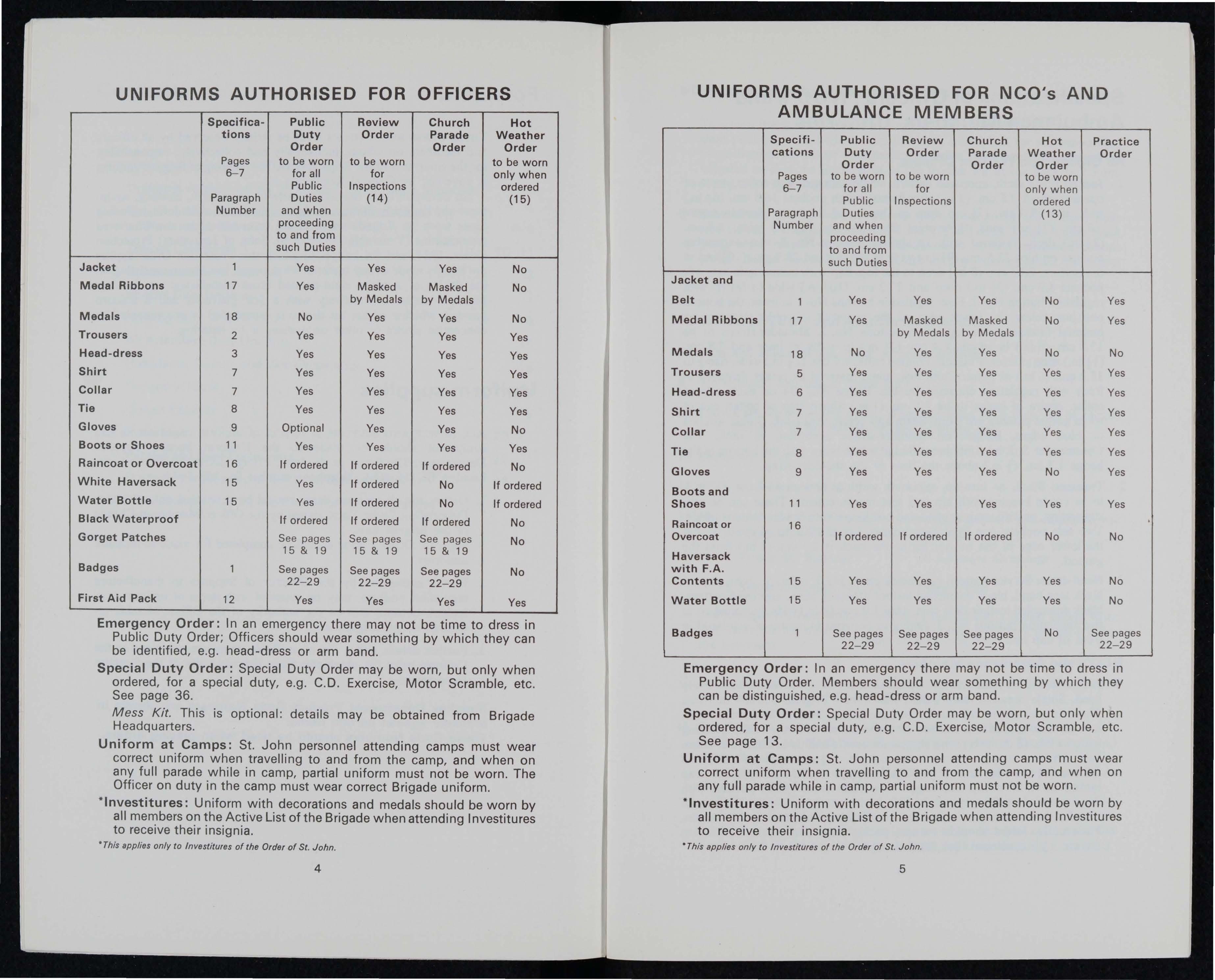
UNIFORMS AUTHORISED FOR OFFICERS
Specifica-
Pages to be worn to be worn to be worn 6-7 for all for only when Public Inspections ordered Paragraph Duties (14 ) (15) Number and when proceeding to and from such Duties
Jacket
Medal Ribbons
Boots or Shoes 11
Raincoat or Overcoat 16 If ordered If ordered If ordered No
White Haversack 15 Yes If ordered No If ordered
Water Bottle 15 Yes If ordered No If ordered
Black Waterproof If ordered If ordered If ordered No
Gorget Patches See pages See pages See pages No 15 & 19 15 & 19 15 & 19
Badges 1 See
First Aid Pack 12
See
See
Emergency Order: In an emergency there may not be time to dress in Public Duty Order; Officers should wear something by which they can be identified, e.g . head-dress or arm band.
Special Duty Order: Special Duty Order may be worn, but only when ordered, for a special duty, e.g. C.D. Exercise, Motor Scramble, etc. See page 36.
Mess Kit. This is optional: details may be obtained from Brigade Headquarters.
Uniform at Camps: St. John personnel attending camps must wear correct uniform when travelling to and from the camp, and when on any full parade while in camp, partial uniform must not be worn. The Officer on duty in the camp must wear correct Brigade uniform.
*Investitures: Uniform with decorations and medals should be worn by all members on the Active List of the Brigade when attending Investitures to receive their insignia.
"This applies only to Investitures of the Order of St. John.
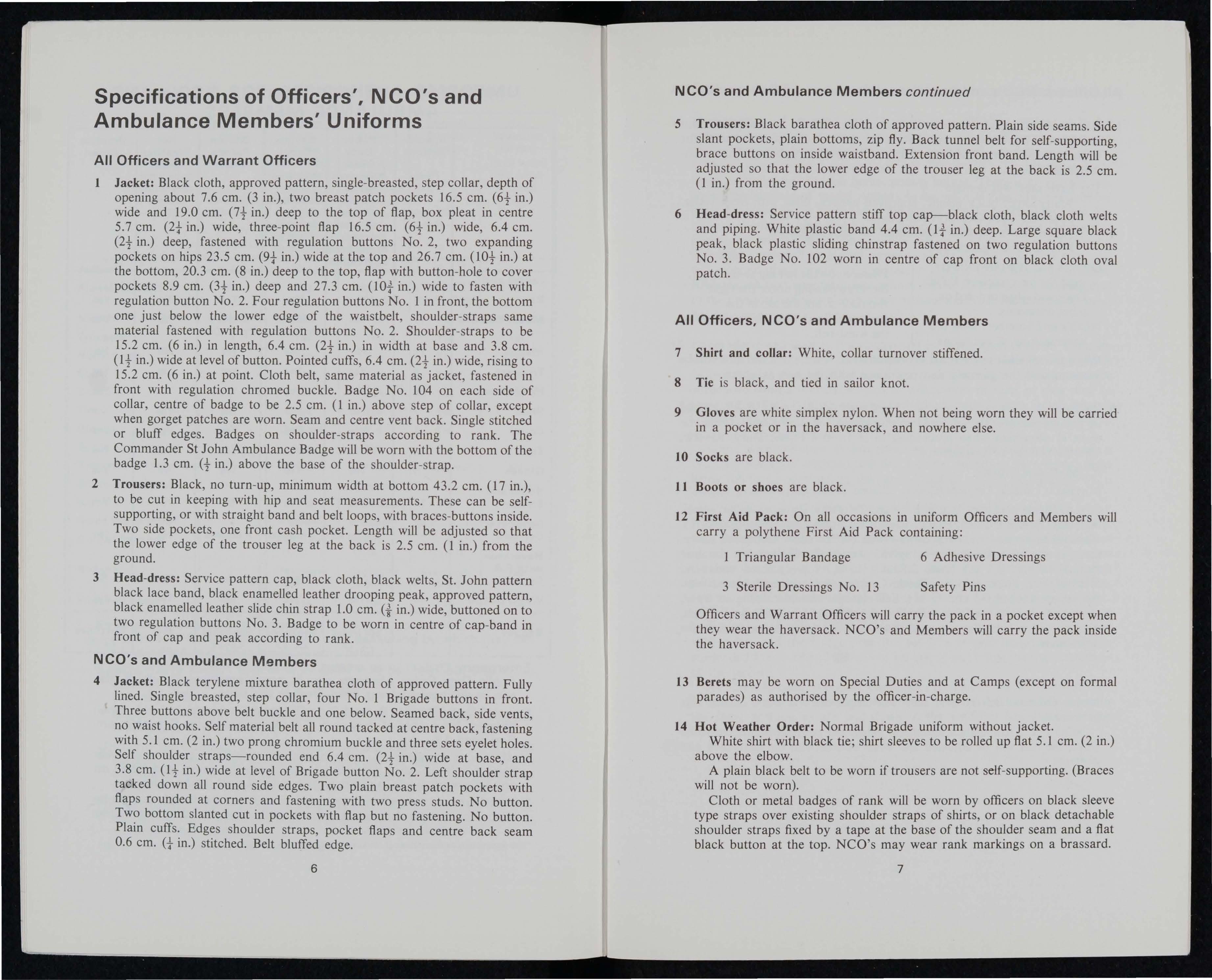
UNIFORMS AUTHORISED FOR NCOls AND AMBULANCE MEMBERS
Specifi- Public Review Church Hot Practice cations Duty Order Parade Weather Order Order Order Order Pages to be worn to
Paragraph Duties (13) Number and when proceeding to and from such Duties
or
Emergency Order: In an emergency there may not be time to dress in Public Duty Order. Members should wear something by which they can be distinguished, e.g. head-dress or arm band.
Special Duty Order: Special Duty Order may be worn, but only when ordered, for a special duty, e.g. C.D. Exercise, Motor Scramble, etc. See page 13.
Uniform at Camps: St. John personnel attending camps must wear correct uniform when travelling to and from the camp, and when on any full parade while in camp, partial uniform must not be worn.
*Investitures: Uniform with decorations and medals should be worn by all members on the Active List of the Brigade when attending Investitures to receive their insignia.
"This applies only to Investitures of the Order of St. John 5
Specifications
of
Officers',
NCO's and Ambulance Members' Uniforms
All Officers and Warrant Officers
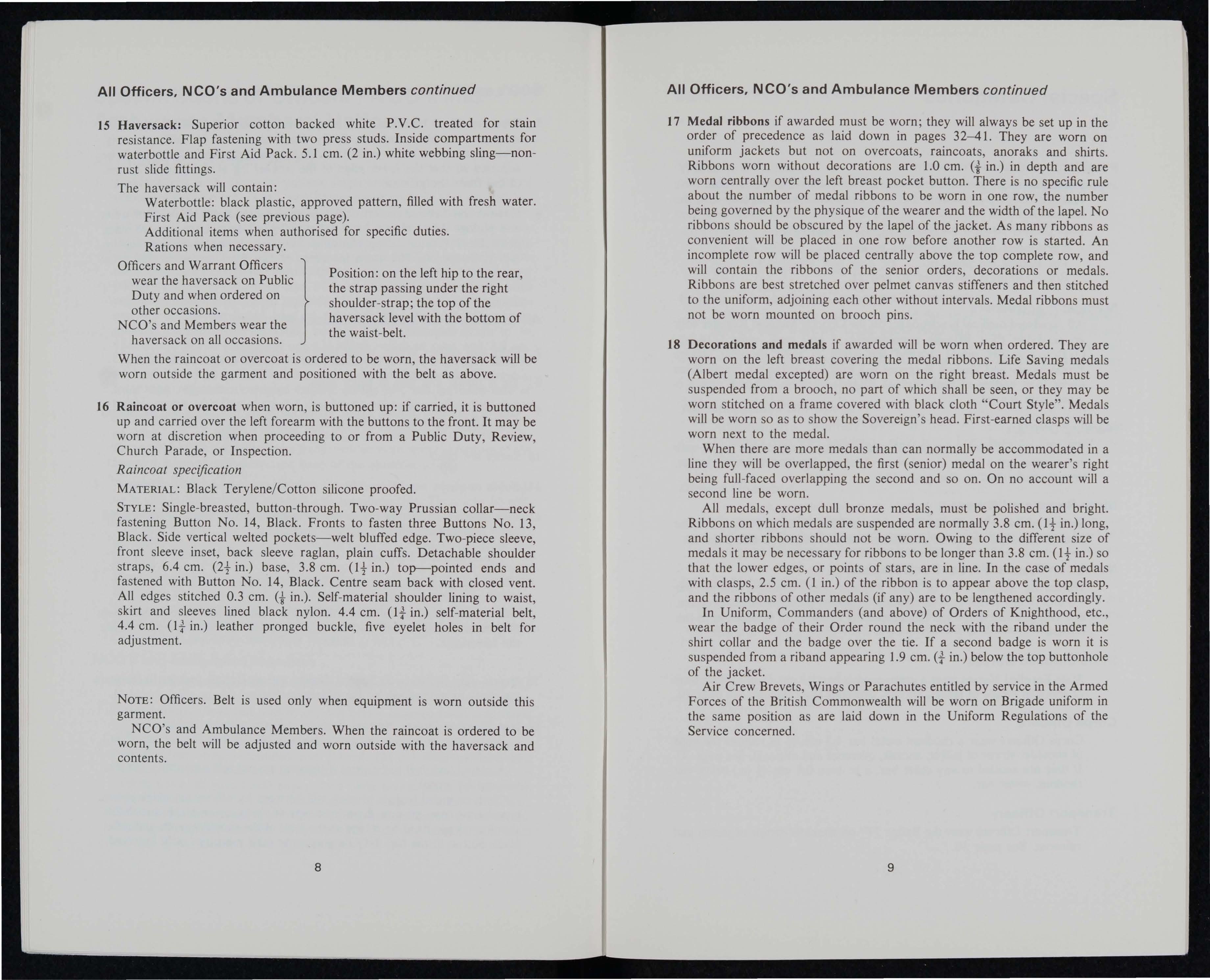
1 Jacket: Black cloth, approved pattern, single-breasted, step collar, depth of opening about 7.6 cm. (3 in.), two breast patch pockets 16.5 cm. (6+ in.) wide and 19.0 cm. (7+ in.) deep to the top of flap, box pleat in centre 5.7 cm. (2t in.) wide, three-point flap 16.5 cm. (6+ in.) wide, 6.4 cm. (2+ in.) deep, fastened with regulation buttons No.2, two expanding pockets on hips 23.5 cm. (9t in.) wide at the top and 26.7 cm. (l0+ in.) at the bottom, 20.3 cm. (8 in.) deep to the top, flap with button-hole to cover pockets 8.9 cm. (3+ in.) deep and 27.3 cm. (lot in.) wide to fasten with regulation button No.2. Four regulation buttons No.1 in front, the bottom one just below the lower edge of the waistbelt, shoulder-straps same material fastened with regulation buttons No.2. Shoulder-straps to be 15.2 cm. (6 in.) in length, 6.4 cm. (2+ in.) in width at base and 3.8 cm. (1 + in.) wide at level of button. Pointed cuffs, 6.4 cm. (2+ in.) wide, rising to 15.2 cm. (6 in.) at point. Cloth belt, same material as jacket, fastened in front with regulation chromed buckle. Badge No. 104 on each side of collar, centre of badge to be 2.5 cm. (l in.) above step of collar, except when gorget patches are worn. Seam and centre vent back. Single stitched or bluff edges. Badges on shoulder-straps according to rank. The Commander St John Ambulance Badge will be worn with the bottom of the badge 1.3 cm. (+ in.) above the base of the shoulder-strap.
2 Trousers: Black, no turn-up, minimum width at bottom 43.2 cm. (l7 in.), to be cut in keeping with hip and seat measurements. These can be selfsupporting, or with straight band and belt loops, with braces-buttons inside. Two side pockets, one front cash pocket. Length will be adjusted so that the lower edge of the trouser leg at the back is 2.5 cm. (1 in.) from the ground.
3 Head-dress: Service pattern cap, black cloth, black welts, St. John pattern black lace band, black enamelled leather drooping peak, approved pattern, black enamelled leather slide chin strap 1.0 cm. (t in.) wide, buttoned on to two regulation buttons No.3. Badge to be worn in centre of cap-band in front of cap and peak according to rank.
N CO's and Ambulance Members
4 Jacket: Black terylene mixture barathea cloth of approved pattern. Fully lined. Single breasted, step collar, four No.1 Brigade buttons in front. Three buttons above belt buckle and one below. Seamed back, side vents, no waist hooks. Self material belt all round tacked at centre back, fastening with 5.1 cm. (2 in.) two prong chromium buckle and three sets eyelet holes. Self shoulder straps-rounded end 6.4 cm. (2+ in.) wide at base, and 3.8 cm. (l+ in.) wide at level of Brigade button No.2. Left shoulder strap tacked down all round side edges. Two plain breast patch pockets with flaps rounded at corners and fastening with two press studs. No button. Two bottom slanted cut in pockets with flap but no fastening. No button. Plain cuffs. Edges shoulder straps, pocket flaps and centre back seam 0.6 cm. (t in.) stitched. Belt bluffed edge.
N CO's and Ambulance Members continued
5 Trousers: Black barathea cloth of approved pattern. Plain side seams. Side slant pockets, plain bottoms, zip fly. Back tunnel belt for self-supporting, brace buttons on inside waistband. Extension front band. Length will be adjusted so that the lower edge of the trouser leg at the back is 2.5 cm. (l in.) from the ground.
6 Head-dress: Service pattern stiff top cap--black cloth, black cloth welts and piping. White plastic band 4.4 cm. (I t in.) deep. Large square black peak, black plastic sliding chinstrap fastened on two regulation buttons No.3. Badge No. 102 worn in centre of cap front on black cloth oval patch.
All Officers, N CO's and Ambulance Members
7 Shirt and collar: White, collar turnover stiffened.
8 Tie is black, and tied in sailor knot.
9 Gloves are white simplex nylon. When not being worn they will be carried in a pocket or in the haversack, and nowhere else.
10 Socks are black.
II Boots or shoes are black.
12 First Aid Pack: On all occasions in uniform Officers and Members will carry a polythene First Aid Pack containing: Triangular Bandage 6 Adhesive Dressings
3 Sterile Dressings No. 13 Safety Pins
Officers and Warrant Officers will carry the pack in a pocket except when they wear the haversack. NCO's and Members will carry the pack inside the haversack.
13 Berets may be worn on Special Duties and at Camps (except on formal parades) as authorised by the officer-in-charge.
14 Hot Weather Order: Normal Brigade uniform without jacket. White shirt with black tie; shirt sleeves to be rolled up flat 5.1 cm. (2 in.) above the elbow.
A plain black belt to be worn if trousers are not self-supporting. (Braces will not be worn).
Cloth or metal badges of rank will be worn by officers on black sleeve type straps over existing shoulder straps of shirts, or on black detachable shoulder straps fixed by a tape at the base of the shoulder seam and a flat black button at the top. NCO's may wear rank markings on a brassard.
7
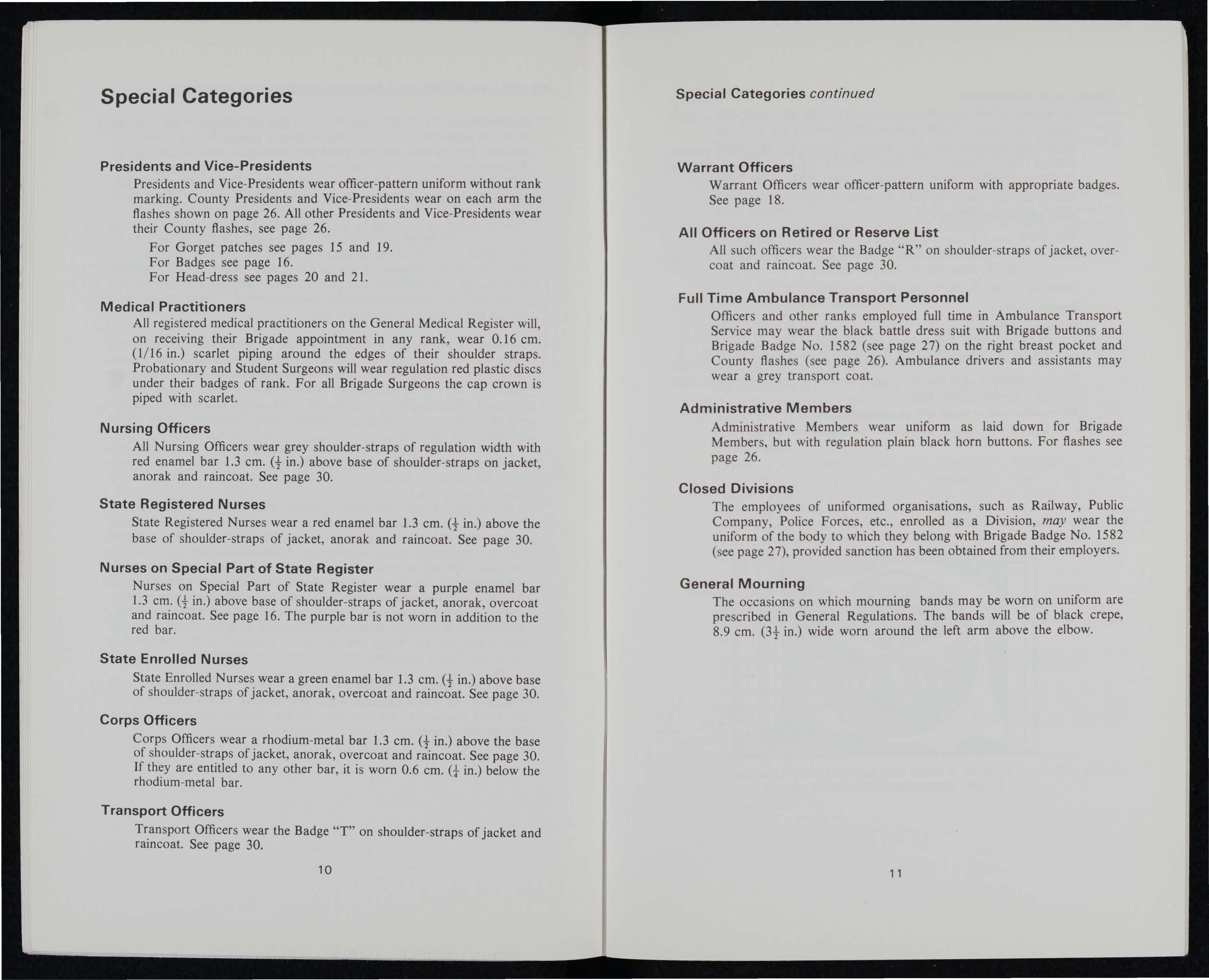
15 Haversack: Superior cotton backed white P.V.C. treated for stain resistance. Flap fastening with two press studs. Inside compartments for waterbottle and First Aid Pack. 5.1 cm. (2 in.) white webbing sling-nonrust slide fittings.
The haversack will contain:
Waterbottle: black plastic, approved pattern, filled with fresh water. First Aid Pack (see previous page). Additional items when authorised for specific duties. Rations when necessary.
Officers and Warrant Officers wear the haversack on Public Duty and when ordered on other occasions.
NCO's and Members wear the haversack on all occasions. Position: on the left hip to the rear, the strap passing under the right shoulder-strap; the top of the haversack level with the bottom of the waist-belt.
When the raincoat or overcoat is ordered to be worn, the haversack will be worn outside the garment and positioned with the belt as above.
16 Raincoat or overcoat when worn, is buttoned up: if carried, it is buttoned up and carried over the left forearm with the buttons to the front. It may be worn at discretion when proceeding to or from a Public Duty, Review, Church Parade, or Inspection.
Raincoat specification
MATERIAL: Black Terylene/Cotton silicone proofed.
STYLE: Single-breasted, button-through. Two-way Prussian collar-neck fastening Button No. 14, Black. Fronts to fasten three Buttons No. 13, Black. Side vertical welted pockets-welt bluffed edge. Two-piece sleeve, front sleeve inset, back sleeve raglan, plain cuffs. Detachable shoulder straps, 6.4 cm. (2t in.) base, 3.8 cm. (It in.) top-pointed ends and fastened with Button No. 14, Black. Centre seam back with closed vent. All edges stitched 0.3 cm. (t in.). Self-material shoulder lining to waist, skirt and sleeves lined black nylon. 4.4 cm. (It in.) self-material belt, 4.4 cm. (1 t in.) leather pronged buckle, five eyelet holes in belt for adjustment.
NOTE: Officers. Belt is used only when equipment is worn outside this garment.
NCO's and Ambulance Members. When the raincoat is ordered to be worn, the belt will be adjusted and worn outside with the haversack and contents.
All Officers, N CO's and Ambulance Members continued
17 Medal ribbons if awarded must be worn; they will always be set up in the order of precedence as laid down in pages 32-41. They are worn on uniform jackets but not on overcoats, raincoats, anoraks and shirts. Ribbons worn without decorations are 1.0 cm. (t in.) in depth and are worn centrally over the left breast pocket button. There is no specific rule about the number of medal ribbons to be worn in one row, the number being governed by the physique of the wearer and the width of the lapel. No ribbons should be obscured by the lapel of the jacket. As many ribbons as convenient will be placed in one row before another row is started. An incomplete row will be placed centrally above the top complete row, and will contain the ribbons of the senior orders, decorations or medals. Ribbons are best stretched over pelmet canvas stiffeners and then stitched to the uniform, adjoining each other without intervals. Medal ribbons must not be worn mounted on brooch pins.
18 Decorations and medals if awarded will be worn when ordered. They are worn on the left breast covering the medal ribbons. Life Saving medals (Albert medal excepted) are worn on the right breast. Medals must be suspended from a brooch, no part of which shall be seen, or they may be worn stitched on a frame covered with black cloth "Court Style". Medals will be worn so as to show the Sovereign's head. First-earned clasps will be worn next to the medal.
When there are more medals than can normally be accommodated in a line they will be overlapped, the first (senior) medal on the wearer's right being full-faced overlapping the second and so on. On no account will a second line be worn.
All medals, except dull bronze medals, must be polished and bright. Ribbons on which medals are suspended are normally 3.8 cm. (It in.) long, and shorter ribbons should not be worn. Owing to the different size of medals it may be necessary for ribbons to be longer than 3.8 cm. (I t in.) so that the lower edges, or points of stars, are in line. In the case of medals with clasps, 2.5 cm. (1 in.) of the ribbon is to appear above the top clasp, and the ribbons of other medals (if any) are to be lengthened accordingly. In Uniform, Commanders (and above) of Orders of Knighthood, etc., wear the badge of their Order round the neck with the riband under the shirt collar and the badge over the tie. If a second badge is worn it is suspended from a riband appearing 1.9 cm. (t in.) below the top buttonhole of the jacket.
Air Crew Brevets, Wings or Parachutes entitled by service in the Armed Forces of the British Commonwealth will be worn on Brigade uniform in the same position as are laid down in the Uniform Regulations of the Service concerned.
Special Categories
Presidents and Vice-Presidents
Presidents and Vice-Presidents wear officer-pattern uniform without rank marking. County Presidents and Vice-Presidents wear on each arm the flashes shown on page 26. All other Presidents and Vice-Presidents wear their County flashes, see page 26.
For Gorget patches see pages 15 and 19.
For Badges see page 16.
For Head-dress see pages 20 and 21.
Medical Practitioners
All registered medical practitioners on the General Medical Register will, on receiving their Brigade appointment in any rank, wear 0.16 cm. (1/16 in.) scarlet piping around the edges of their shoulder straps. Probationary and Student Surgeons will wear regulation red plastic discs under their badges of rank. For all Brigade Surgeons the cap crown is piped with scarlet.
Nursing Officers
All Nursing Officers wear grey shoulder-straps of regulation width with red enamel bar 1.3 cm. (t in.) above base of shoulder-straps on jacket, anorak and raincoat. See page 30.
State Registered Nurses
State Registered Nurses wear a red enamel bar 1.3 cm. (t in.) above the base of shoulder-straps of jacket, anorak and raincoat. See page 30.
Nurses on Special Part of State Register
Nurses on Special Part of State Register wear a purple enamel bar 1.3 cm. (t in.) above base of shoulder-straps of jacket, anorak, overcoat and raincoat. See page 16. The purple bar is not worn in addition to the red bar.
State Enrolled Nurses
State Enrolled Nurses wear a green enamel bar 1.3 cm. (t in.) above base of shoulder-straps of jacket, anorak, overcoat and raincoat. See page 30.
Corps Officers
Corps Officers wear a rhodium-metal bar 1.3 cm. (t in.) above the base of shoulder-straps of jacket, anorak, overcoat and raincoat. See page 30. If they are entitled to any other bar, it is worn 0.6 cm. G- in.) below the rhodium-metal bar.
Transport Officers
Transport Officers wear the Badge "T" on shoulder-straps of jacket and raincoat. See page 30.
Special Categories continued
Warrant Officers
Warrant Officers wear officer-pattern uniform with appropriate badges. See page 18.
All Officers on Retired or Reserve List
All such officers wear the Badge "R" on shoulder-straps of jacket, overcoat and raincoat. See page 30.
Full Time Ambulance Transport Personnel
Officers and other ranks employed full time in Ambulance Transport Service may wear the black battle dress suit with Brigade buttons and Brigade Badge No. 1582 (see page 27) on the right breast pocket and County flashes (see page 26). Ambulance drivers and assistants may wear a grey transport coat.
Administrative Members
Administrative Members wear uniform as laid down for Brigade Members, but with regulation plain black horn buttons. For flashes see page 26.
Closed Divisions
The employees of uniformed organisations, such as Railway, Public Company, Police Forces, etc., enrolled as a Division, may wear the uniform of the body to which they belong with Brigade Badge No. 1582 (see page 27), provided sanction has been obtained from their employers.
General Mourning
The occasions on which mourning bands may be worn on uniform are prescribed in General Regulations. The bands will be of black crepe, 8.9 cm. (3t in.) wide worn around the left arm above the elbow.
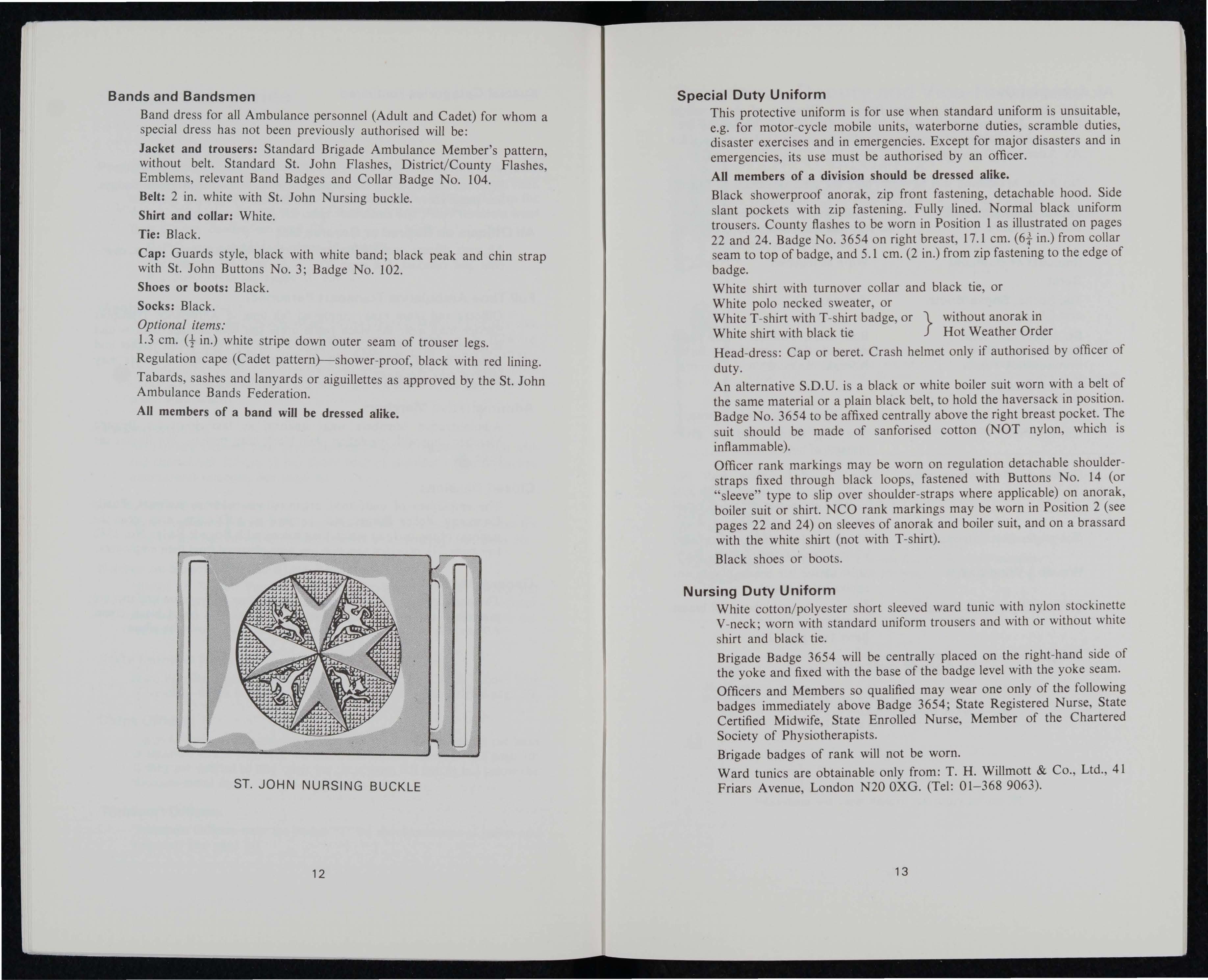
Bands and Bandsmen
dress for all Ambulance personnel (Adult and Cadet) for whom a specIal dress has not been previously authorised will be:
and trousers: Standard Brigade Ambulance Member's pattern, wIthout belt. Standard St. John Flashes, District/County Flashes, Emblems, relevant Band Badges and Collar Badge No. 104.
Belt: 2 in. white with St. John Nursing buckle.
Shirt and collar: White.
Tie: Black.
Guards style, black with white band; black peak and chin strap wIth St. John Buttons No.3; Badge No. 102.
Shoes or boots: Black.
Socks: Black
Optional items:
1.3 cm. (t in.) white stripe down outer seam of trouser legs.
Regulation cape (Cadet pattern)--shower-proof, black with red lining.
Tabards, sashes and lanyards or aiguillettes as approved by the St. John Ambulance Bands Federation.
All members of a band will be dressed alike.
Special Duty Uniform
This protective uniform is for use when standard uniform is unsuitable, e.g. for motor-cycle mobile units, waterborne duties, scramble duties, disaster exercises and in emergencies. Except for major disasters and in emergencies, its use must be authorised by an officer.
All members of a division should be dressed alike.
Black showerproof anorak, zip front fastening, detachable hood. Side slant pockets with zip fastening. Fully lined. Normal black uniform trousers. County flashes to be worn in Position 1 as illustrated on pages 22 and 24. Badge No. 3654 on right breast, 17.1 cm. (6t in.) from collar seam to top of badge, and 5.1 cm. (2 in.) from zip fastening to the edge of badge.
White shirt with turnover collar and black tie, or White polo necked sweater, or
White T-shirt with T-shirt badge, or } without anorak in White shirt with black tie Hot Weather Order
Head-dress: Cap or beret. Crash helmet only if authorised by officer of duty.
An alternative S.D.V. is a black or white boiler suit worn with a belt of the same material or a plain black belt, to hold the haversack in position.
Badge No. 3654 to be affixed centrally above the right breast pocket. The suit should be made of sanforised cotton (NOT nylon, which is inflammable).
Officer rank markings may be worn on regulation detachable shoulderstraps fixed through black loops, fastened with Buttons No. 14 (or "sleeve" type to slip over shoulder-straps where applicable) on anorak, boiler suit or shirt. NCO rank markings may be worn in Position 2 (see pages 22 and 24) on sleeves of anorak and boiler suit, and on a brassard with the white shirt (not with T-shirt).
Black shoes or boots.
Nursing Duty Uniform
White cotton/polyester short sleeved ward tunic with nylon stockinette V-neck; worn with standard uniform trousers and with or without white shirt and black tie.
Brigade Badge 3654 will be centrally placed on the right-hand side of the yoke and fixed with the base of the badge level with the yoke seam.
Officers and Members so qualified may wear one only of the following badges immediately above Badge 3654; State Registered Nurse, State Certified Midwife, State Enrolled Nurse, Member of the Chartered Society of Physiotherapists.
Brigade badges of rank will not be worn.
Ward tunics are obtainable only from: T. H. Willmott & Co., Ltd., 41 Friars Avenue, London N200XG. (Tel: 01-368 9063).
ST. JOHN NURSING BUCKLE
Air Attendant Duty
Air Attendants should enquire from the Director of Aeromedical Services, I Grosvenor Crescent, London SW IX 7EF, about the purchase and availability of the items of uniform specified below as worn for Air Attendant Duty only.
No RANK MARKINGS will be worn, only the rings of ribbon as stated.
Jacket or Anorak with Black Trousers
Raincoat or Overcoat
Beret
Tie, Socks, Shoes/Boots and Gloves
St. John Flash with Aeromedical Flash immediately below Ribbon Rings
On Shirt, Anorak, Raincoat and Overcoat:
On Jacket only:
Doctors and Professional nurses:
Non-professional attendants:
Woven t Wing Badge
t Wing Silver Wire Badge
Badge 104 will not be worn
With long- or short-sleeved white shirt with shoulder straps and with or without breast pocket(s).
Worn as required.
(See page 7).
Both arms, Position 1 (see pages 22 and 24): on Shirt, Jacket
Anorak, Raincoat and Overcoat.
One ring on each shoulder strap.
One ring sewn round the lower forearm of both sleeves.
Black corded ribbon with two white stripes of equal width and edged with scarlet stripes of equal width.
Black corded ribbon with two white stripes of equal width.
Shirt above left breast pocket (or equivalent position).
Jacket or Anorak above left breast pocket.
Beret (see page 21).
Presidents, Deputy and Vice-Presidents
Gorget Patches
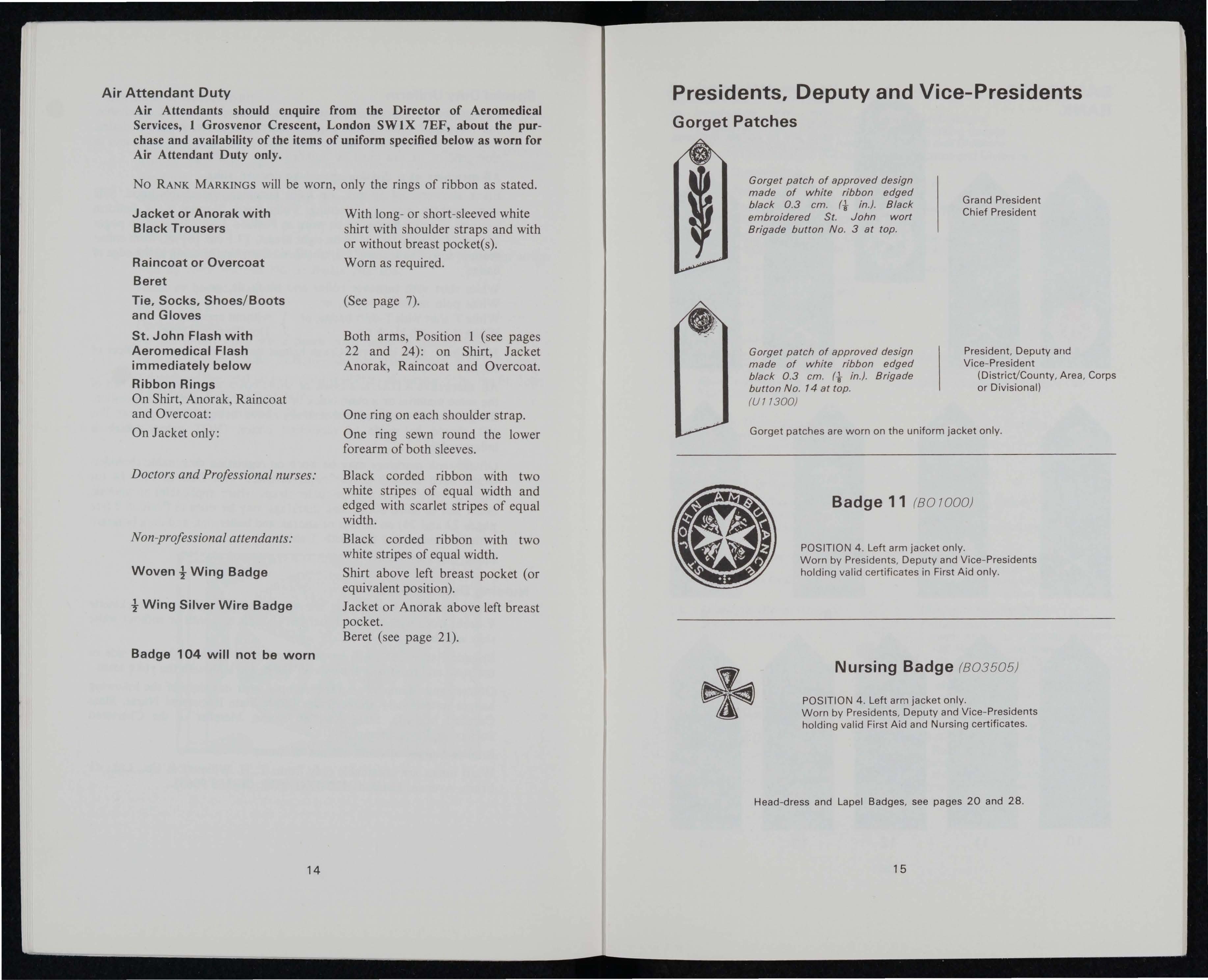
Gorget patch of approved design made of white ribbon edged black 0.3 cm. (i in.). Black embroidered St. John wort Brigade button No. 3 at top.
Gorget patch of approved design made of white ribbon edged black 0.3 cm (i in.). Brigade button No. 14 at top. (UI1300)
Grand President Chief President
President, Deputy and Vice-President (District/County, Area, Corps or Divisional)
Gorget patches are worn on the uniform jacket only. Badge 11 (807000)
POSITION 4. Left arm jacket only. Worn by Presidents, Deputy and Vice-Presidents holding valid certificates in First Aid only.
Nursing Badge (803505)
POSITION 4. Left arm jacket only. Worn by Presidents, Deputy and Vice-Presidents holding valid First Aid and Nursing certificates.
Head-dress and Lapel Badges, see pages 20 and 2B.
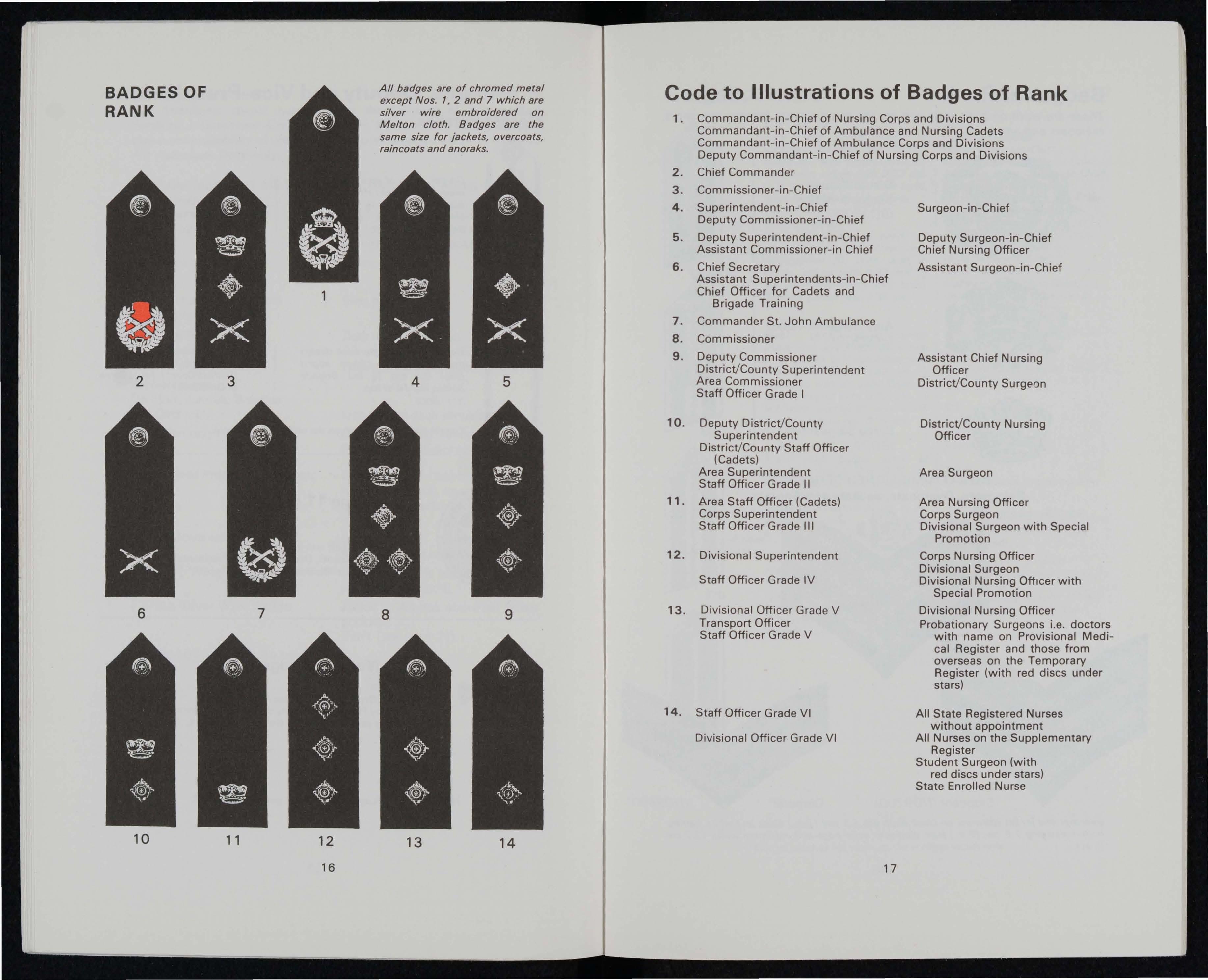
Code to Illustrations of Badges of Rank
District/County
Badges of Rank
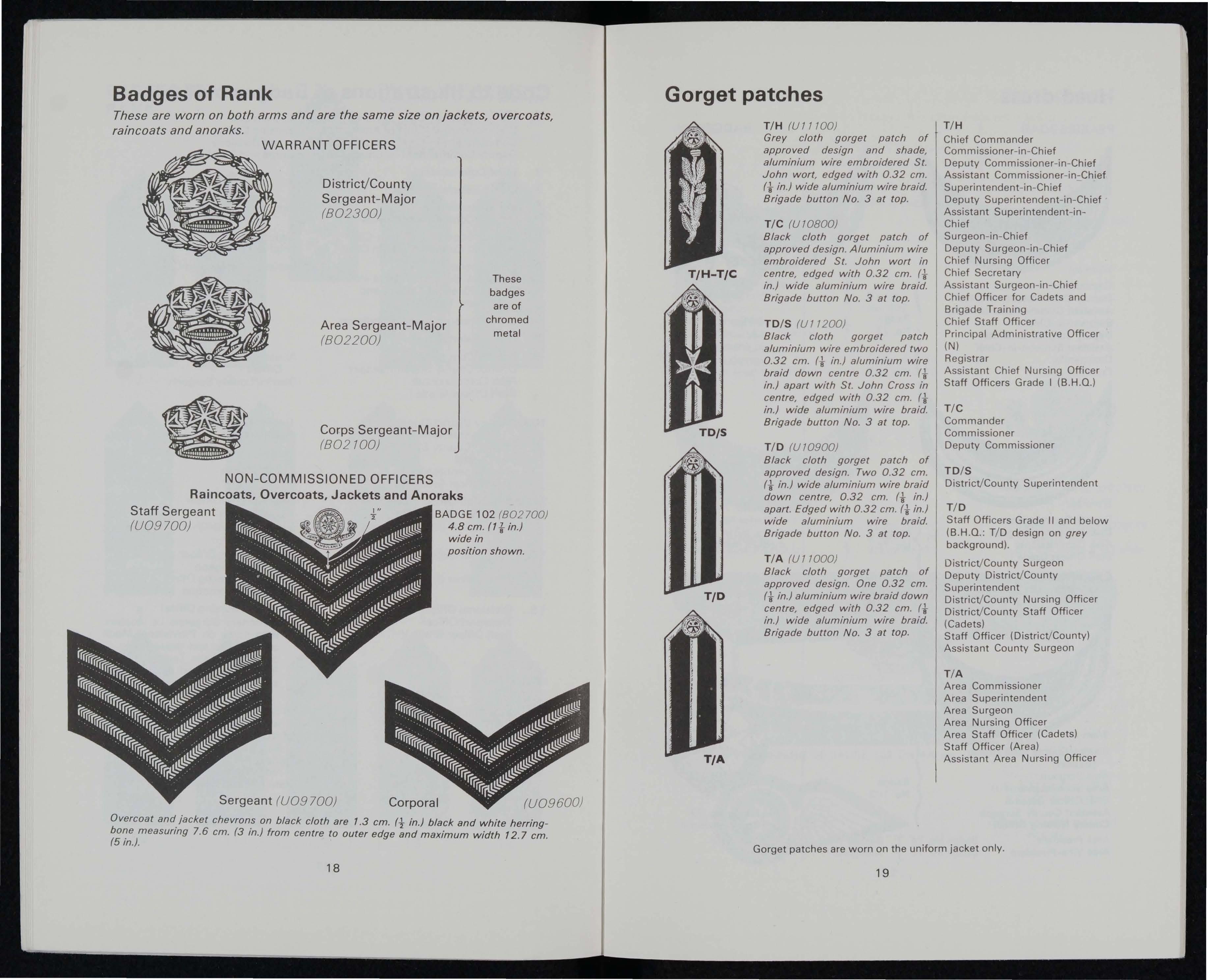
These are worn on both arms and are the same size on jackets, overcoats, raincoats and anoraks.
WARRANT OFFICERS
District/County Sergeant-Major (802300)
Area Sergeant-Major (802200)
Gorget patches
T/H (U 17 700)
Grey cloth gorget patch of approved design and shade , aluminium wire embroidered St. John wort, edged with 0 32 cm (t in.) wide aluminium wire braid.
Brigade button No.3 at top
TIC (U70 BOO)
Black cloth gorget patch of approved design Aluminium wire embroidered St John wort in centre , edged with 0 32 cm (t in.) wide aluminium wire braid Brigade button No 3 at top.
TD/S (U 7 7200)
Black cloth gorget patch aluminium wire embroidered two 0 32 cm (t in.) aluminium wire braid down centre 0 32 cm. (t in.) apart with St. John Cross in centre , edged with 0 32 cm (t in.) wide aluminium wire braid Brigade button No 3 at top
T/H
Chief Commander Commissioner-in-Chief
Deputy Commissioner-in-Chief
Assistant Commissioner-in-Chief
Superintendent-in-Chief
Deputy Superintendent-in-Chief
Assistant Superintendent-inChief
Surgeon-in-Chief
Deputy Surgeon-in-Chief
Chief Nursing Officer
Chief Secretary
Assistant Surgeon-i n-Chief
Chief Officer for Cadets and Brigade Training
Chief St aff Officer
Principal Administrative Officer (N)
Registrar
Assistant Ch ef Nurs ng Officer
Staff Officers Grade I (B H O )
TIC Commander
Corps Sergeant-Major (802 700)
NON-COMMISSIONED OFFICERS
Raincoats, Overcoats, Jackets and Anoraks
Staff
TID (U70900)
Black cloth gorget patch of approved design Two 0.32 cm. (t in.) wide aluminium wire braid down centre, 0.32 cm (t in.) apart Edged with 0 32 cm. (t in.) wide aluminium wire braid. Brigade button No 3 at top
TI A (U 7 7000)
B lack cloth gorget patch of approved design. One 0.32 cm (t in.) aluminium wire braid down centre , edged with 0 32 cm (t in.) wide aluminium wire braid. Brigade button No. 3 at top
Commissioner
Deputy Commissioner
TD/S
District/County Superintendent
TID
Staff Officers Grade II and below (B H O.: TI D design on grey background).
District/County Surgeon
Deputy District/County
Superintendent
District/County Nursing Officer
District/County Staff Officer (Cadets)
Staff Officer (District/County)
Assistant County Surgeon
T/A
Area Commissioner
Area Superintendent
Area Surgeon
Area Nursing Officer
Area Staff Officer (Cadets)
Staff Officer (Area)
Assistant Area Nursing Officer
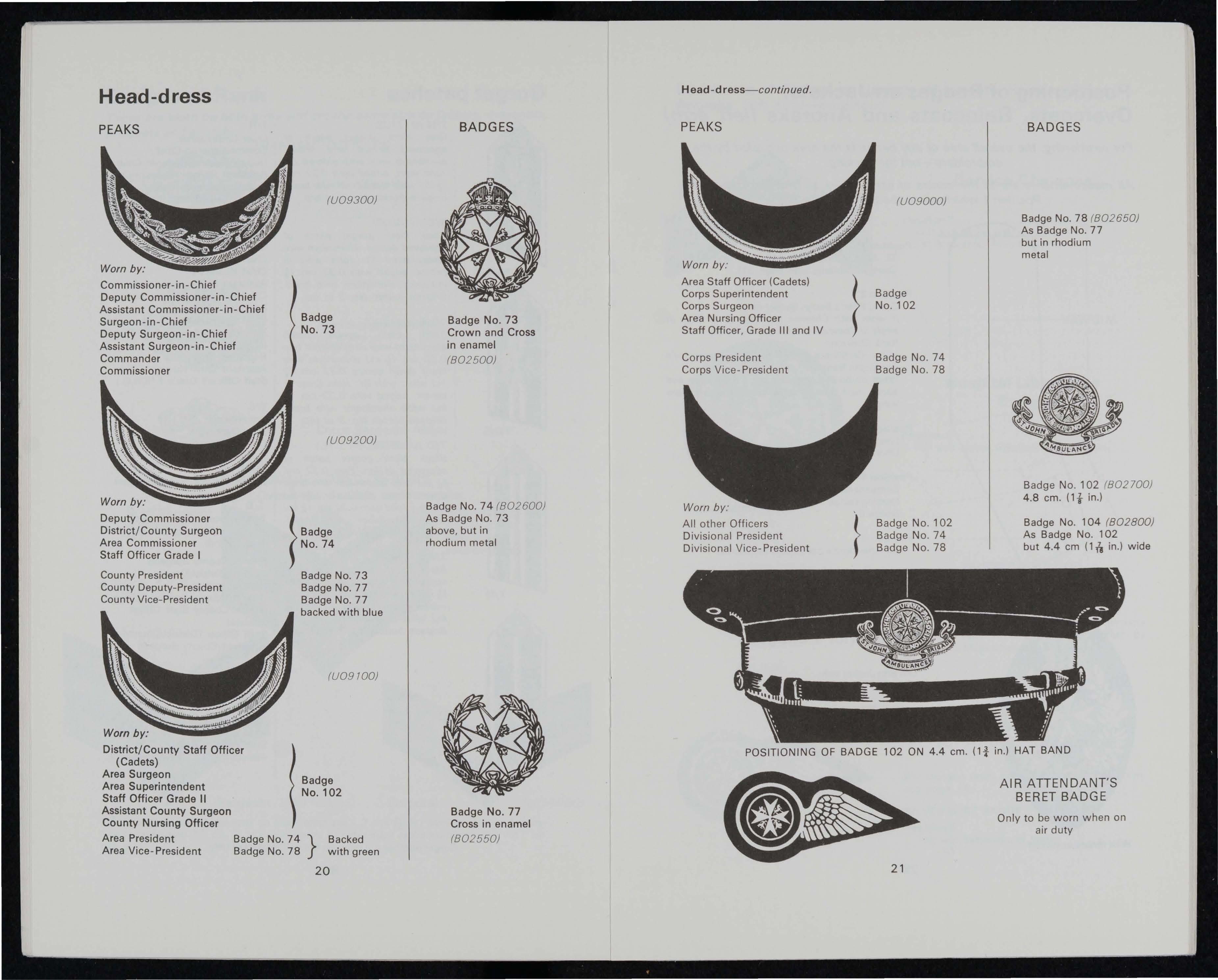
Head-dress
PEAKS
Commissioner-
Deputy
Assistant
Surgeon-in- Chief
Deputy
Assistant
Area
Area
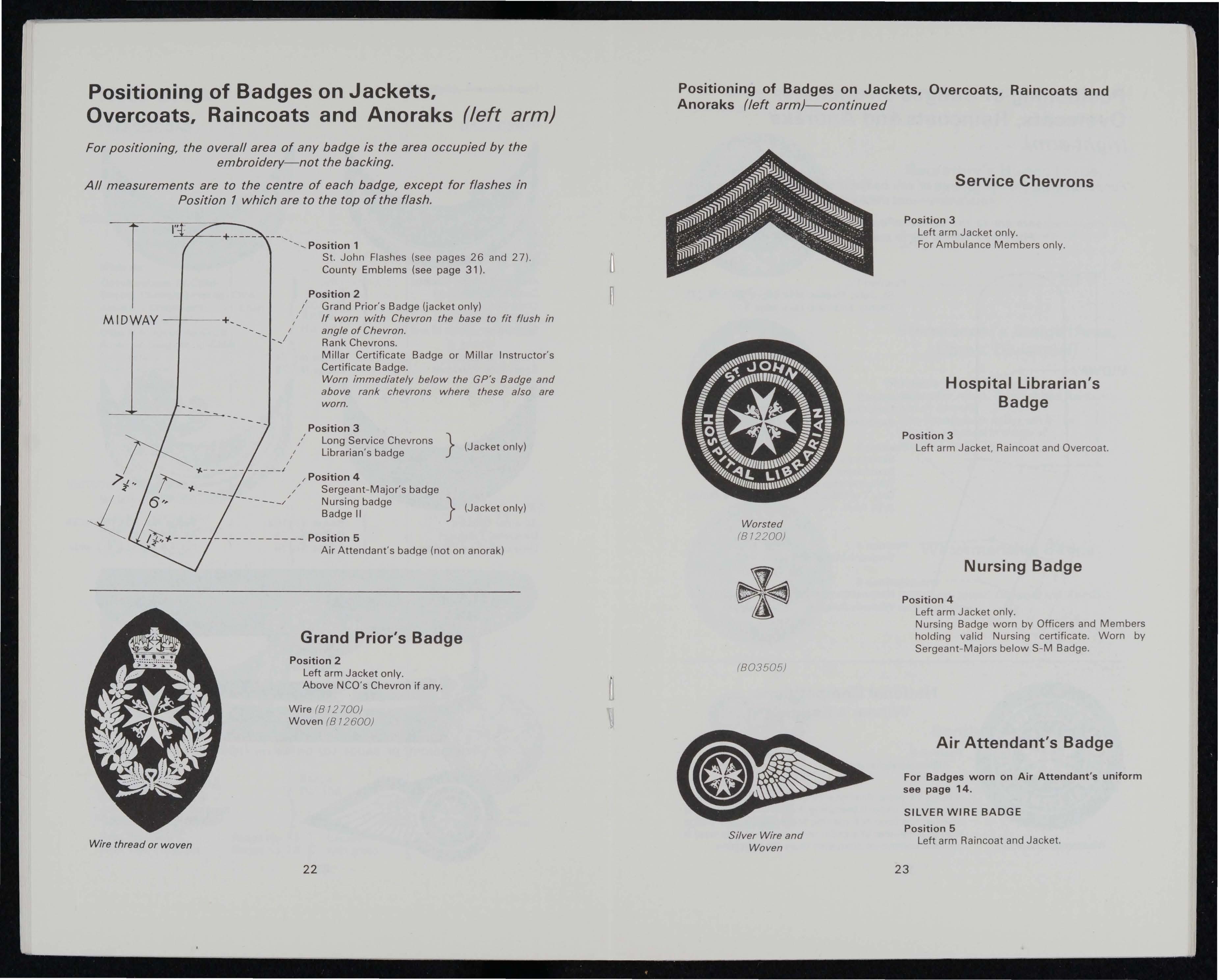
Positioning of Badges on Jackets, Overcoats, Raincoats and Anoraks (left arm)
For positioning, the overall area of any badge is the area occupied by the embroidery-not the backing.
All measurements are to the centre of each badge, except for flashes in Position 1 which are to the top of the flash.
Position 1
St. John Flashes (see pages 26 and 27) County Emblems (see page 31).
Position 2
Grand Prior's Badge (jacket only)
I - -_ I Rank Chevrons.
Positioning of Badges on Jackets, Overcoats, Raincoats and Anoraks (left arm}-continued
Chevrons
Millar Certificate Badge or Millar Instructor's Certificate Badge Worn immediately below the GP's Badge and above rank chevrons where these also are worn.
Position 3
Long Service Chevrons } (Jacket only) Librarian's badge / Position 4 /' Sergeant-Major's badge
---/ Nursing badge Badge II } (Jacket only)
Position 5 Air Attendant's badge (not on anorak) Grand Prior's Badge Position 2
MIDWAY ---If--- +, / / If worn with Chevron the base to fit flush in angle of Chevron. Wire
(B 72700)
(B 72600)
Position 3 Left arm Jacket only. For Ambulance Members only Hospital Librarian's Badge
Position 3 Left arm Jacket, Ra incoat and Overcoat.
Nursing Badge
Position 4 Left arm Jacket only. Nursing Badge worn by Officers and Members holding valid Nursing certificate Worn by Sergeant- Majors below S-M Badge Air Attendant's Badge
For Badges worn on Air Attendant's uniform see page 14.
SILVER WIRE BADGE
Position 5 Left arm Raincoat and Jacket.
Worsted (B72200)
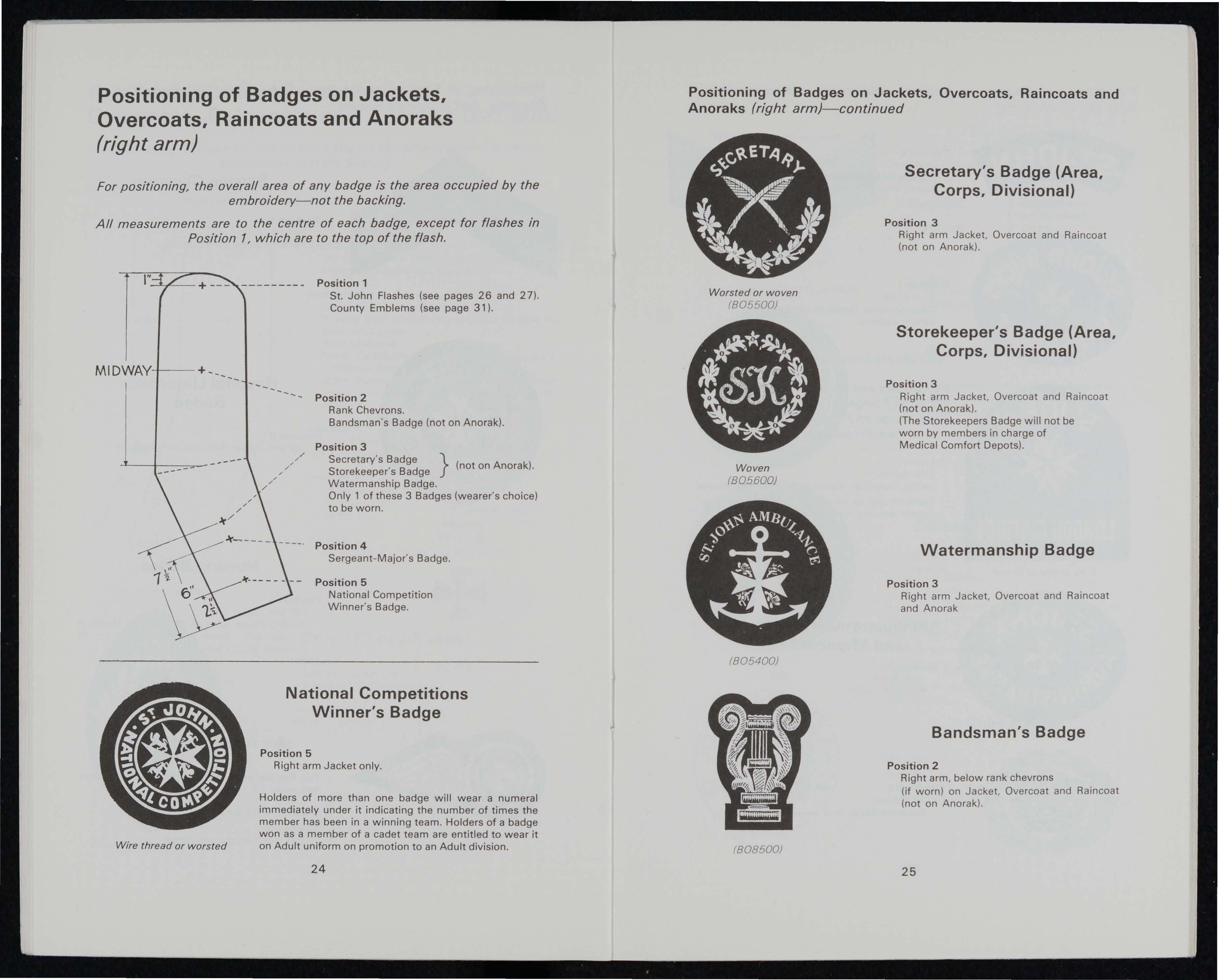
Positioning of Badges on Jackets, Overcoats, Raincoats and Anoraks (right arm)
For positioning, the overall area of any badge is the area occupied by the embroidery-not the backing.
All measurements are to the centre of each badge, except for flashes in Position 1, which are to the top of the flash.
Position 1
St. John Flashes (see pages 26 and 27) County Emblems (see page 31).
Position 2 Rank Chevrons
Bandsman's Badge (not on Anorak)
Position 3
Secretary's Badge } Storekeeper s Badge (not on Anorak) Watermanship Badge. Only 1 of these 3 Badges (wearer's choice) to be worn.
Position 4 Sergeant- Major s Badge
Position 5 National Competition Winner's Badge
Wire thread or worsted
Position 5
Holders of more than one badge will wear a numeral immediately under it indicating the number of times the member has been in a winning team Holders of a badge won as a member of a cadet team are entitled to wear it on Adult uniform on promotion to an Adult division.
Positioning of Badges on Jackets, Overcoats, Raincoats and Anoraks (right arm}-continued
Secretary's Badge (Area, Corps, Divisional)
Position 3
Right arm Jacket, Overcoat and Raincoat (not on Anorak).
Storekeeper's Badge (Area, Corps, Divisional)
Position 3
Right arm Jacket, Overcoat and Raincoat (not on Anorak) (The Storekeepers Badge will not be worn by members in charge of Medical Comfort Depots).
Watermanship Badge
Position 3
Right arm Jacket, Overcoat and Raincoat and Anorak
Bandsman's Badge
Position 2
Right arm, below rank chevrons (if worn ) on Jacket, Overcoat and Ra incoat (not on Anorak) 25
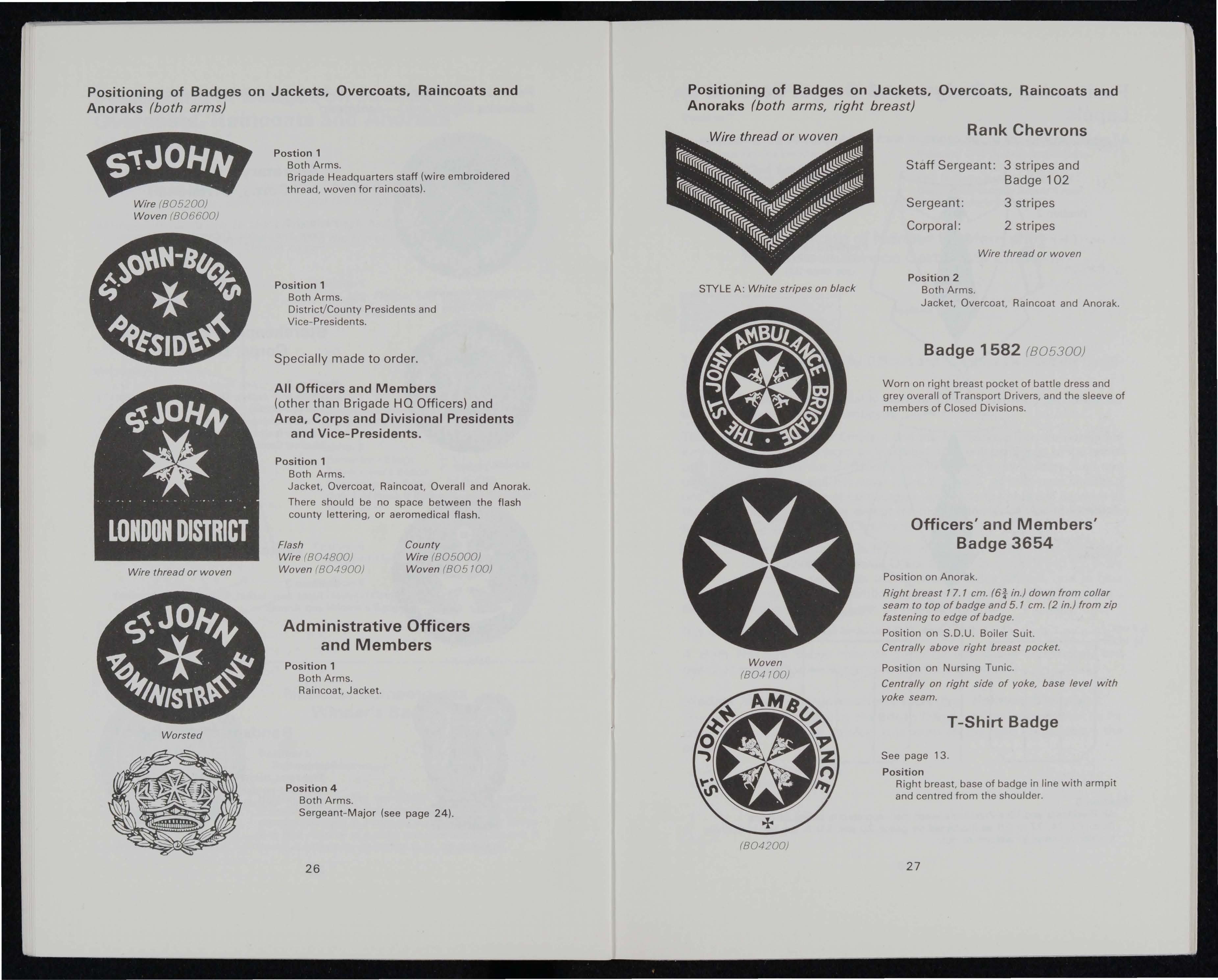
Positioning of Badges on Jackets, Overcoats, Raincoats and Anoraks (both arms)
Postion 1
Both Arms. Brigade Headquarters staff (wire embroidered thread, woven for raincoats).
Position 1
Both Arms District/County Presidents and Vice- Presidents.
Specially made to order.
All Officers and Members (other than Brigade HQ Officers) and Area, Corps and Divisional Presidents and Vice-Presidents.
Position 1
Both Arms. Jacket, Overcoat, Raincoat, Overall and Anorak There should be no space between the flash county lettering, or aeromedical flash.
Flash Wire (804800) Woven (804900) County Wire (805000) Woven (805700)
Administrative Officers and Members
Position 1 Both Arms Raincoat, Jacket
Position 4 Both Arms Sergeant-Major (see page 24).
Positioning of Badges on Jackets, Overcoats, Raincoats and Anoraks (both arms, right breast)
Rank Chevrons
Staff
Badge 1582 (805300)
Worn on right breast pocket of battle dress and grey overall of Transport Drivers, and the sleeve of members of Closed Divisions
Officers' and Members' Badge 3654
Position on Anorak Right breast
to edge of badge
Position on S.D U Boiler Suit.
Centrally above right breast pocket.
Position on Nursing Tunic
Centrally on right side of yoke, base level with yoke seam
T-Shirt Badge
See page 13. Position
Right breast, base of badge in line with armpit and centred from the shoulder 27
STYLE A : White stripes on black
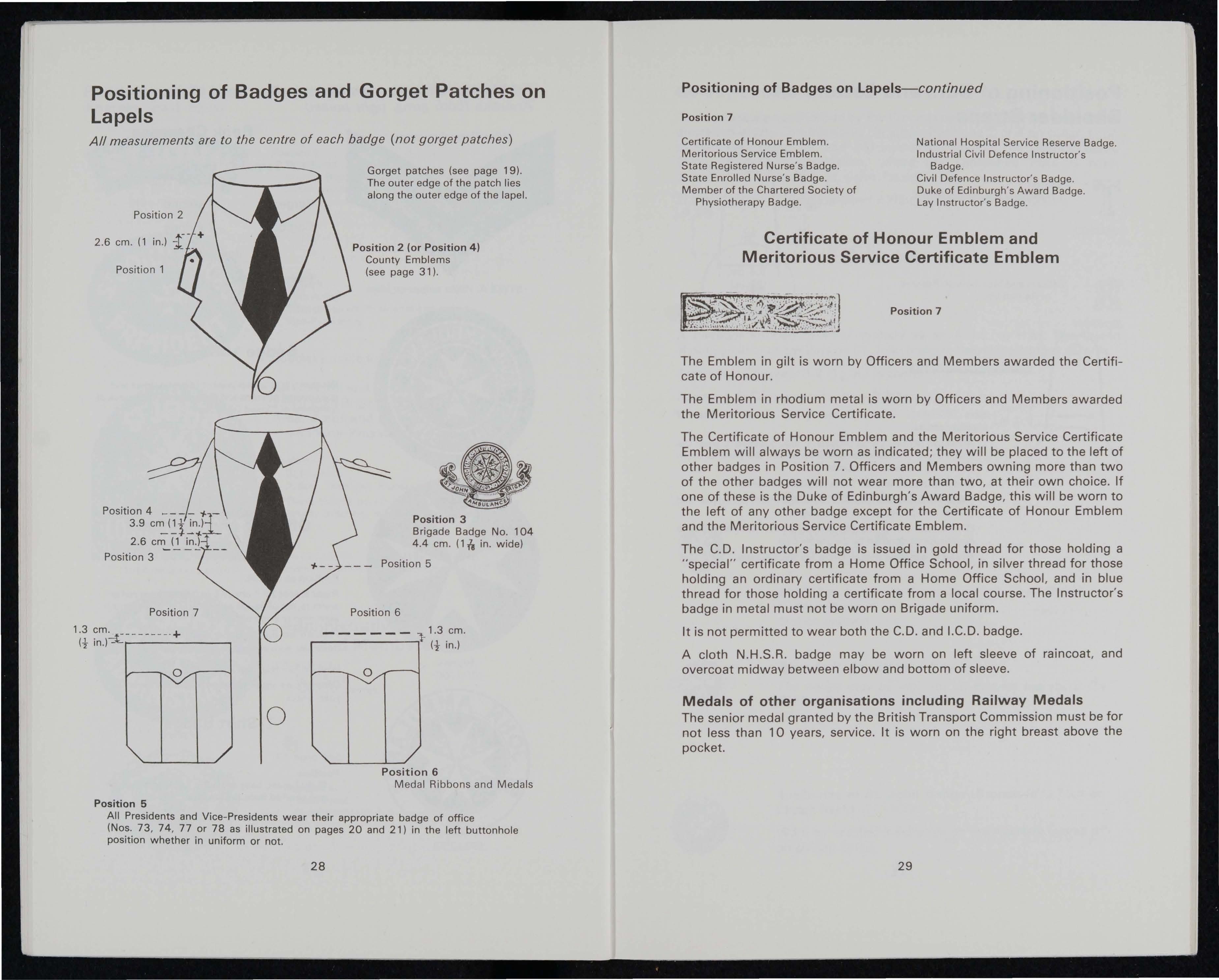
Positioning of Badges and Gorget Patches on Lapels
All measurements are to the centre of each badge (not gorget patches)
Gorget patches (see page 19). The
Positioning of Badges on Lapels-continued
Position 7
Certificate of Honour Emblem. Meritorious Service Emblem.
State Registered Nurse's Badge. State Enrolled Nurse's Badge.
Member of the Chartered Society of Physiotherapy Badge.
National Hospital Service Reserve Badge. Industrial Civil Defence Instructor's Badge.
Civil Defence Instructor's Badge. Duke of Edinburgh's Award Badge Lay Instructor's Badge
Certificate of Honour Emblem and Meritorious Service Certificate Emblem
Position 7
The Emblem in gilt is worn by Officers and Members awarded the Certificate of Honour.
The Emblem in rhodium metal is worn by Officers and Members awarded the Meritorious Service Certificate.
The Certificate of Honour Emblem and the Meritorious Service Certificate Emblem will always be worn as indicated; they will be placed to the left of other badges in Position 7. Officers and Members owning more than two of the other badges will not wear more than two, at their own choice. If one of these is the Duke of Edinburgh's Award Badge, this will be worn to the left of any other badge except for the Certificate of Honour Emblem and the Meritorious Service Certificate Emblem.
The C.D. Instructor's badge is issued in gold thread for those holding a "special" certificate from a Home Office School, in silver thread for those holding an ordinary certificate from a Home Office School, and in blue thread for those holding a certificate from a local course. The Instructor's badge in metal must not be worn on Brigade uniform.
It is not permitted to wear both the C.D. and I.C.D. badge.
A cloth N.H.S.R. badge may be worn on left sleeve of raincoat, and overcoat midway between elbow and bottom of sleeve.
Medals of other organisations including Railway Medals
The senior medal granted by the British Transport Commission must be for not less than 10 years, service. It is worn on the right breast above the pocket.
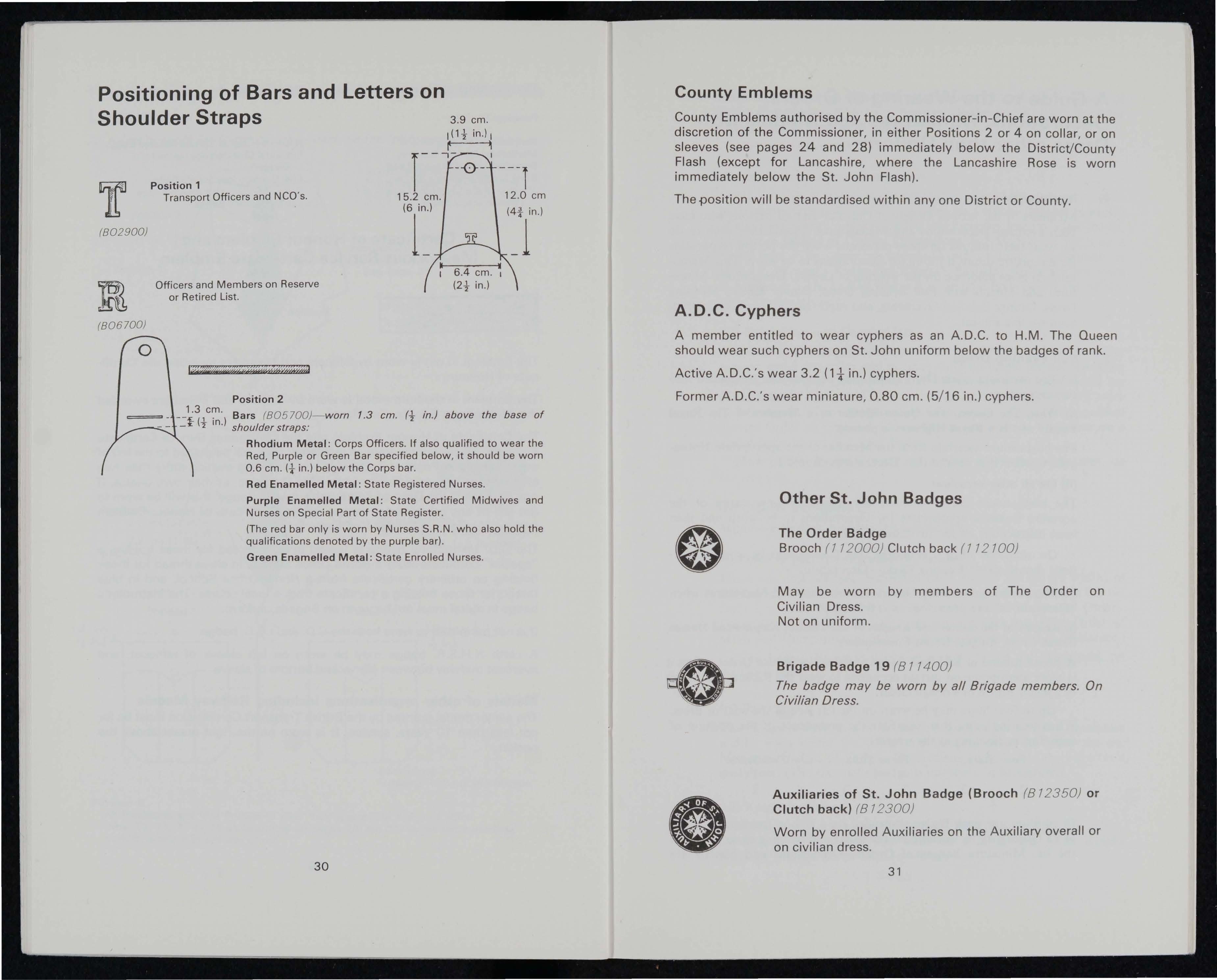
Positioning of Bars and Letters on Shoulder Straps
Officers and Members on Reserve or Retired List
Position 2
__ Bars (805700)- worn 1 3 em. (t in.) above the base of -2 shoulder straps :
Rhodium Metal: Corps Officers. If also qualified to wear the Red. Purple or Green Bar specified below, it should be worn
0 6 cm. (t in.) below the Corps bar
Red Enamelled Metal: State Registered Nurses.
Purple Enamelled Metal: State Certified Midwives and Nurses on Special Part of State Register.
(The red bar only is worn by Nurses S.R N who also hold the qualifications denoted by the purple bar).
Green Enamelled Metal: State Enrolled Nurses
County Emblems
County Emblems authorised by the Commissioner-in-Chief are worn at the discretion of the Commissioner, in either Positions 2 or 4 on collar, or on sleeves (see pages 24 and 28) immediately below the District/County Flash (except for Lancashire, where the Lancashire Rose is worn immediately below the St. John Flash).
The .position will be standardised within anyone District or County.
A.D.C. Cyphers
A member entitled to wea r cyphers as an A.D.C to H.M The Queen should wear such cyphers on St. John uniform below the badges of rank
Active A.D.C.'s wear 3 2 (1 t in.) cyphers
Former A.D .C.'s wear miniature, 0 .80 cm. (5/ 16 in .) cyphers.
Other St. John Badges
The Order Badge Brooch (112000) Clutch back (112100)
May be worn by members of The Order on Civilian Dress. Not on uniform.
Brigade Badge 19 (B 11400)
The badge may be wo r n by all B rigade members . On Civilian Dress .
Auxiliaries of St. John Badge (Brooch (B 12350) or Clutch back) (B 12300)
Worn by enrolled Auxiliaries on the Auxiliary overall or on civilian dress.
A Guide to the Wearing of Orders, Decorations,
Miniatures and Medals with Dress other than Uniform
1. Introduction
Members of the various Orders of Chivalry and all persons who have been awarded Decorations and Medals may, should they wish to do so, wear their Insignia on those occasions when the person responsible for a function deems it fitting for Decorations to be worn. This Memorandum gives guidance on the wearing of Orders, Decorations, Miniatures and Medals with Full Evening Dress, Dinner Jacket, Morning Dress, Lounge Suit and Overcoats, and supersedes all previous instructions on this subject.
2. Full Evening Dress
(a) The occasions when Decorations may be worn can be divided into two categories:
(i) When The Queen, The Queen Mother or a Member of The Royal Family who is a Royal Highness is present
The host should ascertain from the Member of the appropriate Household whether it is desired that Decorations should be worn.
(ii) On all other occasions
The host should decide whether the nature or importance of the occasion makes it appropriate for Decorations to be worn and then issue instructions on the Invitation Cards.
On occasions when it is desired that Decorations be worn, Invitations should state "Evening Dress- Decorations".
(b) The method of wearing Orders, Decorations and Miniatures when "Decorations" are prescribed is as follows:
(i) Knights of the Garter and Knights of the Thistle; Knights and Dames Grand Cross, Knights Grand Commanders
A Broad Riband or Sash and Badge of the senior British Order, unless it is more appropriate on certain occasions to wear the Riband and Badge of a junior British or Foreign Order.
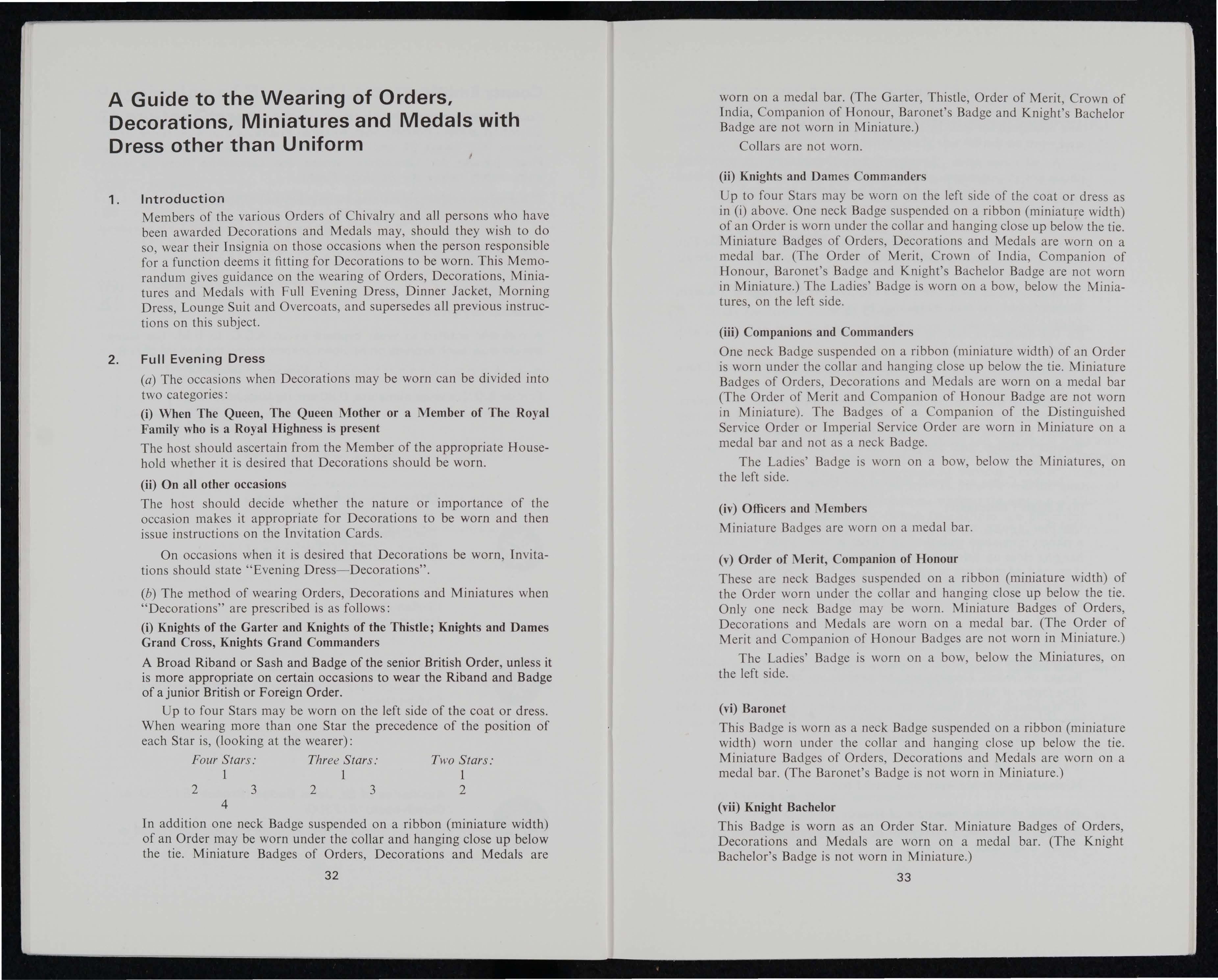
Up to four Stars may be worn on the left side of the coat or dress. When wearing more than one Star the precedence of the position of each Star is, (looking at the wearer):
In addition one neck Badge suspended on a ribbon (miniature width) of an Order may be worn under the collar and hanging close up below the tie. Miniature Badges of Orders, Decorations and Medals are 32
worn on a medal bar. (The Garter, Thistle, Order of Merit, Crown of India, Companion of Honour, Baronet's Badge and Knight's Bachelor Badge are not worn in Miniature.)
Collars are not worn.
(ii) Knights and Dames Commanders
Up to four Stars may be worn on the left side of the coat or dress as in (i) above. One neck Badge suspended on a ribbon (miniature width) of an Order is worn under the collar and hanging close up below the tie.
Miniature Badges of Orders, Decorations and Medals are worn on a medal bar. (The Order of Merit, Crown of India, Companion of Honour, Baronet's Badge and Knight's Bachelor Badge are not worn in Miniature.) The Ladies' Badge is worn on a bow, below the Miniatures, on the left side.
(iii) Companions and Commanders
One neck Badge suspended on a ribbon (miniature width) of an Order is worn under the collar and hanging close up below the tie. Miniature Badges of Orders, Decorations and Medals are worn on a medal bar (The Order of Merit and Companion of Honour Badge are not worn in Miniature). The Badges of a Companion of the Distinguished Service Order or Imperial Service Order are worn in Miniature on a medal bar and not as a neck Badge.
The Ladies' Badge is worn on a bow, below the Miniatures, on the left side.
(iv) Officers and Members
Miniature Badges are worn on a medal bar.
(v) Order of Merit, Companion of Honour
These are neck Badges suspended on a ribbon (miniature width) of the Order worn under the collar and hanging close up below the tie. Only one neck Badge may be worn. Miniature Badges of Orders, Decorations and Medals are worn on a medal bar. (The Order of Merit and Companion of Honour Badges are not worn in Miniature.)
The Ladies' Badge is worn on a bow, below the Miniatures, on the left side.
(vi) Baronet
This Badge is worn as a neck Badge suspended on a ribbon (miniature width) worn under the collar and hanging close up below the tie. Miniature Badges of Orders, Decorations and Medals are worn on a medal bar. (The Baronet's Badge is not worn in Miniature.)
(vii) Knight Bachelor
This Badge is worn as an Order Star. Miniature Badges of Orders, Decorations and Medals are worn on a medal bar. (The Knight Bachelor's Badge is not worn in Miniature.)
3.
(viii) The Royal Victorian Chain
This Chain is worn round the neck by men in place of a neck Badge and is adapted for wear by Ladies on a bow of the ribbon of the Order and worn on the left side above Miniatures.
At all times when " Evening Dress- Decorations" is prescribed, those not in possession of Full Evening Dress may wear a Dinner Jacket with Decorations as described in the next paragraph.
Dinner
Jacket
(a) On occasions when it is desired that Dinner Jackets (and not Full Evening Dress) with Decorations are to be worn , Invitations should state " Dinner Jacket- Decorations".
In addition to Miniatures, only one Star (or the Badge of a Knight Bachelor) and one neck Badge may be worn.
(b) The method of wearing Orders, Decorations and Miniatures with a Dinner Jacket is as follows:
(i) Knights of the Garter, Knights of the Thistle; Knights Grand Cross, Knights Grand Commanders
One Star is worn on the left breast. Miniature Badges of Orders, Decorations and Medals are worn on a medal bar. (The Garter, Thistle, Order of Merit, Crown of India, Companion of Honour, Baronet's Badge and Knight's Bachelor Badge are not worn in Miniature.)
Neither Collar nor Broad Riband and Badge will be worn.
(ii) Knights Commanders
One Star is worn on the left breast and one neck Badge suspended on a ribbon (miniature width) of an Order is worn under the collar and hanging close up below the tie. Miniature Badges of Orders, Decorations and Medals are worn on a medal bar. (The Order of Merit, Crown of India, Companion of Honour, Baronet's Badge and Knight's Bachelor Badge are not worn in Miniature.)
(iii) Companions and Commanders
One neck Badge suspended on a ribbon (miniature width) of the Order is worn under the collar and hanging close up below the tie. Miniature Badges of Orders, Decorations and Medals are worn on a medal bar. (The Order of Merit and Companion of Honour Badge are not worn in Miniature). The Badges of a Companion of the Distinguished Service Order or Imperial Service Order are worn in Miniature on a medal bar and not as a neck Badge.
(iv) Officers and Members
Miniature Badges are worn on a medal bar.
(v) Order of Merit, Companion of Honour
These are neck Badges suspended on a ribbon (miniature width) of the Order worn under the collar and hanging close up below the tie.
34
Only one neck Badge may be worn. Miniature Badges of Orders Decorations and Medals are worn on a medal bar. (The Order of and Companion of Honour Badges are not worn in Miniature.)
(vi) Baronet
This Badge is worn as a neck Badge suspended on a ribbon (miniature width) worn under the collar and hanging close up below the tie. Miniature Badges of Orders, Decorations and Medals are worn on a medal bar. (The Baronet's Badge is not worn in Miniature.)
(vii) Knight Bachelor
The Badge is worn as an Order Star. Miniature Badges of Orders Decorations and Medal s are worn on a medal bar. (The Bachelor's Badge is not worn in Miniature.)
(viii) The Royal Victorian Chain
The Chain may be worn round the neck in place of a neck Badge.
Ladies
(c) The regulations for the wearing of Orders, Decorations and Miniatures by Ladies are the same as in paragraph 2 (b) (ii) above.
4. Morning Dress
(a) The occasions when Orders, Decorations and Medals are worn with Morning Dress are comparatively rare. Such occasions may include special official public functions, religious Services connected with the Orders of Chivalry or Memorial Services. In each case the sponsor of the function or service should indicate whether the wearing of Decorations would be appropriate. When Decorations are prescribed with Morning Dress Insignia should be worn as described below. Those full-size Orders, Decorations and Medals normally mounted on a medal bar should also be worn.
Even so, on all such occasions the wearing of Insignia will be at the discretion of the holder.
(b) The method of wearing Orders, Decorations and Medals, when Decorations with Morning Dress are prescribed, is as follows:
(i) Knights of the Garter, Knights of the Thistle; Knights and Dames Grand Cross, Knights Grand Commanders
Up to four Stars may be worn on the left breast or, for Ladies, in a corresponding place on the dress. (For positioning the Stars see paragraph 2 (b) (i) above.) The Broad Riband and Badge is not worn.
Collars are only worn with Morning Dress if ordered for a special occasion.
(ii) Knights and Dame Commanders
Up to four Stars may be worn on the left breast or, for Ladies, in a corresponding place on the dress. (For positioning the Stars see paragraph 2 (b) (i) above.) The associated neck Badge is not worn.
35
5.
(iii) Companions and Commanders
One neck Badge suspended on a ribbon (miniature width) of the Order is worn under the coIlar. The Badge should hang three quarters of an inch below the tie knot in front of the tie. The Ladies' Badge is worn on a bow on the left side ; if worn with fuIl-size Medals the Badge is worn below the medal bar.
(iv) Officers and Members
The full-size Badge, whether worn singly or mounted on a medal bar, is worn on the left side in the same manner with civilian dress as with uniform. Companions of the Distinguished Service Order or Imperial Service Order wear their Insignia in this manner and not as a neck decoration.
The Ladies' Badge, if worn separately, is worn on a bow on the left side of the dress . If worn with other Medals it is normally mounted on a medal bar and worn in the same manner with civilian dress as with uniform.
(v) Order of Merit, Companion of Honour
One neck Badge suspended on a ribbon (miniature width) of the Order is worn under the collar. The Badge should hang three quarters of an inch below the tie knot in front of the tie.
The Ladies' Badge is worn on a bow on the left side If worn with full-size Medals the Badge is worn below the medal bar.
(vi) Baronet
This Badge is worn as a neck Badge, suspended on a ribbon (miniature width) under the collar. The Badge should hang three quarters of an inch below the tie knot in front of the tie.
(vii) Knight Bachelor
This Badge is worn on the left breast as an Order Star.
(viii) The Royal Victorian Chain
The Chain may be worn round the neck in place of a neck Badge.
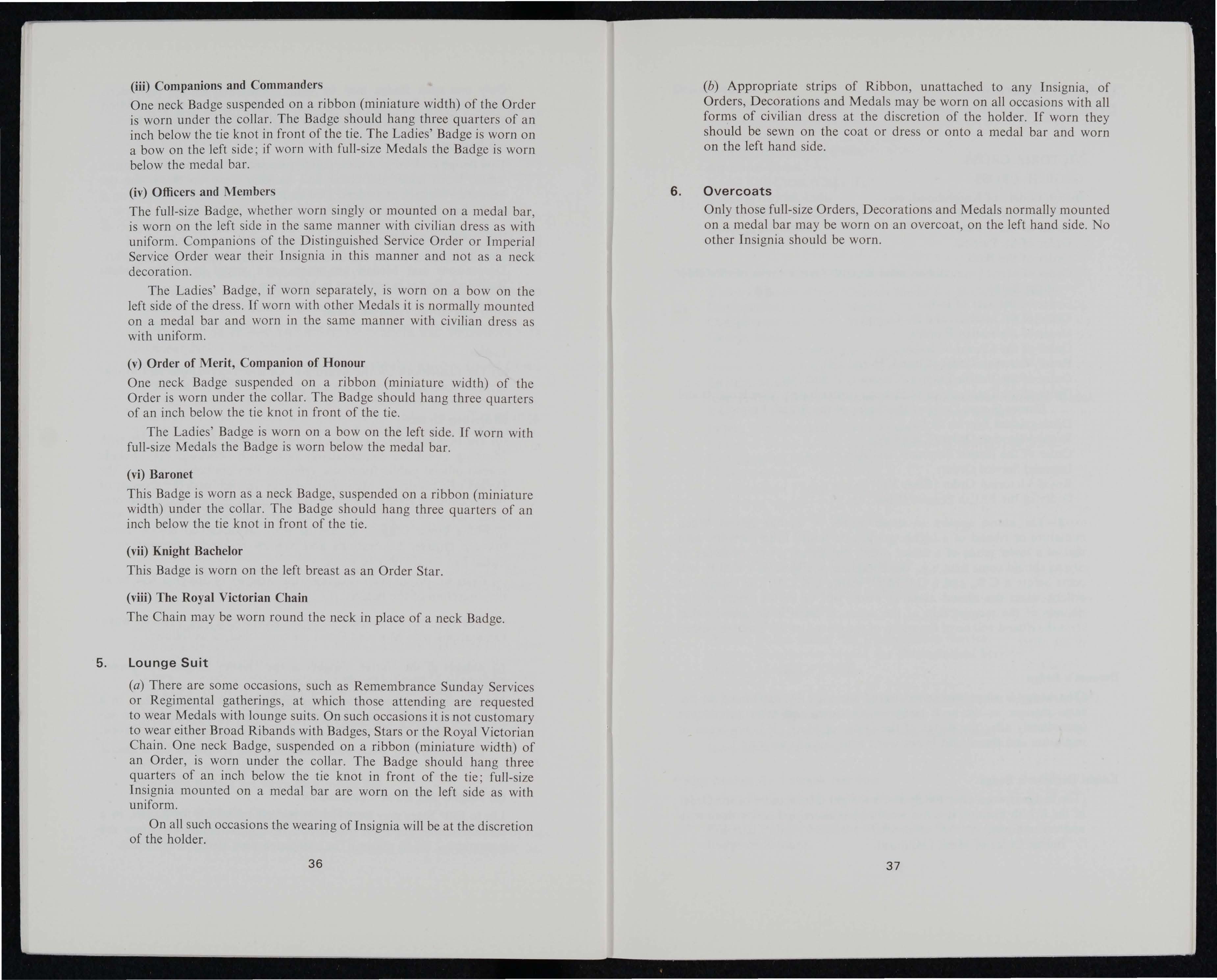
(a) There are some occasions, such as Remembrance Sunday Services or Regimental gatherings, at which those attending are requested to wear Medals with lounge suits. On such occasions it is not customary to wear either Broad Ribands with Badges, Stars or the Royal Victorian Chain. One neck Badge, suspended on a ribbon (miniature width) of an Order, is worn under the collar. The Badge should hang three quarters of an inch below the tie knot in front of the tie; full-size Insignia mounted on a medal bar are worn on the left side as with uniform
On all such occasions the wearing of Insignia will be at the discretion of the holder.
(b) Appropriate strips of Ribbon, unattached to any Insignia, of Orders, Decorations and Medals may be worn on all occasions with all fOfl1!s of civilian dress at the discretion of the holder. If worn they should be sewn on the coat or dress or onto a medal bar and worn on the left hand side.
Overcoats
Only those full-size Orders, Decorations and Medals normally mounted on a medal bar may be worn on an overcoat, on the left hand side. No other Insignia should be worn.
lounge Suit
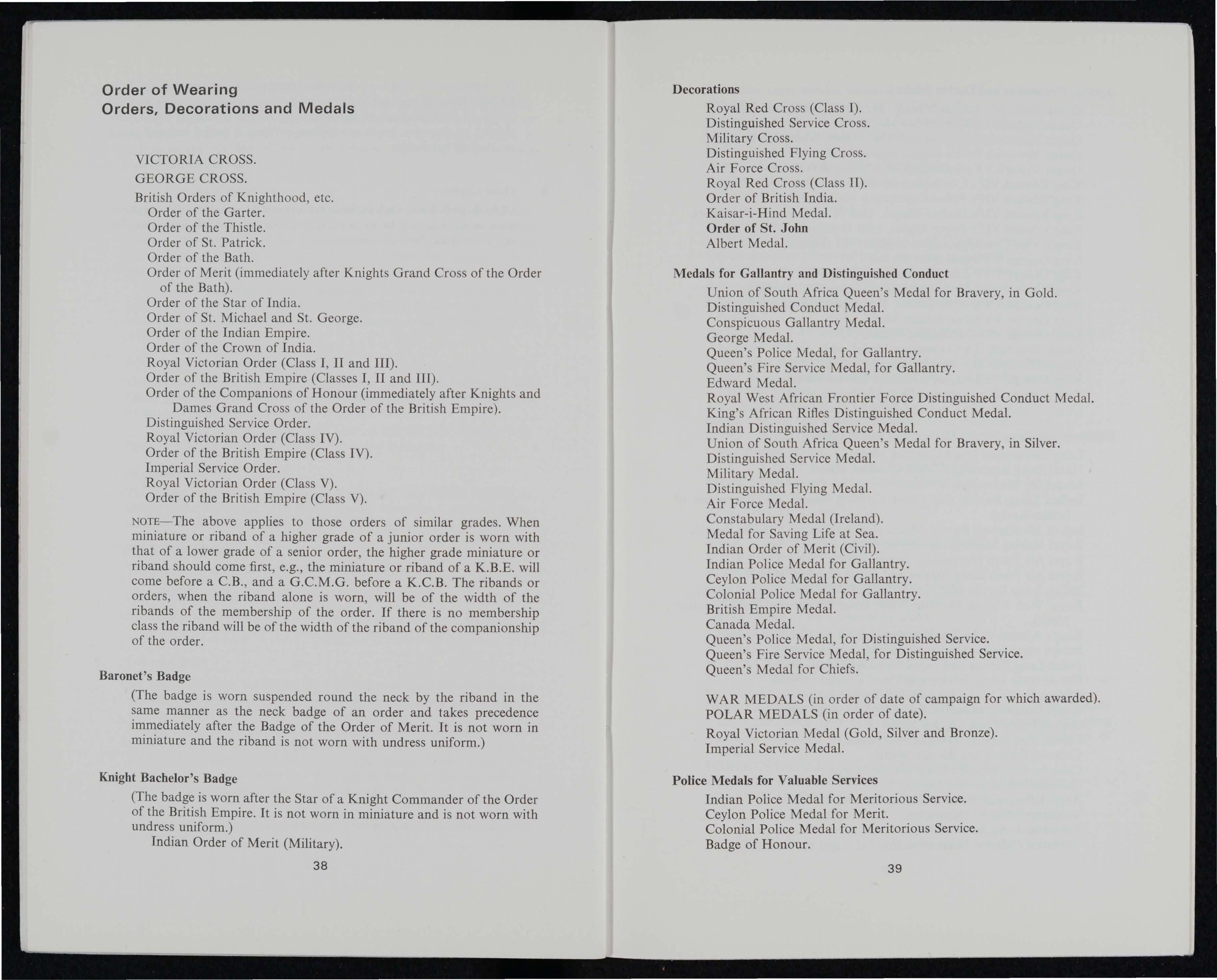
Order of Wearing Orders, Decorations and Medals
VICTORIA CROSS.
GEORGE CROSS.
British Orders of Knighthood, etc.
Order of the Garter.
Order of the Thistle.
Order of St. Patrick.
Order of the Bath.
Order of Merit (immediately after Knights Grand Cross of the Order of the Bath).
Order of the Star of India.
Order of st. Michael and st. George.
Order of the Indian Empire.
Order of the Crown of India.
Royal Victorian Order (Class I, II and III).
Order of the British Empire (Classes I, II and III).
Order of the Companions of Honour (immediately after Knights and Dames Grand Cross of the Order of the British Empire).
Distinguished Service Order.
Royal Victorian Order (Class IV).
Order of the British Empire (Class IV).
Imperial Service Order.
Royal Victorian Order (Class V).
Order of the British Empire (Class V).
NOTE-The above applies to those orders of similar grades. When miniature or riband of a higher grade of a junior order is worn with that of a lower grade of a senior order, the higher grade miniature or riband should come first, e.g., the miniature or riband of a K.B.E. will come before a C.B., and a G.C.M.G. before a K.C.B. The ribands or orders, when the riband alone is worn, will be of the width of the ribands of the membership of the order. If there is no membership class the riband will be of the width of the riband of the companionship of the order.
Baronet's Badge
(The badge is worn suspended round the neck by the riband in the same manner as the neck badge of an order and takes precedence immediately after the Badge of the Order of Merit. It is not worn in miniature and the riband is not worn with undress uniform.)
Knight Bachelor's Badge
(The badge is worn after the Star of a Knight Commander of the Order of the British Empire. It is not worn in miniature and is not worn with undress uniform.)
Indian Order of Merit (Military).
Decorations
Royal Red Cross (Class I).
Distinguished Service Cross. Military Cross.
Distinguished Flying Cross. Air Force Cross.
Royal Red Cross (Class II).
Order of British India.
Kaisar-i-Hind Medal.
Order of St. John Albert Medal.
Medals for Gallantry and Distinguished Conduct
Union of South Africa Queen's Medal for Bravery, in Gold.
Distinguished Conduct Medal.
Conspicuous Gallantry Medal.
George Medal.
Queen's Police Medal, for Gallantry.
Queen's Fire Service Medal, for Gallantry.
Edward Medal.
Royal West African Frontier Force Distinguished Conduct Medal.
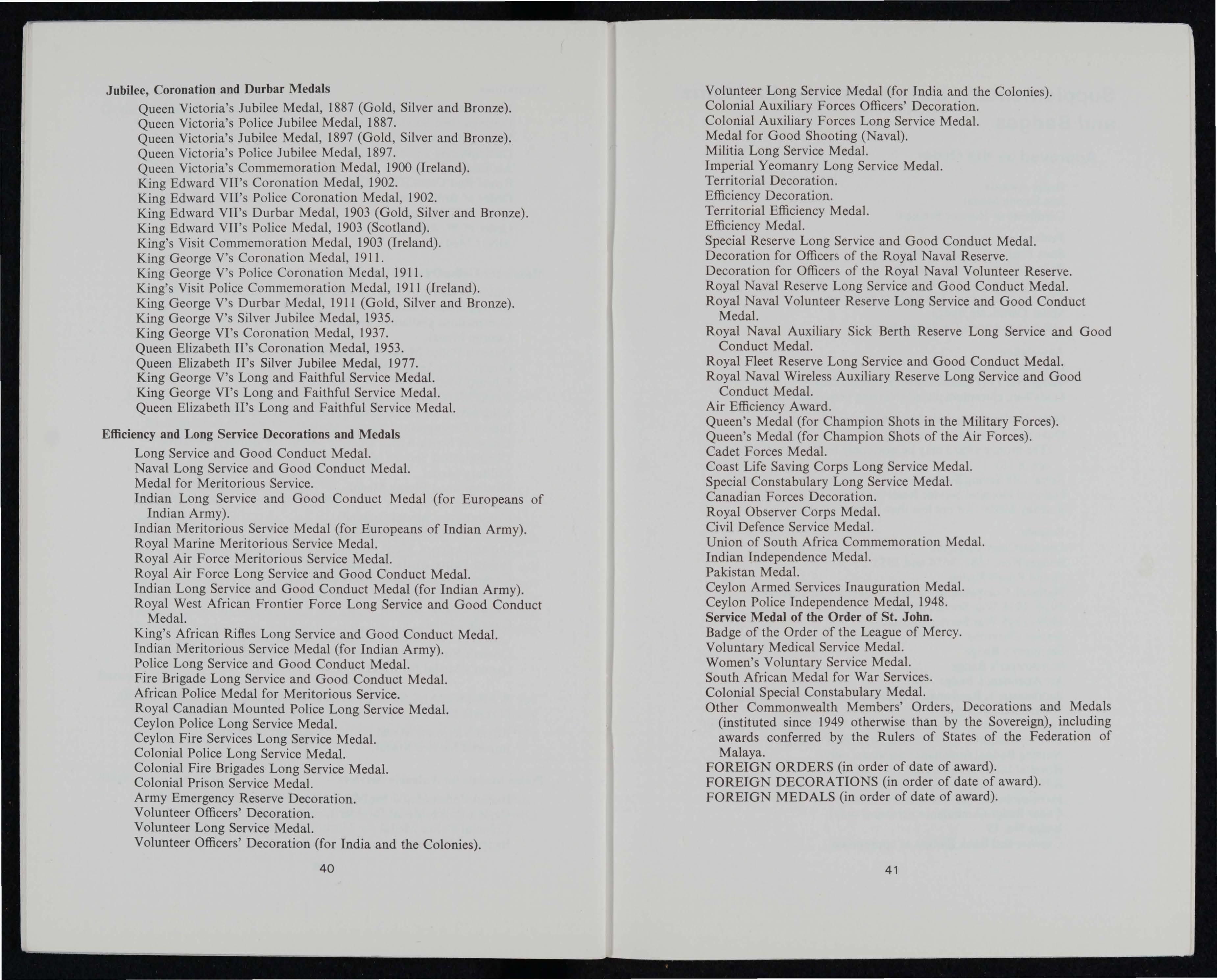
King George V's Durbar Medal, 1911 (Gold, Silver and Bronze).
King George V's Silver Jubilee Medal, 1935.
King George VI's Coronation Medal, 1937.
Queen Elizabeth II's Coronation Medal, 1953.
Queen Elizabeth II's Silver Jubilee Medal, 1977.
King George V's Long and Faithful Service Medal.
King George VI's Long and Faithful Service Medal.
Queen Elizabeth II's Long and Faithful Service Medal.
Efficiency and Long Service Decorations and Medals
Long Service and Good Conduct Medal.
Naval Long Service and Good Conduct Medal.
Medal for Meritorious Service.
Indian Long Service and Good Conduct Medal (for Europeans of Indian Army).
Indian Meritorious Service Medal (for Europeans of Indian Army).
Royal Marine Meritorious Service Medal.
Royal Air Force Meritorious Service Medal.
Royal Air Force Long Service and Good Conduct Medal.
Indian Long Service and Good Conduct Medal (for Indian Army).
Royal West African Frontier Force Long Service and Good Conduct Medal.
King's African Rifles Long Service and Good Conduct Medal.
Indian Meritorious Service Medal (for Indian Army).
Police Long Service and Good Conduct Medal.
Fire Brigade Long Service and Good Conduct Medal.
African Police Medal for Meritorious Service.
Royal Canadian Mounted Police Long Service Medal.
Ceylon Police Long Service Medal.
Ceylon Fire Services Long Service Medal.
Colonial Police Long Service Medal.
Colonial Fire Brigades Long Service Medal.
Colonial Prison Service Medal.
Army Emergency Reserve Decoration.
Volunteer Officers' Decoration.
Volunteer Long Service Medal.
Volunteer Officers' Decoration (for India and the Colonies).
40
Volunteer Long Service Medal (for India and the Colonies).
Colonial Auxiliary Forces Officers' Decoration.
Colonial Auxiliary Forces Long Service Medal.
Medal for Good Shooting (Naval).
Militia Long Service Medal.
Imperial Yeomanry Long Service Medal.
Territorial Decoration.
Efficiency Decoration.
Territorial Efficiency Medal.
Efficiency Medal.
Special Reserve Long Service and Good Conduct Medal.
Decoration for Officers of the Royal Naval Reserve.
Decoration for Officers of the Royal Naval Volunteer Reserve.
Royal Naval Reserve Long Service and Good Conduct Medal.
Royal Naval Volunteer Reserve Long Service and Good Conduct Medal.
Royal Naval Auxiliary Sick Berth Reserve Long Service and Good Conduct Medal.
Royal Fleet Reserve Long Service and Good Conduct Medal.
Royal Naval Wireless Auxiliary Reserve Long Service and Good Conduct Medal.
Air Efficiency Award.
Queen's Medal (for Champion Shots in the Military Forces).
Queen's Medal (for Champion Shots of the Air Forces).
Cadet Forces Medal.
Coast Life Saving Corps Long Service Medal.
Special Constabulary Long Service Medal.
Canadian Forces Decoration.
Royal Observer Corps Medal.
Civil Defence Service Medal.
Union of South Africa Commemoration Medal.
Indian Independence Medal. Pakistan Medal.
Ceylon Armed Services Inauguration Medal.
Ceylon Police Independence Medal, 1948.
Service Medal of the Order of St. John.
Badge of the Order of the League of Mercy.
Voluntary Medical Service Medal.
Women's Voluntary Service Medal.
South African Medal for War Services.
Colonial Special Constabulary Medal.
Other Commonwealth Members' Orders, Decorations and Medals (instituted since 1949 otherwise than by the Sovereign), including awards conferred by the Rulers of States of the Federation of Malaya.