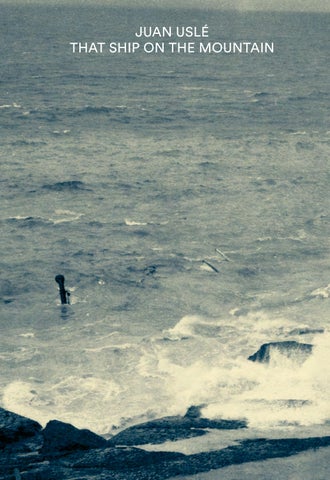
JUAN USLÉ
JUAN USLÉ THAT SHIP ON THE MOUNTAIN
THAT SHIP ON THE MOUNTAIN
JUAN USLÉ THAT SHIP ON THE MOUNTAIN
Juan Uslé’s work has, over the course of decades, appeared on the international art scene from a place of intimacy and rootedness, a link with Santander, the artist’s birthplace, that is captured in his visual language. Through abstraction, the sea, the northern light, and the imprint of the Cantabrian landscape nourish his gaze and thought, configuring a pictorial world that manages to connect with diverse audiences around the world. His work is a testimony to art’s ability to explore the intangible: time, memory, perception, emotion. On his canvases, line and color are also an extension of his own body and memory—painting as a profound sensorial experience, a way of reaching the most hidden layers of our collective consciousness. Throughout his career Uslé has remained close to his roots. Always with one foot in Cantabria, his home, and another in New York, a city critical to his artistic evolution and path through life. This constant “coming and going,” more than just a feature of his biography, is a metaphor for his work: the crossroads between the natural landscape and the modern metropolis, between the introspective and the expansive. This balance between personal depth and the ability to create a universal visual language makes Uslé, whose work has been featured in museums and collections in numerous countries, an indisputably important figure in contemporary Spanish art history. I express my gratitude to curator Ángel Calvo Ulloa and to the Museo Nacional Centro de Arte Reina Sofía for making this retrospective possible. It offers us a new way of seeing Uslé’s work, both its visual dimension and its lyricism, by presenting paintings that were born in the silence of his studio and that in turn speak to us of the vivacity of the contemporary world. Ernest Urtasun Domènech Minister of Culture
Since the 1980s, Juan Uslé (Santander, 1954) has been developing a deeply personal pictorial language that navigates naturally between abstraction and poetry. Internal and exterior landscapes, emotions, memories, rhythms, and gestures all converge in his work. Each piece appears as a gateway to painting understood as a way of remembering, forgetting, and reinventing. His works come together as exercises in self-reflection that weave memory with the body that paints: the hand, the arm, the gaze, the pulse, and the breath. All of that converges to create something beyond mere abstractionism, constructing a complex emotional geography that has made Uslé a singular figure within contemporary Spanish art. More than twenty years after Open Rooms (2003), the Museo Reina Sofía’s first show dedicated to Uslé’s work, the exhibition Juan Uslé: That Ship on the Mountain proposes a new approach to the artist’s universe, one that builds a narrative of trips out and back, of retroaction and prospection. It thus reflects both his transatlantic life experience— marked by displacement between two shores, Cantabria and the United States—and his creative process, which involves revisiting the continually evolving pictorial series he calls “families.” As a result, the exhibition brings together a wide-ranging, diverse corpus drawn from over four decades of work, with pieces from private and public collections and from the artist himself. The curator of the exhibition, Ángel Calvo Ulloa, constructs a narrative for the show originating in a childhood recollection that has left a mark on Uslé’s memory: the shipwreck of the Elorrio in the fall of 1960, near the cliffs of Langre close to his family home. In Ulloa’s reading, water is revealed as a constant symbol in Uslé’s work: not only as a physical landscape or personal memory but as a quality in the painting itself. A liquid, mutable painting that transforms, as memory does; that grows sometimes clear and sometimes murky; that flows between the real and the figurative, between what is lived and what is dreamed. This poetic itinerary becomes an invitation to navigate the internal currents and tides of this artist, who offers viewers an emotional and profound visual journey. On this side of the Atlantic, Uslé and the artist Victoria Civera lived and worked in the 1980s in a remote setting, surrounded by nature and silence, where they developed their artistic practice through withdrawal and creative solitude. The works Uslé produced during this period—such as 1960 Boat at Sea and Casita del norte (Cottage in the north), both from 1986—are profoundly marked by the landscape that surrounded them: a humid, foggy world often shrouded in semidarkness, atmospheric conditions that translated into a deeply personal language in which the outside becomes a mirror of the inside.
In 1987, Uslé and Civera moved to a home and studio at the foot of the Williamsburg Bridge in New York City. In a conversation with Kevin Power, published here for the first time, the artist recalls the striking contrast between the two places: “From the taxi that took us from the airport, I saw a New York that was louder, more hectic, unstable, dirtier than the one hidden in the images in my head.” Despite that initial vertigo, his walks through his vibrant, tangled surroundings, full of energy and stimuli, started to generate resonances, echoes of his native landscape. Uslé recalls contemplating, from the Williamsburg Bridge, “the mysterious flow of nearly black water below me for hours with the murmur of the city in the background.” The city’s ceaseless rhythm—that vital chaos—and the geometric structures of skyscrapers, urban trusses, bricks, and pavement ended up finding their way organically into his work as the new textures, traces, and chromatic spectrums that are visible in works such as Mî-Món (1992), Mal de sol (Sunstroke, 1994), and Mantis (1998–1999), among others. In the late 1990s, Uslé began the series Soñé que revelabas (I dreamed you were revealing), one of his most extensive and recognizable projects, which he continues to work on to this day. It is composed of canvases made up of a rhythmic succession of vertical bands, each one marked by the gesture of the brush that pauses following the rhythm of his pulse, an almost respiratory exercise in which the painting becomes an affirmation of presence and corporality. Juan Uslé: That Ship on the Mountain reveals the deep coherence of an artistic practice in constant movement. Between shores—geographic, experiential, and symbolic—Uslé’s work emerges as a continuous current where the lived and the imagined, the intimate and the external intertwine. This exhibition proposes a free navigation, drifting through the territories of his memory, marked by the persistence of water. And like the tides, his pictorial creation does not pause. It returns, advances, falls back, and transforms, remaining faithful to a lyricism of restlessness and flow. As Uslé himself says, “ultimately we all always come and go.” Manuel Segade Director of the Museo Nacional Centro de Arte Reina Sofía
Table of Contents
19
JUAN USLÉ: THAT SHIP ON THE MOUNTAIN Ángel Calvo Ulloa 113
PORTRAIT OF THE ARTIST AS A PROJECTIONIST Érik Bullot 177
THE FORCE OF THE SENSIBLE Andrea Soto Calderón 229
CONVERSATION WITH JUAN USLÉ Kevin Power 258 List of works
[Fig. 1] José Luis Araúna González, The Sinking of the Elorrio, December 21, 1960
JUAN USLÉ: THAT SHIP ON THE MOUNTAIN Ángel Calvo Ulloa
We’re dropping the lifeboat into the water. At 8:22 a.m. on December 21, 1960, that was the final message sent by the Elorrio before it sank off the coast of Langre in Cantabria. Built in 1922 by the Sestao Navy Yard and first baptized the Aldekoa, the ship was in Republican hands during the Spanish Civil War, covering a route to various Russian ports on the Black Sea under the false name Murduan. It was subsequently damaged, remaining off the coast of Orán until after the war. It was later sold and used for maritime commerce on both the Mediterranean and the Atlantic, as well as off the coasts of Africa and the United States. Rebaptized the Elorrio in 1957, its last transatlantic trip took it to Baltimore, from where it returned full of wheat. It sank just five kilometers from the house where Juan Uslé’s family lived near the convent of Trinitarian nuns in Suesa. It is one of the events from his childhood that the artist recalls most frequently. The experience sparked a series of connections that have been highly transcendent in Uslé’s life and, by extension, in his career as a painter: the tension felt by local residents, unable to help the sailors on the ship who drowned a few meters from the cliffs; the appearance of a maritime rescue unit, photographed from a seaplane hovering above the water—a snapshot published at the time in the newspaper Diario Montañés; and the news reports published there and in other papers, such as La gaceta del norte. Those images [fig. 1] were Uslé’s first contact with the tragedy and the image of it on paper. The difficulty of deciphering the images of the rough seas—the cutoff silhouettes of the townspeople with their backs to the camera, hands on hips in a gesture of disbelief, or hands held to heads in desperation in the face of the inevitable—makes these photographs, even today, enigmatic documents that require additional explanation. “The sea has always been there,” Uslé remarks.1 But so, too, has the river and the idea of the passage from one to the other. A motorboat heads up the Cubas estuary—also called the Cubas River—along the stretch where the Miera River lets out, forming a wide inlet before its waters spill into the Cantabrian Sea. Perhaps because the sea and river have, in parallel, been a recurring landscape for Uslé since his childhood, both have a presence in his painting. The mixture of freshwater and saltwater, the liminal flora and fauna, survive in this place where, to our eyes, the effect of the tides is most evident. I remember that I was surprised, in our first conversation, that someone could feel they were both a river person and a sea person, from the coast and from the interior, in equal parts. For me (whose closest option for a summer dip when I was little was always in one of the rivers in the region where I lived), the sea was an occasional getaway, a milieu that was somehow foreign to us. I always associated the sea with that perfectly horizontal line in the landscape that gets lost where the eye can no longer see. I see the river, on the other hand, symbolically, as a vertical line that cuts through the land. In one of Uslé’s smaller canvases, Nemo azul (Blue Nemo, 1989–1990) [p. 81], the evidence of the horizontal becomes vertical, or the vertical melts into the horizontal, taking on particular importance. Suddenly, that slight gesture of overflowing— or containing, depending on how you look at it—registers a particular 19
moment in the formal investigation of his painting. The painter chose Nemo—the captain whom Jules Verne puts in charge of the Nautilus— and did so out of a desire or need to establish distance. “Nemo’s journey takes place on the margins of existence on the surface; his life is secret. We only have access to it through an accidental witness. Without needing to make his reasons known, the protagonist sets out on a voluntary retreat guided by scientific knowledge and, above all, by the thirst for and pleasure of going to see the marvelous beings and landscapes that populate the depths of the oceans.”2 These motivations resonate with the ones that drove Uslé, well before his arrival in New York imposed new distance from all he had known previously, to break with the homogenizing tendencies then saturating painting. “For Uslé,” Kevin Power points out, “Nemo’s attitude is similar to that of the painter in his studio.”3 Indeed, his painting begins to take a curious turn, leaving his work with a marked liminal character. This can be seen in another small painting [p. 37], this one untitled, from 1990, that is part of the series Nemasté. In it the verticals become horizontals and form red or white corners against a blue background, midway between what has been left behind and what is yet to come. “Nemasté has to do with Nemo and with namaste, the Nepali greeting, as I understood it, from a gentleman who explained to me that this term didn’t only mean ‘peace,’ like for people in the United States, but that it was a sort of greeting or welcome to the best and most diverse of what we have inside us.”4 But let us return to the river and the sea. What else but a river is that blue strip that cuts through the canvas of Guadiana, lugar de sabeos (Guadiana, site of Sabaeans, 1989) [fig. 2]? The parallel between the line and the current of water makes it difficult to imagine a break as sharp as the one between the gouache washes that invade his painting in 1989 and everything painted up until that precise instant when the vertical begins to materialize, clean and well defined. The same thing happens in Marzo 1964 (March 1964, 1990). “Juan Uslé paints wet on wet,” Jerry
20
[Fig. 2] Guadiana, lugar de sabeos, 1989
Saltz wrote at the time.5 In his landscape-themed works a certain somber, ghostly tendency surfaces. The gouache washes become specters, and what the waters hide peeks out. This is no longer a place where childhood unfolds placidly, nor is it a memory of the summer of 1986, which Uslé and Vicky Civera, his partner, spent painting in the village church of Susilla in Valderredible, Cantabria—at a remove from Santander and everyone in the art world who took to the coast each year for their summer vacation. That coast, with its tranquil sea and mild, calm weather, has little or nothing to do with the one Uslé painted, assuming he is painting the coast and not the interior. “Juan Uslé paints from memory,” Octavio Zaya wrote in 1989.6 “Sometimes, a remembered event or a detail is of utmost importance, and, other times, any reference is unrecognizable.”7 Uslé’s 1986 work 1960 Boat at Sea [pp. 38–39]—part of the Río Cubas (Cubas River) series, created in Susilla—is based on the Elorrio tragedy. It is one of those paintings from memory that Uslé creates based on something he recalls from childhood. Curiously, his earlier works—which are more gestural, tied to the material of their medium, and more impulsive in nature—flow into a more transcendental, lyrical, and disquieting mode that lends a sort of shadowy landscape-painting style. The memory had always been there, behind the experiences that had activated his painting. However, 1960 meant uncovering an episode lodged in his subconscious, and it appeals not to the historical event itself but to how he incorporates it as an unresolved chapter that blends the printed image with the image from his memory. It also recovers sensations of the great storm that made it impossible to save the sailors when they were in the final stretch, hoping to return home safe and sound after crossing the Atlantic. And it surfaced in the moment when Uslé and Civera were packing their bags to cross the ocean in the opposite direction. 1960 Boat at Sea exists in time alongside the first version of Casita del norte (Cottage in the north, 1986) [pp. 44–45], where, on a steep, rocky hill, a building appears, a basic unit for shelter, just enough
[Fig. 3] Casita del norte II, 1988
21
space to provide a refuge for the night. Casita del norte is one of Uslé’s recurring paintings, with three more versions to date (1988, 1997 and 2025) [fig. 3, pp. 161, 216]. Uslé, when he takes off on his journey, ties the boat and the house—the journey and the home—to the mountains of Lunada or the rocks of Langre. The first linkage is to rescue the Elorrio, the second a reminder not to forget the place from which he departed; both together anchor the artist, protecting him from the journey and from forgetting. I recall reading about Decimus Junius Brutus Callaicus on the edge of the Lethe River (today known as the Lima or Limia River), accompanied by troops who, confusing it with the river in Hades (the river of forgetfulness and oblivion in Roman mythology), refused to cross it for fear of losing their memories. Uslé recognizes the Elorrio’s journey in his own—the journey out in the journey back, and vice versa—and sees the need to take certain precautions. In the cottage he installs on the hill in that painting, safe from inclement weather and oblivion, one can reasonably also identify an absence that is just about to materialize. In Uslé and Civera’s first trip to New York—and in their first house-studio at the foot of the Williamsburg Bridge—the most marked absence is that of their daughter, Vicky Uslé Civera, just six years old, who remained in Santander until she could be brought to the United States. Vicky emerges as a mantra, a chant repeated in the form of an agile portrait in a series of
22
[Fig. 4] Letter from Juan Uslé and Vicky Civera to Fernando Silió, 1987
paintings on paper titled Engo (1987) [pp. 53–55], an allusion to the first word she spoke as a baby, which, curiously—and clearly by chance— corresponds to the Spanish suffix that indicates belonging or relationship and can be interpreted again as an anchor, a tool for not forgetting. In a letter full of caricature-like drawings sent around that time to his friend the gallerist Fernando Silió [fig. 4], Uslé portrays himself at the foot of Manhattan and draws in pen on his forehead a landscape resembling that in Negro Williamsburg (Black Williamsburg, 1987) [pp. 48–49] or 1960. The subtitle of 1960, “Boat at Sea,” is missing from the catalog for the exhibition at the Montenegro gallery, where the work was presented for the first time on January 14, 1987, the eve of Uslé’s departure for New York. Power wrote, “Uslé’s having been conditioned throughout life to the immediacy of sensation is reflected both in the fluid nature of his nervous reaction to external stimuli and in his obsessive journey on the current of memory and particularly his memories of childhood.”8 Nearly two decades later, Power asked the artist about his first months in the United States— specifically via which path he had started his work there. Uslé responded, The first thing I did before trying to do anything new in that context that was totally unknown to us was to try to repeat myself, almost clone myself in the attempt to paint 1960 again. Almost without realizing it, this version became a new image of the previous one, made from the other side. The ship remained safe, perched on the mountain, but in this second version it didn’t continue on toward land but was instead the center of an island. I clung to my last image like the ship clung to land.9 This second version, later titled 1960 Williamsburg (1987) [fig. 5] was presented in 1988—then titled simply 1960—at a time when Uslé was clinging to that memory while also starting to show signs of a certain distance from how he had previously approached memory or, perhaps, of a burgeoning approach that somehow unfocused or diluted that memory.
[Fig. 5] 1960 Williamsburg, 1987
23
In the text that accompanied Uslé’s first solo show in New York, Dan Cameron writes, “The Paris paintings”—alluding to a show the Farideh Cadot Gallery in Paris had dedicated to Uslé a few months earlier— “suggest a perceptual casting-off, a deliberate loss of the specific point of view from which one might perceive the land, the sea, or the ship itself.”10 “They were ambiguous, mysterious, opaque surfaces,” the artist himself would write in 1992.11 Uslé’s view of the landscape, long seen through the lens of his childhood, from the distance of stories told by neighbors who had watched the Elorrio from the cliffs, was shifting little by little to become a perspective that surrounded him entirely. Perhaps Cameron had already sensed that tendency sometime earlier: “Far from depicting a body of water, Uslé wants the painting to come as close as possible to the thing itself.”12 Suddenly, the landscape he drew on his forehead provided the key to a painting that begins to be painted from the inside, from an Elorrio that crosses the ocean, with no land in sight for many long days before growing closer to the rough coast where the journey ends. “Later,” Uslé remarked, “I would dare to sail from New York to northern Spain. I placed my eyes within a sailor, taking on a possible identity—part of the crew of that ship that so many years before had crossed the blue in the opposite direction that I was going now—until crashing right there before us, near our village.”13 The landscape inked on his forehead was like the old game of “¿Quién soy?” (forehead detective), which allows you to be seen by everyone except you. In the caricature Uslé sent to Silió, he seems to be asking himself that very question: Who am I? “After having lived in Santander for so many years, it seemed I had been looking inside myself for too long. It was like seeing myself in a mirror.”14 In 2021, Mónica Carballas wrote, “In the 1990s, with the discovery of the concept of ‘namaste,’ Uslé welcomes in all of the various others within him, with the intention of dispensing with a personal style. Which is, on the other hand, an illusion, like that of always repeating the same painting because, of course, painting is pure fiction!”15 Suddenly, Uslé seemed to be the very Vitangelo Moscarda that Luigi Pirandello wrote about in his last novel, Uno, nessuno e centomila (One, No One and One Hundred Thousand), a fictional autobiography based on a seemingly trivial question that casts doubt on who Moscarda is: Is he who he believes himself to be, or is he a tangle of the many images that everyone who has met him has constructed of him, or, negating all of that, is he simply no one? His work at the time was about constructing a multiplicitous identity or of understanding his own multiplicity per se, without the need to construct it, instead accepting it and allying himself to it. The idea at work in Uslé’s painting was to incorporate the possibility of amnesia, almost like a game that would allow him to ask himself “Who am I?” and would also oblige the rest of us to ask the same question but remain in permanent doubt. If in 1989 Zaya declared that Uslé painted from memory, around the same time another critic stated that he had lost his memory. “With [the Williamsburg] series, the images progressively disappeared as the paintings became darker, accumulating layers of color and ever-darker pigment until they ended up practically black.”16 Those smaller paintings, all horizontal, suddenly became an approach to water that the artist would, little by little, begin to plunge into, as he already seemed to be doing in a set of self-portraits created a few years earlier in Susilla (1986), in which he placed himself in the water, face up, so his profile created a little island. Was Uslé making himself into an island, like one
24
who makes of himself a homeland? Was he perhaps presenting himself as a drowned man? Or perhaps a diver, as Zaya suggests.17 As the artist began to submerge himself, light—or something midway between light and the fluidity of the painting—suddenly began to emerge. That fluidity gradually made the paintings “more liquid, more oneiric and organic.”18 “The effect,” Uslé stated in 1993, “became more complex, but not in terms of adding layers, which I had already done in earlier works; rather, I had reached a point where I couldn’t make the space concrete: It was always floating, always moving.”19 Then suddenly, he enclosed himself. The influence of New York began to take effect, the earlier flow—of water and of the there emulating the here—followed by a series of revelations, not only in terms of form. The effect of daily life in New York on Uslé, the observation of an agitated way of life—one that is chaotic but follows a certain sense of organization, as Piet Mondrian had sensed—began to manifest in paintings that appear to be less transcendental in theme, more coloristic and ironic. The effect of New York led Uslé to think about when Mondrian was a recent arrival to the city. An avid seeker of gazes to see with, Uslé now wanted to install himself in Mondrian’s gaze and observe the city through his eyes. Perhaps he did not then know of an anecdote about Mondrian related by Alexander Calder, who considered Mondrian a serious sort. Calder claimed that Mondrian had once told him about painting the walls of Bœuf sur le toit, a 1920s Parisian cabaret, in the style of Joan Miró.20 Calder was equally surprised that Mondrian would frequent such a place and that he would be aware of Miró’s existence. Uslé put the two in dialogue—as if they occupied opposing positions—in a painting titled Mî-Món (1992) [p. 97], an encounter of abstractions that would occur frequently during that period in his work. Miró and Mondrian may never have crossed paths. That is what we may deduce from the words of curator Hans Janssen, who analyzes the appearances of both artists on the roster of the Valentine Gallery in New York.21 Miró opened his first solo show there in 1930, and Mondrian did the same in 1942, with a set of works begun in Europe that he picked up again after fleeing to the United States. Mondrian felt the need to reflect the effect that the metropolis had had on him. In “A New Realism,” an essay written for the organization American Abstract Artists, he argues that abstract art was not so much about expressing space as determining space.22 Janssen adds that a city like New York is a good example of that. “With its concrete determination of space, it expressed the vitality of modern life. Thus, like an artwork, the metropolis became a living reality in which two kinds of balance dominated: a static, almost architectural balance; and a dynamic balance that existed mainly in perception.”23 He adds, alluding to that second balance, that “structure was everything: it was much more important than expressing any natural quality. The more structure, the stricter the organization of the lines and planes, and the stronger the determination of space and the more exuberant and radiant the effect.”24 Whatever the case, an encounter between Miró and Mondrian was a distant possibility, and Uslé was not unaware of this when he enclosed the freedom of one in the discipline of the other. In 1992, the Belgian curator Jan Hoet decided to include Uslé on his list of artists for documenta 9 and selected nine of his paintings: Engo-Engo (1990–1991), Guess-Who and Pio-Peo (1992) [pp. 93, 98, 96], all three later held in deposit at the Museo Reina Sofía; Los pájaros (The birds, 1991); as well as Blow Up, Anónimos (Anonymous), Guess-Where, and Deberes
25
(Chores) (all from 1992) [pp. 102, 110–111, 99, 101, 100]. The set of works from this period stands out for mixing not only the verticality the artist had been using for some time in his compositions but also a liquid quality previously seen in his transitional paintings. To this he added a range of colors that sometimes begin to short-circuit, shifting from a dark palette of blues and browns that recalls the hillsides of Casita del norte, the boat of 1960, and paintings like Veneno (Poison, 1990–1991) [p. 79], to a range of more vivid blues, yellows, reds, pinks, and whites, as in Paint-Point (1991), Seven Thirty (1992), Feed-Back (1992–1993), and Fragmentos ibéricos (Iberian fragments, 1992–1993) [pp. 103, 105, 104, 108–109]. Additionally, grids start to appear. Although his use of them does not extend beyond a few specific paintings—perhaps because, as Power states, “Uslé doesn’t believe in grids”—they still mark an ever-more frequent and varied rhythm of repetition and annotation in his work.25 Lleno de palabras (Full of words, 1991) [fig. 6], Boogie-Woogie (1991) [fig. 7], and Red Works (1992) [pp. 106–107] probe in a direction that is cemented in Casita española de Magic Tape (Spanish cottage of magic tape, 1992) or indeed in Mî-Món, and it opens the door to the absolutely delirious period of his Célibataires paintings. Uslé had already set out on this path before with Nemasté, an idea that introduced a new position, a new immersive exercise working toward the opening up of syntax. “A typical example of Uslé’s joking irony,” a set of visual impulses with a “certain sense of communion, of stinging the retina, of problems and pleasure for the mind,” as Power writes.26 Those impulses arrived via a series of small canvases such as Rojo ligero (Light red), Ryder Blue, and Amapola (Poppy) (all 1991) [pp. 90, 89, 88]. Still well-defined and controlled in their composition, these are also the precursors to the larger-scale body of works that would dominate Uslé’s painting in the 1990s and 2000s. If a few years earlier the claim was that Uslé had lost his memory, now one could say he had lost his head. Suddenly, Mondrian appears to have opened the door to Marcel Duchamp. For Uslé, this must not have seemed like a complete sacrilege, just as it would not have been for Duchamp himself decades earlier when, at the International Exhibition of Modern Art (1926–1927), he placed his Grand verre (The Large Glass, or The Bride Stripped Bare by Her Bachelors, Even; 1915–1926) so that it faced two paintings by Mondrian and one by Fernand Léger. As Miguel Ángel García writes in
26
[Fig. 6] Lleno de palabras, 1991
the preface to Ángel González’s El resto (The remainder, 2000), Duchamp staged the work “so it would appear to better effect. . . . In fact, what we see, and we see it quite clearly, is that a Mondrian fits perfectly among the oculist witnesses, so much so that it’s difficult to tell where one begins and the other ends, and that the Léger gives the chocolate grinder a run for its money.”27 Gónzalez, like Calder, also seems to underestimate Mondrian’s interest in nights of cabaret. Writing about Carlos Alcolea (an artist I have been tempted to cite frequently throughout this text), he states: Flatland dances . . . ! Mondrian’s Broadway Boogie-Boogie only gives a poor sense of the certainly unimaginable sequence of colors in movement that must have come alive in those dances, vibrating and reverberating, like fireworks seen through a crack in the blinds of that dark empty bedroom where a little boy suffering with fever thinks he hears furtive scratching under his bed and feels that his body is no denser than the sheet he grips and pulls at with his hands.28 In this text—included in the catalog that the Museo Reina Sofía and the Centro Galego de Arte Contemporánea (Galician Center for Contemporary Art) dedicated to Alcolea in early 1998—González is not thinking about Uslé. Still, I find it curious that those lines were being written in the same months that the artist was cooking up his first painting in his New York studio, which he would call Soñé que revelabas (I dreamed you were revealing; hereinafter referred to as SQR). Some years before, Uslé included a short text in the catalog of his exhibition Mal de sol (Sunstroke, 1995) in Madrid:
[Fig. 7] Boogie-Woogie, 1991
27
When I was nine years old, having recently arrived in the city, I got sick with what doctors then called sunstroke. The cure was silence and a totally dark room. I don’t remember anything of how it started, just that before getting sick I was playing with my brother on the south side of the house on top of a pile of ash-tree branches. Any sound or light stabbed into my head; a tiny open crack made my brain turn into a sort of painful kaleidoscope.29 He goes on to talk about the weight of the light, which unfurled like stars or dry flowers, never stopped moving, and was more present in his memory than the shapes. Mal de sol was also a crack—not a door or a window, but a crack— through which, like a camera obscura, isolated images slipped in. Power wrote in 1996 that “it seems as if he were working with a series of phrases considered as separate acts of creation.”30 Then suddenly, Uslé recovered photography (which had always been present, since childhood and the images of the Elorrio sinking) as a medium for thinking about painting. Detecting this, Power points out that “it is extraordinary to see how his photos, taken some years back, relate so intensely to some of the works being produced now in his New York studio—photos of the sky taken through the window of an airplane, or of train tracks taken from the platform, or photos of simple architectural elements.”31 A good example of the important role photography came to have in his process of working and capturing is his Línea Dolca (Dolca line, 2008–2018) [pp. 189–203].32 A set of images created over the course of a decade as the result of introducing digital photography to his work process, this painting succinctly shows how Uslé’s gaze functions. Repeatedly transferred to his painting, it is a gaze that also observes the world and locates in it fragments that could well be from many of his works. In February 1998, as part of the exhibition Vanishing Lines at Soledad Lorenzo Gallery in Madrid, Uslé presented his first Soñé que revelabas I [p. 155], dated the previous year. In 1999, as part of the exhibition Blind Entrance at Cheim & Read gallery in New York, he presented Soñé que revelabas II [p. 159]. The text by David Moos for the catalog of the first show opens by proclaiming, “Uslé, man of the sea, the seafarer, associated with Captain Nemo; . . . the artist in the north of Spain, his homeland, sitting on a cliff contemplating the immensity of the Atlantic.”33 In the middle, in the space marked by the ellipsis, Moos swiftly lists the various steps Uslé’s life and painting had taken over the course of the previous decade. Soñé que revelabas (Vanishing Lines) was presented at the time as just another of Uslé’s paintings, perhaps a rarity within the artist’s production, but one Moos could still readily situate. His text reads like a diary, with entries examining each piece one by one. It pauses on the first SQR, speaking of water and light: the former as an immediate reference; the latter as a trope. The Blind Entrance exhibition also included Encerrados (amnesia) (Shut in [amnesia]) [pp. 150–151], a painting that is similar in form to SQR but hails from the lineage that includes Amnesia (1992) [pp. 138–139] or such smaller-scale works as 1935. Horizonte (1935: Horizon, 1994), Repleto de sueños (amnesia) (Full of dreams [amnesia], 1996), and Un poco de ti (A little of you, 1995) [pp. 141, 143, 146]. Looking at Un poco de ti, I cannot help but smile upon deciphering the eyelashes that top three of the vertical bands, as if they were definitively three closed
28
eyes—not two, but three—leaving room for what dreams might well come to reveal. Entirely apart from formal elements, Moos points to something that may be key to understanding the nexus between paintings by the artist as a man of the sea—the Uslé who journeys out—and the one sitting on a cliff contemplating the immensity of the Atlantic—the Uslé who returns. Moos speaks of a “fundamental contrapposto of light/darkness, representing loss.”34 With distance and the full airing of SQR over various exhibitions anthologizing the artist’s work, one can see the dialogues that the first SQR works established with Mantis, Bilingual (1998–1999), Rizoma mayor (Greater rhizome, 1998), Rizoma’s (Rhizome’s, 1997), or Casita del norte III (Cottage in the north III, 1997) [pp. 162–163, 157, 164–165, 130–131, 161]. “The focussing presence of grids, for example, combined with the visual evidence of an overall, sweeping lateral motion—a pulling of paint from edge to edge—have created a more or less continuous dynamic in the Uslé opus since shortly after 1987, when the artist moved to New York.”35 In this text, written for Juan Uslé: The Blind Entrance (1999), Lisa Liebmann relates her visit to the artist’s studio and the quantity of works she saw there. Although she might seem to be referring to Soñé que revelabas II, which was included in the show, her text does not address it. Perhaps she did not see it during her visit, or maybe she did not notice it. What is clear is that SQR was, at the time, a series in the making, not yet solidified as the body of work that eventually would establish itself and that contains in its structure many of the gestures that have populated Uslé’s painting over the past four decades. But the construction of SQR also leaves us with a piece of information that sheds a mystic/mythic light on the series: the rhythm of its brushstrokes. Yes, they are discontinuous brushstrokes produced by intermittent contact: I move the brush and press down until the next heartbeat occurs. I try to follow a sequential rhythm, marked by the beating of my pulse, and that’s why I almost always work on these paintings at night, especially here in New York, because it takes concentration and silence in order to feel it. The result varies from work to work and from day to day, depending on how calm or rapid my pulse is (blood is not always pumped at the same rate).36 But SQR also appeals to those “visual impulses,” which Power refers to when citing Nemasté, that “arrive like gifts, like the ritual of giving and offering.”37 In reflecting on the motivations behind Uslé’s choice to paint many of the SQR in black, for years I could not help but call upon the numerous theories that try to explain Pablo Picasso’s decision to do the same with Guernica (1937). Both Dora Maar’s photographs of his creative process and the fact that all images of the bombing published during that era were in black and white reveal the importance that photography, from its beginnings, had for painting. Returning to the photographs of the Elorrio, taken twenty-three years after Guernica, I inevitably want to draw a connection, in this case between SQR and 1960. I attempt to go beyond Uslé’s oft-made comment that the darkroom he and Civera installed in their first house in Valencia also served as his bedroom, his room for sleeping and dreaming. And I link this experience with those choppy shots of the sea, taken from the height of the cliffs—from where the artist, according to Moos, could look out while sitting—and letting us see
29
the glints of light that surface, beat by beat, in each SQR. Uslé decided, nearly eight years after the first SQR, to begin to identify each one using the name of a river: Tajo (2004–2005), Jarama (2005), Guadiana, Tigris (2007), Éufrates (Euphrates, 2008), Onon (2008), and so on, and he covered the world before returning home. Years later, he would produce Saja (2012) [fig. 8] and Cubas-Kevin (2013), an homage to Power, who passed away that year and was thus reincarnated in the river-life of Uslé. Saja honors Uslé’s granddaughter Saja and the river in the Cantabrian watershed whose name—which developed from the Latin hydronym Salia—comes from the simple form sal-, the Indo-European root referring to standing water, the sea, and salt. The coexistence of SQR and other series by Uslé is a constant in later exhibitions of his work. They establish an extended dialogue, taking place over the course of years, between SQR and the other series, like Manthis, doing so over a period when the interfamily coexistence begins to align his works, regardless of format, in favor of the SQR pattern, thus reducing to a minimum the formal departures that would allow him to be associated with another form of painting. This happens in series like In Kayak and in standalone paintings that, on occasion, also function
30
[Fig. 8] Soñé que revelabas (Saja), 2012
as subtle winks. That is the case of La novia de Belchite (The bride of Belchite, 2008) [pp. 172–173], the work that lent its title to an exhibition at the Tim Van Laere Gallery in Antwerp in 2009. In the text he wrote for the occasion, Luk Lambrecht states that, “though recognizable, Juan’s painting is far from predictable,” an observation that can be extended to the present, when, in a pictorial universe that frequently alludes to SQR, subtle gestures surface that pick up a slice of landscape inserted in some small central line, as if 1960 were asking to slip through once again.38 “As for planning,” Lambrecht continues, “these compositions have been built up using vertical or horizontal bands/stripes, embracing time as a sweet and swaying wavelet on the surface of a calm sea and shaping the allusion that change and transformation—however minimal—are the essence of life itself.”39 Since the 1980s, analyses of Uslé’s painting have insisted on an apparently inescapable link to romanticism, something I cannot help but doubt. I do not deny that, from the vistas of Langre and Lunada in the two versions of 1960 or Negro Williamsburg to the subtle skylines of the most recent SQR, we might get the sense of a bucolic landscape. Underlying such scenes, an exoticizing treatment. Uslé knows what he paints to perfection. It might contain certain symbolist traces, given the oneiric, subjective way he approaches his work, but the key piece is always the sinking of the Elorrio. I might venture to relate Uslé to Gustave Courbet’s landscape tradition, which walks the fine liminal line between the poetic and the social. The sailors of the Elorrio die near the coastline, to the shock of the local residents who observe how the old dream of naval invincibility dissolves and see that the same people will always be the ones who are worst off. Therefore, when Klaus Ottmann states that Uslé’s paintings “take us toward the unknown, toward unfamiliar regions, chased by memories of the past and of the future,” I understand that they do, but I also have my doubts.40 Perhaps Barry Schwabsky comes closest to grasping the complex nature of this question when he notes that “Uslé’s painting transmits an uncommon relationship to apprehending a place, a place that is simultaneously extremely specific and entirely tacit.”41 Because, even when Uslé paints from the position of Nemo (no one)—crossing the oceans as the Elorrio sailors did for days and observing through his periscope like Captain Verne—the coast that appears will always be the same one. A good example is a pair of small paintings, Untitled (1988) [p. 34] and Nemovision (1988–1989) [p. 62], where, against a black background of oil paint applied to the canvas, corresponding shadows emerge that—though they may seem difficult to identify a priori—inevitably recall one of the photographs published with a story about the ship’s sinking, showing the silhouette of a maritime patrol airplane against the false calm of the sea [pp. 2–3]. I believe, therefore, that Uslé obsessively paints the coast he knows like the palm of his hand. What then happens is that his point of view suddenly changes, so that it from his position en plein air. The coast is far off, an ocean divides them, and yet, Lunada and Langre do not disappear from his memory. The first is like the source, the second like the mouth of a river, the Miera, a lifeline leading through childhood, maturity, decision-making, the journey, and the notion of the weight of what took place. I sense that Uslé has always painted from the same place, that of the certainty of an episode, despite not having seen it with his own eyes. That is where stories and the photographic image come into play to construct his own image, the imagined one, the one that sometimes prevails as the real one, weaving
31
together a tangle of facts halfway between truth and fiction. It is perhaps there that the discontinuous slices of light emerge, the light of the image in motion, the one that emerges from absence. “I would like to make my painting be permeable and impermeable at the same time, with different degrees of visibility,” Uslé confessed to Power.42 In that same conversation, he also stated, “When I paint in the north, I mix my images with dreams and titles from the south. Once again, opposites! The north desires the south; the east looks to the west.”43 So I ask myself: Where is that ship really coming from? Where is it heading? Perhaps Uslé has simply wished to be in the eyes of those twenty sailors who drowned off his coast and to see that coast for the first and final time through their many gazes in the very instant the ship’s bridge radioed its final message: We’re dropping the lifeboat into the water.
1. Conversation with the artist, December 27, 2023. 2. Mónica Carballas, “El libro de paisajes,” in Juan Uslé: Ull i paisatge / Ojo y paisaje / Eye and Landscape, exh. cat. (Fundació Per Amor a l’Art; La Fábrica, 2021), 170; emphasis in original. 3. Kevin Power, “De la vida al lenguaje,” in Juan Uslé: Back and Forth, exh. cat. (Institut Valencià d’Art Modern, 1996), 32. 4. Kevin Power, “Conversation with Juan Uslé,” unpublished interview reproduced for the first time in this catalogue, p. 235. 5. Jerry Saltz, “A Thousand Leagues of Blue,” in Juan Uslé exh. cat. (Galerie Barbara Farber, 1990), 3. 6. Octavio Zaya, “Insomnios para ‘Los últimos sueños del capitán Nemo,’” in Juan Uslé, exh. cat. (Galería Montenegro, 1989), 5. 7. Zaya, 5. 8. Kevin Power, “Juan Uslé: Di fuori chiaro,” in Juan Uslé (1989), 3. 9. Power, “Conversation with Juan Uslé,” 229. 10. Dan Cameron, “Five Fragments,” in Juan Uslé, exh. cat. (Farideh Cadot Gallery, 1988), 13. 11. Rosa Queralt, “Diálogo con el otro lado,” in Juan Uslé, Bisiesto, exh. cat. (Galería Joan Prats, 1992), 36. 12. Dan Cameron, “Seeing from Within,” in Juan Uslé (Galería Montenegro, 1987), 21. 13. Power, “Conversation with Juan Uslé,” 229. 14. Juan Uslé, “Entrevista con Barry Schwabsky,” (1993), in Pasos y palabras: Escritos 1981–2018 (La Fábrica, 2018), 204. 15. Carballas, “El libro de paisajes,” 171. 16. Power, “Conversation with Juan Uslé,” 229. 17. Zaya, “Insomnios,” 8. 18. Uslé, “Entrevista con Barry Schwabsky,” 204. 19. Uslé, 204. 20. Alexander Calder, An Autobiography with Pictures (Pantheon Books, 1966), 130. 21. Hans Janssen, “L’art révélateur,” in Mondrian y De Stijl, exh. cat. (Museo Reina Sofía, 2020), 183. 22. “The action of plastic art is not spaceexpression but complete space determination.” Piet Mondrian, “A New Realism” (1946), in The
32
New Art—The New Life: The Collected Writings of Piet Mondrian (G.K. Hall, 1986), 348. 23. Janssen, “L’art révélateur,” 183. 24. Janssen, 183. 25. Power, “De la vida al lenguaje,” 47. 26. Power, 36. 27. Miguel Ángel García, preface to El resto: Una historia invisible del arte contemporáneo español, by Ángel González (Museo Reina Sofía; Museo de Bellas Artes de Bilbao, 2000), 33. 28. Ángel González, “Vida y obra de Carlos Alcolea,” in El resto, 358. 29. Juan Uslé, Mal de sol, exh. cat. (Galería Soledad Lorenzo, 1995), 7. 30. Power, “De la vida al lenguaje,” 46. 31. Power, 47. 32. Dolca is the brand name for a line of chocolates. 33. David Moos, “El diario de Juan Uslé,” in Vanishing Lines, exh. cat. (Galería Soledad Lorenzo, 1998), 5. 34. Moos, “El diario de Juan Uslé,” 9. 35. Lisa Liebmann, Juan Uslé: The Blind Entrance (Cheim and Read, 1999), n.p. 36. “Juan Uslé with John Yau,” trans. Rose Vekony, The Brooklyn Rail, April 2011, https://brooklynrail .org/2011/04/art/juan-usl-with-john-yau/. 37. Power, “De la vida al lenguaje,” 36. 38. Luk Lambrecht, “The Paintings of Juan Uslé: Barriers of Beauty,” in La novia de Belchite, exh. cat. (Tim Van Laere Gallery, 2009), 33. 39. Lambrecht, 33. 40. Klaus Ottmann, “Juan Uslé: Lo absoluto del paisaje,” in Juan Uslé: 147 Broadway, exh. cat. (Galería Soledad Lorenzo, 1991), 8. 41. Barry Schwabsky, “El ojo en el paisaje,” in Juan Uslé: Back and Forth, 64. 42. Kevin Power, “Imágenes líricas: New Spanish Vision” (1990), in Pasos y palabras, 201. 43. Power, 201.
Untitled, 1987
33
34
Untitled (L’observatoire series), 1988
Soñé que revelabas (Dvina-Vytchegda), 2024–2025
35
Untitled (Nemasté series), 1990
37
38
1960 Boat at Sea, 1986
39
40
Preliminares a 1960 Williamsburg I, 1987
41
42
Preliminares a 1960 Williamsburg II, 1987
43
44
Casita del norte, 1986
45
46
Islas y Niceas series, 1986
47
48
Negro Williamsburg, 1987
49
50
Untitled (1960 Williamsburg series), 1987 Untitled (1960 Williamsburg series), 1987
Before 1960 (1960 Williamsburg series), 1987
51
Engo NY series, 1987
53
54
Engo NY series, 1987
55
56
Book of Landscapes, 1987–1988
57
58
Book of Landscapes, 1987–1988
59
60
Book of Landscapes, 1987–1988
61
62
Nemovisión (The Last Dreams of Captain Nemo series), 1988–1989 Ojo y paisaje III (The Last Dreams of Captain Nemo series), 1988–1989 Ojo Nemo (Ojo y paisaje series), 1988–1989
1942 (Nemasté series), 1989 Ojo y paisaje (Nemasté series), 1989
63
64
Pintura anónima (Nemasté series), 1989 Yellow Line (Nemasté series), 1998
Untitled (L’observatoire series), 1988 Untitled (L’observatoire series), 1988 Untitled (L’observatoire series), 1988
65
66
Ojo y paisaje, 1988–1989
67
68
Ojo y paisaje, 1988–1989
69
70
Ojo y paisaje, 1988–1989
71
72
Martes, 1991
73
74
Gulf Stream, 1989
75
Etelvina, 1990
77
Veneno, 1990–1991
79
Nemo azul (The Last Dreams of Captain Nemo series), 1989–1990
81
82
Marzo 1964, 1990
Buganbilla, 1991
83
84
Untitled III (The Last Dreams of Captain Nemo series), 1990
Nemasté #3, 1990
85
86
Suht, 1990
Natura morta I, 1991
87
88
Amapola, 1991
Ryder Blue, 1991
89
90
Rojo ligero, 1991
Impar, 1991
91
Engo-Engo, 1990–1991
93
94
Pájaros, 1991
Engo-Engo, 1992
95
96
Pio-Peo, 1992
Mî-Món, 1992
97
98
Guess-Who, 1992
Anónimos, 1992
99
100
Deberes, 1992
Guess-Where, 1992
101
102
Los pájaros, 1992
Paint-Point, 1991
103
104
Feed-Back, 1992–1993
Seven Thirty, 1992
105
106
Red Works, 1992
107
108
Fragmentos ibéricos, 1992–1993
109
110
Blow Up, 1992
111
112
Testigos, 1992
PORTRAIT OF THE ARTIST AS A PROJECTIONIST Érik Bullot
Irregular, horizontal bands of green that shift from light to dark set the rhythm of the painting’s surface, alternating with a series of cerulean punctuated at regular intervals by small, darker, oval spots reminiscent of the perforations in a film reel. The title of this work, Movie Fingers (cinema desconocido) (Movie Fingers [unknown cinema], 1993) [fig. 1], confirms the analogy. The ordered disposition of parallel lines represents the traditional medium of cinema. The small, elliptical touches of color were produced by simple fingerprints. Their delicate roundness evokes the first circular perforations in the films of the Lumière brothers, before the industry began to favor a more rectangular cut. The tension between the regular, almost geometric, nature of the film and the colored variation of the brushstrokes is perceptible in this abstract canvas. Evidence of the painter’s fingerprints recalls the tradition of direct cinema in which, liberated from the apparatus of the camera, the filmmaker scratched, incised, colored, or tinted the film reel directly, as in the films of Len Lye, Norman McLaren, or José Antonio Sistiaga.1 Is the relationship with cinema implied by this picture purely fortuitous, or is it the expression of a more profound dialogue? While this parallel might be less explicit than in Movie Fingers, many of Juan Uslé’s canvases contain grids or lines interweaving across the vertical and horizonal axes. In Mientras pasan (As they pass, 2009), touches of gray paint, highlighted with yellow lines, are evenly distributed along tiered vertical lines, like so many potential photograms. The upper part of the canvas Simultáneos (Simultaneous, 1993), composed of regular red and yellow stripes marked with black borders, suggests the schema of a film. Meanwhile, in the lower part, several series of colored rectangles, arranged horizontally, seem to parade before our eyes. In The Guardians (1993) [p. 124], yellow squares aligned against a scarlet background are etched with red paint and connected by trails of color. The vertical formats of these works, as well as the intermittence of their motifs, call to mind the basic principles of cinema: the discreetness of photograms, the interaction of intervals, the intersection of the horizontal and vertical axes. One thinks of the abstract films of McLaren, who rendered visible the pulsation of the perforations in the optical track, particularly in his film Synchromy (1971). One can also perceive the debt to geometric abstraction or to the paintings of Piet Mondrian, which made a powerful impact on Uslé when he moved to New York in 1987. Nevertheless, the vertical lines of his pictures, punctuated by squares and intervals, segmented by lines that recall the dividing bars in photograms, also reveal in their interplays of color and transparency a continuously variable line that, going beyond mere formal analogy, I describe as “filmic” or “cinematic.” Geometric modulations with synergies of transparencies and pigments are counterbalanced by the fluidity of curves. The modernist grid apparently submits to an effort of subjectivation. In Vanishing Lines (1997) [fig. 2], the strings of white dashes arranged at regular intervals on a red background and the vertical black lines punctuated by blue or black rectangles are traversed by irregular zigzags of yellow paint that, toward the end of their course, dwindle into sinusoids or filaments. In an even more radical manner, El constructor de imágenes (The image constructor, 2010) shows a black surface striated by vertical white incisions, invoking once more the model of the framework or the grid, separated by thick, white, tremulous, continuous horizontal lines that traverse the canvas like boundaries. This dialogue between the regularity of
113
the grid and the expressiveness of the line is constant. Works of great formal complexity like The Little Human Element (1998) [pp. 136–137] or Mantis (1998–1999) [pp. 162–163], both dating from 1998–1999, are baroque examples. Grills or grids, sometimes superimposed, forming colorful checkerboards, are crisscrossed by thick curved lines that spread unrestrainedly, saturating the space with spirals and fluid entanglements in a mad, ornamental rush. Meanwhile, organic matter seems to gush forth like a liquid mass at the bottom of the picture. While no celluloid film actually emerges from the projector, one can detect in many of Uslé’s abstract works a constant opposition between geometry and fluidity, between the grid and the arabesque. For an artist of his generation, cinema was an inevitable reference. “When I was a student in Valencia, I did photography as well as painting and I was convinced that, had Velázquez been around in our time, he would have made films.”2 In his writings and interviews, Uslé frequently cites modern or contemporary filmmakers, attesting to the influence of the seventh art upon his artistic sensibility, and he refuses to establish a hierarchy between disciplines. “Cage, Penderecki, Warhol and Jonas Mekas formed part of my imaginary world, alongside Godard, Resnais, Pasolini, Antonioni and Herzog,” he writes.3 However, unlike artists of a previous generation, for whom cinema became an iconographic repertoire—Jacques Monory, John Baldessari, or Ed Ruscha, for example—Uslé’s work is devoid of direct references to films. Instead, the actual technical apparatus of cinema is implicit in his abstract canvases. This essay examines that influence both by observing the interplay of Uslé’s forms and comparing them to one of the major art forms of the twentieth century and by thinking afresh about the connections that emerge between the pictorial and the filmic realms. Expose Reading Uslé’s writings and interviews, one becomes aware of the determining influence in his work of a series of personal memories, often related to childhood, that invoke the gaze, the body, and feelings of being dazzled by incandescent sensory experiences. Cinema makes a discreet appearance here.
114
[Fig. 1] Movie Fingers (cinema desconocido), 1993 [Fig. 2] Vanishing Lines, 1997
At the age of nine, just after I had arrived in the city, I became ill with what the doctors then called heatstroke. The treatment consisted in silence and a completely darkened room. . . . Any sound or light became irremediably fixed in my head; the slightest crack was enough to transform my brain into a kind of painful kaleidoscope. I cannot remember the forms very clearly, but I do remember the weight of their light. Some of the images, disjointed and unfinished, unfolded into almost geometrical forms resembling stars or dried flowers.4 This memory directly associates a period of seclusion and stillness with the creation of images. One is struck by the filmic aspect of this story in which heatstroke, a darkened room, and the kaleidoscope are intertwined. On the one hand, the excess of light or heat provokes a disruption of the senses. This is not unlike the momentary blindness of the physicist Joseph Plateau, inventor of the phenakistoscope. Famous for his work on retinal persistence, he is said to have burned his retina while staring at the sun, regaining his sight only several days later. The child’s heatstroke, accompanied by cranial pain and a prolonged period of darkness, induces the birth of images. Time passed in a dark room is a leitmotiv in the painter’s work, whether he evokes the solitude of the studio or the silence of the night. In the heart of darkness, myriads of images can appear. The metaphor of the kaleidoscope is enlightening. An optical toy invented by David Brewster in 1816, its mirrors are arranged so they reflect multiple colored patterns that form attractive star systems. But the kaleidoscope seems to transcend the condition of simple technical apparatus to reveal mental images. Avant-garde filmmakers have never ceased to be inspired by the ambivalence, somewhere between vision and imagination, that allows us to catch a glimpse of what lies beyond the shapes. Finally, the description of the child’s intermittent visions reveals a tension between the artist’s formal schematism and his references to nature, whether stars or dried flowers, somewhere between the organic and the geometric, and also recalls the duality of the forms in the artist’s canvases. A second example is also associated with a memory of childhood: The first time I went to the cinema, I didn’t see images, or at least I didn’t identify images. We arrived late and the film had already started. We entered in the darkness and sat in the first row. The screen was very large and all I saw were lights and shadows, forms in motion. . . . What I do remember with absolute precision is that a few seconds after we had sat down there was an intermittent sound, like a clack, clack, clack, at increasingly long intervals, and an image began to appear repeatedly, dark vertical stripes that broke off. This was the celluloid, and a few seconds later a kind of bubble appeared in the center and burned, and then the lights came back on.5 This anecdote, a paradoxical memory of an interrupted movie-going experience, expresses the tension between the promise of the film and its negation. The image appears fleetingly (but the child forgets the details) before the repeated sound made by the film reel signals a technical problem. (One can verify by ear whether a camera or projector is correctly loaded.) Just like the memory of heatstroke, this episode recounts a privation, an absence, conferring upon it an allegorical dimension. It can be interpreted in several ways. Just as it shows a certain fascination for cinema, connected with childhood fears, it also expresses an interrupted promise. The image of a burning screen is used several times in Ingmar Bergman’s Persona (1966) to signify the idea of the impossible film. Moreover, we find in other filmmakers’
115
works stories of catastrophic inaugural projections, as if the first cinema screening, far from provoking the exaltation of discovery, contained an element of terror. Consider, for example, the filmmaker Jean Epstein’s description of his childhood on the Riviera during an earthquake. “Suddenly, the jerks in the images spilled out from the screen, spread to the wall and shook the floorboards. My chair moved: a brief, nauseating tremor. There was shouting, the sound of chairs being pushed back, pedestal tables being overturned, breaking glass.”6 In the case of Uslé, the accident effaced the memory of the film, henceforth reduced to its vertical lines and the flaming circle on the screen. This memory not only illustrates the artist’s attraction to film screenings, whether delightful or terrifying; it also expresses his awareness of the technical apparatus of film—the sound of the projector, the scratches on the celluloid, the screen—and his attentiveness to that which transcends the film itself to reveal the material support beneath the image. Reveal Dazzlement or blindness, the image teeters on the edge of apparition, midway between the transparency of the screen and the darkness of the cinema, between the brilliance of the sun and the obscurity of the bedroom, ready to dematerialize at the very moment of fulguration. “Absorbed, before the mirror. Narcissus discovering an immense ball of fire inside his eye.”7 Uslé incessantly reactivates the intensity of these illuminations. His seminal memory of the shipwreck of the Elorrio in December 1960 off the Cantabrian coast, near to the family home, is an example of this. The artist often evokes this catastrophe and the photographs of it that appeared in the press shortly afterward, both in his paintings and verbally. Hence the attention he accords to processes of revelation, particularly in photography, where the image takes form slowly in the blurred halo of the developing solution. “I loved that moment of anticipation during which the images begin to appear, to develop in the photo laboratory. I often played at exposing them to light while they were developing, so that they faded away or were transformed into residual images, divested of their own character, as in a dream.”8 This passage eloquently explains his desire not to fix the image—all the better to observe its metamorphic power, which is susceptible to irruption, transformation, or obliteration. The illumination of the light in the darkness of the photo laboratory reminds us of the child with heatstroke or the burned photogram of the projector. The technical procedure employed in photography is known as solarization. It refers to an inversion of the photographic negative’s values and signifies the progressive darkening of the image. For the artist, the situation seems to refer to a dream that was interrupted by waking. One is struck by the extent to which these experiences of light, cinema projector, and photographic development inform his pictorial practice. Painting becomes a form of meditation on technical processes. The painter’s studio takes on the role of a chamber of revelation, of transition to darkness, conferring upon the image a movement of diastole and systole at a point situated between emergence and suppression. How to interpret this alternate movement other than as a filmic quality? The different elements are present in the artist’s fine series Soñé que revelabas (I dreamed you were revealing) [fig. 3], which he began in 1997. These canvases in a vertical format are constituted of regular, shaky, vertical, or oblique strokes, often black or grayish, occasionally blueish, whose variations in hue are created through gradation, constituting a kind of dense, compact, abstract writing and often traversed by fine, looser, colored lines. They create perforations, friezes, indentations. One is reminded of a wall made from compact and resistant dry stone or piled up tiles through which light emanates from the obscurity. The impression produced by the whole, not
116
so much a series as a family, according to the artist, might appear relatively homogeneous, but if the gaze lingers the works rapidly reveal an extreme modulation through the interplay of colors and lights, the transparent borders, the lozenge-shape interlacing, the arrhythmic interactions of the inscriptions. The paintings contain a dense network of modulated and musical signs, halfway between musical score and writing. The lines, indents, and tremors become so many scratches on a slate. Is this a new Rosetta Stone? The works suggest a forgotten or ancient writing, cuneiform or hieroglyphic, whose code of decipherment we have long forgotten. Project In the various essays he devoted to painting, the Russian filmmaker S.M. Eisenstein proposed viewing cinema as a basso continuo within the history of art.9 The concept of montage predates the invention of cinema and is discernible in Chinese landscape art, in the paintings of El Greco, or in the caricatures of Honoré Daumier. At the risk of a certain teleology, Eisenstein attempts to trace new genealogical lines. Uslé’s work seems to permit a similar detour. The concept of retrograde remediation proposed by the theoretician Pavle Levi in his essay Cinema by Other Means is interesting in this respect. Cinema, he says, cannot be reduced to its traditional mechanisms. It can metamorphose and move among other media. Levi proposes the concept of retrograde remediation to analyze the detours by which a recently developed medium might find itself called upon to take up anew the challenges of an older medium. He cites as an example a picture by Man Ray, painted with an airbrush gun, Admiration of the Orchestrelle for the Cinematograph (1919).10 This work shows two white circles, connected by lines and crowned with a gramophone horn and a parasol. In the corner of the picture is a graduated column of numbers. The beholder might perceive in the interplay of shapes the feed spool and take-up spool of a film reel, the ribbon of photograms, or the thread of light emitted by the projector, as if the medium of cinema, following
[Fig. 3] Soñé que revelabas (Mississippi), 2013
117
the dissociation of its parameters (camera, projector, film, screen), had become the object of an initial dematerialization before rematerializing via an older medium; that is, painting. We who live in the age of digital technology can appreciate the significance of such a shift, the intersection of a generalized remediation of supports permeated by contradictions and relics. Soñé que revelabas merits our attention in this respect. The paintings might seem opaque, even enigmatic, their slow formation perceptible in the regularity of lines that signal the passage of time. As so often in the work of Uslé, these pictures amalgamate structure (framework, grid, the arrangement of dots) with process (temporality, an interplay of transparencies, the interweaving of shapes). “In painting, image and process are an inseparable binomial, from whose fusion the painter’s role is to provide an individual vision of what is happening,” he writes, referring to Movie Fingers.11 The artist reveals that the pictures in the series Soñé que revelabas were painted to the rhythm of his heartbeat. “Yes, they are irregular brush strokes, the result of an intermittent contact: I move the brush and press until the next heartbeat comes. I try to follow a sequential rhythm marked by my pulse, and this is why I almost always work on these paintings during the night, especially here in New York, because I need concentration and silence to hear it.”12 The succession of brushstrokes and breaks expresses an organic rhythm of which the canvas is both the process and the imprint. Has the painter become an avatar of the projectionist? Far from regarding the latter as a mere automaton engaged only in technical mediation, we can measure the extent to which his profession appertains to a rhythmic movement. He is the clock and the metronome of the film. He performs the projection by assuring the continuity of the images. We know that projectionists, whose role is gradually disappearing today due to the automation of their functions, were not merely mechanical agents. They had to check the technical quality of the copy, prepare the reels, adjust the lighting in the cinema, and move from one projector to the other as necessary to ensure they run smoothly; that is, they regulate the rhythm of the screening. Over time, their profession has evolved from performance to automation. When the first motorized projectors appeared, spectators complained that they could no longer feel the projectionist’s presence, discernible in the movement of the hand crank. The American filmmaker Gregory Markopoulos conferred upon the projectionist the role of an orchestra conductor: “for in the future the projectionist shall be not so much an ordinary technician or worker as he will need to be not unlike a symphony conductor.”13 Following the beat of his pulse, listening to his internal clock, the painter acts as a projectionist. “When I work on these paintings I follow my heartbeat, I synchronize the brushstrokes according to it. I experience a kind of internal ablution which is also a process of identification and projection; these works contain elements of self-portraiture.”14 The art of projection is easily recognized in this search for synchronism. The painter has become the projectionist of his own nervous or sanguine film, of which the canvas is the support. “I meditate until I hear the blood circulating and then I follow my heartbeat and make marks, one by one, line by line.”15 This is no longer the modernist grid or the superposition of hatched lines; it is the perceptible writing of the heart’s pulsations. “They [the marks of the paintbrush] function like the links in a chain or like bricks—fundamental, interconnected units, which render legible the trajectory of a proposition, thus provoking a pictorial experience.”16 Even this image of bricks or chain links can be seen as a reference to the concatenation of the shots in a film, according to a metaphor often employed by the Russian filmmaker Vsevolod Pudovkin with reference to montage. The regular marking of the rhythm of heartbeats, omnipresent
118
in the series Soñé que revelabas, is also reminiscent of machines that predate the invention of cinema. The machines of Étienne-Jules Marey recorded, for example, in the form of a delicate line, the circulation of blood, the beats of the heart, the gallop of the horse, the flight of birds, human locomotion, in a kind of boundless passion for the sign. His work on the portable sphygmograph, a bracelet attached to the radial artery that enables the pulse to be recorded by a stylus on a strip of paper, is particularly interesting. In its own way, Uslé’s painting initiates a dialogue with media archaeology, of which cinema is one of the focal points.17 In the painting De la luz silenciosa (On silent light, 2012) [fig. 4], a black strip, highlighted by an irregular white line, divides the picture surface into two light-colored parts that are studded with points of irregular size. These lines of intermittent signals are reminiscent of certain writing systems invented during the nineteenth century. Cinema is not only part of the history of photographic recording but also of the history of communication systems such as sign language, Morse code, Braille, the telegraph, the telephone, the calculator, or the computer. The perforation of the film reel is the sign of this and has already been evoked in relation to Movie Fingers. Consider the sequence in Jean-Luc Godard’s JLG/JLG, autoportrait de décembre (JLG/ JLG, December self-portrait, 1994), contemporary with Uslé’s painting, where the blind film editor touches the film reel, counting the perforations with her fingertips as if they were a series of raised points. Montage is a question of touch. The dialectic between sight and touch has long been at the heart of the cinematic medium. As he follows the beats of his heart, with precise and obstinate brushstrokes, modulating the light through an interplay of chromatic variations, Uslé’s oeuvre manifests the persistence of this filmic dialogue. Postscriptum In proposing to analyze the artist’s work in the light of cinema, I am stretching a singular point. Am I overinterpreting? I could, no doubt, have stretched other points. But the artist, over and above his central attachment to painting, multiplies or duplicates himself unceasingly, as his poetic writings and his photographic work show, enamored of textures and weavings. For the cover of his catalog Back and Forth, he chose a curious image.18 Hidden behind his camera, the artist is reflected in three mirrors in this inverted photograph: from the front, the side, and the back—a multiple portrait not unlike those showing a model in a hall of mirrors. This process, developed at the beginning of the twentieth century and sometimes known as a multigraph, is based on the principle of two mirrors placed at an angle in front of the subject.19 The three-sided mirror is a familiar feature in the art of cinema. In his introduction
[Fig. 4] De la luz silenciosa, 2012
119
to Le cinématographe vu de l’Etna (Cinematography seen from Etna, 1926), Epstein describes descending a mirror-tiled staircase: “I descended surrounded by versions of myself, by reflections, by images of my gestures, by cinematographic projections. Every turning surprised me from a different angle. There are as many different, autonomous positions between a profile and a three-quarter back view as there are tears in the eye. Each image lived only for a moment: no sooner had I glimpsed it than I lost sight of it, it was already something else.”20 That Uslé, too, should have chosen an image that echoes this state of filmic astonishment, is astonishing. It was an inversed photo that I had taken in 1993, in the mirror of a lift, before going out into the street. I had taken this lift armed with my camera, under its protection, in all probability to take the air but also to search for and to find images. . . . It was a symbolic, inversed image, multiplied by the mirror: painting going out into the street in a lift to find itself, to get closer to the palpitations and the transformations of life.21 Uslé’s art, fragile and tenacious, stands at the interface, inside and outside, between the real and its double, on the membrane of an imaginary screen of which he is the projectionist. 1. The last image in Marcel Duchamp’s only film, Anemic Cinema (1927), is Rrose Selavy’s fingerprint, a paradoxical signature on a work given over to mechanical reproduction. 2. “Durante mi época de estudiante en Valencia hacía fotografía a la vez que pintaba, tenía la clara convicción de que si Velázquez perteneciera a nuestra época haría cine.” Juan Uslé, Pasos y palabras: Escritos 1981–2018 (La Fábrica, 2018), 35. 3. “Cage, Penderecki, Warhol y Jonas Mekas entraron a formar parte de mi imaginario junto a Godard, Resnais, Pasolini, Antonioni y Herzog.” Uslé, 24. 4. “A la edad de nueve años, recién llegado a la ciudad, enfermé de lo que entonces llamaban los médicos insolación. El remedio era el silencio y una habitación totalmente a oscuras. . . . Cualquier sonido o luz se clavaban de modo irremediable en mi cabeza, una mínima rendija servía para que mi cerebro se tornara una especie de caleidoscopio doloroso. No recuerdo bien las formas, pero sí el peso de su luz. Algunas de las imágenes, entrecortadas, sin llegar a ser esquemas, se desdoblaban en formas similares a estrellas o flores secas, casi geométricas.” Uslé, 28. 5. “La primera vez que fui al cine yo no vi imágenes, o no las identifiqué. Llegamos tarde, la película había empezado, entramos a oscuras y nos sentamos en la primera fila. La pantalla era muy grande y yo solo veía luces y sombras, formas que se movían. . . . Lo que sí recuerdo con total precisión es que al cabo de unos segundos de sentarnos se oyó un sonido entrecortado como un clac, clac, clac, cada vez más espaciado, y comenzó a verse una imagen repetida, una manchas oscuras, fijadas como en franjas verticales que se paraban. Se trataba del celuloide y al cabo de unos segundos aparecía una especie de burbuja en el centro que se quemaba, y entonces se encendía la luz.” Uslé, 45–46. 6. Jean Epstein, “Mémoires inachevées,” in Écrits sur le cinéma 1 (Seghers, 1974), 28. 7. “Absorto, ante el espejo. Narciso descubriendo una inmensa bola de fuego en el interior de su ojo.” Uslé, Pasos y palabras, 141. 8. “Me encantaba ese momento expectante en que las imágenes comienzan a hacerse, a crecer en el laboratorio. Muchas veces jugaba a dar la luz, a
120
exponerlas, mientras se revelaban, de modo que se desvanecían, o se transformaban en imágenes residuales, desposeídas ya de su propio carácter, como en un sueño.” Uslé, 231. 9. S.M. Eisenstein, Cinematismo, trans. Luis Sepúlveda (Domingo Cortizo Editor), 1982. 10. Pavle Levi, Cinema by Other Means (Oxford University Press, 2012), 38–40. 11. “Imagen y proceso son en pintura un binomio inseparable, desde cuya fusión corresponde al pintor procurar una mirada peculiar de lo acontecido.” Levi, 155. 12. “Sí, son pinceladas entrecortadas, resultado de un contacto intermitente: muevo la brocha y presiono hasta que aparece el siguiente latido. Trato de seguir un ritmo secuencial marcado por mi pulso y, por ello, casi siempre suelo trabajar estas pinturas por la noche, sobre todo aquí en Nueva York, porque necesito concentración y silencio para sentirlo.” Levi, 224. 13. Gregory Markopoulos, “Towards a Constructive Complex in Projection,” in Film as Film: The Collected Writings of Gregory Markopoulos (Visible Press, 2002), 54. 14. “Cuando trabajo en ellas sigo el ritmo de mi corazón, sincronizo las pinceladas con él. Vivo con ello une especie de ablución interior, que es también un proceso de identificación y de proyección; en esas obras hay un poco de autorretrato.” Uslé, Pasos y palabras, 246. 15. “Medito hasta que oigo circular la sangre y luego sigo los latidos y hago marcas, una a una, línea a línea.” Uslé, 246. 16. La peinture dans son temps: Entretiens (Galerie Lelong, 2021), 85. 17. The relationship between the series Soñé que revelabas and the cinema is mentioned in Stephan Berg, “La Luz oscura,” in Soñé que revelabas, exh. cat. (Distanz Verlag, 2014), 99. 18. Juan Uslé, Back and Forth, exh. cat. (IVAM Centre Julio Gonzalez, 1996). 19. This process has been used by Marcel Duchamp, Francis Picabia, and Ramón Gomez de la Serna. 20. Jean Epstein, Le cinématographe vu de l’Etna (1926), in Écrits sur le cinéma 1, 135–36. 21. La peinture dans son temps, 100.
Gramática urbana I, 1992
121
122
Oda-Oda, 1993
Minúsculas con dormidina, 1995
123
124
The Guardians, 1993
Mole con deseos, 1995
125
Eolo, sueño blanco, 1995
127
128
Mal de sol, 1994
129
130
Rizoma’s, 1997
131
132
Lunada, 1995
Nunca cerrado, 1995
133
134
Huida de la montaña Kiesler, 1993
Wrong Transfer (Líneas replicantes), 1992–1993
135
136
The Little Human Element, 1998–1999
137
138
Amnesia, 1992
139
1935. Horizonte, 1994
141
142
Prisionero, 1996
Repleto de sueños (amnesia), 1996
143
144
The Other One, 1995
The First One, 1995
145
146
Un poco de ti, 1995
Asa–Nisi–Masa, 1994–1995
147
Voces hiladas, 1996
149
150
Encerrados (amnesia), 1997
151
Yonkers Imperator, 1995–1996
153
Soñé que revelabas I, 1997
155
Bilingual, 1998–1999
157
Soñé que revelabas II, 1998–1999
159
Casita del norte III, 1997
161
162
Mantis, 1998–1999
163
164
Rizoma mayor, 1998–1999
165
166
Screen with rocío, 1999–2000
Desdoble (Breaking amnesia), 2001–2002
167
Soñé que revelabas XI (Airport), 2002
169
Soñé que revelabas XV, 2002
171
172
La novia de Belchite, 2008
173
174
Ojos de Fallujah, 2003–2004
Fagocimanthis, 2010
175
176
El constructor de imágenes, 2010
THE FORCE OF THE SENSIBLE Andrea Soto Calderón
The direction of the water that runs to see its limit before it burns. —César Vallejo1 A painting is a figure that does not designate anything distinct from itself. It is a figure that has interiorized its own tension.2 Tension is the movement that defines it, that sustains it, and at the same time is that which vibrates and does not cease to shift. Painting can create images that represent reality, but even within that tradition, if that space does not produce sensations, a direct experience that emerges from confronting the image, the painting is dry. A painting must have a pulse, a doubling, a fold that infuses tension into a zone in which to open up a groove that makes an experience pulsate. Perhaps that is why Gilles Deleuze maintains that painting creates a space of intensities, a place where time, space, and emotion mix in a complex way.3 A living space, one that breathes and shifts, forming a time that shelters bodies in movement. Those bodies can be figures, like those of Francis Bacon, that appear in a state of transformation or pain, which, for Deleuze, reflects a new way of approaching the human figure: not as something fixed and defined but as existing in a constant state of becoming, in a struggle with the very structure of its representation. But they can also be blotches, bands of color, tenuous lines like those formed by the slits between blinds as the light passes through them or the line created by the sun’s reflection on a nude leg when it creates a sort of geographic accident. The image is not a given; it is not something that is captured. Visual language must be shifted so that the image can emerge, an emergent opening that is unique to each case. Sometimes this requires a certain force, a loaded paintbrush, a stroke that is quicker, slower, trembling, more fluid, or more contained to make a presence or a remainder emerge. The image composes a space and a synthesis of time, but as Paul Claudel writes in The Eye Listens, a composition is always an ensemble, a structure, but one that is becoming unbalanced, falling to pieces.4 This is the sense in which Deleuze asks how the act of painting can be defined without referring to a catastrophe that affects it.5 Juan Uslé does not paint catastrophes. Storms do not seem to be what interest him about the sea, nor are avalanches what interest him about mountains, just as the catastrophe that Deleuze alludes to clearly does not have to do with such things but rather with forms that fade away and lose their integrity. The catastrophe has to do with a certain birth, the birth of something that occurs in showing itself, or with the beginning of a light or a color. Painting is inseparable from a birth. The paint has to experience a catastrophe if it is to encounter that which it is not yet, if it is to produce that with which it deals. This procedure of questioning is put in place, goes along with, and is carried out insistently so that the painting is not dead, so as to give quarter to the fleeting, the contingent, and the superficial. Paul Cézanne said, “A sharp sense of nuances works on me.”6 We could say something similar of Uslé’s practice: A sharp, precise sense of nuances works on him. Without rushing, he configures a rich, complex
177
universe, a flow coming together. His painting is poised between stone and earth but also has the complex materiality of dust. It is liquid and solid; it does not take on a single consistency but rather transforms from one state to another. Something in it asks to be let out, but not because it has been there, already existing, but because it must be formed in that originary space, through swathes or narrow bands that serve as a horizon, as a limit or separation. The relationship between colors creates an atmosphere, an environment. The light, the unexpected swathes of color that add, unite, separate, cut, and fuse, create meaning but also startle. From intermittent brushstrokes of one color over another, Uslé creates degrees of chromatic ambiguity that introduce the possibility of “a gaze and its questioning.”7 Uslé’s painting tends to be categorized as “new abstraction,” likely because his work spills past the limits of representation, undoing certain ways of approaching reality, but, at the same time, his poiesis resists the abstraction of forms. It in fact moves in the opposite direction, as if in the dance of the pulse it were beating against the canvas to form the conditions of another possibility, one in which the outline no longer creates the contours of a concrete figure or object. It gives shape only to a tension, a movement toward that which we do not yet recognize as form. The rhythm enters our body effortlessly and slips us into a flow, as when our awareness is so attuned to experience that our skin senses it is going to rain. It opens the image up to the invisible, “helping the eye not fully see and helping the work thread together and measure the light over
178
Red Sky, 2024
the horizontal space, guided by that pulse and its resonance,” putting everything into its performativity with each stroke.8 The Geography of an Instant In Água viva, Clarice Lispector wonders how an instant is made, whether one makes it oneself or we make it together with our breath, between the round and tangled lines, sometimes tepid, sometimes cold, in the expectant silence or the “death rattle of a bird open in oblique flight.”9 Uslé appears to share this concern over how an instant throbs within an image, how its geography is configured. He is not interested in the narrative quality of images or their allegorical possibilities but rather in escaping from a contained time to contemplate what the image condenses. Thus the commitment he introduces with the curve, able to alter a dominant way of imagining. The plane contains a stirred-up time in which the past, present, and future cannot be clearly distinguished from one another. They inhabit the canvas, and, in their density, they create a situation that affects their time, which can even work against them and in favor of a time yet to come. As Uslé writes, “The experience of painting not only implies complicity but also demands being willing to enter a perception of time that does not yet belong to us.”10 Not only to enter a perception of time but also to create that time, which is where its presentness is at stake.11 That is, the ability to not be aligned with an epoch, a noncoinciding that demands to be placed in that point of fracture so as to be able to attend to that which has not been considered. Friedrich Nietzsche said that “we have burned our bridges behind us,” confirming the weakness of the instant but also the need to renounce the enjoyment of one’s own unperturbed perspective to make another time.12 Images are commonly considered as states of things that attempt to show reality, to confirm what it is. They are even believed to be traces
Regreso a mañana, 2024
179
of the real. But images are not only representations of what is, as they always introduce a distinct possibility; they exist between excess and remainder. With a series of broken brushstrokes where the surface is never flat, Uslé seems to circle a shadow, because he well knows that “around the shadow is a heat of abundant sweat.”13 Thus his images have something of that sweat and, perhaps for that reason, cannot be seen except laterally, because a frontal view gets in the way of seeing that which is hinted at in the insinuated volumes, that which hides and populates the opacity that sustains the image. Citing Paul Cézanne, Peter Sloterdijk writes in If You Have Never Thought Gray that “you’re not a painter if you haven’t painted gray,” later adding, “You have to find the gray.”14 This reflection likely recuperates an analysis from Deleuze’s courses on painting, although in that case he was introducing a different line of investigation, regarding a certain tone of existence whose indifference and neutrality would characterize our era.15 Immersive tonalities, from the gray of rocks, fog, clouds, or contamination to the aesthetics of totalitarianism. A series of meteorological and atmospheric conditions that would configure a sort of semantic-chromatic tradition, “selfless approaches to the form of the formless or to the image area without qualities.”16 A tradition perhaps begun by Nietzsche when he assigned a color to a concept, arguing that genealogy is gray because it has to do with that which escapes our notice. We might think, then, that Cézanne’s assertation is not to say, as Sloterdijk interprets it, that gray is a nearly neutral color, assigned to that which is “the intermediate, the neutral, the unexceptional, for an embedding in ordinariness on the far side of inclination and aversion.”17 Cézanne is not referring to gray as a color, as a metaphor, or as an indicator of a mood, as a current conducting a flow of bureaucracy or political-moral ambiguity, but rather speaking of the complexity that demands movement and compositional rhythm to dissolve an image or to undertake the “descent into the depths of memory.”18 Simone Weil writes that “all clumsiness . . . [is] due to the fact that thought has seized upon some idea too hastily, and being thus prematurely blocked, is not open to the truth.”19 Perhaps we can think about the complex work that moves between graphite, black mineral, and organic pigments. The work with limits is where some senses are heightened and others grow blurry—because gray is not a variation between white and black. As Eugène Delacroix well knew, it can also arise between green and red. The question, then, perhaps has to do with the type of truth and the geography of the instant that are formed by gray, with what space is produced by that admitted confusion that does not wish to be resolved. A Desire for Wind Winds are necessary to put everything in motion, although they also always pose the risk of provoking storms or destructive gusts. Air can be as dense as water. Hans Blumenberg, in Care Crosses the River, writes that “people’s behavior at sea provides us with the most profound metaphors for a life whose ground can never be firm enough to make one forget its relations to nautical risk.”20 However, he does not attempt to avoid that risk; instead, he is interested in thinking with it. In Shipwreck with Spectator, Blumenberg analyzes how to construct a ship with the remains of a shipwreck.21 His reflection is part of a wider analysis of the shipwreck metaphor as a privileged site for human beings to express their existential situation. The metaphor is not considered in this case as
180
a stage prior to the formation of concepts, as a resource in a yet-to-beconsolidated realm of language. Quite the opposite: It is understood as an authentic modality for understanding connections. We can extend Blumenberg’s metaphor to understand the particular conjugation of a form of creation by someone who observes a shipwreck from the shore, in a small town located at the outlet of the marked line of a river that falls vertically and fades on the horizon line of the sea that cuts through it. In 1960, on the Langre coast, near Santander, a shipwreck occurred which Uslé learned of from his parents and which he saw only through images in the press. Later he decided to paint it, and, in his composition, he saves the ship, placing it on a hill. This event marks a relationship with the limit—in this case, that of the sea, the most open of all limits, but also a relationship with another limit that is the water’s edge, which with its oscillating movement of expansion and contraction demonstrates the possibility of transforming space through a minor shift: “a small detail marks the way of seeing things and makes us think about connections and relationships that did not exist there before.”22 A small detail can change the dimensions of a space and change how we understand it. The question is how to live with the shipwreck. This is possible only if we are constantly aware that we are adrift, without protection other than the plank that provisionally holds us up.23 That support opens up a flexible space. The framework functions as long as it can float, but it is also weighed down by memory that does not stop asking when and how it has been set in motion. As Uslé states, “the truth of man depends on the geography of his doubts.”24 The image, then, is not “only a configuration of features, nor the aggregation of material qualities on a surface”; it is that which emerges from an imaginative process that informs reality and introduces the possibility of thinking from the ground up but without a ground, or that introduces, at least, a doubt, a tremor in that too stable ground that no longer allows us to tremble.25 In this case, an interplay of fragments twists the surfaces. The watery vertical lines become defined and then blur like those open lines on the sea that so disturbed Johann Wolfgang von Goethe in Poetry and Truth (1811–1833). But this is not the only limit that marks the tone of Uslé’s work. It is also marked by the vertical blocks of New York City skyscrapers, the difficulties of entering into an urban grammar with a calligraphy one must invent. The images sometimes are orientational, ways of looking at a territory—not only the lattices, the metal coils that sustain the fragile structure of mattresses, the lines that follow the bricks or the pavement. They are ways of following those never-closed gestures, of enfolding their features, giving them a dynamic plane, even a logical area in which to transform something inapparent into a composition of forces like two whirlwinds meeting. Deleuze said it was important to consider the importance of a line.26 Lines in painting do not go from one point to another but instead pass between points. They cannot be defined except by how they change direction in each of their moments; they do not trace an outline. We could say the same of many of Uslé’s lines. They rip themselves open, convulse. They do not stop changing direction, and some sustain themselves, as if to pass through each one was necessary to refuse a privileged position. This is why “the tension between the eye and the hand” is so important to understand in painting.27 It is a line that “the eye struggles to follow,” precisely because it is a line that is not subordinated to the eye.28 Perhaps that is why Uslé says that painters’ entire bodies
181
are implicated: “There is a structural relationship between the body of the painting and the reflexive poetics of the body. Malevich’s last work also makes us think about the presence of the body in painting. That metaphorical aspect of the practice goes along with and makes possible the transformation of the surface.”29 Uslé turns the horizon into ground, which is essentially tactile—no easel can hold up the canvas, nor is it even always ground; it is suspension that rises to knee level, like the height of a bed, where, looking all the while, the hand is decoupled from the eye.30 “The hand . . . imposes itself on the eye like a foreign power that, again, the eye struggles to follow.”31 To broaden the limits of representation, it is not enough to avoid clearly identifiable forms of figuration. It is also necessary to open up cracks to create a different relationship. Much emphasis has been placed on the processes that deconstruct the representation of reality in Uslé’s work, but perhaps his discontinuous brushstrokes, the sustained and intermittent contact with the canvas, create a rhythm that is on the order of that which does not appear but can be felt as desire in the dilation of the pupils or the temperature of the skin. Supposedly an image fixes a reality. But in Uslé’s work, the opposite is so: The image introduces movement to generate new forms of knowledge, perception, and affect. It evinces a marked commitment to that which is in between, to passages, through contact with surfaces that move quickly, but also to that which is produced by an experience of uprooting not only from a place but also from language. His is not a formalist game. Instead, Uslé is interested in how lines, gestures, and colors can provoke emotions,
182
Mecanismo gramatical, 1995–1996
clustered glints of instants, deeply active backgrounds that can thrust us into a relationship with the vibrant sense of existence. The complexity of this interweaving has to do with exploring the limits and possibilities of the plane, opening up zones of transit in a society saturated by stimuli such that our experience of the sensible has grown weak: “Paintings are often made by unraveling, you only have to pull the thread with enough conviction and enough tact.”32 It is a question of introducing another rhythm. This is not an order of the sensible in time; it is a dynamic factor that has its own character, tone, modality, accent, expression.33 We could understand the desire for wind as a desire for rhythm. When someone paints the moon or the feeling of the moon, they do not want to retain a luminous moving disc but rather “the emotive image, the lunar flow that passes through bodies.”34 Opening Up Space The river is always ambivalent: “It corresponds to the creative force of nature and time. On one hand, it symbolizes fertility and the continual watering of the earth; on the other, an irreversible course and, as a result, abandonment and forgetting.”35 A river both flows and cuts through. César Vallejo writes that “we walk on the fragile edge / of a heap of earth.”36 We could say the same of the images that Uslé puts forth; his traces lead us to an edge that is about to collapse but also to a “weightless air that floats in the shadows.”37 His lines dearchitecturalize the plane, thread together spaces, disappear, and are reborn, as though they were caressing the lines of an unfinished bridge, in a dialogue between the impulse and its definition, carrying us to a place where we cannot perceive the limits of the space from which to open it up, like being in a completely dark room.38
Zebulón de masa, 2009
183
When Uslé moved to Valencia to begin university, he adapted the room where he slept, painting it all black, until it was transformed into a darkroom to develop photographs. With the leftover paint, he painted the small connecting room, now his bedroom. This was the origin of the name of an important set of paintings that he developed on and off at irregular intervals from 1997 on, and which he continues to work on, titled Soñé que revelabas (I dreamed you were revealing).39 In this series he works on the limits of space so as to no longer perceive them as limits. A place to sleep, dream, love, desire is also the place where images emerge, a place to work by feeling your way, where outlines of images take form to be able to see. This gesture implies taking a position, a commitment of care for the place where his images grow and gestate, but also rigorous work with the material of dreams. In his lecture Dreams, Henri Bergson states that we tend to think that in our dreams we perceive objects that do not exist or speak with people who are not there. But he questions the idea that they are not there. Instead, he feels that what we see, feel, and hear when we dream has a certain “sense material,” that we interact with certain material remainders and outlines: “I mean, is there not presented a certain sense material to our eyes, ears, to our touch, etc., during sleep as well as during waking?”40 This shift in Bergson allows us to ask what sense material appears in memory and dreams—perhaps visual specters, points of color—what type of material our dreams are drawn up in, those slippery forms that become solid and settle. Here we are not considering dreams as the dark depths of the repressed but rather fragments of life that emanate from the indeterminate, from the edges that can create planes of encounter. Black becomes a possibility of opening up space, of an encounter with a memory, but also of the loss of that memory and that always complex zone where “elusive truth slips away before it can be revealed and confirmed.”41 The spatial dimension “is literally an indefinite depth. It can be shallow or deep but it is marked by a characteristic varied visibility that not only potentializes things but [objectivizes] them.”42 The importance of the space emerges between links, slits, and ties that change in the trajectory of their very displacement. Compositions of dispersion, sedimentation, a saturated mixture of pigments, jagged memory, latent effort, miniscule details of tonal distinctions and discrete transitions. Compositions mainly sustained “within vertical bands, mixing wide brushstrokes and fine lines that seem like quick lashes.”43 Depths that are stirred up by the slight curve created by the movement of the arm or wrist, echoes that reverberate off Barnett Newman’s vertical bands or John Cage’s attention to silence, off of Marcel Duchamp’s poetic indiscipline or Joseph Beuys’s intense desire for art not to be dead. Martin Heidegger, in a lecture he titled What Is Called Thinking (1952), stated that, when we say “interest,” we seem to be talking only about “what is interesting.” But Heidegger perceived a clear difference: Following “what is interesting” makes us indifferent to the relationship that is taking shape. We are more alert to the next moment and to replacing what came before with something new than we are engaged in what we are in the midst of, which resists us, which is slippery, but which at the same time—if we are capable of being in the midst of things— extracts us, pulls us with it, whether we are immediately aware of it or not. Therefore, for Heidegger, “to learn means to make everything we do answer to whatever essentials address themselves to us at the given
184
moment.”44 And so, in the moment when a relationship arises, one does not see it coming; one is “surprised by the very stroke that he breaches, by the breaching of the stroke, he is blind.”45 Uslé puts everything he does in that which resists; he stays with the texture of that instant. The Weight of Light Uslé says in one of his texts, “I don’t remember shapes clearly, but I do remember the weight of the light.”46 That blurry, unstable edge where painting starts to happen, that dense in-between where any living, remembered, or dreamt-up thing is found and remains suspended. The light is an element that dissolves reality and transforms it.47 And working with light always means managing shadows. One must learn to live in the shadows and not be crushed when night falls, by the openness, so that something in the bare experience of order, something without a way of being, may take in that which besieges it: a cry, a tenuous sound, or a distant voice, serene rest by a fire, or the anguish that freezes movement. Art remains suspended in that in-between. Everything that interests us inhabits that gap.48 A line is a displacement that occurs on contact. It is a question of being sensitive, alert to these contacts, in order to create those open, changing spaces of a green that becomes gray when the initial yellow is saturated by blue. Each painting contains the weight of a different light and of spaces where the eye can breathe—a wound in the mimesis. Color continues to be the material residue of a process, but it is simultaneously generative and able to point us far beyond the purely objectual plane, creating an intermediary space, a distance where spaces begin to move and the image begins to be defined in a perceptive dialogue with the surface. In the oscillation between the immediacy of the break and a permeable presence, a space shows itself and opens up. In that nearly inscrutable density, no lines provide routes through the plane that is displaced; there is instead the pulsion “of each thing that is seen and felt,”49 in which painting can reach an elevated tone of vibration, making
Pálido (Lunada), 1995
185
possible a sensory and tactile experience, as a sort of “visual haptics.”50 And so the painting is something that is not only seen but is felt, that the skin encounters. Thus the importance of textures, surfaces, and variations on the figural. Not unaware of the multiple uses of images, Uslé’s work seems committed to a few of their critical possibilities. If the images have a dynamic force that affects perception, their interests do not seem to point to levels of capture. While he is also not unaware of the occlusive tendency of the imagination, his painting provides other images whose activity is not exhausted in a glance.51 Making Reality Vibrate In Theory of Film, Siegfried Kracauer argues that film is well equipped to deal with the surface of things.52 I wonder if we might extend that argument from filmic images to those images that are engaged with movement, with the generative hybris that does not reduce the world’s material complexity to abstract values, even if it works with abstractions. We could say that it is a question of thinking about how to introduce knowledge via prolonged contact that tends toward something we do not yet know we are, in order to form connections and establish relationships with the world whose loss has weakened our capacity to sense. Contrary to what is held by an extensive philosophical tradition, Kracauer believes that images are not responsible for the emptying out of our inner lives; instead, he blames the collapse of shared beliefs and disintegration that began before the birth of photography or film. Kracauer links the value of images to their ability to attend to the singularity of things, which must not be understood as objects but rather as those insignificant relationships, apart from daily life, ranging from the most miniscule movements to greater displacements that subsume us in the city. Reason as a driving principle is incapable of satisfying people’s profound needs. This is what Theodor Adorno and Max Horkheimer
186
Nepalí, 1992
call the “dialectic of Enlightenment”: That which should guarantee our progress and freedom ends up being one of the instruments that most destroys them, as is the case with science. Or what Herbert Marcuse, in The Aesthetic Dimension, calls the incorporation of erotic-destructive forces.53 Thus, objects and situations are stripped of the qualities that grant them all of their intensity and singularity. Direct perception of the concrete, effective realization of a thing has no substitute. Therefore, what we need is to create habits of aesthetic apprehension, broadening our knowledge of qualities that are dynamic. And so we do not wish to represent reality but to come into contact with it. This is a slippery world that we do not see because it is too much within our reach. But in painting, in its conjoining of lines, spaces, emptiness, and colors, this world can move us and create a form of experience. We can feel the texture of time, the accumulation of its strata, its tangled movement. We can inhabit things, attending to the hand that writes, to the eye that looks, to the sun contained in the fruit we eat, as artist Itxaso Corral states.54 Anne Carson says that every “wound gives off its own light”; all happiness does so as well.55 We have yet to consider what creates repetition, if repetition indeed exists, or the continual variable that constitutes each digressive line.
Líneas de Madrás, 1996–1997
187
1. César Vallejo, “Himno a los voluntarios de la República,” in España, aparta de mí este cáliz (1938; Árdora Ediciones, 2013). 2. Wassily Kandinsky, Punkt und Linie zu Fläche: Beitrag zur Analyse der malerischen Elemente (Verlag Albert Langen, 1926). English translation: Point and Line to Plane: Contribution to the Analysis of the Pictorial Elements, trans. Howard Derstyne and Hilla Rebay (Solomon R. Guggenheim Foundation, 1947). 3. Gilles Deleuze, Painting and the Question of Concepts, in The Deleuze Seminars, https://deleuze. cla.purdue.edu. Based on recordings of the course that took place at the University of Paris VIII, Vincennes, March 31–June 2, 1981. 4. Paul Claudel, L’œil écoute (Gallimard, 1946). English translation: The Eye Listens, trans. Elsie Pell (Kennikat Press, 1950). 5. Deleuze, Painting, 24. 6. “Un sens aigu des nuances me travaille.” See Joachim Gasquet, Cézanne (Les Éditions BernheimJeune, 1926), 136. 7. Juan Uslé, Pasos y palabras: Escritos 1981–2018 (La Fábrica, 2018), 59. 8. Conversation with the artist, January 23, 2025. 9. Clarice Lispector, Água Viva, trans. Stefan Tobler (New Directions, 2012), 7. [Orig., Água viva (Artenova, 1973).] 10. Uslé, Pasos y palabras, 41. 11. Giorgio Agamben, Che cos’è il contemporaneo?, Sassi Collection (Nottetempo, 2008). 12. Friedrich Nietzsche, The Gay Science (1882/1887), trans. Walter Kaufmann (Vintage Books, 1974), book 3, §124. [Orig., Die fröhliche Wissenschaft (Chemnitz: Ernst Schmeitzner, 1882).] 13. Lispector, Água viva, 11. 14. Peter Sloterdijk, If You Have Never Thought Gray: A Theory of Color, trans. Corey Anderson Dansereau and Robert Hugues (Polity, 2015), 157. Originally published in Conversations with Cézanne, ed. Michael Doran, trans. Julie Lawrence Cochran (University of California Press, 2001), 118–19. 15. Deleuze, Painting. 16. Sloterdijk, If You Have Never, 160. 17. Sloterdijk, 3. 18. Uslé, Pasos y palabras, 19. 19. Simone Weil, “Reflections on the Right Use of School Studies with a View to the Love of God,” in Waiting for God, trans. Emma Craufurd (Harper and Row, 1951), 112. [Orig., “Réflexions sur le bon usage des études scolaires en vue de l’amour de Dieu” (1942) in Simone Weil, Attente de Dieu (La Colombe, 1950).] 20. Hans Blumenberg, Care Crosses the River, trans. Paul Fleming (Stanford University Press, 2010), 15. [Orig., Die Sorge geht über den Fluss (Suhrkamp Verlag, 1987).] 21. Hans Blumenberg, Shipwreck with Spectator: Paradigm of a Metaphor for Existence, trans. Steven Rendall (MIT Press, 1996). [Orig., Schiffbruch mit Zuschauer (Suhrkamp Verlag, 1979).] 22. Marília Garcia, Error geográfico (Killer71 Ediciones, 2015), 20. 23. Hans Blumenberg, Naufragio con espectador: Paradigma de una metáfora de la existencia, trans. Jorge Virgil (Antonio Machado, 2018), 86. 24. Uslé, Pasos y palabras, 23. 25. Ludger Schwarte, “Intuition and Imagination: How to See Something That Is Not There,” in Dynamics and Performativity of Imagination: The Image Between the Visible and the Invisible, ed. Bernd Huppauf and Christoph Wulf (Routledge, 2013), 68. 26. Deleuze, Painting and the Question, session 4, May 5, 1981, trans. Billy Dean Goehring, https://deleuze.cla. purdue.edu/lecture/lecture-04-4/. 27. Deleuze.
188
28. Deleuze. 29. Uslé, Pasos y palabras, 23. 30. “A pure instance of suspension, a moment when form is experienced for itself.” Jacques Rancière, The Politics of Aesthetics: The Distribution of the Sensible, trans. Gabriel Rockhill (Continuum, 2004), 24. [Orig., Le partage du sensible: Esthétique et politique (La fabrique éditions, 2000).] 31. Deleuze, Painting and the Question, session 4. 32. Uslé, Pasos y palabras, 33. 33. Juan Eduardo Cirlot, Diccionario de símbolos (Siruela, 2011), 38. 34. Cirlot, 38. 35. Cirlot, 391. 36. César Vallejo, “Pilgrimage,” trans. James Wright, in Neruda and Vallejo: Selected Poems, ed. Robert Bly (Beacon Press, 1971), 183. 37. Uslé, Pasos y palabras, 47. 38. Uslé, 16. 39. Revelar, “to reveal,” is also the word used to refer to the act of developing photographs. Stephan Berg, Ángel González, and Raphael Rubinstein, Juan Uslé: Soñé que revelabas, exh. cat. (DISTANZ Verlag, 2014). In this catalog of the exhibit of the same name, which took place at the Centro Galego de Arte Contemporáneo in Santiago de Compostela in 2014, the series Soñé que revelabas was presented in its entirety for the first time. 40. Henri Bergson, Dreams, trans. Edwin E. Slosson (B.W. Huebsch, 1914), 15–16. [Orig., “Le rêve,” Revue scientifique, year 38, first semester (June 1–30, 1901): 705–13.] 41. Uslé, Pasos y palabras, 36. 42. Kevin Power, “Juan Uslé: Di fuori chiaro,” in Juan Uslé, exh. cat. (Galería Montenegro, 1987), 6. 43. Kevin Power, “Juan Uslé: De la vida al lenguaje,” in Juan Uslé: Back and Forth, exh. cat. (Institut Valencià d’Art Modern, 1996), 22. 44. Martin Heidegger, What Is Called Thinking, trans. J. Glenn Gray (Harper and Row, 1968), 8. [Orig., Was heißt denken? (1952; Max Niemeyer Verlag, 1997).] 45. Jacques Derrida, Thinking Out of Sight: Writings on the Arts of the Visible, ed. Ginette Michaud, Joana Masó, and Javier Bassas, with new translations by Laurent Milesi (University of Chicago Press, 2021), 36. [Orig., Penser à ne pas voir: Écrits sur les arts du visible 1979–2004 (La Différence, 2013).] 46. Uslé, Pasos y palabras, 28. 47. Power, “Juan Uslé: De la vida al lenguaje,” 36. 48. Jean-Luc Nancy, The Gravity of Thought, trans. François Raffoul and Gregory Recco (Humanities Press, 1997). [Orig., Le poids d’une pensée (Le griffon d’argile, 1991).] 49. Ángel González, “SQR: La canción de la noche,” in Juan Uslé: Soñé que revelabas, 105. 50. Laura U. Marks, The Skin of the Film: Intercultural Cinema, Embodiment, and the Senses (Duke University Press, 2000). One of the central axes of this book is the concept of haptic visuality. 51. Fredric Jameson, The Seeds of Time (Columbia University Press, 1994); and Fredric Jameson, “Postmodernism, or The Cultural Logic of Late Capitalism,” New Left Review 1, no. 146 (July–August 1981): n.p. 52. Siegfried Kracauer, Theory of Film: The Redemption of Physical Reality (Oxford University Press, 1960). 53. Herbert Marcuse, The Aesthetic Dimension: Toward a Critique of Marxist Aesthetics (Beacon Press, 1979). 54. Son[i]a, episode 382, “Itxaso Corral,” Radio Web MACBA, September 12, 2023, https://rwm.macba .cat/en/podcasts/sonia-382-itxaso-corral-2/, 3:55. 55. Anne Carson, Autobiography of Red (Alfred A. Knopf, 1998).
Línea Dolca, 2008–2018
189
190
Línea Dolca, 2008–2018
191
192
Línea Dolca, 2008–2018
193
194
Línea Dolca, 2008–2018
195
196
Línea Dolca, 2008–2018
197
198
Línea Dolca, 2008–2018
199
200
Línea Dolca, 2008–2018
201
202
Línea Dolca, 2008–2018
203
204
Notes on SQR, 2011–2025
205
206
Notes on SQR, 2011–2025
207
208
Surada, 2023
Viento del Este (Hendiduras), 2024
209
210
Doórica, 2025
Tres mares, 2024
211
212
Ojos en la duda, 2024
The Very North, 2024
213
214
One More Night at the Sea, 2024
21 días de abril, 2024
215
216
Casita del norte IV, 2025
Siete noches tres, 2025
217
218
Ródica, 2025
Soñé que revelabas (Shinano), 2024
219
220
Soñé que revelabas (Churchill), 2021
Soñé que revelabas (Snake), 2024–2025
221
222
Hibérnica, 2024–2025
Soñé que revelabas (Kosi), 2024
223
Soñé que revelabas (Kotuy), 2017
225
226
Soñé que revelabas (Kurá), 2024
Soñé que revelabas (Bélaya), 2024–2025
227
228
Un poquito de cielo, 2025
CONVERSATION WITH JUAN USLÉ Kevin Power
Fragments of a conversation between Kevin Power and Juan Uslé took place on and off from 2000 to 2003. Unpublished until now, their discussion was part of a collection of conversations begun in 1995 between the artist, Power, and Pablo Palazuelo, originally intended for publication on the occasion of Carmen del negro at the Palacio de los Condes de Gabia, the solo exhibition that the Diputación de Granada dedicated to Uslé in 2000.
Kevin Power: You arrived in New York in 1987, and your painting immediately had a strong reaction in a new series of works. We could follow the process by which your earlier work, so intimately tied to life experience, gradually dissipated in memory or progressively faded away. What were the new experiences you were having? Juan Uslé: New York was a major change, especially in relation to the experience of living, to the contextual. We were coming from Susilla, in Valderredible (Cantabria), tucked away from the world, where with each step you came across only your own solitude or the mutilated saints that remained in the church that we used as a studio. From the taxi that took us from the airport, I saw a New York that was louder, more hectic, unstable, dirtier than the one hidden in the images in my head, especially when we got to Williamsburg, where we would spend the next five years. All those images began to get twisted up, covered in garbage. It was a slow reaction. It doesn’t seem like it was, because we started to work almost immediately, but we were getting our hands dirty with the same strategic principles and the same colors we brought from Spain. It was after a while, once our skin had adapted, after the initial shock, that we started to filter things slowly, and from there new residues began to appear on the canvas. K.P.: And how did you start to work? J.U.: The first thing I did before trying to do anything new in that context that was totally unfamiliar to us was to try to repeat myself, almost clone myself in the attempt to paint 1960 (1986) again. Almost without realizing it, this version became a new image of the previous one, made from the other side. The ship remained safe, perched up on the mountain, but in this second version it didn’t continue on toward land but was instead the center of an island. I clung to my last image like the ship clung to land. Later, I would dare to sail from New York to northern Spain. I placed my eyes within a sailor, taking on a possible identity—part of the crew of that ship that so many years before had crossed the blue in the opposite direction that I was going now—until crashing right there before us, near our village. With this series, the images progressively disappeared as the paintings became darker, accumulating layers of color and ever-darker pigment until they ended up practically black. We were living a pretty shut-in life, and the moments of contemplating desolate landscapes and skies in solitude turned into walks through
229
the nervous, tangled city, so attractive and stimulating but at the same time so different that it only came close to my previous experience during nighttime walks out onto the Williamsburg Bridge. From there I’d contemplate the mysterious flow of nearly black water below me for hours with the murmur of the city in the background. The images were wiped out, or as one critic put it, “Uslé lost his memory,” but everything took place day by day, slowly and gradually. K.P.: That series arose from a notebook you found? J.U.: It was an accounting book, vertical with yellowish pages. One night walking to the subway, I found it among some bags of trash. I opened it under the light of a streetlight and sensed the interplay of shadows that, along with the ink of the sums—still fairly well preserved—ran across the surface of the pages. At first it seemed like it was blank, empty, but when I tilted it under the beam of the streetlight, I got excited; the pages just needed to be dampened again for images to open up from inside them, the pages now full of numbers and sums. It allowed me, in a way, to be reborn. To first accept the light and later; through it, to accept the hints of images, the new images. That’s where the changes come from, the later transparent paintings, and those transformations you noted when you came to my Williamsburg studio, of the water, and that lengthy series of watercolors, now separated, that I titled Libro de paisajes (Book of landscapes, 1987–1988). K.P.: In the 1990s did you feel you were in the midst of the discrediting of painting, or what certain critics called, prematurely, “the death of painting”? J.U.: One of the things, good or bad, that painters did in that period was to speak a fair amount about their work. On one hand, that’s always been the case, but sometimes I feel we’re using too many words. On the other, we constantly feel more and more obliged to do so, especially following the obsessive stripping away of prestige that painting has experienced. As artists we speak, we pick up a pen to try to explain or enrich what we do, or try to do, in painting. Perhaps we’re even convinced that it is only within the very development of discourse—merged with that of the reality of events—that what we’re doing can come to make sense as part of and future witness to history. But sometimes I sense that we don’t just limit ourselves to the role of witnesses of connection; we instead provide synthesizing or philosophical content to what the works supposedly should: the great witnesses that will remain and that we will continue admiring throughout history. Giving life to painting, first with literature, later with philosophy and anthropology, and now with sociology and psychology. K.P.: Do the explanations tend to go above and beyond the content? J.U.: I’ve alluded to that, titling my paintings, ironically, Palabras vacías (Empty words) or Lleno de palabras (Full of words). These titles allude to the painting, but my intention with them was also to give the paintings, ironically, another necessary reading. A label that supposedly explains more than the painting should or can on its own. I need words to provide a title; I don’t believe in abstract painting conceived solely as a formal exercise of exploration, entirely self-
230
referential. Painting is intended for the world, and so it is exhibited not just to be sold—as, ironically, its detractors would have it—but rather in showing it, it puts forth a material residue, with form, weight, and substance, but, above all, as the possibility of a new experience. I don’t sympathize with the abstract painters who present their works as numbered abstractions. I need the titles as a signal, a difference, simultaneously tied to the process and its development, with the issues surrounding it and what it questions, and also as a link to the present moment, the moment I’m living in, which I share with those I’m going to show my work to. K.P.: What were the key moments in your becoming integrated in the U.S. system? I’m thinking about critical support, being introduced in galleries, included in exhibitions. What do you see as the significant differences between the Spanish and the U.S. systems? Why have you remained in New York for so long? What are the advantages? J.U.: You know I don’t believe much in systems, nor have I been very interested in how they work; I’m not possessed of a collective spirit by nature, and I like to live apart. I don’t consider myself integrated, as you put it. Nor did I feel integrated in Spain before coming to the United States, but things come up, and here I find myself in a dozing metropolis that hasn’t fully woken up to recognize itself in the mirror in the image of what we all feel it has been. We were excited to arrive in New York, somewhat disenchanted with the situation in Spain—an art scene that was somewhat uptight and obsessed with defining what was happening, with devouring it, with digesting cultural menus that were still half-baked—and we didn’t feel good about that no matter how removed we were in Susilla, in the furthest corner of the world. That frenzy, the speeding train that was being used to promote and explore Spanish art, was too noisy. And we came to the noise. The critic Dan Cameron encouraged us—he had seen our work in Madrid, which he visited frequently as he was interested in the work of young Spanish artists, and he came to our studio in Santander. He was the one who most insisted that we should come. I was in New York a few days, having been invited to an exhibit of my work organized by the Institute of Contemporary Art in Boston, and I loved the noisy, fast-paced city. I was invigorated by its energy and fascinated by the idea of working there. We were coming from Susilla, surrounded by landscape and mountains, and we shut ourselves up to work. Our circle of relationships was made up of other Spaniards who were living there, including Patricia Gadea, Juan Ugalde, Dionisio Cañas, and many others who would spend periods of time in the city. We were also friends with Chris de Bosnech, a French American artist who was our neighbor. Cameron introduced us to some gallerists who took an interest in my work. In fact, a year before, we’d been visited in Santander by Luhring Augustine, and after that Jay Gorney asked for two works for a group exhibition that I didn’t participate in because the paintings never arrived from the Montenegro gallery. Since I didn’t speak English, things got complicated, sometimes almost surreal. I felt some frustration, but it wasn’t that we’d sold in order to “triumph”—or not only for that reason. Not knowing the language kept us apart from the system and kept us from becoming a part of it. However, one day Cameron introduced us at a party—also attended by Vicky Civera, Juan [Ugalde], and Patricia [Gadea]—to Farideh Gadot, who had an amazing
231
space in SoHo. Farideh at the time had a fairly well-known gallery in Paris and had bought my work in Cologne. She insisted on coming to my studio, and although we communicated clumsily in French, we started to work together from that moment on. My first solo exhibitions had a certain resonance, and, from then on, I started to work with galleries; critics and curators took an interest in my work; I participated in group shows; and so on. But there are two shows that were very important in my becoming more well known: Painting Alone (1990)—curated by Rainer Crone and David Moos in the new space opened in SoHo by Pace Gallery—which was controversial because it reconsidered painting, a discipline that was rather forgotten at the time; and Inconsolable: An Exhibition About Painting (1990)—curated by Dan Cameron, at nearly the same time, in another new space in SoHo recently opened by the Los Angeles Louver Gallery—which was also about painting, but viewed from a different perspective. I wasn’t really enjoying myself at the time, but my work became more visible, and I had interesting projects. There would be more exhibitions, among them documenta IX, The Adventure in Painting in Dusseldorf and Stuttgart, Painting Language in Los Angeles, Abstracción-abstracciones in Saint-Étienne, Nuevas abstracciones in Madrid, et cetera. I can’t say much about the differences, because I’ve spent the majority of my time in the United States in recent years, and since my exhibition with Soledad Lorenza in Madrid I haven’t experienced other exhibit circuits in Spain. The way Soledad works has little to do with my previous experiences when I was living in Spain. She is above all a professional, but our relationship is also very close in a human sense. With the U.S. galleries the interaction is reduced to business; if it works, they pamper you, and if it doesn’t turn out like they want . . . well, we’ll see. When I come back to Spain, I see that things are changing: the art is taking center stage to a greater degree, there are new exhibit spaces, and there are museums being created by the autonomous communities, by the state, et cetera. I stayed in New York because my house is here and the studio where I’ve spent the best hours of my life. I’m comfortable working here. I’ve gotten used to the tremendous energy of the city, a great, deep murmur, but one I listen to with ease; I hear it from the window of my studio, but I interpret it as a great, calm sea that envelops you only when you decide to plunge into it, to enter its waters. [. . .] K.P.: You’re working with photography more and more, but what are the relationships between photography and your own painting? And how do you approach the matter of photography? J.U.: When we take photos, we touch the world a bit more. When you’ve been stuck in a painting for many days, you sometimes enter a sort of state of foundering, a zone of mistrust. In the middle of your work, you get a flash of what is in general the discrediting of images. So shooting a photo helps us believe—seeing and, above all, choosing. I’m not a photographer, although I’ve always taken photos and I need to take them; I am a gutter and usurper of images. I’m not particularly interested in photographic technique, nor is it my intention to innovate or open up new paths in photography. What interests me is looking and
232
juxtaposing gazes. I protect myself with the camera; that’s why I use it. Armed with the camera, I feel that I’m setting out into the world to steal my own images from it, outside of the studio; that’s where what is hidden and what is shown exists. In shooting, I find I’m more of a voyeur, but at the same time I feel that I touch and confirm. Shooting effects an act of will that also conceals the belief in the miracle, the possibility of making a truth materialize. Like trails of white powder, the images fade as I return to the studio. There they’ll remain forgotten in a corner of schizophrenia, of dual identity, until that brittle truth intensifies or manifests, escapes from that corner even before developing the photos ends up confirming it. What I need least of all is to edit them, to look at them again and select them, perhaps because in doing so I distance myself from the true sense that led me to take them. The more I feel I’m handling them, the more their emulsified thread dissipates, that which makes them damp witnesses between reality and desire—and for that reason, more valuable to me, at least, than as a duplicate witness to my images. [. . .] K.P.: Is Casita del norte (Cottage in the north, 1986) like an intuition of desire? J.U.: Casita del norte is a type of emotional resource. I had never had a house; my parents hadn’t even had one. In this case, it doesn’t have an evident or special meaning, but it may well function with unconscious associations. Why did I call the first painting Casita del norte? It was a sort of giant rock on which there wasn’t a ship but a sort of boat. Why is it a tower? Likely because I felt more and more comfortable painting and wanted to break up the image that I myself had recreated of the painter shut up in a marble tower. That myth—critiqued post May ’68, which we were all marked by—that an artist has to be isolated; the romantic idea of man separated from society. Perhaps that’s Casita del norte. K.P.: In the second version there’s a growing dissolution of the image. The paint is the protagonist. J.U.: Yes, it’s much hazier; it’s atmospheric. Yet you can make out a place of calm, of tranquility. It’s a protective bubble still within the harder zone of material that is more present, that would be the red band or the black vertical line. To me, it’s a painting with a fairly Eastern image. Because of the golds, the reds, it seems almost like a desert landscape. It has a certain dampness, but at the same time a tie to an ideal place, a place of rest. It may well have to do with the idea, the concept, of home, of your parents, of the north. The place you left when you were sixteen years old and that you’ve left again; ultimately we all always come and go. K.P.: And again the motif is centered? K.P.: Yes, they are images that have to do with the eye, with vision, like Ojo, Nemo (Eye, Nemo, 1988–1988) in which the eyelid opens up like in the image of the sea or an open fruit; images of something floating, which could be a ship or a house, like in Crazy Noel (1987–1988); or images of a strange world, like in Los últimos sueños del capitán Nemo (The last dreams of Captain Nemo, 1989), where we have this character that goes toward the water and from its blue depths a world evaporates or emerges that he will grab hold of when he goes under, like going into Nemo in a way. It’s a world inside another world. K.P.: They have some characteristics of a science fiction world.
233
J.U.: Yes. But what’s important lies in that time you lose observing the painting because it almost turns into an object of condensation, where you have to slide and fix your gaze on different parts, textures, and moments, until the image appears to move. But it doesn’t move; it stays still. It has that strange metaphysics, that sort of phenomenology of the event. This series of works has lots of worlds within a world; they are paintings that have a lot to do with Nemo. Between 1988 and 1990 they start to come together. In 58th St. (1989– 1990), I was already almost painting the underwater world in which a great, impasto brushstroke was turning into a dwelling. The brushstroke is the place. Not only the medium to represent but also, in a way, the container. This idea of the container will appear repeatedly—many times in more recent paintings—from the 1990s. [. . .] K.P.: I’m also interested that the colors of the water, which are so characteristic of your work, now appear as if combed through, and they start to give rise to what you classify as “grids.” We especially see this in paintings like Martes (Tuesday, 1991) or Coney Island (1991). It constitutes a transitional moment. J.U.: Yes, they’re all from this phase of transition and struggle between water and order. Both concepts would emerge. Water is freedom: it needs a container to be constrained. Even within a container, water transforms: it evaporates or turns into ice if that container is at a certain temperature, like in the title of certain paintings (Below 0º F, 1990) [fig. 1]. These paintings belong to a state of metamorphosis, both a physical one and a coming together of ideas; that is, they are paintings of seeking, of tangles. They’re complicated because I painted them while I was starting the series of small paintings Nemasté after coming back from Nepal, where the geometric, mantra-based works had left an impression on me. In Below 0º F we see similar issues of solid, semiconstructed forms organized within a vaporous world of water and of cold temperatures in this case. But there’s a difference between this work and Gulf Stream (1989), even if the colors are similar. There’s a tendency of vertical, horizonal, and discursive displacements, owing to the gesture of pouring the paint itself, because, when the painting is in a vertical position and the brush is placed at the top or you spill the color, it tends to fall. Or when you move a brush and place
234
[Fig. 1] Below 0º F, 1990
the painting in another position and let the color fall, your hand tries to smear it differently or tries to follow those rhythms, depending. The final paintings in the Capitán Nemo series (1989–1990), as well as Piel de agua (Skin of water, 1990) [fig. 2] and Martes, were made when I was already working on small pieces with a very clear intention: to open up my vocabulary and try, still working with standard-size pieces, to diversify the images. To not paint based on the idea of a closed series but to test out dispersion through the formation of images and different techniques, even with very simple grammatical elements, as in this case. K.P.: Yes, Nemasté (1988–1999) functions as a series of miniatures constructed exclusively through the language of painting, through exercises and physical or mental regimes. J.U.: Yes, Nemasté has to do with Nemo and namaste, the Nepali greeting, as I understood it, from a gentleman who explained to me that this term didn’t only mean “peace,” like for people in the United States, but that it was a sort of greeting or welcome to the best and most diverse of what we have inside us. What he was trying to say to me was that each one of us is different. This means that, even though it might seem he was saying namaste and smiling the same to everyone, in fact to each person he was saying a different word. I used this idea as a generic title in an attempt to create many greetings, ideas, paintings, characters, each one different. [. . .] K.P.: And in Nemasté the brushstroke becomes the subject of the work? J.U.: That’s something I’ve always done. In moving the paintbrush and laying the paint on the canvas, logically the bristles leave their trace in the paint. K.P.: But do the practices of painting themselves become the protagonists of the work? J.U.: Perhaps. What’s clear is that with a greater quantity of oil paint, it becomes more of a protagonist. One of the paintings in the series is a nighttime landscape, but in brown. It’s like one of those blind images in which the color and the image in the painting only come about as a result of how the surface has been combed over. They have some sweeps toward one side or the other and a sort of combed curl and nothing else. Nemasté is a sort of pianist’s rehearsal. When I came to New York, I had the growing
[Fig. 2] Piel de agua, 1990
235
impression of being stubbornly stuck in painting certain paintings and of having lost a sense of experimentation and seeking out—in a way it was as if I already had a path toward a style and a way of working, as if I was clear on the final result of the images I wanted to arrive at. It was a situation like that of a composer of operas who suddenly needs fresh air. He goes, travels, goes somewhere new, feels like another person or character. He changes even his skin and, above all, his attitude; he realizes that opera can also be created with two or three notes. That’s how the Nemasté series starts, with the most fundamental: a small canvas with a few blue drops on a background of the same color—it contains the idea that an image can be intense even when it’s practically nothing. That same brushstroke that was part of an initial process in an earlier painting can be another image. It’s a question of being alert, as Nemo put it. Always being alert, expectant, to understand, discover, hear, or perceive the moment when the painting attempts to say something to you or is already saying it. What this series meant for me was essentially a change in attitude. Instead of exploring dependable or known images of a dramatic landscape or sumptuous, sacred, solemn presence, I was again discovering the air, the water, the night, the moon, more in the studio, more in the language. Without being very aware of it. K.P.: Does that then produce, on a small scale, a concentrated impact of the image and a radical visual language? J.U.: Definitely. Everything is infused with tension. The same thing happens with the drawings of many artists, where they often express themselves better, because it’s the place where the idea comes out with greatest clarity; it’s more direct, pristine, less manipulated. Large paintings—simply because of the amount of energy, physical effort, and time necessary to organize, structure, and define them—can turn into a great melee or collage, which is perhaps a characteristic of those paintings from 1990 and 1991. K.P.: Perhaps that happens in a painting like Coney Island, which is very beautiful but at the same time trickier than the smaller ones because everything becomes atmosphere and seems to opt for the most wellknown path? J.U.: There’s a complex mix happening. A painting is an artifice, and so it’s always a trick, but we keep trying to understand that it can express something or allow something to come out and flow. Logically, in a space where a gesture can almost directly guide the impulse dictated by thought and the brain, it will encounter fewer obstacles than if that idea has to be articulated with a pantograph. The hand has fewer physical limitations and can only take on a certain surface area. In a very large painting, either you feel like a genius like Pollock and in making a gesture you believe you’ve painted the moon, or you’ll try to come up with a series of contraptions to be able to get closer to what you more or less sense. [. . .] K.P.: Martes is a brilliant image, made up of crossing lines and little else. It has something of a frozen immediacy. J.U.: Yes, it’s a painting that can be just as spontaneous and direct in a large format as on a small scale. It has some quite dense areas because it’s made with a mix of contradictory materials that create areas of tension. K.P.: What are those materials?
236
J.U.: Boiled linseed oil, mixed with acrylic paint. The oxidation of the oil gives the whole painting a patina as it takes on a cured quality and a far greater body than it had before. That is, it possesses the same spontaneity, but the curing over time really helps it. It’s a curing that I don’t intervene in. There’s no added patina or coating. [. . .] K.P.: In this moment [the early 1990s], we also start to sense very specific correlations between painting and photography. I don’t know if it’s a question of merely formal or aesthetic aspects or if it’s something deeper, related to facing life with a nervous disposition or a romantic sensibility in a minor key. J.U.: We just spoke about Nemasté, about the search for a different, more open attitude, and thus a search to broaden the range of language, not only regarding iconography or themes but also in terms of technique. It’s a more open attitude of trying things out, searching, waiting, and observing things, with the intention of not driving them toward the final paintings in the Capitán Nemo series (1989), or toward the earlier ones in Los paisajes del río Cubas (The landscapes of the Cubas River, 1986) or Los trabajos y los días (Works and days, 1984). They are paintings very much guided, since the beginning, by a process I was familiar with after having painted a couple of them, guided toward what I understood as a valid image of what I was looking for. That is, they are paintings that appear to confirm that I already know what I want, and that’s evident, because they have my stamp. That’s what I was trying to avoid! Being linked to a specific image, a loyal slave to a style. In the end, you always arrive in Rome, but you can take many paths to get there, or you can always take the same one. I try to forget the “Uslé” path. For the search, it often takes the most primary, basic language as a point of departure, which is the displaced point. This is the line or the point of the accident. The pen, stumbling into the paper, marks a point; when it slips, a line. A droplet does the same! The drop of paint remains stable, like a little sphere, or it has a little splatter if it remains leveled out on a horizontal plane. If you tilt it, it strikes a bargain and creates the line of displacement: the vertical or horizontal trace of the finger, the hand, or the paintbrush from which it begins to be constructed. There’s no doubt that there’s a relationship between Nemasté and the architecture of the Williamsburg Bridge. I’ve thought, seen, and lived that bridge countless times. It’s very large and can be seen in a fragmented way because the canvases are very small. I’ve never meant to represent the bridge, but there are many constitutive elements of it that later appear in fragments in the painting and that can be identified, because the eye is the mind and is also the camera. The camera directs the mind from which it sees, the very vision it has of the language it seeks or needs, and at the same time the opposite. I take a lot of photos and often store them away, forget them, or develop them. But the exercise of using the instrument of the camera allows me to be more aware than the simple exercise of looking, selecting, and filtering. Fragments of that bridge, elements of its construction whose most evident part I will later call “grammatical,” those that construct an urban-grammatical work. K.P.: In Nemasté we are able to observe this sensation of the city and the structure of the streets, of windows. J.U.: Yes, in 58th Street, for example, I was guiding, combing that water, those transparencies, those still soft, organic forms, and that’s why it
237
seems like a sort of window with a curtain of wind. I was also mixing printing ink with oil, and I was trying out lots of things to make all of it coagulate. The combing over let me unify them, to redirect, for example, the ink that was slipping and being dispersed over the oil, and to carry it back to its place. I was working and seeking the horizontal, fragmentary, almost panoramic image, but now without the idea of underwater vision. I stuck more with that sweeping, mixing various greens with Naples yellow, covering or crossing the three meters of the surface, which is what happens in this case. From those operations, the ordered image emerges, and in the process I always ended up redirecting that sweeping; I would find the path and guide it toward the sensation of air, or of a curtain behind the panes of a window. It’s a process, a very simple one, of discovering images. K.P.: Is it an experimental process or attitude that doesn’t come to an end and that perhaps you’ve been using for Blow Up? J.U.: Yes, in reality Nemasté is a series that doesn’t end. Just like I kill Nemo, naming him in the painting Julio Verne (1990) and in showing him coming out of the submarine in Nemovisión (1988–1989). I remember rereading Jules Verne’s Twenty Thousand Leagues Under the Sea (1870), and I liked the character, his constant need to live, to not stagnate, and to navigate. The idea of the world, of isolation, of rejection, of fleeing; the idea of travel, discovery, et cetera. I liked all of that a lot. I decided to make this painting in 1990, naming Jules Verne without having finished the book. But in reality it has a lot to do with Nemasté because the brushstroke that creates the periscope is brown and white, grayish, turbulent. It’s again a combing of paint over water and transparencies—over tricks, if you will. It’s a floating world traveling at the speed of time. Inevitably, it’s a sort of homage, because everyone would ask me about Nemo or Jules Verne. I had to reread the book—it had been many, many years since I’d read it— and that was how I said goodbye to it. [. . .] K.P.: There’s a phrase from Robert Creeley I’ve always liked: “Truth is what happens.” Work and life work that way, as open fields able and ready to take in everything that takes place. It’s like a generous, bold attitude toward life. Blow Up, accept what happens! J.U.: You’re right that that painting is more tangential. It has more edges and a more real presence than other paintings, which, though they are also very processual, are more atmospheric and nebulous. K.P.: Things get more complicated in Gramática urbana (Urban grammar), which is from the same year, 1992. J.U.: Yes, those are definitively part of the Célibataires series, the largeformat version. I call it midsized to keep the same spirit of nonrepetition, the attempt to generate a nonseries, painting with the idea of always maintaining the same format and almost the same number of words— something I never then achieve—and yet never repeating the same image. It’s a more pragmatic and conscious attempt to apply the ideas that gave rise to Nemasté; that is, to another format. K.P.: And why did you choose Célibataires as a title? J.U.: Célibataires was a wink at the work of Marcel Duchamp, particularly from the space of painting, since Duchamp has been used as a model of antipainting or as an antipainting pretext. In fact, both for the cover of the
238
catalog and the invitation to the exhibition Peintures célibataires (1994), I used as an image the idea of a chain, gears, links. Each painting is a link but never a series or a set, because the essential integrity of the link remains. The series generates the idea that each painting functions on its own. It’s curious that when exhibiting the series, I insisted for years on not hanging works alone but rather as a set, precisely in order to contradict, once again, their very essence. Why not show a painting next to another very different one where the only link is their identical format? K.P.: Gramática urbana maintains the format and, in this case, is made up of very simple elements but with an urban dramatism? J.U.: Gramática urbana is, to me, a general title I used for a small painting that disappeared. At the time, I was about to call it Lotta Aeropuerto. It’s a very urban image, a sort of red, diagonal shadow that could be anything from a projector system—those enormous antiaircraft projectors from war—to the opposite, the shadow of a plane falling. Something about it reminds me of airports. I’m talking about those signs, screens, lights that blur together between buildings with different functions, or the neon lights, posters, or structures that are always at the entrance to airports. K.P.: And it leaves the impression of two rebellious elements superimposed on one another? J.U.: Yes, of urban surfaces. “Lotta” is just silly, because at some point I was obsessed with the idea of buying a Lota sofa to place in front of the screen at home, and we never did it because it was a little cluttered. I realized that what I was thinking about when making the painting, and through the painting, had to do with the urban, and that each element could be a very sclerotic, bulimic synthesis, reduced to the extreme, beyond what could be an urban vocabulary. K.P.: In La habitación ciega (The blind room, 1992) [fig. 3] it gets complicated even though, again, you’re using separate, repeated elements that form a strange set. There are two sections that exist side by side, but do they narrate very different stories? J.U.: The idea of the painting is to have two simultaneous worlds: one that is more or less organic or organicist, and at the same time warmer, like a Caribbean setting; the other is more hieratic, silhouetted, almost Egyptian,
[Fig. 3] La habitación ciega, 1992
239
as a language or synthesis of representation. The challenge is for the two worlds to communicate, commune, and fuse. However, the final result of the painting is defined as connection, on one hand, and separation, on the other. It is a complex image that merges or runs through the limits, creating what could be called a frontier that separates and unites them at the same time. During the process of creating it, I was constantly brought back to the idea of a closer image, of synthesizing the comments Ad Reinhardt made about painting when he said that paint is paint, color is color, white on white, et cetera. It caught me at a certain moment and, above all, at the start of when I was beginning to take the profession of painting seriously. K.P.: And there are other references. To Duchamp, for example? J.U.: The idea underlying the painting is that of abstraction understood as pure abstraction, metalinguistically enclosed within itself: that room, box, or blind space. “Yes it is” would be this painting’s response, so long as we don’t flip the switch. That is, the light switch; the one that brings out the ghosts, animals, creatures, and things we carry within us in the most contaminating sense of the word. The blind room is that room where you can’t see or that has no way out; it’s also in a way a metaphor for interior space, as well as for the space of the studio itself. And, perhaps, above all it is an allusion to the space silhouetted by that modernist, optimistic, purist painting. It’s also about the impossibility of continuing to create an abstraction in those terms. K.P.: You talk about the difficulty of being a believer in the key contexts of abstraction—depth, emotion, utopia, authority, imagining the future— the interminable modernist alphabet? J. P.: Yes, faith is always necessary to paint, not only to create abstraction but to do any activity, but not “blind” faith as in the title of the painting. K.P.: You’ve now begun to deconstruct, sabotage, present an ironic take on the languages of abstraction. In this work there are references, I believe, to the figures in The Large Glass [Marcel Duchamp, 1915–1923], as an ironic wink at a creator who also questioned the possibilities of painting. J.U.: I remember that at the moment I was paying quite a bit of attention: I was observing images from that period, mixing different moments, the imaginary of the historical avant-garde, from the beginning of the century, from the 1920s, et cetera. From that period, I was very interested in Max Ernst. What I did, above all, was to mix them. I was pretty obsessed with the idea of mestizaje, or mixture. That term appears in some of my little written commentaries that accompany the catalogs. It’s also taken up again here. In that period, I tended to write in a notebook where I had notes taken from On Certainty (1969), the essays of Ludwig Wittgenstein. This painting—which alludes to what we see and don’t see, to the real as possibility, or to what we understand we’re capable of reading through blind faith—is related to another one created especially on the basis of an aphorism by Wittgenstein. I’m talking about Testigos (Witnesses, 1994) [fig. 4]. This image is the opposite of the previous one in a way. It’s a response, but the commentary and the idea underlying it are very much tied to La habitación ciega. The basic idea is this phrase by Wittgenstein: “We are certain that the table will remain there when we turn out the light.” It alludes to blindness, to faith, and also to painting and, above all, to what is or is not a boundary and the possibility of representing or alluding.
240
Essentially, you’re questioning all the time, pondering the idea of what is and is not representation, the reality of what is or is not abstraction. [. . .] K.P.: And are there certain elements in La habitación ciega that are posed once again or rearticulated in Huida de la montaña de Kiesler (Flight from Kiesler’s mountain, 1993)? J.U.: Both paintings are from the same period. Huida de la montaña de Kiesler has an emotionally pleasing meaning because, on one hand, it is born with the idea of being a painting in the célibataire style, or even Duchampian. The first impression it causes is of an abstract image. But, on the other hand, it also leads you to Picabian images. I don’t know why! It has something of those links we just talked about. It’s the representation of the interplay of images I have in my head when I paint. It recalls the machinery and mechanisms that both Picabia and Duchamp tended to use. Picabia tended to use exercises with drawings or collage related to these forms. Max Ernst did so as well. The idea of the painting comes from a poster by Kiesler that my neighbor had hanging up in the hallway and that I’d see coming out of the elevator. The painting is a sort of abstract game, but at the same time it’s full of a reflective intention about the interplay between the grid, the gray, the city, the mechanism, et cetera. That poster and that book of chains and belts provided me with the suitable images. They served as a sort of figurative generator. It’s a representation of the machinery that fundamentally refers to a subject, inventor, artist, to something real that is represented, even eroticized, with the possibility of having a definition, almost of a sexual component, of abstract paintings. It’s a sort of joke about the painter as mechanism. And another element that always escapes from that abstract result as painting, or from the painting-painting; it is that Atom Ant or Maya the Bee mechanism, with its grids that tie it up and leave it stuck there, tied to the very sexuality of the impossible mechanism!
[Fig. 4] Testigos, 1994
241
K.P.: Which is, of course, very Duchampian. The line serves to, very nervously, direct the eye, which can’t rest on either side of the painting but instead is guided on a path above it. J.U.: Yes, the eye is driven by the line, but things aren’t quite so clear. The line dissolves in a mechanism of other, nearly simultaneous lines. It’s painted with both hands at the same time, crossing the two lines, ironically following the model of that ad for BIC pens that said, “BIC, BIC, BIC Orange, BIC Cristal,” where two lines drawn simultaneously crisscrossed, creating this game. [. . .] I’ve always been more interested in what images may hide in the moment prior to being constituted as images. The possibility of what they may say interests me more than the global result as a fixed, still image. A bit of this philosophy is hidden in all of the images. Many of them are based on, allude to, or are disrupted by spatial problems belonging more to the digital world or to the spatial phenomenology of the screen than to what was understood as the traditional space of abstraction in the moments prior to our generation; that purist, fixed idea of space. That led to my interest in a certain magic, in concepts like fading, appearing, and disappearing, in showing and hiding, in becoming something different, in appearing to be one thing and representing another, et cetera, which surrounds the paintings from this period. Others are specifically based on experiences having to do with the kinetic image, the image of movement, with the world of film. 1935: Horizonte (1994), for example, is part of a series of paintings in which I work sporadically on the idea of fusing repetition with continuity. It is the image of the fused container, the vehicle, the syntax itself that generates the image as protagonist. These paintings are almost obsessively inspired by the image I have in my memory of the first time I went to the movies. We went with my parents to Galizano; we’d never been to the movie theater, and we were late to the movie. We were sitting in the first row. I remember the very fuzzy images in black and white, the very close-up screen, and my inability to form images and recognize them. The only real image I remember was of a series of repetitive chiaroscuro shifts; the shapes of light and shadow, the sort of deformed, blurry clouds that turned into repeated, simultaneous vertical bands. And in parallel the sound “pla, pla, pla, pla, pla, pla.” The whole process of the image changing, from movement to the fixed image, and the sound “pfssss” with the hole in the image, in the acetate, the celluloid burned in the center. This painting is about the moment just before, about the stalling of the film from frame to frame and what remains in the spaces and fissures where it is assembled. Those melted, fused images allude to something that also interests me as a possibility: the maculate staining, the dirty, contaminated blots of abstraction, of painting. [. . .] K.P.: I want to talk about a striking painting, Mal de sol (Sunstroke, 1994), since in a way it has to do with nature, with the interplay of shadows and with what you just said about cinematic images, and finally it contains an element of pure painting, a concentration on the movement of the brushstroke. To sum up, the painting moves between the representation of a landscape, the pictorial process, and what the painting itself can do. J.U.: Yes, I totally agree with that. Looking at the painting produces the sensation of being in front of something that’s not still, in the sense of the nonreality of the material. It’s paint, and it’s fixed in place. It’s pigment, and
242
it’s adhered to the canvas, but the transparency of the light and of the blue, the fact of superimposing the horizontal bands, creates an illusion of a depth of space. It produces the sensation of being a colder light, like from a screen. If it were much larger in dimension, instead of being medium size, it would give the impression of being in certain images by Akira Kurosawa. K.P.: . . . the winter landscapes, but with sun. J.U.: Yes, exactly. The fragmentation of elements, the layout of the painting is simple and complex at the same time. It’s like it’s dismembered and separated. It’s fragmentary and is superimposed on that background. There’s a more rhizomatic and energetically gestural part. Those brushstrokes that seem like monsters, eels twisting over another series of lines that are more delicate, more akin to the idea of little frozen branches in winter, which are in turn connected to the crack within the celluloid in the background, but that at the same time holds down all the dismembered bits of syntax and representation. K.P.: And there’s also landscape; there’s now a horizon. J.U.: Yes, the brushstrokes in the background, since the light is transparent, give a sense of the image that is between focus and unfocus, where a horizon will take shape, a representative space. It is perfectly linked— especially the images of the tree roots—to an experience of sunstroke I had when I was a little boy that meant I had to remain in a completely dark room for two weeks because I couldn’t handle the light. K.P.: What you’re saying basically allows for a very narrative reading of the painting, even if we’re aware that’s it’s only one level of reading. J.U.: Yes, it’s more that I feel it that way. It’s not that it had that intention. I remember I had a number of very painful images that would constantly come to me, those images that appear when you look at the light, or you’re looking at something backlit, you close your eyes and see the same image reversed, the negative of it and with the opposite colors. You’re interpreting and reading reality. When you close your eyes hard, especially if you touch them when you close them, you get the reverse image. These multiplied images, like a sort of unstoppable kaleidoscope, reproduced and flooded my head. They hurt a lot. It was a sort of sharp pain, like a needle pricking me. [. . .] K.P.: I’ve always associated Yonkers Imperator (1995–1996) with Willem de Kooning’s last paintings, perhaps because of the degree zero of language, so reduced, sure, so knowledgeable of his métier. J.U.: In fact, the title is a sort of reference or homage to the image of de Kooning, practically unable to paint, using the fat, impasto brushstroke. He was almost in a wheelchair, lacking the power and strength of his brushstrokes from the gut. It’s not the de Kooning of sweeping, mixing, twisting, eviscerating the paint but rather the intelligent, wise de Kooning who knew his own limits. I was surprised by his final series of white paintings that I saw when I got to New York, and I liked them. They were on display at a biennial at the Whitney Museum, and the general opinion was pretty negative. But they made me think; once in a while they’d pop into my head, and as the years went by I decided to come up with a de Kooning character with a figure, edging, rhythmic movement, et cetera.
243
These paintings are associated with a type of painting using organic, mobile, floating lines over a white space. They are more timid exercises, prior to those I place in the family of the rhizomatic paintings, not because they were made earlier but because of their baggage of weight and synthesis. They seem very wind-like to me. There’s one, the simplest one, that’s a gray line against a white background with a blue limit. It’s called Eolo, sueño blanco (Eolo, white dream, 1995). It’s practically the idea of floatation, of lightness, which I had talked about quite a bit before. In the case of Yonkers Imperator specifically, my idea was to unite that flight of different lines, directions, and representational elements that I was using separately and that are repeated in other types of painting. There’s an element, the central character, that handles a surrounding vocabulary. That vocabulary, in turn, is the instruments and the language that he uses. I tend to group it with what I call the family of paintings of “another order.” They are canvases whose composition is based not on a logic or background grids or divided-up spaces but on a sort of rhythmic dance in which the weights and counterweights appear by way of floatation. Another order of things would make them make sense. K.P.: Here you start with a line similar to that of de Kooning and then add things along the way? J.U.: Yes, other elements or forms from grammars I’ve used in other paintings. There’s a section that recalls Me enredo en tu cabello (I get tangled in your hair, 1993) [fig. 5], or a tangle of other paintings. Another hidden part would be “rhizomatic,” related to the idea of the paintings alluding to the subway, to the grids, or to the more ironic allusions of the painting; like, for example, to Testigos. It’s obviously related to Huida de la montaña de Kiesler, but those lashes would be the rupturing of links floating and speaking for themselves; the random words without a grammatical structure, like how we use them to
244
[Fig. 5] Me enredo en tu cabello, 1993
function within a developed mechanism of language. They would be the systems of gears, pulleys, or turbines most present in an ironically Picabian or post-Picabian language. K.P.: And you think that all those referential fragments can be included? The only thing that has to be done is to find and organize their space through a somewhat random process or a visual balance-imbalance that you’ve always exploited? J.U.: Yes, I think it’s random and somehow responds to a mechanics of relation with the painting, one on one. What I mean is that here I’m not trying to make an assertion about the basic elements of a language in a pragmatic or very elaborate way. That’s not my intention, nor do I hope that they do that. K.P.: But your pictorial space is always very inclusive and open, ready to give and receive stimuli. J.U.: Yes, I’m sometimes a little obsessed with opening up my vocabulary, never repeating the same painting even when always using the same format, which was the point of departure for Nemasté. In my work— perhaps because I always try to give each subsequent painting a new twist, even when it’s related to another I painted a while back—the feeling I have of being a scattered artist who uses very distinct things weighs on me and also fades away. What I mean is that, even if I feel free to use elements and vocabulary (within the limits of what’s possible), I’m also aware of the ghost of influences. However, as time goes by and looking back on your work, you realize that in the end you’re not capable of contradicting yourself or of lying to yourself that much. Nor are you constantly opening things up; instead, you’re giving them a little twist, but fundamentally you’re referring to constant citations within the wide-open range of possibilities of language that you’re using. And if you look at it with a bit more distance and a bit more coldly, the paintings could nearly organize themselves into families on their own. K.P.: Do you not work with a concept of family? Even if there’s a temporal remove, do you realize, when you start to paint a piece, that you’re placing yourself in a room you vaguely already know? J.U.: Yes. Now particularly I feel that weight, since logically I’ve seen works leave my studio that are closer to what I’m proposing. There’s an implicit complicity in the very project of painting that is not current but rather almost parallel to the moment when I move on to the célibataire paintings, and it’s the nearly undeniable, obvious idea of understanding painting as a world in and of itself, almost like a dried-out planet in the sense of the languages of the historic avant-gardes, or those of painting until the late 1960s, et cetera. This also makes you feel that, like the little worm you paint—those that pop up climbing the ideal bands of Barnett Newman’s utopian zips—you can survive if you have the awareness, or at least the will, to move freely through it: Today I make a perforation here, and I appear over there. I’m working on a task of investigation, searching, connection, of a reading unlike the existing one that has been so linear and orthogonal. Above all, I’m attempting, with this whole process, for the painting, in the end— that’s still leaning on the languages from the history of painting itself, from images of life to those from cinema or the digital screen—to be able to emerge on the canvas with a certain fresh air, capable of moving the gaze and the emotion that accompanies it. That would be the reason and the
245
intention of what it means to keep painting, which is the bare minimum goal you have to set for yourself. K.P.: And do you think that these families, these structures have other connections apart from those related to a visual methodology? That they move through other conscious or unconscious emotional tensions? How does one go from one family to another? J.U.: In fact, we’ve been talking about certain paintings, linking them emotionally to events, experiences, moments from childhood or daily life. The very need to organize a certain system of presentation, location, support, bundling up of one type of painting or another logically comes from the need to not fall into chaos, into a senselessness that leads to nothingness. It will help me to be able to direct that gaze backward, in a more pragmatic sense, with a colder, more comparative eye. I even have a series called Amnesias that I include in a single family. They are “amnesiac” paintings that have already forgotten the images, like those “black paintings” did the first year I arrived in New York! But to respond to your question: yes, there’s another set of connecting motivations. Curiously, in that series of black paintings, where the degree of diction is nearly at a minimum—because fundamentally they are exercises of repeated movements in black, slowly fixed on the surface— it turns out to be almost an exercise in meditation. However, it’s driven and motivated by a curious experience: discovering that the rhythm of our pulse, our blood, changes quickly and is very unstable. The method I used was very curious: After having had some electrocardiograms done and seeing the diagrams of my pulse, I took the papers home and intentionally worked on some paintings along those lines, using them as an added image, a found image, encountered in the anecdotal experience of whatever. I picked up the brush soaked in paint and, concentrating really hard, I felt my pulse, like I’m feeling it now in my neck and in my head. It’s a question of listening to the pulsating and moving the brush, running it and stopping it at the same speed that your blood flows, your pulse. That was the method. The instrumental motive behind this series of paintings, as a principle, was always following the beating rhythm of the pulse. And if, oddly enough, it changes between paintings, changing as your mood does from one day to the next, that’s a mechanism that is shared by all of them. K.P.: It must be a very connected quality, but it’s above all your journey, the record of your body, and I don’t know if the viewer can feel it. And yet in U.S. poetry, there are authors who have worked with the breath as a measure of the verse, making the poem almost a physiological image. J.U.: Well there’s a sort of general echo in that painting’s memory, in the presence of that “nonimage,” or the nearly amnesiac sordid image, as of a black painting. Culturally the work nods to Lorcan images or a certain type of painting, like Reinhardt, or to painting from certain moments of almost extreme abstraction. But there are other pulses and, in the final result, there are also lots of links with certain photographic images of mine, which are almost black, in which I was looking for a single line in the reflection between the corner of the window in my studio and that of the building across from me, with the rest of the photograph almost all dark. These paintings have a blurry-image quality, that of a defined photographic blur, as do certain television images when the image breaks down or cuts out. Of course, they have to do with other paintings in which the idea of the line equal to the circuit comes out
246
more clearly. In any case, I’m interested in the sordid, serene, hidden tone, the sensation of hiding something, just as I’m also interested in the pulse. We can not only feel it, we can see it under our skin, and it’s there, below the apparent nonimage or amnesiac image, where you can perceive it. [. . .] K.P.: Is there something of all this in Contraposto (parcial amnesia) (Contrapposto, partial amnesia, 1998–1999)? Something physiological, like an electrocardiogram or encephalogram? J.U.: Not intentionally. It’s a very simple, plain, head-on painting, seemingly monochromatic—there are just about two colors, that’s it—because the mechanism of dots that gives the worm its form, as it tries to climb up toward itself and travel through a sort of impossible inclined sea, alludes to the possibility of painting. It’s the result of the mixing of these two colors. I started this painting in 1992, at the same time as Amnesia, and it’s the first of these nine radical images. The technique of starting to load up the ink on this side or that side comes about as the result of a sort of spatial unfolding, which is the painting’s only subject. I started it in the same moment, and yet for years I’ve been waiting to grasp the idea that would make it make sense. The horizontal strokes are difficult to make: Because it’s a very large canvas, you can’t manipulate it alone; you need someone to help you, and at the time I didn’t have anyone. I worked on those bands and, if you notice, the drops of paint slid down, dripping. I managed to toss the canvas on the ground and leave it horizontal in the moment when the drops reached a certain size and achieved a certain prominence. I also thought frequently about the painting’s image. I didn’t fully understand it and didn’t know how to follow it. Until one day, in the Museo del Prado, La rendición de Breda (The surrender of Breda, 1634–1635) by Diego Velázquez caught my eye once again. I noticed the columns of lances in the painting and the landscapes that stretch out through the battlefields. Kurosawa’s images came back to me! I started to think, and although I didn’t dare to work on the painting, I created those other black paintings in parallel. These profiles are inspired by the profile of the dripping and traced from the electrocardiogram images. That paper recorded the alterations of the pulse as it rises and falls. I place it right on the wall where I work on the painting, I trace it on an acetate sheet, on tracing paper, and I try to line it up several times. In fact, the same drawing is repeated throughout the work until, in a way, I followed the flow of the dripping and ended up making multiple inverted horizons that recall desert landscapes. The act of doing it sometimes takes me back to the idea that occurred to me when viewing the Velázquez painting. And then I worked on that horizon that in principle was going to be horizontal, not slanted, and that represents a sea as the counterpoint of the desert. It’s superimposed but forms an angle. That largely abandoned ship that the painter sails against the spirit of the languages of his time appears here like a sort of worm that folds up and turns back into itself, trying to come out up top, since there’s no other way. K.P.: It’s a violent, dramatic blue. J.U.: Yes, it’s very much inspired by that biological accident, or whatever you want to call it, but at the same time it alludes metaphorically to the exercise of painting and to arrangement. Perhaps to the position one consciously sees oneself in through the exercise of painting!
247
K.P.: And the blue remains as a sort of wild card, an element that bursts in to use when you feel like it? J.U.: Yes, it absolutely is. In fact, this blue is a nod to Digital Blue (1995) [fig. 6]. It has something of a light that does not belong to a naturalist world. Nor is it on that level of representation, of course, and I’ve already spoken to you about how the painting was created. But because of the density of the ochre or the saturation, it can in fact suggest something more naturalist. You see this blue intentionally but not luminically or chromatically. Again, it takes you to the idea of the electric blue of the screen. K.P.: In this case we see the light of the screen, the digital system, directly. I’ve sometimes argued that one of the ways out of abstraction lies in leaving the fields of philosophy or spirituality as an underlying metaphor and entering the field of science—for example, the color images from microscopes—as the ideological component that frames the latter part of the twentieth century. And so I’m also interested in when you talk about a search to create a new sensation of space. J.U.: If you look at my work in retrospect, the plurality and multiplication of spaces within a single, fixed space—such as the canvas—has lent my work a lot of meaning. I think that, in part, the painting is inevitably inspired by the kinetic image, the moving image from film and the screen. I’m very aware that the painting has a body; it’s solid and has its own materiality, density, and substantiveness. Standing before a painting, you ought to understand and feel the immediacy, that singular but interminable moment that is the experience of reading the pictorial image. You must seek it out, but I don’t reject the other dimensionality, the presence of illusory spaces, of spaces behind spaces. It’s part of the game of painting and always has been—and not only abstract painting. The meaning or nonmeaning of abstract painting interests me or doesn’t interest me. I like paintings with those transparencies that are so present in my work. Classical painters have worked with them; they weren’t invented by abstract painters or watercolorists. They’re part of the experience of
248
[Fig. 6] Digital Blue, 1995
looking, and classical painters were the first to grasp and use that. But we have it in life, and we constantly perceive it, feel it, experience it, and, if we want to go further, we demonstrate it through the camera; in pressing a button, it’s there. K.P.: In Digital Blue do we start to observe associations with photography, with the world of neon that so fascinates you? J.U.: I don’t know if in those cases there’s an interaction between the two media. I wasn’t very conscious of how I was taking the photos. To me the camera is like a sort of protective shield that encourages me to go out into the streets and look with my painter eyes. I go out to buy something and, in order to forget what I’m working on in the studio, I cross the street, sometimes a bit distracted. I go out with the urge to understand, enjoy, and relax, but, at the same time, with the idea of grabbing hold of, apprehending, breaking, cutting up, dividing up images from the world and from life that will help me understand, identify, and feel presence. Also to not feel so alone as a painter, isolated in that tower that I was painting in Susilla, up on a rock. The activity of painting, even as a language that is thousands and thousands of years old, is not totally removed from the future of the world—although, from a social point of view, as an element capable of bringing about a radical change, it is. Painting is not the ideal medium for provoking such change. When I was studying, I came to understand that the only medium that could really collaborate in bringing about a revolution was film. Film has the capacity—unlike perhaps any other medium—to move another series of mechanisms that continue to exist in human beings. To what degree do we value them or not? Who is or is not interested in contemplation? What is the point of looking at a painting if we’re already going with the idea that it belongs to a dead language? These are valid questions, but I continue to believe in that possibility because I continue experiencing it day after day. In fact, the camera often allows me to reaffirm myself in that sort of encounter or imaginary bridge between the two sides of the greater distance that I was talking about. K.P.: The eye isn’t innocent either, and it seeks out essentially what corresponds to the interests of its agent. J.U.: It is and it isn’t innocent! Not innocent, but often unaware. You go along with the pattern of the gaze, as I just said, with the studio in mind. That’s what I called the “shield.” I take all sorts of photos. I take them when I identify with something, sometimes because it’s familiar to me or it surprises me, but generally it’s close to me or to something in me in that moment, consciously or unconsciously. I don’t want to recall my work in the studio, but there’s a connection that escapes one’s consciousness and makes you pause, shoot there, capture that moment. K.P.: Paradoxically, it serves as a “justification” for what you do, or, rather, the forms that attract you or the representational mechanisms you use point us to your paintings. They are, almost inevitably, parallel worlds. J.U.: That’s what I’m afraid of. You always, in the end, marry your mother! It’s what in psychology is called the Oedipal complex. Fundamentally, we always pick up the patterns and dispositions that serve us. There’s a complicity. When I say “shield,” talking about the camera, I’m alluding to my awareness of my cowardice. I go out into the street, and, in the face of a new fashion, development, or radical social change, I feel a tremendous impotence, since I spend the day painting in my studio thinking about
249
still lifes of apples. And I’m not a painter of still lifes of apples! It’s what I, as a student, tried to break away from, what I tried to reject, through my intention to connect art with life. What is painting but a slow medium, the sticky dregs of that plasticity encrusted in a lifeless, limiting surface? I wanted to avoid that, thus the other searches, for losing weight, with the hope of creating a lighter painting. I felt the need to flee from what is encrusted and fixed, from what has the weight of something inert and doesn’t lead to life. It would be ideal for it to redirect life. It’s right here that you understand as necessary the why of contaminating, the why of collecting, the why of letting all the stupidities invade you that you use as trigger mechanisms for making some paintings or for feeding, at least, the process. Because ultimately you hope this can give something back to life, that the person who’s going to stand in front of that painting will also feel something vital, and that it belongs or doesn’t to their own life or they identify it as a mechanism or problem similar to the one that led me to create it, injecting it with a certain insulin. However, if photography is a vehicle for another form of nourishment, or a bit more nourishment, it’s welcome. I’m not clear on the need to present photos. Taking them, yes, because it’s a mechanism I’ve needed for a long time. I haven’t set out to take them to justify my work, by any means. I’ve taken them since the very moment when I started to paint. In fact, you can also see opposite interactions, like those photos of landscapes from 1977 and 1978, which, formally, are related to the landscapes I created between Susilla and New York. These are things that happen maybe with distance. I haven’t used those photos to paint the paintings ten or twelve years later; on the contrary, I wasn’t even aware they existed. I use photography because I like to look, or vice versa. I shoot because I like to look at the moon, or I shoot at the moon because I’ve liked to look at it since I was little. It turns out that those photos of nighttime light, of the moon, are possibly related to experiences I’ve had since I was a child. Later, in some paintings from certain periods, we have the title Lunada (Moonlit night) or Entre dos lunas (Between two moons). However, that sensation or emotion in the painting is represented or formalized in a very different way. Is there or is there not a presence of that light? Possibly there is in these two paintings and possibly also in that so apparently (and “titularly”) digital work [Digital Blue]. If we see it as a painting, not only as an image, we observe the light, we see the sea in the background and probably that sort of contained landscape that is repeated and continues, like the image upon being repeated the first time you initiate the image of the stuck frame. In the end, these are constants that appear. But what’s interesting is that, ultimately, one is just oneself and life is limited. No matter how many experiences you have, it’s more important that you feed back into them and turn them into new experiences and that the images that emerge as a result be, to an extent, novel, within the limits of how novel your project can be. [. . .] K.P.: Besides these relationships between the photos of the neon and the paintings [Digital Blue and Varik], there are also relationships between Lleno de palabras, a painting from 1991, and Houston, a photograph from 1997. J.U.: There’s a photo that interests me, Teenagers (1998), taken on the sly one day at the Metropolitan Museum of Art. I wanted to take photos
250
of paintings in the museum, and Vicky, my daughter, was drawing there because she was preparing her portfolio to enter university. At a certain point, she stopped curiously in front of a painting by a French painter. I was in the gallery, but not at all close to where she was. She had her back to me, drawing an adolescent girl dressed in period clothing who in turn was also drawing. It seemed like they were looking at one another, and they had the same bun, the same color hair, et cetera. The symbiosis, the relationship between the two images, was so remarkable, but so momentary and ephemeral, that I snuck up quickly and, bam!, took the shot so she wouldn’t realize. That’s why the photograph is a little blurry. I had the feeling of identifying the painting and the image anew through a screen. I’m intrigued by the idea of the screen. I’m now seeing the screen, which in and of itself is the photograph enclosed by the white of the page. I position myself back here with you, discussing it, but also in taking the shot I felt I was on the other side, beyond the figure of my daughter, like a sort of shadow behind the other pane of glass in the painting, behind the wall of the bedroom, behind the window, in the street, and next door, next to those buildings [where] there were two other people. I believe that in all those interspaces there are dialogues of possibilities where many of the things we’re discussing—and likely avoiding or forgetting—are enclosed. I sensed myself from that side, behind my daughter, very much removed and a witness at the same time, like those people behind the other windowpane are at a remove and those two figures from the other side of the window are witnesses. K.P.: Like Conversación (Conversation, 1998)? J.U.: Yes, like Conversación. To me, this photograph isn’t a work that’s particularly tied to the process of the painting; it’s instead an eolic photograph. What interests me is how the dance of language in the hands, the rhythms of the fingers, point me to elements of the grammar in Yonkers Imperator because, upon looking at them, I abstract them. I don’t see the finger as a body; I do see the lashing, the movement of the finger or the hand. I see the other dialogue, the cord that coils around them, the other underlying lines in the decoration of the dress itself and, above all, in the folds. It’s not so much the cultural image that makes us immediately confront the eighteenth century when we see a fragment of the cloth or the outfits but the other dance that matters to me. K.P.: This dance is both formal and emotive at the same time, no? Because looking is emotion. What you’re doing is finding forms that are familiar to you and that generate rather immediate sensations. J.U.: I think I don’t go looking for them. In reality, when I took that photograph I wasn’t seeing, of course, what I see now. [. . .] K.P.: Mal de sol was the first painting having to do with what will end up constituting another linguistic element: the rhizome. Could you talk a bit about what interests you about this form? J.U.: Yes, the concept of the rhizome is very much tied to my work, particularly in the larger or more complex works, in the sense that there’s always a question in the air that I ask myself or that is constantly asked of me: How do you know when a painting is done? How and why is a rhizome defined? Where does it start and end? Likewise, a painting with certain dimensions ultimately represents perhaps a partial view of something
251
that takes place temporally and spatially on a larger scale. The rhizome is difficult to define or delimit, even in the actual scientific meaning of the word. It is that root that multiplies and turns into other roots and that goes on, connected to others. Almost the opposite of the tuber, whose form is more precise and concrete. And indeed there’s a text by Gilles Deleuze and Félix Guattari that made an impression on me and pushed me toward this identification with the abstract concept of the rhizome. K.P.: What’s the name of that text? J.U.: Mille plateaux (A Thousand Plateaus, 1980). I associate the idea of the rhizome more with the vegetal, of course, than with paintings. Rhizomatic alludes more to the idea of root. Rhizomes tend to be more fibrous, slender, intertwined, and tangled. However, for me, they’re more the brushstrokes that appeared, for example, on the left-hand side of Mal de sol or in Mantis (1998–1999), especially complex works with structures in which a series of strong organic brushstrokes are able to burst from the depths, from the viscera, and end up coiling around everything like a sort of Laocoön sea serpent. However, Rizoma mayor (Greater rhizome, 1998) is a painting very much tied to histories of the city. In the frontal/profile views in one part and the more or less overhead view in another, we perceive those interlinks or metal structures that support the underground part of the city: those tangles of connections between lines of one color and lines of another, the green line with the orange line. It may be very connected on a thematic level to Wrong Transfer (1992– 1993), for example. It’s more rhizomatic in that the dimensions of the painting, the surface itself, being horizontal, let us know that the painting continues both to the left and the right, above and below. In fact, despite being a large painting, it’s still a fragment of a situation, of the chaotic life of the subterranean city. Yes, it’s a painting of a lot of activity, but complex activity that occurs at certain subway stations at certain times, where many things happen and many energies intersect. K.P.: There’s a complexity to the action, a strong energetic dispersion. Yet in Marks into Impact (1995), you return again to a reduction that has a lot to do with Mal de sol, is that right? J.U.: Yes, it has a lot to do with Mal de sol, and they have a shared organization, through a series of marks and floating brushstrokes that, in expanding or breaking, determine or connect up with what we could call fragments of naturalist reality—which in turn connect to a place of origin, or a more geometric, stable form on a screen, membrane, or a sensation of a place of light. It’s a painting that, like the other one, alludes to certain images from Kurosawa. There’s a clear connection, since the painting is made deliberately thinking about a more ordered grammatical system. So, it’s clear that the background is quite pristine and premeditated so that the outcome is very simple. It’s almost like a second version of Mal de sol! K.P.: And it’s also defined by the reduction in color? J.U.: Yes, it’s much simpler; you have a better idea of what you’re doing. It reminds me of that image from Japanese painting or Pierre Tal-Coat’s graphism, directly applying the ink that drenches the surface, biting, living, and moving over it. K.P.: And similarly, I’d like for you to comment on the term maculate, which you’ve also used to bring together and group a series of works.
252
J.U.: Yes, well, thinking about the nature of certain paintings that are encompassed by the group, name, or idea of “maculate”—it could perfectly well be Célibataires; in fact, they’re derivations of that célibataire mechanism. K.P.: And what does maculate imply? J.U.: Maculate implies the idea of dirtiness, contamination, lack of purity. When I create a catalog, I like the accidents that arise in the printing when they’re working on it. When you do color or ink proofs of a publication, they often create the proofs on top of existing ones from a different publication. I suppose the idea is to save paper, since they’re proofs to adjust the colors, tones, or shades of color. So they print them out over other pages that have already been printed with another image. I have some very curious ones: my images superimposed on images from any random context—from science books, images by Miró, to other things that accidentally came together in the printer. In this case, I’m working with paintings that could adapt perfectly—if we abstract their iconography in the group of célibataire paintings. However, thinking about how the painting is executed, they’re ultimately the result of a maculate process. In fact, the painting itself seems to present a sort of road race, lines, curves, lashes sometimes. But in this case, they go over top; they’re hidden on broken horizontal spaces, they appear as a negative and are reconverted into zones of distinct chromatic filtration. Some seem to respond to a view of filtered color, a screen image; others to a more crude, directly pictorial result, of an unswerving blue against a more or less rose-colored background. To be a bit more precise about what I mean when I say maculate, we could refer to Dirty Dream (1998–1999) [fig. 7]. We can make out various zones, such as the material presence of the medium, the treatment and different layers of paint that carry some zones with respect to others. They’ve in fact been resolved superimposing and dirtying that initial color. The painting, of course, initially had that color all over, and the superimposed brushstrokes against that background were in blue. They’ve been stained, dirtied,
[Fig. 7] Dirty Dream, 1998–1999
253
maculated, and filtered in that area. They’ve also been superimposed, materially, until reaching a level of an almost earthy presence. The bottom part of the painting alludes to my first paintings: Los trabajos y los días and Las tentaciones del pintor (The temptation of the painter). It was the bottom part where the figure swelled up and sunk its knees into the earth where there was a greater accumulation of pictorial matter. K.P.: And the extension of the cross is also . . . J.U.: Yes, that’s the dirtiest part. It’s the most maculate part and is the final result of the painting. The blue part is a connection between the two. All of the fragments lead to a pictorial image, insisting on the three realities of the image; that is, that sort of intervention by the filter, by the painting directly, and by the impastoed material. And, of course, they’re connected! In the end, the stroke is almost the same, but there’s a journey that gets lost here as it’s all dirtied, maculate, that goes from one area to another and that, somehow, unites the painting. They are small paintings in which you can follow the whole process of their elaboration, all the phases, the layers maculately superimposed on one another until reaching an idea, a final image. That’s the case of Blodie Brodway (1998–1999), which is fresh in appearance, very much fluctuating, as though they were red drops that could be blood or flows of liquid carried horizontally, the way rivers or city pipes work. But in reality, it’s maculate, as is the painting. K.P.: It’s a process of temporal accumulation? J.U.: Certainly, they’re phases. They’re overlaid layers that become maculate in that they bury, hide, and dirty the initial idea in formats more closely related to Nemasté. They’re faithful to the first origin of the movement of the hand, of the brushstroke, of the impact of the idea, of the movement of the idea over the surface. In this case, they’re images that lead to unexpected complexities. K.P.: With Missing Lines (1996) [fig. 8], which also belongs to the same series, it seems you’re citing or referring to what could be a digital system. Does it also have to do with Asa–Nisi–Masa (1994–1995)? J.U.: Definitely, it’s a relative and family member, although it comes later. Other overlays and images belonging to other worlds also intervene in it. Asa–Nisi–Masa is a painting that’s more tied to a precise, clear, original idea. It belongs to a vision of landscape. It has a red background with a grid (common in that family of paintings) and scattered iconographic elements. White horizontal lines emerge from one of the edges, and they stabilize, organize, and generate a sort of sequence, almost temporally linked to the vital, to order itself, to the structure of the passage of days and of time that we maintain in our own rhythm of work and life. Always between two lines and intermittently, these kinds of windows appear. Windows with circuits where—as an element of a new and maculate language—more fluid, direct, clear, or disrupted lines of emission, interruption, and communication appear. Which are linked, of course, to those other images, connections, blurry images that we see as circuits on screens and TVs in our daily life. I suppose that all of them, including my most recent works, evoke my own processing of reading and understanding life. Ultimately, perhaps they are ways of approaching the representation of life, of the rhythms of life in the electrocardiograms, which would later be more directly applied.
254
K.P.: Here again the bottom part is “dirtied,” and it also works as a metaphorical assertion? J.U.: Yes, the final part, but it’s also dirtied as an idea, because in the end these greenish horizontal lines refer us more to these sorts of aftereffects in the red background (and dirty us). And, somehow, they have the same effect on a space that is not so clearsighted, so flat, so pristinely red; they instead generate a sort of horizon, which again brings you to another idea of virtuality, but through the presence of something more earthly, tied to the idea of landscape. It contradicts this obvious and clear reading of the superimposed images of futile languages with windows. [. . .] K.P.: Soon [October 16, 2003–January 12, 2004] you’ll have an exhibition at the Palacio Velázquez in Madrid, and you’re going to present almost the entire black series for the first time. What are your concerns regarding this series that is so obsessed with revealing and not revealing the image, that is so sumptuously black, nearly woven in black, with your own pulse so latent in it? J.U.: I’ve given these paintings the generic title Soñé que revelabas (I dreamed you were revealing), although I could also have titled them “Imágenes del eclipse” (Eclipse images). Soñé que revelabas is a turn of the screw, like the “ugly duckling” that grows up in the end and continues growing now. Genetically they are different, with a structure that is nearly the opposite of the idea that has been most present in my work in recent years: understanding painting as a practice of célibataire activities. The title alludes to the moment when photographic images start to appear, which perhaps explains their severe but also unstable quality. Familiar and uncertain, these paintings come together with one another randomly, without a precise temporal continuity.
[Fig. 8] Missing Lines, 1996
255
The first two works in the series emerge like a sort of compensation, within a cycle, of the natural development of my work. Their appearance happens to coincide as a visual resource; in their context they appear to be images of an eclipse. The eye is also a permanent eclipse and functions within like a factory of compensatory images. Much like how we perceive that other compensatory vision, which comes on mechanically in the inside screen of the eyes—when we squeeze them closed or press on one of them after receiving the impact of a strong impression—returning to us the other side of the images, their chromatic inversion, without details, a vision that is closer to their specter, in the negative. In the same way, the images in this black family refuse to remain fixed; they are permeable but never static images. They move within a membrane or screen (the canvas), and they do so, opening and closing spaces, in apparent silence but full of activity. They will never make up a series, literally speaking, due to the anachronism inherent in the intermittent way I make them, but I’m sure they will end up making up a wide family that I hope to be able to show. At first their structure is born slowly, an almost monotone. It consists only of a successive series of bands or strips of black that are left by the brush as it stops, beating intermittently to the rhythm of the pulse. They’re closely related to what I tend to call Amnesia, even though those images already make up an independent group or family: paintings without images or paintings that are born without the calling to display an image. They’re not monochromatic. The colors of black come and go and become more and more clear as I use new and different blacks, from heavy mineral oxides to the almost volatile and insoluble smoke blacks. They ought to reside in a place that would be called Carmen del Negro, like that semi-abandoned corner where I imagined them in Granada. Their predecessors are other, smaller black paintings that I created at various points during the 1990s, like 1935, Un poco de ti (A little of you), Doblante (Doubler), Testigos, or Repleto de sueños (Full of dreams)—the latter might be the closest in terms of syntax. But at the time I didn’t recognize them except as part of Nemasté or Célibataires. They also reference the black paintings from the late 1980s, full of black pigment, like Negro Williamsburg (1987) or the small horizontal paintings from the series 1960 Williamsburg (1987), although in the current ones there’s a greater linkage, a metaphorical association with forgotten, lost, or undeveloped photographic images. They are presences of a throbbing pulse without a concrete form, resulting from a process gone wrong in the laboratory. They continue to allude to the loss of images, the idea of flight, escape. Time, memory, landscape are all familiar echoes, but the unstable dynamism, the encounters between each band/brushstroke and their contact, seem inevitably exposed to juxtaposition, to imbalance, to loss. That is what gives them their sense of pushing, their dynamism, and their reflex. That is what gives them their drive to reveal themselves.
256
Juan Uslé in his studio in Williamsburg, 1987
257
List of Works
JUAN USLÉ 1960 Boat at Sea 1986 Oil, vinyl, dispersion paint, and dry pigment on canvas 200 × 280 cm Museo Nacional Centro de Arte Reina Sofía. Loan Soledad Lorenzo collection, 2014 DO02555 pp. 38–39 Casita del norte [Cottage in the north] Cubas River series 1986 Oil, vinyl, dispersion paint, and dry pigment on canvas 250 × 250 cm Uslé-Civera collection pp. 44–45 Islas y Niceas series [Islands and Nicaeas] 1986 Charcoal and mixed media on paper 6 pieces, 16 × 23 cm each Uslé-Civera collection pp. 46–47 Before 1960 1960 Williamsburg series 1987 Oil, vinyl, dispersion paint, and dry pigment on canvas 20 × 56 cm Uslé-Civera collection p. 51 Negro Williamsburg [Black Williamsburg] 1987 Oil, vinyl, dispersion paint, and dry pigment on canvas 198 × 282 cm Uslé-Civera collection pp. 48–49 Engo NY series 1987 Mixed media on paper 8 pieces, 22 × 30 cm each Uslé-Civera collection pp. 53–55 258
Untitled 1987 Mixed media on paper 55 × 35 cm Uslé-Civera collection p. 33 Untitled 1960 Williamsburg series 1987 Oil, vinyl, dispersion paint, and dry pigment on canvas 31 × 56 cm Uslé-Civera collection p. 50 (top) Untitled 1960 Williamsburg series 1987 Oil, vinyl, dispersion paint, and dry pigment on canvas 31 × 56 cm Uslé-Civera collection p. 50 (bottom) Book of Landscapes 1987–1988 Watercolor on paper 12 pieces, 41.5 × 23.5 cm each Uslé-Civera collection pp. 56–61 Untitled L’observatoire series [The Observatory] 1988 Oil, vinyl, dispersion paint, and dry pigment on canvas 39 × 46 cm Uslé-Civera collection p. 34 Untitled L’observatoire series [The Observatory] 1988 Oil, vinyl, dispersion paint, and dry pigment on canvas 31 × 46 cm Uslé-Civera collection p. 65 (top)
Untitled L’observatoire series [The Observatory] 1988 Oil, vinyl, dispersion paint, and dry pigment on canvas 31 × 46 cm Uslé-Civera collection p. 65 (center) Untitled L’observatoire series [The Observatory] 1988 Oil, vinyl, dispersion paint, and dry pigment on canvas 28 × 46 cm Uslé-Civera collection p. 65 (bottom) Nemovisión [Nemovision] The Last Dreams of Captain Nemo series 1988–1989 Oil, vinyl, dispersion paint, and dry pigment on canvas 31 × 56 cm Uslé-Civera collection p. 62 (top) Ojo Nemo [Eye Nemo] Ojo y paisaje series [Eye and Landscape] 1988–1989 Oil, vinyl, dispersion paint, and dry pigment on canvas 31 × 56 cm Uslé-Civera collection p. 62 (bottom) Ojo y paisaje III [Eye and landscape III] The Last Dreams of Captain Nemo series 1988–1989 Oil, wax, vinyl, dispersion paint, and dry pigment on canvas 38.5 × 56 cm Uslé-Civera collection p. 62 (center)
Ojo y paisaje series [Eye and Landscape] 1988–1989 Watercolor on paper 12 pieces measuring 10 × 17 cm; 14 × 21.6 cm; 27.8 × 21.5 cm; 29.7 × 21 cm; 32 × 24 cm Uslé-Civera collection pp. 66–71
Nemo azul [Blue Nemo] The Last Dreams of Captain Nemo series 1989–1990 Vinyl, dispersion paint, and dry pigment on canvas 46.5 × 38 cm Uslé-Civera collection p. 81
1942 Nemasté series 1989 Oil, vinyl, dispersion paint, and dry pigment on canvas 31 × 56 cm Uslé-Civera collection p. 63 (top)
Etelvina 1990 Oil, vinyl, dispersion paint, and dry pigment on canvas 305 × 204 cm Uslé-Civera collection p. 77
Gulf Stream The Last Dreams of Captain series 1989 Vinyl, dispersion paint, and dry pigment on canvas 203.5 × 309 cm IVAM Institut Valencià d’Art Modern, Generalitat pp. 74–75 Ojo y paisaje [Eye and landscape] Nemasté series 1989 Oil, vinyl, dispersion paint, and dry pigment on canvas 30 × 55 cm Uslé-Civera collection p. 63 (bottom) Pintura anónima [Anonymous painting] Nemasté series 1989 Vinyl, dispersion paint, and dry pigment on canvas 31 × 56 cm Uslé-Civera collection p. 64 (top)
Marzo 1964 [March 1964] 1990 Vinyl, dispersion paint, and dry pigment on canvas 56 × 41 cm Uslé-Civera collection p. 82 Nemasté #3 Nemasté series 1990 Vinyl, dispersion paint, and dry pigment on canvas 56 × 31 cm Uslé-Civera collection p. 85 Untitled Nemasté series 1990 Vinyl, dispersion paint, and dry pigment on canvas 46 × 31 cm Uslé-Civera collection p. 37 Untitled III Nemasté series 1990 Oil, vinyl, dispersion paint, and dry pigment on canvas 51 × 36 cm Museo Nacional Centro de Arte Reina Sofía. Loan Soledad Lorenzo collection, 2014 DO02556 p. 84
Suht 1990 Vinyl, dispersion paint, and dry pigment on canvas 45.5 × 30 cm Uslé-Civera collection p. 86 Engo-Engo 1990–1991 Vinyl, dispersion paint, and dry pigment on canvas 46 × 31 cm Uslé-Civera collection p. 93 Veneno [Poison] 1990–1991 Oil, vinyl, dispersion paint, and dry pigment on canvas 305 × 204 cm Uslé-Civera collection p. 79 Amapola [Poppy] 1991 Vinyl, dispersion paint, and dry pigment on canvas 45.5 × 30.5 cm Museo Nacional Centro de Arte Reina Sofía. Loan Soledad Lorenzo collection, 2014 DO02562 p. 88 Buganbilla [Bougainvillea] 1991 Oil, vinyl, dispersion paint, and dry pigment on canvas 56 × 41 cm Uslé-Civera collection p. 83 Impar [Uneven] 1991 Vinyl, dispersion paint, and dry pigment on canvas 41 × 54 cm Uslé-Civera collection p. 91
259
Natura morta I [Still life I] 1991 Vinyl, dispersion paint, and dry pigment on canvas 46 × 31 cm Uslé-Civera collection p. 87 Paint-Point 1991 Vinyl, dispersion paint, and dry pigment on canvas 56.5 × 41 cm Colección de Arte Contemporáneo Fundación ”la Caixa” p. 103 Pájaros [Birds] 1991 Vinyl, dispersion paint, and dry pigment on canvas 61 × 46 cm Uslé-Civera collection p. 94 Rojo ligero [Light red] 1991 Vinyl, dispersion paint, and dry pigment on canvas 48.5 × 30.5 cm Museo Nacional Centro de Arte Reina Sofía. Loan Soledad Lorenzo collection, 2014 DO02560 p. 90 Ryder Blue 1991 Vinyl, dispersion paint, and dry pigment on canvas 56 × 41 cm Museo Nacional Centro de Arte Reina Sofía. Loan Soledad Lorenzo collection, 2014 DO02561 p. 89 Amnesia 1992 Vinyl, dispersion paint, and dry pigment on canvas 112 × 198 cm Centre national des arts plastiques (France) pp. 138–139
Engo-Engo 1992 Vinyl, dispersion paint, and dry pigment on canvas 46 × 31 cm Museo Nacional Centro de Arte Reina Sofía. Author’s loan, 1994 DO00282 p. 95 Gramática urbana I [Urban grammar I] 1992 Vinyl, dispersion paint, and dry pigment on canvas 198 × 112 cm Private collection, Vienna p. 121 Guess-Who 1992 Vinyl, dispersion paint, and dry pigment on canvas 46 × 31 cm Museo Nacional Centro de Arte Reina Sofía. Author’s loan, 1994 DO00283 p. 98 Mî-Món (Miró vs Mondrian) 1992 Vinyl, dispersion paint, and dry pigment on canvas 198 × 112 cm Uslé-Civera collection p. 97 Pio-Peo 1992 Vinyl, dispersion paint, and dry pigment on canvas 46 × 31 cm Museo Nacional Centro de Arte Reina Sofía. Author’s loan, 1994 DO00284 p. 96 Red Works 1992 Vinyl, dispersion paint, and dry pigment on canvas 198.1 × 198.6 cm Colección Banco de España pp. 106–107 Testigos [Witnesses] 1992 Vinyl, dispersion paint, and dry pigment on canvas 46 × 31 cm Uslé-Civera collection p. 112
260
Feed-Back 1992–1993 Vinyl, dispersion paint, and dry pigment on canvas 46 × 31 cm Uslé-Civera collection p. 104 Fragmentos ibéricos [Iberian fragments] 1992–1993 Vinyl, dispersion paint, and dry pigment on canvas 11.8 × 198 cm IVAM Institut Valencià d’Art Modern, Generalitat pp. 108–109 Wrong Transfer (Líneas replicantes) [Replicating lines] 1992–1993 Vinyl, dispersion paint, and dry pigment on canvas 244 × 153 cm Museo Nacional Centro de Arte Reina Sofía AD00171 p. 135 The Guardians 1993 Vinyl, dispersion paint, and dry pigment on canvas 198 × 112 cm Private collection, held by the Fundación RAC p. 124 Huida de la montaña Kiesler [Flight from Kiesler’s mountain] 1993 Vinyl, dispersion paint, and dry pigment on canvas 244 × 163 cm Museo Extremeño e Iberoamericano de Arte Contemporáneo, Badajoz p. 134 Oda-Oda 1993 Vinyl, dispersion paint, and dry pigment on canvas 198 × 112 cm Colección del Congreso de los Diputados p. 122 Mal de sol [Sunstroke] 1994 Vinyl, dispersion paint, and dry pigment on canvas 112 × 198 cm Uslé-Civera collection pp. 128–129
Asa–Nisi–Masa 1994–1995 Vinyl, dispersion paint, and dry pigment on canvas 244 × 153 cm Colección de Arte Contemporáneo Fundación ”la Caixa” p. 147 Eolo, sueño blanco [Eolo, white dream] 1995 Vinyl, dispersion paint, and dry pigment on canvas 274 × 203 cm Uslé-Civera collection p. 127 The First One 1995 Vinyl, dispersion paint, and dry pigment on canvas 31 × 46 cm Uslé-Civera collection p. 145 Minúsculas con dormidina [Miniatures with dormidine] 1995 Vinyl, dispersion paint, and dry pigment on canvas 198 × 112 cm Uslé-Civera collection p. 123 Mole con deseos [Mole with desires] 1995 Vinyl, dispersion paint, and dry pigment on canvas 198 × 112 cm Uslé-Civera collection p. 125 Nunca cerrado [Never closed] 1995 Vinyl, dispersion paint, and dry pigment on canvas 31 × 46 cm Uslé-Civera collection p. 133 Un poco de ti [A little of you] 1995 Vinyl, dispersion paint, and dry pigment on canvas 31 × 46 cm Uslé-Civera collection p. 146
Yonkers Imperator 1995–1996 Vinyl, dispersion paint, and dry pigment on canvas 274 × 203 cm Grimminger collection p. 153 Prisionero [Prisoner] 1996 Vinyl, dispersion paint, and dry pigment on canvas 56 × 41 cm Uslé-Civera collection p. 142 Voces hiladas [Spun voices] 1996 Vinyl, dispersion paint, and dry pigment on canvas 244 × 152.5 × 3 cm Colección Museo de Arte Contemporáneo del País VascoArtium Museoa, Vitoria-Gasteiz p. 149 Casita del norte III [Cottage in the north III] 1997 Vinyl, dispersion paint, and dry pigment on canvas 45.8 × 61.4 cm Museo Nacional Centro de Arte Reina Sofía. Loan Soledad Lorenzo collection DO02567 p. 161 Encerrados (amnesia) [Shut in (amnesia)] 1997 Vinyl, dispersion paint, and dry pigment on canvas 112 × 197.7 × 5.1 cm Collection S.M.A.K. - Flemish Community, Ghent pp. 150–151 Rizoma’s [Rhizome’s] 1997 Vinyl, dispersion paint, and dry pigment on canvas 112 × 198.5 cm Museo Nacional Centro de Arte Reina Sofía. Loan Soledad Lorenzo collection DO02575 pp. 130–131
Soñé que revelabas I [I dreamed you were revealing I] 1997 Vinyl, dispersion paint, and dry pigment on canvas 274 × 203 cm Colección Nexus & Frontaura p. 155 Yellow Line 1998 Oil, vinyl, dispersion paint, and dry pigment on canvas 31 × 61 cm Private collection, Madrid p. 64 (bottom) Bilingual 1998–1999 Vinyl, dispersion paint, and dry pigment on canvas 274.3 × 203.5 cm Tate: presented by Botín Foundation, Santander, 2006 p. 157 The Little Human Element 1998–1999 Vinyl, dispersion paint, and dry pigment on canvas 203 × 275 cm Uslé-Civera collection pp. 136–137 Mantis 1998–1999 Vinyl, dispersion paint, and dry pigment on canvas 203 × 274 cm Colección Museo Helga de Alvear, Cáceres pp. 162–163 Rizoma mayor [Greater rhizome] 1998–1999 Vinyl, dispersion paint, and dry pigment on canvas 244 × 305 cm Museo Nacional Centro de Arte Reina Sofía. Loan Soledad Lorenzo collection DO02568 pp. 164–165 Soñé que revelabas II [I dreamed you were revealing II] 1998–1999 Vinyl, dispersion paint, and dry pigment on canvas 274 × 203 cm Colección Diputación de Granada, Granada p. 159 261
Screen with rocío 1999–2000 Vinyl, dispersion paint, and dry pigment on canvas 61 × 46 cm Uslé-Civera collection p. 166 Desdoble (Breaking amnesia) [Unfolding (Breaking amnesia)] 2001–2002 Vinyl, dispersion paint, and dry pigment on canvas 61 × 46 cm Uslé-Civera collection p. 167 Soñé que revelabas XI (Airport) [I dreamed you were revealing (airport) XI] 2002 Vinyl, dispersion paint, and dry pigment on canvas 274 × 203 cm Museo Guggenheim Bilbao p. 169 Soñé que revelabas XV [I dreamed you were revealing XV] 2002 Vinyl, dispersion paint, and dry pigment on canvas 274 × 203 cm Colección Bragales p. 171 Ojos de Fallujah [Eyes of Fallujah] 2003–2004 Vinyl, dispersion paint, and dry pigment on canvas 61 × 46 cm Uslé-Civera collection p. 174 La novia de Belchite [The bride of Belchite] 2008 Vinyl, dispersion paint, and dry pigment on canvas 244 × 305 cm Private collection, Brussels pp. 172–173
262
Línea Dolca [Dolca line] 2008–2018 170 photographs (pigmented inks, Hahnemüle Photo Rag® Ultrasmooth, 305g) and 9 paintings (vinyl, dispersion paint, and dry pigment on canvas) 28 × 18.7 cm; 28 × 21 cm; 28 × 15.7 cm Grimminger Collection Installed in Galería 1 Mira Madrid (pp. 189–197) and Galerie Thomas Schulte, Berlin (pp. 198–203) El constructor de imágenes [Image builder] 2010 Vinyl, dispersion paint, and dry pigment on canvas 46 × 31 cm Uslé-Civera collection p. 176 Fagocimanthis 2010 Vinyl, dispersion paint, and dry pigment on canvas 274 × 203 cm Colección Fundación Botín, Santander p. 175 Notes on SQR 2011–2025 Mixed media on card 56 × 71 cm; 56 × 72 cm; 56 × 75 cm; 36.5 × 53.5 cm; 59 × 72 cm; 50 × 65 cm; 56 × 17 cm; 57 × 75.5 cm; 57.5 × 76.5 cm; 57 × 76.5 cm; 50 × 64.5 cm; 57 × 76 cm; 50 × 71 cm; 57.7 × 71 cm Uslé-Civera collection pp. 204–207 Soñé que revelabas (Colorado) [I dreamed you were revealing (Colorado)] 2016 Vinyl, dispersion paint, and dry pigment on canvas 305 x 227 cm Uslé-Civera collection Soñé que revelabas (Kotuy) [I dreamed you were revealing (Kotuy)] 2017 Vinyl, dispersion paint, and dry pigment on canvas 274.5 × 203.5 cm Frith Street Gallery, London p. 225
Soñé que revelabas (Churchill) [I dreamed you were revealing (Churchill)] 2021 Vinyl, dispersion paint, and dry pigment on canvas 305 × 227 cm Galería Elvira González, Madrid p. 220 Ojos en la duda [Eyes on doubt] 2024 Vinyl, dispersion paint, and dry pigment on canvas 46 × 31 cm Private collection p. 212 Soñé que revelabas (Kosi) [I dreamed you were revealing (Kosi)] 2024 Vinyl, dispersion paint, and dry pigment on canvas 305 × 227 cm Private collection p. 223 Soñé que revelabas (Shinano) [I dreamed you were revealing (Shinano)] 2024 Vinyl, dispersion paint, and dry pigment on canvas 305 × 227 cm Elvira González collection p. 219 Soñé que revelabas (Bélaya) [I dreamed you were revealing (Belaya)] 2024-2025 Vinyl, dispersion paint, and dry pigment on canvas 305 × 227 cm Uslé-Civera collection p. 227 Soñé que revelabas (Dvina-Vychegda) [I dreamed you were revealing (Dvina-Vychegda)] 2024–2025 Vinyl, dispersion paint, and dry pigment on canvas 305 × 227 cm Lelong Gallery, New York p. 35
Soñé que revelabas (Snake) [I dreamed you were revealing (Snake)] 2024–2025 Vinyl, dispersion paint, and dry pigment on canvas 305 × 227 cm Lelong Gallery, New York p. 221 Casita del norte IV [Cottage in the north IV] 2025 Vinyl, dispersion paint, and dry pigment on canvas 198 × 112 cm Uslé-Civera collection p. 216 Siete noches tres [Seven nights three] 2025 Vinyl, dispersion paint, and dry pigment on canvas 198 × 112 cm Uslé-Civera collection p. 217 Un poquito de cielo [A little piece of heaven] 2025 Vinyl, dispersion paint, and dry pigment on canvas 46 × 31 cm Uslé-Civera collection p. 228
OTHER WORKS REPRODUCED
JUAN USLÉ 1960 Williamsburg 1987 Oil, vinyl, dispersion paint, and dry pigment on canvas 182 × 282 cm Private collection, Paris p. 23 Letter from Juan Uslé and Victoria Civera to Fernando Silió 1987 Pen on paper Juan Silió archive p. 22
Preliminares a 1960 Williamsburg I [Preparatory painting for 1960 Williamsburg I] 1987 Oil, vinyl, dispersion paint, and dry pigment on canvas 172 × 282 cm Uslé-Civera collection pp. 40–41 Preliminares a 1960 Williamsburg II [Preparatory painting for 1960 Williamsburg II] 1987 Oil, vinyl, dispersion paint, and dry pigment on canvas 152.5 × 307.5 cm Uslé-Civera collection pp. 42–43 Casita del norte II [Cottage in the north II] 1988 Oil, vinyl, dispersion paint, and dry pigment on canvas 244 × 244 cm Private collection, Madrid p. 21 Guadiana, lugar de sabeos [Guadiana, site of Sabaeans] The Last Dreams of Captain Nemo series 1989 Oil, vinyl, dispersion paint, and dry pigment on canvas 56 × 41 cm Galería Daniel Cardani, Madrid p. 20 Below 0 ºF 1990 Oil, vinyl, dispersion paint, and dry pigment on canvas 245 × 245 cm Private collection, Madrid p. 234 Piel de agua [Skin of water] 1990 Oil, vinyl, dispersion paint, and dry pigment on canvas 244 × 244 cm Colección Banco de España p. 235
Boogie-Woogie 1991 Vinyl, dispersion paint, and dry pigment on canvas 198 × 112 cm Marugame Hirai Museum, Kagawa p. 27 Lleno de palabras [Full of words] 1991 Vinyl, dispersion paint, and dry pigment on canvas 31 × 46 cm Uslé-Civera collection p. 26 Martes [Tuesday] 1991 Vinyl, dispersion paint, and dry pigment on canvas 245 × 245 cm Museo Nacional Centro de Arte Reina Sofía AD00029 pp. 72–73 Anónimos [Anonymous] 1992 Vinyl, dispersion paint, and dry pigment on canvas 65 × 46 cm Private collection, Las Palmas p. 99 Blow Up 1992 Vinyl, dispersion paint, and dry pigment on canvas 112 × 198.5 cm Private collection, Germany pp. 110–111 Deberes [Chores] 1992 Vinyl, dispersion paint, and dry pigment on canvas 56 × 41 cm Private collection, Badajoz p. 100 Guess-Where 1992 Vinyl, dispersion paint, and dry pigment on canvas 46 × 31 cm Private collection, Madrid p. 101
263
La habitación ciega [The blind room] 1992 Vinyl, dispersion paint, and dry pigment on canvas 112 × 198 cm Private collection, Madrid p. 239 Los pájaros [The birds] 1992 Vinyl, dispersion paint, and dry pigment on canvas 50 × 41 cm Private collection, Barcelona p. 102 Nepalí 1992 Vinyl, dispersion paint, and dry pigment on canvas 112 × 198 cm Uslé-Civera collection p. 186 Seven Thirty 1992 Vinyl, dispersion paint, and dry pigment on canvas 62.5 × 42 cm Museo Nacional Centro de Arte Reina Sofía. Loan Soledad Lorenzo collection, 2014 DO02579 p. 105 Me enredo en tu cabello [I get tangled in your hair] 1993 Vinyl, dispersion paint, and dry pigment on canvas 198 × 112 cm Uslé-Civera collection p. 244 Movie Fingers (cinema desconocido) [Movie Fingers (unknown cinema)] 1993 Vinyl, dispersion paint, and dry pigment on canvas 112 × 198 cm Private collection p. 114 (left) 1935. Horizonte [1935: Horizon] 1994 Vinyl, dispersion paint, and dry pigment on canvas 31 × 46 cm Private collection, New York p. 141
264
Testigos [Witnesses] 1994 Vinyl, dispersion paint, and dry pigment on canvas 198 × 112 cm Private collection, New York p. 241 Digital Blue 1995 Vinyl, dispersion paint, and dry pigment on canvas 55.9 × 40.6 cm Private collection p. 248 Lunada 1995 Watercolor on paper 30.5 × 22.9 cm Galerie Lelong, Paris p. 132 Pálido (Lunada) [Pale (Lunada)] 1995 Vinyl, dispersion paint, and dry pigment on canvas 31 × 46 cm Private collection, United States p. 185 The Other One 1995 Vinyl, dispersion paint, and dry pigment on canvas 31 × 46 cm Private collection, San Sebastián p. 144 Mecanismo gramatical [Grammatical mechanism] 1995–1996 Vinyl, dispersion paint, and dry pigment on canvas 203 × 203 cm Galerie Lelong, Paris p. 182 Missing Lines 1996 Vinyl, dispersion paint, and dry pigment on canvas 244 × 153 cm Colección de Arte Contemporáneo Fundación ”la Caixa” p. 255
Repleto de sueños (amnesia) [Full of dreams (amnesia)] 1996 Vinyl, dispersion paint, and dry pigment on canvas 198 × 112 cm Private collection, São Paulo p. 143 Líneas de Madrás [Madras lines] 1996–1997 Vinyl, dispersion paint, and dry pigment on canvas 178 × 203 cm Colección Patrimonio Nacional p. 187 Vanishing Lines 1997 Vinyl, dispersion paint, and dry pigment on canvas 244 × 153 cm Colección de Arte Blanco Santos (CABS), Santiago de Compostela p. 114 (right) Dirty Dream 1998–1999 Vinyl, dispersion paint, and dry pigment on canvas 112 × 198 cm Private collection p. 253 Zebulón de masa [Mass Zebulun] 2009 Vinyl, dispersion paint, and dry pigment on canvas 61 × 46 cm Private collection, Valencia p. 183 De la luz silenciosa [On silent light] 2012 Vinyl, dispersion paint, and dry pigment on canvas 31 × 46 cm Uslé-Civera collection p. 119 Soñé que revelabas (Saja) [I dreamed you were revealing (Saja)] 2012 Vinyl, dispersion paint, and dry pigment on canvas 274 × 203 cm Museo Nacional Centro de Arte Reina Sofia. Long-term loan Soledad Lorenzo collection, 2014 DO02581 p. 30
Soñé que revelabas (Mississippi) [I dreamed you were revealing (Mississippi)] 2013 Vinyl, dispersion paint, and dry pigment on canvas 274 × 203 cm Alfonso Artiaco Gallery, Naples p. 117 Ojos y espera [Eyes and waiting] 2022 43 × 21 cm Ultrachrome on Hahnemühle photographic paper Uslé-Civera collection pp. 276–277 Surada 2023 Vinyl, dispersion paint, and dry pigment on canvas 198 × 112 cm Private collection, San Sebastián p. 208 21 días de abril [21 days of April] 2024 Vinyl, dispersion paint, and dry pigment on canvas 198 × 112 cm Lelong Gallery, New York p. 215 Interior of the artist’s studio in New York 2024 Photograph Uslé-Civera archive pp. 270–271 One More Night at the Sea 2024 Vinyl, dispersion paint, and dry pigment on canvas 198 × 112 cm Private collection, Montreal p. 214 Soñé que revelabas (Kurá) [I dreamed you were revealing (Kurá)] 2024 Vinyl, dispersion paint, and dry pigment on canvas 275 × 203 cm Lelong Gallery, New York p. 226
Tres mares [Three seas] 2024 Vinyl, dispersion paint, and dry pigment on canvas 198 × 112 cm Galería Elvira González, Madrid p. 211 The Very North 2024 Vinyl, dispersion paint, and dry pigment on canvas 61 × 46 cm Frith Street Gallery, London p. 213 Viento del este (hendiduras) [East Wind (cracks)] 2024 Vinyl, dispersion paint, and dry pigment on canvas 198 × 112 cm Private collection, Madrid p. 209 Aerial view of Portillo de Lunada (Cantabria) 2024 Photograph Uslé-Civera archive Back cover, pp. 274–275 Red Sky 2024 Vinyl, dispersion paint, and dry pigment on canvas 198 × 112 cm Bankinter’s private collection p. 178
p. 222 Doórica 2025 Vinyl, dispersion paint, and dry pigment on canvas 46 × 31 cm Frith Street Gallery, London p. 210 Ródica 2025 Vinyl, dispersion paint, and dry pigment on canvas 46 × 31 cm Uslé-Civera collection p. 218
JOSÉ LUIS ARAÚNA GONZÁLEZ The Sinking of the Elorrio December 21, 1960 Five photographs Fondo Joaquín and José Luis Aráuna, Centro de Documentación de la Imagen de Santander, CDIS, Ayuntamiento de Santander Cover, pp. 1–9, 18
FERNANDO SILIÓ Juan Uslé in his Williamsburg’s studio 1987 Photograph Uslé-Civera archive p. 257
Regreso a mañana [Return to tomorrow] 2024 Vinyl, dispersion paint, and dry pigment on canvas 46 × 31 cm Galería Elvira González, Madrid p. 179 Bálica 2024–2025 Vinyl, dispersion paint, and dry pigment on canvas 46 × 31 cm Lelong Gallery, New York Hibérnica [Hibernian] 2024–2025 Vinyl, dispersion paint, and dry pigment on canvas 46 × 31 cm Lelong Gallery, New York 265
CHAIRMAN OF MUSEO NACIONAL CENTRO DE ARTE REINA SOFÍA
Minister of Culture Ernest Urtasun Domènech
DIRECTOR OF THE MUSEUM Manuel Segade Lodeiro
Honorary Trustees Pilar Citoler Carilla Guillermo de la Dehesa Óscar Fanjul Martín Carmen Giménez Martín Ricardo Martí-Fluxá Claude Ruiz Picasso † Carlos Solchaga Catalán
ROYAL BOARD OF TRUSTEES Honorary Presidency Their Majesties the King and Queen of Spain President Ángeles González-Sinde Reig Vice President Beatriz Corredor Sierra Ex Officio Trustees Jordi Martí Grau (Secretary of State for Culture) María del Carmen Páez Soria (Undersecretary for Culture) María José Gualda Romero (State Secretary for Budgets and Expenditure) María Ángeles Albert de León (Director General of Cultural Heritage and Fine Arts) Manuel Segade Lodeiro (Director of the Museum) Julián González Cid (Deputy Managing Director of the Museum) Tomasa Hernández Martín (Regional Minister of Presidency, Home Affairs, and Culture of the Government of Aragón) Carmen Teresa Olmedo Pedroche (Regional Deputy Minister of Culture and Sports of the Government of Castilla-La Mancha) Horacio Umpierrez Sánchez (Regional Deputy Minister of Culture and Cultural Heritage of the Government of the Canary Islands) Pilar Lladó Arburúa (President of Fundación Amigos del Museo Nacional Centro de Arte Reina Sofía) Elective Trustees Pedro Argüelles Salaverría Ignacio Garralda Ruiz de Velasco (Fundación Mutua Madrileña) Juan-Miguel Hernández León Antonio Huertas Mejías (FUNDACIÓN MAPFRE) Carlos Lamela de Vargas Rafael Mateu de Ros Marta Ortega Pérez (Inditex) Suhanya Raffel María Eugenia Rodríguez Palop Joan Subirats Humet Ana María Pilar Vallés Blasco
Secretary of Board of Trustees Rocío Ruiz Vara Standing Commission Ángeles González-Sinde Reig (President of Board of Trustees) Beatriz Corredor Sierra (Vice President of Board of Trustees) Jordi Martí Grau (Secretary of State of Culture) María del Carmen Páez Soria (Under Secretary of Culture) Manuel Segade Lodeiro (Director of the Museum) Julián González Cid (Deputy Managing Director of the Museum) Ignacio Garralda Ruiz de Velasco (Fundación Mutua Madrileña) Rafael Mateu de Ros (Ramón y Cajal Lawyers) Rocío Ruiz Vara (Secretary of Board of Trustees) ADVISORY COMMITTEE María de Corral João Fernandes Inés Katzenstein Chus Martínez Gloria Moure Vicente Todolí ARCHITECTURE ADVISORY COMMITTEE Juan Herreros Andrés Jaque Marina Otero Verzier
MUSEO NACIONAL CENTRO DE ARTE REINA SOFÍA
MANAGEMENT
DEPUTY MANAGEMENT
Director Manuel Segade Lodeiro
Deputy Managing Director Julián González Cid
DEPUTY ARTISTIC MANAGEMENT
Deputy Assistant Director Sara Horganero Gómez
Deputy Artistic Director Amanda de la Garza Mata
Head of the Support and Transparency Unit Rocío Ruiz Vara
Head of Exhibitions Teresa Velázquez Cortés
Technical Adviser Javier Andrés Pérez
Head of Collections Rosario Peiró Carrasco
Head of Architecture, Sustainable Development and General Services Francisco Holguín Aguilera
Head of Restoration Jorge García Gómez-Tejedor Head of the Office of the Registrar María Aranzazu Borraz de Pedro Head of Editorial Activities Pamela Sepúlveda Arancibia Head of Education Fran MM Cabeza de Vaca
Head of IT Mónica Rodríguez Escribano Head of the Economic Department Beatriz Guijarro Alonso Head of Human Resources María Paloma Herrero Motrel Head of Security Juan Pedro Aparicio Durán
STUDIES MANAGEMENT INSTITUTIONAL CABINET MANAGEMENT Director of Studies Julia Morandeira Arrizabalaga Head of the Study Centre Ana Beatriz Vidal González Head of Film and New Media Chema González
Director of the Institutional Cabinet Carlos Urroz Arancibia Head of Public Activity Policy Francisca Gámez Lomeña Head of Institutional Relations Carlota Álvarez Basso Head of Protocol Diego Escámez de Vera
COMMUNICATIONS MANAGEMENT Director of Communication Diana Lara Requena Head of Digital Projects and Website Olga Sevillano Pintado
This book is published on the occasion of the exhibition Juan Uslé: That Ship on the Mountain, organized by the Museo Nacional Centro de Arte Reina Sofía, November 26, 2025–April 20, 2026 EXHIBITION
PUBLICATION
Exhibition Project Juan Uslé
Publication edited by the Department of Editorial Activities of the Museo Reina Sofía
Curator Ángel Calvo Ulloa Project Director Teresa Velázquez Coordination Nieves Sánchez Management Natalia Guaza Administrative Support Nieves Fernández Registrar Iliana Naranjo Restoration Head of Restoration: Mikel Rotaeche Restoration Team: Paula Ercilla, Amaya de la Hoz, Ana Iruretagoyena, Virginia Uriarte, and Arianne Vanrell Design Lithe Gestión de Proyectos S.L. Translations Philip Sutton Shipping Hasenkamp Relocation Services Spain, S.L. Insurance Poolsegur S.L. Installation Intervento 2 S.L. Lighting Toni Rueda Urbia Services
Of this edition, © Museo Nacional Centro de Arte Reina Sofía, 2025 Of the essays, BY-NC-ND 4.0 International
Editorial Director Pamela Sepúlveda Editorial Coordination Jorge Botella Translation Spanish to English: Tess Rankin French to English: Carolyn Wooding, pp. 113–120 Copyediting and Proofreading Christopher Davey Graphic Design gráfica futura Coordination Production Mercedes Pineda Plates Museoteca Printing and Binding Willing Press
Of the translations, © their authors Of the works, © Juan Uslé, VEGAP, Madrid, 2025 © Centro de Documentación de la Imagen de Santander, Ayuntamiento de Santander, Fondo Joaquín y José Luis Aráuna All possible efforts have been made to identify the copyright holders. Any error or accidental omission should be notified in writing to the editor and will be corrected in subsequent editions. ISBN: 978-84-8026-672-7 NIPO: 194-25-009-6 D.L.: M-15017-2025 Catalogue of Publications of the General State Administration https://cpage.mpr.gob.es This book is printed on: Interior: Arena Rough White 90 g. (pp. 1–32, 113–120, 177–188, 229–276) and Arena High Definition White 120 g. (pp. 33–112, 121–176, 189–228) Cover: Arena Rough White 250 g. 205 mm × 300 mm pp. 276
PHOTO CREDITS
ACKNOWLEDGMENTS
© Adagp, Paris / Cnap. Crédit photo: Yves Chenot, pp. 138−139 Archivo Uslé-Civera, Rubén González, back cover and pp. 21, 23, 26, 33−35, 37, 40−63, 64 (top), 65−71, 77, 79, 81−83, 85−87, 91, 93, 94, 97, 102, 104, 112, 117, 119, 123, 125, 127−129, 133, 136−137, 141, 142, 145, 146, 155, 166, 167, 172−176, 178, 183, 186, 189−197, 204−209, 212, 214−218, 221, 222, 226−228, 244, 253, 270−277 Centro de Documentación de la Imagen de Santander, CDIS, Ayuntamiento de Santander, Fondo Joaquín y José Luis Araúna, cover and pp. 1−9, 18 Colección de Arte Contemporáneo Fundación ”la Caixa.” Fotografía: FotoGasull, pp. 103, 147, 255 Colección Bragales, Cantabria, p. 171 Courtesy Congreso de los Diputados, p. 122 Courtesy Frith Street Gallery, London, pp. 210, 213, 225 Courtesy Galería Daniel Cardani, Madrid, p. 20 Courtesy Galería Elvira González, Madrid, pp. 179, 211, 219, 220, 223 Courtesy Museo de Arte Contemporáneo Helga de Alvear, Cáceres, pp. 162–163 Dirk Pauwels, pp. 150−151 Félix Méndez, p. 134 Fernando Silió, p. 257 Foto: IVAM, Juan García Rosell, pp. 74−75, 108−109 Foto: Javier Algarra, Colección Diputación de Granada, p. 159 Imagen © FMGB Guggenheim Bilbao Museoa, foto Erika Barahona Ede, p. 169 Joaquín Cortés, p. 124 Juan Silió, p. 22 Liv GmbH, p. 121 Museo de Arte Contemporáneo del País VascoArtium Museoa © Gert Voor in’t Holt, p. 149 Museo Nacional Centro de Arte Reina Sofía, Joaquín Cortés / Román Lores, pp. 38−39, 64 (bottom), 72−73, 84, 88−90, 95, 96, 98, 105, 130−131, 135, 161, 164−165 Photo: Tate, p. 157 Stefan Haehnel, pp. 198−203
The Museo Nacional Centro de Arte Reina Sofía is grateful to Juan Uslé and Ángel Calvo Ulloa for their dedication to the project, as well as Moisés Pérez de Albéniz and Manuel Borja-Villel for their participation in the exhibition’s conception. Likewise, it thanks the following institutions and individuals for their contribution with the loan of works: Centre national des arts plastiques (France) Colección de Arte Contemporáneo Fundación ”la Caixa” Colección Banco de España Colección Bragales Colección Congreso de los Diputados Colección Grimminger Colección Nexus & Frontaura Diputación de Granada Elvira González Fundación Botín Fundación RAC Galería Elvira González IVAM Institut Valencià d’Art Modern, Generalitat Museo de Arte Contemporáneo del País VascoArtium Museoa Museo Extremeño e Iberoamericano de Arte Contemporáneo, Badajoz Museo Guggenheim Bilbao Museo Helga de Alvear, Cáceres S.M.A.K. - Flemish Community Tate Thanks also to those who prefer to remain anonymous. The museum extends its gratitude to Galleria Alfonso Artiaco, Galería Elvira González, Frith Street Gallery, Galerie Lelong, Prats Nogueras Blanchard, and Galerie Thomas Schulte for their invaluable collaboration on this catalog. Thanks also to Érik Bullot, Mónica Carballas, Rubén González, Juan Silió, Andrea Soto, and the Centro de Documentación de la Imagen de Santander (CDIS) for their outstanding contribution to this book. Likewise, the museum thanks galería 1 Mira Madrid, as well as Ada Cerdá, Miguel Masip, Matilde Molla, José Uslé, and Vicky Uslé. Finally, Juan Uslé dedicates this exhibition to Victoria Civera, Ío Uslé, and Saja Uslé.
JUAN USLÉ
JUAN USLÉ THAT SHIP ON THE MOUNTAIN
THAT SHIP ON THE MOUNTAIN