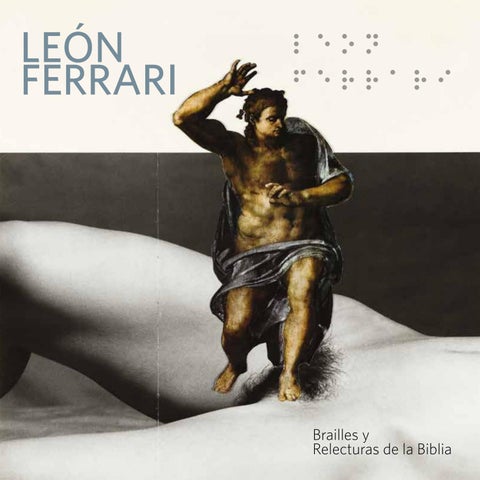
Buenos Aires, Argentina 2012
Malba – Fundación Costantini Museo de Arte Latinoamericano de Buenos Aires 4
Presidente Eduardo F. Costantini Vicepresidente Mauro Herlitzka Curador en Jefe Marcelo E. Pacheco Curadora Florencia Battiti Curador de Proyectos Internacionales Philip Larratt-Smith Gerente General Emilio Xarrier Asistentes María Costantini Carlos Orlando Museografía y Diseño de Exposiciones Gustavo Vásquez Ocampo Asistentes Jorge Cícero – José Luis Rial Montaje Fernando Brizuela – Mariano Dal Verme – Andrés Toro Iluminación Heriberto Ramón Rodríguez Coordinación de Producción de Exposiciones Victoria Giraudo Asistente de Curaduría María Laura Paredes Coordinación de Exposiciones Socorro Giménez Cubillos Asistente María Florencia Cambón
Educadores Solana Finkelstein – Alejandro Rozenholc – María José Kahn Silva – DiegoMurphy – Daniela Seco – Martín Lanezan Cine Fernando Martín Peña Asistente Maximiliano Basso Gold Ayudantes de Sala Francisco Lezama Proyectoristas Alejandro Intrieri Manuel Pose Auditorio Andrés Smith Literatura María Soledad Costantini de Muniz Barreto Asistentes Carla Scarpatti – Magdalena Arrupe Administración Cinthia Moreno Asistentes Sabrina Lemos Recursos Humanos Paula Cantariño
Registro y Gestión de Colección Cintia Mezza
Recepción Carolina Bellomo
Programas Educativos Florencia González de Langarica Asistente Laura Scotti Gestión de Reservas Fiorella Talamo
Comunicación Guadalupe Requena Asistente María J. Molteno
Diseño Gráfico Fabián Muggeri Asistente Pablo Branchini Marketing Cultural y Fundraising Julián Rosner Asistente Romina Pérez Tiendamalba Facundo De Falco Asistentes Juliana Eguía – Horacio Cornejo Atención al público Clara María España – Mauricio Sosa – Ana Braconi Quinteiro – Elías Paz Villegas Sistemas Javier Séré Intendente Daniel Pepe Asistente Rodrigo Martín Darricades Jefe de Mantenimiento Rodrigo Julián López Técnicos de Mantenimiento Edilicio Arnaldo Coronel Veira – Sam Toni – Alejandro Cuba – Héctor Rodríguez – Juan Carlos Carrizo Maestranza Laly Largo Torres José Insaurralde Julio César Calgaro
Cajas y Atención al Público Gabriela Albornoz – Gerardo Barreto – Leonardo Belvedere – Patricia Busoni – Patricia Casidis – Marisabel Del Fiore – María Laura Guerín Bozzano – Jaime Gutiérrez Feria – Mónica Lizzi – María Marta Mongelli – Mariana Muñoz – Silvana Suárez – Juan Cruzat - Vanesa Vicencio Dubost - Marcela Lingiardi – Laura Zingariello asociación amigos de malba
Comisión Directiva Presidente Miguel Menegazzo-Cané Vicepresidente Horacio Areco Tesorero David Eric Weseley Prosecretaria Sofía Weil Vocal titular Amalia Monpelat Comisión Revisora de Cuentas Miembros titulares Myriam Costa Catalina Grether Miembro suplente Luis Orellano Programa de Adquisiciones Elena Nofal Asistente ejecutiva Josefina Barcia Atención Amigos Florencia González Moreno
Brailles y Relecturas de la Biblia
Buenos Aires, Argentina 2012
6
EXPOSICIÓN León Ferrari. Brailles y Relecturas de la Biblia Del 29 de marzo al 2 de julio de 2012 Curadora Florencia Battiti Coordinación de producción Florencia Battiti Gustavo Vásquez Ocampo Diseño de montaje Gustavo Vásquez Ocampo Coordinación logística Socorro Giménez Cubillos Asistente Florencia Cambón
Malba agradece a: Alicia y León Ferrari Paloma y Julieta Zamorano Rosa Lesca Fundación Augusto y León Ferrari - Arte y Acervo (FALFAA) Andrea Wain (FALFAA) Victoria López Zanuso (FALFAA) ASAC Asociación Argentina de Ciegos
CATÁLOGO Diseño gráfico Fabián Muggeri Coordinación editorial Socorro Giménez Cubillos Traducción al inglés: Jane Brodie Corrección: Alicia Di Stasio y Mario Valledor Imágenes reproducidas: © Copyright Fundación Augusto y León Ferrari - Arte y Acervo.
Socios corporativos
Link, Daniel León Ferrari : Brailles y relecturas de la Biblia / Daniel Link y Victoria López Zanuso. - 1a ed. - Ciudad Autónoma de Buenos Aires : Fundación Eduardo F. Costantini, 2012. 162 p. ; 21x21 cm. Medios asociados
Traducido por: Jane Brodie ISBN 978-987-1271-41-2 1. Catálogo de Arte. I. López Zanuso, Victoria II. Brodie, Jane, trad. III. Título CDD 708 Fecha de catalogación: 07/03/2012
Con el apoyo de
© de la edición, Fundación Eduardo F. Costantini Malba – Fundación Costantini Museo de Arte Latinoamericano de Buenos Aires Buenos Aires, Argentina | marzo de 2012
9
Presentación Eduardo F. Costantini
11
León Ferrari, la experiencia exterior Daniel Link
29 31 63
Obras Brailles Relecturas de la Biblia
115
Cronología biográfica Victoria López Zanuso
127
Lista de obras en exposición
137
English Texts
Presentación
9
Como presidente de la Fundación es para mí un gusto inaugurar en Malba, una vez más, una exposición de León Ferrari, uno de los grandes artistas argentinos que, además, en los últimos años ha sido reconocido internacionalmente, con las presentaciones consagratorias de su obra en la Bienal Internacional de Venecia y en la exposición que le dedicó el MoMA de Nueva York, junto a la artista brasileña Mira Schendel. Con su constante trabajo, León Ferrari ha conseguido que, en la escena del arte del siglo XX, hoy se lo considere como uno de los iniciadores del arte conceptual a nivel mundial, con su ya famosa serie de Escrituras de la década del 60. Los especialistas más destacados en el campo de la investigación de esta corriente se han dedicado a estudiar el fenómeno del conceptualismo latinoamericano, y Ferrari es subrayado como uno de sus pioneros más originales y personales. León es uno de los artistas que estuvo presente en la colección de Malba desde sus inicios, con obras significativas de su labor histórica de los años 60 y 70, y con una pieza más reciente, de 1999, que había sido distinguida en una de las ediciones del Premio Costantini, realizada en el Museo Nacional de Bellas Artes. La presentación de sus esculturas musicales en la terraza de Malba, en 2004, con la realización de un concierto-perfomance por el propio artista y una de sus nietas, sigue siendo una de las actividades más relevantes y conmovedoras producidas por el museo en sus primeros diez años de existencia. Algunas de las obras que hoy se presentan fueron exhibidas por primera vez en el mundo por Mari Carmen Ramírez, en su célebre exposición Cantos paralelos, llevada a cabo en el Jack Blanton Museum of Art de la Universidad de Texas en Austin, en 1999. La muestra, dedicada al arte argentino, ayudó a varios de nuestros artistas a fortalecer su visibilidad internacional; entre ellos, Berni, Distéfano, De la Vega y Benedit. Quiero expresar mi más sincero agradecimiento a la Fundación Augusto y León Ferrari por su generosa colaboración en el armado y en la presentación de esta exposición. Estas breves palabras son también una muestra renovada de mi afecto y respeto por León Ferrari, a quien tengo el privilegio de conocer desde hace ya varios años, desde mis primeros acercamientos a sus obras y el inicio de mis visitas a su taller.
Eduardo F. Costantini Presidente Malba - Fundación Costantini
León Ferrari, la experiencia exterior por Daniel Link
La obra de León Ferrari es muy conocida en el panorama de la plástica contemporánea, en el país y fuera de él. Ha estado rodeada, en varias ocasiones, de un escándalo si no previsto, seguramente merecido que, sin embargo, lejos de iluminar mejor las tensiones en las que se instala, parece oscurecerlas. Los tópicos de la iconoclasia,1 en la que el “escándalo” encuentra sus fundamentos (adhesión o rechazo), han puesto a Ferrari en el aparente lugar del destructor de imágenes, cuando su obra apunta precisamente a lo contrario: a la producción de imágenes, al pensamiento sobre la imagen, a la transformación de la imagen (en sus fundamentos teóricos, en sus efectos políticos); nunca, jamás, a su olvido. Lo poco que de iconoclasta puede haber en la obra de alguien que ha insistido en la necesidad de considerar incluso la escritura como imagen (es decir: no como la mera transcripción del habla, sino como un soporte de sentido por propio derecho, a medida que se desarrollan el ritmo y el tono del trazo y la inscripción), en todo caso, es una crítica de la idolatría (la adoración de una imagen en lugar de la deidad, que se supone que el Ícono representa). La idolatría es tiempo perdido, de modo que hay que rechazarla tan terminantemente como en su momento lo hizo Marcel Proust: hay que recobrar el tiempo perdido, dice la obra de León Ferrari, cuya temática obsesiva es el Tiempo, los Tiempos (el tiempo del Apocalipsis y el de la Revolución; el tiempo del arte y el de la deyección, el Fin de los Tiempos, la Historia).2 Más allá de la semioclasia con la que generalmente se la identifica, la iconoclasia, en el sentido de crítica de la idolatría, supone una preocupación (terca, irrenunciable) por la verdad, algo en lo que, sin dudas, se reconoce el arte de Ferrari, y una reflexión sobre el Tiempo / los Tiempos (si hay verdad en el arte, es una verdad del Tiempo). La obra de Ferrari, que desprecia los íconos y su cultivo (y por eso se reconoce antes en relación con el dominio de la imagen que con el dominio del arte,3 preso de la idolatría tal vez más insidiosa), es, por lo tanto, necesariamente iconoclasta porque redefine la imagen (no tanto el sistema de la imagen, sino la potencia de la imagen, su fuerza), necesaria para acceder a su verdad, que es verdad del Tiempo / de los Tiempos. Las obras reunidas en esta exhibición, que forman parte de dos series realizadas por León Ferrari a lo largo de tres décadas y hasta ahora sólo parcialmente conocidas, nos piden que orientemos nuestro examen en esa dirección, precisamente porque no son agitprop, son arte. No protestan por los males del mundo, sino que brindan testimonio de un cierto temblor en esos bordes o fisuras en los que la Ley se declara ausente, porque la cultura misma se ha desbaratado al chocar con otra placa que le ofrece resistencia (Oriente y Occidente, lo visual y lo táctil, etc.). Por lo mismo, su horizonte de reconocimiento no
1 “—Quizás Dios puso el material en su camino para distraerlo de su obsesión iconoclasta. ¿Ya terminó con eso? —No. Porque todavía quedan muchos creyentes a los que convencer”, en “León Ferrari: 'Encontré el alma de Picasso en un tubo de aerosol'”, entrevista de Fernando García en Clarín, Buenos Aires, domingo 17 de diciembre de 2006. (Puede leerse en http://edant.clarin.com/diario/2006/12/17/sociedad/s-06015.htm). 2 Sé que hay sólo una manera de relacionar los nombres de Marcel Proust y de León Ferrari, y es el camino de la Verdad, el camino de Gilles Deleuze, cuyas pistas sigo (en cuyas pistas, derrapo). 3 Desde el principio hasta hoy. “Ignoro el valor de esas piezas. Lo único que le pido al arte es que me ayude a decir lo que pienso con la mayor claridad posible, a inventar los signos plásticos y críticos que me permitan condenar la barbarie de Occidente; es posible que alguien me demuestre que esto no es arte; no tendría ningún problema, no cambiaría de camino, me limitaría a cambiarle de nombre: tacharía arte y lo llamaría política o cualquier cosa”, declaró a propósito del “escándalo” por La civilización occidental y cristiana, y “—Bueno, la Bienal de San Pablo tiene el gran mérito de poner lo estético en un segundo plano. No era una muestra de objetos sino de propuestas del medio artístico a problemas de la vida”, art. cit.
11
12
se agota en el alucinado mundito del arte. Hacen del Mundo y de las imágenes del Mundo su campo de experiencia.
Vida y obra
León Ferrari nació en Buenos Aires el 3 de septiembre de 1920, el tercero de los seis hijos de Augusto Ferrari (italiano, nacido en 1871 y muerto en 1970) y Susana Celia del Pardo. Se educó en colegios religiosos y colaboró con su padre en la construcción y decoración de numerosas iglesias en Córdoba y Buenos Aires. Estudió ingeniería entre 1938 y 1947 y llegó a firmar algunos planos de las iglesias que su padre construyó. Aunque nunca realizó estudios formales de arte, comenzó, por esos años, a dibujar ocasionales retratos. En 1946 se casó con Alicia Barros Castro, con quien tuvo tres hijos: Marialí, Pablo y Ariel. En el otoño de 1952, su hija Marialí contrajo meningitis tuberculosa. En busca de una cura para ella, los Ferrari se trasladaron a Florencia, primero, y a Roma, después, período en el cual suelen datarse las primeras piezas en cerámica y en cemento de su obra.4 Participó decisivamente de los debates estéticos en el Instituto Di Tella (que le regaló la primera censura, el primer escándalo) y de Tucumán arde. Vivió y expuso en el Brasil, cuando tuvo que exiliarse. Produjo películas, obras de teatro, instalaciones musicales, esculturas con alambre, cuadros y planos de pesadillas kafkianas. Sobre todo, en lo que a las series Relecturas de la Biblia y Brailles se refiere, collages. El 24 de enero de 1964 escribió en uno de sus cuadernos: Berni es formidable, los dos Juanito Laguna de 1961 y las dos Ramona Montiel son fuertísimos, muy bien hechos. Después de verlos hay que sacarse el sombrero y degollarse. Es de lejos el más genial de los argentinos plásticos [24-2-64, c2, 18].5
¿Cómo hacer “arte político” después de Berni? Degollándose, es decir, apelando a la propia destrucción (no a la de las imágenes), estableciendo consigo mismo, y con el campo de la plástica, un proceso de depuración del sentido (“El significado solo no hace una obra de arte… Nuestro trabajo consiste en buscar materiales estéticos e inventar leyes para organizarlos alrededor de los significados, de su eficacia de transmisión, de su poder persuasivo, de su claridad, de su carácter ineludible”),6 del que estas dos series son ejemplo cabal. Berni sostuvo que “si hay arte, no hay pancarta; pero si no hay arte, la pancarta es burda y no sirve para nada; mejor dicho, sirve a todo lo contrario de lo que se propuso servir”. Por eso, su última obra recurre, al mismo tiempo, al nombre propio (Juanito Laguna, Ramona Montiel) y al collage como dispositivo (como negación de toda ilusión de plenitud previa, de toda fusión con lo comunitario) para la postulación radical de formas de vida marginales (el villero, la puta). Y, gracias al collage, Berni descubrió la potencia del vacío. Las obsesivas series de Juanito y Ramona, que incorporan los desechos como parte constitutiva de la cosa de arte (es decir: de la cualidad de lo viviente a finales del siglo XX), han renunciado por completo a toda organicidad y a toda complicidad con la plenitud de la imaginería (de la cultura y la civilización). Pocas semanas antes de morir (accidentalmente), y entregado ya a una investigación del Apocalipsis de Juan de Patmos, Berni señalaba: “El arte es una respuesta a la vida”. 4 En ocasión de la muestra León Ferrari. Retrospectiva. Obras 1954-2004, Andrea Giunta estableció, en el catálogo del mismo nombre (Buenos Aires, Centro Cultural Recoleta y Malba - Colección Costantini, 2004), una cronología con abundante material documental, esencial para cualquier aproximación a la obra de Ferrari, y que aquí seguimos. 5 Todas las citas de las libretas de apuntes han sido tomadas del imprescindible trabajo de Andrea Giunta ya citado. 6 “El arte de los significados” (1968), incluido en Ferrari, León, Prosa política, Buenos Aires, Siglo XXI, 2005.
Porque “hemos llegado a esa etapa histórica del hombre vacío”, pensaba Berni, es que valía la pena detenerse a reflexionar sobre esas formas de vida del día después de mañana (el Apocalipsis). Lo demás es cliché. Es a partir de ahí cuando la obra de Ferrari se pone decididamente en marcha. En Cuadro escrito (1964) se lee: Si yo supiera pintar, si Dios en su apuro y turbado por error confuso me hubiera tocado, agarraría los vellos de la marta en la punta de una rama de fresno flexible empapados sumergidos en óleo bermejo y precisamente en este lugar empezaría una línea delgada…
Si hay arte en la obra de Ferrari, ese arte es una línea delgada (la grieta, la rajadura, el crack up), sólo en esa línea delgada se sostiene, y la maestría del artista consiste en haber podido sostenerla, contra la fuerza del Tiempo y la prepotencia de los Tiempos.
Escándalo
La retrospectiva en el Centro Cultural Recoleta superó los estándares de escándalo de Infiernos e idolatrías (mayo de 2000, ICI, Centro Cultural de España en Buenos Aires). Entre los muchos correos electrónicos que recibió el entonces embajador de España, el mejor escrito decía: …repudiables obras, de un mal gusto y de una vileza sin fin… este “cruzado de la antifé”, fundador de un ridículo y degradante club de apóstatas, blasfemos y etc., elabora grotescas muestras de supuesto arte con elementos prosaicos, tan absurdas como su maestro Foucault… Que la Virgen del Pilar le inspire un gesto de hispana grandeza, cancelando ya esa vergüenza.7
La muestra en el Centro Cultural Recoleta se inauguró el 30 de noviembre de 2004 y fue objeto de amenazas de bombas, rotura de obras por fuerzas de choque ultramontanas, violaciones a la “libertad de expresión”, suspensiones judiciales y reaperturas. El detalle del debate, las sentencias judiciales, los panfletos, los pareceres del libro de visitas y los acontecimientos conexos fue recopilado por Andrea Giunta en El caso Ferrari. Arte, censura y libertad de expresión en la retrospectiva de León Ferrari en el Centro Cultural Recoleta, 2004-2005.8 En el prólogo, Andrea señala: La decisión de organizar este libro se basa, fundamentalmente, en el carácter inédito de los acontecimientos que aquí se refieren. Durante los cuarenta días que la retrospectiva de León Ferrari estuvo abierta al público, convocó a 70.000 espectadores; generó inmensas colas para ingresar en la sala; fue recorrida por abogados y jueces; provocó la destrucción de obras y manifestaciones multitudinarias en su apoyo; dio lugar a casi 1.000 artículos de prensa; recibió mensajes de apoyo y de repudio; originó una solicitada en su defensa con 2.800 firmas; hizo necesario extender el horario de exhibición hasta pasada la medianoche; ocupó en varias oportunidades las primeras planas de los diarios; fue clausurada por la justicia y nuevamente abierta por ésta. 7 Firmado por “Luis María Mesquita, profesor de lengua castellana”. Mucho más interesante que la atroz coincidencia del imaginario católico militante y el nombre “Mesquita” es la homonimia parcial con uno de los curadores de arte contemporáneo más importantes de América Latina, Ivo Mesquita, responsable de la Bienal del Vacío. En 1987, Roberto Jacoby había caracterizado las heliografías de Ferrari como “una visión traspuesta de la teoría foucaultiana del poder”. 8 Prólogo de Andrea Giunta, Buenos Aires, Ediciones Licopodio, 2008.
13
Es el costado más incómodo de la obra de Ferrari que, por esa vía, podría convertirse en un mero epifenómeno de las turbulencias de la imaginación nacional (de sus fisuras, sus contradicciones, sus puntos ciegos y sus líneas de fuga) e, incluso, del mercado del arte.9 ¿No es el “escándalo” (mediático) la clave de interpretación de nuestra era, la llave más íntima de la cultura que impiadosamente nos ofrece su abrazo?10 ¿Para qué colocar la obra de Ferrari en el solo lugar del iconoclasta o el apóstata, que no la favorece porque oscurece el carácter productivo, festivo incluso, de su fuerza? ¿No es precisamente eso lo que su obsesión por el Juicio Final y el Infierno nos dicen con monomanía: que se trata de desterrar el miedo como regulador de la vida y de proponer soluciones (imaginarias) a problemas de vida?
14
El autor como productor
Toda lectura retrospectiva es siempre un poco cómoda, porque abusa del saber del presente para modelar el pasado, más o menos incierto, desde el final del laberinto. ¿Cuándo comienza la obra de Ferrari su largo proceso de depuración de todo lo accesorio? Tal vez en el momento en que el artista, como autor, se declara al mismo tiempo como incapaz de seguir reproduciendo imágenes, es decir, como “productor”: porque Dios, en su infinita sabiduría, le ha negado ese don (que el padre sí tenía) y porque el artista, recíprocamente, decide ponerse al margen de la imaginería (ni más allá ni más acá: exactamente en el margen). Como productor aparecerá acreditado León Ferrari en el proyecto en el que trabaja entre 1958 y 1959 con Fernando Birri y Oski, la película de animación La primera fundación de Buenos Aires.11 Inspirada en la crónica de Ulrico Schmidl, cuya lectura constituye la banda sonora del film (que incluye también música), La primera fundación de Buenos Aires consigue la atención del momento: Premio Fondo Nacional de las Artes (1959), Premio II Muestra del Cine Independiente del Instituto Nacional de Cinematografía (1959), Selección Oficial para el Festival de Cannes (1959). En los cuadros explicativos del comienzo se indica que, en 1958: Il regista Fernando Birri e il produttore León Ferrari progettano un film sul quadro. I realizzatori dell’opera inventano “una macchina diabolica” artigianale per le riprese di dettaglio e in movimento sulla sua superficie di piccole dimensioni.
La “máquina diabólica” es, en realidad, un banc-titre (según su denominación en francés) o rostrum camera (según su denominación norteamericana),12 dispositivo inventado en 1906 para realizar animaciones, muy frecuente en la filmación de piezas de archivo13 (documentos o imágenes fijas) y que León Ferrari consigue realizar con la asistencia de “unos amigos ingenieros que tenían una fábrica de zorras eléctricas”.14 Después vinieron el León de Oro de Venecia en 2007, el MoMA en 2009, el Reina Sofía en 2010. 10 Si, como ha sugerido Guy Debord, debe llamarse espectáculo a la fase extrema del capitalismo que vivimos, en la cual cada cosa es exhibida en su separación de sí misma, entonces espectáculo y consumo son las dos caras de una única imposibilidad de usar. Lo que no puede ser usado es, como tal, consignado al consumo o a la exhibición espectacular. Pero eso significa que profanar exige procedimientos especiales. Si profanar significa devolver al uso común lo que fue separado en la esfera de lo sagrado, la religión capitalista en su fase extrema apunta a la creación de un Improfanable absoluto. La prensa colombiana, ansiosa por reproducir el “escándalo”, manifestó su decepción cuando la obra de Ferrari visitó Bogotá: “En el 2004, en Argentina, la retrospectiva del artista León Ferrari generó una guerra de opinión entre el fundamentalismo católico y el activismo laico. Este año, en Colombia, país de medianías culturales, la misma exposición solo causó un rifirrafe de papel”. Ospina, Lucas, “El abogado del diablo”, en Revista Arcadia (Bogotá, 22-6-2011). (Puede leerse en http://www.revistaarcadia.com/opinion/columnas/ articulo/el-abogado-del-diablo/25432). 11 Producida por Producciones del Sur, “ilustrada por Oski, fotografiada por Enrique Wallfisch, leída por Raúl de Lange, musicada por Virtu Maragno, puesta en movimiento por el ayudante de dirección Manuel Horacio Giménez, compaginada por Antonio Ripoll, producida por León Ferrari y dirigida por Fernando Birri”. Copia del Archivio Audiovisivo del Movimento Operaio e Democratico y de la Fundación Fernando Birri de Artes Multimediales. “Direzione del restauro: Guido Albonetti; rigenerazione del positivo, Luigi Bellucci; datore luci al telecinema, Paolo Amatori; restauro del suono, Vieri Martelli; supervisione generale, Fernando Birri, 2000”. 12 Debo a Edgardo Cozarinsky el regalo de estas señas de identidad. 13 Cfr. Denis, Sébastien, Le Cinéma d’animation, Paris, Armand Colin, 2007. 14 Giunta, Andrea, “Cronología”, en León Ferrari. Retrospectiva…, op. cit., p. 77. 9
En esa “aventura”, León Ferrari inscribe su nombre como “productor”. Al mismo tiempo, los textos de la película postulan una equivalencia entre “regista” y “produttore”, esos “realizzatori dell’opera” que no son sino dos caras de la misma moneda (el autor, el productor) o, mejor, el lugar vacío (el único) que el artista puede ocupar toda vez que ha declarado su guerra no a las imágenes, sino al uso idólatra de éstas, sacadas del Tiempo / de los Tiempos, e inmovilizadas en una forma-mercancía cada vez más nauseabunda: Una parte del arte, uno de sus aspectos, es esa relación entre el arte y la sociedad, eso de que la obra te la cuelgan y se murió […] Es una forma de vestir la imagen del dinero… eso es el arte hoy. Cuando el tipo de mucho poder ya compró el barco, la casa country, qué le queda… bueno, para meterte en la sociedad nada mejor que comprarte un cuadro y vestirte de intelectual. El cuadro es especial para eso. Si vos comprás poesía tenés que leerla, el cuadro lo colgaste y listo: ahí quedó.15
Desde el comienzo (desde ese comienzo que yo elijo), León Ferrari se postula como un productor, un inventor de dispositivos (o bien, un artesano que actualiza un dispositivo), un interventor de archivo, un archivista loco y, sí, totalmente irreverente, que, máquina en mano, se propone devolver a las imágenes su verdad, su fuerza, su potencia (la que le viene, precisamente, del contacto del Tiempo). Un punto de vista que devuelve a las imágenes (desde el dibujo de Oski hasta al último de sus collages de tema bíblico) su movilidad, su Tiempo. A la pregunta sobre ¿Qué es la obra?, León Ferrari parece contestar: lo que preexiste en nosotros, lo que, como una ley de la naturaleza, necesaria y oculta, debemos descubrir en nosotros.16 Todo lo demás es falsedad, fetichismo de la mercancía o de la obra, uso idólatra de las imágenes, anulación del Tiempo y de los Tiempos.
Archivo
Las dos series que constituyen esta muestra, Relecturas de la Biblia (de 1983 en adelante) y Brailles (de 1984 en adelante), forman parte del archivo de León Ferrari (“Me gustaría armar una fundación y que se vean mis obras junto con las de mi viejo, eso sería bueno, pero hay que encontrar el lugar”).17 Aunque su sentido no puede comprenderse cabalmente sino en correlación con otras series (Escrituras, Heliografías, Nosotros no sabíamos, etc.), sus libretas de apuntes, sus libros de poemas, su prosa política, incluso la obra de su padre, la delicadeza y la claridad de su concepción permiten un acercamiento bastante fiel al conjunto (al conjunto de series). Es más, tal vez permitan ver con mayor claridad la razón de las series, por lo que agregan (ausente en las series anteriores): el tacto, Oriente. Las piezas más famosas del archivo Ferrari son sin duda La civilización occidental y cristiana (1965) y Juicio Final (1985). Quirúrgicamente precisa como es en su designación, La civilización occidental y cristiana articula en una gradación perfecta –de lo más general a lo más particular (que, paradójicamente, coincide con el universalismo)– lo civilizatorio (el trash industrial, los avioncitos de guerra, los cristos de santería) con Occidente (la Guerra) y la imaginería cristiana (la ética del Sacrificio) en un nudo que no hace sino colocar dos imaginarios completos (Occidente, el Cristianismo) en una justa proporción respecto de los Tiempos: superpuestas alrededor de una falla o un vacío, ambas figuritas de esos dos imaginarios cuya vileza quiere subrayarse constituyen el Monstruo de la Bondadosa Crueldad de nuestra época, pero también de todas las épocas. Ferrari, León, en “León Ferrari: 'Encontré el alma de Picasso…'”, art. cit. Como, por otra parte, Proust, en El tiempo recobrado. 17 Ferrari, León, art. cit. 15 16
15
16
Lo que siempre nos sorprenderá de La civilización occidental y cristiana no es tanto su tema, ni tampoco su forma. No sé cómo definir la delicada precisión de la articulación que propone, pero en todo caso me parece que no se trata allí de un problema de formas (a las que Ferrari considera apenas el objeto de su crítica), sino de unas fuerzas, unas potencias que son las que encarnan en el Tiempo y en los Tiempos: el tiempo del sacrificio (Cristo), el tiempo del Apocalipsis (Vietnam), el tiempo del capitalismo en su fase menos festiva, el tiempo de la redención. Poner a funcionar todo en relación con el Tiempo, recuperar el tiempo, luchar contra la idolatría (contra las formas, contra la forma-mercancía, contra las imágenes congeladas en un más allá de la temporalidad), no hay otra salida para el artista. Lo mismo puede decirse de las series del Juicio Final: el Apocalipsis y la Espera, el Infierno y el Milenio. Pero, más allá de todas las clases o categorías de tiempo en las que la obra de Ferrari piensa (el tiempo de la Inquisición, el tiempo de Dios, el tiempo de la tortura, el tiempo de las noticias políticas, el instante de la bomba o el del trazo, el Tiempo absoluto), en ella la Historia transcurre todavía, o más bien dura, pese a todas las predicciones de detención o de final o de hundimiento. Como sabemos, a partir de 1985 León Ferrari comenzó a presentar en varios museos y galerías una serie de instalaciones compuestas por pájaros enjaulados que defecaban sobre reproducciones de Juicios Finales pintados por Miguel Ángel, Giotto, Fra Angélico, Wolgemut, Van Eyck, Bruegel, Gerson, Lochner, Johannes Nicolaus y Nicola Pisano (la última que realizó). El significado de la experiencia parece claro, pero igual conviene subrayarlo: lo mismo que le había sucedido (que le sucede) al gran arte occidental en el exterior (las estatuas y las catedrales cagadas por palomas), lo mismo (es decir, la afectación al Tiempo y a los Tiempos de las cosas de arte, el devenir ruina, la pérdida del aura por el paso del Tiempo, que es paso de vida, antes que cualquier otra cosa), era reproducido experimentalmente tomando el arte de interior como materia (¿no es el arte, finalmente, una política para la decoración de interiores?). La obra de Ferrari (de allí que las Heliografías desempeñen un papel importante en relación con este punto) da vuelta el espacio como un guante, volviendo sencillamente exterior lo que es interior, afectándolo a los “procesos naturales” propios de la intemperie (elige aves, nunca roedores). ¿A cuento de qué tanto escándalo? ¿Son las palomas apóstatas e iconoclastas? Puede haber un impulso profanatorio en el experimento de Ferrari, por cierto, y habrá que examinar con mayor detenimiento su alcance, pero lo que queda claro en los Juicios Finales es que esa profanación no es diferente de la profanación propia del Tiempo y lo que vive más allá de cualquier amenaza de muerte, más allá de las formas, más allá de cualquier embalsamamiento. Lo mismo que hacen las palomas sobre las reproducciones que Ferrari les ofrece, lo hacen sobre la fachada de Notre-Dame y las estatuas de la Piazza della Signoria. ¿Profanación? Si acaso, como propiedad de una estética profundamente vitalista. La profanación es lo propio de una relación con las imágenes fundada en el Tiempo / los Tiempos. No es, entonces, sólo la protesta contra el Juicio (es decir, contra el fin de la historia: ¿a cuento de qué tanto escándalo?) lo que se deja leer en esas célebres imágenes cagadas, sino la afectación al Tiempo de lo natural, al ritmo de los pájaros (músicos, siempre se supo que eran: Ferrari los propuso, entonces, como pintores, ya que para él la diferencia entre unos y otros es sólo de actitud en relación con la materia). La exteriorización del interior se deja leer literalmente en Prosa política: Propongo construir en el Jardín Botánico de San Pablo o en el Parque Ibirapuera o en la Plaza da Sé una fortaleza en la cual no puedan entrar ni los minutos de Cristo, ni sus premoniciones, y desde donde podamos preparar el nacimiento de una nueva era el día 8 de agosto de 1999, cuando se declare muerto el
tiempo del Hijo de Dios. La planta de esa construcción será la de San Pedro, pero el recinto sólo tendrá de San Pedro la planta, pues será una gran columna hueca, resultado de la proyección al cielo del perfil de sus cimientos. De este recinto, poco a poco y con el pasar de los años, podremos ir ganando años para la Nueva Era Libre de Infiernos. […] Sobre los revoques externos, los más preciosos cuadros y esculturas de la publicidad religiosa de esta era: los de Leonardo, Fra Angélico, Giotto, Durero, Miguel Ángel, las resurrecciones, anunciaciones, inmaculadas concepciones, crucifixiones…18
El arte es un arte del afuera, un arte sometido a las inclemencias del Tiempo / de los Tiempos, y por eso se trata, también, de sacar del archivo (occidental y cristiano) las imágenes (unas imágenes, todas las imágenes) y, al hacerlo, ponerlas en movimiento, devolverles el gesto de lo que vive todavía, afectarlas a la vez a la historia y al Tiempo absoluto. No hay otra misión para el artista que producir lo vivo: “Y nada pudo hacer Dios contra la vida”, se lee en El árbol embarazador (1964).
La imagen
La imagen, liberada de toda devoción, de toda idolatría, de toda ilusión autonomista (artística), y afectada al Tiempo / a los Tiempos (incluso por la vía del anacronismo que la constituye), queda disponible para el uso, e incluso, para el usus pauper establecido por los franciscanos entre 1210 y 1323 y que tanta atención filosófica ha despertado últimamente. ¿No son los collages de Relecturas ejemplos de un usus pauper del arte clásico? ¿Y no ha declarado Ferrari que “el arte contemporáneo consiste en un lenguaje para no videntes?”. Por eso superpone, en Brailles, la caligrafía punteada del ciego sobre las imágenes que, transformadas por el tacto en una imagen ciega (y en una escritura ininteligible, al mismo tiempo), pasan de un plano de significación a otro. Como un poema-haiku, las imágenes producidas por Ferrari (collages, escrituras, lo que sea) sostienen una vida impersonal, situada en un umbral más allá del bien y del mal (es decir: sobre la que no se puede juzgar ni el bien y el mal). Muestran (no porque lo representen, sino porque lo actualizan) el pasaje de lo visual a lo táctil propio de las imágenes. Roland Barthes propuso, para la fotografía, ese carácter táctil: las luminancias que tocaron efectivamente el cuerpo fotografiado han quedado capturadas por el dispositivo y vuelven, desde el fondo de los Tiempos / del Tiempo, para tocarme.19 Más moderno que todos los modernos, podría decirse, Ferrari decide aplicar el mismo principio táctil a las imágenes pintadas, transformando la contemplación estética en un trance o proceso que atraviesa lo vivible y lo vivido. Si la escritura (ese otro avatar de la imagen) es inseparable del devenir y “devenir no es alcanzar una forma (identificación, imitación, Mimesis), sino encontrar la zona de vecindad, de indiscernibilidad o de indiferenciación tal que ya no quepa distinguirse de […] una molécula”,20 hay que admitir que los collages de Relecturas y las sobreimpresiones táctiles de Brailles configuran la misma actualización de la realidad que se dejaba leer en los Juicios Finales: lo que vemos es une vie… y por eso nos impresiona (nos toca). Las imágenes, propone Ferrari, están vivas y, al ponerlas en contacto (al hacer del contacto la razón de su existencia), se recupera no “la vida” (noción puramente ideológica) sino “la chispa de vida” que en ellas se sostiene. 18 19 20
“Contra el infierno” (1986), en Ferrari, León, Prosa política, op. cit., pp. 47-48. Barthes, Roland, La cámara lúcida, Barcelona, Paidós, 2009, p. 94. Deleuze, Gilles, “La literatura y la vida”, en Crítica y clínica, Barcelona, Anagrama, 1996.
17
Una concepción semejante de la imagen es correlativa de la transformación del autor en productor. El autor o bien no existe (ha muerto, y si vuelve es como un muerto-vivo: Barthes); o es una función discursiva (Foucault), o una instancia ética (el ponerse en juego, el testimonio, el gesto, como único rastro de una ausencia). Es una noción crítica (del sujeto de la crítica, pero también de la crisis del sujeto). En un caso y en otro, lo que domina es la impresión táctil: donde el discurso y la vida se tocan, allí hay autor (lo mismo dice Barthes de la fotografía: luminancias). Dicho de otro modo, el autor no es un energúmeno (un pequeño monarca de su propia nada), sino una chispa de vida sostenida en un umbral, en un margen, en una delgada línea. En 1997, en una exposición de Brailles, Ferrari dispuso junto a las imágenes un cartel que decía: “No está prohibido tocar las obras”. La imagen, que no puede entenderse ya ni como forma, ni como representación, sino como fuerza, como supervivencia inmemorial (pathos), como forma de vida (no cadáver, no momia, no ceniza ni polvo), se vuelve pura área de contacto: ¿No son “si Dios me hubiera tocado”, “que se vean mis obras junto con las de mi viejo”, deseos equivalentes, como equivalentes son la Primera fundación de la cual Ferrari es productor y la última, la Fundación León Ferrari, que custodia su archivo?
18
El tacto
Cuadro escrito está prefigurado en los cuadernos de Ferrari, que escribe en 1964: Si tuviera alguna vez que escribir una presentación, una autopresentación, escribiría: no entiendo nada, no entiendo nada no ENTIENDO nada no entiendo nada no entiendo nada no entiendo nada no entendés nada no entiendo nada no entienden nada no entendéis nada no entenderé nada no entiendo nada no entiendo nada no entenderán nada no entiendo no entenderán no entendí nada no entiendo nada no entiendo nada [19-9-64, c3, 16b].
Dicho de otro modo: no hay nada que entender o, con sintaxis más ajustada: hay nada que entender. Sólo la nada se entiende, y lo que subleva es la necesidad de llenar esa nada con una imaginería pletórica de escenas de crueldad (“diluvios, Sodoma, primogénitos egipcios, Jericó, Apocalipsis, Juicios Finales, infiernos”).21 La reivindicación del tacto sobre la mirada no es casual ni caprichosa: es el fundamento de una ética que dice que la mirada es cruel porque crueles son las imágenes, y que en el tacto (que participa de la voluptuosidad) no puede haber crueldad alguna. “El ojo por el que veo a Dios es el mismo ojo por el que Dios me ve”, sostuvo Angelus Silesius, “un autor excesivo”. Muchos años después, otro autor excesivo, Roland Barthes, lo citaba para dar cuenta de ese proceso de co-existencia que impide diferenciar la lectura de la escritura (o, en este caso: la contemplación de la producción). De la inspiración mística de Silesius, sostenida en la teología negativa (todo puede decirse, salvo el Nombre), se deducen la inmediatez y la co-existencia como propiedades de una imagen (de cualquier imagen, de todas las imágenes) y, sobre todo, como lógica del régimen de participación táctil que reclaman, ese paradójico “acto ciego” que Fabián Lebenglik subrayaba en los brailles incluidos en la muestra Tormentos-amores, de 1997. La “línea delgada” sostenida por Cuadro escrito era, entonces, “una frontera oscura” que hacía coexistir inmediatamente (por la vía de la juntura, por la vía del tacto) la sexualidad y la tortura, el éxtasis sexual y la experiencia del tormento. 21
Ferrari, León, La bondadosa crueldad, Buenos Aires, Argonauta, 2000, p. 13.
Dios es esa nada o nadería que la civilización occidental y cristiana (porque las otras dos grandes religiones monoteístas, la de los judíos y la de los musulmanes, tan crueles como el cristianismo, o más todavía, tuvieron la precaución de prohibir las imágenes) recubre con sucesivas capas de imágenes. “No entiendo nada” o “Hay nada que entender” o “Hay que entender la nada”: esas negaciones están detrás de las imágenes, pero no como un dios que en ellas se expresara o como una voz que dictara los trazos y los tonos, sino como la mano gentil que nos toca o no (“si Dios me hubiera tocado…”). El pasaje de lo liso a lo estriado (pero también de lo estriado a lo liso) debe entenderse como un ejercicio de traducción sensorial (de lo visual a lo táctil, y viceversa) infinita, porque traducir es dominar el espacio liso, “pero también proporcionarle un medio de propagación, de extensión, de refracción, de renovación, de crecimiento, sin el cual tal vez moriría por sí solo: como una máscara sin la que ya no podría haber ni respiración ni forma general de expresión”.22 Sin el pasaje de lo visual a lo táctil, sin esa traducción, dicen los Brailles, la imagen ya ni respira, muere por sí misma.
Política del montaje
Algunos Brailles toman como punto de partida fotografías de huacos eróticos mochicas. Antonio Berni, ese pintor que Ferrari admiraba hasta el degollamiento (el sacrificio), tuvo también su encuentro con los huacos (vaso, vasija, vacío): Los huacos-retratos de la cerámica antigua del Perú no han sido estudiados, sentidos y valorados en lo que tienen de más interesante: el de ser una de las bellas manifestaciones del arte escultórico que ha realizado el hombre. Nuestros museos de Bellas Artes han puesto poco interés en incorporar al acervo artístico de sus colecciones el inmenso caudal del arte americano que –desde el preincaico, pasando por la colonia, hasta fines del siglo pasado– forman un legado que podría ser orgullo de cualquier nación del mundo. Los huacos-retratos son, por ahora, curiosidades de los museos arqueológicos, etnográficos o históricos, como caso extraordinario de cultura aborigen, pero estas obras rebasan, por ellas mismas, los límites del común fenómeno arqueológico para entrar, con todos los honores, en el vasto conjunto de las grandes creaciones artísticas de la humanidad.23
El interior del huaco (vaso, vasija) está vacío y todo sucede en su exterior: la fornicación y “la inmundicia”, el uso “contra natura” y las “cosas nefastas” de la carne que Pablo de Tarso condenó en los textos que se superponen, como una segunda piel, a las fotografías de los delicados huacos moches. No son las piezas más logradas, precisamente por la reducción a la bidimensionalidad del huaco, pero son precisamente por eso las más significativas: hay una distancia (vacío) entre la textura, la rugosidad, las estrías de la escritura ciega y los relieves de las cerámicas. En ese vacío entre una materia modelada y la inscripción del veredicto o la sentencia cabe el Tiempo / los Tiempos. Lo que estaba destinado a un ritual celebratorio que poco y nada tiene que ver con la reproducción (las piezas moches que se conservan representan a hombres, mujeres y hermafroditas masturbándose, o practicando coito vaginal o coito anal)24 aparece, por la vía del montaje (la sobreimpresión de la imagen fotográfica y la imagen de escritura), inscrito en “la civilización occidental y cristiana” tal y como la codificó Pablo de Tarso, ese némesis de Nietzsche y, en esa misma tradición, de Ferrari. Deleuze, Gilles y Guattari, Félix, Mil mesetas. Capitalismo y esquizofrenia, Valencia, Pre-Textos, 1988, pp. 492-494. Berni, Antonio, “Los huacos retratos”, en Forma. Revista de Artes Plásticas, nº 27, Buenos Aires, junio de 1943, p. 13. Citado por Raúl Antelo en “Berni, collage e investigación” (mimeo). 24 Cfr. Link, Daniel, “Cachar por atrás”, en Soy, suplemento de Página/12, Buenos Aires, 30 de julio de 2010. 22 23
19
Nietzsche, como se sabe, sostuvo una gran oposición entre Cristo y Pablo: Cristo, el más suave, el más amoroso de los decadentes, una especie de Buda que nos liberaría de la dominación de los sacerdotes, y de toda idea de culpa, castigo, recompensa, juicio, muerte, y lo que viene después de la muerte; este hombre de la buena nueva fue sobrepasado por el negro y tenebroso Pablo, que mantiene a Cristo en la cruz, devolviéndolo a ella sin cesar, haciéndolo resucitar, desplazando todo el centro de gravedad hacia la vida eterna, inventando un nuevo tipo de sacerdote más terrible aún que los anteriores sacerdotes judíos a partir de su técnica de tiranía sacerdotal: la creencia en la inmortalidad, es decir, la doctrina del juicio. Habría que estar, piensa Ferrari, “ciegos ante los frescos que ilustran los crímenes que cuenta el Antiguo Testamento y ante los suplicios que exaltan el Giotto, Botticelli y el Dante”25 y, por eso, imprime sobre grabados japoneses de tema sexual, fotografías de instrumentos de tortura o de huacos precolombinos las marcas de ese impulso civilizatorio ciego, el mismo que había sostenido a Cristo no sobre una cruz sino sobre un bombardero en La civilización occidental y cristiana, obra en la que tal vez ya no convenga tanto señalar la conjunción entre una figura y otra (entre un imaginario y otro), ya suficientemente subrayada, sino la disyunción que se sostiene, como marca del Tiempo / de los Tiempos, entre el avioncito de juguete y la imagen de santería. En la superposición entre una y otra imagen sobrevive un misterio, un casillero vacío, la pregunta, filológica,26 sobre la verdad de las escrituras (escrituras sagradas, en contraposición con las cartas, los cuadros escritos, las escrituras en braille, etc…). La pregunta que agita las imágenes producidas por León Ferrari interroga la verdad de la nueva alianza, la disyunción entre el amor de Jesús y el poder de Pablo como señal del Tiempo / de los Tiempos. Después de La civilización occidental y cristiana, Ferrari trabajó en Palabras ajenas, collage literario que se convertiría en una obra de teatro que “no tendrá fin ni principio” y que, además, como La primera fundación, anota en sus libretas, “ha sido escrita para ser filmada” [11-10-66, c4, 14a]. En la obra de Ferrari, el collage no es la vía regia de una imagen totalizadora (totalizante, totalitaria), sino todo lo contrario: el significado chisporrotea en el choque de las palabras y siempre habrá una disyunción entre el tiempo presente (“contexto 1968”)27 y el tiempo “cuando Dios hablaba (me pregunto por qué no sigue hablando)”.28 El montaje subraya la radical bipolaridad de vida y muerte que se agita en el arte: en todas partes, pero especialmente en Relecturas y Brailles, se constata esa tensión (esa disyunción) entre lo vivo y lo muerto, precisamente lo que pone a las imágenes a circular más allá del amontonamiento inconsecuente y sin sentido de fragmentos de trabajo muerto y de esnobismo reaccionario. Nada de eso: si hay vida en las imágenes, esa vida se sostiene en la “delgada línea” que constituye el arte de Ferrari, quien, de ese modo, se separa de cualquier formalismo estéril y vacío de sentido.
20
Vanguardia y babelismo
Es eso precisamente lo que separa la obra de León Ferrari de cualquier ilusión vanguardista. En 1971 participó de la Contrabienal organizada como protesta contra la Bienal de San Pablo a instancias de Luis Camnitzer y otros artistas. Ferrari denunció, en esa ocasión, la complicidad del arte de vanguardia con las políticas imperiales y militaristas, con las dictaduras latinoamericanas. Como Pasolini, León Ferrari sabe que la vanguardia es elitista, formalista y, por lo tanto, irremediablemente irrecuperable. Sabe también que el único interés de la vanguardia es la destrucción de las imágenes, y ya ha quedado demostrado hasta qué punto su interés es devolverles la vida y no aniquilarlas. Sabe, “Sobre Nicola Costantino”, en Prosa política, op. cit., p. 225. “Yo no soy específicamente anticlerical y ateo. Los anticlericales tienen como objetivo a la Iglesia y los curas, mientras que los ateos se ocupan de negar la existencia de Dios. Y a mí no me preocupan esas cosas, sino la religión en sí, los libros sagrados, la Biblia”. León Ferrari en entrevista con Fabián Lebenglik, Página/12, 1994. 27 La obra se estrenó en octubre de 1968 en el Arts Laboratory, de Londres, con el título de Listen Here Now. A News Concert for Four Voices and a Soft Drum. 28 Carta de León Ferrari a Leopoldo Maler, 15-3-68. Archivo L.F. Citado en Giunta, Andrea, León Ferrari. Retrospectiva…, op. cit., p. 139. 25 26
por fin, que la vanguardia establece con el Tiempo una relación de recomienzo: un nuevo principio (para un nuevo final: el fin de los tiempos en un nuevo registro). A la lógica temporal destructiva y arrogante de la vanguardia, Ferrari opone lo que llama, desde 1964, “babelismo”: …hacer una cosa sin unidad, con diferentes sensibilidades […] o hacerla entre varios. Hacer una torre de Babel y agregarle cosas de otros: Heredia, Marta Minujín, Wells, Santantonín, Badii, Althabe, Stimm, todo mezclado, todo babélico, el babelismo. Puede ser uno que arme la torre con cosas de todos, o mejor, hacerla entre todos, tachándose, cubriéndose […]. Todos juntos trabajando en la Babel y sin mirar lo que hace el otro. [1-1-64, c2, 15-16].
El mito de Babel sostiene que los hombres, en su arrogancia, quisieron construir una torre que tocara los cielos (“si Dios me hubiera tocado….”). Dios razonó: “He aquí que todos forman un solo pueblo y todos hablan una misma lengua, siendo éste el principio de sus empresas. Nada les impedirá que lleven a cabo todo lo que se propongan. Pues bien, descendamos y allí mismo confundamos su lenguaje de modo que no se entiendan los unos con los otros” (Gen., 11: 6-7). Dios comprende que el lenguaje único es concentracionario (totalitario) y por eso establece la disyunción (lingüística) como principio de esperanza. Ferrari, que no es sordo a la voz de Dios (“me pregunto por qué no sigue hablando”), aplica al dominio del arte los principios disyuntivos que se derivan de Babel, porque comprende que “el imperialismo es precisamente ese movimiento hacia la negación de la traducción, o más bien: la reducción de la traducción a traducción a lo dominante”.29 La vanguardia es un lenguaje único (y, por lo tanto, totalitario), dado que su obsesión es la novedad, el tiempo nuevo, la forma nueva. El arte de Ferrari es totalmente otra cosa: no una forma sino una fuerza, la co-existencia de elementos disyuntivos: el coito anal de los huacos y Pablo de Tarso, el dedo en el clítoris de la estampa de Utamaro y el evangelio de Marcos, el helicóptero norteamericano y el ángel tocando la trompeta, Hiroshima y la Trinidad… No se trata de desdecir el mandato divino (entiéndanse más allá de la disyunción lingüística, coexistan en la diferencia) sino de llevarlo, por la vía de la profanación, hasta sus últimas consecuencias: la creación como traducción infinita, el arte como traducción sensorial, la traducción sensorial como vía de propagación de lo viviente y de amplificación del tiempo sin Fin de los Tiempos, sin Juicio Final, sin Fin de la Historia.
El sacrificio y la profanación
Después de Berni, sostiene Ferrari, sólo cabe el sacrificio (el degollamiento). Sacrificarse en/por el arte es la desaparición del artista, su transformación en productor, su persistencia apenas como muerto-vivo, como pieza de un colectivo “babélico”, como engranaje de una “máquina diabólica” que incluye también pájaros vivos en su mecanismo. No se trata de una máquina de negar (de destruir) sino de una máquina de profanar. El propio Ferrari así lo entendía ya en 1964 (y el tacto vuelve y volverá, porque es la clave de la profanación): 29
Moreiras, Alberto, “Una relación de pensamiento. El fin de la subalternidad”, en Línea de sombra. El no sujeto de la política, Santiago de Chile, Palinodia, 2006, p. 166.
21
a) Una Venus del Milo rota, con manos encima como caminando sobre ella o como si estuvieran saliendo de su vestimenta. b) Una virgen de Botticelli o una Eva de Cranach y cubrirla de manos, que las acaricien, viejas y arrugadas manos que las profanen… [27-6-64, c2, 31b, el destacado es mío].
22
Nada más ajeno al dispositivo Ferrari que la destrucción o la negación del Padre (el padre biológico, que construía y decoraba iglesias; el Padre celestial, que estableció la síntesis disyuntiva, babélica, como ley de los hombres). Más bien, se trata de seguir esas voces, de repetir los gestos, hasta la extenuación. No tanto un giro dialéctico como una revolución antropológica; jugar el juego del padre como forma de profanación: Si consagrar (sacrare) era el término que designaba la salida de las cosas de la esfera del derecho humano, profanar significaba por el contrario restituirlas al libre uso de los hombres […] El pasaje de lo sagrado a lo profano puede, de hecho, darse también a través de un uso (o, más bien, un reuso) completamente incongruente de lo sagrado. Se trata del juego. […] El juego no sólo proviene de la esfera de lo sagrado, sino que representa de algún modo su inversión.30
Usus pauper de las imágenes: eso es la profanación. Crítica de toda idolatría: eso es la profanación. Restitución de lo que vive en las imágenes (el Tiempo / los Tiempos), eso es la profanación. Palimpsesto, antropofagia y duración (nunca comienzo, nunca final), eso es la profanación. En La primera fundación de Buenos Aires, Ulrico Schmidl dice: “…y se comieron hasta los zapatos y otros cueros”, “hurtaron un caballo y se lo comieron, secretamente”, colgados los ladrones del caballo, otros españoles “les cortaron los muslos y otros pedazos de carne […] se los llevaron a sus casas y allí los comieron”, “otro español, habiendo fallecido su propio hermano, se lo comió. Esto ha sucedido en el año 1535, el día de Corpus Christi, en la referida ciudad de Buenos Aires”. Comprender una imagen no es sino asimilarla, por la vía de la digestión (se trate de la antropofagia paulista, del canibalismo tupí-guaraní o del hambre ritual –Corpus Christi– de los primeros colonizadores). Los palimpsestos que constituyen la obra de Ferrari (lo que en él preexiste, lo que está condenado a descubrir en sí mismo), fragmentos babélicos en síntesis disyuntiva, alcanzan en las Relecturas su expresión más clara (más despojada de todo lo accesorio). Las imágenes, puestas en relación de contigüidad, se devoran unas a otras. Una de las formas más simples de profanación se realiza así por contacto (contagione) en el mismo sacrificio que obra y regula el pasaje de la víctima de la esfera humana a la esfera divina. Una parte de la víctima (las vísceras) es reservada a los dioses, mientras que lo que queda puede ser consumido por los hombres. Es suficiente que los que participan en el rito toquen estas carnes para que ellas se conviertan en profanas y puedan simplemente ser comidas. Hay un contagio profano, un tocar que desencanta y restituye al uso lo que lo sagrado había separado y petrificado.
Apocalipsis y espera
En 1995, León Ferrari, junto a un grupo de amigos (Álvaro Castagnino, Juan Carlos Romero, Teresa Volco, Ricardo Longhini, Ramiro Larrain), fundó CIHABAPAI (Club de Impíos, Herejes, Apóstatas, Blasfemos, Ateos, Paganos, Agnósticos e Infieles, en formación) con el propósito de pedir la anulación del Juicio Final mediante una carta enviada al papa Juan Pablo II en la Navidad de 1997, firmada por más de 150 personas (artistas, escritores y personas “preocupadas por la actualización de la amenaza apocalíptica”). 30
Agamben, Giorgio, “Elogio de la profanación”, en Profanaciones, Buenos Aires, Adriana Hidalgo, 2005, p. 100.
Buenos Aires, 24 de diciembre de 1997. Juan Pablo II El Vaticano De nuestra consideración: Se acerca el fin del milenio. Se acerca, posiblemente, el Apocalipsis y el Juicio Final. Si es cierto que son pocos los que se salvan, como advierte el Evangelio, se acerca para la mayor parte de la humanidad el comienzo de un infierno inacabable. Para evitarlo basta volver a la justicia que Dios Padre dictó en el Génesis. Si Él castigó la desobediencia de Eva suprimiendo nuestra inmortalidad, no es justo que el Hijo nos la haya restituido, tantos siglos después, prolongando padeceres. Si una parte de la Trinidad dicta una sentencia cuya pena termina y se completa con la muerte, no puede otra parte abrir cada causa, agregar otra sentencia, resucitar el cadáver y aplicar un castigo adicional que repite infinitas veces el castigo ya cumplido por el pecador una vez muerto. La justicia del Hijo contradice y viola la del Padre. La existencia del Paraíso no justifica la del Infierno: la bondad de los pocos salvados no les permitirá ser felices sabiendo eternamente que novias o hermanas o madres o amigos y también desconocidos y enemigos (prójimo que Jesús nos ordena amar y perdonar) sufren en tierras de Satanás. Le solicitamos entonces volver al Pentateuco y tramitar la anulación del Juicio Final y de la inmortalidad. Lo saludamos atentamente, CIHABAPAI
La carta no recibió respuesta y el reclamo se repitió en diciembre de 2000 y 2001: Diciembre de 2000, reiterada en 2001. Juan Pablo II El Vaticano Asunto: Por un milenio sin infiernos De nuestra consideración: En su artículo 5, la Declaración Universal de Derechos Humanos (1948) dice: “…nadie será sometido a torturas ni a penas o tratos crueles, inhumanos o degradantes”. El artículo I de la Convención contra la Tortura y Otros Tratos o Penas Crueles, Inhumanos o Degradantes (1984) califica como tortura “todo acto por el cual se inflija intencionalmente a una persona dolores o sufrimientos graves, ya sean físicos o mentales, con el fin de obtener de ella o de un tercero, información, o una confesión, o de castigarla por un acto que haya cometido…”, y agrega: “todo Estado castigará esos delitos con penas adecuadas”. La última ¿última? edición del Catecismo de la Iglesia Católica (1998) comparte la condena: “La tortura, que usa de violencia física o moral, para arrancar confesiones, para castigar a los culpables, intimidar a los que se oponen, satisfacer el odio, es contraria al respeto y a la dignidad humana” (n. 2297). El mismo Catecismo admite los suplicios: “La enseñanza de la Iglesia afirma la existencia del infierno y su eternidad. Las almas de los que mueren en estado de pecado mortal descienden a los infiernos inmediata-
23
mente después de la muerte y allí sufren las penas del infierno, el fuego eterno” (n. 1035). Al sufrimiento de las almas el Catecismo suma el de los cuerpos. La resurrección de todos los muertos, “de los justos y de los pecadores” (Hch. 24, 15), precederá al Juicio Final. Ésta “será la hora en que todos los que estén en los sepulcros oirán su voz y los que hayan hecho bien resucitarán para la vida, y los que hayan hecho el mal, para la condenación” (Jn. 5, 28-29), “…e irán éstos a un castigo eterno y los justos a una vida eterna” (Mt. 25, 31, 32, 46) (n. 1038). Se materialice o no el sufrimiento anunciado por Jesús, corresponda o no juzgarlo con nuestras leyes, el miedo de los creyentes al futuro suplicio es ya un suplicio: un sufrimiento mental actual que nuestras leyes y el Catecismo prohíben. Frente a estas convicciones de la Iglesia, que rechaza la tortura en vida y la admite en almas de muertos y cuerpos de resucitados, y alarmados por la declaración vaticana de que el Infierno existe, es eterno y está lleno de malvados, le solicitamos: a) que extienda al más allá el repudio a la tortura proclamado en el Catecismo, b) que gestione se respeten los derechos humanos de la multitud de almas que están sufriendo, algunas desde el Gólgota, en tierras de Satanás. Terminar con padecimientos de millones, desalojar y demoler el infierno, tranquilizar a los creyentes puede hacer realidad su esperanza de que la Iglesia pasará a la historia como la defensora del hombre.
24
Lo saludamos muy atentamente, CIHABAPAI
No se trata, en estos ejercicios de “arte postal”, de reclamar por la separación de Iglesia y Estado o de promover la libertad de solventar o no el culto católico por parte de los ciudadanos (renuncia que, en países europeos, es totalmente posible), sino de un pedido mucho más radical, que afecta al Tiempo / los Tiempos, y por eso se solicita la suspensión de la inmortalidad de las almas y la cancelación del Juicio Final (como punto final de los Tiempos). Más allá de la oposición entre Jesús y Pablo de Tarso (o además de ella), aparece la oposición entre Cristo y Juan de Patmos (el “autor” del Apocalipsis). Ferrari, como miembro de CIHABAPAI, comprende que si Cristo se instala en el amor humano (una práctica, una forma de vivir y no una creencia), Juan de Patmos trabaja en el terror y la muerte cósmicos. El Apocalipsis sostiene una religión del Poder, una creencia, una forma terrible de juzgar: una deuda infinita en vez del don de Cristo. La actualidad del Apocalipsis se comprende no tanto en términos de conjunciones históricas del tipo Nerón = Hitler = Videla (en las que los palimpsestos de Ferrari insisten), ni en términos de los pánicos de ciencia ficción propios del milenarismo, sino en términos estrictamente temporales, en términos de espera (“el miedo de los creyentes al futuro suplicio es ya un suplicio”). Lo que esperamos, lo que el Apocalipsis nos obliga a esperar, genera en cada uno de nosotros formas de vivir, de sobrevivir y de juzgar. “Es el libro de cada uno de los que se creen supervivientes. Es el libro de los zombis”.31 El pintor Gustave Courbet (no es casual que El origen del mundo integre la serie Brailles) conoció personas que se despertaban en plena noche gritando: “¡Quiero juzgar, tengo que juzgar!”. Voluntad de destruir, voluntad de ser la última palabra para siempre jamás: triple voluntad que no es sino una sola, la del Padre, el Hijo y el Espíritu Santo. Un poder de los últimos hombres como prolongada (infinita) política de venganza. Lo propio del tiempo judío (que se puso para siempre en situación de espera), el “destino diferido”, es convertido por el Apocalipsis en objeto de una programación maniática sin precedentes: la pequeña y 31
Deleuze, Gilles, “Nietzsche y San Pablo, Lawrence y Juan de Patmos”, en Crítica y clínica, op. cit., p. 56 y siguientes.
la gran muerte, los siete sellos, las siete trompetas, las siete copas, la primera resurrección, el milenio, la segunda resurrección, el juicio final… “Una especie de Folies-Bergère, con ciudad celestial, y lago de azufre infernal”, señala Deleuze.32 Todo el detalle pormenorizado de las desdichas, plagas y azotes reservados a los enemigos en el lago, y de la gloria de los elegidos en la ciudad, la necesidad de estos últimos de medir su gloria comparándola con las desdichas de los otros, todo eso marca el minuto a minuto de un final infinito. El Apocalipsis es una inmensa máquina, una organización ya industrial (Metrópolis). Todas y cada una de las Relecturas insisten en ese punto (la Cicciolina y El Infierno de Signorelli, La Anunciación de Fra Angélico y las esvásticas del III Reich, el ángel del Apocalipsis y el misil, etc…). La obra de Ferrari define el cosmos de una forma muy sencilla: es la sede de las conexiones vivas, la vida-más-que-personal (impersonal). Las conexiones cósmicas son, primero, sustituidas en la religión judía por la conexión de Dios con el pueblo elegido (la antigua alianza), y esa vida-supra-o-infra-personal será sustituida por los cristianos por el pequeño vínculo personal del alma con Cristo (la nueva alianza). El Apocalipsis no es tanto el campo de concentración (eso es el Infierno), sino la gran seguridad militar, policial y civil del nuevo Estado. La modernidad del Apocalipsis no estriba en las catástrofes anunciadas, sino en la instauración demente de un poder último, judicial y moral. Afortunadamente, piensa la obra de Ferrari, existen otras religiones además del monoteísmo (judío, cristiano, musulmán): el sintoísmo japonés, con sus millones de diosecillos intrascendentes, es decir, inmanentes a los elementos naturales, o esa rara religión atea que es el budismo.
Occidente y Oriente
La imagen que falta en La civilización occidental y cristiana (independientemente del sentido que se quiera dar a esa pieza decisiva del archivo de Ferrari), esa imagen que, por lo tanto, nos toca desde el vacío que la constituye, es el objetivo del bombardero: Vietnam y, más en general, Oriente. Pensando en “la civilización occidental y cristiana”, la obra de Ferrari se topa con la idea de vacío (el ideograma mu), es decir: con la paradoja de un signo vaciado. Contra el pleno de Occidente (sus imaginerías, sus lógicas temporales, su teleología, sus dioses únicos y, al mismo tiempo, bondadosos y crueles), el vacío de Oriente (que no sólo no tiene Dios, sino que tampoco tuvo Hegel). Oriente, en la obra de Ferrari, co-existe con Occidente como un diferencial y, en los palimpsestos resultantes, se establece una síntesis disyuntiva entre una temporalidad teleológica (fin de la Historia, fin de los Tiempos, fin del Tiempo, Juicio y Eternidad) y una temporalidad que contradice la lógica occidental y que descubre en el Instante la fuerza del Tiempo absoluto. Entre Oriente y Occidente, por la vía del montaje, Ferrari traza una delgada línea o frontera oscura, y, como sabemos, cuando dos placas tectónicas se tocan se produce un terremoto, lo mismo en el plano de la geología como en el de lo imaginario. El satori es un seísmo y el zen es un acto de conocimiento sin sujeto cognoscente y sin objeto de conocimiento (nada puede oponerse más a Hegel, para quien el final de la historia es la identidad total del sujeto y del objeto). De modo que la desaparición del hombre (la especie), si acaso sucediera, está bien lejos de constituir una catástrofe cósmica (el Juicio, las Trompetas, los Sellos, etc.). Lo que de Japón (y, más en general, Oriente) hace temblar (seísmo, satori) la imaginería occidental y cristiana es un conjunto de valores vacíos por completo de cualquier contenido “humano” en el sentido de “histórico” (es decir, no sometido a las lógicas temporales de Occidente).
32
Ibidem, p. 61.
25
26
Por eso, la verdad del precepto “Ama a tu prójimo como a ti mismo” no se imprime sobre una imagen cristiana sino sobre el pellizco (tacto) del clítoris, según el artista japonés Utamaro. Si Ferrari insiste (con monomanía que algunos juzgarán adolescente) en la síntesis disyuntiva entre decoraciones eclesiásticas y escenas de coito es precisamente para subrayar la experiencia pura y más desnuda del afuera que su concepción del Tiempo reclama (instantes encadenados no a un hipotético final sino a la intensidad de la duración, no otra cosa es la vida). En la perspectiva de Ferrari, hay un epílogo del final de la historia (del Tiempo, de los Tiempos, del Juicio) donde la humanidad se conserva como “resto” desprejuiciado (“desjuiciado”, lamentablemente, no existe en nuestra lengua) en las formas del erotismo, la risa, el júbilo ante la muerte, el arte. Las obras de Ferrari son esas marcas que han herido el papel (se trate de su mano, de una paloma o de un instrumento para trazar palabras en braille), que han subrayado frases, que han aislado fragmentos de su contexto y los han puesto a circular en una maquinación extranjera, exterior (que vuelve exterior los interiores), que no es ya propia ni ajena sino un campo de iridiscencia sin centro y sin orillas, ese momento en el que otra escritura (la escritura del Otro) acierta a escribir fragmentos de nuestra propia vida: en suma, cuando se produce una co-existencia de elementos disyuntivos.
28
OBRAS
29
Brailles
33
Amad, 1996 Cat. 1
34
Amarรกs pues, 1997 Cat. 18
35
Apartaos, 1997 Cat. 14
36
Consolaciรณn, 1997 Cat. 19
37
Dadle tormento y llanto, 1997 Cat. 21
38
Entrad por la puerta estrecha, 1997 Cat. 20
39
El que come mi carne, 1998 Cat. 24
40
El รกngel Gabriel, 1997 Cat. 8
41
EspĂritu inmundo, 2003 Cat. 27
42
Eva, 1997 Cat. 10
43
El amor es Dios, 1997 Cat. 22
44
Hijos, 1997 Cat. 6
45
Mandamiento, 1997 Cat. 9
46
MatarĂŠ a sus hijos con muerte, 1997 Cat. 4
47
No codiciarรกs la mujer de tu prรณjimo, 1997 Cat. 11
48
OÃsteis que fue dicho, 1996 Cat. 2
49
Sin título, 1997 Cat. 16
Sin título, 1997 Cat. 15
50
51
Arrepentimiento, 1997 Cat. 13
52
Yo crĂo el mal, 1997 Cat. 12
53
54
Huid de la fornicaciรณn, 1997 Cat. 17
55
Yo soy la estrella resplandeciente de la maĂąana, 1997 Cat. 23
56
Yo soy, 1997 Cat. 5
57
Yo soy la resurrecciรณn, 1999 Cat. 26
58
La lengua, 1997 Cat. 7
59
Ă mate, 1997 Cat. 3
60
Yo tengo las llaves, 1998 Cat. 25
61
Relecturas de la Biblia
65
Sin tĂtulo, 1994 Cat. 43
66
Bendiciรณn, 1988 Cat. 37
67
Anunciaciรณn, 1987 Cat. 33
68
La expulsiรณn, 1988 Cat. 36
69
71
Lanzamiento, 1986 Cat. 11
72
Lanzamiento, 1987 Cat. 22
73
La anunciaciรณn, 1987 Cat. 21
74
Majestad, 1986 Cat. 7
75
Nagasaki, 1987 Cat. 30
76
ParaĂso e infierno, 1994 Cat. 42
77
La Ăşltima cena, 1987 Cat. 26
78
Sin tĂtulo, 1986 Cat. 18
79
Sin tĂtulo, 1988 Cat. 38
80
Sin tĂtulo, 1986 Cat. 2
81
Sin tĂtulo, 1986 Cat. 10
82
Sin tĂtulo, 1986 Cat. 1
83
Sin tĂtulo, 1986 Cat. 6
84
Sin tĂtulo, 1994 Cat. 40
85
Sin tĂtulo, 1994 Cat. 41
86
Sin tĂtulo, 1986 Cat. 16
87
Sin tĂtulo, 1987 Cat. 23
88
Sin tĂtulo, 1987 Cat. 25
89
Sin tĂtulo, 1987 Cat. 31
91
Sin tĂtulo, 1989 Cat. 39
92
Sin tĂtulo, 1987 Cat. 19
93
Sin tĂtulo, 1986 Cat. 12
94
Sin tĂtulo, 1986 Cat. 8
95
Sin tĂtulo, 1987 Cat. 27
96
Sin tĂtulo, 1986 Cat. 13
97
Sin tĂtulo, 1986 Cat. 15
98
Sin tĂtulo, 1986 Cat. 5
99
Sin tĂtulo, 1987 Cat. 32
100
Sin tĂtulo, 1986 Cat. 3
101
Sin tĂtulo, 1987 Cat. 20
102
Sin tĂtulo, 1986 Cat. 4
103
Sin tĂtulo, 1987 Cat. 34
104
Sin tĂtulo, 1987 Cat. 28
105
106
Sin tĂtulo, 1986 Cat. 9
107
Sin tĂtulo, 1986 Cat. 17
108
109
Sin tĂtulo, 1988 Cat. 35
110
Sin tĂtulo, 1987 Cat. 29
111
Sin tĂtulo, 1986 Cat. 14
112
113
Viaje, 1987 Cat. 24
Cronología biográfica
115
por Victoria López Zanuso
Uno va llenando sus días con cosas que de repente se juntan, crecen y fructifican. A veces el fruto es amargo […] pero otras es como la síntesis, el resultado, el extracto de unos cuantos años. Me pasó con la muestra que hice en un museo de aquí [Brasil], en una sala muy grande, llena de recovecos y paneles donde puse buena parte de lo que hice aquí y, también, unos 30 dibujos de los primeros que hice en 1962. Cosas que tenía medio olvidadas y que alguien me trajo hace no mucho, cosas escritas como historias de loquero y el libro con Rafael Alberti. Eso mezclado con los alambres y dibujos que hice en S. Pablo, en esa sala tan grande, fue como recorrerme por dentro en todos estos años pasados…1
1920
Nace el viernes 3 de septiembre. Es el segundo de seis hermanos, hijos de Susana Celia del Pardo y Augusto Ferrari. De pequeño, León está en contacto con el arte a través de su padre –pintor, arquitecto y fotógrafo–, quien, sin embargo, prefiere alentarlo hacia una carrera convencional. A sus veinte años comienza a estudiar ingeniería en la Facultad de Ciencias Exactas de la Universidad de Buenos Aires, una elección que parece alejarlo del arte. Años más tarde, se recibe de ingeniero civil y comienza a trabajar junto a su padre en la construcción y decoración de iglesias, en Córdoba y Buenos Aires. Durante su paso por la facultad, conoce a Alicia Barros Castro, con quien se casa. Tienen tres hijos: Marialí (1948), Pablo (1949) y Ariel (1951), y viven en Castelar, provincia de Buenos Aires.
1952
Viaja al país de sus raíces, Italia. A diferencia de muchos de sus contemporáneos, Ferrari no llega a Europa para conocer las técnicas plásticas que se desarrollaban en aquel continente. Él se embarca junto con su familia para dar con las prácticas y métodos a los que los médicos apelan para tratar la meningitis tuberculosa, enfermedad que su hija Marialí ha contraído. En una canasta de mimbre pusimos a nuestra hija en Buenos Aires y la sacamos en Florencia. Todo esto parecía absolutamente imposible […] pero si usted parte de la base de no escuchar a quien diga “imposible” va a llegar aquí como yo he llegado.2
1953-1954
Tras la recuperación de Marialí, León y Alicia viajan a Roma para continuar con los chequeos. Es en esa ciudad donde León comienza con las esculturas, toma clases de cerámica y crea vasos junto al siciliano Salvatore Meli. Trabaja con el artista Renato Marino Mazzacurati y alquila luego un espacio que funcionaba como una fábrica de macetas para convertirlo en su propio taller. 1 2
Carta de L.F. a su hermana Susana, fechada el 17-6 [ca. 1980]. Carta de L.F. a un padre en situación similar, 1952.
Libreta de registro del Consejo Profesional de la Ingeniería. Archivo FALFAA.
Participa de un concurso nacional de cerámica que se realiza en el Museo Internazionale delle Ceramiche de Faenza (1954). “Nunca estudié arte. En un momento, tomé unas clases de cerámica y me di cuenta de que me gustaba mucho. Sentí placer desde entonces, cuando tenía 35 años”.3
116
1955
En Italia conoce a Lucio Fontana, quien lo invita a participar de la X Trienal de Milán, en la que él es jurado. Realiza su primera muestra individual, también en la ciudad de Milán, en la galería Cairola. Allí expone “cincuenta piezas únicas de cerámica de unos 60 o 70 centímetros de altura. Eran formas ahuecadas leves, ligeras, para colgar desde el techo. Formas que ante el más mínimo movimiento se transformaban con la proyección de sombras diferentes”.4 Ese mismo año hace una exposición en la colorida via Margutta, una vistosa callejuela que se ve realzada por las formas curvas que exhibían las esculturas del artista. Taller de León Ferrari en Roma, 1955. Archivo FALFAA.
1958-1959
León vuelve a la Argentina y se instala en la casa de Castelar. Durante tres años se aboca a su profesión como ingeniero. Sigue relacionado con las cerámicas –aunque sólo a través de la investigación de sus colores– y monta Tantal, una pequeña industria familiar para materiales metalúrgicos (como tungsteno, tantalio y niobio), que él mismo se dedica a explorar. Al mismo tiempo que trabaja en la fábrica, realiza algunas obras y filma el largometraje La primera fundación de Buenos Aires, junto con Fernando Birri. La película se rueda a partir de un cuadro de Oski y está basada en un texto del siglo XVI, del alemán Enrico [Ulrico] Schmidel. León recuerda la filmación como la de los primeros días de Buenos Aires y “la época junto al cine –Birri y Oski–”.
1960
Rodaje de La primera fundación de Buenos Aires.
Presenta en la galería porteña Galatea Esculturas, su primera exhibición en la Argentina. Expone obras en cemento, yeso y arcilla, “…formas lisas, ampulosas y delicadas, resumen sus temas de la ‘mujer’. Formas rosadas y etéreas que sintetizan todo un ritmo, para sugerir la figura capturada”.5 En esta exhibición conoce a Rafael Alberti, con quien surge una confraternidad que se mantendrá por años. Trabajan para distintas obras y publican un libro con poemas de Alberti e ilustraciones de Ferrari: Mi muy querido León: Te escribí hace muy pocos días una carta diciéndote que le iba a proponer nuestro pequeño libro a un pequeño editor de Milano… Ya todo está arreglado… Estuvo anoche en casa Vanni Sheiwiller, el joven editorcillo, muy amigo mío, y se quedó entusiasmado con el libro y ha decidido tenerlo listo para el 9 de abril (¡¡), en edición facsimilar y al tamaño exacto del original. Es un triunfo lograr esto en tan poco tiempo. […] Recordarás que no teníamos título. Al fin encontré uno, que creo no está mal: “Escrito en el aire”… haremos una exposición de los nueve pliegos… “Escrito en el aire” nos dará prestigio; dinero, poco, pero el suficiente para comprarnos unos cuantos camaleones. Adiós, con grandes abrazos para Alicia, para ti, niños, perros, camaleón, etc. Escríbeme siempre, Rafael.6
Luego de Escrito en el aire, seguirán para León otras tantas publicaciones y participaciones en libros. Incluso, creará dos sellos editoriales, Exú y Licopodio.
Portadilla e interior de Escrito en el aire. León Ferrari, entrevista con Judith Savloff, Perfil, 4-11-2007. Giunta, Andrea, “Cronología”, en León Ferrari. Retrospectiva. Obras 1954-2004 (cat. exp.), Buenos Aires, Centro Cultural Recoleta y Malba - Colección Costantini, 2004, p. 74. La Razón, 12-11-1960. 6 Carta de Rafael Alberti a León Ferrari, fechada el 8-2-1964 en Roma. 3 4 5
1961-1962
117
En 1961 presenta dieciséis obras en la galería Van Riel: maderas talladas y las primeras esculturas en alambre, realizadas en acero inoxidable, bronce, cobre, plata, oro, paladio y tantalio. Por entonces, la crítica se refiere a la obra como “erizos y poliedros metálicos, logrados con notable destreza y espíritu”7 o como creaciones “con gracia lineal, ritmo, fina arquitectura…”.8 En 1962 vive un año Milán y participa de dos muestras en esa ciudad. Una será de pintores y escultores argentinos en el Teatro del Corso de Milán, junto con Lucio Fontana y Mario Pucciarelli; la otra, individual, en la galería Peter. En esta última, el coleccionista Arturo Schwarz le compra una escultura homenaje a García Lorca y lo invita a participar de la colección de aguafuertes Antología internazionale dell’incisione contemporanea. En la ciudad milanesa, León Ferrari establece diferentes vínculos que extenderá desde Italia a París y de allí a Ámsterdam, en donde exhibirá una de sus obras junto a otras de Klee, Michaux y Pollock. En septiembre, vuelve a Buenos Aires y realiza una nueva exposición en la galería Antígona. Allí presenta piezas de alambres y dibujos, composiciones que, según el crítico del Argentinisches Tageblatt, Sigwart Blum, expresan “una musicalidad que parece corresponder al temperamento del artista. Este religioso vibrar, unido a una sensible disciplina, son los fundamentos del talento de un artista cuya obra parece harto promisoria”.9 En esta muestra Rafael Squirru le compra una pieza para el Museo de Arte Moderno de Buenos Aires. Comienza sus cuadernos de notas, en los que asienta fechas y referencia sus trabajos con números y letras. A lo largo de estas páginas también vuelca reflexiones, describe proyectos, desarrolla ideas y registra acontecimientos relevantes para su obra, como invitaciones a muestras o artículos publicados en la prensa al respecto. Envía un conjunto de obras a la galería Levi en Milán.
1963
Debido al estado de precariedad de su casa, “llena de grietas” y bajo riesgo de caerse, se dedica a refaccionarla: “Trabajo poco en la A-230.10 Me paso el día en Tantal y haciendo planos para la casa. Es triste pero perderé dos o tres meses por lo menos”.11 Sin embargo, no detiene su producción. En abril de ese año registra la primera Música con pentagrama; realiza escrituras y la primera Carta a un general, con letras y palabras deformadas. Estas escrituras “contienen un texto que por momentos puede descifrarse y por momentos es una maraña de líneas abstractas”.12 Las denomina, precisamente, “escrituras deformadas”, diferenciándolas así de aquellas otras obras a las que llama “dibujos escritos”, en las que no hay ningún texto. En su cuaderno señala: “primer dibujo con palabras enredadas”, y detalla: “queda bastante bien, las palabras tienen que mezclarse con el dibujo, ser un garabato más, confundirse y casi ser ilegibles”.13 En julio comienza Torre de Babel, una pieza de gran tamaño (220 cm de alto y 85 de diámetro), realizada con chapas y alambres. A partir de esta escultura, surge la idea de “babelismo”, como un proyecto colectivo junto a artistas como Líbero Badii, Antonio Berni, Dalila Puzzovio y Raúl Soldi. Este año viaja a San Pablo por asuntos vinculados a su empresa y visita la bienal de esa ciudad. Expone en la galería Lirolay, Buenos Aires, en la muestra colectiva La escultura en pequeño. En su cuaderno de notas registra el primer collage, con fotos y reproducciones de cristos, manos de vírgenes, madonnas del 1300 y cabezas de Botticelli. También experimenta con grafismos, escrituras y acuarelas: Por primera vez cuando agarro el pincel creo saber qué puedo hacer con él.14
Esculturas, gravuras e desenhos (cat. exp.), con presentación de Aracy Amaral. Pinacoteca do Estado, San Pablo, septiembre de 1978.
La Nación, 20-10-1961. Clarín, 18-10-1961. Blum, Sigwart, 1962. Archivo L.F. 13. 10 A-230: referencia alfanumérica que usa Ferrari para registrar sus obras. 11 Cuaderno de notas 1, página 32a. Se trata de un cuaderno de dibujo Meridiano N° 3, con 40 hojas. Contiene notas desde el 6-12-1962 hasta el 30-6-1963. 12 Giunta, Andrea, op. cit., p. 105. 13 Comentario de León en su cuaderno, citado en Giunta, Andrea, op. cit., p. 105. 14 Cuaderno 2, página 29 (20-6-1964). Cuaderno de dibujo Meridiano, con notas que van desde el 15-7-1963 al 30-7-1964. 7 8 9
1964
118
Desarrolla collages de manos recortadas, que trabaja sobre fondos de acuarelas, sobre papel o con alambres. En abril presenta Escrituras, alambres y manos en la galería Lirolay. En julio comienza a trabajar con botellas. Ayer estuve en el Museo [de] Arte Moderno en la muestra que va a N Y, Pepsi Cola. Algunas cosas muy buenas: [Rubén] Santantonín, Marta Minujín, Dalila Puzzovio, [Luis Alberto] Wells, [Emilio] Renart. Tengo que hacer 12 botellas para “la feria de las ferias” en Lirolay, desde hace tres días no hago más que pensar en botellas.15
Carta de Rafael Alberti a León Ferrari, fechada el 8-2-64, Roma.
Más adelante participa de la exhibición colectiva Buenos Aires 64, en Estados Unidos. En una suerte de síntesis del año, destaca las “cajas con alambres y manos, cajas sin alambres, con manos y Venus. Escrituras confusas en su forma y en el significado. Escrituras con palabras raras, usadas por su sonido y sin cuidarse de su significado real. Escrituras con la Biblia y Cuadro escrito”. A su criterio, los favoritos de 1964 son El árbol embarazador, Cuadro escrito y la caja La Venus rota, señalados por él como “los mejorcitos” de ese año.16
1965
Apuntes del trabajo que realizó para el Premio Di Tella, 1965.
Lo invitan a participar del Premio Instituto Torcuato Di Tella (ITDT). En su cuaderno desarrolla ideas y bocetos para presentar en el ITDT. Entre ellas, una jaula: sería bueno hacer una jaula que se llame Vietnam con una multitud de aviones arriba y abajo flores.17 El envío final son tres cajas y un montaje de dos metros de altura que reúnen la reproducción de un bombardero norteamericano y un Cristo de santería; se titula La civilización occidental y cristiana. Esta última pieza es rechazada, según explica Romero Brest al artista, porque heriría la sensibilidad religiosa del personal o de parte del personal. La exhibición se lleva a cabo sin esa obra. No obstante, las piezas que expone Ferrari generan polémica y un cruce de artículos con la prensa. Rafael Alberti y Julio Cortázar escriben a León Ferrari apoyando su causa. Interrumpe las producciones de arte abstracto y hasta 1975 se involucra en el movimiento cultural vinculado a la política argentina y latinoamericana. En ese período, envía obras a muestras colectivas afines y forma parte de encuentros que abogan por los derechos humanos.
1966
Participa en la organización de la exposición Homenaje al Viet-Nam de los artistas plásticos, que se lleva a cabo en la galería Van Riel entre abril y junio. Publica en Buenos Aires Palabras ajenas, un libro en el que Ferrari crea un diálogo imaginario entre Dios y distintos hombres –como el papa Pablo VI, Hitler y el ex presidente Lyndon Baines Johnson–. El texto es representado posteriormente como pieza de teatro en el Institute of Contemporary Art de Londres (1968), con puesta en escena de Leopoldo Maler.
1968-1973
Carta de LF dirigida a Jorge Romero Brest en la que acepta la invitación al Premio Di Tella, 1965. Archivo Instituto Di Tella.
Se reúne con los artistas que organizan el grupo Tucumán arde y participa de las dos muestras que realizan en 1968. Al año siguiente, envía una obra a la muestra colectiva Malvenido Rockefeller. En 1972 presenta en el Contra-Salón, en la Sociedad Central de Arquitectos de Buenos Aires, una obra alusiva a la masacre de Trelew. En 1973 forma parte del Congreso de Artistas Plásticos de La Habana, Cuba. 15 16 17
Cuaderno 2, página 33b (1˚-7-1964). Cuaderno 4, página 1 (1˚-12-1964). Cuaderno 4, página 9b.
119
1976-1977
El 24 de marzo, una junta militar toma el poder en la Argentina. Bajo el nombre de Proceso de Reorganización Nacional, la dictadura se caracterizó por cometer violaciones sistemáticas a los derechos humanos. Una importante oleada de intelectuales y artistas debe exiliarse. León interrumpe las actividades en la fábrica familiar, arma sus valijas y cierra su casa de Castelar, a la que no volverá hasta 1992. La familia Ferrari viaja al Brasil y, a costa de grandes esfuerzos, logra acomodarse a la situación. En enero de 1977 –año en que se radica en San Pablo–, León relata: A pesar de todo lo que significa esta múltiple mudanza, cambios, trabajos interrumpidos, casas desalojadas y tantas cosas y gente que quedó del otro lado del río Iguazú, a pesar de todo eso estamos bastante bien. Por ahora no busco trabajo técnico pero me paso el día dibujando o soldando alambrecitos. Tengo cierta esperanza en que este cambio me permita volver a hacer lo que me gusta…18
Collage de noticias expuestas en Tucumán arde, CGTA de Rosario, 1968.
Poco a poco empieza a leerse en sus cartas la creación de sus obras. Primero fueron los “alambrecitos” y luego, a medida que fueron pasando los años, en su taller aparecieron diferentes técnicas –Xerox, grabado, Letraset– y nuevos temas –la Biblia, el sexo y, nuevamente, la política–. Fue en esta ciudad [San Pablo] donde retomé inquietudes artísticas. Son gente dulce, libre de cabeza, sin prejuicios. Esto me motivó finalmente para decidirme a dedicarme al arte como profesión.19
1979
Realiza series en collages y dibujos, que llama Códigos, Ajedrez, Baños y Plantas, y sus primeras heliografías, en las que aplica la técnica de Letraset. Escribe uno de los denominados Flasharte, textos que duplica por doscientos y envía por correo. El primero –sin numerar– es Flasharte: Nacimiento; le sigue Flasharte I: Berimbau: artefacto para dibujar sonidos, y en 1980, el último, Flasharte II: A repetição. Participa de la exposición Arte lúdica en el Museu de Arte de São Paulo (MASP), con una escultura de cuatro metros de alto compuesta por cien barras de diversos diámetros: Berimbau.
1980
Tras la experiencia que genera Berimbau en Arte lúdica, en diciembre presenta en la Pinacoteca do Estado de São Paulo un grupo de esculturas sonoras a las que llama Percanta. …sucede que encontré la voz de las esculturas y desde hace un mes me la paso grabando sus vagidos y haciendo nuevas esculturas-instrumentos. Es posible que dé algunos conciertos.20
1982
En abril exhibe heliografías y fotocopias en el Museo Carrillo Gil, en México. Participa en la exposición Artemicro, en el Museu da Imagem e do Som (MIS) de San Pablo. En junio desarrolla performances junto a sus esculturas sonoras en el Serviço Social do Comércio (SESC), Fábrica Pompéia de San Pablo. En octubre inaugura Prismas y rectángulos, una muestra en el Museu de Arte Moderna (MAM) de Río de Janeiro, en la que presenta heliografías y xerografías. Carta de L.F. a su hermana Susana, Santos, 13-1-1977. 19 L.F., entrevista con Romero Keith, El Gallo Ilustrado, México, 13-6-1982. 20 Carta de L. F. a su hermana Susana, 2-12 [1980]. 18
Plantilla Letraset del artista.
1983-1984
120
Retoma la temática político-religiosa. Realiza numerosos collages que compone con imágenes tomadas de la iconografía católica, del erotismo oriental y otras contemporáneas. Cada vez más me parece que cualquier lucha por la libertad política debe estar acompañada por la destrucción de esa manía antilíbido que nos metió hasta en los huesos la perseverante tradición judeocristiana (vivan los griegos!). Sacar del infierno al “pecado” o, mejor, convertir el infierno en un jardín lleno de flores (como lo es en la realidad) puede ser un buen camino para limpiar o empezar a limpiar nuestras cabezas de los versículos de la Biblia y sus congéneres.21
SESC, Fábrica Pompeia de San Pablo. León Ferrari interactúa con sus esculturas sonoras. Archivo FALFAA.
Compone collages sobre páginas de la Biblia, fotos de mujeres de Playboy, recortes del Kama Sutra oriental y otras imágenes eróticas. El fruto de este trabajo es la serie llamada Relecturas de la Biblia, con la que continuará a lo largo de su carrera. “El resultado me gusta, vuelvo al arte significativo, a la crítica de la represión, de donde nacen la intolerancia y el fascismo”.22 En noviembre de 1984 exhibe los primeros collages de Relecturas de la Biblia en la galería Suzanna Sassoun, San Pablo. En el marco de los actos por el Día de los Derechos Humanos (10 de diciembre), se inaugura la escultura Uma catedral ao vento dos dereitos humanos, realizada por Ferrari a partir de un encargo del entonces secretario de Cultura, Fábio Magalhães, para homenajear a Alceu Amoroso Lima, en la plaza homónima en San Pablo. Participa de la primera edición de la Bienal de La Habana con tres heliografías: Rua, Cruzamento y Pasarela. Recibe una mención en la categoría Grabado.
1985
Ivald Granato y León Ferrari pintan un lienzo para la colectiva Diretas Já, organizada por la Pinacoteca do Estado, San Pablo, 1983. Foto: Lory Machado.
Forma parte de la muestra Panorama de arte actual brasileño en el Museu de Arte Moderna (MAM) de San Pablo. Expone allí una jaula con pájaros que defecan sobre una reproducción del Juicio Final de Miguel Ángel. A lo largo de la exhibición, la obra de Buonarroti es reemplazada por los Juicios Finales de otros artistas, como Giotto y Tintoretto. Las láminas con el material residual de las palomas constituyen nuevas obras que Ferrari titula Contra el infierno.
1987
Frente del catálogo Releituras, muestra realizada en octubre de 1983 en la Pinacoteca do Estado, San Pablo.
Treinta collages pertenecientes a la serie Relecturas de la Biblia son ampliados y expuestos en la muestra Heretic Chapel by León Ferrari, en la galería Franklin Furnace de Nueva York. En octubre participa en la muestra colectiva Palavra imágica, realizada en el Museu de Arte Contemporânea da Universidade de São Paulo (MAC USP). Entre otros artistas, también expone Mira Schendel, con quien realizará una exhibición en 2009 en el Museum of Modern Art (MoMA) de Nueva York. A partir de esta muestra, lo invitan a participar de una colectiva en la galería Hayward de Londres, que viajaría luego al Moderna Museet de Estocolmo y, más tarde, al Museo Nacional Centro de Arte Reina Sofía (MNCARS), de Madrid. Sin embargo, la exposición no llega a concretarse, ya que los organizadores argumentan que las obras estaban “indebidamente montadas”. León Ferrari se refirió a este hecho como un acto de censura.
1988
Expone por primera vez en Buenos Aires los collages de la serie Relecturas de la Biblia, en la galería Arte Nuevo. 21 22
Carta de L. F. a su hermana Susana, 21-10-1984. Carta de L.F. a su hijo Pablo, San Pablo, 14-12-1984.
1989
121
Continúa trabajando con collages y en su investigación sobre la Biblia. En una carta dirigida a sus nietas, Julieta, Paloma y Maitén, expresa: Nosotros [Alicia y León, estamos] bien. Yo estoy trabajando mucho en mi Biblia donde se producen inesperados encuentros entre Dios y el diablo (mucho más bueno y simpático este último) entre las parejas chinas o japonesas. Me gusta mucho este trabajo por así llamarlo: me divierte encontrar nuevos encuentros de personajes y de todas las ideas que ellos arrastran.23
Publica Biblia (Edições Exú), una serie de collages en blanco y negro que ilustran versículos de la Biblia.
1991
Vuelve a Buenos Aires para instalarse definitivamente en la Argentina. Comienza la serie Errores. En junio presenta en el Centro Cultural Recoleta V Centenario de la Inquisición, una obra en la que vincula la Conquista de América y la Inquisición, ambas campañas encabezadas por la corona española. La muestra incluye: …una jaula con palomas que defecaban sobre una pila de leños (en representación de aquellos que Fernando V llevó para alimentar el fuego en el que ardían herejes albigenses). Durante la exposición, alguien abrió la jaula y soltó a las palomas. […] “Ni la guerra del Golfo ni ciertas batallas locales quedan afuera de ese suspenso, de esa grieta en el tiempo donde todo está preparado para encender el fósforo que encenderá la mecha que hará explotar el fuego que borrará la paloma, las ideas, el mundo”, escribió Miguel Briante en su reseña de la exposición.24
1992
Retoma el trabajo con botellas. Se realiza en Hamburgo la muestra One World Art en el Museum für Völkerkunde. León Ferrari participa con la obra V Centenario de la Conquista, compuesta por dos estanterías en las que aloja unas ciento cuarenta botellas llenas con objetos alusivos a la conquista, la presencia española y su relación con los habitantes americanos.
1994
Comienza a utilizar como soporte para sus obras la superficie o el interior de maniquíes de cuerpos femeninos. Trabaja sobre ellos con imágenes religiosas, escritos de la Biblia, poemas, palomas y lentejuelas con las que cubre los torsos plásticos y esculturales. Peces de colores y bichos del Comfer, por ejemplo, consiste en un maniquí transparente lleno de agua; en su interior nadan axolotes y peces. Todos forman la serie Maniquíes, que exhibe en septiembre en la muestra Cristos y maniquíes de la galería Filo.
1995
Presenta un plan de trabajo sobre Sexo y violencia en la iconografía cristiana a la Fundación Guggenheim, por el que recibe una de las becas otorgadas ese año. Comienza una nueva serie utilizando el sistema de escritura braille. Primero transcribe poemas de Borges o André Breton sobre reproducciones de desnudos fotográficos, en general, de Man Ray, Tatiana Maiore, Ferdinando Scianna, o de su padre, Augusto César Ferrari, de forma tal que es preciso tocar la imagen 23 24
L.F., San Pablo, 23-3-1989. Giunta, Andrea, op. cit., p. 202.
V Centenario de la Inquisición, 1991.
122
para leer el texto. Más adelante, incorpora pasajes bíblicos sobre imágenes eróticas, con lo que genera un significado crítico y político a partir del contacto entre el texto y la imagen y de la tensión entre lo sagrado y lo profano. Se incluye en los programas escolares de ciudades y provincias de la Argentina la lectura del Nunca más, informe que realizó la Comisión Nacional sobre Desaparición de Personas (CONADEP) respecto de la represión iniciada en 1976 en el país. En esa ocasión el periódico argentino Página/12 y la editorial Eudeba relanzan la publicación en treinta fascículos ilustrados con collages de Ferrari, que dan origen a la serie Nunca más. Crea el CIHABAPAI (Club de Impíos, Herejes, Apóstatas, Blasfemos, Ateos, Paganos, Agnósticos e Infieles). A la organización se sumarán más de cien adherentes, con el propósito de pedir la anulación del Juicio Final.
1996
En una suerte de continuidad con su obra Cuadro escrito de 1964, León Ferrari crea cuatro trabajos a los que llama Arte visual escrito. Entre ellos, Principio y fin de la ecología.
1997
En abril expone su obra de brailles en la muestra Tormentos-amores, en la galería porteña Arcimboldo. En esa oportunidad, un cartel anunciaba: “No está prohibido tocar las obras”, poniendo de relieve la invitación al tacto propuesta por el artista. La nueva serie de obras de Ferrari se interna en una frontera oscura: las prácticas sexuales y las torturas como extremos de las relaciones físicas entre dos personas. […] Nuevamente está presente el sentido del erotismo como un modo de filtrar el sexo a través de los discursos de la cultura, el amor, el poder y la tortura.25
En mayo forma parte de Re-Aligning Vision. Alternative Currents in South American Drawing. La muestra, curada por Edith Gibson y Mari Carmen Ramírez, realza la producción del dibujo latinoamericano y ubica a los artistas de esa región en el escenario internacional. Itinerante, la exhibición visita Nueva York, Arkansas, Austin y Caracas. En agosto recibe el Gran Premio del III Salón de Mar del Plata por Tarde que socavó nuestro amor, poema de Borges escrito sobre una fotografía de Man Ray. Escribe una carta al papa Juan Pablo II pidiendo la abolición del Juicio Final y del Infierno. La misiva no tuvo respuesta y fue reenviada tres años más tarde, cuando tampoco tuvo réplica.
1998
Se presenta la exhibición Escritos 1962-1998 en la galería Filo de Buenos Aires, con obras que ponen de relieve los distintos usos de la escritura (braille, arte visual escrito, escrituras deformadas, dibujos abstractos). A lo largo de ese año comienza a publicar regularmente en el diario Página/12 una serie de artículos de opinión en los que aborda temas como la Iglesia, el poder y los derechos humanos.
1999
Forma parte de la exposición Cantos paralelos. Visual Parody in Contemporary Argentinean Art, curada por Mari Carmen Ramírez. Allí se expone por primera vez en Estados Unidos la obra La civilización occidental y cristiana. 25
Fabián Lebenglik, texto del catálogo de la muestra Tormentos-amores, Arcimboldo, 1997.
2000
123
El ICI, Instituto de Cooperación Iberoamericana, Centro Cultural de España en Buenos Aires, presenta Infiernos e idolatrías. En esta muestra Ferrari expone infiernos en los que las víctimas no son personas, sino –según explica el artista– “los propios santos que abonaron la idea del infierno”. Dos días antes del cierre monjas y creyentes cometen atentados contra la exhibición; arrojan basura y gases lacrimógenos hacia el interior del edificio.
2001
Crea L’Osservatore Romano, una serie de collages que realiza a partir de la versión en español del periódico del Vaticano. En ella resalta las contradicciones del mensaje clerical, a través de un diálogo que establece entre los titulares y las imágenes del diario, que resignifica en sus composiciones. Inicia una serie de cajas, en las que dispone flores artificiales, cucarachas de goma, mariposas de plástico, plumas, aviones de juguete. En algunas ocasiones cubre el vidrio que oficia de tapa de esas obras con escrituras. La caja Flores, bichos y helicópteros recibe el Premio Fundación Banco Nación, cuya inauguración debió ser postergada por las trágicas represiones acontecidas el 19 y 20 de diciembre en la Argentina.
2002
Comienza Electronicartes, serie de collages que satiriza las conductas del ex presidente de Estados Unidos George Bush y refiere al terrorismo, el hambre y la corrupción en la Argentina. Estas imágenes se envían una sola vez y por correo electrónico. En septiembre lo invitan a participar de la muestra Pie de obra, en el marco del X Festival de Poesía, a realizarse en el Museo Municipal de Bellas Artes Juan B. Castagnino de Rosario. Presenta entonces Ámate, pieza en la que escribe en braille “Amarás a tu prójimo como a ti mismo” sobre una estampa de Kitagawa Utamaro que ilustra una masturbación femenina. La obra generó polémicas y no fue exhibida hasta cuatro días después de la inauguración. Por otra parte, la censura se extendió a la reedición del catálogo de la muestra, en la que la pieza no fue incluida.
Sin título, 2004. Poema Unión libre, de André Breton, trad. Aldo Pellegrini, escrito en braille sobre una fotografía de Ferdinando Scianna. 22 x 14,5 cm. Colección Alicia y León Ferrari.
2004
En el marco del ciclo Enclaves, llevado adelante en el Centro de Experimentación del Teatro Colón, presenta Armonías no figurativas, una serie de seis performances junto a las esculturas sonoras creadas por él en el Brasil (reeditadas por Nicolás Salonia), con la participación de distintos invitados que las intervienen. Se exhiben algunas de sus obras en la muestra Inverted Utopias: Avant-Garde Art in Latin America, realizada por The Museum of Fine Arts, Houston y curada por Mari Carmen Ramírez y Héctor Olea. En septiembre, el Drawing Center de Nueva York inaugura León Ferrari: Politiscripts, una exposición de dibujos curada por Luis Camnitzer. En mayo, se realiza en el Centro Cultural Recoleta una retrospectiva del artista con la curaduría de Andrea Giunta. Las obras que refieren a la religión cristiana generan un histórico debate que se instala en la sociedad. Diferentes sectores se movilizan para manifestar su repudio o apoyo a la continuidad de la exhibición. La justicia ordena su clausura y luego su reapertura, sentando jurisprudencia sobre la libertad de expresión en el país y el exterior. La polémica tiene una repercusión sin precedentes en la historia del arte argentino y mundial. Ferrari decide cerrar la muestra antes de lo previsto debido a los disturbios ocurridos. Se presentan en la terraza de Malba –Museo de Arte Latinoamericano de Buenos Aires– cuatro de las esculturas a las que Ferrari se refiere como “artefactos para dibujar sonidos, crear hechos o sumas de hechos musicales, visuales y táctiles”. En esa ocasión, el artista interactuó con sus obras en el marco de un ciclo de conciertos que se llevó adelante en el museo junto a estas piezas, con músicos invitados.
Tarde que socavó nuestro adiós, 2003. Siete versos de Una despedida, de J.L. Borges, escritos en braille sobre foto de Ferdinando Scianna. 42 x 33 cm. Colección Alicia y León Ferrari.
2005
124
Alicia y León en el marco de la performance que se realizó en el Centro de Experimentación del Teatro Colón (CETC) bajo el título Armonías no figurativas, con esculturas sonoras del artista, músicos y bailarinas, 2004. Archivo FALFAA.
Comienza a trabajar con poliuretano, material de uso industrial. Lo utiliza de forma inversa a la tradicional, ya que no lo emplea para rellenar vacíos, sino que lo expande conformando piezas de formas aleatorias. En la Facultad de Arquitectura, Diseño y Urbanismo de la Universidad de Buenos Aires se exponen heliografías, dibujos, láminas y la serie Nunca más. En septiembre, la Asociación Argentina de Críticos de Arte le otorga el Premio Aldo Pellegrini al Artista del Año, en el contexto de los Premios AACA/AICA a las Artes Visuales, en su edición 2004. Se inaugura la muestra Escritos en el aire, 1961-2005 en el Museo Nacional de Bellas Artes de Neuquén. Gana el Premio Roger Pla a la Exposición Individual de Arte Nacional, por su retrospectiva realizada en 2004 en el Centro Cultural Recoleta, curada por Andrea Giunta.
2006
En octubre, la University of Essex, en Inglaterra, organiza la muestra León Ferrari, A Relentless Critique of Power. Ferrari dona todas las obras exhibidas en esa ocasión a la colección de arte latinoamericano de esa institución.
2007
Participa en la 52ª edición de la Bienal de Venecia y en Documenta 12, en Kassel, Alemania. El jurado internacional de la Bienal de Venecia premia al artista con el León de Oro. Ferrari presenta un cuerpo de obras que ofrece ejemplos de una larga y sustancial carrera y continuo sentido crítico en el contexto de circunstancias políticas y sociales adversas. El jurado decide asignarle este premio no sólo por su esfuerzo ético y político, sino también por la relevancia de su estética contemporánea, desarrollada durante los pasados 60 años.26
Manifestantes reclaman por la libertad de expresión en las cercanías del Centro Cultural Recoleta, en ocasión de la retrospectiva del artista, Obras 1954-2004.
2008
Exhibe la serie de poliuretanos Músicos en la galería Braga Menéndez. En esa ocasión, Bengt Oldenburg escribió: “Lo que salió del tubo, además de formar una especie de piel sintética, crea en su interior una interminable cadena de celdillas de nada, de aire, o de alma, según desde donde se lo vea”.27
2009
En abril, el MoMA de Nueva York inaugura al público Tangled Alphabets: León Ferrari and Mira Schendel. La exhibición es organizada por Luis Pérez Oramas, curador de arte latinoamericano de ese museo. Con más de dos años de desarrollo, la muestra pone de relieve los gestos de la “voz escrita”, abordando el aspecto discursivo desde lo visual. Tangled Alphabets se presenta en el MNCARS, Madrid (noviembre de 2009 - marzo de 2010), con el título Alfabeto enfurecido.
2010
En abril se exhibe Tangled Alphabets en la Fundación Museo Iberê Camargo, Porto Alegre. En Buenos Aires, el Fondo Nacional de las Artes le otorga el Gran Premio Homenaje 2009. En junio se realiza, en honor a la distinción, la muestra Luces de León. Allí se exponen exclusivamente las obras que el artista produce ese año; se destacan las brillantinas y las pinturas en relieve sobre tela. Tapa del catálogo Tangled alphabets, MoMA, 2009. 26 27
Comunicado de prensa, Bienal de Venecia, 18-10-2007. Catálogo de exposición.
Participa en la exposición colectiva Principio Potosí, en el MNCARS, Madrid, la cual se presenta luego en el Haus der Kulturen der Welt, Berlín, y a partir de febrero de 2011, en el Museo Nacional de Arte y Museo Nacional de Etnografía y Folclore, La Paz, Bolivia. Una selección de sus obras se exhibe en la iglesia Sainte Anne, en Arles, Francia, en el marco del festival de fotografías Les Rencontres d’Arles 2010, en el que también se presentan fotografías de Augusto Ferrari, padre del artista. Su familia inaugura la Fundación Augusto y León Ferrari - Arte y Acervo (FALFAA), que, con la pujante y afectuosa dirección de sus nietas, genera muestras, proyectos e intercambios multidisciplinarios.
Imagen de la muestra Juguetes, realizada en Turbo Galería Doma, Buenos Aires, 2010.
2011
En marzo se presenta en el Museo del Banco de la República de Bogotá, Colombia, León Ferrari, la primera exposición organizada por la FALFAA. En ocasión de los festejos por el Bicentenario de la Revolución de Mayo, se realiza en Buenos Aires la feria de arte, ciencia y tecnología Tecnópolis. Allí participa con seis esculturas sonoras reeditadas por la FALFAA en un ciclo de talleres para el público y presentaciones en las que más de cien invitados interactúan con las obras. En noviembre recibe el Premio Nacional de Pintura 2011, otorgado por el Banco Central de la República Argentina. Su obra A los derechos humanos es emplazada en el Parque de la Memoria - Monumento a las Víctimas del Terrorismo de Estado, ubicado en la ciudad de Buenos Aires.
Vista de la muestra León Ferrari, en el Museo del Banco de la República de Bogotá, 2011.
Esculturas sonoras de León Ferrari montadas en Tecnópolis, 2011.
Lista de obras en exposición
127
León Ferrari. Brailles y Relecturas de la Biblia A. BRAILLES
1. Amad, 1996 [Thou Shalt Love] Escritura en braille sobre reproducción de Los condenados (detalle), de Luca Signorelli. [Braille writing on reproduction of The Condemned in Hell (detail) by Luca Signorelli.] “Amad a quienes os aborrecen” (Jesús, Lc. 6, 27). 39,2 x 27,5 cm Colección Alicia y León Ferrari
“Ama a tu prójimo como a ti mismo” (Mr. 12, 31). 38,7 x 29,3 cm Fundación Augusto y León Ferrari - Arte y Acervo 4. Mataré a sus hijos con muerte, 1997 [I Will Kill Her Children with Death] Escritura en braille sobre reproducción de Virgen de la leche, de Robert Campin. [Braille writing on reproduction of The Virgin Suckling the Christ Child by Robert Campin.] “Mataré a sus hijos con muerte” (Ap. 2, 23).
2. Oísteis que fue dicho, 1996 [You Have Heard that It Was Said] Escritura en braille sobre reproducción de El descendimiento, de Michelangelo Merisi da Caravaggio. [Braille writing on reproduction of The Entombment of Christ by Michelangelo Merisi da Caravaggio.] “Oísteis que fue dicho: Ojo por ojo y diente por diente. Pero yo os digo: No resistáis al que es malo; antes, a cualquiera que te hiera en la mejilla derecha, vuélvele también la otra; al que quiera ponerte a pleito y quitarte la túnica, déjale también la capa; a cualquiera que te obligue a llevar carga por una milla, ve con él dos” (Mt. 5, 38-40). 30,3 x 20,2 cm Colección Alicia y León Ferrari 3. Ámate, 1997 [Love Thyself] Escritura en braille sobre reproducción de Juego de manos, de Kitagawa Utamaro, que muestra la técnica de masturbación mokodaijuji: pellizcar el clítoris entre los dedos índice y mayor. [Braille writing on reproduction of Hand Play by Kitagawa Utamaro, which demonstrates the mokodaijuji masturbation technique of pinching the clitoris between the index and middle fingers.]
23 x 21,3 cm Colección Alicia y León Ferrari 5. Yo soy, 1997 [I am] Escritura en braille sobre reproducción de La creación del mundo, de Jacques Prévert. [Braille writing on reproduction of The Creation of the World by Jacques Prévert.] “Yo soy yo. Yo soy el que soy, yo soy el Dios omnipotente, yo sólo extiendo la tierra, yo hiero y yo curo, yo crío el mal” (Dt. 32, 39; Ex. 3, 14; Gn. 35, 11; Dt. 32, 39; S. 45, 7). 27,5 x 40 cm Fundación Augusto y León Ferrari - Arte y Acervo 6. Hijos, 1997 [Children] Escritura en braille sobre reproducción de Comida, de Jacques Prévert. [Braille writing on reproduction of Meal by Jacques Prévert.]
128
“Mataré a sus hijos con muerte” (Ap. 2, 23). 34 x 17,7 cm Colección Alicia y León Ferrari 7. La lengua, 1997 [The Tongue] Versículo de la epístola de Santiago escrito en braille sobre una estampa de Utagawa Toyokuni. [Verse from the Epistle of James written in Braille on a print by Utagawa Toyokuni.] “La lengua es un fuego, un mundo de maldad. La lengua está puesta entre nuestros miembros, y contamina todo el cuerpo, e inflama la rueda de la creación, y ella misma es inflamada por el infierno. Porque toda naturaleza de bestias, y de aves, y de serpientes, se doma y ha sido domada por el hombre. Pero ningún hombre puede domar la lengua, que es un mal que no puede ser refrenado, llena de veneno mortal. Con ella bendecimos al Dios y Padre, y con ella maldecimos a los hombres, que han sido hechos a la semejanza de Dios. De una misma boca proceden bendición y maldición. Hermanos míos, esto no debe ser así” (Sant. 3, 6-10). 36,2 x 28,6 cm Fundación Augusto y León Ferrari - Arte y Acervo 8. El ángel Gabriel, 1997 [The Archangel Gabriel] Escritura en braille sobre la reproducción de una estampa erótica japonesa. [Braille writing on reproduction of an erotic Japanese print.] “El ángel Gabriel fue enviado por Dios a una ciudad de Galilea llamada Nazaret, a una virgen. Una virgen desposada con un varón que se llamaba José; y el nombre de la virgen era María. Y entrando el ángel a donde ella estaba dijo: ¡Salve, muy favorecida! El Señor es contigo; bendita eres tú entre las mujeres. Mas ella cuando le vio se turbó por sus palabras. Y pensaba qué salutación sería esta. Entonces el ángel le dijo: María, no temas porque has hallado gracia delante de Dios. Y ahora concebirás en tu vientre y darás a luz un hijo, y le pondrás su nombre Jesús” (Lc. 1, 26-31). 26,5 x 20,2 cm Fundación Augusto y León Ferrari - Arte y Acervo
9. Mandamiento, 1997 [Commandment] Escritura en braille sobre reproducción de miniatura persa del siglo XVIII. [Braille writing on reproduction of an 18th-century Persian miniature.] “Esto os mando: Que os améis unos a otros” (Jn. 15, 17). 40,3 x 28,6 cm Colección Alicia y León Ferrari 10. Eva, 1997 [Eve] Poema “El enamorado”, de Jorge Luis Borges, escrito en braille sobre una reproducción de Adán y Eva (detalle), de Alberto Durero. [The poem “El enamorado” (The Lover) by Jorge Luis Borges written in Braille on reproduction of Adam and Eve (detail) by Dürer.] “Lunas, marfiles, instrumentos, rosas, lámparas y la línea de Durero, las nueve cifras y el cambiante cero, debo fingir que existen esas cosas. Debo fingir que en el pasado fueron Persépolis y Roma y que una arena sutil midió la suerte de la almena que los siglos de hierro deshicieron. Debo fingir las armas y la pira de la epopeya y los pesados mares que roen de la tierra los pilares. Debo fingir que hay otros. Es mentira. Sólo tú eres. Tú, mi desventura y mi ventura, inagotable y pura”. 36, 6 x 14 cm Colección Alicia y León Ferrari 11. No codiciarás la mujer de tu prójimo, 1997 [Thou Shalt Not Covet Thy Neigbor’s Wife] Escritura en braille sobre reproducción de El origen del mundo, de Gustave Courbet. [Braille writing on reproduction of The Origin of the World by Gustave Courbet.]
“No codiciarás la mujer de tu prójimo” (Dt. 5, 21). 18,7 x 22,6 cm Colección Alicia y León Ferrari 12. Yo crío el mal, 1997 [I Created Evil] Escritura en braille sobre reproducción de Adán y Eva en el Jardín del Edén, de Lucas Cranach el Viejo. [Braille writing on reproduction of Adam and Eve in Paradise by Lucas Cranach the Elder.] “Yo crío el mal” (Is. 45, 7). 19 x 26,5 cm Colección Alicia y León Ferrari 13. Arrepentimiento, 1997 [Repentance] Escritura en braille sobre la reproducción de una estampa erótica oriental. [Braille writing on reproduction of an erotic Eastern print.]
15. Sin título, 1997 [Untitled] Escritura en braille sobre la reproducción de un cuenco de cerámica mochica. [Braille writing on reproduction of a Moche ceramic vessel.] “Digo, pues: Andad en el Espíritu, y no satisfagáis los deseos de la carne. Porque el deseo de la carne es contra el Espíritu, y el del Espíritu es contra la carne. Y manifiestas son las obras de la carne, que son: adulterio, fornicación, inmundicia, disolución, idolatría, hechicerías, enemistades, pleitos, celos, iras, contiendas, disensiones, herejías, envidias, homicidios, borracheras, orgías, y otras semejantes a éstas: los que practican tales cosas no heredarán el reino de Dios” (San Pablo, Gál. 5, 16-21). 32 x 20,6 cm Fundación Augusto y León Ferrari - Arte y Acervo 16. Sin título, 1997 [Untitled] Escritura en braille sobre la reproducción de un cuenco de cerámica mochica. [Braille writing on reproduction of a Moche ceramic vessel.]
“Arrepiéntete, arrepiéntete” (Mr. 1, 15). 26,7 x 40,7 cm Fundación Augusto y León Ferrari - Arte y Acervo 14. Apartaos, 1997 [Depart from Me] Escritura en braille sobre reproducción de Virgen de San Jorge, de Correggio. [Braille writing on reproduction of Madonna and Child with St. George by Correggio.] “Apartaos de mí, malditos, id al fuego eterno preparado para el diablo” (Jesús, Mt. 25, 41). 32,5 x 20,9 cm Colección Alicia y León Ferrari
“Yo Pablo, siervo de Jesucristo, os digo: Manifiesta es la ira de Dios del cielo contra toda impiedad e injusticia de los hombres. Porque habiendo conocido a Dios, no le glorificaron. Por lo cual Dios los entregó a inmundicia, en las concupiscencias de sus corazones, de suerte que contaminaron sus cuerpos entre sí mismos: Por esto Dios los entregó a efectos vergonzosos; pues aun sus mujeres mudaron el natural uso en el uso que es contra naturaleza: y también los hombres, dejando el uso natural de las mujeres, se encendieron en sus concupiscencias los unos con los otros, cometiendo cosas nefastas hombres con hombres [los que practican tales cosas] son dignos de muerte” (San Pablo, Rom. 1, 1, 18, 21, 24, 26, 27). 28,5 x 18,6 cm Colección Alicia y León Ferrari 17. Huid de la fornicación, 1997 [Flee Fornication] Escritura en braille sobre la reproducción de una estampa erótica oriental. [Braille writing on reproduction of an erotic Eastern print.]
129
130
“Huid de la fornicación. Cualquier otro pecado que el hombre cometa, está fuera del cuerpo; mas el que fornica, contra su propio cuerpo peca. ¿O ignoráis que vuestro cuerpo es templo del Espíritu Santo?” (Cor. 6, 19). 21,4 x 19,9 cm Colección Alicia y León Ferrari 18. Amarás pues, 1997 [Therefore Thou Shalt Love] Escritura en braille sobre reproducción de El Diluvio, de Gustave Doré. [Braille writing on reproduction of The Deluge by Gustave Doré.]
13,7 x 29 cm Fundación Augusto y León Ferrari - Arte y Acervo 21. Dadle tormento y llanto, 1997 [So Much Torment and Sorrow Give Her] Escritura en braille sobre la reproducción de una fotografía de Marcello Bertoni extraída de Inquisición: guía bilingüe de instrumentos de tortura desde la Edad Media a la época industrial, de Robert Held. [Braille writing on reproduction of a photograph by Marcello Bertoni taken from Inquisition: Bilingual Guide to the Exhibition of Torture Instruments from the Middle Ages to the Industrial Era by Robert Held.] “Dadle tormento y llanto” (Ap. 18, 7).
“Amarás pues al Señor tu Dios con todo tu corazón, con toda tu alma, y con toda tu mente” (Mt. 22, 37). 36,6 x 29 cm Fundación Augusto y León Ferrari - Arte y Acervo 19. Consolación, 1997 [Consolation] Escritura en braille sobre reproducción de Los condenados (detalle), de Luca Signorelli. [Braille writing on reproduction of The Condemned in Hell (detail) by Luca Signorelli.]
20 x 26,3 cm Fundación Augusto y León Ferrari - Arte y Acervo 22. El amor es Dios, 1997 [God Is Love] Escritura en braille sobre reproducción de miniatura paquistana de principios del siglo XX. [Braille writing on reproduction of an early 20th-century Pakistan miniature.] “El amor es Dios. Dios es amor” (Jn. 4, 7).
“Bienaventurados los que lloran, porque ellos recibirán consolación” (Mt. 5, 4).
19,7 x 26,6 cm Fundación Augusto y León Ferrari - Arte y Acervo
32,5 x 20,9 cm Fundación Augusto y León Ferrari - Arte y Acervo
23. Yo soy la estrella resplandeciente de la mañana, 1997 [I Am the Bright Morning Star] Escritura en braille sobre una reproducción con la imagen de una bestia apocalíptica. [Braille writing on reproduction with the image of the Apocalyptic beast.]
20. Entrad por la puerta estrecha, 1997 [Enter Through the Narrow Gate] Escritura en braille sobre la reproducción de una fotografía de Marcello Bertoni extraída de Inquisición: guía bilingüe de instrumentos de tortura desde la Edad Media a la época industrial, de Robert Held. [Braille writing on reproduction of a photograph by Marcello Bertoni taken from Inquisition: Bilingual Guide to the Exhibition of Torture Instruments from the Middle Ages to the Industrial Era by Robert Held.] “Entrad por la puerta estrecha: porque ancha es la puerta, y espacioso el camino que lleva a la perdición, y muchos son los que entran por ella. Porque estrecha es la puerta, y angosto el camino que lleva a la vida, y pocos son los que la hallan” (Mt. 7, 13-14).
“Yo soy la estrella resplandeciente de la mañana” (Ap. 22, 16). 29,7 x 21 cm Colección Alicia y León Ferrari 24. El que come mi carne, 1998 [Whoso Eateth My Flesh] Escritura en braille sobre la reproducción de una estampa erótica oriental. [Braille writing on reproduction of an erotic Eastern print.]
“De cierto, de cierto os digo: El que come mi carne y bebe mi sangre, tiene vida eterna: y yo le resucitaré en el día postrero” (Jn. 53, 54). 20,9 x 25,6 cm Colección Alicia y León Ferrari 25. Yo tengo las llaves, 1998 [I Have the Keys] Escritura en braille sobre reproducción de Cristo en el sepulcro (detalle), de Hans Holbein. [Braille writing on reproduction of The Dead Body of Christ in the Tomb by Hans Holbein.] “Yo tengo las llaves del infierno y de la muerte” (Mt. 16, 18). 15 x 34,5 cm Colección Alicia y León Ferrari 26. Yo soy la resurrección, 1999 [I Am the Resurrection] Escritura en braille sobre reproducción de Cristo muerto, de Andrea Mantegna. [Braille writing on reproduction of Lamentation of Christ by Andrea Mantegna.] “Yo soy la resurrección y la vida: el que cree en mí aunque esté muerto vivirá” (Jn, 11, 25). 21,4 x 29,8 cm Colección Alicia y León Ferrari 27. Espíritu inmundo, 2003 [Unclean Spirit] Escritura en braille sobre la reproducción de una fotografía de Marcello Bertoni extraída de Inquisición: guía bilingüe de instrumentos de tortura desde la Edad Media a la época industrial, de Robert Held. [Braille writing on reproduction of a photograph by Marcello Bertoni taken from Inquisition: Bilingual Guide to the Exhibition of Torture Instruments from the Middle Ages to the Industrial Era by Robert Held.] “Arrepiéntete” (Mr. 1, 15). 42 x 29,9 cm Colección Alicia y León Ferrari
B. RELECTURAS DE LA BIBLIA 1. Sin título, 1986 Collage sobre papel [Collage on paper] 27 x 21 cm Colección Alicia y León Ferrari
2. Sin título, 1986 [Untitled] Collage sobre papel [Collage on paper] 28,5 x 22,4 cm Colección Alicia y León Ferrari Fuente iconográfica identificada: detalle de La madona del parto, de Piero della Francesca. 3. Sin título, 1986 [Untitled] Collage sobre papel [Collage on paper] 27 x 36 cm Fundación Augusto y León Ferrari - Arte y Acervo Fuentes iconográficas identificadas: detalle de La creación del mundo, de Miguel Ángel (Capilla Sixtina), e imagen extraída de L’Érotisme chinois, de Marc de Smedt, Ed. Solar, 1984. 4. Sin título, 1986 [Untitled] Collage sobre papel [Collage on paper] 26,5 x 34 cm Fundación Augusto y León Ferrari - Arte y Acervo 5. Sin título, 1986 [Untitled] Collage sobre papel [Collage on paper] 25 x 20,5 cm Fundación Augusto y León Ferrari - Arte y Acervo Fuentes iconográficas identificadas: imagen extraída de L’Érotisme chinois, de Marc de Smedt, Ed. Solar, 1984, y pintura anónima sobre tabla, siglo XV, Boloña.
131
132
6. Sin título, 1986 [Untitled] Collage sobre papel [Collage on paper] 27,2 x 35,5 cm Fundación Augusto y León Ferrari - Arte y Acervo Fuentes iconográficas identificadas: detalle de Anunciación, de Filippo Lippi, e imagen extraída de L’Érotisme chinois, de Marc de Smedt, Ed. Solar, 1984.
11. Lanzamiento, 1986 [Launch] Collage sobre papel [Collage on paper] 30,4 x 22,5 cm Fundación Augusto y León Ferrari - Arte y Acervo Fuentes iconográficas identificadas: detalle de miniatura del siglo XV y reproducción de un MBI (misil balístico intercontinental) norteamericano.
7. Majestad, 1986 [Majesty] Collage sobre papel [Collage on paper] 26,2 x 38,4 cm Fundación Augusto y León Ferrari - Arte y Acervo Fuente iconográfica identificada: detalle del Políptico de Santa Catalina, de Simone Martini.
12. Sin título, 1986 [Untitled] Collage sobre papel [Collage on paper] 28,8 x 20,4 cm Colección Alicia y León Ferrari Fuentes iconográficas identificadas: detalle de miniatura francesa del siglo XV e imagen de un helicóptero Kaman SH-2F Seasprite de la marina norteamericana.
8. Sin título, 1986 [Untitled] Collage sobre papel [Collage on paper] 27,3 x 21 cm Fundación Augusto y León Ferrari - Arte y Acervo Fuentes iconográficas identificadas: imagen extraída de L’Érotisme chinois, de Marc de Smedt, Ed. Solar, 1984, y detalle de miniatura italiana del siglo XV. 9. Sin título, 1986 [Untitled] Collage sobre papel [Collage on paper] 27 x 21,3 cm Fundación Augusto y León Ferrari - Arte y Acervo 10. Sin título, 1986 [Untitled] Collage sobre papel [Collage on paper] 23,5 x 23,9 cm Fundación Augusto y León Ferrari - Arte y Acervo Fuentes iconográficas identificadas: detalle de Juicio Final, de Miguel Ángel (Capilla Sixtina), e imagen extraída de L’Érotisme chinois, de Marc de Smedt, Ed. Solar, 1984.
13. Sin título, 1986 [Untitled] Collage sobre papel [Collage on paper] 21,8 x 23 cm Colección Alicia y León Ferrari Fuente iconográfica identificada: reproducción de Retiro de Joaquín entre los pastores, de Giotto di Bondone. 14. Sin título, 1986 [Untitled] Collage sobre papel [Collage on paper] 26,6 x 23,7 cm Fundación Augusto y León Ferrari - Arte y Acervo Fuente iconográfica identificada: reproducción de Virgen del canciller Rolin, de Van Eyck. 15. Sin título, 1986 [Untitled] Collage sobre papel [Collage on paper] 27,3 x 21,4 cm Fundación Augusto y León Ferrari - Arte y Acervo
16. Sin título, 1986 [Untitled] Collage sobre papel [Collage on paper] 27,4 x 20,7 cm Colección Alicia y León Ferrari Fuente iconográfica identificada: Ascensión (detalle), de Andrea Mantegna. 17. Sin título, 1986 [Untitled] Collage sobre papel [Collage on paper] 23,1 x 24,4 cm Colección Alicia y León Ferrari Fuentes iconográficas identificadas: El diluvio universal (detalle), de Miguel Ángel (Capilla Sixtina), e imagen extraída de Japanese Erotic Art and the Life of the Courtesan, de Richard Illing, Gallery Books, 1983. 18. Sin título, 1986 [Untitled] Collage sobre papel [Collage on paper] 40,8 x 32,6 cm Colección Alicia y León Ferrari Fuente iconográfica identificada: Anunciación y natividad, de Francesco del Cossa. 19. Sin título, 1987 [Untitled] Collage sobre papel [Collage on paper] 13,5 x 17,2 cm Fundación Augusto y León Ferrari - Arte y Acervo 20. Sin título, 1987 [Untitled] Collage sobre papel [Collage on paper] 36,6 x 31,1 cm Fundación Augusto y León Ferrari - Arte y Acervo Fuentes iconográficas identificadas: detalle de Cristo Pantocrátor de Taüll (anónimo) e imagen extraída de L’Érotisme chinois, de Marc de Smedt, Ed. Solar, 1984.
21. La anunciación, 1987 [The Annunciation] Collage sobre papel [Collage on paper] 22,6 x 19,3 cm Fundación Augusto y León Ferrari - Arte y Acervo Fuente iconográfica identificada: detalle de Anunciación, de Fra Angélico. 22. Lanzamiento, 1987 [Launch] Collage sobre papel [Collage on paper] 20,2 x 26,3 cm Fundación Augusto y León Ferrari - Arte y Acervo Fuente iconográfica identificada: vista de la Capilla de la Arena, Padua. 23. Sin título, 1987 [Untitled] Collage sobre papel [Collage on paper] 27,3 x 25,6 cm Colección Alicia y León Ferrari Fuentes iconográficas identificadas: detalle de miniatura de la Escuela de Ferrara, siglo XV, e imagen extraída de L’Érotisme japonais, de Bernard Soulié, Ed. Solar, 1981. 24. Viaje, 1987 [Trip] Collage sobre papel [Collage on paper] 17,4 x 24,5 cm Colección Alicia y León Ferrari Fuentes iconográficas identificadas: detalle de Comentario del Apocalipsis, del Beato de Liébana, e imagen de un misil EF-111. 25. Sin título, 1987 [Untitled] Collage sobre papel [Collage on paper] 29,9 x 36,5 cm Colección Alicia y León Ferrari Fuente iconográfica identificada: reproducción de un dibujo de la tumba de Ramsés VI realizado por Ippolito Rosellini.
133
134
26. La última cena, 1987 [The Last Supper] Collage sobre papel [Collage on paper] 25,5 x 26 cm Colección Alicia y León Ferrari Fuente iconográfica identificada: La última cena, de Giotto di Bondone, Capilla de la Arena, Padua. 27. Sin título, 1987 [Untitled] Collage sobre papel [Collage on paper] 27,3 x 21, 4 cm Fundación Augusto y León Ferrari - Arte y Acervo Fuentes iconográficas identificadas: detalle de San Miguel Arcángel pesa las almas, del Maestro de Soriguenola, e imagen extraída de L’Érotisme chinois, de Marc de Smedt, Ed. Solar, 1984. 28. Sin título, 1987 [Untitled] Collage sobre papel [Collage on paper] 27 x 42,7 cm Colección Alicia y León Ferrari Fuentes iconográficas identificadas: vista aérea de la Plaza de San Pedro, Roma, y detalle de La creación del universo, de Miguel Ángel, Capilla Sixtina.
Fuentes iconográficas identificadas: detalle de Cristo en majestad, del Beato de Liébana, e imagen de la explosión de la bomba atómica en Nagasaki. 31. Sin título, 1987 [Untitled] Collage sobre papel [Collage on paper] 38,8 x 42,4 cm Colección Alicia y León Ferrari 32. Sin título, 1987 [Untitled] Collage sobre papel [Collage on paper] 18 x 43,1 cm Colección Alicia y León Ferrari Fuentes iconográficas identificadas: detalle de La Trinidad, de Antonio Vivarini, e imagen de la ciudad de Hiroshima luego de la explosión de la bomba atómica. 33. Anunciación, 1987 [The Annunciation] Collage sobre papel [Collage on paper] 32,9 x 42,3 cm Colección Alicia y León Ferrari Fuente iconográfica identificada: La Anunciación, de Roger van der Weyden.
29. Sin título, 1987 [Untitled] Collage sobre papel [Collage on paper] 21,7 x 21,3 cm Fundación Augusto y León Ferrari - Arte y Acervo Fuentes iconográficas identificadas: reproducción de estampa de Kitagawa Utamaro y detalle de El Juicio Final, de Miguel Ángel, Capilla Sixtina.
34. Sin título, 1987 [Untitled] Collage sobre papel [Collage on paper] 45 x 43,5 cm Colección Alicia y León Ferrari Fuente iconográfica identificada: detalle de El descendimiento, de Giotto di Bondone.
30. Nagasaki, 1987 Collage sobre papel [Collage on paper] 29 x 21 cm Colección Alicia y León Ferrari
35. Sin título, 1988 [Untitled] Collage sobre papel [Collage on paper] 33,8 x 49,8 cm
Fundación Augusto y León Ferrari - Arte y Acervo Fuentes iconográficas identificadas: reproducción de una fotografía de Madonna tomada por Martin Schreiberg y vista del interior del Vaticano. 36. La expulsión, 1988 [The Expulsion] Collage sobre papel [Collage on paper] 35,4 x 78,4 cm Fundación Augusto y León Ferrari - Arte y Acervo Fuentes iconográficas identificadas: reproducción de Expulsión del paraíso, de Miguel Ángel (Capilla Sixtina), e imagen extraída de L’Érotisme chinois, de Marc de Smedt, Ed. Solar, 1984. 37. Bendición, 1988 [Blessing] Collage sobre papel [Collage on paper] 24,5 x 19,6 cm Colección Alicia y León Ferrari Fuentes iconográficas identificadas: reproducción de Masacre de los profetas de Baal, de Gustave Doré, e imagen del papa Juan Pablo II. 38. Sin título, 1988 [Untitled] Collage sobre papel [Collage on paper] 29,6 x 20,3 cm Colección Alicia y León Ferrari Fuentes iconográficas identificadas: Auto de fe, de Pedro Berruguete, y detalle del Cristo en Majestad del Maestro de Vallarga, Gerona. 39. Sin título, 1989 [Untitled] Collage sobre papel [Collage on paper] 43,7 x 27 cm Colección Alicia y León Ferrari Fuentes iconográficas identificadas: detalle de un grabado de Alberto Durero y reproducción de Venus de Cirene, atribuida a Praxíteles.
40. Sin título, 1994 [Untitled] Collage sobre papel [Collage on paper] 29,3 x 32,5 cm Colección Alicia y León Ferrari Fuentes iconográficas identificadas: reproducción de una fotografía de Ilona Staller (Ciccolina) y detalle de El infierno, de Luca Signorelli. 41. Sin título, 1994 [Untitled] Collage sobre papel [Collage on paper] 41,6 x 22,3 cm Fundación Augusto y León Ferrari - Arte y Acervo Fuentes iconográficas identificadas: reproducción de una fotografía de Ilona Staller (Ciccolina) tomada por Riccardo Schicchi y detalle de El diluvio, de Gustave Doré. 42. Paraíso e infierno, 1994 [Heaven and Hell] Collage sobre papel [Collage on paper] 38,7 x 26,8 cm Colección Alicia y León Ferrari Fuentes iconográficas identificadas: reproducción de Paraíso e infierno, tabla anónima, Pinacoteca Nacional de Boloña, y fragmento de una reproducción de una fotografía de Madonna tomada por Martin Schreiber. 43. Sin título, 1994 [Untitled] Collage sobre papel [Collage on paper] 35,2 x 40,5 cm Colección Alicia y León Ferrari Fuentes iconográficas identificadas: fotografía de Madonna tomada por Martin Schreiber y detalle del Juicio Final, de Miguel Ángel, Capilla Sixtina.
135
ENGLISH TEXTS
139
Introduction As President of the Foundation, it is my pleasure to once again present at Malba an exhibition of the work of León Ferrari. One of the great Argentine artists, in recent years he has also gained considerable international recognition, with major presentations of his work at the Venice Biennial and, in conjunction with Brazilian artist Mira Schendel, at MoMA in New York. Thanks to tireless effort and the now famous series of Escrituras [Writings] produced in the 1960s, León Ferrari is now considered one of the 20th-century instigators of the international Conceptual Art movement. The most renowned researchers in Conceptual Art from Latin America and beyond consider Ferrari, with his highly personal work, one of the most original pioneers of that movement. León is one of the artists who has been in the Malba collection since its beginnings. The collection includes major pieces from the 1960s and 1970s, as well as a more recent work, from 1999, which was awarded a Premio Costantini in a ceremony held at the Museo Nacional de Bellas Artes. The 2004 presentation of his “musical” sculptures on Malba’s terrace, featuring a concert-performance by Ferrari and one of his grandchildren, is to this day one of the most important and moving events to have taken place at the Museum since its opening ten years ago. Some of the works in this exhibition at Malba were shown for the first time in the celebrated Cantos paralelos exhibition, curated by Mari Carmen Ramírez and held at the Jack Blanton Museum of Art at the University of Texas at Austin in 1999. That show of Argentine art helped a number of local artists, such as Berni, Distéfano, De la Vega and Benedit, gain international visibility. I would like to express my heartfelt gratitude to the Fundación Augusto y León Ferrari for its generous assistance in putting together and presenting this exhibition. These brief words are yet another opportunity to express my affection and respect for León Ferrari, whom I have had the privilege of knowing personally for many years, from the time I first came into contact with his work and visited his studio.
Eduardo F. Costantini President Malba - Fundación Costantini
León Ferrari, The Exterior Experience by Daniel Link
León Ferrari’s work is widely known on the contemporary visual arts scene both in Argentina and abroad. It has often been surrounded by scandal that, if not foreseen, is most certainly well deserved. Far from shedding light on the tensions that his work entails, though, this scandal seems to have obscured them. Because of the issues at stake in the iconoclasm1 on which this “scandal” has been based (whether his work is supported or repudiated), Ferrari appears to be a destroyer of images when, in fact, his work sets out to do just the opposite: to produce images and thinking about images, and to transform the image (into its theoretical foundations and political effects). It never aims at their oblivion. What little of iconoclasm there might be in the work of someone who has insisted on considering even writing image (that is, not mere transcription of speech, but bearer of meaning in its own right insofar as it has its own rhythm, quality of line, and inscription), resides in his criticism of idolatry (the worship of an image in the place of the god that the Icon is believed to represent). Idolatry is time lost, and hence it must be repudiated as resoundingly as Marcel Proust did in his time. León Ferrari’s work, which is obsessed with Time, with Times—the time of the Apocalypse and of Revolution; the time of art and of dejection, the End of all Times, History—, says we must make up for lost time.2 Regardless of the semioclasm with which it is generally identified, iconoclasm, as criticism of idolatry, entails a—stubborn and constituent— concern with truth. And that is certainly a component of Ferrari’s art, as is a reflection on Time / Times (if there is truth in art, it is a truth of Time). Ferrari’s work, which scorns icons and their cultivation (and hence is closer to the realm of the image than the realm of art,3 which is prisoner to perhaps the most insidious form of idolatry) is, then, necessarily iconoclastic because it redefines the image (the power of the image, its force, more than the system of the image) necessary to reach its truth, the truth of Time / Times. Because they are not agitprop, but art, the works in this exhibition, which are from two series produced over the course of three decades that, until now, had not been seen in their entirety, orient our analysis in this direction, in the direction of Time and Times. They do not clamor against the evils of the world, but rather attest to a certain trembling at the edges or fissures where the Law has declared itself absent because culture has shattered upon colliding with another plate that offers resistance (East and West, the visual and the tactile, etc.). For that reason, this work is recognized beyond the bewildered and limited art world. Its field of experience is the World and the images in it.
Life and Work
León Ferrari was born in Buenos Aires on September 3, 1920. He was the third of six children born to Augusto Ferrari (born in Italy in 1871 and died in Buenos Aires in 1970) and Susana Celia del Pardo. He was educated at Catholic schools, and he helped his father to construct and decorate a number of churches in Córdoba and Buenos Aires. He studied engineering from 1938 to 1947, and authorized some of the blueprints for churches that his father built. Although he never studied art, he began, in those same years, to draw the occasional portrait. In 1946, he married Alicia Barros Castro, with whom he had three children: Marialí, Pablo and Ariel. In autumn of 1952, his daughter Marialí contracted tubercular meningitis. Looking for a cure for their daughter, the Ferraris moved first to Florence and then to Rome. Ferrari’s first ceramic and cement pieces are usually attributed to this period.4 “—Perhaps God put this in your path to distract you from your iconoclastic obsession. Is that over? —No, because there are still a lot of believers to convince.” In “León Ferrari: ‘Encontré el alma de Picasso en un tubo de aerosol,’” interview by Fernando García with León Ferrari in Clarín (Buenos Aires, Sunday, December 17, 2006). (The entire interview is available at http://edant.clarin.com/diario/2006/12/17/sociedad/s-06015.htm) 2 I know that there is only one way to bind the names Marcel Proust and León Ferrari, and that is the way of Truth, the way of Gilles Deleuze, whose tracks I follow (along whose tracks, I slide). 3 This has been the case from the beginning, and it continues to hold true. “I do not know the value of these pieces. All I ask of art is that it help me to say what I think as clearly as possible, to invent the visual and critical signs that allow me to condemn the barbarianism of the West. It is entirely possible that someone show me that this is not art; that would not trouble me at all. I would not change course, I would just change the name: I would cross out the word art and call it politics or anything else,” stated Ferrari regarding the “scandal” surrounding La civilización occidental y cristiana [Western and Christian Civilization]. And “—The great merit of the São Paulo Biennial was that it relegated the aesthetic, rendered it secondary. It was not a display of objects but of proposals regarding the problems of life from the place of art,” cited article. 4 On the occasion of the exhibition León Ferrari. Retrospectiva. Obras 1954-2004, Andrea Giunta wrote, for the catalogue that bore the same name (Buenos Aires, Centro Cultural Recoleta and Malba - Colección Costantini, 2004), a timeline of Ferrari’s life and work with a great deal of documentary material. It is essential to any study of Ferrari’s work, and I have used it as a guide in writing this text. 1
141
142
He played a major role in the aesthetic debates at the Instituto Di Tella (where he experienced censorship and scandal for the first time) and Tucumán arde. When forced to seek exile, he lived and exhibited his work in Brazil. His production includes films, plays, musical installations, sculptures in wire, paintings and diagrams. But mostly, in the series Relecturas de la Biblia [Rereadings of the Bible] and Brailles, he produced collages. On January 24, 1964 he wrote in one of his notebooks: Berni is awesome. The two Juanito Lagunas from 1961 and the two Ramona Montiels are extremely powerful and very well executed. After seeing them, you have to take your hat off to Berni and slit your throat. He is by far the greatest Argentine visual artist [2–24–64, notebook 2, 18].5
How to make “political art” after Berni? By slitting one’s throat, that is, by appealing to one’s own destruction (not the destruction of images) and by engaging in a process of honing meaning in relation to one’s self and art. (“The meaning alone does not make a work of art. . . Our task consists of looking for aesthetic materials and inventing laws to organize them according to meanings, their efficacious communication, their persuasive power, their clarity, their inevitability.”)6 These two series are a resounding example of that process. Berni stated that, “If there is art, there is no propaganda. But if there is no art, the propaganda is vulgar and useless or, rather, works against what it sets out to do.” Hence, Berni’s final series makes use of both the proper name (Juanito Laguna, Ramona Montiel) and the collage as negative device—as negation of all illusion of previous abundance, of all union with the communal—to radically postulate marginal lifestyles (the shantytown dweller, the whore). And, through collage, Berni discovered the power of emptiness. In the obsessive Juanito and Ramona series, waste is a constitutive component of the thing of art (that is, the quality of the living in the late 20th century). They wholly eschew any organicity or complacence with the abundance of the imaginary (of culture and civilization). A few weeks before his death (in an accident), and engrossed in research on John of Patmos’s Book of Revelations, Berni stated, “Art is a response to life.” Because “we have reached the age of the empty man,” Berni believed it was worth taking a moment to ponder the life forms of the day after tomorrow (the Apocalypse). Everything else is cliché. And it was on this basis that Ferrari’s work took off. The following is written in Cuadro escrito [Written Painting, 1964]: If I knew how to paint, if God, disturbed and confused in his great rush, had reached out and touched me, I would gather fine marten’s hairs in the end of a branch from an ash tree, dip it in vermillion oil and, at that very spot, make a fine line. . .
If there is art in Ferrari’s work, it is a fine line (the slit, the fissure, the crack up). His art is sustained solely on that fine line, and his mastery lies in having been able to sustain it against the might of Time and the imposition of Times.
Scandal
The Ferrari retrospective at the Centro Cultural Recoleta exceeded the standards of scandal set by Infiernos e idolatrías (May 2000, ICI, Centro Cultural de España in Buenos Aires). Of the many e-mails received by the then ambassador from Spain on the occasion of the 2000 show, the best written stated: . . . loathsome works of boundless evil and in poor taste . . . this “anti-faith crusader,” founder of a ridiculous and degrading group of apostates, blasphemers and so forth, holds grotesque shows of supposed art with commonplace materials, shows as absurd as his mentor Foucault . . . May Our Lady of the Pillar inspire in you an act of Hispanic greatness and may you shut down this shameful show immediately.7
All of the quotes from the notebooks are taken from Andrea Giunta’s essential, and aforementioned, work. “El arte de los significados” (1968), in Ferrari, León, Prosa política, Buenos Aires, Siglo XXI, 2005. Signed by “Luis María Mesquita, professor of Spanish language.” Much more interesting than the dreadful coincidence of the militant Catholic imaginary and the name “Mesquita” (which is the Spanish word for mosque) is the partial homonym with one of the most important Latin American curators of contemporary art, Ivo Mesquita, who was in charge of the Bienal del Vacío [The Empty Biennial]. In 1987, Roberto Jacoby had described Ferrari’s heliographs as “a shifted vision of Foucault’s theory of power.”
5 6 7
The show at the Centro Cultural Recoleta, which opened on November 30, 2004, was the object of bomb threats; works were broken by ultamontanist shock troops; “freedom of expression” was violated; the show was closed by court order and then reopened. The details of the debate, the court’s rulings, the propaganda, the entries in the visitors’ book and related events were gathered by Andrea Giunta in El caso Ferrari. Arte, censura y libertad de expresión en la retrospectiva de León Ferrari en el Centro Cultural Recoleta, 2004-2005.8 In the prologue, Giunta states: The decision to put together this book is based fundamentally on the unprecedented nature of the events recounted herein. During the forty days that the León Ferrari retrospective was open to the public, it was visited by 70,000 viewers; there were enormous lines to get into the gallery; it was viewed by lawyers and judges; works were destroyed by some while mass demonstration in support were held by others; nearly 1,000 articles about it were published in the media; it received messages of support and repudiation; a petition in its defense was signed by 2,800 people; visiting hours were extended until past midnight; it was on the front page of the newspapers on several occasions; it was shut down and then reopened by court order.
This is the most awkward side of Ferrari’s work, one capable of rendering it a mere epiphenomenon of the turbulences of the Argentine imagination (its fissures, contradictions, blind spots and vanishing lines) and, even, of the art market.9 Isn’t (media) “scandal” the key to interpreting our times, the most intimate chord of the culture that so impiously reaches out to us?10 Why view Ferrari’s work solely in terms of iconoclasm or apostasy, which in no way favors it as it obscures the productive—indeed festive—nature of its power? Isn’t that just what Ferrari’s obsession with the Last Judgment and Hell is trying to tell us? Mainly, that is a question of banishing fear as the regulator of life and of formulating (imaginary) solutions to life’s problems?
Author as Producer
Any retrospective reading is a bit facile; it takes advantage of present knowledge to mold the more or less uncertain past from the end of the maze. When did Ferrari’s work begin the long process of doing away with the non-essential? Perhaps at the moment the artist, as author, declared himself both incapable of continuing to reproduce images, that is, declared himself a “producer,” because God, in his infinite wisdom, had not granted him that gift (which his father did have) and because he, reciprocally, decided to place himself at the border of the imaginary (not beyond it, not within it, but precisely on the border). Indeed, León Ferrari would figure as the producer of the project on which he worked with Fernando Birri and Oski in 1958 and 1959, the animated film entitled La primera fundación de Buenos Aires [The First Founding of Buenos Aires].11 Inspired on the chronicle of Ulrico Schmidl—the reading of which, along with music, constitutes the soundtrack of the film—, La primera fundación de Buenos Aires drew widespread attention at the time of its production. It was awarded the Premio Fondo Nacional de las Artes (1959), the Premio II Muestra del Cine Independiente of the Instituto Nacional de Cinematografía (1959), the Official Selection at the Cannes Film Festival (1959). The frames at the beginning of the film explain that in 1958: Il regista Fernando Birri e il produttore León Ferrari progettano un film sul quadro. I realizzatori dell’opera inventano “una macchina diabolica” artigianale per le riprese di dettaglio e in movimento sulla sua superficie di piccole dimensioni. Prologue by Andrea Giunta, Buenos Aires, Ediciones Licopodio, 2008. Then came the Golden Lion in Venice in 2007, MoMA in 2009, and the Reina Sofía in 2010. If, as Guy Debord has suggested, the extreme phase of capitalism that we are currently experiencing, the phase in which each thing is displayed away from itself, should be called “spectacle,” then spectacle and consumerism are two sides of the same impossibility of use. What cannot be used as such is allocated to consumption or spectacular display. But that means special procedures are required to profane. If to profane means to give common use to that which has been placed in the realm of the sacred, capitalist religion in its extreme phase is geared towards the creation of the absolutely Improfanable. Eager to reproduce the “scandal,” the Colombian press expressed its disappointment when Ferrari’s work visited Bogotá: “In 2004, in Argentina, the León Ferrari retrospective caused a war of opinions between Catholic fundamentalists and secular activists. This year, in the culturally mediocre country of Colombia, the only thing that that same exhibition led to was a fluttering of paper.” Ospina, Lucas, “El abogado del diablo,” in Revista Arcadia, Bogotá, 6/22/2011. (The article can be read at http://www.revistaarcadia.com/opinion/columnas/articulo/el-abogado-del-diablo/25432) 11 Produced by Producciones del Sur, “illustrated by Oski, shot by Enrique Wallfisch, read by Raúl de Lange, set to music by Virtu Maragno, animated by assistant director Manuel Horacio Giménez, edited by Antonio Ripoll, produced by León Ferrari and directed by Fernando Birri.” Copy of the Archivio Audiovisivo del Movimento Operaio e Democratico and the Fundación Fernando Birri de Artes Multimediales. “Direzione del restauro: Guido Albonetti; rigenerazione del positivo, Luigi Bellucci; datore luci al telecinema, Paolo Amatori; restauro del suono, Vieri Martelli; supervisione generale, Fernando Birri, 2000.” 8 9
10
143
144
The “diabolic machine” is, in fact, a banc-titre (as it is called in France) or a rostrum camera (as it is called in the United States),12 a device invented in 1906 to make animation. These cameras were used often to film archival material13 (documents or still images), and León Ferrari managed to make one with the help of “some engineer friends of mine who had a forklift factory.”14 León Ferrari called himself the “producer” of this “adventure.” The texts in the film posit an equivalence between “regista” and “produttore,” those “realizzatori dell’opera” are actually two sides of the same coin (author, producer). Or, rather, the empty place (the only place) available to Ferrari once he had declared his war not on images, but on the idolatrous use of images, images removed from Time / Times and immobilized in an increasingly foul form-merchandise: One part of art, one of its features, is the relationship it has with high society. The thing where they put your work up and it drops dead . . . It’s a way of shrouding the image in money . . . that is art today. Once a really powerful guy has bought himself a boat, a country house, what’s left for him to buy? . . . Well, as a way into high society, what could be better than buying yourself a painting and acting like an intellectual? Paintings are particularly good for that. If you buy poetry, you have to read it, but with a painting, you just put it on the wall and there you go: it just sits there.15
From the beginning (from this beginning, the one I have chosen), León Ferrari names himself a producer, an inventor of devices (or, rather, a craftsman who updates a device), a meddler in archives, a mad and wholly irreverent archivist who, machine in hand, sets out to return to images their truth, their power, their potential (which is bestowed on them precisely by their contact with Time). A point of view that returns to images (from Oski’s drawing to the last of Ferrari’s collages on the Biblical theme) their mobility, their Time. León Ferrari’s answer to the question “What is the work of art?” seems to be “that which has always lurked within us, that which, as necessary and hidden as a law of nature, we must discover in ourselves.”16 Everything else is falsity, fetishism of merchandise or artwork, idolatrous use of images, annulment of Time and Times.
Archive
The two series that constitute this exhibition, Relecturas de la Biblia (from 1983 onwards) and Brailles (from 1984 onwards), form part of the León Ferrari archive (“I would like to start a foundation where my works would be on view alongside my dad’s works. That would be great, but I have to find the right place.”)17 Although the meaning of these two series cannot be fully grasped except in relation to other series (Escrituras [Writings], Heliografías [Heliographs], Nosotros no sabíamos [We Didn’t Know], etc. . .), his notebooks, books of poems, political prose, and even the work of his father, their delicacy and clarity of conceptions do allow for a fairly faithful approach to the whole (all the series). Indeed, they provide a clearer vision of that whole’s reason for being, because of what they add (which is lacking in earlier series): touch, the East. Indisputably, the most famous works from the Ferrari archive are La civilización occidental y cristiana [Western and Christian Civilization, 1965] and Juicio Final [Last Judgment, 1985]. As surgically precise as its name, La civilización occidental y cristiana binds—by means of a perfect scale that goes from the most general to the most specific (which, paradoxically, coincides with universalism)—the civilizing (industrial trash, model warplanes, Christ figures from shops that sell religious knickknacks) and the West (War), on the one hand, and the Christian imaginary (the ethic of Sacrifice), on the other. They are tied together in a knot that places two complete imaginaries (The West, Christianity) in perfect proportion to Times. Placed on a defect or hollow, both figures from those two imaginaries—whose evil Ferrari so emphasizes—constitute the Monster of Bountiful Cruelty* of our age, indeed, of all ages. What we will always find surprising about La civilización occidental y cristiana is not so much its theme or even its form. I don’t know quite how to define the delicate precision of the juncture it formulates, but I don’t think what’s at stake is a problem of forms (which Ferrari hardly I am indebted to Edgardo Cozarinsky for this information. Cfr. Denis, Sébastien, Le Cinéma d’animation, Paris, Armand Colin, 2007. Giunta, Andrea, “Cronología,” in León Ferrari. Retrospectiva. . . , op. cit., p. 77. 15 Ferrari, León, in “León Ferrari: ‘Encontré el alma de Picasso. . . ,’” cited article. 16 Like, on the other hand, Proust, in The Recovered Time. 17 Ferrari, León, cited article. * La bondadosa crueldad [Bountiful Cruelty] is the title of a book of poems that Ferrari published in the year 2000.—Trans. 12 13 14
deems an object of criticism), but one of forces, of the powers that are embodied in Time and Times: the time of sacrifice (Christ), the time of Apocalypse (Vietnam), the time of capitalism in its least festive phase, the time of redemption. All that Ferrari can do, his only way out, is to set everything to work in relation to Time, to recover time, to struggle against idolatry (against forms, against form-merchandise, against the images frozen somewhere beyond temporality). The same thing could be said of the Juicio Final series: the Apocalypse and the Wait, Hell and Millennium. But, regardless of all the types or categories of time that Ferrari’s work ponders (the time of the Inquisition, the time of God, the time of torture, the time of political news, the instant of the bomb or the stroke, absolute Time), in it History ensues or, rather, endures, despite all the predictions of its coming to a standstill or an end or collapsing. Starting in 1985, León Ferrari presented at a number of museums and galleries a series of installations that consist of caged birds that defecated on reproductions of versions of The Last Judgment by Michelangelo, Giotto, Fra Angelico, Wolgemut, Van Eyck, Bruegel, Gerson, Lochner, Johannes Nicolaus and Nicola Pisano (in Ferrari’s last version of this installation). The meaning of the experiment seems clear, but it is worth underscoring: exactly what had happened (and happens) to major works of Western art in exteriors (statues and cathedrals shat on by pigeons), that exact same thing (that is, the disturbance of the things of art by Time and Times, becoming ruin, the loss of aura with the passage of Time, which is, above all else, the passage of life) was reproduced in an experiment exercised on art from interiors (isn’t art, in the end, a politics for the decoration of interiors?). Ferrari’s work (and in this his Heliografías play an important role) turns space inside out like a glove, rendering what is interior frankly exterior, disturbing it with “natural processes” that are part and parcel of the elements (he chooses birds, never rodents). Why such scandal? Are the pigeons, by chance, apostates or iconoclasts? There may well be a profane impulse in Ferrari’s experiment, and its scope must be more closely examined. What is clear in his Juicios Finales, though, is that that act of profanation is not different from the profanation effected by Time, and what lives beyond any threat of death or form, beyond any embalmment. The pigeons do the same thing on the reproductions that Ferrari makes available to them that they do on the façade of the Notre-Dame and the statue in the Piazza della Signoria. Profanation? Perhaps, as part and parcel of a profoundly vitalist aesthetic. Profanation is an integral part of a relationship with images founded on Time / Times. Protest against Judgment Day (that is, against the end of history: why such scandal?) is not the only thing that can be read in these celebrated shat-upon images. They also speak of how Time disturbs the natural, the rhythm of the birds (always understood to be musicians, but Ferrari formulated them as painters since, for him, the difference between the two is only a question of attitude towards material). The externalization of the interior is literal in Prosa política [Political Prose]: I will build in the Botanical Gardens of São Paulo or in Ibirapuera Park or in Praça da Sé a fort that cannot be entered by the clock of Christ or by his tenets, and from which we can prepare the dawn of a new age on August 8, 1999, when the death of the age of the Son of God will be declared. The blueprint for this construction will be the same as the one for Saint Peter’s Basilica, but the rest of the construction will be entirely different: it will consist of a large hollow column resulting from the projection of the profile of its foundations onto the sky. From this construction, over the years, the New Hell-Free Era will gradually come of age. . . . On the external plaster will be placed the most precious paintings and sculptures produced by the religious publicity of this era: works by Leonardo, Fra Angelico, Giotto, Dürer, Michelangelo, their resurrections, annunciations, immaculate conceptions, crucifixions. . . 18
Art is an art of the outdoors, an art subjected to the inclemency of Time / Times. That’s why it is also a question of removing from the (Western and Christian) archive images (some images, all images) and, in so doing, setting them in motion, returning to them the gesture of that which is still alive, exposing them to both history and absolute Time. The only mission for the artist is to produce the living. The work El árbol embarazador [The Impregnating Tree, 1964] bears the words: “And God could do nothing to counter life.”
18
“Contra el infierno” (1986), in Ferrari, León, Prosa política, op. cit., pp. 47–48.
145
146
The Image
Freed from all devotion and idolatry, from any illusion of (artistic) autonomy, and disturbed by Time / Times (even by means of the anachronism that constitutes it), the image is available for use, even for the usus pauper established by the Franciscans from 1210 to 1323 that has drawn so much attention from philosophers of late. Aren’t Ferrari’s collages of Relecturas examples of a usus pauper of classical art? And hasn’t Ferrari stated that “contemporary art consists of a language for the blind?” That is why, in Brailles, he placed the dotted calligraphy of the blind on images that, rendered a blind image (and an unintelligible writing) by touch, move from one plane of meaning to another. Like haiku, the images Ferrari produces (collages, writings, whatever) have an impersonal life located on a threshold beyond good and evil (that is, on that which cannot be judged as good or evil). They show (not by representing, but by effecting) the passage from the visual to the tactile that is part and parcel of images. Roland Barthes formulated this tactile quality for photography: the luminances that have really touched the photographed body are captured by the device and return, from the depths of Times / Time, to touch me.19 Perhaps the most modern of the moderns, Ferrari applies the same tactile principle to painted images, turning aesthetic contemplation into a trance or process that runs through experience, both possible and actual. If writing (that other avatar of the image) is inextricable from becoming and “to become is not to attain a form (identification, imitation, Mimesis) but to find the zone of proximity, indiscernibility, or indifferentiation where one can no longer be distinguished from . . . a molecule,”20 the collages of Ferrari’s Relecturas and the tactile superimpositions of his Brailles must be understood to effect the same actualization of reality that could be read in his Juicios Finales: what we see is une vie . . . and that’s why it so strikes (touches) us. Images, Ferrari suggests, are alive, and putting them in contact (by making contact their reason for being) restores not “life” itself, which is a purely ideological notion, but “the spark of life” that resides within them. This conception of the image is related to the transformation of the author into producer. The author either does not exist (he has died, and if he returns it is as one of the living dead: Barthes); or is a discursive function (Foucault), or an ethical instance (putting the self at stake, testimony, gesture, as the sole trace of an absence). The author is a critical notion (of the subject of criticism, but also of the crisis of the subject). Either way, what reigns is the tactile impression: it is where discourse and life touch that there is author (Barthes says the same thing about photography: luminances). Put differently, the author is not a lunatic (he is not a small monarch of his own nothingness), but a spark of life at a threshold, a border, a thin line. In 1997, at an exhibition of the Brailles, Ferrari put up next to the images a small sign that said “It is not forbidden to touch the works.” The image, which can no longer be understood as form or representation, but as force, as immemorial survival (pathos), as life form (not corpse, not mummy, not ash or dust), becomes pure zone of contact: Aren’t “if God had reached out and touched me” and “my works on view alongside my dad’s” equivalent desires, just as the Primera fundación of which Ferrari was the producer is equivalent to his final foundation, the León Ferrari Foundation, that houses his archive?
Touch
Anticipating Cuadro escrito, Ferrari writes in his notebook in 1964: If I ever had to write an introduction, to introduce myself, I would write: I don’t understand anything, I don’t understand anything I don’t UNDERSTAND anything I don’t understand anything I don’t understand anything I don’t understand anything you don’t understand anything I don’t understand anything they don’t understand anything none of you understands anything I will not understand anything I don’t understand anything I don’t understand anything they will not understand anything I don’t understand they will not understand I didn’t understand anything I don’t understand anything I don’t understand anything [9–19–64, notebook 3, 16b].
Put differently, there isn’t anything to understand or, to be more accurate on the level of syntax, there is nothing to understand. Only nothing is understood, and it incites the need to fill that nothing with a plethoric imaginary of scenes of cruelty (“deluges, Sodom, Egyptian firstborns, Jericho, Apocalypse, Last Judgments, Hells.”) 21 Barthes, Roland, La cámara lúcida, Barcelona, Paidós, 2009, p. 94. Deleuze, Gilles, “La literatura y la vida,” in Crítica y clínica, Barcelona, Anagrama, 1996. 21 Ferrari, León, La bondadosa crueldad, Buenos Aires, Argonauta, 2000, p. 13. 19 20
The vindication of touch over vision is neither coincidental nor arbitrary: it is the basis of an ethic that says that vision is cruel because the images are cruel, and that in touch (which partakes of voluptuousness) there can be no cruelty. “The eye by which I see God is the same eye by which He sees me,” stated Angelus Silesius, “an excessive author.” Many years later, another excessive author, Roland Barthes, quoted him to speak of that process of co-existence that makes it impossible to distinguish reading from writing (or, in this case, beholding from producing). It can be inferred from Silesius’s mystical inspiration, which is upheld by negative theology (everything can be said except the Name), that immediacy and coexistence are properties of an image (any image, all images). They are also, and above all, the logic of the regimen of tactile participation that they demand, that paradoxical “blind act” that Fabián Lebenglik spoke of in relation to the Brailles included in the 1997 show Tormentos-amores. The “thin line” in Cuadro escrito was, then, “a dark border” that (by means of juncture, by means of touch) brought sexuality and torture, sexual ecstasy and the experience of torment, into immediate coexistence. God is that nothing or that trifle that Western and Christian civilization (because the other two great monotheistic religions, Judaism and Islam—which are at least as cruel as Christianity—had the foresight to ban images) coats with layer after layer of images. “I don’t understand anything” or “There is nothing to understand” or “Nothing must be understood”: these negations are behind the images, but not like a god who expresses himself in them or a voice that dictates the quality of the line, but like a gracious hand that either touches us or doesn’t (“If God had reached out and touched me . . .”). The passage from the smooth to the ridged (and from the ridged to the smooth) must be understood as an exercise of endless sensorial translation (from the visual to the tactile, and vice versa). Because to translate is to dominate smooth space, “but also to give it a milieu of propagation, extension, refraction, renewal, without which it would perhaps die of its own accord: like a mask without which it could neither breathe nor find a general form of expression.”22 Without this passage from the visual to the tactile, without this translation, say the Brailles, the image no longer even breathes, and dies of its own accord.
The Politics of Montage
Some of the Brailles make use of photographs of erotic Moche huacos. Antonio Berni, that painter that Ferrari admired to the point of slitting his throat (sacrifice), had also had an encounter with huacos (cup, jar, hollow): Huacos, ceramic portraits from ancient Peru, have not been studied, experienced or valorized for their most outstanding feature: their beauty. Indeed, they are among the most beautiful works of sculpture ever made by man. Fine art museums have shown little interest in including this vast wealth of art from the Americas in their holdings. Starting in the pre-Incan period, through colonial times, and until the end of the 19th century, these works constituted a tradition of which any nation in the world would be proud. For the time being, huacos-portraits are oddities in anthropological, ethnographic and historical museums, exceptional samples of native culture. But these works are more than just an archeological phenomenon; they should be considered part of the vast wealth of humanity’s creations.23
The inside of the huaco (cup, jar) is hollow. Everything happens on its outer surface: the fornication and “filth,” the “anti-natural” practices and “wicked things” of the flesh that Paul the Apostle condemned in the texts that, like a second skin, lie on the photographs of the delicate Moche huacos. These are not the most well-rendered pieces precisely because of the reduction of the huacos to two dimensions, but for that very reason they are the most meaningful: there is a distance (hollow) between the texture, roughness, ridge of the blind writing and the reliefs of the ceramics. It is in that hollow between a molded material and the inscription of the verdict or sentence that Time / Times reside. What was to be used for a celebratory ritual that had little or nothing to do with reproduction (the Moche pieces that have survived depict men, women and hermaphrodites masturbating or engaged in vaginal or anal sex)24 is, by means of montage (the superimposition of the photographic image on the image of the writing), placed in “Western and Christian civilization” exactly as codified by Paul the Apostle, the nemesis of Nietzsche and, in that same tradition, of Ferrari. Deleuze, Gilles and Guattari, Félix, Mil mesetas. Capitalismo y esquizofrenia, Valencia, Pre-Textos, 1988, pp. 492–494. Berni, Antonio, “Los huacos retratos,” in Forma. Revista de Artes Plásticas, no. 27, Buenos Aires, June 1943, p. 13. Cited by Raúl Antelo in “Berni, collage e investigación” (mimeograph). 24 Cfr. Link, Daniel, “Cachar por atrás,” in Soy, supplement to Página/12 newspaper, Buenos Aires, July 30, 2010. 22 23
147
148
Nietzsche, it is widely known, maintained that there was a major opposition between Christ and Paul: Christ, the gentlest, most loving of the decadents, a sort of Buddha who would free us from the domination of the priests and from the whole idea of guilt, punishment, reward, judgment, death, and what comes after death. That man of the Good News was overtaken by the dark and gloomy Paul, who keeps Christ on the Cross, placing him there again and again, resuscitating him, shifting the center of gravity towards eternal life, inventing a new kind of priest, one even more terrible than the earlier Jewish priests, by means of his technique of priestly tyranny: belief in immortality, that is, the doctrine of judgment. We must be, Ferrari thinks, “blind before the frescos that illustrate the crimes recounted in the Old Testament and before the torments exalted by Giotto, Botticelli and Dante.”25 That is why it is on Japanese engravings of sexual themes, photographs of instruments of torture or of pre-Columbian huacos that he printed the marks of that blind civilizing impulse, the same impulse that had placed Christ not on a cross but on a bomber in La civilización occidental y cristiana. Indeed, in relation to that piece it may no longer be pertinent to point out the juncture between one figure and the other (between one imaginary and the other), which has already been widely addressed, but the disjuncture that lies, as mark of Time / Times, between the model airplane and the plastic image of Christ. In the superimposition of the two images lurks a mystery, an empty pigeonhole, the philological26 question about the truth of the writings (holy writings, as opposed to the letters, the written paintings, the Braille writings, etc. . .). What sets astir the images produced by León Ferrari is an interrogation of the truth of the new alliance, the disjuncture between the love of Jesus and the power of Paul as signal of Time / Times. After La civilización occidental y cristiana, Ferrari worked on Palabras ajenas [Foreign Words], a literary collage which would become a theater piece with “no beginning and no end” and that, like La primera fundación—writes Ferrari in his notebooks—“was written to be filmed” [10–11–66, notebook 4, 14a]. In Ferrari’s work, collage is by no means the via regia of a totaling (totalizing, totalitarian) image. Just the opposite: the meaning sputters in the collision of the words, and there will always be a disjuncture between the present time (“context 1968”)27 and the time “when God spoke (I ask myself why he no longer speaks).”28 The montage underscores the radical bipolarity between life and death astir in all art: everywhere, but especially in Relecturas and Brailles, the tension (the disjuncture) between the living and the dead is felt, which is exactly what puts the image in circulation beyond the insignificant and meaningless heap of fragments of dead works and reactionary snobbery. None of that: if there is life in images, that life lies in the “thin line” that constitutes Ferrari’s art and by means of which he keeps at a distance any sterile formalism or meaninglessness.
Avant-garde and Babelism
And that is also just what separates León Ferrari’s work from any avant-gardist illusion. In 1971, at the instance of Luis Camnitzer and other artists, Ferrari participated in the Counter Biennial organized to protest the São Paulo Biennial. On that occasion, he repudiated avant-garde art’s complacence with imperial and militaristic policies and Latin American dictatorships. Like Pasolini, León Ferrari knows that the avant-garde is elitist, formalist and, as such, hopelessly lost. He also knows the avantgarde’s sole interest is in the destruction of images, and it has been seen that Ferrari’s interest is in bringing images back to life, not obliterating them. He knows, lastly, that, in relation to Time, the avant-garde establishes a relationship of re-beginning: a new start (for a new end: the end of times in a new register). In response to the destructive and arrogant temporal logic of the avant-garde, Ferrari posits what, since 1964, he has called “babelism”: . . . making something with no unity, with different sensibilities . . . or making it along with others. Making a tower of Babel and adding onto it other people’s stuff, things made by Heredia, Marta Minujín, Wells, Santantonín, Badii, Althabe, Stimm, all jumbled together, all babelic, babelism. One
“Sobre Nicola Costantino,” in Prosa política, op. cit., p. 225. “I am not particularly anti-clerical or atheistic. The target of anti-clerics is the Church and priests, and atheists are concerned with denying the existence of God. I am not concerned with those things, but with religion in itself, the holy books, the Bible.” León Ferrari in an interview with Fabián Lebenglik, Página/12 newspaper, 1994. 27 The piece premiered in October 1968 at the Arts Laboratory in London, under the title Listen Here Now. A News Concert for Four Voices and a Soft Drum. 28 Letter from León Ferrari to Leopoldo Maler, 3–15–68. L.F. Archive, cited in Giunta, Andrea, León Ferrari. Retrospectiva. . ., op. cit., p. 139. 25 26
of us can put together the tower using everyone else’s stuff or, better still, we can do it all together, crossing each other out, covering each other up. . . . Everyone together working on the Babel without looking at what the other is doing. [1–1–64, notebook 2, 15–16].
According to the myth of Babel, men, in their arrogance, wanted to build a tower that would touch the heavens (“If God had reached out and touched me. . .”). God reasoned: “Behold, the people is one, and they have all one language; and this they begin to do: and now nothing will be restrained from them, which they have imagined to do. Go to, let us go down, and there confound their language, that they may not understand one another’s speech (Gen. 11, 6:7). God understands that one language is concentrationary (totalitarian), and so he imposes (linguistic) disjuncture as a principle of hope. Ferrari, who does not turn a deaf ear to the voice of god (“I ask myself why he no longer speaks”), applies to the realm of art Babel’s disjunctive principles, because he understands that “Imperialism is precisely that gesture towards the negation of translation or, rather, the reduction of translation to29 translation of the dominant.”30 The avant-garde is a sole language (and, hence, totalitarian), since it is obsessed with novelty, new time, new form. Ferrari’s art is something else entirely: it is not a form, but a force, the co-existence of disjunctive elements: the anal coitus of the huacos and Paul the Apostle, the finger on the clitoris in the Utamaro print and the Gospel of Mark, the North American helicopter and the angel playing the trumpet, Hiroshima and the Trinity. . . It is not a question of contradicting the divine commandment (“understand one another despite linguistic disjuncture, co-exist in difference”), but of taking it, by means of profanation, to its logical conclusion: creation as endless translation, art as sensorial translation, sensorial translation as means to propagate the living and to expand time without the End of Times, without Last Judgment, endless History.
Sacrifice and Profanation
After Berni, Ferrari maintains, all that is left is sacrifice (slitting one’s throat). Sacrificing oneself in/for the sake of art means the disappearance of the artist, his or her transformation into producer and endurance, just barely, as the living dead, as part of a “babelic” collectivity, as a gear in a “diabolic machine” whose mechanism also includes live birds. This is not a machine of negation (destruction) but a machine of profanation. Ferrari understood this as early as 1964 (and touch returns and will return, because it is the key to profanation): a) One broken Venus de Milo with hands on it as if they were walking on her or coming out of her garments. b) One Botticelli Virgin or Cranach Eve covered with hands that caress them, old and wrinkled hands that profane them. . . [6-27-64, notebook 2, 31b, emphasis mine].
Nothing could be further from Ferrari’s device than the destruction or negation of the Father (the biological father, who constructed and decorated churches; the heavenly Father, who formulated the disjunctive, babelic synthesis as man’s law). What he does, rather, is follow those voices, repeat those gestures, until they are worn out. Less a dialectical twist than an anthropological revolution; play the role of the father as a form of profanation: If “to consecrate” (sacrare) was the term that indicated the removal of things from the sphere of human law, “to profane” meant, conversely, to return them to the free use of men. . . The passage from the sacred to the profane can, in fact, also come about by means of an entirely inappropriate use (or, rather, reuse) of the sacred; namely, play. . . . Play not only derives from the sphere of the sacred but also in some ways represents its overturning.31
Usus pauper of images: that is profanation. Criticism of all idolatry: that is profanation. The restitution of what lives in images (Time / Times): that is profanation. Palimpsest, anthropophagia and duration (never beginning, never end): that is profanation. 29 30 31
Moreiras, Alberto, “Una relación de pensamiento. El fin de la subalternidad,” in Línea de sombra. El no sujeto de la política, Santiago de Chile, Palinodia, 2006, p. 166. Agamben, Giorgio. “Elogio de la profanación,” in Profanaciones, Buenos Aires, Adriana Hidalgo, 2005, p. 100. Deleuze, Gilles, “Nietzsche y San Pablo, Lawrence y Juan de Patmos,” in Crítica y clínica, op. cit., p. 56 et seq.
149
150
In La primera fundación de Buenos Aires, Ulrico Schmidl says, “. . . and they ate even their shoes and other hides”; “they stole a horse and ate it up in secret.” With the thieves hanging from the horse, other Spaniards “cut out their thighs and other pieces of flesh . . . and took them home and ate them there.” “Another Spaniard ate his own brother who had died. This happened in the year 1535, on Corpus Christi, in that city of Buenos Aires.” Is grasping an image not absorbing it through digestion? (This is Paulist anthropophagia, Tupi-Guarani cannibalism or the hunger rite—Corpus Christi—of the first colonizers.) Ferrari‘s Relecturas are the clearest (most bared of the non-essential) expression of the palimpsests that constitute his work (that which had always lurked in him, that which he is condemned to discover in himself), Babelic fragments in disjunctive synthesis. The images, adjacent to one another, devour each other. One of the simplest forms of profanation is enacted through contact (contagione) in the very sacrifice that operates in and regulates the passage of the victim from the sphere of the human to the sphere of the divine. One part of the victim (the innards) is reserved for the gods; what is left can be consumed by men. If those who participate in the rite even touch those meats they are rendered profane and can be eaten. This is profane contagion, a touch that removes the spell and returns to use that which the holy had separated and petrified.
Apocalypse and Wait
In 1995, León Ferrari and a group of friends (Álvaro Castagnino, Juan Carlos Romero, Teresa Volco, Ricardo Longhini, Ramiro Larrain) founded CIHABAPAI (the Spanish acronym for Club of Heretics, Apostates, Blasphemers, Atheists, Pagans, Agnostics and Infidels, in training) for the purpose of writing a letter to John Paul II (sent on Christmas Eve 1997) requesting the repeal of the Last Judgment. The letter was signed by more than 150 persons (artists, writers and those “concerned with the ongoing reality of the apocalyptic threat”). Buenos Aires, December 24, 1997. John Paul II The Vatican Sir, The end of the millennium is upon us, as are, possibly, the Apocalypse and the Last Judgment. If, as the Gospel warns, few will be saved, the beginning of eternal hell is at hand for most of humanity. All that would be required to avoid this is a return to the justice that God the Father had issued in Genesis. If He punished Eve’s disobedience by putting an end to eternal life for men, it is not fair that, so many centuries later, the Son has returned it to us, prolonging our suffering. If one party of the Trinity issues a sentence whose punishment ends in death, another party cannot re-open the case, issue another sentence, resuscitate the corpse and impose an additional punishment that repeats countless times the sentence already served by the sinner once he has died. The justice of the Son contradicts and violates the justice of the Father. The existence of Heaven does not justify the existence of Hell: in their goodness, the few who are saved will not be happy knowing that their girlfriends and sisters, mothers and friends, as well as strangers and enemies (neighbors that Jesus bade us to love and forgive) are suffering in the lands of Satan. We request, then, a return to the Pentateuch and the repeal of the Last Judgment and immortality. Sincerely, CIHABAPAI
The letter was never answered and the request was sent again in December 2000 and 2001:
151
December 2000, reiterated in 2001. John Paul II The Vatican Regarding: For a millennium without hells Sir, Article 5 of the Universal Declaration of Human Rights (1948) states: “. . . no one shall be subjected to torture or to cruel, inhuman or degrading treatment or punishment.” Article 1 of The Convention against Torture and Other Cruel Inhuman or Degrading Treatment or Punishment (1984) describes torture as “any act by which severe pain or suffering, whether physical or mental, is intentionally inflicted on a person for such purposes as obtaining from him or a third person information or a confession, punishing him for an act he or a third person has committed. . .” It goes on, “Each State Party shall ensure that all acts of torture are offences under its criminal law.” The last (last?) edition of The Catechism of the Catholic Church (1998) supports this condemnation: “Torture, which uses physical or moral violence to extract confessions, punish the guilty, frighten opponents, or satisfy hatred is contrary to respect for the person and human dignity” (n. 2297). Yet, the Catechism accepts torture: “The teaching of the Church affirms the existence of hell and its eternity. Immediately after death the souls of those who die in a state of mortal sin descend into hell, where they suffer the punishments of hell, eternal fire (n. 1035).” Bodies, along with souls, must suffer according to the Catechism. The resurrection of all the dead, “the righteous and sinners” (Acts 24: 15) will precede the Last Judgment: “Marvel not at this: for the hour is coming, in the which all that are in the graves shall hear his voice, And shall come forth; they that have done good, unto the resurrection of life; and they that have done evil, unto the resurrection of damnation (John 5: 28–29),” “. . . and these shall go away into everlasting punishment: but the righteous into life eternal” (Matthew 25: 46 (n. 1038). Whether or not the suffering announced by Jesus actually takes place, whether or not it should be judged according to our laws, believers’ fear of future torture is itself torture: a real mental suffering that our laws and the Catechism forbid. Given that the Church repudiates torture in life but accepts it for the souls of the dead and resurrected bodies, and alarmed by the Vatican’s declaration that Hell exists, is eternal and full of the wicked, we hereby request: a) that the repudiation of torture declared in the Catechism be extended to include the hereafter, b) that the human rights of the multitude of souls that are suffering, some of them from Calvary in the lands of Satan, be respected. The Church can realize its hope of going down in history as the defender of man by putting an end to the suffering of millions, evacuating and demolishing hell, and extending a sense of calm to believers. Sincerely, CIHABAPAI
These exercises in “mail art” do not demand the separation of Church and State or espouse citizens’ freedom of choice about whether or not to fund the Catholic Church (which, in European countries, would be fully possible). They entail a much more radical request that disturbs Time / Times. That’s why they request the suspension of the immortality of souls and the repeal of the Last Judgment (as the end point of Times). Beyond (or in addition to) the opposition between Jesus and Paul the Apostle is the opposition between Christ and John of Patmos (the “author” of the Book of Revelations). Ferrari, as a member of CIHABAPAI, understands that if Christ dwelled in human love (a practice, a way of life, not a belief) John of Patmos dealt in cosmic terror and death. The Apocalypse upholds a religion of Power, a belief, a terrible way of judging: endless debt instead of Christ’s gift.
152
The ongoing reality of the Apocalypse is understood less in terms of the historical junctures of the Nero = Hitler = Videla sort (on which Ferrari’s palimpsests insist) or the science-fiction-like panics of millenarianism than in strictly temporal terms, in terms of waiting (“believers’ fear of future torture is itself torture”). What we are waiting for—what the Book of Revelations makes us wait for—generates in each of us forms of life, of surviving and of judging. “It’s the book of everyone who thinks of themselves as survivors. It’s the book of zombies.”32 The painter Gustave Courbet (it is not by chance that The Origin of the World forms part of the Brailles series) knew people who would wake up in the middle of the night shouting “I want to judge, I have to judge!” The will to destroy, the will to be the last word forever more: a threefold will that is but one, the will of the Father, the Son and the Holy Spirit. A power of the last men as extended (endless) politics of revenge. The Apocalypse turned the specificity of Jewish time (which placed itself in a permanent state of waiting or “deferred destiny”) into the object of an unprecedented maniacal agenda: the small and the large death, the seven seals, the seven trumpets, the seven cups, the first resurrection, the millennium, the second resurrection, the last judgment. . . “A kind of Folies-Bergère with a celestial city and an infernal lake of sulfur,” says Deleuze. The minute detail of the wretchedness, plagues and lashings reserved for the enemies of the lake, and the equally minute detail of the glory of the chosen ones in the city, the latter’s need to measure their glory against the wretchedness of the former: this is the play-by-play of a ceaseless end. The Apocalypse is a vast machine, an organization industrial from the beginning (Metropolis). Each and every work in the Relecturas series insists on this point (Cicciolina and Signorelli’s Hell, Fra Angélico’s Annunciation and the swastikas of the III Reich, the angel of the Apocalypse and the missile, etc. . .). Ferrari’s work offers a very simple definition of the cosmos: it is the seat of living connections, more-than-personal-life (impersonal life). Cosmic connections are, first in Judaism, replaced by the connection between God and the chosen people (the old covenant), and, in Christianity, that supra-or-infra-personal-life is replaced by the small personal connection between the soul and Christ (the new covenant). The Apocalypse is less a concentration camp (that is Hell) than the great military, police and civic security of the new State. The modernity of the Book of Revelations does not lie in the catastrophes announced therein, but in the demented imposition of a final, judicial and moral, power. Fortunately, thinks Ferrari’s work, there are, in addition to the monotheistic religions (Judaism, Christianity, Islam), others: Japanese Shintoism, with its millions of minor gods, that is, gods immanent to natural elements, or Buddhism, that strange atheist religion.
West and East
The image missing in La civilización occidental y cristiana (regardless of the meaning assigned to that decisive work in Ferrari’s archive), the one that touches us from the emptiness of which it is constituted, is the object of the bombing: Vietnam or, more generally, the East. In thinking about “Western and Christian civilization,” Ferrari’s work runs into the idea of emptiness (the ideogram mu), that is, the paradox of an emptied sign. Against the fullness of the West (its imaginaries, its temporal logics, its teleology, its sole gods that are at once kind and cruel), the emptiness of the East (that not only has no God, but had no Hegel). The East, in Ferrari’s work, exists alongside the West as a differential and, in the resulting palimpsests, this gives rise to a disjunctive synthesis between a teleological temporality (end of History, end of Times, end of Time, Judgment and Eternity) and a temporality that contradicts Western logic and discovers in the Instant the power of absolute Time. By means of montage, Ferrari traces a thin line or dark border between East and West. As we well know, when two tectonic plates touch an earthquake ensues, and what happens in the sphere of geology also happens in the sphere of the imaginary. The satori is a seism and Zen is an act of knowledge without a cognizant subject and without an object of knowledge (nothing could be more different from Hegel, for whom the end of history is the total identification of the subject and object). Thus, it would hardly be a cosmic catastrophe (the Judgment, the Trumpets, the Seals, etc.) if man (the species) were to disappear. The thing about Japan (and the East in general) that shakes up the Western and Christian imaginary like a seism or a satori is its set of values wholly emptied of “human” content in the “historical” sense (that is, not subjected to the temporal logics of the West). That’s why the truth of the precept “Love thy neighbor as thyself” is not superimposed on a Christian image but on an image of touching the clitoris by Japanese artist Utamaro. If Ferrari insists (with a monomania that some might call adolescent) on the disjunctive synthesis of 32
Ibidem, p. 61.
ecclesiastical decorations and scenes of coitus it is precisely to emphasize the pure and barest experience of the outside that his conception of Time demands (instants linked not to a hypothetical end but to the intensity of duration, which is life itself). For Ferrari, there is an epilogue to the end of history (of Time, of Times, of Judgment) where humanity endures as unprejudiced “remain� (the word unjudiced, unfortunately, does not exist in our language) in the forms of eroticism, laughter, joy before death, art. Ferrari’s works are those markings that have wounded the paper (whether rendered by his hand, a pigeon or an instrument to make words in Braille), that have underlined phrases, that have isolated fragments from their context and put them into circulation in a foreign, exterior machination (one that makes interiors exterior) that is no longer of the self or the other, but a field of iridescence without center or borders, that moment when another writing (the writing of the Other) writes fragments of our own lives: in short, when disjunctive elements co-exist.
153
154
Biographical Timeline by Victoria López Zanuso
And so we fill our days with things that suddenly come together, grow and bear fruit. Sometimes that fruit is bitter . . . but sometimes it is like the synthesis, the outcome, the essence of a good many years. That was the case with a show I had at a museum here [Brazil], in a very large gallery full of nooks and panels on which I put much of what I have produced since living here, as well as some 30 of the first drawings that I made in 1962. Things that I had largely forgotten and that someone brought me not long ago, things written like stories from the loony bin and the book I made with Rafael Alberti. All that, along with the wire pieces and drawings that I made in S. Paulo, in such a large space, was like taking a journey within all those years past. . . 1
1920 The second of six children, León Ferrari was born on Friday, September 3 to Susana Celia del Pardo and Augusto Ferrari. From the time he was young, León was in contact with art through his father who, though a painter, architect and photographer, encouraged León to pursue a more conventional career. At the age of twenty, he began studying engineering at the Science Department of the Universidad de Buenos Aires, a choice that seemed to move him away from art. Years later, he received his degree in civil engineering and began to work with his father on the construction and decoration of churches in Córdoba and Buenos Aires. While at the university, he met Alicia Barros Castro, whom he married. They had three children: Marialí (1948), Pablo (1949) and Ariel (1951), and lived in Castelar, Buenos Aires province. 1952 He traveled to Italy, the country of his ancestors. Unlike many of his peers, though, he did not go to Europe to learn about the artistic techniques developed there; instead, he embarked on this journey along with his family to pursue treatment of tubercular meningitis, a disease that his daughter Marialí had contracted. We put our daughter in a wicker basket in Buenos Aires and we took her out in Florence. It all seemed entirely impossible . . . but if your premise is never to listen to those who say “impossible,” you will make it as far as I have.2
1953–1954 After Marialí’s recovery, León and Alicia traveled to Rome, where their daughter received ongoing medical supervision. That is where León began making sculptures, taking classes in ceramics and making vessels with Sicilian artist Salvatore Meli. He worked with Renato Marino Mazzacurati and eventually rented a space that would house a flowerpot factory that he would later make into his studio. He participated in an Italian ceramic competition held at the Museo Internazionale delle Ceramiche de Faenza (1954). “I had never studied art. At a certain moment, I took some ceramic classes and I liked it a lot. I was 35 at the time, and I have taken great pleasure from art ever since.”3 1955 In Italy, he met Lucio Fontana, who invited him to participate in the X Milan Triennial, where Fontana was a member of the jury. He held his first solo exhibition, also in Milan, at the Cairola Gallery. On that occasion, he exhibited “fifty unique ceramic pieces, about 60 or 70 centimeters high. They were hollow, light forms to be hung from the ceiling, forms that changed with the slightest movement due to the projection of different shadows.”4 That same year, a second exhibition of his work was held on the colorful via Margutta, an attractive back alley that was embellished by Ferrari’s curved sculptures. Letter from L.F. to his sister Susana, 6/17 [ca. 1980]. Letter from L.F. to a father in a similar situation, 1952. León Ferrari, interview with Judith Savloff, Perfil newspaper, 11/4/2007. 4 Giunta, Andrea, “Cronología”, in León Ferrari. Retrospectiva. Obras 1954-2004 (exhibition catalogue), Buenos Aires, Centro Cultural Recoleta and Malba - Colección Costantini, 2004, p. 74. 1 2 3
1958–1959 León returned to Argentina and settled in the house in Castelar. He worked as an engineer for three years. He continued to produce pieces in ceramic—though the sole object of his research was their color—and he opened Tantal, a small family-run business that produced metallurgic materials (like tungsten, tantalum and niobium), which he also explored in his art. While working in the factory, he continued to make art and he filmed, along with Fernando Birri, the feature-length film La primera fundación de Buenos Aires [The First Founding of Buenos Aires]. The film was based on a painting by Oski and a 16th-century text by German explorer Ulrich Schmidl. León remembers shooting the film during his first days back in Buenos Aires and as part of “a period when I was close to film—as well as Birri and Oski.” 1960 His first exhibition in Argentina, entitled Esculturas, was held at the Galatea Gallery in Buenos Aires. He exhibited works in cement, plaster and clay, “…smooth, voluptuous and delicate shapes on the ‘woman’ theme. Pink and ethereal forms that epitomize an entire rhythm to suggest the figure depicted.”5 At that exhibition, he met Rafael Alberti, with whom he formed a tight bond that would last for years. They worked on a number of pieces together and published a book with poems by Alberti and illustrations by Ferrari: My dearest León, I wrote you a letter just a few days ago saying that I was going to present our little book to a small publisher in Milan. . . It’s all set. . . Last night, I was at the home of Vanni Sheiwiller, the young editor in question and good friend of mine. He was excited about the book and has decided to have a facsimile edition in the exact same size as the original ready for April 9 (!!). What a triumph to achieve all of this so quickly. . . . You will recall that the book didn’t have a title. I finally came up with one, which I think is quite all right: “Written in the air” . . . we will make a mock-up of the nine sheets. . . “Written in the air” will give us prestige, just a little money, but enough to buy ourselves quite a few chameleons. So long, hugs to Alicia and yourself, the kids, dogs, chameleon, etc. Write me always, Rafael.6
For León, Escrito en el aire would be the first of many publications and contributions to books. He would even go on to start two publishing houses, Exú and Licopodio. 1961–1962 In 1961, he exhibited sixteen works at the Van Riel Gallery: pieces in carved wood and his first wire sculptures made in stainless steel, bronze, copper, silver, gold, palladium and tantalum. The critics of the day spoke of the works as “metal hedgehogs and polyhedrons made with striking skill and spirit”7 and as creations “with linear charm, rhythm, fine architecture . . . ”8 He lived in Milan in 1962 and took part in two shows there: an exhibition of Argentine painters and sculptors held at the Teatro del Corso of Milan, in which Lucio Fontana and Mario Pucciarelli also participated; a solo exhibition at the Peter Gallery. At that second show, art collector Arturo Schwarz bought a sculpture in homage to García Lorca and invited Ferrari to participate in the collection of etchings Antología internazionale dell’incisione contemporanea. From Milan, León Ferrari made connections throughout Europe, from Italy to Paris and from there to Amsterdam, where one of his works would be exhibited alongside works by Klee, Michaux and Pollock. In September, he returned to Buenos Aires and another exhibition of his work was held at the Antígona Gallery. On that occasion, he presented works in wire as well as drawings, compositions that, according to Sigwart Blum, critic for Argentinisches Tageblatt, expressed “a musicality that seems to reflect the artist’s temperament. This religious chord, in conjunction with a clear sense of discipline, is the basis for the talent of an artist whose work seems most promising.”9 Rafael Squirru bought a piece from the Antígona show for the Museo de Arte Moderno of Buenos Aires. La Razón newspaper, 12/11/1960. Letter from Rafael Alberti (in Rome) to León Ferrari, 2/8/1964. La Nación newspaper, 10/20/1961. 8 Clarín newspaper, 10/18/1961. 9 Blum, Sigwart, 1962. L.F. Archive 13. 5 6 7
155
156
He began working on his notebooks, where he assigned his works dates as well as number and letter references. In the notebooks, he poured forth reflections, described projects, developed ideas and recorded events relevant to his work, like invitations to participate in shows and articles on his work published in the press. He sent a group of works to the Levi Gallery in Milan. 1963 Because his house was in poor shape, “full of cracks” and in danger of collapsing, he did renovations: “I am not working much on A-230.10 I spend all day at Tantal and working on the plans for the house. It’s sad, but I will fall at least two or three months behind.”11 Regardless, he kept producing. His first Musica [Music] piece with a musical staff is dated to April of this year; he also worked on his writings, and his first Carta a un general [Letter to a General], with deformed letters and words. These works “contain text that is at times legible and at times a tangle of abstract lines.”12 Indeed, Ferrari called these works “deformed writings” to differentiate them from the “written drawings,” that contained no text. In his notebooks he explained: “First drawing with tangled words.” “It looks pretty good,” he went on. “The words have to blend into the drawing, be just another scribbling to the point where they are almost illegible.”13 In July he began working on Torre de Babel [Tower of Babel], a large piece (220 cm high and 85 cm in diameter), made with sheets of tin and wire. This sculpture gave rise to the idea of “babelism,” a collective project with artists like Líbero Badii, Antonio Berni, Dalila Puzzovio and Raúl Soldi. He traveled to São Paulo on business; while there, he visited the Biennial. He participated in La escultura en pequeño, a group show at the Lirolay Gallery in Buenos Aires. The first collages appear in his notebooks, with photos and reproductions of Christ figures, hands of the Virgin Mary, 14th-century images of the Madonna, and heads by Botticelli. He also experimented with graphism, writing and watercolor: “For the first time, when I pick up the paintbrush I think I know what to do with it.”14 1964 He worked on his collages with cut out hands and wire on watercolor and paper backgrounds. In April, the exhibition Escrituras, alambres y manos was held at the Lirolay Gallery. In July he began working with bottles. Yesterday I was at the Museo [de] Arte Moderno at the show that is going to N.Y., Pepsi Cola. Some of the stuff is very good: [Rubén] Santantonín, Marta Minujín, Dalila Puzzovio, [Luis Alberto] Wells, [Emilio] Renart. I have to make 12 bottles for “the fair of fairs” at Lirolay. For three days all I have done is think about bottles.15
Later, he participated in the group exhibition Buenos Aires 64, held in the United States. In a sort of summary of the year, he dwelled on the “boxes with wires and hands, boxes without wires, with hands and Venus figures. Writings with confused forms and meanings. Writings with strange words used for their sounds and without heeding their real meaning. Writings with the Bible and Cuadro escrito [Written Painting].” His picks for 1964 were El árbol embarazador [The Impregnating Tree], Cuadro escrito and the box La Venus rota [The Broken Venus].16 1965 He was invited to participate in the Premio Instituto Torcuato Di Tella (ITDT). In his notebook, he worked on ideas and sketches for that presentation, including one involving a cage: “It would be good to make a A-230: letter-number reference that Ferrari assigned one of his works. Notebook 1, page 32a. This is a 40-page Meridiano N° 3 sketch book with notes dated from 12/6/1962 to 6/30/1963. Giunta, Andrea, op. cit., p. 105. 13 Comment by León in his notebook cited in Giunta, Andrea, op. cit., p. 105. 14 Notebook 2, page 29 (6-20-1964). Meridiano sketch book with notes dated from 7/15/1963 to 7/30/1964. 15 Notebook 2, page 33b (7/1/1964). 16 Notebook 4, page 1 (12/1/1964). 10 11 12
cage called Vietnam with a bunch of airplanes above and flowers below.”17 Ultimately, the submission consisted of three boxes and a two-meter-high installation that contained a reproduction of a North American bomber and a plastic Christ figurine. The work was called La civilización occidental y cristiana [Western and Christian Civilization]. It was rejected by the Di Tella because, as Romero Brest, the director of the Institute at the time, explained to the artist, it would “wound the religious sensibility of the staff or some members of the staff.” The exhibition was held without the work. Nonetheless, the works that Ferrari did exhibit generated their own controversy and led to an exchange of articles in the media. Rafael Alberti and Julio Cortázar wrote to León Ferrari in support of his cause. Ferrari stopped producing abstract work for a time; until 1975, he would be involved in the cultural movement surrounding Argentine and Latin American politics. During this period, he participated in group shows with a political orientation and took part in conferences and meetings in support of human rights. 1966 He helped organize the exhibition Homenaje al Viet-Nam de los artistas plásticos, which took place at the Van Riel Gallery from April to June. In Buenos Aires, he published Palabras ajenas [Alien Words], a book with an imaginary dialogue between God and different men, such as Pope Paul VI, Hitler and former U.S. president Lyndon Baines Johnson. The text was later presented in play form at the Institute of Contemporary Art in London (1968). It was staged by Leopoldo Maler. 1968–1973 He joined the group of artists organizing Tucumán arde and participated in the two shows that they held in 1968. In 1969, he submitted a work to the group show Malvenido Rockefeller. In 1972, he presented a work that made reference to the Trelew massacre* at the Contra-Salón held at the Sociedad Central de Arquitectos in Buenos Aires. In 1973, he participated in the Congreso de Artistas Plásticos in Havana, Cuba. 1976–1977 On March 24, a military junta seized power in Argentina. Under the name Proceso de Reorganización Nacional [Process of National Reorganization], the dictatorship systematically violated human rights. A great many intellectuals and artists were forced into exile. León put an abrupt end to his work at the family’s factory, packed his bags and closed his house in Castelar, to which he would not return until 1992. The Ferrari family went to Brazil and, with great effort, managed to adapt to the situation. In January 1977—the year that he moved to São Paulo—, León wrote: Despite everything that all these moves, changes, curtailed projects, abandoned homes and so forth have meant—to say nothing of the people left behind on the other side of the Iguazú River—, we are doing pretty well. For now, I am not looking for technical work and I spend the days drawing and soldering little pieces of wire together. I am hopeful that this change will let me get back to doing what I like. . . 18
Gradually, his letters began to speak of making art. First the “little pieces of wire,” and then, as the years went by, other techniques— Xerox, printing, Letraset—and themes—the Bible, sex and politics (which was nothing new). It was in this city [São Paulo] that I got back in touch with my artistic concerns. The people here are kind, free-of-mind, unprejudiced. That is what ultimately led me to decide to become a professional artist.19
1979 He made a series of collages and drawings that he called Códigos [Codes], Ajedrez [Chess], Baños [Bathrooms] and Plantas [Floor Plans]; he also made his first heliographs using the Letraset technique. 17 Notebook 4, page 9b. * Under the pretext of an escape attempt, in August 1972 members of the military executed sixteen political prisoners held in Rawson Penitentiary in the province of Chubut.—Trans. 18 Letter from L.F. to his sister Susana, Santos, 1/13/1977. 19 L.F., interview with Romero Keith, El Gallo Ilustrado, Mexico, 6/13/1982.
157
158
He began writing what he called Flasharte [Flashart], texts that he would copy two hundred times and send by mail. The first of these pieces, which was unnumbered, was called Flasharte: Nacimiento [Flashart: Birth]; it was followed by Flasharte I: Berimbau: artefacto para dibujar sonidos [Flashart I: Berimbau: Artifact for Drawing Sounds] and, in 1980, the final of these works, Flasharte II: A repetição. He took part in the exhibition Arte lúdica at the Museu de Arte de São Paulo (MASP), with a 4-meter-high sculpture, a Berimbau made from one hundred bars with variable diameters. 1980 In December, after the experience with the Berimbau in Arte lúdica, he presented a group of sound sculptures entitled Percanta [Dame] at the Pinacoteca do Estado de São Paulo. What happened was I found the voice of these sculptures and for a month now I have been recording their wails and making new sculpture-instruments. I may give some concerts.20
1982 In April, he exhibited heliographs and photocopies at the Museo Carrillo Gil in Mexico. He took part in the exhibition Artemicro at the Museu da Imagem e do Som (MIS) in São Paulo. In June, he used his sound sculptures in performances at the Serviço Social do Comércio (SESC), Fábrica Pompéia of São Paulo. In October, the exhibition Prismas y rectángulos opened at the Museu de Arte Moderna (MAM) of Rio de Janeiro; in it, he presented heliographs and xerographs. 1983–1984 He resumed his work on political-religious themes. He made a number of collages using images taken from Catholic iconography, Eastern eroticism, as well as contemporary sources. I am increasingly convinced that any struggle for political freedom must go hand in hand with the destruction of that anti-libido frenzy that the tenacious Judeo-Christian tradition has gotten into our bones (Long live the Greeks!). Taking “sin” out of hell or, better still, turning hell into a garden full of flowers (which is what it actually is) might be a good way to clear or begin to clear our minds of Biblical verses and the like.21
He made collages on pages from the Bible, photos of women in Playboy magazine, clippings from the Kama Sutra and other erotic images. The fruit of this effort was the series Relecturas de la Biblia [Rereadings of the Bible], which he would continue to work on throughout his career. “I am pleased with the result. I have returned to art with meaning, to the critique of repression, which is the origin of intolerance and fascism.”22 In November 1984, he exhibited his first collages from the Relecturas de la Biblia series at the Suzanna Sassoun Gallery, São Paulo. In the framework of the celebration of Human Rights Day (December 10), his sculpture Uma catedral ao vento dos dereitos humanos was unveiled. The piece was commissioned by then Secretary of Culture Fábio Magalhães in honor of Alceu Amoroso Lima; it was placed in the plaza in São Paulo that bears the same name. He sent three heliographs, Rua, Cruzamento and Pasarela, to the first edition of the Havana Biennial, where he was awarded a mention in the print category. 1985 He participated in the exhibition Panorama de arte actual brasileño at the Museu de Arte Moderna (MAM) of São Paulo. On that occasion, he exhibited a cage with birds that defecated on a reproduction of Michelangelo’s Last Judgment. Over the course of the exhibition, 20 21 22
Letter from L. F. to his sister Susana, 12/2 [1980] Letter from L. F. to his sister Susana, 10/21/1984. Letter from L. F. to his son Pablo; São Paulo, 12/14/1984.
Michelangelo’s work was replaced by versions of the Last Judgment by other artists, like Giotto and Tintoretto. The sheets with the pigeon droppings constituted new works that Ferrari entitled Contra el infierno [Against Hell]. 1987 Thirty collages from the Relecturas de la Biblia [Rereadings of the Bible] series were enlarged and exhibited in Heretic Chapel by León Ferrari, at the Franklin Furnace Gallery in New York. In October, he participated in the group show Palavra imágica at the Museu de Arte Contemporânea da Universidade de São Paulo (MAC USP). Other participants included Mira Schendel, with whom he would exhibit at the New York Museum of Modern Art (MoMA) in 2009. Thanks to this exhibition, he was invited to participate in a group show at the Hayward Gallery in London; that show would then travel to the Moderna Museet of Stockholm and the Museo Nacional Centro de Arte Reina Sofía (MNCARS) in Madrid as well. But the exhibition never took place: its organizers argued that the works were “incorrectly installed.” León Ferrari called this an act of censorship. 1988 His collages from the Relecturas de la Biblia [Rereadings of the Bible] series were exhibited in Buenos Aires, at the Arte Nuevo Gallery, for the first time. 1989 He continued to work on collages and to investigate the Bible theme. In a letter to his grandchildren, Julieta, Paloma and Maitén, he stated: We [Alicia and León are] fine. I am working hard on my Bible, where unlikely encounters between God and the devil (the latter being much more decent and likeable than the former) and between Chinese and Japanese couples take place. I really like this work, if you can call it that: it’s fun to come up with new encounters between characters and all the ideas that they bring along with them.23
He published Biblia (Edições Exú), a series of black-and-white collages that illustrate verses from the Bible. 1991 He returned to Argentina and settled permanently in Buenos Aires. He began working on the Errores [Errors] series. In June, he exhibited the V Centenario de la Inquisición [500th Anniversary of the Inquisition] at the Centro Cultural Recoleta. That work connected the conquest of the Americas with the Inquisition, both of which were undertaken by the Spanish crown. The show included …a cage with pigeons that defecated on a pile of wood (representing the wood that Ferdinand V used to feed the fire in which Albigensian heretics were burned). During the exhibition, someone opened the cage and let the pigeons loose. . . . “Neither the Gulf War nor certain local battles manage to escape this suspense, this crack in time where everything is set to light the match that will ignite the wick that will inflame the fire that will do away with the pigeon, the ideas, the world,” wrote Miguel Briante in his review of the show.24
1992 He began working with bottles once again. The exhibition One World Art, held at the Museum für Völkerkunde in Hamburg, included Ferrari‘s V Centenario de la Conquista [500th Anniversary of the Conquest]. That piece consisted of two shelves with one hundred and forty bottles full of objects that made reference to the conquest, the Spanish presence in the Americas, and their relationship with the local inhabitants. 23 24
L.F., São Paulo, 3/23/1989. Giunta, Andrea, op. cit., p. 202.
159
160
1994 He began to use the surfaces and the interiors of female mannequins as the support for his works. He covered these plastic and sculptural torsos with religious images, Biblical passages, poems, pigeons and sequins. Peces de colores y bichos del Comfer [Colored Fish and Critters from the Comfer*], for instance, consisted of a transparent mannequin full of water in which axolotls and fish would swim. The entire series, entitled Maniquíes [Mannequins], was exhibited in September at the show Cristos y maniquíes at the Filo Gallery. 1995 He was awarded a grant from the Guggenheim Foundation for the project Sexo y violencia en la iconografía cristiana [Sex and Violence in Christian Iconography]. He began to work on a new series that made use of Braille. First, he transcribed poems by Borges or André Breton on reproductions of photographs of nudes, mostly by Man Ray, Tatiana Maiore and Ferdinando Scianna, or by his father, Augusto César Ferrari. In these works, it is necessary to touch the image to read the text. Later, he would place Biblical texts on erotic images, producing critical and political meaning through the encounter between text and image and the tension between the sacred and the profane. Nunca más, the report issued by the Comisión Nacional sobre Desaparición de Personas (CONADEP) on the repression that took place in Argentina starting in 1976, became part of the school curriculum in Argentine cities and provinces. On that occasion, the newspaper Página/12 and Eudeba publishers re-launched the publication in thirty fascicles illustrated with collages by Ferrari that gave rise to his Nunca más [Never Again] series. He created CIHABAPAI (Club of Heretics, Apostates, Blasphemers, Atheists, Pagans, Agnostics and Infidels). More than one hundred people joined the organization, whose purpose was to request the repeal of the Last Judgment. 1996 In a sort of continuation of his Cuadro escrito [Written Painting] from 1964, León Ferrari created four works that he called Arte visual escrito [Written Visual Art], among them Principio y fin de la ecología [Beginning and End of Ecology]. 1997 In April, his Braille works formed part of the exhibition Tormentos-amores at the Arcimboldo Gallery in Buenos Aires. On that occasion, a sign that read “It is not forbidden to touch the works” was placed alongside the artworks. Ferrari’s new series delves into a dark border: sexual acts and acts of torture as extremes in the physical relationships between two people. . . . Once again, eroticism is present as a way to address sex through the filter of the discourses of culture, love, power and torture.25
In May, he participated in the exhibition Re-Aligning Vision. Alternative Currents in South American Drawing. Curated by Edith Gibson and Mari Carmen Ramírez, the show encompassed drawing from Latin America and placed artists from the region on the international scene. It traveled to New York, Arkansas, Austin and Caracas. In August, he was awarded Grand Prize at the III Salón de Mar del Plata for Tarde que socavó nuestro amor [Afternoon that Cut the Ground from under Our Love], a piece in which a poem by Borges was written on a photograph by Man Ray. He wrote a letter to Pope John Paul II requesting the repeal of the Last Judgment and Hell. The letter was never answered and, as a result, Ferrari sent it again three years later; he did not receive a response on that occasion either.
* Comfer, or the Comité Federal de Radiodifusión, is the name of the Argentine public agency that regulates communication and, hence, enacts censorship.—Trans. 25 Lebenglik, Fabián, catalogue text to the show Tormentos-amores, Arcimboldo, 1997.
1998 The exhibition Escritos 1962-1998 was held at the Filo Gallery in Buenos Aires. The works in this exhibition underscored different uses of writing (Braille, written visual art, deformed writings, abstract drawings). Over the course of the year, Ferrari became a regular contributor to Página/12 newspaper, with a series of opinion pieces on the Church, power and human rights. 1999 He took part in the exhibition Cantos paralelos. Visual Parody in Contemporary Argentinean Art, curated by Mari Carmen Ramírez. In the context of this show, La civilización occidental y cristiana [Western and Christian Civilization] was exhibited in the United States for the first time. 2000 The exhibition Infiernos e idolatrías was held at ICI, Instituto de Cooperación Iberoamericana, Centro Cultural de España in Buenos Aires. In this show, Ferrari exhibited hells in which the victims were not people but—as the artist explained—“the very saints that had laid the ground for the idea of hell.” Two days before the close of the exhibition, nuns and lay believers attacked it, throwing trash and tear gas inside the building. 2001 He created L’Osservatore Romano, a series of collages made using the Spanish language version of the Vatican’s newspaper. In these works, Ferrari invented a dialogue between the newspaper’s headlines and its images to draw attention to the contradictions in the Church’s message, which he re-signifies in these compositions. He began working on a series of boxes in which he placed artificial flowers, rubber cockroaches, plastic butterflies, feathers and model airplanes. In some of these works, the glass that serves as a cover bears writing. The box entitled Flores, bichos y helicópteros [Flowers, Critters and Helicopters] was awarded the Premio Fundación Banco Nación. The opening of that juried show was postponed due to the tragic police repression that took place in Argentina on December 19 and 20. 2002 He began working on Electronicartes [Electronicart], a series of collages that satirize former United States President George Bush and address the issues of terrorism, starvation and corruption in Argentina. These images were sent by e-mail just one time. In September, he was invited to participate in the exhibition Pie de obra in the context of the X Festival de Poesía held at the Museo Municipal de Bellas Artes Juan B. Castagnino in Rosario, Argentina. On this occasion, he presented Ámate [Love Thyself], in which the phrase “Thou shalt love thy neighbor as thyself” is written in Braille on a Kitagawa Utamaro print that depicts a woman masturbating. The work was controversial, and it was not put on exhibit until four days after the opening. The censorship extended to the exhibition catalogue, which was re-released without a reproduction of the piece. 2004 He presented Armonías no figurativas [Non-Figurative Harmonies] as part of the Enclaves series held at the Centro de Experimentación at the Teatro Colón. This was a series of six performances with the sound sculptures Ferrari had created in Brazil (which, on this occasion, were reworked by Nicolás Salonia); a number of guests participated in the performances. Some of his works were included in the exhibition Inverted Utopias: Avant-Garde Art in Latin America, curated by Mari Carmen Ramírez and Héctor Olea and held at the Museum of Fine Arts, Houston. In September, the Drawing Center in New York held the exhibition of drawings León Ferrari: Politiscripts, curated by Luis Camnitzer. In May, a retrospective of his work, curated by Andrea Giunta, was held at the Centro Cultural Recoleta. The works that addressed Christianity generated widespread debate; different social sectors mobilized to express their opposition to or support of the show and its continuance. A court order closed and then reopened the exhibition, setting a precedent on freedom of expression in Argentina and abroad. The scope of the controversy was unprecedented in the history of art in Argentina or, indeed, anywhere in the world. León Ferrari decided to close the show before schedule due to the upheaval it had occasioned.
161
162
Four of the sculptures that Ferrari describes as “artifacts to draw sound, create musical, visual or tactile facts or clusters of facts” were presented on the terrace of Malba - Museo de Arte Latinoamericano de Buenos Aires. On that occasion, Ferrari interacted with the works in the framework of a concert series featuring guest musicians. 2005 He began working with polyurethane, an industrial material, in a manner diametrical to its traditional use: rather than use it to fill holes, he allowed it to expand and give shape to random forms. Ferrari’s heliographs, drawings and engravings, as well as works from the Nunca Más series, were exhibited at the Universidad de Buenos Aires School of Architecture, Design and Urbanism. In September, the Argentine Association of Art Critics awarded him the Premio Aldo Pellegrini al Artista del Año in the context of the 2004 edition of the Premios AACA/AICA for the Visual Arts. The exhibition Escritos en el aire, 1961-2005 was held at the Museo Nacional de Bellas Artes of Neuquén. He was awarded the Premio Roger Pla a la Exposición Individual de Arte Nacional for his 2004 retrospective, curated by Andrea Giunta and held at the Centro Cultural Recoleta. 2006 In October, the University of Essex in England held the show León Ferrari, A Relentless Critique of Power. Ferrari donated all the works in that exhibition to the University’s collection of Latin American art. 2007 He participated in the 52nd edition of the Venice Biennial and in Documenta 12 in Kassel, Germany. He was awarded a Golden Lion by the international jury of the Venice Biennial. . . . a body of work in the Arsenale that presents just some examples of a long and substantial career. The artist in question has continued a critical practice in the context of an often antagonistic political and social situation. He is given this award not only for his ethical attitude and political commitment, but also for a contemporary aesthetic relevance that is unexpected for a practice that spans six decades.26
2008 Músicos [Musicians], a series of works in polyurethane, was exhibited at the Braga Menéndez Gallery. Regarding the show, Bengt Oldenburg wrote: “What comes out of the tube not only forms a sort of synthetic skin but also creates within it an endless chain of nothingness, of air, of soul, depending on how you look at it.”27 2009 In April, MoMA in New York opened Tangled Alphabets: León Ferrari and Mira Schendel. The exhibition was organized by Luis Pérez Oramas, MoMA’s curator of Latin American art. The show, which took over two years to organize, emphasized the “written voice,” a visual approach to discourse. Tangled Alphabets was then presented at MNCARS, Madrid (November 2009 – March 2010) under the title Alfabeto enfurecido.
26 27
Press release, Venice Biennial, 10/18/2007. Exhibition catalogue.
2010 In April, Tangled Alphabets was exhibited at the Fundación Museo Iberê Camargo, Porto Alegre, Brazil. In Buenos Aires, the Fondo Nacional de las Artes awarded Ferrari its Gran Premio Homenaje 2009, and in June the exhibition Luces de León was held in honor of the distinction. That show consisted solely of works that the artist had made in 2009, mostly pieces in brilliantine and paintings in relief on canvas. He took part in the group show Principio Potosí at MNCARS, Madrid, which later traveled to Haus der Kulturen der Welt, Berlin, and in February 2011 to the Museo Nacional de Arte and the Museo Nacional de Etnografía y Folclore, La Paz, Bolivia. A selection of his work was exhibited at the St. Anne Chapel in Arles, France, as part of the photography festival Les Rencontres d’Arles 2010, which also featured photographs by the artist’s father, Augusto Ferrari. The Ferrari family opened the Fundación Augusto y León Ferrari - Arte y Acervo (FALFAA). Under the vigorous and loving leadership of León’s granddaughters, the Foundation produces shows, projects and interdisciplinary exchange. 2011 In March, the exhibition León Ferrari was presented at the Museo del Banco de la República de Bogotá, Colombia. This was the first exhibition organized by FALFAA. On the occasion of the Bicentennial of the May Revolution, Tecnópolis, an art, science and technology fair, took place in Buenos Aires; FALFAA produced new version of six sound pieces by Ferrari to take part in the event, where more than one hundred guests interacted whith the works. In November, he was awarded the Premio Nacional de Pintura 2011, granted by the Banco Central de la República Argentina. His work A los derechos humanos [To Human Rights] was placed in the Parque de la Memoria - Monumento a las Víctimas del Terrorismo de Estado in Buenos Aires.
163