June 27, 2014
MEDICAL UNIVERSITY of SOUTH CAROLINA
Vol. 32, No. 43
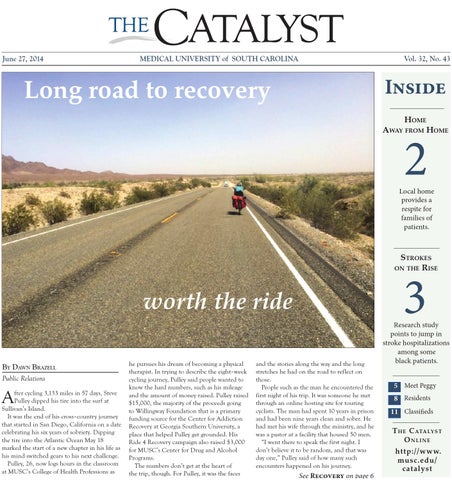
Long road to recovery Long road to recovery
Inside Home AwAy from Home
2
Local home provides a respite for families of patients.
sTrokes on THe rise
3
worth the ride By Dawn Brazell Public Relations
A
fter cycling 3,133 miles in 57 days, Steve Pulley dipped his tire into the surf at Sullivan’s Island. It was the end of his cross–country journey that started in San Diego, California on a date celebrating his six years of sobriety. Dipping the tire into the Atlantic Ocean May 18 marked the start of a new chapter in his life as his mind switched gears to his next challenge. Pulley, 26, now logs hours in the classroom at MUSC’s College of Health Professions as
he pursues his dream of becoming a physical therapist. In trying to describe the eight–week cycling journey, Pulley said people wanted to know the hard numbers, such as his mileage and the amount of money raised. Pulley raised $15,000, the majority of the proceeds going to Willingway Foundation that is a primary funding source for the Center for Addiction Recovery at Georgia Southern University, a place that helped Pulley get grounded. His Ride 4 Recovery campaign also raised $3,000 for MUSC’s Center for Drug and Alcohol Programs. The numbers don’t get at the heart of the trip, though. For Pulley, it was the faces
and the stories along the way and the long stretches he had on the road to reflect on those. People such as the man he encountered the first night of his trip. It was someone he met through an online hosting site for touring cyclists. The man had spent 10 years in prison and had been nine years clean and sober. He had met his wife through the ministry, and he was a pastor at a facility that housed 50 men. “I went there to speak the first night. I don’t believe it to be random, and that was day one,” Pulley said of how many such encounters happened on his journey.
See Recovery on page 6
Research study points to jump in stroke hospitalizations among some black patients. 5 Meet Peggy 8 Residents 11 Classifieds T H e C ATA ly s T online http://www. musc.edu/ catalyst
2 The CaTalysT, June 27, 2014
Hope House: a resource for visiting patient families goodness of Southerners!” Perhaps now you can understand why I feel I receive more than I ever give at Hope House. For information about the admission process, contact Beth Moore, Hope House director, at bmoore@carolinaone. com or 884-4612.
By sara sTewarT Ambulatory Care
S
t. Francis of Assisi said, “For it is in giving that we receive.” This quote best summarizes my involvement as a volunteer for more than three years with the Mt. Pleasant Presbyterian Hope House (a hospital hospitality home). Every other Tuesday after I finish my two-hour “caretaker shift,” I find myself feeling that I’ve received “gifts” from the guests I have encountered. Their appreciation and gratitude in the midst of difficult times never ceases to amaze me. When the doors first opened in January 2010, few envisioned the powerful impact Hope House would have. The mission of Hope House is to provide a safe, secure, Christ-centered, temporary home-away-from-home for individuals and families in need of shelter when an adult (18 and older) has an adult family member in a hospital in the Charleston area. This 100–year–old house has now hosted more than 650 family members and friends of patients in area hospitals. Located at 314 Hibben Street in Mount Pleasant, Hope House has all the facilities necessary to accommodate guests: four bedrooms (including a wheelchair accessible cottage), 3 1/2 baths, a kitchen stocked with frozen meals made by church members, laundry facilities, a computer for guest use, and television. Twelve people can be
Editorial of fice MUSC Office of Public Relations 135 Cannon Street, Suite 403C, Charleston, SC 29425. 843-792-4107 Fax: 843-792-6723 Interim editor: Cindy Abole catalyst@musc.edu Catalyst staff: Mikie Hayes, hayesmi@musc.edu
Parking rate increase effective July 1
photo provided
Hope House in Mount Pleasant is a hospitality house that serves adults, ages 18 and older, who have an adult family member in an intensive care unit of a Charleston area hospital. It is sponsored by Mt. Pleasant Presbyterian Church. accommodated each day. Once referred to Hope House by a hospital case manager, guests are allowed to stay as long as two weeks. There is no charge to the guest, but a donation of $5 per day is suggested. Guests, however, are never turned away if they are unable to donate. Guests participate in the daily chores needed to maintain the house, and they often say it gives them something to take their minds off the difficult circumstances encountered while at the hospital with their loved ones. The Catalyst is published once a week. Paid adver tisements, which do not represent an endorsement by MUSC or the State of South Carolina, are handled by Island Publications Inc., Moultrie News, 134 Columbus St., Charleston, S.C., 843-849-1778 or 843-958-7490. E-mail: sales@moultrienews.com.
A couple from Connecticut left the following comment in the guest book at Hope House: “We drove all night from Connecticut when we learned our 21– year–old daughter had a stroke and was at MUSC. Tired and overwhelmed with emotion, we ended up at Hope House. We cannot begin to express our gratitude to the individuals who give time, effort, items, and money to enable Hope House to work as wonderfully as it does. The unexpected but welcome kindness and generosity of complete strangers reaffirms our faith in humanity and the incredible
The Office of Parking Management has announced a parking rate increase and other changes to the employee parking fee structure. Changes will be effective July 1. In May, the MUSC board of trustees approved a five-year parking schedule of increases. Rates are indexed to employee salary. Employees who park at the Harborview Tower Garage or Lockwood lot will continue to receive a discount over the on– campus rate. Employees working at Harborview Tower who park at the Harborview Tower garage or Lockwood lot will be migrated to the on–campus rate over a period of five years. MUSC Parking will continue to provide free parking in the Hagood system with shuttle bus service around campus. For information contact Melinda Anderson, 792-2597.
Women’s Club accepting nominees for scholarships The Medical University Women’s Club is accepting applications for scholarship recipients. The group plans to award a total of $15,000 in scholarships. All full-time MUSC students in their second or subsequent years from any of the six colleges are eligible. Previous applicants may also apply. Applications may be downloaded
from http://academicdepartments. musc.edu/womensclub/scholarship. htm. Deadline for submission is 4 p.m., Sept. 8. Applications may be submitted via email to muwcscholarship@gmail.com. For information on the scholarships, email Megan Zwerner at muwcscholarship@gmail.com.
Study: Stroke hospitalization on the rise among some patients By lauren sausser Of The Post and Courier staff New research shows that hospitalizations for black stroke patients younger than 65 in South Carolina jumped more than 17 percent between 2001 and 2010, while stroke hospitalizations among middle-age white patients did not change. The study, published last week by the American Heart Association, also reports that stroke hospitalizations decreased in black and white patients older than 65 years. The study analyzed more than 84,000 records for stroke patients discharged from South Carolina hospitals during that decade. "Excess strokes among blacks as well as the lingering racial disparity in the younger groups represent a serious public health issue," said Wuwei (Wayne) Feng, M.D., assistant professor, MUSC Department of Neurosciences, a neurologist and the study's Feng lead author, in a prepared statement. South Carolina is included in a swath of Southern states called "the stroke belt." The state has some of the highest
rates of stroke and stroke–related deaths in the country. MUSC's telestroke program, founded in 2008, connects several rural hospitals across the state with specialists in Charleston, who can provide timely, remote care without transporting patients from their own community's hospital. The program intends to improve outcomes among stroke patients who live too far from acute, stroke-ready hospitals and primary stroke centers. Palmetto Health operates a similar program, connecting rural stroke patients with experts in Columbia. Stroke is caused when a clot blocks a blood vessel in the brain, or the blood vessel ruptures, preventing oxygen flow to brain cells, according to a press release about the new study. Risk factors include high blood pressure, smoking and diabetes. "Our results show the importance of staying healthy, exercising and eating well, and starting these healthy habits while you are still young," Feng said. Editor’s note: The article ran June 23 in The Post and Courier and is reprinted with permission.
The CaTalysT, June 27, 2014 3
AreA HospiTAl’s CAring Clowns
photo provided
The Third Annual Bumper T. Caring Clowns Luncheon was held at Café Fork in West Ashley. These Caring Clowns are volunteers that provide therapeutic humor to patients, families and care givers of MUSC Hospital, the Children’s Hospital, Roper Hospital, St. Francis Hospital, and Ralph H. Johnson VA Medical Center. First row: MUSC Bumper T. Caring Clowns founder Robert Mason (aka Doctor Geezer), third from right, joins adult hospital Caring Clown Lori Salado, second right, who works in OCIO communications and volunteers as Doctor Flutterby in her spare time. MUHA HR recruiter Marlena Davis, back row center, volunteers as Doctor Fluffy Bottoms at night. Other supporters at the event include MUSC volunteer managers, Katy Kuder and Melissa Kubu and Kelly Hedges.
Evita production features MUSC physician MUSC’s very own star, Paul O’Brien, M.D., headlines as Juan Peron in the Wandering Star theater company’s production of Evita. The show is featured at the Dock Street Theatre: 8 p.m., June 27, June 28, July 3 and July 5 and at 3 p.m.,
June 29 and July 6. Doors open 30 minutes before showtime. The play is recommended for audiences, ages 10 and up. For information, call 843-821-3527 or to purchase tickets, visit http://evita. wanderingstars.brownpapertickets.com/.
4 The CaTalysT, June 27, 2014
epiC login TesTing ConTinues
photo by Cindy Abole, Public Relations
Rutledge Tower surgical nurse Beverly Balthaser, left, tests and verifies her login to Epic with the help of OCIO’s Will Cooney, right, and Anthony Emanuel, a second-year medical student and Epic credentialed trainer. Epic is the medical center’s new electronic medical record system designed to improve patient care, safety and clinical research. The login labs are part of the Epic Project team’s preparation for the July 1 Go–Live event throughout the medical center. For support, contact the Epic Help Desk, 792-EPIC (3742) or epic.musc.edu.
The CaTalysT, June 27, 2014 5
MEET PEGGY
Peggy Boehrig Department Hollings Cancer Center How you are changing what’s possible at MUSC I organize speakers and events to enlighten our researchers as to what other institutions are achieving in cancer research. How long at MUSC 36 years Family and Pets Daughter, Amy; son, Brad; stepsons, Sean, Matthew and Korre; and Trixie, a Cocker Spaniel and Ali, a Doberman Pinscher Who in history would you most like to meet and why My grandfather, Walter Stello. He died before I was born. Meal you love to cook Christmas dinner with all the trimmings Your idea of a dream vacation Italy Greatest moment in your life The birth of my children and marrying Patrick
6 The CaTalysT, June 27, 2014
reCovery
Continued from Page One
“I was just welcomed and was overwhelmed by the generosity of complete strangers along the ride. A lot of people helped me out and took me in and cared about what I had to say, whether they had any history with addiction themselves or not. It seemed like everyone I talked to is affected in some way — either directly or indirectly — whether it’s a family member or just someone they know. It’s a pretty pervasive issue, but one that’s just not talked about.” Pulley’s mission was to talk and share – to put a face on recovery. People opened up to him when they heard about his cause. He remembers arriving at a hotel in Texas, where he was directed to an outpatient facility just across the street. He walked over still in his cleats to give a talk to their outpatients. There he heard the story from a woman whose daughter had addiction issues and took her own life in front of her mother. “It was a story she hadn’t shared much. She felt comfortable telling me. I think it was therapy for her. They’re comfortable talking to me because I’m sharing my story. It was just awesome. There were a lot of stories like that.” Pulley’s story with addiction started early. When the Mount Pleasant resident was in middle school, he began experimenting with alcohol and drugs. “Things for me progressed rapidly. I have the disease of addiction. Where consequences are a deterrent for a lot of normal people, for me — in my brain, they are not. It’s a progressive, fatal disease.” Pulley, whose drug of choice was heroin, ended up being hospitalized four times, he said, referring to statistics showing what a problem this has become nationally. Drug overdose death rates in the United States have more than tripled since 1990. In 2012 the No. 1 cause of death in 17 states was prescription drug abuse, and that figure surpassed the number of fatalities caused by motor vehicle accidents, according to the Centers for Disease Control and Prevention. “I did end up in a spot where I just knew that it was life or death. I wanted it. I was beaten so badly. I wanted to try something different. Whereas before
phtolo by Sarah Pack, Public Relations
Steve Pulley said he’s glad to be home and in the classroom. Fitness has been an important part of his recovery. Below, he does ‘flagpoling.’
photo provided
I thought I had a problem and maybe I could manage it or would grow out of it, then I got to a point where I just accepted that it was hopeless and got apathetic. And then I just moved in circles.” Finally he reached a point where he was ready to seek long-term treatment. He went to a men’s halfway house in Statesboro, Georgia, for 18 months and returned to college through a collegiate recovery program at Georgia Southern. “It was an awesome resource. It was an environment on a college campus for people in recovery. It was just getting started when I got there and had 40 people between 18 and 25 who are sober.” Pulley said the average GPA of the Georgia Southern University student was 2.6. The average when he was there for his group at the Center for Addiction Recovery was 3.7. “I graduated with a
3.8. It was such a good resource. I can’t stress that enough.” Pulley got interested in fitness as part of his clean lifestyle. He quit smoking and got serious about working out. He did a 10K and the Charleston Marathon, and then got interested in cycling. “It’s a big part of my recovery and a part of my life. It’s a lifestyle change to change everything about how I was living before.” He bought a bike last May and even though he had been cycling only a year, decided he wanted to do the cross-country trip to raise awareness about addiction recovery. Given prior injuries, Pulley knew he had to change his mentality on being so competitive. “I knew I could do this as a ride, not as a race. It’s touring. It’s not racing.” Suffering some injuries along his fitness path, Pulley had to work with physical therapists. That’s when he decided that is what he wanted to do in life. He was drawn to MUSC because of its reputation with addiction research and because his philosophy is to be transparent about his past. Unlike other graduate programs where he got accepted, Pulley felt MUSC didn’t see his past as a liability. “I’ve been able to mature through some obstacles that many people face as far as alcohol and drug problems. For me, I thought that being honest up front and being welcomed to a place was the best policy rather than hiding in
the shadows. I’m really not about that anyway.” It was a risk, but he felt well received at MUSC, he said. “MUSC is a good fit. I’m local, and I wanted to go there. It’s a top tier school, they do a lot of addiction research, and I felt comfortable here. I believe that alcoholism and addiction is a disease concept, and I believe they reciprocate that belief, and they try to solve the problem.” Part of what his ride was all about was talking about addiction and alcoholism as a public health issue rather than a moral or criminal problem, he said. The discussions need to happen because it’s a disease where what people need most is hope. Pulley recalls some young men in Mississippi who were high, but they were really interested in hearing his story and why he was riding. “For me, a lot of people planted the seed, and I remember people who had an impact before I was ready to stop. That’s all I can hope for with this is to plant a few seeds and try to make recovery attractive. I got sober when I was 20, and it was six years to the day when I started this ride. I thought my life was over. I thought ‘I can’t do this. I can’t do that,’” he said of his life before recovery. Without the burden and drain of addictive behaviors, Pulley said life has gotten so much fuller. Instead of smoking two packs of cigarettes a day, he now has a fit lifestyle, a girlfriend and is on the path to becoming a physical therapist who can help others. He wants to give a vision to at-risk youth to see how attractive recovery can be. “This has given me so many opportunities and made my life so much bigger than it was before.” The ride helped him one more step on his journey. “The things I was telling people to do, I had to be careful to do myself. I’ve been put under a spotlight in a way, and I’ve had to check my ego and my intentions. This is a day-by-day thing for me, and I’m not going around telling people that I’m cured. I have my flaws and things I need to work on on a daily basis to maintain my recovery. This has been a way for me to get really, really involved with recovery, and now I’m going to get really involved with school. I’m ready to focus on the future.”
The CaTalysT, June 27 2014 7
Cyclist, CDAP join forces to lessen addiction stigma It’s not every day that Sylvia Rivers gets the tables turned on her. What she found is she likes it. The community outreach and education coordinator of MUSC’s Center for Drug and Alcohol Programs said she was surprised to get a call to be involved in a cross–country cycling campaign to raise awareness about addiction recovery. The Willingway waTCh Foundation a viDeo sponsored Steve Pulley’s Ride 4 Recovery, but Visit the Pulley wanted to MUSC News include MUSC Center to see in celebrating a multimedia the final stretch package about to Charleston, Pulley’s journey given the strong at: www. addiction musc.edu/pr/ research newscenter initiatives /2014/ride-4there. Pulley, recovery.html 26, just started graduate school at the College of Health Professions to become a physical therapist. “CDAP participated because we were thrilled to be invited to celebrate this incredible event,” she said. “Not many people are willing to ride 3,133 miles to raise funds and awareness for alcohol and drug addiction research, treatment, education and prevention. For five years I have been the outreach coordinator for CDAP, and this is the first time someone has approached me to work with them on raising awareness, reducing stigma and encouraging philanthropic support of this seriously underfunded disease.” Rivers said the Pulley family kindly extended an invitation to CDAP faculty and staff as well as to members of CDAP Philanthropic Advisory Board to be part of Pulley’s final four miles to see him dip his tires into the Atlantic Ocean, and then to celebrate at a luncheon afterwards. A silent auction and donations made at the luncheon helped to raise about $3,000. Pulley raised more than $15,000 for The Willingway Foundation through his journey. Rivers said they appreciate Pulley’s willingness to speak out to local families
photos provided
Steve Pulley, shown above in San Diego at the start of his journey and at MUSC as he arrived home, chose to attend MUSC as a physical therapy student in part because of the institution’s strong reputation for addiction research.
struggling with addiction issues. Alcohol and drug dependence affects all levels of society, genders and races and exists in 40 percent of American families. “Yet, the public is very much unaware of the risks involved in abusing alcohol and drugs, how the disease of addiction develops, and misunderstands that addiction is not simply a lack of selfcontrol but a disease of the brain that predominantly begins during the adolescent years.” One of CDAP’s goals is to do community outreach to change the culture so that addiction is seen as a disease, she said. “What Steve is doing is so tremendous.
He was extremely brave to push the stigma associated with the disease of addiction aside. He is helping families by giving them hope and a better understanding of dealing with this disease, he is building enthusiasm in recovery communities all across the nation, and he is actually helping future generations who may be spared from the devastating effects of addiction by generating greater public awareness and additional financial support for treatment and research.” Often when people seek treatment for alcohol or other drug problems, they are demoralized and feel guilty and trapped by their addiction, she said.
“Steve and many others like him show that these are treatable conditions that can be overcome with commitment and professional help. That is why people like him find it important to give back to others so they can succeed as well.” Raymond Anton, M.D., CDAP director and professor in the Department of Psychiatry and Behavioral Sciences, said Pulley puts a personal face to the cause. “The faculty here at CDAP are all very committed to bringing the latest advances to the treatment of alcohol use disorders and other drug addictions. In CDAP, addictions are considered an illness just like any other medical illness with specific brain mechanisms and chemistry involved in the addiction process,” he said. The center provides treatments whereby individuals can stay in their homes, at work or in school while getting the help they need, he said. “CDAP also is also committed to educating not only the MUSC community but the entire Lowcountry about the disease of addiction and the changes that take place in the brain in those who become addicted to alcohol and other substances.” CDAP faculty work across all medical disciplines to help educators better understand the negative health consequences of heavy drinking, the many diseases alcohol abuse causes and the importance of recognizing when someone needs help, he said. To further all these efforts, MUSC has established the first CDAP Philanthropic Advisory Board. Rivers said the mission of the board is to reduce the stigma associated with alcohol and drug use disorders, to advance MUSC’s outreach efforts, to make CDAP their philanthropic priority and to identify potential donors. The board is expanding its membership and CDAP administrators are seeking others who feel passionate about combating alcohol and drug use disorders through research, clinical care, education and outreach. Anyone interested in supporting CDAP programs or serving on the Philanthropic Advisory Board may contact Rivers at riverssy@musc.edu or Anton at antonr@musc.edu or by calling 843-792-9531.
8 The CaTalysT, June 27, 2014
Residents recognized with departmental awards Anesthesiology Dr. Laurie Brown Resident Teacher of the Year — Brandon Sutton, M.D.; Dr. John E. Mahaffey Resident of the Year — Brystol Henderson, M.D.; and Dr. J. G. Reves Resident Research Award — Abdu Algendy, M.D. Cardiology Charles P. Summerall Fellow of the Year — Richard R. Bayer, II, M.D.; EP Fellow of the Year — Dr. James Merriam, M.D.; First Year Outstanding EP Fellow for 2013–14 — David Daly, Jr, M.D.; VA Award “Be All You Can Be” — Frederick Funke, M.D., and Robert Yoe, M.D.; and Michael E. Assey Award for Faculty of the Year —Valerian Fernandes, M.D. Infectious Disease Teacher of the Year — L.W. Preston Church, M.D. and Chief Fellow Plaque — Andrea Banks, M.D. Internal Medicine Intern of the Year — Livia Tsien, M.D.; Resident of the Year — Nate Richards, M.D.; Fellow of the Year — Eddie Kilb, M.D., and Kathryn Willoughby, M.D.; Michael E. Assey Teaching Award — Rogers Kyle, M.D.; Ambulatory Teacher of the Year — Walter Brzezinski, M.D.; Division of the Year: Rheumatology — Richard Silver, M.D.; Outpatient Resident of the Year — Karen Abernathy, M.D.; and Inpatient Resident of the Year — Elizabeth Kirkland, M.D. Neurology Excellence in Care — Alison Smock, M.D.; Resident Teacher of the Year — Nolan Williams, M.D.; Highest In–Service Score — Dong In Sinn, M.D.; Faculty
Teacher of the Year — Ken Nozaki, M.D. Neuroscience Research Day Best Case Report — Ifran Ali, M.D.; Best Overall — Libby Kosnik Infinger, M.D.; Best Neurology — Karen Karwa, M.D.; Best Neurosurgery — Jan Vargas, M.D.; Most Promising New Finding in Neurology — Nolan Williams, M.D.; Most Promising New Finding in Neurosurgery — Avery Buchholtz, M.D.; and Best Presentation from a Junior Resident — Stephen Lowe, M.D. OB/GYN MIS Award — Hannah Steele, M.D.; Coastal Award — Jessica Brown, M.D.; J. Marion Sims Award for Surgical Excellence & SLS Combined — Jennifer Burgess, M.D., and Cecil H. Nelson, M.D.; J. Richard Sosnowski Award for Outstanding Achievement in OB and Humanism and L.L. Hester, Jr. Award for Academic Achievement and The H. Oliver Williamson Award for Excellence in Gynecology — Rachel Stacey, M.D.; ACOG/ CREOG Award — Roger Newman, M.D.; Administrative Chief Award — Jennifer Burgess, M.D.; PVD Award — Paul Underwood, M.D.; and Community Physician — Scott Jennings, M.D. Ophthalmology Storm Eye Institute Program Director’s Award — George Magrath, M.D.; Ophthalmic Technician of the Year — Christopher Cassidy; COT Pierre Gautier Jenkins Award for Resident Teaching — Charles M. Proctor, M.D.; William W. Vallotton Award for Academic Excellence – Reid Turner, M.D.; and Helma Award for the Best
photo provided
2014 Institute of Psychiatry & Behavioral Sciences residency and fellow graduates include Drs. Lindsay Campbell, Logan Foltz, James Haug (chief resident), Troy Kapral (chief resident), Danielle Lopez (chief resident) Reetta Marciano, Asa Pharr, Gregory L. Sahlem, Harish M,angipudi, (chief resident), Colleen O’Rourke, Nolan Williams (chief resident), Nicholas Evangelidis, Whitney Fulton, Matthew Bader, A.J. Manett, Lauren Yarrow, Suzanne Kerns, John Coates, Liza Grueneberger, Martha Krlstad, Dale Miller, Danield Uderitz, Billy Beck and Erin Seery. Research Project — Jennifer Davidson, M.D.
Teaching Award — Vincent D. Pellegrini, Jr., M.D.
Oral and Maxillofacial Surgery Department (James B. Edwards College of Dental Medicine) Oral and Macillofacial Surgery Certificates — Eric Mcgill Bryant, DMD and Sarah Proulx Donald, DMD
Pathology & Lab Medicine Chief Resident 2014–2015 — Sherry Okun, M.D., and Tom Soike, M.D.; House Staff Award for Clinical Pathology Faculty — Angie
Orthopaedic Surgery Highest Orthopaedic In Training Exam — Cory A. Messerschmidt, M.D.; First Place Outstanding Siegling Society Research Paper — Taylor A. Horst, M.D.; Second Place Outstanding Siegling Society Research Paper — Robert E. Holmes, M.D.; 2014 AOA– OREF Resident Leadership Nominees —Steve C. Stacey, M.D., and Peter H. White, M.D.; and John A. Siegling
Duong, M.D.; House Staff Award for Anatomic Pathology Faculty —Mike Caplan, M.D.; Committees: 2013–2014 University Curriculum Committee – Heidi Hamilton, M.D.; 2013-2014 Peer Review Committee – Natalie Mason, M.D.; 2013-2014 Infection Control Committee – Sherry Okun, M.D.; 2013-2014 CAP Cytopathology Committee and CAP Residents Forum – Shannon Butler–Williams, M.D.; 2013-2014 Resident House Council Representative — Ashley Cross, M.D.; 20132014 MUSC House Staff Council (Vice–President) — Jon Gullett, M.D.; and Best GME presentation: Kate Eichel, M.D., for “Nocardiosis: A Diagnostic Challenge” Pediatrics 2013-2014 Losek Legacy Award — Meghan Cummins, M.D., (EM); and Jessica Litsey, M.D., (Pediatrics); Intern of the Year — Jessie Litsey, M.D.; Intern Compassion Award — Jessie Litsey, M.D.; Senior of the Year — Evan Allie, M.D., and Catherine Foster, M.D.; Fellow of the Year — Rebecca Cafiero, M.D.; Outstanding
See resiDenTs on page 9
photos provided
Division of Rheumatology & Immunology residents and fellows recently honored include, Drs. Edward Kilb, back row from left, Kathryn Willoughby, Nathaniel Richards, Livia Tsien, Director Dr. Richard Silver, Karen Abernathy, Elizabeth Kirkland, Walter Brzezinski, and Rogers Kyle.
The CaTalysT, June27, 2014 9
resiDenTs Continued from Page Eight
photo provided
Department of Pediatrics’ Dr. Bill Southgate presents the 2014 Pediatric Intern of the Year award to Dr. Jessica Litsey. Elective Rotation (Infectious Disease) and Outstanding Pediatric Attending – Terry Dixon, M.D.; Outstanding Required Rotation — Pediatric Primary Care — Kristina Gustafson, M.D.; Most Supportive Faculty — Adebowale Odulana, M.D.; Best Inpatient Educator — Sarah Mennito, M.D.; Best Outpatient Educator — Elizabeth Wallis, M.D.; Best Procedural Teacher — Fred Tecklenburg, M.D.; Best Morning Report Educator — David Sas, D.O.; Best Noon Conference Educator — Sandra Fowler, M.D.; Rookie of the Year — Elizabeth Wallis, M.D., and Adebowale Odulana, M.D.; and Most Supportive Staff — Rebecca Hasegawa.
Psychiatry & Behavioral Sciences Laughlin Psychiatric Endowment Fund Award/Dr. Henry P. and M. Page Durkee Laughlin Foundation — Greg Sahlem, M.D.; J.J. Cleckley, M.D. Clinical Excellence Awards -- James Haug, M.D., Greg Sahlem, M.D. and Nolan Williams, M.D.; PGY1 Outstanding Didactic Teacher of the Year — Lee Lewis, M.D.; PGY1/PGY2 Clinical Teacher of the Year — Tomas Brouette, M.D.; PGY2 Outstanding Didactic Teacher - Bryan Tolliver, M.D., Ph.D.; PGY3 Outstanding Didactic Teacher — Libby Riddle; PGY 3 Outpatient Supervisor — Kelly Holes–Lewis, M.D.; PGY4 Outstanding Career Mentor Awards — E. Baron Short, M.D. and Edward M. Kantor, M.D.; Child Fellow Outstanding Diadactic Teaching — Owen S. Shoemaker, Ph.D.; Child Fellow Outstanding Clinical Training Award — Mark W. Wagner, M.D.; Clinical Excellence Award — Ryan Christopher Shorey; John C. Roitzsch; Memorial Scientist Practitioner Award — Christal Lynn Badour and Sandra M. Coulon; Laura Griffin Humanitarian Award Class of 1996 — Melissa Joy Griffin; and Robert Magwood, Jr. Outstanding Service Award for Crime Victims — Meg Wallace Surgery (General) Max S. Rittenbury, M.D. Intern of the Year Award — Ashley B. Hink, M.D., and Rachel O. Cavenaugh, M.D.; Student Award for Excellence in Resident Teaching — William P. Lancaster, M.D.; and David J. Cole, M.D. Professionalism Award — Daniel S. Eads, M.D.
DenTAl sTAff reCognizeD
photo provided
Dental Medicine Dean Dr. John Sanders, center, congratulates Frankie Maffett, left, and Anne Marie Jones as first quarter employee winners of the college’s staff recognition program on May 13. Winners were treated to lunch and speech delivered by Dean Sanders honoring their accomplishments.
10 The CaTalysT, June 27, 2014
Employee Wellness Anesthesia for Nursing in the Health The Office of Health Professions, 12 to 5 p.m., July 2, Promotion announced CHP Atrium. All donors will receive in May the addition of a a complimentary box of cookies and new wellness nutrition limited edition T-shirt. To schedule coordinator, Debbie an apointment, visit http:// Petitpain. Debbie redcrossblood.org and enter code previously served as a MUSCCHP into the find a blood dietitian with MUSC’s drive box. Bariatric Surgery q Fit Family Challenge — Program for 10 years. In MUSC has partnered with her new role with OHP, Coca–Cola, Lowcountry Parent Debbie will be working magazine, DHEC, S.C. Hospital Susan Johnson to promote healthy food Association and CVS in an 8– environments on campus week program in which S.C. residents and among the community. are challenged to get out and get As a Sodexo employee, she works active. Register at http://www. closely with fitfamilychallengesc.com. Families the cafeteria earn points for a chance to win prizes managers during the challenge period, May 15 to promote to July 10. their mindful q Chair massages: Free massages food choices. are offered to employees on midday Currently, Wednesdays. Look for broadcast she is working messages for locations and times. with the q Farmers Markets: Enjoy fresh fruits Lowcountry’s and vegetables from local farmers on spotlight Tuesdays, 8 a.m. to 4 p.m. (Harborview); families Petitpain Wednesdays and Thursdays, 8 a.m. to 6 participating in the Fit p.m. (ART); and Fridays, 7 a.m. to 3:30 p.m. (Horseshoe). Family Challenge, provides Lunch and Learns at the MUSC Urban Farm, and has done several media Urban Farm (Summer) events on tips for healthy eating. q Sunset Work & Learn, 4 to 5 p.m., Petitpain, a registered dietitian, Take home some fresh produce in return works with people looking to make for work efforts on the farm. Open to dramatic diet and lifestyle changes MUSC employees, students and the to lose weight, improve their medical community. problems and get healthier. At home, q Third Thursday Lunch and Learn — she and her husband model to their 12:15 to 12:45 p.m. Stay as long as your two young daughters how food schedule permits nourishes the body, gives us energy, q Third Saturday Family-friendly work helps us grow, and connects us to our and learn — 9 to 11 a.m., July 19. community. Debbie has been working Bring a plastic bag and take home fresh in this field for more than 10 years. produce in return for your work efforts She graduated from the College on the farm. of Charleston, received her Master’s q Early bird maintenance — Wednesday, degree in nutrition from Boston 7:30 to 8:30 a.m. University and completed her dietetic For information on MUSC wellness training in Honolulu, Hawaii. She events, contact Susan Johnson, Ph.D., believes the healthiest foods are those Office of Health Promotion director at that require a fork to be eaten. Join johnssa@musc.edu or Suzan Beneson us in welcoming Debbie to her new Whelan at whela@musc.edu.for specific role at MUSC. information about Employee Wellness or the MUSC Urban Farm. Events, speakers, causses or any other ideas are Wellness Events welcome.Like us on Facebook and to q Blood drive hosted by the colleges keep up with all MUSC wellness events. of Nursing and Health Professions:
Health at work
The CaTalysT, June 27, 2014 11
Furniture
Furniture
Homes For Sale
King Size Plush Set New, will sacrifice for $275 843-270-4283
Full Mattress Set with Euro Pillow Top New $125. Please Call: 843-270-4283
James Island waterfront home. 4bdr 3.5 ba. 3134 sq ft. Tidal Creek Cv. $795k. isave 843-801-4903. mls# 1414456.
Dining, living, bedroom Furniture/Accessories Excellent shape 413-695-0215
A-Queen Pillowtop that is Brand New in Plastic. Will take $150. Please call 843-270-4283
12 The CaTalysT, June 27, 2014