September 27, 2013
MEDICAL UNIVERSITY of SOUTH CAROLINA
Vol. 32, No. 7
Gift shop receives facelift, now open Inside KaMp Kiawah
R
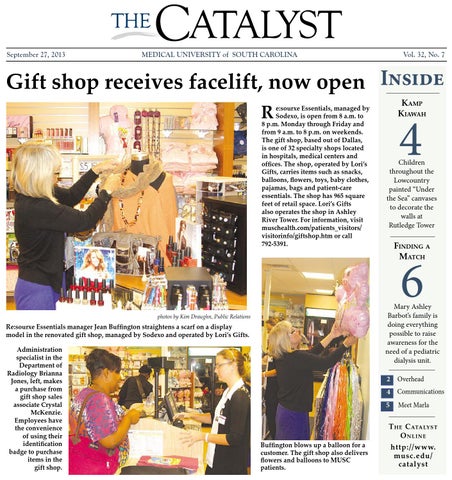
e:sourxe Essentials, managed by Sodexo, is open from 8 a.m. to 8 p.m. Monday through Friday and from 9 a.m. to 8 p.m. on weekends. The gift shop, based out of Dallas, is one of 32 specialty shops located in hospitals, medical centers and offices. The shop, operated by Lori’s Gifts, carries items such as snacks, balloons, flowers, toys, baby clothes, pajamas, bags and patient-care essentials. The shop has 965 square feet of retail space. Lori’s Gifts also operates the shop in Ashley River Tower. For information, visit muschealth.com/patients_visitors/ visitorinfo/giftshop.htm or call 792-5391.
Children throughout the Lowcountry painted “Under the Sea” canvases to decorate the walls at Rutledge Tower
Finding a MaTCh
6
Mary Ashley Barbot’s family is doing everything possible to raise awareness for the need of a pediatric dialysis unit.
photos by Kim Draughn, Public Relations
Re:sourxe Essentials manager Jean Buffington straightens a scarf on a display model in the renovated gift shop, managed by Sodexo and operated by Lori’s Gifts. Administration specialist in the Department of Radiology Brianna Jones, left, makes a purchase from gift shop sales associate Crystal McKenzie. Employees have the convenience of using their identification badge to purchase items in the gift shop.
4
2 Overhead 4 Communications 5
Meet Marla
T h e C aTa ly s T Online Buffington blows up a balloon for a customer. The gift shop also delivers flowers and balloons to MUSC patients.
http://www. musc.edu/ catalyst
2 The CaTalysT, September 27, 2013
Overheard at MUSC whO
In August, Alisha Joyner received a 2013 American Medical Association Physicians of Tomorrow Medical Scholar.
College of Medicine student Alisha Joyner takes pride in achieving success behind the scenes instead of up front and center.
qualities as a new peer inductee to the Paul B. Underwood Chapter of the Gold Humanism Honor Society at MUSC. She is motivated,
Editorial of fice MUSC Office of Public Relations 135 Cannon Street, Suite 403C, Charleston, SC 29425. 843-792-4107 Fax: 843-792-6723 Editor: Kim Draughn catalyst@musc.edu Catalyst staff: Cindy Abole, aboleca@musc.edu Ashley Barker, barkera@musc.edu
TeaChing, leading by exaMple
competent, compassionate, hardworking and a natural team leader,” Deas said. The Jackson, Miss., native was the first in her family to attend college and set her sights high in meeting her personal and career goals. Joyner graduated from Johns Hopkins University earning bachelor’s (neuroscience) and master’s (biotechnology) degrees. While completing her master’s degree, Joyner worked as a donation coordinator for Life Point, an organ and tissue donation agency that supports transplantation and research in Charleston. She helped
A natural teacher, Joyner was a teaching assistant in MUSC’s anatomy brain lab, suture instructor and president of the COM’s Surgical Training Awareness and Residency Group, and was a neurological exam presenter at the 2011 Student National Medical Association regional conference held in Charleston. She also was a COM team leader for second-year medical students to serve as mentors for first-year medical students. In addition, Joyner was a National Institute’s of Health research grant recipient who studied the role of epidermal growth factor in the activation of sodium proton exchange in polycystic disease, and was a Department of Medicine’s Division of Nephrology mentor. She received the Arnold P. Gold Student Summer Fellowship grant and addressed teen pregnancy in an underserved community for her service project. She served as an MUSC Presidential
train new coordinators and coordinated the
Scholar and was a 2013 inductee to MUSC’s
acceptance and placement of tissue for tissue
Student Leadership Society. She also is vice
processors.
president of Women Interested in Surgical
whaT In August, Joyner was named among 21 fourthyear medical students across the country to receive the 2013 American Medical Association Physicians of Tomorrow Medical Scholars Award. The award was established in 2004 to assist rising fourth-year medical students in relieving their medical school debt. According to the AMA Foundation, the average debt a U.S. medical student incurs upon graduation is $162,000. Joyner received a $10,000 tuitionassistance scholarship with this award. Joyner and other recipients were nominated by their medical schools. According to Deborah Deas, M.D., senior associate dean for medical education, Joyner is a leader, mentor, volunteer, researcher and student teacher. “Alisha is well respected by her peers and has been deemed to have compassionate, humanistic
care to uninsured and underserved Tri-county residents.
The Catalyst is published once a week. Paid adver tisements, which do not represent an endorsement by MUSC or the State of South Carolina, are handled by Island Publications Inc., Moultrie News, 134 Columbus St., Charleston, S.C., 843-849-1778 or 843-958-7490. E-mail: sales@moultrienews.com.
At MUSC, Joyner
Experiences; vice president of the Student
has been volunteering Interprofessional Society; and a National in multiple areas Executive Board member of the AMA’s Selection including the MUSC Sugar Free Fall Festival and the CARES (Community, Aid, Relief, Education and Support) Clinic, a student-run center that provides free
Minority Interest Committee. Joyner is the third MUSC medical student to receive this award. She joins past recipients, Kenyatta Frasier and Valerian Bruce, both 2011 COM graduates. Since 1950, the AMA Foundation has awarded more than $61 million in scholarships to medical students.
The CaTalysT, September 27, 2013 3
4 The CaTalysT, September 27, 2013
MUSC medical center communications corner MUSC implements Just Culture
M
USC will be implementing a Just Culture during the next few months. So far, 10 leaders at MUSC have been Just Culture certified, and 400 additional leaders were trained at the most recent Leadership Development Institute. These leaders will be training their staff and implementing the fundamentals of Just Culture at MUSC.
1. The duty to follow a rule (taskbased, such as following a policy)
WhaT is JusT CulTure?
Within those duties, a Just Culture recognizes three types of behaviors, and how staff should “deal” with the types of behaviors:
A Just Culture is an approach to managing behavior that strikes a balance between a “blame free” culture and a “punitive” culture. It balances accountability with the recognition that people can and do make mistakes. It recognizes three types of “duties” that all employees own:
2. The duty to produce an outcome (not task-based, the worker owns the process, such as showing up on time for work) 3. The duty to avoid causing harm. This is the “highest-order” duty, that we all recognize in health care; we are not supposed to cause harm to patients, our co-workers or our organization as a whole.
1. Human error: A slip, lapse or mistake. a. We should console the employee that made the error. 2. At-risk behavior: Doing
To learn more about Just Culture, and its roll out plan for MUSC: q Visit http://mcintranet.musc.edu/muscexcellence/Just%20 Culture/justcultureforleaders.html q Email justculture@musc.edu q Contact any of the certified Just Culture trainers: Danielle Scheurer Chris Rees Sheila Scarbrough David Bundy Helena Bastian Linda Randazzo Janet Byrne Lisa Langdale Sonja Muckenfuss Debbie Browning
something that may cause harm, but the risk is either not recognized or thought to be justified. a. We should coach one out of the at-risk behavior.
3. Intolerable behavior: Doing something with conscious disregard of the risk. a. We should discipline this behavior.
Kamp Kiawah children paint ‘Under the Sea’ canvases for MUSC’s hospital By Melissa KuBu Children’s Hospital On June 25, more than 100 children, ranging from 3- to 17-years-old, gathered at Kamp Kiawah to create an art project that would give back to the Charleston community. The project was to paint canvases that would fit the MUSC’s Children’s Hospital theme of “Under the Sea.” The idea came from one of MUSC’s volunteers, Chelsea Stegmaier. During the week the corporate group, Young Professionals Organization, held a conference at the Sanctuary, and the members’ families joined them to make it a vacation. Their children attended a weeklong camp where they learned about the Charleston community and culture. As their “giving back” project, Stegmaier organized them to paint canvases that would be hung in the MUSC’s Children Hospital.
“This artwork will create a positive atmosphere in our exam rooms.” Rosemarie Battaglia, R.N. There were five canvases for five age groups: 3-4 year olds, 5-7 year olds, 8-10 year olds, 11-13 year olds, and 14-17 year olds. On Aug. 19, the canvases were presented by Kamp Kiawah counselors to Rosemarie Battaglia, R.N., nurse manager of the Rutledge Tower Children's Hospital Outpatient Clinics. “This photo provided artwork will create a positive atmosphere in Children from Kamp Kiawah are busy painting canvases with our exam rooms. We are excited to have this donation, appreciate the time and are amazed at the theme “Under the Sea.” Once finalized, all five paintings are displayed in the Rutledge Tower outpatient clinics. the talent of the young campers.”
The CaTalysT, September 27, 2013 5
Meet Marla
Marla Martin College Pharmacy, a P1 student Pets I have a dog named Murphey. What music is in your player right now? Of Monsters and Men Unique talent I was a hula and Tahitian dancer. Meal you enjoy cooking I can’t cook, but I love to eat beef stew and rice. Most embarrassing moment My cap fell off at high school graduation. Favorite place in the world El Salvador A must-have in the freezer Ice cream Favorite radio station NPR Greatest moment in your life Being accepted at MUSC Best thing about living in Charleston There are so many outdoor activities and, of course, the beach.
6 The CaTalysT, September 27, 2013
Family on mission to find 10-year-old girl new kidney Pediatric dialysis unit needed at MUSC By ashley BarKer Public Relations
F
or 10 hours a day, every day, a vibrant 10-yearold Charleston girl is connected to a peritoneal dialysis machine that pulls the toxins and excess fluids from her blood, something her kidneys can no longer perform on their own. The process, sometimes painful, occurs while Mary Ashley Barbot sleeps in the comfort of her own bed, but it’s not without flaws. Her parents, Chip and Charlene, get up three to five times each night when the tubing gets tangled, making the alarm on the machine would go off loudly, and Mary Ashley needs to be repositioned. Sometimes the machine stops working completely, which has happened twice so far, and Charlene has been forced to perform manual dialysis on her daughter. It’s a much better life than what the family had to do before to keep their daughter alive, which involved driving to Dialysis Clinic Incorporated on King Street three times a week for Mary Ashley’s hemodialysis. With just a few hemodialysis machines configured for pediatric patients, her dialysis sometimes didn’t get started until 6 p.m. or later and took three to four hours to finish. Mary Ashley is one of 15 pediatric MUSC patients who are currently undergoing dialysis treatments while waiting for a kidney transplant. When a kidney becomes available, it must match Mary Ashley’s tissue type and not conflict with her unique antibody profile, she will undergo her second transplant surgery. When Mary Ashley was born at MUSC in 2003, she weighed 6 ½ pounds. She was swollen and was diagnosed with congenital nephrotic syndrome, which meant she was losing protein in her urine. A year later, she only weighed 9 pounds. By the age of 2, her kidneys had failed, and she had her first transplant. Other than some mild developmental delays, hearing impairment and daily medications so her body would accept the new organ, she lived a relatively normal life for eight years. Then her second kidney began failing – forcing her name to be put back on the kidney transplant list. “I would love more than anything in this world for me or my husband to be able to give her a kidney and make this all better,” Charlene said. “As a parent, you always want to provide everything for
your child. It doesn’t feel good to not be able to be the ones to provide this.” None of the more than 20 people who have already been tested have been a match for Mary Ashley. “I’ve been completely amazed by the people who have come out to be tested, just completely unselfishly. We’ve had family, friends, people who we don’t even know that are willing to give up a kidney for her, and they just don’t match,” she said. Katherine E. Twombley, M.D., medical director of the MUSC Pediatric Kidney Transplant Program and a board-certified pediatric nephrologist, has been on Mary Ashley’s team of doctors since July 2012. She said Mary Ashley’s PRA, or panel reactive antibody, is 99 percent. “If you have above an 80 percent PRA, you’re considered a high-reactor, meaning it’s very difficult for you to match to other donors,” she said. “With Mary Ashley, she has her donor antibodies in addition to other antibodies that she’s developed from blood transfusions. Every time, she’ll need a kidney, it will get harder to find a match. But she needs a transplant now or her life would be significantly shortened.” On average, Twombley said, a kidney’s lifespan is 10 to 12 years. With newer immunosuppressant medications and newer treatments, they can last longer, but she’ll likely need several more kidney transplants throughout her lifetime. The dOnaTiOn prOCess Her doctors are now focusing on finding a kidney that will match. In order to give Mary Ashley a kidney, a donor must have the same blood type, O negative or positive. If that’s a match, the donor will have an HLA antigen test, which is a simple blood draw. If Mary Ashley’s blood doesn’t have antibodies to any of the donor’s antigens and her blood doesn’t have a positive reaction when mixed with the donor’s blood, then it’s a match. But that’s not the end. The donor would then have to pass a medical
See Kidney on page 7
Mary Ashley Barbot was born at MUSC with congenital nephrotic syndrome. By the age of 2, her kidneys had failed. After surviving one kidney transplant, she now needs another one. She’s spent much of her young life in the hospital, but still finds ways to keep smiling. photos provided
The CaTalysT, September 27, 2013 7
Kidney
Continued from Page Six
work- up that includes a check of blood pressure, cholesterol and other routine health screenings. “If the donor is considered healthy and able to donate the kidney and they’re a good match, we’d set up a surgery date,” Twombley said. “For the donor, it’s usually two or three days in the hospital after surgery, mostly for pain control, and the donor would be out of work for a while.” According to Charlene, all of the tests and the surgery are covered by the Barbots’ health insurance. Charlene is even trying to find a partner who doesn’t Twombley match Mary Ashley but is willing to donate a kidney anyway to someone else so they can team up to join a national exchange registry. She’s also on the list for a cadaveric kidney, which is when someone who dies has agreed to donate organs. But both options could mean a long wait on dialysis. “I have to believe that people just don’t realize the need. I think making the decision to be an organ donor is hard for families,” Charlene said. “If more people realized how many lives they could save just by being an organ donor at the end of life, I can’t imagine more wouldn’t sign up to do that.” a diva in The MaKing Until the moment arrives when a healthy kidney donor matches Mary Ashley, she will continue to do dialysis treatments and be the little “diva” that her many friends adore. “Mary Ashley is fabulous. She has the brightest smile I think I’ve ever seen. She has this full-bodied, contagious laughter that you just can’t help but giggle about when she’s laughing,” said Charlene. “She likes her purses and her jewelry. She wants to have her nails painted purple, her favorite color.” Her reward for behaving during appointments with her doctors is a trip to Goodwill, where her parents let her pick out a purse. Her collection, which at times has been close to 100, includes every color, shape and size imaginable. The purses – some adorned with clocks, fur and mermaids – hang from several hook racks in her purple room. She gives them away as presents to ladies and young girls who visit her and rotates them multiple times a day, according to her mother. “She makes us smile constantly,” Charlene said. “She’s very appreciative of everything and everyone. You can come home with her favorite yogurt drink, and she’ll be just as excited as anybody you’ve ever seen.” When she visits Twombley, she shows off her purple
photo provided Charlene allows her 10-year-old daughter, Mary Ashley, to pick out a purse as long as she behaves during appointments with her doctors. fingernails and showers her doctor with hugs. “She’s the most outgoing kid. To have been through everything that child has been through in her life and still have a positive attitude is amazing,” Twombley said. helping The ‘FOrgOTTen Children’ The Barbot family has met many other children along their journey of waiting for a kidney and has found that South Carolina is not the ideal place for children who need dialysis. “Although the fabulous staffs at DCI on King Street and MUSC have gone above and beyond to make these visits special for Mary Ashley and the other children, having a center specialized for the pediatric population and the pediatric nephrologists close at hand would certainly be more ideal,” Charlene said. She has been working with another member of Mary Ashley’s team of doctors, Ibrahim F. Shatat, M.D., medical director of the MUSC Dialysis Unit and division chief of Pediatric Nephrology and Hypertension, to raise awareness and funding for a pediatric Shatat dialysis unit. “In many other states and many other children’s hospitals, there are dedicated pediatric dialysis units. Unfortunately, in the state of South Carolina we don’t have those clinics, so pediatric patients end up going to adult clinics,” Shatat said. “Where our children go now, we try to make it as pediatric-friendly as possible. We have all the kids come at the same time, do their dialysis after school time, and
even have the nurses help them with their homework. Despite all of this, it is far from the ideal unit dedicated for pediatric dialysis patients.” Those children, some of whom live as far away as two hours from Charleston, have only two options if they aren’t able to do peritoneal dialysis at home: be admitted to a hospital for dialysis or drive back and forth, three-times-a-week, to one of the few South Carolina adult dialysis clinics that allow children. “Not many people know children who have end-stage renal disease and kidney failure, and require dialysis. Everyone knows about the child that has no hair because he is receiving chemotherapy due to cancer,” Shatat said. “No one knows about the 15 children that we’re taking care of who are on dialysis and have to go three-times-a-week to be on a machine for three hours. Those are the forgotten children unfortunately.” There have been some discussions at MUSC to start a pediatric dialysis unit, but such a unit would require the help and support of the public through fundraisers and charity donations. wiener dOgs raCe FOr Mary ashley Joseph P. Riley, Jr. Park, home of the Charleston RiverDogs, hosted a wiener-dog race on Aug. 31 to benefit the Mary Ashley Barbot Transplant Fund and to bring awareness to the need of a pediatric dialysis unit. More than 70 dachshunds participated in the race along with 30 small dogs who took a chance at winning the costume contest. “Around $10,000 was raised during the event,” Charlene said,” and we’ll probably end up donating about $1,500 to MUSC to go toward a pediatric dialysis clinic.” The remaining funds will be used to help Mary Ashley’s donor, who will likely have expenses related to being out of work for an extended period of time after surgery, Charlene said. Prior to the race, Twombley and the Barbot family spoke to the crowd about the need for people to donate organs and donate money for MUSC to build a pediatric dialysis clinic. “I can promise we’ll do everything in our power to take the very best care of this kidney and treasure it and celebrate that donor. I can’t imagine finding any way adequate enough to say thank you,” Charlene said. “Mary Ashley has taught us that it definitely takes a village to raise a child. The people that we’ve met because of her – I think they’ve been brought into our lives because of God – have been amazing. I think it’s blessings that we would have never had otherwise. I’m very grateful to Mary Ashley for all of that.” To read more about Mary Ashley, visit maryashley. org/. The MUSC Children’s Hospital Fund can accept donations for the proposed pediatric dialysis clinic. Visit musckids.org/giving/childrenshospitalfund/index. htm or contact Barbara Rivers at riversb@musc.edu or 792-6643 for details.
8 The CaTalysT, September 27, 2013
Self-enrollment continues for new security features By Clay Taylor OCIO
I
want to thank every one who took the time to enroll in Mobile Device Management and Two-Factor Authentication. As a reminder, neglecting to enroll in these programs before Oct. 1 will impact your ability to access various MUSC features, including email. q Mobile Device Management – Required after Oct. 1 for access to MUSC email, calendar and contacts from a smartphone or tablet. MDM enables many security improvements, but one impact is a requirement for a devicelevel PIN/passcode to unlock the device after a period of inactivity. To install MDM, visit www.musc.edu/mdm. q Two-Factor Authentication – Required after Oct. 1 for access to MUSC email, calendar, Citrix webapps and VPN from off-campus computers. The impact of enrollment is that users will receive a phone call when
Heart Walk to be held Sept. 28 More than 5,000 Lowcountry residents are expected to take steps to improve their heart health Sept. 28 when they participate in the American Heart Association’s Lowcountry Heart Walk at Liberty Square. The event, which raises funds to fight heart disease and stroke, America’s No. 1 and No. 4 killers, will begin at 8 a.m. with registration and the 3.3 mile walk beginning at 9 a.m. The walk includes teams of employees from local companies, along with friends and family members. Visit www.lowcountry scheartwalk.org
logging in to an Outlook Web Access email account, webapps and VPN. Confirmation is required by pressing the # sign. This step prevents nonauthorized, off-campus people from accessing MUSC resources. To enroll, visit https://2factor.musc.edu. It only takes a few minutes to selfenroll in the programs. If assistance is needed, visit one of the support locations or contact IS support services by calling 792-9700 or emailing mdm2fahelp@ musc.edu. A listing of the support locations can be found at carcweb.musc. edu/mdm/where.html. Goals achieved by using MDM Force password lock; require inactivity timeout; enforce encryption of MUSC data (including email, contacts, calendar information); locate lost devices if users choose to allow their device to be located. In particular, these devices should not be left unattended in any location.
photo by Cindy Abole, Public Relations
College of Pharmacy student Bridget Barnett, second from left, is presented with one of two iPad minis from Information Services engineer Clay Taylor, from left, University Chief Information Officer Dr. Frank Clark and Scott Burroughs. Barnett and College of Nursing student Virginia Hall (not pictured) were winners in a drawing of employees, faculty and students who registered for Mobile Device Management and Two-Factor Authentication before Sept. 15.
The CaTalysT, September 27, 2013 9
10 The CaTalysT, September 27, 2013
Working Well initiative cites excellence in active campus Staff Report
M
USC has been recognized as a Gold Medal Hospital for physical activity and will dedicate its MUSC Fitness park at noon, Sept. 27. The Gold Medal award is part of Working Well, a collaboration between the South Carolina Hospital Association and N.C. Prevention Partners, for providing the highest standard of excellence in creating a physically active workplace. By earning a gold medal for physical activity, MUSC becomes one of several South Carolina hospitals to earn Gold Triple Threat status. To earn the Gold Triple Threat designation, a hospital must reach the highest standard of excellence and earn gold in all three pillars: Gold Star for tobacco, Gold Apple for nutrition and Gold Medal for physical activity. “It’s an honor to be recognized for
creating a healthy campus and promoting health and wellness in our community,” said Susan Johnson, Ph.D., MUSC’s Office of Health Promotion director. “All around campus you’ll see evidence of MUSC’s commitment to creating a physical environment that contributes to health and well-being.” According to Working Well manager Jen Wright, MUSC continues to display its dedication to a healthy environment and innovative spirit. “MUSC provides employees, patients and the community with easy access to the healthiest choices. It has accomplished amazing things in a short amount of time, but more impressive is the willingness to share the lessons learned and successful strategies to lift up worksite wellness culture in hospitals and businesses throughout South Carolina as a Working Well Center of Excellence.”
Time to renew decal, hang tags at parking management Renewal of annual employee parking decals and hang tags will continue until Sept. 30. To renew hang tags and decals, visit academicdepartments.musc.edu/ vpfa/operations/Parking/Annual%20 Renewal.pdf. For information or to receive a
2014 hang tag or decal, visit parking management at 91 President St., second floor, from 8 a.m. to 5 p.m. Monday through Friday,. To speak to a customer service representative, call 792-3665, 792-0690 or 792-8245 or email parkit@ musc.edu.
The CaTalysT, September 27, 2013 11
Benefits fair to be held
Furniture King Size Plush Set New, will sacrifice for $200 843-501-3485 Bed-Queen Pillowtop that is Brand New in Plastic. Will take $150. Please call 843-270-4283
Items for Sale Boat for sale: 14� McKee w/60 hp engine $3995. (843) 696-3941
The university and medical center benefit offices will be holding the Annual Benefits Fair from 7:30 a.m. to 1:30 p.m. on Friday, Sept. 27 in the Colbert Education Center & Library Building and surrounding area. Benefits staff and representatives will be available to answer questions.
12 The CaTalysT, September 27, 2013