July 4, 2014
MEDICAL UNIVERSITY of SOUTH CAROLINA
Vol. 32, No. 44
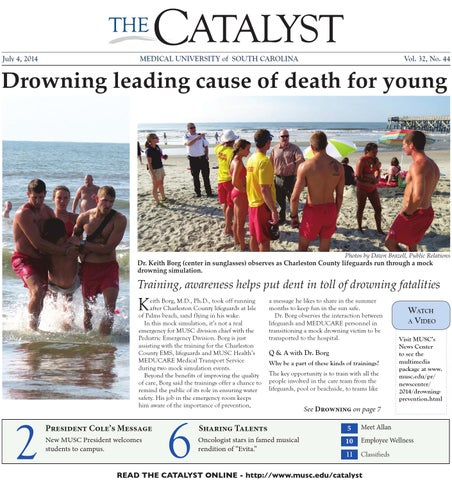
Drowning leading cause of death for young
Photos by Dawn Brazell, Public Relations Dr. Keith Borg (center in sunglasses) observes as Charleston County lifeguards run through a mock drowning simulation.
Training, awareness helps put dent in toll of drowning fatalities
K
eith Borg, M.D., Ph.D., took off running after Charleston County lifeguards at Isle of Palms beach, sand flying in his wake. In this mock simulation, it’s not a real emergency for MUSC division chief with the Pediatric Emergency Division. Borg is just assisting with the training for the Charleston County EMS, lifeguards and MUSC Health’s MEDUCARE Medical Transport Service during two mock simulation events. Beyond the benefits of improving the quality of care, Borg said the trainings offer a chance to remind the public of its role in ensuring water safety. His job in the emergency room keeps him aware of the importance of prevention,
2
President Cole’s Message New MUSC President welcomes students to campus.
6
a message he likes to share in the summer months to keep fun in the sun safe. Dr. Borg observes the interaction between lifeguards and MEDUCARE personnel in transitioning a mock drowning victim to be transported to the hospital.
Q & A with Dr. Borg Why be a part of these kinds of trainings? The key opportunity is to train with all the people involved in the care team from the lifeguards, pool or beachside, to teams like
Watch a Video Visit MUSC’s News Center to see the multimedia package at www. musc.edu/pr/ newscenter/ 2014/drowningprevention.html
See Drowning on page 7
Sharing Talents
5
Meet Allan
Oncologist stars in famed musical rendition of “Evita.”
10
Employee Wellness
11
Classifieds
READ THE CATALYST ONLINE - http://www.musc.edu/catalyst
2 the catalyst, July 4, 2014
OB-GYN doc receives award MUHA Phyician of the Month: Dr. Jonathan Foote has completely changed our GYN/Oncology "world" at Hollings Cancer Center. This is a physician who Foote consistently eases some of the daily stressors by being approachable, dependable, and trustworthy. The patients just love him. He's been a great support this year, especially while two of the partners were out on maternity leave. He's always willing to help with clinics, surgery, phone calls, rounding... name it! The triage nurses feel comfortable calling him for questions, therefore getting safe and appropriate answers quickly back to our patients who call. He differs from our wonderful residents in the sense of him being the constant — he assists with clinics daily, makes patient phone calls, and answers questions from every aspect of the health care
team (labs, chemo infusion unit, inpatient units, triage phone calls, clinics, pharmacy, etc.), so he knows these patients backwards and forwards and never rotates out. He has been such an asset to our team. This is an exceptional individual who deserves to receive recognition for the way he practices medicine. Nominated by Sassha Rodriguez–Romero Jonathan is a pleasure to work with, he always shows a positive attitude and you can expect him to give 110 percent at all times. He is always readily available when doctors can't be here, making the day a smooth transition for the workers as well as the patients. His love for his work shows on a daily basis making him approachable for any questions, concerns, or even problems. He is a very well rounded. Although he is a physician he doesn't allow his title to make others feel inferior. Always having an open ear to the patients allowing for all questions without the feeling of being rushed. Nominated by: Antoinette Blakely
Swing for a Cure Golf Tourney set for July 18
The Fourth Annual Swing for a Cure Travis Branch Memoiral Kick-off Party and Golf Tournament will take place July 18-19 at Patriots Point in Mount Pleasant. The event begins with a Kick off party featuring a buffett dinner and silent auction from 6 to 9 p.m., July 18 at Alhambra Hall. Tourney begins with
Editorial of fice MUSC Office of Public Relations 135 Cannon Street, Suite 403C, Charleston, SC 29425. 843-792-4107 Fax: 843-792-6723
a shotgun start at 9 a.m., July 19. The event honors Travis Branch who died June 2010 with hemangiopeicytoma, a very rare form of sarcoma cancer. Proceeds from the tournament will benefit research at MUSC’s Hollings Cancer Center. Visit http://hcc.musc. edu/giving/events/swingforacure.
The Catalyst is published once a week. Paid adver tisements, which do not represent an endorsement by MUSC or the State of South Carolina, are handled by Island Publications Inc., Moultrie News, 134 Columbus St., Charleston, S.C., 843-849-1778 or 843-958-7490. E-mail: sales@moultrienews.com.
Message from the MUSC President Dear MUSC Students, n behalf of the administration and faculty, it is my sincere pleasure to welcome you to the Medical University of South Carolina, one of the finest academic health centers in the nation. In all things, we are guided by our motto, Auget Largiendo, which means "She enriches by giving generously." For 190 years, MUSC has had the privilege of providing a superior education to our nation’s future health care providers. Your education, and the responsibility of preparing you Cole for your future, is our priority. Know that this institution is committed to providing a learning environment that is challenging, yet supportive of your personal interests and needs. It is our goal to ensure not only that you succeed while you are here, but also that you are well–prepared for your life and work beyond the Medical University. Your education, experiences, and desire to help others have led you to MUSC. As you embark on this chapter of your lives and careers, remember that you are among a select cadre of scholars who show tremendous promise, and we believe you have unlimited potential to become outstanding health care professionals. For that you should be most proud. MUSC is a dynamic institution teeming with innovation and discovery on a beautiful campus that comprises nearly 7.5 million square feet of space devoted to clinical care, research, and academics. New faculty, programs, studies, and facilities continue to inspire us, provide limitless opportunities, and transform our desire to excel. Our students are exposed to the latest technologies and most advanced work environments imaginable. This includes a new state–of–the–art hospital, Ashley River Tower, where students can work and learn in an advanced teaching facility dedicated to the care of patients with cancer as well as heart, vascular, and digestive diseases. The Darby Children’s Research Institute is one of the largest and most comprehensive pediatric research facilities in the Carolinas. The new Drug Discovery and Bioengineering buildings, the cutting–edge Simulation Laboratory in the College of Nursing, the Center for Rehabilitation Research in Neurological Conditions in the College of Health Professions, the James B. Edwards College of Dental Medicine, and new facilities for the NCI–designated Hollings Cancer Center — the list goes on and on. Your time spent at MUSC will be some of the most personally demanding and challenging years of your life. They will also be the most productive, rewarding, and enlightening. It is my sincere hope that ultimately we will instill in each of you the unshakable conviction that there is no greater calling than to serve humanity. To hold the very lives and futures of patients in your hands is a significant responsibility filled with reward; one that will define your lives from here forward. As the newest members of the MUSC family, I believe that you will quickly realize that we are a dedicated, close–knit, and supportive family comprised of remarkably caring people from around the world, each eager to share his or her own unique talents, interests, perspectives, and backgrounds. All are here to make a difference: to change what’s possible. We are excited and honored to have you here, and we wish you tremendous success in your every endeavor.
O
Interim editor: Cindy Abole catalyst@musc.edu
Sincerely,
Catalyst staff: Mikie Hayes, hayesmi@musc.edu
David J. Cole, M.D., FACS MUSC President
the catalyst, July 4, 2014 3
Study reports increase in fireworks-related injuries Staff Report
As the nation prepares to celebrate Independence Day, the U.S. Consumer Product Safety Commission urges consumers to celebrate safely. A new CPSC study issued today highlights an increase in the number of fireworks-related deaths and injuries. Device malfunction and improper use are associated with the most injuries. In 2013, there were eight deaths and an estimated 11,400 consumers who sustained injuries related to fireworks. This is an increase from 8,700 injuries in 2012. Sixty-five percent, or 7,400, of the injuries in 2013 occurred in the 30 days surrounding July 4, 2013. CPSC staff reviewed fireworks incident reports from hospital emergency rooms, death certificate files, news clippings and other sources to estimate deaths, injuries and incident scenarios. Injuries were frequently the result of the user playing with lit fireworks or igniting fireworks while holding the device. Consumers also reported injuries related to devices that malfunctioned or devices that did not work as expected, including injuries due to errant flight paths, devices that tipped over and blowouts. “CPSC works year-round to help prevent deaths and injuries from legal and illegal fireworks,” said
Acting Chairman Bob Adler. “We engage the fireworks industry, monitor incoming fireworks shipments at the ports, and enforce federal safety rules, so that all Americans have a safe Fourth of July.” Last year, children younger than age 5 experienced a higher estimated per capita injury rate than any other age group. Past reports indicate that consumers sometimes feel comfortable handing off to children fireworks devices perceived to be less powerful, such as sparklers and bottle rockets. In 2013, sparklers and rockets accounted for more than 40 percent of all estimated injuries. According to the report, fireworks incidents become deadly when banned, professional and homemanufactured devices are involved. In each of the eight fireworks-related deaths recorded in 2013, the victim was manipulating (or was a bystander to someone who was handling) a banned, professional or homemanufactured device. Edward C. Jauch, M.D., Professor, and Director in the Division of Emergency Medicine offers several safety facts and tips to consider when handling fireworks: For more information regarding fireworks safety, visit: http://www.cpsc.gov/en/Safety-Education/SafetyEducation-Centers/Fireworks/
Researchers uncover potential ADHD biomarker Staff Report Parents of inattentive and/or hyperactive children who have a difficult time staying focused or controlling their behavior now may have a new option for properly diagnosing their children with attention-deficit hyperactivity disorder, thanks to a brain-imaging study authored by researchers at MUSC. Published online in the journal Radiology, the study suggests that brain iron levels offer a potential biomarker which may help physicians and parents make more informed treatment decisions. “Much debate and concern has emerged regarding the continual rise of ADHD diagnosis in the U.S. given that two-thirds of those diagnosed receive psychostimulant medications,” said Vitria Adisetiyo, Ph.D., MUSC postdoctoral research fellow. “We wanted to see if we could identify brain iron as a potential noninvasive biomarker for
medication-naïve ADHD to prevent misdiagnosis.” With the support of a grant funded by the National Institutes of Health to Joseph A. Helpern, Ph.D., and with the collaboration of Jens H. Jensen, Ph.D., Adisetiyo used a magnetic resonance imaging technique called magnetic field correlation imaging that does not require contrast agents to measure iron levels in the brain. Helpern and Jensen of MUSC’s Department of Radiology and Radiological Science invented the technique in 2006. Researchers measured brain iron levels in 22 children and adolescents with ADHD, 12 of whom had never been on medication for their condition (medication naïve), and 27 healthy control children and adolescents. The 12 ADHD medication-naïve patients had significantly lower brain iron levels than the 10 ADHD patients who had been on psychostimulant medication and the 27
Fireworks Safety q Fireworks can cause serious injury and deatheach day close to 250 people require Emergency Department visits across the US during the summer due to firework injuries. q There were 25,691 emergency department visits for fireworks–related injuries between 2006–2010. q The most common location of injury are the hands, face, and eyes. q Just because it didn’t go “boom” when you thought it would doesn’t mean it won’t-do not approach an unexploded piece of fireworks, it may go off at any time q Sparklers burn 3 times hotter than the melting point of lead, over 2000 degrees C, and cause nearly a third of all firework injuries each year! q Fireworks intended for professionals are most commonly wrapped in plain brown paper-do not attempt to use q Do not point fireworks at any person or crowd of people q Be careful using fireworks in high risk fire areas q Children require adult supervision when working with fireworks.About 14 percent of all firework injuries occur in children, ages 5 and younger.
children and adolescents in the control group. Conversely, ADHD patients with a history of psychostimulant medication treatment had brain iron levels comparable to controls, suggesting that brain iron may increase to normal levels with psychostimulant treatment. “Our research suggests that iron absorption into the brain may be abnormal in ADHD given that atypical brain iron levels are found even when blood iron levels in the body are normal,” Adisetiyo said. “We found
no differences in blood iron measures between controls, medication-naïve ADHD patients or pscyhostimulantmedicated ADHD patients.” Magnetic field correlation imaging’s ability to noninvasively detect the low iron levels may help improve ADHD diagnosis and guide optimal treatment, since ADHD diagnosis is currently based only on subjective clinical interviews and questionnaires. If the results can
See Brain on page 12
4 the catalyst, July 4, 2014
MUSC Medical Center Communications Corner Medical Center and College of Nursing team up to offer unique opportunity to MUSC nurses MUSC’s medical center and College of Nursing have joined forces with an increased focus on promoting the professional development of nurses within the hospital and integrating faculty with clinical programs. One of the largest endeavors in this new partnership is the opening of the MUSC Registered Nurse (RN) to Bachelor’s of Science in Nursing (BSN) Program, specifically tailored to working nurses.
“This is an exceptional opportunity for our nurses,” says Matt Wain,medical center chief operating officer. “MUSC College of Nursing is recognized as one of the nation’s top nursing schools, and it’s a great partnership celebrating nursing excellence on our campus.”
“This is an exciting time as we embark on new endeavors to advance our nurses professionally,” says Gail W. Stuart Ph.D., R.N., Dean and Distinguished University Professor at MUSC’s College of Nursing. “With changes in health care, we need a nursing work force that is continually growing, learning and assuming new roles in patient care; we want to ensure that our nurses are in optimal positions to deliver on the new expectations and demands of our evolving health care system.”
MUSC RN to BSN Program: At a Glance • • • • • •
• •
New admissions will be accepted each fall One academic year, full–time program of study The academic year consists of three semesters. Instead of one course for the entire semester, the course content is taught in five–week modules, which moves nurses along in a focused and engaging manner. The entire program is online, which allows nurses flexibility and allows them to participate or study when they get home from work or other obligations. The program acknowledges the nurses’ clinical expertise to date; they will build on a clinical project as part of their program of study. The course curriculum requires several prerequisites. • Nurses interested in entering the program will meet with Student Services to go over prerequisites. • Nurses will receive credits for courses taken while pursuing their Associate’s Degree in Nursing. Applications are now being accepted for Fall 2014. If you are interested, contact Carolyn Page, director of Student Services at pagecf@musc.edu. The MUSC medical center now offers a scholarship program for RNs seeking their BSN. • There will be 30 scholarships awarded this year. The deadline for applications is July 15. For more information and apply, visit https://mcintranet.musc.edu/clined/RNtoBSNScholarship.htm. • Tuition reimbursement is available for those who are not awarded the scholarship. More information regarding tuition reimbursement can be found in the HR policy at http:// mcintranet.musc.edu/hr/employee_corner/documents/ POLICY17-TUITIONASSISTANCE.pdf
In order to facilitate as many nurses pursuing their BSN as possible, the College of Nursing has lowered tuition, compared to the accelerated BSN program, to approximately $20,000 which positions it very competitively with other programs both in-state and nationwide.
The medical center and College of Nursing have worked diligently to make the program as open and available as possible to MUSC’s nurses and hope to accept as many qualified students as possible in the first year of the program. Currently, they expect 30 students from the medical center, but total enrollment could expand to 60–90 in the future.
After the BSN Program
The College of Nursing places a strong emphasis on graduate programs, and the hope is that the nurses who receive their BSN through this new program will also be interested in the Doctor of Nursing Practice program, which is also offered entirely online. “We are committed to assisting the hospital in helping nurses seek new opportunities and new roles as the medical center grows and develops,” adds Stuart. “We are working on carving a partnership and bridge between our medical center nurses and the College of Nursing and are beginning to formalize an exchange of knowledge, skills and innovation as we move forward in the days ahead.” Other hospitals in the state have plans to advance their nursing work force from a majority of associate’s degrees to bachelor’s degrees, so MUSC can expect the nursing programs to see significant growth in years ahead. The College of Nursing will welcome nurses from other parts of the state in various programs to accommodate this shift; however, the preference and priority will be MUSC’s own medical center nurses.
the catalyst, July 4, 2014 5
MEET ALLAN
Allan Sharpe College College of Medicine How you are changing what’s possible at MUSC By striving every day to provide the best patient care possible. How long at MUSC 4 years Pets and their names Two cats, Buckwheat and Spanky A unique talent you have I can play the guitar behind my back. Favorite summertime activity Going to outdoor movies Meal you love to cook Modernist Cuisine Mac & Cheese Favorite July 4 tradition/activity Watching fireworks fire from the USS Yorktown Favorite place in the world Copan Ruinas, Honduras What book can you recommend Junot Diaz’s The Brief Wondrous Life of Oscar Wao
6 the catalyst, July 4, 2014
Physician fulfills creative skills on local stage By Mikie hayes Public Relations Like his father before him, Paul E. O’Brien, M.D., assistant professor of medicine, chose to devote his life to healing patients with cancer. When he joined the MUSC team in 2006, O’Brien had very big shoes to fill, as his father, Paul H. O’Brien, M.D., had served as director of the MUSC Cancer Clinic and vice chairman of the Department of Surgery during his 30– year career at MUSC. O’Brien described his father as having had a major influence in his life and a major presence on MUSC campus. Presence is also the word many have used to describe O’Brien. While patients depend on him in his role as a premier oncologist, the younger O’Brien also offers a second gift to the people of Charleston: his talent on stage. O’Brien, a well–known local actor who over the years has starred in productions such as “Camelot” and “Three Sisters,” is currently starring in the musical production, “Evita,” as Juan Perón. And if acting and singing in the production aren’t enough, he also serves as a producer.
Performers during Evita.
Recently, O’Brien and two colleagues, Christina Leidel, Ph.D., a professor of Physics at the Citadel, and Mary Cimino, a well–respected Charleston theater producer and director, founded a new theater company to add to the rich cultural scene in Charleston. The name of the company, Wandering Stars, comes from the last line in the final stanza of the famous poem written by William Butler Yeats, “Who Goes with Fergus?” For their first production, they chose the musically demanding, “Evita.” “Evita,” which chronicles the story of Eva Perón, wife of former Argentine dictator, Juan Perón, premiered for the first time in Charleston at this year’s Piccolo Spoleto Festival and played to sold-out audiences. When theater
photos provided
MUSC’s Dr. Paul E. O’Brien and The Citadel’s Dr. Christina Leidel perform in Andrew Lloyd-Webber’s local stage production of Evita at the Dock Street Theatre through July 5.
that they have been purists in their interpretation, staying close to the original Broadway production. In addition to his fulltime responsibilities at MUSC, O’Brien carefully balances the demands of his avocation. However, he never feels pressured to deny his passion for acting, and he is happy to devote energized.” time to both. Dr. Paul O’Brien “I have to be careful with the shows I do and aficionados weren’t able to purchase schedule it around call times. Even tickets to the production, the trio made though my schedule is tight, there’s the decision to reopen at a new venue something about entering a theater after so more of the Charleston community a very busy day. I just feel energized. could attend. Even though it may be weeks and weeks The Dock Street Theatre proved the of rehearsal, I never mind it when it’s perfect place to stage the beloved musical thrilling and energizing,” he said. that Andrew Lloyd–Webber created O’Brien credits his parents, both with lyricist Tim Rice in 1978, and of whom were M.D.s, for the dual this production opened to a delighted influences in his day–to–day life. audience on June 27. Growing up, music played throughout O’Brien acknowledged that “Evita” the house and books were always is a particularly demanding musical as scattered about. Performing was simply the lines are sung-through, rather than part of his childhood, and he and his spoken. He has enjoyed “getting to know sister were famous among family and the music so well” and is especially proud friends for putting on shows. Their
“Even though my schedule is tight, there’s something about entering a theater after a very busy day. I just feel
mother had given them a big bag of hats which served as his earliest costumes. While he never intended to pursue acting as a fulltime vocation, he doesn’t, see medicine and acting as diverging paths. More, he feels “they inform and contribute to each other and draw from the same deep well.” “Both medicine and acting share a lot in common and require deeply investing in the human experience. Both are trying to get to the heart of what it means to be human. Some people describe theater as pretending or play acting, but actually, at its best, it’s all about honesty and connecting with each other: that’s what we do with patients at the bedside and what we strive for in the theater,” he said. There are two more opportunities to see “Evita” at the Dock Street Theatre: Saturday, July 5, at 8 p.m. and Sunday, July 6 at 3 p.m. Doors open 30 minutes before showtime and the play is recommended for ages 10 and up. For more information, call 821–3527 or to purchase tickets, visit http://evita. wanderingstars.brownpapertickets.com.
the catalyst, July 4, 2014 7
Lynne Henkel, administrative assistant in the Division of Pediatric Emergency Medicine (far left), tries to distract Charleston County lifeguards during their resuscitation attempt to see how the lifeguards would respond.
droWning Continued from Page One MEDUCARE or Charleston County EMS who continue resuscitation and transport to the emergency department. It’s everyone learning to work together. We all train in our niches but the chance to train together and work on improving the transitions in care is what makes this unique. Plus we just learn from each other. How does drilling as a team improve the system? It really allows you to know what to expect from the other system components. There is also a different range of experience with different patients and environments that allow us all to share knowledge and learn from each other. What are key messages you wish the public knew about drowning? Prevention is the most important. Children are quick! Monitored settings like pools and parks with lifeguards are safer because of the rules and close monitoring in those environments. It’s important to sign up for a first aid class with the American Red Cross, which offers CPR training and never allow anyone to swim alone. What is your advice to parents/
community leaders about improving safety in the home setting? Be prepared! Think and plan for an emergency in advance. Know how you would access emergency services, what supplies you have and how you can prevent and be prepared for emergencies. There are educational resources at websites like cdc.gov with good information on safety and how to best handle many home emergencies. How big a problem is drowning? It’s a bigger issue than most people realize. Just look at the statistics. Centers for Disease Control and Prevention, children ages 1 to 4, have the highest drowning rates. In 2009, among children 1 to 4 years old who died from an unintentional injury, more than 30 percent died from drowning. Among children ages 1 to 4, most drownings occur in home swimming pools. Drowning is responsible for more deaths among children than any other cause except congenital anomalies (birth defects). Among those ages 1 to 14, fatal drowning remains the second-leading cause of unintentional injury-related death behind motor vehicle crashes. Every day, about ten people die from unintentional drowning. Of these, two are children aged 14 or younger.
Above Dr. Keith Borg runs to keep up with Charleston County lifeguards so he can observe how they handle the transfer of the mock drowning victim to the MEDUCARE Medical Transport Service. They talk after the simulation to critique ways the teams can streamline their rescue efforts.
8 the catalyst, July 4, 2014
University’s new Industry Relations policy initiated By cindy aBole Public Relations
E
arlier this spring, the MUSC Board of Trustees approved the Industry Relations Policy, a newly authored institutional policy aimed at addressing the new climate of universityindustry relationships and furthering the institution’s goal to establish ethical, consistent principals and standards for faculty, students and staff across campus. The new policy updates and expands existing policies established previously by the Medical University Hospital Authority’s Professional Relations Policy, which is now MUSC’s Industry Relations Policy. According to Mary Evelyn Armstrong, the campus’ Conflict of Interest officer, this revised new policy serves as a tool to help faculty and other employees navigate appropriate university-industry relationships. The policy exists to protect patients, employees and the university as the institution pursues industry partnerships and interacts with industry to advance research, clinical care and educational initiatives for MUSC. The new Industry Relations Policy covers all trustees, officers, faculty, administrators, staff, students and trainees working as full-time, part-time, temporary and contract employees of MUSC, MUHA, MUSC Physicians, the MUSC Foundation and the Foundation for
Research Development. “The new policy applies to the entire MUSC community, from instructor to dean to president,” said Armstrong. “Its purpose is to establish a framework for how individuals and the Institution can engage in ethical interactions with industry as we pursue entrepreneurial activities that advance research and clinical work." The process for change started in 2012 under the direction of former MUSC Interim President Mark Sothmann, Ph.D. Sothmann quickly established an Industry Relations Committee composed of university and faculty leaders and experts who evaluated standards and collaborated in reviewing and revising the policy. The group was led by Bruce Elliott, M.D. senior associate dean for clinical affairs and Institutional Conflict of Interest official and chair. “MUSC leadership recognized the importance of having consistent standards to apply across the MUSC enterprise,” said Sothmann. “Many provisions that were in the MUHA policy also are included in the Industry Relations Policy, but previous enforcement outside of MUHA was a challenge since we have so many employees who fall under the University and its affiliates who are not subject to MUHA policies.” With the new Industry Relations Policy, ethical principles for industry
University Conflict of Interest Committee Bruce Elliott, M.D., chair and senior associate dean for Clinical Affairs, institutional official-Conflict of Interest; Julie Acker, senior director of Compliance, MUSC Physicians; Mary Evelyn Armstrong, Conflict of Interest officer; Mark Barry, DDS, College of Dental Medicine; Judy R. Dubno, Ph.D., Department of Otolaryngology; Annette Drachman, Esq., MUSC general counsel; Philip Hall, PharmD, College of Pharmacy MUSC campus dean; Edward Krug, Ph.D., College of Graduate Studies; Marilyn Schaffner, Ph.D., MUHA Clinical Services; Reece Smith, MUHA director of compliance; Cynthia Teeter, University compliance officer; and Bart Yancey, Office of the President
and review their data prior to publication. Phase I of registration is currently open and Phase II is set to begin in mid-July. In addition, conflict of interest guidelines by the American Association of Medical Colleges, the Board of Internal thing.” Medicine, the Institute of Medicine and other Dr. Bruce Elliott professional organizations as well as new federal laws relationships can be applied equitably such as the Physician Payments Sunshine throughout the enterprise.” Act address physician best practices that In addition to providing guidelines relate to conflict of interest management and defining university relationships and were a motivator driving MUSC and and activities relating to industry other teaching hospitals to strengthen partnerships and appropriate interaction, their policies related to industry the Industry Relations Policy articulates interactions. approved and prohibited activities "It's fortunate that MUSC leadership and promotes full disclosure and has felt strongly about revitalizing this transparency. policy and offered their support," said It is imperative for MUSC to Elliott. "In today's growing climate of effectively address and comply with transparency, we were focused on doing increasing federal scrutiny and regulatory the right thing to meet federal and state oversight related to conflicts of interest, ethics laws, HIPPA and all conflict of according to Armstrong. New federal interest policies as we continue to focus regulations took effect in 2012 which on advancing the everyday missions of focused on financial conflicts of interest the institution." related to Public Health Service–funded According to Sothmann, the research. Physician Payments Sunshine Act was In the same year, the MUSC board of an important catalyst to getting the trustees approved the MUSC/MUHA Industry Relations Policy finalized and Conflict of Interest Policy, which is implemented. He said MUSC leadership separate from the Industry Relations and the board of trustees felt it was Policy. The MUSC/MUHA COI essential for leadership to provide facultyPolicy ensures compliance with these physicians with a meaningful framework federal COI regulations by outlining and useful tool to guide their industry the Institution’s annual disclosure interactions throughout every step of the requirements and establishing measures process. that should be taken to manage, reduce The Industry Relations Committee or eliminate conflicts of interest related analyzed the enterprise’s operations, to one’s institutional responsibilities and faculty needs, institutional goals related research. to the university’s strategic plan and In an effort to create more public other resources to strike the right transparency, the Physician Payments balance, according to Armstrong. The Sunshine Act (a section of the Affordable group examined a variety of topics Care Act) requires drug and medical including industry-sponsored and device manufacturers to report payments non-accredited speaking engagements; and gifts given to physicians and teaching training and marketing; branding hospitals. and promotion. They also included This information will be reported to provisions to protect faculty members’ the Centers for Medicare and Medicaid intellectual independence and academic Services, and the first set of data will freedom in industry supported activities. be made publicly available Sept. 30. Physicians and teaching hospitals will be able to register on the CMS website See Policy on page 9
“In today’s growing climate of transparency, we were focused on doing the right
the catalyst, July 4, 2014 9
Policy
Continued from Page Eight
Key representation in the Industry Relations Committee included the appointment of a Faculty Senate liaison Natalie Sutkowski, Ph.D. Sutkowski, in turn, worked directly with a senate ad hoc committee to garner advice from individual faculty members on issues and different aspects of the policy. After spending a Sutkowski great deal of time developing and revising policy, Sutkowski is pleased with the outcome and process. “Overall, the revised policy is immensely better than what we started with when the committee initially met. I feel most faculty now understand why many of the ethical guidelines have been put into place and do not take issue with the new restrictions,” said Sutkowski. Policy topics of high interest among
faculty included consulting for industry on personal leave time, industrysponsored educational programming, sponsored meals and gifts and preserving intellectual freedom. “Intellectual freedom is integrally important to our faculty. The policy could not be perceived as restricting the faculty members’ intellectual freedom in any way. On the other hand, ethical interactions with pharmaceutical and medical product industries have been changing in recent years and the university needed to take into account new policies like the Physician Payments Sunshine Act. Many of our faculty are very conscious of ethical concerns, but did not feel that they were doing anything wrong, and were worried that their efforts might be restricted or prohibited. Thus, it was important for the Industry Relations Committee to recognize faculty concerns during the revision process while educating them on the changing ethical climate,” Sutkowski said. She added, “The faculty senate is grateful to Dr. Sothmann for ensuring that the senate played an active role in revising the IR policy, since the policy
greatly affects our faculty members. Dr. Elliott clearly had spent a lot of time researching the new ethical guidelines that other academic medical centers are currently adopting. He did an admirable job educating the committee members on the important highlights. Each member of the Industry Relations Committee made significant contributions to this effort, as did the senate leaders and each of the senate ad hoc committee members.” With regard to policy concerning industry–sponsored meals, employees can only accept food at events open to the community at large or as part of a contract. The new policy restricts pharmaceutical or industry companies from bringing food to employees at work areas or hosting a meal for employees. “We understand that everyone at MUSC is striving to do what is best for our patients, for our community and for the Institution. It is vital that we protect the integrity of our operations from outside influences that could have
a negative impact or that would even appear to have an impact on our actions and decisions,” Armstrong said. A preliminary draft of the IR policy was presented to members of the Deans’ Council in October. From late October to December, feedback was gathered by college deans, department chairs and faculty senate members during the public comment period. In January, the policy was formally presented to the faculty senate and later, to the MUSC board of trustees in February for final approval. Currently, Armstrong and the COI Office continue to focus on promoting awareness and education about the IR policy among the MUSC community. Additionally, the University COI Committee is using annual disclosures from the recent April disclosure cycle as an opportunity to educate individuals about the new policy and how it affects activities and previous interaction. Employees, students and trainees are expected to end any noncompliant activities as soon as possible.
Conflict of Interest Q&As What is the MUSC/MUHA Policy on Conflict of Interest? The MUSC board of trustees developed and approved a Conflict of Interests Policy. To understand the purpose and scope you can read the policy here. If you are a member of the MUSC enterprise and are required to complete an annual online conflict of interest disclosure, you will see additional educational modules during the disclosure process. Colleges and other administrative units may have additional policies that may further define the board's policy. What do I do if I think someone has conflict of interests and are not disclosing the relationships? You should contact one of the compliance officers for the MUSC Enterprise. The Compliance Officers are: Reece Smith [for MUHA 792-7795], Cindy Teeter [for MUSC 792-8740], and Julie Acker [for MUSC Physicians 876-1325]. In this case, you can contact any of the three officers and remain anonymous. What are some of the important /developing issues surrounding Conflict of Interest? The Department of Health and Human Services has published new rules on conflict of interest in the Federal Register on August 25, 2011. Congress has enacted legislation as part of the Patient Protection and Affordable Care Act (3/21/2010) that addresses transparency between doctors and both pharmaceutical companies and device makers; it is known as the Physicians Payments Sunshine Act. We are a state institution. Doesn’t South Carolina have laws that deal with conflict of interest? Rules regarding conduct as employees of the state of South Carolina are covered by the SC Conflict of Interest disclosures deal with the relationships between employees and outside companies, most of which are legitimate and not necessarily a conflict. It is a tool to create an atmosphere of transparency between the enterprise, its employees and the public.
10 the catalyst, July 4, 2014
Employee Wellness Wellness Events
offered to employees on midday Wednesdays. Look for broadcast q Take the July Mindful messages for locations and times. Challenge —The July q Farmers Markets: Enjoy fresh challenge is to eat less fruits and vegetables from local processed: Reconnect with farmers on Tuesdays, 8 a.m. to 4 real food. To begin, take the p.m. (Harborview); Wednesdays and first July Monthly Mindful Thursdays, 8 a.m. to 6 p.m. (ART); Challenge survey at http:// and Fridays, 7 a.m. to 3:30 p.m. tinurl.com/la6drdo (A link (Horseshoe). to final surey will be sent at month’s end to those who take the first survey). Urban Farm (Summer) Susan Johnson q Employee Fitness q Sunset Work & Learn, 4 to 5 Series — Exercise Bands p.m., Take home some fresh produce from 12:15 to 12:45 p.m. July 16. in return for work efforts on the farm. Class will be led by fitness expert Katie Open to MUSC employees, students and Blaylock, MUSC Human Performance the community. Lab. Free day pass to MUSC Wellness q Third Thursday Lunch and Learn — Center for all participants. Participants 12:15 to 12:45 p.m. Stay as long as your should check in at the Wellness Center schedule permits membership desk for directions and free q Third Saturday Family-friendly work class and receive their pass. Email muscand learn — 9 to 11 a.m., July 19. empwell@musc.edu to register. Bring a plastic bag and take home fresh q Worksite screening — July 18, produce in return for your work efforts University hospital, 2W Classroom. on the farm. The screening, valued at about $350, q Early bird maintenance — Wednesday, is available to employees of the State 7:30 to 8:30 a.m. Health Plan (including the MUSC For information on MUSC wellness Health Plan) for only $15 (covered events, contact Susan Johnson, Ph.D., spouses also can participate for $15). Office of Health Promotion director at Employees and spouses without this johnssa@musc.edu or Suzan Beneson insurance can participate for $42. Whelan at whela@musc.edu.for specific To register, go to www.musc.edu/ information about Employee Wellness employeewellness. or the MUSC Urban Farm. Events, q Fit Family Challenge — MUSC speakers, classes or any other ideas are has partnered with Coca–Cola, welcome.Like us on Facebook and to Lowcountry Parent magazine, DHEC, keep up with all MUSC wellness events. S.C. Hospital Association, and CVS in an 8–week program in which S.C. Employee parking residents are challenged to get out and get active. Register at http:// on July 4 holiday www.fitfamilychallengesc.com. MUSC Office of Parking Families earn points for a chance Management will provide three onto win prizes during the challenge campus employee parking garages to period through July 10. be open on the July 4 Independence q Fight for Air Climb Charleston — Day holiday. Saturday, July 26, North Charleston Employees who are scheduled to Coliseum participants choose between work on this holiday may park at the Climb (1,500 steps and higher), the the President Street (PGII/E Lot), Ultra Climb (5,000 steps and higher) or Courtenay Drive (PGV/K Lot) and the Firefighter Challenge (firefighters Bee Street (PGVI/A Lot) garages. climb more than 1,500 steps in full gear with the option of on–air or air–off). Employee parking in the patient/ Practices held from 5:30 to 7 p.m., July visitor parking lots or garages are 15 and from 8 to 9 a.m., July 19, North not authorized unless otherwise Charleston Coliseum. Register at www. stated or pre-authorized by Parking climbcharleston.org or call 556-8451 Management. Visit http://musc. q Chair massages: Free massages are edu/parking
Health at work
the catalyst, July 4, 2014 11
Furniture
Furniture
Rental Properties
King Size Plush Set New, will sacrifice for $275 843-270-4283
A-Queen Pillowtop that is Brand New in Plastic. Will take $150. Please call 843-270-4283
Dntn Bull St. Charming Completely Renovated 1br, 1ba, LR, sunroom, Porch, Kitchen w./ new appliances. W/D, Off street parking, hvac, hdwd flrs. 843-795-1333
Full Mattress Set with Euro Pillow Top New $140. Please Call: 843-270-4283
12 the catalyst, July 4, 2014
Welcome President Cole and staff
photo by Sarah Pack, Public Relations
MUSC President Dr. David Cole reviews some work with Dawn Hartsell, assistant to the President, at their new office located at Colcock Hall. July 1 was the first day in office for Dr. Cole since being elected by the board of trustees in April. Dr. Cole, who is former chairman of the Department of Surgery, is the institution’s 10th president and top administrator.
Brain
Continued from Page Two
be replicated in larger studies, magnetic field correlation might have a future role in determining which patients would benefit from psychostimulants—an important consideration because the
drugs can become addictive if taken inappropriately and lead to abuse of other drugs. For information and resource links, visit http://www.musc.edu/pr/ newscenter/2014/adhd-iron.html.