July 11, 2014
MEDICAL UNIVERSITY of SOUTH CAROLINA
Vol. 32, No. 45
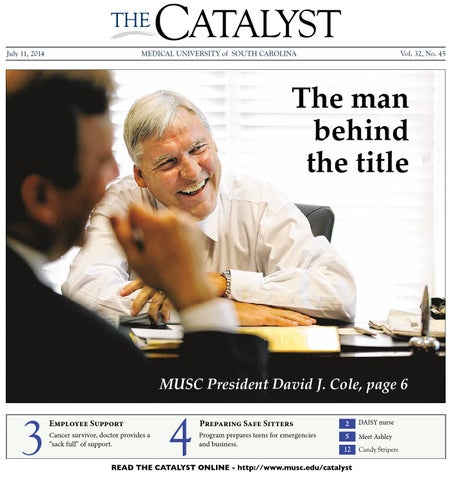
The man behind the title
MUSC President David J. Cole, page 6
23
Employee Support Cancer survivor, doctor provides a “sack full” of support.
4
Preparing Safe Sitters
2
DAISY nurse
Program prepares teens for emergencies and business.
5
Meet Ashley
12
Candy Stripers
READ THE CATALYST ONLINE - http://www.musc.edu/catalyst
2 The CaTalysT, July 11, 2014
Dental StuDentS Begin CliniCal YearS
photo by Anne Thompson, Digital Imaging
A total of 71 third-year students from the James B. Edwards College of Dental Medicine Class of 2016 recite the Dentist’s Pledge after receiving their white coats during the June 20 Dental White Coat Ceremony at Summerall Chapel, The Citadel. The event featured guest speaker and dental faculty member Dr. Teresa Gonzales. The ceremony signifies the students’ completion of didactic and preclinical course work and transition into clinical practice.
Women’s Club accepting nominees for scholarships The Medical University Women’s Club is accepting applications for scholarship recipients. The group plans to award a total of $15,000 in scholarships. All full–time MUSC students in their second or subsequent years from any of the six colleges are eligible. Previous applicants may also apply.
Editorial of fice MUSC Office of Public Relations 135 Cannon Street, Suite 403C, Charleston, SC 29425. 843-792-4107 Fax: 843-792-6723 Interim editor: Cindy Abole catalyst@musc.edu Catalyst staff: Mikie Hayes, hayesmi@musc.edu
Applications may be downloaded from http://academicdepartments. musc.edu/womensclub/scholarship. htm. The deadline for submission is 4 p.m., Sept. 8. Applications may be submitted via email to muwcscholarship@gmail.com For information, email Megan Zwerner at muwcscholarship@gmail. The Catalyst is published once a week. Paid adver tisements, which do not represent an endorsement by MUSC or the State of South Carolina, are handled by Island Publications Inc., Moultrie News, 134 Columbus St., Charleston, S.C., 843-849-1778 or 843-958-7490. E-mail: sales@moultrienews.com.
Trauma Surgery nurse tapped with DAISY July’s DAISY (disease attacking the immune system) award winner is Brent Paape, R.N., who is a staff nurse at 6West in the University hospital. Paape was nominated by Stephanie Chamberlin and Katherine Blume, both 6West nurses. Brent is an outstanding and hard– working nurse with great knowledge in his field and a caring attitude toward everyone. We have several chronic, long–term patients on our unit. Many are confused and/or combative. Many are frustrated due to their long stay and can often be verbally aggressive. Brent shows extreme caring and patience when dealing with this patient population. Brent always takes his time with patients no matter how busy he may be. He addresses every detail of their care and thoroughly discusses the plan of care with each patient daily. We had a patient on our unit who was having a difficult time accepting her physical limitations following a long hospital stay. The patient could not accept or understand the need for her to transfer to sub-acute rehab and kept insisting we needed to fix her and get her back to her pre–hospital condition. Our physicians and case managers spent a lot of time reviewing every aspect of the patient’s medical condition with her. Everyone was frustrated by her refusal to listen to them and refusal to leave the hospital until her condition was back to normal. On a very busy day Brent was assigned to that patient. After the doctors reviewed her situation once more, Brent sat down next to the patient and went through the details again. He went
through her initial diagnosis, what happened to her during the course of her stay and why she was still having the problems she was having. He showed no signs of frustration at all. He was very calm and went through every detail with her again. Brent always Paape shows this brand of compassion and patience with his patients. He works very hard and takes initiative in determining their needs. Brent is always willing to help others no matter how busy he is. Anyone in his care is in great hands. He is exactly the kind of nurse I would want taking care of me or my family. Brent always attends to all of his patients’ needs with care and attention to detail. This particular patient was at times difficult to care for and testsed the limits. Brent was always professional with this patient and maintained a good relationship through tough times. He followed through with all the requests of this patient and even assisted when he was not the assigned nurse. Additionally, Brent is a team player who never complains. Each month, MUSC nurses are honored for their excellence with the DAISY Award. The award is part of the DAISY Foundation’s recognition of nurses for their daily contributions in their jobs. Visit http://www.musc.edu/ medcenter/formsToolbox/DaisyAward.
Maralynne Mitchum Lectureship set July 18 The Second Annual Maralynne D. Mitchum Lecture and Alumni Luncheon will take place Friday, July 18, at the College of Health Professions. It will be hosted by the Division of Occupational Therapy and Office of Development/ Alumni Affairs. It will begin with coffee and registration from 8 to 8:30 a.m., Bioengineering Building Lobby and continues with a tour of the Center for Rehabiliation Research in Neurological Conditions. The formal program will start at 10:30 a.m.,
Bioengineering Building Auditorium. This event’s guest speaker will be Glen Gillen, Ed.D., a writer and professor at Columbia University’s College of Physicians and Surgeons in Manhattan. The Maralynne D. Mitcham Lectureship Fund was established to create, in perpetuity, an annual lectureship program for the Division of Occupational Therapy. To register, email bozzelta@musc.edu. visit http://academicdepartments.musc. edu/chp/ot/mmitcham/index.htm.
The CaTalysT, July 11, 2014 3
Employees fill bags to support Hollings cancer patients By allison leggeTT Hollings Cancer Center
W
hat started as a small effort to use some leftover containers has turned into a huge outpouring of support for numerous patients at Hollings Cancer Center. A cancer survivor and patient of HCC herself, Cassy Salgado, professor of medicine and hospital epidemiologist at MUSC, teamed up last year with Diane Aghapour, the patient support services coordinator for HCC, to fill 50 unused Styrofoam coolers with support items for cancer patients. This year the project got a name: the Survivor Support Sack. A bag, with a logo that was created based on feedback from original contributors, has replaced the coolers. The goal this year was to reach more patients, and through the generosity of the MUSC community, the project blossomed into a campuswide effort filling over 250 bags. MUSC staff members and providers representing all divisions of medicine, ambulatory clinics, Storm Eye Institute, EPIC, Ryan White HIV/AIDS Clinic, HCC Pharmacy, Ambulatory Pharmacy, Graduate Medical Education, Quality Improvement and Risk
photo provided
MUSC epidemiologist Dr. Cassy Salgado sits amid a pile of dozens of Survivor Support Sacks that will be distributed to cancer patients.
Management, East Cooper Infusion, Infection Prevention and Control, as well as countless other individuals, worked to fill bags. According to Salgado, the bags can contain items that would be useful to any cancer patient or can be tailored for a specific type of cancer treatment. Items in the bags include lip balm, tissues, hand sanitizer, unscented lotion, Biotene gum or mouth rinse, hot tea or hot chocolate, lemon drops or hard candy, granola bars, nuts, peanut butter crackers, magazines, puzzle books, water bottles, a fun hat or scarf, or anything that may inspire or encourage. Salgado mentioned that the creativity associated with the contributions was exceptional. Salgado sent out a request for contributions and was overwhelmed by the support. The Survivor Support Sacks were recently delivered to HCC to be distributed to cancer patients while in treatment over the summer. HCC wishes to thank all who contributed and looks forward to seeing where this project can go next year and beyond. For more information on how to get involved, please contact Allison Leggett at leggett@musc.edu or 792-0376.
4 The CaTalysT, July 11, 2014
Safe Sitter program prepares teens beyond first aid By emily UpshUr Public Relations
S
ummer break gives teenagers a chance to grow by trying entirely new things or building upon their existing strengths. One opportunity for such growth is getting a job as a babysitter. This June, Katy Kuder, manager of MUSC’s Department of Volunteer and Guest Services, and Kelly Hedges, the department coordinator, have been teaching skills–building classes as part of the Safe Sitter program. The program is designed for middleschool students ranging from ages 11 to 14. Over the course of two days, students learn first aid, business expertise and life skills, all of which enable them to become more confident sitters and individuals. “MUSC has been a certified Safe Sitter site for over 20 years, but the program had lapsed in offering,” said Hedges. “When Katy and I found out about the program, we wanted to start it up again as community outreach. We asked our superiors if that would be acceptable, and they said, ‘Of course. That sounds great — way to give back to the community.’ Safe Sitter is designed to teach safe babysitting habits before they start babysitting. We really teach the children, through this curriculum, that when you accept a babysitting job, you accept the responsibility for a child’s
photos by Emily Upshur, Public Relations
Participant Nick Delcioppo, 12, locates the sternum on the infant mannequin in preparation for administrating rescue breaths. Delcioppo attended the June 26 class as part of a two-day training. life. And you teach them that babysitting is a serious obligation and that it’s a business.” Safe Sitter offers a variety of instruction and trainings for its students. Emergency medical skills such as
Sophia Discolo demonstrates the steps of making a 911 phone call.
Volunteer Services’ Katy Kuder, right, demonstrates how to locate the sternum on an infant training mannequin to Safe Sitters’ Olivia Kloxin, Braden Siegal and Anna D’Euugeni. rescue breaths, chest compressions and abdominal thrusts are taught and tested both through written and technical exams. Much of the learning is done through a series of hands–on activities within structured games and role–playing scenarios. In one class, each student gets the chance to go through the procedure of calling 911 and performing cardiopulmonary resuscitation on both infant and toddler CPR mannequins. Safe Sitter student Kaitlyn Floyd said, “My favorite part is the hands–on experiences and learning how to do CPR, because I didn’t know how to do that, but I do now.” Floyd’s friend, Anna McClure, expressed the desire to use what she learns in Safe Sitter later in life when she enters a career as a pediatrician or emergency room nurse. Nick Delcioppo, another student in the course also said he was happy to know CPR because he would be helping to take care of his little brother during the summer. Along with crisis training, Safe Sitter teaches students about the business side of babysitting. They are taught how to dress appropriately and how to shake hands with a potential client. Students are trained on how to cancel an
appointment and when it is acceptable to do so. Business networking is also taught as part of the program. Hedges explained, “We do a whole section on where it’s appropriate to advertise. Who do I introduce myself to? We teach them how to network appropriately: by word of mouth or through their school systems, a guidance counselor, maybe, or through a church group.” According to Hedges, Safe Sitter’s most enduring contribution to its students is the way the program instills a sense of confidence they may not have developed otherwise. Before the program, they may have been uncertain about watching children or even starting their own business. After going through Safe Sitter, these teenagers now have the tools and courage necessary to handle these kinds of decisions. Hedges said, “I know plenty of middleschool kids who are terrified to be left alone because they don’t know what to do. But Safe Sitter is a way to help them feel it’s okay if situations arise because they’ve been trained in what to do.” To learn more about Safe Sitter, check out their website at http://www. safesitter.org.
The CaTalysT, July 11, 2014 5
Meet ashLeY
Ashley Rickey, M.D. Department General Surgery Hometown Clemson How you are changing what’s possible at MUSC By trying to always have a positive attitude even in tough/stressful situations. How long at MUSC 8 years (4 years in medical school and 4 years residency) Family and Pets Husband, Josh (also a general surgery resident); daughter, Kendall, 18 months; two dogs, Turbo and Lacey; and a cat, Dohc Music that’s in your player right now Sesame Street sing-a-long songs, because that’s the phase our daughter is into now How do you stay fit Mostly running around the hospital during the day and chasing a toddler around when I get home Something I’ve tried and will never eat again Oysters
6 The CaTalysT, July 11, 2014
Behind the SceneS with...
MUSC President David J. Cole By Dawn Brazell Public Relations
T
he clock reads 8 a.m. and as usual, MUSC President David Cole has been up for hours. He finishes securing a patient’s drapes for surgery, the mellow tones of a Zac Brown Band song playing in the background. Cole settles into one of the roles he loves best, as a surgical oncologist. In this case he’s helping a young woman, a breast cancer survivor, get rid of a new tumor from her chest wall. He sketches out a quick diagram on the patient’s drape to help a resident spatially visualize the best angle to cut out the tumor. Job efficiently mastered, they hand the mass to a medical student. Cole watches as the student places a stitch in it to help the pathology lab better analyze cancer margins. “The less you use your fingers around a needle, the more likely you’re going to have a better day,” he quips. “Don’t work small. Remember? We talked about this.” It’s advice Cole certainly follows. The former chairman of MUSC’s Department of Surgery steps into the role of being its seventh president this month. It wasn’t an easy decision because of his love of research, and clinical and surgical practice, but there’s one lesson he’s learned in life. “Life is rare with its opportunities. You need to be prepared to step forward,” he said, later reflecting on why he opted to seek the top administrative spot. That’s why third–year medical student Simone Marybin said she sought an opportunity to work with Cole on a surgical rotation because she knew she would be challenged. The rumor was she’d be expected to know what a resident rather than a medical student might need to know. It didn’t bother her, though, because she also had heard Cole, though extremely busy, is never too rushed to teach his residents and students. “You can’t say that about all the surgeons. He always takes the time to teach us what we
photo by Sarah Pack, Public Relations
MUSC President David J. Cole began the move into his new office at Colcock Hall last week. need to know. I was excited about doing this service.” Elise Morrison, R.N., said he’s thoughtful and direct. “He thinks everything through. You can see the wheels turning constantly. He’s got a great sense of humor. I love working with him. He’s all about the patient.” Early today he already was calling to check on the cases for the day, even though he has 25 things going on, she said. “He’s just a fantastic surgeon. He’s business–like, but then he’s cracking jokes. I’m happy that he’s president, but I hate that we’ll lose him full time in surgery.” Cole said he will continue to practice surgery on a limited basis because it will help him remain grounded as a health care leader in addition to maintaining his personal sanity. Becoming president is a natural progression in his career
path, though. “The contributions I’m going to make will be on a different level.” Cole’s leadership roles have grown through the years. His research lab investigates novel anti–cancer approaches, including adoptive T cell and gene therapies. In 2013, in addition to being chairman of the Department of Surgery, he served as president of MUSC Physicians, the faculty practice plan for MUSC. On a personal note, he and his wife, Kathy, have been here 20 years and raised their three children in their Mount Pleasant home that’s nestled on a Lowcountry pond. It’s not by happenstance that they’ve not moved. “MUSC is very meaningful to me. It’s been our home. We’re part of the community — it’s who we are.” MUSC is at a threshold in terms of its
momentum and capability, and Cole sees an opportunity to shepherd its growth through an important transition. “We’re in the middle of a lot of transitions nationally aimed at providing better health care for less — reshaping and facing significant challenges in health care systems are a part of our future. So part of me says, ‘I can either stay at my level and complain about it, or I can embrace moving to a level where I can have a bigger impact.’” As his past history has shown, Cole is not one to back down from a challenge. “For me to have the opportunity to be a leader of an institution that’s very meaningful to me, at a time when there’s a chance to make a mark in terms of how we should do this or how we should look toward health care in the
See Cole on page 7
The CaTalysT, July 11, 2014 7
photo by Sarah Pack, Public Relations
Left to right, Dr. David Cole, Kathy Struthers, R.N., surgical resident Dr. Jessica Taylor and medical student Simone Maybin work together during surgery. future, I find very compelling. MUSC is a great health care institution, but in many respects I think in the last decade, we’ve done a good job of hiding our light. We’ve got a lot of capable people and commitment to excellence. We need to shine our light.”
CowBoy heriTage
Nicknamed “cowboy” when attending medical school at Cornell University Medical College in New York, Cole said he was the token Westerner in his class. Mostly, fellow students were just fascinated that he was from Albuquerque, New Mexico, the land of enchantment and wide-open skies, he said, a hint of wistfulness in his voice. Although not a horseman, there is something of the cowboy in Cole and his family. His parents, originally from Kentucky, decided to pick up and leave home to resettle in New Mexico. His father, an aeronautical engineer, raised Cole and his three siblings to always do their best. “My parents are very grounded people. My dad is in no way pretentious. In fact, if you were pretentious, I think you would have gotten the wrath of my dad. You need to be real about who you are and what you do and have integrity and follow through. Those values I think are probably part of my DNA.” His mother, “the glue of the family,” taught him determination and what it was like to be loved unconditionally. She’s a very stubborn person, he added. “I don’t say that in a bad sense. If my mom wants something to happen, it would be sort of like standing on the beach and stopping the tide from coming in. The things she wants to have happen are the right things to have happen, so you’d better be ready for an unstoppable force of nature. That’s just how it is.” Cole admits he may have inherited that from her. “I
photo by Dawn Brazell, Public Relations
Kathy and David Cole in their garage admiring Cole’s handcrafted canoe.
photo provided Cole (center) is shown here with his brothers, Brian and Robert, --in Grand Teton National Park last fall. hate to use the term stubborn, but I have an internal drive and if I know the right thing to do, I’ll get it done.” His wife of 26 years, Kathy, nods. “Yeah, I agree 100 percent.” Cole smiles. “I think there are significant benefits to being consistent and seeing things through. I’d say that’s probably what I got from my mom.” It took Cole awhile to find the right path. He played varsity basketball and trumpet in band in high school. “I was mainly worried about sports, girls, somewhat school.” When he went to New Mexico State in Las Cruces, he decided to veer from the family tradition of engineering and majored in biology. Between his sophomore and junior year, he landed a job as an
autopsy technician at the New Mexico State Medical Examiner’s Office. When he showed up, he found out that they had cancelled the funding for the position so he volunteered to do it anyway for the experience. Cole would watch the news the night before going to work because he knew anybody who was killed would end up in his office the next day. Unfortunately his first week on the job, there were riots at the New Mexico state penitentiary involving some gruesome deaths — fairly memorable for a 20 year old. Cole learned he didn’t want to do that for a living, but that he loved medicine. The following summer, Cole got a job in an immunology lab as part of a summer research program, which was an important first exposure to his research path that’s immunology–based. Though Cole landed a 4.0 GPA, his advisor discouraged him from applying to prestigious medical schools. True to form, he ignored that advice and went on to become a Rhodes scholar finalist and to accept an offer from Cornell University Medical School, which was a big transition for him culturally. He found the diversity and competition inspiring, though, and he ended up graduating in the top 10 in his class. Then came a lesson in humility. Cole spent two months in India on an Ida Scudder scholarship and saw such poverty and a wide spectrum of diseases, such as leprosy, that he’d never been exposed to before. There was so little he could do to help, it felt overwhelming. It taught him how much he still had to learn and not to take things for granted, he said. “That sort of reset my thought process, at least in
See Cole on page 8
8 The CaTalysT, July 11, 2014
Cole
Continued from Page Seven
awareness — there’s such a huge need in those domains that you can never totally fix.” Back in the States, Cole interned and did his surgical residency at Emory University Affiliated Hospitals in Atlanta. A period he describes as physically and emotionally demanding, Cole often logged about 110 hours a week with every other night call. “I grew up at Grady. Being a general surgery resident at Grady Hospital was trauma, trauma, trauma, trauma. If you survived Grady, you’ve seen it and done it all somehow.” Somehow in the midst of all that he met his future wife, who was a nurse. Cole proposed to Kathy at the Plaza Hotel in New York at midnight on Valentine’s Day at the end of his third year of residency. They describe each other as soul mates. When they first got married she was working night shift, and they barely saw each other. They made it work, though. “We’ve always felt very connected.” Not one to take the traditional path, Cole decided he was interested in surgical oncology and matched for a three–year fellowship at the National Institutes of Health, National Cancer Institute in Bethesda, Maryland, which was largely a research–based program. Though he had colleagues who questioned the move, Cole said he’s grateful for the experience as it gave him the right tools to be a research investigator. “I found that at the end of the day, I needed two skill sets to be successful as an academic surgeon. I understand both sides of the street. I understand the clinical application of medicine, I understand patient needs, and I understand the research dimension.”
photo by Dawn Brazell, Public Relations
David and Kathy Cole enjoy time with their family and pets. They also like gardening together. Below, the family enjoys a Thanksgiving outdoors. From left to right, are David Cole, and children, Andy, Bryan, Paige and his wife, Kathy.
eagle sCoUT arrives
Cole came home one Friday night to tell his wife he had gotten a call from Dr. Fred Crawford to come to MUSC for an interview to take a position as a surgical oncologist and researcher. Hollings Cancer Center was brand new and they needed a surgeon and someone to set up a research lab. Cole had just that set of credentials. Over the weekend the couple weighed the options and prayed about it. They picked up The Washington Post travel section on Sunday. “I’m not making this up — it said, ‘Charleston, the place to be.’” Kathy nods, “Front page.” Cole grins. “That’s what it said.” According to Cole’s oldest brother, James Robert “Bob” Cole, his brother is lucky to have made it, period, given all their father’s wild adventures hiking and camping. He recalls one spring backpacking trip they took where they ran into such deep snowdrifts they ran low on food, and had to backtrack to find passable trails. Then there was the whitewater canoe trip when they capsized and their father had to do a miraculous rescue of Cole, who had gotten trapped under the canoe, lodged between a boulder and tree. It was kind of a Wild West childhood growing up in Albuquerque. Bob, as the older brother, did his part
photo provided to toughen up Cole, who was tall for his age and a very smart kid. Cole liked hanging out with Bob and his friends. Of course, sometimes they took advantage of his youth. A lover of practical jokes, Bob and a friend painted a giant boulder gold and even went to the lengths of breaking it in half, painting the inside gold and gluing it back together. Then he took Cole, 6 at the time, out and they talked about all the gold that still can be found in the area, and sure enough, Cole noticed a portion of gold rock sticking up, dug it up and split it open to make sure it wasn’t fool’s gold. Bob laughs at the memory. “He was rich at that point.” Of course, Cole taught his brother some lessons, too, such as don’t get in front of an archery target when
your brother has a drawn bow. “He accidently released an arrow and shot me in the stomach, but it wasn’t with enough force to do any damage. He was 6.” Bob said he’s proud of his brother, even though he’s known as the black sheep of the family. Of the four siblings, two are mechanical engineers and their sister, a computer specialist. Bob’s not sure how Cole got on the medicine track. “He kind of went to the dark side there. I guess he’s done OK, though.” All joking aside, Bob said they are a tight-knit family. He, Cole and their father, and Cole’s oldest son, Andy, all are Eagle Scouts. “Our father was very firm, but he was a very fair-minded man. That ingrained a sense of integrity that David has. David is a very direct, straightforward person. What you see is what you get.” Being a middle child has taught him how to deal with people, and he reads people well and treats everyone with a sense of fairness. Another feature Bob likes about his brother is that he’s down to earth. “He’s a humble guy. He understands what he knows and he understands what he doesn’t know. He has the confidence to make a decision, but he also is smart enough to know when he needs to consult with someone else. I truly believe he wants what’s best for the university. I don’t think he’s out to make a name for himself personally. I think that’s a rare quality in today’s world.” Kathy, agrees. Despite his busy schedule, he always takes time for his family and makes time to attend their three children’s events. The two work well as a team. “He’s caring, supportive, and he’s a great dad. He puts me and the family first, always — no matter what — which is awesome.” Kathy doesn’t see the new position changing him. Whether it’s his cancer research, surgery or now the presidential role, he is motivated to help people. Cole said he wants to know he’s made a difference in life by the paths he takes. “People who are maybe naive in terms of what surgical oncologists do, say, ‘My gosh, how could you be a surgical oncologist? Isn’t that depressing? You’re dealing with hard things.’ You know, I take the opposite view. Even if you can’t, quote, ‘cure something,’ you have a very real ability to tangibly improve — even if it’s for a period of time — in a meaningful way somebody’s life. You will never run into more grateful people. What a privilege to be in that position.” With the role of the presidency, he will be in a position to make contributions on broader levels and has an exciting opportunity to continue MUSC’s momentum, taking advantage of a community that is forward thinking and inclusive, he said. When asked if he thinks the job will change him, he shakes his head. “I don’t think the core person who I am will change. I don’t think a zebra ever really changes its stripes. But I hope that there are different dimensions I’ve yet to explore, in terms of who I am and what I’m capable of. That’s the hopeful part of me. We’ll see. If it changes me, I’m hoping it will make it a bigger, better version of who I am.”
The CaTalysT, July 11, 2014 9
ReseaRch GRants Library Science & Informatics David Rivers Corp. Support-National Conference on Health Disparities, $25,000, from multiple sponsors, February 2007 to December 2016 Oral Health Sciences — College of Dental Medicine Keith Kirkwood Integrating Biomechanics and Cell Biology to Understand TMJ Pathology, $142,858 from Clemson University (RO1 DE021134/1602-209-2008855), March through February 2015 Biochemistry & Molecular Biology — College of Medicine Tilman Heise Screen for Inhibitors of La-Dependent IRES-Mediated Translation in Cancer Cells, $300,906 from NIH/ National Cancer Institute (5RO1CA172567-02), May to April 2016 Cell & Molecular Pharmacology —College of Medicine Krystal Nolan Role of EZH2 in Extracellular HSP90 Mediated Prostate Cancer Tumorigenesis, $42,676 from NIH/ National Cancer Institute (5F31CA177015-02), May to April 2015 Carolyn Britten A Phase Ib Open Label Study of the Safety and Tolerability of ME-344 Given in Combination with Topotecan (Hycamtin) in Patients with Solid Tumors, $211,040, from SCRI Development Innovations, LLC (ME-344-002), April 2014 to 2018 Frank Cuoco reMARQable: nMARQ Pulmonary Vein Isolation System for the Treatment of Paroxysmal Atrial Fibrillation – IDE 120289, $578,473, from Biosense Webster, Inc., May to December 2018 Harry A. Drabkin A Rollover Protocol to Allow Continued Access to Tivozanib Hydrochloride (AV951) for Subjects Enrolled in Other Tivozanib Hydrochloride Protocols, $1,355, from AVEO Pharmaceuticals (AV-951-09-901), December 2012 to December 2019 Gary Gilkeson New Target Identification in Lupus, $56,073, from Berg, LLC, December 2013 to October 2018
Charles S. Greenberg Multicenter, Randomized, Active-Controlled Efficacy and Safety Study Comparing Extended Duration Betrixaban with Standard of Care Enoxaparin for the Prevention of Venous Thromboembolism in Acute Medic, $62,348, from Portola Pharmaceuticals, March 2014 to September 2015 Andrew Kraft Identification of PIM Kinase Substrates in Sensitive DLBCL, Myeloma and Prostate Cancer Cells by Mass Spectrometry, $60,000, by Astrazeneca, April to April 2015 Medicine —College of Medicine Alice Mims A Phase 2 Open-Label Study of the Efficacy of ABT-199 (GDC-0199) in Subjects with Relapsed or Refractory Chronic Lymphocytic Leukemia, $8,370, from INC Research (M13-982), May to July 8, 2014
Jim Oates q A Phase II, Multi-Center, Randomized, DoubleBlind, Placebo-Controlled, Multi-dose, 24-week study to Evaluate the Efficacy and Safety of Atacicept in Subjects with SLE, $132,388, from Quintiles Pacific, Inc. (EMR700461-023), May to May 2017 q Identification of Dysregulated Pathways in SLE, $76,025, by Genentech, March to March 2016 Eric Powers Lipid Rich Plaque Outcomes Study, $651,250, by InfraReDx, Inc., from April to December 2018 Paula Ramos DNA Methylation Biomarkers of SclerodermaAssociated Interstitial Lung Disease, $74,750, NIH/ National Institute of Arthritis and Musculoskeletal Skin Diseases (1RO3ARO65801-01), May to April 2017 Keisuke Shirai q A Phase lb Dose Escalation/Randomized Phase II, Multicenter, Open-Label Study of BYL719 in Combination with Cetuximab in Patients with Recurrent or Metastatic Head and Neck Squamous Cell Carcinoma, $234,960, by Novartis Corp (BYL719X2104), May to May 2016 q An Open-Label, Multi-center, Expanded Treatment Protocol of Oral LDK378 in Adult Patients with Non-small Cell Lung Cancer characterized by ALK (+) Rearrangements in Patients Previously, $171,800, by Novartis Corp (CLDK378A2402), February to June 2016
Robert K. Stuart q A Phase ½ Open-Label, Dose Escalation Study Investigating the Safety, Tolerability, Pharmacokinetics and Pharmacodynamics of ASP2215 in Patients with Relapsed or Refractory Acute Myeloid Leukemia, $150,956, from Astrellas Pharma US, April to April 2017 q Phase III, Multi-Center, Randomized Trial of CPS-351 Liposome Injection vs. Cytarabine and Daunorubicin in Patients 60-75 Years of Age, $118,572, Celator Pharmaceuticals (CLTR0310-301), December 2012 to December 2017 Nichole Tanner A Multi-Center Trial Comparing Standard 22-Gauge and 22-Gauge Procor Needles for Endobronchial Ultrasound, $340,410, from Cook Inc., April to April 2016 Adrian Van Bakel Effect of Everolimus Immunotherapy on Anti-HLA Antibody Mediated Activation of Endothelial Cells. A Retrospective Mechanistic Substudy of the Novartis Sponsored Trial, $577, from UCLA (1625-P-PC853 RAD Substudy), October 2011 to December Timothy Whelan Idiopathic Pulmonary Fibrosis Prospective Outcomes Registry (IPF_PRO), $208,474, from Duke University, May to March 2019
Microbiology & Immunology — College of Medicine Chrystal Paulos Costimulatory Mechanisms of Antitumor Th17 Cell Immunity, $300,907, from NIH/National Cancer Institute (5RO1CA175061-02), from May to April 2018 Mike Schmidt Management of the Nuclear Advisory Committee, $90,828, from SCUREF (DE-NE0000393/DENE005), March to February 2016 Jessica Thaxton Chemotherapy Necessitates Increased Immune Control of Chronic HHVs: A Cause of Persistent Inflammation Enabling Protracted Fatigue in Breast Cancer Survivors, $125,748, from the Department of Defense (W81XWH11-1-0704-P00001), May to April 2015
Chenthamarakshan Vasu Antigen Specific Suppression of Autoimmunity in Lupus, $100,000, from Lupus Research Institute, August 2011 to February
10 The CaTalysT, July 11, 2014
Celebrity chef series features local talent Sodexo and the Office of Health Summer months are a crucial time for blood donations and the bloodmobile will be at the Promotion are launching a culinary series MUSC horseshoe several times throughout that will feature a collaboration between the month (visit from 10 a.m. to 3 p.m., July local chefs and Sodexo chefs to promote 16, July 23 and July 30). Walk–ins are welcome healthy versions of popular restaurant and appointments are available at http:// dishes. Each quarter, a Celebrity Chef or wwwredcrossblood.org. Enter sponsor code: local restaurant will partner with Sodexo MUSC. chefs and Wellness dietitian Debbie q Employee Fitness Series — Exercise Bands Petitpain to select a dish that features from 12:15 to 12:45 p.m. July 16. Class will culinary talents and local produce and meets be led by fitness expert Katie Blaylock, MUSC Mindful criteria for calories, fat, sodium and Human Performance Lab. Free day pass to cholesterol. MUSC Wellness Center for all participants. The first event is scheduled from 11 a.m. Susan Johnson Participants should check in at the Wellness to 2 p.m., Wednesday, July 16 at World Center membership desk for directions and free Cuisine in the Main Hospital Cafeteria. class and receive their pass. Email musc-empwell@musc. Join Chef Lily Lei from Lee Lee’s Hot Kitchen as she edu to register. and Sodexo chefs prepare the Mindful version of her q Worksite screening — July 18, University hospital, Chicken Kung Pao with rice and kale salad. Lei will be 2W Classroom.The screening, valued at about available to answer questions, provide short cooking $350, is available to employees of the State Health demonstrations and offer free samples. Recipe cards will Plan (including the MUSC Health Plan) for only be available. In addition, this special will be available $15 (covered spouses also can participate for $15). Employees and spouses without this insurance can for purchase: Chicken Kung Pao with rice and kale participate for $42. Register at www.musc.edu/ salad — $3.69 or Tofu Kung Pao with rice and kale employeewellness. salad — $2.69. Make it a combo meal — add a 20 oz. q Fight for Air Climb Charleston — Saturday, July bottled water to either for $1.25. In addition, MUSC employees and students can enjoy a 10 percent discount 26, North Charleston Coliseum participants choose between the Climb (1,500 steps and higher), the Ultra at Lee Lee’s Hot Kitchen, 218 President Street, from Climb (5,000 steps and higher) or the Firefighter July 14 to July 18 with their ID badge. Visit http:// Challenge (firefighters climb more than 1,500 steps in leeleeshotkitchen.com to see their menu, hours and full gear with the option of on–air or air–off). Practices catering services. held from 5:30 to 7 p.m., July 15 and from 8 to 9 a.m., The fall Celebrity Chef Series is scheduled for July 19, North Charleston Coliseum. Register at www. Nov. 5 and will feature Chef Marvin Woods who will be climbcharleston.org or call 556-8451 visiting Charleston for the Cooking Well Invitational. q Chair massages: Free massages are offered to To learn more about Woods and this event, visit employees on midday Wednesdays. Look for broadcast http://www.scha.org/cooking-well-invitational. messages for locations and times. q Farmers Markets: Enjoy fruits and vegetables from Wellness Events local farmers — Tuesdays, 8 a.m. to 4 p.m. (Harborview); q Take the July Mindful Challenge —The July challenge Wednesdays and Thursdays, 8 a.m. to 6 p.m. (ART); is to eat less processed: Reconnect with real food. To and Fridays, 7 a.m. to 3:30 p.m. (Horseshoe). begin, take the first July Monthly Mindful Challenge survey at http://tinurl.com/la6drdo (A link to final Urban Farm (Summer) surey will be sent at month’s end to those who take the q Sunset Work & Learn, 4 to 5 p.m., Take home first survey). some fresh produce in return for work efforts on the q July 16 — University Hospital Cafeteria: Celebrity farm. Open to MUSC employees, students and the Chef Series: Chef Lily Lei from Lee Lee’s Hot Kitchen community. and Sodexo chefs prepare the mindful version of her q Third Thursday Lunch and Learn — 12:15 to 12:45 Chicken Kung Pao with rice and kale salad. Samples p.m. Stay as long as your schedule permits provided from 11 a.m. to 2 p.m. q Third Saturday Family–friendly work and learn — 9 q Sodexo is bringing a new, mobile food cart to to 11 a.m., July 19. Bring a plastic bag and take home MUSC. We just don’t know what to name this mobile fresh produce in return for your work efforts on the cafe so make a suggestion and you’ll be entered in a farm. drawing for a chance to earn $50 on your badge for q Early bird maintenance — Wednesday, 7:30 to 8:30 the cafeterias and mobile food cart. Visit http:// a.m. muschealth.com/nutrition. For information, email johnsusa@musc.edu in or q Red Cross Blood Drives on MUSC campus — Suzan B. Whelan, whela@musc.edu.
Health at work
The CaTalysT, July 11, 2014 11
Paper recycling during fiscal year end, Epic transition
Furniture
Items for Sale
Full Mattress Set with Euro Pillow Top New $140. Please Call: 843-270-4283
Professionally Installed Backyard Playhouse & Swing Set $250 843-425-0654
A-Queen Pillowtop that is Brand New in Plastic. Will take $150. Please call 843-270-4283 6 Piece White Kids Bedroom Set. Twin Bed & Trundle $250 843-425-0654 King Size Plush Set New, will sacrifice for $275 843-270-4283
MUSC Sustainability and Recycling Program asks everyone’s help during the transition to Epic and end–of–fiscal year activites: q Do not empty a file cabinet or purge files into the regular shredding bin. q Plan ahead and order a "clean out" bin by calling 792-5600 q Keep confidential paper safe until the secure bin has been delivered q When Clean Out bin is full, call 792-5600 to remove q Plan ahead and order a “clean out” bin by calling 792-5600 For information, call 792-5600.
12 The CaTalysT, July 11, 2014
Candy stripers begin health care careers at MUSC By emily UpshUr Public Relations
A
busy hospital like MUSC requires many hands to manage day-to-day activities. Some of those hands belong to teenage volunteers. MUSC’s Department of Volunteer and Guest Services offers a Candy Striper/ Junior Volunteer program for teenagers ages 14 to 18. Conducted in three–week intervals during June and July, the program can accommodate upward of 25 volunteers. Each junior volunteer undergoes a thorough screening process prior to acceptance and is required to submit his or her grade point average, a letter of recommendation and a written essay. Candy striper duties vary from patient transport and administrative assistance to greeting visitors and serving tasty treats from the coffee cart to patients and faculty. Volunteer recruiter Matthias Frye said, “The program itself gives the students an opportunity to get work experience. It also gives a health care experience for those who are interested in getting into health care. For a lot of them, this is their first time in a health care setting. Some of them go on to big things and I’ve actually seen a few who have started a medical career here at MUSC.” Several of Frye’s current candy stripers have expressed an interest in the medical field. Eduardo Da Costa mentioned his interest in becoming a cardiologist, while Aubree Johnson said that she might
pursue either the field of anesthesiology or radiology. Emma Scott, who shadowed an MUSC neurologist in February, believes that volunteering would help her decide if a career in health care is in her future. The program also gives the teenagers a real taste of what goes on in an institution like MUSC. What most surprised these junior volunteers was just how many different positions are needed to keep a hospital running smoothly. Jeya Anandakumar, whose father works at MUSC as a researcher, said, “Whenever I used to hear the word ‘hospital’ I always thought ‘doctors’. But now that I’ve come here, I’ve learned that there are so many other jobs than just being a doctor. You need technicians and greeters and you need people in the cafeteria. It made me realize that hospitals are not just made up of doctors and nurses.” Da Costa elaborated on this idea when he spoke about his job as a delivery person in Central Supply. He explained that if there were to be a medical emergency, and the supplies had not been delivered on time or stocked properly, it could cost a patient his or her life. Da Costa said he now realizes that what could seemingly be considered a minor job in a hospital setting, such as delivering equipment, is actually very important. Understanding the importance of their tasks has helped the candy stripers fully embrace their jobs as well as the rewards
photo by Emily Upshur, Public Relations
Hospital Candy Stripers Zainab Hussain, 16, from left, serves coffee to Patient Admissions staff Sandra Purdie and Monica Pickney, as fellow volunteers Emma Scott, 14, and Miracle Boss, 17, push the coffee cart.
“Come prepared – expect the unexpected because you never know how your day’s going to turn out.” Emma Scott and challenges that come with them. Whether helping disgruntled patients or receiving a sincere thank you, the junior volunteers recognize that they have to keep an open mind and a cheerful spirit.
When asked what advice they would give to prospective candy stripers, each junior volunteer had a similar suggestion. “Come prepared — expect the unexpected because you never know how your day’s going to turn out. The job could switch — there could be a new person. You have to be prepared for anything that comes your way,” Emma cautioned. Johnson agreed, adding, “You need to have a good attitude just in general. Because if you’re upset or don’t want to be here, the people who come in – they don’t want to be here, either, but you can try to make their experience better.” Visit http://www.muschealth.com/ volunteer/candystriper.htm.