June 20, 2014
MEDICAL UNIVERSITY of SOUTH CAROLINA
Vol. 32, No. 42
Children’s Hospital retains U.S. Inside News & World Report status aRROW PROgRam
3
Annual report rankings cite excellence in cardiology, nephrology programs
Renamed program guides women facutly, researchers on career track.
Staff Report MUSC Children’s Hospital has again been ranked as a “best hospital” for children’s heart and nephrology programs in U.S. News & World Report’s 2014-15 edition of America’s Best Children’s Hospitals, published online at http://health.usnews. com/best-hospitals/pediatric-rankings. Last year, the Children’s Hospital performed 450 heart surgery cases. “Our pediatric cardiology and cardiac surgery program remains a premier program, now supported by a hybrid cardiac cath lab, in which both an interventional and a surgical procedure can be performed in the same setting,” said Rita Ryan, M.D., Department of Pediatrics chairwoman. “The development of our pediatric heart failure, ventricular– assist device and heart transplant programs are rapidly growing and providing the latest technology for some of our most fragile patients.” The Children’s Heart Center supports family–centered comprehensive care enhanced by one of the country’s only dedicated pediatric cardiac intensive care units, designed for the critical care of all pediatric cardiac cases. A multidisciplinary nursing team with expertise in caring for children with heart defects minimizes discomfort and stress for every patient. Other family support services such as child–life specialists further enhance the patient’s experience. This team approach is also reflected in the statewide network
BRain
sTimulaTiOn
6
photo by Sarah Pack, Public Relations
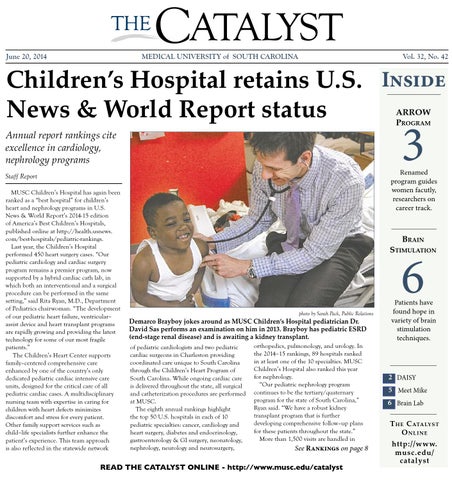
Demarco Brayboy jokes around as MUSC Children’s Hospital pediatrician Dr. David Sas performs an examination on him in 2013. Brayboy has pediatric ESRD (end-stage renal disease) and is awaiting a kidney transplant. orthopedics, pulmonology, and urology. In of pediatric cardiologists and two pediatric the 2014–15 rankings, 89 hospitals ranked cardiac surgeons in Charleston providing in at least one of the 10 specialties. MUSC coordinated care unique to South Carolina Children’s Hospital also ranked this year through the Children’s Heart Program of for nephrology. South Carolina. While ongoing cardiac care “Our pediatric nephrology program is delivered throughout the state, all surgical and catheterization procedures are performed continues to be the tertiary/quaternary program for the state of South Carolina,” at MUSC. Ryan said. “We have a robust kidney The eighth annual rankings highlight transplant program that is further the top 50 U.S. hospitals in each of 10 developing comprehensive follow–up plans pediatric specialties: cancer, cardiology and for these patients throughout the state.” heart surgery, diabetes and endocrinology, More than 1,500 visits are handled in gastroenterology & GI surgery, neonatology, nephrology, neurology and neurosurgery, See Rankings on page 8
READ THE CATALYST ONLINE - http://www.musc.edu/catalyst
Patients have found hope in variety of brain stimulation techniques.
2 DAISY 5 Meet Mike 6 Brain Lab T h e C aTa ly s T Online http://www. musc.edu/ catalyst
2 The CaTalysT, June 20, 2014
ReCOgnizing sPend aChievemenT
photo by Cindy Abole, Public Relations
Members of the MUSC Medical Center’s healthcare supply chain staff gather after they were presented with the ECRI Institute’s 2014 Healthcare Supply Chain Achievement Award. Regine Villain, chief supply chain officer, bottom row center, is joined by Mary Santanna, Rhodee Washington-Grant, Luc Sterckx, Linda Poulos, Jacquetta Norton, Shirley Brown, Jacquetta Ancrum, Chris Fennell, Debra Howard, Thomas Santaguida, Jessica Ovbiagele, Stan Trojanowski, Carlson Beeman, Kim Caver, Ivan Rivera, Joe Logan, Dan Altman and Bert Red. The award honors heathcare organizations that demonstrate excellence in overall spending management (for all medical devices, supplies, capital, service contracts, etc.) and in adopting best practice solutions using the full range of ECRI Institute membership processes. MUSC was among 12 regional winners chosen from 2,800 hospitals and health systems nationwide who subscribe to ECRI Institute’s PriceGuide and Select Plus supply and capital procurement advisory services.
Editorial of fice MUSC Office of Public Relations 135 Cannon Street, Suite 403C, Charleston, SC 29425. 843-792-4107 Fax: 843-792-6723 Interim editor: Cindy Abole catalyst@musc.edu Catalyst staff: Mikie Hayes, hayesmi@musc.edu
The Catalyst is published once a week. Paid adver tisements, which do not represent an endorsement by MUSC or the State of South Carolina, are handled by Island Publications Inc., Moultrie News, 134 Columbus St., Charleston, S.C., 843-849-1778 or 843-958-7490. E-mail: sales@moultrienews.com.
TCU nurse June DAISY award recipient The June DAISY (disease attacking the immune system) award winner is Marvetta Daniels, R.N., who works in 2TCU. Daniels was nominated by La’Tell Stewart and Shameka Middleton, co–nurses in Daniels’ unit. Below is her nomination: “Marvetta exemplifies the kind of nurse that any up–and–coming R.N. would be happy to emulate. This day she had a patient (Mrs. R), who had a history of hypertension, who was sitting in the nurse’s station, just to get her out of bed and her room. Mrs. R sat with us for a pretty lengthy period, until she said that she was tired and ready to return to bed. Not long after returning to bed, Marvetta noted that Mrs. R. was becoming increasingly labile and unresponsive, so she made a point to closely monitor her. At approximately 18:45, while I was in with another patient, the RN1 that was working with us that day came to me and said that “Marvetta has just called the MET [medical emergency team] on Mrs. R”. The RN1 rushed back to the room to assist and I brought the crash cart. The MET was a first for the RN1, but by the time I got to the room, my help was not really required. Marvetta had taken charge, and was skillfully directing our RN1 on what she needed her to do. I remained at the door so as to retrieve any more supplies that might be required. As I stood there observing the events going on, I was overwhelmed by a sense of pride, watching my co-workers perform the task needed to assist the patient. It was learned that Mrs. R had experienced an acute hypertensive crisis,
and had to be rushed for a stat CAT scan of the head and was transferred to an ICU unit. Marvetta’s experience and critical thinking skills surely saved Mrs. R, who is now back on our unit and much much better than before. Marvetta’s Daniels actions and the resulting outcome made me proud to be her coworker. This is only one small example of the type of care that she personally gives our patients, each and every day that she is here at MUSC. Daniels has made my first year at MUSC truly unforgettable. She is an outstanding nurse who goes the extra mile for the patients on TCU. Her high level of professionalism and knowledge has impacted my career tremendously. Daniels advocates and provides the best care possible for all her patients. She gives a great deal of support and guidance to the entire staff on a daily basis.” Each month, MUSC nurses are honored for their excellence with the DAISY Award. The award is part of the DAISY Foundation’s program recognizing nurses for their daily contributions in their jobs. To nominate a nurse, visit http://www.musc.edu/ medcenter/formsToolbox/DaisyAward/ form.htm.
Parking rate increase effective July 1 The Office of Parking Management has announced a parking rate increase and other changes to the employee parking fee structure. Changes will be effective July 1. In May, the MUSC board of trustees approved a five-year parking schedule of increases. Rates are indexed to employee salary. Employees who park at the Harborview Tower Garage or Lockwood lot will continue to receive
a discount over the on–campus rate. Employees working at Harborview Tower and park at the Harborview Tower garage or Lockwood lot will be migrated to the on–campus rate over a period of five years. MUSC Parking will continue to provide free parking in the Hagood system with shuttle bus service around campus. For information contact Melinda Anderson, 792-2597.
The CaTalysT, June 20, 2014 3
Name change defines women faculty, researchers across campus missions Staff Report The Women Scholars Initiative name has changed to ARROW for Advancement, Recruitment, and Retention of Women. This new name reflects feedback that not all women faculty relate to the term “scholars” in the former title. The ARROW program’s mission focuses on the advancement of women faculty across all missions and colleges of MUSC. Various programs are conducted throughout the year to support the initiative and will continue under the new name. These programs are available to all women faculty regardless of career track or degree across all colleges. In addition, the College of Medicine is establishing a center supported by a National Science Foundation grant for the advancement of women scientists. COM Dean Etta Pisano, M.D., serves as the principal investigator. The Center for ARROWS (Advancement, Recruitment, and Retention of Women Scientists) will provide programs and support specifically for female doctoral scientists or similar female faculty who are focused on research. “We’ve come a long way,” said Pisano. “Women now lead medical schools and other big and important ventures. But, there aren’t enough of us in leadership or in science. ARROWS will help us develop methods to improve support for the careers of women in science at MUSC and other similar institutions. Women in STEM [science, technology, engineering and mathematics] disciplines are finding it very Pisano challenging to succeed. ARROWS will be a step toward changing what’s possible for women in science.” Ashli Sheidow, Ph.D., professor in the Department of Psychiatry, has served as vice chair for the MUSC ARROW Initiative since 2010 and is also a co–PI on the NSF grant supporting the Center for ARROWS. Sheidow left MUSC at the end of May for a position at the Oregon Social Learning Center. Her vision and dedication facilitated successes in supporting and advancing the careers of women faculty at MUSC. Tamara Nowling, Ph.D., assistant professor in the Department of Medicine, will step into the role of vice chair, with Darlene Shaw, Ph.D., associate provost for education and student life, remaining as chair of the ARROW Initiative. The College of Medicine has announced that Carol Feghali-Bostwick, Ph.D., professor in the Department of Medicine, was recently named director of The Center for ARROWS and will be taking over Sheidow’s co–PI position on the NSF grant. Feghali-Bostwick will be working in conjunction with Nowling to continue implementation of The Center for ARROWS initiatives. Information about MUSC’s ARROW program and the Center for ARROWS can be found at http://academicdepartments.musc.edu/arrowinitiative/index.htm or by contacting Megan McDonough at mcdonoum@musc.edu.
photo by Anne Thompson, Digital Imaging
Dr. Kathleen Brady, center, professor and associate provost for clinical tranlsational science and clinical neuroscience division director, was honored for her contributions and presented with the 2013 Women Scholars Initiative’s (now ARROW) Advancement of Women Faculty Award by Interim President Dr. Mark Sothmann at Colcock Hall. The award is among several programs, activities and recognition sponsored by the ARROW program honoring excellence among women faculty and researchers on campus.
Safe Sitter babysitting classes offered in June by MUSC Volunteer Services MUSC Volunteer Services will offer two sessions of Safe Sitter classes for girls and boys ages 11 to 13. The second, two-day training class will be held from 9 a.m. to 3 p.m., June 26 and 27 at Room 2408, Ashley River Tower. The Safe Sitter program is a medically accurate program that teaches young adolescents how to handle emergencies when caring for younger children. Registration for the program, which is $75, is open until June 14. To register, call Kelly Hedges at 876-4246 or email hedgesk@musc.edu.
4 The CaTalysT, June 20, 2014
MUSC Medical Center Communications Corner Communication Advisory Group doing more than advising CEO Patrick Cawley, M.D. formed what he called a Communications Advisory Group, made up of a cross section of medical center employees, to devise an effective two–way channel of information between leadership and staff at all levels. “I am looking to deliver the right message, at the right time, to the right people,” said Cawley. The CAG met for the first time in December 2013. After several organizing sessions, it broke into six work groups. The work group chairs and their teams have developed long–term plans — and have, in many cases, created real–time change in the communications structure. The goals of the CAG are to 1) identify topics of interest and concern to employees; 2) serve as on ongoing “focus group” to determine the medical center’s communications needs from the employee’s perspective; and 3) solicit and report employees’ perspectives concerning communication methods and content. Those in the CAG want the committee to be seen as a credible, trustworthy, effective advocate for employee issues and concerns. That requires the CAG to strategically: • • • •
Identify employee issues and concerns Improve existing communication devices now, while developing a major overhaul Provide employee–to–leadership channels Devise methods to segment messages by importance and relevancy to specific work areas or job functions
“The right message, at the right time, to the right people.” -- Medical Center CEO Pat Cawley Given that two–way communication is essential, the CAG also recognized the need to help employees understand their responsibility — and the value to them — of absorbing and acting on information communicated by leadership. The Live workgroup, chaired by Andrea Coyle, R.N., has had the most immediate impact. At the suggestion of that group, MUHA Town Halls were reorganized to have only Cawley and Chief Operating Officer Matt Wain conduct sessions. There was a follow–up session for employees to contemplate further questions and pose them to Cawley and Wain on May 22 in person and via web broadcast. Many employees prefer the face–to–face meetings with their immediate manager and work group. Keeping that in mind, the Live committee suggested having administrators present at staff meetings (rather than town halls), to sharpen the focus to issues affecting that unit. The Web workgroup, chaired by Betty Stuart, a University hospital OR nurse, is coordinating closely with the musc.edu and muschealth.com teams, which are working on a major overhaul of those websites. The Social Media workgroup, chaired by Megan Fink, the Epic program communications manager, is focused on creating a dialogue between employees
and leadership and between employees using the Yammer platform. Many MUSC groups already use this Facebook–for-–the–workplace platform to communicate, and it could become the official MUSC social media tool for employees and leadership to communicate. The Mobile Apps workgroup, chaired by Clay Thompson, senior information security analyst, took on the heady charge of exploring use of mobile devices and apps, and deciding whether to use mobile apps exclusively or a combination of new and existing formats pushed to a mobile platform. Besides the issues the CAG was considering, the Office of the Chief Information Officer always has to factor in the interoperability of the entire university’s systems and the looming Epic go–live event. Faced with these operational challenges, OCIO has moved forward and purchased a new IBM Worklight Mobile Device Framework — an essential platform by which discreet messages can be sent to specified targets. That’s a big step toward getting the right message to the right people. Email is currently the standard MUSC method of communications. Yet the number of emails employees receive is often overwhelming. For many who work on units, access to email is limited during their shifts. The Email workgroup, chaired by Michelle Foreman, a data analyst in MUHA Human Resources, suggested trying to tailor email messages that were relevant to logical job functions, including: • • • • • • • • • • • • • •
ITC group (information technology coordinators) All staff RN group ASBs (secretaries) Business managers Inpatient vs. outpatient Timekeepers/schedules HR departmental contacts (admin/support for HR functions) Leaders Departmental groups Physicians Patient related vs. non–patient related Dietary Environmental Services
and standardizing the subject line with some indication of why the recipient is receiving the email. For example: • FYI if it’s for information only; • ACT if the recipient is to take an action based on the information included; • REPLY if the email is soliciting ideas, suggestions or decisions. The Promotion workgroup, chaired by business development manager Tom Robinson, is responsible for letting employees know what the CAG is planning, what has been accomplished and how employees can engage in any or all of the new offerings. This article in The Catalyst is a first step in that direction. Future communications will be coming through familiar channels, including emails and live meetings, and the new platforms like mobile apps and Yammer as they come online. If you have questions, concerns or ideas, email MUHAinfo@musc.edu.
The CaTalysT, June 20, 2014 5
MEET MIKE
Mike Garbarini Department Hollings Cancer Center — Facilities & Resources How you are changing what’s possible at MUSC I enjoy working together with HCC staff and other departments to help the center achieve its status as one of the top cancer treatment and research centers in the nation. How long at MUSC 2 years Children and grandchildren Two sons Philip and Nick and grandchildren, Maria and PJ First thing you notice about a person If they make eye contact Favorite summer activity Anything near the water Your idea of a dream vacation A motorcycle trip across New Zealand Favorite quote The measure of a man is how he treats someone who can do him absolutely no good. —Samuel Johnson
6 The CaTalysT, June 20, 2014
Brain stimulation techniques reshape psychiatry By Dawn Brazell Public Relations
P
ublic perceptions of psychiatry took a hit from the ’70s classic movie “One Flew Over the Cuckoo’s Nest” where the main character gets sent up to the “shock shop” for electroconvulsive therapy. Ironically, the new frontier in psychiatry is centering on a vast array of brain stimulation techniques, including electroconvulsive therapy or ECT, that are offering relief to patients who have lost hope in other forms of traditional treatment. Baron Short, M.D., clinical director of MUSC’s Brain Stimulation Services with the Institute of Psychiatry at MUSC, said misconceptions remain about these brain stimulation treatments and how they should be used. For example, today’s ECT is considerably different from the primitive “shock treatments” portrayed in the past. There are no paddles Short with periods of violent convulsions, but rather a low–voltage, ultra–brief pulse of current delivered to just one side of the brain. Modern ECT has been shown to be an effective procedure for many treatmentresistant patients with mood disorders. Modern ECT is just a small piece of the puzzle, too, when it comes to the rapidly–evolving field of brain stimulation treatments that are transforming the field. It’s one reason MUSC is offering a new interventional psychiatry fellowship for residents and psychiatrists who want to have an additional year of training in the wide variety of both invasive and non-invasive brain stimulation technologies that now are available, some of which have been pioneered at MUSC. The university also has a curriculum within the residency program called the interventional psychiatry track.
TMS, transcranial magnetic stimulation, is a way to noninvasively apply magnetic stimulation that only reaches the outer layers of the brain’s cortex.
photo by Sarah Pack, Public Relations
Dr. Mark George, right, division director of the Brain Stimulation Lab, and Dr. Baron Short demonstrate a newer form of transcranial magnetic stimulation. Brainsway’s Deep TMS H-Coil System penetrates the brain Nolan R. Williams, M.D., is chief resident of Combined Neurology and Psychiatry at MUSC, and said the curriculum centers around the concept that the brain is an electrochemical organ, and behavior and emotion are mediated by circuits within the brain in which psychiatrists can “intervene” to create therapeutic change. “We think it makes these technologies much safer and much more likely to help people who truly need them by creating a set training pathway. What we would hope is that in a few years, several places across the country will have this, and it can really expand our ability to reach out and help those people who really need them the most and who have failed all other treatments.” Williams, who presented a poster at the American Psychiatric Association meeting last year, received a warm reception, and he and colleague Edward Kantor, M.D., were asked to write an article for Medscape on “A New Psychiatry Subspecialty,” which in a
couple of weeks had attracted more than 22,000 readers from all specialties of medicine and numerous positive comments. “What we’ve done here that’s unique is recognized this explosion, and we tried to capture it within a training model. We’re the first to develop and implement a formal training model within our educational system here in the psychiatry department,” he said. “We’ve had people from across the world contacting us, asking us if they can train here for interventional psychiatry. So there’s an interest and a recognition of need.” Short said the goal is to develop a standard for how to train people in these technologies. “At this point, ECT is widespread throughout the United States. Transcranial magnetic stimulation has spread throughout the United States, and we’re very interested that people are refining how we train and teach people how to use these technologies and be as
updated as possible so that we’re giving people the safest most effective treatment possible.” MUSC has a critical pool of brain stimulation pioneers, such as Mark George, who’s director of MUSC’s Brain Stimulation Lab and began developing brain stimulation technologies in the 1980s. He is known for his research in developing transcranial magnetic stimulation, which is a way to noninvasively apply magnetic stimulation that only reaches the outer layers of the brain’s cortex. “Arguably, it’s still in its infancy, yet we’ve already found evidence for transcranial magnetic stimulation for the treatment of depression and it has been FDA-approved for the treatment of depression since 2008.” Even treatments that have been around for a while, such as ECT, are being revamped, and psychiatrists have had to reeducate patients about how the field has grown, Short said. “We pioneer the same technology with ECT. We do a form of ECT that, literally, no one else is doing in the world, to reduce cognitive side effects while maintaining good efficacy of treatment of depression. We’re not just interested in ECT, and we’re not just interested in TMS. We are involved in various forms of brain stimulation.” Epidural-cortical stimulation, which is a technology pioneered at MUSC by Istvan Takacs, M.D., and Ziad Nahas, M.D., involves placing electrodes on the
See Brain on page 7
The CaTalysT, June 20 2014 7
Brain Continued from Page Six activity in the brain in depressed patients. MUSC also is involved in what’s called deep brain stimulation, which involves implanting electrodes into the brain to treat such disorders as Parkinson’s disease, obsessive compulsive disorder and depression. “But it doesn’t stop there,” Short said. “There are a variety of technologies still developing involving using GAMMA technology to stun parts of the brain for treatment of depression. There are transcranial ultrasound technologies that Williams are being used to modify circuits in the brain, so again we’re trying to get across the idea that the brain is an electrochemical organ that we can modify invasively or non– invasively in very focal ways to change the behavior of the circuits and get people out of serious, severe disorders they experience, including depression, OCD, etc., and we’re still in the infancy of this.” The changes are bringing doctors a step closer to personalizing medicine to treat mental and neurological disorders. For example, in the future a depressed patient who gets therapy would undergo brain imaging first to understand the specific disorders occurring in the brain, Short said. “Based on that, we will be able to directly say, ‘You are more likely to benefit from talk therapy; you are more likely to benefit from specific types of medication or you are not going to benefit from either of these right now. You need this type of technology.’ So we will get to the point where we’re so precise in being able to, not only look at what someone’s experiencing or understand it, kind of precisely determine the type of dysfunction and directly intervene and skip a lot of the steps that people are currently having to undergo.” Interventional psychiatrists work closely with neurosurgeons in the
One of the computer-generated pictures used to plan a surgery for a patient treated by Dr. Istvan Takacs by using deep brain stimulation.
photo by Sarah Pack, Public Relations
Dr. Mark George, left, with Dr. Baron Short in MUSC’s Brain Stimulation Lab showing how the controls for an implantable neurostimulator can be adjusted.
“We’ve had people from across the world contacting us, asking us if they can train here for interventional psychiatry. So there’s an interest and a recognition of need.” Dr. Nolan Williams invasive treatments, such as DBS, which has a “brain pacemaker” that is implanted in the chest that transmits an electrical signal from the impulse generator to the electrodes. Short said the neurosurgeon would play more of a role in implanting the electrodes, and the psychiatrist would play more of a role helping coordinate and program the device. “So once you have the device in, you still have to turn it on and make adjustments.” The psychiatrists and neurosurgeons agree on a target area in the brain based on a patient’s symptoms and work as a team to personalize a patient’s treatment, fine–tuning the device to achieve the best effects with the fewest side effects. Mood regulation is thought to be
controlled by a series of nodes in a circuit, Williams said. “The cortex is one of those nodes, and then there are deep structures, so you have a point here connected to a point here, connected to a point here, and that loops around and closes the circuit. Some of those nodes are deep and when you want to simulate a deep node, you do deep brain stimulation. You stick an electrode deep into the brain, either into a white matter track or a nucleus. If you want to stimulate the cortex, you can do it non–invasively through TMS, which is effective for moderate depression.” Williams sees the field moving towards this circuit-based understanding of both neurologic and psychiatric diseases. The next 10 to 20 years will bring a better understanding of the brain, its circuits and the brain-based mechanisms that drive disease. The goal is to be able to implement neuromodulation treatments earlier to help normalize the brain, he said. “That way we can really capture everyone who has a mental illness and be able to effectively treat them and reduce their symptoms and suffering.” Williams said it’s interesting to note how each one of the brain stimulation treatments is being explored for most of the psychiatric illnesses at some level of severity. The main obstacle to
advancement is funding. Short agreed. “There are current caps in research funding and dollars available for this type of research, so even though it is cutting–edge, we could go tremendously faster than what we’re doing now. Some of us would argue that we’re moving at a snail’s pace, but if we had additional funding, we could really take this to a whole other level and a lot faster.” Just because there’s an explosion of growth in this field does not mean traditional therapies are not needed, but rather that brain stimulation treatments will augment psychotherapy and medication therapies, Short said. “Many of the folks who are either in clinical treatment or research trials have often failed to respond to medication or talk therapy, and what we find is that we help people recover so that they can actually re–engage in psychotherapy.” Short compares it to an orthopedic surgeon repairing someone’s hip who has not walked in quite a while to the point the muscles have atrophied and thinned out. “If that surgeon replaces the hip, now the person has the capacity to possibly walk, but has to retrain the muscles. So we look at interventional psychiatry as a subspecialty to help the circuits behave in a healthier framework so that people can re–engage in their lives. They often still need talk therapy and medications.” Editor’s Note: This is part II in a series about how interventional psychiatry is advancing options for neurological and psychiatric diseases. For the full mutlimedia package, visit MUSC News Center at www.musc.edu/pr/newscenter/2014/dbscase-study.html.
8 The CaTalysT, June 20, 2014
rankings
Master gardener tapped with beautification award
Continued from Page One
Staff Report
photo by Sarah Pack, Public Relations
Radiation tech Lauren Jones, left, monitors baby Adam Mereby while Dr. Nicole Cain, center, checks on him after he had a Medtronic Reveal LINQ Insertable Cardiac Monitor implanted March 21. Nurse anesthetist Kyle Comley is at right. the pediatric nephrology clinic each year, providing comprehensive diagnostic and therapeutic services for children with all types of renal disease including hypertension, urinary tract infections, acute and chronic glomerulonephritis and renal failure. Children with chronic renal failure and end-stage renal disease are treated by a highly–skilled team offering hemodialysis, outpatient peritoneal dialysis and renal transplant. Notably, the division of nephrology has established the pediatric hypertension program and pediatric kidney stone clinic as well as the vasculitis/lupus nephritis and the transition clinics. The division has expanded and improved continuous renal replacement therapy options and protocols. “Finding care for a child with a life– threatening or rare condition is one of the most overwhelming experiences
parents face,” said Ben Harder, managing editor of health care analysis, U.S. News. “We hope the rankings and information in Best Children’s Hospitals help make a family’s search for the best care possible for their child a little easier.” The methodology behind the new rankings underwent various changes. For example, the scoring weight assigned to infection prevention and to use of “best practices” was increased and the weight of hospital reputation was decreased. Five–sixths (83.3 percent) of each hospital’s score relied on patient outcomes and the care–related resources each hospital makes available. Survival rates, adequacy of nurse staffing and procedure volume are among the many kinds of information about each ranked hospital that can be viewed on http:// health.usnews.com/best-hospitals/ pediatric-rankings.
Short-term housing needed Do you have an apartment or house that you could rent on a monthly basis? Or, do you need extra income and would like to rent out a furnished room in your own home? Visiting MUSC students and faculty are in need of monthly rentals. To list your property, visit http://www.musc.edu/housing and click on “Add a Property.” If an entire property is available, list as a “short–term.” If it is a room in your home, list as a “short–term roomate.” For information, call 792-0394.
Mary Helpern, R.N., a garden educator with MUSC’s Urban Farm and Grounds Department, was honored with the 2014 Mamie Williams Award from the Community Pride, Inc. of Charleston County May 16 at its 48th annual awards luncheon at the Community Center in Park Circle. Helpern was among several individuals, clubs, businesses and organizations recognized for creating attractive environments for citizens and their communities. Helpern was praised for her environmental stewardship practices working with MUSC’s Urban Farm and assuming the project beyond the typical “pride” work. Helpern, who has been a master gardener since 1992, started with MUSC’s Urban Farm as a garden educator in 2012. Helpern’s work involved expanding crop selections for the farm to include edible flowers, new pepper and eggplant varieties, greens planted in a quilt or figure design, and other activities. She also helped expand the garden’s composting practices from using various containers in the keyhole garden to introducing a pallet and two-composting system that used coffee
photo provided
Mary Helpern with her award. step grounds from the medical center’s Starbucks Cafe to supplement soil nutrition. Helpern has increased the food and habitat resources for birds, bees and butterflies; added perennia and annual flower beds; demonstrated alternative gardening methods; and provided educational/informational sessions. She also developed a collaborative relationship growing seedlings and provided resources for students studying in Trident Technical College’s Horticulture program. Helpern also has assisted the Urban Farm with professional certifications with the National Wildlife Federation, Carolina Yard, Clemson Cooperative Extension and Charleston Friendly Yard.
The CaTalysT, June 20, 2014 9
Father, daughter neurosurgeons operate on brains together By lauren sausser Of the Post and Courier Staff
W
hat seemed like only a minute ago, Ed Kosnik, M.D., was teaching his daughter how to ride a bike. The next, she was standing next to him in the operating room at MUSC. "It was a pretty awesome experience, when you think that someone whose diapers you changed is now capable of opening up your head and doing the right thing," said Kosnik, who is an assistant professor in the Department of Neurosciences. "You just sit there and shake your head and say, 'Oh, my God.' But Libby's always been one who has been ready to do something, in some ways." His very capable, now 35–year–old daughter, Libby Kosnik Infinger, M.D., was, until graduation June 14, the chief resident of MUSC's neurosurgery program. She leaves Charleston later this summer to complete a one–year fellowship at Cincinnati Children's Hospital, where she'll specialize in pediatric neurosurgery, just like her dad. Certainly, this isn't the first time a daughter has followed in her father's footsteps, but this situation is special. The Kosniks are the only known father–daughter duo in the pediatric
neurosurgery specialty across the country who regularly operate side–by–side. Kosnik, 69, suspended his retirement in 2013 and joined the neurosurgery department at MUSC, where Infinger had been training as a resident since 2007. He previously worked several decades as a pediatric neurosurgeon in Columbus, Ohio. "It was great," Infinger said. "It's funny. We have very similar personalities. We've always done things together, gone fishing, projects around the house. It was different because, you know, you're operating, but we've always had a close relationship." They operate on children together at least once a week: patients with spinal defects, brain tumors, babies born with water on their brain. Their last operation together, at least for the next year until Infinger returns to MUSC after her fellowship, was June 13. "I think this is a very unique experience," Kosnik said. "I've known a lot of neurosurgeons and — you look at all the numbers of neurosurgeons — I don't think there are any other father– daughter combinations, certainly not in pediatrics." Even as a child, Infinger remembers she was curious about what her dad did for a living.
Pediatric neurosurgeons Dr. Edward Kosnik and his daughter, Dr. Libby Kosnik Infinger, work together in the operating room in the Pediatric Neurosurgery unit
photo provided
Dr. Edward Kosnik and his daughter, Libby Kosnik Infinger, when she was a child.
photo by Grace Beahm, Post and Courier
Dr. Edward Kosnik and his daughter, Dr. Libby Kosnik Infinger, have worked side-by-side at the MUSC Pediatric Neurosurgery unit.
“In second grade, there was a girl that sat in front of me that he did surgery on. Every day, I could look at her scar when she came back to school and that really got me interested in seeing what he did, and exactly what he did as a pediatric neurosurgeon." Kosnik remembers the patient, but tells the story differently. "I asked (Libby) what the scar looks like and she said, 'Yucky!' " The early aversion eventually wore off. While her dad never pushed her into
neurosurgery, it turned out that's what she enjoyed most in medical school. She also saw firsthand the kind of lifelong impact pediatric neurosurgeons had on their patients. Ed Kosnik's fan base is huge, she acknowledged. In 2011, when her dad spent several weeks in an intensive care unit after heart surgery, the Caring Bridge website the Kosnik family set up to keep friends up to date on his progress received 80,000 hits. He estimates he performed some 15,000 operations during his career in Columbus. "I had one family tell me once, 'Thanks for giving up a little bit of your dad so he could be a dad to all these other kids out there,' " Infinger said. "But I never felt like he missed anything important. He was there whenever I needed him." Editor’s note: The article ran June 15 in The Post and Courier and is reprinted with permission.
10 The CaTalysT, June 20, 2014
Employee Wellness setting, seek out activities that With summer break work fun and fitness into family officially underway and fun. Swimming, boating, and schedules changing, hiking are obvious outdoor many exercise and summer activities, but even fitness routines begin sightseeing or amusement parks to fall to the wayside. can provide lots of opportunities Transition periods like for walking. Just be sure not to summer break tend to load up on unhealthy snacks be disruptive to healthy while you’re there! habits but shouldn’t q Relax and have fun! – Don’t permanently derail them. worry if you get off track for a But it does take some weekend or even a week. It’s Susan Johnson planning and focus to okay every once in a while to just overcome the temptation let loose and be spontaneous. Just to give in to those lazy summer be sure to get back to your healthy vacation days and stay on track with fitness and healthy family goals. Here habits as soon as possible! To help stay motivated and on track are some easy tips to help us through and for a chance to win great prizes, those first few weeks of summer sign up for the Fit Family Challenge break and keep us moving through at www.fitfamilychallengesc.com. For every backyard barbeque and family more great tips and resources from vacation: our MUSC Fit Family Challenge q Establish individual and family experts, visit www.musc.edu/ffc. exercise schedules – most likely each person in the family has specific times and types of activities that are Wellness Events part of their normal exercise routine. q Worksite screening — Friday, June 20, Sit down as a group and figure out Room 125, Gazes Building Auditorium. how to make time around summer Screening, valued at about $350, is activities (work, camp, vacations) so available to employees of the State that each person can continue to Health Plan (including the MUSC work toward their fitness goals, even Health Plan) for only $15 (covered if it may look a little different in the spouses also can participate for $15). summer compared to the school year. Employees and spouses without this q Try to plan family dinners – with insurance can participate for $42. longer days, camps, and vacations, To register, go to www.musc.edu/ it’s hard to stick to a normal employeewellness. shopping/meal planning/cooking q June Mindful Challenge — Try routine in the summer. But the more an alternative diet at least one day you can, the healthier your family a week: Meat–free Monday. Take will eat and you all will benefit from the survey at http://rtinyurl.com/ that time spent around the table – oqehj4a. whether it’s the kitchen table or a A link to the final survey will be picnic table. sent at end of the month to survey q Establish summertime “house participants. rules” – since most kids spend more q MUSC Holistic Wellness Month time at home during the summer Lunch and Learn Series — Bring than they do during the school year, lunch and interact with local or it is a good idea to establish some MUSC practitioners specializing in special summertime rules that keep complementary health and wellness their bodies and brains active while disciplines. Email musc-empwell@musc. also ensuring adequate rest. Bedtime, edu to register. reading, screen time and exercise can • Holistic Wellness Series Part 3: Save all be worked into a daily schedule, money and calories by considering while still allowing for lots of alternatives. Urban Farm Lunch & Learn flexibility and summer fun. Useful tips and strategies for reducing fat q Plan active vacations – even if and socium without giving up taste. Plus the destination isn’t in an “active” recycling scraps in the kitchen to make
Health at work
fresh foods. Led by Debbie Petitpain, Sodexo Wellness Dietitian. Rain location at Colbert Library, Room 115. • Acupuncture & Elements of Chinese Medicine: Join an informative discussion about the use of food, essential oils and acupuncture to keep the body healthy during the heat of summer. Lisa Abernathy and Lauren Becker of Blue Heron Acupuncture and Apothecary explore the Five Elements and how they are used in this traditional treatment. Event is from 12:15 to 12:45 p.m., Wednesday, June 25, Room 115, Colbert Library. Email musc-empwell@musc.edu to register. q Fit Family Challenge — MUSC has partnered with Coca–Cola, Lowcountry Parent magazine, DHEC, S.C. Hospital Association and CVS in an 8–week program in which S.C. residents are challenged to get out and get active. Register at http:// www.fitfamilychallengesc.com. Families earn points for a chance to win prizes during the challenge period, May 15 to July 10. q MUSC Quits! — an eight–week tobacco cessation program to help MUSC
students and employees quit smoking — free of charge from Noon to 1 p.m., June 23 to 12:30 to 1:30 p.m., July 7, and Noon to 1 p.m., July 14. Register at woodarda@musc.edu. q Employee Fitness Series — 4:15 to 4:45 p.m., June 18; Pilates: a total body non–impact workout that stretches, strengthens and lengthens the entire body with emphasis on core muscles. Participants should check in at the Wellness Center membership desk for directions to the free class and receive a free one-day pass to the Wellness Center. Register at musc-empwell @musc.edu. q Chair massages: Free massages are offered to employees on midday Wednesdays. Look for broadcast messages for locations and times. q Farmers Markets: Fresh fruits and vegetables are available from local farmers from 8 a.m. to 4 p.m., Wednesday, Harborview Office Tower lobby; from 8 a.m. to 6 p.m., ART; and from 7 a.m. to 3:30 p.m., MUSC Horseshoe For information, email johnsusa@ musc.edu, Office of Health Promotion.
The CaTalysT, June 20, 2014 11
Class of 2016 physical therapy students welcomed
Homes For Sale
Furniture
Deep water property 15 minutes to the ocean. Dock to accommodate 40 ft.+ boat. Beautiful custom home, 3 bedrms, 3 1/2 baths, swimming pool, fenced yard, Wadmalaw. $969,900 Call Jackie Clark - Carolina One - 843-607-1265
King Size Plush Set New, will sacrifice for $275 843-270-4283
Beautiful, custom built home on over 8 acres, less than 20 minutes from Downtown. Custom kitchen, Brazilian cherry floors, 4BR, 3.5BA, family rm 3000+ sf, wrap around porches, quiet secluded area on Johns Island. Landscaped, partially fenced and so much more. $760,000. Jackie Clark 843-607-1265 Carolina One
Antique white cast iron full bed with canopy attachment. Price is $150 or best offer. 696-1331 Dining, living, bedroom Furniture/Accessories Excellent shape 413-695-0215 Full Mattress Set with Euro Pillow Top New $125. Please Call: 843-270-4283 A-Queen Pillowtop that is Brand New in Plastic. Will take $150. Please call 843-270-4283
photos by Anne Thompson, Digital Imaging
The College of Health Professions welcomed its newest class of physical therapy students on June 6. The program celebrated with its traditional white coat ceremony held at Seacoast Church in Mount Pleasant. A total of 64 students attended and were presented with their coats by PT faculty prior to beginning their first full-time clinical rotation this fall.
12 The CaTalysT, June 20, 2014