May 2, 2014
Inside
MEDICAL UNIVERSITY of SOUTH CAROLINA
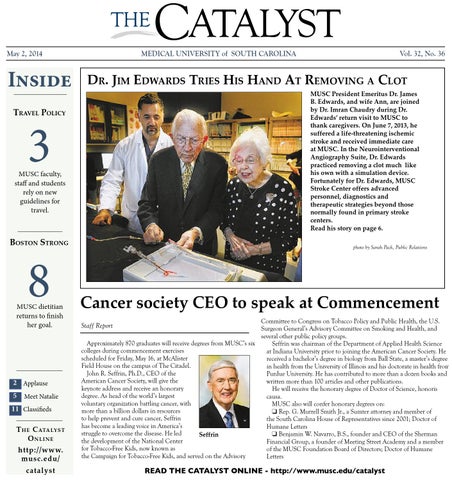
DR. JIM EDWARDS TRIES HIS HAND AT REMOVING A CLOT
MUSC President Emeritus Dr. James B. Edwards, and wife Ann, are joined by Dr. Imran Chaudry during Dr. Edwards’ return visit to MUSC to thank caregivers. On June 7, 2013, he suffered a life-threatening ischemic stroke and received immediate care at MUSC. In the Neurointerventional Angiography Suite, Dr. Edwards practiced removing a clot much like his own with a simulation device. Fortunately for Dr. Edwards, MUSC Stroke Center offers advanced personnel, diagnostics and therapeutic strategies beyond those normally found in primary stroke centers. Read his story on page 6.
TRAVEL POLICY
3
MUSC faculty, staff and students rely on new guidelines for travel.
BOSTON STRONG
8
MUSC dietitian returns to finish her goal.
2 Applause 5 Meet Natalie 11 Classifieds T H E C ATA LY S T ONLINE http://www. musc.edu/ catalyst
Vol. 32, No. 36
photo by Sarah Pack, Public Relations
Cancer society CEO to speak at Commencement Committee to Congress on Tobacco Policy and Public Health, the U.S. Surgeon General’s Advisory Committee on Smoking and Health, and several other public policy groups. Approximately 870 graduates will receive degrees from MUSC’s six Seffrin was chairman of the Department of Applied Health Science colleges during commencement exercises at Indiana University prior to joining the American Cancer Society. He scheduled for Friday, May 16, at McAlister received a bachelor’s degree in biology from Ball State, a master’s degree Field House on the campus of The Citadel. in health from the University of Illinois and his doctorate in health from John R. Seffrin, Ph.D., CEO of the Purdue University. He has contributed to more than a dozen books and American Cancer Society, will give the written more than 100 articles and other publications. keynote address and receive an honorary He will receive the honorary degree of Doctor of Science, honoris degree. As head of the world’s largest causa. voluntary organization battling cancer, with MUSC also will confer honorary degrees on: more than a billion dollars in resources q Rep. G. Murrell Smith Jr., a Sumter attorney and member of to help prevent and cure cancer, Seffrin the South Carolina House of Representatives since 2001; Doctor of has become a leading voice in America’s Humane Letters struggle to overcome the disease. He led q Benjamin W. Navarro, B.S., founder and CEO of the Sherman Seffrin the development of the National Center Financial Group, a founder of Meeting Street Academy and a member for Tobacco-Free Kids, now known as of the MUSC Foundation Board of Directors; Doctor of Humane the Campaign for Tobacco-Free Kids, and served on the Advisory Letters
Staff Report
READ THE CATALYST ONLINE - http://www.musc.edu/catalyst
2 THE CATALYST, May 2, 2014
Applause Program
The following employees received recognition through the Applause Program for going the extra mile: Medical Center Susan Gay, Women’s Services; Sally Shields, Women’s Services; Jennie Nguyen, ART 6 West; Tiffany Bailey, ART 6 West; Priscilla Pearsey, EVS; Tom Carter, ART 6 West; Georona Gadsden, ART 6 West; Becky Hank, ART 6 West; Regina Alwardt, Women & Infant Services; Casey Howett, Women’s Services; Brenda Brown, Women’s Services; Amelia Hinchcliffe, Women’s Services; Deborah Cepeda, Women’s Services; Michelle Vareltzis, Radiology; Laura Zimerman; STNICU; April Austin-Genua, PACU; Michelle Magwood, North Area Multi-Specialty Clinic; Abbie Kjellman, STNICU; Ana Rosa Virella-Pena, Women’s Services; Michelle Turner, Women’s Services; Elaine Cromwell,Venipuncture; Jessica Stout Johnson, 10 West; Antonio Giordano, Residents Medicine; Jared Guichard, Residents Medicine; Peggy Willis, Social Workers; Holly Smith, ART 3 West; Michael Howard, RT Univ Internal Medicine; Blake Olmsted, Residents Medicine; Elane Martin, RT Univ Internal Medicine; Melissa Nolan, RT Univ Internal Medicine; Cathy Addison, RT Univ Internal Medicine; Tim West, RT Univ Internal Medicine; Phyllis LaBoard, RT Univ Internal Medicine; Mona Baylock, RT Univ Internal Medicine; Altrameze Horry, RT University Internal Medicine; Nathaniel Piel, Department of Medicine; Linda Monroe, RT Univ Internal Medicine; Lisa Foster, Revenue Cycle; Terri Bartlett, STNICU; Tracy Floyd, Women’s Services; Cynthia Boolen, 5 East; Gwendolyn Cohen, Outpatient
Editorial of fice MUSC Office of Public Relations 135 Cannon Street, Suite 403C, Charleston, SC 29425. 843-792-4107 Fax: 843-792-6723 Interim editor: Cindy Abole catalyst@musc.edu Catalyst staff: Mikie Hayes, hayesmi@musc.edu
Registration; Moya McFadden, Radiology; Lisa Dooley, Radiology; Mark Lawless, Laboratory Services; Talaesia Jenning, HCC Scheduling; Joan Ancrum, Patient Transport Services; Sandra Buck, RT Urology Clinic; Lillian Jenkins, Revenue Cycle; Shanell Gadsden, University Internal Medicine; Linda Abney, Revenue Cycle; Sharon Ancrum, Venipuncture; Geraldine Smalls, PAS; Cheryl Lynch, General Internal Medicine-Geriatrics; Mary Nelson, Radiology; and Samir Karia, Neurology–Pediatrics University Kellie Adams, Radiology; J. Mark Barry, College of Dental Medicine; Stacy Bramlet, College of Dental Medicine; Alexzandrea Brown, College of Medicine-Dean’s Office; Sonia Castellano, Library; Anna Delamar, College of Medicine-Dean’s Office; Lisa Fowler, College of Dental Medicine; Daniel Knause, College of Dental Medicine; Allen Johnson, College of Dental Medicine; Gabrielle Redding, College of Medicine-Dean’s Office; John (Jack) Reinhardt, Public Safety; Walter (Wally) Renne, College of Dental Medicine; Beth Trout, College of Dental Medicine; and Joe Vuthiganon, College of Dental Medicine.
The Catalyst is published once a week. Paid adver tisements, which do not represent an endorsement by MUSC or the State of South Carolina, are handled by Island Publications Inc., Moultrie News, 134 Columbus St., Charleston, S.C., 843-849-1778 or 843-958-7490. E-mail: sales@moultrienews.com.
Summerville After Hours Care opens
photo provided
MUSC Children’s After Hours Care staff celebrate their grand opening April 21 at the new facility, 4330 Ladson Road in Summerville. The clinic offers a skilled staff to treat walk-in, urgent care needs of children from newborns through age 17. It is open weekdays, 4 to 10 p.m. and weekends and holidays, 12 to 7 p.m.
May is Estate Planning Awareness month The Office of Gift Planning at MUSC has designated May as Estate Planning Awareness month at MUSC. The goal of the month is to create awareness that estate planning is not just for wealthy people and there is more to it than death and taxes. During May, the Office of Gift Planning will answer questions as well as provide participants with estate planning resources. Every Tuesday and Thursday, the office will feature a broadcast message featuring topics of importance to help employees learn about estate planning and offer answers to important issues such as, “Why an IRA is not a good gift for your heirs” and “What
happens when you don’t have a will.” You may get a head start on your planning now by visiting the online wills planner which is designed to help employees gather the information an attorney will need to plan for the future. The planner will guide participants through a series of questions that will help identify estate assets and financial goals and needs. The office also offers an informative and helpful e-newsletter that provides information for financial wellness. For information, contact McLaurin Bruce at brucem@musc.edu or 792-5252 or visit www.muscgiving.org/willsplanner or www.muscgiving.org/enewsletter.
THE CATALYST, May 2, 2014 3
MUSC faculty, students rely on policy in travel plans STAFF REPORT Center for Global Health Where in the world are MUSC faculty, staff and students? That was the often raised and not so simple question MUSC set about answering this past year. Because of MUSC’s commitment to global engagement, many members of the MUSC community travel overseas to conduct research, attend conferences, participate in service projects and take part in educational activities. But until now, there has not been a simple way to keep track of who is doing what, where. While all travel requires planning, some trips, especially those in challenging locations, demand an extra level of preparation to mitigate risks and arrange for every possibility. “In the past, information about who is abroad has been fragmented and nonexistent given that members of the MUSC community travel through many different programs offered by various departments across campus,” said Kathleen Ellis, director of
operations in MUSC Center for Global Health. “Travel registration will help in coordinating a response for MUSC members who may be caught in an international emergency while traveling abroad.” Now, thanks to the yearlong work of a health, safety and security task force formed under the Office of the Provost, universitywide International Travel procedures and policies were developed to ensure MUSC is better positioned to locate and communicate with faculty, staff, trainees and students traveling abroad in the event of a crisis such as a natural disaster, political unrest or a medical emergency. To better assist university members, MUSC contracted with International SOS, a worldwide leader in global medical assistance and security services, to provide emergency medical, security and travel assistance to those traveling abroad for university-related purposes at no cost to the individual traveler. The International SOS network of specialists operates 24 hours a day, 365 days a
photo provided
MUSC students travel the globe to work in communities and deliver valuable health care. year from assistance centers around the world. “The International SOS travel/ evacuation insurance helps to make me feel safer traveling to an underdeveloped country, and choosing a company that is supported by MUSC makes the entire
process more streamlined,” said Sylvia Lee, third–year medical student and a member of MUSC Service Learners International. “The technology on the International SOS website allows MUSC to know exactly where we are and if there are any travel warnings in the area, and this will give my family and me some peace of mind.” The MUSC International Travel Policy requires that any student, trainee, staff or faculty member who is traveling outside the United States on a university–related trip, in a group or as an individual, must register online with International SOS, so that in the case of an emergency, university officials know where the individuals are and how to assist them. Travelers must first create a travel profile, and then he or she can enter an itinerary for each subsequent trip, including length of stay, flights, accommodations, and in–country contacts. The information is accessible
See Travel on page 12
4 THE CATALYST, May 2, 2014
MUSC Medical Center Communications Corner Employee engagement survey results announced The 2014 employee survey was deployed in February of this year. Thank you to all who completed the survey; the results and feedback will be used to make positive changes for our employees.
Morehead’s Model: Employee experiences with the organization, their immediate supervisor and co-workers impact commitment to the mission and purpose of the organization. Employee Commitment fuels overall organizational performance.
Our Results MUSC participation rate in the survey this year was 76 percent. That means that three out of four employees took the time to share their opinions. The leadership team is committed to listening carefully to what employees have said and to enact plans to respond to the issues identified. Please watch for updates on plans and activities in future communications.
MUSC Enterprise Employees 4.06, +.11
MUSC Medical Staff 4.01 +.12 Medical Center View and Clinic View
Medical Center 4.02, +.12
MUSC Physicians 4.15, +08
College of Medicine 4.12, +.04
Faculty 4.08, +03
Staff 4.15, +.06
Key: Engagement Score, Improvement from 2013
RN Magnet 3.99, +.17
4.20
4.10
Green = Significant Improvement in Engagement from 2013
4.16
Difference from: Domain
2014 MC
2013 MC
Natl HC Avg
40. I am satisfied with my job security.
ORG
3.84
+.33
-.02
31. Senior management communicates important news effectively.
ORG
3.73
+.23
N/A
64. I have confidence in senior management's leadership.
ORG
3.70
+.23
-.10
35. The environment at this organization makes employees in my work unit want to go above and beyond what's expected of them.
EMP
3.44
+.21
-.13
62. Senior management's actions support this organization's mission and values.
ORG
3.89
+.19
-.06
MOST IMPROVEMENT Compared to your 2013 Survey
4.16
Difference from:
4.12
36th
4.06
4.00
3.90
2012
2013
2015
2014
Natl HC Avg
Domain
2014 MC
2013 MC
Natl HC Avg
46. Employees in my work unit follow proper procedures for patient care/customer service.
EMP
4.19
-.08
-.14
44. My work unit provides high-quality care and service.
EMP
4.29
-.03
-.10
29. I like the work I do.
EMP
4.36
-.03
-.13
1. My work unit works well together.
EMP
4.18
-.02
+.02
50. The person I report to values great customer service.
MGR
4.23
-.01
-.13
DECLINE Compared to your 2013 Survey
35th
12th
3.90
Natl HC Avg Percentile
Most Improved Items
Items with Decline
4.02
3.80 2011
Medical University Hospital Authority’s overall employee commitment score was 4.02, increasing from last year by .12 points. The national health care average in Morehead’s database decreased by .04.
MC
THE CATALYST, May 2, 2014 5
MEET NATALIE
Natalie Palaez
Department Environmental Services
How you are changing what’s possible at MUSC I organized a women’s self-defense seminar for all MUSC staff and students. This event empowered those who participated to be aware of their surroundings and showed them how to react in a hostile situation. How long at MUSC Seven months Children and their names Son, Jonani A unique talent you have I am currently a yellow belt in Songahm Taekwondo. A must-have in the fridge Pineapples Favorite quote “Whatever course you decide upon, there is always someone to tell you that you are wrong. There are always difficulties arising which tempt you to believe your critics are right. To map out a course of action and follow it to an end requires courage.” — Ralph Waldo Emerson
6 THE CATALYST, May 2, 2014
Former president thanks brain activation team
BY MIKIE HAYES Public Relations
I
t was June 1999. MUSC president, James B. Edwards, D.M.D., took time from his busy schedule to stroll the hospital halls shaking hands and returning hugs. On his way to visit a heart patient at the Palmetto Pavilion, Dr. Edwards asked a nurse if her lab had delivered her puppies yet and an orderly if the fish were biting over on the creek. Both answered yes and lively conversation about family and life in the Lowcountry ensued. This was a typical occurrence in the life of the medical university president who knew his people by name and enjoyed being among them. It didn’t matter what day or what floor, Dr. Edwards was always a welcomed caller and patients and employees alike were happy to see him round the corner. After serving as South Carolina’s governor and secretary of energy in President Reagan’s cabinet, Dr. Edwards assumed the presidency of MUSC in 1983. For 17 years he committed his time and energy to the institution as president and another decade–plus working on special projects. In all the years he spent establishing programs and recruiting faculty, he never expected to be back on campus for such a personal reason: to thank doctors and nurses for saving his life.
On June 7 2013, at about 4:30 a.m., Dr. Edwards fell to the floor, unable to move his left arm or leg or get up. Still able to communicate, he called to his wife, Ann, a retired R.N., who recognized his complete paralysis on one side as a stroke. She immediately called EMS, although Dr. Edwards protested it wasn’t necessary. “Jim argued that he was not having a stroke, as many stroke patients do. Time was of the essence. He was not in a position to call the shots, so I took control of the situation. During a medical emergency, there has to be a change in the chain of command,” she said. “The cardinal thing to do is to seek help.” Mrs. Edwards also called to granddaughter, Catharine Wingate, who lives on their property. She came immediately to help. Wingate, who will graduate in August from the Physician’s Assistant program at the MUSC College of Health Professions, provided a great deal of assistance and support while they waited for EMS. Fortunately, Dr. Edwards’ primary physician, Donald Fox, M.D., associate professor of medicine at MUSC, had given his private number to the Edwardses with instructions to call him if they needed him. And need him they did. “I called Dr. Fox and told him Jim was suffering a massive stroke. He immediately called MUSC to alert them
Dr. Jim Edwards, right, jokes with neurointerventionalist Dr. Emrin Chaudry, left, and Comprehensive Stroke Program’s Dr. Ed Jauch during his April 14 visit to MUSC Hospital.
photos by Sarah Pack, Public Relations
Dr. Jim Edwards reflects on his patient experience at MUSC. of the situation and his forethought directly affected Jim’s outcome.” When Fox phoned ahead to MUSC, the Brain Attack Team was activated. The team, comprised of emergency physicians; neurology attending physicians, fellows, and residents; neurointerventionalists; a CT tech; pharmacist; and lab personnel, was literally waiting in the Emergency Department for Dr. Edwards’ ambulance to arrive. Upon arrival, he had a CT scan and neurological exam, results of which showed he was suffering a life–threatening ischemic stroke. Subsequently, a CT angiography was performed. This made it easier for doctors to see his blood vessels and they determined that blood was not flowing in his carotid artery on the right side, indicating a complete blockage in his neck. A large clot had also made its way to the middle cerebral artery in his brain. Doctors performed a CT perfusion study to determine the current state of the brain: how much of the brain had already been affected by the stroke and how much could be saved. While a small portion of the brain was already irreparably damaged, a much larger portion of his brain would die if they didn’t move quickly. The medical staff moved Edwards to the Neurointerventional Angiography
Suite. After reviewing his options with Marc Chimowitz, M.B., Ch.B., Imran Chaudry, M.D., performed two procedures: first, an angioplasty with stent placement to open the carotid artery and second, a thrombectomy to remove the clot in the middle cerebral artery. “Dr. Edwards had a substantial neurological deficit from his stroke when I saw him and when I discussed treatment options with him he had no hesitation in choosing an endovascular approach,” said Chimowitz, the Countess Alicia Paolozzi SmartState Endowed Chair and associate dean for faculty development. The stent opened up the artery so blood could once again flow to that area, but they had to get to the large clot in the brain. After the stent was successfully placed, a tiny catheter was threaded through the artery in his groin up to his brain. Once the catheter was in place, Chaudry used a very small device to vacuum out the clot, which they removed in fragments, and the procedure completely restored blood flow to his brain and prevented further permanent brain damage. Dr. Edwards’ clot was 6 centimeters in size, about 2 1/2 inches long, the biggest clot Chaudry had ever removed.
See Thankful on page 7
THE CATALYST, May 2, 2014 7
THANKFUL
Continued from Page Six
photo by Sarah Pack, Public Relations
Ann Edwards thanks Dr. Tonya Turan for all she did. “Stroke is one of most rewarding procedures that we do. The ability to see a patient having a stroke and completely resolve on the table after removing the clot is amazing – it’s very humbling,” said Chaudry, associate professor and fellowship director of the Neurointerventional Division of Radiology. “The actual procedure lasted 27 minutes and not only averted permanent paralysis, it saved his life,” said Raymond Turner, M.D., co-director of the Comprehensive Stroke and Cerebrovascular Center. “Four or five years ago, we didn’t have this technology and wouldn’t have been able to do this.” Today, Dr. Edwards is doing well. He suffers no paralysis or speech problems from the stroke and has a good long-term prognosis, according to Tanya Turan, M.D., director of the MUSC Stroke Division. “Dr. Edwards is a wonderful example of someone who had a great outcome after a stroke. He got to MUSC, a stroke–ready facility, as soon as possible, and his stroke symptoms were largely
reversed.” The day before his stroke, Dr. Edwards had spoken to a large crowd gathered at the Yorktown to celebrate the historic aircraft carrier reaching a special milestone. The Yorktown had hosted, as of that day, 8 million visitors from around the world. When he and Mrs. Edwards went to bed that night, they never considered the next day could be his last. As Dr. Edwards reflected on having had his life saved by doctors at the very institution to which he had dedicated nearly two decades of his life, it was important for him to go back through the process. Dr. Edwards said, “I had heard various details from people, and I told Ann I wanted to hear what really happened that morning. It was important for me to know the details and thank each one on my medical team personally,” he said. On April 14, he and Mrs. Edwards spent several hours visiting with the Brain Attack Team and others who cared for him while he fought for his life. As Dr. Edwards stood in
the lobby of the Emergency Department surrounded by a large group of physicians involved in his ordeal, he took his first of many opportunities to express his gratitude. “I want to thank you all,” he said. “Having this kind of team of experts on board is the reason I am here today.” “You had a big stroke,” said Turner. “You were very lucky.” “I was very blessed,” Dr. Edwards agreed. When the Edwardses visited the Neurointerventional Angiography Suite, he examined his scans and films and asked specific questions about his experience. Afterward, Dr. Edwards took a turn at trying the very procedure that saved his life: removing a blood clot from a vessel on a simulation device. When he completed the task, he said, “I am more grateful than ever for what all of you have done for me. I put my life into making MUSC a better place. Miracles happen every day here and most don’t affect me personally. But this did and I can’t thank people enough for the part they played in bringing me back from the dead. I thank God for you every day. I am blessed indeed.” Chaudry told the Edwardses, “We treat more than 100 strokes a year and most patients don’t realize what’s going on or what we have done for them. To have a patient that is truly thankful is heartwarming. It is very rewarding to ‘pay it back’ to a man who has given not only MUSC but the entire state of South Carolina so much.” Mrs. Edwards added, “This really is a miracle. I am overwhelmed with gratitude to the Lord and this team. When I think about him lying on the floor paralyzed, his future looked very dim. But you all knew exactly what you were doing and never hesitated for an instant. We were confident
“I put my life into making MUSC a better place. Miracles happen every day here and most don’t affect me personally. But this did and I can’t thank people enough for the part they played in bringing me back from the dead. I thank God for you every day.” Dr. Jim Edwards we had the very best team caring for Jim. This was truly a life– or–death situation and I can’t express my gratitude enough to you. You gave Jim to me for a while longer.” Silence engulfed the room and Dr. Edwards reiterated, “Thank you, thank you, thank you is just not enough for all you did to bring about this positive outcome for me.” Edward Jauch, M.D., M.S., director of the Division of Emergency Medicine and chair of the stroke division of the South Carolina Heart and Stroke Care Alliance, commended Mrs. Edwards for reacting so quickly. He also noted the importance of prearrival notification. “Calling ahead made an enormous difference,” he said. “Literally, time is brain.” Dr. Edwards gave her all the credit, “Most men my age show pictures of their grandchildren; I show pictures of my clot. At 6 centimeters, I might have spent the rest of my life paralyzed if it weren’t for Ann who recognized the signs and insisted on calling EMS. I knew 62 years ago it was a smart thing to marry a nurse.” The Edwardses are committed to spreading the word throughout South Carolina about stroke prevention. “If you have a stroke, it’s imperative you go somewhere they know how to treat it. I want to spread that message throughout the state. Time is of the essence,” he said. “The right team set in place is the difference between life and
death or paralysis. Go to the place they are prepared to save your life. Plan ahead of time so you know.” Knowing where the closest stroke-ready hospital is located is critical, said Turan, as well as the acronym FAST, which stands for face, arm, speech, and time. It refers to weakness or numbness in the face or arms, difficulty speaking and the importance of time in getting to a stroke–ready hospital. “The first few hours are critical in terms of reversing the damage of a clot,” she said. “In fact, minutes literally matter. Every minute of a stroke, 2 million neurons die. Because Dr. Edwards got to MUSC quickly, and he had the procedures done quickly, his brain is in good condition.” Turan further explained that a stroke is preventable if attention is paid to keeping blood pressure and cholesterol in check and avoiding diabetes. Jauch underscored the importance of knowing the signs and where to go. “People of all ages should know the signs of a stroke since the patient suffering a stroke may not be able to act for themselves. Using the message of FAST, people can remember some of the signs of stroke and act accordingly – call 911. The importance of time is critical in acute stroke. Therapies to potentially reverse the effects of the stroke must be administered within just a few hours of stroke onset, so getting to the right hospital is critical.”
8 THE CATALYST, May 2, 2014
Carter strong: Marathon runner returns to Boston BY MIKIE HAYES Public Relations
F
eeling elated and relieved and dripping with perspiration, Janet Carter crossed the finish line at the Boston Marathon in 3:40:21. This particular achievement held great significance for her. As Carter and 31,930 other runners finished the famed race, they showed the world their courage and resolve. April 21, 2014 marked a year and a week that Carter, MS, RD, a Sodexo dietitian and manager of the MUSC Heart Health Program for children, had waited to finish the famous 26.2 mile race she had been robbed of completing the year before. Nothing was going to stop her this year — not fear of the unknown, not intrusive security measures, not even the objections of well–meaning friends. The year before, with less than four
miles to the end of the course, Carter’s dream of adding the Boston Marathon to her impressive record of races, marathons and Ironman triathlons was put on hold through no fault of her own. After dual explosions resulting from the detonation of pressure cooker bombs that released nails, metal shards and ball bearings near the finish line, officials stopped runners in their tracks for their own protection. In those first moments after the bombs exploded, details were scarce. The only things Carter knew for certain were there had been explosions near the finish line, her father was supposed to be waiting for her in that general vicinity and she had no cell phone to contact him to make sure he was safe. Although he had been a mere 200 yards from the site of the first explosion, he had been incredibly lucky. “The entire experience was very scary last year. We were right near the Prudential
Boston marathon finisher Janet Carter celebrates with her nephews, Mitchell, back center; and Harrison, right; and niece, Mia Carter.
photos by Jackie Regan
MUSC Sodexo dietitian Janet Carter celebrates finishing her first Boston Marathon race on April 21. Last year, she was unable to finish due to the bombing. Center,” said Glenn Carter, Janet’s father. “This year, there was a much greater police presence.” Carter agreed and said there were more safety protocols in place such as not being able to carry bags into the Athletes’ Village as well as numerous check points. For some, having been so close to a tragedy of that proportion would deter them from trying again. Not Carter. She was ready to race again. Along with first-timers and veterans of the race, this year’s field of runners included those who had finished the race last year, many like Carter who were prevented from finishing after the explosions, some who had healed from the wounds they sustained the year before, and those who ran in memory of a runner, spectator, or first responder who had died in the tragedy. The Boston Marathon is the event of the spring season and “Boston Strong” was the motto that participants, spectators and Bostonians alike adopted as they took back their city, race and finish line. The enthusiastic support of the spectators is one of Carter’s favorite aspects of the marathon. “The most fun part is slapping the kids’ hands along the way,” she said. “People in Boston go all out, more so than at any other event. People wore T–shirts with all types of slogans. There were bikers dressed in full
leather jamming out and high-fiving the runners. Wellesley girls held up signs that read ‘Kiss me, I’m Irish!’ ‘Kiss me, I’m a senior!’ ‘Kiss me, I love you!’ as we ran past and many runners took them up on their offer.” Even the Elvis impersonator who performs for the runners was there again this year. “He’s actually really good,” she said. Although Carter fully enjoyed taking in the scenery and the support of the crowds, stopping at Mile 9 to “hang out” with family who live in the area was one of the highlights of her experience. Her two nephews and a niece were waiting to greet her, take pictures and provide moral support for the remaining 17.2 miles. As she ran the course, she was very aware of her surroundings, but didn’t feel particularly nervous. However, she was happy to make it past the spot where the race ended for her the year before. “I had an ‘aha moment’ when I passed the spot I had stopped at last year. It was cool and everything from there on out was all new to me. I was just taking it all in, really experiencing every moment. When you run you notice a lot. It was Boston; I wanted to really experience every bit of it,” she said. As the course brought her into the
See Race on page 9
THE CATALYST, May 2, 2014 9
RACE
Continued from Page Eight
downtown Boston area, she had a realization that the thousands of people lining the streets were in the same spots where the explosions had taken place the year before. “It was a sea of people and everyone was cheering,” she said. “It was amazing. I thought to myself, ‘these people have a lot of guts to be back down here.’ The patriotism and pride were literally palpable.” As she recognized she was getting close to the finish, she kicked it into high gear until the end. At the moment she accomplished her goal, she felt euphoric. “My first thought was, ‘Yeah! It’s over! Thank God I’m done.’ It went so much by faster than any race I’d ever done before because of the crowd support. It was just amazing. The miles just buzzed by. It was especially fun running the streets near the finish line.”
photo by Jackie Regan
Janet Carter with her race packet for Boston. Not long after, a second wave of emotion hit her as she passed the line she longed to clear for a very long time. “I did think to myself, ‘I’m safe. I’m ok.’ I thought about how close Dad had been to the explosions last year and how relieved I was that nothing had happened to him.” There was never a moment Carter considered withdrawing
from the marathon. Beyond her ability to focus through grueling triathlons, which combine a 2.4–mile swim, a 112–mile bike ride and a full marathon, she is a pragmatist. “You can’t live scared or you’re not living,” she said. “There’s not a lot I can do if something is happening. Worrying is not going to help. Staying home is not going to help. I don’t dwell on the negative.” She inherited that attitude from her father who echoed those sentiments. “We were happy to be there again. We weren’t apprehensive in the least. You have to be aware, not afraid. Janet did a very good job and when it’s all said and done, we wouldn’t have missed it for the world.” Waiting for her at the finish line along with her father were girlfriend Jackie Regan and friend Melanie Beach who lives in Boston. All were thrilled to
have witnessed Carter safely complete the Boston Marathon. This year’s finish line reunion was particularly rewarding. Carter feels privileged to have been a part of something so important and especially enjoys wearing her 2013 Boston Marathon jacket. The intense blue windbreaker with bright yellow accents serves as a badge
of honor she wears with pride. People constantly asked her if she was there during the explosions and if she would go back and run again. Her answers were yes and absolutely yes. “Honestly, I feel really proud wearing the from jacket from last year. I was there. It was a particularly significant time in my life,” Carter said.
EPIC training: Register for classes MUSC Medical Center is less than 80 days from the Epic Enterprise “Go–Live” event on July 1. Employees should register for training classes as they will fill up quickly. Managers are responsible for ensuring their employees are registered for required training prior to go–live on July 1. Training opportunities are available now for registration via CATTS. q SuperUser training classes for Clinical Services areas,
including Service Lines, Nursing, Strategic Partners and physicians. q End–user training classes for Clinical Services areas, including Service Lines, Nursing, Strategic Partners and physicians. q SuperUser training classes for Revenue Cycle. q End–user training for Revenue Cycle employees. For information, call 792-9979 or email epicregassistance@musc.edu.
10 THE CATALYST, May 2, 2014
Employee Wellness Yes, sometime getting past the Congratulations to look, smell or taste of something our March Mindful was a challenge. I’d try different Challenge winner Jackie food items for lunch. The Doscher. Jackie signed up evening meal was challenging as by completing the survey sometimes my husband would at the beginning and end be willing to try something new/ of the month and then sometimes not. I went on a cruise took the challenge of in March and was able to try trying a new fruit, veggie, different types of foods. grain and/or lean protein q Do you think that by each week during the participating in the challenge month of May. that you will continue to make Susan Johnson Jackie happily agreed healthy choices and add more to share some of her experiences with others in hopes that variety into your diet? I do. I’m always looking for new her successes will motivate others: recipes and different foods to try. In q Why did you decide to sign up for fact my first experience with Thai the mindful challenge? chili peppers was on a recent cruise. I am always looking for ways to I love hot peppers, so I did not improve my overall health and this challenge gave me the opportunity to hesitate to try them. q Do you participate in other come out of my “comfort zone’ and wellness activities at work? If not, try new and different food choices. do you think you will be more likely Also, I just love a challenge. after having a good experience with q Did you have any problems or the Mindful Challenge? barriers to participating in the Yes, I did the Lunch Time losers. challenge?
Health at work
Had a choice, either lose weight or take blood pressure meds….I chose to lose weight. Since then, I’ve lost 35 pounds and am participating in the Keep It Off program. I’ve also participated in a few of the Monthly Mindful Challenges — still trying to take the stairs instead of the elevator. Participating in these challenges and programs help me to stay focused on my health. Now that I feel I’m heading in the right direction, I want to do things that will help me stay on track. Motivated by Jackie’s story? Why not take the May Mindful Challenge, Adventure Out? Get outdoors and enjoy the many benefits of green exercise. To begin, take the first May Monthly Mindful Challenge survey at http://tinyurl.com/kj2w32k. A link to the final survey will be sent at month’s end to those who take the first survey. To learn more about the Adventure Out program, visit our website at musc.edu/adventureout.
Wellness Events
q Chair massages: Free massages
are offered to employees midday on Wednesdays. Look for broadcast messages for locations and times. q Farmers Markets: Enjoy fresh fruits and vegetables from local farmers on Tuesdays, 8 a.m. to 4 p.m. (Harborview); Wednesdays and Thursdays, 8 a.m. to 6 p.m. (ART); and Fridays, 7 a.m. to 3:30 p.m. (Horseshoe). q Adventure Out: Throughout May, enjoy more than 25 fitness classes in Charleston City Parks taught by MUSC Wellness Center instructors. Visit www. musc.edu/adventureout.
Urban Farm
q Lunch and Learn — 12 to 1 p.m., Stay as long as your schedule permits. Like us on Facebook and email urbanfarm@ musc.edu to receive the farm newsletter Adventure Out shirts will be on sale. q Third Saturday Family–friendly work and learn — 9 to 11 a.m., May 17. Bring a plastic bag and take home fresh produce in return for your work efforts on the farm. q Early bird maintenance — Wednesday, 7:30 to 8:30 a.m. For information, contact Susan Johnson, Ph.D., johnsusa@musc.edu.
THE CATALYST, May 2, 2014 11
Rental Properties For rent Mt Pleas 3BR, 2b, dbl garage $2200. 843-884-4988 All MUSC students, residents, and physicians: 10% OFF & reduced Sec. Dep. Limited time only. On Ja. Is., 8 min. away. Quiet Apt. Complex 1,2,3 bedrooms. 3 br have new 2nd full bathrooms. Beginning at $960. Prelease for July, Aug, or Sept. OR immediate move-in. office@james-townevillage.com 843-795-923.
Items for Sale
Misc. Services
Hotpoint Washing Machine $100. Mint Condition 843-478-3135
King Size Plush Set New, will sacrifice for $275 843-270-4283
Misc. Services Full Mattress Set with Euro Pillow Top New $125. Please Call: 843-270-4283
A-Queen Pillowtop that is Brand New in Plastic. Will take $150. Please call 843-270-4283
12 THE CATALYST, May 2, 2014
TRAVEL
Continued from Page Three
only to the university’s emergency responders. “Anyone who monitors international news knows a crisis can strike at any time,” remarked Ellis. “Registration plays a vital role in our ability to reach out quickly to MUSC travelers who might be in a crisis area and find out whether they are okay and determine what we can do to help them in the short- and longterm. This new procedure will make it more possible to maintain the safety and health of our community.” The critical reasoning behind registration is to quickly locate faculty, students and staff in case of an emergency. But the benefits of the MUSC/ International SOS partnership reaches far beyond that: providing travelers assistance with pre-travel preparations, including detailed destination country reports on culture, security, visa and vaccination requirements, transportation, climate, telephone advice and referrals, lost document assistance, translations up to full-scale evacuation in the event of a medical or security emergency. “Having International SOS travel insurance gives not only me, but my family and friends staying home the reassurance that someone will be looking out for my team’s safety 24/7 as we travel to Haiti,” said Ralitza Peneva, first–year medical student and member of SLI. The MUSC/International SOS partnership, considered a critical component of the university’s
photo provided
A student performs an oral exam on a child.
comprehensive health and safety protocol program supporting international travel, began January 2014. MUSC travelers can link directly to the new MUSC/ International SOS portal to register or learn more about benefits and frequently asked questions or can link to the MUSC Center for Global Health website for more information about international travel policies and procedures. “Global opportunities, such as international research, collaborations and service-learning, expand cultural understanding to help deepen clinical research skills and knowledge,” Ellis said. “Our goal is to ensure that our MUSC community has a support system in place to feel prepared for any situation.” Editor’s note: Reprinted with permission from MUSC Center for Global Health.