May 16, 2014
MEDICAL UNIVERSITY of SOUTH CAROLINA
Vol. 32, No. 37
Nursing grad: Allaround, star performer BY MIKIE HAYES Public Relations
I
photos provided
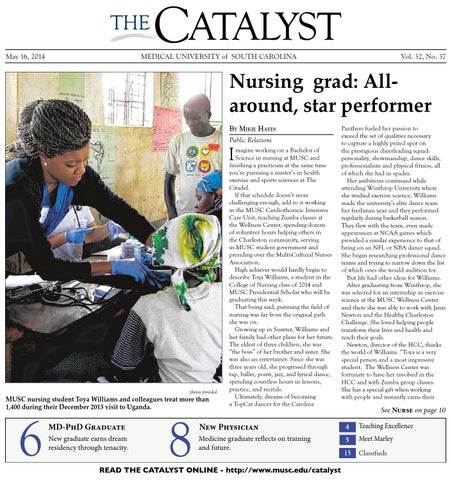
MUSC nursing student Toya Williams and colleagues treat more than 1,400 during their December 2013 visit to Uganda.
6
MD-PhD Graduate New graduate earns dream residency through tenacity.
8
magine working on a Bachelor of Science in nursing at MUSC and finishing a practicum at the same time you’re pursuing a master’s in health exercise and sports sciences at The Citadel. If that schedule doesn’t seem challenging enough, add to it working in the MUSC Cardiothoracic Intensive Care Unit, teaching Zumba classes at the Wellness Center, spending dozens of volunteer hours helping others in the Charleston community, serving in MUSC student government and presiding over the Multi-Cultural Nurses Association. High achiever would hardly begin to describe Toya Williams, a student in the College of Nursing class of 2014 and MUSC Presidential Scholar who will be graduating this week. That being said, pursuing the field of nursing was far from the original path she was on. Growing up in Sumter, Williams and her family had other plans for her future. The eldest of three children, she was “the boss” of her brother and sister. She was also an entertainer. Since she was three years old, she progressed through tap, ballet, point, jazz, and lyrical dance, spending countless hours in lessons, practice, and recitals. Ultimately, dreams of becoming a TopCat dancer for the Carolina
Panthers fueled her passion to exceed the set of qualities necessary to capture a highly prized spot on the prestigious cheerleading squad: personality, showmanship, dance skills, professionalism and physical fitness, all of which she had in spades. Her ambitions continued while attending Winthrop University where she studied exercise science. Williams made the university’s elite dance team her freshman year and they performed regularly during basketball season. They flew with the team, even made appearances at NCAA games which provided a similar experience to that of being on an NFL or NBA dance squad. She began researching professional dance teams and trying to narrow down the list of which ones she would audition for. But life had other ideas for Williams. After graduating from Winthrop, she was selected for an internship in exercise science at the MUSC Wellness Center and there she was able to work with Janis Newton and the Healthy Charleston Challenge. She loved helping people transform their lives and health and reach their goals. Newton, director of the HCC, thinks the world of Williams. “Toya is a very special person and a most impressive student. The Wellness Center was fortunate to have her involved in the HCC and with Zumba group classes. She has a special gift when working with people and instantly earns their
See Nurse on page 10
New Physician
4
Teaching Excellence
Medicine graduate reflects on training and future.
5
Meet Marley
15
Classifieds
READ THE CATALYST ONLINE - http://www.musc.edu/catalyst
2 THE CATALYST,May 16, 2014
DHA graduate recognizes global influences in healthcare IT BY KEVIN WILEY Center for Global Health
C
onventional wisdom holds that once a student graduates, the worst is over. No more long nights studying. No more Socratic or didactic learning. Spending inordinate amounts of time on research papers just for course credit is now a thing of the past. Adrienne Hunter, DHA, the first graduate of the Doctor of Health Administration Information Systems program in the College of Health Professions, continues to take on similar challenges — not for herself, but for those who follow. “For those pursuing goals in the health arena,” Hunter relayed to current and future students, “it is important to realize that Hunter the one team or hospital patient or population you impact ultimately impacts the world.” Recognizing cultural shifts and disruption of industries is a gift only a few possess. These changes upend the norm, leaving in their wake transformational processes, especially in health care where there is a renewed focus on patient empowerment and engagement. Hunter realized early on that a revolution in health care information technology was imminent and
Editorial of fice MUSC Office of Public Relations 135 Cannon Street, Suite 403C, Charleston, SC 29425. 843-792-4107 Fax: 843-792-6723 Interim editor: Cindy Abole catalyst@musc.edu Catalyst staff: Mikie Hayes, hayesmi@musc.edu
photo provided
DHA graduate Dr. Adrienne Hunter, center, visits with a group in Cape Town, South Africa to explore health technology. positioned herself to ride this wave. She completed a Master of Science in informatics at the University of Iowa after completing her undergraduate work in computer science at Spelman College, and has now fulfilled requirements for a DHA with an emphasis in Information Systems. “My interests in the health arena ironically stemmed from the new-age shift in technology use that skyrocketed in the new millennium,” said Hunter. “Upon being welcomed by Y2K, the advancements of software applications and engineering fundamentals for health care become evident.” The ebb and flow of innovation, attributable to people (not companies) who drive the tech market today in health care technology are not just limited to small, singular players and eminent scholars such as Vivek Murthy, The Catalyst is published once a week. Paid adver tisements, which do not represent an endorsement by MUSC or the State of South Carolina, are handled by Island Publications Inc., Moultrie News, 134 Columbus St., Charleston, S.C., 843-849-1778 or 843-958-7490. E-mail: sales@moultrienews.com.
M.D., Todd Park, and now Hunter. Giants like Microsoft and Google have tried their hand at streamlining patient information through use of personal health records but have yet to make a universal impression on the industry. Hunter mentioned that health and health care are, at times, mutually exclusive and that trade associations and the large companies they represent have more emphasis on bottom lines and less on overall patient health. “It wasn’t until I attended the International Health Rights Exchange in Cape Town, South Africa that I truly understood how health and health care are not one in the same,” remarked Hunter. “I researched the social implications impacting women with HIV/AIDS and came back only to want to merge my interests in health and technology, which is why I pursued the field of health informatics.” Hunter has done extensive global health work compared to her many of her contemporaries. While working for the Centers for Disease Control and Prevention, she worked in Port– au–Prince, Haiti where she conducted informatics assessments for disease surveillance and electronic health records customizations. Hunter also assessed informatics capabilities at 14 different burn centers in four cities in India. A prototype for a national burn registry using mobile communications was developed, and data was presented at the prestigious
National Academy of Burns Conference in New Delhi, India. Hunter also has traveled with her husband to volunteer and conduct health care research in Morocco, China, Guatemala, and South Africa. “I have been blessed to have the opportunity to impact the world through my work at the CDC,” Hunter said. Not only has Hunter’s impact been felt abroad, she has been an inspiration for colleagues at MUSC—so much that she was nominated for the MUSC DHA Outstanding Student Award. Hunter modestly considers herself to be “artistic, considerate and fluid,” but her classmates are more forthcoming in their descriptions, even without having met her. Fellow classmate and friend, Courtney Schoessow, recounted a period in her doctoral program where life’s challenges became overwhelming and burdensome. “Just at the point when I thought I couldn’t continue my doctoral studies, I received an email from Adrienne Hunter,” said Schoessow. “Adrienne provided encouragement, support and friendship throughout our program to myself and other students.” Hunter will continue to effect change in global communities, whether she is teaching or developing bioinformatics strategies for large global systems. Her ability to connect with her immediate environment and her passion borne from her work with marginalized populations has made her a recognizable presence at MUSC with classmates and up-andcoming students. “Find your place, your interests, where you can contribute and go towards it full–force, remembering your purpose,” she told them. Although she has spent little time on campus, Hunter’s impact is felt strongly among students and administration. “Working with Dr. Hunter was a real pleasure, in part because we shared a common interest – using technology to effectively deliver vital education that has the potential to improve health,” said Dusti Annan–Coultas, Ed.D., director of educational technology at CHP. “Adrienne has been a thoughtful, conscientious student, dedicated to self– improvement and improving the lives of others. She, and others like her, is the reason it is so meaningful to work in higher education and at MUSC.”
THE CATALYST, May 16, 2014 3
MUSC PRESIDENTS PRESENT AWARD TO FIRST RECIPIENT MUSC’s interim president Dr. Mark Sothmann, left, gathered with president-elect Dr. David Cole, John Chalsty, prominent Charleston philanthropist and first recipient of the Ben Marino Heart Award, and past presidents Drs. Ray Greenberg and James B. Edwards. The inaugural award was presented to Chalsty on April 25 at Middleton Place. Approximately $115,000 was raised at the celebratory luncheon to benefit the Docs Adopt school program. The award was named for Ben Marino who was a dedicated member of the MUSC Heart and Vascular Center Board of Directors until he passed away in 2011. The Docs Adopt program is a public school outreach effort aimed at improving the overall health of children, teachers, administrators, and parents. photo by Anne Thompson, Digital Imaging
4 THE CATALYST, May 16, 2014
MUSC faculty honored for teaching excellence
F
our faculty members will be honored for teaching excellence at MUSC’s annual faculty convocation at the beginning of the 2014-15 academic year, Aug. 19 in the Drug Discovery Building auditorium. The faculty members are: q Kristy L. Brittain, PharmD., assistant professor, S.C. College of Pharmacy, Educator-Lecturer q Brian T. Conner, Ph.D., RN, assistant professor, College of Nursing, Educator-Mentor: ClinicalProfessional q Michelle Woodbury, Ph.D., associate professor, College of Health Professions, Educator-Mentor: Scholarship-Academic q Nicole M. Bohm, Pharm.D., assistant professor, S.C. College of Pharmacy, Developing Teacher
Kristy L. Brittain, PharmD., BCPS, CDE Educator-Lecturer By most student accounts several years ago, the South Carolina College of Pharmacy’s Self Care and Complementary Medicines course was not a highly anticipated stop on the way to graduation. Spread across SCCP’s two main campuses in Columbia and Charleston via video and audio feeds, it was a required course, however, so avoiding it was not an option. In the fall of 2008, Kristy Brittain, a recent arrival to the MUSC campus, joined a number of SCCP faculty members teaching the course. A year later, upon becoming course coordinator, Brittain approached her counterpart at the University of South Carolina to explore a different approach to the course: team-based learning. Today, after much effort, Brittain and her USC colleague, Patti Fabel, PharmD, are reaping the benefits of a course popular with both students and faculty. The transformation has gained national recognition and the pair has made presentations to the American Association of Colleges of Pharmacy and other organizations. This is but one example of her creativity and commitment to pharmacy education and practice. Among her many other awards is the SCCP Clinical Pharmacy and Outcomes Sciences Excellence in Teaching and Innovation Award in 2013. “In the classroom, you can clearly witness her enthusiasm about material and her gratification from teaching,” states MUSC Campus Dean Philip Hall, Pharm.D.
Brittain received her PharmD. from Wilkes University Nesbitt School of Pharmacy & Nursing.
Brian T. Conner, Ph.D.,R.N. Educator-Mentor: Clinical-Professional The clock doesn’t stop when Brian T. Conner, Ph.D., RN, closes his office door on Friday and heads home. In fact, weekends just give him more opportunities to mentor his growing list of students, past and present. As director of undergraduate programs for the College of Nursing, Conner is the primary advisor for the CON’s undergraduate students. However, he also has mentored two Robert Wood Johnson scholars each semester for the past two years, and mentors the college’s Men in Nursing group and the post-baccalaureate nurse residents. He also serves as the Department of Veterans Affairs Nursing Academy college liaison and program coordinator. In addition, he serves as student and faculty mentor for the Doctor of Nursing Practice program. Many DNP students work full-time, leaving weekends as their most opportune time to seek guidance, and Conner accommodates them all. “With the number of students in the classes,” states one former DNP student, “I cannot imagine how Dr. Conner manages to juggle schedules to accommodate each student.” Yet he does, and the mentor-mentee relationship that began in class often continues beyond graduation. “He is an accomplished teacher and mentor that puts the success of his student before his ego” says a former student, “but most important, he helped me grow into the nurse – and person – I wanted to be.” Conner earned his bachelor’s and master’s in nursing from the University of Phoenix and his Ph.D. from MUSC.
Michelle L. Woodbury, Ph.D. Educator-Mentor/Scholalrship Academic “I believe that Ms. Woodbury is one of those rare and truly gifted teachers. She makes learning fun, interesting and most important – real.” The above statement was
contained in a 2001 nominating letter by Becki Trickey, Ph.D., in support of colleague Michelle L. Woodbury, Ph.D., for MUSC’s Developing Teaching of the Year award. Woodbury won the 2001 honor and is this year’s recipient of MUSC’s Educator-Mentor award in the Scholarship-Academic category. What Trickey said in 2001 remains true today. Woodbury is an assistant professor in the Department of Health Sciences and Research with a secondary appointment in the Division of Occupational Therapy. Her educational philosophy, she says, is rooted in her many years of clinical experience, and from that “I desire that my students … gain technical skills, but more importantly come to realize the enormous responsibility and privilege of treating someone’s loved one.” Part of her regimen involves an intensive neurological “boot camp,” where students take their morning classroom lessons and apply them that afternoon working with patients recovering from strokes or spinal cord injuries. Although it is an exhausting exercise, it receives high marks from students. “Dr. Michelle Woodbury is an outstanding teacher who is truly passionate about her subject matter and her students,” states a student in an evaluation typical of the feedback Woodbury receives. She received her bachelor’s from Elizabethtown College, her master’s from Columbia International University and her Ph.D. from the University of Florida.
Nicole M. Bohm, PharmD. Developing Teacher
Nicole M. Bohm, Pharm.D., is listed as a faculty member of the South Carolina College of Pharmacy (SCCP). She will be the first to say, however, that she remains a student while in the company of her patients and those gathered to learn from her. “I urge learners to consider the patients their teachers, as they are for me,” she states in her philosophy of teaching. “I enjoy the humility of teaching. I learn each
See Excellence on page 13
THE CATALYST, May 16, 2014 5
MEET MARLEY
Marley Linder, PharmD. College S.C. College of Pharmacy, Class of 2014 How you are changing what’s possible at MUSC By sharing a smile with all whom I see and meet on campus and taking a few extra minutes to get to know my patients and their families Pets and their names Walker, my four-year old beagle Best thing about living in Charleston Seeing the sunrise over Charleston harbor illiuminating the steeples of the Holy City Greatest moment in your life Finding out I had matched to Vanderbilt University (residency) while sitting in a hammock on the Nile river. Advice for incoming students It’s all about your attitude. Learning and training at MUSC is a unique and rewarding experience. Take advantage of as many of them and organizations as possible. Favorite quote “Wherever you are, be.”
6 THE CATALYST,May 16, 2014
Tenacity pays off for physician-scientist grad
BY CINDY ABOLE Public Relations
F
or new graduate Sahar A. Saddoughi, M.D., Ph.D., defining the success of a physician-scientist is not simply measured by a long education. More, it’s the sacrifices during medical training, pressure to perform well in the lab, striking a balance between clinical and research and managing personal and family challenges. Today, she and her six co-graduates of MUSC’s Medical Scientist in Training Program are reaping the rewards of having spent more than eight years and countless hours in the lab while undergoing medical training. For Saddoughi, it’s about the journey and not the destination. At MUSC, she’s achieved her goal through good training and mentoring. Saddoughi fits the mold of an accomplished MSTP student -hardworking, tenacious, dedicated, and talented in the lab possessing impeccable technical expertise. From her earliest memory, Saddoughi always wanted to be a doctor. As a child living in Australia, she remembers her patient experiences in the hospital were always positive. Yet her early years were ever changing. Her father, Seyed, an aeronautical engineer of Iranian descent, moved the family around the globe. Her ChineseAmerican mother, Elizabeth, worked as a hair dresser and helped raise her and younger brother, Reza. By the time Saddoughi graduated from high school in Clifton Park, NY, she had attended schools in Australia, the United States and Canada, all within four years. She attended Barnard College of Columbia University in New York and studied chemistry. She worked hard and completed her senior honors thesis in organic chemistry. By the time she graduated in 2003, she had published three scientific research papers – a rare feat for an undergraduate student. That achievement got the attention of several MD-PhD programs. She applied to programs in New York and South Carolina. “I wanted to leave New York and experience something different. I had high regard for MUSC’s MSTP
MSTP student Dr. Sahar A. Saddoughi began her studies at MUSC in 2006 and is graduating with honors from the College of Graduate Studies. On July 1, she will start her cardiothoracic surgery residency at Mayo Clinic. program due to its good reputation and National Institutes of Health-funded support. I wanted that,” she said. Nationally, some MSTP programs receive support from the NIH through grant funding. The program has been evaluated comprehensively on the quality of their training through a series of four grant applications to the NIH. Of the country’s MD-PhD programs, only 43 MSTP programs are funded. Saddoughi smiles when she thinks of the culture shock she experienced during her first visit to Charleston. Program director Perry V. Halushka, M.D., Ph.D., Distinguished University Professor and MSTP director, said to her, “You have a little bit of New York in you,”, referring to Saddoughi’s upfront, get-things-done attitude. “Don’t lose that and you’ll do very well in this program.” Saddoughi found this to be true. “I’ve been fortunate to have come across many opportunities during my time here at MUSC. I knew Dr. Halushka would be an amazing mentor and he was not going to let his students fail.” A big achievement for Saddoughi was being awarded an F30 Ruth L. Kirschstein National Research Service
Photos provided
Dr. Sahar Saddoughi and fiance, George Moultrie, join her parents, Dr. Seyed and Elizabeth Saddoughi in Arizona last October as she attended the Southern Thoracic Surgical Association meeting. Saddoughi was awarded the James W. Brooks Medical Student Scholarship. Award for Individual Predoctoral MD-PhD fellows from the NIH. The monetary award funded Saddoughi through her graduate years and part of medical school. MUSC’s MSTP program is ranked third highest nationally for its students ability to achieve F30 grant funding, a credit to Halushka’s work building a high caliber program. The F30 is considered a potential stepping stone to the NIH’s RO1 Research Project Grant. For her research component, Saddoughi worked in the lab of Besim Ogretman, Ph.D., professor and eminent scholar in the Department of Biochemistry and Molecular Biology. In Ogretman’s lab, she expanded her interests in lung cancer research looking at novel protein interactions and drug targets. She specifically studied ceremide, a sphingolipid that causes cells to die. Her research tests the use of ceremidetype drugs and their effects in lung cancer cells. In terms of her medical training, Saddoughi envisioned herself as a cardiothoracic surgeon. While in high school, she was fortunate to have shadowed a CT surgeon and reacted
with excitement seeing a human heart beating. That experience made a strong impression on her. It was this image that she carried with her to MUSC. “Throughout my life, I’ve always been attracted to things that are challenging and difficult, things such as chemistry, research, an MD-PhD program, CT surgery. All of these are challenging goals. Choosing the difficult is exciting to me,” she said. Her approach to the challenging and difficult coincides with how she would address a science question. “It’s great when things work because you’re driven to keep on going through persistence. But what happens when things don’t work? There will always be challenges. One has to keep driving one’s self forward to keep going,” Saddoughi said. Upon arriving at MUSC, she consulted with CT surgeons John S. Ikonomidis, M.D., Ph.D.; Chad Denlinger, M.D.; Fred Crawford, M.D.; and the late Carolyn Reed, M.D., all considered first-class surgeons in their field and all made a positive impression on her.
See Tenacity on page 10
THE CATALYST, May 16, 2014 7
Distinguished graduates share career-defining experiences BY CINDY ABOLE Public Relations
F
or the College of Graduate Studies, three was a charm when it came to selecting its top, most distinguished graduates. Three graduates: Anna-Maria De Costa, M.D., Ph.D., and Daniel Grass, M.D., Ph.D. and Jacob Beckley, Ph.D., were named the recipients of the College of Graduate Studies Distinguished Graduate of the Year Award. The awards were presented May 15 at the college’s hooding ceremony at St. Luke’s Chapel. Perry V. Halushka, M.D., Ph.D., Distinguished University Professor and director of the Medical Scientist Training Program, praised these students for their achievements and successes with the program. “All three are truly outstanding students and individuals for their contributions and dedication to their medical and research careers. They’re great role models and I look forward to following their careers as they enhance biomedical research and medicine through discoveries,” said Halushka. The co-recipients of this award shared common themes as it related to their attraction to continuing their studies at MUSC. For dual-degree graduates De Costa and Grass, both were attracted to the cohesiveness of the program and flexible schedule during their training to become physician-scientists. In addition, Grass liked the ability to conduct translational research and the campus’ collaborative atmosphere which provided a variety of rich opportunities. Likewise, Beckley chose to pursue his interest in drug abuse and addiction research and knew that MUSC’s Department of Psychiatry and Behavioral Health offers one of the country’s premier drug and alcohol basic science research programs.
LOWCOUNTRY NATIVE ACHIEVES SUCCESS
De Costa grew up in North Charleston and is a 2006 graduate of Wofford College. She started that same year in the MSTP. She became interested in conducting immunotherapy of head and neck cancer research after meeting with M. Rita Young, Ph.D., professor of Otolaryngology Head and Neck Surgery and associate chief of staff for research and development at the Ralph H. Johnson VA Medical Center. “Without the guidance of my mentor, Dr. Rita Young, I would not have gained all that I have out of the past eight years. She has given me the right amount of freedom to learn self-sufficiency and the right amount of direction to be focused and actually get to where I am and graduating. She is fantastic and I am indebted to her,” said De Costa. De Costa’s research looked at the process of cancer immune-editing and how the alterations in local and systemic immune responses during development of oral squamous cell carcinoma. Her dissertation work also involved the development of a vaccine used in the
Photos provided
MSTP students Drs. Anna-Maria De Costa and Daniel Grass are two of the three recipients of the College of Graduate Studies’ Distinguished Graduate of the Year Award. Not pictured is Dr. Jacob Beckley, a Ph.D. graduate of the college.
premalignant stage in the development of oral cancer. According to De Costa’s mentor, there are two components that should come from the Ph.D. experience. First, the student must gain expertise in a scientific field, master methods to conduct studies in that field and begin scientific writing to include grants and manuscripts. Second, a student must gain an understanding of the philosophy of research which includes the ability to identify what questions research has not yet answered as well as how to ask a scientific question in a way that it can be scientifically answered. Young said. “It’s important to let a student pursue their own ideas and learn from their mistakes (while still being able to pull the student back if they stray too deeply into trouble). It’s also important that they relish in their successes that they have discovered on their own.” Young said of her work with De Costa But finishing the eight-year, MD-PhD program did not come without surprises and typical life events. At the time of De Costa’s research dissertation defense on May 2, 2012, she was eight months pregnant and on bed rest. She successfully completed her defense and gave birth to son, Benjamin, a month later on June 8. As she returned to her medical training and studies, she quickly got first-hand experience managing the challenges associated with balancing work-life and personal life as she worked hard to parent her son during two years of clinical rotations. “It was incredibly challenging, but I had received wonderful support from program staff, fellow students and others. The experience helped me learn to multi-
task and manage my time like never before,” De Costa said. Her mentor shared invaluable advice. Young told her to make the best of the time that she has with her family and with work rather than constantly struggling to catch up. “Don’t waste precious time,” Young advised. Following graduation, she and her husband, Brian, and Benjamin will have precious time to themselves until she starts her yearlong surgery internship at MUSC, followed by a four-year radiation oncology residency at the University of Wisconsin in Madison. For De Costa, the community of support she received at MUSC throughout her time spent completing the program were invaluable to her success. “Without these people I would not have been able to be a good mother and a good student at the same time. I think it’s very important to surround yourself with people who will be the catalyst for growth and achievement in your life, and it’s important to be that person for others as well. I’m certainly grateful that I found people like that here at MUSC,” De Costa said. DEDICATED PHYSICIAN-SCIENTIST HAS BRIGHT CAREER As a biochemistry major at Charleston Southern University, Daniel Grass knew he wanted to be a physician-scientist and he knew MUSC’s program would provide him with the best opportunity to reach his goal. Grass worked during the first two years of medical school in the lab of Bryan P. Toole, Ph.D., professor in the Department of Regenerative Medicine and Cell Biology, before transitioning into the MD/PhD program. At that time his mentor saw in Grass an innate eagerness to learn combined with a cooperative nature and strong work ethic. He credits his graduate school training with preparing him to handle the hurdles he will face while providing patient care or conducting research in a lab. “My mentor, Dr. Bryan Toole, made a great investment in me with his time and support, while also teaching me how to navigate the harsh waters of basic science research. I hope to emulate the leadership and scientific prowess I have witnessed in him as I continue my future endeavors.” Working with Toole and his team, Grass’ research focused on how breast cancer cells spread or metastasize to other areas in the body. He discovered how a protein called ‘emmprin’ and a sugar called ‘hyaluronan’ influence breast cancer cells to form tentacles, which allow cancer cells to metastasize. His research has identified novel targets, which can lead to new therapeutic options for patients diagnosed with breast and other cancers. “Dan understood that successful translational medicine requires solid basic science knowledge. Patient
See Graduates on page 14
8 THE CATALYST, May 16, 2014
Medical student reflects on degree, subject of loss BY CHELSEY BALDWIN, M.D. College of Medicine
T
his week, I graduate from the Medical University of South Carolina. Our mentoring physicians reminded us in the last weeks of the year, “They are going to call you doctor.” We nod, understanding the weight of the responsibilities that now fall upon our shoulders. The same mantra is pounded into our heads as we practice running codes. “Should I assess the rhythm now or wait until the end of compressions?” I ask my preceptor. The answer? “You’re the doctor, you decide.” As the end of any important experience, I’ve been told it is wise to reflect upon it to understand the impact and contemplate changes for the future. Such a process inevitably makes us better people rather than being leaves simply blowing in the wind on to the next event without appreciation of the last. However, I have always found the more extensive the time and the more diverse the associated feelings, the more difficult this task becomes. The reflection of my time over the past four years in medical school reveals this to be a daunting task. Yet I am all the more motivated to do so, for the experiences have been profound and without a doubt, life altering. About two months prior to graduation, I reported to the first floor of the basic science building to have my photograph taken for our class composite. When I arrived, the photographer reminded me that it seemed “like only yesterday” that I had been in the very same office several weeks prior to starting my first year to have a picture taken for The Catalyst, MUSC’s campus newspaper. I agreed. Yes, in some respects, time has flown. As I recall those first weeks, I remember vividly the nervousness and anticipation of meeting my classmates and the uncertainty of how I would perform academically. Those feelings I eagerly put behind me as my confidence grew. Yet, once more, I have begun the cycle of uncertainty as I approach my first days as an intern. Thankfully, however, I feel confident that I’ll once again come full circle and will leave
UVA a competent physician. Ironically, I am nervous to be out on my own, a feeling shared by many of my classmates. Our fear is rooted in the desire to avoid wrongdoing to our patients and for that reason, I will own the fear. The basic science years, both year one and two, deserved a graduation of their own. It was an incredibly challenging time. I loathed our confinement to desks and lamps and angrily grumbled about the gloves I had to wear inside the library during the winter months as I plundered through mountains of lecture notes. Those were the days, however, when I made the most valued of friends. I depended on their interjections of anecdotes and creative complaints to break up the impending sense of doom as we fought to not fall behind in the face of an approaching exam. While we worked ourselves to the bone during test weeks, forgetting showers and the appropriateness of non-stretch pants, we came to the epic rally of exam week that led unfailingly to the post-test celebratory parties. While some lived for the weekend, we did so for the “golden weekends” that followed exams. To this day, I retell with great enthusiasm the stories of the debacles surrounding the release of nearly 200, 20-some-year-olds who were finally liberated from the confines of their books for a weekend of freedom and indulgence. The clinical years were filled with mixed emotions. Applying what I had learned in the first two years of instruction to the clinical setting came with such a greater level of satisfaction. After all, that was why I applied to medical school: I loved, and continue to love, patient interaction and the challenge of diagnosis and treatment. An experience that I am often questioned about with regard to my clinical years, is the experience of patient death and what effect it has had on me. I must admit it has been an evolving theme of my career and my life, and I still struggle to fully understand it myself, let alone explain it to others. I had the unfortunate experience of losing my sister, Lauren Baccari, during my third year of medical school. Devastation is the only word I can use
photo by Sarah Pack, Public Relations
Chelsey Baldwin takes a moment before graduation for a photo in front of a Magnolia tree planted in memory of her sister, Lauren Baccari, a former MUSC medical student. were unique to my own journey, and I hold that in my repertoire of skills. While I have become hungry for my diploma and feel deserving of the title I worked so hard to earn, there is the fear of shedding the stage of innocence that is afforded a medical student. For so long I have stood by and analyzed the successes and faults of my senior colleagues and now must prepare myself for withstanding the same criticisms. In terms of my own reflection on medical school, I am always amazed at how the words of Charles Dickens describe my experience better than I can: “It was the best of times, it was the worst Chelsey Baldwin and her sister of times, it was the age of wisdom, it was Lauren Baccari celebrate a special the age of foolishness, it was the epoch of moment. belief, it was the epoch of incredulity, it was the season of Light, it was the season to describe my plight at that time. The of Darkness, it was the spring of hope, it unforeseen nature of her death a mere was the winter of despair…” few months before her own graduation from medical school made it nearly Editor’s Note: Inside Track is a impossible for me to find solace. periodic column by MUSC faculty and Consequently, as a clinician who must staff featured on the MUSC News Center. help families deal with pain and loss, I See the full package at www.musc.edu/pr/ use my own experience and turn to the newscenter/2014/Baldwin.html. words and actions I took comfort in that
THE CATALYST, May 16, 2014 9
CHP’s Haley Henderson welcomes new challenges
BY MIKIE HAYES Public Relations
W
hile her playmates longed to be princesses, superheroes and astronauts when they grew up, Haley Henderson had much more pragmatic aspirations. She always knew she wanted to do something important in the health care field: something that would help children. Perhaps a pediatrician, she thought. But after all those years envisioning herself in a white lab coat treating strep throat and chicken pox, she recognized a small glitch in the plan while studying premed courses at Wofford College in Spartanburg. “As far back as I can remember, I dreamed of being a pediatrician,” she said. “My dad is an optometrist and I spent a lot of time at his office so I felt comfortable in health care. I have always had a passion for helping others, especially children. But in college, I found myself really enjoying the business classes, much more than the sciences. Before I knew it, I was an accounting major minoring in economics.” With a mind built for numbers and a heart built for helping children, Henderson applied to the MUSC College of Health Professions to pursue a master’s in health administration, a decision that would eventually meet all her career aspirations. The vice president of her class, Henderson graduates with her MHA from a program that was designed to develop the health care leaders of tomorrow. According to those with whom she worked at the college, she is well on her way to fulfilling that description. During her two years at the college, she held a workstudy position in the dean’s office and closely interacted with the dean and others who came to know her as an outstanding student academically and professionally. Henderson is described as hardworking, dedicated and inquisitive, eager to learn and willing to take advantage of every opportunity that is presented to her. Her reputation as a self-starter with impeccable followthrough earned her an internship at the Children’s Hospital and subsequently, a residency position with MUSC’s chief strategic officer, Mark Lyles, M.D. She has many fans in the College of Health Professions, none more so than Karen Wager, DBA, a professor in the Department of Healthcare Leadership and Management and associate dean for student affairs. “I think the world of Haley Henderson. She has so many strengths and abilities, but I think what I value and appreciate most in her is her extraordinary work ethic, her sense of service, care and compassion for others. No task is ever too big or too small for Haley. She exemplifies all of the qualities of a servant leader, and I have no doubt that she’ll go on to do great things to improve the lives of others,” said Wager. This year, Henderson was inducted into the MUSC Student Leadership Society, a reward for the tremendous character she has shown and her exemplary
photo provided
College of Health Professions graduate Haley Henderson with Dr. Mark Sothmann.
service and commitment to the university. She is also extremely proud of having been selected as an MUSC Presidential Scholar. Every year, the highly competitive, year-long interprofessional program selects representatives from the six colleges and encourages collaboration on a project that benefits the community in a significant way. Henderson’s group designed a community resource guide: binders filled with information related to services such as transportation, financial, legal, housing, health care, medications, all of which were either free or at a much discounted rate. The group delivered the guides to eight clinics throughout the Lowcountry and they were well received by patients and staff alike. In addition to attending graduate school, performing leadership activities and working part-time, Henderson was extremely active in community service and volunteer efforts. Some of Henderson’s most cherished community service work included her involvement in the Junior Doctors of Health program where she volunteered at Meeting Street Academy, teaching second graders about personal health and good eating habits. By the same token, she will always remember the career fair she and the Presidential Scholars hosted at the Carolina Youth Development Center, especially the kids. Representing her college, Henderson explained to them that there are many important career paths in health care in addition to nursing and medicine. She described the types of things physical and occupational therapists; certified nurse anesthetists, cardiovascular perfusionists, physican assistants, and health administrators do day-to-day in their jobs. The Center provides shelter, safety and support services for abused, neglected and at-risk children, and Henderson feels they made a very big impact on the children that day giving
them hope that they could achieve their dreams. She even made time to take on a challenging 18-month internship serving as the administrative intern at MUSC Children’s Hospital from January 2013 through May 2014. This opportunity enabled her to become involved in a number of projects throughout the hospital. One successful project was working alongside developers to create the “For the Record,” Kohl’s Cares iPhone application. As an intern under Meredith Strehle’s leadership, Henderson created the app to help parents in the Charleston community better manage their children’s allergies, changes in measurements, insurance information, developmental milestones, and immunization records: information that can be managed in one convenient spot. Henderson worked around the clock to get the word out to parents in the community about the app, and Strehle is proud of Henderson for managing such a cumbersome project. "For the past 18 months, Haley worked with me as an intern. During that time, she managed a large, multifaceted project. Her attention to detail and followthrough were remarkable. She was able to collaborate with numerous departments and bring to fruition an innovative app that the community has embraced. It was my pleasure to mentor such a determined and dependable student. Haley has natural born leadership skills and I have every confidence she will enjoy a successful career in health administration.” On June 30, she begins a high-status residency with Lyles who will serve as her preceptor. The residency is self-directed and they are contemplating large-scale projects for the university that will utilize her talents while strengthening areas where she can gain valuable experience. Through this experience, Lyles will help Henderson determine which area of the hospital best suits her talents. Ultimately, she would like to stay at MUSC, preferably in the Children’s Hospital. “In Spartanburg, MUSC is the big name in medicine in the state and it has the reputation for being the best place to learn and receive health care. It has always been my dream to work here.” Balance is important to her and she infuses her overburdened schedule with more activities. Not one to be idle or cooped up, she enjoys going out with friends, working out, shopping, reading on the beach, and perhaps most important, spending time with her Bible study group. “I have a great relationship with my parents and my family and a wonderful relationship with the Lord. Along with the support of my family, He got me through some of the challenging times.” Henderson looks at graduation and her new residency program with excitement. “I like being challenged. I love being busy and on the go. I welcome this next chapter in my life, especially since I will be working with all the great people at MUSC.”
10 THE CATALYST, May 16, 2014
NURSE
Continued from Page One
trust, respect, and admiration. She will be missed by so many at MUSC – both professionally and personally. What an inspiration she is and Duke will be one lucky hospital when Toya starts her RN career in July.” After her internship, she decided to stay at MUSC and later applied for a position as a patient care technician on the CTICU. Although the work was entirely different from what she was accustomed to doing, it suited her thirst for knowledge and love of people. Noticing her proclivity for delivering compassionate and appropriate care to patients, people told her she should consider becoming a nurse. At first she didn’t see it, but eventually she came around to the idea. “People would tell me, ‘I think you would make a good nurse,’ and after a while, I thought to myself, wait a minute, I like what these nurses do. I like how they relate to patients, how they interact with each other, the autonomy they have in their environment, and the impact they make every day. I realized nurses are vital to the process,” Williams said. One day while at work, she received an email informing her she had been selected as a Robert Wood Johnson New Careers in Nursing Scholar. The scholarship would pay for her entire semester of school. That was just the sign she needed. Her direct superior, Vance Donahoo, RN, MBA, manager of the CTICU and CICU, agrees that nursing is the right field for her. “Toya is a very dedicated person. She is dedicated to nursing and to completing her goals,” he said. Williams loves the clinical area she’s in and plans to continue her work in that area. In March, she accepted a position in the new graduate nurse residency program in Duke Cardiothoracic Surgical ICU that will begin
TENACITY
after graduation. Once she has completed the residency program, she will have a permanent position there. “I love this area. I love how fast-paced CT is and how much critical thinking it takes. I love how quickly the patient can have a significant turnaround.” At the College of Nursing, Williams has earned a reputation as willing and dependable. Ida Spruill, Ph.D., RN, associate professor at the College of Nursing, has a great appreciation for her work ethic and attitude. “Toya has so much energy. She’s engaging, open and personable,” she said. “You will never hear her complain; she just makes time and gets things done. She’s one of those very few people who when I pick up the phone and ask for something, her answer is always, ‘How soon do you need it?’” Williams represents the College of Nursing in the MUSC student government, and she sits on the service committee that manages MUSC’s student volunteer outreach throughout the community. Some of her favorite projects have included Relay for Life, the Cooper River Bridge Run, and the Delma M. Woods and Aleta McLeod-Bryant Annual Health and Wellness Fair where the College of Nursing provided health care to underserved people. She is extremely proud to have been selected as an MUSC Presidential Scholar. The scholars are divided into groups and each develops and implements a community service project. Her group created a community resource guide for the patients and community at large. It was a valuable learning experience for her. “We learned that what the academic community thinks the community needs and what the community itself actually needs are really two incredibly different things. You have to listen to the true needs of a community,” she said.
She was also was inducted into the MUSC Student Leadership Society this year. Students selected made notable contributions to the university through their character, service, commitment and actions. She is also involved in an interprofessional group at MUSC called SM3: Student Mentors for Minorities in Medicine. She enjoys mentoring high school students who are interested in her area of health care. In December, Williams and four classmates went to Uganda on a medical mission trip for 10 days. She was the triage team leader and “loved it” “I am ready to go back,” she said. “I only wish I could have stayed longer.” Where does a student find the resolve to give so much of herself? Williams credits her family and God. “My family is awesome. I’ve had their support 110 percent of the time. I can’t put into words how supportive they’ve been … encouraging me, telling me that I can do it, to keep going, to take things day by day. They remind me that there’s someone higher than myself that will get me through this. That’s God. “Plus,” she adds, “My chocolate toy poodle, Nala, helps keep me sane as well as very busy.” Williams knows she is a different person today than she was when she started. “I’m this close to being a nurse and I never realized how capable I was. I think I really downplayed my abilities and truly didn’t think I had what it took to do it all and to be president of an organization like MCNA. I admire my College of Nursing advisers who forced me to look at myself, to see leadership qualities I never saw before. They planted a seed.” Tiffany Williams, DNP, an instructor in the College of Nursing spoke of Toya with warmth and regard. “Toya is an amazing student, now RN. She makes me proud that she’s joined the profession of nursing. I would be honored to have her care for me or anyone in my family.”
Continued from Page Six
Saddoughi, however, had a special connection to Reed. They first met in 2006 when she asked Reed what she needed to do to become a CT surgeon like her. That’s when the mentor embraced the student. “Carolyn Reed was a huge role model for me. Like others, I was devastated when she died [Nov. 16, 2012]. I want to have the type of medical career similar to hers,” Saddoughi said. Ikonomidis, chief of the Division of Cardiothoracic Surgery, was especially impressed upon meeting his mentee. “Sahar is very bright and has tremendous drive. She seemed to naturally understand the CT surgical specialty well. She also possesses above-average technical skills. She’s a highly accomplished and talented individual who thus far has navigated her career exceptionally well. I anticipate that she will maintain a steep upward trajectory on her way to becom-
“Caroline Reed was a huge role model for Sahar Saddoughi, M.D., PhD. ing an important contributor to the field of academic cardiothoracic surgery,” he said. Saddoughi is excited to see the field of CT surgery evolving through the use of minimally invasive techniques and new technology. “Any field that’s always evolving is challenging. It’s exciting. I find I have to be on top of my approach and thoughts. There’s always a focus on improving care for patients,” she said. When it came to selecting her residency, Saddoughi interviewed at 11 highly-
competitive CT programs that only offered one or two slots per year. During her senior year in medical school, she completed a six-week rotation in CT surgery at the Mayo Clinic in Rochester, Minn. She was searching for a program that fulfilled her needs in research, CT surgery and patient care. After spending her time at Mayo, she felt comfortable that it was the best fit for her overall. Mayo’s CT residency is an integrated program that supports residents to become certified in both general surgery and CT surgery. Additionally, the program will allow Saddoughi to take a year off to spend more concentrated time on her research, which is something that she wanted. On March 21, during the College of Medicine’s Match day event, she got her wish. Surrounded by her parents,
brother and fiancée, George Moultrie, Saddoughi relished the moment when she opened her envelope to reveal her match result. “I was a nervous wreck,” she said. Everything I’d worked for had culminated in that moment and I was torn with emotion. Overall it was a great day.” Saddoughi’s grateful to the cadre of medical, research and clinical faculty who have contributed to her learning and experiences. She is especially thankful to Deborah Hazen-Martin, Ph.D., associate dean for curriculum in the basic sciences, Department of Pathology and Laboratory Medicine, who has served as a valued mentor throughout her MUSC journey and hooded Saddoughi in the May 15 College of Medicine ceremony. She’s focused on her move to Minnesota to start her residency on July 1.
THE CATALYST, May 16, 2014 11
12 THE CATALYST, May 16, 2014
Dental graduate’s ‘sweet tooth’ forges relationships BY AIMEE MURRAY
Public Relations International champion for dental health, devoted wife, dedicated student, mom to be and now a graduate of the College of Dental Medicine, Elizabeth Smith, DMD, has worked tirelessly during the last several years to achieve her goal of becoming a dentist. Originally from Seattle, Wash., Smith, the youngest of five children, started working in her father’s dental office when she was 12 years old. Though she was limited to cleaning the office on weekends her duties soon expanded to include sterilizing instruments and scheduling appointments. Eventually Smith became a dental assistant and began helping with procedures. Pursuing her interest in dentistry while studying biology at the University of Washington, Smith was a volunteer dental assistant in 2006 and 2007 with International Smile Power, a non-profit organization that fosters partnerships around the world to improve and sustain dental health. During her time volunteering in Jamaica, Uganda and Kenya, Smith met countless adults and children who changed her outlook on life and dentistry. “In Uganda I met a young girl who, by her appearance, we could tell she was in severe pain. We found three of her permanent teeth to be so ridden with decay that they needed to be extracted and it seemed the bacteria had already spread as she had a high fever and swollen tonsils. Even though she’d never seen a dentist before, she was brave enough to trust us to care for her. Treating her increased my commitment to go to dental school so I could someday
photo provided
Seattle native Dr. Elizabeth Smith unwinds from her busy schedule with outdoor activities.
help more children like her,” Smith said. After graduating in 2008, Smith explored other career interests including meteorology, teaching and ultrasound technology before deciding to become a dentist like her father and one of her older sisters. “I spent time observing at Evergreen Health in Washington in the ultrasound unit. While observing, I found that most patients they provided care for were people they’d most likely see only once. I realized that in dentistry we get to see our patients regularly, which gives us a chance to build relationships with them,” Smith said. Smith applied for admission and was accepted to MUSC’s College of Dental Medicine in 2010. Because Smith’s husband Mike works for Boeing, she thought they might be able to move to Charleston together. The couple soon found that a move would be detrimental to Mike’s career and though her dreams
of becoming a dentist were coming to fruition, Smith and her husband faced the fact that she would be going to Charleston alone. Smith set out on her new journey without Mike but with his devout support and constant encouragement. While contemplating the prudence of her move, Smith said it was extremely difficult being away from her husband, family and friends. Despite the distance, the couple, now married for seven years, made it work but look forward to not having to make the 2,500 mile trips come May 16. Smith said getting to know some of the other students in the program helped while she was so far away from her husband, family and friends. “A group of friends in my class and I try to get together pretty often for craft nights. We’ve painted, made soap and even melted crayons on canvas together. I also love to bake and I’m glad my class has been willing to help me consume all the cookies, cupcakes and cake pops I’ve made during the last four years,” Smith said.
Tiffany Lovelace, a fellow classmate, described her in glowing terms. “Elizabeth is the most kind, selfless person you will ever meet. She’s the type of person who will be at your door with homemade soup when you’re sick and stay up with you until dawn helping you study for an exam she’s already going to ace. She’s always just a phone call away.” Like many of their classmates who appreciated Smith’s baking skills, Lovelace said she’s enjoyed cake pops that look like bunnies for Easter, bloodshot eyeballs at Halloween and reindeer with pretzel antlers in December. While describing the sweet treats Smith made for the class, Lovelace said, “I’ve had tooth and toothbrush-shaped cookies during test weeks and cakes that would put Carlos the Cake Boss out of business.” Lovelace also told the story of how she once baked a cake for everyone in the clinic and how her classmates thought Smith made it so they all thanked her instead of Lovelace. “She’s definitely a dentist who satisfies your sweet tooth,” Lovelace said.
THE CATALYST, May 16, 2014 13
Pharmacy graduate leaves legacy of leadership BY JENNY SCARNECCHIA S.C. College of Pharmacy
A
cademia was in his blood. His parents, armed with multiple advanced degrees, were both working full-time in higher education. When he had successfully obtained two degrees, The Citadel came calling, offering him a full-time faculty position. A clear path lay before him, one that would allow him to trace his parents’ footsteps into academia, and with any luck achieve, as they had, a long and renowned career from the lectern. It was then that Saswat “Swat” Kabisatpathy, decided to become a pharmacist. Kabisatpathy, who graduates from the South Carolina College of Pharmacy May 16 with the Class of 2014 looks back on that decision as a major turning point in his life. “My parents have always steered me in the direction of health sciences because of all the career opportunities the field presents as well as the opportunities to give back to the community,” he said. “They view their academic careers as an opportunity to shape the lives of students and I feel the same about pharmacy, as it relates to patients.” With a BS and M.S. in Chemistry from the University of South Carolina, Kabisatpathy had several years of education behind him. But it was his background in chemistry that piqued his interest in pharmacy and after being accepted to the SCCP’s MUSC campus, the decision to pursue that path was easy for him. Kabisatpathy hit the ground running on August 23, 2010 when he began a four-year pursuit of his Doctorate of Pharmacy degree. He was voted class president within the first month of school and has remained in this role throughall four years of the program. His community service involvement began early and continued throughout the program. His most memorable events include volunteering with the Annual MUSC Sugar-Free Fall Festival, MLK Bridges to Health Fair, and donating nearly 2,000 pounds of canned food to the Low Country Food Bank on behalf of the college’s Kappa Psi chapter, the oldest and largest professional pharmacy fraternity in the world.
EXCELLENCE
Continued from Page Four
nomination materials, she makes quite an impression on residents and other members of her medical team. “Her excitement and passion in serving her patients, as evidenced by the many opportunities she took to engage and educate them while on rounds, was memorable,” says one former resident. Another adds, “It was easy to see how well-respected
Saswat Kabisatpathy, who graduates from SCCP May 16, looks back on that decision as a major turning point in his life. During his third year of the program, he served as the president of the campus’ ‘Iota’ Kappa Psi Chapter and is currently serving as the vice satrap (vice president) for the Southeast Province. He was selected as a 2012-13 MUSC Presidential Scholar, a prestigious honor by the University that promotes campuswide interprofessional initiatives and explores complex social, political and human issues of broad interest to health care professionals. The interprofessional focus of MUSC is one of the many factors that drew Kabisatpathy to the campus. “We were delighted to land Swat as a student and he has excelled in the program - not just academically, but professionally as well,” said Philip Hall, PharmD, MUSC Campus dean. Perhaps Kabisatpathy’s greatest accomplishment while attending the SCCP was serving on the Executive Committee as the national Speaker of the House for Phi Lambda Sigma, a prestigious pharmacy leadership society that is nearly a half-century old and was founded to promote the development of she was by her physician and nursing colleagues.” Ever the student, however, she often seeks evaluations of her classroom techniques and sits in on lectures by her colleagues. “I hope that I can be the student I expect my learners to be,” she adds, “and promote a passion for lifelong learning.” Bohm earned her undergraduate and doctoral degrees from the University of Florida.
leadership qualities in pharmacy students. “This was a major highlight of my time here at the SCCP and knowing that I will soon turn the reigns over to a fellow SCCP student makes me even more proud.” At the American Pharmacists Association annual meeting earlier this year, Krutika Medawala was elected to this same role. She is a member of SCCP’s USC Class of 2015. While Kabisatpathy’s road to his third degree is coming to an end, he hasn’t ruled out pursing a fourth, or a residency. He plans to follow in his parents’ footsteps eventually, as he has a strong desire to merge his pharmacy career with that of one in academia. Throughout all the opportunities Kabisatpathy has pursued, his parents have always supported his choices and provided this simple piece of advice: “Whatever you do, do it well.” Kabisatpathy has surpassed expectations. After graduation, he will begin his pharmacy career with Walmart Pharmacy in North Augusta and he is looking forward to his opportunity to give back as a health care professional. He and his wife, Heather Laughridge,M.D., Class of 2011, plan to stay in South Carolina and hope to eventually return to the city where he grew to be the well-rounded leader – and pharmacist – that he has become.
14 THE CATALYST, May 16, 2014
GRADUATES
Continued from Page Seven
care also requires focused, knowledgeable analyses and Dan learned to be good at that, which will strongly benefit his clinical skills,” said Toole. Toole predicts that his mentee will have a strong future in medicine and he looks forward to following his developing career. “Dan is my last graduate student and I am very proud that he has made such strong accomplishments and developed into a mature investigator with a bright career and life ahead of him.” Reflecting back, the 31-year old could not be happier with his experience and training at MUSC. “I am moving forward with confidence to treat patients compassionately and effectively while also being able to approach research questions intelligently,” Grass said. Following graduation, Grass will start an internship in internal medicine at Greenville Hospital System and then head to Tampa, FL with his wife, Kate, to
neurotransmissions in regions of the brain that are involved in the development of addiction pathology. Beckley also collaborated with COLORADO NATIVE DRAWN TO other MUSC RESEARCH neuroscience Beckley, a native of Boulder, research faculty Colorado, came to MUSC with an and postdocs, extended background in behavioral providing him neuroscience, but felt he was lacking numerous the necessary foundation in the basic sciences, especially molecular biology and opportunities to learn how to biochemistry. The College of Graduate conduct effective Studies first year curriculum provided and novel him with a strong foundation in the research using biomedical sciences. cutting-edge Beckley worked with mentor John Beckley Woodward, Ph.D., a professor with joint techniques. Beckley appointments in the Department of completed his degree requirements in Neurosciences and the Department of June 2013 and was granted his doctorate Psychiatry and Behavioral Science. degree in August. In his research, Beckley focused Beckley currently works as a post on toluene, a volatile solvent found doc in the lab of Dorit Ron, Ph.D. in in products such as spray paint and the Department of Neurology at the glue, that when voluntarily inhaled University of California–San Francisco. for intoxication purposes, alters finish a four-year residency in Radiation Oncology at Moffitt Cancer Center.
“My graduate research experience at MUSC exceeded my expectations. I was able to work with scientists who are on the leading edge of my research field; developed friendships with some great people; and directed a research project that yielded interesting and important results,” said Beckley. Asked about reaching his goals in the next five years, Beckley said he would like to lead his own lab as principal investigator, and research the mechanisms underlying the transition from recreational drug use to compulsive abuse. Beckley would like to focus his research on drug abuse that receive less research attention but are potently addictive and commonly abused, like volatile solvents and benzodiazepines. “I’m likely to stay in publicaly funded basic science research and push for changes in the direction of research on drugs of abuse from the inside,” he said.
THE CATALYST, May 16, 2014 15
Homes For Sale
FSBO $329,900 - Gorgeous West Ashley Home 2800 sq.ft. on beautiful pond. 3br/ 2.5ba/ FROG, 2 car garage. Email: 2979doncaster@gmail.com Phone: 843-860-2452 Photos can be seen at: https://sites.google.com/site/29 79doncasterdrive/home
Misc. Services King Size Plush Set New, will sacrifice for $275 843-270-4283 Full Mattress Set with Euro Pillow Top New $125. Please Call: 843-270-4283 A-Queen Pillowtop that is Brand New in Plastic. Will take $150. Please call 843-270-4283
16 THE CATALYST, May 16, 2014
16