December 13, 2013
Inside BABY-FRIENDLY HOSPITAL
2
MUSC is committed to best practices in breast–feeding
GLOBAL MEDICINE
6
Student’s exposure to public health fuels desire to help others.
3 Caring Spirit 5 Meet Leo 7 Parade T H E C ATA LY S T ONLINE http://www. musc.edu/ catalyst
MEDICAL UNIVERSITY of SOUTH CAROLINA
Vol. 32, No. 18
Joint MUSC study shows decline in U.S. stroke deaths Staff Report
S
ometimes behaviors not only feel like the right things to do, they are proven to be the right things. In an exhaustive review of stroke mortality and treatment in the U.S., led by MUSC and the American Heart Association/American Stroke Association (AHA/ASA), researchers determined that stroke deaths dramatically declined in recent decades due to improved treatment and prevention. A scientific statement published in the AHA/ASA journal Stroke provides further documentation that people can make changes to better manage and reduce their stroke risk. AHA/ASA commissioned the paper to discuss reasons why stroke dropped from the third to fourth leading cause of death. “The decline in stroke deaths is one of the greatest public health achievements of the 20th and 21st centuries,” said Daniel T. Lackland, Dr. P.H., chair of the statement writing committee and MUSC professor of epidemiology. “The decline is real, not a statistical fluke or the result of more people dying of lung disease, the third leading Lackland cause of death.” Lackland credited public health efforts including lowering blood pressure and hypertension control that started in the 1970s as contributing to the change in mortality, as well as smoking cessation programs, and improved control of diabetes and abnormal cholesterol levels. Improvement in acute stroke care and treatment is associated with lower death rates. “We can’t attribute these positive changes to any one or two specific actions or factors as many different prevention and treatment strategies had a positive impact,” Lackland said. “Policymakers now have evidence that the money spent on stroke research and programs aimed at stroke prevention and treatment has been spent wisely and lives have been saved.” Lackland applauded the general public for efforts made to prevent strokes by addressing risk factors as
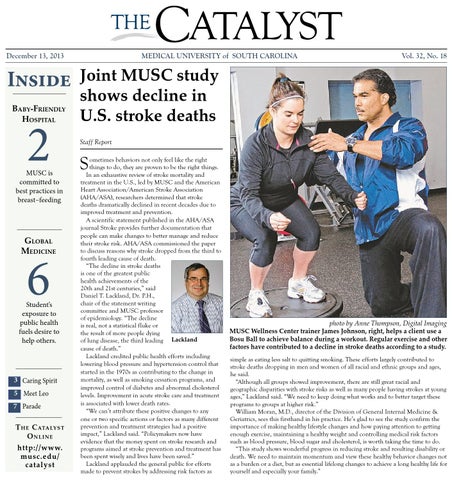
photo by Anne Thompson, Digital Imaging MUSC Wellness Center trainer James Johnson, right, helps a client use a Bosu Ball to achieve balance during a workout. Regular exercise and other factors have contributed to a decline in stroke deaths according to a study. simple as eating less salt to quitting smoking. These efforts largely contributed to stroke deaths dropping in men and women of all racial and ethnic groups and ages, he said. “Although all groups showed improvement, there are still great racial and geographic disparities with stroke risks as well as many people having strokes at young ages,” Lackland said. “We need to keep doing what works and to better target these programs to groups at higher risk.” William Moran, M.D., director of the Division of General Internal Medicine & Geriatrics, sees this firsthand in his practice. He’s glad to see the study confirm the importance of making healthy lifestyle changes and how paying attention to getting enough exercise, maintaining a healthy weight and controlling medical risk factors such as blood pressure, blood sugar and cholesterol, is worth taking the time to do. “This study shows wonderful progress in reducing stroke and resulting disability or death. We need to maintain momentum and view these healthy behavior changes not as a burden or a diet, but as essential lifelong changes to achieve a long healthy life for yourself and especially your family.”
2 THE CATALYST, December 13, 2013
MUSC among four SC hospitals as baby-friendly BY MIKIE HAYES Public Relations During the Nov. 14 Birth Outcomes Initiative Symposium in Columbia, the South Carolina Department of Health and Human Services recognized MUSC among the first four South Carolina hospitals to earn the designation of Baby–Friendly for efforts to improve children’s health through breast-feeding. Only 170 hospitals nationwide have earned this designation. The Baby–Friendly certification is the highest designation awarded to hospitals by an accrediting body that promotes best practices for maternity care and it is only awarded after a rigorous on-site inspection where a hospital’s policies, practices and procedures are examined to ensure they are complete. “We are proud to recognize these hospitals for their achievement of the Baby–Friendly designation,” said Tony Keck, Director of SCDHHS. “We appreciate these hospitals’ efforts to promote maternal and infant health as part of South Carolina’s ongoing commitment to reduce infant mortality.” A global program launched by the World Health Organization and UNICEF, the Baby–Friendly Hospital Initiative encourages hospitals that offer an optimal level of care for infant feeding as well as mother and baby bonding. MUSC was awarded $200,000 for successfully meeting the criteria to earn the certification by September 30. Baby–Friendly hospitals utilize the Ten Steps to Successful Breast–feeding, a joint WHO and UNICEF statement, which stresses to expectant mothers the importance of breast–feeding over formula and the numerous health benefits of breast–feeding. The Ten Steps are endorsed and promoted by the major maternal and child health authorities in the United States, including the CDC, the National WIC Association, U.S. Surgeon General, American Academy of Pediatrics, and the American College of Nurse– Midwives. Through the Ten Steps program, expectant mothers
Editorial of fice MUSC Office of Public Relations 135 Cannon Street, Suite 403C, Charleston, SC 29425. 843-792-2795 Fax: 843-792-6723 Editor: Cindy Abole catalyst@musc.edu Catalyst staff: Cindy Abole, aboleca@musc.edu Mikie Hayes, hayesmi@musc.edu
photos provided
An MUSC Children’s Hospital contingent joins members of Roper St. Francis–Mount Pleasant Hospital, Waccamaw Community Hospital and Georgetown Memorial Hospital as South Carolina Baby–Friendly designated hospitals. are educated on proper techniques and to begin breast– feeding before an infant is an hour old. Other steps involve putting babies in skin–to–skin contact with their mothers immediately after birth; keeping an infant in the mother’s hospital room, rather sending them to the nursery; and educating hospital staff on procedures to better support new families and breast-feeding mothers. While earning this designation may seem an easy task, Sarah Taylor M.D., Department of Pediatrics, explains otherwise. Many of the hospitals involved in the initiative deliver approximately 100 babies a year and the babies’ mothers are healthy. MUSC, however, performs more than 2,100 deliveries per year, many of which are high-risk, and mothers or babies are sick, she said. “Many people said that it was impossible for a large, academic center to achieve Baby–Friendly status. By reaching this, MUSC did not just change what was possible but changed the impossible to possible. We have our work cut out for us to sustain our efforts, but now we know that we can do it,” Taylor said.
The Catalyst is published once a week. Paid adver tisements, which do not represent an endorsement by MUSC or the State of South Carolina, are handled by Island Publications Inc., Moultrie News, 134 Columbus St., Charleston, S.C., 843-849-1778 or 843-958-7490. E-mail: sales@moultrienews.com.
Only seven percent of U.S. babies are born in Baby– Friendly hospitals. These hospitals have demonstrated best practices in the care of mothers and newborns and have improved breast–feeding rates, which are critical to the health of a newborn. Creating Baby–Friendly hospitals provides tangible solutions that will improve the health of mothers and babies in South Carolina. According to the National Institutes of Health, children who were breast-fed have a 20 percent lower risk of dying between 28 days and one year than children who weren't breast–fed. Research also shows that breastmilk contains antibodies that protect newborns from infections, and breast–fed babies are less likely to develop a number of illnesses to which they may otherwise be susceptible. “Being a Baby–Friendly Hospital gives us a wonderful opportunity to make a real difference in the long–term health of mothers and babies. Infants experience less gastrointestinal and respiratory illness, and have 36 percent decreased odds of SIDS. Mothers receive
See Hospital on page 4
Holiday Break The Catalyst will not be published Dec. 27 or Jan. 3 and will resume publication Jan. 10. For information, call Cindy Abole at 792-2795 or e-mail catalyst@musc.edu. For advertising information, call Island Publications at 849-1778 or e-mail sales@ moultrienews.com.
THE CATALYST, December 13, 2013 3
Cardiothoracic surgeon presented Caring Spirit award Staff Report
T
he MUSC Pastoral Care Service staff presented its seventh annual Caring Spirit Award to Mario Castillo–Sang, M.D., assistant professor, Division of Cardiothoracic Surgery. This award is presented each year in conjuction with Pastoral Care Week, Oct. 21 to Oct. 25, with the purpose of honoring a faculty or staff member for his or her commitment and support. In today’s busy world of medicine, nursing, and patient care is often a work that is placed in the back drop of the spiritual needs of patients and families. The annual Caring Spirit Award recognizes spiritual care of patients and families; support of the MUSC Pastoral and Spiritual Care mission; an effort to foster community among clergy and hospital staff; and support of this year’s Pastoral Care Week theme, “Prophetic Voice.” Castillo–Sang came to MUSC from Barnes-Jewish Hospital and Washington University in St. Louis School of Medicine in 2012. He was nominated by Rev. Gerig Huggins, Pastoral Care Services chaplain. Huggins had worked previously with Castillo–Sang while he helped comfort the families of two patients who died suddenly and unexpectedly. According to
Dr. Mario Castillo–Sang Huggins, Castillo–Sang, in both instances, showed great patience, empathy and compassion to each family for their loss. “There was never a sense that he was simply fulfilling a duty to notify the family of what had happened; rather, he was there because he truly cared for the loss
they had suffered. He clearly practices the ministry of presence as he patiently waits with the grieving; nothing seems to be more important to him at that moment,” wrote Huggins. The chaplain staff affirms all nominees for their unending pursuit to assure that the spiritual and pastoral care needs of patients and families are given the highest priority. Pastoral Care Services manager Rev. Terry L. Wilson also supported the selection of Castillo–Sang for this honor. “Dr. Castillo–Sang is a wonderful representative of what the Caring Spirit Award means and stands for at MUSC. It is our hope that the nominations and presentation process reminds all of us of the healing power of a caring spirit,” Wilson said. Previous Caring Spirit winners include Steve Saef, M.D., Adult Emergency Medicine; Michelle Sharp, R.N. Pediatrics; Luc Gagne, R.N., MSICU; Kissia Randolph, R.N., ART; and Tyrone Vanish, STICU. The 2013 Caring Spirit award nominees were Carolyn C. Cavanaugh, R.N., Storm Eye Institute; Bruce Crookes, M.D., Ed.D., Department of Surgery; Caroline DeLongchamps, Children’s Hospital Guest Services; and Sheryl Weathers, a respiratory therapist in STICU.
4 THE CATALYST, December 13, 2013 MUSC Health Strategic Plan
Hospital plans to expand Tricounty primary care services BY ANDREA SWARTZ FELIXON MUSC Physicians MUSC Health is focused on improving access to our nationally ranked specialists through the strategic growth of our primary care services, which often are the first point of access into a hospital’s system. This strategic growth supports several key initiatives which will help MUSC Health achieve its goal of being a top 25 academic medical center by 2015: q The new MUSC Health Plan offers enhanced preventive benefits and lower out-of-pocket expenses to MUHA employees who choose to see providers within our network, including their primary care physician. q The establishment of the MUSC Health Patient Centered Medical Home, where primary care providers coordinate all of the patient’s care, specifically as it relates to chronic disease management such as diabetes and heart disease. q The expansion of new primary care
practices will improve patients’ access to care and also promote the MUSC brand. Our strategic plan also encompasses the growth of our primary care network. This involves expanding our network of primary care providers, as the initial step to grow all of our outpatient services. MUSC leadership and each of the three MUSC Health primary care groups: Internal Medicine, Family Medicine and MUSC Physicians-Primary Care (formally known as Carolina Family Care) have been working together to ensure successful growth in office locations, hours, access and number of providers. MUSC Health has more than 80 primary care providers in 24 locations in the Tri-county area serving MUSC Health employees and their communities. The primary care physicians are board-certified and accepting new patients. Family Medicine (children and adults), Internal Medicine and Allergy services are included in the primary care network. Several locations
take same-day appointments and walkins. In addition, MUSC PhysiciansPrimary Care offers after hours clinics at Midtown Family Medicine, 5 to 8 p.m., Monday through Thursday, and 8 a.m. to 12 p.m., Saturday. Saturday clinics also are available at Flowertown Family Medicine from 8 a.m. to 12 p.m. For a full list of the MUSC Physicians Primary Care locations and physicians or to make an appointment, visit http:// www.muschealth.com/primarycare or 792-7000. Aside from achieving top 25 status, an important reason leadership is focusing on the growth of primary care is to improve the health of employees
and their families. As one of the largest employers in the state, it is critical for MUSC Health to ensure that our employees and their families easily gain access to care when they need it. At the core, MUSC Health is about taking care of patients and their families, which includes MUSC employees.
Strategic Intent: To become a top 25 academic medical center for reputation, quality, service, efficiency and financial performance by 2015
HOSPITAL Continued from Page Two not only a decreased risk of cancer, but also a long–term decreased risk of hypertension, hyperlipidemia, cardiovascular disease and diabetes. Breast–feeding is a solid preventative health strategy for both infant and mother,” said Taylor. While these practices are the gold standard, they are more difficult to achieve today than in the past. “Breast–feeding has been successful for centuries as it was the main source of sustenance for an infant. The difference now is that, yes, breast-feeding is natural, but it is not natural in the unnatural world that we live in today. Do mothers lay quietly with their infants and bond for the days after delivery? No, they entertain many visitors, are constantly connected to electronics, and are managing a house and the stress of heading back to work in a few weeks. I know this because I have been that mom! Since we are no longer ‘natural,’ we have to ‘learn’ how to breast-feed. The Baby Friendly Hospital Initiative provides proven, evidence-based strategies to give mothers what they need for breast–feeding success,” she said. “Now that we have improved in-hospital breast–feeding support, we need to concentrate on post-hospitalization lactation support. The Lowcountry lacks wellestablished lactation support systems that are readily available and economical,” she said.
THE CATALYST, December 13, 2013 5
MEET LEO
Leo Gonzalez College S.C. College of Pharmacy, Class of 2015 Hometown Blanco, Texas How you are changing what’s possible at MUSC I like being involved in multiple organizations that directly contribute to the community. I also am Spanish–certified by MUSC to counsel patients in their native languages. Volunteer history I have volunteered through MUSC Gives Back on multiple projects. Most recently, I helped with the annual Teddy Bear Tags to benefit the Carolina Youth Development Center. I also volunteered with Habitat for Humanity, Lowcountry Food Bank and community health fairs around the area. Favorite holiday song Tchaikovsky’s Nutcracker Ballet Suite Favorite holiday memory My very first Christmas spent with my wife How do you de–stress during exam time I like to go out and have dinner with friends and family.
6 THE CATALYST, December 13, 2013
Student explores benefits of population, global health BY KEVIN WILEY Center for Global Health
D
uring undergraduate pre-med courses, Caroline West stumbled on a medical anthropology course that changed the lens through which she viewed the practice of medicine. West, a second-year College of Medicine student and president of the college’s Global Tropical Medicine Interest Group she credits this early exposure to public health for fueling her desire to help disadvantaged groups domestically and abroad. “Taking these courses as the basis of my experience made me realize that you can do a lot in populations to eliminate cultural and access barriers to health care,” said West. “Volunteering in regional programs working with the migrant Hispanic community was pivotal in broadening my cultural perspective and reinforced the similarity of health issues facing communities in both our own backyards and in developing countries.” West’s interest in global health is quite common among today’s health professional students. In fact, the Association of American Medical Colleges estimates that more than 65 percent of incoming medical students wish to pursue global work while completing their degree. West shares that MUSC is representative of that
statistic as more incoming students are asking about international research and service learning experiences. “Universities offering global health opportunities are a big draw and very attractive to students making decisions about where they want to pursue their studies,” she said. In response to this desire, MUSC students worked with the College of Medicine to create the student interest group GTMIG whose goal is to provide students with information about how to incorporate global health into a medical career, to learn from faculty and community leaders who work in global health and to hear from other students who have participated in service learning trips. West has found ways to contribute to global projects that will enhance her skills as a future medical professional. Recently, she began working on post-interview guidelines for discussing hypertension, diabetes and chronic kidney disease test results in Tanzania with Michael Sweat, Ph.D., director of the MUSC Center for Global Health. Sweat provided West with the opportunity to gain experience by understanding societal norms of the host country and working with his team to develop culturally sensitive survey guidelines for the host country. From this came a mentor-mentee relationship that will outlive her involvement with
Second-year medical students and MUSC Global and Tropical Medicine officers include Zilan Lin, from left, Tiffani Brandon, and Caroline West. Not pictured is Jacob Kahn.
photos by Caroline West
MUSC student Caroline West visited Aconcagua, Chile (between Mendoza and Santiago) for six weeks prior to starting medical school. Sweat’s project. “From my own work in low-income countries I can say without reservation that having students get involved has been a real ‘win-win’ situation,” Sweat said. “For the student, they tend to gain enormously in terms of their knowledge, but also in gaining a deep appreciation in working cross-culturally.” West commented that students interested in pursuing global fieldwork and research experiences need to understand it takes upfront planning and creativity to figure out the best timing and funding while in school. To help foster the overwhelming student and resident desire for international service learning experiences and to offset some of the related expenses, the MUSC Center for Global Health offers a Trainee Global Health Travel Grant. The $2,000 grants are part of a competitive application process that evaluates many criteria, including the strength of the applicant’s learning objectives and preparedness to undertake the project. The next round of grants will be announced in January 2014. “We have had large turnouts of students, residents, and trainees at all levels for recent events that MUSC Center for Global Health has sponsored this past year,” Sweat said. “I am amazed by their drive to help. These are busy
people dealing with enormous pressures, yet they volunteer, raise funds, and give up their few breaks from school to help with global health projects. I think this reflects foremost a deep desire to address some of the most daunting problems humanity faces. These are the kinds of humanistic issues that drew MUSC students into health professions – the desire to make a significant impact on the betterment of humanity.” Editor’s note: Reprinted with permission from MUSC Center for Global Health, http://globalhealth.musc.edu.
Cityscape of Valparaiso, Chile.
THE CATALYST, December 13, 2013 7
A decade of caring: MUSC Angel Tree and Parade Tenth year delivers toys, bikes, warm coats and a whole lot of fun to all who attended this festive event BY MIKIE HAYES Public Relations
H
undreds of MUSC employees and patients — many clad in reindeer ears, Christmas sweaters and Santa hats along with volunteers and guests from the community — lined sidewalks and packed into the Horseshoe eagerly awaiting the arrival of the 10th annual Angel Tree Christmas parade. As the Charleston Police Pipes and Drums, dressed in their signature blue and gold tartan kilts, emerged from the front of Storm Eye Institute, the crowd showed their heartfelt appreciation with smiles, cheers, and enthusiastic applause. The theme of this year’s event, Superheroes, honors the courage and strength shown by patients every day at the MUSC Children’s Hospital. As Captain America stood valiantly atop the superhero float, doctors and nurses joined real-life hero, 12-year-old Kim Grant, a leukemia patient in the Children’s Hospital, for the exciting ride
through the MUSC campus. Her doctor, Michelle Hudspeth, M.D., director of Pediatric Hematology and Oncology, said “We were happy to accompany Kim on the float. Seeing her smile was the most magical part of the day.” A pageant of festively-lit golf carts pulling trailers of toys, and gailydecorated pickup trucks weighed down with presents and bikes, all proceeded down Ashley Avenue bound for the Horseshoe. An elf on a bike kept time with the Coastal Belle Singers, and MUSC public safety officer Corey Cox dressed like a toy soldier, delighted the crowd from high atop stilts, while he danced and performed acrobatics from his wobbly perch. The crowd went wild over Burke High School’s High Steppin’ Band, whose musicians played their hearts out for the grateful spectators, and the audience was equally thrilled to hear the cadences chanted by West Ashley High School Junior Navy Reserve Officer Training Corps, who marched and carried their
Even the youngest parade watchers joined in the spirit Dec. 6.
photos by Sarah Pack, Public Relations
Timmy Moyer, 7, center, served as marshall of the 2013 MUSC Angel Tree Parade which was held Dec. 6 around MUSC’s campus. Moyer is a bone marrow transplant patient. banner in the parade. West Ashley High School’s NJROTC Master Chief Tim Strickland said, “This is the parade the kids enjoy the most and they look forward to it all year. They love bringing a smile to everyone’s faces and it means so much to each and every one of them. It is truly what the season is all about.” Finally the last vehicle arrived, carrying the day’s three most anxiously awaited guests: Santa and Mrs. Claus, and Timmy Moyer, the parade’s marshal. The Superheroes theme was chosen as a tribute to 7-year-old Timmy for the bravery he displayed during his stay at MUSC last year while undergoing a bone marrow transplant. Timmy’s mom, Sharon Moyer, was his donor, as she had been labeled a perfect match. Hudspeth, who is also Timmy’s doctor, said it is extremely rare for a parent to be a bone marrow match — in fact, less than 1 percent of parents qualify. Timmy and his family were on the “good side” of the 1 percent. Hudspeth said, “Timmy had been diagnosed with acute myelogenous leukemia in the fall of 2011 at the age of 5. He was diagnosed with the most difficult type of AML to cure. Timmy was referred here for a bone marrow transplant and did very well during transplant, but later developed severe
complications.” “Timmy and his family persevered through many though times, but we are thrilled to say he is doing terrifically. He is back to playing soccer and focusing on school work. Timmy is a great example of how MUSC pediatric blood and marrow transplantation works with patients all over the state and beyond to truly defy the odds,” Hudspeth said. According to Hudspeth, Timmy’s family recently moved to North Carolina due to his father’s job but continue to do all of their follow up care here at MUSC. His mom says she can’t imagine being anywhere else. As Timmy’s car and the procession of vehicles circled through the Horseshoe, Santa and his many elves unloaded boxes, bikes, and bags of presents as fast as they could while Elvis Presley Christmas carols accompanied their efforts. Relaxing in a wheelchair on the grounds in front of the hospital, Rick Osment, a patient from the Transitional Care Unit on 2East, enjoyed a picnic lunch with family and friends. “What MUSC is doing here is absolutely amazing,” he said. “The parade in and of itself is truly a gift. I imagine the staff from 2-TCU are involved in this as they are just wonderful.”
See PARADE on page 8
8 THE CATALYST, December 13, 2013
PARADE
Continued from Page Seven
Skipping through the crowd, decked out in full clown costume regalia , “Dr. Flutterby,” University Communication’s Lori Solado, visited bystanders, handing everyone a smiley sticker. “I love brightening people’s days and making
A Burke High School Steppin’ Band student keeps the rhythm.
them smile,” she said. “I love this parade. This is joy. Pure joy.” By noon, it was nearly 80 degrees and the Burke High Steppin’ Band stopped for a cold drink before heading back to school. Standing in front of the Colbert Library, people gathered around to thank them for their performances: employees, patients, and kids surrounded the band like a fan club. The personal pride the musicians felt after a terrific performance was evident. Craig Harris, a sergeant in the Mount Pleasant Police Department and volunteer percussion director, said, “The fact this parade is about kids doing for other kids makes it that much more special. They want to do something for the children who need encouragement. For kids to be giving their own time for others – now that’s amazing. They practice all summer long, out in the heat. They work so hard after school every day to prepare. What they do comes from the heart.” Harris’ heart is in the right place too. He played in the same band when he was a student at Burke. He gives back because of what was done for him when he was the age of the musicians he now mentors.
photo by Sarah Pack, Public Relations
MUSC Angel Tree volunteers and employees help load waiting trucks. it is better to give than to receive is never “These are good, good kids,” Harris truer than on this day. said. “There is a spirit placed on them “When we found out the band from and they have inner and outer charisma. They love to perform for the community. Burke and the NJROTC from West Ashley High School were giving up their These kids have amazing appreciation lunches to perform for our parade, we for everything they get to do. Having knew we had to do something,” said this type of influence in their lives is Liz Nista, Blood Marrow Transplant priceless.” Program Quality Coordinator and Across the Horseshoe from the band, Santa and Mrs. Claus held court, posing parade organizer. “Sodexo, the international food service company that for pictures with children, adults and runs the cafeterias on MUSC campus, elves alike. Children lined up to share offered to supply lunch and drinks so the detailed Christmas wishes and adults tried to convince the Clauses they should kids didn’t have to go without.” The MUSC Angel Tree Program not be on the naughty list. is in its 10th year. Every year, MUSC As the parade and the festivities employees prove how sincerely generous wound down, the Salvation Army they are; it is not unusual for more than was on hand to collect the thousands 1,500 Angels and nearly 5,000 families of contributions. The long-respected to be helped. organization partners with MUSC “Every day MUSC employees show every year to ensure the children of the patients that they care, that we’re Lowcountry have gifts under the tree on here for them and that we’re all in Christmas morning. this together. Once a year during the Through the Salvation Army’s Angel holidays, MUSC employees show the Tree program, new toys, clothes and bikes are donated for children of families entire Lowcountry just how much they really care. Thank you to the who have great financial need. Angel entire MUSC family of employees for Trees are decorated with paper angel supporting the Angel Tree this year and tags that include the first name, age and making sure that these children wake up gender of a child who may not receive to a Christmas morning of wonder and any presents for Christmas were it not love,” said Nista. for MUSC and this program. The adage
MUSC Angel Tree gifts await sorting by Salvation Army Angel Tree volunteers at the North Charleston Coliseum.
THE CATALYST, December 13, 2013 9
10 THE CATALYST, December 13, 2013
THE CATALYST, December 13, 2013 11
Rental Properties
Furniture
Items for Sale
Folly Beach 2 Br. 1 Ba. Apt. LR, DR, Kitchen, New AC & Heat Pump. Seeking professional & responsible long term renter. 2nd row on East Arctic Ave. Fenced yard & off street parking. Pest control included. Available Now, 540-663-6541 paul.faneuf@mda.mil
Full Mattress Set with Euro Pillow Top New $115. Please Call: 843-270-4283
Signed copies of Dr. Peter Cotton's award winning rhyming children's books about Fred the friendly snake are available at: www.petercottontales.com
Apts. For Rent 1,2,3 Br for MUSC students & employees. Special reduced rates through January. James Towne Village Apt. Complex, minutes away by car, short walk to free Carta bus services. Unbeatable rates promised. 795-9233 jtvillage@bellsouth.net
King Size Plush Set New, will sacrifice for $275 843-501-3485 Bed-Queen Pillowtop that is Brand New in Plastic. Will take $125. Please call 843-270-4283
OPM, Transportation Holiday Schedule University Transportation Services and the Office of Parkng Management (with excption for patient/ visitor parking services) will be closed Dec. 24 to Dec. 26 and Jan. 1. There is no bus service on Dec. 24. Ambulatory Care and MUHA employees who park off-campus are invited to park in accordance to the schedule. For information, visit http://www. musc.edu/parking.
12 THE CATALYST, December 13, 2013
HEALING THROUGH THE POWER OF HUMOR, FUN
Bumper “T” Caring Clowns national president Ester Gushner (aka Doctor Curly Bubee), left, is joined by Caring Clowns vice president Aviva Gorstein (aka Doctor Hugga Bubbe), second right, and MUSC Caring Clown Robert Mason (aka Doctor Geezer), as they bring smiles to Herbert Love, an MUSC Patient Admissions employee, during a recent visit to the University hospital. Bumper “T” Caring Clowns are a volunteer organization dedicated to healing through the power of humor for hospitalized patients, families, friends and caregivers. Children’s Hospital clowns are volunteers and clowns who visit adult patients are MUSC employees who volunteer their time. In addition to MUSC volunteer orientation and training, Caring Clown volunteers complete a comprehensive clown training program focusing on the art of gentle humor. For information, contact Katy Kuder, 792-0858. photo provided