October 18, 2013
MEDICAL UNIVERSITY of SOUTH CAROLINA
Vol. 32, No. 10
MUSC Wellness Center to offer limited Inside access membership at discounted price C G lObal
hallenGes
6
By Dawn Brazell Public Relations MUSC employees will have a tougher time making excuses for not working out. The MUSC Wellness Center rolled out an Employee Xpress membership for MUSC employees Oct. 16. Employees will be offered a one-year membership for $25 a month with a $15 enrollment fee. In celebration of the Gold Medal Award, the enrollment fee will be waived until Nov. 10. Janis Newton, interim director, said the timing is perfect given that MUSC just received a Gold Medal Award for creating a workplace environment that encourages healthy behaviors. MUSC was recognized as a Gold Medal Hospital Sept. 27 as part of Working Well, a collaboration between the South Carolina Hospital Association and NC Prevention Partners for providing the highest standard of excellence in creating a physically active workplace. “This keeps that positive momentum going,” Newton said. “Physical activity during the workday can add energy, promote a positive attitude, and improve fitness and cardiovascular health.” The membership will not include spouses or dependents and will be offered during limited hours. It’s perfect for those who exercise at lunch or in the evening, she said. Times will be: Monday – Friday 11 a.m. to 2 p.m. and Monday – Thursday 8 p.m. to 10 p.m. and 6 p.m. to 8 p.m on Friday. The fee can be paid by credit card, check or payroll deduction. Employees may sign up at the membership desk at the Wellness Center. Newton said the staff has designed 30 to 45-minute express classes in Tae Bo, group cycle, aqua and HITS to allow employees to get in and out quickly during their lunch time. “We already have many great lunch time classes but we will be adding several 30-minute workout opportunities between the hours of 11 a.m. and 2 p.m. Employees will want to attend James Johnson’s 30-minute fitness circuit, Katie Blaylock’s 30-minute Tae Bo Express, and Marty River’s 30-minute aqua express class.” In addition there are: q lunchtime exercise classes such as Yoga, Zumba, Body Bar and Pilates Mat q an 80,000 square-foot facility with tennis, squash, racquetball, basketball gymnasium q a junior Olympic pool and an indoor-outdoor track q locker rooms with showers and steam and sauna rooms q free weight equipment q free Motion and Nautilus Strength Training q full array of cardiovascular equipment
A pediatric nurse practitioner reaches out to children through a medical mission in Tanzania.
ReseaRCh MaTCh
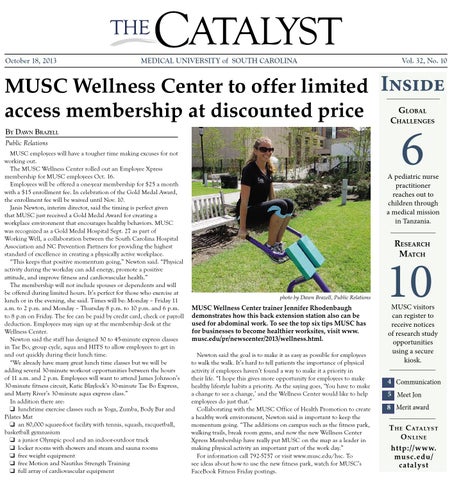
photo by Dawn Brazell, Public Relations
MUSC Wellness Center trainer Jennifer Rhodenbaugh demonstrates how this back extension station also can be used for abdominal work. To see the top six tips MUSC has for businesses to become healthier worksites, visit www. musc.edu/pr/newscenter/2013/wellness.html. Newton said the goal is to make it as easy as possible for employees to walk the walk. It’s hard to tell patients the importance of physical activity if employees haven’t found a way to make it a priority in their life. “I hope this gives more opportunity for employees to make healthy lifestyle habits a priority. As the saying goes, ‘You have to make a change to see a change,’ and the Wellness Center would like to help employees do just that.” Collaborating with the MUSC Office of Health Promotion to create a healthy work environment, Newton said is important to keep the momentum going. “The additions on campus such as the fitness park, walking trails, break room gyms, and now the new Wellness Center Xpress Membership have really put MUSC on the map as a leader in making physical activity an important part of the work day.” For information call 792-5757 or visit www.musc.edu/hsc. To see ideas about how to use the new fitness park, watch for MUSC’s FaceBook Fitness Friday postings.
10
MUSC visitors can register to receive notices of research study opportunities using a secure kiosk.
4 Communication 5 Meet Jon 8 Merit award T h e C aTa ly s T Online http://www. musc.edu/ catalyst
2 The CaTalysT, October 18, 2013
Pastoral Care Week: call to be prophetic, respectful By Chaplain GeorGe rossi Pastoral Care Services The Prophetic Voice calls us to reach for action and peace — to sustain that which brings us hope, well-being, dreams and renewal. Prophecy goes hand in hand with team work, respect, and understanding of the situations in which we find ourselves. In times of change, we are called to be prophetic, most of all in our manner of presence, in a way that involves trust, peace, and collaboration, saying, “Yes, this too, is possible, there is hope.” This hopeful, trustful presence taps into the strength beyond people’s knowing and endures changing seasons to prove that which will sustain us. When acknowledged, it grows into a wise tree to shelter, nourish and teach us. (Visit www.pastoralcareweek.org). The previous paragraph gives a helpful interpretation of the theme “Prophetic Voice.” There will be “changing seasons” and “times of change” and that is certainly the case for health care in the United States and within the medical center. The strategic motto that the medical
Editorial of fice MUSC Office of Public Relations 135 Cannon Street, Suite 403C, Charleston, SC 29425. 843-792-4107 Fax: 843-792-6723 Editor: Kim Draughn catalyst@musc.edu Catalyst staff: Cindy Abole, aboleca@musc.edu Ashley Barker, barkera@musc.edu
center has adopted is “Changing What’s Possible.” It requires clinicians to focus on hopeful outcomes and physical renewal. Teamwork and collaboration are key components to this as change is envisioned and implemented. Health care clinicians can become “blessings” to their patients and families. Clinicians can “speak up” and “advocate” with a prophetic voice for hospitalized individual, people who are less fortunate and marginalized in the community. Clinicians who provide hope with treatments and care, are the same individuals who use their voices, their power, and their skills to help people heal and find peace within a medical crises, difficult diagnosis and prognosis. During pastoral care week, may everyone be mindful to speaking up for others who need help and support. We also can speak up for coworkers and ourselves when any of us need care and support. Our voices can be a small and gentle catalyst that can lead people to be their own religious and spiritual resources so that they may experience health, wellness and abundant living. The Catalyst is published once a week. Paid adver tisements, which do not represent an endorsement by MUSC or the State of South Carolina, are handled by Island Publications Inc., Moultrie News, 134 Columbus St., Charleston, S.C., 843-849-1778 or 843-958-7490. E-mail: sales@moultrienews.com.
Flu vaCCine available FOR eMplOyees
photo provided
Volunteer & Guest Services manager Katy Kuder receives some love from Lucky, a pet therapy dog, while she gets her annual flu vaccine. Vaccines are available to all MUSC employees and students. The vaccine will be offered from 11 a.m. to 1 p.m. on Oct. 30, Nov. 6, Nov. 20 and Dec. 4 at the university hospital. Additional locations for employees are 4 to 7 a.m., at Ashley River Tower and 7:30 a.m. – 3:30 p.m., at Environmental Health Services. For the fastest service, bring a completed Flu Vaccine Consent Form (available at mcintranet. musc.edu/ehs/Seasonal_Influenza_Vaccine_Consent_201314_Blank_ ID_Required.pdf). Forms also will be available on site.
College of Medicine’s Office of Student Affairs invites first-year students to a Webcast on “Assessment-based Strategies to Improve Academic Grit” 1 to 2:30 p.m., Oct. 30, Room 202, Basic Science Building The program will assist MUSC students succeed by helping them improve essential non-cognitive skills to increase their academic grit. Webcast instructors will present assessment-based strategies in self-efficacy, academic and campus engagement, educational commitment and setting up a plan for success. A toolkit and other resources are provided. The event is led by Paul Gore, University of Utah.
The CaTalysT, October 18, 2013 3
Coastal artist delighted to see MUSC feature her art By CinDy aBole Public Relations As an artist, Dee Beard Dean is more accustomed to seeing her work in formal exhibitions, art galleries and shows. Imagine her surprise to see her landscape paintings and nature prints hanging on walls of inpatient rooms and gracing the hallways and waiting rooms inside the Medical University hospital. The opportunity came as Dean was brought in as a patient to MUSC’s Chest Pain Center in mid-September. After completing some tests, Dean’s neurologist wanted to keep her overnight for observation and made arrangements for her to be transferred to 9West’s neuroscience unit in the University hospital.As she was transferred across campus, it wasn’t long before Dean and her husband Nick Chalfa, M.D., were wheeling down 9West’s main hallway when something familiar caught her eye. “I remember looking up and seeing a Carolina marsh scene painting hanging on the wall. Then I kept seeing more of my artwork hanging in the hallway and inside nearby patient rooms. I realized these were works I had painted more than 10 to15 years ago, and it really perked me up to see them again,” Dean said.
photo provided
Landscape artist Dee Beard Dean poses with one of her paintings displayed in hallways and patient rooms throughout the hospital. Dean, who is an award-winning portrait and landscape painter, resides on John’s Island. She paints on location and at her home studio and displays a lot of her works at her downtown Charleston gallery, Galerie on Broad. Both she and her husband remembered that a lot of those early works featuring South Carolina coastal marsh
scenes and other landscapes celebrating Lowcountry life, were sold and marketed through her son’s gallery, the John Beard Collection. Her son, also an artist, is a supplier to interior designers, art galleries, home furnishing retail operations and contract and hospitality firms. Dean’s original paintings, portraits and Giclee canvas reproductions hang in hospitals and medical facilities, health care offices, business complexes and public buildings throughout the country. Scientific articles and evidence-based studies have looked at the effectiveness of hospital design in creating health care environments that can impact the quality of patient care. One study looked at how improved design characteristics such as single-bed patient rooms, reduced noise, use of natural lighting and subdued color palates on walls and visual art displays can contribute to reducing stress and promoting better outcomes. According to the Center for Health Design, art such as waterscapes, landscapes, flowers and some figurative art can positively contribute to healing environments. “From my perspective, each of my paintings share a small part of me and if anyone can find joy looking at or admiring the beauty in each piece then that pleases me both as an artist and an individual,” said Dean, who was released the following day is now recovering well.
4 The CaTalysT, October 18, 2013
MUSC medical center communications corner Performance Excellence update MUSC Performance Excellence is the financial improvement plan for the medical center. It is a $100 million plan consisting of seven different improvement components. The largest part of the plan is consultant evaluation and recommendations in the areas of labor (inpatient and clinics), physician services, revenue cycle, non-labor, human resources, and pharmacy 340B program.
Consultant evaluation and recommendations A large part of the MUSC Performance Excellence Plan is consultant evaluation and recommendations in the areas of labor (inpatient and clinics), physician services, revenue cycle, non-labor, human resources, and pharmacy 340B program. The consultant in this part of MUSC Performance Excellence is Huron. Work with Huron began in January 2013 after an initial assessment phase and will continue until January 2014; however, our focus on costeffective programs and services will remain after Huron leaves. The different components of the plan started at different times; hence, they will have different end dates. Palliative care The second part of the MUSC Performance Excellence plan is improvements in palliative care. Palliative care is an approach to treating patients at the end of life. It is not only better care as evidenced in the medical literature, but is also less expensive care, so it is included in the MUSC Performance Excellence plan. Elements of this plan include hiring additional physicians and palliative team members in order to enhance palliative care services at MUSC. Graduate medical education Another element of the plan is graduate medical education. This plan involves working with the colleges of Medicine, Dental Medicine, and Pharmacy in lowering the unit cost of care delivery in those specialties. The purpose of this part of the plan is to engage all attendings and residents in helping to improve the financial performance by standardizing care and optimizing quality outcomes. A better quality outcome usually means less expensive care. MUSC Health Plan Another part of the MUSC Performance Excellence plan is the development of the MUSC Health Plan. This initially started with elimination of co-pays and deductibles; however, this has morphed into development of the MUSC Health Plan. MUSC can no longer ignore the rising costs of premiums at an institutional level or an individual level. Therefore, we have partnered with the Public Employee Benefits Authority to develop this new MUSC Health Plan, which offers lower out-of-pocket costs for those who decide to seek care within the MUSC Health Plan Network.
This new plan will promote cost-savings, better align the clinical enterprise and create a broader health network for our employees.
Leader focus on unit costs Another part of the MUSC Performance Excellence plan is leader focus on unit costs. This is not new, as we have been focusing on unit costs extensively for about three years. Prior to this year, this plan was called the “5 and 5 Plan,� in reference to an attempt to decrease the unit costs by 5 percent each year. All leaders in the medical center, clinical and non-clinical, physician and non-physician, have a goal in this area. Access Enhancing access is another element of MUSC Performance Excellence. Peter Zwerner, M.D., from MUSC Physicians has been leading a major effort during the past year to improve access. Improvements in access will not only result in greater patient satisfaction, but will also result in more new patients to MUSC; this is why it is included as part of the financial improvement plan. This project is well on its way and we are seeing significant improvements in the number of new patients at MUSC. This plan will continue to roll out over the next year. Procedure suite standardization The final part of the MUSC Performance Excellence plan is procedure suite standardization. During the last six years, we have been standardizing the approach in the operating rooms, and it is now time to bring those same principles of efficiency to the procedure suites. This includes the cardiac catherization labs, endoscopy labs, pediatric procedure suite, interventional radiology, and neuro interventional radiology.
The CaTalysT, October 18, 2013 5
Meet Jon
Jon McGough, M.D. Department MUSC Physicians Primary Care How you are changing what’s possible at MUSC I’m excited to help build our Patient Centered Medical Home in the Lowcountry so that we can continue to provide the best, most comprehensive care for all or our patients. How long at MUSC Three years. I completed my internal medicine residency at MUSC this summer and now work at James Island Medicine. A must-have in the pantry I live on peanut butter. After eating it almost every day for most of my life, it is still my favorite food. Favorite summer activity I enjoy getting friends together to go tubing down the Edisto River. Dream vacation I would love to spend a month traveling through Italy and experience its great art, architecture, history and cuisine. Words of advice As a Georgia Bulldog fan, I have a signed photo from sports announcer Larry Munson, stating, “To Jon, Hunker Down!” It motivates me to do my best each day, no matter how I might be feeling.
6 The CaTalysT, October 18, 2013
photos provided
On the island of Ustupu, Natalia Davila walks through the main square on her way to the pediatric clinic. Bottom right photo: Davila holds an infant with hydrocephalus after a shunt placement procedure at the Bugando Hospital Mwanza in Tanzania.
Nurse pursues global challenges By Kevin wiley Center for Global Health
I
f you think sailing from Hawaii to San Francisco is tough, try establishing sustainable health care infrastructure in a politically autonomous and indigenous province in the Central American country of Panama. Natalia Davila has accomplished the former and is in progress to fulfill the latter. Although these are both daunting pursuits, she has thought very little of the difficulty involved. “I love working with people who gravitate toward these types of challenging opportunities, whether sailing or humanitarian work,” Davila said. “These people put experience and helping others above everything. They’re people who climb mountains to see the world, not for the world to see them.” Davila is a pediatric nurse practitioner with a specialization in developmental pediatrics at MUSC
Children’s Care Clinic in North Charleston. She received her baccalaureate and post-baccalaureate training in nursing at MUSC. “I love giving what I have to give, which is taking care of children. And to be able to share it is pretty cool,” Davila said. “My training and experience at MUSC helped prepare me for activities in the United States and abroad.” Davila has been drawn to global health first through fieldwork, helping treat hydrocephalus in Tanzania, and most recently by traveling to Kuna Yala, Panama with Indigenous Health International. IHI is a nonprofit medical mission operation created by MUSC physician Leonard Egede, M.D., to build capacity and sustainable health systems in low-resource settings across the globe. IHI’s mission is to establish selfsustaining health systems in predetermined locales in a
See GloBal on page 7
The CaTalysT, October 18, 2013 7
Top photo: Pediatric nurse practitioner Natalia Davila sails aboard Helen Ho from Hawaii to San Francisco. Right photo: Davila comforts a Tanzanian child following a procedure. She is working through Indigenous Health International, a non-profit medical mission operation established by MUSC’s Dr. Leonard Egede to build sustainable health systems in third world areas across the globe.
GloBal
Continued from Page Six
five year period—an ambitious, but surmountable feat. Partnerships with the local and national governments have made this particular project relatively seamless in executing the objectives outlined by the group. “You have to be persistent in reaching out to people in these types of projects; it’s important to gain trust,” Davila said. “Simple things like Fanta soda help break down barriers of trust to be able to do the work we’ve enlisted Egede ourselves to do.” IHI is currently working to build health system capacity in Kuna Yala, Panama, an autonomous region in eastern Panama that also demarcates other areas of Central and South America.
This region is so rural that Google Maps offers no estimation of how long it takes to reach the eastern coast near Kuna Yala by any means. Challenges abound for IHI in this particular region of Central America. The primary language spoken in Panama is Spanish, whereas the people of the Kuna Yala region speak Tule, a language foreign to most visitors and comparable to many traditional Native American dialects. Even more formidable are the cays—and other less habitable land formations—that the Kuna inhabit, posing challenges for Natalia and her colleagues. The closest airport is in Panama City, a nearly five-hour drive to Kuna. This is just a glimpse into the difficulty of creating long-lasting programs in indigenous regions of the world. The tenacious, undeterred spirit of Egede, Davila and their team is what’s needed to fulfill the goals and mission of IHI. “We got to meet with the governing body at the end
of the trip and they thanked us for the help we provided them,” said Davila. “One of the most touching things they said to us was that they felt they had seen disease take a step backwards since we arrived in Kuna, and that their people felt healthier.” IHI is gearing up to implement their models of health system development in the Congo, Rwanda and Kenya to work with marginalized populations in Africa. They hope by working in these regions they are able to provide greater understanding of why it is important to use research dollars where diseases are novel but easily prevented. An argument can be made that Americans are rarely exposed to tropical disease, but in order to continue to stave off a disease’s advances they must be treated and researched where they are, which in many cases can’t be found in the developed world. Editor’s note: Reprinted with permission from MUSC Center for Global Health
8 The CaTalysT, October 18, 2013
Student honored with MUSC Physicians scholarship By CinDy aBole Public Relations
S
hikha Patel was selected as the 2013 MUSC Physicians/Medical Scientist Training Program Scholar. Each year, MUSC Physicians, the institution’s academic physicians practice group, awards funding to provide stipend awards for MSTP students. This year, Patel was the sole recipient of this scholarship. According to Perry V. Halushka, M.D., Ph.D., Distinguished University Professor of Pharmacology and Medicine and MSTP director, Patel was selected for multiple reasons. “Ms. Patel was chosen based on her undergraduate academic performance, her prior research experiences and her interview with members of the MSTP admissions committee,” Halushka said. Patel is currently taking classes in her first-year of medical school. By next summer, she will conduct a second lab rotation to potentially determine where she will conduct her dissertation research. In MUSC’s M.D./Ph.D. program, students are required to select a department or lab after completing the second year of medical school. Originally from Boiling Springs, Patel is a May 2013 graduate of the University
photo by Anne Thompson, Digital Imaging
Medical Scientist Training Program student Skikha Patel, second from right, is presented with the MUSC Physicians/MSTP Scholarship by MSTP director Dr. Perry Halushka, from left, College of Medicine Dean Dr. Etta Pisano and MUSC Physicians’ President Dr. David Cole on Aug. 6. of South Carolina-Columbia where she earned a bachelor of science degree in biochemistry and molecular biology and minor in medical humanities. Patel’s research interest is in cancer biology with an additional interest in
immunology. Earlier this summer, she completed a research rotation in the lab of Besim Ogretmen, Ph.D., professor and Eminent Scholar in the Department of Biochemistry and Molecular Biology, where she was investigating the effects of
sphingosine analogs on telomeric length and role in telomerase function in cancer cells. She credits her interest in the MSTP to her undergraduate years where she worked for three years conducting cancer research. It was after that experience that she chose to pursue a career in medicine. “I’ve realized that as a doctor I can impact a few individuals deeply during my lifetime, but as a researcher I would be able to assist an entire community of people. However, I still wanted to be able to affect patients on a personal basis and assist them individually. As a physicianscientist, I can practice both roles and decrease the ever-widening gap between the lab and the clinic,” Patel said. Patel also would like to explore her interests in both hematology-oncology and surgery throughout her time at MUSC. Each year, the MSTP scholarship committee reviews applications of all its incoming students. For Fall 2013, the program welcomed six new first-year MSTP students to its ranks. Last year, the program celebrated the largest number of student applicants in its history. For information, visit http:// academicdepartments.musc.edu/grad/ programs/md_phd_program/.
Instructional tech executive director recognized for contributions By CinDy aBole Public Relations Mary P. Mauldin, Ed.D., has a passion for instructional technology and spreading the use of it and integrating it in education and learning on several levels. A distinguished educator, she’s been recognized for leading the charge and doing some amazing things with technology to engage students and faculty and improve learning and instruction. On Aug. 21, Mauldin was recognized for her energy and commitment and was presented with the Presidential Merit Award and medallion by former MUSC President Ray Greenberg, M.D., Ph.D. Mauldin is the 16th individual to receive this award during Greenberg’s tenure as university president. Mauldin was praised for making a significant impact and “tech-ifying” MUSC’s campus by bringing in the newest technology products, tools and methodologies
Dr. Mary Mauldin was praised for making a significant impact and “tech-ifying” MUSC’s campus by bringing in the newest technology products, tools and methodologies for users. for users. She embraces a commitment to faculty and student development through the use of technology integration and innovative teaching tools and methods to prepare future health care professionals and support educators. During Mauldin’s tenure, she founded the Educational Technology Lab, which has merged into the Office of Instructional Technology and Faculty Resources, to aid faculty in teaching and educational support. Mauldin, who is executive director in the Office of Instructional Technology and Faculty Resources, has worked with faculty throughout her career by
See MeDal on page 10
photo by Anne Thompson, Digital Imaging
Instructional Technology Executive Director Dr. Mary Mauldin receives the Presidential Merit Award and medallion by former MUSC President Dr. Ray Greenberg.
The CaTalysT, October 18, 2013 9
10 The CaTalysT, October 18, 2013
ResearchMatch at outpatient center By reBeKah wriGhT S.C. Clinical & Translational Research Institute Visitors to the SCTR Research Nexus outpatient center in the Clinical Sciences Building may now sign up to receive notifications of research study opportunities matching their health information at a secure kiosk in the waiting area. ResearchMatch, developed by Vanderbilt University and partially funded by the National Institutes of Health's NCATS, has a simple goal – to bring together two groups of people who are looking for one another: (1) people who are trying to find research studies, and (2) researchers who are looking for people to participate in their studies. It is a free registry that has been implemented by major academic institutions across the country. Anyone can join. Many studies are looking for healthy people of all ages, while some are looking for people with specific health conditions. MUSC researchers and their study teams are encouraged to direct patients interested in research to the resource. ResearchMatch can be a useful alternative when volunteers meeting study exclusion criteria still want to participate in research, but don't want to have to manually search for opportunities.
MeDal Continued from Page Eight developing instructional practices and programs that integrate technology, teaching and learning. She developed computer and Internet-based projects, led her staff in creating more than 200 e-learning courses and established continuing education programs supporting faculty across campus. She also led faculty development in the area of interprofessional education through MUSC’s Creating Collaborative Care Initiative. She chairs the Apple Tree Society, a group devoted to the scholarship of teaching, learning and professional development. Mauldin also served in several leadership roles with the faculty senate, and helped plan monthly networking sessions and other support for the campus’ Women Scholar’s Initiative. Mauldin is a Russ Nazzaro Fellow of MUSC’s Trustee Leadership Academy, a program that provided formal leadership training for faculty
photo by Rebekah Wright, SCTR
Clinical nurse manager Karen Packard christens the kiosk on its first day in the waiting room. For more information on the full-service SCTR Research Nexus, visit http://academicdepartments.musc. edu/sctr/nexus. For more information on ResearchMatch, visit https://www.researchmatch.org/.
and staff and a 2008 Distinguished Faculty Service Award recipient. She also has been active in local, state and national work with professional organizations including the National Center for Interprofessional Practice and Education, the S.C. Commission on Higher Education, S.C. eLearning Center Governance Board, Association for Applied Interactive Multimedia and other groups. Mauldin joined MUSC in 1993. A Laurens native, she began her career in public education and served as a special education administrator. She earned her master’s degree in instructional technology at the University of Georgia and doctorate in educational technology at Pepperdine University in 2001. The Presidential Merit Award is the highest award bestowed to an individual by the MUSC president. It can be presented to any faculty, employee, student or friend of the University who displays
exemplary service and support that are exceptional. Recipients have made significant contributions to advancing the institution’s mission of education, clinical service and research to the people of South Carolina. The pResidenTial MedalliOn The medallion is worn by the MUSC president on ceremonial occasions. It was first presented to Dr. James B. Edwards during his installation ceremony on Oct. 15, 1983. The obverse side illustrates the front of the medical university's first building construction in 1826 on Queen Street flanked by Palmetto trees, the official State Tree. The reverse shows the official seal of the University bordered by the names of its six colleges. The medallion worn by the university's president is No. 1 in the minting of the first 100 numbered medallions.
Registration is free but required. Visit sctr.musc.edu
12 The CaTalysT, October 18, 2013