October 11, 2013
MEDICAL UNIVERSITY of SOUTH CAROLINA
Vol. 32, No. 9
Pitts lecture to focus on ethical pediatric issues Staff Report
T
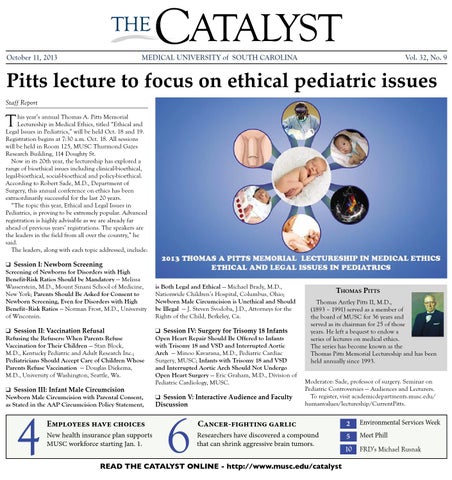
his year’s annual Thomas A. Pitts Memorial Lectureship in Medical Ethics, titled “Ethical and Legal Issues in Pediatrics,” will be held Oct. 18 and 19. Registration begins at 7:30 a.m. Oct. 18. All sessions will be held in Room 125, MUSC Thurmond Gazes Research Building, 114 Doughty St. Now in its 20th year, the lectureship has explored a range of bioethical issues including clinical-bioethical, legal-bioethical, social-bioethical and policy-bioethical. According to Robert Sade, M.D., Department of Surgery, this annual conference on ethics has been extraordinarily successful for the last 20 years. “The topic this year, Ethical and Legal Issues in Pediatrics, is proving to be extremely popular. Advanced registration is highly advisable as we are already far ahead of previous years’ registrations. The speakers are the leaders in the field from all over the country,” he said. The leaders, along with each topic addressed, include: q Session I: Newborn Screening Screening of Newborns for Disorders with High Benefit-Risk Ratios Should be Mandatory — Melissa Wasserstein, M.D., Mount Sinani School of Medicine, New York; Parents Should Be Asked for Consent to Newborn Screening, Even for Disorders with High Benefit–Risk Ratios — Norman Frost, M.D., University of Wisconsin. q Session II: Vaccination Refusal Refusing the Refusers: When Parents Refuse Vaccination for Their Children — Stan Block, M.D., Kentucky Pediatric and Adult Research Inc.; Pediatricians Should Accept Care of Children Whose Parents Refuse Vaccination — Douglas Diekema, M.D., University of Washington, Seattle, Wa. q Session III: Infant Male Circumcision Newborn Male Circumcision with Parental Consent, as Stated in the AAP Circumcision Policy Statement,
4
Employees have choices New health insurance plan supports MUSC workforce starting Jan. 1.
is Both Legal and Ethical — Michael Brady, M.D., Nationwide Children’s Hospital, Columbus, Ohio; Newborn Male Circumcision is Unethical and Should be Illegal — J. Steven Svodoba, J.D., Attorneys for the Rights of the Child, Berkeley, Ca. q Session IV: Surgery for Trisomy 18 Infants Open Heart Repair Should Be Offered to Infants with Trisomy 18 and VSD and Interrupted Aortic Arch — Minoo Kavarana, M.D., Pediatric Cardiac Surgery, MUSC; Infants with Trisomy 18 and VSD and Interrupted Aortic Arch Should Not Undergo Open Heart Surgery — Eric Graham, M.D., Division of Pediatric Cardiology, MUSC. q Session V: Interactive Audience and Faculty Discussion
6
Thomas PiTTs Thomas Antley Pitts II, M.D., (1893 – 1991) served as a member of the board of MUSC for 36 years and served as its chairman for 25 of those years. He left a bequest to endow a series of lectures on medical ethics. The series has become known as the Thomas Pitts Memorial Lectureship and has been held annually since 1993. Moderator: Sade, professor of surgery. Seminar on Pediatric Controversies — Audiences and Lecturers. To register, visit academicdepartments.musc.edu/ humanvalues/lectureship/CurrentPitts.
Cancer-fighting garlic
2
Environmental Services Week
Researchers have discovered a compound that can shrink aggressive brain tumors.
5
Meet Phill
10
FRD’s Michael Rusnak
READ THE CATALYST ONLINE - http://www.musc.edu/catalyst
2 The CaTalysT, October 11, 2013
Gift in honor of father with Parkinson's disease By allyson Bird Office of Development & Alumni Affairs
B
rice Sharpton’s teacher gave each of her 48 students a $100 bill and a special challenge at the end of the school year: Double the money, and then donate that profit to the charity of your choice. The 16-year-old First Baptist School student knew immediately that he wanted to contribute to a fund that supports research for Parkinson’s disease. For almost his entire life, Brice has watched the disorder steal more and more from his father, Kip. Kip Sharpton, now 47, was only 33 on the morning that his wife noticed his hand shaking as she poured him coffee before church. Julie Sharpton, a nurse at MUSC, made her husband an appointment to see a specialist. With three young children and a career in sales, Kip Sharpton said, “I had expectations of what I wanted to do.” Instead, he missed a promotion and, because of his speech limitation, his company moved him out of sales management and into auditing work. Brice’s teacher gave the class its startup cash with instructions to “find out more about themselves.” Brice bought hot dogs, buns and fixings and set up a stand at the Harborview Road Piggly Wiggly near his family’s home. He, his younger sister and his parents explained to shoppers the school project behind the sign, “Pig Out for Parkinson’s.” Some people passed on hot dogs but donated money anyway. Brice's teacher, Robin Gramling, said she based the assignment on the Parable of the Talents from the Book of Matthew, in which a master leaves his money with his servants and then returns and asks for an accounting. The master rewards the servants who increased the value of the money that he entrusted to them. Gramling’s students held gym days, crab sales and talent shows with the money she gave them. They raised nearly $12,000, which they then gave to special-needs
Editorial of fice MUSC Office of Public Relations 135 Cannon Street, Suite 403C, Charleston, SC 29425. 843-792-4107 Fax: 843-792-6723 Editor: Kim Draughn catalyst@musc.edu Catalyst staff: Cindy Abole, aboleca@musc.edu Ashley Barker, barkera@musc.edu
photo provided by Sharpton family Brice Sharpton set up a hot dog stand and donated his profit to Parkinson’s disease research at MUSC’s Murray Center. athletics programs, medical research and books for patients at MUSC Children’s Hospital. “We’re all consumed with promoting ourselves,” Gramling said. “The idea is finding yourself through service, and finding that you’re satisfied. They had to present what they’d done and what they’d discovered from what they’d done. You could tell from the way
The Catalyst is published once a week. Paid adver tisements, which do not represent an endorsement by MUSC or the State of South Carolina, are handled by Island Publications Inc., Moultrie News, 134 Columbus St., Charleston, S.C., 843-849-1778 or 843-958-7490. E-mail: sales@moultrienews.com.
they spoke, from the smiles on their faces, that they were happy to have done it.” Brice donated the $280 he earned from the hot dog sale to MUSC’s Murray Center for Research on Parkinson’s Disease and Other Related Disorders. Looking to his father, Brice remembered, “I wanted to find something that could help you. I wasn’t really thinking about other people. I was mainly thinking about you.” Christina Vaughan, M.D., assistant professor in the Department of Neurosciences, said the Murray Center runs its own clinical trials and also participates in national studies. Because of donations such as Brice’s, specialists at the Murray Center soon will offer video conferencing to remote patients who otherwise would not have access. “I am especially touched that Brice raised these funds on behalf of his father,” Vaughan said. “My father, too, has Parkinson’s disease, and I understand how much this disease can affect a family.” The gift also inspired Brice’s father. In addition to the hot dog sale, Brice and his sister, 13-year-old Sarah Grace, also sold snacks to raise money for research. “I’m proud of them,” Kip Sharpton said. “It’s impacted their lives as much, if not more than mine. I don’t think they’re going to find a cure in my lifetime, but I want to drop back and say, what can I do to help other people?” He hopes to plan a tandem bicycle ride through the Blue Ridge Parkway with a friend, another man diagnosed with Parkinson’s disease in his early 30s. If the two men can’t complete the ride on their own, Kip Sharpton hopes Brice and his older brother, 18-year-old David, can help. Kip Sharpton looks to Michael J. Fox as a role model, since the actor’s Parkinson’s foundation has raised $325 million for research, plus immeasurable awareness. “We can’t all be Michael J. Fox,” he said. “But I want to do something.”
The S.C. Lowcountry Society of Gastroenterology Nurses and Associates presents its Annual Fall Conference 2013 Oct. 18 - 20 at Marriott Grand Dunes Resort 8400 Costa Verde Drive Myrtle Beach, SC, 29572
Event registration for SGNA Members – $145, non-member – $165, GI Tech and Nursing Students – $75 Contact R’celle Boyd at boydrd@musc.edu or visit www.sclcsgna.org.
The CaTalysT, October 11, 2013 3
EnvironmEnTal sErvicEs aPPrEciaTEs EmPloyEEs’ EfforTs
photos provided
Top photo: Crothall Environmental Services employee, Dwayne Mitchell, won a flat screen TV in the Environmental Services Week celebration’s final drawing Sept. 6. Left photo: Ashley River Tower staff Shawn Washington, from left, Karen Moore, Yolanda Frayer, Margaret Scott and Brenda Pierce join the festivities with ice cream, cupcakes and goodies. More than 350 staff work throughout the university, ART, Children’s Hospital, Hollings Cancer Center and other locations.
4 The CaTalysT, October 11, 2013
New MUSC Health Plan preserves choice, lowers costs By Mark lyles, M.d. MUHA Chief Strategic Officer Beginning Jan. 1, 2014, more than 18,000 MUSC employees and their dependents will be offered a new insurance plan that has enhanced preventive benefits and lower overall out-of-pocket costs. The MUSC Health Plan was established in partnership by the South Carolina Public Employee Benefits Authority and MUSC leadership to improve the health and wellness of the MUSC workforce by encouraging patients and health care providers to partner with one another in the delivery of effective, coordinated medical care. During the Open Enrollment Period, employees and their dependents enrolled in the Standard State Health Plan (SHP) will automatically be enrolled in the MUSC Health Plan, a plan that offers enhanced benefits. Members of the MUSC Health Plan who choose to receive patient-centered care within the MUSC Health Plan Network will get many types of preventive services at no cost and will have lower out-of-pocket expenses. The MUSC Health Plan’s preventive care benefits include blood pressure, cholesterol, depression and obesity screenings; tobacco cessation counseling; numerous vaccines; well-women visits and screening pap smears; and other preventive health services at no cost. Also, for many MUSC outpatient doctor’s office visits, MUSC Health Plan members will be required to pay a single copayment with no deductibles or coinsurance. For information about the new benefits offered by the health plan, visit musc.edu/medcenter/ MUSChealthplan/index.html. Employees still have choices Employees covered by the MUSC Health Plan who choose to receive care outside of the network (for example, at another hospital or a non-MUSC owned or affiliated doctor’s office), will continue to have their current Standard SHP benefits: individual or family deductibles must be met, copays must be paid, and coinsurance will apply. Also, employees and dependents enrolled in the BlueChoice HMO or SHP Savings Plan may remain in these plans or elect to join the MUSC Health Plan for 2014. All new employees who begin receiving health benefits at MUSC on or after Jan. 1, 2014, will become members of the MUSC Health Plan. Patient-Centered Care MUSC Health Plan members will receive care
through the Patient Centered Medical Home model that focuses on comprehensive, patient-centered care delivered by MUSC’s team of professionals and coordinated by a MUSC primary care provider. All MUSC primary care and specialty physicians and advanced practice providers will be included in the MUSC Health Plan Network. Additionally, to expand its ability to deliver primary care services, the MUSC Health Plan Network will partner with like-minded physicians and practices that are committed to delivering quality, patient-centered care. In November, a web-based tool will be launched to enable MUSC employees to select a clinic and a primary care physician within the network who will coordinate health care delivered to members of the MUSC Health Plan. For information, contact your MUSC Human Resources Office, MUHA — mcintranet.musc. edu/hr/or university — academicdepartments.musc. edu/hr/university/. FrequenTly asked quesTions What is the MUSC Health Plan? A new insurance plan created in partnership by PEBA and MUSC to offer benefits and lower total costs to MUSC employees and dependents that choose to receive care in the MUSC Health Plan Network. Will employees pay more to be a member? No. Employee premiums for the MUSC Health Plan (the amount withdrawn from employee paychecks) will not increase in 2014. And although other state employees will have their deductibles, copayments and coinsurance maximums increase by 20 percent in January 2014, the MUSC Health Plan is designed to have lower out-of-pocket costs for members who choose to receive their care from a member of the MUSC Health Plan Network. Is my physician in the network? All MUSC primary care and specialty physicians and advanced practice providers will be members of the network. What are the new benefits offered by the plan? There are three levels of benefits offered by the new plan and employees may choose the option that is best for them and their dependents: q Choice One: MUSC Health Plan members who receive care in the network will have lower total out-ofpocket costs and receive many preventative services at no cost. q Choice Two: Members who receive care outside
of the MUSC Health Plan Network but within the Standard SHP Network will continue to receive Standard SHP benefits, the same benefits as other public employees enrolled in this plan. Every general hospital in South Carolina is included in the Standard SHP Network. Out-of-state hospitals that participate in the nationwide Blue Cross and Blue Shield Network will also honor SC SHP benefits to MUSC Health Plan members and their dependents, such as college students or dependents who live outside of the Charleston area or in another state. q Choice Three: Members who receive care outside of the Standard SHP Network will receive Standard SHP out of network benefits. What is a Patient Centered Medical Home? A PCMH emphasizes care coordination and communication. It serves to facilitate partnerships between patients and health care teams to provide high value care in the most ideal settings. There are various organizations that provide standards on how PCMHs may operate and are recognized. Practices that provide patient care in a PCMH model deliver superior patient care centered on a patient’s individual health needs and focus on health and wellness. Do employees have to change their primary care physician? In order to receive the benefits and lower total outof-pocket costs, members of the plan must be seen by physicians or providers in the network. If members of the plan receive care from outside the network, then Standard State Health Plan benefits apply. What are the MUSC Health Plan benefits? Visit musc.edu/medcenter/MUSChealthplan/2014_ comparison_chart.pdf. What preventive care will be offered at no cost? A list of preventive services that are billed at no cost to members of the MUSC Health Plan will be provided. Visit musc.edu/medcenter/MUSChealthplan/Free_ preventive_services.pdf. Does MUSC have enough pediatric primary care physicians in the network? MUSC will partner with high value pediatric practices in order to expand the network’s capacity to deliver coordinated care to pediatric patients. Can employees enrolled in the Standard SHP switch to BlueChoice or the Savings Plan in October? Only employees and dependents enrolled in the BlueChoice or SHP Savings Plan may remain in these plans for 2014. Employees who are on the Standard SHP will be automatically enrolled in the plan.
The CaTalysT, October 11, 2013 5
Meet Phill
Phill Botham, R.N. Department Specialty Nursing, Wound and Ostomy Nurses How you are changing what’s possible at MUSC Working with a great team of nurses to provide the best in wound and ostomy care for our patients. How long at MUSC More than 6 years Unique talent I worked as a professional photographer. Who in history would you like to meet? Suzuki Roshi. He is the father of American Zen Buddhism. Favorite place in the world Mikonos Greece, Super Paradise beach A must-have in the freezer Ben & Jerry’s Phish Food Meal you love to cook Breakfast for a crowd of friends Dream vacation Orient Express from Paris to Istanbul Pets A schnauzer named Baker and a tabby cat named Sophie
6 The CaTalysT, October 11, 2013
Garlic holds promise to combat deadly brain tumor By dawn Brazell Public Relations
I
f you weren’t already a fan of garlic, here’s new scientific evidence of its cancer-fighting properties. Researcher Arabinda Das, Ph.D., said it was exciting to land on the cover of the August issue of the Journal of Neuro-Oncology with the first direct evidence that the compound DATS, found in garlic, is effective in blocking pathways of the proliferation of cancer cells and ultimately may help reduce tumor growth in patients with glioblastoma, the most lethal brain tumor. It’s a brain cancer that remains incurable despite aggressive chemotherapy, radiation and surgical interventions. That the study found a 60 to 74 percent rate in the shrinkages of tumors has the team of clinicians and researchers involved with this study cautiously thrilled. Researcher Pierre Giglio, M.D., said it’s rare to get good results in the clinic. There’s only one drug being used – Avastin – that produces response rates, and those generally are in the 30 to 40 percent range, he said. “In the clinic, I declare victory when I don’t see any change in the tumor. When you get a response that cuts the tumor down by that sort of percentage, I can’t stress how exciting it would be if that would translate to a clinical truth. This paper showed the efficacy, and it was quite stunning,” he said, cautioning that it will
photos by Sarah Pack, Public Relations Researcher Dr. Arabinda Das studies cancer cells in the laboratory. He and colleagues were excited their work landed on the August cover of the Journal of Neuro-Oncology. take time for the results to be translated for clinical use. “What works in the lab sometimes does not work in the clinic.” Das said it has long been known that plant derivatives have beneficial effects in many diseases. Plant
derivatives that are or will be studied include lemon, mushroom, green tea, turmeric, soybeans and ginger. “We have been working on several of these which are known to have anti-tumorigenic properties, and garlic compound is one of the agents, among many, we have chosen to study,” he said. Researchers tested the garlic-derived organo-sulfur compound DATS in two ways. They applied it directly to glioblastoma cells taken from tumors removed from patients, and they also placed these cells in immunosuppressed mice using an orthotopic xenograft model, in which the tumor cells are implanted in the tumor site of origin, a technique advantageous for its ability to mimic local tumor growth and pathways of metastasis. Giglio said it seems that glioblastoma cancer cells have multiple pathways within them that allow them to grow, divide quickly, invade the brain and form blood vessels for themselves. “In a nutshell, they have a lot of strategies that allow them to evade the body’s immune defense systems, evade the treatments that we may give, and most importantly, develop a resistant to the treatments that we give.” Das said the DATS compound seems to have a selective effect on the cancerous cells and not the normal cells. Researchers want to explore all mechanisms by which the compound may be working
See Garlic on page 7
The CaTalysT, October 11, 2013 7
GarliC
Continued from Page Six
against cancer cells. The response rate suggests it works in more than one pathway to block the cancer, he said. “We demonstrated shrinkage of tumors in these animals and showed that DATS reduced division of cells within the tumors and worked against multiple proteins and pathways that promote tumor growth,” Das said. There are several research projects planned to further this work. Das will be working with Giglio, and AmyLee Bredlau, M.D., director of the Pediatric Brain Tumor Program and a pediatric neuro-oncologist, to develop a highly-purified DATS gel capsule for a human safety and tolerability phase I study. “We are hoping to be able to do this in the next 12 months.” The broad long-term objective is to use the information obtained from this study to develop a therapeutic strategy for the induction of apoptosis or cell death of glioblastoma and recommend this natural compound as a therapeutic strategy for trials in glioblastoma patients. The study found the compound didn’t impair liver functioning. Das said most medications pass through the liver and are broken down in this organ. Many medical agents carry warnings about possible liver injury, and it is always encouraging to note that the liver is not affected by the garlic compound at the doses used in the study. Researchers caution that they are not recommending garlic consumption as a cure for glioblastoma or other cancers. “Our research shows promise but recommendations for actual treatment of cancer with DATS would be premature.” Should patients want to take advantage of any potential anti-cancer benefits from garlic now, they should know to take certain precautions, he said. For example, it’s important to cut and peel a piece of fresh garlic and let it sit for 15 minutes before eating or cooking it. This time allows for the release of an enzyme (allinase) that produces the anti-cancer compounds. Consumers using this as a nutritional supplement also should know that eating too much garlic may cause diarrhea, allergies and internal bleeding, so it is important to monitor garlic consumption. Meanwhile, Das and colleagues will take the clues from this study to further their work. Das said the success of this study depended on a strong team of collaborators of clinicians and researchers. The team included clinicians Giglio, Scott M. Lindhorst, M.D., and Bredlau; surgeons Sunil J. Patel, M.D., W. Alex Vandergrift, M.D., and Abhya K. Varma, M.D.; basic scientists Das and Naren L. Banik, Ph.D., and researcher Swapan K. Ray, Ph.D., of the University of South Carolina. This collaboration of clinicians, surgeons and neurooncology researchers is opening up new opportunities for discoveries. Das said in the future, researchers will be able to take patient tumors and have them tested
did you know? q Glioblastomas are generally found in the cerebral hemispheres of the brain, but can be found anywhere in the brain or spinal cord. q Brain tumors are the second leading cause of cancerrelated deaths in children (males and females) under age 20 (leukemia is the first). Source: American Brain Tumor Association
Graphic Illustration by Emma Vought
A collaboration of clinicians, surgeons and neuro-oncology researchers is opening new doors to discoveries. Pictured above (from left) are: Drs. Arabinda Das, Pierre Giglio, W. Alex Vandergrift, Abhya K. Varma, Naren Banik and Scott M. Lindhorst. in their laboratory model to see the efficacy of certain drugs. “We can personalize it based on the response of the tumor.” Plans also are on the table to test the DATS compound in a larger animal model and down the road in the formulation of a nasal application to be delivered in a nanoparticle. Giglio said the hope is that the nanoparticles will prove small enough to pass through the blood-brain barrier allowing the compounds they carry to leach out very slowly to the area of the brain tumor. The first clinical trial will be with an oral
preparation of some type of gel capsule, followed later by nanoparticle research depending on finding funding for these projects. Given how difficult this glioblastoma can be to fight – it ranks in the top three cancers in how fast it may kill people – this breakthrough is energizing to the team collaborating to find clues to how to stop it, Das said. “We just want to be able to help these patients.” Editor’s note: Story reprinted from MUSC’s News Center at www.musc.edu/pr/newscenter.
8 The CaTalysT, October 11, 2013
Dental student strives to impact change, advocacy By Cindy aBole
Baron aTTEnds PankEy insTiTuTE
Public Relations Third-year dental student Jessica Baron has always been one who is passionate about making a difference. The Charleston native has a commitment to getting involved, understanding the processes in legislation and influencing public policy while advocating for dental students and practitioners. Baron is an example of a student advocate and leader in the dental education community who can talk the talk and walk the walk. Baron got her opportunity during the summer of 2012 after finishing her first year at MUSC’s James B. Edwards College of Dental Medicine. She was selected to work as a summer legislative intern with the Advocacy and Governmental Relations division of the American Dental Education Association Policy Center in Washington, D.C. For six weeks, Baron gained valuable experience visiting Capitol Hill to attend hearings, press conferences and debates relating to dental reform legislation and access to oral health care to conducting research on policy issues for fluoridation and corporate dentistry. At the end of her first year in dental school, Baron wanted to diversify her dental science studies and sought out ways where she could merge her passion for politics with dentistry. She had heard about the impact of student advocacy with ADEA, American Student Dental Association, and other organizations. She contacted former ADEA public policy and advocacy head Jack Bresch and quickly realized that she wanted to work with the ADEA to understand public policy and their platforms relating to dental health issues, research and other current challenges. “This experience was perfect for me because it combined my passion for politics and public policy and helping people on a grass-roots level. In order for practitioners to practice dentistry on the highest standards, there has to be good policies in place that also protect the patient. It’s one of my passions to increase care and increase it well,” Baron said. During that summer, Baron got the opportunity to cover specific ADEA issues from following Iowa Senator Chuck Grassley’s investigation of large corporate dental practices that engage in overtreatment of patients to reviewing access to dental care issues, student loan relief, research funding and rural dentistry. During Congress’ vote to pass the Sequester Replacement Reconciliation Act of 2012, Baron took part in a memo-writing campaign to Congress discouraging any further cuts to NIH and NIDCR research funding. Baron’s advocacy work and experience was so meaningful that she invited ADEA mentor Yvonne
Photo by Cindy Abole
ADEA’s Yvonne Knight, second from left, joins dental students Alison Foster, from left, Jessica Baron and Katie Daniel following her Sept. 25 presentation at the dental school.
“This experience was perfect
for me because it combined my passion for politics and public policy and helping people on a grassroots level.” Jessica Baron
Knight, J.D., to visit and speak to fellow dental students and faculty Sept. 25. Knight is the senior vice president for Advocacy and Government Relations of the ADEA Center for Public Policy and Advocacy. In Knight’s midday presentation, she defined advocacy and its importance to students in impacting dental education and how it can affect other issues relating to dentistry and the profession. She also spoke about the need to educate others on the dental perspective and shared tools and resources to help student advocates find a role to support dental education and best practices in the delivery of oral health care. “Through advocacy you can have an impact on dental education,” Knight told the audience. “Unless you make your point of view or position heard, you are not participating in the process. Students need to weigh in on the issues. To use a Washington expression, ‘If you’re not at the table, you are on the menu.’” Knight challenged students to become agents of change within dental education and in the profession.
Jessica Baron, a third-year dental student in the James B. Edwards College of Dental Medicine, was recently named a Pankey Scholar, which allowed her to attend its annual meeting, Sept. 19 through 22 in Orlando. While there, she learned about comprehensive dentistry to maximize patient oral health. The Pankey Institute is a nonprofit educational organization that is dedicated to assisting dental professionals continues in mastering technical skills and behavioral skills through dental education programs. More than 21,000 dentists and dental laboratory technicians and specialists have attended its courses. She urged students and dental faculty to speak out on issues, communicate with members of Congress and State Legislature through mail campaigns and use of social media. She also invited students to attend Advocacy Day on Capitol Hill or participate in statewide efforts with Dental Lobby Day, both usually held in April. “Now more than ever, the stakes are higher as there are constraints on the federal budget with cutbacks and a need to account for every dollar. It’s important that people interface with policy makers at these levels so that they realize that people really do care and can benefit from these programs,” Knight said. For Baron, her interests in engagement, public policy and processes blossomed as an undergraduate student of public policy at Duke University. She fondly remembered one class assignment where students were tasked to pick a failed piece of legislation and reorganize, restrategize and reintroduce it to Congress to pass for voting. “We have to assume a responsibility in educating our legislators,” Baron said. In South Carolina, dental students work closely with dental faculty and the S.C. Dental Association in participating in Dental Lobby Day at the S.C. State House. “I see myself as an oral health ambassador and it’s my goal to educate and impress the importance of good practices for the profession. Without sound politics, you cannot have successful dentistry.”
The CaTalysT, October 11, 2013 9
MUSC experts featured in NPR radio broadcasts By dawn Brazell Public Relations
T
hough aging poses challenges in staying fit, the greater concern is not facing the challenge, said MUSC orthopaedist Shane Woolf. It’s a point Woolf, M.D., interim chief of sports medicine in the Department of Orthopaedics at MUSC, makes in an upcoming NPR “Your Day” broadcast, where he sets the bar high – for good reason. “Within reason, age is not a specific limiting factor,” Woolf said during taping. “George Foreman was a champion boxer in his mid 40s. Mariano Rivera is almost 44 years old and a major league baseball pitcher. Competitive runners have been known to finish 5K and marathon races into their 90s. It’s really all about good habits, consistency, managing health issues, knowing your limitations and keeping it enjoyable.” Whether exploring senior fitness or childhood immunizations, the “Your Day” program on National Public Radio is featuring MUSC experts in segments hosted by Bobbi Conner, known for her former nationwide, syndicated public radio program, “The Parent’s Journal.” The interviews air twice a month every other Monday on the radio program, which is broadcast from noon to 1 p.m. Woolf’s segment will be broadcast Dec. 9 and will cover the topic: “Keeping Fit and Preventing Sports Injuries for Adults.” Woolf explores in his segment how to stay active and avoid injuries and which activities might be better for older adults. Physical activity, especially weight-bearing activities, are wonderful for maintaining and increasing bone mass, he said. Weight lifting within reasonable limits is effective as well as light impact activity, such as walking, jogging, tennis and aerobics. Woolf also explores nutrition, and how proper hydration and supplements of calcium, vitamin D and phosphorous are important to strength and recovery and play a role in maintaining blood pressure, heart and kidney function and bone health. “Appropriate adjustment of blood pressure and diabetes medicines might be necessary as fitness progresses,” he said. The following are other upcoming MUSC segments. 10/14/13 — Philip Saul, M.D.: “Common Pediatric Heart Problems and Treatments” Saul is a professor of pediatrics, specializing in pediatric cardiology. He also is the division director for pediatric cardiology at MUSC Children’s Hospital and director of the Children’s Heart Program of South Carolina. His clinical specialty is management of arrhythmias in children. 10/28/13 — Vanessa Hinson, M.D., Ph.D.: “Parkinson’s Disease (Treatment and Research Update)”
photos by Dawn Brazell, Public Relations Radio host Bobbi Conner (right) interviews Dr. Shane Woolf as part of a radio series with MSUC experts broadcast on NPR. Below, they prepare for the interview. For the full list of archived broadcasts, visit academicdepartments.musc.edu/podcast/archives/index.html.
Hinson is an associate professor of neurology and the director of the Movement Disorders Program at MUSC. Hinson also is the chief of neurology services at the Ralph H. Johnson VA Medical Center in Charleston.
11/11/13 Carolyn Jenkins, DrPH: “Managing Diabetes & Preventing Complications” Jenkins, is a professor in the College of Nursing and is the principal investigator for REACH – a coalition that aims to prevent and control diabetes. 11/25/13 Julie Kanter, M.D.: “Sickle Cell Disease Treatment & Research” Kanter is director of Sickle Cell Disease Research and assistant professor of hematology/oncology. The S.C. Public Radio stations broadcasting the Your Day segments are: WRJA-FM/88.1 Sumter, WNSCFM/88.9 Rock Hill, WLJK-FM/89.1 Aiken, WJWJFM/89.9 Beaufort, WHMC-FM/90.1, Conway, WSCIFM/89.3 Charleston, WEPR-FM/90.1 Greenville and WLTR-FM/91.3 Columbia. For the full list of archived broadcasts, visit academicdepartments.musc.edu/podcast/archives/ index.html. Editor’s note: Story reprinted from MUSC’s News Center at www.musc.edu/pr/newscenter.
10 The CaTalysT, October 11, 2013
Mandatory flu vaccines offered to hospital staff
F
lu season is just around the corner and MUSC Employee Health is preparing to fight this illness among employees. Five to 20 percent of Americans contract influenza yearly, and on average around 200,000 of them are hospitalized with the illness or complications related to the disease. With an estimated 36,000 deaths annually from influenza, and its complications, it is the nation’s eighth leading cause of death. The Centers for Disease Control and Prevention and the Advisory Committee on Immunization Practices recommend that all health care workers get an annual flu vaccine. By getting vaccinated Susan Johnson themselves, health care workers can protect their health, their family’s health and the health of their patients. Flu vaccine is available for all MUSC employees and students. This year the compulsory influenza policy has been updated to eliminate personal choice as a reason for declination and eliminate mask wearing for non-recipients. Religious reasons and medical reasons (history of paralyzing illness or allergy to eggs for those age 50 and older, a non-egg-based vaccine is available for those 49 and younger) are the only valid reasons for declination. Those who refuse the vaccine for other reasons are at risk of termination of employment or termination of volunteer or academic relationships. This policy applies to the following: MUSC medical center employees, trainees, students and visiting students, volunteers, contract staff, medical staff, temporary workers, medical residents, and volunteers. This applies whether paid or unpaid staff. For fast and convenient service, employees are encouraged to receive the flu vaccine at one of the campuswide satellites hosted by Employee Health Services and Infection Control. Bring your MUSC ID badge and your MUSC ID number (located in
Health at work
My Records). Students may obtain the vaccine from Student Health Services, however agency and other non-MUSC paid employees are not eligible. For the fastest service, bring a completed Flu Vaccine Consent Form (available at mcintranet.musc.edu/ehs/ Seasonal_Influenza_Vaccine_Consent_201314_Blank_ ID_Required.pdf). Forms will also be available at the administration site. Flu shots during Wellness Wednesdays: Oct. 16: 11 a.m. – 1 p.m., first floor, Ashley River Tower; Oct. 30, Nov. 6, Nov. 20 and Dec. 4: 11 a.m. – 1 p.m., university hospital. Additional locations for employees: 4 – 7 a.m., Ashley River Tower and 7:30 a.m. – 3:30 p.m., Environmental Health Services. Employee Wellness Events q MUSC Employee Fitness Series Class: Strength and Conditioning, from 4:15 to 4:45 p.m., Wednesday, Oct. 16 at the MUSC Fitness Park (behind Drug Discovery on the grass) weather permitting. Take 30 minutes to tone and strengthen lean muscles along with a cardiovascular workout. This free class will be led by fitness expert Katie Blaylock from the MUSC Human Performance Lab. Free day-pass to MUSC Wellness Center for all participants. Email muscempwell@musc.edu to register. q The Hollings Cancer Center mobile van will be performing digital mammograms for MUSC employees on Oct. 16. For appointment scheduling, call 792-0878. The van will be parked behind the Clyburn Research Plaza. q Worksite screening: The next worksite screening will be held on Oct. 17, HE628H, Clinical Sciences Building. This screening, valued at about $350, is available to employees with the State Health Plan for $15 (covered spouses can also participate for $15). Employees and spouses without this insurance can participate for
$42. The screening includes: height, weight, blood pressure and a blood draw for a blood chemistry profile, hemogram, and a blood lipid profile. Optional thyroid panel is available for $10. Add this test by alerting the staff at the screening. To register, go to musc.edu/employeewellness and click “Worksite Screening Appointment.” q Farmers markets: Fresh fruits and vegetables are available from local farmers from 8 a.m. to 4 p.m., Tuesdays in the Harborview Office Tower lobby; from 8 a.m. to 6 p.m., Wednesday and Thursday at Ashley River Tower; and from 7 a.m. to 3:30 p.m. on Friday at the Horseshoe. Look for new vendors at the Horseshoe. MUSC Urban Farm q Lunch & Learn: The next Lunch and Learn will be held from noon to 1 p.m., Thursday, Oct. 17 under the oak tree. The topic is planting fall and winter greens. q Work & Learns: 4 to 5 p.m.,Thursday q Work and Learn with child-friendly activities – First and third Saturdays from 9 to 11 a.m., Oc. 19. Bring a plastic bag and take home some fresh produce in return for work efforts or help gather for donations on certain days. No experience or prior knowledge necessary. Open to all MUSC employees and students and the general community. Families welcome on Saturdays. q Early Bird Maintenance, 7:30 to 8:30 am., Oct. 16. Contact Johnson at johnsusa@musc.edu for more information on the Office of Health Promotion at MUSC and Suzan Benenson Whelan at whela@musc. edu for specific information about Employee Wellness. Events, speakers, classes, or other ideas are welcome. Find us on Facebook. Like the Employee Wellness Facebook page and keep up with all the wellness events at MUSC. To receive the weekly newsletters, email a request to musc-empwell@musc.edu for Wellness This Week or urbanfarm@musc.edu for Friends of the Farm.
MUSC names new head for Foundation for Research Development Staff Report
M
USC’s Foundation for Research Development welcomed Michael Rusnak as executive director Oct. 1. With a diverse background in technology transfer, Rusnak has more than 25 years of life science experience, most recently as director of New Ventures and Technology Development within the technology transfer office at the University of Rochester Medical
Center in New York. In his six-year tenure at Rochester, he led efforts in life science licensing and directed the university’s Technology Development Fund and award process. He established numerous collaborations to foster commercialization, further investments and advance drug discovery, including agreements with the Moulder Center for Drug Discovery Research at Temple University, the Medical Research Council in the United Kingdom, Califia
Bio Inc., and Johnson & Johnson. Previous to Rochester, Rusnak was an entrepreneur-in-residence with BCM Technologies Inc., the venture subsidiary of Baylor College of Medicine, where he was involved in starting and incubating more than five spinoff companies from the medical school. He held senior positions in biotechnology business development with Ceros Pharmaceuticals, CombiChem and Lexicon Genetics, among others, where
he was involved in more than $100 million of partnering activity in the areas of drug discovery, combinatorial chemistry and genomics. Prior to Lexicon he held various positions in marketing, sales and project management with Baxter, Bayer, and Cetus. Rusnak received his master’s degree in clinical science and lab management from San Francisco State University and has a bachelor’s degree in microbiology from St. Bonaventure University.
The CaTalysT, October 11, 2013 11
Items for Sale King Size Plush Set New, will sacrifice for $200 843-501-3485 Bed-Queen Pillowtop that is Brand New in Plastic. Will take $150. Please call 843-270-4283
Misc. Services FALL CLEAN UP? Call Greg 843-303-2615 Great rates.
Nominations being accepted The Office of the President is accepting nominations for people to receive honorary degrees from MUSC, to be awarded at Commencement in May. In general, degrees go to individuals in the following categories: Contribution(s) to the nation; Contribution(s) to science; and Contribution(s) to the state or MUSC.
Consider submitting nominations of candidates along with supporting materials, in the above mentioned categories. The nominations should be forwarded to Marcia Higaki, Office of the President, Colcock Hall, 179 Ashley Ave., MSC 001, higakimc@ musc.edu, no later than Oct. 25. Nominations of MUSC alumni are generally discouraged.
12 The CaTalysT, October 11, 2013