September 6, 2013
MEDICAL UNIVERSITY of SOUTH CAROLINA
Vol. 32, No. 4
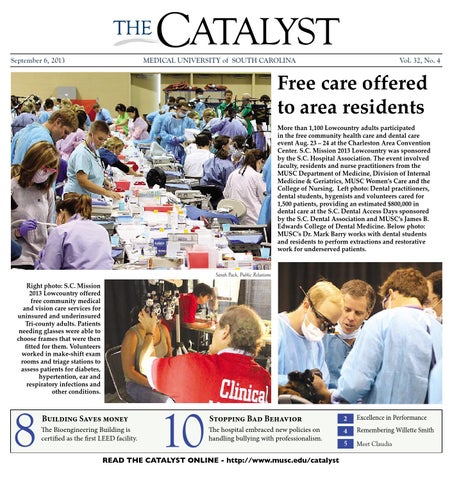
Free care offered to area residents More than 1,100 Lowcountry adults participated in the free community health care and dental care event Aug. 23 – 24 at the Charleston Area Convention Center. S.C. Mission 2013 Lowcountry was sponsored by the S.C. Hospital Association. The event involved faculty, residents and nurse practitioners from the MUSC Department of Medicine, Division of Internal Medicine & Geriatrics, MUSC Women’s Care and the College of Nursing. Left photo: Dental practitioners, dental students, hygenists and volunteers cared for 1,500 patients, providing an estimated $800,000 in dental care at the S.C. Dental Access Days sponsored by the S.C. Dental Association and MUSC’s James B. Edwards College of Dental Medicine. Below photo: MUSC’s Dr. Mark Barry works with dental students and residents to perform extractions and restorative work for underserved patients.
Sarah Pack, Public Relations
Right photo: S.C. Mission 2013 Lowcountry offered free community medical and vision care services for uninsured and underinsured Tri-county adults. Patients needing glasses were able to choose frames that were then fitted for them. Volunteers worked in make-shift exam rooms and triage stations to assess patients for diabetes, hypertention, ear and respiratory infections and other conditions.
8
Building Saves money The Bioengineering Building is certified as the first LEED facility.
10
Stopping Bad Behavior
2
Excellence in Performance
The hospital embraced new policies on handling bullying with professionalism.
4
Remembering Willette Smith
5
Meet Claudia
READ THE CATALYST ONLINE - http://www.musc.edu/catalyst
2 The CaTalysT, September 6, 2013
Rave Mobile Safety, MUSC to provide alerts, notifications to email addresses By amanda RiTsema Risk Management
M
USC has partnered with Rave Mobile Safety to provide emergency alerts and notifications directly to musc.edu email addresses, personal email addresses, desktop computers that are connected to the MUSC network, as well as personal landlines and cell phones. Musc.edu email addresses have been automatically registered to receive email alerts. Contact information for those registered with MUSC Alert was transferred to the new system. Employees are encouraged to login to the MUSC Alert site to update contact information and choose notification preferences. The contact information
ExcEllEncE in pErformancE
employees provide will directly affect the modes in which they receive emergency notifications By not providing personal contact information, employees are acknowledging they will not receive notification via personal modes of communication. Note that a cellular phone provider may charge a per-text message fee for the delivery of emergency notifications to the cell phone. For voice notifications, do not enter MUSC phone numbers with prefixes 792 or 876. To manage your account, visit www.getrave.com/login/musc. Employees must sign in using their NetID and password. For additional information regarding MUSC Alert, contact Ritsema@musc. edu or 792-8514.
Eula Wise, right, Office of Grants and Contracts Accounting, accepts the award for Employee of the Year from Lisa Montgomery, vice president for Finance and Administration. Wise was praised for her take-charge attitude in organizing and managing files of the university’s sponsored grants and contract awards.
Editorial office MUSC Office of Public Relations 135 Cannon Street, Suite 403C, Charleston, SC 29425. 843-792-4107 Fax: 843-792-6723 Editor: Kim Draughn catalyst@musc.edu Catalyst staff: Cindy Abole, aboleca@musc.edu Ashley Barker, barkera@musc.edu
The Catalyst is published once a week. Paid advertisements, which do not represent an endorsement by MUSC or the State of South Carolina, are handled by Island Publications Inc., Moultrie News, 134 Columbus St., Charleston, S.C., 843-849-1778 or 843-958-7490. E-mail: sales@moultrienews.com.
Right photo: The Cindy Garmon Promoting Employee Excellence with Recognition award went to Robert Hedin, Engineering & Facilities Key Shop. He accepts the award from Leigh Garmon Morillo, Garmon’s daughter. Hedin, who has been at MUSC since 2010, was praised for his customer service, quick response and attitude. In fiscal year 2013, he received 22 PEER cards praising him for his work and contributions.
Cindy Abole, Public Relations
The CaTalysT, September 6, 2013 3
Winners announced for MUSC, RiverDogs’ challenge Fans of the Charleston RiverDogs simply do not like to lose. However, in this case, the biggest losers were the biggest winners. Partnering with MUSC, the RiverDogs joined in the Lighten Up Charleston Healthy Lifestyles campaign to eat smarter and healthier while combating obesity. Fans registered with the initial weigh-in and after everyone tipped the scales for the final time, Greg Shore of North Charleston won by losing 22.6 pounds with an 8.6 percent total body weight loss. For his loss, Shore won a pair of 2014 RiverDogs season tickets and a free round of golf and cart for four at the City of Charleston’s Municipal Course. “Even though I struggle with my weight, I tend to not pay as much attention to the way I eat during the summer,” said Shore. “I thought this would be a good way to challenge myself.” Second place went to Alan Cabading of Charleston, who dropped 9.6 pounds with a 4.7 percent total weight loss. For his loss, Cabading received three personaltraining sessions at the MUSC Wellness Center and a body composition test at the Wellness Center along with four tickets to the Old Slave Mart Museum in downtown Charleston.
Third place was awarded to Bobby Stephens of West Ashley, who lost 6.2 pounds with a 3.46 percent total weight loss. For his effort, he received fresh vegetables and herbs from MUSC’s Urban Farm, as well as healthy cooking tips and recipes. In addition, Stephens won a complimentary tour of the farm and an education lesson (up to 20 people) and four tickets to downtown’s Old Exchange Building. “I am so proud of the participants who took part in the RiverDogs Healthy Challenge and committed to eat healthier and be more active,” Charleston Mayor Joseph P. Riley Jr. said. “The challenge is a successful example of our community coming together to support and encourage each other to be healthy. I commend the RiverDogs for partnering with Lighten Up Charleston, MUSC Wellness Center and the MUSC Urban Farm to sponsor the challenge and inspiring their fans to live healthy lives.” Starting in April and continuing throughout the RiverDogs’ season, the club promoted MUSC Healthy Challenge Tuesdays and the all-important eating healthy lifestyle through multiple on-field promotions and informative video board messages. “We are thrilled to be partnering with the RiverDogs
to promote healthy eating,” said Susan Johnson, Ph.D., director of MUSC’s Office of Health Promotion. “The new veggie taco made with fresh vegetables and herbs grown in the MUSC Urban Farm provided fans a healthy, delicious ballpark treat and were a perfect complement to the RiverDogs Healthy Challenge. We are proud to be a part of this initiative and look forward to future collaboration with the RiverDogs, Lighten Up Charleston & the MUSC Wellness Center with the goal of making Charleston a healthier city.” Wellness Center Director Janis Newton said, “MUSC Wellness Center is proud to partner with the RiverDogs and promote healthy family fun at the RiverDogs games. It was a perfect collaboration for the MUSC Wellness Center, MUSC Urban Farm, Lighten Up Charleston and the RiverDogs to implement the first RiverDogs Healthy Challenge. We are excited to join together and help Charleston become a healthier city and look forward to future joint efforts.” RiverDogs general manager Dave Echols said, “In addition to a great partnership with MUSC, this has been a fun and worthy promotion. Many people won by losing, and we congratulate them as they attempted to reach their individual goals.”
4 The CaTalysT, September 6, 2013
Former employee known for her ‘enthusiasm for life’ By KimBeRly mCGhee Business Development & Marketing Services Willette Gault Smith died Sunday, Sept. 1, at the Hospice Center in Mount Pleasant. Smith joined MUSC’s Department of Business Development & Marketing Services in April of 1999 as production coordinator. In her tenure at MUSC, she served in many roles, including a long Smith stint as the physician liaison coordinator, before she retired on Feb. 28. She was employee of the month shortly before her retirement. Affectionately known as Sarge by the MUSC physician liaisons for whom she served as coordinator, Smith graced MUSC and the marketing department with her class, courage and her contagious enthusiasm for life and for her work. According to Sarah Johnson, a retired physician liaison, “She had class. She went out of her way to provide for the liaisons the things that we needed for our trips. She saw the best in everyone and the
talents they offered.” Director of Marketing Chris Murray remembers that “Willette always had a smile and Southern charm to share with everyone she encountered.” Her supervisor, Linda Meehan, admired her courage under fire: “Even in her toughest hours she came to work every day with a smile on her face and willing to do whatever was needed of her.” In addition to her broad experience in public relations — Smith often commented she had worked almost every job a public relations firm can have, from media buyer to copywriter to production coordinator — She taught dance and theater at the college level, wrote and directed her own plays, and ran a newspaper. Smith shared that creativity with her colleagues. Former co-worker Lisa Giles remembers that “The stories of her life read better than a Steel Magnolias-style novel… Some of the funniest times I can ever remember include Willette Smith. She is a shining light to me.” No department event went uncommemorated by an original Smith production, and no employee departed without a song by Smith to celebrate their unique gifts and contributions. When Johnson left, Smith wrote her a farewell tribute to the tune of Happy Trails, which was Johnson’s signature goodbye, and, along with long-time colleague and co-conspirator Priscilla Parker,
dressed up in cowgirl hats, holsters, play guns, and even moustaches. Parker looked forward to her own tribute: “I always wanted to know what my song would be when I retired.” When former MUSC employee Meaghan McNamara heard of Smith’s death, she posted a heartfelt tribute on her Facebook page, excerpted here: “Willette and I worked together at MUSC, and when I moved away in November she re-worked an old song and serenaded me on my last day. In February she retired, and the next day found out her cancer had returned. The doctors gave her weeks to a couple months, but she lived five more months. She loved life that much… I think that is what I will miss the most: Miss Willie's enthusiasm and celebration. Whether it was a colorful flower, a song to sing, or some extra mayo on a tomato sandwich, Willette would celebrate it. Too often as ‘grown ups’ (myself included) we squash our enthusiasm instead of celebrating all our lives have to offer. Willette didn't. She was vibrant and silly and grateful!” For those who would like to celebrate Smith’s life, a memorial service will be held at noon, Sept. 7 at McAllister-Smith Funeral Home, 1520 Rifle Range Road, Mount Pleasant. In lieu of flowers, the family asks that donations be made to the Hospice Center, 676 Wando Park Boulevard, Mount Pleasant, 29464.
Partnership will extend MUSC care to ICU patients in home counties By lauRen sausseR Of The Post and Courier Staff Patients who need intensive medical care in rural parts of the state often must travel to Charleston for treatment. But a new partnership between MUSC and a private health care technology company might eliminate those trips for some of the sickest people. A collaboration between MUSC and Advanced ICU Care will allow physicians to administer intensive care in rural South Carolina via telemedicine. The technology will help patients with life-threatening conditions in rural counties be seen by MUSC boardcertified critical care doctors, also called intensivists, without needing to be transported. Medical staff on site at the rural hospitals will be able to present the patient’s condition to the Charleston doctor in live time via sophisticated video conferencing equipment. “For a patient in critical condition this access can be the difference between
life and death,” said Patrick Cawley, M.D., executive director of the Medical University Hospital Authority. It also could save the state money. The General Assembly appropriated $12 million to MUSC so it could expand the reach of telemedicine to poorer, rural parts of South Carolina that have limited access to medical doctors and specialists. The investment is tied to the state government’s broader effort to focus resources on improving health. Expanding MUSC’s telemedicine program was one part of a plan passed by the General Assembly this spring as an alternative to expanding Medicaid under the federal Affordable Care Act. The federal government has offered South Carolina billions of dollars to expand the Medicaid program to lowincome, uninsured residents, but state leaders here have decided to reject that money. Gov. Nikki Haley has argued that insuring more people won’t make them healthier. Cawley said he expects the
telemedicine technology could be up and running in as many as five rural hospitals by the spring. Both the company and the hospitals are investing money to grow the program, he said. It costs about $9,000 to install the telemedicine equipment in each intensive-care room and the hospitals must pay the company a minimum $125,000 implementation fee to join the program. There are also ongoing service fees. Cawley said the state investment will help rural hospitals pay some of these start-up costs. “Advanced ICU Care is a for-profit company with investors who have the most experience in the entire United States when it comes to tele-critical care deployment. That’s why we choose to work with them,” Cawley said. “Everybody has put something on the table. It’s in everybody’s interest to make this work.” A press release about the partnership called Advanced ICU Care the “nation’s largest tele-intensive care unit provider.”
rElatEd storiEs MUSC rolls out a telemedicine program in September to help children who need critical care. Read about the initiative on MUSC's News Center – www.musc.edu/pr/newscenter/2013/ telemedicine.html. For information on the legislation passed to support telemedicine outreach to rural communities, visit MUSC’s News Center – www. musc.edu/pr/newscenter/2013/ tmlegislation.html. Mary Jo Gorman, CEO of Advanced ICU Care, said that expanding telemedicine in S.C. will reduce hospital transfers and improve outcomes. “The Legislature is really seeing the value of bringing this to more people in South Carolina,” Gorman said. Editor’s note: The article ran in The Post and Courier Aug. 15 and is reprinted with permission.
The CaTalysT, September 6, 2013 5
Meet Claudia
Claudia Miller Department Hollings Cancer Center How long at MUSC More than 11 years Music in your player right now Indigo Girls, always my go-to Nickname at work Stella Favorite restaurant Hall’s Chop House A must-have in the fridge Chocolate soy milk. It’s the only thing my 7-year-old will drink. Favorite words of advice The golden rule: “Do unto others as you would have them do unto you.” If you live by this, you can never go wrong. Dream vacation Lounging on the beach on a tropical island Best thing about living in Charleston There is such a diverse population, you never know who you might meet or what kind of background they might have. Favorite summer activity Hanging out on the beach or sandbar with my family and friends
6 The CaTalysT, September 6, 2013
Prevention of depression, suicide among students a priority at MUSC By ashley BaRKeR Public Relations
O
n average, 400 physicians commit suicide in the United States each year according to the Psychiatric Clinics of North America. The male physician is two times more likely to commit suicide than the average male, and the female physician is three times more likely to commit suicide than the average female. Many of the psychological issues that physicians face start when they are in medical school, which is something that MUSC is addressing through the Counseling and Psychological Services Program. Kelly Anne Holes-Lewis, M.D., one of two attending physicians who see student patients at CAPS, said that in 2012 there were 2,894 MUSC student visits to address these issues. The main reasons for the visits were anxiety (31 percent) and depression or problems with mood (20 percent). Academic and learning problems (16 percent) was the third largest reason followed by relationship problems (9 percent), adjustment concerns (8 percent), alcohol or substance abuse or dependence (7 percent), eating disorders (3 percent) and other mental health
problems (6 percent). Holes-Lewis estimates that 33 percent of all of those visits were from College of Medicine students. “It’s a problem I’m very passionate about,” Holes-Lewis said. “When adequately treated, we can help these students fulfill their full potential.” Any student who is enrolled in a health-based or research-based academic program on campus is eligible for free services at CAPS. Everything that they need is financially provided through a fee linked to their tuition bill. “Students can come in for evaluation and receive appropriate treatment and services for as long as it takes to resolve the issue and restore wellness. I believe this is one of the most helpful and efficacious programs I have ever seen on a university campus,” Holes-Lewis said. “Oftentimes, these students are leaving home for the first time and are away from their support group. Additionally, they are often starting or in the midst of academically intensive programs. Depressive and anxious symptoms can develop that overwhelm a student’s ability to cope in these circumstances.” There are numerous barriers in place that are currently holding back health care students and professionals from
Director of Counseling and Psychological Services Dr. Alice Q. Libet, left, stands with Dr. Kelly Anne Holes-Lewis, an attending physician with CAPS, in front of the MUSC Student Health facility.
Ashley Barker, Public Relations
Director of Counseling and Psychological Services Dr. Alice Q. Libet, left, goes over some paper work with Dr. Kelly Anne Holes-Lewis, an attending physician with CAPS. getting the care they need. Holes-Lewis said one of the main reasons is the stigma of mental illness. Many of those in the medical field fear that if they are labeled with something like depression or anxiety, they will appear to be less effective or unable to cope. The fear of lack of confidentiality is also a problem among students and physicians. With the use of the electronic medical record, access to diagnoses and medications is something that many physicians worry about before seeking help from another health care professional. CAPS has its own internal electronic medical record, not accessible through other MUSC systems, so student confidentiality is ensured. “In terms of licensed physicians, one of the things that we have to do when we renew our license is check a box that we don’t have any psychiatric illness. Physicians fear that getting help will create implications for their licensure,” Holes-Lewis said. “What we know for sure is that this is a serious problem and one that we want to effectively be part of the solution. We do individual
therapy, family therapy and medication management.” Many of the students at MUSC and other medical universities are high functioning and may not realize there is a possibility of a mental issue like a learning disorder because they’ve always been able to keep up. The CAPS Program also offers extensive diagnostic testing for learning disorders, which can cause anxiety. If a learning disability is diagnosed, the CAPS staff will then take it a step further and recommend the necessary accommodations for that student to have within the classroom or during the board exam testing. “We want our students to be able to work to their full potential and help them succeed in any way that we can,” Holes-Lewis said. The same stressors that students go through continue, and in some ways are magnified, when they become physicians, according to Holes-Lewis. “It is widely recognized that physicians and other people regularly engaged in end-point decision making are at
See Depression on page 7
The CaTalysT, September 6, 2013 7
depRession
Continued from Page Six
increased risk for developing heart disease, hypertension and depression,” she said. “The goal of our program is to intervene in a meaningful way so as to reduce these comorbidities and overall provide effective treatment strategies for greater health and well-being.” Holes-Lewis is currently proposing an executive wellness program to include providing care for MUSC physicians who are struggling with depression, stress, anxiety and other psychological concerns. “We’re working on developing a program for physicians that will address the main concerns that limit physicians from accessing care,” Holes-Lewis said. “We know the problem exists and want to provide a confidential environment to provide necessary care so that the physicians in our community can find a balance of wellness and meaning in their work.” Physicians also have access to the most popular way of committing suicide in the medical field – medication. “Everyone knows of someone who committed suicide and in retrospect states that they never even knew there was a problem. This happens with physicians and students as well, as they are very often trying to hide the problem from colleagues and family members,” Holes-Lewis said. “The two
“In the medical culture, there has been this false dichotomy in that you treat patients, you’re never the patient.” Dr. Constance Guille most common ways physicians commit suicide are medication overdosages and firearms. As physicians we have ready access to medications, and it amplifies the problem.” The problems Holes-Lewis is helping students manage within the CAPS Program are what Constance Guille, M.D., assistant professor in the MUSC Department of Psychiatry and Behavioral Sciences, has decided to research. She recognized that medical students were at a much greater risk for depression in comparison to the general population, and they are less likely to seek mental health treatment. “What we’re learning in psychiatry is that if you can identify a high-risk population, prevention programs can be effective in lowering rates of depression and mental health problems,” Guille
said. “We knew med students were a good population for a prevention program, because we can anticipate when people are going to be going into medical school, and we can catch them before they start the year and their mental health deteriorates.” Now she is determining if directing a high-risk population group to a web-based platform using cognitive behavioral therapy can reduce the incidents of depression. “We wanted to see if we could roll this out to medical students and reduce the incidents of depression before they started their medical training,” Guille said. “We wanted something that was already out there and proven to be effective. The program we’re using is called MoodGYM.” MoodGYM has the best efficacy
data for depression and prevention of depression, according to Guille. She is recruiting participants now for a randomized control trial, funded by a grant through the Substance Abuse Mental Health Services Administration, to see if it is going to lower the rates of depression. If the program is successful, it will be utilized in all of the six colleges at MUSC and other institutions across the country. Guille said that during the course of medical training, about 40 percent of interns become depressed. When asked when their first episode of depression occurred, they answered “sometime in medical school,” which is why the research is needed. “The two groups that tend to be the highest risks are medical and dental students, but they’re also the most studied groups, so it’s probably not as well known in the other populations,” Guille said. “We know that during the first episode of depression, about 80 percent of those are preceded by a major stressful life event. We also know that in the medical culture, there has been this false dichotomy in that you treat patients, you’re never the patient. They’re less likely to go get help.” To find out more, visit www.musc.edu/ caps. To learn about the Department of Psychiatry and Behavioral Sciences, go to www.musc.edu/psychiatry/.
8 The CaTalysT, September 6, 2013
Bioengineering Building designated LEED Gold facility Staff Report The award-winning Bioengineering Building located at 68 President St. was completed in 2012 and is now officially certified as the first LEED (Leadership in Energy and Environmental Design) Gold research facility on the MUSC campus. Some of the most noticeable features that contributed to this certification and the resulting 21.5 percent energy cost savings are: q Occupancy sensors q Lighting controls and task lighting q R20 wall insulation q High-reflectance R20 roof q Double-pane tinted PPG glass windows q Window and building overhangs q Exterior lighting (savings of 36.1 percent) q Highly efficient HVAC system with heat recovery “The Bioengineering Building is an important milestone in the development of our broad mission in education, research and health care. It’s the only thematic-focused, interdisciplinary research facility in the state to house faculty from all three research universities in South Carolina,” said Stephen Lanier, Ph.D., associate provost for research. Joined by a walkway to the Drug Discovery and Basic Science buildings, the Bioengineering Building is part of the Clyburn Research Complex. The complex provides a home for several of the S.C. SmartState Centers of Economic Excellence, the MUSC Center for Biomedical Imaging, the College of Graduate Studies and the Hollings Cancer Center programs in genomics and in cancer prevention and control. The building was awarded the exemplary project award by the U.S. Green Building Council, S.C. chapter, for its environmental, social and economic success, as well as its ability to inspire others. It was designed by Stevens & Wilkinson, architect and engineering; Goody Clancy, associate architect; Brassfield & Gorrie, contractor; commissioned by Energy Ace; and Urban Edge Studio, landscape architect.
Anton Grassl/Esto
Top photo: The Bioengineering Building, which is 96,041 squarefeet, is the first Leadership in Energy and Environmental Design Gold research facility on the medical university campus. Right photo: Labs inside the building also have additional features such as low-flow faucets and toilets as well as built-in recycling centers on every floor. For information, visit academicdepartments. musc.edu/esl/itfr/central/rooms/ bioengineering%20building/.
All bicycles need to be locked to racks, not rails
T
he Office of Parking Management is in the process of redistributing bicycle racks to areas of most use and installing additional racks where needed. MUSC regulations prohibit locking bicycles to anything other than a bicycle rack. Bicycles secured to other objects, such as posts, fences and rails, are subject to removal by Public Safety. Secure all bikes in accordance with the university policy. The Office of Parking Management
manages the campus bicycle parking program and works with the Student Government Association, Public Safety, the Sustainability Office and the Office of Health Promotion to support the interests of students and employees who use bicycles for the commute to campus and to carry out their campus duties. For additional information or suggestions, contact Jim Roche, Parking Enforcement and Field Operations, at 792-1907.
provided by Caroline Davila
Next Daddy Boot Camp to be offered Sept. 12 MUSC Daddy Boot Camp will be offered from 6:30 to 9:30 p.m., Thursday, Sept. 12 and again from 10 a.m. to 1 p.m., Saturday, Oct. 12 in Room 113, Colbert Education Center & Library. Daddy Boot Camp is a monthly program for new “dads-to-be” and according to Elice McCulley Graham there is no other hospital offering this nationally recognized program. “The first boot camp was in August and we honored our graduates with mementos and a diploma for success. Once their child is born, then they come back to share their experience with the newest ‘expectant dads.’ In January, a boot camp for new moms will be offered. For information and to sign up, call 792-3905 or email daddybootcamp@musc.edu.
The CaTalysT, September 6, 2013 9
Screenings are lacking, ineffective for ovarian cancer By William CReasman, m.d. Department of Obstetrics & Gynecology Ovarian cancer is the second most common gynecological cancer yet it kills more women in the United States than all of the other gynecological cancers combined. The most obvious reason for this disparity is that, in contrast to other gynecological cancers, the majority of patients with ovarian cancer have advanced disease at the time of diagnosis. Ovarian cancer does not have a reliable screening test. Cervical cancer has a PAP smear, and in endometrial cancer, which is mainly a post-menopausal disease, bleeding is an early sign that requires evaluation. Neither of those is available for ovarian cancer. Screening for ovarian cancer with pelvic ultrasound or tumor markers was extensively studied and, to date, have been found lacking. As a result, no screening is effective. It is well known that a woman who has had multiple pregnancies has a decreased risk for ovarian cancer. The birth control pill decreases the risk of ovarian cancer. If a woman has taken the pill for 10 years or longer she has more than a 50 percent reduction in ovarian cancer. Removal of both tubes and ovaries also decreases the risk of ovarian cancer. Removal of the ovaries will decrease ovarian cancer by more than 90 percent. Prophylactic removal of ovaries, particularly in women with BRCA 1 or 2 gene mutations – which can increase ovarian cancer by about 40 percent with BRCA 1 and about 25 percent with BRCA 2 – has proven to be an effective prevention. A family history of ovarian cancer may indicate
Championship to benefit pediatric oncology scientist By amanda mahaffey The Children’s Hospital of S.C. The Hugs for Harper Endowment, along with the MUSC Children’s Hospital Fund and Kiawah Island Resort Tennis, is hosting the second annual Hugs For Harper Tennis Championship the weekend of Sept. 13-15. The championship will be held at the Roy Barth Tennis Center on Kiawah Island. The weekend will include a “Celebration of Courage, Strength and Hope” dinner, silent and live auction the evening of Sept. 14. All of the proceeds will benefit the Hugs for Harper Endowment, a fund
“
ovarian genetic mutation and to evaluate and treat patients increase the risk for ovarian with ovarian cancer. cancer. Inherited genetic Considerable data exist mutations are associated with that women with ovarian approximately 10 percent of cancer who are operated on by women who develop ovarian a gynecologic oncologist have cancer. BRCA 1 and BRCA 2 a better survival rate than a gene mutations increase the physician without that specialty risk of ovarian as well as breast training. cancers. Other conditions may The goal of surgery is to also affect an increased risk remove all gross disease, of ovarian cancer. If a family which is accomplished more Dr. William Creasman frequently by a gynecologic member has ovarian or breast cancer and it occurred at an oncologist than the gynecologist early age, there is an increased or other surgeons. risk for the development of ovarian cancer. After surgery, essentially all patients receive There is a group of non-specific symptoms that may chemotherapy with carboplatinum and paclitaxel warrant evaluation. They include bloating, indigestion being the drugs of choice. This can be given either and pelvic or abdominal pain that occur several times intraperitoneally or intravenously depending on the over a month or longer. These findings may suggest result of the surgery. Several courses of chemotherapy ovarian cancer and further evaluation should be done. are given, and most patients will be put in remission. In many instances these symptoms lead to the GI tract Follow-up appointments for a clinical examination, being evaluated with barium enemas, colonoscopy and including a pelvic exam, along with tumor markers are even upper tract tests. done at frequent intervals. Unfortunately recurrences Many times these tests are all normal and a patient can occur and retreatment can be done in most is given a diagnosis of irritable bowel syndrome and instances. treated symptomatically. Several months later the During the past 30 years, the mortality rate from correct diagnosis is made. These patients should have ovarian cancer has decreased, particularly in younger at least a pelvic exam. In a post-menopausal woman, women. This improvement has been due to a better a CA125 may be helpful although an elevated CA125 understanding of the disease process, the importance may be due to other causes. of optimal surgery and the development of new drugs, If the likelihood of ovarian cancer is suggested, the which have been more effective than were present patient should be referred to a gynecologic oncologist. several decades ago. Research is ongoing to improve the These specially trained gynecologists are best prepared survival rate for women who develop ovarian cancer.
created to recruit, retain and support a full-time pediatric oncology scientist at MUSC’s Darby Children’s Research Institute at The Children’s Hospital of South Carolina. Harper Elizabeth Drolet was diagnosed with rhabdomyosarcoma, a rare pediatric soft tissue cell cancer, at just 9 years old. She died on Sept. 30, 2011. Four percent of the budget of the National Cancer Institute goes to childhood cancer research. Less than that ($200 million) is used for pediatric sarcoma research. To purchase tickets to the dinner and auction, call 792-3321. For information about Harper, visit http://www. hugsforharper.org/.
Removal of the ovaries will decrease ovarian cancer by more than 90 percent.
”
MuSC eMployee WellneSS q MUSC Employee Fitness Series class: Exercise bands class will be held from 12:15 until 12:45 p.m., Sept. 18, at the MUSC Wellness Center. This free class will be led by Katie Blaylock from the MUSC Human Performance Lab. Email musc-empwell@musc.edu to register. q Worksite screening: A screening valued at about $350 will be held Sept. 26 in Room EL 109, Colbert Education Center & Library. Employees and their covered spouses with the State Health Plan must pay $15. Employees and spouses without this insurance can participate for $42. To register, visit www. musc.edu/employeewellness and click “Worksite Screening Appointment.”
MUSC Urban Farm
q Work and Learn with child friendly activities: From 9 until 11 a.m., Sept. 7, bring a plastic bag and take home some fresh produce in return for work efforts on the farm or help gather for donations on certain days. Wear closed-toe shoes. This event is open to the community. q Early-bird maintenance: From 7:30 until 8:30 a.m., employees are able to care for the farm every Wednesday. Contact Susan Johnson, Ph.D., at johnsusa@musc.edu, for information on the Office of Health Promotion, and Suzan Benenson Whelan, at whela@ musc.edu, for details about Employee Wellness.
10 The CaTalysT, September 6, 2013
Professionalism initiative handles conflict in the workplace By Cindy aBole Public Relations In the changing world of health care, medical professionals are striving to maintain a collaborative work environment. But the urgency to make lifeor-death decisions in a high-stress environment can challenge the best physicians, nurses and health care specialists to react with bullying and disrespectful behaviors that can disrupt workplace relationships and negatively impact patient care. At MUSC, hospital leadership aims to maintain a healthy and safe environment for their employees, patients and patient families. In 2010, an Annual Review of Nursing Research reported that interprofessional bullying, harassment and horizontal violence is a global issue and detrimental to a nurse’s well-being and the organization’s culture. Examples of lateral aggression can range from aggressive facial expressions, passive-aggressive comments and use of technology in meetings (not giving attention to meeting and speakers). Vertical aggression examples include subordinates not respecting authority, team members directing downward aggression to trainees and not involving them in discussion and speaking. Beyond a nuRsinG issue MUSC recognizes that this is not just a nursing issue. Disrespect and unprofessional behavior among interprofessional teams is a problem, according to Marilyn Schaffner, Ph.D., R.N., clinical services administrator and MUSC chief nursing officer. Patrick Cawley, M.D., executive director and MUHA chief executive officer, agrees that disruptive and inappropriate behavior can hurt an organization. “One way to destroy great teamwork is to allow individuals to be unprofessional with members of the team. You can’t have a good team when you have unprofessional behavior. We want to teach people in a very positive and professional way to turn back those being unprofessional,” Cawley said. MUHA’s Professionalism initiative launched with medical center managers and leaders at the Aug. 29 Leadership Development Institute #26 meeting where Cawley emphasized the importance of professionalism and the Just Culture program, an effort that focuses on behaviors, choices and personal accountability, as vital to the ongoing development of the medical center as a high-performance team. The program was introduced by Schaffner and June Darby, R.N., Neuroscience Service Line administrator. The journey to professionalism launched in 2005 when leadership conducted a survey of 663 nursing staff members on lateral violence. The survey revealed findings with 46 percent of respondents agreeing that
Cindy Abole, Public Relations
Nurses and leaders commit to professionalism and sign a banner at the Aug. 29 LDI meeting. lateral violence in the workplace is serious and 65 percent reporting observing such behavior. In 2011, Schaffner accompanied MUSC nurses who traveled to Columbia to see national nurse speaker Kathleen Bartholomew, Ph.D., R.N., address the S.C. Hospital Association about eliminating unprofessional behavior and its effects on interdisciplinary health care teams. Bartholomew was a featured speaker at the 2012 LDI and shared strategies. In early 2012, Schaffner and other interdisciplinary colleagues conducted a Negative Behaviors in Health Care Survey with health care teams. Of the 2,100 responses, more than half of the respondents strongly agreed or agreed that other contributing factors to negative behaviors that occur are related to the unwillingness of peers and leaders to intervene or to the targeted person’s unwillingness to stand up to the culprit. A total of 736 people said that they had shared in examples of lateral or vertical violence and stated that they had observed or experienced this type of behavior. u TuRninG Bad BehavioRs Employees can now use a DESC framework as a tool to respond to unprofessional behavior – Describe (situation and facts), Express (your feelings), Specify (behavior or outcome preferred) and Consequences (positive and negative). Planners also adopted “U turn” as a verbal signal and gesture to reverse unprofessional behavior and practice guidelines prepared in the Professionalism Pathway to Resolution. At step one when bad behavior is encountered, staff and physician-faculty are
encouraged to use the code word, U turn, followed by open conversations to resolve issues. At step two, if bad behavior persists, a manager or department director will be invited to discuss and coach the behavior. In step three, if issues are unresolved between employees, they will meet with a MUHA Human Resources or a peer review will evaulate the situation and make recommendations that may involve consequences. “There’s a tendency to avoid conflict or heighten conversations. If someone is unprofessional to you, most people’s first reaction would be to avoid heightening conversation and conflict. This is the wrong thing to do. There’s a way to turn people around using simple tools and in a nice, respectful way stop people from being unprofessional,” Cawley said. What was needed, according to Schaffner, was for leadership to recognize the problem, create awareness and guide staff with tools and training to embrace professional behavior. The organization’s solution was to adopt a prevention program like professionalism combined with Just Culture training, to establish a safe, quality work environment. “It’s about having conversations and U turning unprofessional behaviors in real-time. We want to create a zero tolerance for unprofessionalism and establish a place where staff wants to work and patients want to come to receive quality care,” Schaffner said. In fall 2012, hospital leaders met with 100 interdisciplinary staff and management to devise a strategy toward professionalism dividing the work in three subcommittees – process, accountability and communications. Their first task was to define professionalism, which is a behavior toward another person that makes that person feel valued and contributes to mutual respect, effective communication and team collaboration. “Professionalism is really about a culture change. What we desire is a culture of behavior toward one another that make staff feel valued, contributes to mutual respect, and provides effective communications, collaboration and safety. It’s about celebrating examples of professionalism and connecting it to safety,” Schaffner said. The subcommittees worked to devise communication and implementation plans, create learning tools, core content and policies, write and produce videos and establish a model of accountability and professionalism timeline. Professionalism training will extend to all MUHA employees, residents and physicians in September. Managers will receive a Professionalism Tool Kit, which includes links to Uturn Professionalism video vignettes (LDI website), a manager’s instructional PowerPoints with key messages, ID badge and U turn cards; commitment statement, and a list of updated policies. For information, visit http://mcintranet. musc.edu/muscexcellence/Professionalism/ professionalismforleaders.html.
The CaTalysT, September 6, 2013 11
Drive to be held for Lowcountry Food Bank For Trident United Way's Day of Caring, donations for the Lowcountry Food Bank are being collected through Sept. 12. Collection bins are in both cafeterias, Basic Science Building, Bioengineering Building, 135 Cannon St., Wellness Center, Colbert Education Center & Library, and at the Vince Mosely Building. Items needed include hygiene products, diapers and non-perishable foods, such as tuna, peanut butter, grits, rice, canned fruits and vegetables. Visit www.lowcountryfoodbank.org/donate-food.
12 The CaTalysT, September 6, 2013