THE 2027 USA SEASON LOCAL,REGIONAL AND NATIONAL NPC AND IFBB PRO LEAGUE SHOWS
PHOENIX ARIZONA NPC SHOW
PHOENIX ARIZONA NPC SHOW
JUNE 2 0 2 7
MAY 2 0 2 7
PHOENIX ARIZONA NPC SHOW JULY 2 0 2 7
ATLANTA, GEORGIA NPC / IFBB PRO LEAGUE SHOW JULY 2 0 2 7
PHOENIX, ARIZONA NPC / IFBB PRO LEAGUE SHOW SEPTEMBER 2 0 2 7
WATCH LIVE
FOLLOW US wingsofstrength
PPV and livestreams at:
and also at:
OlympiaProductions.com
WingsofStrength.net
2027 INTERNATIONAL SHOWS WORLDWIDE NPC AND IFBB PRO LEAGUE SHOWS
BUCHAREST, ROMANIA NPC WORLDWIDE SHOW AUGUST 2 0 2 7
BUCHAREST, ROMANIA IFBB PRO WBB SHOW AUGUST 2 0 2 7
BUCHAREST, ROMANIA NPC WORLDWIDE/IFBB SIBIU, ROMANIA NPC WORLDWIDE REGIONAL OCTOBER 2 0 2 7
NOVEMBER 2 0 2 7
How Shealynn Burnett went from NPC newcomer to Fit Model Olympia qualifier in just 14 months.
By Joe Wuebben
The Wings of Strength Road to the Olympia
IG: @wingsofstrength www.wingsofstrength.net
Find out how Wings of Strength can help you achieve your goals!
IG@WingsofStrength or www.WingsofStrength.net
The road to the Olympia looks different for every athlete, but many journeys begin on a Wings of Strength stage. Burnett and IFBB Men’s Physique Pro Alton Craig reflect on their experiences:
SHEALYNN BURNETT “Wings of Strength has been incredibly supportive. They sponsored me to go to the NPC USA Championships, and they've continued to promote me ever since I competed in the Phoenix show. Having that kind of support from an organization like Wings of Strength has meant a lot to me.”
ALTON CRAIG “Competing at a Wings of Strength show feels less like attending a competition and more like walking into a family reunion. The atmosphere is genuinely welcoming, and people make youoffeel like you've “Competing at a Wings Strength been of the show feels less like attending part a comcommunity for years. petition and more like walking into a
IG: @wingsofstrength wingsofstrength.net
family reunion. The atmosphere I made it a point forismy last genuinely welcoming, and people regional show to be a make you feel like you've been partshow of Wings of Strength the community for years. I made it a because I wanted to experpoint for my last regional show toone be last ience that feeling a Wings of Strength show because time before turning pro." I wanted to experience that feeling one last time before turning pro."
12 I MUSCLE & FITNESS I FALL 2026
FALL 2026 I MUSCLE & FITNESS I 13
CHAIRMAN, PUBLISHER & CHIEF EXECUTIVE OFFICER Jake Wood PRESIDENT Dan Solomon
EXECUTIVE DIRECTOR Jenny De Souza SENIOR EDITOR Jeff Tomko
FEATURES EDITOR Amy Higgins
CREATIVE DIRECTOR Toby Thompson
PUBLIC AFFAIRS CORRESPONDENT Roger Lockridge SENIOR MILITARY EDITOR Rob Wilkins
PHOTOGRAPHER / PHOTO EDITOR Joshua Krause CONTRIBUTING EDITORS Ashleigh Atkinson Klaudia Balogh Chris Cason Dan Churchill Pete Croatto Scott Felstead Dwayne Jackson Victor Kim Roger Lockridge Shane Mclean Bharat Oza John Romano Ken Sylvan Kat Todorovic Joe Wuebben PHOTOGRAPHY Jasim Abu-Dan Sydney Cisco Michael Deckena Will Edwards Dave Laus Kent Leckie Christian Macarilla
Published by: Muscle & Fitness / muscleandfitness.com Copyright Muscle & Fitness All rights reserved. Printed in the USA.
14 I MUSCLE & FITNESS I FALL 2026
The Katalyst Gen4 EMS Suit Get a full-body workout in 20 minutes or less with the Katalyst Gen4 EMS Suit. Katalyst EMS suits are equipped with 26 electrodes that deliver stimulation pulses to activate muscles, targeting and contracting the major muscle groups. Katalyst EMS suits are heavy on impact yet lightweight and easy to pack when you’re on the move. The Katalyst Training System comes with a vest, arm straps, shorts, connectors, an impulse pack, spray bottle, laundry bag, and two base layers configured to your size. In addition, Katalyst EMS suits are machine-washable, offering a clean start to your daily fitness regimen. $2,999 plus a $49 monthly membership fee. katalyst.com
16 I MUSCLE & FITNESS I FALL 2026
Loocio Jump Rope
The health benefits of jumping rope should garner more attention. Multiple studies have shown that jumping rope is a killer cardiovascular workout that burns calories and improves coordination. Loocio’s jump ropes come equipped with a 360-degree ball bearing system and an adjustable PVC-coated steel cable to accommodate jumpers of all sizes. These training tools are outfitted with breathable, moisture-wicking memory foam handles so you can keep a grip on the task at hand. Portable and lightweight, you can take your jump rope with you wherever you go, and the affordability factor is the cherry on top. $9.99 on Amazon. loocio.co
Garmin Forerunner 970
Stay on course with your health and wellness goals and track your stats along the way with the Garmin Forerunner 970. With loads of features to help you plan, prepare, perform, and connect, you’re ready to route your destination, run, and record your progress in minutes. The Forerunner 970 comes with more than 30 built-in activities, including strength training, cycling, and open-water swimming. It can help you estimate your projected pace for upcoming races, measure your hill score, and see your VO2 Max score. The brand touts up to 15 days of battery life in smartwatch mode, and a well-lit road ahead with a bright, easy-to-access LED flashlight. $749.99. garmin.com
Yeti Skala 50L Men’s Hiking Pack $400. Yeti.com
BlazePod Reaction Training Platform BlazePod encourages you to challenge your senses to get the most out of your workout by putting your reactive intelligence, spatial recognition, and processing skills to the test. BlazePod uses reaction lights to train your brain and body to respond more quickly, improving coordination. The pods are portable, durable and splash-proof, so you can take them with you wherever you go, and the app comes with hundreds of free drills to keep your interest heightened. blazepod.com
Lifepro PowerStone Boulder Adjustable Kettlebell Adjust your kettlebell load anywhere from 5 to 44 pounds using one piece of equipment with the Lifepro PowerStone Boulder Adjustable Kettlebell. Sleek and compact, the PowerStone Boulder switches from a lighter weight to a heavier weight simply by twisting the comfort-grip handle of your docked equipment. Lift it from the docking station and swing, squat, lunge, press, and row as you see fit. The Boulder’s smaller cousin weighs in at 3.5 to 22.5 pounds. Both sizes come with a lifetime warranty, so if your kettle starts to hiss and crackle, Lifepro will replace it for free. $214.99 for the original PowerStone; $274.99 for the Boulder. lifeprofitness.com FALL 2026 I MUSCLE & FITNESS I 17
GORUCK Rucking Weight Vest
Wip Caffeine Pouches
Get moving with the GORUCK Rucking Weight Vest and feel the beautiful burn. When fully loaded, you can get 14, 20, or 30 pounds of extra weight to challenge yourself and get the results you desire. GORUCK’s patent-pending curved ruck plates are built with a center hole to prevent pressure on your diaphragm, making it easier to breathe and push forward. Using the same CORDURA fabric the brand has used since 2020, GORUCK vests will not chafe or irritate the skin. Meanwhile, the swimmer’s cut and lowered neckline allow the user to move more freely with a greater range of motion. Starting at $65. goruck.com
When you need an extra boost to power through your training sessions, Wip can whip you into shape with natural caffeine and B vitamins — zero sugar. Simply place a pouch between your lip and gum and swallow your saliva to savor the flavor. Move the pouch around in your mouth often and discard when you’re done. Introduced to the masses in June 2025, the brand has expanded to more than 6,000 retail stores as customer demand continues to grow. Available in Mint, Orange Citrus, Sour Cherry, Strawberry Kiwi, Fruit Punch, Blue Raspberry, and Yuzu Ginger. Starting at $7.99 for a 15-pouch can. wip.com
HigherDOSE Sauna Blanket Aching muscles are eased when engulfed in a HigherDOSE Sauna Blanket. Its full-body far-infrared promotes muscle recovery and helps you detox, burn calories, and increase blood flow and circulation, while reducing stress, boosting your mood, and promoting glowing skin. The process is simple: preheat the blanket for 10 minutes, slip inside, zip in, and sweat. For best results, HigherDOSE recommends users wear long sleeves, pants and socks, or place the towel insert inside the blanket, go in the buff, and slip inside. Get more circulation benefits with its Heat-Activated Endorphin Oil. Starting at $699. higherdose.com 18 I MUSCLE & FITNESS I FALL 2026
BY SHANE MCLEAN, FITNESS COACH
W
alk into any gym, and you’ll see lifters performing squats, deadlifts, presses, and rows. But if you’re watching closely, you’ll also notice something else: a lot of barbell domination and almost no one training one side at a time. If your goal is muscle, performance, and longevity, ignoring your weaker side might be the most significant training mistake you’re making because strength isn’t symmetrical. Unilateral training isn’t flashy, and it’s the method elite athletes and smart lifters use to strengthen imbalances and unlock strength that transfers to everything they do. Here’s how to stop overlooking it and start using unilateral training to your advantage.
UNILATERAL TRAINING HIDDEN BENEFITS
We all have a stronger side and a weaker side. When you train the weaker side with the same weight as the stronger side, you’ll reduce strength imbalances and improve your bilateral lift performance. This is why unilateral training could be the hidden ben20 I MUSCLE & FITNESS I FALL 2026
You don’t need to ditch the big bilateral lifts. Just stop ignoring what’s been holding you back. Training one limb at a time uncovers weak links. efit you’ve been looking for — in plain sight. Core Stability on Overdrive: All unilateral training involves an offset load, reduced stability, or both. Each rep requires your torso to resist rotation, lateral flexion, and folding like a deck chair. That means deeper core activation and better force transfer between the upper and lower body. Better Joint Health: Isolating and strengthening each side reduces compensatory movement from the weaker side by addressing strength imbalances. When the muscles surrounding the joints are stronger, movement improves, and joint wear and tear decreases.
Neural Efficiency and Motor Control: Training one limb at a time places greater demands on your brain and nervous system. You refine balance and coordination, leading to improved movement efficiency and a reduced risk of injury. Cross-Education Effect: A 2018 study in the “Journal of Neurophysiology” by Lara Green and David Gabriel shows that training one side improves strength on the other side, which is critical for injury recovery, performance, and maintaining strength when one limb is limited.
UNILATERAL TRAINING GONE WRONG
Many lifters know unilateral training is necessary, yet it is often misunderstood, misapplied, and dismissed. Ask your training buddy when they last did a split squat, singlearm row, or one-arm press, and you might hear it’s “just accessory work” or that you cannot go heavy enough with it to matter. This line of thinking is flawed because reducing strength imbalances results in stronger bilateral lifts. They expose weak
links you can’t cheat through, requiring your stabilizers, joints, and core to earn every rep and deliver balanced strength that bilateral lifts alone can’t reach. With extra stability, like holding onto a squat rack, you can load up unilateral lifts and often lift more than you do in your bilateral lifts. Avoiding unilateral work is costing you strength, size, and resilience. You don’t need to ditch the big bilateral lifts. Just stop ignoring what’s been holding you back. Training one limb at a time uncovers weak links, strengthens joints, and reinforces good form that powers your bilateral lifts and protects you from injury. Once you uncover the power hiding in your weakest limb, your results will skyrocket.
PROGRAMMING UNILATERAL TRAINING THE RIGHT WAY
Whether your goal is size, strength, or improved athleticism, unilateral training deserves a spot in your workouts. Here’s how to structure it for different training goals:
STRENGTH
Think of unilateral lifts as strength support — they reinforce better form, joint control, and weak links that limit your barbell bilateral lifts. After your main bilateral movements, such as squats and deadlifts, set your sights on unilateral training with exercises such as Bulgarian split squats, single-leg Romanian deadlifts, and one-arm rows. Set and Reps: 3–5 sets of 6–12 reps per side at moderate to heavy loads. Cue: Focus on control, full range of motion, and matching sets and reps between limbs.
MUSCLE
Unilateral training is often overlooked for building muscle, especially when you’re trying
to bring up a lagging side or improve symmetry. Examples include step-ups, landmine presses, single-arm cable rows, and walking lunges. These exercises should be performed after your bilateral compound lifts. Sets and Reps: 3–4 sets of 8–15-plus reps per side, with 1-2 minutes of rest between sides and sets. Tip: Add tempo (e.g., 3-second eccentrics), mechanical drop sets, or high-rep burnouts to enhance your muscle-building potential.
POWER
Power is all about producing force at speed and with control, and performing it unilaterally keeps you blasting by your opponents, stronger and longer. Early in your workout session, after the warm-up and before your strength exercises, work on your power by performing step-up jumps, skater bounds, landmine split jerks, and medicine ball throws. Sets and Reps: 2–4 sets of 4–8 reps per side, with 2 minutes rest between sets. Rule: Stop when quality drops. Power is about crisp reps and not grinding through fatigue.
FALL 2026 I MUSCLE & FITNESS I 21
That’s why protocols are typically built around more than just goals and should be done under the guidance of a medical professional. Clinicians will typically assess baseline lab work, such as hormone panels, inflammatory markers, and metabolic panels, and consider existing health conditions, medications, age, sex, and general lifestyle factors before recommending a protocol. In some cases, foundational habits, like nutrition, stress management, and sleep, need to be addressed first. When peptides are recommended, dosing, timing, and delivery methods are highly individualized. Some peptides are most effective when cycled and some when used continuously.
RISKS AND REALITY CHECK
Despite the hype, peptides come with real considerations, especially outside of clinical settings. “The majority of peptides people are using are not pharmaceutical-grade — contamination or mislabeling is a real risk,” Putrino says. There are also unanswered questions around long-term safety. “We simply haven’t had the opportunity to study
Without a strong foundation of nutrition, sleep, stress management, and exercise, you are unlikely to notice a meaningful difference by adding peptides into your regimen. - Dr. David Putrino
P
eptides are quickly becoming one of the most talked-about tools in fitness and longevity, showing up everywhere from high-end wellness clinics to gym locker rooms. Touted for everything from fat loss to faster healing, they’re often positioned as a next-generation upgrade to supplements and hormones. But the reality is more nuanced. Peptides aren’t magic shortcuts — they’re targeted tools that require precision, personalization, and a solid foundation to work effectively.
WHAT ARE PEPTIDES?
Peptides are short chains of amino acids, typically two to 50, that function as signaling molecules in the body. Simply put, they tell cells to carry out specific functions, like tissue repair, hormone release, metabolic behavior, or regulation. Some occur naturally in the body, while others are synthesized and used as prescription medications or experimental compounds. “Peptides work by modulating pathways the body already uses,” says Dr. Sogol Ash, NMD, MS. What sets them apart is how targeted they can be. Traditional supplements, like protein, provide raw materials to the body to use across a number of different functions. Hormones like
22 I MUSCLE & FITNESS I FALL 2026
testosterone or human growth hormone (HGH) replace or supplement something the body already produces, with broad systemic effects. Peptides, by contrast, “feel a bit more like a precision, surgical option,” says Dr. David Putrino, Director of Rehabilitation Innovation for the Mount Sinai Health System. By operating upstream of these mechanisms, peptides can “target a very narrow biological pathway,” he says, “signaling the body to produce more of its own hormones or activate specific repair mechanisms rather than supplying a hormone directly.”
PEPTIDE PROTOCOLS
If peptides are the tools, protocols are the strategy behind how they’re used. There’s no one-size-fits-all approach — different compounds target different pathways, and how they’re selected, combined, and dosed depends on the individual. That’s why copying a protocol from social media rarely delivers the same results and can sometimes do more harm than good. “The strategy has to match the physiology,” Ash says. “If someone is already depleted, whether from chronic stress, poor recovery, or nervous system dysregulation, pushing something like growth hormone signaling may actually create more strain than benefit.”
these compounds in humans over years or decades,” he says. Other potential concerns include hormone disruption and, in some cases, theoretical risks related to the growth of pre-existing cancerous or pre-cancerous cells. This is especially relevant for anyone with a personal or family history of cancer. Ash sees another common issue: misuse. “The biggest mistakes I see are people using peptides as a shortcut or layering them on top of an already dysregulated system,” she says. Some peptides, like GLP-1s, have effects that are more dependent on continued use, while others, like those involved in tissue repair or mitochondrial function, can have longerlasting changes because they help restore the underlying function.
BOTTOM LINE
When used correctly under medical guidance, peptides can be effective tools for performance and longevity, but they’re not shortcuts. “Without a strong foundation of nutrition, sleep, stress management, and exercise, you are unlikely to notice a meaningful difference by adding peptides into your regimen,” Putrino says. As Ash puts it: “Don’t skip the fundamentals and don’t self-prescribe.”
FALL 2026 I MUSCLE & FITNESS I 23
BY KLAUDIA BALOGH
24 I MUSCLE & FITNESS I FALL 2026
CREDIT - MCMASTER UNIVERSITY
Dill observed that VO2 max declines predictably with aging. He repeatedly measured it and extrapolated the slope downward to where it intersected the survival threshold, the point at which basic physiological function might no longer be sustainable. Based on his declining curve, Dill estimated he would die in 1986. And, according to Bagley, Dill in fact died that year. The story spread through physiology circles as a vivid illustration that aerobic capacity reflects functional reserve. A striking idea, though probably not one to take literally. However, Bagley says, “It’s a good example that VO2 max testing can be done safely and meaningfully across the lifespan.” What the research does support consistently is that higher VO2 max correlates with a lower risk of dying from almost anything. A 2018 study published in JAMA Network Open that tracked more than 122,000 patients found that elite cardiorespiratory fitness “was associated with the lowest risk-adjusted all-cause mortality” and that there was no “observed upper limit of benefit.”
The higher your VO2 max earlier in life, the better, because it’s a bit like insurance in the bank. You can try to maintain it as high as possible for as long as possible. - Dr. Martin Gibala
DR. MARTIN GIBALA
S
ometime in your 30s, your body’s capacity to use oxygen efficiently begins to drop. One researcher understood this process so precisely that he used it to calculate the approximate date of his own death. And got it right. VO2 max has gained mainstream status and is now framed as the ultimate biomarker that may predict your lifespan, cardiovascular health, and resilience. It represents the maximum amount of oxygen your body can take in, transport, and use during intense exercise. But has VO2 max suddenly become important, or have we simply rediscovered something exercise physiologists have known for nearly a century? “This is not a new thing,” Jimmy Bagley, PhD, director of the Muscle Physiology Lab and professor at San Francisco State University, says. “We can go back over a hundred years. In the 1920s, (Physiologist) A.V. Hill was already measuring how much oxygen people were using.” In the 1980s, researcher David Bruce Dill, founding director of the Harvard Fatigue Laboratory and one of the pioneers of modern exercise physiology, took that idea to an extreme. He spent decades studying oxygen consumption in athletes and workers. Late in life, he became fascinated with the question of whether he could predict his own death.
THE METRICS MATTER
“VO2 max is arguably the best single metric in terms of risk for allcause mortality,” Dr. Martin Gibala, professor of kinesiology at McMaster University, says, noting that cardiorespiratory fitness also correlates with reduced risk of cardiovascular disease, metabolic dysfunction, and premature death. “It’s such a good indicator of the underlying integrative capacity of lots of physiological systems,” Gibala explains, adding that it reflects how your heart pumps blood, how oxygen is transported, and how muscles use that oxygen. Not everyone is fully convinced. Dr. Jordan Metzl, sports medicine physician at Hospital for Special Surgery and author of “PUSH,” offers another perspective and argues that VO2 max should be looked at as part of a larger picture. Metzl’s concern, he says, is genetics. “It’s definitely influenced by training, but it’s largely genetic.” Bagley points to research showing genetics might account for 50% of VO2 max potential. Since VO2 max reflects the integrated function of multiple systems, optimizing it requires stressing the entire oxygen transport chain. This includes the heart’s ability to pump blood, the blood’s ability to carry oxygen, the vasculature’s ability to deliver it, and the muscle’s ability to extract and use it inside mitochondria. “You need to create a stimulus that challenges oxygen delivery and utilization at a high level,” Gibala explains. “The body adapts when it’s pushed FALL 2026 I MUSCLE & FITNESS I 25
close to its upper limits.” At the central level, improvements occur through increases in stroke volume, the amount of blood ejected per heartbeat. Peripherally, skeletal muscle adapts by increasing mitochondrial density and capillary networks. The more mitochondria present, the greater the muscle’s capacity to use oxygen to generate energy. “You’re training both sides of the equation: cardiac output and the ability of muscle to use oxygen,” Bagley explains. This is why mild activity alone does not substantially raise VO2 max. Walking is beneficial for health, but it rarely challenges the cardiovascular system enough to stimulate maximal oxygen transport. Gibala notes that improvements are typically triggered when exercise intensity reaches roughly 85-95% of maximum heart rate, even if sustained only briefly.
TRAIN AND TRACK YOUR MAX
In practice, most people training at high intensity are already doing VO2 max work without labeling it as such. Competitive sport, sprint intervals, high-intensity cycling sessions, uphill running, or high-output conditioning circuits all push oxygen demand toward its upper limits. One widely studied protocol, the Norwegian 4×4 method, uses four fourminute intervals at approximately 85-95% of maximum heart rate broken up by threeminute recovery periods. It’s been shown to lead to significant improvements in stroke volume, mitochondrial density, and overall aerobic capacity.
This is not a new thing. We can go back over a hundred years. In the 1920s, (Physiologist) A.V. Hill was already measuring how much oxygen people were using. - Jimmy Bagley, PhD
If you prefer shorter intervals, Gibala’s research offers an alternative. He recommends 10 rounds of one minute of intense effort, each followed by one minute of recovery. “You can get meaningful improvements with very time-efficient sessions,” Gibala notes. Metzl emphasizes that no single protocol is mandatory; the key variable is intensity. “It’s about working hard enough that your body has to adapt,” he says. Today’s wearable technology has made VO2 max more accessible than ever. However, Gibala cautions, “they’re only estimates, though pretty reproducible.” While consumer devices rely on predictive algorithms, they can effectively track trends over time when conditions are relatively consistent. Bagley points out that “those 26 I MUSCLE & FITNESS I FALL 2026
estimates are within 5 or 10%, and that might be good enough for most people.” Gold-standard measurement requires laboratory equipment that analyzes oxygen and carbon dioxide exchange during maximal exertion, either on a stationary bike or treadmill. These systems typically cost $20,000-$40,000, though clinical tests at performance labs generally run $100-$300. Whether using wearables or lab testing, Bagley recommends reassessing every six months or at the end of a training cycle. “Physiological adaptation takes time, and daily fluctuations driven by sleep, stress, hydration, or illness can obscure meaningful trends,” he notes.
CONTEXT IS KEY
Should you use your VO2 max to predict the date of your death? Probably not. Think of VO2 max the way Dill apparently did — as a curve. “Everyone’s aerobic capacity declines with age, driven largely by reductions in maximum heart rate,” Gibala explains, adding that you can’t stop that from occurring, but you can influence where the curve starts, and therefore how much runway you have. “The higher your VO2 max earlier in life, the better, because it’s a bit like insurance in the bank. You can try to maintain it as high as possible for as long as possible,” Gibala shares. “Even if you’re someone who’s coming to physical activity later in life, that’s okay. You’re typically starting out at a lower level, but you can still build your VO2 max up quite robustly.”
ALVARO NUNEZ / @ALVARONUNEZ
28 I MUSCLE & FITNESS I FALL 2026
HYBRID TRAINING
STRENGTH, ENDURANCE, AND LONGEVITY ARE THE NEW FITNESS STANDARDS.
BY CHRIS CASON
T
he term “hybrid athlete” gets thrown around a lot in modern fitness, usually describing someone who can deadlift big numbers, survive a brutal conditioning circuit, and still post both before breakfast. But the idea itself isn’t new. Long before HYROX heats and Instagram reels of runners dragging sleds across turf, the concept already existed in sport: athletes who could move across multiple demands, tap into different energy systems, and still show up the next day. The decathlete. The triathlete. The all-around competitor.
ALVARO NUNEZ / @ALVARONUNEZ
“Hybrid is something that’s been around for a long time,” says performance chef, hybrid athlete, and author Dan Churchill. “Even going back to the Greek Olympic Games — the decathlon, pentathlon, triathlons — they’re all technically hybrid sports.” The best version of hybrid training has less to do with trends and more to do with capability. It’s not simply strength plus cardio. It’s building a body — and a life — that can perform across environments without breaking down. For entrepreneur and ultra-endurance athlete Alvaro Núñez, the concept is even simpler. He answers what hybrid performance looks like when competition isn’t the goal with one word: “Longevity.”
TRAINING THAT SERVES LIFE
In a culture that still treats fitness like a sprint — 12-week transformations, extreme challenges, before-and-after photos — Núñez sees hybrid training as something entirely different: a system built for durability.
FALL 2026 I MUSCLE & FITNESS I 29
“I think that being hybrid these days means so many different things for people,” Núñez says. “The common thinking is: those (who) lift and also do endurance. But ultimately, I think that being hybrid is somebody (who) builds a system that allows you to live long while also feeling great throughout the process.” And that performance, he says, can’t be limited to sport. It has to extend into everyday life. Núñez knows what happens when training becomes one-dimensional. Earlier in his career, he pushed endurance performance to extremes: running for hours, cycling for hours, chasing capacity without balance. The problem wasn’t effort. It was imbalance. “That means I’m capable of performing,” Núñez explains, “but it’s not allowing me to perform in other areas of my life because I don’t have the stamina, strength, and capability of showing up with energy in other areas.” Churchill has arrived at a similar conclusion from another direction. For him, hybrid training isn’t just about expanding physical capacity. It’s about building a lifestyle that remains sustainable. “Training for life means the ability to do something for the rest of your existence,” Churchill says. “It’s not about your next marathon. Training for life is about functionally being able to perform every day.”
DISCIPLINE VS. PLAY
DAN CHURCHILL / @DAN_CHURCHILL
If Núñez speaks the language of discipline, Churchill speaks the language of play. For Núñez, movement anchors the day. “Movement is one of the most important elements in my life. Starting the day by doing some sort of fitnessrelated activity, it changes the mindset,” he says, laughing, adding the phrase he often uses, “Motion is lotion. It keeps you flowing.” That early movement isn’t about motivation. It’s about identity. “Motivation fades. Discipline stays,” Núñez says. And discipline, he believes, is built through repetition. “Little wins every day build self-trust. When you accomplish a promise that you make to yourself daily, that builds confidence.” Churchill approaches the same problem from another angle. Instead of discipline first, he prioritizes enjoyment. “I think play is the reason,” he says. “Training is play only because I’m fortunate to really enjoy that movement.” Churchill believes many people abandon fitness because they treat it like punishment instead of engagement. “The race itself is just 1% of the whole outcome,” he says. “If you didn’t enjoy the 99% of the time you spent preparing for it, then that time was wasted.” Put those two perspectives together, and the lesson becomes clear: sustainable performance usually needs both: the discipline to show up and the enjoyment that makes showing up possible long-term.
RECOVERY OVER EVERYTHING
DAN CHURCHILL / @DAN_CHURCHILL
30 I MUSCLE & FITNESS I FALL 2026
Anyone can talk about pushing limits. The real shift happens when athletes start thinking about recovery. Núñez has experimented with nearly every recovery tool available, from red light therapy to cold plunges and biohacking devices. Eventually he realized he was overlooking something simpler. “I was lacking on the things that are essential for recovery,” he says. “That is sleep.”
Instantized Creatine® dissolves completely,
GAINSINBULK.COM
no residue, no waste, no gut ache - just fuel.
Now his priorities are clearer. “Recovery for me is fundamental,” he says. “It starts with the basics: sleep, nutrition, hydration.” Churchill tells a similar story. “I used to live by the motto ‘sleep when you’re dead,’” he says. “Now, I have a nighttime routine like I’m a 15 year old getting told to go to sleep by his mother.” Age and experience reshaped how Churchill trains. Today, he approaches recovery with more structure and intention. “We say, ‘Train the easy days easy, and the hard days hard,’” he explains. It’s a philosophy that requires restraint, and an understanding that burnout isn’t just
“I used to live by the motto ‘sleep when you’re dead.’ Now, I have a nighttime routine like I’m a 15 year old getting told to go to sleep by his mother.” - Dan Churchill
physical. “Burnout can be physical, mental, and spiritual,” Churchill says. “You’ve got to make sure you’re not just physically burning out, but emotionally also.” Longevity isn’t built on intensity alone. It’s built on rhythm.
THE BIGGER PICTURE
One of the most revealing parts of Churchill’s philosophy had nothing to do with training splits or race times. It was about food. “It’s important to always look at hybrid training through the lens of performance, not aesthetic,” he says. But as a chef, Churchill pushes back on reducing nutrition to numbers. “If we just look at food as fuel and numbers,” he says, “we miss the whole point of its existence.” Food, for Churchill, is also connection: family, friendships, and community. That same principle shows up in how he trains. “Community is a huge part of my health,” he says. “It’s a massive part of my happiness.” Training partners push performance, but they also anchor consistency. Núñez sees leadership in similar terms. Showing up prepared isn’t just personal discipline. It sets an example others can follow. Together, their perspectives point toward a bigger truth: Hybrid fitness, done right, doesn’t shrink life down to workouts and numbers. It expands it. And that might be the real difference between hybrid training as a trend and hybrid training as a lifestyle. One is trying to prove something. The other is building something that lasts. For Churchill and Núñez, the goal isn’t proving how much punishment the body can take. It’s about developing and fine-tuning the habits to keep going. Because the real hybrid human isn’t the one who does the most. It’s the one who can keep showing up — again and again. 32 I MUSCLE & FITNESS I FALL 2026
IMPROVE YOUR HYBRID POTENTIAL ONE WORKOUT WITH COUNTLESS BENEFITS. STRENGTH FOUNDATION
1A. TRAP BAR DEADLIFT
4 SETS OF 5 REPS 1B. PULL-UPS (STRICT) 4 SETS OF 6–8 REPS 2A. BULGARIAN SPLIT SQUATS 3 SETS OF 6 REPS PER LEG 2B. DUMBBELL BENCH PRESS 3 SETS OF 8 REPS HYBRID POWER BLOCK
3A. KETTLEBELL SWINGS 3B. BOX JUMPS OR BROAD JUMPS
3 SETS OF 15 REPS 4 SETS OF 6–8 REPS
Rest 60 seconds between rounds. REPEAT SPRINT CONDITIONING (CHOOSE ONE)
OPTION A: TRACK OR FIELD
8 x 100-meter sprints. Walk back recovery.
OPTION B: TREADMILL
10 rounds of 20 seconds hard sprint; 100 seconds walk AEROBIC CAPACITY BUILDER Immediately after sprints, 12–15 minutes of steady Zone 2 cardio: row, bike, incline walk, or light jog. Hybrid athletes don’t skip this. Zone 2 builds the engine that supports everything else.
FINISHER 3 Rounds: 40-second plank, 10 hanging knee raises, 30-second side plank, each side Minimal rest.
DAN CHURCHILL / @DAN_CHURCHILL
34 I MUSCLE & FITNESS I FALL 2026
enough for the body to fully recover and restore electrolyte imbalances within cells. “Minerals run the show, and most people are running a chronic mineral deficit without realizing it,” Brecka states, adding that without the essential cofactors, you won’t move water into the cell effectively. To boost your body’s capacity to transmit electrical signals, such as firing nerves, contracting muscles, and maintaining a healthy heart rhythm, you need the subtle players like magnesium, potassium, calcium, boron, manganese, molybdenum, and silica.
“Salt, specifically a full‑spectrum mineral like Baja Gold, restores conductivity,” Brecka says. “That shifts hydration from ‘water in the gut’ to ‘water in the cell,’ which optimizes nerve firing, heart rate, and sleep, especially when you stack sweat, caffeine, and travel.”
PICK A SELECTIVE ANTIOXIDANT
F
or years, Gary Brecka sat across from people who looked fine on the outside but were on the edge of a breaking point on the inside. Executives, athletes, and high performers with brutal schedules whose biomarkers told a different story than their lifestyles suggested. He’d find the same underlying deficiencies every time, manifesting as all-too-familiar health issues. “Magnesium showed up as the most common gap by far, even in ‘healthy’ folks. Vitamin D3 was right behind it, often in the single or low double digits for years,” Brecka says. “When those two were low, you’d see the same cluster of symptoms, including poor sleep quality, anxiety‑like restlessness, muscle tightness, joint pain, slow recovery, and immune dysregulation.” He decided he wasn’t going to become one of those patients. The human biologist, podcast host, and founder of The Ultimate Human, keeps a schedule that shows no signs of slowing down. He’s on planes nearly as often as he’s home, with frequent time zone jumps, and late stages bleeding into early flights. So based on what he’d seen working with the
data, he swears by four non-negotiables that keep his body performing at a high level when everything else is working against it. “I don’t leave home without these four because travel is a stress test, and these four keep my body’s regulation tight,” Brecka admits. He believes in these tools so much that, beyond being a brand partner, he even invested equity in Baja Gold Salt Co and Aion Vest and cofounded H2Tab with his son, Cole Brecka. These tools are essential amino acids, a fullspectrum mineral salt, molecular hydrogen tablets, and a weighted vest that supports his physiology under pressure. “They safeguard regulation under load,” he explains. “When output is high, the first things to fray are cellular energy, electrolytic balance, connective tissue turnover, and the stress response. Used as a system, these four keep those circuits online so my intensity doesn’t drift into instability.”
A molecular hydrogen tablet dissolved in water is the tool Brecka calls the most misunderstood. “It’s not fancy water,” he states, adding it’s a gas with selective antioxidant properties that targets hydroxyl radical — the free radical you don’t want — without smothering the normal oxidative signaling the body needs for healthy adaptation. “Think of your mitochondria as tiny power plants that run on a controlled flame,” he explains. “Most people reach for blunt antioxidants that soak up everything and accidentally dim the flame. Hydrogen is different. It’s selective, and it’s fast.”
DITCH THE TABLE SALT
Most of us underestimate how much mineral intake determines cellular energy. Brecka points out that replacing sodium alone isn’t
FALL 2026 I MUSCLE & FITNESS I 35
Beyond neutralizing what he calls the “bully” free radical, Brecka says molecular hydrogen, like H2Tab, also activates the NRF2 pathway, which upregulates endogenous antioxidants, like glutathione and superoxide dismutase. The result he describes is cleaner electron flow, increased cellular energy, and lower inflammation.
OPT FOR AMINO ACIDS
Besides replenishing vitamins and minerals, Brecka has made a case for supplementing with amino acids over regular protein powders because aminos are the exact substrates the body uses for repair. “Amino acids preserve lean tissue, steady appetite signals, and shorten the soreness window, so workload stays adaptive, not cumulative,” he says. His pick is BodyHealth PerfectAmino. He drinks it before fasted workouts, on off-schedule travel days, and anytime he needs to protect lean tissue. “Free-form essential aminos hit the bloodstream fast, don’t drag digestion, don’t
Amino acids preserve lean tissue, steady appetite signals, and shorten the soreness window, so workload stays adaptive, not cumulative. - Gary Brecka
spike insulin meaningfully, and are utilized for build-and-repair with almost nothing left over,” Brecka says, adding that he’s also noticed clearer headspace, and better skin and tendon feel since incorporating it into his routine.
WEIGHT YOURSELF
His fourth non-negotiable is the Aion weighted vest that he’s often seen wearing on stage or during podcast recordings. The mistake, Brecka says, that it helps correct is one many high performers are making. “It fixes the ‘desk athlete’ problem. Instead of one heroic hour and 23 sedentary hours, the vest adds smart mechanical tension, sprinkling adaptive stimulus throughout the whole day.” He says he uses it during warm-ups, while doing chores, and taking calls on days when he travels or doesn’t have time to train. “I notice fewer hip and low‑back grumbles on long travel days, better circulation after sitting, and a calmer drop into sleep because I’ve accumulated meaningful work across the day instead of one hard spike,” Brecka says. If you feel you already have the fundamentals dialed in, like training, protein, and sleep, Brecka encourages going deeper to compress recovery time, widen your margin under load, and prevent the cortisol highs that might compromise your sleep, mood, and performance. “What we consistently see when advanced lifters add these is fewer flat days, better training quality in the same time, lower cramp and tweak risk, and a calmer nervous system at night,” Brecka says. “If your base is solid, deeper tools are how you convert effort into adaptation more reliably.” 36 I MUSCLE & FITNESS I FALL 2026
2X 212 MR. OLYMPIA CHAMPION
SHAUN CLARIDA
6X MS. OLYMPIA CHAMPION
ANDREA SHAW
PROUD OFFICI AL SPONSOR
TH E O LY M P I A 2 0 2 6 , L A S V E G A S
SCAN FOR MORE
@MUTANTNATION
MUTANTNATION.COM
© 2026 Fit Foods® LP All Rights Reserved.
TRAIN
PROFILE
DREW MCINTYRE WAS SELECTED BY DWAYNE “THE ROCK” JOHNSON TO FEATURE IN PROJECT ROCK’S “YOU AGAINST YOU” CAMPAIGN. CREDIT: MARCO MORI
40 I MUSCLE & FITNESS I FALL 2026
his youth probably helped turn him into the calorie-burning machine of today. As McIntyre got to grips with the weights and increased his protein, he went from a skinny independent wrestler to a 245-pound WWE bone-bender. Despite these efforts, he says his body “just didn’t look impressive” when standing opposite figures like Brock Lesnar or Randy Orton. To pack on more muscle, the master of the Claymore Kick has ramped up his food intake further in the last couple of years under the advice of his nutritionist. McIntyre says he now consumes a whopping 6,200 calories per day, a necessary amount of fuel to support his requirements for muscle growth, plus night wars in the ring and the subsequent recovery required each night.
EATING BIGGER TO GET BIGGER
The Scottish hero shares that the key to his physical growth has been more specific than just throwing down extra calories. He’s added a greater focus on consuming enough quality carbohydrates to provide his muscles with a fuller appearance while maintaining energy levels for mauling his victims. For those who have followed McIntyre’s career, the results are clear: the athlete’s long, lean limbs have been transformed into bulging biceps and opponent-crushing quads in recent times, all thanks to changing up
CREDIT: WWE
D
rew McIntyre is the multi-time WWE Champion who utilizes a hulking physique to punish any hapless opponent crazy enough to cross his path — but it wasn’t always like this. “The Scottish Warrior” says that as a rookie in the world of independent wrestling, he struggled to add muscle mass to his towering frame. By making some necessary changes to his nutrition, the grappler not only gained the weight he needed to win main events but also improved his mobility in the wrestling ring with an evolving training strategy. “I was a very hardgainer,” shares Scotland’s most successful WWE Superstar of all time. “I’ve got an extremely fast metabolism, but I’m also 6 feet and 5 inches tall,” he adds, noting that being an avid soccer player in
those macros. Even his protein shakes contain an additional 150 grams of oats. “That’s just an astronomical amount of carbs, compared to what I used to eat in the past,” he says. Of course, intense gym sessions are also mandatory for building muscle, and McIntyre loves to pump iron when he’s not punching his opponents, but old-school exercises like squats and bench presses are no longer the only moves on his plan. That’s because looking like WWE Championship material is a serious challenge, but leaning into longevity is essential for a lasting career in the ring.
MOVEMENT IS POWER
McIntyre says his evolution from young upstart to established icon has meant managing his mobility. “I wouldn’t have gone through a specific stretching routine
FALL 2026 I MUSCLE & FITNESS I 41
even a year ago,” reflects the grappler on the recent strides that he’s made in this critical area. “I wasn’t giving myself enough time to fully prepare, or fully warm up,” says McIntyre, who regularly wrestles for more than 30 minutes per match. “I totally changed that for the first time in my career, and now I do a lot of CARs (controlled articular rotations).” CARs differ from static stretching movements because they are essentially circular joint motions made with the goal of creating a larger circle, increasing the outer limits of the joint’s usable range. “I do those before a match, and it opens up my hips, shoulders, and lower back,” McIntyre explains. “And then I do some stretching… but it’s much more active stretching now. This means that by the time I walk to the ring, rather than warming up throughout the match like I did before, I’m now fully warmed up before the fight even begins, and I can throw a kick to the head of opponents that are around 7 feet tall.” McIntyre’s mixture of muscle and mobility is a force to be reckoned with, and the powerhouse can now boast that he’s beaten both Lesnar and Orton, along
with other top WWE Superstars like Cody Rhodes and Roman Reigns. As a regular WWE main-eventer and future Hall of Famer, it’s clear that McIntyre’s continued success stems from his willingness to work toward his goals. “As a professional athlete, this is the absolute pinnacle of my industry,” he explains. “This is why I put in all those hours in the gym. I feel like I’ve gotten myself in the best shape of my life. My physique, my mobility, and how I feel overall is the best I’ve ever felt.” Watch WWE “Raw” on Monday nights on Netflix and “SmackDown” on Friday nights on the USA Network.
CREDIT: WWE
42 I MUSCLE & FITNESS I FALL 2026
A
P
ANOTHER
PROTEIN BAR
MainEventProtein.com @MainEventProtein
BY SHANE MCLEAN, FITNESS COACH
L
ife doesn’t care about your training split. It throws work deadlines, family responsibilities, poor sleep, and random chaos at you, making it challenging to find time for leg day. That’s why “I don’t have time” has become the go-to reason for missing workouts. There are plenty of reasons for skipping training, but time shouldn’t be one of them. When time is tight, your training needs to be efficient. The best no-time training methods prioritize these principles: get more quality work done in less time by pairing complementary exercises, minimizing setup, and keeping rest periods short. The good news is you can get a great workout when you have little time. These three workout methods will help maintain and build your muscle and strength, so you’ll have little reason to use the “no time” excuse again.
NO-TIME TRAINING GUIDELINES
Doing one exercise, resting, then doing it again doesn’t work when time is short. 44 I MUSCLE & FITNESS I FALL 2026
Instead, group your movements: supersets, trisets, and complexes. These approaches are key to making short workouts effective because they let you pack in quality work without wasting time. To make the most of your time, your exercises should target multiple muscles. Compound exercises such as squats, presses, rows, carries, and hinge variations train more muscle per rep, keep your heart rate elevated, and build muscle and strength. Always choose exercises that target multiple muscle groups, challenge your balance, or strengthen your core.
Furthermore, when time is of the essence, it’s best to limit your equipment to one or two pieces to minimize transitions between exercises. That way, your rest and setup time stays focused on training instead of scavenging the gym for dumbbells. Ideal equipment includes dumbbells, a weight bench, kettlebells, resistance bands, and the Smith machine. Minimizing equipment and transition time, performing compound exercises, and grouping exercises together all point to one thing: high-intensity training. When time decreases, intensity increases. That doesn’t mean every short workout should feel exhausting, but it does mean you need to work hard. Moderate loads, controlled reps, and limited rest are the ideal combination. Less time means more focus, a faster pace, and no easy reps. That’s how no-time training stops being a compromise and becomes your go-to strategy when you’re short on time. Here are three methods for when life cuts into your workout time.
Instructions: Complete all five exercises without rest. Place the dumbbells down at the end of the complex, rest for 90 seconds, and repeat for a total of two to four rounds.
Seize Your Power A hectic life gives you plenty of excuses to skip workouts, but don’t make time one of them. By using methods such as complexes, trisets, and supersets with compound exercises, you’ll make the most of your time and achieve great results. FALL 2026 I MUSCLE & FITNESS I 45
46 I MUSCLE & FITNESS I FALL 2026
BY SCOTT “FUTURE” FELSTEAD PHOTOGRAPHY COURTESY OF ZUFFA LLC
ustin Gaethje is riding high as one of MMA’s most enthralling combatants, becoming the first man to defeat Ilia Topuria en route to the undisputed UFC Lightweight Championship at UFC Freedom 250. But while Gaethje celebrated that success with an iconic backflip that night, hurtling past the White House as a symbol of how far he’s ascended, the gifted grappler is all too aware that success is rarely a straight line. Indeed, the 37-year-old fighter tells M&F that the real test of an athlete is not about how they react while winning, but rather what they can learn in defeat. Casting his mind back to where it all began, growing up in the Gaethje household featured its fair share of broken furniture, he explains. With a twin brother who also pursued wrestling, those early years in Safford, Arizona, could lead to some seriously boisterous fun. “And my dad was just as bad,” he tells M&F with a smile. “He was always the quarterback, and he would always be the referee. And so, we broke so many things. My mom hated it.” FALL 2026 I MUSCLE & FITNESS I 47
48 I MUSCLE & FITNESS I FALL 2026
He shares that the first time he ever saw mixed martial arts was when his dad was watching the sport on TV. “I was 5 years old in 1993,” Gaethje remembers of the UFC’s formative events. “There were no rules, no weight classes, and it was just so crazy how those fights used to be.” Amateur wrestling does have rules and weight classes, however, and the young upstart had already been practicing that discipline since the age of 4. While at Safford High School, Gaethje won the Arizona state championship twice and graduated with an aweinspiring 191-9 record. He headed to the University of Northern Colorado next and entered the NCAA Division I program there. Continuing his momentum as a freshman, Gaethje won the NCAA West Regionals and was named to the Western Wrestling All-Conference First Team at UNC, but his sophomore season proved more of a challenge. Gaethje qualified for the 157-pound Championship, but then posted a 0–2 record, eliminating him from the competition and dashing hopes of a title. Rather than wallow, the fighter picked himself up and marched on. “I’ve won matches I should have never won, and I’ve lost to guys that should never have beat me,” Gaethje explains. “I learned so many lessons when it comes to being in control and taking (in) each
and really fell in love with it, like how intense it was, and how much more intense it was than wrestling. Adrenaline was coursing through my veins.” While Gaethje continued to wrestle through that successful junior year, MMA had put a submission hold on his heart, and so he signed with the World Series of Fighting in 2012. He won the WSOF Lightweight Championship but was controversially suspended by the Colorado State Athletic Commission after celebrating a successful title defense with a backflip off the top of the cage. Apparently, the commission had deemed the flip to represent unsportsmanlike conduct, but the ban was lifted the very next day. Despite the negative voices, Gaethje had become a major force in MMA and, after signing with the UFC in 2017, the still-undefeated fighter won his first match with the biggest league in MMA but was humbled by Eddie Alvarez and then Dustin Poirier.
and every moment. Just learning all the hard lessons that need to be learned when it comes to self-belief and playing a game that is dangerous.”
Gaethje is known to fight fans as “The Highlight,” thanks to exciting performances that have earned him almost $2 million in bonus pay. And it’s true that fighters are not paid by the minute, but Gaethje explains that his highlight-reel-worthy bouts are in large part owed to his evolution as a highly capable fighter. “If there was a switch that flipped, it would have been the opposite direction of me telling myself to calm down and be more methodical,” he says, expounding that he is now much more technical than he is relentless. “When you start fighting these guys at the highest level in the world, you really have to mitigate the mistakes that you’re making.” The line between sport and reality has often been blurred for Gaethje, who shares that as a young wrestler, his team would be forced to endure some seriously heated sessions. “As a kid, they used to turn the heater up and lock us in,” he reveals. “You’ve got to mentally dig deep and understand that your opponent is also going through and suffering the same kinds of feelings and desire for water.” Another huge test that is particularly brutal for athletes is making the weight for MMA bouts. “I hope that I do not have to make 155 pounds very many
FINDING STRENGTH AFTER SETBACKS
That self-belief and seizing of each moment paid dividends when Gaethje got his groove back as a junior. Determined to keep trying, the grappler earned seventh place at the 157-pound NCAA Division I Championships in 2010, becoming the first Northern Colorado wrestler to gain All-American Status since Larry Wagner earned the same honors back in 1970 when he won fourth place in the 126-pound class, right before CU moved to Division II. CU returned to Division I in 2003. No doubt, Gaethje’s sophomore year was pivotal in many ways. He met UFC fighters like Georges St-Pierre, Clay Guida, and Donald Cerrone during this time, and wanted to try the uncompromising sport out for himself. The coaches agreed he could fight, but under the condition that he got his grades up. Fortunately, Gaethje rose to that challenge too. “And so, my first (MMA) fight was in August of 2008,” Gaethje explains. “That’s when I knocked the guy out in 26 seconds
REFINING THE FIGHTER
“Definitely, with age comes wisdom,” explains Gaethje of the way that he handled his first UFC defeats, silencing his critics once again by winning his next four fights straight, and proving that where there’s a will, there is often a way.
FALL 2026 I MUSCLE & FITNESS I 49
more times in my life,” Gaethje shares. “It sucks. I mean, there’s no way around that weight cut.” Gaethje’s pre-match training for MMA is also hardcore, and the star likes to replicate the intensity of the octagon with hard sparring to keep the pressure on. The athlete also repeats drills from his wrestling background, bolstering his base with scrambles and explosive combinations. Fortunately, the culmination of Gaethje’s progress through pain came on June 14, 2026, at UFC Freedom 250, when he capped off a three-fight victory streak and TKOd the formerly undefeated Topuria to become the undisputed UFC Lightweight Champion. “A week before the fight, I went to bed one night at like 178 pounds, and I fought at 155,” he shares. Of course, a gold belt and a massive payday are nothing to be sneezed at, but becoming a UFC champ in front of one of the sport’s largest audiences in history was particularly poignant for a kid who was often told he was destined to be a lifelong miner in his local town. Instead, the new
When you start fighting these guys at the highest level in the world, you really have to mitigate the mistakes that you’re making. - Justin Gaethje
king scaled the octagon as the cameras flashed, and he flipped off those critics with a signature backflip, proving that his unbreakable self-belief is the strongest tool of any athlete’s arsenal. “That’s the pettiness,” he reflects. “You can be competitive and petty. They’re the same thing.”
CHOOSE YOUR FUTURE
With that magical moment now in his rearview mirror, Gaethje’s emotions were soaring. “You’re just really tapped into your inner self,” he says. “You understand where your body’s at… so you don’t land on your head!” This milestone moment, he says, was just as important as his 2020 induction into UNC’s Athletics Hall of Fame, given for his accomplishments in wrestling. “These are all really proud moments for my parents, which makes me proud — their kid (who) set out to make them proud,” he explains. And it’s not just Gaethje’s immediate family that has been moved by his journey. Fans of all sports can relate to his ups and downs in both wrestling and MMA. “Competition is what made me have so much desire to prove so many people wrong,” says the champ, highlighting the importance of getting outside of our comfort zones. “Life is a competition. There’s no room for excuses and having a victim mentality. You really do have the opportunity to create your environment and control your environment and choose your future. We don’t all have it the same way, and it’s not easy, but just keep competing.”
Follow Justin Gaethje on Instagram @justin_gaethje 50 I MUSCLE & FITNESS I FALL 2026
52 I MUSCLE & FITNESS I FALL 2026
S
ince 2021, Muscle & Fitness has honored members of the United States Armed Forces, police officers, firefighters, and first responders by sharing their stories of heroism and fitness excellence in our “Fit to Serve” column. Spearheaded by Senior Military Editor Rob Wilkins, “Fit to Serve” is more than a profiling column. These heroes also share how fitness is not only important but a matter of national security. A healthier nation is a safer nation, and that means everyone from the highest offices in Washington, D.C., to every citizen throughout the land making health and fitness a priority. It isn’t just the leaders and service members who are taking on this challenge. The military is receiving support from many influential people who provide guidance and wisdom on how to make themselves better for their teams, units, and mission. M&F is recognizing two such people for their notable efforts to support those who protect freedom.
ANY AMERICAN CAN SUPPORT THOSE WHO SERVE Both Willink and Irvine are examples that you don’t have to be serving yourself to make a difference. Being in a position to support those who serve can also be valuable, and the contributions one can make could directly benefit service members as well as the family members, friends, and other citizens around them. To learn more about “Fit to Serve” and see features on over 130 military members and first responders, go to muscleandfitness.com/muscle-fitness-fit-to-serve.
CREDIT: IAN SPANIER
FALL 2026 I MUSCLE & FITNESS I 53
ALL PHOTOGRAPHY COURTESY OF JOCKO FUEL
JOCKO WILLINK
SUPPORT FROM IN AND OUT OF SERVICE
John Gretton “Jocko” Willink Jr. is a retired U.S. Navy SEAL who served from 1990 to 2010. He saw action in several places around the world, including Asia, Europe, and Iraq, during Operation Iraqi Freedom. Willink was a part of a SEAL team that seized a Russian tanker in the Gulf of Oman, which carried Iraqi oil in violation of a United Nations economic embargo. Willink received several honors throughout his career, including a Bronze Star with “V” Device, a Silver Star, and the Meritorious Service Medal. While his service placed him in serious situations, he is thankful for the opportunity to do his part while wearing the nation’s uniform and thinks fondly of the people he stood alongside. “I was lucky enough to serve with just a bunch of incredible warriors, and having the opportunity to be alongside them is what I am most proud of, without question,” Willink says. Today, Willink is as busy as ever, leading his Jocko Fuel supplement line and inspiring others through his wisdom and experience on his “Jocko Podcast.” Whether service members 54 I MUSCLE & FITNESS I FALL 2026
are using his products or being inspired and informed by his advice and guidance, Willink sees every day as another opportunity to continue making a positive difference and supporting those who are serving today. His supplement line and energy drinks can provide fuel for training or recovery, while the knowledge he shares behind the microphone can be a great mental asset for others. He was inspired to start the podcast based on encouragement from Tim Ferriss and Joe Rogan. “So, when I had the two biggest podcasters in the world telling me to start my own podcast, I listened to them,” Willink says. Thanks to his YouTube podcast and videos, many people who struggle or face unique challenges that could be holding them back listen to Willink’s insights and advice. His experience is more than a source of knowledge; it is a gift he can give to others so they can benefit and pay it forward. “I have had so many people over the years come up and tell me that something I said changed their lives,” Willink says, “but my standard answer has become that the podcast or something I did didn’t change their life — they did. That person had to take the guidance and execute on it.”
Many people have enjoyed Jocko Fuel drinks and use his supplements, but the name on the label isn’t the only thing he is proud of; it’s the ingredients in the bottles and cans. Some energy drinks make it a race to the top in terms of caffeine dosages, but Jocko Fuel has nootropics, which can be beneficial for focus. He also uses minimal ingredients, which he says makes his products healthier for those who consume them. “We’re the only one that pasteurizes our drinks, so we don’t have to put chemical preservatives in them, all natural sweeteners,” Willink says. And he’s looking to reach and inspire the next generation of Americans. He has written multiple children’s books, including a series called “The Way of the Warrior Kid.” The story chronicles a kid who faces common childhood problems. His uncle, a Navy SEAL, guides him and helps him learn ways to take on the challenges and grow from them. The story is going to become a film and is set to be released in November 2026. “It stars a guy named Chris Pratt,” he shares, “who is a very popular and incredible guy.” Learn more about Willink and his work by following @jockowillink on Instagram.
FALL 2026 I MUSCLE & FITNESS I 55
ROBERT IRVINE WORKING TO CHANGE THE WAY THE ARMY EATS
Chef Robert Irvine is originally from the United Kingdom but calls the U.S. home today. He has provided support to the American Armed Forces in a variety of ways for many years, including through the Robert Irvine Foundation. His support has been recognized as a result, including being named a United States Navy Honorary Chief Petty Officer, receiving a U.S. Department of the Army Outstanding Civilian Service Award, and more. His latest venture has been alongside U.S. Army Lieutenant General Chris Mohan as they work to revolutionize the Army’s nutrition program. The result of that partnership has been the launch of several new dining areas that are changing the way soldiers eat, including 42 Bistro in Fort Hood, Texas. 42 Bistro has more than 3,000 affordable recipes,
L TO R IMAGES, HELM CREATIVE STUDIO CREDIT: IAN SPANIER
56 I MUSCLE & FITNESS I FALL 2026
including fresh food from reliable sources and a college campus-style dining area that provides a more positive dining experience for those who use it. “They go on their phones, and they take pictures,” Irvine says. “We saw kids, little kids running in there and eating and finding things, and campus-style dining is an amazing thing. And the soldiers love it.” The effort has expanded beyond Foot Hood thanks to Victory Fresh, a fast-casual model located in Fort Jackson, South Carolina, and Fort Lee, Virginia, for soldiers who need to grab and go. The Army has revolutionized the way it takes care of its soldiers through the Holistic Health & Fitness (H2F) system, which is designed to support service members in five domains: physical, mental, spiritual, nutrition, and sleep. Irvine explains that, thanks to this effort with Mohan and others working with them, soldiers are eating better, which will transfer to the other domains and ultimately lead to higher retention rates.
“It’s about retention, resilience, and morale,” Irvine shares. Mohan emphasizes that it is working, and the momentum is carrying them forward. Part of that momentum is thanks to educating service members as well as feeding them. “We have to work to strike a balance of meeting them where they are but also guiding them toward more nutritious options, such as baked sweet potato fries versus regular fries, a grilled chicken sandwich versus deep-fried chicken,” Mohan says. Stack House Bistro opened in Fort Carson, Colorado, in March 2026, and more locations are expected to open before the end of the year. With Mohan leading on the military side and Irvine beating the drum for the cause and serving as the expert and enforcer, ensuring those involved do their jobs properly, the result could not only be a stronger and healthier force today, but also healthier veterans in the future as they transition back to civilian life. The impact Irvine is making now could be felt for generations to come because he is doing more than just providing meals. Irvine feels that to be true and believes the other branches should be working on similar programs. He says, “It’s my wish that the entire Department of War follows this to go to warships and bases of all branches.” Learn more about Irvine and his work at robertirvinefoundation.org.
PERFORMANCE ENERGY
CELSIUS.COM
@CELSIUSOFFICIAL
58 I MUSCLE & FITNESS I FALL 2026
BY PETE CROATTO PHOTOGRAPHY BY JAMES MARSHALL
S
trength and conditioning coach and budding social media star Dr. Jordan Shallow says an overlooked body part carries a significant burden in improving a gym-idolized area of focus. “You show me someone (who) wants bigger arms and I show you someone with unstable shoulders, it’s like, well, you can’t fire a cannon from a canoe,” quips Shallow, who is based in Toronto. Those who shrug off shoulders limit their ability to “express force across the glenohumeral joint directly,” he says of the balland-socket joint. That, in turn, can curtail the development of the triceps, deltoids, and biceps. Heavily tattooed and gregarious, Shallow, 35, has worked with professional athletes and sports teams for years, including the NBA’s Los Angeles Lakers. He is someone high-level athletes and their handlers summon to solve problems right now. That’s why Shallow, jet-lagged but humorously lucid, called in to interview for Muscle & Fitness from a pro tennis tournament in Bogota, Colombia, where he was dispatched to work with a confidential client. You do not
achieve that status by peddling inaccuracies or by wasting time — yours or the people who pay you.
STABILITY AND STRENGTH
For Shallow, the shoulder illuminates the gap “between corrective exercise and just exercising correctly.” “The real cash value of exercise programming is understanding where those qualities exist in exercises that we train all the time,” Shallow says. “Someone may lack internal rotation of the shoulder, and they may go through these very deliberate, very intentional warm-up exercises or rehab exercises to improve strength through this range of motion or mobility into this range of motion. But then that problem seems to deprioritize when they actually get into the workout itself.” At the gym, there is no need to be narrowly focused, or to “look through a paper towel roll,” as Shallow puts it. “Exercises have a very robust repertoire of adaptations that they signal the body to make.” Movements that benefit the shoulder reside in popular exercises. “Give me someone FALL 2026 I MUSCLE & FITNESS I 59
who dips (with) 90 pounds worth of weight around their waist, and I’m going to show you someone who probably doesn’t need to spend a lot of time doing the regressed, isolated internal rotation exercise,” Shallow says. “That’s where I see real cash value from an efficiency standpoint.” The issue that Shallow, a chiropractor by trade, sees with shoulders is that most targeted exercises gain credibility from physical therapy and rehab. But that clientele, he explains, comes from “post-operative, geriatric settings, where novel adaptations and the analgesic effect of exercise (are) so potent,” creating a confirmation bias. So, what works wonders for a 75-year-old grandfather who goes for a half-hour walk when the spirit moves him doesn’t translate to the NFL running back looking to improve his blocking or the tennis phenom who relies on a 130 mph serve to dictate a match. “The banded external rotation, isolated movement quality can’t hold water when the shoulder complex has to manage all of these forces,” Shallow says. “So, how can I train the deltoid in conjunction or adjacent to these principles? How can I improve my external rotation on the shoulder by the way I train my deltoid? How can I train the strength of my internal rotation by the way I train my pecs? Because then we can start using more load and more ‘progressable’ exercises.” Shallow is a big proponent of movement quality, which is achieved through a logical progression of movements. One example: bird dog to bear crawl to single-leg Romanian deadlift to single arm dumbbell row. “We have this posterior-oblique-sling progression of anti-transverse plane, antirotation quality, that we’re not progressing with adding weight to the bird dog. We’re looking at a different axis of progression and
60 I MUSCLE & FITNESS I FALL 2026
different vertices,” he explains, adding, “We’re going to go on this path where we increase the ‘loadability’ of the movement by changing the movement altogether but identifying and respecting the underlying moving quality we’re trying to progress.” Sticking to tried-and-true shoulder exercises also diminishes the concept that “exercise is a skill” that can be adjusted accordingly. “It’s meeting people where they’re at on the vortex of skill,” Shallow says. That means being adaptive with both the exercises and the intended results. “Muscles control the movement that’s afforded to us at those joints. Muscles are the conduit to creating the movement, but we’re not looking at it from a bodybuilding perspective of trying to apply tension across fibers and resistance profile,” he explains. “I really like the idea of the scale of movement quality: external rotation, internal rotation. Those are all qualities that are present in every movement that we’re doing, especially for the upper extremity.” When your shoulders move better, everything surrounding them performs better, building the strength they need to transform from canoes to battleships.
©2026. Paid for by the U.S. Navy. All rights reserved.
62 I MUSCLE & FITNESS I FALL 2026
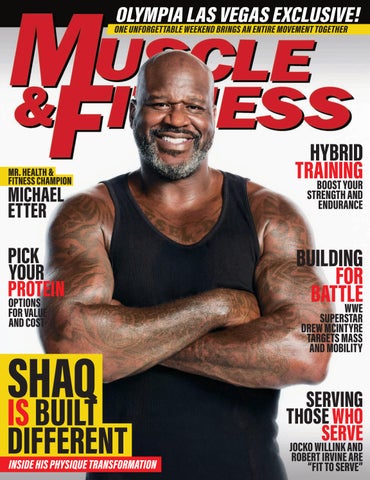
SHAQUILLE O’NEAL WITH RASHID “ROC” SHABAZZ
T
here’s a version of Shaquille O’Neal that the world fell in love with — the one who shook the floor of every arena he walked into, whose stature was so dominant that opposing coaches lost sleep over it. Four championship rings. An MVP. His spot in the Hall of Fame. But that barely does justice to what he actually was on the court. By almost any measure, the 7-footer from Louisiana State University was the most physically dominant force the NBA had ever seen. And then he retired. What nobody tells you about being one of the most physically imposing athletes in the world is what happens when the daily structure disappears. No training camp, no conditioning staff, no built-in reason to wake up at 5 a.m. and do the work. For years after he hung up his size 23s, O’Neal, by his own honest admission, let things slide. The weight crept up. He suddenly found himself winded just climbing a flight of stairs. He has never tried to hide any of it. That kind of honesty, frankly, is part of what makes O’Neal so universally admired in this chapter of his life. A highly sought-after endorser of brands. He’s as real as they come.
“I was really getting fat and really getting chubby,” he said in a podcast interview that made the rounds a couple of years back. His stated wake-up call? Catching a glimpse of himself on television next to Charles Barkley, his friend and longtime sparring partner on “Inside the NBA,” and realizing he was the bigger man in a way he had no interest in being. “My new mission,” O’Neal declared, “is my belly cannot be over my belt, ever.” It sounds like a punchline because, with O’Neal, everything lands with a sense of humor attached. But underneath the joke was something real. This was personal.
THE ACCOUNTABILITY PARTNER HE DIDN’T KNOW HE NEEDED
Anyone who has ever tried to get back in shape after years away from serious training knows that motivation alone will only carry you so far. At some point, you need someone in your corner who doesn’t care what your name is — someone whose job is simply to make you better, regardless of how famous or accomplished you are outside the gym. For O’Neal, that person is Rashid “Roc” Shabazz. FALL 2026 I MUSCLE & FITNESS I 63
64 I MUSCLE & FITNESS I FALL 2026
A former professional bodybuilder with a career built on discipline, Shabazz has become one of the most important constants in O’Neal’s current life. He doesn’t just meet O’Neal at the gym when it’s convenient. He travels with him wherever O’Neal goes — and given his schedule, that’s a long list of places. Shabazz is there, making sure that no amount of travel, late-night media commitments, appearances, or back-to-back obligations becomes an excuse to skip the work. The relationship between an elite-level trainer and a high-profile client is always about trust, but with Shabazz and O’Neal it runs deeper than that. Shabazz understands what it means to build a body through long-term commitment. He’s lived it. And O’Neal, who has spent his entire adult life surrounded by coaches, trainers, and conditioning staff, knows the difference between someone who is going through the motions and someone who genuinely expects more from you than you might expect from yourself. That combination — a man who spent his career being the biggest person in every room, paired with a trainer who doesn’t blink at that — has produced something real. The transformation has been gradual, but the results speak plainly. The goal O’Neal talks about most often, getting his body fat below 10%, joking about the shirtless photoshoot or the bodybuilding “posedown” that waits on the other side of it, isn’t as far off as it once seemed.
FRONT ROW AT THE MR. OLYMPIA
Like many things in O’Neal’s life, when he takes an interest in something, he goes all in. His love of muscle and physique transformation has made him a regular at the event widely considered the “Super Bowl of Bodybuilding.” Held annually in Las Vegas, the Mr. Olympia is the most coveted title in the world of bodybuilding, a sport with a passionate and loyal fanbase. O’Neal is among them. Olympia President Dan Solomon shares, “Shaq’s love of bodybuilding is real. He understands the technical elements of a world-class physique, and he follows the rivalries. But most importantly, he’s inspired many of his fans to follow him into this lifestyle. Shaq is one of us.”
WHEN YOUR BUSINESS EMPIRE DEPENDS ON YOUR BRAND
Here is where things get more interesting than a simple wellness story. O’Neal is not a retired athlete who dabbles in business on the side. He is, at this point in his life, a full-scale enterprise. And at the center of that enterprise is his relationship with Authentic Brands Group, one of the world’s most respected brand development and licensing companies — a partnership that has quietly become one of the most significant FALL 2026 I MUSCLE & FITNESS I 65
66 I MUSCLE & FITNESS I FALL 2026
business moves any former professional athlete has ever made. The story of how it happened is worth telling. Back in 2015, when Authentic came to O’Neal about acquiring his name and likeness, he did something that most people in his position would not have done. Instead of simply taking the money on the table, he asked if he could invest it back into the company itself. Authentic Founder and Executive Chairman Jamie Salter, regarded as the world’s most skilled operator in the discipline of licensing, said yes. That decision made O’Neal the second-largest individual shareholder in a company that now manages an astonishing portfolio of global brands: Reebok, Champion, JCPenney, and the intellectual properties of cultural icons like Elvis Presley, Marilyn Monroe, and Muhammad Ali, to name a few. Today, his role within Authentic goes well beyond shareholder. He was named President of Basketball Operations for Reebok in October 2023, and the results have been a genuine brand revival, highlighted by the kind of revenue growth that has the entire category paying close attention. O’Neal also pushed hard for Authentic to acquire Champion — and they did, in a deal that closed in 2024. His fingerprints are on some of the biggest moves the company has made, even if he will deflect the credit with characteristic modesty. To be clear, the work he does inside Authentic is real, and it requires him to show up, not just in a symbolic sense, but physically. He is the face, the credibility, and in many ways the soul of what makes these brands feel real to consumers who grew up watching him play. That presence only works if he takes care of the body that carries it.
THE HEALTH SCARE THAT CHANGED THE CONVERSATION
In the fall of 2025, O’Neal did something that might have surprised people who only know the version of him that analyzes NBA games and cracks jokes on national television. He went public about a serious health condition. Diagnosed with obstructive sleep apnea, a condition he had known about since 2011 but had not taken seriously for years, O’Neal stepped
forward as an advocate in a meaningful way, speaking candidly about how the condition had affected his life. He described lying down to sleep and feeling his airway partially close. He talked about the chronic fatigue that had followed him into retirement, that he had chalked up for years to the wear and tear of 19 NBA seasons. Turning 54 this past March has given O’Neal a different kind of perspective. The invincibility that comes with being physically elite for so long has a shelf life. What replaces it — if you’re lucky and you do the work — is something more durable: actual knowledge of your own body, and the willingness to respond to what it tells you. That combination of vulnerability and discipline is something his platform allows him to carry to a very wide audience. Thirty million Americans live with obstructive sleep apnea, many of them undiagnosed. When O’Neal talks about choking in the middle of the night and finally deciding to do something about it, people listen in a way they might not listen to a standard public service announcement.
THE BIGGER PICTURE
What O’Neal is building in this chapter of his life — the fitness commitment, the business empire, the health advocacy — is not a collection of separate things. They are expressions of the same understanding that the work is never really done, and that the people who last are the ones who keep showing up. He’s had help arriving at that understanding. Shabazz, his trainer-turned-brother, has been a steady, demanding, non-negotiable presence in that process — the kind of accountability partner who earns respect not by being soft, but by being consistent. Because of that relationship, no travel schedule, no broadcasting obligation, no appearance, no business responsibility becomes a reason to skip the work. O’Neal recently partnered with Nutricost to promote affordable, high-quality vitamins and workout supplements, including a series of cobranded products coming this fall: electrolytes, pre-workout and vitamin packs driven by O’Neal’s desire to offer an all-in-one, affordable vitamin solution that simplifies daily supplementation. “Longevity is the goal now,” O’Neal explains. “I want to be moving well, feeling strong, and showing up for the people in my life for as long as possible — and that starts with what you put in your body. My creatine and protein products are part of how I stay consistent and make sure I’m recovering and performing the way I want to.” The man who once dominated every court he stepped onto has found something that might be harder than any of it: the discipline to take care of himself. Not for a championship run, but for something bigger. For his family, for the brands that carry his name, for a legacy that extends far beyond the billionaire badge that he may soon wear. Legacies as large as O’Neal’s require more than talent. It requires showing up day after day and doing the work, with a trainer who won’t let him off the hook, a business portfolio that demands his best, and the self-awareness to understand that who you become off the court matters more than anything you ever did on it. “The Big Aristotle,” it turns out, is still learning, still improving. And that might be the most inspiring thing about him. FALL 2026 I MUSCLE & FITNESS I 67
68 I MUSCLE & FITNESS I FALL 2026
BY JENNY DE SOUZA PHOTOGRAPHY COURTESY OF JW MEDIA LLC
very great movement has a gathering place. A moment on the calendar when they come together, unified by a shared lifestyle and a shared passion. For this movement, that place is the Olympia. And in 2026, it’s become something bigger than it’s ever been. Under the direction of owner Jake Wood, President Dan Solomon, and a dedicated team, the Olympia has stopped asking how to run a great event. It’s now asking a better question: How do you build an experience worthy of the people who show up for it? Not just the champions under the lights, but the fans who travel from cities around the world: the coaches, the media, the families, the kid in the crowd who hasn’t told anyone yet that someday, that stage will be theirs.
FALL 2026 I MUSCLE & FITNESS I 69
THE PALMS CASINO RESORT IS READY TO HOST
The Palms Casino Resort, reborn through a $700 million transformation, becomes the official host hotel of Olympia Weekend. But this is more than a hotel choice. It’s a place where legends and first-timers can share the same elevators, the same energy, the same electric sense that they’re standing inside history while it’s being written. The main stage Finals move to the Orleans Arena. More seats, more price points, and a more jaw-dropping stage. For an event that keeps growing, an arena is a fitting backdrop.
DEREK
L UNSF ORD
AN EXPO THAT DREAMS BIGGER
The Olympia World Fitness Expo takes over the Las Vegas Convention Center’s South Hall, and if you’ve never felt an expo floor hum with thousands of shared heartbeats, it’s time. This is where the industry’s future gets built and celebrated. Where you’ll shake hands with athletes, celebs, and creators you’ve followed for years. Where powerlifters, models, bodybuilders, athletes, brands, and dreamers collide in the most highimpact room in fitness. This is where the movement connects.
JA ME S BE R G E R
VEGAS, HOME SWEET HOME
For more than 25 years, Las Vegas and the Olympia have pushed each other to think bigger. This city was built on the belief that spectacle and ambition deserve a home, and no event embodies that belief like this one. When the lights hit the stage in September, it leaves no doubt where the industry’s most prestigious experience belongs.
THIS ONE’S FOR YOU A category-leading $2 million prize pool, 12 IFBB pro-sanctioned divisions, along with a slate of world championship experiences, and a global audience. But the vision behind 2026 goes beyond the numbers. It’s about every person who arranges their life around a barbell and a belief. Every attendee who saves all year for one unforgettable weekend. The Olympia isn’t being built for you. It’s being built with you, because you’re the reason it exists. The future of this movement doesn’t arrive on its own. It arrives when we all show up for it. Together. For tickets, schedules, and travel details, visit MrOlympia.com. 70 I MUSCLE & FITNESS I FALL 2026
M AU
REEN BL A NQUIS C O
RYAN TERRY EDUARDA BEZERRA
AMERICA’S #1 CREATINE GUMMY. BORN ON .
5G OF CREATINE. ZERO SCOOPS. ZERO EXCUSES.
M&F
MR. H&F
72 I MUSCLE & FITNESS I FALL 2026
M
r. Health & Fitness unites fitness enthusiasts nationwide in a celebration of confidence and determination, inspiring competitors to advocate for themselves and rally around a worthy cause. This online competition is operated by Colossal (colossal.org), the nation’s leading professional fundraiser for purpose-driven competitions, on behalf of Action Initiative Team, a U.S. 501(c)(3) charitable organization. Through the 2026 Mr. and Ms. Health & Fitness competitions, Colossal proudly raised over $4.9 million for AIT, which granted funds to The Andrew McDonough B+ Foundation (bepositive.org), a nonprofit that provides financial and emotional support to families of children with cancer nationwide and funds critical, cutting-edge childhood cancer research.
CHAMPION
At 4 a.m., downtown West Palm Beach is still asleep, but inside 30 Strong Fitness Studio, the lights are on, and Michael Etter is already training before the sun rises. For Etter, fitness is about building discipline through structure, faith, and consistency. It is the kind of thing that is built quietly over decades — not posted online for validation, but practiced daily. The 40-year-old father of two has centered his life around purpose, family, and helping others become stronger from the inside out. “Jesus is number one in my life,” Etter says. “I’m everything with Him and nothing without Him.” His faith motivates him before the day begins, and the rhythm of being a parent and a business owner settles in. His morning routine of training and prayer prepares him for everything that follows. If you ask him where it all started, the answer is uncomplicated. Back when he was a 13-year-old with zero confidence and no muscles, he bought a cheap weight rack and an Olympic barbell with a few plates, and got to work. This no-excuses mentality defines his training style to this day. Etter trains every day, splitting muscle groups with militarylike precision: shoulders, traps, triceps, back and biceps, legs, and abs. His sessions are brutally efficient with short rest periods, controlled reps, drop sets, and several reps beyond failure, while keeping proper form. To most people, it sounds exhausting. To Etter, that’s the point. “For me, it’s mental,” he explains. “I train to get uncomfortable every day. The physical results follow.” That philosophy guides 30 Strong Fitness Studio, the gym he owns with his brother in downtown West Palm Beach. He credits much of the studio’s growth to the vision and work ethic they have built over the years. The studio focuses on smallgroup and one-on-one training using free weights and functional strength work, a simple approach he believes is underrated in today’s trend-driven fitness culture. While social media feeds are full of gimmicks and shortcuts, Etter remains unapologetically old school: lift heavy weights and train hard. “Free weights and strength training will always be the best way to burn fat and build lean muscle,” he says. “The basics work.” FALL 2026 I MUSCLE & FITNESS I 73
M&F
MR. H&F
Etter’s approach to nutrition is just as simple and disciplined. He eats six meals a day, packed with protein. Eggs are his main protein source, with steak or salmon added strategically. Cream of wheat is a major player, as well as protein shakes twice a day. By evening, there are no carbs, just large salads topped with olive oil, red vinegar, and Mrs. Dash seasoning. There is no dramatic “cheat day” or overcomplicated biohacking, just the basics. His pre-workout routine is a cold shower, meal prep, water, a double espresso, and motivational audio from David Goggins. He recently added skydiving to his repertoire, beginning his Accelerated Freefall certification, with plans to earn his solo license soon. But beyond his sharpedged routine, Etter prioritizes family time, spending quality time with the people who matter most. He embraces fatherhood. Watching his kids compete in sports, grilling by the pool, fishing with his son, and ice skating with the family are some of his favorite activities. This willingness to step far beyond his comfort zone is what drew Etter to the Mr. Health & Fitness competition in the first place. Though he’s never
Free weights and strength training will always be the best way to burn fat and build lean muscle. The basics work. - Michael Etter
formally competed in bodybuilding, he viewed it as an opportunity to grow while supporting an important cause. Now representing the title, he approaches it with the same humility as his life. “I feel honored, grateful, and blessed,” he says. The most compelling thing about Etter isn’t his training volume, unrelenting discipline, or highly developed physique. It is the perspective behind the pursuit. He says he previously tried to do life entirely on his own, but that approach didn’t work. Things changed when faith became the foundation rather than an afterthought. “For me, it’s about a relationship,” he says. “Jesus is at the door waiting. You just have to open the door.” Now, stronger than ever, he is someone who truly lives out the principles he preaches and helps people become stronger, both mentally and physically. These fundamental values stem from his parents, whom he deeply appreciates for providing unconditional support and helping shape the man he’s become. Etter’s message is refreshingly uncomplicated. Show up for yourself and stay disciplined. Welcome the discomfort and keep going because there are no shortcuts. Strength like Etter’s is earned one rep, one prayer, and one early morning at a time. 30strongfitnessstudio.com Instagram: @30strongfitnessstudio
74 I MUSCLE & FITNESS I FALL 2026
the world’s leading M&F's healthmilitary & fitness fitness series MAGAZINE Dedicated to the men and women who serve this country.
www.muscleandfitness.com/ muscle-fitness-fit-to-serve/
Nick Lavery: The Green Beret Who Defied Death and Medical Science on M&F YouTube
M&F
MR. H&F
RUNNER-UP
TOMMIE LEE LANDRUM At 56, Tommie Lee Landrum continues to impress with bursting energy built on decades of dedication. Born in Mississippi, Landrum is now based in Dallas, where he runs Gettin’ It Fitness, a thriving studio gym built on his 32 years of coaching experience. His journey here began early, drawn in at just 12 years old when he found a lifelong passion for improving his strength, performance, and mastery. A former professional football player and longtime powerlifter, Landrum has also spent 15 years competing in bodybuilding, earning top placements across the NPC circuit. Even now, he continues to chase the stage, with sights set on the 2026 NPC North American Championships. His philosophy is simple but uncompromising: no days off. Rising at 2 a.m., Landrum structures his days around coaching, training, and refining his own physique, as well as helping his clients refine theirs. Precision, consistency, and proper form are his foundation, while clean nutrition and disciplined living reinforce it all. Landrum’s passion is tangible. Whether you meet him in person at his gym or join him for virtual coaching, he is accepting new clients and ready to help them realize their potential. TikTok: @gettinitfitness Instagram: @gettinitfittx
76 76 II MUSCLE MUSCLE&&FITNESS FITNESS II FALL FALL2026 2026
THIRD PLACE
RICKY DURANT
From the oil industry to the bodybuilding stage, Ricky Durant is living proof that strength is most powerful when it’s used to help others. Originally from Puerto Rico and now based just outside of Houston in League City, Durant wears many hats: husband, father of two daughters, leadership coach, entrepreneur, and advocate for self-improvement. Alongside his wife, Durant spent the last decade building global network marketing organizations that have generated over $250 million in team sales, while helping others gain financial freedom. Behind the empire is a man firmly anchored in faith, family, and fitness. Fitness has been a lifeline for Durant, serving as his therapy and a foundation for his mental health. A former powerlifter who transitioned into competitive bodybuilding, he earned third place at the 2014 Branch Warren Classic. Throughout the experience, Durant discovered that the true reward was personal transformation. Today, at 46, he continues to train consistently. What keeps Durant going is a mindset centered on selfempowerment. He relies on structure and good habits to stay on track when life gets busy. Whether he’s mentoring entrepreneurs, putting family first, or preparing for competition, his mission remains the same: to lead by example and help others realize their potential. Through fitness, business, and future nonprofit ambitions focused on housing and clean water initiatives, Durant is strong enough to help push the world forward. Facebook: @elevatingothersbravely
FALL 2026 I MUSCLE & FITNESS I 77
T
BY ASHLEIGH ATKINSON, MHK 78 I MUSCLE & FITNESS I FALL 2026
echnically, cardiovascular activity is anything that raises your heart rate, including powering through a tough 8-rep max at the squat rack or sweating through a session of battle ropes. In a more traditional sense, most people think of activities like running, walking, biking, or even climbing the dreaded stair mill when they hear the word “cardio.” Steady-state cardio (SSC) refers to those traditional activities, but don’t let the name “steady state” mislead you. Just because it’s performed at a consistent, moderate pace doesn’t mean it’s ineffective or easy. This form of exercise can be incredibly effective in boosting fat loss, and the output should still be challenging to improve your fitness level. In the intensity spectrum, cardio protocols are often referred to as either low-intensity steady state (LISS) or highintensity interval training (HIIT). Falling between these two is moderate-intensity steady state (MISS), which is a form of exercise done at a consistent, moderate intensity for a sustained period of time. Generally, these sessions keep a stable heart rate around 60–70% of your max, where you sweat but can carry out a conversation for an average of 30 minutes.
DON’T MISS OUT As a fitness enthusiast, you know there are
countless benefits to being active. But some forms of exercise, like SSC, are even more beneficial for an athlete. One of the most beneficial attributes of SSC is its low impact on the body. This lower level of physical exertion allows the body to recover quickly, or possibly not have to recover at all. When you free up your body’s need for recovery from cardio work, it can focus on recovering from your other activities, like strength training or sport-specific drills. There is a limit to how much a body can recover from between sessions, and reducing the need to recover from cardio can help ensure your system is primed for your next serious workout. SSC demands little recovery, and it can actually help support recovery from your other training modalities, too. This form of exercise is referred to as “active recovery” and is commonly used by athletes on their rest days to help alleviate muscle soreness. Compared to complete rest, SSC increases blood flow throughout the body, which results in a boost of oxygen and nutrients being delivered to your muscles — both of which are imperative to the recovery process. Plus, increased blood flow helps remove metabolic waste, like lactic acid, which can build up after an intense training session. Due to its low impact, SSC can be implemented regularly as active recovery in your training plan. If you’re looking to drop some body fat, don’t overlook the power of adding MISS sessions to your weekly schedule. The simple act of adding more output to your routine can help shift your caloric balance into a deficit for weight loss. When done at a challenging level, SSC can produce a strong calorie burn
per minute, without making you feel depleted like a HIIT session can. Due to its low impact, you can add these sessions to your week with more frequency to boost your caloric output as needed. When it comes to the risk of injury, SSC is on the low end. Due to the low impact, you’re at less risk of an acute injury, such as a sprain or muscle strain. And, with numerous modalities to choose from, you can alternate the form of cardio you do, which can help prevent overuse injuries.
GET SWEATING Once you’re sold on adding more steady
state to your fitness program, be sure to start with the lowest intensity, frequency, and duration that yield results and build from there. Pay attention to plateaus and change the intensity and duration of your sessions if a plateau lasts longer than two weeks. By starting on the lower end of output, you leave yourself a lot of room to increase through longer or harder sessions, or more sessions
per week. Always remember that the best approach is to get the most results from the least amount of output before adding on — less is more. While some people thrive on SSC, like triathletes and endurance athletes, others may despise the mundanity of the sessions. If you want to reap the benefits but struggle getting through a session, enlist the entertainment of an audiobook, a killer playlist, or find a series to stream if you can watch a screen. If your modality of choice supports it, you could also use the time to review work notes or study for a test; in this case, the time is doing double duty, boosting your fitness level while being productive. A final selling feature of SSC — and really, of all forms of exercise — is the positive mental impact it can have on you. The release of endorphins that occurs after exercising has a natural calming effect on the body and mind, which can reduce feelings of stress and anxiety. Lace up those shoes and get your heart pumping — at a moderate rate.
FALL 2026 I MUSCLE & FITNESS I 79
PREMIUM DESTINATION RETREATS FOCUSED ON HEALTH THROUGH FITNESS, NUTRITION, RECOVERY, AND THERAPIES.
BY KLAUDIA BALOGH
A
80 I MUSCLE & FITNESS I FALL 2026
new class of retreats is redefining what it means to “get away.” The longevity boom has taken over tourism, and travelers are all in on vacations that turn back their biological clock. However, amid research, untangling conflicting reviews, and logistics, planning a trip might feel overwhelming for many. Hence, these destinations are a bucket-list escape to treat your body, mind, and soul. Their programs are personalized, evidence-based, and data-driven, so you’ll go home feeling measurably better, perhaps even younger. Whether it’s meals built around your metabolic data on the Riviera Maya, an immersive retreat in the Amazon Rainforest, 200-plus biomarkers examined over four days at a Michelin Keyawarded location, or arctic dips through the Nordics, the planning has been done for you. All that’s left is showing up.
CREDIT: SHA MEXICO
SHA MEXICO
SHA Mexico is a luxury resort and wellness clinic on the Riviera Maya coast in Cancun. With scores of preeminent medical experts on site, from functional medicine physicians and psychotherapists to nutritionists and physical therapists, personalized medicine takes on a whole new meaning during your stay. SHA’s programs apply a fully integrated approach, looking at the body as an interconnected web of intelligent systems. Each guest’s stay begins with a thorough health assessment to establish their baseline status. Then they receive a personalized agenda of treatments to address areas of improvement. While there are many spa-like options rooted in ancient Ayurvedic traditions, SHA also offers cutting-edge modalities such as ozone IV therapy, light therapy, radio frequency therapy, hypoxia training, and more. Nutrition is treated with the same clinical rigor as everything else. Meals are prescribed to each guest based on their program goals, built around an anti-inflammatory diet of organic, seasonal, and locally sourced ingredients. The sense of luxury shows up both in grandiose and subtle ways, reminding you that your health deserves that level of care and precision.
CREDIT: SHA MEXICO
CREDIT: SHA MEXICO
CREDIT: CANYON RANCH
CREDIT: CANYON RANCH
CANYON RANCH
Few wellness destinations have earned the institutional trust that Canyon Ranch has built over four decades. Michelin Keys awarded to both its Tucson and Lenox locations suggest the hospitality world has caught up with what wellness travelers already knew: what makes Canyon Ranch worth the conversation is its breadth. Go solo for the flagship LONGEVITY8 program. It encompasses four days, 18 expert consultations, and 200-plus biomarkers examined, including VO2 max, a DEXA scan, carotid ultrasound, continuous glucose monitoring, sleep screening, musculoskeletal assessment, and more, with a personalized blueprint and six virtual follow-ups waiting for you at home. Go as a couple for relationship-focused retreats that run from intimacy workshops and licensed therapist sessions to shared spa days and aquatic experiences. And if you want to tackle a weight loss plateau, Canyon Ranch offers programming that’s built around diagnostic insights, behavioral coaching, and nutrition plans that help you get over that hump. FALL 2026 I MUSCLE & FITNESS I 81
DAVE ASPREY EXPERIENCES
Dave Asprey’s immersive retreats run as part of the Unlimited Life program and are built to show you the path back to yourself through some of the most remote, electrically charged places on Earth. These retreats draw a specific kind of person: high-performers, deep thinkers, people who’ve read the books and are ready to do the work in a room full of others doing the same. Set in an Ecuadorian Amazon luxury lodge and an East African private sanctuary, programming weaves superfood-focused dining, yoga, breathwork, cacao ceremonies, cold plunges, sweat lodge experiences, and shamanic rituals. There are also interactive workshops led by Asprey and co-hosts Dr. Tim Cook and Marc Kielburger on longevity science and living a fulfilled life. The community that forms in the Amazon rainforest in Ecuador or the white sand beaches in Kenya outlasts the retreat itself, which, if you ask most alumni, turns out to be one of the most valuable things they take home.
CREDIT: DAVE ASPREY EXPERIENCES
Resetting your nervous system may sound easier said than done. Years of chronic stress, trauma, and overload can lock the body and mind into survival mode. And that single dysfunction tends to explain the sleep crashes, hormone havoc, and mystery aches that most doctors can’t trace to a source. However, when you hand that reset over to experts in a setting that puts your mind at ease, it becomes less of an uphill battle. With the jungle on one side and the ocean on the other, Rēset’s immersions address everything a dysregulated nervous system has been wrecking. Operating out of a hilltop villa above the Pacific in Sayulita, Mexico, this program combines a research-backed blend of neuroscience, psychology, and functional medicine. Think QEEG brain mapping, neurofeedback, heart rate variability training, mitochondrial activation, trauma release exercises, cold thermogenesis, breathwork, and programs covering pillars from sleep optimization to emotion and integration workshops. Programs run five, 10, or 21 days, depending on how long you’ve been running on empty. 82 I MUSCLE & FITNESS I FALL 2026
IMAGES CREDIT: TRISARA RESORT
TRISARA RESORT
Whether your version of destressing is an intense Muay Thai session, a beach bootcamp, mat Pilates, or a relaxing Thai massage, Trisara Resort in Phuket has you covered in a breathtaking setting. The resort’s private pool villas and residences look out over panoramic sea views, while the jungle presses in from behind. The same luxury carries through to its cuisine. Chefs source directly from local farmers and fishermen, translating Thailand’s rich culinary heritage into nourishing, thoughtfully prepared plates. Wellness here spans fitness assessments, functional training, tennis, and nature walks on one end, and deeply restorative integrative bodywork on the other. All are anchored in thousands of years of Thai healing traditions.
UP NORWAY
IMAGES CREDIT: UP NORWAY
84 I MUSCLE & FITNESS I FALL 2026
Scandinavia has topped the World Happiness Report for years, and this journey lets you live it firsthand. Up Norway’s 15-day Nordic Wellness itinerary slow-travels through Copenhagen, rural Sweden, Oslo, the fjords, and the island archipelago of Austevoll for an immersive, cultural experience. The itinerary earns its price at every stop: bikes and Tivoli tickets in Copenhagen, a full-day excursion to the Forest Tower in South Zealand, Michelin-starred dinners at an organic vineyard in a Swedish forest, and even a private session with an Oslo sleep therapist. Not to mention a full day at The Well, the Nordics’ largest spa oasis, rowboats on the Aurlandsfjord under open mountain sky, and a delicious dining experience on an island with no road to the mainland. Plus, saunas and arctic dips thread through the whole journey. The Norwegians even have a word for the restorative power of time spent outdoors: friluftsliv. Fifteen days in, you’ll no longer need it translated.
Scan or shop at: STEELFITUSA.COM © 2026 SteelFit®. All rights reserved. Creapure® is a registered trademark of Alzchem Trostberg GmbH, Germany. Reg. #2,715,915.
T
his may come as a shock, but not all protein is created equal. And not all protein advice is created for your budget. Spending a lot of time in the world of performance nutrition, cooking for athletes, coaching clients, and talking to people who want to train hard and eat smart, one question comes up more than any other: how do I hit my protein targets without wrecking my wallet? The honest answer is that most people overcomplicate it. They chase the trendy protein sources while ignoring the workhorses sitting right in front of them. When you cut through the noise, you can break it down three ways: which foods pack the most protein per gram of food, which give you the most protein for your calorie budget, and which give you the most protein for your actual dollar. Here’s how to think about protein in a way that could change how you shop, cook, and eat.
86 I MUSCLE & FITNESS I FALL 2026
THE PROTEIN ON YOUR PLATE
When people talk about protein content, they often cite raw numbers. But what matters is what ends up on your plate after cooking. Heat removes water and shrinks volume, so these figures reflect cooked, readyto-eat portions — what you’re actually eating, not what went into the pan. Ranking foods this way helps you understand real-world protein density. If you’re building a meal and you want the highest return per bite, this is your guide:
. . . . .
Chicken breast: 31g protein per 100g cooked Canned tuna: 29g protein per 100g Skirt steak: 27g protein per 100g cooked Tempeh: 19g protein per 100g Whole eggs: 13g protein per 100g cooked
Chicken breast wins on raw density, but the other options aren’t far behind — and they each bring different nutritional profiles and culinary versatility. Canned tuna is particularly underrated: it’s ready to eat, shelf-stable, and delivers nearly as much protein per bite as a cooked chicken breast.
MAXIMUM MUSCLE, MINIMUM OVERSHOOT
This is the metric that changes everything for people tracking their intake. When you measure protein per 100 calories, you’re
asking a different question: which foods give me the most muscle-building return without bringing a lot of extra baggage in the form of fat or carbohydrate calories? These options give you the flexibility to hit your protein needs while keeping the rest of your plate balanced:
. . . . .
Whey protein isolate: around 23g per 100 calories White fish (cod, tilapia): around 20g per 100 calories Egg whites: around 11g per 100 calories Non-fat Greek yogurt: around 10g per 100 calories Chicken breast: around 9g per 100 calories White fish is the sleeper here. It’s lean, mild, easy to cook, and incredibly versatile. Non-fat Greek yogurt doubles as a recovery food and a cooking ingredient — great in sauces, marinades, and as a base for dressings. These foods give you the flexibility to hit your protein needs while keeping the rest of your plate balanced.
BEST PROTEINS FOR THE PRICE
This is where things get real. The fitness industry has done a good job of making protein feel expensive, but the most effective protein sources are usually the most affordable. Here are the approximate costs to get roughly 25 grams of protein from different sources, based on U.S. average grocery prices: FALL 2026 I MUSCLE & FITNESS I 87
EAT
FROM SCRATCH
. Eggs: $0.85 . Canned tuna: $1 . Whey protein concentrate: $1.05 . Tofu: $1.20 . Bone-in chicken thighs: $1.25
Eggs are the undisputed champion of protein value. They’re a complete protein source containing all nine essential amino acids, fast to cook, endlessly versatile, and inexpensive enough to eat every day. Canned tuna is the other workhorse — buy in bulk, drain, and you have ready-to-eat protein with zero prep time after training. A note on chicken thighs: bone-in is significantly cheaper than boneless breast, and the higher fat content means more flavor. Shop local, buy in bulk when you can, and freeze what you won’t use in the next two days. These small habits stack up to meaningful savings over the course of a month. 88 I MUSCLE & FITNESS I FALL 2026
A SIMPLE FRAMEWORK
Most people don’t need to optimize all three lists simultaneously. Use this as a decision framework based on what you’re trying to solve:
.
Maximum protein density in a meal: lean on chicken breast, canned tuna, or skirt steak. Managing calories carefully: build around white fish, egg whites, and non-fat Greek yogurt. On a budget: eggs and canned tuna are your anchors. Add tofu or chicken thighs to rotate the flavor.
. .
The people who actually hit their protein targets long-term aren’t the ones with the perfect protein powder. They’re the ones who figured out five or six affordable, delicious meals they can make on repeat — and made those meals a habit. That’s the real hack.
OFFICIAL OLYMPIA SPONSOR
Business Article
YOUR GYM is OUR OBSESSION First in Europe
established in 2008
We are the official European representative of NEWTECH, and we built the first Olympiaapproved gym in Europe. This September, we're equipping the UK's first Olympia-approved gym. Our work stands at the Kathi Béla – The Legend gyms in Szeged, Budapest and Debrecen, at FIBO, and on the Mr. Olympia stage.
THE STORY OF THE GYMMAKERS In 2008, our founder and competitive bodybuilder Romeo Balogh-Wittman was preparing for the World Championships when an accident left him paralyzed from the waist down. Since then he has channelled that same drive that fueled his ambitions into one mission: building better gyms around Europe.
INFO@GYMMAKERS.EU
gymmakers.eu
LET'S BUILD We design and build training environments created by people who understand bodybuilding from the inside. Our warehouse covers 21.000 m2. Let's build your gym.
BY KAT TODOROVIC
I
n a time where GLP-1s, peptides, and the latest legalized weight-loss systems run the gamut, it’s easy to forget that nutrition still does most of the heavy lifting, especially when counting calories. Whether you’re prepping for a bodybuilding show, entering a cut phase, or simply wanting to lose a few pounds, the right food choices can make or break your calorie deficit. Thankfully, this guide shaves the extra decision-making weight off your plate by offering simple food swaps that promote gradual fat loss. Not to mention, with great taste in mind, making it easier to stay consistent in the long run.
THE COMEBACK CARB
White rice has long been the dieting carbohydrate of choice, but a new root on the block has swept the nutrition world by 90 I MUSCLE & FITNESS I FALL 2026
storm, and it’s a classic: the russet potato. One cup of cooked white rice contains about 170 calories, while one large russet potato clocks in at 160 calories. While 10 calories may not seem damning, the potato offers considerably more volume and satiety, keeping your fears of another potato famine at bay for just a little longer.
DAIRY, AT LONG LAST
Dairy is not the devil, contrary to popular belief, and powerhouse brands like Fairlife prove it. Ranging from skim to whole milk, Fairlife’s unfiltered options compare favorably with their traditional dairy counterparts. One cup of its skim milk contains 80 calories, 13 grams of protein, and 6 grams of carbohydrates, compared with traditional skim milk, which houses around 90 calories, 8 grams of protein, and
12 grams of carbohydrates. The exchange is a no-brainer, and Fairlife’s lactose-free nature makes it even easier on digestion.
NOT YOUR MOTHER’S ATKINS DIET
Crunchy snacks come in many forms, and vegetables like cucumbers or bell peppers can be a fresher, lower-calorie alternative to processed options like chips or crackers. While this swap isn’t intended to appease the almond moms, nor is it revolutionary, those veggies are especially tasty in culinary combinations, like dipping them in cottage cheese with everything bagel seasoning sprinkled on top. If you close your eyes and squint just enough, it’s almost like you’re eating Trader Joe’s iconic Everything but the Bagel Seasoned Bite Sized Crackers. Almost.
BERRIES OR BUST
The name of the game, really, with any produce is volume. When it comes to fruit specifically, options like strawberries or blackberries offer more bang for your buck from a caloric standpoint. One medium banana has around 105 calories, while you can indulge in roughly 2 to 2 1/2 cups of strawberries for about the same calories. Not to mention, a banana can be annihilated in just a few bites. Bushels of berries can keep you preoccupied for longer, which proves especially valuable when you find yourself wanting to go to bed at 4 p.m. because you’ve already hit your daily calorie allowance.
A 93/7 COMPROMISE
If you eat meat, one of the easiest tradeins is choosing leaner options of the cuts you already know and love, especially beef. A 4-ounce serving of 80/20 ground beef contains around 287 calories, 19 grams of protein, and 23 grams of fat. It’s leaner 93/7 cousin has approximately 172 calories, 24 grams of protein, and 8 grams of fat. Yes, it’ll taste leaner. There’s no denying that. But beef is still beef, and a nearly imperceptible switch like this is about as mindless as it gets while keeping calories low and protein high.
THE OIL EXCHANGE
There are plenty of practically invisible calorie cuts you can make with items readily accessible at most grocery stores. Arguably, the easiest is cooking oil. And while fats aren’t the enemy, they do pack a severe caloric punch in any meal. One tablespoon of olive oil contains around 120 calories, and when measuring with your eye, who knows how much damage that’ll do. Oil sprays from brands like Primal Kitchen or Chosen Foods now provide a lower-calorie avocado oil alternative, making it harder to overdo it — unless you’re treating the pan like you’re tagging a building. Don’t do that.
FAVORING THE FUN FOODS
Dieting isn’t easy, so thankfully, just about all the “fun” foods — usually heavily processed items like sodas, dressings, and sauces — have tasty sugar-free or diet alternatives. Dressings and sauces, in particular, can jack up any meal’s calorie count quickly, but options like Ray’s No Sugar Added Barbecue Sauce or any of Bolthouse Farms’ yogurt dressings slash those numbers substantially without sacrificing flavor.
PLATING IT TOGETHER
Most of these swaps prioritize volume, protein, and lower calories without completely overhauling your diet. And if you’re in a pinch at the grocery store, keep an eye out for labels touting low-fat, sugarfree, reduced sugar, or low-carb, as those products tend to lighten the caloric load. At the end of the day, getting lean requires consistency over perfection, and the small changes from this guide will add up far more over time than any crash diet ever could. It’s just like they say: everything in moderation, meaning there’s still room for the occasional full-fat Cesar dressing or decadent chocolate fudge cake.
When it comes to fruit specifically, options like strawberries or blackberries offer more bang for your buck from a caloric standpoint.
FALL 2026 I MUSCLE & FITNESS I 91
n the quest for lean muscle gains, gut health is often overlooked. High-protein diets containing very little variety, fiber, and micronutrient-dense foods currently rule the fitness landscape, setting up many fitness enthusiasts and athletes for gut health issues down the road. The scientific literature backs this notion. Increasing numbers of very fit individuals and pro athletes are coming to health specialists seeking help with symptoms of poor gut health caused by diets lacking essential guthealthy components.
Signs that you have gut health issues: 1. You have symptoms of irritable bowel syndrome (IBS), such as abdominal pain, bloating, and issues with bowel movements: constipation, diarrhea, or a combination. 2. You have food sensitivities — not to be mistaken for allergies — that cause gas, bloating, abdominal pain, and diarrhea. Research has linked the development of food sensitivities to microbial dysbiosis, which triggers immune responses and subsequent inflammation. 3. You feel generally inflamed, tired, and foggy. 4. You have recently experienced unexplained weight gain. 92 I MUSCLE & FITNESS I FALL 2026
Studies indicate that harmful opportunistic microbes such as E. coli and B. fragilis activate the immune system and trigger inflammatory responses when there is a lack of diversity among the various strains of beneficial bacteria. In fact, scientists have discovered that chronic inflammation-related diseases are frequently accompanied by gut dysbiosis.
GUT-MUSCLE AXIS
The gut microbiota interacts with our muscles. Through this interaction, gut health is significant in muscle function via its role in inflammation, immunity, energy metabolism, and insulin sensitivity. As a result, one’s state of gut health is related to exercise performance and state of well-being.
If you are focused on building muscle, you should do everything you can to optimize your gut health. After all, a healthy digestive tract assures you are processing, digesting, and absorbing all the nutrients from the food you consume. This becomes most important when we are looking to build a lean muscular physique, as poor gut health means poor absorption of nutrients, increased inflammation, and immune system compromise.
GUT MAINTENANCE
There are an estimated 100 trillion microorganisms in your body. These bacteria, known as microbiota, inhabit your skin and all your body’s orifices. However, most of these microbes reside in your digestive tract. Maintaining a diverse, dense, and healthy balance of gut bacteria is essential to the
quality of life, as a robust microbiota plays a crucial role in maintaining your overall wellbeing, including muscular health. When gut bacteria become imbalanced, a condition known as dysbiosis, they frequently cause intestinal inflammation by turning on immune system processes that promote inflammatory signaling. This low-grade inflammation can cause increased intestinal permeability, also known as leaky gut syndrome. A lack of microbial diversity in the gut sets the stage for inflammation. In leaky gut syndrome, inflammatory endotoxins like lipopolysaccharide “escape” the digestive tract and circulate in the blood. This leads to systemic inflammation, a condition that promotes muscle loss, weakness, and damage to muscle fibers, not to mention a plethora of health issues.
In the gut, non-digestible fibers are fermented by our colonic microbiota. This fermentation process produces short-chain fatty acids (SCFAs) acetate, propionate, and butyrate. Regular exercise also increases SCFA production, which is associated with enhanced physical performance. Most SCFAs are absorbed through the digestive tract and contribute to energy metabolism. Colonic epithelial cells largely utilize butyrate as an energy source. In addition to being digested in muscle tissue, acetate can penetrate the blood-brain barrier to improve cognitive performance. Furthermore, the liver can utilize propionate as a precursor for glucose production. In addition, SCFAs increase the integrity of the intestinal barrier, minimizing the risk of local and systemic inflammation caused by a leaky gut. Strong evidence from preclinical investigations suggests that SCFAs may be important modulators of physical performance.
FALL 2026 I MUSCLE & FITNESS I 93
THE EXERCISE, MUSCLE, AND GUT CONNECTION
Human exercise studies indicate that regular physical activity modulates the composition of the gut microbiota and, conversely, the gut microbiota plays an essential role in physical performance. Overall, the composition and metabolic activity of gut microbiota aid in the digestion of foods and improve energy utilization during exercise, which provides metabolic benefits for athletes during high-intensity exercise and recovery. Studies demonstrate that the metabolic activity and pathways associated with amino acid and carbohydrate metabolism are more efficient in those with healthy gut microbiota compared with those who are sedentary and/or have gut health issues. Here are three simple science-backed things you can do to improve your gut health: 1. EAT MORE FIBER The body digests most types of carbohydrates, like sugars and starches, into absorbable simple sugars that we use as energy. On the other hand, fiber passes undigested through to the large intestine, where it adds bulk to stool and, in the case of fermentable fiber, becomes food for the beneficial bacteria that colonize the gut. Fermentable types of fiber are called prebiotics. Although fiber has numerous proven health benefits, very few people meet their daily fiber requirements. Foods with high fiber: • whole grains (whole wheat products, oats, barley, popcorn, wild rice, etc.) • legumes (beans, lentils, peas, edamame) • nuts/seeds (chia seeds, flaxseed, pumpkin seeds, almonds, pistachios, walnuts, etc.) • most fruits and berries • most vegetables
When aiming to improve your fiber intake, use many different fiber sources and introduce them slowly. Ideally, men should consume more than 38 grams of fiber per day, while women should aim for more than 25 grams daily. It’s also vital to track how much water you’re drinking. If you eat extra fiber but don’t drink enough water, your stools will become overly dry, which will cause or worsen constipation. To avoid this, drink 3-4 liters of water daily. 2. CONSUME PREBIOTIC DIETARY POLYPHENOLS Like fiber, compounds from food called polyphenols also nourish the gut microbiota. Because, like fiber, many dietary polyphenols are minimally absorbed in the small intestine, they make their way to the large intestine intact, where intestinal microbes utilize them to produce SCFAs.
Polyphenols are natural compounds found in berries, fruits, vegetables, grains, herbs, and spices. These polyphenols give foods their color and taste and protect them from oxidative damage. They offer a multitude of health benefits, including support for the microbiome. Polyphenols are healthy for the entire body, as their potent antioxidant effects decrease oxidative stress in our cells. If you are sensitive to foods high in fermentable prebiotic fiber, a diet high in polyphenols provides prebiotic benefits and may be better tolerated.
3. CONSUME AN ABUNDANCE OF PROBIOTIC FOODS Probiotics are good bacteria that we consume with food or as supplements. They help establish and support colonies of healthy bacteria that reside in the intestines. Research shows that probiotics decrease leaky gut and inflammation, improve immunity and dysbiosis
symptoms, and increase metabolic health and exercise performance. Probiotics do not have to come from supplements. In fact, unless you are dealing with severe dysbiosis, get your probiotic bacteria from frequent daily consumption of: • organic (sugar-free) grass-fed yogurt and kefir • pickled and fermented vegetables like organic sauerkraut or kimchi • organic sourdough bread • drinks like kombucha
94 I MUSCLE & FITNESS I FALL 2026
Here’s an example of how to significantly increase your probiotic consumption throughout the day: • 200 grams of kefir in the morning • 3 tablespoons of organic sauerkraut with lunch • 250 milliliters of kombucha midafternoon • A slice of organic sourdough bread and 3 tablespoons of kimchi with dinner What you put into your body can impact the success or failure of your muscle gains, and when you pair performance training with a gut-friendly diet, your stomach and strength will be at their most powerful.
S
odium is a vital electrolyte likely found in your pantry to add to your food for flavor, but the impact of sodium is so much greater than that. For athletes, it plays an even more important role beyond simply seasoning your food. Sodium is a vital mineral that plays an important role in many bodily functions. The human body needs sodium for critical functions such as conducting nerve impulses, regulating blood pressure, and maintaining cognitive function. As it pertains to athletes, sodium is even more important for its role in hydration and muscle function, both of which are cornerstones to optimal performance. Don’t shortchange yourself by overlooking this element. Sodium is an essential nutrient, meaning it must come from our diet, but it’s only required in small amounts. The recommended amount for adequate intake for a healthy adult is 1,500 milligrams per day, but it’s estimated that most adults consume more than double that amount. Sodium is found naturally in many foods, even the whole foods that make up most athletes’ meal plans. For example, 100 grams of plain, unprocessed chicken breast contains about 70 mg of sodium, and a large egg has around 60 mg. These add up to hit the adequate intake amount, but athletes may need to purposefully supplement more into their diets.
ATHLETIC PERFORMANCE AND SODIUM INTAKE
Beyond the daily functions the body needs to perform, sodium’s role in hydration makes it increasingly important for athletes. In fact, a 5% loss in water can decrease work capacity by 30%. Even low levels of dehydration can hinder athletic performance by way of slower or weaker muscular contractions, lack of focus, loss of strength and speed, gastrointestinal distress, and muscle cramps. Any athlete can tell you how imperative all of these functions are to their results. 96 I MUSCLE & FITNESS I FALL 2026
But sodium doesn’t only impact physical performance. Outside of training or competitive scenarios, being properly hydrated ensures optimal nutrient delivery and absorption throughout the body. Key nutrients, including oxygen, reach the muscles via the bloodstream, which flows best when hydrated. This not only supports active performance, but also muscle hypertrophy and recovery after you leave the weight room or the field. The body loses sodium, namely through urine and sweat, the latter of which can cause athletes to lose more sodium than non-athletes. Throw in factors like hot or humid training conditions, grueling training sessions, or athletes in high-output sports, and this loss can be even greater. Everyone sweats different amounts, so it’s nearly impossible to set a standard amount for all athletes to consume — it must be done on an individual basis. Regardless, it’s imperative to regain a sodium balance of those key functions to keep your training and performance at its peak. For athletes looking to add sodium to their protocol, it’s not as simple as buying a large box of basic table salt. Instead, opt for natural, unrefined salts such as Himalayan
SODIUM OR SALT?
Even though the words sodium and salt are often used interchangeably, sodium is a component of salt, making up about 40% of salt’s weight. The salt found in our food is a compound known as sodium chloride, and sodium is the mineral element found within it.
SODIUM FOR ATHLETES
Stay on top of your game with the following tips: . Add sodium gradually, starting with meals around your training sessions . Start hydration before your training session or competitive event . Make a point to sip water with added sodium and other electrolytes throughout exercise sessions
and Celtic sea salt to gain other essential minerals like potassium, calcium, and magnesium. On their own, these minerals also help boost athletic performance, but they are often stripped away during the processing of standard table salt. When adding salt to your diet, it’s best to do it gradually to avoid any unwanted side effects. As you manipulate your intake, monitor your body’s response. Sodium’s natural propensity to cause water retention can be an indication that your balance is off. If you experience bloating or other negative effects of water retention, you might want to decrease your sodium or increase your water intake to return to homeostasis. While the body requires sodium, some people should watch their intake for health reasons. Primarily, those with high blood pressure are advised to monitor and control their intake. Sodium naturally causes the body to retain water, which increases blood volume. This increase in volume puts pressure on artery walls and can damage blood vessels over time, which requires the heart to work harder to pump blood through the body. When athletes monitor and regulate their salt and sodium intake, they can prevent dehydration, fatigue, and cramps, and get the most out of their fitness routines. FALL 2026 I MUSCLE & FITNESS I 97
*
SOUR PATCH KIDS, OREO and the OREO Wafer Design are trademarks of Mondelēz International group, used under license.
BUILT TO MATCH YOUR POTENTIAL EXPERIENCE THE DIFFERENCE
NEWTECHWORLDWIDE.COM @NEWTECHWORLDWIDE @NEWTECHGYM