JUAN DÁVILA Born in Santiago de Chile in 1946 and immigrated to Australia in 1974 immediately after Pinochet’s coup d’état, Dávila has developed a long artistic career that led him to participate in the famous Kassel’s Documenta 12 in 2007. Curated by Paco Barragán, Juan Dávila: Painting and Ambiguity gathers a wide and varied selection of Dávila’s artistic production over the last five years, including large-format paintings, watercolours, intervened posters, as well as several installations and pieces produced on-site for the MUSAC. Dividing his time between Australia and Chile, Dávila was part of the so-called Escena de Avanzada (the Chilean avant-garde of the 1970s), although his integration into this movement was never easy due both to the themes he tackled and to his preference for painting. From his beginning as a painter, Dávila has always questioned discourses related to sexuality, gender, immigration, colonialism, multiculturalism, postmodernity and otherness in a critical and forceful way. As the title itself suggests, the show not only confronts the viewer with the contradiction and complexity of Dávila’s painting, but also with the violence emanating from a contemporary global society that eschews the other; in short: the different. South American Indian, colonial, modern and postmodern influences give rise to a hybrid and socially committed painting that addresses the above-mentioned issues from a novel perspective and palette that subversively question official history through the use of humour, irony and parody. Dávila offers, to paraphrase Foucault, a “counter-history”, inasmuch as the artist appropriates the right to create a counter-discourse that contests the truth and legitimacy of the official discourse and takes the side of the underdogs: the transsexual, the “sudaca” (racist slur used in Spain for a South American person), the mestizo, the woman, the immigrant, the refugee or the Mapuche Indian. Thus, the viewer is presented with a new version of his now iconic and controversial Libertador Simón Bolívar — let us remember that the exhibition of this work in 1994 at the Hayward Gallery in London caused a diplomatic conflict between Chile and Venezuela, Colombia and Ecuador. Sitting in a pose that resembles a classic female portrait rather than the mythical manly Libertador, we find an anti-heroic, effeminate, transvestite and impure historical character who rides on the injustices and contradictions of race, social class, gender and colonialism.
PAINTING AND AMBIGUITY
Also astounding and certainly enigmatic pieces such as Sudaca (2017) and Tratado de Tordesillas (2018), of audacious and vivid palette, deal with the yet unreconciled history, both past and present, that Spain has with Latin America, and that, perhaps, the term “sudaca” exemplifies better than any other. A problematic love-hate relationship that speaks of injustice and massacres, submission and plunder and, above all, of a guilt for which “Spain as a colonising power — according to Dávila — has not yet asked for forgiveness”.
Ambiguity and bodies in flux Throughout his oeuvre, from some of his first pieces such as Nemesis (1976) or Wurlitzer (1978) to more recent works included in the exhibition such as Eleleleu! (2014), Yes (2014), Ralco (2016) or Figure 203 (2018), we find certain enigmatic characters conceived by the artist who are neither women, nor men, nor transsexuals, but represent all of them at the same time. “They just came out like this, unbidden” says Dávila. “They are images that do not belong to the logic of modernity nor to the rigid digital era where there is nothing between 0 and 1”. Undoubtedly, his characters refer to a polymorphous sexuality that represents the masculine-feminine subject as an entity eternally in flux and with a potential for change and for establishing a new, flexible and more democratic configuration of gender relations. And this is seemingly the message conveyed by these fascinating characters in hermaphroditic bodies, which according to curator Paco Barragán, “could very well be examples of alternative bodies and alternative memories as opposed to hetero-normative bodies and official histories”. Dávila manages to transfer this quality of “ambiguity” to his painting not only through the social engagement revealed by his choice of figures and backgrounds, but also through his use of surprising and contrasting colour, his subtle yet vigorous brushstrokes and the sense of mystery that always permeates his works. “When one looks back on almost fifty years of Dávila’s work,” Barragán says, “one is perfectly aware not only of the complexity and contemporary relevance of the subject matters he deals with, but also of how, from a formal point of view, he has never stopped moving forward and experimenting, renewing his own pictorial language and creating works that never cease to amaze”.
09.06.18 - 18.11.18
JUAN DÁVILA PINTURA Y AMBIGÜEDAD
PAINTING AND AMBIGUITY
SALA 2
JUAN DÁVILA
PINTURA Y AMBIGÜEDAD
Nacido en Santiago de Chile en 1946 y emigrado a Australia en el año 1974, justo después del golpe de Pinochet, Juan Dávila ha desarrollado una larga carrera artística que le llevó en el año 2007 a participar en la mismísima Documenta 12 de Kassel. Comisariada por Paco Barragán, Juan Dávila: pintura y ambigüedad recoge una amplia y variada selección de la producción artística de los últimos cinco años que comprende pinturas de gran formato, acuarelas, pósteres intervenidos y varias instalaciones e intervenciones realizadas in situ para el MUSAC.
De atrevida y ácida paleta, también las deslumbrantes y ciertamente enigmáticas composiciones Sudaca (2017) y Tratado de Tordesillas (2018) abordan la aún no asumida historia, tanto pasada como presente, que España mantiene con Latinoamérica y que, tal vez, el término “sudaca” ejemplifique mejor que ningún otro. Una problemática relación amor-odio que habla de injusticias y masacres, sumisiones y expolios y, sobre todo, de una culpa por la que “España como colonizador —según Dávila— aún no ha llegado a pedir perdón”.
A caballo entre Australia y Chile, Dávila formaría parte de la denominada Escena de Avanzada —la vanguardia chilena de los años setenta—, aunque su encaje en dicho movimiento nunca sería fácil debido a sus temáticas y a su preferencia por la pintura. Desde sus inicios Juan Dávila viene cuestionando de manera crítica e incisiva discursos relacionados con la sexualidad, el género, la inmigración, el colonialismo, el multiculturalismo, la postmodernidad o la alteridad.
Ambigüedad y cuerpos en flujo
Como el propio título indica, la exposición no solo nos confronta en tanto que espectadores con la contradicción y complejidad de la propia pintura, sino también con la violencia que emana de la sociedad global contemporánea que rehúye lo otro, lo diferente; en resumen: lo alterno. Influencias indígenas, coloniales, modernas y postmodernas nutren una pintura híbrida y comprometida que aborda temáticas como la religión, la sexualidad, la raza o el género desde una perspectiva y paleta novedosas que cuestionan la historia oficial de manera subversiva mediante el recurso al humor, la ironía y la parodia. Dávila nos ofrece, parafraseando a Foucault, una “contra-historia” en tanto en cuanto el artista reclama para sí el ejercicio de un contra-discurso que disputa la verdad y legitimidad del discurso oficial, y se pone del lado de los de “abajo”: el transexual, el “sudaca”, el mestizo, la mujer, el inmigrante, el refugiado o el indio mapuche. Así, el espectador se ve enfrentado a una nueva versión de su ya entretanto icónico, al tiempo que polémico, Libertador Simón Bolívar —recordemos que la exposición de esta obra en el año 1994 en la Hayward Gallery de Londres causaría un conflicto diplomático entre Chile, Venezuela, Colombia y Ecuador—. Sentado simulando más bien una pose que se asemeja al retrato clásico femenino, en vez del mítico y macho libertador, aquí nos encontramos con un personaje histórico anti-heroico, afeminado, travestido e impuro, que cabalga sobre las injusticias y las contradicciones de la raza, la clase social, el género y el colonialismo.
Desde unas primeras composiciones como Nemesis (1976) o Wurlitzer (1978) hasta obras más recientes incluidas en la exposición como Eleleleu! (2014), Yes (2014), Ralco (2016) o Figura 203 (2018), Juan Dávila concibe unos personajes enigmáticos que no son ni mujeres, ni hombres, ni transexuales, sino que representan todo ello a la vez. “Me salían así sin buscarlo —señala Dávila—, son imágenes que no pertenecen a la lógica de la modernidad, ni tampoco a la rígida era digital donde no existe nada entre el 0 y el 1.” Sin duda sus personajes apelan a una sexualidad poliforma que representa al sujeto masculinofemenino como eternamente en flujo y con potencialidad para el cambio y para una nueva, flexible y más democrática configuración de las relaciones de género.
Artista / Artist: Juan Dávila Comisariado / Curatorship: Paco Barragán Coordinación / Coordination: Carlos Ordás
Sala / Hall: 2
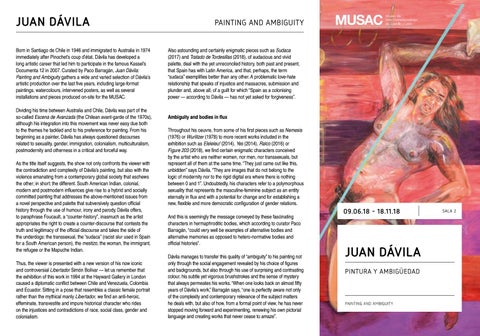
Portada / Cover: Juan Dávila. Eleleleu!, 2014. © Juan Dávila. Cortesía de Kalli Rolfe Contemporary Art, Melbourne
Y esto es lo que parecen decirnos estos fascinantes personajes en cuerpos hermafroditas que, a decir del comisario Paco Barragán, “bien podrían ejemplificar cuerpos alternativos y memorias alternativas en oposición a cuerpos hetero-normativos e historias oficiales”. Dávila consigue trasladar esta cualidad de “ambigüedad” a la pintura no solo a través del compromiso de sus figuras y sus fondos, sino también mediante un uso del color sorprendente y lleno de contraste, unas pinceladas entre sutiles y vigorosas, y unas composiciones siempre impregnadas de un punto de misterio. “Si uno revisa los casi cincuenta años de obra de Dávila —aclara Barragán— se da perfectamente cuenta no solo de la complejidad y vigencia de los temas que aborda, sino que también de cómo desde un punto de vista formal nunca ha dejado de seguir avanzando y experimentando, renovando el propio lenguaje pictórico y creando composiciones que nunca dejan de sorprender.”
Fechas / Dates: 9 de junio – 18 de noviembre de 2018 June 9 – November 18, 2018
www.musac.es
Musac. Avda. Reyes Leoneses, 24. 24003, León. T. 987 090 000