Decoding Broken Hearts Year 2 Impact Report 2026
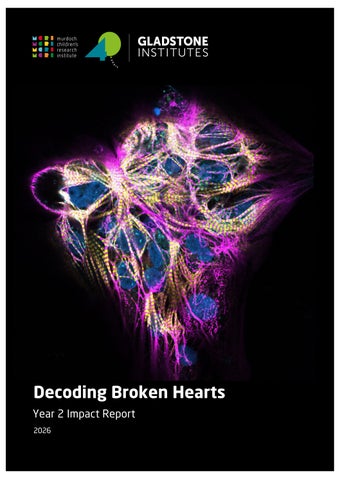
Front cover: Stem cell derived heart cells with their characteristic striped pattern created by their beating units, the sarcomeres, as well as a diseasecausing protein in green and nuclei in blue. By Dr Antonia Zech of MCRI’s Heart Regeneration and Disease Laboratory.
Our purpose is to give all children the opportunity to live a healthy and fulfilled life. For all. Forever. Murdoch Children’s Research Institute (MCRI) is the largest child health research institute in Australia and one of the top three in the world for research quality and impact.* In Melbourne Australia, we are colocated with The Royal Children’s Hospital at the epicentre of a worldrenowned biomedical precinct, including more than 48,000 employees across over 40 biomedical organisations. In 2026, MCRI celebrates its 40th year of transforming child health through research, discovery and innovation. Our legacy is built upon the generosity and unwavering commitment of donors like you. *Clarivate Performance analysis and MCRI benchmarking report, November 2023 Photo credit: John Gollings
Thank you Extraordinary year two program development, thanks to your support
Thank you for your generous support and continued belief in Murdoch Children’s Research Institute (MCRI) and Gladstone Institutes Decoding Broken Hearts research program.
We are deeply grateful for your support. Please enjoy this Impact Report on the research you helped make possible during the past 12 months. Yours sincerely,
Your visionary philanthropy has helped accelerate the world-leading program in its second year, advancing paediatric cardiac research with extraordinary impact. This kind of investment gives researchers across Australia and the US the freedom to pursue bold ideas, bridge funding gaps and accelerate discoveries that can change the lives of children and families. Most importantly, your generosity means more children receive answers sooner, have access to better care and get the chance to live healthier, fulfilled lives. I acknowledge the leadership of MCRI’s Global Advisory Board, whose dedication to this initiative helped unite the expertise needed to make this ground-breaking research collaboration possible.
Professor Kathryn North AC Director, Murdoch Children’s Research Institute
About Decoding Broken Hearts A global partnership to treat childhood heart disease Did you know each year childhood heart disease affects around 40,000 babies born in the US and one in every 100 babies born in Australia? These children are at increased risk of developing heart failure, with the only current treatment option for end-stage patients being heart transplantation. However, transplantation is not a cure. Patients fortunate enough to receive a new heart from the limited donor pool still face poor medium to long-term survival rates. To help, researchers from MCRI in Melbourne, Australia and Gladstone Institutes in San Francisco, USA formed a global partnership in 2024 to give these patients more options. The partnership is breaking new ground in our understanding of childhood heart disease and developing new approaches that have the potential to change how we treat heart failure across the world. Image: Amelia has cardiomyopathy. She received a heart transplant after being diagnosed with heart failure at age two. Read her story on page 8.
Decoding Broken Hearts leverages two revolutionary technologies from these world-leading institutions: • •
MCRI’s advanced human cardiac organoid technologies; and Gladstone Institutes’ artificial intelligence (AI) capabilities.
Year 2 progress and achievements AI tools, data science and partnerships for developing future therapies Global collaboration to build AI tools MCRI and Gladstone researchers have developed a world-first AI model of paediatric dilated cardiomyopathy (DCM), the most common cause of heart failure in kids. Using this model, they have validated several promising gene targets and are now working towards developing new therapies during the next phrase of the collaboration. Using AI to develop future gene therapies The AI tools can predict which patients might benefit from future gene therapies to ensure the right patients get the right treatment at the right time. Using MCRI patient samples and data, the Gladstone AI tool, Geneformer, was able to predict which patients with rare disease-causing mutations would recover their heart function following treatment with a gene therapy. Significantly, this work will feature in an upcoming publication in Nature Cardiovascular Research. This novel gene therapy has now been patented, and the team is currently seeking investment for future clinical translation into trials. Giving answers to families As part of a collaboration with The Garvan Institute in Sydney, rare heart tissues from The Royal Children’s Hospital were analysed to provide genetic answers for families living with dilated cardiomyopathy. The answers came from a combination of genomic and proteomic
technologies - a method used to map which proteins are turned on or off in cells. This groundbreaking approach will now be applied to a larger number of patient samples to provide more answers for more families. Anthropic partnership In April 2026, MCRI partnered with AI company Anthropic to accelerate discoveries into childhood heart disease. Anthropic will provide $500,000 of in-kind support to help the team apply Claude to a pilot program to improve identification of therapeutic targets for heart disease. The partnership builds on MCRI Stem Cell Medicine Theme Director and Decoding Broken Hearts Research Lead Professor Enzo Porrello’s research, which uses a world-first platform to produce human heart tissue from stem cells at scale. World-leading facilities and researchers MCRI’s Stem Cell Medicine Theme was awarded $4.05 million over three years from Stafford Fox Medical Research Foundation to support the Institute’s stem cell research. The funding will equip MCRI with two cutting-edge instruments that significantly expand the Institute’s drug discovery capabilities and boost the development of potential new therapies for childhood conditions. MCRI also recruited Dr Elise Needham from the University of Cambridge to further strengthen the research capacity of the program.
Public engagement
”At MCRI, we punch well above our weight. We are based in Melbourne, but we are a global powerhouse."
Decoding Broken Hearts on the world stage Public engagement has helped build awareness and support for Decoding Broken Hearts internationally. Here are the highlights of our recent outreach that has helped create new opportunities to attract funding, strengthen collaborations and share the promise of this research with broader audiences.
– MCRI Co-chair Sarah Murdoch told G’Day USA Arts Gala guests
Global event
Royal tour
Celebrating Australian excellence across arts and science in the US
Denmark’s Queen Mary and King Frederik X tour of MCRI
Image: MCRI Co-chair Sarah Murdoch and Professor Enzo Porrello. Photo credit: Chris Schmitt Photography.
Image: Professor Kathryn North AC, King Frederik X, Queen Mary and Professor Enzo Porrello.
Celebrating Australian excellence across the arts and sciences, MCRI was thrilled to be part of the 2026 G’Day USA Arts Gala in Los Angeles on 26 February.
MCRI was honoured to host Denmark’s Queen Mary and King Frederik X for a tour of our worldleading stem cell medicine laboratories that produce breakthrough discoveries into childhood heart disease.
Hosted by the American Australian Association (AAA), the event shone a spotlight on exceptional Australian talent and fostered the strong, enduring ties between the two nations. The evening heard from award-winning actors and rising stars alongside moving tributes to innovation and impact. MCRI Co-chair Sarah Murdoch and Stem Cell Medicine Theme Director Professor Enzo Porrello delivered an inspiring update on the Institute’s pioneering medical research and global collaborations, including Decoding Broken Hearts. Read more
The royal visit shone a light on Australian and Danish innovation and research collaboration that has resulted in engineered heart tissue designed to treat heart failure. The pioneering research stems from a partnership between MCRI and the Novo Nordisk Foundation Center for Stem Cell Medicine (reNEW), which is headquartered in Copenhagen, and has research nodes at MCRI, the University of Copenhagen and Leiden University Medical Center in the Netherlands.
Read more
“We have made a number of advances in the identification of potential new therapies for heart failure. – Professor Enzo Porrello told The Australia
In the media Australian and US media help translate MCRI heart research to communities around the globe During its second year, Decoding Broken Hearts was covered in 28 news items, reaching a global audience of 305.2 million between 1 July 2025 - 30 June 2026. In Australia, coverage as part of the Institute’s 40th anniversary celebration, was syndicated across national News Corp publications. In the global media landscape, a FOX NEWS Giving Tuesday story outlined the partnership between MCRI and FOX for Giving Tuesday on 2 December 2025. The story covered the program’s work aiming to help transform the future of paediatric healthcare.
News: FOX teams with MCRI for Giving Tuesday campaign.
Watch now News: MCRI 40th anniversary look behind the scenes with Herald Sun Medical Editor Robyn Riley and National Health Reporter Ruby Kraner-Tucci.
Watch now
News: ABC News Breakfast spotlights gene therapy breakthrough. News: The Australian covers Decoding Broken Hearts research program.
Read more
Watch now
Patient story: Meet Amelia and Elijah Amelia needed a heart transplant to survive. MCRI and Gladstone Institutes Decoding Broken Hearts program is creating a future where her younger brother Elijah may never need one.
“It’s good to know there are people working on things that will help the lives of my kids and others around the country.” – Amelia and Elijah’s mother Ebony
When Amelia received a life-saving heart transplant, her family hoped the worst was behind them. Then her younger brother Elijah was diagnosed with left ventricular noncompaction cardiomyopathy, the same rare heart condition that affects the heart’s pumping power. Amelia was just two years old when she went into heart failure. Coming in and out of consciousness and barely able to open her eyes due to swelling, she was rushed to hospital. A transplant was her only chance of survival. Amelia, now 13, enjoys dancing and lives a mostly normal life. The transplant saved her life, but it is not a cure. Today, the family faces a new challenge. Elijah, 7, lives with the risk of developing heart failure. While he is being closely monitored by a specialist cardiac team, his family remain hopeful that advances in research will lead to new ways to treat and prevent heart disease. MCRI’s Decoding Broken Hearts research program aims to spare children like Elijah from ever needing a transplant. Using cutting-edge stem cell models and artificial intelligence, researchers are targeting the molecular pathways that predict patient outcomes. By understanding these pathways, they can design and test treatments that prevent heart failure before it happens.
Image: Amelia and Elijah. Credit: Ian Currie / Courtesy News Corp Australia.
Expanding our world-leading team Meet some of the experts behind the program Behind every Decoding Broken Hearts advancement is a world-leading team of researchers, clinicians and data specialists working across borders to change the future of childhood heart disease. Through your support, MCRI and Gladstone Institutes are strengthening the expertise, collaborations and next-generation technologies needed to accelerate discovery and bring new treatment options closer. Collaborative exchange program The collaborative exchange program between MCRI and Gladstone Institutes, supported by the American Australian Association (AAA), is a key component of the initiative. In year two, MCRI Heart Regeneration Research Officer Dr Mark Pocock was supported for a two-month exchange at Gladstone Institutes in San Francisco. During this exchange, Dr Pocock gained hands-on experience in complex data analysis and learned how to leverage AI approaches to identify cellular drivers of cardiac disease. Gladstone Institutes Research Scientist Bumjoon Kim was also supported for hands on training in Professor Enzo Porrello’s MCRI lab.
“The two-month immersion at Gladstone Institutes gave me invaluable exposure to cutting-edge computational approaches in cardiac research and fostered collaborations that will continue beyond this exchange. I am eager to implement the new analytical frameworks I learnt at Gladstone in my research program at MCRI.” – Dr Mark Pocock
During the exchange, Bumjoon acquired expertise in fabricating engineered heart tissues from human stem cells, which will be used to validate AI-based predictions of potential disease treatments at Gladstone Institutes. What’s next As part of the collaborative exchange, the inaugural MCRI-Gladstone Symposium will take place in San Francisco on Monday 5 October. The event, supported by AAA, will bring together cardiac researchers from the two world-leading institutes. This initial meeting will focus on the underlying causes of heart disease, as well as the development of stem cell models, AI tools and novel therapies to treat heart disease and heart failure. The aim of the Symposium will be to create connections between the two institutes, supporting vital knowledge exchange and future collaborations that will lead to groundbreaking research breakthroughs.
Professor David Elliott MCRI Heart Disease Group Leader
Professor David Elliott leads MCRI’s Heart Disease Group where he collaborates alongside Professor Porrello’s Heart Regeneration Team to understand the causes of childhood heart disease. “Decoding Broken Hearts provides vital support for our lab by facilitating our collaborative research program with Gladstone Institutes,” he said. “This collaboration has helped expand the capacity of our program to incorporate cutting-edge machine learning technologies into how we analyse human tissue samples collected from patients with childhood heart disease.”
“We are confident our approach will help us develop future precision therapies for patients.” – Professor David Elliott
York Zhang Gladstone Institutes PhD Student York Zhang is a PhD student in Assistant Professor Christina Theodoris’ research lab at the Gladstone Institutes. York develops computational approaches to understand how genes affect disease states. By fine-tuning models such as Geneformer across genetic, cellular and disease contexts, York is able to simulate gene changes to identify how cells can be shifted between healthy and diseased states. York then integrates these predictions with massive datasets to discover therapeutic targets for the stem cell teams to test. “I want to move from simply describing disease to predicting which changes could push a diseased cell towards a healthier state,” he said.
Dr Elise Needham 2026 Sarah and Lachlan Murdoch Fellow Dr Elise Needham, an Australian researcher who joined the University of Cambridge in 2022, will return to Melbourne after receiving the 2026 Sarah and Lachlan Murdoch Fellowship to advance her research into childhood heart disease. “By identifying the underlying causes of dilated cardiomyopathy, I hope to develop treatments that directly target the problem and find ways to use existing drugs that are already approved for other conditions to help these patients,” she said. “The Melbourne biomedical precinct is such a vibrant place to do research, and I’m looking forward to combining what I’ve learned overseas with the incredible local expertise here to help tackle childhood heart disease.”
“Receiving this Fellowship is an honour, and I am so grateful for Sarah and Lachlan’s support.” – Dr Elise Needham
Assistant Professor Christina Theodoris Gladstone Institutes Assistant Investigator Christina Theodoris is an Assistant Investigator at Gladstone Institutes and an Assistant Professor in the Department of Pediatrics at UC San Francisco (UCSF). Her team use computational modelling to map the gene networks that drive disease to then design therapies that can correct the networks back to a healthy state. “Thank you for your generous support of our research program, which helps my team at Gladstone use our machine learning tools to better understand childhood heart disease,” she said. “Our collaboration with MCRI is bringing us closer to earlier diagnoses, better treatments and healthier futures for children and families facing these conditions. I'm truly grateful for your partnership.”
Next steps From discovery to development - charting the next phase of research As the program nears completion of the ‘Identify’ phase, the team has solved previously unknown cases of childhood heart disease and discovered promising therapeutic targets to carry forward into the ‘Develop’ phase. In the next phase of research, we will evaluate the therapeutic potential of AI-predicted genetic targets in human stem cell models of dilated cardiomyopathy. Promising therapeutic candidates will then move into the 'Develop' phase of the program to undertake critical de-risking studies in preparation for human clinical trials. The MCRI and Gladstone Institutes teams are looking to recruit additional postdoctoral researchers to drive this next exciting phase of the research program forward.
Your support matters Our researchers are pioneering therapies for childhood diseases once deemed incurable – be it kidney diseases, heart and skeletal muscle disorders, leukaemia, brain cancer, respiratory ailments or juvenile diabetes. Every breakthrough is an exciting stride toward a future where no child’s health is defined by these challenges. Thank you for your ongoing support of the Decoding Broken Hearts research program as MCRI and Gladstone Institutes continue to break new ground.
Professor Enzo Porrello, MCRI Stem Cell Medicine Theme Director and Decoding Broken Hearts Research Lead.
Together, we are moving closer to new approaches that have the potential to change how we treat heart failure in children today, and for generations to come.
For more information Please contact: Matthew Hannan MCRI Engagement & Development Director E matthew.hannan@mcri.edu.au T +61 3 9936 6362 Arielle Tigel MCRI US Engagement & Development Lead E: Arielle.tigel@mcri.edu.au T +1 929 991 6441 Murdoch Children’s Research Institute The Royal Children’s Hospital 50 Flemington Road, Parkville Victoria, 3052 Australia mcri.edu.au Image by Dr Frankie Butera, Dr James McNamara and Ellen Keen of MCRI’s Heart Regeneration and Disease Laboratory.