COVID Vaccine Preparedness study Summary of report for the Victorian Government, 14 May 2021 Why was this study needed? The COVID-19 pandemic is a public health emergency that has affected every country in the world. The COVID-19 vaccines are an important way to protect people from COVID-19, including the risk of going to hospital or death. We need a very high percentage (up to 80%) of people vaccinated for protection of the community, but not everyone plans to get the COVID-19 vaccine straight away. To support the COVID-19 vaccine program, the Victorian Government funded this research to find out if Victorians were planning to get the vaccine, what concerns people had, and what information they needed to make this decision.
Who carried out this study? This study was supported by the Victorian Government. Researchers from five different research and medical institutes (Murdoch Children’s Research Institute, the University of Melbourne, The University of New South Wales, Monash University, The University of Sydney) worked together on the study. The researchers have expertise in vaccines and vaccination, general practice, pharmacy, and understanding people (social sciences). In addition to the research team, a project Advisory Group included representatives from government, medicine, nursing, pharmacy and the public.
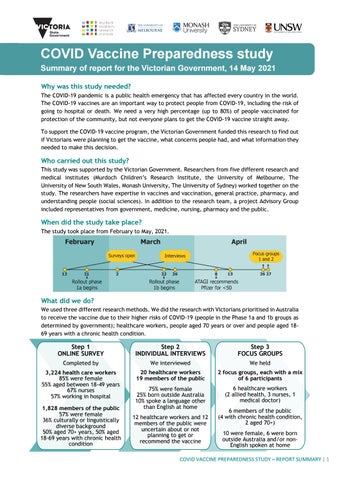
When did the study take place? The study took place from February to May, 2021.
What did we do? We used three different research methods. We did the research with Victorians prioritised in Australia to receive the vaccine due to their higher risks of COVID-19 (people in the Phase 1a and 1b groups as determined by government); healthcare workers, people aged 70 years or over and people aged 1869 years with a chronic health condition.
Step 1 ONLINE SURVEY
Step 2 INDIVIDUAL INTERVIEWS
Step 3 FOCUS GROUPS
Completed by
We interviewed
We held
3,224 health care workers 85% were female 55% aged between 18-49 years 67% nurses 57% working in hospital
20 healthcare workers 19 members of the public
2 focus groups, each with a mix of 6 participants
75% were female 25% born outside Australia 10% spoke a language other than English at home
6 healthcare workers (2 allied health, 3 nurses, 1 medical doctor)
1,828 members of the public 57% were female 36% culturally or linguistically diverse background 50% aged 70+ years, 50% aged 18-69 years with chronic health condition
12 healthcare workers and 12 members of the public were uncertain about or not planning to get or recommend the vaccine
6 members of the public (4 with chronic health condition, 2 aged 70+) 10 were female, 6 were born outside Australia and/or nonEnglish spoken at home
COVID VACCINE PREPAREDNESS STUDY – REPORT SUMMARY | 1
What did we find out from people completing the online survey? Most people planned to get a vaccine, with some groups more or less likely to get it Overall intention to vaccinate
•
Intention to get vaccinated was high (more than 75%) among nurses, doctors, allied health professionals, and those working in hospitals, community or private practice
•
However, only 58% of personal support workers and 66% of those working in residential aged or disability care facilities planned to get a COVID-19 vaccine
•
84% of members of the public aged 18-69 with a chronic health condition and 90% of those aged 70 years or more planned to get vaccinated
•
Among both healthcare workers and the public, men, older people and those living in metropolitan areas were more likely to get vaccinated
Healthcare workers
Public (≥70 and 18-69 with health conditions)
Information from clinical trials about vaccine safety and how well the vaccines work was an important factor influencing the decisions to vaccinate for both groups • People in both groups said they were more likely to vaccinate if the vaccine was required to travel overseas Vaccine required to travel
• Healthcare workers were more likely to vaccinate if the vaccine was recommended by their professional society or if it was available at their workplace • 51% of healthcare workers thought the vaccine should be required for all healthcare workers
For those who were unsure or did not plan to get a vaccine, the main concerns were about vaccine safety, long-term effects and serious reactions •
Of those who were not definitely planning to get a vaccine, 73% of healthcare workers and 62% of the public participants were concerned about vaccine safety
•
About 60% of both groups had concerns about long-term effects, and about half were worried about serious reactions
Most people trusted the vaccines and felt the vaccines were important for their health and protecting others •
Over 75% of both groups trusted the COVID-19 vaccines, thought that they will be safe, and believed they were important for their health and protection of others
•
Most healthcare workers wanted to get the vaccine at their workplace
•
66% of the public wanted to get the vaccine through general practice
Have at workplace or at GP
Most people reported not having enough information about the COVID-19 vaccines •
Only 27% of both groups felt that they had enough information about 5 vaccine topics: how they work, their safety, how well they work, their side effects and how they should be delivered (number of doses, time between doses, etc)
•
When people had enough information about the vaccines, they were nearly 7 times more likely to accept a COVID-19 vaccine than those with no or not enough information
•
For both groups, most people preferred information to come from their health care provider, or government websites and sources
•
Healthcare workers wanted printed information for patients, with training modules to support discussions about the COVID-19 vaccines with patients
COVID VACCINE PREPAREDNESS STUDY – REPORT SUMMARY | 2
What did we find out from people in the individual interviews? Since the COVID-19 pandemic, everyone had made changes to their daily lives. People reported many difficulties but some positives •
Every aspect of life changed – home and family life, socialising and working all impacted
•
Most people were less concerned about COVID-19 now, but some were still fearful
•
Many people found it difficult to keep up with the amount of information about COVID-19
People thought there were important benefits of the vaccines •
Protect themselves and loved ones from COVID-19
•
Wider benefits for the community such as people being able to work, to see their family and friends, and to travel
•
Help the wider community to stay safe
They also had some safety concerns about the vaccines •
Some concerns were about minor side-effects, particularly for those with underlying medical conditions
•
Long-term effects were also a concern
•
Blood clots were mentioned, but not everybody was concerned despite the media attention
I would stop worrying about the risk of getting sick…I’m only in my early 60s, I would like to kick around for a few more years! (Public, female, 60-69, respiratory condition, no/unsure to vaccine)
We just don’t know. There hasn’t been enough information on any long-term trials to say, “Hey, these are the complications down the track.” (Healthcare worker, aged care nurse, male, 50-59, no/unsure to vaccine)
(Note: most interviews were held before the April change in AstraZeneca recommendations) Not all participants preferred one vaccine over another. Some people didn’t mention a specific brand, but said they wanted a vaccine that was made in Australia, or safe for allergies.
People identified a number of influential sources of information •
Personal: friends, family or their own GP
•
Public: public figures like Norman Swan and Brett Sutton or scientists, researchers, epidemiologists, Chief Medical/Health Officers
•
Organisations: particularly with a medical or health focus, like the Australian Medical Association or the Cancer Council
•
Those with a perceived vested interest in promoting the vaccine were not trusted (such as pharmaceutical companies, media organisations, individual politicians)
•
Some people expressed misinformation, a lack of information and unrealistic expectations of the vaccines
People were frustrated and confused by practical issues •
Some of those who wanted the vaccine said they did not know who was eligible, how to book or where to be vaccinated
•
Some healthcare workers mentioned inconsistent supply and burden on GP practices
I haven’t received any information that it was available at all. I haven’t even seen it on the TV.
(Public, female, 70-79, yes to i )
Information about vaccines should be personalised and easily accessible •
Information provided about the vaccines should be personalised to consider people’s age and gender, any health conditions, or medications they may be taking
•
Information about each step of the vaccination process should be provided, from who is eligible, when they can receive the vaccine, booking details, to reminders for second doses
•
Healthcare workers need information for themselves and to support their patients
COVID VACCINE PREPAREDNESS STUDY – REPORT SUMMARY | 3
What did we find out from people in the in-depth focus groups? People were looking for personal information related to their medical condition, medications, age or background.
Many of the benefits identified were about a sense of freedom or feeling free •
Freedom from lockdowns, particularly snap lockdowns for small case numbers
•
Freedom from school closures and long periods of home-schooling for kids
•
Freedom to travel locally, within Australia or overseas – seeing family or friends, visiting those in aged care without worrying about disease risk or border closures
•
Financial security with the return of overseas students and opening interstate and international borders
Knowing what an expected side effect is, and when to see a doctor •
Information about minor and severe side effects should be provided, along with evidence-based information about risks and benefits for individuals
Benefits for individuals, friends & family community
Some side effects are normal when are they serious?
There were varied preferences for comparing the risk of clots •
Some wanted to compare the risk of clots to the risk of COVID-19 disease
•
Others wanted to compare the risk to everyday events, like car or plane crashes or risks from other medications
•
Numbers could be difficult to understand, but were needed to explain risk
•
Explaining risk in simple terms and illustrating with images were important
No single solution for how to best compare the vaccine risks
(Note: both focus groups were held after the April change in AstraZeneca recommendations, but before the June change) People knew that change was likely and wanted those speaking about vaccines to be open about uncertainty and to say things may change. They said this would build confidence in the information being provided. Brochures and written information are important, but more dynamic methods such as interactive websites or videos which can be easily shared were preferred.
Change is likely, be open about uncertainty to build trust
How does this research help? By doing this research, we found out what Victorians in phase 1a and 1b of the vaccine rollout think and feel about the COVID-19 vaccines and the vaccination process. We also found out what people want to know and how they want this information provided. These details can be used to help support Victorians in deciding to get a COVID-19 vaccine (or not) and how to go about it. Using this information, we came up with 11 recommendations for the Victorian Government to support Victorians with decisions about COVID-19 vaccines. The recommendations cover communication content, delivery and context. The report and recommendations have been given to the Government to consider when communicating about the COVID-19 vaccines, the vaccination program or COVID-19. We will present the information from our research on our website, at conferences, and in academic papers so that others can also have this information to help communicate with their communities.
thank you
A special to everyone who participated in the survey, interviews and focus groups. Your time and input contributed to these recommendations.
COVID VACCINE PREPAREDNESS STUDY – REPORT SUMMARY | 4
Recommendations
Communicate about…
Content
• • • • •
Vaccine safety and effectiveness Expected side effects Benefits of vaccination Severity of COVID-19 Vaccine availability
Provide… •
Delivery
• • •
Personalised information about risks and benefits of the vaccine Messages from real, trusted people Clear, simple, shareable communication materials Resources for healthcare workers
Aim to…
Context
• •
Build trust through transparency Use vaccine requirements carefully
COVID VACCINE PREPAREDNESS STUDY – REPORT SUMMARY | 5