

CONCEPTUALIZING Coziness
A MUSIC THEORIST EXPLORES THE SOOTHING SCORES BEHIND POPULAR VIDEO GAMES

Make plans now for International Convention 2026 in Fort Wayne, Indiana.
8 Conceptualizing Coziness by Adriana Ezekiel
COLUMNS
1 President’s Message: Get Ready to Imagine, Innovate and Inpsire by Kurt-Alexander Zeller
2 Musings: Secrets in Plain Sight by Melissa J. Eddy
4 From the Archives: Saving Your Stuff
DEPARTMENTS
14 Applause and Encore: Member and Chapter News
18 Foundation Philanthropy Grants by Donna Chrzanowski
19 Final Notes, Compiled by Ann Geiler
20 District Directors Directory
21 Executive Officers Directory
Fraternity Mission Statement: Mu Phi Epsilon International Professional Music Fraternity is a coeducational fraternity whose aim is the advancement of music in the community, nation, and world through the promotion of musicianship, scholarship and music education with emphasis on service through music.
EDITOR Kat Braz editor@muphiepsilon.org
DESIGN & PRODUCTION Paul Wilson thetriangle@muphiepsilon.org
Send all material for publication to: Kat Braz, editor@muphiepsilon.org
The Triangle welcomes story suggestions from Mu Phi Epsilon members and friends. Publication selections will be made at the discretion of the editor. Photos must be provided as the original digital file at high resolution. Please include photographer credit information. All photographs are published courtesy of the contributor unless photographer credit is provided.
Deadlines for submissions: Spring — November 15 Summer — March 15 Fall — July 15
Change of address, renewals, notice of deceased members, requests for extra copies and subscription requests should be sent to:
Mu Phi Epsilon
International Executive Office 6510 Telecom Drive, Suite 370 Indianapolis, IN 46278 toll free: 888-259-1471 fax: 888-855-8670 email: executiveoffice@muphiepsilon.org
The Triangle is published three times per year by Mu Phi Epsilon, International Professional Music Fraternity.
Member, Professional Fraternity Association.
Subscription price is $20.00 per year. Single copies are $8.00.
Postage paid at St. Paul, MN, and at additional mailing offices. Printed in the United States of America.
POSTMASTER: Send all changes of address to: Mu Phi Epsilon, 6510 Telecom Drive, Suite 370 Indianapolis, IN 46278 © 2026 Mu Phi Epsilon. All rights reserved.

KURT-ALEXANDER
ZELLER, INTERNATIONAL PRESIDENT, MU CHI, ATLANTA ALUMNI PRESIDENT@MUPHIEPSILON.ORG


appy New Year! By the time you read this message, it will be 2026, the year of our triennial Mu Phi Epsilon family reunion, our International Convention!
We’re hoping that many, many members of the fraternity will descend upon Fort Wayne, Indiana, 23-25 July for three days of music and fun: the finals of the International Artist Competition; a gala opening concert by Heartland Sings, founded by Mu Phi maestro Robert Nance (Zeta); a trip to Sweetwater, the nation’s largest retailer for musicians’ needs; and lots of presentations, workshops, and performances by your fellow Mu Phis (and maybe even you—see the call for presenters on the fraternity website)!
Our Convention should be inspiring and heart-warming, a great time to see old friends and to make new ones as we enjoy music together. However, just like other kinds of family reunions, there also should be space for some serious conversations. As we gather and celebrate the joy of our shared traditions and illustrious past and the excitement of seeing each other right now in the present, we must be looking ahead to what the future will bring to our family—and making plans to make sure that our fraternal bond remains strong and secure for all the days to come. Throughout the fraternity’s 122 years, there have been times in which wise leaders of the past facilitated discussions about how to ensure that our fraternity made needed changes to prosper in the future.
Your International Executive Board plans to launch such a discussion at the 2026 Convention; we want to encourage all the members present to Imagine new ways of being for the fraternity, so that our successors can take those ideas and dreams and encourage the entire membership to Innovate to find the “paths that lead upward toward the stars” of something new—new pro-
grams, new processes, new experiences—that will Inspire coming generations of musicians to be true and faithful members of Mu Phi Epsilon for life!
This is why it is crucial that every chapter be represented by at least one official delegate, so that every chapter can participate in this initial discussion about finding a future for the fraternity and take that discussion back to their chapters for further elaboration. We must grapple with the question of what it means to be a professional fraternity in the field of music in an age in which music degree programs, historically our primary source of new members, are being called into question and even shut down all over the country. (I have counted at least two dozen university-level music programs—unfortunately including some that are homes to Mu Phi Epsilon chapter charters—that have completely discontinued all their offerings in the last eighteen months. The number that have cut some music degrees and programs is more than twice that.) Meanwhile, more people play prominent roles in the professional music industry with no specialized academic credentials (and some of our more proactive alumni chapters have been working hard to bring these professionals into their chapters). As the world of professional musicians changes, so must a professional music fraternity like Mu Phi Epsilon. We hope that Convention 2026 will be the start of a serious discussion that will engage us all and create pathways to significant and sustainable growth in our membership, our activities, and our impact.
Please, come join us 23-25 July and be part of the conversation!
Loyally,
MELISSA J. EDDY, MU THETA, AUSTIN ALUMNI
SECRETS IN PLAIN SIGHT AUSTIN ALUMNI PROGRAM EXPLORES NEW INSIGHTS INTO MOZART
s principal pianist of Austin’s A. Mozart Fest concert series starting in 1991, Mary Robbins (Mu Theta, Austin Alumni) sometimes needed to compose cadenzas for Mozart concertos where his were missing. To inform her work and create new cadenzas as authentically as possible, over the years she carefully studied the master’s existing cadenzas.
To her surprise, those studies revealed more than how to compose authentic cadenzas: Robbins came to an entirely new understanding of Mozart’s musical meaning. She realized that his manuscripts contained clear directions about his musical intentions — directions that had become obscure over time and not been recognized or written about for centuries. “His clues were always there, on every page,” Robbins says. “We simply had misunderstood them.”
Although the A. Mozart Fest series concluded in 2008, Robbins has continued to mine Mozart’s manuscripts to deepen her understanding as a scholar, performer and teacher of his music. She identified in his notation a code that tells the savvy musician exactly how Mozart wanted the music played. When understood and carried out correctly, the code gives every measure the force and meaning he intended.
Robbins also realized that to perform Mozart’s music authentically on today’s piano, she had to learn a new way to play it, since the fortepiano of his time responded differently to the artist’s touch and produced a different sound from a modern instrument. She has worked and practiced for years to develop the necessary new technique, including a different use of weight from the usual dropped arm approach. Robbins says that listeners also must learn to hear Mozart’s music the way he composed
and wrote about it. She is currently working on three books — for listeners, all performers and pianists on the modern piano — to explain her findings.
The Austin Alumni chapter sponsored a free public program in April 2024 called Secrets in Plain Sight: A New Way to Hear and Perform Mozart’s Music. Robbins organized and presented the program, joined by three distinguished musicians who demonstrated Mozart’s newly-recognized approach. Each performed a selected slow movement from a Mozart concerto
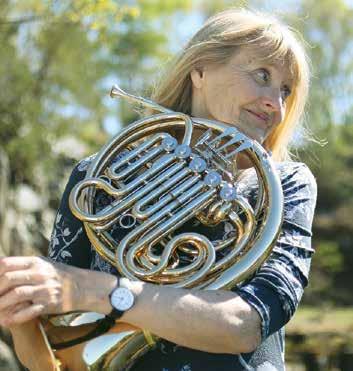
Åshilld Henriksen
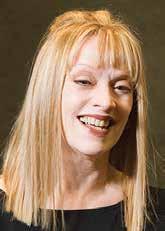
Mary Robbins
International Friendship, Remote Initiation
Mary Robbins and Åshilld [AUS-hild] Henriksen met in 2008 at the Julita International Chamber Music Festival in Katrineholm, Sweden, where Robbins had been invited to perform an all-Mozart concert and judge the Swedish International Duo Competition. Of more than a dozen judges, she and Henriksen were the only women, and they became fast friends.
for her instrument, joined by Robbins at the piano playing the orchestra reductions.
Åshilld Henriksen (Omega Omega, Austin Alumni), principal horn for the Helsingborg Symphony Orchestra throughout her professional career, is an active recitalist and chamber musician in Sweden. Kristin Wolfe Jensen is professor of bassoon at the Butler School of Music at the University of Texas at Austin and an active soloist and recitalist. Clarinetist Martha MacDonald (Phi Xi, Austin Alumni) founded and performed with Austin Chamber Ensemble and is an active chamber musician and teacher. All but Henriksen are based in Austin.
The Butler School provided a recital room for the event. About two dozen were in the audience, including music students, faculty and members of the public. Besides presenting Robbins’ discoveries, the program had another objective: to jump-start revitalization of the Mu Theta chapter. Austin Alumni especially publicized the event to Butler School students and faculty through university channels, in hope that those who attended would become interested in Mu Phi Epsilon.
Henriksen was subsequently invited by the Helsingborg Symphony to perform a Mozart concerto. She knew that Robbins composed cadenzas in Mozart’s style and asked if she could teach her to do so. Robbins is a horn enthusiast (it was her secondary instrument long ago) so of course she said yes. She also told Henriksen about her discovery of the Mozartian code, which the latter adopted and incorporated into her playing.
Robbins later introduced her findings to clarinetist MacDonald and bassoonist Jensen, along with the idea of presenting them in an educational program to catalyze a Mu Theta reactivation. The two artists naturally had questions about the new technique as applied to wind instruments, so Robbins set up a Zoom for Henriksen to share her experience with them.
As plans for the program developed, Henriksen was so enthusiastic that she decided to travel to the U.S. and participate. She was also impressed with the organization and wanted to become a Mu Phi. So after the necessary preliminaries, the Austin Alumni chapter initiated her on January 18, 2025. Chapter members performed the initiation ritual in person, with Henriksen participating by Zoom.
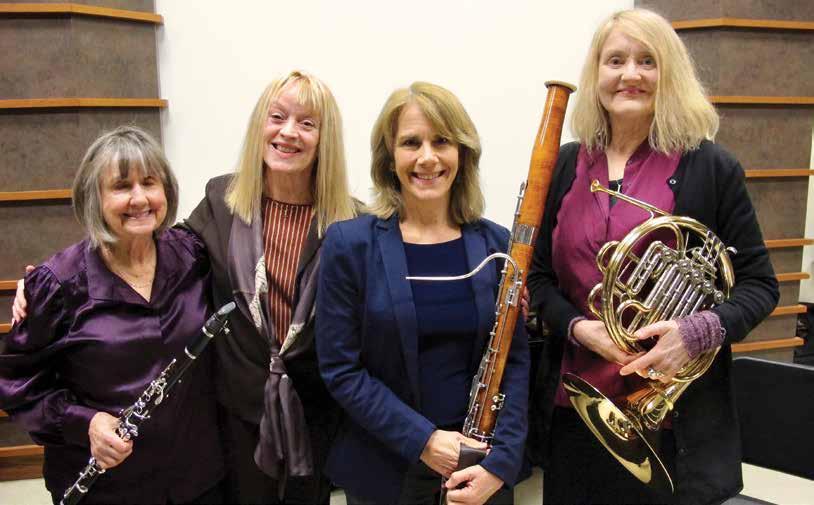
The Secrets in Plain Sight performers, from left, Martha MacDonald, Mary Robbins, Kristin Wolfe Jensen and Åshilld Henriksen.
SAVING YOUR STUFF
s the international librarian and archives chair for Mu Phi Epsilon, Wendy Sistrunk (Mu Mu, Kansas City Alumni) has learned a thing or two about properly preserving materials.
“This advice is for those things you wish to keep for longer than, say, a year,” Sistrunk says. “Sometimes you don’t know if you wish to keep something — a lot of stuff you should recycle or repurpose. I advise following the golden rule of conservation: do no harm. But also the golden rule of collection: we can’t keep everything.”
The preservation of photographs and documents is dependent on the storage environment and storage enclosures. Here, Sistrunk shares her thoughts on the good and the bad when it comes to archiving, as well as some helpful solutions on how to store your stuff correctly.
The Good
• Acid-free paper, acid-free tape, acid-free labels, acid-free everything
• Photo mounting hinges
• Document repair tape
• Plastic paper clips
• Plastic tubs with lids for storage
The Bad
• Laminate (it blurs text and images after a while)
• Rolling or folding photos (need to carefully steam the backs unroll, then lay flat)
• Folding paper (unless you’re OK with creases — sometimes you are)
• Rubber cement, glue, regular tape (residue permanently mars documents, attracting bugs and rodents)
• Metal staples and paper clips (rusts and tears documents)
• Acidic paper such as newspaper or colored paper (full of wood pulp that browns)
• Cheap scrapbook albums/magnetic photo albums
• Ball-point pen / Inkjet printers
• Direct sunlight/fluorescent lights, “in the elements”
• Moisture/dryness
• Vermin, bugs (don’t store unboxed items on the floor)
• Cardboard boxes (too acidic and doesn’t deter insects or rodents)
Solutions
• Acid-free, Acid-free, Acid-free
• Reformat:
• Newspaper articles (photocopy/scan)
• Analog material such as cassettes, VHS tapes, slides, etc. (check local companies or libraries for options to reformat)
• Replace metal clips, tape, glues
• Use archival photo mounting hinges
• Shelves, plastic bins with lids
• Keep current with updating and/or migrating your software and online documents. Back up with a flash drive and/or The Cloud for storage.
• You can always make an “analog” copy of documents (that is, print!)
• Store in cool dark place
• Recommended: no warmer than 70 degrees and between 30% to 50% humidity
• Mildew on books:
• Remove any residual moisture (fan, airing out) and leave overnight. Set books on their spine and fan open pages
• Place inside a plastic receptacle, leaving open, and place inside a larger plastic bag
• In a smaller bag, dump several boxes of baking soda or potpourri
• Seal larger bag and let stand enclosed for several days
• If keeping physical items that require “machine intervention” (i.e., cassette tapes), be sure to keep the machine that will play it.
Products
• Archival folders, boxes, paper, acid-free tape
• Picture mounting corners
• Plastic storage bins
Sources:
Gaylord Archival Products, www.gaylord.com Northeast Document Conservation Center, www.nedcc.org




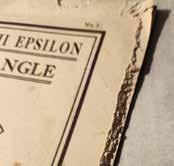

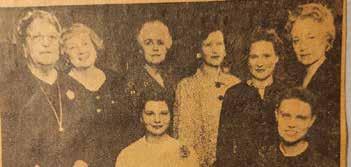
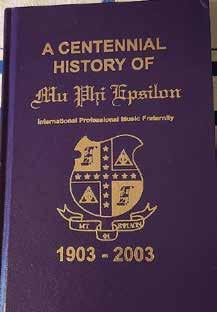
A Centennial History
Sistrunk recently scanned the 2003 publication A Centennial History of Mu Phi Epsilon. In addition to a history of the Fraternity, the book includes individual Collegiate and alumni chapter information, lists of award winners through the years and all sorts of fascinating facts and information.
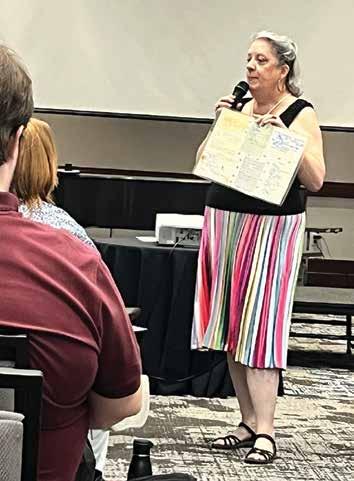
Wendy Sistrunk (Mu Mu, Kansas City Alumni), international librarian, presented a session on “Saving Your Stuff” at the 2023 International Convention in Forth Worth, Texas.
CONVENTION 2026 PREVIEW
See you in Fort Wayne
United in Song
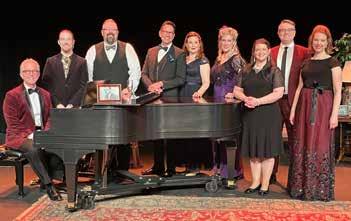
Maestro Robert Nance (Zeta) will conduct the Convention’s opening concert featuring a professional orchestra and vocal artists from Heartland Sings.
I am honored to produce and conduct the opening concert, building on the event theme of “Imagine, Innovate, Inspire” and propelling us all into an amazing few days together.
Because the convention takes place in Indiana, I wanted feature American composer Cole Porter, born and raised in Peru, Indiana. Most everyone knows Porter for his theatrical productions — songs that occupy a significant place in the American Songbook repertoire. But Porter did so much more and is, perhaps, under-appreciated as a composer of sophisticated classical music. Further, recognizing the power of the arts to help us reflect on the issues that dominate our lives, I also wanted to feature music that reflects the often chaotic world in which we live.
Therefore, I have chosen to present a three part program (a triangle reference), beginning with Porter’s “Within the Quota” which focuses on immigration and pairing it with Darius Milhaud’s “La Création du Monde” (the Creation of the World), then rounding out our program with selections from the Porter Songbook.
The pairing of “Within the Quota” and “La Création du Monde” is significant because both ballets premiered in Paris on the same program at the Théâtre des Champs-
Élysées in October 1923, and placing Porter in the company of the most significant composers of the early 1900s. Porter’s ballet music focuses on immigration, an issue just as divisive then as it seems to be today; and the socio-political chaos felt at the time and yet again today is clearly reflected in Milhaud’s music. What ties these two works together lies in the friendship of these two composers and in the underlying jazz idiom in their music, which I believe reflects the desire to find some order amongst the chaos. And, of course, no International Convention would be complete without a rousing version of “Our Triangle” (freshly orchestrated for this convention), the success of which depends on all of you — be prepared to sing loud and proud!

Robert Nance (Zeta) is a multitalented musician who maintains a lively schedule as a conductor, keyboardist, teacher, composer, clinician and arts advocate. A distinguished graduate of DePauw University School of Music and the Peabody Conservatory, Nance is the founder and artistic director emeritus of Heartland Sings, a company of professional vocal artists and ensembles founded in 1997.
Convention Chorus
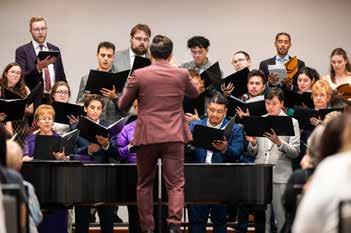
We are excited to announce that the 2026 Convention Chorus conductor will be Rayvon T.J. Moore (Beta Alpha), director of choral studies at Friends University in Wichita, Kansas. Moore holds a bachelor’s in choral music from the University of Southern California, a master’s in choral conducting from California State University, Fullerton, and a DMA in conducting from the Eastman School of Music.

In 2024, Moore received the American Prize Ernst Bacon Memorial Award for the Performance of American Music and was named third-place laureate for the American Prize Dale Warland Award in Choral Conducting. He is also a past recipient of the Mu Phi Epsilon Foundation’s John and Mary Virginia Foncannon scholarship in conducting. Beyond his academic work, he is artistic director and conductor of the Wichita Chamber Chorale and director of the Hill Singers at Chapel Hill United Methodist Church.

Add Your Voice to the Chorus
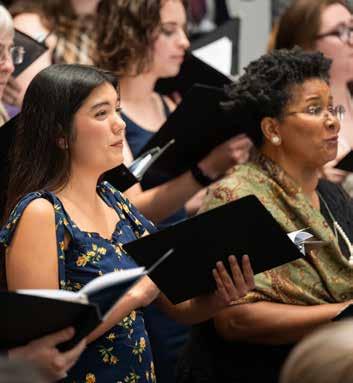
The Convention Chorus is a treasured tradition of Mu Phi Epsilon’s triennial gatherings. Sign up for the chorus and indicate your voice part when you register for the Convention and music will be sent to you in advance to prepare. The chorus will hold three rehearsals during Convention to prepare a varied selection of repertoire for the closing concert that will be the culmination of our time in Fort Wayne — what better illustration of Music, Friendship and Harmony could there be? Please make your plans to be part of it; we’ll see (and hear) you there!

ADRIANA EZEKIEL, GAMMA ZETA
Conceptualizing Coziness
A music theorist explores how iyashikei principles shape soothing game scores
arch 2020 was a pivotal moment in global history. One event would change the world as we knew it forever. Of course, I’m talking about the release of Animal Crossing: New Horizons (AC:NH). This video game, exclusive to the Nintendo Switch system, was an instant success, selling over 48 million units to date.
Within New Horizons, players move to an island and build a community of animal neighbors. The gameplay involves planting and chopping trees, catching bugs and fish and decorating their island however they like. Users interact with nature, their virtual animal friends and even real-life friends who can visit and explore their island online. New Horizons came into the world at a necessary time, only five days after the U.S national shutdown for the COVID-19 pandemic. Players were isolated in their homes and seeking a sense of community and comfort that they found in AC:NH.
AC:NH is just one in a long line of the cozy video game genre that began in Japan in 1997 with Bokujō Monogatari, known in North America as Harvest Moon. Cozy games are about a simpler way of life; think about tending to your farm in Stardew Valley, building a community in New Horizons or exploring a tranquil mountain in A Short Hike. Cozy games do not only have relaxing gameplay, but soothing music.
As a music theorist with a passion for video games, I was drawn to this question of “How does music feel cozy?” for my master’s thesis. Many scholars of game music have written about how the music in games can tell the listener how to feel in their location and change the way they play the game.
Imagine walking into an unfamiliar area and you hear fast, rhythmic, dissonant music. This communicates that there may be something dangerous here, and you can choose to fight it or run. I argue that music in cozy games can also provide you with

a soothing feeling that influences the player to relax and immerse themselves into a simpler virtual reality. I analyzed more than 145 tracks from 27 different cozy games, looking for semiotic patterns in the music that help create the coziness.
In my thesis, I relate cozy games to a Japanese media subgenre called iyashikei. Iyahshikei which translates to “healing type.” This genre is popular for anime, manga and film — like Studio Ghibli’s My Neighbor Totoro. Iyashikei media focuses on nature and companionship. The primary action is simple tasks like cooking and picking flowers, rather than high-energy battles or drama. There is a focus on small sensory details, like showing the audience every detail of making a meal with realistic sounds.
Iyashikei plots are simple, with just enough mystery to keep the audience interested, but not enough to be riveting. In iyashikei plots, one of the characters deals with a difficult situation, like a broken familial relationship. Audiences can identify with the characters and find tranquility in the story’s resolution. This genre rose to popularity in Japan in the 1990s, correlating with the release of the original Harvest Moon game.

Cozy games can be considered iyashikei as they align with all of these traits I’ve discussed. In most Harvest Moon games, the player is tasked with healing the harvest goddess, sometimes creating healing through emotional stability for characters or themselves along the way. Players seek out cozy games to self-soothe and escape the trials of daily life. They are distracted by the simple tasks and find healing through the plots and natural setting.
I mapped traits of the iyahshikei genre (nature, repetitive basic activities, simplicity with a little mystery, small sensory details and healing) to the music in cozy games to help understand how the music may be cozy. Nature can be represented in cozy game music through environmental sounds like bird caws or waves. Music can also reflect nature through a natural order.
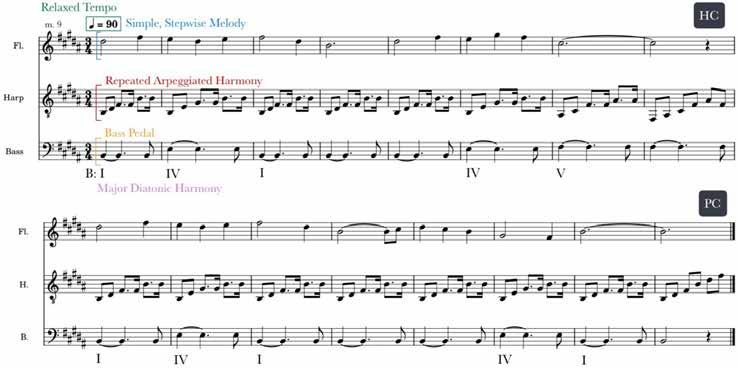
Cozy game music is typically in a major key with mostly diatonic harmonies. Simple, stepwise melodies are common in cozy game music. Uncomplicated harmonies and singable melodies keep the player focused on their environment and comforted by natural music. This also relates to the simplicity of iyashikei. Additionally, cozy video game music is often built on a simple ostinato and more timbres are slowly layered in. This reflects the repetitiveness of the genre and tasks. I found that often the ostinato is simply a repeated arpeggiated harmony as well.
The music also reinforces small sensory details by relating to the game environment. Cozy game tracks are typically a mod-
erate tempo, aligning with the speed of gameplay. In many cozy games, the music will even change depending on the season. In my analysis of seasonal music in games (including a nod to Mario Kart 8 Deluxe), I discuss what makes spring sound like spring in these games. I also explore music that provides the player with a sense of furusato, or hometown, through genre evocation. Music with blues, country or folk inspiration tells the player how rustic the game location is. All of these elements work together to create a cozy feeling for the player.
Many of these iyashikei elements are similar to those found in classical pastoral music. Pastoral music invokes the peacefulness of an idealistic life of shepherds. Many cozy games feature gameplay that mirrors this rural lifestyle. Pastoral music typically features drones or pedal points, consonant diatonic harmony, simple, songlike melodies, unfolding texture, parallel thirds, major mode, plucked string accompaniment and prominent flute or oboe. I found all of these elements in most of the cozy game tracks I analyzed.
A great example of this is “Stardew Valley Overture” from Stardew Valley, a 2016 indie game inspired by the old Harvest Moon games. In the game, the main character leaves their corporate job in the city to become a farmer in a small community. The title track begins by setting up the main arpeggiated harmonic ostinato that will continue throughout most of the

track. The ascending arpeggiated I and IV chords are played by a plucky harp, banjo, dulcimer-like synthesizer with heavy reverberation at a casual tempo.
This rising harmony accompanies the visually rising, wooden “Stardew Valley” title sign into the clouds. The ostinato’s timbre contributes to the rustic feel of the music that matches the rustic visuals. After four measures, a low, warm bass drone is added alongside the ostinato. Four measures later, a diatonic major, stepwise melody is added in a wood-flute timbre. The song continues to add more layers including percussion and synthesizers. This layering of elements eases the listener into the music and


Cozy Games to Check Out
Animal Crossing: New Horizons. Nintendo. 2020. Nintendo Switch. Music by Kazumi Totaka, Yasuaki Iwata, Yumi Takahashi, Shinobu Nagata, Sayako Doi, Masato Ohashi. Harvest Moon. Victor Interactive Software. Natsume. 1996/1997. Super Nintendo Entertainment System. Music by Tsuyoshi Tanaka.
Stardew Valley. ConcernedApe. 2016. Android, iOS, Linux, MacOS, Nintendo Switch, PlayStation Vita, PlayStation 4, Windows, Xbox One. Music by Eric Barone.

“Stardew Valley Overture” Annotated Transcription by Adriana Ezekiel

allows them to focus on each small detail at a time. The repetition of simple elements is soothing and allows new material to not become too overwhelming since it is always accompanied by something familiar.
These cozy, iyashikei elements are not exclusive to cozy video games. Several role-playing games have cozy town themes that tell the player they can relax in this area, such as “Kakariko Village” from Ocarina of Time. Since publishing my thesis, I have found iyashikei elements in some film and pop music as well. Next time you hear music that sounds cozy, I invite you to consider if it is also iyashikei.
Access Ezekiel’s Research
Ezekiel presented her research at the North American Conference on Video Game Music held at Michigan State University in March 2024. Her master’s thesis, Conceptualizing Coziness: Sonic Iyashikei, Furusato and Musical Topics in Cozy Video Games, is currently available on ProQuest and on the University of Alabama’s website for theses and dissertations. In the future, she plans to publish portions of her thesis in an academic journal, as well as create informal YouTube videos explaining her findings.

Adriana Ezekiel is a PhD student in music theory at The Ohio State University where she teaches freshman music theory and aural skills. She earned her Master of Music degree in music theory from the University of Alabama in 2024, where she taught aural skills classes in classical music and in the aural analysis of popular and jazz music. She earned her Bachelor in Music Education from Delta State University in 2020 and Associate of Arts from Northeast Mississippi Community College in 2017. Before pursuing graduate degrees in music theory, Ezekiel taught K-5 music and band in Birmingham, Alabama. Her current research interests include the analysis of video game and film music, music theory pedagogy and popular music studies. She is also interested in public scholarship and making music research more accessible. As an active musician, Ezekiel enjoys playing trumpet in jazz ensembles, singing and playing ukulele. Outside of school, she enjoys playing video games, cross stitching and baking.

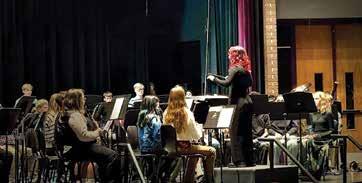
Kidd (Mu Psi), a senior at Coe College in Cedar Rapids, Iowa, spent the fall semester student teaching. They had the opportunity to conduct the fall concert for Taft Middle School’s 8th grade band.
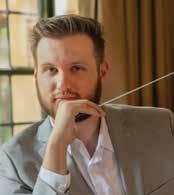
Reinke (Beta Pi, Lincoln Alumni) was the recipient of the 2025-2026 Klein Family Helping New Teachers Award from the Lincoln Public Schools Foundation. Reinke is a first-year teacher at Lincoln Northeast High School in Lincoln, Nebraska.
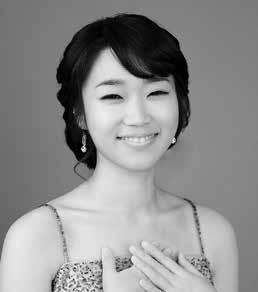
released a new album, The Melodies from East Asia, featuring the rich musical traditions of Japan, Taiwan and Korea, often weaving elements of folksong, people’s lives and social messages with evocative writing to create a captivating sound world.
Kathryn
Austin
Members of Beta Mu from East Texas A&M University spread holiday cheer while visiting an area nursing home in November.
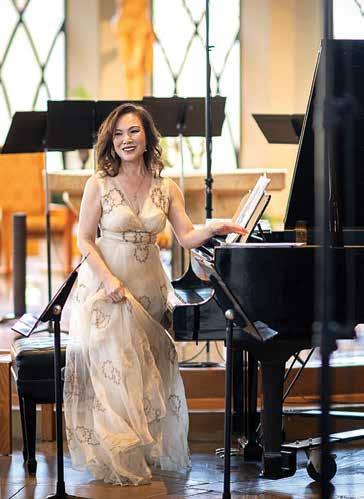
Pianist Hyeji Seo (Denver Alumni)
Anli Lin Tong (Gamma Sigma, Palos Verdes/South Bay) organized a concert titled Bells of Nagasaki in commemoration of the installation of the new bell at the Urakami Cathedral in Nagasaki, Japan. The program included works by Rachmaninoff, LaRocca, Caccini, Liszt and Koseki and was held in Palos Verdes, California.
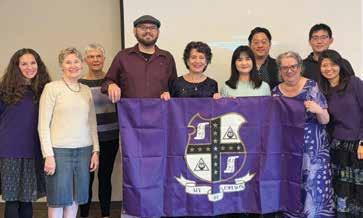
Members of the Kansas City Alumni chapter gathered to celebrate Founders Day in November.

Noelle Buck (Mu Psi), a junior at Coe College in Cedar Rapids, Iowa, attended the Percussive Arts Society International Convention in Indianapolis in November. Additionally, she works with Prairie High School’s marching band percussion section and its winter percussion ensemble. She designed this year’s winter show, “Desperados.”
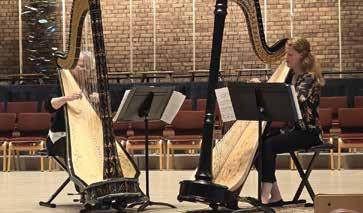
Rachel Brandwein (Gamma, Minneapolis/St. Paul Alumni), right, and her colleague and former teacher Lynne Aspnes presented a duo-harp recital in September. The program included compositions by Tournier, Argento and Grandjany, as well as transcriptions of works of Respighi and Ravel.
WELCOME NEW COLLEGIATE MEMBERS
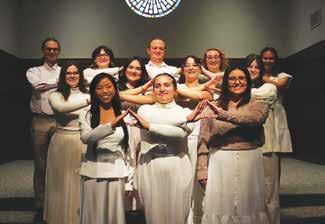
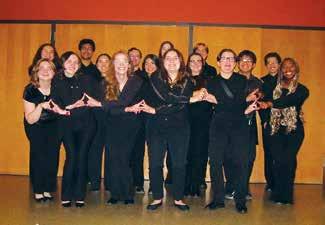
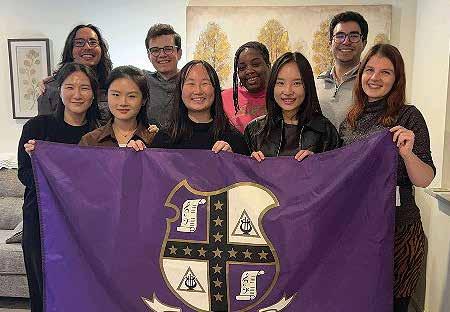
Alpha Nu, West Texas A&M University
Phi Tau, University of North Texas
Alpha Kappa, University of Missouri, Kansas City
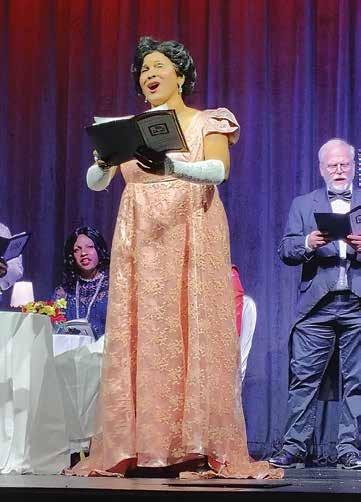
Arietha Lockhart (Beta Gamma, Atlanta Alumni) performed the role of Marion Wright in Americolor Opera’s production of LaRoche in October.
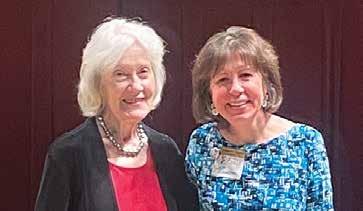
Leone Buyse (Mu Upsilon), the 1970 winner of the Mu Phi Epsilon International Competition, was the guest artist for the Colorado Flute Association’s 2025 Flute Fair. Pictured with Buyse, left, is Jane Sandstrom (Mu Gamma, Colorado Springs Alumni), president of CFA.
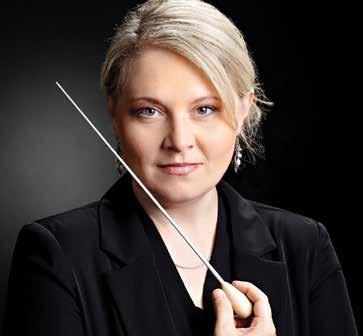
Rebecca Niederhiser (Beta Pi, Lincoln Alumni) was selected to present a session on Copland’s The Tender Land opera at the International Conductor’s Guild conference in January.

The Austin Chamber Ensemble was the recipient of a grant from the Mu Phi Epsilon Foundation to provide compensation to artists performing in a concert celebrating Native American Heritage Month in November. Pictured are Marti Mortensen Ahern (Mu Theta, Austin Alumni), pianist; Mikaela Pace, soprano; and Martha MacDonald (Phi Xi, Austin Alumni), chapter president.
LET US CLAP FOR YOU!
Send your newsworthy member and chapter news to editor@muphiepsilon.org for consideration in Applause & Encore. Please include a high-resolution photo and any identifying information.
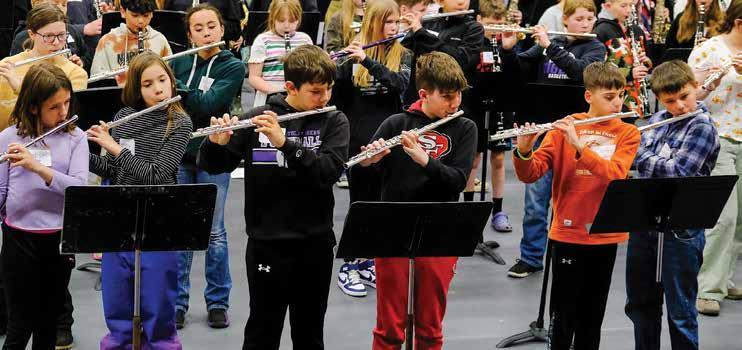
Students from four rural schools in Plumas County, California, joined together for the All-County Band Day in March 2025, an event sponsored by Plumas Performing Arts and supported by a Mu Phi Epsilon Foundation philanthropies grant.
Are Philanthropy Grants Right for Your Musical Group?
Are you playing or singing in a nonprofit musical organization? Could the group use some extra funds? Let’s face it: Every group could use some extra funds. The Mu Phi Epsilon Foundation has a grant just for you.
The philanthropy grant from the Foundation seeks to help all of us in musical endeavors. This is not just when you are seeking a degree or advancement in your career, but throughout all of our lives! Performing in a community ensemble or chorus is just the thing if you are Mu Phi, as you can apply for the grant and the money goes to help your entire group. The deadline to submit an application is June 15, 2026.
In 2025, the Foundation awarded four philanthropy grants to four different organizations: the Detroit Women’s Chorus, the Austin Chamber Ensemble, the Denton Bach Society and the Ann Arbor Musical Arts Society. These groups will use the money to help promote their groups, pay for new Artists to come into their areas and perform music for their communities.
In 2024, the philanthropy grant was awarded to Plumas Performing Arts in Quincy, California, an organization co-founded by Tristan McMichael (Mu Eta). Some of the funds supported local music programs within the Plumas Unified School District and allowed the Plumas county officer of education to purchase awards and certificates for students participating in the All-County Band Day in March 2025. The event brings student musicians from four rural towns in the county to play in a full-sized ensemble together. The location for the 2025 concert was special because it was held in Greenville, California, a town that was mostly lost to the Dixie Wildfire in 2021. Supporting students across the rural county is an important part of what Plumas Performing Arts does as a nonprofit.
Could 2026 be the year that your organization gets a grant to help out your community? It only takes one Mu Phi to apply. That Mu Phi can be you!
Donna Chrzanowski, Phi Kappa, Detroit Alumni, Philanthropy Chair, Mu Phi Epsilon Foundation
Happy Anniversary!
These Mu Phi Epsilon chapters celebrate milestone anniversaries in 2026
120 YEARS
Kappa, Butler University, Indianapolis, Indiana
November 3, 1906
115 Years
Mu, Brenau University, Gainesville, Georgia
February 6, 1911
Xi, University of Kansas, Lawrence, Kansas
April 12, 1911
105 Years
Detroit Alumni
May 2, 1916
100 Years
Mu Phi, Baldwin Wallace University, Berea, Ohio
February 26, 1926
Mu Psi, Coe College, Cedar Rapids, Iowa
May 22, 1926
Kansas City Alumni
November 26, 1926
95 Years
Dallas Alumni
February 26, 1931
90 Years
Denver Alumni
June 16, 1936
85 Years
Phi Pi, Wichita State University, Wichita, Kansas
June 22, 1941
80 Years
Phi Omega, Westminster College, New Wilmington, Pennsylvania
April 6, 1946
Wichita Alumni
December 29, 1946
75 Years
San Jose Alumni
February 18, 1951
70 Years
Fresno Alumni
June 2, 1956
65 Years
Alpha Pi, Texas State University, San Marcos, Texas
October 29, 1961
60 Years
Denton Alumni
April 16, 1966
Beta Zeta, Southern University, Baton Rouge, Louisiana
April 23, 1966
Beta Eta, California State UniversityEast Bay, Hayward, California
May 14, 1966
Beta Theta, Tennessee Technological University, Cookeville, Tennessee
May 29, 1966
50 Years
Gamma Sigma, California State University - Domingez Hills, Carson, California
May 8, 1976
25 Years
Delta Tau, Mercer university, Macon, Georgia
April 21, 2001
15 Years
Zeta Kappa, Young Harris College, Young Harris, Georgia
April 5, 2011
10 Years
Zeta Omega, Illinois College, Jacksonville, Illinois
April 3, 2016
Jessica Ann (Perry) Slosser Epsilon Alpha, May 15, 1999
Died September 8, 2024

Pianist. Ann earned her bachelor’s degree in 1955 from Oberlin Conservatory in Ohio. She started her career in music education in Minnesota where she taught piano and contributed to the arts community. She was an active member of the Minneapolis/St. Paul Alumni chapter.
Verna Bartlett Balch
Phi Chi, October 30, 1953
Died August 26, 2025

Flutist. Verna was raised on a California ranch and dairy farm. Between milking cows and ranch chores, she discovered her true passion: music. At 6 years old, she fell in love with the flute and piccolo, eventually earning the nickname “Piccolo Pete.” Starting her freshman year studying music at Cal State Fresno, Verna was honored with an invitation to become principal flutist with the Fresno Orchestra. She joined Mu Phi Epsilon and began what would become a life of performing and mentoring. Her flute took her across the globe: she performed with the La Paz Symphony in Bolivia, the Tehran Symphony in Iran, for Chinese government officials in the early 1960s, and with the Greenwich Orchestra in Connecticut. At the request of the U.S. State Department, she toured Iran, giving recitals. She later studied with Julius Baker of the New York Philharmonic and Roger Stevens of the Los Angeles Philharmonic. She earned her Master’s in Music at the University of Southern California, and
FINAL NOTES
GEILER, THIRD VICE PRESIDENT/ALUMNI ADVISOR, PHI THETA, ST. LOUIS ALUMNI ALUMNIADVISOR@MUPHIEPSILON.ORG
taught flute in Rolling Hills for the next 50 years. During this time, she also served as principal flutist of the Peninsula Symphony for 25 years.
Verna was a board member of the First Church of Christ, Scientist Palos Verdes, the Music Teachers’ Association of California and the Peninsula Committee Los Angeles Philharmonic. She was a longtime active member of the Palos Verdes/ South Bay Alumni chapter.
Colleen Jennings
Omega, May 10, 1993
Died August 7, 2025

Vocalist. Colleen was a gifted soprano, devoted educator and beloved friend. She had lived in Germany since December 2021. She pursued her passion for music with unwavering dedication, earning a Bachelor of Arts from St. Catherine University in 1989, a Master of Music in vocal performance from Drake University in 1996, and a Doctorate in vocal performance and pedagogy from the University of Iowa in 2014. Her career as a voice teacher and performer spanned continents and institutions. She served as a voice instructor with the Drake University Community School of Music (19982005) and was a graduate teaching assistant at the University of Iowa. She also taught classical voice at the School for Music Vocations at Southwestern Community College (2001-2008), Dowling Catholic High School (2001-2003) and Central College (2003-2008). She worked at the University of Iowa (2005-2008) and later taught at Mahidol University in Thailand beginning in October 2008. From August 2015 to May 2022, Colleen was an assistant professor at the University of Guam, where she continued to inspire students with her artistry and warmth. Most ANN
recently, she served as center operations coordinator at the USO Spangdahlem Air Force Base (2022-2025). Colleen attended Mu Phi conventions and made lifelong friends with many Mu Phis.
Sandra Marlene (Dammann) Saliny Mu Epsilon, February 4, 1958
Died August 9, 2025
Minneapolis/St. Paul Alumni

Pianist. Organist. Sandy earned her bachelor’s degree from the MacPhail College of Music in Minneapolis in 1958. She taught piano lessons in Fairmont and Crystal, Minnesota, and was the organist for the Brunswick United Methodist Church in Crystal for many years. Sandy was a member of the Minnesota Music Teachers Association and served as its vice president. She was also a member of the Minneapolis Music Teachers Forum, the West Suburban Music Teachers, the Thursday Museum and the Schubert Club. To honor her memory, her family requested donations to support Mu Phi Epsilon scholarships.
Dana DeeAnn (Scheer) DeKalb Phi Pi, November 24, 1970
Died September 8, 2025
Wichita Alumni

Violinist. Dana was born the second of 10 children. From her earliest years, music was her heartbeat. She began formal piano lessons in first grade and soon joined her siblings in the family ensemble, The Scheer Delights, which performed throughout Kansas. She earned a bachelor’s in violin performance from Wichita State University in 1973. A gifted
professional musician, Dana was equally skilled in piano and violin. She performed with the Wichita Symphony, the Wichita Grand Opera and in countless weddings, recitals and church events. She especially loved sharing her talents at Eastminster Presbyterian Church in Wichita. Her true calling, however, was teaching. As the owner and primary instructor of the DeKalb Suzuki School of Violin, Dana believed music instruction was about more than technique: it was about discipline, respect, joy, and faith. Her influence extended beyond her studio. Dana co-created the Rhythm Train Music Book series, which has been used nationally by teachers to help young violin students establish rhythm. The books remain a cornerstone resource for many professional musicians and educators today.
Maria Pia Antonelli
Phi Upsilon, December 13, 1946
Died December 9, 2025
Boston Alumni

Pianist. Maria taught piano at The Perkins School for the Blind in Watertown, Massachusetts, for 45 years. She received an award for 35 years of service to the school. She was known for using a Mu Phi quote “Music is the noblest of the arts. I hope our students have experienced some of that nobility.” Maria shared music with her community generously and meticulously. Her piano scores were known to be carefully prepared with extensive fingerings. She donated her grand piano to the Boston University School of Music and served on the board of the Boston Civic Symphony Orchestra. Maria was a faithful and active member of the Boston Alumni chapter and was recently honored and celebrated as a 70-year member of Mu Phi Epsilon.
ATLANTIC
DISTRICT A1
Stephanie Berry 574.596.8285 bmpenguin69@hotmail.com
DISTRICT A2
Susan Todenhoft 703.323.4772 H 703.509.0224 C todenhoft@gmail.com
EASTERN GREAT LAKES DISTRICTS EGL1 & EGL2 Vacant
DISTRICT EGL3
Nancy Jane Gray
330.688.7990 bobgrayz@aol.com
GREAT LAKES
DISTRICTS GL1 & GL3
Donna Chrzanowski 586.751.7276 chrzdonna@gmail.com
DISTRICT GL2
Linda McNair
314.494.7472 c1dd@muphiepsilon.org
EAST CENTRAL
DISTRICT EC1
Herbert Jackson 678.577.3637 herbertjackson5@gmail.com
DISTRICTS EC2 & EC3
Brandon Barnett 317.557.3443 indianapolis@muphiepsilon.org
DISTRICT DIRECTORY
SOUTHEAST
DISTRICT SE1
Lauren Moseley se1dd@muphiepsilon.org
DISTRICT SE2
Wanda Yang Temko 404.217.9712 wanda@yangtemko.com
DISTRICT SE3
Arietha Lockhart 404.284.7811 ariethal@hotmail.com
DISTRICT SE4
Marcus Wyche 301.484.3652 videoauth@aol.com
SOUTH CENTRAL
DISTRICTS SC1, SC3 & SC4
Isabel De La Cerda 210.204.6425 idelacerda@hotmail.com
DISTRICT SC2
Rebekah Boatright 817.701.8068 rebekahboatright@gmail.com
CENTRAL
DISTRICT C1
Linda McNair 314.494.7472 c1dd@muphiepsilon.org
DISTRICT C2
Paula Patterson 417.773.1176 paulapatterson@missouristate.edu
NORTH CENTRAL
DISTRICT NC
Carmen Chavez 952.460.0708
nc1dd@muphiepsilon.org
WEST CENTRAL
DISTRICT WC1
Ashley Roever 580.822.5682 amroever@hotmail.com
DISTRICT WC2
Kirsten Forbes 720.232.6450
kirsten_forbes@msn.com
PACIFIC NORTHWEST
DISTRICT PNW1
Sophia Tegart 509.991.4906 sophia.tegart@gmail.com
DISTRICTS PNW2 & PNW3
Michael Lasfetto 971.275.3800
pnw3dd@muphiepsilon.org
PACIFIC
DISTRICT P1
Jessica Dodge Overstreet 775.720.2135
jessicadodge@gmail.com
DISTRICT P2
Kirsten Forbes 720.232.6450
kirsten_forbes@msb.com
PACIFIC SOUTHWEST
DISTRICT PSW
Rylee Lemay and Shania Carden 951.310.5164
psw1dd@muphiepsilon.org
2023-2026 INTERNATIONAL EXECUTIVE BOARD
Dr. Kurt-Alexander Zeller, Mu Chi Atlanta Alumni International President 770.961.4400 president@muphiepsilon.org
Liana Sandin, Beta Pi, Lincoln Alumni
1st VP/Extension Officer
402.560.7126 extensionofficer@muphiepsilon.org
Ashley Bouras, Phi Tau, Dallas Alumni 2nd VP/Collegiate Advisor
972.765.3252 collegiateadvisor@muphiepsilon.org
Ann Geiler, Phi Theta, St. Louis Alumni 3rd VP/Alumni Advisor 314.691.7648 alumniadvisor@muphiepsilon.org
Marshall Pugh, Alpha Xi Roanoke Valley Alumni 4th VP/Music Advisor 252.599.2492 musicadvisor@muphiepsilon.org
Tanner Wilson, Beta Alpha Fullerton Alumni 5th VP/Eligibility Advisor 951.515.9680 eligibilityadvisor@muphiepsilon.org
Jess LaNore, Beta Psi Indianapolis Alumni Executive Secretary-Treasurer 888.259.1471 executiveoffice@muphiepsilon.org
Kat Braz International Editor editor@muphiepsilon.org
Lisa Storm Beyer, Mu Chi Dallas Alumni Social Media Manager social@muphiepsilon.org
OFFICERS
DIRECTORY
HONORARY ADVISORY BOARD
Rosemary Ames, Omega Boston Alumni
508.498.4669 rosemarykames@gmail.com
Lee Clements Meyer, Phi Xi
Austin Alumni
512.345.5072
MUSIC LIBRARIAN & ARCHIVES
Wendy Sistrunk, Mu Mu Kansas City Alumni
816.309.5910
61gwensinger@gmail.com
INTERNATIONAL CHAIRMEN
ACME
Arietha Lockhart (Chair) Beta Gamma, Atlanta Alumni
404.284.7811 ariethal@hotmail.com
Mary Au (Co-Chair), Mu Nu Los Angeles Alumni
323.666.2603 auhaus@gmail.com
BYLAWS & STANDING RULES
Dr. Kurt-Alexander Zeller, Mu Chi Atlanta Alumni
770.961.4400 zellertenor@aol.com
FINANCE
Evelyn Archer, Omega Omega St. Louis Area Alumni
458.562.9177 archerbe@sbcglobal.net
2025-2026 FOUNDATION BOARD
Kira Dixon, President Phi Mu, Palo Alto Alumni president@mpefoundation.org
Isabel De La Cerda, Vice President Delta Omega, San Antonio Alumni vicepresident@mpefoundation.org
Dr. Hannah Porter Occeña, Secretary Alpha Kappa, Affiliate Member secretary@mpefoundation.org
Dr. Matthew Hoch, Treasurer Lambda, Affiliate Member treasurer@mpefoundation.org
Donna Chrzanowski, Philanthropies Coordinator Phi Kappa, Detroit Alumni philanthropies@mpefoundation.org
Dr. Danielle Kuntz, Artist Concert Manager, Grants and Scholarships Coordinator Mu Phi, Cleveland Area Alumni grants@mpefoundation.org
Dr. Wanda Yang Temko, Website Administrator Eta Eta, Atlanta Alumni admin@mpefoundation.org
Dr. Kurt-Alexander Zeller Mu Chi, Atlanta Alumni president@muphiepsilon.org

Mu Phi Epsilon Professional Music Fraternity
6510 Telecom Drive, Suite 370
Indianapolis, IN 46278
executiveoffice@muphiepsilon.org
888-259-1471