
Edvard Munch and the Chocolate Factory










Edvard Munch and the Chocolate Factory
Foreword 4
Tone Hansen
Cacao Promises: Edvard Munch and 8
the Freia Frieze
Ana María Bresciani
‘The Little Chocolate Girls’ 90 – Who Were They?
Marta Breen
Munch, and My Mum in Confectionaries 110 Per Petterson
The Bittersweet Chocolate: Historical 118 and Contemporary Narratives
Chipo Dendere
From a Ball of Ice to Monumental Frieze: 152
The Work of the Conservators
Nina Mauno Schjønsby in conversation with Lina Wulff Flogstad and Mie Mustad
Exhibited Works and Archival Material 171
List of Illustrations 173
Authors’ Biographies 174
Foreword
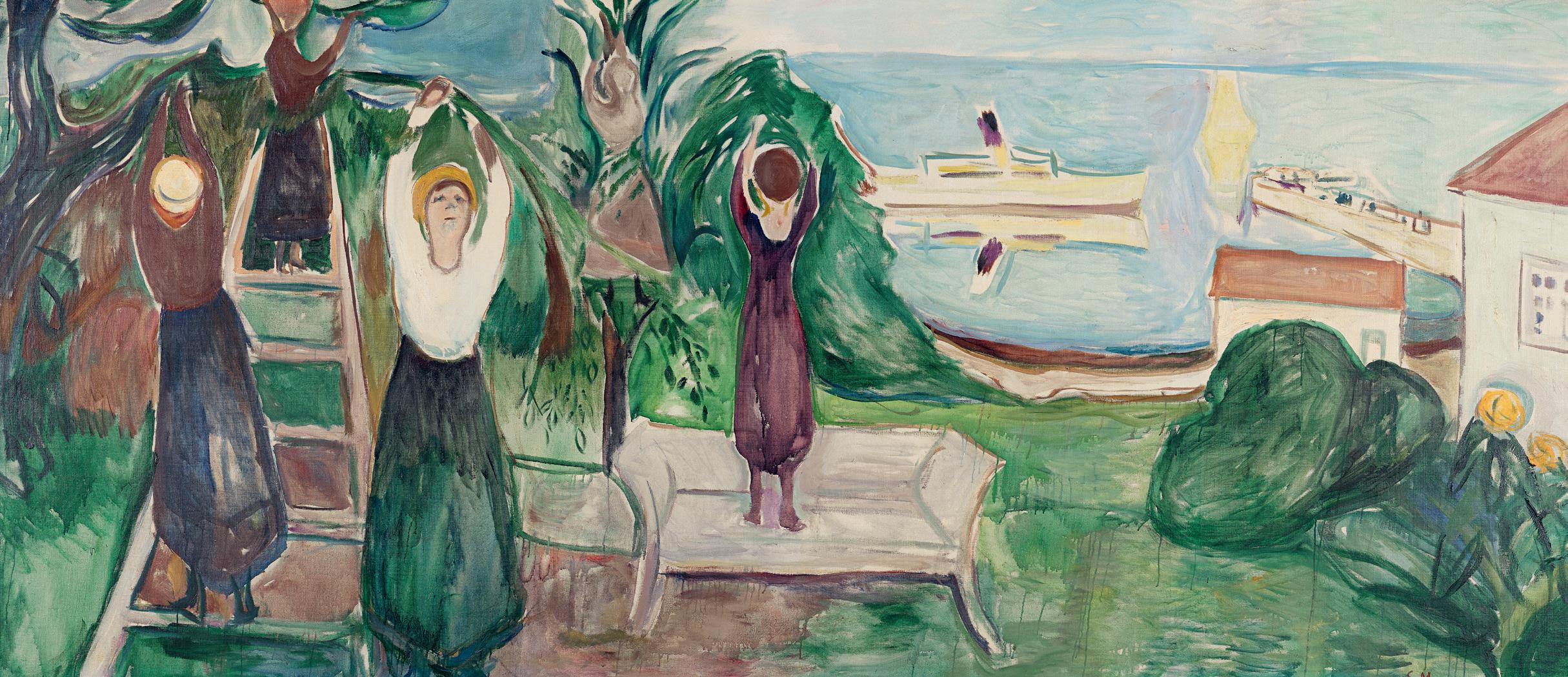
Edvard Munch’s frieze for the Freia Chocolate Factory depicts days of summer in a coastal town. Boats arrive and depart, and people of all ages are enjoying their surroundings. The 12 monumental paintings will be exhibited at MUNCH for five months before they return to Freia, where they were originally installed in 1923. This is a fantastic and unique opportunity for both the museum and for our audience.
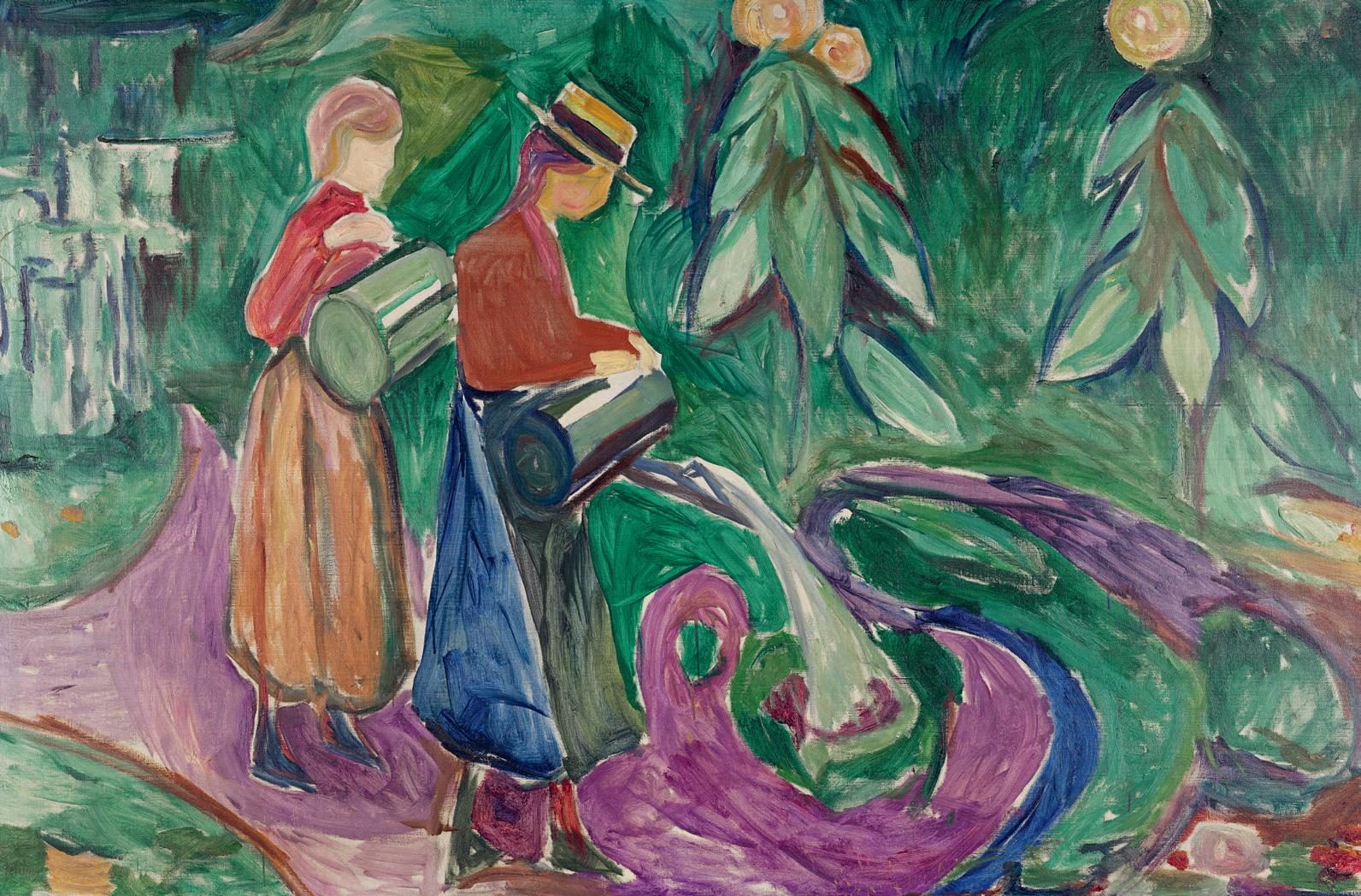
The paintings’ depicted surroundings bear similarities to Kragerø and Åsgårdstrand, two small towns by the Oslo fjord with which Munch was very familiar. Some scenes, such as Girls Watering Flowers and Girls Picking Fruit, originate from earlier works like the Linde Frieze (1904) and Reinhardt Frieze (1906–07). Others, including Fertility and Dance of Life, are drawn from Munch’s major series, The Frieze of Life.
Both the Freia Frieze and the Hall where they are installed have been protected by the Cultural Heritage Act since 2015. Originally commissioned for the women’s canteen, these paintings explore themes of nature and human interaction with the environment, reflecting Munch’s focus during the early 20th century industrial boom. The loan of these works allows the museum to present an exhibition linking Munch’s work and major commissions to themes relevant to his time such as the cacao trade, workers’ rights and women’s emancipation. Alongside the 12 Freia Frieze paintings, the exhibition Edvard Munch and the Chocolate Factory will feature sketches for several decorative projects, relevant works by the artist and archival material related to the interwar period.
Munch completed two public commissions: The Aula Decorations in the University of Oslo’s Ceremonial Hall (1916) and the frieze at Freia Chocolate Factory. To ensure public access to his oeuvre, he envisioned a museum as his most significant public art project, and in his testament dated 18 April 1940 he bequeathed all his works in his own possession to the City of Oslo. Munch’s commitment to public exhibition and engagement continues to guide our mission.
This publication builds on that history. Through essays, storytelling and conversations, readers will gain deeper insight into the historical context of the Freia Frieze and can reflect on the evolution of labour rights and social progress in Norway.
Curator Ana María Bresciani examines the Freia Frieze as a decorative art project, considering the artist, the commission, the commissioner, the canteen user, the resources that enabled the project and the workers’ context in Munch’s oeuvre. Author Marta Breen highlights the experiences of ‘chocolate girls’ and their fight for rights, offering insight into the human stories behind the art. Novelist Per Petterson shares a story about his mother, who worked at Freia and used the new canteen where the frieze has hung
since 1934, connecting the paintings to personal narratives. Political scientist Chipo Dendere discusses the history and democratisation of cacao in Europe and its trade, providing perspectives that enrich the viewing of Munch’s work. Finally, co editor Nina Mauno Schjønsby interviews two of the museum’s painting conservators, Lina Wulff Flogstad and Mie Mustad, about their work with the monumental sketch Workers on the Building Site (1931–33), which is included in the exhibition. This highlights the connection between careful preservation and the visual impact on display.
This opportunity for the museum audience is made possible by the support of lenders, including Mondelez/ Freia, the Norwegian Labour Movement Archives and Library, the National Library of Norway and the National Archives of Norway. We also thank exhibition designer Edoardo Ferrari, this publication’s designer Victoria Ydstie Meyer and the dedicated museum team. We look forward to welcoming you to this special exhibition, where history, art and personal narratives come together to create a memorable experience. We are grateful to our owners, the City of Oslo, and to the museum’s sponsors INPEX Idemitsu Norge AS, Canica, Viking, Deloitte, The Bergesen Foundation, The Savings Bank Foundation DNB and Talent Norge, all of whom make it possible for the museum to present its broad, ambitious programme of exhibitions, publications and live events.
Tone Hansen Director, MUNCH
Cacao Promises: Edvard Munch and the Freia Frieze
Ana María Bresciani
Edvard Munch’s artistic legacy intersects with the cultural significance of chocolate and the experiences of women and girls employed at the Freia Chocolate Factory after World War I. Within the tradition of decorative art commissions, Munch’s Freia Frieze (1922, pp. 28–51) stresses the importance of such works in industrial and public spaces and their influence on the cultural environment of the early 20th century. By analysing the creation and interpretation of Munch’s ‘monumental’ artwork,1 this article explores how art both reflects and shapes class, gender and power dynamics within Norway’s evolving social landscape. Furthermore, Munch’s frieze allows the broader history of chocolate production to serve as a framework for illustrating the promises and exclusions of modern industrial society, as well as the persistent struggles for workers’ and women’s rights, which Munch only partly addressed in his oeuvre.
The Painter
If Munch had selected fresco as his medium, moving the frieze from Freia’s canteen to the museum would have necessitated the destruction of the canteen walls. His choice of oil on canvas, unlike that of some contemporaries’, made this transition possible.2 The relocation of art originally created for a communal environment to a museum setting raises a central idea behind the exhibition Edvard Munch and the Chocolate Factory: art intended for public life is fundamentally connected to its site. By transferring the frieze, the museum participates in a process of cultural re coding that assigns new meanings to the artwork. This act of relocation invites consideration of how a change in setting may alter the viewer’s perception and understanding, thereby offering an additional interpretive layer and fostering discourse on how context and power dynamics redefine art over time.3
During his stay at Dr Jacobson’s Clinic in Copenhagen, Munch organised an exhibition in March 1909 at Blomqvist Kunsthandel in Kristiania (today Oslo). The exhibition received positive reviews and significantly broadened his public recognition. In the same year, he was appointed a knight of the Royal Norwegian Order of St. Olav. After returning to Norway and settling in the coastal town of Kragerø, Munch began preparing sketches for the Aula decorations at the University of Oslo, which he completed and installed in 1916.
By 1916, Edvard Munch was 53 years old and recognised as an acclaimed painter both in Norway and internationally. Following an extended period without a permanent residence, he settled at Ekely, where he lived until his death in 1944. From 1916 to 1944,
Munch participated in 287 exhibitions throughout Europe and the United States, frequently presenting as many as three solo shows annually.4
Ekely is linked to the construction of Oslo City Hall through the solicitor Hieronymus Heyerdahl (p. 125), who served as mayor of the city between 1912 and 1914, and who assisted Munch in acquiring the property. In 1918, architect Arnstein Arneberg (p. 126), although occupied with the City Hall competition, contributed to the expansion of Munch’s first studio at Ekely. During World War I, Munch worked extensively on his paintings and increased agricultural production on the property, a former nursery.
By the end of the war, both Europe and Norway had undergone significant transformation. The success of the Russian Revolution influenced not only the political structures of labour parties but also the arts. The period from 1905 to 1920 marked a breakthrough for the working class, shifting from a marginalised group to a determined proletariat. After World War I, the working class became a legitimate and organised part of society, advocating social reform through collective solutions.5 At the turn of the century, ordinary people began to appear in Munch’s work. In 1909, he depicted masculine workers shovelling snow, working in the fields and leaving the factory. By the time Munch hastily makes the Freia paintings, the worker motif has become a clear paradigm that culminates in the monumental sketch Workers on the Building Site (1931–33, pp. 150–151) in which the virile worker becomes central.
The Commission
Edvard Munch’s commission to create a frieze for the women’s canteen at the Freia Chocolate Factory in the early 1920s is situated within a context marked by labour unrest, strikes led by women workers, the evolving Norwegian labour movement and debates over the classification and taxation of chocolate.
On 6 April 1922, Freia director Johan Throne Holst (1868–1946) sent Edvard Munch an official letter (p. 27) commissioning his first decorative project for the factory, offering 80,000 Norwegian kroner (NOK), the equivalent to 2.5 million kr today. Throne Holst also referenced plans for a subsequent commission for a men’s canteen that Munch ultimately did not realise; sketches for both projects are preserved in the Munch Museum’s collection. Munch also received correspondence from Georg Dedichen, head of the factory’s experimental laboratory and his childhood friend, who affectionately referred to the ‘longawaited decorations.’ Dedichen apologised for ‘all the time wasted and backandforth discussions that have delayed’ the
plans, attributing the delays to ‘grave issues that were neither expected nor foreseen.’6 At that time, Freia maintained three dining rooms on the top floor, and in January 1923, Munch installed the twelve panels in the central room designated for women workers.
Ten months later, on 15 October 1923, the labour party newspaper Arbeiderbladet published an article examining the effectiveness of strikes within the chocolate manufacturing industry. The article featured a photograph of the Freia canteen and included the caption: ‘While the workers are paid starvation wages, large sums of money are invested in expensive paintings which can be sold at a considerable profit over time.’7 Despite Munch’s interest in decorative painting taking over walls, his work never went beyond the easel. Thus, the caption in the article could have worked as a prophecy: that one day the frieze could have been sold and left not only the canteen walls but also the country. The Frieze has previously travelled only once, to the exhibition Höjdpunkter i norsk konst at Nationalmuseum in Stockholm in 1968. The journalist did not identify the artist yet used the commission to centre on a labour dispute involving approximately 1,600 workers, two thirds of whom were women. These women, undeterred by the challenges they faced, played a pivotal role in the strike, using their collective strength to demand fair wages and better working conditions. This act of solidarity highlights their agency and determination to improve their circumstances.8
Historian JanErik Østlie identifies 1923 as a pivotal and turbulent year in the history of the Norwegian labour movement. He notes that the Norwegian Labour Party, founded in 1887, split when 37 representatives from 29 branches of the Norwegian Labour Union founded the Norwegian Communist Party. This created a division between revisionist and revolutionary groups. That year, 25% of the members of the Norwegian Confederation of Trade Unions, established in 1899, took part in an industrial conflict, including chocolate workers.9 The 1923 strike was part of a broader pattern of major labour disputes in Norway during the 1920s, such as the Storstreiken (the major strike) of 1921. This strike resulted from employer demands for wage reductions after a severe postwar economic depression, the longest downturn since the late 1890s.
The Norwegian government’s initial budget surplus, accompanied by a slowdown in business activity and rising unemployment, rapidly shifted to a significant deficit and increasing public debt. In response, the government introduced several measures, including a proposed sales tax on chocolate, which faced strong resistance from industrialists. On the one hand, chocolate was viewed as a luxury item; on the other, many families incorporated cooking chocolate into
their diets as a coffee substitute, offering more calories per krone, thereby introducing a class dimension to the debate.10
In 1922, the government implemented a tax with differentiated rates for eating chocolate, cooking chocolate and cacao. The economic crisis and ensuing tax debate had tangible financial consequences, influencing both the production and marketing of chocolate. This affected the commission, as only one of the canteens was decorated.
Edvard Munch produced twelve panels for the factory, illustrating summer life in a coastal town such as Åsgårdstrand or Kragerø, where he had resided. These panels integrate scenes along the shoreline, depicting boats arriving and departing, and individuals of all ages interacting harmoniously with their environment. The greens of the seasonal trees and the reds of women’s and girls’ clothing on the shore are reflected in the lilac hues of the sky and sea. The intense summer sunlight imparts a bright tone to the tree trunks, which dominate many scenes and accompany people in both work and leisure. The panels portray dance, dialogue and collective labour, as well as a consensual silence that contrasts with the routine and activity of the factory canteen and the daily experiences of women and girls at work.
Munch draws upon motifs he had previously explored in decorative projects such as the Linde Frieze (1904) and the Reinhardt Frieze (1906–07). For Dr Linde’s villa in Lübeck, Munch produced works including Dance on the Beach, Girls Watering Flowers, Girls Harvesting Fruit and Youth on the Beach. In 1906, he was commissioned to design stage sets for Max Reinhardt’s production of Ibsen’s ‘Ghosts’ at the new Chamber Theatre in Berlin, as well as for the theatre foyer. For this project, Munch based the entire decoration on a beach setting, like Freia, and painted the individual images with thin tempera on unprimed canvas including Dance on the Beach, Moonlight on the Beach and a smaller panel depicting Girls Harvesting Fruit.
While some of the imagery in the Freia panels is derived from these earlier friezes, art historian Gerd Woll observes that Munch also developed new concepts from his initial sketches for the Bergen Stock Exchange, where scenes of coastal town life, with boats arriving and departing as women and children stand on the shore, waving, are sketched. Woll further references the steeper skerries of Kragerø and notes that Munch modelled the older man on Børre Eriksen, a local seaman and oddjob worker. The form and motif of movement recall The Beggar (1909, p. 131), a rarely exhibited sketch. While the theme of the vagabond is preserved, Munch substitutes the landbound wanderer with a seafaring figure.
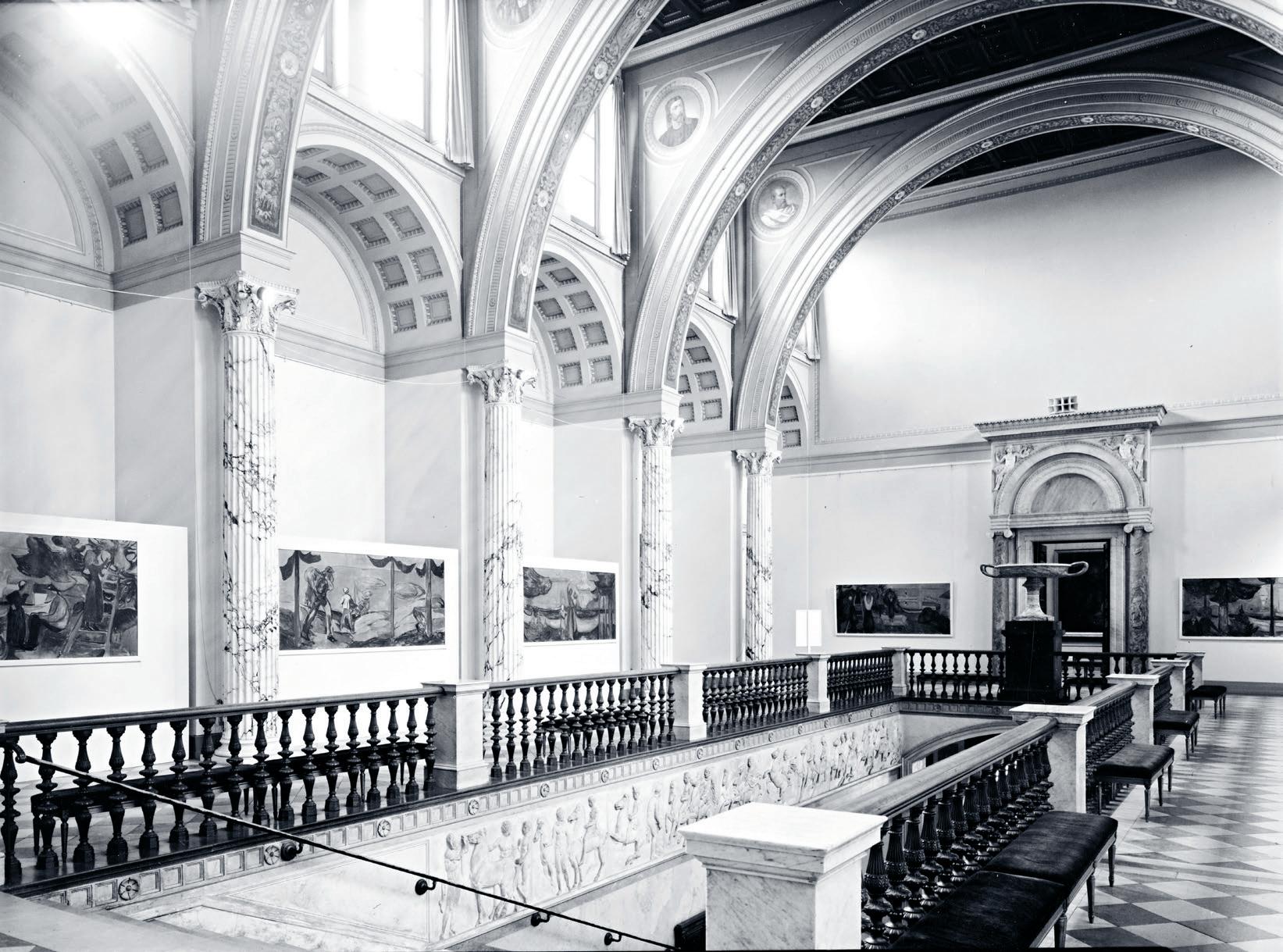
The Freia Frieze shown at the exhibition Höjdpunkter i norsk konst (Highlights of Norwegian Art) at Nationalmuseum in Stockholm, 1968
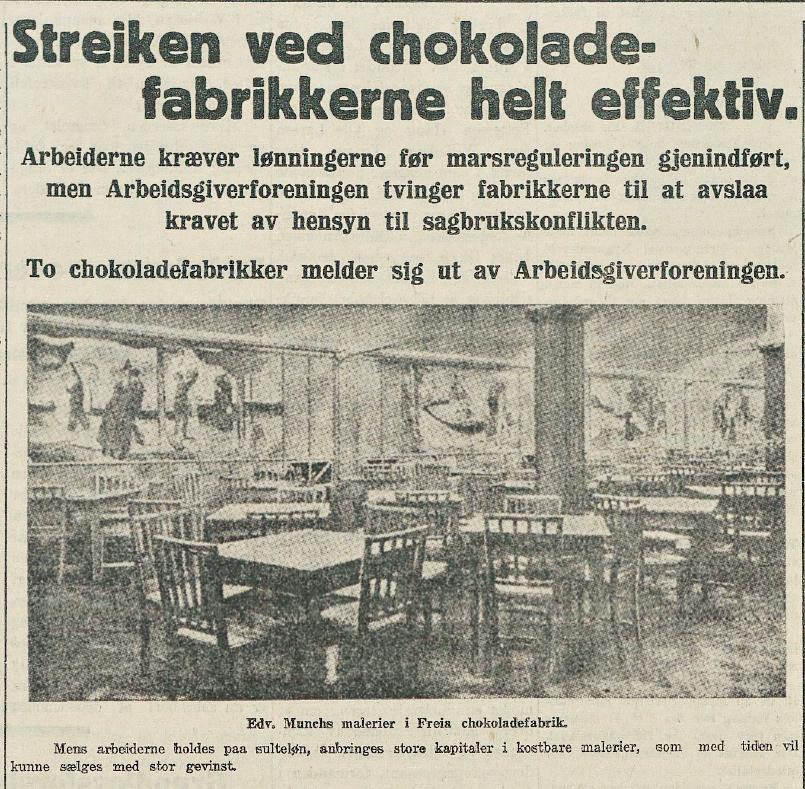
The newspaper Arbeiderbladet on 15 October 1923 uses the recently hung frieze to denounce the large sums spent on paintings while workers earn starvation wages
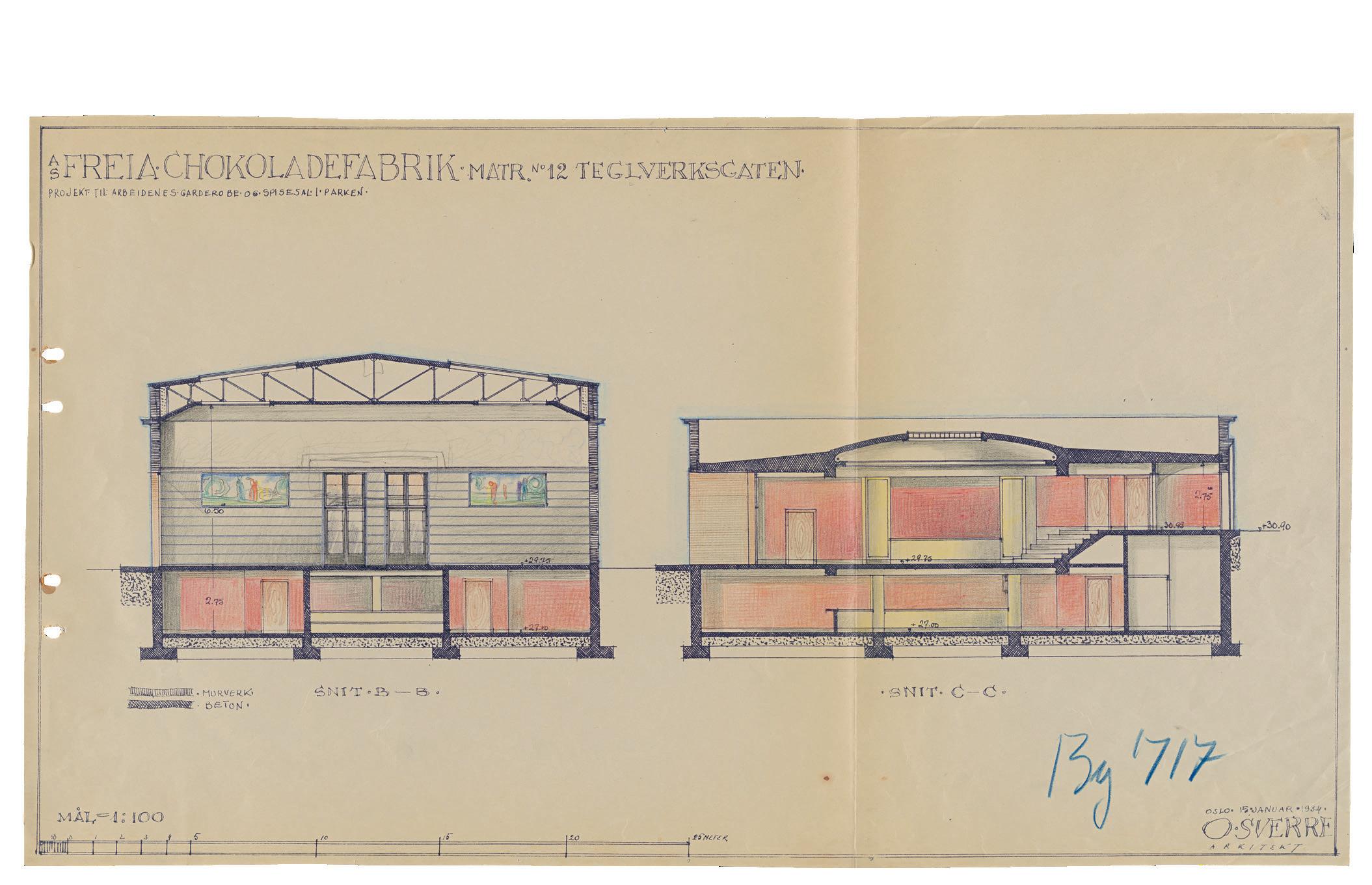
Drawing of the Freia Hall by architect Ole Sverre where the Frieze has hung since 1934
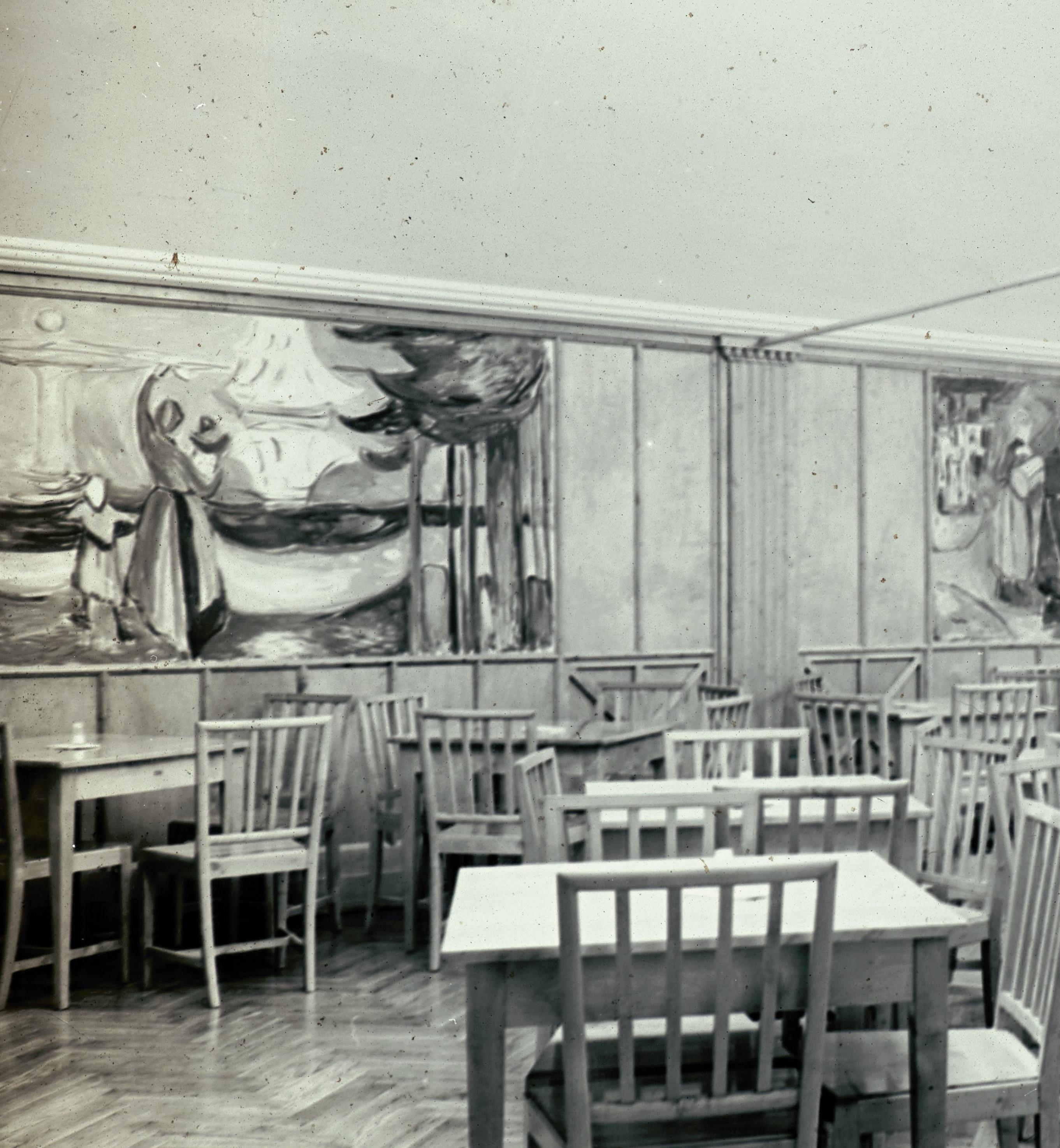
Freia promoted the first version of the canteen with a leaflet authored by art critic Jappe Nilssen (p. 124), who described the landscape of the small fishing town of Åsgårdstrand.12 Moreover, the art critic contributed to several newspaper articles after viewing the frieze. In the newspaper ArbeiderPolitikken, Nilssen highlighted Freia’s initiative by referencing the words of a prominent figure in the social democratic women’s movement: ‘Fernanda Nissen used to say that only the best was good enough for the workers […] This proud slogan has been Freia’s guiding principle […] It is an admirable initiative that the factory has taken.’13 For the daily newspaper Tidens Tegn, he emphasised how Munch transformed the canteen into an idyllic space: ‘With its polished parquet flooring, lightpolished birch wood walls, small tables and chairs made of the same wood, and its vaulted, white plaster ceiling with skylights, […] it was a sight to behold.’14
Art Critic Pola Gauguin asserted that Edvard Munch had ‘created his festive paraphrase of life’, and argued that his art was not exclusive. ‘On the contrary!’ he wrote. ‘I believe that once his somewhat unusual artistic form – which is not unusual in itself – is understood by the masses, there is no art that speaks more to the people than his, because it appeals not only to the cultivated eye, but above all to the human mind.’15 In February, between six and seven hundred people visited Freia’s premises. The newspaper Aftenposten remarked, ‘It is wrong to envy anyone, but one can almost envy those who will now enjoy their lunch in these surroundings every morning’.16
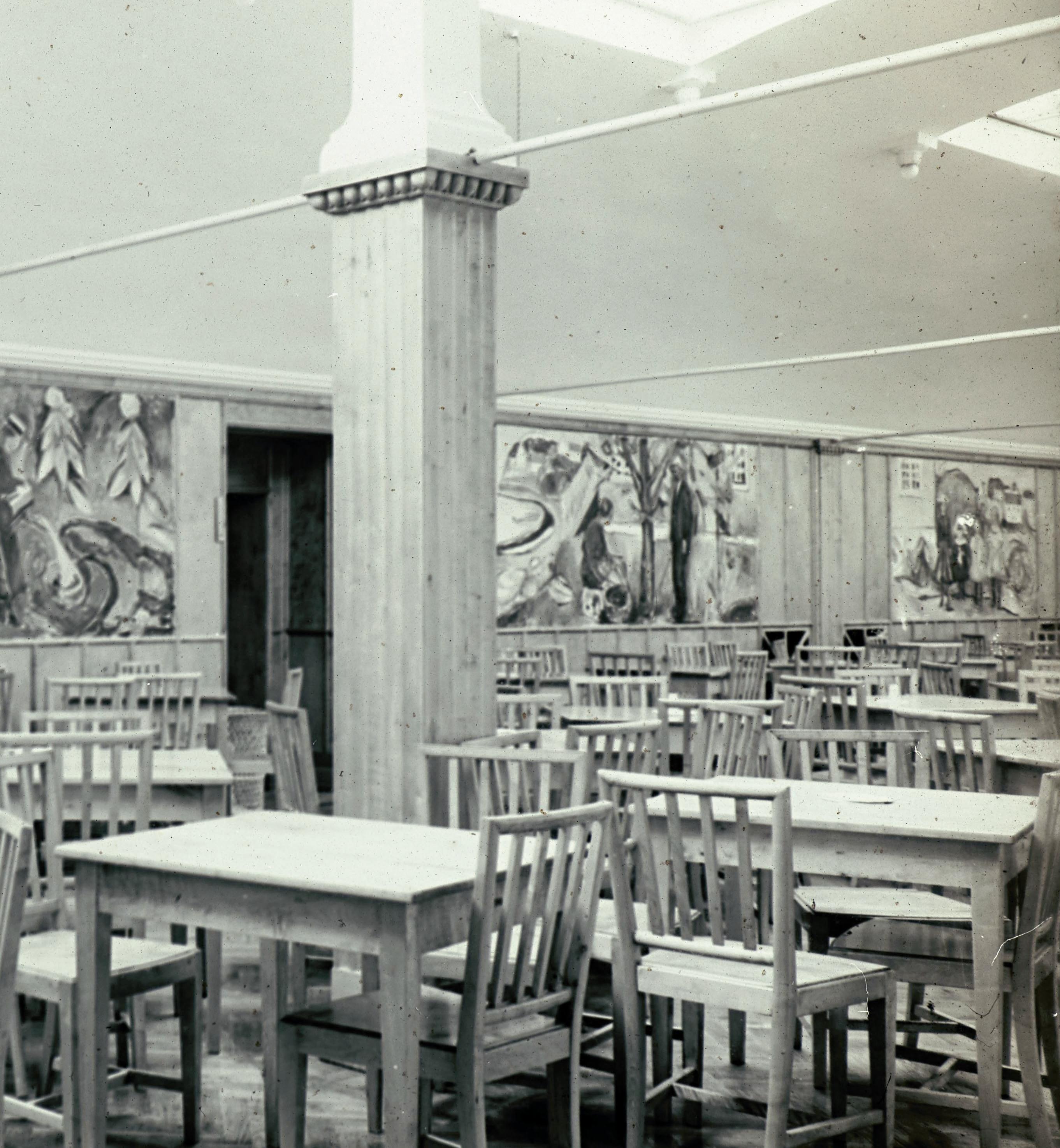
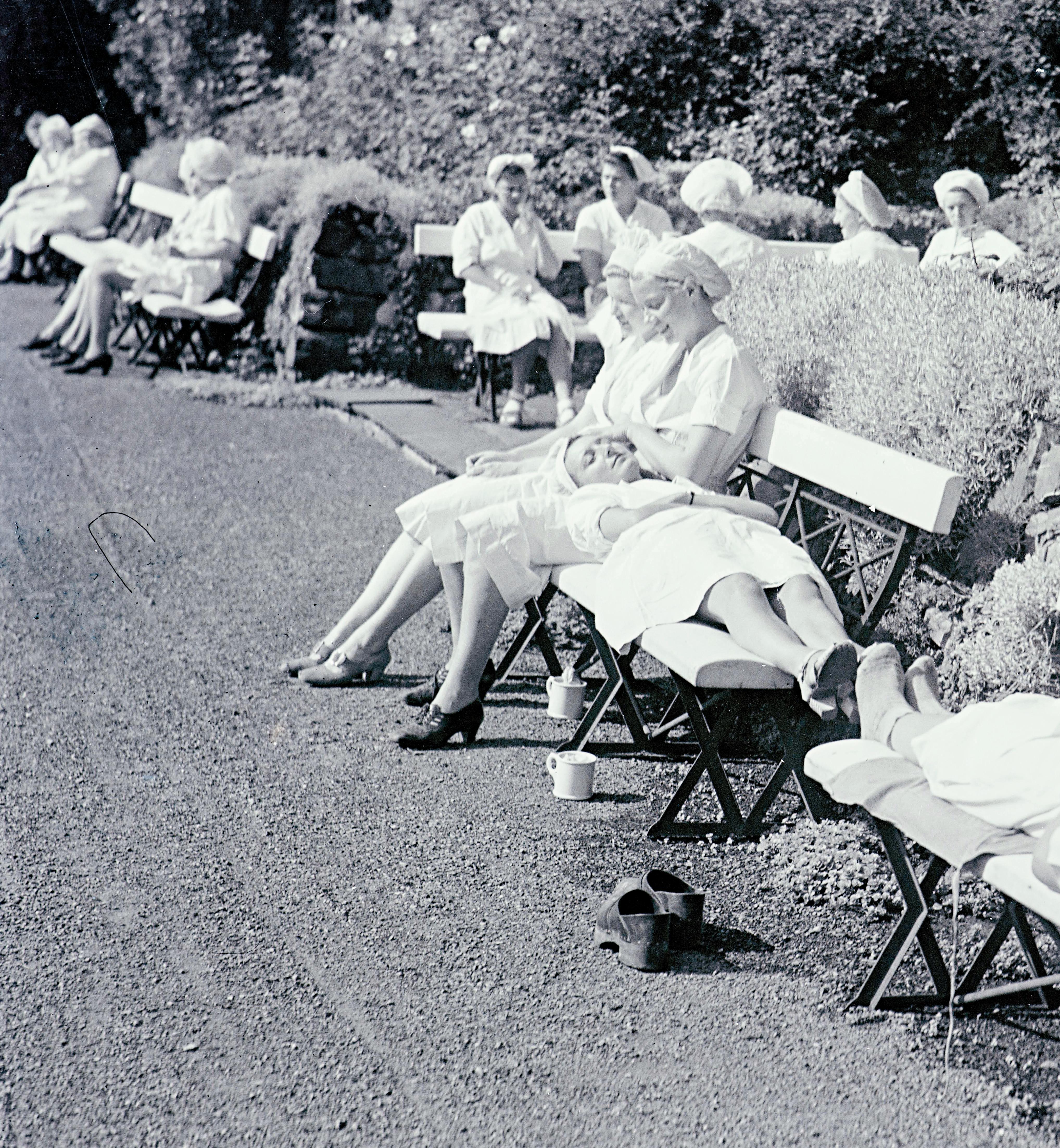
Archival films and photographs document the original canteen, where Munch’s panels were installed at eye level, adjacent to workers in white aprons as they shared their midday meals. In 1934, less than a decade later, Freia commissioned architect Ole Sverre to design a modern replacement building. Construction diaries record Munch’s four visits to plan the frieze’s new setting, with walls finished in ash veneer and aluminium rails.17 Art historian Johan Langaard wrote, ‘No factory in Europe has a more beautiful dining room’.18 English architects concurred, noting the absence of anything comparable in England.19
Within three weeks, more than 10,000 visitors attended the Freia Hall and its newly expanded park. Director Throne Holst organised a series of events that elevated the factory’s profile. On 13 October 1934, Ingrid Thoresen (signed as wife of Consul General Thoresen) placed a fullpage article about Freia in Tidens Tegn titled ‘Art, Light and White Aprons’, connecting to a review on a previous page of a lecture with slides by Professor Carl Schiøtz, Freia’s factory physician, titled ‘What Is Hygiene?’ that had taken place at the University as part of the programme. The Freia orchestra performed an overture, followed by Schiøtz’s
popular science presentation. In November, Professor Sophus Torup delivered a slide lecture on ‘Nutrition and Work’. By March 1935, the hall had become a concert venue, hosting a musical performance for all employees. In October, Freia welcomed the Philharmonic Society, providing the hall free of charge.
In a letter, Edvard Munch writes that ‘the staff and everyone are enthusiastic about them [the decorations], and the chocolate girls who eat there are beginning to understand the images’. He also explains that
It became very repetitive here and as I only had two months for the difficult 12 decorations, they were a little poorly executed
I once asked myself why I had taken it on –{…} When I think about it, it was to finally see my idea of the frieze of life in one place and with my idea of letting a shoreline tie all the images together into a whole –20
The Commissioner, and its Resource
Throughout the last decades of the 1800s, chocolate was primarily consumed in liquid form and served as a highlight at children’s parties and gatherings among the upper classes. Within these social circles, a ‘chocolade’ referred specifically to an event where chocolate was served. The Munch family participated in such traditions, as evidenced by an 1892 letter from Aunt Karen Bjølstad to Edvard Munch, which mentions a recent gathering where chocolate was shared among female family members. Following his return from abroad, Munch’s shopping lists included ‘regia cacao’ and evidence suggests he drank it to get in shape.21 At this time, cacao became increasingly significant in the lives of women and, subsequently, children.
Freia’s modern era commenced in 1892 when a consortium led by Johan Throne Holst acquired the factory. Throne Holst’s youthful bravado secured the factory for 9,000 kr, today’s 844 628. Only three years earlier, in 1889, Freia had been converted into a limited company, by which time its workforce had expanded from 12 to 60 employees.22
Freia emerged as a leader in progressive labour practices, employee welfare and national branding. This development highlights the intersection of class, gender and health in the company’s marketing strategies and workplace reforms, as well as the role of chocolate in Norwegian culture. Freia’s efforts to position itself as both modern and socially responsible are linked to broader trends in Norwegian society,
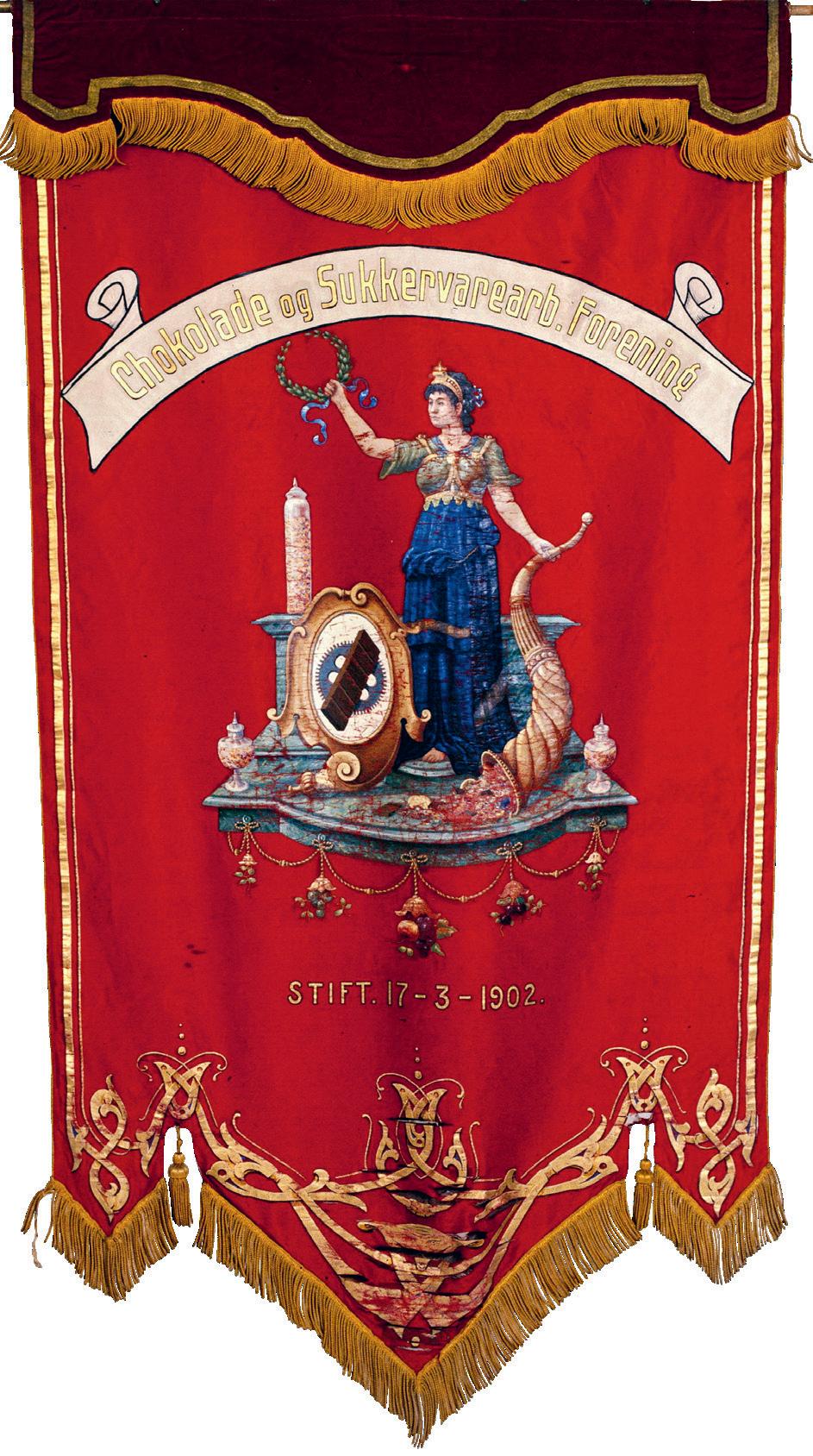
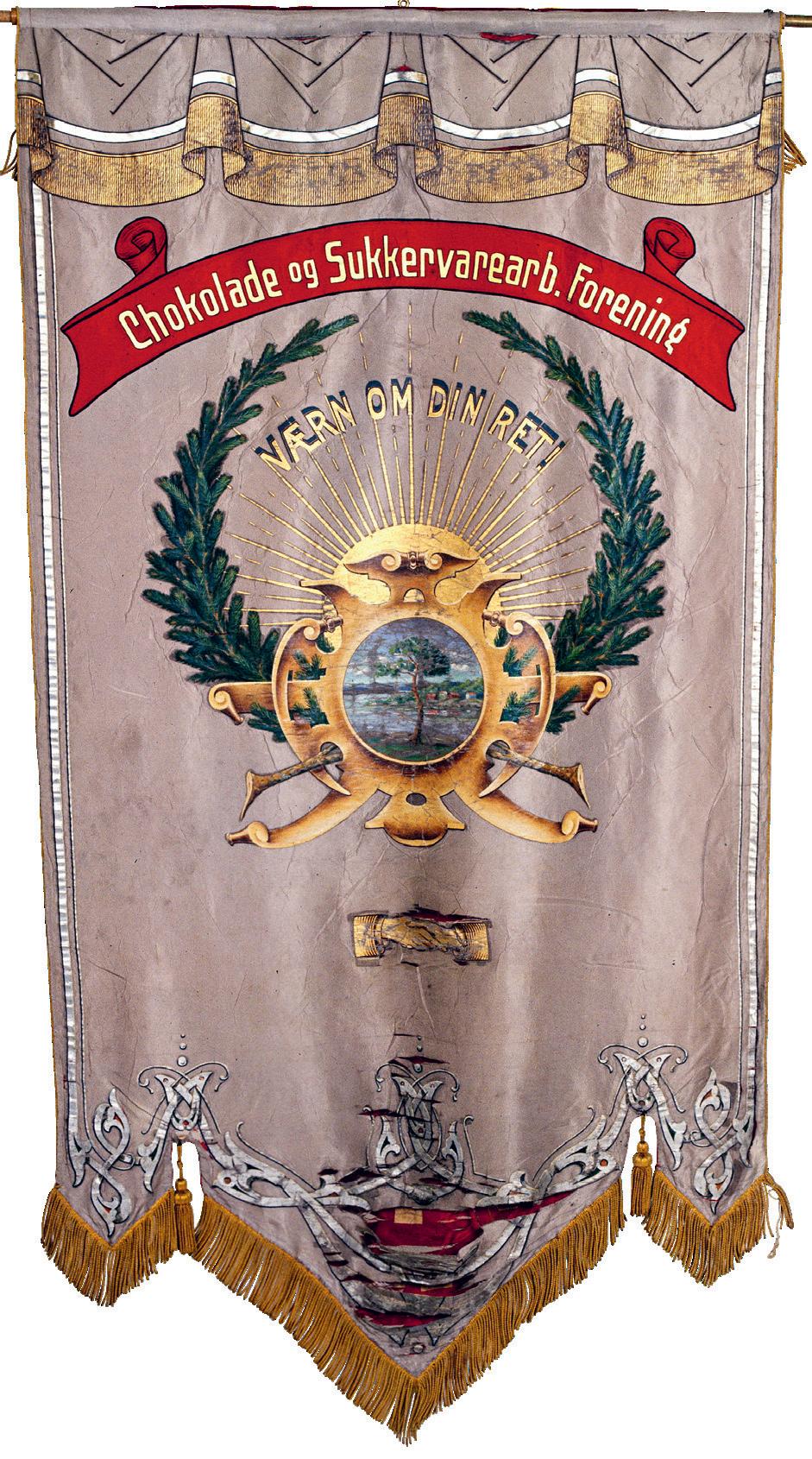
The Chocolate and Confectionery Workers’ Union, front and back of the banner from 1904
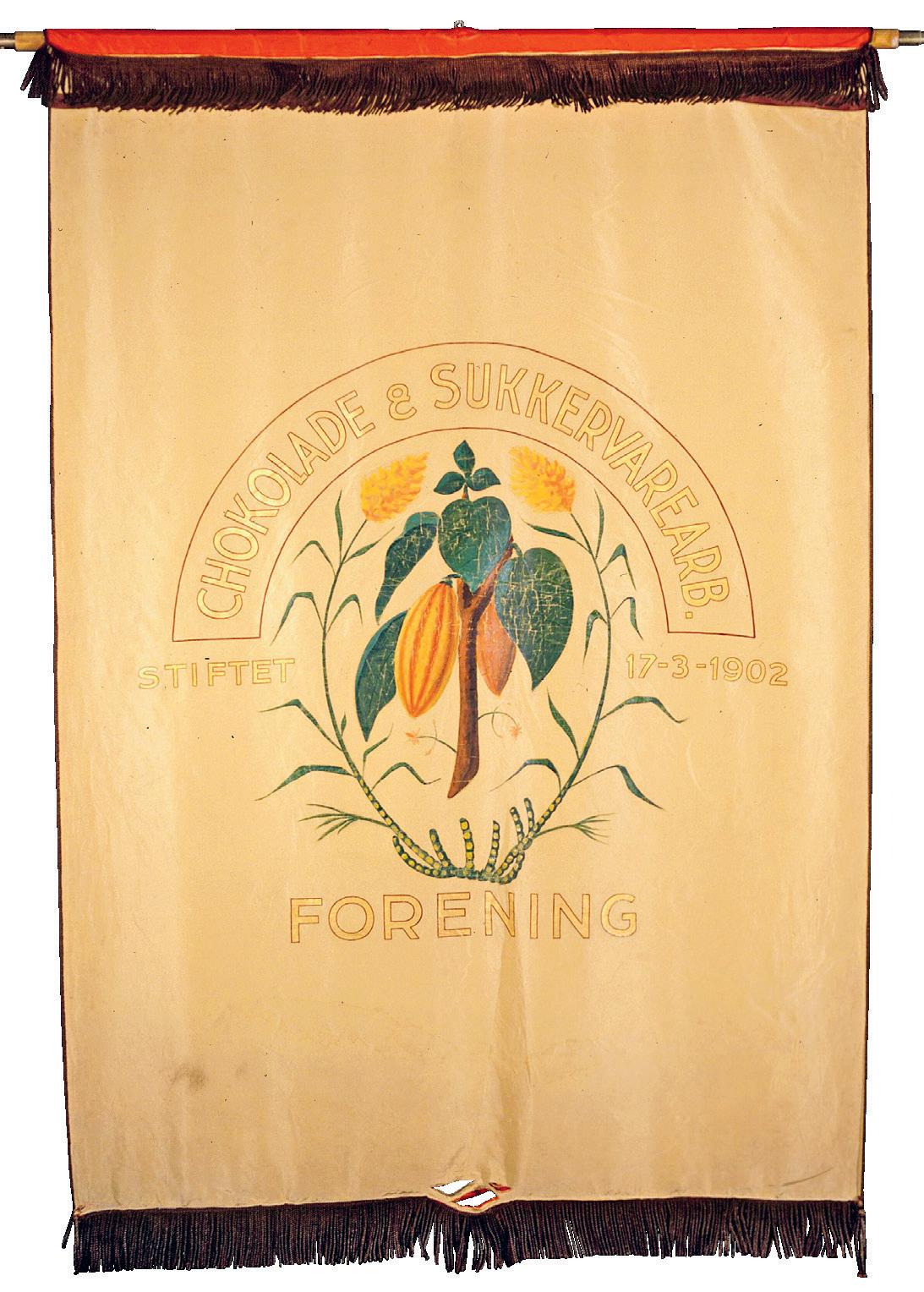
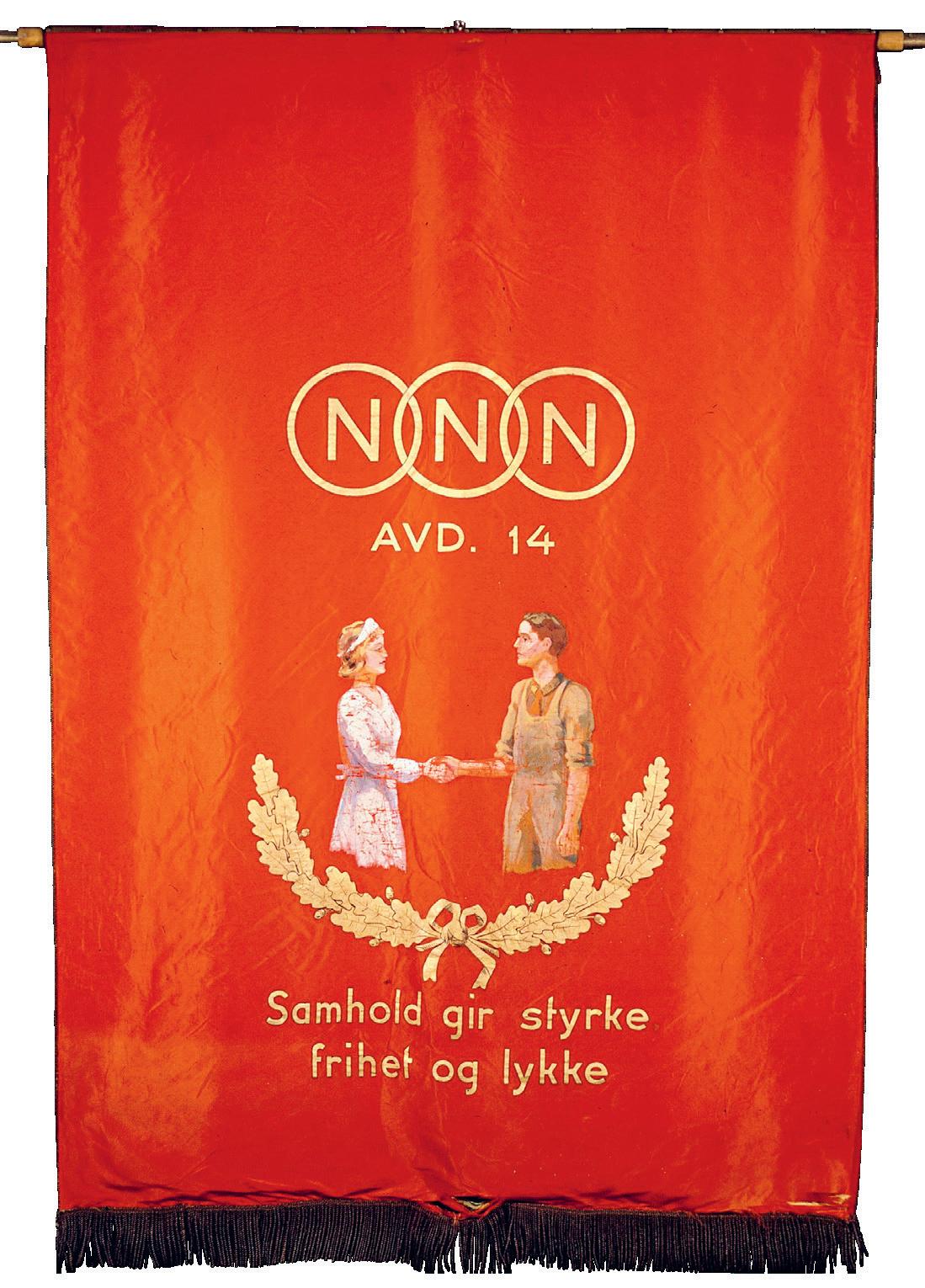
The Chocolate and Confectionery Workers’ Union, front and back of the banner from 1939
including increased life expectancy, unionisation and the integration of women into the workforce. Simultaneously, chocolate underwent a rebranding aimed at establishing it as a masculine product.
In response to foreign competition, Throne Holst aimed to position Freia as a brand with European exclusivity, a quality initially lacking in the small factory. Historian Erik Rudeng notes that, for many contemporaries, the term ‘chocolate manufacturer’ carried a slightly comical connotation. It was perceived not as a legitimate industry, but as a luxury product for women and children, a workplace for women, with the manufacturer likened to a harem guard.23
During this period, children often consumed coffee, prompting several physicians to recommend cacao as a healthier alternative. Dr Carl Schiøtz, head of the Hygiene Institute in Kristiania and factory physician at Freia, became a leading proponent of this initiative. Freia was the first Norwegian company to employ a company doctor, who introduced the ‘Oslo breakfast’ and stated that if cacao boiled with fresh or skimmed milk could completely replace coffee for children, it would be a great gain for their healthy development.24 In an open letter, Freia director Johan Throne Holst also further stressed ‘the importance of chocolate in the fight against alcohol abuse’.25
Freia thus sought to reach a national audience by promoting its product as a nutritious alternative to coffee for children, with the potential to improve public health and increase longevity. In addition, Throne Holst played a pivotal role among the generation who valued outdoor activities. Freia also supplied chocolate to Roald Amundsen and other notable expeditions, reinforcing its association with national achievement and exploration. Rudeng describes Throne Holst as embodying a dual political heritage, merging the patriarchal hegemony of the Trøndelag merchant family with progressive Liberal Party views on Norwegian culture and politics.26
As late as 1880, South America and the Caribbean accounted for nearly all the cacao production in the world. Around the same time, the cultivation of cacao began spreading to European colonies in Africa. By 1930, small farmers in Ghana, Nigeria, Cameroon and the Ivory Coast accounted for 65% of world production. The advances of cacao powder, dark chocolate and milk chocolate revolutionised the industry.
The User
What role does invisibility play in the lives of the Freia Chocolate Girls – the main canteen users – both in the factory’s daily operations and in the broader narrative of early 20th century industrial labour?
This guiding question recodes the intersection of girlhood, labour and visual representation within the archival material of the Freia factory and Munch’s oeuvre.
The 1889 strike at the match factory in Kristiania, led by women and girl workers protesting wage reductions and poor working conditions, resulted in the establishment of Norway’s first women’s union, the Female Match Workers’ Association. This development subsequently inspired the creation of 20 additional women’s trade unions during the 1890s, most of which were based in Kristiania. The strike garnered support from 10,000 demonstrators along Karl Johan Street. During this period, Edvard Munch was in Paris, and his aunt Karen wrote: ‘You read the newspapers and see what is new, – the match girls’ strike and all the commotion surrounding it, led by Dr Nissen and Jeppesen.’27
Women from lower socioeconomic backgrounds often made up the unskilled labour force, and early organising efforts were marked by uncertainty and inexperience. Leadership roles within these associations were often assumed by more resourceful women and men from the upper classes. Fernanda Nissen, referenced by Jappe Nilssen in his review of Munch’s Freia Frieze, served as chair of the Matchworker’s Union (Fystikkarbeidernes fagforening) and was the wife of Dr Nissen, who is also mentioned in Karen Bjølstad’s letter to Munch. In some instances, female workers organised alongside men, while other unions were established in direct opposition to male workers due to concerns that women’s participation would depress wages. Female workers typically received only half, and sometimes as little as a third, of the wages paid to men.
The Act on the Supervision of Factory Workers was enacted in 1893 to regulate child labour and establish employers’ liability for workplace accidents. The first legislation governing standard working hours for adults, which introduced a 10 hour workday and a 54 hour workweek, was implemented in 1915 following a period marked by 76 strikes and 31 lockouts. And yet, it is not until 1918 that Freia workers enter into a collective agreement.28
The Chocolate and Confectionery Workers’ Union was established on 17 March 1902 and joined the Norwegian Food and Beverage Workers’ Union (NNN) in 1923, coinciding with the latter’s formation. Half a year after the association was founded, the question of acquiring a banner arose. Lotteries, dances and other events were organised to raise money. The banner committee raised 181 kr and bought it from the decorative painter O. Ekornes. Unveiled on 28 April 1904, its motto ‘Defend your rights’ was fitting for the times (p. 14). Then, workers in the industry
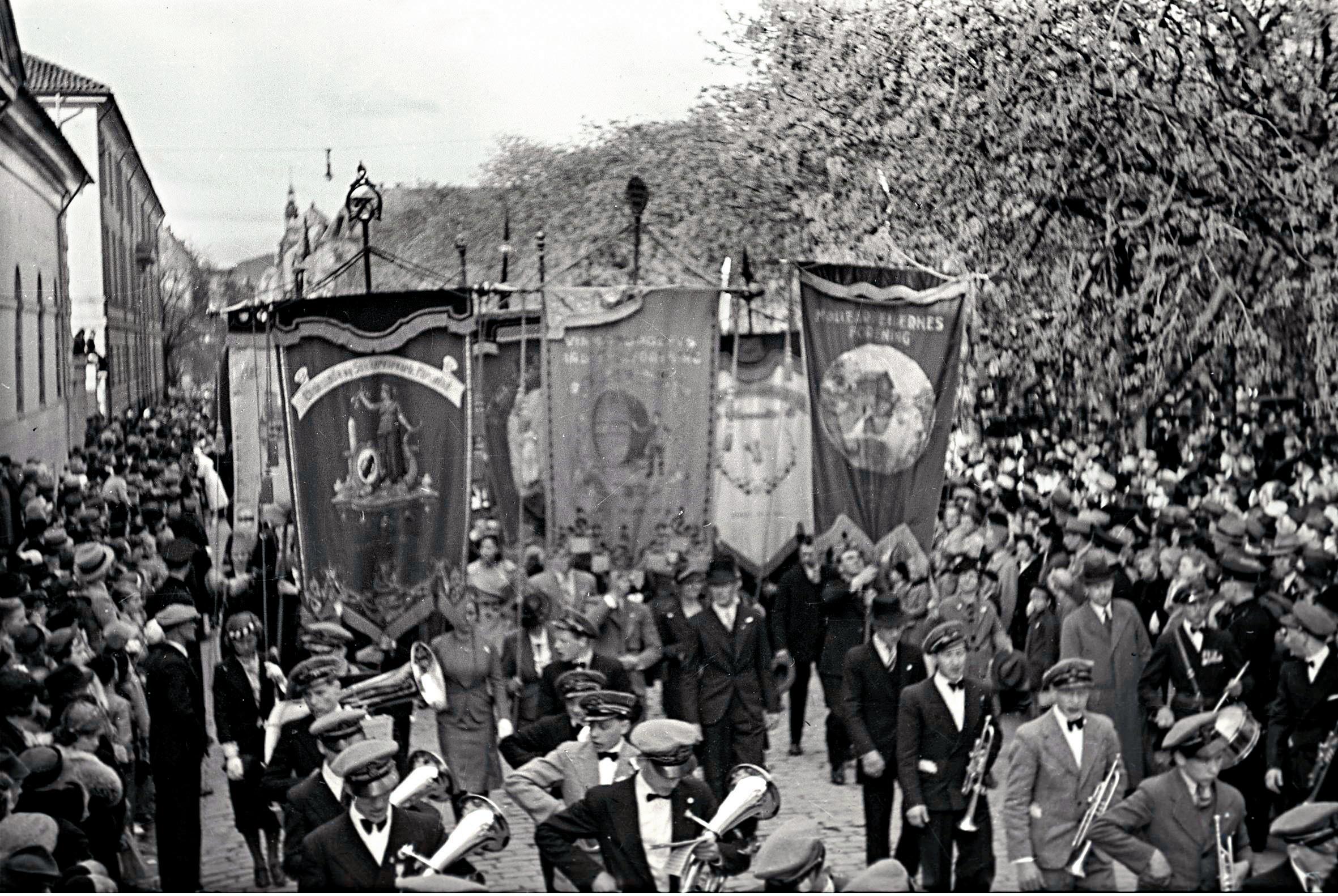
Parade with banners in Kongens gate in Oslo, 1 May 1938
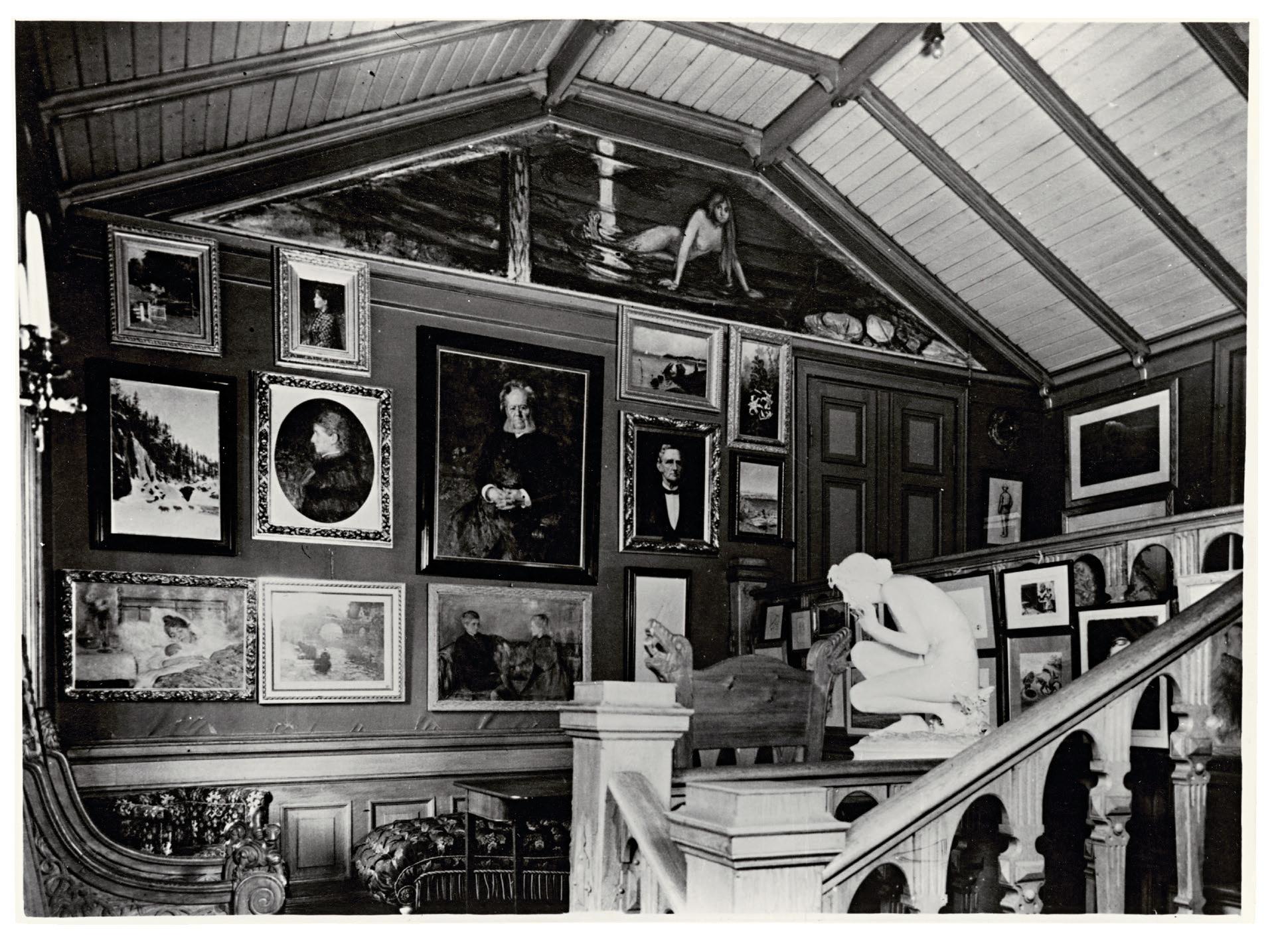
Edvard Munch completed his first decorative commission, The Mermaid (1896), in Axel Heiberg’s home at Lysaker
had no clear idea they had any rights. Over the years, companies were repeatedly asked to give employees 1 May off. Initially, they agreed to compensate employees for time off to participate in the demonstration. Further progress came in 1918, when workers were granted time off from 12 noon without any pay deduction.
The old banner with the cornucopia has served as a rallying symbol throughout the years. The new banner was inaugurated on 21 April 1939. Its motto ‘Unity gives strength’, is typical for its time as the first banner’s motto. Unity in the trade union led to rapid development in the 1930s (p. 15)29. Archive images of the time show equal participation of genders in public demonstrations.
Edvard Munch’s iconic representations of girls in Åsgårdstrand reappear in the Freia Frieze and in several other unrelated sketchlike works. Drawings such as Girl Standing (1912–13, p. 104) and Girl Standing. Profile (1914–15, p. 102) use two Norwegian terms for girl and have uncertain attribution, as it is unclear if these titles are Munch’s own. The jente is depicted with shoes and a bow in her hair, while the pike is barefoot and lacks decorative items. In this case, what stands out is not the working class theme, but how he portrays girls or maidens. In fact, the way he depicts the ‘maiden’ suggests she could be seen as a child from the working class.
Other representations of women workers, such as Charwomen on the Stairs and Charwomen in the Corridor (both 1906, pp. 103 and 105) are among the few in Munch’s oeuvre. A label on the back of the latter indicates that the works were made during Munch’s stay at Hotel Mutiger Ritter in Bad Kösen. These are displayed in the exhibition alongside Girl Standing with Rake (1882, p. 106), one of Munch’s earliest naturalist representations, notable not only for its depiction of female workers but also for its realism. The painting Two Women by the Veranda Steps (1942, p. 107) is a late work, largely overlooked in exhibition history, but it is one of a few depictions in Munch’s oeuvre where women are shown wearing pants, a strong symbol of emancipation.
The Worker
Munch’s art toys with themes of gender, labour and modernity. Comparing the Freia Frieze with his other decorative projects, including unrealised depictions of male labourers, reveals his evolving view of art’s public role. The analysis developed in this text highlights the symbolic tensions between the pastoral and the industrial, the visible and the invisible, and considers how art can represent and transcend working life.
On 6 September 1938, Edvard Munch wrote to the Workers Society, asserting that he had initiated modern decorative painting with the Reinhardt Frieze, the Aula and Freia paintings.30 At this time, Munch was 75. Although his Paris years had ended, it was in the late 1880s and 1890s that the frieze, as a linear decorative motif, regained significance among painters,31 and Munch completed his first decorative project, The Mermaid (1896), for Norwegian entrepreneur Axel Heiberg’s house.32 The distinctiveness of Munch’s paintings from the last two decades of his life, such as the Freia Frieze and the Worker Frieze also known as the Oslo Frieze, is clear in their staging of working life. While neither of these two friezes idealises labour, their motifs and contexts differ significantly from Munch’s ‘sexual war between Man and Woman’33 as described by his Frieze of Life.
The Munch Museum holds original sketches for both the women’s and men’s canteen submitted to Throne Holst on 8 February 1922 on a 1:10 scale. For the men’s canteen, Munch revisited motifs reflecting his interest in male workers, such as Worker and Child (1907, p. 20) from his time in Warnemünde, Germany. He titled this sketch The Mechanic Meets His Daughter (p. 83), replacing the open sea in the original with a long factory wall. Other sketches include workers walking down Akersgata, a notable street in the Oslo area of Hammersborg, standing outside Trinity Church, and the centrepiece Workers on Their Way Home (pp. 86–87). The latter is set against factories and bears similarities to other versions of the motif. These sketches are precursors to the monumental Workers on the Building Site (1931–33, pp. 150–151), created for Oslo City Hall, which would be called the Oslo Frieze in both the press and by Munch himself in the 1930s.34
Public commissions often depend on sketches, and sometimes the sketch serves as the final product. Sketches are preparatory and unfinished, yet they embody a commitment that links the present to future outcomes, like ‘an exercise of imagination that rearranges reality and its possibilities based on a commitment or bond in a shared time’. This applies to Munch’s 1922 sketches for the women’s canteen, but not for the unrealised worker projects.35 During the working process for the Freia Chocolate Factory, Munch produced several smallscale variations, including Dance on the Beach (p. 72) in pen, a version of Departure (p. 73) with a woman and child observing men depart by boat in blue watercolour, and crayon studies on thick cardboard depicting calves among trees with the sea in the background (p. 68). Another sketch from the Reinhardt Frieze period again features Dance on the Beach and Summer Night, along with a recurring group of figures. This motif reappears in later works
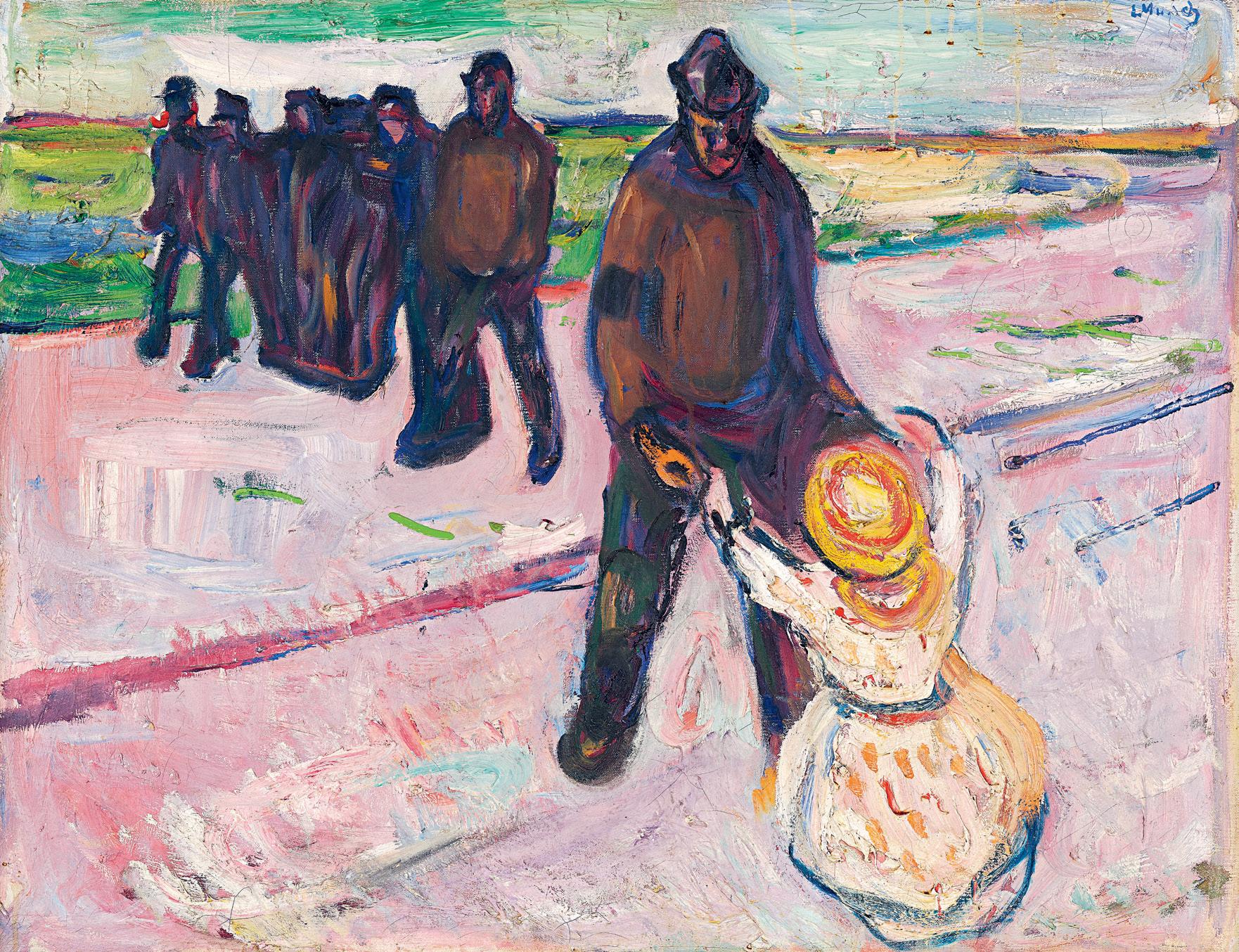
Worker and Child (1907) Oil on canvas, 70 × 91 cm
In the sketches for the men’s dining hall at Freia, Edvard Munch returned to his interest in worker motifs from his time in Warnemünde
such as Meeting (1921, p. 109), where women in white gowns cluster together while men in brown and blue suits stand in a line before them. This division would have been made explicit had Munch completed the panels for the men’s canteen at Freia. Despite these pictorial divisions, the panel Dance on the Beach (pp. 40–41) of the Freia Frieze shows two figures in brown suits dancing on the right side with other couples who follow the white versus brown gender binarism.
Although Munch did not leave recorded statements specifically addressing the topic of the sketch, a diary entry from June 1930 offers insight into his perspective:
– It is better to paint a good unfinished picture than a bad finished one –
Many people believe that a picture is finished when they have executed as many details as possible – A single line can be a finished work of art – What one paints must be done with intention and feeling36
Munch’s artistic focus shifts from idealised symbolic portrayal of emotion to a more grounded depiction of individuals, especially workers. This pivotal change of the 1920s reflects his move from symbolist introspection to a public ethics that highlights the dignity and everyday reality of labour. Like shaping his peasant motifs,37 he did so with the knowledge that they were new and powerful national symbols. This redirection is articulated as follows:
I wonder if the smallscale paintings will soon be pushed aside? With their large frames they are merely a bourgeois art designed for sitting rooms.
It is an art dealer’s art, a product of the French revolution that gained strength after the victory of the bourgeoisie. Now it is the time of the worker. I wonder whether art will again belong to everyone? – and resume its rightful place on the spacious walls of public buildings.38
In the late 1920s, after the missed attempt with the second frieze for Freia, Munch made additional attempts to realise the Worker Frieze, but these were unsuccessful. This frieze exists only as preliminary concepts and sketches, marked by several powerful, monumental images of workers. In the first major worker painting, the central figure’s clenched fist stands out. In a retrospective note, Munch connected this gesture to his own experiences as an artist: ‘As long as I have worked in this country I have fought for my art with a clenched fist. In my large workerpicture I have also
painted a man with a clenched fist.’39 Beside the central standing figure, recurring motifs show workers shovelling snow to clear paths, demonstrating their strength, and participating in the demolition and construction of the city to shape its future.
Edvard Munch’s decision to settle in Kragerø in 1909 was deliberate. During a journey with Ludvig Ravensberg from Bergen to Kragerø, Munch produced a sketchbook depicting workers clearing the way for railroad tracks. This period marked the emergence of a new motif: Workers in Snow (1909–10, 1913–15). Munch further developed this theme by using a big construction worker, Kristoffer Stoa, and other municipal employees as models.40 It later became central in the Oslo City Hall sketches. The construction of the Bergen railway made an impact on Munch, who kept a postcard from the trip with Ravensberg (p. 136). This became an iconic motif in one of few sculptures he produced, Workers in Snow (modelled circa 1914, cast in bronze 1932, p. 134). In 1943, Munch received 30,000 kr for the sculpture from Freia director Erik Pedersen.41
In accordance with certain elitist tendencies though, his good friend Jappe Nilssen wrote a campaign in the newspaper Dagbladet demanding a room for Munch at the Oslo City Hall, whose planning had begun. The architect competition was won by Magnus Poulsson and Arnstein Arneberg in 1918, but currency devaluation after World War I delayed the laying of the first stone until 1931. This was followed by an appeal signed by prominent people such as art historians Harry Fett and Jens Thiis, and painters like Gerhard Munthe and Henrik Sørensen.42
Meanwhile, Munch asked architect Henrik Bull (p. 127) to design his new studio at Ekely, incorporating the old brick studio from 1919, and Nilssen’s campaign became a public debate. Munch was interviewed some days later and said that ‘the plan to create a frieze about working life interests me greatly. But how does one create decorations in a castle in the air? One must board an airplane to see the space that is to be decorated.’ Later in the interview, Munch said his sketches are ‘not really pictures of the city in any other way than that I have been very interested in painting workers at their tasks, bricklayers on a new building, diggers in the street.’ He mentions Freia and various sketches of workers walking home from the factory and similar scenes. ‘In a way,’ he continues, ‘I have seen all these attempts at depicting working life as a kind of collection, but I am still unsure how much should be included if I were to work them together.’
He managed to find a formal overall unity by painting the scene in the snow, knowing that ‘A snow scene in an exhibition almost always overshadows the others.’ However, he did not complete his ultimate
wish, which was to see the demolition begin in Rådhusplassen with its maze of scaffolding and people contracting. In his sketches, he was convinced it looked exactly as if the City Hall itself was under construction.43 Yet no promises were ever made there, unlike those associated with Freia. The Oslo City Hall project for Munch remained a sketch.
Edvard Munch’s Freia Frieze and the history of the Freia Chocolate Factory provide a unique lens for examining the intersections of art, industry and gender in interwar Norway. The significance of decorative art commissions within Munch’s oeuvre is underscored, particularly his pursuit of alternative, movable and nonmonumental forms, as exemplified by the
Freia commission, which challenged the boundaries between public and private art. Tracing the evolution of Munch’s factory commission and its interpretations reveals how industrialisation generated both opportunities and challenges for women workers, shaping the broader social landscape. The story of the Freia factory and its female workforce illustrates the complexities of modern progress, highlighting both achievements and ongoing struggles for recognition, rights and representation. This analysis advocates for a reassessment of the cultural and historical significance of public art and for greater acknowledgment of worker contributions, which have often been marginalised in narratives of modernity.
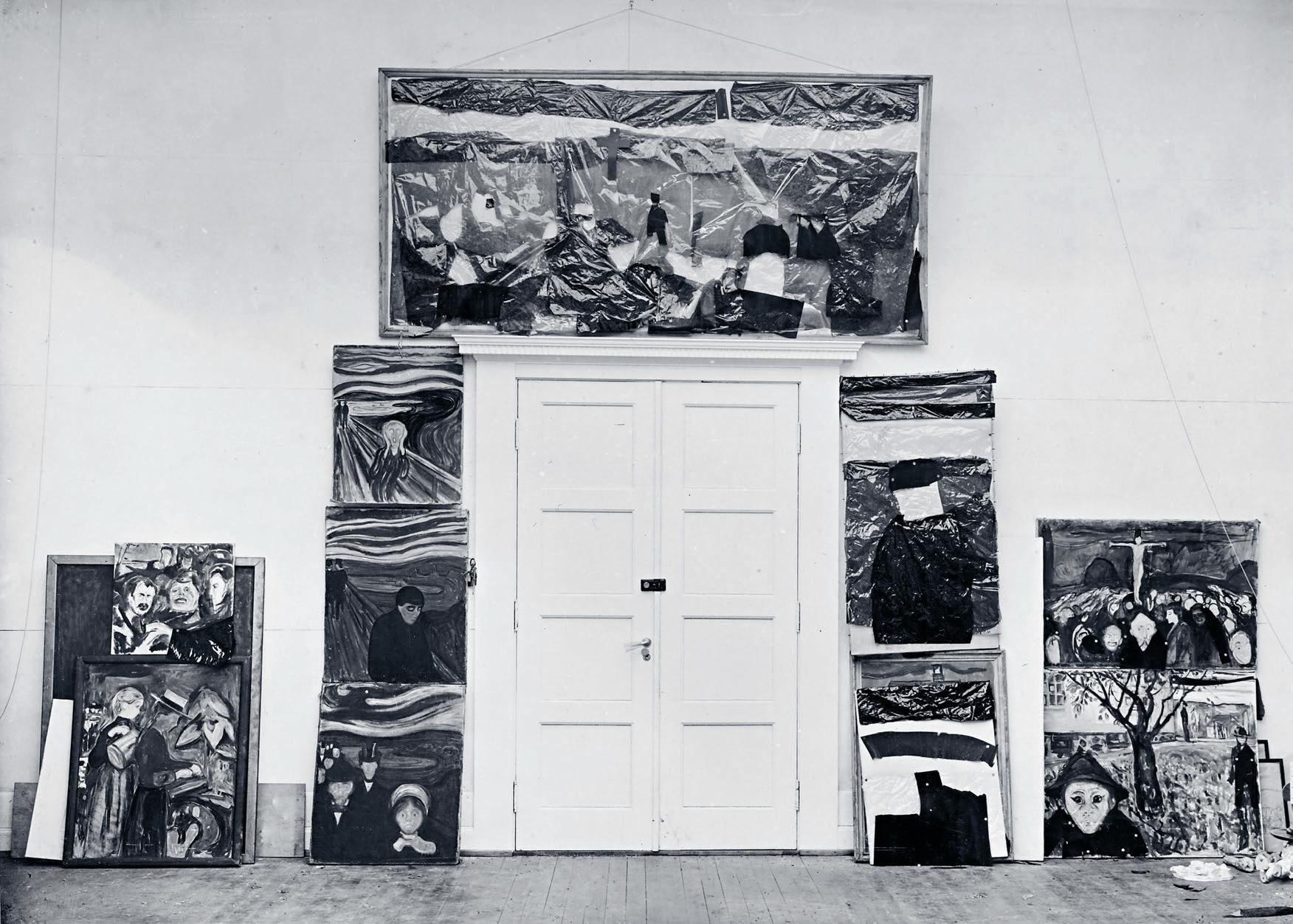
‘The Gates of Hell’ in Munch’s winter studio at Ekely, 1938, with Girls Watering Flowers (the Linde Frieze) on the floor to the left
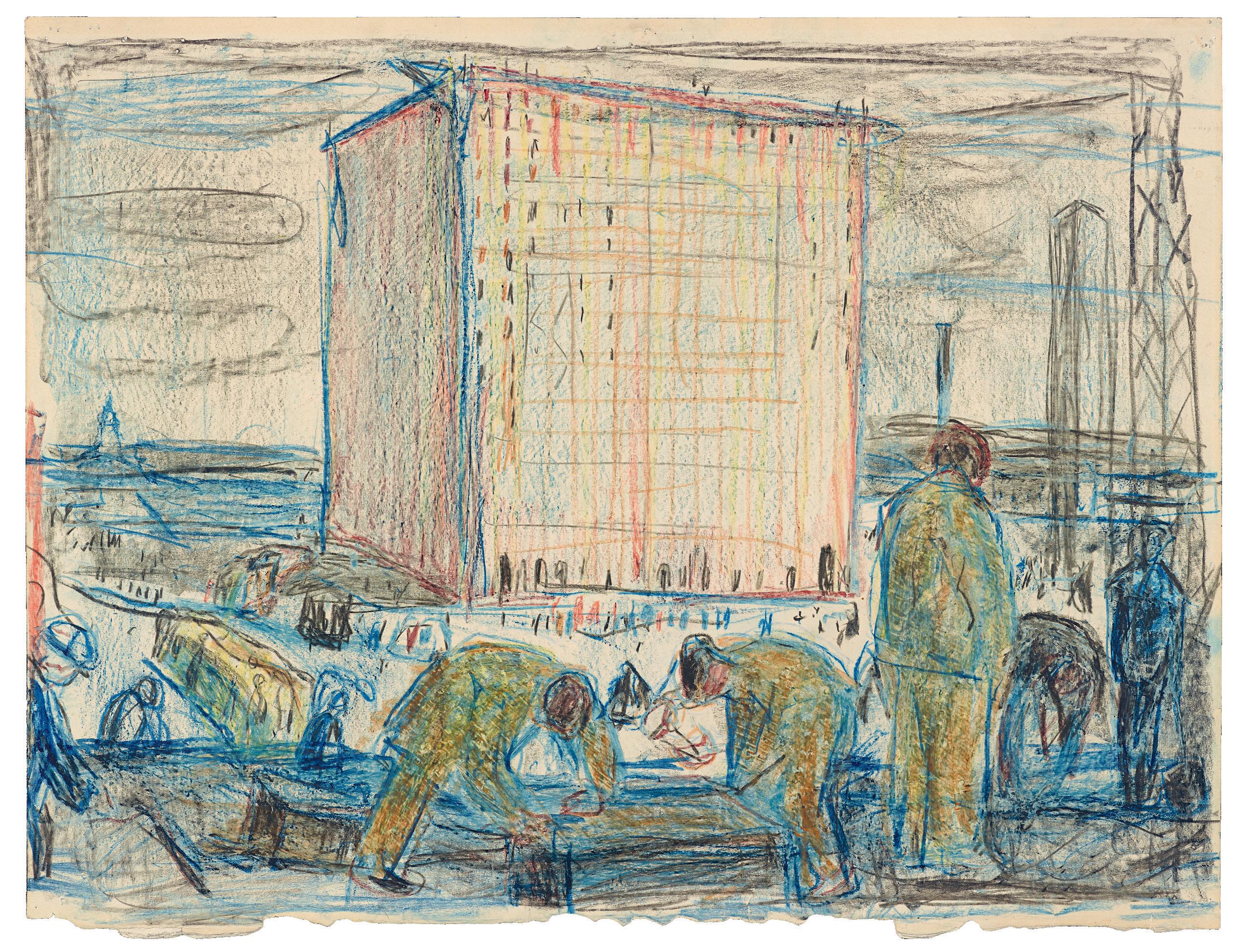
The City Hall under Construction, 1929. Crayon on paper, 386 × 500 mm
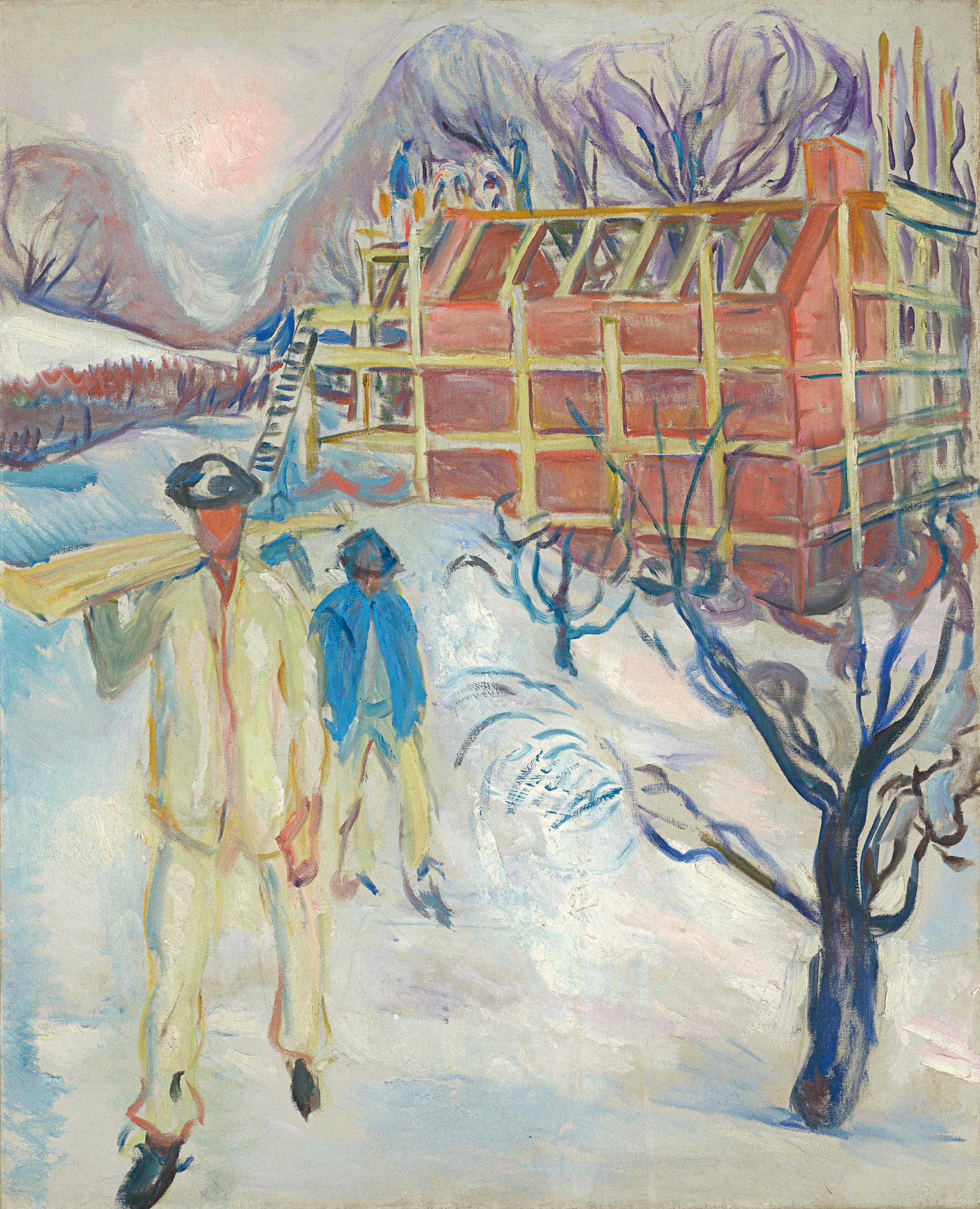
Building Workers in Snow, 1920. Oil on canvas, 128 × 103.5 cm
Published by MUNCH in connection with the exhibition Edvard Munch and the Chocolate Factory 21 May – 11 October 2026
Head of MUNCH Publishing: Josephine Langebrekke
Editors: Ana María Bresciani and Nina Mauno Schjønsby
Editorial Consultant: Karen Elizabeth Lerheim
Translation of Marta Breen’s and Nina Mauno Schjønsby’s texts from Norwegian: Matt Bagguley
Translation of Per Petterson’s text from Norwegian: Diane Oatley
Design: Victoria Ydstie Meyer
Typeface: LL Bradford Paper: 115 g Munken Print White Repro: JK Morris
Print and binding: Livonia Print, Latvia
Front cover: Edvard Munch, Girls Watering Flowers (The Freia Frieze Ⅳ), 1922
Back cover: Edvard Munch, Girls Harvesting Fruit (The Freia Frieze Ⅵ), 1922
All rights reserved. This book’s contents may not be reproduced in any form, in whole or in part, without written permission from the publisher.
© 2026 Munchmuseet, Oslo www.munch.no
ISBN: 978828462 0619
MUNCH thanks its sponsors and partners: