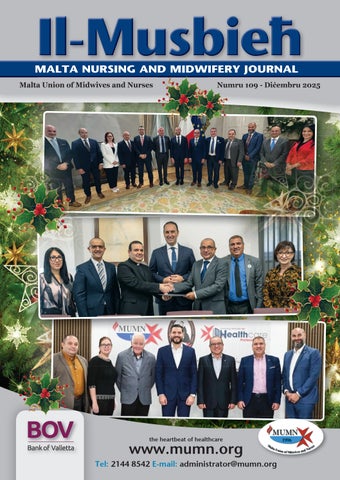
Il-Musbieœ
MALTA NURSING AND MIDWIFERY JOURNAL Malta Union of Midwives and Nurses
Numru 109 - Diċembru 2025
the heartbeat of healthcare
www.mumn.org Tel: 2144 8542 E-mail: administrator@mumn.org
2
Il-Musbieħ - NUMRU 109
contents
Ħarġa nru 109 - Editorial - President’s message
pages 4-5
- From our diary
pages 24-25
- EEN Meeting
page 39
Diċembru 2025 Group Committees - Chairpersons & Secretaries Mater Dei Hospital: Emily Galea, Chairperson: 77440050; Glen Camilleri, Secretary: 79205674 SVP: Therese Decelis, Chairperson: 79809080; Mario Galdes, Secretary: 79449324 RHKG: Graziella Buttigieg, Chairperson: 79275872 Health Centres: Roseanne Bajada, Chairperson: 79671910 MCH: Angelo Abela, Chairperson: 79594326; Malcolm Bezzina, Secretary: 77822561 SAMOC: Charles Galea: 79651430; Mark Mifsud: 99868033 GGH: Joseph Camilleri: 79485693; Anthony Zammit: 79617531; Jennifer Vella: 79277030 ECG Technicians: Alex Genovese, Chairperson: 79860571; Paul Caruana, Secretary: 79604338 Physiotherapists: Pauline Fenech, Chairperson: 79491366; Daren Stilato, Secretary: 77222999 Midwives Group Committee: Luciana Xuereb, Chairperson: 79538562; Marie Claire, Secretary: 99827852 MUMN Council Members Paul Pace - President: 79033033 Colin Galea - General Secretary: 79425718 Alex Manche’ - Vice-President: 77678038 George Saliba - Financial Secretary: 79231283 Alexander Lautier: 99478982 Geoffrey Axiak: 99822288 William Grech: 79011981 Claire Zerafa: 99217063 Joseph Aquilina: 99467687 Alexandra Abela Fiorentino: 79642163 MUMN Office: 21448542 Editorial Board Joseph Camilleri (Editor) CN M1 MDH William Grech: 79011981 Alexander Lautier: 99478982
Pubblikat: Malta Union of Midwives and Nurses Warner Complex, MUMN, Triq il-Vitorja, Qormi QRM 2508 • Tel/Fax: 2144 8542 • Website: www.mumn.org • E-mail: administrator@mumn.org Il-fehmiet li jidhru f’dan il-æurnal mhux neçessarjament jirriflettu l-fehma jew il-policy tal-MUMN.
Dan il-æurnal jitqassam b’xejn lill-membri kollha u lill-entitajiet oœra, li l-bord editorjali flimkien mad-direzzjoni tal-MUMN jiddeçiedi fuqhom.
L-MUMN ma tistax tinÿamm responsabbli gœal xi œsara jew konsegwenzi oœra li jiæu kkawÿati meta tintuÿa informazzjoni minn dan il-æurnal.
Il-bord editorjali jiggarantixxi d-dritt tar-riservatezza fuq l-indirizzi ta’ kull min jirçievi dan il-æurnal.
L-ebda parti mill-æurnal ma tista’ tiæi riprodotta mingœajr il-permess bil-miktub tal-MUMN. Çirkulazzjoni: 5,000 kopja. Il-Musbieœ jiæi ppubblikat 4 darbiet f’sena.
Kull bdil fl-indirizzi gœandu jiæi kkomunikat mas-Segretarja mill-aktar fis possibbli. Front (middle photo): Ian Noel Pace - Archdiocese of Malta
Il-Musbieħ - DIĊEMBRU 2025
3
Editorial
Charge Nurses It has always been said that Charge Nurses are not only pivotal to ward or units’ successes but also to the entire hospital organisation or healthcare facility. Charge nurses’ roles are pivotal to the provision of high-quality care and effective ward management. Charge nurses influence team culture and performance, provide staff mentorship, and ultimately affect the quality of care that our patients receive. For charge nurses or charge midwives to become formidable leaders, formal management preparation is required. But is this being implemented? We’ve seen novice charge nurses who although clinically prepared, were not prepared from the management point of view. Newly appointed ward managers often struggle in adapt to their role, which requires management and leadership skills in addition to existing clinical skills. Charge nurses on the unit should be mentored. Mentors should be appointed, meet the charge nurse and develop helpful skill sets. Silent hours should be allocated for study or training purpose regarding this matter.
The key to becoming a good charge nurse is to develop interpersonal skills with a focus on self-awareness and control over one’s actions. Iinterpersonal skills are more difficult to learn than task-based skills. A leadership development programme should be formally set up in our hospitals specifically for our charge nurses and midwives. Nurse Managers as first-line leaders have a responsibility to induce changes in the clinical environment. But are nurse managers involved in rationalisation, cost-cutting, advancement in medical technology, and reduced lengths of hospital stay? Are Nurse Managers involved enough in new setups, new units, new projects, and new departments? It seems that the ‘medical model’ is still predominant. Problems regularly faced by Charge Nurses also include issues related to staffing shortages and workload, increased turnover of staff, increased hostility from patients and relatives, an exageration of paperwork, increased incidents of harassment, problems with IT, cost-cutting measures and the
strain of issues related to staff with nonMaltese culture. Wards must reflect a balance of Maltese-speaking nurses to foreign language speaking staff. This at present is causing a concern to everyone, including foreign nurses themselves. Charge Nurses’ meetings must definately apply a new format. The way meetings are held at present is that they are as if one is attending a lecture with subjects that many are already well-versed in them. Charge Nurses must meet together and share their experiences, interact with one another, be frank, provide honest feedback, and come with solutions on how to improve ward performances and solve problems, which are not few, to say the least. Charge Nurses must be involved in small improvement projects in every unit or department. Any idea should be discussed in team meetings or in 1:1 departmental sessions. Charge nurses are to ensure that all nursing functions within the department run smoothly and efficiently, provide guidance and support and be patient-facing. The patient is the fulcum in all setups.
from the archives
Photo: Cassar Hamrun
4
Il-Musbieħ - NUMRU 109
WW1 nurses in Malta
President’s message While going around the wards at Mater Dei Hospital, I was surprised to find a tray in a particular ward covered with wrapping paper, and underneath it, were used syringes and needles. Some of the needles were capped while others were left uncapped. I was informed that this tray, left in the treatment room, had been placed there by the venous access nurse for the ward nurses to clear.
Regardless of who left it, I was shocked—not only from an infectioncontrol standpoint, but also because of the lack of respect shown among professionals. Expecting other nurses to clean up one’s own clinical waste is unacceptable. Even more concerning was the complete neglect of basic infection-control practices, which puts at risk whoever is expected to clear the tray. If a nurse were to lift the wrapping paper, this could easily result in a needle-stick injury, endangering both the carer and the ward nurse who is left to deal with the venous access nurse’s waste.
Additionally, the presence of capped needles is itself an infection-control breach, as recapping should never occur. The irony is that a sharp container was available right next to the couch but was never used. The disregard for infection-control standards and the lack of respect for fellow nurses is overwhelming.
If we, as nurses and health professionals, want to uphold respect for our profession, we must begin by respecting ourselves and our colleagues. Needle-stick injuries pose real health risks, including the potential transmission of HIV, Hepatitis B, and Hepatitis C - diseases that affect not only the workplace but also the personal lives of healthcare workers.
Every nurse should know that the person who uses a needle is responsible for its proper disposal. This applies equally to doctors and all other healthcare professionals. No one is above this responsibility. If a tray or trolley is used, it must be cleaned by the person who used it - whether that person is a doctor or a nurse.
Christmas is a time for respect, reflection, and new resolutions. As this busy festive season approaches, let us commit to treating our colleagues with respect and ensuring safety for ourselves and for others. Paul Pace President
from the archives
Sptar Boffa Dar il-Mediterran - Sacra Infermie
ra
Il-Musbieħ - DIĊEMBRU 2025
5
Kelmtejn
mis-Segretarju Æenerali Il-Milied reæa’ qiegœed magœna. Ÿmien sabiœ u ta’ min jieœu œsieb biex fejn nistgœu nqattgœu mumenti mall-maœbubin tagœna. Huwa vera li t-tentazzjoni gœallmaterjalizzmu tkun dejjem hemm però m’hemmx isbaœ mill-bilanç fil-œajja. L-isfidi fi œdan l-MUMN ma jieqfux. Niltaqgœu kuljum ma’ problemi relatati mas-shortages. Dawn iæibu magœhom kwistjonijiet marbuta mallkundizzjonijiet tax-xogœol, fosthom nuqqas fil-compliment, tœassir talvacation leave u study leave, burn out, riÿenji etç. L-iskantament tiegœi huwa li nkunu nvoluti f’laqgœat, jiæi miftiehem pjan kif dan kollu jista’ jissolva, tistenna u ma jsir xejn. Jaqa’ kollox fid-dlam talabissi! Lanqas œaqq il-œin li jaœli kulœadd fil-laqgœat. U s-sabiœa hija li œadd ma jindenja jispjegalek x’inhi r-raæuni li jaqa’ kollox u ma jsir xejn. Imbagœad fejn jidœlu tenders, hemm misteri kbar. Ma kienx hemm tender wieœed ta’ ÿvilupp jew biex jiæu ngaææati nurses, li ma waqax u spiçça kollox. Ir-raæunijiet jistgœu jkunu œafna – jew min jikteb ittenders mhux kompetenti, jew hemm min qed jagœmel sabutaææ jew inkella m’hemmx flus biÿÿejjed u qed jiæi mwaqqaf mill-Finanzi. Xi œaæa hemm ÿgur gœax mhux jiæi wieœed sewwa. Dan il-punt eÿatt ressaqtu quddiem il-
Prim Ministru fil-preÿenza tal-Ministru fil-laqgœa li kellna dwar il-Budget. Bqajt bla risposta! Kemm konna kburin bil-Group Committee responsabbli mill-Florence Nightingale Benevolent Fund. Organizzaw serata memorabbli. Il-quddiesa kienet veru sabiœa. Iç-çerimonja kienet waœda li ma tinsihiex ÿgur. Kellna 40 membru li rtiraw mis-servizz fl-aœœar xhur. Wara organizzaw ukoll bibita fejn kulœadd seta’ jgœid tiegœu. Grazzi kbira lill-E.T. President ta’ Malta li aççettat li tilqana fil-palazz Presidenzjali anki peress li hija l-Patrun tal-FNBF. Œadt gost ukoll nsegwi l-œaræa talPensjonanti fejn marru jÿuru l-Forti ta’ Delimara li gœadu kemm æie restawrat b’mod Bellezza. Prosit kbira lill-Group Committee responsabbli. Però ma nistax inkompli dawn il-kelmtejn mingœajr ma nsellem lil Pawlu Bezzina li œalliena ftit æranet ilu. Pawlu kien ilmissier tal-union. Œaddan diversi karigi bl-ewwel wieœed ikun Chairperson tal-MCH Group Committee, kien ukoll Electoral Commissioner fl-elezzjonijiet kollha tal-MUMN mill-bidu tagœha, Chairperson Bord tal-Appell u ukoll Chairperson tal-Pensioners Group Committee. Insellmulek Pawlu u nirringrazzjawk tad-dedikazzjoni u mœabba li dejjem urejt lejn il-union. Dan l-aœœar anki meta kien ikun pazjent,
Awguri 6
Il-Musbieħ - NUMRU 109
kien içempilli u jgœidli “sibt nurse tajjeb gœall-Group Committee, çempillu œa tkellmu u tirranæa miegœu”. Baqa’ sa l-aœœar jaœseb kif l-MUMN tista’ dejjem tkun aœjar. Il-preparazzjonijiet gœat-tletin sena anniversarju mixjien b’pass tajjeb. Ix-xogœol fuq il-muÿew tan-nurses filkwartieri tal-union gœaddej æmielu. Nixtiequ li jkollna aktar benefatturi li jisilfulna oææetti li gœandhom biex jiæu esebiti f’dan il-muÿew. Il-œidma biex jiæi mwaqqaf monument ieœor fi Ænien Ganado gœaddejja wkoll b’ritmu tajjeb. L-istess jista’ jingœad fuq it-tœejjija talpubblikazzjoni tal-ktieb dwar l-Istorja tal-MUMN. Ovvjament, fil-æimgœat li æejjien, ir-rankatura gœal dawn ilpreparamenti ser tiÿdied aktar biex blgœajnuna ta’ kulœadd ikun lest kollox fi ÿmien stipulat. Huwa ta’ sodisfazzjon kbir li nœabbar li f’erbgœa postijiet differenti tax-xogœol æew eletti Group Committees æodda. Dawn huma l-isptar Mater Dei, Monte Karmeli, Karen Grech u l-Kura Primarja. L-ewwel nett nixtieq nirringrazzja lil dawk il-membri li kienu jiffurmaw parti minn dawn il-Group Committees u issa m’gœadhomx tad-dedikazzjoni u l-impenn li wrew biex il-post tax-xogœol fejn jaœdmu joffri kundizzjonijiet aœjar. Barra minn hekk nixtieq nawgura kull suççess lill-membri kollha æodda li tnejn minnhom diæà ltqajna magœhom u bdew jaœdmu. Is-sena d-dieœla se nkunu qed nintensifikaw din ilœidma biex kullimkien ikollna Group Committee effettiv. Is-sena d-dieœla ser nibdew ninegozzjaw Ftehim Settorali ædid gœallPhlebotomists u Decontamination Sterile Technicians. Dawn iÿ-ÿewæ kategoriji ta’ œaddiema gœandhom Ftehim Settorali wieœed flimkien. Dan se jkun it-tieni wieœed li l-MUMN ser tkun qed tinnegozja dan il-Ftehim f’isem dawn il-membri. Din id-darba t-talbiet ser ikunu aktar immirati lejn ittisœiœ tal-kategoriji sabiex ngœollu livell, flimkien ovvjament ma’ kundizzjonijiet tax-xogœol aœjar u ÿieda fis-salarju u allowances. allowances Illum ser nieqaf hawn. Nixtieq lilek u lil dawk maœbubin tiegœek Milied Hieni u Sena Mimlija Saœœa, Risq u Barka. Colin Galea Segretarju Æenerali
The Healthcare Professional in the 21st Century
Highlights from the MAPN Annual Conference On 24 November 2025, the Maltese Association of Psychiatric Nurses (MAPN) held its annual conference, “The Healthcare Professional in the 21st Century.” The event brought together local and international speakers who explored the realities of healthcare practice in an era defined by rapid technological change, professional expectations, new challenges in an evolving society and innovative approaches to mental health care.
Keynote Contributions
The Role of MAPN
Dr Warrender highlighted the paradox within the International Council of Nurses (ICN) definitions, noting that while mental health nursing is identified as a specialty, its distinct role is not clearly articulated in broader nursing classifications. He emphasised the unique relational expertise of mental health nurses, who provide continuous, 24-hour therapeutic support— particularly within acute inpatient settings—positioning them as essential advocates within complex systems of care.
The MAPN is a registered voluntary organisation governed by its own statute and elected council. Since its establishment on 11 May 2006, the Association has worked to enhance the professional identity and standards of psychiatric nursing in Malta. Its mission is grounded in three core concepts—awareness, education, and recognition—which guide its initiatives in mental health promotion, professional development, and collaboration with local and international organisations. MAPN also plays an important role in monitoring the portrayal of mental health within Maltese media, recognising its influence on public stigma and understanding.
Dr Dan Warrender opened the keynote sessions with “Arguing for Specialised Mental Health Nursing Before It Is Too Late.” He discussed how global instability, climate-related stressors, and advances in artificial intelligence continue to shape the mental health landscape. Despite rising demand, resources remain critically limited, and individuals with mental health difficulties continue to experience significantly reduced life expectancy.
Ms Ruth Sciberras, CEO of the Social Care Standards Authority, delivered an important presentation titled “Recognising the Signs: Building Awareness of Gender-Based Violence in Psychiatric Nursing.” She outlined the definition of domestic violence
under the Gender-Based Violence and Domestic Violence Act (Chapter 581) and highlighted its strong association with conditions such as anxiety, depression, chronic pain, pregnancy complications, and sleep disturbances. Ms Sciberras emphasised traumainformed approaches in healthcare, including ensuring privacy, reducing threats, employing sensitive questioning, and empowering victims. She stressed the need for psychiatric nurses to collaborate closely with the Domestic Violence Unit (DVU), particularly when mental health vulnerabilities impair decision-making. She also described the reporting pathway and the role of Gender-Based Domestic Violence Hubs, currently operating in Santa LuÐija and Floriana, with a new hub opening in Mtarfa in 2026. Consultant psychiatrist Dr Anthony Dimech presented “Cannabis Legislation and the Harm-Reduction Paradox: A Clinical Perspective.” He explained that, while decriminalisation and legalisation aim to reduce stigma and criminalisation, they may inadvertently increase access to high-potency cannabis, escalate overall consumption, and contribute to a rise in cannabisrelated mental health problems. This
continued on page 9
Il-Musbieħ - DIĊEMBRU 2025
7
8
Il-Musbieħ - NUMRU 109
EFN Press Release - 22nd November 2025
EU Nurses concerned about the exclusion of Nursing Education from the professional degree by the US Department of Education At a moment nurses worldwide are hitting their breaking point, and many are already walking away desperately from the nursing profession, the Trump Education Administration plans to remove nursing education from the categories of professional degrees leading to the inability of nursing students to get affordable nursing studies in the US. In contrast, as our US colleagues argue, ‘including post-baccalaureate nursing education as professional is essential for strengthening the nation’s healthcare workforce, supporting the next generation of nurses, and ultimately supporting the healthcare of patients in communities across societies’. At a moment the EU Institutions are impowering nurses education in the EU through the ongoing political debate in the European Parliament on the INI Report on the EU Workforce for Health,
with a strong message from MEPs to empower the nursing profession, we see our colleagues in the US confronted with the huge challenge of diminishing the status of the Nursing Profession in the US. At a time when healthcare globally faces a historic nurse shortage and rising societal demands, limiting nurses’ access to funding for graduate education threatens nursing as a profession. In contrast to the Trump Administration, the European Commission supports Member States through the development of Safe Staffing Levels and Advanced Practice Nurses to reach better health outcomes for EU citizens. EU policymakers have for decades and are still using the US research evidence that decreasing nurses education leads to worser health outcomes and even more dead’s. So, EFN does not understand why the US is now turning policy direction: graduate nursing students losing access to higher federal
loan previously available to professional degree programs. While EU Institutions, including the Council and Member States, invest in the nursing workforce from a defence, security and preparedness perspective, the US Trump leadership and policymakers forget that healthcare systems and preparedness for any crisis are inextricably linked, and the COVID19 pandemic showed: healthcare systems depend on high qualified nurses. EFN therefore call on the U.S. Department of Education to include again nursing in its recently revamped definition of “professional degree” programs. Nursing meets all the criteria for a professional discipline. Please contact Dr Paul De Raeve, Secretary General of the European Federation of Nurses Associations for more details on this issue. Email: efn@efn.eu or Tel: +32 (0)2 512 74 19
Highlights from the MAPN Annual Conference continued from page 7
and to view nursing as a meaningful, lifelong career.
harm-reduction paradox underscores the need for robust regulation, public education, and ongoing monitoring to safeguard young and vulnerable populations.
Professor Andrew Azzopardi emphasised the importance of promoting service-user voice, activism, and coproduction in mental health settings. His work, grounded in Malta’s contemporary social challenges, advocates for strengthening social welfare, addressing inequalities, and fostering open dialogue on mental health and society.
Professor Gisli Kort Kristofferson, advanced nurse practitioner and coauthor of Advanced Practice in Mental Health Nursing: A European Perspective, presented on the integral role of advanced practitioners. He outlined nursing’s four foundational pillars— clinical practice, research, education, and leadership—and explained how mental health nurse practitioners (MHNPs) embody these domains. MHNPs, trained at Master’s level or above, are authorised to diagnose, treat, refer, and prescribe, contributing significantly to service development. His final message encouraged professionals to “find your tribe, voice, and allies”
Dr Neville Schembri, nurse and lecturer at MCAST, delivered a presentation titled “Global Mobility, Local Impact.” He highlighted how internationally educated nurses (IENs) are crucial to sustaining healthcare systems in highincome countries, including Malta— particularly in mental health services experiencing ongoing staff shortages. Overseas nurses, he noted, contribute not only through workforce capacity but also through cultural competence
and patient engagement within Malta’s increasingly diverse population. Dr Schembri concluded by calling for reduced bureaucracy, stronger support networks, and improved cultural mediation to enhance the acculturation process and overall patient care. The MAPN’s 2025 conference offered a rich and insightful examination of the evolving role of healthcare professionals in the modern era. Through diverse keynote perspectives— from specialised mental health nursing and advanced practice to genderbased violence prevention, cannabis policy, activism, and global workforce mobility—the event underscored both the challenges and opportunities shaping psychiatric nursing today. The concluding panel discussion reaffirmed MAPN’s commitment to professional development, interdisciplinary collaboration, and the continuous strengthening of Malta’s mental health services.
Il-Musbieħ - DIĊEMBRU 2025
9
10
Il-Musbieħ - NUMRU 109
The great global nursing ripoff
wealthy countries are saving tens of billions at the expense of developing nations by taking their nurses - it’s time for them to give back Geneva, Switerland; 2 July 2025 During the International Council of Nurses (ICN) Congress, ICN highlighted striking figures demonstrating both the economic power of care — and the economic exploitation at the heart of inequitable nurse migration.
Billions shifted from poorest to richest nations in great recruitment ripoff The latest accounts suggest that billions of dollars are being transferred from the world’s poorest countries to its richest due to wealthy nations saving on nurse education costs by recruiting abroad — and then failing to compensate the countries they recruit from. ICN President Dr José Luis Cobos Serrano remarked: “Ethical recruitment is vital for health equity and justice all around the world. Though ICN supports individual nurses’ right to migrate, we are hearing that vulnerable developing nations are losing hundreds of thousands of nurses, often due to aggressive recruitment by rich countries. This is backed up by data from the new World Health Organization (WHO) State of the World’s Nursing (SOWN) report which shows that almost a quarter of nurses in high-income countries are foreign-born. We can’t deprive some countries of valuable health care human resources to supply others. ICN urges highincome states to break these inequitable patterns and commit to sound, selfsufficient workforce planning and ethical recruitment, including mechanisms to fairly compensate developing nations for the essential workforce they have invested in training.” Howard Catton, ICN’s CEO, highlighted the stark economic toll unethical recruitment takes on developing countries, saying: ‘Wealthy countries are taking muchneeded nurses from fragile states already experiencing shortages, in essence pocketing the money low-
income countries have spent on training those nurses — and National Nursing Associations (NNAs) from these source nations have told me there is either no or very little financial giveback. If they are compensated, we are hearing that these developing countries are getting a pittance in return for the valuable nurses they have invested in educating, in some cases $1000 dollars per nurse, a tiny sum that doesn’t come close to compensating them proportionally for what they are losing. ‘This is a form of sleight of hand by wealthy countries, who are offsetting massive amounts by intentionally hiring internationally rather than paying to educate and retain their own nurses. ‘For example, new data shows that Canada, one of the major recruiting countries, has avoided over C$1 billion in training costs by recruiting health workers from low and middle income countries. Adding up what the top ten or so recruiting countries save in training costs by taking developing countries’ health personnel, we’re likely looking at tens of billions — that’s tens of billions shifted from the world’s richest countries to its poorest, with very little evidence that source countries are getting anything back. It is difficult not to conclude that this is a global nursing ripoff.”
Trillion-dollar returns from nursing and social jobs - but leaders must go beyond using nurses as currency The international recruitment crisis reflects a wider distortion of the true value of nurses. At ICN’s recent Congress in Helsinki, attendees heard that World Economic Forum (WEF) models show a $3.1 trillion return in GDP from investing $1.3 trillion in nursing and social jobs in the United States alone. ICN’s work has continually demonstrated that nurses are the key to
improving population health, achieving economic growth and addressing health challenges from climate and conflicts to pandemic resilience. However, leaders are still failing to invest in building a sustainable, equitable workforce and the nursing shortage remains a global health emergency. Mr Catton commented: “It may seem like politicians don’t know the value of nurses, but actually, perhaps they do. In fact, leaders understand the value of nursing so well that they use nurses as a political currency: they justify not spending on other areas by telling us how many nurses they could hire instead — but then they continue to make the wrong choices. ‘It’s all about priorities. The world understandably is currently focusing on defence, but the price of one stealth bomber plane would cover WHO’s $2 billion annual budget, as WHO Director-General Dr Tedros Adhanom recently pointed out, or could fund 100,000 nurses. We have to find the balance between defence and health and recognise that both are issues of national and global security and that you cannot choose health without also choosing nursing.”
ICN calls for proportional giveback with concrete solutions ICN’s message is simple: if you take, you must give back. Dr Cobos Serrano, ICN’s President, said: “Any country that wants to be seen as ethical must provide mutuality and real, proportional giveback when they take health workers from overseas. ‘If rich countries are saving billions, why can’t they put a proportion of those gains back into a global fund to strengthen nurse education in source countries?
continued on page 31
Il-Musbieħ - DIĊEMBRU 2025
11
The 18th Consultation of the ENHCC in Prague After twenty solid years working in hospital ministry the Lord gave me the grace to attend the 18th Consultation of the European Network of Health Care Chaplaincy (ENHCC). This year’s consultation was held in Prague from 10 till 14 April 2024. For me this was a huge grace which trickled also on my way of doing pastoral care at Sir Anthony Mamo Oncology Centre. It offered me a huge opportunity to learn new ways of being with our patients at the Centre. The venue of the Conference was the The Hotel ILF. The latter is a modern congress hotel, located only 100 m from the Budejovická metro station with an excellent direct connection to the historical center of Prague within 10 minutes. We were blessed that the ILF hotel offerred for us extensive variable conference facilities and full conference services. This made our conference more easily to be delivered and, hopefully, better digested. The program for this four-day conference was really packed. On Wednesday 10 April started at 15:00 (the hour of Divine Mercy) wherein we assembled at arrivals and formal registration opened in front of congress hall K. From 16:00- 17:00 there was the opening ceremony at Congress hall K. Then, from 17:00 - 18:00 we met to get to know each other. Following the dinner which was from 18:00 - 19:00 at the Bar hotel, we had the introduction for reflection groups at Congress hall. This took place from 19:30 till 21:00. There were 8 groups in total who were meeting. The following day, Thursday 11 April 2024, kicked off with breakfast. The time allocated for us was from 7:00 till 8:30. With our stomachs full we immediately headed for Morning prayer/meditation by Pavel Ruml in Congress hall K at 8: 45. At 9:00 -10:00 the key lecture of the day was delivered by Thomas Halik and Pavel Hošek. Its title was ‘On a fragile world: postsecular society’. Afterwards, from 10:00 - 10:30 we had coffee break at Bar hotel Congress hall K. Subsequently, at 10:30 - 11:15 we had paper presentations part 1 (25 min presenting, 15 min discussion). In fact, Simon Harrison dealt
12
with Screening ‘wellbeing assessment ‘ as good practice in Room 8. Axel Liégeois spoke about the topic To touch or not to touch? An ethical reflection on physical touching in spiritual accompaniment in Room 9. Furthermore, Brechtje Hallo, delivered the paper Finding meaning in psychiatric recovery: a literature review on conceptual approaches on meaning in life in mental healthcare in Room 3. From 11:15 12:00 we had paper presentations part 2 (25 minutes presenting and15 minutes discussion). Hence, Lindsy Desmet spoke about How do patients experience a chaplaincy intervention? Results of a phenomenological study with geriatric patients in Belgium in Room 9. Mark Newitt, Lindsay de Wal, Csaba Szilagyi, Daniel Nuzum, spoke about CPE in England? Sharing the results of the assessment work around the unit on the impact of the training in Room 8. Eva Buelens reflected on Understanding the Significance of Chaplain-Led Endof-Life Rituals for Families: Insights from Qualitative Research for Chaplaincy Practice in Room 3. After sharing a beautiful lunch from 12:00 till 13:30 at the Restaurant hotel, at 13:30 we left for visiting the various hospitals in Prague. These were Central Military Hospital, Military Faculty Hospital Prague (ÚVN), General University Hospital Prague Motol University, The Hospital “Merciful sisters of Karel Boromejsky”, and University hospital Královské Vinohrady. We were strongly reminded to bring our ticket for the public transport. I personally chose to visit The Hospital “Merciful sisters of Karel Boromejsky”. As soon as we returned to the hotel we immediately had reflection groups on these visits. The time allocated for us was from 17:00 - 18:00, each in his and her own groups. After the delicious dinner from 18:00 till 19:00 at the Coffee Room at 19:30 till 21:00 we had social evening at the coffee room. We had to bring our poem to recite or song to sing. I chose to sing Sammy Bartolo’s song L-aœœar bidwi f’Wied il-Gœasel (The last farmer at Wied il-Gœasel). This nostalgic song was very much appreciated by my fellow chaplains.
Il-Musbieħ - NUMRU 109
The third day of the conference, Friday 12 April 2024, started by having breakfast. The time reserved for it was from 7:00 till 8:30 at the Restaurant hotel. The Morning prayer/meditation was led by Anne Heimendahl at Congress hall K. From 9:00 till 10:00 there was the key lecture of the day byLindsay de Wal. She talked about Exploring Inclusive Chaplaincy in the U.K.: Bridging FaithBased and Non-Religious Practices in Healthcare. After half an hour of coffee break at the Bar Hotel from 10.30 till 11:15 there were paper presentations part 1 with the usual procedure of 25 minutes presenting and 15 minutes discussion. Niels den Toom presented a paper on Street Chaplaincy: Unwrapping the present of presence in Room. Liz Allison spoke about Evaluation of staff support service in Scotland in Room 8. Furthermore, Patricia Sara Simkova reflected on Cultivating resilience. Strategies for healthcare chaplains in high-stress environments in Room 3. Sarah Crane dealt with the topic Setting up a staff listening service at Milton Keynes University Hospital in Room 9. From 11:15 till 12:00 there was the second part of paper presentations. Cate BeaulieuDesjardins talked about Routine spiritual assessment in spiritual care for pediatric populations in Room 3. Gaby Jacobs spoke about ‘One needs to be seen.’ Patients’ spiritual care needs in primary care as expressed in their experiences with general practitioners, general practice mental health nurses and chaplains in Room 9. Traugott Roser dealt with the subject “Healthcare Chaplaincy as theological profession. Introducing the Master Program for Spiritual Care at the University Münster” in Room 8. Following the lunch at Restaurant hotel from 12:00 till 13:30 Profs Anne Vandenhoeck presented an interesting presentation on Suicide prevention and big stories. Chaplaincy research update by Erich. From 15:00 till 15:30 there was coffee break at the Bar hotel whereas from 16:00 till 17:00 there were workshops going on. Cate Beaulieu-Desjardins led the workshop on Advancing Knowledge of Specialist
ENHCC in Prague photo | gettyimages
Spiritual Care Through Case Studies: Qualitative Research on Case Series and Case Books in Room 4. Ernstson Gudrun led the workshop on discussion on conversation material ‘to be human and professional existential questions on life and death in Room 5. Then, Mark Newitt and Lindsay de Wal led the workshop on Using Liturgy and Ritual in Pastoral Encounters in Room 1. Anne Vandenhoeck, Simon Harrison and Rosie Morton coordinated together to lead the workshop on Big Stories in Chaplaincy in Room 2 whereas Kerstin Roedinger led the workshop on spirituality at the beginning of life in Room 6. From 17:00 till 18:00 we had reflection groups. Group 1 met in room 1, Group 2 met in room 2, Group 3 met in room 3, Group 4 met in room 4, Group 5 met in room 5, Group 6 met in room 6, Group 7 met in room 9, whereas Group 8 met in room 8. The penultimate day of the Consultation drew to a close at 18:00 till 19:00 wherein we had dinner at the Bar hotel immediately followed by the business session at Congress hall K from 19:30 till 21:00. The last day of the Consultation, Saturday 13 April 2024, we started with breakfast at the Restaurant hotel. Then, at 8:45 we had the Morning prayer/meditation led by Tulio Proserpio at the Congress hall K. From 9:00 till 10:00 there was
the key lecture by Csaba Szilagyi on the topic ‘Chaplain Identity and Staying Engaged in a Changing World’. From 10:00 till 10:30 we had a coffee break at the Bar hotel. From 10:30 till 12:00 there were case studies prepared by Niels den Toom. Group A met in room 1, Group B met in room 2, Group C met in room 3, Group D met in room 4, Group E met in room 5, Group F met in room 6, Group G met in room 8 whilst Group H met in room 9. After these sessions we had lunch at the Restaurant hotel from 12:00 13:30. At 13:30 till 14:30 there were again reflection groups. In fact, Group 1 met in room 1, Group 2 met in room 2, Group 3 met in room 3, Group 4 met in room 4, Group 5 met in room 5, Group 6 met in room 6, Group 7 met in room 9 whereas Group 8 met in room 8.
could say that this consultation was rich in key lectures as well as participation by all chaplains. We had the golden opportunity to raise our questions and concerns on the material received at the Consultation as well as sharing our experiences of pastoral ministry together. Although the contexts were different, it was the same spirit who was at play. In a certain sense, the Prague Consultation reminded me of what St Paul wrote in his First Letter to the Corinthians: Now there are varieties of gifts, but the same Spirit (1 Cor 12:4).
At 14:30 we visited Prague by guide or by ourselves. We were reminded to bring our ticket for public transport. At 18:00 till 19:00 we had oecumenical prayer at St. Vitus Cathedral followed by Dinner in Prague and closing ceremony till 22:00 at the Archbishop Palace. On Sunday 14 April at 7:00 till 8:30 there was breakfast at the Restaurant hotel followed by departures.
This Consultation made me more aware of the importance that chaplains across Europe and beyond meet together to support one another, learn from one another, enlighten one another and build one another through prayer, reflection, study and recreation. After all, this Consultation made me more appreciative and open to the undying words of Psalm 133: Behold, how good and pleasant it is when brothers dwell in unity! It is like the precious oil upon the head, running down upon the beard, upon the beard of Aaron, running down on the collar of his robes! It is like the dew of Hermon, which falls on the mountains of Zion! For there the Lord has commanded the blessing, life for evermore (Ps 133:1-3).
When I reflect on the programme I
Fr Mario Attard OFM Cap
Il-Musbieħ - DIĊEMBRU 2025
13
October 2025
EFN Statement on Rebuilding Gaza
A Call for Nurse-Led Recovery and Sustainable Health Systems photo | aljazeera.com
As the international community prepares for the rebuilding of Gaza, the European nursing community extends its deepest solidarity with our nursing colleagues and all healthcare professionals who have served with courage, compassion, and humanity under unimaginable conditions. Throughout the conflict, nurses and allied healthcare professionals have remained at the frontlines, safeguarding life, alleviating suffering, and upholding their professional and ethical duty to care for all — regardless of background, circumstance, or belief. Their service stands as a testament to the humanitarian essence of nursing. The toll of this prolonged crisis has been devastating. Many nurses and other health professionals have lost their lives while serving their communities. Those who remain face exhaustion, grief, and burnout after enduring tremendous
14
physical and psychological pressure. Yet, despite loss and hardship, their commitment to serve has not wavered. These nurses are the cornerstone upon which Gaza’s future health system must be rebuilt. Rebuilding Gaza’s healthcare system is not merely a technical task; it is an essential step toward restoring health, dignity, and stability. A sustainable, resilient, and equitable health system must be rooted in the expertise and leadership of nurses, who constitute the largest group of health professionals and the backbone of health and care delivery. Their knowledge of community needs, their capacity to work across all levels of care, and their deep understanding of public health are indispensable for rebuilding a healthcare system that is accessible, people-centred, and future-oriented. The European Federation of Nurses Associations (EFN), representing
Il-Musbieħ - NUMRU 109
nurses across the EU and Europe, urges that nurses in Gaza are fully supported and recognised as key partners in the reconstruction process. Their participation must be ensured at every level — from policy planning to implementation. The rebuilding of health facilities and services must be accompanied by the rebuilding of human capacity: Nurse leaders must be empowered to lead teams, guide recovery, and restore trust in the healthcare system. Nurse educators must be supported to educate and train the next generation of nurses, ensuring that the values of care, ethics, and evidence-based practice remain strong. Mentorship programmes must be established to help nursing students
continued on page 17
Ethics & Health Care by Marisa Galea Vella
Is Nursing a Profession? Absolutely Recently President Donald Trump decided to reclassify nursing as a nonprofessional degree. The main rationale behind this is said to be with regards to funding and eligibility for loans. As a non-professional degree students are entitled to much lower grants. Unsurprisingly this has sparked anger and reactions of condemnation in a country struggling to address nurse shortages, like many other countries. It also undermines opportunities for progression in studies for nurse practitioners and those in similar roles.
Nursing requires advanced and specialised knowledge and a requirement to serve the community. For this reason, society holds nursing in high esteem, particularly due to the commitment it upholds to the betterment of others. This commitment needs to be nurtured with lifelong learning also referred to as continuous professional development and the ability to take on responsibilities to address patient concerns. These can be achieved through higher education, accountability, autonomy and altruism. Miller’s ‘Wheel of Professionalism in Nursing’ is a widely referred to framework that has eight components. The eight components are adherence to code of ethics, competence and lifelong learning, participation in professional organisations, orientation towards community service, publication and communication, theory and research development utilisation, self-regulation and autonomy, and professional identity and commitment. These eight components support the basis on which nursing is indeed a profession. The International Council of Nurses decades ago established the international code of ethics for nurses. The purpose of this document was to establish the ethical values, responsibilities and professional accountabilities of nurses with the aim of reaching the professional standards set by regulatory bodies. The Council of Nurses and Midwives have a set of documents in place to safeguard and promote the professional conduct of nurses. The Code of Ethics and Standards for Professional Conduct for
Nurses and Midwives by the Council of Nurses and Midwives in Malta aligns very closely to the international code of ethics set by the International Council of Nurses. In addition, nursing is regulated through law, with clear requirements in pre-registration education whereby only those who achieve these requirements are eligible to use the title of nurse. Hence the eligibility of registration and attaining a warrant are overseen by the Council of Nurses and Midwives in accordance with Maltese law. The Scope of Professional Practice for nurses by the Council of Nurses and Midwives defines professional nursing practice as the ‘application of nursing knowledge, skill and judgement to promote, maintain, and restore health, prevent illness and alleviate suffering’ (2018, p.5). This includes nursing assessments, and the application of the nursing process in care; educating and teaching on health issues to enhance the well-being of individuals, families and communities; carrying out research and implementing evidencebased practice; participating in the multi-disciplinary health and social care teams, and beyond to develop policies and procedures as well as address national and international nursing agendas. Hence beyond technical competence, nurses are educators, advocates, leaders who champion patient’s rights and promote health in communities.
nursing as ‘a safety critical profession, founded on four pillars: clinical practice, education, research and leadership’ where ‘registered nurses use evidencebased knowledge, professional and clinical judgement to assess, plan, implement and evaluate high-quality person-centred nursing care’ (2024). As nurses, these definitions are affirmations of what we already know, for others it is a testament to the status of nursing, our profession. Perhaps the most important thing to put forward here is the need to ensure that all nurses uphold these affirmations so that the professional status of nursing is never contested. Yes, nursing is a science driven profession that is ethically grounded. It leads with knowledge, compassion, and accountability. This is indisputable. The most compelling way to affirm nursing as a true profession is through unwavering pride and consistent excellence in practice, demonstrating through every action the knowledge, integrity and compassion that defines our role. Merry Christmas & Best wishes for the festive season! Marisa Galea Vella
The International Council for Nurses defines nursing as encompassing ‘autonomous and collaborative care of individuals at all ages, families, groups, communities, sick or well in all settings. Nursing includes the promotion of health, prevention of illness and care of ill, disabled and dying people’ (1987). The Royal College of Nurses defines
Il-Musbieħ - DIĊEMBRU 2025
photo | naturalsolutionsmag
The impact however is far reaching, as nurses around the world have reacted to this measure. Most nurses are proud of their choice of career and the difference they make to people’s lives. Many nurses have dedicated time and energy to attain their degrees, specialisations and conduct research to improve nursing practice. Reframing the status of nursing to challenge financial frameworks is not ok. Devaluing nursing in such a way is quite simply alarming.
15
16
Il-Musbieħ - NUMRU 109
Julia Dowling
Hospital employee fined ¢1,000 for injuring nurse during altercation at Mater Dei The 51-year-old nursing aide was found guilty of assaulting a colleague during duty hours at Mater Dei Hospital A 51-year-old hospital employee has been fined ¢1,000 after being found guilty of injuring and threatening a nurse during an argument at Mater Dei Hospital earlier this year. Harold Falzon, from Ÿabbar, was convicted of threatening behaviour and causing slight bodily harm to a nurse during an incident that occurred on 1 February 2024, between 8:45pm and 9:30pm, while both men were on duty at the hospital. The court heard how Falzon, who works as a nursing aide, became involved in a fight with another employee, punching him in the face and knocking him to the ground before continuing to hit him and attempting to choke him. Nurse Neil Kamel El Din, who witnessed the altercation, told the court he saw Falzon attacking the victim. Another witness, Amira Azawan Atwair, confirmed seeing Falzon pin the man to the floor until colleagues intervened to separate them. The victim testified that Falzon punched him repeatedly
and grabbed him by the neck, leaving him briefly unable to breathe and forcing him to defend himself. Falzon claimed that he had not started the fight, alleging that the dispute arose over a food delivery and that the victim had insulted him. However, the court rejected his version, noting that it was contradicted by several consistent and independent witnesses.
In its judgment, the court found that Falzon was the aggressor and that the assault was entirely unjustified, taking place during working hours at the hospital. Magistrate Micallef Stafrace fined the accused ¢1,000 and, at the prosecution’s request, issued a restraining order in favour of the victim to ensure his safety. The court was presided over by Magistrate Yana Micallef Stafrace.
A Call for Nurse-Led Recovery and Sustainable Health Systems continued from page 14 and newly educated nurses transition from providing care in a context of conflict to serving across all dimensions of health and wellbeing. Capacity building must include rehabilitation, trauma care, and the management of neglected health issues that have deepened during the crisis. As large amounts of international financial aid will flow into Gaza, adequate finances must be provided for the rebuilding of the healthcare systems, with the nursing workforce at the lead of these reconstruction efforts.
EU and European nursing organisations are ready to share their collective expertise in building strong nursing systems, professional education, leadership frameworks, and community health capacity. We stand ready to collaborate with the World Health Organization (WHO), the European Union (EU), the International Council of Nurses (ICN), and all humanitarian partners to support this effort. On behalf of European nurses, the EFN demands immediate and sustained support for our colleagues in Gaza. We call for their rightful place as decisionmakers in all discussions and decisions affecting nursing and health and care workforce rebuilding. The experience
and knowledge embedded in the European nursing community must be mobilised to contribute to the recovery, ensuring that the rebuilt healthcare system in Gaza is not only restored, but transformed into one that is inclusive, resilient, and sustainable. Nurses across Europe reaffirm their humanitarian duty: to care for all those in need, to restore dignity where it has been lost, and to help rebuild hope where it has been shattered. We will stand by our colleagues in Gaza — as professionals, as partners, and as fellow human beings — to ensure that the people of Gaza receive the care, compassion, and competence they deserve.
Il-Musbieħ - DIĊEMBRU 2025
17
18
Il-Musbieħ - NUMRU 109
Graffiti Storiçi f’Lazzarett Ir-Raba’ Parti Kitba ta’ Joe Camilleri, C.N. Din is-sensiela ta’ artikli f’4 partijiet, tispiçça f’dil-œaræa u se tkompli titratta suææett interessanti dwar il-graffiti storiçi li nsibu f’Lazzarett f’Manoel Island. Fil-œaræa ta’ qabel spjegajna dwar graffiti b’ismijiet, kuntratti, lingwi differenti, talb, slaleb u qaddisin, bnadar u pajjizi, insinji reæimentali, irjali u anke simboli. S’issa rajna gœalfejn in-nies tœaÿÿes isimha u d-dati mal-œitan ta’ Lazzarett, mhux biss gœax mibni minn æebla li tista’ titnaqqax, imma biex tœalli marka u tespressa frustazzjoni, tama, u memorji f’perjodi ta’ kwarantina sfurzata ta’ isolament. Dawn servew ta’ rekords personali taÿ-ÿmien li qattgœu
hemm æew: forma ta’ komunikazzjoni, kommemorazzjoni, espressjoni ta’ identità, li bœall-arti iddum gœal tul ta’ ÿmien. Speçi ta’ testment tal-eÿistenza tagœhom, legat, twemmin u sens ta’ permanenza. Illum sejrin nitkellmu fuq dan li æej.
Galeri u vapuri Bœal dawn hemm xejn inqas minn 16-il biçça u nsibu galeri tat-18-il seklu, iæfna, vapuri tad-dsatax-il seklu, gunports, rigging, hulls u anke ankri. Insibu brigg bil-kitba “M.C. 1866” u biswitu Salib tal-Ordni. Brigg kienet biçça tal-baœar b’ÿewæ arbli, ittnejn armati gœad-dritt u dan seta’ kien wiehed minn tal-Ordni ta’ San Æwann.
Insibu l-kliem “SS Iron Prince” magœmul minn “C.S.” fejn dan l-isteamer talBHP, kien inkalja f’Cape Howe fl-1923 u kulœadd kien salva. Dawn il-kliem huma mnaqqxa f’forma ta’ banner bilponot fit-truf. Partikolarment hemm galjun imnaqqax sabiœ b’dettall impekkabbli. Dawn kienu vapuri kbar bil-qlugœ, b’œafna decks, magœmulin fi Spanja u l-Portugall. Dawn fil-bidu kienu jæorru l-merkanzija u mbagœad intuÿaw gœallgwerer Anglo-Olandiÿi tas-17-il seklu. Hemm imœaÿÿa dgœajsa Maltija talbidu tas-seklu 20 li setgœet kienet jew dgœajsa tal-pass jew dgœajsa talmidalji. Kienx Malti jew le li baraxha ma nafux.
ikompli f’paæna 20
Il-Musbieħ - DIĊEMBRU 2025
19
Graffiti Storiçi f’Lazzarett
ikompli minn paæna 19
Kwotazzjonijiet u Stqarrijiet Xi eÿempji ta’ kwotazzjonijiet li forsi ææib xi forma ta’ tbissima hija “No Beer in Malta!”. Min jaf? Forsi kienet forma ta’ protesta jew xi ftit æbid tas-saqajn lejn l-awtoritajiet tal-kwarantina.
20
Graffiti interessanti u miktuba fuq tlett iknaten fil-baxx tispjega vjaææ minn Kostantinopli fuq il-“Perla” fejn wara tbatija kbira, meta waslu Malta ma tœallewx jitœalltu man-nies gœaliex kellhom jistennew fit-“Teatro de purga” jiæifieri sakemm ‘jitnaddfu’ f’Lazzarett. Aœna gœandna kliem simili gœal din il-kelma ‘purga’ fosthom ‘porga’, ‘jipporga’, ‘purganti’ u ‘purgatorju’,
Il-Musbieħ - NUMRU 109
fejn din tal-aœœar taççenna gœat-tindif spiritwali u mhux mod ieœor. Skont ‘The Hospitaller Knights of Saint John, 1523-1565’ ta’ Gordon Ellyson Abercrombie din il-“Perla” jista’ jkun li hi l-istess bark (barque) li kienet tintuÿa mill-Ordni ta’ San Æwann gœamel meta tkeçça minn Rhodi u stabbilixxa f’Malta.
Numri u Snin Annijiet imœazza jibdew mis-sbatax-il seklu sa kwazi l-1977. Hemm numri waœedhom jew ma xi ismijiet, ittri eçç. Hemm ukoll numri skolpiti bi stil Ruman fuq xi entraturi ta’ binjiet li jindikaw uÿu partikolari u anke numri miÿbugœa mal-œajt tal-Lazzarett li jindikaw in-numru tas-sodda.
ikompli f’paæna 23
Il-Musbieħ - DIĊEMBRU 2025
21
22
Il-Musbieħ - NUMRU 109
Graffiti Storiçi f’Lazzarett ikompli minn paæna 21
Simboli u Marki oœra Fost marki oœra li nsibu hemm xejn inqas minn 4 arloææi tax-xemx mibruxin
mas-sollijiet tat-twieqi jew veranda. Dawn æeneralment jimmarkaw bejn issitta ta’ filgœodu u nofsinhar hekk kif iÿernaq minn naœa tal-Lvant u x-xemx tkun faççata, minn fuq il-Belt Valletta. Arloææ tax-xemx kbir huwa skolpit filbitœa imponenti ta’ Lazzarett u dan
kien jimmarka wkoll mis-sebgœa ta’ filgœodu sas-sitta ta’ flgœaxija. Qalb minfuda bi stallett setgœet saret minn xi œadd li kien tilef jew kellhom qalbhom maqsuma gœal xi maœbub jew maœbuba tiegœu.
L-arloææ tax-xemx il-kbir, fil-bitœa tal-Palazz
Biex nikkonkludu, wieœed isaqsi: Gœaliex dawn il-graffiti storiçi gœandhom jiæu ippreservati? Gœaliex dawn gœandhom ifakkru ‘l æenerazzjonijiet futuri ta’ Malta dwar dak li diæa tlifna mill-istorja tagœna u anke biex nippriservaw mqar framment mill-istorja medika ta’ Malta. Dawn il-graffiti gœandhom
jiæu irrestawrati u mhux jitœallew jitmermru jew jiæu ivvandalizzati.
Refererenzi https://archive.org/stream/b24749655/b24749655_djvu. txt https://www.levantineheritage.com/pdf/NationalArchives-Annual-Report-Smyrna-2021.pdf https://timesofmalta.com/article/distinguished-turkishpolitician-s-controversial-imprisonment-in-malta.382161 https://todoavante.es/index.php?title=Clemente_y_ Palacios,_Lino_de_Biografia https://archive.org/details/diaryofhenryteon00teon/ page/48/mode/2up?view=theater https://www.um.edu.mt/library/oar/ bitstream/123456789/103820/1/Ayse%20Devrim%20 Atauz_%202004_Trade%2C%20Piracy%2C%20and%20
Naval%20Warfare%20The%20Maritime%20History%20 and%20Archaeology%20of%20Malta.pdf http://www.mikesclark.com/genealogy/possidhon_affair. html https://www.nam.ac.uk/explore/kings-own-yorkshirelight-infantry https://www.um.edu.mt/library/oar/ bitstream/123456789/40489/1/9-4-5-1987.pdf https://hmml.org/stories/series-medicine-quarantine-inmalta/ The Hospitaller Knights of Saint John, 1523-1565 ta’ Gordon Ellyson Abercrombie, BDL Dawn ta’ fuq kienu kollha aççessati fis-7, 15 u 28 ta’ Jannar 2025
Min naœa l-oœra, graffiti moderni bœal dawn gœandhom jitœallew? Irrisposta skont il-æudizzju tagœkom.
Tmiem is-sensiela ta’ artikli
Il-Musbieħ - DIĊEMBRU 2025
23
from our
diary of the Hon. Dr. Alex Borg, new Leader ises prem MN MU ed visit ion, Opposit ussed. disc e wer es issu of where number
Historic moment – MUMN part nere MedTech World and participated d with in important workshop. MUMN mem an bers at MCAST made this workshop a true success.
lent Fund organised its annual The Florence Nightingale Benevo members who after a full se ceremony to commemorate tho President of Malta, Patron of the career, retired from work. H.E. all those who retired. Thanks FNBF, presented a Memento to at the Presidential Palace. giving mass was also celebrated
MUMN meets on a regular basi s with its members. Here are two instanc es where nurses gathered for a meeting at MDH.
MUMN organised another Legal Seminar where the union’s lawyer and our President delivered presentations and answered questions on this topic.
The Editor of our journal Il-Musbieœ and his team participated in an European Editors Meeting where other Editors of various nursing journals were also present.
At MCH a new Group Committ ee was elected. Same occurred in MDH, KGRH and PHCD.
Our beloved Pensioners Group Com outing. It was really interesting and mittee organised another fun. MUMN would like to take this opportunity to honour Mr. Paul Bezzina, Chairperson of the Group Committee who pass ed away peacefully last month.
ting with the MUMN held an important mee ister regarding the Min e Prim la Abe ert Rob Dr. . Hon e discussed. wer es issu t van Rele Budget 2026.
EBN-EFN Press Release - 30th September 2025
EBN and EFN Call for Urgent Action on Safe Staffing Levels and Protection from Hazardous Medicinal Products in EU Health Workforce Report The European Biosafety Network (EBN) and the European Federation of Nurses Associations (EFN) today welcomed the work of the European Parliament’s EMPL and SANT committees on their own-initiative report, “An EU health workforce crisis plan: sustainability of healthcare systems and employment and working conditions in the healthcare sector.” Both organisations are calling for urgent action to implement safe staffing levels and prevent occupational exposure to hazardous medicinal products (HMPs). Without decisive measures on both fronts, both the EU and Europe will continue to lose healthcare professionals, undermining patient safety and the longterm sustainability of health systems. By 2030, the EU will face an estimated shortage of 4 million Healthcare Professionals, a crisis that undermines patient safety, endangers frontline professionals, and threatens the resilience of health systems. A lack of safe staffing levels across all clinical settings, combined with inadequate safety measures, particularly in oncology, has left nurses and other healthcare professionals overly exposed to hazardous medicinal products (HMPs). These substances can cause miscarriages, cancer, and other long-term health problems, driving many professionals to leave the sector. Despite the April 2024 deadline for EU Member States to transpose the revised Carcinogens, Mutagens and Reprotoxic Substances Directive (CMRD 2022) into national law, implementation remains weak or non-existent in many countries. This leaves healthcare professionals unprotected and undermines workforce retention. RECOMMENDATIONS The EBN and EFN are therefore urging Members of the European Parliament (MEPs) to integrate the following recommendations into the final report: 1. Legislate safe staffing levels – Recognise staff shortages as an Occupational Health and Safety (OHS) Hazard and develop EU framework legislation on safe staffing
26
with stipulated nurse-to-patient ratios. 2. Close the implementation gap – Ensure swift enforcement of the CMRD, acknowledging that hospitals still fail to use fully closed systems. 3. Mandate closed systems – Require closed system transfer devices (CSTDs), isolators, and biological safety cabinets as primary engineering controls against exposure. 4. Training and monitoring – Oblige employers to provide regular training, conduct exposure monitoring, and report on implementation. 5. Collect and share data – Build an EUlevel evidence base on staffing levels, exposure, and workforce attrition to inform policy. Josh Cobb, Secretary of the European Biosafety Network, said: “Safe staffing and protection from hazardous medicinal products are two sides of the same coin. Without adequate nurse-to-patient ratios, safety protocols cannot be followed, and without strict enforcement of the CMRD and closed systems, including Closed System Drug Transfer Devices (CSTDs), exposure risks will continue to drive healthcare professionals out of the sector. This is a direct threat to the sustainability of EU
Il-Musbieħ - NUMRU 109
healthcare systems.” Paul De Raeve, Secretary General of the European Federation of Nurses Associations, said: “The evidence is clear: nurses are being exposed to life-threatening substances because of unsafe working conditions and the chronic lack of safe staffing levels. The European Parliament’s INI report must lead to concrete, enforceable EU and national-level action. Implementing Safe Staffing Levels with stipulated nurseto-patient ratios, and implementing the CMRD Directive, is therefore key to retaining healthcare professionals, and ensuring safe and sustainable care for EU citizens.” Safe staffing levels and the prevention of HMP exposure are inseparable. Protecting nurses and healthcare professionals is essential to retaining them, and adequate staffing is essential for carrying out safety protocols. The EBN and EFN call on the European Parliament, the Commission, and Member States to ensure that the final report leads to concrete, enforceable measures that protect healthcare professionals, improve patient care, and build resilient, sustainable health systems for all EU citizens.
Voluntary Assisted Death…
What does this mean for the nursing profession in Malta? Part 2 - by Dr Adrienne Grech, PhD Nursing Perspectives The nursing profession is the only profession that is present with patients and their relatives twenty-four seven, accompanying people throughout their journey in health, illness and death. This continuous presence of nurses results in the witnessing of the day-to-day realities of individuals who experience suffering in between visits, interventions and reviews. This proximity to suffering and death provides an understanding of the complexities surrounding end-of-life decision making and supports that this is a deeply emotional and personal journey for individuals and their loved ones. Nurses observe when pain medications prove inadequate, when even high-dose medications and nonpharmacological interventions fail to provide relief and when during those middle-of-the-night moments patients express profound fears about death and loss of dignity despite optimal clinical efforts. Nurses observe the discomfort and burden of treatments that, rather than helping, exacerbate suffering and compromise dignity. These experiences show a reality of suffering despite best efforts, and the witnessing of suffering that cannot be adequately alleviated for some. This presence provides unique insight not only into the suffering of individuals but also into the impact on those around them. These experiences are
witnessed alongside family members who at times feel helpless and at a loss about how to best support their loved ones. Suffering permeates from patients to family, friends and carers as a result of undignified deaths and the loss of self-determination at the endof-life. Furthermore, through extended periods of interaction during personal caregiving moments, nurses directly observe family dynamics that formal assessments may miss. They witness conversations about dignity, dying, and loss of self-determination, identifying when family members may be exerting influence over patients’ decisions. Moreover, patients often share reflections about death and quality of life that they do not usually express with other professions. These reflections are diverse and very personal, with some expressing the wish to continue living despite unbearable suffering, whilst others do not wish to do so. Thus, nurses possess valuable perspectives linked to these lived experiences of caring for individuals, including those who view death not merely as an inevitable outcome but as an option they might choose. Even though these experiences are critical in nursing practice, the perspective of nurses is notably absent from major public discussions. There is call within the nursing literature for such perspectives to be discussed and for nurses to be actively engaged in
the development of policies and public debate. Nurses show a significantly high percentage of professionals who favour VAD legalisation for various medical situations. In Malta, the Malta Union for Midwives and Nurses has endorsed the legislation of voluntary assisted dying20, but does not discuss the implications on the nursing profession and the preparation required for nurses to be equipped in responding lawfully and ethically, to requests for voluntary assisted dying. International associations and representative bodies for nursing adopt a neutral, against or in favour position about assisted dying. However, irrespective of the stance adopted, it is well acknowledged that nurses are highly likely to encounter such requests and need to provide emotional support to patients and their families before, during, and after the assisted death, engaging with a profoundly human and ethically challenging experience. However, the current legislation and research reveals that the roles nurses take in assisted dying are often unclear, leading nurses to participate in activities that fall outside the legal boundaries. It is essential that policymakers recognise the various roles nurses assume in this context, to address the educational needs and institutional support required in the VAD process. The absence of clear nursing guidelines
continued on page 29
Il-Musbieħ - DIĊEMBRU 2025
27
28
Il-Musbieħ - NUMRU 109
Voluntary Assisted Death photo | ama.com
continued from page 27 can lead to confusion, emotional burden, and moral distress when nurses witness VAD without formal preparation or institutional support24. To address this, professional nursing organisations in Malta should advocate for the development of detailed VADspecific guidelines. These should include guidance on how to respond to informal requests, participation boundaries, and referral procedures. According to the Malta Code of Ethics, nurses and midwives who care for terminally ill or dying patients are professionally obligated to ensure comfort, alleviate suffering, advocate for effective pain management, and support a dignified and peaceful death (Statement 1.3.5). These responsibilities are grounded in the fundamental ethical principles of autonomy and self-determination (Statement 1.3.1). The American Nurses Association further clarifies that respect for patient autonomy does not necessitate agreement with all patient choices; rather, nurses are permitted to decline participation on moral grounds, provided such refusals are not based on personal preference, bias, or convenience. Importantly, nurses must ensure that patient safety is not compromised and that care is only withdrawn when alternative support is in place. This is referred to as a conscientious objection. Conscientious objection remains a key ethical and regulatory consideration
in the implementation of voluntary assisted dying (VAD). It addresses the right of healthcare professionals to decline participation in procedures that conflict with their moral or religious convictions. Within the nursing profession, this issue must be carefully balanced with the obligation to maintain patient access to lawful end-of-life options. Institutional policy should explicitly acknowledge and safeguard nurses’ right to conscientious objection which is balanced with the need to ensure that patient access to VAD is not compromised. Nurses who choose not to participate/participate in VAD, must be protected from discrimination or reprisal.
Recommendations i)
Professional guidelines and policy development should address how nursesrespond to informal requests for voluntary assisted dying (VAD). ii) Legislation pertaining to conscientious objection in nursing practice, protectingboth the nurse’s moral perspective and the patient’s rights. iii) Interdisciplinary ethics committees that actively address ethical issues in clinicalwith safe spaces where nurses can discuss complex cases and receive guidance,enhancing ethical competency. iv) Policies that include robust safeguards with mechanisms for independentmonitoring and regular reviews to ensure compliance.
v) The current request timeframe should be extended beyond six months,incorporating coolingoff periods to ensure decisions are well-considered and notmade under distress with an emphasis on advanced care plans. vi) Investment in public and professional education initiatives that enhanceunderstanding of VAD, palliative care, end-of-life decisionmaking empoweringinformed and compassionate choices. vii) Individuals should have the right to choose the location of their assisted death inpublicly managed settings beyond hospitals, to honour personal preferences anddignity. viii) Psychological and bereavement support services available for families of thosewho choose VAD, recognizing the emotional complexities involved. Malta’s proposed voluntary assisted dying legislation in terminal illness promotes agency and selfdetermination, in the absence of interference from the state regarding voluntary assisted dying. This also provides a genuine opportunity through the support of public health systems. The nursing profession’s unique perspective, derived from continuous patient contact and experience in endof-life care, supports a compassionate response to human need. However, as Malta considers this legislation, the nursing profession needs to deliberate on what this means for nursing and how we can be better prepared for this in practice and education.
Il-Musbieħ - DIĊEMBRU 2025
29
30
Il-Musbieħ - NUMRU 109
The importance and challenges of midwifery discussed during European conference in Malta
Some 250 midwives from various European countries attended the eight edition of the European Midwives Association conference in Malta to discuss the theoretical and practical challenges in the profession. There are around 260 midwives in Malta who work in hospitals in Malta and Gozo. Claire Zerafa, Chairperson of the Institute of Health Professionals, stated that some 4,400 babies are born annually in the country and, therefore, every day there is an average of 10 births. The challenges are the long working hours, the needs of the work itself… certain midwives are stressed during
our work, there is a lot of ongoing work and few workers. This is the major challenge, otherwise the midwife is very resilient. The MUMN conference gathered in Malta around 250 midwives from European countries. The University’s Midwives Department head, Dr Rita Pace Parascandelo, stated that the profession entails dedication, patience and long working hours, adding that the four-year course prepares students with a mixture of theory and practice. Research also shows us the developments in other countries, such
as how we can care for the woman in her every aspect. TVM news also met with the first male midwife in Malta, Nathan Zahra Piscopo, who said that, despite the female connotations associated with the profession, every birth he assists brings him a lot of joy. It is a busy work, such as every work in the health care, one has to work in it with passion. Nathan Zahra Piscopo The conference was addressed by various speakers who emphasised the importance of the midwifery profession and the need to continue developing.
The great global nursing ripoff continued from page 11 We know developing nations spend more on servicing their debts than on their entire healthcare or education budgets — why aren’t wealthy countries writing off part of the sovereign debt owed to them by the nations whose workforces they are depleting?
‘We urgently need a strengthened WHO Global Code of Practice on the International Recruitment of Health Personnel with binding commitments to properly compensating developing nations for the health care workers they are losing. The risk otherwise is that the Code is only enabling the recruiting country to “take” and is not supporting any compensatory “give”.
‘ICN also calls on leaders to urgently address the inadequate working conditions, poor compensation, and failures to protect nurses from violence, much of which is gender based, that are perpetuating shortages and fuelling these patterns of inequitable nurse migration and unethical international recruitment.”
Il-Musbieħ - DIĊEMBRU 2025
31
32
Il-Musbieħ - NUMRU 109
The Public Service Management Code (PSMC) The Public Service Management Code (PSMC) is the principal framework governing the conditions of employment for public officers in Malta. It outlines the rights, obligations, and entitlements of public service employees, including various forms of leave. The PSMC Manual of Allowances is mainly divided into two parts: Procedures and Standard Allowances. Allowances should only be paid in exceptional circumstances, namely when work requires substantial extra attendance at uncontrollable hours, involves disturbance, discomfort or risk, or demands special skills not normally required for the post where it is economical to pay an allowance. They are graded according to the level of disturbance, risk or skill involved, and must be withdrawn by the Head of Department if conditions change. Health and Safety measures must always be ensured before granting allowances related to risk. If more than one allowance applies for the same work, only the highest is payable. Allowances must also be withheld when an officer is on leave without pay, when the specific duties justifying the allowance are no longer performed, and during pre-retirement leave, including all supplementary payments under performance agreements.
Allowances Related to Management Management-related allowances are specific payments granted to senior public officers or staff in support of high-level functions, recognising additional responsibilities, higher duties, or special assignments. These include: • Acting Allowances – payable to officers who temporarily serve as Heads of Department, carrying the statutory responsibilities of the role. • Substitution Allowances – applicable when senior officers act in other headship positions which are not formally Heads of Department but still require leadership duties.
• Deputising Allowances – given to officers in Scales 1–10 who, in addition to their regular duties, are formally assigned to perform higher functions in key positions within a directorate. • Class Allowances – granted to Assistant Directors, Directors, and Directors General, linked to their professional background or qualifications, in line with sectoral or class agreements, in recognition of the added value brought to managerial roles. • Allowances to Drivers – payable to drivers serving the Principal Permanent Secretary, Permanent Secretaries, and the Cabinet Secretary, given the sensitive and demanding nature of these roles. • Secretariat Staff Allowances – for staff working within the Private Secretariats of Ministers and Parliamentary Secretaries, in recognition of the irregular hours, confidentiality, and workload involved. • Allowances for Secondment to EU Institutions – provided to public officers seconded as National Experts to European institutions, ensuring adequate compensation while representing Malta abroad.
Allowances Related to Work • Qualification Allowance: Granted to public officers who complete accredited courses, encouraging further study and service improvement. Paid only for the highest qualification, ranging from ¢200 (MQF Level 5) to ¢1,100 (MQF Level 8), usually when relevant to one’s profession and not just an entry requirement.
without entitlement to overtime. Includes contractual posts and reduced timetables (beyond fulltime equivalent hours). Extra hours must be recorded and certified. • Stand-by Allowance: Payable when officers are required to remain at home but available for duty. Rates: ¢0.30/hour (Scales 10+), ¢0.25 (Scales 11–15), ¢0.20 (Scales 16– 20). Sunday stand-by over 8 hours entitles to a day’s pay. Actual work performed is paid at overtime rates. • Obnoxious & Higher Risk Duties Allowance: Compensates officers exposed to higher-than-normal risk or discomfort. Strictly compensatory, reviewed every six months, with previous more favourable rates retained on a personal basis. • Shift Allowance: For roster-based work, pro-rata for reduced schedules. Weekly rates range from ¢5.50 to ¢22 depending on shift pattern and night work. Not applicable to Armed Forces, watchpersons, students, apprentices, or trainees. • Mobile Phone Regulation: Government-funded mobile phones require Permanent Secretary approval, with an annual usage ceiling of ¢815.28 and purchase limit of ¢186.35. Personal use must be refunded. Group allocations need clearance from the People & Standards Division. Directors ensure compliance. In addition to the allowances listed in the Manual, certain Collective and Sectoral Agreements provide specific allowances for officers in particular classes or streams, intended to compensate employees based on their roles and duties.
• Clothing Allowance: Up to ¢233 annually, graded by exposure (100%, 75%, 50%, 25%), for employees whose outdoor duties cause significant wear and tear to clothing. Not applicable when uniforms are required.
Example of such allowances include meals allowances, management allowance, Operational demand coverage incentive allowance, premiums, overtime allowance and others. These allowances are agreed following discussions with the relevant authorities and do not require prior approval from the People & Standards Division, except in some cases.
• Disturbance Allowance: For officers working beyond normal hours
William Grech MUMN
Il-Musbieħ - DIĊEMBRU 2025
33
34
Il-Musbieħ - NUMRU 109
Malta - European Semester Country Report Analysis
Il-Musbieħ - DIĊEMBRU 2025
35
36
Il-Musbieħ - NUMRU 109
Il-Musbieħ - DIĊEMBRU 2025
37
38
Il-Musbieħ - NUMRU 109
Annual Appointment for the EEN Meeting
The European Editors Network Meeting 2025 hosted by the OGKVOsterreichischer Gesundheitsund Krankenpflegeverband Wilhelminenstraße was held in Vienna from the 2nd to the 3rd October 2025. 6 European Countries together with a representative of the ICN discussed their current Nursing journals and magazine, challenges, new ideas and way forward. Christine Schweisser representing the Care Departement of OGKV gave an introduction whilst Elisabeth Potzmann, President of OGKV gave a presentation on the current situation of healthcare and nursing in Austria. Joe Camilleri, as Editor representing Il-Musbieœ, together with Chantelle Muscat and Alexander Lautier gave an update on the current situation of IlMusbieœ. Networking and connections in such seminars are very important for future communication ideas and innovations. Guided Tours in the lovely City of Vienna were also organised by the host, giving an insight of the new Pflegemuseum (nursing museum) at the Healthcare and Nursing (MuGuK) of the University of Applied Sciences Campus in Vienna. Currently MUMN is also building a nursing museum and collecting exhibits for the Qormi HQ which is going to be a unique experience for Malta. MUMN is committed to continue publishing Il-Musbieœ to its members, increasing readership and produce evidence-based articles. Il-Musbieœ is also the main source of communication for its members and a source of research for nursing students. Joe Camilleri Editor, Il-Musbieœ
Il-Musbieħ - DIĊEMBRU 2025
39
40
Il-Musbieħ - NUMRU 109
Il-Musbieħ - DIĊEMBRU 2025
41
42
Il-Musbieħ - NUMRU 109
ICN calls for urgent investment to support safer care for all children on World Patient Safety Day 2025 Geneva, Switzerland, 17 September 2025 – On World Patient Safety Day 2025, the International Council of Nurses (ICN) joins the World Health Organization (WHO) and global health partners to call for urgent investment in safe, child-centred care for every newborn and young person worldwide.
health profession, nurses are central to delivering safe and effective care to the world’s newborns and children every day in every setting imaginable, from hospital bedsides to communities and homes. Let us not forget that nurses care for people from birth to death, throughout their lives, and we ensure patient safety at all times.
This year’s theme, “Safe care for every newborn and every child,” emphasizes the importance of protecting the right to safe, high-quality health care for children and serves as a vital reminder that unsafe care in early life can have lasting consequences for children and their families. Children are especially vulnerable to the harms of unsafe or missed care due to their developmental stages, unique health needs, and dependence on caregivers, and care must be tailored to their specific needs.
‘However, urgent action is needed to support nursing workforces and health systems to be able to deliver safe care. Many of the world’s nurses are under enormous pressure, working in settings that are understaffed, underresourced, and unsafe.
ICN President José Luis Cobos Serrano emphasized the pivotal role of nurses in safeguarding children’s health and called for urgent action to support safe care. He said: “As the largest and most trusted
‘ICN’s recent reports clearly show that when there are too few nurses or when nurses are burned out from constant stress, we see major risks to patient safety, from increased medication errors to higher infection rates, falls, and other harms. When we do not give nurses the resources to deliver safe care — which includes time for emotional support, advice, and education — children and their parents suffer. By investing in adequate staffing
levels and supports, we can ensure that every child receiving care is not only safe but also seen, heard, and supported.” In 2017 alone, 25 million neonates and children were affected by sepsis, resulting in approximately 3 million deaths, and WHO reports that millions of deaths occur annually due to unsafe care. ICN CEO Howard Catton commented: “We know that about 50% of patient harm is preventable. That means that by resourcing our health systems and equipping and enabling strong, sufficient health workforces to deliver safe care, we can prevent millions of children from experiencing preventable harm and save countless young lives. ‘It is now time to recognize and value nurses as champions of child safety. Nurses spot early signs of deterioration, prevent medication errors, and provide essential emotional and physical support to children and their families. Much of this vital work often goes unseen, yet it is precisely this breadth of nursing care that forms the backbone of safe, effective, and equitable services for the youngest patients. By strengthening the nursing workforce, we can make safety the standard from the very start.”
International Council of Nurses puts wellbeing of nurses at centre of International Nurses Day 2025 Geneva, Switzerland; 09 January 2025 – Our Nurses. Our Future. Caring for nurses strengthens economies is the theme selected by the International Council of Nurses (ICN) for International Nurses Day (IND) 2025. Building on the success of the 2024 IND theme, The Economic Power of Care, which demonstrated how strategic investment in nursing can bring significant economic and societal benefits, the 2025 theme shifts focus to the health and wellbeing of nurses. This theme underscores the critical role a healthy nursing workforce plays in strengthening economies, improving health systems, and ensuring better outcomes for communities worldwide. Dr Pamela Cipriano, ICN President, explained why the theme was chosen: “For our 2025 IND theme we are highlighting the importance of
supporting the health and wellbeing of nurses, who are vital to the functioning of health systems globally. Nurses face numerous challenges: physical, mental, emotional and ethical, and it is imperative that we address these challenges in a way that promotes their overall health. This theme provides an opportunity to bring actionable solutions to the forefront - solutions that can be implemented immediately to support nurses in their daily work and improve their long-term health. It reinforces the appeal from our Charter for Change calling for all organizations and governments to value, protect, respect and invest in our nurses for a sustainable future for nursing and health care.” The upcoming IND report, which will be published on 12 May 2025, will focus on tangible, evidence-based solutions to enhance nurses: health and wellbeing, recognizing their crucial role in optimizing both health systems and economies. It
will address key concerns such as mental health, physical wellness and workplace safety, offering actionable strategies to support nurses in these critical areas. Additionally, the report will advocate for the creation of safer, more supportive and positive work environments that foster high-performing cultures, ultimately ensuring improved access to and quality of patient care, higher workforce retention, and a stronger, more resilient health system that benefits society as a whole. Addressing the root causes that erode nurses’ wellbeing is essential for a healthy nursing workforce. «Our goal with IND2025 is not only to highlight the challenges nurses face but also to provide a roadmap for enabling a healthier nursing workforce,» Dr. Cipriano emphasized. «By prioritizing the wellbeing of nurses, we are ensuring that they can continue to provide the highquality care that is critical to the health of our communities.
Il-Musbieħ - DIĊEMBRU 2025
43
44
Il-Musbieħ - NUMRU 109
The door I couldn’t walk through Every nurse remembers the room they couldn’t enter right away. The door loomed like a wall, its handle heavy with fear, its hinges groaning under the weight of what waited inside. I paused. I breathed. I counted steps I hadn’t taken yet. Inside, grief waited, patient and silent. A family holding onto hope that I knew I couldn’t give. A body that no monitor could save. A truth too sharp to soften. I swallowed my own tears. I steadied my hands. I whispered a prayer to anyone who would listen. And then I opened the door. Not because I was ready but because someone had to be. Because nursing is not about courage alone. It’s about showing up, even when your heart trembles. Even when your soul screams. Even when you would rather run. Every nurse remembers the door they feared. And every nurse knows what it means to step through it anyway.
Il-Musbieħ - DIĊEMBRU 2025
45
Il-Ærajja ta’ Francesca Ktieb miktub minn Claire Louise Cauchi ‘Il-Ærajja ta’ Francesca’ huwa ktieb awtobijografiku. Jien naœdem infermiera Mater Dei æewwa l-POAC. Ilni infermiera gœal dawn l-aœœar tlettax-il sena. Dejjem ispiratni l-letteratura. L-gœan ewlieni gœaliex ktibt din l-istorja kien biex bis-saœœa tar-rakkont tal-ostakli li gœaddejt minnhom, nagœmel il-qalb lill-qarrejja tiegœi u jindunaw li mhumiex waœedhom f’dan il-vjaææ. Min jaqrah jagœmel kuraææ, u jipprova ma jaqta’ qalbu qatt.
L-istorja tkompli tirrakkonta d-diffikultajiet personali li kompliet tiffaççja Francesca speçjalment wara l-Covid. Veru li dan iÿ-ÿmien ikrah kien æie fuq kulœadd, imma nies bœal Francesca li minn dejjem kienu jbatu b’anzjetà, affetwathom aktar. Waqt is-sentejn tal-Covid, Francesca tat ir-riÿenja millimpjieg kemm-il darba, però dejjem sabet l-gœajnuna fid-dipartiment innifsu li gœamlilha l-qalb biex iÿÿomm sod f’dik is-sitwazzjoni.
Peress li huwa rakkont personali, fejn il-ærajjiet tal-istorja ærawli vera, kelli nbiddel l-ismijiet tal-karattri. Ir-raæuni gœaliex gœaÿilt proprju dan l-isem, nispjegah fil-bidu tal-ktieb. Baÿikament, l-istorja tibda fuq nota poÿittiva fejn Francesca tirrakkonta t-tfulija tagœha u l-avventuri sbieœ li gœaddiet minnhom mal-familja u mal-œbieb. Barra r-rakkonti ta’ bbuljar li seœœew fl-iskola sekondarja, l-ewwel bomba faqqgœet meta Francesca kellha dsatax-il sena. L-istorja tirrakkonta att partikolari f’œajjitha li œalliet il-marki tagœha minkejja li gœaddew œafna snin. Dan ir-rakkont iœeææeæ lill-qarrejja biex jekk gœaddejjin minn xi storja simili, ifittxu l-gœajnuna minnufih. Ir-rakkont ikompli jirrakkonta diversi intoppi filœajja ta’ Francesca. Fosthom il-mewt taÿ-ÿewæ nanniet favoriti fl-istess æimgœa. Tirrakkonta wkoll id-diversi intoppi fl-imœabba fir-relazzjonijiet li kellha.
Ir-rakkont ikompli fuq nota negattiva hekk kif Francesca tirrakkonta li fi ÿminijiet diffiçli bœal dawn, waslet ukoll biex tipprova ttemm œajjitha. Meta wieœed iœossu f’xifer l-irdum jibda jara kollox ikrah u ma jirraæunax. B’xorti tajba, Francesca fittxet u aççettat li gœandha bÿonn l-gœajnuna. Minn hemm l-affarijiet bdew jidhru f’dawl isbaœ. Gœalkemm xi kultant moœbija, gœajnuna ssib dejjem jekk tfittixha, u bissaœœa tal-familja, œbieb æenwini kif ukoll tal-kollegi u d-dipartiment, illum il-æurnata bis-saœœa ta’ din l-istorja çkejkna, naf li nista’ nkun ta’ kuraææ gœal kull min jiæi bÿonn.
Bla dubju l-esperjenza tal-Covid laqtet fil-laœam il-œaj lil Francesca peress li taœdem fl-isptar. Hi tirrakkonta l-æenn u t-tensjoni li gœaddew minnu hi u l-kollegi tagœha flimkien mal-familji tagœhom. Tispjega dettalji ÿgœar tal-ilbies li kien jintlibes millinfermieri u t-tobba f’dak iÿ-ÿmien.
Minn dejjem kienet il-œolma tiegœi li nippubblika ktieb, u din il-publikazzjoni ma setgœetx isseœœ mingœajr l-gœajnuna ta’ œafna nies. Kelli œafna gœajnuna minn Trevor Ÿahra li b’paçenzja kbira ggwidani f’kull pass ta’ din il-publikazzjoni. Sibt min pinæieli l-faççata kif ukoll l-istampi ta’ æol-ktieb u sibt œafna nies li gœamluli l-kuraææ waqt li kont qed niktbu. Gœalkemm illum il-æurnata l-ktieb m’gœadux moda u ftit gœadek issib nies jaqraw, nista’ ngœid b’wiççi minn quddiem li l-istorja ntlaqgœet tajjeb u rçevejt œafna messaææi poÿittivi. Illum nista’ ngœid li l-gœan tiegœi ntlaœaq gœax irnexxieli nagœmel il-qalb lill-qarrejja li qrawh.
Gœalkemm ÿmien il-Covid kien ÿmien ta’ biÿa’ u inçertezza gœal kulœadd, iÿda xorta œareæ il-poÿittiv minnu, gœax iltaqgœet ma’ ÿewæt iœbieb li gœadhom sal-lum œbieb kbar tagœha.
“
Meta wieœed iœossu f’xifer l-irdum jibda jara kollox ikrah u ma jirraæunax. B’xorti tajba, Francesca fittxet u aççettat li gœandha bÿonn l-gœajnuna.
”
46
Il-Musbieħ - NUMRU 109
Il-Musbieħ - DIĊEMBRU 2025
47