Registered by Australia Post Print Post No. 100030023
Issue 353 | January 2026 | $13.75 inc. GST
The Monthly Magazine for Accommodation Industry Professionals
www.accomnews.com.au
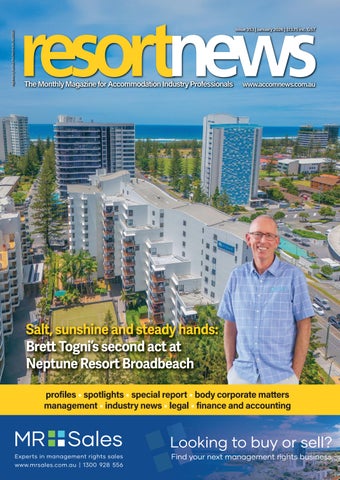
Salt, sunshine and steady hands: Brett Togni’s second act at Neptune Resort Broadbeach profiles • spotlights • special report • body corporate matters management • industry news • legal • finance and accounting
Looking to buy or sell? Experts in management rights sales www.mrsales.com.au | 1300 928 556
Find your next management rights business
OVER 1000
ACCOMMODATION BUSINESSES FOR SALE AUSTRALIAN BROKERS
Commercial
NEW ZEALAND & PACIFIC ISLAND BROKERS
TOURISM & HOSPITALITY BUSINESS BROKERS
FROM ALL THE LEADING BROKERS
IN AUSTRALIA, NEW ZEALAND AND THE PACIFIC ISLANDS
www.accomproperties.com.au
Considerations for upgrading
internet performance Guest expectations are changing, the benefits of upgrading your building’s internet: Tourism Impact: Discerning visitors now view fast and reliable internet as a key factor when choosing accommodation. Online Reviews: Guest feedback increasingly reflects internet performance, which can influence future bookings. Real Estate Appeal: Buyers and tenants are seeking homes that support remote work — high-speed internet is now essential. Holiday Letting Performance: Buildings with excellent internet tend to enjoy better reviews, stronger brand recognition, and increased occupancy and revenue.
What internet upgrade options should I choose? Option A: New CAT cabling to each room. Improves speed over traditional lines but doesn’t support gigabit performance. Installation is costly. Option B: Wireless distribution across the building. Cost-effective but unreliable due to interference from building materials and layout. Option C: Fibre optic cabling to each apartment. Offers excellent performance but comes with high installation costs and device upgrade requirements. Option D – Recommended: Gigabit fibre delivered via existing TV coaxial cables. This solution: o Delivers speeds up to 1.5 Gbps (1,500 Mbps). o Involves minimal disruption and cost. o Is fully managed and warranted. o Has proven success with existing installations.
…with the flick of a switch our internet services moved to world class Gigabit capable internet. Resident and guest satisfaction has skyrocketed with the availability of fast, reliable industry leading internet, which allows our resort to include phone, video and streaming services never before offered. Absolutely Brilliant!” – Eric van Meurs, Manager Atlantis Marcoola Beachfront Resort and past ARAMA President (Australian Resident Accommodation Managers Association.)
0448 189 992 info@sunriseinternet.com.au
sunriseinternet.com.au
FREE SITE AUDIT
UNLIMITED USAGE
Business iQ READY
FIBRE OPTIC AND COAX
INSIDE
The legal stuff...
January 2026 - Issue 353
The views and images expressed in Resort News do not necessarily reflect the views of the publisher. The information contained in Resort News is intended to act as a guide only, the publisher, authors and editors expressly disclaim all liability for the results of action taken or not taken on the basis of information contained herein. We recommend professional advice is sought before making important business decisions.
Advertising Conditions
08 ARAMA Report
16 By All Accounts
Front Desk 05
Editor’s Note: Welcome to a brand-new year for Resort News and for the management rights community
Thinking MR
26
Rights Reality
Tourism 28
Industry 06
24
Special Report – Management rights in New Zealand: A market shaped by complexity, caution and select opportunity
20 Good Governance
Tourism Round-up
Events & Appointments 30
Event - 2025 APMA Management Rights Summit
33
Event - Accommodation Industry Christmas Golf Day Events - ARAMA Christmas catch-ups
08
ARAMA Report
10
State Report
11
BCCM Report
34
12
Person of Interest: David Ren
Property
Management
38
New Managers
14
Legal Ease
38
AccomProperties Sales Report
16
By All Accounts
Profile
18
Motel Market
19
New Year, new you? Maybe just a better you
20
Good Governance
Preferred Supplier Directory
22
Strata Insights
47
42
Salt, sunshine and steady hands: Brett Togni’s second act at Neptune Resort Broadbeach
The Preferred Supplier Directory
The publisher reserves the right to refuse to publish or to republish without any explanation for such action. The publisher, its employees and agents will endeavour to place and reproduce advertisements as requested but takes no responsibility for omission, delay, error in transmission, production deficiency, alteration of misplacement. The advertiser must notify the publisher of any errors as soon as they appear, otherwise the publisher accepts no responsibility for republishing such advertisements. If advertising copy does not arrive by the copy deadline the publisher reserves the right to repeat existing material.
Disclaimer Any mention of a product, service or supplier in editorial is not indicative of any endorsement by the author, editor or publisher. Although the publisher, editor and authors do all they can to ensure accuracy in all editorial content, readers are advised to fact check for themselves, any opinion or statement made by a reporter, editor, columnist, contributor, interviewee, supplier or any other entity involved before making judgements or decisions based on the materials contained herein. Resort News, its publisher, editor and staff, is not responsible for and does not accept liability for any damages, defamation or other consequences (including but not limited to revenue and/ or profit loss) claimed to have occurred as the result of anything contained within this publication, to the extent permitted by law. Advertisers and Advertising Agents warrant to the publisher that any advertising material placed is in no way an infringement of any copyright or other right and does not breach confidence, is not defamatory, libellous or unlawful, does not slander title, does not contain anything obscene or indecent and does not infringe the Consumer Guarantees Act or other laws, regulations or statutes. Moreover, advertisers or advertising agents agree to indemnify the publisher and its agents against any claims, demands, proceedings, damages, costs including legal costs or other costs or expenses properly incurred, penalties, judgements, occasioned to the publisher in consequence of any breach of the above warranties. It is an infringement of copyright to reproduce in any way all or part of this publication without the written consent of the publisher. © 2026, Multimedia Publications Pty Ltd.
Publications Pty Limited
P | 07 5440 5322 PO Box 2652, New Farm, Qld 4005 E | mail@multimediapublications.com.au KEY
28 Tourism Round-up
30 Events
42 Profile
EDITOR:
Mandy Clarke editor@resortnews.com.au ADVERTISING:
Stewart Shimmin advertising@resortnews.com.au
4
January 2026
SUBSCRIPTIONS:
subscriptions@resortnews.com.au PRODUCTION:
Richard McGill
CONTRIBUTING THIS ISSUE...
Andrew Morgan, Ben Ashworth, Frank Higginson, Jane Wilson, Jonathan Hanaghan, Lynda Kypriadakis, Marion Simon, Mike Phipps, Sam Steel, Roland Franz and Trevor Rawnsley
Commercially funded supplier profile or supplier case study Supplier information or content Suppliers share their views in one-off, topical pieces General editorial. Case studies and features may cite or quote suppliers, please be aware that we have a strict ‘no commercial content’ guideline for all magazine editorial, so this is not part of any commercially funded advertorial but may be included as relevant opinion. Happy reading!
EDITOR’S NOTE
Welcome to a brand-new year for Resort News and for the management rights community While most of the country has spent early January easing back into real life, our operators are likely still riding the tail end of a very busy summer period. Yet even in the middle of this seasonal rush, January still offers a moment to pause and decide how you want the year to unfold. January has always been a reflective month for me. It begins with my very inconvenient birthday, so it has become the time of year when any good intentions I have are forced to wrestle with real life. I usually end December full of New Year’s resolutions, plans, colour coding and optimism, and
Mandy Clarke, Editor editor@resortnews.com.au
then my birthday arrives as the universe’s gentle reminder of who is actually steering the ship. Last year brought plenty of change for me, including stepping out of the AccomNews editor’s chair, shifts within our business, a few reshuffles at
home, children doing their own version of adulting and himself easing into retirement with a very enthusiastic eye on cycling (no thank you), golf (I do not mind caddying and quietly judging his swing) and lots of future travel (yes please). Perhaps that is the real theme for 2026. Try new things, stay flexible and keep your sense of humour. I find that one remains the most reliable tool in the toolkit of life.
fraud and the scams costing operators dearly, a reminder that digital security continues to be front of mind for everyone.
Before we look ahead, it is worth acknowledging what resonated most with readers last year. Our top performing management rights stories painted a clear picture of a sector hungry for practical insight and grounded commentary. Interestingly, the most-read piece across both publications was our deep dive into chargebacks, cyber
Looking ahead, we will continue to deliver a mix of real-world industry insight and human storytelling, covering the full and often colourful art of managing communities with fairness and common sense.
Stories that explored the people behind the properties were equally embraced, and educational pieces also topped the charts. This highlights a sector full of curious and committed operators who want to do things well.
Happy New Year! Mandy Clarke, Editor, Resort News
Keep reading for more listings...
Experts in management rights sales Australia’s foremost management rights sales agency, with 15 years of expertise and a dynamic team of over 15 agents strategically positioned along the vibrant expanse of the east coast, we bring unparalleled expertise and dedication to every client interaction.
Brisbane QLD
ID: 9216
Permanent Management Rights Net: $136,077 Price: $900,288
mrsales.com.au | 1300 928 556
Working together, working for you
Experts
in
accommodation
sales
Buying or selling?
National coverage and expertise in the sale of motels, hotels, caravan parks, pubs & MHEs tourismbrokers.com.au | 1300 512 566
FRONT DESK
January 2026
5
SPECIAL REPORT
Management rights in New Zealand:
A market shaped by complexity, caution and select opportunity At the same time, this contrast highlights the opportunity within New Zealand for well structured, professionally advised transactions to stand out and attract serious buyers.
By Mandy Clarke, Editor
New Zealand’s management rights sector continues to operate very differently from its Australian counterpart. While the model exists across many tourism regions, it remains smaller in scale, less standardised and, in many cases, less well understood by buyers. Yet interest persists, driven by selective opportunities, tourism demand and a steady flow of new entrants into the market. According to two brokers working at the coalface of the sector, buyer appetite is present, but it is cautious, targeted and highly dependent on structure.
Selective demand in a tightly held market Wayne Keene AREINZ, National Director Hotels Tourism & Leisure, Bayleys says demand remains firm, but supply is the limiting factor.
A framework defined by agreement, not uniformity Wayne Keene AREINZ, National Director, Hotels Tourism & Leisure, Bayleys
Kelvyn Coffey, Principal, Coffeys Tourism Property Brokers
and complex structures, and there remains a lack of consistent understanding of the management rights model. In many cases, these businesses sit in the same buying category as motel leases rather than traditional Australian-style management rights.”
A Queensland contrast and why Kiwis head north By comparison, Queensland’s management rights model remains far more structured and widely understood, operating within a clearly
defined legislative framework. This clarity continues to appeal strongly to New Zealand buyers, with Queensland long established as a popular destination for Kiwis seeking a management rights business offshore. For many New Zealand buyers, Queensland offers greater deal volume, stronger lender familiarity, clearer resale pathways and a deep ecosystem of brokers, solicitors and specialist financiers. As a result, Queensland continues to attract a significant share of Kiwi buyer demand, often being viewed as the more accessible entry point into the sector.
“Demand for management rights in New Zealand remains strong, but quality opportunities are limited. Most existing operations are tightly held, which continues to constrain supply,” he says.
6
January 2026
“Structures vary. Most agreements involve three parties, body corporate, unit owners and the management rights operator,” Coffey explains. “Owner/manager splits can also differ, determined by varying apportionments of operating costs depending on the setup of the letting agreements. This variability remains one of the defining features of the New Zealand market and a key reason many buyers proceed cautiously. At the same time, it also creates flexibility for experienced operators who understand how to structure agreements for long-term performance.
What buyers are looking for Despite the complexity, buyer preferences are clearly defined.
At the same time, buyer enquiry remains highly selective, according to Kelvyn Coffey, Principal of Coffeys Tourism Property Brokers. “Buyer enquiry is present, but selective. Interest tends to focus on individual opportunities rather than broad market momentum,” he says. “Many properties come with long tenures
Unlike Australia, New Zealand’s management rights sector is not governed by a dedicated, purpose-built legislative framework. Instead, agreements sit within the Unit Titles environment and are shaped by individual body corporate contracts, resulting in wide variability.
Mt Maunganui, North Island – Management Rights for Sale $2,500,000 NZD - Currently listed on AccomProperties
INDUSTRY
“Transient accommodation continues to attract the strongest buyer interest over permanent complexes,” Keene says. “Agreements that include the purchase of reception and a dedicated manager’s apartment are especially appealing, as they offer a level of tenure beyond the building management agreement itself.”
the same time, regulation of short-stay accommodation will play a decisive role in shaping future market stability.”
Coffey says that clarity remains critical. “Buyer interest continues to centre on well-located tourism assets with clear income lines, strong letting pools and sustainable operating models. Simplicity and transparency in agreements remain critical decision drivers.”
Valuations remain flat Valuations across the New Zealand market continue to reflect stability rather than growth. “Multiples on Earnings Before Interest, Tax, Depreciation and Amortisation (EBITDA) have softened, consistent with what we’ve seen in the motel sector,” Keene says. “The strength and term of the body corporate management agreement plays a major role in determining end value.” Coffey places the market at around four times the multiplier. “Multiples are generally sitting at around four times and have remained largely flat. Many assets are worth much the same as they were a decade ago,” he says. “While growth in per unit revenue has largely kept pace with inflation, profitability is often constrained by a number of running costs increasing at a greater rate.” He also points to the impact of unregulated shortstay accommodation.
Auckland, North Island – Management Rights for Sale $650,000 NZD – Currently listed on AccomProperties
within the short-stay space also continues to create uneven competition.” Keene identifies agreement security as another core challenge. “One of the key challenges is securing extensions to management agreements before they expire. Even where it makes commercial sense, most extensions require approval by unit-holder majority, which can be difficult to achieve.”
Shifting buyer demographics Buyer behaviour has evolved in recent years. “It has been a challenging few years for sellers, but market sentiment has shifted positively. We’re now seeing the return of habitual investors alongside an increase in firsttime buyers,” Keene says. Coffey confirms changing offshore interest.
“Rising construction costs should theoretically place upward pressure on revenues, thus values through supply shortages, but unregulated short-stay accommodation has distorted the market. During COVID, many Airbnbstyle properties exited the market, only to return in force post-pandemic, with little effective regulatory enforcement of the District Schemes (town planning rules).”
“New entrant buyers remain active. In recent years, this has included a noticeable lift in Indian buyers, following earlier waves of interest from Chinese investors.”
Operational pressures persist
“There has been little change in how body corporates operate. Where managers maintain a strong relationship and clearly demonstrate the value they add as building managers, the dynamic is generally positive and easier to manage,” Keene says.
For existing operators, profitability is key. “Profitability remains a pressure point, particularly where operating costs continue to rise faster than achievable room-rate growth,” Coffey says. “Regulatory inconsistency
Body corporate relationships remain central
the same challenges as elsewhere. Governance expectations, cost pressures and competing owner priorities continue to shape day-to-day management relationships.”
Advice for buyers entering the market
A widely misunderstood model
Both brokers stress the importance of specialist advice and financial realism.
Both brokers point to education as one of the sector’s biggest barriers. “There remains a lack of education around the management rights model in New Zealand. It is a very different market to Australia’s eastern seaboard, and many NZ agreements are not structured like Australian models. As a result, costs that would traditionally sit with owners often fall on the manager instead,” Keene says. Coffey agrees. “There remains a fundamental misunderstanding of how management rights operate in New Zealand. Many buyers approach the sector with caution because of this uncertainty, often giving it a wide berth due to perceived complexity.”
Where future opportunities lie Looking ahead, both experts point to development, pricing and regulation as the key levers.
At the operational level, the body corporate relationship remains pivotal.
Coffey adds: “Body corporate dynamics present much
Despite the structural challenges, New Zealand continues to offer genuine opportunity for operators who take time to understand the nuances of the model. Longterm tourism demand, limited supply in key destinations and the gradual professionalisation of short-stay accommodation all point to a market with solid medium-term upside.
“There is a real need for more apartment development with on-site management in key tourism locations,” Keene says. “At present, new development has been difficult to bring to market outside Queenstown, where yields and RevPAR continue to outperform the rest of the country.” Coffey says: “Improving profitability will require a combination of room-rate growth and a balanced supply and demand equation. At
INDUSTRY
“Seek professional advice from an experienced HTL broker who understands the difference between strong primary management agreements and secondary agreements,” Keene says. “It is also critical to engage a lawyer with proven management rights experience who understands the nuances and commercial benefits of each agreement.” Coffey adds: “Ensure the bottom line is genuinely sustainable. The management rights businesses available depend on locality.Locations such as Mount Maunganui and the Bay of Islands offer opportunities.”
A market defined by caution and opportunity New Zealand’s management rights sector remains complex, varied and structurally different from Australia’s. Buyer appetite exists, but it is selective. Valuations remain flat, profitability remains under pressure and education remains a barrier. At the same time, the sector is opening up new opportunity for well-prepared buyers. With offshore interest returning, investor confidence improving and continued demand for professionally managed accommodation in key tourism centres, New Zealand’s management rights market is steadily carving out its own path forward. January 2026
7
ARAMA REPORT
Be prepared for fire, floods, cyclones and locust plagues!
© Adobe Stock - stock.adobe.com
By Trevor Rawnsley, CEO, ARAMA
Queensland’s climate can be a magnificent thing, but when it’s bad it’s wicked. Once it was a given that winters were mild in Queensland and summers hot and stormy. But in recent years, we’ve found that storm season can arrive at any time, and resident managers have to be vigilant all year round, always at the ready to protect the properties they oversee. Queensland is considered the most disaster-prone state in Australia, with more than 100 natural disasters since 2011, including floods, king tides, cyclones, and bushfires. These events have had a devastating impact, with reconstruction and recovery costs exceeding $22 billion. And the current cyclone season, tipped to finish on April 30, could be unusually severe due to warmer sea surface temperatures in the northern parts of the country. There were 12 cyclones in the last season, the highest number in 18 years. This included Cyclone Alfred, which struck Queensland and New South Wales in March 2025, causing nearly $2 billion in damage. In 2017, Cyclone Debbie handed Whitsundays tourism a $180 million damage bill. Emergency services had to evacuate thousands of holidaymakers stranded on resort islands hit by wind gusts stronger
8
January 2026
than 260 km/h. Many of our members’ properties were devastated with some losing power for almost a month. Hamilton Island and Airlie Beach were littered with snapped trees, roof tiles, and furniture, with wrecked yachts washed ashore. But resident managers are invariably the cool heads in a climate crisis. They have had to become really good at disaster management. No one knows the building or its occupants better than a resident manager, and they are always on the spot to deal with a crisis immediately. In the last few years, our ARAMA members have had to manage just about every kind of natural and economic disaster. Their effectiveness is one of the reasons that MLR businesses continue to rise in value no matter how much trouble envelops the tourism and accommodation industries. While North Queensland has always had frequent cyclone activity, recently we’ve seen them hit Brisbane, the Gold Coast, and areas much further south than their usual territory. Our resident managers are at the pointy end of natural disasters. Many of those at
high-rise complexes during floods have had to drag cars out of car parks, knock on doors, particularly for some of the elderly residents, and help organise groceries and food drops. They are often unsung heroes who can respond quickly and rally volunteers together. Guy Elliott , ARAMA’s national president manages a large property of about 100 twostorey townhouses in a gated community on the canals at Mermaid Waters. Most of the living quarters are upstairs but at least one of the residents was sleeping downstairs during a recent flood and woke up with water flapping around his bed. It was like somebody put a hose in a bathtub and the water just kept rising. Before long, Guy was organising a massive cleanup, and because he was on the spot, he could help people as they needed it, check on any emergency situations, and then organise the recovery straight away. During the most destructive phase of Cyclone Debbie in 2017, Jo Matthews at the Toscana Village Resort at Airlie Beach showed once again the vital role of a resident manager.
INDUSTRY
Most people had evacuated and gone home before the cyclone arrived but there were still people ready to ride it out; residents who lived there looking over the Whitsundays, and a couple of tourists who couldn’t get a flight. Jo knew exactly where they all were. She put the garden furniture in the swimming pool so it didn’t blow away, and baked muffins, delivering them to people in their apartments on the afternoon the cyclone was coming. She warned everyone what would happen when the cyclone hit, made sure they got everything in off the balconies and reassured the residents and guests that, while they would lose power, they just had to hang in there and sit tight no matter how hard the wind roared. She told them it would be traumatic for a few hours, but the storm would eventually pass. Jo gave them torches and matches and supplies to keep them comfortable. Just as Jo had predicted, Cyclone Debbie roared into Airlie Beach, the power went out, and the noise of the wind was deafening. It stopped about 9 o’clock. Most people thought it was over, but Jo warned
them that it was only the eye of the storm. The tail came back and was even more intense, slamming into the Toscana Resort like a freight train. Jo lost a lot of foliage and there was a lot of broken glass but largely thanks to her efforts as a well-prepared resident manager, there were no injuries to people staying there.
It's incumbent upon all of us wherever we are in Australia to prepare for storm season and that storm could be in the form of a cyclone or seasonal rains or bushfire. There is plenty of information from good government agencies who can help accommodation providers prepare for the things that will inevitably happen in Australia. People just need to take an hour to scroll through the government websites to have a look at their property, make a plan, talk to their staff about it and be prepared. Get Ready Queensland (getready.qld.gov.au) is one such government website helping people prepare for natural disasters in all situations. "An emergency and evacuation plan will ensure everyone knows exactly what to do if the worst happens,’’ the website declares. An hour spent studying the website and preparing the property and residents
© Adobe Stock - stock.adobe.com
Being prepared for disasters could be the difference between staying safe or putting yourself and those you love in danger. You only need to look at 2020 when we started out the year on fire and we ended the year with flood warnings. That's Australia!
could save the lives of you and your guests. You’ll need to pack an emergency kit including first aid supplies, 10 litres of drinking water per person at a minimum, non-perishable food for three days, important documents stored on a USB, sturdy work gloves for removing rubbish and debris, enough tissues and wipes for each guest, battery-operated radio, torches, spare batteries to last three days, toiletries for three days, sunscreen and insect repellent, can openers, phone and portable charger, hand sanitiser and face masks for each guest. Managers should also do a risk assessment on their property, an analysis of everything including making sure they have appropriate insurances, especially business interruption insurance.
A cyclone can wipe out a whole bunch of units and without that business interruption insurance, you could be in strife.
Check for any bird nests near electrical fixtures, as these nests should also be removed before they cause a fire.
Storm preparedness includes checking that walls, roof and eaves are secure, treetops and branches are clear of the property, loose material and furniture that could cause injury in high winds has been stored, and that fuel tanks are full.
Each operator has an obligation to educate themselves when it comes to dealing with disasters, because as we know with natural disasters in Australia (and particularly Queensland), it’s not a matter of “if” but “when”.
Before the storm hits, make sure the roof gutters are clear and the drains cleaned out.
The resident managers who have a plan, who have armed themselves with knowledge about what to do when the cyclone, fire or floods arrive, are the managers who will be doing all they can for their community.
Prepare for bushfire season by clearing out gutters because embers and sparks can quickly set leaves alight. Damage to an electric system is also a major fire hazard. Prevent electrical problems by inspecting the outside of your property, specifically looking for damaged or frayed wires.
They will also be the managers who emerge from the disaster quickly, ready to get back to business. Now what to do about that plague of locusts?
Australian Resident Accommodation Managers Association is the peak industry body representing the interests of people who are involved in management rights. 1300 ARAMA Q (1300 27 26 27) For membership enquiries:
national@arama.com.au | www.arama.com.au
INDUSTRY
January 2026
9
STATE REPORT
Proxy farming or should it be called proxy bonsai? 10 people holding two proxy votes each is... the monster under the bed By Ben Ashworth, Small Myers Hughes Lawyers
Onsite building managers are often accused of being able to proxy farm and unfairly affect the outcomes of strata meetings. These accusations tend to overlook two key facts.
Fact 1: All owners can proxy farm. Fact 2: Even if the farming is successful, barely a handful of votes isn’t really a farm. In most jurisdictions across Australia there are limitations on the number of proxies a
person can hold for a strata meeting. In New South Wales, Victoria and strata schemes that operate under the Standard Module in Queensland, the maximum number of proxies a person can hold is just five percent of the total number of lots in the strata scheme. For example, that means that in a strata scheme with 58 lots, you can only hold two proxies. Two votes out of 58 isn’t really causing any landslide victories or derailing democracy in the strata scheme. In strata schemes under the Accommodation Module in Queensland, the number of proxies that can be held is higher, but not by much, as the limit goes up to 10 percent. Again, five votes out of 58 is still unlikely to be the cause of any significant upsets when it comes to a vote. It’s also worth noting that many building manager related matters that strata schemes vote on are matters where the legislation bans all proxies (in Queensland) or specifically bans the building manager from using proxies (in New South Wales). So, with so few proxies able to be held, why do owners still worry about proxy farming? Two votes held by one person is not really a concern. Whereas 10 people holding two proxy votes each is a different story. This is the monster under the bed that makes the owners jumpy. What appears to get overlooked in these scenarios, whether real
10
January 2026
INDUSTRY
or imaginary, is that for this to work in the building manager’s favour, it still takes 10 people to hold the votes and 20 people to give their votes away. That means first finding 10 people who will willingly attend a strata scheme meeting. Almost an impossible task from the outset. Then it means finding 20 owners (who have paid their levies and won’t be attending the meeting) who are willing to give their proxies to another person. Then you need to introduce the first 10 people to the 20 owners and split them up into little groups of three, so that no one is ending up with more than two proxies. And then of course you need to make sure the right paperwork has been completed correctly and returned to the strata manager before the meeting. And if you have managed to do all that, it also depends on these 30 people actually agreeing with the building manager and agreeing to vote the way the building manager has recommended. Arguably, if you manage all this you deserve an award, let alone a successful vote. What this highlights is that if anyone were to successfully farm proxies, they have succeeded because they have put in a lot of effort and successfully communicated with a lot of owners. If that effort and communication results in a successful vote, that looks a lot like the system working as intended from my perspective. If a vocal minority isn’t willing to put in the same effort and communicate with owners, it shouldn’t be a licence to claim it is unfair when someone else does. Disclaimer: This article is provided for information purposes only and should not be regarded as legal advice.
BCCM REPORT
Sinking fund is not a financial security blanket A body corporate must, by law, maintain the common property in a good and structurally sound condition. That may mean having funds put aside to paint the exterior every 10 years or replace windows in coastal locations every 25 years. By Jane Wilson, Commissioner for Body Corporate and Community Management
New buyers of lots in community title schemes with a massive sinking fund balance need to be aware that it is not a magical pot of money to cover any major problem. The funds are collected to cover foreseeable maintenance issues over a rolling 10-year period. The maintenance could be anything from replacing windows, roofs, and upgrading lifts to painting the exterior, resealing the pool or upgrading security systems. This is why a sinking fund needs to keep pace with inflation and rising building costs to futureproof the property financially. It is not, as some may think, a rainy-day savings account for unbudgeted expenses, and nor should a massive sinking fund be a reason to reduce levies. In fact, not increasing levies in line with at least inflation can create a financial time bomb. Anyone buying a new lot needs to be wary and not delighted, if the sinking fund levy is a relatively ‘cheap’ expense in a cost-of-living crisis era. Do your homework to determine if the sinking fund forecast aligns with inflation and rising costs. Check that foreseeable maintenance repairs are included in the budget.
Even with a two, three, or four million-dollar sinking fund staring you in the face as you sign for your new acquisition, you could still be required to dip deeply into your bank account for a special levy for an unbudgeted maintenance issue. A recent example of this was the serious fire risk surrounding combustible cladding on multi-storey communitytitle scheme buildings.
The new seller disclosure requirements mean the sinking fund balance will be disclosed to the new owner on the body corporate certificate. This information should be read in conjunction with the forecast expenditure to ensure the funds and future deposits, will cover what is needed. Ideally, a new owner should look for robust sinking and administration funds, depending on the size of the property and whether the community titles scheme is registered as a building format plan or a standard format plan. A building format plan is typically for multi-level unit blocks but
can be townhouse complexes. Under this format plan, the body corporate has a responsibility for more maintenance requirements, such as the roof, lifts and structural elements of the buildings. In a standard format plan, more often than not, in townhouse complexes and residential estates, the owner takes on more responsibility, such as the roof and foundations. More information on sinking funds is available at qld.gov.au/law/ housing-and-neighbours/ body-corporate/financeinsurance/funds/sinking
The cladding safety crisis sent shockwaves through bodies corporate across the state. It was not a foreseeable maintenance issue and caught many bodies corporate by surprise. Few, if any, bodies corporate had factored in their sinking fund to replace fire-risk cladding. Depending on the urgency, a body corporate may need to raise money through a special levy spread over time or by obtaining a bank loan. A special levy can be raised through an ordinary resolution at a general meeting of lot owners. It requires a majority of the votes cast for the motion to carry. A body corporate may propose to borrow money. However, under some regulation modules, the motion would only carry if every vote cast was in favour. Be mindful: a body corporate cannot legally move money from an administration fund to a sinking fund or vice versa. Once the funds are deposited into a fund, they can only be used for their budgeted purpose.
INDUSTRY
January 2026
11
PERSON OF INTEREST
From Smart living to smarter communities:
Rethinking how communities operate Clear communication, built in
By Mandy Clarke, Editor
David Ren on why technology is reshaping the future of management rights…
Communication remains one of the most critical elements of any community. Aurora OS includes real-time announcements that allow managers to notify residents instantly, replacing printed notices and inconsistent email delivery.
The future of management rights is being shaped by smarter systems, streamlined workflows and a growing shift toward more connected, data-led operations. Among those contributing to this evolution is David Ren, founder of Bestdream and the creator of the communityfocused platform Aurora OS. With a background spanning technology, property operations and long-term community development across Australia, the United States and Asia, David’s career has been shaped by one clear belief: communities are living ecosystems, not just buildings. And like any ecosystem, they thrive when supported by clarity, transparency and practical tools.
A pathway into management rights David first entered the management rights space through real estate investment and community operations. Working closely with onsite managers quickly showed him just how central their role is to service delivery, resident satisfaction and long-term asset value. “At the same time, I saw how fragmented many systems still were,” he says. “So much of the work was manual, disconnected and inefficient. That’s what drew me further into the industry.” That experience was the catalyst for a much bigger idea.
From frustration to innovation While helping several Queensland communities modernise their operations, David saw managers juggling multiple separate platforms, from access control and CCTV to maintenance tracking, email approvals and resident communication.
12
January 2026
David Ren, founder of Bestdream
“One manager told me they spent more time managing data than managing the community,” he recalls. “That was the turning point. The industry didn’t need more apps. It needed one true operating system.” That insight led to the creation of Bestdream and, soon after, Aurora OS.
One system, one workflow Aurora OS was designed as a fully integrated platform that combines resident and visitor management, security and access control, maintenance workflows, community communication, CCTV integration, committee approvals and contractor management in one place. “The logic is simple,” David says. “The industry doesn’t need ten different tools. It needs one system that works together.” For onsite managers, that translates into real operational relief. Visitor check-ins become automated, maintenance requests convert into structured work orders, contractor progress is tracked in real time, and committee members can approve items digitally rather than through long email chains. “Managers get their time back,” says David. “And with that comes peace of mind.”
Residents can receive updates, confirm they’ve read them, submit feedback and lodge requests, all within the same system. The result is faster response times, clearer records and fewer misunderstandings.
AI as a support tool, not a burden AI plays a growing role within Aurora OS, but always as a support function. “AI is there to assist, not overwhelm,” David explains. “Right now it helps identify repeated issues, predict maintenance risks, generate reports, assist with inspections and flag anomalies.” Future development will expand into predictive budgeting, safety and security alerts, automated compliance checks and long-term digital community modelling. The aim, he says, is always simplification.
Designed for managers first With some operators cautious about new technology, usability has been a guiding principle from day one. “Our design rule is simple,” David says. “If it takes lengthy training, it’s the wrong design.” Clean icons, one-tap actions and clear language mean most managers learn the system in under an hour.
Boosting long-term business value David is firm on the commercial benefits of smarter systems. “Technology directly improves efficiency, transparency,
INDUSTRY
compliance, resident satisfaction, renewal likelihood and cost control,” he says. “All of those affect caretaking income, letting income and resale value.” He notes that digital systems are increasingly contributing to measurable uplift in management rights valuations.
Compliance without the stress Audit trails, timestamps and automated records mean compliance becomes part of everyday operations rather than a looming administrative burden. Maintenance history, approvals, financial transparency and risk documentation are all generated as part of the normal workflow.
Built from the field What truly sets Aurora OS apart, David believes, is that it was shaped by direct industry feedback.“Every feature came from real conversations with frontline managers in Queensland,” he says. “Nothing is theoretical. Everything solves an actual operational problem.”
The road ahead Looking forward, David sees management rights moving steadily toward data-led governance. Predictive maintenance, digital approvals, building-wide operational records and smart access systems will become the norm. “Managers will spend more time with people and less time on paperwork,” he says. “Technology won’t replace managers. It will empower them.” Bestdream is now expanding Aurora OS across Queensland while working with universities and industry partners on new AI-powered modules focused on safety, predictive maintenance and long-term community value. “Our goal is simple,” David concludes. “To help every community operate with clarity, ease and lasting value.”
Aurora OS Building the Next Generation of Smart Communities
CORE VALUE PILLARS Upgrade Operations Smarter workflows for managers and staff. Improve Resident Experience Instant communication, seamless access, faster issue resolution. Enhance Management Rights Value Digitalisation that strengthens long-term recurring revenue assets.
ABOUT US Aurora OS / Bestdream Smart Infrastructure Building smart communities across Queensland. Industry & Academic Collaboration: APMA • TIQ • QUT Innovation Engagement
SYSTEM HIGHLIGHTS Digital access control (license plate recognition + mobile entry) Announcements & emergency broadcast messaging Work order & maintenance automation Parking & visitor management Solar & energy data integration Owner / manager dashboard & insights
WHY IT MATTERS TO MANAGERS For Resort Managers & Developers: Reduce operational workload by 40–60% Faster response times across all operations Higher resident satisfaction rates Improved transparency & compliance Stronger long-term asset performance
CONTACT Website: www.bestdream.com.au Email: david.ren@bestdream.com.au Phone: +61 0499 883 669
LEGAL EASE
The building managers’ guide to a happy 2026 Some of the key issues that may confront you over the next 12 months By Frank Higginson, Redchip Strata Law
After the flurry of Christmas and New Year, it’s tempting to take a moment, put your feet up and relax. But it’s just at this point in time that a bit of careful planning can make for a happy and peaceful year ahead.
Here’s a handy guide and reminder of some of the key issues that may confront you over the next 12 months. 1. You are not the body corporate police. A resident manager should report breaches of by-laws that they become aware of to their committee.
However, that is not the same as enforcing those by-laws. If the occupier of Lot 1 is swimming in the pool at one o’clock in the morning and the by-law says no swimming after 9 pm, that is a matter for letting the committee or the body corporate manager know the next morning. Education should top enforcement. A polite reminder of by-laws about swimming or parking in the visitor car park will likely get a better result than any attempt at immediate strict enforcement. 2. The body corporate cannot change your management rights agreement without your consent. A management rights agreement is a contract. It is no different from a contract for buying a property. There is no ability for one party to unilaterally force the other to agree to a change unless that is documented in the contract itself. It is important for managers to know their rights and to stand up for them. 3. Managers should give master keys to the committee. Most management rights agreements provide that the manager will hold master keys, but ultimately those keys belong to the body corporate. If the committee wants them, then the manager should provide them. The good news is that this can lower the manager’s risk profile. If the keys are misused, that then becomes as much about how the committee managed
14
January 2026
MANAGEMENT
the security of the master keys as anything else, whereas if the manager is the sole holder, that responsibility rests fairly and squarely with them. 4. A body corporate cannot deduct monies it claims are owed from caretaking remuneration. The correct forum for any dispute of this nature is the Queensland Civil and Administrative Tribunal, or a specialist adjudicator through the Commissioner’s Office, over the nature of the duty itself. It is not appropriate for the body corporate to suggest that a manager undertake or arrange a duty and then, in the absence of an agreement, simply deduct the costs from the manager’s remuneration. 5. A body corporate normally can’t refuse to consent to an assignment of a management rights agreement. If a management rights sale or purchase is on the cards for you this year, know that unless a body corporate has reasonable grounds to do so, it can’t refuse to consent to an assignment of a management rights agreement. That isn’t to say that a committee can’t be difficult to deal with during the process. Assignments tend to be more of a problem where the current management rights arrangements have not been a happy experience for the committee. It might seem that a committee would be happy to move on someone they don’t get along with and welcome some fresh blood, but some want to inflict a bit of pain on the way out as well. If a manager is looking for a New Year’s resolution, a good place to start would be undertaking a thorough understanding of their agreement and knowing their rights under that contract. Any concerns or potential misunderstandings should be discussed with a strata law specialist.
PRQWK
,1'8675< /($'(5
/,)(7,0(
81/,0,7(' :$55$17<
<($56
'HOLYHUHG ,QVWDOOHG 'LVSRVDO RI 2OG (TXLSPHQW /LIHWLPH RQ 5HSDLUV
6(59,&(
7 & $SSO\ 3ULFHV DUH ¶ *67·
BY ALL ACCOUNTS
WARNING: Employee or contractor? Basis of the worker’s payment An employee may be paid for the time worked, or per item, activity, or on a commission basis. Contractors are paid to achieve a specific result.
By Jonathan Hanaghan, Principal, Count Gold Coast
Do you engage the services of independent contractors? Have you given thought to the possibility that they could be employees? Getting it wrong can cause you significant trouble. Following the GFC, Australia experienced an incredible surge in contract, temporary and freelance work, dubbed ‘the gig economy’. The underlying force behind the increase in contract-related work rests on higher flexibility and lower costs associated with outsourcing work to a third party.
Equipment, tools and other assets provided by or to the worker An employee is mostly provided with tools and equipment by their employer. Contractors mostly provide their own tools and equipment.
and how it is performed. Contractors can decide how their work is done, provided it is within the terms of the contract.
Independence of the worker Employees form part of the business and therefore are not independent. Contractors operate their own business independently and can accept or refuse additional work.
Control over the work
Other important factors to consider are the exclusivity of the worker and whether the worker advertises themselves ‘to the world at large’. Exclusivity refers to whether the worker is hired by numerous businesses or must remain exclusive to their employer. Advertising ‘to the world at large’ would likely mean that the contractor has a business name and logo in place, has a work uniform with their own logo, and has a storage shed or office that they can operate from.
A business has full discretion over what work needs to be completed by their employee
For example, in Rabba v OekeGuy Pty Ltd T/A PeleGuy [2013] FWC 70, the worker was
Commercial risks of the worker Businesses are responsible for their employees’ work and so employees do not take on commercial risk. Contractors will be personally liable to rectify any defects.
a salesperson required to sell products to convenience stores and petrol stations. The features that supported the salesperson being an employee were that he worked exclusively under his employer, was unable to engage others to perform his work, was subject to the supervision of the employer, and selling goods was a vital part of the business of the employer. These facts were weighed against the fact that the worker submitted invoices, paid for the cost of his motor vehicle fuel, was not subject to PAYG tax, determined his own hours, and was paid by commission on sales. A layperson may have believed the worker was a contractor, as employees do not invoice their employer and do not generally determine their own hours. However, the inability of the worker to subcontract, and the fact that he was not conducting his own business when he performed the work, gave the court no option but to conclude that the worker was an employee.
To determine whether your worker is performing a contract for service (contractor) or a contract of service (employee), the court system will analyse several factors, known as the multi-factor test:
Ability of the worker to subcontract or delegate An employee can’t pay someone else to do their job, but a contractor can.
16
January 2026
© Adobe Stock - stock.adobe.com
The difference between an employee and an independent contractor is not defined by a fine line. The relationship between yourself and your independent contractor is called a contract for service. On the other hand, a contract of service is the relationship established between yourself and your employee. This is certainly a subtle difference but should not be taken lightly.
© Adobe Stock - stock.adobe.com
The difference between an employee and an independent contractor is not defined by a fine line
Avoid the myths Myth: If a worker has an ABN, they’re a contractor. Fact: The existence of an ABN does not confirm that a worker is a contractor. An employer may force an employee to obtain an ABN to make them appear to be a contractor and, in turn, mitigate super and tax obligations. This is known as sham contracting. Breaching the sham contracting provisions under the Fair Work Act 2009 will lead to severe penalties and contraventions. Myth: If a worker is a contractor for one job, they will be a contractor for all jobs. Fact: The working arrangement and specific terms and conditions will determine whether a worker is an employee or contractor for each job. A worker could be an employee for one job and a contractor for the next. It is paramount to make an ongoing effort to ensure there are no differences between your worker’s contract and their actual working conditions. If you hired a contractor last quarter and their role has since turned into that of an employee, you must immediately start withholding PAYG tax on their behalf, pay the super guarantee minimum and obtain workers’ compensation cover. Myth: If a worker submits an invoice for their work, they’re a contractor. Fact: The existence of an invoice for completed work does not confirm a worker is a
contractor. You must examine the working conditions of the worker. Many court cases are not decided on whether the worker has an ABN, whether a contract was in place, or whether an invoice was submitted. They come down to the factors mentioned above (the multi-factor test), such as exclusivity of the worker.
Do I have to pay my contractor’s super? Even after you have confirmed that you have hired a contractor, you may still be liable for super contributions on their behalf. The Superannuation Guarantee (Administration) Act 1992 (Cth) states that a contractor is entitled to superannuation contributions if they work under a contract that is “wholly or principally for the labour of the person”. Employers must pay the 12 percent Super Guarantee minimum. If you incorrectly classify an individual as an employee or contractor, you may be liable for: •
Superannuation charges.
•
Additional payroll tax.
•
Penalties and interest.
•
Unpaid annual and long service leave.
•
Compensation for unfair dismissal or other remedies.
Since the introduction of taxable payments annual reports (TPARs) to the building and construction industry in 2014, the ATO has continued
to strengthen its resources to close the gap of noncompliance. Recently, the ATO has broadened this scope to several other industries and their businesses. Businesses providing cleaning services must now lodge a TPAR. This has clear implications for management rights businesses. If you have a management rights business and 10 percent or more
of your income is from cleaning services, you must lodge a TPAR. However, if you fall under this threshold, it is still a wise decision to lodge a TPAR nil report to avoid questioning from the ATO later down the track. If you are still unsure whether your worker is a contractor or an employee, seek professional guidance from your accountant.
Professional Real Estate Training Since 2006 Nationally Recognised Qualifications Salesperson | Property Manager | Real Estate Agent | Resident Letting Agent
Flexible Training Options:
Benefits:
• Traineeships • Small face to face classes • Live Zoom classes • Delivered in English and Mandarin • Flexi Learning at own pace • Recognition of Prior Learning
• Friendly, Experienced Trainers • Practical Courses for MR Industry • Qualifications issued promptly • Competitively Priced • Exclusive Online Support Group
ormance Skills Workplace Perf t Ongoing Suppor its Un D CP 2 1&
stry Recognised
Indu
Type
Practice IV in Real Estate rt Ce in es lis ia Spec
Call us (07) 3878 8513 email info@pret.edu.au visit www.pret.edu.au RTO: 31303
January 2026
17
MOTEL MARKET
Cash management and its effect on business worth Businesses handling cash should implement robust management practices
By Andrew Morgan, Motel Broker/Partner, Qld Tourism & Hospitality Brokers
Cash continues to be a relevant form of payment for many businesses, particularly those with frequent, small value transactions like cafes, takeaway food outlets, and certain motel services. While the shift towards electronic payments has reduced the overall reliance on cash, these transactions present specific operational, and regulatory challenges.
Operational and regulatory considerations Risk of theft and errors: Handling physical currency naturally increases the risk of both internal and external theft. Additionally, manual cash handling processes are more susceptible to human errors in counting, recording, and reconciliation. Taxation oversight: Tax authorities, such as the Australian Taxation Office (ATO), note that businesses processing large volumes of cash may be more vulnerable to poor record keeping, which can facilitate tax avoidance. The ATO actively monitors businesses as part of its efforts to ensure compliance with tax and employment obligations.
Best practices for cash management To mitigate risks and maintain compliance, businesses handling cash should implement robust management practices:
18
January 2026
Implement strong internal controls: Establish clear procedures for cash handling, including segregation of duties, regular cash counts, and timely bank deposits. Maintain accurate records: Ensure all cash transactions are meticulously recorded in real time using reliable accounting software. Accurate record keeping is essential for audit purposes and demonstrating compliance to tax authorities. Utilise technology: Consider using secure cash management systems, such as smart safes or automated teller machines for staff, which can reduce physical handling and improve transaction tracking. Stay informed on ATO guidance: Businesses in Australia should consult the ATO's information on managing business finances for resources and specific requirements for cash transactions and record keeping. By implementing these measures, businesses can effectively manage cash flow while addressing the associated risks of error, theft, and regulatory non-compliance. Unrecorded cash income can significantly and negatively impact the valuation of a motel business. Valuations rely on verifiable financial performance, so any income that is not officially reported in financial statements is effectively invisible and cannot be included in the assessment.
Impact on motel valuation Reduced net income: Unrecorded cash income leads to an understated net profit. Since valuation formulas (including those based on a capitalisation rate or return on investment (ROI) are directly linked to net income, this undervalues both
the business and, for freehold properties, the real estate itself. Buyer perception and risk: Potential buyers and investors base their decisions on the documented financial history of a business. Unrecorded income creates a lack of transparency and introduces significant risk, making the business a less attractive investment. Audit and compliance risks: These practices attract scrutiny as discussed above. Due diligence: During the due diligence process, buyers and their advisors will scrutinise all financial documentation, including tax returns, bank statements, and profit and loss statements, often for at least three years. Any discrepancies or unaccounted cash will be flagged and could derail the sale or be used to negotiate a lower price. Financing challenges: Lenders will base any financing for a business purchase on the officially reported income. A bank will not recognise unrecorded cash income, which could make it difficult or impossible for a buyer to secure a loan to fund the acquisition.
The shift to digital payments The trend toward a cashless society, which was accelerated post-2020, has been influential for the accommodation industry. Digital adoption: The pandemicdriven shift made electronic payments commonplace for transactions of all sizes, increasing customer expectations for digital options. Improved transparency: The higher use of digital payments inherently increases financial transparency, as these
MANAGEMENT
transactions are automatically recorded. This helps resolve the valuation issues associated with unrecorded cash. Staying competitive: For motels, particularly those serving corporate clients, offering modern payment methods is now a necessity to remain competitive and appeal to customers who are comfortable with digital transactions. Failure to record cash income significantly and negatively impacts the valuation of a motel business. The figures below are consistent with standard valuation principles, as unbanked profits cannot be considered when calculating a business's worth.
Calculation of lost value Unrecorded cash translates to a loss in a motel's value: Motel business (leasehold): With a 33 percent ROI, the business value is calculated by dividing the unrecorded profit by the ROI. For example, $20,000 / 0.33 = ~$60,606 loss in value. Freehold motel business: With a 14 percent ROI, the lost value is calculated as $20,000 / 0.14 = ~$142,857 loss in value.
Maximising business value To maximise a business's value and sale price, it is critical to implement diligent record keeping practices that capture all revenue. The ongoing trend towards digital and cashless payments provides an excellent opportunity to ensure that all transactions are automatically tracked and recorded, contributing to greater financial transparency and a stronger, more verifiable business history.
New Year, new you? Maybe just a better you This year, look for ways to simplify, automate, and delegate 2. Set smarter goals, not bigger ones By Sam Steel,
Co-Founder, Resly
January rolls around and, like clockwork, the resolutions start flowing. Eat better. Work smarter. Be more organised. Stop checking emails at 11pm. But let’s be honest. Hospitality doesn’t really do quiet Januarys. While everyone else is easing back into the new year, you are catching up on guest feedback, fixing the air-con that broke on Boxing Day, and trying to remember where you saved last year’s budget spreadsheet! Still, the new year is a good excuse to hit the reset button, not with big, loft y promises that will be forgotten by February, but with a few realistic goals that actually make life easier, both in business and personally. 1. Clear the digital clutter Before you worry about your inbox, start with your systems. Take an hour or two to tidy up your PMS, archive old bookings, and ensure all staff have the correct permissions. A clean system leads to clearer reporting and fewer headaches later. If you are using Resly, take the time to review your automation settings and online check-in templates. A few minor tweaks now can save a lot of admin later in the year. Think of it as spring cleaning for your soft ware. And yes, clear your desktop too. Those 97 screenshots from last summer’s maintenance reports probably are not sparking joy.
“Grow revenue by 30 percent” sounds great on paper, but goals that vague rarely stick. Instead, try setting small, specific targets that move you towards a bigger outcome. It could be reducing checkin times by five minutes or lifting your guest review score by half a point. Perhaps it is training two more team members on how to reset the wifi, so you are not the only one who knows how it works.
recognising great service, or shouting the morning coffees remind your staff that they are valued. Motivated people make for smoother operations and better guest experiences, and that benefits everyone. 5. Remember to take a breather Hospitality never really stops, and it is easy to forget that you cannot pour from an empty cup. Book a weekend off, plan a short break, or at least switch off your notifications for a few hours. You will come back sharper,
more patient, and probably less likely to send that sarcastic reply to the guest who “didn’t realise check-out was 10am”.
A year for progress, not perfection The start of the year is not about reinventing yourself. It is about getting a bit better at the things that make life and the job easier. So here is to fewer late nights, smoother operations, happier guests, and a little more balance in 2026. You have earned it.
Small, measurable wins create real momentum, and in this industry, consistency beats ambition every time. 3. Work smarter, not longer Property managers are experts at doing ten things at once, but multitasking often means nothing gets your full attention. In 2026, look for ways to simplify, automate, and delegate.
Simpson Quinn Lawyers is a long established commercial ˔ˡ˗ ˣ˥ˢˣ˘˥˧ˬ ˕˔˦˘˗ ˟˘˚˔˟ Ѓ˥ˠ ˢˡ ˧˛˘ ˆ˨ˡ˦˛˜ˡ˘ ʶˢ˔˦˧ ˔ˡ˗ ˢˡ˘ ˢ˙ ˧˛˘ ˆ˨ˡ˦˛˜ˡ˘ ʶˢ˔˦˧Ϡ˦ ˠˢ˦˧ ˘˫ˣ˘˥˜˘ˡ˖˘˗ Ѓ˥ˠ˦ ˜ˡ Management Rights transactions
Use automated guest messages, schedule reports to email you, and let your systems handle as much as they can. The more time you free up, the more time you have to focus on what really matters: your guests and your sanity. And if you are still working through your days off, maybe that is the real habit to break this year. 4. Invest in your team A happy, confident team is the best investment you can make. Start the year with a quick team catch-up, talk about what worked last season and what did not, and make sure everyone feels heard. Even simple gestures like updating uniforms,
We practice in all areas of Management Rights including: • Sales and Purchases of Management Rights • Top ups and variations of Management and Letting Agreements
• Advice on Management and Letting Agreements and Body Corporate Issues • Body Corporate Disputes and Dispute Resolution, including the adjudication of disputes and appeals
Contact: 07 5443 5266
simpsonquinn.com.au reception@simpsonquinn.com.au
MANAGEMENT
ˆ˨ˡ˦˛˜ˡ˘ ʶˢ˔˦˧ ˔ˡ˗ ˄˨˘˘ˡ˦˟˔ˡ˗ ˪˜˗˘ January 2026
19
GOOD GOVERNANCE
Understanding waterproofing membranes in strata properties:
Lifecycles, responsibilities and compliance Types of waterproofing membranes in strata buildings Two of the most common membrane systems are acrylic roll-on membranes and torch-on bituminous membranes. Each has its advantages, limitations and typical use cases. Generated with AI
By Lynda Kypriadakis, The Diverse Group of Companies & DPX Projects
Waterproofing is one of the most critical, yet often overlooked, structural components of a strata property. Whether it is beneath a tiled balcony, lining a rooftop plant room, or protecting a planter box, the integrity of a waterproofing system directly affects the safety, usability and financial health of a building. Failure can lead to leaks, structural damage, mould, loss of amenity, insurance complications and costly remedial works. For building and strata managers, along with elected committees responsible for maintaining common property, understanding what waterproofing membranes are, where they are located and how they should be managed is essential. This article outlines the typical membrane types used in strata schemes, their expected lifecycles, signs of deterioration, responsibility for maintenance, and the warranties and certifications that should accompany the work.
20
January 2026
Where waterproofing membranes are found in strata properties
Pools and wet leisure areas. Waterproofing prevents infiltration into the concrete structure, surrounding paving and adjacent apartments.
Acrylic roll-on membranes These are liquid-applied membranes that cure to form a flexible, seamless barrier. Typical locations: •
Internal wet areas (bathrooms and laundries).
•
Some planter boxes.
Planter boxes. A major source of chronic leaks in strata schemes, as irrigation systems, blocked drains (or lack of drainage) and soil moisture constantly challenge the membrane.
•
Light-duty balconies not subject to significant movement or UV exposure.
•
Feature walls or vertical surfaces.
Private property or exclusive-use areas
•
Easy to apply.
•
Cost-effective.
Balconies (where they are defined as common property). Especially found in older schemes where the slab and membrane sit within the common property boundary.
These often include:
•
Seamless finish reduces vulnerability to laps or joins.
Ground-level podium slabs. These areas often form the roof of basement car parks and require robust waterproofing to protect structural components below.
Internal wet areas (bathrooms, laundries, ensuites). These membranes are typically part of the lot and maintained by the owner.
Waterproofing membranes are used across both common property and private property areas. The nature of the location influences the type of membrane required and the responsibilities associated with maintenance or replacement.
Common property areas These typically include:
Rooftop slabs and plant rooms. These locations face constant exposure to UV, rain, heat, mechanical stress from equipment, and pedestrian traffic damage from maintenance and servicing contractors.
Private or exclusive-use balconies or patios. In some schemes, the membrane lies within the lot boundary.
Because membrane responsibility depends on the scheme’s registered plan and by-laws, it is crucial for managers and committees to check the building format plan (BFP) or standard format plan (SFP) to confirm ownership and maintenance obligations.
MANAGEMENT
Advantages:
Limitations: •
Not ideal for areas with ponding water or high UV exposure.
•
Less durable than sheet membranes.
•
Higher risk of workmanshiprelated failure.
•
Typically have shorter warranties from the supplier.
Useful lifecycle: 10 to 15 years, depending on exposure and application quality.
Torch-on bituminous membranes
Voluntary warranties
These are heat-applied sheet systems consisting of modified bitumen, ideal for larger areas and high-demand environments. Typical locations: Podium slabs, rooftops and plant rooms, balconies exposed to the elements, planter boxes, pool shells and surrounds, and basement walls and retaining walls.
© Adobe Stock - stock.adobe.com
Highly durable and UV-resistant.
•
Suitable for continuous water exposure.
•
Lower failure rates when applied correctly.
•
Longer supplier warranties
Limitations: •
Requires skilled applicators.
•
Higher upfront cost.
•
Heat application requires strict safety measures
Early detection and routine maintenance (including inspections and checks) reduce remediation costs and prevent structural damage by locating and dealing with defects as they arise.
Useful lifecycle: 15 to 25 years, with high-quality systems lasting up to 30 years when well maintained.
Who is responsible for repairs or replacement?
Signs of waterproofing failure
•
The registered plan type (SFP vs BFP).
•
The by-laws.
Waterproofing rarely fails suddenly. Most problems develop gradually over time. Building and strata managers should look for:
•
Whether the membrane is part of common property or lot property.
•
Whether exclusive use has been granted.
•
•
•
Water staining on ceilings, soffits or the underside of balconies. Drummy or loose tiles, often caused by moisture beneath the tiles.
Peeling paint, mould or musty odours.
•
Cracking in grout lines, movement joints or tiles.
•
Ponding water on balconies or podiums due to poor drainage.
•
Rust staining or spalling concrete, indicating moisture penetration.
•
Responsibility differs based on:
Common principles in Queensland •
Efflorescence (white mineral deposits) on tile grout or concrete surfaces.
•
Retrofitted items bolted or fixed to balcony or rooftop patio floors, such as umbrellas or other items installed by lot owners that could damage the membrane.
Manufacturer/supplier warranties: Often 15 to 20 years for torch-on systems, depending on conditions.
•
Applicator warranties: Ranging from two to 10 years, depending on contractor and product system.
Bodies corporate should ensure:
Advantages: •
•
If the membrane is on common property, the body corporate is responsible for maintenance, repair and replacement.
•
If the membrane is within the boundaries of the lot, the lot owner is responsible.
•
Exclusive-use areas remain common property, but maintenance responsibilities may be shifted to the benefiting lot owner depending on the by-law.
•
Tiling above the membrane is usually the responsibility of the same party responsible for the membrane, because removal and reinstatement are integral to the waterproofing system.
•
The installer is licensed.
•
A Form 12 is provided upon completion of the works.
•
Warranty conditions are clearly understood, particularly maintenance requirements and exclusions.
•
A project manager or building inspector is engaged to properly scope the waterproofing works and inspect the works during construction to ensure proper application.
Certification and warranties Waterproofing is regulated because of its impact on the building’s structural integrity. Mandatory certification In Queensland, a licensed waterproofing contractor must supply:
Best practices for strata managers and committees •
Keep a waterproofing register documenting locations, installation dates and warranty periods.
•
Schedule routine inspections, especially for podiums, roofs and planter boxes.
•
Under the QBCC Home Warranty Insurance Scheme, waterproofing work performed by a licensed contractor in a residential strata scheme under four storeys in height is covered for:
Ensure membranes are never penetrated without certification (for example, for rails, screens or airconditioning units).
•
Engage qualified consultants when diagnosing leaks or preparing scopes of work.
•
Six years and six months for defective building work.
•
•
This applies when the value of the work triggers Home Warranty Insurance conditions (typically when contracted directly by the body corporate or an owner for qualifying residential building work).
Budget for lifecycle replacement as part of the sinking fund forecasting process.
Form 12 – Aspect Certificate for Waterproofing, certifying that the work complies with the National Construction Code (NCC) and relevant standards (AS 4654 for external membranes and AS 3740 for internal wet areas). Mandatory Warranty (QBCC)
•
A statutory six years and six months QBCC warranty also applies to waterproofing works on buildings greater than four storeys, although those buildings are not covered by the QBCC Home Warranty Insurance Scheme.
MANAGEMENT
Conclusion Waterproofing systems are fundamental to the longevity and performance of strata buildings. With a clear understanding of the types of membranes used, their expected lifecycles, signs of deterioration and the legal responsibilities surrounding certification and warranties, strata managers and committees can better protect their buildings, reduce long-term costs and ensure residents enjoy a safe, watertight environment. January 2026
21
STRATA INSIGHTS
Strata outlook 2026:
Challenges and opportunities for Queensland demands, the ever-changing strata landscape, and expectations of owners.
Economic and construction outlook
By Roland Franz, General Manager, Body Corporate Headquarters Strata Consulting Services (Qld)
As we enter 2026, Queensland’s strata industry stands at a crossroads. The combination of record construction activity, infrastructure investment linked to the 2032 Olympic games, sustainability pressures, and ongoing legislative reform is reshaping how bodies corporate operates. The strata industry is facing both significant opportunity and complexity. Owners, committees, and building managers must navigate these changes while body corporate management companies evolve from simple administrators to strategic partners, helping communities thrive in an increasingly demanding environment. This article explores what the year ahead might hold for the committees and owners in bodies corporate and strata schemes in Queensland, and how body corporate management companies need to evolve to meet new
22
January 2026
Queensland’s economy is forecast to accelerate driven by strong investment in housing and infrastructure in the leadup to the 2032 Olympic games. Domestic construction activity is expected to reach record levels in 2026 and beyond. Greater density driven by urban pressures and affordability means more body corporate (strata) schemes will be developed. Committees will need to manage new developments with integrated and complex shared facilities. Economic pressure for existing schemes will result from rising construction costs, impacting maintenance budgets and sinking fund forecasts. Predicted pressure driven by skilled labour shortages in building and maintenance industries will impact delivery timelines and cost of materials and services. These dynamics require proactive planning for maintenance budgets, sinking fund forecasts, and project timelines to effectively manage what is undoubtedly going to result in increased maintenance costs and body corporate levies.
Governance and legislative reform The Queensland government continues to refine the Body Corporate and Community Management Act 1997. 2026 will likely see continued focus on: building manager recognition and remuneration, addressing stagnant pricing models and rising workloads,
committee education, assisting owners to understand their obligations and the decisionmaking processes for bodies corporate, dispute resolution reform, and increased funding to provide faster resolution for applications in the BCCM Commissioner’s Office, and by-law enforcement. For committees, this means a renewed focus on lawful decision-making, transparent processes, and realistic service expectations.
Sustainability and climate resilience Queensland strata schemes face increasing pressure to adapt to climate risks: Energy efficiency: Retrofitting older buildings with solar and energy efficient lighting. Water management: Addressing drought resilience and stormwater systems. Insurance pressures: From increasing premiums due to natural disasters and risk management. Infrastructure renewal: Due to ageing buildings needing upgrades to meet modern sustainability and resilience standards. Committees will need to balance owner affordability with long-term resilience.
Technology and digital transformation Technology is reshaping body corporate management services provided by strata management companies and the expectations of owners. Online voting and videoconferencing meetings are now an expected service delivery improving participation by owners. Building management systems are
MANAGEMENT
integrating energy monitoring, remote access control, and maintenance scheduling. AI-driven administration initiatives are assisting managers with compliance, reporting, and communication. Cybersecurity risks have demanded a heightened level of security protecting owner data, financial systems and body corporate records. For building managers, caretakers and body corporate managers, 2026 will be focused on leveraging technology to reduce workloads while safeguarding security and compliance and managing risk. Technology obviously comes at a cost, and the benefit will be measured by the efficiencies created in productivity and enhanced service delivery.
Workforce and industry pressures The strata industry faces a capacity challenge with body corporate manager burnout at the forefront due to rising workloads because of remuneration pressures and increased costs of operation. Caretaker contracts and remuneration is under constant scrutiny as body corporate committees and owners seek value commensurate with service delivery. Labour shortages impacting trades, cleaners, and maintenance staff will result in higher service and maintenance costs for bodies corporate and strata communities. Committees should expect longer lead times for repairs, higher contractor costs, and the need to support building managers and body corporate managers with realistic expectations and remuneration.
Top 5 predictions for body corporate management companies in 2026 1. Transition from basic administration duties to strategic partners. Body corporate managers will increasingly, be expected to act as strategic advisors, guiding committees on sustainability upgrades, risk management initiatives, and long-term infrastructure planning. 2. Technology enhancements will underpin increased service delivery and availability of information. Digital transformation will accelerate. Strata management companies will rely on integrated portals, AI-driven compliance tools, and secure communication platforms. Cybersecurity will continue to be a frontline issue. 3. Sustainability advisory will be at the forefront of economic management. Managers will act as sustainability coordinators,
The year ahead for Queensland’s strata industry is one of growth, reform, and resilience. helping committees implement solar panels, and water efficiency measures. Insurance and resilience advocacy will also become part of the sustainability agenda.
technology enhancements and rising workload and service delivery expectations.
The benefit for owners and committees
4. Professionalisation and workforce evolution. Strata management companies will need to invest in staff development to meet rising expectations, while addressing burnout and labour shortages. 5. Strata business model transformation. With elevated service delivery expectations and the implementation of technology enhancement, 2026 will see strata management companies move to a fee for service module to off set the cost of
Owners and committees will be the beneficiaries of the strata evolution in 2026, with more professional advice on governance, sustainability, and compliance. However, the benefits will incur higher fees, reflecting the expanded scope of services. Greater reliance on technology for communication and decisionmaking will provide improved transparency in reporting, financial management and the availability of information for owners and the committees with online portals providing
an opportunity for a selfserve approach to obtaining information and access to body corporate records.
2026 snapshot The year ahead for Queensland’s strata industry is one of growth, reform, and resilience. With record construction activity, rising costs, sustainability initiatives, ageing buildings and workforce challenges, committees and managers must adapt quickly to the challenges that may be experienced in this high-demand environment. Embrace change, it’s inevitable! Suggested topics for future comment are welcome contact via editor@resortnews.com.au
Legacy Strength. Next-Gen Performance. For over 20 years, Puma has been the trusted name behind management rights operators. Puma Pro takes that legacy forward—combining proven reliability with today’s speed, automation, and intuitive design. Built locally and priced fairly, Puma Pro is designed to be a true partner in your business growth. • Faster, smarter daily workflows • Fully automated trust accounting • Built-in Channel Manager + OTA connectivity • Seamless guest messaging and communication • Automatic booking creation and syncing And this is only the beginning…
For more information visit pumapro.com.au
MANAGEMENT
January 2026
23
THINKING MR
It is quarter time! time in the 21st century. What an opportune moment to look back at the events that have shaped us over this past two and a half decades. Given the scope of the time frame, I’ll make an attempt to confine my observations to events that have, in some measure, directly impacted us Aussies, particularly those in the accommodation industry. As always, I reserve the right to digress…
By Mike Phipps, Mike Phipps Finance
“My life has been full of terrible misfortunes, most of which never happened.”
– Michel de Montaigne
This time of year, my habit is to publish a few observations regarding the year just passed. I usually intersperse these pithy remarks with some crystal ball-gazing and a dose of scepticism for good measure. Not this year, my friends. It’s now 25 years since we welcomed in the millennium and we now find ourselves at quarter
24
January 2026
Like many major speedbumps on life’s highway our first quarter time feature has its roots in the 20th century. We can thank computer programmers who were trying to save valuable coding space by using two-digit dating protocols for this one. The result, a worldwide panic that upon the stroke of midnight in 1999 the world would come to an end. Computers would read 00 as 1900 and aircraft would fall from the sky, financial institutions would crash and burn and we would descend into a post-apocalyptical nightmare. While the Managing Director’s solution was to party like it’s 1999 more serious minds tried to figure out how to make a dollar, whoops, sorry, I mean fix the problem. The subsequent
$500 billion global spend certainly made the IT crowd wealthy but what if we’d done nothing. We’ll never know I guess, albeit a global panic, a much-hyped existential threat, huge dollars spent and no idea if it was really necessary, it is all sounding vaguely familiar. Having dodged the Y2K bullet the world moved on, and rampant capitalism took centre stage. The epicentre of this Gordon Gecko, greed is good (look it up young people) mentality was surely the lofty heights of the Wall Street banks and hedge funds. The ticking time bomb that reflected excessive risk-taking and questionable business practices finally got noticed in 2007 and by 2009 had well and truly exploded. The ensuing debacle brought down some of the biggest names in global banking, investment and insurance with the shockwaves making a significant impact on the Australian banking system. Let’s not forget that at its core the GFC was caused by slack home loan lending standards, high-risk transactions, sloppy debt service analysis and a belief that housing prices would always go up. Investment in
MANAGEMENT
mortgage-backed securities by domestic US banks and those abroad created a web of what was defined as contagion risk. It’s the old cliché about the yanks sneezing and we all catch a cold. It's interesting to note the recent push by regulators to free up lending standards, particularly for first home buyers. Add a hot market and five percent government guaranteed deposits and it’s déjà vu all over again. At a personal level the GFC was one of the most positive things to happen to me… ever! With little activity in the Australian banking sector, other than blind panic, I finally bailed and went broking. In the middle of a global recession with regulators throwing the kitchen sink at tighter banking regulations this would seem a pretty dumb move. The reality is I had no choice. The MD made me do it and for that I am forever grateful. Not sure if she’s braver than me or operates on blind faith but either way her judgement is often right. Quite annoying but we move on. Just to draw a line under the GFC I recall younger people
(basically everyone I know) being super optimistic in the early 2000s. Many had never seen challenging times, and some thought I was a bit negative for suggesting the good times never last. I was asked regularly what could throw a spanner in the works. My reply is as true today as it was then. It’s not the stuff I can think of, we can plan for that. It’s the event that comes out of left field. To quote Donald Rumsfeld: “It’s the unknown unknowns”. The stuff we don’t know, we don’t know.
of toilet paper dealers lurked in the shadows. The so-called global pandemic is fresh enough in everyone’s minds that I’ll skip the history and move on to some thoughts on what to make of it all. Turns out just about every official enquiry into the COVID-19 response has come to the same conclusions. That is, we have no idea how many people would have died from COVID (not with) if left to its own devices, most of the expert medical advice was flawed and the lock downs difficult, in hindsight, to justify.
Then, in 2017 we had the banking royal commission, more formally titled the Misconduct in the Banking, Superannuation and Financial Services Industry. Judging by recent fines levied by various regulators and current service standards within these sectors I’m not sure the commission had the desired effect. What I do know is that it ushered in a period of victimhood among people who have a limited desire to take responsibility for their actions. Yes, I used my credit card to waste thousands on the punt but it’s the banks’ fault. They should have known I’m an idiot. Next thing we’ll be suing car makers when a drunk uses one of their products and hurts some poor bugger.
While we can’t know what might have happened if we’d just taken a few precautions and got on with our lives we do know some things for sure. We know that we have become culturally subservient to government. How else to explain a willingness to give up most of our freedoms and civil rights without meaningful protest. We know that the subsequent rampant money printing and support payments to citizens and businesses has left us with a weakened economy and a culture of government dependence. We know that the economic impact of our COVID response resulted in a circa $9.6 billion hit to our economy. Maybe we overreacted, a theme I will return to soon.
Some of the commission evidence revealed a few particularly slippery characters from the upper echelons of the banking sector and laid bare the disdain some bankers had for the finance broker profession. Interestingly postroyal commission broker market share has increased while bank service standards have declined. It doesn’t take a genius to join the dots here albeit it seems to me that some banks would rather brokers weren’t around to hold them to account and advocate for borrowers.
Of course, all this doom and gloom pales into insignificance when compared to the greatest catastrophe to befall us so far this century. Forgive me the chronological variation but it’s important to have some context before we mention this event. I suggest sending small children to their rooms and pre-warn the elderly, infirm or hysterically predisposed. I’m sure you can remember where you were, perhaps even what you were eating when you first learned of the Gallery Vie decision.
The MD reckons we are safe until the banks offer a superior service proposition. She has declined to hold her breath. Wise woman. And we sure didn’t know that by 2020 we would be cowering in our homes while armed police patrolled the streets and gangs
The outcome of a misguided QCAT ruling would compromise bank lending and the world would end. The MD would wake me in the middle of the night asking why I was muttering Gallery Vie in my sleep. Not sure how holding a pillow tightly to my face was assisting the waking up process but
I’m sure she had her reasons. Some financiers couldn’t have cared less while others blindly took positions with almost no grasp of what the decision actually meant. Needless to say solutions were found and while I’m loath to praise lawyers, I think the profession can be proud of the manner in which the challenge was met. And now, in no particular order, some other noteworthy events before we run back onto the paddock for the second quarter. In the past 25 years we’ve had two cracks at formally altering our social and political fabric. In 2017, and with 60 percent support via a national postal survey, same-sex marriage was recognised via amendments to the Marriage Act 1961. Then, in 2023 we held a referendum designed to recognise Indigenous people in our constitution. In an extraordinary statistical convergence 60 percent of people said no. These two events may seem unconnected but in fact they tell the same story. The majority of Aussies want everyone treated equally. In the case of same sex marriage, the MD just reckons gay people have every right to be as miserable as the rest of us. She’s kidding of course… a happier, more content woman would be difficult to find. No commentary on the last 25 years would be complete without some reflection on the rise of technology. The internet, which had been around in one form or another since the eighties, became integral to our lives. The pervasive presence of social media quickly followed, aided by addictive devices like the touchscreen, first introduced in 2007. At the same time the dreaded app began to appear, driven by the launch of the iPhone. Those were innocent times before we came to realise that business would use the technology to have customers work for them for free. Of course, the excitement surrounding the potential of the internet had already claimed its first victims. By 2000 optimism regarding the use of the web for commercial
MANAGEMENT
purposes was rampant with the tech and e-commerce centric Nasdaq Composite stock market index up 600 percent. The so-called dot-com bubble burst in 2002 with 78 percent of the index value lost and many companies going under. Exciting new tech, huge amounts of money pouring in, unproven profitable commercial applications, unforeseen consequences. Sound familiar? It’s déjà vu all over again, again. I could go on and sometimes I do, but let’s wrap up this first quarter review. It’s hard to avoid the conclusion that when faced with a challenge we are prone to overreact. We also seem to learn little from past lessons and as such are bound to repeat them. For sure we mostly have good intentions but often fail to appropriately appreciate where the genie might go once out of the bottle. The NDIS and our response to managing pollution are classic examples. Globally the post9/11 war on terror is another. Having outlined these first quarter challenges, it’s easy to overlook some positive performances. Global poverty levels are improving as are health standards. People are living longer, and researchers are achieving wonderful results in managing disease. Global skirmishes haven’t erupted into world wars, and we remain a relatively civil society. If I was coaching this side my first quarter address would be to stick to the game plan, don’t overreact if we are behind, try a few set plays and if you see a player wearing an AI jersey, drop the shoulder. And most importantly, yes, we are out to win but be respectful to the other team. BTW… if you find the déjà vu all over again quote amusing it’s widely attributed to a bloke with the unlikely name of Yogi Berra. Well worth a Google search of his history, wonderful quotes and a dispute with a certain bear. No AI or ChatGPT has been used in the writing of this article. January 2026
25
RIGHTS REALITY
A tale of two very different worlds:
Mainland management rights vs remote island resorts
By Marion Simon, MLR Manager, Boulevard North Holiday Apartments
26
January 2026
My husband Chris and I were extremely fortunate to visit two islands off the Queensland coast recently. It was a blessing and a total delight from start to finish. One purpose of the trip was to explore the differences between running mainland management rights and short-stay accommodation versus operating remotely, and it’s certainly a tale of two very different worlds...
Running a management rights business on the mainland is already a complex balance of guest service, owner relations, bodies corporate, and compliance. Yet when you compare that with operating a remote island eco-resort, the challenges multiply in ways that most mainland operators rarely have to consider. Here are the main differences I observed:
Accessibility and transport Mainland management rights benefit from proximity to airports,
MANAGEMENT
motorways, courier, and supplier networks and the ease of finding contractors. Guests can usually arrive with minimal difficulty, and supplies are delivered daily or weekly with relative ease. Order online, and within days the delivery lands on your doorstep. By contrast, operating a resort on a remote island means that every single person and every bag of flour must be flown or ferried in. Bad weather can halt flights and boats for days, stranding staff and delaying deliveries. This creates enormous pressure to maintain careful stockpiles of food, linen, and essential supplies.
A missed shipment doesn’t just inconvenience—sometimes it means operations are scaled back until the next boat can dock or aircraft can land.
Unlike the mainland operators, the islands need to employ a far wider range of staff, including tradies, which as any operator knows are already in short supply.
Recruiting and retaining staff
Supply chains and costs
For management rights complexes in urban or coastal centres, staff are often drawn from the local labour market. Even if turnover is high, there’s a pool of workers within commuting distance. On a remote island, however, staff must be convinced to uproot their lives, live communally, and often in basic accommodation. Attracting skilled chefs, housekeepers, and maintenance workers is tough; keeping them long-term is even tougher. Many staff find the isolation difficult, and recruitment campaigns must constantly be run to keep rosters full. Incentives and strong community culture become critical survival tools for these businesses. Training is intense on both the mainland and islands, only for staff to leave and the process to start all over again.
Management rights businesses typically rely on local contractors for repairs, upgrades, and services, from plumbers to carpet layers. On the islands, however, even small repairs can turn into logistical feats. A broken pump or air-conditioning unit might need to be freighted at high cost, with specialist technicians flown in. Prices for food and beverage supplies can double once freight is included, and careful menu planning is required to minimise waste while still providing variety for guests.
Government and regulatory challenges Mainland operators mainly deal with bodies corporate, local councils, and state compliance bodies. These bring challenges, but processes are familiar and access to officials is straightforward. Remote island operators, on the other hand,
face layers of environmental regulation, aviation and maritime compliance, and tourism permits. Strict environmental controls limit expansion or modification. Every activity must be balanced, protecting fragile reef and sand-island ecosystems, and that requires continual reporting and negotiation with government bodies.
Working with Traditional Custodians While most mainland businesses highly respect and are aware of cultural heritage, remote island resorts often sit within areas of deep cultural significance. Operators must engage with Traditional Custodians on matters ranging from land access to storytelling, tours, and employment opportunities. Building respectful partnerships is not only legally necessary but also vital to delivering authentic guest experiences.
This engagement requires time, sensitivity, and resources.
In conclusion As difficult as mainland management rights can be, ultimately, management rights businesses enjoy the advantages of urban infrastructure, easier staffing, and more predictable supply chains. In contrast, island resorts operate almost like small self-contained villages, dependent on weather, transport, and careful coordination. Both models serve guests, but one does so with the comfort of a support network at its doorstep, while the other survives only through relentless planning, adaptability, and resilience. After all is said and done, I love the familiarity of Broadbeach, the comfort of our wonderful management rights operators and our support structure, and I truly value and respect the incredible work our remote counterparts are doing.
Please remember to email me with any questions, investigations you would like me to research or just to reach out: marion@boulevardnorth.com.au
Leading Lawyers. Living Strata. With decades of experience in management rights, you can trust your investment is in safe hands.
Download Your Free Guide Guide to Buying Management Rights strata.redchip.com.au/offers/buying-guide
strata.redchip.com.au | 07 3193 0500 Hynes Legal, a leading name in strata law, is now operating as Redchip Strata Law – a division of Redchip Lawyers.
MANAGEMENT
Guide to Selling Management Rights strata.redchip.com.au/offers/selling-guide
January 2026
27
TOURISM ROUND-UP
Travelling deeper:
Why 2026 will be the year guests seek connection over comfort By Mandy Clarke, Editor
As the year wraps up, Minor Hotels has released a trends report that captures exactly where traveller sentiment is heading in 2026. The inaugural Travel Trends Report, Travelling Deeper: A Search for Lasting Connection, reveals a global shift in what guests value most. They are optimistic about the year ahead, keen to spend, and increasingly focused on trips that offer emotional clarity, cultural depth and time with the people who matter. Drawn from a survey of nearly a thousand Minor Hotels guests, the report shows that travellers are rethinking the purpose of travel itself. Connection is no longer a nice-to-have. It is the
driving force behind where people go, how they plan, who they travel with and what makes their stay memorable. In short, travellers are not just booking holidays. They are looking for meaning.
Travellers enter 2026 with confidence Despite economic uncertainty, confidence in travel remains high. The report finds that 94 percent of respondents expect to travel the same amount or more in 2026, and almost one third plan more trips than in 2025. Spending intentions follow the same pattern, with 94 percent planning to maintain or increase their budgets and 47 percent expecting to spend more. Affordability is still the biggest constraint for travellers, along with seasonality, time and ease of travel. Even so, the appetite for travel remains strong, and guests are prioritising quality experiences over quantity.
Togetherness leads the way For most travellers, 2026 will be a year of shared journeys. The majority plan to travel with partners (66 percent), immediate family (46 percent) or friends (32 percent). When planners think about what makes a trip meaningful, simple shared experiences top the list. Dining together, exploring new places and relaxing as a group rank as the most cherished ways to connect.
Wellbeing moves to the forefront Even on group trips, travellers want space to reset. The report finds that 71 percent value taking a break from work, technology or social media, and 44 percent intend to weave more wellness or mindfulness into their travel plans. Among travellers already engaged in wellness activities, this rises to 73 percent. Spa
treatments, nature-based activities and fitness lead the list of preferred experiences.
Culture, flavour and a sense of place Food remains the strongest cultural touchpoint, with 85 percent of travellers using cuisine to connect with a destination. Historic architecture (71 percent) and nature (65 percent) follow closely. Local immersion is a significant motivator for travel choice (83 percent), and most travellers prefer to explore independently to understand the local way of life. Authenticity also fuels loyalty. Seventy-six percent of respondents say they would return to a destination because they felt a personal bond with it.
Sustainability becomes a loyalty driver Values-driven travel continues to rise. Nearly half (47 percent) say a hotel’s sustainability record influences their choice of where to stay, and most respondents agree that environmental, cultural and social initiatives enhance their connection to a destination.
An industry moment worth noting Minor Hotels' first trends report gives the accommodation sector a clear snapshot of what guests want next: meaningful connection, cultural immersion, personal wellbeing and quality time with loved ones. As operators prepare for 2026, the message is simple. Travellers are ready to explore, ready to spend and ready to seek out experiences that feel real.
Image courtesy Minor Hotels
28
January 2026
TOURISM
Connection is becoming the new currency of travel, and the industry is well positioned to meet that moment.
drinks, managing queues and maintaining operations during one of the most intense periods on the tourism calendar.
© Adobe Stock - stock.adobe.com
“When those workers called in sick, the impact was immediate and was felt across the entire operation,” she said.
Schoolies again proved to be a double-edged sword for Queensland’s accommodation sector in December. While the annual celebrations delivered a surge in bookings and coastal buzz, they also triggered one of the sharpest spikes in staff absenteeism seen across the hospitality industry in 2025. New data released by workforce platform Deputy showed accommodation businesses were the hardest hit during week one of the three-week Schoolies period, recording a 115 percent increase in absenteeism compared to the previous week. As thousands of school leavers packed Surfers Paradise and other coastal hot spots to
celebrate the end of their exams, many of the workers relied on to keep rooms turning over, kitchens operating and check-ins flowing were unexpectedly calling in sick. The impact was felt immediately by venues already running at full capacity, forcing emergency re-rostering, longer wait times and placing added pressure on frontline teams.
mode at the very moment demand was at its peak.” She said shift workers were the unsung backbone of the Schoolies economy, responsible for turning over rooms, preparing meals, serving
When Schoolies wrapped up on December 13, operators were left with little time to regroup before the Christmas and peak summer holiday rush arrived. For many accommodation providers, the transition from one highpressure trading period straight into another reinforced the growing challenge of maintaining workforce resilience during extended peak demand cycles.
Deputy Chief Financial Officer Emma Seymour said the data highlighted just how quickly workforce volatility disrupted hospitality operations during major event periods. “Accommodation businesses were hit the hardest, with absenteeism more than doubling,” Seymour said. “Pubs and bars saw a 71 percent increase, cafes jumped 50 percent and fastfood venues rose 29 percent. Every unexpected no-show forced operators into reactive
© Adobe Stock - stock.adobe.com
Schoolies celebrations delivered full rooms but staff sickies hit Queensland hotels hard
The mid-Schoolies period had long been regarded by operators as the most volatile and costly phase of the celebrations. Fatigue, long shifts, dense crowds and Australia’s wellknown “sickie” culture converged during this window, amplifying the pressure on already stretched hospitality teams.
Accountants to the accommodation industry. 07 5430 7600 or
accom@holmans.com.au
Sale & Purchase Reports Tax & Audit Compliance Budgets & Forecasting TOURISM
holmans.com.au January 2026
29
2025 APMA Management Rights Summit from the Residential Tenancies Authority (RTA), walked attendees through Queensland’s recent legislative reforms, covering changes to tenant protections, rent adjustments, termination processes and property maintenance requirements. Through timelines and real-case examples, Ms Smith illustrated how these reforms directly affected daily management practice. ARAMA: Bullying and Harassment – Prevention and Response in the Workplace
Images supplied by APMA
The 2025 APMA Management Rights Summit, held at SunPAC in November, brought industry leaders together to explore key trends, challenges and opportunities. The summit, hosted by APMA, the Australian Property Management Alliance, and delivered by Knowledge Bank attracted more than 200 management rights professionals from across Queensland. Once again, the event proved to be one of the most influential annual gatherings in the industry, offering in-depth insights into the latest legal, financial, technological and market developments.
a professional community grounded in knowledge sharing, skills development and practical resources, under its guiding principle, “We care about your business”. Ms Lu reaffirmed APMA’s commitment to supporting managers by connecting them with tools, education and collaboration opportunities that ensured they remained empowered, visible and able to grow together. The summit was hosted by APMA Honorary Chairman and
PRET Australia Director, Paul Po-Hsin Shih, who announced that in May 2026 he would colead an industry delegation to Taipei to participate in the 20th Anniversary Conference of the Taiwan Institute of Property Management for international exchange. Strong interest was expressed by attendees.
Key presentations RTA: The Journey of Queensland Residential Tenancy Law Reform Lynn Smith, Senior Advisor
Mahoneys: Protecting High-Value Assets through Dispute Management and Options Execution
APMA: Ten years of supporting industry growth
John Mahoney of Mahoneys Lawyers explored the protection of management rights’ most valuable assets, including contract interpretation, correct execution of options, body corporate dispute resolution pathways and risk prevention strategies. He warned that errors in option execution could result in multi-million-dollar losses, stressing the importance of procedural precision.
In the opening session, APMA Director Dandan Lu shared the alliance’s founding story. Established in 2014, APMA was created to support Chinese-Australian managers facing language barriers, legal complexity and cultural challenges. Over the past decade, APMA has remained focused on building
30
January 2026
Trevor Rawnsley, CEO of ARAMA, addressed the growing concern of bullying and harassment within the management rights sector, whether from owners, tenants or staff. He shared preventive strategies, communication tools and escalation protocols to protect workplace wellbeing and ensure managers responded lawfully and effectively.
EVENTS
Midday Panel: Market Insights & Q&A During a networking lunch featuring traditional Taiwanese bento boxes, Mr Shih moderated a panel discussion with leading management rights brokers: •
Bobo Qi – Property Bridge
•
Celine Tseng – Shine Realty
•
Jessie Shi – ResortBrokers
•
Kevin Tsai – Ras360 Property Solutions
ResortBrokers presented its annual industry market survey, followed by a joint discussion analysing current transaction trends, valuation changes and emerging market opportunities.
Specialist sessions Innovision BCS: Water Damage, Defects and Insurance Claims after Natural Disasters Hsuan Chang outlined real flood and storm cases where building defects combined with weather events led insurers to decline claims. She explained evidence collection, engagement strategies with insurers, when expert reports were required and how managers could support communities to accelerate recovery.
HGL Lawyers: Risk to Resilience – Legal Survival for Strata Managers Christina Zhong addressed practical risks faced by managers, including body corporate relations, contractual obligations, workplace health and safety responsibilities, record keeping and dispute handling. She introduced a risk-management framework designed to embed compliance into everyday systems and reduce litigation exposure. Bestdream: Smart Communities – Enhancing Long-Term Value David Ren demonstrated how smart community platforms streamlined operations through tenant communications, maintenance automation, visitor management and asset inspections. Technology adoption, he explained, improved efficiency, boosted owner satisfaction and strengthened the longterm value of management rights businesses. Goldenwater Finance: Securing the Best Loans under High Interest Conditions Finance specialists Jason Fu
and Penny Huyan examined lending challenges under rising interest rates, including updated valuation practices and loan structuring between residential and commercial lending. They shared approval strategies and real-life case studies showing how managers could still secure competitive finance. Bugden Allen: Unlocking Profits through Manager’s Residence Separation Kevin Pai presented the legal and practical framework for separating the manager’s residence from the management rights business. He discussed the financial implications, necessary legal procedures, body corporate approvals and lending considerations, noting that while separation could improve asset flexibility
EVENTS
and resale outcomes, it might not suit every scheme.
Event conclusion The summit concluded with a $1000 cash prize draw, sponsored by longstanding strata services firm Newey Strata, and presented by Amelia Tien. Through comprehensive coverage of legal reform, operational risk, finance, technology and asset protection, the 2025 APMA Management Rights Summit successfully equipped managers with timely market intelligence. Organisers confirmed that next year’s summit would continue expanding education and networking initiatives to further promote professional standards across Queensland’s management rights industry.
January 2026
31
32
January 2026
EVENTS
Accommodation Industry Christmas Golf Day
More than 100 players competed on the day at Lakelands Golf Club, Gold Coast. The course was in excellent condition, and the weather was ideal, not too hot or cold, just perfect. The competition for the day was a four-person Ambrose.
Results: 1st Placed Team: Michael Appleby, Simon Carr, David Eversen & David Hatcher – Score: 54.5 2nd Placed Team: Leon Mackay, Chad Mangston, Simon Burke & Donny Mackay – Score: 55 3/8 3rd Placed Team: Paul Tapper, Guy Callaghan, Guy Calligros & Jo Reisenberger – Score: 56 5/8 All sponsors donated prizes and most players walked away with at least one prize. There were also 30 leg hams given away in a draw. A special thank you goes to the Golfer Girl for hitting a shot for all teams on Hole 14 and to Lannock Financial Planning for running a putting challenge on Hole 10. Thank you also to MLR Services for sponsoring the Golfer Girl. The next Accommodation Industry Golf Day will be held at Lakelands Golf Club on Thursday March 26, and will be a four-player Irish Team Stableford, with a special prize for the best-dressed Irish team on the day.
EVENTS
January 2026
33
ARAMA Christmas catch-ups ARAMA members from SEQ came together recently to celebrate the end of another busy year, with Christmas social events held at Burleigh Heads Bowls Club, Gallopers Sports Club and Club Kawana.
BRISBANE
Each venue delivered a fantastic evening of conversation and connection, with freeflowing drinks, plenty of laughs and even a few barefoot bowls champions in the making! These events provide a relaxed and enjoyable opportunity for members to reconnect, reflect on the year that was, and celebrate the strength of the ARAMA community. ARAMA extends its sincere thanks to the sponsors who supported the celebrations and whose ongoing support plays an important role in bringing members together and strengthening industry connections. The team looks forward to reconnecting in 2026, with a calendar of face-to-face events, webinars and industry initiatives planned. From all of us at ARAMA, we wish our members a Merry Christmas and a safe, successful New Year.
34
January 2026
EVENTS
GOLD COAST BRISBANE
EVENTS
January 2026
35
SUNSHINE COAST
Accountants to the accommodation industry. 07 5430 7600 or
accom@holmans.com.au
Sale & Purchase Reports Tax & Audit Compliance Budgets & Forecasting
36
January 2026
EVENTS
holmans.com.au
Considerations for upgrading
internet performance Guest expectations are changing, the benefits of upgrading your building’s internet: Tourism Impact: Discerning visitors now view fast and reliable internet as a key factor when choosing accommodation. Online Reviews: Guest feedback increasingly reflects internet performance, which can influence future bookings. Real Estate Appeal: Buyers and tenants are seeking homes that support remote work — high-speed internet is now essential. Holiday Letting Performance: Buildings with excellent internet tend to enjoy better reviews, stronger brand recognition, and increased occupancy and revenue.
What internet upgrade options should I choose? Option A: New CAT cabling to each room. Improves speed over traditional lines but doesn’t support gigabit performance. Installation is costly. Option B: Wireless distribution across the building. Cost-effective but unreliable due to interference from building materials and layout. Option C: Fibre optic cabling to each apartment. Offers excellent performance but comes with high installation costs and device upgrade requirements. Option D – Recommended: Gigabit fibre delivered via existing TV coaxial cables. This solution: o Delivers speeds up to 1.5 Gbps (1,500 Mbps). o Involves minimal disruption and cost. o Is fully managed and warranted. o Has proven success with existing installations.
…with the flick of a switch our internet services moved to world class Gigabit capable internet. Resident and guest satisfaction has skyrocketed with the availability of fast, reliable industry leading internet, which allows our resort to include phone, video and streaming services never before offered. Absolutely Brilliant!” – Eric van Meurs, Manager Atlantis Marcoola Beachfront Resort and past ARAMA President (Australian Resident Accommodation Managers Association.)
0448 189 992 info@sunriseinternet.com.au
sunriseinternet.com.au
FREE SITE AUDIT
UNLIMITED USAGE
Business iQ READY
FIBRE OPTIC AND COAX
NEW MANAGER PROFILES
Retro motels are back in vogue As a result of a strong marketing campaign by Tourism Brokers, we received over 130 enquiries, numerous inspections and offers for the Freehold Going concern motel in Portland.
Another successful sale for Michael Philpott of Tourism Brokers – Welcome new owners of Batemans Bay Lodge
The lucky buyers are from western Victoria and are already planning on rejuvenating the 14 room ground floor property in the coastal town of Portland. The property has gone from strength to strength, increasing sales and occupancy through good old fashioned customer service, clean, quiet rooms and of course a friendly greeting from the owners who recognise their guests have travelled a distance to arrive at their destination.
With the current owners retiring, (pictured with their son) and travelling Australia, the new owners are already planning on welcoming new and repeat guests back to the Retro motel.
Sales Report The trusted source for buying Management Rights, Motels and Caravan Parks from all the leading brokers.
MANAGEMENT RIGHTS Gold Coast Columbia Beachfront Apartments Beachfront Management Partners P/L Vue &Encore Vue & Encore P/L Aussie Resort Holiday Apartments Heather Rose Realty P/L Five Chester JR Project Consulting P/L Rise Southport JR Project Consulting P/L Ascent Apartments JR Project Consulting P/L Kloud Marika & Jason Augusta Palms Oebie P/L
Coolangatta Broadbeach Burleigh Heads Southport Southport Southport Palm Beach Surfers Paradise
PBS RB RB RB RB RB RB MRS
Dakabin Bowen Hills New Farm
RB RB RAS
Pro Trucking P/L Quartz Property P/L
Maroochydore Mooloolaba
RB RB
Her Tourism Enterprise P/L Steve C&C Resort Management Pty Ltd
Cairns Port Douglas Port Douglas
RB RB CBMR
Padmani P/L Barkrose P/L
Warwick Biloela
RB RB
Khurana Properties P/L BH Outback Resort P/L (Lease) Tamerto P/L (Investment)
Batemans Bay Broken Hill Broken Hill
TB TB TB
Sunglory P/L
Portland
TB
Peninsula Motelier P/L
Port Lincoln
RB
Brisbane Dakabin Crossing Annexe Apartments Anthology
Onsite Zoom P/L Edge Lagoon P/L Delmister P/L
Sunshine Coast / Wide Bay / Fraser Coast Nature by Cube Sandcastles Mooloolaba
Far North Queensland 201 Lake Street Peninsula Boutique Hotel Reef Resort Villas
MOTELS & OTHER Queensland Centre Point Mid City Motor Inn Lake Callide Retreat
New South Wales Batemans Bay Lodge Broken Hill Outback Resort Broken Hill Outback Resort
Victoria Portland Retro Motel
South Australia Blue Seas
Note: Agent/Broker involved in the sale is listed last. Agent - KEY: RMS - Resort Management Sales; CBMR - Calvin Bailey Management Rights; CRE - CRE Brokers; MRS - MR Sales; QTHB - Queensland Tourism & Hospitality Brokers; RB - ResortBrokers; RS - Resort Sales; TB - Tourism Brokers; RAS - Ras360; TMR - Think Management Rights; HRS - Hotel Resort Sales; PBS - Premier Business Sales. * In conjunction
38
January 2026
PROPERTY
Experts in management rights sales www.mrsales.com.au | 1300 928 556
Our Team Delivered in 2025...
SOLD
SOLD
SOLD
SOLD
SOLD
SOLD
SOLD
SOLD
SOLD
SOLD
SOLD
SOLD
SOLD
SOLD
SOLD
SOLD
‘Kellys Beach Resort’ Bundaberg
‘Southern Cross’ Gold Coast
‘Mango House Resort’ Whitsundays
‘Residence on Cascade’ Ipswich
‘Alassio (Azure Waters)’ Cairns
‘Coral Cove Apartments’ Whitsundays
‘Burgess@ Kings Beach’ Sunshine Coast
‘Pinnacle & Panorama’ Capricorn Coast
‘Greenslopes & The Duke’ Brisbane
‘Waterford Apartments’ Gold Coast
Port Macquarie New South Wales
‘Bethania Meadows’ Logan
‘Coolum Beach Resort’ Sunshine Coast
‘Pacific Resort’ Cairns
‘Palma Sereno’ Gold Coast
‘Clearwood Villas’ Gold Coast
We’ll work for you in 2026. Looking to buy or sell? Contact us today.
Upper Mount Gravatt, QLD
ID18872
Surfers Paradise, QLD
ID 18844
MANAGEMENT RIGHTS – MIXED
MANAGEMENT RIGHTS – PERMANENT
NO FACILITIES, BUSINESS ONLY, CLOSE TO SUNNYBANK
SURFERS PARADISE - AWARD WINNING COMPLEX
Asking Price: $ 658,000
Asking Price: $ 1,650,000
Net Profit: $ 101,351
Nett Profit: $ 205,000
Sam Saunders, 0447 419 950 sam@premiersales.com.au
Bill He, 0439 288 960 bill@mrsales.com.au
Belgian Gardens, QLD
ID18900
MANAGEMENT RIGHTS – PERMANENT
Burleigh Heads, QLD
ID18851
MANAGEMENT RIGHTS – HOLIDAY
WATERVIEW TERRACES – LIFESTYLE, PROFIT & FUN!
HOPSCOTCH TO THE BEACH!!!
Asking Price: $ 675,000
Asking Price: $ 1,820,000
Nett Profit: $ 180,000
Kaz Hughes, 0417 516 998 admin@waterviewterraces.com.au
Nett Profit: $ 195,000
Gavin Mattig, 0409 608 854 admin@gavernproperty.com.au
www.accomproperties.com.au
OVER 1000
LISTINGS FROM ALL THE LEADING BROKERS IN AUSTRALIA, NEW ZEALAND AND THE PACIFIC ISLANDS Kings Beach, QLD
ID18651
OVER 23,000 BUYERS VISIT
ACCOMPROPERTIES
ON A MONTHLY BASIS
MANAGEMENT RIGHTS – PERMANENT
RARE CARETAKING ONLY ON THE SUNNY COAST Asking Price: $ 161,000
ADVERTISING
Nett Profit: $ 40,250
LISTING OPTIONS
Nathan Eades, 0448 339 920 nathan@ras360.com.au
Forster, NSW
ID18917
SINGLE CASUAL LISTING $500 EX. GST
(Displayed until sold)
20x MORE ENGAGEMENT
MANAGEMENT RIGHTS – HOLIDAY
GOLDEN SANDS, GOLDEN RETURNS – A RARE BEACHFRONT BUSINESS Asking Price: $ 2,540,000
Nett Profit: $ 441,849
Jacqueline Featherby, 0424 497 056 jacqueline@resortbrokers.com.au
HOMEPAGE FEATURED LISTING $900
EX. GST (Per Month)
For further information on advertising opportunities please contact: Stewart Shimmin on 07 5440 5322 or email s.shimmin@accomproperties.com.au
NEPTUNE RESORT BROADBEACH
Salt, sunshine and steady hands:
Brett Togni’s second act at Neptune Resort Broadbeach Brett Togni’s management rights journey has never followed a straight line. It has taken him from permanent complexes to student accommodation, through silent partnerships and large scale general management, and finally back to a building he had known for years before stepping into the lead role. Today, that journey finds its natural rhythm at Neptune Resort in Broadbeach, where Brett has been the active onsite
manager since 2023. It is a role shaped by experience, patience and a deep understanding that success in this industry is built over time, one relationship and one decision at a time. Neptune Resort Broadbeach offers a relaxed coastal stay defined by generous apartment layouts, an easy-going atmosphere and a location that places the very best of Broadbeach within effortless reach. With Pacific Fair, the Convention Centre, The Star and the beach all close by, the resort has long been a favourite for guests who value space, comfort and true walk everywhere convenience.
10% Discount to Resort News readers when booking direct!
MRM Finance is an industry leader in providing specialist finance needs to companies and individuals embarking on the purchase of a Management Rights business or residential lending.
MRM Finance are proud to be involved with the long term relationship of Neptune Resort and Brett, and wish them all the best for the future.
32 Surf Parade, Broadbeach, Qld
07 5592 3555
0419 640 215 mark@mrmfinance.com.au www.mrmfinance.com.au
stay@neptuneresort.com.au neptuneresort.com.au
42
January 2026
PROFILE
Images courtesy of Neptune Resort
Spacious one and two-bedroom apartments, many with sweeping coastal or hinterland views, are supported by a heated outdoor pool and spa, steam room, gym, tennis court, barbecue area and onsite cafe. It is a property that appeals equally to holidaymakers and longer stay guests.
From first purchase to full circle Brett’s management rights story began in 2004, when he and his wife purchased their first
rights off the plan in Robina. It was a permanent complex with 64 units and no holiday letting, perfectly suited to life with two very young daughters aged four and two. Brett continued working full time in another business while sharing the caretaking duties, learning the foundations of body corporate life from the ground up.
comprised 122 townhouses and was largely dedicated to student housing for Bond University.
Just twelve months later they sold and stepped straight into a vastly different challenge. Their next property in Varsity Lakes
They held that business for a decade before selling in 2015. From there, they transitioned into silent partnerships across
“That was a big learning curve,” Brett says. “We went from no rentals to nearly 200 individual leases with a full student changeover every 17 weeks. It was fast paced and demanding, but it taught me the realities of high-volume operations.”
four buildings on the Gold Coast and in Brisbane, one of which was Neptune Resort. After taking some well-earned time away, he was offered a general manager role overseeing six permanent buildings with a combined total of 680 units and 11 body corporate committees. Five years later, when the equity manager at Neptune decided to step away and the remaining partners bought him out, Brett’s long-standing connection with the building came full circle.
Congratulations to Neptune Resort & Brett Togni! Excellence in Resort Management. Powered by the Cloud. REI Master is proud to support Brett and the team at Neptune Resort. We are thrilled to see your continued success and are honoured to be your preferred software partner. Here’s to many more years of growth with REI Cloud.
REI Cloud | The choice of leading industry professionals. www.reicloud.com.au | sales@reimaster.com.au
PROFILE
January 2026
43
Images courtesy of Neptune Resort
MANAGEMENT RIGHTS SPECIALISTS Covering QLD NSW VIC WA NT
Working for • ŽŵŵŝƩĞĞƐ • Owner / Occupiers • Property Developers • ŽĚŝĞƐ ŽƌƉŽƌĂƚĞ ͬ KǁŶĞƌƐ ŽƌƉŽƌĂƟŽŶƐ • Body Corporate Managers / Strata Managing Agents ͻ ZĞƐŝĚĞŶƚ DĂŶĂŐĞƌƐ ͬ ĂƌĞƚĂŬĞƌƐ ͬ >ĞƫŶŐ ŐĞŶƚƐ
JƵůŝĞ ^ĐŚƵƩ Paralegal
Niko Voukelatos Senior Associate
Ben Ashworth Special Counsel
Col Myers Director
Our expert team comprises of
www.smh.net.au info@smh.net.au Telephone: 07 5552 6666 Level 2, 17 Welch Street Southport Qld 4215
44
January 2026
PROFILE
“I already knew some of the operation and how it worked,” he says. “Stepping into the active manager role in 2023 felt like the right move at the right time.”
The rhythm of onsite life Brett’s days begin where most onsite manager days do, with rooms. “Departures, checking arrivals, making sure everything is ready for guests,” he says. “Then it is body corporate matters, maintenance, reception, cleaning and reacting when plans inevitably change.”
Neptune is a true mixeduse building, balancing holiday guests, long-term tenants, owner-occupiers and investors under one roof. “Each group has different needs and expectations,” Brett explains. “Being able to communicate clearly at every level is the real challenge.”
he says. “Management rights is a people’s industry. If you struggle to communicate, it is very difficult to build that trust in the first place.”
Investing in the building’s future
Strong relationships with the body corporate committee form the backbone of his operation. “If you do not have that trust, everything becomes harder,”
Since taking on the active manager role, Brett has overseen a comprehensive program of upgrades with the support of owners and the body corporate. Hallways and the main foyer have been repainted, new carpet
installed throughout all levels, the barbecue area fully rebuilt with new furniture, the gym refreshed with new equipment, all pool furniture replaced and the original sauna converted into a modern steam room. Behind the scenes, the building has also seen major infrastructure investment, including a new backup power generator, a new basement roller door and motor, and there is a main electrical switchboard upgrade scheduled for 2026.
Looking to buy or sell a management rights business? Trust the experts.
Your Management Rights Experts At Hotel Resort Sales, we specialise exclusively in management rights sales. With years of industry experience, we know what it takes to achieve premium results. Whether you're selling a single complex or acquiring a large portfolio call us today to have a chat.
Craig & Rebecca Johnson
Proven track record in permanent, holiday, and mixed-use management rights, in-depth market knowledge and personalised service. Strong network of qualified buyers and industry professionals. Confidential, strategic, and results-driven approach. When you're entering the industry or ready to sell, Hotel Resort Sales is the partner you can rely on.
1300 946 921 | www.hotelresortsales.com.au Personalised Service Exceeding Your Expectations
PROFILE
January 2026
45
Calm leadership, strong culture
Within individual apartments, Brett continues to coordinate furniture packages, repainting and new window furnishings for owners wanting to lift presentation and performance. “With the cost of living where it is, guests are looking harder than ever for genuine value for money,” he says. “You simply cannot afford to stand still.”
By his own admission, Brett’s leadership style is relaxed. “I want people to enjoy coming to work,” he says. “A positive workplace makes a big difference.” His team reflects that approach. “They always put the guest first,” he says. “They act professionally, they are helpful, and they genuinely care about the experience people have here. That shows in the reviews and in the repeat bookings.”
The strength of a trusted professional team Brett is quick to acknowledge that a strong operation is never built alone. Coardinating his finance is Management Rights & Motel Finance PL, Mark Ryall's specialist understanding of management rights finance has helped structure all Brett's funding requirments with clarity and confidence. “Having someone who truly understands the space makes a huge difference,” Brett says. “Mark is organised, thorough and always available when things needed to be worked through.” Legal guidance is provided by Julie Schutt at Small Myers Hughes, who ensures contractual and compliance matters are handled with care and precision. “That level of certainty on the legal side allows you to focus properly on running the business,” Brett says.
Broadbeach through local eyes
Geoff Walmsley (grounds and maintenance), Paula Bergese (receptionist), Elaine Harvey (office/assistant manager) with Brett.
David Rotherham of Premier Management Right Sales before his retirement and now is guided by Craig Johnson of Hotel Resort Sales, whose understanding of both the
market and the people involved helps bring the right parties together. “It is not just about selling a business,” Brett says. “It is about matching the right people to the right opportunity.”
For sales and transactions Brett was initially guided by
January 2026
Still driven by purpose and performance After more than two decades in the industry, Brett remains clear on what keeps him motivated. “The financial rewards are a crucial part of it,” he says honestly. “But it is also the satisfaction that comes from running a stable operation and seeing people enjoy the building.” From student housing turnover cycles to multi-building general management and now leading Neptune Resort through its next chapter, Brett Togni brings a steady hand shaped by experience, resilience and peoplefirst leadership. In one of the Gold Coast’s most established resort precincts, Neptune continues to thrive under his calm and considered approach.
On the accounting front, Aiden Hanna from Count Gold Coast works closely with Brett to keep the business financially sharp and strategically aligned. “It is not just about the numbers,” Brett says. “It is about understanding where the business is headed and making informed decisions.”
46
When guests ask what to see and do, Brett keeps it simple. “The beaches, the restaurants and Pacific Fair,” he says. “That is the heartbeat of Broadbeach. Everything people want from a coastal holiday is right here.”
PROFILE
THE PREFERRED SUPPLIER DIRECTORY THE ORIGINAL AND MOST TRUSTED BUSINESS TO BUSINESS GUIDE FOR THE ACCOMMODATION INDUSTRY
Look for the sign of an Industry Specialist... Specialist Advisers to the Accommodation & Hospitality Industry
www.accomnews.com.au/business-directory
Accounting – Audits – Taxation Due Diligence Reports
- GOLD COAST -
07 5631 6900
erika thomas & associates
info@hostrata.com.au www.hostrata.com.au
The confidence to look ahead
MANAGEMENT ACCOUNTANTS
management rights income verifica�on management rights trust account audi�ng prepara�on of bank review/re-finance figures
Specialist Business Advisors to the Management and Letting Industry
ACCOUNTANTS & AUDITORS
Whatever, Wherever, Whenever!
• Due Diligence Reports • Trust Account Audits • Structure Advice & Tax Compliance
phone 07 5575 9649 | mobile 0411 841 868 erikathomas@bigpond.com www.managementrightsauditor.com.au
- SUNSHINE COAST -
Level 3, 345 Ann Street, Brisbane QLD 4000
“YOUR GUIDING LIGHT ON MANAGEMENT RIGHTS”
Smiljan Jankovic 0423 595 910 SmiljanJ@agredshaw.com.au
www.agredshaw.com.au Michael Beddoes
Paul Gaffney
Founding Director Principal
Principal
Due Diligence Auditing Business Advice Taxation paul.gaffney@countgc.au jonathan.hanaghan@countgc.au
Management Rights Specialists FOR OVER 25 YEARS
Jonathan Hanaghan
Management Rights Specialists
Your Sunshine Coast
Verification Reports Structure & Taxation Advice Trust Account Auditing Risk & Superannuation Tax & Accounting
Paul Shannon Management Rights Specialist
07 5535 5133
• Due Diligences • Verification Reports • Tax Planning & Structures • For Sale Figures • Auditing • Tax & Accounting
FIRST INTERVIEW FREE!
Greg Kamp FCPA FTI - Senior Accountant/Partner
07 5443 7789
12/72 Wises Road, Maroochydore, QLD 4558
info@kbaa.com.au
www.kbaa.com.au
- NORTH QUEENSLAND -
enquiries@cscaccountants.au
www.cscaccountants.au
1300 667 897 Formerly The MBA Partnership
Chartered Accountants & Specialist Advisors to the Accommodation Sector Since 1993
Management Rights Specialist Financial Due Diligence Trust Account Audits
Peter Brewer B. Bus. Acc.,FCA, CTA
t: 07 5449 9992 e: peter@pbbconsult.com.au w: www.pbbconsult.com.au
ASBESTOS REMOVAL
When your Business Needs a Tune or a Service
• Bookkeeping • Marketing
Accountants to the accommodation industry.
• Business Management Where Value & Service are No.1!
www.businessmechanic.com.au (02) 6583 8386
Call 07 5430 7600
Look for the sign of an Industry Specialist... Whatever, Wherever, Whenever! www.accomnews.com.au/business-directory
• Human Resources
ZERO ASBESTOS
SCAN ME
1800 081 081 ASBESTOS IS NOT WORTH THE RISK
Look for the sign of an Industry Specialist... Whatever, Wherever, Whenever!
holmans.com.au PREFERRED SUPPLIER DIRECTORY
www.accomnews.com.au/business-directory
January 2026
47
BATHROOM RENOVATIONS
BODY CORPORATE MANAGERS
Leaking Shower?
A better customer
COMPUTER SOFTWARE
REI THE MARKET LEADERS IN MANAGEMENT RIGHTS
Our Difference
ALL IN ONE TRUST ACCOUNTING AUTOMATION SUITABLE FOR ANY BUSINESS
Available on mobile Seal 95% of leaking showers without tile removal
SAVE YOUR CLIENTS TIME & MONEY Shower sealing & regrouting Shower waterproofing & tiling Shower renovations
Quick response to phone calls, emails and actions
1800 671 179
Capacity for service
sales@reimaster.com.au
After hours if needed
Fully licensed & insured
Tailored service delivery
Book your free quote today
Cash-back on Insurance Premiums (*Conditions apply)
1300 519 133
CHANGING IS EASY!
Invoices paid daily
HIA
www.showersealed.com.au sales@showersealed.com.au
Value Match Guarantee
BEDS & BEDDING
A seamless and comprehensive approach to property care • Facade Maintenance • • Height Access Solutions • • Gardening & Cleaning Services • • Internal & External Repaints • • Protective Coatings • Servicing Gold Coast, Brisbane & Sunshine Coast
0450 656 093 The Body Corporate Headquarters BROCHURE DISPLAY MANUFACTURERS OF QUALITY BEDDING QUALITY WITHOUT COMPROMISE FACTORY DIRECT PRICES
• Delivering the highest standard of product designed to give long life and superior comfort • Two sided mattresses used across the entire commercial bedding range • We use only the best quality fire retardant fabrics and foams which also include pest resistant treatments, as well as conforming to Australian standards
CARPET & FURNITURE CLEANING/PROTECTION
Industry finance specialists with over 80 years combined experience.
Sunshine Coast Brochure Display
Mike Phipps | Director 0448 813 090
The regions’ original and leading brochure service and provider of information displays
Cameron Wicking | Broker 0477 776 859
0412 587 288 info@suncbd.com.au
Sunshine Coast ph 07 5446 7541 sales@themattresscompany.com.au www.themattresscompany.com.au
1800 FIDATO 3 4 3 2 8 6
FINANCE
www.SunshineCoastBrochureDisplay.com.au
BUILDING MAINTENANCE SERVICES
Paul Grant | Broker 0448 417 754 Josh Haylen | Broker 0435 032 467
• We clean carpets, tiles, mattresses and upholstery • Professional maintenance and emergency cleans • Water extraction and flood restoration
4/31 Mary Street NOOSAVILLE QLD 4566 www.mikephippsfinance.com.au
Across the Sunshine Coast Call 0438 302 591 www.firstresort.com.au CLEANING CONTRACTORS
ACL (364 314)
Red
F I N A N C E
LIFESTYLE CLEANING THE RESORT CLEANING SPECIALISTS
RESORT & COMMERCIAL CLEANING SERVICING THE SUNSHINE COAST FOR 20 YEARS
Nick Smith - 0450 179 677 Joe Smith – 0426 897 779
David: 0421 618 566
www.redtenfinance.com.au
jporter01@bigpond.com
Look for the sign of an Industry Specialist... Look for the sign of an Industry Specialist
48
January 2026
Professional & friendly service Over 35 years finance experience Accommodation funding specialists
Whatever, Wherever, Whenever! www.accomnews.com.au/business-directory
PREFERRED SUPPLIER DIRECTORY
info@redtenfinance.com.au
INSURANCE MANAGEMENT RIGHTS
Property Bridge MANAGEMENT RIGHTS
FINANCE SPECIALISTS
RESORTS
Sales Agency of the Year
TALK TO AN EXPERT:
Specialising Qld wide • Motel Sales • Resort Sales • Caravan Park Sales
Australian Credit Licence 517192
FINANCE CONSULTANT
Andrew Morgan e andrew@qthb.com.au m 0417 608 041 | w qthb.com.au
M: 0457 883 700 E: daniel@greenfinancegroup.com.au
- SUNSHINE COAST -
FURNITURE - OUTDOOR info@propertybridge.com.au propertybridge.com.au
The Management Rights Specialists
1800 888 518
SUPPLYING ALL TYPES OF COMMERCIAL QUALITY FURNITURE, UMBRELLAS & SUNBEDS
SUNSHINE COAST
Specialising in Management Rights Sales Australia Wide.
Matt Campbell 0410 343 219 Adam Langer 0468 317 321 contact@managementrights.com
LARGE INVENTORY FOR FAST DELIVERY
5IJOLJOH PG CVZJOH PS TFMMJOH
1300 928 556
www.managementrights.com
AUSTRALIA WIDE BEST PRICES
mrsales.com.au
- NORTH QUEENSLAND -
MAIL BOXES
info@kudosfurniture.com.au YOUR PARTNERS IN SUCCESS
GLASS INSTALLATION/REPAIRS
Quality Aust Products to meet All Building & Government Standards
DELIVERIES QLD WIDE – INSTALLATION & SERVICE IN SE QLD
P: (07) 5596 1440 E: info@sunni.com.au
MANAGEMENT RIGHTS AGENTS
Motels, Caravan Parks, Hotels & MHEs Australia Wide.
Calvin Bailey LREA
Alex Barker-Re LREA
0414 889 593 calvin@cbmr.com.au
0414 835 128 alex@cbmr.com.au
Working Together
CALVINBAILEYMANAGEMENTRIGHTS.COM.AU
1300 512 566
PAINTERS & DECORATORS
tourismbrokers.com.au
OUR
SERVICES GYMNASIUM EQUIPMENT
GENERAL PAINTING
249
$
NEED A BUYER
NEED A BUYER
START HERE
START HERE
MAINTENANCE PAINTING SOLUTIONS NATIONAL MULTI-SITE PAINTING SPECIALISED ACCESS
CALL 07 3554 0040 FOR ALL YOUR MANAGEMENT RIGHTS & HOTEL SALES NEEDS
BUILDING SERVICES PROJECT MANAGEMENT P 1300 HIGGINS
Whatever, Wherever, Whenever!
www.accomnews.com.au/business-directory
Look for the sign of an Industry Specialist
PREFERRED SUPPLIER DIRECTORY
higgins.com.au
REMEDIAL SERVICES Look for the sign of an Industry Specialist...
Whatever, Wherever, Whenever!
www.accomnews.com.au/business-directory
January 2026
49
Experts in Management Rights Law • Acting on sales and purchases Australia wide; • Securing tenure on agreements; • Decoupling the management rights lot from the business; • Varying your arrangements; and • Protecting the interests of management rights operators.
Kelsey Huebner | Partner (Non-Principal) Phone: 07 5539 9688 / 0400 045 498 kelsey.huebner@mba-lawyers.com.au
mba-lawyers.com.au
SIGNS
Body Corporate Signage • Lightboxes / Neon / LED Stationery / Business Cards • Banners / Flags Reception Signs • A-Frames + much more!
(07) 5520 7911 | signarama.com.au
SOLICITORS
Buying & Selling
New Agreements or Variations
General Advice
All at Fixed Fees
Flood Legal offers all the experience & expertise of a big firm while delivering accessible, personal & affordable service that comes with dealing with a small firm. Call Sharon Flood, Director 0459 070 871 or 02 6674 5118 sharon.flood@floodlegal.com.au www.floodlegal.com.au
Management Rights, Body Corporate and Property Law Specialists
An Australian law firm with unique experience in Management Rights and Community Titles. Our contact details are: Brisbane: 07 3905 9260 Mooloolaba: 07 5406 1280 Email: qld@bagl.com.au
10/1 Lanyana Way, Noosa Heads T 07 5474 5777 E info@siemonslawyers.com.au siemonslawyers.com.au
SWIMMING POOL SUPPLIES/REPAIRS
Michael Kleinschmidt | Partner | ARAMA Legal Panel Member Kevin Pai | Partner | ACSL Michael Young | Senior Associate | ACSL
www.bagl.com.au
- SUNSHINE COAST -
Queensland’s Leading Management Rights Law Firm We work across all areas of Management Rights law including:
Management Rights Transactions
• Buying and Selling • Off-the-plan Procurements • Assignments
SUNSHINE COAST & QUEENSLAND WIDE
• Preparing/Negotiating Agreements • Varying Agreements incl. Top-ups • Unlinking Manager’s Lot • Dealing with RANs
Heat Pumps
Proudly installed and serviced
Noosa 5449 7855 | Maroochydore 5443 2111 Caloundra 5438 1588
25
07 5443 5266
• equipment • repairs • regular servicing • maintenance • chemical supplies • swimming aids & toys
simpsonquinn.com.au
153 Cooyar Street, Noosa Junction (07) 5447 3896 shop@noosapoolandspa.com
Visit our website for webinars, resources and information to help you navigate the management rights maze! strata.redchip.com.au 07 3193 0500
Look for the sign of an Industry Specialist... Whatever, Wherever, Whenever!
www.accomnews.com.au/business-directory
50
January 2026
Look for the sign of an Industry Specialist PREFERRED SUPPLIER DIRECTORY
Whatever, Wherever, Whenever! www.accomnews.com.au/business-directory
TRAINING & DEVELOPMENT
VALUERS - REAL ESTATE
LIVE CLASSES
SPECIALISED VALUERS FOR MANAGEMENT & LETTING RIGHTS BUSINESSES AND MOTELS
at Logan Central
If you’re not reading
or Anywhere via Zoom
PRET AUSTRALIA Professional Real Estate Training Since 2006 Resident Letting Agent Licence Course Real Estate Agent Full Licence Course Conducted LIVE by Friendly, Experienced Industry Trainers
ENROL Today (07) 3878 8513
Valuations for all purposes - National Coverage Major Lenders, Pre-Sale and Pre-Purchase Advice Alex McCowan 0417 405 115 Alison Sun 0416 181 285
admin@accomvaluers.com.au www.accomvaluers.com.au
Bonus FREE CPD Workshops & Ongoing Support for Graduates
Valued up to $2000 per annum (conditions apply)
email info@pret.com.au visit www.pret.com.au
RTO Number 31303
Look for the sign of an Industry Specialist... Whatever, Wherever, Whenever!
www.accomnews.com.au/business-directory
then you’re losing the advantage.
SERVING THE INDUSTRY SINCE 2006 WHEN EXPERIENCE MATTERS
Property valuations for units and management rights for all major financiers. Presale advice and due diligence for buyers. Gold Coast, Brisbane, Ipswich & NSW North Coast - 07 5584 1600 Renee.Hardstaff@htw.com.au Sunshine Coast, Regional QLD & NT 07 5444 7277 Chris.McKillop@htw.com.au www.htw.com.au
PREFERRED SUPPLIER MEMBER SHOWCASE
Ensure you have the ‘Resort News Advantage’ with a team of highly skilled industry professionals covering all the critical topics that affect your Accommodation property. Subscribe now to ensure you don’t miss another issue of this leading monthly industry journal. CALL FOR SUBSCRIPTIONS
Look for the sign of an Industry Specialist...
07 5440 5322
Contact Details: Name: Business: Type:
Hotel
Motel
Apartment
Other
Units/Rooms
Address:
Professional Real Estate Training Since 2006
Town:
State:
Nationally Recognised Qualifications
Phone:
Fax:
Salesperson | Property Manager | Real Estate Agent | Resident Letting Agent
Email:
Flexible Training Options:
Benefits:
• Traineeships • Small face to face classes • Live Zoom classes • Delivered in English and Mandarin • Flexi Learning at own pace • Recognition of Prior Learning
• Friendly, Experienced Trainers • Practical Courses for MR Industry • Qualifications issued promptly • Competitively Priced • Exclusive Online Support Group
Subscribe for 24 Issues and SAVE $33
ce Skills lace Performan kp or W ed is Industry Recogn t Ongoing Suppor its Un D CP 2 Type 1 &
Practice IV in Real Estate rt Ce in es lis ia Spec
Call us (07) 3878 8513 email info@pret.edu.au visit www.pret.edu.au RTO: 31303
$297 (Inc GST) for 24 ISSUES (Save $33) $165 (Inc GST) for 12 ISSUES $99 (Inc GST) for 6 ISSUES
P/Code:
TRIAL RESORT NEWS FOR FREE!
Please send me a FREE complimentary copy
Please charge this purchase to my Credit Card A/C Mastercard
Visa
Card No. Name.
Exp:
Sign:
Date:
Please forward with payment to: Multimedia Publications Pty Limited (ABN 96-685-355-426) PO Box 2652, New Farm, QLD 4005 or email subscriptions@resortnews.com.au THIS FORM CAN BE USED AS A TAX INVOICE FOR GST REPORTING PURPOSES • E&OE
PREFERRED SUPPLIER DIRECTORY
January 2026
51
Buy and sell with h confidence iin n
Manag Management M gement Rig ts Rights
Accommodation Acc commod dation
A LEADING SELLER OF MR BUSINESSES SINCE 2002
SELLING MOTELS, HOTELS, UBS & H HOLIDAY OLIDAY P PARKS ARKS PUBS P
Residential Resi identiial
Ras360 Partner Solutions
2nd LARGEST SELLER OF APARTMENTS & TOWNHOUSES - QLD
DEFEND FROM OUTSIDE AGENTS & BUILD YOUR RENT ROLL *Number of sales 12 months to date - leading portal