Registered by Aust. Post Print Post No. 100030022
The essential industry guide
Issue 93 | Spring 2025 | AUD $16.50 incl GST | accomnews.com.au
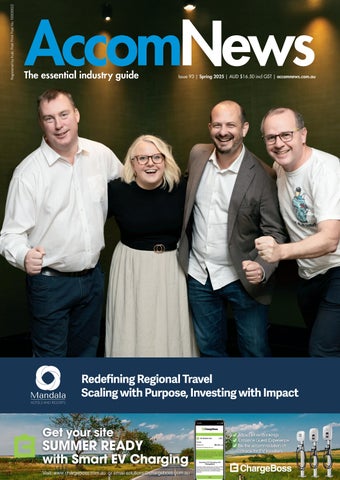
Redefining Regional Travel Scaling with Purpose, Investing with Impact
OVER 1100
ACCOMMODATION BUSINESSES FOR SALE AUSTRALIAN BROKERS
Commercial
NEW ZEALAND & PACIFIC ISLAND BROKERS
TOURISM & HOSPITALITY BUSINESS BROKERS
FROM ALL THE LEADING BROKERS
IN AUSTRALIA, NEW ZEALAND AND THE PACIFIC ISLANDS
www.accomproperties.com.au
BUY RIGHT. BUY FROM THE BEST IN THE BUSINESS PEOPLE MOVERS 150 Ah Advanced Lithium Battery Pack with on board charger 4 Wheel Hydraulic Disk Brakes with Automatic E-Park Brake Alloy Mag Wheels 3 Point Safety Belts LED Headlights, Rear Taillights and Daytime Running Lights LED Speedometer and Voltage Meter Metallic Bodywork Dual USB Port Mirrors
LINEN VEHICLES 150 Ah Advanced Lithium Battery Pack with on board charger 4 Wheel Hydraulic Disk Brakes with Automatic E-Park Brake Alloy Mag Wheels 3 Point Safety Belts LED Headlights, Rear Taillights and Daytime Running Lights LED Speedometer and Voltage Meter Metallic Bodywork B Port Dual USB Mirrors
UTILITY VEHICLES 150 Ah Advanced Lithium Battery Pack with on board charger 4 Wheel Hydraulic Disk Brakes with Automatic E-Park Brake Alloy Mag Wheels 3 Point Safety Belts LED Headlights, Rear Taillights and Daytime Running Lights LED Speedometer and Voltage Meter Metallic Bodywork Dual USB Port Mirrors
SOLAR SO NOW AVAILABLE AV A VAI V AILLABLE ABLE grahamj@ezgo.com.au QLD UNIT 8, 2 LINK DRIVE YATALA, QLD, 4207
+61 (0) 488 166993
VIC 399 LOWER DANDENONG RD, DINGLEY VILLAGE, VIC, 3172
NSW 41 DUNN ROAD, SMEATON GRANGE, NSW, 2567
AccomNews is distributed quarterly to hotel, motel, resort and caravan parks throughout Australia by Multimedia Publications Pty Limited. The views and images expressed in AccomNews do not necessarily reflect the views of the publisher. The information contained in AccomNews is intended to act as a guide only, the publisher, authors and editors expressly disclaim all liability for the results of action taken or not taken on the basis of information contained herein. We recommend professional advice is sought before making important business decisions.
62
Advertising Conditions The publisher reserves the right to refuse to publish or to republish without any explanation for such action. The publisher, its employees and agents will endeavour to place and reproduce advertisements as requested but takes no responsibility for omission, delay, error in transmission, production deficiency, alteration of misplacement. The advertiser must notify the publisher of any errors as soon as they appear, otherwise the publisher accepts no responsibility for republishing such advertisements. If advertising copy does not arrive by the copy deadline the publisher reserves the right to repeat existing material.
Disclaimer Any mention of a product, service or supplier in editorial is not indicative of any endorsement by the author, editor or publisher. Although the publisher, editor and authors do all they can to ensure accuracy in all editorial content, readers are advised to fact check for themselves, any opinion or statement made by a reporter, editor, columnist, contributor, interviewee, supplier or any other entity involved before making judgements or decisions based on the materials contained herein. AccomNews, its publisher, editor and staff, is not responsible for and does not accept liability for any damages, defamation or other consequences (including but not limited to revenue and/or profit loss) claimed to have occurred as the result of anything contained within this publication, to the extent permitted by law. Advertisers and Advertising Agents warrant to the publisher that any advertising material placed is in no way an infringement of any copyright or other right and does not breach confidence, is not defamatory, libellous or unlawful, does not slander title, does not contain anything obscene or indecent and does not infringe the Consumer Guarantees Act or other laws, regulations or statutes. Moreover, advertisers or advertising agents agree to indemnify the publisher and its agents against any claims, demands, proceedings, damages, costs including legal costs or other costs or expenses properly incurred, penalties, judgements, occasioned to the publisher in consequence of any breach of the above warranties. © 2025 Multimedia Publications Pty Limited. It is an infringement of copyright to reproduce in any way all or part of this publication without the written consent of the publisher.
Publications Pty Limited
PO Box 2652, New Farm, Qld 4005, Australia Phone: +61 (07) 5440 5322 mail@accomnews.com.au www.accomnews.com.au
08 Inside our Spring issue
Front Desk........................................................................... Welcome to the Spring edition: Fresh stories and fresh leadership............. 05
Industry...............................................................................
14
PRODUCTION Richard McGill, production@accomnews.com.au ADVERTISING Stewart Shimmin, s.shimmin@accomnews.com.au SERVICE/SUBSCRIPTIONS subscriptions@accomnews.com.au
20
ATEC Voice: EMDG program review – Voicing our members’ concerns...... 09 CIAA Voice: Celebrating regional strengths and global opportunities.........10 Mandala Hotels and Resorts: A regional powerhouse with global perspective............................................................................................................................ 12
Op-ed: There’s serious life left in the lifestyle hotel growth story.....................17
Profile.................................................................................. Inside NoVacancy 2025: Fresh ideas, familiar faces and the conversations shaping accommodation’s future.................................................................................20
Housekeeping..................................................................... Premium amenities to create a memorable stay.................................................. 30 Better hospitality beds deliver sweet dreams for you and your guests........38
50
Case Study: The Berry View Hotel and Koala Mattresses – Enhancing guest experience, one Koala mattress at a time......................... 40 Wrapped in Comfort: Towels, robes and slippers that define a luxury stay...................................................................................................42 The role of robots in housekeeping operations......................................................45
Marketing............................................................................ Guest data: Your property’s secret weapon............................................................. 50
Technology..........................................................................
James Goodwin, Stephen Ferguson, Liz Lycette, Stuart Lamont, Peter Shelley, Kerry Williams and Ross Beardsell.
The power of AI: Good for guests, great for business..........................................58
Refurbishment.................................................................... Outstanding outdoor areas: How these spaces boost guest enjoyment................................................................................................................. 60
KEY Commercially funded supplier profile or supplier case study
Accessibility: Accessible design that feels like a holiday, not a hospital stay...............................................................................................................62
Supplier information or content Suppliers share their views in one-off, topical pieces
04 AccomNews | Spring 2025
problem for the RBA.......................................................................................................... 08
Welcome With Pride: Making belonging the standard in tourism.................. 14
CONTRIBUTORS
General editorial. Case studies and features may cite or quote suppliers, please be aware that we have a strict ‘no commercial content’ guideline for all magazine editorial, so this is not part of any commercially funded advertorial but may be included as relevant opinion. Happy reading!
AHA Voice: Banning surcharges only solves a political
Management.......................................................................
EDITORS Mandy Clarke & Gemma Easton editor@accomnews.com.au INDUSTRY REPORTERS Sarah Davison and Naomii Seah
AA Voice: Unfettered STRA has become big business....................................... 06
What’s Hot....................................................................... 66 Front Cover Image courtesy of Mandala Hotels & Resorts
Preferred Supplier Directory.......................................... 67
FRONT DESK
When we first took ownership of our accommodation and school publications almost two decades ago, it felt like the start of a grand adventure. Then COVID hit and, like so many of you, we had to rethink and adapt. That was when I stepped into the editor’s chair at AccomNews... several years ago. I knew it would be a challenge, but I could never have imagined how rewarding it would become. Since then, I have had the privilege of shaping the magazine’s voice, connecting with extraordinary people and sharing the stories that define Australia’s accommodation sector. This year’s NoVacancy Hotel + Accommodation Industry Expo reminded me how special this
honour to guide this publication, celebrate so many achievements and watch the industry evolve with resilience, creativity and a good dose of humour.
Mandy Clarke, Outgoing Editor, AccomNews
community really is. Meeting so many of you—operators, suppliers, advocates and innovators—felt like catching up with old friends. The quick chats on the show floor, the ideas swapped over coffee and the genuine support in this industry have been the heartbeat of my editorial life. After many happy years at the helm, it feels like the right time to step back from the day-today editor’s chair. It has been an
I am delighted to introduce Gemma Easton as our new Managing Editor. Many of you already know Gemma from her wonderful work with School News. She brings sharp editorial instincts, industry insight and a warm, collaborative style. I know she will lead AccomNews into its next chapter while keeping it informative, inspiring and connected to our community. I am not disappearing. You may still see my byline from time to time, but I am excited to watch Gemma take the reins and continue celebrating and supporting this incredible sector. Thank you for the trust, the conversations and the friendships.
Editing AccomNews has been one of the great privileges— and joys—of my career.
EDITOR’S NOTE
Welcome to the Spring edition: Fresh stories and fresh leadership Warm regards, Mandy Clarke Outgoing Editor, AccomNews Thank you Mandy, for such a warm introduction! I’m excited and honoured to be taking the reins of AccomNews. The shoes I’ve been left to fill are very big indeed, but I am very fortunate to have Mandy to lean on for support and guidance. I’ve thoroughly enjoyed helping to put this edition together and getting to know some of you. I hope to continue to build relationships across the summer edition, and the year ahead. I hope you enjoy this edition of AccomNews. Warm regards, Gemma Easton Incoming Editor, AccomNews editor@accomnews.com.au
SmartEVCharging t bo to toboostyoursite boo oos ost st yo y ursite t te
Charge Boss is your trusted EV charging partner for accommodation and hospitality. Attract guests and visitors with a seamless, fully automated charging experience. Support sustainability goals and boost property value with reliable EV charging to future-proof your site.
You own the charger, You set the pricing, You collect the revenue. 24/7 Fully Automated Au utomat Chargers
Learn More
02 8089 2090
A reliable e 98% u uptime www.chargeboss.com.au
FRONT DESK
AccomNews | Spring 2025
05
AA VOICE
Unfettered STRA has become big business
James Goodwin CEO of Accommodation Australia
And these days, as many of you will have noticed, very little of it is complimentary. In the last few weeks alone, we heard of neighbours along a Brisbane riverfront who have put up with years of alleged drunken nude frolics and strippers at a house rented out on Airbnb for $994 a night. Residents in Norman Park told The Courier Mail, they “have had a gutful” of bucks’ parties, hens’ nights and footy trips complete with strippers with nipple tassels and nude guests jumping into the Brisbane River and swimming to nearby properties. Another case, highlighted in this very publication, was the less lewd but equally shocking one-bedroom apartment on the Gold Coast which had been booked through an online agent and turned into a “pop-up” day care centre. The owner found video evidence of 14 children being housed in a single 60-square-metre apartment. These types of horror stories are becoming commonplace across the country now, but so is the media coverage of the countless enquiries into how to control the STRA market.
06 AccomNews | Spring 2025
© Adobe Stock, stock.adobe.com
Barely a week seems to go by now without short-term rental accommodation companies like Airbnb being in the news. It was South Australia’s turn this month with a parliamentary inquiry recommending—among other things—that the 8000 short stay accommodation places in the state be subject to a registration system. The committee also recommended the enforcement of safety standards, a code of conduct for property owners and guests and suggested the state government consider incentives to property owners to get them back into the rental market. The committee said SA was “lagging behind” the short-stay sector in New South Wales, Victoria and Queensland and Western Australia, but I am not sure these states are faring much better. I was recently quoted in The Western Australian newspaper about this very issue. I said while the WA government should be congratulated for introducing registration and enticing property owners to return to the long-term market, more needs to be done to target the investor end of the market. The stats speak for themselves here—85 percent of all properties on Airbnb in Western
Australia are entire homes or units and more than two thirds of them are hosted by people or companies with multiple listings. The largest host in WA manages 140 properties, all of which are entire homes or units, the second and third biggest hosts manage more than 100 properties each. And that is just Airbnb. STRA has long moved away from the original concept of making the couch or spare room available for tourists on a budget. This is not mum and dad’s listing their holiday home, this is big business. Airbnb and companies like it have become a largely unfettered, underregulated commercial property market. People are buying units and houses with the view to making them only available for STRA. These properties could and should be available for long term rental to workers in places like Perth, Byron Bay, Townsville and the Gold Coast, but they aren’t. And we have seen here and overseas that the growth in STRA comes at a huge cost to housing stock and rental cost.
INDUSTRY
Accommodation Australia is calling for a nationally consistent regulatory framework. We do not advocate for taxes or levies that are simply pushed on to the user, but instead we need to place caps, fees and obligations on the shortterm sector. This would be the game changer to shift more properties from the short-term to long-term rental market. We believe there should be a mandated cap of 90 days for unhosted STRA with local councils authorised to implement a lower cap depending on their situation. There should be mandatory registration and fees for all properties being made available for short-term rental, and we should ensure STRA platforms enforce compliance and establish large fines for owners of non-compliant properties This proposal balances the needs of property owners with the needs of the community and would send a clear signal to property owners and the STRA industry that the days of unfettered, underregulated STRA are over.
*VUÄKLUJL )\PS[ 0U Christie barbecues are built for lasting
performance, giving confidence that your investment keeps working year after year.
Guests enjoy safe, dependable cooking without fuss, while durable design and
trusted support ensure facilities remain worry-free and ready for every holiday season.
AHA VOICE
Banning surcharges only solves a political problem for the RBA all the fees charged by banks and international credit card schemes. Banning surcharges without fixing all the underlying issues hides a political problem, which is convenient for the RBA and politicians, but it does not provide meaningful productivity reform.
Stephen Ferguson CEO, Australian Hotels Association
No one likes to pay something for nothing, especially when times are tough. And punters understandably hate paying surcharges for using their own money when paying for a beer or a meal at the pub, or a bed for a night away from home. The RBA’s second consultation paper on Merchant Card Payment Costs and Surcharging was released recently. To put it simply, it does not go far enough to lower costs for consumers and business—at a time when many are counting every cent, and business owners are struggling for survival. Hotels understand the frustrations of Australians with the cost of debit and credit card surcharges, but it’s a symptom of a much bigger structural malaise— unreasonably high fees. The RBA is right when it says fees charged by the card payments industry are “opaque and complex”, but their proposed fix has a long way to go.
The RBA is relying primarily on the hope that competition will put downward pressure on card costs, while business would prefer the certainty of regulation. So, I suspect, would consumers. Australians pay $6.4 billion in card payment costs each year, which flows to the card payments industry made up of the banks, Mastercard, Visa, eftpos and payment service providers. To provide a more equitable balance, the AHA has proposed solutions such as improving enforcement by the regulator, separating the pricing of debit and credit cards and regulating caps on scheme fees charged by the global credit card schemes. But the RBA says that these proposals are not within its power, or too big a step, or just too hard. The RBA also needs to act to address the disparity between debit card versus credit card transactions. The cost to process a credit card payment is at least twice that of processing a debit card payment because of the cost of perks for
The RBA is designing a political fix, not a solution credit cards like frequent flyer points, complimentary travel insurance and so on. The perks for the 25 percent of credit card users are being subsidised by the 75 percent of debit card users. Is that a fair system? Walk into any business in your main street and you will notice that the surcharge fee can be as high as 1.6 percent. This 1.6 percent is a blended rate paid by debit card users and credit card users, even though the cost for debit card users should be much less. The RBA needs to answer one simple question—if the debit card processing cost on a cup of coffee today is 1.6 percent, how much will that 1.6 percent come down under their new rules? Answer? It won’t come down in a meaningful way because the RBA is not prepared to take stronger action on scheme fees or blended rates which are at the heart of the problem. The best cure to this inequity is finally separating debit transactions from credit transactions, and mandating dynamic least cost routing
We welcome the RBA proposing a reduction in socalled “interchange” fees in its consultation paper—but it needs to do a lot more to reduce
08 AccomNews | Spring 2025
Since 2017, the RBA has been encouraging the payments industry to increase LCR without a clear definition of how it should be implemented. But instead of vaguely relying on the hope of competition to increase DLCR, the RBA needs to mandate and define it. The RBA should also be doing more to tackle scheme fees charged by the big credit card companies—these are charged by Visa and Mastercard and account for around half of debit card transaction wholesale costs. The RBA is concerned by the current level of scheme fees, but has stopped short of proposing a cap or limit. Banning surcharges may solve a political problem for the RBA, but it needs to tackle all the issues. The RBA is designing a political fix, not a solution, and millions of Australians and the thousands of business owners deserve better.
© Adobe Stock, stock.adobe.com
Businesses like hotels, pubs, cafes, restaurants and newsagents often pay 300 percent more than big businesses in card fees. Business would not need to surcharge at all if these fees were reasonable.
(DLCR). DLCR would give businesses like your local hotel the ability to route every debit transaction via the lowest cost network.
INDUSTRY
ATEC VOICE
EMDG program review:
© Adobe Stock, stock.adobe.com
Voicing our members’ concerns
Peter Shelley Managing Director, Australian Tourism Export Council
The Export Market Development Grants (EMDG) program is under review, and ATEC welcomes the opportunity to put our members’ concerns forward. Across industries, exporters are voicing frustration with a scheme that has become more complex, less accessible, and increasingly out of step with business realities. A recent ABC report highlighted how agriculture, manufacturing, and services exporters are “stressed and angry” at the current design, citing unpredictable funding rounds, excessive red tape, and thresholds that make participation unrealistic for many. There is clearly room for improvement. Tourism exporters share these concerns. As small businesses facing a long recovery and increasing costs, the current EMDG model is not fit for many tourism exporters. Short, first-come-first-served application windows close within hours, leaving operators without a chance to apply. The requirement to plan and commit to activities two years in advance is unworkable, particularly in tourism where international trade shows and distribution opportunities are often confirmed far closer to the event. And the shift from a simple retrospective
reimbursement to a forwardlooking grant application has added compliance costs and uncertainty, leaving many businesses in the industry wondering whether the effort is worth the return.
The current EMDG model is not fit for many tourism exporters
These challenges matter because tourism is one of Australia’s most important export industries. The sector supports more than 700,000 jobs and is powered by more than 360,000 small and medium-sized businesses, a third of which are in regional Australia including Indigenous-run businesses with ambitions to grow.
For regional operators in particular, the program has underpinned export readiness and supported the dispersal of visitors beyond capital cities.
Almost 80 percent are sole operators or micro businesses, for whom international marketing is a significant investment. These are the operators, that create the diverse accommodation, touring, food, and cultural experiences that make Australia desirable to global visitors. They are also critical contributors to regional economies, sustaining local communities and supply chains. For these businesses, EMDG has historically been the bridge to international markets, supporting them to establish distribution pathways they could not otherwise afford.
In its current form the EMDG program is creating barriers rather than opening doors. The tier structure does not reflect the realities of tourism exports which produce lower revenue growth than primary exports like wheat and wool. For example, the leap from $100,000 to $500,000 in revenue expected under the system is unrealistic for small service providers. So too, the two-year limit on Tier 1 does not match the three to five years typically required to establish international tourism export distribution channels. The $40,000 minimum spend threshold at entry level is another major obstacle, effectively shutting out many of the very businesses the program is meant to support. Reform is clearly needed. The Australian Tourism Export Council (ATEC) is calling for
INDUSTRY
a series of practical changes including fixed application windows and earlier funding decisions to give certainty, reduced administrative burden, and a collective application pathway overseen by associations like ATEC to allow SMEs to apply as a group. Most importantly, a dedicated tourism pathway should be created which recognises the sector’s unique business growth patterns along with the vital role it plays in driving regional economic prosperity. The EMDG program has been a cornerstone of Australia’s export development for more than 50 years and this review offers an opportunity to restore its effectiveness and ensure it remains a practical tool for exporters across the economy. For tourism, where small businesses carry a disproportionate share of risk and recovery, getting EMDG right will mean stronger international markets, more resilient regions, and a globally competitive visitor economy. AccomNews | Spring 2025
09
CIAA VOICE
Celebrating regional strengths and global opportunities heart of our sector. Together, these measures give us a balanced view of Australia’s top-performing destinations. 1. The Whitsundays (Queensland)
Stuart Lamont CEO, Caravan Industry
If I have said it once, I would have said it a thousand times—the caravan and camping industry has long been, and continues to be, the lifeblood of regional tourism in Australia. Our sector provides more holiday nights in regional Australia than any other commercial accommodation provider, and with a $10.7 billion contribution annually, caravan parks are not only places for families to reconnect but also vital engines of local prosperity. The reason for the not-sogentle reminder, our recent performance data confirms this fact—regional caravan parks are thriving, driven by natural attractions, quality customer experiences, and a renewed appreciation for the Australian outdoors. For this edition, I want to explore top performing regions for the last quarter and look at those regions that have some hidden gifts.
Top performing regions The latest Caravan Park Tourism Region Market Performance Report (August 2025) gives us a clear picture of where the industry is performing best. To do this properly, we’ve looked at both cabins, which reflect higher-yield accommodation, and powered sites, which highlight the traditional volume
10 AccomNews | Spring 2025
The Whitsundays is excelling across cabins and powered sites, with 81 percent cabin occupancy and a remarkable 93 percent site occupancy across the region. From the sublime waters of the Great Barrier Reef, lush inland walking tracks, through to the relaxed lifestyle of Airlie Beach, the attraction for caravanners sell themselves, not to mention the weather. Parks like BIG4 Adventure Whitsunday Resort and NRMA Airlie Beach Holiday Park deliver resort-quality experiences. These parks are doing a fantastic job in matching the quality of the landscape to that of the customer experience, from waterparks for families through to first class amenities for caravanners stopping and propping. The holiday parks in the region have all performed strongly, ensuring the region continues to attract strong visitation. 2. Sunshine Coast (Queensland) The Sunshine Coast blends 78 percent cabin occupancy with 91 percent site occupancy. The cosmopolitan lifestyle with easy access to services, the natural beauty of beaches through to the Glasshouse Mountains, and attractions like Australia Zoo and local food markets make it a magnet for families and retirees alike. Parks such as Ingenia Holidays Rivershore and BIG4 Maroochy River highlight how modern design and innovative offerings—from safari tents to riverside sites—keep this region near the top of the ladder. 3. Gold Coast (Queensland) With 79 percent cabin occupancy and 90 percent site occupancy, the Gold Coast continues to be one of the country’s strongest all-round
performers. Theme parks, surf beaches, and hinterland escapes appeal across all generations. Parks such as NRMA Treasure Island Holiday Resort and Tallebudgera Creek Tourist Park combine convenience with first-class facilities, proving why the Gold Coast continues to attract repeat visitors. 4. Tropical North Queensland Recording 75 percent cabin occupancy and 81 percent site occupancy, this region demonstrates the strength of eco-driven tourism. With the Great Barrier Reef, Daintree Rainforest, and Cape Tribulation on its doorstep, it is a natural wonderland. Parks like BIG4 Ingenia Holidays Cairns Coconut and Port Douglas Caravan Park add value by providing immersive family experiences and sustainability-driven offerings. 5. Australia’s Northwest (Western Australia)
again embrace the nomadic lifestyle not only supports these destination locations over winter but benefits all the transit routes which are visited on the journey. The great thing that I appreciate in Australia is the diversity of experiences which are available in the regions, and are so often only reached through a driving holiday. Six other notable regions worthy of comment include: •
Snowy Mountains (NSW): With 92 percent cabin occupancy, driven by the winter ski season, this is a classic example of how seasonal tourism creates surges in performance.
•
Central NSW: Achieving 65 percent site occupancy with strong RevPAR growth, Central NSW highlights the strength of inland regional tourism.
•
Lakes (VIC): Recording 72 percent cabin occupancy and a 20 percentage points lift on last year, this lakeside destination is emerging as one of Victoria’s strongest performers.
•
Mornington Peninsula (VIC): At 73 percent occupancy with a 50 percent ADR increase, this region reflects the pull of premium coastal escapes.
•
Adelaide Hills (SA): Achieving 72 percent occupancy and an extraordinary 48 percent rise in RevPAR, the Adelaide Hills is benefiting from boutique, wine-driven tourism.
•
Tasmania’s Northwest: Though smaller in scale, it posted 53 percent occupancy and 28 percent RevPAR growth, proof that Tasmania continues to attract travellers seeking rugged beauty and authenticity.
While Queensland dominates the rankings, Western Australia’s Northwest leads the nation in cabins with 82 percent occupancy and a sector-best $233 RevPAR. Though site occupancy is slightly lower at 71 percent, the Kimberley, Karijini, and Broome’s Cable Beach provide world-class adventure and highlight the appeal of a sector that is heavily connected with nature and cultural integration. Parks such as Discovery Parks – Broome, and Kimberleyland Waterfront Holiday Park show that even in frontier destinations, quality guest experiences are central.
Beyond the top 5: Other notable regions The strength of Queensland and northern WA demonstrate that Australian consumers have rekindled their love for exploration and adventure in a post-COVID environment. The willingness to travel and once
INDUSTRY
© Adobe Stock, stock.adobe.com
Together, these examples show that while some states dominate the “top five,” every corner of Australia is seeing parks play a vital role in attracting visitors, lengthening stays, and boosting local economies.
Customer experiences as the differentiator What binds these regions together is not only their attractions but also their commitment to quality customer experience. Caravan parks now are a direct reflection of the customer-centric, quality driven investment we have seen over the last decade—this is culminating in direct return on investment and an experience that Australian families, regardless of age, still flock to. Importantly, not everything is about money—the results are a reflection of park owners, managers and staff caring about every interaction and every opportunity to make the customer the centre of a park experience whether it be food trucks, camp kitchen singalongs, or high end luxury experiences—there is something to please everybody.
The great thing that I appreciate in Australia is the diversity of experiences which are available in the regions
Taking Australia to the world While our domestic market continues to grow, the global stage remains critical. This is why Caravan Industry Association of Australia was proud to represent our sector (and the broader Australian tourism sector) at the recently held Caravan Salon in Düsseldorf—the largest caravan and camping trade show in the world. Our tourism stand (one of only two destinations from outside mainland Europe represented) showcased Australia’s natural wonders and the breadth of
our accommodation offerings, reminding northern European audiences that few destinations can rival the diversity, safety, and unique appeal of a caravanning holiday in Australia. There remains enormous potential to attract long-haul travellers seeking immersive, self-drive holidays. By connecting with international operators and travel media, we are positioning our industry not just as a domestic leader but as a global competitor in experiential tourism.
Looking ahead The performance figures are a reminder that the caravan and INDUSTRY
camping industry continues to evolve and thrive. Yet they also highlight the importance of continued investment in infrastructure, workforce, and marketing to ensure we remain competitive both at home and abroad. As Australians increasingly seek meaningful, value for money, and sustainable holidays, our sector is well placed to deliver. At the same time, international travellers are beginning to rediscover Australia as a caravan and camping destination of choice. By championing both customer experience and international promotion, we can ensure our parks remain vibrant community anchors and essential contributors to regional prosperity. The message is clear: our top-performing regions are excelling because they combine natural assets with industry excellence. With strong collaboration across operators, state associations, and national leadership, the future of caravan and camping in Australia looks brighter than ever. AccomNews | Spring 2025
11
Mandala Hotels and Resorts
A regional powerhouse with global perspective
Vistas of Mercure Clear Mountain soon to be Peppers Clear Mountain
From managing the assets of Brunei royalty to building one of Australia’s most diverse hospitality portfolios, John Zeckendorf and Ryan Shaw founders and principals of Mandala Hotels & Resorts (MHR) have seen the full spectrum of the property and hospitality sectors. Their journey began in insolvency in the late ‘80s and evolved into managing luxury assets and distressed properties alike. In 2003, they returned to Australia with capital to invest and acquired their first hotel. That single acquisition sparked a wave of interest from peers and investors, leading to the formation of a fund and the birth of Mandala. Today, MHR oversees a portfolio of approximately 40 properties, spanning hostels to five-star resorts. Their model is deliberately diverse owning freehold and leasehold assets, managing third-party properties, and operating within strata and management rights
12
AccomNews | Spring 2025
frameworks. Their reputation as regional specialists is well-earned, and the business continues to evolve with agility and purpose.
Vision, strategy and regional expertise
authenticity over polish. It’s not always about price, it’s about perceived value and genuine service,” Ryan explains. “A restaurant or lounge isn’t just an amenity; it’s a space for connection. This matters.” Flexibility is central to MHR’s operating philosophy. “We tailor our approach to each property rather than imposing rigid systems. We’ve seen a lot of people come into this industry, set up these big operations, and then try and impose it on regional properties and it just doesn’t translate to regional settings.”
Ryan Shaw
Ryan Shaw attributes MHR’s sustained growth to one key factor: consistent delivery. “We’ve met our return targets year after year. Unlike many funds that overpromise and underdeliver, we’ve built trust through performance. That’s why investors keep reinvesting.” Their success also stems from a deep understanding of regional hospitality. “In regional areas, guests value
In 2024, MHR rebranded to unify more properties under the Mandala name. “We saw a gap in regional branding. Properties like Ace Albany lacked strong identity, so we stepped in to elevate that,” Ryan says.
Growth through ownership and management Unlike many hotel operators, MHR owns a significant portion of its portfolio. “Most companies that are managing hotels for other people don’t actually own assets, hence
INDUSTRY
they don’t have a direct stake in the hotel market, they’re just providing a service,” Ryan said. “That ownership gives us credibility. Owners trust us because we understand their perspective, we’re in the same game.” MHR’s footprint now stretches coast to coast across the whole of Australia, enabling rapid acquisition and management of properties wherever opportunities arise. The company is also expanding its management arm, particularly near city centres, where owners are increasingly seeking professional operators for multiple assets.
Ryan concedes there are some strong competitors in this space, though they tend to have different niches. For regional properties, it would be hard to find a company that matches Mandala’s reach. Looking ahead, MHR will launch a premium variant of the Mandala brand, debuting at its Berry property. The recent acquisition of Mercure Clear Mountain in Brisbane’s hinterland will also be repositioned for luxury escapes, weddings, and corporate retreats under the Peppers branding. Ryan said this pivot to buying and repositioning properties will be an important part of the company’s ongoing growth strategy. “We’re shifting from light-touch improvements to strategic repositioning,” Ryan says. “We know what guests want and most importantly we deliver.”
Community, ESG and the Mandala philosophy
Poolside at Mercure Cairns
with its local community where it’s needed most.”
rather retain the properties and keep the returns flowing.”
where they had three floods, a drought, and rising crime.
The company’s name reflects its ethos.
MHR’s strategy hinges on diversification across guest sectors (government, agriculture, tourism) and geography. This spread insulates the business from localised disruptions.
“It was a leasehold, so we exited. Our insolvency background helped. We had a plan, executed it, and the bank didn’t lose a cent.”
“A Mandala represents harmony, the idea that the whole is greater than the sum of its parts. For us, that means balancing People (staff), Patrons (guests), Partners (investors), and the Planet. If one outweighs the others, the system wobbles.”
Regional investment philosophy John jokes that MHR is “notoriously bad at selling.”
John Zeckendorf
John Zeckendorf reaffirms MHR’s commitment to community is embedded in its ESG strategy. “We’re often the largest business in town, and we take that seriously,” John says. “Each property has a plan and funding to engage
“We’ve bought 40 properties and still own 37. Our funds start as five-year vehicles, but investors rarely want to exit. They’re happy with the returns and reluctant to face tax implications or lose access to our performance.” The Trinity Accommodation Regional Hospitality Fund (TARHF) One is now in its 16th year. TARHF Two was extended by investor vote, and Fund Three is expected to follow suit. “Our investors trust us to find buyers if needed, but they’d
“If one property is impacted by a natural disaster, another benefits from the same weather pattern. Our scale gives us resilience.” The company’s fund isn’t allowed to invest in the cities, though John said MHR is increasing its presence in city centres through its hotel management arm. “We’re starting to see a lot of people who bought a couple of hotels, thought it was fun, and bought a couple more and decided gee, this is a lot of hard work. This means that people are now coming to us not with one property for us to manage, but maybe three or four properties.”
That experience underscores the founders’ adaptability. “We were built for this,” John says. “Our careers prepared us to navigate complexity.” And while growth remains a goal, it’s not about scale for scale’s sake. “We’re not trying to become another corporate,” John adds. “We want to do what others haven’t, have fun doing it, and do it the right way.” Reflecting on MHR’s track record under the stewardship of John and Ryan, it seems they certainly can.
Lessons from adversity Not every investment has gone smoothly. John recalls Moree as MHR’s biggest challenge
INDUSTRY
Learn how Mandala Hotels & Resorts can elevate your hotel, visit:
www.mandalahotels.com.au
AccomNews | Spring 2025
13
Welcome With Pride:
Making belonging the standard in tourism businesses with e-learning, to empower staff to provide consistently inclusive guest experiences and build a culture of belonging; as well as an accreditation pathway to prove a genuine, authentic commitment to LGBTIQ+ inclusivity. The aim is to give both staff and guests the confidence to be their authentic selves, every time.
By Mandy Clarke, Editor
When Charlie (Charles) Douty thinks about why he founded Welcome With Pride, he remembers a simple but powerful moment: walking into a hotel lobby and stopping himself from holding his husband’s hand.
Training and accreditation in practice Launched in February 2025, the program has already trained more than 1000 businesses, with over 50 joining the accreditation program in its first months.
Novotel Perth Murray Street, Images courtesy of Welcome With Pride Charlie (Charles) Douty
“That feeling, of constantly second-guessing whether it’s safe to express yourself, or your love for your partner, and needing to edit yourself, is something the majority of LGBTIQ+ people experience,” he says. “Some places felt genuinely welcoming, but others really did not.
“That contrast stayed with me. Holidays should be about freedom, joy, expression and belonging, not about hiding who you are.”
From strategy to social change Before starting Welcome With Pride (WWP), Charlie worked as
The West Hotel Sydney, Curio Collection by Hilton
14 AccomNews | Spring 2025
a strategy consultant. But his lived experience of travelling across Australia during COVID, coupled with original research commissioned by the program, inspired him to pivot.
Insights from the research The Welcome With Pride LGBTIQ+ Traveller Survey gathered responses from more than 1000 travellers and revealed sobering insights. Sixty percent said they hide their sexuality or gender while on holiday in Australia, often avoiding holding hands, checking in separately, mentioning their partner, using their preferred pronouns or dressing naturally. Eighty percent said rainbow flags marketing is tokenistic, and does not provide a genuine commitment to inclusivity, with many calling this “pink-washing.” In response, Charlie launched WWP, Australia’s leading LGBTIQ+ inclusive tourism training and accreditation program. It equips
MANAGEMENT
The West Hotel Sydney, Curio Collection by Hilton, was the first hotel in Australia to receive WWP accreditation for its inclusive practices. According to the hotel, this recognition reflects a commitment that goes far beyond symbolic gestures. The team implemented comprehensive training, updated facilities, and actively supported local LGBTIQ+ initiatives, setting a benchmark for others in the industry. The training itself blends 45-minute e-learning modules with an independent accreditation process. It is tailored to tourism, covering inclusive language, pronouns, and practical real-life scenarios. Accreditation is progressive, with two levels, and must be renewed every three years to maintain standards. A trans team member who completed the training shared: “This training has made a difference to how I show up at work. It gave me reassurance on how I look, act and speak as a person to those around me and made me feel more comfortable in my own skin.”
Why inclusivity matters
party verification so guests know your commitment is real and backed by action.”
The business case is as strong as the human case. LGBTIQ+ travellers are forecast to spend USD600b by 2030 due to an average spend three to seven times more than other guests.
The program also provides practical support for businesses (templates, guidelines, and coaching) alongside marketing tools such as logos, stickers, and directory listings to help them demonstrate inclusivity authentically and meaningfully.
Research shows 96 percent of LGBTIQ+ travellers prefer to book accredited experiences, and 45 percent would pay more for them. Staff training is critical, with 88 percent saying inclusive language is essential for a welcoming experience.
The bigger picture For Charlie, success is not measured only in statistics but in lived experiences. “On the hardest days, what keeps me motivated is hearing from staff who feel safer at work or from guests who say they finally relaxed enough to hold hands by the pool. That feeling of belonging and connection is incredibly powerful. That is what this is all about.”
Accor reported an 11.4 percent uplift in staff engagement scores after rolling out the training. Jai McNaughton, Director of Talent & Culture at Novotel Perth Murray Street, says the change was immediate: “I can’t speak highly enough of this program. It’s simple, seamless, and aligns perfectly with our Heartist values of creating spaces where our team and guests can be their authentic selves. The content really lands, it’s sparked genuine conversations, and the team were proud to be doing it. In fact, our pulse survey engagement score jumped 11.4 percent which I put largely down to this training.” Hilton’s Senior Regional HR Director Southeast Asia, Mary Hogg, highlights its impact: “The Welcome With Pride e-learning ensures that our team members consistently deliver a warm welcome for LGBTIQ+ guests every time. Welcome With Pride helps us stay at the forefront of what guests are expecting from us by standardising our training and
16
AccomNews | Spring 2025
Call to action
Images courtesy of Welcome with Pride
LGBTIQ+ inclusion practices across our Hilton brand.”
our guests. It is a one-stopshop for building inclusivity.”
At Hilton’s West Hotel, General Manager Nathan Kengike describes the program as transformative:
Moving beyond token gestures
“The training scenarios gave the team the chance to practise what they learned in real settings. The accreditation creates assurance for LGBTIQ+ travellers, builds confidence in our team, and builds trust with
Charlie is clear-eyed about the pitfalls of relying on symbols alone. “Symbols are a good start, but they are not enough. Without policies, training, and behaviour to back them up, they can feel hollow. Accreditation provides a roadmap and third-
MANAGEMENT
For businesses, the message is clear: inclusivity is not optional. It is essential for improved guest experiences, earning the loyalty of LGBTIQ+ guests, and building a team culture of authenticity and belonging. Enrolling staff in Welcome With Pride training is an investment in people and reputation, and the first step toward accreditation. Importantly, staff do not need to wait for their workplace. Anyone can enrol individually and begin creating change today. Charlie puts it best: “This is about proactively building a world where everyone can show up exactly as they are and know they belong. That’s the kind of tourism we should all be striving for.”
By Ross Beardsell,
Executive Vice President, Advisory & Asset Management Hotels & Hospitality, JLL
Two new hotels opening in Sydney in October highlight the ongoing popularity of lifestyle hotels for guests and developers alike. Sydney’s newest hotel— Caption by Hyatt Central Sydney— highlights that the lifestyle hotels phenomenon is far from running out of steam. In fact, the trend appears to be accelerating. The launch of the Caption follows the debut of another eclectic lifestyle brand—Ennismore’s 25hours Hotel Sydney The Olympia— transforming a heritage theatre into lavish and
OP-ED
There’s serious life left in the lifestyle hotel growth story dramatic digs that wouldn’t be out of place on a movie set. Earlier this year, JLL released its Lifestyle Hotels in Asia Pacific report which revealed the number of lifestyle hotel rooms in Asia Pacific had quadrupled since 2014, with nearly 65,000 new rooms having been introduced to the region. The report attributed the continued growth of the lifestyle hotel sector to evolving consumer preferences, premium pricing power, and increasing investor interest. Projections indicate that lifestyle hotels constitute six to nine percent of new hotel supply in the region. Interestingly, new lifestyle hotels can be found in city centres, suburban areas, by the water and even next to airports.
Caption by Hyatt Central Sydney - Talk Shop
No longer are ‘business hotels’ strictly about business. The transformation started with the ‘bleisure’ trend, allowing hotels to attract business travellers after the work week ended, but today the laid-back leisure focus is in play in many hotels 24/7. Caption by Hyatt personifies the lifestyle trend that started in 2008
MANAGEMENT
with independent brands such as CitizenM and The Hoxton. Global hotel chains quickly realised the potential of these hip ‘indie’ style hotels and introduced their own sub-brands to Australia including Accor’s MGallery, IHG’s Hotel Indigo, and Marriott’s Aloft and Autograph Collection.
AccomNews | Spring 2025
17
celebrates the fact through its “converted warehouse vibe”. Bars serve local beers from nearby craft breweries, accompanied by DJs in the evening. There is serious coffee and everything from rooms, lounge areas and even conference rooms defy the conventional in colour and attitude. On the other side of Botany Bay, the prominent Novotel Brighton Beach is also now aiming for a lifestyle audience, having been rebranded as The Brighton Hotel, part of the MGallery collection. MOXY Sydney Airport
Marriott emphasised the trend by recently purchasing CitizenM and will open more lifestyle hotels in Asia Pacific than any other hotel group in the next three years. Caption by Hyatt Central Sydney is the first of the brand to open in Australia. It joins other Caption hotels in Japan and China. The Sydney hotel has opened in the heart of bustling Haymarket with the super-cool new Atlassian offices under construction just up the road and Darling Harbour’s corporate offices in the neighbourhood. The brand is upscale, selectservice and focused on fostering connection and community in flexible, stylish, and tech-forward social spaces called “Talk Shop”, which is part café, part bar, part community hub. The idea is for the space to be full of Gen Zs and Millennials on their laptops plugging in for a solo session or discussing the latest AI project with colleagues or prospective clients.
energy and doing things your way—no fluff, no fuss.” Arguably the most standardised hotel product is usually found at airports. But not anymore. Darwin Airport Resorts changed that in Australia by combining three business branded hotels—Novotel, Mercure and Ibis—and transforming them into a resort precinct just five minutes’ walk from the airport terminal, but a million miles away from the traditional airport hotel.
any reason, not just airport convenience. “Sydney’s new airport hotel might be the city’s coolest,” was the headline in Traveller, when the hotel opened a few years ago. Travel writer Julietta Jameson said that Marriott’s Moxy brand was one of the world’s original “Millennial” hotel brands.
With a 65-metre swimming pool, pool villas and a massive new restaurant that flows into the pool area, the resort is as popular for leisure staycations as it is with business travellers or transiting passengers.
“Designed for the first generation who’d never known a world without internet, the brands were driven by the preferences and price sensitivities of digital savvy young adults, and the advent of the Millennial hotel has in many regards revolutionised the industry, bringing local connection and unique design into the mainstream,” she wrote.
While not having the space for resort facilities, the Moxy hotel at Sydney Airport has gone a long way to making it an attractive base for
This is characterised in Moxy Sydney Airport’s edgy design that rather than trying to hide the fact that it is in the heart of an industrial area,
It’s not a coincidence that Caption by Hyatt opened on the same day as South by Southwest (SXSW) Sydney festival which, like the Talk Shop, aims to “bring people together to inspire the unexpected and dedicated to helping creative people achieve their goals.” Whereas previously, traditional business hotels prided themselves on uniformity and delivering a standardised experience, Caption by Hyatt adopts a laissez-faire attitude saying: “We are all about good
18
AccomNews | Spring 2025
Darwin Airport Resort
MANAGEMENT
Expansive glass facades have been introduced, and the hotel’s interiors are radically different, featuring calming textures, natural materials, and a colour palette drawn from seafoam, stone and sun. One of the biggest drawcards will be the hotel’s hatted restaurant Ammos Brighton, which is helmed by GreekAustralian chef Peter Conistis. The addition of feature restaurants is one of the reasons why lifestyle hotels attract 30 percent higher F&B (including MICE) revenue per occupied room on average compared to traditional hotels, according to the JLL Lifestyle Hotels report. The future for lifestyle hotels in APAC is bright, not just because they tap into the new face of corporate travel, but also because they command a 10 to 11 percent price premium, making them a compelling option for developers.
The Mandala Difference
Why Regional Hotel Owners Choose Mandala Meet Elena, the Director of Business Development at Mandala In an industry plagued by staffing challenges, unreliable relief management, and inflexible contracts, Mandala offers a fresh, solutions-first approach that puts the owner’s needs at the centre. Whether it's managing day-to-day operations, solving labour shortages, or optimising performance across branded and independent properties, Mandala delivers stability, transparency, and results.
1
Full-Service Labour Hire & Relief Managers
2
Flexible, PerformanceBased Agreements
3
Management Tailored to Your Asset
Mandala replaces the patchwork of relief managers with fully embedded operational leadership through long-term management agreements. Our experienced team runs your property as if it were their own, providing stability, continuity, and consistent performance — no more emergency scrambling or temporary fixes.
We offer non-binding, performance-aligned contracts with no lock-in. You’re not tied down — you stay with us because it works. Our incentives are tied to your property’s success, so we only win when you do. This gives you confidence and flexibility with full transparency and control.
Branded or independent, we deliver the same high standard of operational excellence through our in-house shared services model. From sales and revenue management to HR, marketing, and compliance, we provide the full suite of expertise and systems needed to operate your hotel. Each engagement starts with a property audit to define the right structure, after which we take the lead in running day-to-day operations so your hotel performs seamlessly and consistently.
Learn more about how Mandala can elevate your property by contacting Elena on: em@mandalahotels.com.au or +61 403 638 417 www.mandalahotels.com.au
17- 18 SEPt 2025 ICC SYDNEY
2025 POST Event Coverage
Inside NoVacancy 2025:
Fresh ideas, familiar faces and the conversations shaping accommodation’s future By Mandy Clarke, Editor
There is something about walking into ICC Sydney during NoVacancy that feels like coming home. The hum of conversations, the familiar faces and the excitement of seeing new ideas take shape. This year’s event was no exception. Matt Gatfield, General Manager at Terrapinn Australia, reflected on the show’s growing impact: “NoVacancy 2025 was a landmark event, bringing together the suppliers who drive innovation and the buyers who shape the future of accommodation. Attendance and engagement were stronger than ever, and the sessions delivered practical ideas to help businesses stay ahead. “For suppliers, it is the most effective platform for meeting decision-makers who matter. For buyers, it is the best chance to discover solutions that can transform operations and guest experience.”
Image courtesy of NoVacancy. Credit: turbo360
A lounge built for real conversations
by to talk openly about their work and the sector’s future.
For the team at AccomNews, the heart of NoVacancy 2025 was the Meet the Editor lounge. Designed with a plush, comfortable sofa and furnishings generously provided by William Montague, with wallcoverings by Aspiring Walls, it became a welcoming space where accommodation operators, suppliers, innovators and some of the industry’s most recognisable figures stopped
Over two packed days, the conversations were a reminder of how vibrant and collaborative this industry is. Tracey Candido, William Montague’s Executive Manager Australasia, said supporting the space was especially rewarding. “NoVacancy Sydney is a highlight of the working year for Montague. It is a chance to grow our network, catch
Image courtesy of NoVacancy. Credit: turbo360
20 AccomNews | Spring 2025
PROFILE
up with industry peers and be part of the only show in the region dedicated entirely to the accommodation sector. “We loved helping create the welcoming Meet the Editor lounge this year. It was wonderful to see our furniture used as a place for real conversations and connections to happen. For us, it is rewarding to support an area where people come together to share ideas and build relationships.”
2025 POST Event Coverage
17 - 18 SEPt 2025 ICC SYDNEY
Images courtesy of NoVacancy. Credit: turbo360
Reflecting on the industry’s heart James Goodwin, CEO of Accommodation Australia, stopped by the lounge to sum up the energy of this year’s show. “Another great event with a real buzz and energy in the room. “It is great to see so many industry people in one place, which allows for easy networking as well as serious and important discussions about policy, regulatory and operational issues affecting the sector. “Automation, technology and AI are key themes on people’s minds, but my takeaway is that
we are conscious of not losing that human touch in such a people-focused industry.”
furnishings and helping those in need has been very rewarding. “Events like NoVacancy remind me how special our industry is and how good it feels to stay connected while giving back.”
Michael Johnson, former CEO of Accommodation Australia, also visited and spoke warmly about staying connected.
That sentiment carried throughout the entire expo, which brought a mix of fresh ideas, purposeful networking and a strong sense of community.
“It was wonderful to be back at NoVacancy, catching up with so many familiar faces, friends and former colleagues. “While I am thoroughly enjoying retirement and spending more time with family and friends, I still have a deep love for this industry. Supporting ReLove and promoting the incredible work they do in rehoming quality
Technology and brand growth take centre stage Technology providers shared how the event is helping them move from curiosity
PROFILE
to meaningful growth. Tony Marshall, VP & Managing Director of Agilysys, Asia Pacific, said: “This NoVacancy has been busy and fantastic for us. The best part is that people now know who we are, and they love exploring our wall of products, everything from our property management system and point-of-sale technology to mobile check-in, spa and activity booking tools, and revenue optimisation solutions. “It shows how our complete ecosystem can generate revenue from every guest interaction, from the moment they book to long after they check out.
AccomNews | Spring 2025
21
17- 18 SEPt 2025 ICC SYDNEY
2025 POST Event Coverage
Image courtesy of NoVacancy. Credit: turbo360
“Last year I told you I was hoping for brand recognition and this year I am focused on turning that awareness into strong leads. It is exciting to feel that shift from ‘Who are you?’ to ‘We know you and want to see how you can help us grow revenue.’” Declan Mimnagh, Founder of RoomStay, shared his perspective: “We have had some great conversations, with partners stopping by to chat, repeat customers checking in and potential new partners exploring what is next. We are here showcasing RoomStay’s seamless, conversion-driven booking platform that helps operators win more direct bookings and keep guest data in their hands. “I also love walking the floor and seeing the ideas on display. There are so many hungry, innovative people here this year with fantastic concepts.” On behalf of the RoomPriceGenie team, Lacey Jarvis, Field Marketing Manager Asia Pacific, described their debut stand as a huge success. “We had quite the week. It was our first year exhibiting with our own
Image courtesy of NoVacancy. Credit: turbo360
Image courtesy of NoVacancy. Credit: turbo360
22 AccomNews | Spring 2025
PROFILE
stand and it was packed with visitors on both days. We loved engaging with new clients, long-time users, key accounts, potential customers and partners—so many insightful conversations were had. “We are already excited to come back even bigger and better next year.” Making his NoVacancy debut, Brent Harris, Vice President of Sales at Cendyn, shared: “It is my first time at NoVacancy and it has been brilliant. “Our main objective is to get Cendyn’s message to the market. The Australian market is very important to us. We already have a strong customer base here and it is growing. “Having a presence at this event is essential. It is a game changer to be able to have face-to-face conversations. We have doubled down on our investment in both personnel and product in the region and we are making a real impact with what we are bringing to market.” Scott Wiedemann, National Accommodation Manager at Foxtel, also reflected on the value of reconnecting face-
2025 POST Event Coverage
Why these conversations matter
to connect, share wins and challenges, test ideas and build relationships that will shape the future. Looking ahead, Matt Gatfield said: “In 2026, we will build on this momentum by welcoming an even broader audience and creating more opportunities for meaningful connections. As the industry continues to evolve at a rapid pace, NoVacancy will remain the meeting place where ideas are shared, partnerships are formed and growth occurs.”
NoVacancy is more than a trade show. It is where the industry comes together
NoVacancy 2026 will return to ICC Sydney on September 23 and 24, 2026.
to-face. “It is always great to catch up with familiar people, connect with those we need to speak to and enjoy time with the team. This year we were excited to showcase the latest upgrades to our Business iQ platform, including new features that help operators drive revenue, improve guest engagement and reduce costs.”
17 - 18 SEPt 2025 ICC SYDNEY
Image courtesy of NoVacancy. Credit: turbo360
RoomStay becomes first hotel & holiday park booking engine to offer Afterpay RoomStay has announced it is the first booking engine in the hotel and holiday park space to offer Afterpay as a payment option, giving guests greater flexibility when booking their next getaway. The functionality is now live across RoomStay’s platform.
more freedom in how they book and pay for their stays, which ultimately helps more people experience our accommodation,” said Shane Laidlaw, Marketing & Distribution, CABN. This latest release continues to build on RoomStay’s commitment to delivering smarter, more seamless booking journeys for hotels and holiday parks. By integrating Afterpay directly into the booking engine, RoomStay clients can now offer a more inclusive, guest-friendly payment experience, without needing to modify their existing setup.
This industry-first move responds to a rising demand among leisure travellers for buy now, pay later (BNPL) solutions, offering guests more control over how and when they pay for accommodation. “We know travellers are increasingly looking for flexible ways to pay,” said Declan Mimnagh, RoomStay founder. “By offering Afterpay, we’re helping accommodation providers remove booking barriers and drive higher conversions at checkout, without sacrificing control or revenue.” The new feature enables guests to split the cost of their
booking into four manageable instalments, reducing upfront friction while opening up opportunities for higher average daily rates (ADR), premium room upgrades and upsells.
CABN, one of RoomStay’s early adopters, has already seen the benefits of the new feature. “Afterpay via RoomStay has been an excellent addition for CABN. It gives our guests
PROFILE
“This is about helping accommodation providers capture more bookings from the moment of intent,” said Mimnagh. “We’re not just keeping up, we’re setting the pace.” For more information please email Duncan Waterman, Director of Sales, duncan@roomstay.io or visit roomstay.io
AccomNews | Spring 2025
23
17- 18 SEPt 2025 ICC SYDNEY
2025 POST Event Coverage
Meet the Editor at NoVacancy:
“Be brave and own your bookings”
– RoomStay founder’s call to operators By Mandy Clarke, Editor
At this year’s NoVacancy Mandy Clarke sat down with Declan Mimnagh, Founder of RoomStay, to talk about direct bookings, technology and why operators have more power than they think. Declan has always been fascinated by technology and how people buy. “I was drawn to product placement and advertising from a young age,” he said. His path into travel tech was anything but traditional. He began in publishing, moved into digital agencies and then joined Expedia. “That was a huge learning curve,” he said. “Eventually, I left to set up my own digital agency, which is still going 11 years on, the agency focused on travel, fintech and e-commerce clients, which is really where I began to see the opportunity in the market. We were getting incredible direct booking results for travel clients, and one day a hotel CEO asked me, what else can you do? That was when I realised how much we could do to stop the leakage happening in booking engines.” From that moment, RoomStay was born.
Why RoomStay exists Declan explained: “Think about shopping on Amazon. You stay on one seamless journey. But with most hotels there is a core website and then an external booking engine. That break creates a disjointed experience and leakage. Guests also worry about phishing scams and wonder if they clicked the right thing. We built RoomStay to solve that.” He built the product and signed RoomStay’s first client shortly before COVID. “It was a false start,” he said, “but since then growth has been strong. NoVacancy has been a fantastic event for us. It helps us reach operators who want to improve conversion and direct bookings.” RoomStay began with boutique brands such as Ovolo Hotels and Crystalbrook Collection and now works with motels, apartments, hotels, private islands and holiday parks. “Parks have been an exciting addition for innovation” Declan said. “We built a 3D feature so guests can explore the park and get a feel for the property instead of the traditional phone call or viewing a PDF map on the website. We are trying to solve the simple customer questions of “how far away is the amenities block” or “is the cabin or plot near the beach” before booking, and the accommodation industry simply doesn’t have good technology options to choose from.”
24 AccomNews | Spring 2025
Declan Mimnagh, Founder of RoomStay with AccomNews Editor, Mandy Clarke
On winning direct bookings
Looking ahead
I asked why operators still rely so heavily on OTAs. Declan was clear. “Confidence. Smaller properties sometimes say they do not have the budget. But if you are paying OTA commissions, you have the money. Your P&L will have a pot set aside to pay the commission. If you increase web direct, you’ll save those OTA commissions which means more money in the bottom line which you can reinvest into the property or your own channels to drive web direct. You just need the confidence to pull the lever.”
“We are about to launch a gift card product and we are working on AI-driven onboarding to make implementation easier,” Declan said. “Payments will also keep evolving. The more payment options you offer, like Afterpay, the better. It opens new demographics which drives incremental uplift and has proven effective for CABN, our launch partner.”
RoomStay’s job is to prove that confidence pays. “When we launched, hotels like Ovolo and Crystalbrook backed us because they could see the digital opportunity. We provided them with the formulae, and they saw revenue and conversions rise, which positively impacted the bottom line. Hotels can compete. They just have to believe it.”
What sets RoomStay apart? Unlike a standard booking engine, RoomStay mirrors the OTA experience but keeps the booking and guest data with the operator. “Travellers are used to a certain flow: calendars, filters and upsells. If your direct site feels clunky or is positioned as a ‘brochure’, you increase the likelihood that they will go back to an OTA,” Declan said. “We also hand back guest data so you can own the relationship, market directly and build loyalty and ultimately grow your business.” RoomStay integrates with most major PMS and channel managers. “Set-up is usually just a few days and our team does the heavy lifting,” Declan said. ‘’It also supports upsells such as late checkout, spa treatments and activities in the booking flow, while automating prearrival and post-stay communications.’’ PROFILES
Partnerships remain a focus. “We want more integrations and more connections with other technologies. Our goal is to keep improving conversion and building digital tools for our customers.”
Declan’s advice for operators “Trust us and be brave. I think like I own the hotel or park: Our team thinks the same. My view has always been that many of today’s hotel digital marketing strategies are set with caution. If not managed properly, we’ve seen hotels out of auction by 11 am, which allows the OTAs to “eat their lunch” —taking customers for the rest of the day. The answer is to stay in the market all day. Be efficient, stay present and trust that the right strategy will increase direct bookings.” Declan knows OTAs have their place but believes hotels underestimate their own power. “They give away too much profit because they think they cannot compete. But we have proved they can.”
Takeaway RoomStay is more than just a booking engine. It is a conversion-focused platform built by someone who knows the OTA playbook inside out. For operators who want to reduce commissions, keep guest data and control their revenue, Declan Mimnagh’s message is clear: you can compete and win if you back yourself and use the right technology.
AccomNews | Spring 2025
25
17- 18 SEPt 2025 ICC SYDNEY
2025 POST Event Coverage
Meet the Editor at NoVacancy:
Foxtel is powering guest experience and hotel revenue Mandy: That is a big shift from the Foxtel people once knew as just a content provider.
By Mandy Clarke, Editor
Foxtel isn’t just about great TV. Scott Wiedemann, Foxtel’s National Accommodation Manager, shares how the company’s Business iQ platform is transforming in-room entertainment into a powerful tool for driving revenue and elevating the guest experience. Mandy Clarke: Scott, great to see you again at NoVacancy. Last time we spoke, you talked about how Foxtel was reshaping the in-room experience. What’s changed since then? Scott Wiedemann: It has been a big year under the exciting new ownership of DAZN. We have been busy locking up sport broadcasts rights while also reinvesting and evolving our Business iQ platform with the latest technology and fresh content. We are focused on maximising upsell opportunities and making the system more cost-efficient for operators. We are a premium product, but we want to help properties offset costs through guest engagement, encouraging impulse buys, repeat stays and direct bookings. Mandy: Operators here are always asking about value for money. How does Business iQ help them deliver a premium guest experience while staying cost conscious? Scott: Business iQ is built to pay for itself. The interactive interface does more than entertain; it drives revenue. Guests can book spa treatments, order room service, reserve late check-out or browse onsite dining and tours, all from the TV. When you can market directly in-room, cut printing costs
26 AccomNews | Spring 2025
Scott Wiedemann with AccomNews Editor, Mandy Clarke.
and update content centrally, it changes the economics. Our goal is a seamless, onshore platform with strong local support that operators can rely on without constant tech headaches. Mandy: Return on investment is always top of mind. What is your strongest case to operators about upgrading? Scott: The biggest selling point is having everything on one platform. Often hotels try to integrate several different systems which opens up multiple points of failure. Business iQ is user friendly for guests and easy to manage for operators. We see properties drive significant spend by turning the TV into a digital concierge with on-screen advertising and marketing channels. On top of that, everything is managed centrally via the AWS Cloud so updates happen in one click. That efficiency alone offsets downtime and drastically minimises negative guest feedback. Mandy: You mentioned new features coming. What is next for Business iQ? Scott: Our next major platform upgrade planned for next year will be a major step forward. It focuses on removing hardware and re-cabling needs,
streamlining the experience for a truly future-proof solution. Early 2026 will see our first phase of embedded Apps being introduced where Hotel Loyalty Programs can be accessed and controlled via our home page. We are also planning to introduce QR code analytics so operators can see which parts of their digital compendiums and QR links get the most engagement. That will give powerful insight for upselling and content decisions. We are introducing a digital concierge team that assists sites create their digital compendiums with ongoing management to ensure they are using the platform to its greatest potential. This will be a great benefit to our many smaller regional hotel/ motels who often lack the resources to manage. Afterhours support will be increased while artificial intelligence will also play a role in the coming months, including chatbots to help with troubleshooting and self-help management. Looking further ahead, we have some exciting partnerships pending that will assist with sustainability resulting in cost savings. It will help create a seamless guest journey while keeping costs under control.
PROFILES
Scott: Absolutely. I have been with Foxtel for 18 years and I am proud of how far we have come. We started as a content deliverer but now we are a technology leader. We have completed seven major upgrades in the past five years with plenty more to come. We are winning back flagship sites and big-name brands with emphasis back on in-room experience. With over 700 hotels signed to Business iQ, our commercial team is experiencing continued growth which allows us to reinvest and deliver the best for our customers. Mandy: And on a personal note, what has been a highlight for you this past year? Scott: Personally, completing the Business iQ roll-out at The Star Brisbane and now The Star Sydney has been a huge milestone. And seeing our platform evolve into something operators can truly rely on has been very rewarding. Mandy: Finally, with cost pressures and rising guest expectations dominating conversations at NoVacancy, how is Foxtel positioning itself as part of the solution? Scott: We know operators need technology that works, is efficient and creates revenue. There is a strong focus internally to create more revenue streams with Business iQ. With major partnerships coming soon, we will deliver more exciting valueadds resulting in significant operational savings. The premium “greater than home experience” will always be the focus while helping operators market smarter, upsell effectively and run leaner. In this environment, that combination is exactly what the industry needs.
Foxtel Business iQ: te guest rm engagement p In this short video reel, let us show you how Business iQ will optimise the operations of your business, drive additional revenue streams and enhance your guests' engagement experience.
Scan QR to play video
Call 1300 792 883
Book an in-person or online demo today.
Or feel free to send any questions to business.iq@foxtel.com.au Requires internet connection. Some channels not available in public viewing areas. Business subscribers only. Requires purchase of 100% of in-room screens within the site and a minimum subscription volume of 10 screens per site excluding non in-room screens, e.g. lobby bars.
AccomNews | Spring 2025
27
17- 18 SEPt 2025 ICC SYDNEY
2025 POST Event Coverage
The guest-focused future of hospitality Travellers today want more, beyond just a room. They want experiences that feel personal, seamless and tailored to their individual preferences. For hotels, the secret to delivering top level of service lies in creating a smarter, more unified understanding of the guest. With guests wanting a tech-first option and new approaches to measuring revenue, the future of hospitality is quickly becoming data-driven with guests at the centre. At the heart of this evolution is the Intelligent Guest Profile. Traditionally, guest information has been tricky to locate and retrieve. Often scattered across multiple systems; one for property management, another for dining reservations, another for spa, and so on. This results in a fragmented service, where a returning guest can be welcomed warmly at one end of the property but treated as a stranger at another. By consolidating all touchpoints into one unified profile, hotels can confidently deliver consistency. A guest’s preferences, booking history and service requests travel with them, whether they are booking a table at the restaurant, scheduling a spa treatment or checking into a sister property in a different city. The Intelligent Guest Profile becomes even more powerful when enhanced with artificial intelligence. It does more than store static information - it recognises patterns, predicts needs and flags potential issues before they arise. A traveller who often books late checkouts on weekday stays can
28 AccomNews | Spring 2025
Image courtesy of Agilysys
be prompted with this option automatically, while a family that frequently requests adjoining rooms can be accommodated without needing to ask. Just as important is capturing dislikes. Avoiding unwelcome suggestions, such as offering a steakhouse promotion to a vegetarian guest, shows attentiveness and care. This predictive intelligence transforms the guest experience from reactive to proactive. These insights also redefine how hotels approach upselling. Instead of presenting generic offers, hotels can deliver the right product at the right time - and at the right price. An upgrade opportunity might appear during mobile checkin, while a guest browsing the dining app could receive a tailored offer for a tasting menu aligned with their preferences. For the guest, it feels less like a sales pitch and more like a thoughtful recommendation. For hotels, it increases guest spending as well as boosts
loyalty by enhancing the stay. Mobility plays a central role in hospitality today. Guests increasingly expect autonomy in how they interact with hotels, with the option of mobile checkin and check-out, digital keys and dedicated apps now seen as essential conveniences. When combined with Intelligent Guest Profiles, these mobile solutions become powerful engagement tools. A guest completing check-in on their phone might be prompted with an add-on to book a spa treatment based on their past stays. Mobility not only reduces friction but also creates opportunities for personalisation at exactly the right moments. For decades, RevPAR (Revenue per Available Room) has been the industry standard. Yet RevPAR only reflects occupancy and room rates, ignoring the wider value of each guest beyond the room. RevPAG (Revenue per Available Guest) offers a more meaningful perspective by capturing total
PROFILES
spend across the stay - from food and beverage to spa treatments and golf. In a world where personalisation and upselling are driving forces, RevPAG paints a picture of both guest satisfaction and hotel performance. A guest who books a standard room but appreciates multiple add-on experiences may generate more value than one who pays for a premium suite and spends little else. The implications are significant. A unified, intelligent profile ensures that every interaction feels consistent and personal, enabling greater upsell opportunities and increased revenue. This is more than a technological upgrade - it is a shift that must be adopted. Hospitality is moving from a room-centric model to a guestcentric one, where the goal is not simply to fill beds but to create lasting relationships through meaningful, personalised experiences.
DO NOT DISTURB ++
OUR ANTIQUATED, IMPERSONAL PMS Stay where you are
PLEASE CHANGE
TO A PMS THAT KNOWS GUESTS’ UNIQUE NEEDS Hospitality Technology to Go Beyond
Go beyond siloed guest insights with Intelligent Guest Profile technology across Agilysys solutions, including Versa PMS. Share with teams across your property comprehensive guest preferences and activity, so your staff can know and serve guests more personally, creating memorable moments that matter. Learn how powerful personalisation PLUS optimal data sharing can increase Revenue per Guest. AccomNews | Spring 2025
29
Image courtesy of Hotel Emporium
Premium amenities to create a memorable stay By Naomii Seah, Industry Reporter
Top accommodation providers are known for going above and beyond to elevate the guest experience. In a competitive industry, little details can make all the difference by adding value to a guest’s stay, as well as helping to build a distinct and appealing brand narrative. Premium guestroom amenities and in-room products can raise the standard and quality of your accommodation offering. The right selection has the power to bolster brand reputation, craft a compelling property story, and even create new revenue streams.
Relaxed and pampered: Skincare and bathroom prodcuts The bathroom is often a site of pampering and relaxation,
30 AccomNews | Spring 2025
and for many guests, their accommodation’s bathroom is an exciting place of discovery. Luxury bathroom collections and designer skincare and wellness products can introduce a premium offering and experience for guests. Beautifully designed packaging, curated scents and quality ingredients can deliver an in-room, spa-like experience that guests will never forget. Accommodation providers are no longer limited by the traditional offerings of shampoo, conditioner, and bodywash. In addition to these essentials, some luxury lines have expanded to include extras like face masks, bath salts, pillow sprays, sleep-balms, and natural scrubs. Including unexpected items beyond the basics in your bathroom will help guests feel spoiled, inviting them to sample new products. Using a signature line or scent for your amenities can create a lasting impression on guests. Smell is known to be strongly associated with memories, ensuring your guests will recall their stay long after check-out.
Shea James from Hotel Emporium, Inc, said “luxury amenities elevate the guest experience beyond function— they create a sensory moment guests remember.
these small touches can be the difference between a good stay, and a great one. “In their home away from home, a touch of indulgence becomes a treasured moment for your guests, and making those few seconds special is a great step towards a positive review and a returning visit.”
“Designer skincare and wellness items signal attention to detail and quality, while a signature scent becomes part of the property’s identity, triggering instant brand recall. They also contribute to a property’s overall brand image, positioning it as refined, thoughtful, and guest-focused.”
An upsell opportunity: From guest room, to gift store to your visitor’s home
Jenna Szymanski, Head of Sales and Marketing at Swisstrade, agreed that luxury amenities can help hotels solidify their branding.
Showcasing luxury bathroom products or other amenities at a property creates an opportunity for a new revenue stream.
“Luxury amenities extend beyond function—they shape a hotel’s identity and create lasting memories. Wellness touches such as pillow sprays, yoga mats, or sleep masks provide elements that transform a guestroom into a sanctuary, leaving guests with a sense of belonging and renewal.” Tobias Lord, Head of Brand at Weatherdon, added that
HOUSEKEEPING
Mr James noted that having amenities consistent with available retail items in a lobby boutique creates a subtle upsell opportunity. “Guests who fall in love with a lotion, fragrance, or wellness item in their room often want to take it home. These touches show that a hotel values comfort, wellbeing, and individuality, building loyalty and positive reviews.”
AccomNews | Spring 2025
31
Ms Szymanski added that by offering designer and retail brands, “hotels can extend these products into guests’ lives post-stay, unlocking an additional revenue stream while weaving the hotel experience into each guest’s personal story.”
Luxurious and ecoconscious: Meeting sustainability goals Recent decades have seen a growing consciousness around sustainability, with many accommodation providers and guests adopting the principle as a core value. Truly embodying values like sustainability can help accommodation providers engender brand loyalty. Mr Lord said fortunately, properties no longer need to choose between their guests’ comfort, the planet, and their bottom line. “Innovative products such as natural linen, GSR-Certified EcoTex pillows made from recycled plastic bottles, and refillable amenities dispensers are leading the way into modern guestrooms, reconciling environmental and economic sustainability.” However, he noted that providers should check available amenities carefully to ensure they truly align with a provider’s values. “Many ‘recycled’ products on the market are not certified so be sure to differentiate between genuine progress and vague marketing.” This is especially important as Ms Szymanski noted, “sustainability is now inseparable from hospitality.
Image courtesy of Swisstrade
“Refillable systems, recycled packaging, and responsibly sourced materials are becoming standard as hotels are moving beyond key products and seeking suppliers with transparent, sustainable practices.” Some of these key sustainable practices include eco-friendly formulations, refillable bottles, conscious packaging and thoughtful design. Providers can also think about the product’s end-of-life cycle: is the packaging recyclable or reuseable? Eco-friendly products can still be luxurious when packaging is designed to be reused and reloved. Glass jars can lend an elegant touch to property counters, and guests can bring these jars home as a memento of their stay. This is one example of the many ways to approach sustainability when ordering guestroom products. Mr James said “sustainability can be achieved through biodegradable packaging, refillable dispensers, plantbased formulas, and responsibly sourced ingredients.
“Choosing products that are not tested on animals, using soy-based inks for printing, and working with certified ethical suppliers all help properties meet evolving guest expectations. Regional manufacturing reduces transport emissions, while ethical supply chains and local partnerships support both the environment and surrounding communities.”
Time for a treat: Mini bars and in room snacks Everyone loves indulging in a sneaky mini-bar beverage or tasty in-room treat as part of their accommodation experience. Again, this is an opportunity to infuse luxury and elegance into your visitor’s stay. As with bathroom amenities, utilising regional manufacturing and leveraging local partnerships can help to meet sustainability goals, and create a stronger property identity, by placing the property firmly within its location. Perhaps the town or region has a local delicacy, or a flavour it’s known for, or
Images courtesy of Weatherdon
32 AccomNews | Spring 2025
HOUSEKEEPING
a popular artist in the area. Along with smell, flavour is a powerful sense connected to memory. Including an unusual or unexpected flavour profile in a tea or snack selection can help to strengthen the association between the accommodation and its surroundings. Besides strengthening an accommodation’s character, showcasing local makers supports the local economy and builds a collective identity. Ms Szymanski said “The minibar is evolving from simple convenience to curated delight. Premium tea and coffee options remain a staple, but guests now look for artisanal snacks, alternative beverages such as cold brew coffee and cocktails, wellness-inspired options, and thoughtful touches that showcase a destination’s character. “Sourcing from local makers has become especially important, adding authenticity and a sense of place. These inclusions balance comfort with discovery,
Images courtesy of Swisstrade
transforming the minibar into a stage for memorable, locally connected experiences.” Partnering with local makers and brands also creates another retail opportunity when products are stocked in lobby boutiques. Providing a sample size of a snack or drink in the mini-bar and having the full-size product available for purchase onsite could be a good way to generate additional income as well as support the local economy.
Remembering the basics: Operational logistics Of course, in an ideal world, all guest amenities would help to build a strong brand identity, foster guest loyalty, showcase core values such as sustainability, and champion local products. However, providers also need to think of logistical considerations.
A key element of sustainability is avoiding waste. This means ensuring ordering and restock processes are fit-forpurpose and efficient to avoid overstocking. Prioritising operational efficiencies can also lead to cost savings. Mr James recommended that operators consider consistency in supply, predictable lead times and tailored inventory management when ordering guestroom products. These
HOUSEKEEPING
factors “reduce waste, avoid last-minute shortages, and streamline restocking. “Quick turnaround in response to orders or unexpected needs ensures guest-facing teams are never left without essentials. Bulk purchasing and efficient delivery schedules can also create cost savings, freeing operators to focus on guest satisfaction rather than back-of-house logistics.”
AccomNews | Spring 2025
33
Reinventing luxury with LiquiFill:
How Hotel Emporium is shaping the future of guest experiences In the world of hospitality, details define the difference between a good stay and a truly unforgettable one. Hoteliers know that every touchpoint from the lobby fragrance to the feel of a bath towel contributes to guest perception. Among those details, in-room bath and body amenities stand out as some of the most personal, intimate moments of a guest’s journey. Today, with rising expectations around sustainability, efficiency, and modern luxury, hotels must reimagine how they deliver these essentials.
The Innovation of LiquiFill Traditionally, the task of keeping bath amenities replenished has been time-intensive and environmentally taxing. Single-use plastic bottles create unnecessary waste, while bulk refilling is often messy and inconsistent. LiquiFill changes that paradigm. Available in single and dual-station options, the system allows housekeeping staff to refill shampoo, conditioner, body wash, or lotion in just seconds hands-free, accurate to the gram, and without spills or guesswork. Its ability to handle liquids of all viscosities ensures consistent flow and precise results every time. The outcome: cleaner bathrooms, reduced plastic consumption, and valuable labor hours saved on routine maintenance. For hotels, this isn’t just an operational upgrade; it’s an opportunity to demonstrate care, efficiency, and responsibility in a way guests notice and appreciate. By adopting LiquiFill, properties reinforce a commitment to both sustainability and superior service qualities that define modern luxury in hospitality.
Hotel Emporium: A Curator of Excellence LiquiFill is only one chapter in the broader story of Hotel Emporium, a company that has been elevating the guest experience for over two decades. Trusted by leading hospitality brands, Hotel Emporium is renowned for curating bath and body collections that combine artistry, heritage, and innovation. That’s where LiquiFill, the precision-engineered liquid filling system from Hotel Emporium, steps in. Designed to automate the filling and refilling of in-room bath products, LiquiFill merges operational ease with eco-conscious elegance. More than a dispenser, it’s a statement: that hotels can offer indulgence while reducing waste, saving time, and upholding the values today’s travelers care about most.
Roots Aromatherapy, with its connection to nature and clean, forest-inspired blends, speaks to authenticity and wellness, while Kraemer Paris continues to offer indulgence through rich and comforting formulations. Together, these brands empower hotels to match amenities to their unique identity whether rooted in timeless tradition, natural purity, or contemporary sophistication.
Welcoming New Icons: Bally, Eden Park, and Giovanni Eco Chic Hotel Emporium’s portfolio continues to grow with internationally recognized fashion and lifestyle brands. Recently, three iconic names have joined the family: Bally, Eden Park, and Giovanni Eco Chic. •
Bally, the Swiss fashion house celebrated for precision and timeless style, adds a layer of prestige and heritage rooted in craftsmanship.
•
Eden Park, born from Parisian heritage and refinement, brings chic elegance and a touch of European flair to the guestroom experience.
•
Giovanni Eco Chic, a pioneer in eco-conscious hair and body care, combines natural botanicals with salon-quality performance, offering a modern take on wellness and sustainability.
These additions further strengthen Hotel Emporium’s ability to provide properties with distinctive, world-class options that meet the expectations of discerning global travelers.
Every brand in the portfolio is chosen for its ability to deliver not just products, but experiences. Consider the timeless sophistication of Woodbury & Co., whose classic formulations exude understated elegance. Or the crisp, refreshing purity of Oxygen Collection, designed for guests who seek clarity and lightness in every detail. The modern traveler will also find the urban vitality of Kenneth Cole.
The Future of Hospitality, Refilled As sustainability continues to reshape the future of travel, innovations like LiquiFill are no longer optional; they are essential. But innovation alone isn’t enough. It must be paired with authenticity, heritage, and style qualities that Hotel Emporium delivers through its carefully curated collection of brands. Hotel Emporium empowers hotels to choose the right expression of luxury for their guests, while LiquiFill ensures those experiences are delivered with precision, efficiency, and environmental care.
Experience the difference Contact us at sales@hotelemporium.com and awee@hotelemporium.com.
34 AccomNews | Spring 2025
HOUSEKEEPING
AccomNews | Spring 2025
35
A bed that cares: Why health matters in your hotel’s sleep experience When choosing beds for your hotel, comfort and style often steal the spotlight. But what about your guests’ health? A truly exceptional stay goes beyond plush pillows and crisp sheets— it’s about creating a sleep sanctuary that supports well-being. Enter A.H. Beard’s Platinum Experience, a bed that blends luxury with health-conscious design, ensuring your guests wake up refreshed and cared for. Imagine a bed that’s not just comfortable but actively supports your guests’ health. The Platinum Experience is crafted right here in Australia, using locally sourced foams and fabrics that meet rigorous quality standards. This isn’t just about supporting local—it’s about delivering durability and safety you can trust. Every detail, from the stitching to the materials, reflects A.H. Beard’s commitment to excellence.
breathable sleep surface. Your guests can rest easy knowing their bed is a safe haven.
which are common triggers for asthma and allergies. With over 2 million Australians living with asthma and more than 7 million affected by allergies, this is a meaningful difference. The latex in these beds is treated using non-invasive methods to enhance its anti-allergenic properties, creating a clean,
Support is another area where the Platinum Experience excels. Its Reflex® Advance support system has earned approval from the International Chiropractors Association, a rare endorsement that speaks volumes. Designed to promote proper spinal alignment and relieve pressure points, these beds help guests wake up feeling truly rested. Whether they’re business travellers or holidaymakers, your guests will feel the difference that chiropractorapproved support makes. A.H. Beard’s commitment to health is also reflected in its Sensitive Choice® endorsement from the National Asthma Council. The Platinum
By choosing the Platinum Experience, you’re making a statement: your property prioritises more than just comfort. You’re investing in Australian craftsmanship, anti-allergenic materials, and advanced spinal support — all designed to give your guests the best possible night’s sleep. Picture this: a guest walks into their room after a long day, sinks into a plush, supportive bed, and drifts into a deep, restorative sleep. The next morning, they wake up refreshed, pain-free, and ready to take on the day — thanks to the thoughtful details behind your choice of bed. That’s the power of the Platinum Experience. Ready to elevate your guest experience? Contact your local A.H. Beard Commercial bedding specialist to learn more about the Platinum range. With the Platinum Experience, you’re offering more than just a bed — you’re offering care, comfort, and peace of mind.
One standout feature is the use of latex—a natural material that’s a game-changer for allergy sufferers. Latex is naturally resistant to dust mites, mould, and bacteria,
36 AccomNews | Spring 2025
Experience proudly carries the Blue Butterfly symbol, showing that it’s a preferred choice for those with asthma or allergies. Foams and fabrics used in these beds are carefully selected and treated to resist allergens like dust mites and mould, providing a healthier sleep environment for your guests.
HOUSEKEEPING
Sensitive Choice® Approved for Healthier, Restorative Sleep
ahbeardcommercial.com ahbeardcommercial.com
Better hospitality beds deliver sweet dreams for you and your guests By Sarah Davison, Industry Reporter
The guest sleep experience is no longer a simple matter of providing a place to rest your head. Today’s travellers expect more—from consistency across properties to personalisation, sustainability, and flexible bedding solutions that maximise both comfort and space. At the same time, accommodation providers are under pressure to balance guest satisfaction with operational efficiency, brand identity, and long-term durability.
Images courtesy of AH Beard
A large survey of hotel guests by J.D. Power found that sleep quality is one of the most powerful predictors of overall guest satisfaction. Guests who reported better-than-expected sleep rated their entire stay, on average, 114 points higher on a 1000-point scale. And yet, only about a third of travellers say they are satisfied with their sleep while away from home.
From commercial-grade materials engineered for long-term performance, to adjustable bases, flexible bedding solutions and personalised comfort settings, today’s hospitality bedding is both practical and aspirational.
Additional research supports these findings. A study by the German Fraunhofer Institute revealed that while 98 percent of hotel guests considered the mattress their number one priority for comfort, only 35 percent said they were pleased with the beds they encountered during their stay. This gap between expectations and reality highlights the significant opportunity for accommodation providers to gain a competitive edge by investing in high-quality bedding.
How are hospitalitygrade beds different from consumer products?
To explore how bedding trends are reshaping hospitality, AccomNews spoke with A.H. Beard and Koala.
Peter Deveny, Group Commercial Manager, A.H Beard: While consumer mattresses are tailored to individual comfort and longterm, at-home use, hospitality beds must deliver consistently
high levels of comfort and durability across a wide variety of guests, night after night. Hospitality-grade mattresses are constructed with robust, commercial-grade materials to withstand higher usage frequency and turnover, while still delivering the premium sleep experience guests expect. Additionally, features like edge support, hygiene-friendly fabrics, and ease of maintenance are prioritised to support operational efficiency for housekeeping and facility teams. We work closely with accommodation providers to strike the right balance between luxury and longevity—ensuring the bed not only enhances guest satisfaction but also
Where a bed was once just a standard room feature, it has now become a defining element of the guest journey. Industry leaders are responding with innovations that blend luxury, durability, and ecoconscious design, while ensuring housekeeping and facilities teams can manage efficiency.
38 AccomNews | Spring 2025
stands up to the realities of the hospitality environment. In what ways are adjustable and personalised bed options reshaping guest expectations? Peter Deveny: Modern travellers are placing increasing value on personalisation, and that extends to their sleep experience. Adjustable and personalised bedding options, like adjustable bases or beds with variable comfort settings, are becoming key differentiators in luxury and wellnessfocused accommodation. We’re seeing growing demand for beds that offer flexible support, zero-gravity positioning, and even smart features that allow guests to customise their sleep environment. These options not only elevate comfort but also signal to guests that their individual needs are being considered—whether it’s reducing pressure points, improving circulation, or simply enabling a better night’s rest. As personal wellness continues to shape consumer expectations, offering a personalised sleep experience helps hotels stand out and create memorable stays that guests are more likely to return to, and recommend.
HOUSEKEEPING
Image courtesy of Koala
How important is sustainability when it comes to selecting mattresses and bed bases? Peter Deveny: Sustainability is increasingly important for both hospitality providers and their guests. For hospitality partners, choosing a bedding provider that is committed to continuous improvement in sustainability offers an opportunity to align with growing guest expectations around environmental responsibility, while supporting broader ESG goals in a genuine and transparent way. Tim Harris, Koala Business Development Manager: Sustainability is becoming increasingly important in the selection of mattresses and bed bases within the accommodation sector. There’s a growing awareness among consumers about the environmental impact of their choices, and this extends to where they stay. Guests are placing a greater emphasis on environmentally responsible practices, and an accommodation brand’s commitment to sustainability, including sustainable bedding, can significantly shape their perception. Using mattresses made from recycled materials, natural fibres, or those with a reduced carbon footprint can enhance a brand’s image as a responsible and forward-thinking provider. Beyond the direct environmental benefit, it also demonstrates
a commitment to ethical sourcing and a long-term vision, resonating positively with a significant portion of today’s travellers. How can consistent bedding standards strengthen brand identity and ensure that guests associate the accommodation with reliable, high-quality sleep? Peter Deveny: Consistency is key to building trust—especially when it comes to the guest sleep experience. When a brand delivers the same high-quality sleep across all its properties, it sends a strong message: you can count on us for comfort, wherever you stay. Accommodation providers can establish bedding standards that reflect their brand promise—whether that’s luxury, wellness, value, or innovation. By standardising mattress specifications, comfort levels, and even visual elements like base aesthetics and fabric choices, brands can ensure every touchpoint reinforces their identity. More importantly, consistent quality creates positive associations in the minds of guests. A restful night’s sleep becomes synonymous with the brand itself, encouraging repeat bookings, higher satisfaction scores, and greater brand loyalty. Tim Harris: Consistent bedding standards across multiple properties are fundamental to strengthening brand identity and fostering guest loyalty. When a
guest experiences the same level of comfort and quality sleep, regardless of which property they stay at within a brand’s portfolio, it creates a powerful and reliable brand association. This uniformity builds trust and reassures guests that they can expect a predictable, highquality sleep experience every time. It becomes a hallmark of the brand, a silent promise of comfort and rest that differentiates it from competitors. This consistency contributes significantly to positive word-ofmouth and encourages repeat bookings, as guests know exactly what to expect and can rely on the brand to deliver a superior sleep experience. How can flexible bedding solutions, such as sofa beds, help accommodation providers maximise space while still delivering comfort and quality sleep for guests? Tim Harris: Flexible bedding solutions, particularly sofa beds, are a game changer for accommodation providers looking to increase their occupancy rates without compromising on guest comfort. By seamlessly transforming a living space into a sleeping area, they allow rooms to serve multiple functions throughout the day. This duality is invaluable for boutique hotels, serviced apartments, or even larger establishments catering to families or groups who require more flexible arrangements.
HOUSEKEEPING
The key lies in selecting sofa beds that are engineered for regular use, prioritising a supportive sleep surface and simple, efficient folding mechanisms. A well-designed sofa bed ensures that guests experience the same restorative sleep they would on a traditional bed, which is crucial for overall satisfaction and repeat bookings. What are the key trends shaping the future of beds in the accommodation sector? Tim Harris: A major trend that’s gaining traction is personalisation. While not yet widespread, the ability for guests to customise their sleep experience, perhaps through adjustable firmness settings or temperature control, is an area of growing interest. We’re also seeing more technology integration in sleep environments, with features like inbuilt device charging in bedside tables. Another major trend we’re seeing is the strong emphasis on hygiene and ease of maintenance. Materials that are easy to clean and sanitise are highly sought after, reflecting a heightened awareness post-pandemic. Finally, the demand for truly restorative sleep experiences is driving innovation in mattress technology, focusing on pressure relief, motion isolation, and thermal regulation to ensure guests wake up feeling refreshed. AccomNews | Spring 2025
39
Case study: The Berry View Hotel and Koala Mattresses
Enhancing guest experience, one Koala mattress at a time The Berry View Hotel, a popular boutique accommodation located in the beautiful NSW South Coast town of Berry, aimed to elevate its guest experience. Recognising the role of a good night’s sleep in overall guest satisfaction, managing director David Stubbs sought a mattress solution that would deliver unparalleled comfort and support for guests. Enter Koala. The decision to upgrade to Koala Mattresses has revolutionised the hotel’s guest experience, reflected in overwhelmingly positive reviews.
more compliments on sleep quality than ever before,” says David. These testimonials speak volumes about the difference Koala mattresses have made. Guests are not just comfortable; they are experiencing a superior quality of sleep that often surpasses their at-home experience, leading to increased satisfaction, higher occupancy rates and more positive reviews.
Koala’s commitment to accommodation providers At Koala, we understand the unique needs of accommodation providers. With a dedication to supporting hotels, motels, bed and breakfasts, and other hospitality businesses looking to elevate their guest experience and, in turn, increase occupancy rates and positive reviews.
How Koala supports accommodation providers:
The challenge: Elevating sleep quality In the competitive hospitality industry, providing an exceptional guest experience is paramount. For The Berry View Hotel, ensuring guests felt refreshed and rejuvenated was a key objective. The challenge was to find a mattress that consistently delivered superior comfort, catered to a diverse range of sleepers, and was durable enough to withstand the demands of a hotel environment.
Superior comfort for every guest: Our mattresses are designed with a focus on adaptive comfort, ensuring a restful night’s sleep for a wide range of body types and sleeping preferences. This consistency in comfort helps to drive positive guest feedback. Durable, long lasting: Built with high-quality materials, Koala mattresses are engineered for durability, making them a wise investment for the rigorous demands of hotel use. Streamlined logistics and support: We offer a seamless process for bulk orders and delivery, working closely with accommodation providers to ensure a smooth transition.
The solution: Partnering with Koala, a game-changer for guest satisfaction The Berry View Hotels decision to upgrade their rooms with Koala mattresses has been a game changer for in room comfort and overall guest satisfaction. Known for their innovative design, commitment to sustainability, and focus on comfort, Koala offered a solution that ensured guests would leave feeling rested and keen to share their positive reviews. “The Koala mattresses have been a game changer for comfort in our rooms. Our guests say they sleep better on the Koala mattresses than in their own beds at home,” says David Stubbs. The impact of the Koala mattress upgrade at The Berry View Hotel has been overwhelmingly positive. “Upgrading to Koala mattresses has transformed our guest experience. We now receive
40 AccomNews | Spring 2025
HOUSEKEEPING
Credit: Styling by Tahnee Carroll @Taper_Jean_girl
Enhance your brand reputation: By providing a premium sleep experience, you can differentiate your property, attract more guests, and foster loyalty from your guests. In turn increasing repeat bookings and positive feedback. Increase occupancy and revenue: A superior guest experience, driven by exceptional sleep quality, translates to higher guest satisfaction, repeat bookings, and word-of-mouth referrals, ultimately leading to increased occupancy rates. The success story of The Berry View Hotel is a testament to the power of a great night’s sleep. By partnering with Koala, accommodation providers can not only upgrade their mattresses but also transform their guest experience, ensuring every stay is a dream come true – Tim Harris, BDM Koala Commercial
AccomNews | Spring 2025
41
Wrapped in comfort:
Towels, robes and slippers that define a luxury stay
Images courtesy of Swisstrade
By Sarah Davison,
home away from home, a little pampering is a cherished moment for your guest that can make or break their experience of the hotel. Making those few seconds special is a great step towards a positive review and another visit.
Industry Reporter
For travellers, true luxury is often revealed in the quiet details and small moments of indulgence that can transform a stay, signalling that a property values not only functionality but also atmosphere, care and refinement. High-quality in-room comforts do more than enhance physical wellbeing—they create an emotional connection between guest and property. A spa-worthy robe, a soft towel, and slippers for tired feet can turn a short stay into a memorable one. These touches also act as extensions of brand identity, reinforcing a hotel’s story through colour, texture and design. And with guest expectations rising across the market, online reviews now play a pivotal role in booking decisions, where even small lapses in comfort can translate into negative feedback. For accommodation providers, investing in highquality amenities is not just a matter of aesthetics.
42 AccomNews | Spring 2025
Jenna Szymanski, Head of Sales & Marketing at Swisstrade: It’s often the smallest touches that leave the deepest impression. As many hotels simplify their offering, home comforts like a cosy robe or soft slippers now stand out even more, transforming an ordinary stay into a memorable experience.
For some inside insight, AccomNews spoke with the experts at Weatherdon, Swisstrade and Australian Linen Supply. In your experience, how can high-quality in-room comforts such as towels, slippers and bathrobes influence guest satisfaction, loyalty, and the likelihood of positive reviews? Tobias Lord, Head of Brand at Weatherdon: Guests are particularly sensitive and discerning when it comes to items that are in contact with
skin. We call those High Impact Touchpoints. The comfort and cleanliness of items such as bathrobes, towels, sheets or bathroom amenities is of the utmost importance—particularly when your guest is at their most private and vulnerable—and says a lot about a property’s overall approach to guest comfort. In the hustle and bustle of everyday life, rarely do we have the time to slip on a bathrobe or slippers, or curl up on the bed with a blanket as we wait for our club sandwich. In their
HOUSEKEEPING
At one Melbourne hotel, the robes are a guest favourite, celebrated for their comfort and design, with many guests choosing to purchase them as keepsakes. These thoughtful gestures not only delight in the moment, but also foster lasting loyalty and spark glowing reviews that inspire future bookings. Helen Hurst,National Sales & Marketing Manager with Australian Linen Supply: In my experience, high-quality in-room comforts such as towels, slippers, and bathrobes have a direct and measurable impact on guest satisfaction, loyalty, and review ratings.
These items are often among the first and last tactile impressions a guest has during their stay, making them powerful tools for shaping perception. Guest satisfaction for premium, plush towels and robes provide a feeling of indulgence and attention to detail. This can elevate the guest’s sense of comfort and care, transforming a “standard” stay into a memorable one. When guests associate your property with exceptional comfort, they are more likely to return. These small luxuries can create an emotional connection, differentiating you from competitors. Positive reviews that mention the quality of in-room amenities can signal that the hotel invests in their comfort, which encourages 5-star ratings and enthusiastic recommendations. High-quality textiles subtly increase the perceived value of the stay, making guests feel they have received more for their money— even if the room rate is higher. In short, well-chosen in-room comforts not only enhance the
guest experience but also help strengthen your brand reputation, reduce price sensitivity, and drive repeat business. With sustainability front of mind for many travellers, how can hotels offer ecoconscious options that maintain a luxury feel? Tobias Lord: Sustainable slippers and a green amenities platform are two sure ways of letting your guest know that they have chosen an ecoresponsible property—certainly more effective than asking them not to wash their towels to “save the precious water”. Technology is such that many global skincare brands are available in refillable formats and linen slippers are an attractive eco-option for hotels to pamper their guests without destroying the planet. Jenna Szymanski: Eco-conscious is, in many ways, the new luxury. Guests expect it, and are delighted when hotels go above and beyond to source products that reflect these values. Biodegradable bathroom accessories, plush slippers
Image courtesy of Weatherdon
designed to break down naturally, and robes woven from recycled cotton show that sustainability and indulgence can go hand in hand. Today’s travellers see eco-friendly choices as a marker of quality and care. Sharing the story behind these products deepens guest connection, turning sustainability into part of the experience. Helen Hurst: With sustainability front of mind for today’s travellers, hotels can embrace eco-conscious choices without sacrificing luxury by focusing on materials, presentation, and guest experience. Opt for
high-quality, sustainably sourced cotton, bamboo, or recycled polyester fibres that feel soft and indulgent while meeting eco-standards. Choose suppliers with recognised certifications to ensure products are both safe and sustainably produced. Invest in durable, commercialgrade textiles that retain their softness and shape over many washes, reducing replacement frequency and waste. Highlight sustainable choices in-room and online, framing them as a thoughtful part of the guest experience rather than a compromise.
Image courtesy of Weatherdon
HOUSEKEEPING
AccomNews | Spring 2025
43
Image courtesy of Australian Linen Supply
By blending eco-conscious products with refined design and exceptional tactile quality, hotels can appeal to the growing market of sustainability-minded travellers while maintaining their luxury brand image. How can branded in-room products help tell a hotel’s story and enhance the overall guest experience? Tobias Lord: Hotels can elevate experiences by surrounding themselves with relevant brands and cultural touchpoints. Whether cultural, gastronomical or fashion, there is an opportunity to wrap your accommodation in the local culture and offer a more lifestyle flavour. Partnerships with recognisable
brands or even a famous chef in the kitchen or artist gallery in the lobby, all contribute to your guest experience and your property reputation. A modern hotel is more than a bed and breakfast; it’s a vehicle for lasting memories and properties should lean into it. Jenna Szymanski: Branding can take two forms—a hotel’s own identity carried through products, or partnerships with well-recognised names. Both play a role in shaping the guest experience. Robes, towels and slippers embroidered with the hotel’s logo create a sense of belonging and allow guests to carry a piece of their stay home with them, often becoming lasting reminders that spark loyalty.
At the same time, introducing recognised brands reinforces quality and adds familiarity. Shared on social channels, these branded touches extend the hotel’s reach beyond the guestroom, turning everyday comforts into storytellers that strengthen connection and invite discovery. Helen Hurst: Branded in-room products act as subtle yet powerful storytellers, reinforcing a hotel’s identity and immersing guests in its unique narrative. Branded items can reflect the hotel’s personality—whether that’s understated elegance, coastal relaxation, or urban chic—helping guests feel more connected to the property’s theme and location.
50L 30L
44 AccomNews | Spring 2025
HOUSEKEEPING
Have an emotional connection, when the guests touch, wear, and use items that reflect the brand—it creates a sensory link to their stay, making the experience more memorable. Guests often share photos of well-presented, branded amenities on social media, extending brand visibility beyond the room. Some may even purchase branded products as souvenirs, turning their stay into a long-term brand association. Branded items signal investment in quality and attention to detail, reinforcing the guest’s impression that they’re in a thoughtfully curated, premium environment. In essence, branded in-room products transform functional items into brand ambassadors, leaving a lasting impression that extends far beyond checkout.
The role of robots in housekeeping operations
Liz Lycette Founder, Lycette and Associates Housekeeping Management Consulting
Before leaving my role as Director of Services at JW Marriott and The Ritz-Carlton Macao in 2021, I began testing robot vacuum cleaners for corridor carpets. With 30 guest corridors sharing the same footprint, automation seemed logical. Several Chinese manufacturers were trialled, but the technology then lacked efficiency. Mapping was unreliable, and frequent issues forced us to abandon the experiment. Fast forward to 2025, and the picture looks very different. Robot cleaners for guestroom corridors are now gaining traction— particularly in Australia. During a recent visit to a 5-star hotel in Sydney, I observed how the technology is being applied. The hotel operates two robot vacuums. These robots are mapped to navigate varying corridor layouts across the property’s 14 guest floors, which range from 22 to 83 rooms per floor—creating long, busy corridors. Currently, it takes one staff member around eight hours to vacuum all 14 floors manually. By contrast, the robots handle 500 square metres per hour, dramatically reducing time and improving efficiency.
operators to trial the technology before committing to significant capital expenditure.
The road ahead Robots are not replacing staff—but they are already delivering real value. They lift cleaning standards, speed up routine work, and free staff to focus on detailing and service, which benefits both employees and guests.
Images courtesy of Liz Lycette
Operational realities
•
Mobility: Moving between floors requires staff assistance unless lift integration (approx. $15,000) is installed.
•
Security: Without fixed docking stations, there’s a perceived risk of removal, though no robots have been lost in Australia to date.
Key takeaways •
Many robots can vacuum 500m² per hour versus eight hours of manual work for 14 floors.
Multi-functionality: Some models operate in different modes—vacuum, sweep, mop, and scrub—making it versatile across surfaces.
•
Battery life: More than four hours of vacuuming, up to 12 hours sweeping, 1.5 hours recharge.
•
Multi-function modes: vacuum, sweep, mop, scrub.
•
Cost: under $2000 per machine with ROI in six to eight months.
•
Robots support staff, delivering cleaner spaces and better guest experiences.
While adoption is positive, there are still operational considerations: •
•
•
•
Battery life: Robots run for more than four hours in vacuuming mode and up to 10 to 12 hours in sweeping mode. Recharge takes just 1.5 hours. Waste collection: Daily manual emptying is still required, though auto-emptying stations are on the horizon. Edge cleaning: Corners and edges are sometimes missed, needing weekly manual follow-up. Obstructions: Housekeeping trolleys or clutter can cause robots to skip sections.
With improvements in mapping, lift integration, and automaintenance, the technology is set to play an even greater role. Australia is still in the early stages, but the global trend is clear: robots are becoming part of housekeeping, and adoption here will only accelerate.
•
Costs and ROI The cost is under $2000 per machine, making the investment accessible even for large properties. Hotels typically see ROI in six to eight months, thanks to reduced manual labour and improved efficiency. This low entry cost also allows
HOUSEKEEPING
AccomNews | Spring 2025
45
Images courtesy of Veriu
Vintech’s easy-to-use systems elevate Veriu Macquarie Park When Veriu Macquarie Park opened its doors, security and guest experience were top priorities.
we had two lovely technicians on site to assist with the process. “Vintech was very communicative right from the start,” Mr Rajagopal said. “We were allocated a project lead who was assisting us through this process. Any questions or difficulties we had, Vintech took the time to understand the problem and then worked quickly to assist us.”
Opening in late 2024, the hotel was, at the time, Veriu’s largest property, and marked a significant milestone for the company. General Manager Sri Rajagopal joined Veriu Macquarie Park as the hotel was preparing to open in late 2024. He was pleased to learn Vintech had been commissioned to provide the hotel’s door lock solution. “I had worked with Vintech in the past during my time with Marriott . I was familiar with their operating system, and had always had a positive experience with it. “Once on-board I understood the system that had been installed and got to know of the upgraded secure ambience soft ware which was easy to learn and teach. The access controls to get through the soft ware were secure and each user had their own unique log in details, which was great,” he said. Steven Barnwell, Director of Sales and Marketing at Vintech, said several factors influenced Veriu’s choice of locks and equipment. “Veriu were focused on providing smart electronic locks with the highest level of security as the priority, but also wanted to provide a product
46 AccomNews | Spring 2025
that elevated the aesthetic of the Veriu brand and for the guest. “To provide their guests with added security for their stay, Veriu chose Vintech to supply Safemark safes to accommodate personal items up to a 15 inch laptop.” Along with security solutions, Vintech supplied and installed guest kiosks at the property. “Veriu invested a lot of hours when it came to choosing kiosks,” Mr Barnwell said. “The decision was focused on guest-centric and holistic operation. Veriu wanted a solution that has full integration whilst providing their guests the opportunity to bypass any check-in queues. It was important, though, that the system could still notify the property when VIP guests were checking in, so the hotel could recognise these guests with a welcome from management and front desk staff.”
For Mr Rajagopal and his team, the kiosks were a welcome addition to the check-in process and front desk area. “I was pleased to see that Vintech had now worked with Altitude to have a fully functional kiosk and were across the workings of the system. The support we received with this was fantastic, and the system was safe and easy to operate,” he said. Vintech installed door locks during the construction phase, with programming and operational readiness finalised later in the build. At this point, Mr Rajagopal acted as an intermediary between the builders and Vintech, ensuring a smooth handover from installation to operation. “We went through the detailed mapping of rooms and public areas and made the submission for it to be uploaded on the data base. We agreed on a date, and
SAFETY & SECURITY
Since the installation, Mr Rajagopal said the results have been positive. Staff have found the systems intuitive, and support has been readily available when needed. “We have no issues at all and no complaints. Our team has found the operating system easy to use, and they come and ask for any further information if and when required.” Mr Rajagopal said preparation and strong relationships were key to the smooth installation, staff onboarding, and guest use of the Vintech system. He offered some advice for other accommodation providers looking to install a Vintech system. “Engage early with the Vintech team and know the key people, so you can reach the right team member easily. “Once your system is installed, get to know the operating system inside out so you are the subject matter expert and can train new team members.”
Hoteza TV
Mobile Key
Room Control
Online Payment
In-Room Dining & Service with Hotpad
The Complete Guest Journey Unlocked. Hoteza is a tailor- made Guest experience platform that seamlessly integrates entertainment, information, communication, and ˦˧˔˙˙ ˧ˢˢ˟˦ʡ ˊ˘ ˔˥˘ ˥˘˗˘Ѓˡ˜ˡ˚ ʺ˨˘˦˧ experiences through digital touchpoints before, during and after stay.
Visit Vintech today, elevate your Guest experiences with us. www.vintech.com.au
Quality Escapes:
Redefining global accommodation bookings Quality Escapes has arrived as the newest player in the international accommodation marketplace — and it is already making waves. The platform is live now for property owners to upload their properties free of charge, with guest bookings set to open in December. With a focus on fairness, transparency, and global reach, Quality Escapes offers a refreshing alternative to the costly and complex systems that many property managers and travellers have grown frustrated with.
A platform built for balance Founded by Andrew and Judy Kloester, Quality Escapes was created to restore balance in the booking process. Many major platforms have come under criticism for charging high commissions, introducing hidden fees, and imposing rigid policies that strip flexibility away from both owners and travellers.
contributions from Sandy Giap, who helped build and shape the website — the platform is designed to be simple, transparent, and rewarding for everyone involved.
Benefits for property owners Property owners can already upload their listings free and secure early positioning ahead of the first guest bookings in December. Early adopters will be featured prominently at launch. Key benefits include: •
Free to upload and list – No ongoing memberships. Only a small service fee applies on confirmed bookings.
•
Simple onboarding – Upload a property in minutes, with support on hand when needed.
•
Global reach – Expanding into over 100 countries ensures listings are seen worldwide.
•
Built for international guests – Multi-currency and multiple secure payment options are standard.
•
Fairer returns – More of the income stays with the owner.
Benefits for travellers Guests booking with Quality Escapes will enjoy: •
Transparent pricing with no hidden extras.
•
Curated stays from boutique hotels to unique escapes.
•
Easy, global booking through flexible payment methods and multicurrency support.
Andrew and Judy Kloester
Quality Escapes changes that model. Developed with industry insight and practical collaboration — including
48 AccomNews | Spring 2025
Why timing matters Property owners who act now can upload their properties free of charge and form the first wave of Quality Escapes partners. With visibility at the top of search results when bookings open, early participants will gain a powerful head start as the platform grows its global presence.
Looking ahead The vision for Quality Escapes goes beyond connecting travellers with accommodation. The platform is also building a business-to-business ecosystem, inviting hotel suppliers and professional service providers to list their businesses on the back end of the website. This feature will allow hotel managers and property owners to source goods and services directly from preferred suppliers through convenient, trusted
MARKETING
links. From linen and amenities to technology solutions and professional support, the aim is to streamline operations and strengthen connections within the accommodation industry. By integrating suppliers alongside property listings, Quality Escapes is positioning itself not only as a booking platform but also as a comprehensive resource hub for the hospitality sector.
Get started today Property listings are open now and free to upload. Guest bookings will commence close to December. By joining early, owners will secure prime positioning and play a part in shaping the future of a platform built around fairness, global reach, and genuine hospitality. Upload your property FREE today at qualityescapes.com, and be ready for the first wave of bookings.
Quality Escapes Register for FREE
KEY BENEFITS
info@qualityescapes.com
www.qualityescapes.com
Guest data:
Your property’s secret weapon By Naomii Seah, Industry Reporter
© Adobe Stock, stock.adobe.com
Capturing, analysing and using guest data is a critical, yet sometimes overlooked opportunity for accommodation operators. Leveraging guest data, your property can secure more direct bookings, reduce reliance on OTAs, and optimise marketing performance. Combining smart tech integrations, practical tools and winning strategies, data can be used to convert interest into income for your property. In today’s digital-first world, platform economies which rely on third-party exchanges, dominate. Tourism operators are all too familiar with this model, with giant OTAs an unescapble force in the accommodation sector. As operators know, listing on an OTA comes with pros and cons. On one hand, OTAs have a direct audience and reach that most operators can only dream of. On the other, they charge high commission fees, limit guest data collection for the accommodation operator, and drive market competition. Overreliance on OTAs also exposes operators to market fluctuations. On an OTA, operators have less control over branding, pricing, and visibility. In contrast, direct bookings offer accommodation providers many financial and brand benefits. Profit margins are higher without OTA fees, and operators have more control over offers, deals, and branding through a wellconsidered online presence. Happily, there are effective strategies to drive direct bookings and reduce reliance
50 AccomNews | Spring 2025
Direct bookings offer accommodation providers many financial and brand benefits
on OTAs. Pinpointing which strategy to use begins with capturing and using guest data.
Why collect guest data? Guest data allows operators to understand their customer base on a deeper level, enabling tailored experiences and efficient operations that maximise revenue, strengthen brand identity, and drive guest loyalty and repeat bookings. “Guest data is the single most underutilised asset in the industry today,” said Resly Co-founder Sam Steel. “Too often we let third-party platforms control the guest relationship when the real opportunity lies in using the information we already
have to build loyalty and drive direct bookings.” Impressing guests is crucial in a competitive market, and that begins with understanding and meeting their expectations. Guest data such as length and purpose of stay is invaluable because it offers insights into what travellers want. Using this information to deliver memorable experiences can lead not only to repeat bookings but also to referrals, as satisfied guests often share recommendations within their own networks. A single positive stay can spark organic growth in direct bookings. Unfortunately, when bookings come to a provider through an OTA, some of this valuable
MARKETING
guest data may be missing. So how can providers collect guest data? Surveys can be very useful here, and providers may choose to deploy them pre-arrival, in-stay or post-stay. Chris de Closey, Director of Switch Hotel Solutions, said: “Capturing data to build an understanding of your guests and your guest profile is crucial. When you know who your guests are and what they like, you can develop strategies to optimise online conversions.” Even collecting basic data such as emails and phone numbers can drive direct bookings. Simple strategies include sending booking offers through email and SMS to create a direct relationship with guests.
The PMS that simplifies multi-owner hotel operations Managing hotels with multiple owners involves complex financial structures and strict compliance requirements. That’s why SIHOT.TRUST was developed – a specialised tool within the SIHOT hotel management
platform, designed specifically to support properties with multiple ownership models. It automates revenue distribution, manages owner agreements, and ensures your operation remains fully compliant in every Australian state.
What you gain with SIHOT: Clarity in multi-owner revenue distribution Seamless owner communication and reporting Reduced legal and administrative workload Built-in compliance across all Australian states Scalable for properties of any size and complexity
About SIHOT: SIHOT is a modular hotel management software supporting the full range of hotel operations – from front office and reservations to event management and billing. Trusted by over 3,500 properties worldwide, SIHOT delivers flexibility and reliability to city hotels, resorts, conference venues and many more.
Book a demo
More than 3,500 hotels worldwide trust in SIHOT. Contact us to learn more how SIHOT can support your business! Kylie Keane | Director of Operations • P: +61 7 5634 9527 • E: k.keane@sihot.com • W: www.sihot.com
Kylie Keane, Director of Operations at SIHOT told us that guest data can give businesses a valuable edge in today’s highly competitive hospitality market. “Guest data has become one of the most powerful tools for accommodation providers seeking to reduce dependence on third-party platforms. By capturing direct contact details such as email addresses and mobile numbers, hotels establish stronger relationships with their guests. “Analysing booking history, preferences, and behaviours allows operators to tailor offers, enhance the booking journey, and foster loyalty that translates into repeat stays.”
The role of OTAs If the goal is to increase direct bookings, OTAs are a vital tool—not the enemy. Hayley Armstrong, Senior Revenue Manager at RoomPriceGenie said: “Accommodation providers can use OTAs as powerful discovery channels to attract first time guests. This is especially important for smaller properties that may not have large marketing budgets.” Sales and revenue colleague Melody Phillips added that OTAs “act as the ‘Yellow Pages’ of today’s travel industry— they’re often the starting point of a guest’s booking journey, even if the final booking is made elsewhere. “Rather than resisting OTAs, treat them as a unique channel with distinct value. Their massive marketing budgets and global reach can put your property in front of thousands
52 AccomNews | Spring 2025
Image courtesy of SIHOT
of potential guests you might not reach otherwise. Use their promotional power to your advantage.” Once your property has secured the guest, whether through an OTA or not, then the real opportunity begins, said Hayley Armstrong. “OTAs boost visibility and reviews, but the real opportunity lies in building relationships during and after the stay through personalised services, small extras, and subtle promotion of direct channels. Offering perks like flexible cancellation, free breakfast, or best rate guarantees makes direct booking more appealing.” OTAs can therefore be a vital stepping stone and marketing resource to increase a property’s share of direct bookings. They offer an opportunity to collect some valuable guest data and establish relationships. From there, personalising offers can improve conversion for guests from OTA to direct customers.
How to use guest data strategically Capturing guest data is just the first step. The second is using it to drive smart operational and marketing decisions. “Every stay, every enquiry, every preference noted by a guest tells us something valuable,” said Sam Steel. “When we analyse this data correctly, we can create marketing that truly resonates, not generic offers, but targeted campaigns that speak directly to what each guest wants. “Being able to segment your guests based on preferences and historic stays means you can send highly relevant offerings. For example, if a family stayed during the school holidays last year, send them a special package for this year’s break at the right time to inspire them to book directly.” Chris de Closey added “There are many tools that can help to tailor offers to guests, such as the offers shown to
MARKETING
different IP locations, making some offers country specific. “Do your research and take guidance from industry professionals when developing your strategies.” Craig Dennington, ANZ & Pacific Regional Director at Agilysys explained: “Unified guest data allows providers to tailor offers that feel relevant and timely. By analysing booking history, spending patterns, and on-property preferences, operators can create packages or upsells that resonate with individual interests, whether that’s a late checkout for business travellers, or spa credits for leisure guests. “Personalisation fosters stronger emotional connections, improving conversion rates and encouraging repeat stays.” To best take advantage of guest data, providers shouldn’t underestimate the power of a good property management system (PMS).
AccomNews | Spring 2025
53
may prefer food and drink be available from mid-morning to afternoon. Adjusting operating hours strategically can create a more convenient experience for guests and reduce operational costs. “Think of your data as a truthteller,” said Melody Phillips. “While instincts are useful, data shows you exactly what’s working and what’s not. Ignore it, and you’re flying blind. Use it and make smarter, revenuedriven decisions every day.”
Image courtesy of RoomPriceGenie
Kylie Keane noted that “PMS play a central role by streamlining data collection, segmentation, and communication. With automation and guest-facing tools such as mobile apps and pre-check-in, hotels manage consent preferences while delivering personalised experiences at scale.” Craig Dennington added that “An intelligent PMS acts as the operational backbone, consolidating data from multiple touchpoints into a single, accessible profile. “Segmentation tools can highlight high-value guests, various preferences, and seasonal trends, enabling targeted campaigns that convert OTA bookers into direct return guests. “Integrating with additional systems such as customer relationship management (CRM) tools, point-of-sale (POS) systems, and loyalty platforms, a PMS streamlines both collection and analysis, saving time while providing insights.” Sam Steel said: “A PMS which collects the correct guest data and fully integrates it with existing tools is key. “That data must also be accessible and ready to plug straight into your marketing or loyalty systems so you can act on it quickly. “Data integration also supports smarter pricing and timing strategies. Knowing when guests book, what extras they value, and how they respond
54 AccomNews | Spring 2025
to offers allows hotels to create personalised packages while maximising revenue.”
The importance of a good booking platform Besides offering tailored deals to boost direct bookings, providers also need to create a seamless booking experience. OTAs have an advantage because they make reservations quick and simple. With saved account details, guests can book and pay in just a few clicks. To compete, operators should minimise any booking hurdles and offer incentives that encourage guests to book directly. Chris de Closey believes the biggest factor to convert browsers to bookers is ease of booking. “Everyone wants a sleek website, but if the guest booking journey is arduous, they won’t convert! Spend time reviewing the booking process on your own website to understand the potential sticking points and identify how to get around them. Reduce the number of clicks where possible. Embed what you can on your website to keep it in the same ecosystem. “Remember our direct websites often don’t have the same capabilities as OTAs, so your direct offering needs to be priced appropriately and if you can, offer incentives to book. You might offer priority check in, late checkouts, free upgrades, more flexible cancellation policies and more.”
So, what makes a good booking system? It’s all about ease. Craig Dennington said that “even the most compelling offer can be lost if the booking journey is difficult. “A good booking engine ensures speed, clarity, and mobile optimisation, with minimal clicks from interest to confirmation. Transparent pricing, intuitive navigation, and consistent branding reinforce trust, while features like secure payment options and personalised upsell prompts transform casual browsers into loyal, returning guests.” To incentivise direct booking, providers also need to ensure price settings are right. Hayley Armstrong said data comes into play here, too. “By tracking key metrics, providers can uncover demand patterns and adjust pricing dynamically to maximise revenue.”
Guest data for improving profit margins Guest data isn’t just a powerful marketing tool. It can improve profit margins in other ways. Effective analysis of guest data can lead to improved efficiency and reduced waste from day-to-day and year-toyear. As guest profiles change through the seasons, their needs and preferences change. For instance, business travellers may want food and beverage services available early in the morning, while leisure guests
MARKETING
Chris de Closey said: “Data collection can help streamline operations. It gives you an opportunity to understand peak times, for example, staffing for check-ins and check-outs, for food service on buffets, a la carte dinner service and more. “Appropriate staffing allows for cost saving measures in the slower periods. Ask guests more questions and capture as much data as possible.” Kylie Keane added that “insights into spending patterns and guest feedback enable hotels to refine services, allocate resources more effectively, and uncover new revenue opportunities. “Used strategically, guest data is not just about filling rooms—it’s about building lasting relationships, improving efficiency, and strengthening the hotel’s position in an evolving digital landscape.”
Leverage guest and market data for smarter growth Collecting guest data internally also opens the door to using broader market data for deeper insights and smarter decision-making. Hayley Armstrong said when used effectively, data can be “a hotel’s greatest superpower. “Performance analytics highlight the most profitable channels, guest behaviours, and upsell opportunities. Market benchmarking offers a broader view of industry trends to identify gaps and growth potential. By combining these insights with operational efficiency, providers can make smarter, data driven decisions that increase both occupancy and profitability.”
Turning hotel data into revenue:
How smarter insights drive guest experience and profit By IDeaS
With the power to enable better business outcomes, data underpins decision making across the hotel sector. Accurate data allows hoteliers to analyse booking patterns, effectively forecast demand and adjust their pricing, leading to increased RevPAR (Revenue Per Available Room.) Additionally, by tracking on-site behaviour, hotels can identify areas where guests may experience issues and adjust to improve the overall guest experience. Data can also be used to optimise operations and improve efficiency. Analysing data on room occupancy and staffing levels enables hotels to adjust their staffing schedules, ensuring they always have the right number of staff on hand to maximise the guest experience while keeping labour costs at efficient and profit-oriented levels. However, it’s important for hoteliers to understand that not all data is created equal and that only relevant information should guide business decisions. Understanding which data to use in various situations is crucial for optimising operations, enhancing guest experiences and boosting property revenues. But how can you identify which data is relevant in different situations and how can automation help surface insights to support better decisions?
Booking (and related forecasting) data Crucial for future planning, this data allows you to project room demand. It is also an essential input for pricing strategies, marketing campaigns, and revenue optimisation.
56 AccomNews | Spring 2025
Additionally, booking data aids in forecasting future income and expenditures, facilitating accurate budgeting. With a clear view of expected revenue and expenses, you can make informed decisions about capital investments, renovations and other financial commitments. Long-term forecasting is vital for strategic planning for any hotel, playing a critical role for owners and investors. This data helps hotel chains make decisions about new locations, expansions, or market contractions. It also supports the assessment of entering new markets or investing in new property types. To create accurate forecasts, you must rely on various data sources, including a property’s booking history, inventory history, future reservations, future inventory, and other pertinent data. Additionally, you should incorporate macro-level intelligence such as economic, search and market demand data to help determine how they impact market trends and travel intentions.
Customer data Customer data comprises of information collected from guests through various touchpoints like booking channels, on-site interactions, feedback forms and social media. By analysing this data, you can identify patterns in customer behaviour, guest preferences and satisfaction levels, all of which can enable you to personalise or improve services to help enhance guest stays. For instance, if there are frequent complaints about slow wifi, you can use this feedback to justify investing in upgraded network infrastructure to improve guest satisfaction and increase the likeliness of repeat business.
Beyond guest perception data, it’s necessary to have an accurate understanding of each customer’s true value, which extends beyond room-rate expenditure. To grasp the full value of a guest, it is essential to consider their lifetime contributions, integrating data from all transaction systems. This ideal, holistic view should encompass everything from food services and day spa usage to purchases in guest rooms and gift shops, as well as the costs associated with different booking channels. Recognising your most valuable guests allows you to implement targeted strategies that make these individuals feel appreciated and recognised, fostering long-term loyalty. Examples of this include providing VIP check-in counters for loyalty members, coupled with free wifi for return guests and other tailored incentives, all of which enhance the guests sense of being valued and encourage repeat visits.
Operational data Operational data encompasses information on daily hotel operations such as room availability, occupancy rates, staff allocations, and revenue per available room (RevPAR). Such data is crucial for managing day-to-day operations and formulating short-term strategies. By analysing data on room occupancy and staffing levels, you can make smarter decisions regarding staffing schedules, ensuring an appropriate number of staff are available to meet guest needs. Overstaffing leads to unnecessary expenses, while understaffing can result in guest dissatisfaction due to long wait times. By effectively integrating operational and forecast data, you can balance enhancing guest experiences with maintaining
MARKETING
labour costs at efficient and profit-oriented levels, managing hotel operations in a much more sustainable way.
The need for automation and revenue management technology Data is constantly churning with changing market conditions, leading to the continuous generation of new information. If a revenue manager were reliant on manual methods for analysing this information, it is almost certain that the data points will have changed by the time the analysis is complete. For revenue management teams, the reality is that the sheer volume of data points to analyse and action can be overwhelming. The multitude of decisions required for optimal revenue performance is too complex for any individual to handle well without the assistance of automated solutions. Advanced hotel revenue management systems (RMS) leverage data mining, machine learning, applied AI and predictive algorithms to calculate optimal pricing and inventory control strategies for hotels. These systems enable you to move beyond traditional revenue management processes. They work by fully harnessing data and forecasting capabilities, breaking down the data silos that currently exist in many hotels. This allows you to explore, predict and optimise total revenue performance. Today’s RMS technology allows you to identify granular patterns and trends at a micro-level. By determining why specific results occur and predicting whether they will persist, hotel revenue managers can effectively optimise revenue opportunities both now and in the future.
The power of AI:
© Adobe Stock, stock.adobe.com
Good for guests, great for business
By Gemma Easton, Editor
The rise of generative AI and increased sophistication of AI tools is now providing exciting opportunities for accommodation providers. OTAs and major travel platforms are already leveraging AI. This means it is essential for accommodation providers to understand how to remain competitive and visible in an AI-driven digital world. Adrian Caruso, Group Managing Director at Fastrack Digital shared some tips for operators to harness and maximise the power
58 AccomNews | Spring 2025
© Adobe Stock, stock.adobe.com
The accommodation sector has a long association with AI. Chatbots, automated price adjustments and self-check-in options have all gained popularity in recent years.
of AI. “The essential AI toolkit for accommodation providers is becoming clear: GEO-optimised websites, AI-powered chat, personalisation engines, and smart review management. Together, these tools help capture attention earlier in the search journey, secure more direct bookings, and keep guests engaged long after check-out. “Those who invest now will be tomorrow’s winners in the race for visibility and guest loyalty.”
GEO and search visibility We’re all familiar with Search Engine Optimisation (SEO)— using key words, and optimised technical aspects like mobilefriendly website design and page speed, to increase website visibility and direct traffic. Now, Generative Engine Optimisation (GEO) is changing search visibility. Mr Caruso said the way guests discover and book accommodation is shifting rapidly. “With the rise of AI-
TECHNOLOGY
powered search platforms like ChatGPT, Perplexity and Google’s Search Generative Experience, Generative Engine Optimisation (GEO) is becoming just as critical as traditional SEO. While Google remains king of search, guests are increasingly turning to AI tools for travel inspiration and booking advice. “Start by ensuring your website is AI-ready: clear schema markup, detailed FAQs, and content written in a conversational style that mirrors how travellers ask questions. This makes it far more likely your property will appear in AI-driven answers, driving direct traffic instead of losing guests to OTAs.” To test your property’s GEO, try asking different chatbots what they know about your property. If you don’t like the answers, it might be worth investigating where they are finding their information, and then working to improve your GEO.
Guest communication tools “AI doesn’t stop at search,” Mr Caruso said. “Chatbots and virtual concierges are now playing a bigger role in converting browsers into bookers. From handling enquiries 24/7 to upselling during the booking process or assisting in-stay, these tools not only improve guest experience but also free up staff time.” Before your guests arrive for their stay, AI tools can generate personalised recommendations based on guest information provided when booking. Spa treatments, meal offers, and loyalty packages, as well as interesting things happening in the local area can all be identified and sent via email or text message to your guests. At check-in, AI offers automated processes like facial recognition, details verification, and virtual assistants to help guests settle in. Chatbots give guests the opportunity to learn more about your property and the local area, and again, provide special, personalised offers tailored for specific guests. AI can also factor in considerations like the weather, day of the week, and local events to provide recommendations that are timely and relevant. For returning guests, AI will remember their preferences from previous stays, helping to make the welcome feel more personal. Of course, this can free up considerable staff time, as they will not need to perform tedious tasks like data entry and document checks on guest arrival. Guests will enjoy the convenience of the streamlined check in process and reduced wait times.
Smart review management Guest reviews remain a powerful driver for accommodation bookings. For domestic Australian travellers, reports indicate around 45 percent of people turn to
reviews to decide on their accommodation. Internationally, the figure is estimated at closer to 90 percent. Replying to and acting on customer feedback is essential in maintaining your property’s good reputation and building guest loyalty. In some cases, though, review management can become a full-time job. Software is now available that harnesses the power of AI to monitor and analyse reviews and automate thoughtful responses. These platforms are more powerful than a human, with the ability to aggregate reviews from multiple platforms, and identify recurring issues, customer sentiment, and overall brand perception. From analysing customer reviews, AI can generate actionable insights, for example, which menu items people love, pain points in the check in process, or staff members who are particularly helpful. This datadriven information can help you make informed decisions, and act on minor problems before they become major concerns.
© Adobe Stock, stock.adobe.com
“If your property isn’t optimised for GEO with structured data, rich content, and answers that AI engines can easily reference, you risk being invisible in the new digital landscape.”
Improved efficiencies AI has the capacity to analyse large booking and marketing data sets. These insights mean AI can assist in streamlining a range of administrative tasks. AI can track consumption of essential in-room amenities and automatically place an order, so items are never out of stock. Food and drink can be managed in a similar way. Laundry cycles can be monitored to ensure adequate linen is available. Automation of staff scheduling can ensure you have enough staff during busy periods, while dynamic pricing can adjust room rates to meet demand.
Maintaining the balance While AI tools can undoubtedly improve your guest’s stay and streamline operations, it is important to maintain a balance between human connection and machine-based interactions. Make sure guests can still find a real-life person to talk to when they need. For some guests, nothing will replace a warm smile and friendly chat. After all, sometimes, it’s the people you meet along the way that make your stay truly memorable. TECHNOLOGY
Get a free audit & uncover how AI search can drive more direct bookings Go to
fastrackdigital.com/a / i /a
AccomNews | Spring 2025
59
Outstanding outdoor areas:
How these spaces boost guest enjoyment
Images courtesy of Kudos Premium Outdoor Furniture
By Gemma Easton, Editor
Mr Gesterkamp said accommodation operators should opt for outdoor furniture specifically designed for hospitality, and for the outdoors. “Hospitality-grade outdoor furniture is designed to withstand harsh elements—sun, rain, wind, salt air, and humidity.
Accommodation providers spend a lot of time getting the interiors of guestrooms just right. If you focus solely on the guestroom, however, you’re missing a key opportunity to impress guests.
“These pieces use marine-grade aluminium, UV-resistant wicker, outdoor-rated and anti-rust coatings that outperform residential-grade or indoor furniture. Though the upfront cost is higher, the long lifespan reduces the need for frequent replacements, lowering total cost of ownership.”
Outdoor spaces are essential to enhance guest enjoyment, and help to extend the functional areas of your property. Whether it’s poolside comfort, an inviting dining terrace, or a lush vertical garden feature wall, well-designed alfresco areas can elevate a property’s appeal and boost guest satisfaction.
First impressions matter Outdoor spaces are often the first point of contact guests have with your property. Poorly maintained gardens, shabby furniture and damaged shade structures could put guests off before they’ve even entered the building. On the other hand, welldesigned, photogenic outdoor spaces can set the tone for your guests’ entire stay. Good looking spaces encourage guests to
60 AccomNews | Spring 2025
share on social media platforms, helping to market your property and bring in more bookings. For longevity of outdoor furniture and to ensure your outdoor spaces are always picture perfect, Dean Gesterkamp, Director at Kudos Premium Outdoor Furniture, recommends regular cleaning and maintenance checks. “Ensure staff are trained on proper handling, for example, don’t drag
the furniture. Assign someone to inspect and maintain furniture on a set schedule, and log damage reports early to prevent escalation.”
Outdoor furniture Whether its poolside recliners, tables and chairs for a barbecue area, or shaded bench seating alongside the playground, your choice of outdoor furniture matters.
REFURBISHMENT
Safety and compliance are also better assured with commercial furniture options. “Outdoor hospitality furniture meets safety codes and standards for commercial use, for example, weight capacity, stability, and fire resistance,” Mr Gesterkamp said. “Commercial outdoor furniture often comes with longer warranties and better customer support, which is essential for hospitality operations. “Professional suppliers understand the specific needs of hotels and often offer design consultations, volume pricing, and logistics support.”
To get the most out of your outdoor furniture, Mr Gesterkamp recommends looking for integrated features. “Built-in lighting or charging stations are useful for poolside lounges or rooftop bars. Umbrellas, pergolas, or sun canopies increase guest comfort, extend outdoor use, and protect your outdoor furniture from the elements.”
Shade and style Shade solutions will help to protect your outdoor furniture, and make your spaces more useable—after all, no one wants to sit poolside in the middle of summer, enduring the full force of the sun. Commercialgrade umbrellas, retractable awnings, and architectural shade structures offer comfort and UV protection. Like outdoor furniture, shade solutions come in a variety of colours to suit your property. Some suppliers provide custom options designed to suit your particular space. Portable options like umbrellas provide flexibility to move shade to where it’s needed most, while fixed structures like shade sails and awnings provide continuous coverage.
Images courtesy of Kudos Premium Outdoor Furniture
Make sure shade structures are installed in consultation with a reputable supplier, checking for the best anchor points and considering the placement of the structure. If your property is in a high-wind area, or prone to unexpected, severe weather, ensure shade solutions don’t become a hazard.
Staff should be trained in how and when to pack down shade structures safely and quickly.
Luscious green spaces Gardens and green spaces around your property can be stunning visual features, relaxing retreats for guests, and can help to promote sustainability and conservation. Including vegetables and herb gardens could provide a gardento-plate experience for guests— fresh produce can be used in the hotel kitchen or guests could be encouraged to take produce with them to use in their own cooking. Using recycled rainwater to irrigate gardens can also help your property achieve sustainability goals by reducing water consumption while keeping gardens looking good. Various options are available
to create low-maintenance gardens that look good yearround. Consult with a landscape professional for advice for the best plants to suit your conditions. Clever planting could help your gardens become a haven for local wildlife, providing visitors with something extra to talk about.
Creating lasting memories For truly lasting memories, guests should be impressed by all facets of your property and all aspects of their stay—from when they first arrive on the grounds of your property, to when they leave through the gates at the end of their stay. Exceptional outdoor areas might mean the difference between a repeat customer, and a guest that forgets your property, and never returns.
Supplying All Types of Commercial Quality Furniture, Umbrellas & Sunbeds. Australia Wide Best Prices. Largest Stocks in Australia with over 10,000 items available.
info@kudosfurniture.com.au
REFURBISHMENT
AccomNews | Spring 2025
61
ACCESSIBILITY
Accessible design that feels like a holiday, not a hospital stay Kitchens
Kerry Williams Founder, Accessible Accommodation
When designing accessible accommodation, there’s a common misconception that functionality comes at the cost of style. The truth is, inclusive design can be both practical and visually appealing, ensuring guests with disabilities feel comfortable, while also appealing to guests without accessibility needs. Thoughtful choices in design, layout, and furnishings can make all the difference—and it doesn’t have to break the budget.
Bathrooms The bathroom is often where the “hospital feel” creeps in, but small design tweaks can transform it into a stylish retreat. Opting for plain, cost-efficient tiles across most of the space and splurging on a feature wall adds character without overspending. Grab rails are no longer utilitarian and expensive; major hardware retailers now offer stylish options starting at around $80, which can even match tapware for a seamless look. Bathroom vanities have also evolved beyond old-style, institutional designs. Sleek, contemporary vanities provide both function and elegance, elevating the entire space.
62 AccomNews | Spring 2025
Accessible kitchens don’t have to look clinical. Installing a single lowered countertop for essentials—like the kettle, toaster, and under-bench microwave—paired with an easy-to-reach pull-out pantry and a dish drawer dishwasher, ensures accessibility is within easy reach without compromising aesthetics. Small, targeted modifications can make a kitchen feel open and welcoming while remaining fully functional for everyone.
Furnishings
Citadines on Bourke
When it comes to furniture, less is truly more. Ample circulation space is crucial for wheelchairs and walking aids. Avoid rugs that can trip guests or catch wheelchair wheels, and select sofas with supportive arms to help guests rise safely. Lightweight coffee tables allow for easy repositioning, giving guests freedom of movement.
Lighting and ambience Dimmable switches are a subtle feature that everyone enjoys. Guests without disabilities can create a cosy, moody ambience, while those with visual and physical limitations can adjust the lighting for safe navigation.
City Edge Apartments. Photo: Carol Downing
Task lighting is particularly valuable for guests with low vision, ensuring functionality and comfort go hand in hand. All these tips, and many more, come directly from the experiences of our 36,000 followers and subscribers, which we channel through our accessibility consulting service. By combining style, function, and inclusivity, your property can welcome all guests in comfort and elegance— proving that accessible accommodation doesn’t have to look or feel institutional. REFURBISHMENT
Port Farm, Port Campbell
From wifi to EVs:
The next essential amenity for travellers By Sarah Davison, Industry Reporter
Australia has officially passed a milestone: more than 300,000 electric vehicles (EVs) are now on the road, according to the Electric Vehicle Council. Nearly one in ten new cars sold in Australia is now electric, and as Electric Vehicle Council CEO Julie Delvecchio noted, the trend is only accelerating. “Just a few years ago, electric vehicles were an emerging option in Australia, with a limited selection of models at expensive prices. But today, EVs are a serious consideration for many drivers and a familiar sight on roads nationwide,” Ms Delvecchio explained. “Today, Australians have access to more than 120 EV car models, over 220 variants, and a wider range of affordable options starting at under $30,000, with even more choices and competitive pricing on the horizon. “The 300,000 EVs zipping around Australia are being driven by people from all walks of life: families ferrying kids around the suburbs, tradies going about their jobs, holidaymakers taking driving holidays across the country. “With such a wide variety of models available today, EVs are meeting the needs of people living in the inner city, the outer suburbs and regional Australia.” For the accommodation sector, this shift towards EVs presents both an expectation and an exciting opportunity. Travellers are already factoring in charging access when booking hotels, motels, resorts and holiday parks. As Emma Allen, Director of ChargeBoss, explained, installing EV chargers for guest and visitor use is a forwardthinking step that meets the evolving demands of travellers.
Images courtesy of ChargeBoss
“Planning and building a reliable EV charging amenity demonstrates foresight and alignment with the evolving needs of customers, as more Australian drivers, fleets, and government vehicles transition to zero-emission transport,” she said. “With demand rising so quickly, the need for charging infrastructure has never been greater, creating a unique opportunity for businesses to play a visible role in the shift to cleaner transport and future-ready travel.” Ms Allen noted that accommodation providers are especially well placed to meet this demand. “Overnight stays are the perfect time for EV drivers to recharge, making on-site charging not only convenient but an essential factor in how guests search, book, and plan their trips. ENERGY & RESOURCES
The shift towards EVs presents both an expectation and an exciting opportunity AccomNews | Spring 2025
63
shoes of the EV driver. From the moment they enter your car park, the process of finding, accessing, and using your chargers should be as frictionless as possible. This means clear signage, easy access to bays, and a straightforward first interaction with the charger itself.”
“Properties that invest early won’t just meet a growing expectation, they’ll stand out as forwardthinking destinations, while those that delay risk being passed over by travellers who now see charging as a baseline amenity.” Beyond guest convenience, there is also a strong commercial argument for operators, with the opportunity to create an additional revenue stream year-round.
However, she cautioned that simply installing chargers is not enough—active promotion postinstallation is just as important. “Once chargers are installed, update your profiles on booking platforms and ensure your site is listed on EV maps and apps such as PlugShare, since EV drivers almost always plan trips around charging options,” Ms Allen said.
“Turning EV charging into a reliable revenue stream comes in two clear ways,” Ms Allen explained. “First, boosting the visibility of your site so EV drivers actively choose your property over others. For clubs, resorts, or day-visit destinations, charging facilities can also extend visitor stays, increasing use of other amenities. “Second, implementing payment for charger use transforms a cost centre into a revenue-generating asset. Many venues have already upgraded from ‘free chargers’, which drained electricity budgets and offered no way to manage turnover in high-demand bays. In contrast, smart chargers provide site owners with greater control, improved utilisation, and stronger guest satisfaction—all while protecting the bottom line.” For accommodation operators to do this effectively, Ms Allen recommends thinking in terms of a complete ecosystem rather than one-off installations.
soft ware that is confusing or inaccessible,” she said. “To avoid this, ensure a strong internet connection (ideally via ethernet) so your chargers stay online and operational. Choose hardware and soft ware that are universal and compatible with the growing variety of EV makes and models. Soft ware can range from very basic systems bundled with some chargers to commercial-grade platforms with advanced features such as load management and online management portals.” Ms Allen stressed that planning for the future is just as important as installation today.
“From the site perspective, adaptability is crucial. The charging technology you choose should suit your current customer behaviours and needs, such as deciding on charging speeds while also being scalable as guest demand grows,” she said. “Selecting solutions that evolve with your site ensures you won’t be left behind as EV adoption accelerates or stuck with costly retrofitting.” Ms Allen also encouraged operators to consider the driver’s perspective from the outset to ensure a seamless guest experience. “The key is to put yourself in the
“By combining smart technology, carefully chosen soft ware, and proactive promotion, accommodation providers can ensure their charging stations are not just a convenience, but a valuable, future-proof investment.” Finally, Ms Allen added that the technology must also evolve with guest needs. She compared the shift to another amenity that quickly went from optional to essential. “The question is: will you position your site as a leader in a technology that is inevitably part of our future—just like wifi —or wait and risk being left behind?”
© Adobe Stock, stock.adobe.com
“One of the most common frustrations for drivers is encountering out-ofservice chargers or worse,
Image courtesy of ChargeBoss
“Promote the amenity to members and guests, launch it as part of your sustainability story, and make it highly visible onsite with clear signage, green-painted bays, and staff who are ready to guide guests.
64 AccomNews | Spring 2025
ENERGY & RESOURCES
Quest Griffith takes the lead in green travel with EV Charging Station As electric vehicles continue to gain traction across Australia, accommodation providers are expected to offer charging facilities as part of their guest experience. Quest Griffith, located in the heart of Griffith’s city centre, recognised this shift early and made the decision to install an EV charger onsite. For the team, the project was about aligning with sustainability goals while also meeting the evolving needs of guests. In April 2024, the property partnered with ChargeBoss to bring the project to life. “We chose ChargeBoss for their flexibility in payment
the list of approved suppliers made it easy. ChargeBoss knew exactly what to expect, which gave us confidence.” Quest Griffith selected a 22kWh fast charger that balanced affordability with usability. The unit provides a practical, reliable solution that suits both the property’s budget and its guest profile.
Quest Griffith manager Yannick Kee Mew. Image courtesy of ChargeBoss
and convenience of rate monitoring and parking timer usage,” explained Quest Griffith manager Yannick Kee Mew. “Shipment, and the paperwork for the government rebates were all smooth, and being on
The team at Quest Griffith felt supported throughout the entire process, with ChargeBoss taking the lead. “Our electrician started work on the three-phase installation before the charger even arrived,” Mr Kee Mew said. “From there, everything was handled over email from my end, and the only physical input I had was placing the
NSW compliance stickers!” The response from both guests and staff has been positive. “We’ve been giving some free sessions to promote the facility, and staff have enjoyed using it too,” Mr Kee Mew explained. “It provides a convenient, reliable solution for visitors staying on-site.” Looking ahead, Mr Kee Mew sees potential for EV adoption across the region. “Our farmers and locals are still reluctant to purchase fully electric cars, but hybrid uptake is stronger. With more EVs appearing in town and new chargers being installed at the base hospital, momentum is building. With our solar power capacity, Griffith is well-positioned to embrace the EV future.”
SmartEVCharging t bo to toboostyoursite boo oos ost st yo y ursite t te
Charge Boss is your trusted EV charging partner for accommodation and hospitality. Attract guests and visitors with a seamless, fully automated charging experience. Support sustainability goals and boost property value with reliable EV charging to future-proof your site.
You own the charger, You set the pricing, You collect the revenue. 24/7 Fully Automated Au utomat Chargers
Learn More
A reliable e 98% u uptime
02 8089 2090
www.chargeboss.com.au
ENERGY & RESOURCES
AccomNews | Spring 2025
65
ECO-TEX PILLOWS At Weatherdon, our commitment to sustainability goes beyond thoughtful design—it’s about making responsible choices every step of the way. That’s why our new pillow range features 100% 7D GRS-certified fibre, a 7-denier recycled polyester made from verified recycled materials. This fibre meets the strict requirements of the Global Recycled Standard (GRS), which covers not just the recycled content, but also the environmental, social, and chemical processing standards used in its production. By choosing materials that align with these high standards, we’re ensuring our products are both comfortable to use and kind to the planet.
TWELVE LITTLE BOTTLES, ENDLESS GETAWAY VIBES Introducing The Dirty Dozen — a bold selection of 12 mini spirits (50 ml each) packed in a sleek presentation sleeve. Perfect for glamping adventures, romantic getaways, or weekend escapes, this compact minibar set brings a splash of luxury and fun anywhere you go. Ideal for accommodation welcome packs, boutique stays, or personal indulgence. Guests love the variety — and hosts love the convenience.
C Weatherdon P 02 9906 2202
C Hotel Products Direct P 1300 651 355
E sales@weatherdon.com.au W weatherdon.com.au
E sales@hotelproductsdirect.com.au W hotelproductsdirect.com.au
NERO AEROPRO 400 CORDLESS STICK VACUUM WITH DOCKING STATION The Nero Aero vacuum range has a new flagship – Nero AeroPro 400 Cordless Stick Vacuum with Docking Station, taking cordless cleaning to a powerful new level. Engineered with a highperformance 400W BLDC stick vacuum and paired with an advanced 1400W docking station, it redefines efficiency, convenience, and style in one sleek system. The Nero AeroPro 400 delivers uncompromising suction in a lightweight, cordless design, making every sweep fast, precise, and effortless. When it’s time to recharging, its 1400W power hub fully restores performance and self-cleans with a push of a button. HEPA filters in the stick vac and docking station ensure a truly dust free operation. C Weatherdon P 02 9906 2202
CHRISTIE’S PRE-SEASON BBQ SERVICE CHECKLIST Christie Barbecue’s checklist helps you get facilities ready before peak holiday periods. Timely checks and servicing ensure that barbecues perform at their best, allowing guests to enjoy fault-free cooking and more time with family and friends, rather than waiting for repairs. Christie’s checklist is backed by responsive, in-house technical support, with replacement parts dispatched within 24 hours to minimise downtime. Paired with Christie’s robust stainless-steel cooktops and cabinets, built to withstand the most challenging conditions, operators can deliver reliable, long-lasting amenities for their guests.
E sales@weatherdon.com.au
C Christie Barbecues P 03 9708 2999
W weatherdon.com.au
E sales@dachristie.com W dachristie.com
66 AccomNews | Spring 2025
WHAT’S HOT
HOTEL, MOTEL & RESORT SUPPLIES
LINEN &/or LINEN GOODS
BEDS & BEDDING
MANUFACTURERS OF QUALITY BEDDING QUALITY WITHOUT COMPROMISE FACTORY DIRECT PRICES
• Delivering the highest standard of product designed to give long life and superior comfort • Two sided mattresses used across the entire commercial bedding range • We use only the best quality fire retardant fabrics and foams which also include pest resistant treatments, as well as conforming to Australian standards
SUPPLYING ALL TYPES OF COMMERCIAL QUALITY FURNITURE, UMBRELLAS & SUNBEDS
Hotel Products Direct is the Industry leader in online sales and supplies to the Accommodation Industry
LARGE INVENTORY FOR FAST DELIVERY
• Guest Amenities • Hotel Bed Linen • Pool Towels • Portion Control • Tea and Coffee • Housekeeping Supplies
AUSTRALIA WIDE BEST PRICES info@kudosfurniture.com.au
Australia’s leading embedded energy provider and sustainable energy experts.
W I D E
www.hotelproductsdirect.com.au
A U S T R A L I A
ENERGY MANAGEMENT CONSULTANTS & SERVICES
SECURITY SYSTEMS &/OR CONSULTANTS
Phone: 1300 651 355
Sunshine Coast ph 07 5446 7541 sales@themattresscompany.com.au www.themattresscompany.com.au
Hotel Products Direct
INSURANCE
Commercial Specialist Direct Importers Sales, Service & Repairs ¾LARGEST RANGE¾FURNITURE ¾UMBRELLAS¾SUN LOUNGES Cnr Main Drive & Nicklin Way, Warana, Qld 4575 | Ph 07 5493 4277 Acres Centre, 1/37 Gibson Rd Noosaville 4566 | Ph 07 5449 9336
Smart Electronic Locking
www.daydreamleisure.com.au sales@daydreamleisure.com.au
GUEST ENTERTAINMENT SYSTEMS
02 9472 2000 info@vintech.com.au
www.vintech.com.au
1300 806 806 altogethergroup.com.au
FURNITURE - OUTDOOR
Suppliers of Quality Commercial Outdoor Furniture & Accessories • New Chairs • Tables • Sun Lounges • Umbrellas • Cushions & Accessories • Prompt Service Guaranteed REPAIRS - RESLINGS AND SUPPLY OF REPLACEMENT SLINGS TO P.V.C AND ALUMINIUM OUTDOOR FURNITURE
0418 765 257
Providing IPTV, Google Chromecast streaming, WiFi & touchless technology. Data Network Design & Installation.
silant.tech
www.casualfurniture.com.au
coastalcasualoutdoors@gmail.com VISIT OUR SHOWROOM AT: Unit 4, No. 2 Cnr Captain Cook Drive and Kendor St, Arundel, QLD
The sign of an Industry Specialist accomnews.com.au/psd
PREFERRED SUPPLIER DIRECTORY
Look for the sign of an Industry Specialist... Whatever, Wherever, Whenever! www.accomnews.com.au/business-directory
AccomNews | Spring 2025
67