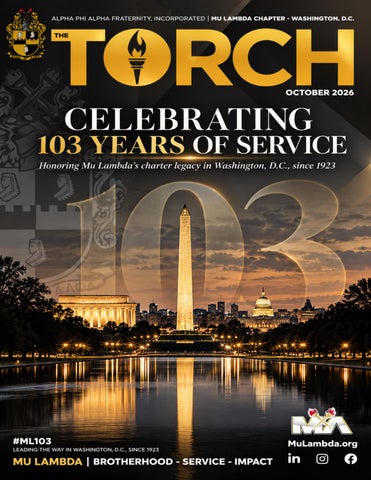
MU LAMBDA TORCH 2026
|2
TWO JEWELS & TWENTY MEN OF ALPHA OUR CHAPTER Mu Lambda is Alpha's eleventh alumni chapter, chartered October 1, 1923, in Washington D.C. The chapter was established, in part, in response to the desire of graduate brothers, many whom were initiated into Beta Chapter at Howard University, to give aid to the undergraduate brothers and continue the work of Alpha. Chartered by 22 distingushed men of Alpha which included Jewel Nathaniel Allison Murray and Jewel Robert Harold Ogle.
CHAPTER LEGACY There has been six members who served as the General President of Alpha Phi Alpha Fraternity, Inc. and two whom served as the Eastern Region Vice President. Mu Lambda is equally proud of our current brothers making their mark in the Washington D.C. community and beyond. Our chapter has many entrepreneurs, activists, political leaders, philanthropists, academicians, ministers and so much more. Our diverse brotherhood age range is between the ages of 25 and 98. We all work together to maximize the brotherhood of Alpha by following the Objective, Mission and AIMS of our Fraternity.
In This Issue 1. Torch Cover - October 2026 2. Chapter Cover Image - The MIGHTY 3. In this Issue 4. Executive Board, Committee Chairs, Charter Members, Past Presidents 5. The Presidents’ Message 7. The Vice-Presidents’ Message 8. Chapter Meeting Schedule 9. Mu Lambda Brother’s Birthdays 10. Fatherhood Reflections 12. Black Thriving in American 2026 - Bro. Reginald O. Salter 14. Battle for the Ballot - Bro. Samuel Armstrong 16. Pure Joi 17. Mu Lambda Charter Day 18. History of Mu Lambda - Bro. Ameer Baker 20. Biographiess on Mu Lambda Charter Members - Bro. Gregory S. Parks 24. After the Title: Bro. Lowery feature - Bro. Christopher Butts 30. DC Alphas Honor September 11 - Bro. Reginald O. Salter 33. Back in the Day Cookout 34. ASALH in Norfolk - Bro. James R. Morgan III 38. Five Reasons Why Every Election Counts - Bro. John T. McMullen 41. Charter Week 42. 35th Annual District Confrence 43. Next on Your Reading List - Bro. Collis Crews 44. Breast Cancer Awareness 45. Charter Day - Light for Democracy, IG Live 46. Chapter Brother Business Advertisements 56. Message from the Editor 57. Espirt De. Fraternite
FIRST OFFICERS The officers elected at the first meeting were Brother Harold StrattonPresident, Brother John Lowery-Vice President, Brother Victor DalySecretary, Brother Daniel W. EdmondsTreasurer, and Brother Nathaniel Allison Murray (Jewel)-Chaplain. Mu Lambda was thus established and was on its way into history!
www.mulambda.org
MU LAMBDA TORCH 2026
|3
Executive Board
Committee Chairs
Charter Members Past Presidents
President Reginald O. Salter
Brother’s Keeper Joseph Housey III
Vice President Karl Bruce
Budget and Finance Jason Jefferson
Recording Secretary Marcus Spells
Communications & Technology Garrett Miller
Arthur Curtis* Merrill H. Curtis* Victor R. Daly* Eugene L. C. Davidson* Arnold Donawa* Walter Garvin* William L. Hansberry* Charles H. Houston* Edward Howard* Joseph R. Jones* R. Frank Jones* J Edward Lowery* Clarence H. Mills* Jewel Nathaniel Allison Murray* Norman L. McGhee* FN4 Jewel Robert Harold Ogle* Louis H. Russell* James N. Saunders* Emory B. Smith* Harold C. Stratton* J.H.N. Waring* Charles H. Wesley* FN3
Corresponding Secretary John T. McMullen Financial Secretary Jason Jefferson Treasurer Michael Young
Constitution Jason Jefferson DC National Pan Hellenic Council James Morgan III
Chaplain William “Tony” Hawkins
Auditing Juan Powell
Historian Ameer Baker
Health & Wellness Ted Darlington
Archivist James Heck
Membership Timothy Fitzgerald / Jonathan Brown
Intake Coordinator Mark Jones Assoc. Editor/Sphinx Joseph Graham Dir. Ed. Activities Sean Perkins Sergeant-at-Arms Frank King Parliamentarian Pierre Boynton Director of Technology Garrett Miller Editor of the Torch Christopher Butts Member at Large Jason Jefferson
Hospitality/Men Who Cook Swain Riley Beta Chapter Advisor James Harmon III Ritual Ryle Bell / Garrett Miller Nominating Samuel Armstrong
CHARTERED ON MONDAY OCTOBER 1, 1923 WASHINGTON, D.C. FN1 6th General President 1915-1916 FN2 General Secretary 1915-1916
Programs/Chapter of the Year Orain Edwards
7th General President 1916-1917
Public Policy Arsene Frederick
FN3 14th General President 1931-1940
Social Xavier Thompson
Risk Management Officer Joseph Gibbs
Community Service Jeffery Taylor
General Council Vacant
Mu Vets Orain Edwards
Immediate Past President Mikael LaRoche
Fundraising Antonio King Archival and History James Heck / Ameer Baker Intake Mark Jones
FN4 General Secretary 1920-1926 FN5 8th Eastern Regional Vice-President 1950-1953 FN6 23rd Eastern Regional Vice-President 2000-2001 Executive Director MLK Memorial
1. Harold Stratton* 1923 - 1924 2. Howard H. Long* FN2 3. Charles H. Wesley* 1926 - 1928 4. Frank Adams* 5. R. Frank Jones* 6. James B. Browning* 7. Jewel Henry Arthur Callis* FN1 8. U. Simpson Tate* 9. Claude Ferebee* 10. George O. Butler* 11. C.C. House* 1938 - 1940 12. Verdie L. Robinson* 13. Walter M. Booker* FN5 14. Jack Bond* 15. Millard R. Dean* 16. Frank Davis* 17. Clifton Hardy* 18. Herman Johnson* 19. Howard Jenkins* 20. C.C. House* 1952 - 1954 21. William F. Nelson* 22. Aubrey E. Robinson* 23. Joseph Waddy* 24. Edward J. Austin* 25. Elgy Johnson* 1964 - 1965 26. George H. Windsor* 1965 - 1967 27. James T. Speight* 1967 - 1969 28. Harold Sims* 1969 - 1970 29. Eddie L. Madison* 1970 - 1972 30. Wilbur Sewell* 1972 - 1974 31. Charles Walker Thomas* 1974 - 1976 32. Theodore Taylor* 1976 - 1978 33. Elmer Moore* 1978 - 1981 34. William E. Calbert* 1981 - 1983 35. Osmond Brown* 1983 - 1986 36. Vernon Gill 1986 - 1988 37. LeRoy Lowery, III 1988 - 1990 38. Morris Hawkins* 1990 - 1992 39. C.C. Jones 1992 - 1995 40. Vincent Orange 1995 - 1997 41. Melvin White 1997 - 1999 42. LeRoy Lowery, III FN6 1999 - 2001 43. James Haynes 2001 - 2002 44. Rudolph Harris* 2002 - 2004 45. Edwin Norwood 2004 - 2006 46. James McDonald 2006 - 2008 47. Timothy Fitzgerald 2008 - 2010 48. Kwame Ulmer 2010 - 2011 49. LeRoy Lowery, III 2011 - 2013 50. Eddie Neal 2013 - 2015 51. LeRoy Lowery, III 2015 - 2017 52. Joel Grey 2017 - 2018 53. Eddie Neal 2018 - 2020 54. John “Tony” Wilson 2020 - 2023 55. Mikael LaRoche 2023 - 2026 * Omega Chapter Brothers Footnote (FN) MU LAMBDA TORCH 2026
|4
ALPHA PHI ALPHA FRATERNITY, INC, MU LAMBDA CHAPTER
------------------------------------------------------------------------------------------------------------------------------------
The President’s Message October 2026 MESSAGE My Dear Brothers,
Happy Charter Day! On October 1, 1923, Mu Lambda Chapter was chartered in Washington, D.C. As we commemorate another year in our history, I am reminded that we are beneficiaries of a legacy built by generations of Alpha men who believed deeply in Brotherhood, scholarship, leadership, and service. Our history is not simply something to celebrate. It is something we have been entrusted to continue. I cannot adequately express the heartfelt pride I feel in serving as the 56th President of this great Chapter. Mu Lambda has a distinguished history within Alpha Phi Alpha Fraternity, Inc. and within the Washington, D.C. community. To have been entrusted with its leadership is an honor I do not take lightly. As we celebrate our chartering, I thank every Brother who continues to give his time, talent, resources, and presence to Mu Lambda. I am equally excited about where we are going. We have spent the opening months of this fraternal year talking about our priorities, strengthening our committees, building greater accountability, and challenging ourselves to think beyond simply conducting programs. Now we move increasingly from planning to implementation. One initiative about which I am particularly excited is the beginning of the Henry Arthur Callis Academy, through which Mu Lambda will expand our engagement with young people at Ballou High School, Hart Middle School, and Kramer Middle School. This work represents exactly the type of sustained community engagement I believe Alpha should provide. Our goal cannot be to enter a school, conduct a program, take a photograph, and leave. We must build relationships. We must mentor. We must expose young people to possibilities they may not yet see for themselves. Most importantly, we must remain present long enough to see whether our presence makes a difference. That brings me back to the words that continue to guide this administration: Intentionality and Impact. Intentionality means that we understand why we are doing the work. Impact means that we are willing to ask what changed because we were there. As we move our initiatives forward, I want those two principles to become more than the theme of an administration. I want them reflected in how Mu Lambda thinks about Brotherhood, programming, community service, leadership, and our responsibility to Washington, D.C. Our commitment to impact must also include the health and well-being of our families and communities. October is Breast Cancer Awareness Month, and the statistics for Black women demand our attention. According to the American Cancer Society, Black women are 38% more likely to die from breast cancer than White women despite having a slightly lower incidence of the disease. The disparity is also reflected in survival: the current five-year relative survival rate for invasive breast cancer is approximately 84% among Black women compared with 94% among White women.
(Continued on the next page) MU LAMBDA TORCH 2025
|5
ALPHA PHI ALPHA FRATERNITY, INC, MU LAMBDA CHAPTER
------------------------------------------------------------------------------------------------------------------------------------
Brothers, breast cancer is not solely a women’s health issue. Men can develop breast cancer, too. The American Cancer Society estimates that approximately 2,670 men will be diagnosed with invasive breast cancer in the United States in 2026, and about 530 will die from the disease. While male breast cancer is rare, representing less than 1% of breast cancers, rare does not mean impossible. So, this month, I encourage every Brother to do something very simple: have the conversation. Encourage the women we love, our wives, mothers, sisters, daughters, friends, and colleagues, to remain attentive to recommended screenings and their breast health. And Brothers, we must remain attentive to our own bodies as well. Awareness and early attention matter. As we celebrate the chartering of Mu Lambda, I hope we will remember that the Brothers who established this Chapter in 1923 were not building Mu Lambda merely for themselves. They were building something they expected other Alpha men to inherit. One hundred and three years later, that responsibility now belongs to us. What will the Brothers who come after us inherit from us? My hope is that they inherit a Mu Lambda that is stronger because we served it; a Brotherhood that is more connected because we invested in one another; young people whose lives were changed because Alpha men consistently showed up for them; and Washington, D.C. communities that know Mu Lambda not simply by our name, but by the difference our presence makes. That is the legacy we have inherited. That is the legacy we must continue. That, my Brothers, is Intentionality and Impact. Onward and Upward,, Brother Reginald O. Salter, 56th President Alpha Phi Alpha Fraternity, Inc. Mu Lambda Chapter
MU LAMBDA TORCH 2026
|6
ALPHA PHI ALPHA FRATERNITY, INC, MU LAMBDA CHAPTER
------------------------------------------------------------------------------------------------------------------------------------
Vice President’s Message October 2026 MESSAGE My Dear Brothers, Happy Charter Day!
Greetings to the oldest and the coldest Brothers of Alpha Phi Alpha, Mu Lambda chapter. I would love to take a moment and say I am already excited about the work that we have begun this fraternal year. Committees are actively meeting; service projects have been pinned and the fraternal spirit is being shown all around. As we reflect on 103 years as 11th alumni chapter in Alpha may we remember the likes of those that have led the way in Washington DC; our founding Jewels of Murray and Ogle, our community giants known the world over and humble servants - the life changers at the local level; we honor you our forbearers. THEY are Mu Lambda history, YOU are Mu Lambda history, WE are Mu Lambda history! I encourage us all to get involved and give of ourselves for the greater good. This year, commit to doing three things as we celebrate Charter Day; sacrifice, serve, and show. Sacrifice your resources, serve all mankind, and show others the way; for an Alphaman is truly a man that lifts others up. John 15:13 says “Greater love hath no man than this, that a man lay down his life for his friends.” Fraternally, Brother Karl W. Bruce, Jr. Vice President (12-Mu Lambda-13) 2025 - 2027 Alpha Phi Alpha Fraternity, Inc. Mu Lambda Chapter
MU LAMBDA TORCH 2026
|7
kjk ALPHA PHI ALPHA FRATERNITY, INC, MU LAMBDA CHAPTER
------------------------------------------------------------------------------------------------------------------------------------
MU LAMBDA TORCH 2026
|8
ALPHA PHI ALPHA FRATERNITY, INC, MU LAMBDA CHAPTER
------------------------------------------------------------------------------------------------------------------------------------
MU LAMBDA BROTHER’S BIRTHDAYS OCTOBER 2026 Bro. Creston Lynch Bro. Maxime Pinchinat Bro. Frank King, Jr. Bro. Samuel Puryear, Jr. Bro. Lloyd McGriff Bro. Eric Washington Bro. Lamar Arnold Bro. Douglas Sands, Jr.
- 3rd - 3rd - 7th - 13th - 16th - 16th - 17th - 17th
Bro. Eric Herndon Bro. Joseph Housey III Bro. Orain Edwards Bro. Kelechi Ononiwu Bro. David Edgerton, Jr. Bro. Alvin Reaves III Bro. Jamie Riley Bro. Nnamdi Olebara
- 18th - 18th - 20th - 22nd - 23rd - 23rd - 25th - 27th
MU LAMBDA TORCH 2026
|9
ALPHA PHI ALPHA FRATERNITY, INC. | MU LAMBDA CHAPTER | WASHINGTON D.C.
ALPHA PHI ALPHA FRATERNITY, INC, MU LAMBDA CHAPTER
------------------------------------------------------------------------------------------------------------------------------------
Light for the Journey: Fatherhood Reflections is a space for the fathers of Mu Lambda to pause, reflect, and share the lessons found in the everyday moments of raising, guiding, and loving our children. From first steps to major milestones, fatherhood continues to shape who we are as men, leaders, and Brothers. Through these reflections, we honor the joys, challenges, growth, and wisdom that come with helping the next generation find its way.
WHEN THEY STOP HOLDING YOUR HAND October has a way of reminding us that things change. The temperature drops. Daylight disappears a little earlier. Trees that spent all summer dressed in green begin letting go. Even our homes feel different. Hoodies replace T-shirts. Football fills the weekends. Halloween decorations appear on porches, and conversations begin about costumes, parties, homecoming dances, and who is going where with whom. For fathers of teenagers and children approaching those years, there is another change happening that can be much harder to name. Our children are growing away from us. Not necessarily emotionally. Not permanently. But naturally. The child who once wanted you to walk beside them everywhere may now ask you to drop
them off around the corner. The little boy who could talk endlessly about dinosaurs may answer, “Nothing,” when you ask what happened at school. The daughter who once needed your help choosing a Halloween costume may now have plans with friends that apparently require no parental creative consultation whatsoever. And somewhere between middle school and high school, many fathers discover one of the more complicated truths of parenting: Our children can need us deeply while appearing to need us less.
HALLOWEEN LOOKS DIFFERENT NOW I think Halloween provides a perfect illustration. When our children are little, Halloween is largely ours. We buy the costumes. We take the pictures. We carry the extra candy bucket. We walk from house to house. We inspect suspicious-looking treats. We negotiate how many pieces of candy constitute “enough for tonight.” And then, one October, things change. They want to walk with their friends. They want to attend the party without you hovering nearby. They have opinions about costumes you may not understand and group chats you definitely were not invited to join. Eventually, some decide they are too old for Halloween altogether. It can feel like something has been lost.
MU LAMBDA TORCH 2026
| 10
ALPHA PHI ALPHA FRATERNITY, INC, MU LAMBDA CHAPTER
------------------------------------------------------------------------------------------------------------------------------------
But perhaps fatherhood in this season requires us to understand that the tradition does not have to disappear simply because its form changes. Maybe you are no longer walking beside them from door to door. Maybe now you are the father who makes sure everyone gets home safely. Maybe pumpkin carving becomes a scary-movie marathon. Maybe trick-or-treating becomes ordering pizza while they tell you about the Halloween party at school. Maybe instead of choosing their costume, your contribution is simply saying, “You look great. Have fun. Call me if you need me.” Different does not have to mean distant.
THE ART OF BEING NEARBY When our children are young, fatherhood is incredibly physical. Pick them up. Tie the shoe. Cut the food. Hold the hand. Check under the bed. Carry them upstairs after they fall asleep. Adolescence asks something different of us. It asks us to learn the art of being nearby without always being in the way. That is harder than it sounds. Because sometimes what looks like withdrawal is actually development. Teenagers are figuring out who they are apart from us. They are developing their own tastes, friendships, opinions, values, boundaries, and identities.
become more intentional. Sometimes the best conversation will happen in the car because looking through the windshield feels safer than looking directly at Dad. Sometimes it happens at 10:47 at night when you are exhausted and suddenly your teenager decides this is the moment they would like to discuss their entire life. Stay awake. Sometimes connection looks like learning the name of an artist you would never voluntarily listen to. Listen anyway. Watch the game. Make the late-night food run. Learn enough about whatever they love to ask an intelligent question. And occasionally, resist the temptation to turn every conversation into a lesson. Sometimes they need Dad the teacher. Sometimes they need Dad the problem solver. And sometimes they simply need Dad to say: “Tell me more.” So, this October, enjoy the changing leaves. Buy the candy. Watch the scary movie. Drive them to the party. Pretend not to notice when they ask you to park a little farther away. And when they get out of the car, remind them: “Have fun. Be safe. Call me if you need me.” Then watch them walk away. Because sometimes fatherhood is knowing when to hold their hand. And sometimes it is making sure they know exactly where to find you when they need to reach for it again.
That does not mean fathers disappear. Quite the opposite. It means our presence must MU LAMBDA TORCH 2026
| 11
ALPHA PHI ALPHA FRATERNITY, INC. | MU LAMBDA CHAPTER | WASHINGTON D.C.
ALPHA PHI ALPHA FRATERNITY, INC, MU LAMBDA CHAPTER
------------------------------------------------------------------------------------------------------------------------------------
Brothers of the Mu Lambda Chapter of Alpha Phi Alpha Fraternity, Inc. attended the Black Thriving in America: 2026 Annual Report Release on September 10, 2026, at Gallup World Headquarters in Washington, D.C. Presented by the Dr. N. Joyce Payne Research Center of the Thurgood Marshall College Fund in partnership with Gallup, the gathering brought together scholars, researchers, policy leaders, and advocates for an important conversation about the lived experiences and well-being of Black Americans. At the center of the program was a question that extends well beyond traditional measures of success: What does it mean for Black Americans not simply to survive, but to thrive? The 2026 report is the fourth instalment in what has been established as a long-term research commitment and draws upon more than 90 years of Gallup survey data and four years of longitudinal trends. Researchers examined dimensions of thriving that include public dignity, financial security, safety, health, workplace respect, educational attainment, economic mobility, and civic participation. For the first time, the report also placed the experiences of Black Americans within a global context. The findings present both progress and cause for continued attention. Overall Black thriving
has rebounded to 49 percent, but significant disparities remain. A seven-point gender gap has emerged between Black men and women; n early one-third of Black adults report unfair treatment while shopping or receiving health care; and Black college graduates are now less likely than their non-graduate counterparts to report being treated respectfully or believing their opinions count in the workplace. For Alpha men, these are more than statistics. They represent the communities in which we live, work, lead, mentor, advocate, and serve. Of particular significance to Mu Lambda Brothers was the leadership of Brother M. Christopher Brown II, a Spring 2004 initiate of Alpha Phi Alpha Fraternity, Inc. and Executive Director of the Dr. N. Joyce Payne Research Center. Brother Brown’s work at the Payne Research Center represents that tradition in a contemporary setting—placing an Alpha man at the intersection of research, higher education, public policy, advocacy, and the national conversation about the future of Black America. A particularly significant moment during the program was the presentation of the inaugural Payne Center Jim Clifton Prize for Research Impact, created to recognize scholarship that moves beyond publication and translates evidence into tangible improvements in human thriving, opportunity, and dignity.
MU LAMBDA TORCH 2026
| 12
ALPHA PHI ALPHA FRATERNITY, INC. | MU LAMBDA CHAPTER | WASHINGTON D.C.
ALPHA PHI ALPHA FRATERNITY, INC, MU LAMBDA CHAPTER
------------------------------------------------------------------------------------------------------------------------------------
The inaugural recipients were Nobel laureate Sir Angus Deaton and Justice Albie Sachs, the renowned anti-apartheid activist and former Justice of South Africa’s Constitutional Court. Their recognition underscored a central message of the gathering: research reaches its highest value when knowledge is translated into meaningful change. That message resonated strongly with Mu Lambda’s presence at the program. From Alpha’s earliest scholar-activists to the Alpha men leading institutions and communities today, education, research, advocacy, leadership, and service have been instruments for advancing our people. That question speaks directly to Mu Lambda’s commitment to Intentionality and Impact. Intentionality requires us to understand the communities we serve before deciding what they need. It requires listening, studying the evidence, identifying genuine needs, and aligning our programs accordingly. Impact requires us to go one step further. It asks us to measure whether our work made a difference. ~ Brother Reginald O. Salter
MU LAMBDA TORCH 2026
| 13
ALPHA PHI ALPHA FRATERNITY, INC, MU LAMBDA CHAPTER
------------------------------------------------------------------------------------------------------------------------------------
For generations, Alpha Phi Alpha Fraternity, Inc. has understood a fundamental truth about citizenship: the right to vote carries power only when people are informed, engaged, and able to exercise it. That enduring commitment was on display September 17, 2026, as Brothers of the Mu Lambda Chapter joined Fraternity leaders and Alpha Brothers from across the country in Washington, D.C., for the “Battle for the Ballot: A Voteless People Is a Hopeless People” Congressional Black Caucus Reception. The gathering took place during the Congressional Black Caucus Foundation’s 55th Annual Legislative Conference, held September 16–20 under the theme Rooted, Ready & Rising. The conference brought elected officials, policymakers, advocates, professionals, students, and community leaders to Washington for five days of policy dialogue, education, networking, and civic engagement. Against that backdrop, Alpha’s reception offered Brothers an opportunity to reconnect around one of the Fraternity’s longeststanding national programs and the continuing importance of civic participation.
A COMMITMENT NEARLY A CENTURY IN THE MAKING For Alpha Phi Alpha, voter engagement is not a new cause adopted for a particular election cycle. The Fraternity established A Voteless People Is a Hopeless People during the 1930s, when many Black Americans possessed the legal right to vote but faced poll taxes, intimidation, inadequate voter education, and other barriers designed to prevent them from exercising that right. Voter education and registration became central to the program. By the 1990s, its work had expanded to include broader political awareness and empowerment, often through town halls and candidate forums. Today, Alpha continues to encourage voter registration, education, and participation through the national program and its First Of All… We Vote initiative. That history gave the September gathering particular resonance. The reception was more than an opportunity for fellowship during one of Washington’s largest annual gatherings of Black civic and policy leaders. It connected the present generation of Alpha men with work the Fraternity has carried forward for decades. MU LAMBDA TORCH 2026
| 14
ALPHA PHI ALPHA FRATERNITY, INC, MU LAMBDA CHAPTER
------------------------------------------------------------------------------------------------------------------------------------
As the country approaches the 2026 Midterm Elections, those conversations take on renewed immediacy. The Fraternity has continued to emphasize voting rights and civic engagement in 2026, including calling upon its college and alumni chapters to educate themselves about changes affecting election maps and voter representation.
THE BALLOT AS A RESPONSIBILITY The phrase A Voteless People Is a Hopeless People carries with it an important distinction. The work does not begin on Election Day. It begins when citizens understand the issues affecting their communities. It continues when eligible voters register and learn the requirements for participating in elections where they live. It grows when communities create opportunities for people to become informed and engaged. And it matters in every election, not solely presidential contests. Alpha’s national voter-engagement efforts have historically emphasized participation in midterm, state, and local elections as well as presidential elections, recognizing the importance of sustained civic participation beyond any single campaign or candidate. That emphasis is particularly meaningful for Mu Lambda.
FROM RECEPTION TO RESPONSIBILITY
The enduring relevance of A Voteless People Is a Hopeless People rests in turning civic awareness into sustained community engagement. Encouraging eligible citizens to register, helping communities understand the voting process, creating spaces for civic education, and ensuring people know where to find reliable information about exercising their rights. Alpha’s own guidance calls upon Brothers to engage family members, coworkers, churches, chapters, campuses, and communities in voter registration and education. That is where a national program becomes local action. And that is where Mu Lambda can continue to make its presence felt. As Brothers departed the Battle for the Ballot reception, the charge was larger than any single gathering and larger than any single election. It was a reminder of an obligation inherited from generations before us: to remain informed, to remain engaged, to encourage others to participate, and to recognize the ballot as one important instrument of civic voice. Nearly a century after Alpha Phi Alpha established A Voteless People Is a Hopeless People, the work continues. For Mu Lambda, here in the nation’s capital, so does our responsibility. The battle continues. And the Brothers of Mu Lambda remain engaged in the work. ~ Brother Samuel Armstrong
There is an important question that remains after the receptions end, the photographs are taken, and CBC Week concludes: What happens next? For Alpha men, the answer cannot simply be to wait for another election.
MU LAMBDA TORCH 2026
| 15
ALPHA PHI ALPHA FRATERNITY, INC, MU LAMBDA CHAPTER
------------------------------------------------------------------------------------------------------------------------------------
A new nonprofit organization is working to ensure that young people have greater access to music, creativity, mentorship, and the confidence that can come from artistic expression. Pure-Joi, founded by Brother Frederick E. Moss, is a 501(c)(3) youth-centered arts education organization focused on helping students discover their voices, build artistic discipline, and experience the transformative power of music and the arts. Its mission centers on developing confidence, creativity, performance skills, and a sense of community among students from elementary school through college. The organization plans to provide a range of opportunities, including in-school music instruction, ensemble rehearsals, songwriting and production labs, access to instruments, mentorship, student showcases, summer workshops, and exposure to college and career pathways in music and the creative industries. Pure-Joi places particular emphasis on underserved youth, students from low-income households, beginners who may not otherwise have access to lessons or instruments, and young people seeking stronger engagement with school and community.
For its first year, Pure-Joi has set an ambitious but community-focused goal: launch pilot programming at Kramer Middle School, enroll 20 students, recruit teaching artists and volunteers, establish rehearsal space, and provide students with opportunities to perform publicly throughout the year. At its heart, Pure-Joi reflects a simple but powerful belief: when young people are given the opportunity to create, perform, and be heard, the impact can reach far beyond the stage. Through music and the arts, the organization hopes to cultivate not only stronger artists, but more confident young people who understand the value of discipline, collaboration, and their own unique voices. As Pure-Joi begins its work, its vision is clear: to create a learning community where young people can experience the rigor, connection, and, fittingly, the joy that comes from making art together.
MU LAMBDA TORCH 2026
| 16
ALPHA PHI ALPHA FRATERNITY, INC, MU LAMBDA CHAPTER
------------------------------------------------------------------------------------------------------------------------------------
MU LAMBDA TORCH 2026
| 17
ALPHA PHI ALPHA FRATERNITY, INC, MU LAMBDA CHAPTER
------------------------------------------------------------------------------------------------------------------------------------
TOWARD A LOCAL LEGACY: THE ROAD TO MU LAMBDA IN WASHINGTON, DC The story of Alpha Phi Alpha Fraternity, Incorporated, is often told through its national milestones and prominent figures, yet the true measure of its influence lies in the communities where its chapters took root. It is within cities and neighborhoods, among professionals and families, that the fraternity’s ideals were translated into lived experience. Washington, D.C., the nation’s capital and a historic center of Black intellectual and civic life, was destined to become one such place of significance. By the early and mid-twentieth century, Washington had emerged as a magnet for educated African Americans seeking professional opportunity and public service. The expansion of the federal government, the presence of Howard University and other institutions, and the city’s long-standing Black communities created an environment where scholarship and leadership could find expression. Yet the city was also marked by segregation, economic disparity, and the ongoing struggle for civil rights. It was a
landscape that required both aspiration and organization. Alpha Phi Alpha’s presence in Washington did not begin with a single moment but developed through the gradual arrival of Alpha men whose professional paths brought them to the capital. These brothers, teachers, civil servants, clergy, physicians, military officers, and administrators, carried their fraternal identity with them. Wherever Alpha men settled, the question eventually arose: how might the fraternity’s mission be sustained and expressed in this new setting? Graduate chapters, in particular, served as the fraternity’s enduring anchors in metropolitan life. They allowed men who had completed their collegiate years to remain actively engaged in Alpha’s work while applying their skills to community uplift. In cities like Washington, where Black professional life was expanding, the need for such a body was evident. The emergence of Mu Lambda must therefore be understood as both a product of its time and a response to its environment. It was born from the recognition that the capital city required organized leadership among Black professionals, men committed not only to personal success but to collective advancement. The chapter’s founders and early members saw
MU LAMBDA TORCH 2026
| 18
ALPHA PHI ALPHA FRATERNITY, INC, MU LAMBDA CHAPTER
------------------------------------------------------------------------------------------------------------------------------------
fraternity not as social affiliation alone, but as a disciplined brotherhood with civic purpose. Washington’s unique position as the seat of federal power gave Mu Lambda a distinct context. Decisions made in the city reverberated across the nation, and the presence of Alpha men within governmental and educational institutions meant that the fraternity’s influence could extend beyond local boundaries. At the same time, the needs of Washington’s Black communities called for mentorship, educational support, and visible models of achievement. Mu Lambda would come to stand at this intersection of policy and people, national symbolism and neighborhood reality.
As we celebrate another revolution of Mu Lambda’s founding era, we also bear witness that no chapter begins in isolation. Mu Lambda was shaped by the fraternity’s national ideals, strengthened by the Eastern Region’s culture of disciplined leadership, and inspired by the aspirations of Black Washingtonians seeking progress in a changing America. rep. ~ Brother Ameer Baker
MU LAMBDA TORCH 2026
| 19
ALPHA PHI ALPHA FRATERNITY, INC, MU LAMBDA CHAPTER
------------------------------------------------------------------------------------------------------------------------------------
The twenty-three men who signed Mu Lambda’s charter represented a remarkable concentration of professional talent, civic ambition, and fraternal devotion. Among them were physicians, dentists, educators, lawyers, psychologists, historians, and a General Secretary of the national fraternity—as well as two of the fraternity’s seven Founders. Together, they transformed what began as an experiment in graduate fellowship into a lasting institution that would shape the cultural, political, and intellectual life of Black Washington for a century. Arthur Curtis, M.D. — Brother Arthur L. Curtis was a physician who practiced in Washington, D.C. He had been a member of Beta Chapter at Howard University before helping to found Mu Lambda. He served the fraternity and the Washington community through his medical practice. Brother Curtis entered Omega Chapter prior to 1956. The Curtis brothers were not the only physicians among the charter membership. Medicine was richly represented in Mu Lambda’s founding cohort, reflecting Washington’s status as a center of Black professional life. Merrill H. Curtis, M.D. — Brother Merrill Curtis was a physician and the brother of Arthur Curtis. He, too, had been a member of Beta Chapter before joining in the organization of
Mu Lambda. Brother Curtis remained active in the chapter for decades. In 1957, he served as co- chairman for a chapter meeting featuring Brother E. Franklin Frazier’s discussion of his book “Black Bourgeoisie.” He was present at the fraternity’s 59th Anniversary celebration in 1965. Victor R. Daly — Brother Victor R. Daly was the first Secretary of Mu Lambda Chapter and one of the chapter’s most prominent and enduring members. Organizational meetings for the chapter were held at his home. Brother Daly was admitted to Alpha Chapter at Cornell University in 1914, where he served as secretary and president and was a delegate to the Eighth Convention at Richmond. At Cornell, he was prominent in athletics and was a member of the cross-country and track teams. Before Cornell, he held the distinction of being the first of his race to hold the captaincy of a major sport team in any of the New York high schools, held the interscholastic one-mile record for a number of years, and was the winner of the New York City interscholastic cross-country championship. He entered Cornell with no fewer than three scholarships. During World War I, Brother Daly served as the adjutant of the famous “First” Battalion of the 367th Infantry, “The Buffalo Regiment,” and was twice recommended for promotion. In 1919, he was one of the founders and the first business manager of the Messenge
MU LAMBDA TORCH 2026
| 20
ALPHA PHI ALPHA FRATERNITY, INC, MU LAMBDA CHAPTER
------------------------------------------------------------------------------------------------------------------------------------
Magazine. He later became affiliated with the Urban League as industrial secretary of the New York branch, and subsequently entered the field of real estate and insurance in Washington, D.C. Brother Daly served as Editorial Editor of The Sphinx. He was president of the Riverside Golf Club and secretary of the National Capital Country Club. Brother Daly is also credited with recalling that the chapter’s tradition of hosting meetings in brothers’ homes, where wives prepared dinners for the gatherings, gave rise to the “Alpha Wives” organization, which was formally established in 1950 and became a vital support structure for the chapter’s programs and fundraising efforts for decades thereafter. He was present at the fraternity’s 59th Anniversary celebration in 1965, and remained a beloved and active member of Mu Lambda for over half a century—still being honored at chapter events as late as 1978. Eugene L.C. Davidson — Brother Eugene L.C. Davidson, known affectionately as “Jinks,” was a charter member of Mu Lambda who remained active in the chapter for many years. He was present at the fraternity’s 59th Anniversary celebration in 1965. Alongside the physicians and businessmen who composed much of the charter membership, the dental profession was also well represented. Arnold Donowa — Brother Arnold Donowa was a charter member of Mu Lambda who came to the chapter from Beta Chapter at Howard University. He was a dentist by profession. Walter Garvin, D.D.S. — Brother Walter Garvin was a dentist and one of the charter members of Mu Lambda. He had been a member of Beta Chapter before helping to found the graduate chapter. Known affectionately as “Fish” Garvin, he remained active in Mu Lambda for many years. Brother Garvin entered Omega Chapter between 1956 and 1960. William Leo Hansberry — Brother William Leo Hansberry was a historian and professor at Howard University who was widely recognized as the pioneer of African studies in American higher education. At a time when the prevailing academic consensus dismissed the existence of advanced African civilizations, Hansberry
devoted his career to documenting and teaching the history of ancient Africa, including the kingdoms of Kush, Axum, and Meroe. Known as “Leo” Hansberry, he joined Mu Lambda as a charter member and became one of the distinguished scholars associated with the chapter. He was listed among the outstanding members of Mu Lambda who contributed significantly to society. The University of Nigeria later honored his legacy by naming its Institute of African Studies for him. Edward W. Howard — Brother Edward W. Howard, known as “Eddie” Howard, was a charter member of Mu Lambda who had previously been a member of Beta Chapter. He entered Omega Chapter between 1956 and 1960. Charles Hamilton Houston — Brother Charles H. Houston was a charter member of Mu Lambda and one of the most consequential figures in American legal history. A graduate of Amherst College and Harvard Law School, Houston served as Vice Dean of Howard University School of Law, where he transformed the institution into a training ground for civil rights lawyers. He was the chief architect of the legal strategy that led to the dismantling of the “separate but equal” doctrine. He mentored a generation of civil rights attorneys, including Thurgood Marshall. Houston was recognized among the outstanding members of Mu Lambda who contributed significantly to society in the field of civil rights. Brother Houston entered Omega Chapter on April 22, 1950, at the age of 54—just months before the Supreme Court decisions in Sweatt v. Painter and McLaurin v. Oklahoma that his litigation strategy had made possible. Houston’s legal brilliance was complemented by the medical expertise that several charter members brought to Washington’s Black community. R. Frank Jones, M.D. — Brother R. Frank Jones was a physician and urologist who practiced in Washington, D.C. He was listed among the outstanding members of Mu Lambda who contributed to society. Known affectionately as “Bony” Jones, he was an active charter member.
MU LAMBDA TORCH 2026
| 21
ALPHA PHI ALPHA FRATERNITY, INC, MU LAMBDA CHAPTER
------------------------------------------------------------------------------------------------------------------------------------
Joseph R. Jones, M.D. — Brother Joseph R. Jones was a physician and charter member of Mu Lambda. Known as “Rusty” Jones, he was active in the chapter during its early years. Brother Jones entered Omega Chapter prior to 1956. John Edward Lowry, M.D. — Brother John Edward Lowry was a physician who practiced in Washington, D.C. Known as “Eddie” Lowry, he was an active member of the chapter in its formative years. Howard H. Long — Brother Howard Hale Long was a psychologist, educator, and significant figure in the fraternity’s national history. He served as General President of Alpha Phi Alpha during the period when the fraternity launched its landmark “Go-to-High-School— Go-to- College” movement. At the 1916 General Convention, while serving as General President, he recommended that “Education” should be the leading aim of the fraternity—a recommendation that proved prophetic and transformative. Known affectionately as “Pup” Long, he was a trained psychologist who contributed to scholarship on intelligence testing and educational psychology. He entered Omega Chapter between 1956 and 1960. Clarence H. Mills — Brother Clarence Harvey Mills was a charter member of Mu Lambda who had been a member of Beta Chapter. He entered Omega Chapter prior to 1956. Nathaniel A. Murray (Jewel Founder) — Brother Nathaniel Allison Murray was one of the seven Jewel Founders of Alpha Phi Alpha Fraternity, having helped establish the fraternity at Cornell University in 1906. Known among the founders as “Nat” Murray, he remained deeply connected to the fraternity throughout his life. As Chaplain of Mu Lambda, he always opened meetings by asking the brothers to recite the Lord’s Prayer, lending a spiritual dimension to the chapter’s gatherings. His presence as a charter member gave Mu Lambda a direct and living connection to the fraternity’s 1906 origins at Cornell—a distinction shared by no other graduate chapter save for Mu Lambda’s co-founder, Jewel Ogle. Brother Murray eventually relocated to Los Angeles, California.
Norman L. McGhee — Brother Norman L. McGhee served as General Secretary of Alpha Phi Alpha Fraternity, the chief administrative officer responsible for managing the fraternity’s official correspondence and records. Described as the “Peerless Scribe,” he was one of the most prominent fraternity officers of his era. The charter application for Mu Lambda was submitted to his office, and he himself was a charter member—a distinction that reflected his deep personal commitment to the Washington chapter’s success. While the Jewel Founders and the General Secretary gave Mu Lambda national stature from its inception, the chapter’s longevity was equally sustained by brothers who served faithfully at the local level for decades. Louis H. Russell — Brother Louis H. Russell was a charter member of Mu Lambda who demonstrated extraordinary devotion to the chapter across more than half a century of active service. He was present at the fraternity’s 59th Anniversary celebration in 1965 alongside fellow charter members Victor Daly and Eugene Davidson. As late as 1978—fiftyfive years after helping to found the chapter— Brother Russell was recognized at a Mu Lambda smoker alongside Brother Daly as one of the chapter’s living founders, testifying to a continuity of fraternal loyalty that few chapters in Alpha Phi Alpha could match. James N. Saunders — Brother James N. Saunders, known as “Jimmy” Saunders, was a charter member of Mu Lambda who played a quiet but consequential role in the fraternity’s national history. It was at Brother Saunders’s urging that General President Raymond W. Cannon traveled to Washington, D.C. to meet with Charles Wesley at Howard University—a meeting that resulted in Wesley’s agreement to write The History of Alpha Phi Alpha, the fraternity’s foundational text. Brother Saunders remained active in the chapter for many years and was present at chapter meetings through the late 1950s and 1960s. Emory B. Smith — Brother Emory B. Smith, known affectionately as “Parson” Smith—a nickname suggesting his ministerial vocation— was a charter member of Mu Lambda and
MU LAMBDA TORCH 2026
| 22
ALPHA PHI ALPHA FRATERNITY, INC, MU LAMBDA CHAPTER
------------------------------------------------------------------------------------------------------------------------------------
was listed among the chapter’s outstanding members who contributed to society. He remained active in the fraternity for many years and was present at the 1941 Mu Lambda Founder’s Day supper at Harrison’s alongside General President Rayford Logan, Chauncey Cooper, and other distinguished brothers. Brother Smith entered Omega Chapter prior to 1956, but his legacy endured in the chapter that bore his imprint for decades. Harold C. Stratton, M.D. — Brother Harold C. Stratton was the first President of Mu Lambda Chapter, elected to lead the new organization at its founding in October 1923. Known as “Hal” Stratton, he was a physician who had served as a leader of Beta Chapter before helping to organize the graduate chapter. As the chapter’s inaugural president, Brother Stratton presided over the establishment of meeting customs, programming traditions, and organizational structures that would endure for generations. He guided the chapter through its critical formative period when the very concept of a graduate chapter was still experimental and its viability uncertain. Brother Stratton entered Omega Chapter prior to 1956, having served the chapter and the fraternity from its founding through more than three decades of growth. J.H.N. Waring — Brother J.H.N. Waring was a charter member of Mu Lambda. He contributed to the chapter’s programs and activities during its early years. Charles H. Wesley — Brother Charles Harris Wesley was born on December 2,1891, in Louisville, Kentucky. He earned his B.A. from Fisk University, his M.A. from Yale University, and in 1925 became only the fourth African American to receive a Ph.D. in History from Harvard University, following W.E.B. DuBois, Alain Locke, and Carter G. Woodson. He was initiated into Alpha Phi Alpha through Zeta Chapter at Yale in 1913, and upon joining the faculty at Howard University that same year, immediately transferred to Beta Chapter. Upon the establishment of Mu Lambda in 1923, Brother Wesley became a charter member and later served as the chapter’s third president (1925–1928). In that capacity, he became president of the Beta-Mu Lambda Corporation,
which opened the nation’s first Black-owned fraternity house in 1928. At Howard, he rose through the ranks to become Professor and Head of the Department of History, Director of the Summer School, Dean of the College of Liberal Arts, and Dean of the Graduate School. He served as General President of Alpha Phi Alpha from 1931 to 1940— longer than any other person in fraternity history—and authored the official history, The History of Alpha Phi Alpha: A Development in College Life, first published in 1929. He served as President of Wilberforce University (1942–1947) and as the founding President of Central State University (1947–1965). He published over 125 articles,12 books, and countless monographs, including Negro Labor in the United States, The Collapse of the Confederacy, and Richard Allen: Apostle of Freedom. An ordained minister in the African Methodist Episcopal Church, Brother Wesley was also President of the Association for the Study of Afro-American Life and History from 1950 to 1965. He entered Omega Chapter on August 16,1987, at the age of 95. Robert H. Ogle (Jewel Founder) — Brother Robert Harold Ogle was one of the seven Jewel Founders of Alpha Phi Alpha Fraternity, having been present at the fraternity’s creation at Cornell University in 1906. Brother Ogle settled in Washington, D.C. and became an active member of the professional community there. His presence as a charter member of Mu Lambda, alongside Jewel Murray, gave the chapter the rare and cherished distinction of counting two of the original Seven Founders among its membership. In 1928, he was named to the committee that assisted Brother Charles Wesley in gathering primary documents and oral histories from the living Founders for The History of Alpha Phi Alpha.
MU LAMBDA TORCH 2026
| 23
ALPHA PHI ALPHA FRATERNITY, INC. | MU LAMBDA CHAPTER | WASHINGTON D.C.
ALPHA PHI ALPHA FRATERNITY, INC, MU LAMBDA CHAPTER
------------------------------------------------------------------------------------------------------------------------------------
MU LAMBDA TORCH 2026
| 20
ALPHA PHI ALPHA FRATERNITY, INC, MU LAMBDA CHAPTER
------------------------------------------------------------------------------------------------------------------------------------
There comes a point in a leader’s life when the titles begin to tell only a fraction of the story. President. Regional Vice President. Advisor. Board member. Foundation President. Vice President and Chief Operating Officer. Each title can identify a season. Each can document an accomplishment. Each can occupy another line in a biography. But titles cannot measure the Friday afternoons spent sitting with undergraduate brothers because you believed somebody needed to be there. They cannot adequately describe the miles driven across an entire region because you believed accepting an office meant actually doing the work associated with it. And they certainly cannot capture the decades spent returning, again and again, to the same fundamental question: What can I contribute? For Brother LeRoy Lowery III, that question has followed him through an extraordinary life of professional achievement, public service, community leadership, and commitment to Alpha Phi Alpha Fraternity, Inc. A native of Knoxville, Tennessee, Lowery earned his Bachelor of Science in Mechanical Engineering from Howard University and later a master’s degree in Systems Management from the University of Southern California. His professional life included service in the United States Army and work with several federal agencies, including the General Services Administration, NASA, the State Department, and the Department of Energy. Within Alpha, his leadership would eventually include serving as President of Mu Lambda Chapter more than once (4x), the 23rd Eastern Regional Vice President, and as the President of the Mu Lambda Foundation. But if you ask Brother Lowery about a lifetime in Alpha, he does not spend much time reciting titles. He talks about work. And he talks about showing up.
BEFORE ALPHA To understand Lowery’s approach to service, one must first travel well beyond his initiation
into Alpha. His childhood was anything but conventional. His parents married while in college and later separated, and Lowery did not grow up with his father in the traditional sense. He and his younger brother spent summers with their grandparents, where church and Sunday school were simply part of life. Looking back, Lowery can see how those experiences quietly shaped the man he would become. There was also movement. Lots of it. At one point, he attended three schools during the 10th grade. His family’s circumstances took him from one community to another, including an extraordinary period when, as a teenager, he and his younger brother traveled across the country. Lowery recalled journeys through places as varied as Denver, Colorado, New Mexico, California, and Ohio during an era when two young Black boys traveling great distances on their own was an entirely different proposition than it would be today.
There was instability in those transitions, but there was also exposure. He saw different communities. Different ways of living. Different expectations. He also inherited the perspective of a family that understood the realities of segregation intimately. His mother had grown up in a system in which Black students in her community received only 11 years of schooling, requiring those seeking higher education to find a way to complete an additional year elsewhere. Those experiences would become part of Lowery’s understanding of opportunity, responsibility, and what it meant to make something of the opportunities placed before him. MU LAMBDA TORCH 2026
| 25
ALPHA PHI ALPHA FRATERNITY, INC. | MU LAMBDA CHAPTER | WASHINGTON D.C.
ALPHA PHI ALPHA FRATERNITY, INC, MU LAMBDA CHAPTER
------------------------------------------------------------------------------------------------------------------------------------
ALPHA BEFORE HE WAS AN ALPHA There is a wonderful irony in Brother Lowery’s Alpha story. His relationship with the Fraternity began long before he actually became a member. As an undergraduate at Howard University, he was surrounded by Alpha. His roommate and many of the men he knew became involved with Beta Chapter. Lowery remembers seeing brothers lined up across Howard’s campus and watching Alpha life unfold around him. He was close enough to it that years later, some Howard classmates mistakenly remembered him as having been on line with them. Lowery would quickly correct them. He had not been. But the interest was there. Administrative circumstances ultimately prevented his undergraduate Alpha journey from materializing. By the time an issue with his academic records was resolved, the line had already crossed. Life continued. But Alpha never completely left his view. Years later, he found himself noticing the prominence of Alpha men serving their communities as school leaders, public officials, professionals, and civic figures. Something about the Fraternity he observed as an adult was different from the Alpha he had known as a college student. There was service. There were scholarships. There was community engagement. There was a larger purpose. “I liked the concepts,” Lowery recalled. “The community service, all those kinds of good things. Okay, we can do some more of that.” In 1984, two of his Howard classmates sponsored him for membership in the Mu Lambda Chapter. He was nearly 42 years old. And once he came in, there would be very little half-stepping.
“WHAT ARE YOU GOING TO BRING” Before his initiation, Lowery interviewed with the Mu Lambda Chapter President. The question posed to him was straightforward: What are you going to bring to the Fraternity? Lowery said he wanted to work with youth. The president remembered. Within perhaps a week or two of becoming an Alpha man, Brother Lowery was informed that Mu Lambda technically served as advisor to Beta Chapter at Howard University. Therefore, Lowery would become the advisor. He had barely learned how to wear his new Black and Gold before he had an assignment. His reaction was essentially: You want me to do what? But he accepted. And then he showed up. Beta met every Friday afternoon. Lowery felt that if he was going to be their advisor, he needed to attend those meetings, not simply appear when it was time for intake or when the undergraduate chapter needed money. That philosophy began changing the relationship between Mu Lambda and Beta. Lowery started providing reports about Beta during Mu Lambda meetings. At Beta, his regular presence meant the undergraduate brothers had an engaged graduate brother who understood what they were doing and what they needed. What had sometimes been a transactional relationship began becoming a relational one. Lowery would serve as advisor for 16 years. Today, he is reluctant to claim too much credit MU LAMBDA TORCH 2026
| 26
ALPHA PHI ALPHA FRATERNITY, INC, MU LAMBDA CHAPTER
------------------------------------------------------------------------------------------------------------------------------------
for the relationship that developed between the two chapters. “I think I had a little bit to do with that,” he said. But the lesson is unmistakable. Institutions become stronger when people decide to show up consistently.
HOLDING A POSITION VERSUS LEADING Over the decades that followed, Lowery would hold some of the most significant leadership positions available to an Alpha man. He served multiple times as President of Mu Lambda Chapter and ultimately became the 23rd Eastern Regional Vice President. Interestingly, the latter role did not come as the triumphant conclusion to a carefully orchestrated campaign. Lowery had previously run for Regional Vice President and lost. He decided he was finished pursuing it. Then circumstances changed within the Eastern Region, and General President Adrian Wallace called. He wanted Lowery to serve as Eastern Regional Vice President. There was one complication. Lowery was already President of Mu Lambda. For a year, he did both. His recollection of that decision comes with the kind of humor available only after surviving it. “I don’t know what was in my head,” he joked. But beneath the humor is a revealing statement about his leadership philosophy. “I want to perform the duties associated with that position,” he explained, “and if I’m not gonna do that, then I don’t even need to be affiliated with it.” So, he drove. Across the Eastern Region. To district conferences. To chapter meetings. To wherever the office required him to be. At the same time, he continued fulfilling his responsibilities to Mu Lambda and maintaining his commitment to the relationship between Mu Lambda and Beta. For Lowery, the title never excused the work. The title demanded it.
BUILDING A MEMORIAL TO A BROTHER, AND A NATION Then came one of the most consequential assignments of his professional life. From 2002 to 2004, Lowery served as Vice President and Chief Operating Officer of the Washington, DC Martin Luther King, Jr. National Memorial Foundation, helping advance the effort to establish a permanent national memorial honoring Brother Dr. Martin Luther King Jr. By then, Lowery had retired from Federal service, but retirement was never intended to mean retreat. He wanted another challenge. He found one. “I don’t think I’ve ever worked harder in my life,” Lowery recalled of that period. When he arrived, he encountered an organization attempting to manage an enormous national undertaking while still building some of the basic organizational infrastructure necessary to support it. Lowery remembered staff working exceptionally long days and an operation that needed greater structure. So, he began creating it. Staff meetings. Organizational processes. Fundraising coordination. Operational discipline. And then there was the money. MU LAMBDA TORCH 2026
| 27
ALPHA PHI ALPHA FRATERNITY, INC. | MU LAMBDA CHAPTER | WASHINGTON D.C.
ALPHA PHI ALPHA FRATERNITY, INC, MU LAMBDA CHAPTER
------------------------------------------------------------------------------------------------------------------------------------
Lowery recalled approximately $5 million being available at one stage, while major commitments were structured as pledges contingent upon reaching other fundraising milestones. General Motors, for example, had pledged $10 million contingent upon the campaign first raising $5 million. The vision was enormous. The cash required to achieve it was even larger. “You’re not going to make a $100 million project with just fraternity,” Lowery observed. The effort required taking the story beyond Alpha conventions and introducing the vision to corporations, policymakers, donors, and the broader public.
predecessor organization. He remembers watching brothers begin socializing while Foundation business was being conducted and wondering why the work was not receiving greater attention. He also encountered an organization holding resources that, in his view, should have been more actively deployed toward its purpose. Lowery eventually joined the Foundation Board and began asking a characteristically simple question: What are we doing? Not what do we possess? Not what did we used to do? Not what might we eventually do? What are we doing?
The memorial would ultimately become something larger than a Fraternity initiative. It would become part of the national landscape. For Lowery, however, getting there required the decidedly unglamorous work that sits behind monumental achievements. The meetings. The systems. The fundraising. The accountability. The long days. The work nobody photographs.
Over time, he worked to reduce what he described as adversarial attitudes between the Chapter and Foundation and encourage greater collaboration.
STRENGTHENING THE HOUSE There is another piece of Lowery’s Mu Lambda legacy that he nearly forgot to mention during the interview. He wanted the Chapter and Mu Lambda Foundation to work together. When Lowery first entered Mu Lambda, Chapter meetings could transition immediately into meetings of what was then the Foundation’s
Today, as the most recent past President of the Mu Lambda Foundation, Lowery continued doing what he has done throughout his Alpha life: pushing institutions to move beyond simply existing and toward fulfilling their purpose. The Mu Lambda House itself has helped create common ground, he noted. But buildings do not create collaboration. People do.
ALPHA AFTER THE PARTIES Perhaps the clearest window into Brother Lowery’s philosophy came near the end of the conversation. He was asked to imagine this edition of The Torch surviving in Mu Lambda’s archives for another 25 years. Imagine, he was MU LAMBDA TORCH 2026
| 28
ALPHA PHI ALPHA FRATERNITY, INC, MU LAMBDA CHAPTER
------------------------------------------------------------------------------------------------------------------------------------
told, that a brother not yet initiated today discovers this article decades from now. What should that brother understand about remaining faithful to Alpha for a lifetime? Lowery did not offer a ceremonial answer. He offered a challenge. Don’t half-step.
there is no better way to understand his vision of Alpha. Before someone sees the pin, the letters, the shingle, the office held, or the line in a biography, perhaps they should see something in the man. Character. Responsibility. Presence. Service. A willingness to give some portion of one’s life to something beyond oneself.
Over the years, he has encountered brothers who seemed more interested in being able to say they belonged to Alpha than in actually doing the work Alpha requires. That never made much sense to him.
“To me, if you’re going to be an Alpha man, you’re expected to contribute,” Lowery said. “You’re expected to put a couple of hours a week, or whatever, into something other than yourself.”
“I don’t ever remember just joining an organization just to say I’m a member,” he explained. “I wanna actually contribute.”
And then he added what may be the simplest explanation of why service matters: “You have the opportunity to make an impression and do something positive.”
And if another brother is sincere about that work? “I want you in with me so we can lock arms and we can go.” That is the Alpha Lowery believes in. He spent years telling Beta brothers that their fraternal responsibility did not end when Howard placed a diploma in their hands. Undergraduate Alpha has its social traditions, he acknowledged. There are parties. Queens. Campus life. Memories. But eventually, he said, you have to enter “the real world.” And there the measurement changes. It becomes about impact. “How much of an impact you make in a community,” he said. That is where Alpha becomes more than something worn. It becomes something lived.
THE ALPHA PEOPLE CAN SEE Lowery remembers once encountering a woman who, after observing him, asked a surprising question. “I bet you’re an Alpha.” He confirmed that he was, but wanted to know how she knew. Her answer, as he remembers it, had something to do with his posture, the way he presented himself. Her experiences with Alpha men had taught her to associate certain qualities with the Fraternity.
That is what he hopes a brother reading his story 25 years from now understands. And perhaps that is the real measure of Brother LeRoy Lowery III’s Alpha journey. Not that he became President. Not that he became Eastern Regional Vice President. Not that he helped advance a national memorial. Not even that he led the Mu Lambda Foundation. It is that when one title ended, he found another way to serve. When one assignment was completed, he found more work to do. When one generation of brothers moved forward, he reached toward the next. Decade after decade. Meeting after meeting. Brother after brother. Community after community. Still contributing. Still showing up. Still carrying the Torch. And somewhere, perhaps 25 years from now, a brother may find these words in the archives of Mu Lambda and understand that Alpha was never intended to be something he simply joined. It was something he was expected to live. ~ Brother Christopher Butts
Lowery considered it a compliment. Perhaps MU LAMBDA TORCH 2026
| 29
ALPHA PHI ALPHA FRATERNITY, INC. | MU LAMBDA CHAPTER | WASHINGTON D.C.
ALPHA PHI ALPHA FRATERNITY, INC, MU LAMBDA CHAPTER
------------------------------------------------------------------------------------------------------------------------------------
Some days of service stay with you long after the work is finished. On September 12, 2026, Brothers representing all six Washington, D.C. chapters of Alpha Phi Alpha Fraternity, Inc.— Area VI, the DC Alphas—came together at the Tanner Community Resource Center in Oxon Hill, Maryland, for a 9/11 Day of Service. What began as a morning of clearing brush, removing small saplings, chipping wood, painting, and restoring the grounds became something far more meaningful.
Regiment, one of the historic Black Regular Army regiments whose service forms part of the enduring legacy of the Buffalo Soldiers. In 1917, members of the 24th Infantry were stationed in Houston, Texas, during a period when Black soldiers wearing the uniform of the United States still faced the humiliation and violence of Jim Crow. Tensions between the soldiers, local civilians, and Houston police eventually erupted on August 23, 1917. The violence left civilians, police officers, and Black soldiers dead.
Unbeknownst to me, we were helping prepare a cemetery for the return and final resting place of Corporal Larmon J. Brown, a Washington, D.C. native and Black United States Army soldier whose journey home has been more than a century in the making. The September 12 service project was specifically organized to prepare the cemetery behind the Tanner Community Resource Center for a forthcoming ceremony that will welcome Brown’s remains “home to rest.” For the Brothers who gathered that morning, learning whose resting place they were preparing changed everything. .
What followed became one of the most consequential military trials in American history. Sixty-three Black soldiers were court-martialled in the first proceeding. Five were acquitted, while others received lengthy prison sentences. Thirteen men, including Corporal Larmon J. Brown, were sentenced to death on December 8, 1917. Three days later, on December 11, they were hanged.
THE SOLDIER BEHIND THE NAME Larmon J. Brown was born in 1891 and served as a corporal in the 24th United States Infantry
MU LAMBDA TORCH 2026
| 30
ALPHA PHI ALPHA FRATERNITY, INC, MU LAMBDA CHAPTER
------------------------------------------------------------------------------------------------------------------------------------
There had been no prior public announcement of the executions. More troubling, the sentences had been carried out without review by either the Secretary of War or President Woodrow Wilson. The speed and secrecy surrounding the executions generated outrage across Black America and contributed to subsequent changes in Army procedures governing death sentences. Corporal Brown was only about 26 years old. Yet the story becomes even more personal when we consider the woman waiting for him back home. Months after the execution, the United States Army was still concerned about the reaction within Black communities to what had happened in Houston. In March 1918, Major Walter H. Loving, a Black Army officer working in military intelligence, personally visited Corporal Brown’s mother in Washington, D.C. She had been informed that her son’s body was being shipped home to Washington. All I could do after learning this was to imagine that moment with a mother in mind. My heart was broken. A mother had sent her son into the United States Army. Now she was being told that the Army was returning him to her in a coffin after executing him thousands of miles from home. Major Loving’s visit carried another purpose. Army historical records show that military intelligence had heard rumours that organizations might use Brown’s funeral as an opportunity to protest the treatment of Black soldiers and spread what officials characterized as “discontentment” within Washington’s Black community. Major Loving discussed those concerns with Brown’s mother. Historical research adds an even more painful detail of Corporal Brown’s mother reportedly was not permitted to discuss the Houston incident at her own son’s funeral. For a Black mother in 1918, even mourning her son had become entangled with the racial politics of the country he had served. More than a century later, that history gives extraordinary meaning to what happened in Oxon Hill. One hundred and nine years after Brown’s death, another community is preparing to receive him. The cemetery located behind the Tanner Community Resource Center, St.
in Oxon Hill, is being prepared for a ceremony welcoming the remains of Corporal Brown and providing a final resting place for this Washingtonian and Black American soldier. The publicly announced September service project specifically called for volunteers to clear the cemetery, remove brush and saplings, chip wood, paint, and complete other improvements in anticipation of his return. We learned from the organizers that a public date for the reinterment ceremony has not been announced in the sources we were able to verify. That makes it important not to get ahead of the family or the organizations coordinating his return. What is certain is that preparations are underway for a ceremony intended to welcome Corporal Brown home to rest. There is something almost poetic about the contrast between his two homecomings. In 1918, his mother waited in Washington for the remains of her son while military intelligence worried about what his funeral might represent. In 2026, a community is deliberately preparing the earth to receive him with dignity. I am both humbled and proud that among those preparing that earth to receive this hero were the Brothers of Alpha Phi Alpha.
The significance of the day was not confined to the history of Corporal Brown. There was also something special about seeing Brothers from all six Washington, D.C. chapters come together as Area VI for one purpose. Different chapters. Different generations. Different professions. Different experiences in Alpha. On that morning, none of those distinctions mattered. That is Brotherhood in one of its purest forms. Every branch removed exposed a little more of the MU LAMBDA TORCH 2026
|31
ALPHA PHI ALPHA FRATERNITY, INC. | MU LAMBDA CHAPTER | WASHINGTON D.C.
ALPHA PHI ALPHA FRATERNITY, INC, MU LAMBDA CHAPTER
------------------------------------------------------------------------------------------------------------------------------------
sacred ground beneath it. Every section cleared helped prepare the place where a soldier’s journey will finally end. Years from now, families may walk onto those grounds and stop at the grave of Cpl. Larmon J. Brown. They may never know the names of the Alpha men who helped clear the land before he arrived, and that is perfectly all right. Service is not always about being remembered for what we did. Sometimes service is about making certain someone else is never forgotten. That lesson was especially meaningful as part of a 9/11 Day of Service. As I have reflected on this day, I keep returning to the theme that guides my administration as President of Mu Lambda: Intentionality and Impact. Intentionality asks us to be deliberate about where we show up, why we are there, and whom our service benefits. Impact asks an even more important question: What is different because Alpha was there? Together, we remembered Americans lost on September 11, 2001, by serving a community in 2026. And through that service, we helped restore the memory of a Black American soldier whose story reaches back to 1917. Two chapters of American history separated by more than eight decades met on one small piece of ground in Oxon Hill. We were intentional in coming together—not as six separate chapters seeking recognition, but as one Area, one Brotherhood, and one Alpha committed to service. And the impact of that decision will extend far beyond the few hours we spent clearing those grounds. One day, Corporal Larmon J. Brown will be laid to rest there. His family and community will gather on ground that was prepared, in part, by the hands of Alpha men. Long after the branches we removed are forgotten and long after the names of those who volunteered that morning fade from memory, the impact of our service will remain.
~ Brother Reginal O. Salter
MU LAMBDA TORCH 2026
| 32
ALPHA PHI ALPHA FRATERNITY, INC, MU LAMBDA CHAPTER
------------------------------------------------------------------------------------------------------------------------------------
MU LAMBDA TORCH 2026
| 25
ALPHA PHI ALPHA FRATERNITY, INC. | MU LAMBDA CHAPTER | WASHINGTON D.C.
ALPHA PHI ALPHA FRATERNITY, INC, MU LAMBDA CHAPTER
------------------------------------------------------------------------------------------------------------------------------------
The 111th Annual Meeting and Conference of the Association for the Study of African American Life and History brought scholars, educators, public officials, community leaders, students, and advocates for Black history to Norfolk, Virginia, for a national gathering devoted to the preservation and interpretation of the African American experience.
historians, former General Presidents of Alpha Phi Alpha, members of Mu Lambda Chapter, and former executive directors of ASALH. The recognition of General President Metellus and Congressman Green did not mark the beginning of Alpha’s relationship with ASALH. It represented the continuation, and in some respects the renewal, of a historic connection.
For the Brothers of Mu Lambda Chapter of Alpha Phi Alpha Fraternity, Inc., the 2026 conference carried an additional significance. Two distinguished Brothers of Alpha Phi Alpha received major honors: 37th General President Brother Lucien J. Metellus Jr., who received the Executive Council Special Recognition Award, and Congressman Brother Al Green, who received the President’s Award.
MU LAMBDA AND THE LEADERSHIP OF BLACK HISTORY
The occasion also brought renewed attention to a much older story. The relationship between Alpha Phi Alpha and ASALH, and particularly between ASALH and Mu Lambda Chapter, extends across generations. Long before the honors presented in Norfolk, Mu Lambda Brothers helped shape the leadership and intellectual development of the organization founded by Dr. Carter G. Woodson. Among the most important figures in that history were Brother Dr. Charles H. Wesley and Brother Dr. Rayford W. Logan, towering
Mu Lambda Chapter occupies an important place within this history. Brother Dr. Charles H. Wesley, one of the chapter’s charter members and later a president of Mu Lambda, became one of the leading African American historians of the twentieth century. He also served Alpha Phi Alpha as its 14th General President and became one of the fraternity’s principal historians. Wesley’s relationship with ASALH was equally significant. He served as President of ASALH from 1952 to 1964 and later as Executive Director from 1965 to 1972. His service placed him directly within the institutional lineage created by Carter G. Woodson. Through scholarship and organizational leadership,
MU LAMBDA TORCH 2026
| 34
ALPHA PHI ALPHA FRATERNITY, INC, MU LAMBDA CHAPTER
------------------------------------------------------------------------------------------------------------------------------------
Wesley helped sustain African American history as a serious field of study during a period when Black history remained marginalized in many American schools and universities. Brother Dr. Rayford W. Logan represents another critical connection. A distinguished historian, civil rights advocate, and longtime Howard University professor, Logan served as Executive Director of ASALH from 1950 to 1951. Within Alpha Phi Alpha, he served as the fraternity’s 15th General President. Logan was also a distinguished member of Mu Lambda Chapter.
A RELATIONSHIP THAT HAS OFTEN GONE UNSPOKEN
GENERAL PRESIDENT LUCIEN J. METELLUS JR. RECOGNIZED UNSPOKE That history provided an especially appropriate backdrop for the recognition of General President Lucien J. Metellus Jr. Brother Metellus received ASALH’s Executive Council Special Recognition Award, honoring his leadership, service, and support of the Association’s mission. As a member of the ASALH Executive Council, I had the privilege of submitting Brother Metellus’s nomination for this recognition.
The histories of Wesley and Logan demonstrate that the relationship between Alpha Phi Alpha and ASALH is not merely ceremonial or contemporary. It is institutional and longstanding. ASALH was created to ensure that the history and achievements of people of African descent would be researched, preserved, taught, and transmitted to future generations. Seeing that nomination culminate in his recognition before the national ASALH community was meaningful because the award drew attention to a relationship between the two organizations that deserves to be better known.
For Mu Lambda, that intersection was especially direct. Wesley helped establish the chapter. Logan became one of its distinguished members. Their careers show that the histories of Mu Lambda and ASALH have overlapped at the highest levels for decades. Seen in this context, the gathering in Norfolk was not simply a conference at which Alpha men happened to receive awards. It was another chapter in a relationship that has existed across generations.
In September 2025, Alpha Phi Alpha made a $50,000 contribution to ASALH, strengthening the Association’s ability to continue the work begun by Carter G. Woodson more than a century ago. That gift takes on additional historical meaning when placed beside the legacy of Wesley and Logan. Generations ago, Alpha men from Mu Lambda provided direct leadership within ASALH. Today, the fraternity continues strengthening the institution through philanthropy, partnership, scholarship, and participation. The form of service has evolved, but the relationship continues. MU LAMBDA TORCH 2026
| 35
ALPHA PHI ALPHA FRATERNITY, INC. | MU LAMBDA CHAPTER | WASHINGTON D.C.
ALPHA PHI ALPHA FRATERNITY, INC, MU LAMBDA CHAPTER
------------------------------------------------------------------------------------------------------------------------------------
a historian, archivist, and fellow member of the CONGRESSMAN AL ASALH Executive Council. GREEN RECEIVES THE Also present was Congressman Brother Robert Scott of Virginia, a longtime member PRESIDENT’S AWARD C.of “Bobby” the United States House of Representatives, Another major moment came with the recognition of Congressman Brother Al Green of Texas, who received ASALH’s President’s Award. Before entering Congress, he served for 26 years as a Harris County Justice of the Peace and approximately a decade as president of the Houston Branch of the NAACP. He has represented Texas in the United States House of Representatives since 2005. His recognition underscored another longstanding characteristic of Alpha Phi Alpha: the service of its members across civic, legal, educational, civil rights, and governmental institutions. With Brother Green and General President Metellus both honored, the evening demonstrated the breadth of Alpha leadership. Both were honored by an organization whose own history has been shaped by Alpha men.
DISTINGUISHED ALPHA MEN GATHER IN NORFOLK The conference also included a notable presence of Alpha Brothers and other distinguished leaders. Among those present was Mu Lambda Brother Dr. Lopez Matthews Jr.,
as well as Norfolk Mayor Dr. Kenneth C. Alexander, who welcomed conference attendees to the city.
CONTINUING A LEGACY ESTABLISHED BY WESLEY AND LOGAN Perhaps the most important lesson from Norfolk is that institutional relationships must be remembered if they are to be sustained. Brothers Charles H. Wesley and Rayford W. Logan understood that scholarship required institutions capable of supporting scholars, that historical memory required organizations capable of preserving it, and that Black advancement depended upon institutions strong enough to endure beyond a single generation. Both Alpha Phi Alpha and ASALH represent that kind of institution. For Mu Lambda Chapter, the connection should be a particular source of historical awareness and pride. One of our charter members, Charles H. Wesley, became a General President of Alpha Phi Alpha, President of ASALH, and Executive Director of ASALH. Fellow Mu Lambda Brother Rayford Logan became the next General President of Alpha and also served as an Executive Director of ASALH. Alpha Phi Alpha’s $50,000 contribution to ASALH in 2025, General President Metellus’s recognition in 2026, the continuing participation of Alpha historians within ASALH, and the strong Alpha presence in Norfolk are not isolated events. They are part of a broader historical continuum.
MU LAMBDA TORCH 2026
| 36
ALPHA PHI ALPHA FRATERNITY, INC, MU LAMBDA CHAPTER
------------------------------------------------------------------------------------------------------------------------------------
MU LAMBDA’S PLACE IN THE STORY For the Brothers of Mu Lambda, the 111th Annual ASALH Conference should therefore be remembered for more than the presentation of awards. It illuminated a significant piece of our own chapter history. Mu Lambda emerged in Washington, D.C., within a remarkable community of Black educators, lawyers, historians, government officials, clergy, and civic leaders. Men such as Wesley and Logan understood that Black progress depended upon both organized brotherhood and organized scholarship. They helped shape Alpha Phi Alpha, strengthened the institutions through which Black history could be preserved, and connected those traditions through their lives and leadership.
not limited to studying or commemorating the past. Alpha men have helped build and sustain the institutions through which that history is preserved. The relationship between Mu Lambda Chapter, Alpha Phi Alpha Fraternity, Inc., and ASALH deserves to be better known, studied, and celebrated. From Charles H. Wesley and Rayford W. Logan to the present generation, Mu Lambda Brothers have occupied a meaningful place within that story. That continuity also reminds us that the chapter’s intellectual legacy is not simply a matter of the past; it remains a foundation upon which new partnerships, scholarship, service, and institutional cooperation can continue to grow. The Norfolk conference did not create that relationship. It reminded us that it has been there all along. ~ Brother James R. Morgan III
In Norfolk in 2026, that relationship was visible once again. As a Mu Lambda Brother and member of the ASALH Executive Council, I was proud to be present representing the Council and grateful to have played a small role in bringing General President Metellus’s service forward for recognition. Seeing him honored alongside Congressman Brother Al Green, with Brothers such as Dr. Lopez Matthews Jr. and Congressman Bobby Scott also present, served as a reminder that Alpha’s place within African American history is MU LAMBDA TORCH 2026
| 37
ALPHA PHI ALPHA FRATERNITY, INC. | MU LAMBDA CHAPTER | WASHINGTON D.C.
ALPHA PHI ALPHA FRATERNITY, INC, MU LAMBDA CHAPTER
------------------------------------------------------------------------------------------------------------------------------------
Every election season, we hear the same message: Go vote. It is an important message, but by itself, it is incomplete. Black Americans have voted, organized, studied the issues, elected representatives, marched, litigated, built institutions, and participated in American democracy—and profound racial disparities have persisted. Voting alone did not end slavery. It did not dismantle Jim Crow. It has not eliminated discrimination, closed the racial wealth gap, or guaranteed equal treatment under the law. So why vote? Because the limitations of the ballot should not be confused with its irrelevance. Voting has never represented the entirety of Black political power. It is one instrument within a much larger tradition of organizing, advocacy, protest, litigation, institution-building, economic action, and civic participation. And history reveals something important: access to the ballot has been contested precisely because political participation has consequences. Voting is ultimately about power—who writes laws, allocates public resources, oversees schools, shapes economic development, administers public safety, and establishes priorities for our communities.
That is why every election matters, not simply presidential elections. It is also why Alpha Phi Alpha Fraternity, Inc. has spent nearly a century promoting civic engagement through its historic program, “A Voteless People Is a Hopeless People.” The Fraternity understood then what remains true today: political empowerment requires an informed and engaged citizenry. Here are five reasons every eligible citizen should participate in every election. 1. Voting Is Power — But It Is Not the Only Power The most fundamental reason to vote is simple: the ballot gives ordinary citizens a voice in determining who exercises governmental authority. Every day, elected officials make decisions affecting our lives. They determine how public funds are spent. They influence educational opportunities, housing policy, transportation, community development, taxation, economic growth, and public safety. Yet no serious reading of Black history suggests that voting alone produced freedom. Abolitionists organized. Black churches built institutions. Civil rights organizations litigated. Workers organized. Citizens boycotted.
MU LAMBDA TORCH 2026
| 38
ALPHA PHI ALPHA FRATERNITY, INC, MU LAMBDA CHAPTER
------------------------------------------------------------------------------------------------------------------------------------
Journalists exposed injustice. Protesters marched. Communities built economic institutions. Activists pressured government. The ballot did not replace those activities. It helped determine whom those citizens would have to persuade, pressure, challenge, or hold accountable. That distinction matters. Elections are not the totality of political power, but they are one mechanism through which citizens participate in deciding who receives governmental power. The ballot matters because power matters. 2. The History of Voter Suppression Tells Us Something About the Value of the Vote In Represent: The Unfinished Fight for the Vote, Michael Eric Dyson and Marc Favreau trace America’s long struggle over who has been permitted to participate fully in its democracy— from the nation’s founding through successive movements to expand the franchise. The electorate we recognize today was not inevitable. Black Americans confronted poll taxes, literacy tests, intimidation, violence, and other barriers. Women organized for generations to obtain the franchise. Native Americans, Asian Americans, Mexican Americans, and other groups confronted their own legal and institutional barriers to political participation. We should be careful about making sacrifice the only reason anyone should vote. People should not participate in democracy merely because someone suffered before them. But those sacrifices tell us something important. People understood that political exclusion had consequences. Poll taxes were not created because the ballot was meaningless. Literacy tests were not imposed because elections were inconsequential. Intimidation was not necessary for a political right that carried no power. The Fifteenth Amendment, the Voting Rights Act of 1965, and other expansions of political
participation emerged from generations of people who refused to accept exclusion from institutions that governed their lives. Their story is not simply one of oppression. It is also a story of agency. They organized. They educated. They challenged. They built. They demanded representation. And when access to the ballot became possible, they voted. 3. Imperfect Institutions Do Not Make Participation Irrelevant Perhaps one of the strongest criticisms of voting asks a difficult question: What happens when inequality is embedded not simply in individual politicians, but within institutions themselves? Isabel Wilkerson’s Caste: The Origins of Our Discontents offers a useful framework for considering that question. Wilkerson examines how societies construct durable hierarchies that shape status, opportunity, and power. That presents a genuine tension for democratic participation. What can an election accomplish when some inequalities extend far beyond the individual officeholders whose names appear on a ballot? The answer cannot be that elections magically eliminate those inequalities. They do not. But institutional imperfection does not make control of institutions irrelevant. Elected officials approve budgets. They write laws. They oversee government agencies. They establish priorities. Depending upon the jurisdiction and office, they make or influence appointments and exercise oversight over institutions affecting millions of people. Citizens can therefore recognize structural inequality while still recognizing the value of political participation. Those ideas are not contradictory. Voting is not an endorsement of the status quo. It is one means of participating in decisions about who possesses the authority to change— or preserve—it. 4. Voting Is an Expression of Agency, Not Political Obedience Political empowerment does not require MU LAMBDA TORCH 2026
| 39
ALPHA PHI ALPHA FRATERNITY, INC. | MU LAMBDA CHAPTER | WASHINGTON D.C.
ALPHA PHI ALPHA FRATERNITY, INC, MU LAMBDA CHAPTER
------------------------------------------------------------------------------------------------------------------------------------
uncritical faith in government. A citizen can question institutions and still vote. A citizen can protest and vote. A citizen can organize and vote. A citizen can demand structural change and vote. Voting is not an oath of allegiance to the status quo. Nor does political empowerment require Black Americans to support the same candidates, embrace the same ideology, or belong to the same political party. A healthy democracy requires something considerably harder: citizens capable of thinking independently. Voters should examine candidates. Study records. Question promises. Understand issues. Challenge assumptions—including their own— and determine which individuals they trust to exercise governmental authority. Political empowerment should give citizens the information, access, and confidence necessary to make those decisions for themselves. The ballot belongs to the voter. Every election therefore presents a choice beyond the names appearing on the ballot: whether we will participate in selecting those entrusted with public power. 5. If Voting Is Where Civic Engagement Ends, the Critics Have a Point This may be the most important reason of all. If our entire conception of political empowerment consists of appearing every two or four years, selecting candidates, and then disappearing until the next election, skepticism about the power of voting is understandable. Democracy requires more. An engaged citizen votes—and then remains engaged. They attend public meetings. They communicate with elected officials. They testify before government bodies. They monitor budgets. They organize around issues. They advocate for their communities. They question public officials. They serve on commissions and community organizations. Some eventually seek public
office themselves. They hold the people they elect accountable. When the Fraternity established “A Voteless People Is a Hopeless People” during the 1930s, African Americans confronted poll taxes, threats of reprisal, and inadequate voter education. Alpha’s national program today encompasses not only voter registration but political awareness and empowerment, including forums and community education. That distinction should inform our work today. Registering voters is important. Increasing turnout is important. But true political empowerment requires something more: citizens who understand how government works, know who represents them, understand the issues affecting their communities, and possess the knowledge necessary to engage public institutions. An informed voter should ultimately become an engaged citizen. The Responsibility Is Ours Perhaps the mistake is asking voting to accomplish something it was never capable of accomplishing alone. No ballot can substitute for organizing. No election can substitute for advocacy. No candidate can substitute for an engaged citizenry. And no single institution can guarantee freedom. But none of that renders the ballot meaningless. Democracy is not something previous generations completed and handed to us. Every generation inherits institutions shaped by those who came before it, confronts the challenges of its own time, and determines what it will leave to those who follow. Alpha understood the importance of political participation when it declared “A Voteless People Is a Hopeless People.” Our responsibility today extends even further. Vote, but do not stop at voting. Become informed. Organize. Advocate. Question. Serve. Hold power accountable.
~ Brother John T. McMullen
MU LAMBDA TORCH 2026
| 40
ALPHA PHI ALPHA FRATERNITY, INC, MU LAMBDA CHAPTER
------------------------------------------------------------------------------------------------------------------------------------
MU LAMBDA TORCH 2026
| 27
k ALPHA PHI ALPHA FRATERNITY, INC. | MU LAMBDA CHAPTER | WASHINGTON D.C.
ALPHA PHI ALPHA FRATERNITY, INC, MU LAMBDA CHAPTER
------------------------------------------------------------------------------------------------------------------------------------
MU LAMBDA TORCH 2026
| 42
ALPHA PHI ALPHA FRATERNITY, INC, MU LAMBDA CHAPTER
------------------------------------------------------------------------------------------------------------------------------------
The Perilous Fight by Colin Kaepernick Publisher: Legacy Li Publication Date: September 15, 2026 In The Perilous Fight, Kaepernick traces that journey back to Turlock, California, where he grew up as a Black child adopted into a white family and wrestled with questions surrounding his Blackness and sense of self. Sports became both refuge and proving ground, eventually carrying the gifted quarterback to the NFL, the Super Bowl, and national prominence. Yet success also exposed him to systems of power and inequity he increasingly felt compelled to examine. His decision to kneel transformed his career and made him one of the most recognizable athlete-activists of his generation. Kaepernick presents his subsequent exclusion from the NFL as retaliation for that protest, while the league has disputed claims that teams collectively conspired to keep him from playing.
MU LAMBDA TORCH 2026
| 43
k ALPHA PHI ALPHA FRATERNITY, INC. | MU LAMBDA CHAPTER | WASHINGTON D.C.
ALPHA PHI ALPHA FRATERNITY, INC, MU LAMBDA CHAPTER
------------------------------------------------------------------------------------------------------------------------------------
MU LAMBDA TORCH 2026
| 42
ALPHA PHI ALPHA FRATERNITY, INC, MU LAMBDA CHAPTER
------------------------------------------------------------------------------------------------------------------------------------
MU LAMBDA TORCH 2026
| 43
ALPHA PHI ALPHA FRATERNITY, INC, MU LAMBDA CHAPTER
------------------------------------------------------------------------------------------------------------------------------------
66770
9556
FEDERAL DONATIONS TO MU LAMBDA Brothers, it is that time of year when we begin to think in the spirit of giving and giving thanks. In that spirit, the Mu Lambda Foundation participates in two key funding programs through which federal and District of Columbia employees can share the gift of the giving. The Combined Federal Campaign - CFC (https://www.opm.gov/combined-federal-campaign) is a resource that allows U.S. government employees to make regular payroll deductions in support of the Mu Lambda Foundation and its charitable and community service programs. The DC One Fund (https://os.dc.gov/page/dc-one-fund-each-one-give-one) provides an opportunity for employees of the District of Columbia to do the same. All donations through these funds are tax deductible and deducted from your paycheck regularly. What could be an easier or better way to support the programs you care about? As open season begins for 2023, you may plan your weekly, biweekly, or monthly contributions to the Mu Lambda Foundation by contributing to charity number 66770 in the CFC, and number 9556 in the DC One Fund. Let’s make 2023 the best year yet for supporting youth and abused women in the DC area. Thank you for your continued support. Bro. Kent Benjamin
MU LAMBDA TORCH 2026
| 45
ALPHA PHI ALPHA FRATERNITY, INC, MU LAMBDA CHAPTER
------------------------------------------------------------------------------------------------------------------------------------
Thursday, January 8 Saturday, January 10 Wednesday, January 21
Chapter Meeting Alpha Wives Meeting Eboard Meeting
Thursday, February 5 Saturday, February 7 Wednesday, February 18 Thursday, February 19
Chapter Meeting Alpha Wives Meeting Eboard Meeting Foundation Meeting
Thursday, March 5 Saturday, March 7 Wednesday, March 18
Chapter Meeting Alpha Wives Meeting Eboard Meeting
Thursday, April 2 Saturday, April 4 Wednesday, April 15 Thursday,April 16 Wednesday, April 15 -19
Chapter Meeting Alpha Wives Meeting Eboard Meeting Foundation Meeting Eastern Region Convention
Thursday, May 7 Saturday, May 9 Wednesday, May 20 Thursday, May 21
Chapter Meeting Alpha Wives Meeting Eboard Meeting Foundation Meeting
Thursday, June 4 Saturday, June 6 Friday, June 19 Sunday, June 21
Chapter Meeting Alpha Wives Meeting Juneteenth Day Father’s Day
July 2026
Saturday, August 15
Chapter Retreat
Thursday, September 4 Saturday, September 6 Wednesday, September 16 Thursday, September 17
Chapter Meeting Alpha Wives Meeting Eboard Meeting Foundation Meeting
Thursday, October 1
103d Charter Day Chapter Meeting Eboard Meeting Foundation Meeting
Wednesday, October 21 Thursday, October 22
Thursday, November 5 Chapter Meeting Fri-Sat, Novembr 13-14 Annual District Conference Saturday, November 14 Alpha Wives Meeting Wednesday, November 18 E-board Meeting Thursday, November 19 Foundation Meeting Thursday, November 26 Thanksgiving Day Thursday, December 3 Friday,December 4 Saturday , December 5 Wednesday, December 16 Thursday, December 17 Friday, December 25
Chapter Meeing Founder’s Day Founder’s Day Breakfast E-Board Meeting Foundation Meeting Christmas
Chapter Vacation
MU LAMBDA TORCH 2026
| 46
ALPHA PHI ALPHA FRATERNITY, INC, MU LAMBDA CHAPTER
------------------------------------------------------------------------------------------------------------------------------------
Contact us at torch@mulambda.org
MU LAMBDA TORCH 2026
| 47
OWNER & FRANCHISEE
BROTHER
MALCOLM CARTER
6-B-87
MU LAMBDA TORCH 2026
| 48
MU LAMBDA TORCH 2026
| 49
ALPHA PHI ALPHA FRATERNITY, INC, MU LAMBDA CHAPTER
------------------------------------------------------------------------------------------------------------------------------------
Brother Albert A. Williams Licensed Realtor in D.C. & Maryland
EXIT First Realty 2139 Espey Court, Suite 1, Crofton, MD 21114 Bus: 301-352-8100 | Fax: 301352-0700 | Cell: 202-210-1539 Email: awilliams@exitfirst.com
www.exitfirstrealty.com MU LAMBDA TORCH 2026
| 50
ALPHA PHI ALPHA FRATERNITY, INC, MU LAMBDA CHAPTER
------------------------------------------------------------------------------------------------------------------------------------
MU LAMBDA TORCH 2026
| 51
ALPHA PHI ALPHA FRATERNITY, INC, MU LAMBDA CHAPTER
------------------------------------------------------------------------------------------------------------------------------------
Get the Mu Lambda Chapter App This official Mu Lambda Chapter App is for members of the chapter to find out about our events, chat with Chapter members, View Chapter Documents, View Chapter Directory, View our monthly magazine (The Torch) Pay Chapter Dues and much more. The ability to effectively communicate with Chapter members will help us continue to develop leaders, promote brotherhood and academic excellence while providing service and advocacy for our community.
Available for members only MU LAMBDA TORCH 2026
| 52
ALPHA PHI ALPHA FRATERNITY, INC, MU LAMBDA CHAPTER
------------------------------------------------------------------------------------------------------------------------------------
Founded in 1976, House of Ruth empowers women, children and families to rebuild their lives and heal from trauma, abuse and houselessness. Our continuum of services encompasses enriched housing for families and single women, trauma-informed childcare, and free counseling to empower anyone who is a survivor of trauma and abuse. Mission: House of Ruth empowers women, children and families to rebuild their lives and heal from trauma, abuse and houselessness.
MU LAMBDA TORCH 2026
| 53
ALPHA PHI ALPHA FRATERNITY, INC, MU LAMBDA CHAPTER
------------------------------------------------------------------------------------------------------------------------------------
Message from the Editor October has a way of reminding us that change is always happening. The air shifts. The days get shorter. The leaves begin to turn. And in many ways, our lives do the same. This month’s edition of The Torch reflects that reality through stories of service, leadership, fatherhood, civic engagement, and legacy. Each reminds us that while our roles may change, our responsibility to show up does not. We lead in different ways and in different seasons. Sometimes that means stepping forward. Sometimes it means making room. Sometimes it simply means being present when it matters most. BRO. CHRISTOPHER BUTTS EDITOR OF THE TORCH TORCH@MULAMBDA.ORG
ALPHA QUOTE TO SERVE BY... “Now is the accepted time, not tomorrow, not some more convenient season. It is today that our best work can be done and not some future day or future year.” Brother W.E.B. DuBois,
Brother LeRoy Lowery III’s story is a powerful reminder that service does not end when the title does. Our civic engagement work reminds us that Alpha must remain connected to the communities we serve. And our reflections on fatherhood remind us that even as our children grow, they still need our presence, just in different ways. So as this season changes, I hope we each take a moment to ask: What am I contributing in this season of my life? If you have wisdom, share it. If you are learning, stay open. If you see a Brother doing good work, encourage him. And if it is your turn to carry the Torch, carry it well. Thank you for continuing to help make The Torch a living record of Mu Lambda’s story. Onward and upward.
GOODWILL IS THE MONARCH OF THIS HOUSE MU LAMBDA TORCH 2026
| 54
ALPHA PHI ALPHA FRATERNITY, INC, MU LAMBDA CHAPTER
------------------------------------------------------------------------------------------------------------------------------------
Esprit de Fraternite Brothers, It is that time of year again. The fraternity’s fraternal year runs January 1st to December 31st. Mu Lambda’s 2025-2026 fraternal year runs September 1, 2025 to June 30, 2026. The chapter does not meet during July and August. It is now time to pay your 2025-2026 dues which will cover you from January 1, 2026 to December 31, 2026. Ways to make payment: 1.
You can pay your dues on mulambda.org by clicking the dues tab at the bottom left of every web page. 2. Bring a check to the chapter meeting. 3. You can pay on the Mu Lambda App 4. Mail it to: Financial Team Alpha Phi Alpha Fraternity, Inc. Mu Lambda Chapter 2405 First Street, NW Washington, DC 20001
Alpha is a life long commitment An Alpha Phi Alpha man’s attitude should not be “how much can I derive from the Fraternity” but “how much can I do for the Fraternity?” In proportion to what he does for his Chapter and for Alpha Phi Alpha will a member receive lasting benefits from the Fraternity to himself in the way of self-development by duty well done, and the respect of the Brothers well served. A member’s duties should be: 1. Prompt payment of all financial obligations, the prime requisite for successful fraternal life. 2. The doing of good scholastic work in his chosen vocation, thereby accomplishing the real end of a college course. 3. The reasonable endeavor to participate in general college activities and social service and to excel therein. 4. The proper consideration of all things with appropriate attention to the high moral standard of Alpha Phi Alpha.
Rest if you must, but don’t you quit.
MU LAMBDA TORCH 2026
| 55