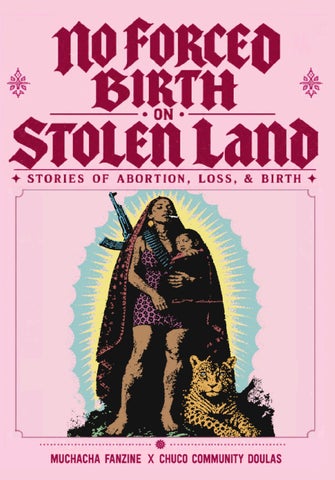
Cover art Cover art by: by: ODODUÁ ODODUÁ (@ododua.aum) (@ododua.aum) Back Cover Back Cover art art by: by: Amir Amir Khadar Khadar (@amir.khadar) (@amir.khadar)
INTRO CONTENT WARNING: These pages touch on abortion, pregnancy loss, stillbirth, sexual assault, reproductive coercion, medical violence, abuse & grief. Please read with care.
Welcome to No Forced Birth on Stolen Land: Stories of Abortion, Loss, & Birth, a collaboration between Muchacha Fanzine and Chuco Community Doulas!
This zine is rooted in reproductive justice, but that struggle has never begun or ended with abortion. The stories in these pages move through abortion, miscarriage, pregnancy loss, birth, postpartum, motherhood, chosen childlessness, reproductive coercion, sterilization, disability, poverty, medical violence, grief, ancestry, survival, and care. They show us that there is no single way to experience pregnancy, birth, loss, abortion, or parenthood. Colonization and cisheteropatriarchy have always depended on controlling bodies, families, land, and futures, especially the reproductive lives of women, trans men, nonbinary and gender-nonconforming people, and others who can become pregnant. That violence stretches from forced reproduction under slavery and the removal of Indigenous children to forced sterilization, medical experimentation, reproductive coercion, and the continued mistreatment of Black, Indigenous, brown, disabled, poor, queer, trans, and migrant people. 1
Reproductive control does not only come through abortion bans. It can look like a doctor ignoring what someone says about their own body, a partner using pregnancy as a form of control, or a society demanding that people give birth while denying them housing, healthcare, childcare, food, safety, rest, and community support. Birth can be sacred and still be painful, frightening, lonely, or violent. Pregnancy loss can carry grief and relief at the same time, and abortion can be an act of survival, love, autonomy, or simply knowing what is right for yourself. Our ancestors held understandings of pregnancy, birth, abortion, death, ceremony, and the spirit world long before settler governments, Christian institutions, doctors, and courts claimed authority over our bodies. One contributor describes abortion as sending a pregnancy back to the spirit world, offering a way of understanding reproductive choice beyond colonial frameworks of punishment and shame. No forced birth on stolen land means no forced motherhood, no forced sterilization, no forced suffering, and no medical intervention without consent. It means having the right and material support to have a child, not have a child, end a pregnancy, mourn a pregnancy, give birth safely, recover after birth, and raise children in communities where they can actually thrive. Reproductive justice is inseparable from racial, economic, disability, migrant, environmental, queer and trans justice, fat liberation, and Indigenous sovereignty. The stories in this zine are filled with grief and rage, but also survival, ceremony, love, and resistance. They remind us that our bodies are not colonies, our wombs are not property, and our futures belong to us. 2
“Migration” by Marissa Rubaiai 3
The Star Who Came Back To Me The star who came back to me It was my 18th birthday and with the wrong person the first time you came to me. I sent you back home to the spirit world, not knowing if you would ever come back to me. Sending stars back home was never wrong to our people. We have medicines and ceremonies meant for this. We knew when the time was right the stars who are meant to come of us will come back. It was my 27th birthday I knew sending you home back then was the right choice, but I still longed for you. This birthday the time was right and you came back to me, my little star.
4
by CozCon
5
To Have Children In A World On Fire: A Short Musing From A Child Of Diaspora by Victoria Villanueva The ocean, the earth's first womb, is boiling. A level 4 standard deviation, never before even reaching a level 3. A state unfamiliar to any human being who's ever lived. A state of which we have little historical precedent and therefore: little ancient knowledge to rely upon. Through the vacuum of our neglect, we've ushered in for ourselves a fledgling alien world and have only just begun to marvel at the wrath of its infancy. It would follow that my period this month was very unfamiliar. It's usually like clockwork: every month it greets me slowly over a day or two at first, then arrives all at once on a morning of its choosing. It almost feels like foreplay, the way it warms me up to prepare for release. This month, it was tardy; it was brash; it came under the cover of night. The quiet dread of its absence, followed by the sudden letting, left me disquieted. Almost felt like being punished; there was a withdrawal of its affection I have come to make a home out of. I can't help but wonder if there's a vicarious energy of a boiling earth leeching into its daughters so severe its manifested in the biological realm. Grief in fractals; as above so below. As it follows, there is a question being asked of me: if the womb of the world is this angry, injured, and betrayed, how can I justify asking more of it, and bring new life into this alien world? 6
The concepts of Puerto Ricans and progeny are inextricably tied. Every womb saved by modern reproductive medicine has a Puerto Rican womb to thank, as it was sacrificed for research. I feel I owe a requital. As hard as colonizers and their descendants have tried to erase us, seguimos aquí. I come from a big family, and the thought of being the end of one branch of a lineage so longstanding rouses rage in my resolve. Why does it feel, as children of the diaspora, as displaced peoples, that we must bend and break to heal and recover all laid waste to by the sins of the oppressors? Why does it feel that all I can contribute in a meaningful way is literally: nothing? Keep my womb bare to keep just one fraction of a fraction of carbon out of the atmosphere? I cannot expect nature to know I am innocent. Carbon does not know who emits it, especially as we spew more of it in our breath, arguing over whose job it is to emit less. As time runs out, the tighter the knot around my hands feels. I cannot ignore the echoing of history in my case: the forced sterilization of my ancestors, and the prospect of a forced hand of self-imposed childlessness for their descendant who survived. To have a womb, to be a giver by design, is to eventually end up robbed.
7
Despite this, I cannot in good conscience blindly bid on such a fatalistic point of view. Like James Baldwin said: I am alive, so I must be an optimist. The outcome of my wildest dreams is just as likely as my wildest nightmares. If carbon doesn't care who emits it, the laws of probability do not care who fears them. The womb is defined by its resilience. By its ability to stretch and be torn. By its forgiveness. The future is written in real time. As we learn, we adjust. Adjust our mindsets, adjust our policies, adjust our environmental outputs. We've seen the devastation compounded fractions are capable of, so we must trust in the flipside of the equation. I have to trust in the wisdom of the crowd: that our refusal to lie down and die is the contribution most meaningful. If we've seen what the dark side of the pursuit of exponential growth looks like, I have to trust in the power of exponential growth of consciousness. Despite my gritted teeth. Despite my empathetic, receptive womb. I don't know if my decision whether to have children has been swayed one way or the other in 716 words. These two world views, I'll have to hold for a very long time. All I can trust is that whichever I choose, I pray will be right on time.
8
BIRTH DEATH + INITIATION by Denise Silva I survived the ceremony of birth seven times Seven times I welcomed a new life inside me sometimes the welcome was joyful, smiles all around sometimes the welcome was shaky, unsure Seven times I felt my insides shift Seven times the ancestor in white met me in the grassy field Seven times I felt bone grind against bone Seven times I bled + felt close to death but didn’t die sweat\ tears \ urine \ amniotic fluid all the holy + sacred waters present, holding me, keeping me afloat my memory of childbirth itself is foggy, distant, much like a fever dream my body grounded in the Earth realm but my spirit faraway in the underworld my newborn’s cries calling my spirit back each and every time I honor my muertos, I honor all the wombs of my matriarchs. I innerstand that they too, tasted death giving birth in the Earth realm, journeying thru the birth labyrinth. When I light my candles + arrange my offerings on the altar, my heart knows my matriarchs also survived the ceremony of birth. They were with me. 9
“Birth, Death + Initiation” by Denise Silva
10
KNIVES OUT by Nenca X. Fierro cw: white medical establishment, surgery, forced sterilization, specific mention of body organs, ableism, fatphobia
White docs in white coats. They wanna get their knives out. "We need to remove the cyst surgically." I can't even sleep from the pain. ACA has existed for a whole few months. I have insurance for the first time as an adult. So fine, get your knives out. White docs don't mention complications. "Hopefully we can save the ovary." But they don't explain any potential problems. No mention of six month recovery time. How would I know what to ask. Day before I tell the anaesthesiologist "I'm allergic to opiates." "They don't work on me and mine." She says "Oh but you haven't tried the ones I've got."
11
Day of and I am given a hypnotic. My brain instantly stops making memories. Is that for their comfort or mine. They get their knives out and slice me down the center. Wake up in pain. Yah, opiates don't work on me. White doc says "You can take a lot of pain." Find out the two white surgeons took both of my ovaries and my uterus out. Fourteen pounds of flesh taken from me. He gives me a high five for "losing weight." They didn't ask or wonder what I wanted. What's a fat brown autistic spic to them. Not even human. Who's the one with no theory of mind. Sterilized. They got their knives out. ----"Don't worry, I left your cervix in." "We can attach mesh to it when your vagina prolapses." Fucking WHAT???
12
by Daisy Salinas 13
JUST BECAUSE by Marta Martinez cw: sexual assault
Because he was my best friend. Because we had had sex on and off throughout college. Because I’m sure someone else has had it worse. Because the first person I told blamed me for letting him sleep in my bed. Because I often let people sleep in my bed. Because companionship felt safe to me. Because of past trauma. Because I always liked him more than he liked me. Because I wanted him to keep being my friend. Because I didn’t want to lose our friendship. Because we hung out after. Because we might have even had sex in the days after. Because I thought we could all just forget the whole thing and not make a big deal out of it if I could just squash my feelings, just squash them. Because I often have delayed reactions to traumatic events. Because of past trauma. Because I wasn’t the perfect victim. Because I like sex. Because he is charming and liked, and I’m not. Because the first person I told said that he was a great guy and she was sure he “didn’t mean it.” Because another friend told me that I couldn’t tell her who to be friends with. Because I wished he had just attacked me in a dark alley so that people would believe me. Because of "gray areas." Because after three attempts to initiate sex that night I finally said “ok fine” at six in the morning before I worked both of my jobs backto-back. Because I judge myself for that. Because I immediately fell asleep after acquiescing to his pressure. Because when I told him I was pregnant, he didn’t ask what I 14
was thinking, he said he’d “handle it.” Because he lied to his parents about why he needed the $150 to “handle it.” Because he came with me to the abortion. Because I waited months before telling my best friends. Because I never wanted my family to know. Because I never wanted anyone to know. Because I didn’t want that moment to define me. Because I didn’t want that moment to be real. Because in the years following, I drank myself into blackouts multiple times a week. Because I could mask the pain and hide amongst the party crowd. Because I had to punish myself. Because of self doubt. Because his name is [redacted] and all my friends wanted to be his friend more than mine. Because right after the incident he moved away and started to become famous. Because everybody likes to know someone famous. Because it crushed my heart and thrashed my ravaged uterus every time I saw a friend share his article in Time Out New York or play his music or post about his next show in town. Because my boss told me to medicate myself when I was so depressed I sobbed at work and took extra long breaks from my front desk position when I couldn’t muster a friendly face. Because he invited me to coffee years later. Because years after that he donated money to my GoFundMe for my medical expenses with the message “much love.” Because the very name of [redacted] is triggering, making it hard to watch movies or read books or meet people with that name without feeling a punch in my gut. Because it’s hard to utter his name today. Because it still gets stuck in my throat. Because of trauma. Because I thought I was too strong to be a victim. Because I was equally ashamed and enraged. Because years went by in a blur. Because I wanted to die. Because instead of going to therapy I yelled at strangers in bars and drunkenly ran into the middle of the street without looking and engaged in other self-destructive behavior. Because he had been my best friend and I didn’t want to lose him. Because I didn’t want him to be a rapist. Because that is some deep and complicated shit. 15
Because I found out he went on to violate many other women after me. Because he has never had to face any consequences for his actions. Because he sent me a weak attempt at an apology on Facebook Messenger that had nothing to do with me. Because I have zero corroborating evidence. Because it’s my word against his. Because I never reported it and after all this time I still remember the pink panties I had on and that when I woke up with him cumming inside me and said “what the fuck,” he responded “oh, sorry.” Because he fucked me raw while I was asleep. Because I never wanted sympathy and needed all the empathy. Because it wasn’t the only time a man treated me like a place to rest their dick when they were lonely or bored. Because this is a heavy burden and I’m tired of carrying it alone. Because after years of therapy the wound has healed, but I will always wear the scar. Because I survive and because our silence has broken and our truths can never be unspoken. I still remember the ham-handed, mustachioed doctor who performed the abortion, the faces of other women in the waiting room, and the falafel I ate that night while I recovered. I remember when [redacted] told my friends I was acting like a martyr for not inviting him to my birthday party. I remember the years of therapy I eventually received, working through handfuls of therapists and modalities to process the event and the emotional toll of being so deeply violated by someone I trusted. But, I also remember the relief I felt for not having to carry his child, raise his child, to be reminded daily of the zero shits he gave for me, my body, and it would seem, for women. I remember how good it felt to need exactly zero therapy sessions for terminating the pregnancy, and none for flexing my fully embodied autonomy by making the choice to end it –that was my salve, my grounding mantra that my body is still mine. And I will always remember waking up this morning, twenty years since the initial event, eight since I outed him, feeling whole, healed, and free of regret. 16
“Earth’s Nectar” DIGITAL PAINTING
by Andrea Galvez Earth’s Nectar reflects on the beauty and natural intelligence of Mother Earth. As she nurtures her children, so does a mother nurse her child with everything that is needed for the child to survive. We are all consciously or unconsciously taken care of by the greater intelligent that keeps us alive. 17
by Maria Elias Heart shaped sounds so cute until it’s your malformed uterus described in that way. I had no clue for years why my menstrual cycle left me bedridden for days. It wasn’t until I wanted to get pregnant that I found out I have a bicornuate uterus and polyendocrine metabolic ovarian syndrome. Terrified of these diagnoses and yearning to be a mother, is what inspired this piece titled “Mi Corazóncito” where I show my uterus in its heart shaped form. Only .4% of girls are born with a bicornuate uterus. It leads to increases in pregnancy complications like miscarriages. PMOS also contributes to infertility. I thought I would never be able to be a mom, but I have modern medicine to thank for helping me become pregnant. I’m so grateful to have access to healthcare so I could take Letrozole and Clomiphene which helped me ovulate so I could conceive. Once I was pregnant, I couldn’t do much. I was bedridden and felt incredibly tired. I now know I also have a connective tissue disorder called Ehlers-Danlos syndrome which makes me hypermobile. I was diagnosed 10 months postpartum due to my chronic body pain. Giving birth happened very quickly and it was due to my hypermobility. I pushed my daughter out in an hour and I’m just still incredibly relieved that it went well. There are cases of women with Ehlers-Danlos syndrome not having the right help they need when giving birth. My doctor was there for the last 15 minutes of me pushing, which was very fortunate, but what if she hadn’t been able to make it? Women deserve more attention and care when it comes to reproductive health. I hope sharing my experience can raise awareness for others that need help.
18
I Never Had The Urge To Give Birth by Amarachi Crystal I have never had the feminine urge to give birth. I mean, I've thought about having children a lot over the years and even set myself a deadline to make a final decision after realizing I didn't mind being a single parent. But I'd be lying if I said I felt like I wanted to experience childbirth. There was no biological clock I could hear ticking, no moment when I looked at a baby. I never imagined a baby growing inside me and had no secret urge to experience pregnancy, labor, or the process of becoming someone’s biological parent. What I did have was an ability to care for children, and those things are not the same. I became a childcare provider and have been in the line of work for over ten years. I not only had the instincts to care for children; I also had the education to back it up. I learned how to hone in on my instincts when it came to anticipating needs, preparing meals, calming crying children, negotiating disagreements, creating routines, cleaning up messes, answering endless questions, and making a child feel safe enough to fall asleep. People may interpret this type of care as a sign that you want to have your own children, but caring for others does not imply a desire to reproduce. I can love children without having to give birth to them, know how to nurture them without wanting to become pregnant, and be deeply invested in their well-being without believing that parenthood is supposed to be my life path. 19
Living in poverty has made that distinction even more important. There is something particularly cruel about a culture that romanticizes parenthood while refusing to acknowledge the material conditions required to raise a child. Love does not pay rent, buy groceries, or provide healthcare. Love does not erase exhaustion, housing instability, childcare costs, lost wages, or the countless ways poverty makes caregiving harder.
We tell people that they should have children because children are a blessing, but we rarely ask whether the person giving birth has the economic freedom, support, safety, stability, and autonomy necessary to raise one. The question shouldn’t simply be… Do you want a child? It should also be… Can you afford to raise one? Will you have somewhere safe to live? Will you have support? Will you have access to healthcare? Will you still have control over your own life? And perhaps most importantly, did you actually choose this outside of societal or familial pressure? As a childcare provider, I’ve also thought about fostering, giving children who don’t have biological parents in their lives a transitional safe space to live in order to find them a permanent home or until they enter legalized adulthood. I may not want to experience childbirth, but I value the role of a caregiver, or as I call it, “surrogate parenting.” I believe parenting through fostering will teach me that parenthood does not have to begin with conception. Children can enter your life without ever having grown inside your body. You can become responsible for children without claiming ownership of them. You can love children and at the same time understand that your role may be temporary. You can provide stability for children without pretending that you can erase everything that happened before they arrived. 20
There is something deeply rewarding about caring for children and knowing that love does not necessarily mean biology or even possession. Sometimes parenting means creating enough safety for children to eventually move forward without you. That challenges one of the assumptions I was taught about parenthood: that the ultimate expression of parental love is biological attachment. It truly isn’t. I believe that parenting is a relational act. This is an act of responsibility, consent, and compassion and even sometimes an act of letting go.
My relationship with children has never required me to become a birthing person. I don't need pregnancy to validate my capacity for care. I don't need biological parenthood to prove that I am nurturing. I don't need to experience labor to understand what it means to labor for someone else's wellbeing. I also don't believe that a person's reproductive ability creates an obligation to use it. There is freedom in saying, "I still want to care for children, but I do not want to give birth.” There is also freedom in saying, "I don't know if I can afford parenthood, so I don’t want any children at all. But I can find other ways to ‘parent’ differently.” For me, reproductive autonomy isn't only about the right to refuse pregnancy. It is also about being able to define what care, family, and parenthood mean outside the expectations imposed by my body. I can be a caregiver without becoming pregnant, be a parent without giving birth, love children without wanting my own, and acknowledge poverty without romanticizing struggle. Overall, I can live a life that does not require me to reproduce in order to feel fulfilled. My ability to care for children was never an indication that I was meant to give birth to them. It was evidence that caretaking was something I could choose. 21
“Depiction of the Virgin Mary” Acrylic on canvas by Luz Suarez
22
But Having A Baby Is Sacred by Itzel Abrego cw: sexual assault
“But having a Baby is Sacred”, the lady shouted to me as I entered Planned Parenthood to confirm that I was pregnant at the beginning of March 1995. I was 16 years old, newly married to my husband, who was currently away serving in the Navy. I was living in Imperial Beach, California, in a studio apartment by the beach that I never left. I was scared. Of everything. I had no friends, no family; the nearest relative was over 2,000 miles away, and it had been three months since my last period. My “husband” was 21; he was supposed to help me with these things. “Okay, Mrs. Lira, the results of your pregnancy test are positive, and we would like to schedule a follow-up with the obstetrician on staff. You can schedule that at the front counter on your way out.” I walked right out without scheduling, running for my life past the kneeling women praying for the women inside getting free healthcare. ‘But having a Baby is Sacred”, my first husband continued. We were separated, but I had a moment of loneliness and weakness. Being a single mom to a nonverbal child wasn’t easy, and it was so expensive. I was 21, and I was almost finished with my associate's degree at Community College. This was a huge feat for me, and it brought me closer to providing for my child and me on my own. I was supposed to transfer to a four-year college to complete my Political Science Bachelor’s. I guess it’s a good time 23
to bring a new baby into our family. He promised to get his life together and take care of me. “We’ll need to have you sign this waiver in case we run into any issues after delivery from your husband’s stitch.” My Doctor revealed to me while I was in labor. “Excuse me, what? What’s a Husband’s stitch?” I asked in confusion. “A husband’s stitch is a surgical procedure in which one or more additional sutures are used to repair your perineum after it’s been torn during childbirth. Your husband will thank you for getting it done. It’s very common after an episiotomy.” “Okay,” I acknowledged and signed the waiver while I was giving birth to my 2nd son. “But having a baby is Sacred!” said the Medical Practitioner at the free clinic that offered free pregnancy tests. “Please wait here and watch this important film about your baby while we wait for the results of your pregnancy test.” She continued. I was 22 years old; I had given birth to my 2nd child less than a year ago. I was trying to get out of my marriage with my first husband because we were broke, and he didn’t care. I was scared and anxious. I can’t afford to have another child right now. I don’t even want to be with him anymore. I HAVE to get an abortion. “Are you scared about the miracle growing inside you? 18 days after conception, your miracle already has a beating heart! (fetal heartbeat noises) By 10 weeks, your baby has over 1 billion cells that will map out their traits from Mommy and Daddy, and just think: at this stage, he or she will have the DNA input that will determine whether he or she will have your eyes or Daddy’s smile. (baby cooing noises) And at 12 weeks, your baby will have their own unique fingerprints! Having an abortion means murdering a potential doctor, world leader, or even the president of the United States! Here’s what happens inside the womb to your baby when an abortion is occurring….” I immediately shut off the TV. Are they fucking serious? I immediately started crying. “Oh, I’m so sorry. I know 24
this can be a very complicated video for some people.” The Nurse Practitioner returned to the room. “But I have the results of your test right here, and it looks like you are pregnant. Congratulations!” “I can’t afford to have another child; I can barely afford the two that I already have. I can’t have this baby.” I explained, in tears, to the Nurse Practitioner. “Oh, we understand, and we get many women under the same stress; that’s why we can offer you a year’s worth of diapers, formula, clothing, and baby furniture.” She said with a disconnected grin. “Do you really want to murder your baby? You said you had two boys; what if this is a girl?” She was right; I did have a girl, but they never provided me with shit, and after finding out about my husband’s infidelity because of a bacterial STI, I tried to get my tubes tied. To which my doctor said, “Well, that might be impossible. In the State of Texas, you have to be over the age of 25 or have more than four kids. You’re only 22. Why do you want one so badly?” “Because my husband won’t stop trying to get me pregnant, and I’m trying to leave him.” “Oh, well, that’s unfortunate.” My doctor didn’t bat an eye. “Well, what if you decide to remarry and your next husband wants a child? It’s not reversible, you know.” What am I, in the 1950s? No, I’m just in Texas. “BUT HAVING A BABY IS SACRED!” He begged me. He was supposed to pick me up to take me to my abortion appointment, but instead he picked me up from work with all of my children in tow. “Your Mom is pregnant, and she wants to get an abortion. She wants to kill your baby brother or sister.” My first husband told our children this. My oldest was 7; the other two were 2 and 1. “Noooo!” My eldest began to cry, and my other children cried too. I stood outside our car in shock, watching my kids cry and my husband with a shit-eating grin glaring at me. “See you, you can’t do it now,” he snickered as I entered the car. Eight months later. “I 25
wanted them cut off, seared off; I don’t want them to work again! I’m almost 24, and I have four kids. THIS ONE was made after he raped me for 15 hours, and I couldn’t go through with the abortion. So can you please make sure I can never get pregnant again?” It was the first time in a long time that I actually spoke up like that. I felt a fire in me that I had never felt before. I felt like I was fighting for my own life. I was so mad I was shaking with angry tears. “Okay, I’ll put it in your chart.” My doctor wrote it in my chart, and on August 23rd, the day after I had my youngest, my tubes were seared. The baby factory was closed, and he could no longer get me pregnant to keep me from leaving. Because the State of Texas will not allow divorces for parents with children under the age of one. I love my children, all four of them, and I’m grateful that even under the intense circumstances they were brought into, I protected them and continued to love them throughout all their childhood. They are sacred, but I wish I had a choice about when to bring them into this world. Because they deserved better than a 1-bedroom apartment with scarce food and poor conditions. They deserved a chance for their mother to grow up, become an adult, and bring them into a happy situation. Because eventually I met the woman of my dreams, and she did want a baby; she wanted a family, and that was stolen from her by someone who wanted to hurt me and harm me. He robbed that from me and my children. Having a baby with her would have been sacred. We both would have been mature enough to raise children together, with two careers in a home that brought them love and a family happy to raise them in a community filled with love and compassion. That would have made having a baby sacred. The end.
26
by Daisy Salinas 27
EN MÍ WOMB by Karina De Love In the light of becoming a woman in the fifth grade at the tender age of twelve, I remember getting my period like it was yesterday. From the beginning of fourth grade, we began to learn about sex education and the reproductive system. I recall being fascinated with human anatomy. I was so excited to get home and have my mother sign the permission slip. “Ama! They are going to teach us about the menstrual cycle at school and talk about the women and men parts!” I told my mother, super excited and eager to learn. My mother, who gave birth to me at a very young tender age, 16, had her traumas and was dealing with her cards, gave me a look of discontent and disgust. Rolled her eyes at me and didn’t say anything. We walked in silence all the way home. As the school seasons continued, I was not as excited to share with my mom anything regarding womb care. The morning of, I went to the bathroom and noticed a tamarind color and paste-like matter as I cleansed and felt very tired. I freaked out. I went to my mother and as I was sharing with her, she looked at me with that look of disgust and discontent, and said “you got your period.” I started crying! My mother then said,”Why are you crying?” “You begged to learn about this and now you’re acting like it's the end of the world.”I was handed a pad and was told to place it on my underwear. At that moment, my father walks in through the front door, getting home from his night shift, and we shut it down immediately. My father, being the intuitive, asked us “what happened?” and my mother said nothing, she had a stomach ache, and looked at me with her hateful eyes and said “go get ready for school now, you’ll miss the bus.” Something in me shifted. That day, I wore a dress uniform, below my knees, and felt ashamed. I learned how to 28
care for myself during my period all along. At a young age, I felt like sharing my vulnerability was looked down upon. So. I never asked for help. I began to get my period every 2 weeks, the cycle would last for 1 week. My towel was used to cleanse myself, and I recall being embarrassed that it had blood! I went outside and washed it off with the water hose, as my mother looked at me with a smirk. One day, during sex ed class, which I forged my mom’s signature to join, laughing out loud, the nurse asked us to write down our questions. I shared that my period lasted 1 week and every 2 weeks I was getting it… The nurse read my question and suggested I let my mother know so they could take me to the doctor. I hated going to the doctor, so I kept it to myself. Turns out, my mother knew and she figured my body was changing and my period would become normal. As the seasons changed, and I became more confident and outgoing, my life felt good. One day, I left a pad in the bathroom and my father found out I got my period. He asked my mom whose pad it was, since she is not hers. My mother let him know it was mine. When my mother confronted me, she was so disappointed and let me know that my dad knew I started my period and that it’s my fault for leaving my pad out. She rolled her eyes at me and looked at me with the same look. I was ashamed and embarrassed to be around my dad from that day on… In the beginning of Spring of 2018, I conceived for the first time in my 38 Springs of life. The day of, my ex and I went to dinner and had margaritas. We got home and had sex and I remember feeling the moment it happened. In my womb. Few weeks later, I get my period, but it was too soon. I knew it, I got at home pregnancy tests, and they were all positive. I shared with my ex, and the reaction was normal. I, on the other hand, was already planning an at home birth in water! We continued to have margaritas and I continued to smoke. On the first doctor visit for an official pregnancy test, the questionnaire had questions related to financial abuse, and emotional and mental abuse, all 29
which I lied too. I felt the need to protect my ex but in my heart, I was not sure about having a child with this man. We went to Champs and got baby Air Force one and had the reveal in mind … When we got to the register and they rang us up, my ex was upset about the price and exclaimed, “Damn, this is the price for infant shoes!” Since I was not working and depending on a man, I put my head down and looked away. My ex had the same look of disgust and disappointment on his face towards me too. I decided I need to work and make sure I’d have funds to get my baby what he/she needed. I had a name for a girl and for a boy. We continued to go out for margaritas. On a particular day, I was Ubering and felt extremely fatigued and ready to nap but disregarded my body's needs and pushed on to work, making food deliveries. On the 3rd doctor’s visit, we arrive at the clinic, check-in and take a seat. My ex went with me to this appointment. When we entered the check-up room, a nurse came in and performed our first ultrasound. Since I am the eldest of 6 daughters, I recall knowing that we’d hear the baby's heart beat during the ultrasound. When the nurse covered my womb with lubrication, and put the medical tool on my stomach, we looked at the screen, and there was dead silence. No sound, no movement, time stopped for a second. I knew it, I knew my baby had given it’s heartbeat for me. During the few weeks of pregnancy, repressed memories surfaced and trauma of my upbringing reappeared. I cried in the room and asked the nurse, “where is the heartbeat?’ The nurse with tender eyes, informed the OB would be in shortly and talk to me. I was offered the choice of having the fetus removed or allowing it to happen naturally. I opted in for the natural birth of a stillborn. We headed for margaritas and had some food. Few weeks later, I’m woken up by an extreme cramp in my womb and the birth of my baby had arrived! My ex laid in bed, and when I shared with him that I think it's happening, the discharge of our fetus, he groaned and went right back to sleep. I was all alone, The little girl was having her first child, all alone and in pain scared. 30
The mini contractions felt out of this world! The pain in my womb felt like my pelvic floor was opening and dilating and as soon as the fetus came out, I felt relief. My body was at ease. I showered and went back to bed, My ex, got up and went to work like nothing, no call all day! I thank god for not having a child with that man, every day. Nowadays, when my womb is bleeding, during my inner winter, I’m in rage, in despair, the empty uterus and unfertilized egg give me so much grief. The sadness of not reproducing life into my womb gets me depressed. The Winter in my cycle becomes a rain on my parade. The anger and the sorrow of all the trauma connected to my womb is a reflection of the lonely person I am. Attempting to quench a thirst that is not there is exhausting. I write and create- take care of my garden, get lost in the kitchen, meditate, yoga, hum and sing. While nature walks seem to make my heart ache less and less. My hibiscus tea, turmeric and ginger water, proteins in salmon and eggs, all for her womb care! My hips sway to the melody of my erotic nature, as I love on my womb and hold her dearly. The way my hips move to the music and sway side to side, round and round, my kundalini rising. In the Spring of my womb I become alive. Waves in my body of movement the warmth to my womb. As my hands glide up and down and feel my curves. I’m so thankful for my womb and my body. The orgasmic pleasure I feel towards life comes from my womb power. My pu$$y Power. Making love is orgasmic and brings joy to my womb. Easy to decipher who to allow in me and Not! Today, my womb bleeds and I honor my being. Today, my womb bleeds, I make sure I have my cacao cinnamon tea beaming Today, my womb bleeds, my tears Are of life and creation Today when my womb bleeds I sleep and have orgasms - Karina De Love 31
“The Cosmos is a Womb” by Anisa the Àjẹ́ 32
MY DAUGHTER LA COATLICUE (for my daughters)
by Alma Rosa Azul They say when goddess Coatlicue was first excavated / She was so fearful/that they placed her back into the ground she was found in/ She was left hidden for years Her face was made of two serpents/ and this accelerated the heart of anyone who stood beneath her. You my daughter/ you for me/ are my Coatlicue/ This male doctors eager hands/ ready to take you out of my soil/ He will unroot you from me /This I know and I accept/ But I hope when his hands touch you/ I hope he looks at you with fear I hope every man that comes your way/ is filled with pure terror at the presence of your spirit/ My serpent child/ wear that skirt of snakes!/ let them hiss at any man who tries to exhibit you as a stone attraction to look at / for these men will always try to normalize your magic Now listen to me carefully mi corazon/ because every woman needs to know this/ Any man who hollers at you down the street/ who touches you without giving you proper ritual I hope you give them destruction/ I hope you wear their hearts as a necklace to adorn your collar bones with/ I hope you curse them for a lifetime 33
“La mascara de la madre” by Rubi Hernandez This piece juxtaposes soft, tender intimacy with warrior-like resilience. A mother, wearing a lucha libre mask and bearing nails piercing her skin, cradles her sleeping child while nursing. The mask speaks to the hidden battles of postpartum life—the quiet fights against pain, exhaustion, and identity shifts—while honoring the fierce, protective instinct that motherhood demands. The physical strain shown in her posture combined with the gentle hold on her baby highlights the duality of maternal strength: vulnerable yet unyielding, bruised yet fiercely present.
34
A whistle of our own I remember running excitedly from the house entrance all the way to my parents’ room, to the crib, looking for the little baby, the infant. A beautiful baby girl who smelled so good. I was in 6th grade, 11 years old, and this baby was my youngest sibling. I loved to pick her up. I loved carrying her around the house. I always wanted her to want me as much as she wanted my mother. My mother breastfed all six of her babies, and now I know that the bond between a parent and the baby they breastfeed is almost unbreakable. What an amazing experience it must be, a baby from your body that seeks your love, your closeness. Before her, from ages 8 to 11, I had experienced the love and care for another baby: my baby brother. He was also adorable. I enjoyed taking care of him, too; he was cute and funny. I loved those two babies the most. They were my babies, too. Even before they were born, my mother would always speak highly of me, her so helpful and dutiful daughter. She always praised how much I cared to help her around the house. She would tell stories that I did not remember because I was very young. One of those stories is of the time my younger sister, who is only a year younger than me, was sick. She was probably around 2 or 3, and I was 3 or 4 years old. It was only us two back then. My mother was getting everything ready to take my sister to the doctor. When she came back to get us ready, she says I had already put on socks and shoes for my sister, besides putting on my own. By 8 years old, I had 4 younger siblings, and by 11, we were 6 children in total. By 13, I was already working in my parents’ laundromat every weekend, babysitting all my siblings at once, cooking, cleaning… During my teenage years, my relationship with my parents became tumultuous, indifferent at best, abusive at worst. I never knew I was a bad child. I only found out when my parents told me they were terrified the rest of their kids would be like me. I was a child that was hard to love. By 17, I was eagerly waiting to turn 18, graduate high school, and leave my parents’ home. By 23, I had graduated college and was a 15-hour drive away from them, going to graduate school. Every single time I got to visit my family, my little sister and I would cry during our goodbyes. I always felt I had abandoned her. Then, in 2014, one night in Chicago, I got heavily drunk with a couple of friends and for some reason felt this intense guilt and fear. Guilt about leaving my little sister with our family, and fear that she had experienced something terrible. I did not know it back then, but in 2020, at the start of the COVID pandemic, after deciding to move from the Rio Grande Valley to El Paso, I found out that my little sister had been sexually abused for years by one of our brothers, and my mother knew about it. My worst nightmare came true. Why did he do that? Did he experience something similar? Why hasn’t my mother done something to keep him away from her? How is she even surviving? It was my fault. I knew something was happening (or would eventually happen) and I abandoned her. My tiny little baby sister, I left her there. I abandoned her. It was my fault. Six years have passed since then, and I still feel that guilt.
35
I have tried my best to support her in every possible way: give her a better car, enroll in college classes, take her dogs and cats to the vet across the border, get her in therapy, apply for a mortgage, etc. I am more than happy to do that for her; I imagine it is what a parent would want to do. Unfortunately, our parents have failed in their duty to protect her. They have failed to love, cherish, and honor the sacred duty of raising daughters. I once read that parents with daughters are taken care of into their elderly years. I do not want my little sister to ever feel like it is her duty to care for parents that chose their abusive son over their abused daughter. I want her to live her life without the burden of surviving child sexual abuse. I know she will never forget what happened to her, but I will be there, her oldest sister, to help her heal. To me, she is still the little baby girl that sometimes would call me mama. I recently saw a video of Mexican families having their own call that is whistled at each other. My family has its own whistle. I remember all 8 of us being at a Walmart or a theme park. Grabbing something I wanted to buy or window shopping and hearing a faint whistle, still a bit indistinguishable, but as I paid more attention and focused on it, I could clearly recognize it. The sound of my parents calling us back. I thought everyone had one. I am left with the realization that while I may not have a baby of my own whom I can teach my family’s whistle, I have my sisters. We have each other, and we too use that whistle to find each other. It does not erase the abuse we have endured, but we too are worthy of our culture, of that connection to our family. And who knows, maybe we will be the caretakers of that tradition and pass it on to the next generation, but this time without the abuse and trauma.
36
ABORTION IN THE TEXAS HEAT Xtna Dolores Luna cw: sexual assault
What do I know about growing up Latina is not much, but what I can tell you about becoming a Chicana is plenty, But later. I grew up loosely a cradle Catholic and as a result of my devotion wrote a lovely piece for one of my high school English classes on why abortion is murder. I guess I didn’t know in a few years I’d end up being the teenage girl who needs one, gets one, and only ever so often looks back. I am a first-generation Latina, but my mother came to the States when she was five. She grew up in East LA, then she married her high school Chicano sweetheart and stopped speaking Spanish. The only time my mother spoke Spanish was to my abuelita and my tias. She says it was to protect her kids, but I think it was more like she didn’t see the value of her language. I grew up on military bases around the world because both of my parents were active duty for 20 to life. I was an immigrant overseas, and it was the only time I have truly felt like an American. Back in the States it becomes a game of, Where are You From? Here? No, I mean like where is your family from? And even your educated friends get tired of being reminded of how my peeps have been here before your peeps. By the time I graduated from John Marshall High School in San Antonio in the nineties, I was on my way to becoming a recovering Catholic. When I met my boyfriend who knocked me up I thought I’d found the perfect guy. A military brat like me, half-Latino good looks, straight from an army base outta 37
Germany, and understood what it was like to live your life on the fringes of the Latino communities that we visited, like they were someplace exotic, but we had roots there? Today you would call us, Yo Sabo kids. San Antonio in the late eighties, early nineties is a whirlwind of sultry nights getting up to the best, no good, stumbling in and out of underage dance clubs, smoking pot, going to shows, drinking shit alcohol, thrift shopping, working shit minimum wage jobs, tripping on acid, having sex, and getting an education. When I graduated high school, I was 18 and a few weeks into my summer I had everything figured out for what my post-highschool life was going to look like. In the fall I was going to UTSA to get my business degree and my boyfriend and I were going to move out and get an apartment. My birthday was at the end of May, graduation was at the beginning of June, and I realized I was pregnant at the end of June. Details allude to how I told my boyfriend about the pregnancy, how we decided on an abortion, all of that. Many things that I remember only now make sense, because I have had two children of my own since that time. I understand more of the process that I went through. Abortion in the nineties was legal in Texas, and there was a Planned Parenthood less than ten miles from us. Although I had a date for the medical procedure, my super reliable boyfriend still went off the deep end and bailed with his friends to the lake, where I couldn’t get a hold of him, because this was the nineties. No cell phones. In the meantime, I started having a miscarriage, and my parents were out of town. I got myself to the clinic on base and knowing that my boyfriend's parents could get on base I called them. Hey, surprise! Your son’s girlfriend is pregnant! The ER doctors are performing sonograms, talking about miscarriage, 38
and the need to schedule a D&C. I didn’t understand what they were saying, and my boyfriend’s parents didn’t give a fuck. I went home and my boyfriend called me soon after. I’m not saying I knew how to get him to call me, but calling his parents was not an accident. The day of the abortion I don’t remember if there were protesters or not, but I am leaning towards yes; it is Texas, after all. I do know that I drove us to the clinic in my car, because this guy didn’t even have a car. But I thought it was so sweet that he was there to walk me in and sit in the waiting room with the hodgepodge of s.o.’s. My name was called and I was taken to a sterile room to have my vitals taken and told to get undressed. The procedure began with me in a gown, naked from the waist down, feet in stirrups, and the doctor saying, “This will hurt like bad menstrual cramps” as the nurse put a mask over my face and told me to count to something. Why do they say that? Because it is always so much worse. Despite the gas, it felt like a suction sucking to the point of pain and rawness and then there is a POP! or did I imagine that? e dance clubs, smoking pot, going to shows, drinking shit alcohol, thrift shopping, working shit minimum wage jobs, tripping on acid, having sex, and getting an education. When I graduated high school, I was 18 and a few weeks into my summer I had everything figured out for what my post-high-school life was going to look like. In the fall I was going to UTSA to get my business degree and my boyfriend and I were going to move out and get an apartment. My boyfriend was so sweet after I was released to go home with some cryptic After Surgery update about the pregnancy being a positive-negative. Thank you for the very efficient D&C Planned Parenthood. My boyfriend drove me in my car to the grocery store, so I could pick out and buy my own maxi pads and Ibuprofen. He let me sleep off the gas effects for a few hours because it had been an early morning, and then he fucked me, 39
despite me expressing no desire and the clinic saying it would be painful and recommended refraining from it in the near future. Can I call it rape? Nah, older me is not proud that I capitulated to his want, because it was easier than having him sulk, but older me does have some thoughts on the whole thing. I’m not proud to say that I stayed with that cheating cad for another year, but I am proud that I had an abortion. I was an 18year-old Latina in San Antonio, Texas, and teenage pregnancy numbers in the nation were coming down, but Texas is different. I am so lucky to have found myself in the position I was in at the same time that abortion was legal in Texas. Then Democrat Anne Richards who strongly believed in female reproductive rights was leading the helm as governor of traditionally red Texas. I spent years questioning myself about my abortion and feeling bad about it, but then I realized that I didn’t feel guilty about choosing to have an abortion. I felt bad about letting myself get into that position where I needed to make that choice. I don’t fault anyone’s reason for needing an abortion. I was a kid who was on the pill, but partied a lot so who knows if I took all of my pills, and what was I using at the moment? I wasn’t going to bring a child into the world with parents like us. I am 52 and could totally handle being a mom to a 34-year-old millennial, but 18-year-old me was not ready to be a mother. And all that bullshit that the Pro-Lifers use, saying that having an abortion will leave you sterile. I have had two children since. A clean and efficient, albeit slightly more painful than menstrual cramps, procedure from Planned Parenthood will ensure a safe from sterilization result. Backdoor abortions with a hanger? Will Not. And would you believe that having an abortion actually led me to a trad wife existence albeit in a non-conventional manner? After I had my miscarriage/D&C/abortion my relationship slowly 40
deteriorated and I finally said, Goodbye! I skipped the country, joined my parents at their duty assignment in Japan, and met my airman husband, who shows me what a healthy, fun relationship can be like. We have two kiddos, and for a time I was their stay-athome mom/wife, before I went back into the workforce and into the public schools. My children are adults and support female reproductive rights, because they know why I am vehemently outspoken about this topic. My husband was assigned to San Antonio in 1996 and I finished that degree I left undone when I had left Texas three years before. We didn’t live too far from the Planned Parenthood, I pointed it out once when my husband and I were driving by. Now I saw it for what it was, not a place of shame, but a place of liberation. When we left San Antonio in 2003, I was pregnant with my first child and receiving care at the same military clinic where I had begun my miscarriage eleven years before. Only 30 years after I had the ability to make a life altering decision and the same choice has been taken away from women. In 2022 Texas made abortion illegal. Doors are being closed, and lives are being lost. A woman in her fifties doesn’t have time to be upset at the woman who was 18 and made a decision for her teenage life that best suited her at the time. I made a decision as a young Latina still finding her voice and now as a Chicana who has found that voice I am using it to be as vocal as possible about the harm women and children suffer when women are not allowed full autonomy over our bodily choices.
41
A Birth Reflection On Cultural Longing, The Labor Of Becoming, Connection & Depletion… by Eztli Amaya What happens when a culture that understood birth as communal, sacred, and embodied is replaced by the system that treats the baby as an event, the body as a machine, the mother as someone who should simply carry on? Bringing my baby into the world, meant confronting what I had been missing. Not just a new family member, but a whole culture. I wanted my people, my chosen family to have a sacred moment in time too. We need the kind of care that doesn't need to be explained, the care that reaches us all when we experience life or death. Our bodies can carry medicine or poison, either one, it comes with great responsibility. Nourishment is key to keep carrying or to dispose of. And what kinds of nourishment do we get in this system? Everyone wanted to know about the baby. I wanted them to ask what happened to me, how is my journey…. There is a certain loneliness, yet deep connection in needing to be cared for while being responsible for keeping someone else alive. It’s a SAD LOVE. I am learning that something can be sacred and still feel uncomfortable. Feel powerful yet feel lonely. Be in love with your baby, but be disappointed in your communal environment. I am learning that nourishment cannot only move in one direction. Nursing fulfills your baby, it supports your body long-term, yet feels depleting, mentally draining. I remember the connection of mind and body, the importance of nourishing both. Maybe postpartum is just a sacred as birth, it shouldn’t be something a woman survives quietly. Healing and recovery intersect but they aren’t the same. We do both after birthing, but the ultimate change is BECOMING…. 42
About the
Contributors Alma Rosa Azul is a Xicana feminist, anarchist, community organizer and mother. She is the author of Mariaposa- poems of love and liberation, a collection of radical anarchistic love and political poems published on Riot of Roses press. She has organized many things for many years but is currently one of the organizers of Pachamamas, a monthly mothers talking circle in San Bernardino, Ca. She is dreaming and also learning about how to create a more safe spaces where mothers, femmes, and children can live freely.
Amarachi Crystal is a Nigerian-born, New York City-raised creative entrepreneur and multidisciplinary creative whose work explores culture, identity, mental health, and liberation. As a lifelong creative, she works across mixed media, graphic collage, and writing to create visual and layered stories rooted in lived experience. Her work serves as a subtle yet powerful form of protest, with a particular focus on Black feminism, women’s empowerment, and the beauty and complexity of womanhood. Through her creations, she invites viewers and readers to reflect, connect, and engage with the personal and collective stories that shape us. Amir Khadar is an image-based multidisciplinary artist from Minneapolis, MN. Their work spans publication design, poster design, illustration, creative direction, and textile art. Amir's work engages art and design as liberatory force, collaborating with nonprofits, grassroots organizations, and communities such as the ACLU, Initiative Sankofa d’Afrique de l’Ouest, the Astraea Foundation, the Black LGBTQIA+ Migrant Project, and the Movement for Black Lives as an artist, strategist, and designer on projects that create visual language for immigration justice, environmental justice, LGBTQIA+ issues, prison abolition, racial violence, and their intersections. Anisa is an Afro-Indigenous artist, astrologer, and mother. Denise Silva (Xicana | Hopi | Mescalero Apache) is an indigenous femme artist storyteller from the Inland Empire. She embodies the creative as a painter, illustrator, writer, OG blogger + curator. The artist has been reclaiming matriarchal, ancestral ways of being + knowing, building a strong creative narrative with her paintings, giclee prints, digital illustrations, zines + writings as Pearmama since early y2k. Her work is intentionally woman-centered + Earth-centered, rich with sacred symbols, bold figurative shapes, plant magick, ancestral veneration, dreamlike color stories + divine feminine mysticism.. Eztli is a proud mother who has experienced life, loss, termination in her reproductive autonomy. Her identity is not reduced to just a mother, carrying the sacrifices and sacredness of our Indigenous lineage, we steward community care, hoping to live in a world where sharing photos of her kids isn’t dangerous.
43
Itzel Tochtli Abrego is a Two-Spirit Native American from Yanaguana (so-called San Antonio, Texas) from the Tap Pilam Coahuiltecan Nation. Currently based in Oakland, California. They hope to use their personal stories and art to document Queer Chicane life of their generation for future generations. She hopes her stories encourage others to preserve and continue to fight so that we can change our generational curses into generational wealth. Karina De Love is a poet, artist, and lover of life. A holistic wellness approach to life, she declares her love to Mother Nature and healing from past trauma, grateful for everyday she holds her womb. Maria Elias, born in 1999, is an interdisciplinary artist. In her artwork, Elias explores themes such as her identity, culture, mental illness, her vision of the world, and social injustices and inequalities. Growing up Mexican-American, she witnessed her immigrant parents face inequality and navigate difficulties in life, while also experiencing the beauty of her Mexican heritage and culture. All of these experiences have inspired Elias to raise awareness for the disparities her community faces, while also providing nuance and understanding for Mexican culture in her works. Ultimately, Elias hopes to share her culture and experiences with the world, in order to raise awareness of the struggles, but also the joys, that are an inherent part of the Latine community. Marissa Rubaiai is an interdisciplinary, LGBTQ+, Assyrian, and Mexican-American artist. Her work is deeply rooted in memory, personal experience, healing and human connection. She holds a BFA in studio art from Michigan State University and currently works in the Detroit community. Through her interdisciplinary practice, Marissa continues to explore the intricate relationship between emotions, people, places, and objects- how they intertwine to shape who we are and how we navigate the world. Marta Martinez (she/her) is a queer, Chicanx, disabled femme from San Francisco. She is interested in writing memoir and creative nonfiction, and is currently based in North Carolina. Nenca X. Fierro, an autistic/ADHD, severely disabled, and chronically ill Indigequeer Xicane, is a multi-discipline-breaking designer, artist, writer, and producer. Xen is passionate about community building, disability rights, Indigenous self-determination, dogs, and resting. Originally from Guanajuato, Mexico, and now based in California, Rubi Hernandez is a multi-disciplinary artist. After relocating to the U.S. in 2011, she turned to visual expression to bridge the gap between cultures. Her work investigates identity and social issues, serving as a powerful voice for thoughts and emotions that transcend the spoken word. Hernandez holds a degree in Studio Art from CSU Long Beach and strives to create art that expands the viewer’s perspective. Victoria Villanueva is an artist and writer living in NYC. She's obliged to share her perspective if it means helping others.
44
About the Editors Bella Luna (Bey-ah) (She/her/ella) is a xicana, full spectrum doula, and certified lactation counselor in the borderlands of Chuco (El Paso), TX. She is a mother, breastfeeder, and gamer. She created her first zine focused on hand expression during incarceration/detention, and hopes to create more. She is 1/2 of Chuco Community Doulas. You can follow her work on @xicanadoula on Instagram. Catalina Camacho (she/her/ella) is a full-spectrum doula and reproductive justice advocate rooted in El Paso, TX. With a background in neuroscience and microbiology, she bridges scientific rigor with trauma-informed, compassionate care for birthing people and abortion seekers. Her work is deeply shaped by lived experience as a researcher, educator, and four-year patient navigator, supporting hundreds of abortion seekers with logistical and emotional care. She loves the desert, video games, movies, growing plants, her animal companions, and dreaming of a world beyond borders and empires. Follow her work on instagram @chucocommunitydoulas and @desertflamedoulaservices Chuco Community Doulas is a collective of doulas fronterizas providing essential reproductive and family care in the El Paso region. They operate at the intersection of healthcare and social justice, grounded in the principles of mutual aid and solidarity. As brown Mexican, queer, disabled, sex-working, and parenting community members, they understand crisis and oppression firsthand, not as abstract concepts, but as personal and community history. This grounds their harm-reduction, trauma-informed model in profound trust and solidarity. Daisy Salinas (she/her) is a Xicana feminist zinester, punk, activist, & rabble rouser living in Yanaguana aka San Antonio, Texas. With the mission to uplift the voices and talents of artists of color, Daisy is the founder of the Native Xicana feminist zine Muchacha Fanzine and the feminist punk collective Xingonas in the Pit. Through her art and the work of fellow people of color, Daisy aims to advance struggles for liberation on a global level. Follow her work on Instagram @muchachafanzine and @xingonasinthepit – or support ongoing publications and projects by subscribing at www.patreon.com/muchachafanzine. Published October Published October 2026, 2026, Yanaguana Yanaguana (SATX) (SATX)
45
RESOURCES Pregnancy Justice 212-255-9252
All Options talkline 888-493-0092
Repro Legal Helpline 844-868-2812
Miscarriage and Abortion Hotline 833-246-2632
Reprocare Hotline 833-226-7821
I need an A
(www.ineedana.com)
Plan C Pills (www.plancpills.org) 46