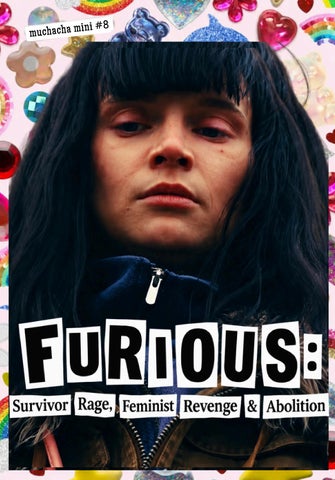
m u c h a c h a m in
i #8
Trigger Warning: Mention of Sexual Abuse
Welcome to Muchacha Mini #8: Furious: Survivor Rage, Feminist Revenge, & Abolition. I finished Furious on Hulu and immediately knew I had to make a zine about it! As a survivor carrying a lot of rage while still trying to imagine what real justice can look like and how we can prevent gender based violence before it happens, this show hit something deep in me. Creator Elizabeth Meriwether refuses to make women’s anger respectable, palatable or easy to swallow. Instead, Furious gives survivors space to sit inside that rage without softening it, sanitizing it or turning it into something easier for everyone else to stomach. As a survivor, Furious made me feel powerful because it never asked survivors to calm the fuck down. It doesn’t give us the sanitized version of the “survivor story,” where trauma gets cleaned up, packaged into an inspirational arc and handed back to us with some lesson about forgiveness, healing or becoming a better person because of what happened to us. It lets survivors be furious, messy, traumatized, complicated, vengeful and terrifying. And it never suggests that any of those things make what happened to them matter less. 1
At the center of all that fury is something survivors already know: the legal system does not reliably protect us. It protects power. Crime shows love to sell us the fantasy that somewhere beneath the corruption, bureaucracy and occasional “bad apple,” the system fundamentally works. If you just “report the abuse, find the good detective, and gather enough evidence” then “the predator will be arrested and justice will be served.” Furious has absolutely no interest in that fantasy. Instead, it asks what happens when survivors do everything society tells us to do and the people with power still choose to protect each other. What happens when cops abuse women, survivors are criminalized and wealthy predators surround themselves with money, lawyers, institutions and people willing to look the other way? What happens when the person who was harmed is interrogated, scrutinized and forced to prove that they are traumatized in exactly the right way while the person who harmed them continues moving through the world protected by wealth, whiteness, masculinity, status or institutional power? 2
And what happens when the survivor is not the kind of victim society finds easy to sympathize with? Sex workers are criminalized. Trafficking survivors are treated like criminals. Women who are angry, poor, traumatized, disabled, queer, racialized, use drugs, return to abusive partners or simply refuse to perform gratitude and respectability are treated as less believable and less deserving of protection. We have constructed entire systems where survivors are expected to prove not only that violence happened to them, but that they are good enough victims for anyone to care. That is one of the reasons Furious hit such a fucking nerve for me. Before Muchacha became the center of my work, I spent three years working as a survivor advocate at a domestic violence agency, and I saw firsthand how hollow the promise of institutional “justice” could be. I saw survivors reach out for help and encounter cops who sided with abusers, cops who were abusers themselves, agencies that questioned survivors’ choices and systems that punished people for acts of survival. 3
4
But I say fuck the “perfect victim” mentality. We are allowed to be angry, messy, complicated & STILL deserve care. Nobody should have to be sober enough, feminine enough, respectable enough, white enough, cis enough, straight enough, calm enough or likable enough for their violation to matter. We should not have to shrink ourselves into the most digestible version of a victim before somebody gives a shit about what happened to us. I watched support become conditional on whether a survivor behaved correctly enough. If she was too angry, used drugs, went back to her abuser, had a disability, was a sex worker or simply refused to act grateful and obedient, suddenly people became much less interested in helping her. Furious understands that and it is fucking furious about it and has absolutely NO patience for respectability politics. 5
That is part of what makes vigilante Catherine Grace (my fav character played by Lola Petticrew) and FBI agent Alice Black so fascinating together. They are not simply hunter and hunted to me. They are two survivors who come to the same devastating realization and then make radically different choices about what to do with it. Alice keeps trying to work through an institution that has already failed her after she was abused by a cop. As a survivor of human trafficking, Catherine no longer believes any institution is coming to save her, punish the men who destroyed her life or even acknowledge what was done to her. So she creates her own brutal form of vigilante feminist justice. Their approaches could not be more different, but neither woman gets the luxury of believing that following the rules automatically leads to justice. That is the part that stayed with me. What are survivors supposed to do when telling the truth, reporting correctly and doing everything “right” still leaves the people who hurt us protected? 6
7
Furious understands that the horror isn’t just what men do to survivors. It’s how ENTIRE SYSTEMS protect them, discredit us & take even more of our autonomy away. That is where the show connected so strongly to abolition feminism for me. Abolition feminism refuses the idea that our only choice for addressing gender violence is giving more power to cops, prosecutors and prisons. It asks us to confront interpersonal violence AND state violence rather than pretending one violent institution can somehow rescue us from another form of violence. Putting someone in a cage doesn’t restore a survivor’s autonomy. Prison doesn’t undo rape, police don’t erase trauma & punishment is not the same as healing, safety or accountability. And let’s be real: about 98% of sexual assault perpetrators never even see incarceration in the first place. Carceral feminism tells us to arrest the bad men, increase sentences & trust the system harder. But what happens when cops abuse women, 8
trafficking survivors are criminalized, survivors defending themselves are incarcerated & wealth protects perpetrators? A system that fails survivors was never going to save us. Catherine becoming a serial killer may not be an abolitionist blueprint, but Furious understands the fantasy of vigilante feminist justice: the desire to see women take power back from men who believed they could violate them without consequence. Considering Catherine survived childhood sexual abuse and human trafficking, the men responsible are tied to her best friend’s death and powerful institutions protect the people behind it all, you can understand why she stops waiting for justice and starts creating her own. As a feminist revenge fantasy, I ate that shit up. There’s a reason phrases like “dead men don’t rape” emerge from the darkest corners of feminist rage. They speak to a fantasy produced by a world that places the responsibility for avoiding rape on women and girls while repeatedly demonstrating how little accountability men who commit sexual violence 9 ever face.
10
There is something electric about watching a woman refuse to carry men’s violence politely. Catherine’s vigilante justice is violent, messy and morally complicated, but so is the world that created her rage. She does not exist to demonstrate graceful healing or make anybody comfortable with what happened to her. She is angry, traumatized, manipulative, funny, terrifying, wounded and complicated. The show does not demand that we approve of everything she does before allowing us to understand her rage, and women deserve that kind of complexity. Survivors are constantly pressured to make trauma palatable. We are supposed to heal gracefully, forgive, speak calmly about horrifying things that happened to us and reassure everyone that our anger won’t become an inconvenience. But healing doesn’t have to look soft. Sometimes it looks fucking furious. 11
Sometimes survival is ugly. Sometimes healing is ugly. Anger does not make a survivor less worthy of care. Survivors do not have to perform softness after violence in order to retain our humanity, and we do not owe anyone forgiveness. The show also understands that sexual violence is fundamentally about power and control. Abuse is someone deciding that your body and humanity are less important than what they want from you. Then the legal system can reproduce that violation by taking even more decisions away from survivors. Police decide whether they believe you. Prosecutors decide whether you are convincing enough. Courts decide whether you behaved appropriately and agencies decide whether you qualify for help. Once again, everyone seems to get a vote except the person whose power was taken away in the first place. 12
13
When I worked in survivor advocacy, I believed in a trauma informed, survivor centered approach that prioritized mental health, emotional safety, and respecting survivors’ choices rather than pressuring them into whatever response an institution considered correct. If somebody wants to report, support them. If they don’t, support them. If they are furious, support them. If they never forgive the person who harmed them, support them. Survivors do not owe anyone a redemption arc in exchange for dignity. And this is where abolition becomes bigger than simply tearing down prisons. It asks us to build the conditions that actually create safety: housing, economic security, healthcare, mental health support, mutual aid, bodily autonomy, community accountability, transformative justice, dismantling toxic masculinity, teaching consent, political education, and resources survivors can access without surrendering control of their lives. 14
I want a world where violence is harder to commit, escaping abuse is materially possible and survivors are not forced to depend on the same institutions that have historically ignored, criminalized and retraumatized us. Abolition means creating the support necessary not only to respond to harm, but to prevent more of it from happening in the first place and give survivors every possible resource to rebuild their lives on their own terms. That vision feels especially urgent because the world Furious depicts is not some distant dystopia. Sexual violence has been part of this country since colonization, and rape culture has been normalized for generations. The echoes of the Epstein files make that impossible to ignore. Epstein was not an aberration, but a product of a culture where money, power and institutions can protect predators & ped0philes, discredit survivors and bury accusations. 15
That is the part society loves to individualize because calling one man a monster is much easier than admitting there is an entire system making his violence possible. Monsters rarely operate alone. Somebody looks away, somebody takes the money, somebody protects the institution, somebody discredits the victim and somebody decides maintaining access to power matters more than what happened to the person being harmed. Then everyone acts shocked when it happens again. Furious is for every survivor whose fury is righteous in a world that silences us and protects our abusers. That is why the show’s feminist fury felt so fucking good to me. It doesn’t ask women to calm down, survivors to be inspirational or any of us to respect institutions. Abolition feminism has taught me that refusing the system we have also requires imagining something beyond it. We cannot let prisons and policing define the outer limits of what accountability, safety and justice are allowed to mean. 16
Furious doesn’t give us an abolitonist blueprint, and it doesn’t need to. What it gives us is something messier: a feminist revenge fantasy that gives survivors, even briefly, access to the power we are so often denied in real life and somewhere to put our rage. I believe in abolition, but I don’t believe the systemic violence of patriarchy, rape, ped0philia and abuse is morally equivalent to survivors fighting back against it. For survivors, justice can sometimes look like revenge, resistance, survival or self-defense in a world that so often protects the people who harm us. Sometimes it feels fucking good to watch men who terrorize women finally become afraid themselves. I can believe in abolition and transformative justice and still know, as a survivor, why “dead men don’t rape” feels true to me. I know many abolitionists may disagree, but that’s where I’m at. That contradiction comes from trying to imagine a liberated world while still living inside systems that repeatedly abandon survivors and deny us meaningful justice. 17
As an unapologetic, rageful and spiteful feminist survivor, I’m still learning what abolition asks of me. It asks us to believe that what exists now is not inevitable, and that systems built around punishment, control and abandonment do not get the final word on what justice can mean. We are allowed to imagine beyond them and then organize, care for one another and fight like hell to make that imagination real. Our anger can tell us what we refuse to accept anymore. Our love for one another can tell us what to build instead.
Furious made me feel seen. It reminded me that there is power in refusing to swallow our rage just to make the world more comfortable. May we carry that fury with us not as something that destroys us, but as something righteous and sacred. As proof that we know what was done to us was wrong, that we know we deserve more, and that no violence, institution or abuser has the power to take our humanity or divinity from us. Let that fury be a fire and may we keep it burning. Let it keep us unapologetically alive, keep us fighting, and light the way toward something better. Power to all survivors. Always.
Published Sept. 26' by Daisy Salinas www.patreon.com/muchachafanzine Email: muchachafanzine@gmail.com IG: @muchachafanzine Website: www.muchachafanzine.com
18