College of Liberal Arts Magazine Fall 2026 | Volume 14, No. 1
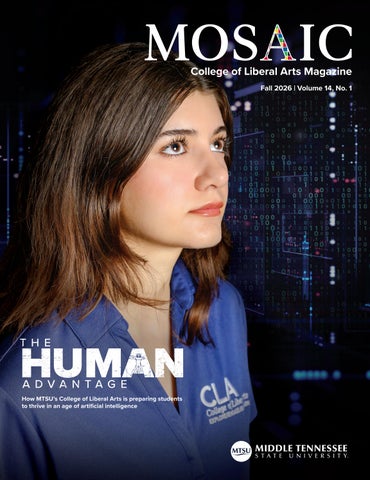
How MTSU’s College of Liberal Arts is preparing students to thrive in an age of artificial intelligence
Contents 03
Dean’s Letter
Through personal stories, Mosaic shows how liberal arts help us see the big picture
04
Learning Beneath the Surface
09
Doors Opened
12
Where Every Note Counts
18
Conversation Corner
Through MTSU’s archaeological field school, students gain hands-on experience while helping answer questions about Tennessee’s past An unexpected scholarship helped create opportunities that once seemed out of reach to Jonathan Escobar School of Music alumni are building careers that demonstrate the power of talent, mentorship, and opportunity Alex Farone moves from marching band and pre-law studies to a doctorate and a career as a college professor
20
The Human Advantage
26
History in Motion
30
Taking the National Stage
34
MTSU Arts
36
CLA Highlights
39
MTSUNews.com
How MTSU’s College of Liberal Arts is preparing students to thrive in an age of artificial intelligence MTSU builds on a legacy with new leaders and technology while preparing the next generation of historians MTSU hosts the largest debate tournament in IPDA history
Cover model: Philosophy major and pre-law student Tara Taha Cover illustration by Micah S. Loyed; photo by J. Intintoli
College of Liberal Arts Magazine Fall 2026 | Volume 14, No. 1
Dean Leah Tolbert Lyons Strategic Communications Manager Mike Davis Development Director Meredith Kerr Director of Creative and Visual Services Kristy D. O’Neal
The Big Picture Being able to see the big picture is an integral part of leadership and my work as dean of MTSU’s College of Liberal Arts. Without getting bogged down in minutiae, leaders must be able to think globally and cast vision for the future. While “big picture thinking” is a leadership trait that I embrace, I am careful to never ignore what might seem small or insignificant at first glance. Exploring what others overlook can lead us to see connections and find solutions to some of our greatest challenges. The College of Liberal Arts is comprised of three disciplinary pillars: visual and performing arts, humanities, and social sciences. These may seem like distinctly separate areas; yet the academic disciplines that are housed in our 10 academic departments are linked by the common bond of human experience. Liberal arts develop skills such as critical thinking, teamwork/collaboration, creativity, communication, cognitive flexibility, and adaptability, among others. These skills, honed through liberal arts disciplines, help us make meaning of knowledge and experience. The beauty of liberal arts is that it is not a monolith; in the liberal arts, we see the interconnectedness of the skills, experiences, and perspectives that bring us together and represent all that we are. We have the ability to make sense and meaning from seemingly disparate elements until a beautiful mosaic unfolds. That is the human experience. That is liberal arts. It is against this backdrop that we present the inaugural issue of Mosaic, the newly named magazine of the MTSU College of Liberal Arts. The liberal arts, like the human experience, represent many distinct parts that help us see the big picture with clarity and focus. The stories in this issue will illuminate the ways our students, alumni, faculty, staff, and community partners come together to explore the past, demystify the present, and look ahead to the future. My hope is that you will see yourself in Mosaic, as it reveals our shared educational values and highlights the commonalities that unite us all. Leah Tolbert Lyons Dean, College of Liberal Arts
Designer Micah S. Loyed Senior Editor Drew Ruble Associate Editor Carol Stuart Contributing Editor Nancy Broden University Photographers Andy Heidt, J. Intintoli, James Cessna, Cat Curtis Murphy Contributing Writer Nancy DeGennaro University President Sidney A. McPhee University Provost Mark Byrnes Vice President for Marketing and Communications Andrew Oppmann Address changes should be sent to Advancement Services, MTSU Box 109, Murfreesboro, TN 37132; alumni@mtsu.edu. Other correspondence goes to Mosaic magazine, Drew Ruble, 1301 E. Main St., MTSU Box 49, Murfreesboro, TN 37132. For online content, visit mtsunews.com. 1,410 copies printed at Pollock Printing, Nashville, Tennessee. Designed by MTSU Creative and Visual Services.
0626-9947 / Middle Tennessee State University does not discriminate against students, employees, or applicants for admission or employment on the basis of race, color, religion, creed, national origin, sex, sexual orientation, disability, age, status as a protected veteran, genetic information, or any other legally protected class with respect to all employment, programs, and activities sponsored by MTSU. The Assistant to the President for Civil Rights Compliance has been designated to handle inquiries regarding the non-discrimination policies and can be reached at Cope Administration Building 116, 1301 East Main Street, Murfreesboro, TN 37132; Christy.Sigler@mtsu.edu; or 615-8982185. Also see crc.mtsu.edu.
4 MOSAIC
Through MTSU’s archaeological field school, students gain hands-on experience while helping answer questions about Tennessee’s past by Mike Davis
At first glance, there isn’t much to see. A few shallow excavation units cut into the ground. Buckets of dirt. Screens for sifting soil. Students working beneath the Tennessee sun. In one unit, a rusted square nail protrudes from the wall of packed earth. Nearby, fragments of brick and ceramic rest in a collection box awaiting further study. None of it looks particularly significant. Yet each piece could help answer a question that historians have been asking for years: Where did the enslaved people of Cragfont live? For much of its history, Cragfont has been known as the home of Gen. James Winchester, a Revolutionary War veteran, War of 1812 officer, land speculator, and co-founder of Memphis. Built between 1798 and 1802, the limestone mansion in the Sumner County community of Castalian Springs remains one of the most significant surviving frontier homes in Tennessee. But the story of Cragfont extends far beyond the house itself. When Winchester died in 1828, records indicate he had 31 enslaved people. Historians know they lived and worked on the property. Memoirs written by descendants describe a row of cabins near the house, but the structures disappeared long ago. No photographs are known to exist, and even the details surrounding their removal have largely been lost to time. Anthropology majors Jadon Lynch (l) and Marah Chance (r) excavating a unit at the Cragfont site with Professor Paul Eubanks Photos by Mike Davis Fall 2026 5
The problem is that nobody knows exactly where those cabins stood. During the summer, a group of Anthropology students at MTSU helped search for answers. Working as part of the University’s archaeological field school, students excavated an area believed to contain evidence connected to the cabins. Their discoveries may help restore a missing piece of Cragfont’s history while shedding new light on the lives of people whose stories were often overlooked. Brick fragments, square-cut nails, and pieces of ceramic recovered by MTSU students investigating the possible location of cabins once occupied by enslaved people at Cragfont
“We’re trying to understand where the enslaved people lived,” said Paul Eubanks, an Anthropology professor and director of this year’s field school. “Historically, much of the focus has been on the house itself.”
The Search for Clues
The excavation site sits on a rise overlooking the historic property. Previous research suggested the area could contain evidence connected to the cabins. Ground-penetrating radar studies provided a starting point, while historical accounts pointed researchers toward the same general location. The work itself is careful and methodical. Students remove soil layer by layer, screen everything they excavate, document changes in soil color and texture, and record the location of every artifact they recover. So far, the findings have been modest but encouraging. Square-cut nails dating to the 1800s. Brick fragments. Pieces of ceramic. Animal bone. On their own, individual artifacts tell only part of the story. Together, they begin to create a pattern. Cragfont State Historic Site, part of the Tennessee Heritage Trail in Castalian Springs
“We’re finding lots of nails and lots of brick,” Eubanks said. “That’s exactly the kind of thing you would expect to find if there were cabins here.” Researchers also are paying attention to where those artifacts appear across the site. If brick concentrations increase in a particular direction, they may help identify where structures once stood or whether portions of the former cabin area now lie beneath modern construction. Archaeology rarely delivers dramatic breakthroughs overnight. More often, progress comes through patient observation and detailed record keeping. Every measurement matters because once a layer is excavated, it cannot be replaced.
Learning in the Field
For students in the field school, the excavation is an opportunity to learn the skills that define their profession. Field school has been a cornerstone of MTSU’s Anthropology program for decades. Students learn excavation techniques, artifact identification, mapping, documentation, and field methods used by professional archaeologists. Just as important, they learn whether archaeology is the career they imagined.
6 MOSAIC
Anthropology student Collin Ball measuring the depth of an excavation unit at Cragfont to help preserve the context of recovered artifacts
“You figure out pretty fast if you like it,” said Jadon Lynch, an Anthropology major entering his junior year. “I would say it’s for me.” Lynch arrived at field school with an interest in archaeology. The experience has helped confirm that interest while exposing him to the realities of working outdoors in Tennessee’s summer heat. “You can read a book and study the methods as much as you want,” he said. “But it doesn’t really matter until you come out here and do them.” For Marah Chance, a senior Anthropology major who served as Eubanks’ field assistant, this summer marked her third field school experience. In addition to helping supervise excavation units, she conducted research related to the distribution of artifacts across the site.
Eubanks working with Anthropology students Collin Ball (l) and Isaiah Hamlett (r)
Archaeologists always remember their field school. “It’s definitely a different responsibility,” Chance said. “But it’s been a really great experience.” Department Chair Shannon Hodge describes field school as a defining moment for many archaeology students. Beyond the technical skills, students learn how to observe carefully, solve problems, work as a team, and recognize subtle details that can make the difference between a meaningful discovery and an overlooked clue. They also form connections that often last well beyond graduation. “Archaeologists always remember their field school,” Hodge said. “It’s a pivotal event.”
The Cradle of Tennessee History
The work taking place at Cragfont is part of a much larger story.
Interpretive silhouettes displayed in the mansion of Amie (born 1770) and Ned (born 1788), two people enslaved at Cragfont
Castalian Springs contains one of the richest concentrations of historic and archaeological resources in Tennessee. Within just a few miles sit Cragfont, Wynnewood, Bledsoe’s Lick, the Castalian Springs Mound Site, and other landmarks tied to the state’s early history. Some historians refer to the area as the cradle of Tennessee history. MTSU has maintained a presence in the community for decades, conducting research projects and providing students with hands-on learning opportunities at sites throughout the region. Among those who once participated in the field school is Tennessee State Archaeologist Phil Hodge. An MTSU Anthropology graduate and Friends of Liberal Arts board member, he completed his own field school in Castalian Springs during the 1990s. Today, his office oversees archaeological projects conducted on state-owned properties, including Cragfont. “It’s very much a full-circle moment,” Phil Hodge said. He credits MTSU and longtime Anthropology Professor Kevin Smith for helping launch his career. Smith, who died in 2025, directed MTSU’s archaeological field school for decades and mentored generations of students. Following his
Field school 2026 (l–r): Ball, Hamlett, Chance, Jacob Troglen, and Lynch Fall 2026 7
death, supporters established an endowment to help sustain the field school and provide future students with opportunities for hands-on learning. The students excavating at Cragfont are part of that legacy. Future students will continue it.
Restoring the Full Story
For Tonya Staggs, executive director of Historic Castalian Springs, the excavation represents more than an archaeological project. It represents an opportunity to better understand the people whose labor helped shape the property. Cragfont, one of Tennessee’s most significant historic homes
When Historic Castalian Springs began reexamining how Cragfont’s story was interpreted, staff members quickly realized important pieces were missing. For years, the experiences of the enslaved people received limited attention despite their central role in the property’s history. Research began filling some of those gaps. Archaeology offered another way forward. “All of this you see right now is sort of a false reality,” Staggs said, looking across the grounds toward the mansion. “The house sitting here by itself doesn’t give us a clear picture of what this property looked like or what people’s lives were like.” Beyond locating buildings, the goal is to better understand the people who lived there.
Lynch sifting excavated soil through a screen
The excavation represents an opportunity to better understand the people whose labor helped shape the property. Earlier this year, descendants of individuals enslaved at Cragfont visited the site. For Chance, that reality remains at the forefront of the work done this summer. “If I was able in any way to help these people get answers about their past,” she said, “that means so much to me.” Whether researchers will ultimately identify the exact location of the cabins remains uncertain. Archaeology seldom provides quick answers, and many questions about the site may persist long after this year’s excavation. Still, every nail, every brick fragment, and every artifact recovered from the soil helps paint a clearer picture of a community whose story deserves to be told. The students left Cragfont at the end of June, but the work will continue. Artifacts will be cleaned, cataloged, analyzed, and compared with historical records. Future field schools may return to the site with new questions and new areas to investigate.
Anthropology students excavating sites at historic Cragfont in Castalian Springs during MTSU’s archaeological field school 8 MOSAIC
Each time, the search will continue one layer at a time, driven by the belief that history is never fully contained within a single story, or within the walls of a mansion. Sometimes the most important stories are the ones waiting just beyond.
OPENED
Jonathan Escobar receiving a $15,000 scholarship from MTSU President Sidney A. McPhee at a 2022 True Blue Tour event drawing for prospective students as his parents, Maria and Saulramos Escobar, look on Photo by Cat Curtis Murphy
An unexpected scholarship helped create opportunities that once seemed out of reach to Jonathan Escobar by Mike Davis
As Jonathan Escobar settles into his senior year at MTSU, his schedule is packed. The Political Science major balances a 4.0 GPA, a pre-law internship with a Murfreesboro legal practice, and work as an associate with a Nashville political consulting firm. He interned already with both the U.S. Department of State and the city of Murfreesboro, worked on political campaigns, and serves as a College of Liberal Arts emissary, helping prospective students and their families navigate the college decision process. A few years ago, however, none of that seemed likely. As a high school student, Escobar found himself struggling through the disruptions of the COVID pandemic years. His grades suffered, and he worried that attending a four-year university immediately after graduation might not be realistic.
“I told myself I was going to go to community college for two years,” Escobar said. “I was going to get a good GPA, I was going to save money, and after those two years, I would reevaluate.” While that was the plan, he still attended an MTSU True Blue Tour outreach event, hoping to learn more about the University in his hometown. What happened next caught him completely by surprise. During the event, MTSU leaders announced several scholarship drawings for students in attendance. Escobar assumed he was not eligible. “I remember when they started giving away the scholarships, I was a little bit sad because I didn’t know if I had to sign up my name anywhere,” he recalled. Escobar did not realize that every student registered for the event was automatically entered into the drawing. When his name was called, everything changed. “That scholarship’s the reason that I went here,” Escobar said. “If I didn’t get that, I probably would have gone to community college.”
Fall 2026 9
Escobar receiving the Mary Foye Huhta Memorial Scholarship
Escobar (r), a CLA emissary and Pre-Law student, speaking with a prospective student during a spring recruiting event for admitted students
Opportunities Within Reach
to larger opportunities, including serving as a political director for a local campaign and later as a field director during a highprofile special election campaign for state Rep. Aftyn Behn in Nashville.
Determined to make the most of the opportunity, Escobar arrived on campus ready to work.
Escobar then completed a public policy internship with the city of Murfreesboro’s planning department, helping conduct infrastructure research and gaining firsthand experience in local government. Through opportunities connected to MTSU, he also spent a semester in Washington, D.C., interning with the U.S. Department of State.
The award, combined with other financial aid, opened the door for Escobar to enroll at MTSU. More importantly, it gave him confidence that a four-year college education was within reach.
One of the first faculty members to notice was Professor Michael Federici, who taught Escobar in Introduction to Political Theory during his freshman year. “He attended every class, sat in the front of the room, did the assigned readings, asked lots of questions, and came to my office hours when he needed help,” Federici said. “He did what all students should do: take full advantage of the opportunities that MTSU has to offer.” Federici said Escobar entered college facing some of the same challenges many first-year students encounter, particularly in writing and critical thinking. What distinguished him was his willingness to improve.
Professional Pursuits
Today, Escobar works for a Nashville-based political consulting firm that helps candidates organize and run campaigns. At the same time, he is building legal experience through a pre-law internship with a Murfreesboro law firm, where he assists with legal research, document preparation, and case support. Looking back, Escobar sees a direct connection between those experiences and the opportunities he found through MTSU.
“We spent time working on his writing skills,” Federici said. “He wrote four essays in my class, and each one improved because he used feedback to fix what was broken. With each aspect of writing that he fixed, the clarity and organization of and support for his analysis improved.”
“It’s all kind of been this domino effect,” he said. “I would not be here if CLA and my department didn’t care enough about professional experience.”
That growth quickly extended beyond the classroom.
He was invited to participate in an internship panel coordinated by Don Srisuriyo, the CLA student engagement coordinator who helps connect students with professional development opportunities and prepare them for careers after graduation.
Escobar’s first internship placed him on a political campaign, where he discovered a passion for public service, voter outreach, and the practical side of politics. The experience led 10 MOSAIC
Escobar’s growing list of experiences created opportunities to share what he had learned with others.
Photo by Don Srisuriyo
At the event, Escobar shared how internships had shaped his educational experience and encouraged fellow students to pursue experiential learning opportunities of their own. Soon afterward, Escobar interviewed for and was selected to serve as a CLA emissary, a student ambassador program that links prospective students and their families with current students. Associate Dean Meredith Dye, who advises the emissary program, said Escobar’s combination of ambition, authenticity, and professionalism made him an ideal choice. “Jonathan was recommended for the emissary position because of his drive and ambitious spirit for civic engagement,” Dye said. “What stands out most to me is his ability to connect with people. I’ve observed him interacting with prospective students, answering questions with ease, offering advice on college life, and being real with people in those situations. He is genuine, and I think that is a much-needed quality today.”
A Recipient and a Giver
For Escobar, serving as an emissary is an opportunity to help students who may be facing some of the same questions he once faced himself. “I know what it’s like to feel a little lost,” he said. “I wanted to give back to the University and the department that gave me so many opportunities.” He especially enjoys speaking with students and families who may be uncertain about college or unfamiliar with the opportunities available through a liberal arts education.
Escobar (second from left) with fellow CLA student emissaries
“Sometimes families hear ‘liberal arts’ and they’re a little worried,” Escobar said. “But the skills you gain here—critical thinking, communication, writing, problem-solving—those skills apply to so many careers.” In the spring, Escobar’s achievements were recognized with the Mary Foye Huhta Memorial Scholarship, awarded to CLA students who demonstrate academic excellence, civic engagement, leadership, and a commitment to public service. The scholarship supports students whose experiences reflect involvement in government, local politics, or civic engagement— areas that have become central to Escobar’s educational journey.
Escobar arrived on campus ready to work. For Federici, Escobar’s story represents exactly what higher education is supposed to accomplish. “Jonathan mixed academic work with applied learning in a way that has prepared him for professional life,” Federici said. “His transformation during his time at MTSU has been a joy to watch. It is what faculty get up every morning hoping they will be a part of.” For Escobar, it all traces back to a moment he almost missed. The scholarship opened a door. What followed was years of mentorship, opportunity, hard work, and growth that transformed an uncertain high school student into a future attorney and public servant. Fall 2026 11
Where Every Note Counts School of Music alumni are building careers that demonstrate the power of talent, mentorship, and opportunity by Mike Davis
12 MOSAIC
The path of a music student can be as complex as a musical score. Some graduates perform on prestigious stages. Others teach, lead ensembles, launch businesses, or create opportunities for the next generation of musicians. At MTSU’s School of Music, students can develop technical skills, artistic discipline, and professional experience that prepare them for careers both inside and outside traditional performance settings. The recently launched Where Every Note Counts scholarship campaign seeks to expand those opportunities for future students. The stories that follow demonstrate how access to education, mentorship, and hands-on experience can shape careers in unexpected ways.
Jonathan and Ashley Copeland, both MTSU alumni, built Clarinets by Copeland from a small repair operation into a nationally serving shop that restores and produces professional clarinets. Photo by Mike Davis
MTSU alumni build a nontraditional career in music When the door opens at the Clarinets by Copeland workshop in Shelbyville, Kentucky, the first thing you notice is the quiet. Not silence, but focus.
improve one detail at a time. Faculty expected preparation, and ensemble work required collaboration. Progress came slowly, and only through consistent effort.
Jonathan Copeland sits at his workbench, adjusting a clarinet part with the same patience he once brought to the practice room as an MTSU student. Nearby, his wife and fellow MTSU grad Ashley Copeland answers questions from a parent whose child is trying an instrument for the first time. Their business serves professional musicians, students, and school programs across the country and now internationally.
Jonathan tested himself early. As a freshman, he entered an international solo competition typically dominated by older musicians from elite conservatory programs. He did not advance that first year, but he kept trying.
It is not the path either imagined when they arrived at MTSU almost two decades earlier. It is, however, a path shaped by what they learned here. The Copelands met long before MTSU, growing up minutes apart in a small town near Knoxville. Music brought them together early. Both played the clarinet and were firstgeneration college students. They married while still in school, juggling coursework, rehearsals, and performances with the realities of adulthood. At MTSU, they were immersed in an environment that demanded precision and accountability. Their talent and work ethic were built on repetition, critique, and learning how to
“He just kept entering the competition,” said Todd Waldecker, professor of clarinet who taught both Copelands. “Finally, his fourth time, he made it to the second round, the international finals.” Waldecker said the outcome mattered less than the process. “That’s the only way to learn,” Waldecker said. “He’s not someone who wants to live with regret for not trying.” Ashley’s education emphasized a different but equally demanding skill set. As a future music educator, she learned classroom management, communication, and how to meet students where they were. She was deeply involved across campus, balancing ensembles, service organizations, and hands-on work with children. “Ashley was a real people person,” Waldecker said. “She was always involved in service and community opportunities.” Fall 2026 13
A customer’s clarinet awaiting repair at Clarinets by Copeland
Jonathan Copeland (l) during a study abroad program in Belgium in 2008
Jonathan Copeland shaping a clarinet component
Taking a Leap of Faith
After graduation, neither followed a traditional, linear path. Jonathan pursued woodwind repair, apprenticing under a respected technician while continuing graduate studies at MTSU. The work required patience, precision, and a willingness to repeat small tasks until they were right. “The work ethic felt very similar to college,” Jonathan said. Ashley entered the public school system, teaching in Title I schools where resources were limited and access to quality instruments was often lacking. Over 15 years in the classroom, she saw how much students’ experiences could be shaped by the tools available to them. Those experiences would eventually converge. In 2019, the Copelands moved to Kentucky as Jonathan attended seminary and transitioned toward full-time work in the business they had been building alongside other jobs. They were raising a young daughter and away from family. Shortly after the move, Ashley was diagnosed with cancer. She had not yet started her new teaching position, and health insurance had not taken effect. “The first moment I thought we made a mistake was actually moving day,” Jonathan said. But their faith allowed them to push forward. Ashley completed treatment while Jonathan continued working long hours to keep the business moving. The following months were marked by careful planning, reliance on community support, and taking things one step at a time. The uncertainty did not disappear quickly, but the family found stability as Ashley recovered and returned to the classroom, and the business began to gain traction. 14 MOSAIC
Ashley Copeland using her Music Education degree and classroom experience to guide students and families through her clarinet shop
When the COVID-19 pandemic shut down performances and schools, more uncertainty crept in. “There actually was a silver lining,” Ashley said. “People were forced to stay home, but many turned to music and other things that are beautiful.” This meant there was still a need for repair work. Instruments needed attention, and musicians still needed support. One early client proved significant. The U.S. Army Band trusted Jonathan with a large repair project, providing income and credibility at a critical moment. “I always treat every clarinet the same,” Jonathan said, “but I do remember feeling pride that I got to fix instruments for the U.S. Army Band.”
Crafting a New Career
What began as repair work did not stay there. As Jonathan worked on instruments day after day, he realized musicians were paying high prices for new clarinets that often still needed extensive setup. Others were forced to choose between affordability and quality. He began experimenting with restoring used professional instruments and selling them at lower cost—providing the same quality without a new-instrument price tag. Jonathan began asking whether it was possible to design something better from the start. Few people take that step. The world of clarinet manufacturing is small, dominated by longestablished makers whose designs have changed little over decades. “I had the idea in the back of my mind for a long time—someday having my own line,” he said.
The leap from technician to maker required more than skill. It required curiosity, patience, and a willingness to learn a new side of the craft. Jonathan studied existing designs, worked with manufacturers, tested prototypes, and refined the instruments again and again. The process resembled the cycle he had learned as a student. That work eventually led to the Copelands’ own line of clarinets, instruments designed to meet professional expectations while remaining accessible to students and educators. What began as a repair shop became something far less common: a new name in a field where few new ones appear. The business grew steadily, built on consistency rather than rapid expansion. While Jonathan ultimately stepped away from pursuing formal ministry, he came to see the business itself as a way to serve others. Making quality instruments more accessible, supporting school programs, and working directly with students and families became expressions of the values that guide the Copelands’ lives. Today, Clarinets by Copeland employs multiple staff members and serves students, educators, and professional musicians across the country. And recently they had their first international client, a musician in Sweden. Teaching did not disappear when Ashley left the classroom. Parents and students who walk into the shop are guided through choices carefully, often learning alongside their child for the first time.
What began as a repair shop became something far less common: a new name in a field where few new ones appear. “When we sell our instruments, it’s not just affordability,” she said. “It’s quality and affordability together.” Jonathan continues to draw directly from habits formed during his years at MTSU.
MTSU’s Where Every Note Counts campaign was developed through a collaborative effort between the School of Music faculty and leadership and the MTSU development office. Led by CLA Development Director Meredith Kerr, the initiative reflects years of relationship-building with alumni and donors who believe in expanding opportunities for future generations of music students. “Scholarships make the difference in whether a student can say yes to pursuing their dream to make music,” said Jennifer Snodgrass, director of the School of Music. “Many of the students we recruit are deciding not just where they want to study, but where they can realistically afford to study.” Scholarship support helps students focus on their education, participate fully in ensembles and performances, and pursue opportunities that prepare them for careers in music and related fields. The campaign also helps MTSU recruit and retain talented students in an increasingly competitive environment.
“When things start to feel overwhelming, I have to write it down and work through it like a checklist,” he said. Waldecker sees the connection clearly: “The same discipline that makes a strong musician makes someone capable of building something like this. They didn’t do this by themselves. They had a lot of people along the way, and they were always coachable.” For current MTSU students, the Copelands’ story offers a broader definition of success. Skills developed through rigorous education often reveal their value over time, sometimes in unexpected ways. Ashley and Jonathan did not leave music behind. They carried it with them. They are still practicing. Still refining. Still building. Just in a different way.
To learn more or support the campaign, visit
give.mtsu.edu/pages/music-campaign
Fall 2026 15
Grace O’Connell with mentor Michael Arndt, MTSU’s trumpet professor
O’Connell (center) performing at an elementary school with Ensemble Connect, a prestigious two-year fellowship program of Carnegie Hall, The Juilliard School, and the Weill Music Institute in partnership with New York City public schools
Grace O’Connell’s MTSU foundation leads to Carnegie Hall fellowship Every two years, Carnegie Hall and The Juilliard School select up to 20 of the world’s most promising young musicians for Ensemble Connect, one of the most prestigious fellowships in classical music.
A native of Madison, Wisconsin, she had already established herself as a talented young musician, including participation in the Wisconsin Youth Symphony and the nationally acclaimed Interlochen Arts Camp.
In the current cohort, one of those musicians is trumpet player and MTSU School of Music alumna Grace O’Connell.
Her application stood out to MTSU’s Michael Arndt, professor of trumpet.
Selection into Ensemble Connect places O’Connell among a small group of emerging musicians chosen not only for their artistic excellence, but also for their potential as educators, collaborators, and leaders in the field.
“Most students recruited into our trumpet studio come from Tennessee and neighboring states,” he said.
“I remember opening the email that announced my acceptance and feeling so unbelievably elated,” O’Connell said. “It seemed like such a dream to be able to make music with incredible musicians, perform for wide ranges of audiences, and help excite kids in New York City public schools about music.” The moment represented the latest milestone in a journey that began at MTSU and has since taken her to Yale University and some of the country’s most respected concert stages including Carnegie Hall. That journey almost looked very different.
Finding the Right Fit
Coming out of high school, O’Connell had opportunities at some of the nation’s most recognized music schools. 16 MOSAIC
After visiting campus, O’Connell found what she was looking for, influenced by the outstanding faculty in the School of Music and the opportunity to study with Arndt. “His guidance and support have played a significant role in my growth as a musician and in shaping my career path,” she noted. She also recognized the opportunities created by the University’s location. “MTSU’s proximity to Nashville provides valuable opportunities to freelance and gain professional performance experience outside of the University,” O’Connell said. “Being so close to a major music hub allows students to build connections and develop real-world experience while completing their studies.” Near the end of her campus visit, Arndt recalls O’Connell saying “after being here and spending time with you in the studio, I can’t imagine going anywhere else.”
O’Connell with the MTSU Wind Ensemble’s trumpet section
But attracting a student of O’Connell’s caliber required MTSU to remain competitive with scholarships.
O’Connell also took advantage of MTSU’s Undergraduate Research Experience and Creative Activity (URECA) program. She landed two grants that funded professional-quality audio and video recordings for digital release, allowing her to develop a professional portfolio as an undergraduate.
“When other schools came back with full rides,” Arndt said, “I was like, ‘Hey, can we make it happen for her?’ ”
“There are so many resources available at MTSU that can help you develop as both a musician and a professional,” she said.
Working with University leadership, MTSU assembled a scholarship package that allowed the Wisconsin native to choose the School of Music over several of the nation’s more elite music programs.
Building a Foundation
O’Connell quickly earned spots in MTSU’s top performing ensembles, including the MTSU Symphony Orchestra and Wind Ensemble, while also participating in brass quintets, salsa band, and other groups that expanded her versatility. She also regularly performed as a substitute musician with symphony orchestras in Nashville and Huntsville, Alabama. Talent alone does not explain her success. “She’s tenacious, very tenacious,” Arndt said. “I have not known many trumpet players that work that hard.” That work ethic translated into national recognition. During her junior year, O’Connell won the National Trumpet Competition Undergraduate Solo Division and the Music Teachers National Association Young Artist Competition. As a senior, she captured first place in the International Trumpet Guild Solo Competition, one of the most prestigious honors in the trumpet world. She praised Arndt’s “unwavering support” during solo competitions. “He made it a priority to be there in person to support me in real time and help me deal with the nuances and stresses of highlevel competition,” she said.
Learning Through Success and Failure
Like most successful musicians, O’Connell had her setbacks. As a sophomore, she failed to advance from the preliminary round of a competition—a devastating experience that changed her perspective. “I’ve come to view rejection not as failure, but as an opportunity for growth,” she said. “I believe that what is meant for me will come in its own time.” The following year, she won the same competition.
From MTSU to Yale and Beyond
After graduation, O’Connell earned a full scholarship and a stipend to earn her master’s degree at Yale University. Along the way, she built an impressive professional résumé, performing with the Cincinnati Symphony Orchestra, Orpheus Chamber Orchestra, The Knights, Greenwich Symphony, and Princeton Symphony Orchestra. She was co-principal trumpet at the New Hampshire Music Festival and a guest artist with the Manchester Music Festival in Vermont. She recently won the Roger Voisin Memorial Trumpet Competition and was named a finalist in the Ellsworth Smith International Trumpet Solo Competition. Today, O’Connell balances performing, teaching, and freelancing throughout New York City through her Ensemble Connect fellowship. She not only plays chamber music, most notably at Carnegie Hall and Juilliard, but also creates and presents interactive performances in public schools and community spaces with other members of her cohort.
Being so close to a major music hub allows students to build connections and develop real-world experience. “Lastly, I am partnered with an NYC public school that I go to about once a week to teach through a creative lens in order to get the kids excited about learning music and listening to live music,” she said. “I love that every student is different and no two lessons are ever the same. Each student presents a new challenge to explore, which often leads to fresh perspectives and creative approaches to music-making.” As her career continues to unfold on stages ranging from public school classrooms to Carnegie Hall, it is clear she sees MTSU as a critical part of the foundation that made those opportunities possible. “MTSU gave me a community of people who were passionate about helping me become the best musician and person I could be,” she said. “It gave me the tools and support that I very much needed at that time and truly shaped me into who I am today.”
“That experience taught me that a musical career demands resilience and that setbacks do not define me as a musician,” she said. Fall 2026 17
CONVERSATION CORNER MTSU Political Science grad Alex Farone, who recently became a college professor after earning his Ph.D. Photo courtesy of University of Kentucky
Alex Farone moves from marching band and pre-law studies to a doctorate and a career as a college professor MTSU alumnus Alex Farone recently earned his Ph.D. in Political Science from the University of Kentucky and began his career this fall as an assistant professor at Jacksonville State University in Alabama. While serving as a graduate instructor, he received multiple teaching honors, including UK’s 2026 Outstanding Teaching Award. Farone credits much of his success to the experiences he found at MTSU. Faculty mentors challenged him to think differently; organizations like Mock Trial gave him opportunities to lead and grow; and experiences outside the classroom helped him discover a passion for teaching. In this Q&A, he reflects on the people and opportunities that shaped his journey and offers advice for students considering graduate school and careers in higher education.
18 MOSAIC
You originally came to MTSU because of the Band of Blue, not Political Science. How did your path change? I really didn’t know what I wanted to do when I started college. I was interested in international relations, but I was still figuring things out. Mock Trial was a turning point for me, and so was taking Dr. Michael Federici’s constitutional law class. Those experiences made me realize I enjoyed asking questions about how institutions work and why they function the way they do. That curiosity eventually led me toward research and graduate school. You mention Mock Trial often when talking about your time at MTSU. Why was it so important? Mock Trial challenged me in ways I hadn’t experienced before. I wanted to improve, I wanted to compete, and I wanted to help my teammates succeed. It taught me leadership, collaboration, and discipline. Later, when I became a team captain, I discovered something else I
Farone (fourth from left) during his Band of Blue days
Farone (second from left) with Mock Trial teammates while at MTSU
loved, helping other students grow. Looking back, that’s probably where I first realized teaching was the career I wanted. Mock Trial is also where I met my wife, Cate. At one point you thought you wanted to become an attorney. What changed? During an internship at a law firm, I realized practicing law wasn’t the right fit for me. Around the same time, I was working on an independent research project with Dr. Federici. Reading political science research and asking my own questions fascinated me. That experience completely changed the direction of my career and convinced me to apply to doctoral programs. Graduate school is demanding. What helped you succeed? Grit. I wasn’t the smartest person in every room, but I worked hard. I read more, prepared more, and kept pushing myself. MTSU taught me that hard work matters. My professors challenged me, and Mock Trial taught me how to compete, collaborate, and keep improving. Those lessons stayed with me throughout graduate school.
Farone with wife Cate after earning his Ph.D.
This fall you’ll begin your career as a professor at Jacksonville State University. What excites you most about this next chapter? Teaching. That’s always been my favorite part. I love helping students discover what they’re capable of. Jacksonville State is giving me the opportunity to help shape its pre-law program and develop courses of my own. That’s something I’m incredibly excited about because mentoring students is why I wanted to become a professor in the first place. What advice would you give current MTSU students who are considering graduate school or an academic career? Make sure it’s something you truly want to do. Graduate school is challenging and competitive, but if you’re passionate about it, it’s worth it. Once you know it’s the right path, commit to it completely. Work hard, take advantage of opportunities, and don’t be afraid to challenge yourself. You never know where those experiences will lead.
Fall 2026 19
20 MOSAIC
How MTSU’s College of Liberal Arts is preparing students to thrive in an age of artificial intelligence by Mike Davis
The email is written before you finish typing the prompt. A marketing plan appears in seconds. A few more words produce an image, summarize a research paper, translate text to another language, or compose a piece of music. Artificial intelligence (AI) has moved from novelty to everyday tool with remarkable speed. Students use it. Businesses rely on it. Entire industries are rethinking how work gets done. Its rise has also revived an old question. What is the value of a college education when information has never been easier to access? Faculty across MTSU’s College of Liberal Arts approach that question through the lenses of their different disciplines, but their answers share a common thread. As technology continues to evolve, human judgment has become more important, not less. “There is no replacement for human judgment and ethical reasoning,” CLA Dean Leah Tolbert Lyons said. “The liberal arts teach us about the human experience through disciplines such as language, literature, history, and philosophy. They help us understand how and when emerging technologies should be applied for everyone’s benefit.” Those qualities have long defined a liberal arts education. What has changed is the environment in which they are applied. “The key here is information literacy,” Lyons said. “Once facts are established, we can assess whether they have been interpreted in context and applied appropriately. A liberal arts education develops critical thinking. It helps us understand what sources are credible, identify fallacies, and draw reasonable conclusions.”
Model: Philosophy major and pre-law student Tara Taha Illustration by Micah S. Loyed; photo by J. Intintoli Fall 2026 21
Students with English Professor Steve Severn at the Celebration of Student Writing Photo by Andy Heidt
Philosophical Questions of AI
For Greg Slack, an assistant professor of Philosophy, those questions reach far beyond artificial intelligence. “Critical thinking is one of our last lines of defense against being lied to, manipulated, and made the playthings and guinea pigs of forces over which we have no control,” he said. Philosophy has always wrestled with questions that resist easy answers. What is truth? What constitutes knowledge? What makes an argument persuasive? AI did not create those questions, but its rapid adoption has made them harder to ignore.
As technology continues to evolve, human judgment has become more important, not less. “If we offload our abilities to read, comprehend, assess, and interpret difficult texts,” Slack said, “we forfeit the exercise of those mental powers that both shield us from error and help to make our lives satisfying and meaningful.” Those conversations are increasingly becoming part of the curriculum. Kaity Newman, a lecturer in the Department of Philosophy, is developing a course on AI and ethics that will examine issues 22 MOSAIC
ranging from bias and privacy to environmental impacts and the broader social consequences of artificial intelligence. “I think we have an obligation to our students to prepare them for the world they will be living and working in,” Newman said. “For better or worse, that world now includes AI.” Rather than offering simple answers, the course is being designed to help students wrestle with complicated questions. “I hope that students who take this class will leave with an appreciation of the nuance and complexity that is often involved in ethical problems,” Newman said.
Lost in Translation?
The same emphasis on judgment appears in a different form in the Department of Communication Studies. Natalie Hoskins, interim department chair, sees AI as a valuable tool, but one whose usefulness still depends on the person using it. An effective prompt requires more than technical knowledge. It requires understanding audiences, anticipating concerns, and recognizing how messages will be received. “Content created without the audience in mind is never going to be as powerful as audience-centered messaging,” Hoskins said. As AI-generated content becomes more common, students still need to evaluate sources, recognize misinformation, and tailor messages to real people rather than simply generate words on a page.
Students learning the art and etiquette of Japanese tea ceremonies Photo by Cat Curtis Murphy
“It is a tool to support your work—not a substitute for your work,” Hoskins said. Those human-centered communication skills become even more important when ideas are conveyed across languages and cultures.
It is a tool to support your work— not a substitute for your work. “I think it is important to first ask where, when, with whom, why, and how you are going to use another language,” said Priya Ananth, a professor for MTSU’s Japanese program. “Two-way human interaction in using a language, with errors and all, is far more authentic than artificial machine translation.” Translation software has become remarkably sophisticated, but language has always carried more than vocabulary. Learning a language offers the opportunity to walk in another’s shoes and see the world from an entirely new perspective. Humor, history, customs, relationships, and unspoken expectations shape every conversation. “Translating words without a cultural context is not only incomplete but also borderline misleading,” Ananth said. “Good quality translations and interpretations rely heavily on a deep understanding of the subject area.”
That understanding grows through experience. Students who study abroad navigate unfamiliar cultures, solve unexpected problems, build relationships, and gain confidence through direct interaction with others. “Technology can facilitate the practice,” Ananth said, “but cannot substitute it.”
Music to Our Ears
Experience shapes understanding in ways technology cannot easily replicate. Music offers another example. Artificial intelligence can compose melodies, generate lyrics, and imitate musical styles with astonishing speed. Yet for Jennifer Snodgrass, director of MTSU’s School of Music, performance has always depended on something more personal. Connection. After attending a presentation by Recording Industry Association of America CEO Mitch Glazier, Snodgrass found herself thinking about what separates live musicians from the technology increasingly capable of producing music. “The key answer here is live communication in real time,” she said.
Fall 2026 23
Music student Aiden Taylor (r) working with Jamey Simmons, a jazz trumpet professor Photo by J. Intintoli
Every performance is shaped by subtle decisions. Musicians respond to one another. They react to the room. They adjust to the audience. No two performances are exactly alike because no two audiences are exactly alike. “While AI certainly can do many things, and in the future may do them even better and quicker, it cannot emotionally interact in a meaningful way with an audience,” Snodgrass said. “Real people in real time with real stories.”
Humans continue to value and desire other humans’ artistic interpretations and creativity. Technology has changed music education, as well, and Snodgrass has embraced many of those changes. Students use online tools, watch performances from around the world, and practice foundational skills outside the classroom, creating more time for discussion, analysis, and collaboration during class. She also encourages students to explore AI directly. One assignment asked students to compare their own musical analysis with one generated by AI. “It did a tremendous job on the facts,” Snodgrass said. The software identified lyrics, structure, and musical terminology with impressive accuracy. What it struggled to 24 MOSAIC
explain was why a performance resonated emotionally or how musical choices shaped the listener’s experience. “At the end of the assignment, students were frustrated that AI couldn’t communicate what was happening beyond the basic facts,” she said. “That was the point of the whole assignment.”
Connection and Collaboration
Facts matter, but interpretation matters, too. Sheri Selph, a Graphic Design associate professor, sees artificial intelligence as part of a much longer history of technological change. Graphic design has weathered major shifts before, from desktop publishing to digital illustration. Each changed the tools designers used without changing the purpose of design itself. “What we know is that it’s the standards held by human consumers of design that still dictate its value and desirability,” Selph said. “Humans continue to value and desire other humans’ artistic interpretations and creativity.” The enduring value of art lies in its ability to tell human stories and create shared experiences. “Centuries of art and art movements have told the stories of humans and created connection between us,” Selph said. Across the College of Liberal Arts, such conversations often intersect. Historians are exploring digital methods of interpreting the past. Communication scholars are studying how emerging
Greg Slack teaching a Philosophy class
technologies shape public discourse. Philosophers are examining the ethical questions surrounding artificial intelligence. Artists, musicians, linguists, and social scientists continue asking questions that technology alone cannot answer. That collaboration reflects the future of higher education. “Liberal arts and STEM [science, technology, engineering, and math] are complementary because together they help us make sense of the world and understand both concrete and abstract concepts,” Lyons said. “STEM requires collaboration, working across differences, and the ethical application of findings. Those are areas where the liberal arts excel.”
Creating the Future
The same conclusion is emerging beyond college campuses. The World Economic Forum’s Future of Jobs Report 2025 found that artificial intelligence is more likely to augment human abilities than replace them entirely. Employers continue to rank analytical thinking, creativity, resilience, leadership, and curiosity among the most valuable qualities in the workforce. Those qualities are not tied to a particular profession. They prepare graduates to navigate change. The software students use today will evolve. Many of the careers they enter will evolve with it. Some of the jobs they will eventually hold have yet to be imagined.
“Creativity, ethical reasoning, critical thinking, collaboration, and communication are liberal arts skills. They are human skills,” Lyons said. “AI may be able to imitate some of what human ingenuity can produce, but it is not a substitute. We play a role in the futures we create, and as we step into the future, those who have been trained in the liberal arts will always have a place in it.”
Employers continue to rank analytical thinking, creativity, resilience, leadership, and curiosity among the most valuable qualities. Artificial intelligence will continue to change how people work, create, and learn. Higher education will continue to evolve alongside it. What is far less likely to change is the need for people who can make sense of complexity, cultivate trust and understanding across differences, and exercise thoughtful judgment. Those qualities have always been at the heart of a liberal arts education. The tools may change. The human advantage of people who know how to use them wisely will not.
The habits of mind they develop remain valuable regardless of the tools they use.
Fall 2026 25
History Motion in
MTSU builds on a legacy with new leaders and technology while preparing the next generation of historians by Mike Davis History is often thought of as the study of what has already happened. At MTSU, it is also about preparing students for what comes next.
Both the Department of History and the Center for Historic Preservation (CHP) are entering a new chapter shaped by new leadership, emerging technologies, and evolving approaches to historical research. Yet amid those changes, one idea remains constant. The goal is not simply to preserve the past. It is to help students understand it, share it, and use it to better understand the present. That mission has guided MTSU’s history programs for decades. It will continue under a new generation of leaders.
A Legacy of Preservation
When History Professor Carroll Van West retired this year after more than 40 years at MTSU, he closed one of the most influential chapters in the University’s history. After taking over in 2002 as just the second director of the Center for Historic Preservation, West helped build the center into a nationally respected leader in public history and historic preservation. Under his leadership, the CHP partnered with communities, museums, archives, state agencies, and preservation organizations on projects that protected historic resources while giving students meaningful, hands-on experience. The center has helped preserve Tennessee’s historic landscapes—ranging from centuryold family farms to Native American, Civil War, Black history, and other heritage sites—while preparing generations of professionals. “Former CHP students work across the country from Seattle to New York City, throughout the Midwest, and all over the South, making a real difference,” West said. Reflecting on what he is most proud of, he points to “the students who have taken their degrees under my direction.”
Digital projects allow for a degree of accessibility that the general public is able to more thoroughly engage with. His former students now lead preservation projects, direct museums, manage archives, oversee historic sites, and shape public history programs across the country. The profession has changed dramatically during West’s career. Geographic information systems (GIS), digital databases, light detection and ranging (LiDAR), and other technologies have transformed how historians document, preserve, and interpret the past. Those advances never changed the CHP’s fundamental approach. “We still maintain that being in communities and listening to what they wish to accomplish far outweighs the benefits of technology,” West said. In his view, technology works best when it strengthens relationships with the people and places historians serve rather than replacing them. West believes the next generation of leadership is well positioned to build on that philosophy while expanding the ways technology can support preservation work. 26 MOSAIC
public to center people and communities and show others that historic preservation is a form of progress, not the opposite of it.” That philosophy influences how she approaches emerging technologies. For example, while researching an 18th-century Charleston, South Carolina, home that was destroyed by fire in 1861, Momon partnered with architecture students to digitally reconstruct the building using historic construction records, contracts, and the few surviving photographs. The project allowed researchers to study a building that no longer exists while giving students experience creating historically accurate architectural models. “Where I’ve found that balance is embracing those new technologies where it makes sense,” she said.
Carroll Van West, former director of MTSU’s Center for Historic Preservation, at his retirement ceremony Photo by James Cessna
“Our new director, Dr. Tiffany Momon, and associate director, Dr. Torren Gatson, are much more adept at the new technologies and building interactive history databases,” he said. “Their teaching will best prepare MTSU students for the 21st-century job market.”
Building on a Strong Foundation
Tiffany Momon is no stranger to the Center for Historic Preservation. A 2016 and 2019 graduate of MTSU’s Public History master’s and doctoral programs, Momon first joined the center as a graduate assistant while pursuing her Ph.D. It was there, she said, that she discovered her passion for public history. “It was where I really flourished as a public historian,” she said. “The CHP’s teaching model with its emphasis on community partnerships and engagement drew me back to the University.” Now, she returns to lead the very program that helped shape her career. “What excites me most is leading a program that invests so much in its students and continuing that work,” she said. Momon hopes to build on the strong foundation established over the past four decades while preparing students for the future of the profession. “My vision for the next decade is to continue ensuring that the CHP remains one of the leading historic preservation programs in the country,” she said. “By building on existing momentum, work, and people power, we can continue to work with the
28 MOSAIC
Momon believes those technologies create new opportunities to preserve and share history while remaining rooted in the community-centered approach that has long defined the CHP. Looking ahead, she sees opportunities to collaborate across disciplines, expand digital preservation efforts, and prepare students to lead the next generation of public history projects.
Age of Digital History
As technology continues to reshape nearly every profession, the field of history is evolving alongside it. Museums, archives, historic sites, and preservation organizations are increasingly relying on digital tools to document collections, analyze landscapes, share research, and engage new audiences. MTSU’s digital history course of study is preparing students for that future. Led by Andrew Maginn, the coursework blends traditional historical methods with emerging technologies that are becoming increasingly valuable across the profession. Students gain experience with digital archives, website development, and other tools that help historians research, interpret, and share the past. Maginn encourages students to begin with the historical question. “You figure out what the project is first before applying the tool,” he said. Whether students are creating an interactive map, building a digital archive, or developing a public history website, they begin with the same historical methods that have guided the discipline for generations. The digital tools create new ways to investigate historical questions, preserve important resources, and make history more accessible to the public. That practical approach is woven throughout the courses. Students build websites, create digital exhibits, conduct oral histories, develop online collections, and complete projects that become part of a professional portfolio they can share with
future employers. Rather than simply learning new software, they graduate with examples of their work and experience applying those skills to meaningful historical projects. Graduate student Danny Rodriguez has experienced that firsthand. Rodriguez entered MTSU’s Public History master’s program Tiffany Momon, new director expecting to deepen his of MTSU’s Center for Historic historical research and writing Preservation skills. Working with Maginn introduced him to an entirely new side of the profession. In addition to document digitization, Rodriguez has gained experience with content management systems, website development, and digital collections. He hopes to continue building those skills through technologies such as groundpenetrating radar, drone mapping, and other tools that help historians analyze and interpret historic landscapes. “I love the process of historical research and writing,” Rodriguez said. “I wouldn’t want to give that up, but at the same time I believe digital projects allow for a degree of accessibility that the general public is able to more thoroughly engage with.” Rodriguez believes those experiences are preparing him for a profession that increasingly values both historical expertise and digital fluency.
Technologies create new opportunities to preserve and share history while remaining rooted in the community-centered approach that has long defined the CHP. “I feel as though I am acquiring a set of skills that will hopefully make me stand out,” he said. “The skills associated with digital history are relatively rare within the historical profession. In this increasingly digital world, they are becoming more desired and valued in the workplace.” Maginn sees MTSU’s menu continuing to expand as interest in digital history grows. New graduate courses, a dedicated digital history lab, and plans for a digital history certificate are creating additional opportunities for students to develop specialized skills while building on the department’s strong foundation in public history.
Teaching Students How to Think
The rapid evolution of technology has changed many of the tools historians use, but it hasn’t changed the questions they ask. As the new History Department chair, Andy Polk sees that distinction as central to the department’s future. “History has a reputation for primarily teaching random historical trivia,” Polk said. “That isn’t the way we approach the discipline.” Students certainly learn about the past, he explains, but the facts are only part of the education. The larger goal is teaching students how historians evaluate evidence, recognize bias, weigh competing perspectives, and build narratives grounded in credible sources. Those practices have applications far beyond the classroom. Whether graduates pursue careers in museums, archives, preservation, education, government, or the private sector, they leave MTSU with the ability to make sense of complex information and communicate it clearly. The department’s partnership with the Center for Historic Preservation strengthens that preparation. Students apply what they learn in the classroom to projects serving museums, archives, historic sites, and community organizations while gaining experience with technologies that are becoming standard across the profession. Polk believes those skills will become even more valuable as artificial intelligence and other emerging technologies reshape the workplace. “Historians will be able to directly apply their skills to that emerging reality in increasingly important ways,” he said. “They are able to coordinate, analyze, and communicate AI products in a way that makes sense out of the noise.”
Looking Ahead
Polk hopes the department will be recognized for developing thoughtful historians and creating a community that continues supporting students long after graduation. “I strongly believe our graduates are going to be better prepared to face whatever the future holds,” he said. The next generation of historians at MTSU may document a historic cemetery with drones, build a digital archive that makes rare collections available around the world, reconstruct a long-lost building, or preserve a community’s stories through oral histories. The tools available to historians will continue to evolve, creating new opportunities to explore, preserve, and share the past. Yet every new technology still serves the same purpose: helping historians ask better questions, preserve meaningful stories, and connect people with the past.
Fall 2026 29
TAKING THE
NATIONAL STAGE
MTSU served as host to the 2026 IPDA National Tournament. Photo by J. Intintoli 30 MOSAIC
International Relations major Sebastian Sanders (r), vice president of speech for MTSU Speech and Debate, managing the help desk
Volunteers at the IPDA National Tournament registration table
MTSU hosts the largest debate tournament in IPDA history
For four days in April, MTSU became the center of the collegiate debate world. The tournament brought 54 universities and more than 400 competitors to campus, making it the largest national championship in IPDA history. The tournament also included more than 200 judges, coaches, and staff.
by Mike Davis and Nancy DeGennaro
By the time the International Public Debate Association National Tournament arrived at MTSU last spring, Sebastian Sanders, an International Relations major and vice president of speech for MTSU Speech and Debate, wasn’t thinking much about debate. He was answering questions at the tournament help desk, making sure buildings stayed unlocked, directing visitors across campus, and solving problems as they arose. “Every time we solved one issue, four more popped up,” Sanders said.
Most visitors saw the competition, but what they didn’t see was the team of students and faculty working behind the scenes to keep everything moving. According to Patrick Richey, MTSU’s debate coach and the IPDA executive secretary and historian, more than 100 people contributed to making the tournament successful, supported by a core group of about 25 organizers. “We have been preparing for over two years,” said Richey, a Communication Studies professor.
Answering All the Questions
The planning touched nearly every corner of campus, with space one of the biggest challenges. Fall 2026 31
Participants checking the competition schedule at the help desk
Political Science major Tala Abukhdair, who advanced to the double-octofinal round
Student competitors outside the Academic Classroom Building preparing for a debate round
A competitor's intense preparation for the debate topic
“We used nearly 150 rooms in total throughout the event,” Richey said.
“It shows how well respected MTSU is in the debate community to host the capstone event of the season,” Richey said. “We are one of only a handful of schools to host it twice.”
But space wasn’t the only hurdle. Competitors needed schedules. Judges needed assignments. Teams needed information. Meals had to be coordinated. Questions had to be answered. “We had to take into account feeding and hosting over 750 people, including the 400-plus debaters,” said Anessa Loftin, a Public Relations student and communication coordinator for the debate team. “Communicating with teams, the IPDA board, and MTSU was a very strategic and lengthy process.” The work required support from across the MTSU community, including from the president, provost, several deans, departments, alumni, and other clubs. Beyond logistics, hosting an event of this size carried significance for the University.
32 MOSAIC
Competing in the Chaos
While most team members focused entirely on hosting responsibilities, a few also competed in the tournament. One of them was senior Tala Abukhdair, a Political Science major. By the end of the weekend, she had advanced to the double-octofinal round in the novice division. The accomplishment came while balancing competition with the demands of helping run the largest tournament in IPDA history. “Participating in the competition felt like 10 bricks on each of my shoulders,” Abukhdair said. Competitors had only 30 minutes to prepare for rounds. Between debates, team members helped maintain operations, checked on logistics, and made sure things continued running smoothly.
“There was barely time to eat at points,” she said. The pace was exhausting, but also rewarding. When Abukhdair learned she had advanced to elimination rounds, she remembers the reaction from her teammates almost as clearly as the achievement itself. “I think my teammates were more excited than I was,” she said. “They have helped me feel like I belong on the team and are the reason why I persevered through debate.” That support, she said, is what she will remember most. “If I could do it all again and experience the chaos one more time with my team before I graduate, I would in a heartbeat.”
More Than Debate
Ask Richey what students gain from debate, and he doesn’t start with trophies—he talks about growth. Competitions are stressful, and travel is demanding. Students spend weekends navigating unfamiliar places, adapting to unexpected situations, and performing under pressure. Over time, those experiences change people. “It changes the life of every student,” Richey said. “Students learn critical thinking skills, time management skills, working under pressure. They learn a lot about themselves and others.”
Every time we solved one issue, four more popped up. Former MTSU debaters have gone on to become attorneys, professors, coaches, and graduate students. Some have argued constitutional cases. Others now coach debate teams of their own. The program itself has been doing that work for a long time. Founded in 1911, MTSU Speech and Debate remains the University’s oldest active student organization.
A Lasting Impression
When the final round ended, the classrooms emptied. Competitors headed home carrying trophies, ballots, and stories from a national championship. The students and faculty who helped host it carried something different. They spent countless hours preparing for one long weekend, where they welcomed hundreds of visitors, solved problems, adapted on the fly, and helped coordinate one of the most ambitious events the organization has ever staged. Richey hoped visitors would leave with a positive impression of MTSU, and by all accounts, they did. But the tournament left an impression on the students, too. “The knowledge they learned from hosting such a large and prestigious event will teach them many skills they can only learn by doing,” Richey said. “They will carry these lessons for the rest of their lives.”
BY THE NUMBERS
54 400+ 900+
universities represented
competitors
participants, judges, coaches, supporters
~150 rooms used across campus
100+
students/faculty/volunteers involved in operations
2 years of planning
Fall 2026 33
The
ART
“Fiction” sculpture exhibit Oct. 14–Nov. 7
are thriving at MTSU
MUSIC
SOAL, TEBA, and Schola Cantorum Concert
Todd Art Gallery
Oct. 8
Nationally recognized contemporary sculptors explore the role of narrative in the 3D artform at this Mid-South Sculpture Alliance juried exhibition. Meet the participating artists at an 11 a.m.–2 p.m. Oct. 17 reception.
Hinton Hall, Wright Music Building Hear our talented vocal ensembles perform a variety of choral works. SOAL (Soprano-Alto) and TEBA (Tenor-Bass) encompass both Music students and other majors, while MTSU’s touring Schola Cantorum primarily features upper-division and graduate students.
Just as our students enrich their lives by showcasing their skills, we invite you to enrich yours by becoming an MTSU Arts Patron. You can join the MTSU Arts Patrons Society and view our events calendar at mtsu.edu/mtsuarts. Questions? Call 615-898-5223
Proudly Presented By
THEATRE
DANCE
Nov. 5–8
Nov. 19–21
Tucker Theatre
Tucker Theatre
Step into a chilling reimagining of Shakespeare’s classic, a haunting theatrical production adapted by D. Wilkerson and set in a shadowy cemetery. Visually striking, this Macbeth will leave you thrilled, unsettled, and spellbound.
Student dancers dazzle in performing original choreography from MTSU Dance program faculty, students, and guest artists. Design, technical, and stage management students from the Department of Theatre and Dance also collaborate on the production.
The Tragedy of Macbeth
Fall Dance Concert
Fall 2026 35
CLA HIGHLIGHTS
CLA is delighted to welcome several individuals to the leadership team. Each, in their own way, will contribute to the college’s culture of excellence.
New Associate Dean—Kate Goodwin
Kate Goodwin brings extensive experience as an educator, theater professional, and administrator, including her most recent appointment as director for the Tennessee Governor’s School for the Arts at MTSU, to her new position. She is an MTSU alumna and an associate professor in the Department of Theatre and Dance. Her career has included teaching and leadership roles at institutions across the region, along with professional work in stage management, theater education, and production. Goodwin succeeds Jeff Gibson, who has been named MTSU’s vice provost for planning and effectiveness. During his time as associate dean, Gibson coordinated curriculum, assessment, and accreditation processes for the college, supporting students and faculty alike.
New Institute
Institute for Interdisciplinary Studies and Initiatives
The College of Liberal Arts has established the Institute for Interdisciplinary Studies and Initiatives, creating a new hub for interdisciplinary teaching, research, and community engagement. Building on CLA’s 25-plus interdisciplinary minors, the institute will support innovative academic programs, collaborative research, experiential learning, and partnerships that prepare students to address complex challenges through multiple perspectives while strengthening the University’s impact across Tennessee and beyond. The institute is led by CLA Associate Dean Rehab Ghazal.
3636MTSU MOSAIC Magazine
New Department Chairs English—Wendy Rountree
Wendy Rountree served in academic leadership roles as both a department chair and program director at Northern Arizona University and North Carolina Central University. Rountree earned her degrees from the University of North Carolina, East Carolina University, and the University of Cincinnati. Her teaching and scholarship focus on 20th-century American literature, African American literature, and ethnic American drama. She is the author of two scholarly books and the young adult novel Lost Soul.
History—Andy Polk
A member of the MTSU faculty since 2014, Andy Polk previously served as interim chair. Polk is an award-winning teacher and scholar of American religious history, and his teaching and research examine the intersections of religion, politics, race, and American history. He earned his Ph.D. in Religious Studies from Florida State University. Polk is the author of Faith in Freedom: Propaganda, Presidential Politics, and the Making of an American Religion and has received both the CLA Faculty Teaching Award and the MTSU Outstanding Teaching Award.
Political and Global Affairs—Mandi Bailey
Mandi Bailey previously served as a professor in the Department of Government in American University’s School of Public Affairs in Washington, D.C., and as co-editor-in-chief of The Social Science Journal. Bailey earned her Ph.D. in Political Science from the University of Kentucky. Her teaching and research focus on political psychology, American political institutions, and research methodology. She is an accomplished scholar whose work examines topics such as political scandals, social media, stereotyping, and the intersection of music and politics.
Communication Studies—Natalie Hoskins (interim)
An associate professor at MTSU, Natalie Hoskins has played a key role in advancing student success initiatives across the University, including serving as assistant director of the Center for the True Blue Core. Her research has focused on support communication, gender socialization, and domestic violence intervention, while her current work examines student success, pedagogical leadership, and psychological safety. Hoskins also has led curriculum development, program assessment, and open educational resource initiatives to strengthen student learning.
Fall 2026 37
Your place in the Every achievement featured in this issue was made possible by people who believed in the value of a liberal arts education. Faculty, alumni, donors, community partners, and friends each add another piece to the picture. Your support helps ensure the next generation of students has the same opportunities to learn, create, discover, and lead.
Ways to Give • College of Liberal Arts Fund • Student scholarships • Department and program funds • Planned giving opportunities
Visit liberalarts.mtsu.edu/giving or scan the QR code For more information on giving, contact:
Meredith Kerr
Director of Development, College of Liberal Arts Office of Development, Wood-Stegall Center MTSU Box 109, Murfreesboro, TN 37132 38 MOSAIC
615-898-5223 • meredith.kerr@mtsu.edu
MTSU NEWS
MTSUNEWS.COM
TRUE BLUE NEWS ANY TIME Stay up to date all year round
Golden Designs
Graphic Design students earned recognition at the Nashville American Advertising Awards and the American Advertising Federation District 7 ADDY Awards, collecting multiple golds, Judges’ Choice honors, and the Rising Star of the Year award. MTSU students accounted for 25% of all Nashville ADDYs awarded and earned half of the six superlatives (Sarah Kestila, Lila Gordon, and Taylor Lowrance). Gordon’s “Skullcrusher Skateboard Deck” illustration later earned a district gold ADDY. mtsunews.com/2026/05/19/mtsu-students-collect-gold-addys-atnashville-district-competitions
Trial by Fire
MTSU’s Mock Trial Team closed its 2025–26 season with a trip to regional competitions, marking another step forward for a program that continues to grow in size, skill, and confidence. Students simulate real courtroom proceedings, taking on roles as attorneys and witnesses before judges. Data Science major Jessie Dicker and Political Science student Henry Vance were named outstanding attorney and outstanding witness, respectively, at the American Mock Trial regionals. mtsunews.com/2026/03/31/mtsu-mock-trial-team-2026
Football, Faith, and Philosophy
Elijah Carney has spent much of his time at MTSU balancing two demanding worlds. One revolved around practices, meetings, travel, and the physical demands of Division I football. The other centered on long hours of reading, writing, and discussion. The Blue Raiders linebacker, a double-major in Philosophy and Religious Studies with a 4.0 GPA, was named the department’s Outstanding Student of the Year. mtsunews.com/2026/05/12/mtsu-student-balances-footballphilosophy-and-faith
Regards from Broadway
Musical Theatre students at MTSU got a firsthand look at the realities of professional auditions when Broadway performer, director, and choreographer James Gray led an intensive workshop on campus this spring. Gray, whose credits span Broadway and West End productions as well as national tours, re-created the pace and structure of an audition by beginning with a fast-paced dance call. Students were then invited to sing 16-bar cuts. mtsunews.com/2026/03/04/broadway-james-gray-theatre-dance
Fall 2026 39
College of Liberal Arts 1301 E. Main St. Murfreesboro, TN 37132