A publication of the MSU Alumni Association for the alumni and friends of
Montana State University
Trailblazers
Vanajeros
Sewing for Soldiers
Dear Alumni and Friends,
When I learned about the recent death of the poet Maya Angelou, I thought fondly of her visit to Montana State University nearly three years ago and her uplifting words to the MSU audience: “When life gets hard, and it will, think of me. Think of your university, your parents, your professors, your grandparents. Think of everybody who has been a rainbow in your cloud.”
Certainly, her words were a gift to the thousands of MSU students who came to the fieldhouse to hear her. Her words were also an inspiration to the many Montanans who traveled to Bozeman to hear one of the great personalities of our time.
In recent years, we have been fortunate to have many national figures travel to our campus to inspire our community. In addition to Angelou, Condoleezza Rice, the former U.S. Secretary of State, spoke at MSU. This spring Lilly Ledbetter, the courageous pioneer in equal pay and namesake for a law that bears her name, also spoke. Yann Martel, who wrote the award-winning novel Life of Pi, spoke at last year’s Convocation. You are all invited to listen to Shiza Shahid, the co-founder and CEO of the Malala Fund, who has been recognized as one of the top leaders of her generation, as she speaks at MSU’s 2014 Freshmen Convocation, scheduled at 7:30 p.m. Monday, Aug. 25. These speakers inspire our students, but their visits also have enriched our state.
Each time I greet groups who visit our campus, I begin with the words “Welcome to YOUR university, Montana State.” I use those words, in large part, because of the great land-grant tradition to which we belong. Until the Morrill Act of 1862 created land-grant institutions in each state, a university education was accessible only to those who could afford it. Even the great Abraham Lincoln, who signed the Morrill Act into law, was self-educated.
As the result of the Morrill Act, and the establishment of what began as an agriculture and mechanical arts college in Bozeman 121 years ago, MSU maintains a presence in all 56 Montana counties through MSU Extension, helping with questions and problems ranging from wheat stem sawfly infestations to how to seal a canning jar. This year we celebrate the 100th year of Extension in Montana, a celebration-worthy event, indeed.
And, of course, as a result of the Morrill Act, MSU has educated many tens of thousands of students, providing an education that is second to none. Our graduates have gone from here to make the world a better place. Perhaps you were one of those students? If so, if you are not involved already, we urge you to become involved with YOUR university. Come back for a football game, volunteer to mentor an MSU student, join the MSU Alumni Association. Be a part of the excitement of Montana State. For more information about how to become involved, go to the MSU Alumni Foundation webpage at msuaf.org.
I hope to see you on campus soon for a lecture, a game or to show an interested student your university.
Until then, remember the advice that Maya Angelou gave at MSU be a rainbow in someone else’s cloud.
Sincerely,
Waded Cruzado President, Montana State University
MSU ALUMNI FOUNDATION
Interim President & CEO
Kitty Saylor ’82
MSU ALUMNI ASSOCIATION
Director
Kerry Hanson ’93, ’08 M
BOARD OF GOVERNORS
Chair
Cory Pulfrey ’82, Bozeman, Mont.
Vice Chair
Jean (Bennington) Sweeney ’76, St. Paul, Minn. Secretary/Treasurer
Tony J. Waller ’81, Falls Church, Va.
Mark Bacigalupo ’80, St. Paul, Minn.
Alexander (Zander) Blewett ’67, Great Falls, Mont.
PHOTOGRAPHY by Kelly Gorham, ’95, MSU Photography (unless otherwise noted)
AD MANAGER Lori Cox, ’92, 406-994-4595, ext. 105
The Montana State Collegian (ISSN 1044-7717) is published four times a year by the Montana State University Alumni Foundation, Foundation & Alumni Center, P.O. Box 172750, Bozeman, MT 59717-2750. Periodicals postage paid at Bozeman, Mont., and additional offices.
Web address: msuaf.org
Postmaster: Send address changes to Montana State Collegian, P.O. Box 172750, Bozeman, MT 59717-2750 (406) 994-2053 • Email: alumni@ msuaf.org
Photo by Kelly Gorham
ALUMNI RELATIONS ADVISORY BOARD
Chair
Mary Beth (Holzer) Walsh ’86, Twin Bridges, Mont.
Vice Chair
Jeff Sipes ’86, Lake Tapps, Wash.
Pam (Turnquist) Birkeland ’77, ’00 M, Helena, Mont.
Jaden Erwin ’01, Helena, Mont.
Joe Ginalias, Miles City, Mont.
Marshall Kath, ’81, Dallas, Texas
Rainey Peuse ’97, Bozeman, Mont.
Maria (Nomie) Ketterling ’75, Eaton, Colo.
Doug Mohl ’86, Mount Pleasant, S.C.
Blake Rasmussen, ’06, Antelope, Mont.
Alyssa Reynolds, ’99, ’01 M, Las Vegas, Nev.
Chantel McCormick Schieffer ’99, Bozeman, Mont.
Nancy Seleski, ‘86, St. Paul, Minn.
Daniel Smith, ’83, Polson, Mont.
David Yarlott ’94, ’96 M, ’99 PhD, Crow Agency, Mont.
Student Alumni Association Representative
Samantha Brandon, Portland, Ore.
Bobcat Club Representative
Bill Miller ’64, Lewistown, Mont.
DONOR RELATIONS ADVISORY BOARD
Chair
David Kem ’67, ’00, The Woodlands, Texas
James Alderson ’69, Whitefish, Mont.
Frank Benevento, Austin, Texas
Edward (Jack) Cameron ’62, Minneapolis, Minn.
Mike Ferris ’68, Columbus, Ga.
Kathy (Metcalf) Finney ’68, Corvallis, Mont.
Jill Jarrett ’94, San Francisco, Calif.
Mary Ann Pearce ’76, Houston, Texas
Barry Remely ’60, Bozeman, Mont.
Will Weaver ’65, ’71 M, Great Falls, Mont.
MSU-led team receives $10 million to pursue innovative research in energy
Montana State University is the lead institution on a new $10 million, four-year project to form a research center focused on innovative energy research.
The Biological Electron Transfer and Catalysis (BETCy) Energy Frontiers Research Center (EFRC) will be based at MSU. Participants from seven institutions will form an integrated team to conduct basic research, looking for scientific breakthroughs to help build a new energy economy in the United States. The project is funded by the Department of Energy’s Office of Basic Energy Sciences.
“It’s a great opportunity for Montana to have one of these federal centers,” said John Peters, who is the lead principal investigator on the proposal and will direct the center based in Bozeman. Peters is a professor in MSU’s Department of Chemistry and Biochemistry.
The BETCy EFRC was one of only 10 new centers funded in the latest round of grants, which totaled $100 million and drew more than 200 proposals. Another 22 recipients received renewed grants based both on their achievements since the first round five years ago and the quality of their proposals for future research.
Centers selected in the second round are charged with laying the scientific groundwork for fundamental advances in solar energy, electrical energy storage, carbon capture and sequestration, materials and chemistry by design, biosciences, and extreme environments, said U.S. Energy Secretary Ernest Moniz when he announced the latest recipients on June 18.
“Today, we are mobilizing some of our most talented scientists to join forces and pursue the discoveries and breakthroughs that will lay the foundation for our nation’s energy future,” Moniz said. “The funding we’re announcing today will help fuel scientific and technological innovation.”
Peters said a main focus of the BETCy EFRC research is to figure out how electron flow is controlled as it pertains to the production of biofuels. Biofuels are produced in microbes as part of their metabolism. Knowing how electrons are trafficked around cells during metabolism could provide the basis for directing more of a microbe’s cell energy toward the production of biofuels.
“This is something that’s really unique and innovative in the area of basic energy science. It could lead to some big advances in bioenergy,” Peters said.
In addition to Peters, the BETCy EFRC involves three other MSU professors: Brian Bothner, also in the Department of Chemistry and Biochemistry; Eric Boyd in the Department of Microbiology and Immunology, and Ross Carlson in the Department of Chemical and Biological Engineering, as well as researchers at Arizona State University, the University of Georgia, the University of Kentucky, Utah State University, the University of Washington, and the Colorado-based National Renewable Energy Lab.
Utah State University professor Lance Seefeldt said the BETCy EFRC includes some of the nation’s most respected researchers in basic energy science.
“That includes small molecules research aimed at tapping energy from such renewable sources as hydrogen, carbon dioxide, waste products and nitrogen,” he said.
He added that the BETCy EFRC opens the door to once-in-a-lifetime research opportunities for students. He noted that the purpose of the Energy Frontier Research Center program is to seed large projects aimed at pulling researchers together to solve fundamental energy problems.
“This is the pinnacle of U.S. energy research, and we get to be part of it,” Seefeldt commented.
—Evelyn Boswell
MSU remains school of choice for high achieving students
Montana State University continues to attract the top academically ranked high school scholars from the state with more Montana University System Honor Scholarship recipients applying to MSU than all of the other Montana schools combined.
The MUS Honor Scholarship is a four-year renewable scholarship that provides free tuition for up to four years to top students from Montana high schools based on grade point averages and college entrance exam scores. The scholarship at MSU equates to approximately $5,300 annually.
While students may use the scholarships at any of the state’s colleges, universities or two-year institutions, 68 percent have applied to MSU this fall.
According to Ronda Russell ’85 M, MSU’s admissions director, 140 of the 205 Montana high school students eligible for the MUS Honor Scholarship have applied to MSU this fall.
“The number of honor students selecting MSU is up five percent from last year and is more than all of the other colleges in the state combined,” Russell said.
For the past five years the largest share of the honor students have enrolled at MSU with 135 of 213 scholarship
MSU’s Towne’s Harvest Garden receives national recognition
Montana State University’s Towne’s Harvest Garden has earned national recognition from the Association of Public and LandGrant Universities, APLU, as one of only 10 exemplary outreach programs in the nation.
Students started Towne’s Harvest Garden in 2007 as a means of providing fresh produce to low-income families through the Gallatin Valley Food Bank. The garden is part of MSU’s campus farm and supports the Sustainable Food and Bioenergy System Degree Program.
“The interdisciplinary component of the garden has drawn students from horticulture, soils, nutrition, culinary marketing and even
recipients choosing MSU last fall; 127 of 206 in 2012; 99 out of 176 in 2011; and 121 out of 199 in 2010.
“Because students can choose to use the honor scholarships at any of the state’s colleges, universities or two-year institutions, seeing so many choose MSU is indicative of the quality of our programs,” Russell said.
According to the MUS Honor Scholarship guidelines, eligible students must have a cumulative grade point average of 3.4 after seven semesters in high school to apply.
“MSU continues to attract the top academically ranked high school scholars from the state, and this year is no exception,” said Ilse-Mari Lee, dean of MSU’s Honors College. “Between the Presidential Scholarship recipients and those joining us with the state Honor Scholarships, we have attracted an inspirational cohort of highly motivated scholars,” Lee said.
“These are the future Fulbright winners and the upcoming Goldwater scholars,” Lee said. “The gifts of these incoming students are truly inspirational, and they will undoubtedly impact our community, state and nation in meaningful ways.”
architecture and engineering,” said Alison Harmon, a faculty supervisor for Towne’s Harvest and associate professor in the Department of Health and Human Development.
According to William Dyer ’81, ’84 M, a professor with the Department of Plant Sciences and Plant Pathology and one of the founders of the program, the garden has produced between 10,000 and 12,000 pounds of produce per year during the past seven seasons and now involves nearly 70 students in the planning, planting, harvesting and distribution.
Members of the MSU Outreach and Engagement Council submitted a proposal nominating Towne’s Harvest Garden for the APLU’s C. Peter Magrath University Engagement Award.
With support from the W.K. Kellogg Foundation, the award identifies colleges
While Harvard and Princeton have the most Goldwater Scholars of any school with 87 recipients, Montana State University ranks in the top 10 in the nation with 61 scholars, ranking just below Johns Hopkins and Massachusetts Institute of Technology and above Yale University and Northwestern University.
“MSU has been drawing record numbers of students, while maintaining and even increasing the quality of our incoming students,” Lee said.
Seventeen MSU students were honored for receiving national academic scholarships or honorable mentions at MSU’s annual scholarship reception in April. Of those honored there were: three Goldwater scholars, two Udall scholarship recipients, two Fulbright recipients, a Boren scholarship recipient and several research fellowships from the National Science Foundation as well as national finalists for Fulbright, Rhodes and Truman scholarships.
MSU students have also won 10 Rhodes scholarships, as well as Marshall, Gates-Cambridge, Mitchell, Fulbright, Udall and Truman Scholarships.
—Tanya Casey-Reinhardt
and universities that have redesigned their learning, discovery and engagement functions to become more involved with their communities.
“Towne’s Harvest Garden is well-aligned with the land-grant mission and MSU’s mission: educating students, creating knowledge and art, as well as serving communities by integration, learning, discovery and engagement,” said Kim Obbink ’00 PhD, chairwoman of the MSU Outreach and Engagement Council.
“The garden is truly a living laboratory for research, an outdoor classroom and an avenue for students to learn through service to others,” Obbink said.
—Tanya Casey-Reinhardt
MSU computer heading to International Space Station
Montana State University professor Brock LaMeres ’98, has been awarded $100,000 and the chance to test his computer technology on the International Space Station.
NASA announced in June that MSU was one of five institutions to submit a winning proposal for this opportunity. That means a computer system designed at MSU will ride on the International Space Station. The system is designed to operate in the presence of high energy radiation particles that pass through space craft and radiation shields. These particles might not permanently damage electrical circuits, but they can cause computers to crash.
“This is extremely exciting,” LaMeres said. “This represents one of the last steps to demonstrate this technology before it can be adopted in a real NASA mission.”
LaMeres designed the radiationtolerant computer system with doctoral students Justin Hogan and Raymond Weber who graduated in May, and master’s degree student Samuel Harkness. All four are in MSU’s Department of Electrical and Computer Engineering.
He predicted that MSU’s technology could head for the International Space Station in one or two years. During the upcoming year, his team will work with NASA engineers to make sure the computer system meets safety standards and can communicate with the space station. He will then turn it over to NASA, which will schedule the computer system for flight.
MSU’s computer system will ride inside the International Space Station and be exposed to the same high energy radiation particles that other, more expensive computers face inside the station, LaMeres said. The MSU computer is built with off-the-shelf parts in order to reduce cost. MSU’s computer promises to deliver the same level of reliability as
existing space computers at a fraction of the cost. He expects it will be tested on the space station between six months and two years, according to LaMeres.
The opportunity to fly on the International Space Station is the latest in a series of follow-on grants that LaMeres has received from NASA since he was awarded the original funding that allowed him and his students to start designing the radiation-tolerant computer system. In fact, LaMeres heard the news while in Colorado delivering the same computer technology to a company that will launch it this fall on a sounding rocket over New Mexico as part of another NASA-sponsored project. The sounding rocket flight will put the computer system in space, but only for a few minutes before it returns to Earth. The space station flight will allow the computer to be tested in orbit for much longer.
The original grant to build the computer system came in 2010. It was a three-year, $750,000 grant from NASA’s Experimental Program to Stimulate Competitive Research (EPSCoR), the same agency that awarded LaMeres the
opportunity to fly his technology on the International Space Station. NASA said it selected proposals from MSU, the University of Kentucky, Lexington; the Maine Space Grant Consortium, Augusta; the University of Nebraska, Omaha; and the University of Delaware, Newark because they were important to NASA’s mission. The proposals should also help university faculty develop science and technology curricula and support higher education students pursuing studies in science, technology, engineering and math (STEM).
EPSCoR is managed by NASA’s Office of Education. EPSCoR helps develop partnerships among NASA research missions and programs, academic institutions and industry. It also helps the awardees establish long-term academic research enterprises that will be self-sustaining, competitive and will contribute to their local and state economic viability and development.
—Evelyn Boswell
Besides being tested on the International Space Station, MSU’s radiation-tolerant computer may eventually orbit the Earth as a stand-alone satellite.
Campus construction update
The construction on the MSU campus is unmistakable: From a crane looming over the new Jabs Hall, to planning meetings for the highly anticipated $50 million Norm Asbjornson Innovation Center, to an overhaul of the Brick Breeden Fieldhouse, to modern upgrades for campus dining facilities and a planned new 400-bed freshman residence hall.
All of the construction will benefit students with improved teaching, research, living, dining and recreational spaces.
Here’s a rundown on MSU’s construction projects:
Jabs Hall
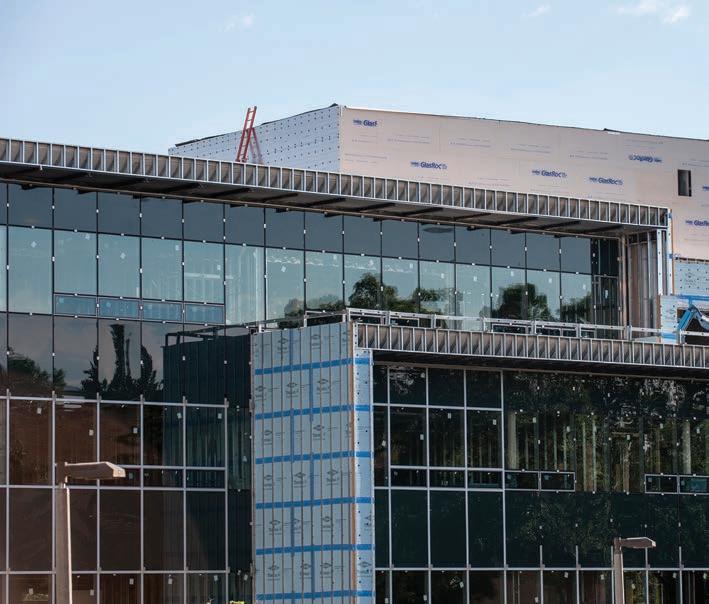
• The 51,000-square-foot home of MSU’s Jake Jabs College of Business and Entrepreneurship will open for classes in the summer of 2015 thanks to a $25 million gift from MSU alumnus Jake Jabs.
• The structure, more than 50 percent complete, received its exterior shell over the summer, including state-of-
the-art windows to maximize passive solar energy.
• The building will tap into a set of newly installed geothermal wells for heating and cooling of it and other buildings nearby. It’s expected the building will achieve LEED Gold certification thanks to the wells, sustainable building materials and its energy-efficient operation.
Norm Asbjornson Innovation Center
• MSU plans to construct the new building across Grant Street from the Strand Union Building, extending the current College of Engineering complex to the south.
• MSU expects to select an architect/ contractor this summer and the general contractor/construction manager is expected to be selected sometime in the fall.
• In the coming months, MSU will hold a series of meetings to plan the building’s labs, classrooms and other spaces.
Campus projects currently in construction or design
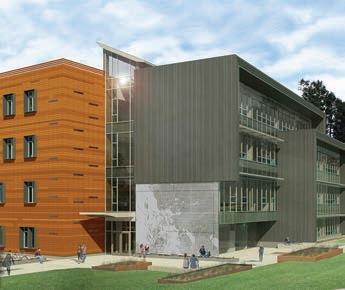
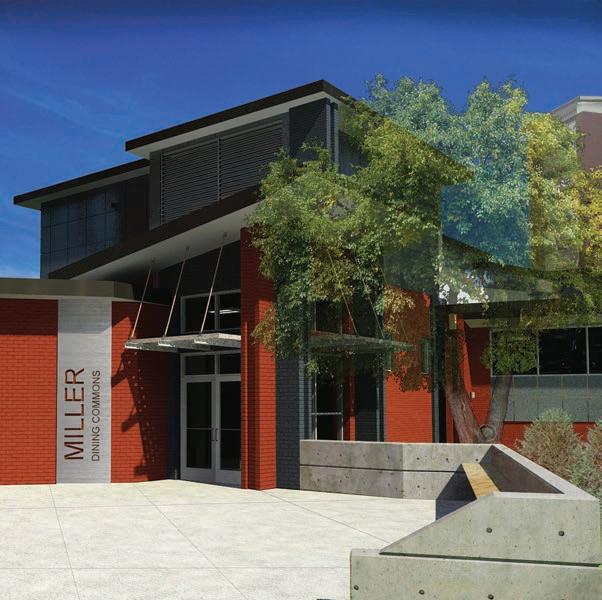
The new home of the Jake Jabs College of Business & Entrepreneurship (left, currently under construction), will open for classes next summer. (Above) Architectural rendering of Jabs Hall. Opposite page renderings of the Miller Dining Hall renovation, and (right) the new Freshman Residence Complex.
• The building is made possible by a $50 million gift from MSU alumnus Norm Asbjornson.
New Freshmen Residence Complex
• West of South Hedges, crews will break ground this summer on a residence complex for up to 400 freshmen in modern, traditional housing.
• The $35 million residence hall will provide much needed on-campus living for first-year students. Research has shown freshmen are more likely to stay in school and succeed when they live on campus.
• The four-story building will be a Yshape to make the best of views and natural light as well as take advantage of solar orientation to facilitate energy efficiency.
• The building’s cost will be covered by student residence hall room and board fees.
Miller Dining Hall
• Beginning this fall, the newly modernized facility—which serves an average of nearly 6,000 meals each day—will offer expanded seating for students and a wider array of fare from upgraded kitchens.
• With Miller leading the way in its $10.5 million renovation, each of MSU’s dining halls will follow suit and feature new serving areas offering a variety of foods.
• Expansion of seating areas, new convenient and ADA accessible entries, windows and energy retrofits are expected to be completed in the fall of 2014. Upgrades and renovation to the food serveries are expected to be completed in the fall of 2015.
• Upgrades to the Hannon and Harrison food service operations are expected to occur beginning the summer of 2016.
• The renovations mark the first campuswide upgrade to MSU’s food service facilities since the 1960s.
Brick Breeden Fieldhouse
• Renovations are underway this summer, giving Brick Breeden a new state-ofthe-art track and floor surface, more comfortable seating with seatbacks and cup holders, a better sound system, a curtain to create a more intimate venue within the space and an upgraded ventilation system.
Cheever 215 Lecture Hall
• When it’s completed, the space will include tables for each seating row, improved wheelchair accessibility and a new movie-grade video display. The update includes a seismic upgrade, as well as a top-to-bottom remodel of the décor, climate systems, sound systems and lighting.
Strand Union Building Ballrooms
• As the centerpiece for many of MSU’s on-campus events, next winter the space will receive a renovation featuring a new, more-modern style, including state-of-the-art lighting and audiovisual infrastructure.
• The Bobcat Grille area will also be updated with a new pizza venue, which will include a state-of-the-art gas fired oven.
—Sepp
Jannotta
Architectural rendering of the Strand Union Ballrooms renovation.
“As women, we need to think big and be bold.” —Nancy Seleski
trail·blaz·er noun \trāl-blā-z r\
1. a person who makes, does, or discovers something new and makes it acceptable or popular
2. a person who marks or prepares a trail through a forest or field for other people to follow
BY TANYA CASEY-REINHARDT
Three MSU alumnae have blazed trails and found success in the fields of science, technology, engineering and mathematics (STEM). Looking for a challenge and confident in their academic abilities, Nancy Seleski ’86, Candace Roberts ’75 and Ingrid DeGreef ’82 broke barriers paving the way for others to follow, and now they are encouraging more women to pursue career fields in STEM.
These trailblazers have a lot in common: supportive families, strong Montana roots, confidence, good science and math skills, respect for others, a passion for excellence and a high-quality education from MSU.
Seleski, a native of Columbia Falls, Mont., earned her bachelor’s degree in chemical engineering, and is now the director of supply chain services and quality at 3M’s Industrial Business Group in St. Paul, Minn. As one of three girls in her family, Seleski decided in junior high to be an engineer like her dad, Lee Smith ’56.
“I was good in math and science, and I liked what he did,” Seleski said.
Roberts was raised on a cattle ranch near Broadus, Mont., and earned her degree in computer science. “While growing up we worked hard and we played hard and being a girl was never an issue,” Roberts said.
Roberts said she elected to study mathematics and computers to avoid homework because math and science were easy for her even without studying. Knowing she was gifted at problem solving, Roberts wanted
to pursue a career that would use her analytical skills.
“Computer science was up-and-coming, and I wanted to be a part of it,” said Roberts, who was one of three women in the program at the time and among the first 12 Montana State students to earn a bachelor’s in the field. “I had always been either the only one, or one of a handful of women in my classes, so it seemed natural. I didn’t think about it.”
Roberts was also the only woman in most of her electrical engineering classes. After graduating from MSU, she went to work at Honeywell in Minneapolis and built a career in the defense industry as a systems engineer working for several companies including Alliant Tech systems and United Defense (now BAE Systems).
Growing up in Dillon, Mont., DeGreef joined Air Force ROTC at MSU and earned a degree in Earth sciences. She served as an Air Force weather officer for six years before transferring to the reserves and joining Lockheed Martin Corporation in Denver where she is a software engineering senior manager.
Entering nontraditional fields didn’t seem unusual for this group of women as they had the encouragement of families who pushed the importance of hard work rather than a specific profession.
“My parents wanted my sisters and me to find a career we could be passionate about,” Seleski said. “Growing up in Montana we didn’t have the luxury of suburban living and therefore, we were hearty,” Seleski said. “Our parents encouraged us to get along, say
our prayers, work hard and do whatever we wanted to do. ‘Go! Be a dermatologist or an engineer.’”
At MSU DeGreef switched majors, from meteorology to earth sciences, which at the time was a more traditional field for women. “I was already entering the military just after the Vietnam War. I didn’t want to be a trailblazer in everything.” DeGreef, however, immediately earned a second bachelor’s in meteorology from Penn State during her first year in the Air Force.
Each of these trailblazers started in their fields immediately after graduation. “MSU has a really good engineering program. They gave me my start and I am really grateful for that, “said Roberts.
“Honeywell liked my broad science background and my Montana work ethic,” Roberts said. “After my first year, they sent a recruiter to MSU to get more like me. Most of the others in my Honeywell department either had a PhD or had worked there for years, and I just had a bachelor’s, and was doing the same quality work,” Roberts said.
All three said that MSU offered a quality education and gave them the hard skills needed to be successful in their careers, but they each acknowledge overcoming obstacles as women in male-dominated environments.
“As a woman in computer science in 1975 I had to prove I was competent. But, a man was presumed competent until proven otherwise,” said Roberts.
“Women are pioneering at 3M,” Seleski said as she praised the corporation for its culture of innovation and encouragement.
“As a woman in computer science in 1975 I had to prove I was competent. But, a man was presumed competent until proven otherwise,” —Candace Roberts
“It is so exciting to see kids enthusiastic about math and science, like a team sport for nerds.”
—Ingrid DeGreef
“Even in the 110-year-old company, women are still pioneering.” During her 28 years with the company Seleski has witnessed the first women appointed as plant manager, manufacturing director and executive vice president.
“I’m impressed with what many of the MSU alums have achieved in STEM e specially in the research world,” DeGreef said and noted that female engineers are at the highest ranks in the defense industry, including Lockheed Martin’s Marillyn Hewson, the first woman to serve as chairman, president and CEO of the company founded in 1912.
As pioneers for women in their fields, they have witnessed a lot of progress and have been a part of a historical movement of women into STEM, but they aren’t stopping yet. Each of them believes there is room for more quality women to enter STEM fields.
“As women we need to ‘think big and be bold,’” Seleski said. “I challenged my boss to tell me what year will it be when half our corporate office is women?”
DeGreef said, “More often than not I’m the only female at meetings. I’ve been most successful in both the Air Force and Lockheed Martin when the male leadership in my environment worked with me and didn’t make being female an issue or an obstacle.
“When I have encountered biases I found the best way to handle it is to do my job, work hard and prove by my actions that I deserve a seat at the table,” DeGreef
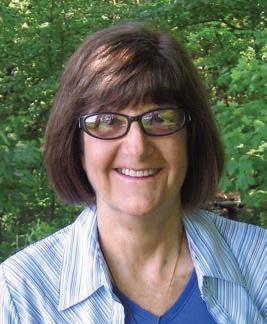
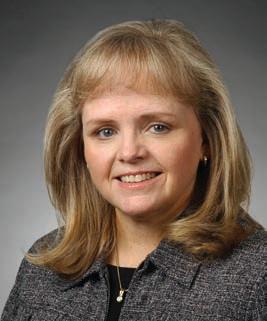
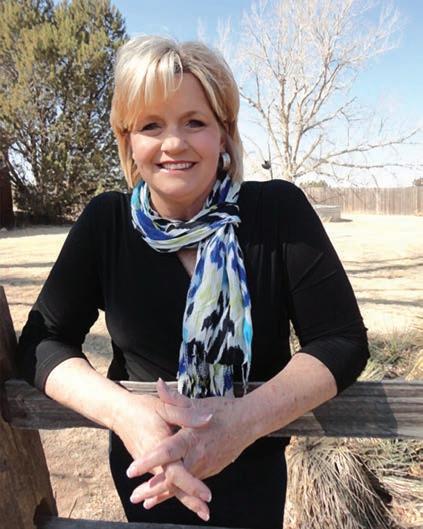
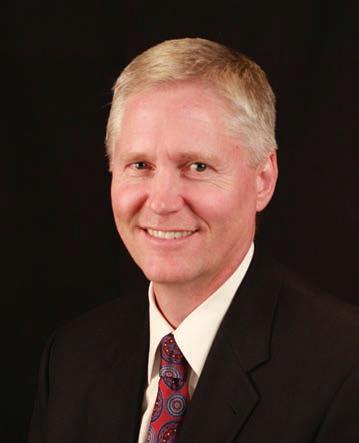
Nancy Seleski Candace Roberts I ngrid DeGreef
said. “It isn’t glamorous, but it is how I have trail-blazed at Lockheed Martin.”
As the parent of a daughter, DeGreef would like to see more done to foster an interest in STEM for elementary-aged girls. According to DeGreef, by the time girls are in high school, it can be difficult to capture their interest or develop their confidence in STEM fields.
Wanting to encourage more young women to pursue STEM careers, DeGreef and her husband started an aviation and space club at a high school in Aurora, Colo., and her employer, Lockheed Martin, sponsors a First Robotics team at the same school. First Robotics is an international competition offering high school students real-world engineering experience.
“It is so exciting to see kids enthusiastic about math and science, like a team sport for nerds. I look for First Robotics now when interviewing new entry-level engineers,” DeGreef said. “The program provides an outstanding background for students going to college in a STEM field particularly electrical, mechanical and computer science.”
According to Roberts, she always thought she wasn’t good with people, but discovered that the same analytical skills used to solve difficult engineering problems could be used to mediate conflict on a team. Mediating and resolving conflict have been key components of her job, she said.
“I often used my conflict resolution skills to handle complex issues when we were working as a team on product integration,” Roberts said, explaining her frequent role
as a liaison between different engineering disciplines.
While all three women volunteer through the MSU mentorship program, it was DeGreef who said, “Being a mentor is a gift you give yourself.”
The MSU mentoring program was launched in 2012. MSU students apply for a mentor and are paired with someone in industry.
“My student is not an engineering student,” explained Roberts. “She is a marketing and business major but wanted a mentor with experience dealing with a chronic illness in the workplace. That was me,” explained Roberts, who has battled multiple sclerosis for more than 30-years. “I was lucky to be in a field in which I didn’t have to use my body, because my left side was paralyzed for a time followed by limited movement, strength and coordination due to MS,” said Roberts who is active in the Alumni Association’s Greater Twin Cities Chapter and part of the leadership team.
Last year Seleski developed the MSU Women in Science Distinguished Professor Award and has been working with the Global Women’s Leadership Forum for 3M. She believes women need to work together to bring more women into the STEM fields.
“Women need to know how to navigate working with men, but they also need to be women. I tell young women I mentor, ‘You are a woman. Show up the way you are. Be a woman first.’ When that is demonstrated it is the greatest lesson for anyone. Women can be amazingly successful and powerful,” Seleski said.
Blending a focus on art and love of the outdoors
BY AMANDA BITZ ’13 M
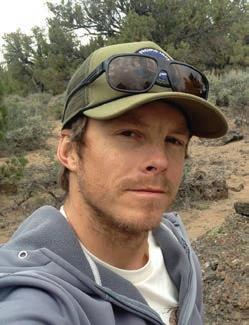
Adam Haynes ’00 developed a love of the outdoors at an early age. After spending his whole life in Central Oregon, he felt the call of Montana through his desire to attend college somewhere new while still living in a nature-centric place. Haynes knew he wanted to study art, but he wasn’t sure that an art career was possible and hoped to expand his options by attending a university.
“I didn’t really click very well with the art schools I interviewed with, and I just wasn’t mature enough in my art. I had this feeling that if I didn’t go to school, I was going to get stuck in other stuff, so I really wanted to get a university education.”
Although he looked at schools in Oregon, Haynes was drawn to the lifestyle Bozeman had to offer.
That decision ended up shaping his future, both professionally and personally. During his time at MSU, Haynes fell in love with fly-fishing, backcountry snowboarding and mountain biking. He knew he wanted to live in a place like Bozeman once he finished school and keep outdoor sports as an important element in his life.
“The feeling of living in Montana is something that I treasure to this day. Living out there made me really understand just how necessary it is to have an outdoor lifestyle and to balance work and play.”
After graduation, Haynes moved back to his home state, settled in Portland, Ore., and got a job designing T-shirts at Adidas.
Working at the clothing company was very exciting for Haynes. It was his first graphic design job, and he learned a lot about the creative process from other graphic designers and the industry in general. Although it was a creative environment, Haynes was challenged to find ways to be creative within specific parameters while also being unique and always improving his art. Haynes likened it to a second university education that polished the tools and skills he acquired at MSU.
Always trying to find a way back to the outdoor lifestyle he loves, Haynes struck out on his own creative career after five years at Adidas. He moved to Bend, Ore., to be closer to family and became a freelance artist. Haynes continued designing for Adidas and built his client base to
include companies such as Nike 6.0, ESPN, Fuel TV, Timberland Boot Co., Quiksilver, Tonka, Mervin Manufacturing, USFS and Deschutes Brewery. He has designed everything from T-shirts, snowboards, helmets and beer labels. Haynes credits his time at Adidas as opening the door for him to be a freelancer because of the contacts he made, the time he spent showing his artwork in galleries and the skills he honed.
Although Haynes has been successful at forging a living from his artwork, he initially wasn’t sure if it was possible or if it was what he wanted.
“I had a mentor who was a local graphic designer in the town where I grew up, and he showed me that it was possible, but I definitely didn’t see it as something that was super easy to get into.”
Haynes’ positive influences continued at MSU, and he credits instructors Robert Rath, Anne Garner and Jeff Conger with instilling an appreciation for the various elements of art and design in him. It was in Robert Rath’s illustration class where Haynes realized that not only was he a skilled illustrator, but that he really wanted to turn his artistic talents into a career.
Because of the style and the layering involved for his fine art, Haynes prefers to paint on solid media instead of canvas, which can stretch or sag under the weight of the paint layers. The result is that Haynes’ paintings are often done
on recycled wood or glass, elements that complement his outdoor aesthetic and subject matter.
Haynes says his favorite work has been some of the most challenging. When he was first starting as a freelancer, he worked with Nike 6.0 on a project called the Vertigo campaign. Haynes created a series of illustrations that he describes as “drawn from the point of view of someone about to drop in on something really vertical, whether it was a biker dropping in off a big ramp, or a surfer on a wave. It was almost a fisheye perspective. That was one of the most difficult projects I’ve done because of that perspective.”
“Haynes revisits that work and perspective when he wants to test himself.” to “Despite the difficulty of the project, Haynes was very pleased with the results and revisits it and the challenge posed by unusual perspectives when he wants to test himself.”
As for other art students looking to make a career in the art world, Haynes encourages them to set aside time to focus on their craft. He says he spent a lot of time worrying about what he was working on and where he was working, but everything fell into place once he focused more on his art.
“It takes a long time to develop a unique style and a sellable artistic persona. Get your name in front of the right people. Work on your craft. Draw a lot. Take opportunities as they come and just love it. It
can be a really difficult career to get started in, but if you really love it then it’s not really work. I feel really lucky that I’m able to do what I do.”
Haynes emphasizes the importance of taking advantage of opportunities for internships and developing a portfolio that contains projects outside of class. Companies want to see more than just schoolwork, and it can be hard to develop a professional portfolio.
Haynes explained, “You learn a lot in school, but those are more tools, and they’re not necessarily tools for getting a job.”
Any opportunity to get hands-on experience is very valuable, he said.
In return for the hard work it has taken to achieve professional success, Haynes enjoys being a part of an artistic community that he describes as collaborative rather than competitive.
“I feel like there’s a really great kinship between artists. It’s not so much competition, but more of realizing how lucky we are to do this for a career.”
Haynes says there is enough work that the competitive mindset doesn’t exist.
“Everyone is just trying to find their own way and their own niche. That’s the beauty of art t here’s a million ways to do it.”
Adam Haynes’ designs are on T-shirts, snowboards, posters (left), helmets (right) and beer labels.
SEWING FOR SOLDIERS
BY JODIE DELAY
In November 2012, Jona McNamee ’74, MSU Extension agent in Cascade County, Mont., confided in her colleague Sharon Hovey ’69, ’75 M. McNamee’s son Ed was on his third deployment to Afghanistan, and it wasn’t getting any easier to cope. Knowing what to expect, in fact, made it harder. She needed an outlet. Hovey, an emeritus professor of nursing who retired in 2002 after 25 years with MSU’s College of Nursing, frequently helped manage monthly projects for the Extension Homemakers, and McNamee thought maybe they could work together on a quilt for Ed.
Hovey, an avid sewer, agreed, and took it up a notch. She suggested they make a quilt for each of the Great Falls-area soldiers who were deployed with the 755 ESFS (Expeditionary Security Forces Squad-
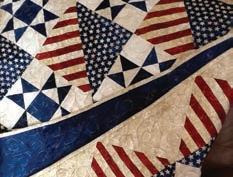
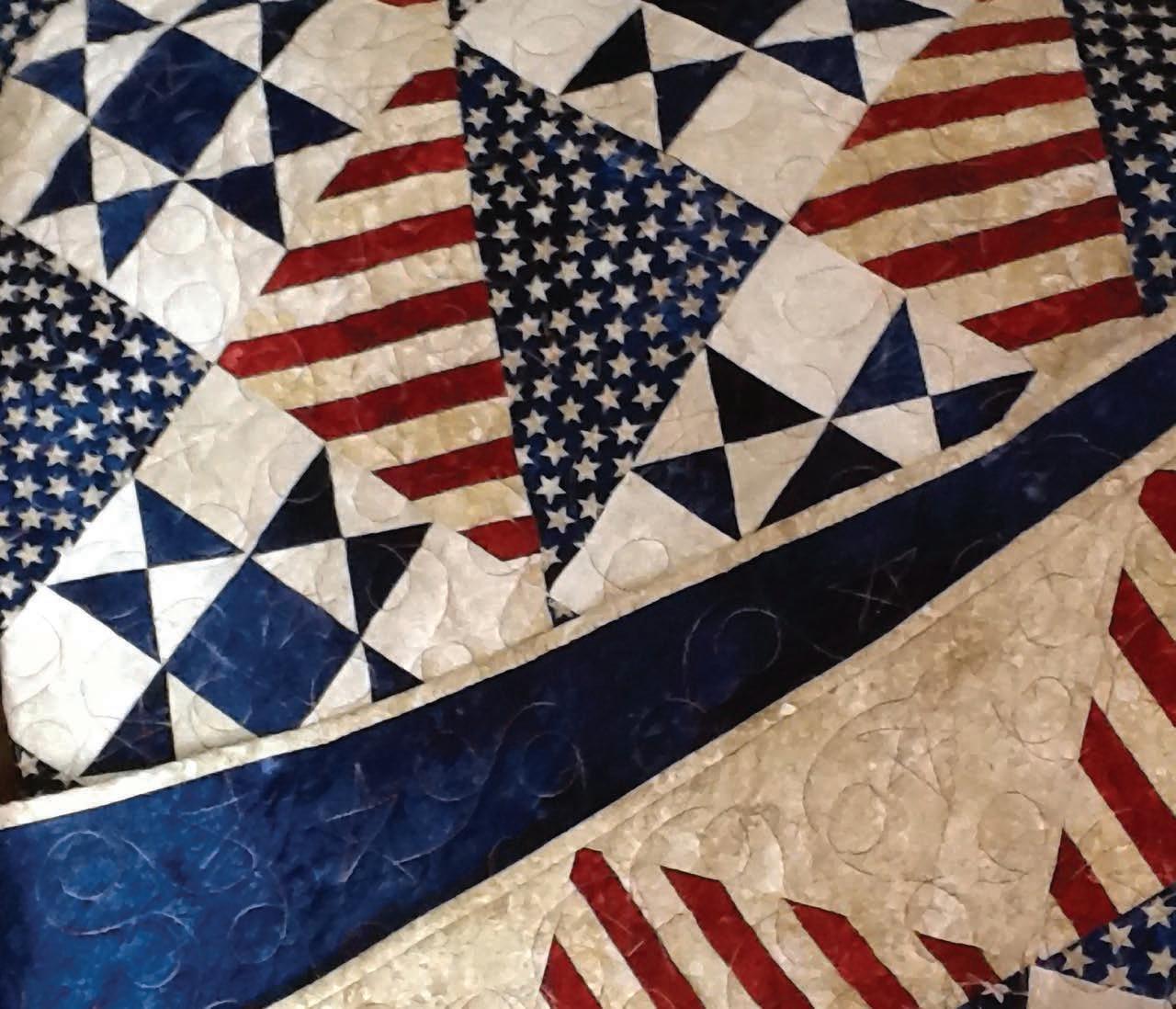
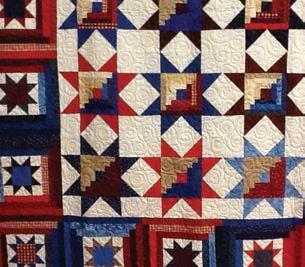
Quilt by Sharon Hovey
“IF SOMEONE MAKES YOU A QUILT, YOU REALLY MEAN A LOT TO THEM. IT’S NOT THE SAME AS A BLANKET OR A THROW. IT’S A REAL LABOR OF LOVE.”
—Sharon Hovey
ron), known in the Montana National Guard as the Reapers. The group included 31 men and six women who all had families, including many young children, who were growing weary from frequent deployments.
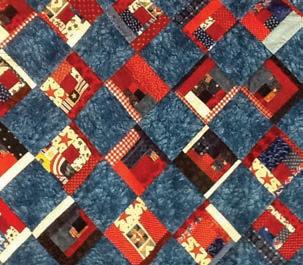
Making 37 quilts would be no simple task. A quilt is a special creation. Made from three layers including a uniquelydesigned top, a warmth-providing middle, and a backing all bound together at the edges e ach quilt takes a considerable amount of time to create. The cost for one quilt, including the pattern, fabric, batting, thread and professional long-arm quilting can often exceed $300. “If someone makes you a quilt, you really mean a lot to them,” expressed Hovey. “It’s not the same as a blanket or a throw. It’s a real labor of love.”
In January 2013, six ladies gathered at the Cascade County Extension Office for the first of a series of work sessions. McNamee reached out to the media, service organizations and anyone who would listen to gather donations of fabric or cash, long-arm quilters and to recruit volunteers. Hovey organized behind-the-scenes, making sure everyone felt valuable, whether they were cutting, pressing or stitching. Sew for Soldiers was born. Momentum grew and donations and volunteers rolled in. Great Falls quilt shops donated generously and fabric donations also came from four states and from across Montana.
The Great Falls Holy Spirit Parochial School student council hosted a popcorn sale to raise funds for the project. The Daughters of the Revolution in Lewistown, Mont., donated pillowcases. Homemaker
Dorothy Tollefsrud collected fabric scraps to create scrappy squares, stretching the fabric a little further.
Several expert quilters donated completed quilts. This included the widow of a WWII Navy veteran who created a quilt in memory of her husband. A young 4-H member donated a finished quilt that had received a blue ribbon at the state fair. Extension homemaker Dee Seay, using her long arm machine, created 20 quilts. Per Hovey, “that’s a good day’s work on each one.”
In Conrad, Mont., Pondera County Extension agent Wendy Wedum helped expand the Sew for Soldiers’ team. She connected with fourth-grade teachers Kim Hofstad and Jennifer Schlepp ’88, whose classes held a poetry reading and root beer float sale. The $242 they raised was presented to the Montana Prairie Quilters in Conrad. The group designed, completed and donated six finished quilts and pillowcases to the project.
Many volunteers during monthly Sew for Soldier days were from Extension Homemaker Clubs and/or military service organizations: some were from the community at-large; some volunteered one day, while others attended multiple sessions. All came to support the soldiers and their families. Many had served in the military themselves. Many knew personally the strains of having a loved one deployed. One woman shared that her husband was spit on when he got off the ship from Vietnam. She joined the effort to be sure that this group of soldiers was honored upon their return. A passion to support soldiers and their families was the unifying thread.
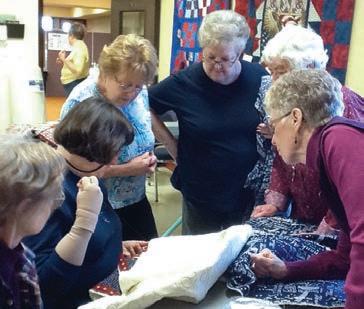
“When people came who didn’t have a sewing background, we helped them learn,” said Hovey. “Energy comes from task completion, and you get confidence as you learn and grow. The synergy of the group working together resulted in beautiful finished quilts, touched by many caring hands. At one point, we had four ladies, one on each side of a quilt, hand-stitching the binding. It was wonderful seeing them using their talents together.”
By the end of the project, more than 200 people had participated. At least 75 were children, and the age of volunteers ranged from 6 to 90. At least 1500 volunteer hours were contributed by Extension homemakers alone.
“The project really took on a life all its own,” said McNamee. “Just when we thought we might not have enough fabric, more would come in, or a completed quilt would arrive. Seeing the support from the entire community, and well beyond county
Gloria Badgett gives handstitching lesson to Joann Johnson, Jo Luse, Dody Sproles, Dorothy Tollefsrud and Kathy Nash.
Quilt by Pat Valtinson
Quilt by Dorothy Tollefsrud and Connie Silva
and state lines, made the difficult time much easier.”
Master Sergeant Ed McNamee’s familyautographed quilt now hangs on the wall in his classroom at Charles M. Russell High School, where he teaches history. McNamee also coaches the girls and boys swim teams for both CMR and Great Falls High. His family and community are stronger than ever, and the quilt is a reminder of how intensely many people supported his entire units’ work.
On the surface, making a quilt is a laborious process of rejoining hundreds of
pieces of fabric that are, quite intentionally and with a lot of work, cut from perfectly complete material. The concept seems illogical, but it takes something ordinary and makes it extraordinary.
Military deployment is similar perfectly complete families and communities are cut apart. People leave their homes to serve a greater purpose, separating from loved ones who also must make great sacrifices. It is a laborious and difficult process, that isn’t complete unless and until each soldier returns home safely.
Like each individual quilt, the Sew for Soldiers project brought together lots of people and for extraordinary results.
On September 21, 2013, at a Yellow Ribbon Ceremony, the Reapers third deployment journey was finally complete. Each soldier was home safe and sound and the community was joined together again, stronger than before. Each soldier was presented with a red, white and blue quilt and a pillowcase, the gift carefully hand-labeled with the message, “You served, we sewed. Thank you.”
Extension Homemakers active throughout Montana 100 years later
MSU Extension recently turned 100 years old. From the beginning, women have been central to its success. Katherine Jensen began her work as Montana’s first Extension home demonstration leader during the summer of 1914. She quickly recognized the nutritional deficiencies of rural Montanans. Grocery stores were sparse, refrigeration was a challenge and homes often had unreliable and inefficient stoves. By organizing easy, healthy recipes and teaching boys and girls in rural schools how to safely prepare them, she was instrumental in implementing hot lunch programs for children. She worked tirelessly traveling around the state conducting lectures and demonstrations.
Families were hungry for knowledge and new skills ranging from raising chickens and milk cows to preserving vegetables and meats to making delicious and nutritious breads and desserts. To expand her reach, Jensen regularly engaged with homemakers through two-four day sessions in their local communities. Because families were often isolated, women’s clubs formed naturally all across the state. These groups provided homemakers the opportunity for socialization as well as to share ideas for raising their families and building their communities.
In 1923, Extension leader Blanche Lee encouraged these grassroots women’s groups to organize formally as Extension Home Demonstration Clubs. By 1926 there were 152 clubs with more than 2,500 members. In June of 1949, Extension organized a State Home Demonstration Council to bring together Homemakers from around the state to brainstorm creative ideas for improving rural life. The
first meeting included 64 delegates from 32 counties, representing 518 clubs and more than 9,300 members. The purpose of the clubs and council was to create a more healthful, happy, intelligent and contented rural population by sharing the latest scientific-based knowledge related to
that at least 46 Extension Homemaker Clubs are still active in 14 counties with more than 500 members. Jane Wolery ’90, Teton County Extension agent, explained “women in these clubs have offered tremendous social support and community involvement over the years.” Clubs are independent and have unique goals and projects, but the unifying thread continues to be supporting and serving families and communities and bringing individuals together socially. Club projects tend to revolve around community services ranging from organizing blood drives to providing meals after funerals to making quilts for soldiers.
living healthy lifestyles in rural Montana. Topics included everything from making comfortable mattresses, to safely preserving food, to child development to building safe, comfortable homes.
In 1965, the State Home Demonstration Council organized the first Women’s Week on the MSU Bozeman campus. Women were invited to Bozeman for this event until 2006. By then, improved transportation and communication had decreased the isolation of many of the state’s people and additional opportunities for gathering and sharing ideas were many. The State Home Demonstration Council was disbanded, though Extension county agents and specialists continue to provide the latest scientific information related to raising healthy families through countless local organizations.
In the past decade, many homemakers have continued to meet regularly. A recent survey through MSU Extension indicated
Linda Bengochea ’71, has been a member of the Mona Homemakers in Richland County since the early 1970s. A young teacher new to town, she joined to get to know others and was inspired by the community service of the group. She continues to participate for the same reasons. In her rural county, it is still as much as 40 miles to the nearest town. Newcomers usually find the club via word of mouth and all are welcome. Each month 25–30 women show up at their clubhouse, Mona Hall, located in Charley Creek. The group is active and there is no end in sight.
“The more you get involved, and the more connected you are to your neighbors, the happier you are,” said Bengochea. “We look out for each other and do what is needed.”
MSU Extension would like to hear your Extension homemaker stories. Please share by sending an email to jdelay@montana.edu or calling 406-994-2502.
Berninger gives advice to MSU film students as his movie goes ‘National’
BY CAROL SCHMIDT
Adocumentary about one of America’s hottest indie musical groups that has gone “National” has a Montana State University connection.
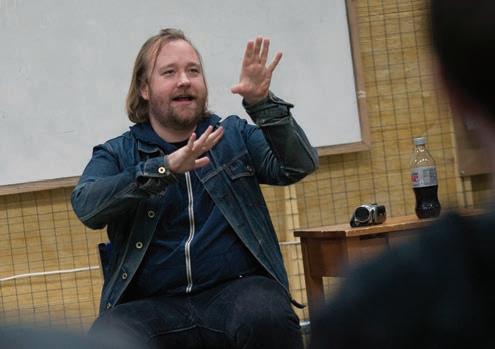
“Mistaken for Strangers,” a documentary that opened nationwide this spring, is written, directed and co-produced by Tom Berninger, who graduated from Montana State University in 2002 with a degree in film. Berninger recently screened his film in Bozeman and spent a day talking to MSU film students.
“I thought about going to a big film school, but one of my brother’s friends who was in film told me to go to a school where I’d have a great college experience…. Get in trouble…. Make a lot of friends…all which I did,” Berninger said.
In addition to making friends at MSU, the likable Berninger has also made a memorable film, which was selected as the opening night film for the prestigious Tribeca Film Festival last year and has since played to great reviews at festivals around the world. Reviewers describe the film as “truly hilarious and touching.”
At first blush, the film is about Berninger and his ill-fated turn as a roadie for the indie-rock band The National, a gig he got because his older brother, Matt Berninger, happens to be the group’s lead singer. Tom’s job doesn’t go so well, and from there the film evolves from a humorous look at the inner workings of a rock band into a touching story about complex family relationships and how they form us, and one man’s discovery of his strengths and courage.
“It’s a love story,” one audience member said about the film’s examination of the relationship between the two Berninger brothers.
Berninger screened the film at the Bozeman Film Festival in connection with his appearance at the Big Sky Documentary Film Festival in Missoula, Mont., which meant it was only a short trip to screen the film in Bozeman, visit his old professors and answer questions from film students at his alma mater.
“This is everyone’s dream…to come back to their school and talk about their movie,”
Berninger said. He told students that he followed a cousin to MSU and never regretted his choice.
“This college and this film school let me make movies…. I made a film my freshman year,” he said. “That doesn’t happen other places.”
Cindy Stillwell, MSU film professor who taught Berninger when he was at MSU and introduced him at the Bozeman festival, said her former student has “made a fantastic film that makes us all beam with pride.” The film had its national opening March 25 at Los Angeles’ Shrine Auditorium followed by an appearance by The National.
his story may serve as inspiration to those who struggle finding their voice even after “years of heartbreak.”
Berninger talked his brother into allowing him to film The National on an international tour with the goal of posting a video blog on the band’s website.
From the beginning of the film, it is obvious that things may not go well for Tom. Even though the brothers’ faces bear a resemblance, the similarity seems to end there. Matt is tall, spare, aloof, hipster cool. Tom prefers heavy metal and video games. He’s accessible, irreverent, relaxed and always in trouble. The audience learns that this is a longstanding pattern in the Berninger family, where Matt was the “quarterback and hero” and Tom was the class clown. Yet, as the film unspools along with Tom’s career, the audience sees Tom make some important personal realizations that enable him to make the film only he could make. The last image in the film is of the two brothers memorably linked together.
Berninger said he still lives with his famous brother and his family, although they recently relocated from Brooklyn to LA. “We went out to look at LA and we just stayed, basically,” he said.
Berninger told the Bozeman audience that “Mistaken for Strangers” has opened up doors to him, and he is working on another unnamed project. He said he hopes
“I wanted to tell the kids that it doesn’t matter when you figure it out,” said Berninger, who is now 34. “You just need to figure it out.”
His advice to MSU students was to stay in college and take advantage of every opportunity offered them as they discover their own strengths.
“I loved this school, and the five years I was in Montana” Berninger said.
He added that many scenes of Berninger at work with The National while on tour were filmed by MSU film school friends. He said some of his best memories of MSU involve those friends. “I was kind of a punk. But I was also part of a community. Once you graduate it’s really hard. When you are in college, you really are free to create.
“The years here helped create who I eventually came to be,” he told the screening audience “….Although. it did take me 12 years to figure that out.”
To learn more about Berninger’s film, see mistakenforstrangersmovie.com. To learn more about MSU’s School of Film and Photography, see sfp.montana.edu.
Tom Berninger
VANAJEROS
BY EVELYN BOSWELL
Aidan Lynn-Klimenko ’12 once lived in Ecuador while his parents worked for an international organization devoted to reducing poverty.
Now the Montana State University alumnus is returning there with three former classmates from the MSU School of Film and Photography: Joel Martin ’12, Parker Hilton ’12 and Madison Perrins ’13.
They are driving a 1985 Westfalia camper van and planning to connect with people along the way by using the skills they developed at MSU. They are photographing individuals and families and giving them their photos. They are posting video and photos on their website and social media. They eventually hope to publish a book of photos.
“It’s definitely us striving to make a deeper connection than if we were passing through and snapping photos and going on,” Martin said.
It’s also a way to test themselves by leaving their comfort zones, said the quartet who fully expect to encounter difficulties, but don’t plan to pursue trouble.
Before heading to South America, the MSU graduates tested their concept in Moab, Utah. The team, from left, is Joel Martin, Madison Perrins, Aidan Lynn-Klimenko and Parker Hilton.
“The big selling point for me is that there will be problems,” Martin said. “That’s a big part of why I’m going now, to prove I can still do things like this and hopefully make that comfort zone a lot bigger.”
The idea for the Latin American adventure began with van owner Lynn-Klimenko, a Minneapolis native who invited the others to join him. The plan for a value-added journey through Mexico, Central America and South America developed as the group discussed logistics and the opportunities to use their education. They dubbed the journey “Vanajeros,” combining their mode of transportation with “viajeros,” the Spanish word for travel.
To prepare for the trip, the Volkswagen engine was replaced with a Subaru engine. The group also replaced other parts and stocked up on spares. They held a three-week Kickstarter campaign to raise funds. They found sponsors, some of whom supplied them with camping gear. They drove to Moab, Utah, to test their idea for photographing strangers and giving away photos without charging a dime or peso, sucre, lempira, colón or cordoba.
PHOTO BY AIDAN
“THE BIG SELLING POINT FOR ME IS THAT THERE WILL BE PROBLEMS. THAT’S A BIG PART OF WHY I’M GOING NOW, TO PROVE I CAN STILL DO THINGS LIKE THIS AND HOPEFULLY MAKE THAT COMFORT ZONE A LOT BIGGER.” —Joel Martin
They repainted their brown van brown.
“We want to blend in as much as we can, as much as four white kids can in Latin America,” Martin said.
“We are not hippies in a van,” Hilton said.
MSU prepared them for the journey, as well, the team said. Lynn-Klimenko, for one, said MSU opened him up to shooting with film. He explained that the switch from digital taught him to slow down and think about composition, content, lighting and other factors that result in compelling photographs. On this trip to Ecuador, the MSU graduates are taking and giving away
digital photos, but they are also shooting film for their book.
In addition, MSU made the travelers comfortable with peer criticism, a skill they said is important for their profession, as well as during a long trip living in close quarters.
Perrins, a native of Columbus, Mont., said her high school helped prepare her for the journey, too. Besides studying photography and Spanish at MSU, she took four years of Spanish in high school.
“Because my town was so small, it was one available link to the outside world and international culture. I always loved geography, as well,” Perrins said.
This time in Latin America is allowing her to enjoy those things while using the skill set she developed in school, Perrins said. And the thought of giving away photos was an added attraction, too.
The group left Montana in mid-June and plan to travel together four months, living in and working out of the van. Looking for the safest routes to cross borders, noting that they are not blissfully unaware of potential dangers, they said the one place
Indonesia and the Japanese boy and sister (right) in Cambodia.
“WE WANT TO BLEND IN AS MUCH AS WE CAN, AS MUCH AS FOUR WHITE KIDS CAN IN LATIN AMERICA.”
—Joel Martin
they won’t drive is the notorious jungle between Panama and Colombia. Instead, they will put their van on a boat and board a plane to meet it.
Their schedule between their departure and return is flexible, the team said. They don’t know if they’ll be in Panama four days or a month. If their van breaks down, they figure the delay will just give them more time to make friends.
“We have a mission, but not a plan,” Martin said.
Above: These are the types of photos the MSU graduates are taking on their journey to South America. Aidan Lynn-Klimenko photographed the boy with the red chair, the dance group and the elderly man previously in Colombia. Parker Hilton photographed the shirtless boy in
Jenny Pluhar At home on the range
BY TANYA CASEY-REINHARDT
Although Jenny Pluhar’s passion for range management started in a patch of sagebrush outside Billings, her expertise is valued throughout the U.S. and impacts Louisiana bayous and swamps, and Texas prairies and rangelands.
That expertise was recognized recently as Pluhar ’81 was elected president of the Society for Range Management, an international organization with more than 4,000 members in 48 countries. Pluhar is only the second woman elected to the position since the society’s inception in 1948.
Pluhar joined the Society for Range Management while an MSU student, never expecting to be elected president nearly 30 years later. With nearly half of all land in the world categorized as rangeland, the group devotes itself to providing leadership to land stewards in the west. As the president, Pluhar is the voice of the organization and works closely with Congress and governmental agencies on a variety of issues from protecting sage grouse and lesser prairie chickens, to public policy and range management for wild horses.
Originally from Billings, Pluhar is also a senior wetland scientist for an environmental engineering firm, ENERCON Services, and manages three ranches in the Texas panhandle.
“I never have a typical day,” Pluhar said. “Today I am counting prairie chickens on a cattle ranch and tomorrow I am heading to the Houston ship channel to a munitions depot where bombs were transported during World War II to develop an environmental impact statement and map wetlands.”
It was an MSU Extension agent, Dave Phillips, in Yellowstone County, who first ignited Pluhar’s interest in range management. Phillips offered Pluhar a summer job as a research assistant while she was in high school, and she was hooked.
“I met students and faculty from the College of Ag and knew immediately I was going to MSU to study range management,” Pluhar said. “I loved getting out there and understanding the ecosystem
and how it all worked together I still do.”
She came to Bozeman and found a mentor in professor Don Ryerson, who taught at MSU from 1957 to 1980.
“He was a perfectionist with high expectations. He videotaped us teaching labs and then critiqued our skills. ‘Be more engaging. Be good teachers.’ I couldn’t have gotten that teaching experience at any other school,” said Pluhar, who worked as Ryerson’s undergraduate teaching assistant.
The drive to excel in the classroom paid off at Texas A&M where Pluhar earned a master’s in range science in 1983.
“As the only female out of 65 range management graduate students I felt I had to prove myself,” Pluhar said. “My teaching skills from MSU made that possible. I was already good at it.”
According to Pluhar, she used the same skills studying Montana soils and plant systems that she used studying hydrology, making her marketable for jobs in wetland ecosystems. And while most aspects of range ecology in Montana and Texas are similar, there are differences.
“I never thought alligators would be part of my range management experiences, but unlike rattlesnakes, neither alligators nor swamp snakes offer a warning.”
Pluhar worked with several soil and water conservation districts before becoming a private consultant which allowed her more time to spend with her three children who were active in 4-H and involved with training, raising and showing American Quarter Horses.
“We traveled all over the USA with those horses,” Pluhar said adding that each of her kids represented the United States at the Youth World Cup competitions in Australia, Canada and Germany.
As a consultant and ranch manager for 80,000 acres of rangeland, Pluhar is developing a habitat conservation plan for the
ranch to protect lesser prairie chickens, a type of grouse, recently listed as threatened under the federal Endangered Species Act.
Sharing knowledge of range management has been important to Pluhar and is evidenced by the weeklong range workshops for youth she directed for 25 years. She also served as president of the Texas Section of the Society for Range Management in 2003 and has been recognized with Fellow awards from the Texas Section and an outstanding achievement award from the international society.
Pluhar encourages students, young professionals and rangeland veterans to get involved in local groups and organizations. While at MSU Pluhar joined the Alpha Gamma Delta sorority, and was inducted into the Alpha Zeta and Septemviri honorary societies. Pluhar is also a member of the U.S. Cattleman’s Association, the Texas and Southwestern Cattle Raisers Association and the Wetland Science Society.
Pluhar lives in Texas with her husband, Darwin ’81. They have three children: Joe, who graduated from Texas A&M veterinary school this year; daughter Logan a college sophomore at Texas A&M; and Zane, a Marine second lieutenant who graduated from the U.S. Naval Academy this spring.
Jenny Pluhar
Hooking a big one: Livingston fishing guide snags prestigious literary awards
BY MARJORIE SMITH
As a Montana-based writer producing literary fiction, Callan Wink ’07 is tracing impressive footsteps which include acclaimed fiction writers Thomas McGuane and Jim Harrison, who both grew up in Michigan, as Wink did, before settling in south central Montana. With a “Story of the Year” award from The New Yorker, inclusion in The Best American Short Stories 2013, and a recently announced National Endowment for the Arts Creative Writing Fellowship to his credit, Livingston, Mont., fishing guide Wink is also producing major literary ripples.
Wink first came to Montana at age 20 as a fishing guide. When he discovered that he could spend a year at Montana State University under the National Student Exchange program, he moved to Bozeman a nd decided he didn’t want to leave.
“I always loved fly fishing,” Wink says, noting that he still makes his living as a fishing guide. As for that $25,000 fellowship from the NEA, Wink says, “Well, I’m not doing anything extravagant I don’t have to travel to exotic locations in order to write. But it means I don’t have to stress out about how to find winter employment.”
Wink hasn’t always seen himself as a writer. “I’ve always been a great reader,” he says, “so literature seemed a natural major. But halfway through my bachelor’s degree I found myself wanting to write my own stuff instead of essays about other people’s works.”
After he graduated from MSU, Wink went on to earn an MFA in the University of Wyoming’s creative writing program. He says he was only semi-aware of MFA programs during his undergraduate years, but then he heard about the new program at Wyoming, which accepts a very limited number of applicants in poetry, fiction and creative nonfiction. “It seemed like a good way to stay in the Rocky Mountains,” he says. “And it was fully funded for students they accept.
“Wyoming’s MFA is a small program, and you’re expected to write and read and critique each other’s writing,” Wink says, pointing out that there is much to be learned about your own writing in the process of pointing out other people’s weaknesses.
Wink’s first New Yorker publication came in 2011 with a story called “Dog Run Moon.” The New Yorker was never on my radar,” Wink says, “but I had this great professor in Wyoming, Brad Watson, and he encouraged me.”
Watson sent one of Wink’s stories to his own agent who liked it and asked to see another story, which the agent then sold to The New Yorker one of the few American commercial magazines still buying short fiction. Other aspiring fiction writers who have collected rejection slips from both The New Yorker and potential agents will recognize that Wink’s career had been launched at that moment.
It was “Breatharians,” the second of Wink’s stories that his agent sold to The New Yorker, which the magazine designated its story of the year and which made it into the Best American Short Stories collection.
When it was first published, Cressida Leyshon, The New Yorker’s deputy fiction editor, wrote: “Wink is one of those earthier writers: his metaphors are all tacked to physically relevant things (like levels or animal intestines), his prose is straightforward (while still reserving the right for elegance), and the story itself is specific about its details while at the same time avoiding the trap of lecturing or telling the reader anything obvious. Straight off, we get to the harsh and the true.”
Wink says his favorite professor at MSU was poet Greg Keeler. “I tried poetry writing, but I wasn’t very good at it,” Wink says. “I took all of Keeler’s classes. I liked his attitude about some of the affectations of the literary world.”
With the National Endowment for the Arts having formally appointed Wink a member of the literary world, he intends to keep Keeler’s scepticism in mind. And although he has plans for a collection of short stories and is trying his hand at writing a novel (“Novels are hard,” he confides), for the time being he’s very busy with his career as a fishing guide. After all, it’s summer in Montana.
Kevin Cummings Rising to the top in global aerospace
BY TANYA CASEY-REINHARDT
For Kevin Cummings ’85 the trajectory that took him from a small-town northern Montana childhood in Cut Bank to a career as chief executive officer for GKN Aerospace in the United Kingdom was established at Montana State University.
It was manifest in 1984 when he interviewed with Hercules Aerospace Company on the MSU campus and received a job offer two weeks later, still six months prior to his graduation with a degree in mechanical engineering.
“When you graduate (from MSU) and take that first job, you have confidence that you are ready to immediately contribute,” Cummings said, reminiscing from his office in the London headquarters of GKN one of the most venerable engi-
neering firms in the world and one with a global presence in aerospace, automotive and agriculture.
“MSU professors were not going to give you an engineering degree just because you showed up and paid tuition…. You quickly learned that you were going to have to work hard and take personal responsibility to achieve your goals,” Cummings added.
“Although a simple concept, I still think of that as a most valuable lesson for someone 18 or 19 years old.”
Armed with sound fundamentals and a competitive drive heading into his job at Utah-based Hercules, then a growing force as a U.S. defense contractor, Cummings stepped into working with composite structures, specifically carbon graphite, a then-new technology that would become a cornerstone in designing components for airplanes, rockets and satellites.
“ I came out of school during the Reagan defense build-up, at a time when there was a lot of research and development activity happening in the aerospace industry,” Cummings said. “The company was in a period of rapid growth and I was fortunate enough to be given a lot of responsibility early on in my career with Hercules.”
The breadth of those responsibilities nearly ran the gamut during his tenure at Hercules. Over 23 years, during which the company was acquired by Alliant Techsystems, Inc. (ATK) and then went on to acquire the chemical and solid rocket propulsion company Thiokol, Cummings progressed from an entry level engineer to leader of the Launch Systems division of ATK in Utah.
After his start as a development engineer, Cummings moved up to engineering management and then program management. His career also included stints working in operations management, business development, corporate strategy and mergers and acquisition. Along the way, Cummings received a master’s degree in business administration from the University of Utah.
Cummings’ next move took him from ATK, which supplies nearly all the solid rocket motors for NASA, the U.S. Department of Defense and private space contractors in the U.S., to GKN Aerospace, which supplies a comprehensive portfolio of lightweight composite and metallic aircraft and engine systems for a vast majority of the world’s aircraft, including Boeing and Airbus.
His move to GKN in 2008 put Cummings squarely into the global business arena. With $3.5 billion in annual sales in 2013, GKN Aerospace has 35 manufacturing facilities located in nine countries.
The chance to lead GKN Aerospace is a great privilege, Cummings said.
“GKN is truly a global leader in both automotive and aerospace and that was a big lure (for me),” said Cummings, who transferred to the U.K. this year from GKN Aerospace’s North American headquarters in Texas. “I was eager to go international and expand (my experiences) within this new global world that we are living in today.”
Despite the lightning-fast communications that have changed much about how business is conducted, Cummings said the fundamentals of technology development have remained the same. Government-funded research, often at institutions like MSU, still drives the development of new technologies. A combination of public institutions and private sector scientists and engineers continue to explore and push the boundaries of what is possible, Cummings said.
“There is a lot of really interesting (research and development) going on across America and throughout the rest of the world. With a truly global economy and an incredible pace of innovation, it’s a great time to be an engineer,” Cummings said.
Cummings added that he was pleased that, in this global environment, MSU continues its tradition of turning out soughtafter engineers, many from places just as remote and rural as Cut Bank. More often than not, new graduates from MSU enter the workforce with excellent problem-solving skills, the ability to work well within a team environment, a great work ethic and an excellent set of values free from most prejudices often found in other areas, Cummings added.
“Never underestimate the value of a rural background,” he said. “It usually results in a graduate with the very attributes that every company in the world is seeking.”
Barney Myers, 103, walks into MSU’s history books 80 years after his graduation
BY CAROL SCHMIDT
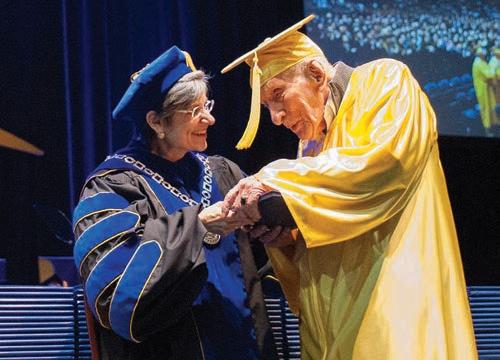
Former Bobcat athlete Bernard “Barney” Myers ’34, ’54 M, 103, who ran long distances when he attended what was Montana State College more than 80 years ago, walked into Montana State University’s history books May 3 when he became the first Montana State graduate to celebrate the 80th anniversary of his graduation.
A member of the class of 1934, the retired math teacher at Billings, Mont., Senior High School walked across the stage on his own power to accept a certificate from MSU President Waded Cruzado. Cruzado told the audience that gave Myers a standing ovation that they had just witnessed “a great day in the history of our university.”
Myers came to the ceremonies accompanied by one of his three daughters, Joyce Fletcher ’61 of Billings.
Kerry Hanson, director of alumni relations for the MSU Alumni Foundation, said while the university routinely invites its golden (50th), silver (60th) and sapphire (70th) anniversary graduates back for spring commencement and class reunions, it has never before had an 80th anniversary graduate return.
“He truly is an amazing man,” Hanson said.
Myers, an engaged man who still rides the Billings city bus to work out at the YMCA “at least” three mornings a week, faithfully watches the news and plays computer games to stay sharp, was nonplussed at “all the fuss.” But, he said he was honored to return to the university that “was a good university when I attended, but is even better now.”
Perhaps the accomplishment is even more significant considering that Myers might have graduated a couple of years earlier. His schooling took place during the Great Depression, and it took Myers seven years to fund his first degree in general studies, returning for an additional degree in education.
Myers, a native of the farmlands of western South Dakota, said he graduated from Wibaux, Mont., High School in 1927.
However, Myers wanted to attend the Air Force flight training and fly airplanes, which required a two-year college degree in engineering. So, he chose Montana State College.
Two years later when he took his degree to the recruiting depot, the doctor giving him his physical flunked him for poor eyesight.
Myers said he had no idea what the doctor was talking about until he put on his first pair of eyeglasses, and the world became clear for the first time.
By then the stock market had fallen, and Myers worked with an itinerant harvest crew, traveling from Texas to Canada. He returned to MSC a few years later. He credits Mildred Leigh, then staff director of Hamilton Hall, the women’s freshman dormitory and the only dormitory on campus, with keeping him in school when she gave him a job as a house boy. There he met “Miss Leigh’s secretary,” Margaret “Bess” Griffiths, a secretarial sciences student from Rexford, near Eureka, Mont. The two married in 1935.
While at MSC, Myers ran long distance in track. He was featured in the infamous “prank” yearbook of 1933, produced by David Rivenes and Chris Schlechten. He was photographed in his track uniform smoking a pipe, trailing a roll of toilet paper and carrying a lunchbox while running.
“The caption said ‘Barney was prepared,’” Myers said. He said the subjects had no suspicions they were participating in an unusual yearbook because Rivenes told them that the joke photos were just a few novelty photos meant to get them to relax.
Myers’ first Montana job teaching was in Ingomar, then Plentywood and Eureka before he found his way to Bill-
ings in 1944—first at Lincoln and then at Billings Senior. He started the school’s cross country program there, and he is still fondly recalled as a mentor and inspiring math teacher in Billings. Among his former students have been astronaut Loren Acton ’59, ’88 HDR, former Lt. Gov. John Bohlinger, as well as a host of professors, scientists, engineers, doctors and “lots of math teachers.”
He was among the first to embrace and train himself to use computers more than 45 years ago, and is still a technophile who readily looks up topics online that interest him.
He said, in response to the usual question, that he owes his age to “picking the right grandparents.” But he does advocate exercise and a healthy diet. He also believes in exercising his mind. He works the Sunday New York Times crossword puzzles, Sudoku puzzles, keeps up on current events and still likes to read. His only concession to age is that he is hard of hearing and must wear hearing aids.
The well-spoken man still lives independently in a Billings senior center, and he regularly visits friends who are older than he. In fact, he is junior, by one year, to McDonald “Don” Held, the oldest man who works out regularly at the Billings Y. In addition to working out, Myers has coffee with friends a couple of times a week and has lunch with a group of retired teachers a couple times a month.
“And there is one more thing that has helped (his longevity),” Myers said. “I don’t worry about things that might happen. Most of those things never do happen. If they do, you can take care of them, if you can. If you can’t, then let them go.”
Barney Myers receives a certificate from President Waded Cruzado
MSU graduate’s firm selected as America’s Small Business of the Year
BY TANYA CASEY-REINHARDT
Sanderson Stewart, a Montana engineering and community development services firm with strong ties to Montana State University, was chosen by the U.S. Chamber of Commerce as the Small Business of the Year at the 10th annual America’s Small Business Summit in Washington, D.C. in June.
Montana State University graduate Michael Sanderson ’94, ’96 M, president and chief executive officer of Sanderson Stewart, headquartered in Billings, Mont., said it was an honor to have been selected as a Blue Ribbon Winner ranking among the top 100 small businesses in the U.S., but then to win the top prize was even more exciting.
Jack Mueller ’51 (deceased), a graduate of Montana State College and Robert Sanderson ’64 founded Sanderson Stewart. The firm has since grown to become a regional, award-winning firm with 70 professionals in Montana, Idaho, North Dakota and Colorado, and more than half of them are MSU graduates.
“If we look back at the company employees that worked for us as interns or used us as a stepping-stone, the MSU legacy is very impressive and the number of MSU graduates is probably in the hundreds,” Sanderson said.
According to Sanderson, who earned a bachelor and master’s in civil engineering from MSU, the company recruits almost exclusively from Montana State University.
“We can train new employees on the specific intricacies of our company, but we can’t train them on attitude and work ethic,” Sanderson said. “MSU graduates already have engineering fundamentals and a tremendous attitude and work ethic.”
Representatives from Sanderson Stewart learned they had won the Dream Big Small Business of the Year award sponsored by Sam’s Club® at the awards ceremony in Washington, D.C., June 12.
“Wow! The number one small business in America,” said Sanderson who attended the awards ceremony. “It’s such a tremendous honor for our exceptionally talented and dedicated team, who are truly the best of the best. It’s very, very satisfying to see them get recognized on the national stage, but we have certainly raised the bar on ourselves.”
Sanderson said the award validates many things the company has been working on to include community involvement, employee development and customer-relations.
“It’s one thing when you surprise someone with good customer service now there will be an expectation that they are getting the best of the best,” Sanderson said. “It is a challenge we want to take on. We have to keep getting over the bar everyday.”
Flat Champ attire: marching to a Blue & Gold beat
Do Bobcats play trumpets? Alumni Association members, cut out this outfit to turn the Flat Champ from your membership kit into an honorary member of the Spirit of the West marching band! Not a member? Get your Flat Champ by joining the Alumni Association today at msuaf.org/join!
Paying back and paying forward through football camp
BY AMANDA BITZ ’13 M
During Jason Westbrock’s first visit to MSU in 1991, he was impressed by then-College of Engineering Dean David Gibson who took an hour out of his Saturday to give the prospective student and his father an in-depth tour of the engineering department. This welcoming attitude and air of encouragement continued throughout their visit. In 1992, Jason Westbrock ’97 began his engineering studies at MSU and walked on the football team as an offensive lineman and left tackle.
During his freshman year, Westbrock started in three games, played in six and was awarded a football scholarship by head coach Cliff Hysell ’66, an occasion Westbrock describes as one of the proudest moments of his life and one that shaped him personally and professionally.
Westbrock’s time at MSU, influenced by his teammates and coaches, reinforced the importance of making positive choices and giving back to his community a belief he puts into practice as a coach at the Leaders, Legends and Legacies Football Camp held each July in Ekalaka, Mont. Founded in 2008, the camp is a nonprofit, free program, open to any high school student in eastern Montana and the western Dakotas. It began as a conversation between Montana State alumni Ty O’Connor ’98 and Kevin Lundstrom ’99, who then reached out to a larger group of teammates and alumni as a way of “paying back and paying forward the honor of being a scholarship football player,” according to Westbrock.
The small town of Ekalaka provides a tremendous amount of support to the camp. Meals are prepared by area volunteers not a small feat when feeding more than 100 high school football players and 12–16 coaches. Carter County High School opens its classrooms and facilities for the young men who sleep in the gym, while the coach-
“We put an equal focus on life skills as we do football skills,” Westbrock said. The weekend features 7–10 sessions where coaches tell campers about adversities they have overcome, moments that required leadership, the importance of good choices and how bad decisions can have long term and far reaching consequences.
es are housed in neighbors’ homes, outbuildings and bunkhouses. The town and coaches work together to secure donations for camp expenses like T-shirts and footballs, leaving only the cost of transportation to the participants who make Ekalaka their home for three days each summer.
What sets this football camp apart from others is the coaches’ attention to the emotional development of the teens. “We put an equal focus on life skills as we do football skills,” Westbrock said. The weekend features 7–10 sessions where coaches tell campers about adversities they have overcome, moments that required leadership, the importance of good choices and how bad decisions can have long term and far reaching consequences. Emphasis is placed on academics, health and the consequences of drugs and alcohol substances that can be heartbreakingly destructive to teenagers in rural environments.
crowning moment of the weekend. Topics of the talk change each year. One talk was by a father whose son died from drinking and driving; another touched on a man who was incarcerated on drug charges.
The camp has a profound effect on the students, the coaches and the community of Ekalaka. Campers return year after year and their progress is noted by coaches, who make themselves available year-round to the students for advice and questions.
The camp culminates on Saturday night in a “walk of life,” a long winding stroll up a hill on the outskirts of Ekalaka. Signs inscribed with different life choices and goals, ranging from “dean’s list” to “drinking and driving” are planted along the path. The campers walk up the hill alone and reflect on what they want in their lives. Once everyone reaches the top, they join together for a talk that Westbrock describes as the
Westbrock also returns annually, making the trip from North Dakota where he lives with his wife, twin daughters and their foster child. His desire to pay forward the richness of his experiences at MSU comes through as he enthusiastically describes the camp he enjoys so much.
“It’s really about shaping young men and challenging them to be leaders on their teams and in their communities.”
Campers reflect on personal challenges and goals during the “walk of life.”
Saturday, November 22, 2014 in Missoula Kickoff time TBA
CAT GRIZ
2014 Satellite Parties
The MSU Alumni Association, in conjunction with the UM Alumni Association, is proud to present these fun-filled gatherings across the country. Alumni, friends and families can watch the game with loyal and spirited Bobcat fans. Here are the cities, listed by state, where satellite parties have been planned. Please visit msuaf.org/ catgriz for party location details and updates. A suggested $5 contribution by each attendee goes to both schools to meet the costs of this incredible outreach program and assist with planning future parties across the country.
CALIFORNIA: Fresno Los Angeles–Culver City Orange County–Rancho Santa Margarita • Palm Desert–La Quinta Sacramento–Fair Oaks San Diego • San Francisco East Bay–San
Leandro SF North Bay–San Rafael area San Francisco proper
COLORADO: Colorado Springs •
Denver Fort Collins Grand Junction
CONNECTICUT: Salisbury, Mass. or New York City
FLORIDA: Pensacola • Wildwood
GEORGIA: Atlanta–Alpharetta
HAWAII: Honolulu-Kailua • Kamuela
IDAHO: Boise Idaho Falls • Lewiston Twin Falls
ILLINOIS: Chicago–Schaumburg Chicago proper
INDIANA: Indianapolis
IOWA: West Des Moines
KANSAS/MISSOURI: Kansas City–Overland Park
LOUISIANA: Monroe
MAINE: Salisbury, Mass. or New York City
MASSACHUSETTS: Salisbury
MICHIGAN: Detroit Area–Utica
MINNESOTA: Minneapolis–Mendota
MISSOURI: St. Louis–St. Charles
Kansas City–Overland Park
NEBRASKA: Omaha*
NEVADA: Carson City–Dayton Las Vegas Mesquite* Reno
NEW HAMPSHIRE: Salisbury, Mass. or New York City
114th Rivalry Meeting
Visit msuaf.org/catgriz
NEW MEXICO: Albuquerque
NEW YORK: New York City
NORTH CAROLINA: Cary
Charlotte Raleigh/Durham
NORTH DAKOTA: Bismarck • Fargo
OHIO: Cincinnati–West Chester
OKLAHOMA: Oklahoma City
OREGON: Bend • Portland Medford • Salem-Silverton
PENNSYLVANIA: Pittsburgh Philadelphia*
SOUTH DAKOTA: Rapid City
TENNESSEE: Nashville
TEXAS: Austin Dallas–Richardson Houston
UTAH: Salt Lake City
VERMONT: Salisbury, Mass. or New York City
VIRGIN ISLANDS: St. Thomas*
WASHINGTON: Bellingham Bremerton Clarkston/Lewiston, ID
Olympia–Lacey Seattle–Renton • Spokane Spokane Valley • Tri-Cities–Richland Yakima
WASHINGTON, D.C.: Arlington, Va.
WEST VIRGINIA: Morgantown*
WISCONSIN: Madison • Milwaukee
WYOMING: Casper Cody Gillette* Sheridan
Thank you to the fantastic Bobcat volunteers who help us as MSU Alumni Cat Coordinators and more in many communities. They are listed as satellite party contacts on msuaf.org/catgriz.
The Can the Griz food drive is held each year on the MSU campus in the weeks preceding the game. Local alumni and fans can support this effort at collection locations around Bozeman and the MSU campus. Find locations through MSU’s Office of Activities and Engagement. Online donations are also welcome on the Gallatin Valley Food Bank’s website— select the Can the Griz program. We encourage our Bobcat faithful around the country to consider making contributions to their local food banks in the spirit of great philanthropy.
FROM THE DIRECTOR
Dear MSU Alumni, Friends and Fans,
Hello summer! You probably remember the seasons of Bozeman well, and how it often felt as though the winter would last forever. We just had one of those winters, lending to a seemingly short spring, but now, summer is in full swing; everything is blooming and the sidewalks of campus, our town and nearby trails are busy with people enjoying outside activities. Aaahh...
We are looking forward as we plan for the next academic year and all the exciting events and programs we work hard to bring to MSU alumni, friends and fans. Here are a few of the highlights:
• Mark your calendar for our Gold Rush, Homecoming and Parent/Family Weekend tailgates, as well as festivities on the road where we love meeting up with Bobcats in communities outside of Bozeman.
• We’ve had great results to date in our VIM Let It Out membership campaign! We couldn’t have achieved such success without the loyalty and support of the thousands of alumni and friends who have joined the Alumni Association, including ALL of MSU’s deans and administrators. Because we still hear “Where does VIM come from?” I want to be sure you all know it’s from our Fight Song—”We’ve Got the Vim, We’re Here to Win!” YES WE DO! If you haven’t already, join the Alumni Association today because well, why wouldn’t you? Visit msuaf.org/join.
• Our Student Alumni Association continues to double its membership every semester and students are engaging in fun, spirit and MSU traditions that you and I experienced. Be sure to tell the current MSU students you know to join SAA—or heck, sign them up yourself at msuaf.org/saa.
• The Future ’Cat kids membership program has gone through the roof. Alumni Association members are making sure the young people in their lives know which school is the BEST, and are signing up kids as members too. Each Future ’Cat gets his or her own membership card, plus great benefits. Join this Blue & Gold wave and get your kids, grandkids, nephews and nieces signed up. Go to msuaf.org/futurecat. My nephews are both members.
• Alumni chapters and groups are expanding around the country as we work to bring Montana Staters together beyond the Gallatin Valley. Stay tuned for fun Bobcat gatherings in your area.
• More and more alumni are organizing reunions with their fellow class members, fraternity and sorority groups and departmental and extracurricular connections throughout the year. We thank the volunteers who step up to make these fun events happen. Please keep us in the loop when your college friends get back together.
Please know that every day of every season, we work with you in mind—the MSU alum. You, the academic, the loyal and the spirited. You, the near and the far. We aim to share great news coming from our amazing university to tap into your pride in MSU and inspire you to tell your co-workers and neighbors about your alma mater. We celebrate you, among the more than 110,000 graduates of MSU and especially thank those who choose to be members of the Alumni Association, because you believe in MSU. Keep on believin’! We’ll see you this fall, winter and next spring. As always, please stop in at the Alumni Foundation when you are in Bozeman for vacation, a weekend of fun, business or when you are passing through—we would love to say hello, offer a cup of coffee and listen to your Montana State story.
Enjoy your summer, Bobcats!
Kerry Hanson ’93, ’08 M Senior Director of Alumni Relations
That Blue and Gold guy
F or four years, Collin Nelson ’14 was one of the most recognizable faces in Bobcat Stadium on game day. Painted head-to-toe in Blue and Gold, Nelson was a home game fixture, whether cheering from the stands or leading the football team onto the field. Now that he’s earned his degree in education, Nelson (a Life Member of the Alumni Association) will be hanging up his Blue and Gold cape—but will he entrust his body paint to another student?
“Everyone wants to know if I’m going to pass the torch,” Nelson explained. He’d like to see the next Superfan attend more than only football
games and get involved across campus, like he did. If someone were to fill his Blue & Gold shoes, he or she would need to take their role as an MSU ambassador very seriously.
“I had little kids come up to me and think I was a super hero because of the cape. With that comes a great deal of responsibility, as you would hate for one of those kids to ever have a negative association with MSU,” he said.
Under the supervision of technology teacher Eric Kinnaman ’01, ’07 M, Nelson student taught welding and woodworking at Belgrade High School this spring and graduated in May with a degree in education. Working with
highschoolers has been a natural process for Nelson, who enjoyed interacting with kids at Bobcat events.
“One thing about Collin is that he works with the students really well in the one-on-one setting,” Kinnaman said. “He learned a lot, and I think he’ll come out of here with some really good experiences.”
Looking forward, Nelson hopes to attend Officer Candidate School and flight school, perhaps even finding a full-time role with the National Guard, with whom he served during his time as a student.
He’s still got the VIM 80 years later
Did you read (on page 23) about Barney Myers ’34, who is 103 and accepted his 80th Commencement Reunion certificate?
How does this inspiring centenarian stay connected to Montana State? Through his Life Membership to the MSU Alumni Association. Barney receives the latest information and news about MSU, invitations to exclusive member events and much more and so can you.
Barney’s incredible accomplishment sent Blue & Gold waves of pride surging across the country. You can be part of this exciting event by joining the MSU Alumni Association. We are in a race to reach our goal of matching Alumni Association members with the number of students who enrolled at MSU last fall, 15,294, and we want you to be a part of it.
HOMECOMING 2014
Calendar of Events | Sept. 25–28
Thursday
Sept. 25
Visitation to Alumni Foundation all day
• GO CATS lighting at Hedges 9 p.m.
• ASMSU ‘Party at the Pit’ Bonfire 9:30 p.m.
Friday
Sept. 26
• Jake Jabs College of Business & Entrepreneurship Awards
8:30 a.m. | Procrastinator Theatre
• College of Agriculture Awards
9 a.m. | 231 Linfield Hall
• College of Education, Health & Human Development Awards
9:30 a.m. | Herrick Hall Lounge
• College of Arts & Architecture Awards
11 a.m. | Procrastinator Theatre
• College of Engineering Awards
2 p.m. | Procrastinator Theatre
• College of Letters & Science Awards
2 p.m. | Byker Auditorium, Chemistry Building
• College of Nursing Awards
3 p.m. | Herrick Hall Lounge
• Honors College Awards
3 p.m. | Museum of the Rockies
• M-Day Hike
12 noon–3 p.m. First 100 hikers get a T-shirt. Sponsored by Student Alumni Association (SAA)
• Fraternity/Sorority Alumni Summit
5 p.m. | SUB Leigh Lounge
• Pep Rally Downtown 5:30 p.m.
• President Cruzado’s Homecoming Celebration and Blue & Gold Awards Presentation
6:30 p.m. | SUB Ballrooms
• Young Alumni Homecoming HQ
6:30 p.m. | Rockin R Bar
• SAA Lighting the M 9 p.m.
Saturday Sept. 27
• Bobcat Breakfast
8 a.m. | Pour House, downtown Bozeman, $10 at door
• ASMSU Homecoming Parade 10 a.m. | Downtown
• Homecoming Alumni Tailgate and VIM Campaign Event 11:30 a.m.
• Football vs. Northern Arizona 1:30 p.m.
For more information, visit the MSU Alumni Association website at msuaf.org/ homecoming or call 800-457-1696. Registration and payment available online.
Homecoming Reunion Groups
These alumni groups will gather during Homecoming 2014. Check msuaf.org/homecoming for updates and more details.
• Delta Gamma
Saturday, Sept. 27, 11 a.m.–2 p.m.
418 West Garfield St.
Contact: Marianne Liebmann at mcliebmann@earthlink.net
Contact: John Roger at (406) 586-1976, jrogers@dagsystems.com or Don Klempel at (406) 687-3244; klempd@earthlink.net
• Bobcat Football 1964 and 1984 Full event details on website
Contact: Mandy Patriarche at (406) 994-6859
• Sigma Phi Epsilon BBQ Saturday, Sept. 27 before the game 1717 Greek Way
Contact: Caleb Bryson at sigep.msu.communications@gmail.com
• Alpha Gamma Rho Annual Alumni
AGR Reception after Homecoming game
Contact: Cole Ratzburg, Noble Ruler, at (406) 788-6786
• Kappa Sigma BBQ Friday, Sept. 26, 4 p.m.
Delta Lambda Chapter House
1120 S. 6th Ave
Contact: Aaron Blaser at (612) 462-8946
• Sigma Chi Gathering Friday, Sept. 26, 6 p.m. 722 S. Wilson Ave
Contact: Dillon Haskell at (406) 860-9839 or via email Dillon.haskell1@gmail.com
• Chi Omega “Welcome Home” Social Friday, Sept. 26, 6–9 p.m.
Contact: MTAlumnaeChiOmega@gmail.com
• Alpha Omicron Phi Open House Saturday, Sept. 27
Contact: Sydney Sherick at (715) 4418125; aoiialumnae@gmail.com
• Honors College Homecoming Celebration Friday, Sept. 26 and Saturday, Sept. 27 Contact: Dr. Ilse-Mari Lee at (406) 994-4110 or Ilselee@montana.edu
• MSU Chorale Reunion Friday, Sept. 26, starting at 4:30 p.m. through Saturday, Sept. 27 at 10:00 a.m. Contact: Kirk Aamot at (406) 994-5755
HOMECOMING 2014
College Homecoming Awards
Agriculture
Distinguished Staff
Brooke Bohannon
Distinguished Faculty
Don Kress
Honorary Alumni
Lochiel Edwards
Alumni Achievement Award
Mark Jutila ’82
Arts & Architecture
Distinguished Staff
Bill Clinton
Distinguished Faculty
Michael Everts
Honorary Alumni
Iris Model
Alumni Achievement Award
Jim Dolan ’70
Business
Distinguished Staff
Linda Ward ’75
Distinguished Faculty
Dr. Anne Christensen
Honorary Alumni
Janice Whetstone
Alumni Achievement Award
Gary Bracken ’61 (posthumous)
Education, Health & Human Development
Distinguished Staff
Katie Bark
Distinguished Faculty
Dr. John Kohl
Honorary Alumni
Mike VanVuren
Alumni Achievement Award
Anne Teppo ’67 M, ’89 EdD
Engineering
Distinguished Staff Lyman Fellows
Distinguished Faculty
Ted Williams
Honorary Alumni
Chris Nelson
Alumni Achievement Award (and Academy of Distinguished Alumni):
Kevin Cummings ’85
Larry Hattery ’84
James Nordahl ’63
Mary Ann Pearce ’76
Bill Wuertz ’80
Letters & Science
Distinguished Staff
Dr. Sheila Nielsen-Preiss ’87
Distinguished Faculty
Gordon “Corky” Brittan
Honorary Alumni
Susan Heyneman ’96 HDR
Alumni Achievement Award
Dr. Michelle Larson ’93, ’95 M, ’01 PhD
Nursing
Distinguished Staff
John Maccagnano ’85
Distinguished Faculty
Dr. Kay Chafey
Honorary Alumni
Matt Rognlie ’88
Alumni Achievement Award
Joyce Dombrowski
Honors
Distinguished Staff
Dawn Major
Distinguished Faculty
Dr. Neil Cornish
Dr. Jack Horner
Michael Miles
Honorary Alumni
Dr. Jennifer DeVoe ’93
Alumni Achievement Award
William Johnstone ’64
Steve Barrett ’67
Blue & Gold Award Winners
This award honors individuals who have rendered great lifetime service or who have brought national or international distinction to MSU or the state of Montana. Blue & Gold Award recipients have also achieved prominence through a combination of his or her profession, family, country, world, university, philanthropy or humanity.
Elise Donohue
Elise Donohue ’89, has called Montana’s Gallatin Valley home for more than 30 years. She supports numerous causes and organizations including, among many others, several performing arts groups, environmental issues and artistic outreach programs and scholarships at MSU. Elise has provided incredible support of the cultural resources available in our community and our university. Ms. Donohue owns the Double D Ranch in Clyde Park, Mont. where she raises cattle, quarter horses and participates in reining competitions.
Dr. Jack Horner
Dr. Jack Horner is Curator of Paleontology at the Museum of the Rockies and Regent’s Professor at MSU. As one of the world’s leading paleontologists and noted researcher on dinosaur growth and behavior, Dr. Horner has brought international acclaim and recognition to our university. Among many other illustrious awards and achievements, he has received the MacArthur Fellowship “genius grant” and the lifetime achievement award from the Society of Vertebrate Paleontology. Dr. Horner is a devoted teacher and faculty member at MSU who works to provide excellent research opportunities for our students.
Dale Schuler
Dale Schuler ’82 is leading the charge for grains research in Montana and around our nation. He has been a continual force for economic development in Montana and a key advocate for the first endowed chair in MSU’s College of Agriculture. Dale has served as president of both the Montana Grains Foundation and National Association of Wheat Growers and his leadership has led to great changes for the state of Montana and MSU. He runs Schuler Bros. farm in Carter, Mont.
Class Notes
Class Notes are compiled from information received from MSU alumni and friends. MSU Alumni Association members receive priority listing in Class Notes. To submit information, please send an email to collegian@msuaf.org or drop a line to the MSU Alumni Association, P.O. Box 172750 Bozeman, MT 59717-2750.
1950s
Gerry Fullerton ’55, Sun Lakes, Ariz., and his wife, Theresa, have been married for 55 years.
1960s
Charlotte (Brown) Shackelford ’60, Billings, Mont., and her husband, Bill, moved from Williamsburg, Va., back home to Billings. Shackelford enjoys the Kappa Delta sorority reunions each year in August.
Arden Huff ’63M, Dugspur, Va., has been elected into the Virginia Livestock Hall of Fame.
Sandy (Spears) Kempa ’63, Great Falls, Mont., is now living in Great Falls. Kempa volunteers at the Bright Eyes Animal Shelter in Choteau, Mont., on a weekly basis.
Al Kozeliski* ’64 and Jan (Archer) Kozeliski* ’63, ’67 M, Bend, Ore., celebrated 50 years of marriage on April 11.
Lynda (Bramlette) Smith* ’65 designed the stained glass windows
of Christ United Methodist Church in Plano, Texas.
George Birtic* ’67, Belgrade, Mont., retired from teaching in Lame Deer, Mont., and has been teaching traffic education at Bozeman High School for the past seven years.
John Christensen* ’68, Idaho Falls, Idaho, and his wife, Ellen, are now operating the Fox Creek Inn Bed & Breakfast in Victor, Idaho. John spent 34 years teaching and managing technology for the Idaho Falls School District. After retiring, he started a HVAC business with his son-in-law and is still manager of that business.
Peter Perry* ’68, Mill Creek, Wash., is currently the vice president at Morgan Stanley in Bellevue, Wash. Perry officiates both high school and community college baseball and softball.
Michael Donovan ’69, Tigard, Ore., has retired from Daimler Trucks North America and is spending time skiing, biking and keeping up with home repairs.
Dewey Lambdin II ’69, Nashville, Tenn., has released his 20th novel in the Alan Lewrie Naval Adventure Series, King’s Marauder Kings & Emperors is due for release in Feb. 2015.
1970s
Jan (Lovely) French ’72, Hobson, Mont., is presently chairman of the Montana Board of Livestock and is ranching with her son, Garth.
Rita (Kraus) Allen* ’74, Normandy, Tenn., is the new director of Argie Cooper Public Library in Shelbyville, Tenn.
Dr. David L. Eaton ’74, Mukilteo, Wash., has won the 2014 Society of Toxicology (SOT) Public Communications Award for distinction as a scientist who has spent many years devoted to educating non-scientists about the importance and impact of toxicological research and activities. Dr. Eaton received this peernominated award on March 23.
William Smith ’78, Marshall, Mo., is an associate at Bothwell OB/ GYN in Sedalia, Mo. Smith enjoys riding motorcycles and raising Texas Longhorn cattle.
1980s
Trish Kirchhoff ‘84, Portland, Ore., Janis Olson ‘75, Lake Oswego, Ore., and Irene Neuman ‘79, Cornelius, Ore. (pictured left to right above) are all MSU nursing alumnae working in the same small research department (with a total of 11 staff) at the Oregon Health & Sciences Hospital in Portland.
Keith Comes ’86, ’10 M, Spokane, Wash., has been promoted to managing principal architect at NAC|Architecture’s Spokane office. Comes has been with NAC|Architecture for 22 years.
Michael Sorenson ’86, Federal Way, Wash., is working on his 28th year with the Boeing Company in manufacturing and production engineering and product standards in the cities of Auburn, Renton and Seattle. When not working, he enjoys coaching First Lego League, his church and his family.
1990s
Eirik Heikes* ’95, Rapid City, S.D., is the principal landscape architect at 4 Front Design. Heikes is also the chairperson of the City of Rapid City’s Sustainability Committee and was elected an officer of the American Society of Landscape Architects.
Bryan Fillinger* ’96, Missoula, Mont., and the 143rd MP DET unit, based in Livingston, Mont., arrived at the Regional Command North (RC-North) Afghanistan in February. They will be there until the end of the year providing law enforcement to the various military camps in the area. Pictured are graduates, MSU attendees (on break for deployment) and Bobcat fans. Bottom row: SPC Kasee Lawson (attended), SGT Shona DeSaye ’12, SPC Cody Criner (fan/ former football ball boy). Middle row: SFC David Eckroth ’92, SFC Brandon Olson (attended), LTC Bryan Fillinger ’96, MSG Sherman Kirby (fan), SFC Simanton (future attendee). Back row: SPC Aaron Duffy (fan), SPC Mathew Smith (attended), and SGT Shawn Smith (attended).
Andrew Goldman ’98, Los Gatos, Calif., recently joined Fort Collinsbased Vaught Frye Larson Architects as architect/project manager.
Melissa (Atherley) McFadgen ’99 M, Spokane, Wash., has been promoted to principal architect at NAC|Architecture’s Spokane office.
Michelle Swenson ’99, White Sulphur Springs, Mont., announced that her son Jory signed as a track recruit for MSU.
2000s
Dan Stevens* ’00, Cody, Wyo., an Edward Jones financial advisor in Cody for the past nine years, has been named to Barron’s magazine’s 2014 Top Financial Advisor State-by-State Rankings, which recognizes the top 1,200 advisors in the country. Stevens was ranked No. 5 in the state of Wyoming.
Molly Biehl ’04, Henderson, Nev., has joined the Ruby Valley Hospital and the Ruby Valley Clinics in Sheridan, Mont. Biehl will provide medical support at the clinic, in the emergency room and on hospital rounds.
Lorinda Lucas* ’04, Billings, Mont., has joined the strategic team at Kinetic Marketing & Creative in Billings, Mont., as account planner.
Jenna Lang ’09, Boise, Idaho, has been hired at Eide Bailly’s Boise location. Lang is working toward her certified public account license.
2010s
Colten McCullough ’14, East Helena, Mont., graduated with a degree in mechanical engineering and will be going to work for Ash Grove Cement Company in Leamington, Utah.
BIRTHS
Anthony Frank* ’04, Bismarck, N.D., and his wife, Emily, had their first child, Brea Fay Frank on Nov. 30, 2013.
Ernie Turner* ’06, and Abby (McBride) Turner* ’06, Bozeman, Mont., had their second child, a baby boy, Corbin David Turner, on Jan. 25.
IN MEMORY
Alice (Williams) Matera* ’44, Seal Beach, Calif., died March 19.
Mike Korich ’50, ’60M, Tacoma, Wash., died June 24, 2013.
James Livers* ’50, ’60M, Roseburg, Ore., died Jan. 20.
Robert Swain ’50, Billings, Mont., died Nov. 2, 2013.
Mary Louise “Molly” (Kranz) Hammell* ’51, Largo, Florida, died Dec. 27, 2013.
Julius Ruedi* ’52, Del Mar, Calif., died Jan. 20, 2013.
Ralph Heiken ’54, Billings, Mont., died March 28.
John R. Adams* ’60, Portland, Ore., died Jan. 25.
Janet (Reed) Rossmiller* ’60, Great Falls, Mont., and Surprise, Ariz., died Dec. 25, 2013.
Bobcat great Dane Fletcher ’10 has signed a one-year, $1.2 million contract to play with the Tampa Bay Buccaneers this season. Fletcher joins the Bucs after spending four seasons as a linebacker with the New England Patriots. The former Big Sky Defensive MVP from Bozeman started six of 38 games in New England, playing extensively on special teams. Several media reports have speculated that Fletcher will push for playing time and a starting position at strongside linebacker. He was signed by the Patriots as a free agent in 2010 and moved from defensive lineman to linebacker. Fletcher was named to a pair of All-America teams as a senior in 2009, when he compiled 17.5 tackles for loss and seven sacks.
Leroy F. Knox ’61, husband of Phyllis Knox ’58, Coeur d’Alene, Idaho, died Oct. 17, 2010.
Richard Bodine* ’64, Sheridan, Wyo., died April 3.
Helene “Ellie” (Piotrowski) Raffety* ’71, Livingston, Mont., died June 3, 2013.
Tyson Nimmick (BA Environmental Design) ’06, Kalispell, Mont., died Dec. 31, 2011. He is the son of Peg Nimmick ’70 and Brad Nimmick of Great Falls, Mont.
FRIENDS OF MSU ALUMNI ASSOCIATION MEMBERS
Mary Jo (Grace) Kay,* Jacksonville, Ore., died Feb. 17, 2013.
Virginia (McCauley) Pahl,* Denver, Colo., died Aug. 19, 2006.
*Life Member of the Alumni Association
Norman Leo “Buck” Millikin, of Bozeman, Mont., died March 2. Milikin was a coal miner’s son and was one of nine children. He was raised on a working farm in Pinckneyville, Ill.
Millikin’s professional life work was teaching; something he loved and did with a passion. He began his professional career at a Boise High School, then taught at Treasure Valley Community College in Ontario, Ore. In 1971, he began his career as a professor of business and marketing at Montana State University. After more than 33 years, Millikan retired and formed a marketing company with two former students. He was also a consultant for several businesses throughout the state, and served as director for the Montana Council of Economic Education for many years. Most recently, he taught business classes at Montana Bible College and served on the board of directors. A scholarship has been created in memory of Millikan, which will be presented each year to a deserving College of Business student.
Alumni Calendar of Events
All events are in Bozeman unless noted otherwise. Dates subject to change.
2014 Sendoff Parties
Held for incoming students and their families this summer. Locations will be provided upon registration at msuaf.org.
Minneapolis
Host: Greater Twin Cities Chapter
Date: Sunday, August 3
4 p.m.
San Francisco
Host: Brad Bergum ’95
Date: Sunday, August 10
Time: 11 a.m.
Denver
Hosts: Marc ’71 & Patty (Burns) Boyd ’71
Date: Sunday, August 10
Time: 2 p.m.
Seattle
Host: John Keil ’96
Date: Sunday, August 10
Time: 3 p.m.
Portland
Hosts: Bob ’86 & Karee (Mercer) Bradford ’86
Date: Sunday, August 10
Time: 4 p.m.
Boise
Host: Jerry Beto ’67 & Brad Schmidt ’91
Date: Sunday, August 10
Time: 4:30 p.m.
Seattle
Bobcats
MSU Alumni Association adventure and educational travel | 2014–15 TRIPS
All prices listed are lead-in pricing per traveler; some trips include airfare from designated departure cities. All trips are listed on the Cat Treks website—msuaf.org/cat-treks, or call to request a brochure: 1-800-457-1696
Pearls of the Mediterranean—Monte Carlo to Barcelona
November 7 – 15, 2014 | From $2,299/person, double occupancy (airfare included)
Discover the rich pearls of the Mediterranean on a cruise aboard Oceania Cruises’ elegant Riviera and explore Marseille, Port Vendres, Mallorca, Portofino, Rome, Florence and Pisa.
Cuban Discovery—Land Tour
Jan. 15–23, 2015 | From $4,599/person, double occupancy
Uncover Cuba’s beauty, paradoxes and remarkable intrigue—a country where 1950s–era automobiles still dominate the roads edged by beautifully preserved Spanish colonial buildings. During your visits to Havana, Cienfuegos, Trinidad and Santa Clara, you will discover the fascinating history and realities of this captivating nation.
Mystical Andes & Majestic Fjords
February 2–23, 2015 | From $5,999/person, double occupancy (airfare included)
Behold the awe-inspiring fjords, mystical mountains, and enchanting cities of South America, as Oceania Cruises’ elegant Marina takes you to historic ports in Chile, Peru, Argentina, Uruguay and the Falkland Islands.
The Masters Golf Tournament
April 8–11, 2015 | From $3,569/person, double occupancy
The Masters Golf Tournament is unlike any other for a variety of reasons, including the charmingly beautiful, yet difficult home course, the extraordinary level of competition, and the pressure to win the famous Green Jacket. The Masters is all about tradition, with a history dating back to 1934. From the green jacket to
“Amen Corner,” everything is special about golf’s greatest event. The Masters is a unique place where beauty, legacy and competition come together for one of the most celebrated weekends in sports.
Pathway through Panama
April 23–May 9, 2015 | from $2,999/person, double occupancy (airfare included)
Discover the pristine natural wonders, spirited cultures and grand colonial architecture of Florida, Colombia, Costa Rica, Nicaragua, Guatemala and Mexico while sailing aboard Oceania Cruises’ elegant Regatta
Kentucky Derby 2015
April 30–May 3, 2015 | From $2,369/person, double occupancy
Experience the 141st running of the Kentucky Derby and all its great tradition. Recognized by Forbes magazine as one of the “top 10 events to experience in a lifetime.” Your tour includes all that you need to explore and appreciate this great majestic sport. Join us as we plan our “Run for the Roses.”
Southern Culture & Civil War—Memphis to New Orleans
May 14–23, 2015 | From $4,699/person, double occupancy (airfare not included)
Southern culture and the American Civil War spring to life on this unique Mississippi River cruise aboard the elegant American Queen. Take in historic sites from Memphis to New Orleans, visiting Shiloh National Military Park, Vicksburg, Natchez, St. Francisville, Baton Rouge and Houmas House Plantation.
California Wine Tour—San Francisco, Lake Tahoe, Napa Valley
June 6–20, 2015 | Price TBD
Special tastings, wine immersion experiences, wine-blending classes, Farmer’s market visits and cooking demonstrations will make it easy for you to immerse new inspirations back home in your kitchen. Experience the
valley’s intense, powerful grapes that aged for decades, creating the taste of lush black fruit— blackberry, cassis, dark cherry—allied with complex underpinnings of tannins that create an unforgettable wine and culinary experience. Top off your gastronomic adventure with unparalleled touring to some of California’s most iconic cities and spots—San Francisco, Lake Tahoe, Napa Valley and more.
Baltic & Scandinavian Treasures
—Stockholm to Copenhagen
June 16–27, 2015 | From $4,299/person, double occupancy (airfare included from select cities)
The treasures of the Baltic and Scandinavia are revealed on this magical voyage aboard the elegant Oceania Cruises Marina Discover medieval towns, onion-domed cathedrals, Baroque palaces and stunning harbors as you cruise the Baltic Sea to captivating ports in Estonia, Russia, Finland, Latvia, Lithuania and Germany.
Kenya: African Safari
November 5–14, 2015 | Price TBD
Watch an endless parade of animals drink at the waterhole of your tree hotel surrounded by dense rain forest. Enjoy wildlife drives across the bush all in plain view of the snow-capped peaks of Mt. Kenya while at Sweetwaters. This is the original safari destination in Africa, one for all the senses— touch, feel, hear, and forget to breathe with all the wonders surrounding you!
Costa Rica: Rainforests & Volcanos
November 8–16, 2015 | Price TBD
Discover the secrets of the rainforest from a bird’s point of view on the Rainforest Aerial Tram and by boat as you glide along the natural inland waterways and canals in Tortuguero National Park. Watch the spectacular display of Arenal Volcano’s eruptions in the distance as you sip your drink and enjoy the hot springs. Your head and heart will literally be in the clouds as you explore Monteverde Cloud Forest.