2026
PADDLEFISH a student literary & art journal
ARS 9 0 YE
PADDLEFISH a student literary & art journal
ARS 9 0 YE
Editor
Jim Reese
Associate Editor
Steven Watts
Review Editor
Steven Watts
Copy Editor
Reese McIltrot and Steven Watts
Editorial Assistant
Reese McIltrot
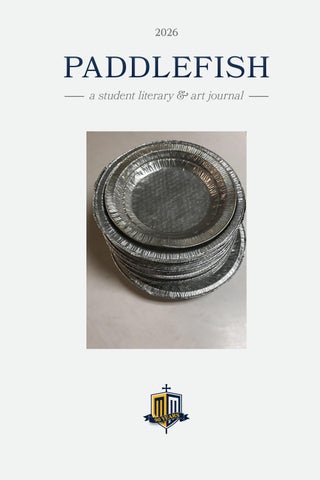
Cover Art
Jim Reese “LaVerta’s Pie Tins”
Copyright © 2026 by Paddlefish All poems and prose are used with permission of the authors, and they retain all rights to their work published herein. Except for brief quotations in reviews, no part of this work may be reproduced or transmitted in any form or by any means, electronic or mechanical, including photocopying and recording, or by any information storage or retrieval system, without prior written permission of the copyright owner unless such copying is expressly permitted by federal copyright law. The essays “Authentic Journalism” and “High-Altitude Risks” first appeared in the book The Great Pretense and are re-printed here with permission of the author and the publisher, TrineDay. The views expressed in Paddlefish are not necessarily those of Mount Marty University.
Paddlefish Snagging good literature one line at a time.
CONTENTS AWARD-WINNING WORK Living the Words on the Wall . . . . . . . . . . . . . . . . by Signe Vogel Bang winner of the Spirit of Benedict Award
.
.
.
.
.
.
.
.
How to Become a Cheerleader. How to Become a Flyer, Specifically . . . . . by Sara Johnson winner of the Father Jack Garvey Award for Creative Nonfiction The Currents of the Kenai . . . . . . . . . . . . . . . . . . . . . . by Kiersten Ostnes winner of the Father Jack Garvey Award for Prose
.
.
.
.
.
.
.
9
.
.
12
.
.
15
.
When it Rains . . . . . . . . . . . . . . . . . . . . . . . . . . . . . . . . by Jonathan Nyamweya winner of the Eugene Brinkmeyer Award for Fiction Since Girlhood . . . . . . . . . . . . . . . . . . . . . . . . . . . by Rachel Lotz winner of the Sister Eileen Neville Award for Poetry
.
.
.
.
.
19 22
CREATIVE WORKS Emma Blomme The Table as my Witness . . . . . . . . . 24 I Would Have Rather Tasted Ice Cream . . . . 26 Zuzanna Brach The Quiet Glow of the TV .
.
.
.
.
.
.
.
. 29
Bill Conroy Authentic Journalism . . . . . . . . . . 31 High-Altitude Risks . . . . . . . . . . . 33 Kylee Cox The End . . . . . . . . . . . . . . 36 Letter to MMU Students
by Rachael Hanel pg. 42
Michael Deyalsingh My Ladybug . . . . . . . . . . . . . 38 Madison Girard What’s Hers is Mine .
.
.
.
.
.
.
.
.
.
40
Sara Johnson Superheroes . . . . . . . . . . . . . 41 Rachel Hanel Letter to MMU Students . . . . . . . . . 42
4
Aurora Huntley Azrael Poetry Collection .
.
.
.
.
.
.
.
. 44
Authentic Journalism by Bill Conroy
pg. 31
Changing Times SD Magazine Staff
pg. 66
CREATIVE WORKS Grace Holys A Call and Response in Writing for Wellness . . . . . . . . . . 50 Stupid Shoes . . . . . . . . . . . . 51 Jacob Kueny The Voice Behind You . . . . . . . . . . 53 Christa Lotz The Season’s End and New Beginnings . . . . 55 Taylor Larson The Girl in the Cherry Swimsuit . . . . . . . 58 Rachel Lotz The cemetery at night . I See God . . . . .
. .
. .
. .
. .
. .
. .
. .
. .
. 59 . 60
Reese McIltrot The Crab Apple Tree . . . . . . . . . . 61 Growing Up . . . . . . . . . . . . . 62
Azrael Poetry Collection by Rory Huntley
pg. 44
Kaela Martinez Grenade . . . . . . . . . . . . . . 63 Forgotten Memories . . . . . . . . . . 64 Emma Moller The Dollar that Didn’t Double . . . . . . . 65 SD Magazine Staff “Changing Times” . . . . . . . . . . . 66
5
CONTENTS
A Letter from Francesca
Dear Students
by JD Schraffenberger
by Aimee Huntley pg. 112
pg. 92
CREATIVE WORKS Jonathan Nyamweya Objects That Signify My Life . . . . . . . . 67 Bananas Comic . . . . . . . . . . . . 70 Kiersten Ostnes My Mother Never Cried .
.
.
.
.
.
.
.
.
81
Hailee Pringle Coffee, Flowers, and Surprises . . . . . . . 82 Archery . . . . . . . . . . . . . . 84 Character of medieval art itself by Adison Uhall
pg. 114
David Phillips Being Straight Edge . . . . . . . . . . 85 Senior Hopes (Independent Thoughts) . . . . . 86 Cody Bumbaca-Thomas Flying Iron . . . .
.
.
.
.
.
.
.
.
.
87
Bode Thurman The Cradle .
.
.
.
.
.
.
.
.
.
88
.
.
.
Jacee Squier Table as Chapter Book . . . . . . . . . . 89 Adison Uhall How to Become an Only Child . . . . . . . 90 6
JD Schraffenberger Dear Students . . . . . . . . . . . . 92
MEDIA AND BOOK REVIEWS Uvam Thapa Between Worlds: Identity and Adaptation in Top Boy 95 Cody Bumbaca-Thomas Iron Lung . . . . . . . . . . . . . . 98 Parker Riley “Me More Cowboy Than You” and The Real World . 103 Reese McIltrot Rotten Mango True Crime Podcast Reviewed . Madison Girard “A Positive Look at Change” .
.
.
.
.
.
. 106 .
107
Zuzanna Brach “What Tastes Like Home” . . . . . . . .
109
The God Who Won’t Let Go
by Kiersten Ostnes pg. 116
BLACKOUT POEMS Aimee Huntley A Letter from Francesca . . . . . . . . . 112 Adison Uhall Character of medieval art itself .
.
.
.
.
.
. 114
Kiersten Ostnes The God Who Won’t Let Go . . . . . . . . 116 Jacee Squier The American Scene (Since 1860) . . . . . . 118
The American Scene (Since 1860)
PHOTOGRAPHY Steven Watts Elk through Binoculars .
by Jacee Squier
.
.
.
.
.
.
.
.
122
Directory of Authors . . . . . . . . . . 152
pg. 118
7
AWARD WINNING WORK
Living the Words on the Wall
T
Signe Vogel Bang
he first time I “The educational community entered Mount that can result breaks Spirit of Benedict Marty University down any residual sense of Award-winning was when my coach insiders versus outsiders Essay picked me up at the Sioux and manifests an openness Falls airport and drove to being transformed by me to the school. When engaging deeply with the I entered the school, I didn’t just other – be it an idea, a person, or an enter a community; I stepped into experience.” something contagious. Stepping into From the moment I entered Mount the school, I noticed the banners Marty University, I was a Mount with Mount Marty’s four core values: Marty student. When I met people Community, Hospitality, Lifelong in the hallway, I wasn’t treated as Learning, and Awareness of God. a stranger; instead, I was met with Every school can hang banners hospitality and curiosity, helping me or have a vision statement. Every adjust to my new life. campus can have values it pursues In so many aspects of life, we to live by. But very quickly, I felt that walk into schools, companies, and this was different. I began to feel workplaces that all have fancy posters that these banners were more than and vision statements. We read words empty words; these words were alive. such as “inter-cultural awareness” and They were printed in the warmth of “openness to cultural diversity,” but we how people interacted, the openness also wonder how we actually live by to every individual, and the smiles these actions. During my time here at spreading among the campus on a Mount Marty University, I have learned summer day in August. Being 4,000 the value in leadership of putting miles away from my hometown, these words into action. Ideas and Copenhagen, Denmark, I knew values that often seemed abstract and Mount Marty would be my only home disproportionate have shown through for 10 months, but little did I know many small, concrete actions. It has how much the values of hospitality shown up by engaging in what is right and community would shape who I in front of me and around me in the am becoming. community. It has shown by giving a Traveling abroad was a huge little bit of myself and being ready to adjustment: new culture, new food, receive a lot more. and a new way of going to school. Far Here at Mount Marty University, we away from friends and family, I had to as students can have many identities: start over and create a home, and as student, athlete, worker, and friend. But I did, the values written on the walls before anything else, we are always slowly seeped under my skin. One of recognized as the special individuals the paragraphs in the 10 hallmarks, we are. When a door is locked, I don’t under the section of Hospitality, states: just call campus safety. I call Rod, 9
and I know that he will be happy to help. For Rod, we students are more than just a student ID; he engages us as a part of the community at Mount Marty University. He knows when we have an important game coming up or when we are busy because of midterm week. He always gives a smile and encouragement along the way. When I am hungry, I don’t just get breakfast in the cafeteria. I go to Lisa, and we talk about her family in the Netherlands and how it differs from South Dakota. She serves a warm breakfast to give us energy for the day ahead. When I am struggling in school, I don’t just go to the Center for Academic Excellence. I go to Karen, and she brings me my favorite cup of tea to help me study for my upcoming exam. And I could continue this list with a smile and good morning from Sister Rosemarie, or my professor making sure I have a place to celebrate Thanksgiving, or even the maintenance worker coming with a blanket when my room is cold. Moments like these do more than feel kind; they create social bonds that quietly hold us up and together when we face adversity. The World Health Organization states that one in six people worldwide suffers from loneliness. Loneliness is linked to an estimated 100 deaths every hour— more than 871,000 deaths annually. Strong social connections can lead to better health, longer life, and more resilience. In other words, being a part of a heartwarming community can save lives. Social connections can reduce inflammation and reduce the risk of serious health problems. A strong community is not the icing on the cake, it is the foundation that helps 10
us students succeed in our college career. And even more important, it gives us the tools to succeed in our future life. The beautiful and important characteristics of hospitality and community are that they spread and grow. Once you feel held by a community, you start holding others. When someone opens a door by showing hospitality, it becomes natural then to open a door for the person next to you. When we see leaders spreading the values of Mount Marty University, we start becoming value driven leaders. It often starts small. We start holding the door, helping a teammate with an assignment, and checking in with a faculty member in the hallway. Slowly it begins to grow, and before you know it, you find yourself going through fire and water for the common good. You see the crazy student section at the important basketball game and realize that across cultures, age, experience, and religion, the community is what makes us belong. When that happens, the abstract words in the vision statement start to make sense. Especially when a part of the 10 hallmarks of Mount Marty University states that community, “help them make the connection between the individual and the communal, the local and the global, the present and the past.” I know exactly what they mean. I have experienced it. I have experienced being a part of a warming
community, where people worked for the common good, and it has shaped me to become a leader. Deep down, it has given me a belief that I can go out and spread the Mount Marty University spirit to whomever I meet on my way—not just by telling them about my core values, but by showing them. By being engaged in what was just in front of me, I learned a lot about the world and I know now that when I meet people with different views from different cultures, that I will see them as a whole person. I will engage in their personal life, and, when they are having a rough day, serve them a warm cup of tea
and some delicious breakfast. When my coach drives me back to the airport at the end of May, I will temporarily leave this community, but I know, even though I can only bring one bag with me, I will carry more than I arrived with. My heart and soul will be full of the heartwarming memories the community and hospitality of this place have left in me. The open doors I’ve walked through don’t close behind me; they shape me into the leader I am becoming. Now, it is my turn to start opening doors for others, so the Mount Marty spirit can spread again and again. -Thank You
11
How to Become a Cheerleader. How to Become a Flyer, Specifically.
B
by Sara Johnson
e small. Start HOW TO BECOME LIGHTER. Jack Garvey young and be Let everyone around Award for smaller than you affect how you move, how Creative everyone else. At that age, you think, and who you are. Nonfiction it’s not skill that gets you Change to fit into this perfect in the air, it’s your size. little box that you think Stand in front of the mirror others are making for you. and realize you aren’t the smallest. Change you. Until you can’t. Until you Turn to the side, then again, and again. realize it’s a box that you built. Until Pinch the skin that is rolling over the you realize that everyone is thinking band of your shorts. Pull and push and the same thing. Everyone is watching, squeeze, trying to mold your body with just not you. They are looking in the your hands like clay. Like if you press mirror, at the number on the scale, at hard enough or pull hard enough, it the girl next to them. Step on the scale. will move and mold and be perfect. Hold your breath and think, “light Pull your shirt tighter, then looser, take as a feather.” Watch the screen flash it off entirely, and just stare in disgust. while trying to balance out. Feel your Look at your stomach, your legs, your heart in your chest racing, beating so arms. Pick it apart piece by piece, like fast you think it might beat out of your it doesn’t belong to you until everything chest. Tell yourself if it’s not under has been changed. Then change into a 120 that you are worthless, convince baggy sweatshirt because nothing looks yourself that your meaning in life is right on a body that isn’t right. Hide it. based on this number. Look down. Feel It’s easier; if you can’t fix it, hide it. your heart sink, the world pause. Feel Be thinner. Maybe if you can get the everlasting hatred flood over you. skinny enough, they will be forced to Feel disgusting. Cry, because that’s all put you in the air. You are at least four you can do. Cry because maybe then inches taller than every flyer currently you will lose the “water weight.” on the team, basically towering over You were a gymnast; you have them. You notice it constantly, it muscles that no one else has. You follows you like a creepy ex. Lurking have been training your body since in the pictures where you cover your you were two to flip through the air stomach, bend your knees, and slouch and catapult yourself off a table. your shoulders. In the pictures, you are You have been training to hold your trying to take up less space, trying to weight no matter what position your shrink with no one noticing. Who cares body is in, and you have been training if they weigh 100 pounds? If you can to be independent. As a gymnast, just get to 99, you might be a flyer. Just that’s what you want: independence. one pound less. Just one change. Just You don’t want someone there for one version of you that you love. your skills because if they are, that 12
means you are not doing it right. As a flyer, you want people there for your skills because if they’re not, it means you are not a flyer. The music starts, and the counts are loud. Five, six, seven, eight. You dip, you lift, you smile like it doesn’t matter. You continue through lifting and flipping girls, when it’s time to tumble, you go to your corner. You feel your pulse sync with the music, and the world goes silent. Deep breath and go. One step, your foot pushes off the ground, rolling all the way through your toes. Two step, you prepare for what comes next. Hurdle, your leg comes to your chest as you gallop like a gazelle for a split second before your feet hit the floor. Reaching with your arms and swinging your legs over your head, you finish the roundoff. Your hands make contact with the ground a second time as you push your hips to the sky to get the perfect arch on your backhand spring. Your feet slam to the ground, but your legs absorb the impact as you begin the set for the flip. Pushing all the way through your toes, you lift off the floor, seven feet in the air, keeping your body straight as you flip over your head, pulling your arms in to start a twist when you are a quarter of the way through the flip. Stick the landing, absorbing any extra power, keep your feet planted firm in the spot they currently sit. Take one count to re-align your thoughts and hop right back into the routine like it’s easy. Four years on the floor, four years of battling your hunger to the point where it turns into nausea, four years of performing like your life depends on it, because if you don’t, you won’t be noticed. Four years of watching them go up while you stay
down. If you can’t be in the air, the next best thing is to be memorable. You can always be sharper. Be louder. Smile bigger, hit harder. You can make them look at you; don’t give them a reason to look away. If you are in the air, this happens automatically, but when you are forced to keep your feet on the ground, when you are forced to never spread the wings you know you have, when you are told that you can’t fly, be memorable. Make yourself impossible to ignore. Perform like your body isn’t screaming at you. Perform like you aren’t thinking about food, about numbers, about everything you wish you could change. Perform like none of it matters. When that doesn’t satisfy the need to be launched in the air, when that doesn’t quench the thirst for flipping above their heads, blame yourself. Blame your body. If only you were smaller, skinnier, didn’t have any muscle, didn’t eat. If only you could carve yourself away until there was less of you to hold, less of you to be wrong. HOW TO BECOME SMALL ENOUGH. Skip one meal. Then another. Skip them all. The first time feels like control, the first time feels like you are taking back something that belongs to you. The second feels like progress. Like you can finally see the numbers dropping. After that it’s not a choice anymore, it’s a crucial part in loving yourself, or, well, tolerating the body 13
you were put in. You are going to drop 35 pounds in 2 months. You are going to start blacking out randomly because your body is going into survival mode. You are going to look like a walking corpse, but you will be a flyer. Your collarbones are so defined, so delicate, and for a moment you will feel proud of your work. Like you accomplished something great. Your mother is going to look at you and no longer see her babygirl. She is going to see a shell of the person you once were. A hollow being with no
14
life left under the pale skin that wraps your bones. She is going to look at you, with tears rolling down her cheeks as she holds you, and she is going to call you malnourished, she is going to say you have faded to nothing, but you have become a flyer, haven’t you? Your body is so diminished that by the time they are willing to put you in the air, the doctor is going to tell you no. They are going to hospitalize you, and you are going to die. You did it, you are finally small enough. But it still isn’t enough.
The Currents of the Kenai
S
by Kiersten Ostnes
tand in the cold here have a strong sense Father Jack morning air and of religion. Small strip Garvey Award load up the big Yeti malls display handmade for Prose coolers into the back of and Alaskan Native art. the SUV, next to the duffel Rednecks fill the bars to bags of clothes and gear. drink lager and tell stories They are heavy and bulky, of backcountry hunting, but shiny, clean, and ready to be filled. kicking up dust with their trucks in the The essentials you will need for the dry season when they come and go. It’s nine-hour drive south are: Airpods, common to see wildlife walking freely water bottle, beef jerky, a pillow, and a along the roads. Moose are large and blanket. Everyone’s eyes are heavy. It’s dangerous; hitting one at high speeds always tough to leave so early, but the can kill drivers and the unsuspecting sunroof offers the comfort of the night; animal on impact, so scare them off it’s easier to fall asleep looking up at by honking your horn. Bears are a the stars. much more serious thing to encounter, The car will stop in Healy after two and always the most exciting. They’re hours of driving, and your family will mostly active at night, so seeing one is sit down to eat pancakes and drink hot less common, but they still lurk in the cocoa at Rose’s Cafe. The rustic red woods and can be a problem for quiet building is an emblem of this small hikers and trail runners. When the town, an inviting presence for travelers giants amble across the roads everyone and locals alike. When you leave, you stops to admire, but people tend to pull will watch the tall patches of bright out their hatchets and pistols when pink fireweed whip in the wind around the wild animal gets too curious about the edges of the parking lot, and start their cabins or campsites. to notice a change as you move away Bears and people are alike during from the interior. The foliage grows this time of year; everyone is coming thicker, mountains reach higher, and to town thinking the same thing– the more rivers and waterfalls make fish are in. Returning to the place in headway through the valleys. The first which they are born, the salmon come view of the ocean is on the Seward every year to spawn and die, a cycle Highway. Like the coast of California, that nourishes the river and those who the winding road is against a steep depend on this source of food. It’s hot, cliff with jagged rocks, overlooking and you can feel the air buzzing as the sparkling blue bay and a blue sky. you pass the countless trailers hauling If you’re lucky, you might find a whale RVs and fishing boats. You can tell the playing in the waters. kind of fish a boat will catch based on Sterling, Alaska, is a small town its characteristics; if the larger boats with a population of 7,000. Houses are have taller rails, long fishing rods with spread out, surrounded by woods and weights, and Sonar/GPS devices, it’s mosquitoes, and the people who live likely they are driving two hours to 15
Homer or Seward for halibut fishing on the open ocean. The smaller boats with rods are used to catch fish like trout and pike in lakes and rivers, and those with large metal dipnets are appropriate for catching salmon. A dirt road leads to your aunt and uncle’s house overlooking a calm lake at the end of the yard, and after a warm dinner is served, it’s time to go to bed. It feels like the night before the first day of school, and though the excitement makes it hard to sleep, it’ll help you get up in the early hours. Your aunt always makes English muffin sandwiches for the drive, so after putting your gear into the truck, buying beers at the gas station is all that’s left before you’re ready to go. A short nap during the forty-minute drive is always welcome; it allows your uncle and dad to catch up on their inappropriate ‘old man’ jokes. The brothers-in-law have been fishing together for years and have developed a strong system of operation. Dad will park the truck after the boat is backed into the water while your uncle starts up its engine, making sure everything is running smoothly. While the two boys prep, you’ll put on your hat and rainboots and walk down the hollow dock, appreciating the sun’s heat reflecting off the plastic. The stench of the dead fish and salt, the reflective water burning your eyes, you can tell the wide ocean is awaiting nearby. After taking your seat at the front near the bow, your dad will push the boat off into the currents of the Kenai. Dipnetting is a fast and intense sport when the salmon runs are strong. Nets with wide and round entrances are submerged underwater and extended away from the rails by their long metal handles, careful not to scrape the 16
bottom of the river or get sucked up under the boat. The best spot to catch the Kings is near the bank where they rest from the strong water flows. The boat becomes one with the current, and all it takes is a jerk of a fish hitting the back of the net, and the twentypounders are hauled in. Lift the heavy net out of the water fast before the catch can swim out, then flip it so the entrance is parallel to the sky. The first few times hauling it in is always awkward; you have to avoid hitting Dad with the hard handle while he fishes over the opposite railing. Dumping fish into the boat must be done quickly to avoid tangling; the longer the seafood struggles, the worse it gets. It only takes a few catches until the biceps and forearms start burning, but you won’t stop until the legal daily limit is reached. They’ll come rapid fire– one, three, five, twenty, sixty fish, splashing up water and fighting like hell each time. You will count as you clip their tails and rip their gills, plunging the net back into the water for more. It feels good to work, to sweat, to bring in food for the table. After each catch, use the bottom of your boot to push it to the back of the boat. The fish slime easily greases the metal deck when it is sent back to your uncle, who will add it to the cache under the deck full of pooling blood and fresh meat. The crew will work up and down the river, returning the boat to the start with a burst of speed after completing a pass. With the engine roaring over
the wind, it feels like pure freedom flying through the waves while taking a sip of your IPA, hats worn backwards so they don’t get caught in the wind. The real work happens after the fishing is complete and the boat is loaded up. All of your cousins, aunts, and uncles come together to create an assembly line back at the house to process the king salmon, a ritual performed like clockwork every year. Working in the grass under the hot July sun with the hornets and horseflies, someone will grab a stiff fish from the boat and hand it to you after hosing it off. Its body and skin will feel rubbery and slimy, so you will have to hold it tight to avoid dropping it. After flexing its body a few times to break up the muscle fibers, hold the filleting knife in your right hand and hold the fish in the air by its head with your other, so that its right eye is facing you. The filleting knife is long, thin, flexible, and very sharp, designed specifically for cutting fish, so it glides easily through the meat and allows for maximum control over every cut. Use its point to find the top of the soft belly, about an inch in from the far right side of the fish, just under the pectoral fin. With the sharp edge facing down, punch straight through the body. The tough silver scales like to resist the knife, so you will feel a pop when it finally goes through. Move the handle back and forth to cut straight toward the tail, and curve the blade away to end the cut just before the vent. Then cut the vent off the body and throw it in the trash. You will clear out the guts and eggs before placing the belly in another bin, ready for someone else to clean and process. The bellies can be fried, baked, and made to be delicious, but they mostly get eaten by the dogs
during winter when their coats are thicker. Lay the fish on its side atop the processing table, position your knife at the base of its gill, and press down until you feel the crunch of its spine. Then, turn the knife toward the tail and cut straight. The ribs should be used as a guide; if you feel the knife popping along the hard bone then you are doing it right. The first filet feels like velvet and reveals your skill, and the fish is flipped so the same process can be repeated. The goal is to throw away a carcass consisting of bones and a head, with minimal meat left on the body. The best part is the amount of red. With the protective skin left on and facing down, the cuts are rinsed and placed neatly in multiple bins, building piece by piece, until the vibrant color blankets the processing tables in a thick sweep, a gratifying sight for the family as the work nears its end. The bellies and fillets are transferred inside to the garage, where everything is packaged, labeled, and stored in the freezer for the remainder of the trip. This is the job reserved for the young cousins and visitors who are fascinated by the vacuum-sealing process, and is always the last to finish. Hundreds of filets fill the shelves of the big freezer, some processed and dated up to three years before. The “less-pretty” filets are given to an aunt with a canner, and they are returned at the end of the trip in a case of mason jars, canned and sealed airtight to enjoy at a later date. The canned salmon can be prepared in similar ways to canned tuna fish, eaten on a cracker or in a sandwich with mayonnaise and seasonings. Coolers are filled with the frozen goods on the last day of the trip; a week spent fishing has proven to be 17
rewarding. With lifted spirits, everyone hugs goodbye while the dogs run around the group, anxious about being left behind. The car is loaded and ready for the journey home, waiting patiently alongside the freshly scrubbed boat.
18
It’s always sad to leave this wild place, but the promise of next year is exciting. The seasons will change, and the fish will be back again to feed the river.
When it Rains … by Jonathan Nyamweya 4PM. didn’t like him now with Boniface still wasn’t his status currently being Eugene home. It was Friday anyway, missing-in-action. Neema Brinkmeyer and one’s youth is not to could be taking her first Award for Fiction be wasted away in the steps and he wouldn’t even comfort of a house. If man be home to bear witness. can’t enjoy the spoils of a Neema probably wouldn’t juvenility, then life may not be worth be walking anytime soon, but it was living after all. “Ujana ni moshi, au sio the possibility of this occurrence that Jackie?” (Youth is fleeting Jackie, is it angered her. He wouldn’t feed the baby, not?) A popular saying in their home. wash the baby or even watch the baby This particular adage didn’t have an when she was napping. Yet somehow ounce of meaning to Jacqueline. To the infant had fallen hopelessly in love her, it was just another day staring with the sound of his voice. He would at baby Neema crawling around the sing and it was as if the baby was single-room home. Sometimes it was under a trance. Cooing and crooning exciting; Neema would dart around while her father serenaded her to sleep. the room looking for sharp objects to It is very rare that both parents have scare her mother with. Other times, the gift of taming wild and insolent it was dull. Exceedingly and painfully children; unfortunately for the couple, dull, just like today. Neema had been neither were blessed with the gift, and crying for the better part of an hour, the one fortunate enough to have the and the only person who had the ability to put their baby to sleep was energy to calm her down was out and constantly evading the household. With about wandering the streets looking Neema still angrily thrashing her fists for cheap liquor and small pleasures. and loudly rolling around on the floor, All the joys of parenting had been left Jacqueline hoped that the light drizzle to Jacqueline to relish in. outside would calm her down. She also It wasn’t a common thought, but hoped that the rain would drive her Jacqueline often dreamed of a life significant other back into her arms beyond the single room that entrapped and out from the clutches of the world her. She would never admit it though. and its entertaining snares. So, the She liked the little lean-to they had two stayed up, mother and daughter, built together. She liked the quiet river waiting: one expecting a lullaby, the that flowed several meters from her other expecting the usual apologies shed. She liked Mama Bridget and and late-night entreaties. her makeshift salon near the poorly The drizzle dripped slowly and built shack of vegetables. She liked the continuously for about an hour before vegetable vendors and their everlasting the water started to flow into the hawking. room. Jacqueline carried the fussing She also liked Boniface; crooked baby off the ground, swaddled her in teeth, pointy head and all. But she a bundle of blankets and placed her 19
atop the plastic chair next to the gas cooker warming her milk. Then the mopping would begin. She would use her trusty little threadbare rag to mop up the murky water. Then an exercise of wringing and twisting the soaked rag outside their tiny shanty would follow. This was the routine that Jacqueline and all her neighbors would get into whenever a downpour would begin. No matter how small the precipitation, the ramshackle rooms built along the stretch of Jacqueline’s neighborhood would fill with water. Threats of demolition, large red signs denoting destruction, forced relocation and arrests for settlements on riparian land never moved the residents. These intimidations came as often as the rain that ravaged their homes. Simply put, the only thing that would move them (other than the brutality of frustrated police force) was divine intervention. That’s not to say that they weren’t adversely affected by the flooding. It was a terror they had learned to live with. Periodically, the heavens would open up and rain down hydrological devastation on their homes. In the event of a particularly harrowing downpour, they had developed a system: 1. 2. 3. 4.
Warn your neighbors Gather important belongings (if any) Get to safety (preferably high ground) Wait for the worst to pass.
It wasn’t a perfect system, but perfection is difficult to achieve when the threat of ecological disaster is dangling over your head. Just the year prior, Mama Kevo would be the last to be notified of the plans of evacuation. Her window of salvation 20
slammed shut when her own little shack would be swept away in the chaos of escape. Now only an empty bedraggled space stands where a once lively and now missing woman used to occupy. 8PM. With the drizzle improving to a steady and sustained deluge, the raggedy cloth just couldn’t handle the water streaming into the room. Boniface still hadn’t appeared. The water was now at knee level. Evacuation was now in full effect. Trouser legs had been rolled up to the thighs and signals of warning were sounded. The residents and local revelers were now trudging along in the raging water scurrying to safety. Neema was tightly secured to her mother’s back, her cries muffled by the cacophony of howling winds and crashing raindrops. Though terrifying, it was hard not to be in awe of the grandeur of the furiously flowing river. Rushing, gushing and effusively streaming to fill any uncovered land. It’s as if it was angry; punishing man for forsaking its importance. Dirtying its purity with awful waste and ever-living materials. Restricting its flow and blocking its pathways with shanties, tumbledown hovels, and dangerously death-defying high-rises riddled with cracks and the careless faults of construction that only a greedy engineer would allow to stand. Maybe it wasn’t a punishment per se, but the waters claiming what
once belonged to them: sprawling expanses of land without the added pressures of an unmitigated and ballooning population. The awe Jacqueline experienced was tainted with a directionless disdain. Who could she point to and scream at for wading waist-deep in tempestuous waters? Maybe if the Minister of Water Resources Management & Development had issued a statement, they wouldn’t be testing the hand of fate by desperately clutching onto dear life in rapidly rising waters. Maybe it was actually the mayor’s fault. Where was the housing promised to Jacqueline and her neighbors? What was to be done about the marketplace of vendors selling their wares down by the same stretch of land? Who would replenish their lost and damaged goods? The blame game appeared to have two winners, but even then, Jacqueline felt as though the well of castigation was deeper than what its shallow exterior presented. Jacqueline stared longingly at the bright lights shining several kilometers away, the uplands, where the water flowed from. The source of her desire and unrestrained contempt. She
had no time to lust over unrealized dreams and fantasies though; she was struggling to pass her daughter into the arms of the man hoisting people onto the roof of the local dispensary. Jacqueline imagined herself submerged by the turbid waters. Being directed every which way by the unfocused flow. She would try to raise her hands and struggle to the surface but the current would drag her down, the water making its way into her respiratory system, rapidly expelling any air that would sustain life and replacing it with deathly fluid. She would take in another gulp of murky water, cementing her fate and denying Neema the chance to grow up with one of her parents. She was pulled out of the water by the man who had held her daughter mere seconds ago. Jacqueline struggled for breath as she coughed up the water she ingested while overwhelmed by the insurmountable force of the flood waters. She laid down her soaked body on the roof while the other rooftop occupants stared concernedly at her. Neema crawled onto her stomach and lay her head on her mother’s chest. It was drizzling again.
21
Since Girlhood by Rachel Lotz Since girlhood, my sleep has been haunted— cradles filled with silence, babies without eyes, without faces, limbs bent by shadows, mouths that cannot call me “mother.” They reach for me in dreams, their touch a question I cannot answer. I want to become what women are told is completion— to carry, to hold, to give— but my womb is a monster, a bitter soil that swallows seed, A hospitable creature beneath my ribs. I am afraid of creation and its cruelty, afraid to love what my body might destroy. And so I wake, hands on my hollow belly, asking the dark: is it worse to never bring life into the world— or to bring it forth only to see it broken?
22
Sister Eileen Neville Award for Poetry
CREATIVE WORKS
23
The Table as my Witness by Emma Blomme Every time I walk into my parents’ house I am greeted by the entryway. And once I turn the corner, There lays our kitchen, and its centerpiece: Our fifteen-year-old, dark oak wood, table Surrounded by five chairs, with each of my family members respective butt imprint Due to the unspoken seating chart. If the table could talk, It would know us better than we know ourselves. It is where I sat and did homework, The surface catching frustrated tears, When math didn’t make sense. Every meal was eaten With my brother’s knees being too close to mine And my mother’s eyes staring right at me. There’s a pizza box burned into the middle Where a napkin holder sits, Always slid to the side when a deck of cards comes out. It’s where my best concerts were given Standing on top, Serenading the dead bugs in the overhead light shade. It’s where my dad watched tears fall, Right into my cereal bowl, After my first heartbreak. And where he later met the love of my life The first time I brought him home. It was the thing my brother chose To bounce a tennis ball off, Sending it straight into our brand-new TV. And the setting place of the chair That my sister threw at me, Down the hallway, into a wall, where a hole became present, So large we couldn’t hide it. To this day, The unmatched paint still reveals the spot. It was where we sat When my parents helped with life decisions, Such as which college to attend. 24
That’s where I am now, Longing for one more family meal At that fifteen-year-old, dark oak wood table.
25
I Would Have Rather Tasted Ice Cream
I
by Emma Blomme
have been waiting months to finally be able to drive my car without needing an adult in the passenger seat. That ability is granted only exactly six months after I turn 14. That day finally came. Last night I drove to the DMV, with my dad of course, and walked out with my restricted license. Even though restricted is literally in the name, I was yearning for that first taste of freedom! I can finally drive myself to school, a friend’s house, or anywhere I want without having to check with my parents’ or siblings’ schedules first. This morning, I realized I have an open afternoon after I get out of class, so I called Abby, my best friend since daycare, and asked if she wanted to go get ice cream. She is down for everything, so come 3:30 p.m. we are going to leave from parking lot B and go get ice cream downtown. The place we are going to is called Armadillos, a local ice cream shop that is only open five months out of the year. It has the best ice cream anyone has ever tasted. I am so excited to go get some. My first taste of freedom is going to be accompanied by the best taste of ice cream. School is almost out for summer, which means the weather in Rapid City, SD, fluctuates from 45 degrees one day to 80 degrees the next. Luckily, today it is in the upper 70s, so it is a perfect day to get ice cream, and the first day I get to wear my brand new striped denim shorts and white tee with a purple butterfly. I did my hair to match the outfit, with two french braids clinging tightly to my head. 26
The final bell is ringing, which means I am surfing through the hallway. It looks and sounds like a pack of zoo animals just got released from captivity and are starting a stampede. I reach the doors by parking lot B when I see Abby walking towards me. We make it to my car, and she looks over jokingly and says “don’t crash, my parents will hate you.” We both laugh, I turn my summer playlist on, and roll the windows down half-way. I didn’t want the wind to mess up my braids. Armadillos is only seven minutes away from our school, located on the east side of downtown, right across from a police station. I have been driving for the last six months, but I have never really driven downtown before. “The Spins” by Mac Miller starts playing and Abby turns the volume up so loud we probably couldn’t hear an ambulance if it was passing by. I love this song too, so no complaints. I take the second-to-last turn to get to Armadillos, and the only thing keeping us from our ice cream is about one hundred feet and a left turn. I am in the far right lane, so I need to get into the turning lane, and then whip a left turn pretty quickly. There’s no one in front of me, so I merge into the middle lane just in time to throw the wheel to the left and make the turn. But everything turns black instead. Mac Miller’s voice
is muffled, and I can feel my heartbeat from every part of my body. Light finally comes to me, but the world is blurry. I am in a parking lot. The car isn’t moving. My head is spinning. I immediately open the car door and get out. A lady walking towards me, yelling. Abby talking on the phone, crying. A baby in a man’s hands, screaming. Flashing red and blue lights, sirens wailing. The spinning ground, my heartbeat that sounds like a beating drum. My eyes and ears are flipping through the options like it’s a movie. And I wish it was, because this is where I would press rewind. I finally decide to lock in on the lady’s words, “Are you kidding me? We have two kids in the car. What the f*ck were you thinking? Do you even know how to drive?” This is when it finally hits me: I just caused a car crash. I haven’t moved since I stepped out of the car. She continued to get closer to me. I keep repeating “I’m so sorry” over and over again. I was so distraught. I can’t bear the thought that I might have hurt someone. I slide slowly down the side of my completely wrecked car, putting my hands on my head. The bent metal pierces my back; I let it. I become aware of the warm liquid dripping down my face, and now down my arms. It’s coming from my head. In a splitsecond, the lady stops yelling and she’s running toward me now. I am afraid that she is going to hit me, but I don’t move, I can’t. My eyes are closed when she reaches me, “Where is that coming from?” I don’t answer, I can’t. She’s yelling again, but this time not at me: “We need to get an ambulance here right now!” She asks me where my phone is, I don’t answer, I can’t. This is the first time I fully see Abby. She
reaches into the car, grabs my phone, types in the password, and hands it to the lady. The lady is pretty, her hair is curled, she is dressed nicely. Her face looks completely different now that it is displaying worry instead of rage. She walks five steps away and starts talking on the phone. I can hear my dad’s voice, so I look up. She has the phone on speaker, the sun is glaring off of the entirely shattered screen. I look back down. My eyes are moving slowly. I see the blood. It is everywhere. The purple butterfly on my shirt is now covered in red streaks. My brand new striped denim shorts have too many drops to count. I grab my hair, every crevice of the braids are wet and red. The blood is only coming from my head. I start to feel it drying in between my fingers, I hate the feeling. I close my eyes again, and think about the ice cream I should be enjoying right now. I open them again, with no idea how much time has passed, to the feeling of the paramedics lifting me up. I look over to Abby, she is talking to my dad. My dad approaches the paramedics, telling them something about how his wife is a nurse and he’s not paying for an on-site examination. The view of the chaotic scene from inside the ambulance makes me want to throw up. I finally feel conscious again. The liquid going into my wrist must be helping. I see the family, the lady is talking to an officer. The father is consoling their kids. I can see my dad again, talking to another officer. Abby is standing still, staring back at me. I replay the scene, over and over again. There were no cars in my sight, how did this happen? I can’t figure it out. It is eating me alive. I gain the ability to speak again. The words start flowing out of me. 27
Mostly questions. The paramedics are answering. “Is anyone hurt?” They tell me, “Only you are.” I feel like I can breathe again. “Why is my head bleeding?” They tell me, “Your window sliced open your head, twice.” I imagine it, I want to throw up again. “What happened?” They tell me, “You turned straight into a truck.” I don’t understand. “What does that mean?” They tell me, “You didn’t check behind you, you basically T-boned yourself.” Behind me? Why would I look behind me? “I don’t understand, I was in the turning lane, and there were no cars coming toward me.” They tell me “This street is one way, there’s no turning
28
lane.” It finally clicks. All of this chaos was completely my fault. It feels like an eternity has passed when I finally get to stand up, and leave the ambulance. Abby walks over to me, and tells me her parents are here to pick her up. She musters up a little smirk, even with the dried tears all over her face, and says, “They hate you.” About ten seconds pass, and we both start laughing. A split second of joy before she walks away, and I realize everything that just happened. What I thought was going to be my first day of freedom became my first taste of reality, and I would have rather tasted ice cream.
The Quiet Glow of the TV
S
by Zuzanna Brach
ometimes, when I think about my dad, I realize that the things I admire most about him don’t come from what he says, but from the small moments he probably doesn’t even notice. He works in Poland, wrapping police cars: a job that demands precision, patience, and absolute perfection. Every line and detail needs to be flawless for law enforcement. It’s difficult work that leaves little room for mistakes. By the time he comes home, you can see the weight of the day on his shoulders but also the quiet pride of someone who gives his all. That’s one of the reasons I look up to him so much. I hope to carry the same sense of discipline and dedication in my own life. The TV is usually on when my dad gets home from work late. He doesn’t turn on the lights, just steps into the dark living room, where the glow from the screen spills across the walls and furniture. It’s almost like the TV has been waiting for him, keeping the house awake in his absence. Boston, our German Shepherd, walks over and settles down beside him, always loyal, always gentle. They have a routine that doesn’t need words: my dad sits down on the couch, and Boston curls up at his feet. Together, they share that quiet space, the light from the screen flickering softly over them both. He rarely changes the channel. Whatever’s on becomes enough, some random show, news broadcast, or old movie. The sound hums quietly in the background, filling the silence that might otherwise feel too heavy. Sometimes his head tilts back, and
before long, he’s asleep. The TV keeps going, voices fading into the rhythm of the night. When I get up for water and walk downstairs, I see him there, half asleep, Boston still close by, the remote slipping loosely from his hand. Other times, I find him awake again, staring at the screen with tired eyes, as though it offers him a kind of peace no words could give. There’s something different about the TV at night. During the day, it’s just noise, something to fill the house. But at night, it feels more intimate. It glows quietly, creating a sense of company instead of entertainment. I don’t ask him what he’s watching, and he doesn’t explain. We usually just nod at each other, an unspoken understanding passing between us. The TV fills the space where words aren’t needed, making the silence something we can share instead of avoiding. As I’ve grown older, I’ve come to see these small moments as something beautiful in their simplicity. What once looked like my dad falling asleep in front of the TV out of exhaustion now feels like a reflection of his devotion to his work, to his family, and to finding calm in a demanding life. His job requires care and precision, and maybe that’s why, at night, he lets things be imperfect for a while. He allows himself to rest without fully 29
stopping, to let his mind drift but not disappear. Boston watches over him, and in that stillness, I see both strength and vulnerability. I’m proud of my dad, for how hard he works, for the quiet discipline he carries, and for showing me that even strength needs rest. The TV light, soft and steady, feels like part of his
30
rhythm now, a small ritual that keeps him grounded. Watching him there, I realize I’ve inherited more than just his work ethic or motivation. I’ve learned that sometimes, love shows up in quiet forms: in shared silence, in loyalty, in the glow of a late night screen that never asks for more than your presence.
Authentic Journalism
W
by Bill Conroy
e now live in a world where too many journalists seek fame over substance, made possible by global access to social media and the influencer game. It’s a pursuit measured in mouse clicks, with the stories told confined to the rules of that empty game. But fame doesn’t make journalism, or writing generally, better. Arguably, it’s a great distraction that makes worse the work of the anointed journalists and hurts the substance of the work — or better put, its purpose. Journalism pursued authentically serves the readers, it walks with the people, which often puts it at odds with those who have great power over the people. It’s not the easiest path, but it is the only one that leads forward. In my case, it has led me down the path of what I call “picaresque reporting.” It’s episodic in nature, develops as the story is reported and written, with the writer
narrating the story from his or her point of view without sacrificing the facts. It is often focused on social justice themes and involves immersing yourself in the story being pursued, occasionally for years, and applying all the tools of investigative journalism. Objectivity in journalism is a delusion that has been thrust onto readers. It’s a ruse used to promote the point of view of the corporate players, shareholders and billionaires who control the agenda-setting media — which produce much of the content fodder amplified and distorted by social media companies. The latter are also controlled by large 31
corporations and billionaires. Stay inside the frame of objectivity, and you don’t shake the system designed to keep you in that place. It’s a place where truth and lies share the same stage across news coverage and the deep catacombs of social media, where partisan influencers deposit a vast body of content and related distortions to be further mediated and distorted by lesser partisan influencers. It’s also a place where you court career suicide whenever your journalism, your writing, threatens the powerful, including media owners — who ultimately value cash-flow over truth-telling. It’s a broken system. Readers are smart. They can smell a rat. And that’s a big part of why mainstream commercial media agenda-setters are no longer respected, why lies have been so successful in opening the door to authoritarianism. Lies are empowered inside the frame of objectivity. Journalists and writers who fall into that trap in the pursuit of recognition and fame, who fear straying outside that frame, are ironically seeking recognition from the very forces that set the trap for them: The media gatekeepers who “mediate fame and success.” Consequently, there are stories that are never told. The late Mario Menéndez, founder and editor of Mexico’s Por Esto! newspaper, practiced a journalism that sought to empower and tell the stories of those facing injustice, that walked the same streets with them. He coined a term for it: “authentic journalism.” In a 2007 interview with the Dallas Observer, Narco News founder and publisher Al Giordano, whom Menéndez influenced, described authentic journalism as “a calling, as our way of participating in our society and its struggles.” 32
“We don’t seek to reform the Big Media or make it less bad,” Giordano added. “We seek to replace it by doing better and more honest work, divorced from the profit motive and its inherent corruption.” Filmmaker Greg Berger, also a key player in the Narco News project and one of Giordano’s closest colleagues, adds: “Al was right. Big media was replaceable and has been largely dethroned by an ecosystem made up of powerful online influencers and podcasters and their echo chamber of thousands of lesser figures in the labyrinth that is contemporary social media. But as the public begins to see through this new mirage, the need for authentic journalism is greater than ever.” As I see it, authentic journalists own their point of view, and they don’t punch down. Point of view exists in every story, even if disguised with the fig leaf of objectivity. The facts included or excluded from any story, and its framing, are proof of the fallacy of human objectivity. The facts matter, always, but learning to own my point of view has focused me on human rights, picaresque reporting and greater selfawareness in the process. It’s a course that involves honest self-reflection and often risk. Authentic journalism leaves skin on the pavement. It draws blood.
High-Altitude Risks
I
by Bill Conroy
literally have flashbacks to this period in my life, which included threats over the phone warning me to back off my pursuit of various stories, none of which I saw as potentially life-threatening. That is until a strange hit-and-run accident nearly seriously injured me and one of my teenage sons at the time, around 2008 – when I was knee-deep in the reporting that led to this book. It happened after we left a fast-food taco place in San Antonio, Texas, sometime around noon – as the sun burned hot in a blue Texas sky. After leaving the restaurant, I drove my fourdoor Nissan sedan across one side of a busy two-way boulevard headed toward a designated U-turn lane located at the center of the boulevard, with my son seated next to me – both of us with seatbelts engaged. There were long approach lanes on each side of the U-turn lane for cars to wait safely in line away from the speeding main boulevard traffic. My son and I were still sipping on Cokes from the fast-food place. At this point, the hood of my car was in the center U-turn lane but the balance of the vehicle was still overhanging the approach lane as I waited for the car ahead of me to clear. I had just edged my car forward slightly when suddenly, bam! I heard metal crushing against metal as we were flung sideways hard by the slam of gravity. I saw nothing other than a bulky late-model SUV out of the corner of my eye that then sped away from the scene. My son noticed more. The driver had raced down the then-empty
approach lane, reaching peak speed just as he plowed into my car, crushing the driver’s side rear-passenger door. The impact pushed my car sideways, allowing the driver to pull onto the main boulevard road for his getaway. Luckily, the vehicle that rammed us without warning hit the car door behind me, instead of my door, where it appeared to be aimed had I not rolled the car forward a bit – just in the nick of time and with no idea the collision was imminent. Thanks to that stroke of fortune and seatbelts, other than being shaken up, neither my son nor I were hurt. Just the car – and the sodas now sprayed all over the front windshield and dash. Providing further evidence that the universe does have its angels, the wife of a San Antonio police detective happened to be driving past the scene and saw the hit-and-run occur, and she tailed the driver to his home, not far away, and spied his huge SUV in the driveway. She returned to report what she had found to the police now at the scene. I recall her saying to me that it looked to her like the driver hit my car intentionally. The driver, knowing he was made, returned to the scene of the crime (expecting, I suspect, to talk his way out of his dilemma). The cops were there still, questioning me, my son, and 33
the detective’s wife about the accident. My son said he was pretty sure the driver, in his 30s, had switched the license plates on his SUV before returning to the scene. That’s an odd fact if his observation was on the mark. I never really made sense of it, though – other than maybe the original plates were expired or phony. Or the driver thought an alternate set of plates would somehow fool the cops. The fact that he had two sets of plates to begin with, however, indicates to me he was up to something shady. It turns out, after running the driver’s name, the cops discovered he had outstanding warrants. No talking his way out of that reality, even with new plates. The cops arrested him on the spot. Earlier on in my career while working for an alternative newspaper in Milwaukee, our news office was firebombed – technically a garage near the office containing newly acquired newspaper street boxes. Years later in San Antonio, while covering a moneylaundering story for a business weekly, our newsroom meeting room was sprayed with bullets (luckily when the office was empty). I’ve even had a gun held to my head while pursuing a story about a series of violent muggings in a Milwaukee neighborhood. For some unknown reason, the gunman (one of two involved) hesitated after threatening “to blow my head off,” and chose not to pull the trigger – or you wouldn’t be reading this. The mugging duo stole my ring and the few dollars I had on me, and they ran off into the darkness. They later became part of the story I wrote. The muggings stopped shortly after that. The publicity likely helped. 34
In Juarez, Mexico, after visiting several known narcofosas [mass graves] in 2008 with a filmmaker and driver (as the city was crawling with heavily armed Mexican troops), we were tailed by a Mexican cop down a desolate canyon road – passing a small phalanx of his fellow cops along the way. We escaped a stop, but the warning was clear. At the time, Juarez was awash in bloodshed as street gangs aligned with the Juarez Cartel or the competing Sinaloa Cartel then invading their market battled in the streets. Corrupted law enforcers, military and politicians were part of the fray as well. All were embroiled in a war for drugs in that key border town across the river from El Paso, Texas. Maybe it was those traumatic memories kicking in, but this strange hit-and-run with my son sitting next to me was the first time I ever felt in my bones that maybe my family (not just me) was at risk due to my investigative journalism. Or was I just being paranoid? Only three years earlier, in 2005, while chasing a narco-trafficking story for Narco News involving an ICE informant participating in mass murder in Juarez, my paranoia was triggered in another way. ICE agents made threatening visits to my home and workplace – another newspaper that had nothing to do with Narco News or its coverage. They were attempting to strong-arm me into revealing my sources – and to generally mess with my job and life. I freelanced for the nonprofit Narco News, with the permission of my newspaper employer at the time. Then there was the Department of Justice’s threat via the courts to
seize my computer before that, in 2003, which was an effort to suppress already public court records I had brought to light in covering the Lok Lau spy case. So, my cat whiskers were still tingling from all those experiences. But those prior threats targeted my job and livelihood, or my own life. Digging into the role of intelligence agencies in the drug world, however, raises the risks to another level. The intelligence agencies, both domestic and foreign, are not infrequently immersed in the criminal underworld and cultivate as assets many unsavory but skilled characters who don’t appreciate publicity about their clandestine activities. At the time, I did ask a good law enforcement source about my concerns. He quipped, “You’re not paranoid, if they are after you.” It’s a line I had heard from law enforcement sources many times before because they endure similar paranoia due to their jobs. The source also pointed out that the only way such a hit-and-run could be staged is if I was being tailed by the driver and likely others, who knew my location in real time. I thought that would require a lot
of work, conspiracy and risk just to target me, so I decided it was improbable, though not impossible. I just chalked up the telephone threats and subsequent hit-and-run to a coincidence of timing. It’s easier that way – and far more likely. But it was a sobering experience, regardless. It did affect my resolve for a time, even realizing the various threats and the hit-and-run weren’t likely connected. The risk was still there. It’s always present. Journalism worth pursuing isn’t accomplished without risk, even if it is only heightened stress and paranoia. Still, my wife insisted I push forward. She has always supported my work and is fearless, too. If she had my back, what excuse did I have? Plenty still, chief among them our kids. But I was already too far down this road to fear predators lurking in the shadows, or the phantoms of my past experiences. I had to shake it off and move forward. I told myself I take a risk each time I step off a street corner distracted by what’s not in front of me. An excerpt from The Great Pretense: A Tour Through the Boneyard of the CIA’s War for Drugs [TheGreatPretense.org]
35
The End
A
Kylee Cox
nna Bloom was only 23 years old when she went missing. It was the year of 2008 in Chicago, Illinois, and Anna was determined to finish the last chapter of the first book she had ever written. She always wanted to write a thriller. Anna decided to go to a small diner to think better and get out of her tiny apartment; plus, her WIFI was always up and down. Anna walked into the diner and there was no one seated in the booths, only to find the hostess leaning on the front desk blowing up a bubble of chewing bubble gum. “Just you?” the hostess said to Anna as the door slammed shut behind her from the wind. “Yes, just me! I’ll sit wherever, preferably a booth. You guys got WIFI? I really need to finish writing this book and need a strong connection for my laptop,” Anna stated. “Yeah, whatever. Follow me.” The waitress blew another bubble, grabbed a menu, and started walking towards the booths where Anna wanted to sit. Anna followed the skimpy waitress with two blonde piggy tails to the booths that lined up against the window of the diner. The waitress stopped in the middle of the lined-up booths and waved her hand to the seat. “This okay for you?” “Yes, this is perfect. Hey, what’s the WIFI password?” “It’s the name of the diner, Stella, and then 12345! And don’t forget to capitalize the S. People always seem to miss that. You want anything to drink? Coffee, iced tea… soda?” The waitress tapped her foot on the ground, pulling out her 36
notepad. “Thank you so much!” as Anna typed in the password on her computer. “Oh, and coffee would be amazing!” “You got it.” The waitress walked back to the kitchen. Anna pulled up her book on the word document and started typing away… The waitress shortly brought back her coffee and Anna looked up. Before she could ask if they were still serving food, the waitress said, “Sorry our cook just left, and I don’t know how to cook anything. We do have some leftover cherry pie though if you’re hungry.” “Sure, I’ll take a slice. And after you drop it off, don’t worry about checking on me. I’ll be busy typing away. You won’t even know I’m here.” The waitress nods her head and walks away. Anna goes on with typing away… An hour passes by, and Anna is staring at the beginning of a conclusion paragraph of her first book. Suddenly, a ringing is coming from the booth behind her. Anna stops typing. She looks in her own bag next to her, and it’s not her phone. It takes her a moment to realize the ringing is coming directly behind her. She could have sworn that she was the only one in this diner and that booth was empty
the entire time. She glances back. The phone rests alone on the table, vibrating against the laminate surface. There is silence in the diner and no one in sight. Anna realizes that the waitress never came back with her cherry pie. The phone begins to ring again. Anna knows that she shouldn’t touch it. She tells herself to just ignore it and go back to finishing her book. However, each ring of the sound is sharper than the last as it pierces her mind. At last, she reaches out and answers the phone without even realizing it. “Anna,” a low deep voice says. Anna freezes. Goes cold. “Who is this? How do you know my name?” He doesn’t answer her questions, “The end is so near. You are so close…” The man breathes in and out through the phone. Anna begins to shake. “Answer me! How do you know my name!?” The man chuckles, “I’ve spent the last hour reading over your shoulder.” Anna turns her head around. There is no one in sight in the diner. The windows by the booth only show her pale, horrified face. She whispers, “This isn’t funny.” The deep low voice gently says, “You’re writing the death scene wrong. Annie doesn’t die in the alley. She DIES IN THE DINER!!!” “What do you want from me!!” Anna shrieks. “To help you with your perfect ending for Annie, or should I say, Anna.”
The call ends. Anna’s heart is pounding. She slams the phone shut and pushes it away from her. Looking around the diner once again, nothing. No waitress in sight, no shadow, no sound. Suddenly, the lights flicker. A gust of wind blows open the front door. She catches her breath and slowly turns to the doorway. Someone is standing in front of the door. Standing very still. The figure is too much to describe, and Anna can hardly see the face. “Hello?” Anna takes a step back and collides into the booth table. The same voice from the phone says, “I finished your story for you.” The figure sprints towards Anna, grabs her wrist as she gasps and stumbles back. Her laptop tumbles to the ground. Anna screams in agony, but the diner’s emptiness appears to drown out the sound of her voice. Before everything goes dark, the last thing Anna Bloom sees is her reflection in the glass of the window, mouth open and her eyes wide open filled with terror. ……… Hours passed. The diner is empty once again. There on the booth table sits a cold cup of coffee, a laptop with a document open with no ending and a phone on the table displaying a text message: “The end is done.”
37
My Ladybug
T
by Michael Deyalsingh
he ladybugs are watching over me: I’m convinced. When I step outside these days, it is very often that I am greeted by the sight of orange with black spots. Three deciding to land around me as I sit outside on a cold metal campus bench. In fact, even when I’m inside I still manage to notice the little creatures stalking my every move. Sitting on the frame of my closed window like they’re trying to bust in. Or hitching a ride around campus on my backpack, and then when I set it down crawling all along the walls. Surely there’s been more around as well, staying out of my sight completely. But, they must be watching me for a good reason I suppose, so I think about why that might be. Quickly the answer comes to me. My sister Molly was born about a year and a half before me, and boy is she feisty. She was born with cystic fibrosis, and has fought to get everything in life, including her hard fight at a young age just to stay alive. In less than a month’s time it’ll be her birthday again, another great milestone, her 21st. I know that she’ll be partying it up, no doubt with a few, or more, drinks. Anyway, what does my sister have to do with ladybugs you might ask? Well as a matter of fact, my parents quickly gave Molly the nickname ladybug when she was a baby. I don’t particularly know the reason why, but I suppose that this is a good reminder that I should ask sometime. We even have a quilt somewhere that my grandma made for her, ladybugs sprawled all across it for just my sister. 38
When I think about ladybugs and my sister, I think that they have one thing in common. Both seem to be always watching over me. It’s a bit embarrassing to admit this to anyone, since like I said before, my sister was born with cystic fibrosis, but she’s always been the tougher one out of the two of us. I love to tell everyone who asks, “we are the exact opposites of each other. Not only because we are different genders, but in what we’re good at, how we act, and the way we handle situations.” Me, I was always the shy younger brother who preferred to avoid any conflicts at all. My sister though, never, and I mean never get on her bad side. Because she will undoubtedly either cuss you out, or just straight up fight you, kick your ass, and be done with it. So you can probably imagine the time I had growing up if I ever made her angry. Due to these factors, it always just happened that no matter what, my sister would, and still does, always defend me. In school I’ve always struggled to make friends, mostly because I am physically incapable of starting a conversation with a stranger. So she’d just make me friends with all of hers. I’ve never been bullied, but you best believe my sister asked me thousands of times if I was anyway,
just to make sure. I’m sure if someone was picking on me though, she’d have no problem getting a suspension or two for me. I remember one time a teacher scolded me for pushing her on the swing too hard, which I’m not sure I even know what that really means, but let’s just say that Molly didn’t take too kindly to that at all. I served my punishment, and took a couple laps of shame around the playground track, but that teacher got an earful from Molly before all was said and done. Of course, her protection of me surpasses being just at school. Our parents have their ups and downs, but they’ve never been the most responsible, or reliable people. That, and when my father was out of the picture for a long time, we were stuck with just our mother. I’m grateful to our mother for trying her best, but one thing she can’t do is cook for anything. So my sister, at a young age, learned how to cook, always making sure that both of us were fed. Honestly, Molly was more of a parent to me growing up than either of our parents actually were. Oftentimes I have told others that Molly was really like my mother growing up. Not only because she cooked for me and watched over me, but because she’s also the one who
taught me more than anyone. How to cook, at least the little I know how to, how to act, how to work hard, and plenty more. All of that, and she’s only a year and a half older than me. At one point, and this wasn’t even long ago at all, my sister moved out at the age of seventeen. This was because her and my mother never really saw eye to eye. Well, without Molly around, it’s no surprise that we quickly got evicted. After all, I say all the time that I get my laziness from my mother. So evicted we were, in December, the dead of winter. At this point my father was still out of the picture, and I went and lived with my sister for pretty much two whole years. So, as a teenager, she solely took care of another person. All while going to school, fighting her cystic fibrosis, and working to pay for us both. Just another reason why she’s the most important person in my life, and the strongest person that I’ll probably ever know. So whenever I happen to see a ladybug, in my mind it’s just my sister keeping her ever watchful eyes on me. Even though currently we live about an hour an a half apart, she seems to always know what I’m up to. So yes, I’m convinced, the ladybugs are watching over me.
39
What’s Hers is Mine
G
by Madison Girard
rowing up with six sisters and fitting into clothes from three of them means that almost nothing in the house is truly “yours,” especially when it comes to clothing. Our closets blur the line between personal space and shared territory, and I fit into at least three of my sisters’ wardrobes, which feels like both a gift and a constant temptation. Borrowing outfits or sweatshirts isn’t really a big deal in theory—it’s almost expected. But in practice, there’s an unspoken rule that everyone understands until someone breaks it, and that’s when things get complicated fast. Olivia, my older sister, treats her closet like it’s carefully curated and off-limits. Everything has its place, and she remembers every single item she owns. That’s part of the reason her oversized sweatshirts are always the first things I go for—they’re comfortable, familiar, and somehow always better than mine. The issue is that Olivia always notices. For her, it’s not really about the clothing itself, but about the fact that I didn’t ask. What feels like casual borrowing to me feels like a lack of respect to her, and she doesn’t hesitate to call it out. Ava and Janessa are a little different, but they still draw their own lines. Ava is generally easygoing,
40
but once something she really likes goes missing, she’s quick to say something. Janessa is more laid-back overall, but even she will question why I keep reaching for her things when I already have so many options of my own. From my perspective, it usually feels harmless at the moment. I might assume they won’t notice or that they have plenty of other clothes to choose from anyway. But that excuse doesn’t always hold up when I’m faced with their reactions. Over time, I’ve realized that sharing isn’t the problem—it’s the assumption that it doesn’t need to be asked for. In a house like ours, even something as simple as a sweatshirt can turn into a reminder that boundaries matter just as much as family. My two younger sisters, Stelah and Braylee, now have to wait their turn for me to “steal” their clothes, and I know it’s only a matter of time before they start guarding their closets just like the rest of us.
Superheroes by Sara Johnson What do I remember from math? What stupid geometry songs play in my head? What are the lessons that stick with a student? Before we get to the boring stuff, let’s talk superheroes. The ones who save us on screens, the ones who fly high, the ones that remind us, people can be more than just people. Let’s talk about DC’s most overlooked, most versatile hero– let’s talk about Martian Manhunter, the best superhero ever created. You might not believe me, but trust me, I have had plenty of time to think about it. Compare him to Superman Flight? Check. Telekinesis? Check. Superhuman strength? Check. Is your Superman failing you? Does your Superman have Martian Vision? Didn’t think so. He’s a green buff alien who saves the world quietly without the spotlight. Maybe that’s why I like him— strength without bragging, power without noise. A hero who didn’t need to be seen to make a difference. Now that he’s gone, that’s what I remember. Even the quiet ones can be heroes even after the bell rings.
41
Letter to MMU Students from Rachel Hanel AIMEE: What about writing in the passive voice? Writing in the passive voice is not all bad! Sometimes it’s necessary. But it’s worth looking at passive constructions because often it can be a way to tighten things. For example, “the ball was thrown by the boy” becomes the much shorter “the boy throws the ball.” Doing a word search in your document for verbs like “was” “is” “were” “are” can be a good way to tighten. NO NAME: How did you make being at the cemetery calm and enjoyable? I always found a cemetery to be a peaceful place. It was always quiet with very few people around. It was a nice way for me to be outside on warm, sunny days. To me, cemeteries are like parks with lots of green space and nature. What is the most important thing when writing a short story or book? Well, it’s important to have a good idea you’re passionate about! But other than that, the most important thing to me doesn’t even have to do with the ideas. It has to do with actually sitting down and doing it. You’re only going to become a better writer by writing day after day, just like anything you want to get better at, like sports, music, etc. DAVID PHILLIPS: Is there anything you wish or had wished you could’ve been able to do to have a good relationship with your brother? I was just talking about this yesterday to someone. The truth is my brother and I never had a close relationship. 42
He’s seven years older than me. The last thing he wanted to do is to play with an annoying little sister. So, we never developed a bond while I was growing up. This is probably why he reacted the way he did to my book. And because we never had a close relationship, it doesn’t bother me to not have a relationship with him today. I don’t believe in the saying that blood is thicker than water. If a family member doesn’t treat you well, I don’t think there’s an obligation to keep withstanding the abuse or toxicity. NO NAME (I THINK A THIRD PAGE WAS CUT OFF): The question is about empathy for perpetrators and where that line is. Context does play a big role in empathy. I think about this almost every day. I listen to Dateline episodes and often the perpetrators are devious masterminds. I usually find it hard to have empathy in those cases. But I think it’s because I don’t know anything about them beyond the crime. True crime reports often paint a one-sided portrait of the perpetrator. I’m not saying that knowing something about them would give me all sorts of empathy, but perhaps I would be able to understand them better.
FRANK SOUKUP: Are you a Twins fan? Who is your favorite player? I enjoy following the Twins from a distance and try to go to a couple of games a year. I liked Johan Duran before they traded him! When I said I wanted to be a writer from an early age, what made me decide that? I always loved reading and writing. I just thought I should choose a career path that involved something I loved to do. Are you a delusional Vikings fan that thinks they are going to win the Super Bowl every year? Absolutely not! I make fun of those fans, ha ha. I’ve just resigned myself to the fact that I will never see them win a Super Bowl (or probably not even make it to one).
ETHAN SYNOVEC: Who inspired me to start writing, and why? It really wasn’t a person who inspired me. I just really loved reading and writing and thought I could make a career out of writing. NO NAME: Does the success of something I’m working on ever get to me as I write? When I write, I’m not thinking too much of where it could go or end up. I’m writing to figure out something, to make sense of the world. In the end, if other people respond positively to my thoughts that makes me happy. But first and foremost, I write for myself.
43
Azrael Poetry Collection from Rory Huntley
44
45
46
47
48
49
A Call and Response in Writing for Wellness by Grace Holys
H
i guys! Sorry for taking so long to get back to you, but the end of the semester is a crazy time! Thank you so much for letting me come and talk to you about writing and wellness. I hope you were able to take something away from the discussion! To reply to some of your letters: thank you so much for all the kind responses! As for Mathew Perry’s biography, I definitely hope some of you read it! It is such a meaningful and deep story with just the right amount of humor. A few of you especially enjoyed “Let Lemons be Lemons,” which I very much appreciate because it’s one of my favorites too! One question I received was about my writing process for my “Panic Attack” poem. Sometimes it can be difficult to get an idea going, especially on something so personal. My best advice is just to get it out and then structure later. For example, I had to really put myself back in that headspace when writing “Panic Attack,” which meant
50
closing my eyes and picturing all the things I was feeling. I remember clenching the steering wheel so tight my knuckles went white, and that I just couldn’t seem to catch my breath. That was how I was able to include the breaths in that poem, because it was something I could visualize. It didn’t come out perfect right away though, so always be open to structuring! In all, I hope all of you keep writing, and remember to dig deep and get emotional. It’s cathartic, and there is always that chance that it will have a huge impact on someone else’s life. Don’t be afraid to let those lemons be lemons for a while! Thank you!
Stupid Shoes by Grace Holys As I walk across the floors of sanitized hospital hallways preparing for the first day, I trip. Stupid shoes. Clinical white, pristine laces, my first pair, for my first year. They match my mind: a clear, blank slate, ready to learn. As I hurry through doors of shiny surgery suites trying to catch a glimpse… I trip. Stupid shoes. Smudged white, soft gray laces, the same pair, for my second year. They’ve grown a little just like me, and learned that this wonderful job is not so easy. As I rush past patient rooms on the ICU, Peds, new-day-new-doors-every-day trying to keep up, I trip. Stupid shoes. Almost black, crusty laces, an old pair, for my third year. They’ve been through a lot. They’ve seen a lot. They’re worn, and broken in, and maybe they know what they’re doing. As I stand on a wooden stage in a black cap and gown, waiting for my diploma, 51
I think about those shoes. How they’ve changed, learned, grown. I think about how they’re messy and loved, how I’m scared, but ready, and for once I don’t trip. But I can’t seem to stop crying about those Stupid Shoes.
52
The Voice Behind You
S
Jacob Kueny
he leaves the school at 5:32 tonight. About six minutes late. She is a great teacher who really knows how to care for her students, so I don’t let it bother me. That’s one thing that I love about her. She’s just so loving and caring for people. Left turn toward home, as always. I follow far enough behind that she won’t get shy. She’s gentle like that. Another thing that sets her apart from everyone else. So gentle. Gentle with everyone else…except me. With me, she is something different. Something special. Something no one else has but us two. I love the little routine we have. She’ll walk out of the school, take her hair out of the tight bun she keeps it in, and walk home. It’s the only time we get to spend alone together. I know she is a busy person. Yet another thing I love about her. So driven and independent in this tough world. Tonight she’s walking a little faster. She must be excited. Or nervous. She gets nervous when she’s happy. Maybe she has other plans for tonight. Of course she does, it’s Friday: she always goes out with her girlfriends on Fridays. The same bars at the same times every Friday. Almost like it’s a ritual. She’s so punctual and structured. That is perfect. Just what I want in a woman. I hope she doesn’t forget about our plans tonight. I’d hate to be stood up again because nothing hurts more than rejection. I can just imagine her leaving her door unlocked, maybe even cracked open like she did four nights ago. I think most would call that accidental. I know better. She
was inviting me, trusting me. I wasn’t ready then, but now I am. She looks at a bus passing by. Maybe she sees me. My heart flares with warmth. Oh, that long blonde hair. The things I’d do just to smell her beautiful hair. She takes a right down her street. She has such a beautiful home. Small, but beautiful. She really knows how to make a house look perfect. I feel my pace start to increase. My heart leaps with excitement about the thought of hearing her voice for the first time. She crosses to the other side of the street and pulls her keys from her pocket. Her left pocket as always. Finally! Finally she’s ready. She slows her pace as she walks up the three steps to her front door. My heart is ready to pound out of my chest as I rehearse the words I’ve practiced for weeks. I get so close I can hear her breathing. It’s quick and uneven. I don’t want her to be afraid. I want her to see. To finally understand what we are. I step forward just before she reaches the top step. I can’t help but smile. “Don’t pretend anymore,” I whisper softly. “I’m right here.” She turns. Her eyes wide. They shine in the light from the porch. For a moment everything feels as it should. The two of us in the doorway of life that we were always meant to share. Whatever happens next is all part of 53
our moment finally coming to life. Her breath falters, a soft surrender against my chest. A sound I will forever remember. I hold her. The way I’ve always imagined. How peaceful
54
she is now, how softly she folds into the shape of my arms. Finally no more distance between us or nights without her. Her silence I hold like a vow that binds us forever.
The Season’s End and New Beginnings by Christa Lotz NOVEMBER 2025 The leaves swirled around us in the unseasonably warm breeze for mid November as we walked together through campus. We were a group of six, escaping the confines of an SLC classroom in exchange for a jaunt through the Sacred Heart Monastery cemetery. The fallen leaves littered the ground beneath us, and I took extra big steps to find an exceptionally loud one to crush, the sound breaking through the quiet chatter from the class as we walk. I’m mourning the loss of the long summer days, when the hot sun stayed out past my bedtime; however, I cannot help but look forward to the cozy winter nights that quickly approach when the fireplace burns hot and the kitchen is always filled with the scent of delicious holiday foods. The old pines, maybe as old as this campus, swayed in the breeze, lining the path to the sisters that have passed. It looks like winter around us—the barren trees, the winter sun that will only be up for a couple more hours. Without the leaves on the bushes you can see straight over the Missouri River into the Nebraska territory where the sun reflects harshly on the water. As we continue on, we come across a gazebo with a table and chairs inside. The table is covered in dust, in part because of the constant construction that started over the summer but also showing the beginning of the winter weather. Last weekend’s snow, wind, and frigid temperatures dissuaded students from enjoying the outdoors, instead gathering in dorm living spaces and
the hot cocoa bar in Benny’s. As we come to the end of the path, the monastery bell chimes, signaling 2:15pm. You wouldn’t know it from the clock though, it shows the time as 12:20: either behind or ahead but definitely not correct. There are only a few plants left around campus, most of the summer flowers have been uprooted for the season, leaving empty flower beds behind. They await April when the daylight reaches into the evening again and the butterflies flitter around. The Whitby brick is lit up under the afternoon sun, casting hard shadows on the surrounding buildings. I want to go up to the roof where the sun shines freely, but we keep walking. Down the hill now, walking where there is no path, just the access road leading to the monastery. Otto Ullrich donated to fund the greenhouse in the science building: why haven’t we noticed it before? The transparent walls blend in, camouflaging the plants inside with the trees surrounding it. We traipse around outside the nursing building now, where Dr. Thress’s voice carries over the Benny’s green as he has the same idea as us—eke out the last of this warm weather with a Friday afternoon class held outside. His students litter the tables and chairs outside, some sitting in 55
the shade and some basking in the sun, but everyone recognizing that the warmth is on borrowed time. As we turned the corner back to SLC, we discussed the empty flower beds with remnants of the zinnias that brightened the sidewalks. As we neared the entrance on our return, I was struck with the thought that my last autumn on campus soon draws to a close. Being a senior, the passing of the seasons hits harder this year. My last fall on campus, my last homecoming as a student, my last theatre musical as a workstudy—every dying flower reminds me that time is fleeting as the frost sets in. It has been four long years walking around this beautiful campus and I’m not quite ready to say goodbye yet. APRIL 2026 I was not ready for how quick the next six months would fly by when I started this last November. Sometimes it felt like the winter would never end but now it is April, the warm days are finally starting to show their face again, and I graduate on Saturday. It is hard to sum up four years of memories in a couple of pages, so I will take another walk. Starting in SLC 108 where I had my very first college class, heart pounding in my chest when I had to speak up and answer the ice breaker question of syllabus day. Down the hall, the sun shines through the big windows in the library illuminating the bookshelves that line the floor. I spent many days watching the sunset through the windows while I tried to convince myself that I could make it through four years of school. Next, I walk the path from the library doors to Bede. The trees have begun to grow leaves again and the flowers are 56
finally budding. The walk looks a little different now, four years have cost us a few trees; however, the sun now floods the grass in light. There have been warm days sprinkled in this month but today is not that day. I can barely hear the birds chirping over the sound of the wind that whips around this afternoon, cold enough to chill me to the bone. As I walk by the theatre, I am struck by the memory of our snowball fight from January, and just as suddenly, the day it was finally nice out and we took the afternoon off of work-study to throw around a football in the sun. So many hours have been spent lingering in the hallways, in doorways, in parking lots talking and laughing late into the evening, nobody wanting to be the first to leave in fear that they miss out on the next inside joke. The theatre holds all of the memories of shows over the years. I walk past the light booth where I spent many hours pushing the GO button, just happy to be a part of something happening on stage. The memories continue to play—our work study duck hunts will probably haunt me forever now (Thank you, Jim). My baby brother is sitting at the table now, about to move on to his Junior year. I’m so thankful for the two years that I got to spend showing him all of my favorite things on campus. Back to Roncalli now, so many people have come and gone but I can always count on Sr. Rosie’s smiling face to greet me when I enter the Raven. Every day around 11:45, we gathered one by one in the Raven—sitting on the couches in the sunlight—waiting for everyone to get out of classes so we could all eat lunch together. Right now, the Raven is empty except for Ellsworth, whose tail gives a slow wag as I look around. Down the stairs to Benny’s Green,
I remember the soccer ball I kicked around there for a group assignment at the beginning of my mental health nursing class. Down the sidewalk to the nursing building, I am reminded of all the times I have laid in the walkway with my friends during our ten minute breaks from lectures. I have spent many hours in the nursing lab practicing my skills that now come naturally to me, my fears of patient care dispelled by the many people I have already cared for. All of the
classrooms where I did last minute studying for every exam, where I wrote and rewrote papers and poems, where I laughed too hard during class with my friends. Four days from now I will put on a cap and gown to walk across the stage and receive my diploma to start the next phase of my life. All of my family, all of my friends, and all of my patients get to witness the person that Mount Marty has shaped me to be over the last four years, and I will be forever grateful for this journey.
57
The Girl in the Cherry Swimsuit
A
by Taylor Larson
little girl runs around the front driveway. With blue eyes and golden hair. Wearing a blue one-piece swimsuit covered in cherries. The sun is gone now, replaced by thick gray clouds filling the evening sky. The towering lights of the softball field across the street illuminate the rainy sky. The rain is not too heavy and fairly warm. Paired with humidity, the driveway has an ethereal vibe for a middle-class home. The house is a pale green with maroon window shutters. The main door is open, but the screen door is closed. There on the steps are mom and dad. Mom has matching blue eyes and golden hair in a messy bun. Wearing a white tank top and pajama shorts. Dad has little to no hair and brown eyes. Basketball shorts and a plain T-shirt. They are just talking. Watching the rain fall and the little girl. The little girl’s hair isn’t golden but rather darker due to the rainsoaked hair. Clinging just below her shoulders. As if the golden girl is darkened by the rain and the sky above. The girl is twirling in the rain carefree of the little lightning and thunder that peak through the clouds. In her own careless way, she dances
58
in the rain. The softball fields her spotlight and live audience. The tan cement driveway, her stage. The few cars that drove by may have looked but the girl would never have noticed. A sudden strike of lightning breaks through the sky. Like the cracks in the cement. Her leaping comes to a pause as she looks at the sky. Her heart pounding as she catches her breath. Rain drops falling and dripping down her face and on to the now soaked cherry swimsuit. She closes her eyes and takes in the warm heavy air. Then jolts out of her world and the show comes to an end. “Charolett! It’s time to come inside.” Her mom says with a measured tone. “One more minute, Mom!” the little girl replies. For one more moment, the rain and the glowing field lights set the stage for her. Her stage, where the rest of the world can’t reach her. All from the free-spirited girl in the cherry swimsuit.
The Cemetery at Night by Rachel Lotz The cemetery at night used to frighten me: shadows whispering between stones, A place of death and ending. But since you were buried there, It feels different. The dark is softer now, the wind carries your name instead of fear. It is no longer a place of ghosts, but of peace. The earth holds you gently, and I find comfort in knowing you rest, finally, in quiet.
59
I See God by Rachel Lotz I see God in others around me— especially in my residents at the nursing home. They are the unwanted, the misunderstood, the unloved, the rejected ones of the world. Their bodies falter, their minds lose their way. Once-mighty hands tremble, once-brilliant minds wander through fog. And yet—God is here. The eyes are the last to change. In them, a faint sparkle lingers, a childlike glow trapped inside a weary body. Through those eyes, I glimpse what was: hope, laughter, the shimmer of youth, the quiet pride of being whole. But slowly, that light begins to fade. The eyes cloud— squinting beneath the weight of sins and shame, of memories too heavy to bear. Until at last, the final visions come: flickers of a life once known, faces loved, days remembered, and God, still there— in the softest glimmer of the dying light.
60
The Crab Apple Tree by Reese McIltrot Wind blows blossoms from the tree, covers the yard in a confetti of petals. After weeks of spring thunderstorms, the pink petals slowly dissolved into bright red crab apples. Dad would complain how they fell off the branches and rotted in the yard. He had to stop the dogs from eating them. Every so often I leaned over the balcony and plucked one off the tree. I would take a small bite. My mouth would pucker in disgust. They were far too sour. I forced myself to enjoy them because I didn’t want my dad’s annoyance to be justified. I felt the need to care about that tree. It was the last remnant of my childhood. I miss the crab apples that used to fall on the deck. Now it’s just empty leaves.
61
Growing Up by Reese McIltrot I want to stay a child forever and never worry about the real world. I want to climb the neighborhood playground and bask in the summer sun instead of being stuck in a cubicle, feeling cold beneath the blinding LED lights. I want my biggest worries to be chasing the ice cream truck before it leaves the neighborhood. I don’t want to see the day where I outlive my grandparents, my parents, or maybe even my brother. I don’t want to know what it’s like to grow up and face the unavoidable reality of life. I’m scared of what the future might hold.
62
Grenade
D
by Kaela Martinez
ark humor in its finest moment is nothing short of therapy. But every so often a frozen image of those horrified and almost disgusted looks from my friends flash across my mind. Like the movies that flash scenes and images across your screen at a blindingly bright and fast pace. You know the face that someone makes when you tell them your dog died, or your grandma fell down the stairs. Those wide eyes, and a mouth stuck open as it twitches to find the right words, words that usually never come out the way they meant them. The nervous laugh they make to buy time to read the room. But when they realize you’re serious that laugh quickly fades into concern. It’s not the dark humor itself that is so satisfying, it’s the feeling of getting those words
off your chest. The feeling of watching that emotional turmoil develop in their eyes as they try to comprehend the joke that has become your reality. And once they warm up to your jokes, it’s time to bring it up a notch. I’ve found this to be the easiest way to let someone get to know you without truly being vulnerable. And that’s the secret, isn’t it? Dark humor isn’t just a punchline or a joke, it’s a test, a filter, tossed into the air like a grenade to see who dives for cover and who laughs through the explosion. If they flinch, maybe they weren’t meant to hold those pieces of you. But if they crack a smile, then maybe they’re someone worth keeping around. Because there’s a strange kind of safety in those twisted jokes, a comfort in knowing someone else sees the mess and doesn’t turn away.
63
Forgotten Memories
S
By Kaela Martinez
omewhere between forgotten memories and a haunting past, you will find a girl. One who is incapable of remembering what has happened to her. One who knows there is something wrong but doesn’t quite know why. A girl who craves chaos, but curses those who bring it upon her. She feels lonely without someone to bicker with. She feels abandoned by those who don’t see the good in her. Somewhere between all this anger and resentment her pure intentions can be found. For all she desires in life is someone who sees the girl she was before it all went wrong. Her body tells the story her mind refuses to relive. Even without the memories, the tension in her shoulders, the way her breath shortens at sudden noises, and the way her eyes scan every room she walks into—all of it speaks volumes. Trauma has trained her to survive, not to live. And in that survival, she’s learned to confuse chaos for connection, conflict for care. She lashes out, not because she wants to hurt, but because she’s terrified of being hurt first. Yet beneath it all, beneath the anger, the sarcasm, the distance, is a quiet ache to be
64
understood. To be held in a moment where she doesn’t have to explain herself. Where someone simply chooses to stay. But the problem is, she doesn’t know how to ask for that kind of love. She’s forgotten what it feels like to trust, to let someone close without the fear of them becoming another wound in her already scarred heart. So instead, she pushes them away, hiding behind her sharp words and guarded silence, all the while hoping that someone will see through the walls she’s built, to the girl who still believes in kindness, in softness, in the possibility of healing. But even she struggles to believe in that possibility anymore, not knowing if the pieces of her past can ever truly be put back together. Still, she holds on to that faint hope that somewhere, someone will understand the battle that rages inside of her.
The Dollar that Didn’t Double
W
by Emma Moller
hen I was little, my family and I loved to play the claw machine: we were obsessed. Anywhere, anytime, if there was a claw machine, it was being played. It didn’t matter if we were there for five minutes or five hours, the claw machine always became the main attraction. We treated it like a serious team sport, too. One person would control the joystick while everyone else circled the machine like professional coaches, yelling things like, “Go left! No, your other left! Okay I think it looks good.” We truly believed we were experts even though we probably spent more money than we should have. Our favorite claw machine was the one at Buffalo Wild Wings in Sioux Falls. While other families sat patiently, waiting to be seated, we huddled around the claw machine like it was a family reunion. One night, we were waiting to be seated, and my little sister Paxtyn was chosen as the next person to play. My dad handed
her a dollar and said, “That’s my last dollar, so make sure we get the prize we want.” Paxtyn knew about money because she loved to spend it, but she didn’t quite understand how money actually worked yet. She stood there staring at that dollar thinking really hard. Then, suddenly, her face lit up like she had just solved the world’s biggest problem. Without any hesitation, she grabbed the dollar and ripped it straight in half. She proudly held up the two pieces, looked at my parents and said, “Now we can play twice!” My mom immediately bursted out laughing while my dad just stood there in shock staring at his destroyed last dollar. Nobody was quite sure what to do meanwhile Paxtyn was standing there smiling, thinking she had just pulled off the smartest financial move of her life. Needless to say, we did not get our stuffed animal that night, but we did get a family story that still gets brought up every time we see a claw machine.
65
“Changing Times”
T
SD Magazine Staff Letter to MMU Students
oday’s college students are on the front lines of the most rapid technological change in world history. Humans had decades — centuries sometimes — to adapt to previous inventions like fire, the wheel, language, the printing press, electricity, radio and TV and so on. Now we’re making machines that will even think for us if we only ask. Maybe even if we don’t ask. That’s caused all of us to wonder if we might gradually lose our ability to think. “Use it or lose it,” wrote Henry Ford, the pioneer automaker. Ford was referring to arms and legs and money but if he were alive today there’s no doubt he would expand the concept to include our temporal lobes where we generate language, creativity and problem-solving. We’ve had the privilege of meeting many of you during the school year — at ball games, Muddy Mo’s Coffee House, in classrooms and particularly at the Writer’s Tour in your amazing Mother Jerome Schmitt Library. We assure you that you are as inquisitive, curious and thoughtful as the generations who came before you. Maybe even more so. You just happen to be coming of age in one of the most remarkable and transformative periods of change in human history. Like the printing press and the
66
television, AI and whatever your generation brings us next will be even bigger, faster tools. People will do good and bad and banal things with them. After meeting so many of you — and then reading your excellent letters about South Dakota — we’re more confident that they’ll be tools for good. Your Friends at South Dakota Magazine — Bernie Hunhoff, John Andrews & Katie Hunhoff
Objects That Signify My Life by Jonathan Nyamweya OBJECTS 1.
BAKING TIN – From cinnamon rolls, carrot cakes, banana bread and the occasional lazy pizza, my red baking tin has given me a lot of sweet confections along with sunken, burnt and under-baked pastries.
2. SEWING MACHINE – I don’t sew as often as I once did, but I would never pass up an opportunity to talk about my sewing machine and the fashion school that I spent three months in. 3.
HAIR DRYER – Without its comb attachment this machine is practically useless in the hair straightening department. However, when it comes to slightly softening very cold butter and drying up small spills on the carpet in the living room, this hair dryer has proved to be invaluable.
4. SPRAY BOTTLE – I might not be particularly good at doing my own hair but I would be a lot worse at it if I didn’t have the spray bottle. 5. HAND-HELD MIRROR – Much like the spray bottle, this is an essential for people who do their own hair. It is also quite useful for the usual things a mirror does like reflecting and whatnot. 6.
TINY IRONING BOARD – An ironing board is a very mundane object, but when it’s the size of a slightly large cutting board, it becomes a little bit more interesting. It barely gets any use out of me since I don’t find myself sewing as often as I once did. However, it’s given my bedroom a nice statement piece; It rarely ever gets any mention in conversation but if it were to be brought up, I would be very happy to talk about my tiny ironing board.
7.
PERFUME – Perfume is a luxury I decided to never live without ever since I started buying myself body splash in high school. Now I deplete my savings every other month paying for a subscription of different perfumes just to satisfy my whims. To be honest though, I couldn’t think of a better way to waste money. 67
68
8. DUMBBELLS – I don’t exercise consistently enough for it to make an impact on my health, however, I am a very proud owner of these pink dumbbells. They are comically small yet unbearably heavy. Much like the tiny ironing board, they make my bedroom look a lot more interesting than it would if they were absent. 9.
WHITE SHOAL – Having a white cat and a white woolen shoal seems like a recipe for disaster, and indeed it is. I never used it because it was always caked in cat fur. After several lint rollers and a serious scolding, it is only slightly more useable than it once was.
10. BLUETOOTH SPEAKER – Besides my phone, this is the most used object in the house. It is perpetually on and blasting music, podcasts and the occasional fifteen-minute voice note from my best friend halfway across the globe. 11. SET BOOKS – These books look a little bit worse for wear but I consider them my prize possessions. If I could, I would lock them away in a glass capsule and place them on a make-shift pedestal. 12. CINNAMON ROLLS – I made my first batch of cinnamon rolls last year on the eve of my birthday. Now it has become something of a tradition; whenever I’m celebrating a birthday (not necessarily my own) I will conjure up a batch of cinnamon rolls. 13. PIZZA – I rarely find myself eating fast food but I can never resist a good pizza. Whether it’s baked in the oven at home or the industrial machine at the Pizza Hut near Walmart, I’ll always be happy to eat one.
69
Bananas Comic by Jonathan Nyamweya
70
71
72
73
74
75
76
77
78
79
80
My Mother Never Cried by Kiersten Ostnes Racing around the bend at top speeds She saw the Ranger parked in the distance stagnant Memories play in her head the times he was squished between her and her husband During those slow rides in Watching him get comfortable with the dirty dog in his lap while Listening to his father’s stories Like the tide rises time Had come down upon her Like she never imagined it could Because there lay her boy in the ditch Next to the unscathed four-wheeler Purple faced and bloody But my mother never cried Instead she joined her husband on Her knees in front of God Begging air into collapsed lungs and Beating on his broken ribs until the paramedics came in their helicopter
too late
81
Coffee, Flowers, and Surprises by Hailee Pringle
“C
an I try a sip of your coffee?” I ask as my husband and I find an open booth at my favorite coffee shop. “Sure, but you already know you won’t like it,” was his response. This was always his response, and he was always right. “Maybe I’ll like it this time,” I didn’t, I never did. But this was our routine when we came here. I have been here so often that the staff knows my name. I come here to grade papers, chat with friends, and do Bible studies. I don’t even get coffee every time I come, but the braistas don’t mind. My husband doesn’t come as often because of the hours he has to put into his business. Because of this, I have men approach me quite often. However, this rarely happens when my husband is with me. He is a large, stoic woodworker. After he was finished with his coffee and I was only halfway through mine, he stands and heads to the bathroom. This was also part of our coffee date routine. While he goes to the bathroom, I grab out assignments that need grading because a teacher’s work is never done. The bell of the shop door rings while I am rummaging in my bag, something I am so used to; there is no need to look up, I wasn’t expecting anyone. Feet stop close enough to the table that I see them in my peripheral vision. When I look up, I find a man whom I have been seeing more often the past couple of weeks. The only difference, he is holding a bouquet. 82
“Hi. I’m Ethan. I’ve seen you in here a lot and wanted to ask if you’d go on a date with me sometime?” This man, whom I now know as Ethan, hands me the flowers as he asks. I am now holding a beautiful assortment of flowers and staring at a man who just asked me on a date while I am on one with my husband. “I have to thank you for the flowers, but…” “But you’re already in a relationship, aren’t you?” “Yes, and I’m here on a date with my husband right now,” I try to sound as polite as possible while telling this man he just asked out a married woman. “Well, thank you for listening to me, I guess. You can keep the flowers,” Ethan turns and heads out of the shop with the look of a defeated man. “Where did the flowers come from?” my husband comes back to the table just as confused as I am. “Well… I just got asked on a date by a man… and he brought me…” I trail off while staring at the flowers. “What did you say?” “That I was on a date with my husband.” “Was he hot?” I look at my husband, trying to see if he is baiting me into something. But he seems genuinely curious. “I-I guess…”
“You should have kept him here longer so I could’ve seen him too,” he’s almost too curious at this point. “But anyway…” he steers the conversation away from Ethan. After another while, we are back to our normal conversations: What tiles we should put in the kitchen, what lamps we want in the living room, and if we’ll replace the bathroom sink. “Well, if we’re going to paint our bedroom, we should figure out what color we should paint the nursery,” I say casually as though I was saying I would wash the dishes when we got home. “We’re definitely not painting it beige. I know you don’t want a beige bab-” he
finally looks at me with pure confusion. “What do you-” I grab a small box out of my bag and set it in front of him on top of some paint samples. He looks at me for a moment longer before grabbing the box. Inside, I placed the positive pregnancy test I took while he was working in his shop this morning, and a purple pacifier. His eyes start watering as he finally processes what is in his hands. “You’re going to be a daddy!” I announce at an appropriate volume for a cafe.
83
Archery
A
by Hailee Pringle
rchery: Pull the arrow back in the bow, aim, and let go. Wrong. Archery is a complicated dance of focus and distraction. You can’t focus on everything going on around you, but you can’t focus on every little thing you are doing. You have to distract yourself from the external noise and the internal screaming. But archery is a good way to focus on yourself and distract from the real world. Focus on the way you’re breathing, distract yourself from people’s verbal stabs. Focus on the weight of the bow, distract yourself from the weight of life. Focus on the movement of your shoulders, distract yourself from the movement of time. Focus on your balance, distract yourself from the expectations. Focus on where you place your pin, distract yourself from how he touched your hair. Focus on your grip, distract yourself from how he said your name.
84
Focus on the lighting, distract yourself from how he grabbed you. Focus on the shaking in your arms, distract yourself from the marks he left on your legs. Focus on your rapidly beating heart, distract yourself from the body dysmorphia. Focus on your body feeling weak, distract yourself from the way he made you believe you were the one, just to get you in his bed and break your heart. Distract yourself. Distract yourself. Distract yourself. Let the arrow go and let everything else go with it. Repeat. Maybe it’s more about distraction than focus…
Being Straight Edge by David Phillips “If you don’t know Then you should. I am straight edge. That means I am drug free, I am alcohol free, And that means I am better than you.” These words I paraphrased Were first said Over thirty years ago By a man named Phil Brooks. He isn’t a typical author Or a hotshot movie star. He’s a punk from Chicago, A legendary pro wrestler, And my source of inspiration. The words Phil Brooks uttered Over two decades ago Became the tagline of my identity. Let’s unpack that: What in the world am I talking about? The Straight Edge movement Started in the 1970s. It’s a Punk Rock movement That, at its core, Avoids substance use Like the plague. No alcohol, No smoking, No hard drugs. No fun?
If you think that, Check into rehab. I am Straight Edge, But I am also understanding. I know that people Can live bad lives Through no fault of their own. Sometimes people have no choice. It’s very unfortunate, But people have hit Rock bottom numerous times. I get the social aspect, too. I admit the party life Has its charm. It seems very fun, But it’s not for me. I don’t hate people Who do these substances, But who I do hate Are the people who will Demonize me for my stance. I’ve gotten grief from people I thought were my brothers When they learned that I don’t drink. To those people who think that: I won’t let liquid Control my life. I am drug free, I am alcohol free. Perhaps that means I am better than you.
85
Senior Hopes (Independent Thoughts) by David Phillips It’s two more months And then goodbye. This five year car ride Has twisted so much That I nearly crashed the car At least 7,777,444,448 times. I think my anxiety has fluctuated Rapidly within that time. Going in, it felt as though I could have a heart attack At least three times a day. As I got used to the college life, That feeling must have gone down To around three times a week. However, now that I’m nearly done And I look to the future, I think the rate shot right back up. I hope life will treat me well, Leaving me with a family that I love And money to secure their future. I hope that I’ll be worthy enough To walk through the pearly gates When it comes time To throw my body Into the manure pile. I hope the friends I met Won’t just become memories, I wouldn’t know what to do If we ever fell out of contact. I hope that the world Will get its crap together Before I reach thirty, But I hate to say that
86
I’m not holding my breath. A large part of me Wishes I could live an easier life For longer than I have left. I’d love it if I could Just have a good time in life; Being able to meet up with old friends, Dust off the old Xbox 360, Put on Dookie by Green Day And listen along to the soul of our younger, More reckless selves. That would be the easy way, But unfortunately, duty calls. Soon I’ll be shackled by debt, Woed by the overwhelming pressure Of being forced to pay back What I have to assume My soul is worth. I hope that, Despite the shackles, The lifelong stress Of the everyday shuffle, And the worry that, If I get to the point, I won’t be able to handle The shine of the spotlight, I am cautiously optimistic Of the life waiting for me. I guess in the end I just hope I’m able To accomplish some pretty cool stuff.
Flying Iron
I
by Cody Bumbaca-Thomas
stand there, discus in my right hand. I spin and take a step into the center of the ring. I whip my arm around and watch as the discus flies through the air. It lands with a soft yet powerful thud in the grass. I step out of the back of the ring, “Mark!” the official yells out. The helpers run to where the discus landed and they start to measure it. I pray for a good mark because this was my last throw. If I didn’t score well this meet I would have to wait till the next one. I watch as the official stands up and writes something on his clipboard: “31.41 Meters!” I had just hit a new personal record. Track and field isn’t as physically demanding as other sports like football or soccer, but it is something that, in my opinion, is much more mentally demanding. Football and soccer are both sports that I have played, and while you definitely need to be able to stay calm and collected, the techniques are much easier and you don’t need to worry about it as much. Track and field
is all about technique, especially for the thrower, as they don’t need to worry about endurance. Being a thrower means being able to clear your mind of any doubt and trusting in yourself to know what you’re doing. I first started track and field in middle school, 6th grade to be exact. But before I got to start track my 7th grade year COVID hit, so by the time I was in high school I was behind the upperclassmen and had to work twice as hard to get to where I am. I can only attribute my success to my coaches, as they have managed to find and fix minor mistakes in my technique that I never would have found. All in all, track and field is a sport that is very fun yet very mentally tasking. I would like to believe that track and field has helped me to be a much more calm and grounded person than what I used to be. If I had to choose my sports all over again, I would definitely choose track and field every time.
87
The Cradle
T
by Bode Thurman
hroughout my wrestling career, I used hundreds of moves. Whether it was from my feet, the referee’s position, or just in a hearty scramble. There are shot variations, pinning combinations, setups, fakes, reversals, stand-ups and more. One move always stood tall in my eyes. The cradle was the first move I ever used in a real match to pin somebody. The first move I learned, as many kids did, was a “Half-Nelson.” This move is the basis of all pinning combinations, though it never stood out to me, and it’s really boring. The cradle is not at all a complex move but a sort of pinnacle. To run a cradle, you have to have control on top and be the one making things happen. It starts with having control of the head, and being quick enough to jump to the side, wrap your arms around the head and the near leg, then drive your head as hard as you can to fold the opponent up, followed by locking your hands together in your strongest grip lock, and turning them to their back. Once I got into my first match, probably around the age of six, as soon as the whistle was blown, it
88
became muscle memory. I remember being filled with so much rage for no reason, clenching my teeth so hard I actually chipped a tooth. Way more angry than a six-year-old should be. I shot into his legs, and took him down to the mat, grabbed his head and his near leg, pushed my forehead into his ribs, eventually flipping him over and ending my first match, with a victory. I had no reason to be angry, but it just felt good to be in control. If I had to guess, I would estimate about 80 percent of my wins throughout the 14 years I wrestled were from a cradle of some variation. I became the guy people on our team would talk to about making their cradles better because I just did it so much. I’d show them points when it would be open to hit in certain situations, or how to make theirs tighter. Being so caught up in one move all the time could have hindered my ability to become a better wrestler only relying mainly on that move, but it also allowed me to upset other wrestlers that may have been better than I was, and teach the younger wrestlers on my team my authority.
Table as Chapter Book by Jacee Squier Rectangular piece of wood with four legs, with scrapes and stains almost a decade old. Many could say it’s trash and spare wood, but this table is more than just wood– it is a chapter book of a girl’s memories. Chapter one shows a big sister holding her little sister. Feeding the family with her famous scrambled eggs. Eating the cake that mother spent hours making. Chapter two has all different kind of gadgets for her future spy career. Covered in paint from the many art projects. The birthplace of the cupcake business that was just a dream. Where she watched Grandpa be himself for the last time. Chapter three table filled with papers of all subjects. Where homework was hated, especially math with my father’s help. Love for homemade donuts. Lost basketball dreams. Chapter four aka last chapter of this chapter book. Her graduation cards filled up the table. Where she called her future coach, told her she is committed. Her sitting at the table one night before going to college. That piece of wood with four legs with the scrapes and stains. It is full of more memories than a history book. Anything to have all of those memories back. 89
How to Become an Only Child
Y
by Adison Uhall
ou hide under the assumption that being an only child means focused attention. You grow up with the spotlight forever blinding you. Wrong. Rather than growing up an only child, you grow up as a younger roommate whose older roommates happen to be your parents. Elementary school was tough. Bullying wasn’t for the faint hearted and yours was the faintest of them all. In all the 80s movies your mom forced you to watch, the younger sibling gets bullied and the heroic older brother comes in to save the day. Where is my hero? I didn’t care much for those movies, they weren’t realistic to me. In kindergarten, they play this fiendish game: “If you have a purple shirt you may go to recess.” “If you have a dog you may go to recess.” “If you have siblings you may go to recess,” the teacher says this thinking everyone will jump from their seat and run toward the door screaming in excitement. Your heart drops into your stomach and begins to dissolve. It’s only YOU left. You watch the teacher’s expression turn frantic; she looks at you trying to find a distinguishing feature to let you go to recess. She can’t think of anything. She gives you a soft smile and says, “You’re good to head out to recess.” With siblings you have built in company, you know you’re never alone whether that fact is daunting to you or not. “I hate my sister,” your friend says, “you’re so lucky.” Your expression hardens. The jealousy festers in your stomach, fighting for an exit; you push it down. You would give anything 90
to have that built in best friend not bonded by only friendship but blood. Your mother is the oldest of three sisters, and your father is the second oldest of four brothers. They have the most spectacular stories of getting into wacky mishaps and what do you have to show for it? Absolutely nothing. Your imagination is nothing like anyone’s has seen before. You’re able to think of fiction stories that make historians jealous, but when you’re writing and you come across the “sibling trope” you stare at it blankly. It’s Christmas morning with your cousins, aunts, uncles and grandmas. The one day of the year you are surrounded by so much love and joy, and being around your cousins was the closest thing you’ve ever had to having a sibling. You are handed a gift, and you rip open the vibrant jolly wrapping paper to reveal a board game. The bane of existence to an only child. You crack a smile, and spit out a half-assed thank you. Who are you I going to play with? You’re in high school now, and you’ve learned to accept the silence. You’ve mastered the art of not only being alone but being okay with it. You’ve come so far; yet, have you? You feel as though your mindset has come from being alone. With tears in your eyes you google “mental illnesses within only children.” Their results don’t shock you, rather calm you. “Higher rates of anxiety and depression.” Maybe this explains why you were the way you were. Why you were so awkward. Why it’s harder to connect with people on a personal level because you yourself have never
had this connection that most children learn from social interaction. You’re in college now. You meet so many new people from all across the globe. You make new friends that you were worried you couldn’t make. An icebreaker that can make or break you, “So, do you have any siblings?” You feel a lump in your throat. You say you’re an only child and see their gaze turn bitter. No you weren’t spoiled, and no you’re not rich, the stereotypes beat into your brain. As a matter of fact, you were on the opposite side of the only child spectrum. You understood
this world wasn’t made for you, so how could it revolve around you? Students have a hard time adjusting to being alone, away from home in college. You don’t struggle, because this is what it has been like since day one. Even now as you write this you’re alone. You’ve been playing board games by yourself for nineteen years now. Though you feel this bitterness, you know there’s nothing you can do about it. You’ll sit and listen to your friends talk about their amazing siblings. How they truly are best friends. You’ll be quiet and accept what you have.
91
Dear Students by JD Schraffenberger Dear Students, It was such a pleasure to visit your class last month and to read as part of the Great Plains Writers’ Tour. I am extremely grateful to Professor Reese for the invitation, and I appreciated everyone’s hospitality while I was there. I enjoyed not only talking about my own writing process and work, including sharing some of my poems, but I had a wonderful time talking about writing in general. The craft and creativity notes I shared with you were gathered as a series of ideas, tips, pieces of advice, and provocations. For 92
example, having a relationship with punctuation sounds kind of strange, but I hope that it is a way simply to think differently about how you use punctuation in your writing, beyond the merely functional. The lists are also given in a kind of take-it-or-leaveit spirit. If something helps, great. If not, forget about it!
I read all of your letters to me, and many of you noted my vulnerability as a writer. It’s hard to be vulnerable, to share pain, to reveal to others that you have strongly felt emotions. But that kind of vulnerability will often lead to important work, not just for your readers, but for you. One of you mentioned how you enjoyed taking classes that could act as a kind of therapy. Writing is certainly an activity that can be undertaken as a form of therapy. That’s completely legitimate. Sometimes when we write, we heal.
Finding the words for your experiences is one way to hold them, not to push them away or tamp them down below your consciousness, but to discover a shape that can contain what you feel and think. I was interested in one of you who mentioned that my writing confused you because it was broken up and kind of fragmented, introducing one image or idea and then breaking to move along to another idea or image. This technique can be compared to collage in the visual arts, when images are placed next to one another. The meaning that comes from it (sometimes intentionally, sometimes not) are created not by the writer but the reader. I would encourage everyone who is just starting out in their writing careers, whether professionally or otherwise, to experiment with that kind of technique. As I said in class, you don’t have to be inspired to write creatively. Sometimes a formal prompt will lead to work that will amaze even you as the writer! I wish you all the best of luck in your future. You have a wonderful foundation at Mount Marty, and a terrific (and talented and generous) mentor in Professor Reese! Looking forward, Jeremy Schraffenberger Editor, North American Review Professor of English, University of Northern Iowa
93
MEDIA & BOOK REVIEWS
94
Between Worlds: Identity and Adaptation in Top Boy
T
by Uvam Thapa
op Boy explores many themes about the complexities of life in London’s low-income communities. The series normalizes different perspectives and aspects of what it takes to survive and thrive when you live with a limited amount of power and opportunities. Top Boy makes arguments about the nature of crime that the genre typically avoids. Throughout the series, they do not glamorize any part of getting involved in crime. Instead they show what it truly looks like and wait for the audience to reach their own conclusions. Top Boy also humanizes their characters by showing their struggle to survive which makes you empathize with them despite their wrongdoings. The violence is graphic and mirrors how violence in real life is quick and shocking. Overall, Top Boy pushes perspectives on crime by humanizing their characters and not glorifying the violence. There are few times when I see a crime show, and they make it look so exciting. Top Boy does the complete opposite; it shows you what reality actually looks like. One of the main themes of Top Boy is survival. Each character does not represent plain evil or good. They are hyperaware of their weakness and do what they can to survive. Dushane’s main motivation is to rise above his poor lifestyle and take control of his life. As Dushane achieves more success, he begins to lose friendships, trust from others, and his moral compass. The show does an
excellent job of showing that these are not choices that Dushane is happy to make. He is constantly being bullied and threatened by members of a higher power while living in fear that he will become a victim. Top Boy forces their viewers to think outside of the box and question if people always have a choice to do what is right. Dushane lives in an environment where just surviving can put people in these types of moral dilemmas. Top Boy does an excellent job of not glamorizing any part of violence. When violence happens, it is quick and disturbing. There are no long reactions or “hero” moments after someone else has been harmed. What happens after the act is what Top Boy cares about. Death impacts friends, family, and neighborhoods. This portrayal of violence keeps you from thinking about the fun aspects of crime, and makes you think about the reality of losing someone. The violence is so graphic, and you are left speechless after someone has died. Top Boy lets you know that what happened to these characters is not something you can just get over. There are no moral lessons or comebacks in real life. By not glamourizing anything in the series it keeps you grounded and allows you 95
to understand what these characters are going through. The theme of power is ever-present in the series but it is also very inconsistent. If you have power in Top Boy, you are going to do everything you can to not lose it. Whether you have power through money or street respect you become a target when others see you as superior. Sully acts on impulse and power fuels his quick emotions. Dushane takes his power more seriously as he builds his empire. He carefully calculates his moves and power is everything to him. Even though these characters have different views on power they both understand that it will not last forever. Someone is always coming for the leader and even your closest allies will sell you out. In my opinion, power is temporary in the world of Top Boy because you end up destroying every relationship you had while trying to obtain it. Although Top Boy focuses a lot on individual stories, they do a great job at showing failed systems. Top Boy shows systems like schools, social workers, and the police. None of these establishments are doing a great job at reaching the people they are supposed to be serving. Growing up in these type of neighborhoods you are conditioned to take care of yourself because no one else will. William Julius Wilson states that “poor people who live in areas of concentrated poverty will turn to illegal activities when employment opportunities are scarce or nonexistent” (Wilson 12). Top Boy reflects this statement because most of the characters only turned to gangs and drugs because they felt as if they had no other opportunities. Showing the failure of these institutions shifts the focus 96
from their characters’ decisions to the environment they are forced to live in. Top Boy speaks to their audience through the language that they use. Everyone speaks differently which represents how diverse language is in London’s communities. Not only does it feel more real but it allows you to connect with their characters because they speak how you speak. The housing estates are another detail that make Top Boy so realistic. Although, it’s a place where everyone knows each other because they are forced to look out for each other. Similar to the violence, there is always tension because you never know when someone is going to turn on you. Overall, the estate serves as a home for some of the characters but also a danger zone. Top Boy includes children and young adults in their series. We see Jamie, who is Dushane’s brother, become a part of the drug world. His story perfectly encapsulates how opportunities can become limited and life courses are steered down certain paths before one can even realize what opportunities they wanted. By telling the stories through young people, Top Boy highlights how far poverty and systemic problems can affect someone’s life in the future. It made me question how society’s systems and jobs are designed to protect these people from falling through the cracks. Why do they seem to fail these people? Speaking from a more personal standpoint, I find myself able to relate to Top Boy through many themes of adaptation and finding where you belong. Moving from Dubai to the United States when I was younger forced me to adapt to a whole new world. Everything about this place was
foreign to me and I felt like a stranger. I know that my experience was much easier and I lived in a much safer environment, but I’d still find myself learning the ways people interact with each other here and where I fit in. All the characters in Top Boy are always analyzing their environment and how to best act in certain situations to ensure their survival. This idea of always having to adjust to where you are is something I could personally relate to. I may not have had life or my safety threatened when entering a new space but I still felt that feeling of needing to adjust. What really drew me to Top Boy was the sense of responsibility that I feel in my own life. Being a student athlete juggling school, sports, and even work I constantly feel like I’m being pulled in a thousand different directions. Everything I do is self-imposed and comes from a place of privilege rather than necessity. But I feel as if people connect to things that they can relate to and responsibility is something that influences the decisions we make. Top Boy places responsibility on these
characters’ shoulders and forces some of them to make tough decisions. Watching kids who struggle with these responsibilities really opened my eyes to how kids my age are capable of so much. Playing soccer was one of the many factors that made it easier for me to adapt to life in America. Not only did I love the sport but it allowed me to fit in with others quicker. I feel as if Top Boy really reflects that idea of other people. Even though these people may choose a life of crime or get caught up in things, they feel like they belong somewhere. The importance of other people is another theme that I’m able to connect to Top Boy. Throughout the series, characters are always leaning on each other for support even when their environment may not be the best at providing it for them. Family and friends allow these characters to feel grounded and provide them with some sort of relief from their struggles. Works cited Wilson, William Julius. The Truly Disadvantaged. University of Chicago Press: Chicago. 2012.
97
Iron Lung by Cody Bumbaca-Thomas An Ocean of Blood Markiplier, also known as Mark Edwerd Fischback, is a horror game YouTuber. His career started in 2012, and he still posts regularly to this day. Mark is also known for many roles in other indie projects such as FNAF: The Musical, A Date with Markiplier, Who Killed Markiplier, The Edge of Sleep, Youtube Channel Unus Annus, A Heist with Markiplier, In Space With Markiplier, and his most recent project Iron Lung’s movie adaptation. Iron Lung is a game made by David Szymanski. The basis of the game is that you play as a convict being sent into an ocean of blood on a moon in search of resources; the reason for this is because of an event known as The Quiet Rapture, which caused all habitable planets and suns in the universe to silently disappear. This event left only people on space stations and space crafts alive. With supplies dwindling, people start making rash decisions, which is how the playercharacter gets sent into this ocean. The movie has themes of unfair punishment, the pressure of loneliness and helplessness, and the indomitable human spirit. The movie draws on these themes and uses a great musical score written by Andrew Hulshut to try and convince you to feel what the main character Simon feels, not just the fear of being enclosed in the submersible, but also the fear of not being able to tell fake from reality. Both the movie and the game deal with unfair punishment in similar ways, although the movie expands on this a little more than the game. 98
The game gives a brief description of the background and tells the player that they are a convict tasked with exploring the depths of this blood ocean. The movie goes into more depth about the backstory of how the playercharacter became a convict. Simon is said to be part of a space station called Eden, home to the last known tree in the universe. Eden knew that they were running out of supplies, and after the death of the last tree they became desperate and decided to steal supplies from a neighboring space station known as the Consolidation of Iron (a.k.a. the C.O.I.). Through flashbacks, we find out that Eden decided to raid a space station known as Filament station. This resulted in a nine-day war between the two groups. The war ended when someone from Eden told young Simon to cross some wires, causing a critical breach in the nuclear reactor. Simon, having now killed many people from both the C.O.I. and Eden, becomes known as Simon the Butcher. Simon didn’t want the station to blow up and says that he was the only one trying to fix it, so he turns himself in to the C.O.I. The C.O.I. weld him into a submarine known as the SM-13 codenamed the “Iron Lung.” This is important as the sub gets the name based on the breathing apparatus:
both the sub and the breathing device resemble an iron coffin, and ending up in either means that you won’t be living much longer. Simon spends some time searching the bottom of this ocean, with his only way of knowing what’s outside the SM-13 being a motion detector and a camera inside the sub. Inside the sub is a note from a previous convict. It reads: “This is not an expedition. It is an execution. When they put you in here, they don’t want you to return. And even if you do, and even if they keep their promises... What freedom waits for you? A few dying ships in a sea of dead stars? If there is still hope, it lies beyond the veil. Hope in this void is as illusionary as the starlight. I will choose to breathe my last here at the bottom of an ocean, unseen, unheard, and uncontrolled. They will get their execution. I will get my freedom.” Simon is told that if he checks out certain points on the map that he will earn his freedom. Eventually Simon finds a skeleton much larger than the sub. The C.O.I. pull Simon out, but instead of giving him the freedom he deserves, they force him back down to collect bone samples from a skeleton despite Simon’s protests. What Simon doesn’t know is that they have been lying to him the whole time: Simon wasn’t the first convict they sent down. The C.O.I. knows that there are living creatures down there. The captain of the crew tells Simon the C.O.I.’s motto of “It’s bigger than all of us,” and send him back down, leading to Simon’s death. Humans are very social creatures and need reassurance that what we see is real. What if our brain can’t discern between false or fact? At the end of the movie, Simon starts to hallucinate a
voice later found out to be coming from a creature that Simon discovers is the voice of someone from the SM-8, a sub that was abandoned at the bottom of this blood ocean. This voice talks to Simon and seems to comfort him at first. The voice tells him to go to a set of coordinates where they could meet up and try to contact the C.O.I. Simon navigates the SM-13 to the coordinates yet almost immediately senses something is wrong. The voice talks to Simon and says, “Together the light shall reveal the truth about the quiet rapture, Simon.” Simon now knows for sure that something is wrong, as he never told this voice on the radio his name. He goes to the radio and pulls on the wire, revealing that it was cut and that the radio shouldn’t be operational. Later, Simon hears a voice from the C.O.I. and immediately doesn’t trust it as he knows the wire was cut. He begs the voice known as Ava to “stop f*cking with me! Please!” He asks Ava to prove something that happened earlier. She answers correctly, and yet Simon still doesn’t trust Ava, as the wire was cut and there was no way she could be able to reach him. Simon yells about how he destroyed the radio and that’s why she’s not real, but when he goes to pull on the wire again it’s intact. This is because the monster wanted Simon to immediately have that distrust of Ava. Simon asks Ava what his name is. Ava stutters before revealing that she never knew Simon’s name. Simon, hearing this, is disheartened but trusts Ava. Simon asks Ava if he can get pulled up now, and Ava reveals that because the chain had to be cut she wouldn’t be able to get him out and that she is sorry because Simon deserves his freedom. 99
Simon starts to break down, saying that he did everything right, and he brings up the wreckage of the SM-8, asking if anyone else has made it out before and Ava affirms that people have made it out before; however, Ava shows a high interest in the SM-8. Ava tells Simon that the SM-8 has tech on it that could save humanity, being able to synthesize food, water, and even oxygen. She tells Simon that if he downloads the content from the black box, she will go down and get him out herself, giving Simon the freedom he so deserves. These displays of the creature messing with Simon’s mind are very impactful to the movie, showing that even if he thinks something is 100 percent a fact, it may not be. The movie gets the audience to also believe what Simon believes by showing us that the wire is cut and that the radio is broken, giving the audience just as much information that Simon has, making not just Simon, but also the audience not trust Ava until it’s proven to actually be the real Ava. Simon now has a new mission: to return to the SM-8 and download the black box data. The only problem is that the SM-8 is in the monster’s layer. Simon backtracks to find the sub, and with new credentials given to him by Ava, he’s able to download the data. When Simon does this an audiolog starts playing; it’s a voice we recognize, the one the monster was using to trick Simon into going to the coordinates. This audio log talks about the tech that is on the SM-8 and how with it they were able to synthesize water from the blood of the blood ocean. The voice yells at another voice saying that she shouldn’t be drinking the water because it’s not good for the body, 100
because the blood is human blood. Simon makes his way back to the coordinates where he made contact with Ava. Simon tries to tell Ava that something is wrong in the ship, and she yells at him to stop talking. She sends Simon into the bottom of the sub to retrieve the SM-13’s black box and begs him to protect it with his life. Simon is understandably upset with this change in directive, but when the camera goes off Simon sees Ava’s sub is in the jaws of the monster. The monster speaks only to Simon, calling him selfish as all he ever thinks about is the life he won’t ever get back. The monster tells Simon to destroy the black box. Simon tries to reason with Ava, talking about how she promised him his freedom, and she says “You deserve your freedom, and I’m sorry I can’t give you that. But this isn’t bigger than me, it’s bigger than you.” Simon watches as the monster destroys the sub and makes its way towards Simon, asking how many more people will have to die from his hands. “You think I’m just gonna give you what you wanted? F*CK THAT AND F*CK YOU! You wanna eat me?! COME AND TRY!” Simon yells this at the monster as he rams the SM-13 into the monster’s face, then slams the sub into reverse. This causes the sub to start filling up with blood as the hull gets breached. Simon makes his way into the bottom of the sub which is mostly filled up with blood at this point. He slowly crawls his way to the front and yanks the black box out of its spot and starts to make his way back. The bottom fills with blood and Simon barely makes it out. He wraps the black box in a lifejacket and a leather knife sheath to keep it secured. The sub hits a wall and Simon is
thrown around. He steadies himself on a pipe as he stands up, but as he does, blood starts to crawl up his body, forming what seems to be a vine-like substance. It holds him in place, and Simon uses his leg to pry himself free. He gets his first arm free, but as he pulls on the second one his arm gives out, it pops out of its socket and the skin tears. Simon rips his own arm off in his attempts to keep the black box safe. Simon, in pain, grabs the black box and whispers, “Please mom, keep this safe.” The monster finally catches up with the sub and bites down on it, its teeth piercing through the hull like butter. This however does not stop Simon who stands up and grabs the fire extinguisher yells, “FINE! You want the Butcher?! COME ON!!! F*CK YOU!!! DIE!!!” He decides to take a stand instead of sitting down and downing like the previous person in the sub. Simon swings the extinguisher with all his might; finally, he breaks through a tooth, causing the monster to yell out in pain before destroying the sub. In the end of the movie, we see the black box floating at the surface of the blood ocean. This shows how even in the face of certain death, Simon never gave up. Simon knew that his death was guaranteed and still decided to put all of his willpower into completing his mission. Even when there was no hope of escape, and no hope of getting his much deserved freedom. The way that Simon pushes on for his freedom inspires the audience to root for him, believing that there is still a way for Simon to survive. Music is a big part of Iron Lung. The music is a perfect mix of ominous underscoring and in-your-face fear
factor. The music is subtle in the background when Simon is listening to the monster lurk around the SM13. The music swells loudly when the monster is thrashing the sub around, when the monster is messing with Simon’s mind, and when Simon is fighting for his freedom towards the end of the film. The music seems to be an entity in itself, as in the beginning of the film the music seems to be based on what Simon is feeling in these moments of fear, but then towards the end of the show the music swells up, and Simon seems to react to the music. The music swells loudly and Simon gets invigorated, giving him his strength to keep fighting. It’s these crescendos and decrescendos that make the viewer feel what Simon is feeling because the music is the manifestation of his feelings and drive as a human. Ebbing and flowing with Simon’s ebb and flow of emotions.
Iron lung is a masterpiece of film made by one man and a rather small team. Despite this, they managed to produce a movie that hit the Hollywood top charts twice, and with a budget of roughly $4 million had a worldwide gross of $49,949,716. They managed to do this by putting so much love and care into the film, but also by making the viewer feel what Simon felt. The movie pulled at the heart strings of viewers by having such rich themes as unfair punishment, the pressure of loneliness and helplessness, and the indomitable human spirit. This was done so masterfully by Mark because of his understanding of humans and with much help from the masterful score written by Andrew Hulshult. 101
The story of Iron Lung was brought to fruition by the great minds of Mark Fishbach, David Szymanski, and Andrew Hulshut, along with many other people working together with the goal of giving to the people a movie they could be happy with putting out into the world. This movie is one that many people would recommend, as would I. I’m sure everyone is ready to see what these greats minds will come
102
up with next. As Markiplier says, “I will see you, in the next video. Buh bye.” Work Cited Szymanski, David. “Iron Lung” Steam, David Szymanski, 29 Mar. 2022, Szymanski, David. Iron Lung. Markiplier, 2026.
“Me More Cowboy Than You” and The Real World
“M
by Parker Riley
e More Cowboy Than You” is a country song that was released January 8th, 2025, by The Brudi Brothers. This song depicts the average scene someone would see today if they walked into a country bar. Back in time, one would usually see people from the country after a long day of work talking to others, singing and dancing, and usually drinking. The Brudi Brothers talk about how today the bars are full of posers. People who “dress the part and take their stance.” These posers are people who care more about their social life on technology rather than speaking to the people around them. Today in the bars, “everyone is glued to their flickering screens, faces illuminated in the dark.” This is something seen everyday. I relate this song to life today. People try to be someone they are not. People faking a lifestyle just to be part of the group and have a label. The problem of the modern cowboy isn’t just the impersonation, it’s the missed connection. While they are busy with technology, they are neglecting the very people sitting right next to them. This fake lifestyle creates a world of hollow icons: people who look the part but lack the character. When you wear a mask for too long, your own face starts to disappear. You become a stranger to yourself, chasing a label that can never actually provide the fulfillment that living does. When we prioritize being seen over being known, we trade our lives for a picture.
The destructive nature of this faking is that it creates a world where everyone is an actor. We lose the grit that makes life worth living. Social media has created this standard to be like famous influencers and famous people. We become entranced in the idea of being so much like them that we lose ourselves. By the time we put the phone down, we might realize we’ve spent our whole lives building a porch for a house that doesn’t exist. My insight on the song was more of everyday life of people being someone they’re not, another source narrows it to just country singers. Maxim Mower, a Holler’s news editor, wrote “‘Me More Cowboy Than You’ by The Brudi Brothers - Lyrics & Meaning” on Holler Country. He talks about all of the new country artists competing to be the most “country”: “In reality, though, he implies barely any of them are ‘real’ cowboys, with the narrator painting Music City and Country Radio as plastic and false” (Mower). Today, country music is becoming more and more popular. This brings a “new” country compared to the old country most people know. Old and new country differ mostly in their sound and mood. The old country is famous for its “three chords and the truth” 103
style. The three chords being I-IV-V. This phrase was known from Harlan Howard, a well-known Nashville songwriter. They used acoustic instruments like the fiddle and steel guitar to tell sad, honest stories about hard work and heartbreak. It feels like a personal conversation. The new country is much more upbeat and sounds like a mix of pop and rock music. It uses loud electric guitars and heavy drums to create personal chants about things like trucks, parties, and summer fun. While the old style focuses on the struggles of life, the new style focuses on having a good time. After looking into the style of the new country and how it has changed over time, we start to look at the artists behind the music. Like I said before, we know these singers are trying to prove who is more “country” and trying to relate to the country as much as they can. The deeper we look, the more we see they come from no background of being country: “Pretending they’re welders and cowboys and such, Buying old work gear from the exchange; But you can tell their hands don’t do very much.” One thing one can look at from blue collar country workers to tell if they are authentic is their hands. When people work with their hands in construction, farming, road work, etc. they get very dry and rough. Their hands are like sandpaper. The Brudi Brothers imply that the hands of these new “country” artists are soft and clean. They have hands that haven’t seen hard work for a period of time. Outside of their current look is their history. There have been artists that have claimed to come from hard upbringings when they came from wealthy roots. They depict this fantasy so they can attract listeners that 104
would relate to the lyrics. I think a little bit back to Taylor Swift and her country music. When I researched her background I saw she didn’t grow up in the county. She grew up in Pennsylvania, on a Christmas tree farm. Her family was quite wealthy which gave her the initial push and funding into the music world. This brought me to question the songs. It made me realize that I don’t relate to the songwriter, but the lyrics themselves. I think many people think they relate to artists because of their songs when in reality they just relate to the lyrics. For example there have been great quotes from evil people. The people who find these quotes inspiring wouldn’t relate to the horrible person but the words themselves. Likewise, I honestly have never heard of The Brudi Brothers before this song. “Me More Cowboy Than You” gave me words I could relate to, not people I relate to. Music was given to appreciate the words, not just the artist themselves. My favorite part of the song is the chorus. “Saying me, me, me, me, me more cowboy than you! I swear that I’m working class through and through, Saying me, me, me more cowboy than you!” Both Maxim Mower and I both share the same thought of the grammar. Saying “me” instead of “I’m” shows the stupidity of these impersonators. It also demonstrates the artists trying to say they are more “country” when before most country artists respected each other and their music. Overall my insight and the true meaning of the song share similarities. The main one, people being someone they’re not. My experience with this song has taught me to be myself. Everyone is made different for a
reason. That reason is to share your differences with others. When we try to “blend in” with certain groups we trade ourselves for a label. We lose the things that make us stand out. While this song only talks about the Nashville singers, it can be related to all things today. The world today makes it easy to blend in and go unseen. We learn to fit in with everyone else because when we stand out we are seen as weird or as an outcast. Once we learn that this idea is wrong and that we are born to stand out, we can become our true selves.
Works Cited Mower, Maxim. “‘Me More Cowboy Than You’ by the Brudi Brothers Lyrics &Meaning.” Holler, 18 Feb. 2025, holler.country/lyrics/me-morecowboy-than-you-by-the-brudi-brotherslyrics-and-meaning/. The Brudi Brothers. “Me More Cowboy Than You (Demo).” Mom+Pop / Fat and Sassy Records, 8 Jan. 2025. Spotify, open.spotify.com/ track/4Kq6O0OuPpQBZJYhawYtio.
105
Rotten Mango True Crime Podcast Reviewed by Reese McIltrot Rotten Mango is a popular true crime podcast hosted by Stephanie Soo. Episode 272, titled “Korean True Crime Fan Commits Murder To Know ‘What It Feels Like,’” is a story about a woman who was so obsessed with serial killers and true crime documentaries that she committed a murder of her own.
O
n May 27th, 2023, at 3 a.m. in South Korea, a woman hailed a taxi. The taxi driver took her to a park and dropped her off. The driver thought her behavior was suspicious, so he called the police. The police searched the park where the woman had been dropped off, and the investigation revealed that the woman had been transporting dismembered human remains, which she then dumped in the park. The victim was Hana, a university student and tutor in her 20s. She used an app that allowed parents to hire tutors for their children. One day, she was tutoring a middle schooler in her apartment. Little did Hana know that this middle schooler was actually 23-year-old Jung Yoojung, and that she was hiding a knife. Yoojung proceeded to stab Hana in the neck over 20 times, dismembered the victim, put her in a suitcase, and dumped the body at a park.
106
What made the crime most unsettling was the happy, childlike mannerism of the killer. She committed the crime simply because she “just wanted to know what it feels like to kill.” Yoojung was later tracked down and arrested, and Stephanie discusses all of the events that occur as the police question her to try and understand her motive. It was clear, though, that Yoojung’s obsession with true crime influenced her to commit the murder. Stephanie Soo talks about more details of the crime in her podcast and tries to answer the questions that everyone wants to know, such as why she committed the crime and what her behavior was like before and after the murder. Stephanie Soo is an excellent storyteller and tells all of the interesting details about the story. She does a great job narrating the story, and her vivid descriptions allow the viewer to picture exactly what she is talking about. She also has a website that has notes, episodes, and merch for her podcast. Viewers can also request cases on her website for her to talk about. This was a fascinating case to learn about, and I would certainly recommend this podcast to any true crime fans!
“A Positive Look at Change”
in the book Dress Your Family in Corduroy and Denim by David Sedaris
I
by Madison Girard
n the chapter “The Change in Me,” David Sedaris discusses how he faced embarrassment and change. Sedaris once felt intimidated by change and embarrassment, but over time he came to see them as small, manageable worries that weren’t worth his fear. I can relate to him in the sense that I used to be the person who was so scared of change and embarrassment. To this day, I still tend to find myself worrying about those little things. Life is so much more than worrying about little things that won’t matter tomorrow. I think back to myself in high school when I was so scared of change. The change that took the biggest toll on me was getting the courage to walk away from a relationship that was affecting my life every single day. I dated a boy from eighth grade through my junior year of high school, and those were the worst three years of my life. I struggled with mental health during those years and never took the time to notice. That relationship hurt more than I realized, shaping me into a version of myself that I never wanted to become. I learned a lot from that relationship, and I realized how I was being treated was just a cycle that was never-ending. Being scared to leave came from hopes he might change or just fearing change itself. After leaving that relationship in May 2024, the biggest weight was lifted off my shoulders. Toxic
relationships of a never-ending cycle can take control over your life when being gaslighted every single day, being cheated on constantly, and a million other things that he wronged me with, but still couldn’t leave until he did. From that day, I never looked back. In June of 2024, this boy I had heard of but never met added me on Snapchat. The only things I knew about him was that he had a nice family who attended church where I went, was a wrestler, and was in a few of my classes in high school. I then decided to add him back. We talked over Snapchat for a few weeks, leading to asking me to hangout. We hung out and I remember being nervous when I got in his car to go get a Dairy Dock together. He was so sweet to me, and that was my very first impression of him. That first impression never disappeared. Now to this day, we do everything together, and I’ve never felt happier. We talk about getting married all the time and raising a family on some land and having a house full of love. Max took me out of a dark place in life and made my life bright again. I know little me would be so proud of myself to make and accept 107
that change in my life. Now that I left that relationship almost 2 years ago, I look back at myself and realized that I was so afraid of change, but change led me to a new life and memories. People may look at change as scary, but now that I have gone out of my comfort zone, change doesn’t seem so scary after all. For once in my life, I put myself first and I couldn’t be happier about that decision. David Sedaris makes a point that change is not for the weak and it can be a hard thing to overcome. It takes a strong person to stand up for themselves and make a change for
108
the better. Change is a positive thing and something no one should ever be scared of because change brought me the best thing that has ever happened to me. Embracing change allowed me to rediscover my own strength and self-worth. It taught me that letting go of fear opens doors to opportunities I never imagined. Most importantly, change showed me that growth often comes from the hardest decisions, and those decisions can lead to the most fulfilling parts of life. Change is not something to fear, but something to welcome as a chance to create a better future.
“What Tastes Like Home”
Reading and Reviewing “The Generational Art of Making Dumplings” by Reese Mclltrot
R
by Zuzanna Brach
eading “The Generational Art of Making Dumplings” by Reese Mclltrot made me think about how some parts of being Polish are so ordinary when you are growing up that you do not realize how important they are until later. When I was younger, pierogi was never something I stopped to think about deeply. They were just there. They belonged to holidays, family gatherings, kitchens, and the kind of meals that felt familiar before I even had words for why. What stood out to me in this piece was how making dumplings was not treated as just cooking. It felt like memory, culture, and closeness all happening at the same time. That felt very true to me. A lot of Polish traditions do not come through long explanations. They come through repetition. Through watching someone fold dough a certain way, through hearing the same words in the kitchen, through standing nearby and knowing what is happening without anyone needing to explain it. As I was reading, I kept thinking about how much of home is tied to food for me. Not just the taste of it, but the feeling around it. The kitchen being warmer than the rest of the house. Someone moving between the stove and the sink. Flour on the counter. The sound of plates being set down. Those are the details that stay with me more than any single conversation. They are
such quiet parts of family life, but they carry so much. I think this piece also hit me more because I live in the United States now. Being away from Poland has made me notice things I used to take for granted. Certain foods, songs, phrases, or routines suddenly feel heavier than they used to. Pierogis are one of those things. They are not just food in the way they might seem to someone else. They carry a kind of emotional weight. They remind me of home, of family, and of a version of life that felt more rooted. On my side of the family, making pierogi was never written down or formally taught. It was something you learned by being there. I remember watching my grandma work quickly and confidently, not measuring anything, just knowing. The dough would be rolled out without hesitation, the filling already prepared, and everyone seemed to have a role even if it was never assigned. Someone would mix, someone would cut circles, someone would fill and fold. Even standing there and helping a little made you feel like you were part of something bigger. 109
There was also a certain rhythm to it. Conversations would happen in between steps, sometimes serious, sometimes completely ordinary. Stories would come up without anyone planning them. At the same time, there were long stretches where no one said much at all, and that silence still felt full. It was comfortable. It made me realize that connection does not always have to be loud to be meaningful. Looking back now, I think those moments shaped my understanding of family more than I realized at the time. It was not about big traditions that only happened once a year. It was about these smaller, repeated experiences that slowly built a sense of belonging. Even now, when I think about my family, I do not just think about who they are. I think about what we did together, especially in the kitchen. Living away from Poland has made these memories feel even more important. There is a distance now, not just physically but culturally. I notice how easy it is for traditions to fade if they are not practiced
110
regularly. That makes me more aware of how much effort it actually takes to hold onto them. Something as simple as making pierogi starts to feel like a way of staying connected, not just to my family but to where I come from. What this essay helped me understand more clearly is that culture is not always something obvious or loudly expressed. Sometimes it is built into habits that seem almost invisible when you are living inside them. It is in the way food is prepared, in the way people gather, in the routines that repeat over time. Those things might not seem important in the moment, but they stay with you. Reading this made me realize that some of the strongest parts of where I come from were never taught directly. I just grew up inside them. And now that I am a little more removed from that environment, I can see them more clearly. It makes me appreciate them in a different way, and it also makes me feel a responsibility to keep them going, even in small ways.
BLACKOUT POEMS
111
A Letter from Francesca
T
by Aimee Huntley
he truth is: I was having fun experimenting with this form of poetry in our group activity. I love combining print and imagery in an interesting way. I hoped whoever saw this wondered if this could be some kind of faux vintage, French love note. The desired effect was to pique curiosity from the visual, to encourage reading the rest.
112
The resulting story in my mind is: A woman receives an unexpected letter addressed to her mother; Francesca. It contained a lottery ticket and cryptic note from a mysterious paramour. The main part of the piece explains the way this letter came to be discovered by her daughter; Carolyn.
113
Character of Medieval Art Itself by Adison Uhall
114
115
The God Who Won’t Let Go by Kiersten Ostnes
116
117
The American Scene (Since 1860) by Jacee Squier
118
119
120
PHOTOGRAPHY
121
Bull Elk #24 through Binoculars by Steven Watts Photo taken through binoculars in Yellowstone National Park 7/2/2026.
122
123
DIRECTORY
124
SIGNE BANG grew up in Copenhagen, Denmark. She came to Mount Marty in 2024 after completing her associate degree at Snow College in Utah. Signe graduated in May 2026 with a bachelor’s degree in exercise science, where she was a member of the women’s basketball team. When she is not playing basketball, she enjoys running, biking, and hiking.
ZUZANNA BRACH
is a sophomore from Poland studying at Mount Marty University, where she is pursuing a double major in Psychology and Criminal Justice. Her longterm goal is to become a criminal profiler, combining her interest in understanding human behavior with her passion for criminal investigations and solving crimes. She was drawn to the United States by the opportunity to further her education while also continuing her volleyball career at the collegiate level. She is part of the Mount Marty Lancers volleyball team, where she competes while balancing her academic and athletic commitments.
EMMA BLOMME
graduated with a Bachelor of Arts in criminal justice and minors in literature, business, and psychology. Emma represented the Criminal Justice Honors Society as the President of Alpha Phi Sigma, and she was also the Vice President of the Pre-Law club here at Mount Marty. Emma was a member of the Psychology Honors Society as well, known as Psy Chi, and a tutor in the writing center. Emma played collegiate softball for Mount Marty for three years. She is now working as a paralegal and gaining experience before attending law school in the fall of 2027.
BILL CONROY,
M.A. in mass communications, is a veteran journalist with nearly four decades of experience working as a staff reporter, editor or freelance correspondent at print and online publications based in the U.S. and in Mexico. His journalism has been cited in more than 35 books to date. Heis the author of three works of nonfiction about the drug war, including his most recent book, T he Great Pretense: A Tour Through the Boneyard of the CIA’s War for Drugs, [TheGreatPretense. org] 125
MICHAEL DEYALSINGH is
in his junior year at Mount Marty University, majoring in English writing. Although born in Texas, he has lived here in Yankton, South Dakota, for most of his life. In his free time, he enjoys anything that has to do with basketball. He also enjoys playing video games, sleeping, and reading.
MADISON GIRARD grew up
in Yankton, South Dakota, where she has lived her entire life. She grew up in a Catholic family alongside her five sisters, an experience that helped shape her values and strong sense of family. Madison is currently pursuing her education to become a nurse practitioner. She is passionate about healthcare and dedicated to helping others through compassionate patient care. Through her studies and experiences, she continues to work toward making a positive impact in the medical field.
126
RACHAEL HANEL
is a professor of creative nonfiction at Minnesota State University, Mankato. She is the author of Not the Camilla We Knew: One Woman’s Path from Smalltown America to the Symbionese Liberation Army, a work of narrative nonfiction released in 2022 by the University of Minnesota Press. It was a finalist for a Midwest Book Award. Her memoir, We’ll Be the Last Ones to Let You Down: Memoir of a Gravedigger’s Daughter (2013, University of Minnesota Press), was a finalist for a Minnesota Book Award.
GRACE HOLYS
graduated Summa Cum Laude in May of 2026. She is now a nurse at Monument Health in Rapid City, South Dakota. In her free time, she enjoys hiking, painting, and reading.
BERNIE HUNHOFF, JOHN ANDREWS
and KATIE HUNHOFF write and edit the bi-monthly South Dakota Magazine, working from an historic office building that was constructed in the 1870s by a newspaper publisher who became territorial governor at Yankton.
AIMEE HUNTLEY
is happily employed at Mount Marty University Library. When not crafting poesy, she is living advice to her hollyhocks and conferring with the comfrey. She is the mother bear of four, and lives in Yankton, South Dakota. She was a regular contributor to the now defunct, HerVoice Magazine in the Yankton Press and Dakotan Newspaper. She has also been published in Paddlefish, and 4PM Count journals.
RORY HUNTLEY is a junior at Mount Marty University, majoring in literature writing. She grew up in Yankton, South Dakota. Rory has a passion for writing fiction, poetry, scrapbooking, eating desserts, character design, and fashion.
SARA JOHNSON
is a junior at Mount Marty University studying Nursing with a minor in Psychology. Drawn to emotionally driven stories, she enjoys writing pieces that explore vulnerability, relationships, and the complexities of the human experience. These selections mark her first published works and reflect her appreciation for the kind of sad, heartfelt stories that stay with readers long after the final page. Outside of writing, Sara has recently discovered a love for surfing while exploring the Hawaiian Islands, favoring Kauai for its waves and Maui for its waterfall jumping adventures. She is both a sideline and competitive cheerleader, a summer lifeguard, and plans to pursue a career as a registered nurse after graduation.
JACOB KUENY
came to Mount Marty University from Sioux Rapids Iowa, seeking a degree in nursing. He ran on the track and field team for Mount Marty as well. He has a loving wife of two years, as well as two children, Luke and Abby Jean. He currently works as an RN at Avera Sacred Heart Hospital.
127
TAYLOR LARSON
is a sophomore studying Radiology. You can find her at sporting events like volleyball, basketball, and football cheering for her school on the sidelines. While also competing on the mat with her cheer team. When she’s not cheering, she loves spending time at the lake or riding side-by-sides with friends and family. However, her favorite way to relax is at home with her dogs.
DAVID PHILLIPS is a graduate of Mount Marty University. This is the fourth year in a row he has published in Paddlefish. He leaves readers one last reminder of who he is and gives them a glimpse into his lost mind as graduation barreled at him at ludicrous speeds. As an alumni, he plans to use his raw, unfiltered voice to improve the world in any way he can.
CHRISTA LOTZ
is a proud 2026 graduate of Mount Marty University with a major in Nursing and a minor in English writing. She will begin her nursing career in the Avera McKennan Emergency Department and is excited to build on the foundation that the Mount Marty nursing department has given her.
RACHEL LOTZ, from Yankton, SD, is a junior in the nursing program at Mount Marty University. She is a Mission Scholar on campus, and she’s also involved with the Student Government Association. In her free time, she enjoys antiquing, biking, reading, and she always has time for a sweet treat. 128
HAILEE PRINGLE
is studying for her elementary education degree. When Hailee is not studying, she can be found at the archery range training with the MMU archery team. She has been writing in her free time since 7th grade and has been improving her skills ever since.
KAELA MARTINEZ
recently graduated from Mount Marty University with a degree in English Education. Her next step is moving back home to teach at Whittier Middle School.
REESE MCILTROT
is a junior at Mount Marty University, currently pursuing a degree in English Writing. She plays on Mount Marty’s softball team and is a writing tutor on campus. She is from Broomfield, Colorado, and in her free time she enjoys reading, crocheting, and spending time with family.
EMMA MOLLER
is a sophomore at Mount Marty University and on a Rad-Tech track. Her hometown is Alcester, South Dakota. Emma plays on the softball team, loves to read, and loves to spend time with friends and family.
JONATHAN NYAMWEYA is a
Junior at Mount Marty University currently majoring in English Literature.
KIERSTEN OSTNES is a
sophomore who majors in Biology and plays for the Mount Marty Women’s soccer team. She was born and raised in Fairbanks, Alaska, and enjoys hiking, fishing, swimming, and playing music in her free time.
PARKER RILEY is a freshman at Mount Marty University where he is pursuing a Nursing major. He is from Yankton, South Dakota, and loves the outdoors. Parker spends his time fishing, hunting, golfing, and spending time with friends and family. J. D. SCHRAFFENBERGER
is editor of the North American Review. He serves as Professor of English and Head of the Department of Languages & Literatures at the University of Northern Iowa. He is the author of multiple books of poems, most recently the chapbook Dueling Shovels (Final Thursday Press, 2026), co-written with Sean Thomas Dougherty. His other work can be found widely in magazines and anthologies. 129
JACEE SQUIER
is from North Sioux City and is a Mount Marty student majoring in elementary education with a minor in history. She is also on the Mount Marty volleyball team and loves to help and volunteer around campus.
UVAM THAPA
is a freshman at Mount Marty University majoring in Business Administration who grew up in Dubai, United Arab Emirates. He is a member of the university soccer team Outside of soccer, he enjoys listening to music and exploring different genres and artists. His experiences living in Dubai and studying abroad continue to inspire his personal growth and creative interests.
CODY BUMBACATHOMAS is a man
who enjoys the arts. He has recently found that he also enjoys writing. Cody is very excited to be able to share his work with you. 130
BODE THURMAN
is a student-athlete from Yankton, South Dakota, known for his strong work ethic and dedication. He balances his athletic commitments with interests in communication, philosophy, and personal growth. Bode is focused on developing his skills both in competition and in the classroom.
ADISON UHALL
is an upcoming sophomore at Mount Marty University majoring in Biology (Environmental). Adison is from Yankton, South Dakota, where she participates as a skater and figure skating coach. When she’s not on the ice, she’s outdoors, hanging out with friends and family, or working on her writing skills. This is her first year being published in the Paddlefish.
PADDLEFISH
Snagging good literature one line at a time.