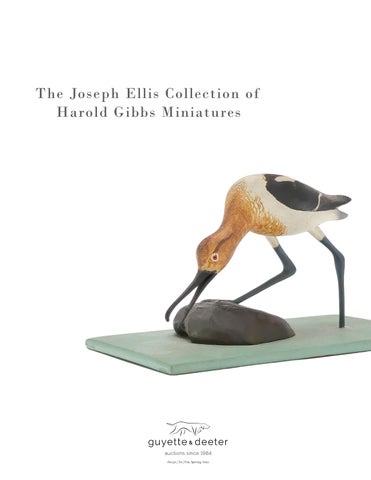
The Joseph Ellis Collection of Harold Gibbs Miniatures
Harold Gibbs 1886 - 1970 | Bar rington, Rhode Island
Harold Gibbs was truly an individual whose life was inextricably tied to Narraganset Bay. He was born in Middleboro, Massachusetts to Reuben Andrew Gibbs and his wife Fannie (Nelson). Reuben moved his family to Barrington, RI in 1892 and opened a grocery store which also served as the local post office and bakery. Harold graduated from Barrington High School and briefly worked as a trapper for the Wm M Harris Fur Co in Providence. He then began to work for his father at the R.A. Gibbs grocery store as a “clerk”, “salesman”, and eventually, about 1918, “Manager”. In 1908, he married Mabel H Collamore, and one year later they had a daughter, Barbara. By 1920 he had left the grocery business and he appears in the census as “keeper – Game Preserve”. This would have been for Isaac Merriman, a wealthy textile merchant from Fall River, MA on his 300-acre hunting stand on the Palmer River in Swansea, MA. The Merriman camp utilized both live decoys and a large rig of premier Masons. Harold remained with Merriman for four years before moving on to the Bristol Rubber Company and, in 1916, he and Mabel purchased a home on Sowams Rd on the banks of the Warren River, where they resided for the remainder of their lives. As an avid
2
hunter, fisherman, trapper, and birder, the industrial setting offered no appeal and he soon left the rubber company to spend the remainder of his life surrounded by the fish and game he loved and, especially, the shellfish of Narraganset Bay. He worked as a lobsterman out of Sakonnet Point and then scalloped in the Sakonnet River. By 1930, he had purchased a larger boat which allowed him to swordfish as well as tend his lobster gear. He eventually gave up lobstering and worked for the Warren Oyster Company as “watchman” over their beds in Nayatt and Warwick in Narraganset Bay. Here, he developed a deep interest in shellfish biology and conservation, turning his boat, the Bahama, into a floating laboratory studying the phytoplankton that the shellfish depended upon for food. This resulted in his publishing a number of articles in respected fisheries journals. In 1939, he had earned enough of a reputation that the Rhode Island Governor appointed him State Administrator of Fish and Game. He was an outspoken advocate for the natural resources and wildlife of the State and, due to his perceived lack of support by the State General Assembly, resigned from that position in 1946. His work, however, resulted in Rhode Island College awarding him an honorary master’s degree in education in 1947. He returned to the Bay, this time studying the biology of the quahog (hardshell clam), conducting research for a Long Island shellfish company and the U.S. Department of Fish and Wildlife. He was appointed by the Governor to the New England Interstate Water Pollution Control Commission and, in 1961, was one of the first members of the Barrington Conservation Commission.
He was a member of the Barrington Rod and Reel Club. A dedicated fisherman, he was a founding father of the “Rhody Fly Tyers” as well as a member of the first chapter of Trout Unlimited in Rhode Island. In the 1940’s he was the originator of the “Gibbs Striper Fly”, an example of which is included in the permanent collections of the Museum of Fly Fishing in Manchester VT. The Museum credits him as being “- - - the father of modern striper (rockfish) fishing in the Northeast”, and records his bucktail as “- - - one of the first attempts at suggesting a specific forage fish, the silverside”. He was an accomplished writer, publishing numerous articles in sporting periodicals, such as “Outdoors” and “The Salt Water Sportsman. He also wrote on issues such as gun safety for the Orvis Company in Vermont. It is believed that Gibbs’ first carvings were working decoys for his own use. He did carve a very small number of miniatures in the form of decoys for a fly-tying friend in Bristol, RI and these may provide a clue as to what his full-size birds might have looked like. His real artistic talent, however, rested on his miniature birds. These were first executed for his daughter as toys, and they were cherished by her, so he was soon carving them for her friends and neighbors. In a 1942 article in the Providence Journal, he was recorded as saying: “I decided if my little birds were going to be distributed among our friends, I’d better put a little care into them, so I began to make exact miniatures of real birds”. He hated the title “carver” and insisted on being called a “whittler”. Demand for his “little birds” began to soar and he was soon selling them through Orvis. A typed list from the 1930’s indicates that he was selling sets of 25 miniature shorebirds for $75.oo, possibly influenced by similar sets by Elmer Crowell. He did a number of male and female groupings, perhaps inspired by contemporary RI miniaturist, A.J. King (1881 – 1959) of North Scituate. His work, in turn, influenced fellow Ocean State carver Arthur J. Peltier (1907 – 1982) of Warwick. Harold Gibbs’ wife of 60 years passed away in 1968 and he died a short two years later at the home of his daughter in Westport, MA. One would like to believe he was casting his Gibbs streamer for stripers in the rips at the mouth of the Westport River at the time. In 1974, a 30 acre parcel on Prudence Island in the Bay was donated to the State for permanent preservation by the Blount Seafood Company of Warren in his name. He is one of the premier carvers discussed in Joe Ellis’ excellent thesis, “Birds in Wood and Paint”, and his “little birds” are actively sought by serious collectors.
3
From Bird Hunting to Bird Watching Man’s interest in birds can be traced to paleolithic cave art dating back tens of thousands of years. As one would expect, early humans must have occasionally gazed in awe at the creatures, marveling at their beauty or their song and, certainly, they must have pondered their mysterious ability to fly. For the centuries to follow, however, his primary interest was focused on the creatures as simply being a source of meat, eggs and feathers, items all critical for survival.
Ironically, as firearms improved so did advances in optical equipment, making it much easier to view wildlife in their natural habitat at a distance. Simple telescopes had been around for some time but, in1823, J. F. Voigtländer patented the combination of two achromatic spyglasses into a pair of simple opera glasses, and in 1894, Carl Ziess developed the first pair of successful porro prism binoculars.
Paleolithic owl and bird, France
Wm Brewster
As human populations grew, man continued to depend on wildlife for what it could provide, and the stories of the associated market hunting are well known. Eventually the widespread killing of birds led to drastic reductions in the population numbers of many species and hunting was a factor in the actual extinction of some. With time, a few individuals began to promote a different approach to their relationship with our feathered neighbors. Interest in birds for something other than food or feathers was not totally new. As early societies developed, some individuals acquired the means and leisure time to make collections of avian specimens fashionable. Egyptian pharaohs filled their tombs with artifacts and Inca chiefs filled their menageries. By the 1700’s better firearms and easier travel fostered not only increased market hunting but the interest in the collecting of wildlife among a widening segment of the population. By the 1800’s the amassing of bird skins, eggs and nests had become extremely popular. This was how ornithology was conducted at the time. Having an actual specimen in hand to refer to and compare with others was considered the basis of scientific bird study. To put the extent of this practice into scale, Yale University’s historic collection of labeled bird skins and eggs alone numbers around 165,000 specimens and Harvard University’s holdings of eggs, nest and skins include about 375,000 examples. Other colleges, museums and universities can cite similar numbers, and these do not include the thousands of personal collections that have disappeared over the years. It goes without saying that these practice’s, too, all necessitated the killing of the birds or their offspring. The opening sentence in the first chapter of “Field Ornithology” published in 1874 by Massachusetts author Elliot Coues begins with the statement, “The double barrel shotgun is your main reliance”.
For many years, the scientific study of birds, including collecting, was, for the most part, a male dominated world. Men such as Boston’s William Brewster were at the forefront of the academic study of birds, elevating it to a level of serious social and collegiate recognition. He was the founder of the Nuttall Ornithological Club in Boston in 1873 and, in 1883, the co-founder of the American Ornithological Union. This male influence and control would slowly begin to erode, and woman began to play an increasingly influential role. By the late 1800’s illustrated field guides began to be more available, greatly easing the identification of species which, previously, was largely reliant only on a written taxonomic description of the birds. When Florence A Merriam (Bailey) was born in 1863, women’s hats were crowned with feathers and sometimes whole birds, all to satisfy the whims of female fashion. On a Manhattan walk in 1886, she saw 40 species displayed on hats in shop windows and in 1889, she released “Birds Through an Opera-Glass”, the first modern illustrated field guide for everyday enthusiasts promoting observation over killing. In 1896 The Massachusetts Audubon Society was formed by Harriet L Hemenway and Minnie B Hall in Boston and, by the turn of the century, similar sentiments were becoming increasingly popular throughout the country.
F.A. Merriam
Passenger pigeons Chicago Field Museum
4
Illinois State Museum
Smithsonian
Harriet Hemenway
Minnie B Hall
Eventually, the observation of birds in their natural habitat became the prefered method of study for many. Hunting would remain popular in a sporting sense but it was increasingly being governed by stricter laws and restrictive seasons. “Bird Watching”, as it was known, became a recognized leisure activity. The first use of the term was coined in 1901 by British ornithologist Edmund Selos who penned his well received book titled simply “Bird Watching” in which he detailed his thoughts on observing birds rather than killing them. He wrote: “Let anyone who has an eye and a brain … lay down the gun and take up the glasses for a week, a day, even for an hour, if he is lucky, and he will never wish to change back again. He will soon come to regard the killing of birds as not only brutal, but dreadfully silly”.
Arthur A. Allen By the beginning of the 20th century the study of birds became a serious academic pursuit in its own right. In 1911 Arthur A. Allen became the first Ph.D. ornithologist in the U.S. (Cornell, 1911) and, in 1915 he founded today’s world-renowned Cornell Laboratory of Ornithology. With increasing popularity and growing acknowledgement and acceptance as a legitimate pastime, bird watching became widely renamed as “Birding” in recognition that it had progressed beyond the mere identification of a species to a more in-depth study of not only the individual but it’s ecology. Clubs and societies, both large and small, emerged throughout the country both in rural and urban settings. Men and women of all ages, either singularly or in groups participated in the practice at all levels ranging from casual observation to elaborately planned outings and the compilation of prized “life list”. Today, the U.S. Fish and Wildlife Service estimates that “Birding”, at some level, is enjoyed by about 37% of the population of the Country.
This rapidly growing interest in birds beyond the traditional circle of hunters did not go unnoticed by the early miniaturists in New England. The men who had begun their careers as decoy carvers focused their initial efforts on tiny replicas of their working birds, both ducks and geese as well as shorebirds. Some would slowly make the transition from a concentration on waterfowl and upland game to non-game species. Others, notably those born post 1900, would show a favoritism towards songbirds. In almost every case, the miniature carvings were intended to evoke a fond remembrance of some past experience afield, either with a gun or with optics. Men such as Crowell intended many of their carvings to be sold in groups to schools and libraries as three-dimensional models of the live birds which, along with rapidly improving field guides such as Roger Tory Peterson’s groundbreaking 1934 “A Field Guide to the Birds”, could serve as an aid in identification, certainly a primary step in any future study. By the first quarter of the 20th century, a time when many of the carvers were in their artistic and productive prime, the “minis” were small, attractive, and inexpensive souvenirs meant for the increasing number of tourists frequenting our shorelines, mountains and vacation destinations. Many found their way onto the shelves of prestigious stores such as Abercrombie and Fitch, Shreve Crump and Lowe, The Crossroads of Sport and others where they were eagerly sought as popular gift items. Organizations such as The Massachusetts Audubon Society and the League of New Hampshire Craftsmen offered them through their catalogs and retail outlets where they similarly found a ready market. Miniature bird carving was practiced to varying degrees throughout the United States, but perhaps nowhere did it flourish as it did in New England where birding can proudly trace its roots. Today the tiny replicas are as popular as when they were carved, and represent a wonderful addition to any sporting or ornithological collection.
Central Park, New York c1950’s
5
The Collection
Canada Geese
Blue Goose
Brant
6
Ruddy Duck
Canada Goose
Bufflehead
7
White Fronted Goose
Widgeon
Long-Tailed Duck
8
Eider
Pintail
Hooded Merganser
9
Widgeon
Shoveler
Red Breasted Merganser
10
Gadwall
Great Blac k Bac ked Gull
Gannet
11
Canvasback
Pintail
Woodduck
12
Woodduck Pair
Bluewing Teal
Greenwing Teal
13
Puffin
Surf Scoter
Mallard
14
Goldeneye
Black Duck
Bald Eagle
15
Pere g rine Falcon
Immature Redtail Hawk
White Gyrfalcon
16
Great White Heron
Snowy Eg ret
Green Heron
17
Chickadee
Great Blue Heron
White Pelican
18
Great Blue Heron
Pelican
Roseate Spoonbill
19
Stork
Pur ple Gallinule
Crow
20
Bar red Owl
Woodcock
Ruffed Grouse
21
Shar p Tailed Grouse
Pheasant
Golden Pheasant
22
Quail
Elliots Pheasant
Bur mese Bar red Backed Pheasant
23
Whooping Crane
Sandhill Crane
Turkey
24
Black Pheasant
Black Pheasant
Mute Swan
25
Whistling Swan
Avocet
Hudsonian Godwit
26
Loon
Shoveler Pair
Hair y Woodpec ker
27
Ter n
Bluebird
Golden Plover
28
Songbird Pair
Red Knot
Dowitcher
29
Lesser Yellowle gs
Tur nstone
Upland Plover
30
31