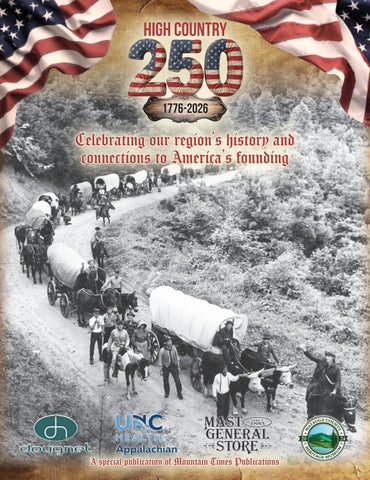
HIGH COUNTRY
1776-2026
Celebrating our region’s history and connections to America’s founding
A special publication of Mountain Times Publications
4 • HIGH COUNTRY 250 • 2026
Mountain Times Publications
A Celebration OF OUR HISTORY
As local historian Michael Hardy so aptly puts it, history happened here. This special magazine from Mountain Times Publications showcases just that — the stories rooted right here in Ashe, Avery and Watauga counties and the surrounding region. Our writers took a deep dive into this region’s connections to America’s founding and the key events that followed. You’ll meet a man who aided the Revolutionary War effort and whose descendants are now country music stars. You’ll travel deep into the roots of this area with the Watauga Association and its key figures. You’ll read how one woman disguised herself as a man to fight alongside her husband in the Civil War. You’ll find the local figures and events that helped shape our nation’s founding documents,
and a detailed look at every American war and this region’s ties to it. There is so much history here that one magazine won’t be able to tell it all, but we hope these stories will help you — our readers and community — appreciate this place even more. You’ll also notice a timeline running along the bottom of these pages, marking events tied to Ashe, Avery and Watauga counties from 1749 forward. We hope you enjoy this celebration of America’s 250th birthday — and the High Country’s place in it.
Moss Brennan Executive Editor Mountain Times Publications
Advertising Director Mark Mitchell
Writers Jesse Campbell, Zach Colburn, Tierney Drake, Riley Gleason, Michael Hardy, Shweta Mishra, Sofia Okubo Peviani, Lorelei Roberts
Regional Digital Director Trey Fowler
Design Darla Allen, Rebecca Portis
Circulation Manager Jeff Winebarger
Sales William Becker, Savannah Beal, Mitchell Fowler, Teresa Roark-Laws (Ashe GM), Landon Reed, Owen Storie
Publisher Gene Fowler Executive Editor Moss Brennan
Editors Jamie Shell, Nathan Ham COURTESY DIGITAL WATAUGA, JACKSON HENSON COLLECTION, DIGITALWATAUGA.ORG
This 1963 image shows the Daniel Boone Wagon train along a dirt road. There is a man on a horse dressed as Daniel Boone at the beginning of the parade leading the way. Many of the wagons pictured are covered and carry people and supplies in the carts. The wagon train can be seen winding down the mountain path.
Mountain Times Publications
2026 • HIGH COUNTRY 250 • 5
NATIONAL ARCHIVES AND RECORDS ADMINISTRATION
The opening page of the United States Constitution, handwritten on parchment by Jacob Shallus and signed by 39 delegates in Philadelphia on September 17, 1787. The words “We the People” established for the first time a government deriving its authority directly from its citizens.
History Happened Here BY MICHAEL HARDY As we celebrate the 250th anniversary of our nation’s birth, names like George Washington and Thomas Jefferson, along with places like Boston, Philadelphia, and Williamsburg, will be in the headlines. These people and places seem far away and from a time long ago. Yet in reality, they are not that far away. While Washington and Jefferson never visited the High Country, in a way, they did. In 1776, just across our mountains, the Washington District was formed. It was the first place named in honor of George Washington, then commander of the Continental Army. This became Washington County, North Carolina, and in 1796, Washington County, Tennessee. The town of Jefferson was named in honor of Thomas Jefferson, then vice president of the new United States. Mount Jefferson was also named for the drafter of the Declaration of Independence. Other places followed. Samuel Ashe was also a patriot in the American Revolution, helped draft North Carolina’s first state constitution, and later served three terms as governor. Colonel Waightstill Avery was the first attorney general for the state of North Carolina and also played a prominent role in drafting North Carolina’s first constitution. Likewise, Daniel Boone, while living in Kentucky, fought against the British-allied Shawnee and then served in the Virginia Assembly. We call all these places home. They serve as a steady reminder of our past. Some of the American Revolution filtered into the High Country. In July 1776, the British-allied Cherokee raided up and down the frontier. Any white settler homestead that encroached upon Native lands was destroyed. The militias from South Carolina, North Carolina, and Virginia retaliated, burning many of the Cherokee towns in far western North Carolina and present-day Tennessee. Loyalists or dissidents frequently hid out in the mountains. Patriot forces would sweep through the area looking for the opposition. The most famous of these Patriot leaders was Wilkes County’s Benjamin Cleveland.
His ranger company patrolled along the Watauga and New Rivers. At one point, Cleveland was captured, but his brother Robert was able to help in his escape at Riddle’s Knob in present-day Watauga County. In 1780, Cleveland and other militia commanders from over the mountain headed south, finding the British force under Maj. Patrick Ferguson at Kings Mountain. In the ensuing battle, the entire British force was killed, wounded, or captured. Thomas Jefferson considered the battle the turning point of the American Revolution. Following the American Revolution, veterans made their way into the mountains, carving out farms from the vast Appalachian wilderness. They included Landrine Eggers, Martin Davenport, William Wiseman, Thomas Calloway, and James Tatum. These men, with their families, created the communities and towns that so many of us now call home. The Ashe, Watauga, and Avery County region – the High Country – has a deep and rich history. Men and women from the area fought in every military conflict since the American Revolution; local mica mines helped win one of those wars; two colleges sprang up in the area, Appalachian State University and Lees-McRae College; two world-class attractions, the Blowing Rock and Grandfather Mountain, continue to attract visitors; incredible hotels, like Mayview Manor, The Green Park Inn, and the Banner Elk Hotel, once wooed guests from all over; there were fire towers, a wind mill, gold mines, railroads, presidential visits, one-room schoolhouses, churches, stores, the Blue Ridge Parkway, floods and epic snowstorms. Our history is complex and varied, deep and rich, sometimes tragic. It is what makes us who we are. Whether our families have been here for generations or have recently arrived, it is this history that ties us to the land we call home. Boston, Philadelphia, and Williamsburg are all far away from Ashe, Watauga and Avery counties. Yet history happened here, just like it did in these places. It is history that deserves to be remembered. Michael Hardy is an award-winning author and local historian. For more information on his work, visit www.michaelchardy.com.
6 • HIGH COUNTRY 250 • 2026
Mountain Times Publications
Watauga settlers built America’s first independent government and fought to defend it COMPILED BY MOSS BRENNAN
B
COURTESY TENNESSEE STATE LIBRARY & ARCHIVES
A portrait of John Sevier.
efore America declared independence from the British, a group of settlers in parts of Tennessee and present-day Watauga, Ashe and Avery counties were beyond the bounds of any formal government. Carved out of Cherokee territory and sitting outside the jurisdiction of any colonial government, these settlers had no courts, no laws and no authority to appeal to, so they built their own. Called Wataugans, they created the Watauga Association in 1772. According to the North Carolina History Project, the Watauga Association was based on the Virginia legal system with a panel of five elected commissioners regulating all judicial activities in the settlement, including court cases, legal documents, and land titles. While they made no claims to independence from Great Britain, Wataugans were under the authority of no other government and thus represented the first autonomous white government in the British colonies. According to an article in the Tennessee Historical Quarterly titled “The Wataugans and the Dangerous Example,” Virginia Governor Lord Dunmore called the Watauga Association “a dangerous example” of Americans forming a government “distinct from and independent of his majesty’s authority.” Years later, President Theodore Roosevelt would go further, writing that the Watauga settlers were “the first men of American birth to establish a free and independent community on the continent.” For four years the court regulated the affairs of the Watauga community — dispensing justice, maintaining peace with the Cherokee, and recording deeds and wills for a people who had no other institution to turn to. By then, war with Britain was no longer a distant possibility. The authors of the Tennessee Historical Quarterly article argue
Mountain Times Publications
2026 • HIGH COUNTRY 250 • 7
LIBRARY OF CONGRESS, GEOGRAPHY AND MAP DIVISION
An Accurate Map of North and South Carolina with Their Indian Frontiers, published by Henry Mouzon and others in 1775 — weeks after the first shots at Lexington and the most detailed map of the Carolina backcountry available when the Revolution began. Both American and British commanders relied on it; the Watauga settlements lay along the rivers at its far northwestern frontier.
the Association’s significance reached far beyond the Watauga River valley. By forming their own government and defying the Crown, the Wataugans directly inspired others to do the same — most notably land speculator Richard Henderson, whose Transylvania Company used Watauga as a safe meeting ground to negotiate the purchase of Cherokee lands and whose work helped open the door to Kentucky and Cumberland settlements that would follow. When war with Britain appeared inevitable, the Wataugans did not wait to be called. According to the Tennessee Historical Quarterly article, they formed a committee of safety of 13 members, rooted out Tories from the settlements, and sent a company of riflemen to the defense of Charleston. They also fortified their frontier against a Cherokee attack being actively encouraged by the British, who hoped to use the tribes to help crush the rebellion in the southern colonies. The stakes were made clear on July 21, 1776 — just weeks after the Declaration of Independence was signed in Philadelphia — when roughly 300 Cherokee warriors under Chief Old Abraham attacked Fort Watauga. Inside the fort were about 200 people, only 75 of whom could bear arms. Among the defenders was a young officer named John Sevier, who during the chaos of the attack reached over the fort’s palisade and pulled a woman named Catherine “Bonnie Kate” Sherrill to safety — she would later become his wife. Another defender, Ann Robertson,
the younger sister of frontiersman James Robertson, distinguished herself by throwing boiling water, along with other women, over the stockade onto a group of attacking Cherokee, forcing them to retreat. The Wataugans would go on to fight in virtually every major southern battle of the Revolution. The authors of the Tennessee Historical Quarterly article make a sweeping final argument: without Watauga, there likely would have been no Kentucky settlements, no Cumberland settlements, and no platform for the military campaigns that secured the Mississippi Valley for the new nation. “The settlement of Watauga,” they write, was one link “in the chain of events by which independence was won” — and had that link broken in the early years, the peace of 1783 would probably have left the Allegheny Country in British hands.
10 • HIGH COUNTRY 250 • 2026
Mountain Times Publications
‘Yankee’ John Church
BY MOSS BRENNAN
O
ff a gravel road near the Watauga, Ashe and Wilkes County lines, a small grave marker bears the name of a man most people have never heard of. But the legacy of John “Yankee” Church — a Revolutionary War patriot who pushed into the Carolina mountains from Massachusetts in the 1760s — lives on today in ways few could have imagined. His family tree runs straight to Doc Watson and Eric Church. According to descendant and family historian Hannah Guthrie Myers, John Church was born on July 11, 1732, in Sheffield, Berkshire County, Massachusetts. Little is known about John’s early life until he came to Rowan County, North Carolina, in 1760, where locals dubbed him “Yankee” John Church, reflecting his New England birthplace. He eventually owned land in the early 1770s in what is now Ashe County located near the South Fork of the New River, along the waters of Pine Swamp Creek. Myers said records suggest that John made a living by selling pelts and farming. Among those records, one from Oct. 3, 1764, shows that “Yankee” John Church was paid 10 shillings for a wolf scalp. The same listing recorded an identical payment to a fellow frontiersman: Daniel Boone. The Daughters of the American Revolution recognized John as a patriot for providing food and supplies to the Continental Army, according to Myers. While he did not fight in the war, his sons did. Amos Church, born in Virginia in 1758 as John’s eldest child, served eight separate tours of militia service totaling, by his own count, two years and three months, according to his pension deposition dated Oct. 19, 1833, sworn before Justice of the Peace James Wellborn in Wilkes County. Some of the highlights of his eight tours include: • Spring 1778 — Volunteered under Col. Benjamin Cleveland, Capt. John Cleveland and Lt. Gambill. Crossed the Blue Ridge to the New River headwaters, pursuing Tories through Cox’s Settlement. Captured and executed a Tory named Ingram, pursued others to the Virginia line, then returned to Wilkes. • Summer 1778 — Drafted under Col. Cleveland and Capt. Richard Allen. Marched up the Yadkin to Crider’s Fort in Burke County after Tory Col. Roberts. The Tories retreated to the Catawba River, where they fired on the militia from the cliffs, wounding Capt. Larkin Cleveland in the thigh.
Patriot, pioneer and forefather of American music
• October 1779 — Volunteered under Capt. Reuben Stringer and Lt. William Brown. Crossed the Blue Ridge, over Stone Mountain, to the Watauga River, again pursuing Col. Roberts. The Tories retreated before them. One month’s service scouting and guarding. • Fall 1780 — Volunteered, joined headquarters at Salisbury under Col. Lark and Capt. William Glenn of Virginia. Stationed at Salisbury, then marched to Mecklenburg County to guard British prisoners. Several prisoners died of illness. John Church Jr. also served alongside his brother. In his own pension application, he swore that “he served in the Revolutionary War with his brother Amos Church, was with him in the expeditions to Cox’s Settlement, the Catawba River and Crider’s Fort, to Cove Creek and the Watauga River, against the Indians and to the Calloway Settlement, that they parted during the service, but he believes Amos Church was frequently if not constantly in service to the close of the war.” After 1782, John moved his family to land across the crest of the Blue Ridge in or near what is now the Summit community of Wilkes County. John died in 1811. That cemetery marker off the gravel road, placed in late September 2024 by the Daniel Boone Chapter of the National Society of Daughters of the American Revolution, speaks to a legacy that has
Mountain Times Publications
2026 • HIGH COUNTRY 250 • 11
PHOTO BY MOSS BRENNAN
The grave marker for Yankee John Church, who is believed to be buried nearby. The plaque on the bottom reads, in part, “In memory of Revolutionary War patriot John ‘Yankee’ Church.” The Daniel Boone Chapter of the National Society of Daughters of the American Revolution placed the marker.
grown far beyond the Blue Ridge. The exact burial spot is unknown first wife, known in family records only by her surname, Stamper — — somewhere in the general area of the Church family cemetery on grew up in Granite Falls and attended Appalachian State University Patton’s Ridge — but the names that trace back to “Yankee” John leave before becoming one of country music’s biggest stars. little doubt about his place in history. According to Myers, who traces her own descent from John through her grandmother Lib Edmiston Walsh, John left behind 14 children across two marriages and a family tree that today reaches into the heart of American music. He is the third great-grandfather to famed bluegrass musician Arthel Lane “Doc” Watson. Watson descends from Elizabeth “Betsy” Church — a daughter of “Yankee” John and his second wife, Jane Andrews — who married Lewis Triplett of Wilkes County. John is also the sixth great-grandfather to country music star Kenneth Eric Church — known to fans simply as Eric Church. Church, whose family descends from Elijah — son of “Yankee” John and his
C E L E B R A T E
America’s
250th! The building of Tweetsie Railroad trestle and track, courtesy of Diane Cornett Deal
Beaver Dam Baptist Church c. 1905, courtesy of JP Greene
And Let’s All Support Watauga’s Heritage!
“Watauga County has an incredible history that includes Native American villages and the early treks of Daniel Boone, Civil War skirmishes, exploration by naturalists and geologists, the creation of a university, early North Carolina tourist destinations, and famous railroad lines.”
The Watauga County Heritage Museum is a nonprofit organization aiming to interpret and share our local history with dignity, respect, integrity, and inclusion. Beginning in Fall 2026, we will welcome visitors to our temporary home at the Dougherty House beside Mystery Hill in Blowing Rock. We believe that you, our neighbors, are each a part of Watauga County’s story—become a member of the WCHM today and help support our mission! Dougherty House
Michael Hardy, Award-Winning N.C. Historian
PLEASE BECOME A SPONSOR OR MEMBER OR MAKE A SECURE DONATION ONLINE AT:
WataugaCountyHeritageMuseum.org Watauga County Heritage Museum, Inc. is a 501c3 and donations are tax deductible to the extent provided by law.
DISCOVER
THE DOUGHERTY HOUSE AT MYSTERY HILL
L
ong before the Dougherty House became part of Mystery Hill, it stood on Rivers Street in Boone as the home of B.B. Dougherty, D.D. Dougherty and Lillie Shull Dougherty — names deeply tied to the founding of Appalachian State University. Built in 1902–1903, the house witnessed a period of change that helped shape Boone’s future. As schools grew, communities expanded and the region’s story continued to unfold, the Dougherty House remained a quiet landmark of family, learning and local legacy. In 1989, when the historic home faced an uncertain future, owner Wayne Underwood helped preserve it by having it driven th ht t it h t
A JOURNEY
14 • HIGH COUNTRY 250 • 2026
Mountain Times Publications
July 4, 1776: The Declaration of Independence
BY MOSS BRENNAN
O
n July 4, 1776, delegates gathered in Philadelphia to adopt the Declaration of Independence and announced to the world that a new nation had been born. That moment wasn’t made only in Philadelphia; it was built in courthouses and frontier forts, in provincial conventions and mountain settlements, by men and women who had already been living the idea of independence long before it was put to paper. Three of those stories trace directly to the mountains and piedmont of North Carolina – to the land that would become Watauga, Ashe and Avery counties. In the backcountry wilderness, a community of Scots-Irish settlers – like James Robertson and John Sevier – called Wataugans had been governing themselves since 1772, four years before independence was declared, building courts and laws in territory no colony claimed. In the halls of the Provincial Congress, a Princeton-educated lawyer named Waightstill Avery was writing more of the first North Carolina Constitution than any other man in the room. Samuel Ashe was organizing revolutionary councils, serving on committees of safety, and preparing to become one of the first judges of a future state. While none of them were in Philadelphia, all of them helped make July 4th possible. What connects these men and the counties that bear their names is a shared conviction that appeared long before independence was declared: that people had the right to govern themselves, to build institutions worthy of free men, and to fight for what they had built.
LIBRARY OF CONGRESS, PRINTS AND PHOTOGRAPHS DIVISION
The presentation of the Declaration of Independence to the Second Continental Congress in Philadelphia, July 4, 1776. Engraved by Illman Brothers from John Trumbull’s famous painting, published as a centennial supplement to Peterson’s Magazine in 1876.
North Carolina’s three signers — William Hooper, Joseph Hewes and John Penn — were all transplants to the colony, born in Boston, New Jersey and Virginia respectively. The following were the signers, with their birthplaces and THE SIGNERS OF THE DECLARATION OF INDEPENDENCE occupations: • John Adams — Quincy, MA — Lawyer While the Fourth of July is when the Continental Congress voted to adopt the Declaration of Independence, according to the National • Samuel Adams — Boston, MA — Merchant • Josiah Bartlett — Amesbury, MA — Physician Archives, it was not actually signed until Aug. 2, 1776. Under what was called the “Committee of Five,” chaired by Thomas • Carter Braxton — Newington, VA — Plantation Owner Jefferson, a draft was prepared between June 11 and 28, with changes • Charles Carroll of Carrollton — Annapolis, MD — Merchant, Plantation Owner • Samuel Chase — Somerset County, MD — Lawyer made up to July 2. The congressional revision process took most of • Abraham Clark — Elizabethtown, NJ — Lawyer, Surveyor July 3 and July 4 before it was officially adopted that afternoon. Under the supervision of the committee, the approved Declaration • George Clymer — Philadelphia, PA — Merchant was printed and, on July 5, a copy was attached to the “rough journal • William Ellery — Newport, RI — Lawyer, Merchant • William Floyd — Brookhaven, NY — Land Speculator of the Continental Congress for July 4th,” according to the National • Benjamin Franklin — Boston, MA — Scientist, Printer Archives. • Elbridge Gerry — Marblehead, MA — Merchant The printed copies, bearing only the names of John Hancock, • Button Gwinnett — Gloucester, England — Merchant, Plantation Owner president, and Charles Thomson, secretary, were distributed to state SEE DECLARATION ON PAGE 16 u assemblies, conventions, committees of safety, and commanding officers of the Continental troops. According to the National Archives, on July 19, Congress ordered that the Declaration be engrossed on parchment with a new title, “the unanimous declaration of the thirteen united states of America,” and “that the same, when engrossed, be signed by every member of Congress.” It wasn’t until Aug. 2 that the true signing began, with John Hancock, the president of the Congress, placing a bold signature on the engrossed copy. The other delegates, following custom, signed, beginning at the right, with the signatures arranged by state from northernmost New Hampshire to southernmost Georgia.
Honest - Dependable - Affordable
2022
2023
2024
2025
Managed IT Business & Residential Hardware & Software System Optimization Malware & Virus Removal Networking & Security Cloud Solutions
202 Southgate Dr., Boone, NC 28607 dougnet.biz | 828.264.0959
16 • HIGH COUNTRY 250 • 2026 u
Mountain Times Publications
DECLARATION FROM PAGE 14
• Lyman Hall — Wallingford, CT — Physician, Minister • John Hancock — Quincy, MA — Merchant • Benjamin Harrison — Charles City County, VA — Plantation Owner, Farmer • John Hart — Hunterdon County, NJ — Landowner • Joseph Hewes — Kingston, NJ — Merchant • Thomas Heyward Jr. — St. Helena Parish, SC — Lawyer, Plantation Owner • William Hooper — Boston, MA — Lawyer • Stephen Hopkins — Providence, RI — Merchant • Francis Hopkinson — Philadelphia, PA — Lawyer, Musician • Samuel Huntington — Windham, CT — Lawyer • Thomas Jefferson — Albemarle County, VA — Lawyer, Plantation Owner, Scientist • Francis Lightfoot Lee — Mt. Pleasant, VA — Plantation Owner • Richard Henry Lee — Stratford, VA — Plantation Owner, Merchant • Francis Lewis — Llandaff, Wales — Merchant • Philip Livingston — Albany, NY — Merchant • Thomas Lynch Jr. — Prince George’s Parish, SC — Lawyer • Thomas McKean — Chester County, PA — Lawyer • Arthur Middleton — Charleston, SC — Plantation Owner • Lewis Morris — Westchester County, NY — Plantation Owner • Robert Morris — Liverpool, England — Merchant, Land Speculator • John Morton — Ridley Township, PA — Farmer • Thomas Nelson Jr. — Yorktown, VA — Merchant, Plantation Owner • William Paca — Abingdon, MD — Lawyer, Plantation Owner • Robert Treat Paine — Boston, MA — Lawyer, Scientist • John Penn — Caroline County, VA — Lawyer • George Read — North East, MD — Lawyer • Caesar Rodney — Dover, DE — Plantation Owner, Military Officer • George Ross — New Castle, DE — Lawyer • Benjamin Rush — Philadelphia, PA — Physician • Edward Rutledge — Christ Church Parish, SC — Lawyer, Plantation Owner • Roger Sherman — Newton, MA — Lawyer • James Smith — Ireland — Lawyer • Richard Stockton — Princeton, NJ — Lawyer • Thomas Stone — Charles County, MD — Lawyer • George Taylor — Ireland — Merchant • Matthew Thornton — Ireland — Physician • George Walton — Cumberland County, VA — Lawyer • William Whipple — Kittery, ME — Merchant • William Williams — Lebanon, CT — Merchant • James Wilson — Carskerdo, Scotland — Lawyer • John Witherspoon — Gifford, Scotland — Minister
LIBRARY OF CONGRESS, PRINTS AND PHOTOGRAPHS DIVISION
An 1903 official facsimile of the Declaration of Independence, surrounded by portraits of key signers including George Washington, Thomas Jefferson, John Adams, Benjamin Franklin, and John Hancock, along with the Great Seal of the United States and a scene of the signing.
• Oliver Wolcott — Windsor, CT — Lawyer • George Wythe — Elizabeth City County, VA — Lawyer
According to the National Archives, although not all delegates were present on Aug. 2, a total of 56 delegates eventually signed the document. Among the late signers were Elbridge Gerry, Oliver Wolcott, Lewis Morris, Thomas McKean and Matthew Thornton, who was unable to place his signature with the other New Hampshire delegates due to a lack of space. Some delegates,
including Robert R. Livingston of New York, a member of the drafting committee, never signed the Declaration. For more information on the Declaration of Independence, visit tinyurl.com/m4tb2j9z
18 • HIGH COUNTRY 250 • 2026
Mountain Times Publications
Avery County’s Revolutionary
Roots live on in graves, names and museums
BY SHWETA MISHRA
F
rom Revolutionary War patriots buried in mountain cemeteries to generations of residents named after Thomas Jefferson and Benjamin Franklin, the High Country preserves a living link to the nation’s earliest history. Avery County itself honors Waightstill Avery, the Revolutionary War colonel and North Carolina’s first attorney general. Avery helped draft North Carolina’s first constitution, signed the 1775 Mecklenburg Resolves — which declared all British Crown laws null and void and suspended the authority of the King and Parliament — and played a role in the broader Mecklenburg Declaration movement. When Avery County was created in 1911, local leaders chose his name because of his influence and land holdings in the region. “His home is actually Burke County, but he owned large tracts of land here,” said Aneda Johnson, chair of the Avery Historical Society. Avery County’s Revolutionary history also runs through the Overmountain Men — the frontier militia whose 1780 march to Kings Mountain is covered elsewhere in this issue — and one of the county’s most significant connections to that campaign involves William Wiseman, an early settler who lived near present-day Spruce Pine. “William E. Wiseman had his plantation down there in that area, across from where the Sibelco Crystal site is located now,” Johnson said. “When the Overmountain Men came marching to Kings Mountain, they were going to meet up down at the Charles McDowell home near Morganton. William and his son Thomas loaded up their shoe-making tools and went along and made shoes for the militia
PHOTO COURTESY RANDY CURDE
Avery County’s Revolutionary legacy survives through patriot graves scattered across its mountains and valleys. Among the most prominent is Captain Robert Sevier, who was wounded at the Battle of Kings Mountain and died Oct. 16, 1780.
frontiersmen.” Johnson added that Wiseman ran a blacksmith shop and even maintained a school on his farm, known as Sunnybrook Farm. SEE ROOTS ON PAGE 20 u
DIANNE DAVANT & ASSOCIATES EXCELLENCE BY DESIGN SINCE 1979
FL LICENSE IB 0000766
DIANNE DAVANT MOFFITT, ASID MARGARET HANDLEY, ASID PAMELA MCKAY, ASID PRISCILLA HYATT COUNCILL, ASID BANNER ELK, NORTH CAROLINA 828.963.7500 STUART, FLORIDA 772.781.1400 WWW.DAVANT-INTERIORS.COM
20 • HIGH COUNTRY 250 • 2026
Mountain Times Publications
u ROOTS FROM PAGE 18
“They weren’t part of the regular army,” she said. Artifacts associated with Wiseman are preserved at the Avery County Historical Museum. Johnson said the museum displays a flax spinning wheel once owned by Wiseman that reflects the ruggedly self-sufficient culture of Revolutionary-era settlers. “They took flax they grew, and they used that to spin it and see if they could make the yarn that then went on to the loom,” Johnson said. She said the settlers blended flax and wool into “linsey-woolsey” fabric commonly used on the frontier. Avery County’s Revolutionary legacy also survives through patriot graves scattered across its mountains and valleys. Among the most prominent is Captain Robert Sevier, who was wounded at the Battle of Kings Mountain and died Oct. 16, 1780. He is buried in Bright Cemetery in the Bright Settlement community. Another patriot buried there is Martin Davenport, remembered locally as a scout and frontier fighter. Johnson also identified William Davis as a Revolutionary patriot buried in the Three Mile area and discussed the disputed service history of William David Barjonah, another figure buried nearby. Another Revolutionary patriot, William Bragg, is buried at Montezuma Cemetery. The county’s ties to America’s founders extend beyond military history into naming traditions passed through generations of mountain families. Local cemetery records show at least 13 men buried in Avery County carried the name of Thomas Jefferson, including Thomas Jefferson Proffitt, Thomas Jefferson Ray and Thomas Jefferson Greene, according to North Carolina historian Michael Hardy. Other residents carried names honoring Benjamin Franklin, including Benjamin Franklin Carver, Benjamin Franklin Ward and Benjamin Franklin Biggerstaff. The popularity of founding-era names fascinated late Crossnore genealogist Tense Franklin Banks, who spent decades preserving local records and oral histories. Banks previously said she was a descendant of Benjamin Franklin, though Johnson cautioned that such family traditions are difficult to verify conclusively. “They always claim that,” Johnson said. “I don’t think they’ve ever completely verified it.” Still, Hardy said Banks represented the essential role local historians play in preserving mountain history. “Collecting and preserving and sharing that history was really what drove her,” Hardy said. “These local historians are the people who strive to make sure the histories of their communities are not forgotten.” Hardy, who served with Banks on the Avery County Historical Museum board, said she devoted herself to documenting the county’s earliest families and Revolutionary-era roots. “Her roots run deep in the area,” Hardy said. “Tense was a descendant of the earliest settlers.” He said Banks regularly attended heritage festivals, historical marker dedications and Overmountain Men commemorations throughout the High Country. “Over the years, I could always count on seeing Tense at nearly any event dedicated to preserving and promoting local history,” Hardy
PHOTO BY MICHAEL HARDY
Tense Franklin Banks in August 2025 at the William Wiseman grave marking program.
said. “Her absence will be keenly felt at those events in the future.” Today, Avery County’s connections to the nation’s founding survive in archives and museums, as well as in family names, frontier artifacts, and weathered grave markers tucked across the foggy hollers.
Custom Residential & Commercial Building Firm Residential | Commercial | New Construction | Renovations | Interior Design | Design Build
Scan the QR code to visit our website. 828-295-8929 4fortyfour.com
THE NATION’S OLDEST REVOLUTIONARY WAR OUTDOOR DRAMA
HORN IN THE WEST Summer months in Boone since 1952
Southern Appalachian Historical Association
591 HORN IN THE WEST DR. BOONE, NC WWW.HORNINTHEWEST.COM 828-264-2120
24 • HIGH COUNTRY 250 • 2026
Mountain Times Publications
PHOTO COURTESY TENNESSEE STATE MUSEUM COLLECTION
Gathering of Overmountain Men at Sycamore Shoals, Lloyd Branson, 1915. Oil on canvas.
How the Overmountain Men
Turned the Tide of the Revolutionary War
BY TIERNEY DRAKE
I
n the fall of 1780, the High Country played a pivotal role in one of the Revolutionary War’s most decisive moments — a battle that Thomas Jefferson would later call “the turn of the tide of success.” That year, British Major Patrick Ferguson insisted that residents of the Carolinas and the Appalachian Mountains pledge allegiance to the King of England. Settlements west of the Appalachian Mountains were referred to as the Overmountain area, which served as the boundary between the 13 American colonies and the western frontier. The Overmountain area encompassed North Carolina, Virginia, and what is now Tennessee. Many of the Overmountain Men had stayed out of the war, preferring to focus on carving out lives on the frontier — but Ferguson’s threat changed that. Major Ferguson had threatened to bring his army across the mountains and lay waste to their settlements, and they were not about to wait for him to make good on it. They decided to organize an attack against Major Ferguson’s Loyalist force, which became the Battle of Kings Mountain. Colonel Isaac Shelby and Colonel John Sevier assembled more than 1,000 Overmountain Men and settlers to defeat the Loyalists. Troops were gathered at Sycamore Shoals, Tennessee, before traveling to the mountains of North Carolina. On September 28, the militia reached the fields along Grassy
Creek, North Carolina, after a 20-mile march from the top of Yellow Mountain, following Bright’s Trace along the North Toe River. Their soldiers were under the command of Colonels Shelby, Sevier, William Campbell, and Charles McDowell. The Overmountain Men camped at Grassy Creek with plenty of fresh water available for their men and horses. The next morning, half the men followed Colonel Campbell across the Blue Ridge through Gillespie and Lynn Gaps into Turkey Cove. They crossed the summit of the Blue Ridge Mountains near Spruce Pine, North Carolina, and camped near the present-day site of the Museum of North Carolina Minerals on the Blue Ridge Parkway. Meanwhile, under Colonel Shelby and Colonel Sevier, the other half of the men returned to the North Toe River and followed Roses Creek
2026 • HIGH COUNTRY 250 • 25
Mountain Times Publications
PHOTO BY MICHAEL HARDY
The route of the Overmountain Men was denoted with a North Carolina Highway Historical Marker in 1938.
to Hefner Gap, crossed the Blue Ridge, and descended into North Cove.
ILLUSTRATION COURTESY NATIONAL PARK SERVICE
The path the Overmountain Men took through our area in September 1780.
The battle between Ferguson’s Loyalist forces and the Overmountain Men took place on Oct. 7, 1780, at Kings Mountain, South Carolina. As they ascended the battlegrounds, they used silence and stealth to their advantage, taking the enemy by surprise when encircling Kings Mountain and closing in on them. Over the course of an hour, 200 Loyalist fighters were killed, along with Major Ferguson. Another 160 were wounded, and roughly 700 prisoners had been taken. Thomas Jefferson referred to this battle as the turning point of the war, calling it “the turn of the tide of success.” A Patriot victory at the Battle of Kings Mountain helped secure American victory by the end of the Revolutionary War, as it destroyed a major Loyalist force, halted the British invasion of North Carolina, and revitalized Patriot morale in the South. For those who want to follow in their footsteps, the Overmountain Victory National Historic Trail traces the 1780 route across Tennessee, North Carolina, and South Carolina — including a crossing of the Blue Ridge Parkway at Gillespie Gap — with 330 miles of marked driving routes and 87 miles of walkable pathways.
26 • HIGH COUNTRY 250 • 2026
Mountain Times Publications
Sycamore Shoals
Where the Frontier Helped Shape a Nation
BY RILEY GLEASON
A
long the banks of the Watauga River in present-day Elizabethton, Tennessee, lies one of the most significant historic sites in the Appalachian region: Sycamore Shoals State Historic Park. Quiet walking trails and reconstructed frontier cabins now fill the area, but more than 250 years ago, Sycamore Shoals stood at the center of some of the earliest and most influential moments in frontier America. Local historian and author Michael Hardy, who has spent more than 30 years researching early American and Appalachian history, says places like Sycamore Shoals connect modern Appalachians to events that helped shape the nation itself. THE EARLY FRONTIER SETTLEMENT European settlers began arriving in the Sycamore Shoals area during the 1760s, decades before much of the surrounding frontier was fully established. At the time, the land technically belonged to the Cherokee Nation, and colonial officials considered settlement there illegal under the British Proclamation of 1763, which prohibited colonists from settling west of the Appalachian Mountains. Despite this, settlers continued to move into the Watauga settlement. In 1772, frontier residents formed the Watauga Association, one of the first self-governing constitutional communities west of the Appalachians. Settlers negotiated a ten-year lease with Cherokee leaders to legitimize their presence, though neither King George III nor colonial authorities recognized the agreement. Hardy explained that Sycamore Shoals developed unusually early for the region, making it one of the first organized frontier settlements in what would eventually become Tennessee. “This area was settled about 20 years earlier than many people realize,” Hardy said. “A lot happened here before most people think of Tennessee even existing.” The site also became known for the 1775 Treaty of Sycamore Shoals, also known as the Transylvania Purchase, in which land speculator Richard Henderson negotiated the purchase of millions of acres from Cherokee leaders. The treaty remains controversial because many Cherokee, including the leader Dragging Canoe, opposed the sale and warned that conflict would follow. CONFLICT ON THE FRONTIER Tensions soon erupted into violence. In 1776, during the early stages of the American Revolution, Cherokee forces aligned with
PHOTO COURTESY SYCAMORE SHOALS STATE HISTORIC PARK
“Liberty! The Saga of Sycamore Shoals,” formerly known as The Wataugans, is an outdoor historical drama that takes place in Elizabethton, Tennessee, each June at the Sycamore Shoals Historic Area.
the British and attacked frontier settlements across the region, including Fort Watauga at Sycamore Shoals. Among the defenders was John Sevier, who pulled a woman named Catherine “Bonnie Kate” Sherrill over the fort’s palisade to safety during the chaos of the attack — she would later become his wife. For Hardy, these stories reveal how deeply the Revolution affected ordinary people living in the mountains. “Much of what happened here had a profound effect on American history,” he said. “And it happened right here in our region.” THE OVERMOUNTAIN MEN Perhaps the most famous chapter in Sycamore Shoals history
2026 • HIGH COUNTRY 250 • 27
Mountain Times Publications
PHOTO COURTESY TENNESSEE STATE PARKS
Sycamore Shoals State Park in the fall.
came in September 1780, when more than 1,000 frontier militia members gathered there to begin what became the Overmountain Campaign. Responding to a threat from British Major Patrick Ferguson,
AM
A LOCAL STORY
CA
250
THAT STILL POWERS OUR COMMUNITY. As America celebrates 250 years, we’re proud to be part of a local story that has powered the High Country since 1915. SERVING OUR COMMUNITY. POWERING OUR FUTURE .
frontier militia from Tennessee, Virginia, and North Carolina assembled here before marching east across the mountains to defeat Ferguson at the Battle of Kings Mountain — a victory SEE SYCAMORE ON PAGE 29 u
SixDecades Decadesof ofService: Service:How HowWAMY WAMY Six CommunityAction ActionCarries CarriesForward ForwardAmerica’s America’s Community Promise Promise theshadow shadowof ofthe theBlue BlueRidge RidgeMountains, Mountains,aa InInthe smallbut butmighty mightynonprofit nonprofithas hasspent spentmore morethan than small sixtyyears yearsdoing doingwhat whatAmerica Americapromised promiseditit sixty would:giving givingpeople peoplehope hopeand andopportunity. opportunity. would: Asthe theUnited UnitedStates Statesturns turns250, 250,it’ss it’ssworth worth As pausingto toconsider considerwhere wherethe thesoul soulof ofthis this pausing nationtruly trulylives. lives.ItItlives livesnot notininmonuments monuments nation alone,but butininthe thedaily, daily,essential essentialwork workof ofpeople people alone, whoshow showup upfor fortheir theirneighbors. neighbors.InInNorth North who Carolina’sHigh HighCountry, Country,that thatwork workhas hasaaname: name: Carolina’s WAMYCommunity CommunityAction. Action.For Fordecades, decades,WAMY WAMY WAMY hasstood stoodalongside alongsidefamilies familiesininWatauga, Watauga,Avery, Avery, has Mitchell,and andYancey Yanceycounties, counties,proving provingthat that Mitchell, opportunityfor forall allisisaaliving livingcommitment, commitment, opportunity renewedevery everyday. day. renewed
Bornof ofaaBold BoldIdea Idea Born Thestory storybegins beginsininAugust August1964, 1964,when when The PresidentLyndon LyndonB.B.Johnson Johnsonsigned signedthe the President EconomicOpportunity OpportunityAct Actand anddeclared declaredan an Economic unconditionalWar Waron onPoverty. Poverty.Across Acrossthe the unconditional country,1,600 1,600Community CommunityAction ActionAgencies Agencies country, tookroot. root.WAMY WAMYwas wasamong amongthe thefirst firstininthe the took HighCountry, Country,carrying carryingaarevolutionary revolutionaryidea: idea:the the High peopleclosest closestto tohardship hardshipshould shouldhave havethe the people loudestvoice voiceininsolving solvingit.it. loudest 1967,WAMY WAMYdelivered deliveredan anearly, early,celebrated celebrated InIn1967, victory.The Theremote remoteAvery AveryCounty Countysettlement settlementof of victory. BlevinsCreek Creekfinally finallyreceived receivedclean, clean,running running Blevins water.The Thededication dedicationdrew drewtwo tworemarkable remarkable water. figuresto tothe themountains—Sargent mountains—SargentShriver Shriverof ofthe the figures federalOffice Officeof ofEconomic EconomicOpportunity Opportunityand andthe the federal ReverendBilly BillyGraham—sending Graham—sendingaaclear clear Reverend message:fighting fightingpoverty povertyisisaashared sharedmoral moral message: duty. duty.
LeadersWho WhoLived Livedthe theMission Mission Leaders Nochapter chaptershines shinesbrighter brighterthan thanthe thenearly nearly No threedecades decadesguided guidedby byH.C. H.C.Moretz MoretzJr., Jr.,aa three decoratedWorld WorldWar WarIIIIveteran. veteran.Under Underhis his decorated steadyhand, hand,WAMY WAMYhelped helpedlay laythe thefoundation foundation steady forAppalCart, AppalCart,Boone's Boone'spublic publictransit transitlifeline. lifeline.He He for championedHead HeadStart, Start,brought broughtschool school championed breakfastprograms programsto tolocal localclassrooms, classrooms,and and breakfast establishedsenior seniorcenters centersoffering offeringcommunity, community, established care,and anddignity. dignity. care, Thatspirit spirit That continuedthrough through continued MelissaSoto, Melissa Soto,who who joinedinin1992 1992as asaacase case joined managerand androse roseover over manager yearsto toexecutive executive 3131years director,expanding expanding director, housing WAMY'shousing WAMY's programs.When Whenshe she programs. retiredinin2023, 2023,she she retired passedthe thetorch torchto to passed BrittanyLuxton—who Luxton—who Brittany firstentered enteredWAMY WAMYinin first 2011not notas asstaff, staff,but butas as 2011 client."Joining "JoiningWAMY WAMY aaclient. asaaclient clientwas wasthe the as beginningof ofmy my beginning journey,"Luxton Luxtonhas has journey," said,"and "andI Iam amnow nowininaa said, positionto topay payitit position forward." forward."
StillAnswering Answeringthe theCall Call Still Today,WAMY WAMYserves servesmore morethan than2,000 2,000 Today, individualseach eachyear. year.ItItrepairs repairsfailing failingroofs roofsfor for individuals elderlyhomeowners, homeowners,helps helpsyoung youngparents parentsafford afford elderly childcare,and andgrows growsfresh freshfood foodfor forlocal local childcare, pantries. pantries. Libertyand andjustice justicefor forall allhas hasnever neverbeen beenselfselfLiberty executing.ItIttakes takesneighbors neighborshelping helpingneighbors. neighbors. executing. Stepinto intothe thenext nextchapter—donate chapter—donateor orvolunteer volunteer Step todayatatwamycommunityaction.org, wamycommunityaction.org,visit visitthe the today Booneoffice officeatat225 225Birch BirchStreet StreetSuite Suite2,2,or orcall call Boone 828-264-2421 828-264-2421
2026 • HIGH COUNTRY 250 • 29
Mountain Times Publications
ENGRAVING BY CHARLES HENRY JEENS AFTER ALONZO CHAPPEL, CA. 1863. COURTESY OF THE NEW YORK PUBLIC LIBRARY, DIGITAL COLLECTIONS
The Overmountain Men who mustered at Sycamore Shoals marched east to Kings Mountain, where British Major Patrick Ferguson — who had threatened to hang their leaders and lay their country waste — was shot from his horse and killed on October 7, 1780. This 1863 engraving dramatizes his death. u
SYCAMORE FROM PAGE 27
widely considered the turning point of the Revolution. Sycamore Shoals was where it all began. Today, annual reenactments at Sycamore Shoals help preserve the memory of those events. According to Hardy, the reenactments do more than recreate battles — they allow visitors to connect with the realities of frontier life. “People of the past are not like the people of today,” Hardy said. “If you come to these events, ask questions. Reenactors love talking about what they do and what interests people.” KEEPING LOCAL HISTORY ALIVE For Hardy, continuing to tell these stories matters because local history creates a stronger connection between communities and the past. “There’s still so much to learn from history,” he said. “And there are stories here that still need to be told.” That passion continues through Hardy’s own work. His most recent book, Western North Carolina and Eastern Tennessee and the American Revolution, explores many of the same frontier stories tied to Sycamore Shoals and the Revolutionary War.
Today, Sycamore Shoals remains both a historic landmark and a reminder that some of America’s most important turning points happened not in major cities, but in small frontier settlements tucked into the Appalachian Mountains. For more information, visit tnstateparks.com/parks/sycamoreshoals.
32 • HIGH COUNTRY 250 • 2026
Mountain Times Publications
THE ONLY
Battle
COMPILED BY MOSS BRENNAN
O
n an April morning in 1781, the Revolution’s violence reached the headwaters of the New River — when a Tory band captured one of Kings Mountain’s commanders, and his brother rode to bring him back. The Revolutionary War was won on distant battlefields, at Kings Mountain, at Cowpens, at Yorktown. But the only armed engagement of the war fought in what is now Watauga County took place closer to home, in the laurel above the New River, and it turned not on armies but on a single man: Colonel Benjamin Cleveland, one of the patriot commanders at Kings Mountain, taken prisoner by the people he had spent the war hunting. The story survives because the 19th-century historian Lyman C. Draper gathered it from the men who were there, preserving their pension statements and letters in his 1881 King’s Mountain and Its Heroes. Watauga County’s own historian, John Preston Arthur, retold it from those sources and local tradition in his A History of Watauga County (1915). The accounts disagree on details — as the participants themselves did — but the main basis of the story is clear enough. THE COLONEL THEY CALLED ROUND-ABOUT Benjamin Cleveland was a large man — more than three hundred pounds, by the accounts — and a hard one. From his Yadkin Valley plantation, which his men called the Round-About for the horseshoe bend of the river around it, he had led one of the patriot columns at Kings Mountain in October 1780. By the following spring he had returned home and taken up the grim work of suppressing the
BEFORE THE LINES WERE DRAWN In 1781 there was no Watauga County — nor Ashe. The whole of this high country was the western reach of Wilkes County, itself only four years old, carved from Surry in 1777. That is why Riddle would be carried to Wilkesboro to hang, and why Cleveland’s Yadkin home and his brother on Lewis’ Fork counted as neighbors to a fight near the New River: it was all one county then. The lines that now divide the region came decades later — Ashe split from Wilkes in 1799, and Watauga from Ashe in 1849. The capture site and the rescue site today fall on opposite sides of the Ashe/Watauga County line.
FROM A HISTORY OF WATAUGA COUNTY, COURTESY UNC-CHAPEL HILL LIBRARIES / INTERNET ARCHIVE
The Wolf’s Den, on Riddle’s Knob. Here Robert Cleveland’s party crept up at first light and fired on the Tory camp, and the colonel dropped behind his log as the shots rang out.
Loyalists who still moved through the backcountry. His methods were notorious: Arthur records that Cleveland once forced an alleged horse-thief to cut off his own ears with a dull case knife to escape hanging — “all without trial or evidence,” as Arthur put it. THE CAPTURE AT THE OLD FIELDS The Loyalist who took him was Captain William Riddle, a Tory leader operating out of a hideout called the Wolf’s Den, on the knob that still bears his name, west of present-day Todd. By Arthur’s account, on April 22, 1781, Cleveland was visiting his tenant Jesse Duncan at the lower end of the Old Fields, on the South Fork of the New River. Riddle and his men — six or eight of them — stole Cleveland’s horses from Duncan’s barn in the night and led them up the river into a laurel thicket above the home of Joseph and Timothy Perkins, gambling that the colonel would follow into an ambush the next morning. He did. Cleveland ran into the ambush and was taken into the Perkins house. When one of the Tories, Zachariah Wells, followed him
Mountain Times Publications
2026 • HIGH COUNTRY 250 • 33
in and tried to shoot him, the heavy colonel seized a woman who was present, Abigail Walters, and kept her between himself and his would-be assassin until the moment passed. Then the band started up the New River with its prize, bound for the stronghold on Riddle’s Knob, some 14 miles off and across what would one day be the county line. “HURRAH FOR BROTHER BOB” Word went out. Arthur names the party of neighbors who set off in pursuit — young Daniel Cutbirth, a youth named Walters, Jesse Duncan, John Shirley, William Calloway, Samuel McQueen, and Benjamin Greer — while Joseph Calloway rode hard to notify Cleveland’s brother, Captain Robert Cleveland, on Lewis’ Fork of the Yadkin. They camped through a cold night in the gap, without fire, watching for the glow of the Tories’ campfire on Riddle’s Knob. A little after sunrise, five of the advance party crept up and fired on Riddle’s camp at the Wolf’s Den. Cleveland dropped behind the log he was sitting on as the shots rang out. In the telling handed down through the neighborhood, he roared encouragement to his rescuers in the voice that carried across a battlefield, cheering on his brother. Only Wells was wounded; the rest of the Tories scattered, Riddle and his wife among them. Cleveland walked out alive. THE RECKONING AT WILKESBORO Riddle did not stay free for long. Arthur relates that soon after the rescue, Riddle raided the Yadkin Valley and captured two of Cleveland’s soldiers, David and John Witherspoon — then made the mistake of bargaining. He offered to spare them if they would swear loyalty to the king and return with a prized horse, the O’Neal mare, to join his band. The Witherspoons agreed, went home, and came back not only with the mare but with Colonel Ben Herndon and a party of men, who seized Riddle along with two associates named Reeves and Goss. The three were taken to Wilkesboro, court-martialed, and hanged on a stately oak beside the village — a FROM A HISTORY OF WATAUGA COUNTY, COURTESY UNC-CHAPEL HILL LIBRARIES / INTERNET ARCHIVE tree Draper noted was still standing and “pointed Where Cleveland was captured. Riddle’s band ran the colonel to ground at the Old Perkins Place on the out to strangers at Wilkesboro” when he wrote in South Fork of the New River; by tradition he was seized beneath the apple tree at center. Wiley C. Vannoy 1881. photographed the site in 1915 — the cabin shown stood on the spot in Arthur’s day, not in 1781. How Riddle died, though, is one of the places the record splits. Alongside the Wilkesboro hanging, battle line, no cannon, no place in the national histories. But for the Arthur preserves a tradition in the neighborhood of the Wolf’s Den families along the South Fork of the New, the Revolution was not that Benjamin Greer killed or wounded Riddle there, soon after the rescue — and a third account, from the longtime Watauga Register of something that happened elsewhere. For a few days in April of 1781, it happened here — in the laurel above the river, on the knob west of Deeds Col. W. W. Presnell, pointing to a white-thorn tree on Brushy Todd that still carries the Tory’s name. Fork Creek where, “reputable citizens of a past day said,” Cleveland Editor’s Note: This story drew on an article in the July 1, 1976, Watauga Democrat hanged Riddle and three of his companions. Two of those men, in Bicentennial Edition, updated with more detailed information from Lyman C. Draper’s that version, were named Sneed and Warren. “King’s Mountain and Its Heroes” (1881) and John Preston Arthur’s “A History of It was “from a military standpoint, apparently insignificant.” No Watauga County” (1915).
Daniel Boone
34 • HIGH COUNTRY 250 • 2026
Mountain Times Publications
Explorer, Soldier, Legend
BY ZACH COLBURN
I
n season three of the hit television show “The Big Bang Theory,” Sheldon Cooper — the show’s main character — made a reference to Boone, North Carolina, when looking at places to move to in an effort to get away from California. “Every summer since 1952, Boone has hosted an outdoor amphitheater portrayal of the life and times of its namesake, Daniel Boone,” Cooper says in the episode. “Sounds like something that would attract the wrong crowd.” Regardless of Dr. Cooper’s thoughts, Daniel Boone’s footprints can be found all over parts of Northwest North Carolina and other parts of Appalachia as America prepares to celebrate its 250th Anniversary. DANIEL BOONE: BEGINNINGS AND EARLY LIFE Daniel Boone — son of Squire and Sarah Boone — was born in Pennsylvania on Nov. 2, 1734, and grew up in the Oley township in what is now Berks County, Pennsylvania, developing the backwoods skills that would define his life. The Boone family eventually moved to North Carolina. Around age 15, Daniel left the family settlement due to religious differences with local parishioners. Boone went on multiple adventures with varied outcomes as he and his family lived in present-day Davie County, from roughly 1750 to 1764, before moving to Wilkes County. Boone would live in the region for six years; records indicate that Boone lived in cabins built on Beaver Dam Creek. His parents are buried in Mocksville’s Joppa Cemetery. Known primarily for his later explorations in Kentucky, Boone’s formative years as a hunter and ranger occurred in the Yadkin Valley, including what is now Davie County. Boone had a camp on Boone Creek — one of the Three Forks on the New River — at a spot located on what is now the campus of Appalachian State University. His frontier and leadership skills later led to his commission as a captain in the Virginia militia in 1775. Land speculator Richard Henderson hired Boone to blaze a trail through the Cumberland Gap into Kentucky and to establish a small base camp that became known as Boonesborough. While on an expedition from Boonesborough, Boone was captured while hunting near the Licking River and surrendered to the Shawnee in 1778. Boone and his men were taken to Chillicothe, Ohio, where they were forced to run the Shawnee gauntlet. They demonstrated SEE BOONE ON PAGE 36 u
LIBRARY OF CONGRESS, PRINTS AND PHOTOGRAPHS DIVISION
Daniel Boone as engraved by J.B. Longacre after Chester Harding’s portrait, circa 1835. Harding painted Boone from life just months before the explorer’s death at age 85, leaving one of the only authentic records of the man whose name would be given to the mountain town at the heart of Watauga County.
Serving family style since 1959. We honor High Country traditions for generations to come while preserving Appalachian hospitality, southern home style cooking, and a rich history that reflects the heritage and history of Watauga county as well as the surrounding mountain community.
130 Hardin Street Boone, NC, 28607 828-264-8657
36 • HIGH COUNTRY 250 • 2026
Mountain Times Publications
u BOONE FROM PAGE 34
bravery and endurance and were ultimately adopted by the tribe. Having gained their trust and confidence by taking on assigned duties, Boone was asked to repair the Shawnees’ muskets, but in secret he sabotaged the rifles — buying time to escape and warn Boonesborough of an impending attack. Upon returning home, Boone was charged with treason. Officers Colonel Richard Callaway and Captain Benjamin Logan claimed that Boone The statue of Daniel Boone on App State’s campus. had acted illegally by surrendering and conspiring with the Indians and British. Despite their attempt to have him courtmartialed, Boone was acquitted on the strength of his testimony about his captivity strategy. Those tactics and leadership earned him a promotion to Major. Before his passing on Sept. 26, 1820, in Defiance, Mo., Boone had reached the rank of Colonel. Boone married Rebecca Bryan on Aug. 14, 1756, and they were together for 56 years prior to Rebecca’s passing in 1813. The couple had 10 children together. HISTORY AND NOTABLE PRIOR CONNECTIONS TO BOONE AND WATAUGA COUNTY According to Dr. Tom Whyte, a professor in the anthropology department at Appalachian State, his book Boone for Boone notes that several explorers arrived in the mountains of present-day Boone before Daniel Boone arrived in 1769. It began with Hernando de Soto as far back as 1540, traveling to the village of Xuala along the Catawba River in what is present-day Burke County. De Soto’s massive entrada passed through the Blue Ridge Mountains, with archaeological evidence of a crossing at Elk Park in Avery County. Other known European visitors to the region include Captain Juan Pardo in 1567 and English colonists Thomas Batts and Robert Fallam in 1671. Three years later, James Needham and Gabriel Arthur attempted to establish trading alliances with the Cherokee, their path taking a more southerly route likely following the Yadkin into the mountains. Moravian Bishop August Gottlieb Spangenberg arrived in the mountains of present-day Boone in December of 1751. He was mentioned as coming the closest to what is now Boone in his survey
PHOTO COURTESY EXPLORE BOONE
of land for a Moravian mission. Like the explorers before him, he encountered no native life in the high mountain valleys. Boone arrived in 1769, often romanticized as the wilderness explorer who made it possible for European Americans to settle the West, leading around 50 people and his family through the Cumberland Gap into what is now Kentucky. LEGACIES OF DANIEL BOONE The town of Boone was named in his honor in 1872, previously known as “Councill’s Store,” as the town is situated near the location of his alleged cabin. The area serves as one of the key stops on the North Carolina Daniel Boone Heritage Trail, with a statue on the Appalachian State University campus, a monument on King Street, and the local summer drama, Horn in the West. In 1951, local citizens wanted to create a summer historical outdoor drama to encourage overnight tourists to visit Boone. Kermit Hunter wrote the script that fall. By Dec. 9, 1951, it was completed, and that summer, on June 27, 1952, Horn in the West made its debut. Hunter
Mountain Times Publications
2026 • HIGH COUNTRY 250 • 37
was an American playwright known for more than 40 historical productions and dramas. On Aug. 28, 1952, the Watauga Democrat reported that the drama had been seen by “46,292 persons from 47 states, Canada, Alaska, the Canal Zone and Hawaii.” With Horn in the West in its 74th season during America’s 250th Anniversary, the Boone outdoor drama continues to balance tradition and creativity, drawing generations back to an unforgettable story. “What I think resonates with people is the cause of the history and the connections to a lot of families in this area,” said Charlie Wallin, chair of Horn in the West. “A lot of people you’ll hear will come back, and they’ll say, ‘My parents brought me here when I was a kid, and I wanted to bring my kids back,’ or, ‘My parents brought me here as a kid, and I brought my kids, and now I want to bring my grandkids.’” For first-time audiences, this production of the Revolutionary War is unlike any other. “You’re going to come expecting a story about a battle and something from the Revolutionary War,” Wallin said. “But you’re going to leave surprised because of the emotions that are brought out and how the effects it had on families in this area and the realness of battle and loss in those battles. I think it’s going to challenge your emotions more than you think.” Daniel Boone may have moved on to Kentucky, but his name — and his story — never left these mountains. PHOTO BY KATHLEEN BAKER For more information on Horn in the West, visit horninthewest. Horn in the West is one of the many connections the area has to Daniel Boone, who is com. pictured from a previous Horn in the West show
Generator Installation Commercial Electrical Residential Electrical New Construction Remodels Service Calls
electrical service & Generators
1257 Poplar Grove S | Boone, NC 28607 828.355.9024 | www.mundayelectric.com
G et Re a l S to n e . co m
Thin Stone Veneer | Walls
stone | Landscaping Stone
Real Stone
Boone, NC | Marion, NC
Rights First
40 • HIGH COUNTRY 250 • 2026
Mountain Times Publications
North Carolina’s Revolutionary Blueprint
BY MICHAEL HARDY
I
n July 1776, a group of representatives from the various colonies, meeting in secret in Philadelphia, issued a document now famous worldwide: the Declaration of Independence. “When in the course of human events it becomes necessary for one people to dissolve the political bands,” the document started. After outlining the grievances the colonies had, the document ended with “That these united Colonies are, and of Right ought to be Free and Independent States…” Since each colony had dissolved its bonds with the Mother Country, each new state now needed a new governing document. Elections were held on Oct. 15, 1776, to elect delegates to the Fifth Provincial Congress scheduled to meet in Halifax in November. In 1776, the High Country of Western North Carolina was part of two counties: Surry and Rowan. From Rowan County, the delegates were John Brevard, Matthew Locke, Griffith Rutherford, William Sharpe, and James Smith. From Surry County came Charles Gordon, William Hall, Robert Lanier, and Joseph Williams. A name familiar to many, one of the delegates from Mecklenburg County was Waightstill Avery. Many of these men were learned men, versed in the philosophies of John Locke, Lord Bacon, Algernon Sidney and Cato’s Letters. As the delegates assembled in Halifax, that learning became evident. They first produced “A Declaration of Rights,” which was based in part on the comparable declarations of Virginia, Maryland, and Pennsylvania, as well as the English Declaration of Rights. All political power came from the people, the document reads, and the “legislative, executive, and supreme judicial powers of the government ought to be forever separate and distinct from each other.” Those accused of crimes had a right to be informed of those accusations and able to confront the accusers in a trial by jury; no excessive bail; there should be a free press; people had a right to bear arms and standing armies were a threat to civil power; people could assemble, to “apply to the Legislature, for redress of grievances”; and that “all men have a natural and unalienable right to worship Almighty God according to the dictates of their own consciences.” The Declaration of Rights was adopted on Dec. 17, 1776.
IMAGE FROM THE STATE ARCHIVES OF NORTH CAROLINA
Photograph of a portrait believed to be Richard Caswell, the first governor of North Carolina.
As early as April 1776, delegates had been working on a state constitution. Mecklenburg and Orange counties sent specific instructions that were incorporated into the document. They also SEE RIGHTS ON PAGE 42 u
42 • HIGH COUNTRY 250 • 2026
Mountain Times Publications
CELEBRATING 93 YEARS OF OPERATION Panoramic views Observation towers Short walking trails Wheelchair accessible Photo gallery Gift shops
COURTESY STATE ARCHIVES OF NORTH CAROLINA
C R I T T E R F R I E N D LY
The opening page of North Carolina’s first state constitution, adopted at Halifax on Dec. 18, 1776, which renounced allegiance to George III and established the new state’s government. u
RIGHTS FROM PAGE 40
examined the constitutions of other states, even sending a letter to John Adams for suggestions. The state constitution formed the government. There were to be two houses in the General Assembly. All officers, such as judges and militia commanders, were appointed by the assembly. Due to the royal governor’s oppression, the new governor was weak, elected by the General Assembly and serving only one term. Two additional terms were possible. Men who paid taxes, including free Blacks, could vote for members of the lower house, but a man had to own at least 50 acres of land to vote for members of the upper house. A man had to own at least 100 acres of land to serve in the House of Commons and 300 acres to serve in the
“Enjoy the Legend” NORTH CAROLINA’S OLDEST TRAVEL ATTRACTION, SINCE 1933
432 The Rock Road, Blowing Rock, NC 28605 828.295.7111. TheBlowingRock.com
Mountain Times Publications
senate. Officeholders had to believe in “the Truth of the Protestant Religion” and could not be members of the clergy, nor Roman Catholics, Jewish, or atheists. A committee of delegates drafted the document. Samuel Ashe took a leading role in the proceedings, as did Waightstill Avery — later the state’s first attorney general — whose handwriting appears on more of the document than any other committee member’s, according to Governor David L. Swain. The Provincial Congress adopted the state constitution on Dec. 18, 1776. The Provincial Congress then passed a series of ordinances to run the state until the General Assembly met. This included electing Richard Caswell as the first governor. On April 7, 1777, the General Assembly met for the first time in New Bern. Representatives from Washington County (now Tennessee) were John Carter in the Senate and John Sevier and Jacob Womack in the House. From Rowan County came Griffith Rutherford in the Senate and Matthew Locke and James Smith in the House. From Surry County came Robert Lanier in the Senate and Charles Gordon and Joseph Winston in the House. Waightstill Avery was in the House representing Mecklenburg County. These members of the General Assembly piloted the state through the next few years of the war. Although it was later revised, the state constitution was not replaced until 1868. A third new constitution was adopted in 1971.
2026 • HIGH COUNTRY 250 • 43
LIBRARY OF CONGRESS
North Carolina’s delegates wrote to John Adams of Massachusetts for advice as they drafted the 1776 state constitution. Adams later became the second president of the United States.
Happy to Serve the High Country as we Celebrate America Turning 250!
Samuel Ashe
44 • HIGH COUNTRY 250 • 2026
Mountain Times Publications
A Man Worth Naming a County After BY NATHAN HAM
F
PHOTO COURTESY OF THE NATIONAL GOVERNORS’ ASSOCIATION
Samuel Ashe was born in 1725 and Ashe County was named after the former governor.
rom the coast to the mountains of North Carolina, Samuel Ashe was a well-known figure during his lifetime. Ashe was born near the small town of Beaufort, in present-day Carteret County, on March 25, 1725. Beaufort is the third-oldest town in North Carolina, founded in 1709 and officially incorporated in 1723. Ashe dealt with tragedy early on in his life. By the age of 10, Samuel had already lost both parents, John Baptista Ashe and Elizabeth Swann Ashe, and was being raised by his uncle, Sam Swann. Law and politics surrounded Ashe from an early age. His father was the Speaker of the North Carolina House of Commons, and his uncle was a member of the colonial executive council. Ashe decided to pursue a career in law after attending Queens College and Princeton University. After completing his education, Ashe returned to North Carolina and became an Assistant Attorney for the Crown in Wilmington. He worked within the British legal system — but even as he did, he was quietly becoming one of the colony’s most committed revolutionaries. Ashe was one of eight people appointed to the first Revolutionary Convention in the state, which took place on Aug. 20, 1774. In January of 1775, Ashe accepted an appointment to the New Hanover Committee of Safety and, later that year, was chosen as a member of the Provincial Congress. During the Revolutionary War, Ashe was a lieutenant in the 1st North Carolina Continental Regiment from September 1775 until April 1776.
Mountain Times Publications
2026 • HIGH COUNTRY 250 • 45
PHOTO COURTESY OF THE NORTH CAROLINA DEPARTMENT OF NATURAL AND CULTURAL RESOURCES
A marker near the burial site of Samuel Ashe located in Pender County
Following the war victory and the founding of the United States, Ashe continued to play prominent roles within North Carolina politics, law and even military service. He was appointed to the inaugural North Carolina Constitution committee. Under Richard Caswell, the first North Carolina Governor, Ashe accepted an appointment as a judge on the first North Carolina Superior Court. He remained on the court for nearly 20 years. In 1787, Ashe was one of three judges who presided over Bayard v. Singleton, a case that decided whether a legislative law can be overturned by judicial review on constitutional grounds. During his time as a judge, Ashe also returned to military service. He served as a captain for the First Troop of North Carolina Continental Dragoon Regiment in March 1777 and remained in that role until the troop disbanded in 1779. His political career continued to grow as he was elected as Speaker of the North Carolina Senate following the ratification of the Constitution and the convening of the first legislature. Ashe’s greatest political accomplishment followed his nearly two decades on the bench, when he was elected North Carolina Governor in 1795. Elected at 72, Ashe served three one-year terms — making him the ninth governor in state history. After his final term as governor, Ashe transitioned into a more educational role. He was named President of the University of North Carolina Board of Trustees.
In his personal life, Ashe married Mary Porter and had three sons with her (John Baptista, Cincinnatus and Samuel). His first wife died, and Ashe later married Elizabeth Jones Merrick. The couple had one son, Thomas. Ashe County is not the only location in North Carolina that was named after Samuel Ashe. Both the cities of Asheville and Asheboro were incorporated under Ashe’s namesake. Ashe died in the small, unincorporated town of Rocky Point at the age of 87 on Feb. 3, 1813. The town, located in Pender County, is where you can find his final resting place in a cemetery on the property of his former plantation. Though he never set foot in the mountains that would bear his name, his legacy found a permanent home there — in the county, the courthouse, and the communities that continue to call themselves Ashe.
Honored to be Your Friend & Neighbor and Honored to be an American!
Voted
Best of the Best Car Repair
Transmission Service ✮ Brake Repairs ✮ Tire Service Engine Diagnostics ✮ Steering & Suspension System ✮ Electrical & Electronic Services
Our Goal... ALWAYS Doing the Right Thing & Treating You Fairly 1472 Old Bristol Road Unit 1 Boone, NC 28607
828-268-8734
2026 • HIGH COUNTRY 250 • 47
Mountain Times Publications
PHOTO COURTESY STATE ARCHIVES OF NORTH CAROLINA
The dedication of the Mecklenburg Declaration of Independence plaque in the Capitol in Raleigh in 1912.
A Date Wrapped in
Mystery
BY MICHAEL HARDY
E
mblazoned on the North Carolina state flag and on some of the “First in Freedom” license plates is the date “May 20, 1775.” It is undoubtedly the most important date in North Carolina history, and it is one surrounded in mystery and intrigue. As the story goes, word had traveled regarding some skirmishes in Massachusetts. British soldiers had set out from Boston, heading to Lexington and Concord to confiscate weapons and powder from the colonists. Shots rang out at Lexington, with the colonists falling back. The British found nothing, and after a skirmish at Old North Bridge, began falling back toward Boston. The colonists skirmished with the British several times before they arrived. That early morning skirmish on the Lexington Green is still
known as the “Shot Heard Round the World.” North Carolinians were well aware of the growing tensions between the colonists and the British government. Following the French and Indian War, Parliament had passed a series of taxes on the colonies in an effort to help pay for the war. We call these the Stamp Act, the Sugar Act, and the Intolerable Acts. This would lead to events like the Boston Tea Party in 1773 and North Carolina’s own Edenton Tea Party in October 1774. The first Continental Congress met in Philadelphia in 1774, in response to the Intolerable Acts. In the Second Continental Congress, the delegates set up a de
48 • HIGH COUNTRY 250 • 2026
facto national government. When the colonial assembly endorsed resolutions supporting the activities of the Continental Congress, the British-appointed governor of North Carolina, Josiah Martin, dissolved the General Assembly in April 1775. The residents of Mecklenburg County watched all of these events unfold. They had elected two delegates from each of the county’s militia districts and met on May 19, 1775. An express rider brought news of the battles of Lexington and Concord to Charlottetown that very day. They appointed a committee to draft resolutions. The next day, those resolutions were presented at noon to a multitude of men and women assembled outside the courthouse. The document called for the dissolution of the relationship between the people of Mecklenburg County and the British government, who had “wantonly trampled on our rights and liberties and inhumanly shed the innocent blood of American patriots at Lexington”, declaring themselves a free and “independent people” with the right to govern themselves, pledging “to each other, our mutual cooperation, our lives, our fortunes, and our most sacred honor.” They recognized that they were under no one’s authority, save that of God and the General Congress; they adopted their former laws; and, re-appointed their civil officers. It was their responsibility, they wrote, “to use every exertion to spread the love of country and fire of freedom throughout America, until a more general and organized government be established in this province.” There were 27 men who signed the document. Most of these are not well-known names in North Carolina: John Queary, David Reece, Benjamin Patton. A few might stand out better: Hezekiah
Mountain Times Publications
PHOTO VIA WIKIMEDIA COMMONS (CC0 1.0, PUBLIC DOMAIN)
A Daughters of the American Revolution plaque in Charlotte memorializing Robert Irwin, listed among the men said to have signed the Mecklenburg Declaration of Independence on May 20, 1775.
Alexander, whose house is a museum in Charlotte; and Thomas Polk, a General during the Revolution and great uncle of President James K. Polk. Yet there is one signer who ties this story to those who live in
250 Years of Freedom One Open Road SALES AND SERVICE FOR HONDA, KAWASAKI, AND YAMAHA PRODUCTS WE DELIVER TO AND FROM ANYWHERE IN NC, TN, AND VA, FOR SALES AND SERVICE NO ADDED “DOC” FEES-THE PRICE IS THE PRICE! LOW-PRESSURE FRIENDLY CUSTOMER SERVICE FAMILY OWNED AND OPERATED SINCE 1997
Wilkesboro, NC www.421powersports.com
2026 • HIGH COUNTRY 250 • 49
Mountain Times Publications
our area: Waightstill Avery. Avery was living in Charlottetown, working as a lawyer. Just recently, he had been appointed a temporary lawyer for the British Crown, a position he would resign. Avery married in 1779, relocating to property his wife owned in Jones County. When the British raided his property, he moved his family to Burke County, purchasing “Swan Ponds” from “Hunting John” McDowell. Avery went on to write large portions of the first North Carolina Constitution, became the first North Carolina Attorney General, and owned vast tracts of land in the Toe River Valley. Some of his descendants still live in the area. The Mecklenburg Declaration of Independence had its own interesting life. It, along with another document, the Mecklenburg Resolves, was taken by Capt. James Jack and presented to the Continental Congress. The Mecklenburg Resolves, adopted on May 31, 1775, were less inflammatory and were published in June 1775. The Mecklenburg Declaration was not. As the story goes, many held out hope that the disagreement between the colonies and Great Britain could be resolved. Hence the Declaration was not published. The original document, which would have predated the United States Declaration of Independence, was lost to history. Some believed that the original was destroyed in a fire in 1800. The text was reconstructed from memory by John McKnitt Alexander and published in the “Raleigh Register” in 1819. Even then, some, like Thomas Jefferson, said the Declaration was a fabrication. In the late 19th and early 20th centuries, Meck Dec Day in Charlotte was a major event. A monument to the signers was dedicated on May 20, 1898. Another marker was dedicated inside the State Capitol in Raleigh on May 20, 1912. Four United States
Alray Tire Supports Our Friends And Neighbors Today & Always
2019
2020
2021
LIBRARY OF CONGRESS, PRINTED EPHEMERA COLLECTION
A 20th-century reprint of the Mecklenburg Declaration of Independence, reputedly adopted at Charlotte, N.C., on May 20, 1775. Among its 27 signers was Waightstill Avery, the namesake of Avery County.
Presidents have spoken at Meck Dec Day events: William Howard Taft, Woodrow Wilson, Dwight D. Eisenhower, and Gerald Ford. While the Mecklenburg Declaration of Independence is still remembered today, the annual commemoration only draws a small fraction of the people it once did.
250 YEARS OF FREEDOM THE NEXT GENERATION OF FARMING Reliable service provided by our Dealership has sustained generations of customers in the area since 1949
2022
2026 2023
2024
2025
All Your Car Care Needs 828.265.4742 124 Realty Row • Boone, NC Monday-Friday 8am-5pm
176 OLD NC HWY. 268 WILKESBORO, N.C. 28697 blueridgetrac.com 336-667-9247
50 • HIGH COUNTRY 250 • 2026
Mountain Times Publications
The Holdout State North Carolina and the U.S. Constitution
BY MICHAEL HARDY
W
hen delegates met in Philadelphia, they drafted the Articles of Confederation to provide a framework for a national government. Though it was approved in November 1777, all 13 states did not ratify it until March 1, 1781. The Articles named the Confederation “the United States of America.” This first Constitution established “a league of friendship” between the 13 sovereign states, with each state retaining “every power . . . which is not by this confederation expressly delegated to the United States.” Under the Articles of Confederation, the United States won the American Revolution, securing independence from the mightiest nation in the world. Not only did the Articles guide the states through the American Revolution, but the Confederation Congress also approved the Treaty of Paris, passed the Northwest Ordinance of 1787, and passed the Land Ordinance of 1785. Yet some wanted a more powerful or centralized national government. There was a meeting in September 1786 to discuss the ongoing debate over trade, but North Carolina had no delegates present. Another meeting was scheduled for May 1787 to discuss needed changes. On the final day PHOTO COURTESY OF THE NATIONAL ARCHIVES of the 1786-87 session, the General Assembly reluctantly Senators marked up this printed copy of the 17 amendments passed by the House on Aug. 24, agreed to send five delegates: William Blount, Richard 1789, trimming and combining them into the 12 articles Congress sent to the states — 10 of which Dobbs Spaight, Hugh Williamson, William Richardson Davie, became the Bill of Rights. and Alexander Martin. Four of the five favored a stronger central government. Tipton (Washington County). Most Westerners opposed ratification. Instead of revising the Articles, Edmund Randolph of Virginia As the late historian William Powell wrote, “they feared the power of introduced a new document — a plan largely shaped by James what they foresaw as a host of federal officials far removed from any Madison that would become the framework for the Constitution. control by the electorate.” North Carolina’s delegates supported this new document, and after In the end, the delegates voted 184 to 84 — not to reject the months of debate, it was presented to the Confederation Congress. Constitution outright, but to neither ratify nor reject it, withholding They approved and sent the new Constitution to the states for approval until a bill of rights was secured. North Carolina was the ratification. Nine of the 13 states had to ratify the Constitution for it to go into effect. In North Carolina, eastern plantation owners typically favored the document, while small farmers in the central and western parts of the state opposed it. More than 270 delegates from across the state met at St. Matthews Church in Hillsborough beginning July 21, 1788, to debate ratification. North Carolina Governor Samuel Johnston was elected as president of the convention. Local delegates included William Lenoir (Wilkes County); Joseph and Charles McDowell (Burke County); and John
Mountain Times Publications
2026 • HIGH COUNTRY 250 • 51
LIBRARY OF CONGRESS, PRINTS AND PHOTOGRAPHS DIVISION
One hundred years after they pledged their lives, fortunes, and sacred honor, lithographer Ole Erekson gathered the faces and signatures of every Declaration signer into a single monumental print — a centennial reminder of the men who made a nation.
only state convention to make ratification contingent on a bill of rights being presented to Congress first. The delegates drafted and forwarded to Congress and the other states a declaration of rights and 26 proposed amendments. Eleven states ratified the new Constitution by July 1788, with only North Carolina and Rhode Island not joining. Federalists in North Carolina began working with renewed vigor for another state convention. When the General Assembly met in November 1788, numerous petitions called for a second meeting, which was authorized to meet in Fayetteville in November 1789. The second convention met for only six days before ratifying the United States Constitution 194 to 77. Representatives from the area included Charles and Joseph McDowell, John Carson (Burke County), Landon Carter and Robert Love (Washington County), and William Lenoir (Wilkes County).
COURTESY OF THE NATIONAL ARCHIVES
The U.S. Constitution, signed in Philadelphia on Sept. 17, 1787. North Carolina refused to ratify it at Hillsborough in 1788, becoming the only state to withhold approval until a bill of rights was secured.
250 Years of Building America .....
AND STILL HAMMERING STRONG!
Owner Greg Testerman has been building in the Blue Ridge Mountains for Over 30 Years! THANKS ASHE COUNTY FOR VOTING US BEST HOME BUILDER AND CONTRACTOR 11 YEARS IN A ROW
• HOMES • BARNS • CUSTOM PROJECTS • RENOVATIONS • COMMERCIAL • GARAGES • CONTEMPORARY
EXPERIENCE MATTERS -EXPERIENCE TO DO IT RIGHT
New River Custom Builder
637 Low Notch Road, Grassy Creek, NC
336-977-2035
NewRiverCustomBuilders.com
Patriot in disguise
2026 • HIGH COUNTRY 250 • 53
Mountain Times Publications
The extraordinary Civil War story of Grandfather Mountain’s Malinda Blalock
COMPILED BY MOSS BRENNAN
A
mong the hundreds of women who disguised themselves as soldiers during the Civil War, few left behind the kind of documented proof that Malinda “Sam” Blalock did. Her enlistment papers and discharge records still survive in the National Archives in Washington, D.C., under the War Department Collection of Compiled Military Service Records — making her one of the most verifiable female soldiers in American history, and, according to the State Library of North Carolina, the only known woman to serve in a Confederate regiment from the state. Malinda Pritchard was born in the Caldwell County area and met William McKesson “Keith” Blalock as a child in a one-room schoolhouse near Grandfather Mountain. The two married sometime around 1856, six years before the war would test everything they had built together. In the end, Keith enlisted in the Confederate Army though his loyalty was never to the Confederate cause. And where Keith went,
Malinda followed. Blalock was nicknamed Keith, because he was a fighter in his youth and a man named Alfred Keith of Burnsville was a great fighter. And so young Blalock’s boyhood companions tagged him with the name. His wife, the former Malinda Pritchard, took the name “Sam” Blalock when the war commenced and served with her husband in Zeb Vance’s 26th Regiment. National Archives records show she officially enlisted on March 20, 1862, at Lenoir, North Carolina, registering as “Samuel ‘Sammy’ Blalock,” supposedly Keith’s brother. Tenting with her husband, she wore a private’s uniform, as the story goes. Their loyalty was to the Union Army, and John Preston Arthur’s “A History of Watauga County, North Carolina” notes Keith joined “only to avoid conscription . . . in the hope that opportunity might offer for him to desert to the Union lines.” The regiment was sent to Kinston rather than Virginia, however, making desertion difficult.
JONES HOUSE CULTURAL Center HISTORY EXHIBITS & ART GALLERY CONCERTS & OLDTIME JAMS FESTIVALS & PARADES SPECIAL EVENTS & MORE!
www.joneshouse.org
|
downtown boone, nc
|
828-268-6280
54 • HIGH COUNTRY 250 • 2026
SOUTHERN HISTORICAL COLLECTION, UNC CHAPEL HILL LIBRARIES, PUBLIC DOMAIN, VIA WIKIMEDIA COMMONS
Sarah Malinda Pritchard Blalock who served as a Confederate soldier under the name Sam Blalock, holding a picture of her husband, William McKesson ‘Keith’ Blalock.
Mountain Times Publications
During a night operation near Kinston, a firefight broke out with some accounts saying she was shot in the shoulder, with the surgeon who removed the bullet discovering that “Sam” was a woman. Others tell a different story: that she revealed herself only after her husband deliberately exposed himself to poison oak to secure a discharge. Blalock had found some poison oak and covered himself with it. While the result puzzled the army surgeons, NCpedia, published by the State Library of North Carolina, records that he was formally discharged on April 20, 1862, as a result of the rash. Both her enlistment document and discharge papers survive in the National Archives, making her one of the only documented female soldiers from North Carolina. They returned to their home near Grandfather Mountain and applied strong salt water to cure Keith’s rash. His recovery confused Confederate sympathizers who wanted to know why he didn’t go back to war. And when Keith proffered his discharge papers, they decided to arrest and conscript him. So Keith and Malinda retreated further up Grandfather’s slopes and lived in a rail pen. “But they were followed even there,” Arthur wrote, “and on one occasion Keith was so hotly pursued that he was shot in the left arm and had to take refuge with some hogs which had bedded up under the rocks.” Keith eventually crossed into Tennessee, where he formally enlisted in the 10th Michigan Cavalry. Malinda accompanied him, and according to multiple accounts participated in the couple’s scouting and raiding missions on behalf of the Union — though her Union-side service, unlike her documented Confederate enlistment, is not supported by surviving military records. Whether true or not, Blalock believed that Robert Green, who then lived in the SEE PATRIOT ON PAGE 56 u
Celebrating 250 Years of Community
Welcome Home
Patrick Morgan
828.773.2960 patrickmorgan@kw.com
Let me help you find YOUR little piece of the High Country.
Proud to Serve the High Country As America celebrates 250 years, Boone Dermatology Clinic is honored to serve the families, neighbors, and communities of Boone and the surrounding High Country.
Hector E. Marcano, MD, FACS Diplomate: American Board of Plastic Surgery Diplomate: American Board of Surgery
Four locations. Local care. Proudly serving our community. Main Office 169 Birch Street, Boone, NC 28607 Skin Wellness and Cosmetic Center 169 Doctors Drive, Boone, NC 28607
828.264.4553
Surgery Center 115 Doctors Drive, Boone, NC 28607
Plastic Surgery Center 141 Doctors Drive, Boone, NC 28607
BooneDermatology.com
56 • HIGH COUNTRY 250 • 2026
Mountain Times Publications
PHOTO BY JAMIE SHELL
The North Carolina Civil War Trails marker for Sarah Malinda Blalock and her husband, William McKesson “Keith” Blalock. u
PATRIOT FROM PAGE 54
Globe, but had also a place at Blowing Rock, was in the party that had wounded him. Accordingly, when he and some of his comrades met Green one day while he was driving his wagon from the Globe to Blowing Rock, he shot Green as he ran down the side of the mountain, breaking his thigh. The following accounts of the Green shooting are drawn from “A History of Watauga County, North Carolina,” which presents both sides without resolution. Arthur, who was commissioned by local citizens to write the history, recorded the conflicting accounts as he heard them: “Green’s friends say that Blalock’s crowd left him lying as he had fallen, and that he managed to regain his wagon, turn it around and drive back home.” “Blalock’s friends say that after he had wounded Green, shooting him through his wagon body and afterwards bragging on his marksmanship, he went to him, and finding him unconscious, took him to his wagon, put him in it, turned the wagon around and
started the team in the direction of Green’s home.” “This is doubted by Green’s friends, however.” Keith and Malinda returned to the mountains of western North Carolina after the war. The couple is buried in Avery County, North Carolina. Malinda Blalock remains one of the most remarkable soldiers — male or female — of the American Civil War. This story was originally published in the Watauga Democrat 1976 and was updated with more information for this magazine.
2026 • HIGH COUNTRY 250 • 57
Mountain Times Publications
PHOTO COURTESY LIBRARY OF CONGRESS, GEOGRAPHY AND MAP DIVISION
Sgt. Angelo Wiser’s field map for March 27, 1865, traces Stoneman’s cavalry as it veered southwest away from the Watauga River on an overnight march toward the North Carolina line.
WHEN THE WAR
Came to Watauga
COMPILED BY MOSS BRENNAN
W
atauga County had largely been spared the worst of the American Civil War — though the war had by no means left it untouched. The county was deeply divided, with Unionist and Confederate sympathizers living as neighbors, and the years of conflict had left old wounds on both sides. That tension came to a head on March 28, 1865, when a column of blue-coated cavalrymen rode into Boone from the west. They were part of an approximately 5,000-man raid led by Federal General George Stoneman, ordered into Western North Carolina to destroy Confederate infrastructure and capture the prison at Salisbury. Stoneman would inadvertently serve as a
wedge between the two principal Confederate armies — Joseph Johnston’s Army of Tennessee to the south and Robert E. Lee’s
58 • HIGH COUNTRY 250 • 2026
Mountain Times Publications
BUILDING A HEALTHIER HIGH COUNTRY TOGETHER.
85
TH
1941
2026
200 Hospital Avenue, Jefferson, NC 28640 336-846-7101 • www.ashememorial.org
Army of Northern Virginia to the north. His detachment in Boone, the vanguard of the 12th Kentucky Cavalry under Major Myles Keogh, was just the leading edge. Stoneman reported back to General George Thomas in Nashville — “We arrived here this a.m., the Twelfth Kentucky in the advance, captured the place, killing 9, capturing 62 home guards and 40 horses” — a dispatch preserved in the Official Records of the War of the Rebellion. They surprised approximately 100 Confederate Home Guard members who had gathered to drill near the courthouse. Some fled. Others took refuge in the house of James W. Councill and opened fire on the Federal troops. The cavalrymen returned fire, charged, and swarmed the town. What followed was recorded by Cornelia Phillips Spencer, a Chapel Hill writer who interviewed survivors just a year later and published her account in The Last Ninety Days of the War in North Carolina: “The village was completely taken by surprise. No one was aware of the approach of an enemy till the advance-guard dashed up the main street, firing right and left at every moving thing they saw. Mrs. James Councill, hearing the noise, stepped into her piazza with her child in her arms, and immediately a volley of balls splintered the wood-work all around her. The jail was burned by order of General Gillem — for which, it is said, he was sternly rebuked by General Stoneman — but all the county records, books, and private papers were destroyed. Private houses were plundered, and citizens were consoled by the assurance that ‘Kirk was to follow and clean them out.’ Several citizens were shot under circumstances of peculiar aggravation. Warren Green was killed while holding up his hands in token of surrender. Calvin Green surrendered, but they continued firing upon him; he then resolved to defend himself, fighting until he was shot down and left for dead — but recovered. Steele Frazier, a lad of fifteen, was chased by half a dozen raiders. Getting over a fence, he coolly waited till they were within range, fired and shot one through, then ran again, turned and killed another — and finally made good his escape.” — Cornelia Phillips Spencer, The Last Ninety Days of the War in North Carolina, 1866 Spencer wrote from a distinctly Southern perspective, and her sympathies are evident. But the basic facts she recorded are corroborated elsewhere. Some of those killed were Ephraim Norris and Warren Green. Among the wounded were Sheriff A. J. McBride, Thomas Holder, Waitsell W. Gragg, Calvin Green, and John Brown. Nearly every male in the vicinity — 68 in total — was placed under arrest and sent under guard into Tennessee. The human cost carried forward through generations. The 1930 Watauga Democrat recalled Ephraim Norris’s son, known to friends as “Uncle Lige”: “Captain Norris enlisted in Company D, 58th N.C. Regiment, at the age of 17, was ‘baptized with fire’ at Chickamauga and Missionary Ridge, witnessed the ‘Battle Above the Clouds’ at Lookout Mountain, and received a gunshot wound at that place which sent him home for seven months. When Stoneman’s raiders paid their destructive visit to Boone near the close of the war, his father, Ephriam Norris, was shot down as he ran from the Yankees near the present site of the Daniel Boone Hotel.”
Mountain Times Publications
2026 • HIGH COUNTRY 250 • 59
George Stoneman (left) led a raid through Watauga County in the final days of the Civil War. One of the Stoneman’s Raid markers in Watauga County located in Deep Gap.
A makeshift field hospital went up in the home of Jacob Councill, where one wounded man lay face-down on the floor while a Federal doctor cut a bullet from his back. Stoneman spent the evening at the home of John Councill, which was given special protection. Brigadier General Alvan Gillem ordered the jail and most of the court records burned. The “Battle of Boone” had lasted only a few minutes. But the occupation that followed would stretch on for weeks. Stoneman’s column split after leaving Boone — one portion heading through Deep Gap toward Wilkesboro, the other through Blowing Rock into Caldwell County. The command reunited and moved into Virginia before returning to North Carolina on April 9. Fighting through Mocksville and Mooresville, the Federals won a pitched battle at Salisbury on April 12, though they were repulsed at the Yadkin River bridge shortly after. Stoneman worked his way back west, destroying Confederate supply depots in Salisbury and Statesville. The plan to liberate the Salisbury prisoners, however, never materialized — most had already been paroled and sent north. Watauga County’s harder days came after Stoneman’s main column passed through. Stoneman’s cavalry was largely
disciplined; what followed was not. Two Federal regiments under Colonel George Kirk arrived in Boone on April 5, with Kirk establishing headquarters at the Councill home and keeping just over 400 men with him. At least 13 Union loyalists from Watauga County served in the regiments that occupied Boone, and another five volunteered after the occupation began, according to the newest Stoneman’s Raid historical marker. Many of Kirk’s men were themselves from the region — Unionists who had spent SEE WAR ON PAGE 62 u
60 • HIGH COUNTRY 250 • 2026
Mountain Times Publications
LIBRARY OF CONGRESS, GEOGRAPHY AND MAP DIVISION
Drawn in the field on the day of the raid itself, this map charts the cavalry’s descent from the mountain passes of Watauga County into Boone, marking the first significant skirmish of Stoneman’s Last Raid.
2021
2022
2023
2024
2025
2026
SUPERIOR SPAS
“YOUR BACKYARD SPECIALIST”
SuperiorSpasBoone.com | 4090 HWY 105 South Boone | 828-963-6624
AEV—GENERATIONS OF BUILDING LIFE-SAVING VEHICLES
AEV is one of the top ambulance builders in the U.S. and supplies life-saving vehicles to Fire Departments, Commercial EMS providers and EMS Service Providers across the nation. AEV’s legacy is deeply rooted in a tradition of building quality products and providing great customer experiences. That tradition is passed along from generation to generation of passionate employees, some who have decades of experience, and some who are just starting their careers.
Land of the free,
because of the brave. “It is exciting to see new folks joining AEV and working alongside team members who have been here for many years,“ said Randy Hanson, Vice President and General Manager of AEV. “Everyday I witness team members picking up new skills and passing along tips and tricks of the trade to their co-workers. That sense of community is at the heart of AEV.” The work of building ambulances entails a broad range of key roles that include cabinet making, assembly, electrical, painting, graphics, welding and more, and AEV is always looking for new talent to join their team. Find out more at www.revgroup.com/careers.
101 AEV Lane - Jefferson NC | 336-846-8010 | aev.com
62 • HIGH COUNTRY 250 • 2026
Mountain Times Publications
PHOTO COURTESY WATAUGA COUNTY HISTORICAL SOCIETY
The newest “Stoneman’s Raid” historical marker, unveiled in May 2026, sits near the historic post office between West King Street and Linney Street. u
WAR FROM PAGE 59
years being hunted, jailed, and driven from their homes by Confederate home guard units. They returned to familiar ground with long memories and scores to settle, and the results were brutal. Major Andrew Bahney was sent to Deep Gap, Major William Rollins to Blowing Rock, and blockades were established at Sampson Gap and the Meat Camp Road. Kirk ordered firing ports cut into the courthouse walls and had three frame houses and a log smokehouse belonging to John “Jack” Horton torn down to build a barricade around the building. Horton was himself a Unionist — the war’s divisions meant that even those who had supported the Federal cause were not spared. At Deep Gap, soldiers built a palisaded fort enclosing about an acre, surrounded by a ditch. Near Blowing Rock, the Federals constructed additional works and named the position Fort Rollins in honor of their major. Field hospitals were established at the home of Ples and Margaret Welch in Deep Gap and in Boone itself. Five members of the Second North Carolina Mounted Infantry
died during the occupation and were buried in the old town cemetery. Word of the Federal garrison spread quickly. Families hurried to hide what little food and valuables they had left after four years of war. Small bands of soldiers moved through the county stealing and requisitioning at will. “They came to our home every day to commandeer what they could find,” recalled Alfred Adams. The home of Jonathan and Malinda Horton was robbed 18 times in 14 days. Stoneman returned to Watauga County on April 17, passing
Mountain Times Publications
through with more than 1,000 Confederate prisoners. The column stopped in Blowing Rock for the night, where several prisoners attempted to escape into a mountain laurel thicket and Federal soldiers opened fire, killing one and wounding another. Stoneman again spent the night at the Councill home — and found it barely recognizable. Spencer recorded the scene: “Standing in the piazza and taking a survey of what had once been a happy and beautiful home — the fencing all gone, the gardens, shrubbery, and yard trampled bare, covered with raw hides of cattle and sheep, decaying carcasses, and all manner of filth — he turned to the lady and said, ‘Well, Mrs. C., I suppose you hardly know whether you are at home or not.’ Gratefully remembering his former courtesy to her, she exerted herself to entertain him with such scanty stores as the raiders had left. A firkin of uncommonly fine butter had been overlooked by them, and she placed some of this on the table. The General commended it especially, and asked if she had any more. She told him it was about the only thing to eat she had left. What was her mortification, a short time after, to see the firkin ordered out and placed in the General’s own provision-wagon. So much that is favorable to General Stoneman’s character has reached me, that I cannot help hoping he was ignorant of this unspeakably small transaction.” — Cornelia Phillips Spencer, The Last Ninety Days of the War in North Carolina, 1866 Stoneman departed the following morning, his prisoners moving west through Cove Creek and into Carter County, Tennessee.
2026 • HIGH COUNTRY 250 • 63
On April 23, Kirk received orders to move toward Warm Springs and Asheville. Nearly a month had passed since those first shots on the streets of Boone. The violence that visited Watauga County in the spring of 1865 did not arrive from nowhere — it was the culmination of years of division, neighbor against neighbor, that the broader war had set in motion. Stoneman’s men operated largely within the rules of war; Kirk’s men, by most accounts, did not. But in a county as deeply divided as Watauga, the lines between soldier, partisan, and civilian had long since blurred. This story takes information from an article published in the 2015 Watauga Democrat written by local historian Michael Hardy; additional context and quotes from primary sources have been added for this special magazine.
WINDOWS THAT LOOK GOOD
WHEN THE WEATHER DOESN’T.
With years of engineering and craftsmanship to build on, Andersen® 400 Series windows and patio doors are designed to be energy efficient and offer superior weather resistance. Plus, with a variety of style options to choose from, you can achieve the look you've envisioned for your home with the performance you need.
Andersen.
Learn more at andersenwindows.com/400series "Andersen" and all other marks where denoted are trademarks of Andersen Corporation ©2020 Andersen Corporation. All rights reserved
587 HWY 105 Ext, Boone, NC 28607
828.264.2475
www.wataugabuilding.com
he for t g ry n i v unt ars r Se Co 0 ye h ig er 4 H ov
Full Interior Service with 40 years of experience Our Showroom has the Largest Selection in the Area for furniture, Home Accessories, Gifts, Lamps, Pillows & more! Open All Year! Mon-Sat 10-5
America’s Wars
2026 • HIGH COUNTRY 250 • 65
Mountain Times Publications
and the High Country’s Connections
BY MOSS BRENNAN
A
merica has fought in every generation since its founding. So have the people of the High Country. From the Overmountain Men who helped turn the tide of the Revolutionary War to soldiers, sailors and airmen who served in the Middle East, Ashe, Avery and Watauga counties have had a presence in every major American conflict. Below are brief glimpses of how these men and women helped in each conflict. REVOLUTIONARY WAR (1775–1783) While Watauga, Ashe and Avery counties did not exist during this time, the landscape and the men who lived on the land played significant roles in the Revolutionary War. One of the most significant battles in the area of that time was the Battle of Kings Mountain, where the Overmountain Men helped defeat British Major Patrick Ferguson. When Col. Benjamin Cleveland’s militia rode out to hunt Tories along the Wilkes, Ashe and Watauga borderlands, men from the High Country settlements rode with him. Cleveland was known as the “Terror of the Tories.” Amos Church, whose family settled near the Watauga and Ashe county line, documented eight separate militia tours under Cleveland in a pension deposition decades later. WAR OF 1812 (1812–1815) The War of 1812 is often called America’s forgotten war, but the people of the High Country answered the call. Less than 15 years after the Revolution, the young United States again found itself at war with Britain — this time over trade rights with France, impressment of American sailors and control of the frontier. Congress declared war in June 1812, and fighting stretched from the Great Lakes to the Gulf Coast before a peace treaty was signed in February 1815. During the War of 1812, Ashe County, which was the only county of the three at the time after being formed in 1799, had 88 citizens fight against the British in the “Second War for Independence.” Those men fought in the 1st and 2nd Companies of the 5th North Carolina Militia Regiment. According to local historian Michael Hardy, Burke County regiments likely met in the muster grounds known as Old Fields of Toe, now the current site of Newland.
PHOTO BY NICK FOGLEMAN
A new marker dedicated in 2025 by the Daniel Boone Chapter of the Daughters of the American Revolution commemorates the Revolutionary War patriots of the High Country — the same backcountry that sent Overmountain Men to Kings Mountain in 1780.
become California, New Mexico, Arizona and much of the American MEXICAN-AMERICAN WAR (1846–1848) Southwest. The Mexican-American War was launched by a North Carolina While there is not much documentation on locals who fought in native. President James K. Polk asked Congress to declare war on the war, during the summer of 1846, Governor William A. Graham Mexico in May 1846 following a dispute over the southern border of Texas, which the United States had annexed the year before. The issued a proclamation calling for North Carolina to raise a volunteer infantry regiment. More than three times the requisite number of two-year conflict ended with Mexico ceding more than 500,000 SEE CONNECTIONS ON PAGE 67 u square miles of territory to the United States — land that would
FROM PAPER TO PRACTICE 2010 - 2026: High Country Community Health's Journey of Service In 2010, High Country Community Health was little more than an idea—a vision to bring affordable, comprehensive healthcare to the people of the High Country.
2016 U.S. Rep. Virginia Foxx Visit
After years of planning and an unexpected grant award in 2012, that vision quickly became reality. With just 120 days to build an organization from the ground up, community leaders assembled a board, secured clinic space, and laid the foundation for what would become one of the region's most important healthcare resources.
What began as an idea became a lifeline for thousands. On January 2, 2013, High Country Community Health welcomed its first patient.
Services by County
» »
2014 CEO Alice Salthouse Breaking Ground at Avery Dental
» »
LEGEND
» »
2021 Ribbon Cutting at Boone Medical Clinic
Since then, the organization has grown alongside the communities it serves. What began with a small team and a single location has expanded into a network of medical, dental, behavioral health, nutrition, pharmacy, and supportive care services serving thousands of patients across northwest North Carolina.
Wilkes
2025 HCCH BY THE NUMBERS: 17,319 Unique Individuals 72,440 Patient Visits 270 Employees 9 Primary Care Sites 3 Dental Clinics 3 Mobile Units 2026 Merger with Surry Medical Ministries
Along the way, High Country Community Health has remained committed to one simple mission: providing quality, patient-centered, affordable healthcare regardless of a person's ability to pay. Today, HCCH continues to strengthen and improve the health of our communities through compassionate care, innovative programs, and lasting partnerships. As the High Country celebrates 250 years of history, HCCH is proud to be part of that story—serving neighbors, supporting families, and helping build a healthier future for generations to come.
www.HighCountryCommunityHealth.com • (828) 262-3886 *We accept all major insurances, medicaid and medicare. We provide a sliding fee scale for the uninsured and low income.
2026 • HIGH COUNTRY 250 • 67
Mountain Times Publications
WATAUGA DEMOCRAT ARCHIVES PHOTO
Thomas Coffey was captain of Company E of the 58th N.C. Infantry in the Civil War. He and his brother, William, moved to Boone in 1869. u
CONNECTIONS FROM PAGE 65
volunteers — most of them from the western part of the state — offered their services, according to historian Lee A. Wallace Jr. in the January 1958 edition of the North Carolina Historical Review. According to an article in the 1976 Watauga Democrat featuring leaders of Watauga County, Col. Joe B. Todd (1822-1903) was reported to be a non-commissioned officer in the “Mexican War.” He first volunteered in Boone, but there being a delay in calling out the volunteers from Ashe County, he went to Cabarrus County and joined a company there, going to Mexico and participating in several battles. He was a colonel of the 96th N.C. Militia. Todd resigned as first lieutenant of Company D of the 1st N.C. Cavalry in the Civil War due to poor health, but later re-entered the service, joining the 37th N.C. Infantry. CIVIL WAR (1861–1865) The Civil War is America’s most complex conflict and it was no different in the High Country. Watauga, Ashe and the area that would become Avery County were deeply divided — men from the same hollows and ridges fought on opposite sides, and guerrilla violence between neighbors was as common as organized military action. On the Confederate side, men from Watauga and Ashe counties were among those who filled the ranks of the 58th North Carolina Troops, recruited across the western mountain counties in 1862. Others chose the Union cause, joining forces such as the 3rd North
PHOTO COURTESY MICHAEL HARDY
Horton Cooper, famed Avery County historian, was also a World War I veteran.
Carolina Mounted Infantry — a regiment of western mountain men known as Kirk’s Raiders — which drew volunteers from across the Blue Ridge. In 1865, in the last few months of the conflict, the war arrived on High Country doorsteps with Stoneman’s Raid — covered in detail elsewhere in this magazine. WORLD WAR I (1917–1918) World War I — known at the time as the Great War — drew the United States into a European conflict that had already consumed
68 • HIGH COUNTRY 250 • 2026
millions of lives. When Congress declared war on Germany in April 1917, American men were mobilized through the first major federal draft in the nation’s history, sending soldiers from every corner of the country — including the High Country — to the trenches of France. By WWI, all three counties were established. According to the Watauga County Historical Society, 358 men were part of the war effort. In a letter from Corp. Luther Bingham, Bat. E. 113th F. A., published in the Oct. 24, 1918 Watauga Democrat, he shares a glimpse of the thoughts from the war. Here is what he wrote, in part, in the letter: “We started a barrage at 2 o’clock one morning and before 8 o’clock we were crossing No Man’s Land. About 2 o’clock the same day we came to a German kitchen and to our surprise we found about 50 gallons of hot coffee and some eatables. Then believe me we had some meal on Kaiser Bill. I have been with several of the Watauga boys on the battlefield and they are all good fighters. It sure makes you feel good when you are in the thickest of the battle to look around and see one of the Watauga boys with a smile on his face, fiercely engaging the enemy. And you will hear him say, ‘we are not in Watauga now, but we will soon be there.’” At least six people from Watauga died during the war. In Ashe County, 536 men served with 461 of those being drafted, according to the Ashe County Historical Society. Of the 461 draftees, 49 were wounded, 15 died on active duty, three were listed as deserters, and five were dishonorably discharged. One “black eye” for Ashe County, according to the ACHS, during the war was the number of deserters who were in the county in various
Mountain Times Publications
PHOTO COURTESY NATIONAL ARCHIVES
Major Thomas Ferebee on Tinian after dropping the atomic bomb on Hiroshima.
Blessed to call the High Country and America home! Appalachian Furniture Mattress Gallery Largest Inventory in the High Country
2026
You’ll Be Amazed!
2550 HWY 421 NORTH • 828-297-5055
WWW.FACEBOOK.COM/APPALACHIANFURNITURE5055
Voted Best Furniture Store 10 Years in a Row
Mountain Times Publications
communities. At one point, on June 24, 1918, a group of local men intent on ending the situation got into a shootout with the deserters. One deserter and one of those with the posse were shot and killed. It got as far as the governor at the time, Thomas Bickett, going to Ashe County and saying, in part, “I came to you today to save and not to destroy. I came to save the fair name of a county in which the whole state takes particular pride. I come to save you — your birthright of honor and chivalry; I come to save backward and willful boys from the sad and certain consequences of ignorance and sin.” According to an article by Hardy, local historian Horton Cooper wrote that there were 421 men from Avery County and one woman who answered the call. Himself a veteran of the conflict, Cooper reported that six local men were killed, two died of wounds, four died of disease, and 40 others were wounded. Jesse Staton, serving in the 321st Infantry Regiment, was killed on Nov. 11, 1918, at Grimaucourt, France a few moments before the armistice was signed.
2026 • HIGH COUNTRY 250 • 69
PHOTO SUBMITTED
WORLD WAR II (1941–1945) George ‘Tobe’ Gentry, of Jefferson, served 22 total years of military service, which took him through World War II was the deadliest conflict in human France and Germany in World War II, peacetime Korea and Vietnam. history, and the High Country answered the call in force — including one Avery County man whose days later, the United States entered the conflict, leading a United actions on a single morning helped end it. More than 1,200 men Nations force in defense of the South. Over the next three years, from Avery County served, with at least 54 dying in the conflict. 1.8 million United States military personnel served in the Korean Ashe County sent 2,440 servicemen, 88 of whom never came home. theater, and early setbacks in 1950 led Congress to enact a new More than 2,000 from Watauga County served in the war. draft. One of the most significant events in the war, and in the history According to Hardy, Avery County sent 578 men to serve in the of the world, happened on Aug. 6, 1945, when Major Thomas Wilson Korean War. For some, it wasn’t until 2024 that they returned Ferebee, a U.S. Army Air Corps bombardier and Mocksville native, home. The remains of U.S. Army Master Sgt. David P. Sluder, a dropped the first atomic bomb on Hiroshima, Japan. His connection native of the Minneapolis community in Avery County killed during to the High Country, specifically Avery County, is immense. the Korean War, were accounted for by the Defense POW/MIA According to Michael Hardy’s “Our Avery County” column in Accounting Agency Sept. 27, 2023, after his remains were exhumed the Avery Journal-Times, Thomas Ferebee received an athletic in October 2019. He was assigned to Battery B, 63rd Field Artillery scholarship to Lees-McRae College in Banner Elk. Rather than wait Battalion, 24th Infantry Division. He went missing in action July 14, for the draft, he volunteered for the Army Air Corps, eventually 1950, at age 33, after his unit was attacked by enemy ground forces graduating from the Army Air Force Bombardier Training program in the vicinity of Samgyo-ri along the Kum River, South Korea. He in March 1942. After several transfers, he was assigned to the was interred Sept. 29, 2024, at Mountain Home National Cemetery, 509th Composite Group — the unit formed specifically to deliver Mountain Home, Tennessee. According to local records, in Ashe the atomic bomb. In May 1945 the group deployed to the island of County, 367 men served in the war with four men dying. Six men Tinian in the Pacific. Just before 3 a.m. on Aug. 6, 1945, pilot Paul from Watauga County died in the war, according to Department of Tibbets rolled the B-29 Enola Gay down the runway. Nearly six Defense records. hours later, Ferebee released a single bomb over Hiroshima, Japan. SEE CONNECTIONS ON PAGE 71 u “There are no words to describe how bright the flash was,” Ferebee recalled years later, according to Hardy. “The sun does not compare at all.” KOREA (1950–1953) Japan had controlled the Korean Peninsula during World War II. With Japan’s defeat, the victorious Allies split the country along the 38th Parallel — Soviet forces controlling the north and U.S. troops the south. On June 25, 1950, North Korea, backed by the Soviet Union and the People’s Republic of China, invaded South Korea. Two
2026 • HIGH COUNTRY 250 • 71
Mountain Times Publications
u
CONNECTIONS FROM PAGE 69
VIETNAM (1955–1975) The Vietnam War started in 1955 and didn’t end until the fall of Saigon on April 30, 1975, with the last official battle ending on May 15, 1975. It was a war that saw the United States side with South Vietnam against a communist regime in North Vietnam. By the time the United States left the conflict, America suffered 58,220 dead and 303,644 wounded out of 2.7 million soldiers who served in Vietnam. The United States withdrew troops from Vietnam on March 29, 1973. The following were those killed from Ashe, Avery and Watauga counties: Harold Beach (Boone), Army, Cpl. Wall No. 25W-27; Bobby Braswell (Vilas), Army, Sgt. Wall No. 23E-56; Baxter Carroll (Triplett), Army, PSGT. Wall No. 4E-68; Alvin Church (Deep Gap), Army, SP4. Wall No. 39E-3; William Roberts (Boone), Marine Corps, Lcpl. Wall No. 45E-28; Ronnie Greene (Newland), Army, Cpl. Wall No. 20W-25; Lowell Smith (Banner Elk), Air Force, TSGT. Wall No. 41E-12; Charles Watauga native Harold Dean Beach was a proud soldier in the U.S. Army. Beach was Eller (Warrensville), Army, Pfc. Wall No. 3E-75; Jeff Miller (Todd), killed in Vietnam. Army, SP4. Wall No. 14W-66; Charles Phillips (Lansing), Army, SP4. Wall No. 37E-66; Gary Phillips (West Jefferson), Army, Sgt. Wall No. 15W-54; Jimmy Phipps (Crumpler), Army, Sgt. Wall No. 11E-101; John Proffit (Todd), Army, Sgt. Wall No. 8W-80; and Samuel Surber (Todd), Army, SP5. Wall No. 14W-36 GULF WAR (1990–1991) Iraq invaded Kuwait on Aug. 2, 1990, and the war ended Feb. 28, 1991, with a ground offensive that lasted just 100 hours. Locally, the 1450th Transportation Company of the North Carolina Army National Guard, which has units in Lenoir, Boone and Jefferson, was
Honoring
ALL WHO SERVE
We are indebted to all of America’s veterans and service members, past and present, for their service, dedication and bravery. We recognize the sacrifices our military members and their families have made through the generations, and we remember that freedom is not free.
Thank you for protecting American life and liberty for 250 years!
Salute To Spc Isaac Pennington, U.S. Army Currently Deployed Overseas
72 • HIGH COUNTRY 250 • 2026 u
Mountain Times Publications
CONNECTIONS FROM PAGE 71
activated from Oct. 11, 1990 through May 5, 1991. Among those who served was Ashe County’s Danny Houck. AFGHANISTAN/IRAQ (OCT. 7, 2001 – AUG. 30, 2021) The September 11, 2001 terrorist attacks launched the United States into its longest wars. American forces invaded Afghanistan weeks later in pursuit of al-Qaeda and the Taliban, then Iraq in 2003 over claims of weapons of mass destruction. The two conflicts stretched across two decades, cost more than 7,000 American lives and reshaped the nation’s military and foreign policy in ways still being felt today. While many from the area served in the conflict, one with ties to both Ashe and Watauga gave the ultimate sacrifice. Then-Corporal Dillon C. Baldridge, 22, of Youngsville, was one of three soldiers killed on June 10, 2017, in Peka Valley, Nangarhar Province, Afghanistan. Baldridge’s mother worked in Boone when he was killed and he was interred in Ashe County. He was baptized in the New River Basin before he went overseas for his deployment. Baldridge was posthumously promoted to Sgt. and earned the Bronze Star Medal, Purple Heart, Combat Infantry Badge and the Army Commendation Medal with one oak leaf cluster for his end of tour awards. The U.S. 221/U.S. 421 overpass in Deep Gap was named in his honor.
FILE PHOTO
Then-Corporal Dillon C. Baldridge, 22, was killed in Afghanistan.
Go POstal in boone -- Local to global
Serving the High Country for over 22 years!
Go Postal is your local, full-service shop specializing in Design, Printing, and Shipping. Established to help small businesses, organizations, and individuals get things done. Powered by People, for People. Guided by honesty, integrity, and service, we bring over 22 years of experience to every order— providing high-quality services with care, effort, and reliability you can count on. Go Postal in Boone has a long history of Service and Partnership in the High Country. When you shop at GP, you not only get great products and services, but also invest in a business that invests in your community.
gopostalprinting.com
orders@gopostalprinting.com
WHAT CAN GP DO FOR YOU?
2026 • HIGH COUNTRY 250 • 73
Mountain Times Publications
PHOTO FROM THE ASHE POST & TIMES ARCHIVES
Rooted Here
The Kraft-Phoenix cheese plant in operation in downtown West Jefferson. The plant still operates as Ashe County Cheese.
The History of Ashe County
BY NATHAN HAM AND JESSE CAMPBELL
A
she County was founded over 225 years ago, and the immense history within its boundaries has shaped the lives of many generations who have called the county home. Some researchers believe the county was likely a fledgling settlement of the ephemeral State of Franklin — a region that included parts of present-day North Carolina and Tennessee — drawn to its renegade spirit of self-governance. Many local land deeds give credence to this notion because several local tracts list Franklin’s proposed capital on their land tract’s title. The State of Franklin dissolved around 1788, and Ashe County grew to become a larger version of Wilkes County before becoming its own county in 1799. The county was named after Revolutionary War soldier, judge and governor Samuel Ashe. Early explorers and settlers came to Ashe County’s vast, uncharted wilderness in search of freedom and new beginnings. Although the Cherokee, Creek, and Shawnee Native American tribes likely hunted the region’s dense forests while camping alongside the ancient New River, early white settlement
encroached upon the land many years later. Peter Jefferson led a surveying party to establish a state boundary, and the county’s seat, Jefferson, was named in honor of patriot Thomas Jefferson. It was the first town in the nation to bear the then-Vice President’s name, according to ashecountygov. com. Moravian Church leader Bishop Augustus Gottlieb Spangenberg was the first white settler to leave a written record of his visits to Ashe County, according to Arthur Fletcher’s book, Ashe County: A History. Exploring early Ashe County was an arduous and hazardous undertaking. Many explorers tamed the wilderness with little more than an axe, musket, and a Bible. Only the most determined could tame the Appalachian expanse — but those who did found a land worth the effort. Rugged frontiersman Daniel Boone likely explored the county, leaving a lasting legacy of stoic, charismatic Appalachia for generations. Fletcher writes that Boone brought relatives to the county to help them establish homes on the New River’s South SEE ROOTED HERE ON PAGE 75 u
BIGFOOT
BUILDERS Built to be Legendary
Bigfoot Builders is a locally owned construction company based in Boone, NC, proudly serving the High Country. We specialize in custom homes, renovations/additions, and commercial projects built to withstand the mountains and stand the test of time. Our mission is simple: to build legendary homes with honesty, integ grity y, and sup perior quality y. We strive to create lasting g leg gacies for generations to come.
Mountain Times Publications
u
2026 • HIGH COUNTRY 250 • 75
ROOTED HERE FROM PAGE 73
Fork near Obids. Boone’s brother, Jonathan, sold 245 acres of land on the north side of the New River to John Hardin for $600, according to an Ashe County Deed book. Although records of local participation in the American Revolution are scarce, Fletcher and other historians write that Ashe County has links to the War of Independence. Approximately 40 Ashe County pioneers fought in the Revolutionary War. The Battle of Big Glades was the only skirmish locally that pitted American forces against a force of 150 Tories on their way to Charlotte to join Lord Cornwallis in July 1780. Captain Robert Love defeated the Tories and “greatly aided the movement to form a regiment of mountain men to help check Cornwallis in his triumphant sweep northward through North Carolina,” wrote Fletcher. ASHE POST & TIMES ARCHIVES Local mountain men also gallantly fought in the Battle Pole beans were a common crop grown and taken to market. of Kings Mountain, which was a pivotal victory and turning point in the American Revolution’s Southern grow around the nearest body of water, making the New River Campaign. an attractive place to farm and build a homestead. Before the Ashe County pays homage to its war veterans, including Revolutionary War pioneers, at the Ashe County Veterans Civil War, more and more North Carolinians began migrating from Memorial at 150 Government Circle in Jefferson. the more populated coastal and central areas to the western Today, many Ashe County residents live on family land acquired part of the state. This brought additional people to the High through service in the American Revolutionary War. Country area, and more challenges to the most rural areas of the mountains. ROADS AND TRANSPORTATION The earliest mountain roads were far from what one would As with most newly settled regions, communities began to
76 • HIGH COUNTRY 250 • 2026
Mountain Times Publications
consider a “modern” highway. Farming was a way of life during this time, and for farmers to transport their crops to sell, the creation of roads was very important. Early roads were rough, steep, and often had obstacles to avoid, including tree stumps and boulders. The idea of an asphalt-paved road would not come around for several more decades. After the Civil War, railroads reached Ashe County. The Virginia-Carolina Railroad, more commonly known as the Virginia Creeper, was formed in 1900 and later expanded into Ashe County a decade later. The rail line traveled from Abingdon, Virginia, to what was first known as Elkland, now the unincorporated community of Todd. The Virginia Creeper traveled through Damascus and into Whitetop, which was home to the highest elevated train station east of the ASHE POST & TIMES ARCHIVES Mississippi River at the time, according to historical The old courthouse in Jefferson is now home to the Museum of Ashe County History. research compiled by Appalachian State University. After that, the train crossed into North Carolina, Depression, unemployment rates were staggering, especially in stopped at present-day Lansing and West Jefferson, and reached the end of the line in Todd. The Virginia Creeper met rural areas such as Ashe County and others in the High Country. its end in 1974 after a flood damaged many of the tracks, and the A major road project like this would mean jobs and money to feed line was abandoned by Norfolk Western. families. The New Deal and the Works Progress Administration (WPA) brought the plan to fruition. A battle ensued over which THE IMPACT OF THE BLUE RIDGE PARKWAY direction the Blue Ridge Parkway would take once it left Virginia. In 1935, work crews officially broke ground on the Blue Ridge Thanks to the “deal-making” efforts of an Alleghany County Parkway, bringing about a new era of mountain travel and the beginning of a booming tourism industry. Because of the Great congressman named Robert Doughton, the road would come
Celebrate 250! Big Plates, Small Plates, Appetizers, Salads & Desserts shared with friends & family
DINinG ROOM
RESERVATIONS RECOMMENDED Service from 5pm
BAR & PATIO
WALK-INS WELCOME! BAR OPENS AT 5pm
A N A DV E N T U R E I N F I N E D I N I N G
gamekeeper-nc.com
3 0 0 5 S H U L L S M I L L R O A D B E T W E E N B O O N E & B L O W I N G R O C K | ( 8 2 8 ) 9 6 3 -74 0 0
2026 • HIGH COUNTRY 250 • 77
Mountain Times Publications
through North Carolina instead of Tennessee. The first section of the parkway officially opened to the public in nearby Alleghany County in 1939, and the final piece of the road, the Linn Cove Viaduct near Grandfather Mountain, opened in 1987. This marked the official completion of the 469-mile parkway, according to the National Park Service. The Blue Ridge Parkway is the most-visited portion of the U.S. National Park System and takes visitors through parts of Ashe, Alleghany, and Avery counties. LIVING OFF THE LAND Settling in a rural area all but guarantees that families will feed themselves and make a living off of what they can grow on their land. Ashe County was certainly no different. Family farms were a standard way of life, particularly in the 1800s. ASHE POST & TIMES ARCHIVES Things began to change at the dawn of the 20th This sign in West Jefferson advertised the shortest route to the Blue Ridge Parkway. century, with the emergence of a booming timber industry in Ashe County, which also led to the years of weathering. creation of a successful furniture and woodworking Cattle and dairy farms played a key role in impacting the industry. Thomasville Furniture thrived in the county for decades economy in Ashe County. There were as many as five different before closing its doors in the early 2000s. cheese factories in Ashe County on all ends of the county, Tobacco was another crop that helped people provide for including Grassy Creek, Beaver Creek, Sturgills near the Virginia their families and make ends meet. Burley tobacco was grown state line, Crumpler, and Ashland. The Kraft-Phoenix Company and cured by hanging the entire tobacco stalk in barns and opened its plant in downtown West Jefferson in the 1930s and is warehouses. Even today, you can find old burley tobacco still in operation today, known as Ashe County Cheese. warehouses and barns across the county that have survived
Proud to be an American and to Serve Our Friends and Neighbors in the High Country!
Certified Auto Glass Services in the Boone and Mountain City Area
· Automotive Glass Repairs & Replacements · Lifetime Warranty on Workmanship · Celebrating 40 Years of Business in the High Country · We Work with Insurance Go to our Website for a Free Quote (appautoglass.com) Veteran Owned and Operated 2012
2013
2014
2016
2017
2018
2019
2020
2021
2022
2023
2024
2025
2026
828-262-3420 | appautoglass.co om Serving Watauga, Avery & Ashe Since e 1986
78 • HIGH COUNTRY 250 • 2026
Mountain Times Publications
PHOTO FROM THE ASHE POST & TIMES ARCHIVES
A view of downtown Lansing.
The most popular agricultural product by a wide margin now is Fraser Fir Christmas trees. The Christmas tree industry in Ashe County, as well as Alleghany, Avery and Watauga counties, is among the nationwide leaders in harvested Christmas trees each year. In fact, Ashe County produces the most Christmas trees of any county in the entire country. It is estimated that about 12,000 acres of Christmas trees are in the ground at any given time, which will produce about 20 million trees, according to the Ashe County Christmas Tree Association. Economically, Christmas trees contribute about $85 million to the Ashe
Mountain Times Publications
2026 • HIGH COUNTRY 250 • 79
County economy as well as over 2,000 jobs. COMMUNITY LIFE Residents of Ashe County have always found a place to blend into their community, whether through a church, a club, or even just gatherings of like-minded individuals. Many churches in Ashe County have stood the test of time; some have even remained organized and operated for two centuries. Old Fields Baptist Church in Fleetwood is the longestcontinually active church in Ashe County, having opened its doors in 1803. Today, there are over 100 churches in Ashe County. Clubs have evolved over the years as members come and go. The West Jefferson Lions Club was founded in 1949 and has helped support vision and hearing screenings for children PHOTO BY JESSE CAMPBELL and adults who cannot afford these Ashe County continues to honor its Revolutionary War veterans at a memorial in Jefferson. basic services. The Rotary Club of Ashe County has been in existence since 7946 are just a few of the other clubs and organizations that 1938 and was organized to bring a hospital to the county. The Peak Creek Ruritan Club, Ashe County Shrine Club, Ashe County Community Foundation and VFW Post SEE ROOTED HERE ON PAGE 82 u
People you know...Care you trust. Here when you need us. Services Offered: • Cardiology • 24/7 Emergency • ENT Department • Hematology & Oncology • Diagnostic Imaging • Orthopedics Services • Podiatry • Inpatient Care • PrimaryCare – Rural • Laboratory Services Health Clinic • Mammography • Pulmonary • Respiratory Services • Internal Medicine • Sleep Lab Studies • Urgent Care • Surgical Services • Urology • Rehabilitative Services - Physical Therapy - Speech Therapy - Occupational Therapy • Wound Care
Your Health - Our Community! To schedule an appointment call 336-372-5511 | AlleghanyHealth.org | Always accepting new patients
The High Country’s Premier Steak & Seafood Restaurant
The High Country’s Best Choice for Event Catering
• Dinner Nightly from 5pm
• Caterer of the Year
• Restaurant of the Year • Best Restaurant Service of the Year
• Creativity, passion and culinary excellence • Parties of all sizes
• Fine Dining Restaurant of the Year
• In -home catering
• Steakhouse of the Year
• Largest mobile kitchen in the High Country
• Seafood of the Year
• Fully insured and licensed
• Burger of the Year • Salad Bar of the Year
The High Country’s Best Vacation Rentals
The High Country’s Best Space for Gatherings
• Best of the Best Lodging 2025
• Event Facility of the Year
• One main lodge and three cabins with mountain views • Up to 5 bedrooms with bunk room available • Event barn, picnic pavilion, open field, meandering streams, and ponds all onsite • Located in the heart of Sugar and Beech
• Private room available • Avery County Chamber Business of • Business of the the Year Year
• Mountains, with proximity to all High
• Vacations, weddings, family reunions, church events, and business retreats • Newly built barn with 1,700 sq. ft., and 18ft. high ceilings • Barn equipped with a complete catering kitchen • 1,750 sq. ft. outdoor pavilion with fire pit • Lodge and cabin rentals • Fields, streams, and ponds
• Country attractions
828-898-5550
828-898-5550
344 Shawnee Ave. South, Banner Elk stonewallsrestaurant.com
2025
344 Shawnee Ave. South, Banner Elk stonewallsrestaurant.com
828-260-3673
2025
64 Cornerstone Cir, Banner Elk cornerstonerentals.com
828-260-3673
2025
64 Cornerstone Cir, Banner Elk cornerstonerentals.com
2025
A Banner Elk Tradition, Served One Table at a Time
For more than 40 years, Stonewalls Restaurant has been part of the story of Banner Elk. Opened in 1985, Stonewalls quickly became known as one of the High Country’s classic steak and seafood destinations, the kind of place where locals brought out-of-town guests, visitors made return reservations, and families gathered to celebrate the moments worth remembering. Long before Banner Elk became the bustling mountain destination it is today, Stonewalls was already building a reputation around quality meals, warm service and a dining experience that felt special without losing its mountain-town welcome. In 2016, Avery County native Scott Garland and business partner Chef Tim Heschke took ownership of the beloved restaurant, bringing with them decades of culinary, hospitality and restaurant experience. For Garland, the opportunity was personal. Stonewalls was not just a business he admired from afar. It was a place tied to his own High Country memories, including his senior prom in 1986. Under Garland and Heschke’s stewardship, Stonewalls has been refreshed and elevated while staying true to the traditions guests love most. The restaurant’s classic steakhouse roots remain firmly in place, anchored by its signature prime rib, hand-selected steaks, fresh seafood and the salad bar that longtime customers were quick to insist must stay. At the same time, the menu has grown with chef-driven specials, fresh ingredients, in-house preparation and a commitment to offering something memorable for every guest at the table. Today, Stonewalls blends the old and the new in a way that feels distinctly Banner Elk: upscale but comfortable, polished but welcoming, rooted in history but still moving forward. It remains a place for anniversaries, rehearsal dinners, graduations, prom nights, family vacations, date nights and those simple evenings when a good meal becomes part of a lasting memory. After four decades, Stonewalls is more than a restaurant. It is a High Country tradition, a gathering place, and a reminder that some of the best stories are shared around the table.
82 • HIGH COUNTRY 250 • 2026
Mountain Times Publications
u
ROOTED HERE FROM PAGE 79
have been serving the county. Ashe County’s history is far from finished. The same spirit of community and resilience that built this place — through floods and depressions, boom years and lean ones — continues to define it today.
ASHE POST & TIMES ARCHIVES
The Virginia Creeper train near the depot in Elkland, now known as the town of Todd.
ASHE POST & TIMES ARCHIVES
Worth’s Chapel in Creston was founded in 1852.
2026 • HIGH COUNTRY 250 • 83
Mountain Times Publications
COURTESY OF HISTORIC BOONE COLLECTION, DIGITAL WATAUGA PROJECT, BOONE, NORTH CAROLINA
A photo of adults threshing grain in Watauga County as seen in the 1880s.
Watauga County BUILT BY MANY HANDS
BY LORELEI ROBERTS
establishing a store and post office in a settlement originally atauga is derived from a Native American word that loosely called “Councill’s Store.” He was a livestock trader and the largest means “beautiful water” or “village of many springs,” which would perfectly explain the creeks and rivers that run throughout Watauga County. Those waters drew people to the land long before it had a name on any map. Native Americans hunted the mountains during the warmer months before settlers arrived, including Daniel Boone, who camped and hunted there during the hunting season. According to A History of Watauga County by John Preston Arthur, many early laborers in the region were convicts or indentured servants sent to work on Southern plantations before the labor system shifted toward enslaved Africans. Jordan Councill Jr. is known as the founder of Boone,
W
84 • HIGH COUNTRY 250 • 2026
Banking Built for What’s Next Partner with a bank that invests in your long-term success. Let’s Talk About Your Next Opportunity
Branches in Banner Elk | Boone Sparta | North Wilkesboro
f i r s tc o m m u n i t y b a n k . c o m 8 0 0 - 9 7 1- 4 67 1
Mountain Times Publications
FILE PHOTO
A marker sits at the intersection of North Depot Street and Queen Street commemorating the Junaluska community and its history.
slave owner in Boone. The enslaved people held by Councill and other Watauga County families would go on to form the foundation of Junaluska, Boone’s historic African-American community. Councill was appointed local postmaster and served as one of the commissioners tasked with laying out the new town. Watauga County was established in 1849, formed from parts of Caldwell, Ashe, Wilkes and Yancey counties. During the Civil War, Stoneman’s Raid swept through Watauga County in the spring of 1865. About 5,000 Union cavalrymen under Maj. Gen. George Stoneman entered the region with orders “to destroy and not to fight battles,” and after a skirmish in Boone on March 28, the troops moved on toward Wilkesboro. Historians credit the broader raid with helping sever Confederate forces from much-needed supplies and hastening the end of the war. By the 1870 census — the first after emancipation — 210 AfricanAmericans lived in the county. Many made their way up near Howard’s Knob and established Boone’s historic African-American community, Junaluska. Most residents of Junaluska today can trace their roots back to slavery through the shared surnames of enslavers in Watauga County — Councill, Horton, Whittington, Folk, Hatton, Shearer and Moore — as documented in the 1850 and 1860 censuses. The land is thought by many residents to have originally been owned by Councill, as it sits north of his home and store. Through sharecropping, buying it outright, or clearing land to keep a portion, the Junaluska community became land and home owners — a foothold crucial to its survival. Lynn Patterson was born in 1967 and raised in the house behind that of her grandmother, Rosalee Jackson, where she still lives today with her mother and daughter. While the parents of the neighborhood were at work, Jackson would watch Patterson and at least seven other children from families in the community. “Sometimes my grandmother kept 14 to 15 at one time during the summer,” Patterson said. Before Junaluska became the name, the community knew it as “the Hill,” near King Street, and “the Mountain,” higher up toward Howard’s Knob. Patterson and her family lived between the two,
Mountain Times Publications
2026 • HIGH COUNTRY 250 • 85
In a photo believed to have been made in the early 1920s, the ‘Tweetsie’ passenger-freight train travels west on what is now Rivers Street in Boone, according to the Aug. 4, 1989, Watauga Democrat. The building at left, with steeple, was the original Watauga Academy, which offered four years of high school and two years of college studies. Next to it was the old science building. ‘Both burned in the late 1940s,’ the newspaper stated.
which made it the perfect spot for children to play. Jackson would make biscuits while her husband brought leftovers from the Dan’l Boone Inn in the morning, then sent the kids outside to play all day. Older kids looked out for the younger ones while playing in the woods, making sure they didn’t get into trouble and, if they were hurt, bringing them home. At lunchtime, Jackson would ring a bell to call all the kids home to eat on the screened-in porch. Patterson remembers the younger kids would take naps while the bigger kids continued to play outside until 4 p.m., when Jackson would hose them down to clean them up for their parents. Patterson was a part of the first kindergarten class at Hardin Park School after desegregation. While there were more opportunities for the community, Patterson describes many kids feeling as though something had been taken from them. “They loved their school and their teachers; it may not have been top of the line, but it wasn’t a shabby education, either,” Patterson said. “I think they went from a situation of being pretty sheltered to being thrown in with kids that hated them.” As Patterson grew older, she watched Junaluska and Boone change around her. Businesses came and went along King Street,
families moved for work and the Town of Boone expanded to press closer to the Hill and the Mountain. Patterson’s story is Junaluska’s story — and in many ways, Junaluska’s story is Watauga County’s story. The community was tight-knit, sharing similar roots, which contributed to its survival. People could depend on each other for reciprocal aid, job referrals, babysitting and emotional support, a common theme among Appalachian communities. That kind of resilience has always defined Watauga County. Isolated by geography for much of its history, the county developed a self-reliance that ran across racial and cultural lines. White and Black Appalachian families alike depended on subsistence farming, livestock trading, and neighborly exchange to survive winters that came early and hard at elevation. The county’s isolation from state power structures meant that its residents, whatever their background, often had to solve their own problems. GROWTH AND IDENTITY In the decades following the Civil War, Watauga County began to take shape as more than a collection of isolated mountain settlements. Roads improved, communities organized and the
86 • HIGH COUNTRY 250 • 2026
Mountain Times Publications
county slowly connected itself to the wider world — though the mountains ensured that connection always came on its own terms. Education arrived early and took root deeply. In 1899, brothers Blanford Barnard “B.B.” and Dauphin Disco “D.D.” Dougherty — along with D.D.’s wife, Lillie Shull Dougherty — established a small teachers’ school on the hill above Boone known as Watauga Academy. That institution grew into Appalachian State University, now one of the main anchors of the county’s economy and identity. The railroad brought the outside world closer. The East COURTESY OF HISTORIC BOONE COLLECTION, DIGITAL WATAUGA PROJECT, BOONE, NORTH CAROLINA Tennessee and Western North A birdseye view of Boone from the late 1920s. Carolina Railroad — known as “Tweetsie” — was a narrow-gauge Lumber Company fueled the town’s boom through the 1920s. line that reached Cranberry, North Carolina, in 1882, running from Johnson City, Tennessee. It would With a general store, a barber shop and a hotel, residents had much of what they needed to avoid traveling off the mountain. later be extended toward Boone, carrying livestock, timber and “People from here would say that ‘in Raleigh, they treat us passengers and connecting the High Country to broader markets. like we’re the lost provinces. We pay our taxes to Raleigh, but Shulls Mill began as a grist mill, grinding corn and grain, before it became a hotspot for the lumber industry. The Boone Fork SEE MANY HANDS ON PAGE 88 u
Since 1913, Crossnore has been part of the fabric of the High Country. Today, we continue that legacy, weaving a fabric of resilience throughout homes, schools, and communities across North Carolina. Founded by Drs. Eustace and Mary Martin Sloop to care for children in the mountains of North Carolina, our mission has grown while remaining rooted in the same belief: every child deserves hope, healing, and the opportunity to thrive. More than a century later, Crossnore Communities for Children is honored to carry on the Sloops’ legacy as we champion the well-being of children and families.
crossnore.org
The way to hope and healing.
Commemmorative_ad_ 2026.indd 1
6/16/2026 3:38:38 PM
88 • HIGH COUNTRY 250 • 2026 u
Mountain Times Publications
MANY HANDS FROM PAGE 86
Watauga County families, even to this day. Cattle and burley tobacco sustained households through lean years, the crops we don’t get anything from Raleigh.’ They felt more connected to Tennessee,” said Appalachian State University Director of the worked by hand on slopes too steep for the machinery that was Music Library and local historian Gary Boye. transforming farming elsewhere. When the tobacco markets The town made money from the lumber industry, but another faded, Christmas trees emerged as the county’s signature crop. large contributor to its success was the travelers headed to Fraser firs grown on those same steep slopes now light living Boone. Visitors would get off the railroad at Shulls Mill, stay at rooms across the country each December, an export that carries the hotel for the night and travel to Boone the next day. a piece of Watauga County and the High Country far beyond the The old-growth chestnut and hemlock trees that once covered rolling hills. the Blue Ridge Mountains were cut down, sent to Shulls Mill, then The arrival of the Blue Ridge Parkway in the mid-20th century loaded onto the railroad for the trip back to Tennessee. While opened the mountains to tourism, permanently transforming the this created a roaring economy for the small mill town, it left county. Skiing followed in the 1960s, and Watauga County’s cool the surrounding mountains clear-cut, with a few of the last oldsummers and snowy winters became assets. The isolation that growth trees at the top of Grandfather Mountain. “There were no trees then,” Boye said. “There are more trees had defined the county for a century became the very thing that today than there were back then, but there are practically no old- drew the outside world in — and the people who had endured it growth trees on the mountains.” were still there on the hillsides when it arrived. As the Great Depression set in, lumber became harder to extract profitably, and the workforce began to shrink. The railroad fell into disrepair in its last years and was washed away by a devastating flood in 1940. Boye said the clear-cutting caused more damage to the hillside, which washed down because there were no longer trees to hold the dirt back. The memory of Tweetsie lived on, and in 1957 the iconic locomotive was restored as the centerpiece of Tweetsie Railroad, one of the region’s most beloved attractions. Agriculture helped shape the daily lives of generations of
250 Our Flag Is Still Here YEARS LATER
JOIN C O N G R E S S W O M A N
VIRGINIA FOXX IN CELEBRATING
250 YEARS
FREEDOM, PROSPERITY, AND AMERICAN GREATNESS OF
PAID FOR BY VIRGINIA FOXX FOR CONGRESS
Mountain Times Publications
2026 • HIGH COUNTRY 250 • 89
The youngest county with an
Old History
BY JAMIE SHELL
T
here is something fitting about the fact that Avery County carries the name of a Revolutionary War hero. As America marks the 250th anniversary of its independence this year, this small swath of the Blue Ridge Mountains stands as a quiet but powerful reminder that the values that defined the founding era — sacrifice, self-governance, and stubborn grit — were truths that didn’t just belong to the coastal founders. They belonged to the mountains, too. Avery County was officially formed on Feb. 23, 1911 — the last of North Carolina’s 100 counties to be created, carved from portions of Mitchell, Watauga, and Caldwell counties. Its county boundary outline has often been compared to a dog’s, making it easy to spot on a map. The county seat, initially established at Elk Park due in large part to the presence of the East Tennessee and Western North Carolina railroad (affectionately known at the time as “Tweetsie”), was moved to the more centrally located community of Newland in 1912 upon completion of the courthouse. Newland, situated at an elevation of 3,589 feet, holds the distinction of being the highest county seat in the eastern United States. Its original name — “Old Fields of Toe” — comes from the broad, flat valley at the headwaters of the Toe River that cradles it. The county’s name honors Colonel Waightstill Avery, a Princeton-educated attorney who arrived in North Carolina in 1769 and quickly became one of the state’s most consequential legal and political figures. Avery helped draft the first North Carolina Constitution in 1776 and went on to serve as the state’s first attorney general from 1777 to 1779 — all while the ink on the Declaration of Independence was barely dry. He was among the early voices clamoring for independence from Great Britain, and when Lord Cornwallis occupied Charlotte, the British general ordered Avery’s office burned. Only a handful of his books and papers survived. Avery’s story also includes one of the more colorful anecdotes in early American legal history: in 1788, a brash young lawyer named Andrew Jackson challenged him to a duel after a courtroom dispute. According to legend, Jackson had slipped an actual side of bacon into Avery’s saddlebag to replace his well-worn copy of a Francis Bacon legal text, humiliating the older attorney when the switch was discovered. Avery accepted the challenge, the two men met on the field of honor, each fired into the air, and they left as friends. The duel challenge, written in Jackson’s hand, is preserved today in both the Library
AJT FILE PHOTO
Christmas trees being loaded from Mountain Top Fraser Firs in Newland for shipment to Washington, DC. Avery County farmer Larry Smith annually donates trees for use at President’s Park in our nation’s capital.
of Congress and the NC Museum of History. That the county bearing Avery’s name would come to honor a man with ties to a future president — and to America’s founding legal framework — makes the connection to the semiquincentennial all the more meaningful. The earliest inhabitants of what would become Avery County were the Cherokee people, followed by waves of German, ScotchIrish, and English settlers who found in the high Appalachian ridges familiarity, a refuge and a challenge. These settlers built communities of fierce independence, a trait that shaped the county’s character long after statehood. During the Civil War, Avery County’s Unionist sympathies put it at odds with much of
90 • HIGH COUNTRY 250 • 2026
Mountain Times Publications
AJT FILE PHOTO
A photo of the newly constructed Avery County Courthouse in Newland in the early 1910s following the establishment of the county.
the South — a distinction that has colored its political identity ever since. Economically, the county built its early identity around the resources the mountains offered. The Cranberry Iron Mine, long said to have been worked by Native Americans before European contact, was opened to systematic production around 1880 and eventually became the only active iron mine remaining in North Carolina by the mid-20th century. Timber companies logged heavily through the early 1900s. The arrival of the railroad in the latter part of the 19th century opened the region’s mineral and agricultural wealth to broader markets. Tobacco, potatoes, beef cattle, and minerals such as mica, kaolin, and feldspar all contributed to the county’s livelihood. And then there are the Christmas trees — Avery County became, and remains, one of the leading producers of Fraser fir Christmas trees in the nation, a fact recognized in the Fraser fir’s designation as the official North Carolina state Christmas tree. Area growers often refer to Avery County as “The Christmas Tree Capital of the World,” with area farmers providing trees for the U.S. Capitol, the White House, and state governors. Today, tourism reigns as the county’s dominant industry, drawing visitors to landmarks that make Avery County genuinely unlike anywhere else in the eastern United States. Grandfather Mountain, at 5,946 feet, the highest peak on the eastern escarpment of the Blue Ridge, stands as one of the state’s most beloved natural attractions. The Linn Cove Viaduct on the Blue Ridge Parkway — a 1,234-foot curved bridge completed in 1987 and regarded as one of the most complex engineering achievements in the country — winds around its slopes. Linville
Caverns, Beech Mountain, and the ski slopes of Sugar Mountain round out a region that draws outdoor enthusiasts year-round. The county’s heritage in education and service runs just as deep. Dr. Mary Martin Sloop arrived in Avery County in 1911 — the same year the county itself was formed — and founded what became the Crossnore School, a pioneering institution that served mountain children for generations and whose weaving program helped revive Appalachian handicraft traditions. In 1951, she was named American Mother of the Year. Lees-McRae College, established by Rev. Edgar Tufts in Banner Elk in 1900 and later expanded to a four-year liberal arts institution, has anchored higher education in the county for more than a century. Musically, Avery County has deep roots in the mountain music tradition that gave birth to bluegrass. The sounds of Appalachia remain intertwined with Avery County through the music of legends like Lulu Belle and Scotty Wiseman, and artists such as Darin and Brooke Aldridge who continue to carry the torch for the native and uniquely American sound of bluegrass music. Avery has carved its own athletic niche in American culture, beginning with the stellar career of Tom Burleson — an NC State national champion, Olympian and NBA veteran — and continuing through the accomplishments of Avery County native and College Football Hall of Fame coach Paul Johnson. As America turns 250 this year, Avery County carries that anniversary with a unique kind of authority. Its very name is a monument to the founding generation — to a man who helped write the first law of a new state born in revolution. Its mountains have watched over communities that outlasted
2026 • HIGH COUNTRY 250 • 91
Mountain Times Publications
AJT FILE PHOTO
Perhaps Avery County’s most decorated athlete, Tommy Burleson won an Olympic silver medal at the 1972 Munich Games, a national championship at N.C. State University in 1974 and played several seasons professionally in the National Basketball Association. PHOTO COURTESY AVERY HISTORICAL MUSEUM
Dr. Mary Martin Sloop founded what became the Crossnore School, a pioneering institution that served mountain children for generations and whose weaving program helped revive Appalachian handicraft traditions.
wars, floods, economic shifts, and the long arc of change that defines American history. The story of Avery County is, in many ways, the story of America itself: built by ordinary people in extraordinary terrain, shaped by sacrifice and stubbornness in equal measure, and still very much alive.
90 Years of Building America—And Still Hammering Out The Future.
We Do It Best for the Farm - Home - Business Projects
19 SOUTH 3RD AVENUE ● WEST JEFFERSON ● WWW.PARKERTIE.DOITBEST.COM
92 • HIGH COUNTRY 250 • 2026
Mountain Times Publications
PHOTO COURTESY MICHAEL HARDY
When the Linville River Railway reached Linville Gap, it became the highest point east of the Mississippi River served by a passenger railroad.
The Grandfather Community Where the Watauga Begins
BY MICHAEL HARDY
I
n 1985, the late Ted Shook defined the Grandfather Community as stretching from the headwaters of the Watauga River, near the present-day Pedalin’ Pig restaurant, to the old James Aldridge home in Sleepy Hollow. The community followed the Watauga River, running between Peak Mountain and Grandfather Mountain, past the Justice Cemetery, and under the shadow of Hanging Rock Ridge. When the first settlers began arriving after the American Revolutionary War, the area was in Ashe County. Today, the Avery-Watauga County line splits the community. The Watauga River is the defining geographical landmark in the area. Its headwaters flow from Peak Mountain toward the north. Other feeder streams and creeks include Shanty Spring Branch, Green Ridge Branch, Valley Creek, Spice Bottom Creek, and Moody Mill Creek. William White and William Lenoir were undoubtedly some of
the earliest landowners. Both received large land grants covering the Grandfather Mountain and Watauga River areas. Following the American Revolution, settlers started to trickle in – Isaac McClurd, James Aldridge, Hugh Fox, and others.
Mountain Times Publications
2026 • HIGH COUNTRY 250 • 93
This area gave us famed bear hunters like Harrison Aldridge and the sordid tale of James Aldridge and Betsy Calloway. Another sometime resident was Cobb McCandless, the man who absconded with some Watauga County tax money, headed out west, and later became the first victim of Wild Bill Hickok. The community began to grow after the Civil War. In 1870, gold was found in a creek on Grandfather Mountain by Ben Davis’s son Will. The Bee Mountain Mining Company was formed in 1888, followed by the Stewart Gold Mine in 1892, and the Grandfather Mountain Mining Company in 1899. Some loads of ore were hauled to Cranberry and shipped out on the ET&WNC, while PHOTO COURTESY TED SHOOK others were taken to Lenoir. Mining One of the gold mine shafts on Grandfather Mountain. continued into the twentieth century; however, the gold deposits were renamed Linville Gap. A flag stop at Linville Gap had a shelter “generally too small to be worked profitably.” These mines gave the area the name Gold Mine Hollow. Several who worked in the where locals could flag down a train and board. Until the tracks were destroyed in the flood of 1940, Linville Gap remained the gold mines include Wilson Taylor, Benjamin Davis, and Harvie highest stop served by a passenger train in the eastern United McLean. The Grandfather post office opened in October 1881, with James States. At Linville Gap, a wye allowed helper engines to turn. These W. McClurd as postmaster. McClurd also donated the property for the first school. In 1887, Ervin Calloway and Shepherd Monroe extra engines could provide a power boost to trains as they climb, or extra weight as they descend. Just before the county Dugger opened the Grandfather Hotel, which had two stories, line, the Jestes Siding and Shelter was used as a place to park seventeen guest rooms, and a large dining room. Tours were and load a logging car. The flag stop was originally called offered to the mountaintop. Eventually, the post office was Newmans. By May 1917, it was renamed Jestes Siding, and it moved into the building. Unfortunately, the hotel burned in the disappeared from the timetable in 1935. 1910s, not long after Avery County was formed. There were also several plank or board roads running up In 1916, the Linville River Railway was extended from Montezuma through the Grandfather Community and on toward to logging tracks on Grandfather Mountain. One of those was located near the Jestes Siding, while two others started at Shull’s Mill. The line passed through McCandless Gap, now Linville Gap. One of at least three stores in the community was located at Jestes Siding. As the valley opened up on the Watauga County side of the community, more businesses began to appear, including numerous sawmills and grist mills. Ownership passed through several family members, including Sam Aldridge, Sr., Ellis McLean, Boss Lowe, Marl Aldridge, and Dock Byrd. At least three schools were in the community. John Fox, James McClurd, Clyde Henson, and Charles Henson are listed among the teachers. A two-room school, with I. J. Bingham, as principal, was still being reported in the community as late as 1949. Josh Yarber, Troy Townsend, Clifford Shook, and George Shook all made coffins at some point, while Orville Hodge and Clarence Fox were barbers. Watauga Baptist Church was the earliest church in the area. Much of the Avery County side of the Grandfather Community is owned by the state of North Carolina or under easement with PHOTO COURTESY TED SHOOK the Nature Conservancy. Much of the Watauga County side is in In 1887, Ervin Calloway and Shepherd Monroe Dugger opened the Grandfather Hotel, private hands. which had two stories, seventeen guest rooms, and a large dining room.
94 • HIGH COUNTRY 250 • 2026
Mountain Times Publications
The man behind the name
Waightstill Avery BY MICHAEL HARDY
W
hen we think of the Founding Fathers, we think of men like Thomas Jefferson, John Adams, and Alexander Hamilton. They were in the thick of the meetings in Philadelphia, crafting our founding documents, and led the fledgling nation to its independence. A name less frequently mentioned but just as consequential is a local man: Waightstill Avery. Born in Connecticut in 1741, Avery graduated from the College of New Jersey, now Princeton University, and then headed to Maryland to study law. In 1769, he relocated to North Carolina, settling first in Edenton, then in Salisbury and Charlotte. Avery was admitted to the practice of law, elected to the provincial assembly, and, for a brief time in 1775, served as the British attorney in the colony of North Carolina — a role he would soon abandon as the winds of revolution made loyalty to the Crown untenable. Avery was soon caught up in the events of the day. It is possible that he helped co-author the Mecklenburg Declaration of Independence in May 1775. The declaration’s authenticity has been disputed by historians — the original document does not survive — but its spirit aligned closely with Avery’s own convictions. Avery was on the Committee of Safety for Rowan County, on the committee that passed the Mecklenburg Resolves, and a delegate to the state meeting in Hillsboro. There, Avery was chosen to serve on the Provincial Council, a group of 13 that governed the state when the Provincial Congress was not in session. In December 1776, Avery was in Halifax helping draft the new state constitution. It was later noted that more of Avery’s handwriting appeared on the document than that of any other person. He would serve on numerous committees: overseeing ranger companies, examining ironworks, determining how to pay troops, and defining treason. His introduction to the western portion of the state came in September 1776, when he was sent to confer with General Griffith Rutherford at Old Fort. Rutherford was getting ready to embark on his expedition against the Cherokee. In May 1777, Avery led the North Carolina delegation meeting with the Cherokee at the Long Island of Holston. His involvement led to the ensuing treaty known as Avery’s Treaty. Later in 1777, William Hooper resigned as one of North Carolina’s delegates to the Continental Congress. The General Assembly’s two contenders to replace Hooper were Avery and
PHOTO COURTESY NC DEPARTMENT OF CULTURAL AND NATURAL RESOURCES
Waightstill Avery’s legacy and contributions to northwest North Carolina were memorialized and celebrated in this state highway marker found near Green Street in the Burke County town of Morganton.
Cornelius Harnett, with Harnett just barely beating Avery. Later, Avery was elected the first attorney general of North Carolina. Avery married Leah Probart in 1779, and for a time, they lived in Jones County. The British came to Jones County looking to arrest Avery. He just barely escaped, with the British burning his house. From “Hunting John” McDowell, Avery purchased Swans Pond in Burke County, moving his family across the state. He built the first brick house in Burke County. The enmity felt against Avery was so strong that when Lord Cornwallis entered Charlotte in September 1780, he ordered Avery’s office burned. Avery was challenged to a duel by future president Andrew Jackson in 1788. Jackson, a young lawyer, was debating a civil suit with Avery. As an experienced older lawyer, Avery took one of Jackson’s arguments and turned it against him. According to legend, Jackson had slipped an actual side of bacon into Avery’s saddlebag to replace his well-worn copy of a Francis Bacon legal text, humiliating the older attorney when the switch was discovered. Jackson, realizing he had been called out, wrote a challenge to Avery, who ignored it, believing Jackson could not be serious. The next day, Jackson challenged him again, and a time and place were set for the two to duel later that evening. In the end, they each fired over the other’s head and became friends afterward. The duel challenge, written in Jackson’s hand, is preserved today in both the Library of Congress and the NC Museum of History.
2026 • HIGH COUNTRY 250 • 95
Mountain Times Publications
Avery went on to serve in the General Assembly for several years following the American Revolution and operated a small law school at his home in Burke County. Governor David Swain considered Avery “one of the most thorough and accurate lawyers in the State.” Avery died on March 13, 1821, and is buried in Burke County. Though he never lived within the borders of what is now Avery County, the county was named in his honor. The mountainous western territory that would eventually be carved into Avery County in 1911 was a world away from the colonial capitals where he made his name — but it was fitting that a region built on the same fierce independence he helped codify would carry it forward. Jamie Shell contributed to this story.
PHOTO COURTESY LIBRARY OF CONGRESS
Following a contentious case litigated between Avery and Andrew Jackson in Tennessee, Jackson sent a note to Avery contending that Avery had injured his character and insulted him in the presence of a large audience. Jackson challenged Avery to a duel, which took place with neither man injured.
Proud to Serve the High Country Since 1972!
MILLER INDUSTRIES
Locally Owned and Family Run Company Providing Residential Services:
For a century, Goodwill of Northwest North Carolina has been a place where generosity meets opportunity. From our earliest days to today, every donation, purchase, and act of service has contributed to lasting impact across our communities. As we celebrate 100 years of Good, we want to emphasize our continued commitment to people, the planet, and progress, and the belief that...
Good works for everyone. goodwillnwnc.org | @goodwillnwnc
• Custom Shower Doors • Replacement Windows • Insulated Glass • Plate Glass • Mirrors • Storm Windows & Doors • Screens 1134 W King St Boone, NC 28607 828.264.8824 millerindustries1974@gmail.com
2026
2025
2024
2023
2022
2021
2020
2019
96 • HIGH COUNTRY 250 • 2026
Mountain Times Publications
The High Country’s living links to
The Revolution
BY RILEY GLEASON
W
hen the Daniel Boone Chapter of the National Society Daughters of the American Revolution gathers, its members carry more than an interest in history; each descends from a documented patriot of the American Revolution. Founded on the lineage principle that has defined the DAR since 1890, the chapter’s members have traced their families back, generation by generation, to men and women who took up arms, supplied the cause, or rendered patriotic service in the fight for American independence. Among them are names still familiar across the High Country today: Boone, Church, Eggers, Triplett, Vannoy, Gragg, and Watson. Each abbreviation marks the patriot’s service — from Private (PVT) and Captain (CAPT) to those who served the cause as civil officials (CS) or through patriotic service (PS) such as furnishing supplies, signing oaths of allegiance, or holding public trust. The names that follow represent those PHOTO BY NICK FOGLEMAN
Daniel Boone Chapter of the DAR Donna McNeil, Sherrie Pitts, Mary Moretz, Nancy Cornwell, and Sons of the American Revolution members Micheal Huffman and David Hulburt ring bells to commemorate the signing of the U.S. Constitution.
2026 • HIGH COUNTRY 250 • 97
Mountain Times Publications
proven ancestors, the patriots from whom Daniel Boone Chapter members are directly descended. CONNECTICUT • Eli Holliday, PVT • Abraham Gould, LCOL GEORGIA • Onesimus Futch, SOL • Thomas Shannon, PS MARYLAND • John Slutts, PS Massachusetts • John Green, CS PS • John Locke, SGT NORTH CAROLINA • Stephen Alexander, CAPT • Hezekiah Alexander, PS • Jesse Battle, CS PS • Jesse Boone, PS • Sterling Bowen, SOL • William Britton, SGT • Thomas Brooks, PVT PS • Alexander Brown, PS • Jehu Burkhart, PS • Thomas Callaway, Sr., PS • Jacob Carpenter, PS • Reuben Coffey, PS
• Amos Church, PVT • John Church, PS • Benjamin Cutbirth, PS • William Diehl, SOL PS • John Durham, PS • Landrine Eggers, PVT PS • John Green, PVT • Jeremiah Green, PVT • Benjamin Grier, CAPT CS PS • John Grier, CS PS • Jacob Hampton, CS PS • James Hampton, PS • Thomas Hampton, SOL CS • Elisha Hearne, PS • John Horney, PS • Michael Houser, CS PS • Benjamin Howard, SOL PS • Joseph Howell, CS PS • Daniel Hunt, PS • Jeffery Johnson, PS • Reuben Johnson, PVT • William Johnson, PVT • John Possum Joyce, SGT • William Kilby, CS PS • William Laws, PS • John Lipps, PS • Johann Valentine Manny, CS • George McNeil, PS • John Miller, PVT
• William Miller, PS • John Oldham, CAPT • Thomas Park Sr., PS CS • John Parrott, SOL PS • Thomas Privett, PS • Andrew Ramsay, PVT PS • Jesse Ray, NONCOM • Robert Shepard, PS • William Sherrill, CS PS • Winburn Summerlin, PVT • Michael Swink, CS • Joseph Taylor, PVT PS • Benjamin Thomas, PVT • Peter Thompson, SOL • Eleanor Harbin Triplett, PS • William Triplett, Sr., CS • Nathaniel Vannoy, CS • Jacob Wagner, Sr., PS • Moses Waters, PVT • David Watson, PS • John White, PVT • John Wilcoxson, PS • Joseph Williams, PVT NEW HAMPSHIRE • Thomas Philbrick Huntoon, PVT NEW JERSEY • Nathan Horton, CAPT • John Van Cleve, PVT
Northwestern Regional Housing Authority 46 Years of Affordable Housing and Development Services 869 Highway 105 Extension, Suites 10 & 11 PO Box 2510 Boone, NC 28607 828-264-6683 www.nwrha.com
98 • HIGH COUNTRY 250 • 2026
NEW YORK • Landrine Eggers, PVT PS Pennsylvania • Peter Goodman, PS • Paul Hertzog, PVT PS • Philip Hertzog, Sr., PS • Henry Lesher, PVT • Michael Sanor, PVT • Sebastian Stonebreaker, PVT PS SOUTH CAROLINA • John Bethea, PS • William Bethea, PS • James Brooks, PVT • William Caldwell, PVT • Thomas Cochran, LT PS • Henry Council, CAPT CS PS • Thomas English, SOL • Andrew Hunter, PS • David Jackson, SOL • James Ritchie Jr., PVT PS • Frederick Rivers, PVT • Maurice Simmons, COL PS VIRGINIA • Samuel Bracy, PS • Thomas Brooks, PVT PS • Burrel Cashion, PVT
Mountain Times Publications
• Samuel Cecil, CS PS • Charles Cummings, STAFF of PS • John Day, ENS PS • Robert Everett, PVT • Dudley Farding, PS • George Gail Jr., PVT • William Gragg, Jr., PVT • William Gragg, Sr., PS • John Jones, PVT PS • Morton Jones, SGT • Joseph Martin, LCOL CS PS • Stephen Mitchell, SGT • Benjamin Rose, PVT • William Shipwash, PVT • Frederick Slemp, PVT • Henry Stratton, PS • William Sutherland, PVT • Charles Washington, COL PS • Jesse White, PVT • Sarah Boone Wilcoxson, PS The Daniel Boone Chapter of the National Society Daughters PHOTO BY NICK FOGLEMAN John Adams, who came from France to fight in the American Revolution, is the only of the American Revolution, based in Boone, was organized Revolutionary War veteran buried at Mount Lawn Cemetery in Boone. in October 1966 when a group explorer and leader. For more from across the High Country. of women met to honor their information, visit tinyurl.com/ Its name was chosen to Revolutionary ancestors. The chapter comprises members honor Daniel Boone, the early yxnk3eh9.
The Museum of Ashe County History “Where Ashe County Remembers”
250 2 50 YYEARS EARS O OFF IINDEPENDENCE. NDEPENDENCE. B UILT O N FREEDOM. FREEDOM. BUILT ON Firearms • Silencers • SBRs • Jewelry • Gold & Silver• Pawns 244 SHADOWLINE DR UNIT E, BOONE, NC (828) 386-1400 XtremeGunandPawn@gmail.com
“Located in the county’s historic 1904 courthouse, the museum works to preserve and interpret the unique history and culture of Ashe County and the Southern Appalachians.” HOURS: Monday - Saturday from 10 a.m. to 4 p.m.
301 E. Main Street - Jefferson NC
336-846-1904
Check out our web page for events and upcoming exhibits.
ashehistory.org
HAPPY 250TH TO THE PLACE WE CALL HOME from Midway Carpet and Tile!
288 Leon Coffey Road Blowing Rock, NC 28605
828.295.6999 Located next to Tweetsie
TH HAPPY H A PPY 2 250 50TH HAP B IRTHDAY A ERIC A !! BIRTHDAY AMERICA!! CA!
LOCAL LOC A L FIBER FIBER INTERNET INTERNET CAL W WORTH ORTH CELEBRATING! CELEBRATIN NG! ASK ABOUT ASK ABOUT UPGRADING UPGR DING FOR FOR COMPLETE COMPLETE HOME HOME WI-FI WI-FI CONTROL CONTROL TODAY! TODAY! 11-800-759-2226 -800-759-2226 | SKYBEST.COM SKYBE B ES T.COM ST.
Silent Witness
2026 • HIGH COUNTRY 250 • 99
Mountain Times Publications
IN METAL AND STONE
High Country historical markers tell 250 years of American story BY JAMIE SHELL
C
ruise the back roads of Ashe, Avery and Watauga counties long enough, and you find the past starts talking back. It speaks in cast aluminum, bolted to steel posts at highway shoulders and town intersections — the unmistakable silver-and-black markers of the North Carolina Highway Historical Marker Program. Since the state began erecting the markers in the 1930s, these roadside plaques have done something libraries, computer screens and museums cannot: meet travelers at the precise or, in some cases, approximate spot where history happened, whether that’s a mountain gap, a mission church or a copper mine shaft sealed for more than half a century. As the nation marks its 250th anniversary, the High Country’s markers offer a condensed civics lesson in how our corner of Western North Carolina helped shape — and was shaped by — the American story. ASHE COUNTY: BORDER BUILT ON INDEPENDENCE Ashe County’s markers lean into geography and the boundary line itself. Two matching markers, designated M-15 and M-16 by the North Carolina Department of Natural and Cultural Resources, which erected the stanchions, stand along the North Carolina-Virginia line, one on N.C. 194 north of Helton and the other on the old N.C. 16 route. Erected in 1942, both markers recount a shared colonial story: Virginia’s founding as the first permanent English colony in 1607, and North Carolina’s own claim to the continent’s first English settlers, in 1585-87. The Tar Heel side of the marker carries a detail with particular weight for the nation’s 250th — North Carolina was the first colony to formally vote for independence, on April 12, 1776, months before the Declaration was signed in Philadelphia. The Halifax Resolves, as that vote came to be known, make Ashe County’s marker more than a boundary notice. It’s a small reminder that the road to American independence marched through North Carolina courthouses well before it reached Independence Hall. Ashe County also preserves its scientific and industrial history. Markers honor botanist Asa Gray, who surveyed the region’s flora in 1841, and the Ore Knob Mine, which produced copper intermittently from the 1850s until 1962 and once supported a boomtown
PHOTO BY MICHAEL HARDY
A Tennessee State Historical Marker denotes the site of Avery’s Treaty.
incorporated in 1875. AVERY COUNTY: WHERE THE MOUNTAINS JOINED THE REVOLUTION Perhaps no marker in the region carries more weight for America’s 250th birthday than the one standing along U.S. 19-E at the Roaring Creek bridge southwest of the Frank community. Marker N-5, simply titled “Yellow Mountain Road,” notes that a nearby route once carried the Overmountain Men toward their victory at Kings Mountain in 1780. That single sentence belongs to one of the Revolution’s most consequential chapters. In September 1780, roughly 1,100 frontier militiamen gathered
100 • HIGH COUNTRY 250 • 2026
Mountain Times Publications
at Sycamore Shoals — present-day Elizabethton, Tennessee — to confront a Loyalist force under British Maj. Patrick Ferguson, who had threatened to march over the mountains and lay waste to the backcountry settlements. The Overmountain Men hailed from parts of Virginia, North Carolina and what is now Tennessee and Kentucky. After a send-off sermon at Sycamore Shoals, the militia crossed the Blue Ridge at Yellow Mountain Gap, marching directly through what is now Avery County before continuing to South Carolina. On Oct. 7, 1780, they overwhelmed Ferguson’s force atop Kings Mountain in a battle historians and even future U.S. President Thomas Jefferson regarded as a turning point in the war as a whole and specifically in its Southern campaign — proof that the rebellion could still win when the regular Continental Army was reeling. Avery County’s other markers round out a fuller regional portrait: the Cranberry Mines, which supplied iron ore to the Confederacy during the Civil War and produced from the 1820s into the 20th century; visits by botanists Asa Gray and Andre Michaux to Grandfather Mountain; author and educator Shepherd M. Dugger; and the founding of Lees-McRae College and the Crossnore School, both born from turn-of-the-century missions to serve mountain youth. WATAUGA COUNTY: CROSSROADS OF CONFLICT AND CALLING Watauga County’s markers trace a longer arc — from a Civil War cavalry raid to the county seat’s founding as a frontier academy. Multiple markers commemorate Stoneman’s Raid, the March 1865 PHOTO BY LUKE BARBER Union cavalry sweep through Boone and Blowing Rock that included The marker, unveiled in 2017, commemorates the unmarked graves of African-American community members buried there. a skirmish with the local home guard. One of the raid makers was
Counseling Services, PLLC
HAPPY
250 B I R T H D AY AMERICA!
NOW ACCEPTING NEW PATIENTS
FAITH - COMPASSION - COMMITMENT - DETERMINATION
TH 828-265-3622 BOONE.BUYABBEY.COM 221 BOONE HEIGHTS DR. BOONE
• Oppositional Defiant Disorder - Conduct Disorder • Attachment Related Issues - Parenting Skills - Grief and Loss • Mood Disorders (Depression, Bipolar, etc.) • Anxiety Disorders (Panic Disorder, OCD, PTSD, etc.) • History of Abuse, Substance Abuse Treatment, Trauma and PTSD Accepts Medicaid and most major insurances ASHE - JEFFERSON RIVERVIEW COMMUNITY CENTER IN CRESTON 336-838-0733 | www.jodiprovincecs.com
1894 Blowing Rock Rd. Boone, NC 28607 Open Monday - Saturday 10AM - 6 PM
Cornerstoneboone.com
2026 • HIGH COUNTRY 250 • 101
Mountain Times Publications
8,) DIGITAL (-+-8%0 THE WATAUGA W% ; %8%9+% 8%9 %9++% PROJECT PROJECT 463.)'8
Preserving Watauga County History
Explore the people, places and stories that shaped Watauga County.
DigitalWatauga.org HELP PRESERVE THE ARCHIVE PHOTO BY MICHAEL HARDY
State historical markers commemorating botanist Asa Gray’s visits can be found in both Ashe and Avery counties.
dedicated as recently as 2026. Markers also recognize the 1842 founding of the Valle Crucis Episcopal Mission, the 1899 founding of what became Appalachian State University, and missionary Emily Prudden’s network of mountain schools. A 2015 marker on Boone’s West King Street honors the ginseng trade, a reminder that mountain commerce connected the High Country to markets as distant as China. A historic marker, unlike the others, also sits in Boone. It sits as a marker that looks like a tombstone in the Historic Black Cemetery in downtown Boone. While most graves were unmarked, records indicated several Black community members were buried there. TENNESSEE: CARRYING THE STORY OVER THE STATE LINE Avery County’s Yellow Mountain Road marker doesn’t stand alone. Its true companion sits roughly 60 miles southwest, at Sycamore Shoals State Historic Park in Elizabethton, Tennessee — Carter County’s most significant Revolutionary War ground. There, the SEE SILENT ON PAGE 106 u
Mail checks payable to Watauga County Historical Society PO Box 3453 | Boone, NC 28607 or scan below to support!
102 • HIGH COUNTRY 250 • 2026
Mountain Times Publications
Mountain Times Publications
2026 • HIGH COUNTRY 250 • 103
104 • HIGH COUNTRY 250 • 2026
Mountain Times Publications
Mountain Times Publications
2026 • HIGH COUNTRY 250 • 105
106 • HIGH COUNTRY 250 • 2026 u
Mountain Times Publications
SILENT FROM PAGE 101
Tennessee Historical Commission has erected markers recounting the Watauga Purchase and Transylvania Purchase, the 1775 land transactions in which settlers and speculators negotiated directly with Cherokee leaders for territory along the Watauga, Holston and New rivers. Nearby, a granite memorial dedicated by the Daughters of the American Revolution in 1909 honors the patriots who mustered there before marching under Sevier, Shelby and Campbell toward Kings Mountain. Together, the North Carolina and Tennessee markers form a single connected narrative split by a modern state line: a muster ground in Tennessee, a mountain crossing in North Carolina and a battlefield in South Carolina, three states bound by one campaign that helped tip the Revolution’s outcome in the Patriots’ favor. For a region often defined by its mountain isolation and remote qualities, there’s a lesson to be learned from the weathered markers along the country roadsides of the High Country: The High Country wasn’t a bystander to the American story; it was a passage through which that story marched. For more information on North Carolina state historical markers, visit tinyurl.com/5bdn7n4d. For additional information on Tennessee’s state historical markers, visit www.tn.gov/historicalcommission/state-programs/ The Valle Crucis Episcopal Mission historical marker in Watauga County. markers.html.
Escape to the Mountains and Build Your Own American Legacy!
FILE PHOTO
Honest - Dependable - Affordable
2022
2023
2024
2025
Managed IT Business & Residential • Hardware & Software • System Optimization Malware & Virus Removal • Networking & Security • Cloud Solutions
202 Southgate Dr., Boone, NC 28607 dougnet.biz | 828.264.0959
Proud to Be an
American As we commemorate and celebrate our nation’s 250th birthday, we recognize how blessed we are to be a part of it.
To all who serve our country, THANK YOU! United We Stand Mike Causey
Commissioner of Insurance Since 2017
www.ncdoi.gov
Visit: mikecauseync.com
Paid for by Mike Causey Campaign