"
..
IN a short time, another drive will be on 'for the sale of War Bonds. We're aU going to be asked to dig pretty deep in our pockets and shell 'out. There is no Cloubt but that we will all shell out.
•
, But a whole lot of people have this YI ar Bonds business figured wrong. As w,e see it, th'ere are four types of citi%en Cluring this period of war, as follows: 1.) The man who buys War Bonds because he feel~ he will be open to ridicule if he doesn't. He buys them and as soon as they can be cashed in, he cashes them in and spends the money.
-:»
2.) The person who keeps his money in the bank because "a bank is safer than War Bonds." This fellow, Cloesn't figure that, if this country ever $hould fail, War Bonds will be the last thing of any monetary value to go.
....
3.) The man who doesn't buy War .Bonds at all. He is the fellow who figures this war is somebody else's respon'sibility. He~ is the fellow who will ae~ept the benefits of victory, but put nothing at all into it. 4.) The man who puts every single penny he can spare into War Bonds. He, is the fellow who buys them regularly, considering the purchase of War Bonds not only a patriotic duty but as sensible 'an investment as a person can make. He buys right up to the limit because he feels that, even if he can't carry a gun, he can ~hip in to help buy g~ns.
'MI.If
Now let's look at the actual score on Bonds:
With a few notable exceptions, the , purchase of War Bonds by the people has 'fallen far short of Treasury Department expectations. One of the greatest promotional drives in history has been put , ~n to educate the people to the vital need 'for War Bond purchases. Yet it has not "ad its full effect. This has been a vol)lntary matter from the beginning, and the Covernment is loathe to force Bond Luying. But if you c~n't pay for a war In one way, you'll pay for it in another. ~Ifwe as people haven't sense enough to hold on to a large measure of our earn.ings at a time like this, we haven't much 'tight to ask for consideration later on. This is no time to spend money foolishly or recklessly. This is the time, of all times, to eJiminate luxuries, to live simply, and to save. There is no better way of saving than by puttin~ every single cent you possibly can afford into War Bonds. They are an aid to you, country and a security for you. -BOB
-2 ..
NEWCOMB
Bullets Keep· TheIR Busy ••. . YES, bullets keep them busy. do much of anything. the photograph and checking
When they 'don't have bullets, they can't
Here are men of the Coast Artillery,
shown in
supplied to us by the U. S. Army Signal Corps, loading a fifty cali~er machine
gun maga%ine.
By the time this
picture appears, those bullets probably will have gone into action; probably will have dealt death and destruction Hirohito.
they
to some of the boys ~f"
But machine guns can't work without
ammunition,
and laps
don't drop dead in their tracks simply because we wish they' would.
. From various plants
throughout
the country
where
bombers
planes and tanks and bullets are made, there are complaints son for production
slow-downs i~ lack of material.
and
that one rea-
The folks on the pro-
duction lines say that, if they could only get some of this and some of that and some of the other
thing.
they could keep production
quotas
up
where they belong .
One of the things they need is copper because, as you know, copper goes into practicaJly every single material of war. So, if production lines are slowing down because of the lack of raw material, it looks as though' the folks on the production direction.
lines might be pointing their fingers in this
It looks as though it's up to us.
-
..
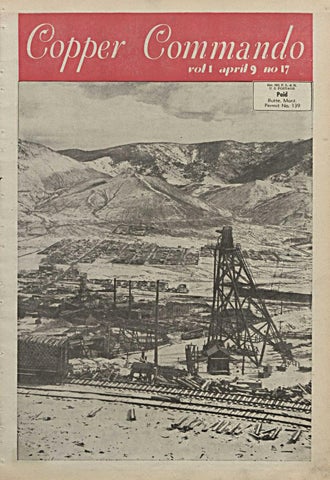
View of the Reservoir at Butte. Another Butte view on cover.
COPPER COMMANDO is the official , newspaper of the VictOry Labor-Manage, ment Production Committees of the Anaconda Copper Mining Company at Butte, Anaconda and Creat Falls, Montana. It is issued every two weeks •••• COPPER COMMANDO is headed by a joint committee from Labor and Management; its policies are shaped by both sides and are dictated by neither ••• COPPER COMMANDO was established at the recommendation of the War Department with the concurrence of the War Production Board. Its editor is Bob Newcomb; its associate editor is Marg Sammons; its safety editor is John L. Boardman; its chief photographer is Bob Nesmith; its staff photographer ,is Les Bishop • • • Its Editorial Board consists of: Denis McCarthy, CIO; John F. Bird, AFL; Ed Renouard, ACM, from Butte; Dan Byrne, CIO; Joe Marick, AFL; C. A. Lemmon, ACM, from Anaconda; Jack Clark, CIO; Herb Donaldson, AFL; and E. S. Bardwell, ACM, from Creat Falls .••• COPPER COMMANDO is mailed to the home of every employe of ACM in the three locations-if you are not receiving your copy - advise COPPER COMMANDO at 112 Hamilton Street, Butte, or better still, drop in and tell us. This is Volume 1t No. 17.
.
"
f:
.,.
In This Issue SOUNDINC
OFF
:
2
With a new drive for the sale of War Bonds and Stamps being launched by the Government, it's time to sit up and take stock of ourselves and figure out just what kind of guys we are. It's high time we all quit fooling ourselves and started looking facts square in the face.
4
ON TH E LEVEL
Ways and means are always interesting. So are the pumps at the Leonard Mine which are the ways and means of getting the water out of the mine. These pumps have been a way to improve working conditions and the water containing copper in solution means more war materials.
TAKE A CANDER
_~
_
_
G
It's a real sight to see the sparks flying from riveting and steel handled as though it were a piece of paper-punched or shaped to form. You can see it all at the Boiler Shop at Anaconda. You'll find the Boiler Shop in the opposite end of the same building as the Machine Shop.
8.
EDITORIAL
With the growing shortage of food stuffs and rationing mentioned in every conversation, interest in the Phosphate Plant at Anaconda has reached a new high, Here's some honest-to-goodness facts on what the right kind of fertilizer will do. It's hard to believe-but true. FORCiNC AHEAD
~
9.
Mending broken parts is their specialty, at the Slacksmith Shop at Great Falls. It's a constant tramp. tramp from the six forges to the ai r hammer al I day long for the blacksmiths and their helpers. Each one realizes the urgency of keeping the machines on the Hill in tip-top shape. THE STORY OF SAFETY
12
The newcomer to the Butte Mines is impressed with the need for safety. Safety, is the chief concern of the regular miner. and it is important for the newcomer to learn his lesson well. A disabled worker. can't help win the war. Realizing this. the boys all lend a willing ear.
3
On the Level Water in the mines was a real problem for a good many years, but a solution was found for the problem-a good pumping system. It . proved to be a profitable solution, too. Today mine water is not only pumped to the surface in order to make it possible to work but also because it contains a certain amount of the vital war material, copper -in solution-which is reclaimed in the Precipitating Plant.
~ HROUGHOUT the years of mining it has always been necessary to pump the water from the mines. It took a good m~ny years to discover that the water being pumped from the mines contained 'the very vital copper in solution, and that it was possible to reclaim this copper. You'll remember how this copper is reclaimed from the story on the Precipitating Plant in a previous issue. But with the knowledge of the value of this mine water, plans were stepped up and now not only is the water in the mine itself pumped to the surface and to the Precipitating Plant, but the underground water from the whole group of mines is diverted by diamond drill holes so that it will follow through filled areas and finally drain to either the Leonard or Hi Ore Mine where it is picked up by the
4:
pumping system and relayed to the various pump levels and finally to the surface and discharged to the Precipitating Plant. There the copper in solution is reclaimed. thus providing more of the vital copper for the war effort. ' Let's take a look at these pumps which do such a whale of a job and the men who keep them pumping. In the picture above. Jim O'Neill, pump boss at the Leonard Mine. is looking over the pumps on the Leonard 2800 ft. level with Kenneth Chisholm, the operator. The two centrifugal, pumps on Hie 3500 ft. level of the Leonard pump the water to the 2800 ft. level pumps. There it is picked up along with the water drained from the other mines, and from there relayed by the four, six hundred gallon a minute ACM electric pumps to the
1200 ft. level pumps and by them relayed to the surface. The water from the new development work comes out from the drift levels into the catch basins and then flows into the drain lines. The catch basins have a screen on them so as to prevent any large obstructions from getting into the drain lines, which are sixinch wood lined pipe and eight-inch wood lined pipe. They are wood lined because of the acid in the water which would soon destroy the metal in the pipes. It is through them that the water is carried on down to the pump storage tanks. Then it is picked up by the pumps and relayed to the surface through the pump columns which are also wood or lead lined. Since wood buckles. replacements are being made with lead for the linings. These
'""
pump columns are ten inches in diameter and come in ten foot lengths with heavy flanges welded on, and bolted together in shaft. It is necessary to clean these pump columns once a year. They are cleaned from the pump straight through to the next pump station. Here's the way it is done. A timber hoist is set up at the top . end of the column. A "bugle," which is a heavy bronze casting weighing around six hundred pounds is hooked on a cable on the timber hoist and by raising and dropping it, it knocks the corrosion down the column to where the column is unhooked at the pump and this corrosion is caught in wooden boxes built on the floor. The corrosion is shoveled into mine cars and hoisted to be discarded.
There are thirty-one men at the Leonard Mine--two operators for each of three shifts a day on the 1200 ft. and 2800 ft. levels and one operator on the 3500 ft. level. Then there is the repair crew who are kept plenty busy with repairs on the pumps and replacements to the columns. Iri the upper left shot Arthur Thomas, pumpman on the 3500 ft. level, is setting the valves preparing to start pumping. In the upper right picture John Culver, Steve Sheehan and James Magor are tightening the valve body cover after they have changed a valve. That's Arthur Thomas again in-the lower left ~t the centrifuga1 pumps. Jim O'Neill and Kenneth Chisholm are on the 2800 ft. level in the lower right shot.
At the mines there are sinking pumps which hang in the shaft on wall. plates. It's these sinking pumps which drain the bottom of the mine and then discharge the water from the bottom to the 3500 ft. level pumps which start it on its way to the surface. It's mighty important that the boys in the pumping station be on the joo every minute of the twenty-four hours in the day, for control of all of this water is most important. There is a telephone system installed so that the operators on one level can keep the operators on the other levels posted as to when the pumps are started or stopped, or if anything goes wrong. Teamwork is what we thought of when we saw these Leonard pumps and thei r operators.
:i..
Take
a'
Gander At the Boiler Shop of the Anaconda Reduction Works there's plenty to see. There's riveting with sparks flying; punching of holes in steel as though it were paper and a different kind of shears which whacks off steel in a second.
TAKE a gander at the Boiler Shop when you go down to the Machine Shop at Anaconda, for it's in the opposite end of the same building. Fact is, it's difficult for an outsider to know just where the Boiler Shop starts. It is easy to know, though, after one trip, for you see the machine like in the upper left shot with Jim Summers, the operator. Jim just steps down on the lever which engages the clutch and the hole is punched in "the steel: Those particular holes were. being punched in steel to be used for ore car rungs. In the center picture John Knez, Don Hoenstine and Johnnie Mehelic are marking off a sheet for an Oliver filter. It's necessary to lay the work out carefully in these days of vital war materials shortages. George Hedge is marking off plates for the peat pipe of the Reverberatory furnaces in the lower right shot. Over in the lower left picture we caught George Burton, a tinsmith, looking on while Steve Knez, the welder, did the work. You may not recognize them with the welder's helmets on but that's who they are.
The boys in the Boiler Shop are all plenty aware of the necessity of keeping their work moving right along for they play a big part in keeping the machines in working order for allover the Hill. They all realize the machinery must be kept going in order to turn out the war orders. John Casey, Superintendent, and Andrew Lacey, Shop. Foreman, got together ?ver a print to. plan work for the boys in the upper right shot. The machine in the upper left picture is an angle iron shears. With it Henry Hanson is cutting angle iron lugs for construction. It doesn't look much like the shears we're used to, but this one whacks the steel right off. Jim McCollom and Sid McCallum are having a little discussion as to just how that particular job of welding should be done in the middle right shot. The machine to Sid's right is a blower. It keeps the air clean and pure, and' that's mighty important. A good many of the parts brought into the Boiler Shop are big and heavy, so the crane is used to lift them off the truck. In the lower right picture, the craneman, Henry Lague, moved the crane to "the spot to unload the train beams which were brought in to be fabricated, later to be used for the copper concentrators. That's Emmett Kennah and John Morris on the truck supervising the unloading job. There's a lot of activity in the Boiler Shop and the work is ably handled by the fine lot of boys working there. They are all anxious to get this war over and are willing to do all in their power to keep production moving.
7
People ~
GOOD RE(;ORD WE were at Anaconda the other day and got to chinning with Rene Jones, who is Sales Manager of the Anaconda Sales Company specialixing in phosphate products. We never knew a hell' of a lot about phosphate, but we came out of that conference with our interest really high. Bend an ear and let us tell you about it. Everybody in the country is beginning to realixe that there is a growing shortage of foodstuffs of all kinds. Food rationing is in effect all over the United States with every prospect that it will become more heavy in the future. F.umers last year produced an all-time record yield of all crops and this year they will be called upon to better last year's record. You don't have to be a farmer to know what an important part the fertilixer industry plays in farming. , Well, t~e boys in the phosphate end of things are making a most valuable contribution in helping to increase food production by the manufacture and distribution of phosphate fertilixer. In the year 1942, the A. C. M. Company produced and sold 60,000 tons of phosphate fertilixer in eighteen western states. Of fhis tonnage, 15,000 tons were used on sugar beets. This phosphate produced approximately 900,000 EXTRA tons of beets' or 150,000 EXTRA tons' of sugar. TH IS IS ENOUGH SUGAR TO SUPPLY OUR PRESENT ARMY FOR ONE YEAR, OR THE ENTIRE POPULATION OF THE INTERMOUNTAIN STATES FOR ONE YEAR. Some 5,000 tons were used on potatoes. This tonnage of phosphate produced some three and one-half million EXTRA sacks of potatoes or enough potatoes to supply the entire needs of Montana, Idaho, Wyoming and Utah. Approximately '10,000 tons of our phosphate were used on wheat in Kansas, Minnesota and the Dakotas, and pro'duced an EXTRA three million bushels of grain. On alfalfa, clover and other hay erops, approximately 15,000 tons of phosphate were used. This tonnage of phosphate produced an EXTRA half million tons'of hay, sufficient to feed a quarfer of a million head of cattle for one year. Some 10,000 tons of our phosphate were used on vegetables and canning
Places
In the Mail
Fightin'
WE have no objection if you want to look over our shoulder and read our mail because some of it is pretty interesting. Naturally we like the pats on the back we get from readers in many parts of the world and particularly from service men who write to us. Private John Wick, for example, 'writes us that he likes the publication and reminds us that he used to work at the Leaching Plant in Great Falls. "Your latest copy," he says, "showed the Shriver presses in operation and I enjoyed it very much as I have worked there many a time," Private Wick has 路been in Africa from the start, and ,he tells us the pictures of North Africa we showed in COPPER COMMANDO were "wonderful and real." Sergeant A. G. Quick reports that his father sends him every COMMANDO and "the picture of the Anaconda Big Stack alone is a sight for any Anaconda soldier's eyes."
SWINGING with everything he has, just as a few years back he did to soundly trounce some of the greatest fighters in the world, Dixie LaHood is leveling on the Axis, these days: In eight months he hasn't missed a shift at the Smelter at Anaconda. 'He's all out to do his bit, wherever and however he can.
. Pete Golie writes us from Brooklyn Naval Hospital to change his address, He "enjoys the paper as news from home" and reports that he is getting along fine. He didn't say what had him under the weather, but we are glad to know that Pete, who used to work in the Great Falls Zinc Plant, is on the mend. We have lots of others from boys in the service who used to work in Montana and from civilian readers. We have a note from Howard Johnson, Chief Justice of the Supreme Court of Montana, in which he tells us that he considers the publication a "very excellent one" and . \ that he intends to have his copies bound in permanent form when the war is over.
Man
Bucki ng snow drifts from Butte to be ,punctual at his work hasn't been an easy job. Dixie never had an easy job and isn't interested in one. In the days of his youth he fought most of the best bantamweights in boxing's big time. When California Joe Lynch was called the uncrowned featherweight champion and Georgie Marks was the uncrowned bantamweight king of all fistic realms, Dixie whipped them both. He whipped an army of other topnotchers to gain rank as one of the most outstanding fighters ever produced in Montana. Dixie was a slugger. He gave everything he had in the ring. He still does, in anything he does. Early last summer, in spare time, Mr. and Mrs. Namen (that's Dixie's Christian name) LaHood , were pictured in the newspapers as the champion collectors of scrap paper. He's 'worked in the mines; he's doing a swell job in the Washoe Smelter. now and, at all times..with a willingness all admire.
crops. From result data on these crops, it is safe to state that this quantity of phosphate路 produced 200,000,000 EXTRA pounds of vegetables. Approximately 5,000 tons of our phosphate were路 used on seed crops of all kinds, such as flax, clover, alfalfa, peas, lettuce, radishes, onions, etc, The United States Department of Agriculture states that increased production of all seed crops is of vital importance. From past results we can conservatively state that our phosphate produced 50,000,000 EXTRA pounds of these various seeds. While the demand for phosphate during 1943 will greatly exceed the supply, the boys are bending every effol't to distribute the available tonnage where it will do most to help increase the production of essential food crops. Every once in a while you come across a contribution like this, made by fellows who don't get much recognition for what they are doing. We would like to take our hats off to these folks for a job which is being darned well done, and we have a hunch that everybody feels the same way.
-CO\lrt~SY
DIXIE LaHOOD
Butk DallYPod
..
Forging Ahead Broken equipment parts are brought in to the Blacksmith Shop at Creat Falls, but they aren't broken long after they are checked in there. The boys forge out the replacements and dress and temper the equipment in short order. They do a swell job of it, too. SINCE the turn of the century there have been a lot of changes made in the Blacksmith Shop at Great Falls. In the old days there was a lean-to at one end of the building. It was to this lean-to that the horses were brought for shoeing and all the horses' names were listed on a big board nailed to the side of the building. Fact is, a blacksmith shop was thought of mainly in connection with the shoeing of horses. Now times have changed. The old lean-to has been torn down. In the Blacksmith Shop they do everything that comes along by way of forging, bending and welding. There are four blacksmiths and each blacksmith has his helper il"'!the Great Falls Shop. Biggest change is the addition of the air hammer for pounding which saves a lot of muscle action and elbow grease. The one thing that hasn't
changed about a blacksmith shop is the sociability. There have been many stories built around the village blacksmith, and certainly many more could be built around the Blacksmith Shop at Great Falls. That's the gang in the Shop in the picture above. Top row, left to right, are: Tom Calvert, Maurice Muzzana, Joe Evans, John Odegard, and Louis Kuchenmeister, Superintendent. In the lower row are: Jack Shryne, Peter Gaudatis, Billie Whitehead, Jack Petrini and Leonard Skog. There are six brick-lined forges in the Shop heated by gas. The iron to be forged is laid on the forges until it is red hot and then it is taken over to the air hammer and pounded into shape by the air hammer. This air hammer looked like it would be very simple to operate, so we tried it. The lever is pulled and
the hammer head is lifted by operating the handle, and it comes down with a real thud. It's necessary to get the knack of operating the handle, though, for if it's pulled up too fast, the top of the hammer will be knocked out. When the handle is let down, it must go easy for there is a lot of pressure behind it. Also in the Shop are slabs of cast iron, called base plates, and it's on them that the iron is straightened. An anvil, which looks like a bullet, is put into service frequently for the blacksmithing of small parts. The emery wheel, used for grinding the tools, a shearing and a punching machine are all to be found in the Shop to help the boys turn out a really finished job. There are big cone-shaped venti .. lators suspended from the ceiling of the Shop and by them the air is kept pure and clean.
9
Now let's look at the boys 'who make the Shop tick. That's Joe Evans and Louis Kuchenmeister, Superintendent, in, the top picture. Louis started working in 1901 on the reverbatory furnaces when the smelter was in Great Falls but in 1903 he moved over to the Blacksmith Shop. He's been there ever since, and judging from his conversation he has no desire to change. He thinks a lot of the nine men in the Shop. One of the first things he'll tell you is: "There are a lot of difficult problems brought into the Shop, but these nine men can solve any of them," Joe Evans says he's been a blacksmith since 1913 and. he 'can't get enough of it. He likes blacksmithing so much that he's specialized. He make~ his own designs and then pounds 'them into shape, Give him a job for fancy iron grill-work and he's happy, for he likes to see work of beauty. The open fireplace at the aiaport is some of Joe's work, so take a look when you're out there and judge for yourself. In the middle picture John Odegard and Tom Calvert are shown at their forge just before they moved over to the air hammer with the hot iron from the' forge. John and Tom are never at a loss for words for they both like to fish and there's nothing like swapping fish stories while waiting for the iron to heat. We got the bottom shot of Billie Whitehead just when he was shying away from the heat of the forge. Billie says the boys in the Shop all work like beavers and that's one thing they all have in common, but he says he can't compete with the other guys so far as outside hobbies are concerned. He brags a bit though about the cabinet he built for his wife. That's Leonard Skog operating the handle of the air hammer in the upper left shot next page. He operates it with the same fine sensitiveness of touch that he polishes the agates about which' we' told you in the last issue. Leonard says he can tell by the feel of the handle when the machine needs greasing or there is anything out of kilter. Jack Petrini and Joe Evans had brought their forging and Leonard was giving it "the works" when , the picture was taken. lack is another man with a very definite hobby. It's carpenter work. To begin wirh, he built his own home and now has his- basement and garage set up for a work shop. That's a good view of the air hammer in the upper right shot with Leonard at the handle and John Odegard holding the forging all set for Leonard to pound it into shape. The middle right picture shows the small air hammer. It's used for smaller forgings. Leonard operates it, too, as you can see. Peter Gaudatis and Billie Whitehead are the men with the tongs holding that forging in place ready for its wallop. Peter can operate this small hammer himself and frequently does when Leonard is busy at the big one,
10
..
In the lower left shot Maurice Muzzana and Jack Shryne are pounding a small forging on the anvil. Notice how bullet shaped the anvil is. Maurice is not worrying about meat rationing for every week end throughout the year he's either fishing or hunting and he doesn't do either without definite success. His cold storage locker is chuck full these days. Jack frequently goes along with Maurice on these fishing and hunting expeditions, so they are 'a congenial pair at the forge. That's Jack at the air hammer to the right. There"s a congenial crowd in the Blacksmith Shop. They all like to "rib" each other, and a joke on anyone of them is greatly appreciated by the others. They seem to co-ordinate their efforts with one thought in all their minds-to do a real job on each and every job brought into the Blacksmith Shop.
,
.
"
The Story of Safety NO man wants to be injured, therefore safety is the major concern of the experienced
miner-he
takes no chances.
Thus, when the new man starts
his training course for working in the mines, he is shown, step by step, the ways in ,which he may prevent injury to himself; for a great share of injuries in any industry can be laid to lack of thought and failure t~ take proper precautions. ''c'',
Here we see a group of newcomers to the Butte mines getting the story of safety first hand. \
way to perform the job. of a miner to be.
12
In each mining operation these men are shown the right They are told that the careful miner is the best kind