2021 REPORT TO THE COMMUNITY 2021 REPORT TO THE COMMUNITY 1
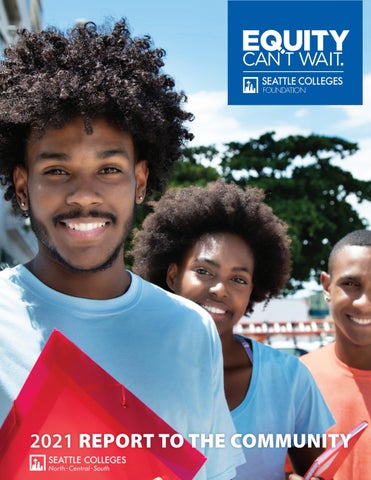
In Spring 2021, a year into the pandemic and amid painful ongoing reminders of racial injustice, the Seattle Colleges Foundation publicly launched a campaign: Equity Can’t Wait. Our goal: raise $50 million so that our students, so extraordinary in their diversity, receive a higher education that authentically honors their individual potential and prepares them for the life and livelihood to which they most aspire. Acknowledging our special role nurturing students from communities of color, immigrant and refugee families, and those who are the first in their families to attend college, donors have responded generously. To date, the campaign has received 2,000+ contributions and raised $22 million. These resources are going to work now, supporting students and powering innovation both in academic programs and in services like advising and mentoring. It’s important to acknowledge that as COVID-19 has persisted, enrollment has slipped across higher education, including at our own Seattle Colleges. Yet history teaches that pandemics do have an end, and that people, however beleaguered, do ultimately re-embrace hope and again start to dream. Higher education is often integral to those dreams, and with support from Equity Can’t Wait, the Seattle Colleges will be strongly positioned to help our students and our community flourish in the brighter times ahead. We appreciate your support.
Kerry Howell
Barbara Dingfield
CEO Seattle Colleges Foundation
Board Chair Seattle Colleges Foundation
Vice Chancellor for Advancement Seattle Colleges 2
SEATTLE COLLEGES FOUNDATION
CAMPAIGN DOLLARS AT WORK
Supporting Students Regardless of background, few make it through college — any college — without considerable financial, academic and personal support. Scholarships Students from more privileged backgrounds can usually rely on family to cover costs while in school. If they work, it’s usually just a few hours a week. But Seattle Colleges students typically have family incomes of $30K to $60K a year — in a city where you need at least $82K for an average one-bedroom apartment and essentials like food, utilities, transportation and healthcare.1 To make ends meet, our students often work well beyond the 15 hours a week where grades are known to suffer.2 Thanks to Equity Can’t Wait and other Foundation support, this year hundreds of Seattle Colleges students received competitive scholarships averaging $3,500. The benefit is financial, yes, but also psychological. Students routinely tell us that being selected validates their hard work and gives them fresh resolve to persist.
1 2
Sahra
Mokish
Lakeisha
South Seattle College
Seattle Central College
North Seattle College
A secondgeneration SomaliAmerican, Sahra is majoring in public health, hoping to be part of solutions to future crises like Covid-19 both close to home and in Africa, where she recently paid her first visit.
A prodigy with languages and a one-time translator for American forces in Afghanistan, Mokish fled his homeland under threat from the Taliban in 2016. He’s now earning his associate’s in computer science, and hoping to one day transfer to a 4-year program.
Lakeisha is a bachelor’s student in the early childhood education program at North Seattle College. She’s eager to help reweave the pre-K system that Covid has ruthlessly unraveled. Her love: programs that genuinely embrace children of every background and ability.
“Report: Seattle’s cost of living is 56.8% higher than the national average” | SeattlePI.com: https://bit.ly/3gflTc2 “Who does work work for?” | ACT Center for Equity in Learning: https://bit.ly/3ujERXe
2021 REPORT TO THE COMMUNITY 3
SEATTLE PROMISE SCHOLARSHIPS. The Seattle Colleges are leaders among America’s community colleges in innovating ways to help students thrive. One example is Seattle Promise, a partly City-funded program for Seattle’s newest high school grads. It combines two years of free tuition with services tightly tailored to individual students. Foundation donors have provided scholarship dollars for Promise students with extra need. Our donors have also let us back two groundbreaking initiatives that serve both Promise students and our student body overall.
Student Services ADDED ADVISORS. Just like students at other colleges and universities, students at the Seattle Colleges can be overwhelmed by the superabundance of options. We have courses in nearly 130 different subjects, and credentials ranging from skills badges, to professional certificates, to associate degrees, to bachelor’s programs. Navigating the choices could be overwhelming, time consuming, and ultimately frustrating, leading some students to flounder and walk away before finishing. The availability of a knowledgeable, highly committed advisor can make all the difference. The Colleges are determined to provide every student with upfront and ongoing help to find and navigate the pathway best matched to their goals, and to connect quickly with any services they need to succeed, such as mentoring, tutoring, or mental health counseling. A $1.5 million investment will let each of the Colleges hire two additional advisors for three years. PROJECT BALDWIN is a many-faceted mentoring and community-building program for Black, Latinx, Native American, and Asian Pacific Islander males at the Colleges. These men typically complete their programs at rates significantly lower than their White and Asian peers. But through the support of caring mentors, and of peers with similar stories and struggles, Project Baldwin programs aim to close the gap. With $1 million in funding these efforts can grow significantly in scale. 4
SEATTLE COLLEGES FOUNDATION
Clarify the path Help students choose and enter a path Help students stay on the path
Ensure that students are learning
CAMPAIGN DOLLARS AT WORK
Powering Innovation The Seattle Colleges are celebrated for creatively adapting to the shifting needs of students, the community, and employers. In that spirit, over the last year we’ve proactively invested in programs expected to be in high demand after the pandemic. Pre-apprenticeships If there’s a bright side to our community’s recent ordeals, it’s greater awareness and appreciation of those whose labor is too often overlooked. Workers of all kinds have kept our community functioning. Among these are skilled tradespeople like electricians, plumbers, carpenters, ironworkers, and cement masons, who, almost without pause, have continued their dedicated work on the places where we live, work, shop and recreate. Workers in the skilled trades tend to skew older, and an impending labor shortage has been clear. But the shortfall is now expected even sooner because — amid the pandemic’s stresses and rigors — some have indicated they’ll retire early. To address the gap, and help a new generation step into these good, well-paying jobs, the Schultz Family Foundation and McKinstry have generously invested $375K in programs to attract and support more pre-apprentices, letting individuals gain the knowledge and essential skills to compete for an apprenticeship. If accepted, what typically comes next is four years of paid, hands-on advanced skill-building with an area union, along with targeted academic preparation at a community college. On completion, a new journey-level tradesperson can usually rely on stable long-term employment and, with time, six-figure pay. It’s both equitable and (because of shifting demographics) only practical that our city foster a next generation of skilled workers that’s significantly more diverse in race, gender identity, and sexual orientation. The investment in South Seattle College’s Apprenticeship Education Center at Georgetown — by far the largest such facility in the state — puts such inclusion front and center.
New baccalaureate program: a B.S. in Computer Science Tech is consistently a leading engine of employment in our region, each year creating thousands of positions that pay well, provide good job security, and significantly influence our collective wellbeing. Most of these roles go to people with a 4-year computer science degree. Given that local colleges and universities generate only a fraction of the needed grads, companies intensively recruit talent from elsewhere. Having these newcomers is positive. They enhance the collective brainpower of our region, and add cultural richness and fresh perspectives to the civic conversation. But what if local young people — greater than half of whom are people of color — would like tech careers… yet effectively have nowhere to go for a bachelor’s? This initiative answers that question. Amazon is investing a foundational $1 million in a new B.S. in Computer Science program at the Colleges. We expect to welcome the first students in Fall, 2022.
If there’s a bright side to our community’s recent ordeals, it’s greater awareness and appreciation of those whose labor is too often overlooked. 2021 REPORT TO THE COMMUNITY 5
Next for the Campaign We’re exhilarated at the support generated by Equity Can’t Wait. Now the challenge is to sustain and accelerate that momentum so that, as the pandemic ebbs, the Colleges are prepared for a surge in enrollment from community members eager to re-take control of their lives — and see education as a key. In the year ahead our work will particularly focus on: • Financial support for students • Full funding of pre-apprenticeship programs • Successful launch of the Colleges’ new BS in Computer Science program • Modernizing classrooms across our campuses so they can better support online and hybrid teaching
2020–21 Financials July 1, 2020 to June 30, 2021
Support, Revenue and Gains
Use of Funds Future programs/projects $4,710,000
Individual
$2,342,000
Investments $5,686,000 Event
$2,944,000
Foundation $694,000 Corporate
TOTAL
$594,000
$12,260,000
Endowment additions $3,660,000 Student scholarships/awards $1,140,000 Program expenditures $900,000 Fundraising costs $1,160,000 Foundation operations $690,000 OPERATING RATIO: 15%
TOTAL
Like to learn more? Contact us at advancement@seattlecolleges.edu
6
SEATTLE COLLEGES FOUNDATION
$12,260,000
Campaign Leadership Seattle Colleges Foundation Board of Directors
Ex Officio Members Louise Chernin Trustee, Seattle Colleges
Barbara Dingfield
Jill Wakefield, Ed.D.
Chair, Seattle Colleges Foundation
Chancellor Emeritus, Seattle Colleges
Jila Javdani General Manager, Slalom Consulting
CHAIR
Shouan Pan, Ph.D.
Barbara Dingfield
Chancellor, Seattle Colleges
Mark Jonson
Community Volunteer
Dr. Chemene Crawford, Ed.D.
VICE CHAIR
President, North Seattle College
Vice President for PNW Construction, McKinstry
Jon Fine
Dr. Yoshiko Harden, Ed.D.
Former President & CEO, United Way of King County
Interim President, Seattle Central College
SECRETARY
Sarah Jane Gunter
Dr. Rosie RimandoChareunsap, Ed.D.
Vice President, Latin America Consumer Business, Amazon
Kerry Howell
TREASURER
Mike Hughes Former President, Safeco
________________
President, South Seattle College Vice Chancellor for Advancement, Seattle Colleges; CEO, Seattle Colleges Foundation
Megan Ackaert
Equity Can’t Wait Advisory Council
Managing Director/Region Manager, JPMorgan Chase & Co.
Jim Sinegal
Melba Bartels
Honorary Campaign Chair; Co-Founder and former CEO, Costco
Executive VP & CFO, BECU
CEO, Seattle Hospitality Group
Gary S. Kaplan, M.D.
Seattle Colleges Board of Trustees
Senior Vice President, CommonSpirit
Louise Chernin, Chair
Steve Loeb
Former CEO, Greater Seattle Business Association
President & CEO, Alaska Distributors Co.
Rosa Peralta, Vice Chair
Sandra Madrid, Ph.D.
Senior Program Manager, Satterberg Foundation
Former Assistant Dean, University of Washington School of Law
Teresita Batayola
Tyra Mariani
President and CEO, International Community Health Services
President, Schultz Family Foundation
Steve Hill Community Volunteer
Lauren McGowan
Brian Surratt
Associate Vice President, Ending Homelessness and Poverty, United Way of King County
President and CEO, Greater Seattle Partners
Steve Mullin
Jon Fine
President, Washington Roundtable
Shouan Pan, Ph.D.
Joseph Jahn
Advisory Council Co-Chair; Secretary, Seattle Colleges Foundation
Community Volunteer
Constance Rice, Ph.D.
Richard Locke Principal and Founder, DataWeb, Inc.
Advisory Council Co-Chair; President, Very Strategic Group
Jackie Martinez-Vasquez
Hon. Jenny A. Durkan
Rick Davis Community Volunteer
Vice President, Diversity Equity and Inclusion, BECU
Special Advisor to the Campaign; Former Mayor of Seattle
Marc Mora, M.D.
Bobbe Bridge
Chancellor, Seattle Colleges
Patti Payne Columnist, Puget Sound Business Journal
Benson Porter President and CEO, BECU
Diana Birkett Rakow SVP, Public Affairs and Sustainability, Alaska Airlines
SVP, Resource Stewardship and Network Management, Kaiser Permanente and the Washington Permanente Medical Group
Founder and former President & CEO, Center for Children and Youth Justice
Rahim Rajan
President, Craft3
Mary Jean Ryan
Deputy Director in Postsecondary Education, Bill & Melinda Gates Foundation
Louise Chernin
Non-Resident Senior Fellow, Brookings Institution
Will Rance Vice President of Community Relations, WSECU
Bruce Brooks
Trustee, Seattle Colleges; Past President and CEO, Greater Seattle Business Association (GSBA)
Jolenta Coleman-Bush
Shiao Yen Wu
Senior Program Manager, Microsoft Philanthropies
Owner and CEO, WPI Real Estate
Phil Condit Former CEO, The Boeing Company
Howard Wright
Fred Rivera Executive Vice President & General Counsel, Seattle Mariners
Seattle Colleges Leadership Dr. Shouan Pan Chancellor, Seattle Colleges
Dr. Chemene Crawford President, North Seattle College
Dr. Yoshiko Harden Acting President, Seattle Central College
Alice Shobe
Dr. Rosie RimandoChareunsap
Global Director, Amazon in the Community
President, South Seattle College
Gary Swindler President & CEO Washington State Employees Credit Union (WSECU)
Emma Uman Portfolio Manager, Ballmer Group
2021 REPORT TO THE COMMUNITY 7
•
QUICK STATS
32,930
students in the 2020-201 school year
52%
people of color
48%
first in their families to attend college
28
average age
16%
under age 20
20%
have dependents
36%
enrolled full-time
44%
work half-time or more
$1 million +
lifetime earnings versus stopping after high school
The Equity Can’t Wait campaign focuses on helping students at North Seattle, Seattle Central and South Seattle Colleges — particularly students historically underserved by higher education—to dream big, be supported, and fully realize their unbounded potential. To meet the challenges ahead, our community needs the talents of everyone, of every background. Learn more about the campaign, or lend your support: equitycampaign.info