BLACK TIES, FAST CARS
Hosting events for members is an important part of MTA’s DNA
Whether recognising the best in industry, or organising a day at the race track, MTA’s events give encouragement and enjoyment to hundreds of members
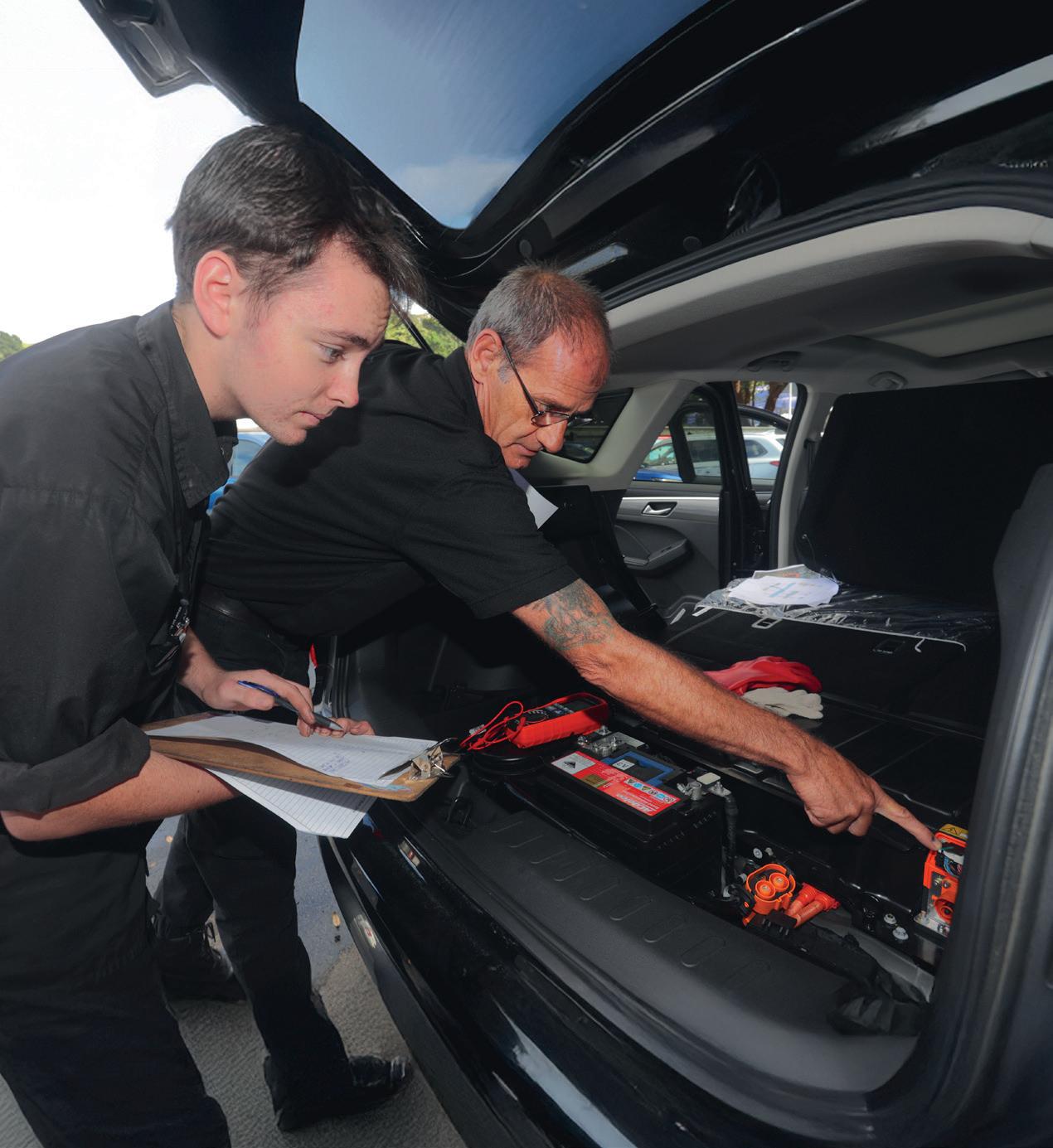
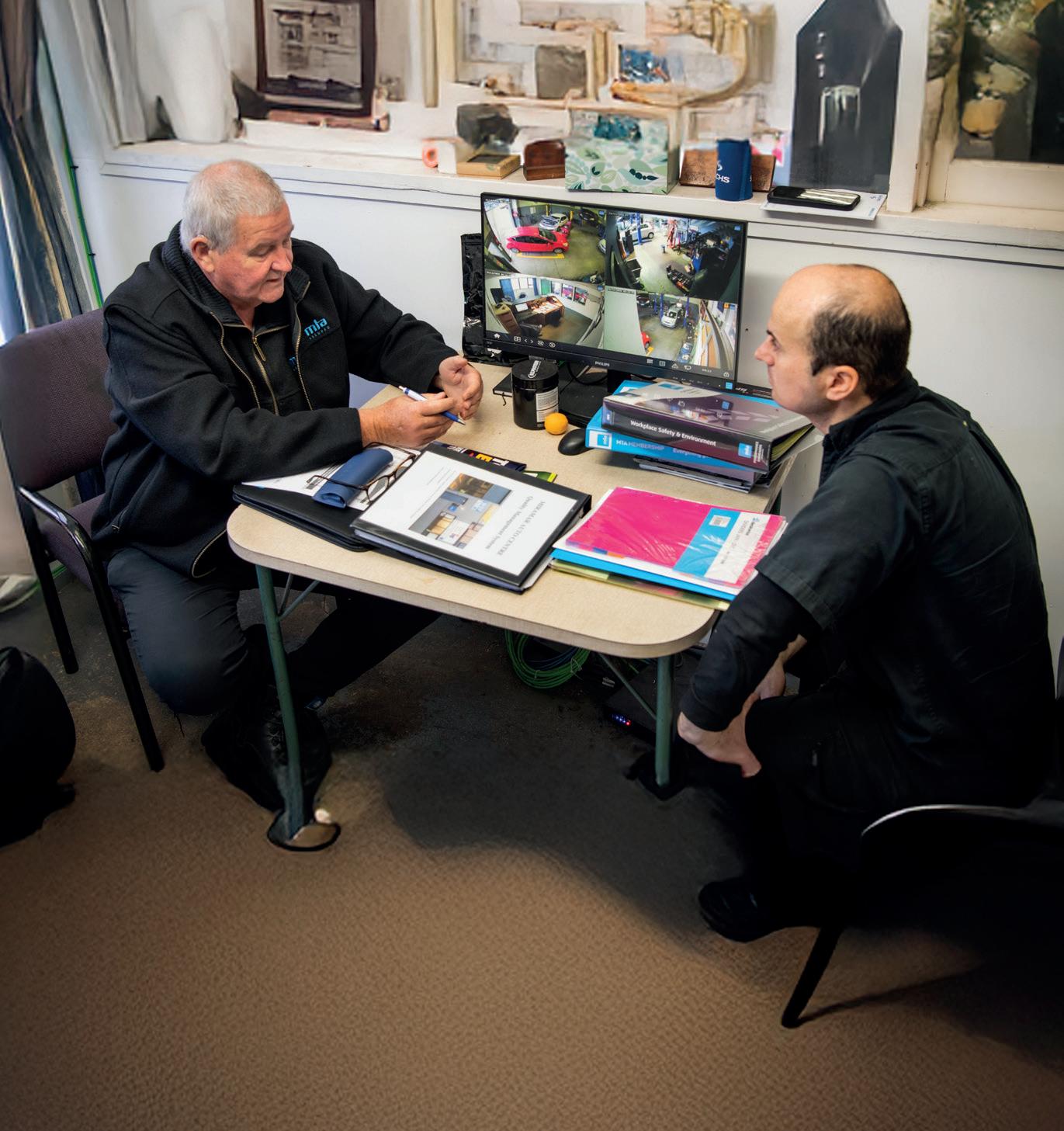
Events are a chance for thousands of member employees to make new connections and contacts, learn new skills and share expertise and experience
Training sessions and workshops are held regularly for members across the country, as are social gatherings
Other events are more grand in scale and involve significant planning and work from the MTA team.
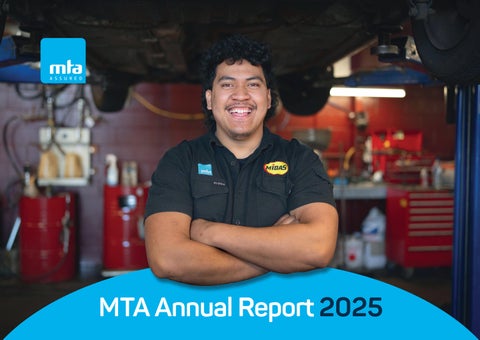
Like the Apprentice of the Year Awards in the South Island’s Coast to Coast region, where Bailey Pike (pictured) won the top prize
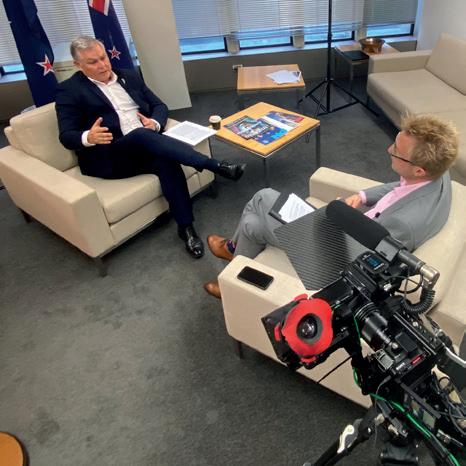
MTA President Sturrock Saunders and Chief Executive Lee Marshall congratulated Bailey at the black tie awards ceremony
While members had the chance to admire, display and ride in some classic cars at the Manfeild race track, thanks to MTA’s Manfeild Mania day - a popular event in the MTA calendar
Bailey Pike thanks MTA President Sturrock Saunders for her award.
SUMMARY OF RESULTS
This Year’s Financials
We are pleased to present the financial statements for the year ended 30 June 2025 which in a departure from previous years are prepared under the Tier 2 New Zealand International Financial Reporting Standards Reduced Disclosure Regime (“NZ IFRS RDR”), a change from the Special Purpose Financial Reporting framework reported under previously The main difference between the two frameworks is that under NZ IFRS RDR the Dekra Put/Call options are required to be revalued at fair value This requirement is a consequence of the Motor Trade Association re-registering, as required, under the new Incorporated Societies Act 2022 on the 2nd of July 2024
It is noted that the 2024 reporting year comparative numbers in these financial statements have also been restated for the prior year impact of revaluing the Dekra Put/call option A summary of the impacts of the 2024 restatement is summarised in Note1(a) to the financial statements.
Profitability
The revaluation of the Dekra Put/call option in the 2024 comparative year resulted in a non-cash, non-taxable gain of $4 7m in that year which increased profitability by the same amount from an $816k loss before restatement to a $3 884m gain after restatement
The result for MTA Group in 2025 was a loss of $427k compared to the $3 884m gain in the restated 2024 result The reduction
in profitability from $3.884m in 2024 to a $427k loss in 2025 is principally on account of the difference in yearly gains from revaluing the Dekra Put/Call option and increased software cost of sales and software amortization in 2025 offset by some one-off Donee Income received this year
Revenue
Total Group revenue was $17 91m, which is $1 82m higher than the previous financial year’s revenue of $16.09m. This increase was due primarily to one-off Donee income of $1 59m from two separate sources being the receipt of $1 21m from the gifting of residual net assets from the Motor Trade Association(Northern Region) Inc following the dissolution of the later on the 30th June 2025 and secondly the derecognition of a historic liability of $391k for Region Funds(contribution from branches) at the same date Increased software sales from Auxo and increased MTA Inc membership fees of $286k and $281k respectively also made minor contributions to the improvement
Expenses
Total expenses, including direct costs, were $1 44m higher than the prior year at $25 29m The increases in 2025 included the cost of Auxo software sales and developmental software amortization of $481k and $364k respectively, but also in consultants and travel expenses to a lesser extent
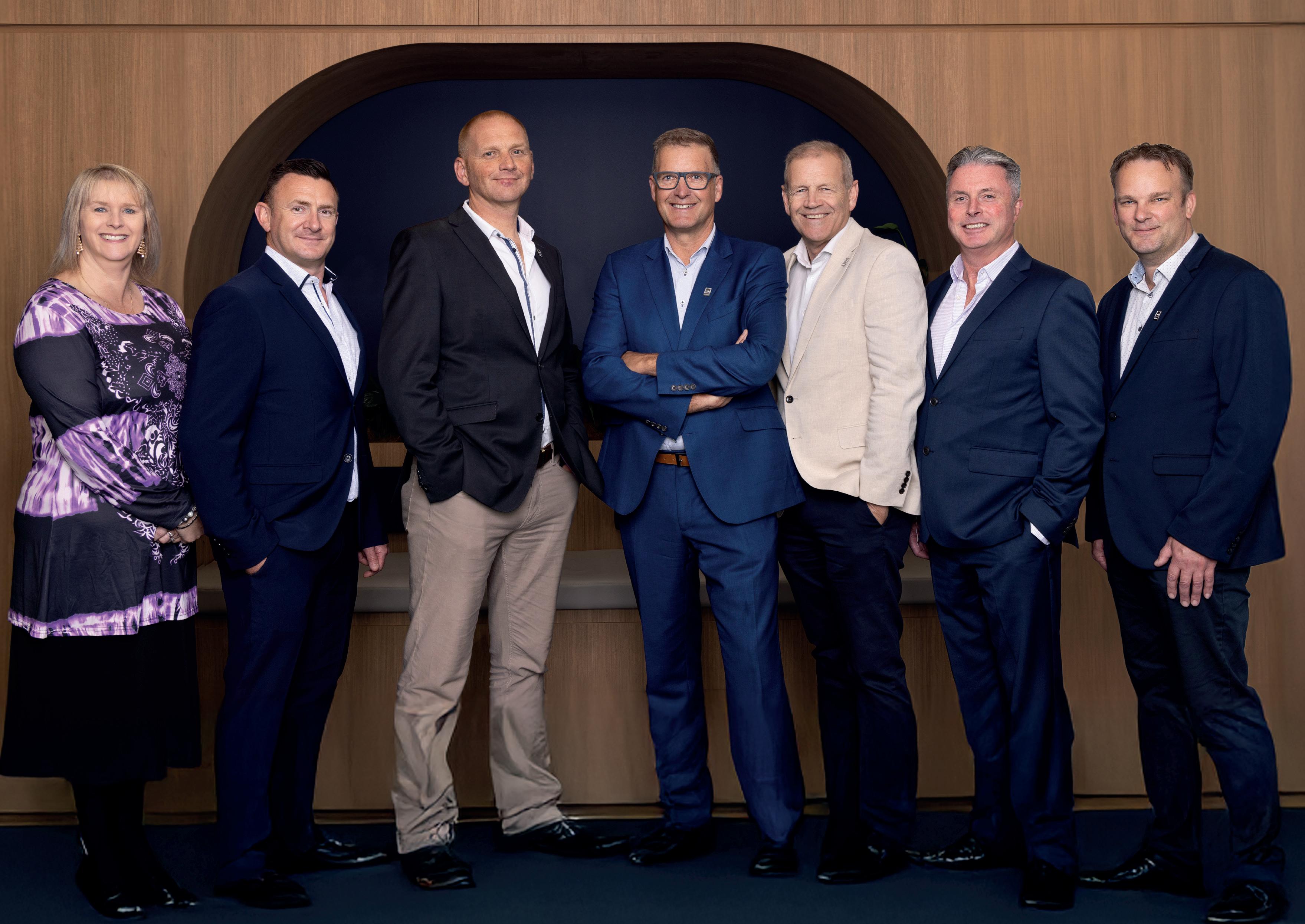
Left to right: Andrea Andrew, Jason Land, Grant Woolford, Sturrock Saunders (President), Ross Verry, Rob Braun, Joris Sanders.
Our share of Dekra’s net profit, which is recorded in the consolidated statement of comprehensive income, decreased by $0 2m to $3 84m in 2025 Cash dividends of $3 2m was received from Dekra during the year which was a decrease on the $3 72m of cash paid dividends received in 2024 as margins at Dekra softened in 2025
The investment portfolio generated a gain of $2 67m which was a 7 7 % return on the fund’s opening balance of $34 69m This level of return is pleasing given that it has exceeded the fund’s benchmark return of 5 5 % for the third year running The value of the fund reduced by a net $3 43m over the 2025 year on account of $7 31m in net withdrawals notwithstanding the investment gain of $2 67m and the $1 21m of donee income outlined above
During the year MTA invested a further $2 8m into it’s 100% owned subsidiary, Auxo to bring the total investment in Auxo now to $10 92m at balance date
The MTA board have recognised that running operating deficits is unsustainable over the medium to longer term and steps have begun to eliminate these deficits and stabilise the value of investments in real terms
MOTOR TRADE ASSOCIATION INCORPORATED GROUP
FINANCIAL STATEMENTS
the year ended 30 June 2025
MOTOR TRADE ASSOCIATION INCORPORATED GROUP
Directors’ responsibility statement
The Directors are responsible for the preparation, in accordance with New Zealand law and relevant financial reporting and accounting standards, of the consolidated financial statements which fairly present the financial position of Motor Trade Association Incorporated (MTA) and its subsidiaries (together the "Group") as at 30 June 2025 and the results of their operations and cash flows for the year ended 30 June 2025.
The Directors have responsibility for the maintenance of a system of internal control designed to provide reasonable assurance as to the integrity and reliability of financial reporting. The Directors consider that adequate steps have been taken to safeguard the assets of the Group and to prevent and detect fraud and other irregularities
The Directors are pleased to present the consolidated financial statements of the Group for the year ended 30 June 2025. The consolidated financial statements were authorised for issue for and on behalf of the Directors on 1 October 2025.
S C Saunders
G J Woolford Vice
Motor Trade Association Incorporated Group
Consolidated Statement of Comprehensive Income
For the year ended 30 June 2025
MOTOR TRADE ASSOCIATION INCORPORATED GROUP
For the year ended 30 June 2025
Statement of Comprehensive Income -
For the year ended 30 June 2025
MOTOR TRADE ASSOCIATION INCORPORATED GROUP
comparative information has been restated as detailed in Note 1(s)
Consolidated Cash Flow Statement
For the year ended 30 June 2025
Consolidated Cash Flow Statement - continued
For the year ended 30 June 2025
MOTOR TRADE ASSOCIATION INCORPORATED GROUP
the year ended 30 June 2025
NOTES TO THE CONSOLIDATED FINANCIAL STATEMENTS
For the year ended 30 June 2025
Summary of accounting policies
In addition to AABSL Limited, the AABSL group also includes SAM Computer Systems Limited (SAM), Systime Automotive Solutions (SAS), TSI SAM PTY Ltd and TSI Systime PTY Ltd. These companies provide software and software related services including licensing, support, maintenance, implementation, customisations and training.
The financial statements for the year ended 30 June 2025 have been prepared in accordance with Generally Accepted Accounting Practice in New Zealand ("NZ GAAP"). The Group is eligible for, and has elected to, report in accordance with Tier 2 New Zealand International Financial Reporting Standards Reduced Disclosure Regime ("NZ IFRS RDR") on the basis that the Group has no public accountability and is not a large for-profit public sector entity. The Group has taken advantage of a number of disclosure concessions.
Accounting policies are selected and applied in a manner which ensures that the resulting financial information satisfies the concepts of relevance and reliability, thereby ensuring that the substance of the underlying transactions or other events is reported. The consolidated financial statements have been prepared on the basis of historical cost, except for the revaluation of certain non-current assets and financial instruments outlined below.
The accounting policies set out below have been applied in preparing the consolidated financial statements for the year ended 30 June 2025.
The presentational and functional currency is New Zealand Dollar (NZ$). The amounts in the consolidated financial statements are rounded to the nearest thousand dollar ($'000).
In the application of the group accounting policies the Directors are required to make judgements, estimates and assumptions about the carrying amounts of assets and liabilities that are not readily apparent from other sources. The estimates and associated assumptions are based on historical experience and other factors that are considered relevant. Actual results may differ from these estimates.
to accounting estimates are recognised in the year in which the estimate is revised if the revision affects only that year or in the year of the revision and future years if the revision affects both current and future years.
The following judgements have been made in preparation of the consolidated financial statements for the year ended 30 June 2025 which have the most significant effect on the consolidated financial statements (except for those involving estimations which are dealt with below):
In the application of the group accounting policies the Directors are required to make judgements, estimates and assumptions about the carrying amounts of assets and liabilities that are not readily apparent from other sources. The estimates and associated assumptions are based on historical experience and other factors that are considered relevant. Actual results may differ from these estimates.
The estimates and underlying assumptions are reviewed on an ongoing basis. Revisions to accounting estimates are recognised in the year in which the estimate is revised if the revision affects only that year or in the year of the revision and future years if the revision affects both current and future years.
The following judgements have been made in preparation of the consolidated financial statements for the year ended 30 June 2025 which have the most significant effect on the consolidated financial statements (except for those involving estimations which are dealt with below):
- Useful lives of tangible and intangible assets.
1. Summary of accounting policies -
continued
- Recoverability of debtors doubtful debts provision, considered using historical delinquency rate and expected credit losses overlay as required by IFRS 9. Refer to Note 5.
- Classification of investment in Dekra New Zealand Limited. Refer to Note 9.
- Valuation of the Put/Call option for DEKRA New Zealand shares. Refer to Note 9.
Key sources of estimation uncertainty
MOTOR TRADE ASSOCIATION INCORPORATED GROUP NOTES TO THE CONSOLIDATED FINANCIAL STATEMENTS
For the year ended 30 June 2025
The key assumptions concerning the future, and other key sources of estimation uncertainty at the balance date, that have a significant risk of causing a material adjustment to the carrying amounts of assets and liabilities within the next financial year are as follows:
6
- Gift vouchers : per Note 1(g), the gift vouchers in circulation are recognised as a liability. Annually, the Board approves a write back to profit a portion of unredeemed gift vouchers based on an estimate of those that are unlikely to be redeemed. The value of the liability and estimated write back may differ to actual redemptions.
- Put/call option valuation: The Group holds financial instruments in the form of call and put options that are measured at fair value through profit or loss. The valuation of these derivative instruments involves significant judgment and estimation, particularly where observable market data is limited or unavailable. Notes 6 contains detailed information on the key assumptions used to determine the fair value of the put/call option, as well as an in-depth sensitivity analysis of these assumptions. The Board considers that the valuation techniques and assumptions it has utilized are suitable for determining the fair value of its financial instruments.
Going concern
The directors have, at the time of approving the consolidated financial statements, a reasonable expectation that the Group have adequate resources to continue in operational existence for the foreseeable future. Thus they continue to adopt the going concern basis of accounting in preparing the consolidated financial statements.
Significant accounting policies
The following significant accounting policies have been adopted in the preparation and presentation of the consolidated financial statements.
(a) Principles of consolidation - Value in Use of Intangible Assets with Indefinite Useful Lives The Group assesses annually whether intangible assets with indefinite useful lives are impaired in accordance with NZ IAS 36 Impairment of Assets. The recoverable amount of these assets is determined based on value in use calculations, which require the use of significant management judgement and estimation.
The Group consolidated financial statements are prepared by combining the consolidated financial statements of all the entities that comprise MTA Group, being MTA (the parent entity) and its subsidiaries. A list of subsidiaries appears in Note 22 to the consolidated financial statements. Consistent accounting policies are employed in the preparation and presentation of the consolidated financial statements. Control is achieved when MTA:
- has power over the investee;
- is exposed, or has rights, to variable returns from its involvement with the investee; and
- has the ability to use its power to affect its returns.
MTA reassesses whether or not it controls an investee if facts and circumstances indicate that there are changes to one or more of the three elements of control listed above.
Intangible assets
Intangible assets not yet ready for use and intangible assets with indefinite useful lives are not subject to amortisation and are therefore tested annually for impairment, or more frequently if events or changes in circumstances indicate that they might be impaired. For impairment assessment purposes, assets are generally grouped at the lowest levels for which there are largely independent cash flows ('cash generating units'). Accordingly, most assets are tested for impairment at the cash-generating unit level.
An impairment loss is recognised when the carrying amount of an asset or cash generating unit exceeds the asset's or cash generating unit's recoverable amount. The recoverable amount of an asset or cash generating unit is defined as the higher of its fair value less costs to sell and value in use (where ‘value in use’ is determined as the present value of the future cash flows expected to be derived from an asset or cash-generating unit).
Impairment losses in respect of individual assets are recognised immediately in profit or loss unless the asset is measured at a revalued amount, in which case the impairment loss is treated as a revaluation decrease and is recognised in other comprehensive income to the extent that it does not exceed the amount in the revaluation surplus for the same asset. Impairment losses in respect of cash generating units are allocated first against the carrying amount of any goodwill attributed to the cash generating unit with any remaining impairment loss allocated on a pro rata basis to the other assets comprising the relevant cash generating unit.
A reversal of an impairment loss for an asset measured at cost is recognised in profit or loss. A reversal of an impairment loss for an asset measured at a revalued amount is treated as a revaluation increase and is recognised in other comprehensive income, except to the extent that an impairment loss on the same asset was previously recognised in profit or loss, in which case a reversal of that impairment loss is also recognised in profit or loss. Subsidiaries
The consolidated financial statements include
are allocated first against the carrying amount of any goodwill attributed to the cash generating unit with any remaining impairment loss allocated on a pro rata basis to the other assets comprising the relevant cash generating unit.
A reversal of an impairment loss for an asset measured at cost is recognised in profit or loss. A reversal of an impairment loss for an asset measured at a revalued amount is treated as a revaluation increase and is recognised in other comprehensive income, except to the extent that an impairment loss on the same asset was previously recognised in profit or loss, in which case a reversal of that impairment loss is also recognised in profit or loss. Subsidiaries
MOTOR TRADE ASSOCIATION INCORPORATED GROUP
NOTES TO THE CONSOLIDATED FINANCIAL STATEMENTS
Orion and Synergy software differs to SAM in that the support is compulsory. This means that the licencing, implementation and support are viewed as a single performance obligation. As such, revenue is taken over time in line with the delivery of this combined performance obligation.
Systime Automotive Solutions Limited ("SAS") offers the Keyloop Autoline product, with the customers having the option of outright purchase or a monthly rental.
While SAS sells the licencing, installation and support of the Keyloop Autoline product, it does not own the underlying software. It is considered to be a principal and not an agent as SAS controls the implementation, upgrades and support of the software. The software is provided as part of an integrated solution or service to the end customer.
1. Summary of accounting policies - continued
Keyloop Autoline is sold as a solution which incorporates licencing, implementation and support, as such this is viewed as a single performance obligation and revenue is taken over time in line with the expected contract life (which equates to an anticipated period of required support).
Dividend and interest income
Dividend income is recognised on a receivable basis when the shareholder's right to receive payment has been established, except where received from an associate. Interest income is recognised on a time proportionate basis that takes into account the effective yield on the financial asset.
(c) Foreign currency transactions
Investments in associates
For the year ended 30 June 2025
An associate is an entity over which the Group has significant influence. Significant influence is the power to participate in the financial and operating policy decisions of the investee but is not control or joint control over those
7
MOTOR TRADE ASSOCIATION INCORPORATED GROUP
NOTES TO THE CONSOLIDATED FINANCIAL STATEMENTS
All foreign currency transactions during the financial year are brought into account using the exchange rate in effect at the date of the transaction. Foreign currency monetary items at reporting date are translated at the exchange rate existing at reporting date. Exchange differences on monetary items are recognised in the Consolidated Statement of Comprehensive Income in the year in which they arise.
MOTOR TRADE ASSOCIATION INCORPORATED GROUP NOTES TO THE CONSOLIDATED FINANCIAL STATEMENTS
(d) Goods and services tax
For the year ended 30 June 2025
The results and assets and liabilities of associates are incorporated in the Group consolidated financial statements using the equity method of accounting. Under the equity method, investments in associates are initially carried in the consolidated Statement of Financial Position at cost, and adjusted thereafter for the change in the Group's share of net assets of the associate and any impairment. Dividends received from an associate are recognised as a reduction in the carrying amount of the investment.
For the year ended 30 June 2025
The carrying amount of equity investments is tested annually for impairment at the end of each reporting period.
Sale of goods
Membership subscriptions are recognised over the subscription period for services provided to members. Membership subscriptions invoiced in advance for the new subscription year
a package.
c) the entity's performance does not create an asset with alternative use to the entity and the entity has an enforceable right to payment for performance completed to date.
Systime Automotive Solutions Limited ("SAS") offers the Keyloop Autoline product, with the customers having the option of outright purchase or a monthly rental.
While SAS sells the licencing, installation and support of the Keyloop Autoline product, it does not own the underlying software. It is considered to be a principal and not an agent as SAS controls the implementation, upgrades and support of the software. The software is provided as part of an integrated solution or service to the end customer.
flows are included in the Consolidated Cash Flow Statement on a net basis. The GST component of cash flows arising from investing and financing activities which is recoverable from, or payable to the taxation authority is classified as operating cash flows.
Cash and cash equivalents
Revenues, expenses and assets are recognised net of the amount of goods and services tax (GST), except for receivables and payables which are recognised inclusive of GST. Page 9
Inventories Cash and cash equivalents comprise cash on hand, cash in banks and investments in money market instruments, net of any outstanding bank overdrafts.
Inventories are valued at the lower of cost and net realisable value, on a first in first out basis. Net realisable value represents the estimated selling price less all estimated costs of completion and costs to be incurred in marketing, selling and distributing.
Financial assets and financial liabilities are recognised in the Group’s consolidated statement of financial position when the Group becomes a party to the contractual provisions of the instrument.
Financial assets are classified into two measurement categories. Those at fair value and those at amortised cost. The classification of financial assets depends on the business model in which the financial instruments are measured.
Investments held at fair value through profit or loss are measured initially at fair value excluding any transaction costs. Transaction costs on financial assets and financial liabilities at fair value through profit or loss are expensed immediately. Subsequent to initial recognition, all instruments at fair value through profit or loss are measured at fair value with changes in their fair value recognised in profit or loss.
the contractual terms of the financial asset give rise on specified date to cash flows that are solely payments of principal and interest on the principal amount outstanding.
Any impairment loss is recognised through the profit and loss in the Consolidated Statement of Comprehensive Income. The impairment allowance on receivables is assessed based on historical delinquency rates and losses. Bad debts are written off when identified.
The Group recognises an allowance for expected credit losses (ECLs) for all debt instruments not held at fair value through profit or loss and other comprehensive income. ECLs are based on the difference between the contractual cash flows due in accordance with the contract and all the cash flows that the Group expects to receive, discounted at an approximation of the original effective interest rate. The expected cash flows will include cash flows from the sale of collateral held or other credit enhancements that are integral to the contractual terms.
For trade receivables, the Group applies a simplified approach in calculating ECLs. Therefore, the Group does not track changes in credit risk, but instead recognises a loss allowance based on lifetime ECLs at each reporting date. ECLs are recognised in two stages. For credit exposures for which there has not been a significant increase in credit risk since initial recognition, ECLs are provided for credit losses that result from default events that are possible within the next 12-months (a 12-month ECL). For those credit exposures for which there has been a significant increase in credit risk since initial recognition, a loss allowance is required for credit losses expected over the remaining life of the exposure, irrespective of the timing of the default (a lifetime ECL).
For trade receivables, the Group applies a simplified approach in calculating ECLs. Therefore, the Group does not track changes in credit risk, but instead recognises a loss allowance based on lifetime ECLs at each reporting date. ECLs are recognised in two stages. For credit exposures for which there has not been a significant increase in credit risk since initial recognition, ECLs are provided for credit losses that result from default events that are possible within the next 12-months (a 12-month ECL). For those credit exposures for which there has been a significant increase in credit risk since initial recognition, a loss allowance is required for credit losses expected over the remaining life of the exposure, irrespective of the timing of the default (a lifetime ECL).
Derecognition of financial assets
MOTOR TRADE ASSOCIATION INCORPORATED GROUP
NOTES TO THE CONSOLIDATED FINANCIAL STATEMENTS
The Group derecognises a financial asset only when the contractual rights to the cash flows from the asset expire, or when it transfers the financial asset and substantially all the risks and rewards of ownership of the asset to another entity. If the Group neither transfers nor retains substantially all the risks and rewards of ownership and continues to control the transferred asset, the Group recognises its retained interest in the asset and an associated liability for amounts it may have to pay. If the Group retains substantially all the risks and rewards of ownership of a transferred financial asset, the Group continues to recognise the financial asset and also recognises a collateralised borrowing for the proceeds received. On derecognition of a financial asset measured at amortised cost, the difference between the asset’s carrying amount and the sum of the consideration received and receivable is recognised in profit or loss.
For the year ended 30 June 2025
Financial liabilities
A financial liability is classified as a financial liability at fair value through profit or loss if it meets one of the following conditions:
(h) Property, plant and equipment
1. Summary of accounting
its estimated residual value. Leasehold improvements are depreciated over the period of the lease or estimated useful life, whichever is the shorter, using the straight-line method. The estimated useful lives, residual values and depreciation method are reviewed at the end of each annual reporting period.
The following estimated useful lives are used in the calculation of depreciation:
An item of property, plant and equipment is derecognised upon disposal or when no future economic benefits are expected to arise from the continued use of the asset. The gain or loss arising on the disposal or retirement of an asset is determined as the difference between the sales proceeds and the carrying amount of the asset and is recognised in profit or loss.
(i) Leases
The Group has reviewed its contracts to see if they are or contain a lease. Where a lease exists the Group has created a right-of-use asset with a corresponding lease liability with respect to all lease arrangements in which it is the lessee, except for short term leases (defined as leases with a lease term of less than 12 months) and leases of low value assets. For these leases the group recognises the lease payments as an operating expense on a straight line basis over the term of the lease, unless another systematic basis is more representative of the time pattern in which the economic benefit from the leased assets are consumed.
It is designated by the entity as at fair value through profit or loss (note that such a designation is only permitted if specified conditions are met).
MOTOR TRADE ASSOCIATION INCORPORATED GROUP NOTES TO THE CONSOLIDATED FINANCIAL STATEMENTS
It is incurred principally for the purpose of repurchasing it in the near term, or It is held for trading, or
A financial liability is held for trading if it meets one of the following conditions:
On initial recognition it is part of a portfolio of identified financial instruments that are managed together and for which there is evidence of a recent actual pattern of short-term profit-taking, or It is a derivative (except for a derivative that is a financial guarantee contract or a designated and effective hedging instrument).
For the year ended 30 June 2025 - Motor vehicles 3 years - Furniture, fittings and equipment 2-10 years Plant and equipment, motor vehicles, leasehold improvements, furniture and fittings and equipment are stated at cost less accumulated depreciation and impairment. Cost includes expenditure that is directly attributable to the acquisition of the item. Depreciation is calculated on a straight line basis so as to write off the cost of each asset over its expected useful life to its estimated residual value. Leasehold improvements are depreciated over the period of the lease or estimated useful life,
MOTOR TRADE ASSOCIATION INCORPORATED GROUP NOTES TO THE CONSOLIDATED FINANCIAL STATEMENTS
For the year ended 30 June 2025
The lease liability is initially measured at the present value of the lease payments, that are not paid at the commencement date, discounted using the rate implicit in the lease. If this rate cannot be readily determined the Group uses its incremental borrowing rate (IBR). The IBR is defined as the rate of interest that the lessee would have to pay to borrow over a similar term and with a similar security the funds necessary to obtain an asset of similar value to the right-of-use asset in a similar economic environment. For the implementation of the standard the Group used an incremental borrowing rate based on commercial mortgages from ANZ (the Groups transactional banker), for an equivalent term and asset type.
Lease payments included in the measurement of the lease liability comprise:
Lease payments included in the measurement of the lease liability comprise:
Fixed lease payments (including in-substance fixed payments), less any lease incentives receivable;
Variable lease payments that depend on an index or rate, initially measured using the index or rate at the commencement date;
The amount expected to be payable by the lessee under residual value guarantees;
The exercise price of purchase options, if the lessee is reasonably certain to exercise the options; and
Payments of penalties for terminating the lease, if the lease term reflects the exercise of an option to terminate the lease.
Page 12
The Group remeasures the lease liability (and makes a corresponding adjustment to the related right-of-use asset) whenever:
The lease term has changed or there is a significant event or change in circumstances resulting in a change in the assessment of exercise of a purchase option, in which case the lease liability is remeasured by discounting the revised lease payments using a revised discount rate.
The lease payments change due to changes in an index or rate or a change in expected payment under a guaranteed residual value, in which cases the lease liability is remeasured by discounting the revised lease payments using an unchanged discount rate (unless the lease payments change is due to a change in a floating interest rate, in which case a revised discount rate is used). A lease contract is modified and the lease modification is not accounted for as a separate lease, in which case the lease liability is remeasured based on the lease term of the modified lease by discounting the revised lease payments using a revised discount
The lease liability is presented as a separate line in the Consolidated Statement of Financial Position. The lease liability is subsequently measured by increasing the carrying amount to reflect interest on the lease liability (using the effective interest method) and by reducing the carrying amount to reflect the lease payments made. The right-of-use assets comprise the initial measurement of the corresponding lease liability, lease
Internally generated intangible assets.
Expenditure on research activities is recognised as an expense in the period in which it is incurred.
An internally generated asset arising from development is recognised if, and only if, all of the following conditions have been demonstrated: the technical feasibility of completing the intangible asset so that it will be available for use or sale; the intention to complete the intangible asset and use it or sell it; the ability to use or sell the intangible asset;
The right-of-use assets comprise the initial measurement of the corresponding lease liability, lease payments made at or before the commencement day, less any lease incentives received and any initial direct costs. They are subsequently measured at cost less accumulated depreciation and impairment losses. Whenever the Group incurs an obligation for costs to dismantle and remove a leased asset, restore the site on which it is located or restore the underlying asset to the condition required by the terms and conditions of the lease, a provision is recognised and measured under NZ IAS 37. To the extent that the costs relate to a right-of use asset, the costs are included in the related right-of-use asset, unless those costs are incurred to produce inventories.
Right-of-use assets are depreciated over the shorter period of lease term and useful life of the underlying asset. If a lease transfers ownership of the underlying asset or the cost of the right-of-use asset reflects that the Group expects to exercise a purchase option, the related right-of-use asset is depreciated over the useful life of the underlying asset. The depreciation starts at the commencement date of the lease. The right-of-use assets are presented as a separate line in the consolidated statement of financial position.
Internally generated intangible assets.
Expenditure on research activities is recognised as an expense in the period in which it is incurred.
An internally generated asset arising from development is recognised if, and only if, all of the following conditions have been demonstrated:
- the technical feasibility of completing the intangible asset so that it will be available for use or sale;
- the intention to complete the intangible asset and use it or sell it; - the ability to use or sell the intangible asset;
- how the intangible asset will generate probable future economic benefit;
- the availability of adequate technical, financial and other resources to complete the development and to use or sell the intangible asset; and - the ability to measure reliably the expenditure attributable to the intangible asset during its development.
The amount initially recognised for internally generated assets is the sum of expenditure incurred from the date when the intangible asset first meets the recognition criteria listed above.
Where no internally generated intangible asset can be recognised, development expenditure is recognised in the profit and loss in the period in which it is incurred.
Subsequent to the initial recognition, internally generated intangible assets are reported at cost less accumulated amortisation and accumulated impairment losses, on the same basis as intangible assets that are acquired separately.
MOTOR TRADE ASSOCIATION INCORPORATED GROUP NOTES TO THE CONSOLIDATED FINANCIAL STATEMENTS
Intangible assets acquired in a business combination.
For the year ended 30 June 2025
and
Intangible Assets acquired in a Business Combination and recognised separately from goodwill are recognised initially at their fair value at the acquisition date.
Subsequent to the initial recognition, intangible assets acquired in a business combination are reported at cost less accumulated amortisation (for finite-lived assets) and accumulated impairment losses, on the same basis as intangible assets that are acquired separately.
(j) Intangible assets Page 13
For the AABSL acquisition, the SAM, Orion and Synergy software assets have been assessed as having finite useful lives of five years and are amortised on a straight-line basis over that period. All other identified intangible assets (including customer relationships, brands, and the exclusive distribution agreement) have been assessed as having indefinite useful lives, reflecting management’s expectation that these assets will contribute to cash flows for the foreseeable future without a determinable limit. In accordance with NZ IAS 36, such indefinite-life intangible assets are not amortised but are tested annually for impairment, or more frequently if indicators of impairment arise.
Intangible assets acquired separately.
MOTOR TRADE ASSOCIATION INCORPORATED GROUP NOTES TO THE CONSOLIDATED FINANCIAL STATEMENTS For the year ended 30 June 2025
Intangible Assets with finite lives that are acquired separately are carried at cost less accumulated amortisation and impairment losses. Amortisation is recognised on a straight line basis over their estimated useful lives. The estimated useful life and amortisation method are reviewed at the end of each reporting period, with the effect of any changes in estimate being accounted for on a prospective basis. Intangible assets with an indefinite useful lives that are acquired separately are carried at cost less accumulated impairment losses.
At each reporting date, the Group reviews the carrying amounts of its property, plant and equipment and intangible assets to determine whether there is any indication that those assets have suffered an impairment loss. If any such indication exists, the recoverable amount of the asset is estimated to determine the extent of the impairment loss (if any). Where the asset does not generate cash flows that are independent from other assets, the Group estimates the recoverable amount of the cash-generating unit to which the asset belongs. When a reasonable and consistent basis of allocation can be identified, corporate assets are also allocated to individual cash-generating units, or otherwise they are allocated to the smallest group of cash-generating units for which a reasonable and consistent allocation basis can be identified. The
and
At each reporting date, the Group reviews the carrying amounts of its property, plant and equipment and intangible assets to determine whether there is any indication that those assets have suffered an impairment loss. If any such indication exists, the recoverable amount of the asset is estimated to determine the extent of the impairment loss (if any). Where the asset does not generate cash flows that are independent from other assets, the Group estimates the recoverable amount of the cash-generating unit to which the asset belongs. When a reasonable and consistent basis of allocation can be identified, corporate assets are also allocated to individual cash-generating units, or otherwise they are allocated to the smallest group of cash-generating units for which a reasonable and consistent allocation basis can be identified.
Taxation
tax (k) Impairment of
The recoverable amount is the higher of fair value less costs of disposal and value in use. In assessing value in use, the estimated future cash flows are discounted to their present value using a pre-tax discount rate that reflects current market assessments of the time value of money and the risks specific to the asset for which the estimates of future cash flows have not been adjusted.
If the recoverable amount of an asset (or cash generating unit) is estimated to be less than its carrying amount, the carrying amount of the asset (or cash generating unit) is reduced to its recoverable amount. An impairment loss is recognised immediately in profit or loss, unless the relevant asset is carried at a revalued amount, in which case the impairment loss is treated as a revaluation decrease and to the extent that the impairment loss is greater than the related revaluation surplus, the excess impairment loss is recognised in profit or loss. Any impairment is first allocated to goodwill and any excess is allocated to the remaining assets in the CGU.
assets Income tax expense represents the sum of the tax currently payable and deferred tax.
Where an impairment loss subsequently reverses (other than goodwill), the carrying amount of the asset (or cash-generating unit) is increased to the revised estimate of its recoverable amount, but so that the increased carrying amount does not exceed the carrying amount that would have
tax 1. Summary of accounting policies (continued)
Current tax is calculated by reference to the amount of income taxes payable or recoverable in respect of the taxable profit or tax loss for the year. It is calculated using tax rates and tax laws that have been enacted or substantively enacted by the reporting date. Current tax for current and prior years is recognised as a liability (or asset) to the extent that it is unpaid (or refundable).
MTA is liable for taxation to the extent that MTA generates income from trading activities. The activities of MTA Group Investments Limited (MGIL) and the AABSL group (including SAM Computer Systems Limited & Systime Automotive Solutions Limited and their subsidiaries) are taxed as normal trading entities.
Deferred tax is accounted for using the comprehensive balance sheet liability method in respect of temporary differences arising from differences between the carrying amount of assets and liabilities in the consolidated financial statements and the corresponding tax base of those items.
MOTOR TRADE ASSOCIATION INCORPORATED GROUP NOTES TO THE CONSOLIDATED FINANCIAL STATEMENTS For the year ended 30 June 2025
for all taxable temporary differences. For the AABSL group acquisition SAM and SAS are both cash generating units, and are both subject to at least annual impairment testing.
However, deferred tax assets and liabilities are not recognised if the temporary differences giving rise to them arise from the initial recognition of assets and liabilities (other than as a result of a business combination) which affects neither taxable income nor accounting profit. Furthermore, a deferred tax liability is not recognised in relation to taxable temporary differences arising from goodwill.
Deferred tax liabilities are recognised for taxable temporary differences arising on investments in subsidiaries except where the Group is able to control the reversal of the temporary differences and it is probable that the temporary differences will not reverse in the foreseeable future. Deferred tax assets arising from deductible temporary differences associated with these investments and interests are only recognised to the extent that it is probable that there will be sufficient taxable profits against which to utilise the benefits of the temporary differences and they are expected to reverse in the foreseeable future.
disposal proceeds and the carrying amount of the asset, are recognised in profit or loss when the asset is derecognised. Page 15
Deferred tax assets and liabilities are measured at the tax rates that are expected to apply to the period(s) when the asset and liability giving rise to them are realised or settled, based on tax rates (and tax laws) that have been enacted or substantively enacted by the reporting date. The measurement of deferred tax liabilities and assets reflects the tax consequences that would follow from the
Provision is made for benefits accruing to employees in respect of wages and salaries, annual leave, long service leave, and sick leave when it is probable that settlement will be required and they are capable of being measured reliably.
are recognised when the Group has a present obligation as a result of a past event, the future sacrifice of economic benefits is probable, and the amount of the provision can be measured reliably.
The amount recognised as a provision is the best estimate of the consideration required to settle the present obligation at reporting date, taking into account the risks and uncertainties surrounding the obligation. Where a provision is measured using the cash flows estimated to settle the present obligation, its carrying amount is the present value of those cash flows.
The definition of the terms used in the Consolidated Cash Flow Statement is as follows:
Investing activities are those activities relating to the acquisition, holding and disposal of property, plant and equipment, intangible assets, managed fund units and investment properties. Dividends received are included in investing activities. Operating activities are the principal revenue producing activities and other activities that are not investing or financing activities. Interest received and interest paid are included in operating activities (except for interest paid on building leases which is classified as financing activities).
Financing activities are those activities that result in changes in the size and composition of the capital structure of the Group. This includes debt not falling within the definition of cash. Both interest and non interest payments on building lease are classified as financing activities.
within this figure (2024 $1.112m) - also see Note 13(b).
Level 2 Inputs that are observable for the asset either directly or indirectly. Level 3 Inputs for asset that are not based on observable market data.
MTA Group Investments Limited ('MGIL') is a wholly owned subsidiary of MTA. MGIL holds a 40% equity interest in Dekra New Zealand Limited ('Dekra NZ' or the 'investment'). The investment is accounted for using the equity method in these consolidated financial statements as set out in the Group’s accounting policies in Note 1(a). Pursuant to a shareholder agreement, the Company has the right to cast 40 per cent of the votes at shareholder meetings of Dekra NZ. For the purposes of applying the equity method of accounting, the financial statements of Dekra NZ for the year ended 31 December 2024 have been used, and appropriate adjustments have been made for the effects of share of profits between that date and 30 June 2025, and this has been done consistently in prior periods.
term, and the Options are mutually exclusive in relation to each share (i.e. if MGIL exercises its Put option, the Call option effectively ceases on those shares). Given the matched terms of the Options and the mutually exclusive nature, MTA recognise the Options as one derivative, measured at fair value.
TRADE ASSOCIATION INCORPORATED GROUP NOTES TO THE CONSOLIDATED FINANCIAL STATEMENTS
and equipment
is the average EBIT for the last two financial years, applied to a fixed earnings multiple.
and
For impairment testing purposes, assets are grouped into cash-generating units (CGUs), which represent the lowest level at which largely independent cash inflows are generated. The recoverable amount of these assets is determined using value in use (VIU) calculations. These calculations are based on discounted cash flow projections prepared by management and approved by the Board of Directors, covering a five-year forecast period.
Key assumptions used in the VIU model include:
- Revenue growth rates and gross margins based on historical performance and market expectations;
- Terminal growth rate of 2.52%, which does not exceed the long-term average growth rate for the markets in which the CGUs operate;
- Pre-tax discount rate of 15.8% reflecting current market assessments of the time value of money and risks specific to CGUs.
Management has considered estimation uncertainty in accordance with NZ IAS 1. Given current economic conditions, there is some uncertainty regarding the short-term impact on forecast cash flows and, consequently, the recoverable amount of intangible assets. However, management has concluded that no reasonably possible change in any of the key assumptions would cause the recoverable amount to fall below the carrying amount of related CGUs.
If there were
MOTOR TRADE ASSOCIATION INCORPORATED
*The comparative information has been restated as detailed in Note 1(s)
Prior to 30 June 2023, MTA entered into agreements to lease in two locations, AIA House in Wellington, effective 1 February 2023 and Great South Road in Auckland, effective 1 August 2022. The table below discloses the gross carrying amount and accumulated depreciation for the Group. Lease payments increased in November 2024 for the Great South Road building so the value of the lease asset increased accordingly.
This financial year four equipment leases were identified and the assets and liabilities brought on to the books. The assets are depreciated on a straight line basis over the life of the leases.
The 485 Great South Road lease ended on the 30th of November 2024 but was extended to November 2026 . MTA holds an option to extend for another two year periods, this has not been included in the right-of-use calculation as no decision has been taken yet to exercise the extension option. The asset is depreciated on a straight line basis over the life of the lease.
In October 2023 MTA entered into a 3 year lease agreement for Kofax licenses. The asset is depreciated on a straight line basis over the life of the
A photocopier lease commencing 26 November 2022 and ending 26 November 2026 has been identified. The assets is depreciated on a straight line basis over the life of the lease. The opening value of this item as at 1 July 2024 was $22,518, made up of a gross value of $35,621 and accumulated deprecation of $13,103.
We have audited the consolidated financial statements of Motor Trade Association Incorporated and its subsidiaries ('the Group') on pages 20 to 53 which comprise the consolidated statement of financial position as at 30 June 2025, and the consolidated statement of comprehensive income, cons olidated statement of changes in members’ funds and consolidated statement of cash flows for the year then ended, and notes to the consolidated financial statements, including material accounting policy information
In our opinion, the accompanying consolidated financial statements present fairly in all material respects, the consolidated financial position of the Group as at 30 June 2025, and its consolidated financial performance and its consolidated cash flows for the year then ended in accordance with New Zealand Equivalents to International Financial Reporting Standards Reduced Disclosure Regime ('NZ IFRS RDR')
Our report is made solely to the Members of the Group Our audit work has been undertaken so that we might state to the Members of the Group those matters we are required to state to them in an auditor’s report and for no other purpose. To the fullest extent permitted by law, we do not accept or assume responsibility to anyone other than the Members of the Group as a body for our audit work, for our report or for the opinions we have formed.
We conducted our audit in accordance with International Standards on Auditing (New Zealand) ('ISAs (NZ)'). Our responsibilities under those standards are further described in the Auditor’s Responsibilities for the Audit of the Consolidated Financial Statements section of our report. We are independent of the Group in accordance with Professional and Ethical Standard 1 International Code of Ethics for Assurance Practitioners (including International Independence Standards) (New Zealand) issued by the New Zealand Auditing and Assurance Standards Board and the International Ethics Standards Board for Accountants’ International Code of Ethics for Professional Accountants (including
International Independence Standards) ( IESBA Code ), and we have fulfilled our other ethical responsibilities in accordance with these requirements and the IESBA Code. We believe that the audit evidence we have obtained is sufficient and appropriate to provide a basis for our opinion.
Other than in our capacity as auditor we have no relationship with, or interests in, Motor Trade Association Incorporated or any of its subsidiaries.
We also draw attention to Note 1 1 of the consolidated Financial Statements, which describes the uncertainty regarding the carrying value of the intangible asse ts. Our opinion is not modified in respect of this matter.
Those Charged with Governance are responsible for the other information. The other information comprises the information included in the Group’s annual report for the year ended 30 June 2025 (but does not include the consolidated financial statements and our auditor’s report thereon).
Our opinion on the consolidated financial statements does not cover the other information and we do not express any form of audit opinion or assurance conclusion thereon.
In connection with our audit of the consolidated financial statements our responsibility is to read the other information and, in doing so, consider whether the other information is materially inconsistent with the consolidated financial statements or our knowledge obtained in the audit or otherwise appears to be materially misstated.
Those Charged with Governance are responsible on behalf of the Group for the preparation and fair presentation of the consolidated financial statements in accordance with NZ IFRS RDR and for such internal control as Those Charged with Governance determine is necessary to enable the preparation of the consolidated financial statements that are free from material misstatement, whether due to fraud or error.
In preparing the consolidated financial statements Those Charged with Governance are responsible on behalf of the Group for assessing the Group’s ability to continue as a going concern, disclosing, as applicable, matters related to going concern and using the going concern basis of accounting unless Those Charged with Governance either intend to liquidate the Group or to cease operations, or have no realistic alternative but to do so.
Our objectives are to obtain reasonable assurance about whether the consolidated financial statements as a whole are free from material misstatement, whether due to fraud or error, and to issue an auditor’s report that includes our opinion. Reasonable assurance is a high level of assurance but is not a guarantee that an audit conducted in accordance with ISAs (NZ) will always detect a material misstatement when it exists. Misstatements can arise from fraud or error and are considered mat erial if, individually or in the aggregate, they could reasonably be expected to influence the economic decisions of users taken on the basis of these consolidated financial statements
A further description of the auditor’s responsibilities for the audit of the consolidated financial statements is located at the External Reporting Board’s website at: https://www.xrb.govt.nz/standards/assurance -standards/auditors-responsibilities/audit-report-7-1/
MTA Wellington Office
Level 5, AIA Tower
34 Manners Street
Te Aro, Wellington 6011
MTA Auckland Campus
485 Great South Road
Penrose
Auckland 1061
Postal Address
PO Box 9244
Marion Square
Wellington 6141
Phone: 0800 00 11 44
Email: mta@mta.org.nz
Website: mta.org.nz
Toolbox: mta.org.nz/toolbox
Facebook: @motortradeassociation
Instagram | TikTok: @MTA_NZ