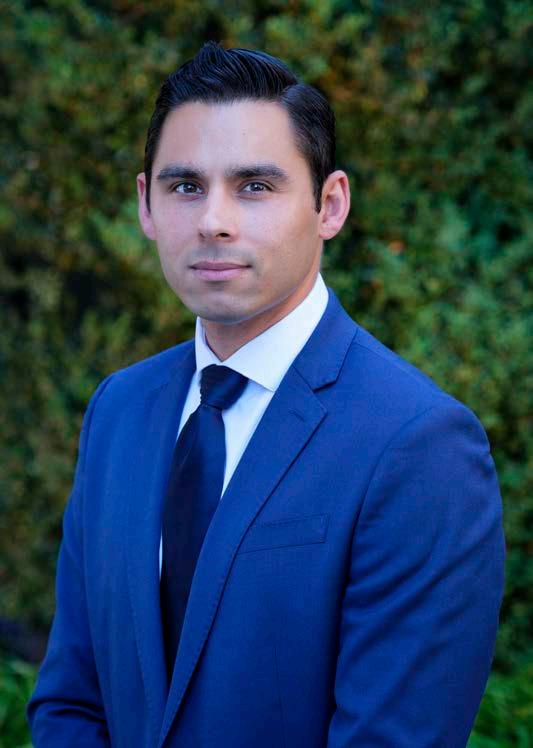
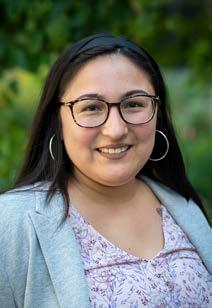
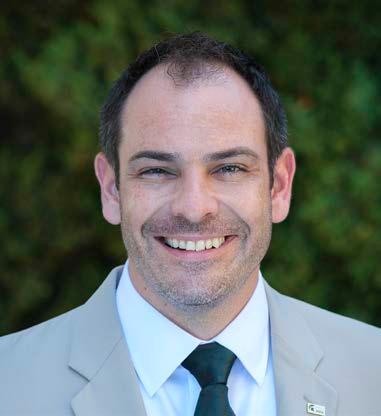
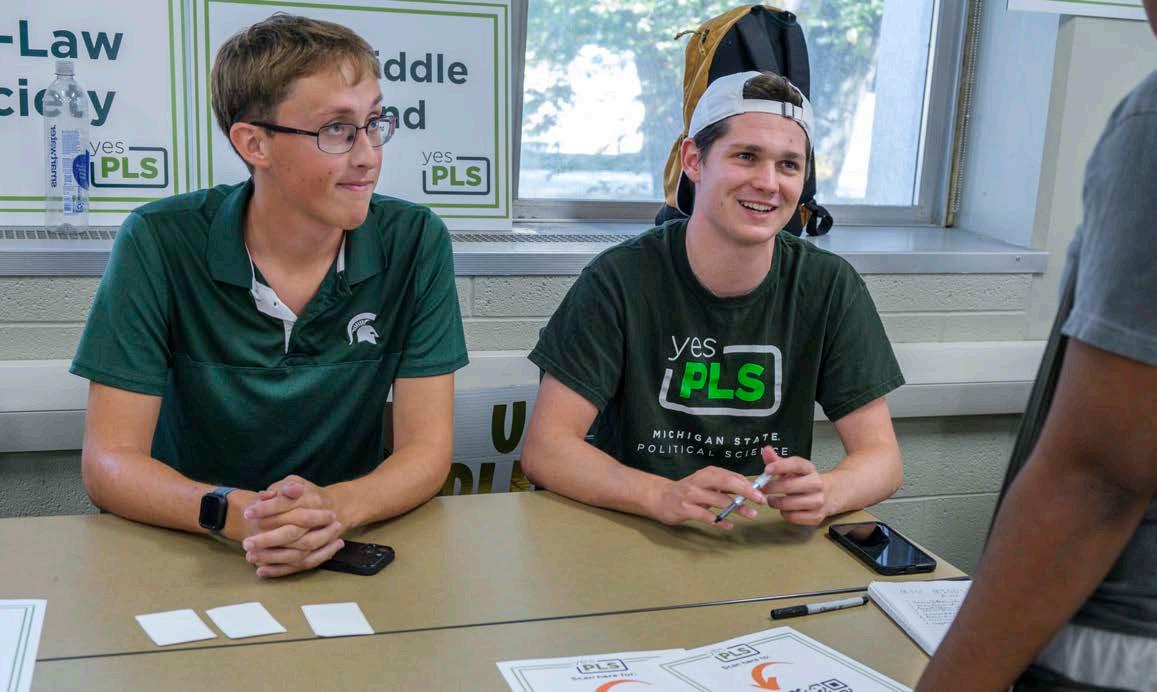
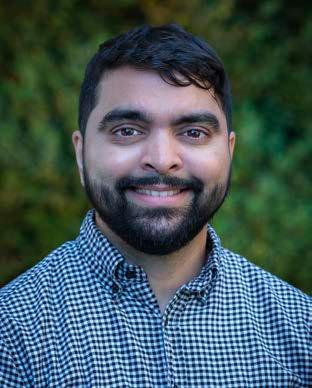
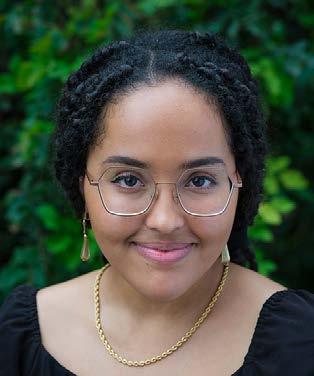
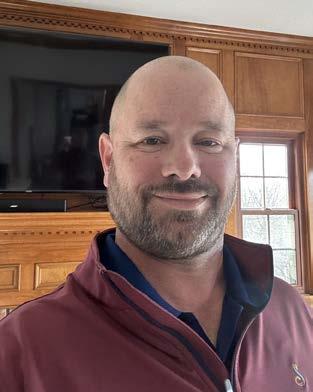
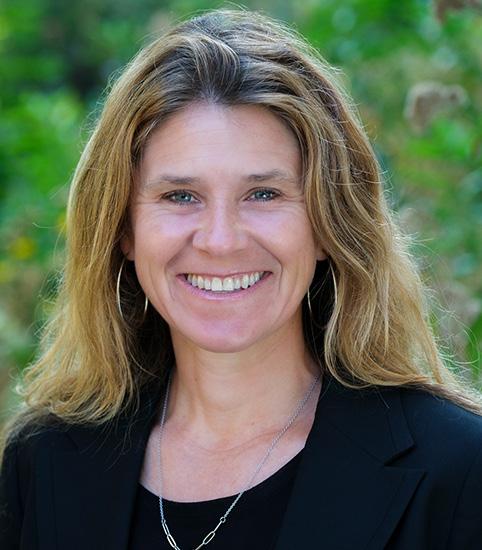
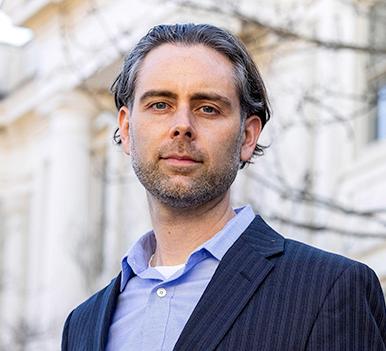
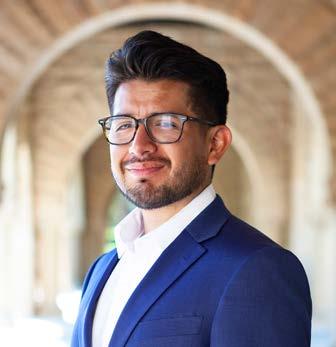
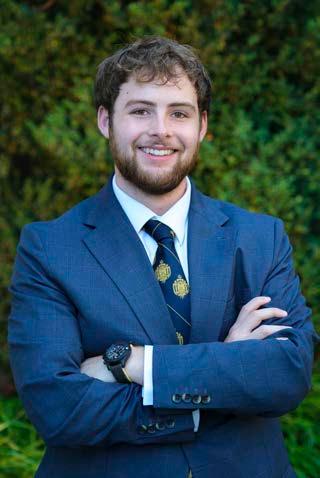
• Montaigne and the Modern Pursuit of Happiness panel discussion with Dr. Margaret Matthews, Dr. Catherine Zuckert and Dr. Rodríguez.
• A seminar on “What is Happiness?” by Dr. Robert Bartlett.
• “Leo Strauss’s Critique of Rights-Based Liberalism” by Dr. Rodrigo Chacón.
• Dr. Michael Zuckert leading a seminar on “John Locke and the Pursuit of Happiness” in Chicago.
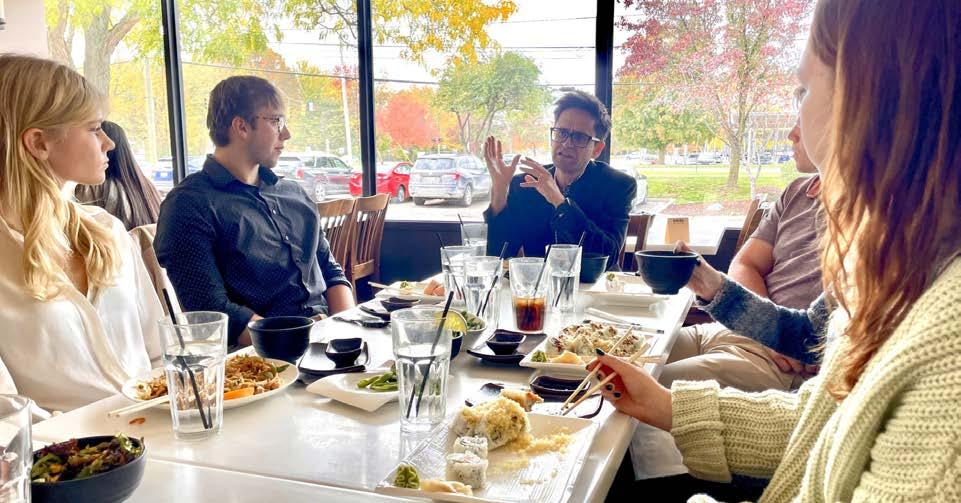
The 2025 LeFrak Forum featured several engagements with speakers and undergraduate students, including time to share ideas over lunch together at Sansu.
Photo by Raul Rodriguez.
LETTER FROM CHAIR:
Jeffrey Conroy-Krutz
Dear Alumni and Friends,
This Fall, we had the pleasure of welcoming several dozen of our PhD alumni back to East Lansing for a conference that showcased not only their scholarly accomplishments but also the remarkable range of career paths they have forged. Alumni and current PhD students presented cutting-edge research, reconnected with mentors and peers, and engaged current students in discussions about careers in academia, government, and the private sector. Their return underscored what we already know to be true—our PhD program continues to be recognized as one of the top training grounds in the discipline, producing scholars and professionals whose work shapes conversations across Political Science and beyond.
The conference also highlighted a core strength of PLS: a deeply collaborative research culture. Many of our alumni pointed to faculty-student partnerships as pivotal to their development. That tradition remains strong today. Faculty and graduate students continue to co-author research published in leading journals, secure externally funded grants, and present findings at major disciplinary conferences. These collaborations are not only central to our graduate training model but also provide current students with meaningful, hands-on experience generating high-impact scholarship.
Collaboration extends well beyond the graduate level. Our undergraduates are increasingly involved in faculty-guided research, as they participate in data collection, analysis, and even co-authored publications. Our students bring energy, creativity, and new perspectives, and they leave with skills that serve them in graduate school, public service, and a wide range of professional careers. Their achievements continue to inspire us and strengthen the Department’s research mission.
This semester also brought important developments across PLS. We welcomed new faculty, whose expertise broadens our intellectual community and enhances opportunities for student engagement. Our Master of Public Policy program and the LeFrak Forum both entered new phases of leadership, and we are excited about the vision and momentum they bring. And our undergraduate programs continue to thrive, with students distinguishing themselves in and out of the classroom.
Together, these accomplishments reflect the vibrancy of our department and the impact of our community. We are proud of what we have built and grateful to all who contribute to our mission.
#YesPLS!
Jeff Conroy-Krutz
New LeFrak Director taking Forum in new directions
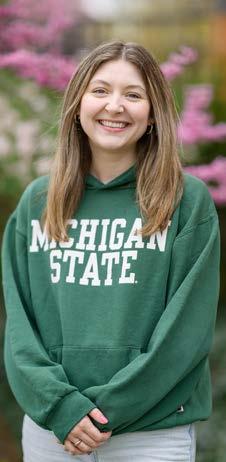
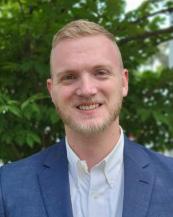
This fall, Dr. Raúl Rodríguez returned to MSU Political Science to take on a new role, as Director of The LeFrak Forum on Science, Reason, and Modern Democracy.
As a Dean’s Research Associate, a post-doctoral position with the College of Social Science, Rodríguez had become familiar with The LeFrak Forum. Now, as an Assistant Professor and the Forum’s newly appointed Director, he has great plans for revitalizing the 36-year-old institution in ways that make it more immediately relevant to current MSU students.
“The main thing is a greater emphasis on undergraduate development. We are creating experiences for students that show them how the philosophical ideas they are studying make a real difference in the world and are relevant to their own lives,” Rodríguez said. “What I envision for LeFrak is retaining the serious intellectual component and adding in a robust undergraduate program.”
The Forum was founded in 1989 through the gracious support of Samuel J. LeFrak, a titan of New York real estate who was dedicated to providing affordable housing for
ALUMNI SPOTLIGHT:
Dr. Erika Vallejo
When she was growing up, Erika Vallejo had plans of becoming a lawyer. As she watched her mother struggle financially, a job with earning potential seemed like a good idea. “It sounds silly, but that was initially what I thought; it seems like they make good money, right?”
However, as a student at the University of Texas Rio Grande Valley, she found herself more drawn toward the political side of things after taking a few relevant classes and becoming involved in the student Political Science Association.
One class in particular on labor policy opened her eyes to just how much her upbringing had influenced her current path. “When I started learning about the material and the importance of class, of labor unions, I was really able to connect to some of those lived experiences,” she said.
Last Spring, Vallejo earned her PhD in Political Science from MSU, and she is now in her first year as an Assistant Professor in the Department of Political Science at The College of Wooster in Ohio. That journey—from the Rio Grande Valley to Ohio via East Lansing—is a remarkable one, especially for a first-generation student.
However, Vallejo didn’t pursue a graduate degree straight out of college. While working as a marketing and program specialist, she says, “I found myself wanting to learn more about politics.” Her undergraduate mentor encouraged her to consider graduate school.
One of Vallejo’s favorite sayings is, ‘You don’t know what you don’t know.’ Navigating the search for a graduate program, doing extensive research and never being afraid to ask questions along the way, led her to MSU.
All Vallejo knew about Michigan was that her grandparents spent time here as migrant farm workers when her mother was young, and that it could get seriously cold. Even though she came to campus for a visit during the spring, she still felt the significant chill. Her advisor and former director of the Chicano Latino Studies program, Dr. Eric Gonzalez Juenke, attempted to assuage her fears.
“At the time, I was terrified of the winter. [Prof. Juenke] was very intentional with my visit. I met with a few other Latinas
working-class families. He and his wife, Ethel, endowed The LeFrak Forum to advance the study of philosophical traditions and their relevance to modern political, economic, and social questions.
Today, The LeFrak Forum remains a center for the serious study of modern political life and is dedicated to helping students think for themselves and ask fundamental questions of human existence.
To continue those goals, Rodríguez has created a new LeFrak Fellows network of more than 200 undergraduate students who come together for lectures, readings, guest speakers, and social events. He is hoping to also launch a LeFrak Scholars program soon that will be a “more intensive, more scholarly subset of the Fellows.”
“The model is education for freedom. It is a blessing that in America we can do and think what we want. So it is important we think about the big questions: What is justice? What is happiness?” Rodríguez said. “MSU students have a real hunger, a thirst for academic rigor and an engaging intellectual community..”
The students are currently writing essays for an undergraduate conference, where they will deliver papers on the topic of “What is Happiness?” and interact with other undergraduates interested in Political Philosophy.
The papers align with the 2025-2026 theme of The LeFrak Forum: “The Pursuit of Happiness,” which honors the 250th anniversary of the Declaration of Independence.
“The Declaration famously states that all people are endowed with the right to pursue happiness. But what is happiness? The answer to this question is neither obvious nor uncontroversial,” Rodríguez said. “We cannot hope to exercise this right effectively, to say nothing of attaining happiness, without first reflecting on the question of what happiness is.”
To this end, The LeFrak Forum is hosting a variety of events—public lectures, undergraduate seminars, and a conference—that will provoke students and members of the wider MSU community to examine the question of happiness through engagement with great texts from the history of political philosophy, as well with contemporary scholarship and thought. These events also work to foster a more reflective appreciation of the Declaration of Independence and the extraordinary right to pursue happiness that it proclaims.
To learn more about The LeFrak Forum, visit lefrakforum.msu.edu
There, you can sign up for Forum updates and learn about ways to get involved.
from Texas, because he really wanted to show me that Texans can survive here. That was a very pivotal moment for me.”
MSU’s Chicano Latino Studies (CLS) program was also very appealing to Vallejo. Her undergraduate school had a large Latino population, and attending Michigan State would be her first experience at a predominately white institution. Having tight-knit spaces in which she could thrive, such as the CLS and PLS, made the size and scope of MSU’s campus seem less daunting and helped to build long-lasting friendships.
“I always felt that I was very fortunate to have that small-class feel at a huge university,” she said. “The people that I met, whether it was faculty, students, or the fellow Latinas from Texas that [Prof. Juenke] introduced me to, we really formed a group that was very pivotal to my own success and our success as a group.”
Vallejo was not just drawn to Political Science. She also wanted to work with students. During her time in college, Vallejo worked at a tutoring center and taught after-school law and legislature classes to high schoolers, igniting in her a passion for teaching. “By the time I accepted MSU’s offer, I knew without a doubt that I loved teaching,” she explained. “Being able to connect with students is something I find really fulfilling. That, and being able to give back. I know that I wouldn’t be where I am today if it wasn’t for all the mentors that I had.”
Vallejo is also looking forward to building on some of the research she conducted at MSU. She has been a part of several projects seeking to learn and understand more about political
candidates with non-traditional backgrounds, such as workingclass individuals. She is interested in how educational and occupational background influence access to elected office, perceptions of political legitimacy, and political representation.
“Our politicians tend to be more affluent, more educated, and we’ve seen a bit of a gap between voters and the public,” she explained. “Being able to share some of this research, the stories I’ve heard from working class folks who have run for office and the challenges they’ve faced, we can make strides toward increasing working-class representation.”
Vallejo’s journey through Michigan is even more meaningful, considering her grandparents’ background here. “It was very humbling in many ways, to recognize that my grandparents had literally worked on the land not too far from MSU,” she says. “I was very fortunate to be able to study and get my PhD there.”
It also brings to mind how important Latino representation is in all fields, whether it be politics, education, or academia in general. “I don’t think I realized what influence it played when I was younger. I realized that much later.” Vallejo’s journey has had its share of ups and downs, times when she felt unsure or lost, but it’s something she isn’t ashamed to speak out about.
“Success is not linear, and failure or losses happen, but that doesn’t necessarily mean that you can’t get back up on your feet and try again.”
Political Science PhD grads return to MSU for 2025 Alumni Conference
This November, more than a dozen MSU Political Science doctoral alumni returned to East Lansing to share their experience, expertise, and advice with current PhD students.
The day-long event included paper panels in the subfields of US Politics and Public Policy, Comparative Politics and International Relations, and Judicial Politics; a Professionalization/Career Panel discussion; and a chance for current PhD students to present their work to the alumni.
“We have graduates here at every career stage with jobs in academia, government, and the private sector,” said Graduate Program Director Dr. Ian Ostrander as he opened the event on Friday, November 7. “There is a lot of brain power here.”
PhD candidate Paige Haight helped organize the conference, which included alumni who graduated between 2002 and 2025. Haight was most interested in how the alumni would interact with current students.
“It seemed there was interest on both ends to learn about each other’s work, and I think that was the most successful part of the conference. The engagement was really good to see, and it looked like students and alumni were enjoying themselves!” Haight said.
The students and alumni mingled and shared stories, and students had the chance to pitch ideas and get feedback from the alumni.
“It definitely didn’t feel like a conference, which is a good thing,” Haight said. “There was a good mixture of activities.”
The afternoon included a Professionalization/Career Panel with Dr. Chris Bonneau (University of Pittsburgh), Dr. Mircea Lazar (Michigan Department
of Health and Human Services), Dr. Matthew Kirwin (U.S. State Department and George Washington University), and Dr. Rachel Spooner (Hope College).
Bonneau, who is a Professor of Political Science and currently the chair of the Spanish/Portuguese Department at Pitt, outlined the current state of academics with the graduate students, and advised them to find a tenure-track position with good work-life balance. A good department will support every aspect of your life, he said.
“You should know that everyone in your department wants you to get tenure and are willing to work with you. Good chairs will advocate for you but you need to let them know what you need.
- Dr. Chris Bonneau
Lazar, the most recent graduate on the panel, has started his own consulting firm working in the area of public health. He followed this track because it allowed him to have more freedom to collaborate with others and have a more immediate, direct impact.
“I created a dashboard where drug overdoses could be tracked, and it was available to be used the next day,” Lazar said when describing a recent project.
“This gives me the ability to directly affect communities and people’s health.”
Kirwin joined the U.S. Department of State after working with Afrobarometer at MSU. He advised students to get a background check if they are interested in going into federal government work, as well as to study a variety of languages.
“It’s been a great career – all the opportunities and trainings I received served me well,” he said.
As a professor at a small faith-based institution, Spooner shared a different view of academic life.
“There is very little turnover here. People don’t leave until retirement,” she said, advising students interested in teaching to have a strong grasp of their teaching pedagogy.
Their discussion was well received by current PhD candidates, many of whom are currently searching for professional positions.
“It was great to reconnect with department alumni from different walks of life. The career panel was a highlight, with speakers from academia, government, and industry sharing their insights. They emphasized the importance of having a life outside academia, being true to yourself, not competing with others, remembering that the job won’t love you back, and understanding that your work isn’t a referendum on who you are,” said PhD candidate Kelechi Amakoh.
“The informal conversations over dinner also provided great insight into how our alumni are making an impact in diverse areas,” Amakoh added.
The conference concluded with PhD poster presentations and speed pitches by current students to the alumni.
It was put on with funds that the Department received upon winning the MSU Outstanding Graduate Program Community Award for 2025.
“This has been years in the making,” Prof. Ostrander said. “It began during COVID, when we weren’t able to celebrate our graduates in-person. So, this is part of recognizing them. We hope to make this effort permanent.”
The American Politics and Public Policy panel presentations included:
• Dr. Bob Lupton (University of Connecticut) “Dimensionality and Constraint in American Federal Spending Attitudes”
• Dr. Josh Koss (Eastern Michigan University) “Putting the ‘Bully’ in the Bully Pulpit: President Trump’s Congressional Purge Through Twitter”
• Dr. Davia Downey (University of Memphis) “City Charter Impacts on Black Empowerment: A Study of City Charter Change in Memphis, Tennessee”
• Dr. Jonah Ralston (University of Wisconsin-Whitewater) & Dr. Jason Kalmbach , “Policy Advocacy, Scientific Conflict, and Research Engagement: Scientists Entering the Fray”
The Comparative Politics and International Relations panel included:
• Dr. Shane Singh (University of Georgia) “Winning Isn’t Everything: Parsing the Effects of Voting, Victory and Loss on Satisfaction with Democracy
• Dr. Alejandra Lopez Villegas (Lake Forest College) “Gender Reforms and Backlash: Institutional and Individual Dynamics of Violence Against Women in Latin America”
• MSU PLS PhD students Lindsay Favero & Sophie Sunderland “Barriers to the Ballot: Roadblocks as Tools of Party Surveillance”
• MSU PLS PhD Student Yu-Hsiao Lee , Social Media & Attitudes About China
The Judicial Politics panel included:
• Dr. Elizabeth Lane (North Carolina State University) “The Court in Their Own Words: Open-ended Attitudes on the Supreme Court”
• Drs. Jonathan King and Jessica Schoenherr (University of Georgia) Racial and Ethnic Diversity in Judicial Nominations”
• MSU PLS PhD student Matthew Cota “The Court Under Threat: Hostility to Judicial Legitimacy and its Effect on the U.S. Supreme Court”
Dr. Marty Jordan appointed Director of the MPP program
Prof. Marty Jordan has accepted an appointment as Director of the Master of Public Policy Program. Dr. Jordan has been an Assistant Professor in PLS since Fall 2019, where he has instructed in the MPP program and, perhaps most notably, served as Director of our Michigan Government Semester Program, a role that he will retain.
Dr. Jordan is also an alumnus of the MSU PLS PhD program.
“We’re very excited about the future of this program under Marty’s leadership!” said PLS Chair Dr. Jeff Conroy-Krutz.
“I’m honored to lead MSU’s Master of Public Policy program. For me, this role is about equipping students with a comprehensive understanding of the policy process, fostering rigorous analytical skills, and providing personalized mentorship. Our ultimate goal is to prepare graduates to craft impactful, evidence-based solutions to today’s most pressing challenges. I’m proud of the strong legacy our Spartan alumni have built and excited to collaborate with faculty and staff to shape the next generation of policy leaders,” said Dr. Jordan.
Previously, Dr. Sarah Reckhow, PLS Professor, had served as interim director of the Master of Public Policy Program following the departure of Dr. Erika Rosebrook to lead MSU Extension’s Center for Local Government Finance and Policy.
STUDENT VOICE:
MSU Middle Ground offers space for civil political discussions
In the aftermath of the 2024 US election, one PLS student—Liam Connor—saw the need for more spaces on campus for students to discuss important issues in civil, productive, and respectful ways. Liam is a graduate of Walter Johnson High School in Bethesda, Md. He is majoring in Political Science Pre-Law, with minors in Law, Justice and Public Policy and Environmental Social Science. He expects to graduate in December 2026. Liam shared his motivation for starting MSU Middle Ground, and how the organization works, with us.
In a climate of political violence, hateful rhetoric, and high levels of polarization, I wanted to find a middle ground. But I couldn’t find a place to calmly and safely discuss the top issues facing the nation — topics like climate change, gun rights, and abortion. So, I created one.
I just wanted a safe, judgment-free space where people could talk about politics in an age when it’s very hard to do. That’s why, as a Political Science Pre-Law junior, I started the student group MSU Middle Ground after the 2024 presidential election.
I remember seeing all the recruitment tables for political parties and voter registration on campus, but I thought something was missing. No one was talking with each other about their different political views, especially online. Instead, we get stuck in echo chambers that can be harmful to our political climate.
I looked into different student groups, hoping to find a place where people were calmly discussing political differences, but I came up empty. There were the MSU College Republicans and the MSU College Democrats, but they rarely talked to each other. I wanted to create a space where people with differing viewpoints could come together and, through a mediated process, talk about politics.
Before joining MSU Middle Ground, members must agree to suspend judgment and promise to respect everyone’s thoughts. Each meeting begins with a five-minute slideshow introducing that evening’s topic. I’m deliberate about getting my news from multiple sources to offset bias and cross-reference information to help me mediate the discussions.
I guide our discussions by ensuring conversations remain respectful, accurate, and civil, and that everyone has a chance to speak. Participants raise their hands to share, and I address any unproductive comments with a warning or, if needed, removal, though that has not been necessary so far. I also pause discussions to invite quieter members to contribute, with the goal of creating balanced dialogue.
I haven’t had to do much mediation. By the end of each meeting, the group usually comes together to form a compromise on what we can all agree on.
In this new semester, I’m focused on heavily recruiting members to continue the discussion. I’ve been reaching out to all political groups on campus to grow our diversity of cultures and political views.
We’re building something that matters — a place where Spartans can practice civil dialogue in an era when it often feels impossible.
Three MSU MPP students awarded Ira Polley Memorial Scholarships
Three PLS Master of Public Policy students have been awarded Ira Polley Memorial Scholarships for their exceptional work both inside and outside the classroom.
The scholarship was established in memory of MSU Political Science Professor Emeritus Dr. Ira Polley, whose 50-year career was dedicated to education and public service. Dr. Polley also served as State Controller, State Superintendent of Public Instruction, Executive Director of the Council of State College Presidents and Secretary to the Constitutional Convention Planning Commission. Dr. Polley passed away in 2005.
MPP students have been selected for this high honor for more than a decade and a half. Students performing at the highest level receive the award and scholarship dollars.
This year’s recipients are Aubrey Ghambi, Micaiah Hall, and Joshua Lake.
“Not only did these three students excel academically during their first year in the MPP Program, but they also embody Dr. Polley’s deep commitment to education and public service,” said MPP Director Dr. Marty Jordan.
Ghambi, originally from Malawi, has contributed to Afrobarometer, the largest non-partisan survey network focused on public attitudes across Africa. (MSU was a founding partner in Afrobarometer in 1999 and is now a supporting institution.) Ghambi also interned at Lansing’s Allen Neighborhood Center, supporting low-income communities. Given his passions about using data to address policy challenges, Ghambi plans to pursue doctoral training in research design. His civic engagement includes creative advocacy—he collaborated with public officials, including the former U.S. Ambassador to Malawi, on the Making Integrity Cool campaign, using hip-hop to promote anti-corruption.
“Receiving the Ira Polley Award truly meant a lot both personally and financially. It eased some of my financial stress and reminded me why I joined the MPP program in the first place,” Ghambi said.
Hall, a Michigan native, earned his undergraduate degree in Political Science from MSU. Alongside his studies, he works in MSU’s purchasing department, where he supports the University’s operational needs—ensuring faculty, students, and units have the resources they require.
“I am grateful and honored to be given the award and glad that I can represent MSU’s MPP program well,” Hall said.
Lake, a Grand Rapids native, earned his undergrad degree in Social Relations and Policy from MSU’s James Madison College. He is passionate about education and labor policy, with his Capstone Project exploring the paradox of rising graduation rates alongside declining test scores in Michigan schools. Over the summer, Lake interned with the Michigan legislature, engaging with constituents to understand their policy concerns. After graduation, he hopes to pursue a career in education policy or state-level politics.
“I am honored to have been selected to receive the Ira Polley Memorial Scholarship. Previous recipients have gone on to do extraordinary things, and I am honored to be among them. I want to sincerely thank the award donors and the selection committee,” Lake said.
“The success of these students is, in many ways, a reflection of Dr. Polley’s enduring legacy. This support has helped ease their path toward education and public service, and for that, we are deeply grateful,” Jordan said.
Since the Polley Scholarship began, it has been awarded to 36 recipients, many of whom have gone on to exceptional careers in government, research, public policy, and law.
Past recipients include:
Jennifer Flood (2012-2013). Flood currently serves as Michigan’s State Budget Director, overseeing all aspects of the state’s budget and managing key agencies. Prior to this role, she was Deputy Chief of Staff to Governor Gretchen Whitmer, where she led major divisions of the executive office, including policy, legislative and federal affairs, appointments, community engagement, and scheduling.
Jordon Newton (2015-2016). After graduating from MSU, Newton worked as a researcher at Citizens Research Council of Michigan, where he analyzed state policy issues and communicated findings through reports and presentations to stakeholders. He is currently working on his PhD in Political Science at Washington University in St. Louis.
Madeleine March-Meenagh (2019–2020). March-Meenagh is the Director of Economic Initiatives at the Community Economic Development Association of Michigan (CEDAM), where she leads statewide efforts to advance economic inclusion. Her portfolio includes managing key programs such as the Michigan CSA Network, Michigan Economic Impact Coalition, Tax Outreach and Awareness Group, Show Me the Money Day, and the Free Tax Preparation Expansion Grant.
Daryn Watson (2020-2021). After graduating from the program, Watson secured a prestigious internship at the White House, which led to a full-time role on Vice President Kamala Harris’s advance team. She later chose to pursue a law degree at the University of Michigan, driven by her passion for amplifying marginalized voices and serving her community.
Sadia Kazi (2022-2023). Kazi is a Senior Policy Associate at the Abdul Latif Jameel Poverty Action Lab (J-PAL) at MIT, where she fosters partnerships between researchers and state and local governments to apply randomized controlled trials for public sector impact evaluations. She also supports the Evidence to Scale (E2S) project and the U.S. Health Care Delivery Initiative (HCDI), aimed at improving the effectiveness and equity of the U.S. healthcare system.
MSU PLS welcomes Dr. Sivaram Cheruvu
Sivaram Cheruvu first came to East Lansing as a senior in high school to attend the Odyssey of the Mind world finals.
As he and his wife, Meck, returned to Michigan State University this summer – this time for Dr. Cheruvu to take his position as Assistant Professor of Political Science – it felt familiar.
“I feel like I came full circle after all these years,” Prof. Cheruvu said.
A native of New Jersey, Prof. Cheruvu earned his Bachelor’s degree in Political Science and History from Rutgers University, his Master’s at the London School of Economics, and his PhD at Emory University in Atlanta. He comes to MSU from the University of Texas at Dallas, where he was teaching courses in comparative law and courts, and international law.
He accepted the tenure-track position of Comparative & International Politics to teach MSU students those same courses.
“I was super excited to come here because of the strong focus at MSU on Pre-Law and politics,” he said.
He was also excited to live among changing seasons again.
“I’m excited to explore the landscapes of Michigan” he said.
Prof. Cheruvu’s interest in international politics started with Model United Nations programs in middle school and high school. As an undergraduate, he worked to organize Model UN conferences for high school students.
“I was very interested in the teaching aspects of Political Science. I knew I wanted to study Political Science and go into academia,” he said. “I hope I can inspire someone in my class to follow that path.”
Prof. Cheruvu’s research focuses on law and politics in the European Union. Specifically, he is looking into how individual judges affect the outcomes of cases in Europe, which is tricky, because the European courts of justice don’t issue opinions under an individual’s name.
“You have to find out ways to know who is writing what,” he said.
He is also investigating democratic backsliding in Europe and has applied for a National Science Foundation grant
to look at the involvement of the Court of Justice and how that affects people’s opinion of their government.
Prof. Cheruvu received the 2022 Sage Award for best article published in European Union Politics, the 2022 APSA European Politics and Society Section’s Ernst B. Haas Best Dissertation Award, the 2022 APSA Law and Courts Section’s Service Award, the 2021 Neal Tate Award for best paper on judicial politics presented at the 2020 SPSA conference, and the 2020 APSA Law and Courts Section’s Best Graduate Student Paper Award.
Prof. Cheruvu is also the founder and organizer of the Junior Law and Politics Research Community, a forum designed for junior scholars to present and receive feedback on their work and connect with other academics studying law and politics.
Outside of work, you can find Prof. Cheruvu watching Netflix documentaries and following sports, including the Brooklyn Nets, Rutgers teams, and the New York Jets.
“I am very excited about the MSU basketball season,” he said.
“
I was very interested in the teaching aspects of Political Science. I knew I wanted to study Political Science and go into academia. I hope I can inspire someone in my class to follow that path.
MSU PLS PhD student wins grant to investigate links between Confederate memorial removals and voter behavior
When Kelsey Osborne-Garth was an undergraduate at Lee University in Cleveland, Tennessee, she worked toward the removal of a Confederate statue near campus and witnessed the months of protests both for and against the removal that followed.
The experience inspired her research as an MSU Political Science doctoral student and has garnered her a 2025 Dean’s Institutional Access grant. Osborne-Garth was awarded $5,000 for research on her dissertation chapter, “The Link Between Confederate Memorial Removal and the Voting Behavior of Black Voters.”
“That protest inspired me to explore national symbols and what impact that has on voting participation and behavior,” Osborne-Garth said. “When the monuments are removed, there is a definite impact on how people interact with the political system.”
More broadly, Osborne-Garth is researching political symbols and how they serve as “political currency” for candidates and political parties.
In the case of the Tennessee monument, the city found that because it was on private land owned by the United Daughters of Confederacy, it could not remove the monument. It also fell under the jurisdiction of the state’s 2013 Heritage Act, which specifically prohibits the removal of Confederate statues and monuments.
Monument removal is not new, OsborneGarth said. The first removals started in the 1920s because of the deterioration of the statues. But after a white nationalist rally in 2017 in Charlottesville, Va., communities across the South started calling for the removal of reminders of a time when Black people were enslaved and then facing discrimination and hatred in the Jim Crow era.
“These are statues that were erected in Jim Crow to threaten Black people. It was a reminder to keep your head down, focus on feeding your family. The presence of these monuments were reminders of their lower status,” Osborne-Garth said. “But there has been a shift in status and people aren’t afraid to use their voice now.”
In conversations with citizens and media reports, Osborne-Garth is finding that the push for removal comes from grass roots organizations. State and local governments also moved to pre-emptively remove monuments that were damaged, attacked or “don’t align with their current goals,” she found.
Osborne-Garth plans to interview more people about their experiences with monument removal with the help of the Institutional Access grant.
When a statue is removed, Osborne-Garth remarked, “it can go both ways in creating anger at wanting it removed but also the anger of the people who want it to stay. In many ways it is a race story as much as political story and not everyone wants to see it that way.”
[T]here has been a shift in status, and people aren’t afraid to use their voice now. “
“I loved my time at MSU and in the Department. I would not have the life I have today without it. Every time I come back (every 2-3 years), I am filled with a sense of happiness, peace, and gratitude. I feel at home on campus and in East Lansing.
Dr. Chris Bonneau
PLS has thousands of alumni, working across Michigan, the US, and the world, in the public, private, and nonprofit sectors to promote change. We highlight the contributions of some of these PLS Spartan alumni, in this newsletter and on our website polisci.msu.edu
Dr. Chris Bonneau is Professor of Political Science at the University of Pittsburgh and Interim Chair of the Department of Spanish and Portuguese. He earned his PhD in Political Science from MSU in 2002, and his research and teaching focus on judicial politics. He has written three books, including Voters’ Verdicts: Citizens, Campaigns, and Institutions in State Supreme Court Elections (UVA Press, 2015, with Damon Cann), and In Defense of Judicial Elections (Routledge, 2009, with MSU Emeritus Professor Melinda Gann Hall).
What were your professional goals as an MSU PLS student?
As a grad student, I knew I wanted to go into academia. I was initially indifferent as to whether I wanted a research-focused job or a teachingfocused one, so I applied broadly. Based on my training and profile, I only received interest from research-intensive institutions, and I was fortunate enough to land a good job in a good place to live (Pittsburgh) right out of graduate school. I never saw myself going into university administration (and that is not something I was trained in at all), but circumstances led me to serving as President of the University Senate for 3 years, and now as a Dean-appointed Chair to help a department stabilize.
What other professional experiences have you had since leaving MSU?
Since leaving MSU, I have been fortunate to be able to use my training and expertise in a variety of ways besides producing academic scholarship and teaching. I have testified and presented my work before legal groups, legislatures, judges, and activists across the ideological spectrum. I have served as an expert witness in multiple cases involving redistricting and other electoral issues. I currently serve as the Chief Reader for the Advanced Placement US Government and Politics exam, overseeing the creation and scoring of over 400,000 exams taken by high school students seeking college credit. I co-edited an academic journal
( State Politics and Policy Quarterly ) for 6 years, and served on multiple advisory panels for the National Science Foundation. When I graduated from MSU, I figured I would do some good work, get tenure, and teach undergraduate and graduate courses. Now in my 24th year at Pitt, research and teaching occupies very little of what I do.
What aspects of your Political Science education prepared you best for your current position?
Without a doubt, the training in how to conduct scientific research and taking methods classes to allow me to answer the questions I was interested in. Good theoretical training allows you to ask interesting and important questions; good methods training allows you to answer them.
What motivates you professionally?
Generally, I like to solve puzzles and take on challenges. Solving puzzles is essential to being a successful scholar. As a professor who works at a university, I am fascinated by how things work and understanding the processes by which decisions get made. Understanding how the university and discipline work makes it easier to have a successful and fulfilling career. In terms of challenges, I get bored easily and always want to try something new. The bigger the challenge, the more interested I am in seeing if I can solve/fix it.
What are your fondest memories of your time as an MSU Political Science student?
My colleagues and I had season tickets to football, basketball, and hockey, and we regularly went out to lunch and dinner. When some of us were writing our dissertation, we developed a routine where we would work all day and then golf 9 holes in the evening, go to dinner, and repeat the next day. Good times.
What experiences at MSU (classes, internships, jobs, research, etc.) would you say are most useful for current students to undertake?
Take as many methods classes as you can. You can read books/articles on substance on your own, but it is very hard to teach yourself methods. Well, at least it was very hard for me to do that!
What is something that you know now that you wish you knew back in your MSU days?
If you pursue academia, it doesn’t get easier; it just gets different. In graduate school, your time is pretty much your own and you can focus on your own work. Once a professor, you will have meetings and classes to prep and students to meet with. So time management becomes even more essential..
What are the biggest challenges today for someone who wants to work in your field? What are the biggest benefits?
It is not a particularly good time to be in higher education. Budgets are continuously contracting, and universities are not held in particularly high esteem by a significant proportion of the population. And some of that is the fault of the faculty and administration at colleges and universities. If you decide you want to go the academic route, make sure you are willing to do what it takes to succeed. There are a lot of benefits (schedule, no boss, work on stuff that is interesting to you), but there are also drawbacks (job market, can’t choose where you live). You should make a decision on an academic career with all available information and then make the choice that is right for you (and not for your advisor, parents, friends, etc.).
A final word:
I know I am nostalgic, but I loved my time at MSU and in the Department. I would not have the life I have today without it. Every time I come back (every 2-3 years), I am filled with a sense of happiness, peace, and gratitude. I feel at home on campus and in East Lansing. There is only one person left who was on the faculty when I graduated, and yet I still think of the Department as “my” department.
PLS Legal Internship Program Update
Pre-Law is the largest major in PLS, and one of the largest in the entire College of Social Science. As such, providing internship opportunities for students interested in legal careers is a top priority of the Department. In her role as director of the MSU Political Science Legal Internship Program, Assistant Professor Melissa O’Shea works to provide students each year with chances to work in the legal environment. Students in the Program work under the supervision of licensed lawyers, on actual cases, before applying for law school.
In 2025, thirteen students participated in the Program, which continues to expand by offering new job sites in downtown Detroit and Lansing. Excitedly, O’Shea reports that alumni of the Program are now starting to take interns of their own, as practicing attorneys.
Participating in the Program gives students a leg up in the application to law schools, which can be quite competitive. In recent years, alumni of the program have gone on to the University of Illinois Chicago, Wayne State, Detroit Mercy, Vermont, George Mason, Chicago Kent, Duquesne Kline, and MSU Law.
The sixteen students who will participate in the 2026 program have interests ranging from criminal law, to business law, and the JAG (Judge Advocate General) Corps. These interns will continue to have a choice between a Summer internship, a Fall internship, or having an internship in both semesters.
Students participating in the program can expect to gain insight into the actual practice of law prior to attending law school, get a chance to network with practitioners and law students, and get a jump start on standard 1L courses, including legal research and writing. As O’Shea puts it, “Past students have consistently reached out to say the first year of law school was much easier and less stressful after the program and work experience.”
PLS Associate Professor Erica Frantz named Kettering Research Fellow
An MSU Political Science professor is among three new research fellows named by the Charles F. Kettering Foundation to study the challenges confronting democracy.
Associate Professor Erica Frantz has been selected to help the Foundation “advance inclusive democracy by equipping the public, policymakers, and civic leaders with essential knowledge needed to understand the forces destabilizing democracy.”
The research fellows will support the Foundation’s efforts to combat the complex forces threatening democracy today. The work of the fellows will help illuminate the
erosion of democratic norms, the rise of authoritarianism, and the roles religion and social movements play in shaping democratic futures, according to the Kettering Foundation.
Prof. Frantz, an expert on authoritarian politics, democratic backsliding, and the dynamics of change, is joined by Sociology professor Dr. Andrew L. Whitehead of Indiana University Indianapolis, and Political Science professor Dr. Deva Woodly of Brown University.
“We selected these fellows because their scholarship confronts some of the most dangerous dynamics threatening inclusive democracy today,” said Sharon L. Davis, president and CEO of the Kettering Foundation. “Whether exposing the rise of authoritarian strongmen, mapping the corrosive effects of Christian nationalism, or examining the democratic necessity of social movements, their work brings clarity to the forces eroding democratic norms and helps us chart pathways to resilience, accountability and renewal.”
The fellows will contribute to the Foundation’s From Many, We blog, The Context podcast, The Stakes video series, and virtual and in-person conversations during their fellowships.
This opportunity allows Prof. Frantz to pursue her research into authoritarianism,
MSU PLS PhD candidate Raymundo Lopez has been awarded a scholarship from the American Political Science Association’s (APSA) Fund for Latino Scholarship.
The award will fund Lopez’s research, which focuses on how candidates’ identities and appeals influence voters’ support. Specifically, it will allow him to launch an online survey experiment, with study participants responding to different types of appeals in hypothetical elections. This research builds on the racial priming hypothesis by applying an intersectional lens to the strategies that women of color candidates use when appealing to broad, cross-racial and socioeconomic
share her expertise, and work toward solving some of the most urgent challenges facing democracy.
“I am thrilled to be joining this esteemed group of fellows and others at the Kettering Foundation and engaging in work that advances and broadens understanding of the critical vulnerabilities of democracies today,” Frantz said.
For MSU Political Science, this fellowship showcases the highly relevant research done by faculty, which can have immediate and real-world impacts.
“Prof. Frantz is one of the world’s leading authorities on authoritarian regimes and democratic backsliding. These are perhaps the most pressing topics facing us today, as democracy is being challenged in unprecedented ways on every continent. As citizens, we’re appreciative of the support the Kettering Foundation is providing for the study of this critical issue. As Spartans, we’re so proud that they have recognized Prof. Frantz with this accolade,” PLS Chair Jeff Conroy-Krutz said.
Frantz is the author of eight books, including The Origins of Elected Strongmen (Oxford University Press, 2024, with Andrea Kendall Taylor and Joseph Wright) and Authoritarianism: What Everyone Needs to Know (Oxford University Press, 2018).
constituencies, Lopez said. Racial priming is a theory that media and campaign content can make racial attitudes more important factors in individuals’ political evaluations.
Lopez is the founder of Atom Laboratories, a YouTube channel that translates Political Science research into accessible video essays, candidate profiles, and analyses of contemporary political issues. His work bridges scholarship and practice, with the goal of broadening civic understanding and fostering inclusive political discourse. Lopez is a Stanford University, USC POIR Predoctoral Summer Institute, and Ronald McNair alum.
Dr. Shane Singh
Dr. Shane Singh is the Joshua W. Jones Professor of Public and International Affairs and the director of graduate studies in the Department of International Affairs within the School of Public and International Affairs (SPIA) at the University of Georgia.
Following his graduation with a doctoral degree in Political Science at MSU in 2009, Dr. Singh did a post-doctoral fellowship with the Centre for the Study of Democratic Citizenship at McGill University and the Making Electoral Democracy Work project at the University of Montreal. His research focuses on comparative political behavior, particularly around elections, and has been published in journals such as the American Political Science Review, American Journal of Political Science, Journal of Politics , and British Journal of Political Science
What aspects of your Political Science education prepared you best for your current position?
The rigorous training in empirical research and quantitative methods in MSU’s Political Science Department put me in a strong position to publish in respected academic journals. My PhD training at MSU also taught me how to function as a professional political scientist, thanks to both the Department’s professionalization seminars and its support for conference participation.
What motivates you professionally?
Conducting rigorous, empirically focused research on democratic politics and sharing insights with my students.
What are your fondest memories of your time as an MSU Political Science student?
Learning linear regression in PLS 802 [Quantitative Techniques in Political Science II] was not only practically useful and intellectually fascinating, it also introduced a new rigor to the way I interpreted the world around me.
I also look back fondly on the time spent bonding with my cohort and connecting with students in other cohorts, many of whom have become lifelong friends.
What experiences at MSU (classes, internships, jobs, research, etc.) would you say are most useful for current students to undertake?
I think MSU PhD students should take advantage of the world-class methods training in the Department.
What is something that you know now that you wish you knew back in your MSU days?
I wish I had known that nearly everyone feels imposter syndrome at some point.
What are the biggest challenges today for someone who wants to work in your field? What are the biggest benefits?
The biggest challenge is navigating the intense competition and unpredictability of the academic job market.
The benefit is academic freedom. Once you secure a job and tenure, you can focus your research and teaching on the ideas that genuinely excite you. There are very few other career paths than offer such independence.
“Ray is well-deserving of this award. He is resourceful, humble, hard-working, thoughtful, and this project fits his passion for analyzing how voters react to candidates of different backgrounds,” said Associate Professor of Political Science Eric Gonzalez Juenke. “More importantly, Ray’s experiments will help us understand what kinds of cues voters use to think about candidates with various overlapping identities. The work helps explain representation gaps and may influence both political parties to recruit and support historically excluded candidates to run for office.”
Lopez credited PLS faculty with guiding his work thus far. “The award is a testament to the support I’ve received from my advisor, Dr. Eric Juenke, the incredibly supportive members of my committee— Profs. Jenny Wolak, Nazita Lajevardi, and Matt Grossmann—and from my fellow PhD colleagues, whose feedback and camaraderie constantly push my work in new directions,” Lopez said. “Big thanks to APSA.”
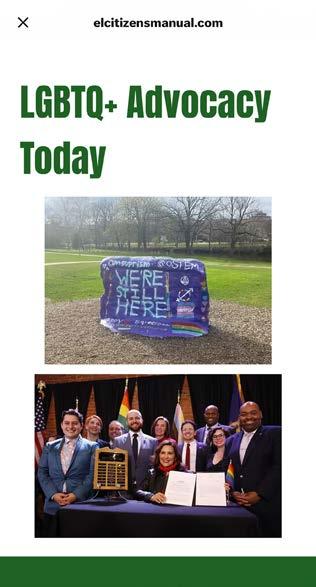
New PLS Citizens Manual explores LGBTQ+ history in East Lansing
“
It means so much to me that our community… can present the history of our own existence.
- Sterling Bentley
When Sterling Bentley was considering attending Michigan State, he did his research and was surprised to discover that East Lansing was the first city in the U.S. to prohibit discrimination in hiring based on sexual orientation.
It sealed his desire to be a Spartan and eventually led to his enrollment in MSU PLS Professor Sarah Reckhow’s Civic Education and Local Democracy course this past spring.
Bentley, a PhD student in Social Work, is one of the authors of the class web publication titled East Lansing Citizen’s Manual.
“We were aiming to fill the gaps of traditional civics education. There is already so much put on teachers that it is dang near impossible for them to cover it all,” Bentley said.
Reckhow’s previous class had created a similar Lansing Citizen’s Manual, also aimed at increasing interest and engagement in civics and local government with younger people. This year, the MSU students worked with students at East Lansing High School to focus on four areas of East Lansing – history, local government, how to get involved, and youth.
Bentley was among the four students focused on the history of East Lansing, which is then divided into Notable Figures, the Founding of the City & History of MSU, Race and Housing, and LGBTQ+ History.
It was a natural fit for Bentley to work on the LGBTQ+ History, as it fits well with his doctoral research into civic engagement, especially with trans people. While he was the only doctoral student in the class, he enjoyed working with people of different ages and academic levels.
“This course has expanded my horizons in many ways,” Bentley said. “I loved the community-engaged portion that leads to a tangible tool. As an academic, that is what I want my courses to do – create ways to benefit communities immediately.”
The LGBTQ+ History section follows the story of the Michigan State Gay Liberation Movement, the first LGBTQ+ student group in Michigan and one of the oldest in the country. In 1972, a member of the movement had been fired from their campus job for being gay, leading faculty and activists to propose an amendment to East Lansing’s city code to prohibit discrimination in hiring based on “affectional or sexual preference.”
Bentley quoted Councilwoman Mary Sharp, an MSU alum, who pushed the proposal to approval with her statement: “This isn’t about promoting a lifestyle. This is about protecting people from being punished for who they are.”
The Michigan State Gay Liberation Movement is still alive today, as the Alliance of Queer and Ally Students.
The LGBTQ+ History section also includes the work of Rachel Crandall-Crocker, a transgender woman, MSU alum, and longtime activist, who created the Transgender Day of Visibility in 2009, now an internationally recognized celebration.
“It means so much to me that our community – which has had our histories erased, burned and rewritten for us – can present the history of our own existence,” Bentley said.
Finally, the section includes community resources and local events of interest to LGBTQ+ people and allies.
Overall, Bentley is hopeful that the website will show local youth how they can get involved in causes they care about, become more media literate, and increase their knowledge – and pride –of their hometown.
“It is so important to highlight the pride and joy and resistance. And how empowering is it for a young trans kid to discover this history and be proud of where they are from,” Bentley said.
PLS student wins full scholarship as a Williams Scholar
This year, fifty exceptional incoming first-year students won comprehensive scholarships. Political Science major Kaela Laurin, from Dexter, Michigan, was one of them.
Laurin is one of only two recipients in the College of Social Science of the inaugural Joseph R. and Sarah L. Williams Scholarship. In high school, she was on the mock trial team and Dexter Drama Club. She earned a varsity letter in theater and participated in the University of Chicago’s Emerging Rural Leaders Program.
“I chose MSU because of the wonderful opportunities offered to me including the ability to do undergraduate research, and advance my education beyond what other schools offer,” Laurin said.
The scholarships cover full tuition, room and board, and a stipend for up to eight semesters of undergraduate study. They are considered some of the most competitive awards in the country.
“These incoming students reflect Spartan excellence,” said MSU President Kevin M. Guskiewicz, Ph.D. “By investing in their futures, Michigan State is not only opening the doors for student success – we’re serving as a greater
talent activator, strengthening the future of our communities, our state, and our world.”
Each awardee also receives a spot in the MSU Honors College’s Professorial Assistantship program, which provides a two-year paid research placement with a faculty member.
“With access to world-class research opportunities, these fifty scholars will collaborate with faculty on groundbreaking work that addresses real-world challenges,” said MSU Honors College Interim Dean Glenn Chambers, Ph.D. “Their ideas, curiosity, and drive will fuel discoveries that reach far beyond campus. We can’t wait to see and support the impact these Honors College Spartans will make.”
“These students didn’t just meet expectations – they challenged them. They’re researchers, advocates, entrepreneurs, and problem-solvers before even setting foot on campus. At MSU, we believe in giving them the space, support, and opportunities to turn big ideas into real-world impact. We can’t wait to welcome them into a community that celebrates ambition,
“creativity, and collaboration,” said MSU Executive Director of Admissions John Ambrose.
The newest scholars represent ten states and eight countries. They are pursuing degrees across twelve different colleges at MSU.
The Joseph R. and Sarah L. Williams Scholarship is named after the university’s inaugural president and first lady. Guskiewicz and MSU announced the creation of the scholarship program in his investiture speech last September. Williams Scholars followed the same selection process as Alumni Distinguished Scholars: applying to MSU, submitting essays, taking a general knowledge exam, and interviewing with a faculty-staff committee.
Alumni Distinguished Scholarships are part of a 70-year tradition at MSU, and University Distinguished Scholarship were established in 2000. To contribute to scholarships supporting PLS students, please visit:
polisci.msu.edu/about/giving
I chose MSU because of the wonderful opportunities offered to me including the ability to do undergraduate research, and advance my education beyond what other schools offer.
- Kaela Laurin
MSU PLS grad recognized for democratic participation efforts on campus
Lucas Gravatt, a 2025 MSU graduate in Political Science and current student in the Master of Public Policy Program, was named to the 2025 ALL IN Student Voting Honor Roll. The honor roll recognizes students who have contributed to the advancement of nonpartisan student voter registration, education, and turnout efforts in their communities. He is one of only 232 individuals named to the honor roll across the country.
“I often tell students that their greatest power is their ability to vote, not just in our federal elections but state and local as well”, Gravatt said. “Your vote is your voice. You use it to advocate for your beliefs and to put people in positions of power that you believe will do the right thing. For how dissatisfied with the state of the world our generation often is, it’s important that we utilize our democratic right to vote to channel our concerns into solutions and build a world that we want to see. That was my driving motivation for helping to register students to vote, on and off campus”.
Jordan Zammit, democratic engagement coordinator with MSUvote, nominated Gravatt for the award. “Lucas’ dedication to empowering students and fostering a culture of civic participation at MSU is exemplary,” Zammit said.
MSU has a longstanding commitment to promoting nonpartisan democratic engagement on campus, particularly through initiatives focused on voter registration and turnout. This dedication was recently recognized by the ALL IN Campus Democracy Challenge, which honored MSU President Kevin Guskiewicz and Gravatt. ALL IN is a national initiative of Civic Nation, an organization dedicated to building a more inclusive and equitable country by collectively addressing social challenges.
Your vote is your voice. You use it to advocate for your beliefs.
- Lucas Gravatt
“Lucas was instrumental in registering more than 350 MSU students to vote, connecting with upwards of 1,770 individuals directly through outreach and events, and collaborating with professors across campus to engage students in the classroom,” said Allyn Shaw, interim colead, Division of Student Affairs, assistant vice president for Student Development and Leadership, and Dean of Students.
These accomplishments would not be possible without the efforts of MSUvote, a nonpartisan campus committee whose mission is to increase the number of registered student voters, inform and educate students on candidates and issues, and bolster student participation on Election Day.
President Guskiewicz received the Standout President Award for his commitment to promoting an institutional environment that values student voter engagement by empowering campus leaders, staff, and student organizations to advance initiatives aimed at increasing voter registration and turnout. His leadership has helped lay the foundation for the university to continue promoting democratic participation, ensuring that civic engagement remains a priority.
Guskiewicz and Gravatt were recognized during a virtual awards ceremony in April.
Two PLS students shine in this year’s Homecoming Court
Every year, 10-12 outstanding seniors are selected to the MSU Homecoming Court. These students are chosen through a nomination and selection process led by the MSU Alumni Association on the basis of their leadership, Spartan spirit, and service. They serve as ambassadors at major campus events, and selection to the Court is a significant honor. This year, PLS was honored to have two of its seniors selected to the Court.
Jaelynn Smith
Jaelynn Smith is a visionary and purpose-driven senior from Kalamazoo, Michigan. Majoring in Political Science with minors in Peace & Justice Studies and Philosophy & Law, Jaelynn has spent her time at MSU passionately advocating for equity, education, and representation. Her Spartan journey has been one of self-discovery and leadership, with a deep-rooted commitment to service.
MSU has been a transformative place for Jaelynn — shaping her into a confident and compassionate leader. Her involvement on campus reflects her drive to create positive change, particularly in the areas of student advocacy, educational equity, and expanding access to Pre Law and career development pathways. Through her academic and co-curricular involvement, Jaelynn has become a trusted voice for underrepresented communities, always striving to uplift others and ensure inclusivity in the Spartan experience.
After graduation, Jaelynn plans to attend law school and pursue a career as a judge, where she can advance justice with integrity and compassion. She is passionate about serving her community and aims to use her voice and platform to speak up for those who often go unheard.
You can often find Jaelynn enjoying the serenity of the Horticulture Gardens, one of her favorite places on campus.
“True leadership comes from standing confidently in your identity. I want every young Black girl at this predominately white institution to know that she can achieve anything she puts her mind to — without changing who she is. Our stories, voices, and communities matter. Embrace who you are, because that is your power.”
Kathryn Harding
Kathryn Harding is a proud Spartan from Wauconda, Illinois who has a heart for leadership and advocacy. A Political Science major with minors in Business, Creative Writing and International Development, Kathryn is a student in both the College of Arts & Letters and the College of Social Science.
Kathryn’s connection to MSU runs deep. Her grandparents met on campus, and she has carried that legacy forward with immense pride. From cheering in the Izzone to serving her community, Kathryn embodies the energy, resilience and unity that define the Spartan spirit. Her love for MSU stems from its diverse and tight-knit community, which she credits for shaping her into a confident student leader.
Following graduation, Kathryn plans to pursue a career in government or public policy, with a focus on uplifting marginalized voices and creating lasting change. She is also an aspiring author, hoping to one day share her stories with the world and inspire others through the written word. Her experiences with education abroad and advocacy for women in leadership have given her a global perspective and a strong sense of purpose.
Kathryn’s favorite place on campus — the Izzone — represents her unwavering Spartan spirit and sense of belonging.
“There is power in community, and we as Spartans are strongest when we are together. I hope my presence on Homecoming Court shows others that when you put yourself out there and surround yourself with support, there’s no limit to how far you can go.”
ALUMNI SPOTLIGHT:
Dr. Jonathan King
Dr. Jonathan King is Assistant Professor of Political Science at the University of Georgia. Following his graduation with a doctoral degree in Political Science at MSU in 2023, Dr. King was an Assistant Professor of Political Science at West Virginia University. He focuses on the federal judiciary, including on confirmation processes and the public’s reaction to judicial outcomes. His research has been published in top journals, including the American Journal of Political Science and Political Research Quarterly
What were your professional goals as an MSU PLS student?
As an undergrad and graduate student, I wanted to continue to do research on important topics while also teaching on the same topics. Being a professor is the best of both worlds, allowing me to teach and work with fantastic undergraduates while also advancing our knowledge on how the U.S. government and its institutions work.
What aspects of your Political Science education prepared you best for your current position?
The top-notch training in American politics -- particularly in the U.S. federal Courts -- and advanced quantitative methods were essential to my career.
What motivates you professionally?
Getting to work with fantastic, motivated students as well as working with amazing colleagues.
What are your fondest memories of your time as an MSU Political Science student?
Definitely celebrating the successes of myself and my friends in grad school -- from passing comprehensive exams to publications to jobs, the people were what made my time at MSU amazing. Also, the old holiday parties bowling were so much fun.
What experiences at MSU (classes, internships, jobs, research, etc.) would you say are most useful for current students to undertake?
Definitely classes on research methods are incredibly helpful and, if possible, working with faculty can be a fantastic way to learn how to go about research. Similarly, for graduate students, working with undergraduate researchers!
What is something that you know now that you wish you knew back in your MSU days?
To take more walks down to the MSU Dairy Store. When you move out of the Midwest, there is nowhere near as much good ice cream.
What are the biggest challenges today for someone who wants to work in your field? What are the biggest benefits?
Biggest challenge is definitely the job market. Becoming a professor is difficult (and a very publish-or-perish mentality). But, if you love the work and love working with students, it is such a great job.
Student-Faculty Research Collaborations
Associate Professor Eric Juenke has long been interested in what drives people to run for office in the US. For some of his latest work, on candidacies for local office here in Michigan, he turned to Mikayla Stokes, a Political Science Pre-Law major, through the Professorial Assistantship Program of the Honors College. Together, they collected data on candidates’ genders and win rates. Their analysis showed that, when women are on the ballot in local races, they win just as often as men do. However, fewer women run as Republicans than as Democrats for local office in Michigan. This creates partisan imbalances in representation. Stokes presented these findings at MSU’s University Undergraduate Research and Arts Forum (UURAF), winning first place in her category. She went on to graduate school, in Gender & Politics at Rutgers University, which is a top program in the country in that field.
According to Stokes, being in a long-term project meant she was entrusted with more and more opportunities, particularly as she proved her capabilities. “I got to work on everything from data collection, to coding, to dealing with bureaucrats, and I also got experience presenting at a professional conference,” she said.
This type of collaborative research between faculty and students has become a defining strength in PLS. In just the last year, sixteen faculty members— about two-thirds of the Department— reported working with students on research projects, with several supervising multiple collaborations at once. These projects span topics from representation to international conflict and public opinion, and they show how shared inquiry deepens learning for both students and faculty. They take many forms, including co-authored papers in peer-reviewed journals, joint data collection, and mentoring relationships that develop as students move from coursework into independent research.
Many students are understandably interested in political polarization, given the state of current discourse in countries like the US. Professor Sarah Reckhow is collaborating with two — Public Policy major Benjamin Lowen and Grace O’Malley, a History major—to study how actors from different ends of the political spectrum are pushing for changes to civic education at the state and local levels. Lowen and O’Malley presented findings on how partisan actors’ goals for these changes differ, as well as possibilities for common ground or shared goals, at the recent UURAF.
Another topic that many students and their families are paying close attention to is policy around student loans in the US. Two PLS faculty—Assistant Professor John Kuk and Associate Professor Nazita Lajevardi—worked with a PhD candidate, Kelsey OsborneGarth, to explore how debtors’ perspectives affect public attitudes about student loan forgiveness. Through an experiment, the researchers found that, when study participants were asked to consider debtors’ perspectives, they became more likely to support student loan forgiveness, especially if they never had an experience with student loan debt themselves. They have presented their work at multiple
professional conferences, and a paper with their findings is currently undergoing peer review.
Other researchers are looking overseas. As civil wars grow in number and intensity around the world, Assistant Professor Andy Halterman has teamed with Tosin Salau, a PhD candidate studying International Relations, on several projects. Prof. Halterman received a prestigious grant from the National Science Foundation to develop automated techniques to more efficiently study how rebels govern territories and people they control. In addition to collaborating on this project, Salau and Prof. Halterman are also studying reprisal violence against civilians in civil wars.
Many of these collaborations were made possible by internal MSU support, from sources such as the Provost’s Undergraduate Research Initiative. Such funding allows students and faculty to devote time to research, while also facilitating things like data access and opportunities for students to present at professional conferences.
Faculty–student collaboration reflects a broader departmental commitment to integrating research and teaching.
Other examples of recent faculty-student research collaborations in PLS:
Assistant Professor Marco Morucci & PhD student
Sophie Sunderland: Deep learning methods and the use of images in causal inference
Associate Professor Eric Juenke & Political Science –Prelaw major Heba Awamleh: Candidates’ demographic backgrounds and choices to run for state legislative elections in the US
Associate Professor Nazita Lajevardi and PhD student
Kelsey Osborne-Garth: Consequences of political violence against local politicians
For faculty, collaboration brings new perspectives, methodological innovation, and the satisfaction of mentoring students as they grow into colleagues. And when students work alongside faculty on projects that produce conference papers, journal articles, or policy insights, they develop the analytical and writing skills central to the discipline.
For students, these experiences can be professional game-changers. As Stokes put it, “My work with Dr. Juenke completely transformed the trajectory of my professional aspirations. Not only did he guide me through hands-on research experience, he taught me how to advocate for myself and the work that I believe in. He has truly gone above and beyond for me.”
To contribute to student-faculty research collaborations in PLS, please visit:
polisci.msu.edu/about/giving
Assistant Professor John Kuk & PhD student Nara Kang: Drivers of support for redistributional policies in South Korea
Associate Professor Michael Wahman & PhD student
Sophie Sunderland: Effects of election competitiveness on spending in legislative campaigns in Malawi and Zambia
Associate Professor Ian Ostrander & PhD student
Iliya Liampert: Demographic representation in President Joe Biden’s high-level bureaucratic appointments and comparisons to predecessors’
Associate Professor Shahryar Minhas & PhD student
Ha Eun Choi: The effects of US military engagement in the Middle East and South Asia on other countries’ diplomatic alignments
Greetings from London!
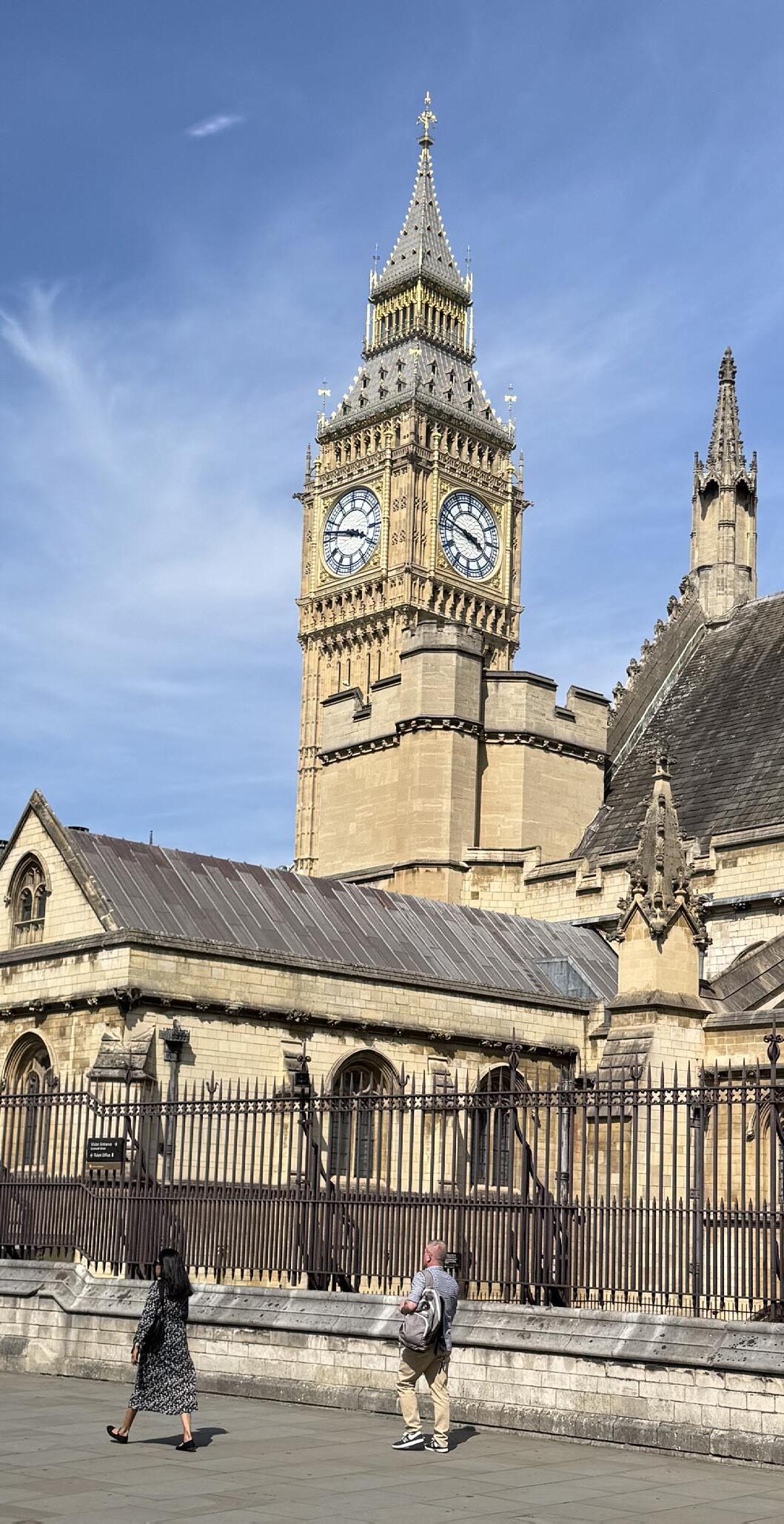
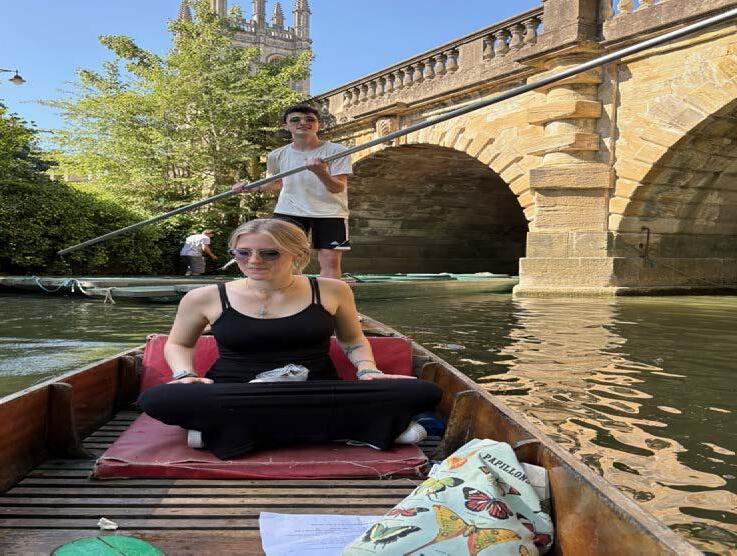
Every year, PLS brings a small group of students to the British capital, as part of the UK Politics & Society Program. Students have the opportunity to learn about British politics in small class sessions taught by MSU instructors, while also experiencing British culture in and beyond London during the four-week program.
The Summer 2025 program involved trips to Oxford, Cardiff, and Brighton. According to MSU Political Science Associate Professor Michael Wahman, who was leading the Program for the third consecutive year, this is a particularly exciting time to be studying the UK, as the country is “one year into the reign of a new Labour government, which is struggling in the polls amid the rise of the populist right.”
The previous summer’s program was particularly exciting, as it came amid campaigning for July 2024 general elections. Students then had opportunities to shadow candidates as they were campaigning for Parliament.
However, this year’s program had its own highlights, including visits to the BBC and the Tony Blair Institute for Global Change, where students had an unexpected photo opp with the former prime minister himself.
For MSU senior Carter Strong, the experience was “eyeopening and amazing.”
“The highlight of my trip was the group’s overnight stay in Cardiff, Wales. There, we took a tour of the BBC, visited Cardiff Castle, and had a fun night out. The best part of the trip was the freedom we were given to explore Wales on our own, as well as spending time with classmates and even our professors in pubs and restaurants,” he said.
Carter enjoyed learning about life outside of London as well.
“Not only did I learn the ins and outs of British politics, but I also learned how different a community England and the broader London area were from Michigan and the United States. We took a plethora of trips to towns like Brighton, Brixton, Southall, Windsor, Greenwich, and others, where we were able to try different cuisines and learn about various histories. Another (less relevant) thing I learned and was impressed by was how efficient London’s transportation system was,” he said.
Overall, the trip was life-changing and Carter would advise any student interested to apply to the program.
“I would absolutely recommend this trip to other students. Not only were the educational aspects of the trip enjoyable, but just being able to live in a flat and experience life as a
Londoner was priceless. There is not a day that goes by that I don’t think of the memories I made in London. Not to mention, there is a lot of free time for students on the weekends, as I visited Dublin, Bath, and other major cities with friends I made on the trip,” Carter said.
But don’t forget to be prepared to handle life outside of the U.S.
“One very crucial piece of advice for people planning to go: bring some type of fan. There is no air conditioning in the flats you stay in, and in Europe for that matter, so plan accordingly. Don’t be afraid to bring an extra suitcase for all of the miscellaneous items you end up buying. Lastly, save up a good $2,000-$3,000 for food, travel, and the like. London is not cheap.”
The British Politics & Society Overseas Study Program gives students opportunities to visit institutions such as the BBC as well as recreational outings such as punting in Oxford and strolling along the Brighton Pier. Photos provided by program participants.
Our mission and how to give
We seek to evaluate, innovate, and invigorate political processes/institutions across our research, teaching, and service.
GIVING INFORMATION
For more information on how to support students and programs at MSU Political Science, please contact:
Rachel Schmidt
Senior Director of Development, College of Social Science rschmidt@msu.edu