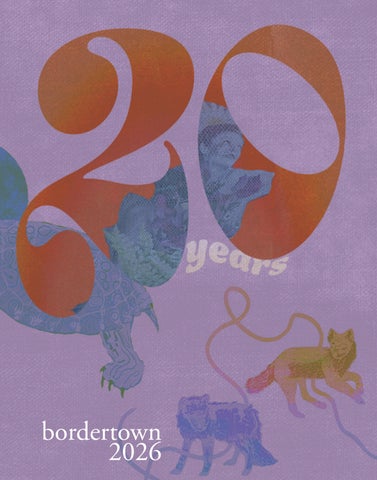
bordertown 2026
i
ii
bordertown
iii
2026
bordertown is proud to be a publication honoring creativity and free expression. Items published in bordertown are selected through a submission process in which editors do not learn authors’ identities until after selections have been made. The opinions and views expressed in these pages are solely those of the writers and do not necessarily reflect the views of bordertown, its staff, its advisor, the Department of Language & Literature, or Missouri Southern State University. bordertown 2026 was printed by Pittcraft Printing in 2026. bordertown 2026 was typeset in Adobe Garamond Pro and Ebrima. bordertown 2026 was made possible, in part, by both editorial and creative contributions from members and sponsors of MSSU’s Sigma Tau Delta chapter. More information about bordertown can be found on Instagram at @mssubordertown. Submissions for bordertown 2027 will open in September 2026.
iv
Editors Lexi Brown Madison Ditzler Shelby Welton Anna Wilkerson
Faculty Advisor Dr. Hannah Dow
Artists Lexi Brown
Cover
Alexis Nessle
Comic, “Sebastian's Confession” p. 54
Taela Terrillion
Flipbook, “Ecc 3:11”
v
vi
Contents Poetry Alecia Arwood To the Thing Called a Heart..........................................5 Kelsey Baughman (Akee) Dog Days......................................................................6 Zach Baughman Love Language..............................................................7 Alli Lee Riechman-Bennett He is the devil...............................................................8 Kindling........................................................................9 Peter J. Bledsoe Attenzione...................................................................10 Maddy Burton The Bus Ride Home....................................................11 November...................................................................13
vii
Poetry (cont.) Myranda Burton love at the horizon line................................................14 Drew Creed Benjamin Button.........................................................15 Maya Dally Imagining a Home not Mine in Chambers: Sonnets...17 Rare Beast...................................................................20 Katherine Frazier Prompt Lit..................................................................22 Alexeous Hall Winter of You.............................................................23 Faith Littlejohn What the Mother Gave...............................................25 What Stayed................................................................27 Sophia Moore Carolina Song.............................................................28 Junebug.......................................................................29 See how the frogs worship and wonder........................31 Street Vender/Son of God (Editors' Award Winner)....32
viii
Poetry (cont.) Shelbi Post Other Lizards..............................................................33 Sarah Prescott My Flower...................................................................34 Lauren Ruth between the hours.......................................................35 Chase Shirk The Knight..................................................................36 O, Blade......................................................................38 They Say “Beauty Fades”.............................................40 Andrew Storrs Far Fields.....................................................................41 Maya...........................................................................42 Cat Tyurikov Cossack Cowboy.........................................................43 Sergeant Baikal - Recruiter..........................................45 Hunter VanValkenburg Heartstrings.................................................................46
ix
Poetry (cont.) Isabelle Walker Cloud Dancer.............................................................48 From the River to the Sea............................................51 Taela Terrillion ASL.............................................................................53
Fiction Gabriel Forrest One Long Party, Vol. 3, Chapter 1 Introduction: “The Hand That Takes”...............................................57 Emily Moore Between Stop Lights....................................................63 Mary Poage Spider..........................................................................67
x
Nonfiction Sarah Prescott Dandelions..................................................................71 Brittney Stinnett Southern Comfort Served Thick (Editors' Award Winner)..............................................74
Reflections Joey Brown Reflection on My Time with bordertown......................80 2026 bordertown Editors Letter from the Editors................................................83
Contributors’ Notes.........................................................87 Editors’ Notes.....................................................................97
xi
xii
Introduction Twenty years. Like the contributors in this 2026 issue, bordertown is old enough to drive a car, vote in an election, purchase cigarettes or lottery tickets. It has reached an age when one might begin learning financial literacy, becoming socially active, falling in love, developing a routine and healthy habits, creating a home, traveling solo, and planning for the future. Already, bordertown has done many of these things, though with one notable exception: it still hasn’t figured out how to make money. But it has crossed oceans and continents, landing in the hands of a contributor in South Korea. It has been socially active, showing up at events across the Joplin area: the public library, coffee shops, downtown Third Thursdays, and of course, all over MSSU’s campus. And while, like any twenty-year-old, bordertown has experienced some growing pains and transformed very much over the years, one thing has remained the same: it has served to create a trusted home for the work of MSSU students. For this anniversary issue, I asked our contributors to reflect on what it means to share in this twenty-year milestone. Here’s what they had to say. What does being published in bordertown mean to you? Overwhelmingly, our contributors expressed that publishing in bordertown is a vulnerable and validating 1
experience. As Maddy Burton said, it “makes me feel like anything is possible and inspires me to keep writing in this crazy, busy world.” For Lauren Ruth, the experience “means I’ve stepped outside my comfort zone.” For alumni like Taela Terrillion, “it brings me back to a part of my life that brought me great joy.” Several alumni contributors— Hunter VanValkenburg, Andrew Storrs, and Maya Dally— were once editors themselves, making this publication a fullcircle moment. For married couple Kelsey Baughman (Akee) and Zach Baughman, the journal served at first as a kind of matchmaker: each had read the other’s work in bordertown before they started dating, and as Kelsey noted, the twentieth anniversary issue is “a sweet, tangible reminder of their shared love for poetry, writing, and the plot twists that brought them together.” Others, like Peter Bledsoe, Sarah Prescott, and Alecia Arwood, shared that seeing their work in the pages of bordertown makes them feel connected to a community—one that extends beyond the physical borders of MSSU’s campus. What were you doing in 2006, when bordertown published its first issue? As bordertown celebrates its twentieth birthday this year, so too do Cat Tyurikov, Alexeous Hall, and Maddy Burton. In 2006, many of our contributors were quite young, but learning important things: Alli Riechman-Bennett “was in first grade, learning how to share.” Some were discovering their creative voices: Faith Littlejohn was “invested in literary classics like Guess How Much I Love You and But Not the Hippopotamus,” 2
while Alexis Nessle remembers being three years old, “scribbling all over a coloring book page” on a particularly snowy day. Where do you see yourself in twenty years? While most of our contributors were understandably reluctant to think so far ahead into the future, several shared visions of a meaningful, creative life rooted in nature. Shelbi Post dreams of “living in a cottage in the middle of a field in Scotland.” Mary Poage would like “to have moved somewhere with lots of pine trees,” Isabelle Walker hopes to be living a life where she can “plunge [her] hands into soil,” and Gabe Forrest envisions “a life suffused with sunshine.” Some, like Katherine Frazier, Emily Moore, and Brittney Stinnett, hope that this, their first publication in bordertown, will mark the beginning of a lifetime full of writing and future opportunities to see their work in print. In gathering these reflections, I’ve come to think of this issue as a sweet plot twist—one that has brought together current MSSU students, alumni, editors past and present, and our cherished readers at this unique moment in time. So, cheers to twenty years, bordertown. I'm thankful to be the current steward of this legacy and I'm committed to planning for our future. May the next twenty years be as joyful, vulnerable, and full of pine trees and sunshine as the last. -Hannah Dow, Ph.D. bordertown faculty advisor (2020-present) 3
Editors’ Award Winners bordertown 2026 is the sixth edition to feature the Editors’ Awards. These awards, selected by the student editors, are given to student contributors for outstanding submissions in poetry and prose. The winner of the bordertown 2026 Editors’ Award in poetry is “Street Vendor/Son of God” by Sophia Moore. The winner of the bordertown 2026 Editors’ Award in prose is “Southern Comfort Served Thick” by Brittney Stinnett.
4
To the Thing Called a Heart Alecia Arwood (2025) I have not been content It sits in my chest, a wounded creature coiled for attack clawing out teeth gnashing hackles bristling every hand extended is a hand raised every word spoken is a lashing it crawls up my throat like a scream until I shove it down like the wretched thing sheltering in barbed wire and mask of fangs they would hold you gently and sing you lullabies while you bleed out in their arms 5
Dog Days Kelsey Baughman (Akee) (2015) If there is something more ominous in the heavy clouds than rain the breeze blows it by unceremoniously Instead the humid heat holds hope. The inky darkness of the night with spots of light like holes pierced through leather with an awl creates the comforting constellations Can these be the same days Homer said Orion’s dog would usher in? Have the portents clandestinely concealed themselves from our view? No…this time Hector returns to Andromache and Paris and Helen grow grey together. No one remembers their names Anonymity the forfeiture for happiness.
6
Love Language Zach Baughman (2016) “I asked you once if Arabic was a tonal language at all” You said it wasn’t. I hate to say “literally” and although we haven’t explicitly discussed it, I’d wager you’re not a fan either… We literally met over love of language ten years ago (a newly minted inside joke) I can’t decide, and will need a lifetime to learn, if possible, at all, if you’re more tonal or kinetic. Brief examples… Tonal: the way you can say my name or “babe” five distinct ways, and you’re close to a breakthrough. Kinetic: a haphazard, only in appearance, defense mechanism shoulder shrug when asked a question you don’t want to answer or one I should already know (although, just yesterday on the plane, you shrugged to be cute, so there’s new data to assess) 7
He is the devil Alli Lee Riechman-Bennett (2022) When a surgical wound heals, it draws hydration and moisture from the rest of your body. So that the healing actually looks like molting and When did you first notice that the wood in the window was rotting, under your wrinkled and clammy hands here with your unbearable want for the notice of rot; and agricultural embellishments, speaking of molecules lost in translation, though not unlearned of in Genesis. bursting, shirking, and shrouding. When the root is thick It draws hydration and moisture from the rest of the pasture. So that growing actually looks like wildfire.
8
Kindling Alli Lee Riechman-Bennett (2022) The kindling that, my love, you left out in the yard past dark, my love, you you left it lit and when I walked the dog this morning and raked the soot an ember landed on my leg and scarred, my love, you don’t need to bandage it I already have but the dog needs to visit the vet and, yes my love, you could not have known couldn’t have known that no you’re fine and I’m sorry and, no my love, you
no again it is fine and I
and I love you, and I shouldn’t have should have worn shoes and asked you if you
no, my love you’re right but
how could I have known you didn’t and you didn’t
you’re right and I’m not
tell me but I should have asked and you’re right but I’m sorry and can we just take a second.
9
Attenzione. Peter J. Bledsoe (2022) Originale
Translation
Il macigno immenso rotto. Non riesco a cavalcarlo più.
The immense boulder broken. I cannot ride it anymore.
Un’intensità che sembra non aver pari tra molta gente.
An intensity that seems unmatched among many people.
La tua forza è come il sussurro del vento che sfiora i rami di un vetusto albero che capisce la Morte.
Your strength is like the whisper of the wind that brushes the branches of an ancient tree that understands Death.
10
The Bus Ride Home Maddy Burton The colors danced across the sky And the clouds ran to the horizon Hurrying, making sure Not to stay out in the nighttime The goliath clouds stumbled over each other Breaking off into pieces of cotton As the sun dissipated across the earth The clouds closest to me were drained of color They returned to the hollow blue they once were The trees blocking the view most Became void of all color and life A darkness cloaked them to hide The beauty that availed in the light The once fiery finish to this day Has now become a dark pink glow The opposite side of the sky has been infected By the dark watery flow The stars freckled her face there And the remaining clouds hover the other side She was beautiful while she stayed And beautiful she’ll be when she returns The sky now blankets in dark blue 11
Awaiting the black to assist in the nighttime leave The light from my bus contests this decision But it is inevitably true The dusk is welcomed forever Until she becomes poisoned with the blue
12
November Maddy Burton When the echoes of fall went silent And the warm, orange glow Shining from the trees and grass Burned out into a brown soot The conversations once spoken aloud By the trees, crickets, and birds Become hushed, whispers And some just don’t talk back at all The stars are now vibrant and alive Waving at each other and shedding glitter across the sky The cold nips at my fingers and nose But it’s too warm to wear a jacket Contradicting in a beautiful way Just another month in the year But so different from her brothers and sisters A forgetful month but I always remember The difficult beauty of November.
13
love at the horizon line Myranda Burton (2021) if we took the seasons’ place, look in your summer face: I’d wait a million winters; let my moon skin wither; you and I; rain and shine; my sweat, your blood— a fragrant musk; the lines of us cut complimentary, but stark— if it’s not your light warming me, I’d rather shiver in the dark.
14
Benjamin Button Drew Creed Benjamin Button’s mother wakes up in a hospital bed the room is dry and smells of afterbirth through the window light blue haze surrounds the megachurch across the street There’s a light on under the bathroom door With a flush and a shuffle, an exchange of fluids out hobbles Benjamin, frail and hunched He waddles his way to his mother, cane in hand He climbs into bed and says Put on some Fox News mom rolls her eyes And flips the channel. She cradles him in her tired arms knees pop as he stretches out the length of her chest soft caresses wash over his back and arms, liver spots on his skin, after only hours of life Like wrinkled grapes in a summer’s heat already fading Carley Shimkus is talking about all gender bathrooms 15
on the box This makes mom and Benjamin have to pee. Benjamin’s mumbling Back in my day when men used to be women because they hadn’t developed yet... He trails off slobber drips from his chin Before long the nurse brings breakfast eggs and biscuits and gravy and coffee, I take milk and sugar Benjamin hands the cup to his mama, She supplies, naturally. Coffee back in hand He pours the sugar and eats This tasted better in the old days, in utero, Sucking down slop—through ma’s tube, Like god intended. One day he’ll be a young man And everything will be new and unpredictable But now he’s old and everything’s cold and known. He knows there’s nothing better than the good ol’ days, when his apartment was rent-stabilized and the walls were made of flesh
16
Imagining a Home Not Mine in Chambers: Sonnets Maya Dally (2024)
First: a thumping heart, one that takes shape by picture window and pulls shadows from corners like dried glue, beats hallways into estuaries and smells not like blood but coins, real ones you could chip clean teeth on. This heart says: I am the mason by bleeding brick, carpenter by christ’s splintered wrist, I set the roof like fat umbrella. I am the scoliosis spine of load-bearing seams. I was born at the kitchen table. I was born at the kitchen table with chubby arms like homebaked bread stretched starlet
17
—
* thin. My mother molds me into something beautiful like her, a backlit pinky promise or wish bone still sheeted by birdskin and rocked by vocal cords. She says: I am the soft nucleus of your one good eye, my hair is thick and long like river and yours will be, too. I will gush my blue heaven into your bed room like morse code and let my firm hand be tendered by give of new skin. Hand be tendered by give of new skin, I have a baby sister. Never have my fingers stuttered over such clarity, new porcelain purse bubbling with milk. She is a clay white umbilical cord prepared for cut, my own still bleeding and beating. She cannot speak but if she could spring magnificence from throat, she might say:
—
I am the corporeal glow of bedtime lighting, my skin provokes song and by my feather lashes, a lullabied apology imagined in shocking color. I am the soul of home and your neat opposite. Sister, I am brilliant mirror but I see you inside the magic pearl sheen of what looks back. — 18
The magic pearl sheen of what looks back may resemble your real childhood home in summertime, a whispered wish under breath beneath cursed shouting, gasp of gunshot, and devastating smack of closed fists on unexpecting skin. In the imagined neat opposite of this home, it is quiet, save for little sighs of breeze through kitchen window and baby sister’s sweet baby sneezes. No one is bleeding and when I speak, my mother bends low, her mature ear touching my unsplit lips. I tell her in nightmares you are severe and your one good eye stays fixed on bad men. Your hair stays short, dead. I see you still in mirrors, but conjure fantasies instead. Thank god this is a home I did not grow up in.
19
Rare Beast Maya Dally (2024) for Raven Dirt roads stretched like taffy over swooning plains like our feet scuffing through dust in step always we were a bridge of embroidered stone you and me my chased shooting star my missing limb once we were so young and you walked with plastic babydolls in strollers motherhood already tickling in your ear we witnessed the slow twists of water when creeks make new we have stuck our fingers into that mud and pulled out gold listen i remember you: neon headbands too tight spectacularly thin wrists and ankles scaredy cat with a trashy sense of humor entirely shocking on a girl of twelve my dream girl with no shame I saw you with me and then I saw you find boys my flower torn from riverbank you exist I know you do I see you through liquid mirror between us now once we were still young and the baby became real and then it became three 20
my silent bigfoot wandering in dark forests with arms at your side belly swollen when I tell this story it always ends and begins in the same place you are pushing a baby in a stroller and I am somewhere beside you with empty hands you are my locked room my girl stuck in time at night I peel your fists apart and peek in at the split lines of what you hold onto
21
still
Prompt Lit Katherine Frazier chat can you make me a poem that comments deeply on the state of the world and if people should be aloud to exist and work and hold and love eachother in style of earnest hemmingsway
22
Winter of You Alexeous Hall I can tell you exactly what it felt like, Down to the churn in the pit of my spine. It didn’t last long, but the cold was precise, A shiver that lingered like frost on thin ice. I remember the scent of my sweater, still near, The smell of my lipstick, each morning applied clear. Skin-tight clothes pressed like they knew every line, The crisp winter air, the naive pulse of time. I remember the world pausing, silent, and still, The future approaching, just beyond will. Alone in the cold, hair whipping like thread, Hands grazing my skin, yet frost where they led. Conversations hollow, kindness running low, Expectations set high, a new standard to show. The cold swept beneath me, like snow it did flow, Yet I stood in it, even wallowed below. Hard pills to come, yet I swallowed each one, Sickness and health, I should have run. But you couldn’t handle, that’s why you didn’t stick, Left me frozen, heartbroken, the pain cutting thick. And then came warmth, where you left only chill, A hand that held steady, a heart that could heal. 23
* Where ice once lingered, now comfort took root, A love that is tender, and honest, and true. I remember the moments, both frostbite and flame, The lesson in heartbreak, is the strength from the pain. From cold to the warmth, I can finally see, Some leave to break us, and some stay to set us free.
24
What the Mother Gave Faith Littlejohn (2025) The forest was green, olive, sage, fern, pine, layered and lush, pressing back when you walked through it. Sap clung to my fingers, amber and honey-thick. Bark scraped skin. Moss held the damp breath of shade. Trees stood close enough that their crowns touched, sunlight breaking through in a shattered kaleidoscope across my skin. The river roared, its glassy braids catching light. Copper and steel-blue stones flickered beneath the surface, edges worn smooth by years of movement without violence. Water slipped over my ankles, cold, clean, smelling of rain and earth, carrying only what it made of itself. I learned this place by standing still in it, where everything made room for everything else. Until it didn’t. Suddenly, a gap where a tree had been. Then another. Stumps pale and raw, sap bleeding down their sides, rings exposed like ribs split open. The forest sounded thinner, 25
wind screamed far enough for us to hear it. The river learned new colors, clouded green along the banks, a film that fractured at a touch. Plastic tangled in roots. Foam gathering where water once moved cleanly through. We saw it. We kept walking. We kept calling it necessary. We called it progress, because trees were still standing somewhere, because the water was still moving. If survival means leaving damage behind, what kind of future are we walking toward, and what will still be alive to meet us there?
26
What Stayed Faith Littlejohn (2025) They dug up the driveway where his blood sank into the gravel, threading itself between stones, following every curve, every place the earth made room for it. Shovels bit and scraped inch after inch, until the stain was gouged, torn out. Replaced with fresh stone, bright enough to hide what happened there. People say it’s fixed. They mean the driveway. Like the driveway, it spread in me, viscous, dark, clinging instead of soaking, crawling, pooling, settling, into sleep, into dreams, into silence. I am not the ground. I cannot be gutted and refilled. I don’t know where his blood ends and I begin. 27
Carolina Song Sophia Moore The ocean spits it up to me— baby blue & baby teeth & sugar sweet & alive. Home is only home when it reaches back. I know this, even when home splits itself open to sing welcome to the land that holds your family’s bones, with the shore that kissed them sorry & the tide that brought them home. But i know that home is only home when the blue pines reach back.
28
Junebug Sophia Moore Emerge from the garden, seven months too late. The same way the creatures were the last to fly from heaven’s hands when his coat was stuck on blackberry thorns and boots in mud. Oh, junebug! Heaven wails, Oh, spur in my side! I will curse you to rot in the ground for half of your life whilst singing of the skies. The bitterness of it is heavy in the song itself, stuck in the back of its throat while flies bite at its exposed green eyes. Angels sing from telephone wires, relay the message back to the skies. The static of it causes his little bug brain to fry. They wail to the creature it is not too late to change! 29
To turn back and repent! To shed your skin the way June melts into July & the August heat slips into the frost that bites your frail wings. & that cold night, where the angels staticked, magicked its song into heaven’s hands, to shed your wings and take flight!
30
See how the frogs worship and wonder Sophia Moore underneath torrential rain, so hard it causes the heavens to split above the creatures. still, they sing, they worship what they do not understand. See how our blood turns to ice? they sing, when the water runs cold, when the salmon swim upstream against time, against the gods of old. & when spring bursts to life again, ancient and hands cold, they start their song anew, see how the gods have reanimated us? How they have held us in their icy grip? Protected us? Swallowed us alive? & the raindrop sized frogs still croon their song.
31
Street Vendor/Son of God Sophia Moore On the side of the road, a man magicks dimes into roses, carefully, he shapes them, poses their form, rounds them into something new. His open palms match God’s own, dirt in the crevices, brown like the rolling hills, white nails on hands that molded his day into future, the word into flesh, & the dimes into roses. & wasn’t the son of God an immigrant himself? Born unto a land without papers, cradled by calloused hands, on the side of the road?
32
Other Lizards Shelbi Post I wonder how it would feel to be a beautiful chameleon. To shift and change with her surrondings. Her new interests. The blues, purples, and reds. Eye catching. Inspiring. Exciting. I really wish I could be a chameleon. I only know the warmth of the sun. But— the chameleon knows the texture of the branch, the sound of the rain, the crinkle of the leaf, and the heartbeat of the wind.
33
My Flower Sarah Prescott Almost cut, just as you began to bud Barely acquainted with your petals A virgin still to bee’s touch Many storms still lie ahead, but oh how good it is to feel the sun
34
between the hours Lauren Ruth around 2am—past the midnight frost i am still up and the light above the stove is on. is this love all for me? the rain is here just as i am how long has it been? the warmth coats my skin as the memories grab hold again from this little night light. too familiar with the sting of empty promises i am not innocent of them either. i’ll leave the light on for you. find me—search for me under the waves of obscurity.
35
The Knight Chase Shirk Although we knew not you, nor still your name, you did not waver when the demons came. Appearing from the wood, you stood fast there between the demons and these people fair. Our fathers and our brothers saw, then cried, and offered up their lives to stand beside. And yet, you raised a hand and said, “At peace, no one but I, on this bright day, will die.” We saw the fighting and your blood’s red hue. The demons charged, and yet, you let none through. We watched them wound you, yet you carried on. You swung your sword through dusk and unto dawn. Upon that fateful morn, when dust had set, with sorry silence then the world was met. A heavy debt was hanging in the air— for which, we saw the price you paid laid bare. Each man and woman, tearfully, we came to you, the woeful one who took the blame. 36
And there you were, among the sin you slew. The whole of town came round, and soon, we knew. Your silent armor now shone crimson red. The price was paid. Your soul for us had bled. The fight was over, and your struggle done. You knelt there lifelessly, but you had won. Now we tell how you sacrificed your life for us, these strangers whom you saved from strife. Now we survive and pass your story down. The price you paid that day lives through this town. Your shield lies battered; your armor lies empty; your sword lies shattered, yet your will shall carry. Because of the blood you spilled, because of the life you gave, I will live on with these families you died to save. There will be generations because of you.
37
O, Blade Chase Shirk O, blade that finely finds its mark in me, you bring to me a melancholic pain. Yet, stronger than the sting of death you give, I see on you the sting of shame engraved. O, steel they forged in flames of wrath and beat into a shape that harvests life instead of wheat. Our foe swung you without your will or want to rend my flesh instead of golden grain. O, edge that cuts without ill will toward me, your scars I see, reflective of my own. Your metal veins are weighed by those poor souls who curse at you and not the hand of man. O, hilt that must be groped by lust for blood And can’t be held in gentle hands of love. How sad your cry for times of peace while forced to swing by those who cry for times of war. O, sadness that is stagnant on my tongue, ironic is your taste that soaks these lands. 38
My salty tears serve not to sate your pain from rage ingrained in men war made insane. O, blood that pools before my fading eyes and taints your innocence with its red dyes. Your brothers suffer all around us here, their surfaces all smeared and soaked the same. O, stench that fills my nostrils here, the filth of sin that men commit yet blame on you. This sin surrounds and steals away the loved, the children, fathers, brothers—now myself. O, blade, how sad your cries that reach my ears. You beat against the hearts of men, condemned to never beat against Love’s ears again. O, blade, I pity
39
They Say “Beauty Fades” Chase Shirk Though Mother Nature scoffs at you and Heaven turns its back, there is no more alluring hue than what the living lack. A snowdrift coddling each time you drape your arms on me, for blood has warmth you pantomime in moonlit fantasy. A rose may wilt, and man may end, yet you can watch and see. So, come, darling, let me ascend and share eternity.
40
Far Fields Andrew Storrs (2023) Sacrifice clover and comfrey so far fields grow The seeds we must sow, to die For next Autumn’s barley and rye Platinum shrouds of powdered snow And canonized ponds in frostbitten halos Its miracles in patience until spring For bullfrog’s croak and meadowlark’s wing.
41
Maya Andrew Storrs (2023) To love you is to love the reticent dawn invoking Spring, the lingering promise of snow and irises, and the assurance of gentle rain kissing your palms in days yet to come
42
Cossack Cowboy Cat Tyurikov Lonesome holy bogatyr Wading east of arctic islands Wading wistful, wistful waiting Wafting like smoke, like a misspake noun The piny woods sharp my senses Boglands, mushrooms rising like welts Where the cloudberries grow in tart clusters of earth The smell of the great arctic on the air The seals beckon me northern ways Past the summer house where my father was a boy Onto the fishing boats, past ancient monasteries Where the white sea laps at your blood The cold salt sticks to your face from the air It lashes you with a joyful fervor The seals beckon further, further away Deep into the ocean, into Eastern bliss My heritage, my love Lonesome sinful cow-herd Riding west of colonial cities Riding thoughtless, riding away Galloping careless, like a misplaced vowel 43
The dry warmth set mind at ease Scrublands, red mud running like blood Where the blackberries snap at fingers like scourges The smell of summer sweat on the breeze The coyotes usher me, bite at me southward Past the family home where I spent my childhood Onto long drives, past crumbling churches Where the rocks get taller and the days hotter The sweat slicks from your brow and you move to replace it Drinking dregs of sweet iced tea The coyotes drive me further, further along Deep into the desert, into Western solace My home, my love
44
Sergeant Baikal - Recruiter Cat Tyurikov Big gray seals all breach on the shore They talk so sharp and evermore They bark, Pomor, Pomor, Pomor They bark, Pomor, Pomor, Pomor Big gray seals speak to my blood They tell me bite the ice, they tell me drink the flood Let the sea mix into my mud Let the sea mix into my mud Navy Seals sitting in a shopping mall They chase you down, you slip and fall You find they never cared at all You find they never cared at all Navy Seals all breach your shore Their hands are loud, their legs are sore They’ll take until you are no more They’ll take until you are no more
45
Heartstrings Hunter VanValkenburg (2022) If you wanted music I would give you the strings from my gut to make a harp. I would play you the best broken bone ballad with my xylophone ribs. If you wanted song I would hollow out my humerus, play a dirge so soft you’d forgive the death rattle in the final note. This is the only way I can love you. My self-desecration is an act of adoration. Let me compose myself into a symphony for you. Let me love you 46
until my body sings its last refrain.
47
Cloud Dancer Isabelle Walker (2024) “A whisper of tranquility and peace in a noisy world.” –Pantone’s 2026 Color of the Year Cloud Dancer kneads cotton in her ears, masks her eyes with sweaty palms, & blows bubble gum bubbles that balloon her into the sky Cloud Dancer overlooks the countless white shrouds encasing Black & brown bodies ignores the white ice letters disappearing her neighbors, battering their bodies ‘til they’re bonded to the black tar pavement, wrists bonded in chains neglects the white spit crusted to the corners of her lips, conserving water for tech giants ignores the spiked white hoods waltzing upon stolen land as their river of champagne burns a chasm through it avoids the white maggot dumpster food turned 48
snow eating into the skin of the unhoused Cloud Dancer ignores the white hands bleeding Mother Earth until her corpse turns as white as their greed
49
50
From the River to the Sea Isabelle Walker (2024) Maybe if Palestine bloomed within the womb of Mother Earth–reverberations of bombs turned ultrasound heartbeats–the West would profess sanctity of life. Maybe the pits of empty bellies awash only with a river of salted tears & pluming dust would rouse the morality seeping from winter-cracked lips. Instead, Palestine crumbles to a tomb no white Jesus-rolled stone can resurrect. The land where freedom rings like a bell muffled by piercing screams sweeps body parts into party favor bags Take this home to Mama. No. Take Mama
Home. 51
52
ASL Taela Terrillion (2018) Invisible words float like the wings of birds. Matched with impassioned expressions that are louder than the crashing waves. The embodiment of love at first glance.
53
54
55
56
One Long Party, Vol. 3, Chapter 1 Introduction: “The Hand That Takes” Gabriel Forrest The stars fell, back in 1833. This is well-attested. N. Scott Momaday once pointed out that the Leonid meteor shower that year is among the earliest entries on Kiowa calendars. A preamble to disintegration; a vision of violence soon to arrive. But arising was no normal bloodshed, on the horizon. Nor was it the end of time, as some who had seen it had hoped. What was to come was the collision of hitherto unelided worlds. The firefall, on that bright, fateful night, was spalls from some great empyreal burin, struck on its graving-edge, with which God was to again chisel out and divide the land. How the stars did fall, indeed, like shards of knapped chert, remnants of a life eked from sheer stone. The buttes of Monument Valley, rising stratified from the siltstone, seem the trunks of gigantic trees. One cannot tell quite what they are. Perhaps they are but stumps, squat leftovers of a transcendent lumberjack’s escapades. Alternatively, perhaps it is that by a continuum of antehistorical growth, they have traversed spaces well past the dome of the sky, branching into the orderings of a cosmology utterly beyond. In New 57
Mexico, the floor of Chaco Canyon, with its eons-old alluvium, is crossed by a dried-out arroyo. It is a tributary of a tributary, connecting to the fan of riverbanks linked through the Four Corners region of the Colorado Plateau, land of laccoliths and spirous hoodoos. The area’s ancient inhabitants labored against its now-lost forests of ponderosa pine, by tumplines dragging the timber to their dwellings. Atop its Fajada Butte, a spiral petroglyph, of some archaeoastronomical import, is sliced, by the play of light, with equinoctial precision. Degraded by modern footsteps, its timekeeping function no longer fully survives, and as such it has been unviewed by the public for some time. To its north, Mesa Verde’s berms line wide lanes, lead to structures mortared with adobe, cubic and conic, pitted with round chambers, brickworn edges like torn paper. Of the Ancestral Puebloans, when faced with Cliff Palace, one can say nothing but that their works remain. But they do not, having been routed by drought and disease, moving away and leaving this world confused and conflicted as any other by the cruelty of things. Deep in their kivas, used then as now, there is a sign for us latecomers. A symbol, maintained by their descendants to the present day, a sole clue toward the mystifying times we now live to see: sipapus, images of the hole from which these durable souls seeped here to begin with. Entering the world. The Diné Bahane’ describes how, laddering from the turmoil of worlds like jet, turquoise, abalone, and whiteshell, the people shored themselves up here. Let’s go down the Little Colorado, a bit past it, through Arizona. At Window Rock—the capital of the Navajo Nation, run through with long-spanning roads—the reservation is 58
overlooked by a formation of Entrada Sandstone, arched with a gap like the brusque end of a slide. Farther away, the rock becomes crossbedded, angularly layered, as though the result of two continents abruptly stuck together. Out there, though, things are different. The self is more readily part of things. Hózhó is zoned to the sky’s limit, and wonder comes not from oneness or twoness, but the togetherness of the red and blue. Kajulew—a K’iche’ Mayan term meaning “skyearth”—may be the best descriptor. The Maya and the Navajo are not so unrelated as national borders may make it seem. They both have stories of man’s creation from corn, and, as with countless other peoples of the Americas, share a mytheme of Hero Twins. The stories are all their own, distinctly different, yet they nonetheless seem to come from some common origin. Hunahpu and Xbalanque, Naayéé’ Neizghání and Tóbájíshchíní—in both stories, in times after the boys’ polarized powers, the people made their treks, shedding lines of settlements across the land, eventually stopped in their tracks by welcomes or wars. The land, however, remains itself, being largely undividable even by mankind’s best efforts, whether words or willpower. There, near that truer unity, a mythistorical existence may seem more clearly attainable. But it is no longer our state to be whole. To behold such a thing is only to remind ourselves of our internal fragmentedness. Broadly speaking, of a broad “we,” we betray this by the fact that it is not our body but our organs that we attach to specific sensations. Hungry to the stomach, horny to the penis: our drives are sequestered. This, itself, is not a new development: but, back in the day, we did not dissect ourselves in quite the same way. Our parts were 59
projected onto the gods. They presided over fertility and food. But there’s a distinction here to be made, too: it was not just over us that the gods had their reign. The outside world—rain, sun, and grain—was as arbitrated over as we were. This implies a union of seeming parts, something we now lack. We and the world around are separate. We were not made from maize, as the old ones were. We did not unsettle Vucub-Caquix, vain baneful bird, blueteethed and whitenosed, nested in his metal home. We did not, in sight of his majesty, magnify ourselves by swapping out his face with kernels of our own kind. We have done nothing, so we say. We are no thieves. Yet we suffer, overweening, less consistent in our being than mere woodcarvings, mere manikins. ‘ Koyaanisqatsi drudges down to naqöyqatsi. The aftereffects of this pride are not always disastrous—for example, the Smithsonian once peacefully repatriated wooden effigies of the Ahayu:da to the Zuni after nine years of careful deliberations between both parties—but this is not the norm. The British Museum is in possession of an Aztec sculpture: a serpent, doubleheaded, mosaical with turquoise and spondylus shell, whose eyes, perhaps once pyrite affixed with beeswax, have been lost to time. There is a head on each end. It is hollow from the back. The line of the body, studded with cabochons, serves to capture and subtilize the light along its tiles, into a tessellation of manymirrored scales, in which a living world takes on the semblance of death. The sculpture’s details whisper many things, but above all, that it depicts a creature of extraordinary ego. It is not of our ilk. Nonetheless our minds have its mimic. Reflecting and refracting across 60
the edges of our experience is this selfsame snake, striated and vertiginous, tussling with us. Consider: that conscious superiority is unconscious inferiority, and vice versa. This is his body, struggling within us, past sight of ourselves, gameplayer and gamemaster, false in both roles. Our rules are not his. He is the linchpin centering the self, and his sphere is that of mirages. But beware: he, doublecrosser, doubled across the wall of our day and night, is bewitching as starfall. For a mirage is no mere illusion, but twinned to the real, a sticky trick of the light. They are of beautiful hues, twined with truth, and hew closely to those most intimate hopes the soul keeps. For instance: on January 1st, 1889, Wovoka, woodcutter, awoke from a coma after a total solar eclipse. He had seen. The nanigukwa, the Ghost Dance, needed to be revived. Soon the dead would resurrect, the buffalo return, and balance be restored to their lives. It spread through the Paiutes, then the Utes, then like wildfire across the States, burning through the Colorado Plateau, reaching as far east as the Missouri River and going south, past Oklahoma, into Kiowa and Comanche territory. There were skeptics—the Navajo, ever-wary of the line between life and death, broadly didn’t buy it—but that didn’t matter. Enough wanted to believe it. For that otherworldly time before their prior way of life at last fully unknotted, and their pained wants came tragically to naught, they stood, dancing in a circle, for that sunwarm world of bison and lost brothers, clockwise slowly shuffling, on the grassland, like men turning a capstan… But that was then. Now, outside, lay heaps of brushwood, substance of the first home, as of late burnt for burning’s sake. Inside, the walls are like bonetooled 61
rawhide, the room deflating under its own weight like an emptied, sunken parfleche. The boys’ sleepclothes are lacerated with color and shadow. Their eyes ache and sting. They stumble, as though hierophants, initiated and blind, irritated by the grit of a sandpainting idiotically stepped in, dirtied, desacralized. These are boys who know nothing of the desert and its deceits. The day is Thirteen Mazatl, the trecena of Cuauhtli, the eagle. It is a time for hunting, for gambles, for games with stakes.
62
Between Stoplights Emily Moore I closed the trunk with a thud, pressing down with both hands just to be sure it latched. The heavy sound reverberated against the quiet of the street. I paused and let my palms rest on the chilled metal for a moment, listening, breathing manually. No doors opened. No porch lights flicked on. Dew soaked into the cuffs of my jeans as I stepped back from my car and reached into my pocket for my keys. They slipped from my fingers. The metal hit the rocky driveway with a clang, and the short faded blue lanyard twisted as they hit the ground. I stared at them; they stared at me; my chest felt tight. When I reached down to pick them up, gravel stuck to my knee through the rip in my jeans. Standing again sent a rush to my head, unsteadying me. I leaned a shaky hand on the side of the car to recenter myself. I opened the driver’s door and slid into the seat, pulling it shut behind me. The worn leather was cracked, exposing the yellow, spongy cushion at the seam. The inside of the car smelled faintly of sweet coffee and must. In the passenger seat, the corner of my bag sagged open just enough to reveal the brown stuffed dog tucked inside. I should’ve been surprised when the engine started, but somehow it always knows when I’m looking for an escape. I glanced over at the hollowed-out space where the 63
radio and CD player used to be. The silence felt heavy, but it matched the weight in my chest, and I was glad to have my thoughts entirely to myself. Houses passed slowly with dark windows and porch lights still glowing. Most people were still asleep as the morning light filled the gaps between the trees. No one needed anything from me yet. My phone vibrated in the cup holder, startling me. I glanced down long enough to see my mom’s name light up the screen. I could guess the contents of the message before seeing it. A third message followed before I could look away. Then a fourth. I didn’t open any of them. I already knew that something had happened, or someone was upset, and I was expected to step in and make it smaller, more manageable. At the red light, I rested my hands on the steering wheel and stared through the bug-streaked windshield. I ran my fingers along the smooth rubber and thought about how many times I’ve had conversations like this. Carefully choosing my words based on what I know they want to hear. Taking mental notes of which words made their voices softer and which words made them louder, angrier. I learned way too early how to carry messages that weren’t meant to belong to me and deliver them in a way that I thought would make everyone happy. The light turned green. I drove through it. I didn’t plan on stopping at Starbucks, but my blinker clicked on by itself, muscle memory guiding me into the parking lot. The building glowed softly in a warm, manufactured way. A few cars were already there. People sat inside with cups in their hands; shoulders leaned together, touching. I parked near the exit and shut the car off. The silence 64
was like a heavy blanket that draped over me, thick enough to dull my running mind. I sat there with my hands in my lap and leaned forward until my forehead pressed against the curve of the wheel. My chest felt tight again, then hollow. I stared at the Starbucks window in my rearview mirror. A barista handed someone a drink. A couple stood close together, sharing wired earbuds. A woman pushed the door open laughing into her phone. Everyone looked—held. I grabbed my stuffed dog from the bag in my passenger seat and pressed it against my ribs, curling myself inward without meaning to. The fur was warm from the sun that was lingering through the windshield. I hated how much I needed that small comfort. I hated that it worked. A car pulled into the space beside mine. I froze and wiped my face quickly, turning my head away so they wouldn’t see my expression. Even now, even completely alone, I was trying not to take up space. When I heard the car doors slam shut and their footsteps move toward the building, I finally sat back. My eyes burned. My head ached. My phone buzzed again, bringing me back to reality. I sat my phone face down in the seat beside me and let out an exasperated sigh. I turned the key in the ignition and let the car start moving forward before I could second-guess myself. Sunlight slid across the busted, dust covered dash and warmed my hands on the steering wheel. It was too bright, so I flipped the visor down, squinting. As I pulled out of the parking lot, a distant memory bubbled up to the surface without warning. I was standing in the hallway of our old house, my little toes curled into 65
the carpet, holding the phone with both hands because it felt too heavy for just one. My dad’s voice on one end. My mom’s on the other. Me in the middle, softening sentences before letting them out. Leaving pieces behind. Learning how to make things sound easier, less aggressive than they were when I relayed messages from one parent to the next. The road curved homeward. I considered driving until I couldn't anymore or maybe until I came across a cozy place to stay for the night. Just one night with no one expecting anything from me. My phone buzzed again. I didn’t reach for it this time. I just let it sit there between me and the stuffed dog sitting protectively on top of my open bag. At the next light, I reached over and pulled the dog toward me, so it was covering my phone screen. The fabric was still warm. I left my hand there for a second longer than I needed to before pulling away. The light turned green and I drove forward. The tears came quietly at first, and I wiped them away fast like someone might be watching. The back of my throat burned from holding onto too many feelings for too long. I told myself to stop. A small sound slipped out of me before I could catch it. I leaned forward and grabbed the steering wheel with both hands, tightening my grip until my knuckles turned white. My arms shook. My jaw clenched so hard it hurt. “What if I choose me?” I whispered. The words felt both honest and wrong at the same time. I felt guilt wash over me for even thinking about it, but really— what would happen if I chose myself?
66
Spider Mary Poage Arthur hums happily along with the radio, one hand tapping the beat on his thigh. Thick green brush interspersed with stretches of pale yellow fields pass in a kaleidoscope blur. The road stretches before him, open and endless, save for a few splatters of unfortunate insects that smudge the corners of his view. He'd read somewhere that that was one of the signs of the changing times, wasn't it, that there weren't as many bugs around to smash onto windshields anymore. Was he supposed to feel bad about that? It still seemed too many to him, and he spritzes the wiper fluid again in a vain attempt to clear away their ghosts. There was a long way to go. He’s been looking forward to this. It’s been too long since he’s really been able to get out there, get away from the mind-numbing bustle of small town life, really get back out into nature and connect. The campsite had looked amazing in the pictures online, majestic green pines towering over pebbled streams and flowering meadows. And, of course, it was fully functional, with a shower house and bathrooms within an easy ten minute hike. He goes over the checklist again in his mind—air mattress, bug spray, camp stove, cooler, deodorant, flashlight, fold-up chairs, garbage bags, headlamp, mosquito net, plastic bins, power strip, sleeping bag, slippers, soap, 67
sunscreen, tent, and a welcome mat… Gwen hadn’t wanted to come on the trip, not if you’re doing it ‘like that’, she’d said. She’d called it glamping. Well, excuse him for not wanting to crap in the woods like an animal—this trip was about more than that! It was about finding himself, breathing in that fresh, piney air so cold and pure it almost hurts, about watching fish as their silvery shapes darted around in the stream - maybe he’d try and fish for a few, although he hated the taste. As the wiper fluid streams away, there's something else, a small crack on the corner of the glass. It catches his attention as it moves. Spindly, shattered-mirror strands that extend and curl... the spider waves its legs. His heart catches in his breath for a moment before Arthur exhales. It's only on the outside, surely, though he registers distantly it is strange that it isn't pressed into submission by the speed of the road. The spider slithers down onto the dashboard. Arthur’s hands tighten white-knuckled on the wheel, and he swallows down a shriek so high-pitched it hurts his throat. A spider! In his car! The announcer's voice fades out as a new song starts, but the change barely registers. His eyes flick between the open road and his treacherous, unwanted passenger. It isn’t moving, thank God, but it’s too close as is. He can already feel it on his skin, a phantom tickle on the back of his hand that has him rubbing it, paranoid, against his jacket. He’d ignored one of those phantom tickles, once, in the sleepy hours of midnight, and of course that had been the one time there was a beetle that had crawled into his bed… He’d slept on the couch for days afterwards, in fear it might return. Gwen had made fun of him. The spider inches slowly, incrementally closer, and Arthur 68
swears at it. “Just—stay! You stupid insect! Stay away from me!” For a moment, he thinks it might have actually understood. The spider is frozen, staring back at him, beady eyes pinning him in place. Can spiders understand intent? What is it thinking in that little brain? How could it look at something so much bigger, louder, more powerful than it, and move closer? “They’re more afraid of you than you are of them,”Arthur scoffs to himself in his (almost) empty car. Maybe a spider’s brain is simply too small to understand its place in the world. The spider waves its little arms creepily in the air, then scurries forth in a burst of speed that causes his hands to jerk, the car briefly swerving across that solid yellow line. He quickly brings it back under control, scolding himself, but the spider is so close now, close enough to raise the hairs on the back of his neck in a matching fuzzy fashion. He looks into its eyes, and there are so many of them looking back, double his own and doubled again, pinprick void black reflections that he still can't find himself in. The spider still toddles towards him, a brave or stupid David to his Goliath, and it extends two of its legs again, feeling its way up in the air towards the wheel— SMASH. Arthur laughs, giddy relief escaping from his chest. The spiders’ guts are splayed on his car, one leg still twitching valiantly. He curses that he hadn't had the forethought to grab a tissue, first, and avoid this mess. It had just been a bug, after all. 69
The miles crawl on as the altitude climbs, brush transforming to rocky crags, the smooth highway turning onto a rougher dirt path that begins to jostle his car. The spider’s body still clings onto the plastic field of its final stand, drying now to a crusty tumbleweed ball. He’s considered brushing it away, but just the thought of reaching out to touch that stringy corpse makes his lip curl and his stomach churn. Or maybe the churning of his stomach is hunger. Reaching awkwardly over, giving the spider a large berth, Arthur thumbs open his glove compartment. The road narrows abruptly, and he turns his attention back to it, eking out around the wall of stone that’s appeared on one side. He digs around blindly, fingers searching for the granola bar he knows he’d stored away inside there… There, a plastic-y, knobbly rectangle—but something’s off. Had the packaging ripped? It feels like it’s covered in… crumbs? Arthur looks down at his hand. Dozens of light-colored, delicate little specks swarm over his hand in a wave of shifting patterns. Hundreds of infinitesimal limbs flowing up his wrist, his arm, a flood of unthinking, unfeeling little bodies, and as the newborn spiders reach his shoulder and envelop his neck Arthur opens his mouth and—his cell rings from the center console. Arthur doesn’t pick up.
70
Dandelions Sarah Prescott When I was little I believed dandelions existed for one purpose, to grant my wishes. I’d pluck their round feathered heads and blow until my cheeks hurt, coaxing even the stubbornest of seeds to take flight. The tiny white parachutes lifted into the air, drifting across the yard, over the fence, and off toward faraway places only my imagination could reach. I tucked my dreams into each seed, hoping that one of them would fly off and plant my future. Dandelions throughout history have been made into teas and tonics, used as a natural remedy. Yet this knowledge is not widely spread anymore. Now these flowers are one of the first things that many homeowners try to kill. Stripped from lawns, dosed in poisons, and uprooted for the crime of growing wildly in a world obsessed with control. Society has decided that the perfect yard, one that is uniform, controlled, and predictable matters more than a flower brave enough to grow wherever it can. When do we stop marveling at the golden flowers and start seeing a weed? Start calculating how quickly it will spread across our carefully maintained lives? Despite society's efforts, dandelions are resilient. I’ve seen them grow through cracks in sidewalks, lifting their sunburst heads through concrete. There is something magical in that kind of persistence. 71
There have been times where I have felt like that. Pressed flat by expectations. Trimmed down into what someone else thought my life should look like. However, some small, bright part of me kept pushing upward. When I first tried to follow the path my family expected of me, tried to frame my future into a neat green square, it felt like I lost the wild parts of myself. My parents separated when I was younger and it became just me and my mom. She couldn’t afford to take me to many places so we found our adventures between the pages of books. The library became my passport. Each swipe of my library card took me to bunny tea parties, enchanted forests, and far off kingdoms. Every day I would come home with a mind full of things to wish for, ready to send them off with the wind. However, as I got older I was told that dandelions weren’t magical, just weeds to be pulled up. Wishing was frivolous. I needed to focus on being practical; start college right after high school, choose a major for stability, like nursing, one that secured the picket fence lifestyle I didn’t have growing up. The future that was once bright with my imagination was dimming. I tried that life for a while. I kept waiting to feel that spark I’d once felt when I dreamed about my future but it never came. Instead all I felt was a quiet ache. A feeling that I was lacking something essential. However, I did not find my seed growing within those sterilized halls. The one that I entrusted with all my dreams. Eventually I couldn't ignore that ache anymore. I didn’t see the value of pruning myself down into a future that never felt like mine. So I dropped out. I felt embarrassed at first, watching as my friends graduated and began their careers and feeling like I had been left behind. I 72
had to learn how to accept setting my own pace. Part of this acceptance was returning to what had always made me feel alive, books. It was there, between the pages of those books where I saw my future start to sprout. Books had inspired both versions of myself. From the little girl escaping to imaginary lands, to the young adult who got lost navigating expectations. That's why I’m studying to be a librarian. I realized I wanted to help others find their spark. To foster new generations of dreamers. Helping them send their hopes off into the wind. Dandelion seeds can travel miles, each one topped with fluffy white propellers. Carried by nothing more than the breeze and the hope that even in the most unlikely of places soil waits. They don’t wait for perfect soil. Those stubborn flowers grow anyway. Many of my accomplishments were once seeds in the wind. I didn’t know where they would land, or if I would reach them, but they drifted until they found a place to take root. I now watch as my nieces scatter their wishes across the yard, and every once in a while, I make my wishes too. Not because I believe the wind will grant them, but because naming a hope and then releasing is its own kind of magic. At that moment I am that small girl again, believing in the possibility that drifts just beyond the fence.
73
Southern Comfort Served Thick Brittney Stinnett “Do you want to see a magic trick?” I ask my son as he leans over the skillet, eyes wide. I sprinkle flour into the hot sausage drippings, and together we watch as it bubbles and transforms into a thick, savory gravy. His face lights up, and in that moment, I see a reflection of my past; of myself. When I was six years old, I stood over my father’s skillet as he asked me this very same question. Back then, I thought he was showing me magic. Now, I know he was giving me something much greater, something that would remain long after the meal was gone: the comfort of being a child in a world that demanded I grow up too soon. I was born in Texas, but most of my childhood was spent in Missouri, where I was forced to live with my mother and stepfather. There, love was scarce, and affection was something I learned to stop expecting. I was the “red-headed stepchild” in every sense of the phrase, constantly walking on eggshells in a house where my stepfather’s anger ran the show. Even now, the slam of a truck door, which, at the time, signaled his arrival home each day, still makes my heart sink. But summers with my father in Texas were different. During my time with him, I got to live in the house he shared with my grandparents, where mornings began not with fear, but with food, laughter, and 74
love. On the weekends, this love was served Southern-style on a big, buttery biscuit smothered with a thick pepper-cream gravy. Though the year was 1996, the house itself felt as if it had been frozen in time, stuck in the 1970s. Pink carpet blanketed the living room, which was separated from the kitchen by a halfwall with brown wooden spindles. Against the adjacent wall was a massive built-in bookshelf, where my grandparents proudly displayed their extensive collection of souvenir spoons and bells, accumulated from their travels across the world. A few feet in front of the bookshelf sat the couch. Every summer, my father would hide in the space between, waiting to jump out and shout in a melodic tone “Here she comes to wreck the daaaaay!” And though he was mimicking Jim Carrey in Liar Liar, I knew it was his way of letting me know he was glad I was home; with him. Beyond the spindles, the kitchen floors were covered in cream and orange patterned linoleum, cream-colored counters with metal edging lined the walls, and a heavy yellow glass light fixture hung above the dining table, softly illuminating the room with a warm golden glow. The table was surrounded by cushioned rolling chairs, the kind that squeaked across the linoleum as we pushed back to get second helpings. Beside the table, the bay window opened onto the sprawling backyard where, just beyond the garden, there was a direct view of the tennis courts across the street at Doornbos Park. As we ate, we’d often watch a bluebird splashing endlessly in the birdbath. “Jimmy’s back!”, my grandmother would joke. She named the bird Jimmy, after my father, as they were both known for taking many baths each day. Of course, it was impossible to know if it was actually the same bird 75
that greeted us day after day, but it was always a bluebird, and that was enough for us. For most of the year, my knees buckled under the massive weight of the stress and dread I was forced to carry in Missouri, where just “being a kid” often had even heavier consequences. But in Texas, under that yellow light beside the bay window, I had the best childhood of my life. My father and I would begin our Saturday mornings by making biscuits from scratch, the counters and floors dusted with flour by the time we were finished. Every weekend, he stood at the counter in his usual attire: a tee shirt with the sleeves cut off, khaki-colored cargo shorts, and white New Balance tennis shoes; the same outfit he wore whether it was blazing hot outside or snowing. His sandy blonde mullet brushed against his shoulders as he leaned over the dough, working it with practiced hands. Next to him, I would stand with my own ball of dough, trying to mimic his hands with my own. Occasionally, I’d sneak a handful of cheddar into the mix, grinning slyly as I quickly worked it into the dough before he could notice. Sometimes, he pretended not to see, letting me believe I had gotten away with something, and other times, he’d laugh and shake his head, warning me that I might “ruin a perfectly good biscuit”. I always wondered if those words were really his, or if they were my grandmother’s, because the look on his face when he ate them told me he loved my biscuits just as much as I did. When the biscuits were golden and the gravy was thick, we carried everything to the dining table and set it beneath the yellow light. There, my grandmother, who smelled of vanilla and patchouli, was always waiting, her dark auburn hair freshly 76
permed and styled, nails painted from her latest routine trip to the beauty shop. Short and round, just like my grandfather, she carried herself with a kind of pride that never seemed to fade. My grandfather sat beside her, his dark tan skin standing out against his white undershirt. I could always tell when he entered the room, even if I had not yet seen him, as the scent of sandalwood and oat would permeate the air. He was a man of small quirks, whether it be wearing straps that connected his socks to his underwear, or wiping his dog’s butt after walks so that she could curl up in bed with him. To this day, he’s the funniest man I’ve ever known. His thick glasses slid down his nose as he smiled warmly in my direction. My grandmother’s smile mirrored his, and together, their smiles illuminated the room more than the yellow light. When I was there, with them, I didn’t have to wonder if I was loved; I knew. Decades later, the weight of those Missouri days still lingers sometimes, but so too do the memories of Texas. Now, with my son standing beside me, staring at the skillet with the same wide eyes I once had, I feel something steady inside of me. I don’t tell him where I learned this, or how rare it once felt. I just let him believe, at least for now, that magic exists. And perhaps it does exist; in simple moments, in Saturday mornings, in the way we show up for one another. The kind of magic that was once given to me under that heavy yellow light, I now give to him. The kind that tells him, without question, that he is wanted, he is loved, and that I’m glad he’s home, with me.
77
78
Reflections
79
Reflection on My Time with bordertown Dr. Joey Brown bordertown Faculty Advisor 2005–16 & 2019–20 In 2000, when I joined the faculty of the Department of English & Philosophy at Missouri Southern State College, my new job involved taking over the faculty advisor position for the college’s arts journal, The Winged Lion. That first incarnation of the journal had existed since the early 1970s. It was a joint venture between E&P and the Art Department: the student editorial staff spent fall semester collecting submissions and choosing the writing to be published, while the student art staff spent spring designing the layout and cover. As a writing professor and the new advisor, I loved from the beginning that the experience was student-led. Students solicited the submissions, they came up with the submission campaigns, they debated what would be published & why, they made all the decisions, and they compiled the magazine. Journals need vision, year-to-year, in addition to an overriding identity. Getting to be part of a project where all that depended on the students involved was . . . well, it was just really cool. In the next few years, a lot changed. The department expanded our offerings in writing, we grew from a college 80
to a university, and the students who worked on the journal came up with a new vision: that the journal should become two journals, one featuring more of the work of Art majors & produced in that department, while students in our department envisioned a journal dedicated to creating more opportunities for the writers on our campus. And that’s how bordertown came to be. That year we transitioned into an independent literary journal was tricky, yet wonderful. A lot of people had become accustomed to the presence of The Winged Lion on campus and were curious about why we wanted to change things. It’s a good to have your community invested in the arts you’re teaching and creating, and tradition is a weighty presence. So, it was understandable they were a bit hesitant we were changing things up. But the journal is and always has been about enabling opportunities for our students—not just those published in the journal, but those who wanted to learn about editing, publicizing, reading, writing, and assembling literary magazines. The move made perfect sense, and our students benefited. The first issue of bordertown had a small staff, but a great leader in Charlotte Hopper, a Professional/Technical Writing major & intern who led that transition. She designed the submission campaign, researched new names, and fostered so much enthusiasm & cooperation among the student staff. It set an exciting precedent followed up by the next year’s staff with what we long called the “postcard edition,” a vibrant turn of editorial direction. Becoming our own journal brought a new era of learning into being. It was a thrill for me to watch students feel encouraged to share their 81
ideas, to dream, and to make work in which they had so much pride. From then on, bordertown has been a distinct, evolving entity of its own. It has undergone changes in look, editorial direction, and design. That shows how times change, how views of art and writing change, but also how our students change. bordertown is a living creation, limited only by the imaginations of the students who participate. I am grateful I had the opportunity to be part of bordertown’s history. I’m proud of the work MSSU students contributed, as I hope they are. Congratulations, bordertown, on your 20th edition! Here’s to another 20 years—and more!
82
Letter from the Editors Dear Readers and Contributors, As you read this issue, you bore witness to the diligent work of talented MSSU students and alumni. These pages embody the countless hours of intention and courage behind every artist’s vision that flourishes in their creations. Our role in bringing their minds’ beauty to print is a privilege we do not take for granted. We are honored to have helped 28 contributors from different backgrounds see their work in print—whether for the first time, or as part of an already vibrant publishing journey. Their unique voices unite to shape an exceptionally special 20th anniversary issue of bordertown. For all of us, serving on bordertown’s editorial staff has been a great joy. When you submit your work, every piece is in hands that handle art with care at every step. We hope our care was felt in these pages, and that reading this issue carries even a fraction of what it meant to us to assemble it. Twenty years is no small milestone. Over time, much has changed, but this care remains constant and at the heart of bordertown: care for the work, for the writers and artists who share it, and for the process of sculpting something that endures. As Dr. Brown reflects, bordertown is a living creation. This issue is a pivotal moment in its life. Though we have not seen bordertown through all 20 years of its history, we are deeply aware of the legacy we step into. Before us, there were many 83
other hands, and there will be many more who come after us. To take part in that ongoing work, no matter how briefly, is a privilege. We may guide the publishing process, but bordertown belongs to you. It is shaped by your words and willingness to share them with the world. Thank you to our contributors, past and present, for trusting us with your work. Thank you to the faculty advisors who guided bordertown over the last two decades. Thank you to our readers and to Missouri Southern State University for continuing to support student publishing. And thank you especially to Dr. Hannah Dow, whose active leadership and passion for editing continue to inspire us. We are grateful to have helped bring your work into the world, and we look forward to all that is to come. With immense gratitude, Your bordertown Editors
84
85
86
Contributors’ Notes
87
Alecia Arwood graduated in Spring of 2025 and is now
happily teaching ELA. She has her degrees in Middle and Secondary Education as well as Certificates in Creative Writing and Linguistics. She enjoys baking, spending time with her many animals, and hearing all the interesting stories her students tell.
Kelsey Baughman (Akee) is originally from Northwest
Arkansas and now calls Joplin, Missouri home, where she lives with her husband, Zach, and their miniature Dachshund, Monte (who firmly believes he runs the household). She graduated from MSSU in 2015 with a degree in English and was published in the 2014 issue of bordertown. Kelsey loves cooking (and, more importantly, eating) all kinds of food, and she’s always up for traveling somewhere new with Zach—especially if there’s something delicious involved. bordertown holds a special place in Kelsey’s heart. Both she and Zach had poetry published here before they were even dating—so you could say their love story was foreshadowed in print. It’s a sweet, tangible reminder of their shared love for poetry, writing, and the plot twists that brought them together.
Zach Baughman has proudly called the Four States home
for the past 18 years and now lives in Joplin, Missouri, with his wife, Kelsey, and their dog, Monte—a charming (and playfully stubborn) mini Dachshund. Zach graduated from MSSU in 2016 with a degree in Spanish Education. A year earlier, he met his future wife in Spanish class after she read his entry in the 88
2015 bordertown publication and was moved by his honesty. Since bordertown played such a pivotal role at the beginning of their story, one of Zach’s first gifts to Kelsey was tracking down a copy of the 2014 edition—the year she was published.
Peter J. Bledsoe was born in Chicago and graduated
Summa Cum Laude from MSSU in 2022 with a BSE in Secondary Education ELA and a certificate in Linguistics. Since then, they have acquired a TESOL certificate and a provisional ESL endorsement. Peter was previously published in the 2021 and 2022 issues of bordertown, receiving the Editors’ Award in poetry twice. They are passionate about music, language, computer modifications, and a burgeoning hobby in 3D printing.
Madison (Maddy) Burton is originally from Southwest City, MO and attended McDonald County High School. She is currently attending her sophomore year at MSSU, majoring in Nursing with a certificate in Crime Scene Investigations. Although she has written poetry for many years, this is her first official publication. She has a fascination with nature and its components, such as meteorology, wildlife biology, botany, and geology. Her interest with nature and how it interacts with people are what influence a majority of her writings.
89
Myranda Burton graduated with a Bachelor of Arts (BA)
in Literary Studies from Missouri Southern State University and a BA in Bible and Interdisciplinary Studies from Ozark Christian College in May 2021. In addition to publishing her first poetry collection, Poems for When You’re Falling, through Tiny Toad press in the fall of 2024, her poetry has been featured in previous issues of bordertown, The Joplin Toad Magazine, and she has presented creative and scholarly work at literary conferences. Originally from Guthrie, Oklahoma, Myranda has been a Missourian for 10 years now, and recently moved out to a farm in Pierce City. Besides becoming a stay-athome mom to two spoiled cats, she spends her time watching television with her husband, reading through her endless TBR, and always writing—whether it’s poetry, essays, fiction, or just journaling through the feelings.
Maya Dally is an early career writer and graduate student
who is earning an M.A. in Writing while teaching first-year composition, and will soon pursue a PhD in Creative Writing. Her work is featured and forthcoming in Wild Roof Journal, Cathexis Northwest Press, and Black Horse Review. Maya graduated from Missouri Southern State University with a bachelor’s in English in 2024 and served as a reader and editor for bordertown from 2021 to 2024. When bordertown published its first issue in 2006 Maya was four years old, learning to write cursive from her mother.
90
Gabriel Forrest is a fourth-year student at MSSU, majoring in English and minoring in Studio Art, Art History, and Psychology. His work is also available on https://keep-planning.net.
Katherine Frazier (She/Her) is a writer from Carterville,
Missouri. She’s interested in eccentric characters, states of altered consciousness, and the hyperinclining state of information-based society. Her main artistic inspirations include millennial authors like Tao Lin, gratuitously pulpy movies (think Quentin Tarantino), and works from the “Neo-Orthodox” (新本格派) school of murder mystery/crime fiction writing hailing from Japan.
Alexeous Hall is an MSSU student. To her, being published in bordertown means being able to share experiences that are difficult to put into words. Alexeous believes that an experience should be felt just as much as it is understood. In 20 years, she sees herself as someone who notices seasons as they change, but still learns how to name what she left behind.
Alexis Nessle, although born in Montgomery, OH, calls the
small town of Liberal, MO home—comprised of about 634 townspeople. She is an artist and writer seeking a BFA in Studio Painting with a Certificate of Illustration, marking Spring 2026 as her third year at Missouri Southern State University. She wishes to become an author/illustrator of children’s books once she earns her degree. Apart from drawing and writing, Alexis enjoys writing songs on the ukulele and singing in her spare time, as well as sewing stuffed animals for her friends and loved ones. 91
Chase Shirk is a Webb City-raised senior at MSSU majoring
in Professional/Technical Writing. He is also the self-published author of a fantasy novel and posts his poetry to social media while working toward a collection. He is a passionate storyteller who enjoys exploring perspectives on death, love, and violence in ways inspired by both fantasy media and the great Romantic writers. As such, he feels honored to share his tales with readers of bordertown for its twentieth anniversary issue.
Faith Littlejohn earned her Bachelor of Science in Education
from Missouri Southern State University in 2025. Now a high school English Language Arts teacher, she is devoted to storytelling, poetry, and mentoring young writers as they find confidence in their own voices. Her writing centers on memory, grief, nature, and ordinary moments of everyday life. Her poem “The Week After” appeared in a previous edition of bordertown, making this publication a meaningful continuation of her writing journey.
Sophia Moore is a junior at Missouri Southern majoring
in psychology. She was raised in the Ozark Mountains and has always had a love for poetry and literature. This is her second publication in bordertown.
Shelbi Post is a long time Joplin resident and Missouri
Southern Student of five years. She is currently pursuing her Masters of Science in Data Analytics. In her free time, Shelbi enjoys participating in clubs and spending time with her friends and family. An organization dear to her heart is Sigma Tau Delta, which she participates in to nurture the creative side of her brain and support her love of literature. 92
Sarah Prescott is a senior majoring in English Literary
Studies. She is from Carthage, Missouri. Her plan after graduation is to pursue a master’s in library science with a focus on archival work. Her hobbies include picnics, thrifting, collecting rocks, and making jewelry. She is happiest listening to the wind through the trees and sipping orange cream rooibos tea.
Alli Lee Riechman-Bennett is an author based in the
Missouri Ozarks and holds an MA in English Literature from Washington State University. She is a Managing Editor for Same Faces Collective, and her work has appeared in many literary magazines. www.allisonleeriechman-bennett.org.
Lauren Ruth is a senior at MSSU majoring in English with a Literary Studies emphasis. She is from Neosho, Missouri. She enjoys spending time with her loved ones and her cat, Miso. She finds inspiration in life’s small moments alongside her favorite poet, Mary Oliver. This is her second publication.
Brittney Stinnett is a sophomore at Missouri Southern State University. Originally from Texas, she now resides with her son in Missouri. As a writer, she draws inspiration from lived experience, seeking to give language and clarity to moments and emotions that are often difficult to articulate. A lifelong poet, she continues to write poetry while also developing a memoir she began in 2016. “Southern Comfort Served Thick” is her debut publication in bordertown.
93
Andrew Storrs is a 2023 graduate of MSSU, graduating
with a degree in English Literary Studies and a Linguistics Certificate. Presently he works as a mental health billing specialist, as well as sitting on the Emerging Leaders advisory board for Missouri’s 32nd Senatorial District. Whenever he has free time, Andrew can be found researching obscure topics, indulging in his love of aquariums, or walking in local parks.
Cat Tyurikov is a junior and accounting major from Joplin, Missouri who has never been published before. In addition to writing, Cat likes painting, reading, and gardening.
Hunter VanValkenburg is a 2022 graduate from MSSU,
where she obtained a degree in Professional & Technical Writing as well as a certificate in Creative Writing. While she is originally from Ava, Missouri, she has settled comfortably in Joplin with her husband and their five cats. During her time in college, Hunter was an editor for bordertown, and so she sees being published in it as a delightful full circle moment. bordertown has always held a special place in her heart as both a guiding light and a source of creative motivation. It is her sincerest wish that the publication will continue for another twenty years and beyond.
94
Isabelle Walker is a 2024 Lang & Lit Alum whose poetic
inspiration has most recently sprung from baring witness to the countless, egregious atrocities manufactured by the West. To keep herself committed to liberatory practices as opposed to feelings of helplessness, she writes. She believes it’s our collective responsibility as artists, as people of conscience, as members of humanity, to bare witness, document, & continue to resist. To that point, she says, “It is now & forever will be Fuck ICE, Free Palestine, Free Congo, Free Sudan, & free all people exploited by U.S. empire.”
Taela Terrillion, a Missourian for nearly 14 years,
graduated in 2018 with a Bachelors in Secondary English Education. After teaching for five years, she pursued a career in the judicial system and now works in the 25th Circuit Court. In addition to contributions in previous bordertown issues, she has two published novels, Come What is Unexpected and To Love is to Wait. She has also illustrated covers for other authors’ books. She can now be found reminiscing about the good ol’ days, or foraging in the woods with her dog.
95
96
Editors’ Notes
97
Lexi Brown's desire to understand the world has led her to
live across the United States, where experience has given rise to a practice spanning photography, poetry, and essays. She has studied feminist thought for years, with interests centered on the prison industrial complex, poetry, and literary and speculative fiction. Her work is shaped by memory, nostalgia, the Midwest, formative relationships, and an evolving exploration of womanhood, sexuality, and erotic potency—carrying the imprint of moving through the world young, attentive, and in awe.
Madison Ditzler is a poet with a B.S. in Professional
Writing, B.S. in Literary Studies, and Creative Writing Certificate. Since Fall '23, she has served as an editor with passion for helping peers experience the magic of seeing their work in print. She credits her mentors, loved ones, and everyone who believed in her for all she’s accomplished. Her work traces the liminal space of yearning between loss and becoming—crafting a body shown to endure, haunted by thirst. When Madison isn’t writing, she’s reading by the water, crocheting toys her cat ignores, searching for the perfect turtleneck, or singing at concerts with friends.
98
Shelby Welton holds a degree in Psychology and is
currently pursuing a degree in English with a Literary Studies emphasis. Shelby is also earning certificates in Writing and Creative Writing. Much of her writing focuses on psychological thrillers that explore tension, memory, and the complexities of the human mind, though Shelby also enjoys dabbling in fantasy inspired by J.R.R. Tolkien and the world of MiddleEarth. When she isn’t writing, Shelby enjoys hiking and traveling, drawing inspiration from the places she visits and the experiences she encounters along the way.
Anna Wilkerson is an English Literary Studies major who
loves poetry, murder mysteries, and trying new forms of writing. She's currently excited for an upcoming study abroad trip to Cambridge, England. When she isn't writing, Anna is with her many younger siblings, playing video games, or illustrating her own comic.
Dr. Hannah Dow is an Assistant Professor of English
and has served as the faculty advisor of bordertown since 2020. Twenty years ago, when bordertown published its first issue, she was learning how to drive a car, discovering a fondness for unicorns, and writing her first poem. In twenty years, she hopes all cars will be driverless, freeing her to write poems and search for unicorns along her commute.
99
100
Contributors Alecia Arwood Kelsey Baughman Zach Baughman Peter Bledsoe Joey Brown Maddy Burton Myranda Burton Drew Creed Maya Dally Gabriel Forrest Katherine Frazier Alexeous Hall Faith Littlejohn Emily Moore
Sophia Moore Alexis Nessle Mary Poage Shelbi Post Sarah Prescott Alli Riechman-Bennett Lauren Ruth Chase Shirk Brittney Stinnett Andrew Storrs Taela Terrillion Cat Tyurikov Hunter VanValkenburg Isabelle Walker