This curated selection of treasures is just a small window into our incredible inventory of thousands of antiques, jewels and works of art. We invite you to visit our 40,000-square-foot gallery in the heart of the French Quarter where you can explore all of the rarities we have to offer.
622 Royal St., New Orleans, LA | 307 S. Galena St., Aspen, CO 866-349-0378 | msrau.com
The Best of the Best At M.S. Rau, we are privileged to share the world's most extraordinary works of art, antiques and jewelry with collectors who appreciate the exceptional. Our Best of the Best catalog brings together a special selection of masterpieces, and this year's edition stands as one of our most distinguished yet. From the perfect pair of Golconda diamond earrings to an exquisite Renoir portrait that captures his greatest love, discoveries of singular importance await. Our recently acquired masterworks continue the proud tradition begun by my grandfather, Max Rau, while also emphasizing our commitment to new levels of excellence. As we look ahead to 2026, we are thrilled to announce a major milestone in M.S. Rau's history—a permanent gallery space in Aspen, Colorado. For the first time since our founding in 1912, you can experience our museum-quality treasures, exhibitions and events year-round in both New Orleans and Aspen. Wherever you find us, our team remains dedicated to presenting breathtaking works with matchless service. Should an item in this catalog capture your imagination, please contact your personal Sales Consultant, who will happily guide you through every step of your acquisition. Sincerely,
Chief Executive Officer
Turn to page 62 to learn more about this clock
RENOIR
Pierre-Auguste Renoir 1841-1919 | French
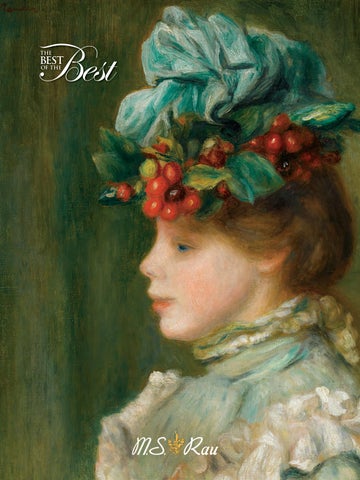
Le chapeau aux cerises A radiant celebration of love and light, this painting is among the most important Renoir masterpieces. The exquisite portrait renders Renoir's great love, Aline Charigot, in resplendent detail, showcasing the artist's signature feathery brushwork and luminous palette. To find such a work by Renoir—beautifully executed, deeply personal and once part of a distinguished royal collection—is nothing short of extraordinary. Painted with evident affection when Aline Charigot was just twenty-four, the work captures the youthful grace of Renoir's love and future wife. Her elaborate hat, one of Renoir's favorite motifs, is brimming with cherries, evoking the tenderness and vitality of his beloved muse at the height of her beauty. Aline appears in many of Renoir's most famous canvases, including perhaps his most celebrated, Luncheon of the Boating Party, where she dons a similarly elaborate outfit and hat. The provenance is as impressive as the painting itself. It was sold by the three most important art dealers of the late 19th and early 20th centuries: Ambroise Vollard, Thomas Agnew & Sons and Wildenstein & Co. It also held a prominent place in the esteemed collection of the Duchess of Alba, the most titled aristocrat in the world, who displayed the work in her Madrilenian castle for over 40 years.
Signed "Renoir" (upper left) | Oil on canvas | Circa 1884 Canvas: 213/4"h x 171/2"w | Frame: 31"h x 263/4"w x 31/2"d | #32-1783
PROVENANCE Ambroise Vollard, Paris | Marcel Kapferer, Paris | Thomas Agnew & Sons, London, 1939 | Wildenstein Galleries, New York, 1943 | Mrs. Charles B.G. Murphy, Maine | Mrs. Charles Dewey Jr., New York | Marlborough Fine Art, London, 1972 | Cayetana Fitz-James Stuart, 18th Duchess of Alba, Madrid, Spain | Private Collection, Ohio M.S. Rau, New Orleans | Private Collection, Nebraska | M.S. Rau, New Orleans
EXHIBITED New York, Wildenstein Galleries, 1943 | New York, Wildenstein Galleries, 1948 | London, Marlborough Fine Art, 1972 Madrid, Fundación Caja de Pensiones, 1987 | Dallas, Meadows Museum, 2016
6 | msrau.com | 866-349-0378
MONET
Claude Monet 1840-1926 | French
Falaises, temps gris Claude Monet is widely known as one of the greatest artists of all time. His radical vision was the founding genius of the Impressionist movement, a watershed moment that changed the course of art history. This magnificent oil, with its rich hues and shimmering atmosphere, captures the master at his most ambitious and expressive. One of Monet's most significant breakthroughs emerged in the early 1880s, when he returned to his roots to spend extended time on the dramatic cliffs of Normandy. Facing the extreme forces of sea and sky while painting en plein air, he pushed the ideas and techniques of Impressionism to new heights. In this remarkable work, Monet beautifully contrasts the soft haze of the sea mist with the bold, rugged texture of the monumental cliffs. This painting also comes with prestigious provenance, acquired directly from the artist by his influential dealer, Paul Durand-Ruel. It was sold to several significant American collectors in the late 19th century and shown in some of the earliest major Impressionist exhibitions in the United States. Such exquisite examples of Monet's Normandy scenes are exceptionally rare, with major museums highlighting the importance of this period in his oeuvre, including the Musée d'Orsay and the Städel Museum.
Signed "Claude Monet 82" (lower right) | Oil on canvas | Dated 1882 Canvas: 205/8"h x 277/8"w | Frame: 301/4"h x 373/8"w x 31/2"d | #32-1374
PROVENANCE Paul Durand-Ruel, Paris and New York, acquired c. 1888 | Alden W. Kingman, New York, acquired c. 1891 | Paul Durand-Ruel, New York, acquired in 1896 | Cyrus J. Lawrence, New York, acquired in 1898 | Sale of the previous; The American Art Association, 21–22 Jan. 1910, lot 72 | Paul Durand-Ruel, acquired at the previous sale | Mrs. Albert L. Webster, New York, acquired from the previous in 1910 | Sale of the previous; The American Art Association, 28–29 Jan. 1926, lot 175 | Paul Durand-Ruel, acquired at the previous sale | Sale of the previous; Galerie Charpentier, Paris, 7–8 Dec. 1954, lot 37 | Philippe Tiranty, Nice, acquired at the previous sale | Private Collection, Switzerland, by 1971 Private Collection, London | Private Collection, Hong Kong | M.S. Rau, New Orleans
EXHIBITED New York, Union League Club, 1891 | New York, The Lotos Club, 1899 | Lausanne, Fondation Pierre Gianadda, 2011
10 | msrau.com | 866-349-0378
CASSATT
Mary Cassatt 1844-1926 | American
Girl with a Banjo Mary Cassatt is one of the most important women artists in history—a groundbreaking visionary and the singular American to exhibit with the great French Impressionists. Her mastery of pastel rivaled that of her peer, Edgar Degas, and this extraordinarily large example displays her talent for achieving rich colors and soft textures in this challenging medium. At the height of her fame, Cassatt was commissioned to create the monumental mural for The Woman's Building at the 1893 World's Columbian Exposition. The right side of this 54foot masterpiece showed a woman playing the banjo, highlighting the new opportunities of the modern woman. Whereas playing the piano or violin was considered ladylike, playing the quintessential American banjo—an instrument with African roots—was pushing the boundaries. This stunning pastel is only one of two complete banjo works she created in conjunction with her now-lost World's Fair mural, with the other residing in the collection of the Virginia Museum of Fine Arts. This important work has also been exhibited at major institutions, including the Art Institute of Chicago, the Museum of Fine Arts, Boston and the National Gallery of Art in Washington, D.C.
Signed "Mary Cassatt" (lower right) | Pastel on paper mounted on canvas | Circa 1894 Paper: 23"h x 28"w | Frame: 371/2"h x 421/4"w x 23/4"d | #32-0025
PROVENANCE Roger Marx, Paris | Private Collection, Tokyo, acquired from previous | Sale of the previous, Sotheby's London, 26 June 1990, lot 13 | Private Collection, Texas | Private Collection, Los Angeles, by 1998 M.S. Rau, New Orleans
EXHIBITED Chicago, The Art Institute of Chicago, 1998 | Boston, Museum of Fine Arts, Boston, 1999 | Washington, D.C., The National Gallery of Art, 1999
14 | msrau.com | 866-349-0378
MORISOT
Berthe Morisot 1841-1895 | French
Jeune fille au chien A pioneering figure of Impressionism, Berthe Morisot changed the course of art history by elevating the feminine to high art. This luminous masterwork is an exceptional rarity, both for its impressive scale and breathtaking beauty. Morisot produced only around 400 oil paintings in her short life—significantly fewer than Monet, Degas and Renoir—with the great majority now held in the world's most prestigious museums. To find such a large and radiant painting by Morisot is extraordinary, especially when it also captures one of her favorite subjects. The young Jeanne Fourmanoir, a famous model for both Morisot and Renoir, and her canine companion are enveloped in a sea of lush foliage, a masterful display of the artist's soft brushwork and vivid hues. Painted in 1892, this work reflects the most important year of Morisot's life. In the spring, Morisot achieved a monumental milestone with her retrospective—a first for a female Impressionist—at Paris' prestigious gallery, Boussod, Valadon & Cie. Just one month before the exhibition opened, her husband of nearly two decades, Eugène Manet, died. Grief-stricken, Morisot entered her most innovative period yet, seeking solace in her work. Recognized as one of her most important paintings, Jeune fille au chien was included in the landmark Durand-Ruel exhibition organized shortly after Morisot's death in 1896, and it has been exhibited around the world since.
Stamped with signature "Berthe Morisot" (lower left) | Oil on canvas | Painted 1892 Canvas: 251/4"h x 311/2"w | Frame: 35"h x 41"w x 23/8"d | #32-0999
PROVENANCE C.W. Kraushaar Galleries, New York, by 1926 | Ralph M. Coe, Cleveland, acquired from the previous, 1926 Sale of the previous; Sotheby's New York, January 14, 1959, lot 70 | Milch Gallery, New York, aquired at the previous | Harry and Doris Rubin, New York, acquired from the previous in 1959 | Sale of the previous; Sotheby's New York, May 7, 2008, lot 10 | Private Collection, acquired at the previous | M.S. Rau, New Orleans
EXHIBITED Paris, Galerie Durand-Ruel et Cie, 1896 | Paris, Galerie Bernheim, 1922 | Chicago, The Arts Club, 1943 New Haven, Yale University Art Gallery, 1956 | New York, Wildenstein & Co., 1960 | Turin, Galleria Civica d'arte Moderna e Contemporanea, 2024
18 | msrau.com | 866-349-0378
CHURCHILL
Winston Churchill 1874-1965 | British
Still Life with Aubergines and Red Peppers on a Silver Tray Revered as the greatest Briton of all time, Winston Churchill was more than a legendary statesman—he was also a gifted painter. This exceptionally brilliant still life is not only far larger than most works by Churchill, but it is also importantly signed by the artist, while the majority of his works are not. Painted between 1934 and 1935 at Churchill's beloved country home, Chartwell, this masterwork offers a rare glimpse into his private creative life. The traditional subject was influenced by Churchill's friend and mentor, the artist Sir William Nicholson, who often stayed at Chartwell in the 1930s. It also closely mirrors a work by the celebrated American artist N.C. Wyeth that is now housed at the Brandywine Museum of Art. Churchill was a great admirer of Wyeth's work and even arranged to have Wyeth's watercolors displayed in his hotel room when visiting Boston. Churchill gave this painting as a token of gratitude to Mr. Alfred Kern, a prominent Swiss banker who owned Villa Choisy in Switzerland. In 1946, Kern hosted Churchill at the villa during the period of his iconic Zurich speech, a seminal call for European unity in the aftermath of World War II. Reacquired later by the Churchill family, this painting is both an extraordinary work of art and a rare testament to the statesman's legacy.
Signed "WSC" (lower right) | Oil on canvas | Circa 1934-35 Canvas: 243/8"h x 291/2"w | Frame: 303/8"h x 351/2"w x 4"d | #32-0392
PROVENANCE Gifted by the artist to Mr. Alfred Kern, 1946 | Sale, Sotheby's, London, March 14, 1979 | Sale, Christie's, London March 1991 | Wells Collection | Churchill family member, United Kingdom | M.S. Rau, New Orleans
22 | msrau.com | 866-349-0378
ROCKWELL
Norman Rockwell 1894-1978 | American
Tender Years: Moth Holes Norman Rockwell captured the heart of America like no other. His most iconic paintings depicted life's intimate moments with universal appeal and lighthearted humor, and this charming work is no exception. Created for the 1957 Brown & Bigelow Four Seasons calendar, the painting shows a couple discovering that moths have eaten the man's out-of-season clothes. Their shocked expressions, scattered belongings and onlooking curious kitten show Rockwell's extraordinary talent for portraying the essence of a relatable, heartwarming moment. In his introduction to this calendar, Rockwell explained his desire to explore the beauty of mature relationships—believing that in a world obsessed with youth, the "charms and comforts of maturity" deserved artistic attention. Rockwell's Brown & Bigelow Calendars (1947–1964) stand alongside his Saturday Evening Post covers as works that elevated him from celebrated illustrator to national institution.
Signed "Norman Rockwell" (lower right) | Oil on canvas | Painted 1957 Canvas: 171/2"h x 171/2"w | Frame: 261/8"h x 261/8"w x 31/4"d | #32-1342
PROVENANCE Judy Goffman Fine Art, New York | Illustration House, New York | Private Collection, Florida | M.S. Rau, New Orleans
26 | msrau.com | 866-349-0378
METZINGER
Jean Metzinger 1883-1956 | French
Port du Croisic A shimmering vision of the Mediterranean, this stunning oil depicts the renowned Jean Metzinger's most coveted subject, with sailboats gliding elegantly across the harbor. Port du Croisic, which Christie's hailed as Metzinger's "manifesto," stands as the magnum opus of the artist's rare Pointillist works. A visionary who bridged Neo-Impressionism and Cubism, Metzinger combined the color theories of Seurat with a fascination for geometry. In this work, countless precise dabs of pigment capture the morning light and tranquil sea with extraordinary luminosity and depth. Metzinger's intellectual rigor and virtuosic technique made him a key figure in the development of abstraction, and his paintings from this period represent the foundation of 20th-century art. Prized by the artist, Metzinger exhibited this painting at the 1905 Salon des Indépendants and kept it in his personal collection. Similar paintings reside in major museums worldwide, including the Minneapolis Institute of Art and the Kröller-Müller Museum.
Signed "J. Metzinger" (lower right) | Oil on canvas | Painted 1905 Canvas: 243/4"h x 351/2"w | Frame: 351/4"h x 433/4"w x 2"d | #32-1703
PROVENANCE Gifted from the artist to Monsieur Bertet, Marseille | Rose Saporte-Bertet, Marseille, acquired from the previous Private Collection, acquired from the previous, 1953 | Private Collection | M.S. Rau, New Orleans
EXHIBITED Paris, 21st Salon des Indépendants, 1905 | Paris, Galerie Berthe Weill, 1905 | Paris, L'Adresse Musée de la Poste, 2012
30 | msrau.com | 866-349-0378
RIVERA
Diego Rivera 1886-1957 | Mexican
Mercado de flores (Mujer cargando un niño) Diego Rivera was one of the 20th century's most influential creative forces. His most sought-after paintings feature his signature Mexican subjects, especially laborers, women and children—and this exceptional watercolor depicts all three. With its vibrant palette and extraordinary provenance, this work is an undeniable Rivera masterpiece. While in New York working on his famed mural at Rockefeller Center, Diego Rivera struck up an unlikely friendship with Waite "Schoolboy" Hoyt, who was a well-known member of what is considered the greatest baseball team of all time—the 1927 New York Yankees. Rivera and Hoyt bonded over their shared love of art and baseball, with Hoyt giving Rivera tickets to a Brooklyn Dodgers game and Rivera gifting Hoyt this very watercolor in return. Cherished in the Hoyt family until now, this magnificent painting displays the bold color and compositional dynamism that are the hallmarks of Rivera's celebrated style. By the time this work was painted in 1951, Rivera had completed his iconic murals throughout Mexico and the United States, making him one of the most famous artists in the world. His importance has only grown, and today Rivera's works are held by prestigious institutions, including the Museum of Modern Art and the Art Institute of Chicago.
Signed "Diego Rivera 1951" (lower right) | Watercolor and ink on paper | Dated 1951 Paper: 211/4"h x 261/2"w | Frame: 321/4"h x 38"w x 1"d | #32-1121
PROVENANCE Waite Hoyt, New York, acquired from the artist circa 1951 | Thence by descent | M.S. Rau, New Orleans
34 | msrau.com | 866-349-0378
BOTERO
Fernando Botero 1932-2023 | Colombian
Juan Rodriguez "Conejo" Fernando Botero's artworks never fail to delight, and this exceptional painting captures one of his favorite subjects. The charming bullfighter is rendered with the artist's iconic voluminous forms and brilliant color, drawing the viewer into Botero's splendid world. Botero himself initially trained as a bullfighter, naming it his "first passion" before he discovered his artistic calling. Yet he remained captivated by bulls and matadors, who became central to his famed oeuvre. This matador is depicted in his elaborate golden traje de luces, perfectly complemented by another signature Botero motif—oranges. The intimate scale creates a direct, almost personal encounter with this character, showcasing Botero's remarkable ability to infuse his subjects with an irresistible warmth and depth. Few artists have achieved such a singular, instantly recognizable style as Botero, which earned him a level of international success virtually unmatched by any Latin American artist of his generation. He exhibited at major museums during his lifetime, including the Metropolitan Museum of Art and the Museum of Modern Art, and now an entire museum in Bogotá is dedicated to his artistic legacy.
Signed "Botero 88" (upper right) | Oil on canvas | Dated 1988 Canvas: 171/4"h x 15"w | Frame: 25"h x 221/2"w x 2"d | #32-1101
PROVENANCE Galerie Hopkins, Paris | Private Collection | M.S. Rau, New Orleans
EXHIBITED Coro, Venezuela, Museo de Arte, 1989 | Caracas, Museo de Arte Contemporáneo, 1989 | Mexico City, Museo de Arte Contemporáneo Internacional Rufino Tamayo, 1989 | Sevilla, Hospital de los Venerables Sacerdotes, 1992 Paris, Grand Palais, 1992 | Bogotá, Banco de la República, 1993 | Paris, Galerie Hopkins-Thomas-Custot, 2001
38 | msrau.com | 866-349-0378
Fernando Botero 1932-2023 | Colombian
El Sueño Beyond painting, Botero was also a talented sculptor, and this bronze brings his signature exaggerated proportions boldly into three dimensions. Two of the artist's most important and coveted subjects—the female nude and the bird—converge in this iconic masterpiece that embodies peace and blissful reverie. Inspired by his travels in Italy in the 1950s that exposed him to the Renaissance masters, Botero began sculpting in the 1960s. In the following decades, his bronzes became internationally renowned for their technical precision and monumental presence. On the personal importance of his sculptures, Botero once said: "For my entire life I've felt as if I had something to say in terms of sculpture. It's a very strong desire, a pleasure—that of touching the reality that you create." Botero's sculptures consistently command some of the highest prices in his market, which has experienced exponential growth since the artist's death in 2023. Importantly, another edition of this bronze resides in the collection of the Museo Botero in Bogotá.
Signed "Botero 4/6" | Bronze | Cast 1996 111/2"h x 267/8"w x 111/2"d | #32-1361
PROVENANCE Contini Galleria d'Arte, Venice | Private Collection, Colorado, acquired from the previous | M.S. Rau, New Orleans
866-349-0378 • MSRAU.COM • 41
Pietre Dure Plaque by Enrico Bosi Astonishing in every way, this extraordinary masterwork represents the pinnacle of pietre dure. Created by the renowned Florentine master Enrico Bosi, this striking, grand-scale plaque brings the legendary Battle of Anghiari brilliantly to life with thousands of inlaid hardstones. Each piece was carefully selected and polished to impeccable smoothness, allowing Bosi to achieve unmatched painterly realism. The subject commemorates Florence's important triumph over Milan in 1440, which allowed the city to become the decisive center of the Renaissance. Based on a now-lost painting by Leonardo da Vinci, Bosi's incredible pietre dure and a drawing by Peter Paul Rubens are among the only surviving works related to this great Renaissance painting. Pietre dure masterpieces of this caliber are exceptionally rare due to the years of exacting labor they required. Comparable examples are housed in the world's most important institutions, including the Metropolitan Museum of Art, the Victoria & Albert Museum and the museum dedicated entirely to pietre dure in Florence, Il Museo dell'Opificio delle Pietre Dure. Inscribed "H. Bosi / Firenze" (en verso) Circa 1860 | Plaque: 30"h x 393/4"w | Frame: 491/2"h x 591/8"w x 51/2"d | #32-1519
PROVENANCE Martin-Desbenoit Sale, Versailles, October 11, 1981, lot 123 | Private Collection, Paris | M.S. Rau, New Orleans | Private Collection, New Orleans | M.S. Rau, New Orleans
42 | msrau.com | 866-349-0378
Hadrian's Villa Mosaic Table This extraordinary treasure of antiquity hails from one of Ancient Rome's greatest architectural triumphs: Hadrian's Villa. Constructed during the peak of the Empire, Hadrian's Villa was home to its greatest leaders and its most significant masterpieces, including this remarkable mosaic. Once part of a floor, the mosaic was walked upon by many of the most legendary emperors in history. Emperor Hadrian reigned from 117 to 138 CE and was revered as one of Rome's most extraordinary rulers. His villa was the ultimate expression of Roman imperial grandeur—the sprawling complex covered an area larger than the entire city of Pompeii. After the fall of the Empire, Hadrian's Villa remained buried for centuries, until the groundbreaking excavation by Cardinal Giuseppe Alessandro Furietti in 1736. He uncovered more than twenty rooms with magnificent but damaged mosaic floors and other treasures of antiquity, which are now held in the world's most important museums. Cardinal Furietti transformed several mosaic fragments into tabletops and documented his designs in his important book, De Musivis (1752), where this mosaic's design appears as Plate IV. After the Cardinal's death, the great English architect, artist and cabinetmaker Robert Adam acquired these mosaic tabletops and added the green English marble border and gilt-wood bases. They were then placed in the grand homes of Britain, including Castle Howard, Holkham Hall and Syon House, with some now residing in prestigious institutions, including the Victoria & Albert Museum. This is the only one of these magnificent tabletops from Hadrian's Villa to ever come to market—the quintessential once-in-a-lifetime rarity. Circa 118-134 CE | 34"h x 531/4"w x 27"d | #32-0924
PROVENANCE Hadrian's Villa, Tivoli, Rome, excavated between 1736-38 by Cardinal Furietti | Private Collection, England M.S. Rau, New Orleans
46 | msrau.com | 866-349-0378
Ancient Roman Stele Relief A rare wonder of antiquity, this extraordinary marble stele relief fragment embodies the artistic sophistication of Imperial Rome. Dating to the 1st century BCE–1st century CE, it represents a moment when Roman sculptors, inspired by their Greek predecessors, perfected the classical ideals of harmony and balance. A stele was a carved stone monument used throughout the ancient world to commemorate important figures, record civic decrees or honor the divine. Crafted from fine white marble, this example reveals the hand of a master sculptor. Rendered in fluid motion, the female figure and her beautifully modeled drapery evoke a timeless sense of vitality and elegance. Such reliefs were originally part of commemorative monuments commissioned by Rome's elite, with their refined execution reflecting the status and taste of their patrons. Ancient stelae of this caliber are exceedingly scarce, with many lost to time or acquired by the world's leading museums. This figure's pose is nearly identical to an important ancient sculpture discovered in 1711, The Small Herculaneum Woman—one of the earliest and most significant finds from the famed ancient city, now housed in Dresden's State Art Collections. Circa 1st century BCE-1st century CE | On stand: 371/2"h x 231/2"w x 12"d | #32-1243
PROVENANCE Private Collection, New York | M.S. Rau, New Orleans
48 | msrau.com | 866-349-0378
Tiffany Studios Mermaid Window Louis Comfort Tiffany stands as America's greatest artistic craftsman. Of all his incredible creations, Tiffany's monumental windows are widely considered his masterpieces, coveted by major museums and collectors alike. This magnificent six-panel Mermaid window exemplifies Tiffany at his most ambitious—an artistic tour de force made for an extraordinary patron. Inspired by Hawaii's natural beauty, sugar baron James Bicknell Castle commissioned this wonder in 1899 for the grand staircase of his Waikiki Beach estate, Kainalu. As one of Hawaii's influential "Big Five" moguls, Castle filled his famed four-story mansion with one-of-a-kind masterworks, and it was the only private residence with Tiffany windows in Hawaii's history. The mermaid subject of this window, drawn from an earlier painting by Frederick Stuart Church, is also one of the rarest in Tiffany's oeuvre. Only one other mermaid window by Tiffany is known—the Mermaid with Goldfish Window—which the artist treasured so deeply that he kept it in his personal collection, refusing all offers during his lifetime. That window now resides in the Field Museum of Natural History in Chicago, leaving ours as the only Tiffany mermaid window in private hands. A masterwork of the grandest proportions, this window has been exhibited worldwide and ranks among the finest testaments to Tiffany's genius. 1899 | With light box: 8'11"h x 10'5"w x 101/2"d (Size and installation customizable) | #32-1271
PROVENANCE James Bicknell Castle, Diamond Head, Waikiki Beach, US Territory of Hawaii, 1899-1918 | Mrs. Castle, by descent from the previous, 1918-1920 | Elks Lodge 616, Diamond Head, Waikiki Beach, US Territory of Hawaii, 1920-1959 Private Collection, Honolulu, 1959-1987 | Private Collection, Colorado | M.S. Rau, New Orleans
EXHIBITED Tokyo, Tokyo Metropolitan Teisen Art Museum, 1991 | Kobe, Kobe City Museum, 1991 | Nagoya, Electricity Museum Gallery, 1991 | Toyama, Toyama Citizens Plaza, 1991 | New York, Nassau County Museum of Art, 1998 | California, Ronald Reagan Presidential Library and Museum, 1999 | Paris, Musée du Luxembourg, 2009 | Montreal, Montreal Museum of Fine Arts, 2010 Richmond, Virginia Museum of Fine Arts, 2010
The Mermaid Window in the grand stairwell of Castle's Waikiki Beach mansion, 1899 50 | msrau.com | 866-349-0378
Polar Bear Vase by Émile Gallé The undisputed master of Continental cameo glass, Émile Gallé crafted some of the most spectacular objects ever created in glass. One of the most important and coveted of these creations was this stunning Polar Bear vase—among the rarest masterpieces of Gallé's oeuvre. Monumental in size, the vase's scale presents a unique challenge for decoration, requiring more intricate craftsmanship and a greater volume of glass to precisely shape and carve. The opaque forms of the polar bear and ice floe appear to magically float against the soft backdrop of the mountains and icy blue waters. Only a handful of these vases were ever made due to the technical and artistic demands of the extraordinarily illusionistic design. Inspired by the celebrated French explorer Jean-Baptiste Charcot, this vase pays homage to his groundbreaking Arctic and Antarctic expeditions, which advanced the scientific understanding of these remote regions. The remarkable design reflects the Art Nouveau fascination with nature and Gallé's legacy as a singular pioneer in glass artistry. Signed "Gallé" Circa 1927 | 141/2"h x 11"dia | #32-0540
866-349-0378 • MSRAU.COM • 55
Art Nouveau Display Cabinet by Georges Hoentschel This stunning cabinet is among the most exceptional examples of Art Nouveau furniture ever crafted—a monumental masterclass of organic form and graceful movement. Standing almost 7 feet high, this one-of-a-kind case was designed by the visionary Georges Hoentschel for the 1902 Paris Salon, where artists showcased their finest works. The cabinet's arched design evokes the grandeur of a cathedral, and its delicate brass decoration captures the ethereal beauty of nature, depicting shimmering wisteria branches and a rippling koi pond. Such an extraordinary work of art embodies Hoentschel's unmatched genius and mastery of the Art Nouveau style. Just two years prior, he was commissioned to design an entire pavilion for the 1900 Exposition Universelle in Paris, which is now preserved at the Musée des Arts Décoratifs at the Louvre. An internationally renowned interior designer and Renaissance man, Hoentschel had an unparalleled knowledge of French decorative art that informed his unique aesthetic. His exceptional designs attracted prominent clients, from wealthy industrialist J.P. Morgan to the Emperor of Japan. Hoentschel's personal collection of over 4,000 works was also so impressive that J.P. Morgan purchased it in full and donated it to the Metropolitan Museum of Art in 1906, serving as the foundation for the museum's renowned Decorative Arts department. Circa 1902 | 831/4"h x 441/2"w x 33"d | #32-0541
56 | msrau.com | 866-349-0378
58 | msrau.com | 866-349-0378
Falcon's Eye and Tiger's Eye Table by Théodore Millet This exquisite table by renowned Parisian ébéniste Théodore Millet blends two rare hardstones—tiger's eye and falcon's eye—in a dazzling geometric design. A singular treasure epitomizing French Empire style, this opulent table stands among Millet's finest creations. A dramatic swirl of light and movement, the table is inlaid with mesmerizing bands of golden tiger's eye and iridescent blue falcon's eye. Both of these rare stones exhibit chatoyancy, a shifting luster that animates the surface with every movement. Complemented with four classical caryatid legs and an urn-shaped crosspiece, this table is a highly unique sculptural marvel. Théodore Millet was a distinguished cabinetmaker and bronzier known for his luxurious furnishings in the Louis XVI and Empire styles. He exhibited at the major international exhibitions of his era, where he received medals and widespread acclaim for his exceptional gilt bronze and hardstone works. Circa 1890 | 277/8"h x 201/4"dia | #32-0527
Napoleon's Sèvres Urns Gifted to Talleyrand These magnificent vases are Napoleonic treasures like no other. Visually and historically extraordinary, they were commissioned by Napoleon Bonaparte as an opulent gift to his famed foreign minister, Charles Maurice de Talleyrand-Périgord—one of the greatest diplomats the world has ever known. Crafted by Sèvres, the world's foremost porcelain manufactory, these elaborate vases cost the Emperor an astonishing sum of 1,200 francs—the equivalent of four years of the average laborer's wages—underscoring Talleyrand's critical importance to Napoleon. Rather than the imperial motifs seen on almost all other Sèvres works, the painted decoration shows garlands of purple bellflowers, a bloom long associated with constancy and gratitude. This symbolism reflected the qualities Napoleon prized in Talleyrand, while demonstrating the Emperor's understanding of art's ability to flatter and persuade. Imperial commissions of this kind were exceptionally rare. There are only a few known parallels, including a single Medici vase with floral decoration ordered by Napoleon for Ferdinand III of Habsburg-Lorraine, now in the Uffizi Gallery, and a pair of floral vases created circa 1810 for Marie-Louise, Napoleon's second wife, for her apartments at Compiègne, where they remain today. Exceptionally important, these stunning vases were displayed at the renowned Palais Vivienne, a private residence celebrated for its remarkable collection of Napoleonic objets d'art, paintings and jewels. Sèvres marks with date symbol for Revolutionary Year 14 Circa 1806 | Each on base: 223/8"h x 121/4"dia | #32-1327
PROVENANCE Charles Maurice de Talleyrand-Périgord, Prince of Benevento, Paris | Private Collection, Paris | M.S. Rau, New Orleans
60 | msrau.com | 866-349-0378
World's Fair Grand Regulator Clock by François Linke Widely celebrated as the greatest sculptural clock in history, this monumental regulator was François Linke's most important masterpiece. Designed to astonish at the 1900 Paris Exposition Universelle, this clock established Linke as the preeminent ébéniste of his time. At the Paris Exposition, the world's best artists showcased their finest objects for more than 51 million visitors. At over 10 feet high, this clock stood in a class entirely its own. Its magnificent case features inlaid tulipwood and fruitwood, extraordinary cast bronze ormolu motifs—each a stunning sculpture on its own—and a star-studded globe dial surmounted by Father Time. Linke devoted over a decade to collaborating with the bronzier Léon Messagé on its intricate design and execution, ultimately spending 22,966 francs in production costs alone (the equivalent of eight years' wages for the average French worker in 1900). The clock became so famous that Linke received numerous orders to create duplicates. When he decided to reproduce this design, the undertaking proved so demanding that only six total examples were ever completed, with one now housed at the Flagler Museum. This clock was formerly owned by Mahdi Al-Tajir, one of the wealthiest men in the world in the 1980s and among history's greatest collectors. Signed "F. Linke" (on interior mounts) Circa 1900 | 123"h x 383/4"w x 22"d | #32-0442
View a video of this clock
62 | msrau.com | 866-349-0378
Royal Orrery Clock by Zacharie Raingo A remarkable fusion of art and science, this extraordinary orrery clock was crafted for royalty. Presented to King Louis XVIII by Zacharie Raingo, it exemplifies the unmatched artistry that earned Raingo the title of official clockmaker to the French Crown. He created timepieces of unparalleled brilliance that were both mechanically ingenious and visually breathtaking—and this one is no exception. This orrery clock was designed to showcase the working wonder of our solar system with precise astronomical accuracy. A beautifully detailed Earth completes a rotation on its faithfully tilted axis every 24 hours, and it makes its orbit around the gilt-bronze Sun every 365 days. Additionally, the Moon circles the Earth every 27.3 days, and the entire orrery swivels throughout the year to indicate the exact date and corresponding astrological sign. Beyond this sophisticated astronomical display, Raingo also employed a highly complex pinwheel escapement to achieve superior timekeeping and concealed a music box in the clock's base. The burled elm base is an extremely rare three-column model, and it still retains its Royal fleur-de-lis hands, confirming the provenance of this clock. Both Buckingham Palace and the Science Museum in London have later four-column examples of Raingo's orrery clocks without music boxes, making this one an exceptional museum-caliber treasure. Circa 1817 | Clock: 29"h x 151/2"dia | With dome: 311/2"h | #32-0526
View a video of this orrery clock
64 | msrau.com | 866-349-0378
Three-Train Skeleton Clock by Smith & Sons A spectacular display of engineering and artistry, this rare three-train skeleton clock is one of the most impressive examples ever crafted. Skeleton clocks were among the most difficult and expensive models to produce, as they had to be mechanically perfect as well as visually stunning. With its highly rare and complex fusée movement, this skeleton clock is extraordinary. Smith & Sons were hailed as the undisputed masters of the skeleton clock, known for their exceptional ingenuity and technical precision. Only a master horologist of the utmost skill would have been able to meticulously craft an elaborate three-train movement beautiful enough for a skeleton clock. This example, with its Gothic architectural design and intricate pierced metalwork, is a testament to the unmatched brilliance of Smith & Sons. John Smith & Sons were the leading horologists in Clerkenwell—one of the most important centers of clockmaking in England for two centuries. At a time when many clockmakers were primarily crafting affordable clocks using mass production, Smith & Sons were dedicated to preserving the art of horological excellence.
19th century | 22"h x 16"w x 9"d | #31-7267
View a video of this clock
66 | msrau.com | 866-349-0378
Paul Revere Coffee Pot Perhaps the greatest work of American silver still in private hands, this extraordinary coffee pot was crafted by the patriot, Paul Revere Jr. It is one of just six pre-Revolutionary armorial coffee pots created by the legendary silversmith. Every element of this statuesque coffee pot evokes Revere's mastery. Perfectly balanced and refined, its fluted scroll spout is a triumph of Rococo design, complemented by a delicate shell and flower spray cartouche. Weighing an impressive 42 troy ounces, this magnificent vessel is also far larger than most of Revere's silver creations, with his average serving spoons weighing just two ounces each. Such an exceptional coffee pot could only have been afforded by an elite patron, and it bears the monogram "MSS" for Dr. M. Sawyer (1737-1815), a prominent Massachusetts physician. Remaining in the Sawyer family for over two centuries, this treasure was then acquired by another American private collection and loaned to the Virginia Museum of Fine Arts for more than 30 years. Revere was not just the preeminent silversmith in America—he was the only silversmith in the colonies capable of crafting a finished, engraved product from the silver ingot, all by himself. His coffee pots are considered the masterworks of his oeuvre, with two of the six important pre-Revolutionary examples housed in the permanent collections of the Museum of Fine Arts, Boston and the Worcester Art Museum. Stamped "Revere" Circa 1775 | 121/4"h x 10"w x 5"d | #32-0711
PROVENANCE Micajah and Sibyl Sawyer, Newburyport | Descended in the family until sold | Sale, Sotheby Parke Bernet, New York, April 30—May 3, 1980, lot 184 | Private Collection, United States | M.S. Rau, New Orleans
68 | msrau.com | 866-349-0378
Silver Wine Coolers by Rundell, Bridge & Rundell Rundell, Bridge & Rundell stands at the pinnacle of Regency silver. As the royal goldsmiths to King George III and the Prince Regent, the firm produced objects that defined the era's taste for grandeur. This set of four sterling silver wine coolers exemplifies that mastery. In Georgian society, wine coolers were the height of refinement. Ice itself was a luxury, and silver of this weight and artistry was reserved for the elite. Weighing 391 troy ounces (excluding liners), these coolers would have cost nearly £200 in 1806—a staggering sum when the average English laborer earned about £15 a year. Rundell's reputation commanded premiums not merely for the weight of silver, but for craftsmanship and artistry that set the standard across the globe. Crafted by renowned silversmiths Digby Scott and Benjamin Smith, the coolers feature superb Neoclassical decoration: grapevine and mask borders, Assyrian figures crowning the handles and engraved armorials denoting a commission of distinction. It is exceptionally difficult to find such a fine set of four wine coolers still united, with similar single examples residing in important museum collections, including the Victoria & Albert Museum and the Metropolitan Museum of Art.
Hallmarked London, 1806 Each: 12"h x 8"w x 73/4"d | #32-1818
72 | msrau.com | 866-349-0378
Duke of Wellington Service by Paul Storr This remarkable silver flatware set by the great Paul Storr is a treasure with extraordinary provenance. Presented to Arthur Wellesley, the Duke of Wellington, by Bernard Edward Howard, Duke of Norfolk, this service embodies the legacy of one of Britain's greatest heroes. The Duke of Wellington is best remembered for his victory against Napoleon at the Battle of Waterloo in 1815, and he later served twice as Britain's Prime Minister. This set was given to Wellesley during his first term on April 13, 1829, as a show of gratitude for his support of the Roman Catholic Relief Bill, indicated by the finely engraved presentation plaque. This set's forks and spoons display Storr's elegant Fiddle, Thread and Shell pattern, and its cutlery was fashioned by Joseph Rodgers & Sons, royal cutlers to the Crown. Uniting the work of the era's finest British makers, this service stands as a singular expression of English history. This complete 90-piece service includes: 12 teaspoons 12 tablespoons 12 large soup spoons 12 luncheon knives 12 luncheon forks 12 entree knives
12 entree forks 1 gravy ladle 2 carving knives 2 carving forks 1 knife sharpener
Hallmarked London, 1821 Case: 91/2"h x 311/2"w x 163/4"d | #31-5819
866-349-0378 • MSRAU.COM • 75
Silver Soup Tureen by Paul de Lamerie This magnificent soup tureen was crafted by one of the greatest silversmiths in history, Paul de Lamerie. Extraordinary in size and exquisite in detail, this masterpiece is a rare treasure that embodies de Lamerie's unparalleled artistry. Wonderfully elaborate decoration covers this tureen, with lions' heads, shells and scrolling designs rendered with graceful splendor. De Lamerie was famous for his mastery of the lavish Rococo style, and only his elite clientele could have afforded such luxury. Once owned by British nobility, this tureen bears the coat of arms of Baron Lilford, a significant title still held by the Powys family. For nearly three centuries, Paul de Lamerie has been revered as one of the most important English craftsmen of all time and certainly the most important silversmith of the 18th century. Born to a Huguenot family in 1688, he moved to London before his first birthday, and by 1716, he was appointed Royal Goldsmith. He was known to all of England simply as "the King's Silversmith," and his rare creations remain some of the most coveted silver objects in the world. Hallmarked London, 1741 11"h x 171/2"w x 101/4"d | #31-2968
78 • Best of the Best • 866-349-0378
Fancy Intense Pink Diamond Ring 5.29 Carats One of the Earth's rarest treasures, this purple-pink diamond is a marvel of size, color and clarity— among the finest examples ever mined. Natural pink diamonds over five carats are exceptionally scarce. Those with the highly prestigious color grading of Fancy Intense, such as this magnificent gemstone, are nearly impossible to find. This example also has the coveted purple modifier, meaning it displays stronger tones and greater chromatic depth that enhance the stone's beauty. With VS2 clarity, even color distribution and a rectangular modified brilliant cut, this pink diamond stands as a singular wonder of nature. The most famous Fancy Intense purple-pink diamonds have commanded incredible prices in recent years, and this remarkable example is an extraordinary opportunity within this exclusive tier of record-setting gems.
GIA certified | Accent diamonds: 2.00 ctw | Platinum & 18K rose gold | #32-1696
View a video of this ring
80 | msrau.com | 866-349-0378
Golconda Diamond Earrings 22.23 Carats Absolutely stunning in every way, this is the perfect pair of diamond earrings. With not one, but two precisely matched, heart-shaped 11.03-carat Golconda diamonds, these earrings are the ultimate. Golconda diamonds, also referred to by the GIA as Type IIa, are in a class all their own. These natural marvels are actually two to three shades whiter than the best D-color diamonds, due to their completely nitrogen-free compositions. Because of their chemical purity, Golconda diamonds possess a transparency so perfect that they evoke the clarity of pure ice. Both of these heart-shaped Golconda diamonds are certified as Flawless and D-color. The heart cut is among the most technically demanding of all diamond shapes, and these diamonds have received Excellent symmetry and polish grades, meaning they have been cut without blemish and with perfect symmetry. When worn, these breathtaking earrings radiate an ethereal brilliance from within—giving each stone a living luminosity that is nothing short of extraordinary. Please see the video below to better appreciate their beauty.
GIA certified | Accent diamonds: 0.17 ctw | Platinum | 1" length | #32-1911
View a video of these earrings
82 | msrau.com | 866-349-0378
Fancy Intense Yellow Diamonds 102.04 Carats This extraordinary bracelet represents one of the most remarkable assemblages of natural Fancy Intense yellow diamonds ever seen. Exuding the ideal canary hue from every angle, each diamond in this bracelet is the pinnacle of perfection. More than white diamonds, yellow diamonds have a large color spectrum. Perfectly matching the hues across 19 examples of this size—each over 5 carats—would have been an incredible, time-consuming effort for the singular purpose of creating this masterpiece. All certified by the GIA, each of these yellow diamonds has the coveted Fancy Intense color grading, exceptional clarity ranging from internally flawless to VS2, as well as superior polish and symmetry ratings. A stunning work of natural beauty and fine craftsmanship, this bracelet stands a cut above the rest. GIA certified | 18K yellow gold | 71/8" length | #32-1268
View a video of this bracelet
84 | msrau.com | 866-349-0378
86 | msrau.com | 866-349-0378
Bulgari Burma Ruby and Diamond Bypass Ring An exquisite work of art from the great House of Bulgari, this ring unites two extraordinary gemstones in perfect harmony. The stunning 5.18-carat Burma ruby glows with the rare pigeon's blood hue, complemented by the brilliant sparkle of the 4.58-carat diamond. This exceptional ring embodies the firm's mastery of opulence and artistry. For centuries, Burma rubies have been among the world's most sought-after gemstones, prized for their exceptional color and brilliance. Long favored by royalty around the world as the ultimate symbols of power and passion, Burma rubies of this impressive size have become extremely scarce. The beauty of this Burma ruby is further elevated by Bulgari's distinctive eye for glamour. Accompanying this ring is the firm's 1980s appraisal, valuing it at 480,000,000 lira—over $400,000 at the time. Nearly forty years later, both the rarity of these rubies and Bulgari's legendary status have only increased in prestige.
Circa 1980 | AGL & GIA certified | Accent diamonds: 0.80 ctw | Platinum & 18K yellow gold | #32-0685
View a video of this ring
Harry Winston Diamond Necklace 68.25 Carats A cascading masterpiece with over 68 carats of sparkling diamonds, this necklace embodies the iconic glamour of the House of Harry Winston. The striking double-strand design evokes an Old Hollywood sophistication attainable only from the "King of Diamonds." Each of the 285 diamonds was selected to meet the jeweler's exacting standards, then united in perfect harmony with precision. The inner strand's 74 graduated round brilliant diamonds total an impressive 48.25 carats, with the largest weighing 2.75 carats. Encircling it, the outer strands form a delicate ribbon of 210 baguette cut diamonds, totaling 20 carats. Bold and brilliant, this necklace shines with a purity for which Winston's creations are celebrated. For more than 80 years, the name Harry Winston has been synonymous with elegance and distinction. His jewels have adorned celebrities from Jackie Kennedy and Marilyn Monroe to Gwyneth Paltrow. Renowned for his pursuit of the world's finest gems—including the famed Hope Diamond, which he later gifted to the Smithsonian—Harry Winston continues to define the pinnacle of luxury and artistry. Mid-20th century | 151/2" length | Platinum | #32-1756
View a video of this necklace
88 | msrau.com | 866-349-0378
Russian Demantoid Ring 7.55 Carats Blazing with an extraordinary green hue, this 7.55-carat demantoid garnet is a masterpiece of color and light. Originating from Russia's legendary Ural Mountains—the birthplace of the world's most coveted demantoids—this mesmerizing example proves why the gem's name means "diamond-like." Russian demantoids of this size and brilliance are exceedingly scarce, with the overwhelming majority weighing less than one carat. To encounter an untreated example over 7 carats, with this caliber of color and life, is exceptionally rare. This stone's AGL report also confirms that it displays a highly desirable optical phenomenon: a subtle color shift between incandescent and fluorescent lighting. First discovered in Russia in the 19th century, the demantoid was immediately prized by the aristocracy and the great House of Fabergé. Its light dispersion surpasses even that of diamonds, earning the reputation as one of the world's most incredible gemstones.
AGL certified | Accent diamonds: 2.54 ctw | Platinum | #32-0786
View a video of this ring
90 | msrau.com | 866-349-0378
Tiffany & Co. Citrine Bird on a Rock Brooch Few jewels capture the imagination as vividly as Tiffany & Co.'s celebrated Bird on a Rock. Created by the legendary designer Jean Schlumberger in 1965, this work of wearable art has become one of the most recognizable designs in the history of fine jewelry. At the heart of this example, a monumental cushion cut citrine weighing over 63 carats glows with a golden warmth. Perched gracefully atop, the signature bird dazzles with 2.99 carats of pure white diamonds and a vivid pink sapphire eye that adds a touch of spirited brilliance. Each Bird on a Rock brooch is entirely unique, its personality shaped by the interplay of gemstones and the avian figure. This timeless design embodies Schlumberger's genius for transforming nature into fantastical jewels. Beloved by luminaries from Elizabeth Taylor to Jackie Kennedy, the Bird on a Rock remains a defining symbol of Tiffany & Co.'s artistry. Its place in jewelry history was further immortalized in 1995, when the firm mounted the legendary 128.54-carat Tiffany Diamond into this famed setting—cementing its status as one of Tiffany's most important motifs. 18K yellow gold & platinum | 21/2"h x 13/4"w | #32-1787
View a video of this brooch
92 | msrau.com | 866-349-0378
Tiffany Studios Nasturtium Lamp Among the most iconic works of American decorative arts, Tiffany lamps embody the artistry and innovation that established Louis Comfort Tiffany as the foremost artist of his era. This extraordinary example displays one of Tiffany Studios' most important and vivid floral designs at an exceptionally grand scale. Vibrant red and pink nasturtium blooms unfurl across a radiant golden ground, interwoven with delicate leaves and vines that twist with naturalistic rhythm. Beloved by Tiffany for their electric color and associations with passion and triumph, the bold nasturtiums are perfectly enhanced by an elaborate bronze base. To find such a stunning floral table lamp—in one of the largest sizes Tiffany ever made—is an incredible rarity. The design of the Nasturtium lamp is attributed to Clara Driscoll, the talented head of the Tiffany Studios' Women's Glass Cutting Department. Driscoll and her team of artisans, known as the "Tiffany Girls," carefully selected and cut Tiffany's revolutionary glass, and this lamp remains one of their triumphs. Similar examples reside in important museum collections, including the Art Institute of Chicago. Shade stamped "Tiffany Studios New York" | Base stamped "Tiffany Studios New York 550" Circa 1900 | 335/8"h x 22"dia | #32-1704
BUY WITH CONFIDENCE Learn more about the Rau difference and our 125% Guarantee
STAY CONNECTED Follow us on social media to learn about our latest acquisitions, special exhibitions and more
Sign up to receive emails from M.S. Rau