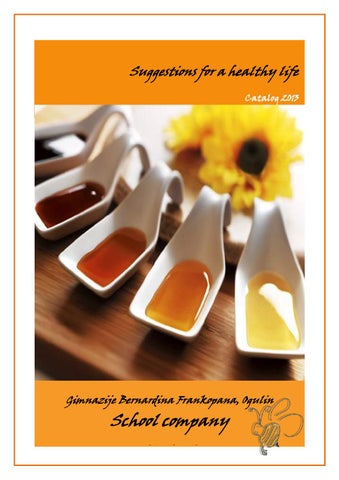
Suggestions for a healthy life Catalog 2013
Gimnazije Bernardina Frankopana, Ogulin
School company Medicija d.o.o.
Content:
Word of the manager ......................................................................................................... 2 Authors ............................................................................................................................. 3 How to find us ................................................................................................................... 4 Land of honey and milk ..................................................................................................... 5 In language and literature .................................................................................................. 6 In many countries and cultures, honey meant much more than food ................................ 7 Honey – food and medicine .............................................................................................. 8 About bees ....................................................................................................................... 9 Types of beedance ......................................................................................................... 10 Interesting historical facts ............................................................................................... 11 Top 10 about honey ....................................................................................................... 12 Selection of products ...................................................................................................... 13 Other honeybee products ............................................................................................... 25 Honey – cakes ................................................................................................................ 30 Apitherapy ....................................................................................................................... 40 Save the Bees, Save the World ....................................................................................... 41 Science about honey and bees ...................................................................................... 43
Medicija d. o. o. Life with taste of health – life with taste of Medicija! Living healthily has always been a life imperative. Now, in 21st century we witness busy way of life. Modern people seem to find it difficult to enjoy advantages offered by the nature. Honey is one of the benefits that can charge us with much needed energy. Therefore, we have decided to offer you products to both please your taste and improve your health. The history of honey consumption is as long as the history of humanity and proofs of its use can be found in almost every culture.The oldest finding that proves the importance of honey for mankind is a prehistoric cave painting in Spain dated as far back as about 15,000 years. Further, Egyptian hieroglyphic records show a significant role of bees and honey in daily life in ancient Egypt; amazing findings of pots of still edible honey, over 3,000 years old, were found in Tutankhamun's tomb. Owing to its extraordinary ingredients , honey has been regarded sacred food from ancient times and one of the most important natural cures for a wide spectrum of health problems. Discover all its characteristics and add it to the list of everyday food. Consumer satisfaction, a change in lifestyle and our desire to bring back the nature into your homes determine our business strategy. Medicija products are a combination of nature,
_______________________ Andrijana Blašković director of Medicija
love, care, know-how and traditional way of production. Tradition, innovation and satisfaction of consumers have transformed Medicija from a small craft into a modern firm that is a synonym for health and quality in Croatia. Learning from the best, improving our knowhow and permanently educating our employees, we have developed our quality products. With much effort and sacrifice , to your and our satisfaction, we have produced high-quality honey and honey products.
For people who live their own lives We proudly present honey and honey products. We aim at offering high-quality products and a long-time experience as well as expert advice of our involved team. Medicija assortment abounds in various sorts of honey whose colour, taste and ingredients appeal for health. We hope pages of this brochure will inspire you to discover pleasure of taste and smell of the nature. Visit our exibition fair to have new ideas how to complete care for yourself and your family. Additionally, our leaflet includes numerous recepies to come up more easily with ideas for your daily and weekly menus. We will gladly help you implement your ideas. Enjoy reading and browsing our brochure.
_______________________ Ana Stošić head of marketing
2
Medicija d. o. o. I value and shortcomings of this work are open to professional criticism.
Josipa Banjavčić • Andrijana Blašković • Martina Domšić • Ţana Kirasić • Danijela Kovačević • Valentina Matešić • Adriana Miloševski • Josipa Paušić • Ivan Pribanić • Barbara Rendulić •Jelena Sertić • Nikolina Srpak • Ana Stošić • Romana Štrk • PetraTonković
Ljiljana Gračanin, prof.
School company Medicija d. o. o. Catalog 2011./2012./III.c 2012./2013./IV.c
Gimnazija Bernardina Frankopana, Ogulin
3
Medicija d. o. o. How
to
find
us?
4
Medicija d. o. o. „Land of honey and milk“ After Jahveh the God had redeemed the Israelites from Egypt, he promised to take them “to the land good and spacious, to the land of milk and honey“ (2 Moses 3:8). When the Israelites settled in the Promised Land they started to raise cattle, sheep and goats which meant that milk was abundant. But what about honey? Some believe that the term translated as “honey“ refers to sweet syrup of dates,figs or grapes. Besides, Biblical honey in question mostly refers to wild honey, not the product obtained by rearing bees. ( Judges 14:8,9; Samuel 14:27; Matthew 3:1,4).
Was the Promised Land “land of honey and milk“ indeed? A recent archeological finding in Tel Rehov, Israel, offers an answer to the question. Hebrew University made the following statement to the press: “We are talking about the oldest known apiary ever found in the Middle East“, said Prof. Mazar. “ The apiary dates back to 10th or 9th century BC.“ Archeologists have discovered more than 30 beehives arranged in three rows and have estimated that the apiary originally comprised about 100 beehives. Analysis of them discovered remains of bees and molecules of beeswax. Experts estimate that those beehives “might have yielded half a ton of honey a year“. In ancient times honey and other bee products had a wide use. For example, honey was used as food and beeswax in processing metal and leather. Besides, the surface of wooden plates for writing was coated with it. What was written on a plate could have easily been removed – wax would simply be melted, so the smooth surface was ready to write on it again. What conclusion have archeologists come to on the basis of this dicovery? The statement goes on: “Although there is no reference in the Bible that people in ancient Israel were engaged in apiculture, the Tel Rehov dicovery showed that beekeeping and production of honey and honey-comb were widespread ever since the time of the first temple ( built by Salomon ). Therefore, it is possible that honey mentioned in the Bible actually refers to bee honey.“
Institute of archeology/Hebrew University © Site Tel Rehov
5
Medicija d. o. o.
In language and literature, religion and folklore, honey is often used as a symbol of sweetness. From ancient times honey has been food omnipresent in sacred religious ceremonies around the world and it has been regarded the food of gods.
Honey is mentioned in the Bible 61 times. With advent of Christianity the production of honey and beeswax got a new swing owing to the production of candles that Christians used in churches and in numerous rituals. Old Testament mentions honey on several occasions as a symbol of pleasure and delight. Therefore, the Promised Land is described as the place of milk and honey. Samson found honey in the lion's den. In Jewish tradition honey used to be essential, so many scholars thought that it should be exempted from their rules of nourishment; that is, in Jewish tradition, many insects and their products are regarded impure unlike honey which is kosher ( pure, divine, sacred ). Honey is a symbol of New Year in Jewish tradition. Dipping slices of an apple into honey at a traditional New Year's party symbolises a sweet beginning of a new year. For Muslims, honey has always been of great importance. In Koran it is said that a river of honey flows through paradise and in one part of it Mohammed said that he liked honey. Prophet sallallahu alejhi ve sellem said: “An example of a believer compares to an example of a bee! He eats what is pure ( good, halal ), produces what is pure, and steps ( onto a branch ) neither breaking nor destroying ( it ).“ ( Hadis hasen , Sahihu Džami´a 5847, Albani ). There is a text about bees' poison in Koran that says: “In their stomachs, a liqiud is made which is medicine for people.“
6
Medicija d. o. o. Buddhists in India and Bangladesh praise honey in their traditional ceremonies. On days when Buddha is glorified his devotees go in the nature where, according to tradition, monkeys fed Buddha with honey. For this reason, on major Buddhist holidays, monks take big quantities of honey in the nature in token of gratitude. The scene of monkeys feeding Buddha with honey is a motif in numerous works of Oriental art.
In many countries and cultures, honey meant much more than food
The tradition of apiculture was brought to this part of the world by the Celts, who settled in the eastern Alps about 400 BC and then spread to the south and east in the area of what is now known as Slovenia and Croatia. They had already used beehives made of bark, and possibly ones made of brushwood, suggesting that they were already engaged in beekeeping. Some Greek as well as some some medieval authors noted down that the Slavonic inhabitants of the area among the Carpathians in the south, the Baltic in the north, the river basin of the Odra in the west and the middle of the Dniestr River in the east practised beekeeping. Slavs practised forest beekeeping, first of all owing to large lime forests in their country then. Some five meters above the ground, conical cuttings would be incised into lime trunks where a cluster, in most cases, settled in by itself. Beekeepers would use a ladder or stairs cut into the trunk to reach a hive. Clusters were enticed by extremely aromatic fats of various herbs hoping to attract as many hives as possible. Throughout the Roman Empire honey was used to pay tax or as a substitution for gold. The Romans presented gods with it and apiculture was widespread in Roman Empire. Similarly, in ancient Egypt a hundred jars of honey counted for an ox or a donkey. According to Greek mythology, young Zeus, whose mother put him away from his cruel and selfish father Cronos, was fed only with honey and milk by nymphs Adrasteia, Amaltea and Melissa. It is traditional in some parts of Greece that a bride dips her hand into honey and draws a cross with her fingers before she enters her new home. This is a symbol of relish in her marriage and harmonious relationship in the household, first of all with her mother-in-law. 7
Medicija d. o. o. In modern culture, bears have mainly been depicted eating honey although they are notorious omnivores; it is proved that bears are more interested in bee larvae than in honey that is commonly packed and sold in bear-shaped jars. Many people believe that honeybased sweeteners are much healthier than sugar; therefore they are considered healthy food. Word “honey“ and its varieties have become common in Western civilization as a way of addressing beloved ones whereas in some parts, like the south of North America, you address “honey“ not so close acquaintances or even complete strangers.
8
Medicija d. o. o.
Honey – food and medicine Honey is a grocery recommended in all life periods and is considered to be a top - quality natural product. It is said that no food is as natural as honey. It is a honeybee product, made from flower nectar and stands for a mixture of water and simple sugars or monosaccharides (80 g of sugar at 100 g of the total mass), from which fructose dominates and glucose is significantly less represented, on the other hand, there are around 25 different oligosaccharides, all possessing therapeutic properties. Honey contains several hundred (around three hundred) different compounds so this is probably the reason why no one so far has been able to create a successful substitute or a copy of this unique food. Traditional conception of honey and many legends about this food see honey as a powerful aphrodisiac, the elixir of youth. However, if we want to point out only strong, scientifically based facts and evidence, the only characteristic of honey, which is certainly unquestionable and undoubted, is that honey has distinctive energy value. Owing to high amount of carbohydrates which momentarily release into blood, honey effects an organism as a current fuel and stimulates the release of energy. Honey consists small amounts of proteins, enzymes, amino acids, vitamins and minerals, elements in traces, polyphenol and aromatic substances. When compared to ordinary table sugar as a sweetener, the amount of nutricional substances in honey is incomparably higher. In relation to table sugar sucrose, honey is still not used frequently enough in Croatia.
Unique composition of the sweet liquid Honey is a mixture of various organic acids, amino acids, enzymes, pollen grains, essential oils, flavonoids, vitamins and minerals in smaller quantities (mostly vitamins B1, B2, B5, B6, C, D, E, K, and minerals sodium, potassium, calcium, phosphorus, magnesium, iron, zinc, iodine, copper, chromium and selenium) and other valuable ingredients. Sugars comprised in honey are fructose (around 41%), glucose (34%), and sucrose (1 to 2%). Amounts of certain substances depend on the type of honey and its origins. Owing to its remarkable composition, from times immemorial honey has been considered to be a sacred food and one of the most important natural medicine for treating a wide range of difficulties. Discover its qualities and add it to the list of your daily food.
Honey should always be taken with a wooden spoon and never with a metal one as it destroys its medicinal properties. 9
Medicija d. o. o.
10
Medicija d. o. o.
About bees BEE – a symbol of simbol diligence, assiduity, hard work and order A bee is not only the essential part of the pollination system, it is the natural phenomenon, one of the most sophisticated beings on the planet. According to St Ambrose Church = beehive, believers = bees, the symbol of Christian vigilance and zeal in obtaining virtue, because the bee never sleeps
Nikola Kezić, a professor of Agricultural college in Zagreb believes that bees can be trained to detect mines While collecting food , bees fly in the radius of 3 km, and it has been noted that they have flown even to 7 km they fly the world more than once to collect 450 g of honey A bee flies up to 24 km/h, swinging its wings 200 times per second or 12.000 times per minute To collect 1 kg of honey, derived from 3 kg of nectar, bees have to visit 7,5 million red shamrock or 2 million acacia flowers Working-bees live from 30 – 45 days in the season, and winter bees up to 6 months A queen – bee lives up to seven years and hatches up to 2.000 eggs, which is three times her size Strong and healthy bee community can pollinate up to 3 000 000 flowers in a day While collecting nectar or flower dust, a bee visits around thousand flowers per day Single bee community has from 20.000 to 80.000 bees Bees construct a honeycomb from only 20 g of beeswax, where 1kg of honey can be placed Elephants are afraid of bees. When they hear their buzzing, they start running and make distinctive sounds while shaking their heads The smallest bee on the planet is a dwarf honey bee (Trigona minima) only 2,1 mm long The biggest bee (Megachile pluto) can grow up to 39 mm Bees have been making honey uniformly for 150 million years A bee community spends around 80 kg of honey for their survival in a year and 2530 kg of honey, and a bee – keeper can take only the surplus Bees pollinate around 80% of plants. Around 20.000 vegetable species would die out with the disappearance of bees Bees are easily kept as they quickly adjust to different climates, as well as to laboratory conditions Honeybees are one of the the best researched insects A Europian specie Apis mellifera stands out in the production of honey among bees, whose members are so productive in honey making that they accumulate a lot more
11
Medicija d. o. o. than needed for the nourishment of their swarm in the beehive. This is the reason why the European honeybee is bred all over the world.
Types of beedance Name of the dance Circle dance
Cleaning dance The dance of happiness
Massage dance
The dance of warning Trembling dance
Cherry dance
Buzzing dance Swinging dance
Purpose of the dance To inform other bees about the presence of a necar pasture within the range of 10 metres To send a mesage to other bees about the need of cleaning To inform other present bees about great happiness, for example, celebration of the queenbee´s birth To inform other bees about the need for a massage. Yes, even bees sometimes have the need for a massage. Danger, food source pollution To inform other bees to transport a great amount of nectar for processing in the beehive To inform house bees about the need of help with the discovery of the exeptionally rich necar source To encourage the colony to leave their habitat eg. when swarming To inform other bees about the presence of nectar pasture at the distance of
While dancing they are: Making small circles
Bending their knees accompanied by body shaking Putting their front legs on one another and moving parts of their mid – sections up and down Moving their head under a certain angle. The other bees react by pulling back their legs and joints and by touching its sides. Vibrating energetically and move in zigzags spirally Strolling as well as wiggling their legs so that their wole body is swinging Working – bees shake off themselves in front of the house bee
Running, zigzaging, waving their wings and shaking their bodies Making two semi-circles, first one and then the other. They show 12
Medicija d. o. o. more than 10 metres
direction, distance and intensity of the nectar pasture in the straight side of the semi-circle
13
Medicija d. o. o.
Interesting historical facts
In Christianity honey became the sign of God´s creation and Christ´s service because of its purity and relish. Heaven is described as the land of milk and honey.
In the ancient Egypt it was believed that honey represents the tears of the gratest Egyptian deity, the solar deity Ra. You could have got a donkey or an ox for a bowl of honey.
Honey in closed jars was also found in the tomb of the Pharaoh Tutankamun.
Egyptian Queen Cleopatra bathed in milk and honey baths in order to obtain and maintain beauty.
The first professional book about breeding bees was written by Greek philosopher Aristotle.
There was a profession called ˝a bee – nurse˝ in ancient Rome.
Old Greek and Romans even used honey to enhance athletes´ strenght and stamina.
The ancient Maya people were one of the first to breed bees of Central America for agriculture.
In the Middle Ages people were punished for destroying beehives or stealing honey by cutting off one of their arms as well as hanging them from a nearby tree
A law in Russia, introduced in 1993, says that it is forbidden to kill a bee unless in selfdefence
Honey and beeswax were also added to new wine, which brings it in relation to even older mead cult and bees in neolithic Europe. In Dionysian tradition bee swarms represent
pure
life
force.
14
Medicija d. o. o.
Top 10 about honey
For centuries honey has been food, a sweetener and a medicine to a man, it was also donated to gods, placed into tombs and served as a means of payment.
All bees produce good and healthy honey. Bad honey can only be the result of bad packaging or bad processing conducted by ignorant bee-keepers.
Honey is one of the safest foods because most bacteria cannot survive in honey.
Not until the other half of the 19th century was honey completely extruded by the mass production of the much cheaper sugar.
Some scientists believe that mobile phone radiation disturbes bees´ navigational systems.
Owing to its remarkable composition, from the distant past honey was considered to be sacred food and one of the most important natural medicines for treating a wide range of difficuties.
For a longtime it was the only sweetener widely accessible to people before the mass production of sugar.
Fermented honey wine, mead, is even older than grape wine
A bee is one of God´s creational wonders, and maybe we could become as skilled, diligent and agile as a bee, if we finally take this honey seriously…
15
Medicija d. o. o.
Selection of products Ho ne
y is one the saf est
foo d
we ca n !
eat
Most bacteria cannot survive in honey!
16
Medicija d. o. o.
An organism cannot get used to honey products so that they stop working, as drugs!
Honey is a Hebrew word meaning Ë?to enchantË?. Be enchanted by our products!
Chestnut honey 17
Medicija d. o. o.
Chestnut honey is characteristic by its intensive smell and a slightly bitter taste
the most curative honey for problems with complete digestive tract and cardio vascular system
favourable to spleen, gall bladder (especially after gall bladder surgery)
chestnut honey is the right choice in treating gastric or duodenal ulcer
chestnut honey is also recommended in treating irritated gastric mucous membrane
helps in liver purification and regulates the pancreatic and cardiac function, as well as blood pressure
helps with kidney and digestive problems, and can be used as a diuretic
also anti-inflammatory, and therefore it is an ideal food for people suffering from arthritis and rheumatism
Product Code 6540
Quantity 900 gr.
Chestnut honey
The price VAT excluded 70,00 kn
The price VAT included 84,50 kn
18
Medicija d. o. o.
Lavender honey
Distinctively bright – colored honey, with characteristically strong aromatic smell. Lavender honey has a rich and delightful taste, it can be darker or lighter.This honey is produced from thousands of various meadow flowers and bushy herbs.
Lavender honey is particularly enriched by iron, and therefore it is helpful to anemic persons
it also helps with bronchitis, asthma, and sore throat
it is especially recommended to be taken daily by the people who tend to suffer from pollen allergies, so that the organism can prepare for being greatly exposed to pollen in spring
it has a calming effect when taken with camomile, mint, or wormwood tea, and it is helpful in relieving cramps
it has a significant effect in treating digestive problems, flatulence and urination problems, when taken with camomile or mint tea
it can be used for easing migraine or vertigo
it can be used by the people who have cardio - vascular problems
19
Medicija d. o. o. Product code 6545
Quantity 900 gr.
Lavender honey
Lime
The price VAT excluded 40,00 kn
The price VAT included 50,00 kn
honey
Lime (basswood or linden) honey is clear, almost transparent in colour, it is of very pleasant aroma and of mild flavour, reminiscent of lime tee.
Lime honey stimulates perspiration.
It is recommended in cold and flu treatments.
It is recommended for body detoxification.
It is recommended for treatment of inflammation of respiratory tract and of digestive organs.
Lime honey boosts metabolism. 20
Medicija d. o. o.
It is of mild flavour reminiscent of lime tee.
Lime honey should not be taken in cases of heart related diseases.
Product code 6541
Quantity 900 gr.
Lime honey
Price VAT excluded 70,00 kn
Price VAT included 84,50 kn
Acacia honey (Black Locust honey)
Being of the mildest aroma and flavour among honey types, and also very light for the stomach, this honey is recommended to small children and diabetics alike.
Among honey types, Black Locust honey is characterised by the highest percentage of fructose content.
Due to its characteristics, this honey is considered one of the most precious honey types.
Black Locust honey is of very light yellow colouring, it has a pleasant mild aroma and flavour.
It is recommended to children and convalescent patients.
It can help with insomnia, it soothes the irritated nerve system and relieves the body of stressrelated disorders.
This honey should be taken with chamomile tea, since this combination enhances both the effects of the honey and of the tea.
This combination is recommended to be taken before bedtime.
21
Medicija d. o. o.
The honey is good for respiratory tract, effective as pacifier and is the best means to sweeten your tea.
A spoonful of Black Locust honey in 2 decilitre of lukewarm milk or St. John’s wort (goatweed) tea, lemon balm, valerian or creeping thyme tea soothes the nerves effectively and guarantees you a good night’s sleep.
It is also good in rhinitis treatment, against cold and flu.
It remains in fluid state for months, since it crystallises slowly due to the lager content of fructose than glucose.
With Black Locust honey in hives, the bees are successfully taken care of for winter.
Product code 6542
Quantity. 900 gr.
Black Locust honey
Price VAT excluded 90,00 kn
Price VAT included 112,50 kn
Wildflower honey
This honey is of mild flavour with a slightly richer aroma
than the Black Locust honey. It varies in colour from
somewhat lighter to a relatively dark shade typical of honeydew, depending on the flower nectar gathering areas of honeybees.
The effects of wildflower honey are of the widest range, what makes it similar to the universal purpose of the yarrow tea.
Due to its health boosting compounds, the wildflower honey is recommended to be consumed daily.
22
Medicija d. o. o.
The wildflower honey is recommended for all age groups, but especially for growing children and for elderly persons, persons suffering from heart diseases and form hypotension.
The wildflower honey is very mild for the stomach.
The wildflower honey encompasses the richness of flowery meadows and grassland; it is also rich in different compounds gained from nectar of various meadow plants.
It is highly recommended for ALL different health disorders, since made from the nectar of dozens of different flower types.
It is very useful for the respiratory tract (against rhinitis, against cold and flu), it sooths the stomach, it is an excellent energy booster and very good for child development.
Judging from the available quantities of wildflower honey, it is obvious that meadows are a significant source of nectar for honeybees, despite the fact that “real” meadows are losing the battle against the permanently growing industry.
The compounds of the Croatian wildflower honey differ according to the various nectar gathering areas of honeybees.
Product code 6543
Quantity 900 gr.
Wildflower honey
Price VAT excluded 69,00 kn
Price VAT included 86,25 kn
Sage honey
23
Medicija d. o. o. The sage honey is of brownish-yellow colour and of aromatic flavour. The sage honey of Croatia has been valued throughout the world for its outstanding quality, what is to be attributed to the still well preserved nature in the pasture land of the Velebit.
Concerning the healing qualities of the sage honey, it ranges very high among honey types meant for treatment of respiratory tract and respiratory organs, and as an immune system booster.
Sage honey is also very highly valued for its soothing effect on cough and bronchitis, and also for its effect in treatment of stomach problems. It alleviates the dry cough and cold, it also helps with bronchial and tracheal mucus expelling.
The sage honey is effective in blood detoxification.
Due to its effectiveness with mucus expelling from the respiratory tract, it is used against cold.
It is used as an effective expectorant in cases of respiratory tract inflammatory diseases.
It regulates appetite.
It has a soothing effect on the organism in general.
Product code 6544
Quantity 900 gr.
Sage honey
Price VAT excluded 80,00 kn
Price VAT included 100,00 kn
Honeydew honey
24
Medicija d. o. o.
It is considered the king among honey types due to the way it is created in one of the most perfect natural processes. The honeydew honey contains 13 times more different minerals, especially iron, than the wildflower honey.
This most perfect product of nature is created through the synchronised work of aphids (plant lice), honeybees and beekeepers being the best food to be taken in cases of respiratory disorders.
The honeydew honey contains the highest quantities of minerals and iron.
It is recommendable is cases of bodily exhaustion and anaemia.
Due to its abundance of the folic acid it can be consumed by pregnant women during the whole duration of pregnancy.
It helps strengthen the heart and blood vessels system.
It is recommendable after surgeries.
It is of outmost benevolence to the chronic smokers. It soothes the irritated mucous membrane of the respiratory tract, especially if it has been damaged due to smoking. The firtree honeydew honey is the best remedy in such cases.
Product code 6550
Quantity 900 gr.
Honeydew honey
Price VAT excluded 100,00 kn
Price VAT included om 125,00 kn
25
Medicija d. o. o.
Honey with blackberry juice
This honey has been improved by the blackberry juice which bees reprocessed bringing the maximum of nectar and pollen into its content. It has become a part of a regular offer as a quality prodact characterized both by its pleasant refreshing flavour and its curing effects.
Flavonoids and antioxidants from the blackberry fruit enrich the valuable substances of the honey. Positive effects of this honey: 
improvement of the blood count 26
Medicija d. o. o.  
immune system boosting maintenance of youthfulness of the organism
Product code 6542
Quantity 900 gr.
Honey with blackberry juice
Price VAT excluded 40,00 kn
Price VAT included 50,00kn
Honey with chocolate
Chocolate has had a long history reaching far back to the ancient Mayans. They were the first to use the fruits of the Theobroma cacao tree (meaning the food of Gods), which grows in the rain forests of the Amazon River, to make a delicious drink rich in flavour : cacao.
27
Medicija d. o. o.
The mixture of chocolate and Black Locust honey which has a soothing effect on the consequences of everyday stress represents the first rate sweet of outstanding characteristics. The chocolate is considered to be a mood booster, i.e. it stimulates the creation of the hormone serotonin (a “good mood hormone“) in human organism. Serotonin makes us feel good after taking a meal. After chocolate consumption endorphins are released in our organisms.
Product code 6542
Quantity 900 gr.
Honey with chocolate
Price VAT excluded 40,00 kn
Price VAT included 50,00 kn
Honey with peanuts
Black Locust honey with roasted ground peanuts 28
Medicija d. o. o. Being one of the most valued honey types, Black Locust honey combined with peanuts is a very rich source of proteins and fibres. Peanuts were grown by the ancient Incas as far back as 3500 years ago. They were brought to Europe in the fifteenth century by the Spanish conquerors. Peanuts are a rich source of proteins, fibres, minerals, iron, zinc, magnesium, E and K vitamins, and it is also one of the rare food types containing the D vitamin.
Product code 6543
Quantity 900 gr.
Honey with peanuts
Price VAT excluded 40,00 kn
Price VAT included 50,00 kn
Honey with dried fruit
Dried fruit is a safe and very healthy food in which all nutritive elements are highly concentrated with the energetic value increased for 6-10 times. Competitive athletes can be 29
Medicija d. o. o. taken as a proof of this fact, since they regularly consume dried fruit in order to cater for the huge need for energy. Black Locust honey can be combined with different sorts of dried fruit:
walnuts
hazelnuts
bananas
figs
apricots
cranberry
almonds
tropical mix
Product code 6543
Quantity 900 gr.
Honey with dried fruit
Price VAT excluded 40,00 kn
Price VAT included 50,00 kn
Other honeybee products Health form beehive
30
Medicija d. o. o.
31
Medicija d. o. o.
Royal jelly
The royal jelly is produced in honeybee colonies in movable beehive frames meant for the queen bee production. The royal jelly is collected from each and every honeycomb when larvae are about four days old. In a well organised beehive approximately 500 g of royal jelly can be produced in a 5 to 6 months long season. Since the royal jelly is a very perishable product, so that producers must ensure that there is an appropriate cooling system nearby (e.g. a refrigerator or deep freezer). The royal jelly is collected and sold as a dietary supplement due to its different health boosting components like the vitamin B-complex (pantothenic acid or the vitamin B5 or the pyridoxal-phosphate or the B6 vitamin. The royal jelly comprises 67 % of water, 12.5% of raw proteins (including a small amount of different amino acids), 11% of monosaccharides, relatively high amount of fatty acid (5%) , many trace elements and some enzymes. It does not contain fat-soluble vitamins (A, D, E and K). It has been proven that worker bees and the queen bee have the completely same genome, and that the differentiation of the queen been is a consequence of the epigenetics. The royal jelly working mechanism has proved itself as having an inhibiting effect on DNA methylation.
Product code 6543
Quantity 900 gr.
Royal jelly
Price VAT excluded 400,00 kn
Price VAT included 500,00 kn
32
Medicija d. o. o.
Pollen grains
Pollen is probably one of the richest sources of nutritional elements and it contains all the substances that are essential for the new life to be created; it also contains most of the nutritional elements necessary for the further development. Pollen is of a very rich chemical composition and it contains all the nutritional elements that are essential for the organism growth and development:
proteins
fats
carbohydrates
vitamins
minerals 33
Medicija d. o. o.
enzymes
hormones
Product code 6543
Quantity 900 gr.
Med s kikirikijem
Price VAT excluded 40,00 kn
Price VAT included 50,00 kn
Propolis
Propolis -
is a resinous substance that some of the worker bees collect when they reach the
21th day of their lives from flower buds and sap flows and from a variety of other plants. Only a small number of bees have been assigned with this task within the beehive. Once the Propolis has been taken into the beehive, the bees use it to build entrances, to fill cracks and small gaps and for storing i.e. for the sterilisation of the honeycomb cells… Of all the honeybee products Propolis has been mostly researched! Many studies have shown that it has an antibacterial, anti-fungicidal and antiviral effect; it also has functions as anaesthetics, antioxidant and anti-cancer substance, it prevents plants from growing and seeds from sprouting, it induces tissue regeneration and boosts the immune system. The word Propolis is nowadays used as an expression throughout the world. It has been known as a medicine since the ancient world. It is also used pre-emptively, as well as in acute conditions of hoarseness, periodontal disease, against oral aphthae and bad breath. Being natural antibiotics, it has an anti-inflammatory effect; it boosts the blood circulation and the epithelisation of lighter burn wounds, surface scratches and herpes. The Propolis contains about 60 natural chemical substances, but its composition has not yet been fully discovered. Its contents: 55% of resin, 30% of wax , 10% of ethereal oils and 5% of pollen, also vitamins E and B, iron, zinc, enzymes, organic acids…
34
Medicija d. o. o. The special feature of the Propolis is that bacteria do not develop resistance against it and there are no side effects, which is the flaw of synthetic antibiotics. It is very effective against flu and herpes viruses, and it has a pre-emptive effect on sore throat and periodontal disease. It has shown outstanding results in treatment of infections, burn wounds and open wounds treatment and treatments of ulcers of the digestive tract. It removes swellings in cases of toothache. If used regularly, it boosts the immune system of the organism.
Product code 6543
Quantity 900 gr.
Propolis
Price VAT excluded 40,00 kn
Price – VAT included 50,00 kn
35
Medicija d. o. o.
Vinegar combined with eco honey
Vinegar combined with aromatic honey and diluted with water is an ideal energetic and anticholesterol beverage.
This low-calorie beverage is usually drunk in the morning before any meals.
It helps diminishing stress, high blood pressure, it reinforces immunity system, and in known as aphrodisiac.
To achieve the singularity of aromas and the taste of healthy, natural product, vinegar combined with eco honey is enriched with fresh sweet basil.
CODE 6543
QUANTITY 900 gr.
ECO HONEY VINEGAR
VAT excluded 40,00 kn
VAT included 50,00 kn
36
Medicija d. o. o.
Honey – cakes
A famous Greek dramatist Euripides describes in his work the way of making “a cake“ with cheese and honey: 37
Medicija d. o. o.
“Cheese was dipped into a thick and rich flavoured honey of a golden bee.“
38
Medicija d. o. o.
Honey cake of Zagorje
Ingredients: • 6 eggs • 65 dg. sugar • 6 tablespoons milk • cinnamon • some crumbled cloves • 25 dg. honey • a teaspoon bicarbonate of soda • flour
Forming and Baking: Mix eggs and sugar for half an hour, add milk, cinnamon, cloves, honey and bicarbonate of soda. Add as much flour as needed. Don't make the dough too hard. Put the dough in the fridge overnight. Roll out the dough flat (about ½ cm thick) and cut it in different shapes. Bake them in the oven until they get nice reddish colour. Brush them with honey or yolk to get nicer crust. 39
Medicija d. o. o.
Honey doughnuts
Ingredients:
2 cups flour
a small package dry yeast
½ cup milk
an egg
salt
1 l oil for frying
a teaspoon of cinnamon
Syrup:
1 cup sugar
½ cup honey
Forming and Baking: Dissolve dry yeast in ½ cup lukewarm water and wait to rise. Mix warm milk, an egg, flour and salt and add rising yeast. Beat the dough for some time. Cover the dough with a kitchen towel and leave it in a warm place to double in bulk. Heat oil in a deep dish. Use spoon to form doughnuts and fry them in a dish both sides. Put fried doughnuts on a paper towel to absorb surplus fat. Sprinkle with cinnamon and serve with hot syrup. Sugar, ¾ cup of water and honey are mixed and boiled to get the syrup.
40
Medicija d. o. o.
Honey cake “Zlevanka“
Ingredients:
50 dg cream - cheese
5 tablespoons maize flour
2 tablespoons wheat grits
3 tablespoons maize grits
5 dl sour cream
5 eggs
2 tablespoons honey
1 packet vanilla sugar
1 packet backing powder
a pinch of salt
Forming and Baking: Mix eggs and sugar in a bowl and add cream – cheese, sour cream and honey. Add other ingredients stirring them for some time until you get a homogenous mixture. Take a larger mould, smear it with some butter and dust it with flour. Pour the mixture into the mould. Bake it in the oven for 30 minutes at 200°C. “Zlevanka“ can be made sweet or salty. If you want sweeter “Zlevanka“ add more honey. When baked spread some apricot jam on the surface of the cake.
41
Medicija d. o. o.
42
Medicija d. o. o.
Honey cake ˝Kuglof˝ Ingredients:
1 packet dry yeast or 4 dg quick – rising yeast
25 dg flour
4 tablespoons softened honey
10 dg butter
9 dg sugar
3 eggs
1 teaspoon cinnamon
some grated nutmegs
some cloves
grated orange rind
some castor sugar
Forming and Baking: Dissolve yeast in lukewarm water, add some sugar and flour and wait to rise. Mix sugar with butter. Add yolks one by one into the mixture and then honey, flour, rising yeast, cinnamon, nutmegs, cloves and grated orange rind. Add whipped white of eggs into the mixture.
Smear the baking dish (˝kuglof˝) with some butter, pour the mixture and bake it for 45 minutes at an average temperature. When baked take ˝ the kuglof˝ out of a mould and sprinkle it with custor sugar.
43
Medicija d. o. o.
˝Dalmatian˝ honey biscuits
Ingredients:
40 dg flour
a teaspoon baking powder
15 dg castor sugar
4 teaspoon garden – sage honey
3 eggs
4 crumbled cloves
some grounded cinnamon
some grated nutmegs
one lemon
a pinch of salt
some almonds
Forming and Baking: Knead
the
dough
using
the
flour,
baking
powder
and
other
ingredients.
Roll out the dough flat and then cut roundly cookies using a glass. Press half of an almond into each piece. Put them in the baking dish, smeared with butter and bake them at an average temperature. 44
Medicija d. o. o.
˝Sweet Kisses˝
Ingredients:
50 dg flour
10 dg fat
5 eggs
15 dg honey
10 dg castor sugar
2 gr bicarbonate of soda
2 gr cinnamon
1 packet vanilla sugar
10 dg apricot jam
Forming and Baking: Knead the dough using the flour, fat, eggs, honey, sugar, some cinnamon and bicarbonate of soda. Roll out the dough flat (thick about 1 cm) and cut it into pieces. Put them in the baking tin and bake them in the oven (you don't have to smear the baking tin with butter).
45
Medicija d. o. o. When the cookies are baked spread some apricot jam on one side and stick the two pieces together. Roll them in castor and vanilla sugar. Let them stand 1-2 days before serving.
Honey cake “Madelene“ Ingredients:
20 dg butter
2 teaspoons honey
8 dg flour
15 dg castor sugar
8 dg grounded almonds
vanilla beans
some butter for oiling the dish
6 white eggs
Forming and Baking:
46
Medicija d. o. o. Soften the butter in a dish at an average temperature. Add honey and leave it to cool down (the mixture should not get too hard). Put flour, sugar, grounded almonds in a mixture and stir. Add vanilla beans. Whip the white of eggs in another bowl, add it to the mixture, put the softened butter and honey and stir all together. Put the mixture nto oiled moulds and let them stand in the fridge for an hour. Bake the cakes at 190°C for 12-15 minutes until they get crusty ends. When they are baked take them out of the moulds. Serve them hot or store them in an airtight container.
˝Cantuccini˝ with honey Ingredients:
10 dg butter
40 dg sugar
3 eggs
7 tablespoons honey
50 dg flour
8 dg dry yeast
lemon peel
20 dg shredded almonds
a pinch of salt
47
Medicija d. o. o.
Forming and Baking: Mix sugar and butter until you get a smooth mixture. Add eggs, honey, flour, yeast and grated lemon peel. Finally add shredded almonds and a pinch of salt. Knead the dough until it gets even. Form the dough into long shaped cylinders 5 cm in diameter. Bake in the oven for about 10 minutes at 180°C. Take the pieces out and cut them into thin slices. Bake again for 30 minutes.
Chocolate brownies
Ingredients:
5 dg grated cooking chocolate
2.5 dg butter
3 eggs
1 tablespoon honey
23 dg sugar
8 dg flour
18 dg walnuts
2.5 dg grated white chocolate
48
Medicija d. o. o.
5 dg shredded almonds
a packet of baking powder
Forming and Baking: Put the cooking chocolate and butter into a bowl. Dip the bowl into another one filled with boiling water and soften the mixture. Cool down the mixture. Mix eggs, honey and sugar adding it gradually into the chocolate mixture. Add flour, walnuts, white chocolate and stir. Pour into the baking dish. Bake for about 30 minutes at 180°C. Cover the cake with the aluminium foil and bake for another 45 minutes. When the cake is baked and cooled down, remove the dish turning it upside – down and then cut the cake into pieces.
Apitherapy Apitherapy is the treatment by means of bee products – honey, ˝propolis˝, gelee royale, pollen and bee venom. Apitherapy was first applied in the second half of the 20th century. Today more and more physicans use it in their professional work. Medical treatment of apitherapy makes use of anti-inflammation properties of meletin and adolphin extracted from bee venom, to reinforce immune system,lessen the problems of multiple sclerosis, rheumatic arthritis, fibromyalgia, tendonitis and other autoimmune illnesses.
49
Medicija d. o. o. If should be pointed out that the body can not get used to bee products in the sense they cease to be effective, as it is the case with some other medicines.
It is our duty to get the consumption of honey back to our homes and to contribute in this way to the general wealth and strenghtening of the health of all of us from our childhood to an advanced age.
Save the Bees, Save the World 50
Medicija d. o. o.
Without bees there is no Life – no crops,no food, no Man! ONE THIRD of the world's crops breeding depends on bees, but these insects disappear more and more from our planet.
51
Medicija d. o. o.
Albert Eistein
52
Medicija d. o. o.
Science about honey bees
Do you know that honey is the only substance which comprises all the component parts necessary for sustaining life, including water? 53
Medicija d. o. o.
Archive for honey bee WHAT’S ALL THE BUZZ ABOUT NOBEL PRIZE SEASON? Posted in Ants, bees, wasps with tags Bees, Honey bee, Nobel Prize, von Frisch on October 10, 2010 by Dr. Art Evans By Arthur V. Evans There have been plenty of reports in the news lately regarding the 2010 Nobel Prizes
awarded
for
cultural
and
scientific
endeavors. The prizes were established in 1895 in the will of the Swedish chemist Alfred Nobel, whose fortune was built on, among other things, the invention of dynamite. First awarded in 1901, the prizes are given annually in recognition of outstanding achievement in the fields of chemistry, literature, medicine, physiology or medicine, and physics. The best known and often controversial prize is the Nobel Peace Prize.
This is a good time to recall that nearly 40 years ago Austrian Karl von Frisch (1886-1982) received
the
Nobel
Prize
in
Physiology
or
Medicine
in
1973,
along
with
NikolaasTinbergen and Konrad Lorenz, for his pioneering work on communication between insects by studying the sensory perceptions of honey bees that led to the deciphering of their waggle dance in 1946. You can download a copy of von Frisch’s Nobel Lecture
54
Medicija d. o. o. Although sometimes claimed by entomologists as one of their own, Von Frisch was actually an ethologist, a zoologist that examines animal behavior relative to their environment. His studies with honey bees (Apis mellifera) produced several revelations. For example, von Frisch discovered that foraging bees were able to discriminate among different species by their scent and that individuals bees consistently forage among the same species of flower. He also learned that, in spite of a great sense of smell, the sense of taste is not particularly well-developed in bees. He also established that bees can distinguish the colors of blue, violet, white, and yellow, but that black and red were colorless and therefore indistinguishable to them. Under ultraviolet light, the pigments that make up these colors appear as multicolored patterns called nectar guides. Von Frisch determined that bees orient themselves and can tell time of day primarily by their relative position to the sun. On overcast days or inside their hives, bees can still do all this by using the polarized light pattern of even a small patch of blue sky, or by relying the Earth’s magnetic field when moving about inside the hive, respectively. Using all the tools at their disposal, Karl von Frisch proposed that not only do bees have the ability to gather orientation and temporal information from the sun’s daily movement across the sky, they can also relate this information to the current position of the sun from the dark recesses of the hive. This allows foraging bees returning from the field to provide up-to-date information on the direction and distance of nectar sources to their hive mates without having to go back outside to reorient themselves. This information is relayed by performing two basic kinds of “dances.” The information conveyed in these dances is received and interpreted on the vertical surface of the comb and put into practice on a horizontal landscape.
55
Medicija d. o. o.
The round dance communicates information about nearby nectar sources about 50-100 meters from the hive. Whirling about in a tight circle, the dancing bee completes two circuits one way, then abruptly turns the other for two more circuits. Delivered on a thickly populated section of comb, bees in the immediate vicinity of the dancing bee struggle to keep their antennae in contact with the dancer’s abdomen. Soon the dancing bee’s wake is filled with bees all fervently trying to keep in step. Direction is not conveyed during the dance, but the type of flowers is transmitted through the dancing bee’s odor.
The waggle dance presents information on distant pollen and nectar sources. The dancing bee moves a specific distance in a straight line on the comb, turns and walks a half circle, then retraces the straight line and waggles its abdomen. Turning in the other direction, the bee completes a figure-8 pattern and waggles along the straight line again. The direction of the straight line relative to the vertical plane of the comb reveals the precise direction of food source relative to the position of the sun. The intensity of the dance, as measured by the number of times the waggle dance is performed informs the other bees as to distance of the food source. Bees receive and reinforce this information by copying the dance and by sensing the odors of dancing bee. Fully informed by the waggle dance, the newly recruited bees leave the hive and locate the food source regardless of intervening physical barriers, natural or man-made. My first exposure to von Frisch and his groundbreaking work with honey bees was through the 1964 Life magazine article about his life and research at the tender young age of seven. Later in 1966, I saw him in one of the very first National Geographic television specials, The Hidden World of Insects (another milestone in this entomologist’s fascination with insects). I clearly remember being fascinated by his painstaking experiments with experimental feeding stations set among open grassy habitats and stocked with petri dishes of different colors and filled with various sugar solutions. 56
Medicija d. o. o.
Karl von Frisch also studied the pheromones produced by queen honey bees and the role they had in maintaining the social order of the colony. Although he published all of his is original findings in German, von Frisch did produce some popular works in English. Two of these titles have long been in my library. Both works are fascinating to read. Animal Architecture covers both vertebrates and invertebrates, including some wonderfully illustrated information on the structures built by arthropods. Scientists have long been skeptical or flat-out rejected von Frisch’s work with honey bees and his results suggesting that these industrious insects had a language all their own. Recent studies suggest that the importance of the bee’s dance may not be as great as once thought and that most of the bees that witness the dance get it all wrong, if they don’t just ignore it altogether. Only a few workers that “get” the information actually find the food source. Other scientists are not ready just yet to discount the importance of dancing bees to the overall success of the hive. Both camps agree that most of the research thus far has focused on the message delivered by dancing bees and that there is still much to be learned how this information is perceived by other members of the hive.
57
Medicija d. o. o.
Bee HappY!
Bee HealthY! All bee products (honey,pollen, Ë?propolisË?, wax,
galee royal and bee venom)which the bee-farmers collect make 20% of bee work, while 80% of their
58
work is donated to nature through pollination.
Medicija d. o. o.
Unreserved gratitude to my colleague Elizabeta Ivčević for her patience and competent help in making the final version of the catalogue. My thanks to English teachers Zvjezdana Tešić, Tanja Ivošević, Jasmina Jašarević and Mirica Zorić for their work in translating the catalogue into the English language.
59
Medicija d. o. o.
“Ž ivot s okusom zdravlja je život s okusom Medicije!”
Adresa: Struga 3, 47300 Ogulin, Hrvatsk a Telef on: 047/ 522-573 Fax: 047/ 811-422 E-pošta: medicija@net.hr
Medicija d. o. o. 60
Medicija d. o. o.
61