ON THE FIRST TEE... With Nick Dietzen
A
t the Montana State Golf Association, we spend a lot of time thinking and preparing for the next tournament, the next season and upcoming challenges facing golfers and clubs across the state. Halfway through our strategic plan, our Board of Directors has also been asking a longer-range question: What are we doing today to give young Montanans a place in this game tomorrow and beyond? For many years junior golfers around the Treasure State have benefitted from significant investment in junior programs thanks to the Montana golf community’s support and the MSGA’s philanthropy. Our organization is striving to cultivate a blend of honoring our roots in competition while also introducing the game to the next generation and inspiring them to continue playing well beyond high school. With those ideas in mind, conversations with our board, staff and partners have led the MSGA to make a deeper investment in junior golf. We’ll have more to share in the coming year as those plans are solidified. For now, I want families, clubs and golfers to know that our commitment is growing, and that we intend to build on the programs and people already doing good work across Montana. There is a lot to build on. Our junior competitions give young players a chance to test themselves and make friends from other communities. Some juniors have their first real taste of competition at a state junior qualifier. Junior grants have introduced golf to children who might never have picked up a club otherwise. Scholarships help students take their next step in education. Those efforts matter, and so do the local professionals, coaches, volunteers and parents who make them possible.
2
-
406GOLF
-
OCTOBER 1, 2026
We also know that an introduction to golf is only a beginning. A young player needs somewhere to play again, someone to encourage them and opportunities that fit their interest and ability. For a family whose child wants to compete, the cost of travel, equipment, coaching and tournament entry can add up quickly—especially in a state where getting to the next event may mean hours on the road, lodging and, for some, out-of-state travel. On the national level, the USGA has instituted the U.S. National Development Program (USNDP) in an effort to identify top golfers around the country. The program has continued to evolve and I’m pleased to share that this year Montana has signed on and will begin its work to create our program and announce our team of four boys and four girls in 2027. The program is part of the USGA’s effort to help promising young golfers develop and find a path forward. As we begin that work, we’ll share more about what it means for players and families here.
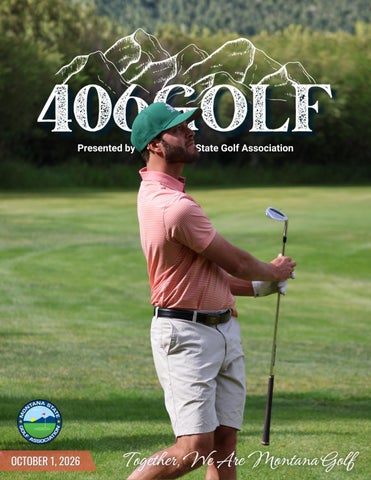
Stuart Gentry reaches for club on the first tee at the 2026 Montana State Junior Championship at Lake Hills Golf Club.
There is an opportunity for families to explore right now. Applications are open for the 2027 USNDP Grant, which offers selected families of competitive junior golfers with financial need up to $15,000 in reimbursements. Eligible expenses include tournament fees, travel, equipment, practice and green fees,
4
-
406GOLF
-
OCTOBER 1, 2026
and training. Recipients also receive access to the Accel Golf stat-tracking app and athlete development webinars. The application deadline is October 31, 2026. Families can review the details and apply through the USGA’s grant page. The USGA also offers application webinars for families who want help understanding
the process. MSGA leadership is committed to extending our reach well beyond eight elite junior golfers. Of course, junior golf in Montana is bigger than any one grant or competitive pathway. Some kids will chase championships. Others will find a lifelong pastime, a summer job, or a place to belong. We want to make room for all of them. We cannot do that work in isolation. If you run a junior program, have an idea for reaching more kids, or want to help with time, expertise or financial support, please reach out to us. If you’re a parent wondering where your child fits, we want to hear from you, too. The next chapter of Montana golf will be shaped by the opportunities we make available now. We are excited about what comes next, and we hope you’ll be part of it. Together, We Are Montana Golf!
MSGA
ABOUT US BOARD OF DIRECTORS - OFFICERS PRESIDENT..............................................Ron Ramsbacher VICE PRESIDENT......................................... Joe Rossman TREASURER...................................................Mary Bryson PAST PRESIDENT..........................................Peter Benson EXEC COMMITTEE....................................Susan Haskins BOARD OF DIRECTORS Ross Bartell, Peter Benson, Carla Berg, Marshall Bettendorf, Mary Bryson, Brandon Davidson, Bill Dunn, Cheri Ellis, Lisa Forsberg, Susan Haskins, Jeri Heard, Ron Ramsbacher, Joe Rossman, Rod Stirling MSGA STAFF Executive Director......................................... Nick Dietzen Tournament & Player Dev. Director.............. Tim Bakker Membership Operations Director............... Emily Hulsey Member Services Manager.............................. Ian Hulsey Marketing and Branding Director................... Katie Fagg Communications Manager.............................. Ty Sparing Partnerships & Business Development...... Nick Dietzen PARTNERSHIPS Nick Dietzen.............................. 1 (800) 628-3752, ext. 6 406GOLF STAFF Editor in Chief................................................ Nick Dietzen Senior Writer...................................................... Ty Sparing Graphic Designer.................................................Katie Fagg Contributing Writer.......................................Shanda Imlay Contributing Writer...........................................Peter Grass Contributing Writer..................................Melissa Dickson Contributing Writer..................Logan Groeneveld-Meijer Contributing Writer...........................................Hunki Yun Contributing Writer.............................. Scott Lennemann Contributing Writer.............................. Elliott L. Dowling
Montana State Golf Association P.O. Box 4306 Helena, MT 59604 1 (800) 628-3752 www.msgagolf.org
OCTOBER 1, 2026 -
406GOLF
-
5
Here Comes the Bogie Man The Origins of Bogey Golf BY TY SPARING
MSGA COMMUNICATIONS MANAGER
As golf spread beyond the velvety shores of Scotland in the late 1800s, the game became much more standardized. This is when the expected number of holes for a normal golf course was set at 18, when the R&A began creating a universal rule book that extended beyond the borders of St. Andrews, and even the scoring of the game became more universal. Among these developments, golfers for the first time started using terminology to describe how well they played a particular course (e.g. bogey, par, etc.) and thus a rudimentary scoring system was born. “Ground Score” was the first of these words to pop up on the scene. In 1890, a man named Hugh Rotherham, who was the Secretary of the Coventry Golf Club in England, had the idea to figure out how many shots a scratch golfer should take on each particular hole at the course he worked at, and that number became referred to as the ground score. Soon after, Coventry Golf Club was offering prizes for competitions centered around beating the ground score that Rotherham had devised. The novel concept spread quickly as the links transformed into an anthropomorphized competitor in the sense that golfers were no longer just competing against each other but
8
-
406GOLF
-
OCTOBER 1, 2026
also trying to shoot equivalent to or better than the ground score. At around the same time that the ground score became widespread in golf circles, a popular English folk tune called Hush! The Bogie Man! was making the rounds and popularizing a familiar trope. Drawing on sixteenth-century Scottish lore of a goblin-type figure called a bogey man, the song was a hit, thanks in part to a spooky chorus line that went:
“Hush, hush, hush! Here comes the Bogie Man! So hide your heads beneath the clothes; he’ll take you if he can. Hush, hush, hush! And all the children ran. So hushaby, my babies dear; here comes the Bogie Man.” Meanwhile, at Great Yarmouth Golf Club in England, a man named Dr. Thomas Browne, the club’s secretary, heard about the intriguing concept of competing against the ground score from a visiting group of Coventry Club golfers and soon after installed it as one of Yar-
mouth’s options for competition golf. One day Dr. Browne was out showing off the new scoring system to a friend named Major Charles A. Wellman, and as the round progressed, Wellman found himself getting caught by the tricky ground score. He ultimately failed to beat the inanimate foe, and after the round an exasperated Wellman commented that it felt like playing against “a regular Bogey Man.” (To this day the Great Yarmouth and Caister Golf Club in Norfolk, England, calls itself the home of the bogey.) Delighted at not only the idea of the ground score but also its devilish characterization as the Bogey Man, Dr. Browne took the concept all around England, with further monikers like Colonel Bogey or Mr. Bogey attached along the way. The terms ground score and bogey eventually fused together to indicate the same thing. To be a bogey golfer in the late 1800s and early 1900s effectively meant what we think of today as scoring par for the course. As some of us hackers know full well, that is not very easy to do, and hence the tendency to conceive of the ground score as an elusive and adversarial figure.
its own totally separate scoring system, albeit slightly easier to achieve than a score of even par, and many holdouts remained devoted to “bogey golf” for years after par became officially accepted by the USGA. On the other hand, in the United States the word “bogey” increasingly became a reference in relation to par and not the separate ground score from whence it sprung. The idea that a bogey was simply a way of referring to one over par was a point of contention throughout the first half of the 20th century, resulting in the widespread belief that Americans had corrupted the term. Finally, in 1957 the USGA defined bogey for the first time, calling it “one of the most widely misapplied and misunderstood terms in golf, ‘bogey’ has been often erroneously thought of as a score of one over par.”
Bogey golf was the target score for a couple decades before the term “par” became a fixture of golf lexicon. As the game continually grew more uniform in the years surrounding the turn of the century, and with a slew of innovations in playing equipment, the ground score essentially became too easy for skilled golfers, and so too did the bogey lose a little bit of its ominous luster. In 1911 the USGA (ahead of its European counterparts), standardized the length of holes and assigned par value depending on distances and defined it as “perfect play without flukes and under ordinary weather conditions, always allowing two strokes on each putting green.” With the widespread acceptance of the “par” scoring system as the new standard for competition against the course, the term bogey remained in a sort of limbo period for a few decades. On the one hand, it remained
Hush! The Bogie Man was a popular song in the late 1800s and contributed to golf's appropriation of the term 'bogey'.
OCTOBER 1, 2026 -
406GOLF
-
9
The USGA went on to explain that a bogey is “the same as par except when the committee declares it to be one over par because of the difficulty of a particular hole,” and that “par is beyond the reach of most players; bogey now is more nearly within range.” And while today it seems obvious that when people refer to a bogey they are talking about a score that is one over par on a particular hole, nevertheless the USGA still defines the average “bogey player” as someone with a Handicap Index at 20.0 for men and 24.0 for women, which of course is not necessarily as cut and dry as a +1 on each hole. Nor is there much to say about bogeys in the USGA’s Rules
That "bogey" feeling...
10
-
406GOLF
-
OCTOBER 1, 2026
of Golf other than describing it as “a form of stroke play that uses scoring.” True to its name, bogey remains an elusive figure to define. Despite having undergone many etymological transformations in its history, “bogey” is yet one of the most ubiquitous terms in the world of golf and still feared by many. While seeming to resist a final definition, maybe we should consider bogey’s origins and think of it as a reanimation of the mythical goblin of Scottish lore, a sort of golf demon that whispers “hush hush hush, here comes the bogey man,” to nervous golfers who are standing atop five-foot putts for par.
BY TY SPARING
MSGA COMMUNICATIONS MANAGER
2026 High School Class AA Divisional Golf Class AA golf is gearing up to crown champions this October at the MHSA State Championships at Meadow Lark Country Club in Great Falls, but first competitors had to battle it out at their respective Divisional Tournaments this September 21-22. Eastern Class AA Divisional The Eastern AA Divisional was held at Riverside Country Club and Cottonwood Hills Golf Course. On the girls’ side, Billings Senior swept both the team and individual titles. As a team they beat out second place Billings West by 9 strokes with a final cumulative score of +108. Following Billings West in third place was Gallatin with a final score of +120. Future University of Montana golfer and defending Class AA girls’ champion, Payton Tryan, took home first place by three strokes over Billings West’s Paige Loberg. Tryan finished at +7 (147) and collected four birdies over the two rounds as she collected her fifth individual victory of the season. Joining Tryan and Loberg in the top five was Anna Fenhaus (Billings West) who finished third at +14 (154), Breckin Frederick (Gallatin) was fourth at +19 (159) and Clare Jensen (Billings Senior) ended up in fifth place with a final score of +21 (161).
12
-
406GOLF
-
OCTOBER 1, 2026
On the boys' side it was CMR and Bozeman High Schools that shared in the spoils, tying for first place in both the team and individual events. As teams they finished at +34 for the event, with Gallatin three strokes back in third place at +37. Individually, CMR’s Jack Pinske and Bozeman’s Will Benne tied for the individual divisional title as the only players to score under par at -1 (139). Pinske, who recently committed to play golf at MSU-Billings next year, had six birdies and an eagle over the event, while Benne notched seven birdies of his own. Following the two leaders was Gallatin’s Ty Tisdale in third place at +4 (144) and Sam Alke in fourth place at +7 (147), while Karter Hammermeister (Billings Senior) and Lincoln Angst (Bozeman) rounded out the top five with a tie at +8 (148). For full results of the Eastern Class AA Divisionals, CLICK HERE Western Class AA Divisional Capital High boys swept both the team and individual titles at the Western Class AA Divisionals, held September 21-22 at Butte Country Club. As a team the Bruins finished at +37, thirteen strokes ahead of second place Missoula Sentinel. In third place was Butte High with a cumulative score of +59. Capital’s Jayce Belzer took home the top spot as an individual with a +3 (143) tworound performance that included six birdies. Cole Jenkins (Sentinel) and Lane Lisac
(Butte) tied for second place at +7 (147), Jack Schaefer (Sentinel) finished in fourth place at +8 (148) and in a tie for fifth place was last year’s Class AA state individual champion, John Gilbert (Capital) and Austin Kaufman (Helena High) who both ended up at +9 (149). On the girls’ side, Missoula Big Sky took first place in the team event with a final total score of +183. They were followed by Missoula Sentinel in second place at +220 and Capital High in third at +228. Individually, Glacier High School’s Maggie Mitton overcame a six-stroke deficit going into day two and ultimately won by a single stroke with a final score of +32 (174). Her second round of 82 was the lowest individual round of the tournament by four strokes. In second place was Maci Reiff (Sentinel) at +33 (175), Missoula Big Sky’s Charlotte Dale took third place at +34 (176) while her teammate Zoey Loberg followed suit in fourth place at +37 (179), and rounding out the top five
was Nora Kosena (Sentinel) who finished up her two rounds at +38 (180). For full results of the Class AA Western Divisional, CLICK HERE
Max Milton Sets New Course Record at Polson Bay Golf Course The high school junior scored -13 (59) at his home course There might not be anybody in Montana playing better golf right now than Polson High School junior, Max Milton. He has dominated the high school golf scene this fall season with five victories in both Class A and Class AA events and was even named the MHSA Athlete of the Week back in early September after a Helena Invitational win at Bill Roberts Golf Course in which he scored -17 (127) – with 18
Polson's Max Milton set a new course record at Polson Bay Golf Course with a score of -13 (59) from the white tees.
14
-
406GOLF
-
OCTOBER 1, 2026
total birdies – over two rounds. Milton’s latest achievement is about as mind-boggling as they come, as he set a new course record at Polson Bay Golf Course after posting a -13 (59). The round was highlighted by eleven birdies and one eagle on the par-5 third hole. One might think they have never seen so many circled numbers on a scorecard! This all comes on the heels of a summer in which he broke a tournament scoring record and became the youngest champion ever at the Lake City Open, was one stroke shy of becoming the youngest titlist in the 109-year history of the Montana State Amateur Championship, and announced his commitment to the University of San Diego, a nationally ranked D1 program. Having won the Class A individual championship back in 2024, Milton will look to capture his second MHSA title and lead a talented Pirates squad as they head into the State Tournament at Marias Valley Golf & Country Club in Shelby, October 1-2.
Looking for more Montana golf news? Head over to our website at msgagolf.org and check out our Latest News page. We have something for everyone. •
COLLEGE CORNER
•
HIGH SCHOOL ROUNDUP
•
COURSE SPOTLIGHTS
•
MONTANA GOLF HALL OF FAME
•
GRASS CLIPPINGS WITH PETE GRASS
•
RULES OF GOLF WITH SHANDA IMLAY
•
MSGA TOURNAMENT UPDATES
•
NEXT ON THE TEE WITH NICK DIETZEN
OCTOBER 1, 2026 -
406GOLF
-
15
Big Sky, Bigger Stage A Montana Agronomist at the Masters BY MELISSA DICKSON
MSGA BOATWRIGHT INTERN
The mowers start before the birds do. It’s not even 5 a.m. yet on the morning of the first day of the Masters Tournament, and Kash Helfert is already tending to the greens that millions will study on television. Months of hard work led up to this week, which also marks the conclusion of Helfert’s prestigious internship in agronomy at Augusta National Golf Club. Now, the Helena native works as an assistant superintendent at Desert Mountain Club in sunny Scottsdale, Arizona, bringing with him the skills and practices he acquired during his tenure at Augusta. A 2024 graduate of Oregon State University with a degree in turfgrass management, Helfert has made the world of agronomy his career and hopes to one day manage a course that he can call his own. “Being at the Masters with my parents and being there while the tournament was going on was definitely the most rewarding thing about it. Being there in August, it was work, work, work right
18
-
406GOLF
-
into overseed, just to grind and finally being there on the day was just a huge rewarding and fulfilling experience,” Helfert said. Despite having to work from sunup to sundown every day of the tournament, he said having his parents there to see the fruits of his labor was especially meaningful. Helfert was working as the second assistant superintendent at Green Meadow Country Club in Helena after having worked previously at Bill Roberts Golf Course for four years. Helfert’s former boss, Steve Link, superintendent at Bill Roberts, reached out to him, suggesting he apply for the internship when he came across a posting for it. Four interviews later, Helfert got the call, and he was soon on his way to Georgia in August of 2025 which he would call home for the next year. Helfert said he was most shocked by how traditional the operations are at Augusta, even on the greenskeeping side. “As opposed to newer golf courses, and what you see with big money, fancy golf courses where technology has gone so far in the
OCTOBER 1, 2026
industry, Augusta remains traditional with their mindset and their strategy.” Things like hand detail work, and walk mowing instead of mowing the greens with a mechanical reel mower are just some of the details he could share that were standard practice at Augusta. Helfert said it was a lot of manual labor, making the days harder but much more rewarding. “It was very cool to see that with a course like that that has all the money in the world they still choose to use manual labor, but that’s how they get the best product as opposed to trying to use some machinery.” Helfert’s love for turf management and course maintenance came initially from just a love for golf itself. He’d played for years at his home course, Bill Roberts Golf Course, in Helena. While working there as an equipment operator, he was often up before the sun was, and said that working among the crisp, morning dew and beautiful views was an easy career choice. “I thought I had good at-
tention to detail back at Bill Roberts, but it was nothing compared to what I had to learn and gain in detail there,” Helfert added. And the standard isn’t reserved for the Masters. It’s what Augusta National is known for year-round, for the members who play it on a regular basis. “So it’s just all year of details, details, details.” Details are the job, and most people never notice them. When people think of a greenskeeper, they likely assume it’s a lot of cutting grass. In reality it takes thoughtful care, detail and early mornings to create the pristine backdrop of a beautiful golf course. That type of expectation changed how Helfert thinks about his career, and it raised the bar for whatever comes next. “It’s hard to go from working at a public course, to you know, the highest pinnacle of golf, so it’s definitely hard to find the next place after that. But ultimately I want to take everything that I’ve learned from all of the golf courses that I’ve been at including Augusta National, and be a superintendent one day at a golf course that’s mine,” Helfert said. It doesn’t matter which one, he noted, just as long as he gets to use the skills he has learned and eventually pass them along to someone else one day.
Kash Helfert was part of a Capital High School state championship-winning golf team in 2022.
Proud parents got to witness Kash Helfert in action at the Masters.
OCTOBER 1, 2026 -
406GOLF
-
19
On course with Anaconda’s Logan McKay BY LOGAN GROENEVELD-MEIJER PACIFIC NORTHWEST GOLF ASSOCIATION
There’s not much Logan McKay can’t accomplish with her steadfast ambition and 14 golf clubs at the ready. Logan, 17, is a rising senior at Anaconda High School, where she’s one of its most prominent athletes, competing in volleyball, basketball, and golf for the school’s Copperheads. All those sports have long meant plenty to her, but golf has commanded her attention for the longest time. A natural athlete with a competitive spirit, Logan was ready to join her high school golf team as an eighth grader. That year (and in each one since), she lettered and earned both all-state and all-conference honors in the sport. Her golf excursion is one that traces back to her earliest days. At the age of three – or, that is to say, three days – Logan was brought onto the golf course in a small baby seat, accompanying her recuperating mother, while her dad, Russ, played a handful of holes. “She has been out there ever since,” says mom Kristy, herself a longtime player. “All those years she would ride with us, but not really golf. She’d maybe hit one hole or two, but never really a whole round until she was able to play high school golf as an eighth grader.” At AHS, that lifelong experience has served Logan well. She’s become one of Montana’s best junior players, having picked up multiple Class B high school wins, as well as a runner-up finish in that division’s state championship. Last year, she became the first AHS
20
-
406GOLF
-
OCTOBER 1, 2026
girls’ golfer to win an individual tournament title in over a decade. Each honor provides Logan with a sense of accomplishment and motivation. “To think I could be good, it just pushed me to do even better,” Logan said of the statewide stage on which she often finds herself. Both Logan’s parents have been immersed in sports. Kristy grew up competing in the Montana-favorite sport of rodeo, while Russ spent his upbringing hunting, snowmobiling and golfing with his grandfather. Once their family started to grow, both Kristy and Russ took up golf more earnestly in the hope of making the game a family activity. While growing up in that household, it wasn’t long before Logan was geared up with a set of what she called “little practice clubs” that became the catalyst in her own playing foray. Quickly progressing with a genuine proclivity for the game, Logan was ready to contribute to Anaconda’s high school team while still in eighth grade. “That’s when I truly started to enjoy it and realize it was my true calling she said.” Progressing through the first couple high school years, Logan’s time on the course was supplemented by the sports she played off it, and she’s always kept her game refined. When Montana’s cold and snowy winters descend, Logan finds the time to practice indoors in nearby Butte, where her coach, Caleb Stetzner, provides the lessons, and the indoor facility, Uptown Golf, donates generous bay access.
“She has great community support, especially with golf,” Kristy explains. “This town really cheers for her and her success.” The support from Anaconda makes its way to Logan. Whether directly from strangers, through social media comments or otherwise, the town’s faithful offers the young athlete a level of support for which she is grateful. “Every post that goes out, people from our town are just overflowing in the comments,” she said. “Going back and reading them, when I’m in my head or down on myself, is just a confidence booster because I know that people are behind me, no matter the outcome.” Her high school career has come with some adversity, but she’s overcome that, too. Playing basketball in December 2024, Logan suffered a torn ACL, an injury that jeopardized her upcoming golf season. After undergoing surgery a few weeks later and spending the following months in physical therapy, Logan managed to stick a tee in the ground for Anaconda in April. What resulted was another successful season and her runner-up result in
the state championship. What means just that much more to Logan is the ability to represent the budding golf scene in Montana, where herself, both her parents and her 97-year-old great-grandmother remain. Three courses are available to Logan in her hometown, among them Old Works Golf Course, a public and esteemed Jack Nicklaus design. “To go into the golf world and show that in Anaconda, a town in Montana, you can do well in other sports, it’s great,” she’ll say, noting how other sports like football have historically received higher interest. As her career progresses, Logan certainly has college golf in her crosshairs. But throughout the summer of 2026, and as she heads into her senior year at AHS, she’s content to sharpen her game while free from the competitive air of a high-school tournament. “Golf is honestly everything to me,” she said. “I want to perform and do well, and I know that I’m able to. I know that it’s ‘just go out there and have fun.’”
Logan (in middle holding the plaque) and her high school team took third at last year's Class B State Championship Tournament.
OCTOBER 1, 2026 -
406GOLF
-
21
Looking Back on the First Year of The MSGA's Fantasy Golf League BY TY SPARING
MSGA COMMUNICATIONS MANAGER
We recently wrapped up our inaugural first season of MSGA Fantasy Golf and we can report back that some fun was had. With 452 total members competing for some awesome Fins & Pins gear, participants took part in 12 events throughout the spring and summer, showing off their knowledge of both Men’s and Women’s professional golf. Partnering up with Majors Challenge, MSGA Fantasy Golf was a great way to root for our favorite players, learn a little more about various players in the pro game, and compete with friends in hopes of obtaining one of the cool prizes that were offered. Thanks to all who played, we can’t wait to see you back next year!
22
-
406GOLF
-
2026 MSGA MAJORS CHALLENGE FANTASY GOLF LEADERBOARDS
U.S. Women's Open Kyle Richie Robert Clark Ben Walborn
WM Phoenix Open Emily Hulsey Bill Moseley Joey Wark
U.S. Open Scott Eide Tye Boone Josh Martin
Players Championship Ty Sparing William Horgan Ben Kaul
Women's PGA Championship Mick Mueller Cheryl Sandback Emily Hulsey
Masters Tournament Toby Dinges Jay Taylor Luke Beckman
Evian Championship Jeff Benedetti Josh Martin Peter Morin
Chevron Championship Emily Hulsey Hal Seward Andrea Tucker
AIG Women's Open Laurie Mohl Dennis Morton David Hunt
PGA Championship Ross Bartell Emily Hulsey Brian O'Conner
Tour Championship Ben Kaul Michael Works Andrea Tucker
OCTOBER 1, 2026
History of Handicapping Part1: Roots of The System
BY HUNKI YUN USGA
The desire to compete is innate in any athletic endeavor. But most often, a fair contest is only possible between competitors possessing similar levels of skill. A Little Leaguer would have little chance of hitting a fastball thrown by a Major League pitcher. A top tennis player would hit serves that a recreational player would not be able to return. Golf is the only sport in which elite athletes can compete fairly against players with less talent while both are giving maximum effort. There are no head starts, no taking it easy, and we all play by the same rules. This level playing field is made possible due to the United States Golf Association’s Handicap System™. The USGA Handicap System takes into account the differences in skill level between the players as well as the difficulty of the golf course on which they are competing in order to properly allocate handicap strokes and ensure that the sides are as evenly matched as possible. Of course, no system is
24
-
406GOLF
-
perfect; but over the past 100 years, the USGA has made numerous changes and refinements to the USGA Handicap System to minimize the inefficiencies that may provide advantages to one type of player over another. Although there are more variables and the calculations have become more intricate, the foundations of the system remain the same as when it was established a century ago. It is dependent on both the integrity of the players in posting scores and the peer review of those scores within the setting of a licensed golf club.
played at Bruntsfield Links and Leith Links, and wrote about many aspects of the game, including equipment and technique. On January 21, 1687, Kincaid opined about the best ways to allot strokes to gain an advantage during matches: “At golf, whether it is better to give a man two holes of three, laying equal strokes, or to lay three strokes to his one and play equal for so much every hole.”
That the effectiveness of any handicap system lies with the players themselves has not changed since the first rudimentary attempts to equalize uneven skill levels, which no doubt took place soon after early golfers in Scotland recognized the competitive (and wagering) possibilities of the earliest game.
There is another reference from one of golf’s most revered clubs – the Honourable Company of Edinburgh Golfers – nearly 100 years after Kincaid’s diary entry. On March 30, 1782, a club official wrote: “Captain Elphinston challenges Mr. Allan next Saturday best of three rounds, half a crown a hole, that he beats Mr. Allan with the Club against his throwing and gives him half one. No running at the throw! That match was halved.”
The earliest known written mention of golf handicapping can be traced to a diary kept during the 17th century by Thomas Kincaid, a medical student at Scotland’s University of Edinburgh. Kincaid
The references to throwing indicate a certain level of unstructured informality regarding the game even at the Honourable Company, the club that drew up the first set of rules in 1744 for their
Early Years
OCTOBER 1, 2026
competitions. By all accounts from the era, a similarly libertarian ethos guided handicapping during the early years of the growth of golf. Whereas we now assign a USGA Handicap Index to within a tenth of a stroke (15.4, for example), the allocation during the 18th and 19th centuries wasn’t nearly so exact. In The Golfer’s Manual, Henry Brougham Farnie described the most commonly used odds, which were available in four options: “thirdone” (one stroke every three holes), “half-one” (one stroke every two holes), “one more” (a stroke a hole) and “two more” (two strokes a hole). Depending on the skill difference between competitors, the advantage could swing wildly between those giving and receiving strokes. Given the lack of precision and the absence of a standardized system, there was plenty of pre-round negotiating before settling on the terms of a game. Some say that most matches are won or lost on the first tee, and never was
that statement truer than in the early days of the game. Back then, golfers competed against a small community of other players in their clubs. Whether through actual rounds together or by word of mouth, the skill level of every player was familiar to all, ensuring reasonably fair matches among club members. To this day, that principle of peer review remains a cornerstone of the USGA Handicap System. Hand in Cap It is interesting to note that among all these mentions of handicapping during the earliest decades in which the game was played, the term “handicap” itself was not used. The word did not enter the golf lexicon until the 1870s. The term originates from a trading game, popular in pubs in the 17th and 18th centuries, known as “hand in cap.” The game required three sides: two players and a referee. Each player would have an item to trade with the other,
and it was the responsibility of the referee to determine the amount that would make up a difference in value between the items. The players would place money into a pot, then put their hands into a cap. When they pulled their hands out, an open palm would signal an acceptance of the trade, while a fist indicated rejection. If both sides agreed – either acceptance or refusal – the referee would receive the pot. If the traders disagreed, the player accepting the deal received the pot. The key to the game was how equitably the referee would assign the difference in value between the traded items, as he would benefit only if both sides agreed. If the referee wasn’t fair, he would lose out. “Hand in cap” became known as “handicap,” and the word transferred to other endeavors associated with betting – first horse racing in the 1850s followed by golf a couple of decades later.
OCTOBER 1, 2026 -
406GOLF
-
25
Ian Mackenzie-Olson 1. Who introduced you to golf? My grandfather Reed Mackenzie. 2. Who influenced you most in your golf life?
5. What is the best part of your game? The best part of my game is putting. When my game is sharp, my green reading and touch on the greens is very solid..
My grandfather. I grew up playing golf with him. He has always been a huge support in my competitive golf career and he has given me some amazing opportunities including playing golf in Scotland.
6. What is your dream foursome (living or dead)? Why would you choose them?
3. How did it feel to win the Mid-Amateur Championship this year at Polson Bay GC?
7. What’s your most memorable moment on a golf course?
Tiger Woods, Nelly Korda, and Michael Jordan. All three are the greatest at what they do/did.
One of my most memorable moments on the golf course is walking out on the 1st tee at St. Andrews Old Course with my grandfather. Such a memorable round of golf and incredible experience.
Winning the state Mid-Am was an incredible experience. I had been out of competitive golf for a few years and 2026 was my first year back. It truly means a lot to me to be able to win that championship. The MSGA did a great job running the event and the staff at Polson Bay did a great job making the players feel welcome and having a spectacular golf course for us to play.
8. If you could change one thing about the game of golf, what would it be?
4. What is your favorite course in Montana and why?
I would love to see more people walking golf courses. I really enjoy walking while I’m playing golf, I think it’s very underrated and is better for the golf courses.
This may be a biased pick, but my favorite course in Montana is Meadow Lark Country Club in Great Falls. Our greens complexes are very unique. They have lots of slope and are very fast which allows golfers to be very creative.
30
-
406GOLF
-
OCTOBER 1, 2026
9. What advice would you give to beginner golfers? I would tell all beginner golfers to ask for
help. Golf is a very complex game that is hard to master on your own. The golfers you see on tv have teams of people behind them to help them succeed.
Bonus: Lay up or go for it? Whichever is going to make your score lower.
Great Falls' Ian Mackenzie-Olson won the Montana State Men's Mid-Amateur Championship back in August at Polson Bay Golf Course.
OCTOBER 1, 2026 -
406GOLF
-
31
Happy Anniversary BY PETE GRASS RETIRED CGCS
Even though 99.99% of you golfers do not know it (until now), there are two very significant, to the game of golf both around the world and locally, anniversaries celebrating this month. The GCSAA (Golf Course Superintendents Association of America) has its official 100-year celebration on October 8th at its Headquarters in Lawrence, Kansas. GCSAA began in 1926 when a small group of what were then called greenkeepers gathered in Ohio. John Morley, who became the association's first President, made a statement that has become the backbone of this group for 100 years now. He said, “No life is, or can be self-existent. We depend upon each other.” In the profession of golf course management, as in all of life, this continues to be so true even 100 years later. As superintendents work to do their best, we depend on other Superintendents, our staff, our families, suppliers, turfgrass researchers, other allied associations and overall, you the golfers. Without everyone’s help and support, the course conditions you enjoy would not be the quality that increases each season. GCSAA has grown from those 20 people at
34
-
406GOLF
-
OCTOBER 1, 2026
that first gathering to over 22,000 members today, from 78 different countries. There are 102 affiliated chapters, the vast majority are in the US, but the Canadian Province of Ontario was one of the initial 5 Chapters to be formed. Mexico and the Caribbean are also Chapters. One of those Chapters is ours here in Montana (and Wyoming), it is called Peaks & Prairies GCSA. 50 years ago (1976), for much the same reason as GCSAA formed on a very large scale, a group of “local” Superintendents felt that learning from each other at a more regional level would be beneficial, so they officially formed what they called “WyMont GCSA”. That name was held until the late 1980s, when others from the Dakotas joined the group and the present name was added to more accurately depict the physical geography where these folks were maintaining golf courses. Peaks & Prairies GCSA will be celebrating its 50th Anniversary in Billings at its semi-annual educational conference October 13-15. I have the unique honor to have served as the President of each of these great organizations, P&P in 1987-88 and GCSAA in 2016. To be associated with the absolutely fantastic members and staff of both these groups has been a great honor and privilege.
The Golf Course Superintendents Association of America (GCSAA) is celebrating its 100-year anniversary this October.
Both groups are leading the way for members to advance their continuing education, professional development and employment skills to serve you, the golfers of Montana and the world. The game of golf has greatly benefited from those leaders who, 50 and 100 years
ago, came together with the realization that they depended upon each other. The result has produced the professional level of management at the facilities that provide such enjoyment to millions of players and economic vitality to communities around the world. HAPPY ANNIVERSARY
OCTOBER 1, 2026 -
406GOLF
-
35
What would Shanda do? You ask, Shanda Imlay answers. PART ONE - THE MOST MISUNDERSTOOD RULES The golf season is winding down (at least in Montana) so I thought I would write about some of the Most Misunderstood Rules in Golf! Or should I say, the ones I receive the most questions about? Let’s face it – the Rules of Golf are confusing especially when you go from casual play to competitive golf, from course local rules to MSGA competitions. WWSD is here to provide you with advice to help you avoid those penalties! --------------------------------1. Out of Bounds vs Lost Ball: Rule 18a (1) A ball is lost if not found in three minutes after the player or their caddie begins to search for it. Rule 18a (2) A ball is only completely out of bounds if the entire ball lies beyond the boundary line. If a ball is lost or out of bounds, the player MUST take stroke and distance relief by adding one penalty stroke and
36
-
406GOLF
-
OCTOBER 1, 2026
playing the original ball or another from where the previous stroke was made. Here comes the confusion: the USGA Local Rule E-5 lets you drop a ball near the fairway with a two-stroke penalty instead of going back to replay from the original spot. The purpose of this Local Rule is to allow a committee or your golf course to provide an extra relief option that allows a player to play without returning to the previous stroke. This Local Rule was created as an alternative to help with pace of play because let’s be honest, how many of you play a provisional ball if you think your ball is lost or out of bounds? --------------------------------2. Penalty Areas are one of the five defined areas of the course and can be marked as either red or yellow. Under Rule 17.1 when your ball lies in a penalty area you can play the ball as it lies or take relief outside the penalty area for one penalty stroke. Here is where errors occur with the relief options. Yellow only offers two relief options. You
can return to the spot from the previous shot and play under stroke and distance or the option of Back-on-the-Line Relief (no, this is not line of flight) where you drop anywhere on an imaginary line drawn from the hole through the spot where the ball last crossed the margin of the penalty area. For Red Penalty Areas there is an additional option which
is lateral relief (up to two clublengths no nearer the hole) from where the ball crossed the margin of the penalty area. Reminder: the Rules allow you to take practice swings, ground your club and remove loose impediments inside a penalty area. --------------------------------3. You can touch the sand
in bunkers (Sometimes). Under Rule 12, there are instances when you can and can’t touch the sand in a bunker. You can touch the sand when placing a club or other equipment in the sand, including the rake. You can lean on your club while waiting for your turn, or remove loose impediments (like leaves, twigs and small stones) if you do not intentionally test the
MSGA Rules Expert Shanda Imlay shares her top five most misunderstood rules of golf.
OCTOBER 1, 2026 -
406GOLF
-
37
sand or touch it right next to the ball with your club during a practice swing. On the other hand, you can’t hit the sand when making a practice swing in the bunker. However, there are some exceptions such as you cannot practice in the bunker in which your ball is lying, but you can go over to a different bunker and take a practice swing there as long as you do not hold up pace of play! --------------------------------4. You MUST correct hitting the wrong ball. Here was a situation where a player hit their drive into the rough off the tee, played their second shot short of the green, chipped up on the green with their third shot but when they went to mark the ball, they realized it was not their ball. The group called me over and asked what the player should do? Under Rule 6.3c (1) the player needed to correct their mistake by playing the original ball, which meant the player needed to go back and if they found it, they would add two penalty strokes for playing the wrong ball, but they do not count any of the strokes playing the wrong ball. However, the three-minute search did not turn up the original ball, so it was determined to be lost. Now the player had to take the strokeand-distance penalty and return to the tee. In the end the player had to take a two-
38
-
406GOLF
-
stroke penalty for wrong ball and a one-stroke for lost ball, and the player was hitting their fifth shot from the tee. --------------------------------5. You can’t always hit a Provisional Ball. Hitting a provisional ball is allowed under the Rules (see Rule 18.3) in the interest of saving time so why don’t more players play provisionals? In my opinion, the confusion is when are you allowed to play a provisional. A provisional ball is allowed when you believe your original ball might be Out of Bounds or Lost OUTSIDE a penalty area. You must, however, announce that you are playing a provisional, or the next shot you hit will be considered in play as if you took a stroke-and-distance penalty. There is, however, a time when you’re not allowed to play a provisional: For example, when you believe a ball is INSIDE a Penalty Area because you have multiple relief options to choose from with penalty relief. One more thing that often comes up regarding playing a provisional ball is if you hit one off the tee and it lands in the middle of the fairway and you’re sure the original ball is in a terrible lie, you can decide not to search for the original ball. Here is one of my friendly reminders: You can never declare your ball lost, if you play your pro-
OCTOBER 1, 2026
visional ball from a place nearer the hole than the estimated spot of your original ball, your provisional ball becomes the ball in play. This is important to know because if the original ball is found before you have played the provisional, either by you or someone else, and is in bounds, you must now play the original. And if the lie is unplayable, you just can’t use your provisional ball. You must proceed under the relief options for an unplayable ball. --------------------------------In conclusion, these are the top five misunderstood rules that I continue to answer. Hopefully with the explanations I have provided you can avoid penalties. Remember to always keep your copy of the Rules of Golf, effective January 2023, in your golf bag or better yet download the free Rules of Golf app for iOS and Android devices. The app contains the Player’s Edition, the Full Rules, and the Official Guide to the Rules, plus many additional features including videos, diagrams, FAQs, quizzes and more! Next month, Part Two, my next 5 rules that players find confusing but, in the meantime, if you have any rules, you find confusing or you simply struggle to understand, please email me!
Get the shale out of here! BY SCOTT LENNEMANN MARIAS VALLEY G&CC
Marias Valley Golf and Country Club is nestled into a ¾ mile length of canyon along the Marias River. The walls that surround the 160-acre “Oasis of the Hi-Line” are 200-300’ tall. The “badland” type topography is mostly dark gray and black shale that does not provide plant life sustainability. The region is described as high desert with an annual rainfall of twelve inches. The right sunlight can be stunningly beautiful in contrast to the turf and the giant cottonwoods that are one of the primary features of the golf course. Nine holes were built around 1970, and the next nine holes were built in the mid-90s. I have been onsite since 2017, and there have been technological upgrades to irrigation, machinery, and overall property amenities. We’ve been fortunate to host multiple events for the Montana High School Association, the Montana State Golf Association, and local fundraising-type tournaments. The summer of 2025 was no different. A full slate with one of our most prized events, the 96th Oilfield Golf Tournament, being the starting point of tournament season on Father’s Day weekend. The following week is another big one, but it’s a fundraiser for the local radio station, and it turns into a huge party annually. The evening of the big fundraiser, we had a rain shower of almost 0.9” that came down throughout the night. Over a three-day span,
40
-
406GOLF
-
OCTOBER 1, 2026
we received 1.25” of rain. These showers were not gully washers by any means, but they were setting the stage for the bigger, heavier rains that were yet to come. That 1.25” saturated the ground all around the course and made the surrounding hillsides susceptible to mudslides, unbeknownst to us. Weeks later, the night before we were set to host an MSGA Senior Tour Event, we received 0.76”, again over a lengthy period, but it did cause a small bit of soil erosion. The shale silt encroached on the playability of the course. We were able to come up with creative routing and fulfill our obligation of hosting the event for the MSGA, but it wasn’t the show you ever wanted to put on. Our maintenance crew takes considerable pride in their product, and not being able to fully highlight it was a dud, so to speak. One week after the MSGA Senior Tour event, we had the course ready to host our member/guest two-day tournament. Mother Nature had other plans, though. My Tempest weather gauge said we received 0.87” of rain in one hour. I happened to be driving into the property at 4:30 that morning as it was starting. It was a deluge! There were rivers of water flowing off everything. The farmer to the west of our property has an old-style rain bucket type of gauge. He told me that he received 2.2” of rain in that one hour. As the sun began to reveal the wonderful destructive powers of Mother Nature, the rain slowly diminished. Our Member/Guest was in jeopardy of total cancellation. Fairways 1, 8, and 7 run east-west at the base of the shale hillsides on the northern part of the golf course. The main silt deposits from this latest rain fanned out over these three holes. The damage on 1 fairway was approximately 65 yards in length. The damage on 7 and 8 fairways was nearly 300 yards. We ended up playing 1 as a short 130 yd par-three, 8 as a 250 yd par-four, and 7 was closed altogether as the entire fairway was buried with 3-10” of silt. All three holes were buried in muck that you
could barely stand up in as it was extremely slick, and the silt stuck to everything! Above the golf course, the coulees and draws are numerous and rugged. Each coulee had its own miniature flooding event. Some came onto the course like they did on 1, 7, and 8. We had similar silt deposits swing around the west end of our clubhouse that left deposits on numbers 10 and 18. 10 was played as a shorter par 4 and 18 was a par 3, similar to
number 1. As we are all aware, when challenging times fall on us, there are always folks with plenty of advice and ideas on how to attack the problem. We talked with our local insurance company, and insurance was not an option. Marias Valley Golf Course is in the Golden Triangle of Montana, and all these farmers and ranchers have ideas!! Some good, some not so good. I listened to all comers and even tried a few
Heavy rain caused rivers of water to flow through Marias Valley Golf & Country Club during the summer of 2025.
OCTOBER 1, 2026 -
406GOLF
-
41
things that I knew wouldn’t work, just to keep the idiocy to a minimum. Our green received a small amount of silt, maybe 30 sq ft. It took hours for my irrigation guy to hose it off. Hosing off the rest of the 12+ acres of covered turf seemed to be everyone’s “go-to” fix. I would point out how long it took to fix the putting green, and that stopped that discussion. I reached out to peers around the country, and the consensus was, “Good luck, let me know how she turns out.” I stared at the problem for weeks but kept coming back to the fact that I wouldn’t be able to do anything with it until it was bone dry. I decided to focus on the fairways only, as the entire flooded region covered almost 12 acres of turf. I put my attention to holes 1, 7, and 8 where there were 4 acres of turf to repair. I put a 4’ wide brush attachment onto our tracked skid steer and began to push the silt into piles that I could pick up and haul away. The silt had dried up to the consistency of talcum powder. As is normally the case in Shelby, the wind was a great aid in moving material away from the course. From the clubhouse it often looked like a desert dust storm that carried for miles away from the course, downriver. Every few hours I would come to the shop to blow out the air filter and get a new dust mask, even though I was inside a closed cab. I spent over 100 hours inside that machine, one 4’ wide swath at a time. Was it perfect? I don’t know how else we could’ve done it, short of a total renovation of the holes at a cost no one was ready to take on. At the end of all this dust blowing, it was too late in the season to seed anything, but we were able to aerify it three times with 5/8” hollow tines and top-dress it with a very coarse sand from a local pit. Over the winter when we were free of snow, I went out and ran our tractor over it with the aerovator attachment to poke more holes. More top dressing. In the spring of this year, we waited until soil temperatures would allow us to try and germinate the ryegrass. I opted to save money and not seed with a Kentucky bluegrass/rye
42
-
406GOLF
-
OCTOBER 1, 2026
blend until late in the season when temperatures are more conducive to germination. Our forecast looked good, our window between events looked good, and the board of directors told me to get after it. We put out a pound of nitrogen pre-fertilizer, double verticut the affected areas, we seeded heavily, we top-dressed with a compost material, wheel-packed the seeded areas, and set the water to run for five minutes every two hours. We shortened up the holes for play as we had done in 2025 and we crossed our fingers. None of us are weathermen, but I’m sure we all wished we could be wrong as often as they are. Not in the forecast were two consecutive mornings of 20-degree frosts! I thought I was sunk. We kept the watering process up for eight days until I had to dry things up enough for play and more events. I was not thrilled with the highly inconsistent results. As time has carried us through the summer, we have been able to keep the silt- affected areas as close to the rest of the property as possible— being mindful that we can’t get it as wet as the rest of the course because it will become a sloppy wet muck. In mid to late August 2026, we will repeat the spring process of pre-fert, punch holes, verticut, seed with our Kentucky Blue/Ryegrass blend, and water, water, water. As of today, we are in far better condition than I expected, and my board of directors is thrilled with our results. There are areas in the rough that still need loving attention, and they will get it as time allows. There are areas of the course that we haven’t touched and have healed up better than expected and areas that we have probably overworked and look horrible. I’ve learned that patience and thought will carry the day more often than bull rushing into a problem. I’ve learned from pretty much every mistake I’ve made in the turf business since 1989. I am sure I’ll screw more things up, and I hope Mother Nature and I have an amicable next few years, as this past year has been a huge challenge.
Greens Expansion Everything You Ever Wanted to Know BY ELLIOTT L. DOWLING REGIONAL DIRECTOR, EAST REGION
Expanding a putting green – whether for agronomic or architectural reasons, or both – requires detailed planning and careful execution. The decision to change putting greens is never an easy one and there is an understandable level of nervousness when it comes to manipulating the most important and valuable features of your course. Putting green expansions can seem like a relatively simple project, but experience shows they can be far more complicated than people think and problems are common. In many cases, expansions are undertaken decades after original construction, when turfgrass cultivars, construction technology and maintenance expectations have evolved significantly. To integrate expansions seamlessly with the original surface in terms of playability and presentation, the process requires close coordination between designers, contractors and the agronomic staff. If executed improperly, the new area may exhibit inconsistent firmness, drainage problems, or seams that affect playability for years to come. WHERE TO BEGIN The first step in the process is establishing
44
-
406GOLF
-
OCTOBER 1, 2026
the “why” for the expansions. Are you looking to add playing surface and hole locations? Are you adding expansions to alleviate traffic stress or improve surface drainage? Perhaps expansions are being added to change the look of the golf course? The reasons behind the expansions will play a big role in defining the project area. Another important consideration is the construction method of the existing greens. Historically, greens were built using native soils, but modern construction practices favor sand-based rootzones because they drain quickly and resist compaction. Sometimes, the proposed area of expansion used to be part of the green and the soil characteristics are very much the same. In other cases, the proposed area of expansion sits on an entirely different soil type that will have to be removed and replaced with a suitable growing medium. Although it is not essential that you match the soil used in the expansion with the existing green, grow-in and long-term maintenance will be much simpler and more streamlined if you do. I recommend performing soil tests on the green and proposed area for expansion well in advance to understand if the existing soil is suitable, if it needs to be replaced, and what to replace it with. The size of the green, its perimeter configuration, and its relationship to surrounding bunkers, sprinklers and approaches must also be evaluated before expansion begins.
“The essential challenge of expanding a putting green lies in extending the existing playing surface outward while maintaining continuity in soil profile, drainage characteristics and turf quality.” TYPES OF EXPANSIONS The essential challenge of expanding a putting green lies in extending the existing playing surface outward while maintaining continuity in soil profile, drainage characteristics and turf quality. Construction strategies to achieve this continuity generally fall into one of several categories. One approach is complete reconstruction, where the expansion area is excavated, rebuilt and regrassed to the desired specifications. Another approach is incremental expansion, sometimes called a “bump-out” method, where the new area is converted to putting surface by slowly lowering the height of cut until the expansion eventually matches the putting green. This obviously works best when the turf in the expansion area is comprised predominantly of the same grass species as the putting green turf, but overseeding while lowering the height is an option. Another common approach is to remove the existing turf, prepare the surface and plant new grass without any major soil modifications or drainage installation. This is the simplest method to complete but often comes with the most risk, particularly if the underlying soil does not match the existing green and/or is not conducive to maintaining healthy putting green turf. COMPLETE REBUILD The most comprehensive method of green expansion involves removing the existing soil and reconstructing the area. This allows you to reshape the area if desired and install a preferred rootzone mix and subsurface drainage. Drainage in expansion areas can connect into the existing putting green drainage system or outfall elsewhere if connection is not practical
or if the existing green does not have subsurface drainage. When outlining a proposed disturbance area with this method, it is important to go into the existing green and beyond the putting green expansion zone (even though those areas will not be cored-out) so that all the changes tie-in together seamlessly for aesthetic, playability and drainage purposes. Excavation should be deep enough to accommodate drainage layers and new rootzone material, which typically means excavating 8 to 12 inches below finished grade. Rootzone selection and depth is arguably the most important variable in this type of putting green expansion. As noted above, having a lab test the existing putting green soil and options for expansion rootzone material will guide decisions about what mix to use and how deep it should be. Another important consideration with this method is making sure the new rootzone mix is fully compacted and tied in smoothly with the existing green. If the mixture settles after grassing, there will be a negative impact on ball roll and potentially surface drainage. INCREMENTAL EXPANSION In some situations, the green has shrunk over time but the surrounding grass mostly matches what is on the primary putting surface and the soil type is similar in the expansion area to what is on the green. In this case, incremental expansion may be more practical than total reconstruction and it will definitely be less expensive and disruptive. There are many older golf courses that have used this method to successfully recapture lost putting surface area. One way to determine if this method is an option for you is to look at irrigation head placement around the greens. If you notice heads are spaced with an unusual amount of grass between them and the putting surface, there is a good chance that the green used to extend out to the irrigation heads and shrunk for various reasons over the years. You can use a soil probe to check where
OCTOBER 1, 2026 -
406GOLF
-
45
the original putting green rootzone layer ends and where native soil begins. If the area to be converted is currently rough, then you’ll start with a rough mower and slowly lower the height of cut until you are able to use a smaller reel mower and eventually a putting green mower. If you are lucky, most of the grass in the expansion area matches the desired grass on the putting greens, but if it has been maintained as rough for an extended period of time, there’s a good chance that other grasses have crept in that won’t be suitable at putting green height. If this is the case, you will have to aerate and overseed with the desired grass as you lower the height of cut or use a different method for expansion. Good seed-to-soil contact is important for quick germination. If the grass in the expansion area is already at fairway or surrounds height, lowering the height of cut gradually will be simpler because you are already using a reel mower and there is likely more of the desired turf in the expansion area, though some overseeding may still be necessary to fill voids and achieve the desired turf population.
For warm-season grasses, this procedure can be done relatively quickly in summer. You can drop the height of cut, topdress, recover, and drop it again in fairly rapid succession. With cool-season grasses, the process takes a little longer and is best started in late summer and continued as late into the fall as necessary. Cool-season grasses will react negatively to lower heights of cut if the process happens too quickly and/or if the weather is still stressful. A general rule is, if lowering starts in mid to late summer, the goal should be to reach putting green height by very late fall or early the following spring. There are exceptions to this, mostly depending on the initial mowing height of the expansion area and the turf composition. If the starting point is close to the desired height, then you could achieve putting green height in a month or so, but if the expansion area is rough height you should be prepared to take your time. Rushing will only cause you problems later. “Rushing will only cause you problems later.”
Excavating the expansion area gives you an opportunity to install drainage and a rootzone material that closely matches the existing putting green soil.
46
-
406GOLF
-
OCTOBER 1, 2026
REGRASSING WITHOUT REBUILDING If the soil in the expansion area is consistent with the putting green soil, but the grasses are incompatible with the putting green turf, courses may choose to strip the sod and replace it with their desired turf without making major modifications to the soil or slopes. This process can work well, but there are a few caveats. First, I still encourage courses to strip a few lines into the green and beyond the proposed expansion area to make sure the grades align well and positive surface flow is achieved. If the proposed area for expansion also hasn’t been maintained as putting green turf for a long time, you may want to aerate the soil, mix in some topdressing, remove thatch accumulation, or perform any other practices to help that area match the soil characteristics of the putting greens as much as possible. Regrassing without rebuilding is not likely to be successful if the soil in the expansion area is not consistent with the soil under the green. GRASS SELECTION After how to choose the best rootzone mix, the second most common question I receive with expansions is what grass to use. I’ll start with an easy answer. If your course grows bermudagrass, zoysiagrass or paspalum greens, your option is limited to the putting green turf you have. If you try to plant different warm-season species or varieties in the expansion area, inconsistent playability and aesthetics will be immediately recognized by golfers. It’s also very likely that there will be contamination between the green and expansion area that will create further inconsistency down the road. The more difficult answer is what to do if you are growing Poa annua or a combination of creeping bentgrass and Poa annua. The gut reaction for some is to plant the “latest and greatest” bentgrass on expansions because, why not? Unfortunately, it’s not usually that simple. It is important to consider your options and have a solid reason behind the grass
you ultimately choose. Even after you’ve done your research on different grasses, the story doesn’t end there, especially with greens that are predominantly Poa annua or a bentgrass/Poa annua mix. Courses often select creeping bentgrass for the expansion because of the improved genetics or because bentgrass sod is readily available. While both reasons are valid, you must consider how that expansion will look and play in the long term. There is really no way to get a new, uniform stand of bentgrass (especially an improved variety) to match an existing Poa annua or Poa annua/creeping bentgrass putting green. There have been courses that aerated the primary putting green and incorporated those plugs into the expansion in the hope of creating a more consistent surface, but that takes years (or even decades) to work, if it does at all. If the greens have a high percentage of Poa annua and your course is happy with how they perform, my recommendation is to establish a nursery with aeration plugs and use that sod for the expansions once it has matured. This is the only way to truly match the putting green turf and get consistent playability, presentation and agronomics. If you have predominantly bentgrass greens with a commercially available variety, you should have no problem obtaining new sod. If it’s an older variety, my recommendation is to focus on finding a commercially available option that closely matches the color and texture so the expansions blend in as much as possible, rather than choosing whatever is considered the “best” variety at the moment. Another option is to take sod from a practice green to use for expansions – assuming those grasses match what is on the golf course – and then regrass the practice putting green with a commercially available variety. GRASSING AND ESTABLISHMENT No matter whether the expansion area is excavated and rebuilt or stripped and prepped, you are going to have to reestablish grass.
OCTOBER 1, 2026 -
406GOLF
-
47
There are a couple ways to do this, with sod being the most common because it is playable sooner and you are not typically talking about large enough areas where sod cost is prohibitive. Plugs can also work well, and they tend to stay in place through early establishment better than seed or sprigs would in the event of heavy rain. Regardless of grassing method, it is important to make sure the irrigation layout properly covers the expanded putting surface. In many cases, the existing heads are already in the right places because the green shrunk over time, but sometimes heads do have to be moved outside the new putting surface, which adds complexity to the process. The first method we’ll discuss is sod. Ideally, you want to use sod that matches your greens taken from somewhere on your golf course. The easiest solution, if possible, is to use a nursery or perhaps portions of a practice green. If you don’t have a nursery, or don’t have one that is large enough to account for all of your expansions, and you have time, use plugs from putting green aeration or a matching seed blend to start your nursery. This means the grass you establish on the nursery will match the existing greens and your expansions will be seamless. If this isn’t an option, or it isn’t an option you want to use, you’ll need to purchase sod from a supplier. If you can purchase sod that matches the turf variety on your greens, then I recommend doing that. If not, try to get as close to the color and texture of your existing greens as possible so the expansion doesn’t stick out. “You also have to be gentler with new expansions than with the existing putting green turf.” The story is also not over once the sod is down. The expansion will need to be maintained like a grow-in for several months. I often find giving expansions everything they need is more difficult than if the entire green would have been rebuilt because expansions tend to be small and can fall down the prior-
48
-
406GOLF
-
OCTOBER 1, 2026
ity list. Don’t let this happen! It is imperative that you perform additional cultivations on sodded expansions to break through the sod layer and disrupt the interface of sod and rootzone mix to allow for better rooting and water infiltration. You also have to be gentler with new expansions than with the existing putting green turf. Even beyond the grow-in stage, expansion areas can be quick to struggle during stressful weather or under heavy traffic because they have not fully matured. Sodded expansions may need to be mown at a slightly higher height of cut, or mown less frequently, and they may require more water and fertilizer than the mature portion of the green long after the sod has been fully established. Traffic management is equally important. Try to divert foot traffic away from expansions as much as possible. Roping the area off helps, you can also try to place hole locations on parts of the green where golfers won’t tend to walk over the expanded area. If the expansion is large enough to support a hole location once it matures, that is fine. Just keep in mind that excessive foot traffic can be injurious and try to place hole locations in the expansion area less frequently than fully mature areas of the green until you are confident that the new turf can handle the traffic. The second method for grassing is using seed or plugs. There are many reasons why these approaches might be right for your course, but the most obvious is cost savings. Seed is less expensive than sod, especially if you are lucky enough to have seed on hand. While the major advantage of seed is a low price, it does come with an extended grow-in period. Sod can be ready for play in a couple of months under the right conditions. However, seeded expansions may require six months or more until they can handle play. For example, cool-season courses utilizing seed often try to have it on the ground sometime around mid-August to early September, with an anticipated opening date of that area the following spring. Besides the additional time for establishing
Planting expansion areas with plugs may be the only way to match them with the existing greens (image courtesy of Michael Vessely).
the expansion, traffic control is critical. Seedlings cannot handle traffic. The challenge is that expansions often include corners or edges of greens where players naturally walk on and off. Closing the area to traffic with ropes and signs and reminding players and staff about the importance of staying off the seeded area is critical for success.
putting green because they create an irregular surface even when packed down tightly. Rolling and topdressing will be needed to create a smooth transition between plugs and an established green.
Seedlings also need to be watered frequently so that they don’t dry out. This is typically done with a hose in expansion areas because they are small and you don’t want to water a large area of the green at the same frequency new seed requires. Applying water two to three times per day, if not more frequently, will keep the soil and seedlings moist. Fertility is also needed on a regular basis. Light applications once per week are not unusual. Unlike sod, which is comprised of more mature plants, seed has only one root to start. That one root, and eventually an immature root system, should not have to move far to find water and nutrients. It will only delay establishment and opening if proper water and nutrients are not applied.
Expanding greens can be an exciting and impactful project. Whether the purpose is to reestablish older architecture, add new hole locations, change traffic patterns or change the look of the greens, this popular renovation project can add to the value of your most valuable asset – the greens! But expansions aren’t always as simple as you think they should be, and mistakes tend to look pretty bad right next to a nice, mature putting green. Consulting an architect and performing due diligence on finding a matching rootzone mix, installing or connecting drainage, and choosing a suitable grass type are all critical to success.
Plugs are hardier than seed and they can establish faster, but they still require plenty of water. Plugs also make it more challenging to achieve a smooth grade with the rest of the
FINAL THOUGHTS
Click Here for more from the USGA Green Section Record ‒ including the latest articles and videos on sustainable management practices that produce better playing conditions for better golf.
OCTOBER 1, 2026 -
406GOLF
-
49