122
Autumn 2026
2 Situation report | 4 Ebola emergency Read first-hand accounts of our work combatting this deadly new outbreak | 8 Ebola treatment centre A detailed look inside MSF’s Ebola treatment centres | 10 ‘We are neutral, but not blind’ Jérôme Tubiana takes us behind the scenes to see how MSF operates in conflict zones | 12 Three innovations changing patients’ lives Read about MSF’s innovative new research breakthroughs | 14 ‘I slept with my mattress against the wall’ Dr Mohammed Abu Mughaiseeb shares a deeply personal account of life in Gaza during the war
SITUATION REPORT
2
3
1 5 4
2. NIGERIA
1. ETHIOPIA Toys being used for play therapy at a feeding centre in Ethiopia. Play therapy is an important psychosocial tool that helps young children affected by displacement, illness and stress to express their emotions, while strengthening their relationship with caregivers and supporting their developmental wellbeing. 2 | DISPATCHES
2,217
3. VENEZUELA Following the devasting earthquakes of 26 June, MSF teams are running four mobile clinics providing basic healthcare, mental health support, health promotion, and water and sanitation activities across the most affected areas, and have donated approximately 8.5 tonnes of emergency medical supplies.
Number of medical consultations conducted by MSF in earthquakeaffected areas of Venezuela in the month following the disaster. Photograph © Mariana Zupo/MSF
Photograph © Paula Casado Aguirregabiria/MSF
Photograph © Abba Adamu Musa/MSF
An MSF health promoter encourages families to bring their children for vaccination during a diphtheria vaccination campaign in Kano state, northwest Nigeria. Between January 2023 and December 2025, the state recorded more than 31,300 suspected diphtheria cases and more than 1,580 deaths from the disease. MSF vaccinated 486,948 children in the area between 20 and 24 June 2026.
Photograph © Diana Worman/MSF
4. KIRIBATI Kiribati (pronounced Ke-ree-bas) is a vast island nation made up of 32 atolls and one raised coral island in the Pacific where extreme weather events and rising seawaters are depleting freshwater supplies. MSF is working with the Ministry of Health in a project focusing on nutrition-related conditions affecting women and children under five, while working to strengthen community resilience to climate change. A core part of this work includes improving water, sanitation and waste management systems, strengthening rainwater harvesting infrastructure and promoting health education.
MSF LAUNCHES UK TRAUMA PROJECT MSF has launched a specialist trauma service for refugees and people seeking asylum in the UK, delivering targeted psychological care to people who have often survived torture, conflict and persecution, as well as violence and exploitation on their migration journey. Based in Birmingham and Sandwell, the project addresses the mental health needs of people who are continuing to experience trauma in the UK due to harmful migration policies and hostility from protest groups.
A girl suffering from measles is treated by the MSF team in Burao, Somaliland. Following more than 1,500 cases and eight deaths from the disease, MSF has been running an emergency response in the region, providing free measles care and nutrition support.
Referred to the trauma service by the NHS as well as local refugee and migrant support organisations, patients are often dealing with symptoms associated with posttraumatic stress disorder (PTSD) – flashbacks, nightmares, hypervigilance – as well as
Photograph © Abdurahman Mukhtar/MSF
5. SOMALILAND
While Birmingham is the UK’s second largest city and hosts England’s second largest supported asylumseeking population after London, “it has far fewer public and charitable services available to meet these needs compared with the capital,” says Fouzia Bara, head of MSF’s migration taskforce. “As part of our ethos, we go where we are needed most and we saw that need was in the refugee and asylum communities in Birmingham and Sandwell.”
depression, anxiety and grief. MSF offers an evidence-based, multistep, multi-disciplinary model of care, as part of a broader holistic approach that includes case work support to those living in hotel accommodation and signposting to other support organisations. Maria*, a member of MSF’s therapy team, says the fear experienced by people with PTSD “is like an alarm that is always on. It can be absolutely depleting and devastating. But as I tell the people I work with in therapy, with the right support you can switch the alarm off.” But UK migration policies, which force people to make dangerous Channel crossings, separate families and see people housed in unsuitable temporary accommodation, are only compounding patients’ trauma. “All these policies mean that many of the people we work with continue to feel like they’re not safe, which has a real impact when we’re trying to treat conditions like PTSD,” says Melissa*, another member of MSF’s therapy team. Sign our petition calling on the UK government to end dangerous and harmful asylum policies at msf.org.uk/sick-asylum * Names have been changed. AUTUMN 2026 | 3
DEMOCRATIC REPUBLIC OF CONGO PHOTOGRAPHY ALEXIS HUGUET JULIEN DEWARICHET
EBOLA EMERGENCY 4 | DISPATCHES
On 15 May 2026, the Democratic Republic of Congo (DRC) officially declared an Ebola disease outbreak in the northeast Ituri province. To date, there have been more than 3,000 confirmed cases and more than 1,400 deaths in DRC and across the border in Uganda. More than 1,400 MSF staff are on the ground treating patients.
Trish Newport, MSF emergency manager “This outbreak is extremely concerning. Just days after the official confirmation there were already hundreds of suspected cases, and people were losing their lives. It’s only the third time in history that there has ever been a Bundibugyo Ebola outbreak. This means there are no approved vaccines and very limited testing capacity.” Anthony Kergosien, emergency coordinator, Bunia, DRC “As of today, we are caring for 37 suspected cases and seven with a confirmed diagnosis. The facility is full. We’re preparing a new section of land to almost double our capacity. We need to adapt our approach almost daily to keep pace with the level of care needed.” Armand Sprecher, MSF public health coordinator “When we first discovered this outbreak, it was further along than what we’re accustomed to. Usually, when we start working in an Ebola outbreak, there will have been a dozen or so cases and a handful of deaths. In this case, the numbers were already five times what we would usually see. Importantly, people were already moving shortly after the outbreak was detected, and cases were appearing in cities hundreds of kilometres away. If you want a recipe for a big outbreak, start with a small outbreak and then have people move around while they’re incubating illness. If you have one epicentre, that’s a lot of work. If you have five, that’s five times as much work and requires five times as many staff to combat the outbreak and contain it.”
Déi sits in a ward of the Ebola treatment centre, Elykia, Bunia, Democratic Republic of Congo after recovering from the Ebola Bundibugyo virus. “Before coming here, I spent three days at home, not realising I needed to go to hospital,” she says. “In my in-laws’ family, there have been more than fifteen deaths caused by the virus…Today, I’m fine. I no longer have nausea or diarrhoea; my appetite has returned and I’m eating normally.” An MSF staff member at the Ebola treatment centre at Mongbwalu general hospital collects bottles of drinking water for distribution to patients in the confirmed cases ward, Ituri province, Democratic Republic of Congo.
Dr Maria Mashako, MSF medical coordinator “I can tell you that here at the hospital the needs are gigantic. We’ve been open for almost two weeks now, but within less than 48 hours, nearly 30 beds were already occupied. From then on, every day, we’ve been receiving about five new admissions. That’s putting us under tremendous pressure.” John Johnson, emergency coordinator and vaccination and epidemics response advisor “MSF has extensive experience working on Ebola. We’re one of the main organisations that can deploy teams rapidly and respond to these epidemics, which can be very challenging. Not only because of where they take place, but because Ebola is a disease with a very high mortality rate.” Kate White, emergency medical coordinator, Mongbwalu. “The team is doing everything they possibly can to ensure that people survive but we’re finding new needs every day. You have healthcare workers who have seen not only their loved ones die, but their fellow workers. We have patients coming in at the very end stage of the disease. It’s heartbreaking because sometimes you see the same family group over and over again, AUTUMN 2026 | 5
because what started with one person has been transmitting at a household level every day. It’s on a scale I haven’t seen in a really long time.” Florence Baginyo, accountant at Mongbwalu general hospital. “I work here at the hospital – I’m the accountant. My little sister, who was sick, called to say she was feeling very ill. I hopped on my motorcycle and arrived right away. I found her on the floor, vomiting. I asked her, ‘Can I take you to the hospital?’ At first, she refused outright: ‘No, people die there.’ But then she agreed. We arrived on the 5th. On the 6th, she died.” John Johnson “One of the big challenges with Ebola is that the symptoms look like a lot of other conditions. You have a fever, you have tiredness, fatigue, some joint pain, a headache. That can look like malaria, that can look like typhoid fever. And the problem is when you start having Ebola cases, everybody starts out having these symptoms and until you test them, you don’t know what is what.” Esperanza Santos, MSF emergency coordinator “The most important tool against Ebola is not in a hospital; it is in the community. It may seem surprising, but experience has shown us again and again no outbreak can be controlled
1,400 Number of MSF staff responding to the Ebola disease outbreak in DRC
without the trust and participation of the people affected. When a community knows the symptoms, knows where to seek help, knows how to prevent infection and helps with early detection of cases, we can act faster and protect more lives.” Armand Sprecher “Trust between MSF and the community is vital because we ask people to do things that they’re otherwise disinclined to do. People like to care for their family members at home and only go to healthcare facilities when that’s necessary. But we need them to come to facilities straight away, which means that they have to trust us with the care of their family members. If we’re kitted out in the suits and look like we’ve come from another planet, that impairs their interest in coming to the treatment unit. So we have to go out into the communities and explain why we wear the PPE, why we look the way we do and that a lot of the people wrapped up in that gear are actually people that they would otherwise know and recognise because they are local healthcare workers.” John Johnson “One of the things that’s hard for people to understand is since Ebola is a contagious disease and it has a very high mortality rate, we also have to protect the family from the patient, or from the patient’s body if the patient passes away. And a lot of times that creates a lot of frustration and anger with the family who want to bury the dead, and they don’t necessarily have access right away to the patient’s body.” Augustin Kpagbo Ngodonza is a maths teacher and MSF community health educator in Mongbwalu. “My role is to raise awareness within the community about Ebola, to help them understand that this disease exists, and that it kills. I explain how to protect themselves against this disease. It is not easy to announce the death of loved ones. We cannot announce a death abruptly. There are strategies that must be adopted to announce a death in a dignified way, knowing how to calm them, and gently communicate the news of death. At first, the community did not want to accept the existence of the disease, but gradually, the community is beginning to understand.” Florence Baginyo “On Sunday the director of nursing [at the hospital] called me to say she was sick. Could I send an ambulance?
6 | DISPATCHES
We headed to her house to pick her up. We arrived around 9 am and she died at 7 pm.” Armand Sprecher “The infectious dose of this virus is very low, so if you get just a few viral particles into the wrong place, like an eye or your mouth, that’s enough to initiate disease. And we can’t even trust skin, because although it is often an effective barrier, sweat can run downhill with gravity and get into your eyes or your mouth. So the PPE is designed to exclude even small amounts of virus, which means the gear must be water impermeable. But impermeability comes at a cost, because if we don’t want fluids to go in, neither can sweat evaporate and go out. It just runs down and ends up in your boots, and it doesn’t cool you off, so you become very, very hot. At a certain point, people need to get out of the gear because their body temperature is so high that it’s no longer safe for them to continue working. On average, depending on the climate, you have anywhere from 45 minutes to an hour working in the suit in an Ebola treatment centre. So you have to make the most of the time.”
Dr Alex Bonane Murutsi and a colleague pose proudly with recovering Ebola disease patients they have been caring for since their arrival at the Ebola treatment centre in Bunia, Democratic Republic of Congo. Hygienists at the MSF Ebola treatment centre at Mongbwalu general hospital sing and dance to celebrate the discharge of three patients who have recovered from Ebola.
Florence Baginyo “I rested on the 8th, the 9th and the 10th, then I got sick. I started having strange symptoms. I had body aches and felt weak. From the 10th until today, I have been in the hospital. The test came back positive. But thankfully, I beat the disease.” Trish Newport “Every delay costs lives. We are still chasing the outbreak instead of staying ahead of it. More people become infected, more families lose loved ones and the epidemic becomes harder to contain. We need stronger, more coordinated international action to move faster and improve access to both Ebola care and other essential health services.” John Johnson “It’s important to remember that there are people that survive, and that’s the reason we do everything we do.” Kate White “It’s not the end. There is still hope if we can make sure that people can get early treatment and access care.” LISTEN TO DR JOHNNY FALCONER TALK ABOUT HIS EXPERIENCE OF WORKING IN THE OUTBREAK ON OUR EVERYDAY EMERGENCY PODCAST: MSF.ORG.UK/EBOLA-PODCAST AUTUMN 2026 | 7
EBOLA TREATMENT CENTRE
I
n response to the Ebola outbreak in the Democratic Republic of Congo and Uganda, MSF has established several specialised centres to treat patients and contain the spread of the disease. Ebola, one of the world’s deadliest diseases, is highly infectious and is transmitted through close contact with bodily fluids, so patients must be treated in isolation by staff wearing full protective gear. Because this outbreak is caused by the Bundibugyo virus, for which there is currently no vaccine, infection prevention protocols are especially vital.
Laundry, showers, latrines (staff)
6
Water tanks
LOW-RISK ZONE
Staff changing Stores
1 2 Pharmacy
Staff entrance/exit
3 Triage and Screening
RED – PATIENT PATHWAY 1. ENTRANCE FOR PATIENTS/TRIAGE TENT Patients with Ebola symptoms are admitted through the triage tent and follow a carefully designed pathway throughout the treatment centre. 2. HIGH RISK ZONE – SUSPECTED CASES To prevent patients becoming infected with Ebola after entering the treatment centre, it’s crucial to keep suspected and confirmed cases separate. 3. HIGH RISK ZONE – CONFIRMED CASES Once Ebola infection is confirmed, patients are admitted to the treatment ward for confirmed cases, where staff manage their symptoms and keep them as comfortable as possible.
8 | DISPATCHES
4. MEETING ZONE Family members talk with patients through the fence, local religious leaders offer moral support, and MSF psychologists provide counselling all while maintaining safe distance protocols. 5. MORGUE Safe and dignified burials are conducted by trained teams, with family involvement according to infection prevention and control protocols and, where possible, culturally appropriate traditional rites. 6. EXIT FOR CURED PATIENTS Patients who recover from Ebola are able to leave the treatment centre after testing negative for the virus two times in a row. Before leaving, they shower in chlorinated water and receive clean clothes and therapeutic food and vitamins to help rebuild their strength.
Staff entrance to high risk zone
Patient entrance
7. RETURNING HOME Returning home isn’t always easy, due to the stigma and fear associated with Ebola. Survivors receive continued support from psychologists after they leave, while health promoters help educate their communities about the disease.
1
2. PROTECTIVE CLOTHING “Because the gear is impermeable, sweat can’t escape, so you become very hot,” says Sprecher. “Depending on the climate, you have between 45 minutes to an hour before you need to get out of the suit.”
BLUE – STAFF ROUTE 1. STAFF CHANGING AREA Before entering the high-risk zone, staff are helped into their protective suits, following strict protocols and respecting the ‘no body contact’ rule.
3. STAFF ENTRANCE TO HIGH-RISK ZONE As staff can only work in short bursts while wearing the protective gear, every entrance into the high-risk zone is carefully planned to ensure no time is wasted.
Incinerator
Staff exit from high risk zone
4. HIGH RISK ZONE – CONFIRMED CASES There is currently no specific treatment for Ebola caused by Bundibugyo virus, but staff can tackle symptoms like fever, headache, vomiting and diarrhoea, offering supportive care such as fluid replacement and oxygen support. 5. STAFF EXIT FROM HIGH-RISK ZONE/ PPE REMOVAL When leaving the high-risk zone, staff remove their protective gear and have their boots, gloves and goggles sent to be disinfected. 6. STAFF LAUNDRY, SHOWERS, LATRINES/PPE CLEANING AND RECYCLING Reusable items of clothing are washed in chlorinated water, while anything that can’t be washed or disinfected is burned in the incinerator.
5 Office and meeting tent Family and visitor area Showers and latrines
4
Ward
2
HIGH-RISK ZONE – SUSPECTED
Ward Showers and latrines
HIGH-RISK ZONE – CONFIRMED Ward
Your support enables our teams to provide specialist staff and essential supplies when an emergency strikes.
£154
Morgue
6 Shower
Exit for cured patients
7
could pay for two sets of personal protective equipment (PPE) for staff members in an Ebola treatment centre
£310
could cover the cost of an MSF doctor working in a project for two days
AUTUMN 2026 | 9
© Richard Palmer Graphics
5
3 4
SUDAN
PHOTOGRAPHY JÉRÔME TUBIANA
‘WE ARE NEUTRAL, BUT NOT BLIND’ MSF’s teams provide urgent medical care in conflict zones, but who makes sure they can get to patients in the first place? Assessing needs, understanding risks and negotiating access are vital skills that help ensure that MSF can provide care in high security, unstable settings. Operational advisor Jérôme Tubiana explains…
Jérôme Tubiana, operational advisor
What’s your role in MSF? I’m part of a unit that helps MSF teams trying to work in areas controlled by groups that are particularly difficult to access, understand and relate to: for example, areas controlled by jihadi groups. I split my time between MSF’s operational centre in Paris and working in the field, often with the emergency team, where we manage the situations that are escalating fastest. Where are you focused at the moment? Right now, Sudan is the biggest emergency in the world. That’s in terms of the number of deaths, the number of people in need of aid, and the level of suffering from both violence and famine. I’ve worked in Sudan a lot and I have a network there.
10 | DISPATCHES
Tell us about your work in Sudan. MSF was in Sudan before the war. We were providing healthcare, but we were also planning. Because not only MSF, but many analysts were forecasting that a war was coming. When the war began, the airports were closed. Flights had been the fastest and safest option to transport staff and supplies within Sudan, but air travel became impossible. So we started by establishing an overland route from Chad to the city of El Fasher in Darfur. We’d agreed the route with all the different armed groups who controlled sections of the road, but we were still stopped by the Rapid Support Forces, one of the main warring parties. They refused to let us pass. Our trucks were filled with medicine and therapeutic food for malnourished children. We’d heard that needs in the area were acute. We had to find an alternative. We spent some days in another city, El-Geneina, making more contacts, finding the right cars, finding drivers who knew the terrain. We set off. On the way we changed cars twice so that the drivers, who were local people, would not have to cross frontlines into areas controlled by different armed groups.
It took us a few days to reach the mountains, the Jebel Marra. Bridges had been swept away by floods and left unrepaired because of the war. We’d spend hours trying to find a way to cross. On the other side of the mountains, we reached the town of Tawila. It was just 60 km from El Fasher – the city we’d originally been trying to reach with our trucks. The whole journey took over a week. Today, it takes just two days. Why is opening a route like this so important? Tawila was in a neutral area, and so relatively safe. People who were fleeing the violence elsewhere were arriving in larger numbers. Some were systematically targeted by armed groups on their journeys. They were arriving with gunshot wounds and blast injuries. When we arrived, there were between 100,000 and 200,000 people, a mix of residents and displaced people. They needed food, clean water, shelter. When we open a new route and show that it is safe to use, we make it possible not only for MSF to work there, but also other humanitarian organisations. It doesn’t always work. Sometimes other organisations don’t have the funding, or think the risks are too high. But in Tawila, it worked, and there are now many NGOs there providing essential assistance. With the road open, what care was MSF able to provide in Tawila? The hospital in Tawila had been looted and partly burnt during the attack on the town the year before. Local doctors had managed to reopen it with a team of volunteers, but with so many people now arriving in need of care, they needed support. When we arrived, we were a very small MSF team: just four or five of us sleeping on the floor, but with the road open we were soon able to bring in more staff and supplies. The hospital has two operating theatres now, and the number of surgical cases they see is astonishing. It really hit me when I was last there: the number of people on the street who have lost an arm or a leg, using makeshift crutches. It feels like a city of injured people. More people continue to arrive in Tawila, seeking safety. The population is around 800,000 now. For the team, it feels like a race – trying to keep up with the growing needs. You feel like you’re always one step behind. But the hospital is now one of the best in the country, and I’m proud to know that I contributed to it, just a little bit.
A displaced woman from El Fasher builds a shelter with some of her clothes at Tawila displaced persons camp, North Darfur.
What makes it possible to do work like this? In a highly insecure setting like a conflict zone, travelling somewhere new involves risk. MSF is known to be ‘frontline’ – we have experience of working in these settings and we have team members who are very strong in managing and reacting to risk. We’re also independently funded, which means we do not have to apply for complicated institutional funding in order to deploy quickly. We can react fast. But knowing the risks and having the resources isn’t enough to get a team where they’re needed. Building a network of contacts is vital. I meet people active in politics and armed groups at all levels. That means that I may meet people who have blood on their hands, which can be difficult for colleagues to accept. But MSF is neutral. You have to meet everyone. Speaking out is also important. This can be privately in meetings with governments, but I think it also has to be publicly. I write articles, and I take photographs. It’s a duty because as MSF we are seeing things others cannot see. Speaking out can be dangerous. But it’s also a tool because people in the field know I am active in the media. Neutrality is not symmetry. If one side has committed an atrocity, we do not wait for the other side to do something similar before we speak out about what we have seen. MSF is neutral, but we are not blind. What’s the key thing people should understand about humanitarian access? Building and maintaining a network can take years. You have to invest time. You need to be a specialist not in a technique, but in a context. In any organisation, there are only a small number of people who have that. Sometimes you can count them on one hand. So it’s about using the right person in the right place. FIND OUT MORE AT MSF.ORG.UK/SUDAN
Thank you. It’s your support that allows us to provide life-saving medical care to people caught in conflict and violence.
£88 £1,099 could pay for a solar panel to power a fridge to safely store vaccine doses.
could pay for a kit with enough essential medicines, supplies and equipment to provide primary healthcare to 1,000 people during the first three months of an emergency.
AUTUMN 2026 | 11
PHOTOGRAPHY PAULA CASADO AGUIRREGABIRIA
THREE INNOVATIONS CHANGING PATIENTS’ LIVES For MSF teams around the world, delivering healthcare to the people who need it most can involve very specific scientific and technical challenges – challenges that aren’t often the focus of global medical research. That’s where MSF’s medical research and innovation is proving vital.
I
“
t’s essential to do research as close as possible to the patients we intend to serve, so those people can best reap the benefits,” explains Matt Coldiron, director of MSF UK’s scientific and medical research hub, the Manson Unit’. MSF researchers work on areas “that aren’t particularly rocket science in terms of the science but are completely game-changing,” Coldiron says. At MSF Scientific Days, an annual global health and humanitarian conference, this research is shared and celebrated. Here are three new projects bringing innovative healthcare to patients and projects.
1. A NEW ANTIVENOM
The World Health Organization (WHO) considers snakebite to be an issue that is “almost absent from the global health agenda”, receiving limited research attention and resources. Yet someone is bitten by a snake every 10 seconds, and every year, 100,000 people die from snakebites. 12 | DISPATCHES
Twelve-year-old Kasanesh receives treatment for a snakebite in the female ward of MSF’s Abdurafi health facility, Ethiopia.
Access to antivenom remains a major challenge for people across many parts of the world. Treatments are often expensive, difficult to transport and unavailable in many health facilities. “Often the places that have the largest number of snakebites are the places that have the least access to antivenom,” says Dr Alan Pereira, MSF’s medical coordinator for Ethiopia. In northwest Ethiopia, where MSF runs a free snakebite treatment centre, a new study has yielded exciting results. In June 2025, MSF introduced a WHO pre-approved antivenom known as PANAF. This antivenom does not require cold-chain storage – it doesn’t need to be refrigerated – which makes it significantly easier to transport and store. It is also cheaper than other antivenoms. Over a year, MSF followed up with 600 patients who received the antivenom to study its safety and efficacy. The most significant result: no patients died from their snakebite, and only two needed further care before being discharged. Allergic reactions to antivenoms are extremely common, and
remote areas, it can be challenging to keep up with the dose schedule. Recent research by MSF teams in Burkina Faso, Mali and Chad has shown that delivering the vaccine alongside seasonal malaria chemoprevention medication – that can be taken as a dissolvable tablet – significantly boosts coverage and saves lives.
3. CONFLICT SURGERY IN GAZA
a quarter of patients reacted to PANAF, but the majority of reactions were mild to moderate, and all recovered with treatment. In short, the study indicated that PANAF could be as effective as other antivenoms, while being significantly cheaper and easier to transport, making it a potential solution to the problem of antivenom access. More research is needed across more diverse populations, says Dr Pereira, “but as a starting point, this was promising”.
2. MALARIA VACCINATION
Malaria is the single largest disease treated by MSF. Despite improvements in its treatment and prevention, it continues to kill over 600,000 people each year. The search for a malaria vaccine began in the 1960s, but it wasn’t until 2021 that a vaccine was approved by WHO. Now, the second ever malaria vaccine, the R21 vaccine, has been approved in many countries where MSF works for widespread use in children. Vaccine coverage is often a logistics problem, not a demand problem. For people living in
197
Number of patients treated for snakebites in two MSF hospitals in South Sudan in 2025
The immense scale of traumatic injury in Gaza has long been evident – but until recently, it hadn’t been systematically recorded. A new study has documented rare and vital evidence from Gaza’s overwhelmed health system, explaining in depth the traumatic injuries seen and surgeries carried out in MSF’s Al-Aqsa field hospital between August 2024 and August 2025. The study will enable MSF teams to improve the response to major humanitarian crises. Dr Sohaib Safi was a deputy medical coordinator for MSF in Gaza until October 2025; now, he’s an advisor at MSF’s operational research unit in Luxembourg. Collecting data on traumatic injury in Gaza was far from easy, he says; data entry operators were repeatedly displaced by evacuation orders, internet connectivity was sporadic and the entire team had to share a single scanner to input patient files. “We were scared that the area where our field hospital was might be put under an evacuation order, and then we’d lose all these patient files,” Dr Safi says. “It was a lot of work, and a lot of stress. But I knew we needed to do this. It was something I could do for our patients and our colleagues.” The dataset of over 4,000 surgical admissions in one year alone is one of the most significant conflict surgery datasets assembled in recent years. Analysis of the data is ongoing, and the archive will be available for future study and analysis. “Documentation isn’t just about numbers,” Dr Safi says. “This is very valuable scientific knowledge that, if analysed properly, could give us a huge amount of information that might improve science and trauma management in our practice as medical doctors.” Analysis will yield insights, he says, into “how to improve our preparedness, how to improve our emergency response and how to improve our resource allocation”. LISTEN TO THREE MSF SPECIALISTS TALKING ABOUT GAME-CHANGING RESEARCH ON OUR EVERYDAY EMERGENCY PODCAST: MSF.ORG.UK/SCI-DAYS-PODCAST AUTUMN 2026 | 13
GAZA
PHOTOGRAPHY MOTASSEM ABU ASER
‘I SLEPTWITH MY MATTRESS AGAINST THE WALL’ Dr Mohammed Abu Mughaiseeb
14 | DISPATCHES
Dr Mohammed Abu Mughaiseeb has been an integral part of MSF’s work in Gaza since 2001. He now lives in Ireland with his family and is a medical advisor with MSF’s Manson scientific and medical unit. Here he shares a deeply personal account of life in Gaza during the war.
“
T
he first thing I knew for sure on 7 October 2023 was that life in Gaza had changed forever. We had lived through previous wars, but compared with what followed, those conflicts now feel like games. When 7 October happened, with the attacks, the killing of people, the hostages, I knew things would be different, and the response would be unlike anything we had seen before.
That day, I packed a few documents and belongings into backpacks and told my wife and children we were leaving our home. Nothing had happened to our neighbourhood yet, and my wife was surprised. ‘Why are we moving?’ she asked me. ‘You’ll see,’ I told her. ‘This will not end easily.’ I called the MSF office and said I was bringing my family because I believed the situation would become very bad. We left the house with our backpacks and documents. I didn’t know then that that would be the last time I saw my house. We stayed there for a time, and then for the next five months we moved from shelter to shelter. Every few weeks there was another evacuation order, another bombardment, another area that became unsafe. My children learned to sleep on floors. My wife and daughter stood in long lines just to use a toilet. Food became scarce. Water became a daily struggle. I had to watch them lose weight. It was destroying me to see them like this. Eventually I found a way to get my family out through Egypt. On 13 February 2024, I watched them cross the border. I saw their passports stamped on the Egyptian side, and for the first time in months I smiled. As I drove back to the office alone, I felt an enormous weight lift from me. I arrived at the MSF field hospital, and I said, ‘Guys, I’m back.’ I felt energised, my brain was working, my heart was at peace. I could sleep in the street, I could sleep in my car, it didn’t matter. I felt I had nothing to worry about because my family were now safe. We were running clinics, trying to treat people, but the needs were so huge. It wasn’t just surgery, it was everything. The health system had collapsed: primary care, vaccinations, laboratory supplies. We opened projects, then closed them when evacuation orders came. We reopened them somewhere else, only to be forced out again. We planned field clinics and emergency services, never knowing whether they would still exist a week later. Every day brought another tragedy. Some colleagues received news while they were operating that their children had been killed. Others lost entire families. Twelve of my colleagues died while I was there. Some are still buried beneath rubble. At night I slept with my mattress pressed against a wall, trying to shield myself from shrapnel and bullets. Near our office, shooting was constant. Stray bullets shattered windows,
A family sit on the rubble of their destroyed home at Al Saraya, Gaza City, November 2024.
damaged my car and tore through nearby tents. We could hear people screaming when women and children were hit. And above everything were the drones. For 712 days, there was almost no silence: bombing, shelling, helicopters, drones. The sound never stopped. Even during the brief ceasefire, the drones remained overhead. The sky itself felt hostile. People who have not lived under that constant noise cannot easily understand what it does to the mind. There was no real rest, even when you closed your eyes. It makes you crazy. People think I wasn’t scared, that I’m a brave guy, but I was completely scared. I’m not Superman. I threw myself into work to distract myself and to cope with the fear. Yet the fear must have remained inside me. After several months, I developed severe joint pain. Every morning my hands were stiff and swollen for nearly an hour. I called friends in internal medicine and described the symptoms. ‘You’re 50,’ one of them joked. ‘It’s rheumatoid arthritis. You need to take medication.’ But I didn’t want to take medication. The first morning I woke up in Jordan after leaving Gaza, the pain had completely gone. Only then did I understand that my body had been carrying stress I could not admit to myself. As the months passed, I became convinced that I might never see my family again. Then came the evacuation that eventually took me out. I felt relief and grief leaving. I was happy that I would see my family again, but I was also leaving behind my home, my colleagues, my work. I could only take out the things I could carry, and that was it. What stays with me most is the destruction. People who did not remain in Gaza cannot fully understand its scale. Neighbourhood after neighbourhood disappeared. Roads, universities, schools, nurseries, water systems, sewage networks, electricity infrastructure. All the social life we enjoyed, gone. Palestinians are resilient. We always say we will rebuild, and I believe in that spirit. But I also know what I saw. In 2014, it took years to rebuild a single large building. Now an entire territory has been devastated. Removing the rubble alone could take years. Rebuilding homes, streets and infrastructure could take decades. For me, I am grateful to be here, and I want to contribute more to MSF and make sure my family have the future that so many of my fellow Palestinians no longer have.”
AUTUMN 2026 | 15
A woman waves goodbye to relatives leaving Tawila, North Darfur. Photograph © Jérôme Tubiana/MSF
Médecins Sans Frontières/Doctors Without Borders (MSF) is a leading independent humanitarian organisation for emergency medical aid. In more than 70 countries worldwide, MSF provides relief to the victims of war, natural disasters and epidemics, irrespective of race, religion, gender or political affiliation. MSF was awarded the 1999 Nobel Peace Prize. TEL 020 7404 6600 ADDRESS Médecins Sans Frontières/ Doctors Without Borders (MSF UK) Level 5, Unit 12–13, 9 Prescot Street, London E1 8PR, United Kingdom Charity Registration Number 1026588
ABOUT Dispatches is written by MSF staff and sent out quarterly to our supporters to keep you informed about our medical work around the world, all of which is funded by you. Dispatches gives our patients and staff a platform to speak out about the conflicts, emergencies and epidemics in which MSF works. It costs £0.72 to produce, package and send using the cheapest form of post. It is an important source of income for MSF and raises three times what it costs to produce. We always welcome your feedback. Please contact us using the methods listed, or email: dispatches.uk@london.msf.org
SIGN UP TO EMAIL Get the latest MSF news delivered to your inbox. Sign up at msf.org.uk/signup
Patient names have been changed throughout Dispatches to protect anonymity.
CHANGING YOUR ADDRESS Please call 020 7404 6600 or email: uk.fundraising@london.msf.org
MAKE A DONATION You can donate by phone, online or by post. If possible please quote your supporter number (located on the top left-hand side of the letter) and name and address. LEAVING A GIFT IN YOUR WILL Have you thought of remembering MSF in your will? A gift of any size will make a real difference. For more information, email legacies@london.msf.org or call us on 020 7404 6600.
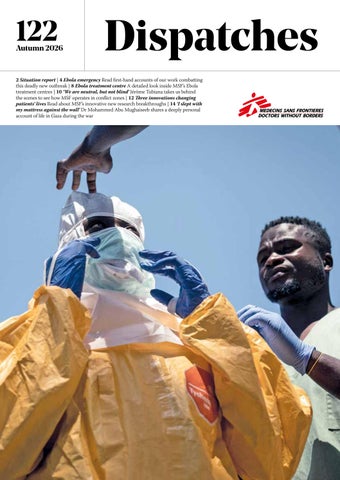
CHANGING A REGULAR GIFT To increase or decrease your regular gift, please call us on 020 7404 6600 or email: uk.fundraising@london.msf.org with your request. Please also get in touch if your bank details have changed. If you would like to stop receiving communications from us, please contact our Supporter Care team on 020 7404 6600 or email uk.fundraising@london.msf.org and we’ll be happy to help. Thank you for your support. Cover image: MSF colleagues assist a hygienist in donning personal protective equipment (PPE) before she enters the Ebola treatment centre in Mongbwalu, Democratic Republic of Congo. Photograph © Alexis Huguet/MSF