121
Summer 2026
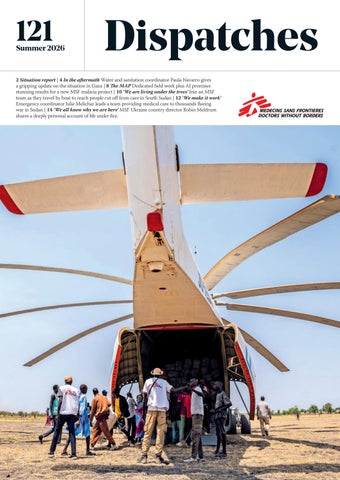
2 Situation report | 4 In the aftermath Water and sanitation coordinator Paula Navarro gives a gripping update on the situation in Gaza | 8 The MAP Dedicated field work plus AI promises stunning results for a new MSF malaria project | 10 ‘We are living under the trees’ Join an MSF team as they travel by boat to reach people cut off from care in South Sudan | 12 ‘We make it work’ Emergency coordinator Julie Melichar leads a team providing medical care to thousands fleeing war in Sudan | 14 ‘We all know why we are here’ MSF Ukraine country director Robin Meldrum shares a deeply personal account of life under fire.
SITUATION REPORT
2 6
5
4
3
1
Photograph © MSF
2. LEBANON
Photograph © Cindy González/MSF
350
Approximate number of patients treated each day in our clinics in Tehran, Iran, during the current conflict.
An MSF team member treats a patient at a mobile medical unit in Bekaa, Lebanon. More than one million people have been displaced as a result of the current conflict. As a result of the escalation of conflict in the Middle East, MSF teams have mobilised in Lebanon and Iran, and since 28 February, have shipped 281.42 tons of medical supplies to countries affected across the region. Read more at msf.org.uk/middle-east-crisis
3. JAPAN MSF International President Dr Javid Abdelmoneim meets with Tony Tony Chopper, a character from the acclaimed manga series One Piece to announce a new collaboration, with Chopper named an official supporter of MSF. “Dear Chopper, thank you for joining MSF to save lives around the world! The belief in helping those in need of medical care, regardless of ethnicity or nationality, is something Chopper and MSF share,” says Javid.
MSF health promoter Rimeh speaks to women about the medical and mental health services offered by MSF at the emergency clinic in Daba Naira camp, Darfur, Sudan. Across Sudan, sexual violence has become a pervasive feature of the war, with reports describing patterns of ethnic targeting against non-Arab communities. Between January 2024 and November 2025, MSF treated more than 3,396 survivors in Darfur, with more than 90 per cent in North Darfur assaulted while travelling between towns in search of safety. msf.org.uk/sudan-war 2 | DISPATCHES
Photograph © Laurence Hoenig/MSF
1. SUDAN
Photograph © Alexandre Marcou/MSF
35,000
4. CENTRAL AFRICAN REPUBLIC A pregnant woman waits in the stabilisation room of the MSF hospital in Bangui, while a team of nurses check patient files. For more than seven years, MSF has been treating women at the clinic for complications such as eclampsia, haemorrhage, and conditions that need further surgical intervention.
Diaka Kaba, a member of the MSF team, administers a diphtheria vaccine to a child in the Hèrèmakonön neighbourhood of Siguiri, Guinea. This vaccination campaign forms part of the response to the ongoing epidemic in this prefecture, which borders the Republic of Mali. Since 2023, diphtheria has seen a worrying resurgence in Guinea, driven by a combination of factors: declining routine vaccination coverage and significant challenges in accessing vaccines and diphtheria antitoxin. MSF has launched a large-scale, targeted emergency vaccination campaign to interrupt transmission of the disease and prioritise the protection of children under ten years of age.
5. NIGERIA An MSF vaccinator marks a child’s hand during a diphtheria vaccination campaign in Bauchi state, northeast Nigeria. In December 2025, approximately 329,000 people were vaccinated in the region by MSF and the Ministry of Health.
Photograph © Mohamed Mara/MSF
Photograph © Abba Adamu Musa/MSF
Number of medical consultations conducted by MSF in Lebanon since the current conflict began.
6. GUINEA
SUMMER 2026 | 3
GAZA
PHOTOGRAPHY CRAIG KENZIE NOUR ALSAQQA MSF
IN THE AFTERMATH In March, all international MSF staff withdrew from Gaza following registration disputes with Israeli authorities, while Palestinian staff remained. Among the last to leave was Paula Navarro, MSF’s water and sanitation coordinator for Gaza. Here, she describes managing her Palestinian team remotely from Jordan, her team’s courage, and the critical importance of continuing MSF’s lifesaving work in Gaza.
4 | DISPATCHES
Palestinians walk through the ruins of Jabalia in northern Gaza.
GAZA UPDATE
I
“
Paula Navarro, Water and sanitation coordinator in Gaza
have worked four times in Gaza since 2024, and each time has been very different. When I left in June last year, we were in the middle of the food shortages. Everybody was super skinny, even our staff, and the level of degradation was just something else. It was terrible. Then when I went back last December, the first feeling I had was that, OK, the situation has improved. There’s food, people look better, there is less bombing. The last vision I had of my team was of people surviving on small amounts of soup and rice, but now things are better. But you quickly realise that even with the ceasefire and these improvements, the situation remains terrible. One awful drama has been exchanged for another. For example, I’ve never worked in a humanitarian situation before where the place is so utterly destroyed that there is a risk from pieces of damaged building falling off and killing people. In December, I remember sitting with a colleague outside and we were both talking about how long it had been since a bombing, and two minutes later, a massive piece of building fell on a tent near us and killed three people. Each time I’ve left I’ve thought it’s impossible for this place to be more destroyed, but then I come back and I’m shocked to see that the destruction is worse. I remember at the beginning of 2025 going to places in Gaza where there was around 20 per cent of water infrastructure remaining and thinking it’s going to be impossible for people to live here. Then you come back later in the year and there’s even less infrastructure, but people are still there, trying to live. SUMMER 2026 | 5
One thing you need to understand is that, even before the war, there were no natural drinking water sources in Gaza. All the water is super salty and has to go through an industrial desalination process called reverse osmosis, or ARO. We installed one of our ARO hubs in Beit Lahia and it was the only functional drinking water source in the area. And as soon as we put it in, people started flocking to the area to live. MSF sets up a medical clinic, establishes a small amount of infrastructure, provides people with the bare minimum to survive, and people return to the place they’re from. They understand the risks of living in such a dangerous and precarious environment, but they want to go back and rebuild their lives. It’s impressive. At the moment, we’re mainly trying to repair and rehabilitate the existing water infrastructure rather than create anything new. It’s impossible to bring cement and pumps in so we have to work with what we’ve got. But people know where the boreholes are and what’s functional. Gaza was pretty developed before with a lot of expertise, so we work in collaboration with the water authorities. The bigger problem is sanitation. Before, everybody lived in houses or flats and obviously all the toilets were inside. But if all the houses have been destroyed, all the toilets have also 6 | DISPATCHES
been destroyed. How do you replace that for a population of two million people? Add to that the fact that the sewage system has been destroyed, the waste treatment plants have been bombed and there isn’t enough material to repair those systems, and you have a very big problem. The few toilets that have been installed have massive queues, so people cope in the only way they can: by digging massive holes in the ground. But they come with their own problems. When it rains, they overflow, spilling out onto the streets. People even fall into them. There are rats. Sanitation is the biggest challenge we currently face, and we are doing what we can to install more latrines. Nothing about this environment or these living conditions is conducive to human dignity. Every free space is taken up with tents. It’s a complete sea of tents as far as you look in every direction and people have been living in them for more than two years, subject to flooding and to cold. You’d arrive in the office after a night of rain and you know your staff have been awake all night in their tents, shaking, trying to keep their children warm. But they come into work and they are completely focused. You know the staff, the people I work with there, they are more than just colleagues. They are my friends. During
90
Percentage of water and sanitation infrastructure in Gaza destroyed or damaged during the conflict.
A Palestinian woman carries water to her tent after an MSF distribution in the coastal area of Mawasi Rafah, southern Gaza.
some of the worst days of the conflict when there were bombs falling everywhere, every morning we would text each other, ‘How was your evening? How did you sleep?’ What we were really asking was, are you alive? Is everything OK? You do that for forty or fifty days straight and the bond you have is not just about work. There was one morning when we couldn’t get hold of one guy. He didn’t arrive at work, and we didn’t know what was happening. Two hours later, he arrived and I was like, ‘Hey mate, what happened?’ He apologised and told me he’d spent five hours searching for his father who had been killed when his building had been bombed. Now, he just wanted to work. The team, they are super strong and they have enormous technical capacity. They are amazing. I was in Gaza when the decision was taken that all international staff would have to withdraw. It was very hard. There had been so much uncertainty beforehand, and our staff had been really stressed. Would MSF have to shut its projects? Would the staff have jobs? How will they support their families? In Spain where I’m from, you see someone with a missing limb rarely. But you walk through our clinics in Gaza, and you see scores of children with limbs missing, wounded. What would happen to them if MSF left?
A scene of destruction in the Rimal neighbourhood of Gaza City. MSF physiotherapist Ibtihal fits a 3D mask on Joud, a four-year-old burns patient, while his mother looks on in MSF’s Gaza City clinic.
We’re providing water for around 400,000 people every day. Where do they find clean drinking water if MSF leaves? It’s unthinkable. The work had to continue, but still, it was very hard for us to leave. Thankfully, our Palestinian staff are ensuring the work goes on. It was Ramadan when we left, so the night before we all shared Iftar together. We decided we wouldn’t focus on the leaving, instead we would all just enjoy each other’s company. And we did. But the next day when we got in the vehicles and we had to say goodbye to the team, it suddenly hit hard for us that this was really it. Managing the team remotely has been an adjustment. It’s difficult when you need to troubleshoot something and you can’t just get in the car, drive twenty minutes and see something and be hands-on. It’s tough not being able to sit down with a staff member and have a coffee and talk through problems. But we are coping and it’s going OK. It is vital that MSF is here. The needs are so great, but we owe it to the people of Gaza to ensure the work continues.” WATCH A VIDEO ABOUT OUR 3D PRINTING IN GAZA: MSF.ORG.UK/GAZA-MASKS
MSF is the largest producer of drinking water in Gaza after the local authorities. In March 2026, MSF produced or distributed over 5.3 million litres of water in Gaza each day, the equivalent of the minimum needs of over 407,000 people – one in five inhabitants of the Strip. We can only do this because of your support. Thank you. Find out more: msf.org.uk/gaza
SUMMER 2026 | 7
THE MALARIA ANTICIPATION PROJECT With more than 250 million new cases a year and approximately 600,000 deaths, malaria remains one of the world’s deadliest diseases. But a new MSF project combining dedicated field work with the computational power of AI is giving hope that the fight to contain this disease could be won.
M
“
alaria is one of the deadliest killer diseases here,” says Dr Yazid Sanni, an MSF doctor in Gummi, northwestern Nigeria. The parasitic disease is transmitted to humans through the bites of infected mosquitoes. In mild cases patients experience a fever and headache. However, it can quickly become more dangerous, especially if affecting the brain, liver and kidneys, and can cause anaemia so severe that the blood no longer carries adequate oxygen to the organs. While some people do recover, others are more vulnerable, particularly pregnant women and young children. Without proper treatment, malaria can kill within hours. Dr Sanni’s team alone treats approximately 20,000 cases a year. One of the key factors influencing survival rates is preparedness. In Gummi, and in many places affected by malaria, the ‘peak’ malaria season follows shortly after the annual rains, when newly formed puddles and ponds become ideal breeding grounds for mosquitoes. When the rainy season begins and ends at around the same time every year, MSF teams can have a relatively clear idea of when and how they will need to prepare. Bed nets can be
8 | DISPATCHES
1 IN 60
malaria cases worldwide are treated by MSF.
distributed, medical supplies can be ordered, staff can be recruited and trained. But there’s a problem, says Dr Jacob Levi, MSF climate adaptation specialist for infectious diseases. In many places in the world, that consistency no longer exists: “With climate change, we’re seeing malaria patterns shift… We don’t know whether the malaria season is going to come a few weeks earlier or later than last year, and we don’t know whether it’s going to be an outbreak that lasts one month or four.” This uncertainty has profound implications for communities affected by malaria and the MSF teams working to provide urgently needed medical care. “During the peak season we sometimes have to have up to three children per bed,” says Dr Sanni. “[If the season is long], maybe you have to build another ward at the hospital to accommodate extra patients. Maybe you have to bring in more medical doctors and staff.” The remote locations of many MSF projects means that international orders for medicines can take months to arrive. If the peak comes early, the supplies may not be there in time.
Photograph © Paula Casado Aguirregabiria/MSF
‘If we can do this, fewer people will die...’
If it’s unexpectedly short, medications may expire, wasting precious budget that could have been used for patient care. MSF teams must make high consequence decisions around preparedness with very little data. Until now. MSF’s Malaria Anticipation Project (MAP) is aiming to transform how humanitarian teams prepare for malaria season. The MAP team takes historical data on the number of malaria cases in a region and combines that with satellite-based climate and environmental data. They use statistical approaches and in some cases a form of artificial intelligence called ‘machine learning’ to train mathematical models to crunch these numbers. The result? A forecast of when the malaria peak will start and how long it will last. “So far, it’s accurate by about 70 to 80 per cent, up to eight weeks in advance,” says Dr Levi. “So it gives us two months of warning.” But given the long lead times for international orders, the team is already pushing for improvements. “We have promising results for forecasts up to six months in advance,” says Dr Levi. “When we are talking of infectious diseases, prevention is better and cheaper than cure,”
Thirty-year-old Margaret holds her newborn baby in Twic, South Sudan, while recovering from malaria.
says Mohammed Sani, the infection prevention and control supervisor in Gummi. He’s intending to use the MAP forecast to plan preventative campaigns in the community, with the goal of reducing the number of people infected with malaria, and ensuring those who need treatment get it earlier, before the disease becomes severe. “If we can do this, then fewer people will die, fewer will need to come to the hospital,” he says. The MAP was rolled out to the team in Gummi last year. Now the MAP team is keen to take it further. “It took us almost three years to do all the research and modelling for our first deployment in South Sudan,” says Dr Levi. “Then to do our second deployment in Gummi took five months. The third one in Ethiopia only took about six weeks. Now we can rapidly apply the approach, the idea is to scale up and deploy in at least 15 MSF projects within the next few years.” Looking ahead, the team sees potential for this approach to create early warning systems for many climate-sensitive health emergencies, from cholera to dengue fever. “This ability to analyse climate and health data and make a model has been around for 10 years at least,” says Dr Levi. “But it’s been quite stuck in academia and hasn’t really translated into operational, humanitarian, on-the-ground impact… Until MAP, no one was implementing this approach for malaria, to see if it could actually improve programmes and save lives. Given the contexts we work in, MSF is uniquely positioned to do that.” FIND OUT MORE AT MSF.ORG.UK/MALARIA
1 IN 5
of our lifesaving projects worldwide are made possible by gifts in wills.
By leaving a gift in your will, you’ll be supporting MSF’s work, ensuring that our cutting-edge research and lifesaving medical care will continue to be funded in the future. Help to ensure our teams are there where the need is greatest. Independent, impartial and neutral, forever without borders. Please visit msf.org.uk/legacies to find out more.
SUMMER 2026 | 9
SOUTH SUDAN
PHOTOGRAPHY ISAAC BUAY
‘WE ARE LIVING UNDER THE TREES’ Fighting between government and opposition forces in South Sudan has intensified over recent months, forcing tens of thousands of people in the northeast to flee their homes and to live in the open. MSF teams are using boats to reach people cut off from care. “I have lived through many wars, but nothing like this,” says 77-year-old Moses, who fled his home in Lankien as fighting intensified. “I have never seen homes burned to ashes on such a scale. We are now living under the trees.” Around Lankien and along the Sobat River in the Upper Nile region, thousands of families have fled on foot, walking for days to escape attacks. At least 25,000 people have sought refuge in Chuil town, and thousands more are scattered across surrounding villages and swamps. People are now living outdoors without any shelter, or in makeshift settlements without adequate food, water, or healthcare. MSF has increased capacity in clinics and is distributing mosquito nets, blankets, soap, and plastic sheeting. Water and sanitation teams 10 | DISPATCHES
have constructed 300 latrines and are building a water purification plant. Joon Hyun is an MSF logistician and a member of the mobile clinic team who travel each day along the river to reach displaced people. “More people keep arriving. When we first started coming in February, there were around 10,000 people. Now, there are more than 20,000 and more are arriving. Some people have plastic sheeting, but many have nothing. They are living under trees and sleeping on the bare ground. Before, there was no food. People were eating bark and boiling leaves from the trees. And there was no clean drinking water because the condition of the river is super bad. It used to be a healthy river, but now it is so contaminated with dead bodies and rubbish that it makes people sick. We’re on the river a lot, and many of us in the team have also been made ill by it. We have been distributing essential items and water purifiers while other organisations are distributing food, but so much more needs to be done. It is a tough situation, but we are working to improve things.”
MSF logistician Joon Hyun holds an IV drip for a young girl suffering from severe burns. Both she and her mother were taken to an MSF clinic in Chuil. Joon and the MSF team carry a patient with severe wounds in a blanket to the boat for transportation to the clinic for further treatment. Women carry bags of food on their heads near Chuil.
“There are no proper roads here and no bridges across the river. The only way to get to people to help them is by boat. And that costs a lot of money. And without the funding people give us, there is no way we could be here helping these people. The money people give is saving people’s lives right here, every day.”
SAVING A GIRL
“She was an eleven-year-old girl and she had been boiling water over the firewood and it tipped on her. All of her body was burned. We had no stretcher in the boat, so had to make her as comfortable as possible and carry her to the boat in a blanket. We had no IV stand, so it’s my job to hold it, which is what I’m doing in the photo. We were able to take her and her mother to the clinic where they could get further specialised medical treatment. We transported a one-yearold who was suffering from the heat and dehydration and who kept convulsing. It happened twice on board when we were rushing along the river. It was very nerve-wracking. But we made it to the clinic and when I checked back a few days later, the baby was well and happy.”
“Before I came here, I knew nothing about South Sudan. I didn’t even know where it was. But working with the South Sudanese, I feel their heart. They dream about a future that is not just about survival, and I want to support them so they can have this dream. We give them hope, but they also give us hope. Our team is wonderful and I’m just a small part of that. But I am happy to be here, helping.”
Your support enables our teams to provide lifesaving care to people in desperate need.
£522 £100 could pay for a portable radio handset for staff to communicate in regular and emergency situations.
could pay for supplies for four displaced families to construct a basic temporary shelter.
Thank you. We couldn’t do it without you.
SUMMER 2026 | 11
SUDAN
PHOTOGRAPHY JULIE MELICHAR
‘WE MAKE ITWORK’ As the war in Sudan enters its fourth year, relentless violence continues to wreak devastation across the country. Thousands of people continue to flee the fighting, moving from one area to another as the conflict shifts. In the remote and mountainous region of Jebel Marra in South Darfur, MSF teams are working to provide care to people who have lost everything. Julie Melichar has been working as MSF’s project coordinator in the area. 12 | DISPATCHES
“
Julie Melichar, MSF Emergency Coordinator
Displaced people line up to be seen by MSF doctors at Feina camp.
W
e first heard about Dar Omo over WhatsApp. In January, tens of thousands of people arrived at the newly established displacement camp in Feina, a remote village in the mountainous Jebel Marra region of South Darfur. Many had fled from other camps, where they no longer felt safe because of the war. At the time, I was working in Kas, to the south of Feina, where MSF supports a hospital and a series of health posts in the mountains. We have strong connections with local communities – which is why we started receiving photos from people who were concerned about the conditions in Dar Omo. What we saw was incredibly alarming. People were living in makeshift shelters they’d pulled together with the few materials available to them: sticks, cloth, plastic bags, grass. We knew we had to go to the camp. We gathered some supplies: medicines, therapeutic food to treat malnutrition, and water purification tablets. And then, early on a Monday morning, we set off. The journey took us high into the mountains, the car bumping along rocky, winding roads. When the camp came into view, I was stunned. Thousands and thousands of people, many of them children. There were no latrines, and only a distant river for water supply. We split up and began to speak to people. They told us that malnutrition was widespread, particularly among children. Women were forced to give birth in desperate conditions. Many told us they had survived sexual violence. We assessed the situation, gathering as much information as possible so we could put together a plan. There were some trained nurses and midwives living in the camp, who themselves had lost everything, but were still doing all they could to care for their community. However, it wasn’t enough: they urgently needed supplies and support. On that first trip, our water and sanitation specialists spotted a broken hand pump for water. We were on an incredibly tight schedule: we had to leave the village on time to make it back to Kas before dark. But the specialists were certain they could fix it that day, begging me, ’Just 15 more minutes.’ And they were right. It was lovely to know, on the drive home, that we’d already made a tangible improvement for people.
We set off again just four days later, this time with a much bigger team and far more supplies. On the way, the car I was travelling in broke down on the bumpy, mountainous roads, and we were stranded for hours. As we waited in a small village, something astonishing happened. A woman approached us, explaining that she used to work for MSF as a midwife, in a project that had now closed. We were able to confirm her qualifications and employment history and soon had a new member of the team! Things moved quickly. We were able to set up a medical clinic almost immediately. We also brought in tents to carry out consultations in the midst of the camp itself. Not long after we established the clinic, we learned that a woman in the camp had given birth in her shelter and was bleeding profusely. Without immediate treatment, she would die. Our staff brought her to the clinic on a stretcher, where they managed to stop the bleeding. She survived, and her newborn didn’t lose their mother. One of my Sudanese colleagues spoke to me afterwards. He was emotional. ‘Look what we managed to do,’ he said. ‘We saved this woman.’ He was incredibly proud, he told me, to be able to support his community. Setting up in Dar Omo meant a lot of trips back and forth to Kas and to other projects, bringing new team members, supplies, and equipment. On one occasion, we were about to drive back to Kas when a colleague ran towards the car, frantic; a malnourished baby was in critical condition. We squeezed the mother and her tiny baby into the back. The journey was long and bumpy, but eventually we got to the hospital and the child was admitted right away. We knew that without medical care, they would not have survived. Back in the camp, more handpumps needed repair, so in the meantime we found drivers to bring in truckloads of water. Bringing anything to the camp was difficult because of the mountainous roads: I remember awaiting a water delivery, unsure if it would ever arrive. Finally, the truck pulled into view. I was so happy. A colleague looked at me, smiling, and said, ‘This is what MSF does. We make it work.’” FIND OUT MORE AT MSF.ORG.UK/SUDAN
SUMMER 2026 | 13
UKRAINE
PHOTOGRAPHY MARIIA NAHORNA ANHELINA SHCHORS MSF
‘WE ALL KNOWWHY WE ARE HERE’ Robin Meldrum, MSF Ukraine country director
14 | DISPATCHES
Drone attacks, freezing temperatures, and rare moments of peace with friends: MSF Ukraine country director Robin Meldrum describes the challenges of providing medical care in a conflict zone.
“
U
krainians call them ‘mopeds’ and the sound is similar, but higher pitched. These are the long-range attack drones, usually equipped with around 100kg of explosive warhead and capable of destroying two floors of a solidly built concrete apartment block or house. In the larger attacks, upwards of 600 of them are sent into Ukraine on just one night. I first heard one in close proximity in late 2024, in the southern city of Mykolaiv. We were in the ‘two-wall-space’ safe room in our international staff house. We knew some Shahed drones were approaching the city, because the alert systems are extremely well developed in Ukraine.
We heard a couple flying past, maybe a few hundred metres distant. And then that whining sound got louder, and closer, until it was directly overhead, just above the rooftops. Nobody said anything. Muscles involuntarily tightened in a fight-or-flight reaction. The sound reached peak intensity, followed less than a second later by a shattering explosion that shook the walls throughout the house. It had hit a building around 300 metres from us. It was not a direct hit, and luckily nobody was hurt on that occasion; but almost every day now I read of people injured or killed in their homes somewhere in Ukraine by these attack drones. And this is just the drones – the ballistic and cruise missiles are capable of much greater destruction. Our team is well drilled in how to react, and they go to the safe basement shelter whenever there is an increased risk. The following week I went to see the director of a hospital in Kherson which had come under attack. I had a few topics to discuss, including some measures to increase the security of our MSF team.
His reaction will be forever etched in my memory. His tension when he thought we were meeting to say we would no longer be able to work in that hospital was clear from the moment we walked in the door. And his relief when we said we intended to stay was palpable. He explained that he would struggle to maintain the emergency department and intensive care units of the hospital without MSF’s additional support and said the idea that the MSF team would leave had been worrying him for the past week. This is what we saw everywhere we went along the 600km of near-frontline areas: hospitals and primary healthcare centres struggling to cope with enormously depleted staff numbers. One general hospital we were supporting near the frontline in the east had no surgeon until the MSF team proposed to embed a medical team. During twelve months our team performed or assisted 452 surgeries in this hospital, until the frontline got too close and we had to withdraw and start supporting another hospital a bit further back from the active combat area. The patients we treat, and transport by ambulance, are an indicator of how civilians are impacted. Pretty much every village you go to in the 50km zone from the frontlines has some civilians who have remained, usually older people who have lived there all their lives, not wealthy and with deep anxiety about leaving. Where will they go? What will they do for food and shelter? Many of these people have chronic medical conditions. We try to reach as many of as possible with mobile clinics, but our hospital teams see far too many elderly patients arriving in a critical condition. Things got particularly bad in the depths of winter, the coldest Ukraine has experienced for several years. Russian attacks focused even more than usual on targeting electricity and heating infrastructure, and the consequences were brutal. I had to move into a colleague’s apartment after a month with no running water, no flushing toilet, very intermittent heating, and sometimes only two or three hours of electricity per day. I would often wake up in a room that was 3 or 4 degrees Celsius, which is the recommended temperature inside a fridge. Many of my Ukrainian colleagues have had the same experience, having to leave their homes to move in with friends or colleagues, because when temperatures drop to 20 degrees sub-zero, just surviving becomes a struggle if you have no heating.
3,200
Number of patients treated by MSF in supported hospitals near the frontline since January.
MSF staff attend to an 84-year-old patient suffering from low blood pressure in a hospital in Mykolaiv, southern Ukraine, where the frontline is approximately four miles from the city. Robin Meldrum during the recent freezing winter.
A potential attack is never more than 10 or 15 minutes away, and this threat is ever-present, 24 hours a day, seven days a week. Everybody has their own ways of coping. I try to appreciate little moments of beauty and normality: the rooks circling and calling at sunset over the Dnipro river in Kyiv, while the imposing 300-foot tall statue of ‘Mother Ukraine’ fixes an indomitable stare over the river to the east; the two lesser-spotted woodpeckers that would come every morning to the old walnut tree outside our house in Mykolaiv; good chats with friends over a beer or coffee in one of the many excellent bars or cafes in Kyiv or Dnipro; a memorable summer barbeque on the sandy beach on the banks of the Pivdenny Buh river in Mykolaiv (I copied some of the locals and went for a quick swim, and it was lovely)… But above all, I find motivation and inspiration in our 320 Ukrainian colleagues. They have endured this for four years, and the energy-sapping fatigue is clear. Some, who originally come from the eastern region of Ukraine, have lived this war for 12 years now. Nobody I know is free of mental and emotional scars. But the determination and commitment they show, every day, arriving in the morning mustering all their energy to do their job as well as possible – it is an extraordinary source of inspiration. Each passing week, the needs grow as the machine of war grinds on. But we all know why we are here. There are some very vulnerable people in need of medical care, and they deserve our very best efforts.”
SUMMER 2026 | 15
An MSF physiotherapist attends to thirty-five-year-old Guy, who broke his femur and pelvis in a motorcycle accident, SICA hospital, Bangui, Central African Republic. Photograph © Alexandre Marcou/MSF
Médecins Sans Frontières/Doctors Without Borders (MSF) is a leading independent humanitarian organisation for emergency medical aid. In more than 70 countries worldwide, MSF provides relief to the victims of war, natural disasters and epidemics, irrespective of race, religion, gender or political affiliation. MSF was awarded the 1999 Nobel Peace Prize. TEL 020 7404 6600 ADDRESS Médecins Sans Frontières/ Doctors Without Borders (MSF UK) Level 5, Unit 12–13, 9 Prescot Street, London E1 8PR, United Kingdom Charity Registration Number 1026588
ABOUT Dispatches is written by MSF staff and sent out quarterly to our supporters to keep you informed about our medical work around the world, all of which is funded by you. Dispatches gives our patients and staff a platform to speak out about the conflicts, emergencies and epidemics in which MSF works. It costs £0.72 to produce, package and send using the cheapest form of post. It is an important source of income for MSF and raises three times what it costs to produce. We always welcome your feedback. Please contact us using the methods listed, or email: dispatches.uk@london.msf.org
SIGN UP TO EMAIL Get the latest MSF news delivered to your inbox. Sign up at msf.org.uk/signup
Patient names have been changed throughout Dispatches to protect anonymity.
CHANGING YOUR ADDRESS Please call 020 7404 6600 or email: uk.fundraising@london.msf.org
MAKE A DONATION You can donate by phone, online or by post. If possible please quote your supporter number (located on the top left-hand side of the letter) and name and address. LEAVING A GIFT IN YOUR WILL Have you thought of remembering MSF in your will? A gift of any size will make a real difference. For more information, email legacies@london.msf.org or call us on 020 7404 6600.
CHANGING A REGULAR GIFT To increase or decrease your regular gift, please call us on 020 7404 6600 or email: uk.fundraising@london.msf.org with your request. Please also get in touch if your bank details have changed. If you would like to stop receiving communications from us, please contact our Supporter Care team on 020 7404 6600 or email uk.fundraising@london.msf.org and we’ll be happy to help. Thank you for your support. Cover image: MSF staff offload relief items from a helicopter in Chuil, South Sudan, where displaced people are receiving emergency assistance. SEE PAGE 10. Photograph © Isaac Buay/MSF