BRINGING MEDICAL HUMANITARIAN ACTION TO YOU
SUMMER 2026
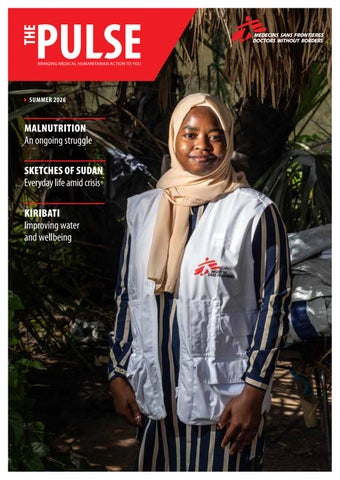
MALNUTRITION An ongoing struggle SKETCHES OF SUDAN Everyday life amid crisis KIRIBATI Improving water and wellbeing
EDITORIAL
CONTENTS 02 Editorial 04 News in brief 06 Feature: Bearing witness in Gaza 08 Photo essay: Malnutrition: More than just hunger 10 Feature: Kiribati responds to climate change 12 Letter from Sudan 14 Staff profile: Clemence Chbat 16 On assignment
Cover: MSF Dr Maysaa Haroun, in El-Geneina, West Darfur, Sudan, July 2025. Dr Haroun was in the capital Khartoum when war broke out in 2023. After fleeing to Chad as a refugee, she returned home to El-Geneina to work as a medical coordinator. © Moises Saman/Magnum Photos
MEDECINS SANS FRONTIERES Médecins Sans Frontières is an international, independent, medical humanitarian organisation that was founded in France in 1971. The organisation delivers emergency medical aid to people affected by armed conflict, epidemics, exclusion from healthcare and natural disasters. Assistance is provided based on need and irrespective of race, religion, gender or political affiliation. Today Médecins Sans Frontières is a worldwide movement of 24 associations, including one in Australia. In 2025, there were 95 departures of Australians and New Zealanders to fill roles in our medical humanitarian projects. Nāu te rourou, nāku te rourou, ka ora ai te iwi - With your basket and my basket, the people will thrive This whakataukī encompasses the idea that when people work together and combine resources, we can all flourish. It was chosen by our Māori partners Deborah Harding and Tracey Poutama.
CONNECT WITH US Call 0508 633 324 Email contact.us@nz.msf.org msf.org.nz facebook.com/MSFANZ @msf_anz @MSFAustralia 2
Rethinking solidarity in a changing humanitarian landscape In the face of increasing challenges, the global humanitarian system needs a new approach. Throughout 2025, the troubled state of the global humanitarian system was plain to see. Cuts in foreign aid spending by the US, Germany, France, the UK and other big donors signalled a shift away from long-standing commitments to support overseas development and humanitarian assistance – despite prolonged crises in Palestine, Sudan, Syria, Ukraine and elsewhere, which have driven needs to unprecedented levels. The impact has been rapid and tragically evident, shown by increased deaths and disruption to health and education programs. Humanitarian organisations have cut programs and staff, and critical supplies of food and medicine have shrunk. The World Food Programme estimated that more than 16 million people could be cut off from food assistance in 2025 due to funding cuts, a 21 per cent drop from the nearly 80 million people it reached in 2024. Emergency response efforts are in serious jeopardy, with the aid sector forced to “hyperprioritise” its objectives to compensate for financial shortfalls. This situation is part of a recent shift called the ‘changing humanitarian landscape’. The term describes prolonged conflicts, unrestrained outbreaks, malnutrition spirals, climate-fuelled disasters, large-scale displacement, and a world that is burning through the last of its empathy. Continuing to get humanitarian assistance where it’s needed is intensely challenging under such conditions. MSF supporters in Australia and New Zealand have shown their incredible commitment to meeting this challenge, with donations in 2025 greater than ever. That support is vital for an organisation that doesn’t take government funding, and a real strength as governments abandon the aid sector.
Speaking up is only half the work. Listening is the other half. However, trying to do more of the same is not enough to take on this changing landscape. What’s needed is a willingness to reimagine how we act in solidarity with the people most affected by crises. The concept of témoignage – bearing witness – is fundamental to MSF. It represents the responsibility to communicate the realities of patients’ lives when safety and dignity have been ripped away by disasters, disease, violence, starvation, or genocide. It means not accepting a status quo that surrenders the fate of the vulnerable to the edicts of the powerful. But humanitarianism sits on a foundation shaped by colonial hierarchies – by who has the power to define whose suffering is visible and whose voice is credible. The modern aid system inherited this attitude of saviourism and charity. Decolonising humanitarian action isn’t about disowning our past, it’s about dismantling the reflexes that keep reproducing it and replacing them with practices of co-creation, trust and shared authorship.
Performance at the Meeras Pavilion in Sydney, October 2025. © Victor Caringal/MSF Former MSF international president Christos Christou (left) and Arunn Jegan (centre) with Rohingya ceramicist Kali Kumar Rudro in Cox’s Bazar, Bangladesh, June 2025. © Victor Caringal/MSF
What I’ve learned during my advocacy career is that speaking up is only half the work. Listening is the other half. Through listening we practise solidarity – not as posture, but as method. For 10 days this past September and October, the Meeras Pavilion – a handcrafted bamboo structure breathing with sound, light and Rohingya stories – stood in the heart of Sydney. In Rohingya, meeras means heritage, and that’s what the space embodied: a living archive of memory and resistance. Inside, refugees, artists, humanitarians, students and strangers stood together as co-owners of a shared moment. There was no field and no headquarters, just people in partnership in a humanitarian space without hierarchy. The moment began four years ago in small workshops in Sydney, Kuala Lumpur, and Cox’s Bazar, Bangladesh, where Rohingya and their allies shared stories of loss and belonging.
From those conversations, the taro leaf emerged as a simple but powerful symbol. Over time, the team created a space that would bring together hundreds of people, dozens of organisations, and a 10-day program that wove pedagogy, art and advocacy into one living experience. In truth, the pavilion was as much a process of giving up as it was of building up. It required MSF and its partners to relinquish authorship and to follow the lead of those whose stories defined the work. That, to me, is what solidarity looks like – not representation, but redistribution.
The symbol appeared in student rallies in Dhaka, and even reached the UN, held up by the interim Prime Minister of Bangladesh, alongside other ministers and diplomats. The crisis in the humanitarian system might seem overwhelming. The lesson of Meeras is that transformation begins when we work with, not for. Solidarity is not a limited resource. It is an infinite one. And it’s what will sustain us through the next humanitarian landscape. Arunn Jegan Humanitarian affairs lead, MSF Australia
The outcome: an advocacy tool that continues to resonate far beyond the clinics of MSF – shifting conversations, challenging narratives and creating new spaces for belonging and political voice. The taro leaf left more than 14 million impressions on social media. More than 35,000 Sydneysiders visited the Pavilion. THE PULSE: SUMMER 2026
3
NEWS IN BRIEF
MEXICO
A city of waiting Once a transit point for people travelling north to seek refuge in the US, Tapachula, capital of Mexico’s Chiapas State, has become a city of ‘forced waiting’. Thousands of migrants – mostly from Cuba, Haiti and Honduras, and without documents, employment or access to basic services – have become stranded in the city since the US sealed its southern border in January 2025 and suspended asylum programs. MSF has been providing essential health services to migrants living on the streets, in makeshift shelters and in informal settlements, and is offering individual and group psychological care to the migrants. The psychological impact of migration is profound and often invisible. People face grief, family separation, violence, discrimination and uncertainty. “Many arrive with insomnia, panic attacks and a deep sense of hopelessness,” said Olga Lucia Uzcategui, MSF mental health manager. “We see patients who have lost family members along the route, who have been victims of sexual abuse, or who live in constant fear.”
From January to September 2025, MSF teams provided 11,484 medical consultations and 2,390 mental health consultations – 128 per cent and 53 per cent more, respectively, than in the same period in 2024.
Hurricane damage in St James Parish in northwest Jamaica, November 2025. © MSF
JAMAICA
Filling urgent gaps After Hurricane Melissa, a rare category 5 storm, struck Jamaica on 28 October, MSF emergency teams assessed critical needs. In remote areas, people were cut off due to road damage, and regional hospitals and healthcare centres were partially destroyed. MSF provided medical supplies, relief items, tarpaulins and other materials, and MSF teams started working in St James Parish and in St Elisabeth Parish in the west of Jamaica. In St James parish, MSF fixed the roof and other severely damaged areas of Cornwall hospital, and restored water supply. Teams provided medical supplies to the hospital and healthcare centres, in coordination with the Ministry of Health. In St Elisabeth parish, MSF teams supported three health centres and temporary health points, providing distribution of medical supplies and logistical support, as well as trucking water to vulnerable communities. Given the country’s robust health services and national response capacity, and the large humanitarian presence, MSF operations were less expansive than first anticipated. “We see a strong and capable system. If we fill the urgent gaps, Jamaicans can take it forward,” MSF head of mission Estifanos Mengistu told the Jamaica Information Service.
1.6 m people affected In Tapachula, in southern Mexico’s Chiapas state, MSF provides medical care and consultations to migrants facing precarious conditions and limited access to basic services, 15 July 2025. © Yotibel Moreno/MSF 4
11 hospitals, including 5 major hospitals, severely damaged by Hurricane Melissa in Jamaica (Source: PAHO)
SYRIA
Expanding support for healthcare The profound consequences of Syria’s 14-year civil war include nine out of 10 Syrians now living in poverty, and 7.4 million people internally displaced. The healthcare system, already struggling with damaged facilities, lack of medical supplies and a shortage of healthcare workers, has been heavily impacted by cuts to global funding. MSF is working in six hospitals and 15 health centres and runs several mobile clinics. “In light of the huge healthcare needs in Syria, MSF expanded activities to 11 out of 14 governorates,” said Brian Moller, head of mission for Syria. “Our main goal is to bring medical care closer to communities who may not have access to it.”
IN THE FIRST SIX MONTHS OF 2025 IN SYRIA, MSF CONDUCTED:
396,200
outpatient consultations
135,700
emergency consultations
125,900
paediatric consultations
Since the fall of the Assad regime in December 2024, more than one million Syrians have returned to their areas of origin, and hundreds of thousands of refugees have crossed back from neighbouring countries. But they are returning to destroyed infrastructure and housing, and no power or clean water. The dire living conditions exacerbate the risk of infectious and waterborne diseases, and MSF teams are working to increase the availability of safe water in areas of return and in displacement camps. A pregnant woman displaced to a shelter in Daraa governorate visited the MSF clinic in July 2025. The foetus had an irregular heartbeat, and the MSF team referred her to hospital. © Salam Daoud/MSF
UKRAINE
Ghost towns and crowded shelters As Russia’s full-scale invasion of Ukraine nears its fourth year, intensified fighting has left some communities near the front lines with little or no access to healthcare. Mass displacement has turned cities and villages into ghost towns of empty streets, damaged buildings and inaccessible healthcare. The Dnipropetrovsk region in eastern Ukraine has become a critical transit hub with overcrowded displacement shelters, where MSF mobile clinic teams have provided medical consultations and psychological support.
IN 2024 IN UKRAINE:
75,400
outpatient consultations
12,500
mental health consultations
“Most people are forced to evacuate on foot, across rough terrain under drone strikes, often through fields which may have landmines,” said Dr Ivan Afanasiev, an MSF doctor working in the shelters. “The majority of people are elderly and are already weakened by untreated chronic conditions such as hypertension, diabetes, or asthma, as well as malnutrition and anaemia.” Oleksandra Shevchenko, 90, from Kostiantynivka, Donetsk region, moved to a shelter in Pavlohrad, Dnipropetrovsk, and waited to travel further west for treatment. © Yuliia Trofimova/MSF THE PULSE: SUMMER 2026
5
FEATURE: GAZA
Speaking out on the state of Gaza Despite the ceasefire that came into effect on 10 October 2025, the genocide in Gaza has not stopped. In the month after the ceasefire, more than 300 people were killed, and more than 760 were injured, according to the Gaza Ministry of Health. Among the MSF staff working in Gaza are Australians who have been speaking to media back home, so that more people understand the scale of the trauma and the enormous needs still unmet. On a tiny patch of land in southern Gaza, more than one million people are being forced to survive in dire living conditions. Combined with civilian infrastructure and a health system largely demolished by Israeli forces, it makes an ideal setting for the spread of infection and illness. Plummeting food insecurity due to Israel’s aid blockade beginning in March caused mass starvation. MSF has seen record rates of acute malnutrition in our clinics. And Israeli attacks have continued. “I would like Australians to know that this isn’t a ceasefire. I would like Australians to know that this is still a genocide that’s been disguised as a ceasefire,” medical activity manager Thienminh Dinh told the ABC in November, after returning to Gaza for her second assignment there in 2025. 6
Dinh is one of several Australians working with MSF in Gaza who are speaking out about what they are seeing. They all make clear that the situation demands a stop to the violence and a massive scale-up of assistance of every kind. Living conditions are desperate. Without improvements in water, sanitation, shelter and nutrition, more people will die from preventable causes. Without sufficient medical supplies and equipment, providing essential services and restoring Gaza’s devastated health infrastructure will be impossible. “They are living in tents, and I use the word ‘tents’ very lightly. They are shelters made from pipes that have been found, and from plastics,” Dinh said. “These people don’t have any electricity, they don’t have access to reliable water, and they don’t have reliable access to food. They do seek treatment in hospital, but they have to walk kilometres to seek that treatment, and often we don’t have the medication.” Many mothers, malnourished themselves, struggle to breastfeed their babies due to an array of factors, and ready-to-use infant formula is in short supply. The ceasefire has enabled more deliveries of aid, but delays and restrictions have kept assistance far short of what is needed. “There’s an assumption that people in the Gaza Strip will simply return to their normal lives, but this is really quite far from the truth,” project medical referent Kaylene Tomkins told the Australian Associated Press (AAP) shortly after the ceasefire took effect. “The reality on the ground is completely different. What we see is the lives that people once knew are gone, and it’s unlikely that this is going to return anytime soon.”
Medical coordinator Kate Charlton spoke to ABC News from Gaza in October. “We’re seeing a range of different skin disease, which is resulting from a lack of hygiene and clean living conditions,” she said. “Even more worryingly, we’re seeing people with very simple wounds that are becoming very badly infected. On top of that, in our inpatient facilities we have people with complex traumatic injuries from violence, having very delayed wound healing, severe infections, which are really difficult to manage.” The harsh living conditions compromise people’s ability to recover from physical trauma. “When patients are malnourished, beyond seeing them look like skeletons, they don’t have the proteins that they need,” Dinh said. “They don’t have the sugars, the micronutrients, the selenium and zinc needed for their body to actually lay down tissue.”
The impact of this devastation is going to be felt for years to come. Access to any treatment is extremely limited. The systematic targeting of Gaza’s healthcare system by Israeli forces – bombing hospitals, raiding medical facilities and endangering the lives of staff and patients – has shattered the medical infrastructure. The few remaining hospitals are overwhelmed and undersupplied. “We’re working in a system on the brink of collapse. Many of the primary and secondary healthcare facilities have been directly targeted, and we see this continuous flow of patients that don’t have access to care elsewhere,” Tomkins said.
The situation is especially difficult for thousands of people with amputations or disabilities. Before returning to Gaza in November, Dinh talked with the AAP. “This conflict has created the largest generation of amputees. They will need rehab. Access to prosthetics is nonexistent, and we’re running low on crutches, as well,” she said. “We have patients who’ve been made quadriplegics and paraplegics because shrapnel has torn through their spines. These are patients who will need lifelong care.” She also pointed to the suspension of chronic disease management as another critical gap. “There’s a massive backlog in cancer care. The single ministry of health care facility that specialises in cancer care was closed in 2023,” she said. And then there is the psychological and emotional injury from enduring so much death, violence, displacement and deprivation. “Only now we’re beginning to witness the true extent of the mental health crisis in Gaza, as people who have been living in this prolonged state of acute trauma can finally start to grieve,” Tomkins said.
Opposite: Thousands of tents in Mawasi, Khan Younis, in southern Gaza, shelter displaced families living in overcrowded conditions. © Motasem Abu Aser/MSF Above left: Bassel holds his children, Mohammed and Ibrahim, as his wife massages his leg to relieve phantom limb pain from an amputation, October 2025. The family lives in a tent in Mawasi, Khan Younis, after fleeing their home in Rafah. © Motasem Abu Aser/MSF Above right: Project medical referent Kaylene Tomkins in Gaza, October 2025. (Supplied) THE PULSE: SUMMER 2026
7
PHOTO ESSAY: MALNUTRITION
Malnutrition: More than just hunger Communities, families and caregivers can struggle to meet important nutritional needs due to a range of factors. In 2025, the situation was catastrophic for people in many countries, especially for children and pregnant and breastfeeding women. MSF provides nutrition and medical care to treat acute malnutrition, which can easily become lifethreatening in children without adequate care.
Above left: MSF project coordinator Huggins Madondo inspects the ready-to-use therapeutic food stored at the MSF medical warehouse in Birnin-Kebbi, the capital of Kebbi State, Nigeria, August 2025. © Abba Adamu Musa/MSF Above right: MSF’s Ladi Musa, a counselloreducator, bonds with a child during a recreational psycho-stimulation session in the playroom at Kafin Madaki General Hospital in Bauchi, Nigeria, June 2025. © Abdulkareem Yakubu/MSF
Clinical mentor Musa Mansary (left) reviews a mentee’s written clinical chart of a patient, following a bedside session in the inpatient therapeutic feeding centre of the MSF Mother and Child Hospital in Kenema district, Sierra Leone, May 2025. © Noor Ahmad Saleem/MSF 8
A mother sits with her severely malnourished child under a mosquito net in the therapeutic feeding ward of an MSF clinic in Adré, Chad, July 2025. Families fleeing the war in Sudan arrive here after harrowing journeys, many with children suffering from severe acute malnutrition and malaria. © Moises Saman/Magnum Photos)
Above left: A mural outside the MSF-supported inpatient therapeutic feeding centre in Ad-Dahi Hospital provides advice about nutrition, Al Hudaydah. Yemen, March 2025. Yemen’s struggle with malnutrition remains one of the most pressing yet underreported humanitarian issues. © Leah Cowan/MSF Above right: Eight-year-old Haroon sits with his mother at the inpatient therapeutic feeding centre in the MSF-supported Boost provincial hospital in Lashkar Gah, Helmand province, Afghanistan, September 2025. Haroon helps his mother, who cannot speak, communicate with medical staff, as his sibling is suffering from severe malnutrition. © Alexandre Marcou/MSF A mother supports her malnourished child resting at the MSF-supported Bay Regional Hospital in Baidoa, Somalia, June 2025. © Hareth Mohammed/MSF Dr Avis and paediatrician Dr Camille Lafarge treat eight-month-old Ilaf Jaffar Issa in the paediatric ward of the MSF clinic in Aboutengue refugee camp in eastern Chad, July 2025. Ilaf, who is suffering from malnutrition, is accompanied by her mother. © Moises Saman/Magnum Photos
THE PULSE: SUMMER 2026
9
FEATURE: KIRIBATI
Kiribati: Clean water for community health A water, sanitation and hygiene supervisor explains why climate change is the natural enemy of Kiribati and how small actions can have a big impact on people’s lives. In the middle of the Pacific Ocean, Kiribati’s 33 low-lying atolls span more than 3.5 million square kilometres and are home to more than 130,000 people. This is one of MSF’s most remote projects – and one on the front lines of the climate crisis. Rising sea levels, saltwater intrusion and frequent droughts make access to clean water in Kiribati’s communities a daily challenge. And the impacts of climate change increase children’s and adults’ susceptibility to non-communicable diseases, such as diabetes and high blood pressure. MSF is developing a community integrated climatehealth model of care in partnership with the Kiribati Ministry of Health and Medical Services (MHMS). The goal is to better understand how environmental change is affecting people’s health and to support communities as they adapt to these realities. The approach depends on strong local collaboration, drawing on the insights, knowledge and leadership of national healthcare teams and community volunteers.
The I-Kiribati, the people of these islands, have been addressing the impacts of climate change and advocating for action for decades. One local expert is Mila Tirikai, who joined MSF just over a year ago as a water, sanitation and hygiene (WASH) supervisor. Born and raised in Kiribati’s capital, Tarawa, with family roots in the islands of Abaiang and Beru, his connection to his community runs deep. For him, water and sanitation are not just a job, but his passion. “Being a WASH supervisor gives me a deep sense of purpose and fulfillment, because I know that the work I do directly improves the wellbeing of my community,” Mila said. “It reminds me that even small actions, like supervising water treatment or ensuring latrines are maintained, have a big impact on people’s daily lives.” Mila has witnessed the effects of climate change firsthand in his own community.
I remain hopeful that with unity and determination, our nation will endure. “From a young age, I was taught that climate change is one of the natural enemies of Kiribati – not only because it affects our daily life, but because we lack the resources to fight it,” he said. “The sea level has risen, flooding homes and washing away our coastline. Our wells have turned salty, and traditional crops like bwabwai [giant swamp taro] are dying. The weather has become unpredictable, with stronger winds, longer droughts and sudden heavy rains.”
MSF’s water and sanitation team presents its findings and proposal for WASH activity plans with Abaiang community leaders and elders, November 2025. © Selene Tripp/MSF
10
Wash supervisor Mila Tirikai tests well water to understand the vulnerability of the groundwater source, assess environmental risks and improve health outcomes. © Pratistha Koirala/MSF
Mila works with a small team to investigate changes in water quality in Abaiang, one of Kiribati’s remote islands. By testing well water for salinity and coliform bacteria, they can identify which areas are at highest risk of contamination. Using geographic information system (GIS) technology, the team maps identified wells, recording their location, type and test results to create a geo-referenced profile of water sources. This collaborative project helps both MSF and MHMS identify communities most in need of improved water access. In Kiribati, high water salinity levels can also correlate with hypertensive disorders of pregnancy and gestational diabetes. In Abaiang, several freshwater wells were recently found to be contaminated, indicating just how susceptible the groundwater is when not protected or replenished through natural cycles. In response, the WASH team and community members will work together to rehabilitate wells located near schools and clinics, cover open water sources, improve drainage and establish hygiene committees to protect these vital resources. Plans are also underway to improve existing rainwater harvesting systems in remote primary health centres and strengthen capacity building so that communities can install, operate and maintain these systems. “Climate change is not a distant threat, it is here, reshaping lives,” Mila said. “In Tebunginako village, the rising tides forced a community to abandon their church and move inland, leaving behind not just buildings, but generations of memories.
A shallow water well in Abaiang. An MSF team is working to identify and rehabilitate wells that have been contaminated by salinity and coliform bacteria. © Pratistha Koirala/MSF
MSF is also leading efforts to strengthen healthcare waste management on Kirabati – an often overlooked but critical part of protecting people and the environment. Mila has supported waste reduction efforts that prevent harmful materials from entering groundwater or the sea. The team also trains local healthcare workers on safe waste disposal and infection prevention, reinforcing clean, sustainable practices at the community level. For Mila, this work is more than technical. “Our actions – testing water, covering wells, managing waste – save lives. They prevent disease, promote dignity and bring communities together around health,” he said. This is what a community response to a climate crisis looks like in practice: recognising that health systems, human behaviour and environmental factors are deeply interwoven. “I believe that if the world takes stronger action to reduce emissions and if we continue to adapt locally, Kiribati can survive and preserve its culture, land, and identity,” he says. “So, while the future will not be easy, I remain hopeful that with unity and determination, our nation will endure.”
You can follow the work of Mila and MSF Kiribati team on their Facebook page:
“However, I am also optimistic because I see the strength and resilience of our people. Communities are working together to plant mangroves, build seawalls and protect freshwater sources. The government and partners are planning adaptation projects and raising our voice in global climate discussions.” THE PULSE: SUMMER 2026
11
LETTER FROM: SUDAN
Seeing Sudan’s crisis of compassion On the roads of Khartoum and Darfur I visited Sudan twice in 2025, once to the east, once to the west. In February I went to Chad, then across the border to Darfur. I spent two weeks in El-Geneina, capital of West Darfur state, and then a week in Fora Baranga in the south of the state, where an MSF project was just starting. I returned at the end of May, this time to Port Sudan and then Khartoum.
In Sudan, I kept sketching as I always do. But this time, I also wanted to document what I was seeing, what I was feeling. Often, when I come back from countries like Sudan – forgotten conflicts – even those closest to me only associate these places with war and suffering. People rarely ask about daily life there. Some avoid the subject altogether. Through my drawings, I try to share another perspective.
The scenes change: different ages, genders, faces and stories. But when I look into the eyes of the young ones, of women, even of men on the road of displacement and migration, do you know who I see reflected in their eyes? I see myself.
Access is one of Sudan’s greatest challenges. To reach Khartoum, we flew from Geneva to Nairobi, then took a UN flight to Port Sudan, and then travelled two days by road just to arrive. And when I did, I was so relieved to finally see my colleagues, after waiting nearly three months because of visas and paperwork.
So I sketched little details: markets, coffee shops, roads, food, to show that Sudan is more than conflict. Alongside war, there is resilience, beauty and everyday life. When I shared a drawing of the pyramids in Sudan, many people didn’t even know they existed. That sketch sparked conversations about history and culture, not only about war.
I am Narin Fandoglu – human before I became a humanitarian. My journey with MSF began in 2016. Years later, while working in migration response, it suddenly struck me: I was a migrant child too. That realisation stayed with me, and I believe it shaped my path with MSF.
It was deeply moving to witness how much effort our colleagues put into gaining access and setting up operations. Today, our teams include more than 1,400 staff – both locally hired and international colleagues – working across about 25 health posts and supporting Ministry of Health teams. Seeing that level of progress was encouraging.
From Darfur, I remember a man carrying fuel on a wooden cart pulled by a weary donkey. It was scorching hot, the air bonedry, people waiting for hours. The contrast to the comfort and convenience of Geneva, the city I reside in, unsettled me. It left me questioning the injustices of our divided world.
Working with MSF has meant many assignments and countless stories. Nights when my heart bled with what I had seen and heard. Moments when the weight of it all pushed me into complete emotional freezing. The burden was heavy. I needed a way to release those emotions. So I turned back to a small thing from my childhood: sketching. My watercolour journal became my way to slow down, to process my emotions, to keep going.
Narin Fandoglu sketches the scenes she sees and the people she meets while working for MSF as an operational advisor. “I see myself,” she said. 12
Sketches that stayed with me
SUPPORTER PROFILE
Verity Doak
Location: Lower Hutt
On the road from Port Sudan to Khartoum, I remember a woman making coffee. Her stand was set up in front of a half-ruined house, almost in the middle of nowhere. At first, she seemed alone. Then I noticed a baby on a bed behind her, and a toddler playing nearby. She worked while caring for her children.
When I ordered coffee without sugar or ginger, she laughed through our driver and teased me for my poor taste. Her strength and ease embodied the Sudanese women I had imagined. Later, I painted her – not a portrait, but a memory, a mixture of her presence and the impression she left.
What if I were Sudanese… Wherever I go, I ask myself: if I had been born here, what would my life look like? When I see refugees or people we support, I recognise myself in them. I could be in their place; they could be in mine. Our work is not about helper and receiver – it is solidarity between humans. And yet, I often feel caught between lives.
I give to MSF because I have the financial means, but not the means to go and serve. People have different talents, and mine isn’t going as a doctor to a war zone. I’m a Christian and I very much feel that I’m called not to hoard my money, but to share it with people who are doing the work in the community. I see the work that MSF does as being God’s work in the world, in a world that’s so broken and so hurt and damaged. The situation in Gaza is just horrific. I’ve been to Israel and could feel both sides in a way. It’s just a problem of such enormity that whatever can be done to help people needs to be done. But also Sudan – I have three cousins who were all born in Khartoum. Their father was a missionary and a carpenter, and his wife was a nurse and a teacher. I know it would grieve my uncle to see the way conflict has continued there. It’s just horrific. So if something could be done to help the innocent people who suffer because of the conflicts that powerful men tend to get themselves into, all the better. The idea for me is peace. We cannot as a human species survive with just constant war. There’s never a winner. It’s always at least two sides losing, really.
Our work is not about helper and receiver – it is solidarity between humans. In the field, I arrive from a comfortable life while my colleagues live in remote camps, holding their lives in a corner. It makes me wonder: should I be doing more? At home, my family and friends live with my absence three or four months a year. Plans are fragile. I also feel the need to explain what I do, what is happening. So, when I again tell my family and friends I’m going to Sudan, I hope they understand not only how deeply the war impacts lives, but also that warmth, humour and daily life still carry on. Through pictures, I can share Sudan more honestly. Now I want to share with a wider audience – with you who are reading my words, because I want people to see Sudan, a country that feels forgotten. We are facing not only a humanitarian crisis, but a crisis of compassion, because compassion begins with seeing, with refusing to turn away. We cannot stop the war with drawings, but we can refuse to look away, and we can bear witness.
To learn more about our Philanthropy program, please visit msf.org.au/major-donors or contact our team at philanthropy@sydney.msf.org THE PULSE: SUMMER 2026
13
STAFF PROFILE
CLEMENCE CHBAT
Women’s health advisor Home: Sydney (Gadigal land) MSF experience: Democratic Republic of Congo, Iraq, Lebanon, Nigeria, Sudan, Syria
How did you come to work at MSF? I am Lebanese and French, and I grew up in Lebanon and did all my studies in Lebanon and started working as a midwife there. Then I went to French Guyana to get my equivalency diploma, so I could work as a midwife in the French system, and I worked with a doctor who had just returned after an assignment with MSF. He told me I had the perfect profile, because I speak Arabic, French and English. But I thought: I don’t know anything about HIV or malaria, and I’m a midwife, so it’s impossible. But he insisted, and I started to look into MSF. Learning about it was super powerful. I said, “Okay, I’ll just do one assignment to see what it is and if I can do it.” So I went to Iraq in 2017, and since then I have gone on many assignments, and I have continued my work with MSF. Where did that work take you? I was a midwife activity manager in Iraq, Syria, Nigeria, Democratic Republic of Congo, Sudan, and Lebanon during COVID-19. And then I went for a Master of Public Health, because I arrived at the limit of what I could do as a midwife. I wanted to have a bigger overview of why women are dying, why we cannot solve this. And after that I became a women’s health advisor.
Left: On the Ethiopia-Sudan border in 2022 with Sudanese colleague Mahadi Kosheeb. (Supplied) Right: MSF midwife supervisor Queenete administers fluid to a patient at the MSF-supported primary healthcare centre at Akor community in Cross River state, Nigeria, April 2024. © Abba Adamu Musa/MSF
14
Can you describe that role and the work of MSF Australia’s Medical Unit? It’s more of a strategic and a technical role, a mix of different things that you don’t find easily in other kinds of work, because it’s super diverse. The Medical Unit is mainly about women’s health and paediatrics, but we also have links with vaccination advisors, nutrition advisors, mental health advisors, surgery advisors, and so on. We support the teams and the projects – we don’t really like to be in the spotlight. We brief and debrief everybody that has a link with women’s health. For example, for a project coordinator, my job would be to brief them on sexual violence and safe abortion care. If they are going to a country where these things are difficult for security reasons, I try to explain the options we might have to put these services in place. Other times maybe there are questions about medication, so you give recommendations. There are guidelines, but you might need to adapt them in the field – like, for example, if there is a shortage of these antibiotics, can we use this other one?
What are some of the biggest challenges you encounter? It can be to say, “Look, we have red lines.” For example, in a country I won’t name, where they are putting a lot of restraints on women and girls, whatever we’re doing, it’s “no” – no contraception, no vacuum delivery, and so on. At some point you have some critical incidents, and you’re like, “Hey, it’s not possible for midwives to go there and be so restrained. It’s affecting the quality of our care.” So you try to help them figure out their problems and then you make some suggestions. Another challenge is to push for more women’s health activities in emergency contexts, where women and children are the most vulnerable. Do you spend a lot of time working in projects? Yes, because you are a bit blind if you are just behind your desk saying, “You should do this; you should do that” when you don’t know the project, when you don’t know the people and the dynamics. It’s difficult to give good recommendations if it’s too far from their reality.
RECRUITMENT WEBINAR
Life on assignment Watch our recent webinar to hear about life on assignment as a midwife in our projects, and the realities of providing antenatal and postnatal care in low-resource contexts. Scan the QR code
For example, in Haiti they had just two midwives, and something like 20 patients coming with sexual violence every day. A midwife can see a maximum one patient per hour. So you know they cannot cope – it’s not enough. But everybody was like, “No, it’s okay, they’re managing.” And I knew it cannot be. So you go there, you observe the situation. You propose this and that. And you propose for many years to come, not just for now. It’s for two or three years to run the project with the strategy in mind, and with more structure. What keeps you going? It’s the changes that you see, like women having access to contraception, it’s just growing everywhere. And I feel that more teams are coming to ask me how to put things in place. Like Syria, they just told me the burn unit would like a women’s health component. I was like, “Finally! They’re coming to me!” Before, it was me going to them. And now even a burn hospital would like to have a contraception, sexual violence care and safe abortion care consultation room. And I’m like, “Wow, it works!”
We are recruiting roles dedicated to improving the quality of care for newborns, their mothers, families and communities – including paediatricians, obstetriciangynaecologists, midwives, and neonatal and paediatric nurses.
Interested? Please apply at msf.org.au/join-our-team
Midwives with MSF Midwives provide maternity checkups, childbirth assistance, postpartum care, family planning and education to prevent sexually transmitted infections. Assistance is needed for high-risk and abnormal delivery in regions where prenatal care is not common and testing equipment is limited. In areas with a high birth rate, midwives play an important role in helping to ensure vaginal delivery over caesarean section whenever possible.
THE PULSE: SUMMER 2026
15
ON ASSIGNMENT
An MSF team performs a surgery in Kutupalong Hospital in the Kutupalong refugee camp in Cox’s Bazar, Bangladesh, May 2025. © Ante Bussmann/MSF
During the last quarter, 40 staff from Australia and five from New Zealand covered 45 assignments with MSF. This list of project staff comprises only those recruited by MSF Australia who have given permission for their names to be u published. We also wish to recognise other Australians and New Zealanders who have contributed to MSF programs worldwide but are not listed because they joined the organisation overseas.
Afghanistan
Libya
Papua New Guinea
Katie Dabbs, nursing activity manager
Steven Purbrick, head of mission
Ivo Valente Dias, deputy head of mission
Chad
Malawi
South Sudan
Noni Winkler, epidemiology activity manager
Shanti Hegde, obstetrician-gynaecologist
Democratic Republic of Congo
Myanmar
Alec Kelly, operational deputy head of mission
Clare Manera, project coordinator Samuel Templeman, medical coordinator
Lucy Butler, HR coordinator Matthew Calissi, hospital facility manager Indu Kapoor, anaesthetist Annie Lee, nursing activity manager
Nigeria
Sudan
Haiti Gregory Le Pape, project finance/HR manager
India Prem Chopra, mental health activity manager
Kenya Naomi Thomson, logistics manager
Kiribati Peter Clausen, head of mission Leahanne King, project finance/HR manager Neil McNulty Cooper, medical doctor Kiera Sargeant, medical coordinator Adriana Talotta , midwife activity manager
Lebanon Louisa Cormack, head of mission
Rodney Miller, project coordinator
Palestine Paul Blackery, medical activity manager and ER doctor Kathrine Charlton, medical coordinator Prue Coakley, project coordinator Thienminh Dinh, medical activity manager Michael Hoey, deputy HR coordinator Narelle Raiss, nursing activity manager Ben Shearman, logistics team leader Kaylene Tomkins, project medical referent Emily Young, project medical referent Aidan Yuen, epidemiology activity manager
Pakistan Pearl Bailey, logistics manager
msf.org.nz facebook.com/MSFANZ @msf_anz @MSFAustralia
Grant Clark, logistics manager Shelley Cook, project medical referent Malaika El Amrani, nursing activity manager Amy Neilson, project medical referent Tara Pollock, project coordinator Miho Saito, midwife activity manager
Syria Paul Maclure, anaesthetist Brian Moller, head of mission Christian Seufert, nursing activity manager
Yemen Audrey Badaoui, head nurse Adam Mangal, logistics manager