NEW! Student Perspective Column | Building the Bridge: One Student’s Role in School Board Governance
VOLUME 1, ISSUE 1 | SEPTEMBER/OCTOBER 2026
The journal of the Minnesota School Boards Association
In this Issue From Referendum Failure to Success: Lessons Learned from Districts that Found Victory in Defeat Come Onboard! The Importance of Welcoming Your Newest School Board Members
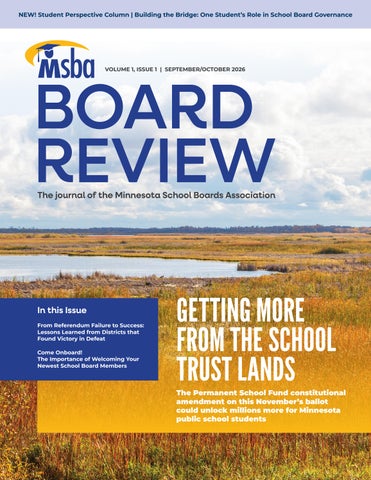
GETTING MORE FROM THE SCHOOL TRUST LANDS
The Permanent School Fund constitutional amendment on this November’s ballot could unlock millions more for Minnesota public school students
School insurance shouldn’t require a study hall. You’ve got enough on your plate. EMC keeps coverage clear and practical — so understanding your risks and protecting your school doesn’t feel like extra homework. Learn more at emcinsurance.com
©Employers Mutual Casualty Company 2026. All rights reserved.
PLANNERS ARCHITECTS ENGINEERS
VIEW OUR PORTFOLIO
www.woldae.com
2
MSBA BOARD REVIEW | SEPTEMBER/OCTOBER 2026
MSBA OFFICERS
VOLUME 1, ISSUE 1 SEPTEMBER/OCTOBER 2026
President: Kristi Peterson, Shakopee President-Elect: Tim Riordan, Rock Ridge
MSBA BOARD OF DIRECTORS District 1: Dave Klatt, Albert Lea Area District 2: Mike Pfeil, Truman District 3: Samantha Best, Buffalo Lake-Hector-Stewart District 4: Milind Sohoni, Wayzata District 5: Michelle Langenfeld, Anoka-Hennepin District 6: Gail Theisen, Forest Lake Area District 7: Liz Niemioja, Inver Grove Heights District 8: Collin Beachy, Minneapolis District 9: Heather Naegele, North Branch Area District 10: Andrea Haverinen, Menahga District 11: Jill Lofald, Duluth District 12: Tyler Brekken, Win-E-Mac District 13: Hunter Feldt, Watertown-Mayer
Leadership, governance, and connection across Minnesota public schools.
TABLE OF CONTENTS 10
MSBA STAFF
From Referendum Failure to Success: Lessons Learned from Districts that Found Victory in Defeat
Kirk Schneidawind: Executive Director Gary Lee: Deputy Executive Director Jackie Fahey: Executive Assistant Erica Allenburg: Director of Communications and Member Engagement
By Zach Nelson, DehlerPR
Jay Bennett: Associate Director of Board Development Kristy Cook: Associate Director of Board Development Denise Dittrich: Director of Government Relations Barb Dorn: Director of Leadership Development and Executive Search
14
Jennifer Ebert: Administrative Assistant to Finance and Government Relations
Come Onboard! The Importance of Welcoming Your Newest School Board Members
Gail Gilman: Director of Strategic Planning and Board Leadership Tiffany Gustin: Director of Management and Insurance Trust Services
By Katie Klanderud, Kristy Cook, and Jay Bennett, MSBA Board Development Staff
Shelby Herrera: Administrative Assistant to Strategic Governance Donn Jenson: Director of Technology Amy Jordan: Associate Director of Leadership Development and Executive Search
16
Katie Klanderud: Director of Board Development
The Permanent School Fund Amendment: A Historic Opportunity for Minnesota Students
Kristy Larson: Associate Director of Management Services Kimberley Dunn Lewis: Associate Director of Government Relations Bruce Lombard: Associate Director of Communications and Member Engagement
By Denise Dittrich, MSBA Director of Government Relations; Minnesota State Senator Mary Kunesh; and Minnesota State Representative Spencer Igo
Sam Nelson: Communications Specialist Terence Morrow: General Counsel Maria Shinabarger: Charter School and Project Specialist Jaymyson Sillman: Information Technology Support Heather Starks: Associate Director of Strategic Planning Joel Stencel: Director of Association Finance
8
The MSBA Board Review (USPS 352-220) is published bimonthly by the Minnesota School Boards Association, 1900 West Jefferson Avenue, St. Peter, Minnesota 56082. Telephone 507-934-2450. Call MSBA office for subscription rates. (Opinions expressed in the MSBA Board Review are those of the writers and do not necessarily represent MSBA policy.)
The Student Perspective Building the Bridge: One Student’s Role in School Board Governance
a New Kind of 22 Composing Classroom: 2026 Minnesota Teacher of the Year
By Bruce Lombard, MSBA Associate Director of Communications and Member Engagement
By Jules Rotter, Former Student School Board Representative on Tri-City United School Board
4
Executive Director’s Message
27
MSBA Staff Spotlight
6
Legal Update
29
MSBA Events
21
MSBA Board Spotlight
30
Vendor Directory
MSBA BOARD REVIEW | SEPTEMBER/OCTOBER 2026
3
EXECUTIVE DIRECTOR’S MESSAGE
Introducing the MSBA Board Review: A New Name, A Renewed Commitment By Kirk Schneidawind, MSBA Executive Director
For more than a century, the Minnesota School Boards Association has existed for one purpose: strengthening public education by supporting the elected leaders who govern Minnesota’s public schools. That mission has not changed. The environment in which school boards lead has. Today’s boards navigate increasing complexity, heightened public expectations, evolving policy, and decisions that shape not only schools, but entire communities. Strong governance has never mattered more. That is why I am pleased to introduce the MSBA Board Review. More than a new name, the MSBA Board Review reflects a renewed commitment to providing school board members with the insights, perspectives, and practical resources needed to lead with confidence. It is designed to examine the issues that matter most to effective governance, highlight innovative leadership from districts across Minnesota, and provide timely analysis of the legislative, legal, financial, and educational trends shaping our work. The name itself reflects an important principle of effective board leadership. The MSBA Board Review is more than the title of this publication — it is a practice. Strong boards regularly review their decisions, evaluate their governance, learn from emerging challenges, and continually improve their leadership. They ask thoughtful questions, seek diverse perspectives, and never stop learning. That spirit of reflection, accountability, and continuous improvement is at the heart of effective governance — and it is the purpose of this publication.
4
MSBA BOARD REVIEW | SEPTEMBER/OCTOBER 2026
The MSBA Board Review is intended to be a trusted resource that helps board members do exactly that: review the issues that matter, learn from one another, and strengthen the leadership that serves Minnesota’s students and communities. While school boards remain our primary audience, the MSBA Board Review also serves a broader purpose. The decisions made by local boards influence students, families, communities, employers, and the future of Minnesota itself. By sharing the realities, opportunities, and responsibilities of school board governance with legislators, state leaders, local officials, and community partners, we hope to build greater understanding of the essential role school boards play in public education. First and foremost, however, this publication is for you. Whether you are looking for governance best practices, practical tools, emerging trends, or stories of innovation from districts across the state, our goal is to provide content that informs your leadership and strengthens your service to your community. As you read this inaugural issue, I hope you find ideas worth discussing at your next board meeting, perspectives that challenge your thinking, and examples that remind you of the extraordinary work taking place in Minnesota’s public schools every day. Thank you for your leadership, your dedication to public service, and your commitment to Minnesota’s students. Together, we strengthen public education through thoughtful governance, informed leadership, and a shared commitment to serving every community. Kirk Schneidawind is MSBA’s Executive Director. Direct questions or comments about this column to kschneidawind@mnmsba.org.
RATWIK, ROSZAK & MALONEY, P.A. Join us for our Annual School Law Seminar on Friday, October 30, 2026 Learn more at www.ratwiklaw.com
ADVANCING SCHOOL LAW
Student Discipline
LabħŅ & EĞłĘħŲĞeğŏ LaŬ
Daŏa PŅĂūacŲ & Ołeğ MeeŏĂğg LaŬ
Iğ-SeŅūĂce TŅaĂğĂğgʼn
SchħħĘ BħaŅd AdūĂce & PħĘĂcŲ DeūeĘħłĞeğŏ
SłecĂaĘ EdŔcaŏĂħğ
IğūeʼnŏĂgaŏĂħğʼn, TĂŏĘe IX, EĞłĘħŲĞeğŏ
CĂūĂĘ LĂŏĂgaŏĂħğ
SchħħĘ BŔʼnĂğeʼnʼn OffĂce AffaĂŅʼn
A law firm dedicated to your needs. 444 CEDAR ST., SUITE 2100 • ST. PAUL, MN 55101 612.339.0060 • ratwiklaw.com
MSBA BOARD REVIEW | SEPTEMBER/OCTOBER 2026
5
LEGAL UPDATE
K-12 Issues and the Minnesota Election Landscape By Dr. Terence Morrow, MSBA General Counsel
The legal structure of Minnesota’s K-12 education environment significantly impacts local and state elections. The state’s commitment to prioritizing local community governance of public schools, together with funding mechanisms that give rise to ballot questions on property tax referendums and candidates’ emphasis of the importance of public education, results in a menu of key education issues facing voters in November. Students’ success is a common subject during the campaign season. From school board elections to state races, candidates often cite test scores, academic proficiency, gaps in achievement, and related matters as they propose new directions and initiatives for Minnesota’s K-12 schools. Minnesota’s school board members and staff devote considerable time and effort to inform local and state candidates about educational challenges and opportunities and the ways in which candidates can work with schools to support student success. School funding is a perennial election concern. The Minnesota Constitution requires that the state Legislature establish “a general and uniform system of public schools” and ensure that they are adequately funded. Despite this provision, Minnesota’s complicated K-12 funding process often leaves local school districts seeking voter approval on referendums that direct local property tax increases to address budget shortfalls that can result in staff cuts, larger class sizes, and school closures. Recent years have seen some progress in addressing large-scale K-12 funding gaps, such as the special education cross-subsidy, while other fiscal pressures (including recent declines in compensatory revenue and increases in health care costs) result in operating referendum ballot questions every election cycle. At the same time, broad election questions often arise on how Minnesota should allocate the state’s public education tax dollars.
6
MSBA BOARD REVIEW | SEPTEMBER/OCTOBER 2026
This November, voters will see a rare election matter on the ballot related to school funding: a constitutional amendment proposition related to the Permanent School Fund (which was created at statehood in 1858 to generate funds for Minnesota’s schools). The measure aims to increase the annual fund distribution from the Fund to Minnesota’s schools by altering Article XI, section 8 of the Minnesota Constitution. Unlike other ballot questions in Minnesota, the constitutional amendment process provides that a voter’s failure to vote on an amendment counts as a “no” vote. Every election cycle, Minnesota’s public schools strive to provide helpful information to voters on K-12 ballot issues. The public purpose doctrine holds that local units of government, including school districts, must use their funds in ways that recognize the line separating factual information and advocacy on an issue. Under this doctrine, schools may provide objective, factual, and neutral information on ballot questions. They cannot, on the other hand, use public funds (including staff time or district resources) to urge voters to vote in a specific way on a matter. The public purpose doctrine does not affect election advocacy by school staff on their own time, off school property, and without using school resources. Similarly, school board members may encourage voters to support or oppose a ballot question as long as district funds are not used. Dr. Terence Morrow is MSBA’s General Counsel. Direct questions or comments about this column to tmorrow@mnmsba.org.
Regional Educational Planners + Architects with 100+ K-12 projects in the past 5 years
davenport • milwaukee • saint paul • sheboygan
MSBA BOARD REVIEW | SEPTEMBER/OCTOBER 2026
7
THE STUDENT PERSPECTIVE
Building the Bridge: One Student’s Role in School Board Governance By Jules Rotter, Former Student School Board Representative on Tri-City United School Board
Editor’s note: Students experience the impact of school board decisions every day, making their perspectives an important part of effective governance. Across Minnesota, districts are finding meaningful ways to bring student voices into boardroom discussions, including through student school board representatives. While each district’s approach is unique, the common goal is the same: creating opportunities for students to share their experiences, insights, and ideas. Student input can help boards better understand student needs and make more informed decisions. This new Student Perspective column highlights student voices and showcases the many ways districts are engaging students in board discussions. Every district’s approach will look different, but the commitment to listening, learning, and building stronger connections with students remains the same. Through these stories, we hope to inspire conversations about how student voice can help shape the future of our schools.
As a founding Student School Board Representative for TriCity United Schools, I have had the unique opportunity to sit at the board table and serve as a bridge between students and district leadership. Through this experience, I have learned that student voice is essential to effective school board governance. School board decisions directly impact students every day, from academics and activities to policies and school culture. Including students in these conversations helps ensure that decisions reflect the perspectives of those who are most directly affected by them.
8
MSBA BOARD REVIEW | SEPTEMBER/OCTOBER 2026
Student representatives bring a perspective that cannot always be captured through surveys, reports, or other forms of feedback. As students, we experience the impact of board decisions every day and can share how policies are actually affecting our peers. Having a student voice at the board table helps strengthen trust between students and district leaders. It shows students their opinions are valued, and the board is committed to listening to the people it serves. One of the most meaningful ways I contributed to board decision-making was through helping establish and strengthen our district’s student representative program. When I began serving during my sophomore year, the role was brand new and lacked clearly defined expectations. Alongside the other founding representatives, I attended Minnesota School Boards Association student leadership events, connected with representatives from other districts, and worked to develop a stronger understanding of how students could contribute meaningfully within a governance setting. As the only original founding member remaining this year, I also had the opportunity to train my successor. Through this process, I helped create a foundation that will allow future student representatives to continue providing valuable input long after my term concludes. One example of successfully advocating for the student body involved the issue of graduation cords. Many students were frustrated and confused about why graduation cords had been discontinued several years earlier. As graduation approached, my successor and I heard concerns from numerous seniors who felt the cords were an important way to recognize their involvement and achievements throughout high school. Rather than simply relaying complaints, we took action. We researched graduation recognition practices across Minnesota by contacting student representatives from other school districts. We then met with our principal to better understand the reasoning behind the original decision and to present the information we had gathered. Although
they ultimately decided not to reinstate graduation cords, the experience demonstrated the importance of advocacy. We were able to provide students with clear answers, ensure their concerns were heard by district leadership, and show our peers that student representatives were willing to speak on their behalf. Serving as a Student School Board Representative has shown me that good governance is built on communication, collaboration, overall positivity, and accountability. Most importantly, it has reinforced my belief that students deserve a voice in decisions that affect their education. When students are included in the conversation, school boards gain valuable perspective, make more informed decisions, and create stronger schools. Jules Rotter is a former Student School Board Representative on the Tri-City United School Board. Rotter was one of the recipients of MSBA’s Robert E. Meeks Student School Board Member Scholarship in 2026. If your student school board representative is interested in writing a future Student Perspective column — or if your district would like to learn more about engaging students in board governance — contact Kristy Cook at kcook@mnmsba.org.
COMPLETE FACILITY SOLUTIONS FOR MINNESOTA SCHOOLS Where Collaboration Takes Form
InGensaInc.com
MSBA BOARD REVIEW | SEPTEMBER/OCTOBER 2026
9
From Referendum Failure to Success: Lessons Learned from
Districts that Found Victory in Defeat By Zach Nelson, DehlerPR
Passing a referendum is one of the toughest challenges school leaders face. Thousands of hours worked by school staff and stakeholders culminate in an outcome you do not get to decide. With a defeat, it may seem like it was all for nothing; but there are districts that will tell you otherwise. A failed referendum can be one of your greatest tools for success. The defeat provides a direct look into how the community perceives the schools and the quality of education being delivered. A referendum defeat — while painful — provides a valuable opportunity to research, plan, and implement new communications strategies to engage your community. Using these insights, along with robust community engagement, a strong plan, a compelling district story, and committed advocates from your community will set you up for success. Research — Analyze and Listen Before You Lead
To understand how to pivot from a failed referendum, you must first research why you failed. “Listening is just as important as talking,” says Montevideo Superintendent Dr. Jamie Skjeveland. Engage with your community to understand their wants and needs. • • • • •
Analyze previous election data Evaluate previous referendum communications Consider practices unused previously, including those successful in neighboring school districts Become actively involved in your community and really listen — to the good and the bad Study opposition movements (if you had any)
“Community engagement is the most essential step in this process,” says Jeff Dehler, APR, president and founder of DehlerPR. “People need to recognize the problems your district is facing. Once you communicate the situation, people can contribute their own input, and your community will see their own fingerprints on the final plan.” Planning — Form a Better Story
After researching and understanding what went wrong, the next step is forming your new plan. Switch up your tactics after engaging your community now that you know exactly what they are seeking in school improvements. Use the data you have gathered to shape your new communications methods. • 10
Make your messages simple and easily understandable.
MSBA BOARD REVIEW | SEPTEMBER/OCTOBER 2026
• •
Simplify your plan; start with the bare essentials and build from there. Rework your communications to better reach your target audiences.
“There are people out there that didn’t hear your story,” adds Dehler. “You have to expand your audience to make sure everybody in your community knows about the situation: both the ‘what’ and, more critically, the ‘why.’” Implementation — Build Trust Through Honest Communication
After you make your new plan, the next step is to put it into action by sharing it with people in the ways they like best. Focus on the facts, be transparent, and build trust throughout the process. Use every tool to your advantage (a few examples are listed below). • • • • • • • •
Website — specific referendum page or stand-alone microsite (with FAQs) Social media School-to-Home communications Messaging systems Backpack flyers Facility tours (in-person or virtual) One-on-one meetings Community roadshow and town halls
Conclusion
The districts that follow demonstrate referendum success is rarely about simply asking voters the same question twice. It comes from taking the time to understand the community, adapting to what is learned, and communicating with clarity and consistency. A failed referendum provides valuable information about public perception, community priorities, and opportunities for improvement. Districts that embrace those lessons are better positioned to develop stronger proposals, tell a more compelling story, and build lasting public trust. When school leaders pair thoughtful planning with authentic community engagement and committed local advocates, yesterday’s defeat can become tomorrow’s victory. Zach Nelson is a Marketing and Communications intern for DehlerPR. DehlerPR is a strategic communications firm specializing in community engagement, public relations, and referendum campaigns for school districts. Visit dehlerpr.com for more information.
FROM REFERENDUM FAILURE TO SUCCESS
Three Districts that Turned Failure into Success Annandale Public Schools - Cardinals Rising
Following the failed 2024 operating referendum, a group of Annandale parents and community members formed Cardinals Rising, an advocacy group dedicated to securing funding for and supporting the Annandale school district. They kicked off a fundraising campaign to help protect school programs and the jobs of a few teachers, resulting in over $250,000 raised. This effort spiked community morale, drawing attention to the cause, and rallying the community. This momentum culminated in a successful 2025 operating levy campaign, proving that with a good district story, you are set up for success. In addition to the school district’s renewed compelling story about the referendum, Cardinals Rising became one of Annadale’s keys to success. The group would eventually evolve into the Vote Yes for Excellence Committee, a group that served as community advocates committed to a robust, well-funded campaign. “Having committed advocates is showing there’s a bandwagon to jump onto,” says Dehler. “If voters see a group of people who are supportive of this mission, they’re more likely to be supportive themselves.”
Annandale Vote YES communications provided the story behind the facts and figures provided by the school district to educate voters.
Montevideo Public Schools
Montevideo Public Schools faced several failed two-question bond referendums from 2020-2023. The district had serious facility needs, and faced mistrust, lack of engagement, and voter fatigue. Montevideo decided to take a step back and rethink their project and community engagement.
For more information: Crystal Nutt, Vote YES Chair / crystalsandersnutt@gmail.com
“In my experience as a superintendent, I have discovered that successful referendums are not won during the final few weeks of a campaign,” says Montevideo’s Skjeveland. “They are earned over months of listening, educating, engaging the community, and planning.” Skjeveland noted, “Equally important, we recognized school administrators, especially the superintendent, cannot do this alone. We partnered with communications professionals who understood how to communicate effectively with different audiences. School leaders are experts in education, but running a successful community-wide referendum campaign requires specialized communications expertise. To be clear, the investment in securing the services of a communications specialist was the number one critical factor in our successful bond referendum campaign.” Before making a new plan, the district looked at: • Educational space needs (quantity and quality) • Current and future enrollment • Existing facility condition • Community feedback • Operational efficiency
Pictured above is a community engagement session included as an advertisement for a public meeting with building tours. To view the full spectrum of referendum materials, go to: www.montevideoreferendum2026.com/resources
Montevideo school leaders settled on a simplified, single question referendum that aimed to benefit every student and school — and all community learners — by addressing the most dire needs the district had. Montevideo passed their referendum with 57% “yes” votes in February 2026.
For more information: Dr. Jamie Skjeveland, Superintendent / jskjeveland@montevideoschools.org See Page 12 to learn about Thief River Falls’ referendum success story.
MSBA BOARD REVIEW | SEPTEMBER/OCTOBER 2026
11
FROM REFERENDUM FAILURE TO SUCCESS
Thief River Falls Public Schools
Thief River Falls underwent a robust community engagement cycle for its 2024 operating referendum. From May to October, the school district engaged with the community through meetings, interviews and a community-wide survey, so they could gain a better understanding of priorities for their community. The district was facing sweeping budget cuts following a failed 2023 campaign and had no voter-approved operating levy in place to soften the blows. After discovering their community did not fully understand what would happen to the district with no levy in place, their restructured plan focused more heavily on the impact of a “no” vote. “All groups focused on educating the public,” says Thief River Falls Superintendent Dr. Chris Mills. “Clear and consistent messaging was extremely important.” The 2024 campaign was conducted in a general election year rather than as a special election (a positive for Thief River Falls; this is not true for all school districts). The district took advantage of the swell in election attention to engage with their community to properly address their shortcomings and implement a new plan, resulting in a critical win.
DESIGNING FIELDS THAT BUILD COMMUNITY.
The school district engaged with the community through meetings, interviews, and a communitywide survey. At the community meetings information was shared and questions were asked to engage community members in the solution. For more information: Dr. Chris Mills, Superintendent / chris.mills@myprowler.org
Great games start with great fields. Bolton & Menk designs athletic facilities that support students, schools, and communities for the long run.
Bolton-Menk.com
12
MSBA BOARD REVIEW | SEPTEMBER/OCTOBER 2026
MSBA BOARD REVIEW | SEPTEMBER/OCTOBER 2026
13
Come Onboard! The Importance of Welcoming Your Newest School Board Members By Katie Klanderud, Kristy Cook, and Jay Bennett, MSBA Board Development Staff
“Give me six hours to chop down a tree and I will spend the first four sharpening the axe.” — Abraham Lincoln What is your board doing to prepare your newly elected or recently appointed board members? As stated above by “Honest Abe,” when given a task to complete, he prefers to spend most of that time in preparation. Onboarding the newest members of your governance team should be no different. Strong school boards do not happen accidentally. They are deliberately developed through shared learning experiences, clear expectations, and strong board-superintendent relationships. A commitment to sound governance practices paired with an emphasis on continued board development, can help keep student success at the forefront of their decision-making processes. For newly elected or appointed school board members, the first months of service are especially important. Your new board colleagues bring energy, community perspective, and a desire to serve. Effective onboarding can leverage this momentum and transform their interest and commitment to informed, responsible board service. Effective onboarding should help your newest members understand the connection of board education to student success. An introduction to school finance, curriculum and instruction, student achievement data, personnel systems, labor relations, facilities, and district operations is a great place to start. When board members understand these areas and work collaboratively with the superintendent, they help build the foundation for strong instruction, responsible budgeting, safe schools, and meaningful accountability. Together, these conditions create a supportive and educationally sound environment focused on student success. Moving from Candidate to Elected Board Member One of the most important reasons for a comprehensive onboarding process is helping new members make the 14
MSBA BOARD REVIEW | SEPTEMBER/OCTOBER 2026
transition from campaigning to governing. Candidates may run because they care deeply about an issue, program, school, or community concern. Once seated, however, they become part of a larger governing body. Individual members may ask questions and bring perspectives, but formal authority rests with the board as a whole. A board member’s role is not to manage daily operations, direct staff, or personally resolve every concern. The board sets direction, adopts policy, approves budgets, employs and evaluates the superintendent, monitors progress, and represents the community through lawful and ethical decision-making. Early orientation helps new members understand the difference between governance and management, the importance of following the chain of communication, and the importance of speaking with one voice after the board has made a decision. Clarifying Roles and Relationships A strong onboarding process should also clearly explain the relationship between the board and the superintendent. New members need to know district processes around how communication occurs and information requests are handled. Who’s responsible for the development of agendas? How are board packets prepared? Why is it important to connect the superintendent evaluation to district goals and the strategic plan? Getting these questions answered helps to create a clarity that protects both the board and the district. When roles are understood, the superintendent can manage operations without mixed messages, and board members are better prepared to ask governance-level questions. The board chair, experienced board members, and the superintendent all play important roles in modeling respectful communication, timely questions, confidentiality, and productive boardroom conduct. Building Knowledge of the District Every new board member joins a district with an existing story. The board has already adopted goals, approved budgets, negotiated agreements, reviewed data, made
COME ONBOARD!
facility decisions, and established policies. Onboarding should help new members understand that context before they begin proposing changes or questioning past decisions. Reviewing the strategic plan, recent board meeting minutes, board policies, budget summaries, enrollment trends, school improvement efforts, and major district initiatives helps new members see how board decisions connect over time. District context also includes community context. Public school boards represent the best needs of every student in the district. New members need to understand the district’s demographics, attendance areas, financial condition, academic priorities, facility needs, and community engagement practices. Increased knowledge in these areas can help them make decisions that are informed, balanced, and focused on the long-term interests and success of every student in the district.
understand the difference between policy and procedure, as well as the board’s process for reviewing, updating, and adopting policy. Board member and team expectations are equally important. New members should become familiar with standards for board conduct, conflict-of-interest requirements, and expectations for appropriate communication with staff, families, the community, and fellow board members. A clear understanding of these responsibilities helps build trust and supports effective governance from the start. Mentorship and Training You should also consider assigning a veteran board member to act as a mentor to your new board member(s). This mentor/ mentee relationship can help address questions, concerns, processes, etc. that may come up during their acclimation to board service. The Minnesota School Boards Association emphasizes the importance of school boards learning to lead. New board members should first understand their role as part of a larger governance team. They can then start the process of learning and working together toward a deliberate and sustained focus on the bedrock of the district’s mission and vision of ensuring every student’s success. MSBA provides many resources on its website and in the Phase I and Phase II workshops held in December and January every year. We recommend you have the mentor and/or board chair attend along with the new board member and superintendent.
Preparing for Meetings, Policy, and Public Process Board meetings are where the public sees governance in action. While considering a board seat or after being elected but before being sworn in, a board member may want to consider attending board meetings to get a feel for how they run. Once elected, new members need a formal orientation to meeting procedures, open meeting law, agenda development, data protection and security, committee work, and expectations for preparation. A clear understanding of how to review board packets, ask questions, and distinguish information gathering from public deliberation is important.
Onboarding is one of the board’s first opportunities to establish this crucial foundation. The process should not simply consist of a welcome packet or a one-time sit down before the first board meeting. Instead, it should be an intentional, consistent process that introduces all newly elected or appointed members to the legal, financial, ethical, and relational responsibilities of effective school board governance. We’ll close the way we opened, with “Honest Abe” reminding us: “You have to do your own growing no matter how tall your grandfather was.” Katie Klanderud, Kristy Cook, and Jay Bennett comprise the MSBA Board Development Staff. Direct questions or comments about this article to them at development@mnmsba.org.
Policy is another essential component of onboarding. Board policies provide the framework for district governance, guide operations, communicate expectations, and support consistent decision-making. New board members should
MSBA BOARD REVIEW | SEPTEMBER/OCTOBER 2026
15
The Permanent School Fund Amendment: A Historic Opportunity for Minnesota Students Part I: Why This Amendment Matters for Minnesota Schools By Denise Dittrich, MSBA Director of Government Relations
generated from those lands through timber, minerals, leases, and other activities became the foundation of what we know today as the Permanent School Fund.
The Permanent School Fund began with a promise.
Those lands were not set aside for the benefit of the government. They were set aside for the benefit of our school children.
More than 200 years ago, America’s founders embraced a simple but powerful idea: that education was the foundation of self-government. They understood that an educated citizenry was essential to the future success and prosperity of the nation.
Over generations, the Permanent School Fund has grown into a valuable educational asset. The fund continues to belong to Minnesota students — past, present, and future — and serves as a lasting reminder of the commitment made to every child who walks through the doors of a public school.
When Minnesota became a state in 1858, that promise took tangible form. Millions of acres of land were granted by the Federal government to support public education, creating a permanent trust for the benefit of our students. Revenue
Like any promise made across generations, it requires stewardship, attention, and occasional modernization to ensure it continues serving students as intended. Story continues on Page 17
16
MSBA BOARD REVIEW | SEPTEMBER/OCTOBER 2026
PERMANENT SCHOOL FUND
Today, the Permanent School Fund is worth more than $2 billion and provides annual distributions to every public school district in Minnesota. Yet despite its growth, the constitutional language governing the fund has remained largely unchanged for more than a century. While investment practices and financial management have evolved dramatically over time, Minnesota’s Constitution still limits how much of the fund can be distributed to schools each year. A constitutional amendment before voters in November 2026 modernizes that approach. If approved, the amendment will allow distributions to be based on a sustainable percentage of the fund’s average market value rather than relying primarily on interest and dividends. This approach is already used successfully by many university endowments, charitable foundations, and permanent trust funds across the country. The amendment is designed to provide greater stability, preserve the long-term purchasing power of the fund, and increase annual distributions to schools while protecting the fund for future generations. For Minnesota public school districts, the impact would be meaningful. If the proposed formula had been in place in 2025, Minnesota public schools would have received approximately $101 per student from the Permanent School Fund instead of $68 — about $33 more for every student, without raising taxes. These additional funds would be distributed to every Minnesota public school district on a per-pupil basis, giving local school boards and community leaders flexibility to use the funding to meet the needs of their students and communities. Just as importantly, this proposal does not increase income taxes. It does not increase property taxes. It does not create a new funding stream. Instead, it modernizes how Minnesota manages an educational asset that already belongs to its students. At a time when districts across Minnesota are facing rising costs, workforce shortages, inflationary pressures, and increasing student needs, every additional dollar matters. School boards are constantly balancing the responsibility of being good stewards of taxpayer resources while ensuring students receive the opportunities they deserve. The Permanent School Fund amendment represents a rare opportunity to provide additional support for schools without asking taxpayers for more. This proposal is also notable because of the broad coalition behind it. It received bipartisan support from legislators representing urban, suburban, and rural communities. Education organizations, school leaders, state officials, and MSBA BOARD REVIEW | SEPTEMBER/OCTOBER 2026
17
PERMANENT SCHOOL FUND
policymakers from across the political spectrum recognized this is a thoughtful and responsible update to a system that has served Minnesota for generations.
distributions while protecting the long-term value of the principal. Minnesota’s Permanent School Fund should operate under those same modern principles.
I believe this amendment is ultimately about honoring the original intent of those who established both our nation and our state — ensuring future generations have access to educational opportunity.
As I traveled throughout the state and spoke with school leaders, educators, and families, I heard a consistent message. Schools are doing extraordinary work, but they are facing real financial pressures. Communities are being asked to do more with less. Students have increasingly complex needs. School districts are balancing budgets in difficult circumstances, and at the same time, many Minnesotans are concerned about the cost of living and property taxes.
The constitutional amendment before voters in November 2026 represents the next chapter in a story that began at statehood and continues today. The legislators who authored and championed this proposal each brought their own perspectives to the effort, but shared a common belief: Minnesota students deserve a Permanent School Fund that is as forward-looking as the promise that created it. Part II: Why I Championed This Amendment By Minnesota State Senator Mary Kunesh, DFL
As a former teacher, parent, and legislator, I have spent much of my career focused on one central belief: investing in public education is one of the most important things we can do for Minnesota’s future. Every community benefits when students have access to strong public schools. Great schools strengthen local economies, prepare future workers, build stronger communities, and create opportunities for young people regardless of their background or ZIP code. That is why I am proud to have championed the Permanent School Fund constitutional amendment in the Minnesota Senate. The idea behind this proposal is actually very simple. Unknown to most Minnesotans, we already have a significant educational trust fund created at statehood and it has grown substantially over time. Thanks to responsible management, it has become a powerful financial resource for public education. The challenge is that the Minnesota Constitution still reflects investment practices from another era. When those provisions were written 168 years ago, relying primarily on interest and dividend income, the investment portfolio made sense. Today’s investment environment is very much different. Modern endowment management recognizes longterm growth comes from a combination of income and appreciation. Many successful funds throughout the country have adopted policies that allow for sustainable annual
18
MSBA BOARD REVIEW | SEPTEMBER/OCTOBER 2026
This amendment provides a responsible path forward because it helps schools without placing additional burdens on taxpayers. As I have said publicly, there is widespread recognition that schools need additional support, and this is one way to provide that support without asking taxpayers to pay one penny more. I also appreciate that this proposal maintains a commitment to future generations. The amendment does not abandon the principle of protecting the fund. In fact, it explicitly requires that management of the fund preserve its purchasing power over time while balancing the needs of current and future beneficiaries. That balance was critically important to me throughout this process. Perhaps what I am most proud of is the bipartisan nature of this effort. In today’s political environment, it can be difficult to find issues that bring people together. Yet legislators from both parties recognized the value of this proposal. We may come from different districts and different political perspectives, but we share a belief that Minnesota students deserve strong schools and that the Permanent School Fund should be working as effectively as possible on their behalf. This amendment is not about politics. It is about stewardship. It is about making sure an asset created for students nearly 170 years ago continues to fulfill its purpose in the 21st century. Most importantly, it is about providing opportunities for the next generation of Minnesotans. That is why I championed this amendment, and that is why I am asking voters to support it by voting YES on their ballot in November. Senator Mary Kunesh represents Minnesota Senate District 39, which includes parts of Ramsey, Hennepin, and Anoka counties, and the cities of Fridley, Spring Lake Park, Columbia Heights, Hilltop, New Brighton, and St. Anthony.
PERMANENT SCHOOL FUND
What Will Voters See on the Ballot? “Shall the Minnesota Constitution be amended to increase the funding going to all school districts from the permanent school fund, which is a fund that supports school districts without raising individual income or property taxes, effective July 1, 2027?”
Part III: Why I Championed This Amendment By Minnesota State Representative Spencer Igo, Republican
When I first began working on this legislation, I viewed it through a simple lens: How can we help Minnesota schools without asking taxpayers for more money? That question led me to the Permanent School Fund. What I found was an incredible opportunity. Minnesota has a fund that already exists, already belongs to our students, and has been responsibly managed for generations. Yet the way we distribute money from that fund has not kept pace with modern investment practices. To me, that seemed like something worth fixing. One of the things I hear most often from school leaders is that they need flexibility. They do not need more mandates. They do not need more one-size-fits-all solutions from St. Paul. They need resources and the ability to make decisions locally. That is exactly what this proposal does. The additional funding generated through the Permanent School Fund amendment would be distributed on a per-pupil basis to districts across Minnesota. Local school boards, superintendents, and community leaders would determine how best to use those dollars to meet local needs. That’s a principle I strongly believe in. Local leaders understand their communities better than state government ever will. Another reason I supported this proposal is because it treats districts fairly. Whether a school district is in rural northern Minnesota, the suburbs, or a large metropolitan area, every student benefits from the same formula. Every community shares in the success of the fund. That fairness was important to me. I also appreciated that this proposal does not raise taxes. In fact, one of the most compelling aspects of this amendment is that it costs taxpayers nothing additional.
We are not creating a new tax. We are not increasing existing taxes. We are simply modernizing how an existing educational asset is managed and distributed. As I have said before, this is about providing support to schools without raising taxes and without creating new burdens for Minnesota families. Throughout the legislative process, I was encouraged by the broad support this idea received. Education advocates supported it. School districts supported it. Republicans and Democrats supported it. That doesn’t happen very often. The reason it happened here is because the proposal makes sense. It respects taxpayers. It respects local control. It supports students. It protects the long-term health of the Permanent School Fund. For me, that combination made this proposal an easy one to champion. Minnesota has always taken pride in its commitment to education. The Permanent School Fund is part of that legacy. By updating how the fund operates, we can strengthen that legacy and ensure more of its benefits reach today’s students while preserving the fund for tomorrow’s students as well. That is a goal that should unite all of us. No matter where we live, what political party we belong to, or what our background may be, we all benefit when Minnesota’s students succeed. That is why I championed this amendment, and that is why I hope Minnesotans will vote to support it this November. Representative Spencer Igo represents Minnesota House of Representatives District 7A, which includes the city of Hibbing, and parts of Aitkin, Itasca and St. Louis counties. Visit mnpsfamendment.org to learn more about the Permanent School Fund.
MSBA BOARD REVIEW | SEPTEMBER/OCTOBER 2026
19
September is Minnesota School Board Recognition Month
Minnesota School Boards help
Minnesota Kids Rise
Thank you, Minnesota school board members! Your Minnesota School Boards Association
20
MSBA BOARD REVIEW | SEPTEMBER/OCTOBER 2026
BOARD
SPOTLIGHT Hunter Feldt
Watertown-Mayer School Board Member MSBA Board Director Director District 13 (Southwest Metro) What is a “fun fact” about you that would surprise most people? My family completed both the Minnesota Hiking Club and Passport Club — visiting over 65 state parks and hiking nearly 200 miles together. Morning or evening person? Morning, without question. It’s my favorite time to ease into the day before things pick up. What is your favorite outdoor activity in Minnesota? Hiking with my family tops the list, but deer hunting in the fall runs a close second — there’s something about the quiet of the woods that’s hard to beat. I’ve also recently gotten back into fishing after a 20-plus year break, which has been a great hobby to rediscover. What’s one thing you’d tell your younger self? Take the risk. Life doesn’t follow a straight path, and the uncertain moments often lead to the most growth. Stay curious, stay humble, and don’t wait for the perfect plan before moving forward.
What is the top highlight of your school board career? Handing out diplomas at graduation. I didn’t know that was part of the role until I experienced it, and it never gets old. Seeing students cross that stage is a reminder of why this work matters. If you could have dinner with any person, who would it be? My grandfather on my dad’s side. I didn’t have much time with him before he passed, and I’ve always wished I could sit down, hear his stories, and learn where our family came from. What is your favorite drink? Black coffee. No frills — just a simple cup. Three cups in the morning and I’m set for the day. What is the best part of serving on the MSBA Board of Directors?
What personal accomplishment makes you the proudest?
The perspective. Seeing how challenges in WatertownMayer are shared across urban, suburban, and rural districts makes me a stronger advocate for school boards statewide.
Being a dad. Watching my three kids grow into their own people — supporting them and sharing in their milestones — means more to me than anything else.
What’s one thing you wish more people understood about school board service? Students first. Always. Every decision comes back to their education, safety, and well-being all while honoring our responsibility to taxpayers.
MSBA BOARD REVIEW | SEPTEMBER/OCTOBER 2026
21
Composing a New Kind of Classroom St. Louis Park music teacher David Davis, named 2026 Minnesota Teacher of the Year, wants every student to see themselves as creators By Bruce Lombard, MSBA Director of Communications and Member Engagement
David Davis, an instrumental and general music teacher at Park Spanish Immersion Elementary in St. Louis Park Public Schools, was named 2026 Minnesota Teacher of the Year in May. Davis is the 62nd recipient of the prestigious award. At Park Spanish Immersion Elementary, Davis teaches music to students in kindergarten through fifth grade, designing a curriculum that emphasizes student voice, creativity, and cultural responsiveness. His students compose original music, collaborate in bands, and connect their learning to their own identities, families, and communities. Davis said the award energizes him to continue working toward a more human-centered education system for the sake of students. “For years, I’ve worked to reimagine music education around student ownership, creativity, and community through ideas that sometimes challenged traditional assumptions,” Davis said. “To see my innovative work affirmed by educators across Minnesota is incredibly meaningful.” Davis added that he is excited to use his platform as Teacher of the Year to uplift the brilliance of students and educators across our state. “I hope to celebrate innovative ideas already happening in classrooms and invite more people into the conversation about how we can transform schools to be more humancentered, creative, and connected to the communities they serve,” he said. MSBA asked Davis a few questions about “giving students more ownership,” his approach to teaching, his own musical influences, and more. MSBA: What does giving students more ownership over their learning actually look like in your classroom?
David Davis said a major issue in public education is that students often have too little ownership over their own learning. “The future of public education can be meaningful, relevant, and joyful when we trust students’ inherent brilliance, creativity, and intrinsic motivation,” he said. Photo courtesy of Education Minnesota
DAVIS: I’ve found that learning is more engaging and wellrounded when students are partners in the process, not just passive recipients of adults’ expertise. In my classroom, that starts as early as kindergarten through Kinder Connect, where each student selects a song that’s meaningful to them and their family, then comes to the front to co-teach it alongside me. I’m very intentional about calling them “teacher,” because they truly are teaching all of us – including me. As students grow, so does their ownership. Third graders choose musicians from the racially diverse posters displayed throughout our classroom, research them, and present what they discover. In GenreFlix, fourth graders select a musical genre they’re curious about and become the class experts, teaching their classmates what they’ve learned. By trusting students to help shape the curriculum, it naturally becomes more culturally and musically diverse because it reflects the identities and interests of the learners themselves. Student ownership even extends to assessment and
22
MSBA BOARD REVIEW | SEPTEMBER/OCTOBER 2026
MINNESOTA TEACHER OF THE YEAR
David Davis works with first graders on rhythmic patterns, inviting students to invent their own patterns for classmates to echo and count. Photo courtesy of St. Louis Park Public Schools
classroom management. We co-create rubrics, practice self-reflection through self-assessment, and use restorative one-on-one conversations to identify problems and develop solutions together. My goal is to reduce teacher dependency and help students develop the skills they’ll need long after they leave my classroom: communication, reflection, empathy, collaboration, and confidence to know their voice has value. MSBA: Your students don’t just learn music — they compose original pieces and form their own bands. Why was it important for you to build a curriculum around that kind of creative freedom, rather than a more traditional approach? DAVIS: Ironically, music education can sometimes leave students believing they aren’t musical. Even though music is a fundamental human capacity, too many young people leave school thinking, “I’m not musical.” I believe that happens when we define musicianship too narrowly as just performance proficiency, but when we expand our definition to include creativity, expression, and connection, many more students begin to see themselves as musicians. More broadly, I think schools sometimes confuse re-creation with creation. We say we value curiosity, creativity, and innovation, yet our systems often reward compliance, standardization, and risk avoidance. Students become very good at following directions, but not always at generating original ideas. Imagine if visual art class only consisted of paint-by-numbers. Those activities have value, but we wouldn’t mistake them for artistic creativity. Music is no different. If we want students to develop their creativity, they need regular opportunities to improvise, compose, collaborate, and problem-solve.
That’s why my curriculum includes songwriting, studentformed bands, and improvising — “speaking” music — as early as kindergarten. In a world where AI can increasingly reproduce information and technical skills, I believe schools have an even greater responsibility to help students become creators – not just performers – who can express their unique brilliance, contribute something original, and recognize they have the capacity to improve the world around them. MSBA: You are part of Education Minnesota’s Racial Equity Advocate program and the Minnesota Department of Education’s Culturally Responsive Arts Education cohort. How does that work shape what cultural responsiveness looks like in your music classroom day to day? DAVIS: For me, cultural responsiveness means seeing students and their families not just as recipients of learning, but as partners who bring valuable experiences, cultures, and musical traditions into our classroom. Rather than asking the community to simply watch performances a few times each year, I invite them to help shape the curriculum itself. That might look like family members and community musicians visiting to coach songwriting, teach hip-hop culture, or share instruments for “show and tell.” Fourth graders exchange pen pal letters with high school musicians to explore their musical identities, and through Elders’ Wisdom, Children’s Song, students interview community members and transform their life stories into original songs. These experiences help students see music not just as entertainment, but as a way to build empathy, strengthen community, and share humanity. This work has also challenged me to rethink whose music gets MSBA BOARD REVIEW | SEPTEMBER/OCTOBER 2026
23
MINNESOTA TEACHER OF THE YEAR
centered in school. Like most music teachers, I had been trained primarily through the lens of Western European art music. However, a few years ago, I realized I wasn’t even teaching the music of our own continent like rock, country, rap, jazz, or bluegrass. Since then, I’ve worked to broaden my curriculum by normalizing all genres, including any instrument, and expanding the definition of musical excellence beyond performance proficiency. I want each student to see that their culture’s music is worthy of being “school music.”
And my students are always introducing me to new music! Because they regularly teach alongside me, they introduce me to music I never would have discovered on my own. Whether it’s kindergarteners sharing a song that’s meaningful to their family or fifth graders choosing a song to perform on their last day of school, I’m constantly learning from them. And I’ve seen that when young people see their own cultures, identities, and musical interests reflected in the curriculum, they naturally become more motivated to participate, create, and learn.
When students regularly encounter both their own musical traditions and those of others, they become not only more well-rounded musicians, but more curious, empathetic, and thoughtful people.
Bruce Lombard is the MSBA Associate Director of Communications and Member Engagement. Direct questions or comments about this article to blombard@mnmsba.org.
MSBA: Who are your own musical influences — and has your students’ music ever introduced you to something new? DAVIS: I often tell people I grew up on 1980s rock, and while that’s certainly one of my favorite genres, my musical influences are actually much more eclectic. I also grew up loving Japanese anime music, Lutheran hymns, Eric Whitacre’s choral music, the musical Wicked, saxophone quartet music, and especially movie and video game soundtracks.
This article includes information from a press release by Education Minnesota announcing David Davis’ selection as Teacher of the Year. Education Minnesota, the 84,000-member statewide educators union, organizes and underwrites the Teacher of the Year program. Visit the Education Minnesota website at educationminnesota.org (under News & Events) to learn more about David Davis and the Minnesota Teacher of the Year program.
Client focused. Results driven.
SQUIRES, WALDSPURGER & MACE, P.A.
• Creative problem solving • Tenacious representation • Goal-oriented advice • Cost-effective services • Timely work product
With over 100 years of combined experience in school law, our attorneys are dedicated to providing customized, cost-effective legal services that fit your needs.
612-436-4300 ● 333 South Seventh Street, Suite 2800, Minneapolis, MN 55402 ● www.raswlaw.com
24
MSBA BOARD REVIEW | SEPTEMBER/OCTOBER 2026
Protection Insurance when you need it. The Minnesota School Boards Association Insurance Trust (MSBAIT) endorses companies with a proven record of service and has addressed the needs of public schools’ risk-management programs since 1972. Property, Inland Marine, and Crime | Workers’ Compensation | School Leaders’ Legal Liability | Automobile | Group Term Life | Long-Term Disability | General Liability | Excess Liability
mnmsba.org/MSBAIT
Contact Tiffany Gustin at tgustin@mnmsba.org or call 800-324-4459 to find out what MSBAIT can do for your school district.
Quality Coverage and Service Tailor-Made for School Districts
one partner every step Nexus Solutions is 100% focused on helping PK-12 school districts plan, fund, design and build realistic facility improvements that benet student learning while bringing communities together. From strategic planning to construction closeout, we are your singlesource partner—transparent, trusted, and always by your side.
Better Buildings. Better Learning.®
PLAN
FUND
DESIGN
BUILD
COMMISSION
CONSERVE
NexusSolutions.com | 763.201.8400 | info@NexusSolutions.com
MSBA BOARD REVIEW | SEPTEMBER/OCTOBER 2026
25
MSBA Strategic Planning Services
Get your school board-superintendent team on the same page •
Create clear expectations for school district operations
•
Drive your district to continually improve in pursuit of excellence
•
Meet Striving for Comprehensive Achievement and Civic Readiness plan requirements
Contact Gail Gilman at MSBA for more information today!
ggilman@mnmsba.org
800-324-4459
mnmsba.org/msba-services/strategic-planning 26
MSBA BOARD REVIEW | SEPTEMBER/OCTOBER 2026
STAFF
SPOTLIGHT Jaymyson Sillman
MSBA Information Technology Support
What is a “fun fact” about you that would surprise most people? I once reached the No. 1 ranking in a trading card game. What is your favorite food? A perfect steak. What is your favorite book or book series? “The Count of Monte Cristo.” What is your favorite film and/or TV series? “Back to the Future.” What is the No. 1 item on your bucket list? Visit every continent. If you could have dinner with any person — living or deceased — who would it be and why?
As an IT specialist, what nugget of tech-related advice would you offer school districts? Before assuming something is broken, try restarting it. It really solves more problems than you’d think. What is the most prized album in your vinyl record collection? A test pressing of Paramore’s “Singles Club.” What is your favorite band or musician? Gerard Way. What do you enjoy most about working with MSBA’s members? I like taking the tech stress away so they can focus on what they do best.
Steve Irwin. He always seemed genuine and down to earth, and I imagine he had some incredible stories to tell.
MSBA BOARD REVIEW | SEPTEMBER/OCTOBER 2026
27
ISD #196 - Emerald Trail Elementary
BUILD THE FUTURE WITH KNUTSON EVERY CONSTRUCTION JOURNEY STARTS WITH A SHARED VISION OF SUCCESS At Knutson, we use technology to help you communicate your vision and attain the buy-in you need. From referendum planning and budget / schedule management to project completion and beyond, Knutson is the partner you can trust.
CONTACT OUR K-12 TEAM TODAY JASON PETERSON | 763.546.2226 jpeterson@knutsonconstruction.com ALISSA MOE | 507.226.3258 amoe@knutsonconstruction.com
Learn more about our K-12 experience here
www.knutsonconstruction.com
28
MSBA BOARD REVIEW | SEPTEMBER/OCTOBER 2026
MSBA EVENTS Access complete list of MSBA events at mnmsba.org/events.
JAN
14-15
Annual Leadership Conference MSBA’s marquee event is set for Thursday, January 14, and Friday, January 15, 2027, at the Minneapolis Convention Center. The Leadership Conference features a wide variety of informative workshops and roundtable sessions for school board members and district leaders, an Exhibit Hall loaded with hundreds of top state and national education-related vendors, and a School Excellence Showcase (where districts “show off” their exemplary school programs). Conference week also includes an Awards Banquet, a Wednesday Night Social, and MSBA staff-led workshops. We encourage MSBA members to save the date for this great learning and networking event. Registration opens in late October. Visit the MSBA website today to submit a workshop proposal or to nominate a school board colleague for one of MSBA’s awards.
Other Key Upcoming Events SEPTEMBER 2026
15
Platform in Action (Virtual)
17
Third Thursday Webinar: Platform in Action
DECEMBER 2026 4 5 11 18
18 25
Building a High-Performance School Board Team: Phase III Workshop (Virtual)
OCTOBER 2026 23 30
Representing Your Community Through Policy and Engagement: Phase IV Workshop (Virtual)
NOVEMBER 2026 17 19 20
Resolution Briefing (Virtual for MSBA Delegates)
MSBA Delegate Assembly (Minneapolis)
Leadership Foundations School Finance and Management: Phase II Workshop (Virtual)
JANUARY 2027
12
Learning to Lead — School Board Basics: Phase I Workshop (Minneapolis)
13
Leadership Foundations — School Finance and Management: Phase II Workshop (Minneapolis) Building a High-Performance School Board Team: Phase III Workshop (Minneapolis) Awards Banquet and Social Event (Minneapolis)
Visit mnmsba.org/events for times and other upcoming events. MSBA BOARD REVIEW | SEPTEMBER/OCTOBER 2026
29
VENDOR DIRECTORY MSBA’s Vendor Directory helps connect school districts with the products and services they need. The directory is always at your fingertips. You’ll find it printed in the back of every Journal magazine as well as on the MSBA website at www.mnmsba. org. Most listings in the web version of this directory include a link so you can head instantly to a website or email address. The directory includes everything you need to know to contact a company quickly—phone numbers, fax numbers and addresses—in an easy-to-read format. If you have a service or product you would like included in this directory, please contact Erica Nelson at 763-497-1778 or erica.nelson@ewald.com. ARCHITECTS/ENGINEERS/ FACILITY PLANNERS
Ameresco, Inc. (Ben Wallace) 701 Xenia Ave South #240 Golden Valley, MN 55416 612-491-6227 ameresco.com bwallace@ameresco.com ATSR Planners Architects Engineers (Sarah Fox, AIA) 8501 Golden Valley Road, Suite 300 Golden Valley, MN 55427 763-545-3731 atsr.com sfox@atsr.com Bolton & Menk, Inc. (Jay Pomeroy) 111 Washington Avenue South, Suite 650 Minneapolis, MN 55401 612-416-0220 bolton-menk.com jay.pomeroy@bolton-menk.com Bray Architects (Matt Wolfert) 12 Long Lake Road, Ste. 17 St. Paul, MN 55115 651-770-4442, Fax 651-770-1997 brayarch.com Mwolfert@brayarch.com Cuningham (John Pfluger) 201 Main St. SE, Ste. 325 Minneapolis, MN 55414 612-379-5540 cuningham.com jpfluger@cuningham.com Design Tree Engineering and Land Surveying 800 Washington Ave N. Suite 610 Minneapolis, MN 55401 888-216-1916 DTE-LS.com DJF@ DTE-LS.com
30
DLR Group (Maria James) 520 Nicollet Mall, Ste. 200 Minneapolis, MN 55402 612-977-3500, Fax 612-977-3600 dlrgroup.com maria.james@dlrgroup.com
ICS (Pat Overom) 1331 Tyler St. NE Ste. 101 Minneapolis, MN 55413 763-354-2670, Fax 763-780-2866 ics-builds.com pat.overom@ics-builds.com
Nexus Solutions (Kevin Hickmann) 6885 Sycamore Lane North Maple Grove, MN 55369 763-201-8400 nexussolutions.com info@nexussolutions.com
DSGW Architecture (John Erickson) 2 West 1st St., Ste. 201 Duluth, MN 55802 218-727-2626 dsgw.com architects@dsgw.com
inBYLT (Corey Schlosser) 3495 Northdale Blvd. NW, Suite 230 Coon Rapids, MN 55448 563-543-2210 inBYLT.com CoreyS@inBYLT.com
OPN Architects (Joe Wallace) 212 N 3rd Ave., Suite 312 Minneapolis, MN 55401 612-523-2110 opnarchitects.com jwallace@opnarchitects.com
EAPC Architects Engineers (Sean Sugden) 539 Bielenberg Drive, Suite 115 St. Paul, MN 55125 701-412-3489 eapc.net sean.sugden@eapc.net GLTArchitects (Ryan TerSteeg) 808 Courthouse Square St. Cloud, MN 56303 320-252-3740 gltarchitects.com rtersteeg@gltarchitects.com Hallberg Engineering, Inc. (Trevor Gilbertson) 1750 Commerce Court White Bear Lake, MN 55110 651-748-1100, Fax 651-748-9370 hallbergengineering.com tgilbertson@hallbergengineering.com Hoffman, Planning, Design & Construction, Inc. (Mindy Crowley) 7600 2nd Street N Oakdale, MN 55128 218-348-7766 hoffman.net mcrowley@hoffman.net ICON Architectural Group (Kyle Kvamme) 214 N. 4th Street, Suite 208 Grand Forks, ND 58203 701-772-4266 iconarchitects.com designwith@iconarchitects.com
MSBA BOARD REVIEW | SEPTEMBER/OCTOBER 2026
InGensa, Inc. (Jacqui Coleman) 18215 45th Ave. N, Ste. C Plymouth, MN 55446 952-222-3550, Fax 952-222-9980 ingensainc.com jcoleman@ingensainc.com ISG (Sue Peterson) 6465 Wayzata Boulevard, Suite 970 St. Louis Park, MN 55426 952-426-0699 isginc.com sue.peterson@ISGInc.com JLG Architects (Dan Miller) Offices in Minneapolis, St. Cloud & Alexandria 612-746-4260 jlgarchitects.com dmiller@jlgarchitects.com Larson Engineering, Inc. (Justin Nielsen) 3524 Labore Road White Bear Lake, MN 55110 651-481-9120, Fax 651-481-9201 larsonengr.com jnielsen@larsonengr.com LSE Architects, Inc. (Jennifer Anderson-Tuttle) 1401 Glenwood Avenue Minneapolis, MN 55405 612-343-1010 lse-architects.com jtuttle@lse-architects.com
SitelogIQ (Matt Helgerson, Kate Carroll) 7900 W 78th St, Ste 400 Edina, MN 55439 888-514-1971 sitelogiq.com matt.helgerson@sitelogiq.com, kate.carroll@sitelogiq.com Wendel (Justin Parish) 510 1st Avenue North, Suite 420 Minneapolis, MN 55403 612-332-1401 wendelcompanies.com jparish@wendelcompanies.com Widseth (Brent Dammann) 216 South Main Street Crookston, MN 56716 701-765-8005 widseth.com Brent.Dammann@widseth.com Wold Architects and Engineers (Vaughn Dierks) 332 Minnesota St., Ste. W2000 St. Paul, MN 55101 651-227-7773, Fax 651-223-5646 woldae.com mail@woldae.com Zerr Berg Architects, Inc. (Blake Carlson) 510 4th Ave N Fargo, ND 58102 701-280-0187 zerrbergarchitects.com info@zbarch.com
VENDOR DIRECTORY ATHLETIC FACILITIES Bolton & Menk, Inc. (Jay Pomeroy) 111 Washington Avenue South, Suite 650 Minneapolis, MN 55401 612-416-0220 bolton-menk.com jay.pomeroy@bolton-menk.com Bray Architects (Matt Wolfert) 12 Long Lake Road, Ste. 17 St. Paul, MN 55115 651-770-4442, Fax 651-770-1997 brayarch.com Mwolfert@brayarch.com EAPC Architects Engineers (Sean Sugden) 539 Bielenberg Drive, Suite 115 St. Paul, MN 55125 701-412-3489 eapc.net sean.sugden@eapc.net ISG (Sue Peterson) 6465 Wayzata Boulevard, Suite 970 St. Louis Park, MN 55426 952-426-0699 isginc.com sue.peterson@ISGInc.com ATHLETIC SPORT FLOORS/ SURFACING FLR Sanders, Inc. (Brandon Ramage) 3079 92nd Ave Princeton, MN 55371 763-633-1170, Fax 763-631-0127 flrsanders.com info@flrsanders.com ATTORNEYS Kennedy & Graven, Chartered (Maggie R. Wallner) Fifth Street Towers 150 South Fifth St., Ste. 700 Minneapolis, MN 55402 612-337-9300, Fax 612-337-9310 kennedy-graven.com contactus@kennedy-graven.com Knutson, Flynn & Deans, P.A. (Steve Knutson) 1155 Centre Pointe Dr., Ste. 10 Mendota Heights, MN 55120 651-222-2811, Fax 651-225-0600 kfdmn.com sknutson@kfdmn.com
Pemberton Law Firm 110 North Mill St. Fergus Falls, MN 56537 218-736-5493, Fax 218-736-3950 pemlaw.com Ratwik, Roszak & Maloney, P.A. (Jennifer K. Earley) 444 Cedar Street, Suite 2100 St. Paul, MN 55101 612-339-0060, Fax 612-339-0038 ratwiklaw.com info@ratwiklaw.com Squires, Waldspurger & Mace, P.A. (Amy Mace) 333 South 7th Street, Suite 2800 Minneapolis, MN 55402 612-436-4300, Fax 612-436-4340 raswlaw.com amy.mace@raswlaw.com BROADBAND/ COMMUNICATION SYSTEMS Arvig 150 Second Street SW Perham, MN 56573 888-992-7844 arvig.com/forbusiness/ answers@arvig.com COMMISSIONING Hallberg Engineering, Inc. (Trevor Gilbertson) 1750 Commerce Court White Bear Lake, MN 55110 651-748-1100, Fax 651-748-9370 hallbergengineering.com tgilbertson@hallbergengineering.com ICS (Pat Overom) 1331 Tyler St. NE, Ste. 101 Minneapolis, Minnesota 55413 763-354-2670, Fax 763-780-2866 ics-builds.com pat.overom@ics-builds.com Nexus Solutions (Kevin Hickmann) 6885 Sycamore Lane North Maple Grove, MN 55369 763-201-8400 nexussolutions.com info@nexussolutions.com
COMMUNICATIONS/MARKETING Bray Architects (Matt Wolfert) 12 Long Lake Road, Ste. 17 St. Paul, MN 55115 651-770-4442, Fax 651-770-1997 brayarch.com Mwolfert@brayarch.com Captivate Media + Consulting (Jake Sturgis) 8969 Aztec Drive Eden Prairie, MN 55347 612-314-3314 captivatemedia.us jake@captivatemedia.us Knutson Construction (Jason Peterson) 7515 Wayzata Boulevard St. Louis Park, MN 55426 763-234-5645 KnutsonConstruction.com Jpeterson@knutsonconstruction.com CONSTRUCTION MANAGEMENT & CONSULTING SERVICES Ameresco, Inc. (Ben Wallace) 701 Xenia Ave South #240 Golden Valley, MN 55416 612-491-6227 ameresco.com bwallace@ameresco.com Donlar Construction Company (Jon Kainz) 550 Shoreview Park Road Shoreview, MN 55126 651-227-0631, Fax 651-227-0132 donlarcorp.com jon.kainz@donlarcorp.com Gehrtz Construction Services, Inc. (Blake Carlson) 510 4th Ave N Fargo, ND 58102 701-297-0704 gehrtzconstructionservices.com info@gcs-fm.com H+U Construction (Shane Butler) 5555 West 78th Street, Suite A Minneapolis, MN 55439 612-290-6312 hu-construction.com sbutler@hu-construction.com
Hoffman Planning, Design & Construction, Inc. (Mindy Crowley) 7600 2nd Street N Oakdale, MN 55128 218-348-7766 hoffman.net mcrowley@hoffman.net ICS (Pat Overom) 1331 Tyler St. NE, Ste. 101 Minneapolis, Minnesota 55413 763-354-2670, Fax 763-780-2866 ics-builds.com pat.overom@ics-builds.com inBYLT (Corey Schlosser) 3495 Northdale Blvd. NW, Suite 230 Coon Rapids, MN 55448 563-543-2210 inBYLT.com CoreyS@inBYLT.com InGensa, Inc. (Jacqui Coleman) 18215 45th Ave. N, Ste. C Plymouth, MN 55446 952-222-3550, Fax 952-222-9980 ingensainc.com jcoleman@ingensainc.com Knutson Construction (Jason Peterson) 7515 Wayzata Boulevard St. Louis Park, MN 55426 763-234-5645 KnutsonConstruction.com Jpeterson@knutsonconstruction.com Kraus-Anderson (John Huenink) 501 S. 8th St. Minneapolis, MN 55404 612-747-6258 krausanderson.com john.huenink@krausanderson.com Loeffler Construction and Consulting (Will Forbord) 9202 202nd St W. Suite 100 Lakeville, MN 55044 952-955-9119 loefflerconstruction.com wforbord@loefflerconstruction.com Nexus Solutions (Kevin Hickmann) 6885 Sycamore Lane North Maple Grove, MN 55369 763-201-8400 nexussolutions.com info@nexussolutions.com
MSBA BOARD REVIEW | SEPTEMBER/OCTOBER 2026
31
VENDOR DIRECTORY SitelogIQ (Matt Helgerson, Kate Carroll) 7900 W 78th St, Ste 400 Edina, MN 55439 888-514-1971 sitelogiq.com matt.helgerson@sitelogiq.com, kate.carroll@sitelogiq.com Stahl Construction (Cathy Schmidt) 861 E. Hennepin Avenue, Suite 200 Minneapolis, MN 55414 952-767-2110, Fax 952-931-9941 stahlconstruction.com cschmidt@stahlconstruction.com Solid Rock Construction (Harlan Worsham) 14665 Buchanan St. NE #4 Ham Lake, MN 55304 (763) 270-5058 srcmn.com service@srcmn.com COST ESTIMATING Hoffman Planning, Design & Construction, Inc. (Mindy Crowley) 7600 2nd Street N Oakdale, MN 55128 Hoffman.net mcrowley@hoffman.net ISG (Sue Peterson) 6465 Wayzata Boulevard, Suite 970 St. Louis Park, MN 55426 952-426-0699 isginc.com sue.peterson@ISGInc.com Knutson Construction (Jason Peterson) 7515 Wayzata Boulevard St. Louis Park, MN 55426 763-234-5645 KnutsonConstruction.com Jpeterson@knutsonconstruction.com EDUCATIONAL PROGRAMS/ SERVICES The Minnesota Service Cooperatives (Anne Kilzer) 525 Park Street, Suite 255 St. Paul, MN 55103 651-261-9692 mnservcoop.org anne@capitolhillassoc.com
32
ELECTRICAL ENGINEERS/ AV SYSTEMS Hallberg Engineering, Inc. (Trevor Gilbertson) 1750 Commerce Court White Bear Lake, MN 55110 651-748-1100, Fax 651-748-9370 hallbergengineering.com tgilbertson@hallbergengineering.com ISG (Sue Peterson) 6465 Wayzata Boulevard, Suite 970 St. Louis Park, MN 55426 952-426-0699 isginc.com sue.peterson@ISGInc.com EMPLOYEE BENEFITS Aviben (Trent Pepper) 1995 E Rum River Dr S Cambridge, MN 55008 763-552-6053 aviben.com info@aviben.com ENERGY SOLUTIONS Ameresco, Inc. (Ben Wallace) 701 Xenia Ave South #240 Golden Valley, MN 55416 612-491-6227 ameresco.com bwallace@ameresco.com ICS (Pat Overom) 1331 Tyler St. NE, Ste. 101 Minneapolis, Minnesota 55413 763-354-2670, Fax 763-780-2866 ics-builds.com pat.overom@ics-builds.com inBYLT (Corey Schlosser) 3495 Northdale Blvd. NW, Suite 230 Coon Rapids, MN 55448 563-543-2210 inBYLT.com CoreyS@inBYLT.com Nexus Solutions (Kevin Hickmann) 6885 Sycamore Lane North Maple Grove, MN 55369 763-201-8400 nexussolutions.com info@nexussolutions.com
MSBA BOARD REVIEW | SEPTEMBER/OCTOBER 2026
SitelogIQ (Matt Helgerson, Kate Carroll) 7900 W 78th St, Ste 400 Edina, MN 55439 888-514-1971 sitelogiq.com matt.helgerson@sitelogiq.com, kate.carroll@sitelogiq.com ENVIRONMENTAL CONSULTANTS Bolton & Menk, Inc. (Jay Pomeroy) 111 Washington Avenue South, Suite 650 Minneapolis, MN 55401 612-416-0220 bolton-menk.com jay.pomeroy@bolton-menk.com ISG (Sue Peterson) 6465 Wayzata Boulevard, Suite 970 St. Louis Park, MN 55426 952-426-0699 isginc.com sue.peterson@ISGInc.com FACILITY IMPROVEMENTS Ameresco, Inc. (Ben Wallace) 701 Xenia Ave South #240 Golden Valley, MN 55416 612-491-6227 ameresco.com bwallace@ameresco.com Knutson Construction (Jason Peterson) 7515 Wayzata Boulevard St. Louis Park, MN 55426 763-234-5645 KnutsonConstruction.com Jpeterson@knutsonconstruction.com Solid Rock Construction (Harlan Worsham) 14665 Buchanan St. NE #4 Ham Lake, MN 55304 (763) 270-5058 srcmn.com service@srcmn.com FINANCIAL MANAGEMENT Baird (Michael Hoheisel) 7755 3rd Street North, Suite 400 St. Paul, MN 55128 651-365-2582 RWBaird.com/MNSchools mhoheisel@rwbaird.com
Ehlers (Shelby McQuay) 3001 Broadway St NE, Suite 320 Minneapolis, MN 55413 651-697-8548, Fax 651-697-8555 ehlers-inc.com smcquay@ehlers-inc.com MSBA-Sponsored CP-DBS, LLC d/b/a Payschools (Rick Killian) 40 Burton Hills Blvd., Ste. 415 Nashville, TN 37215 330-295-3140 payschools.com rick.killian@payschools.com MSBA-Sponsored MNTAAB (Minnesota Tax and Aid Anticipation Borrowing Program) (Lori Volz, Baker Tilly) 612-876-4505 Bakertilly.com Lori.volz@bakertilly.com MSBA-Sponsored P-Card (Procurement Card) Program 800-891-7910 or 314-878-5000 Fax 314-878-5333 pfmam.com/OurSolution PaymentSolutionsProgram PFM Asset Management, LLC - MSDLAF+ (Matt Schmidt) 800 Nicollet Mall, 4th Floor Minneapolis, MN 55402 612-518-2531, Fax 612-338-7264 msdlaf.org Matt.schmidt@pfmam.com FLOOR COVERINGS Hiller Commercial Floors (Dave Bahr) 2909 South Broadway Rochester, MN 55904 507-254-6858 or 888-724-1766 hillerfloors.com dbahr@hillercarpet.com INDOOR AIR QUALITY ISG (Sue Peterson) 6465 Wayzata Boulevard, Suite 970 St. Louis Park, MN 55426 952-426-0699 isginc.com sue.peterson@ISGInc.com
VENDOR DIRECTORY Nexus Solutions (Kevin Hickmann) 6885 Sycamore Lane North Maple Grove, MN 55369 763-201-8400 nexussolutions.com info@nexussolutions.com
Ratwik, Roszak & Maloney, P.A. (Jennifer K. Earley) 444 Cedar Street, Suite 2100 St. Paul, MN 55101 612-339-0060, Fax 612-339-0038 ratwiklaw.com info@ratwiklaw.com
INSURANCE
NATURAL GRASS FIELDS
EMC Insurance Companies (Ashley Kaniasty) 7500 Flying Cloud Drive, Suite 670 Eden Prairie, MN 55344 612-643-4795 emcinsurance.com Minneapolis@EMCIns.com
Bolton & Menk, Inc. (Jay Pomeroy) 111 Washington Avenue South, Suite 650 Minneapolis, MN 55401 612-416-0220 bolton-menk.com jay.pomeroy@bolton-menk.com
Marsh McLennan Agency (Patrick Truax) 6160 Golden Hills Drive Minneapolis, MN 55416 763-482-9500 marshmma.com patrick.truax@marshmma.com Minnesota School Boards Association Insurance Trust (MSBAIT) (Tiffany Gustin) 1900 West Jefferson Ave. St. Peter, MN 56082-3015 800-324-4459, Fax 507-931-1515 mnmsba.org/MSBAIT tgustin@mnmsba.org National Insurance Services (Rob Keller) 14852 Scenic Heights Road, Ste. 210 Eden Prairie, MN 55344 800-627-3660, Fax 262-814-1360 NISBenefits.com rkeller@NISBenefits.com INVESTIGATIONS Ratwik, Roszak & Maloney, P.A. (Jennifer K. Earley) 444 Cedar Street, Suite 2100 St. Paul, MN 55101 612-339-0060, Fax 612-339-0038 ratwiklaw.com info@ratwiklaw.com LABOR RELATIONS Kennedy & Graven, Chartered (Maggie R. Wallner) Fifth Street Towers 150 South Fifth St., Ste. 700 Minneapolis, MN 55402 612-337-9300, Fax 612-337-9310 kennedy-graven.com contactus@kennedy-graven.com
PLAYGROUNDS Bolton & Menk, Inc. (Jay Pomeroy) 111 Washington Avenue South, Suite 650 Minneapolis, MN 55401 612-416-0220 bolton-menk.com jay.pomeroy@bolton-menk.com Flagship Recreation 1123 Upper 33rd Street W Lake Elmo, MN 55042 763-550-7860 flagshipplay.com info@flagshipplay.com Webber Recreational Design, Inc. (Nick Herman) 1442 Brooke Court Hastings, MN 55033 952-457-1809 webberrec.com nherman@webberrec.com PUBLIC FINANCE Kennedy & Graven, Chartered (Maggie R. Wallner) Fifth Street Towers 150 South Fifth St., Ste. 700 Minneapolis, MN 55402 612-337-9300, Fax 612-337-9310 kennedy-graven.com contactus@kennedy-graven.com
SAFETY & SECURITY ASSESSMENTS EAPC Architects Engineers (Sean Sugden) 539 Bielenberg Drive, Suite 115 St. Paul, MN 55125 701-412-3489 eapc.net sean.sugden@eapc.net SOFTWARE SYSTEMS MSBA-Sponsored CP-DBS, LLC d/b/a Payschools (Rick Killian) 40 Burton Hills Blvd., Ste. 415 Nashville, TN 37215 330-295-3140 payschools.com rick.killian@payschools.com STRUCTURAL DESIGN/ ENGINEERING Bolton & Menk, Inc. (Jay Pomeroy) 111 Washington Avenue South, Suite 650 Minneapolis, MN 55401 612-416-0220 bolton-menk.com jay.pomeroy@bolton-menk.com EAPC Architects Engineers (Sean Sugden) 539 Bielenberg Drive, Suite 115 St. Paul, MN 55125 701-412-3489 eapc.net sean.sugden@eapc.net ISG (Sue Peterson) 6465 Wayzata Boulevard, Suite 970 St. Louis Park, MN 55426 952-426-0699 isginc.com sue.peterson@ISGInc.com
Nexus Solutions (Kevin Hickmann) 6885 Sycamore Lane North Maple Grove, MN 55369 763-201-8400 nexussolutions.com info@nexussolutions.com SUSTAINABILITY CONSULTING Ameresco, Inc. (Ben Wallace) 701 Xenia Ave South #240 Golden Valley, MN 55416 612-491-6227 ameresco.com bwallace@ameresco.com TRANSPORTATION Hoglund Bus Company (Brenda Otto) 116 East Oakwood Drive Monticello, MN 55362 763-295-5119, Fax 763-295-4992 hoglundcompanies.com brenda.otto@hoglundbus.com I-State Truck Centers 11152 Courthouse Blvd Inver Grove Heights, MN 55077 952-435-9060, Fax 952-435-9066 istatetruck.com 243sales@istatetruck.com North Central Bus & Equipment (Brenda Hoffke) 25112 22nd Ave St. Cloud, MN 56301 320-257-1214 northcentralinc.com brendah@northcentralinc.com
Meyer Borgman Johnson (Gary Sabart) 801 Nicollet Mall, Suite W2000 Minneapolis, MN 55402 612-604-3654, Fax 612-337-5325 mbjeng.com gsabart@mbjeng.com
MSBA BOARD REVIEW | SEPTEMBER/OCTOBER 2026
33
ADVERTISER INDEX Bolton & Menk, Inc . . . . . . . . . . . . . . . . . . . . . . . . . . . . . . . . . Page 12 Bray Architects. . . . . . . . . . . . . . . . . . . . . . . . . . . . . . . . . . . . . . Page 7 EMC Insurance Companies. . . . . . . . . . . . . . . . . . . . . . . . . . Page 2 Hallberg Engineering, Inc.. . . . . . . . . . . . . . . . . . . . . . . . . . . Page 9 ICS . . . . . . . . . . . . . . . . . . . . . . . . . . . . . . . . . . . . . . . . . . . . . Back Cover InGensa, Inc. . . . . . . . . . . . . . . . . . . . . . . . . . . . . . . . . . . . . . . . . Page 9 Kennedy & Graven, Chartered . . . . . . . . . . . . . . . . . . . . . Page 26 Knutson Construction. . . . . . . . . . . . . . . . . . . . . . . . . . . . . Page 28 Knutson, Flynn & Deans, P.A. . . . . . . . . . . . . . . . . . . . . . . . . Page 7 LSE Architects, Inc.. . . . . . . . . . . . . . . . . . . . . . . . . . . . . . . . Page 20 MSBA Insurance Trust . . . . . . . . . . . . . . . . . . . . . . . . . . . . . Page 17 MWP Recreation . . . . . . . . . . . . . . . . . . . . . . . . . . . . . . . . . . Page 20 Nexus Solutions. . . . . . . . . . . . . . . . . . . . . . . . . . . . . . . . . . . Page 25 PFM Asset Management, LLC – MSDLAF+ . . . . . . . . . Page 34 Ratwik, Roszak & Maloney, P.A.. . . . . . . . . . . . . . . . . . . . . . Page 5 Squires, Waldspurger & Mace, P.A. . . . . . . . . . . . . . . . . Page 24 Widseth. . . . . . . . . . . . . . . . . . . . . . . . . . . . . . . . . . . . . . . . . . . Page 34 Wold Architects and Engineers. . . . . . . . . . . . . . . . . . . . . . Page 2
34
MSBA BOARD REVIEW | SEPTEMBER/OCTOBER 2026
EVERY Minnesota public school student is part of a trust fund. Learn about the Permanent School Fund constitutional amendment on the November 3 ballot at
mnpsfamendment.org
I’m a Minnesota Kid. Minnesota Kids Rise is a nonpartisan initiative creating a trusted place to explore: Real stories from Minnesota students, families, and educators Clear, transparent data you can verify, and a balanced view of what’s working and what’s improving
We’re inviting Minnesotans to step into the story of our public schools—one that’s real, local, and worth believing in.
Opportunities to get involved and show support
Want more information? Contact Erica Allenburg at: eallenburg@mnmsba.org
MinnesotaKidsRise.org MSBA BOARD REVIEW | SEPTEMBER/OCTOBER 2026
35
1900 West Jefferson Avenue St. Peter, MN 56082-3015
PHASE
PHASE
PREPARED BOARDS. STRONGER SCHOOLS. Learning to Lead: School Board Basics - Phase I is your starting point, but not the finish line. It’s part of MSBA’s four-part Learning to Lead workshop series designed to support your growth as a school board member. Though we recommend completing the phase workshops in numerical order, they can be completed in any order. Complete Phases I-IV to earn MSBA’s Leadership Development Certificate and take it a step further with an optional fifth workshop focused on advocacy.
PHASES 1
2
3
4
LEADERSHIP DEVELOPMENT CERTIFICATE
OUR TEAM
CONTACT US
MSBA’s Board Development team includes professionals with school board experience, a deep knowledge of Minnesota’s public education landscape, and expertise in designing and delivering workshops and programs for Minnesota school boards and their administrative teams.
To learn more, please contact MSBA’s Board Development Team.
Would your like more information about how to earn MSBA recognition points? Scan our QR code! www.mnmsba.org
development@mnmsba.org
development@mnmsba.org www.mnmsba.org