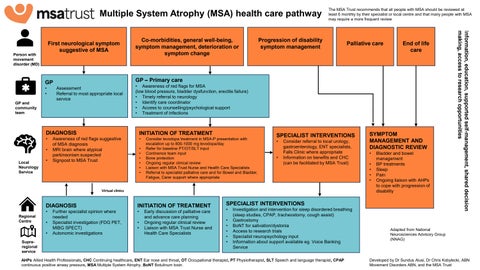
Multiple System Atrophy (MSA) health care pathway Co-morbidities, general well-being, symptom management, deterioration or symptom change
GP
GP – Primary care
Person with movement disorder (MD)
• • GP and community team
INITIATION OF TREATMENT
•
•
•
Palliative care
Awareness of red flags suggestive of MSA diagnosis MRI brain where atypical parkinsonism suspected Signpost to MSA Trust
• • • • • •
Consider levodopa treatment in MSA-P presentation with escalation up to 800-1000 mg levodopa/day Refer for baseline PT/OT/SLT input Continence team input Bone protection Ongoing regular clinical review Liaison with MSA Trust Nurse and Health Care Specialists Referral to specialist palliative care and for Bowel and Bladder, Fatigue, Carer support where appropriate
SPECIALIST INTERVENTIONS • •
Consider referral to local urology, gastroenterology, ENT specialists, Falls Clinic where appropriate Information on benefits and CHC (can be facilitated by MSA Trust)
Virtual clinics
Regional Centre
DIAGNOSIS
INITIATION OF TREATMENT
•
•
• •
Supraregional service
Further specialist opinion where needed Specialist investigation (FDG PET, MIBG SPECT) Autonomic investigations
End of life care
• Awareness of red flags for MSA (low blood pressure, bladder dysfunction, erectile failure) • Timely referral to neurology • Identify care coordinator • Access to counselling/psychological support • Treatment of infections
DIAGNOSIS • Local Neurology Service
Assessment Referral to most appropriate local service
Progression of disability symptom management
• •
Early discussion of palliative care and advance care planning Ongoing regular clinical review Liaison with MSA Trust Nurse and Health Care Specialists
SYMPTOM MANAGEMENT AND DIAGNOSTIC REVIEW • • • • •
Bladder and bowel management BP treatments Sleep Pain Ongoing liaison with AHPs to cope with progression of disability
SPECIALIST INTERVENTIONS • • • • • •
Investigation and intervention for sleep disordered breathing (sleep studies, CPAP, tracheostomy, cough assist) Gastrostomy BoNT for salivation/dystonia Access to research trials Specialist neuropsychology input Information about support available eg. Voice Banking Service
AHPs Allied Health Professionals, CHC Continuing healthcare, ENT Ear nose and throat, OT Occupational therapist, PT Physiotherapist, SLT Speech and language therapist, CPAP continuous positive airway pressure, MSA Multiple System Atrophy, BoNT Botulinum toxin.
Information, education, supported self-management, shared decision making, access to research opportunities
First neurological symptom suggestive of MSA
The MSA Trust recommends that all people with MSA should be reviewed at least 6 monthly by their specialist or local centre and that many people with MSA may require a more frequent review
Adapted from National Neurosciences Advisory Group (NNAG)
Developed by Dr Sundus Alusi, Dr Chris Kobylecki, ABN Movement Disorders ABN, and the MSA Trust