Goldie Globe Issue 2
October 23, 2026
the
GOLDIE
GL
BE
A Publication of the Goldie Margolin School for Girls
Friends from Far Away
By Abby Lewis (’29)
S
tudents Sonya Vayavodkina, Rivka Ruderman, and Miriam Bauer have all lived in other countries. In an interview, the three shared what life was like outside of the United States; the countries they lived in, their cultures, what they found most interesting or different about living abroad, and even their favorite dish! What country did you live in, and how long did you live there?
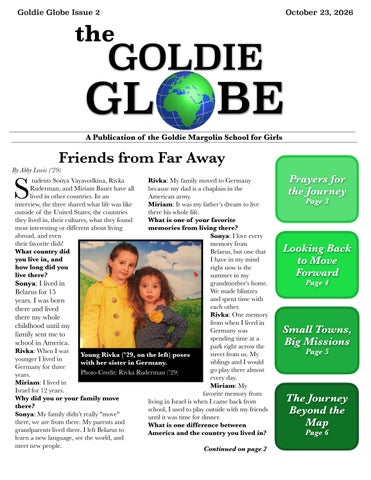
Rivka: My family moved to Germany because my dad is a chaplain in the American army. Miriam: It was my father’s dream to live there his whole life. What is one of your favorite memories from living there? Sonya: I love every memory from Belarus, but one that I have in my mind right now is the summer in my grandmother’s home. Sonya: I lived in We made blintzes Belarus for 15 and spent time with years. I was born each other. there and lived Rivka: One memory there my whole from when I lived in childhood until my Germany was family sent me to spending time at a school in America. park right across the Rivka: When I was street from us. My Young Rivka (’29, on the left) poses younger I lived in siblings and I would with her sister in Germany. Germany for three go play there almost Photo Credit: Rivka Ruderman (’29) years. every day. Miriam: I lived in Miriam: My Israel for 12 years. favorite memory from Why did you or your family move living in Israel is when I came back from there? school, I used to play outside with my friends Sonya: My family didn’t really "move" until it was time for dinner. there, we are from there. My parents and What is one difference between grandparents lived there. I left Belarus to America and the country you lived in? learn a new language, see the world, and meet new people. Continued on page 2
Prayers for the Journey Page 3
Looking Back to Move Forward Page 4
Small Towns, Big Missions Page 5
The Journey Beyond the Map Page 6
Continued from page 1 Sonya: In Belarus, life is much more “collective” and community-focused. People rely on family and neighbors, everyone takes public buses and walks a lot, and kids play outside together without planning. In America, everything is more individual and car-centered, and you need a car to go anywhere. People here are more independent and private. Rivka: One difference I have noticed between America and Germany is that Germany takes recycling very seriously; when we lived there we had different bins for paper, metal, plastic, food, and glass separated by every color. We had to walk two blocks just to get to the glass bins to separate by either green, brown, or clear glass. Here in Memphis there’s barely any difference between trash and recycling. Miriam: In Israel, most of the food and restaurants are kosher, but in America, you need to check if the food or restaurants are kosher before you eat it or buy it. Additionally, almost everything is within walking distance, and if you don’t walk, you take a bus, which is different from the Memphis lifestyle. What is your favorite dish from the country you lived in? Sonya: My favorite dish is draniki. It is Belarusian potato pancakes made from grated raw potatoes, onions, and salt, which are fried until crispy. Rivka: When I lived in Germany, my family and I would make our own latkes every year on Chanukah. We
haven’t kept that tradition since then, but whenever I see latkes now, that is the rst thing that comes to mind.
Sonya (’27) pictured with friends in Belarus. Photo Credit: Sonya Vayavodkina (’27) Miriam: My favorite dish is Shwarma. What’s something American’s do that you think is weird or unusual? Sonya: For one, Americans do not take their shoes off at home. Small talk with strangers is also strange- like a cashier asking, "How are you doing today?" and expecting a full answer. In Belarus, we are more direct and we don’t smile at strangers on the street, so that was very unusual for me at rst. Rivka: To be honest, I didn’t live in Germany that long and I never thought of myself as a German
national, so nothing really seems that different to me. Miriam: How random people you don’t know will say hi to you and be nice to you. How was the Jewish community similar or different from the country you lived in? Sonya: In Belarus, the Jewish community was much smaller than in America. There were fewer Jewish schools and kosher food options, so it was hard to nd things that were speci cally for Jewish people. However, the community was close, and people supported each other. Rivka: The Jewish community in Offenbach, Germany is small. Most of the community there is Russian with very few religious people. The shul has high security, if you are a stranger you have to make a reservation to get in, and they had metal detectors at the door. The shul also acted as a preschool and social hall, everything Jewish was in the shul protected by armed soldiers. The shul is funded by the government, each person in Germany registered their religion with the government and pays a religious tax that goes to support that faith. Miriam: The Jewish community in Israel was different from the one here. My old community was very big and I didn’t know everybody, but here the community is very small so that everyone knows everyone. (Note: Some answers have been edited for clarity)
This month's issue is sponsored by
Tuly and Chani (Vayavodkina)Klein In honor of the birth of their baby boy, Meir!
fi
fi
Goldie Globe Issue 2 fi
fi
2
October 23, 2026
Jewish Topic
3
Prayers for the Journey By Chaya Devorah Besser (’29) very time we head out on a trip, our custom is to say a quick prayer for a safe journey. But have you ever stopped to think about why packing our bags makes us feel as though we need an extra spiritual boost? Recited only where the journey is considered to have really begun, te llat haderech is centered on asking Hashem for safety and success on any trip we go on. The words of te llat haderech come from Masechet Berachot which cites Eliyahu, who said, “Do not get angry, do not get drunk, and pray before traveling.” While getting angry and drunk have an obvious connection, what is the relation with praying before traveling? This seems to be the odd one out.
E
The Maharal and the Gemara answer this question. They explain that while people generally have good intentions and a natural instinct to be kind and moral, the balance between the two can sometimes get upset by anger or drunkenness. This can lead to people acting in a way they can’t control or doing something they might regret later. This answer gives an explanation to the relevance of the rst and second command, but it doesn’t really connect the last part. The Maharal further elaborates on this and says that when a person leaves the place and surroundings they are familiar with, they can sometimes become uncomfortable with the change. Since te llat haderech is speci cally said when traveling, the uncertain environment can cause the same result of uncontrollable behavior that might be regretted later. This understanding of te llat haderech shows the many important layers hidden within it. Despite
fi
fi
fi
fi
fi
fi
fi
fi
fi
fi
fi
fi
fi
fi
fi
fi
fi
fi
fi
fi
Goldie Globe Issue 2
modern technology’s developments when reaching the city’s limits, or the and having passed down the prayer end of our driveways, or maybe the through dozens upon dozens of moment we take off from a plane or generations, we still say the same when we sail off on a cruise. thing. In addition to being a longAccording to Chabad.org, the real lasting prayer, te llat haderech is also answer is none of these. The real and meant to provide comfort, con dence, accurate time in which we should say and belief that everything will go well te llat haderech is only once the traveler as the traveler leaves their home or is a little past the point where there wherever they are comfortable. When are very few houses, or right outside we say te llat haderech, we ask for the city’s limits. Additionally, they also guidance need to have from left the city Hashem area, not and just have protection found a from any more open dangers we area. If may face traveling by along the air, they way, should say whether te llat they are haderech known or when still on concealed. the runway. That is one So although of the main you might points of think you the prayer, are at the which is point when emphasized it feels like Malky Steiner (‘30) saying te llat haderech by the te llat on her road trip. repetition haderech Photo credit: Chaya Devorah Besser (’29) of the word should be “ ”שלוםor said, be sure to check “peace.” your surroundings to make sure This word gives te llat haderech more you’re for sure in the right spot! meaning through the different Some people may say te llat understandings of this word. haderech without necessarily knowing Throughout the prayer, the word what they are saying or why they are “peace” can mean emotional saying it. The reality is, that te llat calmness, physical well being, success, haderech is incredibly important to or good relationships with others, understand–speci cally, when, how, each being something we hope for and the many meanings behind it. throughout our journeys. With all of this known, obtaining safe The words of te llat haderech must travels should be even easier and be said when a traveler is going on a maybe a little more fun when you can trip after passing a signi cant marker share the te llat haderech trivia facts! in their journey. The question is, what exactly is this marker? There are many potential options: it could be
October 23, 2026
Looking Back to Move Forward By Aliza Wiener (’27) For thousands of years, Jewish ctober 7th: the largest attack people have endured persecution, exile, on the Jewish people since the and several unsuccessful attempts to Holocaust. A day of erase our identity. But, as we say on celebration quickly turned into a day Passover, generation after generation, of mourning and suffering. Families we get up, rebuild, and strengthen our torn apart, loved ones murdered, and connection to our heritage and hundreds of thousands traumatized. traditions. October 7th was Many people ask how it is even devastating, but as the world has seen possible to move on. How can we move in these past three years, we aren’t forward when something so going anywhere. devastating happens to our nation? Three years later, rebuilding means There is no doubt that we have faced more than just restoring homes and and will continue to face acts of communities. Ask anyone who has antisemitism for simply practicing and been in Israel in the last three years, loving our religion, so how can we and they will tell you just how little continue to do so while continuously sleep they got due to the sounds of faced with adversity and hatred? construction outside their doors. Amid The answer is not that the pain has the devastation, cranes have gone up, lessened or gone away. Rather, it is that buildings have been repaired, and hatred and adversity does not have a communities have worked tirelessly to place in determining our future. Jewish rebuild what was lost. The sounds of and Israeli construction resilience is are a reminder the decision that life to continue continues, building hope remains, despite the and the Jewish pain we feel. and Israeli A few future is years ago, I strong. had the Rebuilding is privilege of also shown by hearing from lling schools Rachel and Goldbergsynagogues Polin, the with Jewish Hersh Goldberg-Polin’s sign, along with mother of life, other memorial signs at the Nova Hersh celebrating Festival. Goldbergwith each Polin. Hersch Photo credit: Aliza Wiener (’27) other, was taken supporting hostage and murdered by Hamas in when needed, and refusing to hide our captivity. She expressed an idea that Jewish pride. Remembering those we couldn’t be more true. She said, “It lost goes hand and hand with our doesn’t get easier, you get stronger.” responsibility to build a future worthy Strength does not mean forgetting of them. what happened or pretending the pain However, resilience does not has disappeared–it means nding the happen by liking Instagram posts that courage to carry that pain while combat antisemitism. It happens continuing to live, love and rebuild. through education and speaking up for
O
fi
fi
Goldie Globe Issue 2 fi
fi
Life
4
the truth about antisemitism and antizionism. This is where organizations like StandWithUs play an important role. StandWithUs is an international Israel education organization dedicated to educating people of all ages about Israel, challenging misinformation, and combating antisemitism. Through leadership programs, community events, and educational resources, it empowers people to stand up for Israel and the Jewish people. As an intern at StandWithUs this year, I have had the opportunity to be a part of this effort. Educating others is one of the most important ways we can transform our resilience into action. Every conversation is a chance to educate; every time a person chooses to speak up makes a difference. We may not be able to control the hatred that exists around us, but we can control our response. We can choose to let our Jewish pride and identity become a source of strength rather than something we feel pressured to hide. Thriving does not mean pretending October 7th never happened. We remember the victims, survivors, and those affected. We continue to stand with them and support them. It is our responsibility to celebrate our strengths and remember our pain. Three years later the Jewish people are still here. We are still learning, still growing, and still rebuilding towards a better future. Though there is no guarantee that a future without antisemitism will exist, there is the chance to respond to it with purpose and con dence, rather than ignorance and fear. Our story has never been de ned by what has happened to us, but by what we choose to build afterward. Three years later we remember, but three years later we thrive.
October 23, 2026
5
Chabad: Small Towns, Big Mission By Chloe Yosef (’30)
B
arbados, Costa Rica, and Iceland. What do all of these places have in common? They all have a Chabad. Chabad is a Jewish organization that establishes synagogues around the world to help Jews in almost every community connect with Hashem and have access to Jewish resources since 1172. Dating back to before World War II, the Chabad headquarters was in Belarus. When Chabad remained local, Jewish people in Europe would daven in small ats, rented spaces, or just congregate in a house. Chassidim who didn’t participate in these small gatherings would daven in a normal shul and just use a special Siddur that was used by Chabad followers. After the tragedies of World War II and the Holocaust, however, the Chabad movement in Europe shattered. But what seemed to be the end of Chabad in Europe started a new chapter in America. With the leadership of Rabbi Yosef Yitzchak Schneersohn, the Chabad movement made its way to Crown Heights in Brooklyn, New York. Many people told him that American culture wouldn’t allow a strict religious community to survive, but despite this backlash, he kept pushing to create a good environment for Jewish people. He built Jewish day schools, youth organizations, and “publishing houses,” established for publishing Jewish books to build up community engagement. After Rabbi Schneerson’s passing, his son in law, Rabbi Menachem Mendel Schneerson, took over. He expanded the movement even more. He started a program, Shlichus, that sent young couples to cities all around the world to rebuild Jewish life anywhere they found Jews. The rst ever Chabad house, coming in at 300,000 square feet and 16 stories high, was established in Los
fi
fl
Goldie Globe Issue 2 fi
fl
News
Angeles. Chabad, a project that meat on the island. Since people can’t started with humble beginnings, has buy raw meat on the island, the now grown to be a worldwide rabbis have to drive through the hot, movement. For example, Rabbi Eli unpaved jungle roads and get on Chiakin is the current head Rabbi at ferries to get double wrapped cooked the Chabad in Barbados, where there kosher meat. are approximately 100 Jews. Most of In that light, another Chabad the people family traveled living there from New York are to Iceland with descendants their kids to of Ashkenazi start the shul refugees who there. There ed from the are about Nazis. This 300-400 Jews particular currently living Chabad there and house has about two been around million tourists for only nine come to visit years. They annually. have many Inside of the traditions building is a such as wall that Monday displays the night BBQs, history of beach front Jewish life in Yaheli Zalman (’28) looks online for Menorah Iceland since the nearest Chabad center. lighting, and the 1800s. One Photo Credit: Malky Steiner (’30) Torah and of the major Tea for problems there women. Since all of the kosher food is that Shabbos either comes in super in Barbados has to be transported in, late or super early. During summer, the Jews there make kosher versions the sun doesn’t usually set until of the island’s traditional meals, such around midnight on Friday night and as breadfruit and tomato gravies. In it doesn’t end until 1:30 on Sunday Costa Rica, the main Chabad center morning, so they use a modi ed is Chabad of S. Jose, led by Rabbi schedule. In the winter, Shabbos Hershell Spalter. One interesting starts at around 3:30pm on Friday story from the Costa Rica area is a night and ends around 4:30 on story about the Witches of Ecazu. Saturday night. Ecazu’s local nickname is “The City While all these places are unique of the Witches,” stemming from in their own way, they all serve the when early Jewish immigrants came same purpose: they bring the Jewish to Costa Rica and would light people together. No matter how far Shabbos candles in their homes. The you travel, Chabad aims to make local Catholics didn’t know of this Jews feel at home anywhere on the tradition and thought it was globe and provides a space where all witchcraft. Another fascinating thing Jews can connect and make new about Costa Rica is that just like experiences. Barbados, they don’t have any kosher
October 23, 2026
D’var Torah
6
The Strength to Choose By Sara Klein (’28)
P
arshat Lech Lecha often has me reliving second grade, when I learned and experienced it in depth for the rst time. Each year that passes, as I review and relearn it, I somehow manage to come out with a new lesson learnt, a new perspective on a complicated idea, or even simple details that I may have skipped over in the past. The parsha begins with the words Lech Lecha, when Hashem tells Avraham to pack up and get going on a mysterious journey to an unknown destination. However, what do these words truly mean? There are many interpretations, each of which has their own perspective on how Avraham’s life was undeniably impacted. Simply put by Rashi, the phrase Lech Lecha translates to “Go for yourself,” meaning that Hashem is sending Avraham on this journey for his own bene t and good. While he leaves his birthplace, land, and family– everything familiar behind–Avraham is going, knowing that he’s moving towards a better future, guaranteed to him by Hashem Himself. This leap into the unknown was driven by Avraham’s complete belief that Hashem knew what was best and was leading him to where he would be most successful despite the challenges that came along. Another idea is brought by the Medrish, who says that Lech Lecha means “Go with yourself.” This explanation interprets Avraham and Sara’s journey as more of a statement to show that Hashem is not limited to one location or person. They are taking with them their beliefs, faith, and unique lifestyle based around them, bringing them to each place they traveled. The Midrash compares Avraham and Sara to perfume to further prove that through this, they will spread Jewish values over the many lands that they go to, leaving
fi
fi
fi
fi
fl
fi
fi
fi
Goldie Globe Issue 2
behind a signi cant trace of their dissociated with our family or where presence like a fragrant aroma. At that we come from? This was a critical time, the Jewish belief about Hashem’s point in Avraham and Sara’s life in existence as the sole Creator and which Hashem helped them to Master of the world seemed crazy in a discover who they truly are. heavily Lastly, this Lech polytheistic Lecha journey was world that more than just a believed in command. localized gods Instead, it plays a and deities. key role in the Like a bottle existence of the of perfume, if Jewish nation. In they were to his book, The stay in one Guide for the place, these Perplexed, the beliefs would Rambam talks remain about how trapped and anything natural tightly sealed. is bound to However, by disintegrate and spreading decline. This is them around what happened to on their nearly every Debi (’27) re-enacts Avraham’s travels, civilization eagerness to embark on his Lech Avraham and throughout Lecha journey. Sara were able history. However, Photo Credit: Sara Klein (’28) to leave a Avraham was lasting impact being set up to wherever they went. Hashem sending become the founder and father of them on this journey was not only what is an “eternal nation.” To ensure bene cial to their own lives but also this, we must be willing to do the led them to in uence countless people unexpected and persevere despite what along the way. is thrown at us. This identity of the Chassidic masters offer another Jewish nation must be worked at and is perspective, saying that Lech Lecha achieved through such a journey that means “Go to yourself.” This Avraham was sent on. By leaving command to Avraham is deeper than behind his home and everything he just the physical component of knew, Avraham was able to embark on embarking on this journey; rather, it is this journey and lay the foundation for an inward journey of self-discovery. an eternal Jewish nation. He had to leave his home and Through these ideas, the reason practically everything that identi es a for the mysterious journey Avraham is person to truly nd himself. On his commanded to go on becomes journey, Avraham left all familiarity apparent and easily understood. It isn’t behind so that he could move forward about each stop or the nal and discover parts of himself he never destination, but rather about keeping would’ve found elsewhere. Only when our values close as we experience the we step out of our comfort bubble, can world and making sure that everything we truly ask ourselves what our core we do ensures success in the future. values are. Who are we when
October 23, 2026
Feature
7
Oh The Places We'd Go! Where’s your dream vacation spot? Based on a poll taken by the GMSGers, you’ll get to know our top picks! By Miriam Kaplowitz (’29)
1. France was the most popular place for the girls in the GMSG. This may be because of its world-famous pastries, beautiful art, and of course, the Eiffel Tower. Personally, when I went to Paris, there were so many tasty kosher restaurants. My favorite was a Thai restaurant we went to, with such good food I still think about it. Safe to say that if you want to book an enjoyable trip for any of the girls in the GMSG, France is a pretty safe bet. 2. Now what do you think about Switzerland? I think their ag is a big plus. And clearly, so does the rest of the school. High in the rankings, Switzerland was very popular among us GMSGers. Switzerland has beautiful landscapes and not to mention terri c chocolate. Another reason us girls might want to visit is to see the beloved Moreh Shimshon who lives there!
3. Now what about a nice beach vacation in Tel Aviv? It is shore to be nice! But really, do you think we could make a list of places to visit without including Israel? For starters, you get to meet up with everyone you have ever known who has made aliyah. And in Israel there are in nitely more places for us to eat than anywhere else, especially here in Memphis. And of course, you get to go to all the holiest sites in the world! Really, what could be better? 4. When someone told me to include Ireland in this list, I almost started Dublin over with laughter. But after a second look, I am starting to see the appeal. I mean if you go to Ireland at just the right time you may run into the goat king. And if you are confused about what that is, well, so was I–but every year in County Kerry a random goat is chosen to be “King.” The Irish give this goat all it could ever want and dream of, true royal treatment. Then, after three days, the goat gets released back into the wild, which must be very confusing for that one goat. Other than those very interesting traditions, Ireland has some of the most picturesque grasslands and farmlands, with sheep and leprechauns galore. Most of all, it just seems like a cool place to say you have been to. 5. Now there is Norway we could forget about Sweden! Sweden is another one of those places where the nature sure is pretty. If one of your bucket list items is to view the northern lights, then this is the place for you! Sweden also gets a lot of snow, so for the winter lovers such as myself this is another big plus. Sweden has the longest art gallery in the world, located in none other than their metro system. Additionally, the inventor of the Nobel Prize (Alfred Nobel) is from Sweden and that is why the awards are given in Stockholm (except for the peace prize which is given in Oslo). All great reasons to plan your trip!
fl
October 23, 2026 fi
fi
Goldie Globe Issue 2
Feature
8
The Global Kitchen There are so many interesting foods found in different countries! Some are spicy, some are sweet and some may look disgusting, but you can’t tell until you try them! By Eliana Sukhodolsky (’30)
Kholodets is a Russian delicacy which is made from collagen with an extra jiggly taste. In some regions people call it studen. If you’ve ever wanted meat soup and jello at the same time, kholodets is the dish for you!
Gulab jamun is an Indian dessert made from bread and milk dough fried balls known for its sweet and donut-like consistency. Sticky and gooey, gulab jamun will be the sweet treat you never knew you needed.
Walkie talkies is an African dish that consists of chicken feet which are fried and seasoned! This street food can be crispy, chewy, or soft depending on how it’s cooked. Doesn’t that sound yummy?
Dora wat is an Ethiopian dish made with chicken, lots of red onions, and boiled eggs with lots of berbere which is a certain type of spice.
Student Spotlight By Avigayil Sa er (’29)
O
n Sunday, October 18th, the GMSG girls packed their bags and headed out for the exciting two day nature trip which was lled with fun, laughter, and opportunities to strengthen friendships. The trip began with a bus ride from Memphis to Kentucky, where we enjoyed a nature hike and explored the outdoors in the beautiful fall weather. After the hike, everyone headed to Kentucky Lake Glamping where we relaxed and enjoyed a yummy dinner of salmon, mac and cheese, and steamed vegetables made by Dovid Cenker. Through the many different bonding activities such as a scavenger hunt while hiking, and a group activity organized by the student council, we were able to connect and make memories outside of school. We also had the opportunity to to hear a D’var Torah from Adina Lennon (’30) which made the trip meaningful, giving us a chance to learn and re ect while spending time together. On Monday, after eating breakfast, we started the drive back to Memphis with one more exciting stop: Lavender Kisses Farm. There, we learned how to grow lavender and had the opportunity to play with Highland calves and goats. It was a unique experience that added a lot to the special trip. The GMSG nature trip was a great chance for everyone to spend time together and we came back to Memphis with lots of fun memories and stronger friendships with our classmates and friends!
fl
October 23, 2026 fi
fi
Goldie Globe Issue 2
Feature
9
Teacher Take Off
By Dahlia Frieden (’29)
Dr Kennon When Dr. Kennon retires, she will nally move to the middle of nowhere on a daisy farm! She loves saying “happy daisies” so much that she literally became a happy daisy. Now she spends her days surrounded by all the daisies that she planted on her own and enjoying her peaceful life. If you ever need to nd her, just look for the biggest
Mrs. Crews When Mrs. Crews retires, all her years of math will nally pay off when she calculates exactly how to win the lottery! She will use the money she won to buy her very own private yacht. Instead of teaching every math class, she will spend her days sailing around the world and living her best life on her yacht. Mrs. Brown When Mrs. Brown retires, she will be living in Canada! Ever since 2024, she has wanted to live there, and now her wish came true. She will wave her Canadian ag at every Canada Day Parade and be the loudest person/ Canadian there. She might even become a hockey fan!
Morah Rivki When Morah Rivki retires, she will move straight to the Amal Coast in Italy. Ever since visiting, she has not stopped talking about it! She will bring all her children with her and spend her days enjoying the beautiful views, delicious food, and blue water. If you need to nd her, just look for the nearest beach in Italy!
Mrs. Branson When Mrs. Branson retires, she will move to Melbourne, Australia, because of its amazing coffee! She will spend her days visiting different coffee shops and trying new drinks. Soon, every barista in town will know her order by heart. Her retirement will be full of coffee, relaxing, and more coffee!
fi
fi
fi
fi
October 23, 2026 fi
fl
Goldie Globe Issue 2
Feature
10
GMSG ON THE MAP Sara (’28) to the Rocky Mountains: "Say Cheese!" Photo Credit: Sara Klein (’28)
Daphna (’28) rings up the past in Bermuda. Photo Credit: Daphna Kam (’28)
Naomi (’30) shows off her new wig at the Colosseum in Italy. Photo Credit: Naomi Schwartzberg (’30)
Rachel (’27) plays kook for a day in the Outer Banks.
Photo Credit: Rachel Sanderson (’27)
fi
Goldie Globe Issue 2
Rivka (’29) shares the beauty of the corner of Italy’s buildings. Photo Credit: Rivka Ruderman (’29)
Aliza (’27) attempts to camel ride to class from Israel. Photo Credit: Aliza Wiener (’27)
The rst shomer picture taken in Rome, Italy. Photo Credit: Miriam Kaplowitz (’29)
Adina (’30) looking amazing in Sophie (’29) is astonished at the sight of an Michiana, Michigan. ancient temple in Greece. Photo Credit: Adina Lennon (’30) Photo Credit: Sophie Chaifetz (’29)
October 23, 2026
Spot the Difference
11
Try to nd all the differences, we bet you won't. If you think you've found them all, send them in to rachel.sanderson@mhacyos.org
Goldie's Guidance Dear Goldie, I am a freshman this year and I have a big problem. I live fairly close to my school and this year both of my parents got jobs that start super early. They decided that I am now old enough to walk to school every morning by myself. I have to wake up earlier now and I keep getting lost on my way to school. I’m always showing up super late and it’s so embarrassing, and everyone always stares at me when I walk into class. No matter what, I just can’t seem to nd a good way to get to school every morning. What should I do? Love, Always_Late_Leah_613 Dear Always_Late_Leah_613, Well kids these days have very different problems then I had, I see. I think in this situation, you could use a map. I heard that nowadays the kids have tiny maps on their cellular devices. You know, I never had one of those; when I was a kid, we didn’t even have maps yet. We would have to venture through the forest every morning to get to school, and hope that we would recognize the trees on the way there. Most of the other kids were scared of the woods because of all the wild animals, but not me. They called me the “Woodland Whisperer,” or the “Queen of the Forest,” if you will. Let me tell you, I once ran into a bear on my way to school, and we became best friends pretty quickly. I named him Berel and he would pick me up every morning and walk me to school. But back to your problem, I do suggest that app, orange maps, I think it’s called. I don’t know, it’s something about a fruit.
fi
fi
Goldie Globe Issue 2
October 23, 2026
Goldie Globe Issue 2
October 23, 2026
Letter From the Editors
Dear Readers, From Sukkot to the nature trip, October was a busy month for the GMSG. This issue, we capture the true essence of traveling, whether through Lech Lecha or our own personal experiences, traveling opened our eyes to the amazing world around us. We hope this issue enhances your view of the world and guides you in all your future travels! Shabbat Shalom!
To sponsor an issue for just $30, email Daphna Kam at daphna.kam@mhacyos.org
GOLDIE GLOBE STAFF Hodaya Harary & Aliza Wiener Co Editors-in-Chief
General Staff
fi
Debi Cohen Yaheli Zalman hodaya.harary@mhacyos.org & aliza.wiener@mhacyos.org Rivka Ruderman Avigayil Sa er Adina Schwartzberg Rachel Sanderson Maytal Davidovics Assistant Editor-in-Chief Managing Editor Chaya Devorah adina.schwartzberg@mhacyos.org rachel.sanderson@mhacyos.org Besser Miriam Kaplowitz Sara Klein Daphna Kam Abby Lewis Layout Editor Finance Manager Ariella Caplan sara.klein@mhacyos.org daphna.kam@mhacyos.org Adina Lennon Naomi Schwartzberg Faculty Advisors Sophie Chaifetz Malky Steiner News Editor Mrs. Ashley Brown & sophie.chaifetz@mhacyos.org Eliana Sukhodolsky Mrs. Rivki Wiener