MINNESOTA | MISSOURI | NEBRASKA | OHIO | TENNESSEE | WISCONSIN | THE DAKOTAS | ILLINOIS | INDIANA | IOWA | KANSAS | KENTUCKY | MICHIGAN
W W W. R E J O U R N A L S . C O M
OCTOBER/NOVEMBER 2026 VOLUME38 ISSUE5 COMMERCIAL SERVICES PAGE 34: ASSET/PROPERTY MANAGEMENT FIRMS BROKERAGE FIRMS CONSTRUCTION COMPANIES/GENERAL CONTRACTORS REAL ESTATE LAW FIRMS
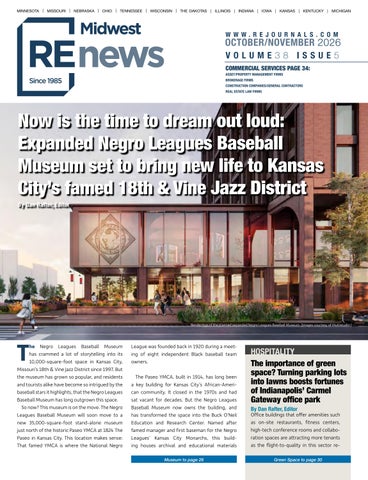
Now is the time to dream out loud: Expanded Negro Leagues Baseball Museum set to bring new life to Kansas City’s famed 18th & Vine Jazz District By Dan Rafter, Editor
Renderings of the planned expanded Negro Leagues Baseball Museum. (Images courtesy of Multistudio.)
T
he Negro Leagues Baseball Museum has crammed a lot of storytelling into its 10,000-square-foot space in Kansas City, Missouri’s 18th & Vine Jazz District since 1997. But the museum has grown so popular, and residents and tourists alike have become so intrigued by the baseball stars it highlights, that the Negro Leagues Baseball Museum has long outgrown this space. So now? This museum is on the move. The Negro Leagues Baseball Museum will soon move to a new 35,000-square-foot stand-alone museum just north of the historic Paseo YMCA at 1824 The Paseo in Kansas City. This location makes sense: That famed YMCA is where the National Negro
League was founded back in 1920 during a meeting of eight independent Black baseball team owners. The Paseo YMCA, built in 1914, has long been a key building for Kansas City’s African-American community. It closed in the 1970s and had sat vacant for decades. But the Negro Leagues Baseball Museum now owns the building, and has transformed the space into the Buck O’Neil Education and Research Center. Named after famed manager and first baseman for the Negro Leagues’ Kansas City Monarchs, this building houses archival and educational materials Museum to page 26
HOSPITALITY The importance of green space? Turning parking lots into lawns boosts fortunes of Indianapolis’ Carmel Gateway office park By Dan Rafter, Editor
Office buildings that offer amenities such as on-site restaurants, fitness centers, high-tech conference rooms and collaboration spaces are attracting more tenants as the flight-to-quality in this sector reGreen Space to page 30
There’s potential in every space
You just have to know how to realize it. We work in every dimension of commercial real estate. Our mission is to realize the potential in all the businesses and people we work with, so that together we can create the real estate solutions of the future. We are driven by the entrepreneurial spirit of our people and the diverse needs of our clients. From instilling confidence in investors today, to reimagining space requirements for tomorrow, we thrive in complex and ever-changing environments.
Learn more at cbre.com
2 | Midwest Real Estate News | October/November 2026 | www.rejournals.com
FEATURES
The Midwest’s commercial real estate publication, providing useful, unbiased and accurate coverage of the industry and its professionals since 1985. WWW.REJOURNALS.COM Publisher | Jay Kodytek jay.kodytek@rejournals.com Editor | Dan Rafter drafter@rejournals.com ADVERTISING Vice President of Sales & MW Conference Series Manager | Ernest Abood eabood@rejournals.com Vice President of Sales | Frank E. Biondo frank.biondo@rejournals.com Business Development Director | Matt Loarie matt.loarie@rejournals.com Classified Director | Susan Mickey smickey@rejournals.com Director, National Events & Marketing | Allison Kim Allison.kim@rejournals.com
1
1
4
6
Dreaming out loud with the Negro Leagues Baseball Museum: The Negro Leagues Baseball Museum has crammed a lot of storytelling into its 10,000-square-foot space in Kansas City, Missouri’s 18th & Vine Jazz District since 1997. But the museum has grown so popular that it has long outgrown this space. The importance of green space? Turning parking lots into lawns boosts fortunes of Indianapolis’ Carmel Gateway office park: Office buildings that offer amenities such as on-site restaurants, fitness centers, high-tech conference rooms and collaboration spaces are attracting more tenants as the flight-to-quality in this sector remains a reality. But what about outdoor space? Commercial real estate activity thriving along Milwaukee’s lakefront: Milwaukee’s lakefront is becoming more than a scenic backdrop to the city’s downtown. It is instead becoming a thriving hub of commercial real estate activity. Falling in love with physical retail again? Shoppers seek freedom from the algorithm: Are shoppers yearning for the physical store experience once again? The latest research from JLL suggests that a growing number of consumers view brick-and-mortar stores as a healthy break from online shopping.
8
Helping to meet soaring housing demand in Rochester: Rochester, Minnesota, has no shortage of jobs. Finding enough housing for the people who fill them? That’s a challenge.
10
The big draw of outdoor shopping districts: What brings the shoppers out? Physical retail is on a hot streak, with consumers returning to brick-and-mortar stores as an alternative to endlessly scrolling on their smartphones.
Commercial real estate remains a boon to the U.S.
14 economy: Commercial real estate remains a major growth
engine for the U.S. economy, generating hundreds of billions of dollars in economic activity and supporting millions of jobs across the country.
Midwest Real Estate News brings real estate leaders together to explore the challenges and opportunities unique to their markets.
Today’s shoppers? They prefer quick trips and local
16 options: Today’s consumers might not look quite like the shoppers many retailers, developers and investors have been planning for, according to the latest research from Placer.ai. Momentum building, challenges remain in U.S. office
18 market according to Cushman & Wakefield report:
Momentum continues to build in the U.S. office market, though challenges remain, according to Cushman & Wakefield’s third-quarter U.S. Office MarketBeat. Negative net absorption? Yes. But that doesn’t tell the
20 full cold storage story: The U.S. cold storage market is
going through a period of adjustment. And older facilities? They are struggling to keep occupancy levels high, while newer cold storage buildings are seeing steady demand. CORFAC members share positive deal trends, impacts of
22 AI: CORFAC International’s survey of members earlier this
ADDRESS 7767 Elm Creek Boulevard, Suite 210, Maple Grove, MN 55369 Midwest Real Estate News® (ISSN 0893-2719) is published bimonthly by Real Estate Publishing Corp., (rejournals.com). Current and back issues and additional resources, including subscription request forms and an editorial calendar, are available on the internet at rejournals.com.
year demonstrated that the commercial real estate sector as a whole and transaction activity within specific sectors are seeing growth. How Collaboration, Credibility, and Capital Are Rewrit-
24 ing Cleveland’s Real Estate Story: Cleveland’s commercial real estate market is no longer asking whether it can compete; it’s proving that it already does.
World Cup games kicked retail, restaurant sales up ... but
12 mostly for retailers with the right strategies and location: More than 5.4 million fans attended FIFA 2025 World Cup games this summer at stadiums across the United States. For retailers, restaurants and commercial property owners, though, simply being in one of the tournament’s host markets didn’t guarantee a boost in business.
www.rejournals.com | October/November 2026 | Midwest Real Estate News | 3
MILWAUKEE
Colliers report: Commercial real estate activity thriving along Milwaukee’s lakefront By Dan Rafter, Editor
iStock photo by Sean Pavone.
Milwaukee’s lakefront is becoming more than a scenic backdrop to the city’s downtown. It is instead becoming a mixed-use commercial district where corporate investment, office demand, residential development and infrastructure improvements are building a thriving hub of commercial real estate activity. That’s the conclusion of a white paper on the strength of Milwaukee’s lakefront commercial districts published late last month by Colliers. The report studies activity in the area where Milwaukee’s central business district meets Lake Michigan. According to the report, the Lakefront Gateway is entering a new growth cycle after a decade of investment in corporate headquarters, lakefront placemaking, residential projects and infrastructure. Those forces are helping transform the area into a mixed-use neighborhood connecting the downtown core with the lakefront. The numbers illustrate the momentum. According to Colliers’ white paper, the lakefront district attracted more than 6.3 million visitors in 2025, while office visits increased 9.7% year over year. Multi-tenant Class-A office buildings posted a 91.3% occupancy rate. At the same time, major corporate users continue to invest in the area. Northwestern Mutual is undertaking a more than $500 million modernization of its lakefront office tower, while Baird continues to expand its presence at U.S. Bank Center. Colliers says these long-term corporate commitments are having a positive effect, helping to generate demand for nearby office, residential, retail and
hospitality properties.
Colliers’ white paper.
As in most markets across the country, quality matters when it comes to the performance of the lakefront office sector in Milwaukee. Colliers’ analysis found that trophy and Class-A office buildings are capturing the strongest tenant demand. Newer properties with better amenities, lake views, parking, transit access and proximity to cultural attractions are proving more attractive to companies looking to bring employees back to the office.
The Couture alone accounts for $191 million of that total. The 44-story development, which opened in 2024, contains 322 residential units and was 87% occupied, while also providing a transit concourse serving Milwaukee County bus routes, The Hop streetcar and the Bus Rapid Transit line.
That trend is particularly notable in a downtown market that continues to face challenges. Milwaukee’s central business district posted a 17.8% office vacancy rate in the second quarter of 2026, according to the white paper. Yet Class-A properties continue to outperform older Class-B and Class-C buildings. Foot-traffic data tells a similar story. Trophy and Class-A buildings have already surpassed their 2019 visitation levels, while overall downtown visitation remains about 10% below the numbers recorded in 2019. Several of the lakefront’s major office properties illustrate the difference. Colliers reports that U.S. Bank Center, with approximately 1.2 million square feet, is 96.3% occupied. The 833 East office building, with 358,000 square feet, is 95.1% occupied. Residential development activity is strong along Milwaukee’s lakefront, too. Four nearby projects — The Couture, 333 Water, 7Seventy7 and Ascent MKE — represent approximately $511 million in investment, according to
4 | Midwest Real Estate News | October/November 2026 | www.rejournals.com
The lakefront’s appeal also extends beyond real estate fundamentals. Henry Maier Festival Park drew 613,475 Summerfest attendees in 2026, while nearby attractions including the Milwaukee Art Museum, Discovery World, Veterans Park, the marina, hotels and restaurants contribute to what Colliers calls a year-round “experience district.” Infrastructure investment is helping tie those pieces together. The Lakefront Gateway project, Lincoln Memorial Drive reconstruction, East Michigan Street improvements, the Couture transit concourse, The Hop streetcar and BRT connections are improving access between downtown, the lakefront and surrounding neighborhoods. Corporate capital, residential density, transportation improvements, tourism and the flight to higher-quality office space are converging along the shoreline. In Colliers’ view, that combination is positioning the Lakefront Gateway as a premium live-work-play district and one of the stronger-performing areas of downtown Milwaukee.
www.rejournals.com | October/November 2026 | Midwest Real Estate News | 5
RETAIL
Falling in love with physical retail again? Shoppers seek freedom from the algorithm By Dan Rafter, Editor
Abercrombrie & Fitch is an example of a national retailer that has revamped its stores to meet the needs of today’s customers. (iStock photo, credit tupungato.)
A
re shoppers yearning for the physical store experience once again? The latest research from JLL suggests that a growing number of consumers view brick-and-mortar stores as a healthy break from online shopping. According to JLL’s new report, Resetting the Retail (Algo)Rhythm, shoppers are turning to brick-andmortar shops as an antidote to digital exhaustion. This means that physical shops can’t just mirror online shopping. They must offer experiences that shoppers can’t get by simply clicking on an Amazon link. According to JLL’s report, 83% of consumers enjoy finding products in stores they never would have searched for digitally, while 53% of both Millennial and Gen Z consumers say that they prefer browsing physical stores without algorithmic influence. Physical retailers need to be careful, though, not to turn off their customers. According to JLL’s report, 72% of shoppers reported leaving a store early because it felt overwhelming, whether that meant that the store’s shelves were too cluttered, the noise levels too high or in-store screens flashed too many messages. The survey found that atmosphere matters when it comes to brick-and-mortar shopping. A total of 60% of shoppers surveyed said that a store’s atmosphere influences whether they would recommend it to others, even when they didn’t make a purchase. We recently spoke with Emily Albright Miller, Executive Vice President of Strategy at JLL Design, about
the brokerage’s latest retail findings and what they mean for both online and brick-and-mortar shopping. Here is some of what she had to say.
I know this is a big topic, but why are consumers returning to physical retail? Emily Albright Miller: It’s important to ground ourselves. More than 80% of retail sales are happening in brick-and-mortar locations. The shoppers never really left physical stores. They are gravitating toward the experiences that brick-and-mortar retail can provide. They want something very different than what they can get with ecommerce and digital retail. What we found in our report was that consumers are tired of the algorithm. When retailers first started offering ecommerce solutions, there were so many options at consumers’ fingertips. The whole model of Amazon was that it offered an infinite number of choices. It eventually became overwhelming for consumers to navigate. Consumers had to spend so much time filtering, sorting and browsing through this endless list of items. That is where AI came in. You can now have AI do the sorting for you. A huge percentage of consumers start their online shopping journey with a large language model. That makes online shopping less overwhelming. But it also narrows what consumers are allowed to see online. Consumers feel like the algorithm is limiting what they can see and purchase online. That doesn’t happen when you shop in a physical store. By shopping in brick-and-mortar
6 | Midwest Real Estate News | October/November 2026 | www.rejournals.com
locations, you get the opportunity to discover new and different items. Shoppers like that. Just look at high school kids. They want to experiment. They might want to be emo one day and preppy the next. The online algorithm won’t let you do that when you are shopping digitally.
JLL’s report also mentions digital exhaustion with social media and other online sites. How is physical shopping an antidote to that? Miller: Consumers are overstimulated. We live in a world where we are all overstimulated. So much is constantly flung at us. We are all seeing so much content day to day. Shopers are gravitating toward brick-and-mortar experiences partly because they allow them to be calmer in their retail journey. They provide an escape from this overstimulation.
There is a balance, though, right? Most people will turn to both online and physical shopping? Miller: Yes, depending on your trip mission and your mindset there is always going to be value to an ecommerce experience. Shopping online is a highly convenient and efficient experience. But there are times when shoppers want the benefits of physical retail, too. There is a difference by generation. Gen Z shoppers who have grown up with digital retail are the ones rejecting it the most. They tell us that they want to escape the algorithm. What’s interesting, though, is that they are still creating and sharing a lot of online content from their brick-andmortar experiences. They are still shopping with
Image courtesy of JLL.
their mobile devices. They use them at the point of purchase, and they get them out to text their friends about their purchases. The Millennials and Gen Xers also express some exhaustion with digital retail, but they are still reliant on this digital reality. The Millennials kind of created this digital world we are now living in. They are also a sandwich generation. They are raising kids and caring for aging parents. They are balancing a lot. They can’t reject the convenience of online shopping as strongly as Gen Zers because they are so reliant on solutions that save their time. Gen Xers want more control over their shopping experiences. We found that they are using QR codes the most. It gives them a sense of control. For Boomers, there is still some novelty with this technology. Maybe we should be concerned more with our aging parents when it comes to smartphones and screens. They are so addicted to the scroll and the different technologies.
What about the overstimulation that shoppers can experience in physical stores? Are some shoppers staying away from stores that are too loud and cluttered? Miller: Yes. Just look at Abercrombie & Fitch. We have seen many quarters of positive results from them. But in the early 2000s, that store was super dark and super loud. The smells were overpowering. Abercrombie & Fitch has since reinvented the store experience. There is more natural light. The audio experience is much calmer. The scent experience is more neutral than it used to be. These changes are having an impact. Abercrombie & Fitch has per-
formed strongly in the last 14 quarters. Retailers must be careful with how they communicate with shoppers in their stores. There can be so many messages in a small space. There is information on product packaging. There are QR codes. There are often screens and signs. It’s important for physical retailers to refrain from shouting so many messages to customers all at once. Scent is very important as is sound. Retailers can’t let the in-store experience become too overwhelming. Paris Baguette, a fast-casual bakery chain, is a good example of how to do it right. It is a high-growth quick-service-retail company. They keep their pastries in cases. Consumers select their own pastries. When they open the cases, they experience the smells from these products. But the consumers are controlling the experience. It’s not until you open the case with the strawberry doughnut that you experience the scent from it. You don’t smell everything at once. The consumers are empowered to experience the pastries as they choose. La La Land Café is another example. These coffee shops focus on the aesthetic experience. There is a focus on providing the right lighting and color washing to provide a content-worthy experience to consumers. It’s a focused and calming experience. Providing this is important: 60% of the shoppers we surveyed said that a store’s ambience influences their decision to recommend it to others, even if they don’t buy anything.
feel good to be in is a focus on touching and feeling the products. Consumers don’t want a screen in their way. They want to feel the products. That’s the whole reason why they got off the couch to visit a brickand-mortar location. Consumers also want enough space and to browse at their own pace. They don’t want to feel pressure from employees hurrying them along or pressuring them to make a purchase. But they do want knowledgeable staff to be there when they need them. They want it to be on their own terms.
Do you think this embracing of physical retail is a long-term trend? Miller: I do. The numbers are only strengthening as we get younger through the generations. Retailers spent years thinking about how to create an omnichannel experience, where their online and physical presences work together. That is still important. But consumers are now giving retailers permission to let brick-and-mortar do what it does best. Retailers still need an omnichannel approach. But they can also amplify the strengths of physical retail. That’s the point
What factors persuade customers to recommend a physical store to others? Miller: The number one feature that makes a store
www.rejournals.com | October/November 2026 | Midwest Real Estate News | 7
MINNESOTA
Helping to meet the need: Sherman Associates project to bring mixed-income development to Rochester’s Destination Medical Center By Dan Rafter, Editor
R
ochester, Minnesota, has no shortage of jobs. Finding enough housing for the people who fill them? That’s a challenge. But in good news, a massive new mixed-income housing development might help with this struggle: Sherman Associates is moving forward with a $136.5 million multifamily development on the former Rochester Civic Center North Lot in downtown Rochester. The Minneapolis-based developer in August announced the financial closing for the project at 217 E. Center St. The development will bring 349 new homes to a prominent downtown site along the Zumbro River and next to the Mayo Clinic campus, with completion expected in the spring of 2028. The project marks Sherman Associates’ entry into the Rochester market and a significant public-private partnership involving the City of Rochester and Destination Medical Center. Its goal is to add much-needed housing while helping transform an important downtown Rochester site into a place where people can live, work and spend time. “This is an exciting milestone for a project that has been years in the making,” said Rochester Mayor Kim
Rendering of the Civic Center North Lot development provided by Sherman Associates.
Norton, in a statement. “By bringing both market-rate apartments and affordable senior housing to the heart of downtown, this development will provide more housing options while creating new opportunities for people to live, work and stay connected to our community. We are pleased to see this important site moving forward through a strong public-private partnership.”
Big plans The development will be split between two residential buildings. The larger will be a 273-unit market-rate tower. The second will contain 76 affordable apartments for seniors. The two buildings will share a 350-stall enclosed parking structure. The new residential buildings are much needed. Rochester’s housing market has been struggling to keep pace with demand. Housing studies conducted by Sherman Associates, the City of Rochester, Olmsted County and others have identified a significant shortage and the need for thousands of additional housing units in the years ahead. Recent market analyses have put multifamily va-
8 | Midwest Real Estate News | October/November 2026 | www.rejournals.com
cancy rates in the low 3% range, well below what would typically be considered a balanced market. And don’t expect the need for new housing here to slow any time soon. Rochester continues to grow as a regional employment center, while the Destination Medical Center district is attracting additional investment. And the Mayo Clinic’s ongoing $5 billion campus expansion is expected to generate additional workforce growth and more demand for housing. For Sherman Associates, the Civic Center North Lot offered an opportunity to address some of that demand while putting housing in a location that is already closely connected to Rochester’s employment and entertainment centers. Carole Mette, senior developer at Sherman Associates, pointed to the site’s location on the edge of downtown, its direct access to the riverfront and its proximity to major employers, including the Mayo Clinic, as major positives of the development. Downtown businesses and civic amenities are within walking distance, too. “The design of Rochester Civic Center North begins with the people who will call it home,” Mette said. Minnesota to page 15
www.rejournals.com | October/November 2026 | Midwest Real Estate News | 9
RETAIL
The big draw of outdoor shopping districts: What brings the shoppers out? By Dan Rafter, Editor
The Lincoln Road shopping district in Miami Beach, Florida, is an example of a thriving open-air retail destination. (Photo courtesy of Vertical Real Estate.)
P
hysical retail is on a hot streak, with consumers returning to brick-and-mortar stores as an alternative to endlessly scrolling on their smartphones. But not all physical retail is performing equally well. Open-air shopping centers and districts continue to thrive, especially if they boast the right mix of restaurants, retail and experiential real estate, outperforming their indoor counterparts. Think Chicago’s Magnificent Mile in the city’s downtown; Eastown Center in Columbus, Ohio; Massachusetts Avenue in Indianapolis; and the Third Ward in Milwaukee. These busy outdoor shopping districts continue to attract investment dollars, new tenants and a steady stream of shoppers. What’s behind the success of these open-air shopping destinations? Lyle Stern, co-founder of Miami Beach, Florida-based boutique real estate firm Vertical Real Estate, and a veteran of the retail real estate sector, said that having the right tenant mix, attracting retailers that are committed to the district and bringing in both local and national retailers are key components of successful open-air shopping districts and malls. “The best retail streets have never been entirely one thing,” Stern said. “National brands bring recognition and consistency, while local and emerging concepts create discovery and give a district more personality.” Stern points to Lincoln Road in Miami Beach, a diverse, thriving shopping district in Stern’s own community of Miami Beach. The district features established names including Zara, Nike, Lululemon,
Victoria’s Secret, Hoka and Sephora, newer additions such as Uniqlo and more local concepts like Habitat Hyett. Many of these brands are not only maintaining their existing footprint but are also reinvesting in the Lincoln Road district. Zara is developing a larger, reimagined flagship, Hoka is moving into a larger space, and GUESS has been working on a new flagship concept. That reinvestment is a key, too, for outdoor shopping destinations, Stern said. “That kind of commitment is important because it shows retailers still see value in physical presence when the location and customer base make sense,” Stern said. Stern, though, said that the most successful districts don’t rely only on major brands. The key is to also bring in international retailers, independent operators, restaurants and first-to-market concepts. That variety gives people more reasons to explore and come back, Stern said, and creates a stronger destination than one built around a single category of tenant.
Experiential retail matters Another key component of successful outdoor shopping districts? Experiences. Shoppers today expect some type of experiential retail in malls and busy shopping districts. This might mean indoor miniature golf, high-end movie theaters, indoor skydiving or massive arcades and bowling centers. These experiences give shoppers something that they can’t get online, and help keep traffic coming back to a shopping district.
10 | Midwest Real Estate News | October/November 2026 | www.rejournals.com
“Experiential retail has become a major part of the equation because people aren’t necessarily making a trip today just to complete a transaction,” Stern said. “They can do that from their phone. What physical retail can offer is everything around the transaction.” Dining remains a key experience, Stern said. But so are fitness, wellness, entertainment, public art and events. “At Lincoln Road, we think of the street as a retail destination, but it’s also a public amenity for Miami Beach,” Stern said. “People may come for dinner, a concert at New World Symphony, an art installation, yoga on Sunday morning or simply to walk around and people-watch. Retail benefits from all that activity.”
Online burnout? Stern said that he isn’t surprised that shoppers continue to embrace physical retail even as online shopping options continue to grow. While online shopping is convenient, it’s not necessarily fun. Visiting a shopping district, going to the movies, bowling a round or having a drink with friends? That is fun “I think the social and discovery components are especially important,” Stern said. “Shopping has historically been a social activity. People like walking into a store, seeing merchandise, trying something on and discovering something they weren’t necessarily looking for.” Stern agreed that online shopping is a useful tool for shoppers who know exactly what they want. But physical retail creates opportunities for discovery and interaction. There’s also an immediacy to physical retail that shoppers can’t get from scrolling through a store’s Website, he said.
The open-air advantage Of course, some physical retailers continue to struggle, as do many indoor malls across the Midwest and the country. Stern said that open-air shopping has certain advantages over indoor malls. The first of these? Geography. As Stern says, the best open-air shopping districts are woven into the places where shoppers already want to be. Stern points to Lincoln Road in Miami Beach, Worth Avenue in Palm Beach and Pearl Street in Boulder. “These districts benefit from the surrounding neighborhood, restaurants, hotels, cultural venues, offices and residential uses in a way that can be difficult to replicate in a more isolated retail environment,” Stern said. These outdoor shopping districts also give people more flexibility in how they experience the destination. Shoppers can walk a few blocks, sit outside, have coffee, shop, meet someone for dinner, attend an event or simply spend time in the public realm, Stern said. “The experience does not begin and end at the storefront,” Stern said. “Particularly as consumers place more value on walkability, outdoor space and wellness, that broader environment has become increasingly important.” Open-air districts also benefit from activity that is not generated by retail alone. Shoppers might be com-
ing from a nearby baseball game, the beach, a nearby park or an event at a central convention center. “That crossover between hospitality, culture, dining and retail creates a level of foot traffic and spontaneity that is much harder to manufacture within a self-contained shopping environment,” Stern said. Stern’s final point? All retail must compete with more distractions today. The more reasons districts can give consumers to shop at their stores, restaurants or attractions? The more likely they are to succeed. “I think the lesson for more traditional shopping centers is that retail today has to compete for people’s time, not just their spending,” Stern said. “The strongest destinations are the ones that understand their geography, keep the tenant mix relevant and invest in the spaces between the stores just as much as the stores themselves. If people enjoy being there, the retail benefits naturally.”
Lyle Stern (Photo courtesy of Vertical Real Estate.)
Local Market Expertise. National Buyer Reach. Local Expertise. National Buyer Reach. Northmarq’sMarket multifamily investment sales team connects local market expertise with a national platform to help you move quickly and Year local to date, our Midwest team has Northmarq’s multifamily investment salesconfidently. team connects market expertisemultifamily with a national closed across sevenand states totaling more than $710 with a current team pipeline platform26totransactions help you move quickly confidently. Year to date, ourmillion, Midwest multifamily has of more than 4,300 units. closed 26 transactions across seven states totaling more than $710 million, with a current pipeline of more than 4,300 units.
MAXIMIZE VALUE. EXECUTE WITH CONFIDENCE. MAXIMIZE VALUE. EXECUTE WITH CONFIDENCE. Explore our listings and connect with Explore our listings our Midwest and connect with multifamily team our Midwest multifamily team
www.rejournals.com | October/November 2026 | Midwest Real Estate News | 11
Commercial Real Estate Debt + Equity | Investment Sales | Loan Servicing | Fund Management northmarq.com
RESTAURANT & RETAIL
World Cup games kicked retail, restaurant sales up ... but mostly for retailers with the right strategies and location By Dan Rafter, Editor
iStock photo, credit peterschreiber.media.
M
ore than 5.4 million fans attended FIFA 2025 World Cup games this summer at U.S. stadiums in Dallas, Kansas City, Houston and several other major cities. For retailers, restaurants and commercial property owners, though, simply being in one of the tournament’s 11 U.S. host markets didn’t guarantee a boost in business during these soccer games. Location mattered. But so did what retailers and property owners did with in these locations. That’s one of the key takeaways from a new report from Colliers and Placer.ai that highlights retail and dining patterns during this summer’s World Cup. The report, 7 World Cup Lessons for Retail, Dining &
Real Estate, found that the tournament’s economic impact was highly localized, with the strongest gains concentrated around stadiums, Fan Fests and commercial districts that became part of the fan experience. According to the report from Colliers and Placer.ai, dining visits near match venues increased 53.7% on a year-over-year basis during the World Cup tournament, while retail visits climbed 22%. By comparison, host markets overall, when you don’t just focus on locations close to venues, saw only a modest visitation advantage over markets that didn’t host World Cup matches. “Mega-events create enormous consumer de-
12 | Midwest Real Estate News | October/November 2026 | www.rejournals.com
mand, but proximity alone does not guarantee that businesses will capture it,” said Anjee Solanki, national director of retail services and practice groups for the United States at Colliers, in a written statement. “The properties that performed best became part of the fan experience through the right tenant mix, gathering spaces or activations.” What does this mean? The World Cup provided the traffic. The properties that benefited most were those that gave visitors a reason to stick around after the matches ended. In little surprise, bars and pubs located near U.S. World Cup venues saw some of the biggest gains in business. Across host markets, they averaged a 9%
increase in match-day visits. Sporting goods retailers performed even better, recording higher match-day visits in all 11 U.S. host metros, averaging about 14% above pre-tournament same-weekday levels. That consistency made the category the tournament’s biggest retail winner, according to the Colliers/Placer.ai report. Other retail categories produced more mixed results. Apparel stores and superstores, for instance, didn’t experience the same across-the-board gains. That suggests that major sporting events don’t necessarily lift every retailer equally. Businesses that have a natural connection to the event, or that can create an experience around it, saw more consistent boosts in activity. Public fan activations also played a role. Fan Fests and other community events helped spread the World Cup experience beyond stadiums, giving more consumers a reason to gather in commercial areas. But the resulting boost to nearby businesses varied
depending on where those activations were located and how they were designed. That could offer a lesson for municipalities and developers planning for future mega-events. The Colliers/Placer.ai report suggests that organizers can’t just create an event in a market and expect surrounding properties to benefit automatically. The connection between the event and the commercial district has to be intentional. “Retail and dining locations close to the action during the World Cup events benefited from the increased enthusiasm and many were able to capitalize on the attention in host cities,” said Elizabeth LaFontaine, director of research at Placer.ai, in a written statement. “Traffic growth for retail categories like sporting goods was strongly correlated to the World Cup, cementing that the summer of sports captured the American shopper.”
way to think about event-driven real estate. A property near a stadium or entertainment venue has an obvious locational advantage. But its tenant mix, public spaces and ability to host activations will help determine whether that advantage translates into any real increases in consumer spending. That lesson could become increasingly important as cities compete to attract major sporting events, concerts and other large-scale gatherings. The properties best positioned to benefit may not necessarily be those closest to the action. They may be the ones that can become part of it. The Colliers and Placer.ai analysis also comes with an important caveat: Its visitation data measures domestic U.S. traffic and excludes international visitors. As a result, the numbers don’t capture the full impact of foreign tourists who traveled to the United States for the World Cup.
For landlords and investors, that creates another
www.rejournals.com | October/November 2026 | Midwest Real Estate News | 13
COMMERCIAL REAL ESTATE
BOMA study: Commercial real estate remains a boon to the U.S. economy By Dan Rafter, Editor
iStock photo, credit jamesteohart.
C
ommercial real estate remains a major growth engine for the U.S. economy, generating hundreds of billions of dollars in economic activity and supporting millions of jobs across the country, according to the latest research from the Building Owners and Managers Association International. How big of a growth engine? Boma’s 2026 Market Study: The Economic Impact of U.S. Commercial Real Estate found that the operation and maintenance of office, retail and industrial properties across 79 U.S. markets generates $609.9 billion in annual economic output and supports 3.9 million jobs. The study, which BOMA conducts every three to four years, highlights the economic contribution of commercial building operations. The latest analysis covers 35.4 billion square feet of commercial real estate across 79 markets in 38 states. And the numbers show that the economic impact of commercial buildings extends well beyond the owners and tenants occupying them. Building operations generate $274.9 billion in annual operating expenditures, according to BOMA. Those expenditures contribute $344.4 billion to U.S. gross domestic product and generate $219.4 billion in personal earnings. For every $1 spent on building operations, the study found, $2.22 in total economic output is generated through direct, indirect and induced economic activity. That activity flows through a broad network of businesses and workers. Building managers, contractors, maintenance and repair companies, suppliers, utilities, insurers and security providers all play roles in keeping commercial properties operating. “Commercial buildings are economic engines, supporting businesses, jobs and communities across the country,” said Kjersten Jaeb, BOMA Fellow, chair and chief elected officer of BOMA International, in a statement. “Every building relies on an extensive
network of professionals, service providers and businesses to keep it running safely and efficiently.” Technology is adding another layer to that ecosystem, Jaeb said, as building owners and managers increasingly use technology to manage energy, water, security, access and overall building performance.
A changing construction landscape BOMA’s study also looks beyond building operations to examine construction activity in the office, retail and industrial sectors. One of the more notable findings involves the increasingly important role of data centers in office construction statistics. Federal construction statistics classify data centers as private office construction. As a result, the rapid expansion of data center development is having a significant effect on the nation’s overall office-construction figures. In 2025, data centers accounted for approximately $41.2 billion, or nearly 46%, of more than $90 billion in private office construction nationwide. A decade earlier, data centers represented less than 5% of private office construction. Traditional office construction, excluding data centers, totaled about $48.4 billion in 2025. Industrial construction, meanwhile, remains at historically high levels, BOMA’s research found. Warehouse and manufacturing construction totaled approximately $274.2 billion in 2025. That represented a 7.9% decline from the previous year, but the figure was still more than twice the 2020 level and ranked as the third-highest annual total on record. Retail construction totaled approximately $47.1 billion in 2025, with activity increasing during the first three months of 2026. The life sciences real estate sector also is showing signs of settling into a more normalized environment following several years of rapid expansion.
14 | Midwest Real Estate News | October/November 2026 | www.rejournals.com
Impact reaches beyond major markets The economic contribution of commercial real estate isn’t confined to the nation’s largest cities, either. BOMA’s study looks at commercial real estate activity in 79 markets of varying sizes, spread across 38 states. The organization says building operations in those markets support local jobs, businesses and wages, creating economic activity that continues year after year. “The economic impact of commercial real estate is not a one-time event,” said Mary Lue Peck, president and COO of BOMA International, in a statement. “Ongoing investments in the operation, maintenance and improvement of our buildings generate economic activity that supports businesses, jobs and wages across the country creating an impact that lasts well into the future.” The study was conducted by the Business Research Division at the Leeds School of Business at the University of Colorado Boulder on behalf of BOMA International. Researchers used 2025 square-footage estimates from CoStar and operating-expense data from the National Council of Real Estate Investment Fiduciaries. They then used the 528-sector IMPLAN input-output model and its Multi-Regional Input-Output framework to calculate the direct, indirect and induced economic impacts associated with commercial building operations. The analysis covers office, retail and industrial properties across BOMA’s 79 markets. It also includes a separate analysis of life sciences properties in 17 markets where sufficient data was available. For commercial real estate owners and operators, the findings put a dollar figure on something that can be easy to overlook: The economic contribution of a building doesn’t stop when construction is complete or when a tenant signs a lease.
Minnesota from page 8
“Many future residents will be healthcare professionals, researchers and others whose work centers on caring for and serving others. Our goal is to create a place that supports their well-being when they step away from work.” Just as important, Mette said, was the partnership behind the project. “Complex developments of this scale require close coordination among many stakeholders,” Mette said. “The city’s long-term vision for the site and its commitment to downtown investment helped create a framework that allowed the project to move forward. We are grateful for the support and collaboration of both the City and DMC throughout the process.”
Housing for a changing workforce The market-rate tower will offer more than conventional apartments. Of its 273 residences, 221 will be traditional apartment homes. Another 52 will be fully furnished residences available on a short-term or month-to-month basis. Those flexible units are aimed in part at healthcare professionals, visiting medical staff, patient families and others who need temporary housing near Mayo Clinic and downtown Rochester. That makes the project something of a reflection of Rochester’s unique economy: A major healthcare and research center requires housing that can accommodate people who might relocate to the city permanently as well as those who may only need a home for several weeks or months. The 76-unit affordable senior housing building addresses another part of the market. The apartments will give older residents access to downtown amenities, healthcare services and the broader Rochester community while providing an affordable housing option. The development will also open the site to the broader community. Plans call for a publicly accessible walking path along the Zumbro River, which borders the property to the east. The path will improve public access to the waterfront while creating another connection through downtown. The development is near the Civic Center Link Bus Rapid Transit station and connects with Rochester’s riverfront trail system and pedestrian skyway network. Residents will have access to Mayo Clinic, the Civic Center, downtown shopping and dining, hotels, entertainment and other services without having to travel far from home.
wellness-focused amenities, riverfront connections and gathering spaces to create a more residential, restorative atmosphere. Sustainability is another component. The market-rate tower is pursuing National Green Building Standard Silver certification. The senior housing building is pursuing Enterprise Green Communities and ENERGY STAR Multifamily New Construction certifications. The buildings will incorporate ENERGY STAR appliances, solar-ready infrastructure and high-performance building systems designed to meet Minnesota Sustainable Building 2030 standards. “Rather than drawing inspiration from a clinical environment, the building embraces a sanctuary-inspired philosophy,” Mette said. “Natural materials, wellness-focused amenities, riverfront connections and thoughtfully designed gathering spaces create an atmosphere that feels restorative, welcoming and residential.” Financing the project required an equally deliberate approach. Sherman Associates secured tax increment financing to support both the market-rate and affordable housing components, allowing the two developments to advance simultaneously as part of one larger plan for the site. That unified strategy was important because the project itself presented several development challenges.
The two residential components have different financing structures, design requirements and resident populations. Combining them on one site required extensive coordination. The site also has a high groundwater level, making a conventional underground parking garage impractical. Instead, Sherman incorporated an above-grade parking structure that will serve both buildings while preserving as much developable land as possible. The development team also had to accommodate shared parking, maintain access on a constrained urban site and incorporate the publicly accessible riverfront improvements. Frana Companies is serving as general contractor, with ESG Architecture & Design as architect. “A strong downtown is not simply a place people visit. It is a place people can call home,” said DMC Executive Director Patrick Seeb, in a statement. “Sherman Associates’ investment will bring hundreds of new residents to the heart of Rochester, create more housing choices across ages and incomes, and reconnect an important downtown site to the Zumbro River. We are grateful for Sherman’s confidence in Rochester and for the public-private partnership turning a long-held vision into a defining investment in downtown’s future.”
A different approach to downtown development Sherman Associates is also approaching the project with an emphasis on wellness and sustainability. Mette said the design is organized around three themes: elevated renewal, holistic living and gathered worlds. Rather than taking design cues from the clinical environment surrounding much of Rochester’s economy, the project will use natural materials, www.rejournals.com | October/November 2026 | Midwest Real Estate News | 15
COMMERCIAL REAL ESTATE
Today’s shoppers? They prefer quick trips and local options By Dan Rafter, Editor
iStock photo, credit Drazen Zigic.
T
oday’s consumers might not look quite like the shoppers many retailers, developers and investors have been planning for, according to the latest research from Placer.ai. In good news for retailers, younger consumers, particularly those in the Gen Z age group, are shopping in physical stores more frequently. And yes, retailers continue to embrace experiential retail designed to pull consumers away from their screens and into brick-and-mortar locations. But a closer look at visitation data tells a more complicated story, according to The 2026 Retail
Consumer in 5 Charts: Who’s Winning in 2026? Placer.ai released this report in August, and it shows that shoppers are evolving as they embrace both the convenience of online shopping and the variety and excitement offered by physical retail. According to Placer.ai’s report, today’s shoppers often live close to the stores they visit. Today’s shoppers tend to spend less time in stores, too. Older consumers remain an important part of the brick-andmortar audience. And lower- and middle-income households account for a disproportionate share of physical-store traffic. At the same time, consumers are increasingly shopping at retailers that give them compelling reasons to visit, whether that means low prices, a steady influx of new products, a wide selection of tiems or
an experience that shoppers can’t easily replicate online. Those are among the key findings in Placer.ai’s August report, which analyzes visitation data from the Placer 100 Retail Index to examine how consumers are interacting with physical stores, and what those patterns mean for retailers, advertisers and commercial real estate professionals. Here are the five key shopping trends in Placer.ai’s report:
1. Most retail trips are short Today’s consumers generally aren’t spending much time in stores. Placer.ai found that the vast majority of visits to the retailers included in its Placer 100 Retail Index last less than 30 minutes. Visits of fewer than 15 minutes represent the largest dwell-time category. That suggests that many consumers are approaching physical retail with a specific mission: They know what they want, they want to find it quickly and they want to get on with the rest of their day. For retailers, that puts a premium on convenience. Intuitive store layouts, easy product discovery, efficient checkout and convenient pickup options can help retailers attract customers looking for quick trips, Placer.ai said. The finding also has implications for advertisers. Consumers are increasingly researching and discov-
16 | Midwest Real Estate News | October/November 2026 | www.rejournals.com
ering products before they arrive at a store. That gives in-store advertising a different role: Instead of simply introducing a product, it can reinforce the physical-store experience through demonstrations, samples and product trials. For commercial real estate professionals, there are key lessons here: Parking, tenant mix and overall property design can all influence how easily consumers can complete a quick shopping trip. At the same time, properties can create optional reasons for consumers to linger, turning a short mission into a longer visit.
2. Retail remains intensely local Retail may be increasingly omnichannel, but consumers still tend to shop close to home. Nearly 60% of retail visits analyzed by Placer.ai originate within five miles of the store. About 44% originate within just three miles. That makes location about more than visibility, accessibility or traffic counts. It means that a retail property effectively comes with a customer base attached to it. The households surrounding a store will account for a substantial portion of its visitors. For retailers evaluating new locations, then, understanding the demographic characteristics of those nearby households can be just as important as evaluating the physical characteristics of the property.
A location that looks attractive based on traffic or proximity to other businesses might not be a strong fit for every retailer. The surrounding population needs to match the consumer that a particular brand hopes to attract. The same principle applies to marketing. With such a large share of retail traffic originating nearby, localized campaigns can concentrate advertising dollars on those consumers who are most likely to visit a particular location. For landlords and developers, the lesson is clear: When looking at possible tenants, landlords and developers shouldn’t focus only on whether a retailer can afford the monthly rent, but whether its customer base fits the population surrounding the property.
3. Don’t overlook older shoppers The retail industry has devoted plenty of attention to Gen Z’s embrace of physical stores. Placer. ai’s data, though, suggest that retailers shouldn’t let that enthusiasm obscure another important reality: Older consumers remain a core brick-and-mortar audience. Adults aged 55 and older are generally overrepresented in the captured market of the chains included in the Placer 100 Retail Index. That’s not surprising; Older shoppers already have a strong affinity for physical retail. That should influence how retailers think about their stores. The push to attract younger consumers shouldn’t come at the expense of ignoring customers who are already visiting and spending money in physical locations. Store layouts, merchandising, messaging and instore experiences should continue to serve these consumers. Retail properties designed to appeal to younger generations still need to function for older shoppers, according to Placer.ai’s report. Accessibility, easy navigation, convenient parking and seating can all influence the physical-store experience for all shoppers, but these features are especially important for older ones. A multigenerational tenant mix can also help strip center properties appeal to a broader audience.
4. The brick-and-mortar shopper has a distinct income profile According to the Placer.ai report, households earning less than $100,000 annually are overrepresented among visitors to the Placer 100 Retail Index. Households earning more than $150,000, meanwhile, are underrepresented. Armed with this information, brands can tailor their physical-store products, messaging and promotions to better serve the consumers already walking through their doors. But the research from Placer.ai also suggests that retailers should work to attract more affluent shoppers who are part of their broader potential market but currently aren’t visiting physical locations at the same rate.
A brand’s overall customer demographics may not accurately describe the people who actually visit its physical stores. Retailers and advertisers trying to drive physical visits should consider the income characteristics of their actual store visitors rather than relying exclusively on their broader customer profile. A retailer’s offline visitor profile may provide a better indication of how well it will perform at a particular property than its overall brand audience. If the shoppers surrounding a shopping center resemble the retailer’s existing in-store customers, the tenant may be a stronger fit.
5. Value matters—but so does experience Perhaps the most important takeaway from Placer.ai’s report is that consumers aren’t necessarily choosing between value and experience. Instead, they’re looking for both. Value-oriented retailers appear prominently among the fastest-growing chains in the Placer 100. But retailers that combine value with discovery, browsing or in-store experiences are also posting strong gains. Placer.ai points to Five Below, Hobby Lobby, Ross and Citi Trends as examples of retailers where growth is occurring not only across their overall footprints but also at individual venues. The message for retailers is that low prices remain a powerful reason to visit a store. But price isn’t the only way to win. Physical stores can give consumers something online shopping cannot: the opportunity
to browse, discover unexpected products, experience merchandise firsthand and enjoy the act of shopping itself. That gives advertisers another way to position physical retail. Value-focused campaigns can emphasize deals and the excitement of discovery. Experiential retailers can promote the selection, inspiration and experiences consumers can find only in person. Retail properties that offer both value and experience, and are home to tenants that combine affordability with discovery or experiential appeal, could be especially well positioned to generate traffic among today’s evolving shoppers.
A clearer picture of the 2026 shopper The Placer.ai report suggests that consumers are still visiting stores in significant numbers but are choosier about how they spend their time and which stores they consider worth visiting. That puts pressure on retailers to make shopping easy when consumers have a specific mission and compelling when they don’t. It also places greater importance on the fundamentals of commercial real estate. Location matters because consumers remain highly local. Tenant mix matters because different retailers appeal to different populations. Property design matters because shoppers still care about convenience. And the ability to offer discovery and experience matters because those are among the advantages physical stores retain over e-commerce.
BUILDING YOUR FUTURE BEGINS WITH BUILDING RELATIONSHIPS TRUMPF SMART FACTORY ENR Midwest Best Manufacturing Project
McShane Construction gets involved early in the process to provide you continuous input throughout the project lifecycle. Starting earlier leads to better outcomes. And better outcomes lead to better relationships.
www.rejournals.com | October/November 2026 | Midwest Real Estate News | 17
OFFICE
Momentum building, challenges remain in U.S. office market according to Cushman & Wakefield report By Cushman & Wakefield
Image by teru I from Pixabay.
M
omentum continues to build in the U.S. office market, though challenges remain, according to Cushman & Wakefield’s third-quarter U.S. Office MarketBeat. Cushman & Wakefield’s latest research shows that the national office vacancy rate declined yearover-year for the third consecutive quarter, sublease availability fell to its lowest level since 2020 and new construction remained near historic lows. Net absorption totaled positive 50,000 square feet during the third quarter, extending the market’s streak of positive absorption to five consecutive quarters. Over the past year, U.S. office absorption totaled positive 15.5 million square feet. National office vacancy stood at 19.8% at the close of the third quarter. While vacancy has remained broadly stable near 20% for the past two years, it declined 25 basis points from a year ago, marking the third consecutive quarter of year-over-year improvement. Vacancy was also lower than a year ago in 48 of the 92 U.S. markets tracked by Cushman & Wakefield, including San Francisco, Manhattan, Orange County, Charlotte, Phoenix and Dallas. “The U.S. office market is showing increasingly consistent signs of stabilization,” said David C. Smith, Head of Americas Insights at Cushman & Wakefield. “Occupier demand continues, sublease inventory
is steadily declining, and obsolete buildings are increasingly leaving the competitive inventory. While conditions vary considerably by market and asset, these trends are creating a stronger foundation for a tightening office market.”
Sublease inventory falls to lowest level since 2020 Vacant sublease availabilities declined for the 10th consecutive quarter in the third quarter and are now 33% below the peak hit in the first quarter of 2024. At 89 million square feet, sublease inventory is at its lowest level since the fourth quarter of 2020 and accounts for 1.6% of total U.S. office inventory, approaching its long-term average of 1.5%. The decline is an important indicator for the broader office market. Historically, sublease inventory has peaked ahead of overall vacancy. Sublease availability reached its most recent peak in the first quarter of 2024, while national vacancy reached a recent high of 20.1% in the third quarter of 2025 and has since declined to 19.8%. The recovery remains uneven across building classes. Vacancy among top-tier office properties has declined 215 basis points over the past two years, while vacancy in Class-B and -C properties has continued to rise, highlighting the widening performance gap between higher-quality buildings and the broader market.
18 | Midwest Real Estate News | October/November 2026 | www.rejournals.com
New office supply approaches 30-year low The national construction pipeline increased for the second consecutive quarter to 23 million square feet but remains near historic lows. Just 7.1 million square feet of new office space was delivered through the first three quarters of 2026, approximately one-fifth of the historical average. Based on the current pace, full year 2026 completions are on track to equal the lowest amount of new office space delivered in more than 30 years. At the same time, the existing office inventory continues to contract as competitively obsolete properties are converted to other uses, such as residential. Total U.S. office inventory has declined by 42.5 million square feet, or 0.8%, over the past six quarters, while more than one-third of U.S. markets have seen office inventories decline by at least 2% from recent peaks. “The supply side of the office market is undergoing a significant reset,” Smith said. “New construction remains historically low while obsolete inventory continues to be removed from the market. Combined with stabilizing demand, that reduction in supply should support further improvement in office fundamentals.”
www.rejournals.com | October/November 2026 | Midwest Real Estate News | 19
STORAGE
Negative net absorption? Yes. But that doesn’t tell the full cold storage story By Dan Rafter, Editor
iStock photo, credit Unaihuiziphotography.
T
he U.S. cold storage market is going through a period of adjustment. And older facilities? They are struggling to keep occupancy levels high, while newer cold storage buildings are seeing steady demand. That is one of the big takeaways from Newmark’s first-half 2026 U.S. Cold Storage Market Overview, which found that this key sector recorded negative net absorption during the first half of the year, the first time that has happened during a first half since 2007. About 41 million cubic feet of new cold storage space was delivered during the period, while net absorption fell by 56 million cubic feet. Thanks to this imbalance, vacancy climbed to an average of 7.7% in the U.S. cold storage market during the first six months of the year, according to Newmark. But that negative absorption? It doesn’t provide an accurate picture of the strength of the U.S. cold storage industry. Newmark found that tenants are increasingly seeking space in modern cold storage facilities. According to the company’s report, cold storage properties delivered since 2020 have captured nearly all recent demand, while older facilities continue to lose occupancy. Legacy properties have posted negative absorption since 2022, a trend that points to growing functional-obsolescence risks for aging facilities. For owners of older cold storage properties, the current environment is a challenging one. Just look at
the numbers: As of the second quarter, legacy facilities carried an 8.2% vacancy rate, compared with just 3.4% for properties delivered from 2006 through 2019. Newer facilities delivered since 2020 had the highest vacancy rate in the first half of the year, at 10.9%. But much of that reflects the lease-up of recently completed space rather than the same kind of structural decline facing older buildings. Legacy facilities accounted for 68% of all vacant cubic feet, compared with 24% for post-2020 properties and 8% for the 2006-2019 cohort, Newmark reported. Population growth continues to fuel food distribution patterns across the country. Newmark is predicting that the Dallas-Fort Worth market could require another 2.8 million square feet of cold storage space by 2035 based on projected population growth. Houston could need 1.3 million square feet, while Tampa-St. Petersburg-Clearwater could require 1.1 million square feet and Atlanta about 1 million square feet. The pharmaceutical side of the business is another major source of demand. Newmark noted that products requiring pharmaceutical cold storage have grown from 26% of pharmaceutical sales in 2017 to roughly 35%. Logistics companies including DHL, C.H. Robinson, FedEx and UPS are responding by investing billions of dollars in specialized cold-chain capacity. Food distribution is changing, too. U.S. e-grocery
20 | Midwest Real Estate News | October/November 2026 | www.rejournals.com
sales rose 21.5% on a year-over-year basis in July, while in-store sales declined 2.6%. Because delivery and ship-to-home orders are more cold-chain intensive than pickup orders, retailers and logistics providers are expanding temperature-controlled capacity. But building that capacity isn’t cheap. Newmark estimates that cold storage construction costs between $130 and $350 a square foot, compared with roughly $85 to $150 a square foot for conventional dry warehouses. Those costs, combined with higher capital costs and softer near-term demand, mean that new projects are likely to be dominated by buildto-suit, owner-user and pre-leased developments. That dynamic is already reshaping the development pipeline. The average cold storage lease signed during the past five and a half years has been roughly 125,000 square feet, while properties under construction average nearly 300,000 square feet. The mismatch is contributing to longer lease-up periods. For investors and occupiers, then, the message from Newmark’s first-half report is becoming clearer: Cold storage remains a durable real estate sector, but not all cold storage is created equal. Modern facilities with automation, higher clear heights and sophisticated temperature-control systems are attracting demand from tenants. Older properties face a bigger challenge: Can their owners upgrade, reposition or replace them before they become obsolete?
Detroit 7th Annual
APARTMENT & MULTIFAMILY
SUMMIT
November 13, 2026
7:30 AM - Registration, Networking & Hot Breakfast 8:00 AM - 11:00 AM Program The San Marino Club (1685 E Big Beaver Rd, Troy, MI 48083) 3 Hours of Real estate CE Credits have been approved by the CE Marketplace, a division of Michigan REALTORS®
Register Today
Scan QR code or Click Here for more information and to register www.rejournals.com/upcomingevent/
SPEAKERS:
Sanford Aaron - S.R. Jacobson Development Corp.
sponsors:
Hank Carpenter - CBRE | Multifamily Michael Ferlito - Ferlito Group Charley Henneghan - Signature Associates Zain Mikho - Woodward Capital Partners Reshma Sambare - Miller Canfield Barry Swatsenbarg - Colliers
More Speakers to be Announced... Speaking and Sponsorship opportunities available Jay Kodytek jay.kodytek@rejournals.com 612-940-3713
Frank Biondo frank.biondo@rejournals.com 248-670-2691 www.rejournals.com | October/November 2026 | Midwest Real Estate News | 21
AI
CORFAC members share positive deal trends, impacts of AI by Joe Santaularia
C
ORFAC International’s survey of members earlier this year demonstrated that the commercial real estate sector as a whole and transaction activity within specific sectors are seeing growth. More than half of surveyed members experienced increased transaction activity. Because of this trend, respondents from across the global network are expressing optimism about the market’s performance and the prospects for their businesses this year.
Continued Strength in Industrial Industrial- and logistics-related sectors dominate transaction activity across the network so far this year. Manufacturing, noted by more than 70% of respondents, is the leading subsector driving business activity, with warehouse/distribution following close behind it. Office continues to drive select markets, and investment sales are showing a network-wide uptick as well. Meanwhile, retail transaction activity has slowed for most respondents. Members expect industrial will continue to fuel business across the network for the remainder of the year. One member noted, “Advanced manufacturing users continue to drive industrial demand.” The survey also revealed growing diversification of activity. Land transactions, particularly tied to multifamily development, are gaining traction. One
respondent reported having “over $200 million under contract in land deals driven by multifamily development to combat the affordable housing crisis,” signaling a shift toward development-driven opportunities in growing markets.
Office and Retail Are Still Evolving Though office remains a smaller share of expected growth, the subsector is not dormant. Respondents highlighted a continued shift toward smaller, more efficient spaces, creating transaction activity. As one member explained, companies maintaining hybrid schedules are “looking to downsize and leasing smaller spaces with more buildouts.” Retail also shows pockets of strength, particularly tied to development and experiential uses. One respondent reported recently completing a “25acre land assembly for a grocery-anchored retail development,” reflecting how necessity-based retail continues to fuel activity.
The Good News: Transaction Activity Increases Compared to the last fall’s survey results, transaction activity is growing across the network. More than 50% of respondents reported increased transaction activity and just over a quarter of members said activity has remained stable since. While others noted performance remains “highly dependent on
22 | Midwest Real Estate News | October/November 2026 | www.rejournals.com
the sector,” just over 20% said transaction activity declined in the first quarter. Deal highlights reinforce this trend. Members reported significant transactions ranging from a $24 million industrial sale to multiple office leases exceeding 20,000 square feet. Another highlight reported is a 165,000-square-foot corporate headquarters project. These examples underscore continued deal flow across asset types and geographies within the network. Top sources of new business among CORFAC firms so far this year include client expansions, business relocations into the market and referrals from local service providers. Collaboration and in-network referrals between CORFAC firms also continue to drive business.
The Bad News: Inflation and Interest Rates Despite improving sentiment about the commercial real estate market overall, respondents reported inflation and interest rates as the most significant negative influences on transaction activity. Other factors, such as high costs for labor and construction materials, lack of available space and difficulty obtaining financing, are plaguing some markets.
How AI is Shaping CORFAC Member Operations
AI and new data technology are playing a growing role in enhancing operational efficiencies. AI and data availability were among the top positive influences on brokerage operations, along with attracting top talent and connections made through CORFAC. Although AI is having a positive impact on operations, some respondents also cited it as a disruptor. The question of how to incorporate AI effectively into
daily workflow remains a key concern. Throughout the rest of the year, member success will hinge on navigating the rapidly changing market. Brokers must look to capitalize on strong sectors while adapting to evolving client needs, economic realities, and technological change. CORFAC members and their clients can stay on the forefront even when encountering challenges by leveraging the network’s
“DarwinPW has been focused on industrial real estate for over 45 years. You could say it’s in our DNA. As times change, we stay ahead of them by developing new tools and skill sets to help the people we serve.”
collective expertise and robust referral network. Joe Santaularia, executive vice president at Dallas-based Bradford Commercial Real Estate Services/ CORFAC International, is the current president of CORFAC International.
Matthew Lewandowski Principal
For over 45 years, Darwin Realty has been a leader in industrial and commercial real estate. The company specializes in brokerage, property management, investment and development services primarily in the Midwest. Darwin’s highly qualified professionals are problem solvers and utilize a breadth of tools and knowledge to serve our clients best.
www.rejournals.com | October/November 2026 | Midwest Real Estate News | 23
CLEVELAND
Game Changers: How Collaboration, Credibility, and Capital Are Rewriting Cleveland’s Real Estate Story By Kevin Malinowski, Executive Managing Director and Market Leader – Northeast Ohio, Colliers
C
leveland’s commercial real estate market is no longer asking whether it can compete; it’s proving that it already does. At the June 2026 Midwest Real Estate News 12th Annual Cleveland Summit, one theme came through clearly: transformation in Greater Cleveland is no longer driven by isolated projects, but by alignment across an entire regional ecosystem. From catalytic downtown redevelopment to suburban reinvestment, from private capital to quality-of-life assets and advanced technology platforms, the next chapter of Northeast Ohio’s growth will depend on how well these elements work together. That message is reinforced at the highest level.
In 2026, Ohio was ranked the No. 1 state for business in the country by CNBC, reflecting a years-long climb supported by strong infrastructure investments and a highly competitive cost structure. From our vantage point at Colliers, this recognition is consistent with many of the trends we are seeing in the market. While overall absorption has remained measured across several asset classes, leasing and investment activity are increasingly tied to long-term fundamentals that favor Ohio and, more specifically, Northeast Ohio. As moderator of the “Transforming Downtown and Suburban Development—Game Changers” panel, the discussion reinforced what many of us are see-
24 | Midwest Real Estate News | October/November 2026 | www.rejournals.com
ing every day: Cleveland’s opportunity is real, but unlocking it requires a coordinated approach that integrates development, infrastructure, talent, and innovation.
A System, Not a Set of Projects What makes Cleveland unique today is the emergence of a system-wide approach to development. Major urban projects such as the repositioning of legacy assets and waterfront planning represent visible anchors. At the same time, suburban mixeduse reinvestment continues to evolve into community-centered environments that support local growth. The macro narrative supporting these investments is strong. CNBC’s ranking cited Ohio’s No. 1 position
in infrastructure, as well as its ability to provide access to more than 143 million people within a day’s drive; a geographic advantage that continues to be an important consideration for many logistics and supply chain users. At the local level, that advantage can also be seen in real estate fundamentals. Office vacancy remains elevated compared to historical norms, but high-quality, amenity-rich assets continue to outperform as tenants prioritize workplace experience. In the industrial sector, vacancy has ticked up slightly with new supply, yet demand remains healthy, particularly from advanced manufacturing and technology-driven users. Colliers 2Q2026 Market Data supports this shift. Overall Office vacancy: ~16.5% reflect• ing continued national pressure on office occupancy strategies • Overall Industrial vacancy: ~5.7%, remaining within a healthy range despite new deliveries • Net absorption (industrial): ~63,000 SF, a shift from previous negative absorption Average asking rents (industrial): • $4.64/SF, continuing to hold relatively stable What this tells us is: demand has not disappeared, but it has become more selective. Regional leadership also plays an important role in helping align priorities, resources and long-term economic development objectives, supporting growth that benefits both businesses and the broader community. Equally important is the region’s quality of place. Investments in parks, connectivity, and lakefront access can enhance livability while also contributing to talent attraction and broader economic development goals. When viewed together, these components form a cohesive platform: • Developers delivering catalytic projects • Suburban reinvestment sustaining regional balance • Public space enhancing livability • Waterfront development connecting the system This integrated model represents a fundamental shift in how markets like Cleveland compete nationally.
Continued Proactive Growth While the panel focused on physical transformation, another equally important dimension is emerging: proactive business attraction tied to Northeast Ohio’s technological strengths. The region is home to one of its most underutilized competitive advantages; the NASA Glenn Research Center. When aligned with economic development organizations like Team NEO and other partners such as the Aerozone Alliance, this asset has the potential to transform both the economy and real estate demand. From a market perspective, we are seeing early
signals of this shift. A growing share of industrial and flex-space requirements involves companies with R&D, production, or testing components with users that can align directly with NASA Glenn’s capabilities. This is not about marketing a single institution. It is about converting mission-critical research into private sector growth, technology commercialization, and sustained job creation.
Competing on Risk, Not Just Cost Historically, Midwest markets have been viewed as lower-cost alternatives to coastal hubs; however, that perspective captures only part of the story. Ohio’s top ranking highlights the growing importance of factors tied to risk mitigation and long-term business resilience. Companies are increasingly prioritizing: Companies are increasingly prioritizing: • Infrastructure reliability • Market access • Cost predictability • Speed to deployment Ohio is well positioned across many of these dimensions. The state’s investment in site readiness, including significant funding for shovel-ready locations, has made it easier for companies to accelerate timelines and reduce execution risk. From a commercial real estate perspective, this can be a significant differentiator. It helps position Northeast Ohio to compete not only for cost-sensitive users, but also for high-value, time-sensitive projects in sectors such as advanced manufacturing, aerospace and technology.
Targeting the Right Industries The opportunity is not to create new industries, but to selectively attract segments of existing ones. Target sectors align directly with NASA Glenn’s capabilities and include: aerospace manufacturing and propulsion systems; advanced materials and specialty chemicals; power and energy systems; communications and navigation technologies; and research and development in engineering and life sciences. These industries often require proximity to testing, certification, and research infrastructure – assets that contribute to Northeast Ohio’s attractiveness for high-value expansion projects. Ohio has seen continued investment in these sectors, from advanced manufacturing facilities to large-scale data center developments, which continue to cluster in markets with strong infrastructure and energy capacity.
This echoes what we discussed at the recent summit: no single entity can drive transformation alone. Success depends on alignment between public and private sectors; urban and suburban markets; economic development; and real estate execution.
Implications for the Commercial Real Estate Market For owners, developers, and investors, the implications are noteworthy. The state’s No. 1 ranking reinforces many of the underlying fundamentals that continue to shape real estate decision-making across Northeast Ohio: • Increased demand for specialized industrial and R&D space • Continued bifurcation in the office market • Growing importance of mixed-use, talent-oriented environments • Stronger integration of infrastructure and placemaking At the same time, affordability remains a key advantage. Ohio ranks among the most competitive states in cost of doing business, with relatively low real estate costs compared to coastal markets.
A Defining Moment for Northeast Ohio Northeast Ohio benefits from a distinctive mix of assets, including leading research institutions, deep industrial expertise, competitive operating costs, energy reliability, and an established real estate foundation. Ohio’s recognition as the top state for business is more than a headline; it’s a signal to investors, developers, and occupiers that this market is positioned for long-term growth. The opportunity now lies in execution. If the region continues to align its development strategy with its innovation ecosystem and market fundamentals, Cleveland can move beyond being a resurgent market to becoming a nationally differentiated hub for advanced industry and connected, livable communities. The pieces are in place. The next chapter will depend on how effectively they come together. Sources 1. CNBC, Ohio is America’s Top State for Business in 2026, capping yearslong rise with first No. 1 finish ( July 9, 2026). [cnbc.com] 2. CNBC, Top States for Business 2026: Ohio (2026 Rankings). [cnbc.com]
The Role of Collaboration Executing this strategy requires coordination across the regional ecosystem. Economic development organizations play a key role in business attraction and in translating regional strengths into compelling business cases. Real estate stakeholders help ensure the availability of flexible, market-ready facilities, while research institutions contribute as important innovation anchors. www.rejournals.com | October/November 2026 | Midwest Real Estate News | 25
MUSEUM FROM PAGE 1
Renderings of the planned expanded Negro Leagues Baseball Museum. (Images courtesy of Multistudio.)
charting the history and development of the Negro Leagues. The museum’s new campus will also feature a 144room Pennant Hotel by Marriott, which will be the only hotel operating in the 18th & Vine Jazz District. Plans call for the hotel to include an on-site restaurant and rooftop bar. Grayson Capital, a Kansas City real estate firm, is leading this development, while Multistudio is serving as its architect and Taliaferro & Browne Inc. as its civil engineer. Russell Construction and Vazquez Grayson have recently been selected as the project’s construction team. An official timeline for the $35 million expansion has not yet been announced, but Bob Kendrick, president of the Negro Leagues Baseball Museum, said that the ultimate goal is to have the new spaces open by 2029. This means that construction crews would break ground sometime in the first quarter of next year, with the expansion taking about 18 to 24 months to build. “We have some work to do, but I feel so encouraged by our progress,” Kendrick said. “Our goal is to have this open immediately prior to the opening of the new Kansas City Royals stadium. What a great celebration that would be of the heritage of baseball in our great city.”
26 | Midwest Real Estate News | October/November 2026 | www.rejournals.com
Museum to page 26
Detroit 5th Annual
SUBURBAN STATE OF THE MARKET December 2, 2026
SUMMIT
1:00 PM - Welcome & Registration 1:30 PM - 4:30 PM Program The San Marino Club (1685 E Big Beaver Rd, Troy, MI 48083) 3 Hours of Real estate CE Credits have been approved by the CE Marketplace, a division of Michigan REALTORS®
Register Today
Scan QR code or Click Here for more information and to register
SPEAKERS:
Andy Andre - Oxford Companies Paul DiGiacobbe - ARCO National Construction Anne Galbraith-Kohn - CBRE Brendan George - CBRE Justin Lipscomb - Moltus Building Group Brad Rosenberg - Mid-America Real Estate David Ruff - Bernard Financial Group Steven Silverman - Friedman Real Estate Mike Valant - Cushman & Wakefield Bill Vogel - Cresa A.J Weiner - JLL
www.rejournals.com/upcomingevent/
sponsors:
More Speakers to be Announced...
Speaking and Sponsorship opportunities available Jay Kodytek jay.kodytek@rejournals.com 612-940-3713
Frank Biondo frank.biondo@rejournals.com 248-670-2691 www.rejournals.com | October/November 2026 | Midwest Real Estate News | 27
Museum from page 24
Renderings of the planned expanded Negro Leagues Baseball Museum. (Images courtesy of Multistudio.)
Kendrick said that the new 35,000-square-foot museum space will give planners access to 15,000 to 18,000 square feet of exhibit space. The rest of the square footage would serve as ancillary space to hold events and create additional revenue streams. “We have had to pack a lot of information into very tight quarters,” Kendrick said. “It’s so exciting to be able to reimagine this story again 25-plus years after our current space opened. There are still stories we want to share that we don’t have the space for. This new museum campus will give us the opportunity to do that.” The new space will also include interactive exhibits, creating a more immersive experience throughout the museum. But this doesn’t mean that the Negro Leagues Baseball Museum’s new space will throw too much technology at visitors. “When you walk through the museum, it is an intimate experience,” Kendrick said. “You feel the spirit and soul of the place when you walk through it. We don’t want to lose that. We want the technology upgrades and immersive feel. But we are also being careful to not lose the soul of the museum.”
A boon to the neighborhood Kendrick said that the addition of the museum and the hotel will provide a boost to the 18th & Vine neighborhood. And that’s fitting. As Kendrick says, successful Black baseball league teams historically
brought prosperity to Black neighborhoods and communities. It’s poetic, then, that the new museum campus has the opportunity to do the same in this Kansas City neighborhood. “Wherever you had successful Black baseball, you typically had thriving Black communities,” Kendrick said. “When we lost the negro leagues, we lost the economic commerce in many of those communities.” When the Negro Leagues Baseball Museum first opened in 1991 as a one-room office in the 18th & Vine district, naysayers told the organizers that they were making a mistake. The neighborhood surrounding the museum was suffering economically. No one, these critics said, would visit a museum located there. Those critics were wrong. As Kendrick says, the popularity of the museum has only grown, with tourists from across the globe regularly visiting the space. The growing crowds are one reason why the museum needs to expand. “They thought we were crazy for opening here,” Kendrick said. “But we have seen this neighborhood change. We knew that we could help resurrect this once very proud and prominent African-American community. People are living and working and playing at 18th & Vine today.” The addition of the new hotel is an important step in helping to bring more commercial activity to the 18th & Vine Jazz District, too. This neighborhood
28 | Midwest Real Estate News | October/November 2026 | www.rejournals.com
hasn’t been home to a hotel since the closure of the famed Street Hotel in the 1960s. That hotel, operated by Rueben and Della Street, was a well-known listing in the Negro Motorist Green Book, marking it as a safe haven for Black travelers. The hotel did house several famous guests, perhaps none more important to Kansas City’s baseball history than Hall-of-Famer Jackie Robinson, who lived at the Street Hotel in 1947 while playing for the Kansas City Monarchs. “The cool thing about a hotel is that we can socialize it,” Kendrick said. “It will have a rooftop deck. It is going to have a restaurant. That full-service hotel will be a tremendous asset.” The new museum space will mark the latest chapter in the Negro Leagues Baseball Museum’s history. As Kendrick says, outgrowing its current space? That’s a great problem to have. “Negro Leagues baseball history is as hot as it’s ever been,” he said. “I believe that our museum has had a hand in generating that interest. We started this with a hope and a prayer and some dedicated individuals who believed that this story needed to be preserved. Now is the time to dream out loud and build a new, modern museum.”
Chicago 25th Annual
COMMERCIAL REAL ESTATE FORECAST SUMMIT January 14, 2027
11:30 AM - Registration, Networking & Exhibits 12:25 PM - 4:30 PM Program 4:30 PM - 5:30 PM Happy Hour Networking The Westin O’Hare (6100 N River Rd, Rosemont, IL 60018)
Register Today
Scan QR code or Click Here for more information and to register
STAY TUNED FOR OUR LINEUP OF INDUSTRY EXPERTS...
www.rejournals.com/upcomingevent/
Sponsors:
Speaking and Sponsorship opportunities available Jay Kodytek jay.kodytek@rejournals.com 612-940-3713
Ernie Abood eabood@rejournals.com 773-919-8799
Frank Biondo Matthew Loarie frank.biondo@rejournals.com matt.loarie@rejournals.com 248-670-2691 701-388-4926 www.rejournals.com | October/November 2026 | Midwest Real Estate News | 29
which makes the prospect of coming into the office more attractive.
GREEN SPACE FROM PAGE 1
When Carmel Gateway and our ownership looked at flexible outdoor working spaces, we wanted to take this concept to the next level, where nothing else in central Indiana could rival what we are doing here. Our East and West Lawns allow our campus to put on full-scale professional presentations at our waterside amphitheater with full AV capabilities. We can host social events and gatherings right outside the office, but thanks to extensive landscape work and unique features at both lawns, they feel like they are in more of a resort-style space rather than an office park.
Renderings of the planned expanded Negro Leagues Baseball Museum. (Images courtesy of Multistudio.)
mains a reality. But what about outdoor space? Do walking trails, green lawns and park spaces help attract tenants to office parks? Yes, and the success enjoyed by a Class-A office park at the northern boundary of Indianapolis is evidence of that.
Carmel Gateway, a Class-A office park adjacent to the Indianapolis suburbs of Carmel, Zionsville and Fishers recently reclaimed more than 2 acres of parking lot to create its newly opened East and West Lawns, unique green amenity spaces for tenants to enjoy, gather and work outdoors.
We spoke with Patrick Moyers, senior property manager with Carmel Gateway, and Jason Fiddler, account manager with Komplete Landscape Contractors, about the effort to bring more green space to this Central Indiana office park and the positive impact this move has brought.
We’ve written quite a bit about how important outdoor spaces are for improving the health of office employees. How will the new green space at Carmel Gateway help boost both employee health and productivity? Patrick Moyers: Through our extensive market research as employers are coming out of the Covid19 pandemic and reimagining the workspace and how it supports their team, Carmel Gateway realized very quickly that the nature of work is changing. Our tenants began asking for more from their workplace community to boost productivity for their teams, promote a healthy work-life balance for their employees and increase employee retention rates and the office itself played a big role in those areas.
intentionality of bringing the outdoors into their work environments. We incorporate creative uses of natural light while indoors, decompression and break areas throughout campus, designer lobbies, walking paths and extensive landscape features including our newly opened East and West Lawns. We see these spaces as an opportunity to build community and camaraderie on our connected campus.
For Carmel Gateway, our green spaces are about providing our tenants and their employees with more choice in how and where they work, take breaks and interact with one another. When employees have an environment that supports those needs, we believe it can contribute to a more positive, energized and productive workday.
How does offering a green space like the East and West lawns help tenants at Carmel Gateway attract and retain workers? And does it make the office building more attractive to tenants? Moyers: When we faced the Covid-19 pandemic, businesses needed space and fresh air to even operate during some period of time, when indoor spaces were considered unsafe. Office environments over the years have become more flexible to accommodate different types of work, whether it is collaborative spaces for team projects or personal workspaces. At Carmel Gateway, we provide more than just flex workspaces or an outdoor patio for our tenants and their employees,
Our tenants at Carmel Gateway appreciate our 30 | Midwest Real Estate News | October/November 2026 | www.rejournals.com
Our leasing partner JLL now has this in its back pocket as their representatives work to attract new tenants to our office space. We have had tenants relocate to our property recently because of the investments in our outdoor amenities and green spaces. We include the PARC amenities building that includes our on-site cafe and caterer, conference rooms and fitness center as the start of our tour for prospective tenants, followed by a walk outside on the West Lawn, which is a landscaped greenspace and amphitheater with terraced limestone block seating with a waterside backdrop, and then we tour their potential office space.
Can you talk about the factors that went into choosing the correct mix of trees, shrubs and other foliage for the site? Jason Fiddler: Before the renovation, much of the area that is now the West Lawn was an unused parking lot. Reconfiguring vehicle access allowed different areas of campus to become a connected green space while helping address traffic circulation during peak periods. A total of 68,537 square feet of hard surface was removed and returned to turf, with upgraded landscaping throughout East and West lawns.
From the landscape side, this continued our broader work across Carmel Gateway of revitalizing planting areas with a proven plant palette, stone accents and seasonal color while creating more space for people to enjoy getting outdoors during their workday.
series with professional development opportunities for tenants and their employees over the lunch hour, summer socials with local vendors and live music, performances by the Carmel Symphony Orchestra and more.
Thousands of select plants are organized into repeatable patterns to create color, texture, durability and a strong sense of place as people move about their workspace. For a high-traffic commercial property like Carmel Gateway, intentional plant choices look purposeful and make an impact in all four seasons we experience here in the Hoosier state.
We also dedicated a portion of the West Lawn to a memorial for a longtime employee of one of our largest tenants who passed away from cancer, with input from his family on tree, shrub and flower selections, which is a unique part of the project I take great pride in. Before the West Lawn, we had to work within the constraints of smaller patio areas or indoor spaces to host these types of professional development or networking-style events. Now, with nearly 2.5 acres of flexible green space, an amphitheater with full AV capabilities and a scenic setting, the possibilities are seemingly endless. We’re incredibly proud of how the space has been embraced so far by our campus community, but what’s most exciting is where we can take it next.
As the gateway to the city of Carmel, our signage flanked by impeccable landscape design welcomes tenants and travelers alike to the best city to work, live and play. Our West Lawn project and 96th roundabout landscaping included more than 3,000 plant installations to beautify our newest amenity-rich outdoor space of both the East and West lawns.
What impact has Carmel Gateway seen after the opening the new green spaces? Moyers: Since opening the East and West lawns, one of the biggest impacts we’ve seen is our ability to take tenant programming and events to an entirely new level. We’ve already hosted a full monthly speaker
Why was the decision made to add an amphitheater instead of just greenery and walking paths? Moyers: We already enjoyed our large pond and fountains as a natural focal point. Rather than creating a flat green space adjacent to the pond with walking
paths and picnic tables, we decided to elevate that area, make it more distinctive and transform it into an oasis that blocks the hustle and bustle of the world around campus. By cutting the amphitheater into the natural slope of the pond, we were able to create a lakeside setting that feels surprisingly removed from the traffic and activity along College Avenue and 96th Street. The limestone seating helps nestle the amphitheater into the landscape and gives it a more permanent, natural feel than simply placing tables and chairs throughout a flat lawn.
Just as importantly, the amphitheater makes the West Lawn functional for our campus to host large-scale events. With built-in audiovisual capabilities including outdoor sound system and television screens, we can accommodate everything from outdoor meetings and corporate presentations to a speaker series, concerts, tenant socials and larger community events. We’ve already begun exploring that potential through our programming, including bringing the Carmel Symphony Orchestra to the campus.
Making the investment in the amphitheater space allowed Carmel Gateway to turn what could have simply been landscaped green space into an amenity-rich environment that can evolve with our tenants. It can be a quiet place to have lunch or meet with col-
Principle Delivers for Orozco Trucking. Principle Construction is proud to announce the completion of Orozco Trucking’s new 55,468-square-foot facility located at 2580 Mason Road in Elgin. Built for a specialist in climate-controlled and dry freight, this state-of-the-art facility features a 26-foot clear height, 4 docks, and 4 drive-in doors designed for efficient in-house maintenance and storage.
55,468 SF Relocation/New Build Elgin, Illinois
Situated on an expansive 11.95-acre site, the property offers substantial expansion capacity, with 229 total parking stalls (91 for passenger vehicles, 75 for 75-foot trailers, and 63 for 55-foot trailers) and dedicated space for a future office build-out.
9450 West Bryn Mawr Avenue Suite #120 • Rosemont, IL 60018 (847) 615-1515
www.rejournals.com | October/November 2026 | Midwest Real Estate News | 31
gether to make a project of this scale successful.
One of the things that made this project possible was our strong partnership with the City of Carmel, which has built a national reputation for being intentional about how people experience the environment from its extensive trail network and signature roundabouts to its parks, public spaces, landscaping and continued investment in quality-of-life amenities.
leagues one day and become a venue for hundreds of people the next.
How important was it to create a green space that doesn’t require extensive maintenance? Moyers: Carmel Gateway and our landscape contractor Komplete Landscape invested in durable materials and infrastructure so the space will remain attractive, functional and sustainable over time. We want these green spaces to look and feel intentional every day, no matter the season.
That proactive thinking influenced everything from landscaping and irrigation to drainage and technology. The lawns are fully irrigated to help maintain healthy green space throughout the season, and we installed larger, more established trees from the beginning, so the East and West lawns immediately had height, structure and shade. Evergreens also serve a practical purpose throughout the landscape, including screening electrical and technology infrastructure so those necessary elements blend naturally into the environment.
The music and audiovisual systems, including the outdoor televisions, were specifically selected and rated for outdoor use. It was a greater investment upfront, but a lasting selection for the use of our lawns.
On the East Lawn, we also incorporated a compact, walkable surface around high-traffic areas such as the swings. It provides the character of a more natural surface while remaining stable underfoot and helping prevent the wear and tear that would occur with grass in those areas.
shed. Those details may not be the first things tenants notice, but collectively they help ensure these spaces continue to look good and function well as they receive more use over time. We considered the lifecycle of this major investment, not just how impressive it would look on opening day. We want it to be sustainable.
Fiddler: We have crews working throughout Carmel Gateway every day of the week. The West Lawn typically receives attention from three to four service crews each week, with two to four people per crew depending on the task. Routine care includes weekly mowing and litter removal, plus bed weeding once or twice weekly as needed. Seasonal services include fertilization, selective herbicide treatments where needed, aeration and overseeding, two applications of bed pre-emergent, and three dedicated perennial-care visits to remove spent blooms and encourage repeat flowering where appropriate.
Insect control helps reduce nuisance insects so people can comfortably enjoy the space and we’re also refining turf aftercare and using the smart irrigation controller to adjust watering as the landscape establishes.
We also utilize technology and AI to create a full 3D model of the entire landscape design on campus visualizing each plant, bush and tree mapped out. We have programmed agents to keep track of watering and care that way if anything needs immediate attention we can quickly address it.
Do you expect more office properties to invest in green space to bring in more tenants?
Moyers: A transformation like Carmel Gateway’s Even the drainage was carefully considered, with doesn’t happen simply by deciding to tear out a parksystems designed to manage water across the lawns ing lot. There are a lot of pieces that must come toand help prevent debris from entering the water32 | Midwest Real Estate News | October/November 2026 | www.rejournals.com
There is an attention to detail here and an emphasis on creating places where people can live, work and enjoy their surroundings. We wanted Carmel Gateway to reflect that same philosophy within our connected office park and campus. Because of that alignment on vision, our partnership with Carmel made this project possible as we had to request variances and permits to remove parking spaces to make room for usable green space. We recognize that not all municipalities would be on board with a project of this magnitude, but the city has been a vital partner in our reclamation effort, and we worked together to connect existing city infrastructure with paths, trails and roadways through campus.
It also required a significant financial commitment from Rubenstein Partners and its affiliates. This was a multimillion-dollar investment made during a challenging period for the office market. Ownership had to believe in the long-term value of the project, lenders had to understand that vision, and tenants had to be comfortable with rethinking portions of the campus that had traditionally been dedicated to parking.
From my experience as a property manager, I recognize every property is different and not only do you need the right physical environment to pull something like this off but you also need strong partnerships among ownership, municipalities, lenders and tenants. At Carmel Gateway, those pieces came together around a shared belief that some of our existing concrete could provide greater value to tenants as a place for people to work, gather and connect during the workday.
Carmel Gateway is strategically positioned at the gateway of Carmel and the north side of Indianapolis. The more than 1-million-square-foot campus offers on-site amenities for tenants including a standalone amenity center with executive fitness club and exclusive tenant cafe, abundant green space and recently renovated lobbies and restrooms. With more than $52 million worth of capital investments in recent years by affiliates of Rubenstein Partners, L.P., the park is the foremost area leader in central Indiana office space. Carmel Gateway is leased by JLL.
Omaha 11th Annual
COMMERCIAL REAL ESTATE
CONFERENCE
November 19, 2026
8:00 AM - Registration & Networking 9:00 AM - 12:00 PM Program Embassy Suites by Hilton Omaha La Vista Hotel (12520 Westport Pkwy, La Vista, NE 68128)
Register Today
Scan QR code or Click Here for more information and to register
SPEAKERS:
www.rejournals.com/upcomingevent/
Kristi Andersen - NAI NP Dodge Mandi Backhaus Barr - The Lerner Company Patrick Bartman - McGrath North Josh Berger - Woodbury Corporation Ralph DePasquale - Cushman & Wakefield Kassie Inness - Metonic Charles McNeil - Colliers Jacquelyn Morrison - City of Omaha Mike Moylan - Shamrock Development J.P. Raynor - Investors Realty, Inc. Michael Sands - Baird Holm LLP Sam Stahnke - ARCO National Construction Alicia Stoermer Clark - Seldin, LLC Jack Suter - McGrath North Todd Swirczek - Noddle Companies Chris Trosper - Opus Development Company
sponsors:
More speakers to be announced... Speaking and Sponsorship opportunities available Ernie Abood eabood@rejournals.com 773-919-8799 www.rejournals.com | October/November 2026 | Midwest Real Estate News | 33
COMMERCIAL SERVICES ASSET/PROPERTY MANAGEMENT FIRMS
BROKERAGE FIRMS
MID-AMERICA One Parkview Plaza, 9th Floor Oakbrook Terrace, Illinois 60181
AREA REAL ESTATE ADVISORS 4800 Main Street, Suite 400 Kansas City, MO 64112 P: 816.895.4800 openarea.com
Primary Contacts Jean Zoerner-Illinois, JMZoerner@midamericagrp.com; Brad Lefkowitz-Michigan, blefkowitz@midamericagrp.com; Brandon O’ Connell-Minnesota, boconnell@midamericagrp.com; Jim Vaillancourt-Wisconsin, jvaillancourt@midamericagrp.com Core Services Mid-America provides strategic consulting services that maximize net operating income, net cash flow, and accelerate property appreciation. We provide property and construction management, leasing, due diligence, and market analysis. Additionally, we offer MA Building Services, a self-performing porter and maintenance company offering our clients cost savings and improved accountability for related services. About Mid-America Mid-America Real Estate is #1 in retail real estate services in the Midwest, with full-service offices in Illinois, Michigan, Minnesota, and Wisconsin. Our exclusive focus on retail property, combined with cutting-edge technology and unsurpassed service, distinguishes Mid-America within the industry and provides clients with a competitive edge. The total consideration value of leasing and investment sales transactions facilitated in 2025 was $2.6 billion. Mid-America leases and manages more than 50 million square feet of retail space, provides comprehensive selfperforming facility services, and represents over 270 retailers and other tenants. For more information, visit www.midamericagrp.com.
OUTLOOK MANAGEMENT GROUP, LLC AMO S74 W16853 Janesville Road Muskego, WI 53150 P: 414.369.3511 | F: 414.435.0251 outlookmgmt.com Primary Contact Ray Balfanz, President/Partner, ray@outlookmgmt.com Core Services Full-service property and asset management services, financial analysis and reporting; budget preparation and expense reconciliations; lease administration; construction management; preventative maintenance and consulting services. Company Overview Outlook Management Group, LLC AMO provides comprehensive property and asset management services for all asset classes in multiple states and markets. Selected Properties Managed Washington Corners, Naperville, IL; Ironwood Office Park, Glendale, WI; Wood River Condominiums, West Bend, WI; Seven 10 West Luxury Apartments, Chicago, IL; MDJD Aesthetic MOB, Rockford, IL, Ascension Health MOB Milwaukee, WI; Henry Ford Health Systems Pharmacy Services Bldg. in Rochester Hills, MI; Henry Ford Medical Center in West Bloomfield, MI.
Primary Contacts Tim Schaffer, Founder & President, tschaffer@openarea.com Matt Vaupell, Managing Partner, mvaupell@openarea.com Doug Grossenbacher, Partner, Director of Property Management, dgrossenbacher@openarea.com Core Services Office, Retail & Industrial Landlord and Tenant Representation; Property Management; Project Management; Investment; Research Analytics and Consulting Firm Profile AREA Real Estate Advisors is a full-suite commercial real estate firm in Kansas City. AREA is the hometown team that plays in the big leagues. Our size and scope allow us to be nimble and apply a team-driven approach while providing best-in-class service. At AREA, we deal in real estate, but our business is relationships. We are committed to meaningful partnerships with our clients to ensure that their goals are achieved. Our goal is to exceed our clients’ expectations. Selected Clients KU Endowment, Federal Realty, SomeraRoad, Price Brothers Management, Gillon Property Group, Five Below, Bath & Body Works, Arvest Bank, Emler Swim School, 151 Coffee, Equity Bank, American Academy of Family Physicians
GOODMAN REAL ESTATE SERVICES GROUP LLC 25333 Cedar Road, Suite 305 Cleveland, OH 44124 P: 216.381.8200 | F: 216.381.8211 goodmanrealestate.com Primary Contacts Randy Goodman, President, Randy@goodmanrealestate.com; Richard Edelman, Senior Vice President/Principal, Richard@goodmanrealestate.com Core Services National investment sales, tenant and buyer site selection, property marketing, leasing, sales, and disposition. Firm Overview Goodman Real Estate Services Group LLC is a leading commercial brokerage firm based in Ohio that currently markets 13.6 million square feet of property for sale, lease, or development throughout Ohio, and 14 other states with partner brokers, nationwide for investment sales, and tenant and buyer site selection with over 100 companies represented. We combine experience, technology, a large support team and hard work to provide exceptional service to our clients. Goodman Real Estate have offices in Cleveland and Columbus.
FOR ADVERTISING OPPORTUNITIES IN THIS SECTION, PLEASE CONTACT SUSAN MICKEY AT SMICKEY@REJOURNALS.COM OR 773.575.9030 34 | Midwest Real Estate News | October/November 2026 | www.rejournals.com
CONSTRUCTION COMPANIES/GENERAL CONTRACTORS BRINKMANN CONSTRUCTORS 16650 Chesterfield Grove Road, Suite 100 Chesterfield, MO 63005 P: 636.537.9700 BrinkmannConstructors.com Primary Contacts Brian Satterthwaite, CEO, bsatterthwaite@brinkmannconstructors.com; Tom Oberle, President, toberle@brinkmannconstructors.com; Rebecca Randolph, Executive Director of Business Development & Marketing, RRandolph@brinkmannconstructors.com Core Services General contracting services including design/build, design/assist, and construction management Company Overview Brinkmann Constructors is a national general contractor that has completed over $10 billion of construction projects across multiple market sectors, including senior living, multifamily, student housing, warehouse, cold storage, manufacturing, automotive, retail, hospitality, and more. With regional offices in St. Louis, Denver, Kansas City, Phoenix, and Richmond and a project footprint that spans 41 states, our mission is to deliver the best construction experience for the people we serve, with a foundation built on lasting relationships and expertise driven by insight—beyond measure. Selected Projects •Coastal Cold Storage - Foristell, Missouri - 125,000 SF cold storage industrial warehouse •Axial Rockville 64 - Rockville, Virginia - Two speculative warehouses totaling 330,550 SF •I-10 International - Tucson, Arizona - Two warehouses totaling 374,000 SF •74 Broadway – Kansas City, Missouri - 440,000 SF mixed-use development with 280 units •Aspendale Littleton - Littleton, Colorado - 231,000 SF active adult community with 190 units
MERIDIAN DESIGN BUILD 9550 W. Higgins Road, Suite 400 Rosemont, IL 60018 P: 847.374.9200 info@meridiandb.com meridiandb.com Primary Contacts Paul Chuma, President Howard Green, Executive Vice President Core Services Meridian Design Build provides construction and design/ build construction services on a national basis with a primary focus on industrial, office, medical office, retail and food and beverage work. Company Overview With a team of in-house professional project managers, Meridian has extensive experience coordinating the design and construction of new buildings, tenant improvements, and additions/renovations from 15,000 square feet to 1,000,000+ square feet. Meridian Design Build has been a Member of the U.S. Green Building Council since 2007. Selected Projects University Park Logistics Center, University Park, IL - 970,123 sf speculative multitenant industrial distribution/warehouse facility for Clarius Partners and Hillwood Investment Properties. Silesia Flavors, Huntley, IL - 134,075 sf food production, laboratory, research and development, and office facility for Venture One Real Estate and a global leader in confectionery and beverage flavors. FedEx Ground, Gary, IN - 324,901 sf package sorting and distribution center on a 78-acre redevelopment site for Scannell Properties and Transport Properties.
PRINCIPLE CONSTRUCTION CORP. 9450 West Bryn Mawr Ave., Suite 120 Rosemont, IL 60018 P: 847.615.1515 | F: 847.615.1598 pccdb.com Primary Contacts Mark L Augustyn, COO, maugustyn@pccdb.com, James A. Brucato, President, jbrucato@pccdb.com Core Services Since 1999, Principle Construction Corp. has been a leading design-build general contractor serving the industrial markets of Chicago Metro, Southern Wisconsin, and Northwest Indiana. We specialize in designing and constructing exacting solutions for our clients, including: • Built-to-Suit Facilities • Speculative Facilities • Warehouse and Distribution Centers • Logistics and Cross-Dock Facilities • Industrial Outdoor Storage •Industrial and Manufacturing Plant • Tenant Improvements • Expansions and Additions• Food Processing Facilities • Specialty Projects Selected Projects • 8,205 SF animal shelter for Heartland Animal Shelter, at 586 Palwaukee Dr., in Wheeling, IL. • 12,560 SF showroom and outdoor pool park for Doheny Enterprises, at 5307 Green Bay Rd., in Kenosha, WI • Phase 1 renovation project for SMW Autoblok, at 285 Egidi Dr., Wheeling, IL
REAL ESTATE LAW FIRMS SARNOFF PROPERTY TAX 100 N. LaSalle St., 10th Floor Chicago, IL 60602 P: 312.782.8310 Sarnoffpropertytax.com Primary Contact James Sarnoff jsarnoff@sarnoffpropertytax.com, P: 312.448.5337 Core Services Since 1986, Sarnoff Property Tax has been a leading and recognized law firm concentrating solely in the field of property taxation. We help clients secure favorable taxes in Illinois through property tax appeals, incentives, and consulting. Firm Overview Sarnoff Property Tax’s clients include Owners, Developers, Managers, REITs, Fortune 500 Companies, Private Equity Firms, etc., in connection with commercial property, high-rise and low -rise apartment buildings, condominium associations and singlefamily home portfolios. WORSEK & VIHON, LLP 180 North LaSalle Street, Suite 3010 Chicago, IL 60601 P: 312.917.2307 P: 312.917.2312 F: 312.596.6412 wvproptax.com Primary Contacts Francis W. O’Malley, Managing Partner, fomalley@wvproptax.com; Jessica L. MacLean, Partner, jmaclean@wvproptax.com Core Services Worsek & Vihon, LLP represents taxpayers in Illinois by limiting their property tax liabilities through ad valorem appeals resulting in lower tax bills. We have over 40 years of experience and can handle basic to the most complex assessment issues while offering the dependable, personalized attention our clients deserve. We have experience representing owners of all property types. In addition to filing thousands of appeals with the Cook County Assessor, we have been involved in numerous proceedings before various Boards of Review, the Illinois Property Tax Appeal Board, and the Circuit Court of Illinois, and have appeared before the Illinois Appellate and Supreme Courts. Firm Overview Worsek & Vihon LLP, is a team of highly experienced attorneys singularly focused on Illinois real estate tax law. The firm is dedicated to minimizing property tax liabilities through strategic tax portfolio management, well researched, creative appeal preparation and aggressive advocacy.
www.rejournals.com | October/November 2026 | Midwest Real Estate News | 35