©2026 Real Estate Publishing Corporation
Oct/Nov 2026 • VOL. 43 No. 5
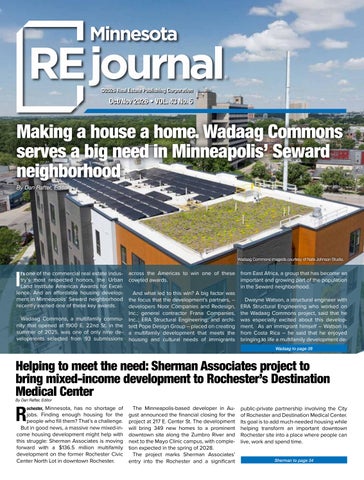
Making a house a home. Wadaag Commons serves a big need in Minneapolis’ Seward neighborhood By Dan Rafter, Editor
Wadaag Commons imageds courtesy of Nate Johnson Studio.
I
across the Americas to win one of these from East Africa, a group that has become an try’s most respected honors, the Urban coveted awards. important and growing part of the population Land Institute Americas Awards for Excelin the Seward neighborhood. lence. And an affordable housing developAnd what led to this win? A big factor was ment in Minneapolis’ Seward neighborhood the focus that the development’s partners, -Dwayne Watson, a structural engineer with recently earned one of these key awards. developers Noor Companies and Redesign, ERA Structural Engineering who worked on Inc.; general contractor Frana Companies, the Wadaag Commons project, said that he Wadaag Commons, a multifamily commu- Inc..; ERA Structural Engineering; and archi- was especially excited about this developnity that opened at 1900 E. 22nd St. in the tect Pope Design Group -- placed on creating ment. As an immigrant himself – Watson is summer of 2025, was one of only nine de- a multifamily development that meets the from Costa Rica – he said that he enjoyed velopments selected from 93 submissions housing and cultural needs of immigrants bringing to life a multifamily development det’s one of the commercial real estate indus-
Wadaag to page 28
Helping to meet the need: Sherman Associates project to bring mixed-income development to Rochester’s Destination Medical Center By Dan Rafter, Editor
R
ochester, Minnesota, has no shortage of
jobs. Finding enough housing for the people who fill them? That’s a challenge. But in good news, a massive new mixed-income housing development might help with this struggle: Sherman Associates is moving forward with a $136.5 million multifamily development on the former Rochester Civic Center North Lot in downtown Rochester.
The Minneapolis-based developer in August announced the financial closing for the project at 217 E. Center St. The development will bring 349 new homes to a prominent downtown site along the Zumbro River and next to the Mayo Clinic campus, with completion expected in the spring of 2028. The project marks Sherman Associates’ entry into the Rochester and a significant
public-private partnership involving the City of Rochester and Destination Medical Center. Its goal is to add much-needed housing while helping transform an important downtown Rochester site into a place where people can live, work and spend time. Sherman to page 34
MONROE MOXNESS BERG NATIONALLY RECOGNIZED ATTORNEYS handling the many facets of sophisticated real estate transactions
OUR SERVICES INCLUDE: •
Purchase and sale of commercial properties
•
Financing of commercial facilities
•
Acquisition and divestitures of multi-unit transactions
•
Triple Net leasing
•
§1031 and other Tax Free Exchanges
•
REITS organization, counsel and financing
•
Title, survey and environmental due diligence
•
Zoning, land use, planning and condemnation
Visit us at MMBLawFirm.com 7760 France Avenue South, Suite 700, Minneapolis, MN 55435 T: 952.885.5999 F: 952.885.5969
CONTENTS
1
Making a house a home. Wadaag Commons serves a big need in Minneapolis’ Seward neighborhood:
It’s one of the commercial real estate industry’s most respected honors, the Urban Land Institute Americas Awards for Excellence. And an affordable housing development in Minneapolis’ Seward neighborhood recently earned one of these key awards.
1
Helping to meet soaring housing demand in Rochester:
Rochester, Minnesota, has no shortage of jobs. Finding enough housing for the people who fill them? That’s a challenge.
4
From a symbol of unrest to a site of hope: Project for Pride in Living brings Opportunity Crossing to life:
The site had been a symbol of the unrest that hit Minneapolis after the murder of George Floyd in 2020: Riots burned down the former Wells Fargo branch at 3030 Nicollet Ave. in South Minneapolis following the killing.
6
Modern industrial properties thriving, older buildings struggling in Twin Cities industrial sector:
The Minneapolis–St. Paul industrial market continued to attract tenants and investors during the third quarter of 2026. But vacancy rates rose slightly, according to a new report from Colliers.
8
Falling in love with physical retail again? Shoppers seek freedom from the algorithm:
Are shoppers yearning for the physical store experience once again? The latest research from JLL suggests that a growing number of consumers view brick-and-mortar stores as a healthy break from online shopping.
3
Oct/Nov 2026
10 Today’s shoppers? They prefer quick trips and local options: Today’s consumers might not look quite like the shoppers many retailers, developers and investors have been planning for, according to the latest research from Placer.ai.
13 Do I really need a qualified intermediary for a 1031 exchange? One thing you can learn the hard way is that you really need a qualified intermediary when doing a 1031 exchange.
15 Where are the international students? Slowdown in renters
from across the globe equals challenges for student housing operators:
How strong is demand for student housing across the United States? That varies widely by university as many student housing operators face challenges stemming largely from a decrease in international students.
17 Commercial real estate remains a boon to the U.S. economy: Commercial real estate remains a major growth engine for the U.S.
economy, generating hundreds of billions of dollars in economic activity and supporting millions of jobs across the country.
19 Developers remain cautious as new industrial development cycle arrives:
The U.S. industrial real estate market is showing signs of a new development cycle, but developers are approaching this next phase with greater caution after years of construction that left many markets struggling to absorb new supply.
22 The $5-per-gallon breaking point: What Midwest gas prices mean for QSR Operators:
The U.S. industrial real estate market is showing signs of a new development cycle, but developers are approaching this next phase with greater caution after years of construction that left many markets struggling to absorb new supply.
Minnesota Real Estate Journal Copyright © 2026 by the Minnesota Real Estate Journal is published bi-monthly for $85 a year. 7767 Elm Creek Boulevard, Suite 210, Maple Grove, MN 55369. jeff.johnson@rejournals.com. For more commercial real estate news and information, please visit our website www.rejournals.com ©2026 Real Estate Publishing Corporation. No part of this publication may be reproduced without the written permission of the publisher.
MINNESOTA REAL ESTATE JOURNAL
4
President | Publisher Jeff Johnson jeff.johnson@rejournals.com
Oct/Nov 2026
From a symbol of unrest to a site of hope: Project for Pride in Living brings Opportunity Crossing to life By Dan Rafter, Editor
Managing Editor Dan Rafter drafter@rejournals.com Senior Vice President Jay Kodytek jay.kodytek@rejournals.com Chief Financial Officer Todd Phillips todd.phillips@rejournals.com Art Director | Graphic Designer Alan Davis alan.davis@rejournals.com Media & Design Manager Jordan Jensen jordan.jensen@rejournals.com Managing Director National Events & Marketing Kaitlyn LaCroix kaitlyn.lacroix@rejournals.com
7767 Elm Creek Boulevard, Suite 210 Maple Grove, MN 55369
Karla Henderson, president and chief executive officer of Minneapolis-based Project for Pride in Living, speaks during the grand opening of Opportunity Crossing. (Photo courtesy of Project for Pride in Living.)
T
he site had been a symbol of the unrest that
tion is why supply is so difficult to add. Affordable housing carries regulatory requirements that market-rate housing doesn’t, and those requirements add cost. Today it is often cheaper to build market-rate housing than affordable housing.
Today? That land is now home to Opportunity Crossing, a six-story, 110-unit affordable-housing project developed by Minneapolis’ Project for Pride in Living.
The challenge doesn’t end at the ribbon cutting. Rents in affordable housing are regulated, but the costs of operating it are not. Insurance, maintenance, security and utilities keep rising, while rents stay tied to what residents earn. Longterm affordability is the right goal, but without the flexibility to adjust as costs change, too often the industry is incentivized to build buildings that cannot be sustained.
hit Minneapolis after the murder of George Floyd in 2020: Riots burned down the former Wells Fargo branch at 3030 Nicollet Ave. in South Minneapolis following the killing.
Opportunity Crossing, which opened in July, ranks as one of the largest affordable-housing developments in Minneapolis and is the largest in Project for Pride in Living’s history. The property also boasts first-floor retail, including a new Wells Fargo branch. As evidence of how high demand is for quality affordable housing, Opportunity Crossing is already fully leased. We spoke to Karla Henderson, president and chief executive officer of Project for Pride in Living, about the challenges and rewards of bringing Opportunity Crossing to life. Here is what she had to say. Can you talk a bit about the need for more affordable housing in the Minneapolis market? How important is it today to provide more affordable options for renters? Karla Henderson: There is an urgent need for more affordable housing across the Twin Cities. As a housing stability nonprofit that also focuses on career readiness and financial empowerment, Project for Pride in Living (PPL) sees this need daily through our work with individuals and families, many of whom are searching for a stable home they can afford. At its core, this is a supply-and-demand problem. There isn’t enough affordable housing in Minneapolis or the wider region, and demand continues to outpace supply. The harder ques-
That has real consequences for people. A stable, affordable home is foundational to a person’s well-being and long-term success, yet nearly half of Minnesota renter households are cost burdened, spending more than 30% of their income on housing, according to Minnesota Housing Partnership. Abundant affordable housing is a must-have, not a nice-to-have. Building more of it, and keeping what we build affordable and well maintained for decades, is essential to the economic health of families and the Twin Cities as a whole. What is the symbolic value of Opportunity Crossing being built on the former site of the destroyed Wells Fargo Branch? What does it say about the efforts that Minneapolis and the downtown area in particular are taking to rebound from the social unrest and COVID-area challenges? Henderson: Opportunity Crossing represents a transformative new chapter for the Lake Street community and everyone who calls it home by creating more much-needed deeply affordable Pride to page 16
Oct/Nov 2026
MINNESOTA REAL ESTATE JOURNAL
A STATE FULL OF RESOURCES. A FULL-SERVICE RESOURCE TEAM READY TO HELP.
From data centers to agribusiness, our economic development team specializes in helping businesses start and expand here. Get started with our cost-free services:
Let’s grow your business. econdev.greatriverenergy.com
5
MINNESOTA REAL ESTATE JOURNAL
6
Oct/Nov 2026
Modern industrial properties thriving, older buildings struggling in Twin Cities industrial sector By Dan Rafter, Editor
iStock photo, credit urfinguss.
T
he Minneapolis–St. Paul industrial market
continued to attract tenants and investors during the third quarter of 2026. But as more warehouse space becomes available and large vacancies take longer to fill, vacancy rates are ticking up, according to a new report from Colliers. Net absorption totaled approximately 540,000 square feet during the third quarter, bringing the market’s year-to-date total to nearly 2.7 million square feet. Yet the region’s overall industrial vacancy rate edged up to 5.5%, compared to 5.4% in the second quarter and 4.5% during the third quarter of 2025. The numbers point to a market that remains healthy but is becoming more selective. In its Q3 2026 Industrial Report: Minneapolis–St. Paul, Colliers found that modern, well-located industrial properties continue to attract interest, while older buildings and facilities with less functional layouts face greater competition. Tenants have more options than they did a year ago, particularly when searching for large warehouse and distribution facilities. As a result, building functionality, transportation access, power availability, labor access and occupancy costs play increasingly important roles in leasing decisions.
Warehouse demand drives absorption
Warehouse and distribution properties accounted for most of the region’s occupancy growth during the third quarter. Manufacturing properties, meanwhile, recorded modestly negative absorption. The distinction highlights the importance of property type in determining how individual industrial buildings perform. Companies seeking modern distribution facilities continue to support demand, but relocations into newer buildings can leave older properties vacant, creating additional competition for landlords. Overall, the market recorded approximately 23 million square feet of vacant industrial space at the end of the third quarter. Direct vacancy remained essentially flat at 4.9%, while sublease availability increased to 4.8 million square feet, largely because of a limited number of larger manufacturing offerings. The pressure is concentrated in large warehouse blocks, recently delivered buildings and properties that do not meet current tenant requirements. That concentration suggests the increase in vacancy is not affecting every part of the market equally. Geography also matters. Colliers reported an overall vacancy rate of 2.1% in the outly-
ing submarkets, compared with 5.3% in the Northwest, 7.4% in the Southwest and 8% in the South Central region. The East submarket posted an 8% vacancy rate, while the Midway area recorded 5.8%. Warehouse and distribution vacancy varied considerably across these areas. The Southwest submarket recorded a 9.4% rate, while the Northwest stood at 8.1%. By contrast, North Central warehouse and distribution vacancy was 2.8%.
Asking rents soften
Rental rates also reflected the changing balance between landlords and tenants. Colliers reported an overall asking rate of $9.28 per square foot on a triple-net (NNN) basis during the third quarter, down from $9.41 in the second quarter. The latest figure was only slightly above the $9.23 rate reported a year earlier. The decline does not necessarily signal widespread pricing deterioration. Colliers attributed the change to more balanced leasing conditions and shifts in the mix of space being marketed. Industrial to page 7
Oct/Nov 2026 Industrial from page 6
MINNESOTA REAL ESTATE JOURNAL
for 4.9 million square feet of construction, limiting the amount of speculative development in the overall pipeline. Outside Project Nova, development remains selective, although speculative construction has increased in the Northwest submarket. Projects include Rogers Gateway, a 117,100-square-foot facility developed by Oppidan; Rogers 101 Business Park, a two-building, 442,000-square-foot project developed by CP West; and the 157,080-square-foot Arbor Ridge Business Center in Maple Grove, developed by Altus. Third-quarter deliveries totaled 271,000 square feet, of which 254,084 square feet was occupied at completion. That level of Development remains concentrated The region had approximately 6.8 million preleasing and occupancy helped limit imsquare feet of industrial space under con- mediate supply pressure, although upcoming struction at the end of the third quarter, up deliveries in the Northwest could create addislightly from 6.7 million square feet in the tional competition. previous quarter. Investors return to the market A significant portion of that pipeline is tied Industrial investment activity strengthened to Amazon’s 3.6-million-square-foot Project Nova build-to-suit development in Eagan. during the quarter. Sales volume reached Build-to-suit projects collectively accounted $742 million, up from $410.7 million in the Newly delivered Class-A industrial properties have generally maintained their asking rents or recorded modest increases. Landlords with larger vacancies, however, may need to offer concessions, building improvements or greater lease flexibility to attract tenants. Asking rates also varied by property subtype. Office Service space commanded the highest average blended rate, at $11.70 per square foot NNN, followed by Manufacturing at $10.07 and Warehouse/Distribution at $7.84.
7
second quarter. Rolling four-quarter sales volume climbed to $2 billion, supported by several large institutional transactions and portfolio sales. Among the quarter’s significant transactions, an Amazon-occupied property in Lakeville sold for $94.8 million. Arbor Lakes Business Park V and VI in Maple Grove traded for $74.15 million, while Imagine Print Solutions in Shakopee sold for $54.13 million. Colliers reported that investor demand remains strongest for well-located, fully leased properties with durable tenancy and modern industrial functionality. Large vacant buildings, upcoming lease expirations and properties requiring significant capital investment face greater scrutiny from buyers.
MINNESOTA REAL ESTATE JOURNAL
8
Oct/Nov 2026
Falling in love with physical retail again? Shoppers seek freedom from the algorithm by Dan Rafter, Editor
Abercrombie photo with this caption: Abercrombrie & Fitch is an example of a national retailer that has revamped its stores to meet the needs of today’s customers. (iStock photo, credit tupungato.)
A
re shoppers yearning for the physical
store experience once again? The latest research from JLL suggests that a growing number of consumers view brick-andmortar stores as a healthy break from online shopping. According to JLL’s new report, Resetting the Retail (Algo)Rhythm, shoppers are turning to brick-and-mortar shops as an antidote to digital exhaustion. This means that physical shops can’t just mirror online shopping. They must offer experiences that shoppers can’t get by simply clicking on an Amazon link. According to JLL’s report, 83% of consumers enjoy finding products in stores they never would have searched for digitally, while 53% of both Millennial and Gen Z consumers say that they prefer browsing physical stores without algorithmic influence. Physical retailers need to be careful, though, not to turn off their customers. According to JLL’s report, 72% of shoppers reported leaving a store early because it felt overwhelming, whether that meant that the store’s shelves were too cluttered, the noise levels too high or in-store screens were flashing too many messages. The survey found that atmosphere matters when it comes to brick-and-mortar shopping. A total of 60% of shoppers surveyed said that a store’s atmosphere influences wheth-
er they would recommend it to others, even when they didn’t make a purchase. We recently spoke with Emily Albright Miller, Executive Vice President of Strategy at JLL Design, about the brokerage’s latest retail findings and what they mean for both online and brick-and-mortar shopping. Here is some of what she had to say. I know this is a big topic, but why are consumers returning to physical retail? Emily Albright Miller: It’s important to ground ourselves. More than 80% of retail sales are happening in brick-and-mortar locations. The shoppers never really left physical stores. They are gravitating toward the experiences that brick-and-mortar retail can provide. They want something very different than what they can get with ecommerce and digital retail. What we found in our report was that consumers are tired of the algorithm. When retailers first started offering ecommerce solutions, there were so many options at consumers’ fingertips. The whole model of Amazon was that it offered an infinite number of choices. It eventually became overwhelming for consumers to navigate. Consumers had to spend so much time filtering, sorting and browsing through this endless list of items. That is where AI came in. You can now have AI do the sorting for you. A huge percentage of consumers start
their online shopping journey with a large language model. That makes online shopping less overwhelming. But it also narrows what consumers are allowed to see online. Consumers feel like the algorithm is limiting what they can see and purchase online. That doesn’t happen when you shop in a physical store. By shopping in brick-and-mortar locations, you get the opportunity to discover new and different items. Shoppers like that. Just look at high school kids. They want to experiment. They might want to be emo one day and preppy the next. The online algorithm won’t let you do that when you are shopping digitally. JLL’s report also mentions digital exhaustion with social media and other online sites. How is physical shopping an antidote to that? Miller: Consumers are overstimulated. We live in a world where we are all overstimulated. So much is constantly flung at us. We are all seeing so much content day to day. Shopers are gravitating toward brick-andmortar experiences partly because they allow them to be calmer in their retail journey. They provide an escape from this overstimulation. There is a balance, though, right? Most people will turn to both online and physical shopping? Retail to page 26
Oct/Nov 2026
MINNESOTA REAL ESTATE JOURNAL
Unlock the Full Potential of Your Investment
Discover the difference between a development and a true community. With more than a century of experience and 110+ communities, Ebenezer Management Services is a trusted leader in senior living management, development, and consulting. We partner with organizations at every stage to ensure communities and the people who call them home thrive. As the senior housing division of Fairview Health Services, we bring integrated healthcare expertise, strong professional partnerships, and a proven track record. Our mission-driven staff foster connection, engagement, and belonging, transforming buildings into vibrant communities. From planning to daily operations and ongoing maintenance, we deliver thoughtful guidance and innovative solutions that support lasting success.
“Because they have such a strong reputation, we don’t have to worry about the care side of things. Ebenezer has that tightened up.” —Development Partner/Owner
From concept to care, we deliver.
EbenezerManagementServices.com
9
MINNESOTA REAL ESTATE JOURNAL
10
Oct/Nov 2026
Today’s shoppers? They prefer quick trips and local options By Dan Rafter, Editor
T
oday’s consumers might not look quite like the shoppers many retailers, developers and investors have been planning for, according to the latest research from Placer. ai. In good news for retailers, younger consumers, particularly those in the Gen Z age group, are shopping in physical stores more frequently. And yes, retailers continue to embrace experiential retail designed to pull consumers away from their screens and into brick-and-mortar locations. But a closer look at visitation data tells a more complicated story, according to The
2026 Retail Consumer in 5 Charts: Who’s Winning in 2026? Placer.ai released this
report in August, and it shows that shoppers are evolving as they embrace both the convenience of online shopping and the variety and excitement offered by physical retail. According to Placer.ai’s report, today’s shoppers often live close to the stores they visit. Today’s shoppers tend to spend less time in stores, too. Older consumers remain an important part of the brick-and-mortar audience. And lower- and middle-income households account for a disproportionate share of physical-store traffic. At the same time, consumers are increasingly shopping at retailers that give them compelling reasons to visit, whether that means low prices, a steady influx of new products, a wide selection of tiems or an experience that shoppers can’t easily replicate online. Those are among the key findings in Placer. ai’s August report, which analyzes visitation data from the Placer 100 Retail Index to examine how consumers are interacting with physical stores, and what those patterns mean for retailers, advertisers and commercial real estate professionals.
iStock photo, credit Drazen Zigic.
Here are the five key shopping trends in Placer.ai’s report: 1. Most retail trips are short Today’s consumers generally aren’t spending much time in stores. Placer.ai found that the vast majority of visits to the retailers included in its Placer 100 Retail Index last less than 30 minutes. Visits of fewer than 15 minutes represent the largest dwell-time category. That suggests that many consumers are approaching physical retail with a specific mission: They know what they want, they want to find it quickly and they want to get on with the rest of their day. For retailers, that puts a premium on convenience. Intuitive store layouts, easy product discovery, efficient checkout and convenient pickup options can help retailers attract customers looking for quick trips, Placer.ai said. The finding also has implications for advertisers. Consumers are increasingly researching and discovering products before they arrive at a store. That gives in-store advertising a different role: Instead of simply introducing a product, it can reinforce the physical-store experience through demonstrations, samples and product trials. For commercial real estate professionals, there are key lessons here: Parking, tenant mix and overall property design can all influence how easily consumers can complete a quick shopping trip. At the same time, properties can create optional reasons for consumers to linger, turning a short mission into a longer visit. 2. Retail remains intensely local Retail may be increasingly omnichannel, but consumers still tend to shop close to home. Nearly 60% of retail visits analyzed by Placer.ai originate within five miles of the
store. About 44% originate within just three miles. That makes location about more than visibility, accessibility or traffic counts. It means that a retail property effectively comes with a customer base attached to it. The households surrounding a store will account for a substantial portion of its visitors. For retailers evaluating new locations, then, understanding the demographic characteristics of those nearby households can be just as important as evaluating the physical characteristics of the property. A location that looks attractive based on traffic or proximity to other businesses might not be a strong fit for every retailer. The surrounding population needs to match the consumer that a particular brand hopes to attract. The same principle applies to marketing. With such a large share of retail traffic originating nearby, localized campaigns can concentrate advertising dollars on those consumers who are most likely to visit a particular location. For landlords and developers, the lesson is clear: When looking at possible tenants, landlords and developers shouldn’t focus only on whether a retailer can afford the monthly rent, but whether its customer base fits the population surrounding the property. 3. Don’t overlook older shoppers The retail industry has devoted plenty of attention to Gen Z’s embrace of physical stores. Placer.ai’s data, though, suggest that retailers shouldn’t let that enthusiasm obscure another important reality: Older consumers remain a core brick-and-mortar audience. Adults aged 55 and older are generally overrepresented in the captured market of the chains included in the Placer 100 Retail Shoppers to page 12
Oct/Nov 2026
MINNESOTA REAL ESTATE JOURNAL
The Vision To See Banking Differently Discover Bridgewater Bank.
BWBMN.COM Member FDIC
11
MINNESOTA REAL ESTATE JOURNAL
12 Shoppers from page 10
Index. That’s not surprising; Older shoppers already have a strong affinity for physical retail. That should influence how retailers think about their stores. The push to attract younger consumers shouldn’t come at the expense of ignoring customers who are already visiting and spending money in physical locations. Store layouts, merchandising, messaging and in-store experiences should continue to serve these consumers. Retail properties designed to appeal to younger generations still need to function for older shoppers, according to Placer. ai’s report. Accessibility, easy navigation, convenient parking and seating can all influence the physical-store experience for all shoppers, but these features are especially important for older ones. A multigenerational tenant mix can also help strip center properties appeal to a broader audience. 4. The brick-and-mortar shopper has a distinct income profile According to the Placer.ai report, households earning less than $100,000 annually are overrepresented among visitors to the Placer 100 Retail Index. Households earning more than $150,000, meanwhile, are underrepresented. Armed with this information, brands can tailor their physical-store products, messaging and promotions to better serve the consumers already walking through their doors. But the research from Placer.ai also suggests that retailers should work to attract
more affluent shoppers who are part of their broader potential market but currently aren’t visiting physical locations at the same rate. A brand’s overall customer demographics may not accurately describe the people who actually visit its physical stores. Retailers and advertisers trying to drive physical visits should consider the income characteristics of their actual store visitors rather than relying exclusively on their broader customer profile. A retailer’s offline visitor profile may provide a better indication of how well it will perform at a particular property than its overall brand audience. If the shoppers surrounding a shopping center resemble the retailer’s existing in-store customers, the tenant may be a stronger fit. 5. Value matters—but so does experience Perhaps the most important takeaway from Placer.ai’s report is that consumers aren’t necessarily choosing between value and experience. Instead, they’re looking for both. Value-oriented retailers appear prominently among the fastest-growing chains in the Placer 100. But retailers that combine value with discovery, browsing or in-store experiences are also posting strong gains. Placer.ai points to Five Below, Hobby Lobby, Ross and Citi Trends as examples of retailers where growth is occurring not only across their overall footprints but also at individual venues. The message for retailers is that low prices remain a powerful reason to visit a store. But price isn’t the only way to win. Physical stores can give consumers something online
Oct/Nov 2026
shopping cannot: the opportunity to browse, discover unexpected products, experience merchandise firsthand and enjoy the act of shopping itself. That gives advertisers another way to position physical retail. Value-focused campaigns can emphasize deals and the excitement of discovery. Experiential retailers can promote the selection, inspiration and experiences consumers can find only in person. Retail properties that offer both value and experience, and are home to tenants that combine affordability with discovery or experiential appeal, could be especially well positioned to generate traffic among today’s evolving shoppers. A clearer picture of the 2026 shopper The Placer.ai report suggests that consumers are still visiting stores in significant numbers but are choosier about how they spend their time and which stores they consider worth visiting. That puts pressure on retailers to make shopping easy when consumers have a specific mission and compelling when they don’t. It also places greater importance on the fundamentals of commercial real estate. Location matters because consumers remain highly local. Tenant mix matters because different retailers appeal to different populations. Property design matters because shoppers still care about convenience. And the ability to offer discovery and experience matters because those are among the advantages physical stores retain over e-commerce.
...where the extra mile takes you. 2 Million People within a 1 hour drive Shovel-ready certified industrial sites Nationally ranked municipal utility
Located at the crossroads of I-35 and
US Highway 14
For more details contact: Greg Kruschke, Development Director 507-774-7317 Greg.Kruschke@Owatonna.gov www.owatonnamn.us
Oct/Nov 2026
MINNESOTA REAL ESTATE JOURNAL
13
Do I really need a qualified intermediary for a 1031 exchange? By Jeff Peterson
iStock photo, credit Worawee Meepian.
O
ne thing you can learn the hard way is
that you really need a qualified intermediary when doing a 1031 exchange. Imagine you go to a real estate closing wanting to do a 1031 exchange and you sign a closing statement and deed at the closing table. Unfortunately, you neglect to notify a qualified intermediary, and you fail to sign an exchange agreement with a qualified intermediary in advance of your closing. What happens? The proceeds are delivered to you, and you have jeopardized your ability to do a 1031 exchange. For most delayed (or non-simultaneous) 1031 exchanges, the practical answer to “Do I really need a qualified intermediary for a 1031 exchange?” is YES. A 1031 exchange is not simply a sale followed by a subsequent purchase. It is an interdependent plan to conduct a tax-deferred “exchange” that must be structured correctly
from the beginning. That distinction really matters because if the taxpayer has actual or constructive receipt of the sale proceeds, the transaction may be treated as a taxable sale rather than a tax-deferred exchange. In other words, the timing and structure are not mere administrative details, they are central to whether the exchange works.
The common mistake: waiting until after closing
property, the transaction has closed and the taxpayer has received the proceeds or had the unrestricted right to receive or control the sale proceeds, the opportunity to structure the transaction as a 1031 exchange may already be lost. The exchange agreement, assignment of rights to the qualified intermediary, notice of assignment to the other parties, closing instructions, and movement of funds all need to be handled properly before the taxpayer gives up the relinquished property and before the proceeds are disbursed. A successful exchange is usually built before the closing table, not after it.
A taxpayer sells investment real estate and then decides they would like to use the proceeds to buy another property. They call a qualified intermediary after the relinquished What the qualified intermediary actuproperty closing has been completed and ask whether a 1031 exchange can still be set ally does up. A qualified intermediary, often referred to In most cases, the answer is NO. as a QI, helps facilitate the exchange so that Once the benefits and burdens of own1031 to page 14 ership have shifted to that relinquished
MINNESOTA REAL ESTATE JOURNAL
14 1031 from page 13
not to spend the money may not solve the problem. The question is not only whether the taxpayer used the funds. The question is whether the taxpayer had control over them. This is one reason why simply asking a title company, attorney, broker, or accountant to “hold the money” may not be sufficient. Those professionals may play important roles in the transaction, but they are not automatically substitutes for a QI. In fact, certain parties who have recently acted as the taxpayer’s agent (accountants, real estate agents, employees, partners and related parties thereof) may be disqualified from serving as the QI. The proceeds must be handled in a way that keeps the taxpayer from having access to or control over the money during the exchange period.
the taxpayer does not receive or control the sale proceeds during the exchange period. In a typical delayed exchange, the QI enters into an exchange agreement with the taxpayer prior to closing, receives the proceeds from the sale of the relinquished property, holds those proceeds subject to the exchange agreement, and uses them to pay for and acquire the replacement property on behalf of the taxpayer. The QI also helps coordinate documentation with the closing agents and other parties involved in the transaction. This role is sometimes misunderstood. A QI is not simply a place to park money. The QI is an integral part of the process that helps preserve the exchange treatment. The QI’s involvement helps distinguish an Are there any situations where a QI is exchange from a sale followed by a later not needed? purchase. That distinction is at the heart of a There are limited situations where a QI may delayed Section 1031. not be necessary. Why “constructive receipt” matters There are rare situations where two propA taxpayer does not have to physically erty owners trade real estate directly and sireceive the money to create a problem. The multaneously at the same closing, and those issue can also arise if the taxpayer has the transactions may not require the same QI right to access, control, to direct, pledge, borstructure used in a delayed exchange. row against, or otherwise obtain the benefit But most modern commercial real estate from the funds. transactions are not simple two-party direct This is known as constructive receipt. and concurrent swaps. In the real world, a For example, if sale proceeds are placed in taxpayer often sells one property to one an account where the taxpayer can access buyer and later acquires replacement propthem, the fact that the taxpayer chooses erty from a completely different seller. That
Oct/Nov 2026
is the classic delayed exchange, and that is where the QI becomes essential in practice. For most delayed exchanges, the real planning issue is not whether to involve a QI, but making sure the QI is involved before the transaction gets too far down the road. The answer: as early as possible, and always before closing on the relinquished property.
What a qualified intermediary does not do
A QI plays a critical role, but a QI does not replace the taxpayer’s CPA, attorney, broker, lender, or investment advisor. A QI does not determine whether the taxpayer should sell, whether the replacement property is a good investment, how much gain may be deferred (or recognized in a partial 1031), how depreciation recapture may apply, or how the transaction fits into the taxpayer’s broader estate, tax, or investment plan. Those questions should be addressed with the taxpayer’s other professional advisors. A strong 1031 exchange process usually involves coordination among several parties: the taxpayer, QI, CPA, attorney, real estate broker, lender, title company, and sometimes estate planning or wealth advisors.
The deadlines still matter
Entering into an exchange agreement with a QI does not eliminate the strict requirements of a 1031 exchange. 1031 to page 27
Oct/Nov 2026
MINNESOTA REAL ESTATE JOURNAL
15
Where are the international students? Slowdown in renters from across the globe equals challenges for student housing operators By Dan Rafter, Editor
Photo by RDNE Stock project.
H
ow strong is demand for student housing
across the United States? That varies widely by university as many student housing operators face challenges stemming largely from a decrease in international students. At the same time, rent growth in the student housing sector remains sluggish as 2026 enters its final months, according to the latest research from Yardi Matrix. According to Yardi Matrix’s September 2026 Student Housing National Report, student housing properties were 93% preleased in August for the 2026-27 academic year. That was 80 basis points above Yardi Matrix’s final August 2025 estimate and 120 basis points higher than in August of 2024. Nearly 320 student housing properties reported that they were fully preleased, slightly more than at the same point last year. Yardi Matrix surveyed 200 U.S. universities for its national report. That August leasing figure is preliminary, with Yardi Matrix saying that it will revise it as final occupancy information comes in. Based on previous revisions, Yardi Matrix is predicting the final occupancy figure for the student housing properties it studies to reach approximately 94% to 94.5%, roughly in line with last year’s number. The strength of preleasing, though, has not translated into equally strong rent growth. Yardi Matrix reported that advertised rents across the Yardi 200 averaged $927 per bed a month in August, down from $929 in July and $930 in June. On a year-over-year basis, average monthly rents were still up 2%. The longer-term rent trend, though, highlights that while student housing rents are increasing, they are rising at a slower rate. Average rent growth for the 2026-27 leasing season, which Yardi Matrix measures from
October through August, came in at 1.1%. That compares with an average rent growth of 2.8% during the 2025-26 leasing season and 5.9% during 2024-25. Yardi Matrix says that the combination of strong preleasing and modest rent growth suggests that student housing operators are finding demand, but have less pricing power than they enjoyed during the stronger leasing cycles of recent years. Location is also playing an important role in both student housing demand and rent growth. Class-A properties were 93.8% preleased in August, compared with 92.1% for Class-B properties and 91.7% for Class-C housing, Yardi Matrix reported. Properties located closest to campus also continued to outperform those located a greater distance away. Student housing properties within a quarter-mile of campus were 93.4% preleased, while those between a quarter-mile and a half-mile were 93.2%. Both figures were about 100 basis points above August 2025’s numbers, Yardi Matrix said. Properties more than two miles from campus,, were only 88.7% preleased, 110 basis points below their year-ago level. The same pattern showed up in rents. Properties within a quarter-mile of campus posted average rent growth of 1.6% during the 2026-27 leasing season. Properties more than two miles from campus saw rents decline an average of 1.2%. That represents a reversal from recent years, when properties farther from campus often produced stronger rent growth. The supply pipeline is another factor investors and developers are watching. Twenty-eight Yardi 200 markets were 100% preleased in August, with another 11 schools
above 99%. Several major student housing markets, including Auburn, Maryland, Missouri, Virginia and Virginia Tech, were fully or nearly fully leased. This strong performance has resulted in an increase in new student housing construction in these markets. Except for Missouri, those markets had an average of 1,600 beds under construction per school, according to Yardi Matrix. Not every market is experiencing the same conditions. A total of 52 Yardi 200 schools were below 90% preleased in August, including 21 below 80%. Utah Valley was at 71.1%, Syracuse at 77.9%, Delaware at 78.7% and North Carolina State at 78.8%. North Carolina State, in particular, is absorbing a major wave of new supply. A 2,195-bed student housing project delivered in August, with another 970 beds under construction for delivery in 2027. Enrollment trends are adding another layer of uncertainty. Among 38 Yardi 200 schools reporting enrollment information, total enrollment increased by 6,840 students, or 0.6%, to 1.08 million. Thvat was considerably slower than the 1.8% growth recorded in fall 2025, according to Yardi Matrix’s research. A big reason for this? Yardi Matrix pointed to declining international enrollment. Arizona State University-Tempe reported a 7.4% enrollment decline, while the University of North Texas fell 3.6%. Both universities have relatively high shares of international undergraduate students. Other schools, though, did see an increase in enrollment. Yardi Matrix reported that Texas Tech notched 9.2% enrollment growth, Georgia Southern grew 7.6% and Texas State increased 7%.
MINNESOTA REAL ESTATE JOURNAL
16
Oct/Nov 2026
Pride from page 4
We’re really proud of this housing and economic opportunity while fosproject. It was built on a site tering overall neighborhood vitality. that was burned down in the This project is many things: The largest in unrest following the murder PPL’s more than 54-year history, one of the of George Floyd, and it is largest in the City of Minneapolis, innovative the most significant financial in the ways it prioritized sustainability features investment in that neighborand worked with dozens of cross-sector part- hood since before that time. ners over a five-year span. Most importantly, It serves as a model for other Opportunity Crossing is thought to be one of efforts being made across the the most deliberative and collaborative com- city to rebuild and reinvest in munity investments ever made in city history, disinvested neighborhoods guided by PPL’s usual approach to equitable in ways that promote equity, development, which focuses on centering stability and long-term resilthe voices of communities most impacted ience, instead of displaceby housing disparities by promoting diverse, ment. active participation in any new project. Are you surprised at all by Every inch of the space was informed by the fact that the project has community through extensive feedback from been leased-up so quickly? local residents, small business owners and How does the quick leaseneighborhood stakeholders, grounded in eq- up emphasize the need for uity and collaboration. What resulted was a even more affordable houstransformative building that offers 110 afford- ing in the area? Henderson: I wasn’t at all able units that support both individual and surprised to see how quickly multi-generational family living, 8,400 square feet of commercial space for local entrepre- Opportunity Crossing leased neurs to own and operate, a new, full-service up, especially given how we Wells Fargo branch, community-focused consistently engaged combuilding amenities like a playground and munity from the inception of the project all the way plaza, and so much more. Pride to page 24
Significant deals that lead to rewarding relationships. Not every deal changes a community. The ones we take on do. We are your trusted commercial title partner — closing the deals that matter and building the relationships that last.
YOUR NEXT DEAL.
Our next relationship.
Contact Kathleen Geherin at 612-422-1823. www.guarantytitle.net
The ribbon cutting at Opportunity Crossing. (Photo courtesy of Project for Pride in Living.)
Oct/Nov 2026
MINNESOTA REAL ESTATE JOURNAL
17
BOMA study: Commercial real estate remains a boon to the U.S. economy By Dan Rafter, Editor
iStock photo, credit jamesteohart.
C
ommercial real estate remains a major growth engine for the U.S. economy, generating hundreds of billions of dollars in economic activity and supporting millions of jobs across the country, according to the latest research from the Building Owners and Managers Association International. How big of a growth engine? Boma’s 2026 Market Study: The Economic Impact of U.S. Commercial Real Estate found that the operation and maintenance of office, retail and industrial properties across 79 U.S. markets generates $609.9 billion in annual economic output and supports 3.9 million jobs. The study, which BOMA conducts every three to four years, highlights the economic contribution of commercial building operations. The latest analysis covers 35.4 billion square feet of commercial real estate across 79 markets in 38 states.
And the numbers show that the economic impact of commercial buildings extends well beyond the owners and tenants occupying them. Building operations generate $274.9 billion in annual operating expenditures, according to BOMA. Those expenditures contribute $344.4 billion to U.S. gross domestic product and generate $219.4 billion in personal earnings. For every $1 spent on building operations, the study found, $2.22 in total economic output is generated through direct, indirect and induced economic activity. That activity flows through a broad network of businesses and workers. Building managers, contractors, maintenance and repair companies, suppliers, utilities, insurers and security providers all play roles in keeping commercial properties operating.
“Commercial buildings are economic engines, supporting businesses, jobs and communities across the country,” said Kjersten Jaeb, BOMA Fellow, chair and chief elected officer of BOMA International, in a statement. “Every building relies on an extensive network of professionals, service providers and businesses to keep it running safely and efficiently.” Technology is adding another layer to that ecosystem, Jaeb said, as building owners and managers increasingly use technology to manage energy, water, security, access and overall building performance.
A changing construction landscape
BOMA’s study also looks beyond building operations to examine construction activity in the office, retail and industrial sectors. BOMA to page 18
MINNESOTA REAL ESTATE JOURNAL
18 BOMA from page 17
One of the more notable findings involves the increasingly important role of data centers in office construction statistics. Federal construction statistics classify data centers as private office construction. As a result, the rapid expansion of data center development is having a significant effect on the nation’s overall office-construction figures. In 2025, data centers accounted for approximately $41.2 billion, or nearly 46%, of more than $90 billion in private office construction nationwide. A decade earlier, data centers represented less than 5% of private office construction. Traditional office construction, excluding data centers, totaled about $48.4 billion in 2025. Industrial construction, meanwhile, remains at historically high levels, BOMA’s research found. Warehouse and manufacturing construction totaled approximately $274.2 billion in 2025. That represented a 7.9% decline from the previous year, but the figure was still more than twice the 2020 level and ranked as the third-highest annual total on record. Retail construction totaled approximately $47.1 billion in 2025, with activity increasing during the first three months of 2026.
Oct/Nov 2026
Researchers used 2025 square-footage esThe life sciences real estate sector also is showing signs of settling into a more normal- timates from CoStar and operating-expense ized environment following several years of data from the National Council of Real Estate Investment Fiduciaries. They then used the rapid expansion. Impact reaches beyond major markets 528-sector IMPLAN input-output model and The economic contribution of commercial its Multi-Regional Input-Output framework real estate isn’t confined to the nation’s larg- to calculate the direct, indirect and induced economic impacts associated with commerest cities, either. BOMA’s study looks at commercial real cial building operations. The analysis covers office, retail and indusestate activity in 79 markets of varying sizes, spread across 38 states. The organization trial properties across BOMA’s 79 markets. says building operations in those markets It also includes a separate analysis of life support local jobs, businesses and wages, sciences properties in 17 markets where sufcreating economic activity that continues ficient data was available. For commercial real estate owners and year after year. “The economic impact of commercial real operators, the findings put a dollar figure on estate is not a one-time event,” said Mary Lue something that can be easy to overlook: The Peck, president and COO of BOMA Interna- economic contribution of a building doesn’t tional, in a statement. “Ongoing investments stop when construction is complete or when in the operation, maintenance and improve- a tenant signs a lease. ment of our buildings generate economic activity that supports businesses, jobs and wages across the country creating an impact that lasts well into the future.” The study was conducted by the Business Research Division at the Leeds School of Business at the University of Colorado Boulder on behalf of BOMA International.
Growth is happening in Madison ARE YOU WINNING OR WATCHING? MULTIFAMILY SALES
+20.2 JOIN OUR NEWSLETTER
%
INDUSTRIAL LEASES
+13.0
Stay ahead of the trends shaping Wisconsin commercial real estate. https://bit.ly/ReJournals
colliers.com
%
Oct/Nov 2026
MINNESOTA REAL ESTATE JOURNAL
19
Developers remain cautious as new industrial development cycle arrives By Dan Rafter, Editor
iStock photo, credit nortonrsx.
T
he U.S. industrial real estate market is showing signs of a new development cycle, but developers are approaching this next phase with greater caution after years of construction that left many markets struggling to absorb new supply. That’s one of the key findings in Colliers’ October 2026 U.S. research report, Building the Next Industrial Development Pipeline. The report examines how the industrial sector is working through a historic wave of new construction while identifying the markets and property types best positioned to support renewed development. Nearly 1.9 billion square feet of industrial space has been delivered nationally since the start of 2022, expanding the country’s
industrial inventory by approximately 11%. That construction boom peaked at the end of 2022, when 711 million square feet was under construction. By the end of 2025, that figure had fallen to 271 million square feet as rising vacancy rates and an imbalance between supply and demand forced developers to pull back. The market is now showing signs of recovery. Space under construction increased 16% from its year-end 2025 low, reaching 314 million square feet in the first half of 2026. Construction starts also gained momentum, totaling 158 million square feet during the first six months of the year. Still, the recovery is unlikely to produce another nationwide construction surge, ac-
cording to Colliers. Instead, development is expected to return first to markets where vacancies have stabilized, modern industrial buildings are leasing steadily and competing supply has declined.
Recent deliveries continue to lease up
The amount of time a property has been on the market remains an important factor in determining how successfully industrial construction has been absorbed. Buildings delivered in 2022 were 84% occupied, while those completed in 2023 were 70% occupied. The occupancy rate for 2024 deliveries stood at 61%. Overall, 73% of the 1.5 billion square feet delivered between 2022 and 2024 had been occupied. Developers to page 20
MINNESOTA REAL ESTATE JOURNAL
20
Oct/Nov 2026
Developers from page 19
More recently completed buildings have more work ahead. Properties delivered in 2025 were approximately 50% occupied, while first-half 2026 completions were 47% occupied. Combined, buildings delivered in 2025 and the first half of 2026 were approximately 49% occupied. Much of the remaining vacant space is concentrated in these newer properties. Their continued absorption will help determine where developers can confidently resume speculative construction.
Midwest markets outperform
The Midwest has emerged as the nation’s strongest region for absorbing newly delivered industrial space. The region added 334 million square feet between 2022 and 2024, a volume comparable to the construction activity recorded in the West. Yet 88% of the Midwest’s deliveries during that three-year period were occupied, compared with 73% in the Southeast, 70% in the West, 64% in the Northeast and 62% in the Southcentral region. The Midwest’s advantage has continued with more recent construction. Of the 58 million square feet delivered in the region during 2025 and the first half of 2026, 82%
was occupied. That compares with 48% in the Southeast, 45% in both the West and Southcentral regions, and 22% in the Northeast. Across all deliveries since 2022, 87% of the Midwest’s new industrial supply was occupied, according to Colliers. Individual Midwestern markets have also posted strong results. Dayton led the country, with 98% of its post-2022 industrial completions occupied. Columbus and Detroit each recorded 95% occupancy, while Omaha reached 93%. Columbus is particularly notable because it combined substantial construction with strong absorption. The market added approximately 47.2 million square feet since 2022, expanding its industrial inventory by 15%, yet 95% of that new space was occupied. Its second-quarter 2026 vacancy rate was 5.2%. Chicago also demonstrated its ability to absorb substantial development. The market added approximately 106 million square feet since 2022, including 74 million square feet of speculative construction and 32 million square feet built to suit. Approximately 82% of those deliveries were occupied, and the market’s second-quarter vacancy rate was 5.1%.
A more selective pipeline takes shape
The composition of construction underway offers another indication of how developers are adjusting their strategies. The Midwest had approximately 72 million square feet under construction, with buildto-suit projects accounting for 54% of that pipeline. That makes the region an exception to the national pattern, where speculative development remains the dominant construction type. Specialty industrial properties are another area in which the Midwest stands out. The region had 22.5 million square feet of manufacturing facilities, 29.4 million square feet of data centers and 5.3 million square feet of cold storage and food production facilities under construction. The Midwest’s data center pipeline was nearly two-and-a-half times the 12 million square feet underway in the Southeast, the next-largest region for that property type. Its cold storage and food production pipeline was more than three times the total in any other region.
MINNESOTA REAL ESTATE JOURNAL
Oct/Nov 2026
Minnesota 23rd Annual
21
COMMERCIAL REAL ESTATE INVESTMENT December 16, 2026
7:30 AM - Registration & Networking 8:00 AM - 12:00 PM Program
The Club at Golden Valley
SUMMIT
Register Today
Scan for more information and to register www.rejournals.com/upcomingevent/
STAY TUNED FOR OUR LINEUP OF INDUSTRY EXPERTS... Sponsors:
Speaking and Sponsorship opportunities available Jeff Johnson jeff.johnson@rejournals.com 612-819-0385
Jay Kodytek jay.kodytek@rejournals.com 612-940-3713
MINNESOTA REAL ESTATE JOURNAL
22
Oct/Nov 2026
The $5-per-gallon breaking point: What Midwest gas prices mean for QSR Operators By Trever Gallina
Image by andreas160578 from Pixabay.
T
he Midwest is facing a localized surge in
fuel prices due to a temporary supply squeeze. While pump prices are elevated nationwide, a convergence of refinery outages and planned maintenance across the Great Lakes has tightened regional supply. Pump prices in many Midwest markets are currently pushing well past $4.50 and into the $5.00 or more per gallon. For QSR operators, that regional price shock matters on both sides of the business. Operators are absorbing higher costs throughout the supply chain and seeing a distinct demand decline from consumers. “$4.00 a gallon is a psychological breaking point where consumers start cutting restaurant trips,” according to Revenue Management Solutions. With Midwest prices now well above that threshold in many markets, the potential
impact on QSR traffic becomes increasingly important. QSRs get up to 70% of their revenue from drive-thru, and pump prices directly impact a customer’s discretionary “wallet share” and their likelihood to pull into a drive-thru lane. According to Revenue Management Solutions, just a $1 increase in gas prices can mean roughly six fewer customers per day at the average drive-thru. For a location averaging 300 daily transactions, that translates to approximately $22,000 in lost annual sales. The Great Lakes Refinery Crisis The Midwest is currently experiencing a severe localized gasoline price shock. While prices nationwide are elevated due to global tensions, regional refinery maintenance issues and disruptions in the Great Lakes region have sent Midwest pump prices skyrocketing.
Over the past week, states like Michigan, Indiana, Illinois, and Wisconsin led the nation with explosive 30 to 62-cent per gallon jumps in a matter of days. Regular unleaded is pushing near $5.00+ a gallon in major metros like Detroit and Chicago. The sudden, historic surge in Midwest fuel prices stems from a highly localized “perfect storm” involving three major refining disruptions across the Midwest. 1. The ExxonMobil Refinery Outage (Joliet, Illinois) The plant experienced a major, rare power loss that completely took the refinery offline. The restart process was further crippled by regulatory and operational complications involving floodwaters and consecutive safety flaring issues. This single facility processes 275,000 barrels of crude per day and Gas to page 23
MINNESOTA REAL ESTATE JOURNAL
Oct/Nov 2026 Gas from page 22
single-handedly injects roughly 11 million gallons of gasoline and diesel daily directly into Illinois, Indiana, Iowa, Michigan, and Wisconsin. Removing 6% of the entire Midwest’s refining capacity overnight sent local fuel replacement costs into a tailspin. 2. Seasonal Turnaround at BP Whiting (Whiting, Indiana) The BP Whiting facility in Indiana, the absolute largest refinery in the Midwest, is simultaneously down. Due to a scheduled fall turnaround maintenance period. Refineries must periodically shut down units to clean equipment and transition from summer-blend to winter-blend fuels. 3. Planned Maintenance Turnaround at Cenovus (Lima, Ohio) Cenovus refinery in Lima, Ohio is undergoing extensive planned maintenance as their major crude unit turnarounds began in September and are scheduled through mid-October, taking another 185,000 barrels per day of refining capacity offline. The Great Lakes pipeline infrastructure interlocks Ohio’s production with Michigan and Indiana, this planned drawdown severely tightened regional fuel supplies at the worst possible moment, amplifying the price shocks across the entire Midwest interior. The Triple Net Takeaway This regional supply-chain squeeze means that Midwest QSR operators are paying
23
localized premiums for fuel delivery costs at the same time consumers have less discretionary income available for restaurant visits. For operators already working on thin margins, sustained fuel prices can therefore affect both traffic and operating costs at the same time. Restaurants depend on trucks to deliver food, packaging, beverages, and other supplies, making diesel and freight costs another point of exposure when energy prices rise. The average diesel price in the Midwest is currently $6.68 per gallon, a nearly 80% jump from last year. The average cost to operate a truck reached a record $2.34 per mile in 2025 with 20% accounting for fuel, according to the American Transportation Research Institute.
Trever Gallina (Photo courtesy of Matthews.)
For an STNL QSR operator, tracking gas prices in the Midwest is a vital proxy not only for consumer behavior, but also for the freight and delivery costs flowing through the restaurant supply chain.
returning to operation and other planned maintenance coming to an end soon at BP Whiting, regional supply will stabilize, and the aggressive margin pressure on Midwest QSR operators should ease. Trever Gallina is senior vice president of net Note, however, that much of the current lease retail with Matthews. pressure is a temporary regional infrastructure bottleneck rather than a permanent macroeconomic shift. With the Joliet refinery
BUILDINGS BUILDINGS ARE ARE COOL COOL.. We should should know. We know. Wedesign designthe the behind-the-walls behind-the-walls systems We systems thatbring bring them them to that tolife. life.
MINNESOTA REAL ESTATE JOURNAL
24 Pride from page 16
Oct/Nov 2026
and Damaris was selected not only for her through. As Operation Metro Surge created design talent, but for her community-cena fear, disruption and instability that contin- tered approach and belief that development ues to deeply impact many of the people should create opportunity for the people it and communities that PPL proudly serves, serves. we had to quickly pivot how we engaged What sets Opportunity Crossing apart is residents and the community to accommoits holistic approach to community building, date requests and safety concerns, working alongside them in a deeply frightening time. combining affordable housing, public art, community space, and commercial condoThat’s the PPL way. miniums that create ownership opportunities The demand for affordable housing is great for local entrepreneurs. Damaris was an exin Minneapolis and Saint Paul generally, traordinary partner throughout the process, given how cost-burdened families have be- helping translate community voices into a decome by having to spend an unsustainable velopment that reflects the neighborhood’s share of their income on housing. There’s a vision and expands opportunity for residents particularly urgent need for the resource in and business owners alike neighborhoods that need it most, specifically, The project approaches its 110 affordable communities that have been historically ecoliving units differently than other developnomically neglected or disinvested in. ments by offering one to four-bedroom units, What are some of the amenities and fea- including studios, spread across all six stotures of Opportunity Crossing that you think ries. This arrangement aims to support both sets it apart from other affordable housing individuals and families at multiple life stages, as well as multigenerational living, as 77% of developments? Henderson: Designed by Damaris Me- the units feature multiple bedrooms. lo-Gyasi of Design by Melo, Opportunity The building amenities encourage commuCrossing was shaped through extensive community engagement to reflect the aspi- nity connection and feature your typical resrations and strengths of the Lake Street corri- idential development features, like a fitness dor. From the outset, PPL intentionally sought room, co-working space, community room, partners whose values aligned with the proj- and access to public transit. Other thoughtect’s commitment to equitable development, ful amenities include an outdoor plaza and
playground for children, accented by a beautiful, building-size mural designed after a nationwide search for an artist that led to Dr. Nettrice Gaskins and painted by the Minneapolis-based national arts nonprofit Juxtaposition Arts. There is also an indoor play area and in-unit laundry capabilities. Perhaps one of the most unique features about Opportunity Crossing is how it provides much-needed affordable housing while simultaneously advancing economic opportunity. The four new commercial spaces that anchor the building’s ground floor alongside the new Wells Fargo branch are truly innovative. One of the most common refrains we heard from community during the engagement period was that they wanted to own something. So, the purpose behind this design decision was to create opportunities for local entrepreneurs who call Lake Street and south Minneapolis home to own their own business space instead of simply renting it. This is a rare and innovative model to take real steps in providing opportunities to build generational wealth Lastly, Opportunity Crossing is built to be long-lasting and affordable with its sustainability features. From underground parking with EV charging docks to geothermal heatPride to page 25
BUSINESS IS BETTER IN SIOUX FALLS, SD
• Population (MSA) 318,000 & growing by ~5,000/year • Strong and skilled workforce • No state corporate or personal income tax FOUNDATION PARK
DISCOVER BUILDINGS + SITES IN SIOUX FALLS
SIOUX FALLS, SD
1,000+
410
ACRE PARK
ACRES AVAILABLE NOW
ZONED I-2 HEAVY INDUSTRIAL
I-29 & I-90 ACCESS
CLASS 1 RAIL SERVICE
MINNESOTA REAL ESTATE JOURNAL
Oct/Nov 2026 Pride from page 24
vision and a single organization accountable ing and cooling capabilities, Opportunity for carrying it through. How we build matters as much as what we Crossing is a shining example of how quality affordable housing and sustainability are not build. A site marked by loss is now a place that expands housing stability and small busimutually exclusive. ness ownership, shaped by the community it How important were the partnerships serves. between public, private and nonprofit partWhat are some of the biggest challenges ners to bringing this project to life? developers face when trying to build new Henderson: After its Lake Street branch was destroyed in 2020, Wells Fargo decided affordable housing? Is it necessary to renot to rebuild and own the site itself. Instead, ceive financial support from government it invited proposals to purchase and redevel- and other agencies to make the numbers op the property. PPL applied with a proposal work? Henderson: A project of this magnitude built on one commitment: The community would define what came next. Wells Fargo and impact takes incredible partnerships and selected us, and from that point forward Op- resources. It requires immense flexibility in portunity Crossing was PPL’s project to lead. everything from planning and design to fundWe purchased the land. We led the commu- ing and construction. nity engagement process that shaped the One of the biggest challenges we expedesign, the housing and the commercial ownership model. And we carried the project rienced in bringing Opportunity Crossing as owner and developer through six years to life that I believe other developers face of work, with Wells Fargo alongside us as a in bringing more affordable housing online was the intricate funding sources. Each fundpartner throughout. ing source brought its own requirements, The partnerships were essential to the fi- timelines, and closing conditions, requiring nancing. Opportunity Crossing was anchored extensive coordination to align approvals by Wells Fargo and the City of Minneapolis and financing commitments and ultimately and made possible by roughly 30 funding bring the project to fruition. For this project, it sources, about a third of them from the took more than 30 different funding partners city. Dozens of public, private and nonprofit across the public, private and philanthropic partners contributed. What made that collab- sectors to ensure the vision could be made a oration work was a clear, community-driven
25
reality. You can see a full list of funding partners here. Aside from the complexities of funding new projects, the affordable housing field does continue to face other interconnected challenges: demand outpacing supply, public funding not keeping pace with need, and the growing costs of developing, maintaining, and operating affordable housing. Can you talk about the sustainability features of the project? Henderson: Yes. Opportunity Crossing brings renewable energy and water-saving features to affordable housing in ways that are still uncommon in the sector. It is the first affordable housing development in Minneapolis with geothermal heating and cooling, and it also includes rooftop solar, stormwater recycling and EV charging stations in the underground parking for residents. Features like these are hard to prioritize in any new build, and harder still in affordable housing, where every dollar has to stretch to keep a project on track and on budget. At Opportunity Crossing, they were designed in from the start to reduce energy and utility costs over the long term. That was possible through close collaboration with general contractor Weis Construction and the City of Minneapolis Department of Community Planning and Economic Development.
MINNESOTA REAL ESTATE JOURNAL
26
Oct/Nov 2026
Retail from page 8
Image courtesy of JLL.
Miller: Yes, depending on your trip mission and your mindset there is always going to be value to an ecommerce experience. Shopping online is a highly convenient and efficient experience. But there are times when shoppers want the benefits of physical retail, too. There is a difference by generation. Gen Z shoppers who have grown up with digital retail are the ones rejecting it the most. They tell us that they want to escape the algorithm. What’s interesting, though, is that they are still creating and sharing a lot of online content from their brick-and-mortar experiences. They are still shopping with their mobile devices. They use them at the point of purchase, and they get them out to text their friends about their purchases. The Millennials and Gen Xers also express some exhaustion with digital retail, but they are still reliant on this digital reality. The Millennials kind of created this digital world we are now living in. They are also a sandwich generation. They are raising kids and caring for aging parents. They are balancing a lot. They can’t reject the convenience of online shopping as strongly as Gen Zers because they are so reliant on solutions that save their time. Gen Xers want more control over their shopping experiences. We found that they are using QR codes the most. It gives them a sense of control. For Boomers, there is still some novelty with this technology. Maybe we should be concerned more with our aging parents when it comes to smartphones and screens. They are so addicted to the scroll and the different technologies.
What about the overstimulation that shoppers can experience in physical stores? Are some shoppers staying away from stores that are too loud and cluttered? Miller: Yes. Just look at Abercrombie & Fitch. We have seen many quarters of positive results from them. But in the early 2000s, that store was super dark and super loud. The smells were overpowering. Abercrombie & Fitch has since reinvented the store experience. There is more natural light. The audio experience is much calmer. The scent experience is more neutral than it used to be. These changes are having an impact. Abercrombie & Fitch has performed strongly in the last 14 quarters. Retailers must be careful with how they communicate with shoppers in their stores. There can be so many messages in a small space. There is information on product packaging. There are QR codes. There are often screens and signs. It’s important for physical retailers to refrain from shouting so many messages to customers all at once. Scent is very important as is sound. Retailers can’t let the in-store experience become too overwhelming. Paris Baguette, a fast-casual bakery chain, is a good example of how to do it right. It is a high-growth quick-service-retail company. They keep their pastries in cases. Consumers select their own pastries. When they open the cases, they experience the smells from these products. But the consumers are controlling the experience. It’s not until you open the case with the strawberry doughnut that you experience the scent from it. You don’t smell everything at once. The consumers are empowered to experience the pastries as they choose.
La La Land Café is another example. These coffee shops focus on the aesthetic experience. There is a focus on providing the right lighting and color washing to provide a content-worthy experience to consumers. It’s a focused and calming experience. Providing this is important: 60% of the shoppers we surveyed said that a store’s ambience influences their decision to recommend it to others, even if they don’t buy anything. What factors persuade customers to recommend a physical store to others? Miller: The number one feature that makes a store feel good to be in is a focus on touching and feeling the products. Consumers don’t want a screen in their way. They want to feel the products. That’s the whole reason why they got off the couch to visit a brickand-mortar location. Consumers also want enough space and to browse at their own pace. They don’t want to feel pressure from employees hurrying them along or pressuring them to make a purchase. But they do want knowledgeable staff to be there when they need them. They want it to be on their own terms. Do you think this embracing of physical retail is a long-term trend? Miller: I do. The numbers are only strengthening as we get younger through the generations. Retailers spent years thinking about how to create an omnichannel experience, where their online and physical presences work together. That is still important. But consumers are now giving retailers permission to let brick-and-mortar do what it does best. Retailers still need an omnichannel approach. But they can also amplify the strengths of physical retail. That’s the point.
MINNESOTA REAL ESTATE JOURNAL
Oct/Nov 2026 1031 from page 13
termediary should be treated as a significant due diligence decision. Taxpayers and advisors should ask questions such as: • Does the QI have meaningful experience with the type of exchange being contemplated? • How are exchange funds held? • Are funds segregated (NOT co-mingled with other clients’ funds)? • What internal controls are in place? • What insurance coverage does the QI maintain? • Who will be coordinating with the closing agents? • Can the QI handle more complex structures, such as reverse or improvement exchanges, if needed? • How accessible or responsive is the QI during the transaction? Price matters, but it should not be the only consideration. In a 1031 exchange, the lowest-cost provider is not always the lowest-risk provider.
Once the relinquished property closes, the 45-day identification period begins, and the taxpayer must identify potential replacement property within that window. The taxpayer must also receive the replacement property by the earlier of 180 days after the transfer of the relinquished property or the due date of the taxpayer’s tax return for the year of the sale, including extensions. This creates an important year-end planning issue. If the taxpayer sells late in the year, the normal tax return due date may arrive before the 180-day exchange period expires. In that situation, the taxpayer may need to file an extension of the tax return to preserve the full 180-day exchange period. Filing the extension does not extend the 180-day exchange deadline; it simply prevents the tax return due date from cutting the exchange period short. These deadlines are firm. A QI cannot fix a missed identification deadline or extend the exchange period after the fact. That is another reason early planning matters. The The bottom line QI should be involved before closing, but A 1031 exchange can be a powerful tool for the taxpayer should also be thinking about deferring tax and repositioning real estate inreplacement property well before the 45-day vestment capital. But the tax benefits depend clock starts ticking. on following the rules. Choosing a QI should not be an afterFor most delayed exchanges, the QI is not thought optional in any practical sense. The QI is part Because the QI will often hold substantial of the procedures that helps prevent actual exchange proceeds, choosing a qualified in-
27
or constructive receipt of sale proceeds and preserves the exchange treatment. The most important lesson is simple: do not wait until after closing to ask whether a 1031 exchange is possible. If a taxpayer is considering a sale of investment or business real estate and wants to preserve the option of a 1031 exchange, the QI must be formally engaged before the relinquished property closes. Simply speaking with or seeking advice from a QI is not enough. The taxpayer and the QI should have entered into the exchange agreement, with the QI positioned to carry out its role in the transaction before the sale is completed.
Jeff Peterson is a Minnesota attorney and former adjunct professor of tax law. He serves as President of Commercial Partners Exchange Company, LLC, where he facilitates forward, reverse, and build-to-suit 1031 exchanges nationwide. Jeff regularly collaborates with attorneys, accountants, and real estate professionals on exchange strategies. Reach him at 612-643-1031 or JeffP@CPEC1031.com or on the web at www. cpec1031.com.
Building Spaces That Keep Minnesota Moving
www.bainey.com
MINNESOTA REAL ESTATE JOURNAL
28
Oct/Nov 2026
Wadaag from page 1
signed to serve the many larger, multigenerational families that are now renting in Wadaag Commons. “It’s a good feeling to work on something that will have a positive impact on a minority community,” Watson said. “From a structural point of view, we had to consider a lot of factors that we don’t think about usually.” An example? Wadaag Commons units are designed to house large families. That meant eliminating large columns, maximizing space and including as many amenities as possible in a somewhat smaller site. Katie Blum-Wise, project manager with Wadaag Commons imageds courtesy of Nate Johnson Studio. Pope Design Group, said that her team kept the needs of the project’s largely East-African Blum-Wise pointed to the location of the The units in Wadaag Commons also feature residents in mind while designing the projunits’ laundry facilities. In many multifamily private entrances so that residents feel as if ect’s interior spaces. projects, Pope Design Group might call for they are entering their own home and not just “We had to be sensitive to these families’ placing washers and dryers in the units’ bath- a large housing complex. culture,” Blum-Wise said. “That meant incor- rooms. But to certain religions, that might be “It was about making the space as dignified porating design elements that normally might considered unclean. For Wadaag Commons, then, Pope Design Group placed the laundry as possible,” Blum-Wise said. not go into a project like this.” facilities in a separate space. Wadaag to page 30
Oct/Nov 2026
MINNESOTA REAL ESTATE JOURNAL
29
Register Today
Scan for more information and to register www.rejournals.com/upcomingevent/
speakers:
sponsors:
Sam Eaton - Timberland Partners David Kay - Proterra Real Estate Kent Roers - Roers Companies Dan L. Werry, JD, MBA - Legacy Private Wealth Jim Bullis - EagleRidge Realty Trust Todd Phillips - CEO Keith Collins - CBRE Harrison Wagenseil - CBRE
Speaking and Sponsorship opportunities available Jeff Johnson jeff.johnson@rejournals.com 612-819-0385
Jay Kodytek jay.kodytek@rejournals.com 612-940-3713
MINNESOTA REAL ESTATE JOURNAL
30
Oct/Nov 2026
Wadaag from page 28
Wadaag Commons imageds courtesy of Nate Johnson Studio.
Sustainability was important, too. Wadaag Commons is nearly an all-electric project. “We were focusing on a triple bottom line,” Blum-Wise said. “We wanted to be culturally sensitive, as sustainable as we could be and we wanted to cram in as many features and amenities into the site as possible.” Wadaag Commons completes the multiphase Seward Commons redevelopment. The $26 million, 39-unit affordable housing community offers one- to four-bedroom homes designed to primarily serve East African and multigenerational families. The development includes six townhomes, a playground, green roof, community spaces, underground parking and charging stations for electric vehicles. The project also sits in a walkable transit-connected location in the Seward neighborhood, another positive for its residents.
A space for families The word “Wadaag” in English means “to share.” That concept of a community that comes together, though, became a central focus of the project’s developers.
people to gather comfortably. That is a bigger “This project was set up for large families,” challenge than it at first appears. Blum-Wise said. “Park of making the project a “If you need to fit seven people in a space, success was making space for families to be you can’t have a beam there,” Watson said. together.” “This project was about finding ways to To do this, planners included both the de- design these larger, more family-focused velopment’s playground and a community spaces. We couldn’t just take the traditional room. Each residential unit comes with its approach.” own raised planting bed. Another challenge? Major design switches The size of the units, too, reflect the focus did come up during Wadaag Commons’ deon family life that the project’s largely East-Af- velopment. rican population brings. Marshall Abrahamson, associate and Lead This focus on building a space that encour- Structural Engineer with ERA Structural Enages community interaction presented chal- gineering, said that his team had to switch lenges to the engineering team working on systems from precast concrete to a post-tension concrete design, a type of system often Wadaag Commons. reserved for higher-end projects. The benefits were important: A post-con“One of the things we look for in engineering design is consistency, things that are crete design system eliminates the large conrepeatable,” Watson said. “That was one of crete beams that hang down and encroach the challenges because this project didn’t on ceiling space, Abrahamson said. include a lot of those repeatable elements.” “That allowed us to squeeze in a little more An example? Wadaag Commons’ units headroom,” he said. “But that is an unusual needed a large space for people to have din- step to take with affordable projects. You ner, a room large enough for at least seven Wadaag to page 32
Oct/Nov 2026
Minnesota 13th Annual
MINNESOTA REAL ESTATE JOURNAL
31
DOWNTOWN MINNEAPOLIS October 30, 2026 summit 7:30 AM - Registration & Networking 8:00 AM - 1:00 PM Program Renaissance Minneapolis Hotel, The Depot
speakers:
Abe Appert - CBRE Lester Bagley - Minnesota Vikings Football John Bailey - Weidner Apartment Homes Wendy Blackshaw - Minnesota Sports & Events Matthew Caldwell - The Minnesota Timberwolves and Lynx Michael Clark - Renaissance Minneapolis Hotel Dan Collison - Sherman Associates Dean Dovolis - DJR Adam Duininck - Minneapolis Downtown Council-Downtown Improvement District Erin Fitzgerald - Willow Peak Ryan Freeland - DLR Group Jacob Frey - City of Minneapolis Logan Gerken - Mortenson Kari Glaser - nimble Jacob Graff - Cordia Energy Joe Grunnet - DRG Erik Hansen - City of Minneapolis Ben Kepple - PCL Construction Jon Lanners - Onward Investors Matthew Loven - Maslon LLP Jim Montez - Transwestern Tom Pohlad - Minnesota Twins Michael Rainville - Minneapolis City Council Ward 3 Seth Redfield - Piedmont Realty Trust Sean Ryan - Ryan Companies Kevin Salmen - Transwestern Elizabeth Shaffer - Minneapolis City Council Cecil Smith - Minnesota Multi Housing Association Chad Tepley - CDT Realty Harrison Wagenseil - CBRE Pearll Warren - Minneapolis City Council
Register Today
Scan for more information and to register www.rejournals.com/upcomingevent/
sponsors:
Speaking and Sponsorship opportunities available Jeff Johnson jeff.johnson@rejournals.com 612-819-0385
Jay Kodytek jay.kodytek@rejournals.com 612-940-3713
MINNESOTA REAL ESTATE JOURNAL
32
Oct/Nov 2026
Wadaag from page 30
Wadaag Commons imageds courtesy of Nate Johnson Studio.
don’t see two-story townhomes very often in affordable-housing developments.”
A home, not just a house
Abrahamson said that despite the challengBlum-Wise said that everyone working on es, he is thrilled with the completed result. the Wadaag Commons project worked together to overcome challenges presented by “It’s been so fulfilling to see the families the site and the scope of the work. who are positively impacted by this project,” Abrahamson said. “What I enjoy most about “Every person working on this team came this profession is seeing the completed projready to creatively solve problems,” she said. ects, seeing the buildings being used as they “We couldn’t just do what we’d typically do were intended. This has been an incredibly on a project. But everyone was willing to fulfilling one to see come together.” overcome whatever challenge came up. A lot of the elements that feel like higher-end More affordable housing is needed across housing we worked as a team to make a re- the entire Twin Cities region. As Blum-Wise ality.” says, affordable housing builds up a community.
“The best moment is when I get to see a project become someone’s home,” BlumWise said. “It might be a kid playing in the playground, a mom cooking dinner or a grandmother at the table. It’s not just a house. It becomes their home. That is rewarding.” Demand has been strong for Wadaag Commons as the project welcomes in a steady stream of new residents. This isn’t surprising to anyone who worked on the project. “This makes it all worth fighting for an important part of the project and doing the heavy lifting of making new housing a reality,” Blum-Wise said. “It’s all for the people who are going to live there. We are fighting for the quality of their home and to build and support the community in which they are going to live. That makes the hard work worth the effort.”
Oct/Nov 2026
MINNESOTA REAL ESTATE JOURNAL
33
Minnesota 28th Annual
INDUSTRIAL
COMMERCIAL REAL ESTATE SUMMIT November 12, 2026
7:30 AM - Registration & Networking 8:00 AM - 12:00 PM Program
The Club at Golden Valley
Register Today Scan for more information and to register
speakers:
Ross Briggs - Bridgewater Bank Ryan Durand - Oppidan Tim Elam - Scannell Properties Nate Erickson - Stack Industrial Partners Jason Folger - Gardner Builders Gregory Frahm-Gilles - Anoka County Regional Economic Development Tina Goodroad - City of Lakeville Jake Kelly - Cushman & Wakefield Mark Kolsrud - Colliers Greg Kruschke - City of Owatonna Deanna Kuennen - City of Farmington JP Maloney - CBRE Connor McCarthy - United Properties Leslie McGillivray-Rivas - City of Faribault Erik Miller - Sambatek Peter Mork - Capital Partners Jeffrey Przytarski - CBRE Ellie Ripple - Cushman & Wakefield Jeff Salzbrun - Commercial Equities Group Nate Sondrol - City of North Branch Scott Tankenoff - Hillcrest Development Jeremy Thomas - RJ Ryan Construction Eric Van Oss - City of Rosemount Judd Weliver - CBRE Josh Wilcox - Enclave Companies
www.rejournals.com/upcomingevent/
sponsors:
Speaking and Sponsorship opportunities available Jeff Johnson jeff.johnson@rejournals.com 612-819-0385
Jay Kodytek jay.kodytek@rejournals.com 612-940-3713
MINNESOTA REAL ESTATE JOURNAL
34
Oct/Nov 2026
Sherman from page 1
Rendering of the Civic Center North Lot development provided by Sherman Associates.
“This is an exciting milestone for a project that has been years in the making,” said Rochester Mayor Kim Norton, in a statement. “By bringing both market-rate apartments and affordable senior housing to the heart of downtown, this development will provide more housing options while creating new opportunities for people to live, work and stay connected to our community. We are pleased to see this important site moving forward through a strong public-private partnership.” Big plans The development will be split between two residential buildings. The larger will be a 273-unit market-rate tower. The second will contain 76 affordable apartments for seniors. The two buildings will share a 350-stall enclosed parking structure.
The new residential buildings are much needed. Rochester’s housing market has been struggling to keep pace with demand. Housing studies conducted by Sherman Associates, the City of Rochester, Olmsted County and others have identified a significant shortage and the need for thousands of additional housing units in the years ahead. Recent market analyses have put multifamily vacancy rates in the low 3% range, well below what would typically be considered a balanced market. And don’t expect the need for new housing here to slow any time soon. Rochester continues to grow as a regional employment center, while the Destination Medical Center district is attracting additional investment. And the Mayo Clinic’s ongoing $5 billion campus expansion is expected to generate
additional workforce growth and more demand for housing. For Sherman Associates, the Civic Center North Lot offered an opportunity to address some of that demand while putting housing in a location that is already closely connected to Rochester’s employment and entertainment centers. Carole Mette, senior developer at Sherman Associates, pointed to the site’s location on the edge of downtown, its direct access to the riverfront and its proximity to major employers, including the Mayo Clinic, as major positives of the development. Downtown businesses and civic amenities are within walking distance, too. Sherman to page 36
Oct/Nov 2026
MINNESOTA REAL ESTATE JOURNAL
Minnesota 13th Annual
35
AFFORDABLE HOUSING December 2, 2026
7:30 AM - Registration & Networking 8:00 AM - 12:00 PM Program
The Club at Golden Valley
SUMMIT
Register Today
Scan for more information and to register
speakers:
www.rejournals.com/upcomingevent/
Jeff Anneke - DBS Group sponsors: Christian Borgan - Kaas Wilson Architects Katrina Cadalbert - Sherman Associates Emily Chad - Husch Blackwell Paul Connolly - R4 Capital Karen Dubrosky - Colliers John Errigo - Greater Minnesota Housing Fund Karla Henderson - Project for Pride in Living (PPL) John Henderson, PE - Emanulson Podus Monte Hilleman - Darcy Solutions Bernadette Hornig - Hornig Companies Michelle Jester - Messerli & Kramer Sam Johnson - BC Davenport Peter Mathison - National Equity Fund Cecil Smith - Minnesota Multi Housing Association Anne Mavity - Minnesota Housing Partnership Dan Metz - Wells Fargo Alysen Nesse - Momentum Advocacy Speaking and Sponsorship opportunities available Laura Russ - University of St. Thomas Jeff Johnson Jay Kodytek Chris Sherman - Sherman Associates jeff.johnson@rejournals.com jay.kodytek@rejournals.com 612-819-0385 612-940-3713 Allison Streich - Carver County CDA
MINNESOTA REAL ESTATE JOURNAL
36
Oct/Nov 2026
Sherman from page 34
“The design of Rochester Civic Center North begins with the people who will call it home,” Mette said. “Many future residents will be healthcare professionals, researchers and others whose work centers on caring for and serving others. Our goal is to create a place that supports their well-being when they step away from work.” Just as important, Mette said, was the partnership behind the project. “Complex developments of this scale require close coordination among many stakeholders,” Mette said. “The city’s longterm vision for the site and its commitment to downtown investment helped create a framework that allowed the project to move forward. We are grateful for the support and collaboration of both the City and DMC throughout the process.” The city’s long-term vision for the site and its commitment to downtown investment helped establish the framework that allowed the project to move ahead, she added. Housing for a changing workforce The market-rate tower will offer more than conventional apartments. Of its 273 residences, 221 will be traditional apartment homes. Another 52 will be fully furnished residences available on a short-term or month-to-month basis. Those flexible units are aimed in part at healthcare professionals, visiting medical staff, patient families and others who need temporary housing near Mayo Clinic and downtown Rochester. That makes the project something of a reflection of Rochester’s unique economy: A major healthcare and research center requires housing that can accommodate people who might relocate to the city permanently as well as those who may only need a home for several weeks or months. The 76-unit affordable senior housing building addresses another part of the market. The apartments will give older residents access to downtown amenities, healthcare services
and the broader Rochester community while providing an affordable housing option. The development will also open the site to the broader community. Plans call for a publicly accessible walking path along the Zumbro River, which borders the property to the east. The path will improve public access to the waterfront while creating another connection through downtown. The development is near the Civic Center Link Bus Rapid Transit station and connects with Rochester’s riverfront trail system and pedestrian skyway network. Residents will have access to Mayo Clinic, the Civic Center, downtown shopping and dining, hotels, entertainment and other services without having to travel far from home. A different approach to downtown development Sherman Associates is also approaching the project with an emphasis on wellness and sustainability. Mette said the design is organized around three themes: elevated renewal, holistic living and gathered worlds. Rather than taking design cues from the clinical environment surrounding much of Rochester’s economy, the project will use natural materials, wellness-focused amenities, riverfront connections and gathering spaces to create a more residential, restorative atmosphere. Sustainability is another component. The market-rate tower is pursuing National Green Building Standard Silver certification. The senior housing building is pursuing Enterprise Green Communities and ENERGY STAR Multifamily New Construction certifications. The buildings will incorporate ENERGY STAR appliances, solar-ready infrastructure and high-performance building systems designed to meet Minnesota Sustainable Building 2030 standards. “Rather than drawing inspiration from a clinical environment, the building embraces a sanctuary-inspired philosophy,” Mette said. “Natural materials, wellness-focused ameni-
ties, riverfront connections and thoughtfully designed gathering spaces create an atmosphere that feels restorative, welcoming and residential.” Financing the project required an equally deliberate approach. Sherman Associates secured tax increment financing to support both the market-rate and affordable housing components, allowing the two developments to advance simultaneously as part of one larger plan for the site. That unified strategy was important because the project itself presented several development challenges. The two residential components have different financing structures, design requirements and resident populations. Combining them on one site required extensive coordination. The site also has a high groundwater level, making a conventional underground parking garage impractical. Instead, Sherman incorporated an above-grade parking structure that will serve both buildings while preserving as much developable land as possible. The development team also had to accommodate shared parking, maintain access on a constrained urban site and incorporate the publicly accessible riverfront improvements. Frana Companies is serving as general contractor, with ESG Architecture & Design as architect. “A strong downtown is not simply a place people visit. It is a place people can call home,” said DMC Executive Director Patrick Seeb, in a statement. “Sherman Associates’ investment will bring hundreds of new residents to the heart of Rochester, create more housing choices across ages and incomes, and reconnect an important downtown site to the Zumbro River. We are grateful for Sherman’s confidence in Rochester and for the public-private partnership turning a long-held vision into a defining investment in downtown’s future.”
“A strong downtown is not simply a place people visit. It is a place people can call home”
Oct/Nov 2026
MINNESOTA REAL ESTATE JOURNAL
37
Minnesota 22nd Annual
OFFICE
SUMMIT
December 9, 2026
7:30 AM - Registration & Networking 8:00 AM - 12:00 PM Program
The Club at Golden Valley
Register Today
Scan for more information and to register
speakers:
Joe Conzemius - CBRE Steve Herron - Zeller Britney Kocken Davis - CBRE Kevin Kurpierz - Cushman & Wakefield Andrea Leon - JLL | Brokerage Services Jim Montez - Transwestern Sheila Mozayeny-Hale - BDH Nick Murnane - Opus Development Company Marc Nanne - JLL Tom O’Brien - Colliers Steve Shepherd - Newmark Nils Snyder - Kenwood Commercial Christopher Stockness - Shenehon Avery Ticer - Cushman & Wakefield Dana Twum - CBRE Nicole Urista - Continua Interiors
www.rejournals.com/upcomingevent/
sponsors:
Speaking and Sponsorship opportunities available Jeff Johnson jeff.johnson@rejournals.com 612-819-0385
Jay Kodytek jay.kodytek@rejournals.com 612-940-3713