
How about preschools and early education centers?
By Dan Rafter, Editor

Miami-based developer and investor Fortec is betting that one of the nation’s most overlooked real estate sectors, early childhood education facilities, is also one of its most needed.
The company has committed to building between 50 and 60 preschool and early education centers across the country, fueled in part by a $100 million investment fund launched in 2025 and a recent $30 million
institutional investment backed by Equiturn Holdings.
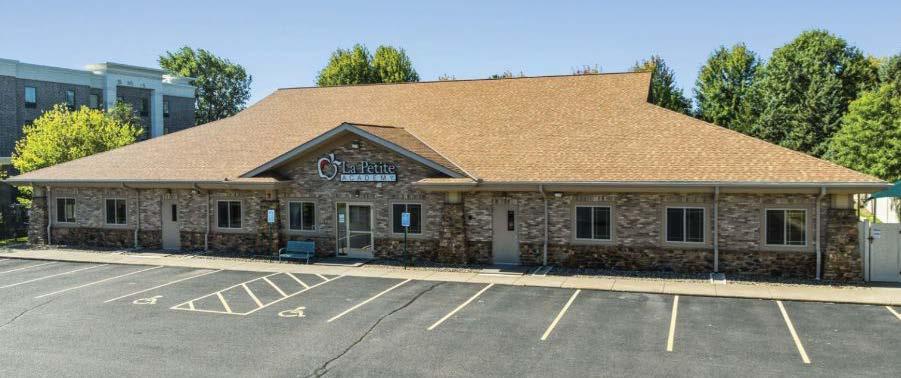
Fortec recently expanded its reach into the Midwest with the acquisition of the 7,700-square-foot La Petite Academy preschool facility at 470 Imperial Ave. N. in Oakdale, Minnesota. As part of the acquisition, the company signed a new 10-year lease with the property’s operator, Learning Care Group, one of the nation’s largest childcare
providers. Fortec also committed additional capital to modernize and upgrade the facility.
For Pablo Barreiro, chairman of Fortec, the company’s focus on early childhood education facilities is about more than investment returns.
“We are trying to help solve a real problem in communities across the country,” Barreiro said. “About 46% of the United States is still considered a childcare desert. When we started in this sector, that number was
Preschools to page 20
Evolution never stops at Minneapolis’ 9th Street Center
By Dan Rafter, Editor
When Hillcrest Development acquired Minneapolis’ 9th Street Center in the late 1990s, the company saw potential in a sprawling industrial property that boasted plenty of parking and a great location in the city’s Marcy-Holmes neighborhood.
What Hillcrest Development didn’t see was a center that would one day be home to tabletop gaming enthusiasts, indoor soccer
players, craft beverage fans and a growing collection of experiential businesses.
But that’s exactly what the 224,000-squarefoot property has become.
The latest chapter in the evolution of 9th Street Center comes with the addition of two new tenants: Wyldwolf Games and Midwest Indoor Soccer. Their arrivals highlights Hillcrest Development’s long-term strategy of creating a mixed-use destination that blends
industrial, retail, recreation and community-focused uses.
Located in Minneapolis’ Marcy-Holmes neighborhood near the University of Minnesota and downtown Minneapolis, 9th Street Center consists of nine buildings built between 1910 and the 1950s. Over the last quarter century, the property has gradually transformed from a traditional industrial site into a diverse campus of businesses that attract visitors from across the Twin Cities.
Fortec closed the sale of this Barrington, Illinois, property occupied by The Nest Schools in early 2025. (Photo courtesy of Fortec.)
The Vision To See Banking Differently
Discover Bridgewater Bank.
CONTENTS June 2026
1
An overlooked commercial asset class? How about preschools and early education centers?
Developer and investor Fortec is betting that one of the nation’s most overlooked real estate sectors, early childhood education facilities, is also one of its most needed.
1
Evolution never stops at Minneapolis’ 9th Street Center: When Hillcrest Development acquired Minneapolis’ 9th Street Center in the late 1990s, the company saw potential in a sprawling industrial property that boasted plenty of parking and a great location in the city’s Marcy-Holmes neighborhood.
4
1031 Exchanged Out of California? You’re Not Off California’s Radar Yet:
Many real estate investors assume that once they’ve 1031 exchanged out of California and purchased replacement property in another state, California is no longer part of the equation.
6
Life Time breaks ground on flagship club in Maple Grove: Life Time held a groundbreaking ceremony June 15 for a new flagship athletic country club in Maple Grove, Minnesota.
8
The great mall divide:
Despite what you might believe from some of the headlines, the U.S. enclosed shopping mall isn’t dead, with many of these retail spots thriving. But not every mall is sharing in the sector’s post-COVID recovery.
10 Key considerations for real estate Investors considering hotel acquisitions:
Investors with significant experience buying and selling triple net real estate often evaluate prospective investments by analyzing predictable rent schedules, tenant (and guarantor) financial statements, and cap rates.
12 What Determines the Value of Land Adjacent to Critical Power Infrastructure?
If you own land adjacent to a major power generation facility — a nuclear plant, a large switching station, or a high-voltage transmission corridor — you may already sense that something about your property is different.
14
Not all industrial markets are created equal:
After years of rapid development and shifting market conditions, the U.S. industrial sector appears to be entering a new phase, one marked by improving fundamentals, rising demand and a more balanced supply pipeline.
Minnesota Real Estate Journal Copyright © 2026 by the Minnesota Real Estate Journal is published bi-monthly for $85 a year. 7767 Elm Creek Boulevard, Suite 210, Maple Grove, MN 55369. jeff.johnson@rejournals.com. For more commercial real estate news and information, please visit our website www.rejournals.com ©2026 Real Estate Publishing Corporation. No part of this publication may be reproduced without the written permission of the publisher
Pragmatic Advice Staunch Advocacy
Fredrikson’s regionally and nationally recognized team of property tax lawyers helps commercial and industrial property owners, tenants, developers and managers obtain reductions in real estate taxes of many millions of dollars every year. Contact Gauri Samant at 612.492.7492 or gsamant@fredlaw.com. fredlaw.com

President | Publisher Jeff Johnson jeff.johnson@rejournals.com
Managing Editor Dan Rafter drafter@rejournals.com
Senior Vice President Jay Kodytek jay.kodytek@rejournals.com
Chief Financial Officer Todd Phillips todd.phillips@rejournals.com
Art Director | Graphic Designer Alan Davis alan.davis@rejournals.com
Senior Graphic Designer Jordan Jensen jordan.jensen@rejournals.com
Managing Director National Events & Marketing
Kaitlyn LaCroix kaitlyn.lacroix@rejournals.com
7767 Elm Creek Boulevard, Suite 210 Maple Grove, MN 55369
1031 Exchanged Out of California? You’re Not Off California’s Radar Yet
By Jeff Peterson, J.D.

Many real estate investors assume that once they’ve 1031 exchanged out of California and purchased replacement property in another state, California is no longer part of the equation.
Not necessarily.
California has a unique reporting requirement that allows the state to continue tracking deferred gain from the sale of California real property long after the replacement property has crossed state lines. If you are not aware of these rules, you may be surprised to learn that California could still have an interest in your transaction years down the road.
The California “Clawback” Rule
Suppose an investor sells real property located in California and completes a valid Section 1031 exchange into replacement property located in another state.
For federal tax purposes, the gain is usually deferred.
However, California does not simply forget about the deferred gain. The state requires taxpayers to report the transaction on Form FTB 3840 and continue filing that form annually while the California-source gain remains deferred and unpaid.
The purpose is straightforward: California wants to preserve its ability to potentially tax gain that originated from California real estate if that gain is later recognized in a taxable transaction.
This ongoing reporting requirement is commonly referred to as California’s “clawback” rule.
What Is Form FTB 3840?
Form FTB 3840, California Like-Kind Exchanges, is used to track deferred gain from California property that has been exchanged into replacement property located outside the state.
In general, taxpayers who exchange California real estate for out-of-state replacement property must file the form in the year of the exchange and continue filing it annually until the deferred California gain is ultimately recognized or otherwise resolved.
The reporting obligation can continue for years, or even decades, after the original exchange.
Why Does California Require Ongoing Reporting?
California’s position is that the gain was generated while the property was located within California.
As a result, the state wants to maintain a record of that deferred gain, even if the replacement property is now located elsewhere.
The state’s interest follows the deferred California gain, not necessarily the physical property itself.
What Happens If the Replacement Property Is Sold?
If the out-of-state replacement property is eventually sold in a taxable transaction rather than exchanged again, California may seek to tax the portion of gain that originated from the original California property.
This is why ongoing reporting is important. California wants visibility into whether and when that deferred gain is ultimately recognized.
What If Another 1031 Exchange Occurs?
Many investors complete multiple 1031 exchanges over time.
In those situations, California generally continues tracking the deferred California-source gain through subsequent exchanges. The reporting requirement may continue even though the taxpayer may not have owned the original California relinquished property for several years.
What About Estate Planning?
A common question from the heirs of investors is whether California can collect tax on deferred gain if the investor dies before the gain is recognized.
The answer depends on several factors, including the taxpayer’s estate plan, ownership structure, and applicable federal and state tax rules. Because these situations can be highly fact-specific, investors should consult with their CPA, tax advisor, or estate planning attorney regarding their circumstances.
iStock photo credit Sundry Photography.

Life Time breaks ground on flagship club in Maple Grove

Life Time held a groundbreaking ceremony June 15 alongside City of Maple Grove leaders and Knutson Construction for a new flagship athletic country club in Maple Grove, Minnesota.
The two-story, 120,000-square-foot destination will nearly double the size of the
Planned features include:
• 120,000 square feet across two stories
company’s existing Maple Grove club and represents a significant reinvestment in its original Minnesota market. In a future phase, Life Time Living luxury residences are also planned as part of the development.
The new flagship athletic country club underscores Life Time’s continued investment
• Resort-style outdoor pool and beach club
• Dedicated pickleball courts
• Full-service LifeSpa
• Fitness, recovery, rejuvenation and wellness spaces
• 200+ team members expected at opening
• Targeted opening: Late 2027
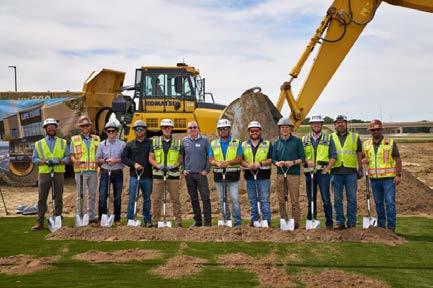
in premium, resort-style destinations in the Twin Cities and nationally. The company has 23 locations in Minnesota (plus additional coworking, tennis and pickleball destinations).
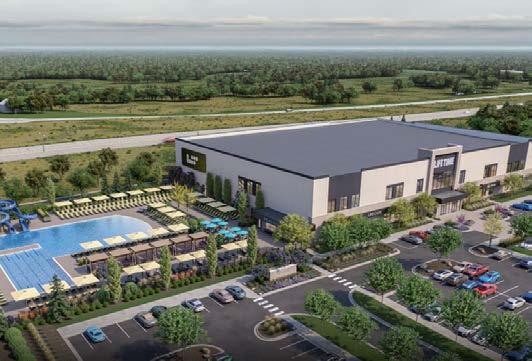
The project follows a land exchange agreement finalized with the City of Maple Grove in late 2024. Under the agreement, Life Time will construct the new athletic country club and, once fully transitioned to the new location, the city will take ownership of the current Life Time club to expand its adjacent community center.
Photo courtesy of Knutson Construction.
A rendering of the new Life Time club in Maple Grove. (Image courtesy of Life Time.)
Image courtesy of Life Time.
Unlock the Full Potential of Your Investment


Discover the difference between a development and a true community. With more than a century of experience and 110+ communities, Ebenezer Management Services is a trusted leader in senior living management, development, and consulting. We partner with organizations at every stage to ensure communities and the people who call them home thrive.
As the senior housing division of Fairview Health Services, we bring integrated healthcare expertise, strong professional partnerships, and a proven track record. Our mission-driven staff foster connection, engagement, and belonging, transforming buildings into vibrant communities. From planning to daily operations and ongoing maintenance, we deliver thoughtful guidance and innovative solutions that support lasting success.
From concept to care, we deliver.
“ Because they have such a strong reputation, we don’t have to worry about the care side of things. Ebenezer has that tightened up.”
—Development Partner/Owner
The great mall divide: Coresight report finds that top-tier malls thrive while lower-tier properties struggle
by Dan Rafter, Editor

Despite what you might believe from some of the headlines, the U.S. enclosed shopping mall isn’t dead, with many of these retail spots thriving. But not every mall is sharing in the sector’s postCOVID recovery.
That’s one of the key points in a new report from Coresight Research, The American Mall Renaissance: A Bifurcated Sector with Top-Tier Assets Leading the Way. According to the study, the nation’s enclosed mall sector has become divided between high-performing, top-tier properties and struggling lower-tier assets.
“The metrics we look at are heading in opposite directions with these two sets of malls,” said John Mercer, head of global research and managing director of data-driven research with New York City-based Coresight Research. “Whether you look at visits, net operating income, absolute rents or occupancy, the top-tier malls are performing well while the lower-tier malls continue to decline.”
The Coresight report found that by 2025, foot traffic at top-tier U.S. malls had nearly returned to pre-pandemic levels, sitting just 0.1% below 2019 traffic counts.
But the news wasn’t as good for lower-tier malls. Coresight found that foot traffic at these lower-quality malls remained 6.8% below pre-pandemic levels.
Then there are occupancy rates. In its report, Coresight said that top-tier U.S. malls average 95.5% occupancy compared to 89% for lower-tier centers.
The top-tier difference
So, what separates a top-tier mall from the rest?
Mercer said top-tier malls typically feature luxury and high-end retailers while serving affluent trade areas with higher household incomes.
“They are the malls that are thriving and attracting high-end retailers,” Mercer said. “The demographics surrounding the mall matter significantly.”
Those advantages create a cycle of success for higher-quality malls. When a tenant leaves a top-tier mall, its owners can often replace that retailer quickly. Lower-tier malls, though, face the opposite challenge: When an important tenant leaves a lower-tier mall, it’s more difficult for its owners to find a replacement.
“If you lose an anchor tenant in a lower-tier mall, you tend to see lower foot traffic in that space,” Mercer said. “Then it becomes harder to fill that anchor space. New tenants don’t join, and it can become a death spiral.”
New concepts
Luxury retailers continue to gravitate toward top-performing malls, but Mercer said some of the most interesting changes in the enclosed mall sector involve what is replacing vacant department store space.
As traditional anchors close stores, mall owners are increasingly turning to entertainment, fitness and healthcare concepts to fill large vacancies. Examples include immersive attractions such as House of Netflix, gyms, medical providers and competitive socializ-
ing venues, think experiential retailers such as indoor mini-golf company Puttshack and ping-pong-based entertainment venue SPIN.
“It’s not just about going to the mall for shopping anymore,” Mercer said. “These uses increase dwell time and bring consumers to the mall for non-shopping missions.”
The trend benefits owners in another way. Department stores often occupied space under favorable lease arrangements that generated relatively modest rental income for landlords. Replacement tenants frequently pay higher market-driven rents.
Other experiential concepts are helping malls reinvent themselves, too. Mercer pointed to attractions such as Dick’s House of Sport locations, which combine retail with interactive experiences.
“The mall becomes a more rounded experience,” Mercer said. “It’s a place to socialize, be entertained and engage with brands.”
Those changes make sense because consumers’ expectations of what the mall experience should be have also evolved.
“We live in an age of instant gratification,” Mercer said. “Consumers want engagement and experiences. Shopping is no longer purely functional.”
Mid-tier malls can thrive, too
While much of the Coresight report focused on the divide between top-tier and struggling malls, Mercer said that many mid-tier U.S. mall properties are increasing their foot traffic today, often by appealing to younger shoppers.
Photo courtesy of Knutson Construction.





Before you buy your first hotel: Key considerations for real estate Investors considering hotel acquisitions
by Aaron Robinow

Investors with significant experience buying and selling triple net real estate often evaluate prospective investments by analyzing predictable rent schedules, tenant (and guarantor) financial statements, and cap rates. This framework, while effective for traditional single-tenant assets, is not readily transferable to the hotel sector.
A hotel is not merely a real estate investment—it is an operating business conducted within a real estate asset. As a result, the legal, financial, and operational considerations differ in fundamental ways. Here are several key distinctions that net-lease investors should carefully evaluate when considering a hotel acquisition.
Valuation Methodology and Cash Flow Variability
Net-lease investments are typically underwritten based on contractual rent and evaluated relative to prevailing market cap rates. The existence of a long-term lease with fixed or predictable rent provides a stable basis for valuation and facilitates relatively straightforward comparisons across assets. Net leases also generally make the tenant responsible for all or most property-level expenses, resulting in a more predictable free cash flow to the owner.
By contrast, hotel revenues are not contractually determined and instead fluctuate based on operational performance and demand. Room revenue is generated on a nightly basis and is subject to variability driven by occupancy levels, average daily rate (ADR), seasonality, and broader economic conditions. In addition, the hotel owner is responsible for all operating expenses, maintenance, and capital expenditures.
As a result, hotel buyers lack a directly comparable standardized metric equivalent to
contractual net operating income for purposes of applying a cap rate. Instead, valuation may be derived from multiple measures, including net operating income, EBITDA, or fee cash flow after management and franchise fees. Underwriting a hotel purchase therefore requires sensitivity analyses and scenario-based projections rather than reliance on a fixed income stream.
Accordingly, investors must adopt a more dynamic valuation approach that accounts for both market-based and operational volatility.
Diligence: Asset Performance, not Tenant Credit
In a NNN lease transaction, diligence is principally focused on the creditworthiness of the tenant and any guarantor, as well as the enforceability and structure of the lease. The investor’s risk profile is therefore closely tied to the tenant’s ability to perform its obligations under the lease.
In a hotel acquisition, there is no tenant. Instead, the investor assumes direct exposure to the operating performance of the asset.
Due diligence is therefore centered on historical financial statements, operating data, and the physical condition of the asset. However, such data must be evaluated with caution, as historical performance may not be indicative of future results. Investors must also consider a range of additional variables, including changes in room supply within the market, shifts in demand drivers (such as business travel and tourism trends), non-recurring events reflected in historical results, and variations in management quality and operating strategy.
As a result, legal and financial diligence must be supplemented by a robust assessment of market conditions and forward-looking demand projections.
Capital Expenditures and Ongoing Property Obligations
A defining feature of NNN lease structures is the allocation to the tenant of responsibility for most or all of maintenance, repair, and capital expenditure obligations. This structure limits the landlord’s need to contribute additional capital during the lease term. Hotel ownership entails a fundamentally different allocation of responsibility. The owner bears primary responsibility for all maintenance, repairs, and capital improvements costs necessary to maintain the property’s physical condition and competitive positioning. In addition, management and franchise agreements commonly require the owner to fund capital reserve accounts, typically in the range of 4% to 5% of gross revenue.
Branded hotels are also subject to periodic property improvement plans (PIPs), which mandate upgrades to furniture, fixtures, and equipment, as well as broader renovations to ensure compliance with brand standards. These capital cycles are recurring and can be significant, often occurring on a 5–7 year cycle for soft goods and a 10–14 year cycle for more substantial improvements. These obligations must be carefully modeled, as they directly affect both cash flow and longterm asset value.
Management Agreements and Operational Control
Net-lease investments are generally characterized by limited landlord involvement in day-to-day operations, with the tenant retaining operational control subject to lease restrictions.
In the hotel context, the owner’s role in operations is central to value creation and preservation.
Photo by Klaus Nenning, Pexels.
What Determines the Value of Land Adjacent to Critical Power Infrastructure?
by Joseph Carrizales, Marcus & Millichap
If you own land adjacent to a major power generation facility — a nuclear plant, a large switching station, or a high-voltage transmission corridor — you may already sense that something about your property is different. Your neighbors are still farming row crops. Your local tax assessment still reads like farmland. But inquiries from development interests have become more frequent, and the conversations feel increasingly serious. That intuition is correct. The confluence of exploding data center demand, power scarcity across major markets, and AI infrastructure build-out has created a category of land that institutional capital values through a lens that
has almost nothing to do with agricultural productivity.
Understanding that lens — how it works, what it rewards, and what it penalizes — is the first step toward making an informed decision about your asset.
Why Proximity to Power Has Become the Controlling Variable in Land Valuation
Data centers consume electricity at a scale that is genuinely difficult to comprehend. A single hyperscale campus — the kind operated by the largest technology companies — may require between 200 and 500 megawatts of continuous, uninterruptible power.
That scale of demand has transformed land adjacent to nuclear generating stations into something that was effectively worthless five years ago but can now command values comparable to light industrial land in secondary urban markets.
The central problem facing data center developers today is not capital. It is power availability and time-to-power. In the most sought-after markets, interconnection queues have grown so long that developers have begun siting campuses in entirely new geographies, specifically to access power that is available now or in the near term. This dynamic has redrawn the map of institutional land demand.
The implication for landowners is significant: the agricultural baseline value of your parcel may represent only a small fraction of its actual market potential. But realizing that potential requires navigating a valuation process that institutional buyers apply rigorously, and that many landowners have never encountered.
A Framework for Evaluating InfrastructureAdjacent Land
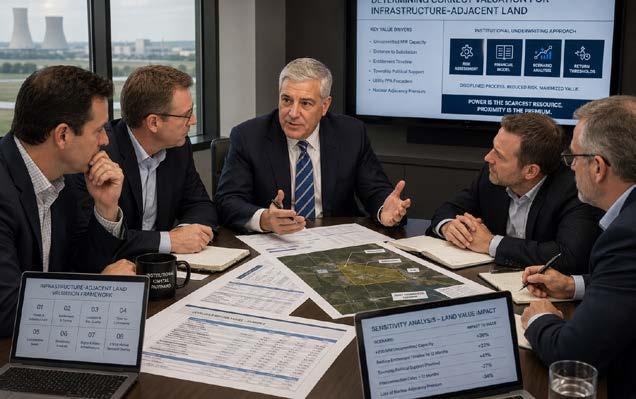
Sophisticated buyers and their underwriters apply an integrated, multi-dimensional assessment that quantifies both the opportunity a site represents and the risks standing between today’s agricultural parcel and a revenue-generating data center campus. Eight categories capture the essential dimensions of that assessment.
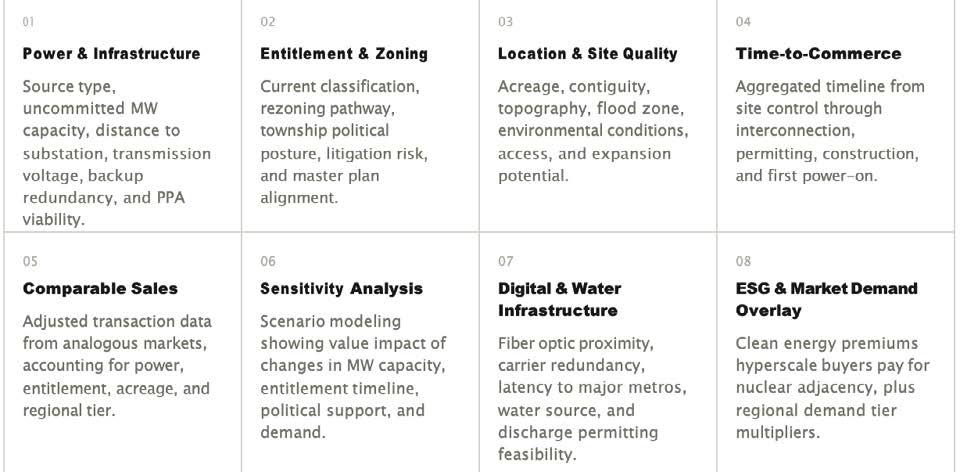
These categories are not evaluated in isolation. A site with exceptional power credentials but an intractable entitlement pathway scores very differently than one with modest infrastructure but a fast, cooperative zoning environment. The integrated score drives the valuation range.
Photo courtesy of Marcus & Millichap.
HEIDI ADDO NAMED MINNESOTA BROKER OF
Michel Commercial is proud to recognize Heidi Addo as Minnesota’s Broker of the Year.
Growth and Performance
Heidi has played a key role in the growth and direction of Michel Commercial Real Estate, helping expand the firm into one of the most active multifamily brokerages in Minnesota. Building on a 38-year foundation, she has strengthened client relationships, improved how the team operates, and refined how properties are positioned in the market.
Under her leadership, Michel Commercial achieved its strongest year in the firm’s history in 2025—doubling the number of properties sold and increasing total sales volume by 163% year over year. That momentum has carried into 2026, with the firm on pace to exceed those results.
Approach and Impact
Heidi is known for her steady approach and clear perspective in a market that continues to shift. She works closely with clients to make informed decisions, set realistic expectations, and move forward with confidence. Her focus is on building long-term relationships grounded in trust and integrity, while guiding transactions through to completion.
Her impact is reflected not only in record-setting results, but in the long-term relationships she continues to build across the Minnesota multifamily market.







Heidi Addo , Michel Commercial Real Estate
Not all industrial markets are created equal: The country’s top 25 industrial hubs are gaining strength
By Dan Rafter, Editor

After years of rapid development and shifting market conditions, the U.S. industrial sector appears to be entering a new phase, one marked by improving fundamentals, rising demand and a more balanced supply pipeline.
That’s one of the key findings from Colliers’ June 2026 report, The Markets That Move America: An Inside Look at the Top 25 U.S. Industrial & Logistics Markets.
The report examined the nation’s 25 largest industrial markets, which account for 76% of America’s industrial inventory among the 78 markets tracked by Colliers.
According to the report, the industrial market is transitioning away from the post-pandemic construction boom that flooded many regions with new supply. Today, developers are pulling back while occupier demand is gaining momentum.
In its report, Colliers wrote that the surge in new industrial supply is over. According to Colliers’ research, new industrial deliveries fell 24% year-over-year nationwide while construction activity sits roughly 60% below its 2022 peak.
That shift is helping bring balance back to the market.
Across the country, industrial inventory grew by just 0.5% over the past year, a sharp decline from the rapid expansion seen during the height of the logistics boom. The 25 largest markets grew faster, posting 1.3% annual inventory growth, but even those numbers reflect a significantly slower pace of development.
Several Sun Belt markets continue to dominate industrial activity. Dallas-Fort Worth led all markets with 22.9 million square feet of inventory growth during the past year, followed by Houston with 20.1 million square
feet. Greater Los Angeles, Atlanta and Phoenix also remained among the nation’s most active logistics hubs.
Colliers reported that net absorption across the top 25 industrial markets increased 19% year-over-year to nearly 146 million square feet. Nationwide, industrial demand rose 5.2% to 186 million square feet over the last 12 months.
Dallas-Fort Worth remained the nation’s top performer, recording 24.3 million square feet of net absorption. Phoenix followed with 18.5 million square feet, while Indianapolis emerged as one of the strongest Midwest markets with 15.7 million square feet of absorption. Chicago also posted impressive results, recording 14.2 million square feet of demand growth.
The Midwest continues to demonstrate strong fundamentals. Nine of the nation’s top 25 industrial markets sit in the Midwest, and several are seeing demand outpace supply.
Indianapolis stood out as one of the country’s strongest markets. According to Colliers, the market recorded 15.7 million square feet of net absorption while adding only 3.9 million square feet of new supply during the same period. Columbus, Cincinnati and Memphis also posted strong supply-demand balances.
These conditions are already affecting vacancy rates.
National industrial vacancy reached 7.4% in the first quarter of 2026, up 37 basis points year-over-year. However, conditions were somewhat tighter in the top 25 markets, where vacancy rose only 11 basis points to 7.2%.
Some markets are already seeing vacancy decline. Indianapolis posted one of the largest improvements in the country, with vacan-
cy falling 364 basis points year-over-year to 7.1%. Columbus and Phoenix also recorded significant decreases as demand absorbed previously delivered space.
Phoenix still has the highest vacancy rate among major markets at 10.6%, but even there conditions have improved significantly from a year ago.
Colliers said that the combination of moderating supply and strengthening demand could soon create tighter market conditions in many regions.
Construction activity remains well below its pandemic-era peak, according to Colliers. Industrial space under construction totaled 286 million square feet nationally in the first quarter of 2026, far below the 711 million square feet under construction in 2022.
Dallas-Fort Worth continues to lead the nation with 34.3 million square feet under construction, while Houston ranks second with 24 million square feet underway. The New York metro area saw one of the biggest increases, with its construction pipeline expanding 150% year-over-year.
Still, developers appear increasingly selective. Build-to-suit projects continue to dominate, but Colliers reported that improving market conditions are laying the groundwork for the eventual return of speculative development.
Rents are also stabilizing. National warehouse and distribution asking rents dipped 0.5% year-over-year to $10.46 per square foot, reflecting a normalization after several years of record increases. Yet rents in the top 25 markets still rose 0.8% to $9.72 per square foot.
Houston led the nation in rent growth, posting a 14.2% increase over the past year.
iStock photo credit by vitpho.
Generally, heirs can get a “stepped-up” basis in property that they receive as an inheritance. Internal Revenue Code Section 1014 states that heirs receive property with a new basis that is set at the fair market value (FMV) as of the date of death of the decedent (https://www.law. cornell.edu/uscode/text/26/1014). This may deprive the State of California of its long-awaited recognition of gains.
Don’t Overlook the Filing Requirement
One of the biggest risks is simply forgetting that the reporting obligation exists.
Investors often focus on successfully completing the 1031 exchange and acquiring replacement property, only to overlook the annual reporting requirement that follows.
Failure to file Form FTB 3840 when required may result in California penalties, interest, or other compliance issues.
The Bottom Line
Completing a 1031 exchange out of California does not necessarily end California’s involvement.
If California real estate is exchanged for replacement property located outside the state, taxpayers may have an ongoing obligation to file Form FTB 3840 each year until the deferred California-source gain is ultimately recognized or otherwise resolved.
For investors with California property, understanding these rules is an important part of the long-term planning process.
As always, qualified intermediaries facilitate the exchange transaction itself. Tax reporting and compliance matters should be reviewed with a CPA or tax advisor to ensure all filing obligations are properly addressed.
This article is for educational purposes and should not be read as tax, legal, or accounting advice. Readers should consult their CPA, tax advisor, or legal counsel regarding their specific situation.
Jeff Peterson is a Minnesota attorney and former adjunct professor of tax law. He serves as President of Commercial Partners Exchange Company, LLC, where he facilitates forward, reverse, and buildto-suit 1031 exchanges nationwide. Jeff regularly collaborates with attorneys, accountants, and real estate professionals on exchange strategies. Reach him at 612-643-1031 or JeffP@CPEC1031.com or on the web at www.cpec1031.com.




What Moves Value: The Key Drivers
Not all assessment categories carry equal weight. Buyers anchor on a subset of variables that, when favorable, compress risk premiums substantially — and extend them when unfavorable.

Just look at Gen Z consumers. They continue to embrace mall shopping. Retailers such as Abercrombie and Hollister remain popular among younger consumers, helping support many middle-market malls.
“There are a lot of healthy malls in the mid-tier category,” Mercer said. “A lot of the experiential retail opportunities can work there, too.”
Gen Z shoppers are often looking for discovery and novelty, Mercer said. They enjoy finding new brands and products and frequently return to stores that regularly refresh the merchandise that they offer.
That consumer behavior creates opportunities for malls that can provide changing experiences and a diverse tenant mix.
The lower-tier struggle
For lower-tier malls, however, the path forward is far less certain.
“Their options are limited,” Mercer said. “You lose traffic, you lose tenants. You lose tenants, you lose traffic. It becomes very difficult to turn around.”
Some struggling malls have found new life through redevelopment. In some cases, former retail properties have been converted into distribution facilities or mixed-use projects. Others have added apartments, hotels or other uses to their sites.
Residential development around malls has become increasingly common, Mercer said, particularly on excess parking lots surrounding existing centers.
“It’s something we’ve been tracking for several years,” he said. “It’s a good use of space and a trend that continues.”
Ultimately, Mercer said the future of retail centers depends on meeting consumer expectations that have been shaped by digital commerce.
Online shopping has become faster, easier and more convenient through quick-commerce delivery services, artificial intelligence tools and streamlined payment options. Physical retailers must respond by reducing friction within stores and creating better experiences.
“Retail is changing,” Mercer said. “Consumers have higher expectations today because
of digital channels. Retailers need to reduce friction, improve the shopping experience and create reasons for people to visit.”
A Different Kind Of Commercial Real Estate Experience.
We listen closely—to our clients, our tenants, and our people in the field—and we move quickly as the market shifts. It’s how we’ve become one of Minnesota’s most trusted names in commercial real estate management, and how we keep earning that trust, one property at a time.
What a Valuation Range Looks Like — and Why the Spread Is So Wide
When institutional underwriters model the value of unentitled agricultural land adjacent to critical power infrastructure, they produce a range rather than a point estimate. This is not imprecision — it reflects how contingent the realized value is on outcomes that have not yet occurred.
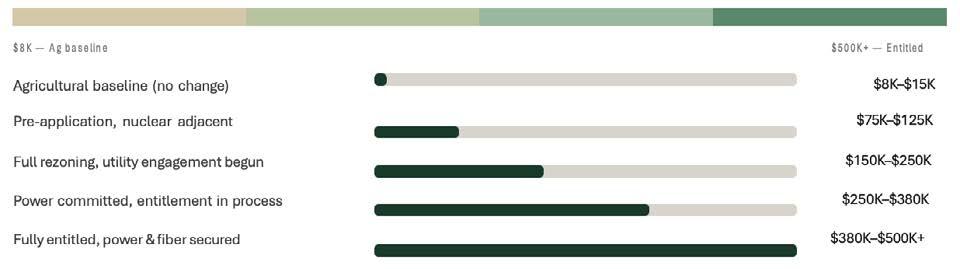
The implication is that a landowner’s decisions — whether to proactively engage the utility, invest in pre-application community outreach, or pursue an assemblage of adjacent parcels — are not passive. They are among the most consequential variables in the ultimate valuation equation.
Four Valuation Methods That Institutional Buyers Apply in Concert
No single approach is adequate for this category of land. A well-constructed valuation uses four complementary methods and examines the convergence of their outputs.
01 Comparable Sales Approach
Adjusted transaction data from analogous markets forms the foundation. Key adjustments include entitlement status at sale, confirmed megawatt capacity, acreage, substation proximity, and market tier. The adjustment process is as important as the raw comparable selection.
02 Power-Value Method
This approach builds value from the agricultural baseline upward, adding a per-megawatt premium for each unit of committed utility capacity. Market data on MW premiums provides a range — typically $150,000 to $400,000 per megawatt depending on scarcity, power type, and contractual certainty.
03 Residual Land Value Method
Working backward from what a fully developed campus would be worth to an institutional buyer, the residual method deducts all development costs to determine what a developer can rationally pay today. Particularly sensitive
to power premiums, ESG credentials, and operating cost advantages from water and clean energy access.
04 Developer Return Model
What will the land need to sell or lease for at completion, and what can a developer pay today
while achieving a required return? This frames the question from the buyer’s perspective and reveals the ceiling on acquisition pricing at any given stage of entitlement.

The Path From Agricultural Land to Market-Ready Asset
Understanding how institutional buyers think is useful. Understanding the sequence of steps that moves an asset from its current state to one where multiple serious buyers are competing is more useful still.
PHASE 1
Baseline Asset Assessment
Establish current zoning, parcel dimensions, existing easements, adjacent land uses, and utility agreements. Commission an ALTA survey and Phase I environmental
assessment. Confirm exclusion zone compliance if near a nuclear facility.
PHASE 2
Utility Pre-Engagement
File a pre-application with the regional utility to initiate an interconnection capacity screen. The purpose is not to commit — it is to establish in writing that uncommitted capacity exists. This documentation materially affects buyer risk perception.
PHASE 3
Entitlement Strategy Development
Analyze the township master plan, identify the rezoning pathway, assess the political
environment, and develop a realistic entitlement timeline. Identify precedent transactions in analogous jurisdictions. Assess litigation risk and potential opposition.
PHASE 4
Infrastructure Confirmation
Confirm fiber availability from at least two carriers within commercially viable distance. Confirm water source, available daily gallons, and discharge permitting framework. Document all of this for institutional due diligence teams.
Investors typically engage a third-party manager pursuant to a hotel management agreement, although some owners elect to operate themselves, sometimes through affiliated management platforms. These management agreements govern the operation of the hotel and address, among other matters, staffing, operational policies and procedures, owner approval rights, management fee structures (including base and incentive fees), performance standards, and termination rights.
The selection of a well-qualified manager and the negotiation of a management agreement with proper alignment of incentives and expectations are critical to the owner’s return on investment.
Franchise Agreements and Brand Considerations
Most hotels operate under a brand affiliation pursuant to a franchise agreement with a major hospitality company, such as Marriott, Hilton, or Hyatt.
These agreements provide substantial benefits, including access to centralized reservation systems, brand recognition, and marketing support. However, they also impose material obligations, including the payment of initial and ongoing franchise fees, compliance with detailed brand standards, and required capital improvements and renovations.
In connection with an acquisition, investors must typically address the termination of the existing franchise agreement and the negotiation of a new agreement. This process often involves property improvement plans and other conditions required to obtain brand approval. Buyers must also carefully coordinate the timing and process of franchise application and approval.
In Sum
For private and institutional investors with experience in NNN lease acquisitions, hotel ownership represents a transition from a contractually driven investment model to one that is operationally intensive and performance dependent.
This shift implicates not only different financial metrics, but also a fundamentally different allocation of risk, responsibility, and control. Successful execution in the hotel sector requires a nuanced understanding of hotel management, franchise relationships, capital planning, and market dynamics, in addition to traditional real estate considerations.
Investors contemplating such a transition should engage legal advisors experienced in the hospitality industry to guide them through the due diligence process, identify and mitigate risks specific to hotel acquisitions, and provide strategic insight in negotiating transaction terms and documentation.
About the author:
Aaron Robinow is an attorney at Dorsey & Whitney LLP who advises clients on complex commercial real estate transactions, with a focus on the hospitality sector. Dorsey & Whitney LLP’s Hospitality Industry Group counsels clients on a wide range of hotel and restaurant matters.


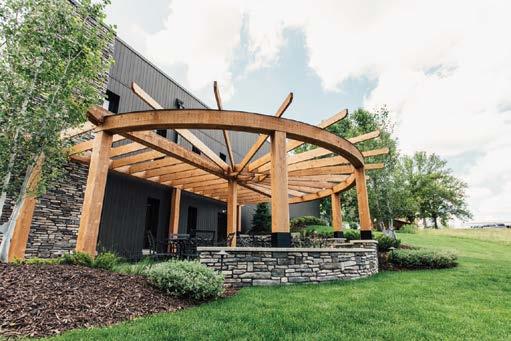


Aaron Robinow (Photo courtesy of Dorsey & Whitney LLP.)
Preschools
from page 1
even higher. There is still a big need for new schools and modern facilities.”
A childcare desert refers to areas where the supply of licensed childcare falls far short of demand, leaving working families struggling to find affordable and accessible early education options.
Barreiro said the shortage is evident across the country, including in states such as Minnesota.
“The first thing we look at is whether the community needs this product,” he said. “If the need is there, we are open to investing there. We want to help reduce the imbalance between supply and demand.”
Fortec’s strategy is unique in a commercial real estate industry where many developers focus on more traditional asset classes such as multifamily, industrial and retail properties.
“Our main objective is to be the first institution that only invests in educational products,” Barreiro said. “We understand the community needs, so when we do projects, they are specifically designed for that community.”
An evolving sector
Preschool and early education centers continue to evolve. Barreiro said today’s schools boast larger classrooms, more natural light, a greater amount of outdoor learning spaces and modern technology. Safety improvements have also become increasingly important.
“There has been much more investment in playgrounds and outdoor spaces, bigger windows and more natural light,” Barreiro said. “The spaces today are more organic. Kids are not just sitting in classrooms anymore.
Learning now includes music, art, outdoor activities and many different experiences.”
That evolution has also changed the design of the buildings themselves.
“The buildings have to support the curriculum,” Barreiro said. “Children use more of the building now, both inside and outside. In places like Minnesota, where winters can limit outdoor activity, schools need larger interior spaces where children can still play and learn.”
Safety features are another priority.
“There have been a lot of improvements in life safety,” Barreiro said. “Fencing, barriers near parking lots, making sure children are safe while still enjoying the building. Those are critical parts of these projects.”

Fortec is working with The Nest Schools to transform a former ambulance warehouse in Vernon Hills, Illinois, to The Nest School-Vernon Hills, an early education center scheduled to open in the spring of 2026 in Vernon Hills, Illinois. (Rendering courtesy of Fortec.)
La Petite Academy in Oakdale, Minnesota.
Preschools to page 23
PHASE 5
Valuation and Market Positioning
Construct a defensible valuation range using all four methods, incorporating the current state of each variable. Recognize that the framing of what the buyer is acquiring, and the credibility of the development narrative, are as important as the underlying characteristics.
What Makes Nuclear-Adjacent Land Distinct
Land immediately adjacent to a nuclear generating facility carries several characteristics that institutional buyers value in ways that are not always intuitive.
Baseload reliability. Nuclear power operates at a capacity factor that no other generation source approaches in practice — typically 90-93% of all hours in a year. Solar capacity factors in the Midwest average 15-20%. The reliability of nuclear as a baseload source is structurally superior for data center applications, which cannot tolerate intermittency.
Clean energy ESG premium. Hyperscale operators publish 24/7 carbon-free energy commitments. The largest technology companies are not simply seeking the lowest-cost power — they are seeking power whose carbon attributes satisfy investor and regulatory scrutiny. Nuclear qualifies as carbon-free under every major accounting framework.
Infrastructure permanence. Nuclear facilities are not built speculatively or moved.
They are long-lived assets with immovable infrastructure, fixed interconnection capacity, and established transmission rights. That certainty has real option value for a developer underwriting a 20-year campus development plan.
Paradox of the exclusion zone. The NRC exclusion zone creates a development constraint that paradoxically benefits adjacent landowners. It prevents competing development immediately surrounding the facility — and eliminates residential encroachment that would otherwise constrain industrial land uses. A parcel just outside the exclusion zone may face more complex permitting, but it also faces no residential neighbors and no competing development pressure.
The Questions a Landowner Should Be Prepared to Answer
When institutional capital evaluates nuclear-adjacent agricultural land, the due diligence questions are predictable. Being prepared to answer them — clearly, specifically, and with supporting documentation — is not simply a matter of professionalism. It is a meaningful contributor to the value the market will ascribe to your asset.
• What is the precise distance from the nearest boundary of your parcel to the substation fence line?
• What is the voltage of the highest transmission line that crosses or directly borders your parcel?
• Has the regional utility acknowledged in any written communication that intercon-
nection capacity exists for new large-load customers?
• What is the current zoning classification, and has the township ever rezoned comparable land for industrial use?
• Is there documented fiber infrastructure within a commercially viable distance, and from how many carriers?
• What environmental assessments have been completed, and have wetlands, floodplain, or contamination issues been identified?
Each question corresponds to a specific variable in the valuation framework. The quality of the answer either compresses the risk discount that buyers apply — or leaves it in place.
Joseph Carrizales is an Associate Investments professional in Marcus & Millichap’s Detroit office and a member of the firm’s Office & Industrial Division. He advises owners of infrastructure-adjacent, unentitled, and redevelopment land on positioning, valuation, and transaction strategy. His practice focuses on the intersection of institutional capital formation and emerging land use categories — including data center development land, nuclear-adjacent agricultural parcels, and grid-proximate properties across the Great Lakes region.
For a confidential consultation:josephcarrizalescre.com






“We are intentional about tenants,” said Scott Tankenoff, managing partner with Hillcrest Development. “We’re not looking to get market rates for everything. That’d be great, but having the right tenants that are durable and stay? That’s a good formula.”
That winning philosophy is evident in the property’s newest additions.
Wyldwolf Games will open a 1,945-squarefoot location at 9th Street Center in June. The business specializes in tabletop gaming, offering retail products and professionally hosted role-playing experiences such as Dungeons & Dragons and Pathfinder events. The space will feature custom sound-resistant gaming rooms and technology designed to support both in-person and hybrid play.
For Tankenoff, the gaming concept fits naturally into the property’s growing collection of destination-oriented businesses.
The tenant needed more than just square footage. It required a location with ample parking, easy access and a distinctive environment capable of creating an experience for customers.
“They are used to going into retail strip centers,” Tankenoff said. “This is more interesting. There is a certain warmth to a brick-and-timber space. There were certain things about it, the character of the neighborhood and the other retail uses in the building. It made for a more attractive destination for them.”
The second addition, Midwest Indoor Soccer, will occupy approximately 28,000 square feet when it opens in August. Founded by Ashraf Ali, the facility will feature two indoor

soccer fields, youth programs, leagues, training sessions and retail offerings. Future additions could include concessions and café space.
The soccer facility addresses a growing need for indoor sports facilities in the Minneapolis-St. Paul market.
“There really aren’t other indoor soccer facilities that we are aware of in the city of Minneapolis,” Tankenoff said. “It’s very hard to find indoor training, competition and practice space. Almost impossible.”
The property’s physical characteristics made it particularly attractive for indoor soccer. The building offers the height, depth and open floor plans necessary for athletic uses, along with parking and a location accessible from throughout the Twin Cities area.
“You need a building with a certain amount of height, volume and depth, no columns and good open space,” Tankenoff said. “You need parking, both on-street and off-street. You need to be centrally located. There are certain physical things you need to make it work. You can’t just shovel these uses into an industrial building.”
The addition of the soccer facility also aligns with broader changes Tankenoff has seen at the property during the last two decades.
When Hillcrest first acquired the site, many tenants were traditional industrial users, including pallet manufacturers, metalworking operations and light warehouse businesses.
“That is not what the building is today,” Tankenoff said. “There are still some industrial uses there, but a lot of the space has become destination retail.”
Today’s tenant roster includes Planet Fitness, creative businesses, health and well-
An aerial view of 9th Street Center in Minneapolis. (Photo courtesy of Hillcrest Development.)
Photo courtesy of Hillcrest Development.
Preschools
from page 20
An overlooked asset class
Despite the growing need, Barreiro said that many developers have overlooked the early education sector in part because projects require extensive collaboration with local communities and government officials, something that can prove challenging.
“These are community-based projects,” Barreiro said. “You are building something where children from that community will spend a large portion of their day. We work closely with local architects, city staff and council members to make sure the project fits what the community wants and needs.”
Traffic flow and drop-off safety also add layers of complexity that developers do not always face in more conventional property types.
“It is not as standardized as some other real estate sectors,” Barreiro said. “Every project is specific to that community. Some developers prefer products they can replicate the same
way across the country. For us, the focus is on what each community needs.”
Fortec’s growing investment fund is designed specifically to address those needs. Barreiro said the company is currently active in 14 states and expects to expand further by the end of the year.
“All of the money is focused on early education,” he said. “The goal is to bring new schools to communities across the country.”
For Barreiro, the company’s interest in the sector began with a personal connection. About six or seven years ago, Fortec and its partners acquired a preschool property in Hollywood, Florida, a school his daughter attended.
“I knew that property very well,” he said. “At the time, we had never worked with a preschool tenant before. But the tenant was great, and once we started learning more about the industry, we realized there was a tremendous need.”
That first acquisition quickly led to more projects in Florida and eventually to a nationwide strategy centered entirely on educational facilities.
“We realized this was something where we could put our resources to work and actually help solve a problem,” Barreiro said.
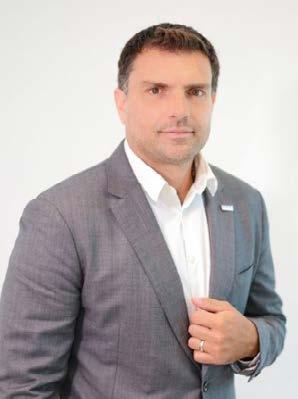













Pablo Barreiro (Photo courtesy of Fortec.)
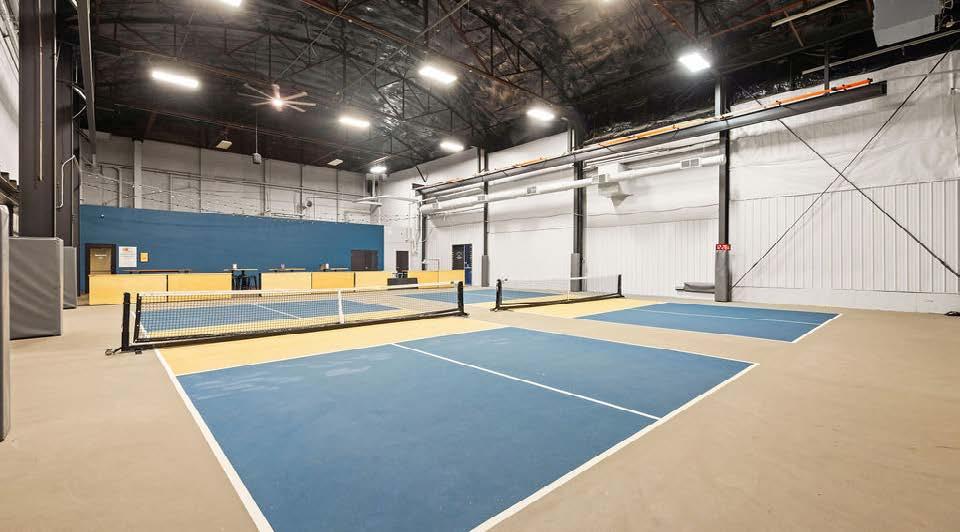
ness providers, makers, production companies, retail operators and food-and-beverage tenants. The mix is designed to create activity throughout the day and evening while supporting a wide variety of business needs.
Tankenoff credits much of the property’s success to its ability to accommodate uses that might otherwise struggle to find appropriate space elsewhere.
“A lot of people need use of a building where they can load a truck, have good signage and operate in a clean and functional environment,” he said. “It’s the compatibility of uses that matters.”
That compatibility has become increasingly important as Minneapolis neighborhoods continue to evolve.
When Hillcrest acquired the property, the surrounding area was far different than it is today. Over time, neighborhood investment, housing development and commercial activity transformed the area into one of the city’s more desirable urban districts.
“Back in the late ‘90s, we didn’t foresee this happening,” Tankenoff said. “But 10 to 15 years ago, you could see where the neighborhood was going. You could see where other developments were taking place. It became very evident what was happening.”

That evolution has coincided with a growing demand throughout the Twin Cities region for experiential businesses, the types of tenants that give consumers reasons to leave their homes and gather in person.
“That’s where this is headed,” Tankenoff said. “What makes people want to be here? What makes people want to gather? You need food. You need a place where people can gather that’s not just an office and break room. Exterior spaces are valuable. You need good infrastructure and a sense of place.”
Convenience is also important. Tankenoff said the property’s location near downtown Minneapolis, major highways, residential neighborhoods and retail destinations helps attract both tenants and visitors.
“People want convenience,” he said. “How much time can I save and how much convenience can I give myself today? That’s what matters.”
As 9th Street Center continues to evolve, Hillcrest Development isn’t targeting any single tenant category. Instead, the company plans to continue evaluating each opportunity based on how well it fits within the property’s existing ecosystem.
“We think a lot about tenant compatibility,” Tankenoff said. “That’s very important. We don’t want someone to move in and not be a good fit. We need to get it right.”
For a property that began life as a traditional industrial complex, that careful approach has helped create something increasingly rare in commercial real estate: a place where industrial, recreational, retail and community uses successfully coexist.
9Th Street Center is home to a variety of uses. (Photo courtesy of Hillcrest Development.)
Photo courtesy of Hillcrest Development.


Zach
Betsy
Cory
Brent
Shawn
Nicholas
Speakers: