A Publication of the Memphis Library Foundation
Falling into Fantasy
PLUS:
Spellbinding Literacy, Comics, and an Intro to Some of Your Magical Librarians FALL/HOLIDAY, 2026
VOLUME 2, ISSUE 2 ISSN 3065-503X
FREE
MKelly 2
03 The Memphis Public Libraries in Your Hands
a Publication of the Memphis Library Foundation FALL 2026
03
DISCUSSIONS What we’re doing with the UNBOUND Youth section, and more about this issue’s cover!
08
FEATURES
07
OPINION: IN THE BRANCHES With Libraries Under Threat, the “Sacred Vocation” of Librarianship Carries Increasingly Heavier Burdens
08
MEET THE BRANCH SUPERHEROES Across all 18 branches, library staff are hard at work bringing new and creative programs to serve patrons and the common good
14
FOUNDATIONS: RIF TURNS 60 Reading Is Fundamental, the institution built to help children become skilled readers, goes on the road to celebrate over a half-century of reading joy
14
SHORT FICTION
19
‘THE REMEMBERING’ “This was All Souls’ Night, a night to celebrate and remember loved ones passed on.” An original short story from UNBOUND Co-editor Rebecca Stovall
19
BOOKS & MORE
23 30 32 36
BOOK TALK John T. Edge, the renowned Southern food & culture writer, excavates his family history, & other Southern myths PASSIONS: ABSOLUTE UNIVERSE! Welcome to the DC Absolute Universe, where legacy heroes are rebirthed with new stories & new destinies THE MEMPHIS ROOM, FOR FOODIES! MPL’s history department — the Memphis Room — digs up a little foodie history for the holiday season
MPL UNBOUND, A PUBLICATION OF THE MEMPHIS LIBRARY FOUNDATION
(ISSN 3065-503X)
FALL, 2026, VOLUME 2, ISSUE 2
30
COMICS: THE MEMPHIS SEASONS UNBOUND is proud to introduce its first mixed media comic strip, from local artist Walsh Perrin
32
MEMPHIS LIBRARY FOUNDATION 3030 Poplar Ave, Memphis, Tennessee 38111 To support the Memphis Public Libraries, visit memphislibraryfoundation.org/ donate, or email us at: unbound@ memphislibraryfoundation.org. THE MEMPHIS LIBRARY FOUNDATION IS RECOGNIZED BY THE INTERNAL REVENUE SERVICE AS A PUBLIC CHARITY WITH NONPROFIT STATUS, REGISTERED AS A TAX-EXEMPT CHARITABLE ORGANIZATION IN THE STATE OF TENNESSEE. ©2026 MEMPHIS LIBRARY FOUNDATION. ALL RIGHTS RESERVED.
DEPARTMENTS 2 3 4 5 7 19 23 34 35 36
START HERE DISCUSSIONS STAFF, CONTRIBUTORS CALENDAR EVENT HIGHLIGHTS FEATURES SHORT FICTION BOOK TALKS, STAFF PICKS, AND MORE! CROSSWORD BIOS, CREDITS BEYOND THE STACKS: COMICS!
36
1
START HERE LETTER FROM THE PUBLISHER
MEMPHIS LIBRARY FOUNDATION
IMAGINE MORE Private donors make our awardwinning library programming possible. The Memphis Library Foundation was founded in 1995 to secure private and corporate donations to fund the innovative and community-centered work at the libraries that the City cannot cover. Library supporters who give at least $25 per month or $250 annually to support the Memphis Public Libraries receive UNBOUND by mail each quarter. Scan the QR code or visit memphislibraryfoundation.org to donate today!
Consistency in the Face of Change
Dial 2-1-1 to reach the community information and referral resources of LINC, the Library Information Center at the Memphis Public Library. LINC, in conjunction with United Way of the MidSouth, is the local source for community resources. LINC maintains a large, comprehensive database of human services organizations, government agencies and volunteer groups, which can now be accessed by dialing 2-1-1. Call for help with utilities, food, protective services, legal assistance, childcare, social support, housing, and mental health. Services are accessible to the hearingimpaired by calling TTY 415-2701. Toll free access is also available at (855) 354-4211.
DONATE HERE
WANT TO SHARE YOUR STORY? CALL FOR SUBMISSIONS
THE MEMPHIS LIBRARY FOUNDATION IS NOW ON SUBSTACK
Are you a writer, an artist, a dreamer? MPL UNBOUND and the Memphis Library Foundation are inviting you to submit original artwork, photography, creative writing, puzzles & games, news or opinion articles, book recommendations and more for consideration! We accept submissions from local Mid-South storytellers, Memphians with ties to the city or the Library, or just those people with something to say.
If there’s one thing 2026 has reminded me, it’s that change is inevitable. With change comes both exciting new possibilities and tests of our resolve as we consider how to move forward. Memphis Public Libraries (MPL) has experienced a year of significant transition. New leadership, evolving priorities, and changes in longstanding relationships have brought opportunities and challenges. Through it all, the most important thing about our libraries remains unchanged: their purpose. Every day, across MPL’s 18 locations and through its outreach programs, children discover the joy of reading, job seekers find tools and encouragement, and neighbors learn new skills, encounter different perspectives, or simply find a place to belong. Together, these everyday moments fulfill an extraordinary promise: that knowledge, opportunity, and community belong to everyone. That promise is bigger than any one person, organization, or moment in time. It is rooted in dedicated library staff, public investment, generous supporters, and a shared belief that free access to information and ideas is essential to a healthy democracy. At the Memphis Library Foundation, our responsibility is to help keep that promise alive. As an independent nonprofit supporting MPL, we provide resources, relationships, and a long-term commitment to strengthening our libraries. Our work may evolve as circumstances change, but our mission does not. We remain steadfast in our determination to support the people and programs that make our libraries indispensable to Memphis. The true measure of commitment isn’t how enthusiastically we embrace a mission when circumstances are easy, but how faithfully we honor it when the path forward becomes complicated. This year has only strengthened my conviction that our libraries, their dedicated staff, and the people who depend on them deserve nothing less. As we look toward a new year, I’m grateful for the library staff, community partners, donors, and supporters whose dedication keeps our libraries strong. The library is there for you, whether or not you need it today. It’s there for your neighbors and for generations of Memphians to come. Thank you for standing with us and helping carry that promise forward. ~Christine Weinreich Executive Director, Memphis Library Foundation
2
DISCUSSIONS ABOUT THE COVER A Publication of the Memphis Library Foundation
Falling into Fantasy
PLUS:
Spellbinding Literacy, Comics, and an Intro to Some of Your Magical Librarians FALL/HOLIDAY, 2026
VOLUME 2, ISSUE 2 ISSN 3065-503X
FREE
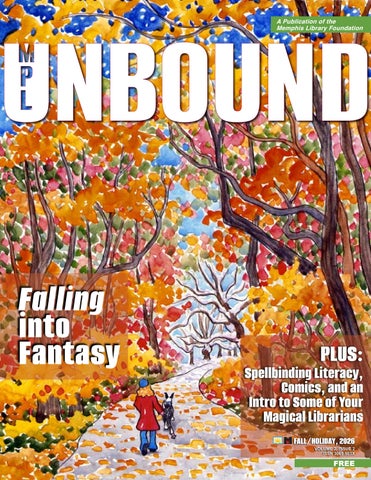
Arriving at a cover image for each issue of the magazine is a little bit like the work of a chef in a kitchen, developing a new dish from scratch. We know which season is coming (in this case, fall/holiday), we have the ingredients (stories and imagery) arriving at our back door (in our inboxes), and we have a pretty good sense of the palate of our diners — well, our readers. It also requires a trust in the process, a faith that the idea will come, once we have most of our ingredients laid out before us. For this issue, the ingredients were a mix: fantasy, the magic of librarians, the promises of the holiday season, cooler weather, family, and nostalgia. And so I turned once again to local artist Martha Kelly, who gave us that whimsical treasure map for the previous issue. This time, I said, “Let’s present the longing that so many of us see when this season arrives: colors changing, magical paths ahead, and winter not too far away.” True to form, she delivered more than I could possibly imagine. ~Mark Fleischer
Martha Kelly is a printmaker, painter, Urban Sketcher, lifelong Memphian, and occasional upright bass player. In her free time, she chats with strangers, picks up rocks, and wanders into the city with her dog and her sketchbook. Her favorite sketching spot is the Old Forest in Overton Park, which was the model for this cover. Her first solo museum show was at Dixon Gallery and Gardens in 2015, where she has a piece in their retrospective this fall, followed by shows at the Walter Anderson Museum of Art in 2022 and Rowan Oak in 2024. Lately, she’s thrilled her inner middle-school-book-nerd by writing and illustrating books including P is for Possum, Memoir of a House, and M is for Memphis. MPL UNBOUND, FALL 2026
LETTER FROM THE EDITOR
The Magic of Fall
Something always comes over me when the calendar turns to fall. September 22 may have been the official first day of fall this year, but here in the South, what many of us love so much about fall doesn’t always follow the autumnal equinox. I don’t have to remind you that this summer was particularly brutal! As I write this within the first couple of weeks of fall, the heat dome that had trapped us under an unrelenting 24/7 heat lamp has mercifully cracked enough to release cooler temperatures, lower humidity, and hints of more pleasant days to come. For me, fall has significance deeper than just the welcome change in weather. Summer represents neverending heat and humidity for sure, but ah, when fall crests that corner and shows its head, everything seems to feel better. For me, fall has often been a time of hope, promise, and joy. September and October are the first chapters in that period of magical thinking we call autumn, opening the door to November and December, when the air cools, the leaves become brilliant, and the spirits of giving, communing, and love arrive like a warm blanket. These are the spirits that informed this issue, and that continue to wrap themselves around our public libraries. Back in September, our team was tasked with researching public library systems around the country to learn how they address the needs of their communities, and by luck of the draw, I was assigned the Washington, D.C. Public Library system. Many of its programs resembled those of our own Memphis Public Libraries, but one set of programs stood out as a product of its 2026 strategic plan. It is named IRL: In Real Life. It is aimed at addressing an epidemic of isolation and loneliness, seeking to improve area residents’ lives through “inperson experiences in an increasingly fractured, screen-dominated world.” At its core are three priorities: joy, belonging, and resilience. As I look toward the holidays and the season of giving and renewal, those priorities strike a chord, and as I always do around this time of year, I feel both magic and warmth in them. Look closely, and you might see some of the same in this issue of UNBOUND. Revel in them. Hold them close. ~Mark Fleischer, Chief Editor
Where Did the MPL UNBOUND Youth Section Go? Savvy MPL UNBOUND readers (all of you, I’m sure!) may have noticed that the Youth Section is missing from this issue. Your eyes aren’t deceiving you, your head’s not in the clouds, and you’re still safely on this big blue marble we call planet Earth; the UNBOUND Youth Section is no more. But hear us out, we’re envisioning something much better in its place! The goal of MPL UNBOUND has always been to give Memphians a little library in their hands, all the parts of MPL that’re fit to print, if you will. That means a bit of news, a bit of arts and culture, a bit of fiction, a bit of history, and, of course, a bit for the kids. Our mission hasn’t changed, we’ve just thought of a way that will better achieve it. As it’s happened so far, the Youth Section has always been largely focused on news regarding MPL Youth events, clubs, and CLOUD901 – in short, it’s been a section about kids, but not necessarily for or by kids. That is what we’re hoping to change. In the coming months, MPL UNBOUND will work to spin off the Youth Section into its own mini-zine; a place for art, writing, and news written and created by MPL kids, a publication all their own! MPL UNBOUND has grown and evolved with every issue, and we pledge to you, our readers, never to stop in our pursuit to provide you with the best library literary magazine we possibly can. We are always happy to receive feedback on our work; we’d love to hear from you about what we’re doing right and what we could be doing better. Our inboxes are always open, drop in any time.
ABOUT THE BACK COVER
Photo by Jamie Harmon
Recognize this? It’s the lobby floor of the Benjamin L. Hooks Central Library! The terrazzo installation is called Double Take, by the artists Alonzo Davis and Pinkney Herbert. It is made of crushed marble and maplewood. 3
STAFF & CONTRIBUTORS The Library in Your Hands
MPL UNBOUND, a Publication of the Memphis Library Foundation Publisher: CHRISTINE WEINREICH Executive Director of the Memphis Library Foundation (MLF) Associate Publisher: NATHAN SCOTT WEINREICH Communications Manager, MLF Do you have a 901 Pass card and would like to use it to access the Memphis Public Libraries? Check here on how we can activate that for you! Benjamin L. Hooks Central Library: 3030 Poplar Avenue, 38111; (901) 415-2700
Levi Library: 3676 South Third Street, 38109; (901) 415-2773
Cherokee Library: 3300 Sharpe Avenue, 38111; (901) 743-3655
North Library: 1192 Vollintine Avenue, 38107; (901) 415-2775
Cordova Library: 8457 Trinity Road, 38018; (901) 415-2764
Officer Geoffrey Redd Library: 5094 Poplar Avenue, 38117; (901) 415-2777
Cornelia Crenshaw Memorial Library: 531 Vance Avenue, 38126; (901) 415-2765
Parkway Village Library: 4655 Knight Arnold Road, 38118; (901) 415-2776
Cossitt Library: 33 S. Front Street, 38103; (901) 415-2766
South Library: 1929 South Third Street, 38109; (901) 415-2780
East Shelby Library: 7200 East Shelby Drive, 38125; (901) 415-2767
Raleigh Library: 3452 Austin Peay Hwy, 38128; (901) 415-2778
*Frayser Library: 2220 James Rd, 38127; (901) 415-2768
Randolph Library: 3752 Given Avenue, 38122; (901) 415-2779
Gaston Park Library: 1040 South Third Street, 38106; (901) 415-2769
Orange Mound Library: 843 Dallas Street, 38114; (901) 415-2761
Hollywood Library: 1530 North Hollywood Street, 38108; (901) 415-2772
Whitehaven Library: 4120 Mill Branch Road, 38116; (901) 415-2781
Frayser Library
Hollywood Library
Chief Editor: MARK FLEISCHER Co-Editors: REBECCA STOVALL BETH THORNE Associate Editors: TAJUANA FULTON SARA PRIDDY MARTY SYNK Style & Design Editor: DAVID CHRISTIE Graphic Design, Layout: SERAH DELONG, SerahWorks
BRANCH MAP
Original Masthead, Type Design: REBECCA PHILLIPS, Dribbble.com Operations: MOLLY PEACHER-RYAN Director of Operations & Donor Strategy MLF
Contributors to this issue: MARK RIDDLE South Branch Manager and Branch Superhero Extraordinaire South Library
STEPHEN USERY WYPL Program Manager, Host of Nationally-Syndicated Show BookTalk WALSH PERRIN Memphis-Based Artist
MEMPHIS PUBLIC LIBRARIES PROGRAM HIGHLIGHTS
SCAN QR CODE FOR ALL MPL EVENTS
EVENT HIGHLIGHTS
NOV 2026 thru JAN 2027 NOV
17 TUE
EAST SHELBY BOOK LOVERS CLUB FRIENDSGIVING & BOOK DISCUSSION @EAST SHELBY LIBRARY MEETING ROOM C
DEC
12 SAT
21 SAT
DEC
23 WED
Saturday, November 21, 2026 11:00am–2:00pm Ages: Tweens (Age 8-12), Teens, Adults
AFRICA IN THE CITY 4-PART SERIES @ ORANGE MOUND LIBRARY Saturday, January 9, 2027 11:00am–12:30pm Ages: Adults, Seniors
This 4-part series, Africa in the City, is designed to teach members in the Memphis community about the history and culture of various communities in Africa. Food tastings, mini language lessons, and hands-on activities are features of the program.
chocolate, and of course Santa!
Instructor Tanisha Dudley-Williams is a teacher with Memphis Shelby County Schools. She has been in the education field for 25-years. In addition to having bachelor and master’s degrees she received her Teaching Africa Teacher Certificate through Boston University African Studies Center in 2022.
LIBRARY & LATTES: HOT COCOA EDITION @FRAYSER LIBRARY TEEN AREA
Wednesday, December 23, 2026 2:00pm–3:00pm Ages: Teens
Cozy up with us at the Frayser Branch for Library & Lattes: Hot Cocoa Edition! Teens are invited to relax, connect with friends, and enjoy a warm cup of hot cocoa with fun and tasty toppings. Whether you want to chat, read, get creative, or simply take a break, this cozy seasonal gathering is the perfect place to unwind, be yourself, and enjoy the library.
MPL TEEN ARTS FEST @ BENJAMIN L. HOOKS CENTRAL LIBRARY MEETING ROOMS
9
SAT
Join us for holiday crafts, hot
East Shelby Book Lovers Club will have a “Friendsgiving” and book discussion on The Frozen River by Ariel Lawhon
NOV
JAN
Saturday, December 12, 2026 12:00pm–3:00pm Ages: All Ages!
Tuesday, November 17, 2026 1:30pm–3:00pm Ages: Adults
The Frozen River is a historical mystery inspired by the true story of Martha Ballard, an 18th-century midwife in Maine who investigates a murder after a man is found in the frozen Kennebec River in 1789. The book follows Martha as she uses her diary and skills as a healer to uncover the truth behind the death, challenging the male-dominated legal system and fighting for justice for women.
PICTURES WITH SANTA @ BENJAMIN L. HOOKS CENTRAL LIBRARY LOBBY
Other dates in the series, all times 11:00am-12:30pm: SAT JAN 16 SAT JAN 23 SAT JAN 30
JAN
28 THU
JOT THAT JUNT: NORTH BRANCH WRITERS CLUB @ NORTH LIBRARY MEETING ROOM
Thursday, January 28, 2027 4:00pm–5:30pm Ages: Adults And every Thursday at North Library
The Memphis Public Library’s Teen Arts Fest is back!
I know there is something on your mind to write about. Whether it’s a poem, a short story, or a novel, come to North and JOT THAT JUNT DOWN!
Mark your calendars for November 21. We’re bringing together the best teen talent in the city for a full day of art, music, and pure vibes.
This is a free writing club - which means the focus is writing, sharing, and helpful/positive critique. No reservation required!
These events made possible by the Memphis Library Foundation. MPL UNBOUND, FALL 2026
IMAGINE MORE 5
ANCESTRY LIBRARY CAN BE USED TO FIND CENSUS, BIRTH, MARRIAGE, DEATH RECORDS AND MORE. Collections Include: Tennessee Delayed Birth Records; Tennessee Death Records; Tennessee City Birth Records; North Carolina and Tennessee Early Land Records; and so much more!
INSIDE AND OUTSIDE THE LIBRARY
Talented professional artists and musicians play, perform, and teach at locations where seniors live and gather. Musical performances and hands-on arts workshops reach diverse audiences, improving participants’ cognitive vitality and emotional well-being, and making arts access a reality. 6
LIBBY BY OVERDRIVE
Explore the Past. Inform the Present. Shape the Future.
The digital archive of the Memphis Public Library, showcasing many of the treasures found in the Memphis and Shelby County Room.
EXPLORE MORE
IN THE BRANCHES OPINION
With Libraries Under Threat, the “Sacred Vocation” of Librarianship Carries Increasingly Heavier Burdens By Tajuana Fulton, Randolph Library My college had an institution-wide commitment to “The Common Good—” to the well-being of society, public and civic engagement, and the idea that part of our purpose as members of society is to make the world better for the people around us. In his 1802 inaugural address, Bowdoin College president Joseph McKeen said, “It ought always to be remembered, that literary institutions are founded and endowed for the common good, and not for the private advantage of those who resort to them for education... It if be true, that no man should live to himself, we may safely assert, that every man who has been aided by a public institution to acquire an education, and to qualify himself for usefulness, is under peculiar obligations to exert his talents for the public good.” Basically, you should put into the world what you get from it, and if you have received the means to educate and further yourself in life, you should use those means to help educate and further others’ lives as well. I have attempted to live by this principle every day, going all the way back to when I started at Bowdoin in the fall of 2008, and it is absolutely the basis for why I love my job so much. I am honestly surprised that there aren’t more librarians in my alumni directory, because libraries embody that spirit of civic responsibility that McKeen was talking about. It is, historically, the purpose of public libraries. However. When you’re trying to do good in the world, you can’t fill from an empty cup. And, increasingly, libraries are holding empty cups. More than half of American workers suffer from active, mediumto high-stress-level burnout. More than half. More than 75 percent of American workers reported some level of burnout over the course of a year, and it comes as no surprise to me that the industries hit hardest are health care, education, and social services. Libraries are right in the middle of all those industries.
“NO MATTER HOW MUCH YOU LOVE YOUR JOB, OR THE WORK, OR THE COMMUNITY, THERE IS AN EMOTIONAL TOLL TO FITTING YOURSELF INTO THE ROLE OF AN ‘IMPARTIAL OBSERVER’ DAY IN AND DAY OUT.”
Nationally, we are facing a crisis in which libraries are under threat from many things: shifting politics to book bans to the basic question of funding. Initiatives to end property taxes threaten one of the largest funding sources for libraries across the country; the upheaval of the Institute of Museum
and Library Services (IMLS) has created an ongoing question for the future of our profession; nationally, we are reckoning with the idea that libraries as we know them might change forever. Combined with attrition from an aging workforce and job insecurity, there needs to be a national conversation about burnout in libraries and how to support staff who feel overburdened. The biggest driver of workplace burnout is, of course, workload. Libraries are, for better or worse, a catchall of social responsibilities. We have many roles and many expectations within those roles. In 2018, Fobazi Ettarh coined the term “vocational awe” for the idea that libraries are often looked at as a sacred vocation, a higher calling that is irrefutable and undeniable. The problem with vocational awe is that it can excuse a lot of negative actions in the name of fulfilling your vocation. In order to serve a higher moral purpose, we must keep doing, even when the doing becomes too much. Ettarh also makes a good point that another major cause of burnout in libraries specifically is emotional regulation. We work with the public daily, but we operate as representatives of a larger institution, and so we have to interact as members of that institution rather than ourselves. That takes a type of emotional distance that is hard to sustain over time. No matter how much you love your job, or the work, or the community, there is an emotional toll to fitting yourself into the role of an “impartial observer” day in and day out. We talk a lot professionally about mental health services and how to engage external customers in crisis, but staff are in crisis as well. While there’s not much we can do about the state of the world or where libraries will end up in that world, we do still owe it to staff to make an effort to understand what their mental health needs are and how we might mitigate the effects of burnout in libraries nationwide. I live my life trying to serve the common good, but I can’t maintain that if serving the common good tears me down in the process. I can’t give what I don’t have. Libraries serve the common good, but we must make a concerted effort to make sure that our service doesn’t fall into the trap of vocational awe, so that we can find ways to make our acts of service support the future of libraries and the people who work in them as well as the public. To quote Ettarh, “Libraries are just buildings. It is the people who do the work. And we need to treat these people well. You can’t eat on passion. You can’t pay rent on passion. Passion, devotion, and awe are not sustainable sources of income. [...] The library’s purpose may be to serve, but is that purpose so holy when it fails to serve those who work within its walls every day?” 7
THE BRANCH SUPERHEROES
Get to Know Some of Your Local MPL Librarians T
he real heroes of any public library system, librarians bring their own unique flair to every program they run. Here at Memphis Public Libraries, we are blessed with the talents of many passionate individuals — and even one snail! — who share their own innovative approaches to learning and fun in branches and imaginary spaces alike. On these next few pages, we’d like to introduce you to some of our own special librarians — our Branch Superheroes!
Meet Ningfeng “Maple” Yan Interviewed by Tajuana Fulton, Randolph Library As Senior Serials Clerk, what are your main job duties? I’m responsible for magazine cataloging, check-in, and maintaining holding records in the library catalog. What did you do before you came to MPL? I managed subscription and collection management for Chinese-English language books in the East Asian Studies Program at University of Memphis. What do you like most about your job? Although periodical management may seem like behind-the-scenes work, I see my work as building a bridge between readers and the journals they need. That is what I enjoy most about my job. I like the feeling that, through accuracy and attention to detail, I am helping to make those resources easier to find, access, and use. What do you like about libraries? Libraries are a place full of treasures. Libraries are not only about books, they are also places where people can find information, continue learning, connect with their community and discover opportunities they may not have access to elsewhere.
8
What is something about yourself that you think the rest of the staff would find interesting? I’m not sure if it’s interesting, but I really enjoy trying new foods and exploring new places. What is your favorite book and why? A Thousand Miles of Dreams: the Journeys of Two Chinese Sisters, by Sasha Su-Ling Welland. This biography tells the stories of early 20th century Chinese students who came to America to study and worked really hard to build a better life. Their stories remind me of my own journey and make me appreciate how far I’ve come. What is your favorite hobby? My favorite hobby is reading. These days, a lot of my free time is spent watching YouTube, but I still prefer reading printed books. To me, there’s something special about holding a real book that an electronic document just can’t replace. Do you have pets? Yes, I do. I have a blue-and-white domestic shorthair cat named Cutie. She is a really sweet, smart, and well-behaved cat. She never scratches things or jumps on the table to steal food from my plate.
Why is MPL important to you? MPL is important to me because it has opened a new chapter in my life and given me an opportunity to serve and help more people. I’m very grateful for this opportunity, and I truly cherish being part of MPL. Another reason MPL is so important to me is that I’ve met some really amazing leaders and colleagues here. They’ve always encouraged and supported me, and they’ve inspired me to keep learning, growing, and becoming a better version of myself. Why is MPL important to Memphis? MPL is important to Memphis because a library is a place full of treasures and opportunities. It gives people access to knowledge and information, helps people learn and grow, and brings the community together. It is a place where everyone can find something valuable, no matter who they are. MPL UNBOUND, FALL 2026
Meet Shelby, and her Adult Social Hour
At the Raleigh Library, Shelby Loveland has re-introduced the novel concept of, you know, like, talking in person. Interviewed by Sara Priddy, Central Library Sara Priddy: So you’ve been doing an Adult Social Hour at the Raleigh Library for a little while now. What exactly is an Adult Social Hour? Shelby Loveland: Yeah I have, and it’s been great! An Adult Social Hour is a fun, low-energy place where adults in their 20s and 30s can hang out after work, do crafts, watch a movie, share things, or do some kind of activity. We do something different every month; it’s just a way to build community. That sounds so fun! What inspired you to start this program in Raleigh?
That’s so fun! What’s been your most popular event so far? A couple of months ago, we had a PowerPoint night. Everyone came prepared with a presentation about something they’re passionate about. I did mine introducing all of the geese around the lake, giving each of them different personalities (and some that even had funny criminal traits). Someone else did theirs on soil and how to cultivate the soil in your yard for gardening. One person presented about their favorite storytelling podcasts, another ranked their favorite game apps on their phone, and one guy showed us what he does at work.
It came about because I wanted a program that my friends could come to, something low-commitment that people could just drop in on whenever. We’re all busy and we want to do stuff after work, but it’s hard to predict our schedules. And we’re tired! So the goal was something chill. I was actually looking at some programs that other libraries around the country do, and I found one called an “Adult Happy Hour,” where young adults just hang out and do stuff, and I based my program around that idea. It’s so great that you’re targeting those working adults and holding it in the evening when people can actually be there. What activities have you done so far? Is there something I’d enjoy, or maybe something my husband and I would both like? I try to do a mix of things that can appeal to all genders and all kinds of personalities. We like crafts, but it’s always something different. We’ve made fridge magnets out of polymer clay, we had a Bob Ross night, and we made bookmarks out of paint swatches. But we’ve also had bad movie nights, book swaps, music bingo, and some more casual get-togethers where you just bring your own crafts or projects to work on. In December, we’re all going to bring our own books and sit in a quiet room while we work together to hit our reading goals for the year. Tell me about music bingo — how is it different from regular bingo? It’s a lot of fun! We borrowed the idea from another librarian at the Frayser branch. Everyone gets a bingo card with a bunch of song titles on it, and then we play a 30-second clip of a song. If you hear a song that’s on your card, you stamp it. MPL UNBOUND, FALL 2026
So, this is a monthly event, right? What are some themes you’re looking to try out next year? Yes it is! The one I’m most excited to try is a silent disco. It’s a dance party where everyone wears headphones and dances to their own music instead of blasting stuff over a speaker. And we want to bring back our game night and PowerPoint night — those were a lot of fun. Nice! What are you hoping that people can get out of this program? A fun sense of community with people in their age range. It’s a chance for people to make new friends, and I like it when people get to leave with something like a craft or a 3D-printed trophy for winning bingo. That’s awesome! When and where do you meet? We meet at the Raleigh Library, on the third Tuesday of every month from 6:00 to 7:30 (or until we’re done — we are usually the last ones out before we close at eight!). 9
THE BRANCH SUPERHEROES
Meet Passive Literacy Programs*: Snails, Puzzles, and More at the South Branch Library From well-read babies to Master Builders, we have it all at the South Branch Library! By Mark Riddle, South Library
A
regular library-land question we get all the time is how do we promote literacy skills beyond our traditional offerings of materials and in-person programs? At South Branch, we host several standalone passive literacy programs, all designed to answer that (and a few other) questions.
*pas.sive lit.er.a.cy pro.grams noun. A set of low-pressure,
self-directed activities and environmental prompts that foster reading, language skills, and literacy appreciation. Common examples include interactive displays, writing & puzzles, and reading nooks.
South Branch Snail Mail: Meet Slid Viscous – the black mystery snail (Pomacea bridgesii) that lives in the aquarium in our Manager’s office. The idea behind this program is to encourage patrons (particularly children) to practice their letter writing skills. Participants first collect a letter template, which includes pre-drawn lines, the words “Dear Slid” and “From” written in traceable letters, and a small space to draw a picture. Once complete, patrons follow the instructions on the reverse side to fold the missive so it looks like an envelope before placing it in the library mailbox. Within two weeks, Slid will write a personalized letter back to them, complete with a picture, a small snail charm, and a snail- topped pen or 3D-printed creation. A key component of Slid’s replies are that he always asks questions in the hope that an ongoing correspondence will develop — which, in a few cases, it has! Copies of all of the letters and replies are collected in a folder entitled “Meand(you)dering Conversations” (as you can probably tell, I very much like wordplay and revel in the opportunity to use it professionally), which is available both in the library and at outreach events for the public to peruse. More than 30 letters have been written to Slid so far, and we’re always looking forward to receiving the next one! 10
MPL UNBOUND, FALL 2026
Welcome Baby Kits: When parents go home from the hospital with their new baby, they are given huge amounts of literature on health, literacy and other important information. In the inevitable chaos that a new baby brings, this information can easily be lost on the kitchen table, and eventually relegated to the trash. To welcome new patrons into our library, fill health and literacy gaps, and create a lifelong reader as early as possible, South Branch hands out “Welcome Baby Kits” that include a bilingual board book, a teething ring, and library, literacy, and health information provided by groups such as local health organizations, Reading is Fundamental (read more about them on page 14), and Literacy Mid-South. We’ve given out several dozen kits, and parents are always excited to get these into their newborn’s pudgy little hands!
South Branch Master Builders: The South Branch Lego Club motto is “Imagine, Build, Share”. Part of that sharing includes putting new “builds” on display, alongside a nametag that patrons are encouraged to write themselves. However, to reach the lofty ranks of “Master Builder,” the participants must write a short story about their build, which they can do either in the library or at home on a provided template. After that story is shared, they receive their official South Branch Master Builder Badge. These short stories, along with a picture of their creation, are then collected in the South Branch Builds book, which is displayed in the library for patrons to view. We are currently on the book’s second iteration, because someone who must’ve been very proud of being included took it home and never brought it back! We prefer our books to be borrowed through the proper channels, but that was a powerful statement as to the impact this book and program have had on at least one patron. 11
Plus One
Why is it important?
As well as passive programs, staff are encouraged to add a “plus one” literacy component when able – for instance, if you come to our “Nightmare on Third Street” party you will find games including Black Bat Sight Word Match. It’s the same as any regular word-pairing game, but using a school-supplied sight word list. To improve health literacy, we double up programs whenever possible. At most of our Bingo events you can find community partners handing out relevant information or giving short health presentations. It’s great to have a (semi) captive audience! And we’ve just introduced our South Branch Community Puzzle Challenge, where community members can sit down and work for as long as they like on a jigsaw puzzle. Once it’s complete, we leave it up for a few days for people to admire before we start on the next one!
Words are all around us, but so are a lot of distractions. All those little words can get missed so easily! By offering passive literacy programming, we hope to offer some fun activities that normalize adding words, phrases, and storytelling to fun and exciting activities, reinforce regular and healthy reading habits, and most importantly help build the South Branch Library community. We have regular patrons who ask to say hello to Slid or feed our fish on every visit, and who enjoy flipping through the pages of our Snail and Lego books to find all of their lovely contributions. A basic tenet of libraries is that patrons can find themselves and their experiences reflected on their library shelves. By helping to create new library materials, our patrons gain greater ownership of their own library space and, hopefully, increase their literacy skills at the same time.
To write to Slid, welcome a baby into the library community, become a South Branch Master Builder, or for more information on anything else we can help you with, visit the South Branch Library at 1929 South Third Street, Memphis TN, 38109 (SouthGate Shopping Center – the one with the Cash Saver). 12
MPL UNBOUND, FALL 2026
THE BRANCH SUPERHEROES
D&D is DND (Definitely Not Dead) Jason Heeter, Interviewed By Marty Synk, Cordova Library
Dungeons & Dragons, created in 1973 by Gary Gygax and Dave Arneson, continues to thrive today. And thanks to local D&D aficionado, Jason Heeter (with the prompting of OGR* librarian, Jonathan Hill), numerous campaigns have been in action at a branch near you. Marty Synk: Can you give us a brief description of what Dungeons & Dragons is, for readers who aren’t “in the know?”
The campaign had fantastic overall attendance throughout the summer. What do you think made it so successful?
Jason Heeter: D&D is a tabletop role-playing game that revolves around characters in fantasy realms. Unlike a regular board game, it’s open-ended — meaning it can potentially go on for years (sort of like a comic book) with players creating new and unique characters who have epic adventures. Dice are rolled, tales are told, snacks are eaten, and a community of gamers comes together.
I think many kids want to develop their own imagination and creativity, and they know there’s something outside the limitations of video games that staring at a screen just cannot provide. Not to mention, this is a chance for them to communicate face-to-face and use teamwork to overcome the odds without the pressure (and expense) of playing a sport. This program is free and open to all kids, regardless of any handicap or their background with the game.
This summer, you ran an eightweek-long campaign for teens at the *Officer Geoffrey Redd Library branch. How did the idea for this come about? What interested you in teaming up with the library? The brilliant Jonathan Hill at OGR posted on Facebook last year about a D&D summer program near my neighborhood, and I couldn’t resist. I grew up in an underfunded school district in St. Louis, and playing D&D as a kid inspired me to develop a passion for reading, history, and psychology throughout my life. I still have friends I played with in childhood, and we manage to get together once a year for a game despite living in different parts of the country. So when I saw a D&D program that would help kids discover the game, I couldn’t pass it up!
What was your favorite moment from the campaign? We had a large group that was split in half when magical darkness filled a collapsing lair after they had defeated a shadow dragon. They spent weeks trying to get back together and learn to undo the darkness so they could go back to plunder their loot from the dragon’s lair, which was really rewarding. They learned patience and determination in the face of all the delays, obstacles, and conflicts in front of them. Interest in D&D has arguably seen a huge resurgence in recent years. How much do you think popular media like Stranger Things and Dimension 20 has contributed to this resurgence? Do you have any favorites — books, TV shows, movies, etc. — that you’d recommend? Tabletop games are definitely having more of an impact on the larger culture, which gives the hobby a more diverse fan base. When I began the hobby in the ’80s, you rarely saw female players; nowadays, they often make up half the table. Speaking of the ’80s, I’m constantly letting kids know about some of my favorite fantasy movies they may not be familiar with: The NeverEnding Story, Labyrinth, The Dark Crystal, The Last Unicorn, etc. Do you think you’ll be back next summer for Part 3? I definitely wouldn’t mind doing it again!
13
Reading Is Fundamental Turns 60
The institution built to help children become skilled readers goes on the road to celebrate over a halfcentury of reading joy. Story and Interview by Mark Fleischer, Connect Crew Outreach Team
FOUNDATIONS 14
T
60
his past May, in celebration of their 60th anniversary, Reading Is Fundamental (RIF) sent about a half-dozen of their staff, assembled over a dozen volunteers, and shipped hundreds of children’s books to Memphis for MPL’s annual BookStock authors’ festival. To celebrate this milestone anniversary, RIF partnered with Sylvamo, the Memphis-based global paper manufacturer, to create a roadshow of sorts, starting right here in Memphis, Tennessee at our beloved Memphis Public Libraries. And BookStock was the perfect vehicle. Joined by dozens of Sylvamo staffers, RIF created an impressive display of program information, games and giveaways, and of course, free books just outside the Children’s Department of the Benjamin L. Hooks Central Library. For BookStock, they replicated their flagship Books for Ownership program, which enables children to add new, age-appropriate books to their home library. They also set up a children’s reading corner, organized reading activities, and hosted two author story times, delivered with gusto by children’s authors Alice Faye Duncan and Shadi Yousefian. A few weeks prior to Bookstock, I sat down for a podcast with Reading Is Fundamental staff members Rachel Madewell, Senior Vice President of Development, and Zach Moeller, Senior Associate of Programs Marketing, to talk about RIF’s anniversary, programs, the roadshow, and, of course, books (including our own personal favorites). This transcript from our conversation has been edited and condensed.
1966
1967
1966 1967 1976 1977 1979 1981 1988 1995 1997
From previous page, the first RIF pilot project kicks off in 3 Washington, DC elementary schools.*
Launch of the RIF Bookmobile expands to community centers, day care facilities, and even laundromats.
2001
*Photos and captions from the RIF.org website; used with permission MPL UNBOUND, FALL 2026
15
Mark Fleischer: Let’s start with the basics. What is Reading Is Fundamental? Rachel Madewell: We are a children’s literacy nonprofit founded and based in Washington, D.C. Our whole mission is to get books into the hands of children around the nation. We believe that every child deserves access to books. I was very privileged to grow up in a home surrounded by books. I kind of took that for granted as a child. A lot of people do not have that privilege, they don’t have easy access to books and all the wonderful opportunities that reading can lead you to: endless possibilities; endless worlds you can slip into that could set you on your life course; something you’re interested in to pursue completely. And it could change your life. With RIF, our whole mission is to ensure that every single child that we can reach is able to have those same opportunities. Taking a look at your website, I saw a number that it was quite jarring: 61% of US children living below the poverty line don’t have easy access to books. RM: Right. We think of them as book deserts – some of these communities where there’s just not a prevalence of book titles. It can be as low as one title for every 800 children, so the need is there. It’s really acute, and that is exactly what RIF is trying to do is to: embed ourselves in these communities; reach children where they are with both physical and digital books, with titles they need to read and practice and grow to become skilled readers and navigate through life. Let’s talk a little bit about your 60th, and about the history of the program. RM: RIF was founded 60 years ago quite literally from the trunk of a car, out of the observation that kids in Washington D.C. weren’t getting access to books. That underlying tenet of book access has continued to propel us forward to this day. RIF has gone from being an incredibly well-known national brand, with peak awareness in the ‘80s, to where we are today. And we’ve been so fortunate to have amazing ambassadors, be it celebrities, professional sports figures, or companies & partnerships that have really propelled our success in a way that is unprecedented. But the reality is that it’s in our name: reading is fundamental. It doesn’t matter what job you’re in, what sector your company is from, it unifies and brings everybody together. It is a baseline skill that
16
is essential to navigating the world. I think that is what has always brought folks to RIF and has helped us tell the story and raise awareness for children’s literacy. From grade school, Reading Is Fundamental is somehow stuck in my memory as aligned with Scholastic’s book program where, at the beginning of the year, we would go through a catalog and order books we wanted, and then weeks later we’d see the boxes delivered to the classroom. “They’re here! The books are here!” So, is there an alignment with Scholastic? RM: Yes. And Scholastic is still a partner right there with us. They were a part in that early, lowcost book distribution from the outset, and they continue to be a strong partner in helping us get the best prices for books.
1976
RIF launches a 3-decadelong partnership with the federal government through the nation’s Inexpensive Book Distribution Program.
RIF received federal support for national book distribution, so we often worked with community partners back in the day. I think at our peak we had over 1500 community partners around the country who were beneficiaries of our low-cost book distribution programs. They were also a part of the public service announcements and ad campaigns around those programs. All of that was a big part of RIF. And we continue to reach the number of folks that we do through our network, so that from our Washington, D.C. headquarters we can reach 25 million children every year, through the educators doing the work in their classrooms; through kids visiting our online resources; through our Skybrary app; through our programs, our corporate partners, and our foundation partners who are implementing these more robust programs in the communities that they serve. RIF is and always has been this groundswell of community engagement and community partners that move this needle forward. Through our site, Literacy Central, we offer a myriad of resources for every title that we have. So if you’re an educator, you can go in, poke around Literacy Central, sort by grade, sort by title, and it will extend the learning from the book onward. Those were the kinds of activities that we really leaned into during the pandemic, because so many teachers were forced to pivot from in-person learning to virtual, online learning, so we made
1977
RIF produces public service announcements with Carol Burnett on television and Arthur Ashe on radio.
sure that they had the tools and resources that they needed. And we recently have revitalized Skybrary into an amazing tool and resource. LeVar Burton gifted us with his online platform for Skybrary.
1979
In conjunction with the International Year of the Child, First Lady Rosalynn Carter and daughter Amy host the first RIF National Reading Is Fun Day at the White House.
1988
Oprah Winfrey joins RIF’s National Advisory Council, serving for 6 years and championing RIF’s service to families in homeless shelters.
What other types of programs do you make available to schools around the country? Are there still literature kits, things like that for schools that you get out there? Zach Moeller: Yeah, we do all sorts of stuff like that to this day. Some of the more traditional approaches. We also have all sorts of other resources that we try to make available to folks. It’s important to point out that while we love going around and doing these book celebration events at some of the more traditional programs, we also make it so that our partners and local communities can do these events on their own by providing the resources they need, so even if we’re not there physically from RIF on the ground, local communities are able to do some of these events, whether that’s supporting schools or community events or what have you. We want to meet you where you are. So as an independent program, as a nonprofit, there’s always an evolution of sustaining and growing funding. You hit a pretty big bump in the road with the 2008 crash and recession, having to make a real shift in some of your funding. What did that look like? RM: RIF was a beneficiary for a long time of dedicated federal funding, and it was in 2011, in the wake of the 2008 economic crisis, where we lost that federal funding. What we have done since that time is really pivot and lean into the fact that we are a nonprofit with an amazing community of supporters. What that looks like from a practical and fundraising perspective is growing our individual donor base. We have grown our corporate partnerships, we have continued to work with foundations, and we’re looking at every kind of revenue stream that is viable for us to continue to fundraise and do our work. It’s been an exciting challenge for us to get to where we are today, but we’re really proud of the progress that we’ve made.
workforce and showing up in their community, all the way to our individual supporters who often have these incredibly powerful memories of the impact of reading in their lives. We have been so fortunate to have an amazing community of supporters that have shaped who we are today. As we think about our vision for the future, it’s always with sustainability in mind. We would love to solve the literacy crisis, but there are children growing and joining us every single day. When we talk about 2008 and 2011, I have to wonder, how did you have to pivot in 2020 during the pandemic? RM: That was an interesting challenge. We pivoted from doing the book distribution events to offering things like our literacy kits: three titles in a drawstring bag that has all of the components they might need — the book, the bookmarks, etc. — and we delivered those to kids in schools. That was a response to that need to social distance and have space, but at the same time get books to kids. And the amazing part is that some of these programs have endured. Literacy kits are an incredibly popular offering to this day. We are piloting a program right now, a Read for Success geared at early childhood, and it matches up for both home and at-school. We also have a middle school initiative — like you said, coming out of COVID we were seeing a real need for this middle school engagement, and we have already found a huge appetite for that. Middle schoolers wanted to be involved in all of the events. They wanted to help pick the titles and make sure that the way the program came together reflected their school; so they were a really highly engaged group of kids. And middle schoolers read a little bit more like adults, right, so we’d try to offer titles like Winnie the Pooh, which is a classic, but middle schoolers, they really wanted to make sure that the titles that they were considering also included very contemporary things. Speaking of Winnie the Pooh, I can’t help but feel a sense of nostalgia about the impact of that first book, or the first book that you really remember that sticks in your head forever. RM: And that is the RIF question: what’s your book or what’s your story? Let’s turn the tables here for a second. What was the book that jumped off the shelf for you?
I’ve talked to our donors, across their different spectrums of giving, and this is a priority, this is important to people, this is important to our corporate partners as they think about building their
MPL UNBOUND, FALL 2026
17
60
For me personally, it was Harold and the Purple Crayon. Not only does it stick with me, but as an adult I understand the impact it had and the sense of comfort, safety, and escape... and I was learning.
1997
Now, what about you two?
RM: So I have two. One that specifically ties me to Tennessee — my grandma is from Tennessee, and so I remember sitting with her and reading There’s a Monster at the End of This Book, with Grover, who is terrified to turn the pages. Well, my grandma — she’s such a soft spoken Southern grandma — so she would say “Now don’t turn the page,” and I remember being little and just thinking it was so funny, but also kind of being scared.
2003 2004 2006 2008 2009 2012 2014
My other one is no longer in print. It’s called The Wuggie Norple Story. It’s by Daniel M. Pinkwater and it’s illustrated by Tomie dePaola. It’s about a little orange cat that joins a family and every day gets increasingly bigger, and the dad of the family, Lunchbox Louie, observes this and keeps going, “Hey, don’t you see how much bigger it is?” So, he keeps bringing home other animals to compare it in size as it’s growing. And of course, Daniel Pinkwater is amazing. The names are insane – Papercup Mixmaster, Laughing Gas Alligator – all these animals. And by the end of the book there’s a menagerie. To this day I probably could list every single animal in that book by their proper name. It’s awesome. Zach, what’s the book that sticks out for you? ZM: That’s an easy one for me. It would be Go, Dog. Go! It’s a classic. I used to beg my mother to read that to me every single night. Honestly, some of my earliest memories are of my mom reading to me, and that was the one that I’d always go back to. It was special. And I really think that my mom reading to me when I was little kind of led me to be passionate about reading and wanting to read more as an adult. I really cherish those memories.
In April, First Lady Hillary Rodham Clinton presents the awards honoring the 1997 RIF National Poster Contest Winner and the National RIF Reader.
2003
RIF launches a partnership with Macy’s, which leads to the creation of the Multicultural Literacy Project, an initiative to provide books and motivational activities targeted towards Black, Hispanic, and Native American children.
2025
2018 2020 2021 2025 18
RIF is honored with the 2025 Contribution to Literacy by an Organization award by the World Literacy Foundation, celebrating its decadeslong commitment to expanding children’s access to high-quality books and fostering lifelong readers.
SHORT FICTION
THE REMEMBERING By Rebecca Stovall, Central Library
E
yes stalked her as she crossed under the faded welcome arch of Strose’s town center. Amongst the watchers, Zanesh noticed, were the usual suspects, though none of them carried the sharpness they’d once had for her. She remembered the fear from her first days in town, when her boot, planted inside the main square, had sent townsfolk scurrying. But not now; she’d been here too long for that. The fear had faded to something softer. Hesitance, maybe. Mercenaries weren’t common around these parts. Her type usually stuck to larger cities or under the thumb of some seedy lord. She was the dangerous sort and, worse, an orc. Amongst other peoples, orcs were feared for their unmatched strength, which made them good mercenaries, bodyguards, or someone to throw a coin at for completed dirty work. One often saw them with a sword or club or sickle, a weapon weighed in hand, and nothing else. Zanesh knew that when she settled here, a town of simple traders and farmers, she’d not only be judged for her past as a mercenary but she would also live as a ghost of Strose’s preconceived orcish stereotypes, something to avoid for one’s own good. But she’d wanted a more peaceful life, far from any city rife with forced expectations and bloody jobs posted on the city notice board. All she had to do was get used to being lonely. Those who stared after her were headed the same direction, or were about to be. They made sure to fall out of pace with her as they approached the heart of town. The town center, usually stuffed with market stalls and gossip, was alight with a different kind of liveliness tonight. Though the branches of the grand center tree were long dead for the cold winter months, festoons of lamplight, like strings
MPL UNBOUND, FALL 2026
19
of shining pearls, wrapped the boughs and illuminated the entire square. Families, mostly human and elvish, gathered on the roots and lifted decorated candles to a priest, who nudged them with his shaky, thin magic to the outside branches. Rounding the outskirts of the square, large tables were brought out from any of the willing homes on its border, dressed in fine tablecloths and burdened with feasts fit for royalty.
buildings lining the town square, and there were more in every direction no farther than a stone’s throw. There were many gods, but the most revered was Evana, The Gentle Mother, Goddess of Life and Death. All Souls’ Night was her domain, as was Zanesh’s afterlife.
People clustered around the food, piling their plates full with familiar favorites as they swapped stories and watched their children chase each other mirthfully around the square with popping, magicked sticks.
Zanesh couldn’t discern whether the priest’s response was sympathetic or resigned.
This was All Souls’ Night, a night to celebrate and remember loved ones passed on; this was what she’d come for. Zanesh, in an effort to preserve what small peace she had amongst the people of Strose, didn’t make a habit of attending holidays. But they’d see her today.
Even Zanesh was surprised at a laugh, somewhere between a chuckle and a rumbling growl, coming out of her. “I didn’t know her as all that,” she said. “But she always brought me a plate of whatever it was she was cooking up.”
She had business. Before she could even step over the first of the tree’s holy roots, the priest abandoned his post at the base of the tree and rushed towards her, as one might a toddler about to tip over a valuable vase. “Zanesh!” He only knew her name through the mouths of others. She’d never spoken to the man before, nor had she ever stepped foot over his temple’s threshold. “I didn’t expect you here.” The small talk sounded cautious on his lips, maybe even accusatory. His eyes were already elsewhere, darting around to see who had seen him approach. She huffed a sigh. “I’m not staying long,” she reassured him. “Just long enough to... well... enough for this.” Slipping a hand into her heavy woolen jacket, she produced a small candle. It was a nub of a thing, nowhere near as impressive as some of the others’. In all honesty, it was all Zanesh could find in her little cottage, and even then she’d had to smother the flame and take it from her own table. She’d dressed it in oil and then pressed sunflower petals, sweet violets, and white clover into the soft wax, though her thick fingers had made a mess of it. The priest blinked in rapid succession, gaping at the candle. “You’re here for the ceremony!” Zanesh clamped her jaw and averted her eyes. “What else would I be here for?” He was right to be shocked. There was little reason for her to come and enjoy the festivities with everyone else. She claimed no religion, no god — it was widely believed mercenaries and warmongers had no place in the hands of The Gentle Mother, anyway. Zanesh often wondered if that was part of the reason they avoided her, as this town was exceptionally religious. Temples made up half of the
20
Her eyes drifted back to her candle. “‘S just that... Old Maeve passed away.”
“She was your neighbor, right?” he asked. “Many in town knew her to be a very pious lady.”
In truth, it was much more than that. Old Maeve was... Everything. At that, the priest finally smiled. “Well, Zanesh, I’m Priest Vernon of The Gentle Mother’s Temple. I’ll help you dedicate your candle.” She awkwardly handed the candle over, feeling a sudden surge of embarrassment at how short and nubby it was, even in human hands. Priest Vernon, neglecting to mention it, instead curled a guiding arm around her back, though he had to reach quite a bit higher than with his usual congregation. He was trying to be kind, Zanesh realized. Was it the candle? Then she remembered what Priest Vernon had said about Old Maeve’s piety. Maybe he’d appreciated the gesture of honoring a faithful old woman’s memory. She tried another smile, though it felt odd and lopsided on her scarred face. Strange — Old Maeve always did have that altar by the entryway, laid with her best doily, offerings of fruit, homemade confections, and whatever busted-up coins she could spare. If Zanesh remembered right, the statue standing watch over the offering bowl was The Green Goddess, Ambohr. Was she the one wrapped in ivy? In any case, Old Maeve always had the altar, yet none of the religious composure of any of their neighbors. Even her own son, Kael, who owned the plot north of her own, was rife with strict theology and ceremony. He’d shake his head at the way Zanesh would till, plant, or harvest her land, as it was discordant with the sacred texts of the Green Goddess. Kael would complain if she worked on religious holidays or chopped down a tree without the proper ceremony. But Old Maeve never said anything about Zanesh’s longdead welcome wreath or the way her oxen slept in the barn
rather than out under the stars. That old woman would sooner lecture Zanesh for her antisocial nature or the way even her neutral face held a certain malice to it.
“I met my husband because of her meddling,” said a pretty young elf, a strong, eerily quiet man’s hand clutched in her own. “She was really... persistent.”
“You’ll scare away your friends!” she’d scold, smacking Zanesh with the handle of her crooked, knot-riddled broom.
Her favorite bit of Old Maeve lore confirmed what she already knew. Her son Kael, through grumbles, begrudgingly told her that his favorite memories were of his mother smiling down at him, encouraging him, petting his hair. He could never keep a sour mood around her.
Zanesh’s answer was always the same. “What friends?” Maybe Old Maeve’s religion was quieter. Maybe she embodied it, refined it; something between just her and the earth. Zanesh liked the thought of that. Old Maeve worshiped by offering a seat at her table the second she heard a stomach rumble, or making sure that the trees at the edge of her property, lining the public road, went unharvested, laden with fruit, for any passersby. Her prayers were the actions she did for the sake of others, even if they were nothing but a feisty fox kit caught in her fence. Despite Old Maeve’s scolding and reservations about Zanesh’s social skills, Old Maeve was a true friend to Zanesh; the best thing that could happen to a gruff, retired mercenary. Neither Zanesh’s many scars nor her past scared Old Maeve. The first time they’d met, Zanesh opened her door and found her on the porch, fresh serviceberry pie in hand. She was ready to flinch at the old woman’s shock upon seeing her, but Old Maeve simply raised the outstretched pie in her hands a little higher and smiled. As Zanesh watched her candle float up and away from Priest Vernon’s hands and nestle itself gently on a high branch, she remembered her friend’s smile. It was warm. Bright. Like sunshine.
Halfway between debating getting a plate of food and listening to more stories, Zanesh heard Priest Vernon call out to the crowd. Before he’d even said a word, everyone in the square gathered around the central tree. “I hope everyone is having a good time tonight,” Priest Vernon began. The candle flames in the tree behind him grew bigger and brighter, as if fed by his words. “And although I’d like to offer my deepest condolences to any who’ve lost someone this year, I’d like to remind everyone of how much of a gift it is to be able to remember and honor those who have passed on ahead of us.” Zanesh tucked herself on the outskirts of the crowd, ignoring the way some feet shuffled away from her at her approach. To her everlasting surprise, Kael, his brow furrowed, found her and stood a little less than a healthy distance away, crossing his arms. “Which one is yours?” he mumbled. Zanesh barely caught it. Pointing it out to her neighbor, she managed her own nerves. She didn’t think he’d ever addressed her directly before. Upon spotting her nubby candle, he huffed. “Is that yellow?” “Closest I could find to sunlight.”
Sunflower was the closest Zanesh got to capturing it, and just as well — even from the ground, Zanesh could see the glowing radiance of the yellow petals as the candle ignited itself on its perch. It would burn until after the ceremony; the priest’s magic would make sure of that.
Priest Vernon, a beacon of serene smiles, continued. “I hope you’ve been sharing your memories tonight, because as you know, the greater the magic gathered, the greater The Remembering.”
Zanesh scarcely took her eyes off it.
“What’s—”
But she tried, for Old Maeve. She tried to speak to those she’d seen visiting her friend’s homestead or walking with her into town. On All Souls’ Night, one was supposed to speak of the beloved dead. Telling stories, sharing their best recipes, singing their favorite work songs — anything that conjured good memories and appreciation for the dead added to the swirling eddy of magic lacing through the central tree’s branches.
“Someone gets a gift from the dead,” Kael answered, eyes trained on the tree.
Zanesh’s attempts were met with surprise and reluctance, though she did manage to hear new things about Old Maeve. “She had the best peach cobbler of any of us,” one of Maeve’s friends, an older man, told her. “I wonder if she has the recipe squirreled away somewhere in her house...”
MPL UNBOUND, FALL 2026
He nodded.
Ah, Zanesh thought. A blessing. She’d heard of people who’d received one, from one god or another. They were never anything big; little more than charms. Big magic was left for those patient enough to study its archaic, complicated nature. Most priests could cast a veil of protection or maybe levitate small items, but their knowledge lay more in sacred texts than in magical law. Small magic was hair that never tangled or goats listening to your call when they’d avoid all others. If The Remembering conjured little trinkets like this, she wondered if she knew anyone who’d been lucky enough to receive one.
21
Priest Vernon raised his hands skyward, his sleeves illuminated by the chorus of candles floating above his head. “Let us sing the psalm and allow The Gentle Mother to bless who she will with The Remembering.”
She looked once more at her yellow candle, its flame dancing like a leaf on the breeze, full of life.
When it came to singing, Zanesh was lost. Her voice sounded more like a dying animal than anything melodic. She didn’t even know the words to The Remembering Psalm. Instead, she tried to ignore Kael’s equally discordant voice and think of Old Maeve.
This time, the gentle wind became a torrent, tousling her hair and tearing at her heavy coat. A rush of warmth passed through her, head to toe, and ran into the earth.
If only I could see that smile one more time. The psalm pitched higher. Closing her eyes, Zanesh took in the melody, her heart warming with bittersweetness that her beloved friend’s smile lived on in her memory — but only there. She could feel a gentle breeze lapping at her scarred flesh, and suddenly she became worried for her pitiful little candle at the top of the tree. Searching for it, she found a small line of yellow on one of the highest branches, still burning.
A gift? If she could have one—
She closed her eyes.
The second it was over, she tore away from the crowd, rushing over to the grand feast laid out on the tables. She nearly tripped in her franticness. Behind her, the crowd erupted into conversation, exclamations of confusion and surprise as Zanesh seized a platter of fruit and tipped it over on the table. Silver, shiny — the platter reflected a mosaic of dancing flames from the hundreds of candles above the square. Breath quick, Zanesh tilted it to her face so that she could see her reflection. She smiled, and her heart leapt.
She hadn’t realized that the psalm had ended until she felt the unmistakable weight of eyes on her. Pulling her gaze down from the tree, she realized everyone had her locked in their sights, looking her up and down with shock and disbelief. “I— I don’t—” Kael’s arms crossed tighter over his chest. “Look down,” he grumbled. Her mouth fell open. A soft, warm glow had settled over her chest, flickering to and fro like a candle. She reached a hand up, pawing her thick fingers over the light without success. Nonsensically, she said, “I can give it back.” But Priest Vernon gently parted the crowd and made his way to her, stopping just before her enormous boots. “No,” he said, taking her hand. Hers dwarfed his. “Evana is giving it to you.” That same kindness from earlier was back, awkward but sincere. “Close your eyes and think of a gift.” For once she was made nervous by the eyes watching her, a kaleidoscope of different expressions around her. A bead of sweat poured down her neck.
Have a Little Fiction In You? Submit HERE:
22
SUBMITTING CONTENT Scan this code to submit content or letters to the editor FOR CONSIDERATION. Storytellers may submit works of short fiction, book reviews, poetry, photography, artwork, etc., or we can even collaborate on an original feature / opinion article!
The Writer’s Block Join us for “The Writer’s Block,” a writing club geared towards bringing writers together and getting words down on the page. We meet at Panera Bread in the Laurelwood Shopping Center every Wednesday from 6pm to 8pm. All you need to bring is some paper and a pencil or your laptop and we’ll get you writing!
A Talk With JOHN T. EDGE
BOOK TALK
The Renowned Southern Food & Culture Writer Excavates His Family History, & Other Southern Myths By Stephen Usery, WYPL FM 89.3 & TV 18
J
OHN T. EDGE has spent much of his adult life writing about the American South through the lens of food and culture. As one of the founders of The Southern Foodways Alliance, he helped promote the idea that food and cooking were as important to the study of culture and society as politics and arts. Known to many for his long-running ESPN TV series TrueSouth, he is also a prolific writer, having penned books like The Potlikker Papers: A Food History of the Modern South and Fried Chicken: An American Story. John stopped by the WYPL studios to record an episode of Book Talk when his most recent book, House of Smoke: A Southerner Goes Searching for Home, was published by Crown.
JTE: It was the hardest thing I’ve ever done. I don’t recommend memoir. The people who say, “Well, it’s kind of like therapy, isn’t it?” it’s like... no, not at all! It was just hard. My [desire] to tell my own story comes out of a piece I wrote for the Oxford American called “My Mother’s Catfish Stew.” I wrote it in, like, 2018, as our son was going off to college, to tell the fuller story of our family. I’d kept my mother’s story from our son. My mother was an alcoholic. My mother was also a gloriously unconventional and socially intelligent person.
SU: A lot of your career has been dedicated for people in the South, especially white Southerners, to look at their history in a more honest way and to face these hard truths. What was it like doing it for your own personal life?
I’m sixty-two. Whatever age you are in the South, you inherited a roster of stories that is full of untruths — I’m speaking here to fellow white Southerners — and if we can excavate those stories, turn them over, look at them, examine them, and get towards some story, some narrative that’s closer to the truth, then we can make a little progress in this generation. SU: And your mother was not unique in being enamored with the myth of the Lost Cause. JTE: No. There was an historical marker in front of our house that told the story of Alfred Iverson, who was a Confederate brigadier general. The marker in front of our house implied that he was a hero of the Civil War, and my mother didn’t really care about his service in the Civil War. He served at Chancellorsville and Gettysburg. I later found out in this book that he did not serve with distinction at Gettysburg, but actually led his troops to slaughter there.
Stephen Usery: House of Smoke begins with a prologue featuring a harrowing scene from your childhood, and that was a childhood that did not want for harrowing scenes. John T. Edge: That prologue, you’ll find it begins front and center with my mother running out the back door of our house with a gun in her hand and me giving chase. That was the last thing I wrote in this book. It was the hardest thing for me to write. I’d put it aside, I’d pulled a cloak over it for a long time, but, you know, the work of memoir is to try to tell the truth and try to tell the hardest stuff. And that was the hardest thing for me. I didn’t realize until I kind of stacked up scenes, one atop the other, that, from the time I was about eight till I was about sixteen, violence was a constant in my life.
in which you grew up and the stories the South told you, we all live with that.
But I hadn’t told Jess, our son, the fullness of that story. I hadn’t told him the range of my mother’s life, and I realized, as he was going off to college and I was beginning to tell him the story that I then wrote for this Oxford American piece, that before I’d thought that kind of memoir was an act of selfishness. [But after the Oxford American piece,] I began to recognize memoirs as an act of generosity, because people responded to that story — to the most difficult things that I could tell about myself. They saw some of their story in mine. That’s where I’ve come about on all of this truth telling; whether it’s about your own family, or whether it’s about the South
But my mother was interested in the sheen that his story gave to our own family story. It was as if she was adopting him like he was a lost uncle on a scattered, broken branch of the family tree. She reveled in the idea that he read Shakespeare by firelight while campside during the Civil War; that he wore the gray; that he somehow represented some lost past that might somehow be revived, which is exactly textbook Lost Cause stuff. I didn’t think about my mother that way, though. I accepted my mother, it was only after I went back to grad school and began reading more broadly and recognized what the Lost Cause was and how my childhood had been wrapped up in the myth of the Lost Cause.
>>> MPL UNBOUND, FALL 2026
23
John T. Edge johtedge.com
John T. Edge’s Southern Roots SU: Were there any personal myths where the family lore that your mom passed along to you wasn’t quite accurate? JTE: Yeah, there were a number. You know, she always told us that her father Jesse Clifton Evans (for whom our son is named) had been a small-town railroad baron who owned a narrow-gauge railroad that ran from Bowman to Branchville, South Carolina — It was “the B and B.” I’d heard that he owned this railroad until they were transporting a load of cotton, the cotton burned up, took the train, and with it, the family fortune. So, in that way, the family became this “elite” family. [To be clear,] the family that my mother was born into was middle class at best, but it explained the fall to the middle class. And I bought that story, I believed it and retold it, and there was a picture from that B and B railroad on the wall of my bedroom growing up. So one day I went to Branchville, South Carolina, and went through the archives of the B and B railroad. I couldn’t find him. He was certainly not an owner. He likely worked on the railroad, but my mother had embellished that story. And that connects to the myth dealing and spinning that my mother did with Iverson, that Confederate brigadier general. She was weaving together this narrative that, in her mind, left our family with a greater stance in the world, and yet all that myth making and storytelling — without grounding in truth — left me unsteady in the world, not knowing what to trust.
John T. Edge, House of Smoke
24
LISTEN HERE:
WYPL BOOK TALK ON PODBEAN
We are looking for writers! Lend us your thoughts — and your pens! SUBMITTING CONTENT Scan this code to submit content or letters to the editor FOR CONSIDERATION. Storytellers may submit works of short fiction, book reviews, poetry, photography, artwork, etc., or we can even collaborate on an original feature / opinion article! WORD LIMITS: -Letters to the Editor - 175 words -Book Recommendations - 300 words -Short Fiction or Historical Nonfiction* - 650 words (1 page), 1200 words (2 pages), 2000 words (3 to 4 pages) -Nonfiction Features or Opinion Articles - 750 to 3000 words *Historical pieces will be evaluated for accuracy, narrative structure, and context; facts should be properly cited from credible sources. Writers should follow the notes and bibliography system referenced in The AP Style Guide.
BOOKS
STAFF PICKS Prep
by Curtis Sittenfeld 448 pages Published by Random House 2005
Michigan vs. the Boys
by Carrie S. Allen 304 pages Published by Kids Can Press 2019
Pick by Kes Jackson, Randolph Library
Pick by Sharon Evrard, Cordova Library
If you were to check the Goodreads reviews for Curtis Sittenfeld’s Prep, you would see that it’s a polarizing novel. Some readers found the content boring or the narrator unlikable. For me, however, the book captured something enchantingly real: the awkwardness, insecurity, and uncertainty of adolescence.
The way I know that a book is good is that when I’ve finished it, I want to reread the ending. I reread the last 50 pages of this book four times.
Prep follows Lee, a young girl who moves from the Midwest to New England to start her freshman year of high school at an illustrious boarding school. If you’re looking for action, this is not the book for you — it’s slow-paced and character-driven. However, if you’d appreciate some insight into the convoluted mind of a teenage girl, you couldn’t ask for a better representation. Lee is a scholarship kid in a sea of casually wealthy peers and a chronic overthinker to boot. She spends much of her time absorbed in her own mind, fretting over any and all potential social blunders. She makes and loses friends, harbors a years-long crush on a popular boy, and pontificates on the meaning of it all — typical teenage activities. But while the book details Lee’s youth, the narrator herself is older, looking back at her experiences with the benefit of hindsight. As Lee drags herself toward the finish line of graduation, she reminds us that however insurmountable our high school years felt at the time, they were ultimately a stepping-stone to a much larger and fuller life ahead.
MPL UNBOUND, FALL 2026
This is a book about hockey. Hockey, you ask? Actually, the story is more about a girl: Michigan Manning. Just as she has been named the co-captain of her high school girls’ hockey team, it’s announced that the team has been cut due to budget issues. But how will she continue to play and get noticed by prospective college teams? Michigan tries out for and wins a spot on the varsity boys’ team. Michigan works hard and plays the best hockey of her life, but the animosity of some of her teammates proves hard to get past. Michigan endures it for her own future, and for the futures of female players to come. However, when “harmless” hazing crosses the line, Michigan must decide whether to stand up for herself or whether it’s game over. You don’t have to like hockey or know anything about it to enjoy this book — I sure didn’t — but you will find yourself rooting for Michigan as she plays the game; the game of hockey, and the game of life.
25
Propaganda Girls: The Secret War of The Women in The OSS by Lisa Rogak 240 pages Published by St. Martin’s Press 2025
to stop an apocalypse. It follows the first book in the Supernatural Entanglements series, Zomromcom, in which a zombie outbreak is thwarted and Gwen has a worldending vision. I really enjoyed the first book so I had high hopes for this one, and it does not disappoint. I actually think the sequel is better than the first book because the main characters have more depth; you start to root for them and want them to succeed. While our heroine, Gwen, isn’t the most talented oracle — she may even be one of the worst — it is up to her, a vampire, a few witches, a troll or two, some fae, a normal human, and — we can’t forget — a demon to save the world as we know it.
Pick by Marilyn Umfress, Central Library Most histories of World War II are written about brave soldiers and battles, but in the deeply secret world of spies and covert operations in the OSS during World War II there were women who used their language skills and wits to convince the enemy to quit fighting. Betty MacDonald, Jane Smith-Hutton, Marlene Dietrich, and Zuzka Lauwers worked for the Office of Strategic Services (OSS), producing propaganda in the form of pamphlets or music intended to break the morale of enemy Axis soldiers. To accomplish their missions, these courageous women worked close to the battlefield. Propaganda Girls: The Secret War of the Women in the OSS by Lisa Rogak tells of these four women’s strong desire to serve their country. It transports readers into their lives, and takes them into the world of the OSS during WWII.
World’s Okayest Oracle (Reluctantly) Seeks Demon by Olivia Dade 464 pages Published by Berkley 2026
Pick by Caitlin Prilliman, Orange Mound Library I run full steam ahead to any book with main characters close in age to me. This one has a wonderful cast of older characters, mostly in their mid-to-late thirties, trying to save the world. In World’s Okayest Oracle (Reluctantly) Seeks Demon, we follow Gwen and Hugh as they try
26
The Dallergut Dream Department Store by Miye Lee 288 pages Published by Hanover Square Press 2024
Pick by Hollye Ferguson, Central Library In everyone’s subconscious there is a dream-selling department store where both humans and animals go to purchase dreams. Each floor of this department store sells different kinds of dreams — childhood memories, meeting a celebrity, becoming a star, and many more. This story follows Penny as she begins working at the Dallergut Department Store. She meets many customers who want dreams to help them in their daily lives, and she begins to form attachments to them. She becomes close to the unforgettable people she works with, especially the owner, Mr. Dallergut, who teaches her many life lessons. She also gets to know the many people who create the dreams themselves. She learns that everyone has dreams, and that not everything is as it appears. This is the book to read for fans of Before the Coffee Gets Cold, by Toshikazu Kawaguchi, and The Rainfall Market, by You Yeong-Gwang. It is a book of whimsy and dreams; this is pure magical escapism. I adored this story. I did not want to put it down, and I was very excited that there was a second book: The Dallergut Dream-Making District. Both books are translated from Korean by Sandy Joosun Lee.
Assassin’s Apprentice by Robin Hobb 435 pages Published by Bantam Spectra 1995
The Lions of al-Rassan by Guy Gavriel Kay 582 pages Published by Viking Canada 1995
Pick by Erik Warberg, Central Library The deeds of men, as footprints in the desert. Nothing under the circling moons is fated to last. Even the sun goes down. Thus reads one of the many poems found in Guy Gavriel Kay’s The Lions of al-Rassan, a sweeping story of romance, loss, and fate set in a fantasy version of medieval Spain. It tells the story of Rodrigo Belmonte, a nobleman exiled from his home for killing a wicked count; Ammar ibn Khairan, a courtier who left his homeland in shame after killing a man; and Jehane bet Ishak, a physician who must leave her home to help an innocent man escape murder. Rodrigo and Ammar come from two different nations, each vying to claim control of the Esperañan peninsula; Jehane, meanwhile, knows that whichever side wins, her people, the Kindath, will still be homeless. The world grows more complex for all of them, however, when these three exiles are brought together by a twist of fate to find that, regardless of a person’s homeland, love of every kind can transcend any border placed by man. The Lions of al-Rassan is a grand epic on the scale of Gone with the Wind, showing the ending of one storied era of history and the beginning of another, where the dreams and loves of man must inexorably be bent to the yoke of history; but it is also an intensely personal story, asking how a person can possibly choose between love for their homeland and love for a single person. It has the feel of a tragic yet heartwarming western romance, as well as the strange newness of a fantasy novel. With some of the most interesting and dynamic characters I have ever read about, I cannot recommend it enough.
MPL UNBOUND, FALL 2026
Pick by Sara Priddy, Central Library One of the unique beauties of fantasy is the ability to lose yourself in an alternate world. While a 400-page nonfiction book might sound like a slog, 400 pages is barely a glimpse when you’re exploring a new universe. Robin Hobb’s Realm of the Elderlings saga is 16 books long, with a total page count nearing 12,000. And yet, I don’t want it to end! The first series in the saga, the Farseer Trilogy, follows FitzChivalry Farseer, an illegitimate son of a prince whose royal duties consist of espionage and assassinations. Fitz understands the political importance of his role and, for the most part, he does his job without complaint. But Fitz is also a child who grows into a teenager, and then into a young man. There are things Fitz wants that just aren’t realistic for the king’s personal assassin to have, and — like his deceased father — Fitz has a stubborn way of going after the things that he desires, regardless of possible detriment to the kingdom. He can be kind of an idiot. Things that are obvious to an astute reader might not be obvious to Fitz. Hobb plays this up well, with other (more observant) characters showing their exasperation when Fitz can’t take a hint. But Fitz is just Fitz. He didn’t choose his lineage or his magical abilities. He wants to work with the animals like his pseudo-parent, Burrich. He wants to frolic. He wants to hunt. He wants to be a wolf. If you love magic, dragons, dogs, and a sprawling universe, I highly recommend this saga.
27
All Systems Red
by Martha Wells 152 pages Published by Tor.com 2017
Pick by Kyle Johnke, Randolph Library The Murderbot Diaries series by Martha Wells has been a captivating read for me. The first in the series, All Systems Red, follows the story of a being created from a blend of robotic parts and cloned human tissue: Murderbot, a sentient Security Unit who is obsessed with watching media and has found a way to free itself from the control of the company that made it. What follows is an extremely engaging and well-crafted story that gets at the heart of what it means to be human while following a protagonist who flatly rejects the idea of being human at all. Throughout the story, Murderbot is torn between wanting to do its “job,” wanting to uncover the truth behind its missing memories, and just wanting to ignore everything and watch its favorite show. There’s a lot to relate to in Murderbot’s story, and I find myself drawn increasingly into the messy relationships it has with the people, bots, and constructs that it interacts with. One of the central themes that The Murderbot Diaries revolves around is the question, “What do I want?” It’s not only Murderbot that grapples with this, either; many of the characters we meet are trying to answer this question for themselves, and one thing that I particularly appreciate about the way that Wells approaches this is that she shows just how heavy and messy a question that can be, and how the disparate things that we want aren’t always compatible with each other. The books are relatively short, so they’re not a huge commitment compared with other contemporary sci-fi and fantasy series on the market right now. There is also an Apple TV adaptation that premiered in 2025, with a second season on the way. I’m excited to see what Wells does next with the series.
28
The American Revolution and the Fate of the World by Richard Bell 416 pages Published by Riverhead Books 2025
Pick by Marilyn Umfress, Central Library The American Revolution was a shot heard around the world; a worldwide event that sparked both the resettlement of people and other successive revolutions. “Indeed, American independence was nothing less than a geopolitical earthquake,” Richard Bell says in The American Revolution and the Fate of the World. Bell’s book involves the reader in the impacts of the American Revolution by writing about the wartime experiences of individuals like Molly Brant, Baron Wilhelm von Steuben, and Harry Washington, who all have gripping stories. Intermingled with some of these individuals’ lives are the leadership roles of Benjamin Franklin and George Washington in the colonies. The Revolution also leads to the upending of loyalists’ lives and, for many, their resettlement. Bell also sends the reader around the British Empire as the ideas of the American Revolution spread. He takes us around the globe and shows the reader the cataclysmic worldwide effects of the Revolution in India, Africa, Central America, and Australia. For a reader who wants a global perspective on the American Revolution, this book is an interesting and essential read.
Anne of Green Gables
by L.M. Montgomery 429 pages Published by L.C. Page & Co. 1908
Pick by Tajuana Fulton, Randolph Library “Dear old world,” she murmured, “You are very lovely, and I am happy to be alive in you.” There are many quotes that I love, but this one is so quintessentially Anne that it has always been my favorite. Whenever I am in a book slump or need comfort, I always retreat to Anne of Green Gables. It is one of the first books that captured me when I was a child, and it continues to do so with every reread. I always identified with Anne, and I loved the optimism with which she views the world. Anne is an eleven-year-old orphan girl mistakenly adopted by Marilla and Matthew Cuthbert (they meant to fetch a boy) and sent to the town of Avonlea. She finds true friendship and family, belonging, and, of course, a dash of romance (Gilbert Blythe will always be the romantic lead by which I measure all romantic leads). The first in a series of eight, this book follows Anne through school and college as she grows from a dreamy and precocious child into a steady and accomplished young woman. I am always floored to remember that this is a children’s book — I never think of it that way. Anne is timeless to me. She has a tragic orphan backstory, but she approaches life with wit and charm and joy. She doesn’t take no for an answer, and she makes way for happiness in every situation. Whimsically capricious and artificefree, her hijinks and adventures make everyone in Avonlea fall irrevocably in love with her, and the same goes for readers as well. I reread Anne whenever I need something to remind me of the good in the world and the joy that books can bring me. The next time you need those reminders, pick up Anne of Green Gables.
MPL UNBOUND, FALL 2026
We Have Always Lived in the Castle by Shirley
Jackson 214 pages Published by Viking Press 1962
Pick by Nathan Weinreich, Memphis Library Foundation Spooky season might be over, but it’s never too late for a good unnerving book! Many readers may be familiar with Shirley Jackson’s unique approach to the mundane through the unsettling lens of gothic horror via her seminal short story “The Lottery” or perhaps through her much-adapted novel The Haunting of Hill House, but one of her best, most subtle works frequently slips through the cracks: We Have Always Lived in the Castle. The short novel explores the characters of Merricat Blackwood, her agoraphobic sister Constance, and their sickly Uncle Julian — the only survivors of a terrible family tragedy six years ago that has left them shunned and hated by the villagers around them — whose lives are upturned when their avaricious Cousin Charles surprises them with an unannounced visit. Cousin Charles’s arrival threatens to upset the strange, antisocial way of life that Merricat has come to love so thoroughly, and her attempts to usurp his power quickly grow more and more dangerous. The meat of the story itself is not necessarily filled with twists and turns, and those few twists that do rear their heads are far from unpredictable, but the brilliance of this novel comes not from its plot, but rather from its presentation. Narrated by the likely OCD-addled (and definitely darkly eccentric, to say the least) Merricat, we are invited to see the world through her unique perspective as she spends her days warding off bad omens by nailing books to trees and selecting “magical words” to avoid saying so as to protect her family from the taunting villagers whom she frequently, in plainly blunt English, “wished were dead.” Through Merricat’s childish, slightly unhinged eyes, we are invited to join Jackson in delving into the unnaturalness of life and the anxiety of everyday existence.
29
PASSIONS
AB S O
L U T E... HUH?
Batman is not a billionaire orphan but is instead a massively buff construction worker? Wonder Woman’s riding a skeletal Pegasus? Superman DIDN’T grow up in Kansas? WHAT IS HAPPENING? Welcome to the Absolute DC Universe, an opportunity for comic writers to take legacy heroes and start again from scratch. No complex history of fights, relationships, alliances, betrayals, siblings, doppelgangers, clones, and long-lost children to try and keep track of. When you are traumatized by the Joker for the first time, it’s for the very first time¹. In Brief, a new, darker, alternate universe has been created. Batman: A working-class, blue-collar behemoth. Dad is still dead, but Mom is deputy mayor to Jim Gordon, and Bruce’s childhood friends become what was once his Rogues Gallery — Catwoman, Penguin, Riddler, etc.² Superman: Raised through his teenage years by Kryptonian farmers / environmentalists. Now on Earth, he is a myth among the oppressed, saving folks from exploitative labor practices and environmental disasters³. Wonder Woman: Focusing a lot more heavily on Greek myths, characters, and magic — no longer from Themyscira but raised alone in Hell by Circe, with various monstrous pets and awesome weaponry. Martian Manhunter: I don’t know what to say about this beautiful, weird book except that you should read it. Other titles include Flash, Green Lantern, Catwoman, and Green Arrow. So for anyone interested in superhero comics (remembering that comics and graphic novels are SO MUCH MORE than only superheroes), this is a great place to start or rejoin! You can follow characters that are completely new to you, or familiar characters with a new twist⁴ — and rest mostly assured that you are in safe hands in terms of creators. Absolute Universe overseer (and Absolute Batman writer) Scott Snyder has assembled some amazing partnerships, with each book having its own distinctive feel. While there are clever little callbacks, homages, and Easter eggs for trainspotters or comic nerds (like me), new readers shouldn’t be worried about getting too lost, as these titles are doing a good job with universebuilding. The storylines aren’t Law & Order–style ripped from the headlines, but they do include more modern aspects — and so far have proven to be very successful and popular, particularly Batman⁵...
34
30
1. And quite traumatic. 2. FYI: The second volume contains unrelenting body horror. 3. Not at all a political statement. 4. Like the smell of your favorite hoodie after it’s been washed with new detergent. 5. One local collector has DOZENS of Absolute Batman tribute covers.
Will there be crossovers / universe merging events / resets etc?
Eventually… Undoubtedly….. Unavoidably........ Yes.
But in the meantime you can enjoy a (mostly) entirely new universe without worrying about 70+ years of backstory or who-did-what-to-whom-and-when-andhow-and-with-what-and-why-and-do-Ineed-to-know-that-now-and-hang-on-Ithought-they-were-friends-and-huh?
And most importantly it’s good... Really, really good.
Several Absolute Titles are available in the Memphis Public Libraries System. 31 35 35
THE MEMPHIS ROOM
For the Love of Banana Pudding
Banana Pudding MPL’s history department — the Memphis Room — digs up a little foodie history for the holiday season. By Kyle Liotta, Central Library
B
anana pudding is a tradition as Southern as biscuits and gravy, sweet tea, or Coca-Cola. Practically no social gathering is complete without the layered trifle of bananas, pudding, and the famed Nilla Wafers that, Heavens to Betsy, cannot be replaced. It is a dish that can be made with only a few simple ingredients to make an absolute delight. Memphis, of course, has plenty of its own banana pudding recipes. From Gus’s to McEwen’s, many restaurants in the city that offer Southern classics have menus featuring banana pudding. Elise Dessert Co. on Shelby Oaks Drive ships its pudding to various grocers around the South, including Kroger and Cash Saver. Local Memphians are even selling their own banana pudding recipes online, like Ms. Annie’s Banana Pudding — with the key ingredient of love and a recipe over 100 years old! Every recipe starts somewhere; banana pudding came about as a melding of new ingredients with old recipes in a rapidly industrializing United States. The National Museum of African American History & Culture’s cookbook, “Sweet Home Cafe,” provides only slight details on the origins of the famous pudding, but it mentions that New Orleans was the main port of entry for Latin American bananas for the American public. Memphis became one of the first major cities to receive the foreign yellow fruit at its own ports in the 1880s, shipped by companies such as D. Canale & Co., who — according to the Memphis Daily Appeal — required handlers 32
to whistle as they worked. Prices tended to hover around $1-3 a bunch at that time, with shops like Johnson & Guinee at 284 Front Street advertising bananas in stock. Frank Peratti, the “lecherous reptile” arrested in 1888, ran a fruit stand at 1584 Main Street selling stale fruits such as bananas. Banana-filled recipes filled local newspapers as Memphians dined on bananas with ice cream, bananas sprinkled with sugar and lemon juice, and more. Chronicling America, an open access database of historic American newspapers, lists a Cincinnati Star article from 1878 including a frozen banana pudding recipe involving sliced bananas, ice cream, and almonds in layers. There is also a mention of banana pudding in the Detroit Free Press in 1881. Yet, banana pudding did not seem to find its way into Memphis until the 1900s. The first mention of a banana pudding recipe in the Commercial Appeal is on May 8, 1908. Located on page five of the Commercial Appeal in the “A Bit Domestic” section near the bottom, underneath the recipe for “Apple Dumplings – Good,” is the first banana pudding recipe listed in a Memphis newspaper. Simply titled “Banana Pudding,” it is an interesting recipe, mainly as it does not involve the nowubiquitous vanilla wafers, nor does it much resemble what we consider to be modern-day pudding. Before Nilla wafers, Memphians used slices of stale cake in their layers. The recipe is as follows: MPL UNBOUND, FALL 2026
Banana Pudding (1908): Have some slices of stale cake cut very thin. Peel and slice about half a dozen bananas. Put a layer of the cake at the bottom of a buttered baking dish. Put on top of this a layer of the sliced bananas. Pour over this a layer of custard made with one pint of milk, three eggs, and half a cup of sugar, and boiled very thin. Add another layer of cake, then one of banana custard, till you have used it all up. Make the top layer of the custard. Put into an oven, cover with a piece of paper, bake for half an hour, letting the top brown slightly. Serve cold. After making some tweaks, here is a modernized version of the recipe: • • • • • •
Two cups of milk Three eggs ½ cup of sugar Slices of stale cake (Either homemade or storebought sponge cake) One bunch of bananas, sliced 1 teaspoon of vanilla extract (Optional)
1. Butter up the baking dish. Preheat the oven to 325°, slice the cake, then stale for 20-25 minutes. 2. Combine the milk, eggs, and sugar into a saucepot and whisk till combined. Heat on medium-low util thickened enough to make a line through the mixture with the back of a spoon. Stir in optional vanilla. Take off heat once ready. 3. Slice the bananas thinly, then start layering cake, bananas, and custard. Once ready, bake in the oven for around 30-45 minutes, until a knife or toothpick comes out clean when poked into the center. Chill and serve. MPL UNBOUND, FALL 2026
I am still unsure about the baking part, as it turns the custard solid rather than the pudding-like dessert that many are used to, so that part is optional. Still, this recipe is an interesting take on banana pudding, and it underlines how much the recipe has changed throughout the decades. A later recipe on July 16, 1917 adds a meringue on the top. On November 30, 1919, Memphians found a recipe in the children’s section of the Commercial Appeal with a new take on banana pudding: Augustine Reitz provided a recipe that involves, specifically, “Two dozen vanilla wafers,” and does not use an oven — much more similar to modern recipes. The trend continues in the July 29, 1928 issue which, in the children’s section, includes a recipe from Martha Sloan that includes vanilla wafers as well. It is interesting to see the evolution of the dish throughout the years, yet why the switch from stale cake to Nilla Wafers happened is unclear. Considering that vanilla wafers existed at the time, as listed in early newspaper advertisements from the grocer Buckham & Campbell in the 1880s, it simply may have begun as a way to rid one’s kitchen of stale cake. At some point, somewhere in America, someone figured out that using vanilla wafers led to a better taste and a shortened preparation time. Wartime rationing may also have caused the switch, as flour and sugar rationing, for both the American troops and overseas aid under the American Relief Administration, led citizens to adjust recipes. Still, taste-testing with both the History and Business/Sciences Departments gave an almost unanimous agreement: this recipe’s still good. It’s a good sweet, not a sickly sweet, with the cake providing an interesting twist. Verjeana Hunt, supervisor of the History Department, still prefers and defends the modern-day version, however! 33
CROSSWORD
Mid-South Foodies Edited by MPL Unbound Staff
ACROSS 7. Louisiana “ham” 9. Teddy bear’s insides 11. Purple-capped root vegetable 12. Silly-sounding grape of the muscadine family 15. Always makes it better, so says Paula Deen! 16. A loaf that’s all ears 17. West African one-pot rice dish, per the Lowcountry, SC (classic spelling) 18. Poor man’s paté
34
22. World’s most optimistic nut? 23. This bread must be great at video games... 25. Perhaps not the smartest of dough balls 27. Sauce thickener, or a French street? 28. The power that be, according to Kendrick Lamar 30. Heart and soul (and liver) of a turkey dinner 34. Long-nosed swimmer, fry it up into boulettes 35. Tear-jerker from Georgia 36. Business in the front, dorsal fin in the back
37. Gobble one up for Thanksgiving! 40. Forbidden meat in both Halal and Kosher kitchens 41. A real gem of the raw bar 42. And do we like this cured meat? 44. [With 2-Down] We wrote an article in this very issue of UNBOUND on the history of it! 45. Cool as one of these, if you’re lucky 48. Coffee addition or Wu-Tang acronym
ACROSS (continued) 49. 52. 53. 56. 58. 62. 64. 65. 66. 67. 68. 69. 70. 71.
Nature’s ladyfinger Why did it cross the street? Anne, Condoleeza, and Sir Mack’s surname Spill it, sister! And make it sweet! Memphis BBQ go-to order Unfortunately, this melon isn’t allowed to run off and get married... Cole’s favorite side dish Signifier of the slow, especially in January Struggling with this puzzle? Don’t worry, so is this bottom-feeder... It don’t matter if it’s king, spider, or rock, this dish has legs Don’t worry too much over this slow-cooked dish Oscar-nominated role and heroine of Beasts of the Southern Wild PTSD-suffering detective opposite Peralta and Diaz in Brooklyn’s 99th Precinct We’re not giving permission to a donkey, we’re actually saying the name of this tart fruit
SUBMISSIONS WANT A CREDIT IN OUR NEXT ISSUE? YOU TOO CAN CONTRIBUTE TO THE LIBRARY IN YOUR HANDS! SUBMITTING CONTENT
Scan this code to submit content or letters to the editor FOR CONSIDERATION. Storytellers may submit works of short fiction, book reviews, poetry, photography, artwork, etc., or we can even collaborate on an original feature / opinion article!
WORD LIMITS:
-Letters to the Editor - 175 words -Book Recommendations - 300 words -Short Fiction or Historical Nonfiction* - 650 words (1 page), 1200 words (2 pages), 2000 words (3 to 4 pages) -Nonfiction Features or Opinion Articles - 750 to 3000 words
*Historical pieces will be evaluated for accuracy, narrative structure, and context; facts should be properly cited from credible sources. Writers should follow the notes and bibliography system referenced in The AP Style Guide.
VOL 2, ISSUE 2 PUBLIC CONTRIBUTORS
DOWN 1. Chinese dog breed’s favorite pickled vegetable relish? 2. [See 44-Across] 3. A diehard drunkard, or pickled pork parts 4. Fish that could pass for a Jet (or a Shark), especially in the Prologue number 5. No self-respecting Southerner uses instant [these], so says my cousin, Vincent Gambini! 6. I hear it goes good with some fava beans and a nice Chianti 8. This link really knows its rice 9. Feeling a little shellfish? 10. Newton’s fruit 13. Sweet, big, easy rice fritters 14. Godlike whipped eggs, sugar, and corn syrup 15. Churned leftovers, great for making pancakes 19. Figured out clues 42-Across or 8-Down yet? 20. Kentucky Derby concoction 21. A child’s introduction to sidewalk capitalism 22. Hate to be caught in one of these... 23. American tropical fruit with a name so nice, your dog will touch it twice! 24. This small bird’s a real chicken 26. What cannot be cut, idiomatically 29. Tennessee’s former state flower 30. In some African languages (e.g., Bantu, Bambara), the name of this stew translates to 49-Across
MPL UNBOUND, FALL 2026
31. Step aside, PalmPilot, there’s a new (defunct) phone brand in town 32. Creole dish smothered with 9-Down or 55-Down 33. Another word for 9-Across, this time left out of the big bird 38. Freak on a leash? More like freak on a cob! 39. A real goober of a nut 40. You ‘n me are two of these 43. This fish loves a good beat 45. Candy, sugar, or walking _____ 46. Donut’s cajun cousin 47. Mayo-based sauce so good, it’ll make the cow moo all over again 48. If you throw this on apples, does it counteract the whole “doctor” thing? 50. A king, minus his lizard wizard 51. Japanese citrus fruit with orchards across the South 54. West African one-pot rice dish, per the Lowcountry, SC (phoenetic spelling) 55. No “y,” no “dad,” but however you spell it, these little crustaceans make for a nice boil 57. Why are you deploying your Sicilian defense on my pie? 59. I’ll bring home the donuts if you bring this home! 60. Frequent misspelling of Captain Solo’s name? 61. Baked good that cats love to make with blankets 63. A young “hero” without any money?
D&D is DND (Definitely Not Dead): Jason Heeter is a local writer, Dungeon Master (DM) extraordinaire, and lover of all things TTRPG & Fantasy. He has been working with the Officer Geoffrey Redd Library to DM a summer campaign for 2 summers now, with hopes to continue the campaign long into the future! The Memphis Seasons: Walsh Perrin is a thirty-year-old with basic illustrative skills working a 9-5... Errr a 12 - 9 to pay bills. A lover of all things penciled, inked, colored, and printed, he first discovered his love of comics at 10 when his local supermarket began selling Action Comics. What else should a child with no interest in Sports do? Obsess over men in tights of course! Back Cover: Jamie Harmon is a Memphisbased photographer. His work includes the widely recognized Memphis Quarantine project, which documented more than 800 households during the COVID-19 pandemic. His photography has appeared in The New York Times, CBS News, The Bitter Southerner, and Memphis Magazine. BOOK TALK, with Stephen Usery: Stephen Usery is the Broadcast Services Manager for The Library Channel TV-18 and FM 89.3 WYPL. He is the host and producer of Book Talk, a syndicated interview program that airs weekly on FM 89.3 WYPL and as a podcast, available for streaming on various platforms and via Podbean, https:// wyplbooktalk.podbean.com/
CREDITS 35
BEYOND THE STACKS COMICS
THE MEMPHIS SEASONS
By Walsh Perrin
36
MPL UNBOUND, FALL 2026
“STUDY HALL” At the Poplar-White Station Branch (now named Officer Geoffrey Redd Library), a student gathers warmth from books during a cold and snowy MPL UNBOUND, FALL 2026day. February 12, 1982. DIG Memphis archives winter’s
37
Double Take. Photo by Jamie Harmon, 2024 38