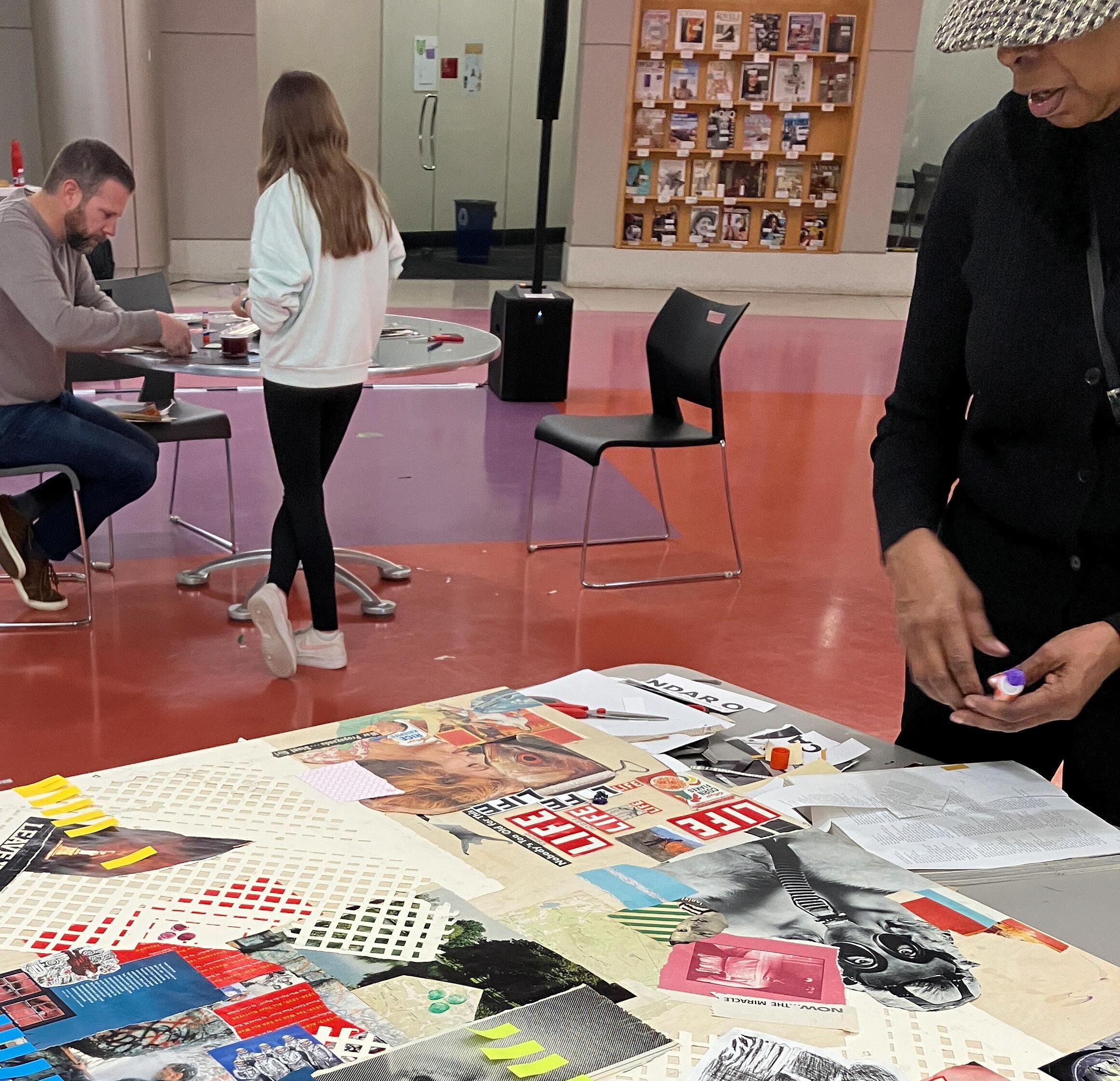
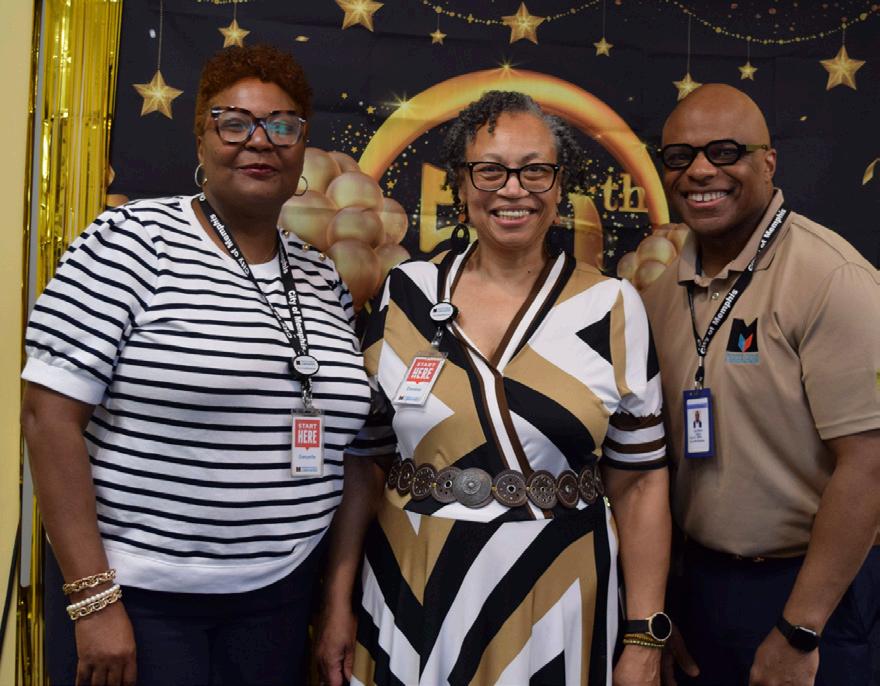
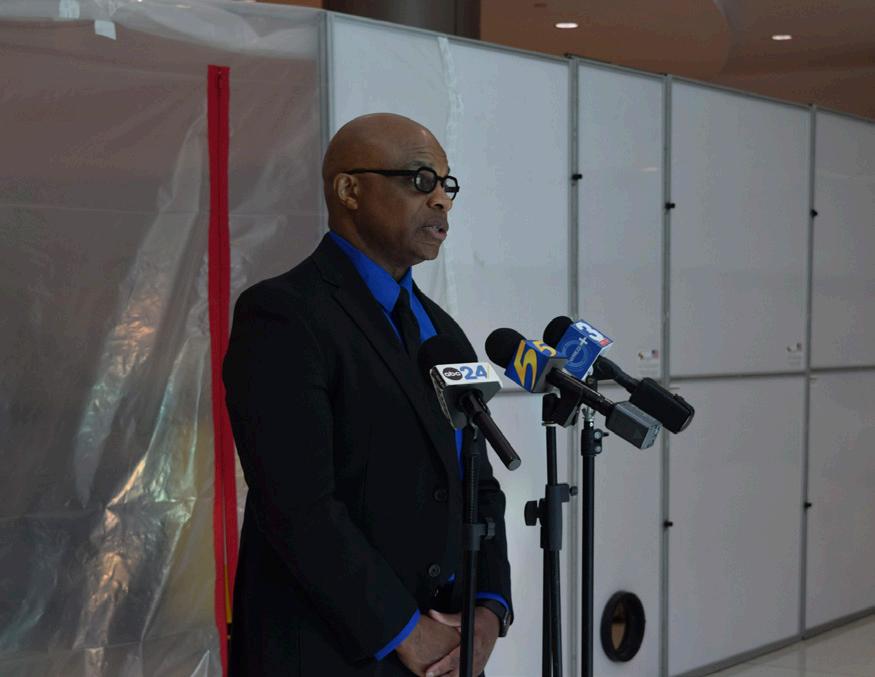
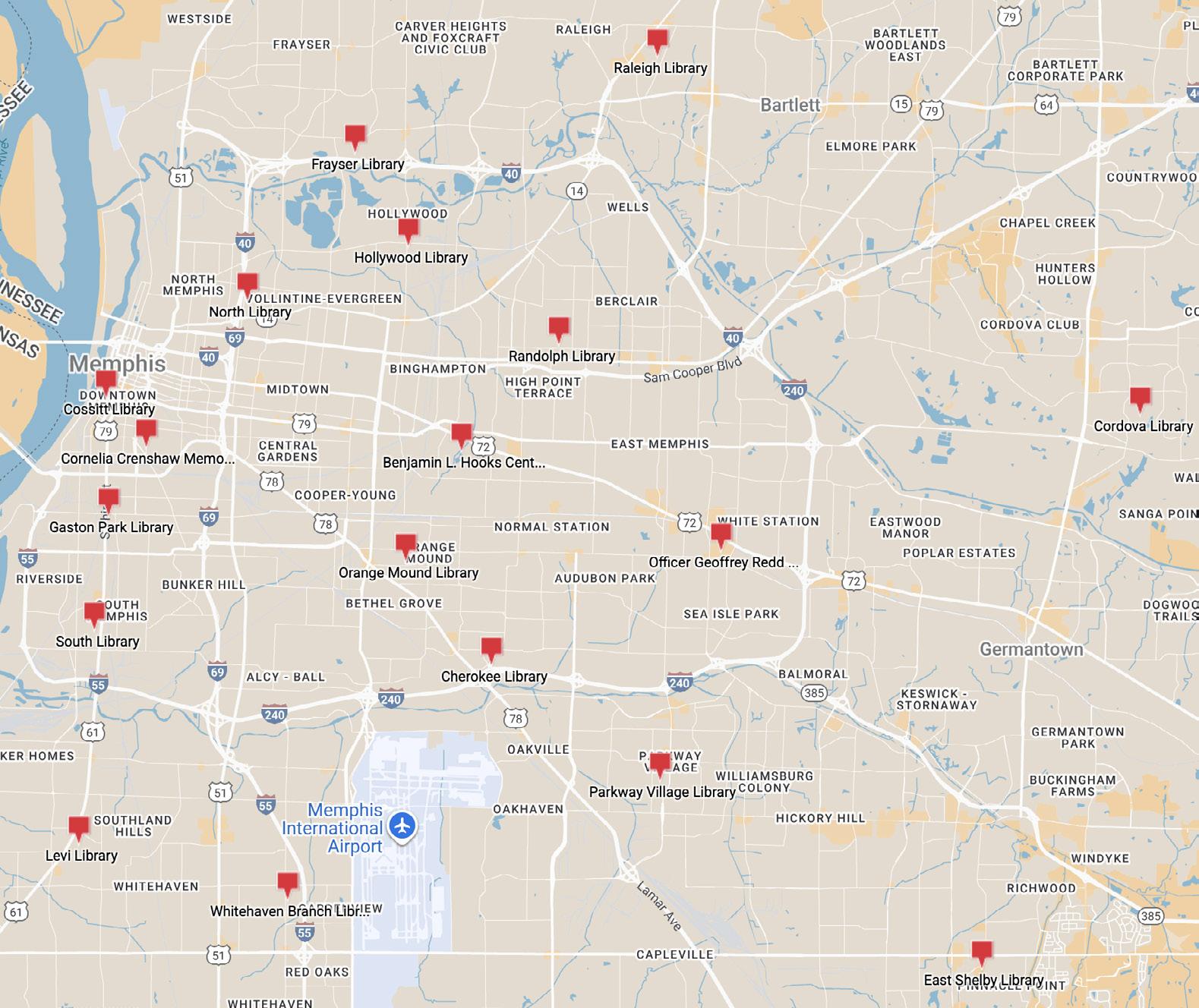
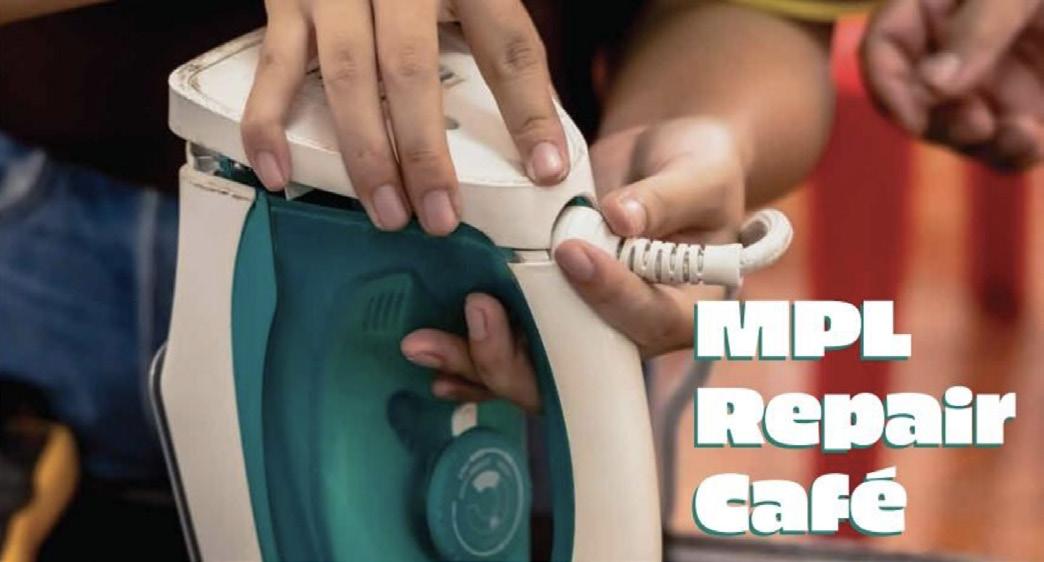
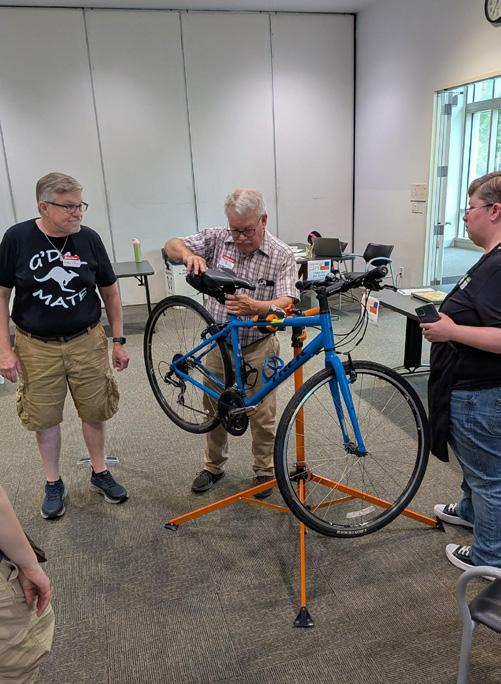
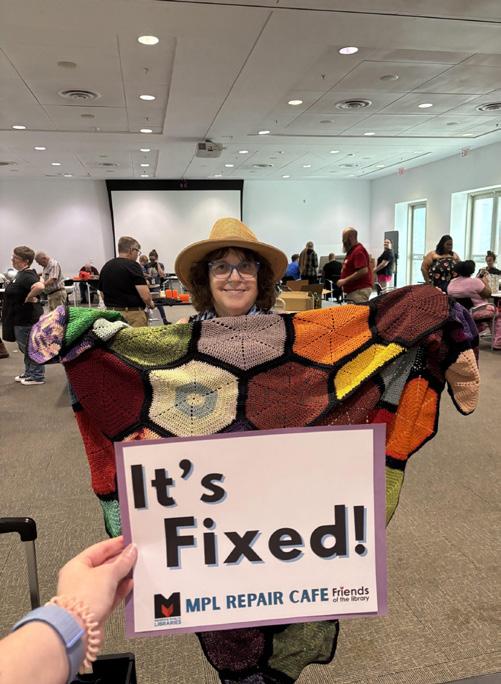
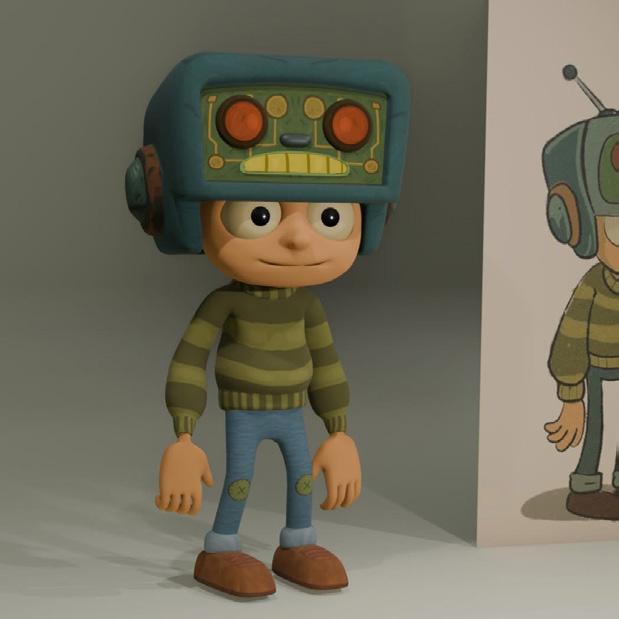
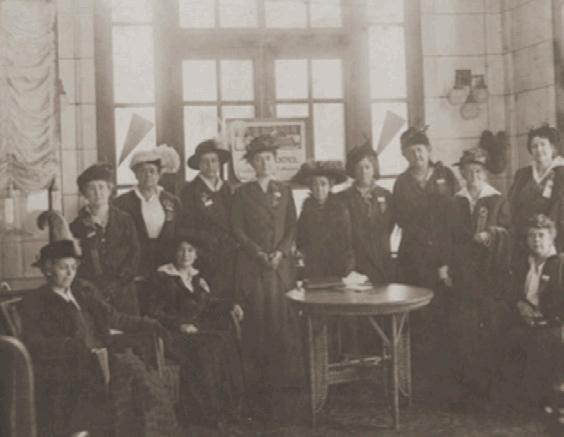
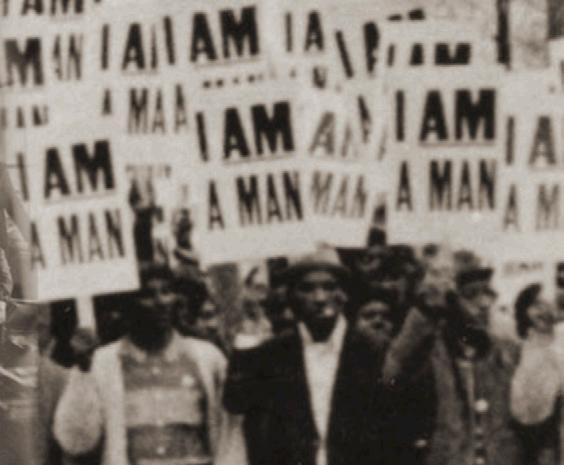
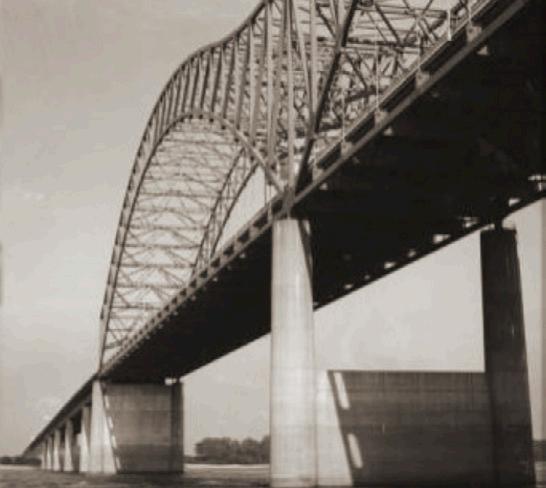
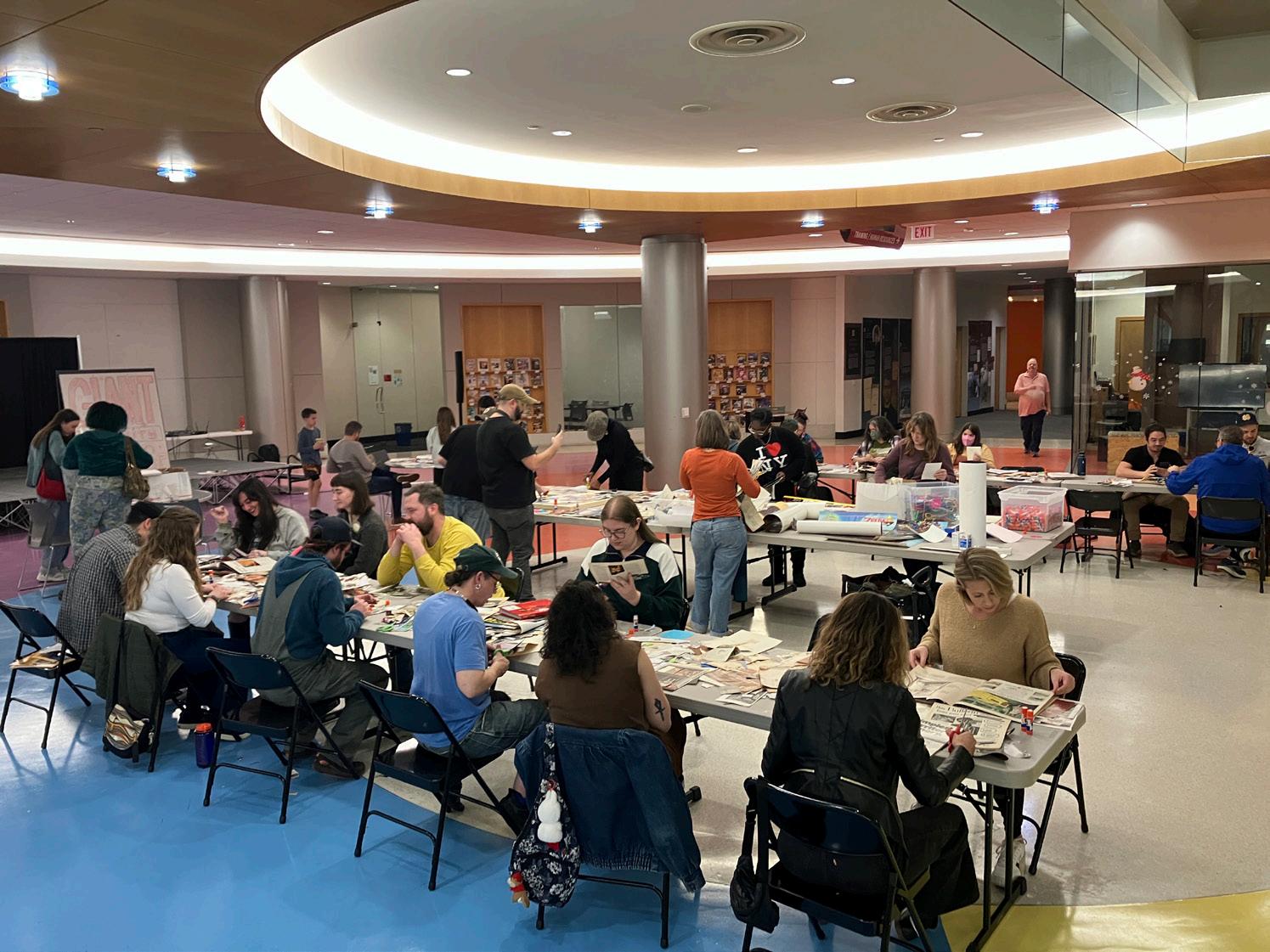
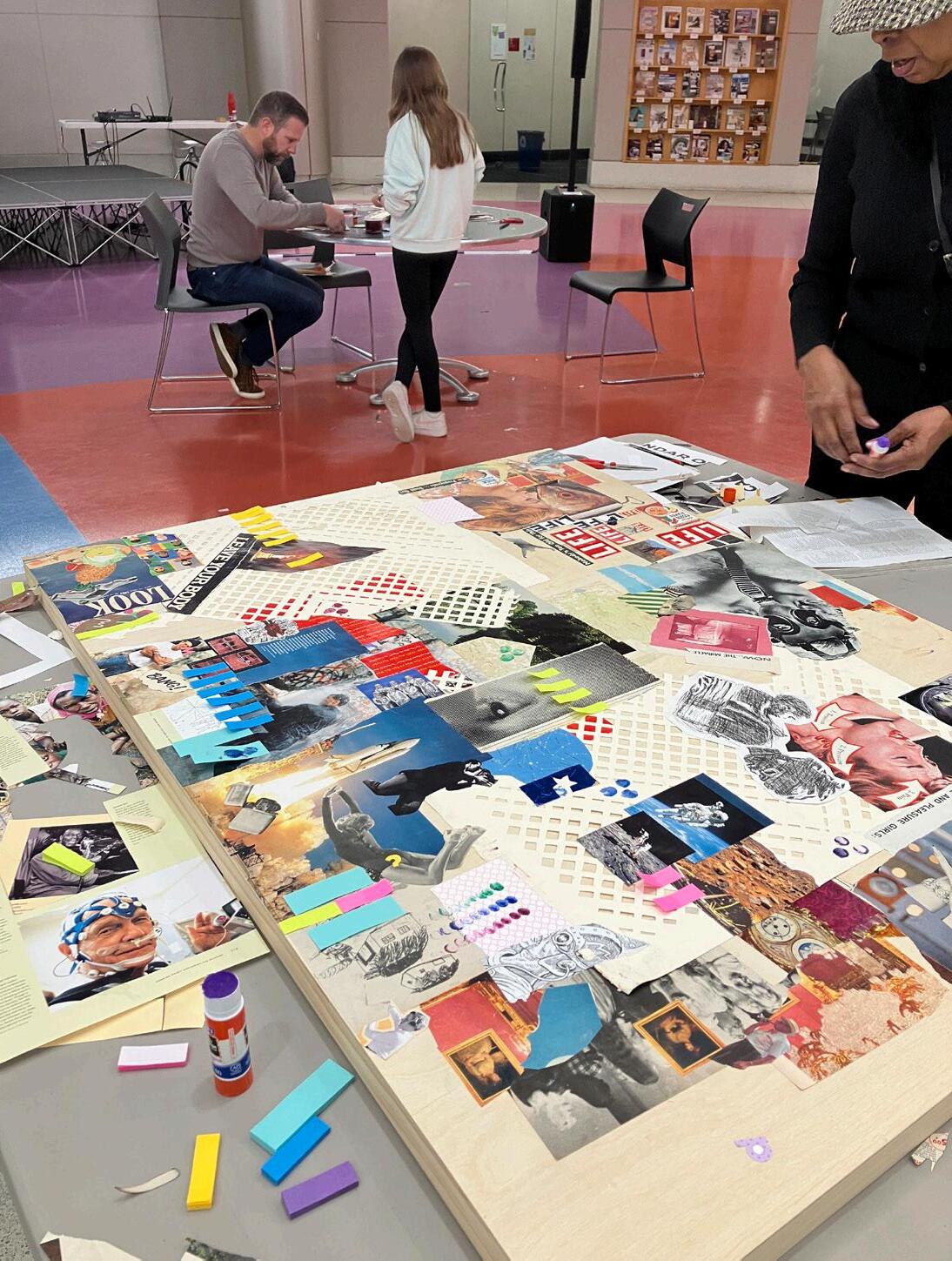
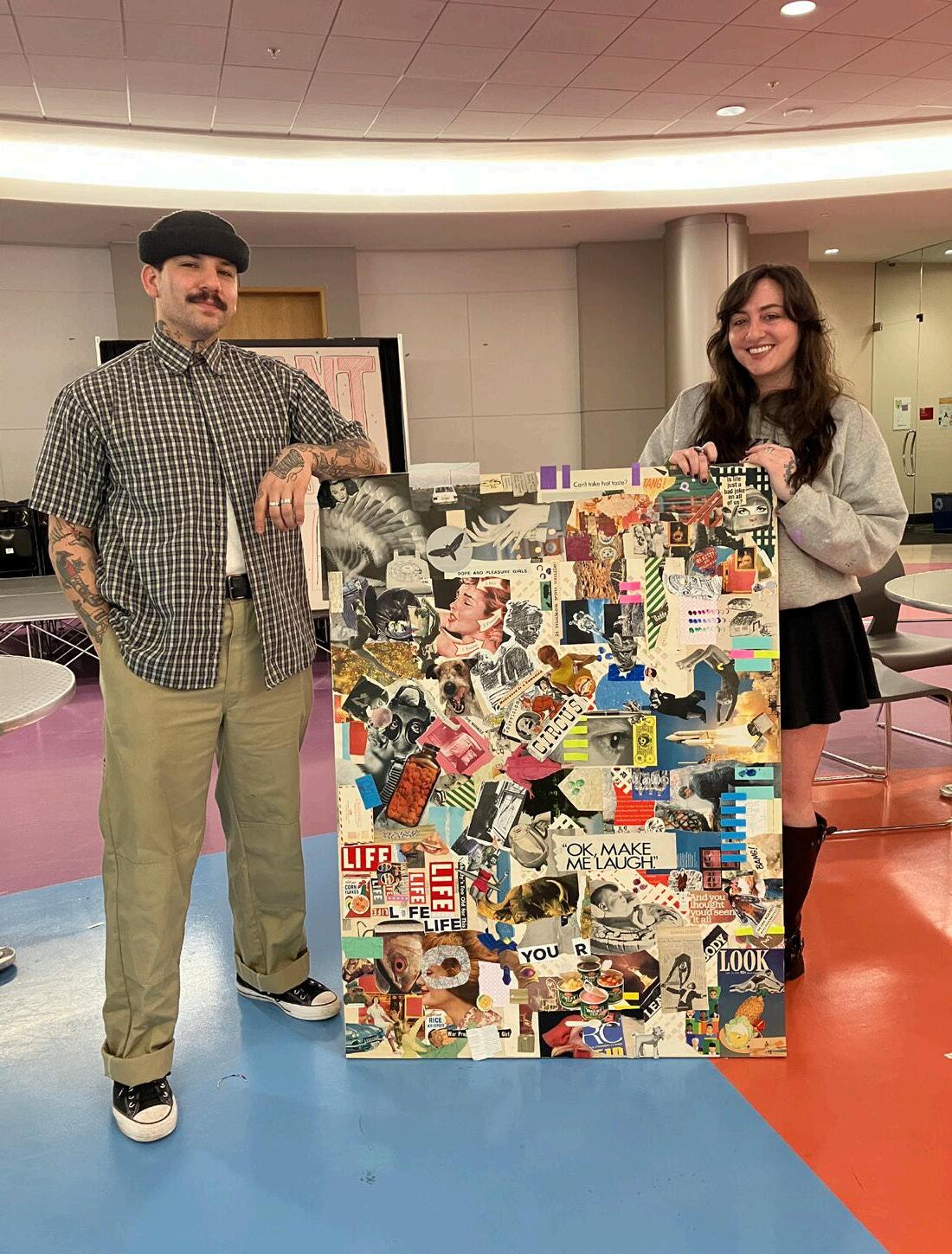
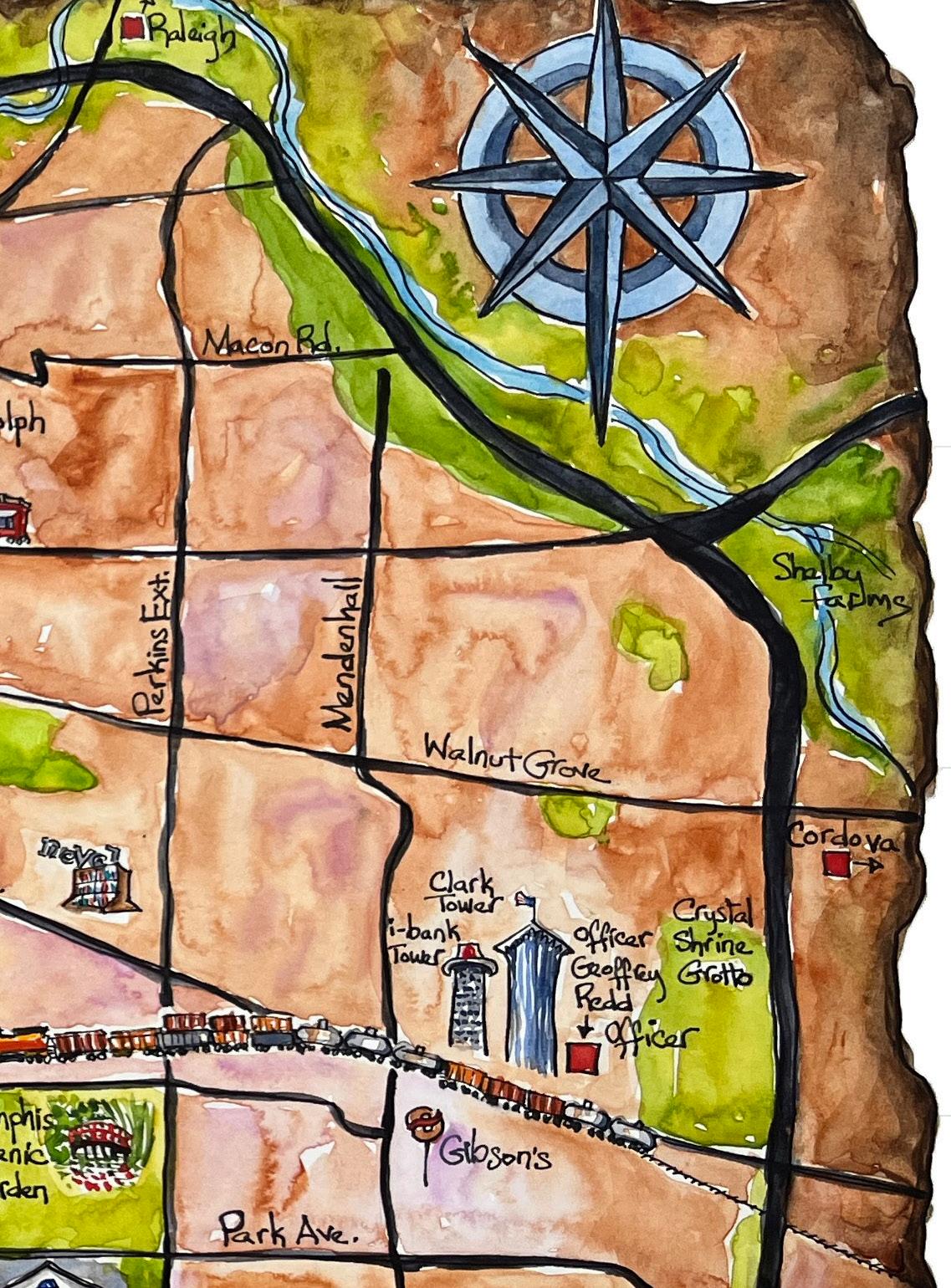
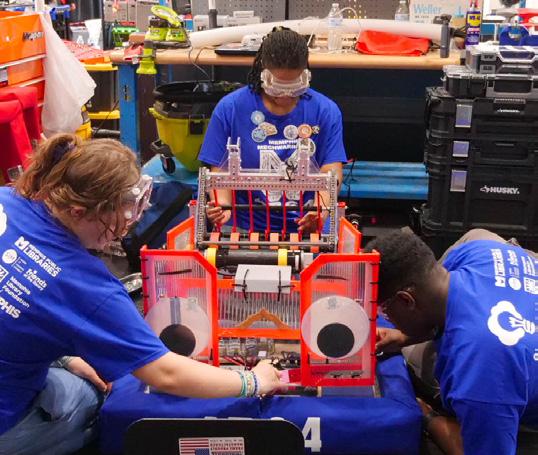
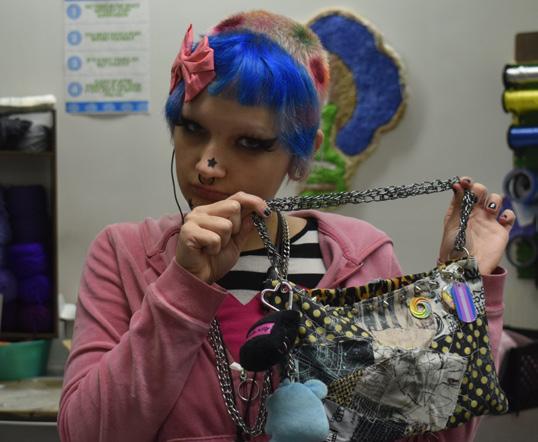
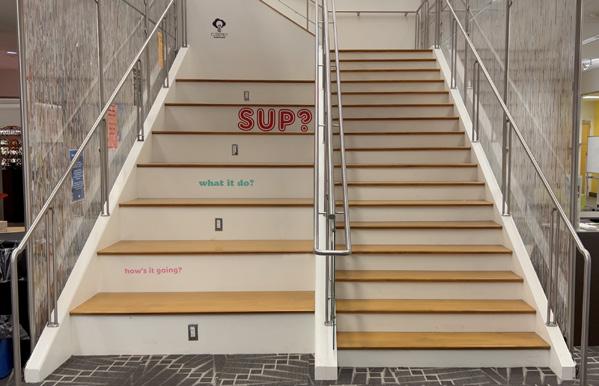
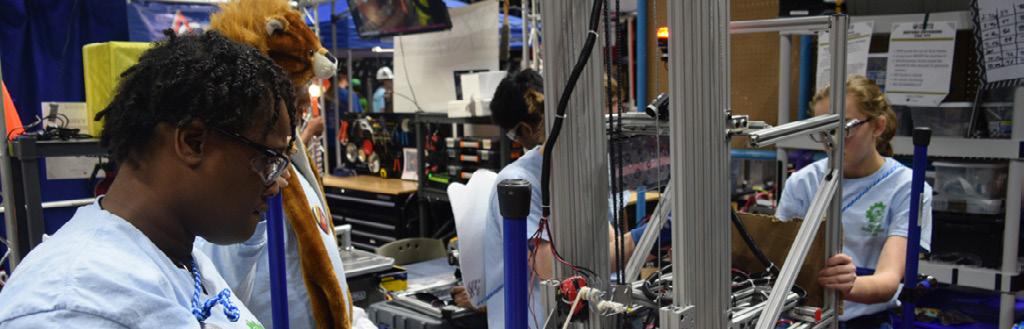
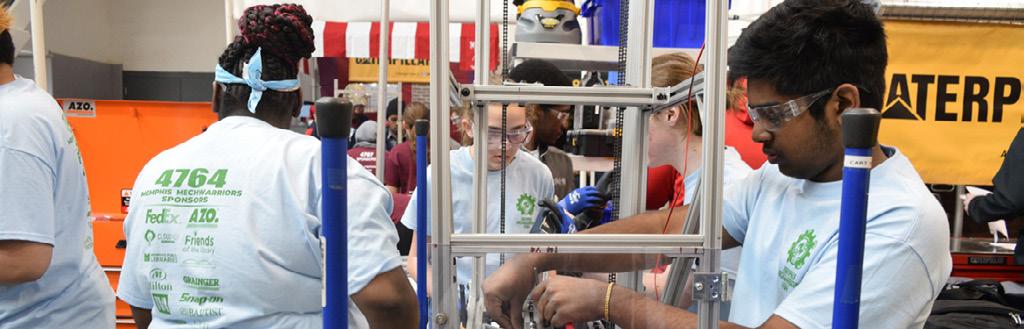
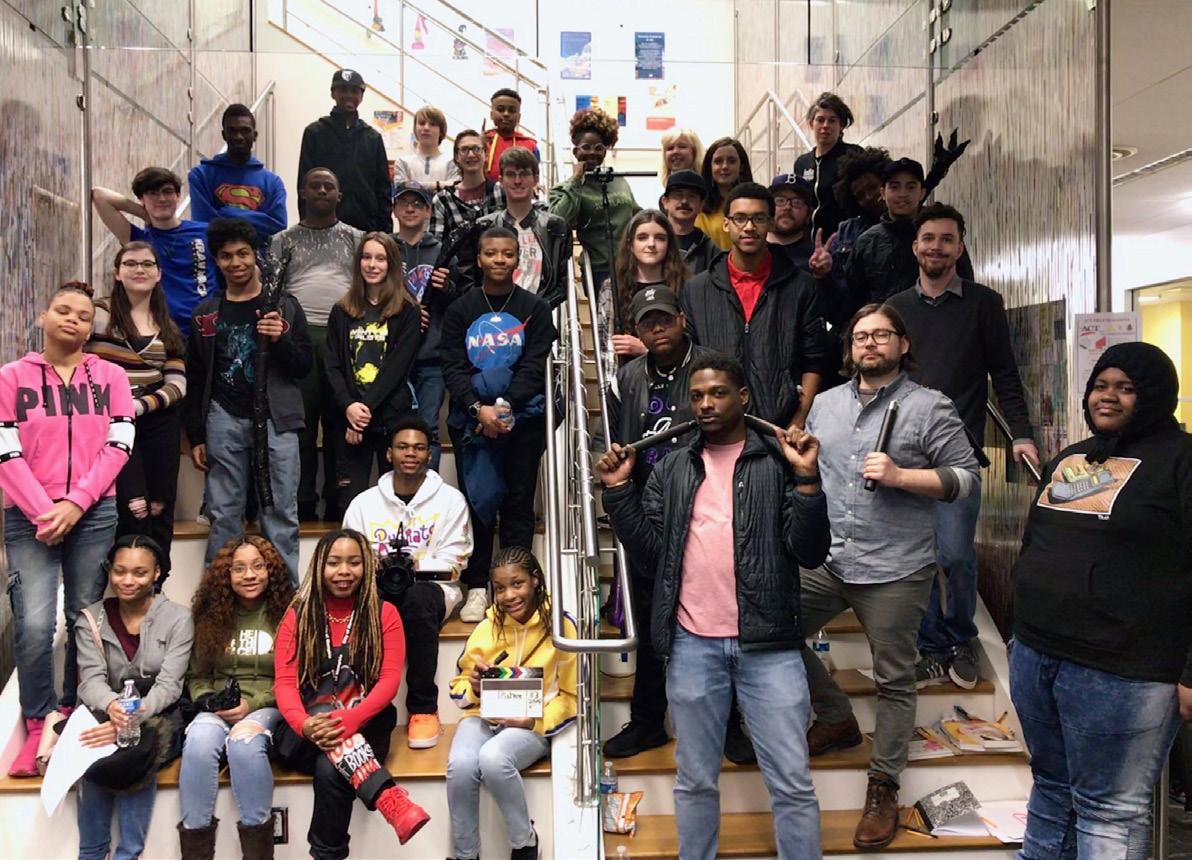
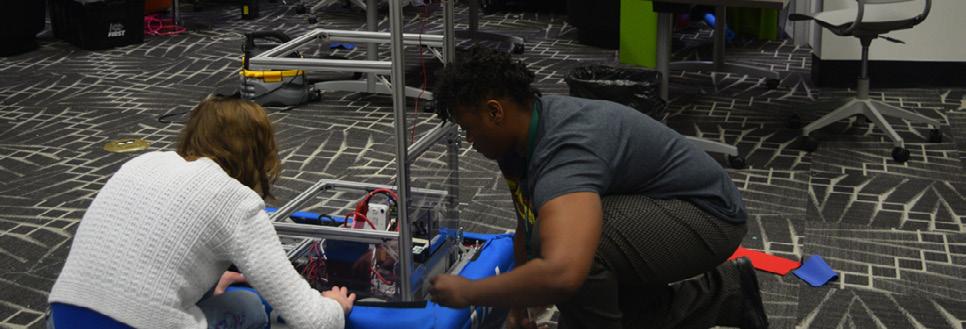
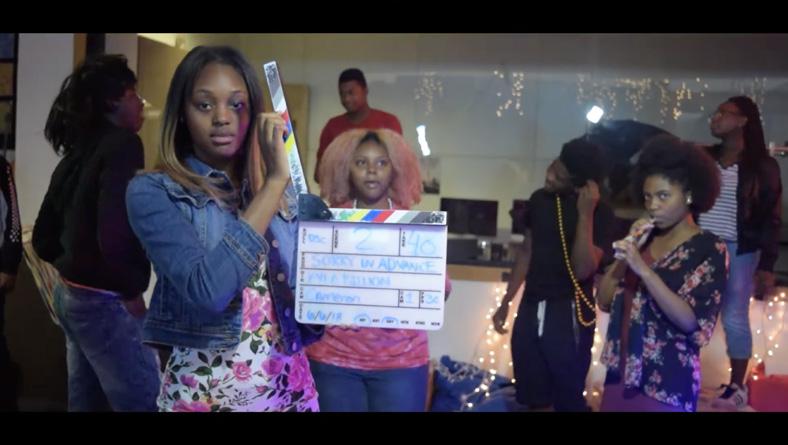
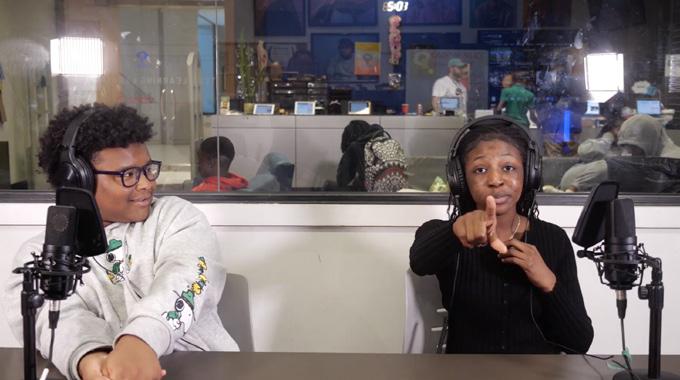
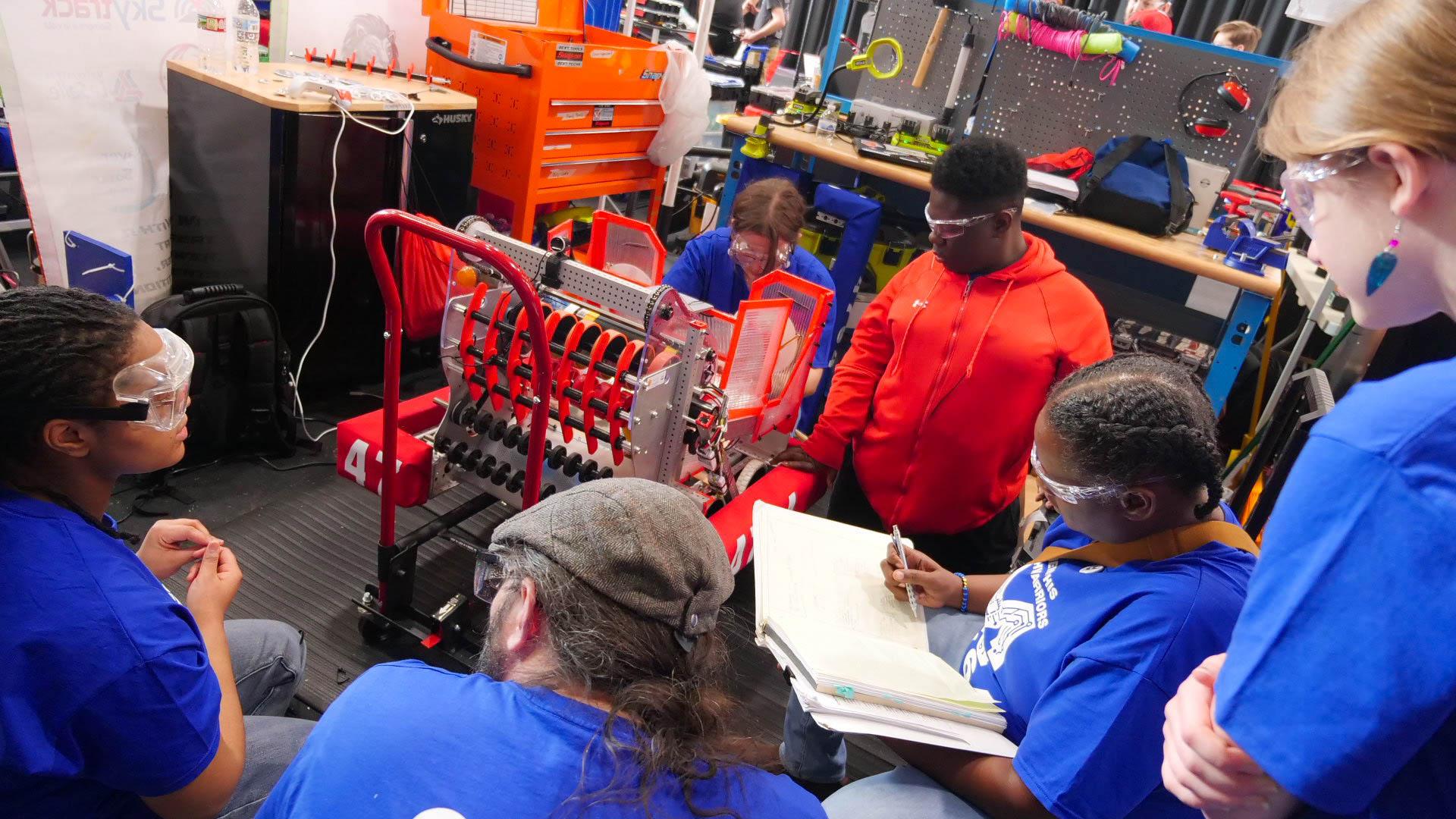
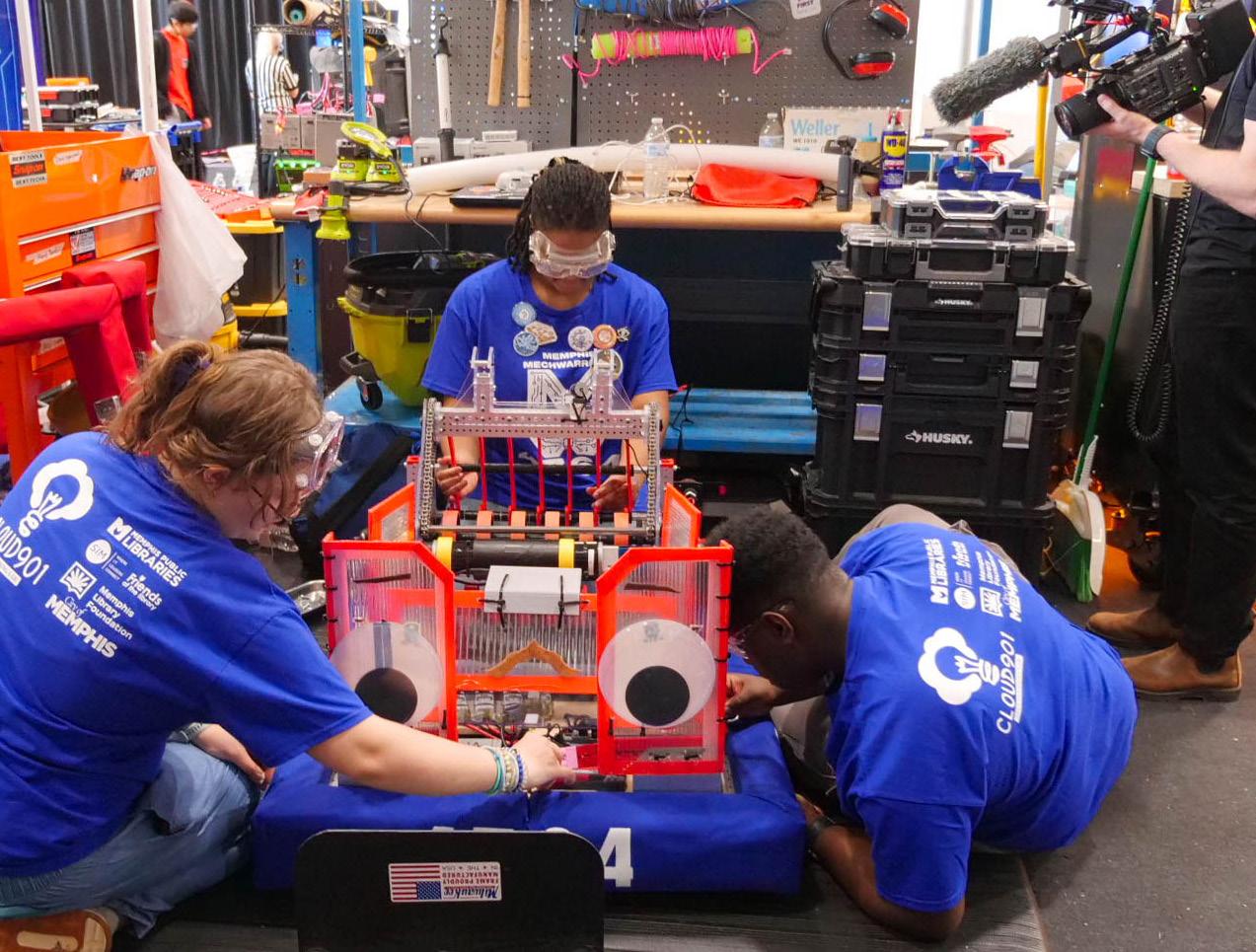
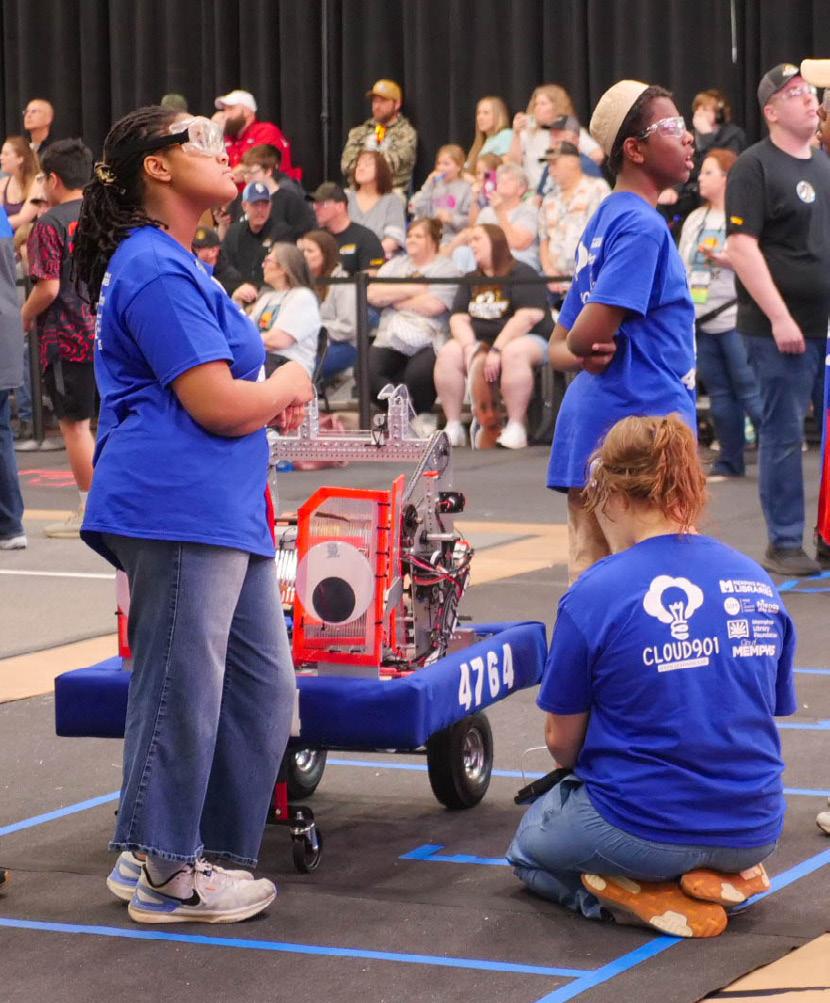
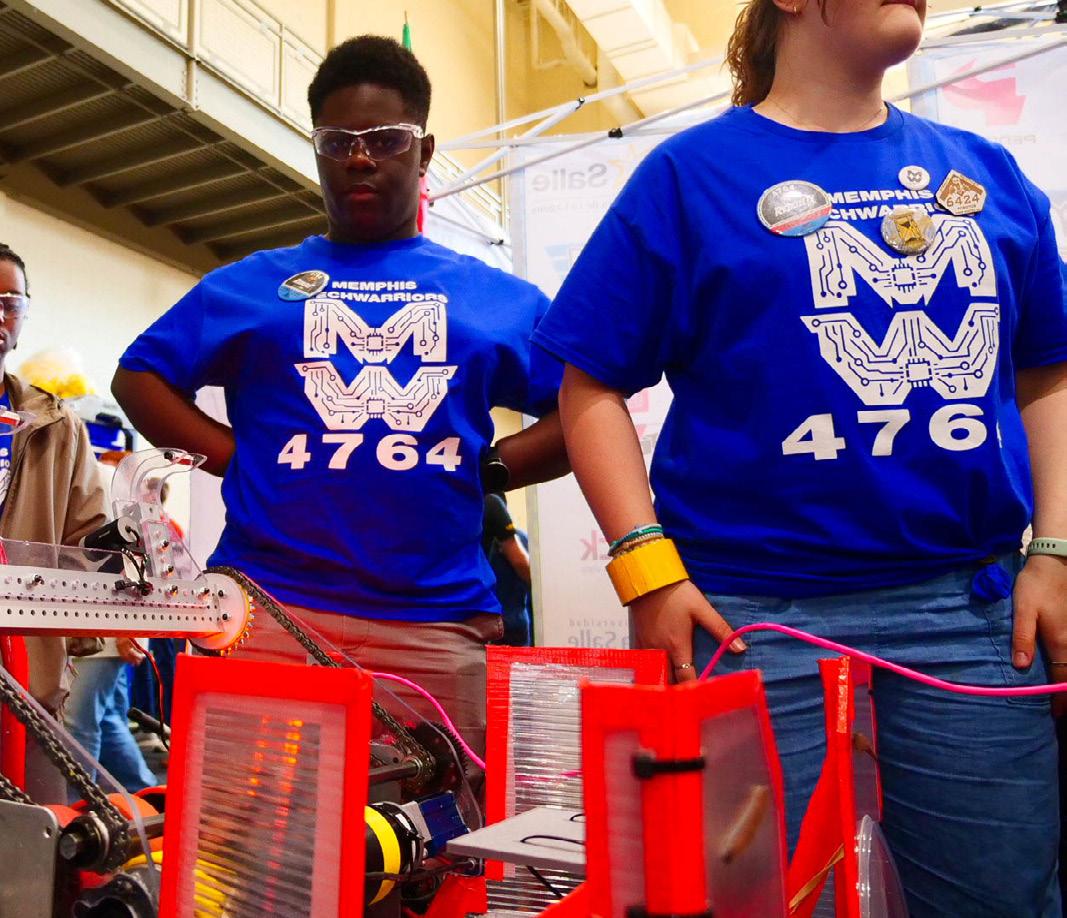
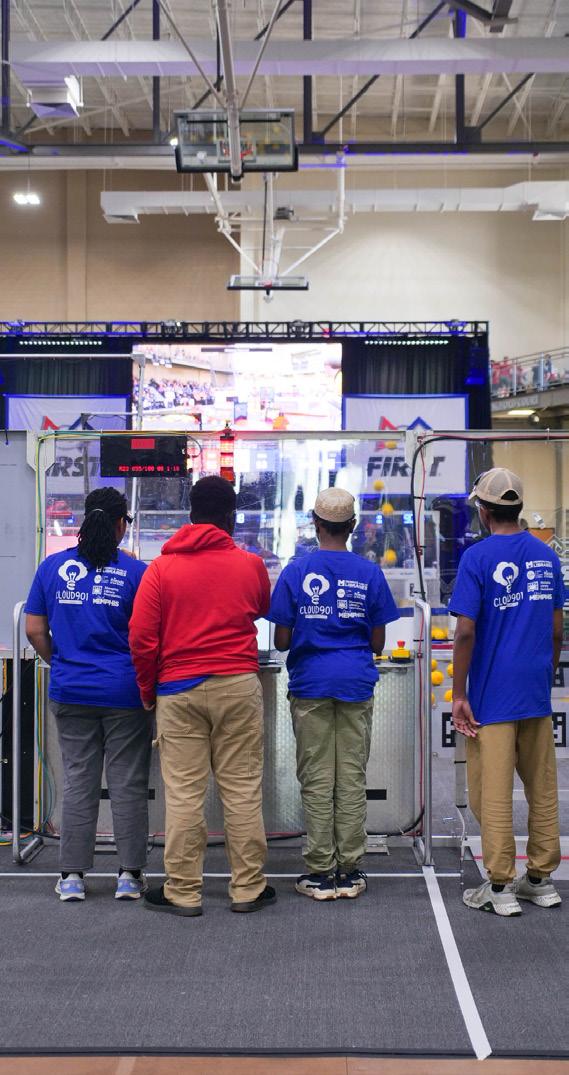
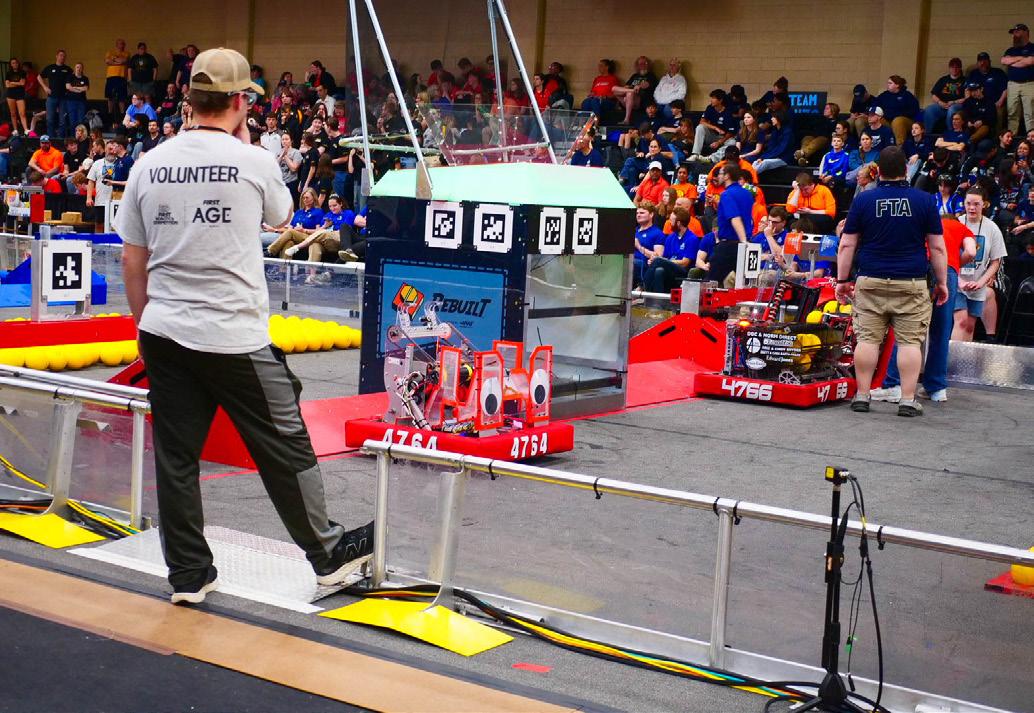
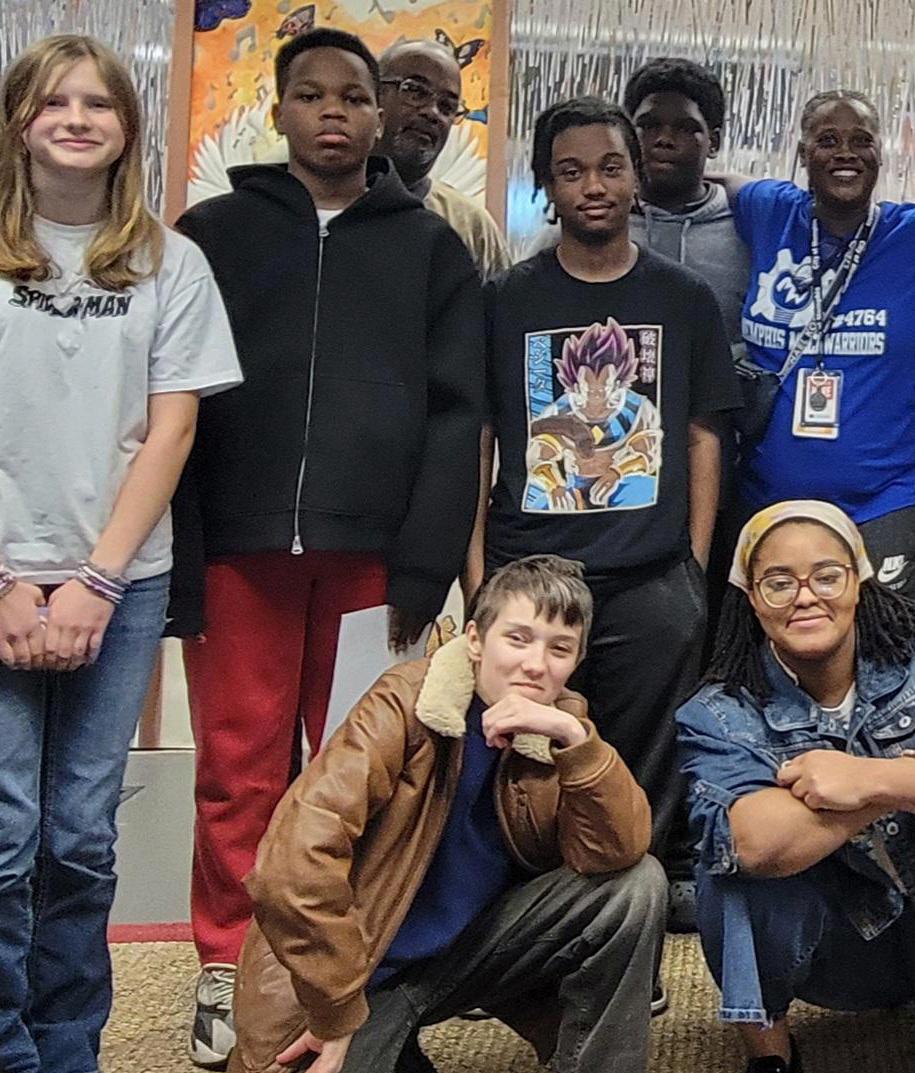
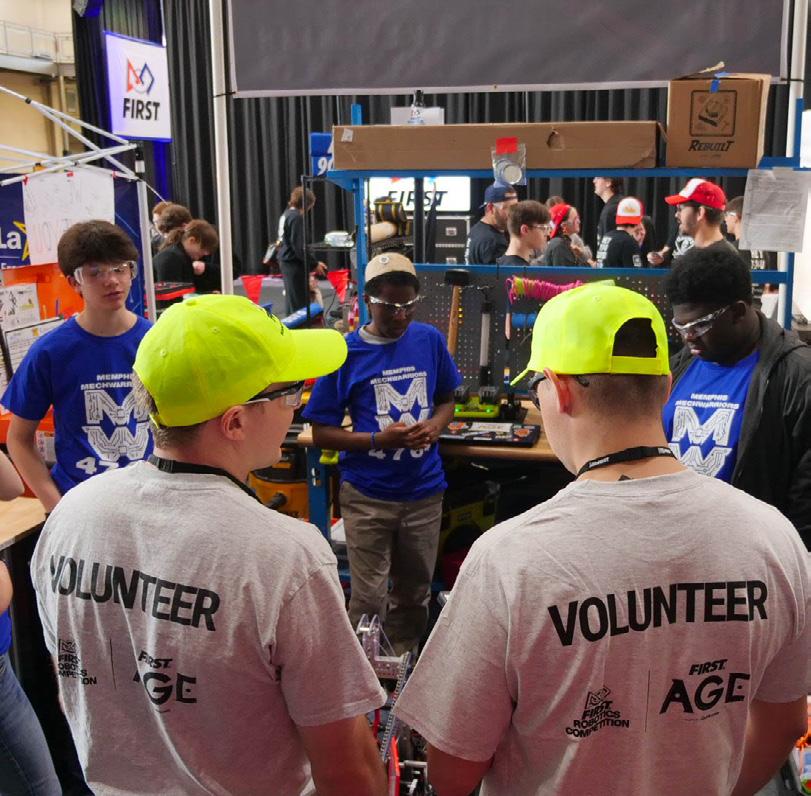
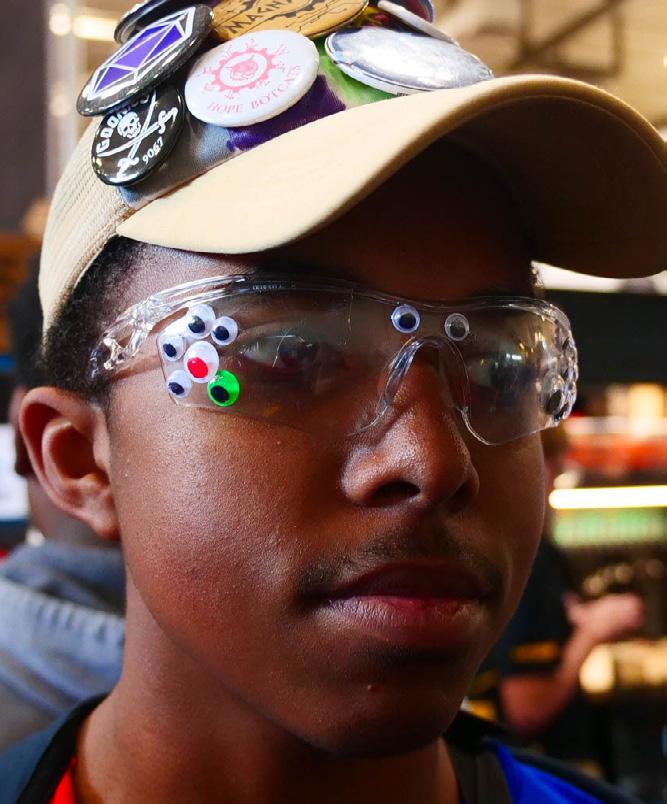
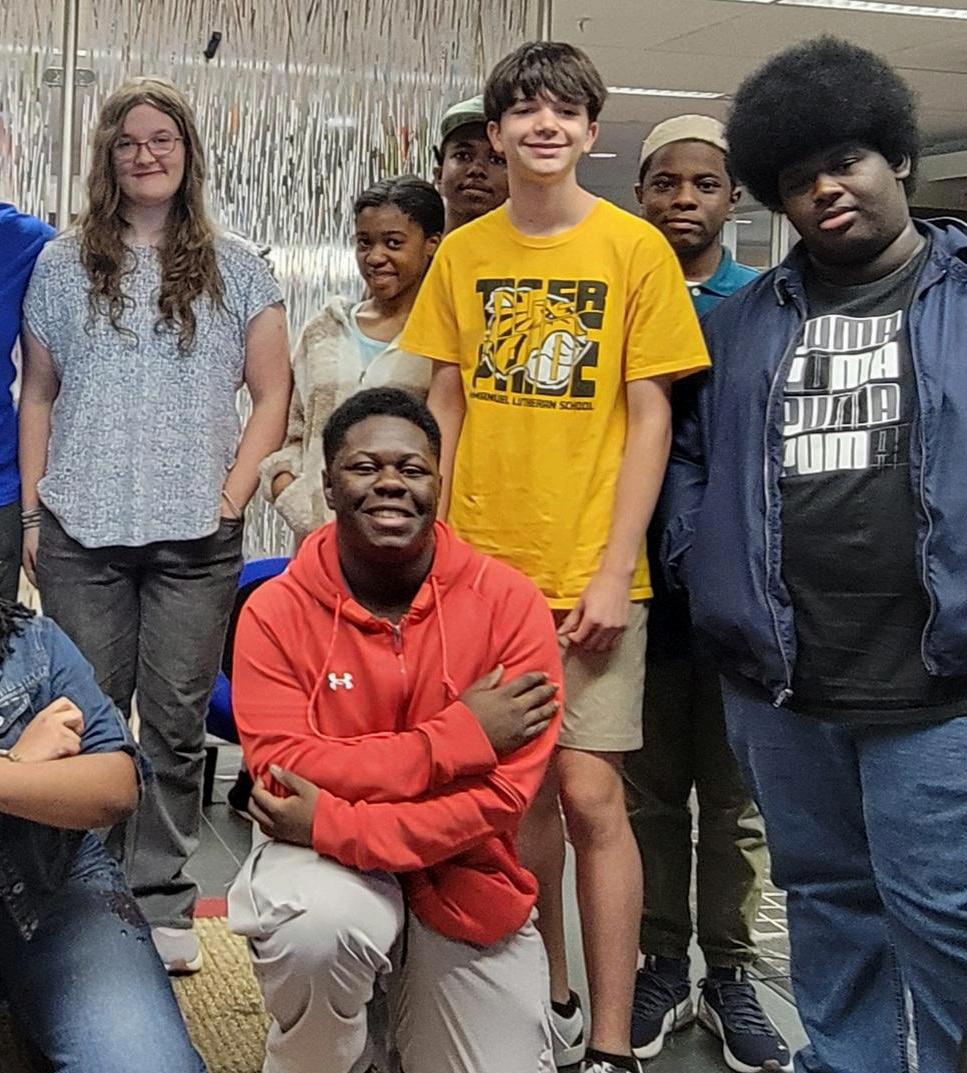
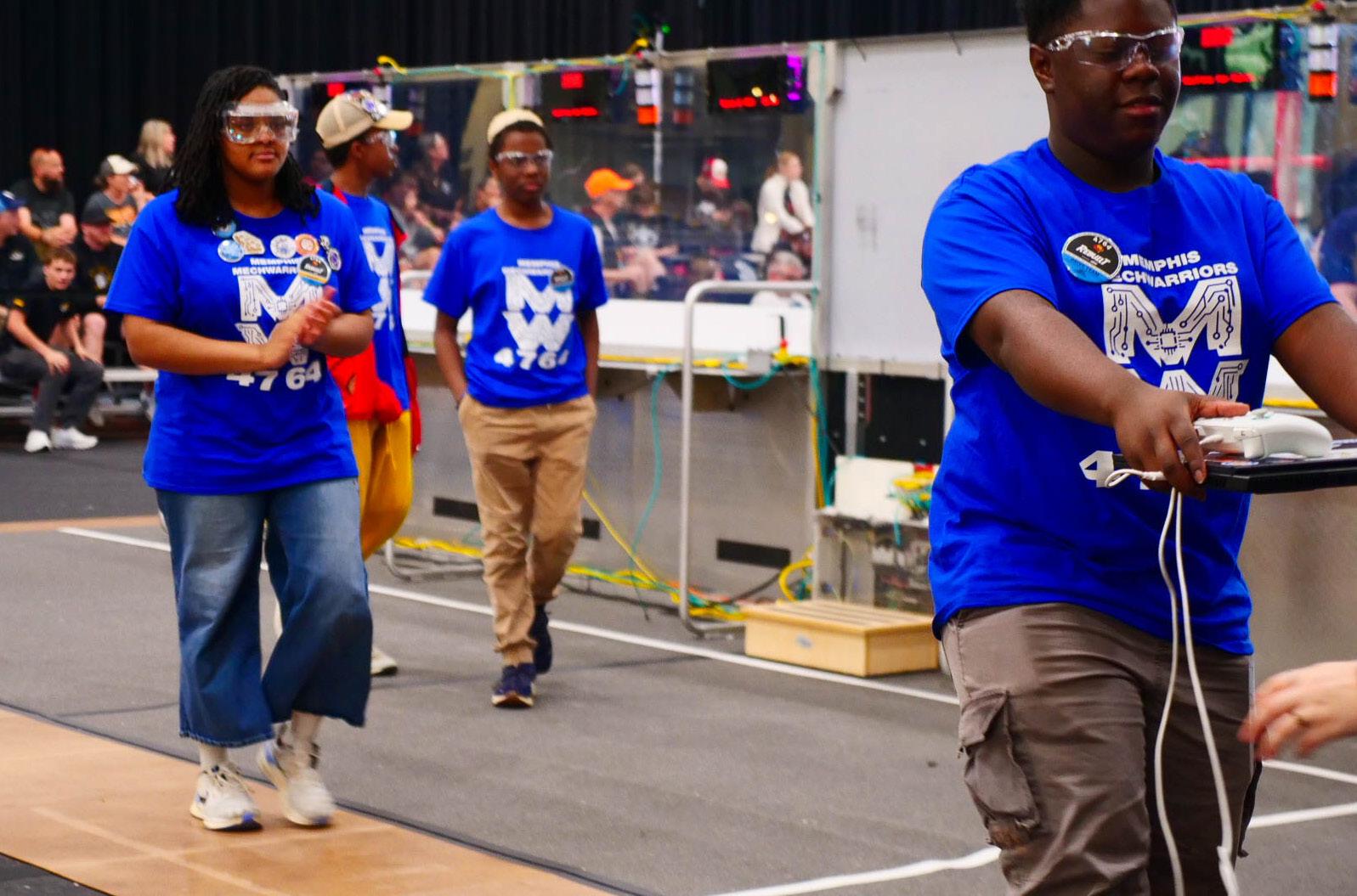
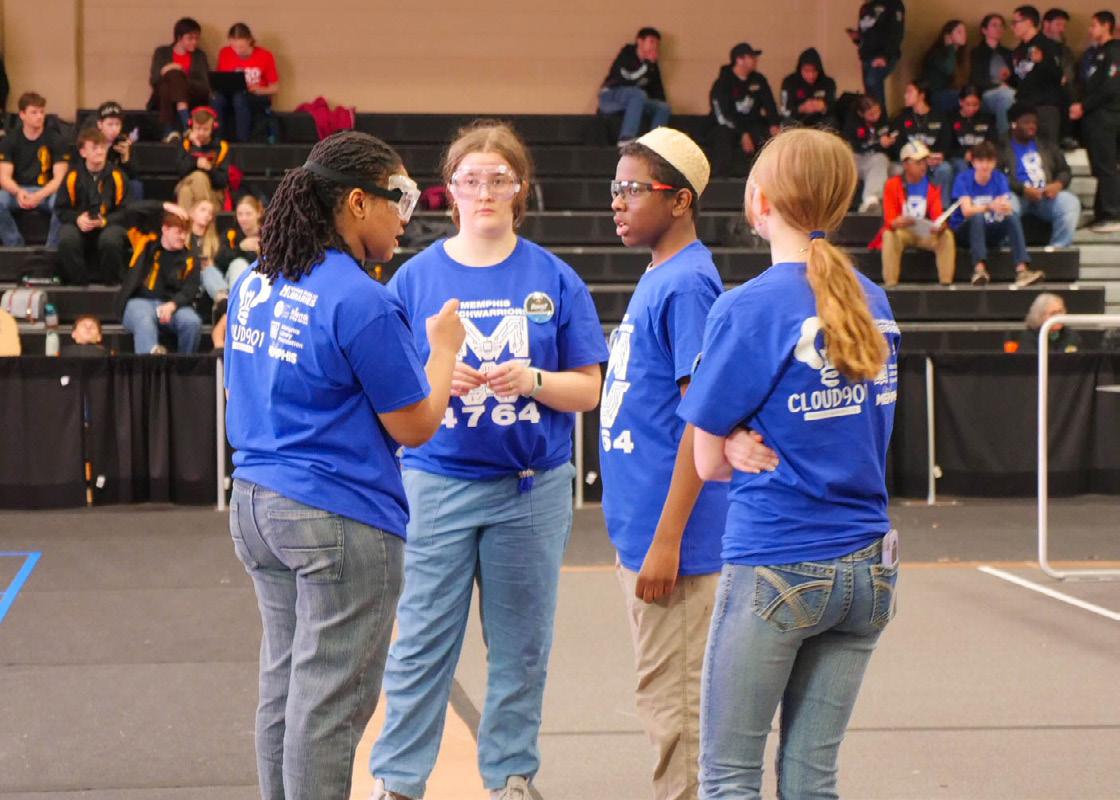
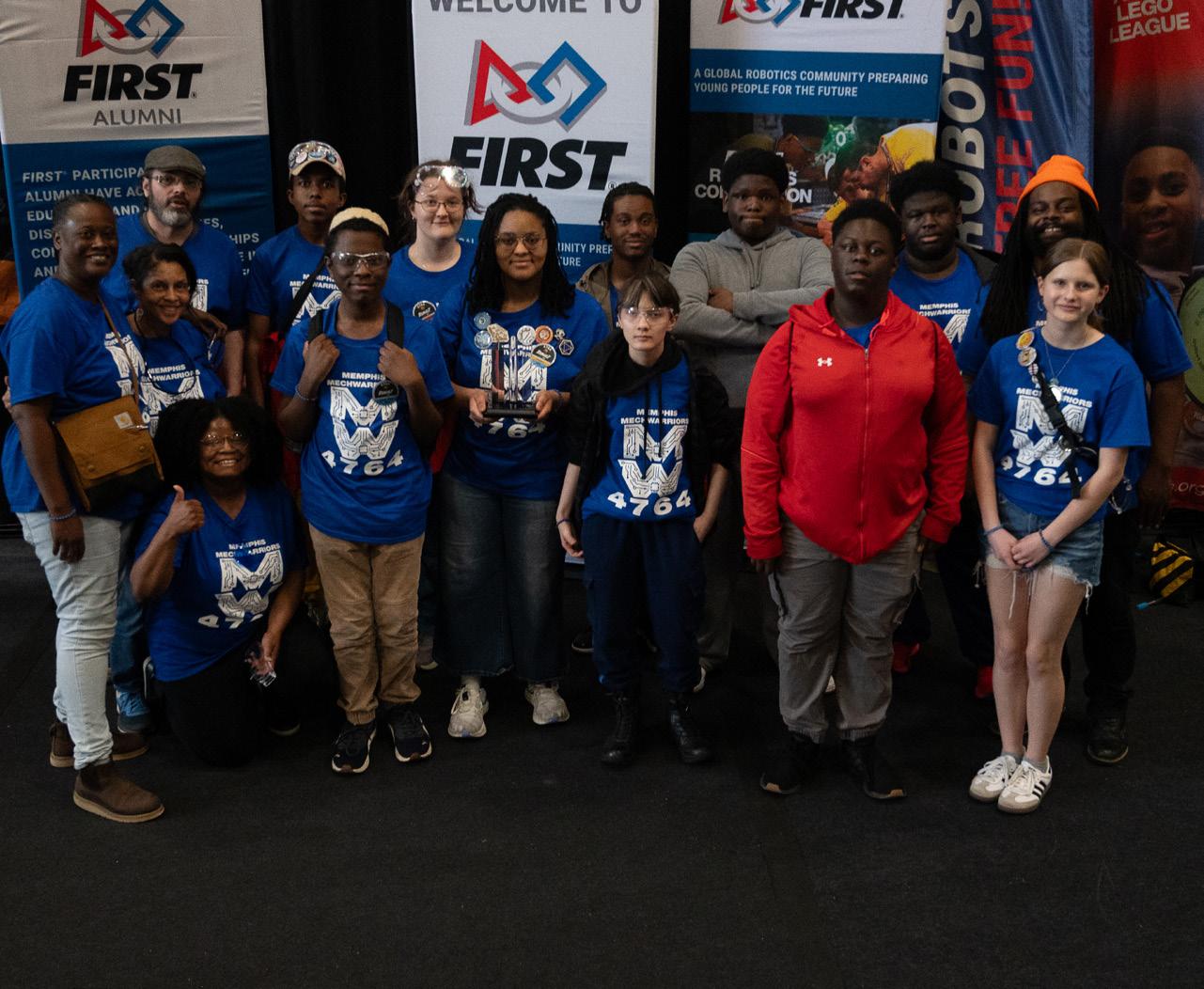
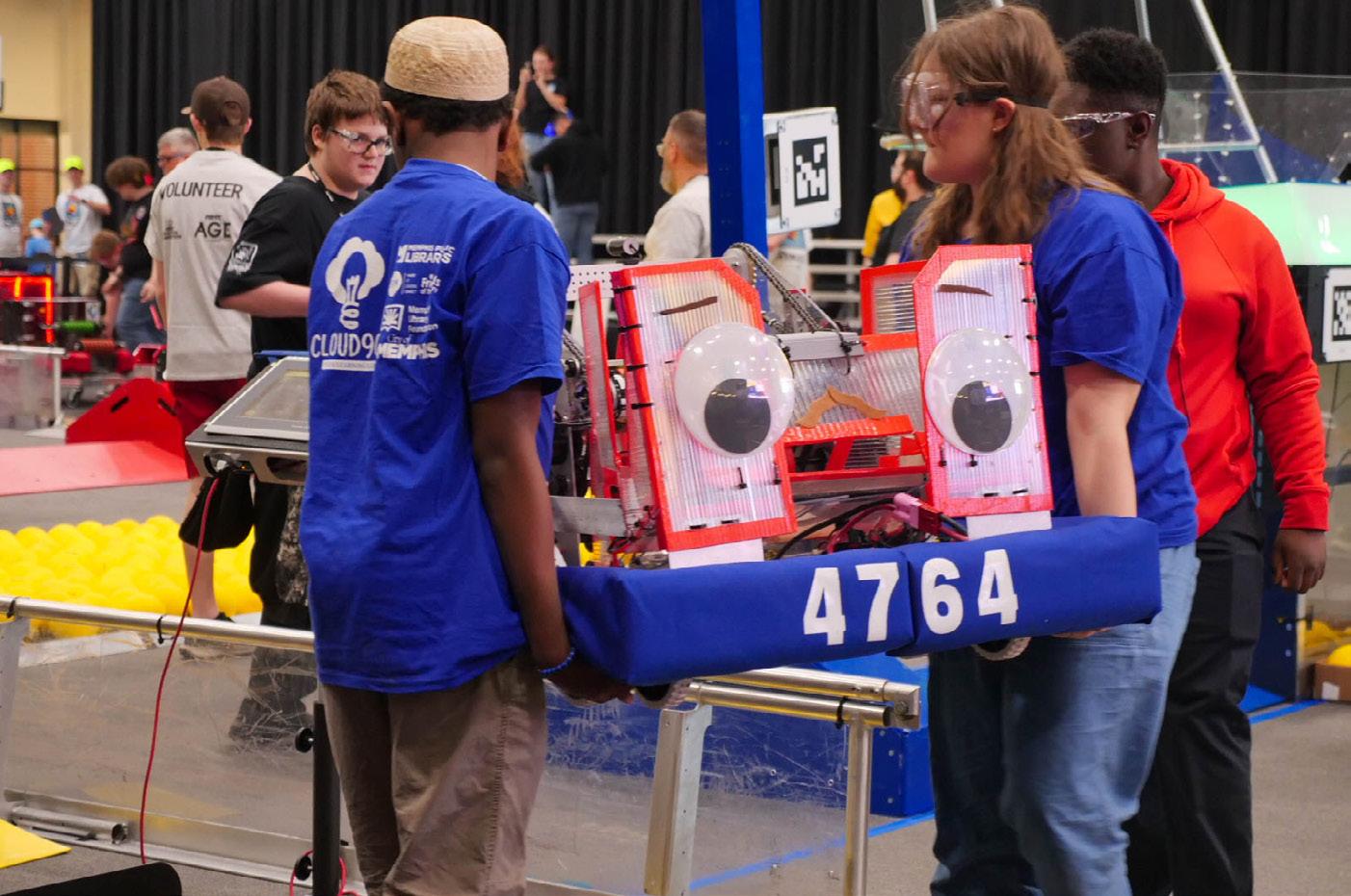
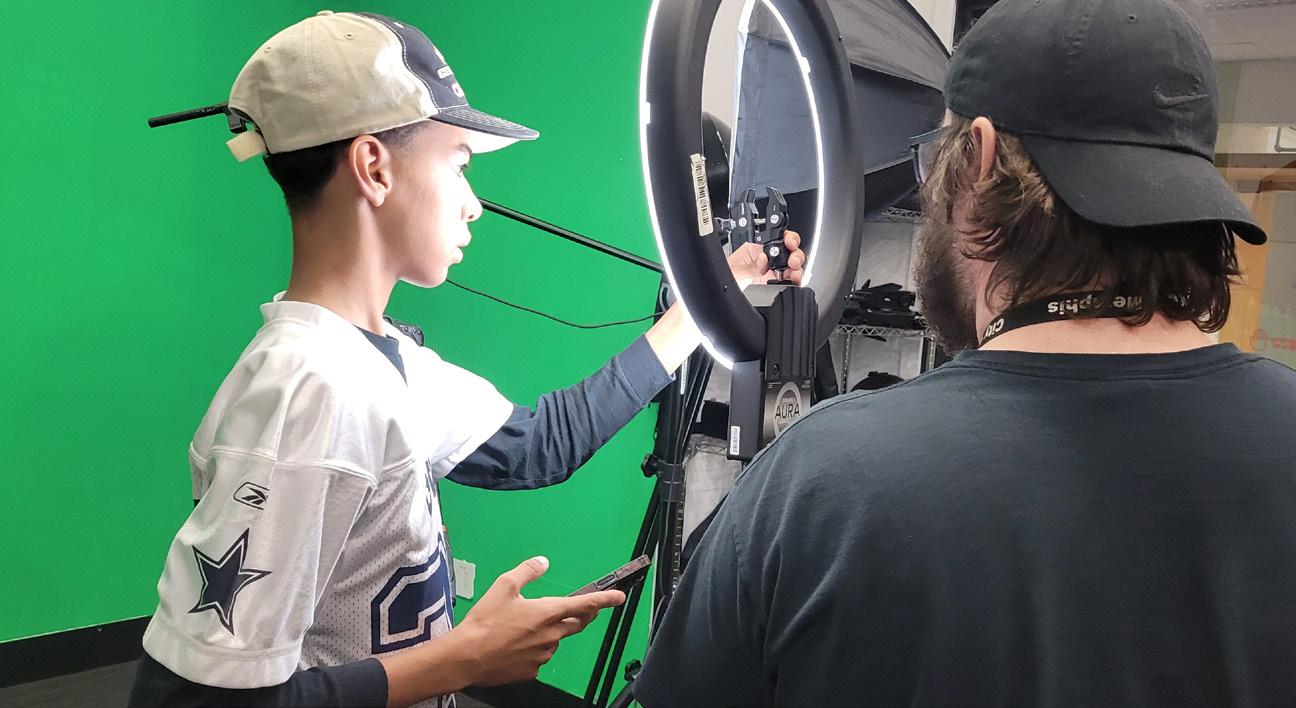
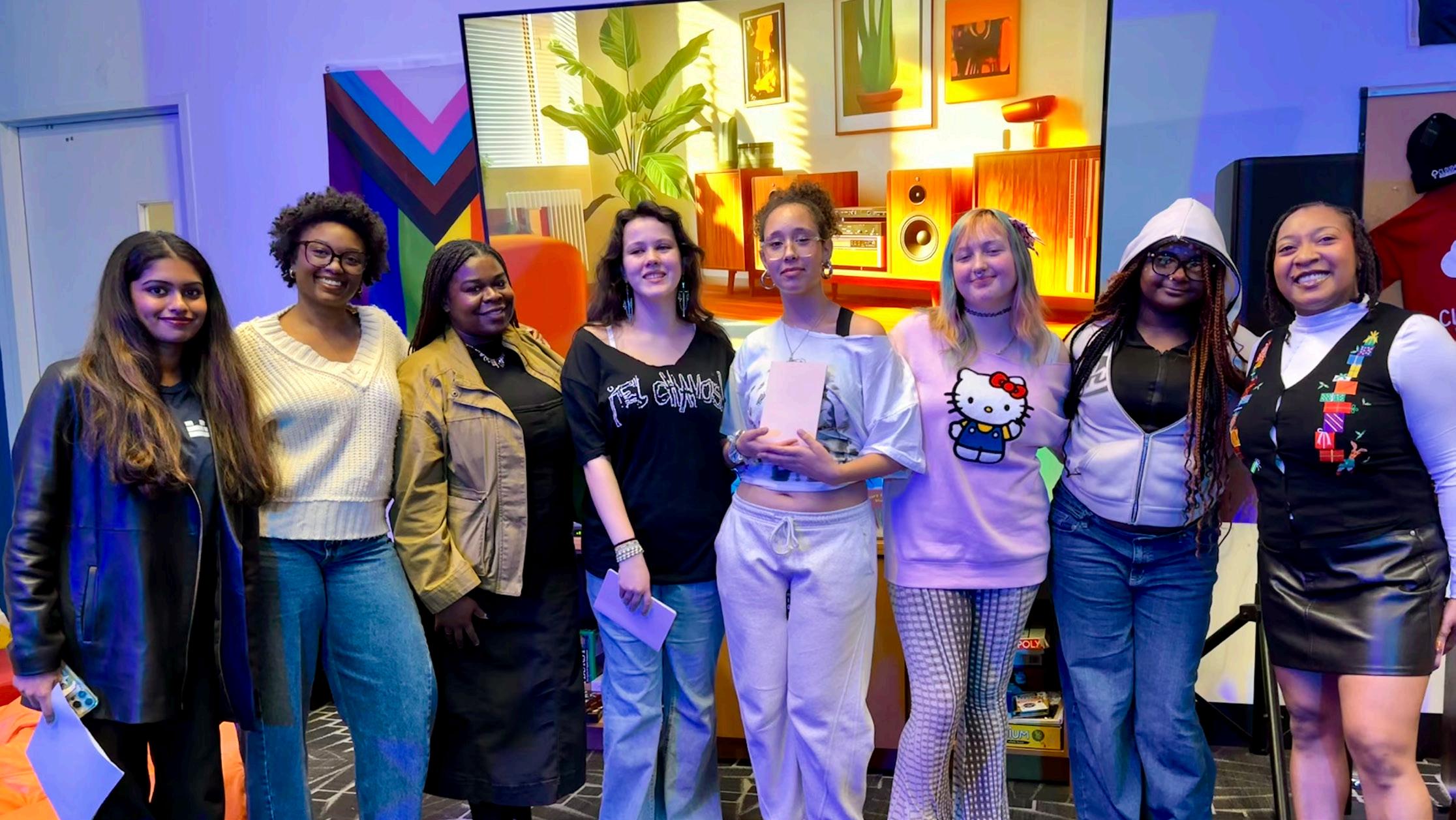
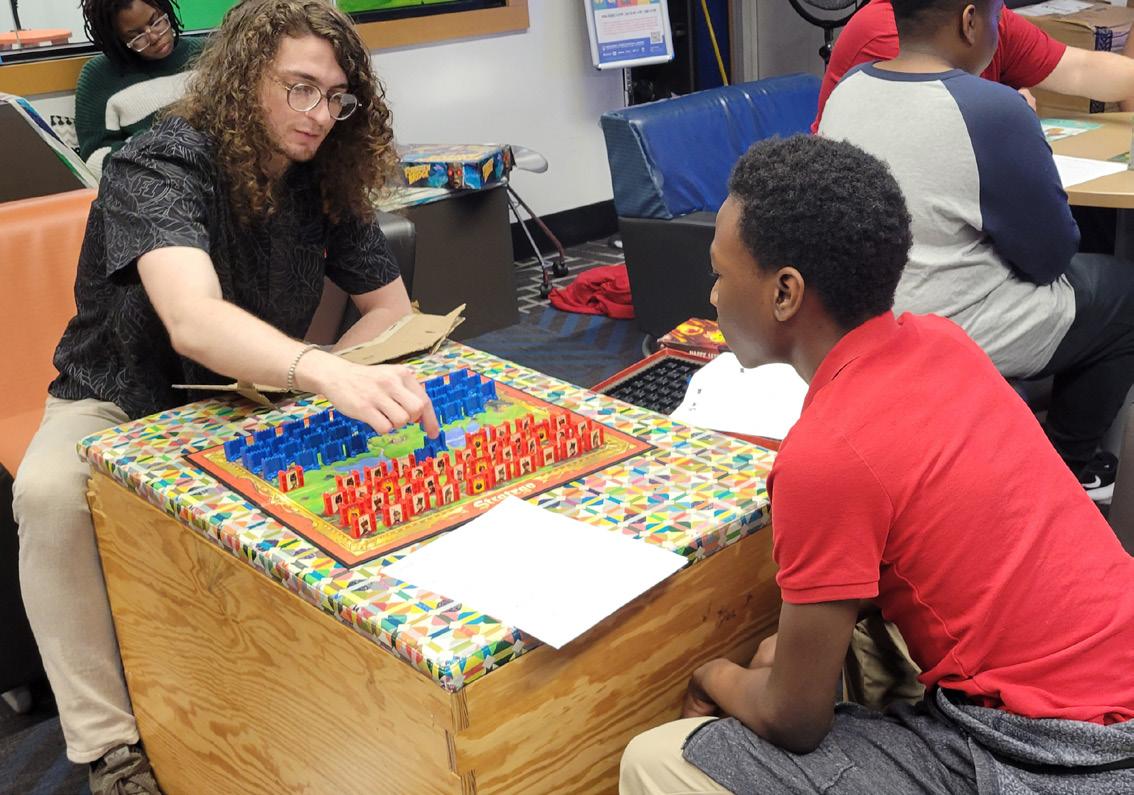
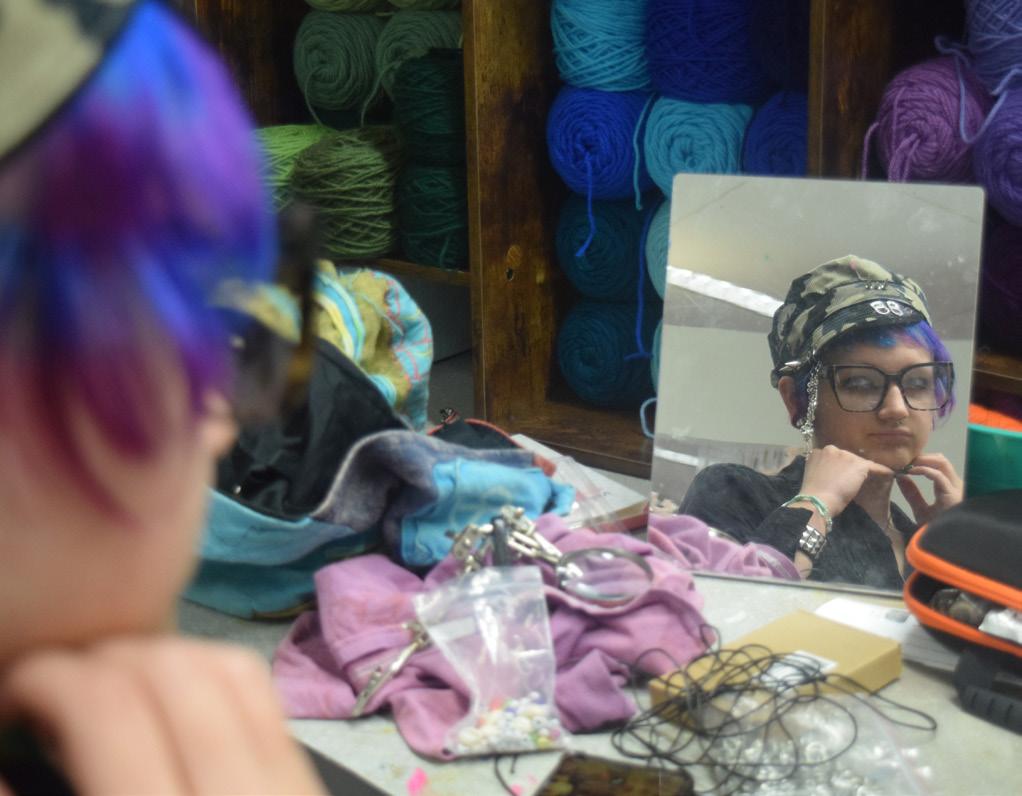
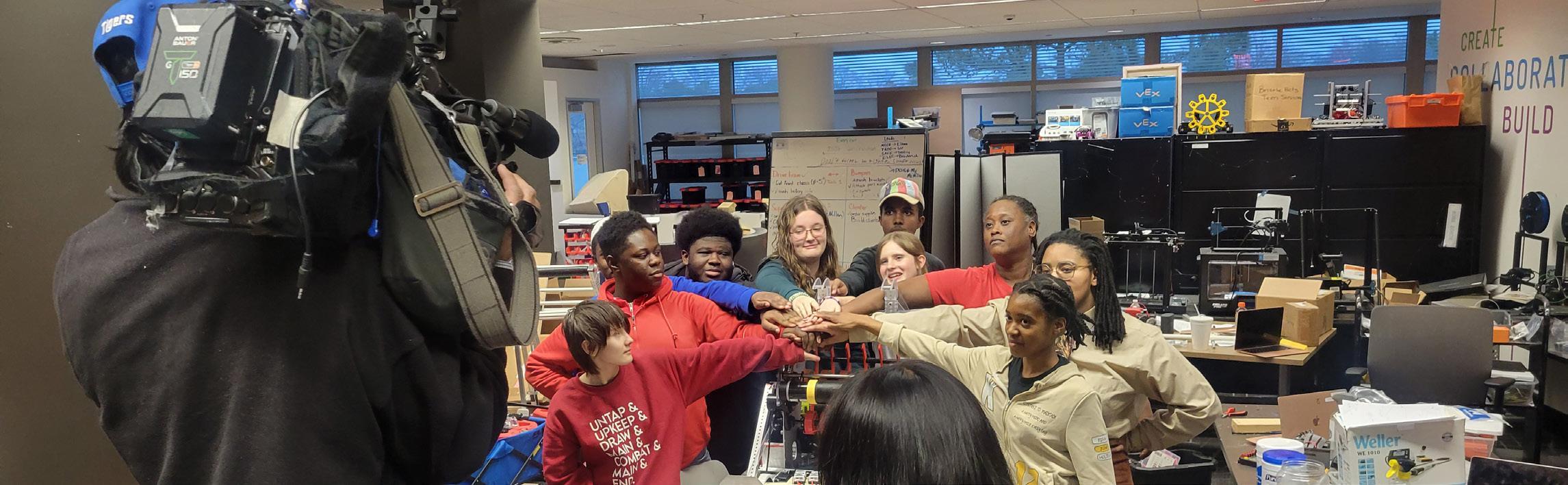
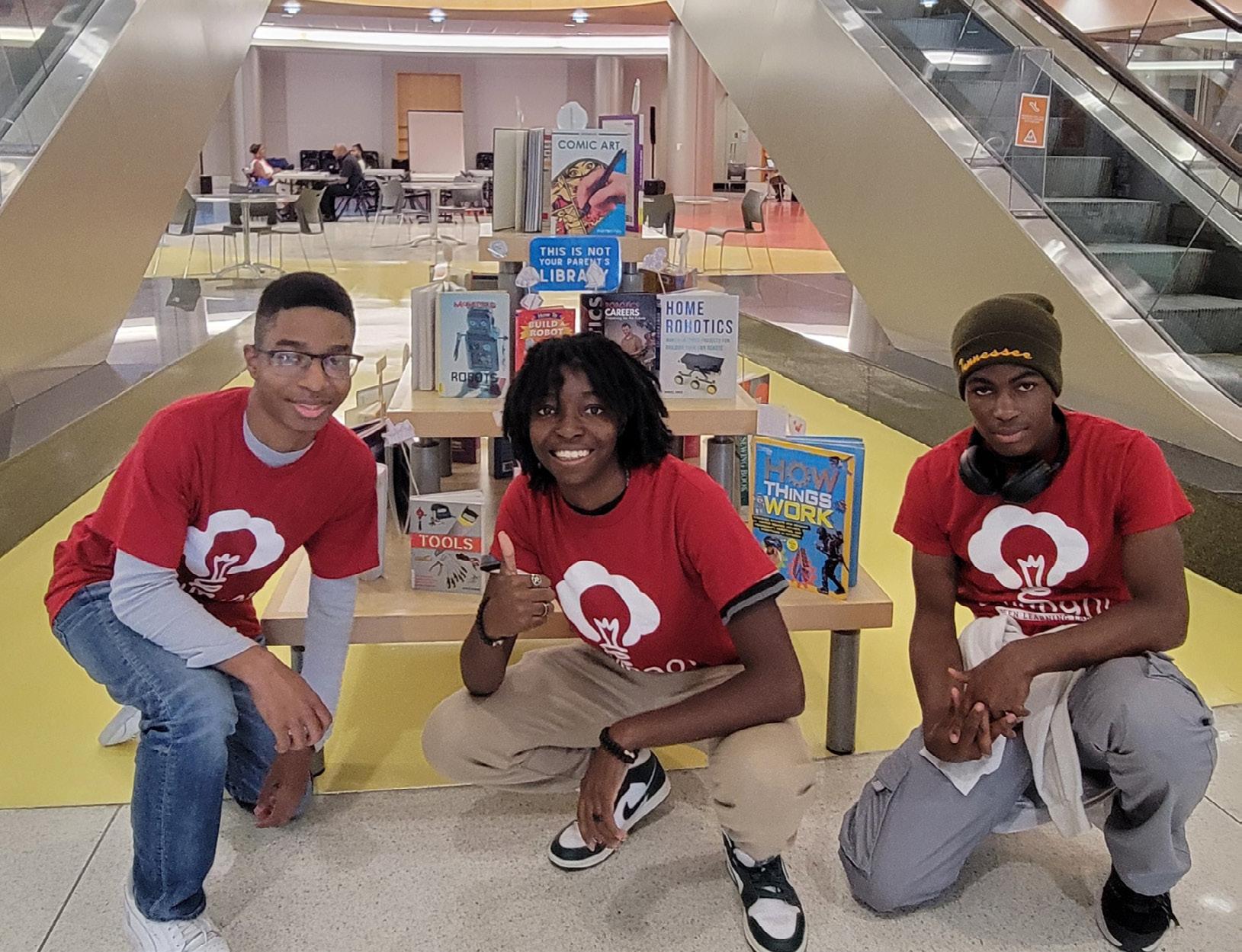
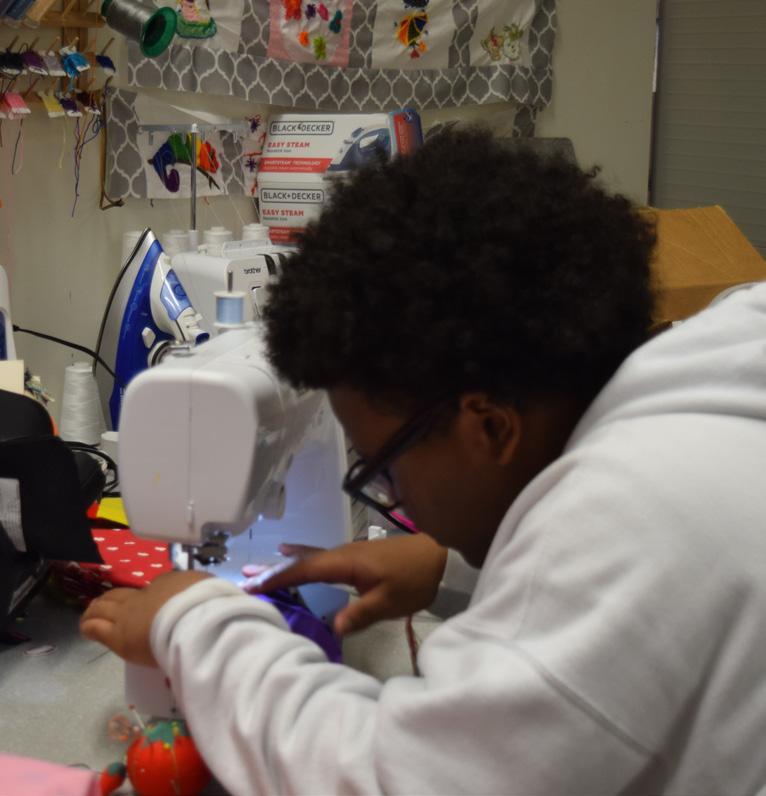
ABOVE: What are they working on here? Find out on pages 10 and 11.
DONATE HERE
The city funds the cost of library operations like staff salaries & benefits, building maintenance, & security; private donors make our award-winning library programming possible. The Memphis Library Foundation was founded in 1995 to secure private and corporate donations to fund our innovative and community-centered work at the libraries.
WANT TO SHARE YOUR STORY?
CALL FOR SUBMISSIONS
Are you a writer, an artist, a dreamer? MPL UNBOUND and the Memphis Library Foundation invite you to submit and/or pitch original works for consideration. We accept submissions from local, MidSouth storytellers or those with ties to Memphis and the Library. You will see more details throughout the issue, or, scan this QR code to submit a piece or a pitch.
DISCUSSIONS
Meet MPL’s new Library Director, Dr. Eric Harris, as he talks about his goals for the near future of the Memphis Public Libraries.
FEATURES
INNOVATORS-IN-RESIDENCE
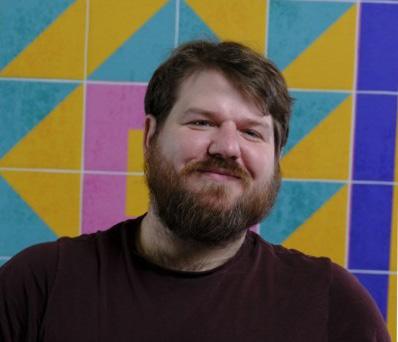
Ted Kasparek is a graphic design and animation specialist hailing from New Orleans who’s been loving his time as an Innovator-in-Residence.
FEATURED BRANCH: HOLLYWOOD AT 50
The Hollywood Library is 50! The DIG Memphis team gives us a few highlights of its history and place as a neighborhood branch.
EXPLORING MEMPHIS TREASURES
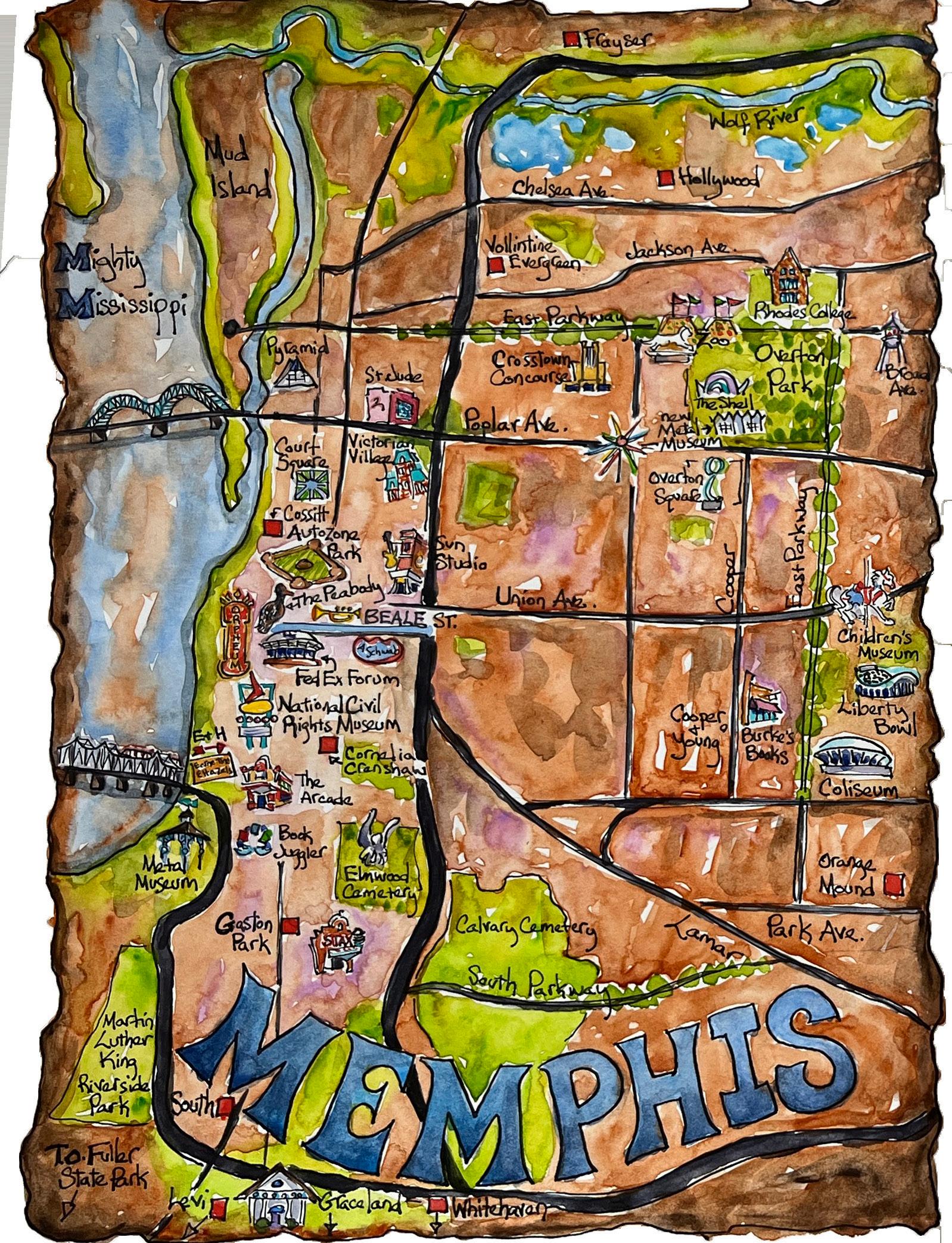
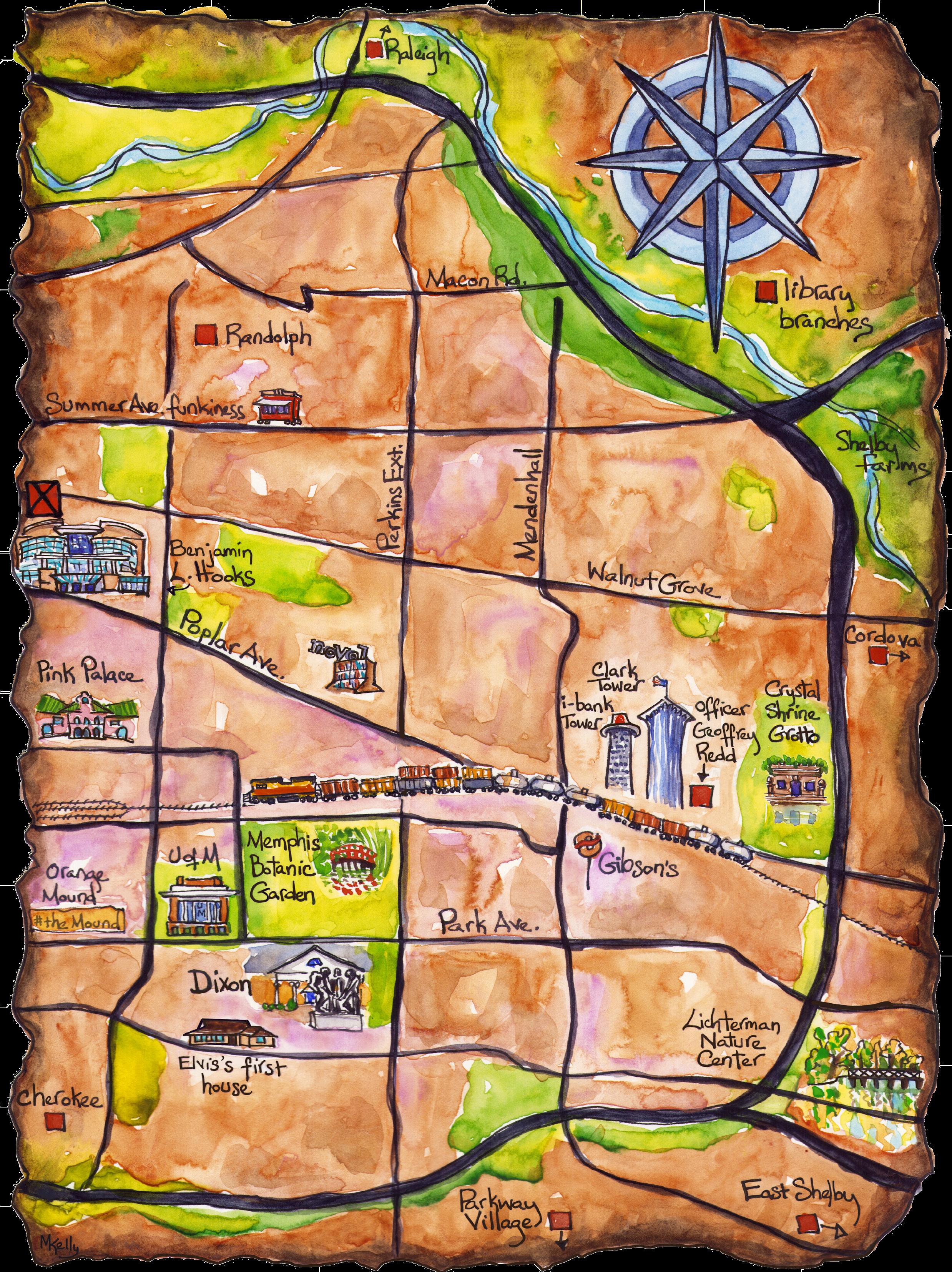
A MYSTERY MAP OF MEMPHIS TREASURES
Unknown sources delivered a Memphis treasure map to the desks of the Memphis Room. Here we invite you to explore it, and Memphis treasures, along with us.
EXPLORE DIG’S NEW COLLECTIONS
The Digital Archive of MPL has been hard at work curating and publishing new collections. Here are highlights of the Funeral Programs and Negro Leagues collections.
EXPLORE HIDDEN MEMPHIS
The Memphis Room’s Kyle Liotta takes us on a historical tour of the hidden Memphis beneath our feet, and around the city’s corners.
SHORT FICTION
‘THE POINTY END OF THOUGHT’ UNBOUND is proud to present our first piece of short fiction, penned by our Associate Publisher, Nathan Scott Weinreich.
BOOKS & MORE
BOOK REVIEWS
MPL staff present their picks and reviews, just in time for summer reading.
PASSIONS: MUSIC
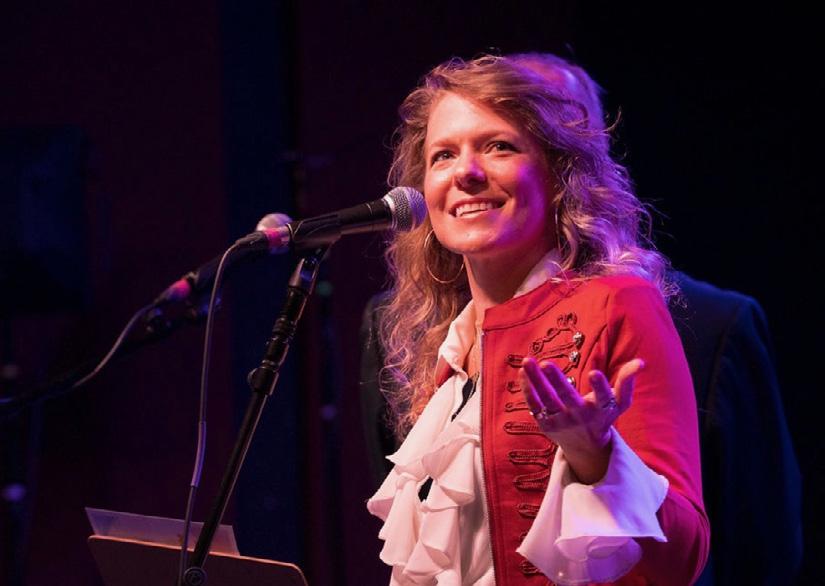
Music contributor, Mark Parsell, returns to give us a profile of local artist and collaborator Amber Rae Dunn.
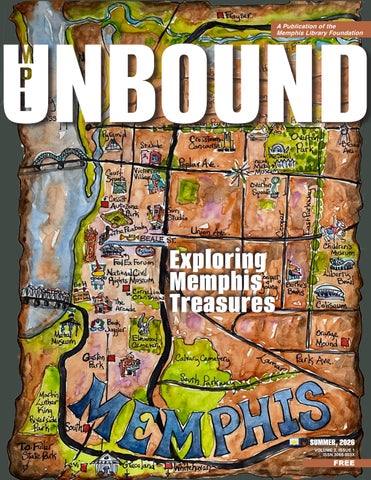
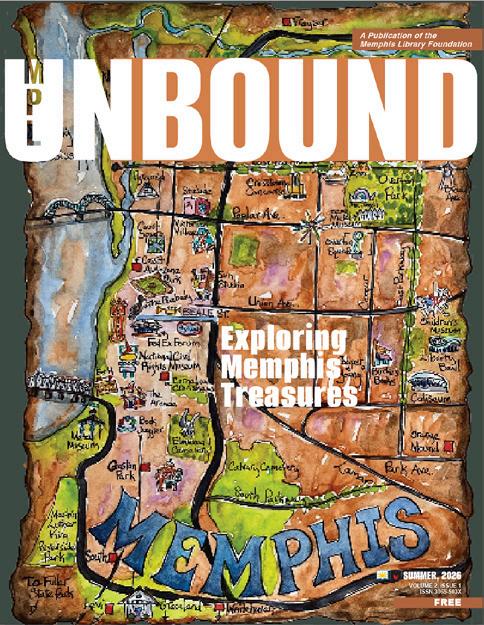
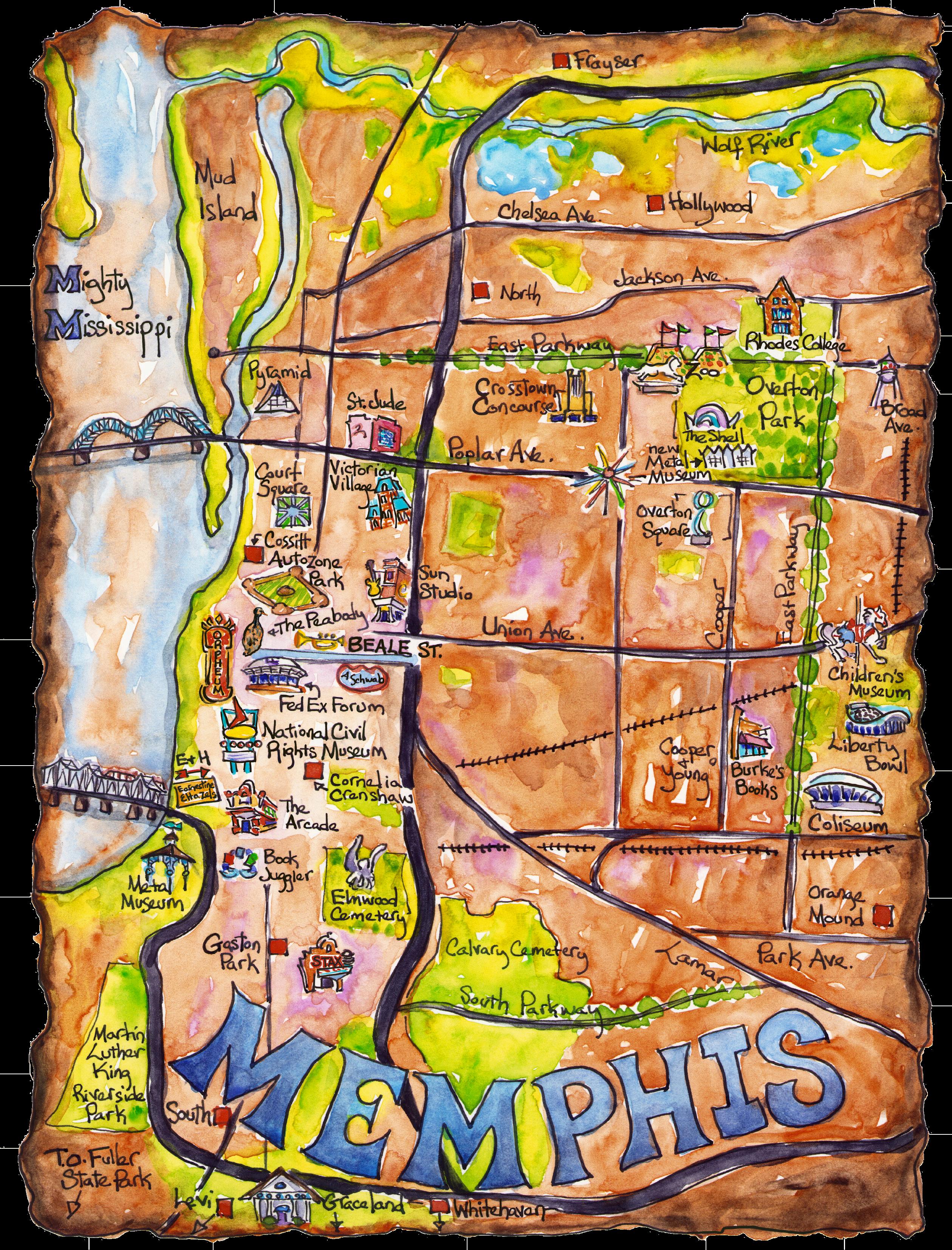
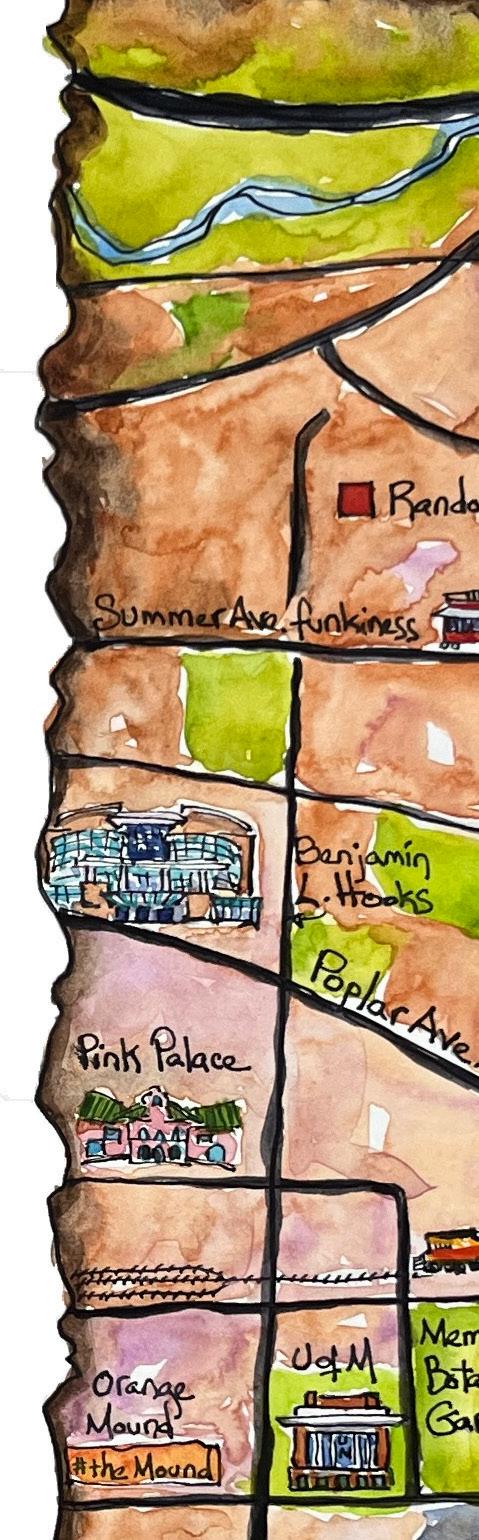
For this issue’s cover art, we enlisted the enthusiastic help of local artist Martha Kelly. As an admirer of Martha’s work, and in reviewing her interpretations of local architecture, I had a hunch that she would be a good fit to create a Memphis treasure map.
Turned out she loves maps just as much as I do. And in short order, we collaborated on outlining the map’s coverage area, which treasures she might depict, which color schemes to use, and so on.
We modeled the map after those you might have seen in the Indiana Jones films and The Goonies. And, we gave the map a mythical back story, torn in half as it is.
Our collaboration was great fun, and I think Martha pulled off a real work of art. I hope you have as much fun perusing it as I did working with her!
~Mark Fleischer, Chief Editor
START HERE
FROM THE EDITOR LETTER FROM THE PUBLISHER
SUMMER EXPLORATION
All my life, I’ve heard people refer to summer days as “lazy…” that’s always seemed odd to me. For me, the end of the school year opened the door for seemingly endless opportunities to play, make friends, grow, learn new perspectives, and most of all, explore my world. My summers were certainly fun, but they never felt lazy.
At MPL, summer is one of the most exciting seasons for learning and exploration. Across all 18 library locations, the award-winning “Explore Memphis” summer program brings together thousands of Memphians — young and old alike — for programs that spark curiosity, creativity, connection, and joy.
With everything from story times and day camps to creative coursework, concerts, and exhibits scheduled across all MPL branches throughout June and July, there’s truly something for everyone at the library this summer. Alongside the annual Summer Reading Challenge, these programs help Memphians of all ages discover new interests, build skills, meet neighbors, and feel more connected to their communities.
Of course, you can still find a quiet corner of the library to relax with a good book or play a game with a friend. But is that really “lazy?” Or is it simply a different kind of growth?
Perhaps we call summer days “lazy” because we live in a culture that so often values productivity above everything else. But at MPL and the Memphis Library Foundation, we know that summer is a time for exploration that can be both productive and joyful. People learn more about themselves and their world when they have space to be curious without the pressure of grades or a paycheck. They grow kinder and more compassionate when they interact with people whose lives and experiences may differ from their own. They build confidence, belonging, and direction when they explore their interests in community, with the guidance of skilled mentors, and with the support of other Memphians like them.
This summer, I invite you to experience all that MPL has to offer. Visit your local branch. Join a program. Read a great book. Connect with your neighbors. Write a short story - and maybe even submit it to us for our next issue!
However you choose to spend your summer, remember that library programs might be free to you, but they are not free to do. Becoming a monthly sustaining donor helps ensure that MPL can continue giving Memphians of all ages what they need to thrive.
Whether you want to keep your summer days ‘lazy’ or pack them full to the brim, we can help you with that at your local library!
~Christine Weinreich Executive Director, Memphis
Library Foundation
LETTER
TREASURES ABOUND
MPL UNBOUND was born in the spirit of love and comfort. From our first brainstorming meetings, we imagined what this publication should deliver, directly echoing what the library means to so many of us, and we continued to come back to the idea of a warm blanket.
For all of us who work on the magazine, the concept of a warm blanket translates to something that gives you the reader the same resources as the library: a safe place; a refuge; a moment to breathe, read, learn. And, we hope, a chance to turn down the volume of a world and a time of constant motion and, well, chaos — images, information and misinformation that can be at times confusing and overwhelming.
Each summer, the Memphis Public Libraries offer a host of programs that invite its public to explore — through workshops, events, and of course, books. In concert with those annual invitations, and with thoughtful observations during MPL and Library Foundation events, our visions for this issue shaped into the idea — or rather, the ideal — of not only exploring the world around us, but also celebrating and sharing its treasures.
What each of us treasure is deeply personal: a good book; a stroll through a museum; live music on a summer night; a long bike ride; a hike through the woods, accompanied by the sounds of nature and an easy river. Each of them allows us to slow down, set aside devices, take in life’s gifts, and dream.
With this issue, we aimed to do the same. On each page we hope you will find some of the same treasures that so many of us hold dear. Moreover, some of you readers told us which treasures give you solace and comfort. We listened, and we shared them on these pages.
It is worth reminding you all that the ideal of inviting the community to participate in the shaping of — and contributions to — the magazine itself, just as we do with library programming, is critical to our mutual growth and success.
We continue to extend that invitation. If you write, draw, paint, sketch, or dream, please reach out to us. There are QR codes aplenty throughout - your keys to the us, and the library. We hope you use them.
Like the library, this magazine is a safe refuge, open to what readers and patrons seek in our services, and in turn giving back safety, creativity, learning, community, and yes, that warm blanket.
So set aside your mobile devices, slow down for a moment, and spend some time with these carefully curated pages of Memphis treasures, created by very compassionate people, young and old.
Enjoy this issue, and a nice, long summer.
~Mark Fleischer, Chief Editor
Dial 2-1-1 to reach the community information and referral resources of LINC, the Library Information Center at the Memphis Public Library. LINC, in conjunction with United Way of the MidSouth, is the local source for community resources. LINC maintains a large, comprehensive database of human services organizations, government agencies and volunteer groups, which can now be accessed by dialing 2-11. Call for help with utilities, food, protective services, legal assistance, childcare, social support, housing, and mental health. Services are accessible to the hearing-impaired by calling TTY 415-2701. Toll free access is also available at (855) 354-4211.
THE LIBRARY IN YOUR MAILBOX
Library supporters who give at least $25 per month or $250 annually to support the Memphis Public Libraries receive UNBOUND by mail each quarter.
Scan the QR code or visit memphislibraryfoundation.org to donate today!
THE LIBRARY IN YOUR MAILBOX
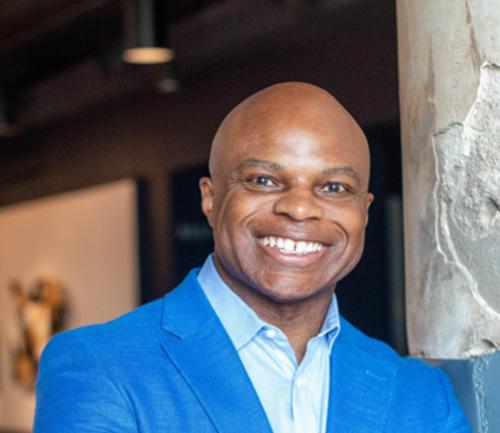
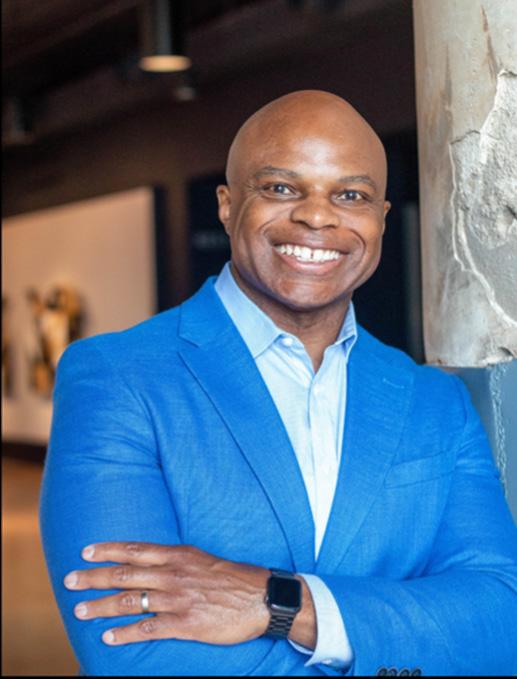
We’re excited to introduce you to a new member of the Memphis Public Libraries family: Dr. Eric Harris! We sat down with Dr. Harris after a month in his new position as Director of the Memphis Public Libraries to learn more about him and his vision for the library system.
Coming into MPL, Dr. Harris was impressed with the house as it stood; the modernity of our new branches, the robust activities offered in the Central Library’s CLOUD901 (which he hopes to replicate in other branches), and multiple national award wins all caught his eye. “It’s great that we don’t have to come in and make all these drastic changes, because the library is already great as it is,” Dr. Harris reflected, “I’ve never met so many people who are just geared toward helping. That’s all they want to do.”
Dr. Harris credits all of these accolades and accomplishments to his predecessors and noted that he is excited to join the tradition of innovative library directors. “You know, I am only the eighth Library Director in the history of Memphis libraries,” he said, “the first was named in 1893, and there were no gaps [in leadership]. That’s some big shoes to fill.” Dr. Harris’s storied career has sharpened his leadership skills and led to a new, unique vision for the library. For instance, his strategy of tackling education from a business-focused standpoint has colored his approach to managing people within large, diverse systems. “When you’re in education, it’s people all day long,” said Dr. Harris. “It’s children, it’s parents, it’s teachers, it’s community members. You have to be a good people-person to be successful.”
New Director, Same Great Library
Welcoming Dr. Eric Harris, our new Library Director, to the MPL family
By Nathan Weinreich and Emma Pennington
The transition from Memphis’s school system to its libraries was one that came easily for Dr. Harris; his personal connection to MPL stretches back to the seventh grade, when he took advantage of our librarians’ unparalleled support to complete his summer reading assignments. Since then, he has introduced a whole new generation to the wonders of MPL: his own children, whom he would bring to the library to check out books “ten at a time.”
During his tenure, Dr. Harris plans to leave his own mark on MPL while staying wary of the challenges before him. “Our population is declining [in Memphis], which means there are less tax dollars available. There are fewer patrons, potentially, who are interested in our service. But it’s a matter of keeping the library relevant and moving forward, just like my predecessors.” For that, he hopes to build a culture of trust, growth, and efficiency to bolster the best aspects of the library that already exist.
“I think that even a person who may come to the library a few times a week, they don’t really get to see the full gamut of what a library offers,” Dr. Harris mused, “libraries are community hubs. Period. There are so many different activities that reflect not only the interests, but the needs of the community.” Under his newfound tenure, Dr. Harris aims to amplify everything MPL has to offer to continue meeting those needs. Maybe the next time you’re at your local library, you’ll see the needs of your community reflected back at you, just as Dr. Harris does.
MPL UNBOUND, a Publication of the Memphis Library Foundation
Publisher: CHRISTINE WEINREICH Executive Director of the Memphis Library Foundation (MLF)
Associate Publisher: NATHAN SCOTT WEINREICH Communications Manager, MLF
Chief Editor: MARK FLEISCHER
Co-Editors: REBECCA STOVALL BETH THORNE
Associate Editors: TAJUANA FULTON SARA PRIDDY
MARTY SYNK
Style & Design Editor: DAVID CHRISTIE
Graphic Design, Layout: SERAH DELONG, SerahWorks
Original Masthead, Type Design: REBECCA PHILLIPS, Dribbble.com
Operations: MOLLY PEACHER-RYAN Director of Operations & Donor Strategy MLF
Contributors to this issue:
STEPHEN USERY
WYPL Program Manager, Host of Nationally-Syndicated Show BookTalk
CELIA MATHEWS
Librarian, Hollywood Library
MARK PARSELL
Owner & Operator of South Main Sounds
PATRICIA LOCKHART
Freelance writer and journalist for publications such as Memphis Magazine and Edible Memphis
Contributor to UNBOUND YOUTH:
TAYLOR JACKSON
CLOUD901 Teen Lab Manager Benjamin L. Hooks Central Library
THE LIBRARY IN YOUR MAILBOX
THE LIBRARY IN YOUR MAILBOX
Library supporters who give at least $25 per month or $250 annually to support the Memphis Public Libraries receive UNBOUND by mail each quarter. Scan the QR code or visit memphislibraryfoundation. org to donate today!
MEMPHIS PUBLIC LIBRARIES PROGRAM HIGHLIGHTS
JULY thru SEPT 2026
SCAN QR CODE FOR ALL MPL EVENTS
EVENT HIGHLIGHTS
TUE
SOUNDS FROM THE STACKS: JEREMY SHRADER @ BENJAMIN L. HOOKS CENTRAL LIBRARY LOBBY STAGE
Friday, July 24, 2026
1:00pm–2:00pm Ages: All
Join us for an afternoon of live jazz with Memphis musician Jeremy Shrader.
A native of Clarksville, Tennessee, Jeremy earned his degree in Jazz Composition from the University of Memphis and has become a familiar presence in the local jazz community. He leads several ensembles, including the New Memphis Hepcats, the Hot Memphis Five, and the Jeremy Shrader Octet.
For this upcoming solo performance, Jeremy will explore the timeless sounds of the Jazz and Big Band eras. Whether you’re a longtime jazz enthusiast or simply looking to enjoy an afternoon of live music at the library, this familyfriendly concert offers something for everyone. All ages welcome!
GENEALOGY ASSISTANCE
TUESDAYS WITH SKYLER! @ORANGE MOUND LIBRARY GENEALOGY ROOM (OM)
Have questions about genealogy? Wondering how to find that long-lost ancestor? Just getting started on your family history research journey? Have no fear...Genealogy Assistance Tuesdays are here! Pay us a visit at the Orange Mound Genealogy Center Tuesday, 1pm-3pm, to get the help you need to fill that missing link in the family tree!
AUG 02 SUN
HR/JOBLINC ONE-ON-ONE @ CENTRAL, 2ND FLOOR
Sunday, August 2, 2026 10:00am–4:00pm Ages: Adults, Seniors
Held the 2nd day of every month, the JobLinc one-on-one session assist adults and senior is resume development, career development, and in how to seek employment. Please feel free to join us.
COMPUTER BASICS CLASS @EAST SHELBY MEETING ROOM A Monday, August 10, 2026
3:00pm–4:00pm Ages: Adults, Seniors
CHESS CLUB @ OFFICER GEOFFREY REDD LIBRARY MEETING ROOM (OGR)
Friday, August 14, 2026
2:30pm–4:30pm Ages: All Ages 5 years and up!
And every other Friday at Officer Geoffrey Redd Library
Every other Friday afternoon, join us for two-hours of casual chess. Players of all levels and ages welcome. Participation is first come, first served as space allows.
Other dates thru October, all times 2:30pm-4:30pm: FRI AUG 28
FRI SEPT 11
FRI SEPT 25
FRI OCT 09 FRI OCT 23
Occurs every Monday, 3-4pm, at East Shelby Library
*No Class on Sept 7 due to Labor Day Holiday AUG 10 MON
Whether you’re just starting your computer journey or you want to brush up on the basics, come join us as we learn about some of the most fundamental computer skills in a small class environment! Give us a call or drop in anytime to ask us what the coming week’s topic will be.
A limited number of laptops are available for students to use on a first-come-first-served basis.
Contact Info
Gabriel Short, at (901) 415-2767 ext. 3
Other dates thru September* MON AUG 17
MON AUG 24
MON AUG 31
MON SEPT 14
MON SEPT 21
MON SEPT 28
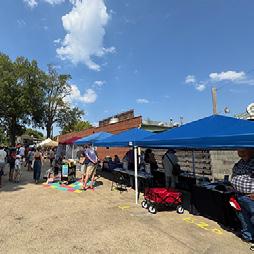
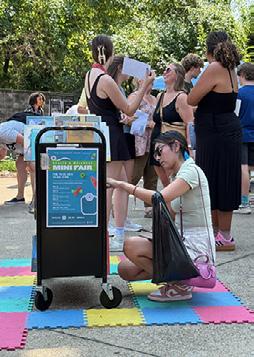
CONNECT CREW @ THE COOPER-YOUNG FESTIVAL Saturday, September 19, 2026 9:00am–4:30pm Free Books
Activities for Kids of All Ages Resources & Information
IN THE KNOW
Need Something Repaired?
THE MPL REPAIR CAFÉ, in partnership with Repair Café International, is bringing new life to broken household items for the citizens of Memphis. Volunteers from around the city — mechanics, engineers, seamstresses, and other expert hobbyists — have come together to support sustainable living by offering their skills at the Benjamin L. Hooks Library at these quarterly events. How does it work? Simple. Each patron may bring in one item to be repaired (things like bikes, small appliances, clothes, or electronics). When they arrive, patrons will be asked about the item they’ve brought and triaged to a table of skilled experts bestsuited for their issue. Then the volunteers get to work! Though success is never guaranteed, by working together and pooling their talents these volunteers successfully fixed hundreds of items over the course of 2025 and saved about one thousand pounds of things from being thrown into a landfill.
A Repair Café is a living archive: a collection of materials that hold value and importance to the people of this city. There are several reasons to consider participating in one of these events, either as a skilled volunteer or a patron. Repairing items can save money, reduce waste, and help society hold on to the technologies of the past. History can be preserved by repairing out-of-print books or vintage clothing. And did we mention it’s free? MPL’s Repair Cafes continue in 2026 on Sunday afternoons once a quarter. Expect the next event on Sunday, October 4th. Scan the QR code at right to stay up to date on your Repair Café.
Next Repair Café: Sunday, October 4th, 1:30-4:30PM
~Sara Priddy
Repair Café is held quarterly on Sunday afternoons at the Benjamin L. Hooks Central Library. Scan this QR code for the next scheduled date.
CONNECT CREW
SCAN ME
Memphis Public Libraries lends non-traditional items, too!
DON’T HAVE A LIBRARY CARD YET?
A Library Card opens the door to our physical and online collections including over a million items in our 18 locations and over 50,000 e-books and e-audiobooks. You can also use it to reserve one of our public access computers.
SIGN UP FOR A
The Crew is There For You
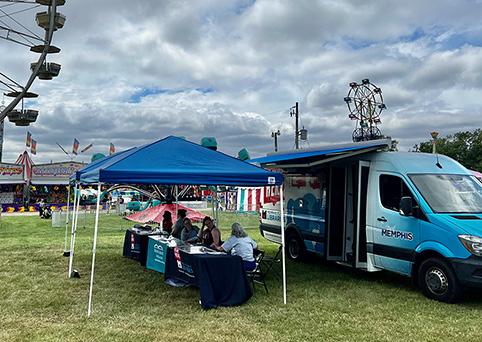
Laundromats and daycare centers. Schools, grocery stores, the Memphis Zoo, parks, community centers, and facilities assisting the unhoused. At annual festivals, at elementary, middle, and high schools, and places like the Dixon Gallery & Gardens, the Pink Palace, a neighborhood Fourth of July parade, or the CooperYoung Festival.
These are the places you will find the library — not the actual library itself, of course — through our Connect Crew, delivering library resources into the community, meeting patrons where they are with library card signups, copies of MPL UNBOUND, information, games, storytimes, and free books. Last year, the “Crew” held over 250 outreach events, and engaged with over 9000 patrons.
The Crew brings the library to you.
TO LEARN MORE ABOUT CONNECT CREW
SCAN ME
GET READY, library fans, Cossitt has a new innovator! Ted Kasparek is a graphic design and animation specialist hailing from New Orleans who’s been loving his time as an Innovator-in-Residence.
“Growing up, I went to the Jefferson Parish Library [in New Orleans] a lot, where I could grab movies and cartoons to check out, things like Dragon Ball Z and Outlaw Star. Finding that cool stuff wouldn’t have been possible without the library, because I didn’t have cable growing up. Having all this access to cool content and visual things, it kind of inspired me to become an animator in the first place!
Innovator Ted Kasparek makes MPL more animated! INNOVATORS-IN-RESIDENCE
By Nathan Scott Weinreich
“I’ve always wanted to teach people. A lot of times [in the artistic community] there’s this issue where people want to keep their techniques close to their chest, which on the one hand I do get because they don’t want to get [those techniques] stolen, but I don’t care about that. I want everyone to have all the tools and trade that they can and to learn how to make all this cool stuff themselves!
“
with everything from interview practice to day-one advice. Kasparek’s joy at sharing his creative expertise is palpable from the moment you step into the room with him.
“Kasparek comes from a storied artistic and cultural background. After moving from The Big Easy to Memphis in 2009 to attend the Memphis College of Art, he stuck around to do odd jobs in the city’s creative scene. He eventually got involved with Youngblood Studio, where he worked on mural installations throughout the entire city, but after nearly 10 years of portfolio work around Memphis he was called to Chicago with his partner, where they both attended top grad programs. “Getting my Master’s in animation from DePaul University was kind of when my narrative changed. I started working all these internships and volunteer programs for a lot of cartoon pilots in Chicago, and from there I’ve been working on multiple projects – a lot of background designs and character animations for upcoming pilots.”
But Chicago just couldn’t hold Ted for long! “It’s funny, people always joke that Memphis is a black hole that just won’t let you leave. And I was always like ‘nah, that can’t be me,’ but then here I am coming back!”
Since graduating from DePaul University and returning to Memphis, Kasparek has begun working as an adjunct professor at Southwest Tennessee Community College, teaching graphic design, motion graphics, and video editing. Teaching and – more importantly – helping people’s artistic growth has always been in Kasparek’s blood.
Coming from his own cable-less upbringing, Kasparek understands that the barrier to entry for some creative fields can be high, which is exactly why he wants to provide access to everyone through the library. “It’s great to have programs like these through the Memphis Libraries that cost [students] nothing but still lay these tools out before them. I just love that the library gives them access without any barrier, whether it’s [monetary] or any other type of thing that might get in the way.”
Kasparek’s love of helping people find their creative way is evident already, even in his short time as an instructor. “I always see everyone as having potential. They have the potential to do great things and be great people. Everyone comes with different skill levels and experiences, so getting them involved with finding internships, workspace experience, pipeline experience, that’s what I’m really aiming to try and help [my students] with.” In fact, Kasparek has already helped one of his Southwest students get involved with the City of Memphis as a graphic design intern, coaching them along the way
Believe it or not, this won’t be Kasparek’s first time working in a library. “Way back in high school, I actually worked in my school’s library. It exposed me to a lot of cool reading materials, and it was just a really great chance to be around books all the time and just pick up and read stuff.” In the sea of high school drama, shuffling from class to class, and, in his own words, “watching too much TV,” the library served as a quiet, safe space for Kasparek. “There’s always been this nice connection with libraries for me, so I’m really excited to be working for a library. For the second time, I guess!”
Kasparek and all the other Innovators-inResidence are well on their way to creating fun and interesting programs for people of all ages. Keep an eye out in the near future for new Innovator Programs popping up around our Libraries. And while you’re out at Cossitt, dipping your toes into animation and design with Ted Kasparek, you might even be fortunate enough to try some of his authentic NOLA cuisine. “I make a mean gumbo, and beignets too! That’s about all I can make, but I’m bringing a good little bit of New Orleans here to Memphis with me.”
We’re happy to have you and all of your New Orleans glory at the Memphis Public Libraries, Ted!
Ted Kasparek
Ted Kasparek
ANCESTRY LIBRARY CAN BE USED TO FIND CENSUS, BIRTH, MARRIAGE, DEATH RECORDS AND MORE.
Collections include Tennessee, U.S., Delayed Birth Records; Tennessee, U.S., Death Records; Tennessee, U.S., City Birth Records; North Carolina and Tennessee, U.S.; Early Land Records; and so much more INSIDE AND OUTSIDE THE LIBRARY
Talented professional artists and musicians play, perform, and teach at locations where seniors live and gather. Musical performances and hands-on arts workshops reach diverse audiences, improving participants’ cognitive vitality and emotional well-being, and making arts access a reality.
Explore the Past. Inform the Present.
the Future.
Shape
The digital archive of the Memphis Public Library, showcasing many of the treasures found in the Memphis and Shelby County Room.
A BELOVED NEIGHBORHOOD INSTITUTION
THE FIRST MENTIONS of “Hollywood neighborhood” in North Memphis begin appearing in the Commercial Appeal in the early 20th century. One of the earliest and most prominent businesses was Hollywood Furniture and Hardware at the corner of Hollywood and Chelsea, which served as an anchor for the community for decades, beginning with its opening in 1924. By 1928, the Commercial Appeal referred to the area as “one of the fastest growing industrial subdivisions in Tennessee,” with more than 25 large industrial plants and several thousand residents, most of whom owned their own homes. Prior to the 1940s, the area was mostly rural, but after World War II more houses were built and its industrial footprint expanded. The community expansion continued into the 1960s, when major street improvements led to even more development in the neighborhood.
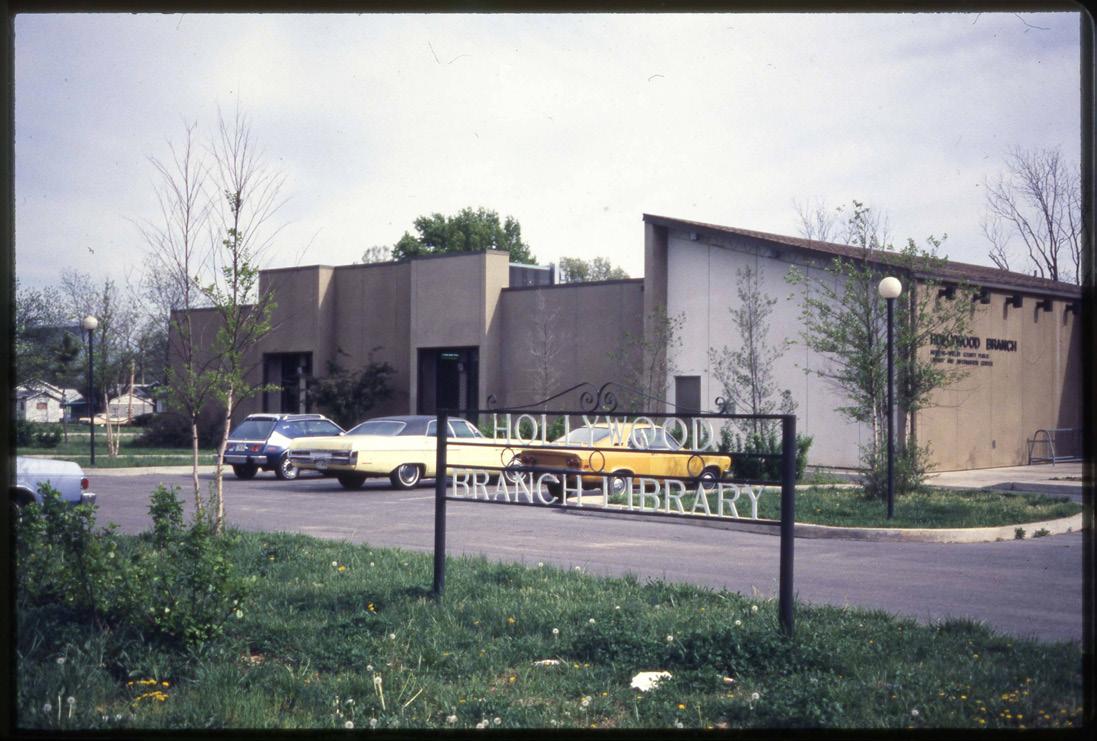
By 1973, the existing city and county library systems were consolidated into the newly named Memphis/Shelby County Public Library & Information Center, and new branches followed. In April 1976, Hollywood Library became the library’s twentieth branch. A unique feature of the library was that it shared the space with the Hollywood Health Clinic next door. The 6,250 sq. ft. building, located at 1530 North Hollywood had a service area primarily bound on the north by Watkins, south by Warford, on the east by the Wolf River, and the west by Jackson Avenue. The 1980 U.S. Census indicated the total population of the Hollywood area to be 13,707, with a median age of 25.6 and the racial demographic being 99% African American.
Throughout the 1980s, Hollywood Library was known for its growing young adult collection, a substantial collection of books by and about Black Americans, and a collection of toys and games available for children to use in the library. By 2001, Hollywood Library boasted the largest collection of African American fiction of any branch and was one of four branches with a job and career center. In addition to materials and resources, Hollywood thrived at programming, with offerings for adults and children, including story times, crafts, and puppet shows.
In 1994, the library saw its first renovations when minor improvements were made to update the branch. More extensive renovations followed in the early 2000s when the community health clinic vacated its half of the building. At the time, City Council member Barbara Swearengen Holt championed the cause of expanding the branch, stating, “there’s no place more important than the library” for her constituents. Her efforts led to nearly $2.5 million devoted to improving Hollywood Library, including increasing its space and adding more computers, chairs, and tables.
The grand re-opening of the expanded Hollywood Branch Library was held on September 13, 2005. The library’s new footprint was 14,500 square feet – over a fifty percent increase. It maintained its unique features by showcasing one-of-a-kind commissioned art pieces by artists Jill Turman and Terrance Brown. Turman designed several metal sculptures for the interior, and Brown created a tile mosaic that greets customers as they enter. Hollywood Library celebrated its 50th anniversary in 2026 with week-long festivities honoring the long history of the branch, cementing its status as a beloved neighborhood institution for years to come.
FEATURED BRANCH
Hollywood Library Turns 50!
Once described by some as “the country,” the Hollywood neighborhood blossomed in the 20th century into a densely populated industrial area later known as a “walkable community.” As one daycare director stated: in Hollywood, “the neighbors look out for us, and we look out for them.” It was in this environment that the Memphis Public Library expanded its services in 1976, opening its 20th branch: the Hollywood Library.
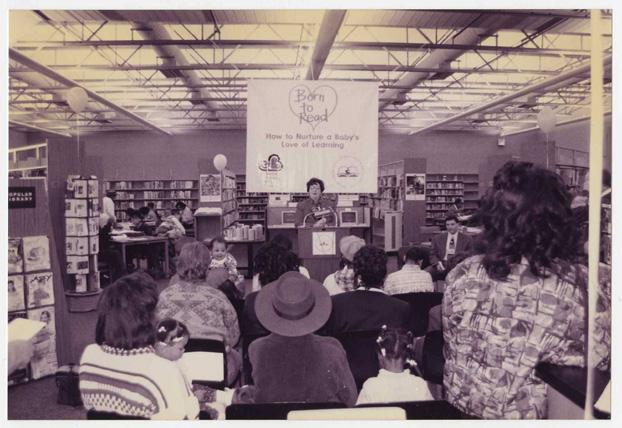
Judith Drescher, Library Director, speaking to an audience and the press about the collaborative program with Le Bonheur Children’s Hospital at the Hollywood Branch.
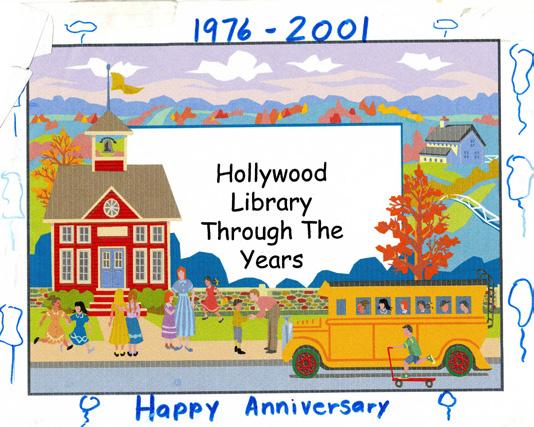
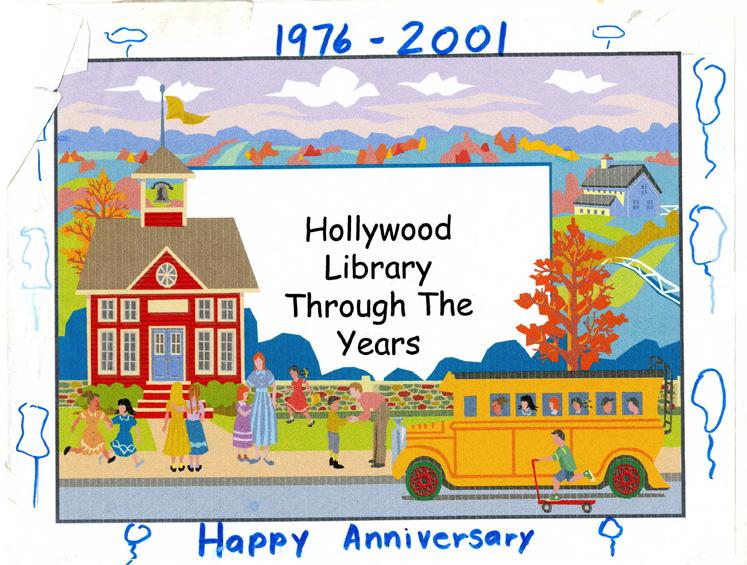
Anniversary scrapbook showcasing the history of Hollywood Library from 1976 to 2001. The 12 page scrapbook contains photographs of children enjoying various library programs, including holiday celebrations, arts and crafts, story times, and puppets.
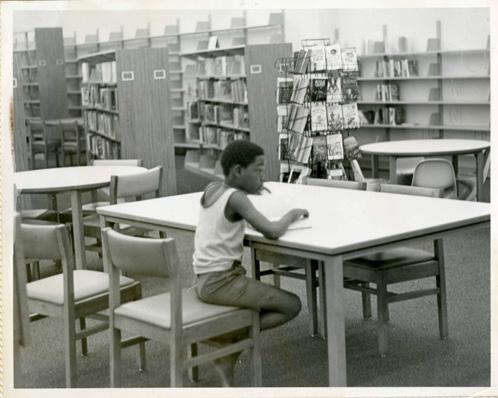
A young boy sits at a table in front of library stacks and books in Hollywood Library. Handwritten note on the back of photograph states, “David Green, 8-25-76”
From Jamie Corson and the DIG Memphis Team
Hollywood Library from the parking lot, c. 1976
EPHEMERA SYNERGASIA*
A Collage Worth a Thousand Looks
By David Christie
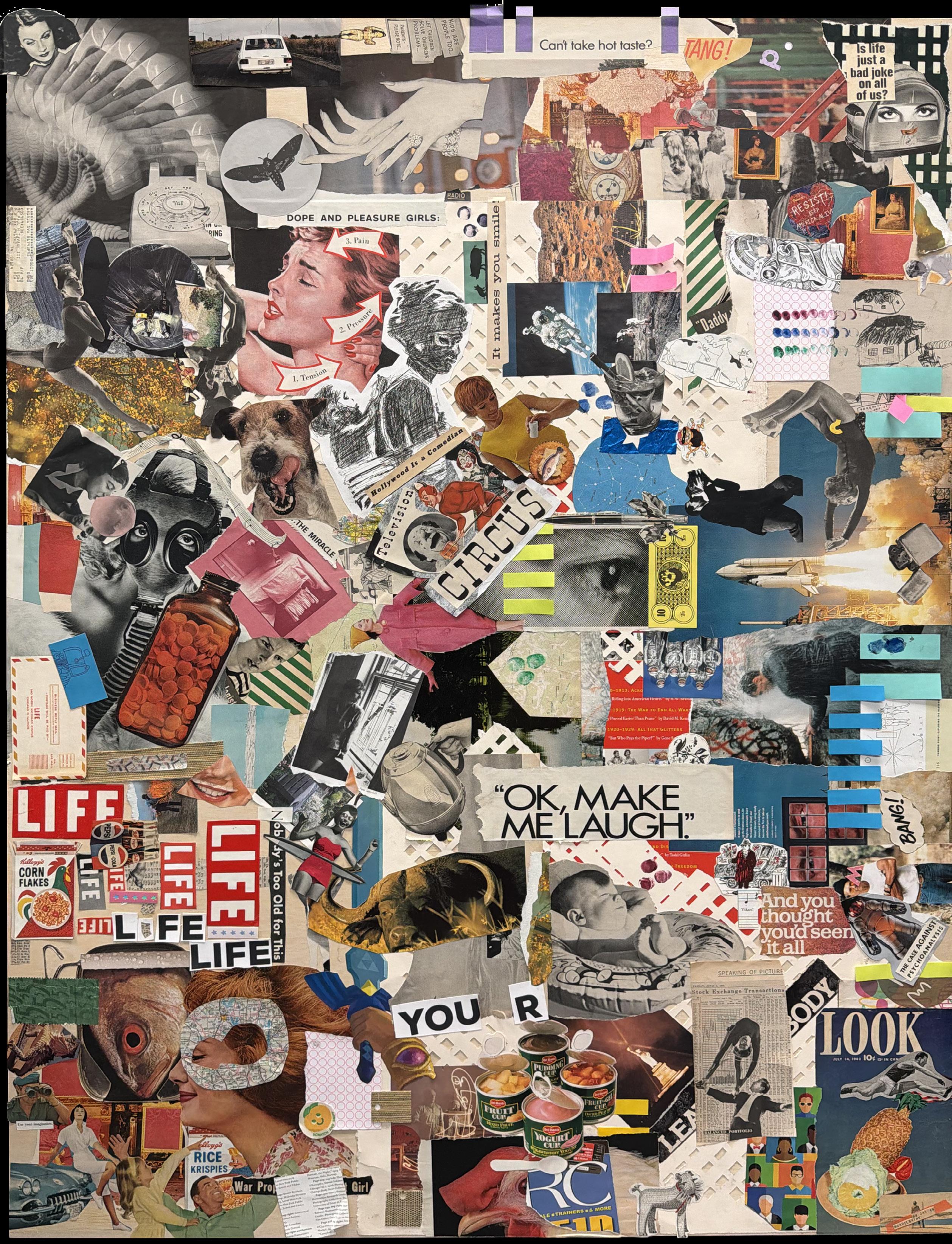
Taking scrap-booking to another level, MPL collaborated with Memphis arts phenomenon Like Really Creative and local street art duo A Correspondence to support library customers in producing a giant collaborative collage.
In the Central Library’s lobby, around 50 guests dove into an ocean of magazines and other paper ephemera to emerge with pictures of people, animals, words, and other things, which they mixed together on a 4- by 3-foot surface. The result was a riot of imagery and color that you can peruse again and again (and again) and still not see everything.
*Ephemera: collectible, transient, vintage objects of everyday life, valued for rarity, nostalgia, and/or association with historical events or eras
*Synergasia: in ancient Greek, translates to working together, collaborating
Denizens
Driver beware. On this road,denizens make random left turns with seemingly little regard for fellow drivers.
MacLean Avenue. thisApparently, street is pronounced ‘muh-clain,’ not ‘mah-clean.’
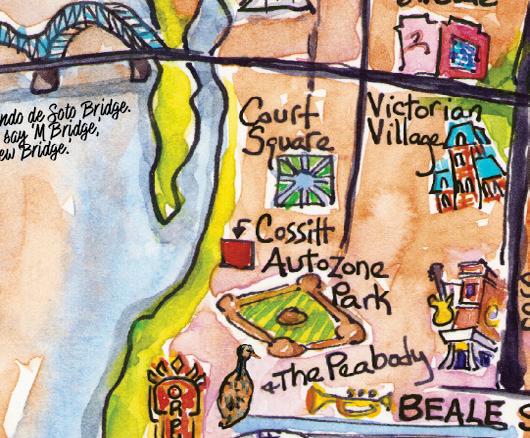
The Hernando de Soto Bridge. Denizens say ‘M Bridge,’ or ‘The New Bridge.’
refer to these as ’The Old Bridge.’ But therecuriously, are three.
It is remarkable how large the geogrpahic area of Memphis is. It is approximately 314 square miles, not including the Mississippi River, with just over 600,000 residents. By comparison, the New York City boroughs of Manhattan, the Bronx, Queens, and Brooklyn total to approximately 245 miles, but with over 8 million residents.
“East Memphis,” so called, covers most of the area on this side of the map. Curiously, denizons here say they “never go downtown.’” Conversely, denizens from downtown and Midtown refer to this area as “out east,” and display great annoyance when having to make travails here.
To this traveler, the endless greenery of the canopies of tall trees along many roads and avenues is remarkable and beautiful.
This “loop” highway, called “The 240,” generally follows the northern, southern, and eastern city limits through the early ninetween sizties.
The Mystery of the Map
The map arrived in an old, crusty envelope, coated in fine, gray dust particles that clung to it as if to protect it from further deterioration. It was addressed only to “Memphis History Room, Public Library.” No zip code. No’ In Care Of.’ And it had no return address.
The date stamp on the upper right corner of the envelope had long since faded away. How long, we wondered, had it taken this forlorn envelope to reach the fourth floor? It measured about nine by twelve inches, and was sealed only by a tattered string of leather, like one from an old lacedup boot, that weaved its way through a brass ring smaller than a penny.
So weathered, handled by who-knows-how-many eager hands, the map’s folded mid-section had long since torn in half, somewhere around where Midtown Memphis becomes East Memphis. Any leftover scraps of missing map pieces were nowhere to be found.
It also had a timelessness about it, existing in some ethereal realm of past and present, referencing current landmarks along with older ones in the same space. When was it created? We don’t know.
And its handwritten notes... We wondered, who wrote them? Was this a ruse? Something penned by Prince Mongo? Maybe the ever-roguish Vance Lauderdale? Or handed down from a descendant of Sivad, the late-night horror TV host?
We will never know.
~Fletcher Markunson
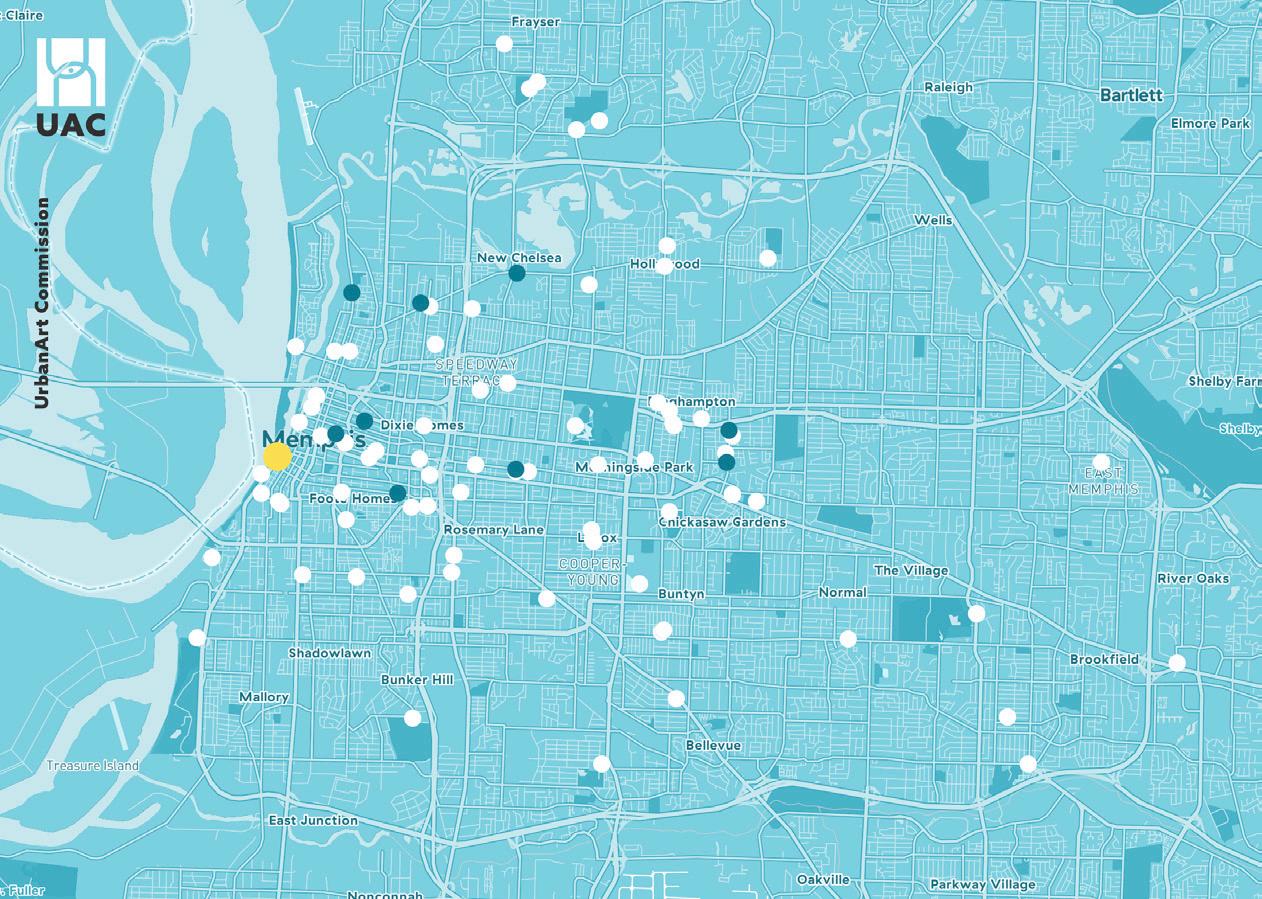
EXPLORE MORE
Looking to explore more Memphis treasures? Check out the interactive map of public art projects and installations from the Urban Art Commission.
Click on the QR code at the bottom-left, and start exploring!
Paths to Rediscovery EXPLORING
By Beth Thorne
There’s an undercurrent in Memphis that, if you stand still long enough to listen, will make itself known to you like the ebb and flow of the mighty river it sits on. Memphis is a city without a lot of flash, without a lot of artificial hype, but those of us who live and work and play here know where its hidden treasures lie. Each time a Memphian steps off a well-worn path for a forgotten one, they are participating in one of the great adventures that this city offers: rediscovery. Award-winning author, Ann Patchett, likes to say, “If you haven’t read this book, it’s new to you,” and that sentiment applies to every corner, community, and culture Memphians have the privilege to uncover. The pride of rediscovery leads to the next indelible tradition: making the most of Memphis. We share what we love. And we love Memphis. Here’s some of our favorite places we’ve loved and rediscovered.
My hidden Memphis is Mud Island. I love walking the length and history of the Mississippi River etched into the ground like a fossil. I find it a serene and quiet place to ponder about the future. ~Celia Matthews
My Hidden Place in Memphis is the Disability Resources for Students Center at the University of Memphis. ~Jordan Bailey
For fifty years, I have gone into Overton Park and walked straight into the forest until I reach the point at which I can no longer see or hear any signs of civilization. There I find peace and healing.
~Julie Dahlhauser
My special place is Crosstown Concourse. You can hold meetings, dine, just chill and people watch, attend events, all in one place. And it’s HUGE! ~Samara Solomon
WHAT’S YOUR MEMPHIS TREASURE?
Local Hangouts and Book Pairings!
By Patricia Lockhart
I love my city! Memphis offers so many places to explore. From cool hangouts to hot spots, there’s something for everyone to enjoy. But there is one thing Memphians can’t quite agree on: The summer heat! Some people love it, some purposely don’t come out until after sundown. Whether you’re trying to beat the heat or soak up the sun, summertime in Memphis has plenty for you to explore.
Don’t feel like basking in the Memphis heat? Want to stay as cool as a MemPop? Then I would advise you to seek refuge in a few of my favorite indoor places.
Crosstown Concourse
The Crosstown Concourse is full of fun, food, and air conditioning! You can grab a bite to eat, get your nails done, listen to some really cool beats, and even grab a coffee, find a cozy spot, and read. And oh, the people you can meet! Kind of reminds me of some of the characters in Anxious People by Fredrik Backman.
Pink Palace
Dinos, space suits, steamboats, oh my!!! The Pink Palace, also known as MOSH, has a lot of interesting exhibits and sights. I love taking a stroll through the Natural History portion, gawking at the dinos while silently wishing they were real!
If you enjoy learning interesting facts about animals and nature, you should definitely read Fuzz: When Nature Breaks the Law by Mary Roach while staring deeply into the eyes of a stuffed raccoon.
Soul
and Spirits Brewery
A brewery is one of the best ways to beat the Memphis heat. Soul and Spirits Brewery is spacious, and serves up some of the best beer in Memphis! They won Tennessee Brewery of the Year at the Tennessee Championship of Beers in 2022, 2023, and 2024! Plus, they have a Low Tones room that is perfect for reading, or just sitting alone. I wonder if they have a magical chair that can take you to the past? Like in the book Before the Coffee Gets Cold by Toshikazu Kawaguchi…but called, “Before the Beer Gets Warm.”
Now, for those of you who prefer the great outdoors, I have a few spots for you too. Don’t forget to grab some water and a hat!
Overton Park Shell Concerts
Picnic Basket? Check! Secured the perfect spot? Check! Bubble machine blowing? Double check! That’s all we need to enjoy some free live music from the Overton Park Shell Concerts! If you’re into a short
I love the Wolf River. Usually once or twice a week I and my family are running, hiking, or biking the large network of trails that provide access to the forest along the river. My son and I have done a good bit of fishing along the river as well. And I’ve been kayaking a handful of times on the river, and it’s so serene and quiet. When you’re out there, with nothing but the sounds of nature and the oars in the water, it’s crazy to think that you’re in the middle of Memphis. ~Chris Marszalek
My special place in Memphis is Board to Beers, a woman-owned and operated third space to play just about any board game you can think of! Great service, and just a wonderful place to hang out! ~Denise Yewell
story where 2 possible lovers vibe through music, you should read Love in Colour by Bolu Babalola.
Memphis Zoo
Just imagine: it’s 10am, sunny, but not too hot, and you’re sipping your water while walking around the Memphis Zoo. Nice, huh? And sometimes I like to wonder what the animals are thinking about me as I watch them. I might even grab the book Remarkably Bright Creatures by Shelby Van Pelt while I watch a few animals in the shade.
Cooper Young
If you want to get a taste of Memphis’ personality, just put on your walking shoes and head to Cooper-Young. You can grab a crafted knick-knack from a local store, then turn the corner and enjoy some craft beer. Or maybe you want to grab a cup of coffee and browse some books. If you want to meet Memphis’ extroverted side, just walk around Cooper-Young. And while you’re at it, read The City we Became by N.K. Jemisin.
So let’s make it a point this summer to explore all that Memphis has to offer. And by the way, all of the books mentioned are available at the Memphis Public Library!
Browse the collection by scanning this QR code:
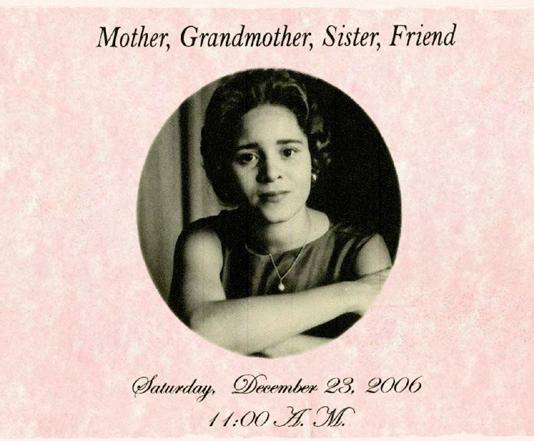
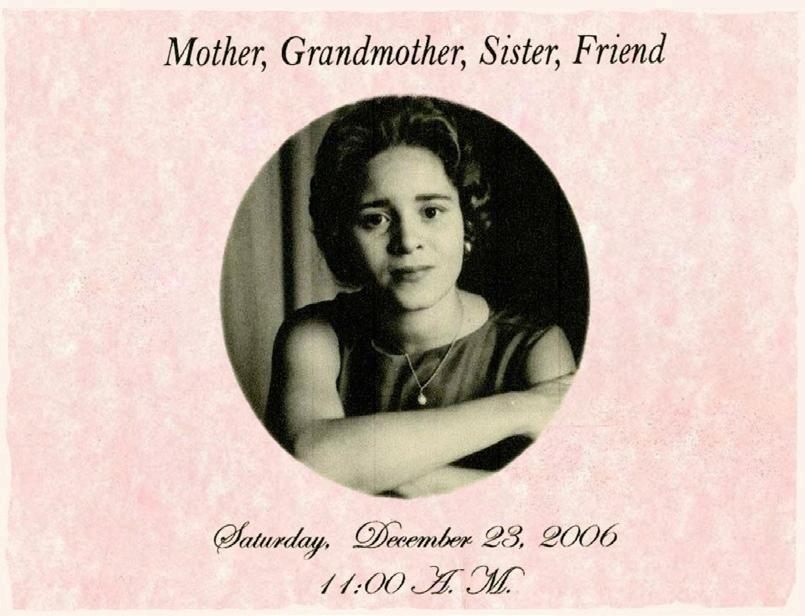
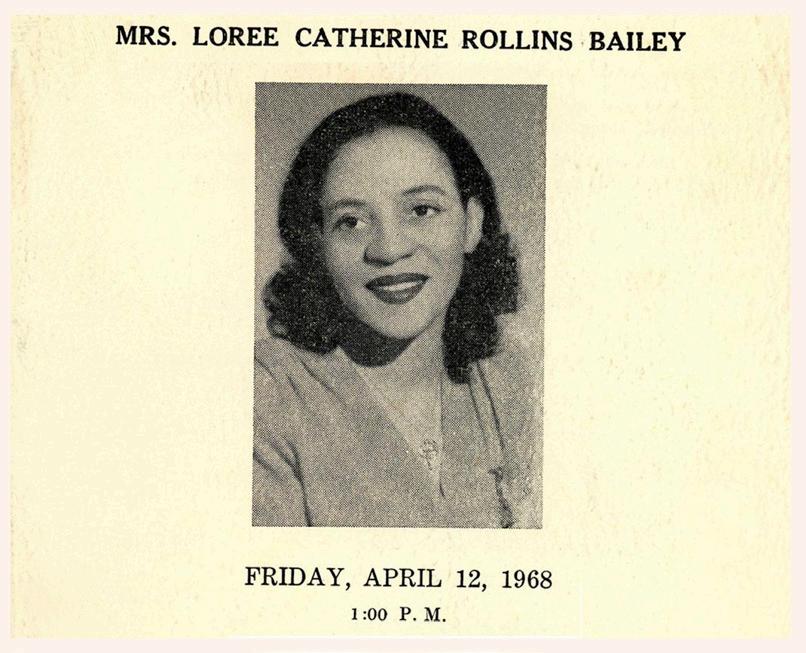
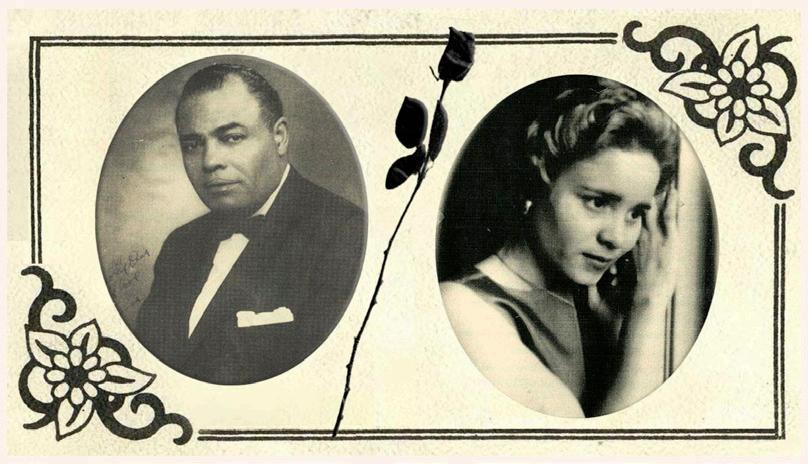
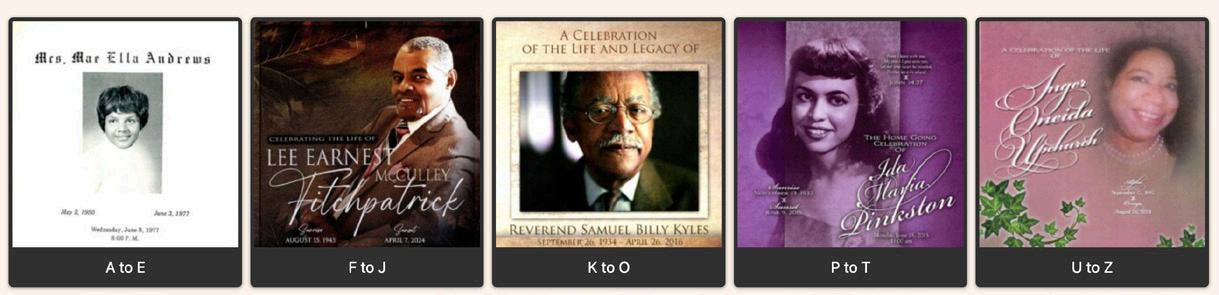
Funeral programs are invaluable historical documents that offer rich insights into our ancestors’ lives. They often include biographical information, family connections, dates, and locations, and they serve as a unique record of an individual’s life. The programs contained in the Funeral Programs Collection preserve crucial data cherished by genealogists and family researchers, enhancing their understanding of personal histories.
Funeral programs also offer insight into the makeup of a community and reflect broader historical patterns. By preserving the lives of individuals who may not be documented in other public records, these programs help to create a more comprehensive historical narrative.
This collection was made possible by initial donations from Dr. L Lasimba Gray, Jr., Fredricka Hodges, Sharon Hill, Joyce Pinkston, Catherine Wilson, and Everna Andrews. It aims to provide accessible resources for individuals researching their genealogy and family history. It includes online access to digitized images from funeral programs, obituary details, and burial locations. The project is ongoing, with programs organized alphabetically by the deceased’s name to help researchers easily find relevant information.
The online collection currently includes over 1,000 funeral programs donated by residents of Memphis, Shelby County, and surrounding areas, with significant contributions by Rosalind Withers from the Ernest Withers Museum and Archives, and Teresa Mays, President of the Afro-American Genealogy Society of Memphis and the Midsouth.
We invite the Shelby County community to help us expand this collection by donating both physical and digital materials related to local history. Your donations will help preserve the stories and experiences of Shelby County residents for future generations.
BROWSE BY NAME
BROWSE BY FUNERAL HOME
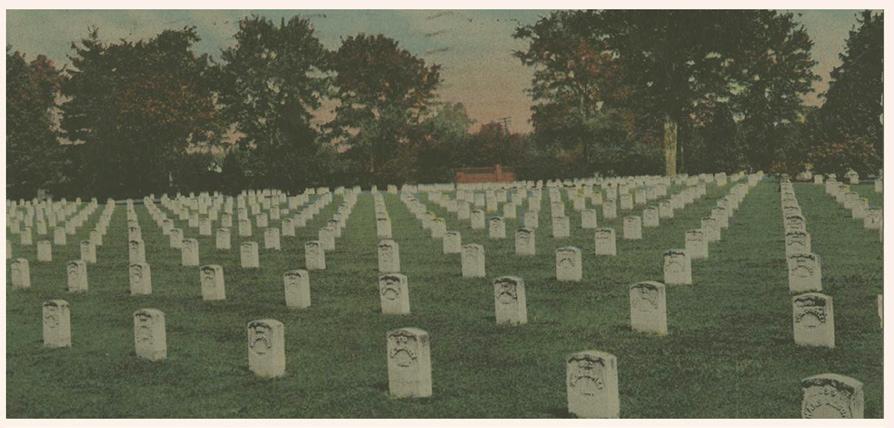
When noted on the funeral program, we’ve included information on the decedent’s place of burial, and programs can be searched by cemetery.
BROWSE BY PROGRAM
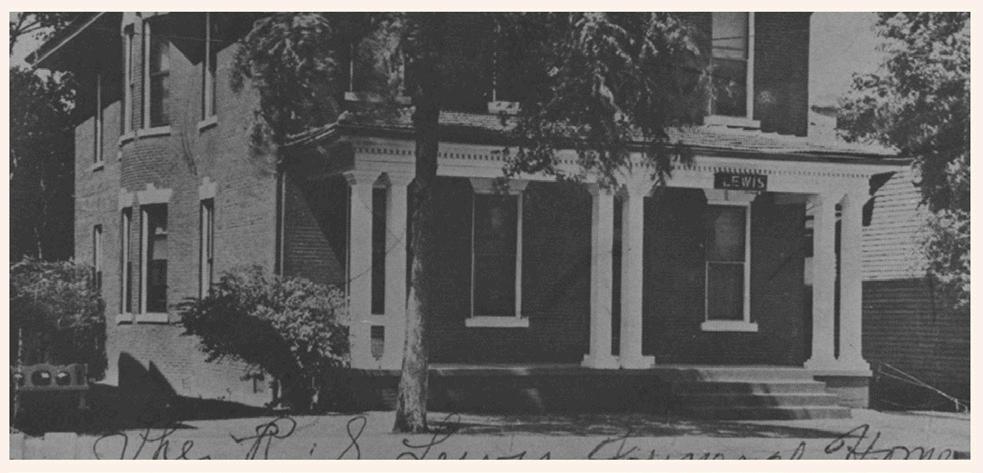
The collection contains programs from over a hundred different funeral homes – both in Memphis and beyond.
To donate materials or learn more about contributing to the Memphis and Shelby County Room’s permanent collection, please contact us:
• Phone: (901) 415-2742
• Email: Hisref@memphistn.gov
We look forward to incorporating your valuable stories and memories into our growing collection. Thank you for exploring this important resource and for your continued contributions to preserving our metropolitan area’s rich history.
Wish to donate an electronic copy of a program? Scan the QR code.
EXPLORE DIG DIG Memphis Releases
More Collections
From Jamie Corson and the DIG Memphis Team
Over the last year or so, we at DIG Memphisthe Digital Archive of Memphis Public Libraries - have been collecting, curating, and publishing several new collections.
The first new collection we published is the Funeral Programs Collection. Bonnie Pinkston and Verjeana Hunt in the History Department spent years developing it. It is just as it sounds: a collection of funeral programs from funeral homes across the city — and beyond! — which expands the genealogical research available to historians as well as family members. It’s searchable through a number of ways: by funeral home, cemetery, person’s name, and more.
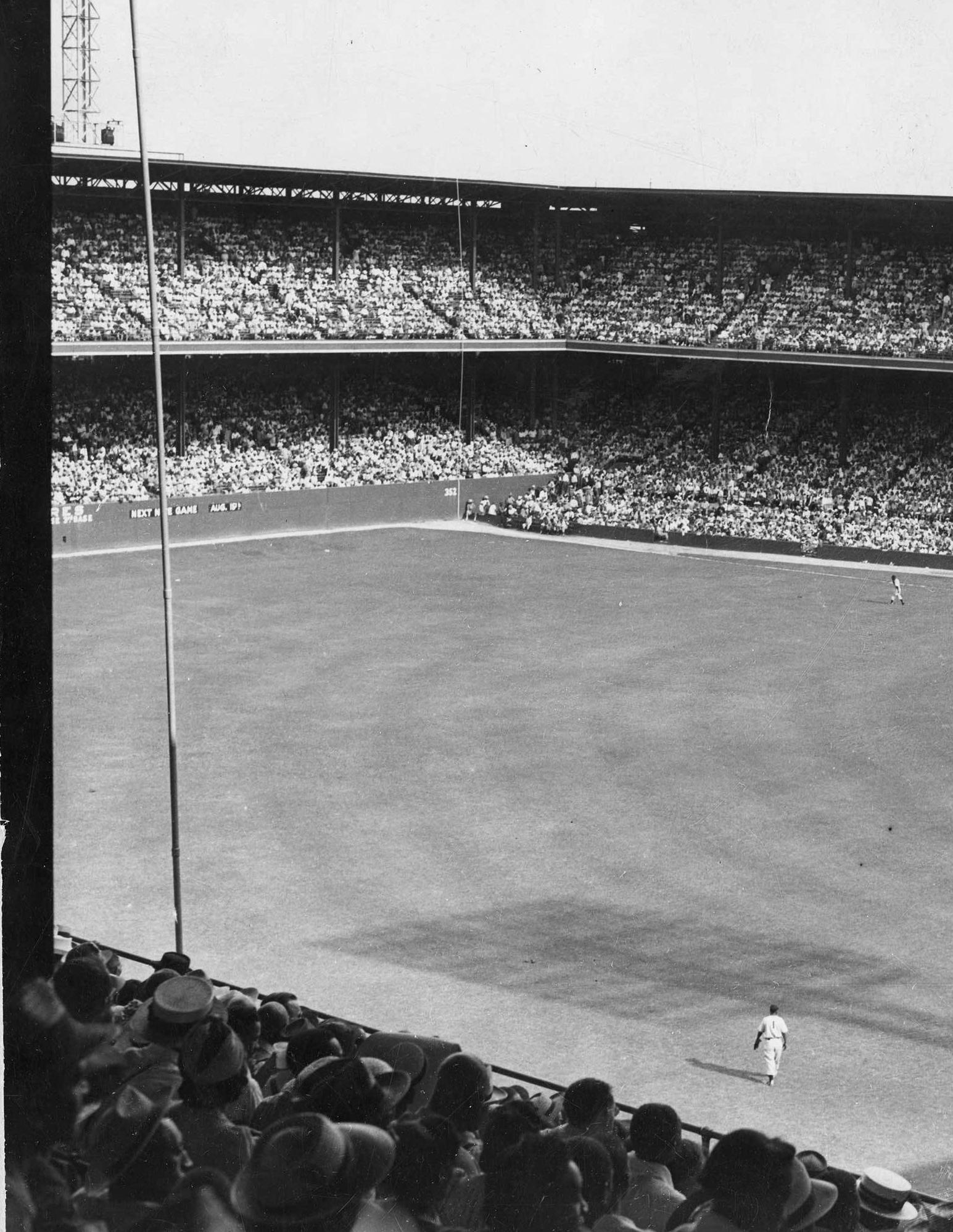
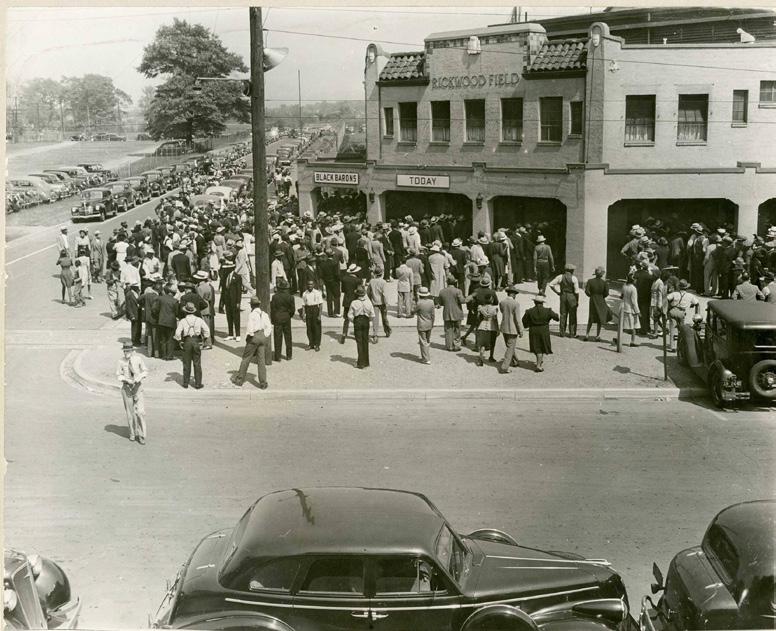
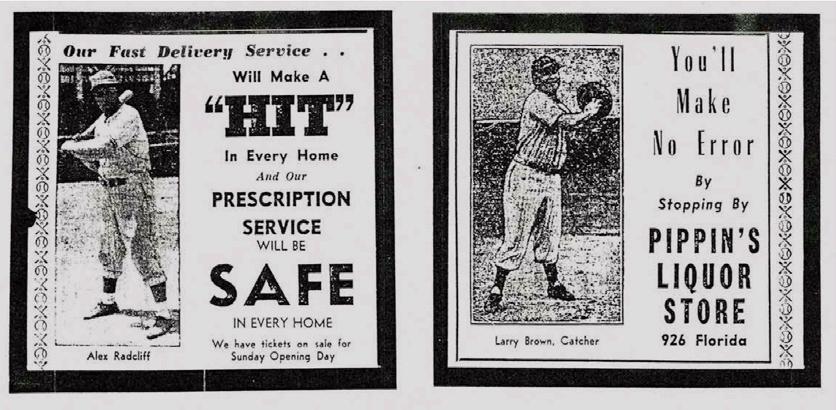
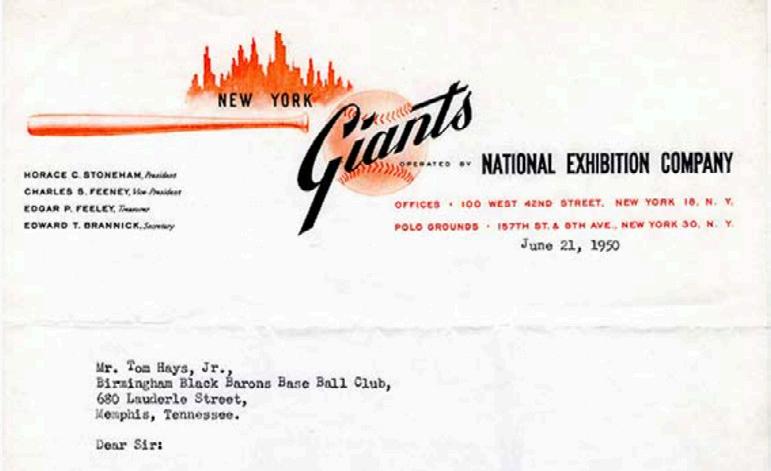
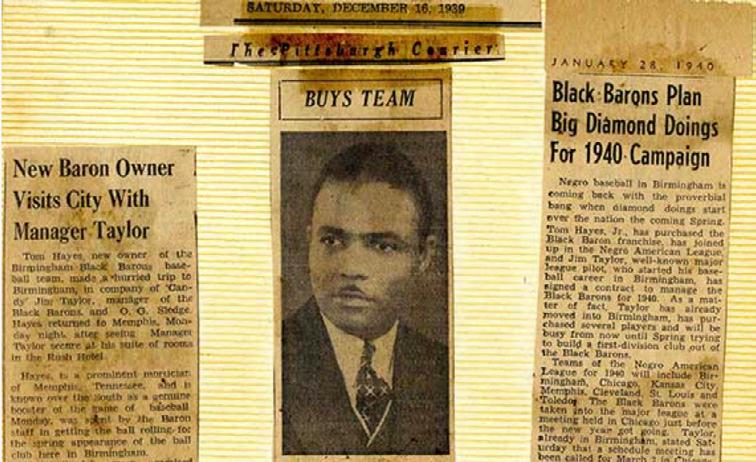
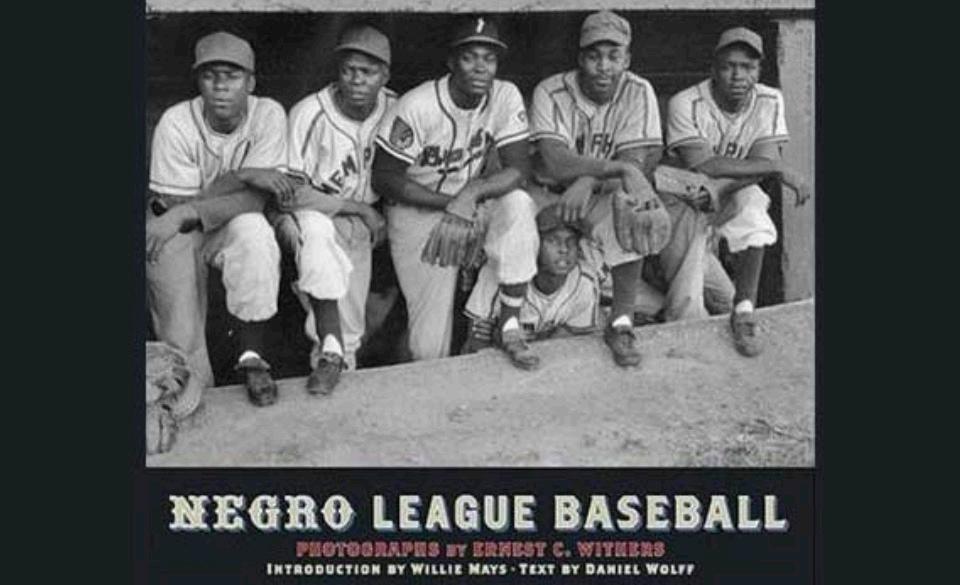
The second set we unveiled is the Negro Leagues Baseball Collection. We are really pleased with how this collection turned out. This digital archive is compiled of materials from the T. H. Hayes Collection — T. H. Hayes owned the Birmingham Black Barons — and the physical materials in the Negro Leagues Baseball Collection. Those include the programs, photos, and newspaper clippings stored in the Memphis Room.
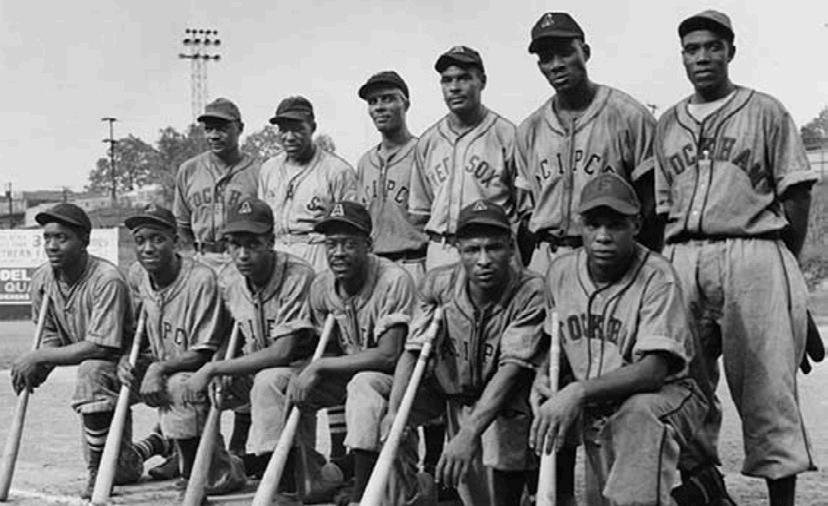
The collection tracks the business side of the leagues, highlights league players, and also includes clippings, oral histories, and great photographs of the Memphis Red Sox.
The most recent new collection is the Jones Family Boxtown Collection. This was a digital donation by the Jones Family - a prominent family from Boxtown, whose patriarch and matriarch started the first Blackowned grocery store chain in the area. The collection tracks the history of the family, and also provides a familial and cultural snapshot of the Boxtown neighborhood, adding context to its significance.
MPL UNBOUND presents highlights and links to the Funeral Programs Collection on these pages, and to the Negro Leagues Baseball Collection on pages 18-19. Look for a feature on the Jones Family Boxtown Collection in our next issue.
“We didn’t make any money… Somebody made some, but we played it – We played it for the love of the game.“
~ Clinton “Casey” Jones, catcher for the Memphis Red Sox in Black Diamonds, Blues City – Stories of the Memphis Red Sox BROWSE COLLECTION
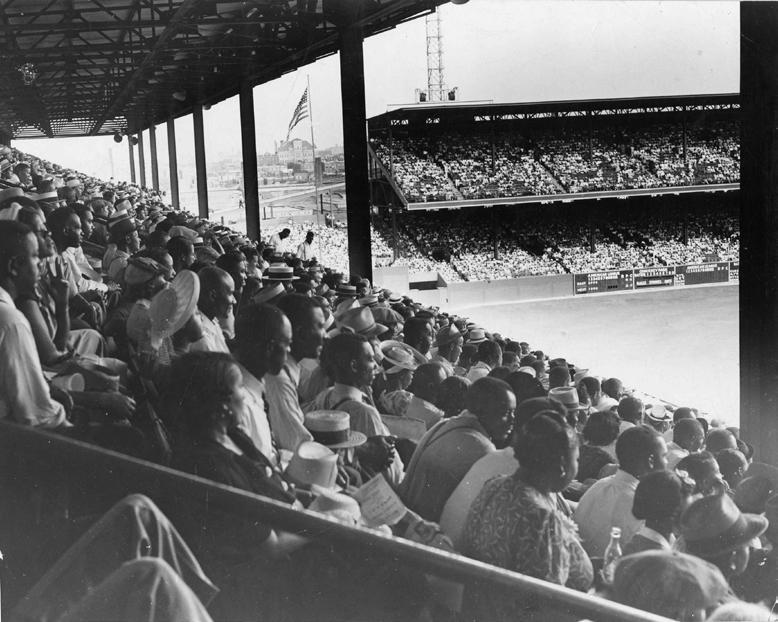
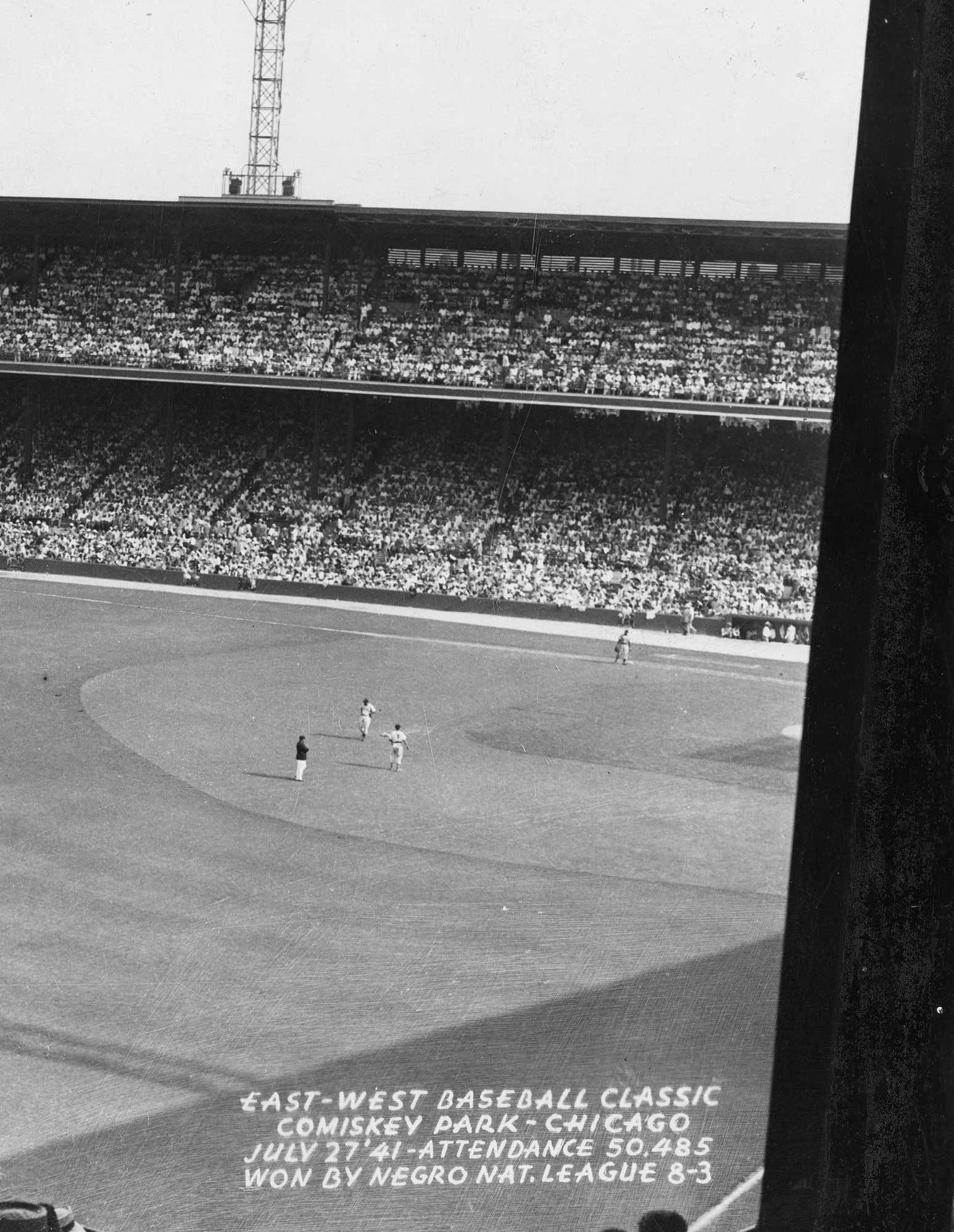
The background photo captures the stadium and field of the annual Negro American League vs. the Negro National League game. This game took place on July 27th, 1941 at Comiskey Park in Chicago, Illinois. The front of the photo says “East-West Baseball Classic Comiskey Park-Chicago July 27 ‘41- Attendance 50,485 Won by Negro Nat. League 8-3”
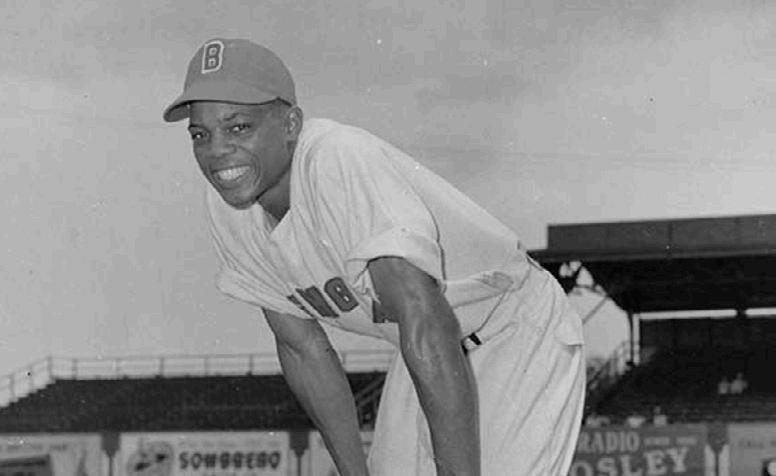
WILLIE MAYS
GAME DAY
THE PLAYERS
LEGACY
BUSINESS BEHIND THE LEAGUES
From Jamie Corson and the DIG Memphis Team
ABOUT THE COLLECTION
This collection is a record of memory, movement, and resilience, an archive of what community leaders, businessmen, and athletes made possible during a turbulent twentieth century in America. Spanning over 200 individual items, our collection tells a story that begins on dirt fields and in city ballparks in the late 1930s, and stretches through team photographs, newspaper publications, business correspondence, magazine articles, and reunion banquets decades later. This is not just a sports collection; it’s a story about what it means to build something of your own and prove your worth in a society where many of the doors are closed.
At its heart are the players and visionaries who shaped the game and the world around it; Willie Mays, who began his career as a teenager with the Birmingham Black Barons; Reverend William Greason, whose pitching career led him from the mound to the pulpit; Dr. J. B. Martin, Memphis Red Sox owner and former president of the Negro American League; T. H. Hayes, Jr., Memphis businessman and owner of the Birmingham Black Barons. The Memphis Red Sox and Birmingham Black Barons are central to this story.
The bulk of the material in the digital archive comes from the T. H. Hayes Collection, which was donated to the Memphis Public Library by his wife, Helen M. Hayes. Hayes, a prominent Memphis businessman and director of the T.H. Hayes and Sons Funeral Home, owned the Birmingham Black Barons from 1939 to 1952, during the height of the team’s success. There is also material from the library’s Negro Leagues Baseball Collection, which includes items from an individual named D. Hill and an anonymous donor.
The collection features rare material showcasing the Harlem Globetrotters Baseball Club, Chicago American Giants, Philadelphia Stars, and many others. It brings together photographs, business records, promotional posters, banquet programs, media coverage, and memorabilia to reveal the full ecosystem that made Black baseball thrive: the fans who filled the stands, the businesses that sponsored teams, and the players who crossed state lines with nothing but a glove and a name worth knowing.
The Negro Leagues Baseball Collection is a collection about excellence, but also the refusal to disappear. The refusal to let these stories fade; the Negro Leagues were never just about baseball. They were about pride, community, and the perseverance to keep going in the face of adversity. This archive is part of that legacy.
THE MEMPHIS ROOM
Hidden Downtown: Alleys Around Corners, and the Water Beneath Our Feet
By Kyle Liotta
IF ONE LOOKS at a map of modern Memphis, a sprawling city lies in front of them, condensing along the Mississippi River at the bluffs. This tightly-packed area - now known as Downtown Memphis - hosted the first generations of Memphians since the city’s creation in 1819. Downtown Memphis provided the foundations for a hub of trade on the riverside, housed cultural institutions like Beale Street and the Peabody Hotel, and gave sanctuary to the community as centuries of urban growth developed into a diverse community. Yet rarely do people learn or take notice of what Memphis needed for such history in the first place: the “blood veins” known as streets and alleys, and the support systems of the hidden waterways underneath those streets. Everyone travels over roads to get to work, go out to their local haunts, visit friends, and deliver critical materials to businesses downtown. Going along A. W. Willis Avenue from Mud Island, across from the sleek, modern BRIDGES USA facility, one sees the old brick building named the “Memphis Artesian Water Department,” where Downtown Memphis once sourced its water from the Bayou Gayoso through a vast sewer system. Without such intricate infrastructure, Memphis could not grow into the city it is today.
The founders of Memphis knew that such a city needed meticulous planning to succeed. In the original grant for the City of Memphis, the proprietors first listed the streets and alleys of the new city, declaring that “it was always our intention that the same should forever remain as public streets and alleys… shall continue eastwardly as far as the lots are laid off, and the streets (though not the alleys) as far east as Bayou Gayoso,” intending to see the city expand to a theoretical future limit. This land, bought by land speculator John Rice from North Carolina without Chickasaw acknowledgement in 1783, was sold to John Overton and future president Andrew Jackson after Rice’s death in 1791. Jackson sold his part of the claim to James Winchester in 1797. The Jackson Purchase was finally negotiated with the Chickasaw in 1818, and the new owners founded Memphis on May 22, 1819, with a new plan.
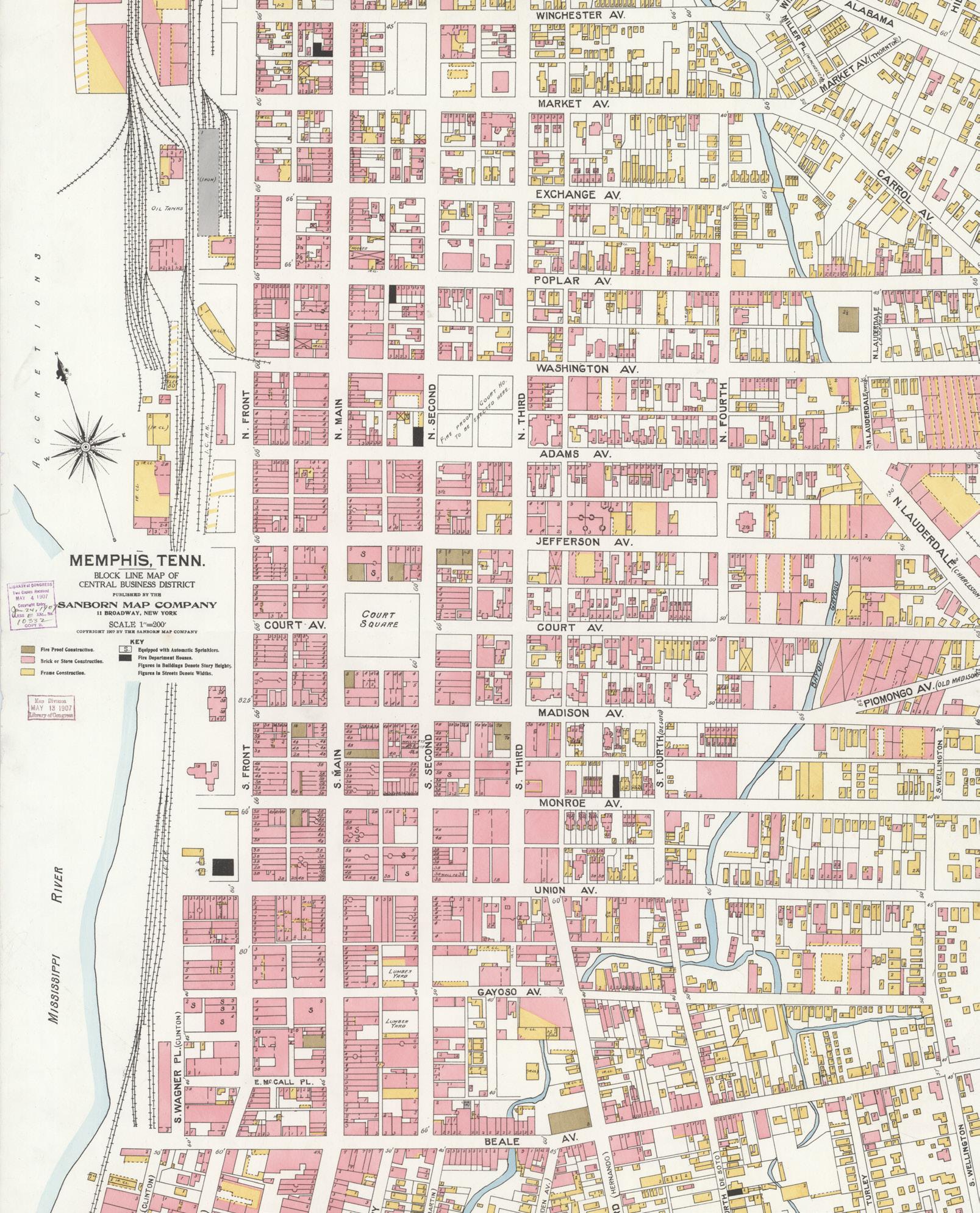
Sanborn Map Company “block line map” of downtown Memphis, 1937. The Sanborn maps were highly detailed, and developed for fire insurance assessments. Structures in pink are those constructed in brick or stone; yellow in wood frame; while brown represented what was considered fire-proof materials.
Surveyors drafted a plan of the city’s streets and alleys for easy
wagon travel, going as far as from Union to Sycamore, all the way to the winding Bayou Gayoso. Looking at the 1819 map reveals a series of boxes and crosses. Each box houses lots on every corner, dissected into halves by crossing alleys. Urban planners later stopped using this method, but remnants remain. As an example, what was
lot no. 361 between Union and Monroe now houses Charlie Vergos’ Rendezvous restaurant in the alleyway, operating since 1949 as one of Memphis’ oldest running restaurants. The alleys became a source of news throughout the years; updates on crime, gossip about major parties and even one story of a Mrs. Beatrice H. Shipp taking time to feed the alley cats back in 1959. Some of the alleys are named after historical events, like General Washburn’s Escape Alley, where Major General C.C. Washburn of the Union Army ran to escape the invading, slave-trading traitor known as Nathan Bedford Forrest. Stereo Alley once hosted KLYX radio back in 1965, broadcasting instrumentals and dinner music on 101.1 FM throughout the area. Others honor people like Maggie H. Isabel, who became a major promoter of education and playgrounds to help the poor, and whose sewing shop on Madison mended various Memphians’ clothes. This series of boxes and crosses morphed a burgeoning small town
into a growing metropolis as more people settled and expanded as time passed. Still, later speculators buying lots of various sizes for plantations led to the system dying off in favor of longer, ally-less streets. Yet, these boxes still house various apartments, restaurants, law offices, and other places today.
Still, Memphis could not expand without access to water. If the Mississippi gave Memphis its economic lifeline, then the Gayoso Bayou gave a growing Memphis its health. Before the city became the gray concrete buildings and black asphalt streets of today, the areas surrounding downtown used to be more swamp-like, teaming with different kinds of life due to the bayou’s water. Stretching from today’s N. Front St (formerly Chickasaw Street and Mississippi Row) down to Union, this five-mile river formed a natural boundary for Memphis’ borders in the early days, with some even lodging at the mouth of the bayou in a place known as Catfish Bay. Engineers bridged the bayou for better traffic flow, allowing for further expansion as more moved into the city to stay or to trade. Projects began in the 1850s to straighten out the riverbed between Market, Adams, and Jackson Avenues for land use, with other projects utilizing the stream for both sewage and drinking water. This usage later caused problems; the first Board of Health formed in 1878 to combat the various epidemics that had been hitting Memphis throughout the 1800s. The Board questioned the bayou’s usage as both sewage and a dumping ground for dead animals and industrial waste, banning the “bucket and cart” method of waste disposal in favor of modern methods. These measures did not stop the devastation that Yellow Fever brought to Memphis in the 1870s, essentially wiping out most of the population and resulting in the State revoking its charter due to the pandemic’s effects. The pollution flowed into the Wolf River, the city’s main water supply, causing debates on how to properly clean and control the polluted river. What did not help matters was that the bayou flooded when heavy rains dropped onto Memphis, causing the polluted waters to flow into Beale Street. With complaints of pollution, flooding, and even one Pat Boyle in 1909 suggesting that the “unnamable negro lodging houses and their back yards” close by made an eyesore to the white public, initiatives to pump, control, and demolish neighborhoods close to the bayou started in the 1910s. In 1912, under the Crump government, Memphis installed levees and pumps estimated to discharge about forty-one million gallons of water as flood control measures. Even with those safety nets in place, a major storm in January of 1937 caused the bayou to overflow, resulting in the city tapping into the new Works Progress Administration funding to encase most of the bayou in concrete tunnels. Little portions remained in the daylight. Roads and buildings now cover these tunnels, hidden away from the public and continually maintained, pumping out and diverting flood waters and pollution into water treatment plants.
As one walks downtown, it is easy to forget that such sections hosted major history. Many of the buildings there stand on ground where the first Memphians congregated, where its alleys hosted history since the first laid-out design for the city. Many buildings still follow the original layout, influencing the city from the businesses and people who lived in these narrow sections. Underneath these streets, history still flows, as the covered and controlled Gayoso Bayou runs under the feet of many Memphians. Walking these streets may seem like nothing on the surface, but dig deeper and one can find the history and infrastructure that made Memphis.
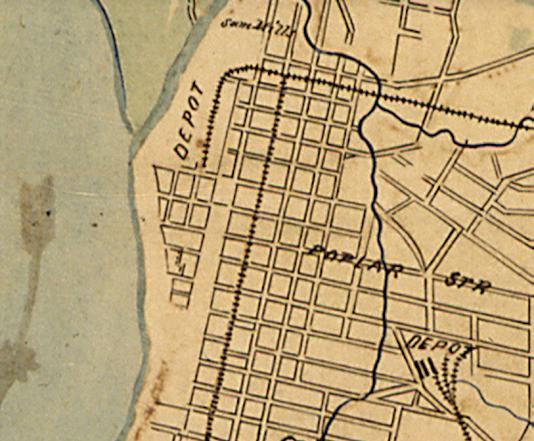
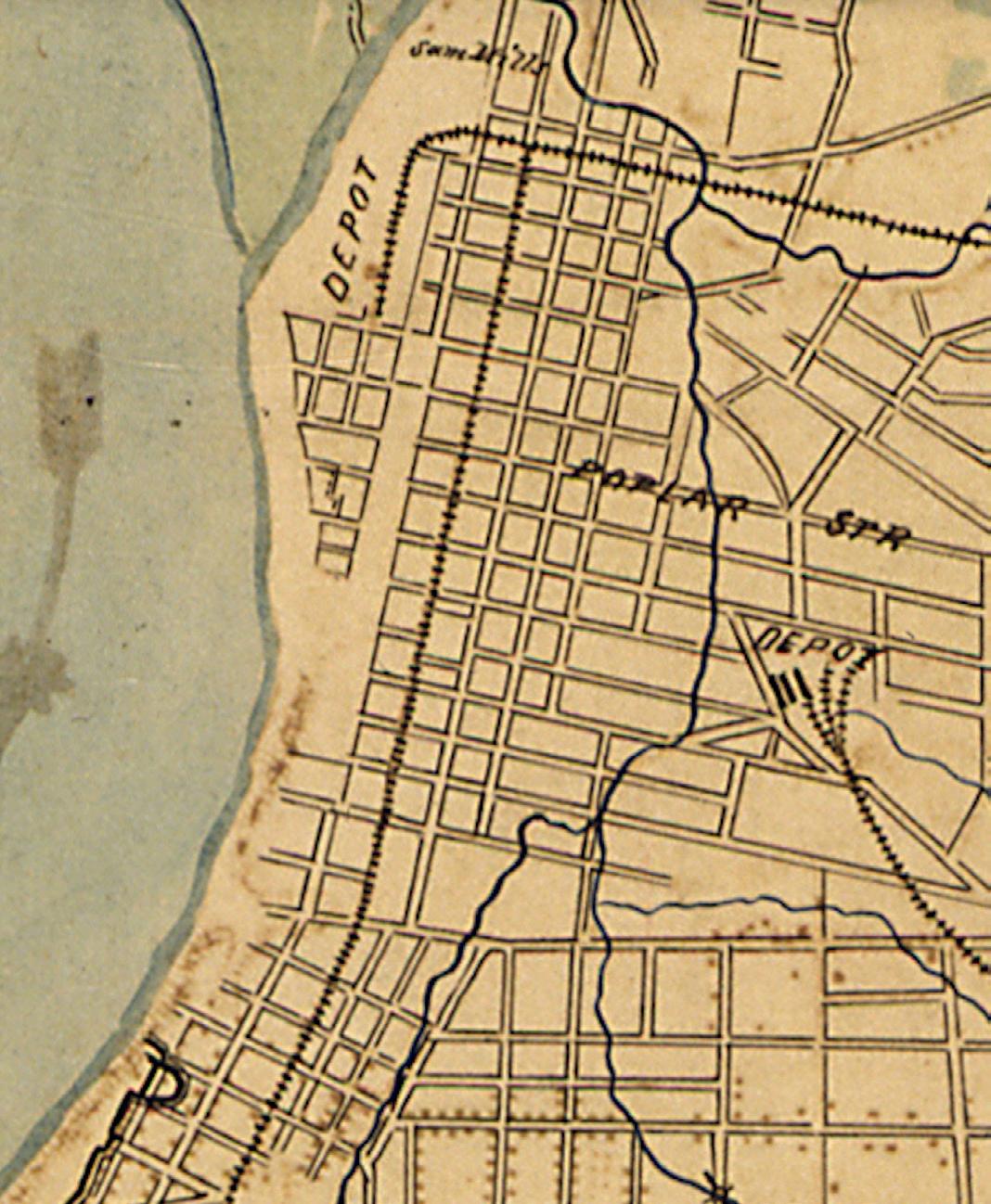
TOP: Inset of Topographical Map of Memphis, c.1860, by order of Maj Gen W.T. Sherman
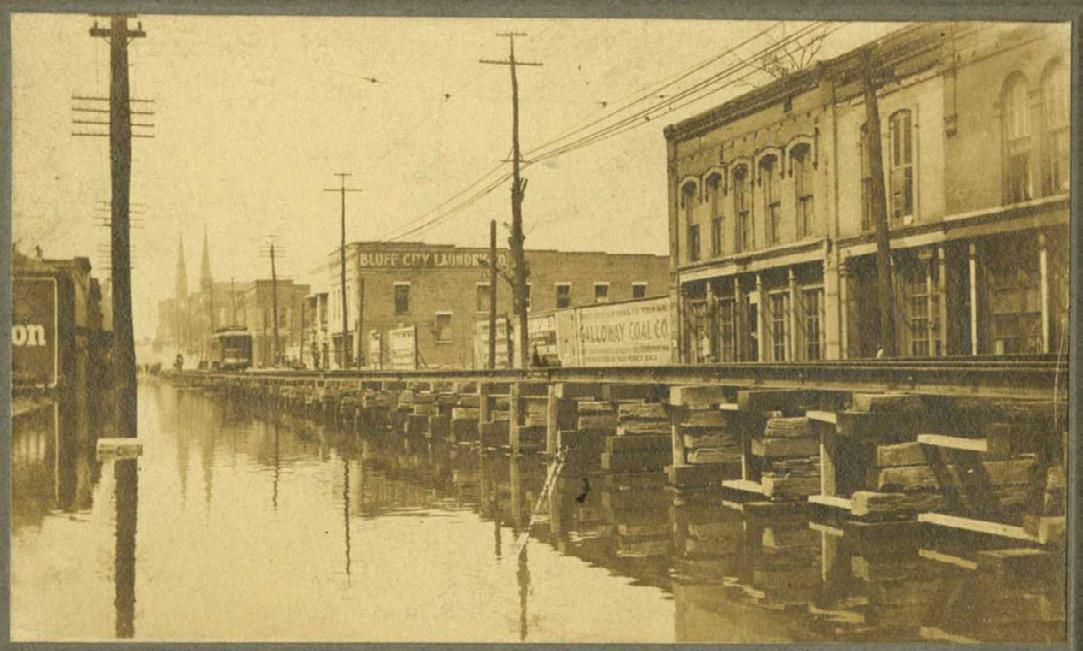
ABOVE: 1913: Looking west on Poplar showing the street railway elavated about 5 feet above the submerged rails. Water came clean over the tracks.
Photos these pages courtesy of Memphis and Shelby County Room, Memphis Public Libraries
SHORT FICTION
The Pointy End of Thought
Written by Nathan Scott Weinreich
Illustrations by Walsh Perrin
HENRY SIDDONS was a very important man with a very important job out of a very important building filled with very important people. What he did there was not relevant. What was relevant was that he did it on time, and that he did it well. Better than most, he liked to think, but not as well as others, which he’d happily admit with more than a hint of strained humility in his tenor-toned, nasally voice –by far his biggest disadvantage when it came to his work. His was a career that revolved heavily around dialogue, mainly the detailed discussion of his company’s holistic approach to the strategic integration of opportunities for synergy and growth as foretold by the computational output of their mechanized internal databases, and, while Henry was a skilled conversationalist, the grating sound of his voice prompted a sense of urgency towards the point that quickly forced him to master the art of concise, direct communication. He did this by simply hitting his clients smack-dab between the eyes with the right answer.
Henry’s life was one of monotony. The days were filled with much of the same and very few surprises. That was the way he liked it. Surprises invariably came with unexpected results or, worse, unnecessary expenditure of thought, and Henry’s job allowed no room for the unexpected or the unnecessary. Today, Henry was to expect very little, save for an offsite meeting with another very important man who, doubtless, occupied a class altogether higher than Henry’s own – a fact which had no bearing on Henry, as he aspired unwaveringly to that very class himself. When the time came to depart for this very important meeting, he bid his very important superiors a wordless wave (goodbye an easily omitted pleasantry) and imagined their cheery approval at his prompt punctuality, the what-a-diligent-worker’s and the how-very-important-our-Henry-is’s they were doubtlessly exchanging, and Henry felt quite pleased with himself.
His meeting was scheduled, unfortunately, many blocks from the safety of his very important office, at a coffee shop the name of which, for legal reasons, I cannot tell you (but which, doubtless, you already know – not that most common establishment, but the other, more forgivable one). Henry thought he might walk the distance on foot so as to allow himself time to collect his thoughts. He had nearly an hour before his client was to arrive, and this way was likely to involve much less talking on his part, which would save him the trouble of having to hear his own grating voice before it was absolutely necessary.
The natural beauty of his journey escaped Henry, as he was the type to keep his eyes down while he walked so as to avoid the occasional dip in the sidewalk or, worse, the abandoned excrement of some inconsiderate golden retriever. Henry was no more sorry for his failure to recognize natural beauty than he was for its existence in the first place. To him, trees were trees, birds were birds, and passersby were nuisances. Instead, he thought only of his tactics for the meeting; he would arrive first, of course, to afford himself the advantage of selecting a seat. He would, of course, order his coffee before his client had arrived so as to consume a perfectly calculated sip as they traipsed in – late, no doubt – a display of power that had the dual effect of establishing his dominance and forcing the client
into the awkward position of having to order their own drink while Henry tapped his watch in faux exasperation. And, of course, he would speak as little as humanly possible throughout their meeting, saving his breath for only those most important words needed to communicate only that most important core facet of his script.
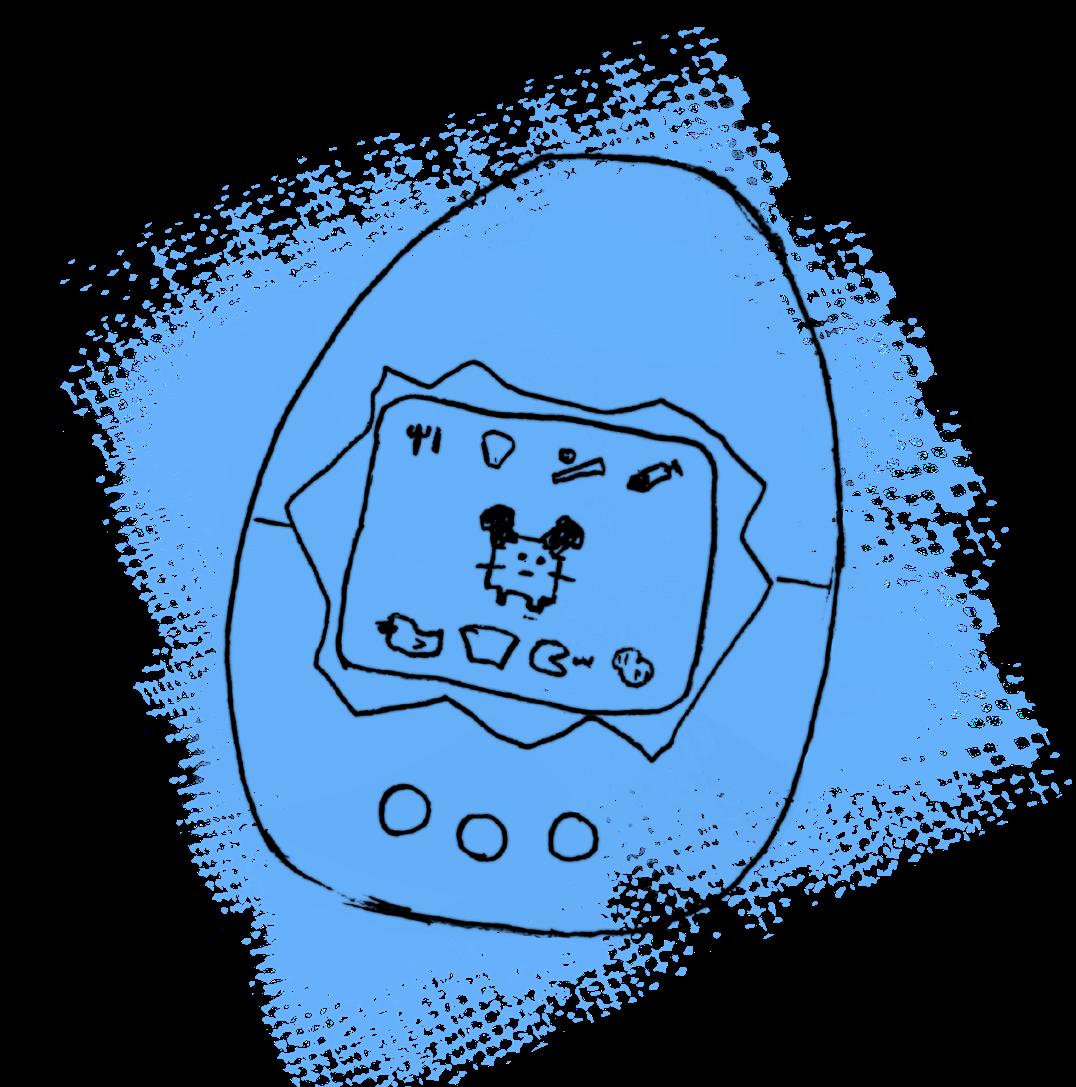
The cafe was bustling as he stepped inside, a fact which at first he lamented before the thought overtook him, full of strained positivity, that the droning din might cut some of that regrettable register of his own voice. Henry scanned the crowd with seething apprehension, taking note of the few inconveniently perceptible patrons that stood out amongst the crowd: a pink-haired teen with a garish, 90’s-style patchwork coat, likely of the queer persuasion, he expected, obnoxiously popping bubblegum at a window seat and fawning over some blue, egg-shaped device whose only response consisted of a series of ear-splitting 8-bit beeps; a soft, wrinkled man of at least seventy, lounging in a large armchair – the size and placement of which, Henry lamented, would have been perfect for his own purposes, had the aging weasel not managed to snag it first – mouth brimming with what could only be described as a forcefully potent, albeit enviably calculated, slurp of coffee; a gaggle of mothers with blouses shoddily slipped half-down, their suckling, parasitic infants latched on with any traces of concern for civilized society’s dining conventions abandoned, their mouths, thankfully, too stuffed full to make noise beyond the occasional unnerving schluck. Far from the perfect environment for Henry’s design, but that came with the unfortunate reality of offsite meetings.
He had taken not two steps towards a surreptitiously selectable table when a voice – delicious and dulcet, much to Henry’s chagrin – called out:
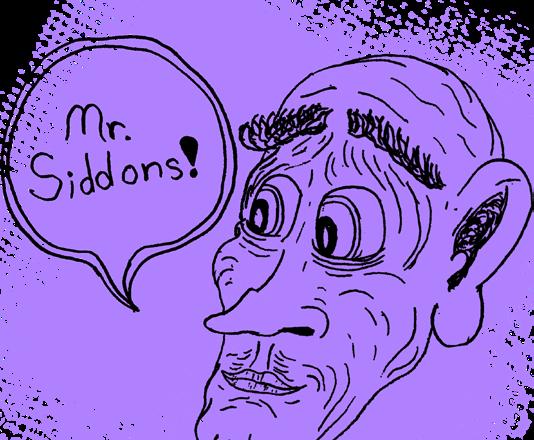
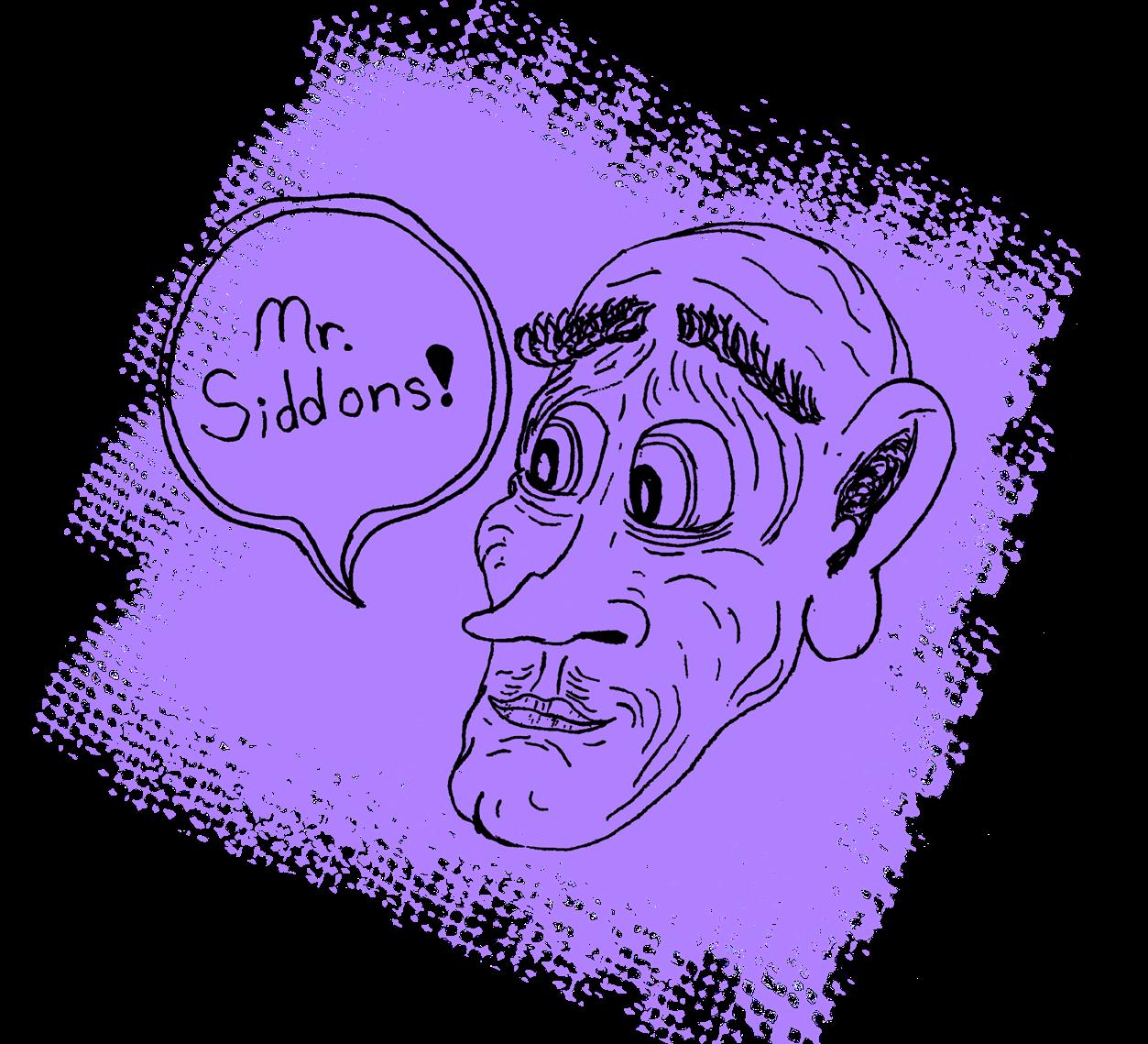
“Mr. Siddons!”
Henry, anchored on the ball of one irate foot (the right one, being the more irate of the two), swiveled slowly towards the unmistakable
source: the soft man in the large armchair, deviously nursing a cappuccino – that most respectable of coffees – in his grey, wrinkled hands.
Henry mulled over his present circumstance with childlike optimism. Perhaps this was some old friend of his mother’s, long forgotten to him in the decades since their introduction? Or perhaps he was an admirer of Henry’s reputable class (not terribly surprising, given the man’s penchant towards that enviable seat and that perfect sip). Or possibly, though perhaps woefully unlikely, this was all just an unfortunate case of mistaken identity in which the mis-took party coincidentally shared a surname identical to Henry himself.
After what, to Henry, seemed like mere seconds but which was, in reality, more like three-and-a-half minutes of prolonged, terrorstricken silence, the man spoke again.
“Well, Mr. Siddons, I appreciate a man who moves about through life with such focused intent, but I do have my limits! You must be parched, your mouth hung open like that for so long. Why don’t you go order a nice hot drink for yourself, and we can begin when you’ve got yourself situated.”
Henry’s fears, three-quarters confirmed, squirmed and distended inside his gut like a crumpled, discarded napkin introduced to an ill-intentioned strawful of water. Finally, to remove all doubt: “Begin what, sir?”
“Begin our meeting, of course! You are Mr. Henry Siddons, aren’t you?” Henry mustered a barely perceptible nod. “Wonderful! William Walker, pleased to meet you.” Without standing, the man stretched out one of those wrinkled hands. An invitation to shake it, which Henry resentfully accepted.
“You’re early,” Henry squeaked, checking his watch, “nearly twenty-five minutes...”
“Better twenty-five minutes early than thirty late,” he said with a smile, “don’t you agree, Mr. Siddons?”
“... Surely.”
“Wonderful, then we’re in complete and total agreement! What a wonderful foot to start on. Go and get your coffee Mr. Siddons. When you return we’ll be that much closer to on-time, if that makes you feel any better.”
Henry sleepwalked to the counter, wondering where his life went wrong and how he might manage to salvage some semblance of his perfectly penned plans for this already unfortunate meeting. He was, after all, Henry Siddons: that most important of men, with that most important of jobs, out of that most important of buildings, filled with those most important of people. If anyone could turn this around, it was him, right? He had fought and bested proverbial lions, summited allegorical mountains, forded hypothetical seas of the most violent and vengeful of natures, and always, invariably, without exception, he had come out on top, all without ever leaving the comfort of his own office. Perhaps that was the problem? The offsite meeting, wherein he had no control, wherein anything, even of the most random and undecipherable pretense, could fall upon him.
It was during this silent, internal, desperate pleading, back-and forth between his own unmatched confidence and insurmountable doubts at once building him down and tearing him up, that a very rude and impatient man in line behind him pointedly cleared his throat: the universal language for get on with it – perhaps, in this case, with an added expletive thrown in for good measure. The clarity of its translated intent, Henry had to admit, impressed him, given how nonverbally it had been delivered.
Extricating himself first from his unrelenting self-pity, then from his admiration for this enviably unspeaking-yet-perfectly-intelligible man, Henry found himself, without so much as a clue how or when he had arrived there, suddenly in front of the register, behind which stood a lone, confused barista in maligned solitude, eyes darting left and right as if in search of some lost detail. He wondered how long he had been standing there wordlessly, and made a mental note to strangle any future instances of these prolonged, unnoticed silences that had seemingly become a habit since he walked in.
“Cappu–” then, thinking better of mimicry, “coffee, please. Just… coffee.”
“One cuppa just coffee, comin’ right up,” she responded, patting her apron down quizzically, once again searching for something – no doubt Henry’s sanity, or else his sheer, unbridled nerve.
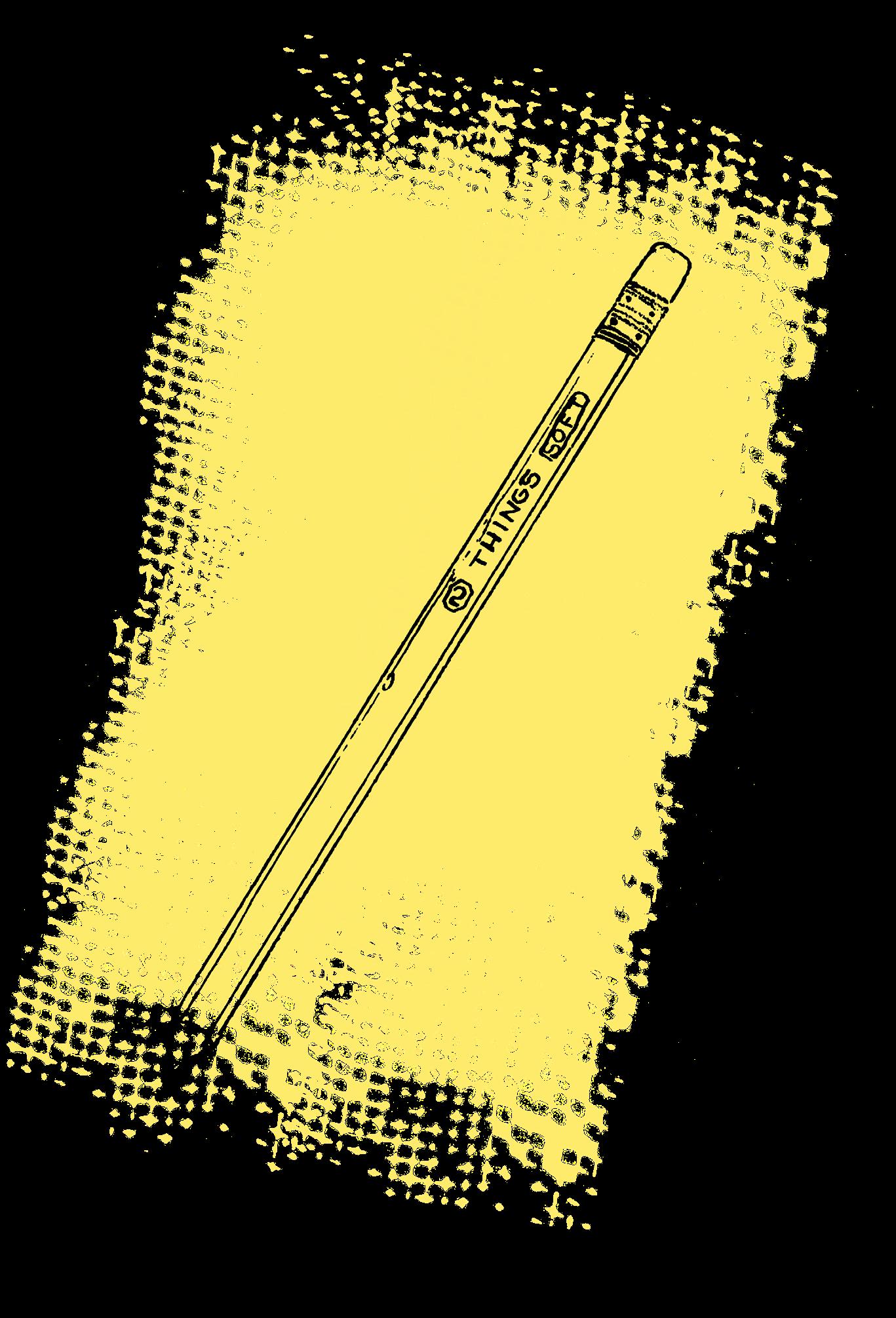
Coffee in hand and a rejuvenated – if not forced – confidence in his step (the left one, being the more confident of the two), Henry returned to William Walker poised and ready for discussion. Henry found him staring in childlike wonder at a small block of cedar, painted yellow with cheap, flaking paint, carved to a point at its precipice and terminating in a pink-rubber round. A pencil, Henry suddenly recalled. He found himself quite puzzled by the scopophilic septuagenarian sitting before him. Henry noticed the man’s displaced attention and took it as an opportunity to even the playing field with a similarly uninterrupted three-and-a-half minute silence initiated this time not by himself, but by his now unmistakable nemesis – as well as an invitation to take his seat. To his disappointment, no sooner did cheek meet upholstery than the old man broke his deceptively short silence.
“What is this, Mr. Siddons?”
Henry wasn’t sure he understood the question. “I’m not sure I
understand the question,” he said, rather redundantly.
“I mean, what is this?”
“A pencil, Mr. Walker–”
“–William–”
“–Isn’t it?” Unsure even of himself now.
“Surely, but what I mean is what is it? What is the significance of the pencil? Why would they choose to place it here? They wouldn’t just throw pencils around left and right without any purpose or reason behind it, would they?”
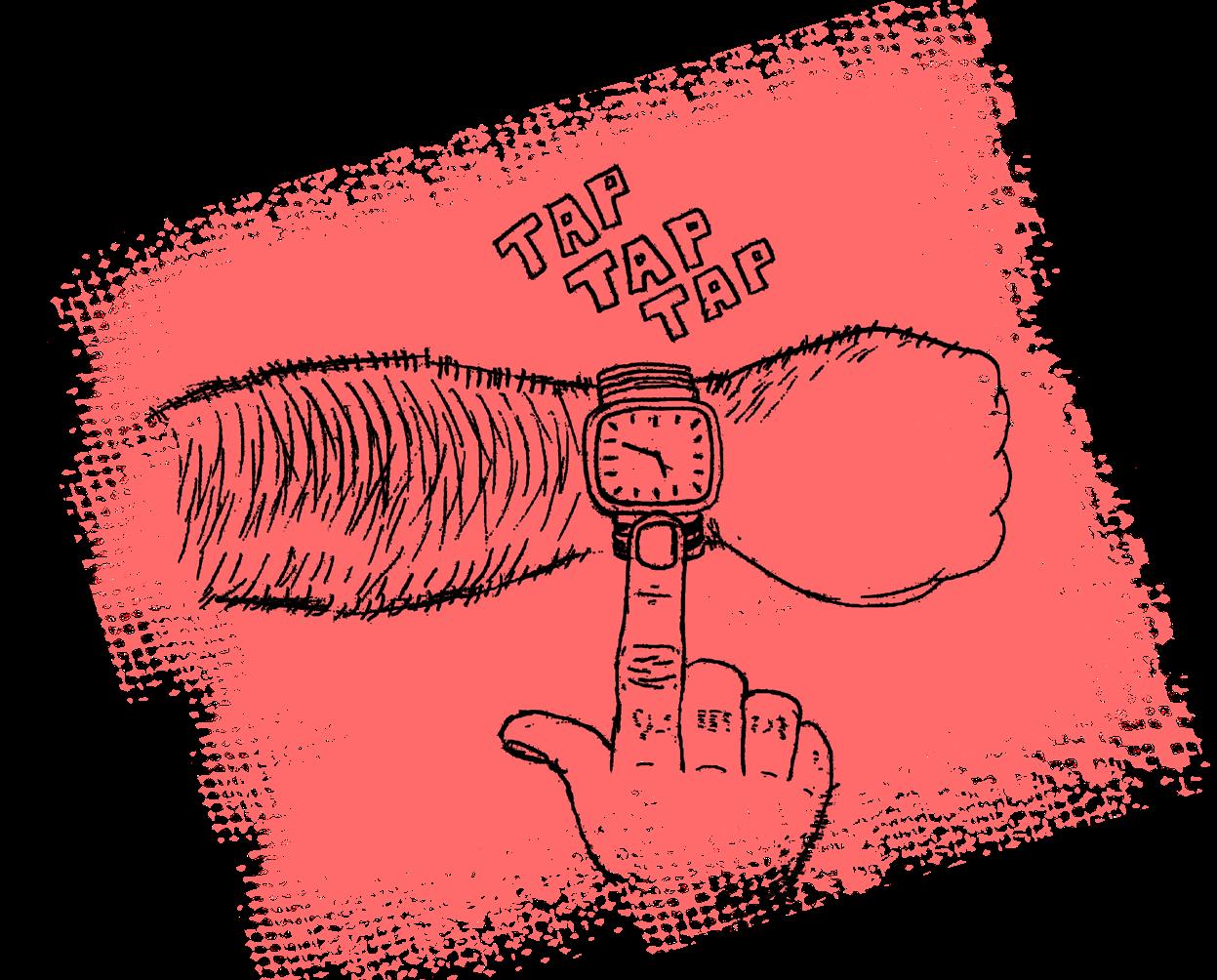
Henry checked his watch, which Mr. Walke – William – deftly interpreted as an inquisition into the time remaining before their meeting was scheduled to begin.
“We still have a few minutes to spare, surely you have time to muse with an old man?”
Muse? What was “muse?” This was a most unprofessional conversational detour, especially for one who hated such unnecessary words as muse.
“I’m not… quite–” quite? What the hell was that doing there? “–sure what you mean, Mr. Walker.”
“William, Mr. Siddons. And to be honest, I’m not quite–” why the emphasis on that word? Some kind of spiteful, mocking joke? “–sure what I mean either, Mr. Siddons. But that’s half the fun, isn’t it?”
“... Yes, surely,” Henry not wanting to waste words on a topic that perplexed him so, let alone one that he cared so little to speak about, and, moreso, hoping that his quick acquiescence would allow them to move on from this unsavory topic.
“Perhaps it’s indicative of man’s desire to create, contrasted by his desire to consume,” William holding up his cappuccino, that most respectable coffee of coffees, “or perhaps it’s here to externalize the scorn of some irksome character here in this very room – yellow portends scorn, isn’t that right? Or, and this is my personal favorite, maybe its thin, wooden composition symbolizes the stiff, brittle, ohso-delicate worldview of some unfortunate soul who refuses, who altogether rejects the sport of intellectual indulgences, who relies on figures and procedure and computational output to interpret life rather than artistic expression or conversations intentionally metempsychotic in their flow. What do you think, Mr. Siddons?”
Think? What is “think?” Who, in this era of unrelenting information, has time to “think?”
The silence that William allowed to follow, a clear invitation to respond, was lost on Henry. He couldn’t help but hear the 8-bit jeering of that young probable-lesbian’s blue egg, couldn’t help but catch a glimpse of a mother’s unmentionables as she shifted her parasitic blight – that potential future “thinker” – from one side to the other, and he felt as if his once-orderly world were suddenly caving in around him.
“I… think,” he finally ventured after a regrettable three-and-a-half minute silence, “that it’s just a pencil, Mr. Walk– er, William.”
“A thing can be two things, Mr. Siddons,” an innocent smile that still, despite the undeniable shackles of the world, knew no boundaries, spreading across his face, “I’m simply trying to get to the bottom of the second one.”
A thing can be two things? What could that possibly mean, of course a thing can only be a thing! Henry opened his mouth, as if to respond, but promptly closed it again. His stunned inability to speak wasn’t what bothered him so much as his peculiar desire – despite the detestable sound of his voice, his past penchant for eliminating the unnecessary, and the unshakable fervor of his very approach to life – to do just that. And yet, after years of practiced silence, no words came to him.
He sought solace in his watch, which gracefully informed him
that they were now officially on-time to begin their meeting. And with that, Henry set out to do what he did best: to excise the extra, to omit the unnecessary, to purge the prison of pleasantries and hit this man smack-dab between the eyes with the right answer.
Some forty-five minutes later – the perfectly planned timeframe Henry had designated for their outing, but which, to him, felt both infinitely shorter and relentlessly longer – William left the cafe in high spirits, filled with joy and wonder and an ever-evolving sequence of thoughts that would doubtlessly occupy his mind for hours, if not days or weeks or even months to come.
Henry left the cafe a speck, slugging through a loathsome existence, surely sure above all else that he had lost the Walker account and dreading how to tell those very important men with those very important jobs out of that very important building filled with very important people – people whose class Henry hoped he might one day, in spite of his perpetual flaws, aspire towards – of his failure.
Back inside the cafe, that same lone barista that had served Henry, now dutifully clearing his and William’s half-empty mugs and wiping down their already-spotless table, snatched the little yellow pencil with unmitigated resolution – that thing that had caused Henry so much pain, had brought William so much happiness. A smile of recognition spread across her face, displacing her confused, inquisitive look, and she returned her missing friend to her apron to become whole once again.
SUBMITTING CONTENT
Scan this code to submit content or letters to the editors FOR CONSIDERATION. Storytellers may submit works of short or feature-length nonfiction, short fiction, book reviews, poetry, photography, artwork, etc.
Word Limits:
Letters to the Editor - limit 175 words
Book Reviews - 350 words
Short Fiction or Historical Nonfiction* - 750 words (1 page), 1500 words (2 pages), 2500 words (3 to 4 pages)
Historical Nonfiction* Features - up to 3000 words
*Historical pieces will be evaluated for accuracy, narrative structure, and context; facts should be properly cited from credible sources. Writers should follow the notes and bibliography system referenced in The Chicago Manual of Style.
Ever find yourself stuck when you’re trying to write? Or, maybe, you don’t even know how to start? Then please join us for “The Writer’s Block,” a writing club geared towards gathering writers together and getting words down on the page. Visit with writers from all genres and discover new ways to write. We meet at Panera Bread in the Laurelwood Shopping Center every Wednesday from 6pm to 8pm. All you need to bring is some paper and a pencil or your laptop and we’ll get you writing!
The Writer’s Block, from Connect Crew Every Wednesday evening, 6:00pm–8:00pm Panera Bread, Laurelwood Shopping Center 4530 Poplar Ave Suite 101 Memphis, TN 38117
Book Reviews from MPL Staff, just in time for summer reading
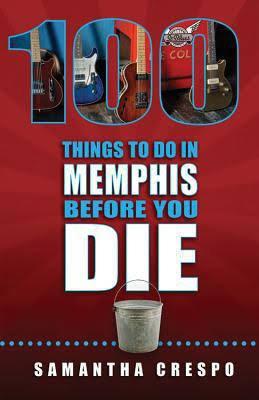
100 Things to Do in Memphis Before You Die, by
Samantha Crespo
Reviewed by
Marilyn Umfress, Central Library
Do you want to explore Memphis any time of the year but can’t find a place to start? Let 100 Things to Do in Memphis Before You Die, by Samantha Crespo, be your guide. Suggested places are organized by arts, music, restaurants, and sports. In addition to present-day Memphis, Samantha Crespo leads explorers on a seventeen-stop tour of Memphis past. This tour is good for any Memphian or visitor wanting to delve into the city’s history, giving readers a complete view of Memphis, not just downtown. If an explorer needs a jumpstart, they can browse the suggested itinerary list. The book also includes listings of free activities and seasonal ones. This is a wonderful resource for anyone looking to explore Memphis!
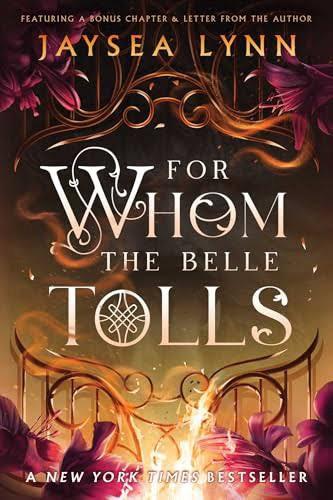
For Whom the Belle Tolls, by Jaysea Lynn
Reviewed by Caitlin Prilliman, Orange
Mound Library
The main character of this book dies. The end. Except it’s just the beginning. For Whom the Belle Tolls is a romantasy book with very little romance and where the fantasy is just an exploration of what life looks like from the other side. It is the story of Lily, a woman who dies of cancer and wakes up in the afterlife, or her version of it. Lily gets her paradise, but her nature leads her to start a Help Desk at the entrance of Hell, sheperding the demons and souls to where they belong.
While the setup is fantastical, and of course there is a romantic element—her love interest is Beleth, one of the four princes of Hell—it has so much heart that it defies its genre conventions. Lily explores her faith, her grief, and the realization of what life and death truly mean to a human. Reading along, it’s hard not to recognize yourself in her.
This book made me weep. It made me think. It made me want to truly embrace the life I am living and the one I want to live. It made me recommend it to everyone I know, even if romantasy isn’t their usual genre.
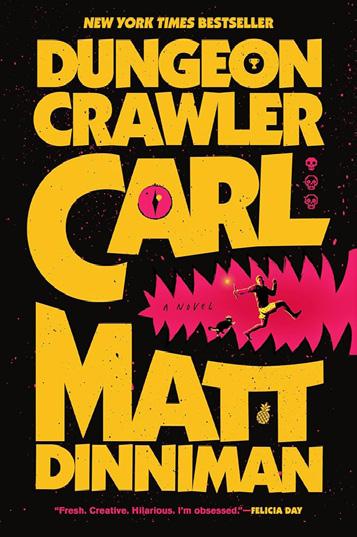
Dungeon Crawler Carl, by Matt Dinniman
Reviewed by Hollye Ferguson, Central Library
The library can’t keep this book on the shelves, so I had to see what all the fuss was about. I am so glad that I did. It was a fun read, and I can see why everyone is singing its praises.
Carl is watching his girlfriend’s show cat, Princess Donut, while she is out of town. When Princess Donut suddenly bolts outside, Carl follows in only boxers and his girlfriend’s pink crocs when suddenly all the buildings around them collapse. Aliens have taken over and those who have survived have minutes to find entrances into the dungeons the aliens have created to fight all forms of aliens to survive—like being in your own video game. Oh, and it will be televised all over the galaxy for everyone to watch. Carl and Princess Donut have to defeat the levels, gain viewership, and get some cool ass loot along the way.
I laughed so much while reading this book. Princess Donut achieves human intelligence, and her and Carl’s relationship is so funny. My only regret is not reading it sooner. I can’t wait to read the next books in the series.
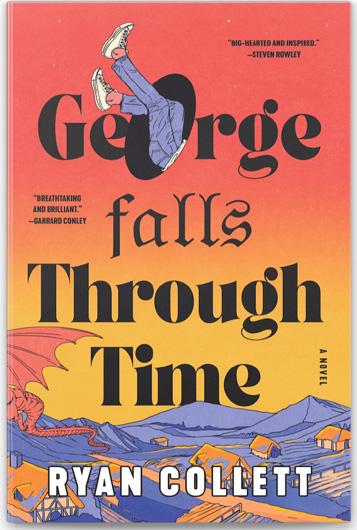
George Falls Through Time,
by
Ryan Collett
Reviewed by
Marty Synk, Cordova Library
In George Falls Through Time, our main character, George, well... falls through time. In 2026, George finds himself beset with modern troubles - a failed relationship, being laid off from his job, and getting lost in the middle of a park in Greenwich with two of the dogs he walks having run off. Amid panic, he tumbles through time and lands in 1300. From there, he is beset by un-modern troubles; howeverunlike many other literary time-travelers - he does not look to find his way back to the future.
What I found interesting in the beginning of the book - before he’d even time traveled - was how visceral the panic in the narrative is. I could feel the oppressive nature of modern society and its concerns pressing in. The rebirth that George experiences in 1300 is interesting - horrific, terrible, and yet somehow freeing. I can tell that the depiction of the period is well-researched. The plot is confounding - it begins to feel like a fever dream, but then it slides back into a simple narrative, only to turn once again into a fever dream. I appreciate that the logistics of time travel in this universe are never completely discovered - it allows the focus to remain on existential questions that theme the book. Overall, I would recommend this to readers with an interest in philosophy, or history, or time travel. Tone-wise, it reads more seriously than Jodi Taylor’s Chronicles of Saint Mary’s, but less serious than Kaliane Bradley’s The Ministry of Time. While it is a love story, I would not consider this a romance.
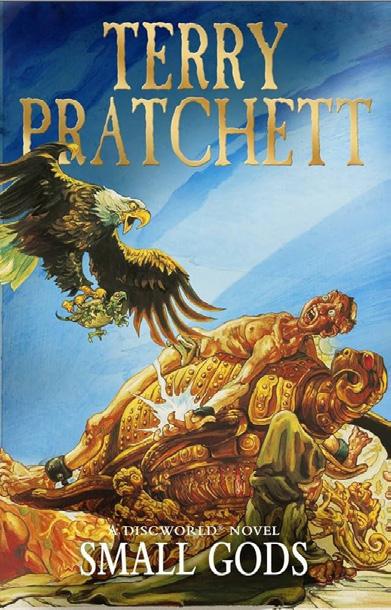
Small Gods,
Reviewed by
by
Terry Pratchett
Erik Warberg, Central Library
Almost every book I’ve read that tries to examine the interplay between faith and religion has turned out to be annoyingly preachy, unsettlingly vitriolic, painfully dull, or some unholy trinity of all three. Terry Pratchett’s Small Gods is the book that gave that sentence the “almost”. This novel tells the story of Om, a great and powerful god with a nationwide church who has, for some reason, been stuck as a tortoise for the past three years and cannot communicate with any of his followers save one: Brutha, a novice so low even the novices look down on him. Together, they must work together to figure out why Om has lost his powers, why only Brutha can hear him, and what plans the terrifying Chief Exquisitor Vorbis has for a nation of zealots in a time of war. It is a ponderous meditation on faith, human nature, and the capacity for banal evil in every man, all while managing the precarious balancing act of going down as smoothly as wine and being uproariously funny as well. To top it all off, it slides in at just over 350 pages, so it’s an easy read, unlike many fantasy novels.
On Freedom, by Timothy Snyder
Reviewed by Mark Riddle, South Library
What is Freedom? In his latest book, author, professor and political commentator Timothy Snyder offers his definition of positive freedom and the five forms it takes.
The book begins with the bicentennial (or more accurately, the author’s remembrance of that time) and uses Snyder’s growth to adulthood and maturity as a frame to introduce the five forms of freedom: sovereignty, unpredictability, mobility, factuality and solidarity. Each form is explored in its own chapter, complete with philosophical quotes, arguments and often examples from the Russian invasion of Ukraine.
The book focuses on the differences between what Snyder describes as positive freedom and the more jingoistic negative freedom, or to put it another way ‘Freedom to ____,’ versus ‘Freedom from_______.” He writes, “Freedom is not an absence but a presence, a life in which we choose multiple commitments and realize combinations of them in the world.”
Snyder’s positive freedom requires individuals to act, rather than the alternative negative freedom of simply declaring freedom at the end of a conflict or celebrating it through symbology or a song.
A Traveller’s History of Ireland, by Peter Neville
Reviewed by
Marilyn Umfress, Central Library
For the curious reader of Irish history – or visitor to the island itself – A Traveller’s History of Ireland by Peter Neville is an in-depth, great read that provides concise historical background. The book invites readers to journey through Irish history and explore the Irish fight for independence from the United Kingdom. For over seven hundred years after the British Invasion, the Irish carried on a strong struggle for independence through politics and rebellion. In 1922 they gained their independence from the United Kingdom and by 1948 they had codified their government as the legally recognized Republic of Ireland. This independence resulted in the founding of Northern Ireland, a constituent country of the United Kingdom. Northern Ireland was formed from the Irish counties of Antrim, Down, Armagh, Londonderry, Tyrone, and Fermanagh. In A Traveller’s History of Ireland, Neville gives us a clear picture of how these two separate countries formed on the same island and the role of the Catholic and Protestant Irish Church in the formation of Northern Ireland.
“We say that a symbol stands for something but all too often a symbol merely stands in for something. The American flag is supposed to stand for freedom, but it can easily stand in for freedom. In singing the anthem we treat values as permanent or as if they were enacted by song. But praise is not practice”
This is a historical work, written in 2022 and 2023, focusing heavily on the Russian invasion of Ukraine and touching on other far-reaching events such as the Capitol attack on January 6, 2021. Part of the ‘fun’ of reading history is finding parallels and differences between then and now - what makes this book unique is that the ‘history’ is just three years old, with many of the same main characters and situations that can be re-examined through the lens of current events.
It is not a light read, despite the reminiscences of childhood or clever uses of bells, rings and other homonyms. At one point Snyder comments about the length of time it would take to get so far into the book by reading one vignette per day - which would be my personal suggestion: read a piece, reflect, read on. (Also remember that you can renew MPL library books twice if no one else has it on hold, so this is very possible). No matter your political leanings, this is a book that will give you viewpoints to ponder, new quotes and philosophers to investigate, and some ideas to use in discussion with others - or even just with yourself.
Reviewed
by Thomas Pinchon
by
Nathan Scott Weinreich, Memphis Library Foundation
Counterculture, family trauma, and a touch of defenestration come together to form one bonkers journey of self-discovery in Thomas Pynchon’s Vineland, which served as inspiration for recent Best Picture Academy Award Winner One Battle After Another. Don’t look for too many similarities between the source material and Paul Thomas Anderson’s latest opus, however; while there are traces of plot that carry over to the film, to read Vineland is to experience something wholly unique unto itself.
Following the exploits of Zoyd Wheeler and his daughter, Prairie, as they navigate the turmoil of Reagan’s 1980s while searching for Prairie’s long-lost mother and hiding from a monomaniacal DEA agent, Vineland deals more in a search for purpose and the passing down of generational trauma than it does in One Battle After Another’s paranoid cat-and-mouse chase. Through his trademark style – a juxtaposition zipping between haughty, didactic diction and hilariously haphazard antics (ninjas, aliens, and LSD-fueled anarchists are not off the table here) –Pynchon takes us on Prairie’s journey through her family’s past, and how her parents’ time as revolutionary hippies fighting against autocracy was warped so intensely by government interference that it ended up leaving her nothing but a father with more than one screw loose and a world still run by those same autocrats.
Expect the unexpected in Vineland. It contains a world not unlike ours, but one that bends the line of reality so plainspokenly that it feels like a subtle slap to the face. Pynchon returns to his classic motif of conflating humans and the inanimate (e.g., the automata of V., the bombing patterns of Gravity’s Rainbow), this time with the Thanatoids - ghostly beings, at once metaphors for people whom the good fight has chewed up and spat out as fresh nihilists, and literal human souls trapped between life and death that spend their days glued to the Television. Perhaps all that’s changed since Pynchon’s 80s is that we’ve exchanged TV for cell phones.
In this way, and so many more, Vineland exists as a novel so explicitly reflective of its own moment that it has become timeless. Don’t expect an ending tied up in a neat bow, however; if Vineland seeks to answer the question of how the hell we got here, even Thomas Pynchon would be hard-pressed to give adequate closure. But maybe Vineland isn’t about finding all the answers –maybe it’s about fidning the journey.
Perfume: The Story of a Murderer by Patrick Süskind Reviewed by Tajuana Fulton, Randolph Library
98% of the time, I prefer romance and fantasy. The other 2% is always unexpected. Take for example Perfume: The Story of a Murderer. The story follows Jean-Baptiste Grenouille, a man with no scent of his own but whose sense of smell is otherworldly. Born in 18th century Parisian slums, he is passed around until he finds himself apprenticed to a perfumer. Thus begins his descent into obsession and murder in his attempt to create the perfect scent. True crime and murder are, for better or worse, common fascinations. This story blends them with the fantastic, a vague sense of magical realism described with the dispassionate observance of documentary narration. Its matter-of-fact tone contrasts with an inexplicable humor. Whether that humor is intentional, a result of translation, or my own perception is unclear, but it adds absurdity to the macabre. The story is disturbing and vivid and hard to look away from.
Magic and history, love and obsession, genius and madness. A dark and revolting tale in which to examine those themes. Grenouille’s disgust for humanity and his fixation on preserving it enthralls the reader, and you are pulled into an obsession that mirrors his own to consume more, to know more about his fate. This might be the only non-romance/romantasy book I read all year. But it gripped me from beginning to end, and I regret nothing.
Have a Book Review in You?
SUBMITTING CONTENT
Scan this code to submit content or letters to the editors FOR CONSIDERATION. Storytellers may submit works of short or feature-length nonfiction, short fiction, book reviews, poetry, photography, artwork, etc.
Word Limits:
Letters to the Editor - limit 175 words
Book Reviews - 350 words
Short Fiction or Historical Nonfiction* - 750 words (1 page), 1500 words (2 pages), 2500 words (3 to 4 pages)
Historical Nonfiction* Features - up to 3000 words
*Historical pieces will be evaluated for accuracy, narrative structure, and context; facts should be properly cited from credible sources. Writers should follow the notes and bibliography system referenced in The Chicago Manual of Style.
NovelSpeak: A Different Kind of Book Club
Where: Cordova Library, Room B
When: 1st Thursday, every other month, 1:00PM
Upcoming Dates: Thursday, August 6 Thursday, October 1
NovelSpeak is already 11 years strong! We meet every other month on the 1st Thursday of the month at 1:00. We are not a traditional book club where everyone is reading the same title. We encourage everyone to read something different. The rules of NovelSpeak are easy. Read 1 to 2 books of whatever caught your interest, and be prepared to discuss the books with other participants. That’s it. Hope to see you there!
Vineland,
More Gray Man, with Mark Greaney
By Stephen Usery
MARK GREANEY is likely the most commercially successful Memphis novelist working today. His thrillers hit the New York Times best-seller lists every year, and the first in his The Gray Man series was adapted into a Netflix film starring Ryan Gosling and Chris Evans, and directed by action movie superstar duo The Russo Brothers. For many years, he coauthored Jack Ryan novels with legendary thriller writer Tom Clancy and even continued that series for several years following Clancy’s passing. He has authored several other novels outside of The Gray Man series, like Armored and Red Metal.
But back in 2009, Mark came to the WYPL studios with his debut thriller, The Gray Man, and has been back at least once a year to discuss the exploits of his former CIA operator turned assassin with a moral code, Court Gentry. The series follows Gentry’s hot and cold relationship with U.S. secret operations and a handful of other operatives who try their best to do the right thing while at the mercy of political expediency and others’ personal ambitions.
Mark recently stopped by to record another episode of Book Talk in order to discuss the 15th entry into the Gray Man Series, The Hard Line, which has Gentry dealing with another assassin who has a very personal reason for seeking vengeance against him. What follows is an edited excerpt (for clarity and brevity) from our early 2026 interview. The full interview can be accessed using the QR code at the end of this interview.
Stephen Usery: Mark, at the beginning of The Hard Line, we have a man who is in a bit of a state, and we don’t know who he is. Why did you decide to kind of tease us at the beginning and not let us know who it is that we’re looking at?
Mark Greaney: Anytime someone asks me why I did something with this book, my first honest answer is “Because it’s my fifteenth book, and I’m always trying to find ways to do things that are different and interesting!” So, I wanted to open this book up in the point of view of essentially an antagonist to the hero, Court Gentry. This character that you open up in the point of view of is named Charlie Coyle. He’s a Northern Irishman working as a
bodyguard, and he’s taken a job, sort of the only job that he can get. He just started his new job, and he’s working for a Bulgarian mobster, and he’s disappointed that his job wasn’t what he had hoped it would be. But he’d had some problems with alcohol and had been fired from several other jobs, so he’s literally at the bottom rung of the bodyguard strata. The book opens up with Charlie Coyle realizing that he’s working
for some goons. And then very, very quickly, he realizes that these goons are in trouble and that he’s one of them.
SU: And it’s really cool to see from the point of view of a henchman.
MG: Yeah, exactly. He is a henchman; he’s not a big part of the action, but it’s big to him. So, it’s his life, and he realizes that this man is coming towards his protectee, and he has every desire in the world to just let his protectee suffer his fate. But he prides himself on doing his job, so he doesn’t turn around and run, even though the guy that he’s protecting is not really worth much protecting.
SU: Over the course of the series, and of course, other thriller series and action movies that we see, it puts a human face on the henchman, because Court has killed dozens, if not hundreds of hired guns over the years. And finally, we get to see that, you know, there are real world consequences to what happens when all this is going on.
MG: Yeah, in my initial pitch to my editor, Tom Colgan, even before pitching this book years ago, I had told him that I
BOOK TALK
always thought it would be interesting to have there be ramifications for some little thing that Court does - [though of course it wouldn’t] be little to that person. But the way I talked to my editor about it, I said, “What if the hero is running across a bridge to go rescue someone and there’s a guy in his way, and he just knocks the guy off the bridge and keeps going. And a few books later, I write a book about that guy who fell, and, you know, he has a family and he has people that care about him. And what if they have some agency? What if they have a way to come back at the Gray Man afterwards?” So, that was my initial idea. That’s not at all how it plays out in the story, but the idea of this nameless, faceless henchman not being nameless and faceless in the book is really what spurred on my initial idea.
SU: That connection of family and things that have happened in the past that still have reverberations throughout people’s lives is a big theme for many characters in this book.
MG: Yes, and it grew into that. I mean, in one case in this book, there’s actually sort of four generations whose fates are intertwined. This young man at the beginning of the book, and his son, who is an infant, and his father and his grandfather, they’re all very relevant to this story. And then Court’s father is involved in this story. And another major character’s daughter is involved in the story. And, you know, it’s a standalone novel. You don’t have to have read any of the other Gray Man books. But if you had, you would see how some things came together that might have been mentioned or hinted at in earlier books. That’s one of the beauties of writing such a long series. There are some really tough aspects of writing a long series and then there’s some fun parts. And one of the fun parts is that the little things that you’ve teased in the past, you get to realize. And it’s not just the reader that gets to learn about them, it’s the writer who gets to learn about them, too, by going back and digging in and trying to figure out what’s the best way to bring these characters to life.
The Hard Line
By Mark Greaney Berkley
BEYOND THE STACKS
Learning in the Kitchen
By Celia Matthews
THE “KIDS CAN! COOKING CLUB” program debuted at Hollywood Library on what felt like one of last summer’s hottest days — which I only partly blame for the sweat that formed at my temples while leading the class. I attribute the rest of the blame to the fact that it was my first time leading a program that I created. I was familiar with working with children in similar settings, which meant that I was also familiar with how hard it is to engage them for extended periods of time. One has to balance the perfect amount of bewilderment, excitement, and amusement with the mission of making sure their minds are being expanded — a tightrope act as fun as any!
So why choose cooking as a learning vessel?
These cooking classes have many goals. It is just as much about providing a different approach to teaching children important academic skills as it is about showing them how to function in the kitchen. The best part, however, is that the children don’t realize they are applying skills they already have while learning new ones. Cooking is one of those activities that offers endless opportunities for growth. Following a recipe helps with reading comprehension. Children also work on their math skills through understanding serving portions and unit conversions. Some of the more intangible skills they learn are patience, collaboration, and communication.
One of my favorite sessions of the cooking program was the Fried Food lesson where we explored food science and culture. The menu consisted of handmade pierogies. It was a wonderful blend of culture and science. We learned a little about Poland and the origins of pierogies, as well as the science of making and frying dough. While I did not fully expect the children to remember every fact about Poland or the specifics of the Maillard reaction, I do know that the information fed their minds in ways they did not expect.
Another example of how I used cooking classes to expand learning is the Cake Pop session we did in early August. The children made cake pops and put them into the freezer to harden. While we waited, the class took a quiz on learning styles.
To bring the entire lesson together, we discussed how the children could apply their own learning style towards following the recipe. Some participants discovered that they were visual learners, so following the recipe was easier when they watched someone demonstrate the steps. Others found that they were auditory learners, so they preferred having the steps of the
recipe read aloud. Some even learned that they had two or more learning styles, and that they could play to the strengths of a style at a given moment.
Afterwards, I assigned a letter of the alphabet to each learning style. The letter indicated the icing color that each child then used on their cake pops. For example, the letter R represented both auditory learning and the color red, so red icing was used by auditory learners to decorate their cake pops.
So much learning can be achieved through cooking, in more ways than one can imagine, and I have been giving this a lot of thought as I plan for another summer of lessons and recipes. It is hard to narrow down a focal point for the classes, as there are so many gaps in the children’s knowledge base. Teachers in the traditional school setting can only do so much, and this is where teamwork between the community, especially between libraries and families, comes into play.
A major takeaway from the program is that you should seize the opportunity to make learning fun and engaging; find ways to distract and fascinate the mind! If you are unsure about where to start, why not give the recipe below a try?.
Simple Pico De Gallo
Ingredients:
4 roma tomatoes
¼ red onion
½ cup chopped fresh cilantro
½ fresh lime
Salt to taste
Garlic powder to taste
Instructions:
On a vegetable-safe cutting board, dice tomatoes and red onion, then add them to a large bowl.
Next, chop cilantro (tip: hold the stems together to get evenly chopped pieces).
Add to the bowl with the tomatoes and onion, and stir all together.
Squeeze the one half of the lime into the bowl, add salt and garlic powder to taste, then stir until combined.
Enjoy!
PASSIONS
Amber Rae Dunn Bridges Life and Music
By Mark Parsell
AMBER RAE DUNN is a Country Music and Visual Artist from Northeastern Arkansas. It’s no coincidence that her songs reflect life in her hometown of West Memphis with a bit of a Memphis twist to them. Think classic country meets the blues. On a bridge overlooking the Mississippi River, connecting the two places she’s called home for most of her 37 years.
Amber suggested we do our interview on the “Old Bridge.” More specifically, on the Big River Crossing, that fourmile pedestrian walkway next to the train tracks that is now enjoyed by Memphians and tourists alike. It was used for carriage traffic in the early 1900’s and converted for use in 2016 by agreement between the Union Pacific Railroad, Memphis, and West Memphis.
I asked Amber about what she remembers about the early days along this route. “As a large family of seven kids, there weren’t a lot of things we could do that were very exciting and new that were also low budget. We would come over and ride the downtown trolleys for I think a dollar a day. The Trolleys were so nostalgic and old-school looking, and it really made you feel you were somewhere special.” Amber would later cross the bridge and attend Memphis College of Art. “I would come over the new bridge at Sunrise and then when I came back across I felt I was driving into a watercolor painting, with the sun and sky all different colors.”
Amber is Vice President of the Memphis Songwriters Association, Co-coordinator of the NSAI Memphis Chapter, and she plays a lot of local gigs too, primarily with the string band Mulberry Jam. “We have a new album coming out that was recorded with Ranger Records at Northwest Mississippi Community College. We went in to record three songs and next thing you know we have a 10song album in the works. The plan is to do a release party at A. Schwab on Beale Street.”
Amber chased the dream in Nashville briefly in 2014, but returned to Memphis upon the passing of her brother Ryan in a Motorcycle accident. This tragic event was the inspiration for the song “My Ryan” from her album That’s Life produced by Billy Smiley at Sound Kitchen in Franklin, TN. Our paths first crossed during an open mic she hosted at the iconic Memphis dive-bar, Earnestine & Hazel’s, in 2015. This led to her performing a set for a “Songwriters Night” at South Main Sounds, and for over ten years now, she’s been a collaborator on the series. “The first gig you booked me for,” she said, “was on Trolley Night, and I think I’m the only person to date who has done a full songwriter set singing a cappella.”
Dunn, who co-wrote her 2022 song “Barbershop” with Smiley, works alongside her father at Larry’s Hair Designs, a West Memphis institution for over 50 years. “I’m blessed that my day job is a family business, so I can come and go as I need to.”
Another part of her current journey involves the Memphis Public Libraries. “The library took a place in my heart when Jerry Williams asked me to guest-host the TV show, ‘Memphis Sounds With George Klein.’ George and Jerry were very good friends with Elvis, and it’s a huge legacy to uphold.” Beginning as a cohost with Memphis broadcasting legends Dave Brown and Leon Griffin, she has slowly become a mainstay of the program -- it airs on WYPL multiple times each month. She also co-hosts the library-produced radio program “The Memphis Connection” with Griffin, which airs on WYPL radio.
As a train barreled down the tracks behind us, I asked what’s next for Amber Rae Dunn: “I want to get on the road and tour, I’ve been wanting to do that for years.” In the meantime, she’ll be writing and playing her songs while supporting Songwriters in Memphis and surrounding areas, just like she has been for over a decade.
Amber Rae Dunn guest-hosts the TV show Memphis Sounds With George Klein, for WYPL. Memphis Sounds is about the people behind the music that defines this city. To watch a recent episode, scan the QR code.
The Memphis-Arkansas Bridge, aka the “Old Bridge.” Photo: Mark Fleischer
*More clues can be found throughout this issue.
The hospital where a king was pronounced dead, demolished in 2000
Used his wealth to help the city recover after yellow fever epidemics
Long ago, Lamar Avenue was named ___ Recordings here have their own special regality
Earnestine & ___, still haunts and entertains
Exploring Memphis Treasures*
Edited by Taryn Spake
Elegant, shaggy Shelby Farms residents
The foremost street of Cotton Row
Ghoulish late-night horror host in the ‘60s
What this hospital provides is truly saintly One was nicknamed this, another made his mark on Beale, the other led the civil rights movement Man-made, it’s a gem of a shrine in Memorial Park
A.____, oldest business in town
Though recently unseated, often voted the Best Burger by the Memphis Flyer
A historic, soulful studio of R&B
Held a term and a half as mayor, but held power for decades
This almost mythical prince was often on the ballot for mayor
The “M” Bridge is really named after this explorer
Some say this spicy fried chicken is the best in town
ACROSS (continued)
The avenue with everything, and many memories for many Memphians
It is said that Memphis is at the tip of the ___
A park, a retirement village, and a street with ties to Elvis
Historic downtown building, “The Queen of Memphis” (or of The South, depending on your sources), finally getting a facelift
Empty but revered Mid-South spot for music, sports, wrasslin’
A city founder, and a great city park
Colorful name of a former Station out East; namesake of a nearby street and high school
Leading Mid-South cinema chain
This motel, now a museum, holds a historic, important, vital legacy
Oldest diner in town, on an iconic corner
Donuts anyone? This is the place
Built for music and sport, only Pros go there now
Danny Thomas protested that it should be called a Street, not an Avenue
Another world-renowned children’s hospital, Le ___
Rock was born here, cut by Phillips
This fruit, along with peanut butter and bacon, is featured in the King’s favorite sandwich
The Farnsworth building was once nicknamed the Three ___
An oasis of a gallery & gardens in the middle of East Memphis
This auto district has a place for the Sun Union Ave once used these to regulate morning and evening commutes
DOWN
Generations of Memphians say this fried chicken is still their go-to
A leading Memphis company, and a ballpark too
On Lamar, many say this the best BBQ in town
Joe’s spacy sign lights up a Midtown corner
This river howls its way under highways and past byways
Eccentric, wry, and street-wise Memphis
Magazine history writer
Some just call it ‘The Mound’
Before G.E. Patterson, this street was named ____
Name of ursine creature, the Zoo’s first resident
Winds all through downtown, right under our streets
An alley, a bayou, a historic red-brick hotel
Entertainer who sainted the city to help sick children
His raw color photos are a canvas of the American South
This Memphis trade enriched many at great expense to generations
Many find no harmony on this busy thoroughfare
SUBMISSIONS
WANT A CREDIT? YOU TOO CAN CONTRIBUTE
SUBMITTING CONTENT
Scan this code to submit content or letters to the editors FOR CONSIDERATION. Storytellers may submit works of short or feature-length nonfiction, short fiction, book reviews, poetry, photography, artwork, etc.
Word Limits:
Letters to the Editor - limit 175 words
Book Reviews - 350 words
Short Fiction or Historical Nonfiction* - 750 words (1 page), 1500 words (2 pages), 2500 words (3 to 4 pages)
Historical Nonfiction* Features - up to 3000 words
*Historical pieces will be evaluated for accuracy, narrative structure, and context; facts should be properly cited from credible sources. Writers should follow the notes and bibliography system referenced in The Chicago Manual of Style.
VOL 2, ISSUE 1 CONTRIBUTORS
Local Hangouts and Book Pairings: Patricia Lockhart is an assistant principal and librarian for KIPP Memphis Public Schools and a freelance writer. She has served as a contributing writer for Edible Memphis and the Memphis Flyer According to her bio, she is “a native Memphian who loves to read, write, cook, and eat. By day, she’s a librarian and a writer, but by night—she’s asleep.”
The Mystery of the Map: Fletcher Markuson. Fletcher Markuson, according to several notes and business cards found in the Memphis Room of the Central Library, has made various claims as an explorer, archaeologist, archivist, traveller, adventurer, writer, ambassador, and a collector of Memphis artifacts. In his notes, he claims to have been a frequent guest of Vance Lauderdale at his mansion. However, it should be noted, no one in the Memphis Room - or in any other library branch - has admitted to ever actually seeing Fletcher Markuson. They only have his various notes and business cards as any evidence that he exists.
Some would like to rename Main this way Historic resting place of the most famous of Memphians
The world-famous hotel on Union holds daily ___ marches
Beautiful behemoth that was once Sears
In ongoing BBQ debates, many still prefer this porky place
1970s tower that gave East Memphis a downtown vibe
Ribs and spices at this downtown meeting place
Before the Cannon Center, this was downtown’s auditorium
His photographs - millions of themcaptured an era in Black & white Another Memphis moniker, “City of Good ____”
A County, and Forest and Farms too Indisputably, the Memphis hotel On Main, the ___ Shoppe that still dishes ‘em fresh & shelled
In its element, the only U.S. museum of its kind
This thin island is really a peninsula of builtup river sediment Memphis has been referred to as a metropolis on the American ___
Amber Rae Dunn Bridges Life and Music: Mark Parsell is a local event promotor and the owner and operator of South Main Sounds, an intimate live music venue on South Main, across the street from Central Station, just a few storefronts south of the iconic Arcade Restaurant. Through his efforts at South Main Sounds and other Mid-South venues, Mark specializes in promoting up and coming musicians and singer-songwriters, as well as established touring artists. Before starting South Main Sounds, he worked extensively in local news on WMC-TV, ABC24, and CW30.
BOOK TALK, with Stephen Usery. Stephen Usery is the Broadcast Services Manager for The Library Channel TV18 and FM 89.3 WYPL. He is the host and producer of Book Talk, a syndicated interview program that airs weekly on FM 89.3 WYPL and as a podcast, available for streaming on various platforms and via Podbean, https://wyplbooktalk.podbean. com/
The Crossword: Taryn Spake is a local semi-retired school librarian, substitute teacher, avid reader, and a bit of a cruciverbalist in her puzzle-solving and editing skills.
MPL UNBOUND Youth
ENROLL NOW! IT’SJULY,BUT THERE’SSTILLTIME!
Youth
EVENTS: ON THE THINGS YOU CAN DO! Dungeons & Dragons are coming to Cordova, Summer Challenges, and more!
YOUTH FEATURES
901 ROBOTICS
The Memphis MECHWarriors recently completed the Arkansas Regional Competition held at Harding University from March 18-21. Check out all the highlights!
CLOUD CREATIVES
Take a look at just some of what our CLOUD901 creative teens produced this past winter and spring, in: Crafts, Poetry, Visuals Arts, and More
UNEARTH A STORY! SUMMER READING
It’s not too late to take advantage of MPL’s Summer Reading Challenge. Details - and a double-page Bingo Reading card - are on pages 10 and 11.
The Eye of the Dino This summer, the Memphis Public Libraries are partnering with The Collaborative Summer Library Program (CSLP), a nonprofit organization that helps public libraries spark a love of reading. Through shared resources and collaborative committees, CSLP makes it easier and more affordable for libraries to host high-quality summer reading programs that enrich their communities. As part of this partnership, CSLP works with partner libraries to develop themes, and in turn develops and provides a variety of materials, images, media and promotional kits, and encourages libraries to employ these materials in support of the programs, as well as to promote the programs across multiple platforms. With graciousness and enthusiasm, CSLP gave MPL UNBOUND permission to incorporate this striking image of the eye of a dinosaur into our Youth cover design.
CLOUD901 TEEN LEARNING LAB
All year, Cloud901 Teen Learning Lab has been celebrating its first 10 years. Here are just a few highlights of all that our 901 teens have created over the years, and a snapshot of what you can do in Cloud901.
Robotics labs over the years. Scan below for more on CLOUD901:
WATCH HERE
WATCH HERE
2018: MAKING MOVIES In June 2018, CLOUD901 partnered with the City of Memphis MPLOY Youth Program and gave teens the opportunity to create a series of original short films. Most had never used professional video equipment or editing software. See what their experience was all about!
WATCH HERE
2017: ENGINE, a teen experimental film directed by CLOUD901 summer intern Nubia Yasin
2024: Cloud Talk - the Podcast: Teens at CLOUD901 weigh in on their favorite schools around town!
ABOVE: Article that appeared in the Commercial Appeal in June 2016.
MPL YOUTH PROGRAM HIGHLIGHTS*
JUL thru AUG 2026
JUL 20 MON
*SCAN FOR ALL MPL EVENTS
UNEARTH A STORY AT ORANGE MOUND ORANGE MOUND LIBRARY MEETING ROOM B (OM)
Monday, July 13, 2026 10:30am–11:30am Ages: Tweens (Age 8-12)
REOCCURRING THRU END OF JULY:
Come join us every Monday for a fun Summer Program at Orange Mound. -July 20 -July 27
AUG 01 SAT
BACK TO SCHOOL BASH! OFFICER GEOFFREY REDD LIBRARY
MEETING ROOM (OGR)
Saturday, August 1, 2026 2:30pm–4:00pm Ages: Children (Age 6-8)
Summer is coming to an end so let’s end it right. Join us at the Officer Geoffrey Redd Library as we attempt to build solar ovens and use the power of the sun to bake a summer classic: S’mores!
All materials provided.
FALL PREVIEW FANTASY FAIRE
YOUTH EVENTS
INTRO TO PHOTOGRAPHY
CLOUD901
VIDEO PRODUCTION LAB
@CENTRAL
SCAN QR CODE TO REGISTER: AUG 03 MON
Monday, August 3, 2026 3:00pm–5:00pm Ages: Teens
REOCCURRING THRU AUG 31
Intro to Photography is perfect for any teen that has an interest in learning how to use a camera to take great pictures. Teens do not need to bring a camera as we provide all gear for the course. After the 90 minute course, teens will have an understanding of how to identify and apply basic lighting techniques, demonstrate an understanding of shot composition principles and the different photography shot types ultimately bringing all of those elements together to create amazing shot sequences! No matter your skill level, this course will help you become a better photography in no time!
REGISTRATION
REQUIRED.
OCT 24 SAT
It’s never too soon to look forward fall fantasy! Fantasy Faire is on the autumn horizon. It arrives on October 24, 2026, at the Cordova Library.
MPL Fantasy Faire Cordova Library Saturday, Oct. 24th 2026 12:00 PM – 4:30 PM
REGISTRATION REQUIRED. SCAN QR CODE TO REGISTER: AUG 12 WED
JOIN THE QUEST @ CORDOVA: DUNGEONS & DRAGONS
CORDOVA LIBRARY
TEEN INNOVATION CENTER Wednesday, August 12, 2026 4:00pm–6:00pm Ages: Teens
REOCCURRING THRU DEC 31
Hark, young heroes in training! We have issued a call for the bravest adventurers to reserve a seat at our table! Join us as we start our first campaign at our weekly teen Dungeons and Dragons club starting Wednesday August 12, 2026 from 4:00-6:00 pm. All experience levels welcomed. Space is limited, so please reserve your spot.
Snacks and dice will be provided.
DUNGEONS & DRAGONS! SEE ABOVE
YOUTH PROGRAMS
SCAN HERE FOR PROGRAM DETAILS
ORANGE MOUND MAKER SPACE
Children and Tweens will have the ability to utilize the incredible Maker Space we have at Orange Mound. STEM equipment includes a 3D printer, Bee-Bots, Makey Makey’s, Sphero Indi’s, Snap Circuits, and Sphero Bolt+’s. THRU JULY 31
SCAN HERE FOR PROGRAM DETAILS
MULTIPLE BRANCHES: SENSORY STORYTIME
is a welcoming, interactive environment designed for special sensory seeking children with autism or other sensory integration.. NUMEROUS DATES
SCAN HERE FOR PROGRAM DETAILS
OFFICER GEOFFREY REDD LIBRARY
Join as as we raid our supply closet and play chill background music for a relaxing 3 hour art session! We will have supplies for collages, zines, drawings, paintings and more!
Feel free to bring your own supplies and positive vibes.
It’s an artsy free-for-all. JULY 30 ONLY
Teens of Memphis!
Are you a creative between the ages of 13 and 18 with a passion for your city? Do you want to share your unique perspective and show everyone what’s great about Memphis? We’ve got the perfect project for you!
The Memphis Public Library is launching Heart of 901, a new media project designed to give you a platform to highlight the best of our city.
HERE’S WHAT YOU’LL BE DOING:
Sharing your story: You’ll create short videos, interviews, and other original content that showcases the people, places, and things you love about Memphis.
Getting featured: Your work will be featured on city outlets like YouTube, WYPL, and social media, so your voice can be heard!
Building your skills: You’ll gain hands-on experience in storytelling, videography, and video editing—all valuable skills that can boost your resume and portfolio.
If you’re ready to show off your city and build some awesome skills, start here! Scan the QR Code for more information.
SCAN HERE FOR ALL YOUTH PROGRAMS
SCAN HERE FOR THE FULL PROGRAM PAGE
By Taylor Jackson, Central Library
Rookie Memphis MechWarriors Compete and Impress in March Arkansas Regional
THE MEMPHIS MECHWARRIORS (FRC Team 4764) recently completed the Arkansas Regional Competition held at Harding University from March 18th-21st. This event brought together twenty-five teams from across the US and Mexico. Teams got a chance to break the ice with thrilling games of dodgeball and basketball, setting a friendly tone before competition.
The FIRST Robotics Competition is often described as “the hardest fun you’ll ever have.” From studying the 166-page game manual released in January and watching livestreams of other regional competitions in early March, the Arkansas Regional marked the culmination of months of preparation and fast-paced learning. By the time they arrived in the arena with their robot, affectionately named Gerald Einstein Robotnic, the MechWarriors had spent countless hours and late nights designing, building, and programming the entry.
REBUILT, the first game of the 2026 Robotics season, began with Red and Blue Alliances competing to score the most points before time ran out. The robots attempted to score points by competing autonomously for a short period of time, in which they are exclusively controlled by their pre-programmed instructions. After this period, the teens operated their robots manually, collecting game pieces (yellow foam balls called “fuel”) and scoring them into goals that counted the amount
of fuel in real time. In the last seconds of the game, the robots could score additional points by climbing a 3-rung tower.
The MechWarriors competed in twelve qualification matches, alternating between the Red and Blue Alliances. Despite early mechanical challenges, the rookie team adapted quickly by shifting to a defensive strategy that proved critical in the arena. Though not initially chosen for the playoff rounds, the MechWarriors were called in as a Blue Alliance alternate team and helped bring a major win by aggressively blocking the Red Alliance’s attempts to collect and score fuel. This opportunity came after Captain Kennedy Jefferson signed the MechWarriors as an alternate team and scheduled practice sessions to keep the team focused and prepared.
The Memphis MechWarriors concluded the Arkansas Regionals as finalists, earning medals and a trophy that are proudly on display at the CLOUD901 Teen Lab. As a rookie team, they not only earned finalist honors but also experienced firsthand the spirit of the FIRST Robotics Competition and being part of a global community of teens who compete fiercely and uplift one another.
Check out the full photo spread on the next page!
CLOUD CREATIVES
Flowers by Maya Phelix
Mom said I loved flowers admiring them
At a specific garden
At a specific pot
On a specific day that garden I loved, stayed Flowers changing disappearing withering away pots staying empty
Now on that day I think about flowers And I imagine asking you “What kind do you prefer?” But I can’t ask
So I guess every year
Teen Sewing in Makerspace
Teen Made Purse in Makerspace
How to Participate:
Sign up! Visit your neighborhood library and don’t forget to pick up your registration prize, thru June.
Read, complete activities, and log your progress either online or on paper. All types of reading counts! Books, audiobooks, being read
to, etc.
Bingo! Read 800 minutes and complete four activities (one from each list) – then visit your library for a limited-edition prize, while supplies last.
The last day to turn in your completed log and pick up your limited-edition prize is July 31!
Scan this QR code for all the details and materials
Activites are listed on the library website using the QR code at the upper-right of this page, where you can also track your reading progress.